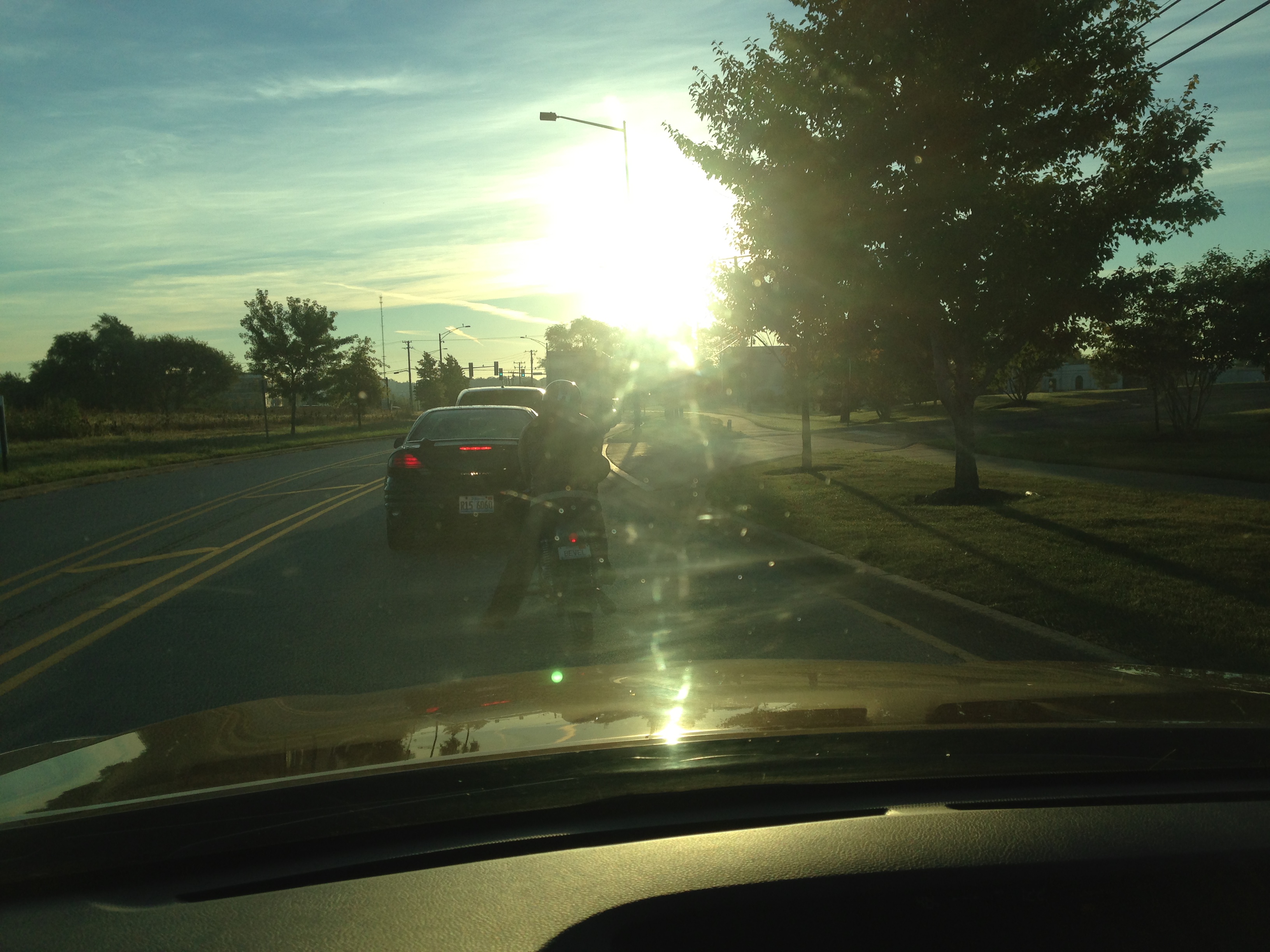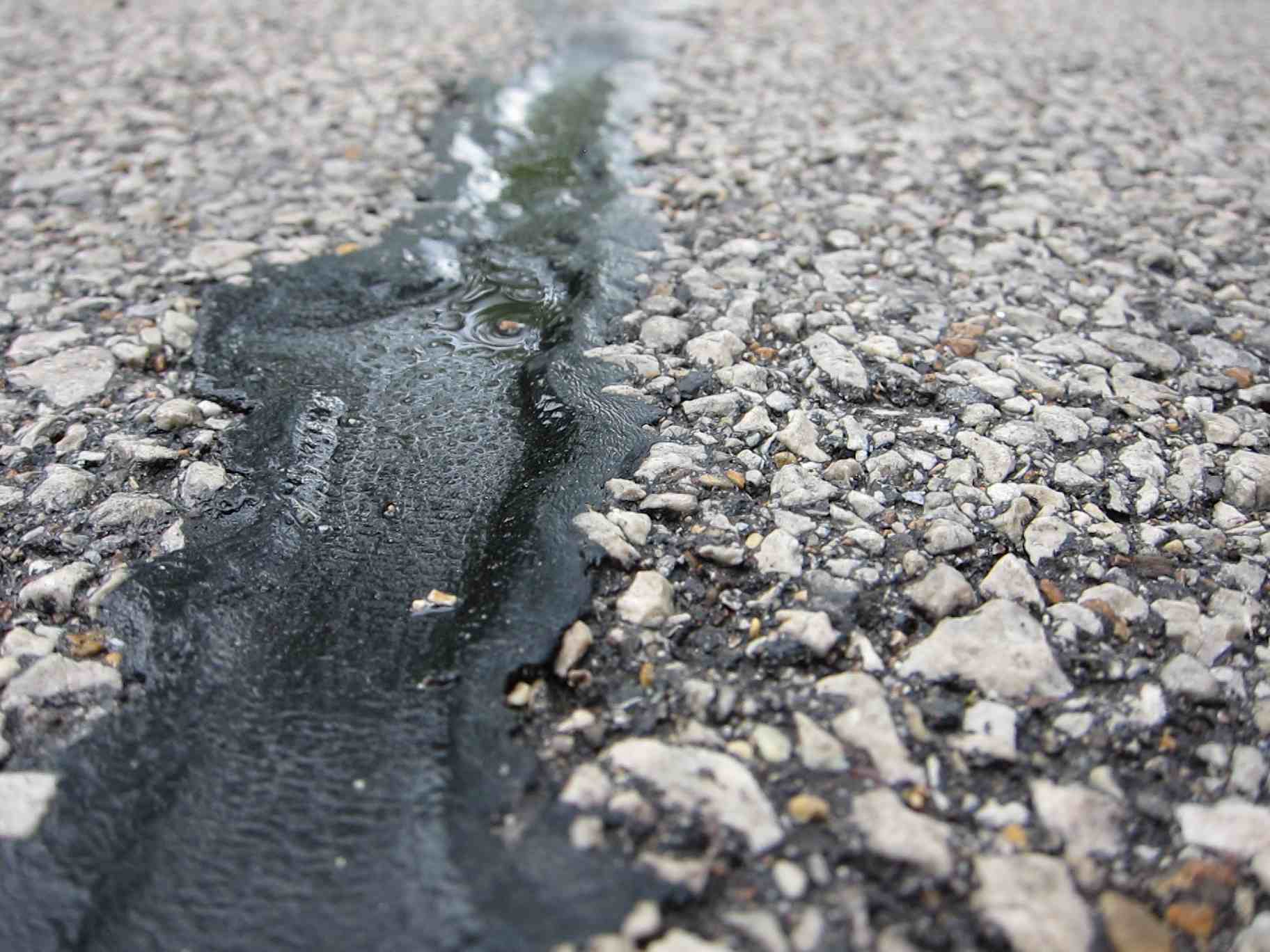
Nothing better than running and riding on a two-track trail

By Christopher Cudworth

With all the ways to get lost in this world you probably aren’t looking for one more suggestion on how to escape the confines of GPS and your commuter route. But here goes.

You need to find a two-track.  Go get partly lost in good way.

If you don’t know what a two-track is, now is the time you learn.

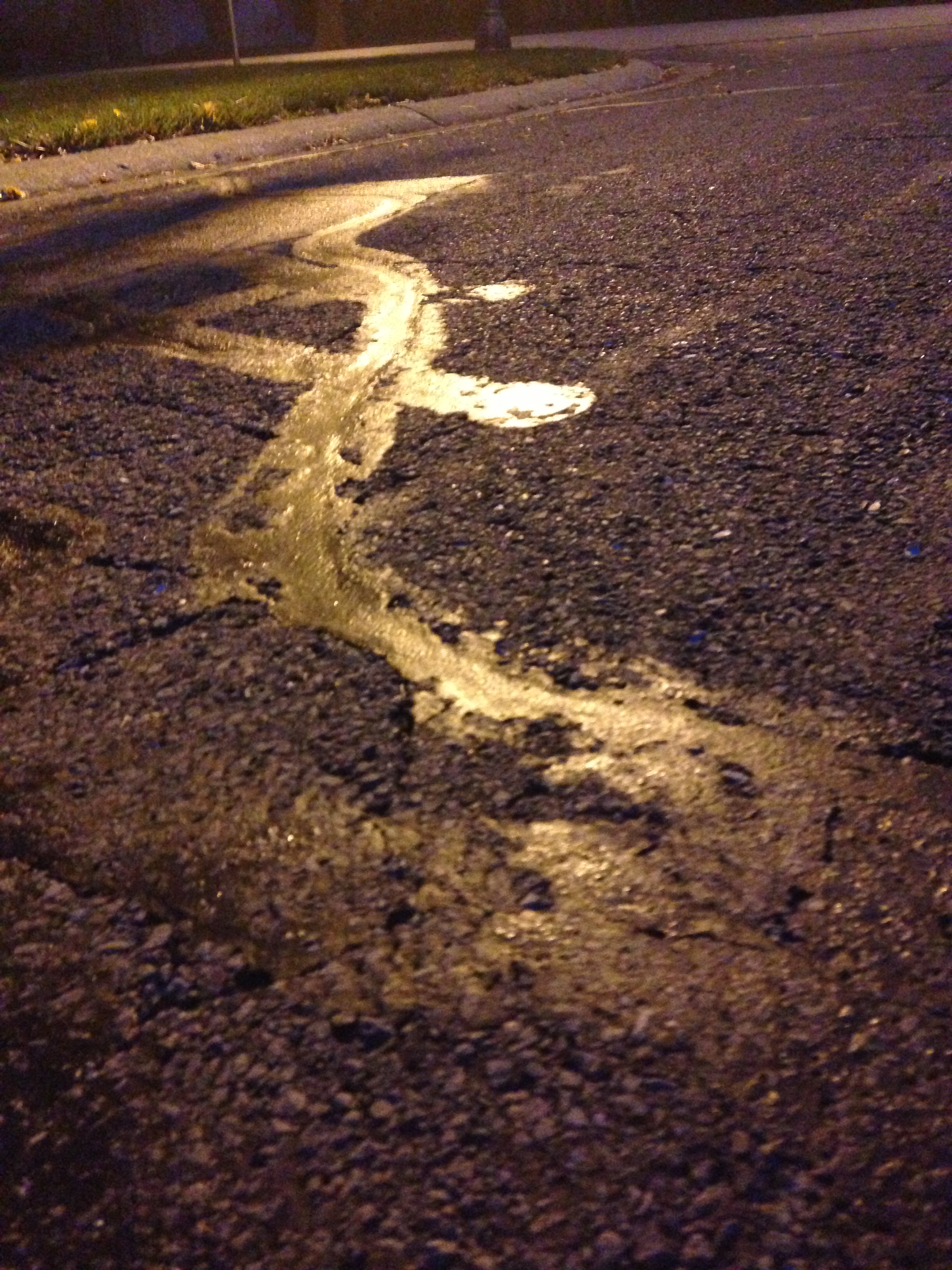
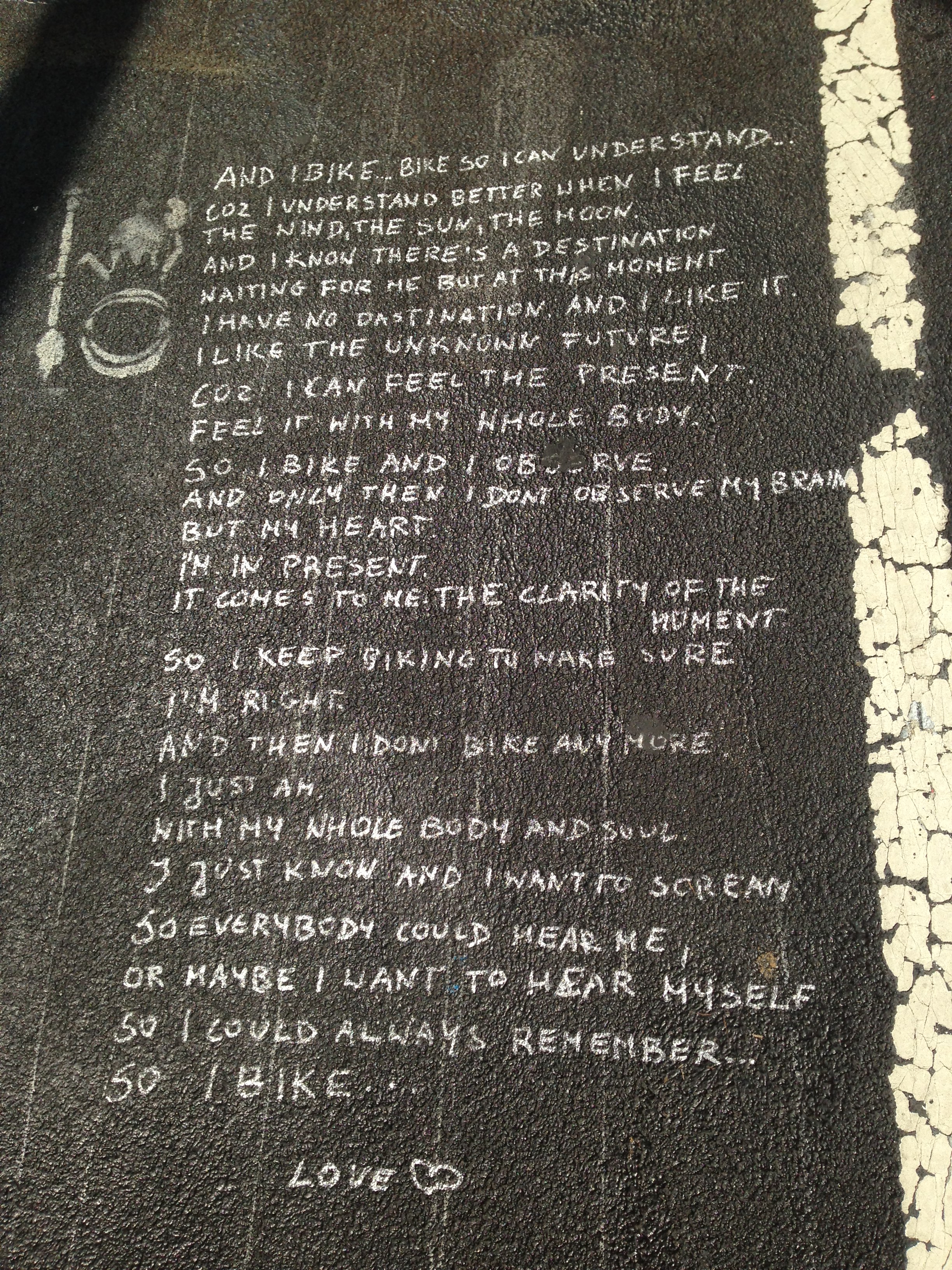
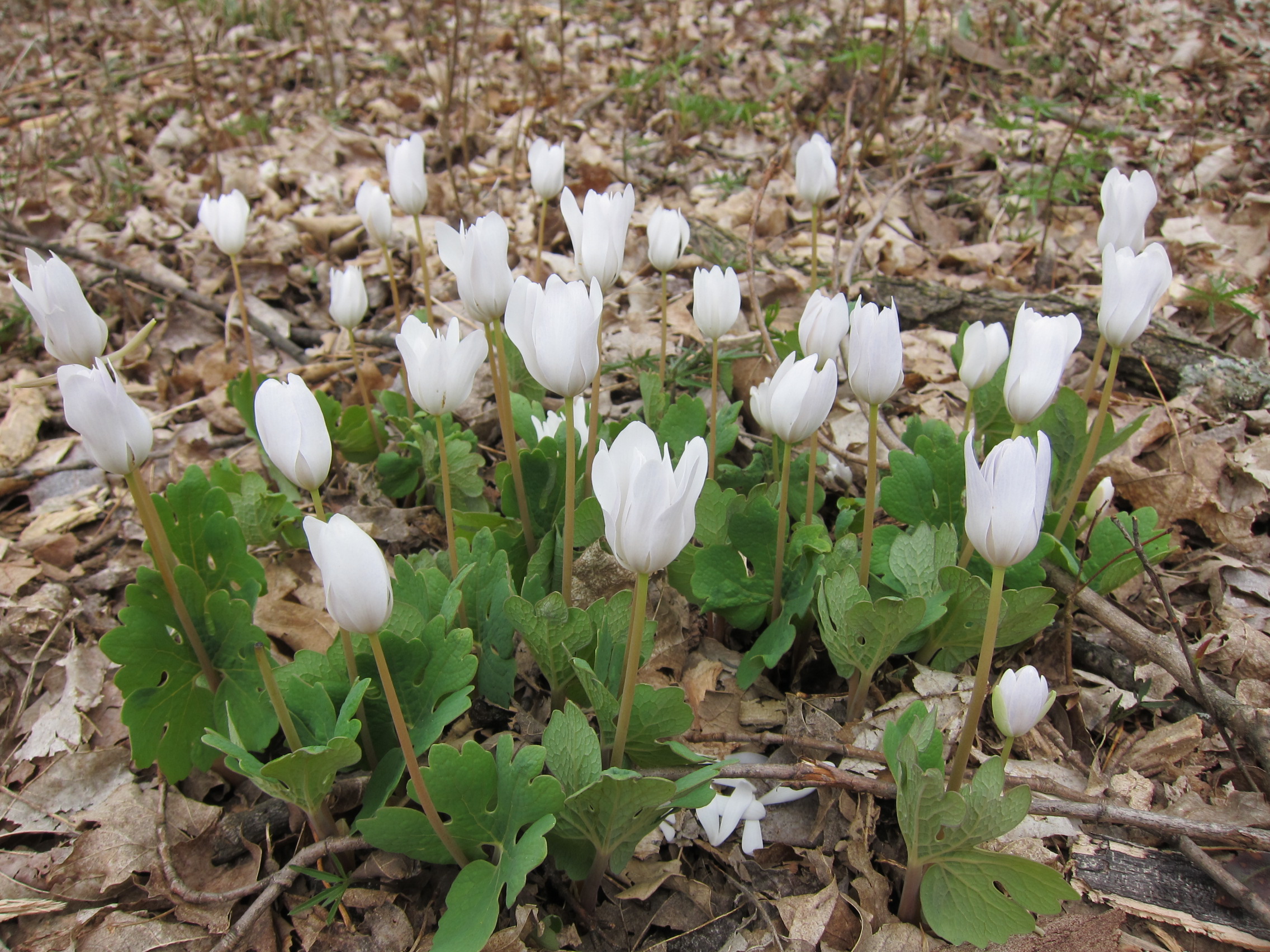
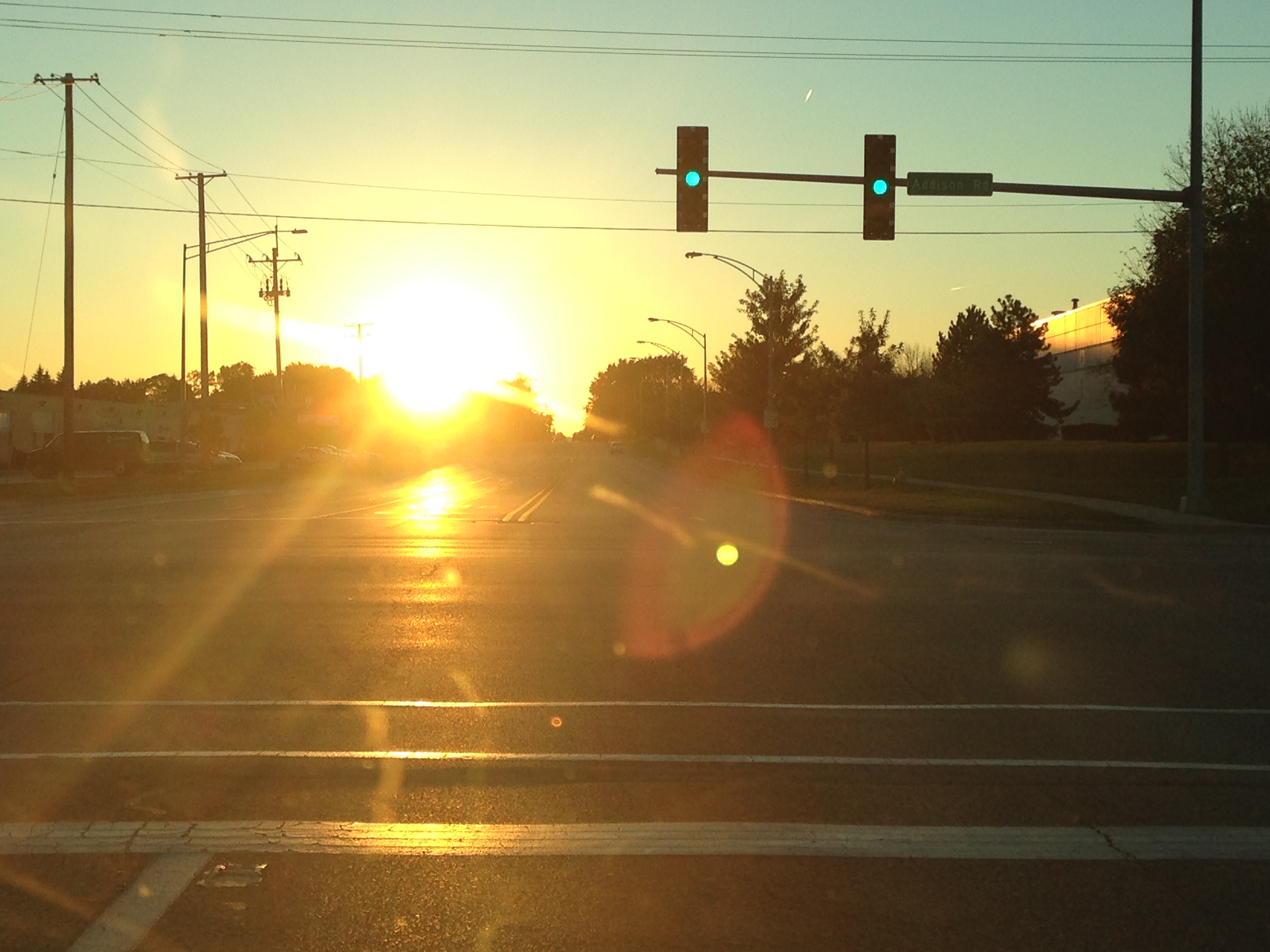
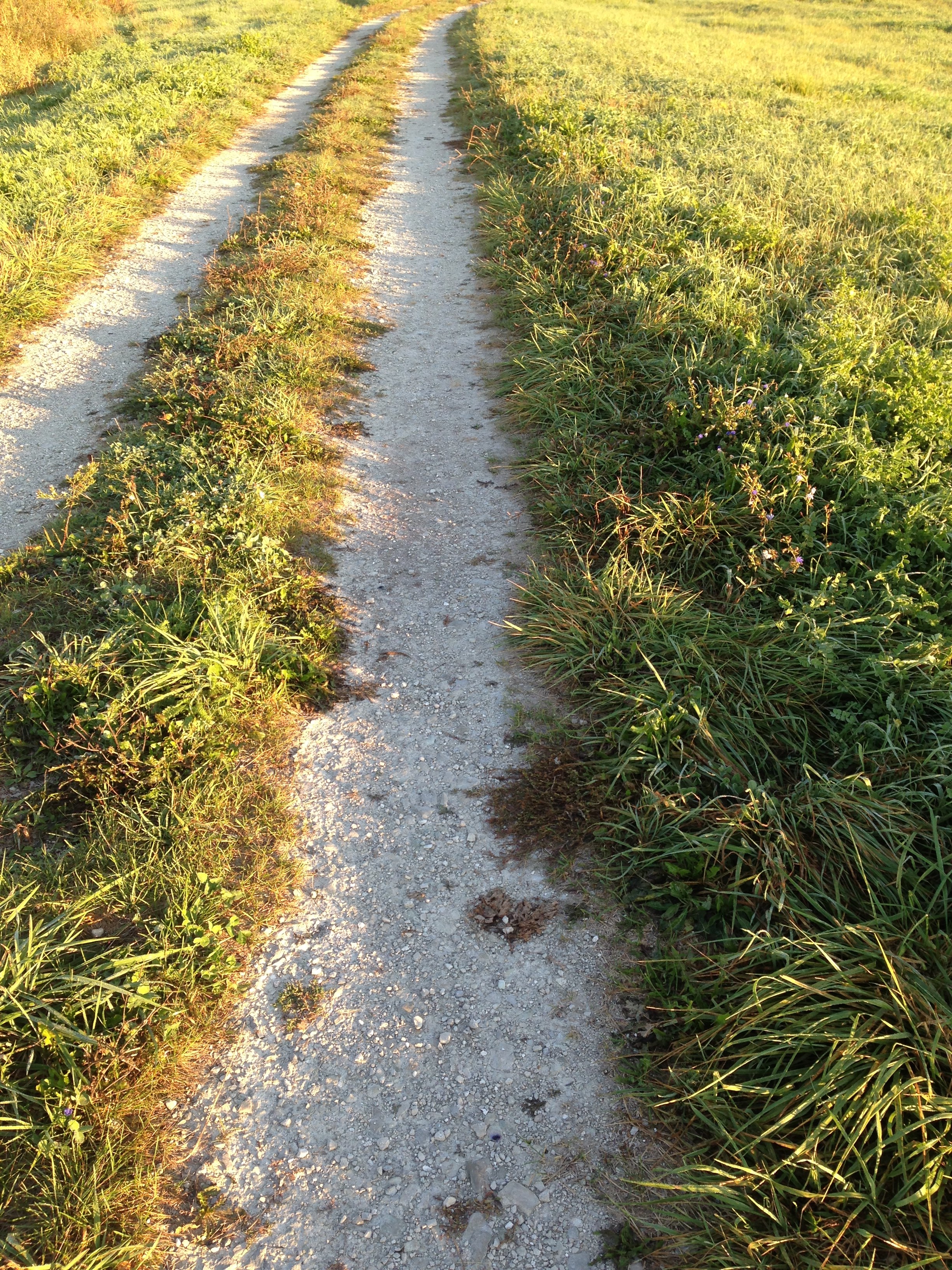
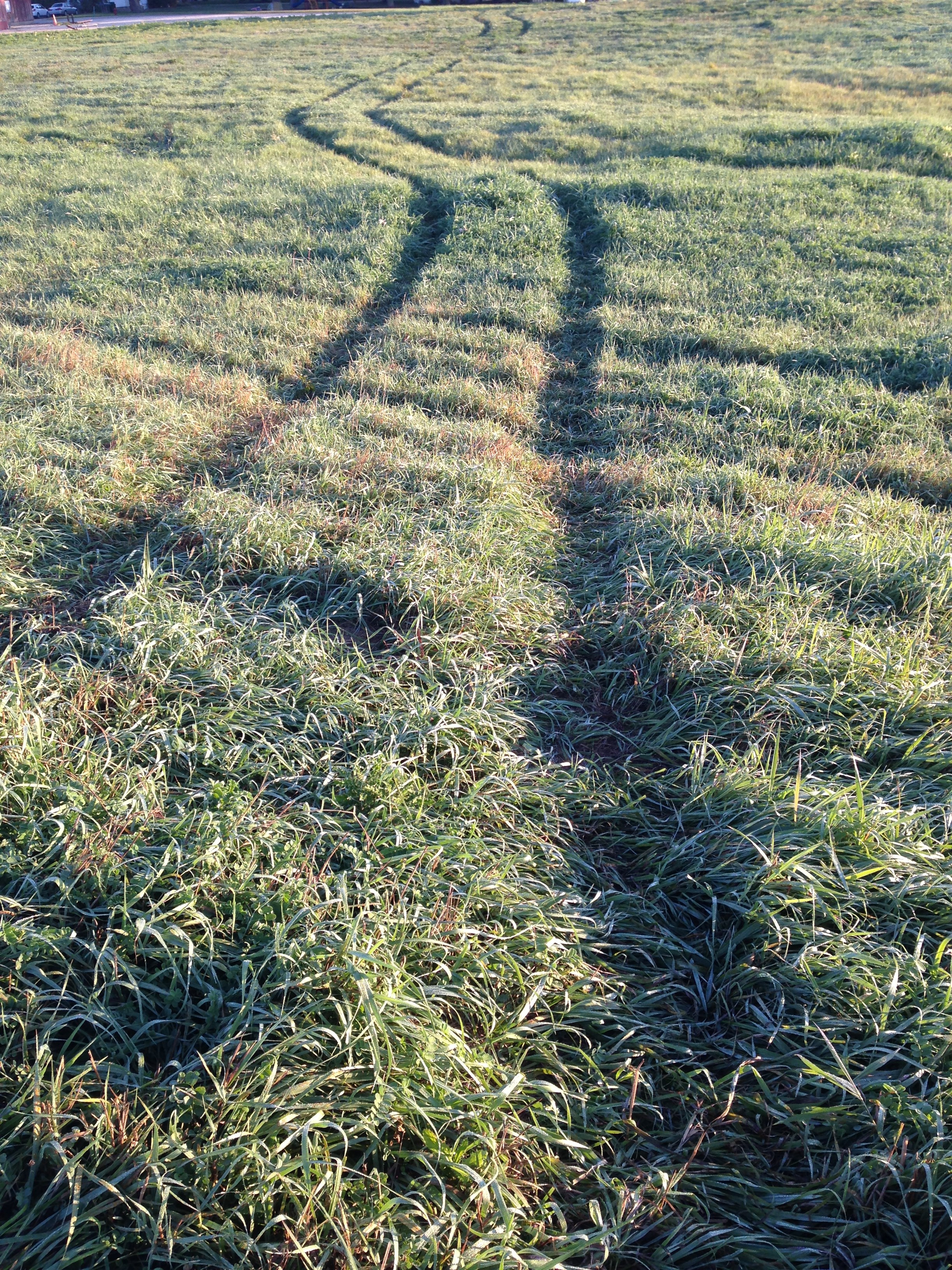
photo (3) photo (2)A two-track is quite simple, you see. A two-track can be found anywhere you see a couple ruts on the ground that lead you away from the main road.

That’s a two-track. Some are made with gravel, others just dirt or sand. A two-track can even be a temporary indentation in the grass, or a mark in the morning dew on a golf course or an athletic field where the workers have driven a cart or a tractor.

The point isn’t how good or bad a two-track looks or feels. The point is that you follow it where it goes.

Two Track Mind

The best two-tracks are semi-permanent at least. They take you somewhere interesting even if it ain’t that pretty. But often it is. A two-track usually takes you someplace a little bit wilder. A little bit less regimented. You could run or ride through a quarry or a public landfill, around the perimeter of a jail or the outside of a golf course. Sometimes you have to sneak around and even trespass a little to enjoy a good two-track. But that’s part of the thrill. If it makes your ears red and your legs go a little faster, all the better. It doesn’t even hurt to get chased by a dog now and then, feel what it’s like to be the hunted rather than the hunter. Fight or flight. That’s what two-tracks are for.

There is serenity to be sought on the right kind of two-track. When you know a good locations you can pull off the road and silence surrounds you. Sparrows flit ahead from bush to bush, or you cut through the tall grass of a prairie or meadow on foot or by bike. A two-track works for you in all seasons.

Every two track has its reason, and its season.

Two Track Seasons

Fall is the season for color.

Winter the season for solitude.

Spring the season of renewal

Summer the season of exploration.  

BrickCompanionsIf you’re running it may take a little more balance and concentration to run on a two track rather than your suburban streets. But that’s the point. Even if a two-track only loops around a local lot you’ll be pleased to find how engagingly relaxed it is to run on a gravelly or grassy surface rather than a road. It forces you to concentrate when you have to place your feet in a straight line and pay attention to your balance and your ankles.

Same goes for riding your mountain bike on a two-track. You follow a rut to get out of one.

Two Track Geography

Two tracks can take you lots of interesting places. I’ve run on two-tracks through the jagged hills of the Upper Peninsula of Michigan following the wild corridor of a power line cut through the woods. The two-track led me a couple miles up and down to a hidden stream, deep and cold, with purple chunks of feldspar sticking out of the banks. It felt like stumbling on a little miracle. Later that day I hiked my family out to the same spot so we could collect some of the shiny purple rock that would never have been found had I not taken that crazy two-track away from the roads. We sat in the sun and had a picnic with our feet dangling in the cold water. That’s where two-tracks can take you.

I’ve also followed two-tracks deep into the dry woods of a Wyoming mountainside, running smart to avoid the bigger rocks while listening to the calls of black-headed grosbeaks and western tanagers in the trees. I honestly believe you can’t know an area until you’ve ventured out on a two-track away from town. You may find private property and badass people with guns. But you just apologize and hightail it out of there. At least you’ll remember the experience.

A tr

Behind these bluffs in Decorah, Iowa sits a system of two-track and single-track bike and running trails. 

Two-tracks have led me through rugged farmland in Iowa, Wisconsin, Illinois, Pennsylvania, Ohio and Texas. I’ve run naked on two-tracks in remote areas where no one else was around. You hang your clothes on a fence, keep your shoes and hat on and sprint for half a mile with you everything flapping around and it’s truly liberating. Everyone needs to get naked and run once in a while. Two tracks are the perfect compromise between the wilds and civilization. I’ve never been caught and don’t intend to be. The point isn’t showing yourself off. It’s showing yourself you’re alive.

Two Track Fitness

Riding a two-track with your mountain or cyclocross bike is one of the greatest ways to get in good shape and get good and lost if you see fit. A two-track is essentially your highway to nowhere on a bike

Riding the woods in Chequamegon National Forest in northern Wisconsin, I have beat myself up bouncing along like a maniac on sandy, muddy and rocky two-tracks laid down by recreational ATVs and the small outfit loggers who use those woods the most. The habitat shifts from wet tamarack bogs to high upland maple woods pocked with stands of white pines. You can stop there listening to the lonesome hiss of wind in the pine needles and whip it out to take a quick piss against the trunk of a tree leaving only a wet spot and some tire tracks to recall your presence. No doubt the pine martens and deer take deep interest where you marked your scent, but by then you’re long gone and they have the woods to themselves. As it should be.
In spots on those Wisconsin two-tracks the sand is so deep you have to pedal like a sonofabitch just to keep going. But that is why you go. Two-tracks often aren’t “designed” to be easy. They’re created by a combination of need and recreation and what you find out there while running and riding is what you get. I’ve hurdled fallen logs like a rural steeplechaser and also made tragic decisions trying to hop a fallen sapling on the mountain bike. My skills rank somewhere below decent at that stuff and thus I have learned how to fall when necessary. You just pull your arms in and roll with the flow when you go down. It doesn’t hurt. Usually. When it does you shake it off, check out the burns and scrapes, maybe shake some water on it till it stings and then ride on. Then you know you’re alive.

Two Track Lost and Found

Yes, I’ve truly gotten lost on some two-tracks, most notably on a three mile run that turned into thirteen before finding my way back to the 7-Mile Pinecrest Resort where we were staying. Word got around camp of my adventures and a fair amount of teasing transpired, as people would ask if I needed directions every time I got up to get a beer. And I got lots of them that day, because deep down I was really tired and just a little scared that had I not lucked out and found the trail home it could have gotten really ugly. Cell phones don’t work out there, and I didn’t have one anyway.

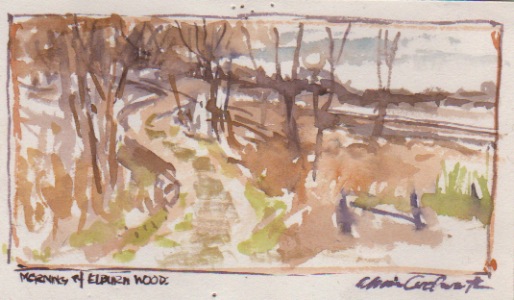
The romance of a two track captured in watercolor. Direct from life.

The romance of a two track captured in watercolor. Direct from life.

There’s more risk of running out of juice on a two-track when you’re running as opposed to riding. The self-propulsion of a runner requires feet to the ground effort, while the bike is a bit of a cushion until you find your way out of the woods. Of course you can also get farther out into the woods on a bike and get really good and lost if you try off road running or off road cycling. It’s a bit of a conundrum which is worse

As far as I’m concerned, it’s all-good.

Two Track City

For you city-dwellers, it may be hard to find a two-track you can use to get away from it all, so you have to improvise. Two-tracks can crop up in the strangest places if you know how to look for them. Even in the heart of a big city, there are places off the beaten path where you can find a two-track to follow. It might be an alley or a trip across an urban beach where the service truck has crossed the sand to empty the garbage cans, but it can make it easier to cross any bit of terrain with a two-track to follow.

Two Track Etiquette

That includes the wintertime. Many’s the time I’ve run in the tracks of snowmobiles on our local running trails. That’s far better than wading through snow 6” deep.

But there’s one thing I won’t do. I refuse to run in the cleanly laid two-track of a cross-country skier. I know how hard it can be to cut your own trail on skis. So it’s better to go out in snow on skis and make your own two-track than it is to crunch through the efforts of someone else.

Some people maintain the only thing better than a two-track is a single track. But that’s a subject for another day. Hopefully you have found enough inspiration to go find a two-track of your own, and soon. See you out there. Or maybe not.

WeRunandRideLogoEditors note: Recently I got a little sloppy in the proofing department, and for that I apologize to my valued readers. I’ve been writing “live” into WordPress and that’s not a good system. Thanks for your patience and readership. 

Posted in We Run and Ride Every Day | Tagged , , , , , , , , , , , , , , , , , , , | Leave a comment

The brilliantly messy process of evolving in your running and riding

By Christopher Cudworth

Water_ShrewMy brother-in-law is a funny guy. He likes to tease about certain things. One of them is the concept of perfection. He maintains there is no such thing. Given the generally messed up state of the world, one generally has to agree. Perfection may exist in concept or principle, but not in nature. It cannot. The world is always changing and that dictates that perfection cannot physically exist. No temporary thing can be perfect.

Life as we know it exists for the present. The next generation may or may not mimic what went before. As proof of that fact, we now know that 99% of all living things that ever existed on the earth are now extinct.

That’s a lot of failed experiments. It is also proof that the evolutionary forces shaping our world could care less us or the philosophical crap that goes with it.

Our vestigial selves

Evidence that the human race is still a work in progress is apparent in the interesting array of vestigial traits still hanging around in our bodies. If you’re not familiar with the whole concept of vestigial traits, the dictionary definition goes like this:

Vestigial: forming a very small remnant of something that was once much larger or more noticeable.

We refer to certain parts of our bodies as “vestigial” because its seems they no longer have a function or behave as part of an original design as they did in earlier iterations of evolutionary history.

Intelligent Design or shit just happens? 

Of course we use the term “design” judiciously here, so as not to confuse the notion of design in nature with the inane and chronically overwrought concept known as “Intelligent Design,” which is non-scientific mumbo jumbo for… “We don’t now how it works but we know that what you say has got to be wrong because nature is just too complex for it to happen on its own.”  

But shit happens, and that’s how we got here.

Stupid Design Theory

So we could just as easily posit an idea called Stupid Design Theory to account for all the things the supposed Great Designer essentially f’d up, including retardation and profound physical disabilities in human beings, birds that don’t fly and fish that can’t see, pelvic bones disconnected from limbs in whales and an entire social disorder in Homo Sapiens that led to Honey Boo Boo and her fatass ridiculously obnoxious mom. But we digress.

Have at it humans

Here’s the only fact you really need to remember. Evolution is the result of trillions of experimental imperfections that spit us out into the relative present with no more concern or ceremony than an ostrich chewing grass seeds. Ptoo. Now have at it, humans. Nature really doesn’t give a shit if you make something of yourself or not. Really. Now deal with it. That’s what God is for.

Why we compete

The realization that none of us is that special in the evolutionary scheme of things does help explain why we’re so competitive by nature.

imagesOur competitive natures drive us to invent religions that confer social advantage to tribes that have otherwise screwed up everything else they ever tried.

Competition also drives us to set up races where our imperfect bodies can be tested against hundreds of other imperfect bodies while paying $200 for the right to do it in the streets. Cause the cops don’t work for free.

It’s not a perfect imitation of the evolutionary process, mind you, but it’s the best we’ve got. So get out there and enjoy it.

Triathlons and evolution

Any race of beings built on the trajectory of so much imperfection is bound to be a little competitive by nature. It’s how we keep from going f’n insane from the potential boredom of day-to-day existence.

That also explains is why triathlons were invented, because crushing your knees and feet to death in a marathon or ultramarathon was not sufficient enough torture.  We had to invent an event where nothing is left toward the end but a lurching, crawling hunk of human flesh with a head perched on top trying to finish under 12 hours. Then you get an Ironman tattoo for the trouble.

I have personally engaged in similarly tortuous efforts, albeit not as long as an Ironman, and come out feeling like a better person because I am relatively sure I dropped a few vestigial organs along the way. Who says you can’t see evolution in progress?

Evolution in action

It’s a brilliantly messy process, evolution, especially because some of the vestigial shit it leaves behind, like Tea Party candidates and biblical creationists, who frequently die choking on their own anachronisms. Who says we can’t see evolution in action?

Watching our bodies evolve

Of course we all have our own personal evolutionary dramas going on inside our bodies. One of the crowd favorites in terms of vestigial evolutionary leftovers that can f*** you over is the appendix, which can flare up and explode inside your guts. Always good fun on a Sunday afternoon. Then there are heart flaws like the one that took down avid runner and author Jim Fixx.

ku-coccyxIf you’ve ever fallen on your tailbone it doesn’t help to know that it is perfectly useless these days without a human tail to wag. But without it you might slip down your bike seat so who knows if it is truly vestigial or not?

Think: It would also be fun to grow tails again and have a little slit in the back of our bike shorts so that we could our furry tails flap in the wind at 25mph. The sight of all those tails flapping behind cyclists in a competitive bike criterium would be grand, to say the least. Just don’t let your tail get caught in the spokes. Rumor has it that can hurt and possibly take you down in a crash, the evolutionary test of every cyclist. 

A friend of mine once broke his sacrum in a bike accident. It hurt like hell but he rode 11 miles back home even though the sacrum thing that holds your butt together was busted. That raises the important question about whether we really need a sacrum in the first place, doesn’t it?

Useless shit we don’t need

Yes, we’re forced to carry all this useless vestigial shit around with us when we run and ride, so it’s rather surprising that no weight-obsessed runner or team of cyclists has figured out how to cut out all the useless body parts and gain a competitive advantage. Seriously. Quite a few women dump their ovaries and uterus past a certain age, which accounts for the smiles on the faces of so many women after the age of 55. We could all use a few less body parts, it seems.

Chop out the appendix, for starters. That’s a half a pound or so. Get rid of the tailbone too. That’s another few ounces. Our ears are technically not needed the way they used to be, nor our wisdom teeth. Chop out all the extra stuff and you might be 3-4 pounds lighter. That’s enough to move you up two places at least in the Tour de France or any marathon on the planet.

The vestigial lessons of Wall-E 

That’s how evolution works, in a sense. Anything that doesn’t help you survive technically drags you down. So nature tries like hell to get rid of it, or else nature sooner or later gets rid of you. Rid. Run. Ride. There’s a pattern emerging here.

Walle7If you’ve seen the movie Wall-E you might recognize the potential dangers of human inactivity. All the people on the spaceship get fat and roly-poly to the point where their skeletal systems become almost vestigial. They’re fed by robots and never exercise. In other words, they look like the Newman character on Seinfeld. Not the height of physical fitness.

Why we run and ride

Those of us who run and ride are therefore involved in an evolutionary experiment of sorts. The manner in which we push our bodies and the endurance activities we engage in are primarily voluntary and not tied to any particular survival trait or environmental pressure. Not that we can see.

But perhaps our collective need to run and ride may be a subtle behavioral response to social pressures. The benefits of exercise are often pitched as a “stress reliever,” a reaction to the “fight or flight” response carved deep into the human Bikeevolutionnervous system. We are placed in many stressful situations from which there is no escape like the 8 to 5 work schedule and commuting an hour one-way in a car. It can also be very stressful sitting in meetings where everyone feels they have to give an opinion, no matter how stupid that opinion might be. At that point it is fight or flight, baby. First World problems.

Third World sensibilities

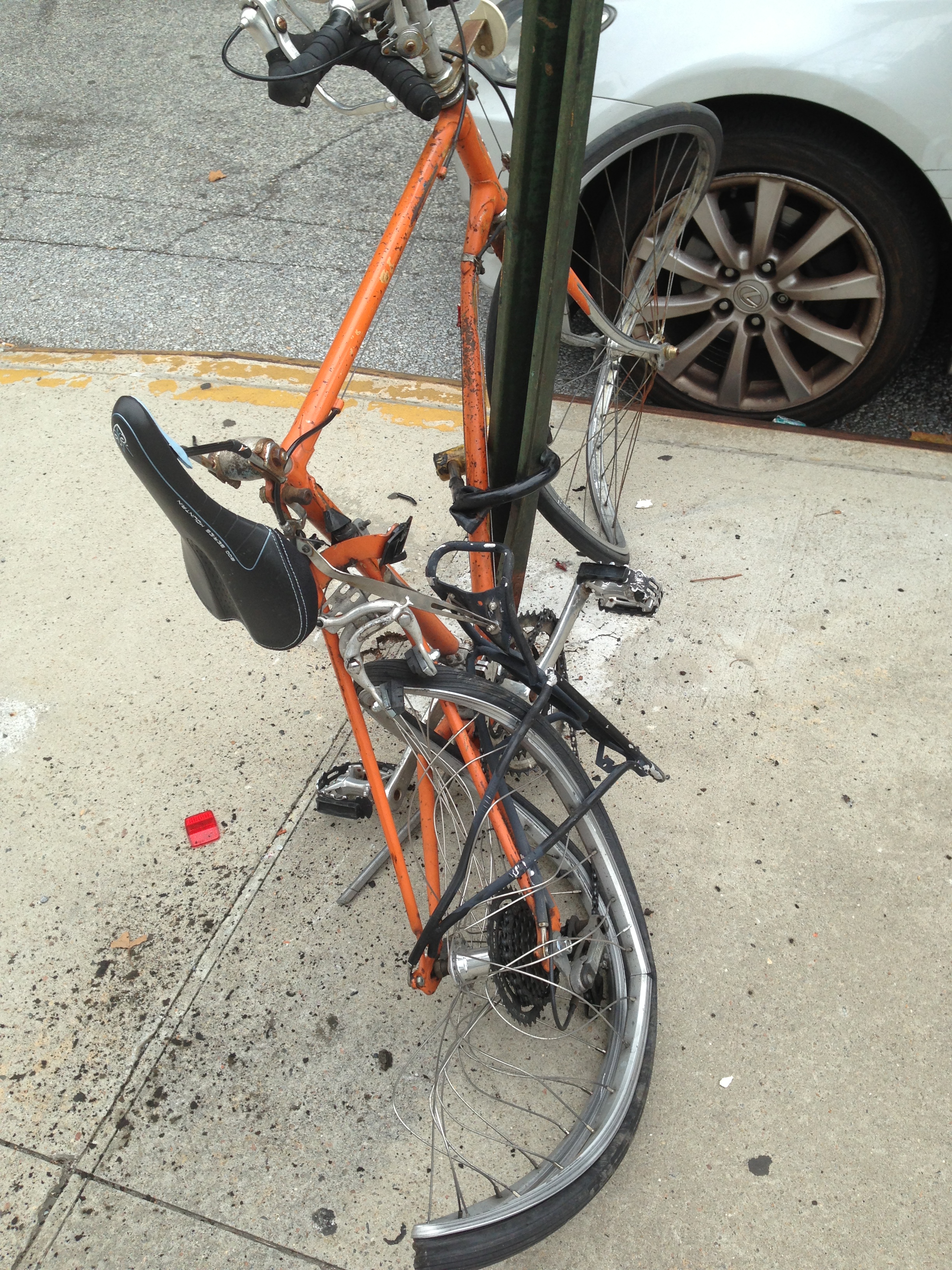
Then we come out on the street during lunch to find our favorite commuter bike crunched around a pole because some dickhead doesn’t know how to drive. Now that’s stressful.

Without release from these tensions the stress of life burrows deep into our nervous systems. So we strap on running shoes or don cycling equipment and head out to our respective evolutionary adaptations to stress. It’s not a perfect response, but it’s the best we have.

Circling back to our selves

We run and ride through an imperfect world in an effort to achieve a feeling of being one with nature and at the same time become with ourselves. That is the organic journey to which Walt Whitman refers in his poem, We Two-How Long We Were Fooled.

Please not the italics in this poem have been added for emphasis by this blogger.

WE two—how long we were fool’d!
Now transmuted, we swiftly escape, as Nature escapes;
We are Nature—long have we been absent, but now we return;
We become plants, leaves, foliage, roots, bark;
We are bedded in the ground—we are rocks;


We are oaks—we grow in the openings side by side;
We browse—we are two among the wild herds, spontaneous as any;
We are two fishes swimming in the sea together;
We are what the locust blossoms are—we drop scent around the lanes, mornings and evenings;
We are also the coarse smut of beasts, vegetables, minerals;


We are two predatory hawks—we soar above, and look down;
We are two resplendent suns—we it is who balance ourselves, orbic and stellar—we are as two comets;
We prowl fang’d and four-footed in the woods—we spring on prey;
We are two clouds, forenoons and afternoons, driving overhead;
We are seas mingling—we are two of those cheerful waves, rolling over each other, and interwetting each other;


We are what the atmosphere is, transparent, receptive, pervious, impervious:
We are snow, rain, cold, darkness—we are each product and influence of the globe;
We have circled and circled till we have arrived home again—we two have;
We have voided all but freedom, and all but our own joy.

On rare occasions, despite all the vestigial garbage we carry around in our bodies and our heads, we really do find rare moments of perfection through our running and riding pursuits. They might be fleeting or temporary, but so is everything. What goes around comes around, and we return from whence we came. It’s the journey between that matters.

We have circled and circled till we have arrived home again.

However imperfect it may at times seem, it is all the perfection we will ever need, or will ever know, until we move beyond this world.

But leave your appendix and all that other vestigial shit behind. You won’t need it where you’re going after this life, because you didn’t need it here. Just pray your reincarnate with a more biomechanically blessed body than the one you got this time around.

We all evolve in one way or another. However imperfect that may be.

WeRunandRideLogo

Posted in We Run and Ride Every Day | Tagged , , , , , , , , , , , , , , , , , , | Leave a comment

What’s your Call To Action when you run and ride?

With additional musical information from co-blogger Monte Wehrkamp.

Christopher Cudworth's avatarWe Run and Ride

By Christopher CudworthWeRunandRideLogo

In marketing terms, the Call To Action (CTA) is a crucial element in motivating potential customers to make a purchase or download information about your company.

Considerable time and effort is given in website marketing and Pay Per Click marketing to leading customers through the process of engagement to placing an order or making a call. That process is called “conversion” which simply means you’ve moved a customer from an interested party to someone who’s actually responded to your message.

Call To Action really rocks

We find Call To Action at work in all kinds of day-to-day circumstances. The classic formula of most pop songs, for example, relies on a variable pattern of main lyrics, chorus and refrain. But the Call To Action of most pop songs is the hook. That’s the part that won’t go out of your head after the song is done playing. Some…

View original post 790 more words

Posted in Uncategorized | Leave a comment

What’s your Call To Action when you run and ride?

By Christopher CudworthWeRunandRideLogo

In marketing terms, the Call To Action (CTA) is a crucial element in motivating potential customers to make a purchase or download information about your company.

Considerable time and effort is given in website marketing and Pay Per Click marketing to leading customers through the process of engagement to placing an order or making a call. That process is called “conversion” which simply means you’ve moved a customer from an interested party to someone who’s actually responded to your message.

Call To Action really rocks

We find Call To Action at work in all kinds of day-to-day circumstances. The classic formula of most pop songs, for example, relies on a variable pattern of main lyrics, chorus and refrain. But the Call To Action of most pop songs is the hook. That’s the part that won’t go out of your head after the song is done playing. Some of the most famous hooks in history are found in songs like the rolling guitar riff in the Beatles’ “Norwegian Wood” or the quick chord progressions in Steely Dan’s “Reeling In the Years.”

Hooks are a call to action to listen. We can’t resist their infectious rhythms or melodies that appeal to some crazy core in our souls that reacts to primal sounds.

The Hook That Sells

That’s why music has long been used to sell products. Hooks are something people remember well, and they can even draw out emotions in people. When emotions get recruited into the Call To Action formula the buyer and seller begin to share a common language. That’s why the genre known as rock n’roll music has lasted more than 50 years. Rock goes straight for the gut with hooks we cannot forget.

Watch Out For the Flatted Fifth

cyclist2Some people have questioned the motives in the Call To Action in rock music. Sex and drugs and rock’n’roll have common roots, you might say. When rock first hit the scene in the 50s it was considered the devil’s music. The Flatted Fifth or the augmented 4ths is called The Devil’s Interval. But the chord and its use goes way back in musical history, and could get you killed for playing it at some points in time. But we are redeemed by Beethoven, who used a variation in the famously impactful Dah dah dah daaaaahhhh that introduces Symphony No. 5 in C Minor. Talk about your Call To Actions!

Rock is Call To Action personified

Rock just took some of those timelessly evil musical tools and emphasized them for emotional impact.

cyclistwithheadphonesSo it’s no wonder so many people like to listen to rock music while they run or ride. Their music is filled with Call To Action riffs and hooks and motivational gut checks that match your heart rate in tempo or make it go faster. Music is your drug, your fuel and your Call to Action. It is also your companion. Add Some Music To Your Day.

Selling Yourself On Your Workout

But you probably never thought of it as a form of marketing exercise to yourself before. But its true. We all need to motivate ourselves some way and the pleasure-seeking brains of those who run or ride are just as susceptible to the marketing message, however subliminal it may be, that we are our own commercials for success. Now get out there and rock a few miles.

Add-A-Motivational-Soundtrack-To-Your-Workout-With-These-Great-Headphones-For-iPhone-or-iPodBut be smart. There’s a risk to rockin’ our way through our runs and rides, or our morning commutes. We can’t always hear the world around us, and that holds danger. You’re not fit for anything when you’re mangled or dead. Even Heavy Metal bands have to admit that much.


With additional comments by my co-blogger, Monte Wehrkamp, a bassist in the group What’s On Tap. 

Flat five, flat seven, there is no blues without those two notes.

Where they came from? Africa. The African chord system, which wasn’t a system or theory, per se, was the sound in American black slaves’ heads. Just like how Indian music is atonal to western ears, but makes perfect sense to an Indian.

Add the backbeat. Slaves took American religious music and gave it rhythm. But instead of clapping on 1 and 3 (in 4/4 time, as white ears hear music), they subtly rebelled, clapping on 2 and 4. The African-American Spiritual musical movement was born.

One-TWO-three-FOUR, one-TWO-three-FOUR. Flat the five. Flat the seventh. You’ve changed music forever. It’s the greatest gift America has given the world, in my opinion. The blues. When it mashed into Irish and Scottish music played in the hollers and the hills by poor white immigrants, we got bluegrass. Which begat country-and-western (the real stuff, see Patsy and Johnny, et al). The blues added to poor white boys from the deep south begat rock ‘n roll (Buddy and Elvis, etc). And that floated across the pond to post war English kids and we got the Stones, Beatles, Clapton/Cream – a British invasion.

All of a sudden, the rebellion that was the African-American Spiritual and the blues became the rebellion music of people of all colors and backgrounds. The anti-war movement. Anti-government protests.

Music — it meant something more than notes and beats and lyrics. It was in our blood. It was our conscience.

Too bad that today, occultism and computers and corporatism have pretty much strangled the meaning of music to death. Anything mainstream by the big record labels, whether it’s Miley or Brad Paisley or any rap act has been compromised and tinged with insincerity and inauthenticity. Now America exports trash. And we get back Gangham Style from South Korea. Ugh.

Posted in Mechanical Genius, We Run and Ride Every Day | Tagged , , , , , , , , , , , , , , , , , , , | 1 Comment

Running and riding through our sentiments

sen·ti·ment

Def #1: a view of or attitude toward a situation or event; an opinion.  Def #2: a feeling or emotion.

Mechanical GeniusI used to be quite the sentimental person. One doesn’t know exactly why certain sentiments build up in the psyche, but they do. Embracing these sentiments defines your life. Or it’s the other way around. You view your life through the lens of sentiment and all things become sentimental, even the present.

The first feelings of sentiment often come through a longing for a place where you once lived, but no longer do. That meant true sentimental feelings for a place hit me first as a 5-year old. Our family moved from Seneca Falls, New York to Lancaster, Pennsylvania when I was in the middle of kindergarten. So I missed the home where we lived and the short walk down to Cayuga Lake and the borrowed cottage with spider webs floating just above the surface of the water. It was all good in my mind, that home back in New York. So I missed it.

I was also sentimental about the farm where my mother and father grew up in Bainbridge. Our family visited those farms most often in summer when hillside pastures were verdant and the Susquehanna River ran slowly past the flats where corn and potatoes grew. The Catskill mountain on which the milk cows grazed was laced with fossils in the rocks and fresh cold springs that filled the ruts where the tractors drove and leopard frogs made their homes.

Moving sentiments

We leave these things behind by necessity as time goes by. Yet we yearn for the feelings generated by those places and the people who lived there. But when the barn on my mother’s farm burned down, and when robbers broke in and stole the Indian arrowhead collection gleaned from the soil when working the farm, it was apparent that what drew me to the place could not be held forever. So the sentiment over losing the farms to time and change slowly disappeared. The memories do remain, but they have been drained of the sense of loss that fuels sentiment.

As Warren Zevon so brilliantly stated in his song Sentimental Hygiene, there is a sense of loss to all of life that can be crippling if we let it. His lyrics capture these feelings, and the need to dispense with unhealthy sentiment:

“Everybody’s had to hurt about it

No wants to live without it

It’s so hard to find it

Sentimental Hygiene…”

At some point, for some reason I thought I heard different lyrics to that song, but they never existed. This is what I must have invented on my own:

“Everybody’s signing up to fight

for the right to be wrong

They need some….

Sentimental Hygiene.”

Whether Warren sang those lyrics in another version of his song I don’t know, but I love what they mean nonetheless. We are too often absorbed by sentiment and become defensive of things that we really need to release.

Moving friendships

In 1970 our family moved from Lancaster, Pennsylvania to Elburn, Illinois. I was 13 years old, emerging from 7th grade and feeling really tragic at losing my middle school friends back “home” in Lancaster. I made new friends but kept a place in my heart especially for a particularly close relationship with a kid named David whose life, I figured out later on, was no picnic thanks to his parent’s divorce.

Yet we shared so many rites of passage from the age of 5 through the hormonal years of 7th grade that it is impossible to imagine my life without that good friend. We grew up in the 1960s and hung by the pool eating pretzels with mustard and string licorice and Coke. We bought Superballs, Ratfinks and other 60s junk. Then we played on the same baseball team that won the Lancaster New Era tournament. David had three beautiful sisters from whom I learned that girls were really just people and it was really painful to leave David behind. We sat on the elevated tee of the golf course on which his house was situated and David turned to me and said, “Why does everything I love have to leave me?”

We cried together and as our family pulled away with the Mayflower truck that day in June I thought I literally was going to die of grief. My brother leaned over and we sang a Beatles song under our breath behind the back seat of our 1965 Buick Wildcat. “One twothreefourfive six seven…all good children go to heaven…”

Taking big breaths

My brothers and I longed for our Pennsylvania home even as we adjusted to life in Illinois. When we’d leave the state after visits we’d literally take a big breath to hold the Pennsylvania air inside our lungs a little longer.

But we did the same thing with New York air. And later, when I came to love the Northeast Iowa country where I went to college, it came to pass that I loved that place more than any other. It was sentimentality for the time that passed, the events that occurred and the friends I’d made. College memories still populate my psyche, and many of those memories are tied to the running I did during those years. 4 years of college feels like one big inhalation in some respects. But when you’re training 90-100 miles a week, life gets pretty intense and you’re doing little more than eating, sleeping, shitting and running.

Then your friendships grow, forged by mutual effort. Successes come to be magnified and your college years can take on too much significance. It’s hard in some ways to keep it all on perspective as you move on. The carefree existence of college and having time to run all those miles seems like a Nirvana of sorts. It’s possible to cling to all that, or overshare, or look through life with a lens that turns all the way back to those experiences as a measure of everything you’re now experiencing. A mature person doesn’t break those ties, but they figure out how to put them in context. That was hard for me in some ways. I admit it. But one day you’re driving around and realize that you’ve known the people you work with much longer than you spent time with your college friends. Then you say to yourself, “Hey, what’s with the sentiment toward those days…”

Again, Warren Zevon nailed that feeling:

“Some nights I’d drive my car

Up and down the boulevard

It’s so hard to find it

Sentimental Hygiene.”

Rekindled sentiments

In my late 30s it happened that my friend David moved to Illinois for his job. I tried to strike up a friendship again but his new life was truly new. His first marriage had broken up leaving 3 girls behind. Now he had another child with his new wife, who was truly a sweet person. But it wasn’t to be. David wasn’t really interested in revisiting the past in any substantial way. I longed to reminisce about some of our boyhood memories, but that wasn’t to be.

We drifted apart yet again, only to connect on Facebook another 20 years later. But my political posts offended his conservative character and he unfriended me.

But by that time it had become evident on my own volition that sentiment was not a workable solution to much of anything. Memories are just that. We make use of them sometimes but their tangible value is limited other than with people who share them. Even then they can be limiting in some respects.

Zevon:

“Every day I get up in the morning and go to work

And do my job-whatever

I need some

Sentimental Hygiene.”

My life took some strange turns not long after that. Losing a wife to cancer and going through the job changes that came with helping her through all that was tough to take. Along the way we adopted a motto: “It is what it is.”

That’s a very liberating approach to life, if you think about it. You go out and run and ride, for example. Some days are good. Some days are bad. Once you used to kick yourself around for the bad days. Tell yourself you’re a bad or lesser person for failing at some race or training goal. And while you don’t quit trying to reach your goals these days, you learn to see that the bad can come with the good and you can still make progress. You don’t overthink and make everything into Another Tricky Day, another gentle nagging pain. In other words, you don’t oversentimentalize your running and your riding. Or your swimming. Triathloning. Marathoning or half-marathoning. The reason you work out is to escape the trap of sentiment or living in the “good old days.” You become a new you every time out the door. Add yoga to your routine. Lift weights. Go get muddy in some nutso race in the sticks. Shake it up. That’s sentimental hygiene at work.

Achieving hygiene

The day I woke up fully realizing that I was indeed capable of Sentimental Hygiene, the world became a better place. It really is a strange and better new world when your life is not dependent on sentiment to define your current reality.

Admittedly, people don’t always understand your emotions, or in my case, that you can grieve in a healthy way without being dragged down into the abyss of loneliness and collapse. That’s nothing more than me actually embracing what faith has always told me: Life goes on. We believe that about the people we love, if we believe they have souls. A death is sad, but it is not final with respect to our sentiments. Those can come forward with us, and not hold us back.

With sentimental hygiene you can better handle anxieties or depression, concerns over money and relationships if you manage the sentiments that go along with all that. It’s not just “positive thinking.” That’s too simplistic. Sentimental hygiene requires real thought, and perhaps a few long runs or walks in the dark with only the stars for company, and possibly a little faith in something greater around you.

One looks at the world and sees people clinging to conservative outlooks that says the past was better in some way, that traditions and happy memories of the way things were far exceed the quality of the present. But I know that’s a load of crap. Now–– is all we have. Wishing for the past or imagining that earlier politics were better than today is dysfunctional at best, and dangerous at worst.

“Everybody’s at war these days

Let’s have a mini-surrender

I need some…Sentimental Hygiene.”

For 25 years I attended a conservative church where change was not that welcome. When we finally changed churches as a family it was a tremendously liberating feeling not to hear things preached from the pulpit that were sad, hateful and narrow-minded. All of that was founded on a fear of change and a perverse brand of sentiment for something that the Bible doesn’t truly preach. It was literal in a way that turns the past into something that never really existed.

Now when I read that the new Pope Francis actually thinks the Catholic church is caught up in petty things it makes me realize that even one of the leading religious leaders in the world is capable of sentimental hygiene. We all need it.

“Every night I come home exhausted

from trying to get along

I need some

Sentimental Hygiene.”

Like I said, I used to be the one of the most sentimental guys in the world. But I might have been sentimental in ways that were not that healthy, or realistic. That was true even with my running and riding, where my personal angst found its release, but sometimes absorbed a little too much of who I was, like a cosmic Black Hole. We all need an escape, but must be careful with our personal gravity and the hold it has on our souls.

Now sentiment still plays a role in life, but not the lead role. Sentiment has its place with the loves in my life, and in sharing feelings with those you most care about. That’s a healthy place to be. Sentiment for the present is a beautiful place to be. Try it, you’ll see.

WeRunandRideLogo

Posted in We Run and Ride Every Day | Tagged , , , , , , , , , , | 1 Comment

Are people who run and ride canaries in a coalmine on global warming?

On the run (or ride) from global climate change

As a worldwide scientific consensus on the issue of global warming continues to build, the community of ideological naysayers who think the earth is simply too big to be impacted by the human race is still mounting vocal resistance to the idea of anthropogenic climate change.

Dealing with denial

The God of All Tarsnakes

Our very existence on earth is a tarsnake of sorts.

The most compelling objection to anthropogenic climate change is that cycles of global warming and cooling have occurred throughout earth’s history, and that current warming trends are nothing more than the product of naturally occurring warming cycles. These scientifically conservative contentions are often combined with an ideological belief that the earth’s atmosphere is simply too big to be impacted by the human race.

But that reasoning appears to be flawed.  There is very hard evidence evidenced by compelling precedents from industry, transportation and agriculture that the human race does indeed have profound impacts on the earth’s environment, and at a massive scale. One of the tarsnakes of our existence is that everything we humans do seems to leave its mark in earth history, and we have discovered through tough experience environmental mistake are much harder to fix than than they are to break.

AIR POLLUTION

For example, we know that manmade production of air pollution and particulates produces sometimes fatal levels of air pollution, smog and acid rain.

WATER POLLUTION

The human race has also produced massive levels of water pollution to the point where entire river systems, lakes, bays and entire sections of the ocean floor are rendered dead from pollution and chemical siltation.

PESTICIDES, DRUGS, MERCURY AND NUCLEAR POLLUTION

Our groundwater is suffering from pesticide leaching and even influxes of hormones and pharmaceuticals while rising mercury levels, ocean acidification and nuclear pollution are all manmade environmental challenges.

A 50-YEAR BATTLE TO ENTOMB OUR TOXIC NUCLEAR REMAINS

IMG_8829An article TheVerge.com documents the ongoing fight over where to store nuclear waste that cannot be stored almost anywhere without risk to human beings. The article states, “Yucca, the rocky desert range on the horizon, was chosen 25 years ago as the nation’s first and only nuclear waste repository. Thus began a conflict among politicians, locals, anti-nuclear activists, government officials, and the nuclear industry. Thanks to decades of political power plays, safety debates, and scientific disagreement, Yucca has never opened. Meanwhile, nuclear power provides twenty percent of America’s electricity, with the resulting waste — about 70,000 tons of it — accumulating at 75 sites nationwide, including near major metro areas such as New York City, New Orleans, and Chicago.”

SUPERFUND

Refusal to take responsibility for environmental stewardship undermines rational discourse in business resulting in remediation efforts such as Superfund, a governmental agency specifically chartered to clean up toxic waste sites. It was established in 1980 as the Comprehensive Environmental Response, Compensation and Liability Act of 1980, and made necessary by the massive scale and danger of toxic environmental waste.

HABITAT DESTRUCTION

In America the tradition of environmental protection includes national parks, regional and county forest and nature preserves. But most of those efforts began well after America removed 99.9% of its native grasslands and reaped an ugly legacy of devastating soil policies that resulted in the Dust Bowl. Entire ecosystems were destroyed in the process of prairie tilling, never to return again.

America’s environmental legacy includes destruction of millions of acres of virgin timber and conversion of formerly intact ecosystems into homogenous tree farms and corn deserts, yet those “solutions” are judged as both necessary and superior to preserving native habitats because in the short term the commercial use of land appears to benefit the human race. That is the crux of the modern environmental debate; short term versus long term use patterns as defined by near-term commercial benefits versus sustainable ecosystems.

RELIGIOUS BIAS

Denial of environmental problems is many times an ideological choice, and a certain brand of literal interpretation of the Bible favors an attitude of so-called “dominion” over the earth that can (and has) been used to self-righteously justify abusive environmental practices.

Conseequently, extraction-based business interests (especially coal, oil and gas) have pursued and benefitted from a conservative alliance with religious groups that deny anthropogenic climate change on the strangely contradictory grounds that manmade climate change is… photo (3)simultaneously impossible because only God can change the earth…and an unnecessary distraction because humans are supposed to use the earth as they see fit.

Forgotten somehow in this pact is the notion that original sin and the proceeding ejection of Adam and Eve were ostensibly the first sign that the human race was out of tune with God’s creation. Yet biblical literalists and extraction barons side on the issue of global warming out of perceived mutual support and possibly direct convergence in these world views. Yet, both seem to conveniently forget the critical warnings of scripture that point out the fatal flaws of pride and arrogance in how the human race interacts with the world. Perhaps it is no coincidence that both parties prefer to claim God on their side in the issue either. Speaking for God is one of the first signs of an arrogant heart and mind.

THE GULF OIL SPILL: CAUSED BY NATURE OR HUMAN BEINGS?

If we apply the conservatively extreme logic that human beings have nothing to do with the health of the earth on a grand scale, then the BP Gulf Oil spill could not have been caused by human error at a drilling platform in the Gulf of Mexico.

Instead nature was responsible for the spill, or else nature under the direction of God caused millions of gallons of oil to spill out from the ocean floor into the Gulf of Mexico. Granted, natural disasters occur with some frequency on our planet. But in the Gulf oil spill example, humans actually dug a hole in the ocean floor and stuck a pipe down in it, and then broke the pipe and could not repair it, resulting in millions of gallons of oil pouring up from the guts of the earth.

And think about it: That’s essentially  the same principle behind our pattern of CO2 emissions spilling into the atmosphere from human causes. Yet some claim we have nothing to do with rising Co2 levels and the pursuant warming resulting from this atmospheric change. We can either deduce by logic what is going on or we can deny the truth and effectively bury our heads in the sand.

A DEDUCTIVE CONCLUSION ABOUT ANTHROPOGENIC CLIMATE CHANGE

Based on all this prior evidence, the human race has proven emphatically that it indeed is capable of producing anthropogenic environmental change at a massive scale. Global warming is therefore not just possible but an inevitable consequence of our current path of social behavior. We’ve simply outstripped the earth’s ability to naturally handle our waste, byproducts and pollution.

Ignorance and confidence 

Still, there will always be doubter and deniers and people who flat don’t care what happens to the earth. Their selfish perspective remains focused on living as they see fit, and devil take the rest. They are confident God or technology or future generations will be able to deal with the environmental damage we so obviously create in the present. That type of arrogance is addressed by none other than Mark Twain, who once said, “All it takes is ignorance and confidence, and success is sure.”

Denial Precedents 

Basically the arguments against global warming used by climate change deniers closely resemble in structure and approach the methods by which creationists attempt to deny the theory of evolution as a foundation for science. Approximately 30% of Americans claim to believe in a literal interpretation of the Bible and on grounds of the Genesis creation story deny that evolution is either possible or functionally capable of producing the genetic diversity and speciation we see in the fossil record or living species today.

Beginning with a premise such as God-inspired creation to establish a truth is not quite the same as establishing a theory based on empiric evidence and then setting out to determine where that evidence points in terms of history, outcomes and the predictive value of the theory as an operationally scientific paradigm.

But the habit of mind that creates a reality and then dogmatically defends that paradigm without consideration of overwhelming facts in favor of its opposition is what marks the approach of both global warming deniers and creation theory advocates. They simply refuse to engage with reality or deny it with sufficient vehemence to raise doubt in others. And that is enough for some.

Complexity here, complexity there

photo (8)There is a considerable contradiction in the fact that global warming deniers give nature all the credit for complexity in its climatic models yet the apparent partnership between creationists and climate change deniers refuses to credit evolution with power to generate complexity in nature.

This is obviously a mixed up and dysfunctional worldview, but it has plenty of supporters because the more that opponents can confuse the issue the more difficult it is to do something about it. And that’s just the way so-called conservatives like things in society. All it takes from there are some seemingly clearheaded statements (however untruthful they may be) and out of exasperation people jump on board the “simplicity” train of dim-witted populism made popular in the last 30 years by politicians and religious leaders able to exploit this dysfunctional worldview to their economic, political and dogmatic advantage.

Denial Presidents

Climate change denier and closet creationist / intelligent design supporter President George W. Bush was a huge favorite with people who both deny anthropogenic global warming and evolution. Bush singlehandedly (and simple-mindedly) set back science more than any single individual in the last 50 years of American history. He applied the same dunderheaded simplicity to education reform, producing No Child Left Behind that has crippled teacher ingenuity in public schools. His economic policies resulted in a near-Depression and his foreign policy produced unfunded wars in Afghanistan and Iraq. It can be said that the foundations of his worldview, beginning with the illogic of his foundational principles of literalistic religion were crippling from the ground up, and are evidence of much that is wrong with America today, including our denial of the threat of global climate change, even though America consumes more than 25% of all the earth’s resources for a society with only 300M people.

Establishing equations

All it takes is ignorance and confidence, and success is sure. It all started in the early 1980s when Ronald Reagan as President installed one James Watt as Secretary of the Interior. Watt never said some of the things to which he was credited in opposition to environmental preservation, but the die was cast. The conservative habit of mind became connecting Christian policies with an end-of-the world, extraction-based political ideology that won votes and delivered contracts to the big business interests whose activities were primary contributors to environmental problems.

Whether it was Watt’s actual statements or his implications that generated this attitude did not count. It lit a match that has never been extinguished. The men who followed in his footsteps continued making the God-based, End Times “leap of faith” in promoting a political and religious ideology that placed human interests far in front of overall environmental management. It turned into a culture war between conservative Christians and liberal environmentalists. The gap is only recently closing with the work of progressive Christians seeking to replace the word Dominion with stewardship.

But we can see where the argument got started in apocalyptic statements such as these from Ronald Reagan himself, who said, “You know, I turn back to your ancient prophets in the Old Testament and the signs foretelling Armageddon, and I find myself wondering if–if we’re the generation that’s going to see them come about. I don’t know if you’ve noted any of those prophecies lately, but believe me, they certainly describe the time we’re going through.” 

The question is whether Reagan would equate the potentially dire effects of global warming with Armageddon  or whether he would deny its possibility in favor of policies that would promote the interests of gas and oil lobbyists would might have supported his presidency. We can only guess based on men like George W. Bush and others who cling to the Reagan legacy as the movement’s top conservative

Global climate change is a potentially significant turning point in how we implement those policies against the health of future generations.

Here we stand

97% of the world’s most credible scientists agree that manmade global warming is occurring at a rapidly increasing rate possibly because warming cycles have begun to feed back upon themselves.

The reason that fact is a concern is that while natural cycles of cooling and warming have occurred throughout Earth’s history, there is no comparative precedent for a prolonged introduction of closed loop CO2 into the atmosphere like the one now produced by the human population on earth.

If you’ve ever forgotten to put up the garage door while warming up the car, and suddenly realized that car fumes are not good for you and could even kill you, that’s exactly where we are right now with the planet Earth. We can choose to open the door with policies designed to remediate carbon gas levels and even turn off the car, or we can asphyxiate ourselves while standing flatfooted. That’s suicide.

The Opposite of killing ourselves

Developing a rational environmental perspective on global warming is, therefore, incumbent on reviewing the historical evidence for human influence on the greater global environment to determine whether there is sufficient precedent for anthropogenic influence on large scale ecosystems and climates. And having conducted that review, the challenge is to determine whether you choose a conservative or liberal view on how to address the topic of global climate change.

And here’s where the subject gets quite interesting, because if you choose a conservative view that says we should do nothing to change our ways, it actually constitutes a liberal response to the situation, which is allowing unrestricted carbon emissions to continue unabated.

But if you choose the liberal view in wanting to curb global manmade C02 emissions, you are technically trying to protect the planet in some form of conservative fashion. That is, with respect for a traditional understanding of what constitutes environmental balance.

So the simple labels “conservative” and “liberal” get flipped on their heads when it comes to global warming. To be an ideological conservative on the issue and do nothing requires a radical denial of 97% of the world’s climate scientists. That’s a contradiction in terms.

Yet to be a liberal on the issue and advocate action on the climate is a move toward conservation of the planet and its resources. The terms “conservation” and “conservative” are not typically linked. Which is actually quite a shame, and inexcusable.

Middle ground and a better atmosphere

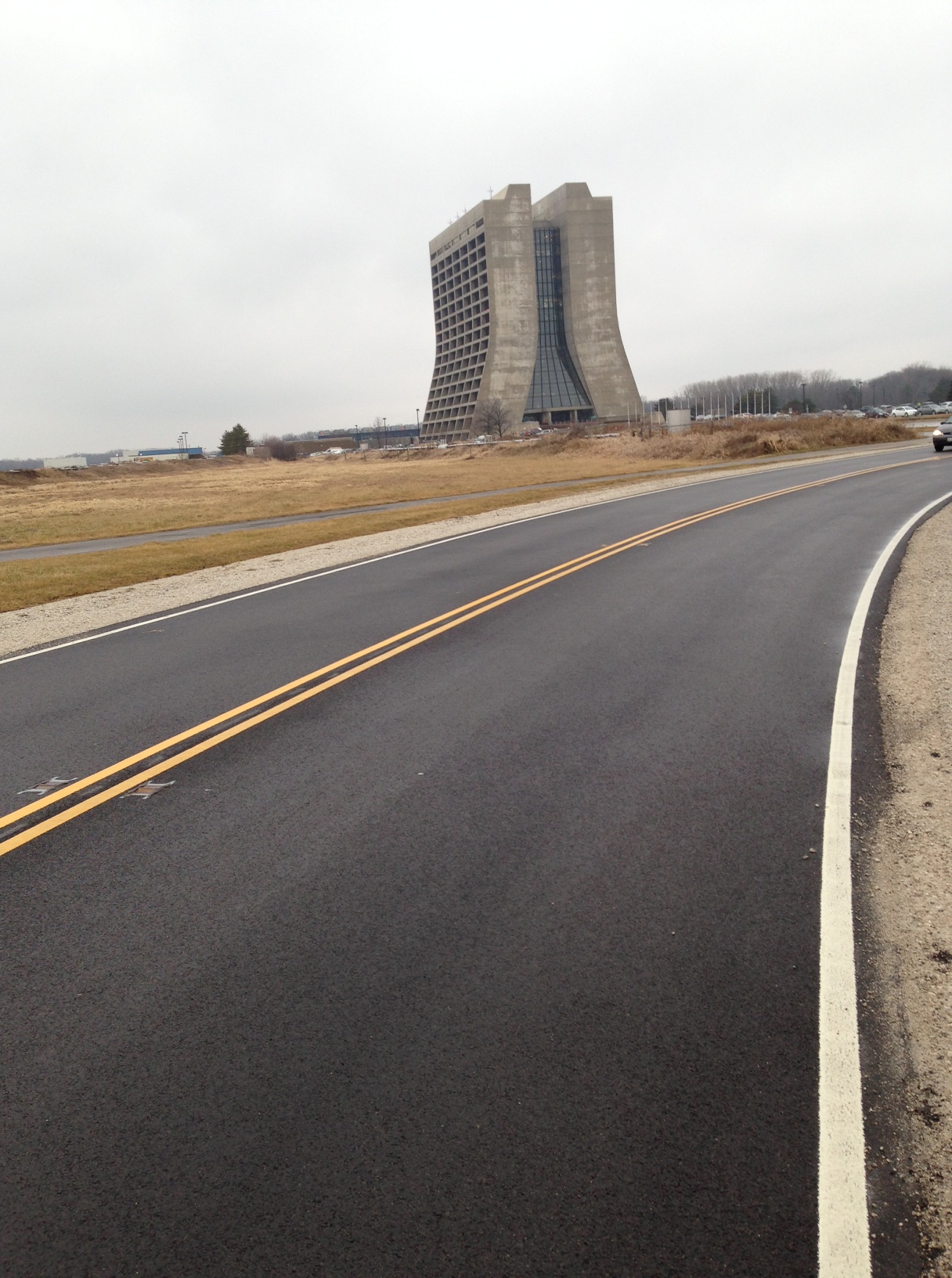
Fermi LabIs there some sort of middle ground to which we must hew in order to reconcile these contradictions? From where can we derive insight to help us determine the long-term effects of our decisions one way or the other? Is it science? Or is it religion. Or somewhere in between?

One thinks of the fact that the study of physics (such as at Fermi laboratory, pictured at left) has produced terms such as The God Particle to describe the source of all matter. Are we capable of such convergence in thinking on a social scale?

What we need is a test of some kind, a litmus paper to determine the acid truth of what has already transpired, and what is likely to come. That litmus paper is already out there on the roads and in the fields all over the world.

The running and riding paradigm

Every big problem requires an icon to help explain how the situation will affect us all. Given that global climate change stands to radically alter much of the earth’s biosphere and will be a giant evolutionary experiment over much of the earth’s surface, we essentially need some lab rats to serve as control subjects during this massive climactic shift that is going on as we speak. And that’s where people who run and ride come in.

Canary in a Coalmine

If you run or ride, you are about to become a canary in the coalmine on the issue of global warming. If you think the last few summers were hot where you live, imagine what life will be like when winter never comes and summer lasts from late February through late November?  If you live in Chicago the climate of the Upper Midwest could be altered drastically.

Sue Astra takes off on the run leg

Heat and drought can radically affect the training cycles of people like those who run and ride.

The people who spend the most time outside in the sun, the wind and heat are runners, cyclists. and triathletes. We’re the ones who will know most intimately how hot it really is out there. The rest of the world may retreat inside their homes to run their air conditioners while we get up earlier and earlier to run outside.

A new class struggle

Do you get the irony there? The people who prefer to sit inside to keep cool all the time will be contributing to even more global warming while people who actually like being outdoors will suffer even more for their willingness to endure the heat. It’s a new form of class struggle, with the active and the inactive engaged in a silent wrestling match over how to best to encounter the world.

In fact, that is entirely how we got here, through a chronic case of American obsession with motorized and industrialize convenience. Its ugliest expression can be found in the many motorists who have no tolerance for cyclists or runners on roads. Road rage over road ownership is in fact a form of culture or class war in which drivers jealously threaten those who seem to impinge on their concept of ownership when it comes to roads. That jealousy will only heighten when the next level of payment for usage of cars kicks in.

CO2 Rationing

Americans will finally be forced to make lifestyle changes when policies governing CO2 rationing are put in place to control output and levels of carbon gasses into the atmosphere.

But here’s the upside to those who run and ride. Those two activities may become a marketable commodity when the efficiencies offered by personal transportation are commoditized in the open market. Our insurance and compensation packages may become linked to CO2 and employees able to run or ride to work may become tradable commodities as carbon credits in the workplace

Health and the Public Option

Running and riding may also result in reduced insurance rate premiums, especially for those on the Public Option plan, which will be an inevitable need as medicine tries to come to grips with global warming’s effects, including plagues of infectious diseases resulting from emigration of insects, bacteria and airborne viruses released from tropical environments into the more heavily populated northern hemisphere.

Canaries in a Coal Mine, Part II

It is highly likely that active people will also be asked to enroll in scientific studies related to environmental stress. Those who run and ride will become valuable feedback mechanisms because of the time they spend outdoors. We’ll all be mined for information and analytic data about physical adaptions and blood response to heat and higher CO2 levels in the air. One risk is over acidification of human blood resulting from increased levels of CO2 in the atmosphere. Some doctors suggest that all human disease is resultant from disturbance of the alkaline balance in the human body.

Survivors

Copy of gollumIt is highly likely that over time due to global warming, personal fitness and heat tolerance could become a selective force in human evolution. That is, those who can best tolerate consistently high temperatures in areas strongly affected by global warming will better be able to survive the new, hotter world. The precedent for these selective pressures already exists in many parts of the world in all sorts of temperature conditions. The Inuit people have fatter eyelids that shield them from the cold. Kenyans exhibit slender long legs that enable them to release heat better to the atmosphere. The list of selective racial traits goes on and on. We like to ignore them out of political correctness and racial sensitivity, but the very real possibility exists that future races will actually need to be bred for survival purposes, especially if the climate heats up profoundly.

In that new world, runners and riders with better heat tolerance might even become breeding stock for the survival of the human race.

Last Laughs for Homo sapiens

You might chuckle and say it’s all an exaggeration, or insist that global climate change will not have enough effect to require such drastic measures for survival. But that would be a stark denial of earth history in which Homo sapiens evolved from ancestors highly dependent on climactic conditions for survival. As our intellects grew the ability to cope with heat or cold became linked to technology. The question now is whether or not technology can save us from our own inventions.

We also know that massive geological, volcanic, oceanic, tectonic and atmospheric changes occurred over great spans of time, and these often resulted in mass extinctions. So it’s pretty clear the earth does not care one way or the other which species survive. Neither do spiders or cockroaches, which have proven themselves highly adaptable to heat and stress.

Species of all types are going extinct at a fast rate these days. It happens every few hundred million years or so. Things get tipped and entire animal kingdoms get dumped into the waste heap. Humans could join the other 99% of species that have become extinct in history.

WeRunandRideLogo

Finish Lines

We can run and ride in real time and hope for the best, but when human hubris actually exceeds the earth’s capacity for sustainability as it did once before in the 1970s when air, water and pesticide pollution threatened the lives of so many, we can either act or deny the facts at hand. Fortunately we acted to remediate our polluted habits and the earth and its habits rebounded as a result. We even helped close the danger of the ozone hold by getting rid of chlorofluorocarbons in hair spay and other products and 25 years after the hole in the ozone layer appeared to be a dire threat, our change in habits has produced positive results.

As has been proven in cases such as the hole in the ozone layer it is possible to head off adverse, broad scale human effects on the environment.

But only if we act, and wisely. Otherwise there’s only one fact to consider in all of this: You really can’t outrun history.

Posted in Tarsnakes, We Run and Ride Every Day | Tagged , , , , , , , , , , , , , , , , , , , , , , , , , , , , , , , , , , , , , , , , , , , , , , | Leave a comment

See how far gratitude can take you

By Christopher Cudworth 

As you make plans for your next long run, ride, or swim, it might be wise to consider how thankful you should be for the ability (and time) to do your favorite activities.

Self-fulfilling prophecies

Gratitude can lead you in new directions.

Gratitude can lead you in new directions.

Plenty of times in life during conversations at a party or some other social occasion we hear people say, “I’m not built for running” or “Running bores me” or “I don’t have time for long bike rides.”

Some of these statements are self-fulfilling prophecy. But some people legitimately are not built for running or riding.

People with physical limitations still do get out there and run and ride. They don’t let their shortcomings stop them from putting in miles to help their minds, hearts and their bodies. The gifts we get back from running and riding usually exceed the pain and suffering.

And when they don’t, we call it character building.

Grateful or ungrateful  talent

Perhaps you’ve met a truly talented athlete who does not seem to appreciate the physical and mental gift they’ve been given. Athletic achievement comes so naturally to them it is hard to conceive that others struggle to do the same sport at all.

An elite athlete like Bill Rodgers (center) may be hard pressed to understand the lesser efforts of others.

An elite athlete like Bill Rodgers (center) may be hard pressed to understand the lesser efforts of others.

At one point in his career, successful marathoner Bill Rodgers called the efforts of mid-pack runners “graceless striving.” And he is right. From an aesthetic point of view, there are plenty of non-professional athletes who lack grace in their chosen sports. Later in his career as he evolved into an icon for the sport, Rodgers mingled with regular runners much more and even had some humbling efforts as he aged. He grew wiser for the experience.

Grace and gratitude

What Rodgers may have missed early on, and what he discovered later in life as he entered the status of a running guru for millions of wannabe marathoners, there’s another kind of grace at work in the lives of most people. It’s not all about being the prettiest or the fastest runner on the planet.

Instead, grace comes through working with your limitations–as well as through them–to discover who you really are. That produces a grateful attitude about your running and riding that actually deepen your appreciation not only for the sports you do, but everything else in life.

True grace

IMG_9433What Bill Rodgers missed in branding the efforts of less talented runners “graceless striving” was that grace in a spiritual sense is a gift freely given and there’s nothing you can really do to earn it.

Grace does not fall to you through the compliments of others or from winning a contest. Grace does not come your way out of earnestness or a desire to be loved. It essentially pre-exists all our human emotions.

If we understand grace sufficiently, it is the most humbling of all emotional connections and also the most uplifting expression of acceptance and love you can imagine. It is a tarsnake in that respect, a confusing and somewhat ethereal dimension of being that not everyone has an easy time appreciating.

Take a look at the definition of grace and you find it has three manifestations in the English language.

Grace: defined 

1. Simple elegance or refinement of movement

2. (in Christian belief) the free and unmerited favor of God, as manifested in the salvation of sinners and the bestowal of blessings.

3. To do honor or credit to (someone or something) by one’s presence. 

Grace beyond reason

Should you be disinclined to religious definitions of grace as described in #2 (or here, on my blog The Genesis Fix) you can still understand operative grace apart from God.

In fact Bill Rodgers once noted while competing in the New York City Marathon that he was overcome with a need and desire to do the race with utmost respect, even to the point where the manner in which he held his hands was important. He was calling himself to an alignment with the grace of the moment. Doing something well for its own sake and out of respect for the situation you are in is a combination of grace and gratitude, or grace appreciated. 

Moving in grace

If you have ever experienced that level of immersion in the act of moving, you appreciate the emotions that go with those sensations and feelings of grace that proceed from trying to do something that well. It’s called being thankful for the opportunity.

So while Rodgers might have been harsh toward other runners in his original dismissal of runners less talented than he, it may be true that athletes at that level do experience something unique, and it is therefore hard to bridge the gap between their own experiences and those of others.

In the other direction, it may be the reason why we admire the most graceful skaters, dancers, cyclists and runners or swimmers. Like Michael Phelps. Chris Froome (although not graceful, he can ride…).

Their grace in action symbolizes something rare and difficult to attain. Whether they appreciate their own transcendence is a question for the ages. It is apparent that some athletes do, but some don’t. That only proves they’re human.

Core emotions

At the far extreme of cynicism, a world devoid of grace gratitude is an embittered place, in which we are distanced by an inability to make connections of any kind.

We all know people who suffer from ingratitude, and that can seem hard to understand. But when the core emotions of gratitude are cut to pieces by some deep or painful life experience or circumstance, people tend to turn inward to a life of dissatisfaction with everything they encounter.

That is the opposite of gratitude, and it can be one of the most difficult things of all to overcome, a barrier you must cross to happiness, a hurdle to jump or a wall around which some people can never manage even to approach.

Ingratitude really is a form of death, if you must know.

That is why we run and ride in the opposite direction if we know what’s good for us.  The journey never really ends, but the daily beginnings are what count toward appreciation of grace and its pursuant attitude of gratitude.

Here are the ways that gratitude can take you a long way toward that which you most want to achieve:

  1. Feeling gratitude is wise. It means you are enthused for your best efforts and accepting of your failures, which keeps your running and riding in perspective. It also transfers to other aspects of life.
  2. Expressing gratitude is positive. Being grateful creates a loop of continual positive feedback, and that affirms motivation.
  3. Gratitude is purpose-focused. Mental gratitude helps you remember why you’re doing something as well as how.
  4. Finding gratitude is enlightening. Grace and gratitude open your mind to the value of current activities and the potential of those to come.
  5. Gratitude is practical. Being grateful for the important things helps you release distractions and simplify your life. That is zen, in a nutshell.
  6. Being grateful is sustaining. Gratitude helps you overcome adversity.
  7. Seeing gratitude builds comraderie. You will be naturally and expressively drawn to others who share your grateful perspective in life.
  8. Gratitude deepens satisfaction in what you’re doing. There is no need to rationalize workouts of race efforts when you are grateful for all that you can do, or have done.
  9. Gratitude shakes up the world. Voicing your gratitude can shift conversations and change lives, including your own.
  10. Choosing gratitude is good use of free will. A grateful attitude going into races or workouts strengthens your resolve that what you are doing is possible and beneficial. That’s a good use of what we call free will.

Be grateful for your next run or ride. Or swim! And keep that grateful attitude going. It can sustain you in all aspects of your life.

WeRunandRideLogo

Posted in We Run and Ride Every Day | Tagged , , , , , , , , , , , , , , , | Leave a comment

Are we ready for zombies that run and ride?

By Christopher Cudworth

Walking Dead or the 20 mile mark in a marathon? Hard to tell sometimes.

Walking Dead or the 20 mile mark in a marathon? Hard to tell sometimes.

My daughter just finished a NetFlix marathon watching past episodes of a show called The Walking Dead. It was a pretty grueling effort to catch up on 4 full seasons or so. But she’s a tough girl when she needs to be, and watching zombies die all over again and again and again is something that just needs to be done sometimes.

Every time I’d walk in the room to say hello or ask her if the dog needs a walk, I’d turned to the TV and see another zombie’s brains splattered on the wall behind their head. “It’s not always like that,” she’d laugh and tell me. “You just happen to walk in when they’re shooting zombies.”

Zombie chic

The Not So Walking Dead.

The Not So Walking Dead.

I admit the whole zombie thing makes no sense to me. If any of those zombies was ever treated to what we call a “decent burial” they would not be walking around groaning and talking and casting evil eyes toward their human victims. See, when people get prepared for burial by a funeral home it’s a pretty intrusive process. What we see when we view our loved ones at a funeral is an elaborate ruse. Their eyes are Superglued shut and there are quite a few other tricks used to make up the face and bodies of our dearly departed to make them presentable for the living.

It seems we’re willing to ignore all that to indulge our very weird fantasies about dead people coming back to life to eat us. Or whatever zombies do. I haven’t paid enough focused attention to truly understand the role of zombies in our living ecosystems. It definitely seems like they might upset some social dynamics, especially at cocktail parties when their rotting teeth keep falling into the finger food tray. Did someone say finger food? Keep it down, the zombies love appetizers.

Zombie comebacks

Actually, I think zombies are stupid for wanting to come back to life. They’d have to be pretty dumb, desperate or bored to want to come back to a world where Honey Boo Boo and little girl beauty pageants are tolerated for any reason. When are people going to realize that the phrase “cable reality show” is an oxymoron?

Where you can find real life zombies

The sport of cyclocross has been known to produce a few zombies.

The sport of cyclocross has been known to produce a few zombies.

All that said, I am here to tell you that I have actually seen living zombies. Stand at the 22 mile mark of any regulation marathon and you will see plenty of zombies, especially if you hang out past the time when the 12:00 mile pace. At that point in a race people are basically trying to get along like the actual Walking Dead. The only difference between marathoners in oxygen debt or lactic acid overload and real zombies is that zombies don’t stop at water stations.

Zombie pelotons

Zombie cyclists move through the murk and mud in an early version of the Tour de France.

Zombie cyclists move through the murk and mud in an early version of the Tour de France.

I’ve seen zombies riding bikes too. Our weekend group ride has been known to produce a zombie or two when the pace picks up and the route extends past 60 miles. That’s when Zombies On Bikes begin to appear. It is sad to see their wretched faces, gazes fixed just over the front wheel in an effort to keep moving forward. They raise their water bottles to drink and you almost think the fluids they ingest will pour out their rib cage like those moonlit crewmates in Pirates of the Caribbean.

Personal zombie experience

I have become a zombie myself at least 10 times in my running and riding career. The worst moments are pretty hard to take, when you know you’re dead and don’t really care to survive. That’s when it’s hard to find motivation to be anything other than a zombie. Just one foot in front of the other. Keep on pedaling. Chain yourself to the saddle and stay in the draft or risk falling to pieces.

The three most memorable zombie moments in my career include:

1. The Lake Geneva Marathon when I wound up seeing stars at the Yerkes Observatory just past the 20-mile mark. Sat down to rest and never got back up until someone threw me in a car and drove me to the finish.

2. An 80 mile group ride in April, during a windstorm, in which we still averaged 20mph. I do not remember the last 20 miles of riding. I was simply too dead to care.

3. A ladder workout on the track in which I ran 200-400-600-800-3/4-mile-3/4-800-600-400-200 all at race pace. By the last 200 body parts were falling off on the track. But I came back from the dead after that workout and set a PR in the 10K the next week.

Zombie resurrections

Some very healthy zombies pace themselves so they won't die in the last miles of a half marathon.

Some very healthy zombies pace themselves so they won’t die in the last miles of a half marathon.

Coming back from the dead is not easy. Sometimes a Powerbar is all you need, or a strong swig of electrolytes. But if that doesn’t work the only alternative is to stumble or pedal home and try your best to recover.

I’m pretty sure if you produced a TV series titled Running Dead it would be twice as scary as the series Walking Dead. If zombies could run, the odds against human survival in the face of an onslaught by a group of sprinting zombies goes down quite a bit.

And how comic would it be to see a Zombie Peloton riding through town, chomping at the bit for human flesh while riding Trek and Felt and LeMond bicycles.

It seems like Walking Dead are boring by comparison with really active, fit zombies who have real endurance and speed. Someone should make that show. They really should. I’d be willing to take on a role in that series, even the love interest. Once you’ve had a little zombie action, it is said, you never go back. Or so they say.

WeRunandRideLogo


Posted in We Run and Ride Every Day | Tagged , , , , , , , , , , , , , , , , , , , | Leave a comment

Seeing your way clear to success

By Christopher Cudworth

Those of you with perfect vision have no idea. How much. It sucks. To have bad eyesight.

Early onset

My eyes started going bad at about 12 years old. Which double-sucked, because that’s about the age when glasses really look geeky on kids no matter how well-chosen the frames may be.

So you suffer through those years if your parents won’t buy you contact lenses.

27_mclovin_lglOf course parents who suffered through their adolescent years looking like McLovin from Superbad generally have compassion on their own kids and buy them contact lenses as soon as they are old enough to responsibly use them.

But contact lenses for athletes are not just about appearance. They are also about performance.

Lobbying for a better look

My parents paid no attention to my complaints that the glasses they purchased for me at age 13 were negatively affecting my hitting ability in baseball. The frames were thick and blocked peripheral vision.

So I stopped wearing them even as my vision got worse. Soon enough the inevitable happened. A line drive came screaming off the bat of my coach at twilight and I could not see it before it was too late. Off to the hospital and dentist I went to have a tooth put back in my mouth.

Limited options. Unlimited ugliness. 

Glasses have come a long way since those early days of forcing kids into one or two frame styles for kids. That’s right. When you went to the optometrist there were basically three styles to choose from in the early 1970s. Ugly. Uglier. And ugliest.

And none of them was designed for sports.

Except for actual Sports Glasses. Now those were a scary deal. Sports glasses were big black frames attached to your head with what appeared to be a chunk of jockstrap. Girls almost automatically laughed at you when you put Sports Glasses on.

My parents bought them for me as a sort of concession that I was good at sports. But those glasses actually made things worse, not better. The frames were so thick that basketballs were always hitting me in the side of the head because you could not see them coming.

The Squint King

So I went without glasses, preferring to squint my way through cross country races and baseball games and basketball, which was worst of all. It’s pretty hard to find your range on the court when everything around you looks fuzzy.

It went that way all through high school. I finally demanded a pair of wire-rim glasses so that I’d look a little better “for the ladies”, but those glasses repeatedly got shattered on the basketball floor and often had to be held together with athletic tape. I know: Nerd City, right? You did what you had to do when your parents weren’t rich and your glasses got busted.

Lenses were glass back then, and the tiny little pieces resulted from a basketball to the face made the coach livid that practice had to be stopped to sweep up the glass.

Who can blame him? By the time I was a senior, the sport was no longer practical given my eyewear situation.

And that made me a full time runner.

Framing the issue

Still, the glasses thing was still a problem. If you had a strong prescription your glasses were heavy and thick, forcing you to push them up your nose if you did not have a glasses strap to tug them tight to your face.

napoleon-dynamiteAnd that’s how it went through high school and well into college. Think Napolean Dynamite, only ever so slightly cooler, but not by much.

Cool was not a term that would be associated the glasses I wore my junior year in college. In an attempt to make them look a little cooler I selected a frameless style with the lenses exposed on the side. What a mistake. With my prescription they looked nothing like the sample pair on display at the optometrist’s office.

And those suckers were heavy. I spent half of every race I ran pushing them up. Or else the glasses strap was pulled so tight to keep them in place my entire forehead would compress in tension from the pressure. Neither was conducive to good racing.

LutherCC

That’s me, freshman year in college. 8th from left in the back row. Long hair. Glasses.

That was the only year I did not make All Conference in college cross country. And I blame those damned glasses.

By spring I’d made peace with the things enough to run all my PRs in track. But actually, those times came out of anger in not doing well the previous fall.

The fact is, I was in a prison of my own making, with long, long hair, a pair of glasses too big and too heavy for my face, and a Lasse Viren beard that make me look like a Nordic reject.

And that summer I got rid of it all.

Transformation

Cut off my long hair myself, then went to the barber shop to fix the overall look.

Shaved the beard and kept a simple, clean mustache. It was 1978, after all.

And got contact lenses. That was the real kicker.

From 1978 to 2013. Am I still squinting? Looks like it here.

From 1978 to 2013. Am I still squinting? Looks like it here.

I felt like a liberated man. No longer did I have to push my glasses up or run with my face pointing down at the ground in a habit I’d developed when running without glasses.

Life suddenly made sense, and my running started to show it.

That summer’s training was revelatory, and that fall I moved from 7th man to 2nd man on the cross country team. We placed 2nd in the nation that fall in NCAA Division III cross country.

It would not have happened without the contact lenses. I am convinced of that.

Seeing clearly and easily was an important part of that transcendent period, but so was having a clearer picture of myself.  It all works together, as anyone can see. The same thing happened for a dozen or so of my fellow runners. They got rid of the glasses and became a different kind of runner. It worked like magic. Perhaps it was less facial tension. Or less weight on the head. Whatever. It worked.

Laserlike vision

Friends of mine have gotten eye surgery to correct their vision. I can certainly see the merit of that. But middle aged friends tell me they still need reading glasses after the surgery. So I’m not convinced the trouble and expense is worth it.

It would however be nice not to worry about contact lenses while running or riding the bike. And if I take up triathlons as I’m planning to do, not having contacts during the swim would be one less worry to think about.

The real point is that taking your vision seriously can reap pretty significant benefits. Your eyes are an important part of your success, if you know how to use them.

WeRunandRideLogo


Posted in We Run and Ride Every Day | Tagged , , , , , , , , , , , , , , , , , | Leave a comment

On the run with The Pretender

By Christopher Cudworth

The Pretender (click link to video)

JacksonbrowneThePretender

“I’m gonna rent myself a house in the shade of the freeway,

Gonna pack my lunch in the morning and go to work each day

And when the evening rolls around

I’ll go home and lay my body down

And when the morning light comes creeping in

I’ll get up and do it again. Amen.” –The Pretender, Jackson Browne

On the run with The Pretender

That song The Pretender by Jackson Browne once served as the thoughtful foundation for a 20-mile run on a gray spring day when it seemed no one else was on the road. Being old school at the time, I carried no water and drank nothing the first 17 miles of the run, when I finally bent down next to a faucet on the back of a factory and took the chance the water was potable. Drinkable. Suitable to ingest.

It was. I’m still here. Didn’t die from bad water or get found dead in a ditch beside a running trail. Nope. Never did nothing that stupid.

But that was dumb luck. Instead my stupidity seemed focused around other phases of life. Like not completely understanding office politics, or being too assertive about ideas, no matter how good they were.

And trying in between to figure out what love was all about.

Reason for life

photoWhich is why The Pretender was so apt a song for a young man to sing on the run while trying to reason out his life. Of course, as a product of the 1970s there was plenty of angst toward life and the entire act of making money.  A song like The Pretender perfectly captured that angst.

But always with a Jackson Browne song there was more to the story than simple dissatisfaction with life.

“Caught between the longing for love

And the struggle for the legal tender…”

Thought for fuel

On and on I ran. Not tired or thirsty. The thoughts were too intense to allow such sensations into that run. Thought can do that. And thoughts turned to the women I’d known, or wished I’d get to know…

“I’m going to find myself a girl

Who can show me what laughter means

And we’ll fill in the missing colors

In each other’s paint by number dreams…”

Love was confusing then. Love is real now. You come to recognize love through experience. You don’t rush it. It’s like pacing yourself during a marathon or a long bike ride. Jump at the chance for a quick pace—on the run or in love– and you might suffer later. It’s not sustainable. But you dive into it anyway. Hoping. Feeling. Dreaming. Touching. Trusting.

“And then we’ll put our dark glasses on

And we’ll make love until our strength is gone

And when the morning light comes streaming in

We’ll getup and do it again

Get it up again…”

Studying facets of life

Oak leaves. That long run long ago with a song like The Pretender going round in my head opened a few channels in life. The lyrics fed me as I ran on through 10, 12, 15 miles. The song was a diamond in my head, full of facets and gleaming truths.

“I’m going to be a happy idiot

And struggle for the legal tender

Where the ads take aim and lay their claim

To the heart and the soul of the spender…”

A realistic place

It wasn’t hard to realize that running even then, when it seemed like my whole world, was actually just a treat, like ice cream. Though I tried hard at the time to make it something more than that, running 80 to 90 miles a week, and winning some races, soon enough it dawned on me that it was time to move on from that type of dream. I may have quit competing a bit too soon. But at 27 years of age I was getting married. Having our first child. I had been Competition’s Son since the age of 12. It was time to find a realistic place in the world. But the prospects were daunting. They always are.

“And believe in whatever may lie

In those things that money can buy

Thought true love could have been a contender

Are you there?

Say a prayer for the Pretender

Who started out so young and strong

Only to surrender.”

We lose track of truth

Zen fern. Yes I fell for those lines, a bit, and the harsh reality they represented. But I also learned that the prayer for which the Pretender asks in the song can actually enrich you in different ways. Such as the fact that it is not that money is the root of all evil, but the love of money may lead you to evil things. That’s what the Bible actually says. We lose track of truth in such subtle ways.

Knowing the difference can make all the difference, and salvation lies between.

So in some respects I have surrendered to the realities of the song, but not entirely to the disillusionment it suggests, which can be tortuous if you let it hold you down, or to define you.

“I want to know what became of the changes

we waited for love to bring

were they only the fitful dreams

of some greater awakening…”

When you are running 20 miles you have lots of time to think, if you allow it to be so. And as I ran on, singing snippets of The Pretender over and over again, life stretched out before me as if the lyrics themselves were calling me forward…

“I’ve been aware of the time going by

they say in the end, it’s the wink of an eye

And when the morning light comes streaming in

You’ll get up and do it again

Amen.”

And that’s how most of us go about it. We make a living. And living makes us.

Sustaining hope

Running and riding while thinking things through is one form of sustaining hope for so many of us. We run and ride on, and find love, or lose it, or someone. If we’re luck or persistent, we learn to love again.

DSCN1978And make sense of the rest the best we know how. Earn our livings. Share our hopes and worth and trust. Make love in the morning light. Then go for a run in the shimmering early sun. Together.

“Ah the laughter of the lovers

as they run through the night

Leaving nothing for the others

But to choose off and fight…”

Running past secrets

We all go through difficult things in life and some try to keep them all secret. Pretend they don’t exist. That is the tarsnake of truth. Do things still exist if we never tell anyone?

But those of us who expose our souls on the roads by running and riding know that life is honest and hard and full of tests that can make you a better person. We create for ourselves a reality that faces those facts, or learn to accept them in more positive fashion when they come our way.

“Out into the cool of the evening

strolls the Pretender

He knows that all his hopes dreams

Begin and end there…”

The Pretender in all of us is the person who finds truth between the house on the freeway and the morning light that greets each day. We run toward the light at dawn, and away from the light at sunset. Then we come back home and greet those we care about with hopeful kind words such as, “How was your day?”

And we don’t pretend it has to be any other way.

WeRunandRideLogo

Posted in Tarsnakes, We Run and Ride Every Day | Tagged , , , , , , , , , , , , , , , , | Leave a comment