What the hell do you know about mountain biking?

By Christopher Cudworth

The thing about mountain biking is that to do it right, you had better know what the hell you’re doing.

A mountain bike will stay on the trail if you make it do that. But it really wants to go elsewhere.

A mountain bike will stay on the trail if you make it do that. But it really wants to go elsewhere.

Wander off on the wrong trail and kiddo, there’s no easy way back. Rocks and drops and switchbacks to tear your legs off. Real mountain biking requires skills that your run-of-the-mill cyclist who owns a mountain bike but doesn’t ride off the road much simply don’t have.

Different DNA

Real mountain bikers are made from different kinds of stuff than the typical round tire grass knockers (like me) who ride mountain bikes off the road but not where mountain bikes actually were designed to go.

But the dream persists.

In fact recently I met this cute girl with an awesome tattoo on her calf whose sturdy thighs told me, in no uncertain terms, that I probably could not keep up with her on the mountain biking trails we had just been discussing in the lunchroom.

We both live in the Chicago suburbs, so that means there are only a few really good places for real good mountain bikers to go.

One of the best sites for mountain bike trails is in the Palos area where glacial moraine hills make mountain biking pretty fun. I know this because the little graphic designer friend with a black Volkswagon Whatever and a bike rack on top told me it was one of the best areas around. The attached video didn’t show anything I couldn’t do on my mountain bike. But I’m pretty sure the trails shown were some of the milder stuff you can find. That I could hack.

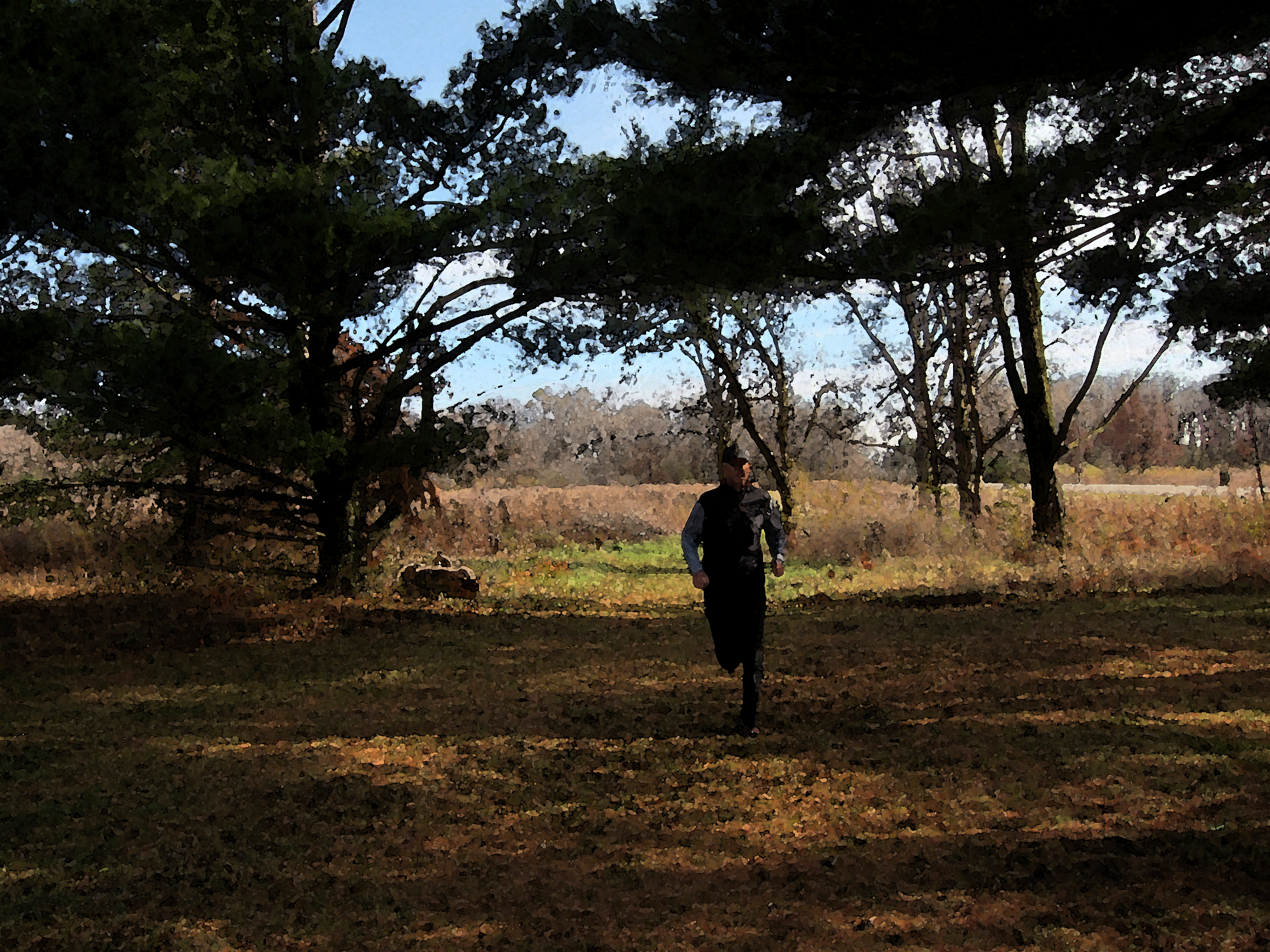
When I went down there to ride I stayed off the single track but rode a trail loop through a forest preserve where at one point the climb was so steep my back tire could get no traction. Clipped into my SPDs, it was pedal or die. So I pedaled and made it up a hill steep enough that my nose was basically scraping the gravel ahead, and topping out on the flat above, adrenaline coursing through my veins and vanity, it definitely felt like I had accomplished something. And had I gone backwards, there would have been no living with myself. A cyclist with any degree of respectability does not go backwards under most circumstances.

Facing a test

Perhaps my cute cafeteria gal with the cool tattoo would swing right up that hill no problem. I get that. Real mountain bikers ride terrain that makes the rest of us piss our pants. They cross log piles too, without impaling the their crankset on a log. That’s both a literal phrase and a euphemism, if you catch my drift.

A rock from a different age still lingers on the burnt, wet prairie.

Mountain bikes like odd places. That’s why odd people ride them. Because it’s fun.

The last time I jumped a log my rear tire went hissssss with a pinch flat. That meant I had to walk home three miles because I wasn’t carrying a spare. I know. Dumb, right? But honestly I’d never had a flat on my mountain bike in 8 years of owning it. So give me a freaking break. I’d come to believe that bike was impervious to damage. All cyclists know there is a first for everything.

What cool-chickie cafeteria gal also probably knows about mountain biking is that it takes a certain daring nature to really ride the rough turf. And then she tweaked me by saying, “I don’t know if you could keep up with me.”

And it set me back a step. Anyone with a tattoo the size of a good sized bass on her calf must have a respectable tolerance for pain. Perhaps she was right. Maybe I couldn’t keep up. I’ve been dusted by plenty of women on the road bike. Gals who rip along at 26mph on the open road and leave only a whiff of their healthy fit gal smell on the wind as they cruise on by. You can either jump in their draft and go with it or make that pathetic little wave cyclists use when they know they’re not up to the pace.

Stepping up
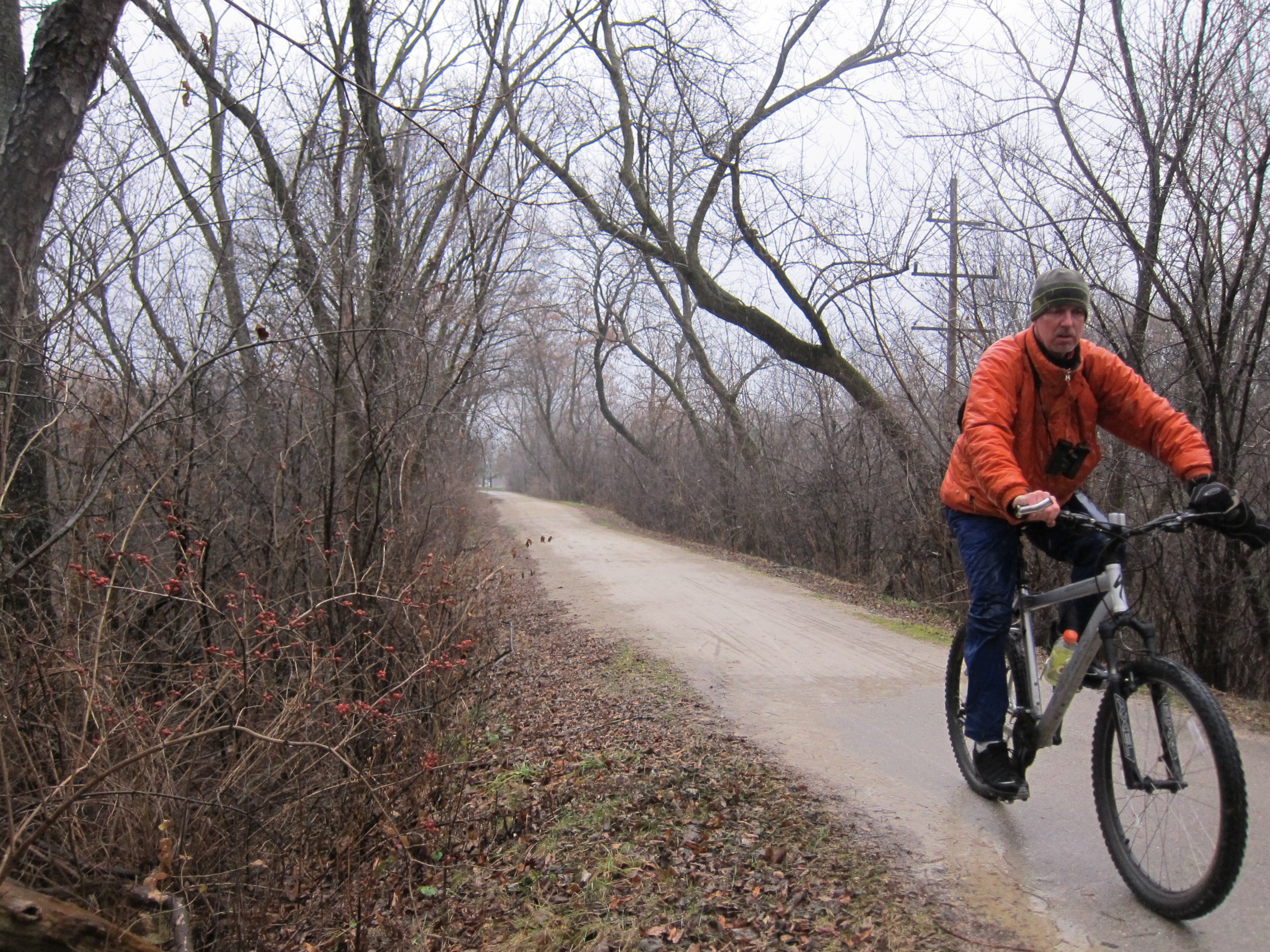
You can get wet, cold and dirty on a mountain bike and not feel guilty. At all.

You can get wet, cold and dirty on a mountain bike and not feel guilty. At all.

Yet I have been known, on more than one instance, to rise to to new level of endurance and toughness when the occasion demands. My competitive nature and talents can be aroused by just such a challenge.

For example, my daughter once asked me to chaperone a date with a 9th grader when she was in 7th grade. I agreed, and we all went bowling together. The first game the kid dusted me 190 to 165. And then he did a dumb thing. He got all cocky and patronizing with me.

The next game I bowled 7 or 8 straight strikes and rolled to a 280+ game. To which my daughter hissed, “Are you insane?”

Yes, my little girl. Your father is quite insane. My brothers used to call me The Mink, and for good reason. Once I got spitting mad and the competitive juices started flowing, the ‘game on’ insanity was not far out of reach. I embraced it gladly, like a McDonald’s hamburger following an all-day workout. One does not care if food is healthy or not when famishment drives the soul. It’s the same with self respect and being challenged. You will eat your young to win if someone pats you condescendingly on the back and says, “Nice try. You did your best.”

Hungry for dirt

So while mountain biking is not my preferred diet for cycling, you could put a trail in front of me and who knows what could happen? If the chickie-babe tattoo cafeteria girl rides off into the sunset without me I will accept the fate and acknowledge that she, and millions of other women to be honest, are better cyclists than I.

But neither will I go down without trying my damndest. And it’s not about “beating a girl” or anything stupid like that. It’s about breaking out of your own expectations.

A healthy touch of insanity

It simply takes a little touch of insanity to be good at any sort of competitive sport, especially solo sports, because you have to put in a certain amount of time thrashing yourself alone to be good at a sport like cycling.

But mountain biking is a whole new realm of insane. If you really know what you’re doing––then you really don’t, in a way. Riding the right kind of trail where your senses are challenged to keep up is a matter of reacting and accepting that your next big jump could cost you some skin or a bone or two.

Okay, I’m not ready to go there. The Mink knows better now. But given the challenge of chasing a tattooed gal up a suburban hill, I just might.

I just might.
WeRunandRideLogo

Posted in We Run and Ride Every Day | Tagged , , , , , , , | 2 Comments

How running and riding help conquer your fears

By Christopher Cudworth

Fear is found in nearly every sentient creature. Including you.

Fear is found in nearly every sentient creature. Including you.

Fear is the emotion that too commonly keeps people from reaching their potential in all phases of life.

We fear failure.

We fear success.

We fear rejection.

We fear lack of will.

We fear the unknown.

We fear God. But not always in the right ways.

So, how do we overcome fear, or work with it positively?

Rehearsal breeds success

It pays to move forward through fear, however slowly.

It pays to move forward through fear, however slowly.

Rehearsal. We conquer fear by choosing to engage in things that challenge us. When we successfully overcome the challenge, fear is reduced or even eliminated.

Fear can paralyze. Fear can stultify. Fear can make us reject ourselves and others. Fear can teach us the wrong way of looking at things. Then it becomes a habit.

Anxiety is fear. Some of us are born with naturally high levels of anxiety. It affects our ability to function. It creates a flipside that sometimes results in depression. These are biological sources of fear. Rooted in the evolution of all humankind, our anxious fears are exaggerated forms of natural preparedness. A rabbit twitching in the grass, waiting to run, is heightened by anxiety. Fight or flight?

How to be a badass rabbit

But having seen rabbits fight with some ferocity, we know that rabbits are not always afraid. When called to action, a rabbit can be one badass piece of scratching fur.

And therein lies the answer to conquering our fears. We can use situational rehearsal to help us get to know our minds, recognize trigger points for fear and learn how to manage our thoughts––and fears––through “set-aside” activities like running and riding.

How does it work? Quite naturally, actually.

Cataloguing our fears

Any time you prepare for a challenging effort your mind is engaged in preparation. You begin to take in factors that could cause you to fail. But you hopefully engage in thoughts about how to succeed. The trick is how you catalog those thoughts and set them aside to help make room for the hopeful, positive thoughts that can overcome fears and negativity.

Saturday Night syndrome

We all question ourselves. But when we replace those questions with answers, we overcome our fears.

We all question ourselves. But when we replace those questions with answers, we overcome our fears.

Fear is interesting in many respects. Let’s say you’ve prepared for six months to run a marathon. On Saturday night your mind is full of good thoughts and positivity. Yet when you rise on Sunday morning it feels like a black cloud moved in overnight. All you can think about are the many things that can go wrong. Your wicked subconscious almost takes over. “I didn’t train enough. That long run three weeks ago went terrible. What if I feel like that today?”

100 miles of fear

Or perhaps you’re riding your first century. The distance is new to you. The farthest you’ve gone before is 80 miles, and that was hard. Will your body give out? Will your back grow tired and cramp up? Will you get a saddle sore and have to quit?

Just listen to yourself.

In advance of both the marathon or century ride, those negative thoughts are natural, because they express our doubts. But if you take out a piece of paper and write down all the reasons you want to succeed and all the reasons why you should succeed, it is likely you’ll find the hopes balance out the fears.

Using heightened senses to your advantage

Becoming awr

Becoming awr

Fear heightens the senses, after all. A bit of nervousness is how many athletes get up for their competition. But when nervousness flips and becomes translated only as fear, which holds you back from doing your best, then it’s vital that you “get a grip” as they say, and put those fears back into context so that you can move forward with what you want to accomplish.

Remember that piece of paper we just mentioned? Find one. Sit down right away and start writing down your fears. The very act of acting on your fears by writing them down can make a tremendous difference in overcoming anxiety and fear. Something about the physical act of writing combined with getting your thoughts down on paper help. It really does.

Not sure if writing on a smartphone works as well, but whatever…in a pinch.

Capture your fears.

Then use a column to write down all your real goals and how long you’ve prepared for your event. Even if it falls short in terms of counterbalancing your fears, there’s a massive steam valve waiting if nothing else works.

Write down these words: “I can only do my best.”

That’s both a confession and a motivation, you see. It accepts that not everything may go right, and forgives you if it doesn’t. Yet it states positively that whatever you do, you are responding the best way you know how, and giving your best because you’ve had the courage to challenge your self. Welcome the challenge and you’ll find a way to succeed. Give yourself credit for that.

Applying your best to life

We all get his with surprises. Don't let them make you nuts.

We all get his with surprises. Don’t let them make you nuts.

When facing major life events, it is often easy to become critical of ourselves and imagine we are not up to the task. I recall the moment when my mother was dying of cancer and my father, a stroke victim, needed me to take over his caregiving. Standing in his front yard before going in to discuss next steps, I realized there were no rules to guide me then. No one to tell me what to do. I could have been full of fear at that point. But all my years of rehearsing how to conquer fears through running and riding came into play. I quickly assessed the near term goals and strategies necessary to do a good job in the situation I was facing. Decisions on life and health and money would need to be made. Suddenly I felt capable.

In fact my former high school track coach called me a few days later. He’d heard that I was also facing a new challenge on top of my parent’s ill health. My wife also had cancer. “You can do it,” he told me. “Your whole life has been preparation for this.”

He knew me well, having first coached me in baseball at the tender age of 13. He also coached me in cross country and track in high school. Later we even did business together. So he’d seen me face potential fears as a 13-year-old pitcher in American Legion baseball, playing baseball against players 3 years older. But I loved the challenge. I literally had no fear. It pays to be young and stupid sometimes. But hey, whatever works.

Sensational perspective

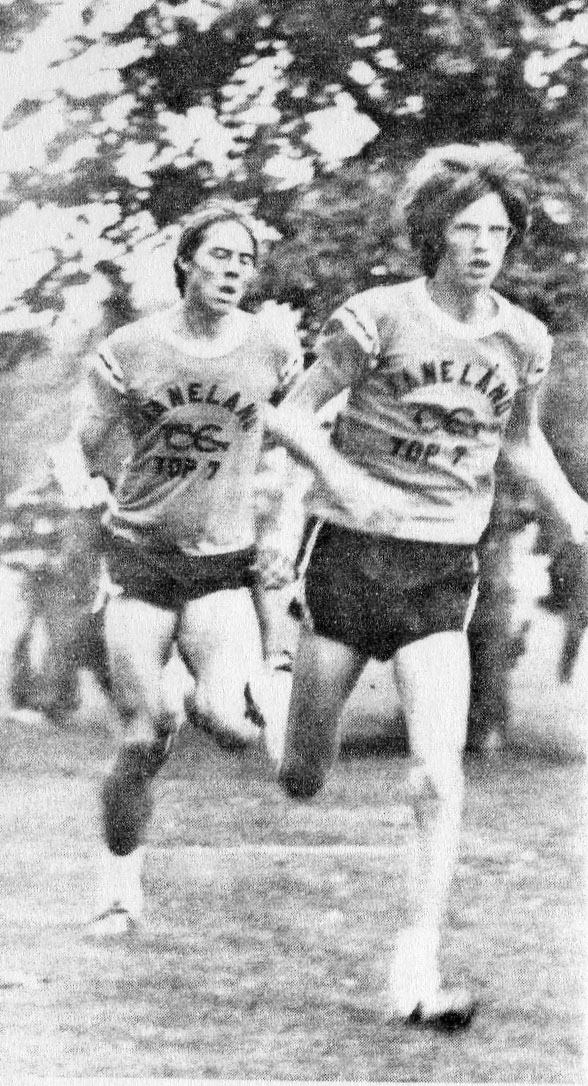
As a high school runner enjoying some success, there came a time when a sports reporter called me a “junior sensation.” My coach corrected the writer in print by saying, “Cudworth is a good runner, but not a sensational one.” And he was right about that. There were runners even in my conference who were better than me. I’d done some good things, but a sensation does even more than that. Even I knew that.

But it all made sense when my coach reminded me of all those athletic challenges faced over the years, including acknowledgement of limitations. Because to a degree, it resonated with real life, in the moment.

A nail biter

Skinny kids grow up to be adults who need to make decisions.

Skinny kids grow up to be adults who need to make decisions.

The anxious kid who bit his nails from age three had grown up to handle life emergencies because sports had provided enough mental rehearsal to enable a calm, collected approach to tense situations.

That doesn’t mean I never fail. I recall the day I was standing in a hospital room in Syracuse, New York. My father had his stroke in Seneca Falls and had been transported 6o miles to a magnet hospital for treatment. For six weeks over the summer he lay there in near comatose fashion before reviving somewhat. I traveled to New York to bring the recovering patient home. The plane tickets and transportation to and from the airport had all been arranged. The narrow travel window was tense and difficult. A stroke patient can need medical assistance at any moment.

I thought I had prepared everything well for the journey. Then the doctors said, “Well, perhaps you can take your father home later this week…”

“This week?” I asked. “It’s all prepared for tomorrow. We’re leaving tomorrow…”

And just then I began to faint. I’d never had that experience before. But rather than fall face first into the row of interns standing together in my father’s room, I took a few steps forward and pushed them aside, heading for the hallway.

It wasn’t fight or flight, exactly. It was more like move and breathe or collapse. Same difference. At any rate, I got out into the hallway and took a series of intensely deep breaths. From then on I was fine. We got dad home through airports and beat up medical vans but it all worked.

Recovery from fear

Running and riding can be great recovery from stress.

Running and riding can be great recovery from stress.

Then I did the one thing that came naturally after a tense, wild affair. I went for a run. Because running and riding are not only great rehearsal in preparing for the big events in life, they’re also great for winding down.

So no matter what difficulties and challenges you are finding in your life at this moment, running and riding can help you prepare. Whether it’s a big marketing pitch in front of a major client, or discussing your child’s math grades with a taciturn teacher, you can learn how to control your thoughts, rule out the negative and find space for the positive. Then go in that room and do what you have to do, because you’ve rehearsed for this. In many ways through running and riding, you’ve done it all before. Conquered your fears.

Now go out there and run and ride. And don’t be so afraid. You can do it.  We know you can.

WeRunandRideLogo

Posted in We Run and Ride Every Day | Tagged , , , , , , , , , , , , , , , , , , , , , , , , , , , , , | Leave a comment

On why the cycling world seems obsessed with the colors red, white and black

By Christopher Cudworth

True to the Red, White and Black.

That’s the world of cycling.

In fact a recent review of new bikes in Bicycling magazine made mention of the fact that so many road bikes seem to feature a red, white and black color scheme.

Criterium racing on the Felt 4C

Red white and black is cycling’s favorite color combination.

It’s true. Red, white and black appears to be some sort of default setting for bikes in all sorts of brands. Specialized has made a science out of using those three colors. Trek likes them too. Felt. The list goes on an on.

Either consumer research is driving this trend or sales figures must dictate that bikes in the color combination of red, white and black simply sell better.

Red and white and black 

Having ridden a red Felt 4C for nearly eight years, and sporting a Felt kit in––you guessed it––black, white and red, I can personally testify to the versatility of these three colors. You can mix and match clothing in the red, white and black color scheme and hardly ever misfire. It isn’t hard to buy accessories for a black, white and red bike either. Throw some SRAM components in red or black on there and you can keep the theme going.

Search for hidden meaning

Red, white and black is cool. But what does it mean?

You knew I’d ask that, right? Because if you read this blog you know I search for meaning in all kinds of things. Even apparently meaningless crap holds eternal philosophical significance in my life.

Take tarsnakes, for example. Maybe I’m the only one who tries to read anything into that writing on the roads, or find significance in the random scrawlings of a million billion tar marks on our roads. But if you stop and think about it, tarsnakes actually are made by hand. Millions and billions of miles of tarsnakes cover our roads, put there by working people with working brains. They may just be following and filling the cracks in the road, but you can’t tell me their minds are completely turned off all the while. Even an absent mind operates on the subconscious level.

Plus randomness has its own merits. Leonardo da Vinci once said,

“Learn how to see. Realize that everything connects to everything else.”

And what are we, blind to the scenes we pass on our bikes? Walt Whitman’s “Song of Myself” beckons us to raise our heads, to see the significance in everything we pass:

The big doors of the country barn stand open and ready,
The dried grass of the harvest-time loads the slow-drawn wagon,
The clear light plays on the brown gray and green intertinged,
The armfuls are pack’d to the sagging mow.

See, I do not digress. There is meaning in these things, if you dig a little. Even the things we wear do matter. When we ride or accompany one another.

We do these things to excite our senses in the face of so much apparent senselessness and randomness in the world. Our narcissism is our salvatioin. Riding is a song of ourselves, and so is running, because at last we notice time passing, and with it, the many-colored expressions of our being.

Absolutes

Another rider true to the red white and black.

Another rider true to the red white and black.

The red, white and black theme in cycling is one of absolutes. Red is an aggressive or action-based color. Black signifies the hidden or secretive. White is purity and perfection. Innocence, wholeness or completion.

Now you see. Those are absolute descriptions of the sport we know as cycling. You could turn it into a colloquial definition if you like. As in:

Cycling is an aggressive, action-based sport whose many hidden attributes and secrets to success in competition are manifold, yet riding is also a pure and perfect form of innocence, wholeness and completion. 

There you have it. The significance of colors, and why red, white and black color schemes are so popular in the cycling world.

You can thank me now or later for this incredible insight. Or just send money. Because I want to buy some more red, white and black gear. My collection needs an addition, most absolutely.

WeRunandRideLogo

Posted in Uncategorized | Tagged , , , , , , , , , , , , , | Leave a comment

Problem solving on the run has a poster child

By Christopher Cudworth

There are two types of problems that need to be solved in this world.

1) Immediate problems, such as things going wrong right now.

2) Long term problems, as in challenges that need to be solved through forethought and strategy.

Tr

The tarsnake of problem solving is that you often have to solve short term problems in order to get to your long term problem solving goals.

You never knew life was that simple, did you?

Once you recognize the black and white of problems to be solved, life is essentially a mix of getting through  immediate problems with the least amount of delay so you can begin working on long term or complex problems that help you succeed in life. If that makes it sound like life is one big problem, well, the truth hurts sometimes.

That’s the tarsnake of problem solving. Life is what happens to you while you’re busy making other plans. (Thanks, John Lennon.)

The truth actually, really, physically can hurt you

Women world class runners compete in the steeplechase, an even that requires intense problem solving skills.

Women world class runners compete in the steeplechase, an even that requires intense problem solving skills.

I once ran an event called the steeplechase that involves running 3000 meters over 42 barriers and seven water jumps. The event is a perfect paradigm for problem solving in both the short and long term sense.

Steeplechasing requires you to deal with every hurdle (all 42 of them) with complete focus, because the hurdles are constructed of 4″ X 4″ wood. When you hit your knee on one of those, you definitely know it. Meanwhile, you’re trying to run at an even pace in order to achieve your best time.

7+ laps of steeplechasing on the track is further complicated by the addition of 7 water jumps that are built with a 2.5 foot depth underneath the barrier and a slope that inclines to a depth of 0″ about 8 inches from the flat surface of the track.

If you’re a really good steepler with a degree of spring in your legs, you can actually jump far enough to keep your foot dry the whole race. I’ve done it. Finished with barely a drop on my shoe. But that was when I was leading the whole way.

Problem solving in a crowd

The water barrier tests both the analytical and physical skills of every athlete in the steeplechase.

The water barrier tests both the analytical and physical skills of every athlete in the steeplechase.

It gets a lot more complicated and requires an entire new set of problem-solving skills when you approach a hurdle with 8 other runners all of whom need to hurdle the barrier without dragging one leg outside the width of the barrier or risk being disqualified.

Pushing and shoving ensues, with panicked stutter steps before you jump, compressing all your body parts as close to yourself as possible so you don’t get tripped up going over the solid wood hurdle.

And so it goes for over 9 minutes. The steeplechase is one repetition after another of spatial problem solving compounded by a growing fatigue as the race proceeds.

Sink or swim

I’ve seen guys go all the way under water once. Watched them emerge sopping and cold and stiff from getting splashed. Heard them shriek when cold  water hits them in the nuts or coats their bare legs.

Spectators like to gather near the water jump for these reasons, and we all know the world loves a calamity. The steeplechase often provides both dark and comic entertainment at a track meet.

You have to be tough and smart to be a steeplechaser, and there is no guarantee that a certain physical build will make you successful. There are stocky steeplers and long lanky ones, svelte Africans and charging Eastern Europeans who will run through you if you block their way going to a barrier.

Problem solving basics

But for all these variegations in technique and build and constitution, the steeplechase is still a basic track race. That means you need to have a plan to get from start to finish as fast as possible. Your long term planning requires that you run practice laps over barriers to get better at hurdling while running race pace. So while your teammates claim they suffer doing 12 X 400 at 63 seconds, you labor through 12 laps at 68 seconds while jumping 4 hurdles along the way. If you’re really masochistic, you run through the water jump as well. All while running 5:00 mile pace or better.

You have to trust your long term strategy as each barrier comes along. Even if you stumble or run sideways a few steps the trick is to get back into the pace groove and grind along. Don’t get caught napping when you come up to a barrier or you could lose 8 to 10 steps. And make sure you step on the barrier cleanly, with your spikes and not the smooth part of your shoe.

Steeplechasing is an art of problem-solving. It’s like a chess match at sub 5:00 pace. The world record for the event has progressed from 8:49.6 in 1954 to today’s best time by Saif Saaeed Shaheen (QAT)† of 7:53 set in 2004.

Women’s steeple has been progressing quickly as well. The world’s record of 8:58 was set in Beijing by Gulnara Samitova-Galkina (RUS). Yet the record was only 9:21 set by Alesya Turova (BLR) just 6 years before, in 2002. That’s a six second progression, showing that women can someday be expected to run much faster for the event.

Problem solving on the run 

So next time you go out for a run, be glad you have no hurdles to jump. Instead, you can focus your mind on those mental hurdles you’d like to solve. Some of them might have to do with how you feel at that exact moment. Others may be problems at work or in your family life. Those are the hurdles you have to jump in the course of life.

The water jumps are the bigger, longer term problems you want to solve. These may be creative issues, financial dilemmas or vision for your company or job. Keeping your mind on those as you jump the easier hurdles can be tricky.

Another Tricky Day

I’ve quoted the lyrics to the Who’s song Another Tricky Day in prior posts, but never the second verse, which goes like this:

You can’t always get higher
Just because you aspire
You could expire even knowing.
Don’t push the hands
Just hang on to the band
You can dance while your knowledge is growing

Fortunately those of us who run and ride have a unique problem solving tool in our favor. When you run and ride, your brain goes into a new kind of arena that could accurately be characterized as the Problem Solving Zone. You know what I’m talking about don’t you? One of the greatest attributes of working out is the brain release we get from doing something physical. Great thoughts can come to mind, and “you can dance while your knowledge is growing.”

And that’s worth the time you spend running and riding, for sure.

WeRunandRideLogo

Posted in Tarsnakes, We Run and Ride Every Day | Tagged , , , , , , , , , , , , , , | Leave a comment

Doing the possible so the impossible can happen

 By Christopher Cudworth

Heat can last well into the fall competitive season.

Effort, and perceived effort are the fabric of achievement

There are accomplishments about which we all dream. Personal records we strive to achieve. At times these goals seem unreachable. Impossible.

But we persist, doing the small things that add up to big changes in our bodies, minds and hearts. Doing the possible so the impossible can happen.

Transcendence 

One of the most transcendent moments an athlete can experience occurs not in competition but in practice or a workout when an effort that used to be difficult comes with greater ease. It can be the pace of an interval workout. Climbing a hill on the bike. Even swimming without that sinking feeling that comes with fatigue.

When those things happen in practice the human mind becomes adapted to a new level of performance.

Run fast, repeat

Recently a friend shared an experience in which they were doing a set of repeat miles when the group doing the workout got excited by the feeling of running fast. The pace picked up and three laps ticked by at 67 seconds per lap. With the coach exhorting them to slow down, not to race in practice, the group ignored the directive and kept going, finishing in just under 4:30 for the mile. In practice.

That kind of breakthrough moment does wondrous things for an athlete. At the world class level we’ve seen marathoners tear through the middle miles at 4:40 pace and even 4:30 in surges and we wonder, how do they do that?

The answer is that they have done the possible in order to accomplish the impossible.

Dialing it up

World class athletes effectively deny our perceptions of the possible.

World class athletes effectively deny our perceptions of the possible.

That may include running even faster than 4:30 per mile in practice in order to prepare to run 4:30 in a marathon race with ease. Many world class distance runners are capable of mile times below 4:10 and even 4:00 per mile, making 4:30 seem like a jog. That means the sustainability of running 4:40 pace much less strain on the body.

When our distance team at a small Midwestern college (insert your own Penthouse joke here) prepared to run against much better teams at the Drake Relays each year, we’d set up a workout to do repeat quarter miles at 60 seconds each. We knew none of us was capable of a 4:00 mile, but running that pace was possible, and the remote possibility of getting on a roll and caught up in the pace would often drag us to “enhanced” times, bettering our PRs by seconds or even whole chunks of time.

Pulled to new levels

At the eli

At the elite level of cycling, overcoming pain is key to making the impossible possible. 

It’s just as miraculous to get caught up in a pace line on a bike and get pulled to distances and speeds you never thought imaginable. Early in my cycling career on a windy day in March I knew enough to tuck into the group going out into the wind. Some massively strong triathlete pulled us along at 22-24 mph for 30 miles into the wind. He hardly got off the front at all. I jumped into his wake for miles at a time, staring at the vee shape of his back and catching rare glimpses of his seemingly indefatigable thighs. The effort became trancelike, flirting with fatigue at every pedal stroke yet rolling onward.

When we turned southwest the wind became a crosswind and it was tougher to find space in which to relax. Yet the miles rolled by, and the cyclometer showed a pace per mile of 22 mph.

Finally we swept around a big curve and the wind was at our backs. I thought that would be time to relax. Instead, the group jumped on some invisible signal and I got gapped. All was lost. The group tore off ahead at 26 mph hour. There was no catching them now.

I was left to ride the last 20 miles of a 70-miler alone. Yet the thrill of riding so hard did not dissipate. I finished with an average of just over 21 mph, cutting across several spans of crosswind on my own.

Feeling the change, being the change

Our imaginations of what we can do need to compete with those of others. Yet there is collaboration even in those endeavors.

Our imaginations of what we can do need to compete with those of others. Yet there is collaboration even in those endeavors.

Turning into the driveway that day the world felt completely different. Truly the impossible had happened. I’d never ridden near that far, that fast. Sure, as beneficiary of all those group draft dynamics the work could not be claimed as my own, alone. But rides would come in which 20 mph became the norm as a solo rider.

It wasn’t sudden, but the impossible had indeed become possible. It happens with every pedal stroke. Every stride. Every revelation of self and purpose and hope.

Evolving abilities

Some people argue that the world and its amazing diversity could not have come about without a great designer. Experience tells us something different, yet no less amazing or exclusive of something fantastic to realize. It depends on our manner of vision.

In fact the organ we call the eye came about through incremental changes in cells and tissues that inferred a critical advantage to creatures that could sense light. At the most basic level, this was vision. That it became shared by so many billions of creatures and their kinds is evidence that the possible can indeed lead to the impossible. Thus we can see in full color, but it came about one tiny shade and light particle at a time. It is as if the universe had a hunger to be seen, and in return, it rewards our seeing.

A fantastic model for the impossible

That same process is what we call “vision,” and it’s what businesses try to create in their employees. The communal change that comes about when people begin to share even the simplest vision can be a powerful thing. It is also why people who run and ride share something special in their endeavors. What we are witnessing––to each other and within each other––is the impossible becoming possible one person at a time.

That’s a wonderful, miraculous thing no matter how you look at it.

We Run and Ride. So do you. Let's share original thoughts.

We Run and Ride. So do you. Let’s share original thoughts.


Posted in We Run and Ride Every Day | Tagged , , , , , , , , , , , , , , , , , , , , , , , , , , , , , , | Leave a comment

The antithesis of fitness

By Christopher Cudworth

We can all learn some things from a dog like Ike, a zen character who knows how to live in his own skin.

We can all learn some things from a dog like Ike, a zen character who knows how to live in his own skin.

Having spent all of my life exercising my brains and guts out, running so far and so long that my body almost evaporated several times in the heat, it can be hard at times to pause and appreciate the benefits of slowing down.

I can honestly say that at some point in life I recognized something in myself akin to an exercise addiction. My self esteem was so wrapped up in running faster that I didn’t feel right or honest or true if I wasn’t on that perceived “road to success.”

Even when I took up cycling almost a decade ago there came some moments along the way where it wasn’t obvious what the training was about. Sometimes you get rolling on a bike and you finish the ride and can’t remember a single thing you saw along the way. You ride too hard too often, pounding away at the same pace, staring at the cyclometer with panicked eyes.

That’s not what one would call “being present in the moment.”

Instead you’re not really enjoying what you’re doing, or getting better at it as a result. You forget cadence or pacing, or varying your routine, training faster or slower for variability. It all matters though. Just paying attention to what you’re doing when you plan a ride or run, or while you’re doing it.

Carry that weight

A friend once told me that riding thoughtlessly is the direct result of needing to process other things along the way. And for sure, there were days and weeks and months over the last decade that required considerable focus. Over the last 8 years, managing treatments and bills and morale while my wife was going through ovarian cancer meant there were days when room for my own thoughts simply wasn’t there. Add in job changes, financial responsibilities and caregiving for my stroke-ridden father… and the Beatles song, “Carry That Weight” comes to mind.

Now it’s 2013. 8 years passed since 2005 when I lost my mom to cancer, took over caregiving for my father and dealt with the first phases and treatments of ovarian cancer with my wife.

“You’re gonna carry that weight, a long time…”

Gratitude and release

Over the past couple months, my mind has worked through the many things that happened along the way to make those burdens easier. So many people helped us in so many ways. My wife was brave and honest and resolute through her struggle with cancer. I am proud of her. Proud of my kids. Yet proud also that I have the will and hope to move on in life. I know that’s what she wanted. I could hear it in the way she always said my name, “Chris,” with her strong yet gentle nature.

In so many ways those events and her example are true inspirations, which are the antithesis of burden. So life beckons. The May rain falls. Flowers bloom. The road calls.

Of course it’s hard to keep up in some ways. It has been quite a busy time since she passed away on March 26, 2013. Just assuming the household management is a lot of new things to do in the daily schedule. The bills that need to be paid in intelligent ways when someone passes away have occupied considerable time and thought.

Just getting to work on time some mornings has been a scramble.

But its getting better. Getting better all the time. 

Still a ways to go

That doesn’t mean I’m as physically fit as I’d like to be.

By this time most years I’m riding 50 milers at a pretty good pace. 18mph on my own. 20+ mph with a group. But not this year. And that’s okay.

I’m not fat by appearance, but the fitness test administered by XSport upon joining the club showed a BFI of 20%+. They want me down to 14%. The lowest I’ve ever been in 3%.

It’s all about perspective, you see.

Well okay, I admit it. The Holiday weight did not go away this year.

But you know what? You don’t have to be perfectly fit all the time. In fact, last year I overdid it again. The heat wave in Illinois wore me down with all the riding I was doing, and running too, to the point where I complained to a friend that I had no apparent zip and he told me something I hadn’t heard in at least 20 years. “Maybe you’re overtrained.”

Revelations

Holy Crap, I thought. He’s right. I was en route to riding nearly 4000 miles. Not a ton by some cyclist’s standards but for me, that’s a lot.

We all need to understand that overtraining, just like being way undertrained, is the antithesis of fitness. It doesn’t do us any good to grind our bodies, or our minds, clear into the ground.

But I’m happy to say that the difficult times have indeed made me stronger. I’ve learned to have faith in certain things, and in uncertain things too. Trust is important both in relationships and in daily life. Trust yourself. But trust God too. Life can be an amazing process, and it’s best to enjoy it even when things don’t go perfectly well.

Be like Ike

But it might actually do us some good to lie down and roll around in the grass, like the dog in the photo at the top of this essay. His name is Ike. He’s fat. And he’s a zen dog. 

His feet flip under when he runs in a trot that looks like his legs are disconnected from his body. But Ike knows how to dish out the love, baby. And he doesn’t seem to worry about too much. Hence the puka shells around his neck. Ike would look great on a surfboard. He’s like one of those big dudes on the beach with a wide round belly and a “F*** you” tan. At home in his prodigious skin.

So while I plan to lose about 8-10 lbs this summer at some point, down to about 168-170 at 6’1″ (XSport says 163…) I’m also going to pay attention to the example of Ike–who may be the antithesis of fitness–but he knows how to live, however long that may be.

Want proof that it’s okay not to be superfit all the time? This article on just appeared in the Wall Street Journal.

WeRunandRideLogo

Posted in We Run and Ride Every Day | Tagged , , , , , , , , , , , , , , , , , , , , , , , , , , , , , , , | 2 Comments

Cows have a Whole new plan to take over the world

By Christopher Cudworth

Lactose can make you feel like you're going to explode. And cows are to blame.

Lactose can make you feel like you’re going to explode. And cows are to blame.

Recently I had an unholy experience with whole milk

It all started because some habits we take for granted, like buying a certain kind of milk at the store.

For years our family has used either 2%, 1% or fat free milk at home.

But while shopping a month ago, I failed to pay attention to the label and brought home whole milk.

What a mistake.

Wholly unholy milk week

For three days my stomach was so painfully engaged trying to digest that whole milk it felt like it was about to explode.

Nuff said.

Nuff said.

At first I blamed some other parts of my diet. Even cast an evil eye toward the knockoff sports drinks our company stocks in our freezer.

But by the third day of Whole Milk week it became difficult to operate in a social environment. My stomach was gurgling all the time. It was even necessary on occasion to step outside, if you catch my drift. And I hope you didn’t.

I ran through everything I’d eaten to figure out if food poisoning was the problem.

Milking the situation

And then it hit me: The only thing I’d changed was the milk.

So the next morning I ate waffles instead of cereal. No more Whole Milk. Immediately, the problem went away.

Whether this indicates a lactose intolerance at some level I do not know. The problems don’t arise with 2% milk or under. So the whole milk still sits in my refrigerator. Offered it to the neighbor lady for cooking. No reply. Perhaps whole milk is unholy in some way, and I do not know it.

Sacred cows

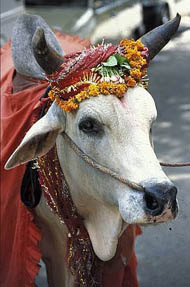
In some parts of the world, cows have already taken over and are worshipped like gods.

In some parts of the world, cows have already taken over and are worshipped like gods.

It’s possible. Cows may be sacred in India, but here in America they probably hate us. We milk them and eat them and turn them into leather baseballs and mitts.

Cows are nothing much more than a cruddy commodity. And I think they’re pissed off enough to seek revenge.

It would not surprise me, therefore, to find out cows have conspired to take us humans down. Could you really blame them?

Cow Rapture

It’s a pretty nifty plan, if you ask me. The effects of that whole milk, if I had continued to drink it, were destined to blow me to bits or turn me into a red mist like I’d just been popped out a space capsule in outer space.

Another couple days and it might have looked like the Rapture itself at my work desk. Poof! Gone in an instant. Wonder what the Left Behind folks would say about that.

Some badass evil cows are coming after you, one glass of whole milk at a time.

Some badass evil cows are coming after you, one glass of whole milk at a time.

But the cows would know better. Cows aren’t as dumb as they look, you see. They’ve been lulling us into using only 2% of our intellect with all that lowfat milk. Then one day you buy whole milk and if you’re not smart enough to back off you blow up like a circus balloon. Phoooom! The cows win. That’s their plan.

Got Milk? You die.

wolverine-got-milkThey’re a pretty trick bunch. They’ve even got an advertising campaign in which you see movie stars and other celebrities posing with a glass of milk and asking, “Got Milk?”

But it seems like you never see some of those stars after they’ve done their Got Milk? ads.

That’s because they’ve exploded into nothing from accidentally drinking Whole Milk.

From bright star into dark matter they go. Or else they mutate like this guy into dangerous anti-everything types who fight for the cause of cows, not human beings. So the cows win either way.

The science behind the cow plot

It’s a fact. We’re all a bunch of carbon and bacteria pretending to be animate objects that run and ride happily through life until the right chemical reaction comes along and then Phooom! we’re gone. That’s right: Phoom! Today, tomorrow and yesterday suddenly mix into one.

The cows are just hurrying the process along.

It’s a rather remarkable plan they’ve had cooking for years. So don’t say I did not warn you. Cows may chew their cud like they’re old, dumb farmers but there’s really no such thing as a dumb farmer. They just act that way sometimes so you’ll leave them the hell alone.

Same with cows. And it’s a plot, I tell you. A plot to take over the Whole world. And all it takes is a little fatty milk.

Phooom!

WeRunandRideLogo

Posted in We Run and Ride Every Day | Tagged , , , , , , | Leave a comment

A better bike fitting is a worthwhile investment

By Christopher Cudworth

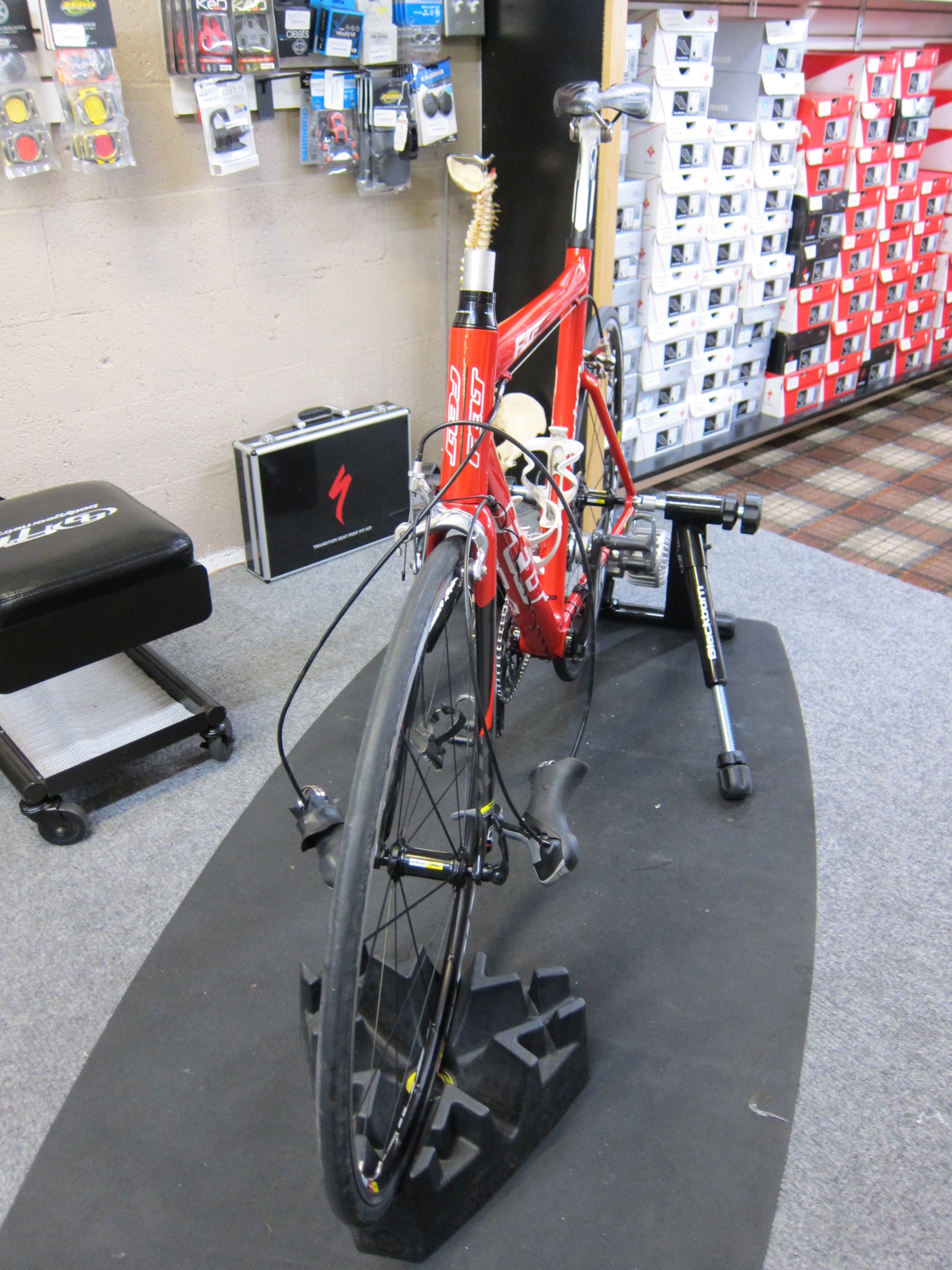
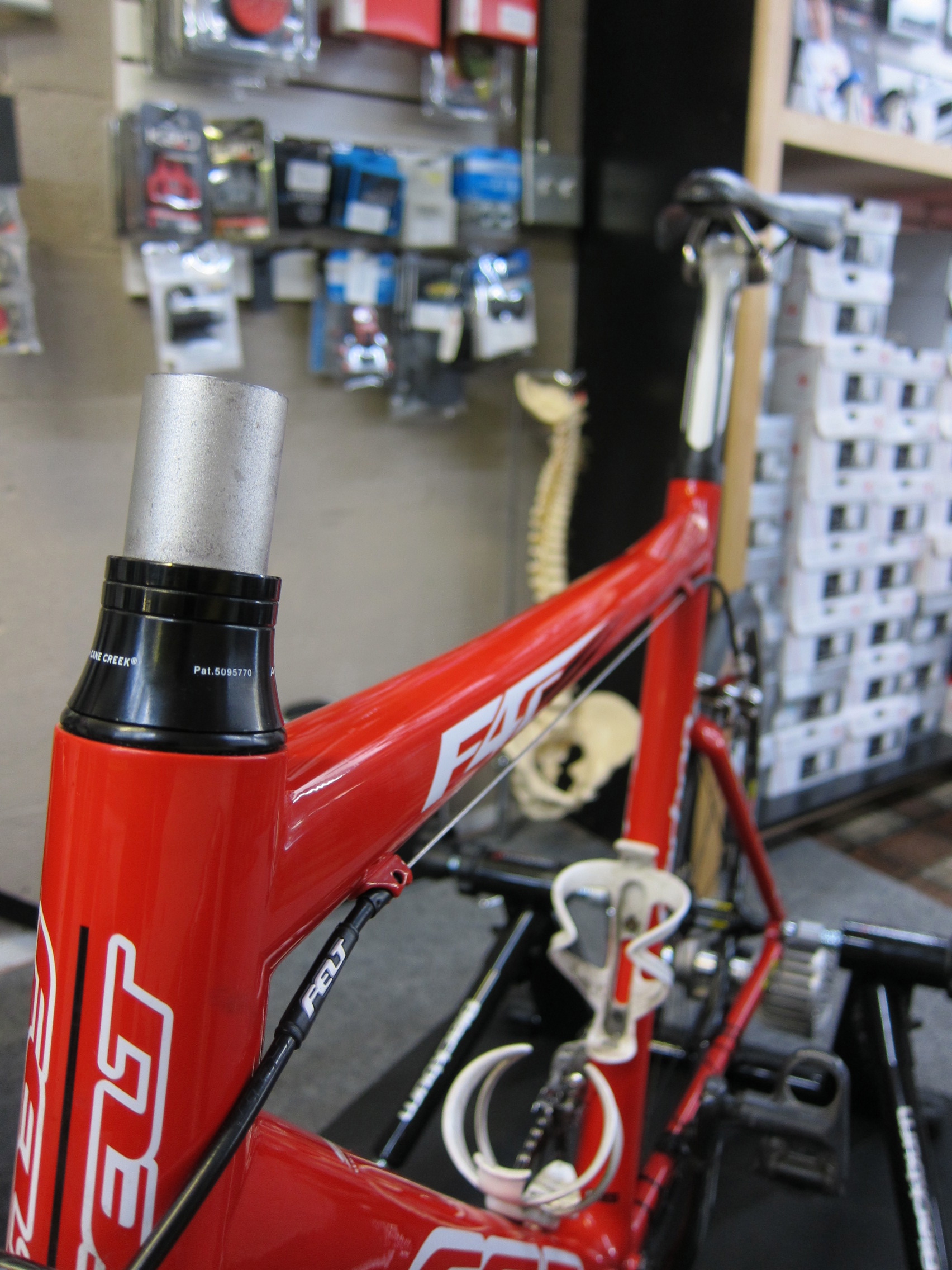
Stripped down and ready for reconstruction. The Felt Red Rocket.

Stripped down and ready for reconstruction. The Felt Red Rocket.

Sometimes the threads of destiny are thin and tenuous. Other times they appear in the signature of an email.

Such was the case when the announcement for a local group ride showed up in my Inbox. At the bottom of the email appeared the words: Karrie Ozyuk. Certified Master BG FIT Technician.

Renewed association

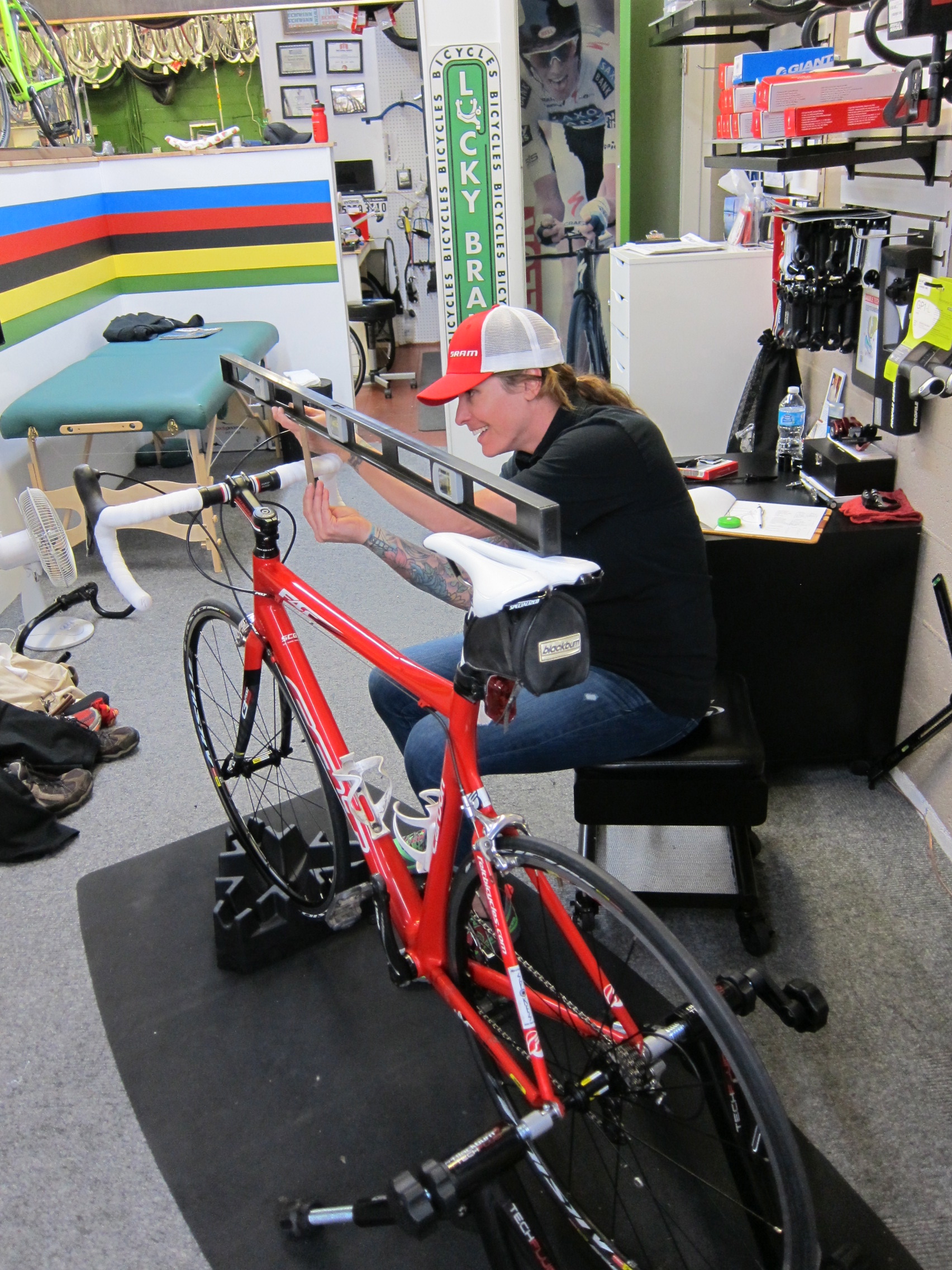
I’d met Karrie several years ago when she ran a different bike shop closer to my home. Her new shop in Crystal Lake, Illinois is called Lucky Brake, and the group ride from there was a little too far away to attend.

But the bike fitting part of her communication intrigued me. I remembered from talking with Karrie a few years ago that she had an eye for detail and an obvious respect for cyclists of all types. So I called her up and scheduled a bike fitting.

Intros

When I rolled my Felt 4C into the shop she asked, “How’d you hear about me again?”

“Your email signature,” I laughed. “Sometimes it’s the little things that count. Good marketing.”

Karrie Ozyuk (right) and a store associate form part of the team that serves customers at Lucky Brake in Crystal Lake, Illinois

Karrie Ozyuk (right) and a store associate form part of the team that serves customers at Lucky Brake in Crystal Lake, Illinois

She spent time interviewing me about riding habits and any problems on the bike. Then she put me through a happy little battery of tests to test for physical flaws. I knew she would tell me I’m a little crooked due to a longer leg. The pedorthist Shelley Simmering with whom I consulted on orthotics told me the same thing.

Crooked realities

Karrie identified that longer leg and then her mind went to work figuring out how that was going to affect my position on the bike. It only makes sense that when you have a longer leg your pedaling and position on the seat is going to be affected.

And that’s exactly why I went for a bike fitting. You can’t figure these things out on your own. I can’t, anyway. One should much prefer the objective eye of a trained bike fitter for the plain reason that you can’t effectively measure your own physical flaws. It’s that simple.

Promises made and kept

I’d quizzed Karrie on what was involved in the fitting and this is what she wrote in the email:

Body Geometry Fitting is $175

Expect to spend 1-3 hours 

We will go through a pre fit assessment, get you on the bike and align you properly to your bike. We may try saddles, stems, bars etc… Also, we may add footbeds (cycling orthodic) if needed. You will leave in a neutral riding position.

Willing student

Getting a bike fitting is really a personal endeavor. It involves a degree of personal taste but you must also “buy in” and be ready to change what you’ve been doing, or why make the investment at all? I decided going into the bike fitting that I would be both a willing student and make whatever changes were recommended. After all, what good does it do to hire an expert and then fight their advice? That’s too common a tale that leads to failed expectations.

Investment

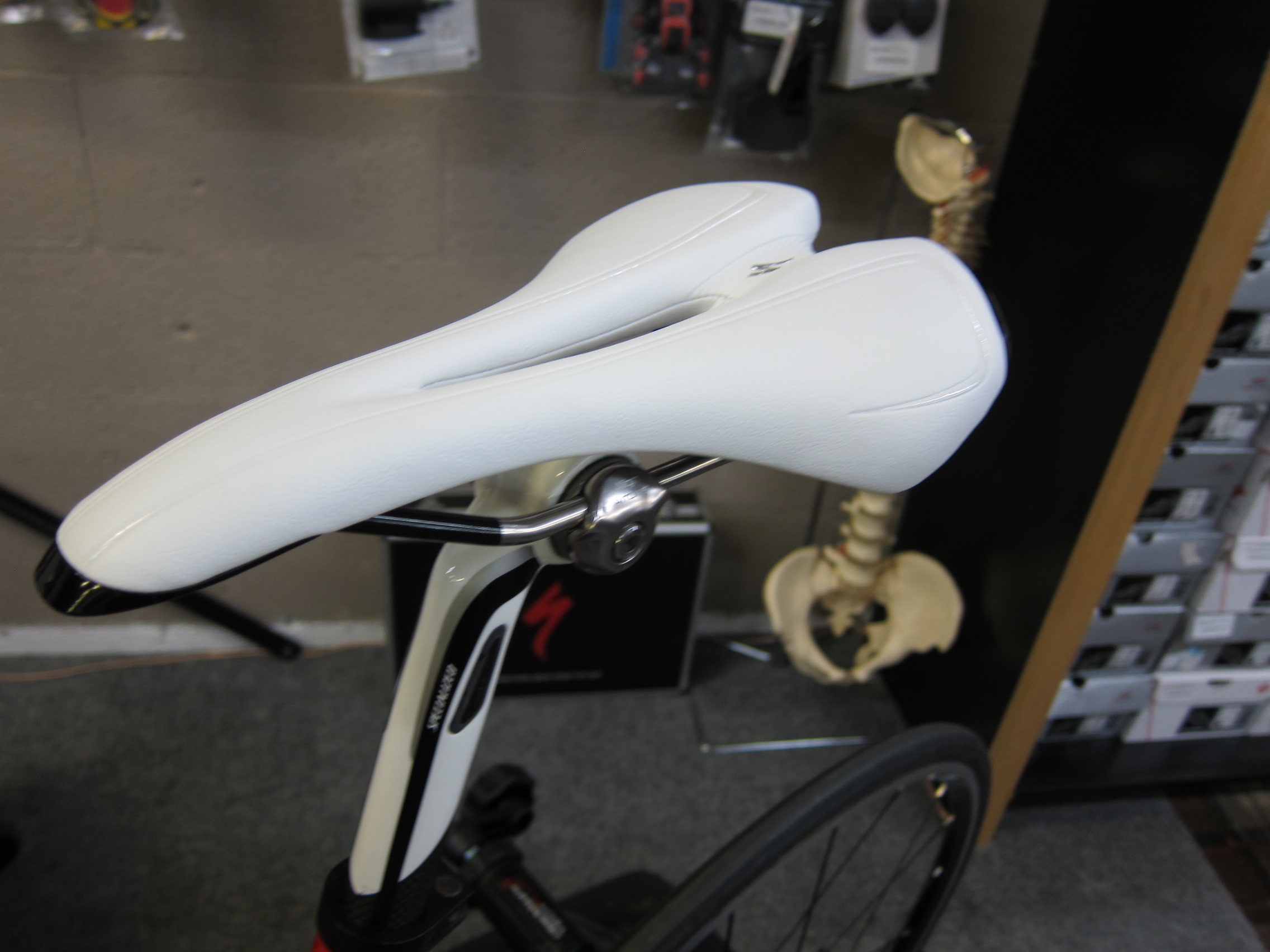
A new seat somehow found it's way into the formula. My call.

A new seat somehow found it’s way into the formula. My call.

It’s true: Bike fitting is an investment. The process requires you to spend some money in exchange for a potentially better riding experience. That was my first priority.

For the last 8 years I have not moved the seat post position from the day the bike was set up for me when it was purchased. Only recently had I pushed the seat back an inch upon realizing how scrunched up I felt while riding. For a long time my riding position hurt the shoulders, sometimes the hands. My back suffered on really long rides, especially during high winds. All that should have told me a change was needed. Ultimately it did.

My bike position was dictating poor biomechanical efficiency. That is what needed to be changed.

Brake in the action

Visible in the distance, the new seat post.

Visible in the distance, the new seat post.

There was just one problem that cropped up during the bike fitting process. Karrie had done all her physical measurements and had me up on the saddle pedaling away and stopping for measurements when it came time to consider adjusting the seat height. Only it would not budge. For 8 long years the carbon fiber seat post on my Felt had stayed in one position and was now fused together with the metal gripping it at the frame head. Both of us tried pushing and turning to see if the seat post would loosen. No luck. Karrie sighed and told me she’d need to get her other mechanics working on it. So the first bike session was a case of Fittus Interruptus. No go on a Wednesday. Come back on Friday.

So I collected the signed Vanderkitten Cycling Club pictures Karrie gave to me as a consolation prize for not finishing the fitting that night. Then I drove the 30 miles home to Batavia and waited a couple days for the call that would let me know if the seat post was fixable or f*****.

Turned out it was f******.

“I’m sorry,” Karrie told me over the phone. “We tried everything. But in the end that post was too stuck to save.”

Mr. Postman

That meant we installed a new white Specialized seat post with Zertz inserts. Then on a whim I picked out a new white saddle to boot. My original saddle that came with the bike had originally been exchanged for a Specialized saddle with a split up the middle. That saved the “unit” from going numb.  That saddle still worked, but it turned out my appetite for a new feel with the bike included a new saddle, and a new look. A little narcissism is part of the bike scene after all.

“I’m the best bar taper you’ve ever seen…”

We also exchanged my original handlebars and installed a new 10 degree stem in place of the 24 degree stem I’d installed way back in 2007. Karrie smiled at the new black bar and said, “I’m the best bar taper you’ve ever seen.”

I thought she’d just said, “I’m the best bartender you’ve ever seen.” So I smiled nicely and then laughed, realizing my mistake as she pulled out the white bar tape.

Overdue at the bike shop

I had a different body back when I bought the bike. That was 20,000 miles ago. I didn’t really know at the time how to position myself on the bike, or to keep up the core exercises to ride right.

Bike Fit Geometry reaches both the rider and the bike.

Bike Fit Geometry reaches both the rider and the bike.

So it was time for the change. All I could think about of late is how many rides there have been where it felt like my form was literally giving away energy up hills and into the wind, much keeping pace during criteriums.

And while I’ve aged 8 years from time when I first started riding seriously, my overall leg strength and endurance has compensated and improved in many ways. Better form on the bike was still the missing component.

A better way to go

The Body Geometry Fit system made a ton of sense. It was the clinical touch that convinced me, and the objectivity.

For example, Karrie used a mat that showed the outline and height of the arches in my feet. She also checked the degree of flexibility or range of motion in my foot, which was admittedly not good. We ended up adding some varus tilt and some shims in the forefoot to put that part of my body in better alignment. That felt much better than the dress orthotics I’ve been shoving in my shoes for 8 years.

According to the Specialized website, the BG Fit Process includes:

  •  the Pre-Fit interview
  •  the flexibility assignment to get an accurate picture of the “geometry” of the body
    Another curious customer stops by to ask about the bike fit process. His "prescription" cost $60 for a casual bike.

    Another curious customer stops by to ask about the bike fit process. His “prescription” cost $60 for a casual bike.

    including spinal curve, foot structure, knee position and other factors

  • viewing the rider from the side to plumb and measure angles
  • a front view to watch the motion of the rider’s knees and legs as well as upper body position
  • The Prescription.

Actually, I made that last one up myself. Because that is what’s really taking place. When you’re done with your bike fitting it’s rather like getting a prescription. When I took the bike out for a ride it felt completely different. Really, it was a marked improvement.

Results

My first couple rides have resulted in a little twinge in my calf but that’s to be expected. There’s a lot of new angles at work. I didn’t ride 4 mph faster or anything crazy like that. But it sure felt better. The speed will come with increased training and pace from being more comfortable on the bike.

Like the serious cyclists say, if you want to ride better, then ride more. 

Fruitful and fun

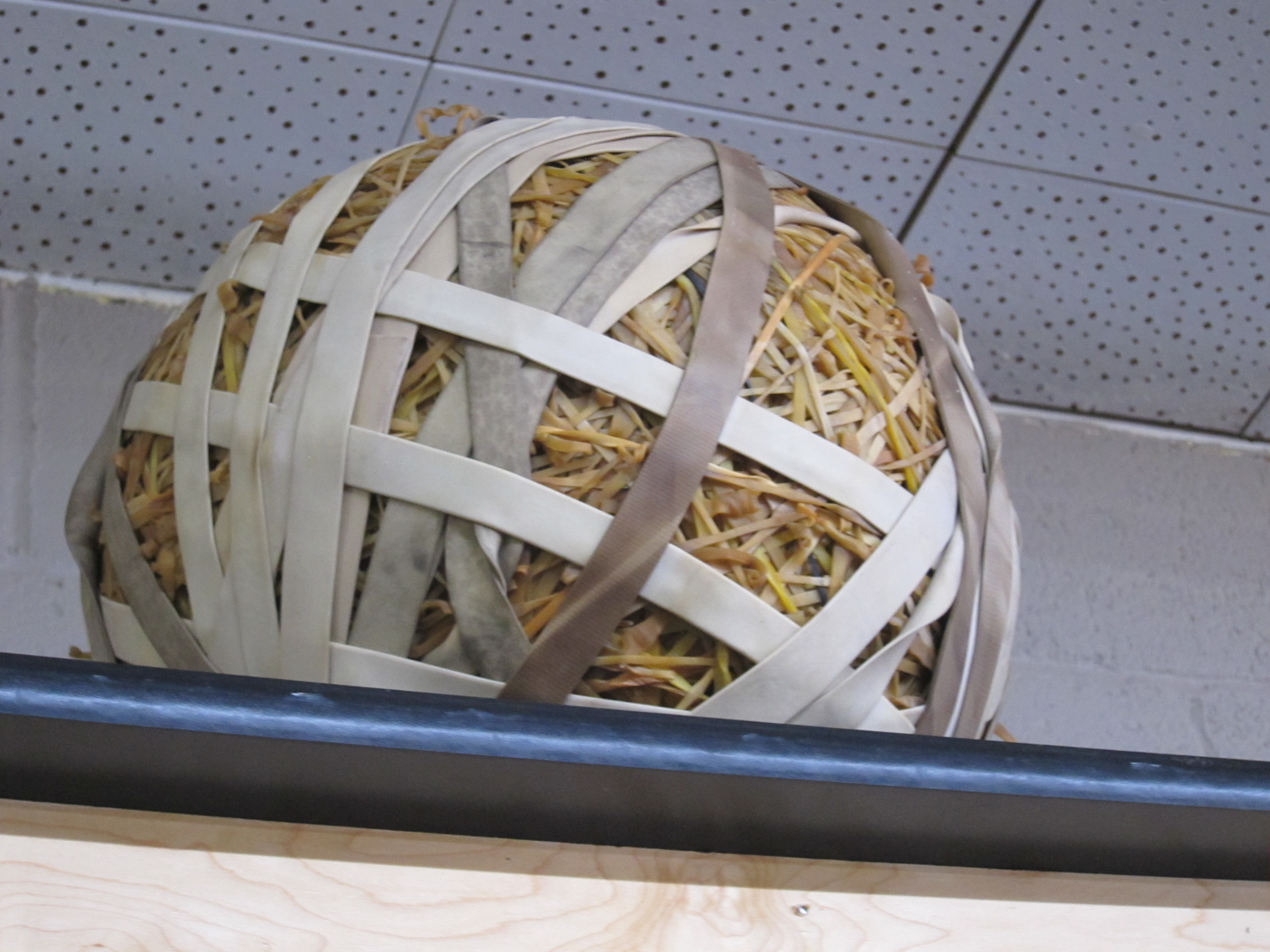
Emblematic of the many bikes assembled and sold,  the store's rubber band ball was years in the making. Fun!

Emblematic of the many bikes assembled and sold, the store’s rubber band ball was years in the making. Fun!

It was fruitful, and it was also fun getting a bike fitting with Karrie Ozyuk. It so happens she has a great personality for the job. She asks lots of questions. Studies the issues at hand, sometimes literally. The certificates on the wall from Specialized make you feel a bit like you’re at the doctor’s office. In a manner of speaking, you are. A Dr. of Bike Fit, she is.

I’d budgeted for the process and knew I wanted a new saddle at least. The seat post was a surprise and cost a little, as did the new handlebars. Some might have said “You should have just bought a whole new bike” but that was never my intention. That Felt and I  have been through a lot together. The carbon frame is still good, survivor of a difficult crash last fall. The components are decent. The Dura-Ace derailleur still shifts like butter. So we’re sticking together, the Felt and I.

Karrie asked at one point if it was okay if she referred to the Felt in the female gender. I told her I wasn’t in the habit of that, but it was fine by me. Then I realized, she’d probably seen something in me that I had not. A bit of devotion.

In other words, my bike fitting turned out to be about Bike Love, not Bike Lust. Karrie Ozyuk played yenta by setting me up for years of more riding with the Red Rocket. That’s what the bike was called when it was named Bike of the Year by a cycling magazine back in 2006.

Closing ceremonies

Appropriately, we shared a Fat Tire beer when all was said and done. Then I shook her hand and wheeled my happy new bike out the front door into the light of the setting sun.

It has sat in the garage ever since.

Ha ha, just kidding. The bike rides great and is worth every penny of the bike fitting.

The way I look at it, I’d rather invest in better form than lose it all on an uphill.

WeRunandRideLogo

Posted in We Run and Ride Every Day | Tagged , , , , , , , , , , , | Leave a comment

Thoughts that run through your mind on Memorial Day

By Christopher Cudworth

Memorial Day is really about who is here, who is not, and what we think about that.

Memorial Day is really about who is here, who is not, and what we think about that.

Yesterday when I arrived at my father’s house to check on his caregiving needs, he pulled me over to his dining room table to show a drawing he’d just done. My father is a stroke victim going back more than a decade. He’s done pretty well given the partial paralysis of his right side, and not being able to talk. Despite these obstacles he’s taught himself to write and draw with his left hand, and that has helped with our communications over the years.

He showed me a picture that I knew immediately to be him. It bore the date September 1945 and had a drawing of a series of vehicles in a line. Each of these, it turned out, were forms of transportation he got while hitchhiking from the coast up to Yosemite while on leave from the Navy.

You could hitchhike back then and expect to get rides. Today’s hitchhikers seem to have disappeared from most urban and suburban areas. We don’t even see them on rural roads any more. One must suppose the creepy killer movie industry has killed hitchhiking.

But a sailor on leave in 1945 could go just about anywhere, you’d expect, because military was everywhere in those days. If I recall correctly my father arrived back on base a bit late and had to sneak around the MPs to get back safely to his barracks.

My father’s tour of duty included a stint sailing across the Pacific in a crappy boat with lots of leaks and a giant trough for a latrine. My father told me about the piss sloshing about and the occasional turd escaping the system to land on deck. The crew spent a lot of time cleaning up after their own ship. Once they made the trip to Japan for some sort of excursion the Navy scuttled the ship to the bottom of the ocean. It was no longer needed, so it was discarded.

Dad toured Nagasaki and Hiroshima. His black and white photos show cities flattened by the bombs that effectively ended war in the Pacific.

That’s about the extent of what I know about my father’s military service. His stroke silenced his recollections at the time in life when he might be interested in sharing them.

I like military stories, but not because I ever served. My age group fell into the gap between military conscription (the draft) and voluntary / required registration. So the military never touched me in any meaningful way.

A military lifestyle

Still, the training done for cross country and track was a difficult trek through discipline, suffering and sacrifice. I guess I did it for myself. I was never good enough as a runner to represent my country. Though I tried to be national class, the best I could do was compete in the Prairie State Games, an Illinois competition with an Olympics-like structure.

Some might say a good friend could have saved me all that trouble. Truly, by the time you’ve graduated from college running you should know just about how good you really are. Yet I did get better and learned quite a bit about myself from running as hard and long as I could.

That’s a bit different from being conscripted into service at the age of 18, subjected to 6 weeks of boot camp and shipped off carrying a rucksack to some – country where you shoot people. Of course you’re going to remember those experiences. Of course you are making a sacrifice for your country. Time is valuable.

Reminders

Life is valuable. Which is why Memorial Day exists. It reminds us that people who either chose the military or were forced to sign up and gave their lives for the nation deserve to be recognized and remembered for that commitment to duty.

We can question politicians and question wars. We can question religion’s role in those wars, and whether we as a society go to war for legitimate or selfish reasons.

We can question how we treat our soldiers, both men and women, when they return home from war.

We can question all this and still be truly patriotic. Because our questions also force us to remember that not all war is just. Some wars are fought for reasons that the general public will never know. How those politicians sleep at night we will also never know. Because someone’s loved one is not here with them on Memorial Day. Children grow up without fathers or mothers because war is hell. And hell knows, or respects, no bounds.

What might have been, and what is

I don’t feel unpatriotic because I never served in the military. I might have made a great soldier. Lord knows I had enough anger within to make me want to kill people at some point in life. But working through that anger meant emerging as a different kind of warrior, one who respects life in a significant way, but not in some falsely patriotic bluster that says everything the military does is right.

The torture of people in Iraq. The whole messy ordeal going on now in Afghanistan. The massive blunders of Viet Nam. The lives destroyed by PTSD, by shrapnel and limbs torn off. All that mixes together when one thinks of Memorial Day, these days.

And that’s as it should be. I know that I run free because of the sacrifice of others. I know those wars despite their ugly flaws in purpose and passion probably needed to be fought. One could argue that nations cannot really exist without war. It defines resources and borders, ideology and hope. We are animals, so we fight. Even the Bible can’t change that, nor the claim that God favors one race or people over another.

Memorial Day is all about remembering the animal within us, and the struggle for survival, as a person, and as a people. Death is ignominious in so many ways. We consider it disgrace and yet utilize it for advancement of our national interests. That’s why Memorial Day is so necessary. Our survivor’s guilt needs some form of expression. We wave the flag and cook meat on a grill. Drink beer and turn on a car race or a basketball game. We go for a run or a ride and try to make sense of the reasons why we are alive. Then we remember, in some vague or painful way, that we’re here because someone else isn’t.

WeRunandRideLogo

Posted in We Run and Ride Every Day | Tagged , , , , , , , , , | Leave a comment

Standing up for MAMILs and MISRS

By Christopher Cudworth

Some people think a Middle Aged Men In Lycra (MAMIL) is a terminal joke.

Some people think a Middle Aged Men In Lycra (MAMIL) is a terminal joke.

The Internet has been great for proliferation of acronyms, particularly cynical names for targets of lust and disgust. The term MILF comes to mind, which stands for Mother I’d Like to F***, in case you didn’t know. It originated with porn sites that require shorthand to communicate the entire spectrum of lusts and disgusts. The term MILF is both a compliment and an insult to certain women. Of course that is how just about everything in the porn world works. The primarily male propensity to “own” the imagery that grabs their attention so fiercely takes a perversely cynical view toward the women they adore or abhor.

Seemingly witty acronyms do abound in the web world, so it wasn’t too surprising to find that a new acronym has been coined to describe Middle Aged Men In Lycra, MAMIL for short.

MAMIL off the charts

Let’s pause for a moment and consider the source of the acronym. The reason the term exists is that cycling has attracted people of all ages to the sport. Riding bikes can be fun. Riding bikes can be healthy for you, much better exercise than four hours on a golf course eating hot dogs at the turnaround and downing beers the entire round as you ride a motorized cart.

By comparison

Lots of middle aged men play golf, especially middle-aged white men. They costumes they wear on the golf course have blessedly improved over the years. Fewer golfers show up in outrageously loud plaid paints. Instead, the Tiger Woods of the world have introduced some degree of athletic class to golf wear.

And yet, the general shape of men on the golf course is not all that impressive. The middle-aged man who has let himself get fat around the middle with a bulging stomach that obscures his belt (and below) has a serious challenge on his hands. It is hard to lose that weight. Worse yet, belly fat is known to kill you.

So some middle aged men have taken up exercise to lose their fat and change their eating and drinking habits.

Riding a road bike is an excellent alternative to standing around on the golf course drinking beer. So the middle-aged man who puts on a cycling outfit and rides a bike 3-4 hours with some buddies is doing something genuine to improve his life and even prolong it.

Fat and lycra

But let’s face it. Some middle aged men have a tough time losing the body fat they accrued sitting behind desks eating donuts. For a while as they ride to get in shape they might not be svelte. Their stomachs still bulge and their butts and thighs struggle to fit inside cycling shorts.

But goddamnit, they’re trying. I’ve ridden with plenty of middle-aged men carrying a few extra pounds and I’ll be damned if some of them are not fast on the bike and determined to improve their pace and their lives.

Yet some people find MAMIL just a step above MAMIS (Middle Aged Men In Speedos). But it’s not exactly the same. The Speedo guy really may be clueless that he does not belong in that swatch of spandex. Or perhaps not. Some guys just let it ride, so to speak. But if MAMIS is at the pool doing laps to get in shape, then it’s your job to turn your head if you don’t like what you see.

Same goes for MAMILs who stop by the coffee shop to refuel after a 50 mile bike ride. If you don’t like looking at MAMILs for whatever sick little reason enters your head, it’s your problem, not the men who ride bikes to better themselves.

Modern parables

If women who dress provocatively don’t deserve to get raped, men who wear Lycra or Spandex don’t deserve to be ridiculed. It’s not a fashion choice anyway. You literally can’t ride 50 miles in flapping, loose clothing and expect to have a good experience. Lycra shorts and shirts were invented for one thing: aerodynamic efficiency. It makes a big-ass difference out on the open road. And if you really do happen to have a big ass that blocks the wind, that’s one thing. But a big ass draped in flapping clothing just creates more drag.

That means it’s time for you to shut the hell up and quit the sniggering if you think middle aged men in Lycra are pathetic or funny. What’s really pathetic and not so funny is ignorance toward the legitimate pursuit of better health and a longer life.

MAMILs have it right, and have the right, to dress however they please. Just ride away from the acronym, boys and gals. Wandering eyes do not need to define you. Don’t let them acronym you to death.

MAMISRSs

The same goes for Middle Aged Men in Short Running Shorts. It’s become taboo for middle aged men to run with shorts that don’t cover their knees. It’s ridiculous. Who wants to run in a freakin’ dress that blows around in the wind?

I blame the whole stupid oversized shorts thing started with Michael Jordan, who by all reports is an inveterate skirt chaser with little respect for the rest of the human race, and particularly women. Yet his fashion choices and proclivity for longer shorts turned the entire fitness enterprise into a skin-shy society with an oddly conservative bent. Talk about your cognitive dissonance.

The influence continues to this day. As far as this runner is concerned, the Devil Doesn’t Wear Prada. The Devil tells us we’re all supposed to dress like Desert Sheiks when we go out for a run or ride. It’s stupid. It’s dynsfunctional. And I refuse to play by those stupid rules.

Call me what you will. MAMIL. MAMISS. Don’t care. I hope your eyes pop out of your head when you see me. I’m fit and proud like to wear loud colors now and then. So deal with it, even at the coffee shop.

MAMILs, stand up for yourself. There no reason to be shy. Let them undress you with their eyes. Or not.

WeRunandRideLogo

Posted in Uncategorized, We Run and Ride Every Day | Tagged , , , , , , , , | Leave a comment