Riding the storm out

By Christopher Cudworth

Guys Weekend included two stints at the golf course.

Guys Weekend included two stints at the golf course.

Guy’s Weekend

It has been a long time since I last participated in the vaunted tradition known as “Guys Weekend.” In fact I’ve never, ever really been on a guy’s weekend. Not by name, anyway. Not where you go away to a cabin and do stuff that guys do when they are not with their wives.

Having been placed in the odd but not entirely rare position of no longer having a wife due to her death from cancer just over two months ago, the Guy’s Weekend was an inviting proposition to get out of a house in which the clutter too often gets the best of me.

It’s been just me and the dog at home for 7 weeks. But the Guys Weekend also happened to coincide with my daughter’s graduation from college, which also happened to be another hour in the same direction as the Guy’s Weekend Retreat. That was a beautiful home on wooded property overlooking a secluded lake north of Dixon, Illinois.

Exceptions to the rule of boring

Most of the surface of the giant slice of bread we call Illinois is flat and featureless. Driving down the guts of the state or cycling across it is boring, quite frankly.

But the edges of the giant bread slice are interesting. Starting from Chicago and sweeping counterclockwise around the state about 30 miles from the border runs you up and down some rolling and pretty territory. That’s true from East to West, and from North to South along the borders of Illinois.

The northwest part of the state is downright hilly, though not mountainous. There are no mountains in Illinois, only big bluffs along the rivers such as the Illinois and Mississippi. The topography is all a result of glacial activity or the lack of it.

The town of Dixon, Illnois recently lost $55M to embezzlement by a public official. They are trying to recover some of the money that was lost.

The town of Dixon, Illnois recently lost $53M to embezzlement by a public official. They are trying to recover some of the money that was lost.

A hidden beach

The northwest part of the state near Dixon is in fact perched on a giant sand dune deposited in part by ancient seas. Rivers have since carved their way through and the really interesting parts of the landscape include a spot of prairie called Nachusa Grasslands. That is part of the 1/10 of 1% of native prairie left in Illinois. The land is marked by jutting bits of boulder like something out of a Star Wars movie. Rare plants cover the land which means rare insects and birds also frequent Nachusa. To visit the prairie is to take a step back in time. This is true prairie, not the stuff of Prairie Glen, or whatever name developers assign to their houses slapped on former cornfields. Flat land alone does not a prairie make.

Lessons from the real prairie

People still don’t seem to get that. And our land habits have weird effects, as we learned during the Dust Bowl. When you aggressively scratch off the vegetation on a landscape, it starts to go away. Millions of feet of topsoil have long vanished from Illinois and Iowa, where some estimates say that 6 feet of the earth’s surface have washed down the Mississippi to the Gulf of Mexico, or blown away by the wind, to land somewhere less useful.

Billions of tons of dirt disappeared from the Great Plains during the Dust Bowl because we ripped up the shallow surface of soil, converting grassland to crop land. Whoops. It caused an environmental disaster. See, the true prairie is a really windy place. Here in the Land of Lincoln, we call the wind an Illinois Hill. Short of a few bur oak islands and some planted pine forests near the river, much of the woodlands is short by woodland standards and the wind wouldn’t care about that anyway. It just blows over the tops of most trees.

Wind breaks

In other words, when you ride a bike in Illinois you learn there are very few windbreaks of much consequence. Even the woodsiest places lend little shelter from the wind, because sooner or later you have to ride out into the open if you are covering more than 10 miles, and that means you are at the mercy of the wind and weather.

So while the cycling route my friend on Guy’s Weekend mapped out for me to ride seemed inviting at first, it took only a mile or two to realize that it held potential to be a long, horrid slog back home in the wind if I followed his directions.

Riding the calm out

That is because Guy’s Weekend called for golfing at the start of the day, and then cooking burgers on the grill. By then it was noon, and the wind from the South was blowing at 20 mph. The wind did not care that I was hoping for a calming ride to think my thoughts hopefully and with consideration, pondering life ahead without my wife of 28 years. Instead the wind blows those thoughts away.

It’s fairly impossible to think much about anything when you’re riding in the wind. It pulls and pushes at you on the bike. Your brain is forced to occupy itself with the consequences of wind force. Crosswinds are as bad or worse than headwinds. Very seldom is it true that the wind is 100% behind you. When it is, you sometimes find yourself riding in a vacuum, your actual speed neutralizing the wind coming from behind. Then the air is silent. You’re riding along at 24 mph with a 24 mph wind at your back and things go quiet, neither yin nor yang is at work. Only the whirr of your bike tires.

But the four corner loop my friend mapped out for me would have meant riding 15 miles head on into a southerly wind that showed no signs of letting up in the 2 hours I’d allotted for a 30 mile ride. It wasn’t my goal to go fast or long. I just wanted to go. That’s what you do on a guy’s weekend on roads where I had not ridden before.

No way, I told myself. I’m not heading up to Oregon and riding alone 15 miles on a rolling country road with the wind in my face.

Dixon

A wise choice. Instead I rode into the town of Dixon and back. Rode some hills in town for some extra effort and pedaled back to the cabin with the wind pretending to be at my back. It still clawed at my shape at times. The road wound through the countryside, a two-laner called Lost Nation road. The name refers to native peoples that have gone before in the Illinois landscape. It is a euphemism of sorts. The nation to which it refers and the prairies upon which they depended for food and game were not lost. They were replaced. Yet somehow the name Replaced Nation does not have the same allure.

Dixon is also the boyhood home of President Ronald Reagan, of whom I am no fan. So the supposed draw of the place is less than I suppose it must be for others. The reason Dixon was in the news recently was a $53M embezzlement by a public official who funded her fondness for horses and other playful whims with money from the public coffer. Apparently the embezzlement started when the former city comptroller Rita Crundwell sought to purchase a horse named “She’s Exclusive Baby.” That whet her appetites, and she went on a roll.

As reported by CBS News, her free enterprise run with public funds led to getting caught and prosecuted. “This has been a massive stealing of public money – monies entrusted to you as a public guardian of Dixon, Ill.,” Judge Reinhard said in imposing sentence. Crundwell, who had pleaded guilty to the theft of city funds, said she was sorry for her actions. “I am truly sorry to the city of Dixon and to my family and friends,” she said through sobs.

Others are not so convinced Crundwell is contrite. “I don’t know if she’s truly sorry or not,” one resident said. I don’t know how she was able to sleep all those years knowing what she was doing to my hometown.”

Some of us feel the same way about Ronald Reagan, whose current devotees of radical conservatism and trickle down economics have created repeated disasters for America, stealing from the public coffers through wars and deregulation to hand money over to giant banks, oil companies, agri-giants and corporate welfare recipients in a long-running saga of ugly, secret commerce that has gutted middle America. Those same factions want to privatize Social Security and Medicare. Who are we to trust? Really?

We should remember that Reagan’s administration saw numerous prosecutions for illegal activity, especially related to the Iran-Contra affair, which involved billions of dollars being laundered for illegal political activities around the world. Then came the Bushies and Cheneys with their pallettes of money dumped in Iraq and handed out in Afghanistan. All in the name of National Security. Who do they think they’re kidding.

That whole pattern of jingoistic funding a jump-start with Ronnie Reagan. Now the forces the believe ideology to be the commerce of civilization keep trying to replicate the Reagan years.

Juicing Newton’s law

So perhaps the apple really doesn’t fall far from the tree in Dixon, Illinois? It’s a beautiful area, but sometimes beauty is only skin deep. In other words, there may be a new meaning for the term Lost Nation. Perhaps it is not so much a testimony these days to the recent past as to a present where raping the land and the nation are the real hobbies of those who love wealth and exclusivity.

Some might speak of the situation in Dixon and insist, “Well, it’s only money,” or of Ronald Reagan (Dixon’s favorite son) “Well, you have to break some eggs to make a good omelette.”

Instead we should admit that those who admire free enterprise to such a degree don’t always know where to draw the lines. It makes one think about the difference between the artificial values of unbridled commerce and the consequences of real values, which have much to do with genuine gain or loss.

Real consequences = real values

We should recognize that some things, once lost, can never truly be replaced. For example, you don’t replace someone with whom you’ve lived for more than 30 years. You live with their memory. They are part of you. Woven into your being. And that’s good.

Which also meant the college graduation ceremony the next day at Augustana College in Rock Island felt a bit nostalgic. I sat in the crowd of parents thinking about the fact that my wife was not there. So many middle aged people who looked like me  were there to watch their children graduate. Many did so innocent, it seemed, of the realities that exist outside their own. They were both still living. But who knows, with what? We all suffer through the storms of life.

The eye of the storm

So I kept thinking proud thoughts and talking silently to my wife in that language widows use. The things we tell ourselves: “She’s there.” But not really.”

But it surely feels good in spirit. Your daughter walks the stage and sits back down, diploma in hand. She is possessed of so much character and resolve, this daughter. She has been through much more than most kids by the time they are 23. She rode through storms of financial difficulty, health and her mom’s concern for her future.

And she was there the moment her mother passed away. We all were. We carry my wife with us now as a result. Always will.

Coming home

My wife would have been terrified on our ride back home from graduation. She hated driving in bad weather. My daughter and I saw some of the worst ever seen on our way back home.
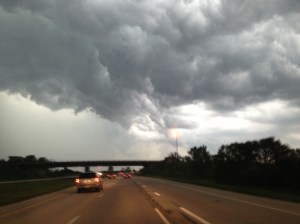
photo (2)Just outside Rock Island heading east on I-88 the weather turned as strange as a scene from a Hunter S. Thompson novel. The wind kicked up to 50 miles an hour. Our vehicles shimmied on the road. My daughter was driving home the 2000 Chevy Impala her mother drove for years. I drove the boxy (and requisite) U-Haul 10 footer.

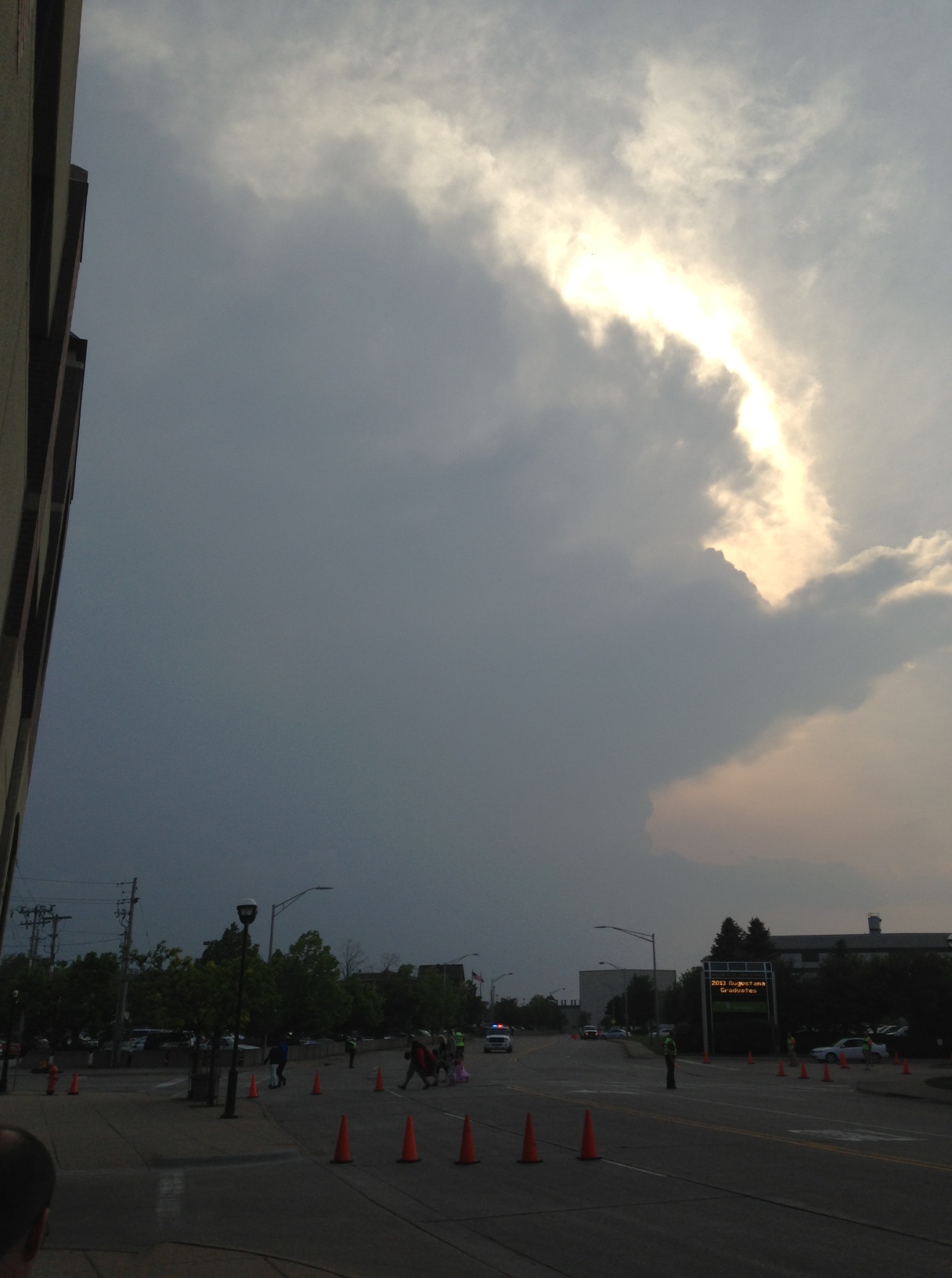
A huge dark cloud followed us as we headed northeast. The southern winds picked up giant clouds of soil, then mixed with westerly winds swirling up giant whirlwinds colored by black dust. For 60 miles the storm tore at the landscape. Giant billowing dust clouds rolled across the highway. In places traffic slowed to a near stop. Cars pulled over and waited by the side of the road. My daughter and I kept driving. By cell phone I told her, “Keep it at 60. My truck does best at that speed.”
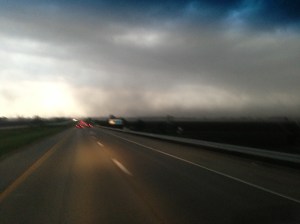
photo (1)Finally conditions turned apocalyptic. My daughter called to tell me she was scared. So we pulled over and I told her, “Listen, we need to keep going because if we don’t, this storm will catch us and swallow us up. If we keep it steady it looks like we’ll get ahead of it soon enough.”

So we drove on. The wind picked up even more. The air turned brown in the headlights. Cars pulled over again. Others raced past like they were shot from a military cannon. We talked by cell phone rarely because it took every ounce of concentration to stay on the road, especially in the U-Haul cube truck I was driving.

I looked back in the rear view mirror at the massive black cloud that continued chasing us. We stayed directly under the rim of the cloud for 60 miles. I learned up on getting home that the storm was headed on a track to the northeast and the sides swelled above us as if the giant monster storm were breathing earth and rain and wind into its evil lungs.

photo (3)And then I saw a sight that gave me chills. Lightning flashed within the cloud and it was blood red in color. All that soil lifted off the Illinois landscape and recently plowed fields was turning the sky into a genuine apocalypse.

We raced on ahead. Finally the air cleared as we slipped beyond the storm track. I tried to imagine what it might have been like to get caught in that storm on a bicycle. You could not have ridden very far. A crosswind of 50 miles an hour would knock you down. A headwind would stop you cold. And wet. And dust-covered. Then the rain would come and you’d be shivering and cold. The whole thing could kill you.

Risking the anthropomorphism of turning a storm into a living being, it so resembled in nature the manner in which our family fought through 8 years of cancer with my wife, including those last slicing moments when clouds of fear and doubt enveloped us all before we got spit out the side of one of the many storms in life we faced together, it only made sense to ride through one last storm. It symbolized so much.

Perhaps it was a fitting way to end a Guy’s Weekend and a graduation weekend combined. You do recognize when you’ve been through something difficult in life. We have these rituals to mark the time because the wind and rain and storms of life come along and erode our memories. That is time. Riding the storm out is our principle occupation. Sometimes the wind blows fierce. Other times it is a gentle breeze that allows our thoughts to flourish, even encourages them. In the end we simply must be thankful for both. That is the human condition.

WeRunandRideLogo

Posted in We Run and Ride Every Day | Tagged , , , , , , , , , , , , , , , , , , | Leave a comment

This just in. You’re not really in shape. But you can get there.

By Christopher Cudworth

The enemy of fitness and th fuel for body fat: carbs in beer, sweets and breads.

The enemy of fitness and th fuel for body fat: carbs in beer, sweets and breads.

Body fat. Most of us hate those two words. And to make matters worse, the fitness world now has this device that you grip in two hands and hold out in front of you like a tiny set of handlebars and wait for the verdict to come in.

I’m at 23%. Yikes. Not where I want to be.

But here’s the kicker. I don’t look fat. You can see the muscle in my arms and legs. I’m 6’1″ and 180 lbs. Not fat by any measure. In fact some people call me skinny.

Yet I am too fat.

Fat and skinny math

As the fitness tester health club guy did the math the facts came in. The ideal weight for a person of my height would be 163. And I accept that. Because that’s exactly the weight I hit at peak fitness both of the last two summers.

At that weight I don’t look skinny, per se, but I’m definitely less fat. The fitness tester health club guy said the goal is to get down to 14% body fat percentage. And like the 163lb objective, I’m good with that.

“Don’t get caught in the rain. You’ll die.” 

At 6'1" and 140 lbs., my frame was wafer thin.

At 6’1″ and 140 lbs., my frame was wafer thin.

The thinnest I’ve ever been was 3% body fat. No lie. The test was given several times over the period of a year and it always came out the same. I was running 75-90 miles a week and racing every other weekend. One of the nurses administering the BMI test said to me, “Don’t get caught in the rain. You’ll die.” I did. And I didn’t. But the point was taken.

All my PRs on the road and track were set when I was at 3% body fat. A 14:45 5K. A 31:10 10k. 53:30 10 mile. 1:10 half marathon. 1:25 25K. I essentially stopped racing after my lone attempt at the full marathon distance, in which I ran through 15 miles at 1:25 before succumbing to hypothermia in a very cold Twin Cities Marathon.

That last result makes sense when you consider a couple things. 1) I only wore a tee shirt when it was 30 degrees out and 2) My body fat was about 6% at the time. No insulation.

So my goals are somewhat more moderate these days when it comes to body fat percentage. I like being lean and rid of the fullness around my stomach and sides. Middle aged man stuff. Yuck.

Restart

Hardly

Hardly fat, but in need of body fat loss nevertheless.

It all fits a restart in life. Having recently lost my wife to cancer there is this feeling of a need to start over whether I like it or not. But given a lifelong attitude of perseverance that has served me well on many fronts, I have chosen to like starting over rather than wallow in sorrow, which is not what she wanted for me. I know that because she told me so in her quiet and sometimes demonstrative ways. She liked to stay fit herself until cancer got in the way. As far as I’m concerned, she ran it down and ran it over multiple times. Her ‘fitness’ as a cancer athlete was supreme. She ran the equivalent to many marathons going through all that chemotherapy, surgeries and side effects. Trust me on that one. She was a champion.

Bargains

When it came to our interests, we had a bargain of sorts. I never questioned her love of gardening and she never questioned my love of fitness. Oh, she joked about Golden Leg Syndrome when I was training hard and didn’t even want to stand around at a party the night before a race. Then she called me Lady Legs when I shaved for cycling. It was funny. But those comments were just to give me perspective. It’s what a spouse should do.

Love handles

Secretly I think she liked having a little more of me to hold as time went by. Being so radically skinny as a callow youth when I married her was acceptable. But being too, too skinny gets old actually.

However, being healthily thin never gets old. So getting down to 163lbs and 14% body fat it will be. The new, old me. Or the old new me. Whatever. Make it happen.

This weekend will see me doing three strong training rides come rain or shine. The goal will be to drop 5 lbs right off the top. It will will happen.  Then I’ll carefully chip away at the body fat remaining to go from 175 down to 163. Cooking for myself should help. Ha ha.

Measuring up

I’m likely fitter than a high percentage of the guys my age but that’s not good enough. My cardio test was way up there but can improve, and strength in the upper body has a ways to go.

Those are challenges we can all love to face.

Posted in Uncategorized, We Run and Ride Every Day | Tagged , , , , , , , , , , , , , , , , , , , , , , , , | Leave a comment

Can we have your liver then?

By Christopher Cudworth

Road kill is the only fuel served at a Hillbilly aid station.

A plate of harvested livers awaits transport to China and the Black Market

I’ve always been one of those people who, when faced with great change in life tends to surf the wave and add even more changes. As long as your apple cart is upset, you might as well pick up some oranges too, if they’re lying around. Or make that organs. Because that’s exactly what happened to me today. I went for a fitness test at the health club I just joined and learned that I have a liver. When you change your routine, it sets you up to learn all kinds of things.

Liver let die

Most of us apparently take the presence of our livers for granted. But if what the hunky health guy doing my testing tells me is true, the liver does a ton for us endurance athletes. It processes or busts up sugars and other gunk apparently. Which is why a bad diet and poor health habits just compound the problems we have in trying to get fit. Who knew?

Knowing the importance of our livers does answer all sorts of questions. Want to know why that run you just did sucked so bad? It might be your liver. Want to know why you got dropped going up that false flat on the ride last weekend when you felt great just a couple miles before? It’s probably your goddamned stubbon liver. I had no idea livers were so important to athletic performance. You learn something every day I guess.

Tastes unlike chicken

I do know that I hated eating cooked cow liver when it was a kid. The texture was awful, like eating a slimy piece of corduroy. The taste was really bad, too, like chomping on a wet, smelly sneaker. To make matters worse, my mother always always served lima beans when she cooked liver. Lima beans have the same texture as baby shit. Don’t ask me how I know. I raised two kids from scratch. Things happen.

Liver and lima beans. It was the most hated supper on earth.

“But you like lima beans and liver!” my mother would insist.

“Who told you that?”I’d demand to know.

“You ate it all up last time!”

Indeed I had. Because I was so terminally hungry as a skinny, scrawny kid I’d have eaten used tampons if you put them on my plate. That does not mean I liked liver and lima beans. It meant I was hungry as hell and had no choice but to eat whatever my mother made me eat. And sometimes it was liver.

Our bodies are nothing more than an organ store in the eyes of some people.

Our bodies are nothing more than an organ store in the eyes of some people.

Life lessons

Funny thing about eating liver. It’s a little like other things in life that are unpleasant, even abhorrent, like eating liver, filling your senses with that fetid odor of meat that feels like it’s been cooked in used motor oil, and then right toward the end of eating it your mouth just gives in and it doesn’t seem to taste so bad. What a life lesson!

Marathon efforts

If you’re honest with yourself, it’s the same way with running marathons or riding centuries. With three miles to go you swear to yourself, “I will never, ever run (or ride) one of these again. It hurts too much. My crotch is hamburger. My feet feel like bruised clay. My nipples are bleeding. I’m pretty sure I shit my pants a little at 16 miles. I can’t wait to be done.”

Then you finally finish, feeling like a piece of chopped liver of course, and people slap you on the back and holler “nice race” or “what a fun ride”  and the process begins all over again again. The very real memory of hating yourself for even starting a marathon or riding a century recedes just an inch. In four more weeks you’re looking for another chance to torture yourself. Two months later you’re back in training with a bunch of other people abusing their bodies and calling it fun.

Dead or a liver

It’s rather amazing that your liver never really complains through all this mistreatment and misguided frivolity. That is, unless you have liver dysfunction and turn all yellow whenever you climb the stairs, your liver is generally as docile as Ed McMahon with Johnny Carson. As one doctor writes, “In my experience of over 20 years of clinical medicine, I have found that approximately one in every three persons has a dysfunctional liver. Even if the level of dysfunction is only slight, it will still have a negative impact on your immune system and energy levels.”

Yikes! A dysfunctional liver must be worse than flat feet! Time to get a transplant perhaps.

A sliver of liver

Some people actually do get liver transplants if their organ goes bad. You simply need a good liver to stay alive. And you need to be a good liver in order to have a good liver. These things tend to circle around like that, you see. At least the liver is useful even if it is prone to repeat itself.

It’s not like that stupid appendix we’ve got lying around, thanks to the vagaries of evolution. Vestigial, useless organs are generally rather rare in the bodies of living things. Yet we know that whales have feet and leg bones buried inside their blubbery bodies, and who really knows if there are not even more useless appendages or organs in the human body. Surely the audience for Rush Limbaugh no longer uses their brain. You could hold them down and carve out their skulls and they’d pop right back up and yell, “Dittos Rush!” Don’t laugh, it’s been medically proven.

A liver finally speaks up

When the health club needed an achilles tendon for one of their top paying customers, they held down a dizzy patron and harvested the tendon on sight.

When the health club needed an achilles tendon for one of their top paying customers, they held down a dizzy patron and harvested the tendon on sight.

I learned today that my liver can talk pretty loudly when it wants to. I was 12 reps into a squat test when fitness guy told me to make sure to keep breathing. Deeper. More breath, he warned. Then I finished the reps and stood there as the world seemed to turn all fuzzy and weird. I was faint, and nauseous, and wondered how in the hell 12 reps on a squat machine could make me feel like I was dying.

“It’s your liver,” he intoned. “And those waffles you had for breakfast? Spiked your blood sugar. You probably poured syrup on them too. Not a good combo. Now you’re dizzy.”

Hardly describes the feeling, honesty. I felt like a stripper who just slipped and fell off her pole, so to speak. In other words, weird. Disoriented. Didn’t really care about much. I don’t know what happened next to be honest.

I’m pretty sure he could have harvested my liver right then and I’d have never noticed them taking it, just like this scene from the movie The Meaning of Life by Monty Python. In fact the health club may be running a black market in organs for all I know. They put you on those machines, work you until you pass out and then carve out the organs they need to sell to organ dealers in China.

“Hey, look,” the fitness guy tells you. “You lost four pounds today. How’d that happen?”

They don’t tell you they just carved out your liver and sewed you back up. Then they give you a tattoo to cover up the scar. Just look around you at the club next time you go. Have you ever seen so many tattoos in your life? Well, for every tattoo you can be sure there is one less organ of some sort serving its original owner. There are hearts to be chopped out. Kidneys to gouge and sell. There’s even a market for fat up in the arctic. The Inuit love it on a spittle.

So now you know the dirty little secret about health clubs. They invite you to work out and then harvest your organs when you faint and wake up sweating and panting.

“Good effort!” they’ll yell to distract you. “Hey, nice tattoo!” they’ll exclaim.

Funny, you don’t recall having a tattoo before you came in that day. But it goes well with your adidas shorts, and who’s to say what people should do with their bodies?

Or what other people should do with yours. It’s a free world. But a new liver? That will cost you. Yes it will. WeRunandRideLogo

Posted in We Run and Ride Every Day | Tagged , , , , , , , , , , , , , , , , , , | Leave a comment

Checks and balances are the secret to a healthy life

Christopher Cudworth

The pull of technology and checking off our efforts is strong indeed.

The pull of technology and checking off our efforts is strong indeed.

For all the technology available to us runners and riders these days, there is still something to be said for the good old hand-written schedule of the day’s events.

A co-worker noticed the neat list of tasks and events on my legal pad and remarked: “Do you like to check off the boxes? That’s my favorite part.”

It’s not even old school. It’s just human balance.

The pull of technology

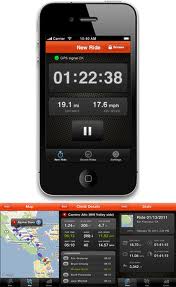
I like Strava and my iPhone as much as the next guy or gal. Yet the visceral experience of writing down what I’m thinking or need to do each day still holds value.

Perhaps that is a direct reflection of being goal-oriented. Our goals come from within and the direct expression of that inner emotion is to somehow externalize it in the world. That way we own it. We can see it. And act upon it. And check it off the list.

photoThose are our checks. Our balances come from a different place in the brain. The side that wants to check off lists and rack up mileage or hours on the bike has plenty of places to find expression. Strava tracks your rides and runs. You can see how you compare to previous efforts and to those of others on the very same stretch of road. Again, those are our checks.

The push toward balance

A healthy life requires balance. The push and pull of obligations and choices can be hard to maintain.

A healthy life requires balance. The push and pull of obligations and choices can be hard to maintain.

Our balances are a bit more nebulous in origin, like knowing when to back off, and how to train and not overtrain. When we do reach those excesses, our bodies and minds send us warning signals that we too often ignore. The desire to check off that box for a 10-miler in our daily journal (however you keep it, digitally or otherwise) is sometimes too strong for common sense to negate.

So we make ourselves sick or too tired to run and ride the next day. Last summer, despite the overbearing heat we felt here in Illinois, I kept hammering away on the bike and finally hit the wall one night about 15 miles out of town. My skin started to tingle. My head felt light. Sweat evaporated. I was forced to cut a ride short and head to a country store to buy ice. Stuffed it down my shirt and rode home. Hot. Tired.

But not depressed. I learned that the human body has its limits. We learn that lesson over and over again as endurance athletes. We need balance.

Work/life balance takes planning

The same goes for work/life balance as well. When you’re working too much you risk burnout. Even that vacation in Mexico isn’t quite enough to clear the pipes sometimes. It’s the daily balance that counts. So you can’t let your checks overrun your balances.

It takes discipline and planning to achieve life balance. That may sound counterintuitive, but it’s not. If we don’t plan for downtime or schedule a break, we keep going. Type A Syndrome. Hell, Type B even commits that sin now and again. Type A does it out of drive. Type B does it out of fear. Both can be dangerous to your health.

Your running and riding may be that balance against working too much. But then you’re faced with checks and balances even in your favorite activities. If you’re running and riding right through the checks and right over the balances, give some thought to perspective. Here’s how to achieve it.

The important difference between obligation and choice

Competing for Running Unlimited meant racing 24 times in one year.

Competing for Running Unlimited meant racing 24 times in one year.

They way I separate the two is something learned during my competitive racing days. In one year I raced 24 times and won 10 races. But the pace of competitions every other week was tough to sustain. Yet I was obligated to represent a store with whom I had a contract. As a sponsored runner the obligation to run and compete was my checklist for the year. There was not much balance possible.

That next year the enthusiasm for competition had waned. Plus I was getting married and realized there were other commitments coming along that were more important than running. I still competed that year with good results, but raced a lot less. The following year we had our first child and it didn’t make much sense to be running 90 miles a week and being gone every weekend.

That was the turning point in a competitive career. But it meant balance had been restored, in many respects. We need room to pursue our obsessions and commitments. That is not what I’m saying. But the ultimate difference or the checks and balances came about when I began to understand the difference between obligatory running and that done by choice.

Now when I sense that running or riding are feeling like more of an obligation than a choice, it is apparent things might be out of balance somewhere.

Obligation. Choice. Those are our checks and balances.

WeRunandRideLogo

Posted in We Run and Ride Every Day | Tagged , , , , , , , | 1 Comment

It’s not too late for inspiration from a high school track meet

At a high school or world level track meet, the field events are as interesting as the racing.

At a high school or world level track meet, the field events are as interesting as the racing.

By Christopher Cudworth

When was the last time you witnessed real competition? Live, dramatic, inspiring?

It’s not too late to get a dose of real inspiration. The girls and boys state track competitions are winding up over the next couple weekends here in Illinois and across the rest of America.

United States track and field competition at the high school level is focused on qualifying for the state meet. Male athletes converge on sectional meets while the girls teams in Illinois compete at state the weekend of the 17th of May.

So this is a call to get off your duff and go see some high school track.

If it’s been a while since you’ve seen real athletes compete in track and field, you can be guaranteed to see stirring performances, especially in sectional or state competitions. There’s even a chance you’ll be moved to tears. Nothing draws out the excitement of competition, man to man and woman versus woman, like good old track and field.

There is tons to learn from watching high school track and field. It’s good to see what all-out effort really looks like. If you’ve been training in the same old distance running group each weekend and haven’t seen someone run really fast in a while, you’ll gain from the experience. The best high school half-milers (800 meter runners) will finish their races at between 1:52 and 1:55 for the distance. That’s flying, in case you didn’t know.

If you’ve never been to a high school track meet it’s a bit of a carnival. Events are going on simultaneously, and the nature of all out competition is that there will be thrilling finishes at some point. You don’t need to know anyone to participate as a fan. High school track is much better than horse racing, where animals with funny names run around a dirty oval with jockey’s on their backs. High school track athletes at the sectionals level are exceptional athletes who take their sport very seriously.

So Google your local high school track program, figure out their meet calendar and go. Go to the meet. Pay the $5.00 admission fee. Grab a burger and a Coke at the inevitable concession stand, or bring along a healthy picnic lunch and settle in. Choose a seat high enough in the stands to see the whole track. Bring binoculars, preferably a set of 10×32 power but 7 X 35 will do.

Learn the meet schedule so that you know what’s coming up. There is an elegant design to how track meets are conducted, and knowing a little bit about when qualifying races are run, versus finals, can help you enjoy the meet. Usually there’s a program handed out telling you the schedule for the day.

It’s almost guaranteed that at some point during the day a race will tighten and you’ll see two or three athletes running stride for stride down the backstretch. Something in you will choose one athlete or the other, or you’ll simply wish to see a truly great race. And then it happens. Both runners emerge on the final straight neck and neck. You can see the strain in their faces and voices raise in anticipation as they sprint to the finish.

Or watch the relays. So much strategy, yet so much speed. Exchanges count. Only the best conditioned teams win, but if they miss the handoffs, catastrophes occur.

The pole vault, high jump, long jump, triple jump, shot put, discus and other field events may be going on, depending on what part of the country or world you live in. It’s all fun to watch. A high jump over 6’5″ is a marvel. A pole over 15 feet as well. You’ll be glad you witnessed them.

At a high school or world level track meet, the field events are as interesting as the racing.

At a high school or world level track meet, the field events are as interesting as the racing.

This is what you’ve come for. This is the thrill you’re seeking. This is the way sports should be, and still are. When you know where to go. And how to look. It’s all there at a high school track me. So go. Be a fan. Gain some inspiration.

It might last all year.

Posted in Uncategorized | Tagged , , , , , , , | Leave a comment

Highest Paid Public Employees

This is an enlightening graphic that says a lot about our priorities in America. But what would happen if football became too litigious a sport to sustain?

Posted in Uncategorized | Leave a comment

One-stepping and half-wheeling and American Exceptionalism

Is American exceptionalism reflected in the way some choose to run and ride?

Is American exceptionalism reflected in the way some choose to run and ride?

Those of us who run and ride or both know that etiquette does play a certain role in the life of both sports.

When you show up for the Saturday morning group run or group ride, the histrionics of who will lead and what segment of runners or riders you will join is generally an unspoken choice. You gravitate to those you know best, and pick out people with whom you think you can keep up.

One stepping and half-wheeling

But sometimes even those choices fail. You jump in with a group on the run and there’s a person who just can’t seem to hold themselves back. They’re always a half step ahead. One-stepping is a common phenomenon. I’ve written about it before and about the pricks who seem to need to dominate no matter what situation they encounter. But the one-stepping and half-wheeling habit is one that is worth mentioning again and again, because it seems the people who do it most can’t get it through their thick heads that there’s a time and a place for competitive running and riding, but you ought to talk about it first.

If you’re in a hardass training group the rules are simple: The best man or woman wins. There’s no such thing as one-stepping or half-wheeling then. You know what you’re there to do: Push the crap out of each other.

Missing the signals

But if you’re not up for that kind of red meat competitive fire, the rules are more subtle. That’s why the one-stepper on a group run is all the more annoying. They don’t pick up on the social clues of people who drop off the increasing pace or even swing wide with a flair to let you by. If you’re one of those people who is out there doing that crap, get a clue. People don’t mind working hard together, but when you’re pushing for your own sake and ignoring the signals from everyone else, you’re just being a dope.

Bleed out

That kind of personality flaw tends to manifest itself in other walks of life as well. Which should tell you that if you’re one-stepping on the run you’re probably also pushing people at work the wrong way too. They may never tell you openly, just as the runners in your group won’t say anything direct. No one likes to be forced to breach the social gap and confront others over something like one-stepping or half wheeling.

More likely you are the subject of frustrated conversation when you are not present. That’s true on the run and ride and at work as well. It takes work and commitment to manage your personal brand in the workplace and on the run and ride. You actually have to care what people think. Some people just don’t. They’d rather one-step and half wheel you the entire road of life.

Justice or not

Some secretly hope the half-wheelers and one-steppers will get their comeuppance sooner or later. But sometimes those behaviors are rewarded, not penalized. Other half-wheelers and one-steppers call that sort of aggressive, even egregious behavior “motivated” or “enthusiastic” or “assertive” and embrace that form of excess in others. A whole strain of half-wheelers and one-steppers can wind up running your organization. It doesn’t help to call them suck-ups or anything else. Reality sucks sometimes. The world rewards the half-wheelers and one-steppers in many ways. Some go so far as to call it the American Way. That leaves the rest of the world to talk behind our backs, and to complain that our nation is a half-wheeler and one-stepper on political and economic fronts.

American exceptionalism

We even have a name for the American grievance toward holding back and actually having some class and consideration on the world front. It is called American Exceptionalism, which as they say, is a double-edged sword.

Of course in certain political circles the attitude of exceptionalism is a required tenet for membership in the FU club, that prideful form of gross patriotism that cares not a whit for diplomacy. As in, FU, we’re > than you and we’ll do it our way.

It is a confusing ideology that states one’s priorities are automatically of higher value than someone else. As Mark Twain once said, “All it takes is ignorance and confidence, then success is sure.”

That describes the whole half-wheeler and one-stepper phenomenon pretty well. You can keep on doing it, even make it a principle factor in your ideology, but in the end, it really doesn’t make you better than anyone else. Even if you win, and half the world hates you for doing it, what’s the point? Really?

The tarsnake effect

They say all politics is local. Well, so is all etiquette. Our personal brands spread into all sorts of other manifestations, and manifestos. Think about it: even madmen like Adolf Hitler began their pursuit of world domination with little angers that later festered into eugenics and worse, a holocaust. Psychopathic and sociopathic tendencies all grow when they are rewarded by those who say nothing to stop them. Give them an inch and they’ll take a mile, they say.

Also: give them a one-step or a half-wheel and the whole group run or ride can be ruined. The tarsnake of doing nothing is far worse than the inconvenience of saying something. Some of the responsibility does rest with those most frustrated by the actions of others. We need to say something.

The cure for half-wheeling and one-stepping is simple. All it takes is a question, such as: “Hey, anyone want to pick it up here?” Your riding and running partners will respond.

The same simple questions manage situations at work and on the world stage. Rather than shoving your co-workers aside in race to the front of the suck-up line, why not make the effort to bring a few along in your pursuit of success? Ask for help. Compliment someone. Don’t be a dick as a boss. Then you’ll actually be appreciated and admired for both your leadership and your character.

And when it comes to America’s reputation on the international stage, perhaps it is high time we stopped shouting to the world “We’re #1” and started behaving like someone who knowns how to win the day but doesn’t really need to prove it every step of the way. That’s just fear rearing working from back to front. And that’s so un-American.

WeRunandRideLogo

Posted in We Run and Ride Every Day | Tagged , , , , , , , , , | Leave a comment

Is your cycling too predictable?

By Christopher Cudworth

Stick your neck out a little and vary your routine.

Stick your neck out a little and vary your routine.

Here in Illinois, land of few hills and much wind, cyclists have to be creative in order to keep from falling into a rut. Stuck in a tarsnake of too many familiar routes and too much routine.

Even when you vary your routes, race the Strava segments to keep yourself entertained (and competitive) and ride the only hills around every chance you get, riding can get repetitive.

Last night while squeezing in a 25-miler before dusk it was my objective to take new turns and ride a different route. Still, when I got home and was about to check the cyclometer to see what pace I’d ridding, I stopped and said out loud: “17.8.”

Sure enough, that’s exactly the pace per mile I’d ridden. “Oh boy,” I thought. “Something might be wrong here.”

Useful predictability

In running I once had uncanny skills at hitting pace per mile. When running through Chicago’s Lincoln Park one day I caught up to another runner who asked, “How fast are you going?”

Told him, “How fast do you want to go?”

“I’m trying to do 6:20’s,” he told me.

“C’mon,” I replied. “I’ll lead you.”

And we cranked off 3 straight miles within one second high or low of 6:20 pace.

“You’re weird,” he said. “Who does that?”

“Comes with the territory,” I told him. “Run enough miles and enough intervals and you know exactly how fast you’re going.”

Pace setting

That same summer I was “hired” to be the pacesetter for a Master’s runner who ran a 5K in about 17:40. He wanted to get down to 17:00. We met at a track with his coach every week. I was doing 2-a-day workouts at the time so I simply added his workout into the routine and ran 3 times a day. I know, obsessed? Yes, I was.

The typical workout consisted of an interval set going from 400 meters up to a mile and back down. We’d do it all at 17:00 5K. I ran in front and he followed behind. He met his goal 3 months later.

It may be time to put some of that pace intuition to work in my cycling. Like too many cyclists, I tend to go out and ride without a plan. Easy days aren’t easy enough. Hard days aren’t hard enough.

Know how fast you’re going


And here’s the ironic part: It takes a certain amount of predictability in order to vary your routine.

In other words, if you don’t know how fast or slow you’re going, or don’t pay attention, it is far easier to fall into a rut. Ride the same pace. Every day. And get home every ride and find out you’ve ridden 17.8 mph. Again.

Find ways to push yourself

Find ways to push yourself

It’s not that hard to change. A few summers ago when I added interval work and even did faux criteriums of 30 minute rides at 20mph+ in my neighborhood, my overall riding improved like crazy.

All by simply varying the routine.


Variability

But it’s easy to forget that positive training requires variability. With summer looming like a big fat chunk of riding meat, you figure you have time to change things up. Then May zips away and June too. Suddenly you’re watching the Tour and wondered what the hell happened to your own racing plans.

Well, there’s always the fall. Isn’t there?

But why hold the hopes of more fun riding at bay by ignoring the reality of time and season?

Take out the bike. Map out a short course and race, by yourself, for 20 or 30 minutes. Go harder than you’re used to going. Much harder. Go flat out. Even if you don’t repeat 100% effort week after week (which you shouldn’t) you’ll now know what your top end is. And you need to know that in order to improve it, build intervals around it and yes, even take yourself to a local crit and see how fast you get dragged to glory.

It’s all about varying the routine. So you’ll have something good to remember by September. Other than 17.8. Or whatever your stuck point is.

WeRunandRideLogo


Posted in We Run and Ride Every Day | Tagged , , , , , , , | Leave a comment

How competition can lead you to your best times

By Christopher Cudworth 

Choosing to race begins with a calm commitment to letting your competitors pull you along.

Choosing to race begins with a calm commitment to letting your competitors pull you along.

For 98% of the running population, the word “racing” is a misnomer for what transpires when most people show up at a running event. Racing actually involves trying to aggressively outrun another runner or a group of runners. Fact is, most runners don’t find themselves in that position unless they are competing at a really small event.

But you need to know “how to race” nonetheless. Because the best thing you can do to improve your times is to find someone to race against. Competitive instincts are the shortest point from your current personal record to your new personal best

Being your own “spy”

Click to view larger image of race start.

The sorting process begins right at the starting line and continues through the first mile. Be aware and find yourself a competitor you can trust to run the pace you desire.

The hard thing to do at any race is to pick out who will be running at or near your goal race pace. If you’re a good enough runner to lead a race, the problem of who to run with sorts itself out within the first 800 meters to a mile.

The question of who to compete against is rote if you’re starting a marathon where pace groupings are pre-marked and thus pre-determined. Then you at least know you’re in the ballpark. But you will still need to choose who among that group you want to chase as a pace setter.

That means you have to be your own pace spy. Here’s how it works.

Removing the guesswork

It doesn’t do much good to just guess who might be going the same pace as you. Some runners look great but run really slow. Others might not look so great but turn out to be the type of chug-a-lugs that never slow down.  You’ve got to admire those types. They make the rest of us look like slugs.

In short or long races the sorting process is how competitors emerge.

In short or long races the sorting process is how competitors emerge.

In the first mile of any race there is a lot of sorting going on, and you have to “read” the race like you want to win it, sizing up competitors and watching their form to see if they’re the “real deal” at your chosen pace or not. Trouble is, there are a lot of potential distractions in that first mile, especially with all the colored race kits and shuffling and huffing going on, it’s a lot like being thrown into a jelly bean sorter. Some jelly beans roll ahead while others start to trail behind. You want to be the jelly bean that quietly rolls through the chaos. That’s how all great racers handle their early nerves and put themselves in a position to mark their potential competitors.

How the world class runners do it

If you don’t believe it, watch a world class mile race sometime. The first lap is when all the runners read each other like moving books. At that level of competition and ability, all the subtleties count. The efficiency of stride. Rate of breathing. And then there’s race positioning. Great milers know they want to be near the front of the main pack, out of harms way yet in reach of the rabbits in case someone makes an early breakaway.

Measured response

Spending the first mile sorting out your pace competitors is a great way to keep yourself from going out too fast. By being observant and aware, moving gradually through the pack rather than frantically yo-yoing your pace will deliver you through the first mile calm and collected, warmed up and ready to make some good choices.

Some runners don’t even worry about other competitors at first. Instead they focus on getting into a pace rhythm and stick with it.

Beyond the first mile

You're either going forwards or going backwards. Fix your mind on positive progress at all times.

You’re either going forwards or going backwards. Fix your mind on positive progress at all times.

By the time you are approaching the first mile marker you’ll begin to see people “going backwards” as those who started out too fast begin to feel the effort and fade. Don’t charge past them. Just let them slide behind and keep to your race pace.

But after the first mile you can look around for someone to race against.

You’ll find them in two places. Generally if someone is going to hold their pace they are not going backwards at that point in the event. You should look ahead perhaps 20-30 yards and look for a runner with good form who is not flailing their arms, breathing like a bulldog or otherwise looking distressed. That’s your first target.

As a runner, you try to close down that gap evenly and consistently, racing your pace ever so slightly now that you’re warmed up. Then you slot in behind them and recover for a while. You’ll know right away if you’ve chosen well. If you are in immediate distress you might want to do the sidecar shuffle and move over to someone else for a bit.

But you must soon choose a runner to compete against and stick with it. Racing against someone is both the toughest and the easiest way to get to faster times. Our competitive instincts remove subjectivity and place our focus on an outside force that can shift our perceptions.

Capitalizing on your racing strategy

The next two miles should be spent focusing on being efficient and conserving energy. This is true in every race from 5K up to a marathon. If there’s a wind you tuck in behind your pace setter and run smooth. If there’s a tailwind you might move up next to them and run side by side. Some runners respond well to sharing the pace and cadence of running together. Pick up on the rhythm and let your body roll. At that point your competitor also becomes you friend, because you’re being pulled along.

COMPETITION RACE STRATEGIES

5K

This painting by Christopher Cudworth of Johanna Olson, Luther College distance runner, will be given to her family during a fund raising event in Arizona. Click to view.

Separating yourself from the race is something real competitors know how to do. To leave your competitors behind is a choice you make when your earlier decisions pay off. 

If you’re running a 5K, the first mile is the “sorter” mile to choose your competitor or a group to run with.  The second and third mile are “hold steady”  miles while you let the racer “select” themselves and your goal is to always try to “choose up” one runner rather than drift with those peeling off the back.  The 3 mile point is the moment when you find your final gear and accelerate toward home.

10K

If you’re running a 10K, the first mile is the sorter mile. The halfway point of the race is the best time to grab a short drink and check your watch to see your pace. If you’re on goal pace and feeling good, then you stick with your running “partner”–if they’re still moving steady. If you’ve lost them ahead or behind you must replicate the strategy used at the start of the race and find a “new” competitor with whom you want to stick for the next 3 miles before your last .2 kick.

Half Marathon

Segmenting a half marathon can definitely be key to improving your times. If you’ve done your training and know it is a matter of pacing yourself to a new personal best, then your goal is to find “competitors” to help pull you just beyond your baseline effort. At 13.1 miles, there’s too much distance to simply jump into the race with mile splits piled up in your head and hope you hit them as you go along. The minute you miss one there are all sorts of calculations going on in your brain. Do you make it up in one mile, two? Nah.  Better at that point to put your focus on someone slightly ahead of you and start competing to make up the difference. Doing the math in your head, after all, does not always equate to covering the distance faster. You need to compete, not calculate. It is best not to even check your times much between 5 and 10 miles, for example. If you’ve done your training your pace should come naturally. It is far better to find someone who shares your rhythm and let those middle miles fall away. If you’re a fairly elite runner and go through 5 miles at 26:30, you cannot assume you”ll come through 10 miles at 53:00. Not if you don’t find someone to cruise along with. So race with someone. Competition is your friend, not your foe. Remember that.

Marathon

Marathoning has its famous checkpoints for brain games too. When you hit 10K and start thinking “there’s 20 miles to go” that’s not exactly encouraging is it? Instead you should prioritize on the immediate goal of keeping up with your surrounding “competitors.” Locking in on someone else is a great way to make the miles pass and not freak yourself out with pace per mile calculations. Sure, you can check your splits once in a while, but once you do, let the basic math settle back into your head.  Then lock in on someone and let yourself get pulled along to close that gap in line with your personal best time.

Stay Calm and Race

You’ll notice there is no anger or competitive rage inserted into any of these strategies for racing to your best time. Competitive instincts need to be put to positive, not confrontational use. One can guarantee that world class starts like Galen Rupp want to beat their competitors more than anyone. But they also need their competitors to pull them along to faster times. In that respect you really can behave like a world-class runner. It’s the one thing the rest of us have in common with the elite. Competition makes us all better, if you let it work for you.


WeRunandRideLogo


Posted in Uncategorized | Tagged , , , , , , , , , , , , , , , , , , | Leave a comment

Running into deep grass

By Christopher Cudworth

The long and short of it is that all our efforts add up in the end.

The long and short of it is that all our efforts add up in the end.

You know how Sundays go. In your mind there seems to be so much time to do everything you want (or need) to do. So you dreamily, on a Saturday night, occupy your thoughts with plans for a little yardwork, then maybe a run or a ride when time allows, and maybe enjoy a beer late afternoon.

It seldom works out that way.

Like yesterday. It started out great. I did get home in time from church to go for a sweet little 4-miler in the sun and strong spring breeze. The legs felt a bit tired because the 40 mile bike ride the previous day had turned into a thighjello effort over the last 10 miles when my riding buddy started hauling ass up hills after 30 miles. He does that. I should have known that. And yet I deceive myself into the thinking the first 30 miles counted for something.

It all adds up

You’re glad for the effort when you’re through. But while you’re in it, the misery is sometimes daunting. Yesterday by the time I’d done the run, walked the dog and cleaned up the house it was time for lunch and a beer. And then I remembered that my father’s lawn needed mowing. Desperately.

Changing horses in the middle of a stream

The kid I’d hired to mow the lawn for my father’s place this summer could not start for another week. But dad’s lawn was already 7″ long and looking really ragged. Last summer when my wife was so sick with cancer treatments and it was hard to find time to check on my dad’s place, the city had actually come over to check on him. The neighbors had expressed concern about how the house looked with its bushes overgrowing despite the fact that the lawn was cut. So I was forced to buzz over there on a Sunday and tear into the trimming of trees and overall cleanup. The day was made tougher by the fact that I had ridden 50 miles on Saturday and 40 miles on Sunday morning, so by the time the yard work was done there was very little energy left in my body. I went home and collapsed. Told the dog to go walk himself, for all I cared. But then took him for a slow, short walk that brought a sheen of sweat to my body. You know when you’ve hit your limit sometimes.

Beating back ugly

Knowing that it could not be left to get that ugly, I resolved to head up there yesterday and catch up before real weeds took over the lawn.

Packing the Honda lawnmower into the back of my Toyota Matrix was easy enough, but the mower is a little heavy and it reminded me that I’d broken my collarbone last fall and needed to do more upper body work. No matter how old or young you are, recovering from injury requires early and constant rehab if you want normal function.

Then it was lifting the mower back out and starting into mowing the lawn. The grass was so thick the mower would just stop. That meant picking away at sections that were too tall for normal passage. The effort was difficult and tiring. My shoulders felt tired from the previous day’s ride because I’ve pushed my bike saddle back a bit to allow for a lower perch on the bike and my arms and shoulder have not yet adapted fully to the new position.

Mowed over 

Slowly my body tired while mowing chunks of that lawn. There was a lot of heaving, turning and even lifting the mower. The longer it went, the more it became evident how much more strength work was needed for my upper body. Even my core muscles got tested as I leaned far into the effort of mowing on a side hill. Trying to keep the mower in line was as good an exercise as those darn “planks” done each morning.

At least you could see the results of your work. Nothing could have been clearer. An overgrown lawn is one of the most frustrating things to fix and yet, when you’ve gotten through the grass clogs and gone back over the spots where the grass pops back up you can at least say to yourself, “That’s better.”

There didn’t used to be so many things in life where progress is so clear. Mowing the lawn was an organic test of our will to make progress.

That’s all changing these days. We use analytics and metrics in business to track our return on investment. We tap into a satellite to measure the pace, elevation change and length of our runs and rides. We can even compare our efforts to people that have gone before.

Round and round we go. 

If you mow your own lawn, you probably follow some kind of pattern to get the job done. Maybe you vary it a little week to week, changing direction in order to avoid carving ruts in the soil with your mower tires. If you’re like most people who mow your own lawn, you probably have a certain way of doing things that makes sense to you.

That all changes when the lawn is overgrown and you wade into tall grass behind a mower. Then you have to take what the lawn will give you, and measure your efforts carefully. Thoughtlessness only breeds more work. The mower clogs. You sweat and fret and curse. Why can’t this be easier?

Parallel universes

Or the wind blows from an odd direction on a day when you’ve got a 50 mile bike ride planned. It become obvious you’d have to ride 20 miles straight back into the gale if you ride your regular route. Do you change it up? Ride in the opposite direction? Dump your plan and start another route?

Same goes for running. So many runs start out great only to run into trouble. The sun gets hot too quick. You forget water or the faucet you normally trust for a drink is covered in a black plastic bag when you arrive, slapped with a sign that says, “Faucet under repair.”

Life is unexpectedly long grass and changing winds and faucets that don’t work. It’s how you deal with these obstacles that counts. There is probably no better paradigm for dealing with difficulties than becoming a runner or a rider. You learn to improvise as you go along. And accept the lessons and the extra training you get when pushing a mower through tall grass. There is no simpler allegory for perseverance. It makes no difference whether you push or pull, it all adds up to worthwhile effort in the end.

Posted in Uncategorized | Tagged , , , , , , , , , , | Leave a comment