Putting down the Livestrong bracelet

By Christopher Cudworth

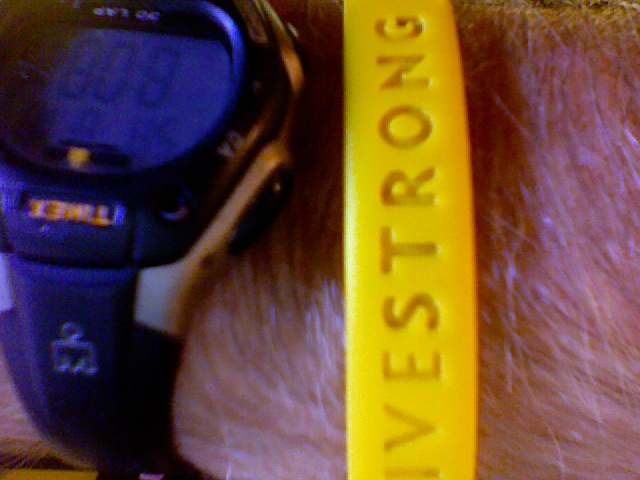
A Livestrong bracelet joins the jewelry of the author's wife in repose on a hand mirror.

A Livestrong bracelet joins the jewelry of the author’s wife in repose on a hand mirror.

I finally just took it off. After 8 years of wearing a yellow Livestrong bracelet, it occurred to me while putting on a short-sleeved shirt this spring that the point had been long made. Livestrong had in some small way been a part of my ability to help my wife through 8 years of treatment for ovarian cancer. But that job was complete.

The night she passed away it was left to me to remove the remaining jewelry she was wearing. That included the German silver earrings I’d saved up to buy her a decade ago. She wore them often. She was German by ancestry. But that had little to do with it. The jeweler where I ordered the earrings for her birthday simply said that German silver was a reliable, handsome substance. And my wife Linda liked silver over gold. It complimented her skin tone much better.

I pulled off her recently repaired wedding ring too. The ring had to be fixed after an incident last summer when her hands, already swollen from Doxil chemotherapy treatments that blistered her skin, became too puffy to remove the ring. She tried, but it raised two giant blisters on her finger, one on either side of the ring. So it was off to the emergency room early on a Saturday morning to have the ring removed. The emergency tech was kind and patient, using a tool to snip the gold band in two. She handed it to us in a plastic bag.

A few months later we had the ring fixed, and it looked brand new when it was given back to us. That lifted both our hearts. At the same time my wife ordered a tiny silver cross to wear home. We’d been through a lot with her cancer treatments but had also had many a prayer answered so fully that gratitude overflowed. So she bought the small silver cross to wear every day.

I took that off too, along with a bracelet she liked to wear just to feel feminine on days when cancer treatment side effects made her feel less than human.

Reflections

All these effects and a few more were placed carefully on the hand mirror she used every day. Over the last two years it was used to check the position of the wigs she wore because her hair was never coming back. That is one courageous woman, who lives on without much complaint because her hair is gone. Once in a while she’d tear off the wig at home and sometimes in the presence of guests, and no one ever expressed shock or showed surprise. People agreed she should do whatever she wants.

Through all 8 years of being caregiver to my wife, I wore the Livestrong yellow bracelet as a quiet connection to the greater cancer community that was going through the same sorts of things. Of course ovarian cancer like my wife had is a known killer of women. Statistics on the disease are grim. As the National Alliance on Ovarian Cancer reports, “The Surveillance, Epidemiology and End Results (SEER) Program reports that on January 1, 2009 in the United States approximately 182,758 women were alive who had been diagnosed with ovarian cancer (including those who had been cured of the disease).”

That all sounds encouraging, to a degree. But wait…

The year my wife was diagnosed in 2005 some 19,842 women were also diagnosed with the disease. 14,787 women died that year from ovarian cancer. That does not mean they were diagnosed and died the same year of course. Although many likely did. Ovarian cancer is a swift killer if given a chance to progress. My wife was diagnosed Stage IIc but she could well have been a III or IV if I had not been an assertive husband who insisted she get over her reticence to find a new gynecologist and get a checkup. Most of her issues at the time were typical middle aged woman stuff. So there was no panic going in. But when you find out your wife has ovarian cancer it is a stunning revelation, no fun at all.

So I also took to wearing an teal-colored bracelet given me by someone along the way, who explained that teal is the official color of ovarian cancer. Colored bracelets were proliferating by then. The Livestrong Effect was far greater than its own organization. A reminder: Lance Armstrong was at the height of his popularity and success in 2005 when cancer entered our lives.  Lance was just finishing up 7 straight Tour de France victories. And while cycling had struggled for years with its doping woes, but many considered Lance a shining departure from all that. Turns out that wasn’t true.

Riding like crazy

It was pretty much by circumstance that my own cycling “career” started up in 2005. My brother-in-law gave me a Trek 400 steel frame road bike he no longer needed. So I rode that thing like crazy a couple years before buying a “real” road bike, my Felt 4C.

A friend of mine who had been a rider years before offered me his road bike before I bought the Felt. It was a little small, so I gave it back. But he told me to keep the other cycling stuff he’d brought over, which included two bright yellow Livestrong bracelets.

A steady companion.

A steady companion.

Like many people I was caught up in the allure of the yellow bracelet. So iconic and clean. Millions wore them. I put mine on in early June, as I recall.

Two weeks later my wife was diagnosed with ovarian cancer.

More colors

At times I wore both the teal and yellow bracelets until one day an employer asked what the teal bracelet was for. This was years after my wife had been through the exhausting cycles of chemotherapy that almost required me being home with her. And in some ways, that did cost me a job. But while I was unemployed I was also available to care for her. And things happened to help us with money and hope.

In fact, the very day she was declared cancer free after her second big set of treatments, that very day I got a new job. So many serendipitous things like that have happened. So many.

More challenges

It worked the other way as well, however. One employer tried to force me off their insurance. Another fired me the day after I let them know my wife was going back into cancer treatment. So many ways it was a rough road, to be honest. Some of that was my own fault. It’s pretty hard to separate your own mistakes from the shit the world throws at you. That’s one of the tarsnakes of self-perception. Some things you’ll never really know for sure. Like, whose fault was it, really?

Some of the travails resulted from irrational fear or strange circumstances wrought by how our nation handles health insurance. It is absurd that we buy our health insurance through our place of employment. There should be no connection at all. Our whole paradigm is stupid, lopsided and dangerous to society. But some people claim the Public Option is socialism. I say it is humane rather than Darwinistic. And I hate to use that term “Darwinism”, because it definitely should not “mean” what people take it for; the concept of heartless commerce and social strife. But the colloquial meaning is used here to hit those over the head who insist that health insurance programs should be strictly profit-motivated and, by that definition, predatory in some respects.

World class

WorldHealthRankingUS

Click to enlarge image. World Health Organization rankings of top health care systems.

One learns to navigate the health insurance system of one’s own country, and many of Livestrong’s resources are designed to help people find and manage health insurance resources. What a noble cause.

But isn’t it also ironic that it is so necessary to broker our own health in a nation that claims to be the City on the Hill according to its causational principles.

We lie to ourselves. The World Health Organization ranks America’s health care system 38th on the global list of best health care systems. No wonder we pumped so much pride into Lance Armstrong. If France (#1 health system worldwide)  is kicking our ass on important issues like health care, it makes you wonder if they saw Armstrong as an affront on some other level. Many French journalists accused Armstrong of doping all along, through all 7 Tour victories. And they were right. The accusations weren’t yellow journalism after all.

Losing yellow

All this puts into perspective the moment I took off my yellow Livestrong bracelet and placed it on top of the jewelry my wife was wearing when she died from ovarian cancer this past March 26, 2013. Each piece of jewelry, and now the yellow bracelet, is reflected in the clear mirror she had used for years to check her face and hair and clothes before going out.

I’ve ridden more than 20,000 miles since first putting that Livestrong bracelet on. It enjoyed sunny days and driving rain. Late nights at the hospital and gray early dawns when all my wife wanted was something she could eat that didn’t taste like metal or make her turn her nose up.

It’s been quite a journey. But now it’s over, except for the grieving. And that I accept with all my heart while knowing that I must go on. She was one courageous gal who gave us years more life than many could have tolerated.

Her garden is coming into bloom now. Each and every plant is a reflection of her love and care, her green thumb. I’m hoping I can replace my yellow bracelet with a green thumb as well. That would be fitting.

We Run and Ride. So do you. Let's share original thoughts.

We Run and Ride. So do you. Let’s share original thoughts.

Posted in Uncategorized | Tagged , , , , , , , , , , , , , , | Leave a comment

Universal thoughts on why we run and ride

By Christopher Cudworth with original contributions and inspiration from Monte Wehrkamp 

If you don’t believe in evolution, you apparently don’t believe in matter. It’s that simple. Evolution traces the history of all things back to that unimaginable moment when the universe and all the matter in existence got started in motion, and it’s still moving.

Moving through space and time, but also moving through the… space of itself. Charged particles are humming around inside your body and mine. The same kinds of charged particles are also humming around inanimate matter, even rocks.

It all feels so hard and real. We hit a rock with our bike tire or stumble over a rock on the trail and down we go, bodies racked and wounded. We are lucky at that moment the universe does not just suck us into the ground and be done with it. Because like none other than the Bible says, we are ashes to ashes, dust to dust. Why piss around with the time between? It’s so brief and delicate it hardly seems like it matters much what happens to anyone except God. Perhaps.

The Big Perhaps

Time and universe. God loves shaking things up.

Time and universe. God loves shaking things up.

That’s a big perhaps… because even God doesn’t seem to want to administrate much what happens in the universe. 99% of all species that once existed on earth are now gone. Kaput. Poof. The dust of history. The fossils of our fascination with what has gone before.

Random events and cataclysms are apparently are pretty cool in God’s eyes. They shake things up a little. God seems to like to see what settles out, what survives. Evolution is the strainer, that’s all.

And that’s what’s happening to you and me whether you care to admit it or not. Random crap like car accidents, stubbed toes, feet in mouth and liberalism are all part of the rancor of the universe and a test of our personal and collective consciousness and spirit. Welcome to the universe of Shit Happens.

Entries and exits

There is in fact a good case to be made that our religion and appreciation for God could not exist without the evolutionary forces that brought us into existence. Evolution directly reflects the nature of free will that gives us the opportunity to make choices; to pedal our bikes when the light is red or to run a marathon on a hot, hot day, and take our chances that our choices will not kill us off or otherwise snuff us out.

Then you might wind up in a box or an incinerator, which are choices as well. One leads you to rot until only bones remain. The other leads you to burn cleanly away, nothing left but ashes. Either way, none of that material stuff makes it to heaven, if you’re worried about that, because the universe reclaims us all. That much we do know for sure.

No use denying

You’re naïve as hell if you think it is any other way. To deny matter and free will and the evolution that produced it is a peculiar form of madness even if 50 or 60% of religious believers claim to abide by such thoughts. A crowd one day might yell Hosanna and the next day, Crucify. As it has been proven, none of that matters to the cosmos or to God. The plan is bigger than that. Bigger than your leather-seated Escalade and your bank account too. God’s not that fond of the materially rich. Did you ever hear that before? Are you getting the message on both the value and fruitlessness of material awareness yet?

If not, let us proceed.

This fellow we call Jesus Christ, who is not God to everyone but said a few wise things in his time. He especially acknowledged the organic roots of our existence by basing most of his most important parables on natural images chosen to communicate a direct link between the observable and invisible world we occupy. That’s a pretty sound foundation for truth, even if you aren’t a Christian. Because as a result, he was able to convey spiritual principles that we might otherwise never understand. That’s a gift even if you aren’t a believer. You’ll find a similar pattern in most other philosophy and religion.

Our material dichotomy

We come into being through material processes.

We come into being through material processes.

All great thinkers and spiritual leaders recognize the dichotomy between the intransigence of our existence and the fact that there is so much time that has come before and so much apparent time to reconcile in the future. So we must come to grips: we’re all just a bundle of spinning molecules with enough brains to get us through 80 or 90 years if we’re lucky. Then we find out what comes after, if anything.

Religion promises all sorts of great things beyond, but let’s keep our focus on the matter at hand, lest we lose our ability to conceive anything at all.

Because nothing exists if there is no matter. Philosophers and even scientists have argued that just might be the case–all that we perceive is a false reality. The space between, this thing we call life, may turn out to be an illusion, of course. So you’ve got this parallel existence going. Your life span is strictly relegated to the space you occupy. Yet we run and ride across this earth and feel transcendent, in a way. Why does such movement promise to change our perception? Make us feel more alive? Make us stop in wonder at the blue sky, the nightly stars or the twirling of dust in a whirlwind. We are staring at ourselves within a greater self. Our awareness is brought into focus by moving away from what we just were into what we will become. And guess what? That continues even after death.

The Great Beyond

Perhaps some day we’ll know in a new way. We’ll possibly confront the reality that our whole perception is actually inside out.

But for now, there are quantum scientists and physicists smashing tiny bits of matter together in particle accelerators to find what some (but not all) call the God Particle. W may soon know if matter is indeed the foundation of all things.

Life is balance. Difficulty and joy. Darkness and light. Matter and dark matter.

Life is balance. Difficulty and joy. Darkness and light. Matter and dark matter.

This fact is elusive because matter is both fixed and moving, light and dark in the same dimension. The concept of yin and yang, darkness and light is manifestly true and yet highly invisible.

It is the same with each of us. We are at once a person we fix in our imaginations and a person moving through time. Hang a medal around our necks for finishing a run of 26.2 miles and we call ourselves marathoners. Ride 100 miles and you’ve done a Century. Combine them all with a swim and suddenly you’re a triathlete. But what does it all mean? Really?

Granular comprehension

Think of it, we’re made up of atoms that have made up Earth for 4 billion years. The molecules we’re each made of have already been part of millions and millions of different living things – trees, insects, fish, dinosaurs, wooly mammoths, birds, bacteria. And we’ll go on and become a million other things again.

Someday, 7 billion years from now, when our sun-star begins to die, Earth (and Mars and Venus and Mercury) will be swallowed up as the sun expands into a red giant, growing in size 100 times over. Then we become plasma. Then as the sun goes supernova, we’ll be shot across the galaxy at the speed of light. Time will compress and one second for us would be equal to 22,000 years on earth. We’ll become new stars, new planets. Some of our atoms will be too late for the journey and will fall back into our sun, now a black hole, eating all matter, light, even time. A portion of us will become anti-matter, the missing 90% of the mass of the universe that’s needed to create gravity. An existence where time even ceases to matter, back to the origin of the big bang. Where God lives.

Of course, bodies in coffins go along for the ride, too. They’ll just miss out on being trees and frogs and grass and bumblebees for a few centuries or a few millennia. Pity.

A call to action

Is there really only One Way of thinking?

Is there really only One Way of thinking?

Tomorrow when you get up to run or ride, you’ll be fixing that moment in time, making your own little orbit in a world orbiting the sun in a universe rolling along inside a galaxy. If that doesn’t humble you and make you appreciate that there had to be a process to make it all possible, along with a cause, then perhaps you don’t deserve to run or ride at all.

You should instead just sit home praying you don’t just suck back into a cosmic void, because then your thoughts and your actions really don’t matter.  You are literally praying yourself into a hole by convincing yourself that matter has no consequence, or that the free will it inherently implies does not exist. They say there are no atheists in foxholes, but there may be plenty of believers in black holes as well. People whose faith is so great they can’t see ther way out of the black hole of unconsciousness they’ve prayed themselves into. And that’s sad. And unnecessary. You can believe with all your heart and not have to deny yourself the beauty, brilliance and miracle of a material creation built on random processes. It’s all so elegant if you let it flow. Or join it.

Denial of the facts does not constitute faith

Denial of material processes is an arrogance that insists the only thing in time and space that really matters is you. You’ve placed yourself above all the rest of creation as the most important damn thing to come along. In that position what you believe to be true is dismissive of all else.

Stepping stones like prayer can turn out to be stumbling blocks.

Stepping stones like prayer can turn out to be stumbling blocks.

Of course denial has always made itself out to be one of the most powerful forces in the universe. Even those who suppose themselves religious to the point of all righteousness do not seem to get the massive deception that lies at the heart of denial.

Denial is not knowledge. It is anti-matter. Some would even call it evil. Think about it: denying another person their rights as an equal human being is the ultimate sin of democracy and of faith, both of which are constituted on the construct of free will.

And if you study it closely, denial is what led to the earthly death of one Jesus Christ. When you deny something, you refuse to accept its existence, but you also blot out your own. Because the moment when you turn your denial into your religion, and by proxy, into a science of denial (like creationism of intelligent design) you cease to exist in some sense. The molecules that make up your brain and your heart might as well stop spinning, because you are literally trying to stop time by trying to deny the processes that clearly drive all of creation. We can see them. We can measure them. We can test them. We can replicate them.

Breaking free

And yes, there are miracles of many forms within these processes. Our own existence is a miracle of matter and evolution. We burst forth from these processes to own an awareness of a degree that produced language, science, medicine and education. So the notion that a miracle is required to break the material processes of time and matter is inaccurate. Our knowledge is valuable and our spirituality is evident in all the things we do, think, believe and trust.

But you can choose not to believe in these miracles, and stop moving altogether if you like, because denial pins you down in time. The anachronism of turning your back on progress is like trying to go back in time. It stops you from realizing that the purity of the moment is made from the absence of time. We cannot transcend our early existence if we cannot begin to comprehend it.

Arrested development
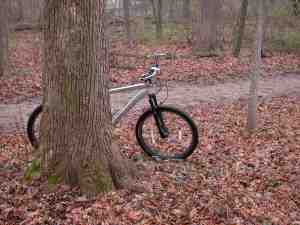
Does a bike create itself? No. But evolution does not work like that. It works with materials readily at hand.

Does a bike create itself? No. But evolution does not work like that. It works with materials readily at hand.

Those of you who insist God get all the credit for creation and everything that has happened since, down the micrometer of spinning atoms, essentially deny the question that begs our very consciousness into order, which is: “Okay, God created everything. Now what?”

If by choice you prefer to beg off answering that question on grounds of absolute providence, then please get out of the way and leave the practical decisions to the rest of us who actually care what happens day to day, and feel responsible for our actions. Because if you believe that everything is pre-determined and that God is the end-all, be-all when it comes to control freaks, you’ve practically signed off your right to have an opinion on politics, religion, the environment. You believe life is a form of Reality TV run by God, like the Truman Show. Or Keeping Up With the Kardashians. A pre-manufactured reality.

Grace appreciated

If you are a strong believer in God, the administrative reality of what happens in what we call “the kingdom of God” eminently requires our participation and decision-making capacities or else our choices are for naught. The Bible clearly indicates that God appreciates those who appreciate grace in both an active and cognitive sense.

If you still don’t get it, let us break it down for you, because this reality does not distinguish between people of any faith; Jew, Muslim, Christian, Hindu, Buddhist or atheist.

Grace in some form is a reality even it is turns out to be pure coincidence. Of course you can choose to ignore even your own good luck and happy coincidence, but that just means you’re both a pessimist and a sourpuss.

Bluebird

The bluebird of happiness is both a literal and figurative term.

Furthermore, without action to benefit others as you have benefited, you’re a selfish jerk. Even humanists believe that. Some prefer to credit our good fortune to God, but then you must also credit your bad luck to God as well, and that puts you in a bind, doesn’t it. Does God cause bad things to happen? What kind of God is that?

Take God out of the equation and we all face the same cosmic algebra: how do we respond when bad things happen? If we accept the fact when bad things happen to us and do our best to recover, and choose to help others when they face troubles as well, then we can make life better for everyone. Do unto others as you would have them do unto you. The Golden Rule. Grace appreciated. The humanist motto. Call it what you will.

In any case, the human race has already decided that hogging your own good luck is bad form. Some believe karma will get you for that. It goes without saying that if you are a selfish sonofabitch who gets hit by a bus, no one will miss you.

Bridging the selfishness gap
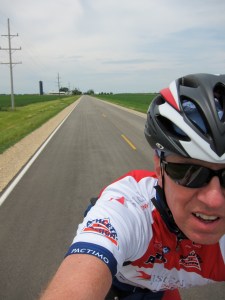
We are forced to live in the present. And also to imagine the future. So keep moving.

We are forced to live in the present. And also to imagine the future. So keep moving.

The honest bridge between outright selfishhness and the capacity to give is going out for a run or a ride and coming home better prepared to deal with the world on its own terms. You may do each of those activities alone––or you may choose to ride or run with a group. The basic fact is that many people use that time out running or riding to get into a positive orbit. While you can call it selfish, there can be no mistaking its ultimate value. Running and riding, even swimming or walking are all fair attempts to orient ourselves to the universe. We move to understand.

Think about it. During your greatest, most transcendent moments as a runner or cyclist, you are moving through time in a way that makes you feel truly alive. You are tuning yourself to a universe that was born of movement and seems by its very design to appreciate and encourage movement down to the smallest particle of existence. From that movement comes self-awareness, acknowledgement of free will and for the ever-changing, ever-exchanging matter of which we’re all made.

Carbon fiber souls

In the end, you give yourself up to the cosmos whether you want to or not. Go ahead, try to deny that. It will never work. Denial never works. It only pins you down in your little corner fo the universe.

Better to choose free will, and grow with it. We run and ride because we can. Because we should. Because it teaches us that what matters is not our own limitations in space and time, but our humble efforts to transcend our limited understanding in active ways. To deny yourself that opportunity is, in a way, to cease living. It also denies the legitimacy of others who would seek the same transcendent existence. And as we’ve learned, to deny another person’s full humanity is a sin.

It’s that simple. Now go out and run and ride. And be thankful you don’t deny yourself the opportunity.

WeRunandRideLogo

Posted in Uncategorized | Tagged , , , , , , , , , , , , , , , , , , , , , , , | 3 Comments

The club scene in cycling or running isn’t for everyone

It all started out so perfectly. 

You can check out your riding or running form by taking a route past a long set of windows.

After ditching a club, it’s not really legal to wear a brand kit in a criterium. My mistake. I was a rookie that year. 

Every Wednesday at 6:00 we’d ride 40 miles in a big sweeping loop through the little town of Kaneville. A weekly group ride with the same sane leader leading the group at an average pace of 20 mph when you were done. The group was replete with all kinds of riders. Fast. Beginners. Elite women. And guys like me. Just wanting company to get in shape.The 20 mile stretch of road returning to Batavia was largely straight, had a few hills and if the wind wasn’t blowing from the east, a total gas to ride in a group. Pace would shoot up to 26 or 28 mph and stay there. You’d be spinning softly just to stay off the rear wheel of the guy ahead in line. As twilight came on the group would coalesce into two neat rows with lead riders pulling off the front.

I recall being paired with a really talented female rider who, when I got too eager on pace, would turn quietly and say, “Stay steady.”

Another time a much better rider than I came rolling up and said, “Your cadence is much better tonight, that’s the way to ride efficiently.” That mattered to me because I had specifically been paying attention to a higher cadence that night.

The group ride lasted a couple years. But then a new initiative began with the club, hosting Wednesday night criterium. The popularity of the “practice races” took off. And they were fun and helped you work into shape for the circuit. But they slowly killed off the Wednesday night group ride from the shop that sponsors the team.

Demise of the club group ride

IMG_7100

Racing is not necessarily a great substitute for a good group ride.

A few of us tried to continue the Wednesday night rights but without the structure of the shop organizing things and the regular ride leaders taking less interest in managing the pace, the rides turned into a race every week. Surges and uphill sprints and all with no communication other than guys looking over their shoulder to see if they could be caught.

The women quit showing up because the ride had become some sort of testosterone-driven shrivelfest. The group finally shrank to four guys who, in the heat of the 2012 summer, had varying degrees of tolerance for 89 degree afternoons. The rides were averaging 20-22 miles and hour, but most were a slog. And that was that. People quit coming.

One morning I made the mistake of riding 40 miles on the same day as the group ride. Thought it might be interesting to try to come back and do a double workout since I was getting pretty fit. But 25 miles into the ride on a hot, hot night I was cooked. Couldn’t hold the wheels of the guys in front of me. They waited at a stop sign even though I waved them on.

“I’m sorry,” I told them. “I should not have ridden 40 this morning. You go ahead.”

“I’m not buying that,” the off-again, on-again leader told me. In my exhaustion his tone to me sounded cynical. Snarky bike prick stuff. Did he genuinely not believe I rode 40 that morning? Or did he think that should not have affected my ability to stick with the group that evening. The net result is that the group slowed down for 5 miles while I clung to wheels and then brought it home the next 10 miles at 20 mph. I just hung on, head down and heart heavy with the effort.

Racing for the fun of it

On the Red Rocket, Felt 4C

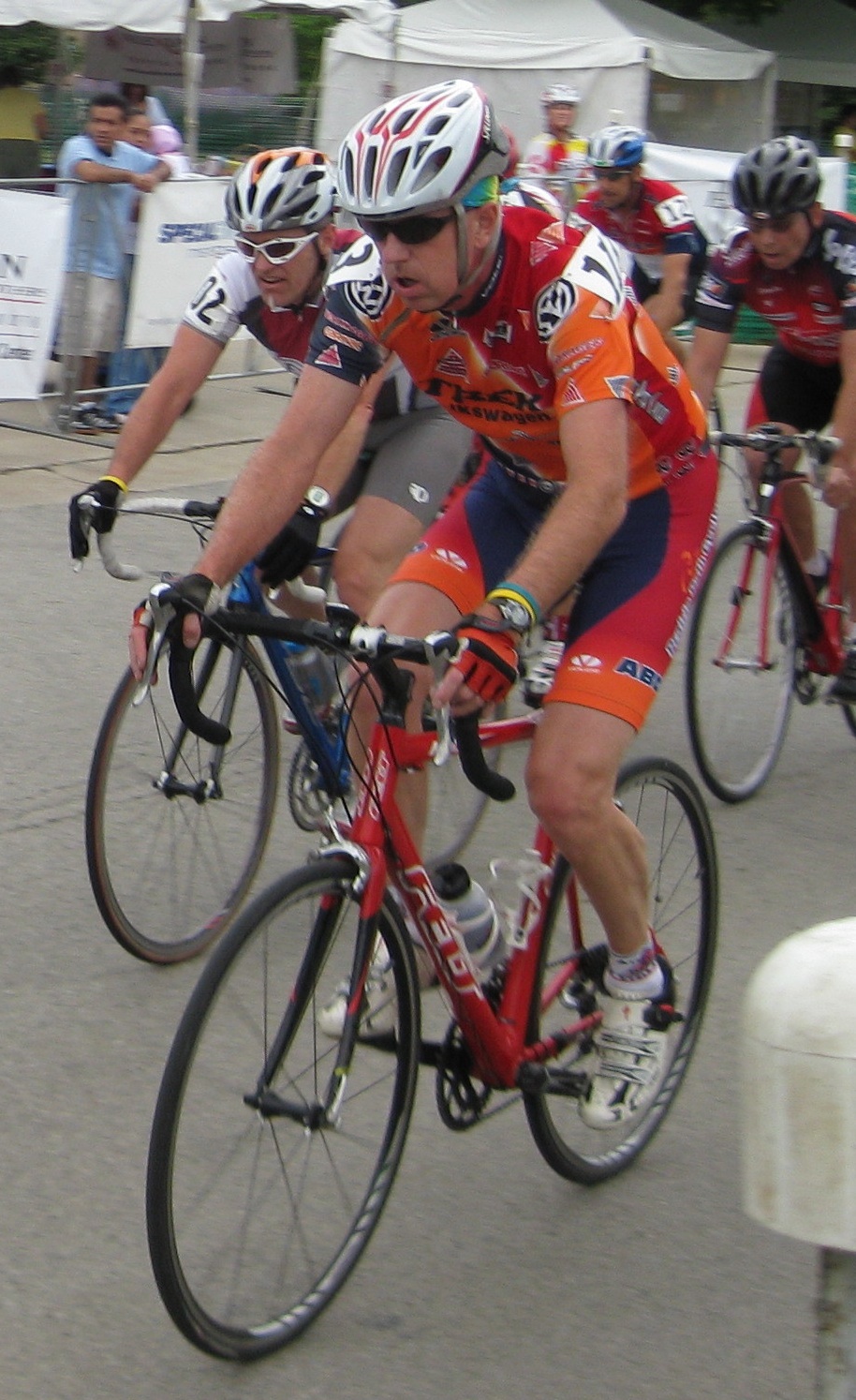
Cud racing in a crit.

After the group ride collapsed I gave myself a little lecture and decided that I could not mope about it. Instead I joined the Crit rides on Wednesdays. The first night there was a huge wind and the group of CAT 5 racers sat shivering and nervous at the starting line. The instructions weren’t clear whether experienced CAT 5 racers should start in the first group or wait for the combined CAT 4/5s, which is where I should have been. So I started right way. And within 2 laps a group of 7 riders had shattered into little clumps that go swept away by the larger group charging around the crit course in the wind.

On the group’s website I commented that instructions could have been a little clearer at the start. Right away the personal attacks started. “There’s no crying in cycling,” one club member wrote. “HTFU. That’s what we’re out there for.”

The next race was another windy, cold night and this time the instructions were clear, but as the group sat waiting for the start the race referee singled out a very anxious looking beginning rider, probably 19 years of age, and grilled him in front of the entire group. “This your first race?” the starter bellowed. Then he made fun of his generic kit and his pale skin.

I was incensed. Here was a kid trying to make his way into the cycling world and this is the treatment he gets?

Feedback loops

The rash nature of the club members came through a few months later when I posted a piece from this blog to the group email list. The blog was a somewhat pointed article about concealed carry laws and cyclists. Someone in the group took great offense, dug up my email and began attacking me personally.

No cycling or running club is perfect. But even if the kits or uniforms are nice and earn you some visible respect among other athletes on the road, not everyone belongs in a club. You may not fit the personality of the club, or its objectives. It may be that your priorities are not in sync with what the club is doing. Or you may be a sonofabitch who can’t get along with anyone.

My own fault?

I don’t know which of the above are true about me. Perhaps all of it. But this summer I’m riding in a generic kit or my Felt gear to match my bike brand. Sometimes the allure of being a club member just isn’t worth the contradictions we face when our own ideas don’t match those of the organization we choose. That’s one of the tarsnakes of being in a club. It sometimes happens that you don’t fit in. Best to just ride or run on. Something else will come down the road.

As for the club that I ceased to join this year, there is too much circumstantial variance to put the onus on their shoulders. After all, I don’t ride the winter indoor training circuit. I do volunteer to work races, including one event where as course marshall I stayed with my spot while hail and pouring rain came down. You could hear the nickel-size hailstones bouncing off the helmets of the CAT 3 riders plying their $5000 road bikes through deep channels of water pouring down the hills of the suburban streets where the criterium was being held. I’m a loyal type, you see. And you learn tons of things by working at bike races.

So it wasn’t all bad. But it wasn’t good enough to make me want to stay. I’ll take the responsibility for that. But if you run a bike or running club, it might pay to survey your members every year to find out what goes on behind the scenes. Assuming everything is going well seems rather naive, does it not?

WeRunandRideLogo

Posted in Uncategorized | Tagged , , , , , , , , , , , , | 3 Comments

Become a Flexible Flyer to improve your cycling this year

Flexibility is especially crucial to cyclists who race or ride really long distances.

Flexibility is especially crucial to cyclists who race or ride really long distances.

Cycling is a multifaceted endurance sport that involves some contradictions, the first of which is that the lower part of your body is in almost perpetual motion while your upper body, if well-managed, should stay relatively still.

It’s almost as if a cyclist needs to split him or herself in half to be optimal on the bike.

Sure it takes a lot of energy to pedal. But a smart cyclist turns much of that effort into a cadence driven spin rather than pressing up and down on the pedals.

While lower body strength is obviously important to a cyclist—just look at the legs of world class riders if you doubt the need for strength, you can also make the case that core strength from the abdominals to the neck is vital to keep a good position on the bike to gain maximum outfit.

Flexible Flyer perspectives

Wherever your body is tight in terms of muscular and tendon connections, you are essentially pumping energy into resistance against those segments of your body and getting very little energy back in return. It’s like those tight spots are mini Black Holes in your body.

For example, if your Achilles or calf muscles are so tight that they limit ankle motion, that can cut down the range and power of your pedal stroke. Plus, if you’re tight in the knees on either side, that can pull your leg out of it’s most efficient rotation and put you at risk for an overuse or bio-mechanical injury.

When you consider how much movement your knees do during cycling, the amount of torque and wasted motion created by a tight or misaligned knee can be considerable.  If every quarter pedal stroke carries your knee in a circumference 36” around, and you are riding at a cadence of 90 cpm (cycles per minute) each knee travels just over half a mile

Monte Wehrkamp on our annual trek to Wisconsin

every 60 seconds. Combined your knees cover a mile every minute. That’s 60 miles of knee rotation in an hour or 120 miles in two hours, all just to cover 30 miles. Perhaps you’ve been taking your knees for granted on the bike?

We’ve all ridden up behind a cyclist whose knees are pointing out at 30-degree angles as they pedal down the road. The added angular motion of the knees in that poor riding form is highly inefficient, using more energy because of the additional effort your legs must produce to cover the same rotational difference. It also increases your wind resistance profile, costing you perhaps 30% of your forward energy because you’re errant knees (or knee) is blocking that much more wind as you move forward.

The Flexible and Unflexible Platform

Often the reason cyclists stick their knees out is that their seat post is positioned too low. Dropping your center of gravity too low forces your knees outward to compensate for the additional leg length when the pedal comes up to the top position. If you are additionally tight in the hips, the knees, the ankles or the lower back, the “dropped seat” position may feel somewhat better because it helps you reach the pedals, but the net result is that it simply worsens an already problematic condition. Tightness becomes a self-fulfilling prophecy.

Your lower back is the most underestimated component of cycling efficiency. A tight lower back cuts power, but the balance for a tight lower back is strong abdominals. The cure for a weak or tight lower back starts on the front of your body where the stomach muscles “take up the slack” of an otherwise tilted pelvis, which puts your lower back into a curved or bowed position rather than straight. A strong core helps you perch on the bike rather than slap your ass on the seat and hang on with your shoulders and arms, and flailing away with you legs.

It all starts with your “platform,” that group of muscles strung like a basket around your hips, pelvis and pelvic floor. If those muscles are weak or tight, sooner or later your “platform” will tire from the added effort and you’ll find yourself weakening up hills or into the wind

Note: If your lower back and hamstrings are tight, they are essentially pulling against each other your entire ride. That means you’re doing work “within yourself” that can’t be pumped into the bike to make you go faster or longer.

If your core is weak your shoulders and arms will have to take up the slack. That can really knock you out on the bike. Bike fit has a lot to do with how your shoulders feel, but position on the bike also affects form and enjoyment. Most importantly, strength and conditioning of the core gives you the confidence and relaxation to ride your bike without fear of wearing out.

How to achieve a more flexible platform

Improving your flexibility through range of motion exercises like balance drills and toe raises increases ankle strength and develops balance, which you can use on the bike when you stand up to pedal.

Lunges

Use long, deep lunges to improve hamstring and lower back strength. As you progress add hand weights from 8 to 25 pounds and walk from one end of the room to the other. You’ll feel your body stretch out, your shoulders loosen up with time and your legs become steadier beneath you.

 One Legged Squats

One-legged squats are an ideal exercise to enhance quad strength near the knees, hip flexor development and overall balance on the bike. This simple exercise requires no equipment and you can do it anywhere. It actually makes an ideal warmup exercise before a ride or a run. Just bend one knee at the joint to point the foot back at a 90 degree angle to the ground. Then lower your bent knee toward the ground so that your knee is about 8” or so above. Rise back up and repeat. Start with 10 repeats, alternating legs. You’ll feel it in your quads and butt, hips and Achilles are.

Planks

To do a plank, put your elbows together on the ground, rise up on your toes and hold that position for 60 seconds. This exercise very closely mimics your position on the bike and the tension your body feels holding itself up all day over the handlebars. Planks make your stomach stronger, and by proxy, your lower back.

One legged hamstring reach

Stand neck to a table for starters, and lift one leg straight out from your behind while reaching down to touch your other leg with the tip of your finger. Hold the position as if you were a ballet dancer at the barre. Usually 20 seconds is sufficient. This exercises causes your hamstrings to lengthen and is a great warmup before getting on the bike and being scrunched up all day.

Flat wall vertical arm swings

Standing with your back to the wall, put your arms flat against the wall and while keeping contact with the wall raise your hands up in matching arcs to touch above your head. This will strengthen and lengthen your shoulder muscles and even those touch muscles in the middle of your back where bands connect between your shoulder blade and spine.

Next, with your back to the wall, place your elbows against the wall and swing your hands from top to bottom, tapping the wall in both positions. This strengthens your shoulders as well, but gives your neck position a test that works well to prepare you for bike riding

Using these exercises to create a Flexible Flyer platform will help your efficiency, strength and comfort on you bike. No go out there and be flexible!WeRunandRideLogo

Posted in Uncategorized | Tagged , , , , , , , , | Leave a comment

We sort out who we are by how hard we try

By Christopher Cudworth

My friend Pete. Long ago teammate. A bond that lasts.

My friend Pete. Long ago teammate. A bond that lasts.

A familiar figure ahead on the road. Strong calves. Vee-shaped back. A quick pedal turnover on his black hybrid bike. I recognized my old friend Pete, a high school cross country teammate, pedaling out of town headed who knows where.

It was 5:00 on a Sunday. Light was getting dim due to a flat overcast sky. No threat of rain. Just lack of light getting through. So Pete looked almost like a black and white photograph on his bike. Some friends are like that anyways.

A little history

Pete was a tiny kid in high school, standing only 4’11 as a freshman. Yet no one could wear him out. His endurance and commitment to running was admirable. With a running style that was more churn than burn, his short torso seemed carried along as if he was the Roadrunner from cartoon fame. But again, long distance, not speed was his forte.

Sometimes we’d come in from a run and Pete would show up later only to tell us, “I went a little longer.” That was his thing. If he couldn’t be first, he’d do more than anyone else.

You can see it in his eyes

All those thoughts came through my mind as I drove past. Wanted to pull over, park my car and stop and talk but Pete seemed focused on his effort. Actually, that hardly describes it. The expression on his face, that I could see in the rear view mirror, was ‘eyes ahead and don’t slow down.’

Last I saw Pete was a year ago. He was on a walk on the river trail in the company of his mom, who turned 80 recently, and she really looked fit. She hadn’t seen me in nearly 40 years, not since I was a 16 year old kid, yet her eyes brightened right away. Runner Moms never forget a former teammate either. That special bond that comes from watching kids torture themselves to exhaustion through the woods and rain and cold and heat burns a face into your memory. Runner Moms are the best that way.

Catching up

Runners and cyclists just "get it" when it comes to living with difficulties.

Runners and cyclists just “get it” when it comes to living with difficulties.

As I pulled into the forest preserve today where I’d driven to walk the dog and check out spring flowers, I wasn’t expecting to see Pete again. yet minutes after I’d pulled in and entered the woods to walk the drive  looping 7/10ths of a mile around and over a prairie kame–along came Pete on his black hybrid bike. He must have been hauling ass to get out to the preserve that quickly. I’d seen him more than 5 miles back! Yet here he was. Some people amaze you that way.

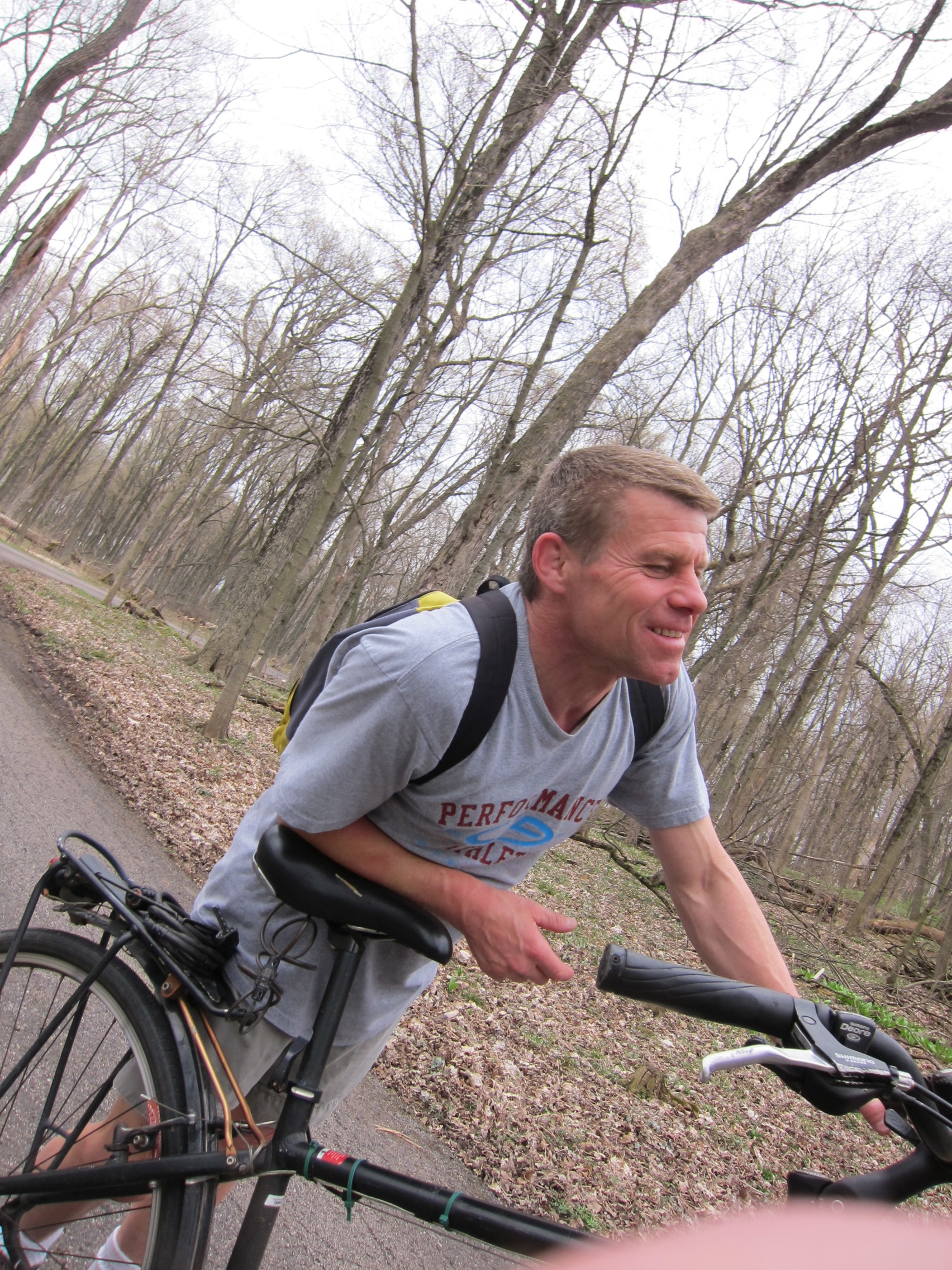
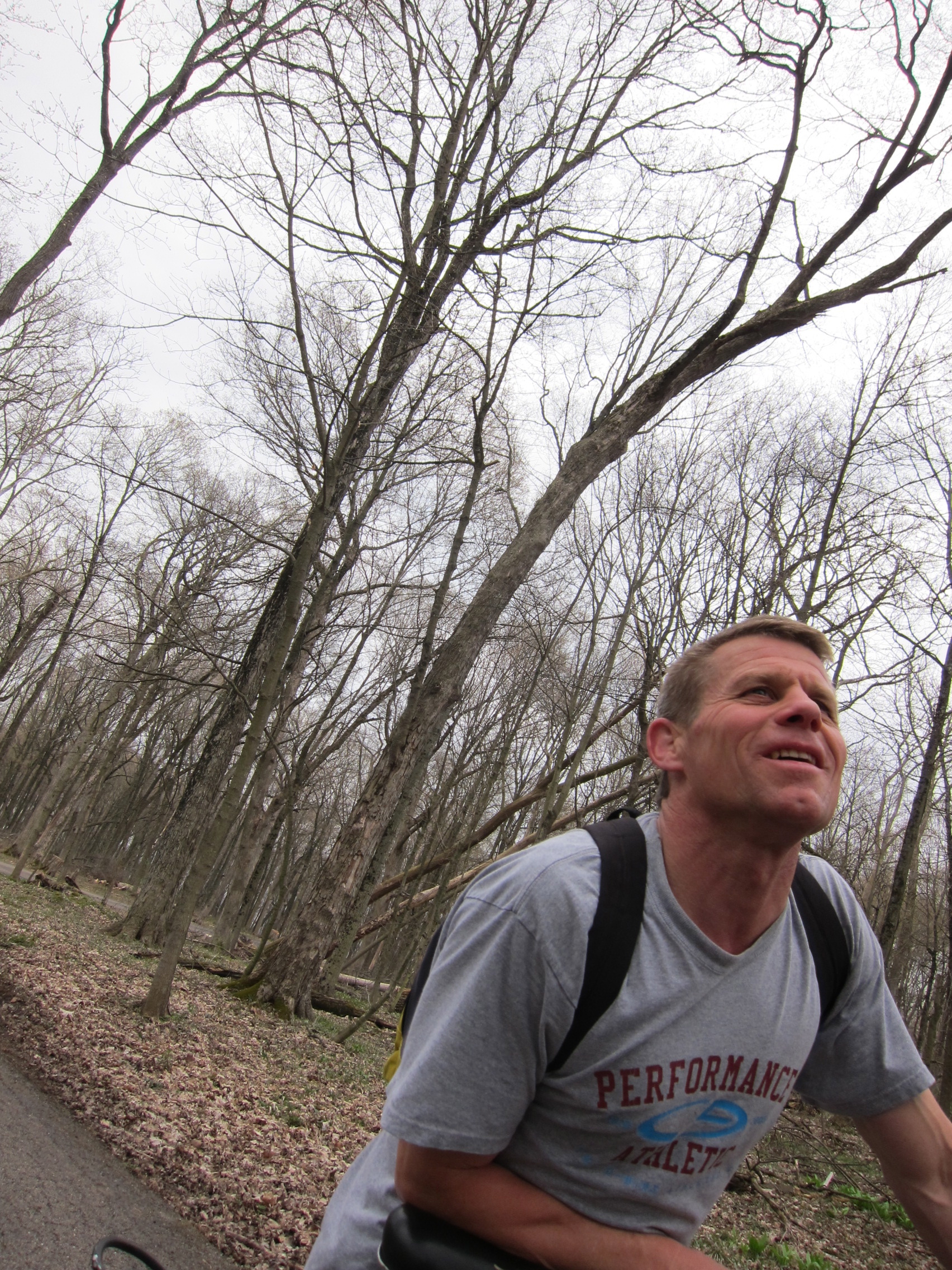
Pete came rolling around a curve on the woods drive and I smiled and called out “Pete!” at which a flash of recognition came over his face and he came to a rolling halt. Smiled that big smile. He’s compact now, not small. His marine arms and shoulders bulged under a tee-shirt with the word Performance on the front. He wasn’t breathing hard despite what must have been 8 hard miles of cycling. Not a whit was he breathing hard, in fact.

Instead, the first words out of his mouth were, “I’m so sorry.”

He was speaking about the death of my wife March 26. “Was it sudden?” he asked.

I explained that it was not sudden. That she’d not given in despite 8 years of very tough existence with chemotherapy and surgeries and side effects that would have brought anyone else to their literal knees.

A section of the hill at Johnson's Mound in summertime.

A section of the hill at Johnson’s Mound in summertime.

Told him that I was proud of the time she’d given to all of us, and that many blessings were fulfilled as a result. That is how I really feel.

There was no need to feign vain or superstitious ideas about her courage. As a runner and now power-cyclist he’d know what I meant. Living with suffering is a way of life, not a choice for most runners. Yet it still gives you an insight into things other people don’t understand. Like persevering. Dealing with inconvenience and even panic.

Thinking on that, in many ways my wife was more of an athlete than I will ever be. Sometimes I would compare her struggles through cancer to competing in a marathon, or training for one at least.

Effort and Recovery

“Honey,” I’d tell her. “You have to think of these days after chemo like you’d just run a marathon. It takes time to recover.”

She’d grunt and go outside to work as long as she could by the garden. Yet sometimes I’d find her plopped in an Adirondak chair exhausted and sweating, flush in the cheeks and pissed as hell. Outright pissed. “This sucks,” she’d say. But she wasn’t speaking about the cancer. She was speaking about the limitations it put on her. I don’t think I ever heard her complain directly that she had cancer. Not in a resigned sense or in some whining way. Not her style. What really pissed her off, right to the roots of who she was, is that she could not sometimes do the things she enjoyed. That made her mad. Disgusted. Frustrated. Disappointed mostly. But not always. In fact not most of the time. She wanted to live, and keep on living. She lived that philosophy to the end. That is not to lionize her in some romantic way. I admired her courage and grew frustrated with her stubbornness. But you can’t necessarily have one without the other. Ask Winston Churchill. FDR. Martin Luther. Martin Luther King, Jr. Muhammad Ali. Joe Frazier. Jon Stewart. Steven Colbert. She liked those two guys. Stubborn and funny. Justice and humor.

That’s one of the tarsnakes in life. You sometimes can’t separate the good from the bad.

Meaning of life. Meaning in life. 

Life is all about overcoming limitations. Dealing with failure. Accepting success with grace rather than Lording it over others.

And my old friend and running partner Pete understood all that in a heartbeat. I could see it in his eyes.

Bloodroot. A perfect Sunday flower.

Bloodroot. A perfect Sunday flower.

We walked along as I pointed out flowers along the path. Dutchman’s breeches. Bloodroot, which almost always blooms in the weeks following Easter. A perfect Sunday flower. When you break off the plant, red sap flows from the stem. Hence the name.

Linda and I would journey to that hill in all seasons. Sometimes to walk the dog. Also just to “be” somewhere.

It was a test of cancer fitness if she could walk the hill. And she did it many times. Strava recently told me there is a 9% grade in the middle of that hill called Johnson’s Mound outside Elburn, Illinois. There is a Strava segment on that hill and I’m amazed at how fast some cyclists can top it. I ranked somewhere around 100 when I rode the loop the other day. Not thinking about the Strava segment. Only wanting to incorporate it as part of my 40-miler. But I will return. And ride it harder. I have to now.

An old school measure of fitness

I also knew I was very fit back in competitive running days when I could cover the portion of the loop from the woods-opening to the top of the hill in 3:00. You had to be in 31:00 10K shape to go that fast. I know from experience, because that was how it worked for me. The flats had to be covered at 5:00 mile pace or under. The hill had to be traversed without pause. It was both training and a measure of character. It was back in 1971 when I first ran it as a high school freshman. And it still is. Hills don’t change. But how we view them sometimes. That can change.

Reading a book of passage

Pete and I walked slowly up the steep sections of the hill with him pushing his bike and me pulling my dog away from the pee trees. Lots of people walk their dogs in those woods. There are lots of pee trees as a result. Probably Chuck was reading a book about other dogs.

Pete and I were reading aloud from a book about the present and the past. He asked about various running teammates we knew and I filled him in. His curiosity was both genuine and not too possessive. Pete is one of those people who doesn’t cut too deep a groove in the air through which he passes, if he can help it. Sometimes it pays to act small in that respect. You maintain a better sense of self that way. But it doesn’t mean you don’t think of the important stuff.

We talked of sons and daughters and I realized that Pete and everyone else on earth faces the same sort of wind resistance no matter how fast or slow we’re going, or how big or small we are. It’s all relative. Our pleasure and pain is offered by the universe in the same way that sunshine hits us evenly, or rain. You can’t outride the sun or run between the raindrops. Yet we sort out who we are by how hard we try.

How hard we try.

WeRunandRideLogo

Posted in We Run and Ride Every Day | Tagged , , , , , , , , , , , , , | Leave a comment

10 Things You Can Start Today to Improve Your Running

  1.  Go to Bed Earlier. Runners in the habit of staying up late are not likely the runners who get up early to train. Early morning training can be one of your best bets to better overall running because it sets the stage for a whole different kind of day. First
    Early to bed, early to rise, makes a good runner healthy wealthy and wise.

    Early to bed, early to rise, makes a good runner healthy wealthy and wise.

    off, you don’t start your day by eating, or overeating. Instead, you get out for a fresh run and come back and are much more likely to think healthy food instead of comfort food. But it all starts with going to bed early enough to get good rest and rise early enough to fit in a good run.

  2.  Buy new shoes. Runners in the habit of stretching the life of their shoes are runners who tend to have chronic or nagging injuries, or just don’t feel good when they’re out on the road or trail. The longer you run in your shoes the more your biomechanical deficiencies show up in your stride pattern. If you’re into the minimalist thing you can probably ignore this touch of advice, but if you’re one of the many people who keep their shoes a month too long and feel saggy and hurting every time you run, go to your running store and cure the problem. You’ll run better right away.
  3.  Have sex. Sex is one of the best training and racing tools around. A body released from physical tension of a sexual sort is actually capable of performing at a higher level than one wracked by sexual tension and the anxiety that comes with it. Many running coaches will tell you… “Make sure you run relaxed.” Yet the one thing we can do to feel more relaxed and
    No butts about it. Sex can be good for everyone.

    No butts about it. Sex can be good for everyone.

    literally be more relaxed is somehow out of bounds? Absurb. Having sex will enhance your performance, not detract from it. Don’t believe the crap about being less competitive or less motivated because you released sexual tension. It’s a lie fomented by the type of coaches who are control freaks and want to keep you for themselves. Even sex with yourself is better than no sex at all. Your body was not designed, shall we say, to hold all that in. Get your rocks or rolls off and get your PR on. 

  4. Do strength work, and forget the club or the weights. The simplest and most effective type of strength work uses no weights, so it is easy to accomplish anywhere and prepares your body for training or competition. The single most important exercise for runners is the one-legged squat, in which you lift one calf to a 90 degree angle and lower your body in a controlled dip as if you were trying to touch the knee 534792_436025453153010_2134165241_nof the raised leg to the ground. That exercise strengthens vital quad and thigh muscles, butt muscles and even your hamstrings. You’ll find it especially helpful in strengthening those hip flexors as well. For the upper body do planks for stomach strength, pushups for arm and shoulder strength and you’ll be doing yourself a favor every day.
  5. Eat less sugar and carbs.  Sugar is the actual enemy of consistent performance because it spikes insulin and throws your whole dietary chemistry out of balance. Craving sugar usually results in replacing healthier foods with sweets. So you’re going out the door with a disadvantage right way. But you don’t have to go cold turkey on sweets. Just plan ahead for your workday snacking with some carrots and dip, an apple or orange or banana and skip the cookies or chocolate bar. It’s that simple. 
  6. Run during the lunch hour 1-2 times a week. Getting out the door during lunch hour rather than diving into another comfort food lunch will improve lots of things in your training. Sure, if you don’t have a shower to use it can be a little grimy to run during the day, especially in the summer. So be practical an only run on cool days, perhaps in spring, fall and winter. There’s plenty of daylight during the summer months that you can rise early or run late and not wind up in the dark. But you’ll find that cranking out 4 miles at lunch leaves you time to change in and out of your running clothes. Just bring a bag of those self-shower wipes used by hospitals and change in some discreet bathroom and no one will think you’re weird or smell bad. Or change in your car at a park so long as you’re well out of sight. You’ll feel better, break up your workday and be less inclined to skip a workout if you head out during the noon hour.
  7. Fix your stride. This one may take some help, but many runners have really poor running form that is holding them back from achieving their goals. Form coaches are rare and can
    A well conditioned stride makes you faster.

    A well conditioned stride makes you faster.

    be expensive, but if you can get out with a runner who’s a little better than you and knows form, and do a short digital video of your running form together, the effect can be transformational. Not enough runners see moving pictures of themselves to learn how their upper body carriage, arm swing and foot plant affect how fast they can go. Yet a little analysis can help you go a long way, a lot faster. 

  8. Make a plan to run with people faster than you. Forcing yourself to run with faster groups is the only real way to get better. Don’t make excuses if you get dropped. Finish the prescribed distance and come back the next week to try again.
    Athletes on the Multisport Madness Triathlon Team gather for a quick team photo between intervals.

    Athletes on the Multisport Madness Triathlon Team gather for a quick team photo between intervals.

    Telling yourself you “had a bad day” is bullshit. You’ll have a good day when you work hard enough and long enough to actually stick with the better runners. It may hurt and you won’t feel or look good, but results are what counts when you want to get better. Stretch yourself and be glad for the pain. It means you’re really trying to get better, not just fooling yourself.

  9. Run fast and short if you’re planning to go long.Few runners appreciate the fact that running short, fast intervals actually has benefits to their longer races, especially distances
    People who run fast over short distances find it easier to race with more efficiency over long distances.

    People who run fast over short distances find it easier to race with more efficiency over long distances.

    over a half marathon. The effects of increasing your stride rate and turnover are both real and perceptual. Running fast literally lengthens and strengthens your leg muscles in a greater arc of motion than does slow running. This added “capacity” actually enhances efficiency when you’ve shortened your stride length and are running a pace considerably less fast than the interval pace. For example, if you plan to race a 5K at 6:00 pace, running a set of eight 200-meter intervals at 35-40 seconds per 200 is a bit faster than your target pace and will make your race pace feel easier. But if you are planning a marathon at 8:00 pace, running a set of eight 400s at 1:30-1:45 is ideal for stretching your “muscle memory” so that running your race pace feels easier. The idea of intervals is always to enhance speed, but the side-benefit is making your goal pace seem easier.

  10. Run long to last longer when your race is short. These counterintuitive statements are no so much contradictory as they are imaginatively practical. While you can compete at the
    Eck eck eck. Ye'ah gotsk tah run long sometimesk.

    Eck eck eck. Ye’ah gotsk tah run long sometimesk.

    5K or 10K distance very effectively on 30 miles weeks built around speedplay and interval work, there is much to be said for getting in at least one 10-12 miler per week if you want to build insurance for the last 1/3 of any race under 20K. In the 1980s several speedy distance runners and especially a racer named Doug Padilla followed a low-mileage, high intensity program designed by a Stanford coach named Brooks Johnson. Yet the talented Padilla still got in at least one longer run per week as insurance for endurance. 

There you have it. 10 practical ways to get faster as a runner by starting today. There’s nothing here that requires special shoes, special training, special equipment or even anyone else to help you do it. If you know how to use the self-timer on a digital camera, you can even do Lucky #7 yourself. Have at it. And see you at the races. 

WeRunandRideLogo

Posted in We Run and Ride Every Day | Tagged , , , , , , , , , , , , , , | 5 Comments

Urban Running Girl inventing new ways for cool gals to keep warm

By Christopher Cudworth

Shrugs from Urban Running Girl fit over the shoulders and offer rollable cuffs to cover the hands on really cold days.

Shrugs from Urban Running Girl fit over the shoulders and offer rollable cuffs to cover the hands on really cold days.

Deborah Cape is an apt name for someone who perfected a super new way for women runners to cover that transitional time when the weather outside is too cool for a tank top but might warm up enough once you get on the move.

The type of garment she creates is called a “shrug” and is designed as activewear. But more than a few women may find it just as comfortable in other transitional climate situations, such as a too-cool office space or around the house.

A shrug above

The term “shrug” comes from the fact that the garment covers just the shoulders and arms, perfect for the warmup or cooldown session, but also great for keeping warm during the entire workout.

I know. Smart, right? The idea makes so much sense it almost jumps out at you once you see one. Like arm warmers for cyclists, the shrug is a tuckable and convertible garment yet highly wearable piece of fabric that women runners can grow to love.

“How about shrugs for men?” I asked Deborah during our interview about her products.

“Well,” she admits. “I wasn’t sure there was a market there as yet. But if there’s a demand then yes, we might do that.”

Her ingenuity got its first tweak a few years back when she saw other garments designed for temporary or transitional wear and began thinking about what runners need out there day to day, because Deborah is a runner.

One thinks of a shawl, for example, but a “running shawl” would blow in the wind. The shrug, as it was designed, is designed for sleek aerodynamics and transitional warmth, combined.

Shrug design

Once the idea was conceived, Deborah set about making the design. She cut out some fabric in the shape she thought was needed, then conceptualized with an actual clothing designer and finally a pattern and test garment was produced. Following a few tweaks for fit and flow, the Shrug from Urban Running Girl was born and ready to sell.

The website describes the many ways shrugs can come into play in daily life.

“You can wear it with your favorite t-shirt or tank top without adding an extra layer around your torso like a jacket or a long sleeve shirt will. When you’ve warmed up enough, it’s easy to take off and tie around your waist, and unlike a jacket it won’t weigh you down. A shrug has no zippers, buttons, or touch fasteners that may rub against leggings when tied around the waist, potentially damaging the material.”

Cool beings need shrugs

That all sounds pretty good, does it not? A shrug works like running tights for the shoulders and arms, where tension from cold or sudden chills can wreak havoc on muscles and tendons if you’re not wise about the chill.

Deborah notes that a shrug can also be worn during many other activities including cycling, yoga, warmups at the gym, dance or walking.

One wonders what the sporting world will do now that shrugs exist. Plaster logos on shrugs for athletes male and female? This is a garment begging for commercial uses. They might make interesting “team flair” for pro basketball players during warmups. Why not, those guys wear every other kind of whatzits now to warm up, compete and play.

A Shrugfest

The market for shrugs seems well on its way, Cape admits. “I’ve been told that NIKE has a product on the market that’s like a shrug, and it’s sold in pair with a tank top. But it’s much more expensive than my product of course,” Cape says. “And the Urban Running Girl product is a bit more practical. I designed mine with rollover cuffs so that you can cover your hands on really cool mornings.”

Deborah Cape’s goals for her product are perhaps a bit more modest than those of a global company like NIKE. She’ll be content knowing that women find her product comfortable, practical and purposeful. “I’ll like it if women are using my shrugs just to watch a movie–movie theaters get pretty cold!–or inventing their own purposes,” she says.

One starts to imagine other purposes for shrugs, such as sun protection during gardening or other outdoor activities. You really can’t shrug off any potential ideas with a product this novel.

On the move

Runners and cyclists will find shrugs easy to remove and either tie around the waist or stuff into a cycling shirt or fuel pack.

Urban Running Girl makes its shrugs out of tech fabric designed to wick moisture and stay comfortable in all kinds of conditions. Colors include Sky Blue, Black, Amethyst, Orange and Hot Pink, of course. And that last one’s a great idea for fund raising, wouldn’t you think?

Urban Running Girl Shrugs are $32.99 (Canada) when you order direct from the website at www.urbanrunningirl.com. Shrugs come in small, medium and large and chest sizes up to 38.

WeRunandRideLogo

Posted in Uncategorized | Tagged , , , , , , , , , , , , , , , , , , , , , , | 2 Comments

Is there life beyond testosterone for those who run and ride?

By Christopher Cudworth

Is less testosterone really such a bad thing?

Testosterone fuels our muscles and our minds.

Testosterone fuels our muscles and our minds.

Every time one of those commercials for male testosterone comes on the radio it strikes me that guys of a certain age may be worrying about all the wrong things.

Read between the lines and you can guess that male sexual performance is hidden somewhere in the messaging. But “energy” and “drive” are such nebulous terms they could apply to just about anything. Business. Creativity. Hell, taking out the garbage.
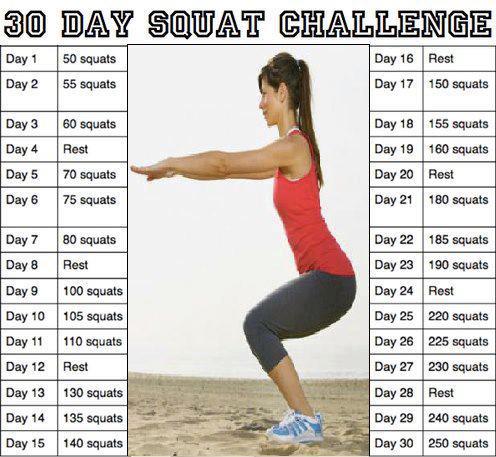
The problem with obsessing over testosterone levels is that you don’t know what the net effect of your testosterone boost might be. Will it genuinely improve your energy or turn out to be a distracting yank on your system?

A somewhat medical perspective…

An episode of the TV show “House” focused on what happened when a normally driven character lost some of his creative and professional drive when his testosterone levels suddenly dropped due to some organ failure. He was professionally brilliant but a total jerk before his testosterone levels dropped. Then he became a nice person during his testosterone dip and his partner was forced to consider the meaning of what she would gain or lose if she choose either the jerky genius or the milder, kinder man she discovered sans testosterone.

I won’t spoil the ending in case you’re surfing cable channels some night and happen upon that episode of House. It’s an interesting conclusion that makes you think about the relative merits of too much or too little testosterone.

Competitive athletes and testosterone

So many gals, so little time.

So many gals, so little time.

For competitive athletes testosterone in men obviously plays some sort of role in the desire to compete and win. Nature outfitted the male gender with a sometimes overloaded capacity for testosterone production so that men could rise up and compete for mates. Take a look at what ram bighorn sheep go through, clopping heads together high in the mountains. Or those ugly elephant seals snorfing and stabbing at each other with tusks until they are quivering heaps of bloody flab. The male animal can get crass and dangerous with too much testosterone running through their veins.

NFL proves the point of testosterone madness

We have the NFL as testimony to the dangers of testosterone. It is rapidly becoming evident that thousands of former NFL players have suffered brain damage from competing in a sport that quite closely resembles those male bighorn sheep, clattering heads together in a ritualized way. Now that we know the truth about what helmets can and cannot do to shield ourselves from the drives of testosterone, we face the question of whether football can even survive as a social institution. Is a ritual of male human beings crashing into each other important enough to put the lives and minds of thousands of youngsters at risk beginning as early as 6 years old?
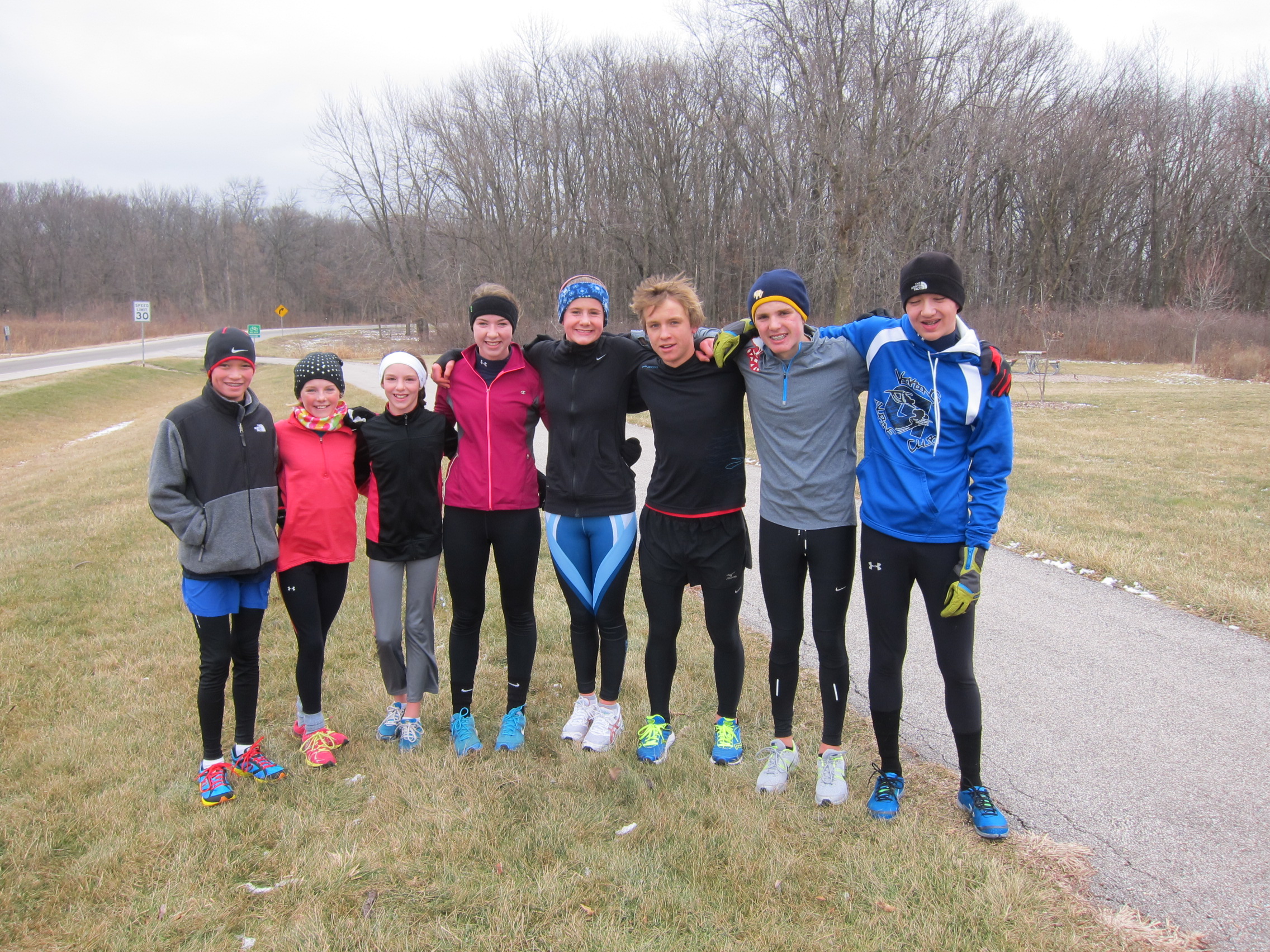
The scrawny kid in front did not belong in high school football.

The scrawny kid in front did not belong in high school football.

Some parents have begun to question the merits of football. My own father forbid his four boys from playing the game. We were all good athletes who could have found a place on the field. My oldest brother could have been a murderously good tailback or fullback. He was strong, agile and unafraid. My next oldest brother and I might have made decent receivers with good hands, and my youngest brother at 6’6” turned out to be an All State basketball player, but with a 36” vertical leap he might have made a fearsomely good tight end. Who’s going to outjump that type of receiver?

Wisdom of a father

But dad didn’t want us playing what he considered a brutal, dumb sport. In my case he literally took me to high school on the first day of fall sports at little Kaneland High School in the cornfields and shoved me in the cross country locker room saying, “You’re going to run cross country and if you come back out of there, I’ll break your neck. Because that’s what would happen to you in football.”

He was right. I stood 5’11” at the time and weighed just under 130 lbs. Skinny didn’t describe me. I was scrawny. But tough. And I’d won the local Punt, Pass and Kick competition and thought football sounded kind of cool. But deep down, not really. I knew nothing of the real game and did not really want to learn. Schoolyard football had resulted in one brutal concussion when I hit a cement ditch after a tackle sent me flying.

A running career begins

So I became a runner, and a year later the cross country team went 9-0 while the football team was 0-9.

Running proved the ideal antidote to my personal overload of testosterone and the resulting anxiety and sometimes even depression that came with it. Running soothed my soul and poured out the excess energy. Sure, like any teenager lust and distraction were an all-around issue, but running kept me as level-headed as could be, and for a skinny kid it provided feedback on self worth and the sense that if you worked hard at something you could achieve it, and even win at times.

Hardly academic

The frantic battle with testosterone lasted through college when serious dating led to serious sex and my closest buddies and I learned that getting laid did not hurt your performance as some proposed, but actually helped. The feeling of being relaxed and loved is far better than being anxiously driven and manic. I set PRs for the mile and 5000 following bouts of sex. Testosterone is plentiful enough in the young to fuel both drives. That’s one of the tarsnakes of testosterone. It isn’t too choosey about what it drives us to do. It can make us heroes but it can also trip us up. Just ask Bill Clinton or any of a number of Republican politicians who rail against the lusts of society only to be caught in their own web of lies about sex, adultery and human failure. Testosterone can kick your own ass.

Growing into ourselves

As men age their testosterone levels change, and with that comes the need to engage in strength-building and fitness activities to maintain health, wellness and appearance.

As men age their testosterone levels change, and with that comes the need to engage in strength-building and fitness activities to maintain health, wellness and appearance.

But as men age, and some women too, the body’s natural hormones mellow a bit. Some men lose muscle tone and don’t feel themselves as a result of low testosterone levels. Some doctors thus prescribe testosterone to help these functions. Steroids are known to produce the same result, pumping up muscles and creating a feeling of euphoria that makes you feel like you can conquer anything.

Yet some of us recognize that a little less testosterone can be a good thing. The ability to concentrate, have patience and not feel like you have to prove yourself every second can be a bit liberating.

Growing perspectives

It may mean that you don’t care that much if you get dropped on the Saturday ride. Your pace per mile running slips from an 8:00 average to something closer to 9:00 per mile. It all raises the issue of what really matters in a life, a career and our avocations.

Does it matter if you’re the fastest? While I won many races during my running career and people remember that to some degrees, that is not how most people judge you as a human being. Instead they look for steady commitment to meeting obligations, completing work enthusiastically and on time, and showing respect and concern for others. Those are qualities that take development in many respects. They also happen to be qualities that a testosterone-driven man can overlook under the influence of one of nature’s most powerful substances.

Competition for our souls

We run and ride for fitness and health. Some choose to compete and some do not. The lesson in this analysis of testosterone is that it matters more how you compete and why than it does how often or hard you compete, and whether you win or not all the time.

Winning is always relative, you see. Even in nature we find that the cost of defending a harem is sometimes death. The bull elk gets his ass kicked sooner or later. That type of domination doesn’t last forever. But if you believe our souls are eternal in some ways, it matters just as much is how you’ve lived as how much you’ve competed and won.

It’s not that competing and the cost of competition are bad things by nature. When my college cross country coach was limping across campus next to me at a reunion, I asked about his recent back surgery, the result of years of bashing around on the football field. “I wouldn’t change a thing,” he told me. “Not on your life.”

One suspects a lot of male warriors feel the same way. To compete is to feel alive, and being horny and crazy and drinking too much and maybe shooting your mouth off and getting into fights are all a part of life that some people would never trade.

But if you’ve passed your genes along a few times and don’t mind a new role in life other than bashing heads with other males, there just might be meaning for men beyond testosterone.

As for me, I’ll run and ride to that.

WeRunandRideLogo

Posted in We Run and Ride Every Day | Tagged , , , , , , , , , , , , , , , , , , , , , , , , , | 2 Comments

Your running shoes are being manufactured by imprisoned Martians

By Christopher Cudworth

A bin of Martian-made running shoes shows the diversity of products these other-earthly beings have made.

A bin of Martian-made running shoes shows the diversity of products these other-earthly beings have made.

A true connoisseur knows of whence I speak. A new pair of running shoes can set all the right and wrong nerves quivering with anticipation. You try on several pairs and even buy one or two, then take them home in a box where you set them aside until you can find the time to really take a look at what you’ve bought.

Running shoes deserve this sort of attention. Especially these days. With prices now set well over $100 for even the most basic shoes–of which there really are none anymore–it is forgivable for a shoe slut to cast admiring eyes on the product, taking in the elaborate gluing and stitching that goes into modern running shoes.

Like jewels

Some pairs of shoes are like expensive jewelry, seemingly honed from materials drawn deep from the earth. Other shoes are more like an industrial miracle, fabricated by a hidden band of Martians somewhere in Site 52. That’s actually where many of our running shoes do come from these days. If a shoe says Made in America what that really means is that those shoes are being manufactured far underground by a somewhat bored group of nearly immortal space beings, Martians mostly, that knows how to heat form rubber and slap on logos with the best of them. That kind of technology is what enabled them to survive underground all these years on Mars.

Sponsoring the Martian Marathon


Which by the way will be the site of the Martian Marathon. You can register for the race at http://www.martianmarathon.com. Entrants get a complimentary oxygen tank and a hazmat racing suit to fend off violently dangerous ultraviolet rays, especially those in the red spectrum, which have been known to otherwise melt unprotected human flesh. Of course, given the gravity variance on Mars a person who normally weighs 100 lbs. only weighs 38 pounds, which means the marathon distance will be expanded by approximately 62 percent. Please remember to adjust your split times.

Site 51 is now a shoe factory

The government had to give the Martians something to do, you see. The technology they otherwise have to offer might be too advanced for us human beings to utilize at this point. A leaked document on the Internet proposes that the Martians offered us a technology to create cars propelled by a group of magnetic cords wound up like DNA that could allow vehicles to go 500 miles without need for gasoline, natural gas or even hydrogen. The advanced magnetic engine would completely eliminate fossil fuel usage in America.

Trouble is, the Martians proposed their new brand of new cars during the Bush-Cheney era, and that would have dropped Dick Cheney’s energy stock values too low. So Cheney had the Martians locked away deep under Site 51, consigned to making fancy running shoes as punishment for their transgressions against Cheney’s precious Halliburton stocks. So the Martians got sent deep into a cave to make something Dick Cheney would never consider wearing, which is running shoes. As a compromise, the Martians then offered to fix Dick Cheney’s busted up old heart to which Cheney replied, “Leave my heart out of this matter. That’s been my policy for years and I’m not going to change it for some namby pamby bunch of Martians.”

Martians play jokes on runners

The Martians are a little bitter about the whole thing, as you can imagine. So they’ve been playing some interesting little jokes on the running community as a whole, including introduction of all those minimalist running shoes and the really stupid-looking models with 5 toes showing. It is reported the Martians are literally lying on the floor laughing their high-pitched Martian laughs, barely audible through the Methane tanks through which they breathe, yet audible just the same. They think it’s really funny that Earth People are waddling around the streets running as if they’ve just had a Martian probe stuck up their ass. The Martians conduct constant YouTube searches for minimalist runners because it just sets them off, laughing uproariously. Here’s one of their favorites, in which some guy sits there holding up the goofiest looking shoes on earth, talking about them as if they were products sent down from heaven.

Here at We Run and Ride, we just want to keep you up to date on the latest developments in running and riding gear. Next week, we’ll fill you in on the fact that underneath their shiny latex swimming suits, whales, dolphins and seals are actually as hairy as grizzly bears. Scientists are working on ways to make underwater shaving kits so the animals will no longer need to squeeze into their constrictive underwater swimming suits, which really hurts their fertility, hence the fading populations of cetaceans in general.

That’s all the serious news for this week, folks. Tune in next week to learn about a woman who invented a jogbra that can act like a high-powered slingshot if a female runner finds herself in a scary situation. The product is called the Boobsling and is available for $19.95  at the Seen On TV website. You don’t have to thank us. We like reporting this stuff.

WeRunandRideLogo

Posted in Uncategorized | Tagged , , , , , , | Leave a comment

Respect for fitness getting traction in the corporate and industrial world

By Christopher Cudworth

Letting our bodies and minds get out of shape does no one any good.

Letting our bodies and minds get out of shape does no one any good.

At one point in America’s economic history, manufacturing made up more than 40% of our economic output. Coming out of World War II, America made more stuff than any other country in the world. We were the builders, the makers, the industrial bakers driving the world’s economy

Now our economy has changed. Manufacturing constitutes about 10% of our GDP, but that’s still a huge amount.

Respect for manufacturing

Through my work as a copywriter in B2B marketing communications and public relations, it has been fascinating to have the is actually going on. You sure can’t tell much about any sort of manufacturing business from the outside looking in. There are secrets and even magical creations going on behind those flat industrial walls. Once inside and walking through a factory it is quite a trip learning how companies invented the things they make, or perfected them somehow. There may be noise, smells and flakes of metal flying around. There may be machines lines up for shipping, and giant wooden crates waiting to welcome them.

The fact about manufacturing is that even the dullest-sounding products usually have a fascinating history or manufacturing process. Business owners who walk you around their factories speak with pride of how the products they make, fix or sell have come to be. Some have long histories. Others were just invented. Either way the engineering or technical requirements of those processes required sharp minds and a determined focus to make them come true, much less market and sell them to the appropriate customers. If you visit enough factories it makes you realized that there is a somewhat alternative America going on in which business runs itself. That’s why businesspeople can grow to hate the government, which imposes regulations and requirements on business that complicate the already difficult tasks of making and selling products.

Many business owners are generous people. They give to local communities and donate their time to lead committees or boards of non-profit organizations to make things better for the world.

A different reality

Then again, there are businesses that are not so nice to workers, or simply don’t have a clue about what real safety and good working conditions mean.

I once worked for a paint company in college. It was a summer job and you don’t expect glamor or glory in those circumstances, but this job was both dull and dangerous. The routine of loading and unloading gallons of paint from a conveyor belt was dull. The task of switching pipe flows between 35,000 gallon tanks of turpentine and latex was very dangerous. One day I made a mistake in the order of valves being turned on and off and got coated when liquid latex poured out of the tanks at a rate of about 1000 gallons per minute. That earned me a trip to the industrial shower where I was stripped naked before the floor managers so they could see that I washed down all the latex. If it had dried and sealed off my pores, it could have meant death

Back out on the floor, my co-workers were busy making fun of my mistake when one of them got so distracted by the teasing he drove the Clarke floor cleaner right off the dock. The front-heavy machine tipped nose first onto the railroad tracks and the driver got catapulted clear over the tracks.

It was a manic summer, as you can tell. The floor managers never knew who was coming and going, or where the employees were assigned. When things got slow one week he put me in charge of chipping out paint layers from beneath the giant color tanks at one end of the production floor. I’d punch in every morning and disappear behind the tanks to chip away with a flat hoe all day long. It was quiet and somewhat satisfying work. In 5 days I’d cleanly carved out a wide section about 30 X 30 ft., chopping through layers and dumping the dried paint into a wheeled dumpster for disposal. One felt a sense of pride as the work proceeded. Then the next Monday the foreman was walking around the tanks and spotted me there. “What are you doing here?” he asked, looking around at the excavations.

“You told me to clean up back here, so that’s what I’m doing,” I told him.

“Well,” he said, looking a bit flustered. “We need you back in production. Leave this alone and come with me.” And it was back to moving cans on and off the production line.

All that summer I gazed worriedly at the constant blue haze in the upper reaches of the factor. Those were turpentine fumes, I knew. It scared the hell out of me that workers would retreat to the lunch room and light up cigarettes during breaks. What if one of those flames ignite the entire place? The explosion would have gone up like a mushroom cloud.

An old problem that never seems to go away

I think about those working conditions in light of the explosion at the fertilizer plant in Texas. The last real inspection was apparently in 1985 or so. That’s 28 years ago. 28 years of workers apparently working in conditions no safer than those of the paint factory where I worked.

The real damage of my time there became apparent that fall as I entered the junior year of my college cross country career. My lungs did not respond to regular workouts well. I had depression and an occasional queasy feeling in my stomach. I’m convinced the industrial grade environment of that paint plant had lots to do with the difficulties of that year. Of course some of it was my own existential angst of being a 20 year-old with a bad beard and ugly glasses. But not all of it.

Setting the bar higher

It makes me think that America would be better off if we set the bar for working conditions a little higher. If our employee collective in the manufacturing sector were encouraged to better fitness we might learn more about what better health can do for our nation. Fitness and health opportunities need to be dispensed to blue collar as well as white collar workers. Many corporations are seeing the benefits of healthier employees and encouraging employee fitness programs, even providing on-site training and health measurement. Cutting down the costs of health care by helping employees learn more and take better care of their health makes a ton of sense in the current structure of our healthcare system. But the movement needs to move all the way through our economic system for it to be effective.

Truckers set an example

I read somewhere that interstate truck drivers are taking fitness more seriously like this Fit For Trucking website. The rigorous demands of long haul trucking do fall under some health regulations. Drivers are on the clock and must pull over when their driving time is up. That’s a good thing. But that means those truckers have time to kill, and instead of retreating to the bar or the roadside diner, many are going for runs, lifting weights or riding bikes when they pull the rig over.

Those activities are bound to be better for the mental health of drivers away from their families and possibly subject to anxiety or depression as a result. Exercise is one of the first best steps to combatting mental health issues that can lead to physical problems ranging from heart disease to cancer to diabetes.

Industrial grade health problems

We have an industrial grade health problem in our country. Millions of Americans are excessively overweight, and health insurance costs have been going up and up regardless of what party is in charge. Yet when Michelle Obama goes on the road advocating steps to prevent childhood and adult obesity, she is sometimes ridiculed by oppositional press for her concerns about health and fitness.

During the Bush years the average annual increase for corporate health care premiums rose by 12% per year on a straight line average. Conservative blame Obamacare for raising health care costs, but the pattern started well before Barack Obama put provisions together in a package designed to force America to reckon with the neglect of millions of Americans who are uninsured and the gravitation of quality health care toward those with corporate coverage alone.

Cheers for those who run and ride

Those of us who run and ride are already trying to take care of ourselves through healthy exercise. Our efforts to stay healthy are also industrial grade and do contribute to the productivity and GDP of the nation. That is something to be proud of, and yet we need to be concerned that so many Americans simply don’t care how fat they get, how many cigarettes they smoke or how many drinks they imbibe while yelling at the NFL on TV.

The future of America is dependent on those who run and ride and walk their way to fitness. That is yet another secret of the still-industrial age, only it happens mostly outside the walls where everyone can see it. It’s time to claim our rightful place in the betterment of the nation. Run and ride with pride, people. You’re making America better one step and one pedal stroke at a time.

WeRunandRideLogo


Posted in Uncategorized | Tagged , , , , , , , , , , , , , , , , , , , , | Leave a comment