Some words of admiration for fat cyclists and heavy runners

As a lifetime "skinny" kid it has been a revelation to deal with small weight issues in middle age.

As a lifetime “skinny” kid it has been a revelation to deal with small weight issues in middle age.

As a relatively and sometimes frighteningly skinny person all my life, it is only in middle age that dealing with fat has become any sort of problem. The diet relied upon to pump my body full of fuel in more competitive days is now a betrayal of aims. Love handles that show up each Christmas season are proof of that.

But people who are born with heavier, more fat-prone frames fight the battle of the bulge from birth. All deserve some credit and words of admiration at some point.

Heavy wheels

The lesson of how good fat cyclists can be was drummed home last summer when a friend and I were riding on trails leading to the open roads west of town. Suddenly from behind us came a cheery voice and the whir of a bike chain in repose. “Hey, can we ride with you?” he asked.

“Sure,” we replied. And poked along at 17-19 mph through woods and over bridges till we reached the roads.

Both of our new friends were, shall we say, rather large around the middle. In fact they were rather large everywhere, especially in the thighs and butt area. Yet their cadence was quick, and form on the bike quite smooth.

Cranking

Off we went when the road opened up. Cranking it up to 22-24 mph, the two cyclists led the way into a solid wind for mile after mile. We offered to do a couple pulls and did so, but inevitably it was our portly friends who rode back to the front. 10 miles. 15 miles. We rode 20 miles with those two riders who showed no signs of tiring. In fact my friend dropped the hint that the 15 miles we’d ridden before hooking on with the two Big Guys was starting to show up in his legs. He was coming off a cold and a back injury, so we said goodbye and turned for home, which was still another 13 miles away. Frankly I was relieved. I was tired too.

Glancing back at the two big riders it struck me that here were two guys thoroughly enjoying themselves on the bike who did not look like the traditional image of cyclists. I look more like that. Tall, thin, 6’1″ and 170 lbs. Yet they were riding the legs off me. “Thanks!” I called out after them. One of them waved. I’m pretty sure they were picking up the pace as they headed further west. They’d been going easy on us.

The tarsnake of excess weight

See, excess weight is a tarsnake of sorts. One of those challenges that requires extra effort to overcome, yet builds a different sort of character as a result. In the end, you can’t really tell whether being fatter than skinnier is either bad or good. It just is what it is. Some change occurs as a result of training, and that is good. Better health generally comes from exercise, we can all agree on that. But there is no hard and fast line on weight that says one is too fat, is there? Each case is individual. We’d all like to shed our gut and love handles, but the tarsnake is that many of us like to eat and drink as much as we love to run and ride.

Kudos

Okay, all you fat cyclists. You are studs. Both men and women. Because I watched a stout female member of our club team absolutely ride off the front in a women’s CAT 1,2, 3 criterium last summer. Her low riding profile was countered somewhat by her prodigious hips, yet the power she exhibited made me want to cry. Literally. There’s no way I could stay with a rider like that.

Heavy running

The evidence for swift heavy runners is less common. The sports are so different in context that comparisons are not apples to apples between fat cyclists and heavy runners. At some point on a bike having extra weight on the downhills can actually be an advantage over lighter rides. There’s this thing called gravity, you see, and a heavier friend on our weekend rides is fond of chanting things like “Fat Boy coming through!” as he idles past me on downhills.

Weighty Mechanics

Was this gal a runner at some point? If so, she deserves admiration for her efforts.

Was this gal a runner at some point? If so, she deserves admiration for her efforts.

I have run with heavy men and women over the years, however, and the mechanics are simply different than riding a bike when you’re so-called overweight. Once you get a bike rolling, momentum helps. But there is no such thing in running. Even on downhills, momentum can be a tricky thing to manage when you’re heavy. The knees bear the weight, and a braking motion takes over.

Marathons on down

But so what if heavy runners aren’t the swiftest in the lot? I still see plenty of heavy types completing marathons. If we consider that endeavor there should be a degree of envy at their determination. After all, it is much harder to run 26.2 miles, or 13.1 miles, or 6.2 miles or 5.1 miles when you weigh 190 lbs. than if you weigh 130.

My cousin from Florida stands 6’2″and weighs over 200 lbs. Yet he loves running and has continued to do so for more than 30 years. A friend from childhood was even bigger when he started. In fact he was the neighborhood “fat kid” growing up, a roly-poly tumbler of a blubberbutt we loved to tease about rolls of fat. Yet he decided in his 20s that he could run, and shed some weight and proudly completed several marathons.

Well, what an example he came to be. Once in a while he’d encounter me socially and happily related his most recent running triumph, which might seem to pale in comparison to my history of running and winning races, but not really. His example changed my world in many respects, as I began to look at the running pack, and now the heavier riders in the peloton, with a lot more respect.

We all know corporate fitness programs target weight loss as a key to health, but perhaps, given some recent evidence that fat people might even outlive skinny people, it is time to look at the issue a different way.

Maybe love handles are one of the keys to life. Who knows?

WeRunandRideLogo

Posted in Tarsnakes, We Run and Ride Every Day | Tagged , , , , , , , , , , , , , , , , , , , | 4 Comments

Before Lance Armstrong goes on with Oprah Winfrey…

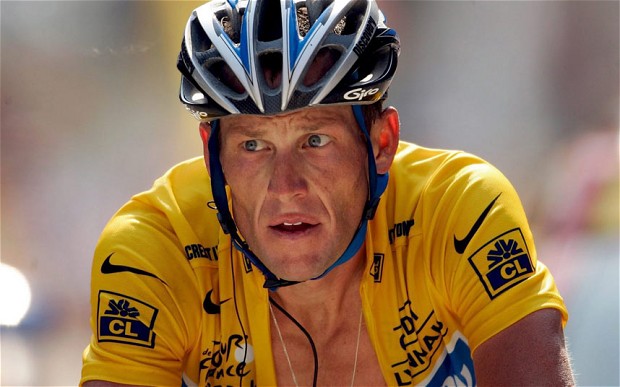
From the UK Telegraph. Lance Armstrong.

From the UK Telegraph. Lance Armstrong.

Lance Armstrong’s confession was there all along, if you knew where and how to look. As a result, I suggested we all consider forgiving Armstrong for his past transgressions and try to move on with what cycling will become in the wake of the Lance Armstrong era, which occupied our imagination, the sports world and our culture for more than a decade.

So if Lance “comes clean” about his doping past with Oprah Winfrey, it’s a clear call for forgiveness.  Like a war of attrition in popular opinion, it’s a numbers game from there on in. One Lance hopes to win.

The numbers game

From the feedback on earlier columns on this blog, the world seems divided about 50/50 on whether to give Lance a second chance. Of course

Bloodied but apparently unbowed, Lance Armstrong rides on...

Bloodied but apparently unbowed, Lance Armstrong rides on…

ostracizing him at this point is rather pointless. He’s already been stripped of his Tour de France titles, banned from competing in cycling and triathlons, and lost his key sponsors and chairmanship of the organization he once headed as icon, spokesperson and chairman, the Livestrong Foundation. 

National character: at war with ourselves

So it is up to us as a society to determine whether we can forgive, learn from the past and become who we are to be in the future. But we should recognize that America, at least, is a country that has long been at war with itself in what it should learn from the past, who to honor as heroes, how to treat them and why we need them.

Our sordid military past, for example, with its early conflicts over grudging representation by ragged militias and paid soldiers, our wars for possession and imperial aims against Mexico and Spain, then slaughter of native peoples in the Phillipines, where we also tortured and burned to get our way, all the way back home to genocide of native Americans on our own soil. America’s past is not a pretty sight. Have we forgotten also the Civil War, where our national character was outlined in the blood and lives of thousands, only to kick those surviving soldiers down the block for being crippled and maimed by their service to country?

American Exceptionalism

Yet we call ourselves a great nation, ignoring these and other crimes such as CIA-led overthrows of foreign governments, wars of fear and ideology in Vietnam, Iraq and Afghanistan.

Even wars where we conducted ourselves honorably have revealed great fractions within our society, especially in ongoing racism toward American blacks and ostracizing of women. That is, until the need for labor and the war effort simply absolutely demanded support for America’s goals, however intransigent they may be. Then we excused women and blacks for their contributions, only to shunt those rights of citizenship and productivity to the back of the national conscience once war was over. It took the civil rights movement to fulfill what war could not.

Murderous ways

We can’t even account the manner in which Presidents and political leaders like JFK, RFK and Martin Luther King, Jr., have been shot dead. Thousands of others are killed by guns each year, including innocent children in Newtown, Connecticut, yet the NRA continues to prostitute the word “militia” to justify free ownership of murderous weapons as a representation of freedom in America.

Here’s a hint: read up on the history of militias in America and you’ll find that they were neither trusted or appreciated, and the truth about winning wars is not found in the guns or cannons, but in the number of bodies you can throw at the enemy. Ask any soldier. The weaponry is indiscriminate. It is soldiers who are the fodder for political power and often psychopathic aims (Stalin and Hitler come to mind). The number of gun deaths in America is yet another sign that our psychopathic claims to American exceptionalism are false, yet in full force.

Hidden behind the obsession with gun rights is a fearful ideology laced with racism, lack of confidence in the American governmental system and a willingness to sacrifice thousands of lives each year as the fodder for violent natures that cannot find the way to peace other than through brutish aims.

The losses in such circumstances are so great it often takes written history years to dissect, and still often comes out with a bias in favor of who those who hold the pen, which in the end is mightier than the sword. To the “winners” go the spoils, they say.

Sports heroes

Into this massive void in consciousness rides a sports hero who seems to represent all that is good about America. Like a cowboy, from Texas even, with a chiseled jaw and a chip on his shoulder. The backstory of Lance Armstrong was so delicious America could not resist such a hero, who bordered on the miraculous, as if he was God sent to succeed.

Lance Armstrong’s bold recovery from cancer at a young age preserves hope that others can do the same. His ride to victory 7 times in the Tour de France bore all the marks of New World conquest over the Old World. Of course that nation of philosophical and existential equivocation, the French, hated Armstrong at first, while the Euro cycling world resisted his crowns with all its might. Yet the American prevailed. It’s our history in a nutshell, you see. Lance is the nut.

Nuts about doping

Yet there were hints all along that Armstrong might be cheating. He denied the truth vigorously, just as America has long denied its capricious tactics as the world’s most fearsome power, ever. Our nation spends more on its military budget than the next 17 nations of the world combined. Yet we’ve borrowed to finance our wars, bankrupting the nation as a result. We’re a nation that deceives itself into hubris with self-compliments of American exceptionalism, Manifest Destiny and Under God pledges, when in fact we’re doped up on defense spending, the steroids of international success, to maintain our status in the world.

A closer look

So before we go giving Lance Armstrong the heave-ho for doing what Americans do best, which is whupping the world at any price, let us consider who else is implicated in the perverse realm of our national dream. Either we come to understand who Lance Armstrong is, and what he represents, or we go on ignoring the facts of what America is really all about. Winning at all costs.

WeRunandRideLogo

Posted in We Run and Ride Every Day | Tagged , , , , , , , , , , , , , , , , , , , , , , , | 2 Comments

Runnin’ and ridin’ in a Hillbilly Nation

Evidence of Hillbilly Style. Going natural as possible at all times.

Evidence of Hillbilly Style. Wear as little as possible, state your love fo’ the apple of your eye and go commando.

The popular imagination of America seems to have a preoccupation with the unsophisticated side of life. That is, America is in love with hillbillies.

One glance at the mega-hit Here Comes Honey Boo should be enough to convince us all that America is obsessed with hillbillies. Always has been. Always will be. America is the Hayseed Nation of the World.

But in case you’re not convinced that a snot-nosed fat girl braggin’ on her family’s backwoods roots is a reflection of the real America, you can always take an off-road tour of popular cable TV shows featuring a litany of backwoods boobs showing off their gun-shootin’, critter killin’, gold-minin’, tree timberin’, moonshinin’ or just plain eatin’ and drinkin’ skills. They even make contests out of all that.

And that’s ‘Merica. In a nutshell.

Hillbilly Nation

Hell, yes, America is full of freakin’ hillbillies. So rather than fight ‘em, let’s join ‘em. I hereby declare myself the first President of the American Hillbilly Run’Ride ‘Sociation. (AHRRS).

Here are the rules of hillbilly runnin’ and ridin’ if you’re fixin’ to join AHRRS. Note: These rules are just as good as the Velominati, and you don’t even have to kiss anyone’s cycling or running ass to follow them…

  • Ya done better run barefoot, and don’t call it minimalism or we’ll shootcha for tryin’ to be some sort of intellect’yall.
  • No wearing support garments of any kind. No inner shorts nor jog bras. Commando is God’s way of showing whatcha got. If yer not shakin’ or swinging while yer runnin’ and ridin’, ya ain’t getting the full effect.
  • No carryin’ any food of any kind with ya’s on a run or ride. There’s plenty of food on the side of the highway if ya knows where to look and how to eat it raw. Better fer ya anyway. High in protein, ‘specially if you don’t spit out the flies. If yer thirsty, swallow yer own spit.

    Road kill is the only fuel served at a Hillbilly aid station.

    Road kill is the only fuel served at a Hillbilly aid station.

  • The only ‘cepptable reason to stop a run or a ride other than death is to have sex in a ditch with anyone in the following categories; 1) trainin’ partners 2) 1st cousins, 3) lonely lookin’ sheep or cows 4) immediate siblings 5) Yerself.
  • You may also always relieve yourself as needed, without warning. That’s called a Nature Break. Just ask Mr. Fancy Pants, Phil Liggett.
  • Fartin’, burpin’, farmer-snottin’ and bleedin’ from the nipples are all ‘ceptable Hillbilly forms of releasing body fluids on the go.
  • Smokin’ and drinkin’ are perfectly ‘ceptable forms of fuel during a run or ride. Cigarettes open up the lungs and alcohol has lots of carbs. Next question.
  • Keep track of miles by carvin’ notches in yer arm with a jackknife. If you run outta space on one arm, use anuther. If you run out of arms, use a leg or two. If you want to keep track of miles for life, get a tattoo. Or lots of ’em. That’s a hillbilly thing gone mainstream, ya know.
  • If’n you encounter Bigfoot on a run or ride, be sure to invite the Big Feller or Missus along. And Please let’em know people are looking fer um.
  • The first honorary members of the ‘Sociation of Hillbilly Runners are to be Jimmy Peanut Farmer Carter, Bill Bubba Clinton and George Wingnut Bush. All these hillbilly presidents ran for office and then ran while in office. Hell, GWB even rode his Hillbilly Bike out to cut brush on his ranch. How Hillbilly can you get? But remember, even though Carter and Clinton were from Georgia and Arkansas, all Hillbilly runners must vote Republican. That’s not just a Hillbilly tradition. It’s in our jeans.

    Jimmy_Carter_jogging

    Jimmy Carter, the original Hillbilly Runner. Hint: Disguised as a yuppie.

  • The only lube of any kind to be used on yer bodies while trainin’ or racin’ is your own spit or sweat. If you get itchy or it rubs somewhere, jes’ spit or sweat some more and rub it in a little. Works just fine. In a pinch, go ahead and use mud.
  • No respectable hillbilly cyclist stops at stop signs, yields at yield signs or obeys any road signs of any kind. Jes’ keep pedaling. This is true for hillbillies who live in the city as well. Flip ’em the bird and be sure to pack heat in the event someone follows ya.
  • Annual dues to the AHRRS can be paid if bar-b-cue meat, road kill, moonshine whiskey or foolin’ around behind the woodshed.

There you have it, the bylaws and code of ethics for the American Hillbilly Run’Ride ‘Sociation. (AHRRS). Hope you’ll consider joinin’ soon.

WeRunandRideLogo

Posted in We Run and Ride Every Day | Tagged , , , , , , , , , , , , , , , , , , , , , , , , | 2 Comments

Bikes and brains and snows and rains

A rack of bikes at University of Chicago awaits return of their riders. Someday.

A rack of bikes at University of Chicago awaits return of their riders. Someday.

The lifestyles of bicycles in urban areas and college campuses has always fascinated me. Some bikes sit chained to street signs for weeks on end, months even. Years?

One walks past one of these chained bikes on the way to downtown from the train station and it begs the question: is the bike forgotten?

Morbid fantasies

Or, those other morbid fantasies come to mind. Was the owner killed on some other bike, leaving the machine out in the elements day and night, in all sorts of weather?

Or perhaps the story is less exotic in its way. The owner moved out of town in a hurry or simply doesn’t care that an old bike is left to rust in the rain and snow. The brains of some cyclists are hard to figure out. Contrast a neglected bike with one ridden by a streaking messenger through traffic and the spectrum is hard to conceive. One bike is a mark of the unliving and the other is the tool of a livelihood.

Impractical genius

On the campus of the University of Chicago I photographed a rack of bikes stuck in the snow. It was obvious they weren’t going anywhere soon. What isn’t always so obvious is––why? Certainly riding bikes in the snow on an urban campus is not so easy, and college students generally take the path of least resistance. Just look at those footpaths across the College Green. The sidewalks are ignored.

So they are not about to rough it out riding bikes in snow. There are drifts and piles and ice slicks, and one is more prone to crash. Especially with a hangover or a head full of final exam material.

So I guess it makes sense. It just hurts to see the bikes suffer alone.

Squeezed out

The other reason for neglected bikes is that there is seldom little space in a college dorm to store a bike. The configuration of a room with two beds and tight closets simply won’t allow it. Fraternities and sororities might have room in their houses for bikes, but that’s no guarantee. So the college bikes sit out in the snow and rain in all seasons. The seats soak up moisture and split. Chains rust. Gear cables lock and brakes too. Riding one of these outdoor bikes after a winter in the elements is an adventure of sorts, like shaking off dull thoughts after a long night’s sleep.

One would think that the bikes of some of the world’s brightest people would get better attention. Yet a bike, like so many machines and gadgets in this world, is just a tool for a brilliant mind. A way to get from one place to the other a little quicker. And often nothing more.

Personalities

I’ve been on enough college campuses and in cities and towns around the country to know that bikes also take on the personalities of their owners, and that process can be quite revealing. Duct tape holds together weather-worn seats. One set of brakes is missing completely. Yet people ride these machines because they don’t care that their bikes don’t work well until their bikes don’t work at all.

The bike fixer

A fellow in the town where I live scours the landscape for forgotten and abused bikes. He fixes them up and people buy these bikes like they are rare gems. He is discerning, this bike repair guy. He once took a look at the ancient Schwinn Varsity in our garage and deemed it beyond easy restoration. I think he just didn’t feel like carrying the damn thing that day. It must weight 40 lbs.

Yin and yang, bikes and people

This is the yin and yang of the bike world, with a deep netherworld between. Some people treasure their bikes and protect them from all harm. Others leave them to rot in the rain and don’t even know how to oil the chain. You hear these people on bikes clattering down the trail. Their bikes are louder than thought. Maybe that’s why the bikes get left behind. Smart people don’t like anything that competes with their thought processes.

But I for one, consider the bikes worthy of more than that fate. No matter how primitive a bike may be, it deserves better than to have rust take over the chrome of the handlebars, or to fall apart without hope.

WeRunandRideLogo

Posted in Mechanical Genius, We Run and Ride Every Day | Tagged , , , , , , , , , , , , , , , , , , , , , | Leave a comment

Good Samaritans do not always succeed on the road

Good Samaritans can't always help everyone.

Good Samaritans can’t always help everyone.

In the dim light of evening the figure shuffling ahead was dark and shrouded by his own hood and thick coat. It was 5:15 p.m. on a Saturday evening, mid-winter. A thin skiff of snow had fallen. My mountain bike tires were just enough to keep a good grip.  I noticed with interest that some earlier cyclist had dared use skinny tires the entire route I was taking, a loop of 9 miles along the Fox River between Batavia and North Aurora, IL.

Human nature

The path crests a small hill along the river right where a local nature center is perched in the woods. That is where the man with his old bike was moving along at a slow speed. I said hello in passing and looked down at the tracks he was leaving in the snow. His feet barely cleared the ground. The line of his bike tires was scuffed out by his boots. It appeared from the tracks in the snow that one of his tires was flat.

Snowman

As I slowed to consider these signs, there appeared alongside the bike path a tiny snowman, no more than 18″ tall. It had black eyes and a stick nose, sticks for arms, the whole deal. There were big and small tracks around the snowman. Obviously a family had stopped to use the wet snow to make the snowman. It was an interesting sight in the half-dark.

Something about the snowman and the sight of the shuffling tracks along the trail made me brake my bike to a stop. I turned around and rode back toward the man with his bike, about 200 yards back the trail.

Good Samaritan

As I approached from behind I saw the man had stopped next to a tree, but was not leaning on it. I slowed my bike with its blinking headlight and asked, “Is everything okay?”

What a loaded question, it occurred to me. Of course it wasn’t. There isn’t a person on earth who can say that “everything is okay.”

Wounded animal

But that patent irony was lost in the moment, for the man gave absolutely no response. In fact he stood stock still in the way of a wounded animal when cornered. Years ago I’d encountered a raccoon that had been struck by a car on the nearby road along this same section of trail. The raccoon hunched in the weeds, fearful and defiant at the same time.

Spirits

This fellow had that same demeanor, silent and dark. In fact he reminded me of the Spirit of Christmas Future from the Dickens’ novel A Christmas Carol. He aimed his shrouded face away and made absolutely no move. There was some sort of long black plastic rod mounted on his bike. I could not identify it.

“Do you have a flat?” I asked.

Still, no words.

Realities

Respecting his space and clear interest in not wanting to be disturbed, I backed up my bike and pedaled away. Forty yards up the path I rode by the little snowman again. It had fallen over in pieces. My Good Samaritan act was not helping anyone this night.

I considered using my cell phone to call 911 and get the man some aid. Yet that seemed like an invasion of privacy in some respect. Would it be fair to have the police descend on him? What was the right thing to do.

Right or wrong, at that point I kept riding, and met up with the young family and a stroller on the path. I hesitated, wanting to tell them their snowman had fallen over. But it struck me as odd and cruel. I would be the strange one, then. So I waved hello and chirped, “Beautiful night for a walk.” And rode on.

WeRunandRideLogo

Posted in Uncategorized | Tagged , , , , , , , , , , | Leave a comment

Running: A Work In Progress by Christopher Cudworth

This poster features pastel artwork and an article by Christopher Cudworth originally published in the FINISH LINE section of Runner’s World magazine. Now available at Fine Art America.

This newly designed poster features pastel artwork and an article by Christopher Cudworth originally published in Runner's World Magazine.

This newly designed poster features pastel artwork and an article by Christopher Cudworth originally published in Runner’s World Magazine. Click to view enlarged image.

TEXT OF ARTICLE

We all begin by assuming something about ourselves. Our legs are too thin, or too fat. Too slow for basketball. Sink when you swim. And then, the process begins  •  A rut in the grass. That was our training loop in high school. Every scrawny tree was a checkpoint in the perimeter around the campus, carved out of cornfields. The distance was .85 miles around. Coach promised steaks to the top seven guys if we all broke the 4-minute barrier in practice. We were all 14, 15 years old. It didn’t matter that it wasn’t a full mile. We broke the 4-minute barrier. Some guys get to win races. I consider myself fortunate to have been one of them. Cross-country victories always seemed to come in the rain. Leaving competitors behind in the slp and puddles felt extra good. Losing in the same was twice as bad  •  The steeplechase was my event in college. It wasn’t as prestigious as the “flat” races: the 1500, 5000 and 10,000. Perhaps I wasn’t fast enough. But I liked jumping that water. Saw a guy go all the way under once. How silent it must have been those few moments, below the surface  •  Hundred mile weeks were the most I ever managed. Being in love helped me do it. Nothing could hurt me, not for miles at a time or week after week. Running was effortless, a delicious separation from her, knowing I was going back. That’s how runners are. They need love. If they don’t get it, they run more  •  I run for different reasons now. Races strain meaning from the effort, like a sieve. Kenny Moore, the marathoner and writer said: “Running is hard, clean, severe,” and that is true. But my favorite quote is from the book Ambiguous Adventure, by Cheik Hamidou Kane: “The purity of the moment is made from the absence of time.”  •   That’s  how it is when you’re focused and running. It erases time for the moment. Then the forces that shape a runner become repetition, luck, imagination, love, and finally balance. Makes one wonder what’s ahead.

This article and illustrations originally appeared in the FINISH LINE section of Runner’s World Magazine, September, 1995. Article and illustrations © Christopher Cudworth 2013

Posted in We Run and Ride Every Day | Tagged , , , , , , , | Leave a comment

Monte writes some riding wresolutions

WE RUN AND RIDE New Years Resolutions

by Monte Wehrkamp (January 4, 2012)

We all wrestle with our New Year’s resolutions. Sometimes they become wresolutions:Solutions to problems with which we wrestle in running and riding. These are focused on riding. Because Monte kind of hates running. Don’t ask him about he. He literally broke is ass last time he tried it. So here’s the pedal resolutions he has resolved to make. 

Monte Wehrkamp on our annual trek to Wisconsin

Let’s hold him to the fun he prescribes. See you on the MTB!

I resolve to ride like a kid again. To meander and seek, to take a new road or trail with no plan or purpose other than to see where it goes, and what it’s like.

I resolve to let fitness be the byproduct, and not the goal. I’ll not worry so much about zones, or intervals, or whether I’m doing enough climbing work, or what my mileage or speed/pace is in 2013. 

I resolve to stop quantifying and qualifying. If all I have time for is a 25 minute ride after work or on a Saturday afternoon, then I shall take the opportunity and make it the best 25 minute ride possible, and stop thinking 25 minutes is not enough to “do any good” and simply not riding at all. Bah! Good is in the doing. Good is in the now. I shall do good now for as long as I have time available.

I resolve to ride my mountain bike more. I shall seek out trails and paths and wind my way through woods and prairies where nature inspires and heals. 

I resolve to take a riding vacation with my wife. Maybe it will be back in my homestate of South Dakota, or maybe California, Colorado, Florida or even Delaware or Texas. Inn to inn, or B&B to B&B, taking in a new place at a bike’s pace, then exploring each day’s destination on foot, tasting and smelling, meeting new people.

I resolve to start a friend or family member on a bike. Somewhere, someone I know is ready for the joy of pedaling; they’re just waiting for the encouragement. I shall have my eyes and ears open and will help where and when I can.

I resolve to make the Saturday morning group ride a bigger priority. It’s usually too hot, or too cold, or too fast, or too hard — and usually, I have too much to do. I shall dispense with the excuses and remember the joy of riding with a group of good riders, with good conversation, and enthusiastic effort – and I’ll be there. 

I resolve to ride a century with Chris Cudworth. We had hoped to ride one in 2012 — have one of our wives dump us off in the middle of nowhere, and we’d roll back home. Life events conspired against us in the fall of 2012, but we shall get our century completed in 2013.

I resolve to ride a charity event. There are no shortage of opportunities in Illinois, with many worthy causes. I shall support at least one with both my participation and my checkbook. 

I resolve to clean my bike more. Cuz seriously. Ick. 

I’m sure I’ve left out some great resolution ideas, so I encourage everyone to share their running and riding resolutions below, whether they be new this year, or ones you’ve kept in the past. Heck, for fun, you can even share resolutions you made with the best intentions, but were unable to keep. 

And we’ll see you on the road or trail in 2013!
E-MAIL CONFIDENTIALITY NOTICE:
The information contained in this communication is confidential, and is intended only for the sole use of the recipient named above. If the reader of this message is not the intended recipient, you are hereby notified that any dissemination, distribution, or copying of this communication is strictly prohibited. If you have received this communication in error, please re-send this communication to the sender and delete the original message or any copy of it from your computer. Thank you.

Posted in Uncategorized | Tagged , , , , , , , , , , , , , , , | Leave a comment

Think before you go out and run or ride

How important is your head while running and riding. It plays a pretty big part. Illustration by my son Evan Cudworth, circa 1998.

How important is your head while running and riding? It plays a really big part in success. Illustration by my son Evan Cudworth, 1998.

Running and riding are not mindless activities. We should all know that, but it is easy to forget.

Doing a little thinking before you set off on a 50-mile ride can, for instance, help you prepare for the inevitable challenges brought on by each ride. Rather than let the ride dictate to you what you want from it (which sometimes still happens…) it is far better to consider the route you are planning to take, what riders you might be accompanying, and how you plan to respond to pulls, surges and hills.

Set the tone

Setting the tone mentally––and thoughtfully––helps the mind avoid “panic mode.” That’s the state in which you are riding or running along and an increase in pace throws you for a loop. You drop off the back before you are ready and have to ride like made to catch back on. Suddenly that surge of fatigue races through your legs and the group is not letting up. You’re in desperation zone, riding just to stay with the group rather than riding in control and with thoughtfulness.

Runners can fall into a similar mental slump during training or a race. It is easy to let the mind grow slack, particularly on a longer run. That is when your form gets lazy and you begin wasting energy. This can be costly during any length of run, but it is absolutely wasteful on runs of 15-20 miles when you are trying to teach your body to be more efficient.

What to do, on the bike

Rather than go into a run or ride without a mental plan for form and consistency, it is better to rehearse what you need to do to maintain efficiency.

For cyclists, thinking about cadence is the secret to better riding. Fortunately most riders equip their bikes with cadence meters so you can glance down and check how many RPMs you are doing. That is a quick key to whether you are pedaling efficiently. The rule of thumb is to maintain a pedaling cadence between 90 and 110 rpm, which means finding a gear where the pedal stroke is not about resistance, but enables you to pedal quickly and smoothly while driving the bike forward. Thinking in advance about your cadence and even paying attention to the rate being used by riders around you can provide constant clues about your efficiency. Why ride dumb when you can ride smart?

Special dynamics of a group ride

I recall a group ride in which there were about 20 riders involved, all torquing along at 20-25 mph. It is easy to grow slack in your mental state when you are riding in a group like that. Letting the draft do most of the work for you is smart, but can also lull you into a lazy, and too heavy–pedaling cadence. I took note of several of the best riders in the group and how fast they were pedaling. Mimicking their cadence and tucking into their draft stream, the ride felt effortless for long periods. Note: It also helps to be “light” on your handlebars, using your core strength to “perch” on the seat of the bike and not hunch or lean too heavily on the bars. That leads to fatigue, especially in the lower back, which takes away critical riding power. Be mindful of that!!

Then when the faster-paced pulls came along toward the end of the ride and the pace line pumped me to the front, there was energy left to do my share of the pulls and ease back into line. Instant respect.

When the pace really picked up with four miles to go, topping 26-28 up short inclines and down the backside, it felt great to be sticking with the group. As a bonus, one of the better riders in the group came up toward the end of the ride and said, “Way to keep up the high cadence. I was watching you the entire ride. That’s the way to stick with the group.” What a nice bit of encouragement!

But it all started with thoughtfulness at the start of the ride. Cadence. Pedal stroke. It’s simple stuff if you don’t forget about it.

What to do, while running

Running with a group is an entirely different dynamic than cycling. For one thing, the draft effect is relatively minimal on days when the wind is less than 10 mph.

For another thing, there is no coasting downhill to recover like there is in cycling. You’re propelling yourself with your own two feet the entire way. And good luck with that if you’re wasting energy with bad form or unmindfulness along the way.

dave_wottle_oly_chmp

Notice the placement of Dave Wottle’s foot. The toe-off is key to fast, efficient running. That hasn’t changed in 40 years. Nor will it ever.

Paying attention to foot strike in running is the equivalent to riding cadence in cycling. You should know your foot strike pattern well enough to know whether you are overstriding or running efficiently. Generally the overstriding runner is reaching so far ahead with each step their heel is striking the ground with force almost like a brake. And guess what? That’s exactly what is happening with so many runners.

It does not mean you cannot use a heel strike pattern while running. Many world class runners do. But their stride at that point is almost like a cyclists in that their feet are rotating through each stride almost in a circular fashion. They are pedaling over the ground rather than reaching-landing-lifting with their feet.

You can hear the difference if you run on a gravel trail. When you are overreaching with your stride the heel will literally crunch into the ground. Your stride goes —–scrinch scrinch scrunch—–because each time you hit an uneven part of the surface your stride is not in control. The entire weight of your body drives your foot into each little hole and your foot is literally pushing surface material forward underfoot.

Running over the ground

An efficient runner by contrast is running over the ground, and that takes some serious thought to practice and perfect. Good running form is real, rehearsed and mindful. The entire CHI running movement is based on this mindfulness. Many CHI runners use a midfoot stride in which the pattern used by the runner is almost a flipping motion of the foot forward, yet the ground surface is not contacted until the body weight is over the point where the foot strikes the ground. The best description of this type of stride is that you are “pawing” the ground, much like a cheetah running over the African savanna. Your foot should always be headed backwards when it touches the ground. The forefoot under the balls of your feet is your contact point, and the heel comes in contact with the ground almost like a spring mechanism is installed in the achilles.

Practice your midfoot stride at a higher speed than your normal training pace. Go to a neutral surface like a running track and be mindful of how and when your foot strikes the ground. You do not need to go all “CHI” on yourself to learn how to run efficiently. Mindfulness of your footstrike and the correct, slightly forward-leaning trunk position is all you need to move more efficiently over the ground. Some runners practice the flip stride by kicking their own ass with their heels. It’s a good exercise but won’t happen for most runners while racing except at top speed.

Remember: don’t let your arms rotate to the sides if at all possible. That throws energy out at all the wrong angles.

Mindfulness reminder

So there you have it. Some mindfulness and thinking about what you are doing out there on the roads and trails can really make you a better rider and better runner.

Now get out there and kick some ass. Your own, and others.

Posted in We Run and Ride Every Day | Tagged , , , , , , , , , , , , , , , , | Leave a comment

Do trophies really mean anything?

My running and riding trophy case is a shelf above my art studio.

My running and riding trophy case is a shelf above my art studio.

If you have ever won a trophy for any reason, you know the feeling of success in having earned recognition for your efforts.

First trophies

I don’t remember my first trophy, but it might have been for winning a prestigious youth league baseball championship in Lancaster, Pennsylvania. It was the type of baseball league where you really learned how to play the game. Sliding practice. Fundamentals. Major League rules. And it was fun. But it was work, too.

In the Lancaster New Era tournament we won the first game 26-0. At one point the coach put me in the lineup and said, in all kindness, “I’ll never ask you to do this again. But please try to strike out.”

I swung up at the ball that way you should not, and accidentally cracked a double up the middle. Standing on second base, I looked in at the coach and shrugged. Sometimes when you try to lose, you still win.

I got to pitch in the second game, which was a pretty big honor considering I was one of the younger kids on the team. Then we won the championship game and headed to the Dairy Whatever for ice cream. I ordered both a cone and a shake because Coach said we could, only to hear one of my fellow players say, under his breath; “He didn’t even do anything to help us win.”

Hello! I pitched four innings out of six in the second game, which we won by a score of 8-6 or something like that. The anger I felt at the insult fueled many another triumph over the years. It’s funny how much a small comment can drive the human mind.

I suppose the trophy for that championship is sitting up on a shelf somewhere with a few of the others. Most of them are running trophies. I was lucky enough and worked hard enough to win a few races over the years.

Not so consolation prizes

Yet toward the end of my serious racing career in my late 20s, I entered a road race and won my age group, but did not place in the Top 3 overall. Given that the awards ceremony was not scheduled to be held for another 2 hours for some strange reason, I went home.

That afternoon a local competitor showed up on my doorstep with my age group trophy and a lecture. “You’re bad for the sport. You don’t show any respect for other runners when you don’t pick up your trophy.”

I’ll admit I was pissed off about not placing high enough overall to earn a “real” trophy rather than an age-group consolation. At the time I was a bit of a prick about my achievements, for better or worse. I did not really care about the age group trophy. When you are accustomed to winning races, the redundancy means little.

Trophies and meaning

But the incident made me wonder if trophies really mean anything at all. I have not won a trophy for running in years (just a ribbon last year for finishing a 3 mile cross country run in 21:00) and have never won a cycling race or placed high enough in a criterium (staying with the bunch sprint doesn’t count for much…) to get a trophy or even a six pack of beer as a premium.

My collection of trophies sits on a shelf high above my art studio. They don’t even collect much dust because it all falls downhill.

At least one that matters

Plastic and metal represent reality and mettle

Plastic and metal represent reality and mettle

There is one “trophy” I keep out in sight. It is a plaque, really, with two silver medals inside a plastic case. That trophy was for placing second place as a team in the Division III national meet. That trophy means a lot because it represents a whole bunch of different facets of training, mental preparation and teamwork coming together.

Softball and other arenas

Since then there have been a few other “trophies” along the way for accomplishments in business and civic activities. The human race motors along on a tide of effort and recognition. Our trophies mark past accomplishments and ostensibly, motivate future efforts.

But I think about what one player from the opposite team said when our softball team had won the league championship for the 7th straight year. We were purposefully a ragtag team without uniforms. Half the team was former college players and several had 90 mph arms at one time. So we were tough to beat, and it was a fun way to spend Sunday afternoons, denying advancing age.

The trophy was a small baseball glove facing upward, like it was set to catch something falling from heaven. As each player stepped up to get his trophy, one of the opposing players joked, “Congratulations. That’ll be good at collecting dust over the years,” he laughed.

And he was right. It has. Yet what I remember from that game was the last out, because I got to make it. The sky was gunmetal gray because the season had been delayed several weeks into September due to late summer rains. The popup rose high into the sky and I centered myself under the tail end of its arc. The white ball shone like a bright stone against the clouds. It grew bigger as it fell and my teammates yelled “two hands!” and “clutch it” as it dropped from the sky.

Trophies=memories

There are similar memories from running trophies, if I pick them up and look at them. The Run for the Money was my breakout race in road running, bursting through the 32:00 mark for 10K on a course the locals said was a little long.

The vicarious effect

The 3rd place trophy for a 25K I ran in 1:25 reminds me of the fact that I got to escort Bill Rodgers around that day. I knew the race director who lent me a Volkswagon to pick Bill up at his hotel. He opened the door in his underwear and laughed, “Is it time to go already?”

We drove up to the race and people flocked to the car, seeking autographs and advice. One runner leaned in the window and said, “Bill, what advice do you have for a 4-hour marathoner?”

Rodgers eyes went wide and he said, “You can run for 4 hours?

I got so inspired hanging out with Rodgers that I decided to jump into the race at the last minute. This despite the fact that I had trained 15 miles at 6:00 pace on Thursday, and ran a 10 miler again at 6:00 pace on Friday. I was so fit that it would have been a great weekend to run a marathon had I put one on the schedule.

So I ran. And the race went great. I placed third and got a trophy. But at 14 miles something went “twinge” in my hamstring and following the race, back in the company of Bill Rodgers, it was hard to mask my growing concern about the possibility of injury. He could read my body language and my mood, astutely noting that throwing a race onto the schedule at the last minute can be risky.

Lessons from a master

He had cancelled his own racing effort that day due to general fatigue. In fact he’d lent me his actual big number and during the race people cheered me on, think I was the great Bill Rodgers himself.

Like he’d have finished in third place against a bunch of locals. Or cared about the trophy that came with that place.

One can only imagine what the trophy case of a Bill Rodgers might look like. Or a Galen Rupp. Or whoever. Yet, it’s true. Olympic Medals and New York Marathon trophies (Rodgers won 4 times) gather dust just like the rest of the trophies in the world. So they must mean something else, other than being symbols of triumph.

Shared sacrifice

But we can imagine what the work it takes to get to that level and stay there is really like. All our efforts feel the same, even if we do not run the same speed. While Rodgers once labelled the pace of slower runners “graceless striving” he later amended that take in having seen how much significance people place on the doing, rather than the awards.

And that, if anything, is what trophies really represent. But most of them are invisible, except to our own discerning minds. Whether you run or ride, may you have the good fortune to earn a few trophies of your own in 2013.

WeRunandRideLogo

Posted in We Run and Ride Every Day | Tagged , , , , , , , , , , , , , | Leave a comment

Clawing our way into the New Year and beyond

A talisman hawk's claw was part of the inspiration in college cross country.

A talisman hawk’s claw was part of the inspiration in college cross country.

There is something in the human spirit that likes a practical talisman or two to help us get through life. We wear chains around our necks with a charm, a cross or a hawk’s claw, as I did in college when I knew that my running was going to be the center of existence for a while.

Getting back to nature

The hawk’s claw, which was admittedly illegal to possess, served as a reminder that I would get back to my nature study and painting when the all consuming cross country season was done. Even at 21 years of age I was conscious of the need to seek balance. To seek out that side of myself that needed nature to thrive.

Discoveries

I’d found the dead hawk during a run in a forest preserve and returned later on to collect the bird and bring it home. As a college student trained in taxidermy and a wildlife artist keen to learn the details of so glorious a creature as a red-tailed hawk, the discovery was a gem of sorts. I rendered drawings of the feet and studied the feathers on the back and wings, which were marked with such enormous subtlety that even someone accustomed to painting the details of nature saw the task as a daunting prospect.

Evolution and creation

Even so common a bird as a red-tailed hawk is a testament to the complex work of evolution and the wonder of creation. Such creatures also bespeak wildness and fierce nature. High-flying hopes. It is no wonder that pro sports teams are named after falcons, lions and eagles. The human race, for all its sophistication and logo-driven commodification still desires commune with our roots. And we are connected deeply, right down the genetic level, with everything that moves and creeps on this earth.

Limited worldview

Don’t let the selfish creationists fool you into thinking the human race is separate from all creation. God doesn’t think that way, nor did Jesus, who taught using parables richly steeped in what organic fundamentalism, a term I conceived in my book The Genesis Fix: A Repair Manual for Faith in the Modern Age.  Organic fundamentalism is a scriptural method that recruits metonymy (the use of one thing to represent another, especially nature) to communicate spiritual laws and values.

The whole bible depends on this tradition, and it supplies the metaphorical foundation for truth. In fact all great traditions of faith and belief ultimately recognize these deep connections between nature and what we call God, while scientists eventually sit in awe and wonder at what they study, at complexity, and at the meaning derived natural law.

Reduced to metaphor

Can you see this truth? We are reduced to metaphor to describe anything in this world. The very words you read here represent ideas, and ideas represent meaning, and meaning leads to truth. There are no shortcuts.

Literalism, by contrast, is the child’s view. It limits our worldview and leads to brutally childish conflicts over dogma, false theologies and politics. Look at what literalism does to the great religions of the world. The radical side of literalistic Christianity fights science and seeks to dominate social policy. The radically fundamental wings of Islamic faith issue threats against the world and resorts to terrorism. These two branches of faith engaged in Crusades and kill people within their own traditions to get their way.

It is a fascist form of faith that plagues our world. Resist the temptation to run or ride down that road, for it is the tarsnake of ignorance. Use your running and riding to gain the mental space to see beyond these fatal ideologies. They will kill your spirit.

A talisman of hope

As a youth, I wanted hope in the form of a talisman around which to draw the robe of my worldview. Youthful symbolism is different that childish faith, and I wanted a part of that awe and wonder to go with me wherever I went, especially wherever I ran.

So I hired a jeweler to mount one of the hawk’s claws in a clamp on a real silver chain.

The feet and claws of this gyrfalcon exhibit the incredible design and power of evolution to a purpose.

The feet and claws of this gyrfalcon exhibit the incredible design and power of evolution to a purpose.

With respect to laws

Again, the decision to use that hawk claw was illegal, and flies against the wildlife protection laws in every state in the nation. So I am not recommending that anyone use any part of a wild animal for any decorative purpose these days. I no longer possess the chain or the claw, and have since focused my acquisitive nature on taking photos rather than specimens.

Especially, I did not kill the hawk to collect the claw (which would have been heinous) but found it dead already. It is against the law to collect even dead wildlife however, and the laws to protect wildlife exist for a reason. They must be sweepingly observed in order to prevent potential for abuse.

Different era

But a determined young man accustomed to trespassing in search of birds to see was not going to be deterred by such considerations in the late 1970s. I’d been handling all sorts of wildlife specimens in field biology; ruffed grouse and great horned owls, gray and red squirrels, beaver and opossum and 15 species of ducks.

So the short leap to wearing a hawk’s claw around my neck was not difficult to make.

Flying higher

Despite how hokey it might seem, the hawk’s claw (along with the love of a woman at the time) did inspire me. I moved from 7th man to 2nd man on the team that season, and nearly winning my first varsity college race. Our team finished 2nd in the nation in Division III cross country. Not earth-shaking results by measure of the world’s great achievements, but they meant a lot to us, and me. And still do in many ways.

Returning to earth

I think the hawk’s claw ultimately dissipated from exposure to sweat at the base of my neck where it hung for so many miles. It returned to the earth, as shall I some day. We all do.

Great faith traditions recognize the connected nature of the universe.

Great faith traditions recognize the connected nature of the universe.

Or perhaps we’re all running and riding in a cycle much larger than our own thinking. This life and whatever comes next, or came before. Our own bodies are launched in a cycle of destruction and renewal, the marathon of reality and imagination we call life. Yin and yang. Darkness and light. Nature and nurture. Devil and God. Self and selfless.

As Crosby Stills Nash and Young put it in the song Woodstock …

“We are stardust, we are golden, we caught in the devil’s bargain, And we got to get ourselves back to the garden.”

Posted in We Run and Ride Every Day | Tagged , , , , , , , , , , , , , , , , , , , , , , , , | Leave a comment