Keys to understanding

By Christopher Cudworth

KeysMy brother has been using our 2000 Chevy Impala for a few months and he likes the car, so we got together last night to talk about transferring the title and taking over the insurance. He walked up to the door and dangled a set of keys in front of him.

“Have you been looking for these?”

They were keys to the Toyota Matrix my daughter drives. The set with key fobs and all the gadgets that make the doors work and such. I lost those keys about 3 or 4 years ago.

“Where did you find them?” I asked.

“They were wedged down between the seats,” he replied. “I was cleaning the car and found them way down underneath the seat bed.”

The Impala has a long, wide front seat with a flip-down center console. Apparently years ago I dropped those keys on the seat while riding with my wife and they disappeared down below. Out of sight. But not out of mind.

Forgetful history

“How can you lose an entire set of keys like that?” she demanded to know. “They’re expensive to replace.”

She was right. Those key fobs are expensive. And I’d lost another set of keys earlier that year. Two sets in a year? That’s a problem.

The issue of lost keys became a symbol for my other memory challenges and sometimes spaciness. It really irritated her.

Other matters

WIZARD-OF-OZ-THE-1939-001Of course part of the problem was preoccupation with some pretty serious matters. We were dealing with all sorts of medical bills and issues related to her cancer treatments. I was really good at solving billing problems and finding ways to get things paid even when the money was short. So my attention was on those issues, as it should be.

Things like where I set the keys down escaped me though.

Truth be told, my mind has always had a propensity for preoccupation. I’m a creative guy and am always thinking of some idea for a new painting, an article or a blog, like this. And in school my dreamy brain did not always hew to the algebraic sequence of classroom affinities, shall we say. If I only had a brain…

Proof positive

On a recent visit with a college buddy he recalled an event that I had long forgotten. “We were running the distance medley relay indoors,” he chuckled, “and you came sprinting around on what you thought was the last lap and wanted to hand off the baton. I said ‘no no you have one more lap’! I’ve never seen someone so freaked out in my life. That final lap must have really hurt.”

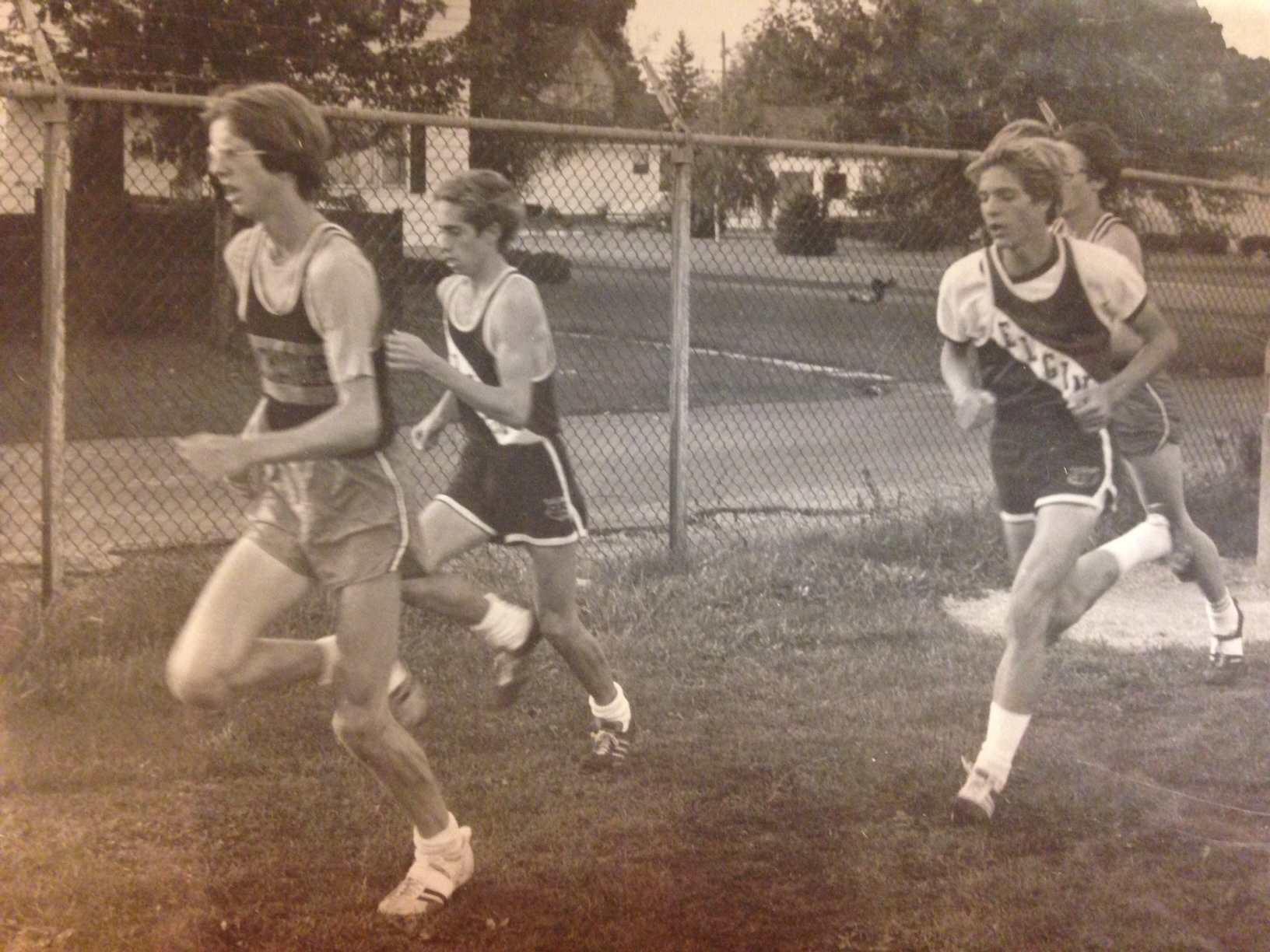
And back in high school I struggled at times with course tours in cross country. We’d jog the course with a member of the opposing team and were then supposed to remember the entire 3-mile layout? Not likely at times. Many of those courses had repeat loops and changed the second time around. Against a team from Naperville Central I had built a 200 meter lead on my rival Rick Hodapp and had the race in the bag when we came around for the second loop on the North Central College campus. I turned right onto the track (which was cinders then…it is all weather now…) and began my sprint toward the finish line around the track and up a short hill to the finish.

But to my horror and anger upon reaching the backstretch, Hodapp was going straight on the near straightaway! The course did not loop around the track the second time through. I lost the meet by three or four yards because that course map had slipped my mind.

Common sense

Of course it would have made sense to have had someone directing runners at that spot in the race. So much of life is like that though. You’re just supposed to “know” these things and “remember” obtuse crap that in the heat of competition or under stress no one can effectively recall. That’s one of the tarsnakes of existence. People aren’t very forgiving of forgetfulness as a rule. They see it as irresponsibility. When in fact people who are forgetful are simply trying to do more with the time they have. That means some things are bound to get lost along the way.

Think of “absent-minded” professors. They wander across campus dreaming up the next big idea they are about to publish and literally get lost on the way to class. Is that such a horrible thing? Doesn’t the world need to consider the value of big ideas against the tiny tragedy of missing out with minor events? Or losing a set of keys…

I know, I know. It’s irritating to deal with forgetful people.

Time for better thinking 

ChronoThe keys to understanding how to deal with life in better fashion lie in preparation, organization and in my case, compensation for a preoccupied mind.

So I work like a madman to organize things. Set my cycling stuff out the night before so that the morning of a ride is not a panic trying to find black arm warmers in drawers filled with other black gear.

On race day in particular it pays to be organized and not leave your thinking to chance. Triathletes need to put their cycling shoes and running shoes where they can find them and get them on easily in transition.

And there’s one of the real keys to understanding how the human mind works. It’s those periods of transition that bring us all down. We can be pretty good in our general habits but when asked to transition from one activity to the other, or when getting ready to go to work in the morning, successfully making the transition to getting on our way is key to having a better day. One without forgetting or losing things.

Assume the position

I’m working at it. I really am. It’s been hard in some ways taking over all the things my wife used to do around the house that I now do. All the dishes and grocery shopping and paying bills. I helped with that when she was alive but now it’s all my own.

Plus I’m caregiver to my father and pay all his bills and supervise his medical needs as well. Then there’s walking and feeding the dog and starting my own business at 3C Creative Content. Pretty much the balls of my feet are worn out from pivoting so much this year.

But I have not lost any keys.

I did finally find my dress orthotics after missing them for three weeks. They were stuck in a pair of shoes where we store the toilet paper in a hallway closet. I’d set the shoes in there absentmindedly while stocking the toilet paper in the master bathroom. So my priorities were in the right place. Just my followup was missing. The closet was dark. The shoes were hidden. But I did find them eventually.

I knew I would. Eventually. Even those car keys came home to roost. Eventually.

The business of life

That actually teaches me a lot about how my mind really works. And doesn’t. One can’t afford to be casual in your thinking when things disappear like that. Sooner or later you can forget something important like an appointment business engagements or something important on the social calendar. Oops. Honey I’ll be there soon…

We all forget things. Helmets on the way to a ride. Tying our shoelaces twice. Sports puts pressure on the forgetful. We have to compensate or pay the price.

I once locked the keys in the car five minutes before a race. My racing flats were inside, so we had to jimmy open a window with a borrowed coat hanger. My warmup for that half marathon turned out to be a sprint to the line from the parking lot with 30 seconds left before the start. But I finished 7th overall. So no harm done, right?

Perhaps one of the keys to understanding our sometimes forgetful minds is to forgive some of this stuff if the results turn out alright. Even if they don’t, it’s wise to forgive and then take measures to prevent (other, real losses) from occurring. We run and ride with all that in mind. Except the parts we forget.

WeRunandRideLogo

Posted in Christopher Cudworth | Tagged , , , , , , , , , , , , , , , , , , , , , | 1 Comment

BEWARE THE BIKING BUBBLE SPHERE!

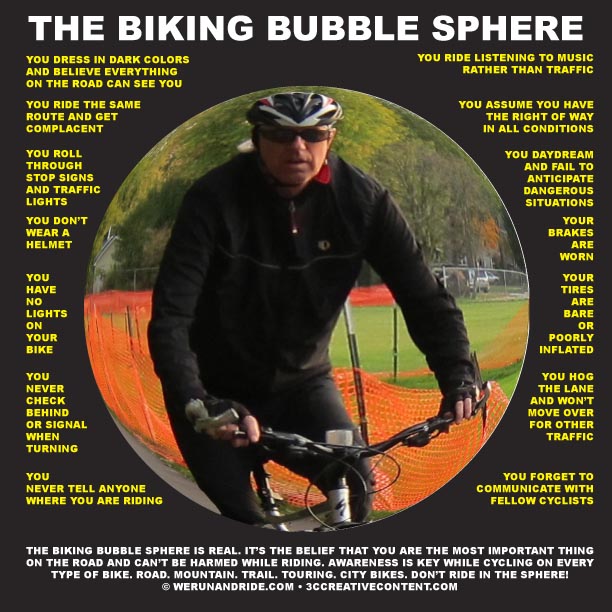
BikingBubbleSphereFINALIn case you hadn’t noticed, there’s a big graphic leading off today’s We Run and Ride. It is designed to grab your attention and encourage you to consider some important safety and mental health practices while riding.

We call it the Biking Bubble Sphere because many of us come to believe we are impervious to harm while out on the bike.

Lazy mental habits can lead to accidents on the bike. No matter what type of rider you are, from casual trail pedaler to full-on road cyclist or triathlete barreling down a country road at 25 mph, you cannot afford to ride in a sphere where you forget what you are doing.

It’s dangerous. It can lead to harm from careless drivers or irritated farm dogs. If you live in a city you can ruin the reputation of cyclists for other riders if your Biking Bubble permits you to ride without manners, etiquette or obeying the laws.

Read about the Biking Bubble Sphere and pay attention while you ride. You’ll be doing yourself and the whole world a favor.

WeRunandRideLogo

Posted in Christopher Cudworth, We Run and Ride Every Day | Tagged , , , , , , , , , , , , , , , , , | 2 Comments

Base layers and kits that fit

By Christopher Cudworth

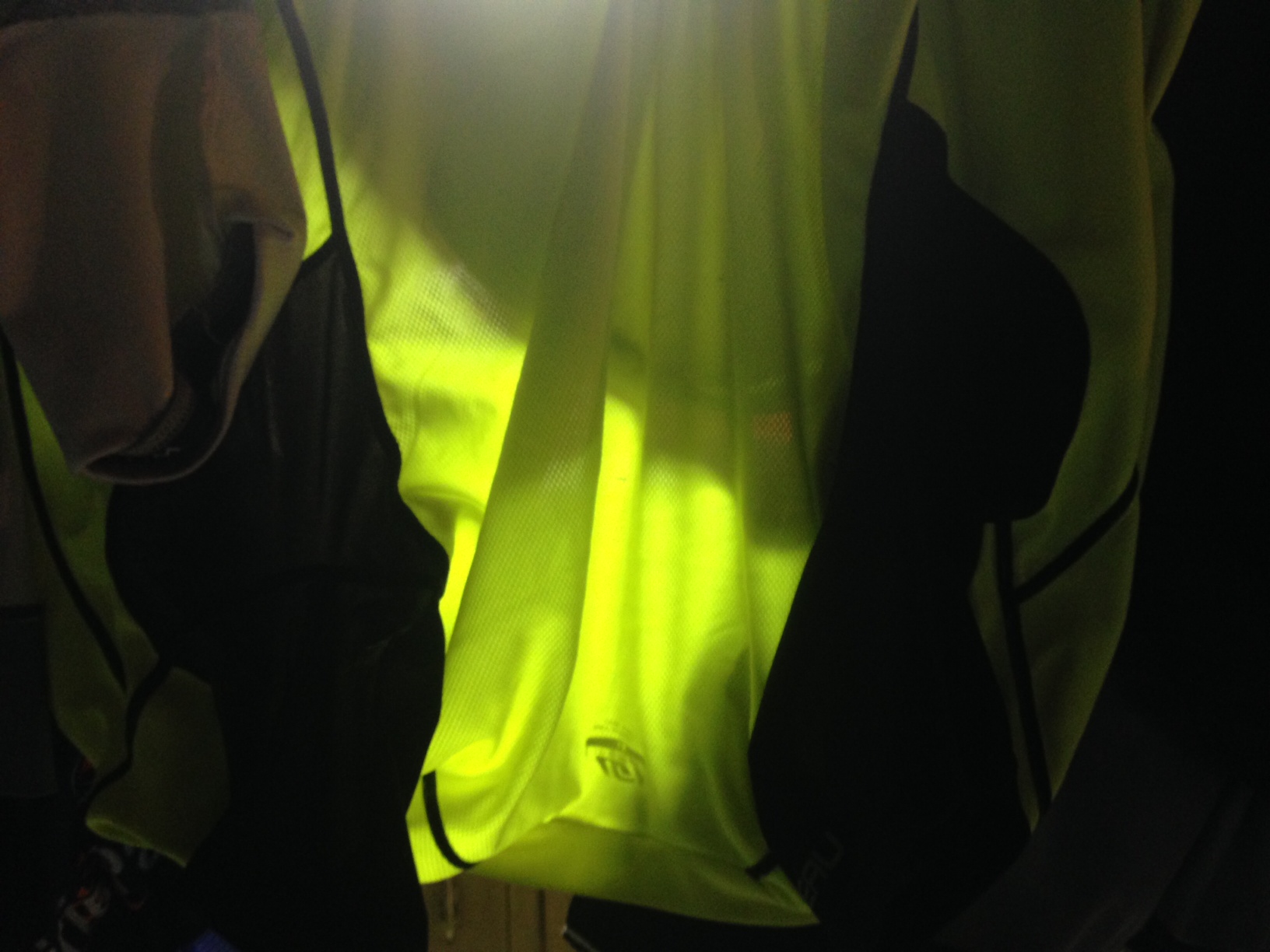
A base layer is a garment you wear under your cycling jersey to help with sweat, skin protection and fit of your kit.

A base layer is a garment you wear under your cycling jersey to help with sweat, skin protection and fit of your kit.

Back when I started cycling in 2003 or so, I headed to the store and purchased some Pearl Izumi stuff that was real cycling gear. Some nice Descente shorts too. Kits that fit.

Yet somehow the jerseys always felt itchy and blousy..

There was that rather generic looking Nike jersey, red with black accents. It tended to billow and pull up my back.

And the bright yellow Pearl jersey. It also flapped in the wind a bit. But they had to do. That was my initial cycling gear along with the Red Trek 400 and mountain bike shoes with SPD pedals. A half geek you might say. That approach worked for about 2 years as I learned to ride. I even shaved my legs that second year.

Then I got a real road bike (the Felt 4C carbon) and upgraded my shoes (Specialized) and my kits in order to be able to ride longer and better.

The gear upgrades included a really thin zip-front Giordano (Italian) cycling jersey that looked pretty spiff once I got into shape. The material in that base layer moved with your body and wicked off sweat in the worst of conditions. It also made a really great base layer when the weather got cool. Best of all, it did not itch, which can be a real pain when you’re riding.

That $80 jersey lasted about 5 years before the zipper stuck at about 1/3 of the way up. Then the material tore along the zipper when I tried to fix it. The perfect base layer jersey was no more.

That meant searching or a new base layer. Which is important to own. But I could not find a suitable replacement for years. I made do with various running shirts underneath the cycling kits when the weather got cold.

Cycling jerseys are great but sometimes they can chafe or irritate the skin depending on the fit. Even pros wear base layers to cure this problem.

Cycling jerseys are great but sometimes they can chafe or irritate the skin depending on the fit. Even pros wear base layers to cure this problem.

Then last year I purchased two Under Armor workout shirts on sale at Dick’s. The base layer problem was instantly solved.

Understand I don’t rep for Under Armor or anything like that. I don’t get any money for promoting any of these products. But I have to tell you: Under Armor works like it says it does.

Given the criteria for good cycling gear, Under Armor fits all the key elements. It is skin tight. It drains off the sweat. It can function in all temperatures, even within a single ride, which is often the challenge on early spring cool days that turn hot as you go.

So my mourning is over for the original base layer. It’s nice to have a replacement that works, and to know that more can be found when the time is right.

Just a hint about all performance gear like Under Armor. I avoid putting all that stuff in the dryer. Nothing turns a nice running or riding top into an itchy piece of worthless material faster than dry heat. It’s one of the tarsnakes of performance gear.

I let all my cycling and running stuff line dry for that reason alone. Sure it takes longer, but having ruined a few nice kits over the years tossing them into the dryer, I’ve learned my lesson. The great thing about the whole Under Armor approach is that you kind of get a 2-for-1 deal when you buy a shirt like that for a cycling base layer. You can use it for running as well, and it makes a nice shirt to work out on weights at the gym. Just don’t wear your Under Armor to a wedding. That’s not a good look for guys or gals.

So now I’m a happier guy on the bike. I have a base layer strategy that really works. Of course Nike and a whole lot of other manufacturers now copy UA. They all offer stretchy clingy base layer-like garments for athletes. So you don’t have to go out and buy Under Armor. But if you haven’t tried a good base layer and don’t want to pay $90 for the cycling base layers from some overpriced supplier, you can find a cross functional base layer for $30 and be a happier cyclist and runner too.

WeRunandRideLogo


Posted in Christopher Cudworth, Mechanical Genius, Tarsnakes, We Run and Ride Every Day | Tagged , , , , , , , , , , , | 1 Comment

Not exactly performance enhancing drugs (or drinking)

By Christopher Cudworth

Given that it’s Mental Health Month and Mental Health Awareness Week, it might pay to run through the subject of drinking, drugs and self-medication.

I don’t know about you, but my running and riding buddies all like to drink a little. A few also did a fair share of pot smoking back in the day. It was fun. We got crazy. But it cost us at times as well.

As a kid in Upstate New York the Yankees were my favorite team, and Mickey Mantle my hero. Only in later years did we learn of his ardent drinking habits.

As a kid in Upstate New York the Yankees were my favorite team, and Mickey Mantle my hero. Only in later years did we learn of his ardent drinking habits.

Drinking too much is not good for athletic performance, especially in endurance sports. You can talk all you want about Mickey Mantle partying it up when he was one of the best baseball players in the major leagues. But standing on a baseball field nursing a hangover is a lot less difficult than running 6.2 miles at a hard pace when you feel like you want to puke.

Yet we did that at times, at least on training runs.

We worked too hard to waste chances at races by drinking too much the night before. Yet one of our college teammates downed an entire pitcher of beer the night before running a 24:25 8K at nationals, barely missing All American status by two places. So there are no real rules for whether you should drink or not.

“Whatever works” is not really good advice however. The blind factor in consuming alcohol is just that: It blinds you to what you might have achieved had you not been engaged in drinking.

With all drugs there is risk of dependency if not addiction. Handling nerves and stress and pressure by drinking is a form of dependency. If it gets too habitual it can turn into addiction. One running teammate who drank a lot on weekends drinking funneled his frustrations in violent, angry episodes such as punching walls with his fist when a girl turned him down for a one-night stand. He lay unconscious the next morning when we came to rouse him for a workout. His fist was bloody and swollen and there was blood spattered all over the wall. The same intensity that drove him to be a great runner was a destructive force when processed through alcohol.

Pot was an entirely different type of problem. If anything it seemed to take the drive right out of people. One runner who placed 26th at nationals as a freshman in college never made the varsity again. His eyes were basically bloodshot from pot from his sophomore year on.

Of course the labels make it look so inviting and exotic to get a good drunk on. But do we really want to be pirates in this life?

Of course the labels make it look so inviting and exotic to get a good drunk on. But do we really want to be pirates in this life?

My own experience with drinking had its share of ugly moments. The cross country party that resulted in a liver-cringing blackout. The tug and pull relationship with a woman in college that saw her forcing me to drink rum on a weekend trip to the point where I passed out in a McDonalds. She was jealous, she told me, of the time I spent running.

So often the problem with drinking is that these propensities come from outside our better core. Everyone deals with weird crap in their life. Everyone. Some suppress their instincts on how to handle the world through religion. Others pump it into escapes like gambling or sex or drugs.

We seem to either associate or dissociate with our problems. It’s just like the mental framework of running and riding, in other words. Some absolutely choose to relate to the act of running and riding, looking for body response and signs to monitor progress. Others would rather think about anything other than what’s going on. They pump their heads full of music and try to ignore the pain.

A group of us once thought it would be interesting to down four beers and go for a four-mile run. Given that we’d already run a 20K race that morning it was already a stupid idea before we got started. But we learned a lot.

Running while slightly drunk is really no fun at all. You don’t have good control of your body, for one thing. Your brain can’t concentrate on the matter at hand, for another. We all got back to the house at different times and weren’t even laughing about the experience. “Well, that was stupid,” one of us burped.

“And it hurt,” another friend groaned.

An early morning hangover can turn your training into a painful slog.

An early morning hangover can turn your training into a painful slog.

It’s true. Drinking can hurt an athlete. As can smoking pot or doing any of a litany of other drugs now available. The so-called War On Drugs has had no effect on the availability or abuse of drugs in this world. If anything it has made the matter worse by criminalizing pot and putting thousands of people in jail for selling or using pot. That’s just stupid. But it is profitable to those who run the jails. Those who fear anyone using drugs or view it as the ultimate sinful foible are not easily persuaded that legalizing the whole thing could make life a lot simpler. If putting people in jail makes them feel powerful and smart then they really are the ones with the problems.

For those of us who run and ride and like to drink or have other fun, the balance between doing all that stuff for kicks and getting up to work out is always a tradeoff.  5:30 in the morning comes awful early when you’ve been up drinking wine until 11:30 p.m. You wake up dehydrated and with a headache. Your legs feel like clay and your gut roils like a Waring Blender. So you take care of business the best you can and go out and run 10 miles or bike 50. When you get home you still feel like crap but at least you’re halfway to recovery that day. The rest will have to come from Coca-Cola or coffee. Throw in a few Oreos and life starts to look a whole lot better.

We’ve got to figure there are some benefits to a little fun drinking with friends. There’s the social component for one thing. A little bit of loose sex with your companion at the end of the evening never hurts either. All that is part of the balance of life.

So you won’t find any indictments of drinking here. Just this: If you sense there is a problem in your life with any of that, there probably is. When friends or family complain about your drinking or doing drugs in any way, you must take it seriously.

Good mental health is a product of balance and choices made for the right reasons. We all walk around with a bit of personal history rattling around in our heads. It could be early family issues, or a dose of abuse as kids that lasts us a lifetime. Hiding that pain can be costly, and trying to drink or smoke it away never works. The pain of life continues in so many ways. Broken relationships. Failed marriages. Personal loss and the death of friends or loved ones. All these triggers. So many bullets in silver cans and tall shiny bottles. That’s a potent combination.

All that liquor advertising is not lost on us. Those companies know that drinking is fun because social taboos can be broken when you’re high or drunk. The thrill of busting out of standard behavior is what makes it all so compelling.

Our altered states may be fun in context but the mind needs clarity long term.

Our altered states may be fun in context but the mind needs clarity long term.

Teens and college kids use drinking and smoking as a rite of passage. Lacking challenging stimulation in other ways because society is too damn busy to engage them in constructive ways, youth take matters into their own hands. They invent games and hold parties to “knock it out of the park” when it comes to excitement. There are role models for that kind of behavior everywhere. It seems like the right thing to do.

We now know that guys like Mickey Mantle were the real pros at the whole drinking thing. They could party it up and get it done on their field of business the next day. While there’s something admirable in that, there is something tragic as well. Why make things harder than they have to be?

That was the question we all asked that day when running with four beers in our gut. If this is how it feels in real time, what might the holdover effects be on our athletic performance? That’s the question all who run and ride have to answer for themselves.

Is drinking and doing drugs really worth it?

WeRunandRideLogo

Posted in Uncategorized | Tagged , , , , , , , , , , , , , , | Leave a comment

Hardly a day goes by

By Christopher Cudworth

What feels like a pleasurable choice to some people feels like a worrisome decision. That's anxiety.

What feels like a pleasurable choice to some people feels like a worrisome decision. That’s anxiety.

May is Mental Health Month and this week is Mental Health Awareness Week.

Like all workaday weeks, it begins on a Monday of course. So here’s a thought. For those with anxiety, every day feels like a Monday. It’s a constant dread and wonder over what bad thing could possibly happen next. That’s the best way to describe anxiety.

For people with anxiety, hardly a day goes by where a mild feeling of dread or concern does not occupy the thoughts. It’s not just the imagination at work, or practiced fears. In many cases those patterns do enter the picture of course. Ruminative thought patterns vex the anxious and can contribute to depression. They are like two sides of the same coin.  So what do we do about it?

Anxiety is a real physiological condition that can be diagnosed and treated with a combination of methods. Those of us who run and ride have discovered one of the very effective ways people with anxiety and depression can control the “fight or flight” feeling and even moderate genuine feelings of depression. Physical activity produces a very real sense of control and results in a valuable release of tension. Those two simple responses can be vital to mental health.

Building health self esteem and emotional balance can require moving through and past earlier events in life.

Building health self esteem and emotional balance can require moving through and past earlier events in life.

Self esteem also enters the picture. When we look ourselves only through anxious eyes, we see only a person who is worried about where the next bad thing will come from. Yet when we literally step outside to explore the world on foot or by bike, new thoughts are able to enter our minds. Bad thoughts can be perished or enough perspective is gained to produce the motivation to overcome both short term and chronic anxiety.

Combined with talk therapy, anti-anxiety drugs and other medically supervised approaches to controlling anxiety, physical exercise like running and riding are tremendous tools to help those with anxiety and depression gain control of emotions and reduce the difficult byproducts of poor mental health. These include poor work performance, strained relationship, inability to enjoy life and even reduced resistance to sickness or illness.

Those are all hard phrases to digest, and all too familiar to millions of people around the world. The Independent.com published a revealing article on the number of women who experience anxiety on a daily basis. As mentioned, some forms of anxiety are situational. Yet is 25% of the world’s women experience anxiety every day, that’s nearly a billion people living with an anchor on their hearts and minds.

Seeing past present problems and even future challenges is part of overcoming anxiety and depression. Running and riding can help us gain perspective on our options.

Seeing past present problems and even future challenges is part of overcoming anxiety and depression. Running and riding can help us gain perspective on our options.

It is important for everyone to understand that anxiety is real. It affects people deeply. Yet anxious and especially even those with depression are some of the most profoundly influential peoplel  in history. Winston Churchill had major depressive episodes. Yet it was his courage and stalwart resistance to Hitler and the Third Reich that saved the world. Abraham Lincoln also struggled with depression. His wife had a form of mental illness as well.

John Lennon famously wrote about his deep emotional struggles with anxiety and depression. These were compounded by his propensity, from an early age, to self-medicate with drugs and alcohol. He also suffered great personal loss with the death of his mother. It is highly important to realize that events in our lives can in some ways affect the very chemistry of our brains.

John Lennon’s insight and ability to see through so much of society’s self-absorption and pain made him a great musical artist. His vision was so profound in its breadth and simplicity he challenged the world to think differently on everything from major wars to women’s rights. That’s no small degree of benefit from the mind of one human being.

Mental illness should not be the end-all of anyone’s story. There are people with mental illness so severe it eclipses their ability to function in the world. We now realize these people are not possessed by demons as it was once thought. They are simply part of a broad spectrum in human evolution, defined by a brain chemistry that might only respond so far to the drugs and treatments the human race has developed.

Billions of people in the world wrestle with degrees of mental illness and rather than stigmatize the entire enterprise of alternate brain function, we should be looking to positive results and more tolerance for the minds of those with predispositions to anxiety and depression.

See, none of us is perfect. That’s true in both a biological and spiritual sense. You can either say “Let he who is without sin cast the first stone,” indicting the whole world in effect, or we can quote John Lennon and say “All You Need is Love,” and release care and concern into the world. It’s amazing how many facets there are to a worldwide story like this.

As for you and me, people who run and ride, we do our personal best to keep ourselves mentally healthy and find the positives. Hardly a day goes by in which that isn’t a good idea. See you on the road. Or the trail. Or in the pool. It’s good for the body and the head.

WeRunandRideLogo


Posted in Christopher Cudworth, We Run and Ride Every Day | Tagged , , , , , , , , , , , , , , , , , , , , | 2 Comments

Giving name to our rock and roll running and riding

By Christopher Cudworth

imgres-1Those of you who’ve been keeping up with Rock N Roll the last 50 years know that band names often come from strange places. Steely Dan is named after a shiny vibrator, for example.

The Rolling Stones tip their hat to their blues origins in their name. Led Zeppelin hints at a trace of irony and angst.

imgresAnd given the popularity of the Rock ‘N Roll Marathon series, it seems like there’s quite a market for sports and rock to merge. So why don’t we have a little fun making up our own band names based on the many things we experience as we run and ride?

The Black Toenails would be a great band name for an Indie group. Ideally the group would be part R&B and part goth depressive subtones. Of course all the band members could paint their toenails black. Or hammer them black and blue with their guitars.

Hamstring Pull would be a great name for a country rock band. Their style could be part The Band and part Grateful Dead.

Here’s a list of other prospective band names to prime the pump. All are based on things we experience while running and riding. All you need now is a bass player,  a guitarist, some drums and a singer. An oh yeah, some music and lyrics would help too. Then you’re on your way to rock stardom. Or something like that.

So let’s explore the possibilities. These bands may soon be appearing at a club near you.

Chain Slip. Or a play on words. Chains Lip?

Salty Sweat. You know you love it.

The Hill Repeats. Their music hurts.

Hard Workout. It could mean a lot of things. Rock n’ Roll always does.

Shoes For Cheap. It’s ironic. Get it?

The Fat Tireds. Versus Fat Turds. Which is a whole different music genre. But also fits with running and riding. You know it’s true.

PR4U. It’s fun to say, for one thing. I’m thinking pop music here.

The Dirty Kits. Nothing more funky than a kit that has not been washed. Rock on.

Sick Century. Can you feel the Portland grunge happening with this band?

High Mileage. We all know where the brain goes on high mileage. Double entendre. Runner’s high. Collapsing on the bike.

My Bike Sucks. Confessional rock of an emo-ish nature. Lots of makeup on this group.

Run Like Shit. You can go a lot of musical directions with this band name. All downhill.

Rideslut. Lyrics would have to be full of sexual innuendos for this band to make it.

The Crotch Rots. It’s both a fact and an action. That makes it totally rock n roll.

Echelon Dream. Like Roxy Music. Only cheesier.

Coldplay. Oh, wait. Is this one taken?

Well, you get the picture. So it’s time to map out your rock n’ roll future. What would your band be named if you named it after something you do or experience while running and riding?

You can add in swimming if you like too. My personal swim band name would be:

Runners Sink. Or Runner Sinks. Either one works. Cause it’s true.

And I stake a claim to the band name The Tarsnakes. I rank #1 on Google for that term.

Send in your band names in the comments section. Have some fun with this!

WeRunandRideLogo

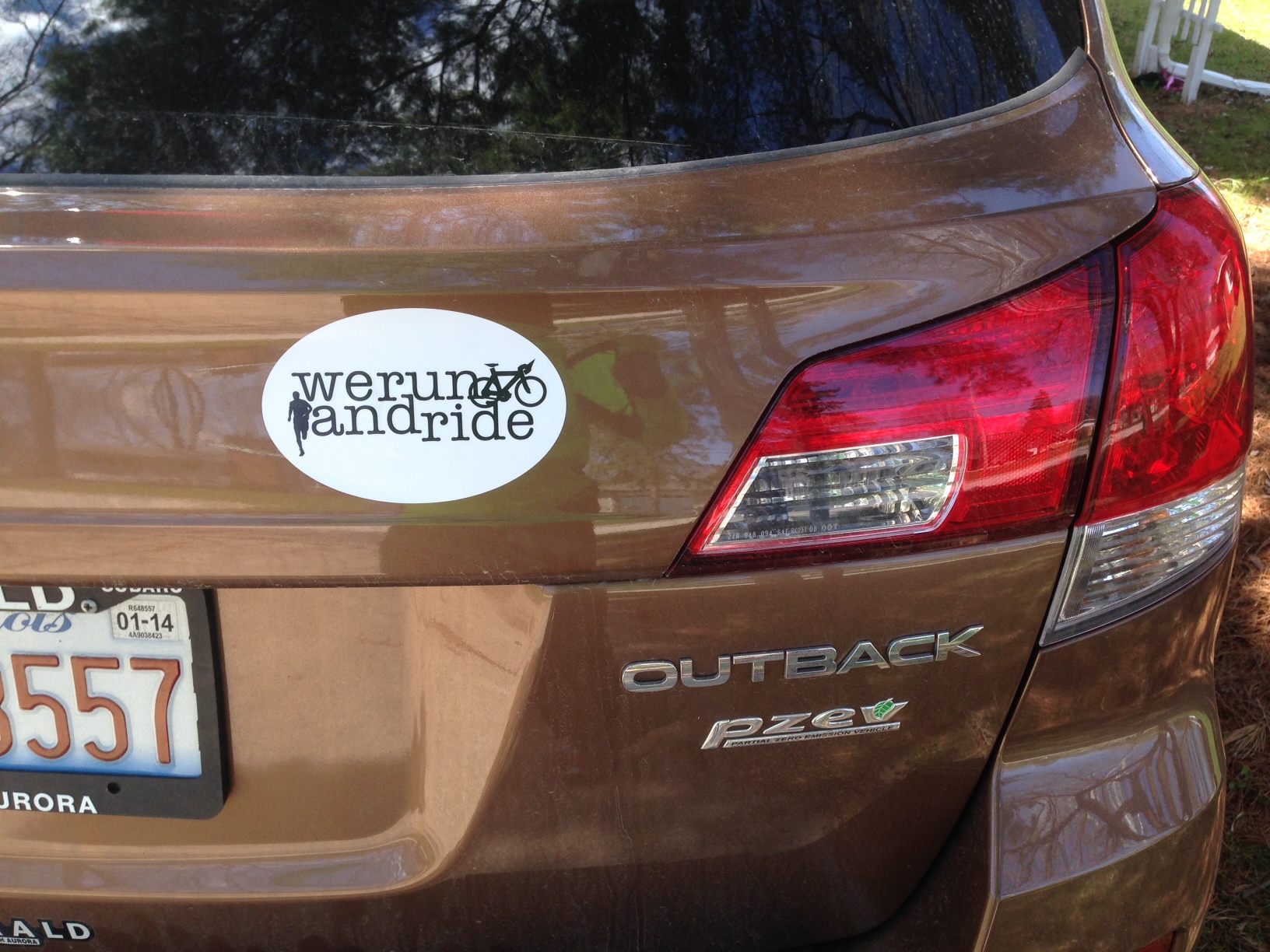
Enter your band name and you could win a free We Run and Ride oval decal! 

photo (9)Entries must be posted to the comments section of this blog for consideration.


Posted in Christopher Cudworth, Tarsnakes, We Run and Ride Every Day | 4 Comments

An exceptional day for the Tour de Plantes

By Christopher Cudworth

IMG_7335In bright white britches they stand by the road, quivering in a wind that will no relent. Fortunately it is at my back approaching a section of 9% grade that tests the legs to no end. In May the encouragement of Dutchman’s Britches helps you get up the hill.

Beside them is a small cluster of bloodroot waving as I roll past. The white petals have already fallen, a bloom that lasts but a couple days. Like all fitness, it is not destined to last. It plays its roll in the days that matter, and relentsIMG_7317.

A stand of dark red trillium hunkers beside a tall oak tree. These hold fast to their positions even in the wind. They barely tremor, so strong IMG_7313are their stems. Their red adornment appears to be part leaf, part flower. Its deep red color reminds you of the blood coursing through your own veins.

Then the hillside erupts with a sea of showy white anemone, a flower both profuse and fleeting. Blue flags rise amongst them. Could they be cheering their own preservation, a plant’s form of nationalism?

Their smalls faces whisk by like fans along the Alpe du Huez in bright colors of July. They help you along. The hills are no longer bare, or icy or too cold to ride.

Then a solo white trillium appears. Its head is nodding just like a cyclist tired from climbing. The white IMG_7316bloom is tilted down, toward the earth, as if its very existence is too much to show the world.

It is spring. Time for the Tour de Plantes.

For so many years this has been a ritual. I have run this loop hundreds of times. Now I ride it too. 95 feet of vertical ascent, Strava tells me. All comprised of glacial gravel, dumped here by an ice wall thousands of years ago. Now soil and flowers and trees cover the small rise in the landscape known as Johnson’s Mound. It sits 8 miles west of the Tri-cities where I

IMG_7329live. You can see all the way to Fermi Laboratory 10 miles to the east when you look east from the hill.

This is a gut-wrencher of a hill for Illinois. Local runners and cyclists use Johnson’s Mound and its one-lane road as a training site. The record pace up the North slope is 17.9 mph. I averaged 8 the day I last rode up the segment.

That’s why I need a cheering section. There is nothing more cheering that spring wildflowers. They come up in mid-April and bloom all the way into summer when the taller plants and even invasive species like mustard garlic take over.

Your spirits rise in such company during the annual Tour de Plantes. The first time I ran the loop it was 1971, freshman year in cross country. Later in my running career Johnson’s Mound was the perfect place for truly hard training. I knew I was racing fit when I could run from the entry point of the road into the woods all the way to the top of the hill in under 3:00. That meant I was in 31:00 10k shape.

Now the riding is a bit more humbling. Often my IMG_7326cyclometer shows doddling speeds of 5-6 mph until the legs build more beef for the climbing season.

So I ride, and take small measures of encouragement from the flowers that cheer me on. Perhaps I am the only one who pictures them as a crowd in the Tour de France. But they are my fans, and do not complain that I claim them for the moment. Up and up we go together. For summer approaches, and still more hills. It is memories of these climbs that carry me forward.

WeRunandRideLogo


Posted in Christopher Cudworth, We Run and Ride Every Day | Tagged , , , , , , , , , | Leave a comment

Half-Marathon; Or, How I Learned To Stop Worrying And Love My Body

Seeing that I cannot write from a woman’s perspective, this might be a cogent way to accomplish some good in this world. Learning to love yourself is pretty important.

Amira K.'s avatarThe Z-Axis

I’ve never told anyone these things. My parents, my sister, my friends – no one. So heads up. You’re the first to know.

For the last few years, I have grown, slowly but steadily, to despise the way my body looks.

When I was a kid, I was always told how skinny I was. I didn’t break fifty pounds until I was eight years old. In high school I was always the smallest – height and weight – of my friends. I grew up knowing, somehow, intuitively, that ‘being skinny’ was something good, that it was something I should maintain. In high school, that belief was confirmed and reinforced by magazines, friends who were constantly ‘dieting’, and my school’s insistence on athletic rigor and social ostracism of students who didn’t fit the body ideal. But I was always warned that, as a woman, ‘my time would come’, I would have kids…

View original post 892 more words

Posted in Uncategorized | Leave a comment

What kind of tortured soul are you?

By Christopher Cudworth

Tortured souls, hmmm. Where to start?

Tortured souls, hmmm. Where to start?

We all like to think of running and riding as a magical fix for the emotional turmoil of life. That works for many people. What we’re forgetting is that we all start from somewhere to get where we’re going. That means there are a lot of tortured souls out there.

The respective sports of running and riding attract a host of personality types to the fold. There is no magical formula for who decides to run a marathon or ride a bike until their sit bones show through their ass cheeks.

But some of these personality types show up with some frequency in the world of running and riding. This unofficial Field Guide To Tortured Souls is based on 40 years of participation in the world of endurance sports. Learning to recognize what type of Tortured Soul you are can put you on the track to being a well-adjusted person. That is, if you torture yourself enough running and riding to feel better about life.

THE “NEED FOR APPROVAL” TORTURED SOUL

The television show LOST featured a planeload of tortured souls trying to find their way to peace and self-acceptance. Kate here was a murderous gal who learned patience and love.

The television show LOST featured a planeload of tortured souls trying to find their way to peace and self-acceptance. Kate here was a murderous gal who learned patience and love.

People who struggle through childhood, adolescence, teen years, college and beyond seeking to earn love and respect from parents and friends know that the Need For Approval is a torturous state of mind. The more you work at it, the more you feel exposed, and needy. Flow that state of mind into something like running and riding and every new workout or competition is a new measure of your self-worth. That can be a wicked cycle. Somewhere down the road all people need to realize that it’s how you feel about yourself that matters, and not every failed effort or triumph is an absolute measure of who you are. Running and riding can help you better understand the difference and make you less prone to seek approval all the time.

THE “WHY IS LIFE SO HARD?” TORTURED SOUL

If you’ve ever studied the philosophy of existentialism (and I have) you come to realize that life basically sucks. At least that’s what French philosophers such as Jean Paul Sartre might have us believe. Sartre said, “Freedom is what you do with what’s been done to you.” He also said, “If you are lonely when you’re alone, you are in bad company.” That’s pretty funny. But this isn’t. “Man is condemned to be free; because once thrown into the world, he is responsible for everything he does.” And that’s why life is so hard. Because we’re responsible for everything we do. Some people just can’t deal with that, and live with a tortured soul as a result. Running and riding are not easy. Which is why participating in those activities can actually train you up to realize that life, if it is going to be hard, might as well be really, really hard. So we go out and run or ride with the wind for 50% of the workout and slog back into the wind the rest of the way. When you get home, life seems relatively easy after that.

THE “EVERYONE ELSE HAS IT BETTER THAN ME” TORTURED SOUL

Syndrome from The Incredibles had some serious self-torture going on. He envied those with super powers.

Syndrome from The Incredibles had some serious self-torture going on. He envied those with super powers.

Envy, greed and avarice are just some of the 7 Deadly Sins. Each can make your life a tortuous experience if not recognized as problems. Envy is basically jealousy toward others. Greed is the eternal expression of dissatisfaction with what you have. Avarice is merely extreme greed to the point where you lose concern toward anything other than possessive, selfish behavior. You could argue there are a fair number of athletes who fall prey to all these sins. They always want the most expensive shoes, the radically costly bikes and can’t sit still when they see people with more “junk” and talent or anything else that seems like something they want. But the truth is simple: Even when you have the most expensive equipment in the world, it is your hard work and talent that makes it “go” somewhere. So stop your bitching and try to appreciate that no one has it “better” than you. You get better by working hard and being smarter tomorrow than you are today. So there’s nothing to be jealous about with anyone.

THE “I USED TO BE FASTER” TORTURED SOUL

There is nothing like age and experience to make you wiser. Yet some people get stupid about their past performances. Wishing you could stay young and fast forever is one of the most dangerous traps of psychology for those who run and ride. Instead of appreciating the daily process of improving yourself inside and out, it is easy to constantly compare yourself to past efforts and not think you’re doing well unless you set

Unless you're slinging downhill on a metal sled, you might not be getting faster every year.

Unless you’re slinging downhill on a metal sled, you might not be getting faster every year.

a new personal record at some distance or event. But the “coulda shoulda woulda” mindset of never being as could as you “used to be” is neither accurate or true. For your age, you may actually be performing comparably better than you did at 23, or 33 or even 43. So give yourself some credit and don’t torture yourself all the time. Maybe just torture yourself enough to stick with the pack on the group ride. Or refuse to drop off the weekend long run because you’re a stubborn bitch or bastard who does not like to lose pace. That’s different than whining about how fast you once were. That’s living in the moment and appreciating it for all it’s worth. That’s a good way to go.

THE “I WISH I HAD MORE TALENT” TORTURED SOUL

Talent it not even dispersed in this world or we would not have the Olympics, the World Cup, the World Series or the last two rounds of Dancing With the Stars. If you ask any world class athlete, the first thing they will tell you is how hard it was to get past their own shortcomings in some way. No athlete is perfect. Not in the body. Not in the brain.

We can't all win Boston or New York. But we can be winners at our own pace.

We can’t all win Boston or New York. But we can be winners at our own pace.

Only a tortured soul would think otherwise. Even world class athletes get injured. Quite frequently actually. Even world class athletes have bad days. Also quite frequently. Unless they’re on a roll of some sort, all athletes have ups and downs and it is not related to the level of talent they possess. It’s the application of talent that matters. When a young sculpting artist was once asked by his teacher what he was doing with a chunk of marble, the protege replied, “I’m working on my talent!” The teacher boomed back: “Talent is worthless! Get to work!” Or something like that. You get the point. If you wish you had more talent, work harder. That’s how you find out how good you really are.

THE “NO ONE UNDERSTANDS ME” TORTURED SOUL

One of the most difficult athletes to coach is the person who insists that everyone around them either refuses or fails to appreciate them. That tortured attitude is one of self-pity, revealing the character flaw known as selfishness. If a person thinks that no one understands them, it is far more likely they make little effort to understand others. If you are that person, you are engaged in a self-fulfilling prophecy that is not fulfilling at all.

Some people train and race like prima donnas, never wanting to let anyone else be the center of attention.

Some people train and race like prima donnas, never wanting to let anyone else be the center of attention.

The best way to get something is to be the first to give. Try it on the run or ride sometime. Help out someone else with a word of encouragement, a pull at the front of the pack into the wind on the bike or keeping the pace sane when it’s obvious the group is struggling. People will instantly understand you a lot better than if you simply bury them without a word of concern for others. The first option builds loyalty and friendship. The second option makes everyone simply think you’re jerk or jerkette.

THE “I CAN’T LET SOMEONE ELSE LEAD” TORTURED SOUL

You know the type. They ride or run at the front of the pack until someone passes them up. Then they react impetuously, as if to say, “How dare you! Can’t you see that I’m the leader here?” Or worse, they dominate training by virtue of their skill or fitness, guttering the echelon so that no one else can ride with them, or one-stepping everyone on the group run. Of all types of tortured souls, this is the hardest of all psychologies to sustain. If you never want to let anyone else lead, every run or ride is torture for the soul. It’s hard to find peace from your efforts that way. Yet if you learn to let someone else lead, especially in competition, you might just come out the winner you’d like to be in the end.

WeRunandRideLogo

Posted in Christopher Cudworth, We Run and Ride Every Day | Tagged , , , , , , , , , , , , , , | 1 Comment

Dealing with setbacks

By Christopher Cudworth

Chris Cudworth 8When you set goals in your running or riding there are bound to be disappointments along the way. If the disappointment is profound enough, you go so far as to call it a setback. That is, you might need to adjust your expectations. Recalibrate your goals. Adjust your training or racing schedule. Heal from injury. Make do with what you’ve got. Or even start over.

If you are new to racing and competition, setbacks can feel like the end of the world. What happened to that happy state where everything was going great?

The musical world has a word, even a genre, to describe the next phase of emotions. It’s called the Blues. The Blues are all about dealing with setbacks. When you get whupped by something or other in this world, you just gotta deal with it.

Some of us regress for a time, moping in our misery. Others try to push on through knowing in the back of our minds that things could get worse before they get better.

So let’s take a look at what constitutes a setback, and how to deal with it.

Great quotes about setbacks

See, setbacks are not the product of some “new psychology” or pattycake self esteem program. Consider this quote by none other than Henry Ford. Life is a series of experiences, each one of which makes us bigger, even though sometimes it is hard to realize this. For the world was built to develop character, and we must learn that the setbacks and grieves which we endure help us in our marching onward.”

Or, here’s a quote from Olympic Gold Medalist Peggy Fleming: “I think exercise tests us in so many ways, our skills, our hearts, our ability to bounce back after setbacks. This is the inner beauty of sports and competition, and it can serve us all well as adult athletes.”

Setbacks as motivation

When you consider the life stories of most professional athletes and leaders in business, it isn’t the triumphs with which we most readily identify. It is the failures that  are necessary to achieve that level of expertise that most interest us.

So rather than look at your current setback as a sign of weak character, you should view yourself in terms of challenge and opportunity. That is, when you set before yourself a challenge that is hard to achieve, it is the difficulty that makes it worthy trying.

For some people, much of the trouble in life actually comes about when things are not challenging enough. Young people with idle time on their hands get involved in risky behavior because day to day life is simply boring. Many of us crave excitement and we thrive on risk. Kids sit playing video games because the visual and mental stimulation of killing things, even in a virtual environment, is preferable to sitting around doing nothing.

Of course we sometimes imagine our threats as challenges much greater than they really are. Or ever existed.

Of course we sometimes imagine our threats as challenges much greater than they really are. Or ever existed.

If you think about it, all of life is a rite of passage. Ancient cultures recognized this transition into adulthood (so aptly characterized in the quote above by Peggy Fleming) as an important engagement in the life of a person. Some rites of passage, such as participating in a dangerous hunt or the first war with another tribe, could indeed be deadly if you did not pay particular attention to your role and function in the action. That is why the rite of passage was so highly ritualized.

We continue imitating those true rites of passage with social behaviors designed to scare people into awareness. Fraternity or sorority rites, military and athletic pledging or hazing all function to some degree as a tool for cultural indoctrination.

Stress and setbacks

They also prepare us for setbacks. Rehearsing high-stress activities is a test that reveals character. If you are put through the wringer and can’t deal with setbacks in the process, you might not be accepted in the group as a whole. That’s an evolutionary principle in action. The idea of “fitness” in nature is based on your ability to persevere and perform a logical, functional role of support or leadership in a group, culture or population.

It’s true in the business world as well. Every day in the office is a test of “fitness” per se, and your ability to deal with setbacks in the corporate or business world is a sign of your overall character and value to the team.

So the parallel worlds of sport and business draw on each other for success. We hear many tales of how hard it is to succeed in business. It’s why we admire the Steve Jobs of the world, who was fired from the very company he helped create. Yet he returned to lead Apple to world ascendency. There were many setbacks along the way. We all purchased a few, and avoided others. Now that he’s gone some wonder if Apple can continue to thrive without Steve Jobs at the helm. So far…

So as you enter your own world of achievement, and set yourself up to succeed only to fall short due to injury, lack of ability to tolerate intense training, or from random setbacks like an accident, distracting demands on your time or the simple realization that the goals you set are for now outrageous, it helps to draw back and consider what we can really learn from a setback.

Here are some simple rules to abide by in dealing with setbacks:

1. A setback does not define you. 

Gain some objectivity. Your whole being is not determined by a single setback or missing a goal. What does define you is how you come back from temporary failure, or make decisions based on new objectives.

2. A setback is not the end of you. 

When soccer player David Beckham screwed up and got a red card in the World Cup, he was hated by his entire country for the failure. Yet he came back to become a leading player in future World Cup competition and one of the world’s most famous soccer players because that initial setback did not end his aspirations.

3. Within a setback lurks opportunity. 

If you’ve been hurt in training, often the recovery holds clues to how to become a better athlete or businessperson. Learning your weaknesses is a great tool for future achievement. Many time you can turn them into your greatest strengths through training, focus and perseverance.

4. Setbacks should not kill your spirit. 

Our spiritual examples in the world help us understand the true nature of being. The Christian story of Jesus Christ triumphing over political and worldly powers through matters of spirit inspires billions of people. But Christianity is not alone in providing spiritual inspiration and healing. Great wisdom can do the same thing.

Zen Buddhism offers us this: “To cry and not be carried away by tears, to laugh and not be carried away by laughter, is the way.” 

So whatever your goals are, be prepared for the eventual reality of a setback. Those moments can come on suddenly or eventually. Either way we need to ready our minds for how to deal with adversity. That’s what helps us put one foot in front of the other whether we’re running down the road, pedaling our bike or reaching through the water on the next difficult stroke. Setbacks are always around the bend, but they don’t need to block you from the road ahead.

WeRunandRideLogo


Posted in Christopher Cudworth, We Run and Ride Every Day | Tagged , , , , , , , , , , | Leave a comment