A Turkey Trot to End All Turkey Trots

By Christopher Cudworth
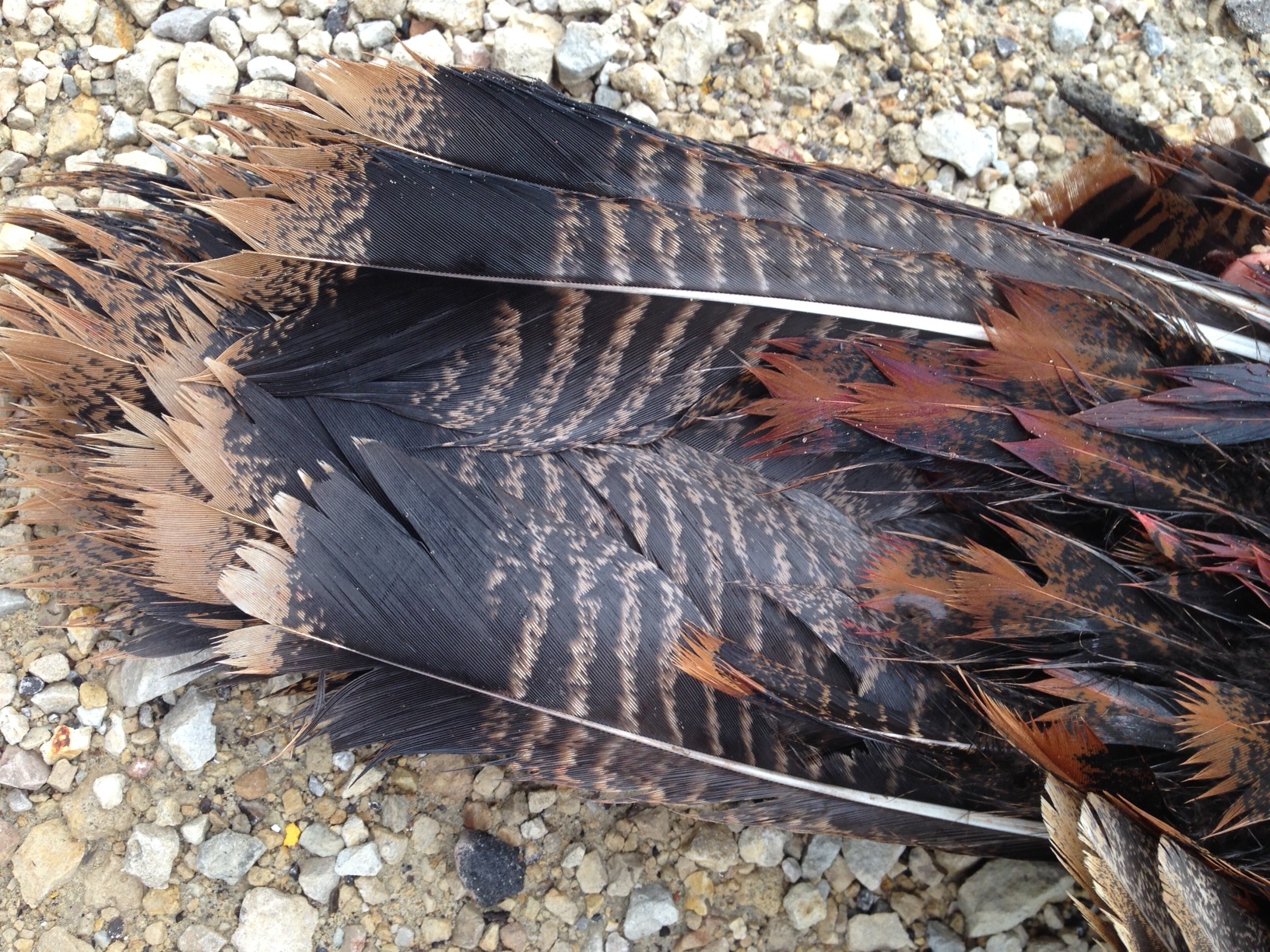
This female turkey challenged me to running race and gave her all at the end.

This female turkey challenged me to running race and gave her all at the end.

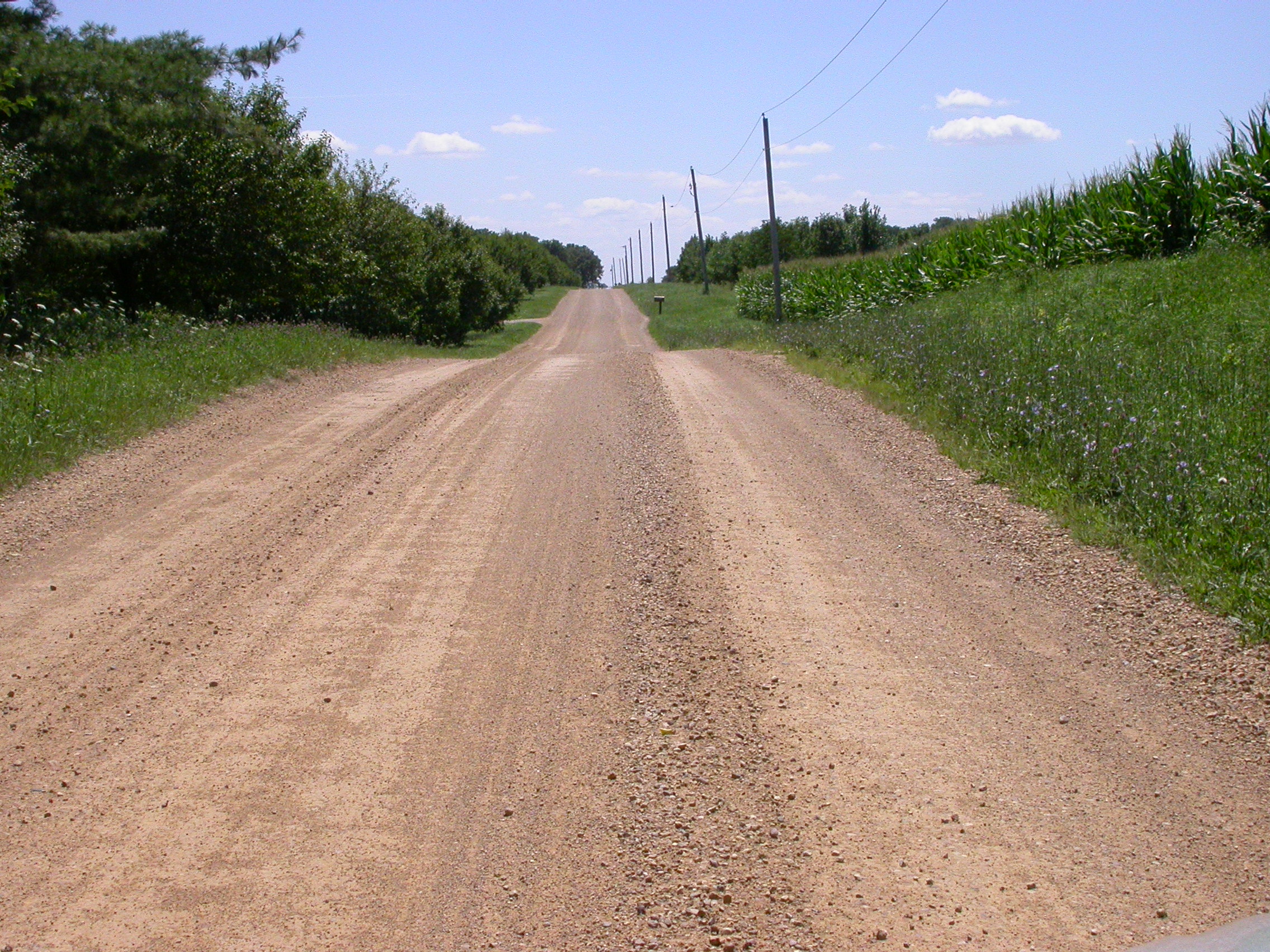
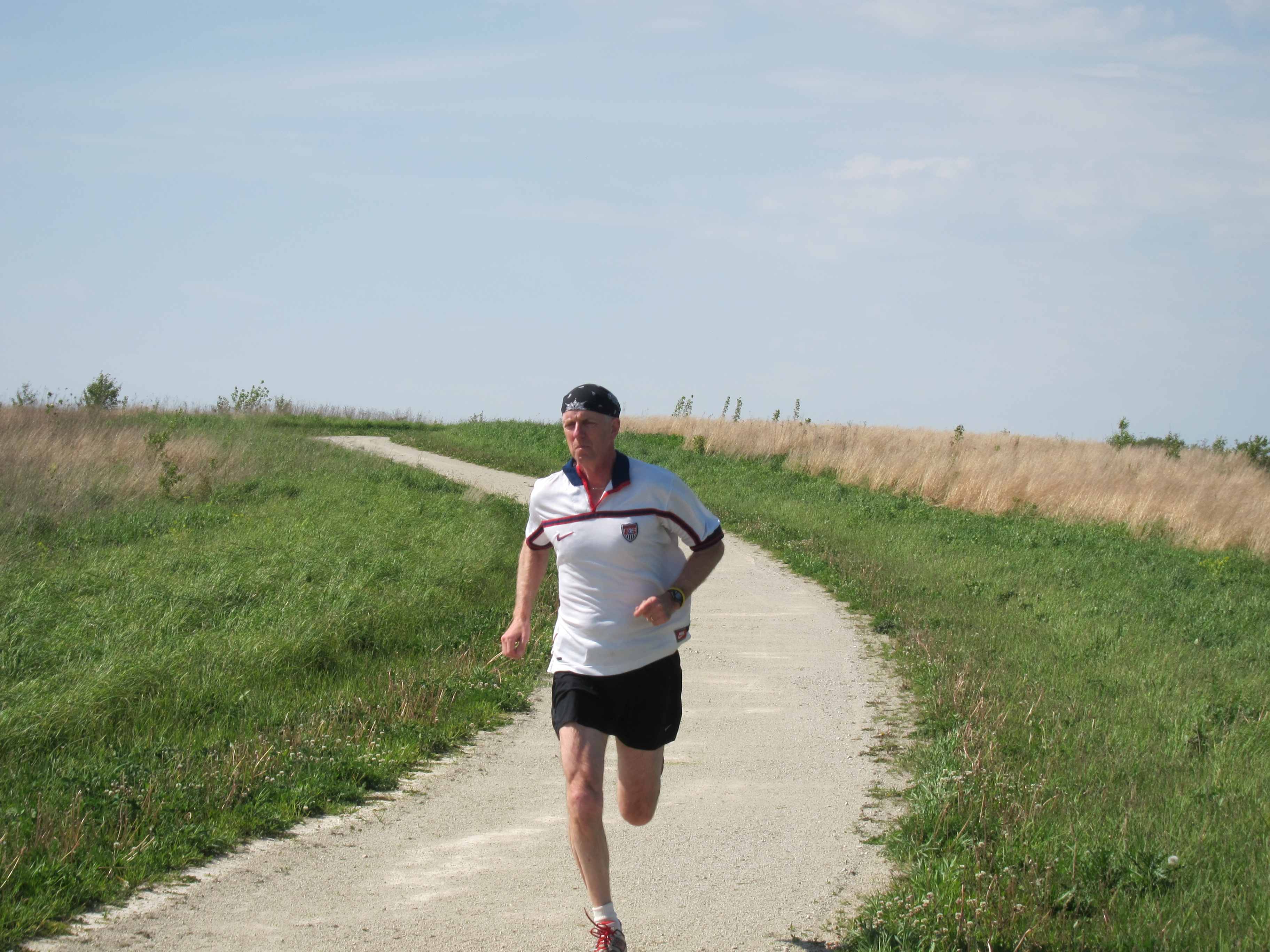
So I was running in the hills of Decorah, Iowa, clipping along at 7:00 minute pace when what should appear beside me but a real, live female turkey. She ran up out of a ditch and stood by the side of the road, running in place. “You know, I bet you think you’re hot stuff, running all those miles in them fancy shoes.”

“Um,” I said. “I did not know that turkeys can talk.”

“What, haven’t you seen a Pixar movie in the last 15 years?”

“I stand corrected.”

“So, Mr. Running Shoes. Want to race me in a real turkey trot?”

“I haven’t really been competing the last few years,” I admitted. “Much less against a real turkey.”

“What’s the matter?” she challenged. “Are you some kind of chicken?”

“I’m guessing that’s some kind of turkey joke,”

“Of course.,” she crowed. “We turkeys are full of good humor. We have to be. Life is not easy for a turkey you know. Not with you humans around.”

“You have a point,” I admitted. 

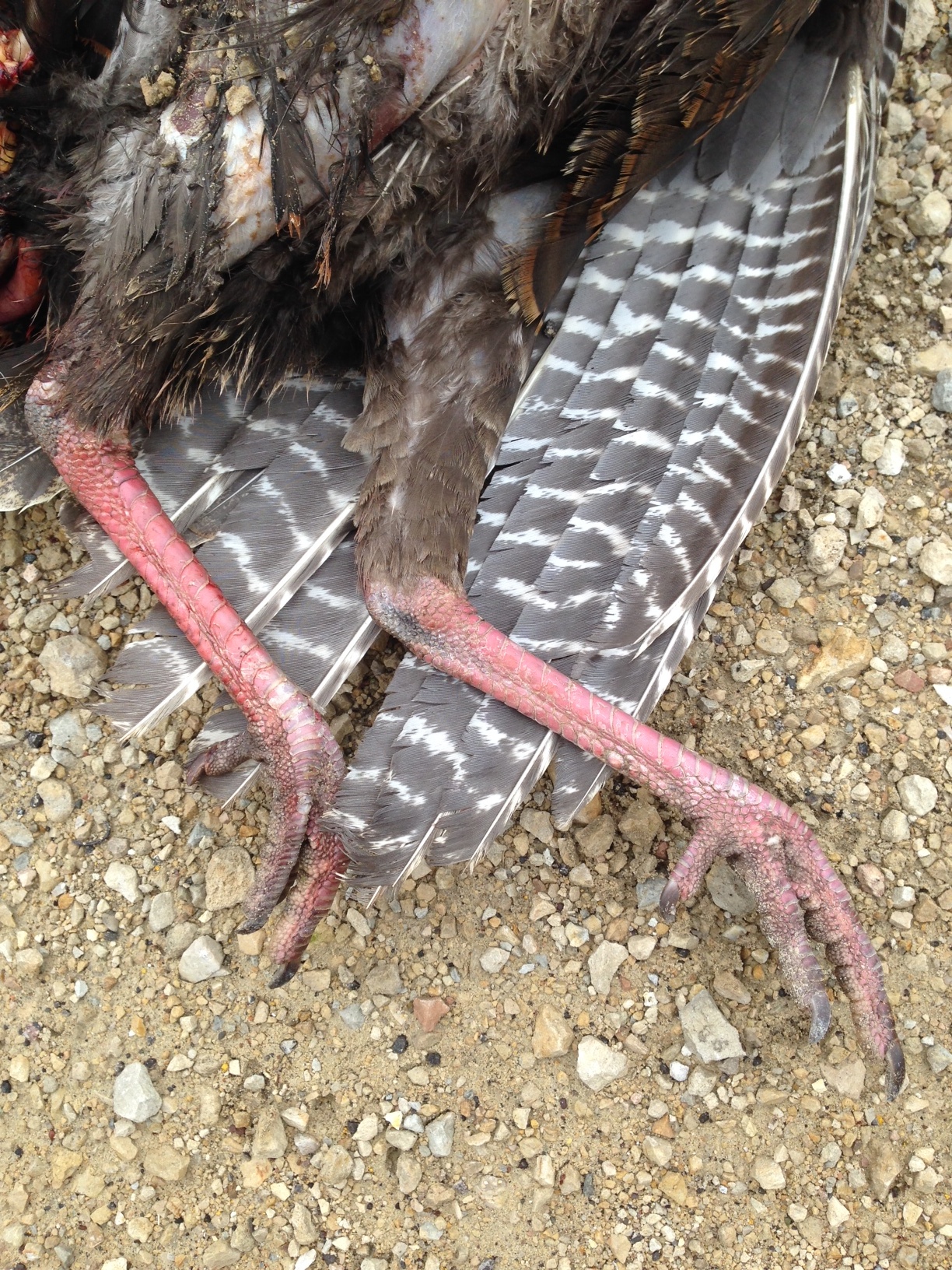
The feet that enable a turkey to sprint at speeds of 25 miles per hour.

The feet that enable a turkey to sprint at speeds of 25 miles per hour.

“Of course, this time of year, it’s not easy being a female turkey with all those male turkeys around, either,” she chuckled. There’s nothing like mating season to put a female turkey on her toes, so to speak.”

“Yes, I hear tom turkeys can get a little horny this time of year.”

“You said, it buster,” she clucked through her thick beak. “Tom, Dick and Harry. All those horny male turkeys want to do is…”

And just then a car whizzed past us.

“God I hate those things,” she chirped. “How can you stand running along these roads when those blankety blank cars keep roaring past.”

“You get used to it,” I offered.

“Not me!” Lady Turkey exclaimed. “I nearly jump out of my drumsticks every time one of them comes roaring past.”

“Maybe you just haven’t had enough time to evolve and get used to them,” I suggested. 

“You believe in that evolution stuff?” she asked. 

“Yes, I do.”

A tom turkey was chasing her tail.

A tom turkey was chasing her tail.

“Not me. According to Turkey Religion, all the creatures of the world hatched from eggs over a 7 day period.”

“Interesting,” I quietly replied. “Some humans have a similar theory.”

“Anyway, are we going to race or not?” she egged me on. “If you’re so big on Survival of the Fittest, let’s see you prove it! I bet I can beat you in a mile race. Easy.”

“Okay,” I told her. “But it’s no fair flapping your wings and flying. I hear you can reach speeds of 55 mph on the wing.” 

“And 25 mph on the run,” she snarled in her churliest turkey voice.

“Really?” I said, exasperated. “You’re telling me you could beat Usain Bolt over 100 meters?”

“That turkey?” she laughed. “He’s only human you know. I could dust him easily.”

“Even if he does use steroids…” I mused. 

“Did I scare you off now?” she challenged. “Are you still game to race me?” 

“”I figure you for a sprinter,” I said. “I don’t think you can beat me over a mile.”

“Is that so?” she responded. “Well let’s have at it. Let the 1 Mile Turkey Trot begin.”

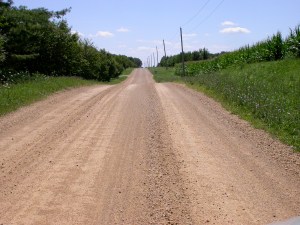
We stood side by side on the rural road. Ahead of us stretched the purtiest little section of road you ever did see. 

“On your marks,” I announced. “Get SETTTT! Go!”

The turkey tore off ahead of me. This turkey chick really was fast. Even at 5:30 pace, top speed for me these days, I had no chance of keeping up. I could see her rufus rump receding in the distance. She disappeared around the curve ahead of me. 

She gave her life in a true Turkey Trot. Hopefully now she'll be eaten by turkey vultures in the circle of life rather than nibbled to death on the roadside by Reddit Trolls.

She gave her life in a true Turkey Trot. Hopefully now she’ll be eaten by turkey vultures in the circle of life rather than nibbled to death on the roadside by Reddit Trolls.

I tried picking up my pace in hopes of catching a glimpse of her at the finish line.

But to my horror, I found her collapsde in a heap of rumpled feathers and guts around the next curve. 

“What happened?” I asked incredulously. 

“It was one of them tom turkeys trying to track me down,” she complained, heaving her last breath. “We collided head on at 30 miles an hour. He’s knocked out over there in the ditch, and here am I. Now we’e nothing but fodder for the Turkey Vultures. What an end! I didn’t even make the Thanksgiving table.” 

“Well, you’re better off for that,” I advised. “Thanksgiving is no bargain when it comes to being a turkey. Let me tell you. It’s almost as bad as being devoured by those trolls on the running group on Reddit. I’ve had that experience and it’s a pretty terrible ordeal, like being eaten by those little dinosaurs in the movie Jurassic Park. So I’d rather donate my gimlets to a hungry hoard at Thanksgiving than die from cuts delivered by people who seem to hate on anyone posting content that doesn’t fit their narrow view of what running is about.”

“Do me a favor,” she groaned. “At least enter my time today for the Strava segment on this road. At least my death will have been worth something.”

“How noble,” I advised her. “You’ll be recognized with the rest of the turkeys on Strava.” 

“Thank you,” she sighed. And then she died. 

You can see that she really gave her guts to the cause. We should all be inspired to excel in our future Turkey Trots if this turkey was an example for the rest of us. Next time you race a Turkey Trot, be sure to give it your all in her honor. And watch out for the trolls. 

WeRunandRideLogo


Posted in Christopher Cudworth, We Run and Ride Every Day | Leave a comment

The wonders of finding a new coach

static.squarespaceby Steven Scholz

Today’s We Run and Ride features a guest column by marathoner Steven Scholz, whose insightful piece “New Coach” chronicles both the excitement and challenge of committing to a training program for the marathon. He takes on that biggest of all races, the New York City Marathon. You’ll find plenty of wise hints on how to train and prepare for events of that scale.

I won’t spoil the ending. You’ll enjoy going on the journey with Steven.  Click on the link above and enjoy!


http://www.stephenscholz.com/blog/2014/3/31/nyc-marathon-2013

WeRunandRideLogo

Posted in Christopher Cudworth, We Run and Ride Every Day | Tagged , , , , , , , , , , , , , , , | Leave a comment

Searching for completeness through running and riding

By Christopher Cudworth

Feeling complete can be a challenge in a world with so many moving parts.

Feeling complete can be a challenge in a world with so many moving parts.

The notion of our lives being “complete” is tantalizing. We long for that feeling of peace that comes from having everything in order. How we want it. So that we can think. Be true to ourselves. Love others.

But life is a messy thing. Just getting ready for work in the morning can put things out of order. Or worse, things are out of order already, and it’s difficult to find them in time to get ready for work. Round and round we go. Seldom do we feel truly complete.

Then you head out to run or ride and the nagging sense of disorder in your life goes with you. It’s hard to be “in the moment” when projects from work are cycling through your mind. Relationships too. Those can create messy places in your brain. So can being a parent, a business partner or a host of other roles in this world.

I often think about the lives of the pastors in our church. How many problems and needs flow their way. How difficult it must be at times to find peace for their own needs. That 4ad1e6849call to serve others requires a special person, someone who knows how to find completeness in a seemingly incomplete world. That is why people turn to God. Or spirituality. Meditation. Or running and riding.

Yes, our so-called “sports” rank right up there in the search for completeness. Physical effort is a portal to a more open mind, one capable of putting things in order so that a sense of completeness can be attained.

Really, what does it mean to be complete? 

One definition starts us on our way.

1. complete: having all parts or elements; lacking nothingwhole; entire; full:

Another relates directly to our running and riding:

2. complete: finished; ended; concluded

A third definition speaks to the state of being…

3.complete: having all the required or customary characteristics, skills, or the like; consummate; perfect in kind or quality:

So in order to attain completeness, we should consider these definitions in order to help us plan our lives.

1.  Be organized. Completeness starts when you have a systematic approach to your daily functions.

2. Have goals and a plan to achieve them. Otherwise you will never really know when you have completed anything.

3. Embrace creative solutions. The character of being complete embraces seemingly oppositional characteristics such as creativity, which is the source of new ideas. Many people do not feel complete without these challenges, which involve risk or change. Others prefer a more predictable way of existence, finding completeness through the manner in which their worldview is fulfilled.

photo (8)Seeking completeness 

When you take these characteristics “on the road” to run and ride, they are easily applied to your fitness goals. Being organized helps you be prepared for training and races. Having goals and a plan enables you to measure your efforts. Embracing creative solutions helps you cope with things like training challenges, injury or the very real pressures of putting your self esteem on the line.

Compete to complete

Many of us find a sense of completeness by setting out to achieve a fitness goal. We compete in order to feel complete. It’s part of human nature to compete with others, and ourselves. It makes us better. Pushes us to achieve more. Gives us opportunities for team-building and collective achievement.

Some apply this competitive dynamic to do good things for other people. That’s why so many millions of dollars are raised by people competing in events while raising money for charities. It completes the notion of self-betterment by pushing some of that effort into altruistic goals.

Obviously you can see how these principles apply to the business world and other activities as well. Seeking completeness is really a question of knowing yourself well enough to find satisfaction in doing things well. You can measure that any way you choose.

As for those of us who run and ride and swim, we know the clock does not lie. Not usually. So there’s always the ticking of time to consider as a measure of our success.

But there’s much more, and you know that. The feeling of completeness does not always fit into the confines of time or how others view our success. We are complete when we feel like we have done something that matters to us. There is no limit or measure to the value of that.

WeRunandRideLogo


Want to hear more about what it means to be complete, and motivate your team to success? Author, marketing pro and motivational speaker Christopher Cudworth speaks to service clubs, running groups, cycling and business organizations. Contact him at cudworthfix@gmail.com. 

www.linkedin.com/in/christophercudworth/

Posted in Christopher Cudworth, We Run and Ride Every Day | Tagged , , , , , , , , , , , , , , , , , , , | Leave a comment

In the pink in all the wrong ways, and tricky days

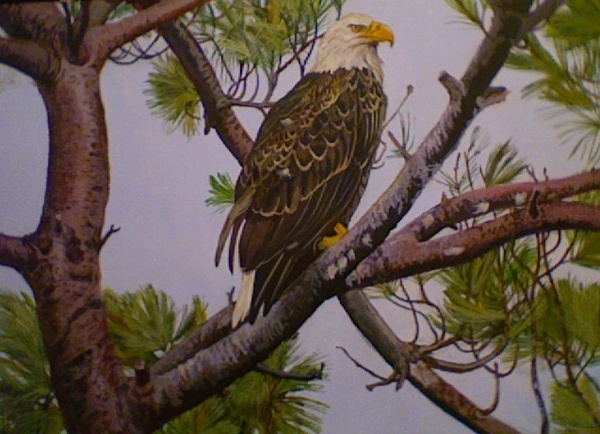
Bald Eagle by Christopher Cudworth. 24" X 36". 2013.

Bald Eagle by Christopher Cudworth. 24″ X 36″. 2013.

This time of year brings a series of choices for those who run, ride and swim. There are days when weather dictates your run or ride. If it’s a blasting spring wind, the idea of getting out in the open on a bike is not so appetizing. So you run. If it’s pouring rain, you might as well go inside and swim.

As if those choices are not difficult enough, we actually have other things to do in life than keep our fitness up. That can make for a tricky day. Work. Family. Other hobbies.

Love of nature. Nature of love. 

As a birder (ne: birdwatcher) there are mornings when I get out on the bike and am positively torn about not having binoculars on my person. An April or May morning can be an absolute treat when southerly winds dump a pile of birds in a “fallout.” That can mean dozens of warblers singing in the trees. The color and activity is mesmerizing.

Birders do much of their work by ear. When riding or running through a spring woods it is often possible to hear 20 or 30 species. That makes it all the more tantalizing, especially when you hear a species that you know is beautiful. You want to pair the bird’s song with the bird. But you’re riding or running. Stopping every 30 seconds is not what you’re about at that moment. So you ride or run on with the promise to return to that spot and find those birds.

Great horned owl, acrylic on board. 11" X 14". 2013.

Great horned owl, acrylic on board. 11″ X 14″. 2013.

In the moment

Of course that doesn’t happen sometimes. The days whip by and the mornings where conditions are perfect for birding can be rare, depending on the year. You must be wise and opportunistic to catch the “waves” of birds coming through.

Yet the same holds true for training on the bike and running. Those April and May mornings are precious opportunities to build fitness. So choices must be made.

Commitment

That’s not an unfamiliar dynamic. I took up birding the exact same year I became a serious runner. That year I also began painting birds, selling my work. That carried on through high school, college and beyond college into the professional world.

At one point headed into my senior year in college it was evident that training for running would need to trump all else. By chance that summer I found a dead red-tailed hawk along the road. Illegal as it was, I scooped up the bird and brought it home to do

A talisman hawk's claw was part of the inspiration in college cross country.

A talisman hawk’s claw was part of the inspiration in college cross country. click to enlarge

drawings and mine it for feathers and even the claws. Again, that’s illegal as hell. Hopefully the statute of limitations have run out since 1978. But as a bird artist, you have to get close up to the subject at times, and my experience in college biology and taxidermy gave me insight on how to handle the specimen.

Talisman

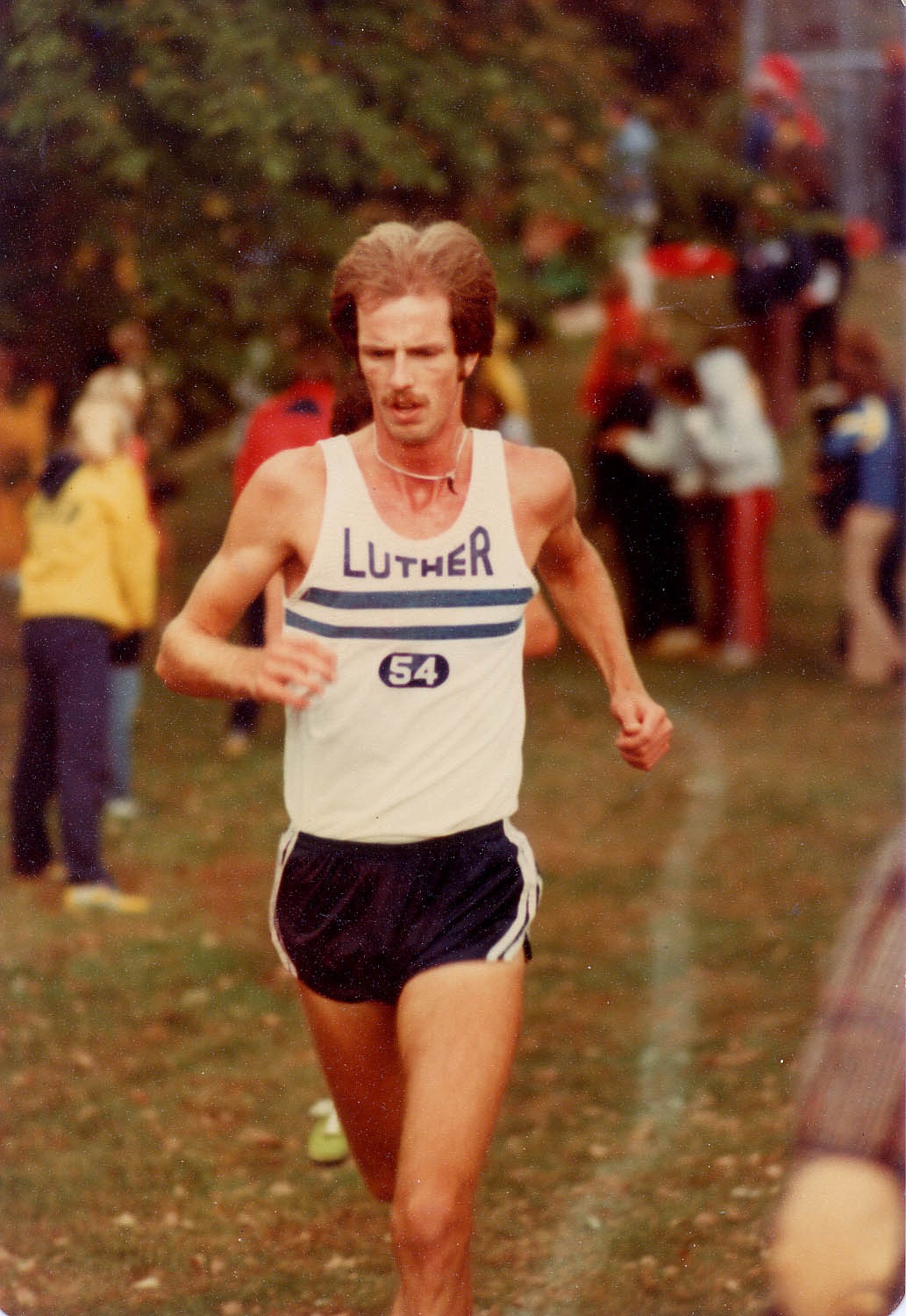
One of those hawk claws I took to a jeweler and had it turned into a necklace. I wore it with the promise that when all the intense training was done, I would get back to nature and birding and painting. Running 100 miles a week did not allow much time for anything else. But it did allow me to be a key part of a team that placed second in the nation in cross country. That was rewarding and fun.

Birding gigs

10 years ago while out birding on an early May morning, my brother called me by cell phone to ask if I was watching the opening time trial of the Giro de Italia, the bike race featuring a pink jersey and some of the wildest stages imaginable in a grand tour.

I explained that I was out birding. Undaunted (being a fellow birder) he quickly proceeded to share the excitement of the team time trials going on. I promised to watch the action on the later broadcast that day.

Then I went back to birding, tromping through the fields, marshes and backwoods in the annual Spring Bird Count. It was a good morning for birding, as I recall. A dozen or so scarlet tanagers, orioles and mixed flocks of warblers were moving through the trees.

Tricky days

That year, along with my newfound love of cycling, I took swim lessons with thoughts of taking up the triathlon. During my first swim lesson I lost a contact lens in the pool and was given a set of soft contact lenses to wear by the optical shop while they ordered a replacement.

So I was feeling kind of weird and changed by the whole enterprise. I loved those soft contacts yet the optometrist insisted I was better off in hard lenses.

Advice like that is frustrating. A few years before I had met with my family doctor to get a referral for physical therapy because of pelvic and knee problems. He branded PT a “bunch of fluff.”

A month later I tore my ACL because of weakness in my knee. That injury required surgery and physical therapy, work that which strengthened everything below the waist. I learned that my instincts were correct. Had he allowed me to do physical therapy before the big injury, life could have been considerably different.

Back in the pink

After the surgery to fix the ACL I went back to playing soccer, running and riding. But then some even trickier events came to pass.

During the Spring Bird Count two things happened simultaneously. I got bitten by a tiny deer tick and at the same time picked up a wicked case of poison ivy. The deer tick bite formed a target rash indicating possible Lyme disease. That meant taking oral medication for two solid weeks to battle the tick bite and swabbing all kinds of pink goo on my leg to stave off the poison ivy.*

687302d5047244106a4a3e3cca2eab0a

Backyard Pyre. Acrylic on board. Christopher Cudworth.

The poison ivy turned the entire left lower leg into a pink, bubbly mess of itchy skin. It was really gross and kept returning despite the calamine lotion I was using for treatment. That meant I had to stay away from the gym to do any strength work. Even while wearing pants the itching was intolerable and I could not justify going to the club at risk of turning the equipment into a poison ivy factory. That would be so, so wrong.

The month of May turned into a ridiculous mess of medical itchiness and popping pills. It wasn’t just a tricky day. It was a tricky month in all the wrong ways.

Consequent events

When early June rolled around I had signed up to play outdoor soccer. The second match of the season was bitch. It had rained the night before and we only had 8 guys to put on the pitch. By halftime the field was a greasy, slick mess and fatigue was setting in from head to toe because playing forward against a superior team meant lots of work trying to get open for the ball.

38ebbb0ff7aa2aeb583ee70a4a26ca22

Flag Waivers. Acrylic on board by Christopher Cudworth. 24″ X 26″.

Finally with 1:00 left in the half the ball came to me in an open position in the box. I trapped the ball with my left leg and planted to shoot with my right. A defender came in from my left and I heard a “snick!” as his weight lurched against my knee and the repaired ACL was gone. I blame the lack of strength work coming off the deer tick bite and the poison ivy for putting my knee in a compromised place.

So there really is such a thing as a tricky day. Even when you’re out doing something you love, an activity that seems innocent and joyful enough, you cannot always predict the outcome. Just when you think you’re “in the pink” in all the right ways, things can blow up in your face.

I’m guessing that’s what makes big bike races like the Giro de Italia so fascinating for the rest of us to watch. Those bike racers put it all on the line, every day. Things can and do go wrong. When some rider finally emerges with a pink jersey they obviously symbolize the ability to overcome adversity. We can all identify with that. Even when we’re doing the things we love, it can be tricky knowing when and where the next challenge might come along.

WeRunandRideLogo


*I now recommend TechNu for treatment of poison ivy. It’s a homeopathic medical scrub that knocks poison ivy dead. I’m not paid for this endorsement. It just works. Invented by the military I hear. Seriously. It works. 

Posted in Christopher Cudworth, We Run and Ride Every Day | Tagged , , , , , , , , , , , , , , , , , , , , , , , , , , | Leave a comment

It’s all uphill from here; hills and how to handle them

By Christopher Cudworth

Hills can be your friend. They truly can.

Hills can be your friend. They truly can. But don’t ride gravel on a road bike unless you’re really in for a test.

It’s one of the tarsnakes of endurance sports that going uphill is both a wonderful challenge and a vexing test of your fitness. Uphill running and riding requires both intelligence and effort. How you approach a hill often defines your success in climbing it.

We’ve all crested a hill only to encounter another than looks twice as bad as the one we’ve just climbed. Often this is an issue of visual perception. When you’re higher than the next stretch of road or trail, your eyes read the entire stretch as part of the next hill. Yet when you hit the flats below and realize they are not actually part of the next climb, you feel both stupid and relieved. Any sort of break between climbing is appreciated.

Of course the very opposite can be true as well. We sometimes read a stretch of road ahead as a “false flat,” and that can be deadly to your pace and energy. Runners even have to beware of the camber of a road. A highly cambered road can throw off your stride and cause cumulative fatigue.

Cyclists meanwhile need to beware of the deadliest of combinations: a false flat combined with a crosswind. Oh, my, gosh can that be exhausting.

So it fits that we all need to have strategies and knowledge to be better climbers. For those that run and ride, there is plenty to learn between sports, and some that does not apply.

For example, in running there is a very limited transfer of downhill motion that can be applied to the very next climb. The great news for cyclists is that you can often “coast” going downhill, allowing your momentum to carry you on those rolling wheels. That’s a merciful truth that saves many a set of tired legs on a given day. Of course you have to hope your fellow riders are also coasting and not blasting away from you on the downhill segments. That happens.

What we can all learn from cycling hills
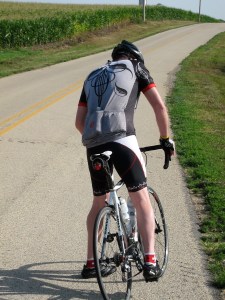
Prepping

Prepping for hill works takes concenstration and a plan of action.

But when a cyclist approaches a hill bearing momentum from the previous hill, or when you are approaching a climb, there are some subtle dynamics going on between your existing pace and the gearing of your bike. It pays to keep your machine in the highest gear possible going into a hill at first. Momentum will carry you only so far, however. Imagine riding into a hill and not pedaling. At what point would the bike literally roll to a stop on the uphill? That transition zone between the base of the hill and where you might come to a stop is the not-so-imaginary Wall of Truth.

If you’ve ridden for a few years you have a sense of this zone whether you know it or not. If you’re a newbie it likely pays to ride a few hills of different slopes and sizes to learn where the bike slows down on its own. Getting a read on this “slope zone” is key to understanding when you need to shift and how to trick your bike into being your friend as you climb.

Building acceleration at the base of the hill should be done in high cadence and with even pressure on the pedals. Spin into a hill and your legs won’t be shot. But be wise and don’t underestimate your gearing needs. While you can go fast on the flat or initial rise of the hill you should. But not so fast that fatigue is pressuring your legs. You don’t want to fatigue yourself before you get started.

Then as you start to climb you will feel the pressure build with each gearing depending on the grade you are climbing. The trick is to beat that negative pressure with a more responsive gear. Notice that we don’t say “easier” gear. If you are climbing properly the gearing should feel like a balance between easy and productive. Go too easy too early and you’ll find yourself “spun out” and not putting enough energy into the pedals. Your cycling mates will often pull away because they have the balance right.

imgresOf course there are always massive riders like Jan Ullrich of Germany who climbed in big gears. He’d be next to Lance Armstrong who was spinning his way up the hill and Ullrich would be pushing a gear so big that Paul Kerwin and Phil Liggett would be puking in their coffee cups just watching the big man ride. If you’re that kind of rider, good on you. But those types are generally rare. The rest of us need to “balance” our way up the hill by reading the slope zones with our pedaling.

Hill phases

So many hills seems to start gradual and end with a nice little peak at the end. Let’s all thank road engineers for this marvelous bit of dastardly construction. We must suppose that suits the needs of cars and trucks somehow, but it is hell on cyclists and runners.

But you have to deal with reality. That means conserving energy and efficiency for the crucial last phase of a hill.

Usually there are three zones therefore: A slight rise at the bottom followed by the critical middle grade where shifting occurs and the last 10-30% where true effort is required. That’s when you go into low gearing. Ideally if you are strong enough you should stay in the saddle as long as it is efficient. Stand up too soon and your quads and knees can tired out. So you want to visually measure where you might stand up to climb.

Cyclist Floyd Landis was a solid climber who contended that amateur riders should never stand up from the saddle. His contention was apparently that most of us are so inefficient in that position there is no real energy gain. Contemporary rider Geraint Thomas says the same thing in these six tips about climbing.

But it seems like everyone and their mother still stands up in the pedals. And having your weight to shift to each pedals can be a help as you climb. So think about that and use your body to shift from side to side as you climb.

You are no longer “spinning” once you stand up. You are basically running up the hill with your feet on the pedals.

The main difference is that you are also still propelling the weight of your bike, your water bottles and everything else you choose to carry up and down hills. So the sweet little benefit of momentum going into the downhill is now cancelled out as you try to crest a hill. That’s the ugly glory of cycling. The lighter you are going uphill, the more you have the advantage.

Climbing hills as a runner

IMG_6318So now that we know that cyclists can be reduced to the same game as runners, it’s time to consider how to run hills when you don’t have momentum on your side.

Doing hills as a runner is basically the same as being a cyclist in the last stages of a climb. You are responsible for your form and carriage and must make best use of your energy to spread it out over the length of the hill.

When taking on any climb, a runner needs to consider form over the course of the hill to adapt of any changes along the way.

1. A long steady climb over a quarter mile does not require much change in form other than responsive arm carriage if the hill steepens toward the end.

2. A climb that increases in grade toward the end must be approached conservatively. That means you maintain form and keep eyes up to read the hill. Then when the climb grade increases, you increase pushoff first. Knee lift is not the issue unless the hill is extreme, and even then it’s more about turnover and maintaining pace than lifting your knees. A skilled runner rises onto the toes when moving up steep grades. That allows you to cut down the amount of plant time with the length of your foot. You are pushing and driving.

3. A really steep grade requires form adaptations. You will naturally feel your head drop and your shoulders hunch. Counter this tendency by actually driving your arms back behind the plane of your body and swinging the wrists up next to your ears. This driving motion is of course in sync with your legs. Again, concentrate on driving your legs forward, not up. It takes a really fit individual to use knee lift alone to climb hills. The rest of us need to use efficiency and a driving form to climb effectively.

You should be feeling your feet flex as you run up a hill. If not, you are likely still striking your heel as you run. Unfortunately that’s not the most effective way to get up a hill. It’s like you’re stopping with every stride, and you can visually pick out the heel strikers on an uphill. Their arms will either drop way down by their sides and the tendency to overstride or understride becomes pronounced as the grade increases.

To cure those tendencies you need to go out to a hill and practice running up. Jog back down at first. Concentrate on the uphill portions, and take note of your form as you hit the steep portions.

See, the force of gravity affects us whether we’re on a flat or a hill. Hills just illustrate the fact a bit more.

That means whether you are a cyclist or a runner, you need to use form and forethought to respond to the demands of a hill. That takes practice. And it hurts. But you will hurt a lot less when it counts if you go out and do some hill work before the Moment of Truth.

FOR CYCLISTS

It’s best to practice on three types of hills.

1. Long, slow climbs. Ride repetitions of 15-30 to practice form and build strength.

2. Climbs that start slow and increase in grade. Ride reps of 8-10 during a training ride.

3. Climbs that are acute and steep. Each requires pedaling practice to successfully ascend. Do 4-6 of these once a week.

Conditioning naturally occurs when you climb regularly. You build muscles necessary for climbing and form as well. You’ll be surprised the difference it makes.

FOR RUNNERS

1. Long, slow climbs are a great way to combine interval training with hill training. Set up a workout at a hill between 200 and 400 meters in length. Run two early repeats at a pace that feels like 70% full effort. Then repeat up to 12-15 times after warming up well on the flat. Jog down the hills at first, preferably in grass if you can until you build up tolerance for hill work.

2. More pronounced climbing must be approached with respect. Warm up properly so that you do not strain your calves or achilles tendons. Plan on initial workouts of 4-6 hill repeats and work up to 10-12 if the climb is difficult.

3. Short, sharp hill workout is more about building form than endurance. Unless you’re the ghost of Walter Peyton, most runners don’t need to hit steep hills for training very often. But you can improve your speed working on steep uphills, so look at that as a way to enhance your repertoire!

In some parts of the world, hills are an unavoidable fact of life. For those of us in Illinois and other flatter portions of the world, hills must be sought in order to be conquered.

But when we travel to southwest Wisconsin to ride, we Flatlanders get a rude wakeup call about our hill-riding capabilities.

With thought and practice however, we can all improve as climbers. And unless we’re in peak shape, we all need to lose a little weight. That always helps on the uphills.

WeRunandRideLogo


Posted in Christopher Cudworth, Tarsnakes, We Run and Ride Every Day | Tagged , , , , , , , , , , , , , , , , , , , , , , , | Leave a comment

The true story of a lost team photo and its miraculous discovery

By Christopher Cudworth

photo 1 (1)

This team photo was discovered in a program that had survived next to the fence of a football field for 10 Illinois winters. Click for larger view.

In the era of Facebook and Throwback Thursdays, when Facebookers post sometimes ancient photos of themselves for purposes of entertainment, it is interesting to consider how far we’ve come in terms of being able to share images from our past.

The proliferation of digital images in the Internet era has made it seem so easy to capture and share moments in our lives that it is possible to entirely forget a period when processing film and holding actual prints in your hand was a pretty laborious process.

Some photographers lament the supposed end of the printed photo. Yet it lives on in art the way that LP records lived on. Now LPs are making a comeback thanks to audiophiles who claim the sound is better. Perhaps we’ll all be printing more photos in the future?

We still have the capability thanks to home printers that are nearly as good as those formerly kicking out prints at 1-Hour photo shops. Remember those? The height of convenience we thought. Photos in one hour! Amazing.

If you go back to the age of Kodachrome (they give you those nice bright colors…give you the green of summers…makes you think all..the world’s a sunny day, oh yeah…) and even before that when color film was not all that common or affordable, there was the age of black and white photos.

photo 2

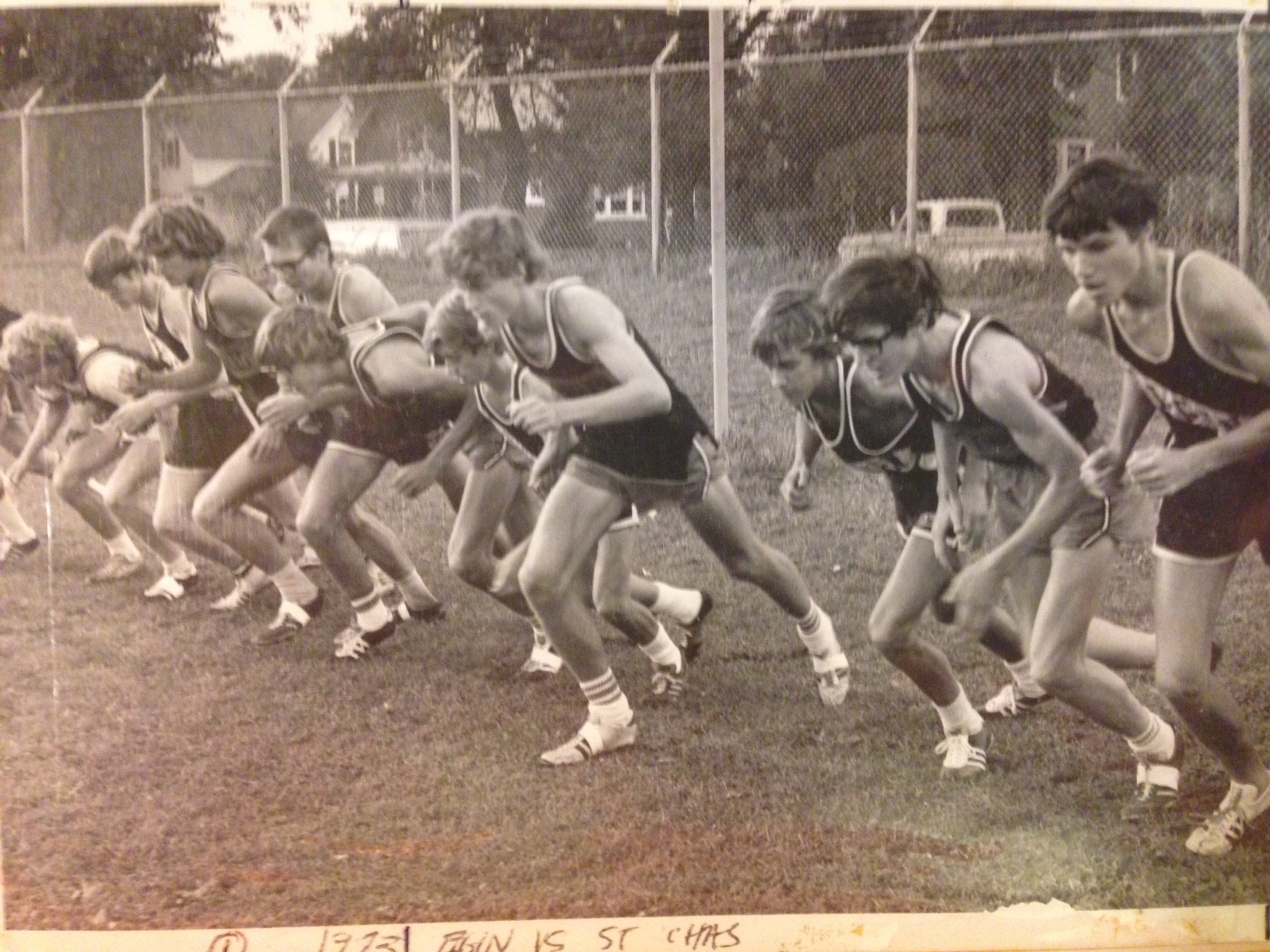
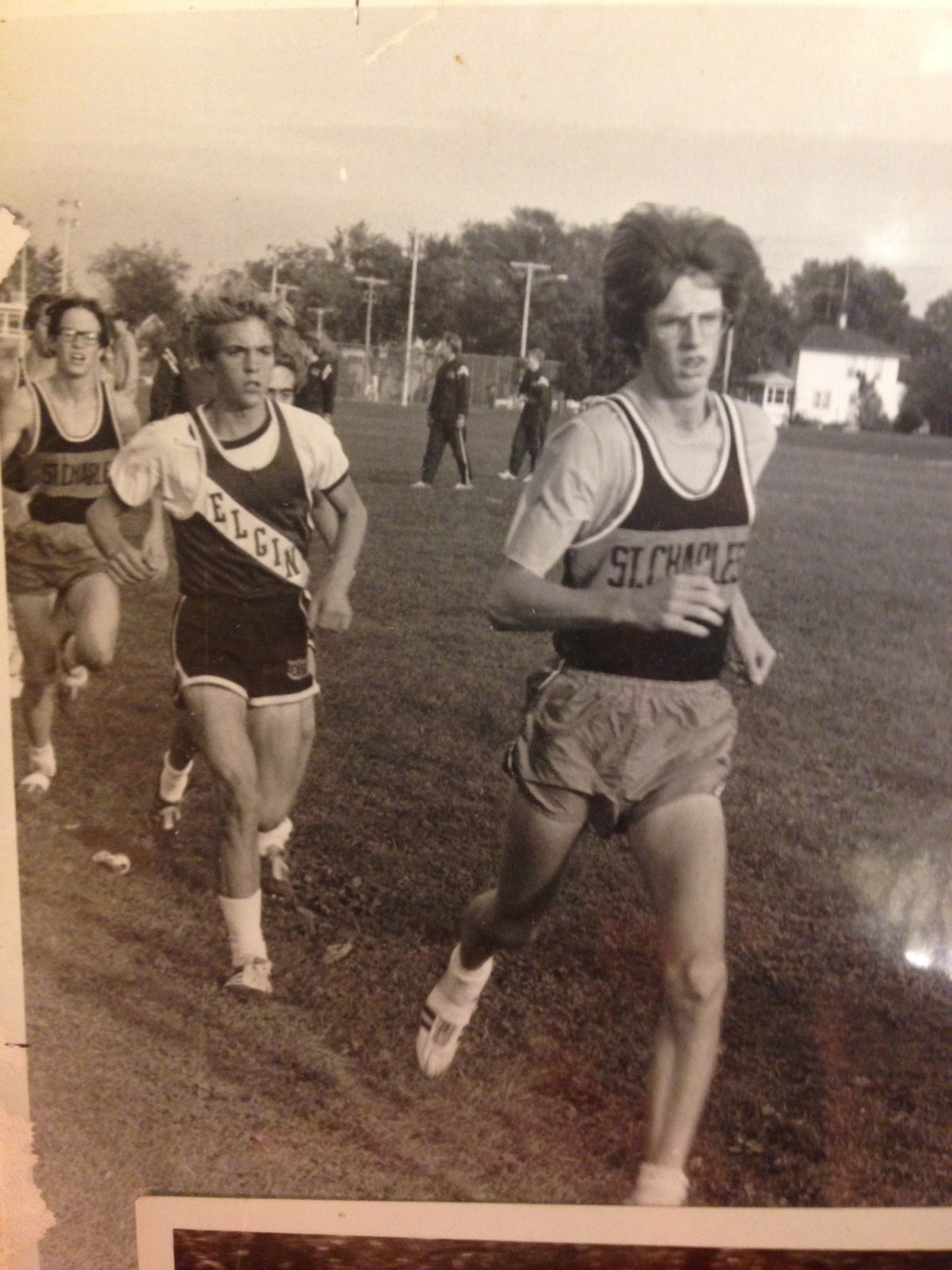
At the start of a race between Elgin High school and St. Charles, runners (from right) Karl Ulrich, Marty Van Acker, John Shorey, Paul Morlock, Kevin Webster, unidentified, Jack Brandli, unidentified, Rob Walker. St. Charles won the tightly contested dual meet in a score of 27-29. Click to enlarge.

High school yearbooks and sports programs were all printed in black and white. It’s like the whole world was black and white. No color.

Yet there’s a beauty to that era. Black and white photography has a frankness thanks to its reduction of distracting colors. You can better study form, shadow and structure.

Sports photos in black and white take us all back in time. Which is why, one summer afternoon doing a run workout on the campus where I attended high school, it was strange to find an old sports program jammed at the base of a chain link fence. I was walking around between mile intervals and noticed the somewhat frayed looking cover sticking out of some unmowed grass right next to the fence. The booklet looked a little familiar so I bent over and picked it up. Indeed it was an old football program from the year 1973. My junior year in high school.

It was 1983 when I bent over to pick up that program. The external pages were haggard and crusted from all the moisture and snow that had enveloped them over the years. Yet as I carefully opened the exterior pages the interior pages seemed relatively unharmed. Then I flipped to the middle of the program and there it was: A black and white photograph of my cross country team from 1973.

photo 3 (1)

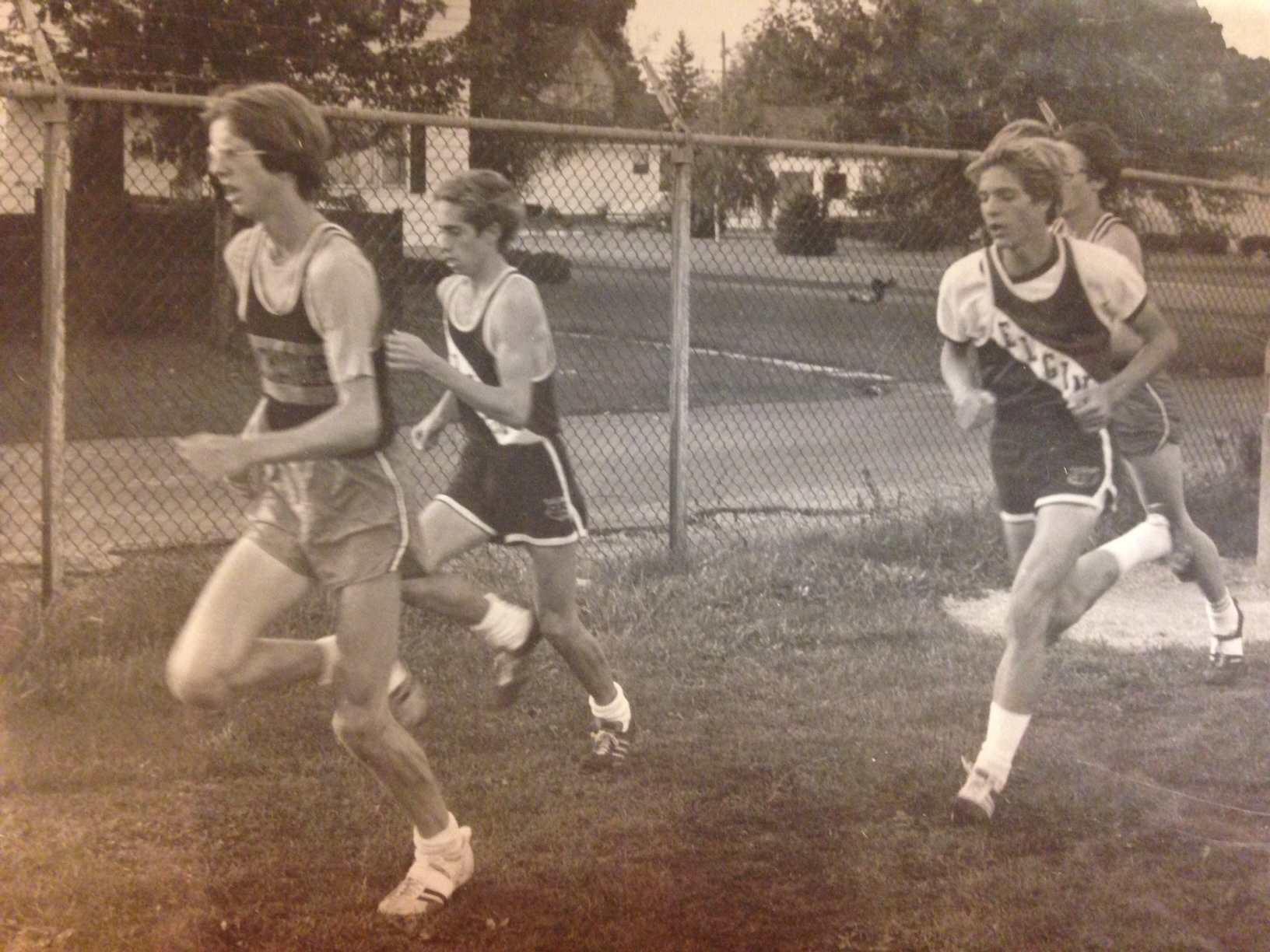
Runner Chris Cudworth of St. Charles leads Elgin’s John Shorey, Ken Englert and Marty Van Acker. Englert won, Cudworth finished second, Van Acker third and Shorey fourth.

I stood there stunned, looking around in fact to see if there was some sort of practical joke being played on me. How else could a 10-year-old program survive ten long Illinois winters and still be intact?

But no, the spot in the grass where the program was embedded had no growth beneath it. This program was a genuine relic, a survivor from the time when at 17 years old I ran with a group of guys that did great things together.

We went 9-1 in the regular season dual meets, won the Kane County Championship, the District Meet and lost to a powerful Dekalb team in the conference meet. In fact the season was so interesting and profound that years later some competitors from a team at Elgin High School called me up with an invitation to get together again. One of their runners told me: “We could run together, maybe even hold a meet. Our rivalry was so good it would be fun to revisit.”

photo 4

Chris Cudworth leads in the first mile of a three mile cross country race between Elgin High School and St. Charles in 1973.

To me that was a pretty profound testimony that some special things had happened in that era. The chemistry of the team was amazing. Everyone was “all in,” even the cross country cheerleaders knew they were part of something special. The football team was 1-9 that year, and we were 9-1.

1973 was the year after Frank Shorter won Olympic Gold in the marathon and running was starting up its populist history along with the era of miling greats like Jim Ryun and Marty Liquori. And St. Charles was earning a worldwide claim to fame of sorts with the achievements of Rick Wolhuter, a St. Charles and Notre Dame University grad who would go on to set a world record in the 800 meters and earn an Olympic bronze medal. But that had yet to happen.

Our team in 1973 was the first year that St. Charles has done much in cross country. I had moved to St. Charles from nearby Kaneland High School where I was top runner along with a class guy named Bill Creamean. Then when I moved to St. Charles a new friend and former football player Paul Morlock switched from quarterback prospect to cross country guy. Everyone on the team stepped it up from there, and in our little way, we helped build the foundation for a running program that continues to excel to this day.

But still, what were the odds of finding that team photo stuck against a fence after a decade outdoors? I certainly treasure that somewhat crinkled photo because it was never used in the yearbook. Someone made the decision that year to dispense with formalized photos and go with a layout emphasizing the active life of teens in our school. That meant no team picture in the yearbook.

So it was a prodigal photo of sorts. But it wasn’t the only time something like happened to me.

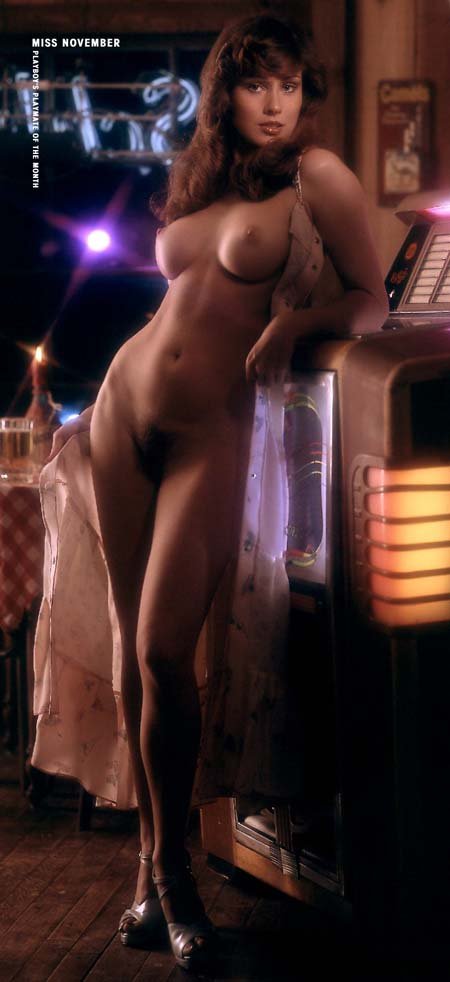
10 years later in 1993 while walking into the Pepperidge Farm store at a strip mall in Geneva, Illinois, I glanced down at my feet while stepping over one of those low-slung cement parking barriers that keep people from hopping their cars up over the sidewalk. Sticking out from one end of the slot beneath the barrier was the edge of a magazine I recognized. It was a Playboy magazine from November, 1976. The centerfold in that issue was none other than Miss November, Patti McGuire.

Patti McGuire

Patti McGuire was the featured Playmate in a Playboy mysteriously discovered beneath a parking barrier 17 years after the magazine’s publication.

I had once owned that issue, so I knew it well. But having thrown out my Playboys once I got married it was quaint to pick up that magazine and flip through the pages. The male memory retains such strange things. You instantly recall the photos your most liked in a Playboy. Even the articles, yes the articles, come rushing back to you.

So I stood there holding that Playboy in my hands as people walked past glancing at me a little nervously, I suspected. Who reads a Playboy in the parking lot of a hardware store?

Me, I guess. And the mystery of it could not be solved. I looked all around to see if there were other magazines strewn about. Had someone lost their collection somehow, dropping it on the way to the frame shop on the far side of the strip mall?

There were no other signs of how the magazine got there. Yet as I studied it and thought about how long the shopping center had been there, it seemed impossible that a Playboy magazine had survived through 17 Illinois winters in that parking lot. It was a little timeworn in appearance, yet here it was, with no explanation of how it got there, the imagination was left to roam.  And Patti McGuire was still there in all her airbrushed centerfold glory.

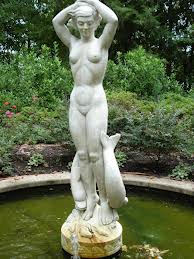
Whether some people want to admit the fact or not, being featured in a magazine such as Playboy is an accomplishment of sorts. Sure, you could argue that it is nothing more than exploitation of women, and of natural beauty. Or, you could argue the female form has been celebrated throughout history in art. Playboy and other forms of nude url-1photography is simply a technological extension, as it were, of previous art forms that had less capacity for detail. Of course we might now better appreciate the discretion shown by sculptors 2000 years ago who spared us the details in favor of the form.

One can hardly argue there is not a market for the stuff. Porn is a multibillion dollar online industry, driven manically further by the ability to capture and distribute digital images so readily. People even willingly submit photos and videos of themselves to porn sites. We’ve gone from an era when images were relatively rare and precious to produce to an era when selfies can be shared less than two seconds after they are taken. What does such rampant exposure to even basic images do to the human mind? That’s an experiment in progress.  If you want to see human evolution in progress, just look around you. Visit your favorite social media site. We’re either evolving or devolving.

For me, the long term survival of that program I found by the school and that Playboy are mysteries to this day. Perhaps the Playboy had just been dropped recently. But that certainly wasn’t the case with the 1973 program discovered in 1983.

To me finding that old photo was a bit of destiny. Things like that happen now and then is this world. Someone finds an old photo in a box and tracks down the people in the picture somehow and a bit of history is revealed. Those moments are kind of like living fossils, a testament to the near and present evolution of the human race in all its forms. And that’s a beautiful thing, if you think about it.

WeRunandRideLogo


Posted in Christopher Cudworth, We Run and Ride Every Day | Tagged , , , , , , , , , , , , , , , , , | 2 Comments

Together we run, together we thrive

By Christopher Cudworth

VeronicaMaura

Veronica McLaughlin and Maura Hirschauer. New running buds!

Veronica McLaughlin and Maura Hirschauer had just returned from their first workout together and were hanging at the local Panera Bread enjoying some coffee when We Run and Ride asked if they’d like to talk about their workout partnership. They both laughed and looked at each other. “This is the first time we’ve been out together!”

They have been neighbors for a while, yet both are relative newcomers to the town where they live. Each has young children and thus appreciates the the time they are able to spend working out because it carries forward their own athletic histories. .

Maura mentions that she was a field hockey player in high school and college.

“Did you wear those skirts and everything?” Veronica asks her.

“Yes, we wore those classic kilts,” Maura smiles. “Now the girls still wear skirts but they’re more of an athletic cut.”

“Like skorts,” Veronica offers.

“I love skorts!” Maura agrees. “It’s like they do better with a woman’s thighs. The Spandex shorts underneath are great.”

Origins

Veronica comes from an athletic background as well. She relates her tomboy status as a kid growing up. “I have four brothers. In school I played basketball and volleyball. I would have played football if they let me.”

Given her strong desire for athletics and love for playing sports with the guys, it was likely inevitable that Veronica would tear her ACL one day. Still, the experience was traumatic. “I had the whole operation,” she relates. “They used the middle section of my patellar tendon. That’s my ACL now.”

Later came a back surgery that was even tougher to manage. “But I can’t not be active,” Veronica smiles, eyes flashing at the thought of not working out. “So I came back.”

She’s done triathlons and has now gotten her certification as a personal trainer.

Beginnings

Maura listens to this history with studied fascination. The earlier workout had been the first time the two had actually gotten together for a walk or a run. “We met each other first as moms and next door neighbors,” Maura relates. “So we’re still kind of getting to know each other.”

They both laugh. This is obviously a broader friendship in the making.

photo 3It’s been a steady road for Maura since college. She kept on running after her field hockey career was over. “But I don’t really consider myself a runner,” she says quietly. “I mean, not compared to other people. I just run 5 days a week. I’m not fast…but I did have a great running partner in college. We were the same pace and when we got out there we talked and talked.”

“But you are a runner,” Veronica smiles, overriding Maura’s genuine humility. “I know people who go out once a week and call themselves runners.”

Subcultures

The conversation takes a turn into the subject of sub-cultures within the greater athletic community. “I worry for some people,” Veronica says. “They get so caught up in something like CrossFit that they’re actually hurting themselves. They’re trying to measure up to some expectation within these subcultures that they’re competing with some crazy notion of intensity. My goal is to help people learn how to work out the proper way, be a teacher to them. That’s my background.”

“I also want to help people diversify. It’s hard when someone gets hurt in their sport and they’re miserable, depressed people. My job is to ask them, ‘What is your ultimate goal?’ So I see motivation and accountability as the job of a coach. I want to help people find a more complete picture of fitness.”

Later, in an email exchange in which We Run and Ride shared the iPhone pics with Veronica, she mentions her strong spiritual background. She discusses the significance of chance meetings and how they can provide renewed motivation to achieve goals.

Their really are so many signs in this world if you pay attention. But it all starts with getting out there where you can meet others and see the world in a new light.

That’s how we run together and thrive together. By paying attention to the signs.

WeRunandRideLogo


Posted in Christopher Cudworth, We Run and Ride Every Day | 1 Comment

Why Meb’s Boston victory as an American confuses so many people

By Christopher Cudworth

MebOpening the Chicago Tribune the morning after the Boston Marathon, I read a wonderful article by Philip Hersh, one of the leading sportswriters in America. Not only was the article beautiful, so was the photo inside. The shot of the lead group flying through the early stages is such a wonderful illustration of what the race is all about.

And there’s that word: race. It means several different things of course. The word “race” can be used to describe an event in which we compete and it can also be used to refer to an indentifiable group of human beings.

Therein lies the problem. The idea of “race” also describes the manner in which some so-called human beings choose to use skin color or cultural characteristics as the basis for discrimination.

Race 

We’re all quite familiar with the history of racial strife and discrimination in America. The massacre of Native Americans was racially motivated, as was forced bondage of African-born people brought to the continent by slave traders.

So the history of race discrimination in America is not a pretty picture. That is why the photo of racers flying down the streets of the Boston Marathon is all the more compelling. There have been Boston Marathon victors from many races of people over the years. Black. White. Asian. People from all over the world converge on the streets of Boston to run as fast as they can and prove themselves equal to the day, the task, and the humanity of a footrace.

Citizenship

Yet the temptation to question the American citizenship of Meb Keflezighi proved too strong for some commentators to resist. Meb move to America with his family when he was 12. He spent his entire adult life here and earned his citizenship. But for some people that’s apparently not good enough. In their heads, the idea of being a true American is to be born here.

Sure, that’s one of the primary qualifications to be President of the United States. Lord knows we’ve heard enough of those citizenship questions about President Barack Obama, who was borne of a multi-racial marriage in the state of Hawaii.

That is just too confusing a scenario for some people to take. Demands for Barack’s birth certificate were politically motivated, yet those pursuits also held an underlying racism that has barely been concealed at the public level. Behind the scenes and on the Internet, racists have not held their tongues. They call our President racially provocative names and hold the man in contempt. That’s how small-minded people always act. They endeavor to empower themselves in creating a sense of “the other” through some set of rules they create to support their own supposed logic about purity of soul or race.

Religion


It happens on all kinds of fronts. Just try arguing a theological point sometime with a group of people who view the bible literally and see what transpires. First there’s the adamant denial that you have any sort of right to question their interpretation of the bible. When you persist in arguing the symbolic logic of the bible and how Jesus himself used metaphor in his parables, biblical literalists will argue that you are “picking and choosing” what to believe in the bible. Finally, when you point out that the Christian faith has indeed evolved, having long ago dumped its support for things like slavery, their heads just about explode. Slavery is a tarsnake of sorts in the bible. It is mentioned with such frequency and is even advocated as a form of tolerable punishment in Genesis 44:10 and as a sign of obedience in Romans 6:16 to name just two of hundreds of references to slavery, both positive and negative, in the Bible.*

So the Bible is not entirely innocent if you do not apply some form of cultural filter to its context. As a global society we’ve grown in our understanding of human and racial equality. Currently we’re engaged in a massive cultural debate about sexual orientation.  Gay people are yet another category of human beings ostracized by a literal interpretation of the bible. Forget that Jesus never mentions the issue. If a clearly brilliant yet tortured soul like St. Paul can’t get his brain around a basic biological fact, then the rest of us aren’t allowed to do so? That’s a piece of cultural insanity that might possibly be the result of Paul’s own struggle with his sexual identity.

Here are the facts: We know from genetics that the human race is the same species. All the colors of skin and racial characteristics evidenced in the human race are simply adaptations to the many environments into which human beings have migrated. Being black or gay or transgender does not reduce the humanity of any individual. That should be the end-all in human philosophy.

Science

140421123349-13-boston-0421-horizontal-galleryAnd the genetic evidence points to the fact that we all likely descended from people who evolved in Africa. Those people moved out from the continent to other parts of the world, where genetics and environmental conditions went to work on the species, producing varieties of skin color and characteristics within the human race.  We find the same principles of evolutionary adaptation at work in birds, fish and other living creatures. It’s how the world works. Yet we recognize that a species such as Homo sapiens is defined by identifiable characteristic such as the ability to reproduce. And humans certainly know how to do that.

Diversity

Yet instead of celebrating this diversification and the enormously brilliant ability of evolution to enable the human race to thrive wherever it occurs, there are people who want to deny all this evolutionary history. They consistently use a literal interpretation of the bible to do just that.

Taken at a shallow, face-value level, the bible can be interpreted to suggest that all the races of the people in the world as well as animals, plants and living things right down to a microscopic level suddenly appeared in a 7-day period at the hand of God.

One must choose to forget the fact that there are giant holes in the Genesis story to believe such a thing. The moment when wives suddenly appear for Cain and Abel has never been sufficiently explained. Not without jumping through all kinds of inventive hoops.

The whole literal interpretation thing is nothing more than a massive denial of the fact that the bible was recorded from an oral history that mashed together creation stories from the Middle East into a tenable whole. While inspiring in its wisdom about the nature of human beings, the bible was never intended as a historical or scientific document.

Ideologies

Yet that latter contention is still being used to argue and contradict real science in American classrooms. And pathetically, the same form of literal interpretation has been used to create philosophies such as Manifest Destiny that led to the slaughter of Native Americans on grounds that the white race was divined to own America. The same sort of dull-headed view of Christians as a solely white and ostensibly superior race of human beings was used to justify slavery in America as well.

It’s a sickly disturbing worldview that is not easily debunked. The harder you try to argue with biblical literalists the more they entrench themselves in the “God Said It, And I Believe It” form of theology. They simply believe you can’t question anything in the bible or the whole thing falls apart.

And indeed that is true when you take the bible literally. That form of faith really is a house of cards. That’s why the cult inside the Christian religion that abides by the literalistic worldview is so determined to defend it at all costs. Deep inside their ideology they sense a tectonic fault in logic because the practical, everyday science used to produce modern medicine and science is so clear and demonstrable. But because it runs afoul of their simplistic worldview–the one thing that gives them a sense of control in this world–it must be resisted on supposedly holy grounds.

Boston Strong

But when you gaze at that picture of the leaders of the Boston Marathon, and consider the wonderful visage of humanity it represents, you realize the small-minded threat of anachronistic worldviews is not destined to win the day. All the communal support for Boston this year is evidence as well of the humanistic philosophy that drives so much good in this world. Despite claims to the contrary, people are capable of doing good, serving others and reaching out in mercy to those impacted by an evil act like the bombings of last year’s Boston Marathon.

The terrorists who set off bombs in Boston may not have been religiously motivated, but the terrorists who crashed planes into buildings on 9/11 were. It is important to remember there are Christian terrorists and Muslim terrorists and the nationalistic terrorists who started World War II and massacred millions of Jews. The unfortunate fact is that the dark specter of a fundamental form of religion lurks behind it all.

Commonality

Those of us who choose to find commonality in our evolutionary history embrace a competitor such as Meb Keflezighi as a fellow human being and American. Those who view him as an American carpetbagger and the member of an inferior race completely miss the significance of what he represents. That is, he symbolizes the best in human achievement.

Meb also struck a victory for the aging and the ages. Rising to the occasion for an American victory, and at the age of 38, proves that it is the human spirit that matters, not the color of one’s skin, the origin of one’s nationality or even how many years you’ve collected along the way. It’s more about who you are than what you are.

And to the point, whether some people care to admit it or not, we’re all Africans deep down. Bearing that knowledge, we can appreciate that every race we run is about human achievement as a whole, not whether one race or nation is superior to the other.

*“Very well, then,” he said, “let it be as you say. Whoever is found to have it will become my slave; the rest of you will be free from blame.”

Note: This piece is also an extremely good read from a reporter at CNN. 

WeRunandRideLogo

Posted in Christopher Cudworth, Tarsnakes, We Run and Ride Every Day | Tagged , , , , , , , , , , , , , , , , , , , , , , , , , , , , | 1 Comment

We Run and Ride interviewed for a Podcast at The Conscious Runner

By Christopher Cudworth

IMG_6318Last week We Run and Ride was contacted by another blogger/runner named Lisa Hamilton who produces podcast interviews on a wide range of subjects related to running. You can hear the interview here:

http://consciousrunner.com/cr019-fascinating-conversation-former-elite-runner-chris-cudworth/

Lisa is positive person and it was a great joy to talk with her. We discussed how each one of us starts out running from a different point in life. Then as we go through the realms of competition, in my case high school, college and post-collegiate running, we learn more about ourselves.

You’re invited to tune into the podcast and hear the interview. We discussed the challenges of training balance, dealing with injuries, appreciating your performance and relating running to life.

And remember, your story is important too! If you’re so inclined to be interviewed about your experience in running, cycling or swimming, I’d love to write about you! Send me a comment through this blog or contact me at cudworthfix@gmail.com. It might be about a race you’re training for, or a cause you love to support.

Or do you have a favorite training partner or friend that you’d like to tell the world about? It’s all good! We Run and Ride! And swim sometimes. And watch out for tarsnakes. 

You’re also encouraged to sign up for notifications from The Conscious Runner.

WeRunandRideLogo


Posted in Christopher Cudworth, Tarsnakes, We Run and Ride Every Day | Leave a comment

Lifting the lid on an important etiquette for those who run and ride

By Christopher Cudworth

Perfect Outhouse 2We Run and Ride is going to let you in on a beautiful little secret. But you must promise not to ruin what you are about to learn.

We know the location of the world’s most perfect outhouse. It is a wonderfully constructed piece of practical architecture, put together with a cheerful wood that seems to absorb sunlight. There is ample ventilation so that you don’t suffer from its purpose, yet even on the coldest, windiest day there is no draft on your hind parts.

This outhouse is perched in a park on Route 9 in Northeast Iowa, about midway between Prairie du Chien, Wisconsin and Decorah, Iowa. The park in which it sits is a nifty roadside pulloff so that you can stop, relax, do your business and move on.

I’ve driven that stretch of road perhaps 200 times in my life. Yet never had I discovered this great little outhouse until recently. Of course it is clean because it may not receive that much use in being so far off the beaten path. But there’s something more. People seem to respect the Perfect Outhouse and do not pee on its seat or leave half pooped up toilet paper flapping under the lid. That is called etiquette. Why ruin a good thing?

Standards of behavior

Ever should be the case in any public outhouse. We all know the abuse dished out at Porta-Potties and public outhouses wherever we go. Pun intended.

For some reason a certain segment of the population, let’s call them Men for lack of a better word, cannot seem to figure out how to go to the bathroom without making a splashy, crappy mess of things.

Visit any public restroom in the world and you’ll find pee on the seat of many of the toilets. That’s true in airports, restaurants or the line of Porta Potties at any major race. Let’s not even talk about restrooms at rock concerts. Please.

Apparently there is an entire population of men out there who simply don’t care if they have good aim or not. They whip it out and let it fly.

Reparations

Which means the next person who visits that stall has to deal with wiping down the seat or lining it with toilet paper. Heck, in airport restrooms the pissy problem is even institutionalized. There are plastic swoop-arounds that provide a clean seat for the next person no matter how badly the guy before has missed.

Not being a frequent denizen of women’s restrooms, We Run and Ride cannot speak on behalf of the condition of those facilities on average. But it’s more than likely there are women pigs out there too who find ways to junk things up for those who follow. Is there anything more disgusted and distracting than wet toilet paper on the floor? Not much.

But it’s men or anyone guilty of poor aim with the penis that are primarily responsible. It’s good that God generally gave guys only one of those things. Too many seem to have problems learning how to use the one they’ve got.

So this is a call to men who run and ride to pay attention to their pricks when going to the bathroom. There is no reason not to lift the lid when you go. Use the tip of your shoe if you don’t want to touch the seat. Concentrate, and aim. But first, lift the lid. Leave it up when you go. And put it back down when you finish. That way women don’t drop their tushies into the wrong position.

Forgetful and disrespectful

Hey, I’ve been guilty and forgetful like a million other guys. But I try. We should all try. Because when you get to a race or are out on a workout and have to go you should think of the dozens of other people who must follow in your pissy little wake.

The world is most definitely co-ed these days. Women actually have you outnumbered, guys. According to some reports, there are more women runners than men. Every event from a 5K a marathon and beyond has women participants. So gentlemen, stop being a heathen caveman with your crank. Quit pissing on the seat.

Strange experiments

If you happen to have some kind of strange disaster from the other end, do your best to clean it up. Some guys seem to be conducting strange experiments with their bowels once they reach the can. One wonders if they simply don’t listen to the signs of the body somehow. It’s as if going to the bathroom is some kind of shocking, surprising event in their lives. The results are tragic at best.

So let’s face it: public restrooms and outhouses and Porta Potties are a necessary but imperfect commodity. It’s up to us to render them usable. They can’t do it on their own.

Perfect OuthouseSurprises

Even when well-designed, an outhouse can shoot you a surprise. A woman companion on a camping trip once sat down to use an open latrine at a State Park and got a rude surprise when the liquid below splashed back up and hit her private parts. Her shriek could be heard throughout the camp. And who can blame her? That should not happen to anyone.

Even women have to pay attention to some simple rules. Don’t throw things down the toilet that can’t be flushed. Plan ahead with your period if possible. There are ways to handle that stuff that don’t cause other people, especially maintenance folks, problems of unnecessary magnitude.

In fact, why create unnecessary surprises for anyone? Try to abide by some etiquette in your outhouse visits. And if you happen to visit the world’s most Perfect Outhouse out there in Northeast Iowa, try to appreciate its charmingly refined nature.

But put the lid up when you go, and put it down when you leave. It’s that simple guys.

See you in line.

WeRunandRideLogo


Posted in Christopher Cudworth, We Run and Ride Every Day | Tagged , , , , , , , , , , , , , , , , , | Leave a comment