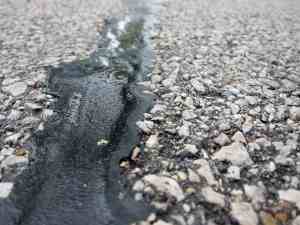
Beware the Englishman, the tarsnake of bonk and the wall

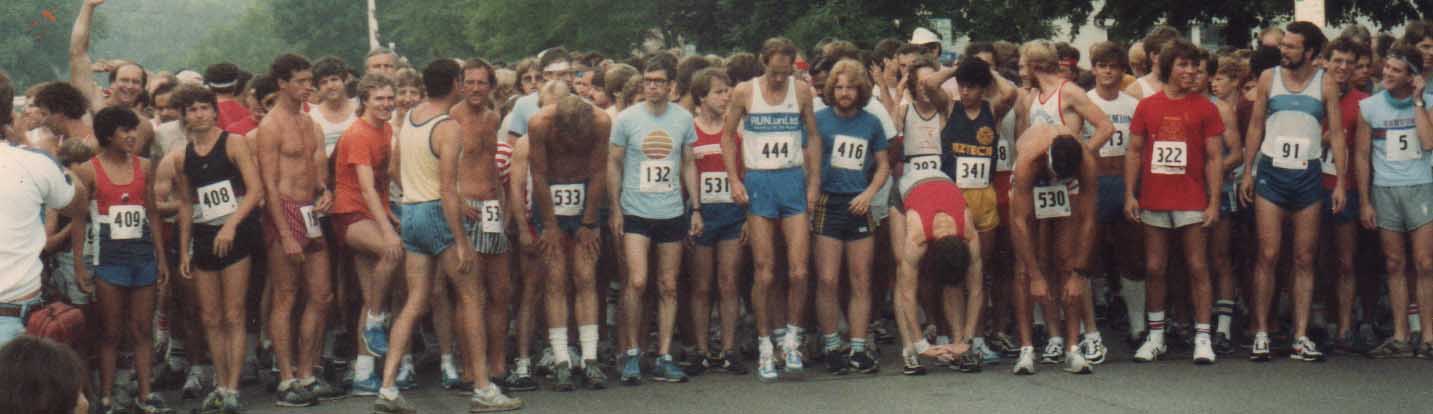
As competitive runners, my best friend and I were always pounding each other in training. Seldom did a run proceed at less than 6:00 pace. We learned that habit in an era when everyone ran fast all the time. Intensity was how you got better. A part of me still thinks it’s true.

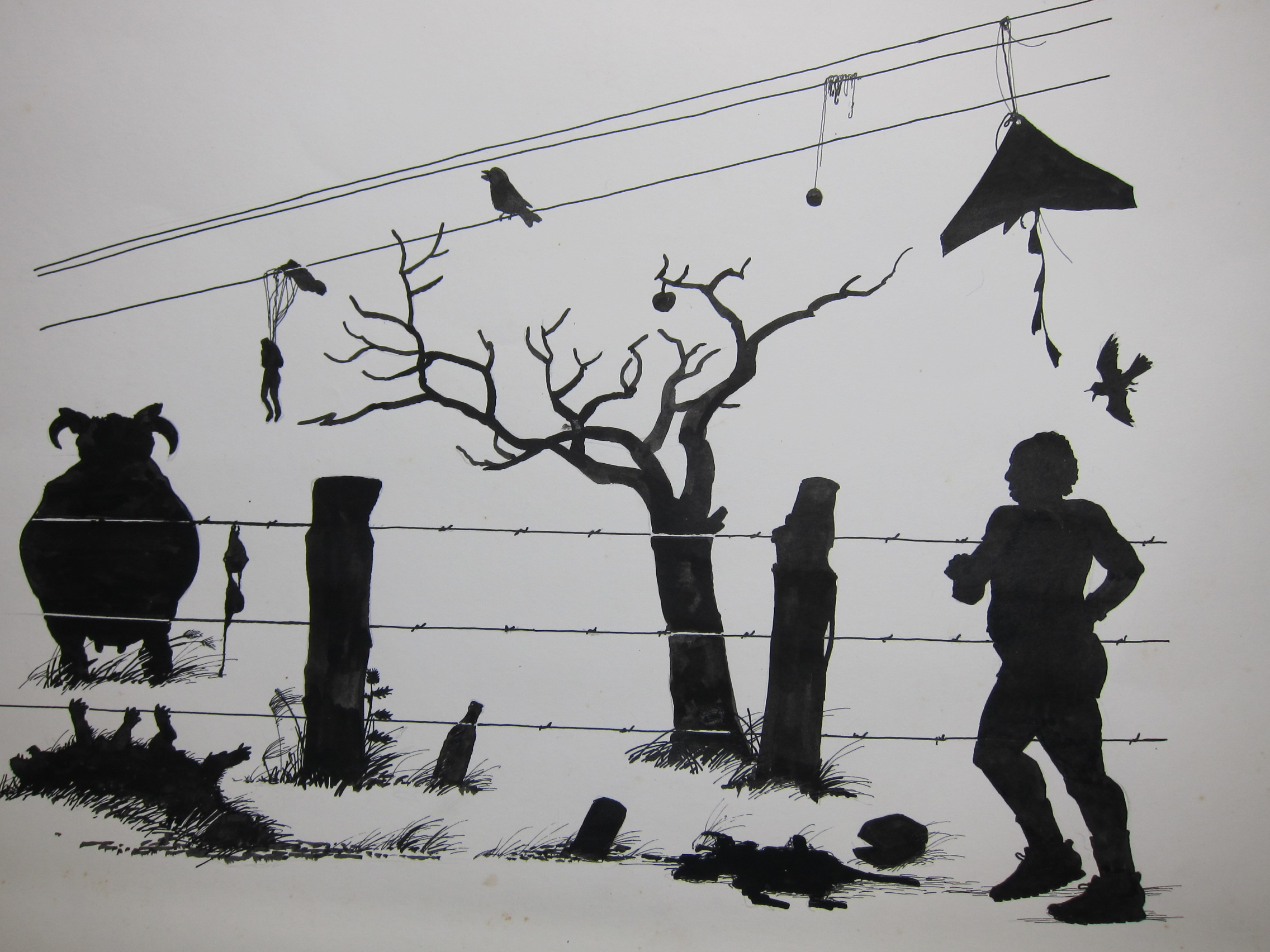
The tarsnake of running or riding too far is you suffer. The benefit is you learn. Sometimes you even meet an Englishman.

The tarsnake of running or riding too far is you suffer. The benefit is you learn. Sometimes you even meet an Englishman.

Yes, we’ve learned over the years through science and experimentation that running and riding too hard can lead to burnout, poor performance and injury.

But what’s the fun in not trying too hard sometimes. Crazy things can happen when you cross the line into training madness. You might even encounter an Englishman who will run or ride alongside you, talking amiably as you suffer. Englishmen are good at that sort of thing.

It happened that my best training partner met the Englishmen during a long, experimental training session that happened pretty much by chance.

We had an 8-mile run on our training schedule one muggy August afternoon, and took off running at 6:00 pace in our usual way. Finished the run in 48:12 and then he turned to me and said. “I’m not tired. Let’s get some bikes and go for a ride.”

This was long before he took up cycling seriously. Later in life he rode his bike with fury and fitness, competing in CAT 3 races and above. He also rode his bike back and forth to work 60 miles round trip each day. Got so fit that summer he accepted an invitation to ride the famous climbs of the Tour de France in France. Alpe de Huez. Mont Ventoux. He rode them all in the heat of summer, hanging onto the back wheel of a manic Frenchman named Erik (pronouned Air-rheeek). It was the thrill of a lifetime. And hard as hell.

But that summer neither of us was anything near to a serious cyclist. I buzzed home and got my Columbia 10-speed, black with a split seat. He pulled up on a dull yellow Schwinn Varsity. And we took off riding toward Sycamore, 17 miles away.

The first hour went fine. Then my friend heard a whirring coming from is bike and realized a brake pad had shifted and was about to come off. The rubber was corroded. The bike hadn’t been ridden in a while.

So he yanked off the brake pad but in the process something might have happened to the cable too, which meant the brake handle went slack and the cable itself dangled by the side of the bike. He yanked that off.

A few more miles down the road another brake cable broke. On the rare moments when we stopped he had to put his feet down. Neither of us had clipless pedals. We were just mashing along in tandem, chewing up as much road as we could.

It got hot. Neither of us had any water. We kept pedaling. The miles rolled away until suddenly another strange sound came from the chain of my friend’s bike and it ground to a halt. The rusty chain was stuck between the sprocket and the bike. We yanked it out and attempted to keep going, but something was wrong. He seemed to have only one gear, and a relatively low one at that.

We were 12 miles from home and he was pedaling like the old lady in the Wizard of Oz. Sweat streamed from his body and then stopped. He started to look a little pale, and the hills were really hard for him to ride.

5 miles from home he plain out bonked. His pedaling turned into a strange, weak sort of thing that offered little propulsion. He looked worried and distracted all at once. So I decided to ride circles around him to keep him focused and moving forward. And something in my brain decided to begin conversing in a thick English accent.

We often talked in accents between us, my friend and eye. Outrageous Inspector Clousseaux voices, and Asian and East Indian and Black and dumb White Guy accents. Whatever it took to make the other guy laugh. Just mid-20s fun.

But the Englishman had a purpose that day. He offered praise and encouragement for the effort. “Jolly right, good chap, keep pedaling,” he’d chirp. To which my friend would mutter some famished invective, not nearly strong enough to get me to stop.

It continued that way for 5 whole miles. The Mad Englishman riding circles around the damaged Schwinn Varsity and its haggard rider. But we got home and bought two whole giant jugs of Gatorade, which he drank in consecutive gulps and recovered.

He told me then he never wanted to hear that fucking Englishman again. But the cheery chap turns up once in a while on longer rides, when neither of us expect it. It can be him that takes the role of the Englishman, or me. But we know what it means, hearkening back to the day when we first tried a long ride, and overshot our experience.

Which was worth it. The Englishman has been good company ever since.


WeRunandRideLogo


Posted in Tarsnakes, We Run and Ride Every Day | Tagged , , , , , , , , , , , , , | Leave a comment

Grass and bamboo bikes are trippy

By Monte Wehrkamp

Know what I’d like?

Know what Chris, this site’s fearless leader, would like even more?

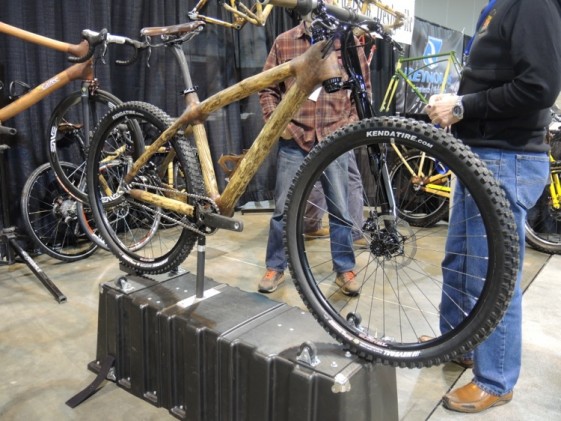
A renewable, recycleable bike. One that’s handmade, custom fit, and one of a kind. And here it is…

Image of Calfee Bike from Velo Magazine.

Image of Calfee Bike from Velo Magazine.

(courtesy Velo News)

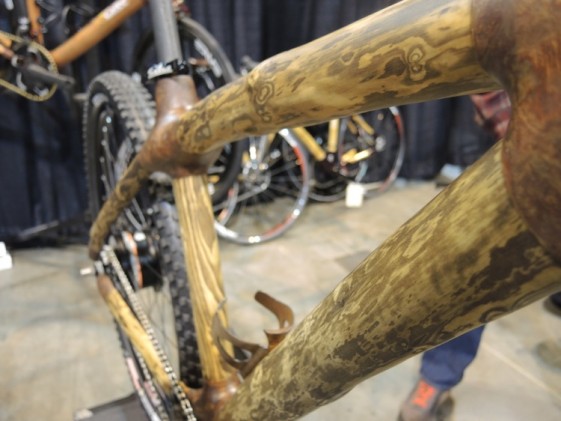
It’s a Calfee mountain bike made with bamboo tubing covered in epoxy-soaked bark cloth. Crazy cool.

Here’s a close-up…

If that’s not the coolest thing ever, I don’t know what is.

For more bikes au naturale, head on over to Calfee’s website and take a gander at their bamboo frame and bike collection.

http://www.calfeedesign.com/products/bamboo/

You’ll learn you can order your bamboo bike in either stock or custom geometries, and each frame takes over 40 hours to hand build.

The full on Calfee Bamboo bike.

The full on Calfee Bamboo bike.

While bamboo is really cool, the lugs are even better, as they’re made from hemp. Yep, good old Mary Jane – how dope is that? Even the resin that creates the hemp layups (think carbon) is made from plants.

Calfee offers frames for tandems, road bikes, mountain bikes, crossers, tourers, tri/TT bikes and even offer a belt-driven, internally geared city bike. Pure awesome.

Okay, but what about cost? Sounds expensive, doesn’t it.

Well, not so bad, actually. A complete road bike with standard Ultegra will set you back $6058. Add about $2400 if you need the top-shelf Campy Super Record gruppo. SRAM Apex buildout comes in under five large. A fully-built Calfee mountain rig comes in under six large when fitted with Shimano MTB XT 10s. Frames alone start around $3,000 if you prefer to build up your bike yourself, or have your LBS do it for you.

Sure, $6000 will buy you a seriously good carbon bike — just under top pro spec. Most of us don’t really need a Pinarello, Cervelo, or Calnago pro bike anyway. And with a Calfee, I guarantee you’ll be one of the only riders in your club or riding group that has one — maybe the only bamboo bike owner in your entire community. And even if there is another Calfee rider near you, since each bike is made from natural materials, no two are exactly alike. Each is unique, just like its rider/owner.

So how does it ride? Calfee claims bamboo delivers a natural vibration damping quality — and is far more crash damage resistant than their carbon bikes.

The British website Road.cc put a Calfee bamboo road bike through its paces and says the workmanship is “gorgeous” and that at 20 lbs, it’s a little heavier than what most carbon bike riders have grown accustomed to. However, the extra weight is a small price to pay because the road feel “smoothes over rough road surfaces beautifully and stops unavoidable potholes from jangling your teeth loose.”

What Chris and I would really like is to see one of these bamboo bikes up close and personal — maybe even ride it in circles in the parking lot a minute or two. So if you live in the Chicago area and have one’a these beauties, please drop us a note.

And if you’re not, and you own a bamboo or wood bike, or have ridden one, please tell us all about it. We’ll try not to be too jealous.

(Full Disclosure: I have not been contacted by, had conversations with, or am being compensated in any way by Calfee for this article. If they’d like to send us a bike to test — 58 cm road version, please — that’d be fantastic. Though I’m not gonna hold my breath. I just think Calfee’s bamboo bikes are unique, interesting and thought WRAR readers might find them fascinating, too.)

WeRunandRideLogo

Posted in Mechanical Genius, We Run and Ride Every Day | Tagged , , , , , , , , , , , , , , , , , , , , , , , , , | 1 Comment

Cycling is no cheap sport. For sure.

As a runner I used to think I spent a lot on my sport. 3-6 pairs of running shoes a year cost a couple few hundred dollars or so.

But then I became a cyclist, and turned my pockets inside out.

The Rockhopper still serves me well.

The Rockhopper still serves me well.

The first “real” bike I bought was a Specialized Rockhopper. Not an expensive bike by any means. But at least it was something more than a retail store junker.

Even the Rockhopper required some mountain bikes shoes. There goes $70. Same as a pair of modestly priced runnings shoes.

Then came cycling shorts ($75) a jersey or two ($120), socks, lube and decent helmet ($80).

That added up to three or four hundred bucks. But that was nothing compared to getting started in road cycling.

The first road bike was a red steel frame Trek 400. Got it free from my brother-in-law. So I got off cheap on the starter bike. Still, it needed a new saddle ($100) SPD clips to sync with my mountain biking shoes (okay, I was a dork at first) and a few new road kit items like arm warmers ($75) base layers and other road cycling accoutrements. Then came extra tires, tubes, air pumps, new chain, chain cleaner, chain lube, new brake pads, replacement cables, replacement brake cables. The list went on and on. The old steel Trek was a skinny Money Pit.

Criterium racing on the Felt 4C

Full on commitment to Felt. A little geeky, but I like it.

Then I bought the Felt 4C for $1700. Retail was $2300. But what does retail really mean in the cycling world. Nothing costs anything except what you’re willing to pay for it. Still the cycling hobby is more expensive by far than any other sports I’ve done.

Beyond the Felt were Specialized carbon fiber soled cycling shoes ($250) new helmet ($105) complete new kit cause I joined a racing team ($250) club membership fees ($50) and racing fees (about $350 that first summer.) Then there were winter training jackets ($150…but discounted to $75 at Pearl Izumi outlet) balaclava ($30) winter riding gloves ($29.99) winter socks ($24) nylon luminescent green winter riding shell ($125, a Christmas present) riding tights/Specialized ($123) and several more kits including a Felt kit ordered online, made by Hincapie sports ($185.00).

That’s several thousand dollars of investment in the sport of cycling. Never thought I’d do that.

But it’s worth it. Comparatively, a set of decent golf clubs runs you $2000. Then there’s fees, if you play 15 times a summer at $80 a round with cart=$1200. Plus golf takes longer to play 18 holes than if you ride 55 miles in 3 hours or so. Golf hardly burns any calories and you might even gain weight if you eat hot dogs and drink beer for an hour on the 19th hole.

I’ve given up comparing cycling and running. I love ’em both, and accept that running shoes now cost $100 and shorts and tops cost $35 each. It’s ridiculous but one has to admit the equipment is genuinely better.

It’s a lifelong investment. If you amortize your cycling investment over the years it really does flatten out in the end, unlike the roads you ride, the hills you climb and the grief you take for shaving your legs, lubing your nuts and generally turning yourself inside out to get on a bike and suffer. Quite an investment you’re making in yourself, now isn’t.

The bike might not be cheap, but the thrills sure are.

WeRunandRideLogo

Posted in We Run and Ride Every Day | Tagged , , , , , , , , , , , , | 2 Comments

It really does matter where you buy your running and riding gear

By Christopher Cudworth

Buying new running or riding gear can be a messy process.

Buying new running or riding gear can be a messy process.

What follows is not so much an endorsement as a bit of documentation of a long-standing relationship. I purchased my first pair of shoes from a man named Dick Pond in 1976. At the time he was building his business and sold shoes out of his garage in Glen Ellyn, Illinois. Dick Pond was himself both an avid and quality runner, so he knew running better than the average Joe, and certainly had more shoes to offer than your typical local sporting goods stores. In 1976 running stores did not really exist, but Dick Pond helped create the concept.

Original thinking

The chain of stores now known as Dick Pond Athletics sells running shoes and wrestling shoes. I know, an odd combination in some ways. But not really. Where else are you going to order good wrestling shoes if not from a store that stocks the best? Runners and wrestlers also seem to have something in common. Both are individual sports with team competitions. And a wrestling coach in the John Irving novel Hotel New Hampshire was quoted, “You got to get obsessed and stay obsessed.” That fits both runners and wrestlers. Cyclists too. Obsession serves one well in the pursuit of achievement. Normally…

Time to buy new shoes

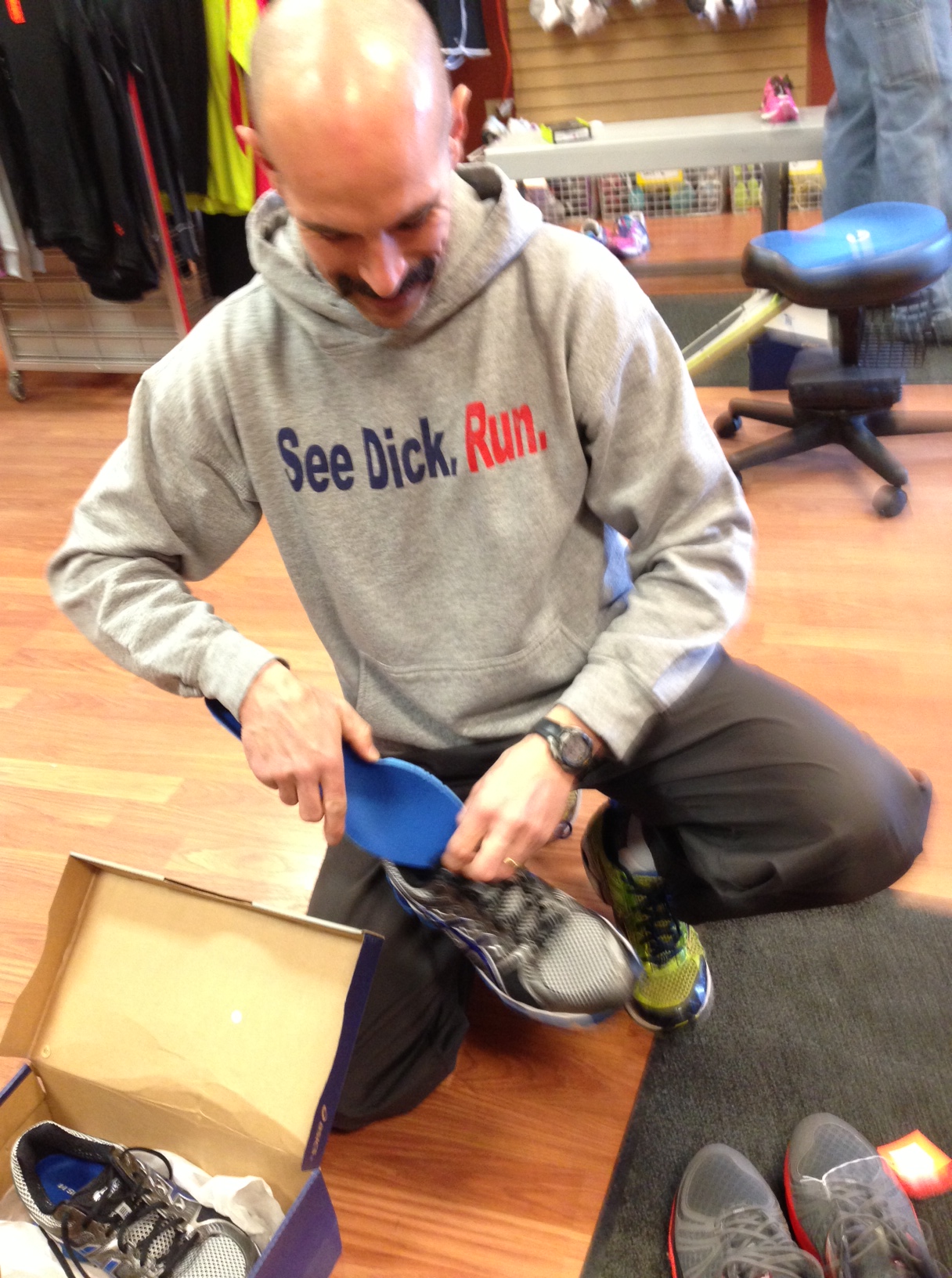
Dick Pond employee and top competitor Steven Nusser prepares a set of shoes for testing.

Dick Pond employee and top competitor Steven Nusser prepares a set of shoes for testing.

Like most runners, I always try to get a few more miles out of my shoes than I should. But when your hips and knees start to hurt, it’s time to wise up and spend some money on new shoes. Recently the question was posed to a LinkedIN group how often runners change shoes, and how many pairs they rotate. One rather obsessed fellow admitted he rotated 14 different pairs. Well, I have 14 pairs lying around the house in various sorts of worn out disrepair, but would not rotate any of those back into my running routine. Still, it made the point that we should probably all rotate at least two pairs of shoes, perhaps three for optimum health.

I always did that when running really high mileage weeks. It makes sense when you’re popping 80-100 mile weeks back to back and over months of time to rotate shoes daily. They need time to rebound, and so do your legs. Different types of shoes bring subtle changes in stride as well. Even if you alternate shoes within the same brand or even the same model, there are differences in their construction. Subtle perhaps, but still a reality.

Wising up

Caroline Cayton is in constant motion fitting customers in the St. Charles, Illinois Dick Pond Athletics store.

Caroline Cayton is in constant motion fitting customers in the St. Charles, Illinois Dick Pond Athletics store.

Runners have wised up to the fact that changing shoes every day and buying new pairs after 500-700 miles of wear is a good thing. But when you’re young and broke and hammering away through high school or college you do the best you can. That means you need to be smart about the shoes you buy, and a running shop like Dick Pond or one of the hundreds of other running specialty shops across the nation is an important resource even for expert runners.

Recognition of quality

Recently Dick Pond Athletics was named one of the 50 Best Running Stores in America by Competitor Magazine. The Dick Pond business card says America’s Oldest Running and Wrestling Shoe Store. But when I think of Dick Pond it is not only the originator of the chain, Dick Pond himself, but a man named Glen Kamps that symbolizes the Dick Pond legacy.

The Glen Kamps factor

Glen Kamps is the lead figure in the St. Charles, Illinois store. He leads group runs, staffs the mobile van and keeps customers happy a thousand ways.

Glen Kamps is the lead figure in the St. Charles, Illinois store. He leads group runs, staffs the mobile van and keeps customers happy a thousand ways.

I am pretty sure Glen Kamps is powered by a perennial motion machine of some sort. When you visit the store, he is absolutely never standing still. His clear voice conducts a constant chatter greeting customers and directing his employees to make sure everyone is being served. Glen Kamps is gracious and unprepossessing from head to toe. His commitment to running and runners is unparalleled.

For years he has staffed the Dick Pond mobile shoe truck appearing at local races, high school cross country and track meets. The truck has undergone an upgrade in recent years with sporty-looking graphics but the motivation is still the same: Bring shoes to the athletes.

The strategy has worked. Marketing the chain of Dick Pond shoe stores with a guerrilla approach has worked well over the 40 years the store has been in business. Credibility is key in the business of selling running shoes, and Dick Pond Athletics is all about credibility.

Running tests

Glen Kamps is in almost constant motion serving customers and getting to know everyone who comes through the store.

Glen Kamps is in almost constant motion serving customers and getting to know everyone who comes through the store.

The whirr of a treadmill is one of the sounds you’ll always hear inside the store. Runners throw on shoes and give them a run while Dick Pond employees eye their stride for possible recommendations on shoes. A pronator might get a little more arch support, for example, but most of all Dick Pond employees get to know their customers from head to toe and foot plant. You can see the wheels turning through the shoe inventory as each runner hits the treadmill.

Early vision

Back when Dick Pond was selling shoes out of his garage, the process was simpler but no less insightful. You showed up at the garage and walked among the tall stacks of shoes while Dick eyed you up and down, asking questions about your running and racing. He was an astute observer of character who knew the top personalities in the sport. A copy of a letter he had written to Phil Knight at Blue Ribbon Sports in 1972 talks about the early days of Nike, with references to Jeff Johnson and the urgency of getting shoes in wide size ranges and styles. It also says, “Thanks for the special Nike Spikes for Craig Virgin, our great young distance runner. I have not yet received an invoice for them and please understand that I fully expected to be billed for them.”

Craig Virgin was Illinois state cross country champion in 1972 with a still-record 13:51 for three miles. He would go on to set state and national records at 2 miles and become world cross country champion.

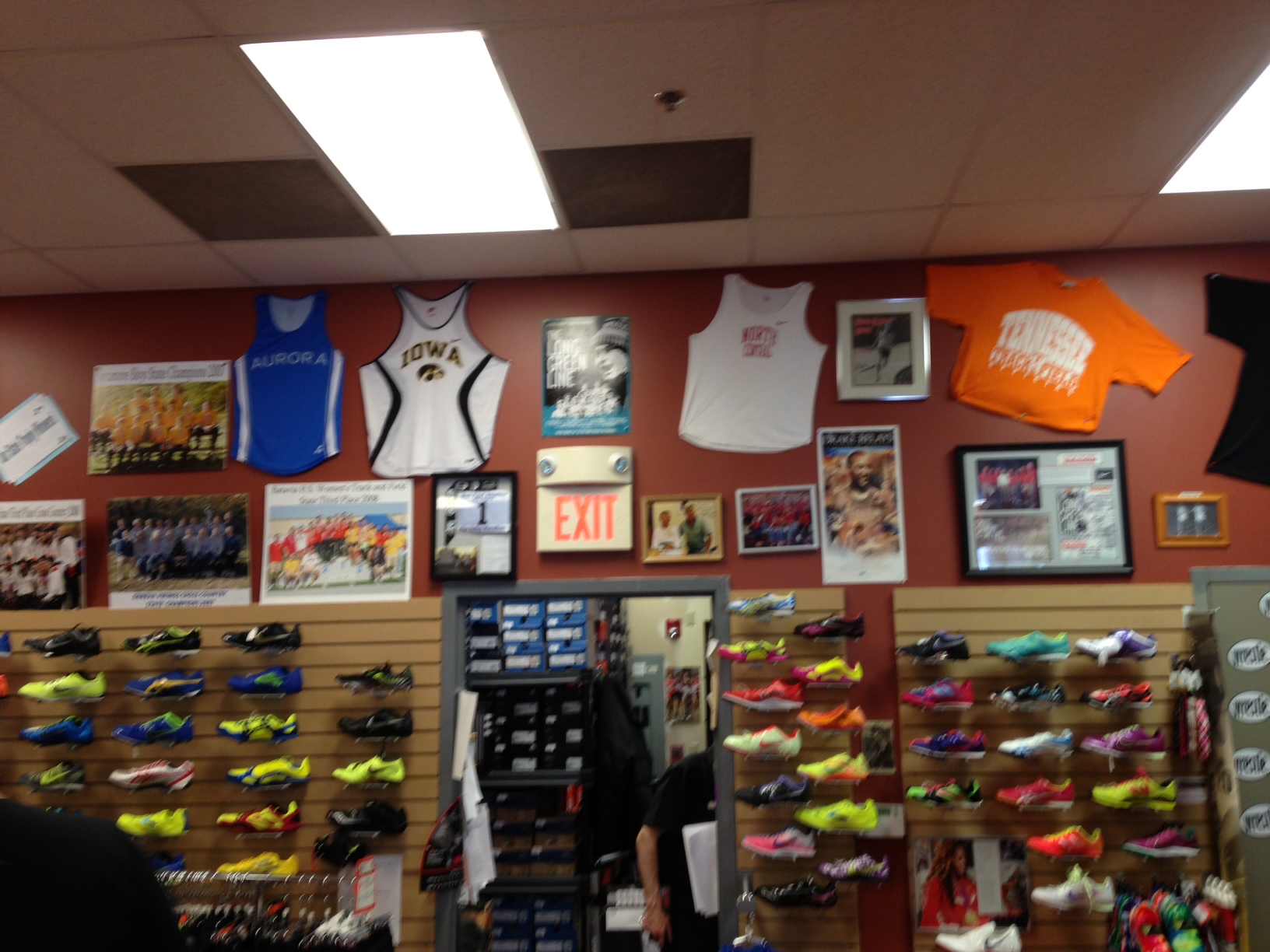
Yet Virgin is just one of hundreds of top quality distance runners to pass through the various doors of Dick Pond Athletics. They include state and national and world champions over the years. Some of their signed posters adorn the walls at Dick Pond.

The people’s running store

Some of the running gear signed by greats who have passed through the doors of Dick Pond Athletics.

Some of the running gear signed by greats who have passed through the doors of Dick Pond Athletics.

That is only the tip of the iceberg when it comes to who the chain really serves. Champion athletes are great, but runners from all types and backgrounds make up the bulk of business for the chain. Obviously the store is closely involved in support of races such as the highly successful Fox Valley Marathon, a relatively new race starting and finishing in St. Charles, Illinois. The race is popular for many reasons, but one is the option of choosing how far you actually want to go the very morning of the race! You can opt for a Half-Marathon, 20 miles or Marathon distance when you show up to run. Many of Dick Pond’s avid customers run and complete the race, which fits with the philosophy of teaching many runners how to succeed. The shop hosts running classes and pace groups, all in keeping with the modern philosophy of the sport. Everyone counts.

40 years and going strong

It really hasn’t changed in 40 years. Dick Pond himself would greet you at his garage if you called ahead. If you forgot to call, as a group of us once did on a late Sunday afternoon, Dick might turn out a little cranky. But you learned that was his prerogative, especially if he’d been relaxing with a few beers inside his home. I recall showing up eager to buy shoes only to get smacked down a bit by a taciturn Pond who groused, “You really need to call if you’re coming on a Sunday.”

But then he set about helping us find the shoes we needed. I can remember the pair I bought, a resplendent pair of NIKE LDVs with weird flared heels, yellow uppers and a simply NIKE swoosh on the side. Their were weird contraptions, those LDVs, built on the principle that wider was better.

Lineage

The pair of Nike Vomeros that I just bought owe some lineage to those shoes. They bear the same Waffle treads, a slight flare to the cushioned bottom and that classic NIKE swoosh. I even got married in NIKEs, and gave them to the groomsman as well. But those shoes I bought from the Running Unlimited store (then in Arlington Heights, now in Palatine) where I worked at the time.

The retail reality

You learn a few things about runners and cyclists by working at a real retail store like that. The quirks and buying habits of people are endless. Then you realize you are just as quirky in your own tastes and habits. It is the job of every successful retail running and cycling store to field those quirks and funnel them into the right gear and shoes like a shoehorn slipping a foot into a shoe. Some things about running and riding never change. And that’s a good thing.

Tomorrow: How buying cycling gear differs from buying running gear. 

WeRunandRideLogo

Posted in We Run and Ride Every Day | Tagged , , , , , , , , , , , , , , , , , , , , , , , , , , , , , , | 1 Comment

Saturday Artwork: 1972 drawing of Pre from pic in Sports Illustrated

In 1972 Sports Illustrated devoted a few pages to cross country running as well as an article on running form. Both affirmed a running worldview that continues to this day, about the qualities of running, and the art of it.

In 1972 Sports Illustrated devoted a few pages to cross country running as well as an article on running form. Both affirmed a running worldview that continues to this day, about the qualities of running, and the art of it. This oil pastel was drawn when I was 15 years old. Pre was a hero to me like so many other runners. The original photo also shows Kenny Moore trailing Pre. Moore would later become a Sports Illustrated writer and one of the leading running writers in the world. His book Best Efforts is one of the best running reads ever, and a model for my own writing. 

Posted in Uncategorized | Tagged , , , , , , , , , , | Leave a comment

How far would you go to protect your running and riding career?

The tarsnake of protecting yourself from danger is that judging proper actions in the heat of the moment is sometimes difficult.

The tarsnake of protecting yourself from danger is that judging proper actions in the heat of the moment is sometimes difficult.

By Christopher Cudworth

In yesterday’s blog about unintentional cross-training, I documented the benefits of cross training with a paper route in my early years as a competitive distance runner. The early mornings, the extra exercise, the discipline of daily commitment all helped develop a work ethic that lasts till this day.

But I did not reveal the actual dangers of doing that paper route, and what transpired in my efforts to protect myself from those dangers.

Dog days

As you might imagine, the sight of a stranger walking up to the house each morning to open the door and shove something inside was not a welcome visit from the perspective of the dogs who lived in the homes where I delivered newspapers.

Trigger unhappy

One house required me to enter the screened in front porch to place the newspaper against the inside door, which happened to have a flap in it so that the household dog, a German Shepard named Trigger, could always get out for some fresh air and bark at the world if he wanted to do so.

Trigger was smart enough to know it was me each morning delivering the newspaper. But he was not so smart that he knew enough to lie in wait for the moment when I’d entered the front porch with newspaper in hand. He’d have easily gotten me with that tactic. Who knows what might have happened then?

As it st00d, it was frightening enough to quietly grip that door handle and prepare to open the aluminum front porch door, which squeaked, then take a quick step inside to whip the newspaper around the door and pull it back shut before Trigger came bawling through the doggie door with teeth bared, barking like he wanted to rip out my soul with his dangerous doggie teeth. You could hear his toenails coming at you / on the linoleum floor in sort of a doggie Doppler effect, so you know how close he was coming and how quick you needed to act before he got out the door and made you pay for entering his domain.

He never got me, that Trigger. There were mornings when it was close, when his paws would scratch wildly against the aluminum pane at the bottom of the porch door, sending a shiver like fingers on a blackboard on steroids.

There were other dogs as well. Big, bellowing hounds. Stupid yappie dachsunds and these two mutts with no voice. They would bark and bark and nothing would come out. They’d stand like ghost dogs in the yard, making like this  “—-” “—-  ——“. Nothing. No barks. Weird.

The evil dog

Then there was the evil black and blind dog that lived just a block from my house. It was the last home on my paper route and most days it was a simple ride up the driveway where I’d circle on the basketball court and toss the newspaper against the door before riding home.

But one day as I was circling the drive a menacing black shaped came charging around the house and ran straight at my bike. He gripped my ankle in his jaws and shook. I tugged with fearful rage and clambered back onto the bike, having nearly fallen off from the attack. The dog stood there growling in the driveway, looking off into the distance in the way that old, angry dogs do when they are half afraid and half wild out of their minds over the thought of an intruder on their property.

Repeat business

The next day it happened again. And the next. I tried dumping my bike at the end of the drive and running up to throw the paper because it afforded me more agility. I was always quick on my feet, trained as a basketball and soccer player who loved ballistic sports. But this was different. The minute you rounded the house the dog had an incredible advantage and was smart enough to cut you off even though it was clear he could not see for shit.

The third day I tried the running technique the dog happened to be right beside the house where the door was ajar. It was obvious someone let him out to do his business every morning and never paid attention to the ugly encounters the dog was fond of initiating. That morning the dog got hold of my ankle and bit down hard.

Red in tooth and claw

It was late September, peak training season for cross country and I was having the season of my life, leading the team in points and ultimately to a conference championship. But at the moment that dog gripped my ankle the entire season and all that training flashed before my eyes. I shook my leg but the dog would not let go.  I could feel his teeth through my jeans, chomping on the ankle bone. I raged and yelled at the dog, and even yelled at the owners in the house to come get their animal. But no one listened, and the dog only let go when I pulled myself far enough down the driveway that some strange instinct kicked in and he unhitched himself from my leg.

The antidote

I described this scene to my father over breakfast. “Dad, he’s been biting me every day for the last week. I’m afraid he’s going to take me out of cross country.”

My father stood up and walked out of the room, returning with a can of starting ether he often used to kick our old Buick Wildcat (’67) into gear on cold mornings. “Here,” he instructed me. “Give him a shot of this if he comes after you tomorrow.”

I trusted my father. He grew up on a farm with lots of animals. I once saw him take down a bothersome groundhog that had dug a burrow under the outbuilding at our New York home. He had us all join him in the upstairs attic while we waited for the groundhog to emerge. Finally the creature crawled out from his dirt burrow and my dad wasted no time in pulling the trigger. “Crack!” went the rifle. Down went the groundhog. “Wow!” we exclaimed. “You’re a good shot!”

He was. He’d nailed the critter from at least 35 yards away. Perhaps 50. My little brain did not know distances that well.

Armed and ready

So the next morning I carried the spray can of starting ether with me on the paper route. Approaching the last house with the mad blind dog a surge of nervous energy took over my consciousness. I grasped the paper in one hand and the spray can in the other and started running up the drive. As fate would have it, the dog circled round behind me and I could not stop. I was trapped on a driveway with fencing all the way around. The dog growled and charged, grabbing my right ankle in his jaws. The animal could obviously see well enough to aim his bite, and this one hurt. All the other times he had gnawed on me did not hurt like this.

But this time I was armed with the spray ether. I bent down and gave him a short shot of the acrid stuff. The smell reminded me of getting my tonsils out when I was 5 years old. The hospital put that ether mask over my head and I was out like a light. But the feel of that ether in your nose never quite leaves you, and firing it into the fresh fall air was a profound shot of unreality. The dog shook, sputtered a little and then clamped own even harder on my ankle, getting the bones between his teeth where he could do some real damage.

Closing the deal 

That sent a real shock of fear through me. I bent closer and aimed the either straight up his nose and pushed the button with all my might. A straight show bounced off his nose and a foam started forming where it hit. The dog gave four sharp shakes and let go, trotting back to the house sneezing and huffing.

“Take that!” I said in a whimpering voice. I was scared and angry all at once.

It was only 150 yards back home from the dog’s house and I rode my Huffy 3-speed in a low gear uphill, pressing down hard on each stroke to make it home. My arms were shaking and my ankle hurt. In two days there was an important meet to run and I was genuinely worried that my ankle would hurt so bad it would be impossible to compete. I felt justified protecting myself from that dog.

Business as usual

I parked the bike and got ready for school. Neither my father or mother remembered to ask me about the dog that morning, or whether the spray ether had worked.

Protecting those skinny legs required some extreme measures.

Protecting those skinny legs required some extreme measures.

At cross country practice I limped the first mile or two and the coach asked me what was up. I told him I’d hit my ankle on the bike chain that morning and he responded, “Be careful. You know who we race tomorrow!”

That night I ate alone because my parents were off with my brothers at school events. The next morning I got up as usual at 5:30 to do the paper route and carried the spray ether with me again just in case the dog would attack.

Scene of the crime

Riding the 3 miles of the paper route felt weird. Everything was so quiet. Even Trigger barely came to the door that morning. I was both relieved and in shock at that. There was only a few more houses to go…

Pulling into that last driveway I noticed that the yard seemed extra quiet. I stepped off the Huffy bike and set it down quietly on the grass. At first I was prepared to run up the driveway but something in me wanted to walk slowly instead. I put the paper down by the door and the dog was nowhere to be seen or heard. No growling. No charge. I glanced around the yard, and to my horror saw a black shape (like a tarsnake on the highway) slumped by the woodpile beyond the fence. The dog was dead.

Running away from blame

In a panic, I glanced at the house but no one came out to chide or scold me. Not knowing what else to do, and not wanting to create more trouble or honestly take the blame for the death of the dog, I simply got back on the Huffy and rode back home.

Nothing was said at Smitty’s Bar-B-Que the next morning when I rode down to pick up the papers for delivery. Smitty shoved my regular perk, a chocolate covered donut and a Cherry Coke in front of me and I downed them quickly before riding out into the chill October air.

Sounds of silence

In fact nothing was ever said by anyone about the death of the dog. My father never asked. I guess he assumed the ether had chased the dog away. That was good enough for me. The people who owned the dog never said a word either. Perhaps they did not know how he died. Just found him by the woodshed and disposed of the body somehow. No doubt someone like Cesar Millan the Dog Whisperer could have helped the poor animal work out its fears and issues, but mostly he would have likely chided its owners for their neglect.

I was a dog murderer, I knew. It dragged on my conscience for a while, but not really. I won the big meet, my first outright individual victory for the team all year. Our top guy had hurt something in his back that took him out of action for a week and I realized it was my time to step up and lead.

Dog justice

To this day I do not regret my defense against the dog. Perhaps I even did him a favor since the owners did not seem to care about him. The ether had sent him to doggie heaven, or doggie hell, wherever mean dogs go. But they can’t be blamed entirely for their actions. If their god is a dog, perhaps there is different breed of dog justice in their god. As a dog owner now I realize how important it is for the owners to be responsible for the actions of their pet. Their lives are literally held in your hands.

As for me, I learned that some things actually are better left unsaid. Especially when there are miles to go. You do what you have to do sometimes, to keep running and riding through life.


WeRunandRideLogo


Posted in Tarsnakes, We Run and Ride Every Day | Tagged , , , , , , , , , , , , , , , , , , , , , , , | Leave a comment

Unintentional cross training sometimes the best

As freshman in high school I entered the sport of cross country and found a true love. Nothing was better than running as fast as one could go in the woods and fields. Training was hard. Sometimes my skinny legs were so tired it hurt to walk around the house after practice. Yet something about the severity appealed deeply to me.

As a goal-oriented kid, I even mapped out the stops on the paper route in oil pastel, painting over them if the route changed. The map was color coded to residential, industrial and downtown sections.

As a goal-oriented kid, I even mapped out the stops on the paper route in oil pastel, painting over them if the route changed. The map was color coded to residential, industrial and downtown sections.

At the same time high school began, I was a paperboy in the small town of Elburn, Il. The paper route required delivery before 6:30 a.m. to between 30-35 houses each morning. I would rise at 5:30 a.m., climb on a Huffy 3-Speed bike (with hand brakes, yeah baby!) and pedal to pick up the papers for delivery from Smith’s Bar-B-Que, a restaurant that catered to the many farmers who lived and worked around the agricultural community.

Before dawn the atmosphere inside Smitty’s (as it was called) was dark and mysterious. Clumps of farmers sat at small tables throughout the restaurant. Though not a shy kid, I never talked to many of those men. They were busy eating and occupied themselves in that grumbling low talk men use when starting the business of a working day.

I’d sit on one of the 8 spinning stools and belly up to the linoleum counter. Smitty would shove a free chocolate-covered donut and a Cherry Coke under my nose. We didn’t have to talk, and this was my perk for doing a good job on the paper route. He liked how I delivered the papers on time and we seldom heard any complaints. At least none that I ever heard about.

35 newspapers can be a lot of weight when you have only 125lbs on a 6’0″ tall frame. Like so many high school runners, my body fat was probably in the negative integer category. But I was wirey strong, and would shoulder that low-slung bag filled with Chicago Tribunes, the Sun-Times, Chicago Daily News and one or two other newspapers as I recall. Only the Tribune and Sun-Times remain in operation, and both have been through bankruptcy in the last decade or so.

At the time, however, newspapers were king of all media, and even at that young age I was proud of being part of the chain. A small part, admittedly, and naive to the political slant of newspapers, which I viewed as the final word on just about every subject.

Later in life I would spend 15 great years working for two different newspapers, the Kane County Chronicle and the Daily Herald, 3rd largest newspaper in Illinois, where I worked first in editorial and then in marketing.

But my job as a 14-year kid was simple and straightforward: Get the newspaper delivered to the right homes, and on time.

I relished the daily challenge, and in all sorts of weather. Some mornings it was a slow pedal down to Smitty’s, weaving my way through deep snow with narrow tires. Those were heavy cross-training efforts. The total paper route was just over 3 miles, contained some hills and was generally a gentle aerobic effort under any conditions.

That meant the paper route was really a form of cross training.

It was also a form of discipline. Getting up early every day when you’re 14 years old takes a certain amount of dedication. The $8.50 I earned per week (in 1970s dollars) was some motivation. The only other source of income at that age were the sale of a few of my paintings to friends and family, and allowance. And I couldn’t always count on that, especially when my grades wavered or the family budget was tight.

So doing that paper route was a matter of taking some control over my own life, of having some shred of independence, however meager it might be. I recall taking a girl out on a date my sophomore year, calculating that it would take me four weeks of paper route money just to buy her dinner. Such is young love.

Yet the thing that sticks with me about that paper route is the knowledge that it did serve an important physical function as well as having social benefits, like a few bucks in my pocket. Those early morning rides carrying perhaps 10 lbs. of newspapers (double that on Thursdays and Holidays) slung over my shoulder held important benefit for young legs still figuring out what it meant to train and compete. There was also a certain form of goal-setting that it helped me learn. How to plan my time accordingly, and meet expectations. All those facets contribute to the ultimate success of an athlete, especially one engaged in endurance sports. Throw in a little suffering on those -17 degree mornings, riding through rain and sleet and snow, and fighting off dogs at every 3rd stop, and you have all the makings of a Rocky-style upbringing. Only I wrought it on myself. Willingly.

One of many old newspapers clippings that feel like gold in some respects. That's the author 2nd in line in the back row.

One of many old newspapers clippings that feel like gold in some respects. That’s the author 2nd in line in the back row.

As a freshman I ran varsity for the big meets, and our team won the conference meet. As a sophomore I led the team in points earned and we won the varsity conference.

Then we moved 10 miles east to the City of St. Charles and my mother told me I did not have to do a paper route any more. She was worried, I’m sure, that the move was enough strain on my young mind. The circumstances were always unclear to me, but there were definitely family economics involved. But I also learned that my father did not want my younger brother to play basketball at such a small school, especially one with a slow down offense, which drove my father insane to watch. My brother earned Honorable Mention All State honors and went on to play Division I ball for Kent State University. So my dad was right.

And I adjusted to a new school, and led the cross country team to its first ever District Title. It was fun being the new kid in town. I even earned a few kisses from a sweet cheerleader with a penchant for hooking up with the top runner on the squad.

Yet something in me still missed that paper route. There is a Spartan tendency that runs through all runners, it seems. Mine loved riding through the dark with a bag of extra weight on my shoulder.

But the $100 in tips each Christmas season didn’t hurt either.

Posted in We Run and Ride Every Day | Tagged , , , , , , , , , , , , , , | Leave a comment

Running and riding acquaintances never grow old

Elizabeth Khalil-Green is a longtime acquaintance, massage therapist and counselor who walks 5-6 days per week.

Elizabeth Khalil-Green is a longtime acquaintance, massage therapist and counselor who walks 5-6 days per week.

Friendships made through running and riding have a timeless quality. Though times and efforts may change and even the ability to run and ride at all may diminish with time, the common bond of shared time on the road, track or trail never goes away.

A new hello

Late last week during a slow run on a cold day, a pair of women appeared ahead of me on the street. One of them I recognized as a longtime acquaintance, though I was not sure she’d remember me. Her name is Elizabeth Khalil-Green. I know her from nearly 30 years ago from my part-time job as manager of the Norris Sports Complex, a multi-sport facility with an indoor track, basketball, volleyball and soccer venues.

She used to come to the facility to walk with her husband or friends once or twice a week. The track was 120 meters or so, and faster runners stayed to the inside while walkers used the outside lanes. I took pains to calculate the number of laps per mile and created a poster at the front of the facility so people could accurately track their nightly mileage no matter what lane they used to walk or run.

Local connections

My own competitive running career was at its peak, and having won a share of local races I was reasonably well-known among runners in the area. So it was fun to enjoy a little local fame while giving back to the fitness community. My wife (then girlfriend) worked as an assistant at the front desk managing the steady flow of people coming in for their nightly workouts.

Each member of the Sports Complex had their own little orange card on which their visits were marked so that we could track their monthly fees. I can still remember the distinctive handwriting in which my acquaintance Elizabeth Khalil-Green signed her name. Perhaps it was the pleasant rhythm of her name (she is of Egyptian heritage) that made me remember her, or her distinctive style of walking with a brisk arm swing that made me recall her so well. Or maybe I am just weird and remember people in general, because people do matter.

At any rate, I’ve seen Elizabeth walking around town for years. She walks 5-6 days a week depending on the weather and cold temperatures. On really cold days she stays indoors to use the elliptical trainer, but it is not something she relishes. “I can only take it half and hour or so. After that, my mind goes numb.” On better weather days she walks an hour outdoors.

She and I now live 5 blocks apart. Her home is a beautifully dignified place along Route 31, one of two state highways following the Fox River north to south.

A career making people feel good about themselves

She has converted a portion of the home to incorporate her massage therapy and counseling practice. During the first phase of her career, Elizabeth served 30 years as a guidance counselor at Waubonsie Valley High School. She earned her undergraduate degree from Wheaton College and her Master’s in counseling from Northern Illinois University. She speaks with great fondness of working with thousands of high school students over the years.

She’s “retired” from that position but not retired as a practicing massage therapist. She got her start providing massage to the elderly at a retirement facility and later studied to become a licensed massage therapist. It is her great joy these days to work with people of all backgrounds and ages. When asked if people seek her services as both a counselor and massage therapist, perhaps talking about their lives as they relax on the massage table, Elizabeth observes: “Each person is different. Some may choose to talk when they are getting a massage. Others like the time to be quiet and not talk. I normally do not talk when giving massage.”

She laughs and says,”My job is also to provide the music people like when they are getting massage. Some like country. Some like opera. Personally I like classical. It is really a matter of taste. But it is also about respect for people. That is one of the most important aspects of my practice and my life. Showing other people respect.”

Practicing respect

She likes to get to know people first before taking them on as clients. “Massage therapy is just as personal as counseling. There is confidentiality and privacy to consider. All are important to my practice. Again, it is about respect.”

Elizabeth also loves theater and taking care of her grandchildren who live in a nearby town. All this is deeply integrated with her personal faith in God, who as Elizabeth describes, “Gives me the values of sharing with others. One cannot diminish that.”

So perhaps our “chance” encounter was not so chance at all. As mentioned, I’ve seen Elizabeth for years on the trails and have even waved a few times, and she’d always wave back. But it wasn’t until I stopped on the road last week and introduced myself, explaining how I knew her from all those years ago, that her beautiful dark eyes flew open and that charming smile opened wide. “Oh my gosh!” she exclaimed. “How is that you remember me from so long ago?”

“I just do,” I chuckled. So we chatted and caught up, and it quickly became evident that we have a few things in common in terms of faith and life values, and strong belief in respect and social justice as well.

So this blog is shared with you as an illustration that you never know who you’re going to meet through running and riding. Some may turn out to be lifelong friends. Others you might rediscover years down the road when circumstance or providence add them to your life for enlightenment or fulfillment. Whatever the cause or purpose, that is the joy and purpose of life. To share and share alike.

WeRunandRideLogo


Posted in We Run and Ride Every Day | Tagged , , , , , , , , , , , , , , , , , , , , , | Leave a comment

Women athletes push past breast fixation in society

Women who run and ride have additional worries than men. Namely their breasts.

Women who run and ride have additional worries than men. Namely their breasts.

“I wear two,” my female coffee companion informed me when asked what brand of running bra was her favorite. “It’s the only way I can stand to go running.”

She’s a normal, healthy woman. Not large-chested by any measure, but happy with where she finds herself in the omnipresent assessment of breast size to which women are subjected every day.

Requisite boob puns

America's fixation with breasts has reached massive proportions.

America’s fixation with breasts has reached massive proportions.

Only recently, thanks to growing awareness of breast cancer through fund raising events has the world of female breasts crossed an important threshold where people can speak of breasts without tittering. Okay, that’s the requisite boob pun. One has to do these things to ease into these subjects. That’s why Austin Powers made such fun of our prurient fascinations with his running series of “dick” jokes in his movies. It’s the habit––and moneymaker––of the entertainment industry. Naughty makes nice at the box office.

Movie boobs

There is a certain fault that rests with movies, television and other media when it comes to the American obsession with female breasts. There is an unspoken rite of passage among female movie stars to do a gratuitous topless scene at some point in their careers. If actresses they don’t actually undress in a movie, paparazzi photographers grope with their cameras to catch a glimpse of starlets falling out of their dresses at awards shows. Some even stoop to catching actress moms showing downblouse cleavage while tending to a child in a baby carriage. Anything for a glimpse. Capturing images of bared breasts is what modern culture seems to be all about.

Boob bans

Ashcroft BreastsYet there’s a side of the culture that reacts at the opposite extreme, trying to ban sex in society at all. As a result, American society’s sexual fixation with boobs leads to a sort of sexual fiction about breasts as both desirable and taboo.  Some of the prudish attempts to pretend that female boobs don’t exist have been darkly comic. Remember when U.S. Attorney General Donald Ashcroft tried to cover the breasts of those statues in the halls of government in Washington, D.C.? Now some jerky politicians in North Carolina are busy passing laws that would ban women from baring their breasts in public under any circumstances. Who are the real boobs in that case?

Abreast of the competition

The tendency to sexually ogle women spills over into sports as well, where breasts are just part of the ranking order of sexual athleticism, with tennis stars seeming to rule the roost in the breast category. Butts proliferate the TV screen in beach volleyball, and track and field too. Sexualization of the female athlete is far more common than doing the same to men, and some women bank on that exposure to heighten their personal brand. I wrote about the difficult journey faced by Suzy Favor-Hamilton, the women’s track star whose girl-next-door attraction was parlayed into calendar girl status.

Suzy Favor Hamilton is one of America's all time leading female distance runners.

Suzy Favor Hamilton is one of America’s all time leading female distance runners.

Hamilton was one of those rare female distance runners who seem to keep their cleavage no matter how fit they are. As a result, athletic stars like Favor-Hamilton get a lot of attention in the sports world. Her journey took a strange turn when she took it all a step further and actually acted out her sexuality as a highly paid call girl. Not exactly the Olympic Medal she was hoping for her whole life, but is she to blame, or is society at fault for exaggerating her beauty over her talent? Ask those female golfers who win tournaments week after week but don’t get half the attention as the cute little blonde gals with bigger boobs and shorter skirts.

Body image

Suzy Favor-Hamilton is far from alone in struggling with self image. Elite female distance runners often lose body and breast weight due to training. High school girls in particular may struggle in their early maturation between “keeping their breasts” or competing in an endurance sport that can help them manage their emotional, physical and even spiritual health over the course of their lifetime. Overall, distance athletes females face an interesting challenge in maintaining healthy weight or getting so thin from high mileage that they experience conditions such as amenorrhea––cessation of periods due to low overall body weight. Put simply: women deal with a lot more shit than men when it comes to competing in sports.

Boob alerts

The uninformed viewer of a track and field or cycling event may focus on the apparent absence of breasts on elite women athletes. More than once while watching a world class race during the Olympics or World Championships, I have overheard comments to the effect of, “Look at those girls. They have no boobs.”

“Well, so what?” I’ve often wanted to say. “Boobs would only slow them down.”

Even that comment falls short of real gender equity when it comes to women in sports. When you see women on the podium at a cycling event with oversized thighs but small chests, do you automatically think, “Poor girls, they have no boobs?”

Or do you stop to think, “My concept of how and why women might want to look is highly skewed toward some sort of ‘norm’ that has nothing to do with reality…” because the latter rather than the former shows more respect for the female athlete.

Training bras

Perhaps someone should invent a bra for men that helps them appreciate how hard it can be to run with the weight of breasts on your chest. Those of us whose wives or girlfriends run or ride soon grow to appreciate the “extra step” in finding the right bra for each sport.

Radical change in perception

The moment when the notion of breasts changed for me was when I saw a male friend at a Breast Cancer Survival event. “Are you here with your wife?” I asked.

“No, I’m here for me,” he told me. “I just got over breast cancer.”

Several people around him turned to stare. “Yes, men have boobs too,” he chuckled bitterly. “I had breast cancer and had chemo and I survived. And I don’t wish it on anyone.”

His illustration shows that the other “cancer” of perception is how we project both prurient and prudish imagination on people with breasts. We all have them, after all.

Beyond breasts

It seems that sports like running and riding are a great starting point to get over the whole breast fixation thing. Breast size doesn’t matter. Breast fixation is a warped view of the world. At the same time, breast avoidance is just as sad. Let’s give breasts some room to breathe in this world, and see what happens when it comes to showing everyone else respect.

WeRunandRideLogo


Posted in We Run and Ride Every Day | Tagged , , , , , , , , , , , , , , , , , , , , , , , , , | Leave a comment

Is your running and riding equipment a tool or a toy?

Is a bike a tool or a toy? Depends how you look at it.

Is a bike a tool or a toy? Depends how you look at it.

By Christopher Cudworth

When you are small and people give you birthday presents made of plastic in the shape of a hammer, screwdriver or wrench, people think it’s cute that a little kid likes to play with toys that look like the tools that big people use. It’s fun for little kids to pretend they’re big people. It helps them model behaviors and learn hand-eye coordination. And play is considered a principle component of healthy socialization.

Using play tools can also convey life lessons.  Such as the fact that round pegs do not really fit into square holes. Worth remembering.

Real tools

As we grow older and actually start to use real tools in practical functions, there remains an element of play involved. Hammering nails into fresh clean wood feels good. The set of a screw flush in a board or a plaster wall is a genuine accomplishment. So is a completed plumbing experiment. All plumbing work is an experiment until it actually works as it is designed to do. Ask any hardware clerk how many visits it takes for the average “home plumber” to accomplish a simple job and they will likely tell you, “6 to 7.”

Plumbing is one of those things that never really feels like play. It’s really not much fun getting sprayed in the face when your compression fitting is not executed properly and the water pressure sends hissing jets of water up your nose. Neither is it fun seating a toilet on that wax ring around the dark hole leading to the sewer only to find you did not get the bowl on straight and toilet water starts seeping out the bottom.

Life is an experiment

Life in general can be an experiment when it comes to tools. Which is why it is so important that we have our toys. They make us feel less inept if we’re lucky.

Shoe treads are like their own little universe.

Shoe treads are like their own little universe.

Running shoes look like elaborate toys these days, with all their day-glo panels, tricky treads and flashy stripes. Short of actual sparkles, today’s running shoes look more like something worn by a 10-year-old girl than a mature adult. Yet here we go traipsing down the street, matching fluorescent compression socks and all, acting like we’re all grown up and serious.

Fantasy worlds

It’s comic, really. Yet runners can’t compare to cyclists when it comes to outrageous kits and tools that look more like toys. Our bikes alone are a strange fantasy of logos, slick paint and accented brakes, components and saddles that you might otherwise find at a Star Wars or Star Trek convention. Bikes are the tools of the cycling trade, yet something about them relegates them to toy status if you have a shred of honesty about you.

Acronyms

Even when a runner or cyclist gets involved in “serious” training there are childish elements to the pursuit of the prize. We have all kinds of acronyms, like a secret code we speak only to the “inner circle” of those who understand the fine line between tools and toys. We set “PRs” and run for causes ranging from “TNT” to “MS” to “ACS” and everyone knows what we mean. We live in a toy world of symbols and hopes and flashy gear that sets our running and riding apart from the drudgery of basic efforts with basic tools.

Expensive toys

Of course we get serious about our toys when they cease working for us. That $130 pair of shoes wears out on a small part of the sole and we toss them into the casual wear bin, back to the future as “tools” again to be worn around the yard, or if lucky, turned into hi-tech casual wear because they go well with a pair of pants or a favorite shirt.

When our bikes break down we either fix them ourselves using actual bike tools, or we take them to the bike shop and beg them to have mercy on our cyclism souls. Either way it is serious work getting our toy bikes back in shape so we can sport about town at 20 miles per hour as if the laws of physics do not apply to our sorry asses. Riding a well-tuned road bike is about as close as most of us will ever come to that dream of flying on our own accord. The bike is a tool for that dream, but it is the toy of our imagination. A bike is, therefore, both a tool and a toy, and it doesn’t do much good to separate the two.

Playing with reality

Runners know that sooner or later there will come a day when everything feels easy and light on the feet. Glancing down at our playful footwear we feel suddenly uplifted. Is is the caffeine today? That tube of toy goo we just chewed? The sunshine? No matter. When we feel good running the entire world is our toy. We hop curbs and turn corners with a bit of acceleration. The sound of our toy shoes makes us happy with each footfall. The world turns all rainbow colors and prancing unicorns dance ahead of us on the road. Starlight dazzles in daylight and sidewalks roll us up like waves coming onto the beach. Cars and trucks bend and sway out of our way as we smooth down the road, breezes bouncing off our skin as the pace quickens and there are no thoughts of pain or grief or limitation.

And we say to ourselves, “Nobody better toy with me today. Because I rock.”

Tools and toys. You can’t always tell the difference. Nor should you always want to.

WeRunandRideLogo

Posted in Mechanical Genius | Tagged , , , , , , , , , , , , , , , | Leave a comment