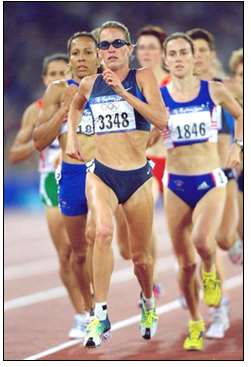
The tarsnake of self indulgence can help or hinder our running and riding

Was it self indulgent for the race of fish known as mud skippers to emerge from the mud and walk on land? Not at all. Some self-indulgence leads to great things.

Was it self indulgent for the race of fish known as mud skippers to emerge from the mud and walk on land? Not at all. Some self-indulgence leads to great things.

Whether you run or ride as your principal form of exercise or add swimming to do triathlons, the time involved to engage in training and racing can be considerable. If truth be told, there is a streak of selfishness that needs to run through our efforts, because without that, you cannot prioritize or be motivated to put in the miles or hours it takes to get fit, hone your racing skills and achieve your goals.

First timers beware

First time marathoners learn the hard way there is no shortcut to running. The sport is entirely about distance covered and the time it takes to cover it.

It is also common for cyclists to put in rides of 3-5 hours in a single training effort. In fact it takes that much to build the necessary base for any type of ride you target for racing or completion.

In either scenario, that means considerable time must be spent on the bike or on lonely trails unless your significant other shares your hobby. But even then, the selfishness factor can enter the picture. Sooner or later people who need you to do other things for them can question the amount of time you devote to training.

The tarsnake of selfishness

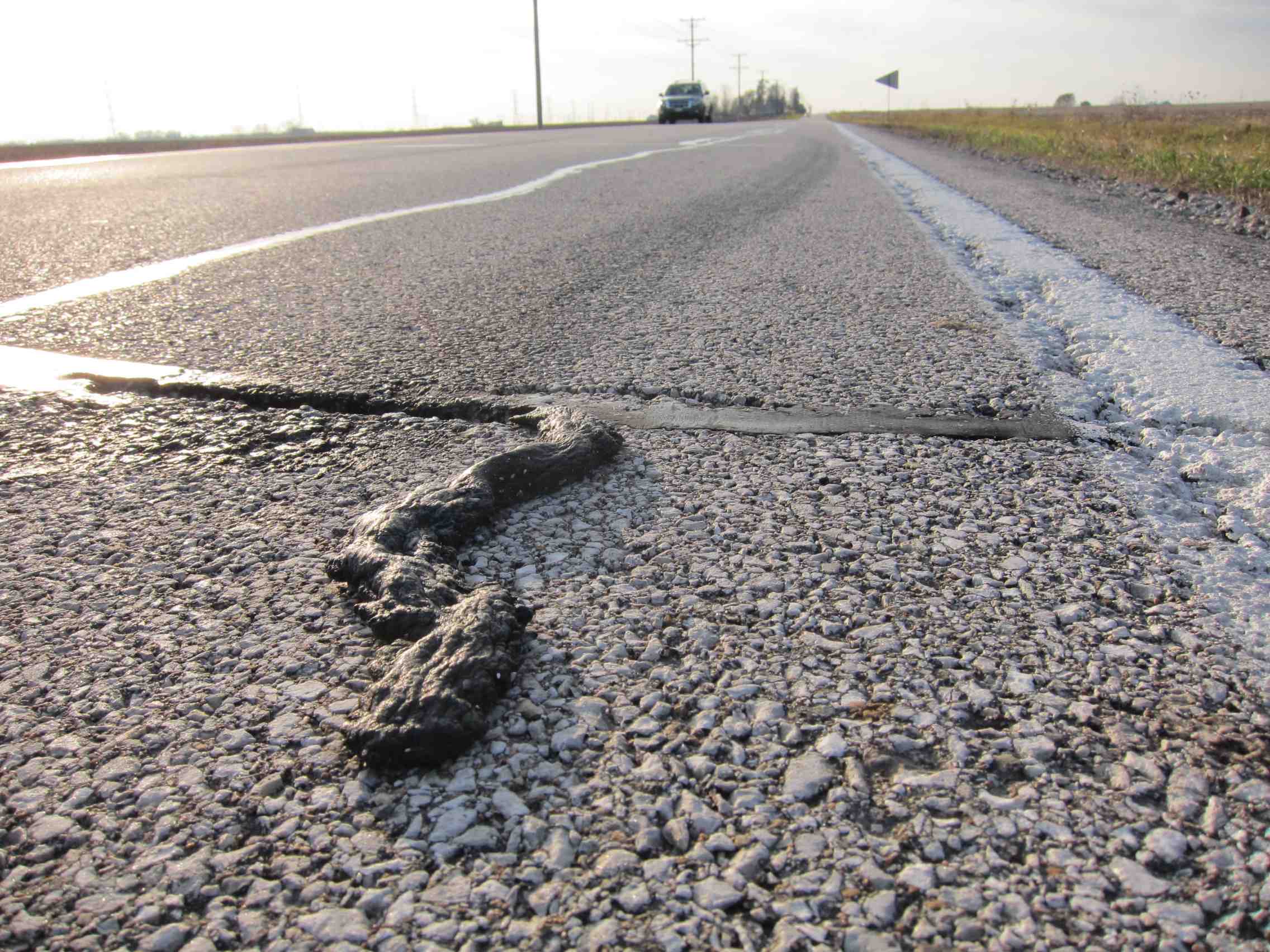
A tarsnake, as we know, can be both a good and bad thing.

A tarsnake, as we know, can be both a good and bad thing.

Managing the selfishness factor takes both a bit of dreaming and a bit of cold-eyed pragmatism. If you don’t set goals your training can feel vacuous, unfocused and unsatisfying over the long run. That’s where the real selfishness trap lies. The tarsnake of training is that selfishness can drag you into a rut.

It is an athletic irony that not having some sort of focus for your training can also result in a manic sort of selfishness as you seek some sort of gratification from every training effort. Suddenly you’re running or riding hard every day, not letting your training show any peaks and valleys. You might even start racing people in training, not wanting to give an inch. Grudges might form as you project your brand of running grief on everyone else. If all this happens you have arrived at the most selfish form of training their is. It is self with recourse.

Share and share alike

It happens because most people who set up goals tend to share those goals with others. If you are shooting for a 4:00 marathon there are plenty of people who are likely shooting for the same goal. You can train with them knowing you are moving toward your goal. If you’re shooting for a 2:20 marathon you most likely have a coach and a team to keep you from getting too self-absorbed.

Alone again, unnaturally

Training the same way all of the time can make anyone feel like shit about themselves.

Training the same way all of the time can make anyone feel like shit about themselves.

But if you have no races on your calendar and no events to absorb your focus, you can fall into the trap of turning every training effort into some sort of an event.

The “bitter” training partner is the one everyone tries to avoid. If you’re out there bitching about the pace or complaining about what you have to do when you finish, people would rather not run or ride with you. So don’t be that guy or gal.

The wise Englishman

That is not to say there are no happily adjusted people out there training for no particular purpose at all. For months I rode in a group ride with a quiet English fellow who was always “right there” when the group moved at any pace. His riding form was impeccable. He was both strong and fast. His was an approach of gratitude and absorption in the effort. He even laughed at the sometimes manic attempts of some riders to beat up the group with this surge or that. One had to admire his healthy perspective. He was a dedicated rider without need for ego, or selfishness.

Our personalities drive us

A certain amount of selfishness is expected in the high-strung, goal-oriented, Type-A personality athlete. Why fuss with the idea that people can remove their personalities from their pursuits. The lovable idea that people get obsessed and stay obsessed is the heart of sports. We rather like our nutty characters with running addictions and former addictions cured by running, or riding, or whatever it takes to get through life.

Awareness counts

Understanding your real purpose in running and riding can help you take flight.

Understanding your real purpose in running and riding can help you take flight.

The practical truth behind this blog is that you should simply be aware of why and how you’re training so that you understand how to manage your training toward a healthy and ultimately positive end. Selfishness on its own is not the disease. Selfishness with no aim, or no cure, is what we need to monitor. In ourselves, and our friends.

A friend once told me, “You know, self-indulgence is not the way to self-fulfillment.”

It hurt to hear him say that. At the time, I was not working full time but spent my days in double workouts and doing a few hours a week in a retail running store. It was what I felt I needed to do at the time. Perhaps it was a self-indulgent period. I was in some emotional pain from a sudden job loss that uprooted my whole life after having moved to Philadelphia. So I channeled the anger into running. So what? Sometimes self-indulgence is a bit inevitable. Versus self-fulfillment, at which we generally need to work to achieve…

Dichotomy?

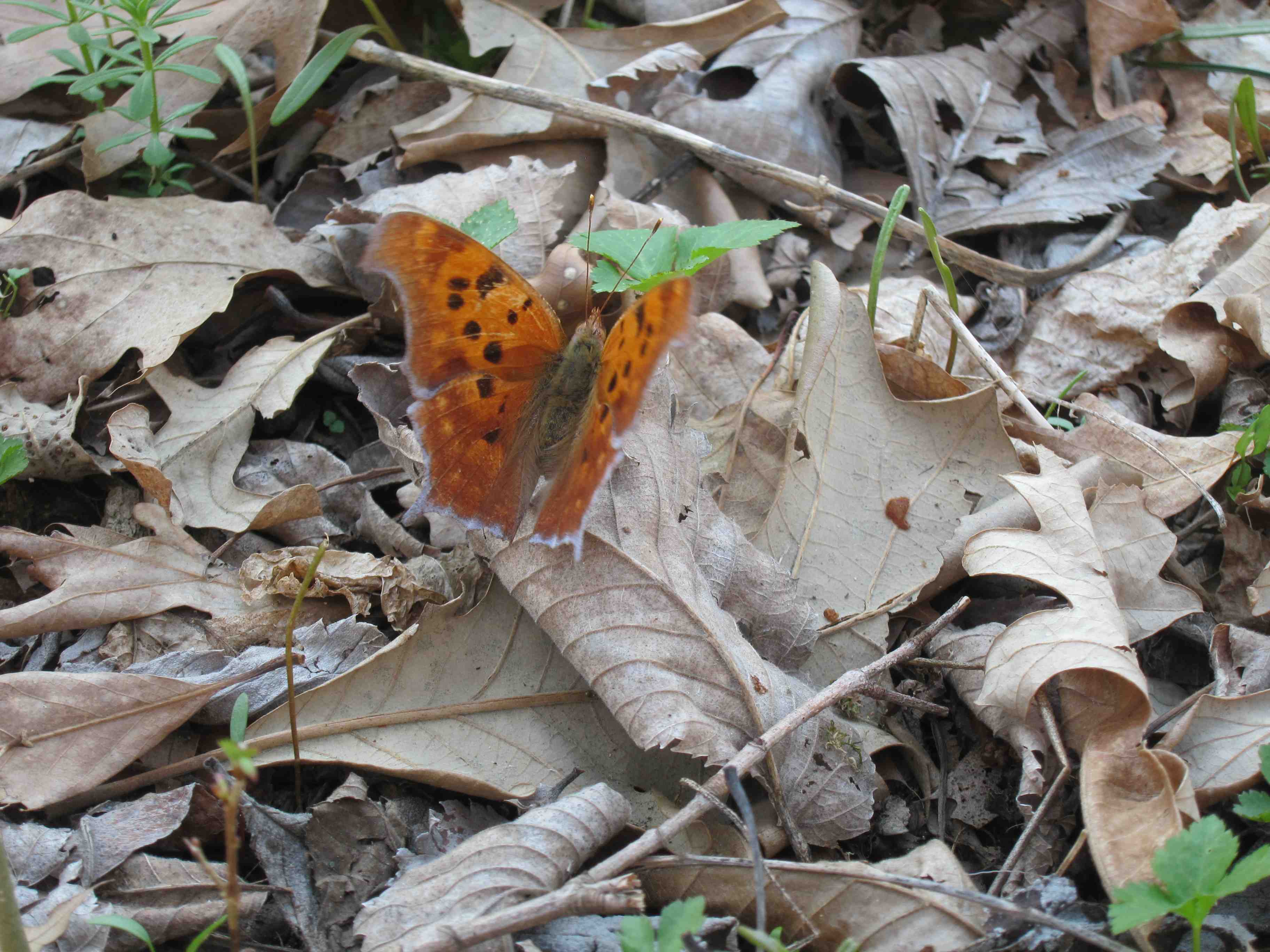
The ying and yang of self indulgence is its sometimes contradictory nature.

The ying and yang of self indulgence is its sometimes contradictory nature.

It is genuinely hard to distinguish between the two at times. There may in fact be times in your career or life when self-indulgence is required to succeed. Just be sure to communicate that to those around you, those who care, and those who depend on you. “I’m going to do this (triathlon/marathon/half-marathon/century)” is a statement that declares to those who care that you’re going to focus on an event. Then be prepared for some pullback when it’s through. That’s human nature. Be a big enough person to get what gratification you can from your Big Event and let that be your self-fulfillment for a while. But to transpose all your desired accomplishments over the needs of all others in your life, well, that’s self-indulgent.

Know the difference, and be happy as you run and ride.

WeRunandRideLogo


Posted in Tarsnakes, We Run and Ride Every Day | Tagged , , , , , , , , , , , , , , , , , | Leave a comment

Saturday Artwork: Ancient Runners Had The Same Problems We Do

5000 years ago in what is now Iraq, a pair of runners stands at the starting line aghast that they've forgotten some key race preparations. A woman says, "Oh No! I've forgotten my Jog Bra!" While a man says, "I should have hit the Porta Pottie one more time." Too late. The race is about to start.

5000 years ago in what is now Iraq, a pair of runners stands at the starting line aghast that they’ve forgotten some key race preparations. A woman says, “Oh No! I’ve forgotten my Jog Bra!” While a man says, “I should have hit the Porta Pottie one more time.” Too late. The race is about to start.

Posted in Uncategorized | Tagged , , , , , , , , , | Leave a comment

Copenhagen shows the world how it’s done on public biking

By Christopher Cudworth (with contributions from Keith Hauser)

Part of the difficulty in making the cycling and running world safer for millions who run and ride is in stretching the public imagination to see what is possible when people really put their minds to the issue of safe, simple solutions for public trails and bike lanes.

Following a blog post on We Run And Ride titled Who Owns the Road Where You Run and Ride, a rider named Keith Hauser sent along this response and the photos he’d taken of cycling in Copenhagen, Denmark:

From Keith: 

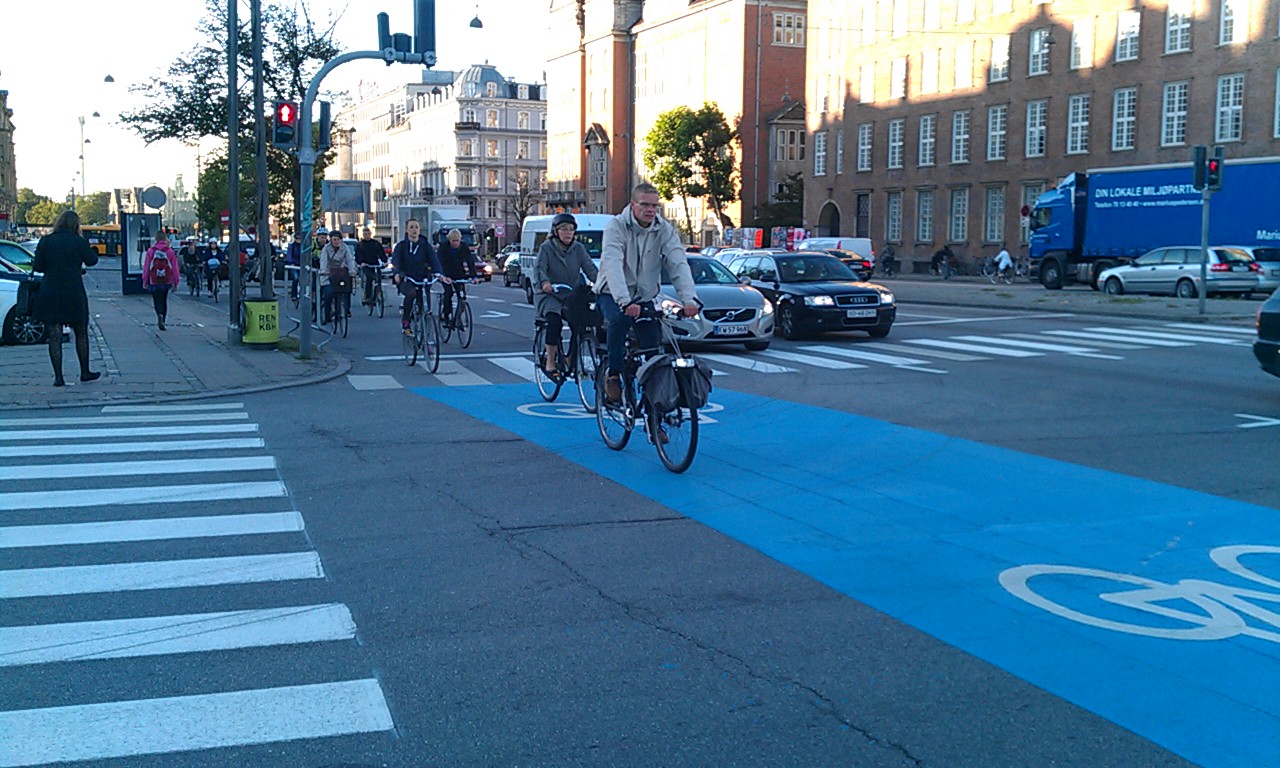
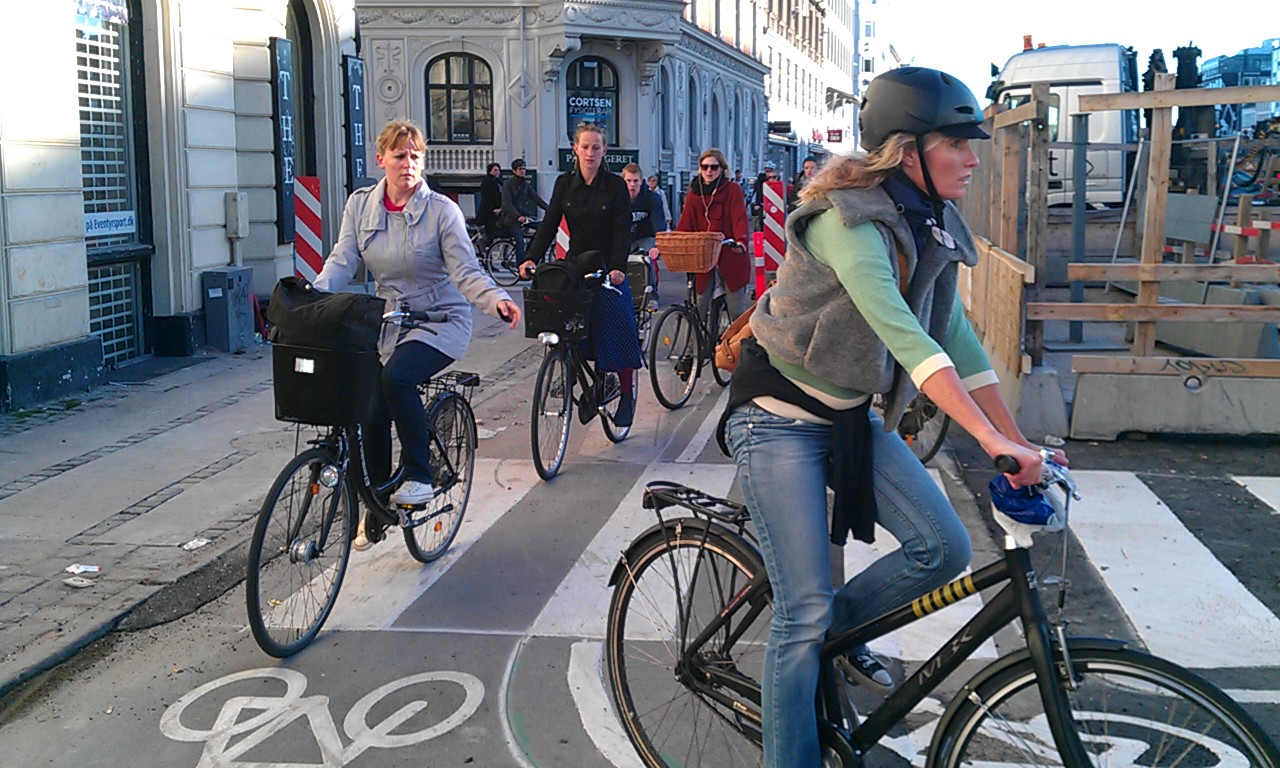
Copenhagen Bike Crossing. Click to see full view.

Copenhagen Bike Crossing. Click to see full view. Photo by Keith hauser

“In the last decades, Copenhagen has gone bike-crazy. The wide bike-lanes are filled with thousands of bicycles all day long. Copenhagen can now compete with any Dutch town on bicycle density. They have set the bar really high for any other city that wants to call itself a “green city”.

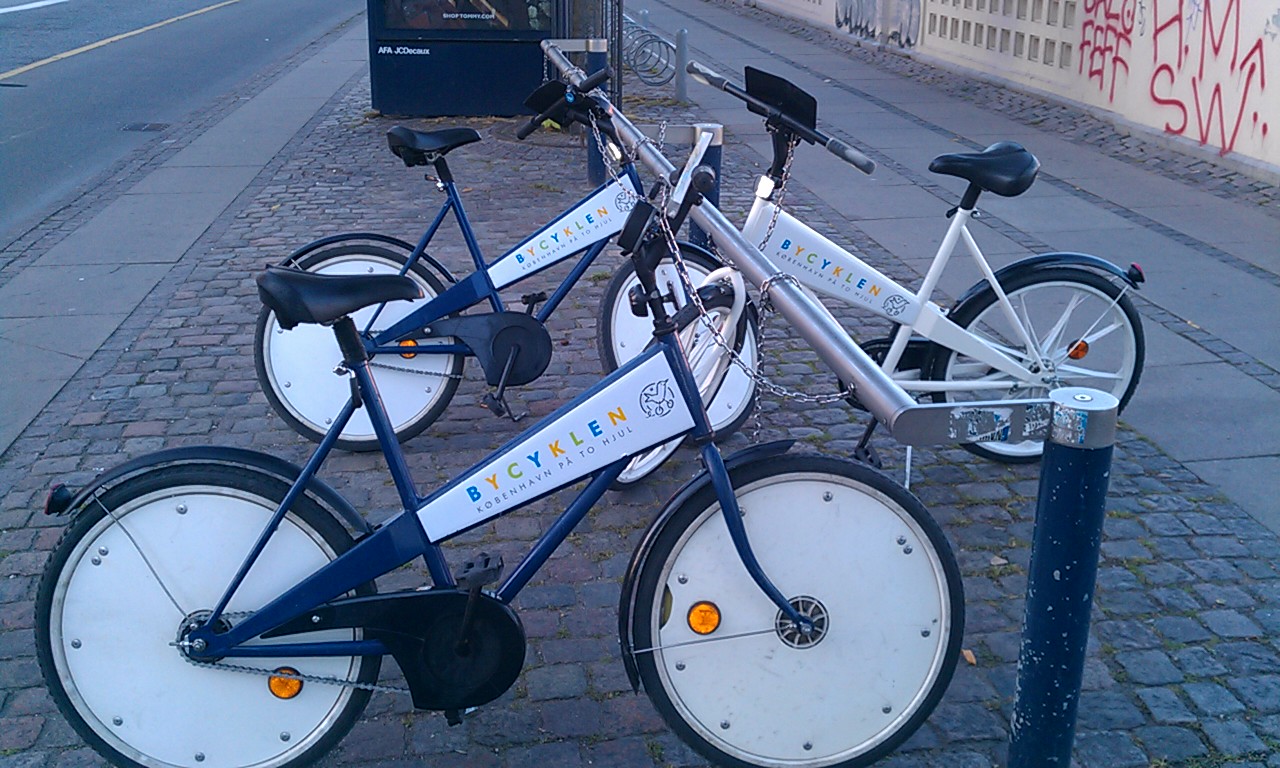
There is also a system of public bikes, old clunkers available at

Copenhagen Bike Detour. Click to enlarge. Photo by Keith Hauser.

Copenhagen Bike Detour. Click to enlarge. Photo by Keith Hauser.

special bike racks where you push a coin into a slot to unlock the bike, and you get the coin back when you lock it back up at one of their stands. These are mainly used by tourists. They’re really simple: one-speeds, no racks, no baskets, no lights. And you can only use them inside the old town. You often have to go to several bike stands to find one with any bikes there. But they’ve been perfect for me: lots of sightseeing done the last days. It’s sponsored by the city and 10 other sponsors, and

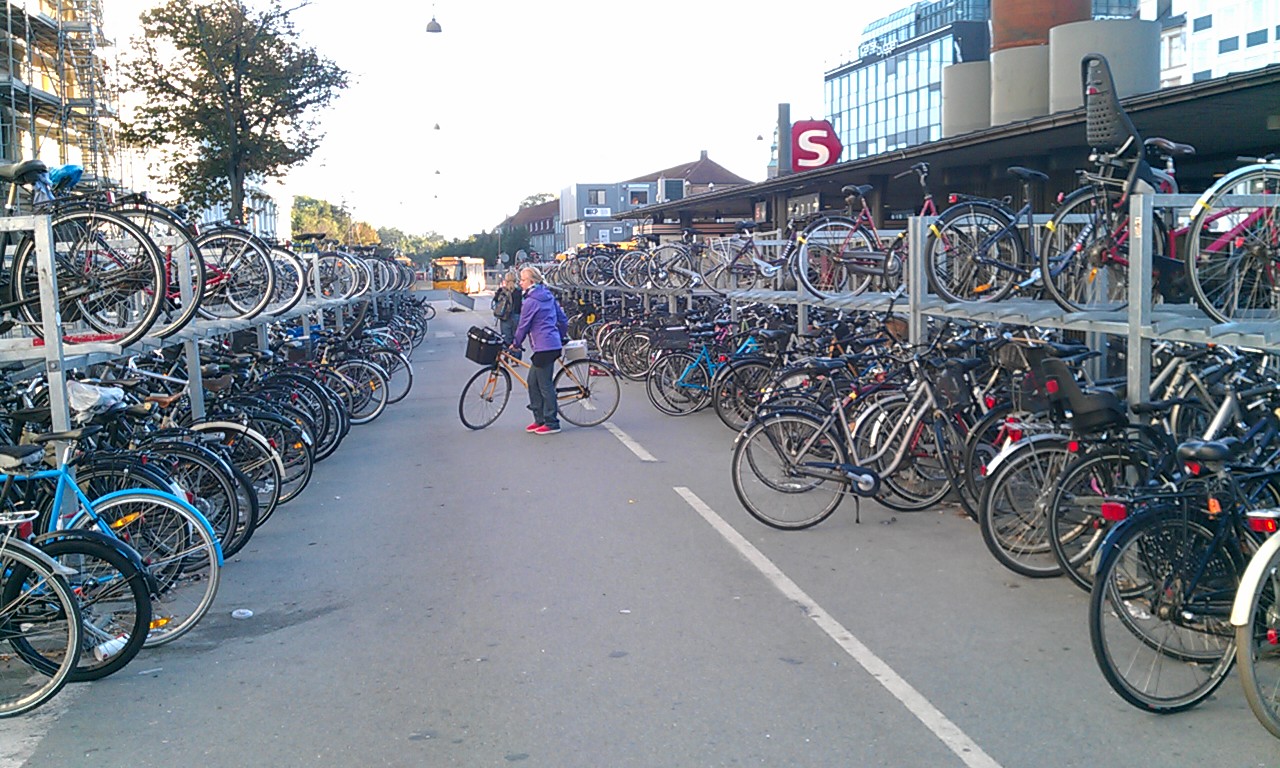
Copenhagen Bike Parking. Click to enlarge. Photo by Keith Hauser.

Copenhagen Bike Parking. Click to enlarge. Photo by Keith Hauser.

they have 2500 bikes. The original idea was to reduce general bike theft by making these available.

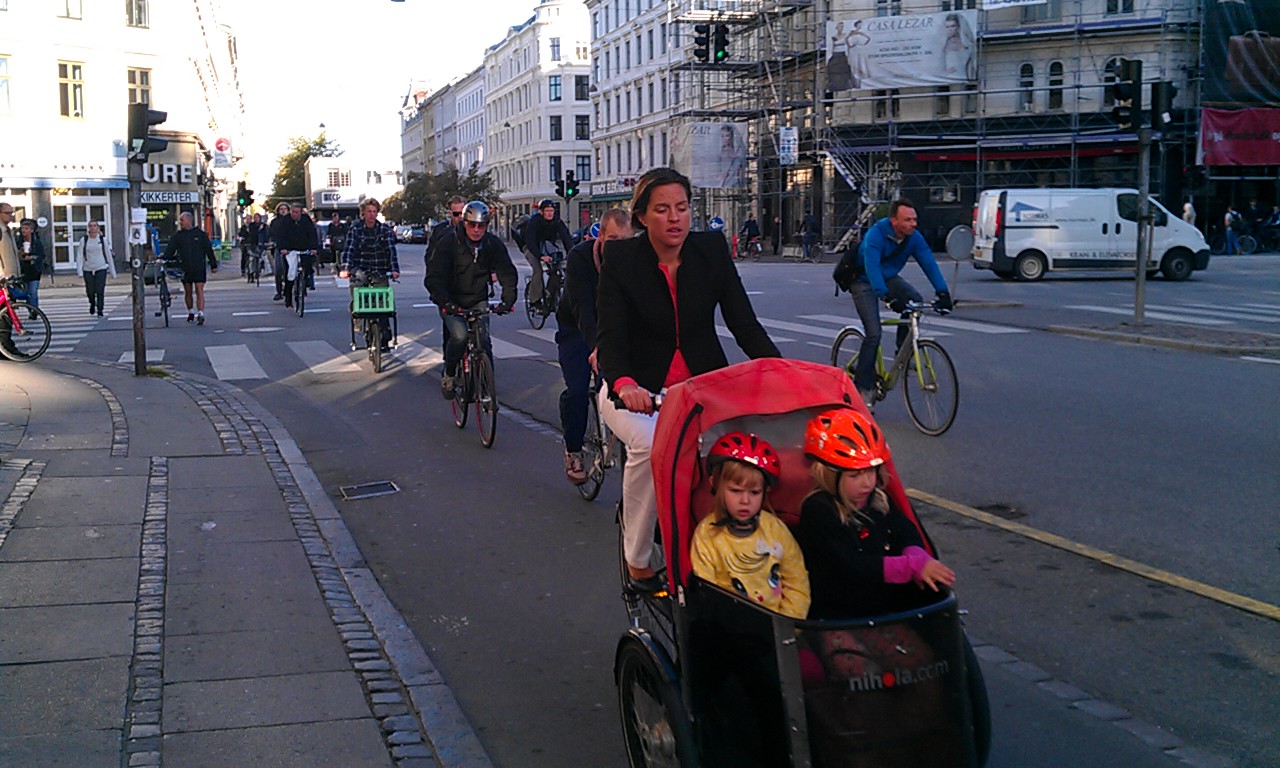
Parents all over town use their Christiania 3-wheel bikes, with

Copenhagen Kids. Click to enlarge. Photo by Keith Hauser.

Copenhagen Kids. Click to enlarge. Photo by Keith Hauser.

a box for groceries or kids up front, to take the kids to day-care or school. No need to use a gas-guzzling SUV for that. The double-decker bike racks are at the Nørreport subway station. This is just a small part of the bike racks there.”

What a wonderful example of a city and country that has taken the initiative to make cycling safer and more practical for its residents. It also happens to make cycling practical and inviting for tourists! What a concept!

Copenhagen Free Bikes. Click to enlarge. Photo by Keith Hauser.

Copenhagen Free Bikes. Click to enlarge. Photo by Keith Hauser.

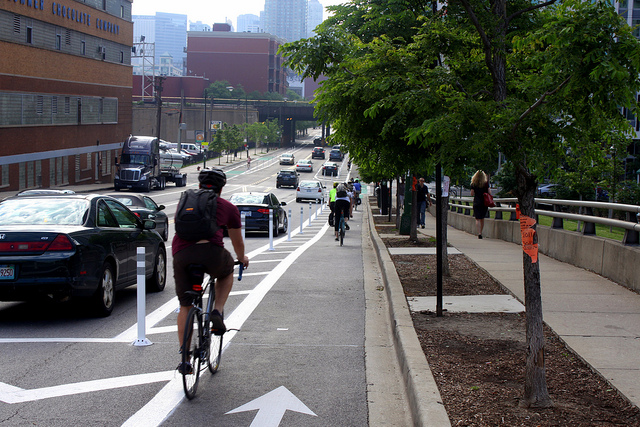
They even offer free bikes for use by anyone. Just unclick and go. What else do we need to know? The examples here show what’s possible. And cities like Chicago are, in fact, beginning to move in this direction. The city already has miles of running and bike paths along its lakefront, and cities around the country seem to be following suit.

Chicago Bike Lanes

Chicago Bike Lanes. Click to enlarge view. 

Here in our little section of the world there are even plans to turn a landfill into a cycling and recreation center at Settler’s Hills Landfill. That means piles of garbage will be turned into place to run, bike and play. A good idea, no?

WeRunandRideLogo

Posted in Uncategorized, We Run and Ride Every Day | Tagged , , , , , , , , , , , , , , , , , , , , , , , , , , , , | Leave a comment

Running and riding is for the birds

I not only run and ride, I bird. That is, I’m a birdwatcher. Or in North American parlance, a birder. That’s the acceptable terminology these days for those who seek to identify wild birds in the field, in the city, or wherever you may find them.

The Wilson's Phalarope is one of three species that migrates through middle America.

The Wilson’s Phalarope is one of three species that migrates through middle America.

Being a birder and a competitive athlete can create some dichotomies in purpose. I was once leading a race held on a golf course in upper Iowa near Cedar Falls. It was mid to late October, and fall migration was in full swing. While rounding a bend near a pond at the center of the course, I glanced down to see a shorebird bobbing on the surface of the water. It was spinning in circles, feeding on the surface. “Phalarope!” I called out, nearly stopping in my tracks. The runner closest behind me almost ran up my back he was so surprised at my weird racing tactics.

I kept running and went on to victory, the only time I won a race in college. Then I ran back to the pond without any explanation to my coach or team, hoping to find and identify the phalarope. I looked it up later and determined that is was either the Red Phalarope (in winter plumage, all grey, white and black) or the Red-necked Phalarope. But I could not count the sighting without some form of better verification. Neither species now resides on my birding life list.

Birding on the run

Sandhill cranes are a popular roadside attraction here in Illinois

Sandhill cranes are a popular roadside attraction here in Illinois. Photo by Christopher Cudworth

Birding is often best accomplished while running or riding on the roads. Roads are, for better or worse, a source of natural attraction for birds. Many birds like to sit on wires to survey their territory, to hunt or seek food of one kind or another. Swallows will gather by the hundreds on wires, a twittering, fluttering group that will often rise and fall en masse.

Great horned owl. Acrylic painting by Christopher Cudworth.

Great horned owl. Acrylic painting by Christopher Cudworth.

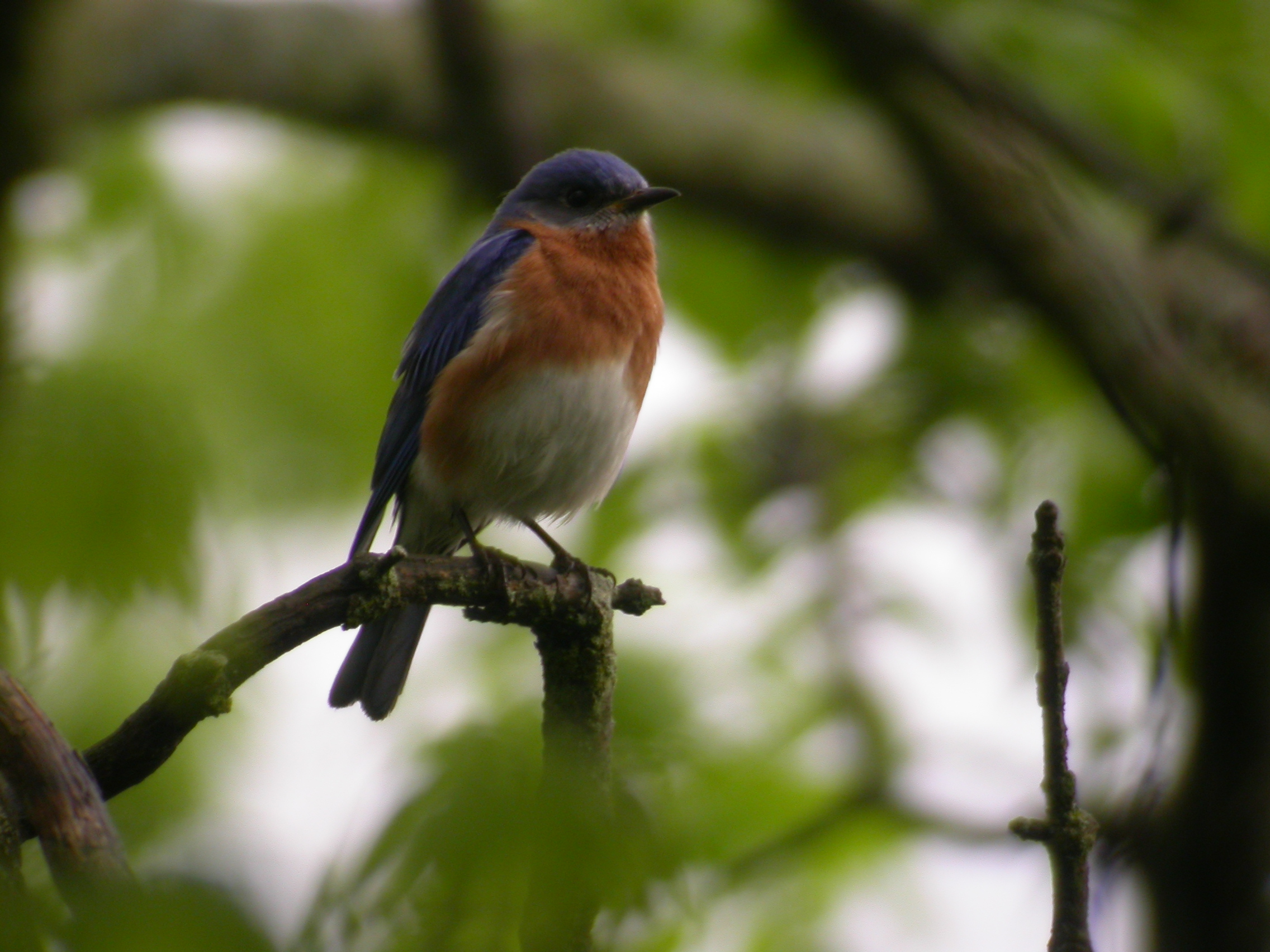
Birders also develop the capability of identifying bird species by sound. Many times over the years a run or a ride has been enhanced by knowing that the muffled warble of a song coming from an oak savanna not far off is an Eastern Bluebird. Or the determined flight call

Eastern Bluebird. Photo by Christopher Cudworth

Eastern Bluebird. Photo by Christopher Cudworth

of Red-winged blackbirds flying into a late February breeze, headed for territories they’ll defend at the marsh unless snow blows the group back into feeding flocks until bad weather passes.

My running bird list includes a falcon known as a merlin that swept in front of our group to snatch a mouse trying to cross the dirt road ahead of us. I have seen pileated woodpeckers and wild turkeys while on a run, dozens of species of warblers, ducks, hawks, eagles, cranes and herons.

But the prize bird seen on a run might be the Harris’s Hawk found in Scottsdale, Arizona. While running through those endless dry suburbs outside Phoenix, I noticed a trail of fur falling from the sky. Looking up, I saw a Harris’s Hawk in its dark brown, russet red and white plumage plucking a rabbit on a light post.

Birding on the bike

Road cycling is not ideal for birding, but you still do see some birds along the way. Often a kestrel will float from lightpole to lightpole ahead of you on a country road. Red tails have the same habit as well, flying just far enough ahead that they think you’ll leave them alone. Then you come pedaling along like an annoying giant bug of some sort, so the hawk lifts off again.

A year ago a raptor lit off the top of a light pole west of Kaneville, Illinois and I was riding fast in the direction it was flying. Instantly I realized it was a juvenile Peregrine Falcon. It’s marking were clear, almost surreal in the early autumn sun. It coursed low over a harvested wheat field of golden shocks clipped evenly across the entire field. The bird never slowed as it veered from the road toward the northern horizon. Now that’s a bird that can really fly.

Birding by bike

Birding by mountain bike is much more productive. You’re going

Riding or running along the Fox River in winter one finds these goldeneye ducks in rafts, diving beneath the surface to grab crustaceans off the bottom.  Photo by Christopher Cudworth

Riding or running along the Fox River in winter one finds these goldeneye ducks in rafts, diving beneath the surface to grab crustaceans off the bottom. Photo by Christopher Cudworth

slower, can head off-road where the better birds are and can carry more stuff like binoculars and books. There’s a whole school of people now birding by bike because it’s a greener way to go.

It doesn’t take much to become a birder, really. Just a bit of curiosity and a $30 pair of 7 X 35mm binoculars. Watching birds at your backyard feeder teaches you to look for field marks, and as you get better it is fun to wander local parks looking for more variety. Soon enough you’ll learn ways to identify more birds, buy yourself a Sibley Bird Guide or some other field guide and it starts to add up in your head where and when to find birds. Early morning is best, which is when so many people choose to run and ride as well.

But rather than wonder what those birds singing in the bushes really are, or what they flock of brown-looking smooth birds in the berry tree were (cedar waxwings, most likely) you can inform yourself, and enrich every run and ride knowing a little more about the world around you.

Just don’t expect everyone in your group ride to understand your enthusiasm. Non-birders love to ridicule those who do. It’s an ignorance thing, you see. Best just to say, “I can’t help it if I know a thing or two about nature. Just trying to share.”

You’ll find that gentle proselytization works best. By the next ride the same rider or runner who made fun of you the week before will sidle up and say, “Hey, you know that bird thing you pointed out? Well, last week I saw something and wondered what it was….It had this long beak you know….”

It happens. People generally have a curious nature. Let it grow on them. But first let it grow on yourself. Birding can be a great addition to your running and riding life.

Posted in We Run and Ride Every Day | Tagged , , , , , , , , , , , , , , , , , , , | 1 Comment

Faithful gear deserving of respect and gratitude

People who run and ride eventually learn to appreciate the best gear they own. When speaking of gear, we are talking about clothing, shoes, kits, whatever you depend upon to help you go faster, longer and smarter when you run and ride.

Great gear testimonial

It can be said without equivocation that a great piece of gear is literally worth its weight in gold. For example, you may regret spending $38 on a fancy training top because you figure you could get by with a similar top for only $25. Yet when you put on the more expensive top and go for a run or a ride, you realize something about that piece of gear really is different. The expensive stuff doesn’t itch. Doesn’t bind or constrict. You’re liberated. You actually run or ride farther because it feels good to do so.

My dog Chuck sports his favorite brand of running shoes. They are minimalist, for sure.

My dog Chuck sports his favorite brand of running shoes. They are minimalist, for sure.

It doesn’t matter what brand you wear as long as you love wearing it. You could throw on a Nikeeboknewbalumadidasics shirt for all you care. As long as the garment wicks sweat, keeps you cool when it’s hot or warm when it’s cold, that’s what you care about. And when that great piece of gear lasts you years and years without fail, it becomes a faithful part of your training and racing program. You can count on it.

One classic set of gear

I own a New Balance mock turtleneck that I was given in a store promotion way back in 1990. It still fits. Still looks good as new. Even the New Balance logo humbly printed on the left breast area of the shirt does not look faded or broken up. That shirt is performance gear at its best. It wicks sweat when necessary and absorbs it when called upon to do so.

There were matching shorts that finally gave out about 5 years ago. The waistband elastic simply went “wuff” one day while pulling them on. Even the drawstring (which I LOVE in a training short) could not pull those shorts back together again. Had I tried to wear them it might have been Humpty Dumpty time with the old drawers. And that’s never good.

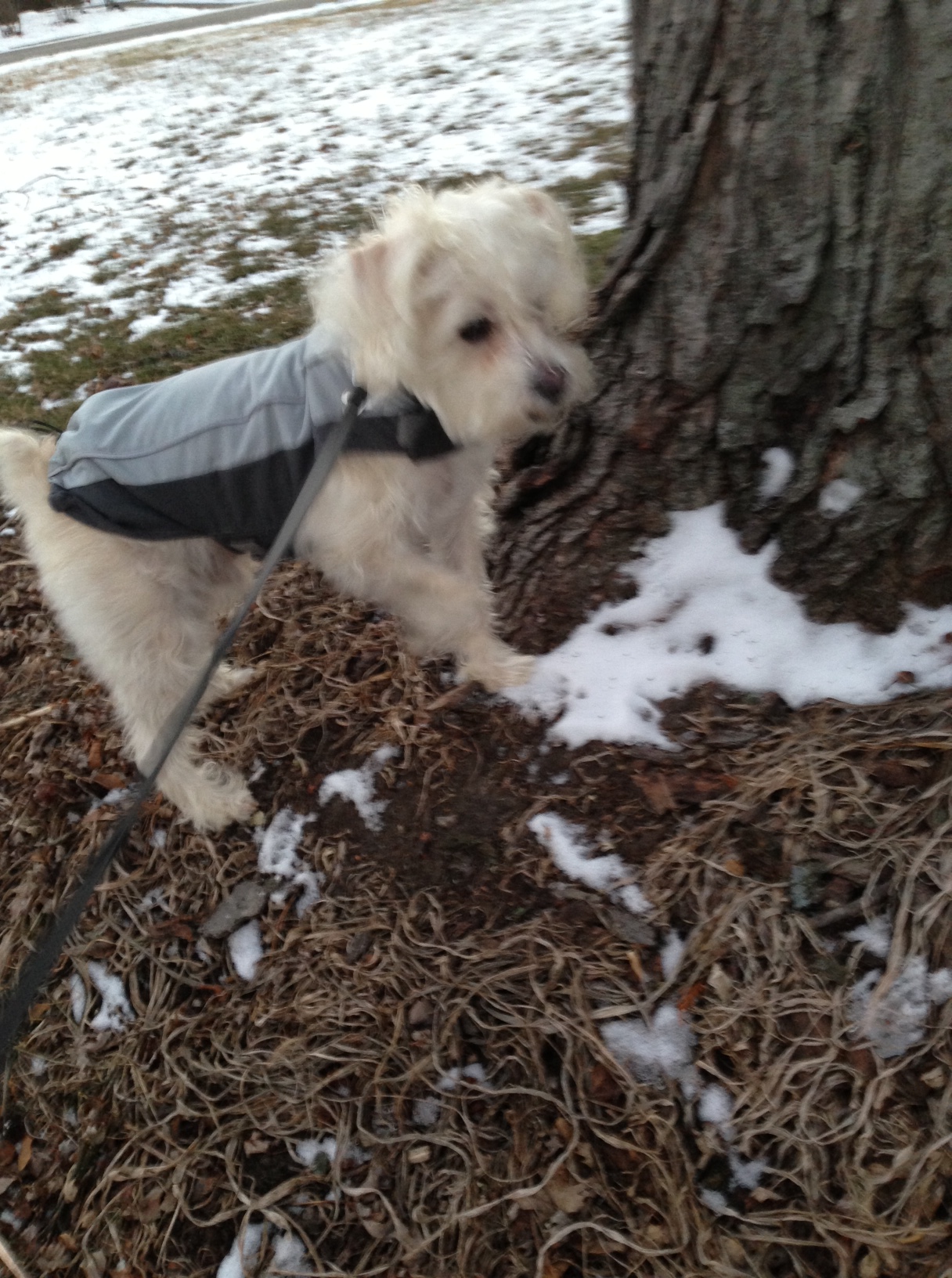
Chuck models his winter training gear, a grey nylon racing top with dark grey fleece trim with velcro stays.

Chuck models his winter training gear, a grey nylon racing top with dark grey fleece trim with velcro stays.

But getting 20 years out of a pair of running shorts is a pretty fair deal. If they retailed for $35.99 at the time, and 20 years have passed, that’s 7300 days of ownership. I have probably run in those shorts every 3rd day or so over the years, so let’s say there were 2433 days of wear. Divide the number of wear days by the cost and you get a raw cost of about 0.01479244 per day. What a great investment, and the height of faithfulness when it comes to a long-lasting pair of shorts.

Natural limits

Of course some forms of gear have natural limits, an expiration date as it were that should not be exceeded. One notably fickle brand of gear was the classic jock strap. A few athletes still wear these, one must suppose, but they were standard issue in the 1970s. Jocks were not cheap, so we tried to make them last a long time. However multiple trips through the caustic washing machines of high school or college laundries could reduce the most stoic brand of jock to a quivering triangle of dangerously weak threads.

So you had to watch it. You could never really tell when a jock might break, leaving you helpless and flopping in the proverbial wind, commando when you’re not supposed to show.

It happened that I pressed my luck with just such a jock. My main jockstrap was not yet back from the school laundry on a the afternoon of a cross country meet, so I grabbed a faithful backup jock that was clinging by a stretchy thread down there. I tested the strength with a tug. It seemed to hold, so it was a risk I had to take because I had these lucky silky shorts that I’d dug out of the old uniform closet and had won two straight races so I didn’t want to break the streak. But one definitely had to wear a jock under the silky shorts because they would sometimes rise up the side of your butt and show your underwear, which is never a good look.

Racy finish

Did Jimmy Carter wear a jock back in the day? Yuk! Who cares? Don't want to think about that.

Did Jimmy Carter wear a jock back in the day? Yuk! Who cares? Don’t want to think about that.

By the time I had the lead and was turning for home, I could feel the jock unraveling between my junk and my right leg. The faithful jock was giving out. Hoping to make it to the finish before disaster struck, I sprinted harder, only to feel it loosen even more. Then suddenly, that horrible sound of “wuff” happened just 100 meters from the finish chute. A quick draft blew up my shorts and a waving segment of jockstrap released behind my back leg, flapping like the tail of a sting-ray.

Panicking, I reached down and pinned my shorts to my thigh and finished with the other arm raised in victory, hoping the gesture would distract the crowd as I finished with nearly everything hanging out my shorts.

Lack of faith

That was a most unfaithful act by that formerly faithful jock. To make it worse, as I was walking out of the finish chute, I was accosted by one of those crazy freshman team members who does not know how to keep his mouth shut.

This dude could use a jock, for sure.

This dude could use a jock, for sure.

“Dude, your jock broke!” he called so loud everyone could hear.

Glancing at him in a fury, I was about to curse him out when my mom appeared in the field of view behind him. “Yeah, thanks for telling me,” I falsely smiled, hurrying off to find my sweats.

Faithful and unfaithful bike gear

Truly faithful cycling gear is pretty hard to find. You don’t think about it when you’re riding, but there are a lot of contact points on your cycling shorts or bibs and you can ruin a great cycling kit just by riding in too much of a fixed position for too long. One hole in your cycling kit butt area and the entire bibs are ruined.

Who repairs bike clothing? No one. There’s no market for that. I once took a pair of shorts to a local tailor for a patch job and she laughed. “Patch it with what? Throw them away. Get new ones!”

That must be what everyone does with old biking gear. In fact there are rumors of giant rafts of discarded bike gear floating in the Pacific right along with those giant rafts of plastic water bottles and discarded CDs from every band in the 80s. I hated that decade. It’s no wonder those 80s band CDs are floating in the ocean where no one can hear them.

Spandex and Lycra: Uneasy lovers 

Spandex and lycra and all those miracle fabrics we have now for cycling wear are notably fussy about proper washing methods. Hot dryers can turn great gear into an itchy kit in one pass. Ruined lycra, spandex and other wonder fibers are nearly unwearable once “washified” except as lumpy covers over base layers.

Thin is good, but not forever

Really thin cycling jerseys are wonderful to wear, but the minute you go to a race and put a pin through the fabric they are never the same. Their faithfulness is stretched to the limit by the smallest of perforations. All it takes is one small hole to start the process and everytime you pull on that favorite shirt that little hole becomes a bigger hole. It’s almost like they planned it that way, so you’ll have to buy another expensive European bike shirt. Because pretty soon there’s a hole the size of a quarter in your side and your faithfully engineered piece of Italian racewear looks like moths have been eating it. Holey cycling gear is never a fashion statement of any merit, unless you have crashed, and there is blood globulets clinging to the shredded fibers of your shirt. Then a holey shirt is very cool. Until you get home and have to cut off your shirt and then shower with road rash. But still, even that is cool. Road rash. That means you were doing something dangerous. Or stupid. It all feels the same in the shower. Which hurts.

Now back to fashion and faithfulness.

Accessories and such

Cycling shoes, helmets, gloves, socks, sunglasses, arm warmers, leg warmers; the list of cycling gear goes on an on. It is much more complicated getting dressed for cycling than it is for running, especially during the winter months. Then it is way more complicated. Tons more work to find your stuff before you ride, too. Plus you’re always cooking by the time you finish putting on all your layers. Then you realize your forgot that church meeting you were supposed to attend so you go out and pedal around for half and hour and sweat like you’ve been to a sauna. But the endorphins never arrive. They’re trapped down between your ass checks by six layers of spandex. If you fart in that kind of outfit, your angles bulge out. At least they seldom pop.

Faithful black cycling shorts

But you always need a pair of faithful black cycling shorts, or five. That way in darkness you do not have to make decisions. And you will also be obeying “The Rules” by wearing black shorts. Some of you may want to wear red or blue or yellow in protest of such cycling fascism, but that’s your choice. Black really is simple, distinguished and doesn’t show your junk in good light or bad.

In order to have a truly faithful cycling closet, you also need jerseys that go with everything. Nothing tests your patience on the dark morning of your group ride than digging around drawers where you keep your cycling stuff and can’t find things that match. Then you wind up panicking and show up for the ride wearing that pair of white shorts and everyone takes turns making fun of your kit.

You wonder why you ever bought those white shorts in the first place (they looked good on the rack!) but you just can’t bring yourself to throw them away because they were made in France or Italy or Spain and cost about $112 retail and were only $65.50 on the rack. What a deal!

So you toss them back into the drawer until the next embarrassing emergency or a ride. So those whites short are faithful in their way, because they faithfully embarrass your sorry ass every time you wear them.

Faithful gear takes on many forms, you see. Nothing will test your faith like bad gear, and nothing encourages your faith and loyalty to running and riding like a piece of gear that lasts 20 years.

Got any faithful in your life?

WeRunandRideLogo

Posted in We Run and Ride Every Day | Tagged , , , , , , , , , , , , , , , , , , , , , , , , | Leave a comment

Black ice is the tarsnake of winter for those who run and ride

by Christopher Cudworth

A section of black ice forms where snow melts on a downhill, resulting in slick, angle sidewalk.

A section of black ice forms where snow melts on a downhill, resulting in a slick, angled section of sidewalk.

One learns through experience that black ice is nothing to take lightly on winter sidewalks and roads. Even springtime running and riding conditions can be treacherous when rain or snowmelt freezes clear and slick to roads and driveways.

That’s when black ice can “attack.” It is the tarsnake of the winter and spring season.

Don’t tread on me

Even the best traction running shoes and knobby bike tires are helpless against slick smooth ice. That is what makes the ice we call “black ice” so dangerous. At times you cannot even see it ahead of you. On asphalt it can be nearly invisible unless there is a light ahead to reflect of the surface. Where it really gets dicey is on angle surfaces such as driveways where melting snow or rainfall freezes into a long, mean slick of wintery tarsnake. Then down you go.

The clear "black" ice is show here on a downhill. Facing north, it is not apparent that it is ice at all.

The clear “black” ice is show here on a downhill. Facing north, it is not apparent that it is ice at all.

Fast falls and odd angles=ouch

Injuries can easily occur when runners and cyclists slip on ice. The drop can be so quick that arms and legs hit at odd angles. Wrists get bent and even fractured. Heads knock on the hard ground. Tailbones get cracked. Hips bruised. Cartilage like ears and noses can get broken or bloody if you fall frontwards or sideways.

Better ways to fall

The same section of ice when seen facing south does show a sheen, but still does not appear to be ice.

The same section of ice when seen facing south does show a sheen, but still does not appear to be ice.

There are better ways to fall than others if you feel yourself going down. Seasoned cyclists learns to lower their body weight immediately and at least shoot for the slide. That can result in a lot less impact. You may get soaked or scraped, but that’s a lot better than bruised and broken. Wounds heal and clothes dry, but bones take time to heal.

Many runners react instinctively, raising their arms to the sides as they realize they are on a stretch of black ice. This balancing instinct is indeed useful. People who have played ballistic sports such as basketball of soccer likely fare a little better in black ice situations than those who have never much used their proprioception capabilities. That means balance, in case the big words have no meaning. Your proprioceptor muscles come into play big time when “skating” on your running shoes across black ice. If you’re lucky, you come out the other end unscathed. If you’re unlucky, you lay on the ground a bit to recover your wits. Then you get up humbled and a lot more cautious.

Cyclists beware

Cyclists have to pay particular attention not just to black ice, but water in general on the roadways. A road bike on black ice is completely helpless. Don’t even think about riding through it. Find a way to let it down easy as possible, if possible. Often it’s not, which means it’s time to pull in the arms and pop off the cleats if you’re wearing them. It’s possible. Things happen fast on ice but there’s a surprising margin of reaction time for those who stay alert.

Riding into the slide

If the road is simply wet and oil is floating on the surface, making your tires slip, you need to turn your front tire not in the direction of the slide, which is often the back wheel whipping around the right side if you’re turning right and the left if you’re turning left. You turn your front tire at a right angle to the slide, but be prepared, because there will sometimes come a “catch point” where things can straighten out suddenly and the bike can whip back on course. Overcorrecting can send you frontwards over the bars or simply collapsing into the direction of the slide. No fun, since your shoulders and head carry a lot of weight and that can heave you hard into the cement. But think about it, the goal is getting your front tire under your slide direction like a second leg on a chair. That’s one way you can hope to catch off a slide and stay upright.

Prevention the best cure for black ice

The best prevention of crashes and falls is being prepared when overnight or evening conditions cause a freeze. Black ice can form in minutes, even turning sections of path you crossed just half an hour before into anti-runner zones. Then pop, down you go.

Late winter and spring cyclists know they’re involved in a devil’s bargain with black ice or slick roads. Wise cyclists keep the road bike in the house whenever road melt is likely to be crossing their favorite roads. Generally during the daytime if snow is melting you need to look ahead and slow enough to gauge the conditions before crossing. If water is literally running over the road in rivulets, be wise enough to realize your bike tires will be slick for the next half mile or so. Braking can be bad news at that point, so it’s best to keep pedaling and apply some touches to the brakes to begin cleaning off the rims.

1st Annual National Black Ice Day February 15, 2013

In honor of this blog subject we would formally like to declare the beginning of black ice season on February 15, 2013. The season varies by state but pretty much everywhere north of the latitude of Muncie, Indiana has to watch out well into mid-April. That is, unless global climate change delivers another heated spring and you’re dodging drought rather than black ice by mid-March. It’s tricky business dealing with black ice and tarsnakes, but National Black Ice Day should go a ways toward raising awareness around the world that black ice is nothing to fool with. And that includes the black ice floating in a glass of Kentucky Bourbon. That can throw you for a fall as well.

Posted in Tarsnakes, We Run and Ride Every Day | Tagged , , , , , , , , , , , , , , , , , , , , , , , , , , , , , , , | Leave a comment

From “tragedy” comes humor in running and riding

By Christopher Cudworth

Sure, we take our running and riding seriously. Yet the obvious reason we also run and ride is to have some fun, enjoy some laughs and look back with fondness on unexpected things that happen. Some of those situations seems like a tragedy at first, turning to laughter only when people stand back and gain perspective on the situation. Here are some true anecdotes that might inspire you to find humor in your own running and riding.

One Shoe Down

Be it tarsnakes, clay or quicksand, you never know what might trip you up on a run.

Be it tarsnakes, clay or quicksand, you never know what might trip you up on a run.

In Southeastern Pennsylvania where the soil is mostly clay and trails through the woods quickly turn to glue when it rains, there is much to be said for a nimble stride.

While training with a club of fellows out for a long Sunday run, our route took us through a section of horse trails near Wayne, Pa. As the trail bottomed out, the clay got slicker and the footing underneath was difficult. Most of us ran splay-legged using firmer ground on both sides of the foot-wide path. But the lead runner, not taking a cue from the rest of us who were humbling ourselves and losing pace every step, kept trying to stomp through the mud. Finally his right foot plunged deep into a bed of wet clay. He immediately came to a sucking halt and using considerable force yanked his foot out of the ground only to find that his shoe was no longer secured to his foot. He stood over the hole in the ground, staring down in amazement at first.  The rest of us gathered round to take a look with him, and a couple people wondered what to do.

Wanting to help, I reached down and shoved my arm into the foot-deep hole. It was like shoving my hand up the backend of a cow and the hole was slowly closing, to boot. Grasping the shoe as best I could in a firm grip, I pulled like mad, but it only moved a couple inches, then sucked back down into the ground with a sound like a muddy fart. I burst into laughter but no one else found it funny. I continued trying to extricate the shoe, keeping my head down and stifling laughter all the while. For several minutes I yanked and pulled to get the shoe out but it was no use. Finally someone gave a small laugh and said, “Well, now what?” Our lead runner stood there with one muddy sock and one shoe on. “Screw it,” he said. He took off the other shoe and threw it into the woods. Ran home the rest of the way in his Thor-Lo socks. That made him a true minimalist runner, but not on purpose. Fortunately he was the owner of the shoe store that sponsored our team, so the shoe loss was not a tragedy. But it wasn’t quite comedy either. That’s one of the tarsnakes of training and competition. Tragedy + time = comedy.

Frozen Junk

On a subzero day our large group had a 10 mile training run scheduled. Everyone was bundled up for the effort. Rushing to join the group from other commitments, one of our group forgot to wear his windproof shorts. Heading north into the freezing grip of an Alberta Clipper, we felt the cold like never before and our running partner was soon moaning about the freezing conditions “down below.” He was wearing mittens of course, but it didn’t help much when he shoved one down those front of his trunks and tried running that way.

Reaching true survival mode, he stuck the mitten back into his running jacket and shoved a warm hand down the front of his pants. “I have to hold on to my crank or it’s gonna freeze and fall off,” he yelled.

We all sympathized, and several guys offered what they could in terms of extra clothing to stave off frostbite on his unit, but he was most confident in the comfort and safety of his own hand. Even running with “one hand,” as it were, he still completed the 10-miler in just over 60:00 and ran straight to the showers. The warm water was little comfort at first, but he stayed in the shower for close to 20 minutes trying to warm up his vitals. The situation wasn’t funny at the moment. We all knew he really could have gotten frostbite. The humor in the sight of him running with one hand down his pants only showed up later as we recounted the run over a warm meal.

What Are the Odds?

On a bright, clear spring morning our weekend ride decided to do a 70 mile loop that took us far out in the country. At around 35 miles, the left pedal on my bike began to wobble and shimmy underfoot. Looking down, it was evident the pedal had worked itself backwards out of the thread. That’s not supposed to happen.

I shouted to the head of the group to let them know there was a mechanical problem. Actually, I had taken the bike for a tuneup two days before and had not had a chance to ride the bike before the weekend ride. The mechanic had obviously done something wrong. Now we were 30 miles from the nearest bike shop and I could only groan, “Man, the dude who worked on my bike at the shop must not have tightened the pedals right…”

One of our group came circling back to where I stood straddled over the bike. “No worries,” he said.  “I’ve got a pedal wrench in my jersey.”

“You have a pedal wrench in your jersey?” one of our fellow riders panned. “What are the odds?” he laughed. “What else do you have in there? Extra cranks? A set of brakes? I mean, WTF dude?”

He laughed and sure enough, pulled out the pedal wrench and set to fixing the problem. He confessed, “I’ve had a pedal acting up on me lately so I don’t go anywhere without this puppy,” he laughed. Upon finishing up he looked up and smiled. “Let me know if it gets loose again. But I’d also take it back to the shop and have them fix it, or ask for a refund. They owe you one.”

I did just that, and the mechanic was pretty chagrined. He admitted rushing the job a bit. But that meant I took the bike to another shop the next time it needed a good tuneup. I suck at that stuff. But the odds were not good trying my luck again with the same mechanic. Tragedy sometimes equals comedy, but you don’t have to let the same joke happen over again.

WeRunandRideLogo

Posted in Uncategorized | Leave a comment

The Zen of making tracks while running and riding

By Christopher Cudworth

Our tracks can tell us much about ourselves, and our passage.

Our tracks can tell us much about ourselves, and our passage.

Many of us track the miles we cover through records in journals, online or through new technology such as Strava or other digital methods. But nothing tracks our existence like the immediacy of our own tracks, left behind in some soft surface.

Most of the time we leave them behind without thinking about them. They are memories untold. Yet once in a while, do you not turn around to see your own tracks in the wet grass, or on a wet or snowy path?

Tracking our form

Our tracks tell an interesting tale, if we pause to think about them. Each track is a record of our own foot plant, or the steadiness (or lack thereof) in the way we ride our bikes.

As a runner who has long cared about form and efficiency, I often glance back to see how direct and straight I am running, and whether my footplant is straight ahead or ducklike. Don’t like ducklike. Learned long ago in a Sports Illustrated article at the start of my running career that pointing your toes out is the least efficient way to run. It sets off all sorts of other biomechanical inefficiencies. So I glance behind me on days when the snow is newly fallen, or the rain leaves a sheen on the street so that I can check my own form, from the ground up.

Leaving tracks behind

There is also the transitory aspect of tracks to consider. On days when there is no trace of our passing, no tracks to consider, we run and ride without trace in the world. Usually the ground wears us out, not the other way around. The soles of our shoes wear away with each stride. The rubber on our bike tires gets thinner each second on the road or trail. The world is wearing us down, it would seem, except that running and riding make us stronger in many ways. We wear ourselves out to gain strength. That is the way of zen. Contradictions abound.

We run races as marks of our existence. Put ourselves through the attrition of marathons and half-marathons and 10Ks and Century Rides, then mark our efforts by placing stickers on our vehicles that say 26. 2, 13.1 or 100. Tracks, you see. Tee shirts. Trophies. Medals. Tracks. Tattoos. Tracks.

Realizations

Yesterday during a mountain bike ride I came to a gate where the only way to continue on a road was to ride around the end of the fence. Based on the only track in the snow, just one rider had preceded me on this normally busy section of road. That is, since the snow had fallen. Of course there is also the fact that in the days before me, the gate would have been open to all traffic. So no one would have needed to go around the fence.

The rest of the world could have passed through unnoticed and I would have been none the wiser. That is the zen of realization. Our comprehensions are limited by our circumstance.

That is a wise thing to appreciate against what we often think we know about the world. Even our religions sometimes cannot help us know more than we humanly know. Christian services often end with a benediction, gleaned from Phillipians 4:7: “And (may) the peace of God, which surpasses all understanding, guard your hearts and your minds in Christ Jesus.”

Spiritual transcendence

There is a spiritual aspect to our running and riding, you see. An understanding of the world that comes from moving through it.

We see yet do not always know. Know but do not always understand. Understand but do not always comprehend. Comprehend but struggle to conceive. Conceive but fail to transcend. Transcend to find that our journey ends back where we belong.

Other souls

Graceful in air. Awkward on ground. We all make tracks our own way.

Graceful in air. Awkward on ground. We all make tracks our own way.

That is the zen of running and riding. We are joined in this journey by many other transient souls. Geese flying through the air or walking in the snow. Graceful in sky. Awkward on land.

Sometimes our pets accompany us on this journey. Some run with us. Others lead us on walks, or follow along. If we are lucky and wise, we appreciate the company, just as we appreciate our training partners. We do not always run and ride alone.

At night we glance up to find planets in the sky, wondrous and fixed, it

Jupiter and its moons. All in zenlike motion.

Jupiter and its moons. All in zenlike motion.

seems, in some form of time. Yet they are moving too. Much faster than we can comprehend. They leave no trace of their movement in time or space, yet we know they are there. Moving with us. Away from us. Toward us.

Then a comet appears from somewhere out in the universe. It trails a tale of gas and ice, tracks in the sky, that dissipate and vanish even as new traces are created. It is the way of all passing. Tracks made and lost. Worth the journey, if only just a glance behind. To see how those tracks look, and to recall our own passage.

WeRunandRideLogo

Posted in Uncategorized | Tagged , , , , , , , , , , , , , , , , , , , , , , , , , , , , , , , , , , , , , , , , , , , | Leave a comment

Saturday Morning Artwork: Father and son cycling

One of the great gifts a parent can give a son or daughter is time together. My neighbor is great at doing that with his kids, and I joined he and a son for a ride up the river trail and back one summer afternoon. The ride was a work in the art of parenting.

One of the great gifts a parent can give a son or daughter is time together. My neighbor is great at doing that with his kids, and I joined he and a son for a ride up the river trail and back one summer afternoon. The ride was a work in the art of parenting.

Posted in We Run and Ride Every Day | Tagged , , , , , , , , , , | Leave a comment

Rozik designing bike clothes that go beyond the commute

By Christopher Cudworth

If you were going to design a line of pants for bicycling commuters, where would you start? The fabric? The design? The crotch?

If you answered “all three” then you might have what it takes to be bike clothes designers the likes of Anne Clarrissimeaux and Anthony Rosich of Dallas (TX), who have launched a company named Rozik to make clothing for cyclists who like to ride to work without changing all sorts of clothes when they get there. The tagline for the company (www.rozik-us.com) is “Clothes that go in any direction life takes you.”

Breaking the right rules

Rozik pants are fashionable. And functional.

Rozik pants are fashionable. And functional.

It makes a lot of fun sense for a line of commuter clothing to break a few rules while paying attention to key points of style. For starters, the pants look good, like a pair of working khakis should. But hidden in the weave is just enough stretch (just 3% spandex) to make these 97% cotton pants feel good when you climb on your bike and ride to work. Yet they look great when you step in the office. No one need know that your Rozik khakis are designed for any other purpose than doing what office clothes do. Fit in. Yet stand out. It’s all good with Rozik.

The line of pants designed by Rozik is both stylish and smartly designed. But let us discuss a vital point at risk of being indelicate. Upon trying on a pair of Rozik pants, the one comment that guys are sharing about the design is that they offer room where it counts. In the crotch.

Seamless comfort

The room and flow extends from stem to stern.

The room and flow extends from stem to stern.

There’s no thick seam to pressure the area where you sit on the bike seat. And the pants have a “gusset” designed into the underside of the crotch to allow room for comfort and movement. That’s even more important to a commuter pant than a line of chamois, which only makes you feel uncomfortable and thick if you were to wear them to work.

Beyond cycling, the design of Rozik pants could start a minor revolution of sorts with men. Because while looks count in the cut of a pair of pants, ultimately what rules is comfort. Rozik pants are comfortable. Even to those who might want to go commando. Not recommended for the office, of course. But no one works all the time. And Rozik is designed, as the tagline says, “to go in any direction life takes you.”

Discreet benefits

While selling her line of pants to bike shops across the country, Anne Clarrissimeaux has learned to let the pants speak for themselves on the subject of, shall we say, the low country comfort. “It’s a little awkward to speak right to the point,” she admits. “But guys figure it out for themselves pretty quick.”

The revolution may be beginning already. Testimonials on the Rozik website confirm the comfort factor

“I am in love with my new trousers. You guys have done such a killer job with the fit, that I’m starting to realize that my previous pants problems may have been more about everybody else’s poorly fit pants, and not so much my generously-portioned cyclist butt.”

“So it’s all true:  the new Rozik trousers are magically comfy.”

“Folks, these pants are wicked awesome. Totally digging my pair.”

Practical innovation

City riding is easy in a pair of Analyzer Rozik pants.

City riding is easy in a pair of Analyzer Rozik pants.

The pants have several great practical features that complement the comfort factor. The full-length khakis easily roll up to mid-calf and button with a tab. The process takes just seconds and the pants unroll wrinkle free. There is also the SafeSwitch, a patent-pending pocket design that allows commuters to pop out a reflective tab on the back pocket for travel, and a discreet zippered pocket to hold a wallet, keys or other items.

The knickers are simply cool.

The knickers are simply cool.

The stylish knickers do not look like knickers in the traditional sense of the word, but end smartly below the knee in a cut that says “I can go where I want to go in these pants.”

Freedom and incorporation 

Rozik is designed for self-assured men who know their schedules and commute by bike because they like the freedom and feel of incorporating their cycling into a critical part of their lives. That’s not to say that Rozik pants would not work for a trip to the library our out with friends for a cruises to a local eatery and a night dancing before riding home. Just bring a light for your bike. The pants will handle the rest of the evening.

Rozik=Every Wear

The logo tagline encapsulates the future plan for the compay. Rozik: Every Wear.

The growing line of Rozik clothing includes the Analyzer pants, the Wanderer knickers as the central offerings of the new line. Rozik tee shirts compliment the pants line and a set of slacks called The Traveler is coming soon, along with a lean cut shirt called The Thinker and a women’s shirt as the first expansion toward the female market.

Anne Clarrissimeaux is busy expanding the distribution network for the Rozik line, offering the clothes through bike shops in Texas and Illinois for starters. The Twitter site is @rozikeverywear and on Facebook under Rozik Wear.

It’s a simple proposition. Rozik makes Clothes that go in any direction life takes you. Even if you choose to go commando. But we won’t tell.

WeRunandRideLogo

Note: The author of this blog has no commercial ties or involvement in the Rozik line of sportswear. All opinions on this blog are the sole responsibility of its author, Christopher Cudworth. 

Posted in We Run and Ride Every Day | Tagged , , , , , , , , , , , , , , , , , , , , , , , , , , , , , , , | Leave a comment