And what remains

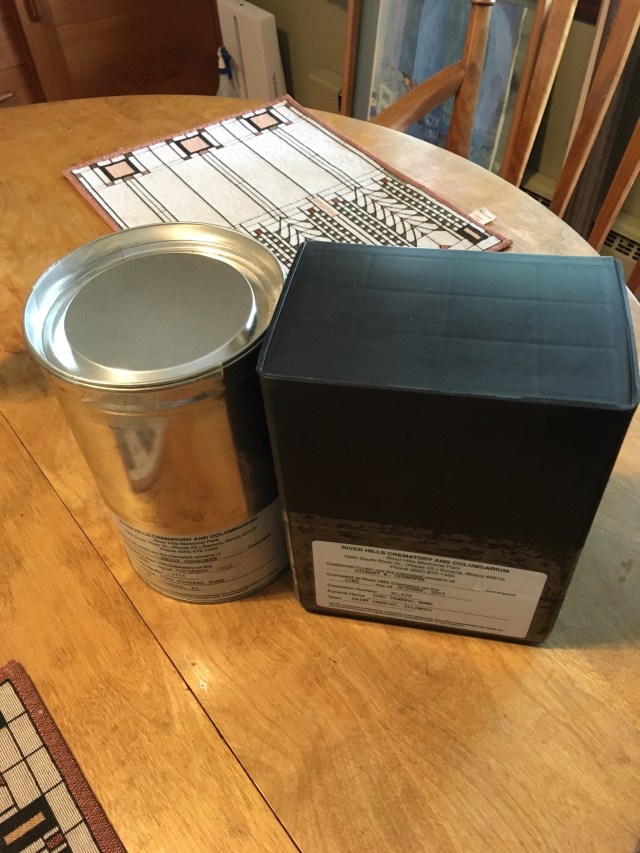
Parents Remains.jpg

ALL OF US experience days when we’re out running or riding or swimming and we just feel dead. The legs are heavy. Even the mind can feel like it’s sinking down into the abyss of the neck. We drag ourselves through a workout and slog through the shower. “Thank God,” we murmur to ourselves. “That almost killed me.”

Well, that’s the rhetorical version of being dead on your feet anyway.

This weekend I’ll be driving east to Cleveland to visit my son and attend a graduation party for my niece, who is graduating from high school and will play college volleyball with her sister before the older sibling graduates next year.

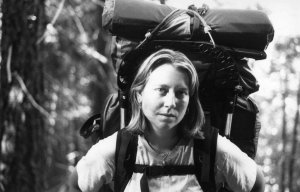
So the time is right to rally with family and get another job done in the process. My father passed away last October and by his own directives was cremated. The same thing took place in 2005 for my mother. It was my father’s wishes that they both be buried in a cemetery in Upstate New York, the region where they were both born and raised. So my brother who lives out east made a couple trips to the Bainbridge area to secure a beautiful spot on a hillside cemetery. My father and mother’s remains will be buried there.

On the way to Cleveland, I’m planning a little stop on the way to ride the Cuyahoga bike trail. I may ride thirty miles or so and jump off the bike for a run too. It looks like lovely territory for a workout and getting a taste for the natural areas of Ohio.

Urn For DadWhen I get back home there will be yet another matter of cremains to attend. I’ve had discussions with my late wife’s family and we’re considering a burial place for her with her father in the cemetery of the church where she was raised. She’d never really indicated any other plans beyond the directive to be cremated. It seems strange to say that we didn’t discuss ideas beyond that, but really her reticence was the product of her unwillingness to give into ovarian cancer, the disease that took her life three years ago.

I’ll confess to the fact that carrying all these remains around has had an effect on me. In some respects, it has fueled an ire. Life itself feels absurd in some ways. And politically, there’s almost no excuse for people to devalue others and to do the stupid things they do, including murder and the taking of life so casually or willingly.

All my life, from the youngest memories I have, there has always been a sensitivity to social justice in my soul. Even from my earliest years as a little kid I fought back against bullies and sometimes paid the price. But I don’t regret those fights, on the ones in which I engage to this day. I don’t think I’m wrong to do that, or to care so much.

I recall a period in the early 1980s when I was working hard to become an even better runner than I had been in college. The results came, but the drive was so deep within me that I was in some ways maniacally joyous and at the same time profoundly unhappy. The drive to do better fueled both emotions. That is life in a capsule if you ask me, and what remains for each of us to figure out whether the joy or the unhappiness is the true reality.

I am conscious of this duality every time I go for a run, ride a bike or slide into a pool. I am alive, therefore I do. It’s not much more complicated than that, and yet it means so much to be conscious and grateful for these or any abilities.

In this ashes to ashes world, the bridge between the simple act of being alive, which we too often take for granted, and the “I do” choices we make in our existence define our will to live, and how to do it best. What remains is history; be it personal, perpetual, or whatever we can make of it.

LOVE LIFE.

WRARShirtGraphic


Posted in aging, aging is not for the weak of heart, Uncategorized | Tagged , , , , | Leave a comment

Take a knee, or something else, seriously

Me Too.jpgWay back in the early 2000s I tore my ACL playing soccer. It was a sudden injury and a shocking incident given my lifetime of playing ballistic sports such as basketball, baseball and other activities requiring hard cuts and sudden stops. I triple-jumped in high school, which involves three consecutive jumps at full speed down a runway and into a sandpit. And I didn’t tear my ACL doing that?

So the last thing I ever expected was to feel my knee crumble under me while chasing down a ball on the indoor soccer field. That year I had surgery on the ACL and chose to use a cadaver part. Mistake. Two years later, it tore again.

However the strength training learned through physical therapy for the ACL rehab protected the knee in the ensuing years. Ballistic sports are now out of the question, but that’s okay. Basically, life told me to “take a knee” on those childhood activities and stick to grownup sports such as running, riding and swimming.

Only none of us ever really likes to be told to “take a knee.” Usually, it means some sort of punishment or harsh instruction is about to take place. I’ll admit there have been times when it has been a struggle to stay away from the soccer field and other formerly fun sport. A certain sort of grief kicks in about that.

Acting funny

Recently my left knee, the one without the ACL, has been acting funny. It produces a clunking feeling, like a bone is protruding, when I’m in an off-balance situation.

That’s not a fun feeling. In fact, it scares me. So while getting stretched out on the Athletico sports table after the duathlon I mentioned my “knee thing” to the trainer. He told me his company offers free injury screening. I’ve actually been to Athletico for physical therapy and strength training for the knee before. Some of the things I still do for strength work were exercises I learned there. But I’ll admit to a bit of laxity about those exercises of late.

So I dropped in to inquire about the injury screening and came back for an appointment. A physical therapy specialist did some short tests on my knee and hips. I could feel the relative weakness in my left hip and glute.

After a consultation with John Honcharuk, who runs the facility, I signed up for some refresher training. It’s time to invest in my “resilience,” as John put it so aptly. I’m confident the investment will be well worth it. We love to think of ourselves as these educated creatures who run, ride and swim. Yet we’re often ignorant or lazy or avoiding the truth about our own bodies. Our weaknesses are not fun to think about.

Dollars and sense

Me at MusclemakersIt will cost me a little money to get the training and become more dedicated about my strength training. It’s frankly overdue. Neglecting your strength training is like making minimum payments on your credit card bill. It feels like progress is occurring, but actually, it’s not. Sooner or later the principle actually comes due.

The truth is often converse to how we are accustomed to thinking. Turns out there is more than one way to “take a knee.” Just add a word and the meaning changes. As in: “Take a knee seriously.” That’s the advice I’m giving all of you. If you have a recurring problem with any part of your body it’s a sign to which you should pay attention. It might be soreness or weakness. It might be digestive or urinary. It might be your teeth or your eyes, you toes or your butthole. Get it checked. It’s far better to find out the source of your problem and find a possible cure than simply hoping it will go away. Good athletes take care of their whole body. We shouldn’t ride our parts until they are bone on bone.

You may not always find the exact answer to your questions and concerns. It may take a couple opinions to decide  the right thing to do. But it is far better to take a problem seriously than to wish it would simply improve on its own. Yes, we all get lucky sometimes. Some pains or problems do heal on their own. But not all. These are “traveling injuries,” a natural part of training and racing.

We’re talking about the bigger picture here. Chronic or congenital issues need to be addressed, not ignored. So: Take a moment. Take a knee. Catch your breath and figure it out. You’re in this for the long run, aren’t you?

WRARShirtGraphic


Posted in triathlete, Uncategorized | Tagged , , , , , , | Leave a comment

Jens Voigt in person is the real deal


IMG_5190

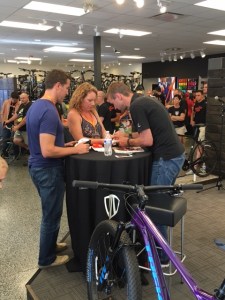
Jens Voigt stayed to sign autographs and pose for pictures for an hour after his interview session.

He was much taller and even a bit leaner than we all anticipated. Jens Voigt stands 6’3″, and even in retirement from pro cycling, his athletic frame shows no trace of fat. Yet he had a confession to make during an hourlong interview at the Trek Bicycle Store in Naperville, Illinois. “When I was racing I was down to 4% body fat, and 8% at most. Now I’m in double digits!”

He admitted that his transition from pro athlete to life as a “normal human being” included some prescient thoughts after breaking the world record for an hour bike ride. “I stood in the shower and looked at my body,” he related. “And realized this was it. This was as fit as I would ever be again.”

Changing game

Such are the challenges of once being one of the world’s elite bicyclists. Yet Jens Voigt always approached his career with an open mind. Today’s cyclists, he relates, are much more controlled in everything they do. Cyclists on Team Sky, he shared, even receive their food in little packets. “They are measured to the pea,” Jens joked. “And during races, the riders are numbers,” he intoned. “The team director says, ‘Go ride 20 minutes at 485 watts,” he shared. “I’m not sure I would fit in the world of cycling anymore. With me, I looked around and said to myself, “If the sun is shining, it is a good day to attack.”

Yet the master of the breakaway also related that his mind worked in visionary ways at times. “There were times, every couple of years I’d say, where I would get this idea in my mind, and see the whole attack like it was a movie, a picture in my mind. And then I would go do that. It did not come every year, but there were several races like that where I had the idea and made it happen.”

Crashes and doubts

Voigt was asked about the worst crash he’d ever experienced. He recalled the day that he went down to the tarmac at 55 mph. “Later, I saw myself on TV and I thought, ‘I look dead.’ ” But the worst part of the experience was the fact that television commentators speculated that he might indeed be dead. That left his wife and family back home wondering if his life was indeed lost.


Russ and Jada Jens

Our friends Russ Bauch and Jada Hambry-Butler getting gear signed with Jens Voigt

The comeback from the crash took months and a bit of soul-searching. it was a solitary decision in some ways. Yet he also recalled a bit of encouragement from an unusual source after the life-threatening crash. “When I came out of surgery hours later I had a note there from Lance Armstrong,” he said. “He was the only cyclist that took the time other than my team members to wish me well. I know what people say about Lance, that he is a monster or something. But it’s not true. The world is not black and white. There are many gray areas. Lance has done some bad things but he is not an all-bad person.”


Murmurs among the crowd of listeners at that point intimated that Jens was confessing to being part of the doping culture of cycling at the time. That’s how cynical the fandom of cycling can be.

The Hour Record

Yet listening to Voigt describe his experience in the one-hour time trial vanquished those considerations. “The first five minutes were not that bad,” he joked. “But then everything started to hurt. And at thirty minutes I was thinking ‘This is really hard, and it’s not going to get easier.’ ”

After the effort, Voigt said his body hurt for days, all the way from his neck to his butt to his fingertips. “It really was a total effort,” he observed.

The idea for the hour record came about as he raced in his final season in a career that included 17 rides in the Tour de France, which included wearing the yellow jersey. That’s 39,000 miles of competitive racing in some of the toughest conditions in the world. Voigt won Tour stages three times and made the racing interesting in many events around the world. His favorite place to ride in the world is South Africa, he said, because around every turn is a “picture postcard moment.”

Behind The Wall


Jens Speaking

Voigt is an avid storyteller with an honest take on his own successes and challenges in life.

Voigt was raised in communist East Germany. He lived in a secluded world behind the Berlin Wall, a structure that was breached at times, but always reconstructed until the wall finally fell for good. Yet five years after the wall was gone his father still raced to turn off West German radio  whenever he saw police or other authorities driving by the garage where he liked to tinker on cars and such. “Those habits die hard. You had to be careful,” Voigt related.


In the oppressive environment of communist East Berlin, Voigt was lured to cycling by the opportunity to ride in a government/state program in which kids could ride and get a free bike. That idea appealed to young Jens, who happened to win his first race, setting him on a course for training in an academy where dorm life was austere and highly competitive. He learned early to be tough and self-reliant.

Coming of age

His first pro team was a bunch of Australians who apparently loved having a good time. That was an experience Jens characterized as eye-opening for his relatively sheltered, innocent worldview. Yet his performances led to invitations to join Continental and then World Pro Teams. That’s where Jens Voigt earned his reputation as a hard man, and his personality became legendary. His famous Shut Up Legs philosophy is now featured in a brand of appealing Trek and Bontrager clothing.

That’s the purpose of Jens visiting a string of Trek stores across the country. Jens also has a book titled Shut Up Legs. Ironically, he forgot to plug the book until a visitor asked him about it during a long and personal autograph session. “Oh yeah!” Jens chirped to the crowd. “I do have a book called Shut Up Legs!”

Still a cycling fan

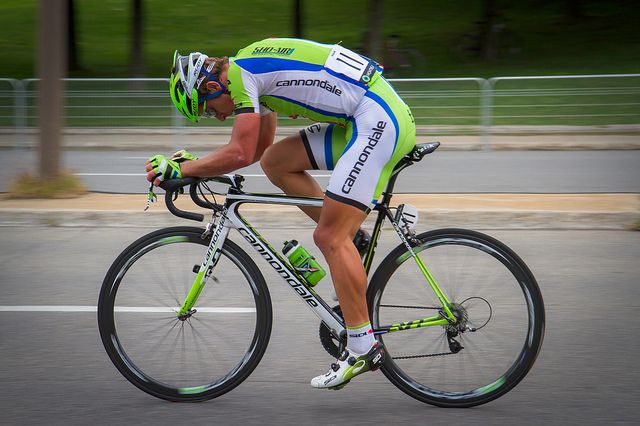
Peter-Sagan-Foto-Flowizm.jpg

Such is the humane and honest personality of one of the best bike riders the world has ever known. Yet Jens is a fan of some of his fellow cyclists as well. “I really like Peter Sagan,” he related. “He is so smart, and he’s honest. When the peloton caught me on a breakaway Peter rode up and said, “Jens, I’m sorry…”. Voigt may admire the counterculture and breakaway mentality of the still-maturing Sagan, who seems to defy the conventions of modern cycling on so many fronts.

Riding on a team with Fabian Cancellara was also a treat for voigt. “He’s so tough and strong,” Voigt related. “But one day he comes out of the shower in the team bus and says, ‘This water is hurting my skin!”

Jens also had words of praise for the Trek cycling company for whom he works. “There are a lot of great bikes in the world,” he said. “But riding for Trek was different, because they would talk to the riders and listen. You weren’t just a ‘muscle’ in their eyes. We would give them ideas and they would come back with new bikes. It was really collaborative.”

He also shared that Trek takes the relationship seriously. “Yesterday, I learned that back home in Germany my child was getting tested for a problem with her heart. Trek told me, “Jens, we can fly you home right now.’ But I found out they are doing an electrocardiogram and things will be okay. So I said, ‘No, I’ll stay.’ But it shows you they care about the people that work for them.”

Best and Worst

Voigt was asked to share his best and worst races of all time. The worst he cited as an eight-hour day on a stage of the Tour de California. That was back when the race was held in February. “We rode 120 miles into a headwind the whole way,” he groaned. “And it was raining so hard. My fingertips did not thaw out for three days.”

His favorite race was an opportunity pull his former teammate Bobby Julich to a victory and the yellow jersey in the Tour. “People asked me if I did not want to pull away and win the stage for myself,” Voigt smiled. “But when I saw his family and the looks on their faces it felt so good to be part of that. That was my favorite day.”

The Character of a character


Jens signature sock

Voigt gave it a go signing all sorts of gear.

Such is the character of a great cyclist, a father of six and a man figuring out the meaning of his life and legacy. Jens Voigt is the real deal, both passionate and humble, circumspect and amusing. He could have talked for hours and people would have stayed to listen.


Even when his handlers offered to cut off the autograph session,  Jens was having none of that. “I want to stay for everyone,” he gestured to the 20 people still standing in line. And that, my friends, is a world-class human being.

A blush with fame

When it became our turn to step on stage for autographed pictures and photo with Jens, the great cyclist glanced at Sue and asked, “Are you a triathlete?”

She was taken aback and said, “Yes.”

“I can tell,” he said, flexing his arms. “You have a body like an Amazon Princess!”

Sue almost folded into herself in embarrassment at them moment. Then came an abashed blush and a thank you for the compliment. Jens signed our Shut Up Legs summer cycling caps and we all posed together. We walked out of there appreciative of the opportunity to meet a genuine hero. Those are few and far between in this world.

TRAIN HARD. COMPETE WELL. LOVE LIFE.

WRARShirtGraphic


Posted in Uncategorized | 1 Comment

The numbers really do lie sometimes

RACE NUMBER.jpgAt the race packet pickup last Saturday, the guy handing out the numbers gave me a weird smile. “I hate to tell you this,” he grinned. “But your number is 666.”

Okay, I laughed. The Mark of the Beast.

However, when I wore the race number, my eyes did not spew blood. Nor did I sprout devil knobs on my bald pate. Or, secretly have to hide a tail that grew out of my coccyx.

Instead, I ran a healthy, happy duathlon and finished fourth in my age group. It went so smooth and enjoyable that I was actually able to “be in the moment” at a number of points along the way.

Did it mean that I did not suffer? Well, one has to define that term. I ran 6:42 per mile for the first segment and 7:42 for the closing four miles. Nothing spectacular there. But I was feeling it to some degree. I ran 13:45 last year for the opening two miles last year and T 13:43 this year. Rather consistent there.

In 2015 I ran 30:27 for the closing 4.2 miles. This year, 31:33. That part of the course was changed for 2016. One never knows how the measured distances compare. I ran a minute slower perhaps? I rather doubt it. I was running much smoother this year than last, when rain had filled my shoes with water during the bike.

This year the bike segment was quicker by 20 seconds on the same course. There was a fierce northeast wind in our faces in the open country.

Transitions? I still need work. Last year I was 1:54 and 2:01. This year, 1:44 and 2:04. Too much dawdling still. The top guys in my general age bracket of 50-59 are all close to one minute in transitions.

I chuckled at the comment of a running associate Tom Spadafora. We passed each other during the race a couple times. He’s running faster these days but I caught him on the bike. Then he passed me again during the second run and said, “We’re getting too old for this stuff.” He’s kidding. No one loves running more than Tom. “All I wanted to do was get off that bike,” he later laughed.

Enjoying the race

For me, the kicker was the feeling of enjoyment this year. I had fun last year too, but perhaps it was the cool weather and the lack of a driving rainstorm during the bike that made things a little more fun this year. So there was no dramatic performance improvement year over year, but there was a qualitative feel to this year’s race that I really liked. I think there’s something to be said for competing comfortably or better at the same distance. Is it a sin to actually enjoy the sensations of what you’re doing?

The numbers to me are interesting, but all very relative. When the chip results were first listed, there were guys behind me in the standings that had faster overall times. The name Christopher Cudworth was also listed twice in the standings. That made me wonder if I had sold my soul to the devil without knowing it? Perhaps that number 666 had come back to haunt me after all. But it all settled out once the results hit the actual website. Such are the vagaries of data.

Hand in hand

What mattered most to me was the most wonderful circumstance of all. In the last half mile I spied my fiance Sue headed into the finish. I caught up with her about 200 yards out and suggested we hold hands going into the chute. Well, I’m the nutty romantic of the pair but she agreed and we got a few “awwwwwww”s as we ran across the finish line together, hand in hand.

I say that was super cool. The odds of our finishing exactly together were pretty slim considering she did the Triathlon and I did the Duathlon. She finished second in her age group after a good swim and a good bike.

It was a match made in heaven despite my devlish race number. That’s my story, and I’m sticking to it.

LOVE LIFE.

WRARShirtGraphic

Posted in Uncategorized | Tagged , , , , , , , | 1 Comment

What the death of Michigan cyclists can teach us

Road bikes crash-800x539I’ve waited a few days to think through the meaning of the death and injuries among a group of cyclists in Michigan. By now social media has essentially had its say and will go back to looking for the next emotive tragedy. That’s generally the way of the world these days.

But let’s pause to think about his. The recent incident can teach us something more about incidents like the driver plowing into a group of cyclists in Michigan.

The problem breaks down into four essential categories among both drivers and cyclists. These four categories of people on the road are:

  1. Erratic: People too ignorant, confused, emotionally disturbed or incompetent to frequent their place on the road.
  2. Unintentional: People either distracted, inattentive, detached, inconsiderate or temporarily incapacitated during their time on the road.
  3. Intentional: People in full control but whose perception of their place on the road has been preoccupied through notions of entitlement, power, competitiveness or ownership to the point where they think they are above the law.
  4. Responsible: People in full consideration of their role on the road, who respect the law and who acknowledge the rights of others to use the road as law and etiquette permits.

And there you have it. A simple categorization of people in cars and on bikes.

Erratic by nature

There is something of an algorithm to all this. Erratic drivers and erratic cyclists are clearly a danger to others and to themselves. Whether you’re on a car of a bike and see someone driving erratically, it almost seems beyond belief. “How did they even get their license?” you want to ask.

Erratic behavior is simply part of the human spectrum. The best thing to do in any circumstance, by bike or by car, is to report erratic behavior for the safety of society. Call the police and give a location. Put them on alert if you see a drunk driver or even a cyclist who seems to be riding in an unconscious way.

Dealing with the erratic side of human nature 

We’ve all seen people riding their bikes on busy highways where there is no significant shoulder and they don’t really belong. The fact of the matter is that the law still protects them. Drivers in most states are still required by law to give cyclists a full three feet of margin when passing, and this may require a separation of hazards. It is also advisable to make a call to the police if you see cyclists who are riding in erratic or dangerous ways. 

By contrast, when someone is driving erratically or aggressively, they should be immediately reported to the police with no exception. 

Unintentional dangers

Whether cycling or driving, all of us eventually make mistakes on the road. Blind spots on vehicles can make it difficult to see around the corner or even directly in front of a car or truck at times. While on a bike, it is difficult to check in all four directions in traffic or even when stopped. Sometimes people become inattentive and make poor choices. Driving requires plenty of attention to rule our risk factors such as these.

There are also factors such as texting and driving that are proven to contribute to dangerous driving situations. These are technically “unintentional” driving mistakes, yet they are some of the most serious risks on the road. And no cyclist should be texting and riding. Ever.

Of course, many cyclists unintentionally impede drivers. But here’s the problem: Even cyclists who are obeying the law, riding single file or even in twos where it is legal to do so are perceived by some drivers to be intentionally blocking traffic. This is a problem of perception, not rights. Yes, there are times when cyclists unintentionally

This is a problem of perception, not rights. Yes, there are times when cyclists unintentionally swerve due to wind or inattention. Drivers do need to be cautious about this when approaching a single or group of cyclists. Even a crack in the road or a tarsnake can cause a cyclist to temporarily lose control of their bike.

But when the driver unintentionally swerves or even stops suddenly in the path of a cyclist, mayhem can ensue. And when a driver either erratically or unintentionally plows into a solo cyclist or a group of cyclists, people can injured badly, and even die. We’re still trying to ascertain the nature of the case in the Michigan accident. Was it erratic, unintentional or intentional? That is perhaps for the courts to decide.

Dealing with the potential for unintentional accidents


The most important rule for cyclists on the road is to make sure that motorists see and notice them. If a cyclist is not sure if a driver is aware of their presence, it is wise to wave arms and call out reasonable directions. Even a friendly “HELLO!” with the wave of an arm can avert unintentional accidents. 

Drivers can alert cyclists who seem to be drifting or inattentive by giving a short beep on the horn of the car. It’s not always necessary, but sometimes individuals from small groups of riders will drift too far out in a lane for their own safety. Patience is key because there are a lot of things a cyclist has to abide, such as road conditions, deep cracks, glass or other objects that may make them temporarily, unintentionally become an obstacle. 

Intentional confrontations

Angry drivers

The ugly side of all this is intentional confrontations between drivers and cyclists. This happens when either party is acting dominant on the roads. The danger begins when one party feels inconvenienced or threatened by the presence or actions of the other.

Some drivers intentionally buzz cyclists. Others honk long and noisily when approaching from behind. Some will even swerve in front of a group in an act of aggression. And in the worst case scenario, really angry drivers will intentionally use their vehicles to intimidate or actually strike cyclists.  Still others will stop, get out of their vehicles and attempt to start a fight or accost riders.

This is better known as road rage, and it is the worst degree of intentional confrontation.

Arrogant cyclists

By contrast, bands of cyclists can be intentionally ignorant on the roads as well. This is true among some elite cycling groups whose weekly rides get competitive or build to large numbers. When this happens, cyclists are no longer thinking about the rules or the road in many cases. They roll through stop signs even when other traffic is present, or spread out across the entire length of the lane, thus making it impossible for any vehicles to get by.

Even the presence of multiple cyclists in sponsored or organized rides has been perceived as a threat to the community order and laws of the road. Some popular cycling counties in Southwest Wisconsin have considered banning organized rides for these reasons. The aggrieved residents have been observed stalking riders with video to document abuse of the law.

Dealing with intentional confrontations on the road


When it comes to confrontations between drivers and cyclists, the clear advantage in aggression and power goes to the person driving a car. The weight and speed of a 2,000 lb. vehicle can easily smash a 17 lb. bike and it’s 170 lb. rider. That’s no contest. 

But that’s the point as well. It is a pretty pathetic character who feels their rights are threatened by the temporary inconvenience of having to share the road with a cyclist or group of cyclists. 

Largely this is a cultural issue. It is a classic clash between perceptions and rights. Cyclists, whether they are adorned in multicolored kits or pedaling along with baggy shorts and a basket on the front of their bike are doing something far different than any person in a car. 

And if that person in a car, van or truck happens to be in a hurry or has emotional issues going on about respecting others or feeling self-respect, the cultural impasse becomes greater every inch of the road they are asked to share. 

Likewise, we must address the sometimes intentional ways that groups of cyclists can take over a road. When intentionally preoccupied, cyclists can be terrible about obeying stop signs or riding with road etiquette in acceptable sized groups. 

So the mutual burden on society is to promote the idea that roads were built for good intentions, not bad. It’s that simple.

Which brings us to the last group of people, the Responsible members of society. 

Responsible Drivers and Cyclists

Let’s get something clear and out on the table right now. Responsible drivers don’t always drive by the letter of the law. There are almost no drivers on our local interstate corridor who obey the 65mph speed limit. Local and regional etiquette dictates how the law is interpreted, and police patrol the highway knowing they cannot possibly pull everyone over who is breaking the law.

The same goes for responsible cycling. Many riders do not come to a full stop at unoccupied stop signs because it is frankly much safer to stay in your pedals, slow a bit, check for traffic and roll on through. This even saves time for drivers as well, who don’t have to wait for a cyclist at a full stop to accelerate all over again. Responsible people communicate via hand signals and responsible cyclists know that an intersection with four cars is not the place where you should expect to be automatically first in line. That’s where you unclip for sure.

The world works fine, and Libertarians, in particular,will agree that too many laws and too much attention to them can be an infringement on reasonable liberties. At least that’s one thing most of us will abide in the Libertarian philosophy. Responsible people know that interpretation of the law as it pertains to specific situations is always part of the picture. Definition of these norms is why we have courts in the first place.

Encouraging responsible driving and cycling

It should be the goal of society to focus on this collaborative approach to citizenship. Getting people who are unintentionally dangerous to pay better attention is the first goal. Getting people who are intentionally dangerous to moderate their emotions is the second goal. And getting everyone to take responsibility for their own place on the road is the ultimate goal. 

As for the erratic drivers and cyclists in this world, evolution may weed some of them out on its own accord. But in the meantime, let’s all look out for these types and report them when possible. It will make the world a better place. 

And by the way, all these principles of erratic, unintentional, intentional and responsible brands of citizens can be applied to our gun laws in America as well. Think about it. 

SEEK JUSTICE. SHOW RESPECT. LOVE LIFE. 
WRARShirtGraphic


Posted in Uncategorized | Tagged , , , , , , , , , , | Leave a comment

5 insightful ways to measure success

IMG_3120Endurance sports are widely measured in empiric ways. You have personal records at a specific distance or type of event. But these numbers by themselves do not measure every type of success you can achieve. In fact, numbers can actually be deceiving.

For example, cyclists fortunate enough to tuck into a quick pack in a criterium can get pulled along to an amazing pace. For the same relative effort one might do in a solo ride where you achieve an average pace of 20-22 mph, a rider might find themselves humming along at 24-26 mph in the draft of 10-15 other cyclists.

And that’s fun, but which is a more honest measurement of success? The answer is: both are legitimate.

In order to quantify success, you need to factor in more issues than the raw numbers of pace or time. Running a 33:00 10k on a hot day can take just as much commitment and courage as a 31:30 10K on a fine autumn weekend.

The notion of success can get even more complex in a sport like triathlon. Factors such as water temperature and wind speed certainly determine the outcomes of an emphatically solo sport.

So in order to gauge your success, use these five factors before you call your last effort a success or failure. Rank each one from 1-5 after each racing effort and you’ll have the valuable comparative baseline to prepare you for each new race.

  1. How did you prepare for conditions? Did you think ahead and prepare in the event of adverse weather, wind or temperatures? If you did, that’s already a factor in how you should measure your effort. Simple acts like bringing a thermal cap for the swim, the bike or the run if water or temps outside are cold can keep you in the game. Rate yourself on a scale of 1 to 5 on how well you prepared your gear and equipment for the day of a race.
  2. How did you respond to conditions? The next factor of success is how well you calculated your effort “in the moment” and during the race. If the day turned out much colder or hotter than predicted, what adjustments in pace or strategy did you employ to get the best result?
  3. How did you adhere to your plan? Most athletes have prepared a plan for a race. That might involve anticipated pace in a swim, bike or run. It might even break down into splits or checkpoints. Going out too fast or too slow puts you in a position where you plan is more difficult to implement. Being disciplined and focused on your race day plan is a sign of commitment and confidence in your training and preparation.
  4. How did you respond to competition? While your strategic plan is the foundation of your race effort, it is also important to be ready to respond if pressed by competition. Recognizing opportunities to compete is important if you want to win your age group of any other competitive goal. Testing yourself is why we enter races, and competition pulls you along to better efforts. Taking those risks off the foundation of your competitive plan is often the toughest choice we make. There are times when it is better to stick by your pace plan than be dragged ahead by someone that might not be able to sustain their pace. However, those moments are what make competition so interesting.
  5. Did you compete to achieve or to avoid failure? This may be the harshest question of all. When measuring success, it is hard to admit that the fear of failure might be greater than the desire to achieve. The differences are subtle but building confidence through your training and taking risks that fail are part of growing as an athlete. See, if isn’t a failure if you try too hard and wind up with a seemingly poor effort or even a DNF. That means you’re measuring yourself by the willingness to try. The real measure of success is what you gain from that supposedly failed experience. What did you learn that can be applied to future efforts? Was it your plan that was flawed, or were elements of your preparation or response to the day somehow at fault? Even grand failures can add up to future success if you are honest with yourself about the source of your challenges.

If you use this Success Factors list and rank each one after your races, you might find yourself more informed and feeling positive about your efforts than you might if you simply look at your effort as a comparative number to your personal record.

Factor in aspects of competition such as transitions in triathlon and your overall sense of how you prepared and competed becomes much clearer. There is always room for improvement. But having a clearer sense of what contributed to your success is the key to understanding how that improvement should take place.

TRAIN HARD. COMPETE WELL.

WRARShirtGraphic


Posted in competition, Uncategorized | Tagged , , , , , , | 1 Comment

Racing the bike in a criterium

Bike RacersThe first year I bought a real racing bike ten years ago, I raced in a series of criteriums from June through September. The lessons learned were many. How to ride in a hurtling pack. How to turn without braking. How to draft within inches of the wheel ahead of you. And how to get dropped.
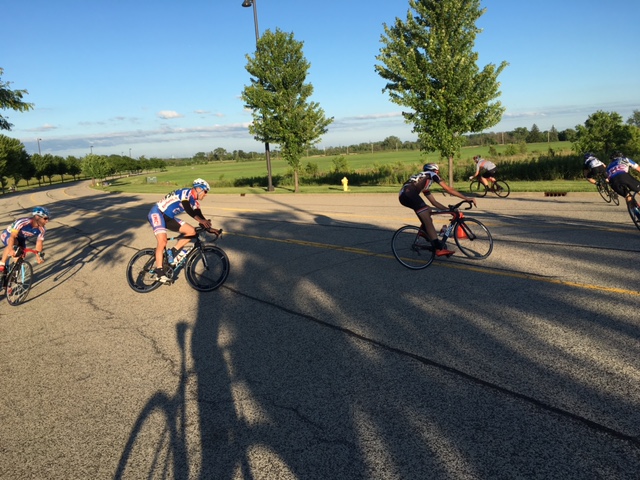
That last one is the inevitable consequence of bike racing. Sooner or later, every rider on earth gets dropped somehow. It happens in a local criterium and it happens in the Tour de France.

The point here is that getting dropped is the natural state of bike racing for all but the most exceptional riders on earth. There is no shame in it really. It’s not always your fault. It can happen because the riders in front of you fail to hold the wheel of the peloton. A gap develops and suddenly you’re riding a mile or two per hour slower than the main pack and pop! you’re off the back. Bridging that gap takes guts and fury. It can be done, but you have to act fast.

All these lessons were fun to learn. Yet when I go bike racing now, there are still lessons to learn. Every time.

Last night I showed up for the Tuesday night criterium races. The crits are “practice” events hosted each week by a cycling club called Athletes By Design based out of Prairie Path Cycles in Batavia and Winfield. There are crit races from Cat 5 to Cat 1 and all points between.

The second race of the evening is essentially a handicap. The Cat 4 and 5 racers get a head start and try to stay ahead of the Cat 1,2,3 racers on the U-shaped mile-long crit course. At either end are hairpin turns.

That means the Cat 4 and 5s get to see their pursuers along the way. It is a scene much like the movie Apocalypto in which the lead character Jaguar Paw attempts to stay ahead of a band of murderous warriors angry that he was able to get away from their death game back at the Aztec colosseum.

Bike Racers too

The fact of the matter is that it all comes down to miles-per-hour. We Cat 4s and 5s thought we were humming along at our 23 mph on average and stayed away for three whole laps. It’s hard to do the mental calculus and know how far you are ahead of the chasers when you’re concentrating on your own pace.

On the third lap I was on the front doing my pull for close to a mile when the band of elite racers roared up and closed around the front of our group like a school of barracuda. The sound of real bike racers in action is definitive and profound. Noise from skinny bike tires at 26 to 30 mph is threatening and pure. Same goes for the whirr of more expensive bikes and rims.

The effects were so sudden it was hard to react. But I dialed it up to what I estimated to be about 26mph (my cyclometer is not yet installed on the new bike) and stayed with the pack for another quarter mile. Then we angled into a persistent crosswind and I was three feet back, barely hanging on, when the acceleration came leading up to the corner. I couldn’t hold.

If you stick your finger in your cheek and pop it out, that would have been an appropriate sound effect. POP! Off the back you go.

That meant the next 15 minutes were spent pedaling because our original group of Cat 4 and 5 racers was blown apart by the sweep of the faster riders. We were cycling detritus at that point. Because for all the riding I’ve done, the ability to hum along at 26 mph is relatively rare. I’ve actually had more success with it in open rides rather than crits, where the stops and starts of racing make it tough to ramp up every time.

My real goal in the crit this week was getting ready for the solo bike effort in the middle of the duathlon this weekend. So the riding I did alone was good practice for the race. I dialed it in and focused on a full pedal stroke and averaged 20.8 for eight miles of racing. That’s a good sign. My goal is to race at 22 mph.

This bike racing stuff is a fun gig, all things told. I rode pretty smart with the original bunch and would have done well with the 4s and 5s had we not been blown apart by the Apocalpyto gang of Cat 1s, 2s and 3s. But you gotta love it. There’s always someone faster out there, and that’s the point of criterium racing. Sometimes you get away from the murderers. Sometimes you don’t. That’s bike racing.

TRAIN HARD. COMPETE WELL.

WRARFrontGraphic


Posted in cycling, doing pulls in cycling, duathlon, Uncategorized | Tagged , , , , , | Leave a comment

Open water confessions

One of the benefits of training for a triathlon with a club is the motivation of shared experiences. Whether you’re an expert able to give advice to a beginning athlete, or someone starting out who is eager to learn, training with a team or group or club can make the experience that much better.

I’ve been associated with a team called Experience Triathlon for several years now. And when I say “associated,” I mean that in the most casual way. For the last year, I’m not even sure my membership has been paid up, and I intend to fix that. But I did go west with the club to train in Arizona this April. It was a grand way to kick off a year of new

Coach-Joe-Evergreen-Tri-2013

Joe LoPresto is Founder, Coach and Director of Experience Triathlon

experiences in which I’m going diving into triathlon more fully.


Joe LoPresto is Coach and Founder of Experience Triathlon. The club boasts dozens of athletes completing Ironman and triathlon races in races across the country and even overseas each year. It also directs races in Batavia, Lake Zurich and Naperville every summer.

Joe and his staff have taken people from zero experience to completing Ironman distances. Some of his star athletes compete in USA triathlon and Duathlon nationals as well. But the heart and soul of the club are the many athletes who accomplish their goals at whatever distances they choose.

Open water season

Last night was the first session of open water swimming at Centennial Beach in Naperville, IL. The facility offers a wide expanse of chlorinated water in which to practice open water swimming. Forty or so Experience Triathlon athletes showed up to get in the pool for the first open water session of the season.

The better swimmers all got going on their warmup laps. That was my first instinct as well. My swimming has come a long way, albeit with a break or two. So I swam 200 meters but found myself breathing with difficulty. That first time in the pool in a wetsuit is a different experience than doing laps in an indoor pool. Sure, the buoyancy of the wetsuit is great, but the constriction of the suit around my chest was an odd sensation. I’ve only swum in the thing a couple times.

Newbie confessions

So I drifted over to the newbie side of the open water swim session for some instruction in a more controlled environment. I was not alone. There were 20 of us bobbing in the water together. Many are shooting for their first Sprint or Olympic events this summer. This weekend is the Batavia Triathlon and Duathlon in my hometown. I’m doing the Duathlon to defend my age group title from last year. But then comes the Pleasant Prairie Sprint Triathlon and later the Lake Zurich race, where I may enter the Olympic if the Sprint goes well enough.


suzy-lulu-3-low-res1-200x300

Coach Suzy Cerra of Experience Triathlon

We’ll see. There’s still quite a bit of practice in the pool needed to be comfortable in open water. Yet there could not be a better facility in which to test your guns than the Naperville pool. By way of instruction, Coach Suzy Cerra was floating around giving us all guidance on the skills of open water swimming. We sighted for a few laps. Then we swam around her like a buoy. With each new drill my confidence in the pool grew.


Always the fundamentals

It’s so easy to abandon your fundamentals when you start any activity in a new environment. You can ride hills in your hometown with aplomb, yet when you face a long climb in the mountains of Arizona you start mashing and kill your quads in half a mile.

Or you can run on the track at 8:30 pace all day, yet when you come out of transition with a line of other athletes that simple pace seems impossible.

The swim segment can be even more manic given the potential to get kicked, dunked or driven off course in the frenzied start. Learning to maintain or regain your rhythm when you get knocked around in the water also takes practice. No one wants to panic, yet anxiety is a common challenge for many open water swimmers.

Relax

Of all the sports in triathlon, relaxation is most key in swimming. You simply can’t breathe well if you’re taking quick or shallow inhalations or forgetting to exhale fully as well. Many of my fellow newbies were talking about that very sensation. You could see it in them during our practice session too.

But Suzy Cerra (who is a wonderful, patient and experienced coach) reminded us that flipping over on your back when tired or anxious is a great way to recover your confidence. It’s not hard to do in a wet suit with all that buoyancy. Frankly it feels a little like the hand of God has got your back, keeping you afloat. Jesus may have walked on the water, but most of us would happily settle for the ability to float in a wetsuit when needed.

So we practiced that too. One by one smiles emerged as we doubled our laps and got better at our open water skills. Humility is a wonderful partner on the path of progress.

Outtakes


IMG_1993

Coach Sue Astra (left) with fellow Ironman Wisconsin finisher Lida Bond Kuehn at the Madison Open Water Swim 2015

When the session was over, an accomplished duathlete friend of mine named Bob Jones came over to talk. He’s coached by my fiance Sue Astra and he has made significant progress in improving his swimming as a result. Bob is a fast athlete, and tends to like to do everything fast. So the incremental fundamentals of swimming have in some ways been hard for him to incorporate. We both laughed about our athletic impatience and he confessed, “The first 50 meters today I was like, ‘Whoa, I’m out of breath.’ But then I got back to fundamentals and remembered to rotate my body and it came together again. I’ve just got to remember what I’ve learned.”


That’s the secret to open water confessions. Let it all out when you get in the water. Remember not to force the issue. Don’t go too hard at the start. And focus on the fundamentals.

Race day advice

virgin-mary-0405That’s what my fiance Sue Astra was advising another of her swimming students to do. The gal had recently trouble in the opening yards of the swim segment in her first triathlon of the season. “Next time, go out slower than you normally would to start,” she told her. “And find some space to the side if you can. Get some rhythm going and your breathing will come along better.”
It really is about fundamentals. All of this. That takes practice, and a few open water confessions as well. If all else fails, you’ve always got your wetsuit along with the Hand of God and even the Virgin Mary to help you through. That last one might only work if if you’re Catholic. But open water swimming has been known to drive some strange confessions.

TRAIN HARD. COMPETE WELL. GIVE FULLY.

WRARShirtGraphic


Posted in triathlete, triathlon, triathlons, we run and ride | Tagged , , , , , , , , , | 2 Comments

The secret to love what you’re doing when you run, ride and swim

Motivation is the power source of all performance.

Without motivation, there is no will to work.

Without the will to work, there is no progress.

Without progress, there is no achievement.

And without the potential for achievement, there is no real reason to begin.

So here’s the secret to all motivation. It is love. All people who love what they are doing and who feel loved have found the secret to success.

So how do you tap into the single most motivating force in all athletics, and for that matter, life itself?

HOW TO LOVE YOUR WORK

Secret #1: Loving the challenges

Zach Plank

North Central College runner Zach Plank recently became a double All-American in the 10K and 5K at the Division III national meet held in Waverly, Iowa. Werunandride.com did a profile of Zach in summer 2015.

All great athletes know the secret to loving your work is to work backward from the goal you hope to achieve. That’s where you find reason to love what you are doing.

On that morning when the rain comes down and you don’t feel like going outside for a ride or a run, motivation must come from the context of your goals.

Often your training time is irreplaceable. You schedule it for a particular reason due to time constraint or the rhythm of your training plan.

That means challenges to your schedule are just that: challenges. Plus overcoming challenges in training involves the same sort of will required to overcome challenges during your race or event.

That means you need to learn to love what you’re doing even when it is not comfortable or easy. The very reason you don’t want to go out in the rain; that you’ll get wet on the bike, or have to dodge puddles, be careful on the corners, or get chilled before getting in the water (so long as there is no lightning during all of this) must become the root source of your motivation.

The rewards of this determination can be fantastic. On a morning when my cycling buddies opted out of a bike ride on a rainy Saturday morning, I was already dressed in a rain jacket and ready to go. After they cancelled by text, I rode out into a driving rain and laughed at the absurdly loud sound of water pelting the streets. For 10 miles the rain kept up. Then it stopped. I’d reached the western edge of the storm and paused to peel off my rain jacket. Underneath I was sweaty but not soaked. My feet were wet and my tights were still wet, but over the next 25 miles the sun came out and I dried off quickly in fresh breeze following the storm. That ride felt extra tremendous for having faced a challenge.

And it made me love what I was doing despite the challenges. That’s how it works.

Secret#2: Loving who you are

The Girls

These three gals who trained together last summer all completed their first Ironman Wisconsin in 2015: Lida Bond Kuehn, Suzanne Astra and Andrea Schaal

The second source of motivation that all athletes need is acceptance of who you are. That does not mean a lack of will to improve. Quite the opposite. We are talking about a core acceptance here, one that includes the willingness to work on your flaws.

Because until you accept your flaws and learn to love and acknowledge their existence, you cannot really identify the areas in which you need to progress.

This is perhaps the most difficult of all concepts to comprehend for many athletes. Because when you look around at your competition and see the people who beat you in races it can seem like those athletes do not suffer the same weaknesses as you. And that’s true. But here’s a fact: they have different weaknesses because they’re different people. They face challenges just like you.

So the trick to improvement and loving who you are is to develop that deep understanding of your weaknesses and to love yourself for the strengths you do have. And then go to work on those weaknesses. Learn persistence and enjoy the love of seeing progress in those areas of weakness.

There is no better feeling in the world than overcoming your own flaws in some way. It’s true on a personal basis and it is also true in your relationships with others. Loving who you are is always a matter of acknowledging your weaknesses so that you know how to work on them. Those who love you will feel even greater love toward you for that honesty and care.

Secret #3: Loving to suffer

The will to win is not always a pretty thing. It can drive athletes to extremes and create an unhealthy obsession with beating others at the sport in which you choose to excel. So let’s face facts: when you love to win or set out to get a personal best or achieve some goal, it’s seldom easy.

Evan Running

My son Evan Cudworth completed his fundraising Half Marathon to raise money for the organization Back On My Feet. The race included snow, sleet, hail and rain in 37-degree temperatures in Cleveland.

Because when you’re in the last mile of a 10k, or finishing the final leg of a triathlon, the desire to quit or slow down can be pretty strong. So you have to want to overcome that pain and fatigue or you don’t get the job done. It’s a harsh reality, but it’s not impossible to surpass.

Our college cross country team had a saying that helped us through those closing miles when it hurt really bad to stick with the pace. “It’s only temporary…” we’d say. And it worked.

Because most pain associated with endurance sports is only temporary. If you’re otherwise healthy and not fighting actual injury or other chronic issues, the discomfort goes away when you complete the race or training you set out to do.

And those two things go together. You must teach yourself to learn to suffer during training so that when you encounter those feelings in a race they do not make you panic or want to give up. We called it “callousing the body.” Just like that callous on your big toe that keeps you from getting blisters from your shoes. You callous yourself from pain and fatigue by training hard enough (and harder than you think sometimes) to make the racing experience seem easier.

#Secret #4: Loving the source of your inspiration

CherylStrayedphoto1

Author Cheryl Strayed documented her personal journey during a very long hike up the Pacific Crest Trail and learned to love herself in the process. She has proven to be an inspiration to many through her honesty and example of confronting her own flaws and fears along the way.

There are many examples in history and religion where people suffered for their cause and achieved great things. One thinks of Nelson Mandela in prison all those years, contemplating the goal of civil rights for all in South Africa. He could have come out of that experience bitter and angry. Instead, he turned his liberation into triumph.


The same held true for activists such as Martin Luther King, Jr. and Ghandi, Mother Teresa and yes, even Gloria Steinem. Some aspects of their achievements were controversial to some, yet they stuck by their vision to change the world for better.

It may not feel like you’re changing the world by going out to train each day. And when you finish in the middle of the pack at a major triathlon, it can feel like you’re invisible even after you’ve heard your name called out by the announcer. But guess what? By loving what you’re doing and doing it to the best of your ability, you are changing the world for the better too. By setting an example for yourself. By setting an example for your family or friends. Your work and achievement produce results. You can become healthier and relieve stress from the pressures of the world, which can be so unloving and intense.

But guess what? By loving what you’re doing and doing it to the best of your ability, you are changing the world for the better too. By setting an example for yourself. By setting an example for your family or friends. Your work and achievement produce results. You can become healthier and relieve stress from the pressures of the world, which can be so unloving and intense.

The secret to loving what you’re doing when you run, ride and swim is to let yourself love and be loved in return. You will come to believe in yourself and the force of love in the universe in the process. And that’s the most powerful motivating force of all.

WRARShirtGraphic


Posted in competition, it never gets easier you just go faster, mental health, race pace, swimming, training, triathlete, triathlon, triathlons, we run and ride | Tagged , , , , , , , , , , , , , , , , , , , , , , , , , , , | 1 Comment

On Southern climes

Pool tools

We were up today before dawn to get ready for my trip to the airport. That meant the pool equipment that looked so happy under the Florida sun took on a dark and sinister cast. Even the frogs that had been singing the morning before sat silently in the palms. Everything seemed sad that vacation was over. Or so it seemed.

Yet the trip home from Tampa went so smoothly I was tempted to think traveling had actually gotten easier of late. Tales of nightmare lines at the TSA check-ins were everywhere. That was not my experience. On the flight down to Tampa, my digital boarding pass even offered TSAPre status that put me through the process even easier. How that happened I do not know. But it was faster.

Florida joys

Looking UpOur week in Tampa was wonderful, capped by that wonderful run yesterday morning on the Starkey Wilderness Trail. When we got back to the parking lot we heard the chatter and laughter of a running group echoing beneath the steel shelter next to the bathrooms.

That made me think about what it might be like to move down here and actually live in Southern climes. During our run that morning we’d seen so many of these same runners out on their loops. They looked just like our assortment of running, cycling and triathlete friends back home. In other words, they were young and old, fit and fat. Just doing their running thing before gathering back at the picnic tables for camaraderie. Like runners do.

There were also a number of cyclists and triathletes doing their bike mileage out on the trail. This led Sue and I to discuss the merits of living down there in Florida. “You could train all year,” she said. “And acclimate. Then you could go race anywhere in the country.”

Hmmm. Sounds tempting, does it not?

Reverse psychology

Some triathlon friends this year did the reverse. They trained up north all winter for a Half Ironman, then flew down for a triathlon in Florida . They did well, especially given the supposed difficulty of putting in big mileage in colder weather.

But is it really that difficult or any harder to train up north as opposed to down south? Personally, I love running in cold weather. After the first couple miles when your hands warm up, cold temps are hardly noticeable. Some days you wait until the temps warm a bit before going for a longer run. You learn the ropes and make the best of the weather you have. Sure, there’s snow, wind and ice to contend with as well. So let’s not be naive. It’s not always easy to live and train “up north.”

The Southwest

Cold northern weather makes it tempting to consider moving to a place like Tucson, Arizona, where the mountains beckon for long climbs in southern climes. Okay, we all know the desert winds can get fierce. And in summer, the heat in Tucson or in Phoenix (or for that matter in Australia, Africa or any other place known for a hot clime) can kill you at 2:00 in the afternoon. Athletes who live and train in these places learn how to deal with the heat. They typically get their workouts in early.

There are other considerations to moving to new locations as well. Life can interrupt the best of plans.  While in Florida I met a 73-year-young guy named John down who lived in New Port Richey. He moved there a few years back. Four years ago he lost his wife to a sudden onset of brain cancer after she had just been advised by doctors that she had officially survived ovarian cancer. After 19 years they told her she was “cancer free” and no longer needed to come for checkups. Then the brain cancer struck and she was gone in eleven months. Her health had gone suddenly south.

Yet John keeps himself active these days running 3-4 times a week and cycling the other days. He does adventure races as well as triathlons. “I usually win my age group because there aren’t many of us,” he chuckled. “But I had to laugh at the results of one race. They said I was second even when there was only one entry. They said they didn’t know how that even happened.”

Southern states of mind

Florida RoadIt proves that so many of us operate in time-out-of-mind fashion. We place ourselves somewhere and make it work. Yet we still long for other places, better races and friendlier faces.

If that drive is strong enough, many people shake off the snow and cold and head South. Expatriated northerners migrate to Arizona or Florida seeking a whole new life only to arrive and find the new life contains so many of the same elements as the old life, just in a new climate. There are still relationships to consider, bills to pay and loneliness to bear if life’s circumstances have changed for reasons outside your control.

But the allure remains. Florida is indeed a beautiful place if you know where to look, and the warm climate is its principal draw for millions of Snowbirds and Retirees. Yet the state is also the repository (depository?) for millions of people who can’t seem to slide any lower off the map. Homelessness is common, as well as people of a seemingly common gender bearing a peculiar kind of zaftig shape one can only call the Florida Physique. They may not be hardy or healthy, but as long as they can get out of the sun and into the shade, grab a bite to eat now and then and scrounge up a few (or many) drinks, they survive to see another day. At least they know they won’t freeze to death in Florida.

And isn’t it amazing in a state where so many people claim to love Jesus with signs, tee shirts and hats, there are so many poor and homeless characters wandering around?

Chryslers and Lawyers

There is one other thing all Floridians seem to have in common. There are many godawful drivers in every city and on every street you find them. We witnessed people drifting their vehicles across three whole lanes of traffic. And bad driving was not categorized according to  wealth, privilege or poverty either. Bad driving was as true with beater Chryslers as it was with newly shining Chrysler 300s. People in Florida simply suck at driving.

This ugly problem is perhaps reflected in hundreds of billboards advertising lawyers promising “aggressive services” to win that lawsuit and gain those rewards for “personal injury.”

So the innocence of the place and its Sunshine State reputation wears off rather quickly, usually after six or seven hours or so, to be honest. The litigious climate in Florida is enough to make one think that the best way to make a good living down there would be to steer your $5000 tri-bike straight into traffic and hope the physical damage to your person isn’t that severe. Just make sure to do the deed under one of those billboards for the injury lawyers. And when the “offending” driver jumps out of their vehicle to scream at you for getting in their way, simply point up at the sign and say, “My lawyer will be calling you!”

Money for nothing

Injury lawWhen one of those aggressive Sunshine State lawyers gets done with your case you can live high on the hog the rest of your life. Buy yourself that new Specialized Shiv. Invest in several pairs of Saucony ISO Triumphs as a symbol of your newly earned decadence and buy some Speedo swim goggles with miniature windshield wipers on them if you like.

The year in review

We exaggerate of course. Most of us still have to earn a living no matter what Southern clime we choose. But if you figure out the whole money thing and do move South to where you can train year-round, remember that the mind and body do eventually need a rest. I predict you’ll train your butt off for eleven months of the year, then get a longing for cold snow and warm holiday lights in the darkness of night. Then you’ll grab a late flight and show up at the house of friend or family eager to share in turkey, potatoes, stuffing, pie and cognac. You’ll put on seven pounds in three days and feel as bloated as a Florida manatee after it washes up on shore after a power boat strike.

And that means starting all over training with a life buoy around your middle come January. You can take a Northern soul South all you like, but you can’t shirk the fact that a layer of fat will sooner or later come home to roost, usually around the area we call Tampa-St. Petersberg. But watch out for Orlando as well.


WRARShirtGraphic


Posted in Christopher Cudworth, triathlete, triathlon, triathlons, Uncategorized | Tagged , , , , , , | 2 Comments