Riding head-on into the medicine zone with no control

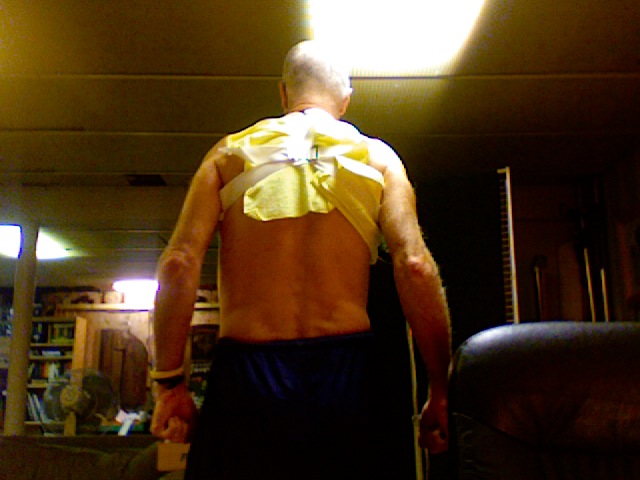
A wounded warrior wears a figure 8 brace for a broken collarbone.

When you crash your bike and injure yourself you pretty much give up control of your life. From the moment you hit the ground and hear that crunching sound in your shoulder when you try to get up, you know you’re screwed.

First there’s a trip in an ambulance. Stupid conversation with EMTs. The Emergency room in a podunk hospital. They check you out with a sling and a prayer.

Back at the hospital near home you see the x-rays. A good doctor tells you, “This is not good. Let’s put this on you to hold you into place until they can operate.” Figure 8 brace. Torture device.

From that moment on, you’re dependent on others. You’ve gone from zooming down the hill at 40 mph to hobbling across the room at 2.3 miles an hour because your right leg still has a thick purple bruise on the inside, plus your back really hurts.

Then you get surgery a week later and the amazing knife-wielder does his work and you’ve got a zipper on your shoulder and another sling to wear along with instructions not to move too much. Which isn’t hard to do at first, because everything is numb and sort of hurts.

The overnight stay at the hospital, your first since 1961 when your tonsils were removed, turns out to be a slow dissolution of personal control as well. Although that’s not a bad thing. The hospital is chartered to take care of you. Watch your vital signs. Dispense fluids into your veins and painkillers into your system. Make sure you don’t die or get an infection. Seriously.

As the night wears on, who cares if the hospital gown hangs off your shoulder like a worn-out dress on a backroom slut? You’re in the hospital. It doesn’t matter what you look like.

The nurse’s job is keeping you comfortable and clean.

But when it comes time to work through the after-effects of anesthesia, it’s a little tough to piss into that angled plastic jug, especially with an IV hanging in one arm and a sling on the other. But you hold your unit with both hands and aim the best you can. Nothing comes out at first. It’s like the piss is a stubborn train sitting at the edge of the railroad yard and can’t find the right track. So you secretly stand up and joggle your body a little bit and something hurts near your shoulder but you just don’t care because it would feel so much better just to let go with a good, solid whiz. Drip. Drip.

Then the nurse comes in and finds you sitting up on the edge of the bed. Odd, she’s thinking. He’s not supposed to be up yet. Which leads to conversation about reaching the bathroom and a Catch-22. You can’t GO TO the bathroom until you go to the bathroom. That kind of terminology can drive you nuts.

And leaves you sort of pissed.

But she leaves and through intense concentration a dribble and a flow finally comes out, like a stream flowing out from a foggy wood. Man, that feels good. It’s the simple things in life that count.

Then the dam opens and all that IV hydration starts pouring through your kidneys at a high rate of speed. Plus you’re drinking water cause it feels like you should and damned if you aren’t pissing like you’re out to set a record. Jar after jar.

Then the inevitable happens. Backwash. You go, “Oh gross.” No one likes to smell like piss in this world. So you grab a bottle of something that says ANTISEPTIC on it and give your junk a little washdown to feel fresh again. Mistake. There’s 83% alcohol in that bottle and a burning sensation starts down low and stays down low. Panic. Is it worth a punch of the nurse button? That would be embarrassing. You wait it out with a grimace. Damn that stings. But you feel honest somehow. Pain has a way of doing that. At least I’m clean.

When she comes by later you explain the humorous surge of pain you brought upon yourself. Even she has to laugh, and delivers some much needed wipes (designed for the job) that suffice much better. Probably she’s relieved you’re not asking for a sponge bath or some crazy creepy thing like that. Oh, what nurses must surely put up with. I’m not shy figure it’s my business to manage things down there unless I’m completely disabled. And I’m not. I just need help getting out of bed, that’s all.

Things improve. Breakfast comes. You make some phone calls out. The surgeon comes by and says things look good. “You can check out any time,” he says. But this is a hospital. Time out of mind. The doc came at 8:30 but you wind up leaving at 1:30. Emerge into a bright fall day clutching written instructions not to move the arm too much

Earlier you had lessons in body maintenance from a tanned-looking physical therapist that looks like she has not a care in the world. We walked around the corridor together to get rid of my “sea legs.” She says, “Oh, yeah. You’re good to go. You athletes are easy to work with.”

My legs. They felt like rubber. It was all I could do to stay upright. But you don’t say that when you want to leave the hospital.

It wasn’t bad, that first night in a hospital since 1961. One must be grateful for clean, private rooms and all the millions of dollars that go into health care these days. All I could think about sitting in that hospital is how much planning, preparation, science and technology go into running that place. Every hospital is a miracle to me. And it all happens through dozens and dozens of smart people working together so that when someone like me screws up and crashes into a ditch at 40mph, the hospital and surgeon and nurses are prepared to look after you.

Don’t get me wrong. Health care is not perfect. You can read the signs of disorganization if you look closely. You punch the button and no one shows up to empty your pee jar. Or two people show up, both surprised to see each other. But you must be forgiving of these small mistakes.

Because you really do have to give up control in many respects. Give yourself over to the process of what medicine determines is right for you. Ask questions, for sure. Get information about your treatment and options, absolutely. But you must also trust the doctors, nurses and others who take care of you.

By the time you get home the drugs take over. Vicodin is truth serum in my body. My wife and daughter think it quite funny how I prattle on while taking painkillers. Can’t tell I’m doing it. Writing about it makes me want to lie down. Let the pain go away.

But I’ve weaned off them now. Today’s the 10-day checkup, which comes down to this: How well have I been holding the arm still. Not very. I hope my body has more discipline than the brain that runs it.


Posted in Tarsnakes | Tagged , , , , , , , , , , , , , , | Leave a comment

You can’t beat fun: Total riding miles fast catching up on running miles

The Big Picture

Having kept running logs quite a few years I know about how much I’ve run in training and competition. Being careful not to exaggerate, but based on real figures from journals, my running mileage from ages 14 through 30, or peak competitive years, totaled 36,600 miles. That’s an average of about 2150 miles per year or 41 miles per week, or about 6 miles per day, on the nose.

By age 30 I tapered serious training and began running for health and fitness. Still, I covered about 10,000 miles from age 31-40. That’s approximately 1,111 miles per year, or 21 miles a week or 3 miles a day.

In the years since I turned 40 I’ve run less, but perhaps enjoyed each run more than ever. I estimate my mileage to total between 5000-8000 miles in those years, giving me a total lifetime running mileage of between 51,000 to 54,000 miles.

That’s not high by many standards. The most miles I ran in one week was exactly 100. And there have been weeks during injury, illness or schedule conflicts where I did not run at all. But pretty much I’ve kept trucking all these years. In all those years I never stayed overnight in the hospital once until this past week with the broken collarbone. The physicians and nurses ran down their checklists over and over again and pronounced, “You’re a pretty healthy guy.”

My blood pressure is 110/73 and my pulse rate runs between 55-65 on average. According to MetLife insuracne standards my basal health indicators place me in the Top 2% of all Americans my age. So the running has been worth it in many respects.

Keeping yourself up is easy. Keeping up with yourself is much tougher. 

I can still run a 21:00 3-mile without that much struggle, and did so last summer in an All-Comers cross country meet, and also on my own this year on a timed section of bike trail. My personal record at that distance is 14:17, accomplished during a 5000M track race at 14:45. So my raw speed and ability have diminished with age.

Speed is not my worry these days, because frankly it’s not that fun to run a race and finish with a time 5 or 10 minutes slower than your PR. That’s not really a thrill to me. Nor is winning age groups. That has never satisfied any of my competitive instincts. When I raced, I raced to win. When that priority moved to the background, my training priorities changed too. Running helps maintain an ideal weight of between 165 and 170lbs at 6 foot 1 inches. Running also fulfills a longstanding need to get out and think, helping me deal with stress and anxiety in life, and get grounded in my thoughts and objectives. I’ve always considered running a form of “moving meditation.”

As a writer and creative director I have had many moments of inspired thinking and problem solving occur on the road. The race home to get those thoughts down can be as interesting as any competitive 10K. Have you ever had a race to remember your own creative thoughts? It’s quite a challenge. But when the creative solution works, as it has many times in my career, you are grateful to have that portal to constructive thoughts.

Practical and Impractical Maintenance

I’ve had to do a lot of work to keep on running. In my mid-40s I took up competitive soccer and tore an ACL. To fix it, I had surgery and rehabbed the knee, which took about a year. Then I got back to soccer, and to running, but one mile at a time.

For a guy in his mid-40s I could still run with the young kids, but putting on the brakes got tougher as did handling the jostling and knocks of soccer. The repaired ACL finally gave way again 2 years later when another player slid into my knee from the side. I remember crying the whole way home, like I’d lost a relative, knowing that my career in ballistic sports was really over. The old Chris Cudworth was gone. Grief and tears. Boo hoo. You’ve got to move one.

But running has proven possible through continued physical therapy. Weights and strength work keep the knee stable. So on I go.

Cycling comes into the picture

8 years ago I took up cycling when my brother-in-law gave me a red Trek 400 steel frame bike. I fixed up that machine the best I could but still could not keep up on the group rides. So 2 years later the Felt 4C (“The Red Rocket) came into my life and it has been a joy learning to ride, compete and join the group rides a couple times a week. I’ve raced criteriums too. Nuts, but fun.

I also own a Specialized Rockhopper mountain bike to ride all winter. Cold weather riding is a great way to get over the indoor blues.

Riding mileage

In 8 years of riding I’ve averaged around 2500 miles per year, with the highest annual mileage topping 4000 miles. So I’ve ridden around 18-20,000 miles already and expect to keep riding at about that pace for the next 10 years at least. I see plenty of riders in their 60s who can kick my ass on group rides. That is both motivating and inspiring. So why not keep rolling?

There will come a day, probably 5-10 years from now, when my cycling mileage officially passes up my lifetime running mileage. It is like a tortoise and hare race against myself, as my running mileage wanes slightly the bike catches up.

But if it all adds up to running and riding equality in the end I’ll have covered 100,000 miles on foot and on bike in my lifetime.

And that’s cool, because I really don’t know if I’ll ever travel overseas before World War III takes half the world out. But I’ll have seen a lot and done a lot running and riding circles around my own spinning brain. It’s been fun. It will be fun. And it’s fun to think about what is yet to come. First I have to get back on the bike following the collarbone rehabilitation. But I’ve had a few injuries and know that it just takes time. And God’s will sometimes.

Laughing about the struggles

Our college cross country coach used to say this about the joys and difficulties of running, “Ah, Boys…You can’t beat fun.”

To which we’d all mutter under our breath, headed out to a tough workout; “Yeah, you can’t beat fun. It’s like a sore dick.”

There’s more truth in that joke than you might think. The effort and pain of training can sure wear you out and make you sore. But for some reason you always come back for another day. It seems some of us just can’t help ourselves. So we keep on going. Sore or not.


Posted in We Run and Ride Every Day | Tagged , , , , , , , , , , , , , , , , , , | Leave a comment

What role does God play in competition?

Stepping stones like prayer can turn out to be stumbling blocks.

As a young athlete it always perplexed me what to ask of God related to my performance in sports.

The questions were many. Should I ask God to help me win the race? Does God really do that? Or should I simply ask God to help me do my best. But what does that really mean?

These are not easy questions for a young mind. And actually, it seems society as a whole has a poor grasp on what to ask of from God when it comes to competition.

Our modern role models and what the Bible has to say about prayer

Look at quarterback Tim Tebow bowing down in front of millions of people to pray. And for what? Will God really bestow victory on Tebow’s team by this show of public piety? The Bible does not always present God showing much favor to those who pray, especially when praying very much in public, and especially for their own apparently selfish interests.

Take this passage from the book of Isaiah:

Isaiah 1:15

When you spread out your hands in prayer, I hide my eyes from you; even when you offer many prayers, I am not listening. Your hands are full of blood!

Not too encouraging, particularly if you just killed or have plans on killing your enemies in the near future. Sounds like God is pretty ticked at what you’ve already done…

But then God turns around and makes promises such as those in Matthew:

Matthew 21:22
If you believe, you will receive whatever you ask for in prayer.”

And that’s very nice, knowing that God is there for you in all circumstances. 

But the Bible also says you should not make too big a show of it because God seems to prefer people who direct their prayers to God in heaven, not make a show of them here on earth. This passage from Matthew gives directions: 

Matthew 6:5
“And when you pray, do not be like the hypocrites, for they love to pray standing in the synagogues and on the street corners to be seen by others. Truly I tell you, they have received their reward in full.”

Spit crosses and self-blessings

That said, what do we make of Olympic Silver Medalist Leo Manzano, who could be clearly seen making “spit crosses” from head to toe before several of his races. The diminutive Manzano made track history coming from far behind to place 2nd in the Olympic final 1500 meters race, the first time in decades any American (native born or naturalized like Manzano) has broken through to a medal at that distance.

So you could legitimately argue that Manzano’s highly unorthodox method of “prayer”––he administers a self-blessing by making spit crosses on his body in advance of a race–– was truly successful. His prayers to win a medal were answered by God. Were they not?

Not so fast. We must also accommodate several other factors when assessing the prayers answered by God when it comes to competition.

Let us suppose there are 16 athletes in the Olympic 1500. 4 are Christian, and all say prayers to God for success. 5 others are Muslim, and they all pray to Allah. 3 are agnostic, but choose to say a brief prayer just in case it helps, and the last, the Gold Medalist, happens to be atheist and does not even think about God at all before the race. Is God therefore rewarding the unfaithful and unjust? Punishing the faithful for pale hopes?

This is no joke. The composition of most athletic competitions is a very mixed bag. And what do we make of Christians or Muslims or Jews or Buddhists who are active in their faith but do not pray at all for individual success in competition, but trust in their training and (God-given?) talent to get them through?

A capricious God, at times

The Bible does show many faithful people getting their prayers answered. Some get immediate results, while others wait years and through impossible circumstance before a prayer and a miracle come true. But the Bible also shows entire nations that have fallen away from faith and trust in God being neglected or destroyed when God lets enemies overthrow them. That is the ultimate form of earthly competition, and yet God “lets them down.” Hmmm.

In fact it is fair to say that God dispenses as many harsh lessons to his faithful as he does answers to fervent prayers. Look at the biblical record. John the Baptist got his head chopped off. The loyal Job was tortured in effect by a wager between God and his greatest challenger, the Evil One. Many great heroes of the Bible suffered long and hard before receiving so-called rewards from God. The Bible tells us perseverance is as important as joy in building good character. That darn little book, the Bible. So full of apparent contradictions, isn’t it? It’s almost like God doesn’t want us to know what’s going to happen next, so that we have to be vigilant managing our free will in context with what God wills for us. That is; to love and be loved.

The perseverant

I can think of a few former teammates whose athletic careers were anything but triumphant. Many never even cracked the top 7 in cross country. Yet they put in all those miles. Sweated. Suffered. Ran through pain. Threw up. Sacrificed time and treasure. Some never even earned a varsity letter.

Then there were those who did enjoy success, and whose faith seemed to be a part of their ability to persevere. Yet when I asked one of these friends years after high school what he liked about running and competing on our team, he blurted: “Nothing. I hated running.”

His answer shocked me, to be honest. He was quiet and never complained about running. I can still see his bespectacled face grimacing as he approached the finish chute. He was tough, fast and competitive. Yet he hated it. Is this also what God wants from us? To suffer through things we hate?

I happened to love running. Most of the time. But I can remember praying that God would scoop me up from the infield and whisk me away to heaven during one spring track meet when I wasn’t yet that fit, and was dreading a competition in the 2-mile against runners I knew were much superior competitors. God didn’t answer that prayer. He probably knows what’s good for me.

Developing a real winning perspective

Having been fortunate to win a number of races in my career, I cannot definitively say that God played favorites with me at any time. That observation is made in context of other situations where I felt God played an intrinsic role in the events and the outcome––for better or worse.

In competitions of a wide variety there were circumstances where Providence seemed like it was at work, but sports is so ephemeral. For all the winning and losing one does in a career, it is the cumulative effect and how it effects your overall character that matters the most. No single game or event can really define “success,” as it were. So you can’t say that God either helped you win or lose. But it seems you can say that having faith in God teaches you the real difference between the two, in the long run.

Prayers as stumbling blocks

So I personally do not rely on that specific sort of prayer about a contest or an outcome to help me win. Those types of prayers can turn out to be stumbling blocks in your life.

By the time you’ve gotten to the starting line, all that you are and want to be should have been prayed about well in advance. That is part of your preparation and training.

Gratitude and attitude

Then comes gratitude at being able to compete. That is the first order of business, following by gratitude for your competition.

That’s right! Think about it! Your competitors are the ones who will actually make you better in one way or the other. And think about the pressure that takes off your shoulders when you go out to compete! Yes, it’s good to want to win or outrace your competitors. But rather than regarding them as a symbol of total opposition or fear, they become instead your collaborators in success. You’re racing with them as well as against them. That’s why, if you win, you should turn and thank them for a good race. They have earned that respect from you. Hopefully they will do likewise. But if they do not, be gracious. Emphasis here on the word grace, which you have been given, and that you should extend. When the competition is over, a gracious winner is loved and a gracious loser is respected. God loves them both.

Gratitude is an attitude. It is best therefore to give thanks in all things, the good and the bad. That way God knows you are paying attention to the lessons in the losses as well as the affirmations in the wins. God isn’t too fond of the proud, it is said, or the boastful, only that you are boastful in the greatness of God.

Where credit is due

“All glory to God,” I heard one female sprinter say after her victory in an Olympic event. “Without Him I would not be here.”

Okay, that’s fair. We might also assume that God was there with her as well when she fell in training, got hurt in the cold, got worried in her soul or lost hope during those long 4 years between Olympics. It seems like winning is really just part of the overall picture of the role that God does or doesn’t play in our lives.

We can look to examples of runners like Allyson Felix, who before the London Olympics had not won a gold medal in her favorite event, the 200 meters, but she “kept the faith” and finally won her event.

Another Olympic athlete who earned vindication of a sort was cyclist Alexander Vinokourov, a tough cyclist who got caught doping during the Tour de France a fews years back, then came back to the sport after his ban only to crash. But he slipped through a giant pileup at the Olympic road race to pedal to a strong victory. Whether he’ll now retire remains to be seen, even though the cyclist is nearing 40 years old.

We all know it can be so frustrating to train long and hard only to fail at your big objective, be it a marathon, a 10K, a triathlon or century ride. But these athletes show us that having faith in yourself, and perhaps faith in God as well, can work wonders.

The answer to “What is God’s role in competition?”

So the answer to the question “What role does God play in competition?” is perhaps simpler than we make it out to be.

It begins with this: God loves you for who you are. He revels in your successes and commiserates in your losses. He feels your pain and he knows your doubt. When you go to him in prayer asking for that “one thing” your heart so desires, the Bible says it will be delivered. But then, it also says it may not. God reserves judgment to determine what is best for you. That is a hard reality for some to take.

When King David asked God if he could build a temple in His honor, God said no. “You have too much blood on your hands,” He advised David. “But I will let your next of kin build the temple.”

And it was so. But the challenge raised by that story is a lesson for us all.

God really does appear to love people who compete in His name, but God has rules and He doesn’t like when people stretch them for their own sake.

God also equally loves the humble and meek, and those who do not choose to compete for competition’s sake. Some cannot even afford to eat, or are too sick to get out of bed. Others suffer mental and physical illnesses that afflict them for no apparent reason. These people used to be called ‘cursed by God.’ But we now know better. Or at least we should. Richer or poorer, we all have to make sense of our lot (and our obligations to God) through prayer, asking forgiveness for the flaws and behaviors that do not honor God.

That is the worst risk for any athlete glorying in their success: That they are somehow free from fault and sin and are somehow favored by God as a result. Because even when you are better than everyone at a sport, that does not make your better or more favored in God’s eyes.

So when you raise your arms in triumph with your prayers seemingly answered in victory or achieving a goal, remember that God’s top priority is for us to love not just ourselves but to love and serve others the most. Competition is a form of that service. We can inspire or motivate others. Raise money for good causes. Invite people along on your journey, to share in your triumph. But ultimately your response to victory should be simple: If God bestowed this favor on me, to whom can I now bestow blessings upon?

That is the competition God really wants us to win. The rest is simply training for the perseverance and dedication it takes to achieve that goal: To love others as God loves you, even your enemies. 

That may not be the message some competitors want to hear. But it is a message that is proven to make the world a better place.

More than the Olympics. More than triumph on the field, road or track. That is the role God wants us to play in competition.

Amen.


Posted in We Run and Ride Every Day | 2 Comments

Overtraining is a tarsnake that can really bring an athlete down

By Christopher Cudworth

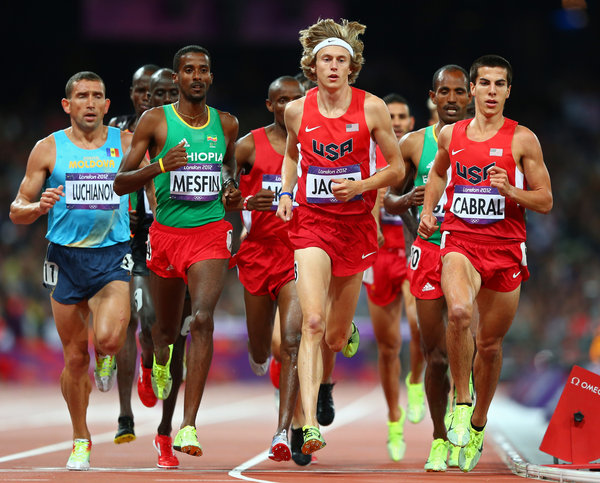
Elite athletes like Evan Jager (center) must be careful not to overtrain.

The tarsnake of overtraining

For most athletes struggling to find time to fit quality workouts into their busy lives, the concept of “overtraining” seems foreign and unlikely. But most elite athletes will tell you, it is actually far better to be a bit undertrained when preparing for competition than overtrained.

Overtraining occurs through several means:

  1. Too much volume or mileage (large or sudden increases)
  2. Too much quality work in too short a time (speed work on consecutive days)
  3. Too little recovery or insufficient rest days (lack of easy or slow training)

In fact, many serious athletes find themselves facing a combination of all three of these training flaws at once. That can put you in serious trouble, make you sick and knock you out of your big race.

You can see the signs of the overtraining tarsnake 

The signs of overtraining are relatively clear, but many athletes caught up in the excitement of preparation for a major race or series of races are prone to ignore the warnings. Here are just a few ways you can tell if you are overtrained:

  1. A feeling of staleness or fatigue on consecutive days of training, even on easy days.
  2. Struggling to maintain a pace on the bike or the run that just a few days or weeks earlier was easy. The feeling of “trying to catch up to your old self.”
  3. Any symptoms of a cold or sore throat, dry or strained cough, elevated heart rate and  irritability.
  4. The overtrained athlete will also crave sweets or other junk foods, lose the will to maintain good dietary habits in general.
  5. Overtrained athletes also tend to turn to other risky behaviors; including over-servings of alcohol, staying up late following a hard workout, restlessness, anxiety and overwrought libido. All are signs the athlete’s body and mind are responding poorly to the stressload of the the workout schedule.

It’s almost like your subconscious is trying to tell you to slow down before you crash.

Types of overtraining

Overtraining can be broken into two simple categories: Short term and cumulative.

For example, if you are in the midst of a 100 mile running week and by Wednesday you have 60 miles under your belt and are feeling great about your progress but also feel really fatigued, forcing that Thursday speed work is seldom a good idea.

Or, if you are a cyclist and begin to lose contact going up every hill during a group ride, or lose your will too easily in a pace line, it is likely you have overtrained to the point where your body and mind are sending you subconscious signals that rest is needed.

These are signs of a short term overtraining binge. Usually you can regain your reserves by breaking up your workout routine, shifting to a shorter day and getting more sleep, and making sure your diet is on target and you can get back on track.

Cumulative overtraining load can be much more difficult to detect.

During college our cross country team had a penchant to run all its base miles at 6:00 pace. That included midweek recovery workouts of 8-10 miles as well as our weekend long runs of 20+ miles. All of that mileage was run at 6:00 per mile! Nuts, I know.

It wasn’t until I got out of college and trained with some elite runners out East that I realized the mistake in our thinking, that high pace always equaled high-quality workouts.

The first time I ran with a group of sub 30:00 10k guys on a 20-miler I raced ahead at 6:00 pace thinking they’d tail along and maybe show me a few things along the way. Instead, they let me get ahead about a mile and never gave chase. When I slowed down they asked, “What the hell are you doing? We run 7:30 to 8:00 a mile for 17 miles, then do a smooth pickup for 3 miles at the end. That’s how you build up your base.”

In cycling the same principles hold true. If you’re out hammering every single ride at 26mph whether you’re going solo or in a group, your body really never has a chance to adapt and build baseline aerobic capacity. You may also (ironically) be hampering your ability to drive top power outputs and reach speeds of 30 mph if you don’t alternately do real speedwork at that rate. But you can’t do that every day or you’ll burn out.

Give yourself a break now and then

All those habits of overtraining; running too fast in base mileage, jamming too much mileage into a short period of time, not allowing yourself sufficient recovery over a season and doing too much speedwork can all add up to illness or injury.

Overtraining is often the product of enthusiasm, but the quickest way to undermine your enthusiasm, if you really think about it, is overtraining.  The overtrained athlete literally loses the physical ability and the will to maintain quality, and enthusiasm comes from seeing progress and achieving quality.

Don’t use it up too soon

If you are training for a late October peak and you build your peak too quickly to the point of overtraining in late September and early October, there is a strong chance you will lose your ability to peak at all. Overtraining is exactly like sticking an energy tap in your side and letting it all drain out.

So how to prevent overtraining? The rules are simple:

  1. Keep a record of all physical norms; resting heart rate, weight, and even blood pressure if you can measure it. Do not ignore changes like increase in resting heart rate. Back off your training until it returns to normal.
  2. Chart your running and cycling mileage. If you see yourself losing mileage week to week because of training interruptions like sore throat or other symptoms, you’ve hit the edge of your ability to increase effort. Better to be safe and able to compete than sick, overtrained and unable to toe the line.
  3. Communicate with friends and teammates. Often they see signs of your overtraining before you do. They’ll notice irritability or other personality changes like depression, overtalking or negative behaviors before you do. Listen to your body, but listen to your friends and teammates as well.

Overtraining is something almost all serious athletes do at some point in their career. Understanding the signs and risks is crucial to maintaining good health and achieving your goals. Don’t let your enthusiasm run or ride away from you when ramping up to a good race. That holds true when you actually hit the starting line, when managing your pace, just like managing your training, is a microcosm of knowing your limits so that you can exceed them.

Posted in Tarsnakes, We Run and Ride Every Day | Tagged , , , , , , , , , , , , , , , | Leave a comment

We all need our own criterium

Criterium racing

For cyclists, criterium racing is a frenetic test of bike handling skills and fitness. While there is no such thing as a truly “typical” criterium course, there are some general standards that apply to how criteriums work.

What is a “crit”

A criterium is a race around a prescribed course generally ranging anywhere from a half a mile to a little over a mile in length. The race often consists of a set number of minutes plus two or three additional laps once that time period is fulfilled. A criterium might therefore consist of a race of 40 minutes plus 2 laps.

The strategy in a criterium is, therefore, to maintain contact with the front group during the critical stages of the race. That’s in part why the word “criterium” is often shortened to simply “crit”, because it’s also critical to stay in touch with any “breaks” or groups of riders moving off the front.

With the thrill comes a little danger

Criterium racing is both thrilling and somewhat dangerous. The confined construction of most criterium courses forces riders into close spaces, with anywhere from 5 to 20 riders trying to squeeze around corners at the same time. It is important that cyclists learn to corner well, holding the line they choose in collaboration with the group and not wobbling or breaking off that line erratically, lest they cause other riders to swerve and crash.

How rookies learn

The very first crit in which I competed was on a highly “technical” course (notice the euphemism for ‘dangerous’) that involved a sudden turn down a steep hill followed by another turn and ascent up a similarly steep hill. On our first time down the hill, a group of riders went careening to the side with some skittering across the road on the lips of their tires while others simply flew wide and smacked into a pile of hay bales protecting them from a dip in a creek. The next few laps saw more crashes and separations on those hills and then suddenly, a huge gap opened in the middle of the field. Riders were falling back precipitously. Not having any prior experience in a crit, and trusting my “runner” instincts over what you should do in a bike race, I assumed it would be possible to slowly make up the gap. Mistake. You must power your way over the length of any gap and get back into the group draft or get dropped. First lesson of criteriums. Cover all moves. Next time through the finish area I called out to the announcer, “Can I be Category 6?”

“No such thing,” he chortled. I rode the rest of the race alone, but did not get lapped.

Watch the corners

Yes, crashes are part of crit racing, unfortunately. Corning especially produces crashes, because the ideal way for riders to push through a corner is at full speed, using the centrifugal force of the bike to corner rather than slowing or hitting the brakes. That’s bad under any circumstances in a criterium. The goal is to proceed at full speed at all times, handling your bike through accelerations and the inevitable slowing or decelerations that occur during racing.

Irrational truthes

The mind of the peloton in a criterium is neither logical or predictable. In fact you should throw all group logic out the door and use your own head at all times. A rider that can think through inevitable fatigue or confusion is one who will succeed in a criterium.

Criterium riders often test the front of the pack by making little breaks to see how many riders respond. The ideal situation is to form a break with anywhere from 4 to 8 riders who then trade “pulls” or riding in the lead. Using the draft of other riders is always critical to success in criteriums. Very few riders can go solo from the start and ride away from the field. If they do, they probably need to move up in racing category, because the purpose of criterium racing is to place yourself among similarly skilled riders and test your overall racing skills and fitness.

Strategy

When the race is evenly balanced, strategy comes into play. Riders surge and pull off the front, and if a break forms, those riders work together to try to pull away from the field. Getting “off the front” is an exciting feeling because you are both dependent on the other riders in the break and responsible as well for your own success. Cycling is unique that way, with riders from opposing teams often working together to lead breakaways even in races as short as criteriums. That is when your fitness is truly tested, and your confidence too.

The bunch sprint

If no break forms and the pack or peloton stays together the entire race, a criterium often comes down to the final two additional laps. That’s when riders find out how well they have harbored their resources during the initial phase of racing. Often riders who’ve hung around the front of the pack the entire 40 minutes will find themselves left in the dust because other, cagier riders have “sat in” the entire way and saved all their energy for the bunch sprint. It hardly seems fair that the fastest or strongest riders who’ve done all the work should lose for their efforts, but that’s the way of cycling. It is not always the fastest or strongest rider who wins, but the smartest.

It’s not as easy as it looks

Well, hell, you think. All you’ve got to do is be smart and sit in, right? Not exactly. Criteriums are full of very conscious moments of decision-making. If you sit in and miss a break, you’ll be left behind with 40-50 others while 5 or 6 riders go for glory off the front.

But there are many false breaks in the typical criterium. So if you go with a couple of them and expend precious energy bridging the gap and holding on, you won’t have any juice left for the final sprint.

That’s why it’s important for riders who want to be successful in criteriums to practice racing as often as possible. Our club Athletes By Design in Winfield and Batavia, IL. hosts very popular weekly criterium practices at a spot called the Pelladrome, a quadrant of commercial drives that was scheduled for major industrial construction that never happened. But the Pella Windows plant has nice parking lots and lets the club use them for racing after business hours. The Pelladrome is about .8 miles with relatively gentle corners and flat, smooth roads. It is an ideal place for racing and practicing criterium skills.

Anywhere from 30 to 50 riders show up most weeks, with practice races held in broad groups of category 4 and 5 races followed by category 1-3 riders. Both women and men race together.

Of cours there are many more categories of criterium races, including Masters 30+ on up through Master’s 70+. These races are often filled with avid cyclists who enjoy the thrill of getting out to ride harder than they would in practice, and against riders their own age or ability.

Set up your own crit course, and practice riding fast

It can be beneficial to prepare for criteriums by setting up your own, personal criterium course where traffic and safety conditions allow. In my neighborhood there is a “large block” circling a group of athletic fields that allows all right turns. On quiet nights or mornings it is possible to ride quite hard on this loop in training for crits.

My goal each season is to reach the point where I’m riding 30-40 minutes at an average of 20+ mph on my personal crit course. That kind of solo riding usually enables me to race at an average pace from 24-27 mph in actual crit racing. My personal best in a Master’s 50+ race is 26.8 mph for a 40 minute + 2-lap race. I’m proud of that time, and also proud of the fact that my fellow 50+ riders left me in the dust the last 5 laps.

Don’t let age or other perceived limitations slow you down

Age is not an absolute restriction in bike racing. Many riders continue their competitive careers long past what most people consider “middle age,” whatever that means.

One of the premiere riders in the Athletes By Design club is Joe Berenyi, who just won several medals including Gold at the London Paralympics. Joe has his right arm but no left, and competes well at CAT 3 races throughout the Midwest.

America’s cyclists along with America’s runners are re-writing everything about modern fitness, and what it means to age and stay healthy. In that perspective, we all need our own criteriums. That is, testing ourselves is the best way to improve with age and experience.

Posted in We Run and Ride Every Day | Tagged , , , , , | Leave a comment

Read all about it: The best way to prepare for competition

The great thing about racing is the excitement it brings. The chance to test your fitness against others is the reason many of us run and ride.

Competition can bring out the best and the worst in us. A simple case of nerves, a jumpy stomach or a tight mental attitude can prevent you from performing your best.

So how do you avoid getting too nervous before a competitive event?

It seems a number of major competitors at the world class level prefer to listen to music. Swimmer Michael Phelps is an example of one successful athlete who tunes into his earbuds before competing. But Phelps competes in a pool. And we don’t talk about that here for very long. That’s a different world. Here at We Run and Ride, we think swimmers are a different breed. Too many laps in a pool does weird things to your brain.

But we are here to consider the best strategies when you’re competing on your feet or a set of fast-rolling tires.

Music to your ears?

Listening to music can be a great escape in advance of competition. It can pump you up. The right mix of tunes might even put you in the right mood to compete. If you are an aggressive person, your music might be hard rock or metal. If you prefer entering competitions in a state of calm, your music choice will reflect that state of mind.

But is listening to music indeed the best way to prepare for competition? That depends on a couple factors having to do with how your mind actually works in competition.

Dissociative and Associative thinking

Some studies of athletic competitors show that dissociative thinking–finding ways to distract yourself from the actual process of competing, is the most effective way to compete in endurance events.

Others think that associative thinking or cognitive thinking is the better way to prepare for competition: Thinking your way through your race while you’re doing it. Anticipating situations, monitoring your body’s reaction to stress and responding with both a rational and motivated energy.

Generally, two facets of performance thinking are at play in associative versus dissociative thinking. Associative thinking focuses on controlling your responses while dissociative removes the mind from the process enabling your training instincts to take over during competition. That’s a simplification of course, but the basic truths are there.

You can read tons of information about the depths of associative versus dissociative thinking. I personally believe that both are frequently at play in the performance of top athletes. A marathoner might be humming along monitoring their breathing and form while also daydreaming about some movie they’ve seen, an inspiring character or the music that formed the backdrop. Hence the long tradition at many races of playing music from movies such as Rocky or Chariots of Fire. These inspiring images remain favorites with many runners and riders because they appeal to classic themes of athletic achievement.

Transcendence is the key. Now what can help?

What athletes truly want to achieve, however, is transcendence. Their goal is always to combine their physical training with mental preparation that enables them to achieve at a high level. That means several things have to occur:

  • The athlete needs to create an internal atmosphere of motivation
  • The athlete needs to generate excitement without producing fear
  • The athlete needs to promote optimum physical response, which often includes sufficient relaxation to perform well
  • The endurance athlete needs to be able to push through pain and exhaustion in endurance sports
  • The successful athlete always tries to transcend their perceived limitations in physical and mental ability to perform at their highest

Based on several personal experiences with transcendent performances in my athletic career, I propose that the appropriate way to prepare the mind for athletic competition is not listening to music, which can domineer and even erase natural thought processes vital to athletic achievement.

Can music actually be detrimental to athletic performance? 

If you have ever tried writing while listening to music with words or lyrics, you know that it can be difficult to generate words on your own. This “interruptive” aspect of much mainstream music is the very reason it is so popular as entertainment. It disrupts normal thought patterns with an insistent beat, driving noise and often provocative or catchy lyrics.

But think what happens when you remove the music in advance of a competition. Suddenly your mind is popped out into a world of more conventional sounds and back into the associative necessity of dealing with real, live competitors. You’ve escaped for a while but you’re back in the mix. That can actually result in something like a shock to the system. Hardly good preparation for handling competitive circumstances.

Reading your own mind

On several occasions during a competitive career in high school, college and post-collegiate distance running, I read books before the race instead of listening to music. Each time I had a transcendent performance. The difference in my focus and motivation and the ability to process competitive circumstance and apply myself to the task at hand was much improved.

In one case as a junior in high school I was reading a book titled The Peregrine by J.A. Baker. The absolute absorption of the main character in his pursuit of studying birds of prey was so well-written and so engaging that my mind was enervated far beyond a normal state of engagement. And against superior competition that day I ran a PR on the course and led our team to victory against a school that had not lost in 61 straight dual meets.

There was a definite connection between reading before the meet and running so well. With reading, you can stop and contemplate what you are reading, and even allow the mind to return a few moments to process any nervous thoughts or doubts. You can address them then and there, and still go back to the book. Whereas listening to music forces you to drive through these moments and into the future without contemplation.

Choosing the right kind of book can be key to preparing your mind in advance of competition. And even if you are the dissociative type, the material you read in a book can be thought through and processed during your event. More than one athlete I know has told me they played entire basketball or football games while thinking entirely abstract thoughts about mathematics or literature. The human mind loves the richness of these circumstances, and there is likely a connection between relaxed performance (in a zone) and deeper thought.

So next time you’re preparing for a big competition, be it a marathon, a 5K or a cycling criterium, try bringing a good book to the table in the week leading up to the event, and even in the moments leading up to your warmup. Reading combines the ability to use associative and dissociative thought in far better ways that listening to music ever could.

Think about it. And read your way to success.

Posted in We Run and Ride Every Day | Tagged , , , , , , , , , , , , , , , , , | Leave a comment

I run and ride, therefore I now walk

It’s never fun being injured. Especially when that injury is profound enough to alter your whole fitness routine.

So it is with humility and determination that I will now walk my way to fitness. For a while.

Walking it off until you can get back on the horse

I’ve done this before. A couple times at least. Tore an ACL back in 2003 and it took months following surgery to rehabilitate the knee. Physical therapy was vital in that process. So was walking. Then I tore it again two years later. More walking. More rehab. But not another surgery on the ACL. I should have chose a patellar tendon extraction rather than the cadaver part (I called him Jake) that tore again.

Now I just walk, run and ride in straight lines. Except when they wobble. Like on a bike. 

First steps back

Those first steps back on the fitness trail after any sports injury are seldom much fun. After my ACL tears, the knee stung and hitched… and wobbled. It takes time to rebuild strength, and courage to continue through setbacks and pain.

I recall the puss yellow seepage coming out of my ACL surgery scars. It dripped down the compression bandages I wore to work to keep my legs from blowing up with swelling. And the stinging pain in my ankles for days. But as soon as that wore off the physical therapy kicked in and after that, the walking. It is a thrilling process in many respects. You can’t give up.

Regaining fitness

Then it takes time to regain your former fitness. A mile run tires you out. Then two miles. Finally three or four. Then when you’re finally triumphant upon your return to running or riding, a new injury crops up. You’ve overdone it. Naturally. What athlete has terminal patience? None of us do.

So you’re back to walking. Again.

What’s busted this time? 

This time it’s a busted clavicle. But actually, I’m rather proud that I busted it. I was riding 40 miles per hour on a killer hill when the bike went nuts with harmonic wobble and down I went. Chunked out a divot in the dirt with my shoulder. Wound up in a ditch with an aching body and a dirt-stained kit. But damn it, that’s living. And I was alive. Those aren’t always givens, you know.

Surgery is easy. You’re not awake for any of it. Waking up from surgery, you’re still kind of loopy and the world is confined to dim lights and a mechanical bed. Pee in a bottle. Wait until you fart. Then you eat a hospital Caesar Chicken Wrap and a Caffeine Free Pepsi and go home. To soreness. Typing with a sling (pretty good huh?).

But nothing ever stops me. Never has. Never will.

Here’s why. As I prepped for surgery with nurses and doctors hovering about, they asked literally dozens of questions about my health. Blood pressue 110/73. Pulse rate 56. Height and weight ratio: Excellent. No heart or lung problems, diabetes or other health problems. The nurse said: “You’re really fit and healthy. Even with a broken clavicle you have good posture.”

Damn right sister. I work for this. Don’t take fitness and health for granted. Top 2% in the country according to my MetLife health insurance exam. And I plan (with the grace of God) to keep it that way.

Bucking around with the proverbial “horse”

Getting back on the bike could be a little weird next spring. There will be fear of the wobble hitting again. But online advice from Cycling Enthusiasts on LinkedIn has provided strategies to deal with bike wobble. Ride low. Press your knees on the top bar. Pedal, don’t brake.

It’s funny in a way that you can’t ride a bike or run because you’ve hurt your shoulder. There’s something wrong with that algorithm. But it shows how everything in fitness is connected in some way.

They say you have to get back on the horse and ride after it bucks you. Well, sometimes you have to walk around the ranch a little bit first, shaking off the soreness before putting your feet back in the stirrups again.

That’s okay. That badass horse of fitness will always be waiting. Sure, it loves to buck around with you. Just have to walk it off and start all over ag’in.

Posted in Tarsnakes | Leave a comment

Runners and cyclists can all benefit from a visit to a pedorthist

PEDORTHIST.   A pedorthist is a foot care specialist, trained specifically in gait analysis, shoe fitting, foot orthoses, custom shoes, wound care and lab fabrication. 

–From the Foot Mechanics website

The Injury Cycle

Injuries to the foot, knee, leg or hip can be vexing problems for people who run and ride. Figuring out why the injury happened or keeps happening is not something you can often do on your own.

Two winters ago was not a difficult time in terms of weather where I run and ride in Illinois. There were some icy days, but I did credit a persistent calf injury to a slippery run on roads covered with snowy slush. The leg did not hurt so much when I rode the mountain bike, nor on the road bike when the weather cleared sufficiently to take out the Felt 4C.

The calf would clear up slightly and then cramp without warning. It seemed like cold weather had something to do with it, but not always.

Come spring I was out for a gentle 4-miler at a local running trail when the calf tightened yet again. Hobbling back to the trailhead, I sat down on a bench and watched as other runners trotted home happy and healthy. Not wanting to feel sorry for myself, I started up conversation with some people stretching and talking near the water pump. Then two big white dogs came up and they were so irresistibly furry it was impossible not to pet them. I asked the owner’s permission and she said, “Sure, they like attention.”

We started talking, the pet owner and I, and before long conversation turned to my running and the persistent injury. She invited me over to a picnic table sitting on a concrete slab and had me take off my shoes. Her friend took one look at the rigid orthotics inside my shoes and said, “Hoo boy.”

“What?” I asked.

“You’re in trouble now,” she chuckled.

Running into good luck

It turned out my new friend with the white dogs was none other than Shelley Simmering, a pedorthist and owner of Foot Mechanics, a medical practice at 303 N. Route 31 in St. Charles, Illinois. By no mere coincidence, her shop is right next door to a local running institution, Dick Pond Athletics, provider of running shoes for more than 40 years.

Following an on-the-spot examination of my lower leg and ankles, Simmering invited me in for an appointment to figure out what was going on with my calves, because truth be told, both legs were really bothering me.

The breakdown

The appointment started with a long discussion of running history that included going way back into a career as a high school and college athlete, what events I did in track and field, and how my current running program has evolved.

That took a while. Runners like to talk about themselves, you know. Simmering took notes and gathered information for her assessment all the while. Her listening powers appear to be a key component of her overall effectiveness in working with runners and cyclists looking to cure and prevent injury.

After the examination, Simmering had me hop up on a treadmill for a videotaping session. The camera went to work recording my full posture and running form as well as closeups of my gait and lower legs in action. Simmering literally marked the lower legs with inked lines and angles, helping her find and determine what kind of torque and stresses were at play in the legs.

Then she set up my feet with some podiatry tape that turned into plaster, the cast for a set of future orthotics. Before letting me leave, she provided some temporary lifts and a whole catalogue and demonstration of proper stretches for my tweaking calves.

The Whole Truth and Nothing But the Truth

The return appointment to review the videotape was enlightening, to say the least. Back in the 1980s I had worked with a renowned podiatrist whose work with world-class runners like Sebastian Coe, Craig Virgin, Jim Spivey and Mike Durkin helped those athletes compete at a global level. I even illustrated the book he wrote about foot and leg mechanics.

But nothing prepared me for the lesson I was about to get from Shelley Simmering as she played back the videotape she’d made of my stride. She let me watch a few moments and said, without irony: “You do know you’re crooked, don’t you?”

I could see that. The stride I’d carefully crafted over thousands of miles depended on a fairly pronounced compensatory swing of the right arm to maintain momentum. It was clear my hips were not level either, and one leg might be a little longer than the other, she told me.

That videotape was a depressing piece of evidence why I might be having some issues. “You’ve got a great stride, actually,” she informed me. “I’d personally like to see you shuffle more than you do, but I can tell you were a middle distance runner, used to going fast. It’s just that things have settled a little more than you might think. With age and the like.”

She pointed out moments in my stride where my body was working really hard to compensate for bio-mechanic deficiencies. I’d known that for many years and really focused on maintaining good form however possible. Yet uneven wear on my left heel told me that my footstrike was uneven, as did a circular motion under my right forefoot. Like a three-legged dog, I’d learned how to move fast in spite of any physical deficiencies.

The buildup

After depressing the hell out of me with the videotape, Shelley Simmering smiled and waved off the challenges, then added a few more. “You’re not the most flexible runner I’ve seen, particularly in your ankle flexion. That may be the cause of some of your calf pain, along with some known pronation, which we’ll examine here.”

Then she played back the videotape isolating the view of my lower legs and there, in full slow motion, one could see the visible stresses being placed on my calves as I ran barefoot on the treadmill. It was clear you could stick those feet inside shoes and the problems would still occur. You could even put orthotics inside those shoes and the problems would still be there.

So I asked, “What can we do?”

Her first observation was that there appeared to be as much stress in the forefoot as around the ankle. My current orthotics made no compensation for that motion, and as a mid-foot striker, it was obvious why that might cause some problems.

The appointment concluded with some encouraging words and Simmering sent off for some orthotics according to her instructions.

Like getting new feet

When they came back, we went next door to buy brand new shoes tailored to the new orthotics. Those shoes weren’t cheap. And the consultation with Simmering was $600, and needed to be submitted with a special letter to the insurance company to seek coverage. Most insurance companies are still struggling to justify preventative medical procedures, and pedorthists like Shelley Simmering do not fall into the easy categories mapped out by insurance companies.

All I can tell you is that the orthotics, given a couple weeks to adjust, have worked relative wonders in my running. Cycling is different for me, and there have not been any problems resulting from my cycling form and motion patterns. But running was definitely difficult before treatment. Now I’m running 4-5 times a week with only occasional calf tension, which we’re adjusting with tweaks and time.

Honestly, Shelley Simmering saved my running hopes from oblivion. Things were not going well. Now they are. It’s worth checking out whether you’ve got a pedorthist near you if you have any running or riding problems due to bio-mechanical issues. If you like to run and ride, you ought to invest in your own health and injury prevention.

Posted in We Run and Ride Every Day | Tagged , , , , | Leave a comment

The relationship between running and riding, and mental health

The Walker makes us think

We called him “The Walker.” His real name was Steve. And he walked everywhere he went, and thensome. Local legend had it that a doctor had told him that walking would help cure his “problem,” so he took the doctor at his word.

We knew The Walker covered a lot of ground because our high school cross country team would encounter him in all parts of town, even other towns. And that, as a matter of team introspection, both amazed and creeped us out. “Maybe we’re actually the crazy ones,” someone finally blurted.

We knew The Walker was not crazy. A few of us had stopped to talk with him at times. He was quiet, but conversant, offering interesting observations about life in town. As an icon of what we considered abnormal behavior, however, he was the object of jokes from our tightly knit clan of distance runners, who only poorly knew the possible cause of his wanderings.

The Walker still moves about town even today, though not as prodigiously as he once did. His footwear evolved through the years from the worn out high-tops with which he began his never-ending journey to sets of official running shoes.

The words mental illness and mental health never crossed our lips in those days. We just knew him as The Walker. Secretly many of us seemed to harbor a bit of compassion for his apparent lot. He seemed to live in his own universe or a mythic parallel like one of the characters from a Greek tragedy we’d read about in literature. Odysseus or Ulysses. In some ways that we perhaps cared not to admit, we could see ourselves in the wandering “hero.”

In truth none of us dared dig too deeply into the history of The Walker. His very physical allegory of having been told to walk, then taking those directions to absurd extremes was too close for comfort as a parallel to our own situation as distance runners. We––who were told to run––and did so.

As runners, we had to admit that our own classmates thought we were a bit out there. In many ways, they were right. Which goes to prove that viewpoints about mental health are often a matter of perspective. So who is to judge?

Talent and torment sometimes go together

Our next team encounter with mental illness involved a competitor from a nearby town. He was a conference champion in cross country and track, several times over. None of us could beat him at any distance between a mile and three miles.

Then some strange things happened. He showed up on our high school campus with a bagged loaf of Wonder Bread asking to see members of our cross country team. He just happened to find me walking down the hallway and looked both happy and frantic to find someone to help him with his cause, which was to join him in feeding the foxes on the bridge across the river downtown. “Those foxes are made of bronze,” I told him. But that fact did not seem to deter him from his mission. I could see he was agitated, yet his demeanor was almost always sweet, even naive. So I accompanied him to our school office and the staff made calls to have someone from home pick him up.

The next year that same runner went on to compete for a leading Midwest Division III cross country program, helping to lead the college to a national championship. During the season he logged several 250-mile training weeks. That divides into an average of 35 miles a day, far more mileage than your typical elite college distance runner who runs 15 miles a day in a 100 mile week. The 250mpw training program did deliver him to an All-American status, placing in the Top 25 in the country. It also scared the hell out of everyone else on his team.

The baseline mental illness affecting my friend caught up with him eventually. His family enrolled him in treatment but the medications never entirely worked. He compensated for his lack of running with prodigious eating (mostly pizza, he informed me) that ballooned his weight to over 300 lbs. He could still talk running with the best of them, recalling former battles with rivals and great races. He knew these were figments of the past, but his present was clearly too ambiguous to examine.

Examples to grow by

These true stories are not shared to exploit or ridicule the sufferings of the mentally ill. They do show that the extremes of mental illness often start in small, simple ways. They also illustrate how a too simplistic approach to treating mental illness can exaggerate or worsen the prognosis for people with mental disorders.

An elite challenge in mental health

Following graduation from college, I met yet another competitor who struggled with  emotional challenges. Upon first meeting him, it was far from obvious that one day he would face severe problems with mental illness. He had graduated from a leading Christian college and was signed up to run for a shoe company, competing throughout the Midwest with a personal record of 29:20 for the 10k. His girlfriend and wife-to-be was a stunningly beautiful woman who was also an elite distance runner.

Their personal faith was one of the hallmarks of their relationship. Often they’d share and discuss their relationship with God with other runners. They were scheduled to be married, possibly wearing the running gear they loved.

But as time went by my friend, who we’ll call “Mike,” showed signs of acute depression. His running tailed off. His relationships stalled. He became despondent and seemed to be searching all the time for new answers to questions he’d once answered through his personal faith. Then one day he parked his car in a remote lot, doused himself with flammable liquids and lit himself on fire. Fortunately he did not die from the effort because his plan involved locking himself in a car trunk, and the flames went out. But the attempt made clear than he needed help coping with a serious mental illness.

These examples show the extreme challenges of managing mental health for some people.  Mental illness is a widespread problem in America, with literally millions of people coping with degrees of anxiety, depression, stress and other mental health challenges. Fortunately increased awareness and improved treatments for these challenges has resulted in major shifts in thinking about mental health, including many tangible ways for people to normalize their mental health and outlook. But it all starts with personal awareness that can lead to simple, organic ways to create better mental health in each individual.

Running and riding to cope

Of course not all mental health issues are profound or disabling. Millions of people cope with disorders that simply make it difficult to function in day-to-day life. These include mood disorders but also functional challenges such as ADD and ADHD. It is acknowledgement of these disorders and practical treatment measures that is leading our health care system to recognize the importance of mental health as an integrated treatment priority rather than an isolated or “set-aside” issue to be dealt with randomly.

Running and riding to mental health

In recent years it has also become evident that endurance sports like running and riding and regular exercise can be helpful tools in coping with mental illness and creating better mental health.

For starters, there is considerable evidence that regular exercise can help reduce stress. That is good news, because negative stress is a factor that can set off other mental responses, producing deeper or more profound anxiety in some individuals, and leading to outright depression in others. Thus stress is one of the “trigger” causes of poor mental health. Learning to manage stress and finding health physical or creative outlets for stress is considering one of the first steps toward better mental health.

People with a predisposition to anxiety and depression need to pay particular attention to how their body and mind responds to stress. Also the ability to manage thought patterns is an important tool in preventing runaway anxiety or negative thought processes that get people into emotional trouble.

Engaging in a regular running or riding program can help. A disciplined walking program is also considered a great ways to give the mind time to process life events and deal with stress perceptions.

Combined with other stress and emotional management techniques, regular exercise can put you in better control of your thought processes and prevent emotional flareups including anger, jealousy, fear, intolerance and ambiguity that can affect your relationships at home and in the workplace.

America embraces the “road” to mental health

This may create a bit of a sore spot in the minds of some, but there is a chance that the growing popularity of distance running and cycling in America is the result of a massive, collective need to cope with the pressing anxiety of modern life. It might be hypothesized that the millions of people now participating in endurance sports are drawn to them not only in response to the need for better physical health, but to create opportunities for better mental health as well. Some classic literature suggests as much, with figures such as the lead character in The Loneliness of the Long Distance Runner trying to come to grips with his individuality and independence. For it is an almost existential cliche that distance running (and riding your bike) a long ways will clarify the mind and purify the soul. But the cliche is real, and women in particular have been discovering this truth for themselves, taking to the streets by the millions to create better physical and mental health for themselves.

No coincidence: battling an insane world with sane acts

This is no coincidence. Coping with a world that exhibits apparently insane behaviors in politics, religion and economics can make you feel like you’re the one going crazy. It can sometimes take a lot of running and riding to convince yourself that you’re the one that is actually sane, and get back to being who you want to be, not who the world says you should be.

Fortunately, it generally doesn’t take much commitment to experience the benefits of exercise and better mental health. Even 30 minutes of running or riding a day is often enough to create a bridge between your stress points and your baseline framework of mental health. Multiple studies have shown that the simple release of brain chemical like endorphins through exercise can improve mood.

It’s all about brain chemistry

For people diagnosed with mental health problems such as  anxiety, depression or other emotional challenges, it is also desirable in many cases to effectively treat emotional disorders with controlled dosages of highly effective drugs designed to balance the chemical response of the human brain without wiping out a person’s personality or causing addiction. One of America’s leading distance runners, Alberto Salazar discovered in early middle age that he was susceptible to depression. In his case Prozac proved to be an effective relief strategy. He has gone on to coach the #1 and #2 finishers in the 2012 London Olympics 10,000 meters.

The best way to engage in your own analytical process of emotional balance once you’ve begun an exercise program is to identify a doctor qualified to work with you on the appropriate drugs for your specific degree of anxiety, depression or other emotional disorder. But don’t just expect your family doctor to know all about brain drugs. Some do, and some don’t.

A good starting point is to ask about your family history in using psychiatric drugs. Sometimes drugs from the wrong groups of medicines can cause adverse reactions in some patients, and you don’t want to go there.

If your doctor recommends treatment

The ideal way to start is to find a doctor willing to work with you on a mild program of adding drugs to compliment organic treatments such as talk therapy and your own exercise program. The ideal first step is to simple “put some air in the tires” with prescription medications designed to dampen the effects of a mood disorder such as depression. One common drug for depression, for example, is Citalopram, whose volume can readily be controlled to determine how much you really need to feel improved emotional health. Lorazepam is another simple drug used to reduce anxiety.

Have a discussion with your physician to let them know what steps you might be taking to treat emotional pain and disorders and you’ll likely find that you can ease your way into better mental health.

Reducing stigmas. Raising awareness. Promoting cures.

It is important to recognize that millions of people in the world live with mental health challenges every day. Some may never conquer the nature of their illness and accept that their condition can only be moderated, not cured entirely. If you are interested in mental health information for yourself, your family or friends, there is a non-profit organization with chapters throughout the United States called NAMI (National Alliance for Mental Illness) that provides mental health services and advocacy at the community level nationwide. Our own little chapter in Illinois has raised an average of $20K per year with the NAMI 5K held in Batavia, October 6, 2012.

But millions more can improve their lives with the right combination of self-knowledge, regular exercise, good mental health habits and a well-designed prescription that can reduce the difficulty of achieving good mental health.

Then you can run and ride for the joy of it, as well as the therapy it brings.

Posted in Tarsnakes, We Run and Ride Every Day | Tagged , , , , , , , , , , , , , , , , , | Leave a comment

The Fixie’s Up: Public Trail + Fixie = Disaster

By Monte Wehrkamp

In my community, we have some very nice trails. Note that I do not call them “bike paths.” Cyclists do use them, but these trails are not for bikes exclusively. Riders share these trails with a host of others, including walkers, joggers (with obligatory earbuds drowning out calls of “on your left” no matter how loudly shouted), moms pushing strollers, dads pulling wagons, grandparents riding adult trikes, skateboarders, squirrels weaving around on BMXs, dogs on 12-foot leads, and the occasional eliptibike (dude, what possessed you to buy that thing anyway?).

So as you can see, trails can be busy places. A cyclist using these trails has to be aware of all trail users and the trail itself at all times, lest carnage occur. You, the rider, will meet people who, upon hearing “on your left,” will move to their left. “Um, okay, on your right, I guess.”

You will meet noob riders coming the other way with no idea they should stay to their right. I’ve literally had to pull off into the weeds as an inexperienced rider, going the other way, is riding while paralyzed with fear, yelling, “Sorry, sorry, ohmygod, sorry, sorry, ohnooohno!”

Dogs and children are always a hazard, as their movements are completely unpredictable. Left, right, left, waaaaay left. No right. Best to stop and let the owner/parent corral their whirling dervish, then pass.

Then there’s the group of casual riders or walkers who stop to chat on the trail. Not off to the side. No, right there. Usually on a bridge where there’s a pretty view. That leaves other trail users traveling both directions about seven inches of clearance.

I ride these trails to get to open roads west of town, out in the country where I can get into a rhythm, set a good pace, and roll past farms and fields. Ahhh.

But getting to those roads via the trail requires awareness, patience, some quick thinking, and decent bike handling skills. You have to be able, and willing, to stop quickly. Or slow down and pick your way through other trail users. Stay on the hoods, keep your hands on your brakes.

So imagine this…

There’s a new cycling club being formed in my community for trail-riding fixie riders. Holy smokes, in the immortal words of John McEnroe, “You can’t be serious!”

But they are. “Fox River Fixies is now recruiting new members to be part of an elite fixed gear club that hauls ass down Fox River Trails. You must have a fixed gear bike, no single speeds and no brakes.”

This has disaster written all over it.

First, what’s a fixie? It’s a bike that has one gear, and no ability to free-wheel or coast – a free-wheeling one-speed is a “single speed” and these aren’t allowed in this too-cool club. If you’re moving on a fixie, the pedals are turning. Period.

Fixies are the new “throwback” trend in cycling. You’ll find them now in movies, underneath hipsters, and usually in urban environments. To be especially cool, the fixie rider will express their complete mastery of cooler-than-you coolness by riding sans brakes, instead choosing to halt their forward progress much like Fred Flintstone. Oh, and no helmets allowed. Which makes sense because if you ride a fixie, there’s probably little or no brain in your skull to protect.

Let’s now parse the Fox River Fixies’ Craigslist solicitation. “Trail-riding fixie riders.” Remember what I said about the trails being for everyone? For walkers and joggers and babies in strollers and dogs and kids and….fixies with no brakes now? On second thought, maybe the trail shouldn’t be for everyone. I’m thinking bikers on bikes with no brakes should probably be invited to ride anywhere but the trail.

Next, “An elite fixed gear club.” Elite? So, only master bike handlers allowed (will there be a skill test for all prospective members)? Cat 1 racers, maybe? Pros even? I doubt it. The elite riders in these parts are on their road bikes and mountain bikes, eking the last bit of speed and fitness from their training rides (on roads and single-track trails, respectively). I think “elite” in this context is merely a euphemism for “elitist.” As in, trendy, fashionable, and way cooler than the Lycra set. Riding skill hasn’t anything to do with it.

Finally, “Hauls ass down the Fox River Trails.” Really? Hmmm, let’s ride as fast as we can on bikes with no brakes down trails being used by joggers who can’t hear you coming, walkers that have no idea where they should go upon being overtaken by a cyclist, kids and dogs oblivious to your existence, and hell, other clueless, brakeless fixie riders, possibly.

Not to mention, most of the trail network throughout the greater Chicagoland area is limited to 15 mph, max. So, Fox River Fixies, haul ass someplace where you won’t kill somebody. Because the person you crash just may be me.

Responsible trail riding comes down to respect and courtesy. Good judgment. And that includes well-maintained brakes and saving ass-hauling for appropriate settings. Usually, tarsnakes happen to riders. Tarsnakes are rarely riders themselves. But in the case of the Fox River Fixies, we have found the exception to the rule. 

Posted in Tarsnakes | Tagged , , , , , , , , , , , , , , , , , , , , , , , , , | 1 Comment