Is your inner animal holding you back from enjoying competition?

by Christopher Cudworth

As the skinniest kid in a family of four boys, two older and one younger than me, it was an art of survival to learn to handle teasing from my brothers over skinny arms and skinny legs.

They called me “card-table knees” because when sitting in a crouching position with knees pulled up you could place a deck of cards on top of my knee joints and they would not fall off.

My eldest brother owned a 45rpm record of “My Skinny Minnie” that he would play at loud volume through his guitar amp while I banged on his bedroom door screaming at him to stop. His laughter drove me even more insane, kicking the door and trying to break the handle off.

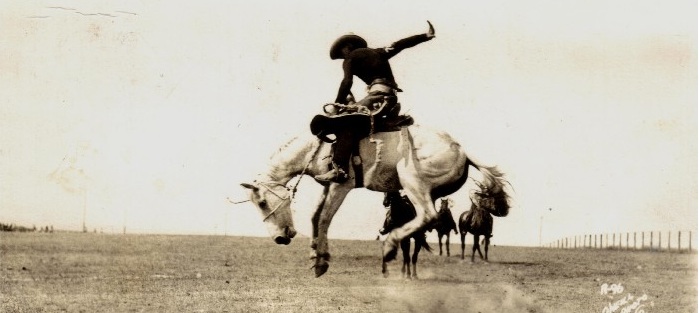
Between the artful antagonization of my brothers and some heavily critical upbringing by a father who was not above using physical means to make his point whenever our behavior bothered him, part of me was forged into a competitive little facet of personality my brothers all called The Mink.

Minks are members of the Mustelidae, or weasel family. Weasels (and minks) are known to be feisty little creatures that spit and fight like crazy when mad or cornered. Hence the nickname.

And it fit. There was seldom a time when it did not feel like as if I were fighting the whole world.  That attitude produced a series of playground fights with friends and foes alike. All it took was a wrong word or phrase or a challenge issued––even casually––and it was fists up.

The Mink served me well in early youth sports, although my best friend once pulled me aside and said, “Don’t you know you’ve got to play nice with girls, or they won’t like you!”

“I don’t care if they like me,” I hissed under my breath. “I want to win!”

Only I did really, truly, honestly care that girls liked me. Too much, in fact. Yet it was difficult to read their emotions on so many levels. And being so eager to impress them while not showing any aspect of personality that might be viewed as unattractive weakness proved a confounding challenge indeed.

Like the time I pitched an American Legion baseball game against a nearby town. I knew that a girl I really liked would be there with her friends, who I also would not mind impressing. After throwing a 1-hitter, I strolled over to talk with them and got the group cold shoulder. Turns out they’d all come to flirt with players from the other team, all of whom I’d struck out at least once during the game. The Mink lost that round.

Competitive fury worked wonders in the sport of cross country, however. Focusing your inner rage on covering 2 or 3 miles is a good way to push back the inevitable pain brought on by distance running. As a freshman I made the Varsity squad in high school. As a sophomore I earned the most points on the season and led the team to a first-ever conference championship. As a junior transfer to another school, I joined and led a team to its first ever District Championship and as a senior placed 4th in that District and advanced to Sectionals, where The Mink withered at the daunting prospect of running against the best teams in the best sectional in the state. Even The Mink found its limits eventually.

So inner rage can take you just so far. And you have to be careful how and where you let The Mink loose. The workplace, for example, is not the best place to take a combative approach to relationships.

There were lessons to be learned, therefore, on how to control the mink out in the real world.

A co-worker once determined that it would be beneficial for his career to have me process all my work through him. His manipulative approach included threats and promises to undermine my future with the company. The pressure was relentless, lasting for weeks until one night I went home angry, with The Mink fantasizing how to punch him in the face when I returned to the office the next day.

However not wanting to make a negative impression on my own children, I took a walk upon getting home, and exhausted from the emotional torment going through my head, I threw myself down on a high jump pit at the high school track, rolled over on my back and tore off my glasses. At that moment the sky looked close enough to touch, and into my head, seemingly out of nowhere, popped the word “forgiveness.”

Forgiveness is exactly the opposite of The Mink. It is also exactly the opposite of the whole notion of competitive spirit. You really cannot be competitive toward someone and forgive them. It just doesn’t work.

But an interesting thing happened when I adopted an attitude of forgiveness toward that co-worker. His manipulations had no power over me anymore. Two weeks later he was fired. Yet I felt no vindication in that result. Just amazement at the counterintuitive, and inherently more moral approach to resolving a problem.

The reason that lesson of forgiveness was so important in my life is that it is just as powerful to forgive yourself as it is to forgive others. When your running or riding performance does not meet your own expectations, it does no good to beat yourself up for days, weeks, months or years. Yes, it’s important to re-calibrate your effort and learn from your mistakes. But forgive yourself and move on.

The Mink learned to step aside in many such situations over the years. And with that more mature perspective on competition and life, all things became more enjoyable. The Mink was part of the game, but not the whole game. The Mink helped motivate performance, but was not the sole reason for competing. Anger was replaced by appreciation of opportunity. The starting line became less a position of dread and more a position of gratitude. For health. For the joy of competing. For excitement and diversion and above all things, the will to play.

The Mink still lives inside me. But only I choose to decide when to let it out. Life is much happier that way. Whatever animal might vex you at times; the Badger, the Snake, the Warthog or the Tiger, you might want to get it under control. You’ll feel a lot more human for the effort.

Posted in We Run and Ride Every Day | Tagged , , , , , , , , , | Leave a comment

The art of managing your “athletic identity” when you’re hurt or sick

Everyone knows that getting injured sucks. No, it really sucks. More than sucks.

Being hurt grinds you down to the nub of who you are, not who you want to be.

In that circumstance, you had better be prepared to deal with who you are–as a whole person–if you want to get through an injury with self-respect and motivation intact.

So why mess around?

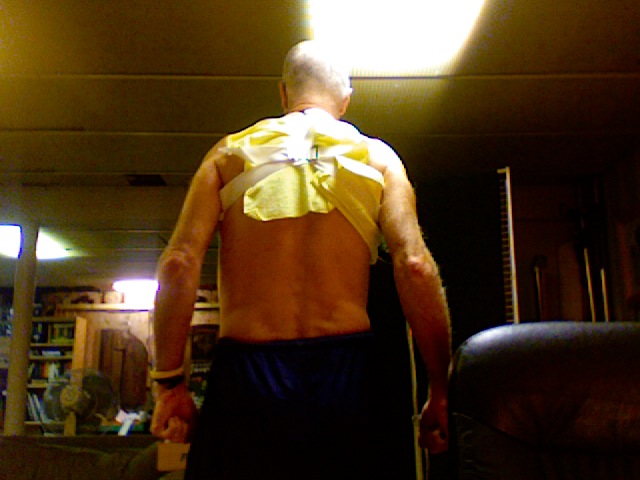
A wounded warrior wears a figure 8 brace for a broken collarbone.

Because whether you are one of those people who was born with a desire to participate in athletics, or discovered a love for sports like running and riding in your adult years, you know that a chunk of your self esteem is attached to that athletic core you’ve worked so hard to build.

Remove it for a day, a week, a month or a year, and a chunk of yourself goes away. Poof.

You’re left with the rest of yourself. The soft underbelly of Me. So how do you survive life without your tough, athletic exterior?

Taking the long view

If you’ve been an athlete most of your life you learn that you have to suck it up and wait it out. That’s right. You simply must take the long view (that might be days, or weeks or years, it’s all relative to your condition) or suffer the self-imposed indignity of feeling sorry for yourself every single, damn day. And that’s no way to go through life.

Wading through jealous payback

You also have to deal with the specifics of going back to work or other situations where you’ll no doubt face questions about your fitness routine from the very co-workers you’ve regaled for weeks or months or years with tales of training triumph or goals achieved in races. Suddenly you’re not talking about all that. And you know what? There might be a little payback to endure. People can be notably unsympathetic to former fitness braggarts, particularly if you’ve ever lauded your overall fitness in front of them in any way. We might not even know we’re doing that at times, such is the joy of running or riding. But secretly, some people might think you insufferable. And will not let you forget it.

Embrace the challenge

You need to embrace your injury or illness as a sign of trying your hardest and doing your best in something that ideally does transfer to better health, focus and work performance.

Then when someone digs at you a little for crashing and burning, you can reply in modest hope, “Well, injury and illness is part of the risk.” People have a harder time arguing with the idea of risk, because it is associated with courage and bravery, traits idealized in the corporate and social world. And if your protagonists still want to crush you for being a broken-down fitness nut, and say something like, “Well, this just proves what you’re doing is stupid,” you can humbly say, “Well, that’s your choice to believe what you want to believe. I’m sorry if I’ve ever offended you in any way. I just know what works for me.”

And leave it at that.

Unfortunately you’re still left with your banged up self, torn or half-sick condition, and athletic egos can be fragile, especially in the private space of planning your own schedule. That ‘workout hole’ where you used to run and ride can feel like a huge gap in your persona. So fill it with something constructive and uplifting. Nature walks. Volunteering at races. Get involved with your church or non-profit. Be around things that make you feel good. Then when you return to your training, you’ll have even more to think about. That’s a great cycle to develop.

Overall, the best approach to maintaining hope of better days is to place your fitness interruption in perspective. Take stock and you’ll realize that setbacks are just that. Like the pain you experience during a race, this too is only temporary. Pain is only temporary.

When change is permanent, expand organically

But sometimes it’s not. You’ve lost your ACL or turned an ankle for the 12th time and soccer just isn’t in your future. Not if you have any common sense. That means your athletic identity is about (or needs…) to change.

Be not afraid. Pick and choose from your training experiences to see where you can expand organically. A cyclist who is injured in a road crash can ride indoors on a trainer. A runner recovering from plantar problems can hit the bike trails and keep up a degree of fitness. The pool is always a good place to rehab. But please, don’t tell the swimmers. We never want them thinking their sport is superior to everything else. That would make them intolerable, and might resign too many of us to staring at a blue line on the bottom of a boring pool. A fate worse than drowning.

Owning your athletic identify

Your athletic identity is something you own and manage. No one can do it for you. If you’re hurt badly and it’s going to be a while before you run or ride, then start a walking program. Wear your running outfit and embrace the movement.

Or, do rehab and physical therapy exercises. Lift weights or go indoors with assisted weight machines and other ways to maintain muscle strength in key areas. Use the valuable time you’ve been given to balance out your overall musculoskeletal system of joints, support muscles, tendons and ligaments. Then when you return to action your risk of injury will truly be reduced. Physical therapy can eliminate chronic running problems such as iliotibial band syndrome, chrondromalacia and and “runner’s knee.” Cycling injuries to the shoulders can be eliminated through strength and core training as well.

Fortunately we live in an era where there are hundreds of opportunities to engage in active rehabilitation. There’s yoga. Pilates. Spin classes.

The art of knowing yourself

The fact of the matter is whether you like it or not, you can never be the athlete you were yesterday any more than a great artist like Picasso or Degas or Wyeth were the same artists they were the day before. Change occurs. Influences impact the framework of your belief system.

Being hurt or sick really does suck.

But refusing to accept the message each circumstance is trying to teach you about the need to moderate or change what you’re doing is of far greater risk to your long-term fitness plans than ploughing ahead doing the same things the same way. Exploiting your weaknesses is no way to improve. Diversifying your strengths to compensate for your weaknesses is a far better approach. Being sick or hurt is absolutely the best time to assess your weaknesses and strengths, and start along a new path to self discovery.

You can be an artist in managing your athletic identity.  It just takes the ability to see the bigger picture in who you’ve been, who you are, and who you want to be.

Posted in We Run and Ride Every Day | Tagged , , , , , | Leave a comment

Beware the tarsnake of “bike wobble”

by Christopher Cudworth

The ambulance is not the place runner/rider wants to visit.

Heading into the Labor Day weekend and an anticipated participation in The Wright Stuff, a hilly 100, 60 or 30 mile ride in southwestern Wisconsin, it was the climbing that was a primary worry. The hills in SW Wisconsin are humbling to say the least.

But as bad luck would have it, it was descending that turned out to be the tarsnake of all tarsnakes. 

I was really feeling good that Sunday morning. The climbs were actually going great. I hadn’t even gotten out of the saddle on the steepest climb before the first rest stop at Taliesin, the legacy home of Frank Lloyd Wright, for whom the ride is named.

Coming off the peak there was a stiff left turn and the road slowly curved north toward the American Player’s Theater, the Shakespeare performance venue where my wife and I had joined friends just 4 weeks before at a production of The Twelfth Night. We’ve been to Spring Green together many times, and I had ridden up and down the hill passing in front of the theater many times.

As the descent gained speed, however, the road surface changed ever so slightly. Within 2 seconds of hitting this surface change the bike began to wobble below me. Thinking there were mechanical problems with the front wheel, I touched the brakes to slow down. The estimated speed at that point was around 35-40 mph, cruising speed on hill of that length and grade. The previous day we’d topped 45mph  in a noodle ride around Governor Dodge State Park so it wasn’t like we were hitting some new, uncontrollable pace.

But the wobble continued to increase in breadth and violence. I tried to quickly yell to my companion who was racing down the hill ahead with another rider we’d joined on the ascent.

No one heard me yell, and anyway, things were happening too fast to control. The bike felt like it was going to disintegrate below me, wobbling and shivering as if it were not made of earthly material of any kind.

My options were reduced to ugly simplicity. Crash on the road or get to the grassy ditch. Somehow.

When my tires hit the grass, an entirely new set of challenges took over, and from that point not everything is clear in in my head. The actual crash happened so fast it felt like time was compressed. Looking back at the evidence once I’d crawled back up to the road, it was clear from the divot where my shoulder hit–pushing a dirt divot a foot high in the air–that I struck ground hard and then slid to a stop down the embankment, 15 feet off the road, tucked into a crease of deep grass. I lay there for a few moments, stunned, just staring up at the beautiful September sky and realizing, “This is not good.” There was no loss of consciousness, just a starkly realized awareness that I’d done the right thing, but things still hurt.

So I moved a little, and instantly felt and heard a crunching sound where the left clavicle should be. Yep, busted. It was hard to move much at all, at first. Then I heard the wheels of my other companion whiz by.  He’d taken it easier up the last big descent but rolled past faster than I could call out.

No other cyclists came by for a couple minutes. We’d started the ride way late because our 4th companion, a woman triathlete from Tulsa, had tires go flat in the first 4 miles. Nearly everyone in the ride was ahead of us before we started. Still more passed by our group as we worked on her flat (s).

So given our position toward the end of the ride, I knew my chances were running out to be noticed at all.

Heaving up onto my right side, I pushed up the hill and sat there, assuming the pose that every cyclist with a busted collarbone tends to take whether they are local bush league (me) or Europro (in my dreams). Hunched and holding the arm in place, just trying not to move, hoping someone would come by sooner or later.

Finally, after a period of probably 5 minutes, 3 cyclists came rolling down the hill. We’d passed them 2 descents earlier on a series of short climbs… that felt good at the time to ride. It is amazing when you can finally put a summer’s worth of preparation into a climb and the legs actually give back. That is what I wanted to experience, and did. Though I’ve been riding for 8 years and 20,000 miles, and have raced numerous criteriums, I’d never just done a “ride” for the feel and joy of it. My friends had done The Wright Stuff for a number of years. But for me, some serious aspects of life had intervened all those years. They still exist now, but my wife had done a mini-vacation with her sister and mother a few weeks before, and she said, “Go on, have some fun.”

Laying in a ditch with a busted collarbone is not most people’s idea of fun, obviously. But I was grateful as heck when those three riders stopped to assist me, and a gal named Libby crept around in front of me and asked, “Was it a bike wobble?”

“Wow,” I thought to myself. “That’s exactly what happened.”

I tipped my head up and weakly replied, “Yes.”

She explained that she’d just attended a seminar with a discussion on the subject. She told me all about bike harmonics and how it is so random that even the experts cannot tell exactly when a bike wobble will happen. While it was a relief to hear her words and understand, in some pain-fogged way, an explanation for my crash, it was also the most terrifying realization of my life.

At that moment, I wanted to quit cycling forever if bike wobble could just arrive, randomly, at any moment. That is the very definition of fear and terror if you ask me.

Had I known about bike wobble it might have been possible to clamp my knees tightly on the top bar, as Libby advised then––and as I’ve since confirmed on the Internet and hundreds of articles on the topic, and gotten my carbon-fiber Felt 4c (The Red Rocket, it was called in a 2006 cycling magazine Bike of the Year review) under control.

Again, I’m no pro rider. I compete in CAT 5 and Master’s 50+ races. My training rides solo average from 17-19 mph, and group rides to 20mph average. My top crit average was 26.8 mph in a 40 minute+2 laps criterium. But nothing in any of that experience prepared me to handle bike wobble at 35mph on a hill in Wisconsin.

When the paramedics arrived it was all the standard procedure. But they were rookies it seemed, who did not even know whether to put my neck in a brace. My blood pressure checked out and I wasn’t going into shock. The riders who stopped (God Bless the Good Samaritans) to help the bloodied, beaten rider out of the ditch said goodbye and good luck.

Then they closed the ambulance door and I realized, this is the first time I’ve ridden in an ambulance for my own injuries.

The little Upland Hills hospital in Dodgeville confirmed the worst news with an x-ray. There wasn’t much they could really do but give me a sling and send me on my way to go to a doctor back home.

But I did not see the actual picture x-ray image until visiting the Emergency room at Central DuPage Hospital, where my friend the triathlete is a lead doctor. It was not a pretty sight, that fractured collarbone. Surgery is pending.

My companions had worried and wondered where I’d gone, of course. But having trained for more than 40 years since high school with the two of them, they figured I might have either gotten lost (though I told them I knew the roads well) or done some other Cudlike thing. I’m not always the most predictable character in good times or bad. Or so they intimated.

They inquired to the race officials and communications had not gotten through from the EMTs to the meat wagons driving the course in search of crashed up people like me. 100 miles of road is hard to cover even on a bright September day. I’m grate I did not cover any of that road with my skin or limbs, frankly. Grateful to have reached the weeds and missed the hidden wire cable by inches, apparently. Grateful there is no brain or spinal injury. Hardly any road rash even. Grateful that I am alive and able to write these words 2 days after a terrifying tarsnake of 75 yards of bike wobble at 35mph.

Just grateful. It will be a little while before I ride again. But I’ll keep writing. Riding and running and writing are one and the same to me. I’ll start by walking. Then running. Then get back on the bike when healed. It’s what I’ve always done through injury and circumstance.

Gratefully.

If you’re interested in more information on Bike Wobble and how to control it, either Google the subject or try this page as a starting point. http://www.roadbikerider.com/advanced-skills/speed-wobble

Posted in Tarsnakes, We Run and Ride Every Day | Tagged , , , , , , , , | 4 Comments

Interesting training experiment

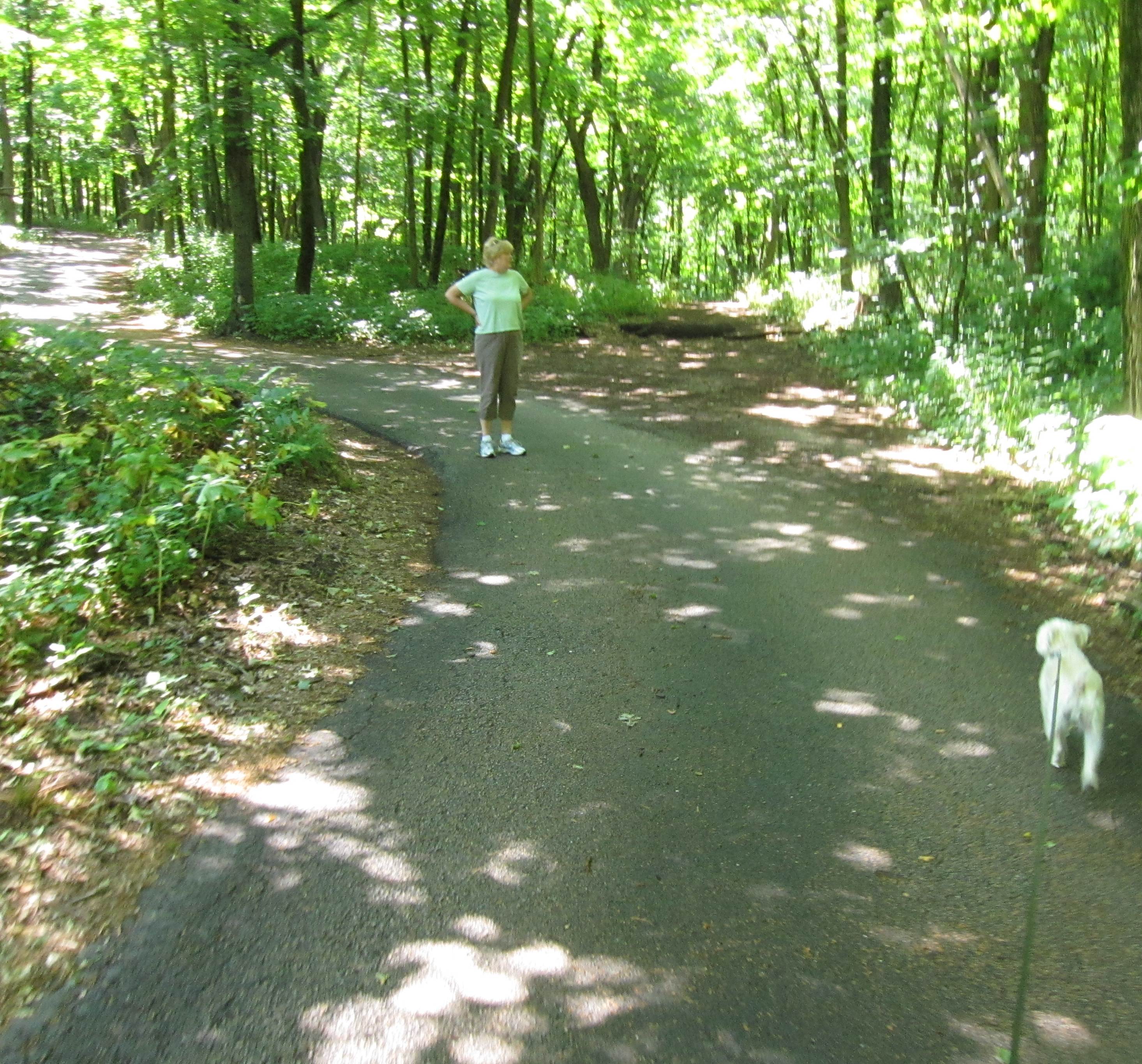
Here my wife and dog join me for a hike up Johnson’s Mound.

The last day of August here in Illinois is brilliantly hot. Which meant long, slow training miles on country roads was likely to be neither fun nor productive.

I chose instead to head to the local hill training sight known as Johnson’s Mound Forest Preserve, a glacial kame covered with thick woods. Kames are basically piles of gravel dumped on the landscape by glaciers 10,000 years ago. The entire topography of Kane County where I live and ride and run was defined by the same large glacier that extended out from Lake Michigan all the way to the northwestern part of the state.

There is a black asphalt road that curls around the north side of the hill at Johnson’s Mound and then turns abruptly and takes a serpentine run up the hill. Total elevation is about 150 feet, so it’s not a monster. The steepest grade is just over 12% with most of the 1/3 mile climb from 4-6%. Not killer climbing some might say. But in Illinois we make do.

As a runner I’ve been using the hill for training since freshman year in cross country, when the specter of running at Johnson’s Mound was something we dreaded for weeks. It hurt, plain and simple. Our skinny little high school legs were not much match for the ancient gravel incline.

But by the time I graduated from college and was looking for ways to intensify training and improve hill running skills, Johnson’s Mound became the site for a weekly visit. A group of us would sometimes do hill training together, using a loop from the start of the woods up to the top in just over a half mile. The whole circuit around is .7 miles.

Through years of training I got better and faster at climbing that hill. At the peak of my post-collegiate competitive career, I ran one set of 5 repeats up and over the hill averaging 3:01 for the set. To break 3:00 meant you were in darned good shape. Every runner I knew, some with PRs below 31:00 for 10k, did that loop and agreed that it was tough to break the 3:00 mark.

I ran 31:10 the next week, taking second in a competitive 10k, then won a hilly hometown 10K in 31:52, that was measured 216 meters long by the high school track coach.

Those are fun recollections as a runner. Recently I ran a few hills at Johnson’s and can tell you that I’m not quite as fast these days. Not at all. Still, there was a respectable repeat or two thrown in there.

So to cycle the same hill and do the same loop on a bike is quite interesting. All four repeats today were completed in 2:25-2:27. I tried various strategies, riding harder on the lowland flats, charging the first hill, holding back until the last killer 12% grade and every way I tried to improve the time produced the same result.

Hmmm, I thought. Must be I’m only so good at hill climbing right now. I stood up out of the saddle some attempts, and rode seated as well. Same times.

What that really means is that more hill climbing value is in order. I simply have not built up the muscle base to allow faster climbing. I could probably jump off the bike and run it up the hill just as fast. In fact I’m thinking my climbing skills on the bike about matched my climbing pace as a runner. The times were not that far apart. I go 22mph on the flats own below and couldn’t do that on foot. So that’s the time differential right there.

In any case, having a hill like Johnson’s Mound to test your training and your spirit is an important resource. Find a hill of choice and put your watch on yourself. It will make you think about how to improve. Almost guaranteed.

Posted in We Run and Ride Every Day | 1 Comment

How to know when you need a running or riding tuneup

So you’re a runner. Or a rider. One requires little equipment. The other quite a bit of equipment. So the concept of a tuneup should vary quite a bit between runners and cyclists right?

Well, yes and no. Your body (if you’re a runner) and your bike (if you’re a cyclist) always give off signs when you need a tuneup. So there are some similarities. Here are some friendly, informative reminders of what to consider and how to do a body and mechanical tuneup when you need one.

Know your starting points: Runners

Most of your running efficiency, health and ability to maintain speed boils down to mechanics. So here’s a few simple rules to help you “tune up” if you’re a runner:

  1. Build proper running form. Back in 1971, I read an article in Sports Illustrated about running form. It said that good runners (distance runners, anyway) all do some basic things the same. They point their feet straight ahead, not out like a duck. They run “over the ground” with a mid-foot strike when running full pace. They lean forward slightly over the full length of their frame when running, and make this possible by carrying the arms forward so that the hand reaches the height of the shoulder in mid-stride. It’s that simple. Nothing’s really changed in the last 40 years. At 14 years old, however, I practiced those stride habits, and at all speeds, and that commitment has delivered good running form in all kinds of circumstances. It really does make a world of difference. You must be disciplined about knowing good running form and practicing it. If you don’t know what you look like when you’re running, find some store windows. Then watch yourself run from the side. Watch yourself run from the front. If your arms are flinging around or you run crooked somehow, either you can fix it through practice, or else biomechanics are likely to blame. Many great runners have biomechanical flaws, but they minimize their effects through practice of good running form.
  2. Maintain proper running form. Ever notice how your running form tends to go to hell when you’re tired? That’s because the muscles that do most of the work are fatigued. When muscles (big and little) start to tire, you cannot maintain the function or foundation of your stride. If you haven’t disciplined and trained yourself to practice and implement about good running form, you’ll simply lose it worse in a race when you’re tired and can’t possibly think. So it has to become second nature.
  3. Strengthen your running form. What this means is to use weights or exercises to build up the small muscles and ligaments that support your knees, hips and even shoulders. An overall fitter body, especially one with a strong core, will respond much better to the muscular demanded by good running form. So tune up your body with pushups, one legged knee dips, simple planking exercises and some weight work if you can manage it. Doing your strength work before you need it, or to recover from the occasional and inevitable injury is the first step to any tuneup.

For cyclists: Melding body and bike is the trick. But start with the bike.

1. Tune your machine. You simply cannot ride with efficiency or even safety if your bike is so out of tune that it holds you back. If you have not learned the most basic mechanics of your bike, this can be tough to understand, and you’d best take your machine to a bike store mechanic and tell them you want a tuneup. They’ll check your chain for length and wear, inspect your wheels to see if they’re true, test your shifting cables for tension, test the derailleur so that your bike shifts well, and check your brakes so that you can stop.

2. Tune yourself to your machine. The next challenge for bike riders is fitting your body to the machine. This is an entirely different issue than tuning up the mechanics of your bike. But it is just as important. And while I’d like to tell you that fitting yourself to the bike can be done on your own, it just isn’t true. There’s no facet of cycling in fact that does not require some outside perspective. And unlike running, getting help to tune yourself to a bike usually costs you some money. So amortize. Spend $150 or so on a bike fitting with a good shop and you’ll know at least that you’re “in the ballpark” on how your body relates to the machine. Trouble is, there are no hard or fast rules here. One cyclist that is 6’1″ and 160 lbs may ride a 58cm bike frame while another of the same height and weight might ride a 56cm frame with seatpost, front stem and saddle angles all different. If you have a long torso or short legs it’s all going to vary. Tuning yourself to your machine is a question of lengths and angles. Go get help. Or suffer. Don’t say I didn’t warn you.

3. Tune your body to cycling. Runners can’t just jump on a bike and use their endurance to keep up with other cyclists. Well, most runner’s can’t. A few gifted geeks like Matthew Busche of RadioShack have proven that theorem wrong. But they are a rare breed, the Busches of the world. Most of us have to ride a considerable number of miles to get efficient and comfortable on the bike, and it may take years, literally, to build up muscle to support your body on the frame and then to drive your pedals forward with efficiency. Again, a strong core is especially key to maintaining good form on the bike. So if you do nothing else in your personal tuneup, spend time making your gut strong. The rest of your cycling form will be forced on you by the sheer effort of trying to keep up with others. It will come sooner or later. It just hurts a little. Every year. Even if you train all winter. Cycling is an annual tuneup of the body and soul. No getting around it.

Of course this is general, practical advice for doing a “tuneup” on your running and riding. But basics are always the best place to start, and reminders of the basics have saved many a soul much suffering.

The great thing about running and riding is that there are some “tradeoff” benefits from one sport to the other. Cyclists need to run some to maintain bone density. And when runners hurt themselves by pounding on roads, the bike can always help you maintain fitness.

If you’re hurt too badly to participate in either sport, there’s always swimming. But we don’t like to talk about that. Don’t let it get that far. Tuneup first. Don’t make us talk about swimming. Please.

We Run and Ride. So do you. Let’s share original thoughts.

Posted in Mechanical Genius, We Run and Ride Every Day | Tagged , , , , , , , , | Leave a comment

Usain Bolt, Lance Armstrong and the meaning of legend

After Jamaican sprinter Usain Bolt finished winning gold medals in the London Olympics 100 meters, 200 meters and 4 X 100 meter relay races, he was asked by an NBC sports announcer to characterize the merit of his accomplishments.

Bolt’s reply: “I’m a Legend.”

We’ll resist the immediate temptation to dissect that possible Freudian slip given how many sprinters have won world championships only to test positive for steroids or other performance-enhancing drugs later on. Those athletes are stripped of their titles. Banned from the sport for years. Their legends become legendary in an entirely different way.

Some return to race again. Others never do. Consider that there was at least one reformed US doper, Justin Gatlin, competing in the Olympic races against Usain Bolt.

The claim to legendary status

At face value, Bolt’s claim to being a legendary figure in track and field is hard to argue. After all, he won the same trio of races in the Beijing Olympics, setting world records at 100 and 200 meters, giving him 6 gold medals total in two consecutive Olympic Games. With the 4 X 100 world record he helped set at this year’s games, Bolt is basically 3 for 3 in his attempts at breaking world records in his events at the Olympics. That is pretty legendary stuff.

But consider: Bolt’s reputation was at risk prior to the Olympics when he lost both the 100 and 200 to Jamaican teammate and training partner Johan Blake, who is no sprinting slouch himself. Bolt finished second to Blake in both qualifying races. In those races Bolt looked human to say the least. Some proceeded to question Bolt’s fitness for the 2012 London Games, but were perhaps only a little surprised at the pursuant quality of his performances. Again Bolt left some of the world’s best sprinters in his wake.

In post-race interviews, Bolt said his Jamaican trials experience was a “wakeup call.” Hmmm.

But now he’s a Legend. At least that’s what Bolt labels himself. His size and stride and demeanor of joyous dominance is certainly legendary. So for now the claim follows him around like a shadow that has to move fast and possibly jump high to keep up. Bolt is considering competing in the long jump in the Olympic Games in Brazil in 2016. His coach wants him to run the 400 meters. Which would make him more of a legend? Let the debate begin.

The jury is always out

For now, those of us who’ve followed track and field for many years have learned to be suspicious of all such claims to legend. Too many times, the accomplishments of some the greatest athletes have come tumbling down. We recall Canada’s Ben Johnson, the seemingly indomitable sprinter who got busted for steroids.

Too often we’ve been wowed by amazing sprint times only to learn that the athlete had been using performance-enhancing drugs. Even Olympic great Carl Lewis was not entirely able to escape speculation about possible steroid use, even to the point where people compared photos of his face over the length of his career to study his jawbone structure and other physical features that would indicate possible steroid use. The mantle of a legend is hard to wear with peace and ease.

Bolt’s jolt of improvement from the Jamaican trials to the Olympics did raise some eyebrows. If it were to be discovered that he has been using steroids or other “juice” to improve his speed he would quickly become a legend of another sort. There are literally dozens of athletes out there who rose to the top of their sport with amazing skill, speed and courage, only to be exposed as a fraud when the results of a doping test show them to be merely human with some big-time help.

Compared to other legends

In that regard, Usain Bolt may be uniquely connected to another big-time athlete with an outsized reputation and a transcendent demeanor. That would be Lance Armstrong, the world’s best cyclist who won 7 consecutive overall races at the Tour de France.

The oft-repeated tale—by Armstrong himself—is that he has never been caught using drugs. But the ugly specter of potential teammate testimony against his legendary accomplishments has put Armstrong in a tough position recently. No absolute evidence has been submitted against his legend, but in the absence of that, sometimes testimony by others will do.  If he were to protest the research and findings of the USADA, the anti-doping agency of the United States, all the testimony they’ve lined up would come rolling out. That might impact the other facet of Armstrong’s legend.

The Livestrong legend

Armstrong’s legendary accomplishments happen to extend beyond the world of sports. He has leveraged his Livestrong brand into a world of good for people with cancer. Armstrong at this point in his career is essentially sacrificing one facet of his legend to protect the other. A possibly noble act, in a way, for a man regularly accused of some selfish instincts and behavior. Or else he actually is being selfish. It is sometimes hard to tell with legends. Look at Usain Bolt: is he bragging himself up or simply planting an idea with fans who adore him?

Those who chose to sustain the Armstrong legend in either cycling terms or Livestrong will likely find themselves stifling their own questions about what is more important in the case of a man like Lance Armstrong, truth or legend?

If you choose truth, then the legend may be sacrificed. But if you choose legend, then the truth perhaps must be ignored. It’s a complicated scenario, especially for those whose inspiration has been distilled to the simple symbol of a small yellow wristband. That small token represents a legend, and what it really means to try to give back to the world.

Someone’s always trying to take you down.

Putting legend in context. Not all good. 

But if Bolt were found to be a doper and Armstrong’s legend were to collapse under further scrutiny of his use of performance-enhancing drugs, would either man be a bigger liar than most politicians and their parties? Over the last 50 years we’ve seen presidents with sterling political skills fall prey to very human foibles. John F. Kennedy and his dalliances. LBJ to his possibly murderous desire for power. Nixon with his Watergate. Reagan and Iran-Contra. Bill Clinton’s affair with Monica. George W. Bush’s illegal wars and torture and lost billions.

All Presidents become legends, of a sort. And the harm they do in a legendary way can cost millions of people their lives. It should make us take a step back to consider just was the term legend means. Is it the truth, or what we choose to believe about another human being that matters?

Seems we’re making choices like that all the time.


Posted in We Run and Ride Every Day | Tagged , , , , , , , , , , , , | Leave a comment

Don’t turtle up in your training…Come out of your shell and try new things!

What it means to “turtle up”

Athletes of all levels tend to train in their “safety zones.” That is, they do the types of training with which they are fairly familiar, comfortable and proficient. We’re all a little like turtles in that respect. Content to move along at our own speed.

But when something comes along to challenge us, we tuck our heads and legs into that protective shell of excuses and avoidance, and go back to what we usually do. And get slower in the process while we tell ourselves we’re getting fitter. Part of that may be true, there is nothing wrong with using slow or steady training to build a base. But we’re talking about something else. Breaking out of a rut. Getting a little faster. Preparing for a race or event.

In those cases, training the exact same pace all the time is exactly the opposite of what you need to do to improve at your sport.

So whether you are a runner or a rider, it is important to keep your mind open to train in challenging situations. Throw out those turtle legs and stick out that turtle neck and give something new (or too long ignored) a try.

Coming out of your shell

As someone who is rebuilding a running career after periods of low activity due to injury and bio-mechanical issues, it is pleasant to simply run 5 miles without tugs or pulls from calves or knees. But sooner or later if you want to break out of a training rut you need to go a little farther than you usually do, climb some hills, or do some speedwork.

The best prescription to break out of a rut is to accept an invitation to train with someone else, and to try something new.

Train with a triathlete. They’re always doing crazy, different stuff. 

My first invitation this summer to break out of a training shell came from a triathlete who is frankly a little nuts about his training, as most triathletes are. So if you want to get tested on your running or riding, find a triathlete and invite yourself along. Or wait until they invite you. Because they’re generally either lonely types, are sick of getting pounded in their regular training group, or they’ve scared off all their other partners with their obsessions over heart rate and Zone training. So they usually appreciate company, and they’ll also usually take you farther, and sometimes faster, than you usually go in training. A short run for a triathlete is an hour. A short ride is 3 hours. You get the picture. They will stretch your little turtle legs, if you let them.

Entering the program

All triathletes have programs, so they’re always doing something very specific and interesting if you enter their world for a day or two.

First my triathlon buddy cooked up a hill workout. It’s been a while since I did hills so it sounded rather fun. Ironically he chose a workout spot behind our church on a long, steady grade on which our high school cross country team trained many years ago. Back then it was gravel, and we used to cut across the golf course to reach the hill. Now there’s a sign at the fence to the golf course. “No Jogging. No Biking. Private Property.” Times change. We used to love to run on that course.

But the hill was still there, so we did a set of 6 or 8 repeats at triathlete speed, which is “get up the hill the most efficient way possible” speed. Not too fast, not too slow. But it was good for my calves to be tested on the incline, and I ran an hour with him up and down that hill with a warmup and cooldown. Came out of my shell, in other words.

Hitting the road with Dr. Joe the Triathlete

Next I rode 40 miles with the triathlete we call Dr. Joe. Because he’s a doctor. And his name is Joe.

Joe sucks at riding hills. So I pull away from him while climbing. But Joe can fly going downhill, usually well into the upper 30s in terms of MPH. Then he hits the flats and keeps rolling at 26mph, mile after mile. It is best to tuck into his draft and just go for the ride. Because frankly he will run you down like a squirrel if you get in front of him, especially if you are going against the wind.

Rumor has it that Dr. Joe’s legs were surgically transplanted from a rare breed of sub-African hippopotamus known for its ability to run 30 miles per hour underwater. His thighs are huge and the piston-like motion he attains while rolling at cruising speed can be hypnotizing. Several cyclists have gotten lost in this cadence vortex and ridden straight off the road behind him. It takes Dr. Joe about 1.5 miles to slow down and finally turn around, so most cyclists are up and riding again by the time he swings back to check on you. So it all works out. Suffice to say that riding with Dr. Joe definitely pulls one out of our 20mph rut.

Find your own Dr. Joe, and you’ll be yanked out of your rut like a snapping turtle in a ditch.

Riding a circuit with Andy the Artist

Exactly last night I got a call from a character I’ll call Andy. That’s because Andy’s his real name. But he’s way more than an ordinary Andy or an ordinary cyclist. Andy was, and is, a proficient mountain biker. So when he hops on a road bike he does not generally limit himself to the boring practices of other road cyclists. For instance, he can easily ride on the gravelly road shoulder beyond the safe harbor of the asphalt with little problem. He has good bike handling skills, in other words. So he doesn’t like boring rides.

So Andy calls me and says, “Can you meet me tomorrow morning at my place? I’ve got this circuit I do. It’s kind of like Andy’s Criterium.”

Well, it was way cool. He lives in a neighborhood with lots of hilly roads, and they happen to cut through the woods in sort of parallel grids connected on either end by a big circular loop road. So we swerved and tore around corners, went up steep hills and flew down others. It was, in a word, fun. And somewhat Andy Artistic.

Then we broke out of his neighborhood and entered a wealthy Disneyland neighborhood where the houses were bigger than most suburban high schools. The roads were smooth and there were even fake bridges between dual ponds on either side of the road. That’s the lengths to which some rich people will go to feel like they’ve got enough money to live in a quaint area that isn’t really quaint.

But we were happy to steal through their neighborhood, cutting tight corners and whaling down streets at 30 miles an hour with no traffic with our bikes spinning along above the speed limit. Andy announced: “We’re going to turn right at the next corner and sprint to the next street.” And we did. He was faster. Much. I learned from the feeling in my legs that more sprinting would definitely help my day-to-day cycling, and also some climbing too. But the sprinting is fun. Although it hurts. So we motored down, circled round and headed back toward home.

But we were still crazy little turtles breaking out of our shells.

We came tripping back through the carefully coiffed customs of suburban unreality. Right past a house that Beach Boy Brian Wilson used to own. Back across the fake bridge between the ponds. Back into the real world.

Andy picked up the pace (again) and burst onto the bike path leading back home toward his house. The flora on either side stood tall and bursting with spikes of yellow goldenrod. The sun was shining at us with that late August morning angle and Andy the artist was happy someone had joined him on his cool little anti-turtle circuit. I was happy that I kept up and didn’t slow Andy the artist down because he’s a pretty good rider.

The empiric results on the cyclometer said 16 miles at 17.8 miles an hour, with lots of climbing. Top speed: 36mph.

Faster than a turtle, you might say. But let’s not be so sure.

For those who might want to actually see a map of Andy’s Criterium, here it is:

http://share.abvio.com/2af6/4e2a/4fae/9d46/Cyclemeter-Cycle-20120829-0700.kml
Posted in We Run and Ride Every Day | Tagged , , , , , , | 2 Comments

Tarsnake lessons: Two brushes with death while running and riding

It is not maudlin to address the reality of risks to your health while running and riding.

We all need to be aware of traffic safety, how we run or ride along the side of the road, using the classic rules, with runners against traffic, cyclists with traffic. We also need to pay attention to tarsnake obstacles, unexpected circumstances and just plain weird luck.

Yes, the strange and unexpected really can happen. Like the time I was running through Geneva, IL. and had hopped up some small steps at the corner of Route 38 and Route 31, both state highways. The intersection is busy almost any day of the week, and particularly busy on a Saturday, mid-morning, which is when I stopped and was jogging in place waiting for the light to change.

Then some drops of sweat fell into my eyes. I had just gotten new contact lenses and was careful not to brush them out of my eyes while using my hands to clear the sweat away. And then I heard a deep, strange sound. Metal on Metal. I looked up to see a Volkswagen Beetle flying through the air in my direction. There was nothing to do but jump out of the way, and as I did I grabbed an elderly man and pulled him down the stairs with me. He tumbled awkwardly and landed with an odd thump. But the action has likely saved both our lives.

The gentleman stood up, noticed that his wife had pulled up in a car waiting for the light to change, and got in. Never said a word to me. Not “thanks” or “Hey, that was a close one.” He just got in and rode away.

Glancing back at the car resting on its side on the curb, it all seemed quite unreal. But not thinking about the fact there were probably legal obligations on my part to stick around and describe the accident, I took off running east toward my home.

About halfway across the bridge over the Fox River, my body was wracked with a shiver that came out of nowhere. I could only call it a “death shiver.” When you’ve come that close to dying or being physically maimed by a flying car, there have to be emotional consequences. So I stood bent over at the waist, hands on my knees, wondering if I was going to throw up.

The whole scene is a perfect example of how close some of us come to dying without any direct involvement in the circumstances leading up to the risk. I’m sure you can point to a few moments in your life where you were directly or indirectly threatened without recognizing the potential for impending doom. And then you move on. There is nothing else to do. Perhaps share the story with a few friends; “Hey, something really weird happened to me today…” as they ooh and ahh and you say to yourself, “It really could have been bad.”

A second later and my life would have been changed. Perhaps both legs could have been cut off by the flying Volkswagen. Or a massive head injury. It’s useless to speculate. But not pointless.

I also almost died on the bike about 6 years ago. There is a big cycling loop called the Great Western Trail that leads from our towns in suburbs to towns east and south of us. The trail is a mixed bag of converted railroad beds and paved sections leading through forest preserves and backlots. It runs about 25 miles in a roughly circular loop all the way around Fermi National Accelerator Laboratory.

The only problem with this loop trail is that it cuts across a considerable number of roads. At one point the trail drops from a former railroad bed down a short hill to cross a  major street where the traffic moves at 30 mph. I was riding at 18 mph when the ground seemed to drop out from under me due to the embankment. Hitting the brakes, my tail end came around and I stopped just before the road edge. And at that moment, a car came whizzing past at a speed that surely exceeded the posted limit.

I say there thinking for a moment. “That was a close one. I could have been killed.”

It is not maudlin to consider the possibilities. What is maudlin is to ignore the realities. That is the tarsnake of travel by roads on bike and while running. You really never can be too careful, or alert.

It happens. We have to be alert out there.

Posted in Tarsnakes | Tagged , , , , , | 4 Comments

A reality check tarsnake: The “not so green side’ of cycling and running

Green or not?

Both cycling and running have reputations as “green” activities. That is, they don’t chew up fossil fuels or pollute the environment.

But if you add up your cycling and running miles, and consider where the bulk of that activity occurs, a true accounting might show that most cyclists and runners are highly dependent on use of public roads for their favorite activities.

In a given week, a serious runner who puts in 60 miles of training might cover 80-90% of that on the roads.

Meanwhile, a road cyclist who cranks out 250 miles of training will do almost all of that work on public roads.

Even off-road cyclists are often dependent on public lands to find space to tear through the woods. Cyclocross races also tend to be held in public parks.

Local scene mimics global challenges

In our county there is now some major debate about establishment of a mountain bike park on a giant local landfill. Total development plans call for building an amphitheater and other attractions to make the overall property a regional attraction.

Some of my Green friends have taken to protesting the plans because they would impact the oak woodlands of a long-established forest preserve. That is already where trail and mountain bikers have ridden for years, rather quietly carving out a space in the far northeast part of the property. Their jumps and obstacles are too difficult for a casual mountain biker like me, so I ride around them if I choose to ride through their little domain. The county has tolerated their presence, but residents of an adjacent affluent community have complained at times about the trails that edge their properties.

So the county has had a tough time working with the mountain bikers, who only want to put some rugged terrain to use. It is a rare commodity in our region. The steep banks of a stream and some glacial moraine make for interesting riding. But inevitably the popularity of the spot clashes somewhat with the overall environmental ethic of the forest preserve system. Any visible impact like stripped soil, fallen trees or compacted trails makes some people itchy and nervous.

Advocacy

That is why, about 5 years ago, I wrote a letter to the county proposing a mountain bike park on the landfill. And while you’re at it, I suggested, throw in a road cycling course that includes several climbs up the steep side of the landfill. Use the landfill as a cycling hub for a county that already gets thousands of riders on its roads every week and there would be an economic engine on a site that is essentially nothing more than a big pile of garbage with some dirt on top of it?

It took all of 5 years for that plan to coalesce, based not only on my letter and further phone conversations with county representatives, but also input from many other cyclists, runners, cross-country skiers and many more. Selfishly though, it would make a great place to ride, and it would also not require dedication of delicate environmental areas to riding.

We’re all dependent on roads, not the greenest surface on earth

So you see, all these factors make it tough for cyclists to claim that their sport is entirely green. Dependence on asphalt and concrete roads is not exactly a green ethic. Same goes for runners of course. Wise runners frequently go “off-road” because the feel of running is much more natural and better for your body, with less shock and impact. During college our cross country team did about 50% of its training on dirt roads. That was about the perfect compromise for both training efficiency and a green ethic.

But how many runners really have access to dirt roads? And truth be told: exactly zero road cyclists prefer dirt or gravel to nice smooth asphalt when it comes to riding. You don’t even see that many mountain bikers riding the few dirt roads we have in our county.

Hard surfaces make for hard choices

The tarsnake here is a somewhat false environmental ethic for cycling and running. Both are clearly dependent on hard-surface environments that prevent rainwater absorption, require massive amounts of chemical and material construction and support, and also great amounts of maintenance in all seasons. Tarsnakes in summer. Show removal in winter. Street sweeping. Sewer and drainage upkeep. Curb reconstruction. Shoulder grading. The list goes on.

We can claim running and cycling are Green sports in many respects. Commuting by bike saves gas. Running requires only a pair of shoes (also not exactly Green in their construction or disposal in many cases) and away you go.

But let’s be honest with ourselves as well: Just like the drivers who love to hate us for taking up space on the roads, we need those roads just like they do. It would probably be fair to license cyclists at some level and generate revenue to pay for the less than Green effect of our dependence on tar, asphalt and concrete. Call it an investment in enjoyment. Or a tax on our Brown side. In any event, it’s one of those tarsnakes of ideology that isn’t all black and white. We’re mostly Green, we runners and cyclists, but let’s not pretend we’re perfect, by any means.

Posted in Tarsnakes | Tagged , , , , , , , , | Leave a comment

Talking Half-Marathon, Women’s Running and Connections

At 8:00 a.m on a Sunday morning, the streets are usually quieter than usual. Perfect time to walk the dog and let thoughts wander. It hardly registered with me that that the wooden street barriers lying near street corners indicated a race that morning. When a race is not on your competitive calendar, it hardly seems to exist.

A little after 8:15 a group of four runners when striding past as I was walking the dog and it suddenly registered with me that the race was started. The leaders were clipping along pretty well and I regretted not being able to see them up close to take their measure and speculate over my own chances against the current group of of hotshots, if I were in hotshot shape.

My dog and I ran a block to where two women were sitting eating muffins in the wan morning sunlight. It was slightly overcast with a light breeze from the south. There was a long gap between the leaders and the next group of runners, so my dog and I trotted across the street and joined the Fans sitting next to a STOP sign watching the race.

It seemed like a full minute until more runners came along. The two gals explained they were there to support several friends who were running the race. Not yet realizing the actual distance of the event, I asked if their friends were nervous or anything. “Ohhh, yeah,” the one woman smiled between bits of her blueberry muffin (which my dog was eagerly eyeing), “quite a bit so.”

The next wave of runners approached, accompanied by a few cyclists pedaling along beside them. ‘I wonder what is legal these days,’ I asked myself. ‘It’s nice they want to help, but what’s an unfair advantage?’

The waves of runners grew bigger. I asked the Fans if they were runners too. “We both walk and run,” they both said. “And we’re with the Mother’s Club so we know what this racing stuff is all about. We hold a 5K every spring.”

Indeed they do. The race attracts a thousand or more people each April.

The first women racers came by at that moment. Serious looking gals in their little shorts and tanks, eyes straight ahead, moving together in a pack of four.

Two other Fan Friends joined the watching party at that point. Both were dressed in athletic gear. “Don’t we look the part?” they said as they threw their hands in the air in greeting to their friends.

Both looked fit, but not razor fit. More like fit for health than fit for racing. So I steered the conversation toward that part of the spectrum. “Do you know there’s more women runners now than men?” I asked, wanting to hear their theories on the increasing trend of female participation in aerobic sports like running and cycling.

“Well, running’s about perfect,” said one of the new Fans, who told me she was a small animal veterinarian–because my dog was sniffing her out, checking her food. “Running’s cheap. It doesn’t take much equipment and you can do it on your own.”

One of the original Fans chimed in. “That hour by myself when I’m walking or running is just heaven. I never knew that could be so important.”

“Time away from the kids?” I asked.

“And everything,” she replied, rolling her eyes and tossing her head back to look at the sky.

At that point a runner carrying a Pace Group sign reading 1:30 went striding past. Then it finally registered with me that this was a half-marathon, not just a 5K. Again, it was early on a Sunday morning. Our neighborhood block party had been held the night before. My brain was a little foggy.

“What is that?” one of the Fans asked.

I explained the Pace Group phenomenon, that runners now banded together in pace groups to help them make their goals. The practice evolved over the last 15 years or so, I explained. There would be more to come. “Probably even one with 3:00 hours on it,” I said.

“That’s about what our friends are shooting for,” they agreed.

I explained that one point I got to serve as a race-day escort for a world-class marathoner named Bill Rodgers. A runner came up to our car and shouted in, “Bill, what advice do you have for a four-hour marathoner?”

Bill got genuinely wide-eyed, and replied, “You can run for four hours?”

That remains my theory to this day. There are women and men out there willing to do far more mileage running and on the bike that I really ever liked to do. Oh, sure, as a competitor I trained 100 miles weeks and these days regularly top 50-70 miles on my road bike. But I meet plenty of runners and cyclists without much natural running ability who hit those numbers with some frequency.

At one point Bill Rodgers called it “graceless striving.” Athletes who haven’t got a prayer of going fast, covering the distance any way they can. He later amended his observations to a more nuanced opinion about middle and back-of-the-packers, but the damage, as they say, was already out there. The elite often have little patience or understanding for those who aren’t so swift afoot or on the bike. The respective running and cycling communities are taking care of that through education, and time. Everyone counts, it should be known. No matter how fast or slow. Or how long you go.

Just then several half-marathoners went past wearing minimalist footwear. Both appeared to be mincing along. “Oh, I don’t know about that,” one of the Fans said out loud. “It doesn’t look comfortable at all. I hear podiatrists hate those foot shoes, or whatever you call them. Even those extra-flexible shoes aren’t that good for your feet,” she contended.

These are knowledgeable people, I said to myself. But I couldn’t help sharing a couple observations. “In college we raced barefoot,” I told them. “But that’s because we were crazy.” They all laughed.

More “barefoot” runners came past, looking as if they’d had the bottoms of their feet removed in comparison to all the other runners in the race. Is it good, this minimalist trend? Is the average human being blessed enough bio-mechanically to tolerate the joint torsion of pronation or supination, and the pound. Oh, God, the pounding taken by the feet and legs. Even efficient runners, mid-foot strikers and so-called CHI runners still must absorb the shock of force when running. The tend may or may not last. Minimalist runners may be a little too connected to the earth, it seems.

At about age 38, I found the need to wear orthotics. All those miles in high school, college and post-collegiate competition and training led to some increasingly complex bio-mechanical issues. Then age and a flattening foot plant set in as well. No amount of wishful thinking or barefoot running would change the fact that my feet no longer achieve a neutral plane at any stage during footplant or stride. My pedorthist showed me videotape, and the tape does not lie. So I trust the foot specialists.

Using orthotics and executing a daily routine of physical therapy exercises makes it possible to run healthily and reasonably fast. Last summer in a cross country meet sponsored by a local running club, I jumped in with no real prep and ran 21:00 flat for 3 miles. Won my age group. Finished 10th overall. Sure, my PR for that distance is 14:17. But that was at my physical peak. 7:00 is respectable. It feels like you’re running. That’s enough for me, and most of the runners I know as well.

As the 2:00 Pace Group sign came by I decided not to tell the Fans that my personal record at the half marathon distance is just over 1:10. I raced the HM distance six or eight times and never broke 1:10, a major goal. We all have our thresholds. Never broke 31:00 for 10K either. But had fun trying.

Finally the big packs of runners come along and people I knew in the race started to shout out greetings to me alongside the road. One was a former rival now trundling along with a stride that did not look good for him. “I wonder what’s wrong?” I muttered. Then you remember: Always something wrong in every race. An unwelcome surprise of some sort.

I waved to a former softball teammate running the race with his high-school daughter, a former student in my wife’s preschool. How the world circles around and around us. So many connections.

“Do you know everyone?” one of the fans asked.

Then I noticed the familiar face of a woman I knew that had once posed for Playboy. She still looked great in her early 40s and I thought, “She’s got the same challenges as every mom. Keeping weight off. Keeping tone up. Taking care of her kids.” Only in her case, her children require profound medical treatments to maintain normal lives, if that even describes all they’ve been through. Truly, if anyone in the race knew the real story of that runner (and it has been publicized) she would have been receiving applause from every corner just for being out there. Yet glamour is no guarantee from strife.

Saying goodbye to my newfound Fan friends, who had just seen their buddies pass by on scheduled pace, I trotted away with my dog and the little critter seemed to want to race the humans down the road. He took off and was tearing along, making me sprint to keep up, and glad I’d worn good running shoes instead of sandals.

Then we cut through the neighbor’s yard toward home and left the runners to tarry on. 50% of them men. 50% of them women it seemed. How things have changed, and gotten better in so many ways over the years. Many had waved at us and said thanks as we cheered them on. One even stopped to pet my dog Chuck, who gave the guy his best “i need luv” look and it worked. Then off went the runner. A little happier for the connection with another soul.

That’s what it’s all about, people. Male, female, dog, whatever. Finding our way to connections.

Posted in We Run and Ride Every Day | Tagged , , , , , , , , , , , | Leave a comment