Every run and every ride is a startup investment in yourself

We often hear the business media lauding the excitement and importance of startups.

Entrepreneurs are considered heroes. Brave adventurers into the economic unknown. American and world heroes.

We’ll we’re here to say that the most important startup in the world is you.

Because we’ve all seen the result of business people who throw themselves so deeply into their work that their health falls apart. Fattens up. Clogs the heart. And lungs. So enough with that kind of “hero.” What is there to admire in a person who “wins the game” and yet loses the most important thing in life, which is quality of life.

There’s nothing that can make you more uncomfortable in life than being in a business situation where the person across the table is mopping their brow with a handkerchief because their weight is too high and their blood pressure through the roof. It’s enough to make you not want to do business with them. Or just give them the deal…whatever it is. Just get them out of my sight!

And it works the other way around as well. If you have someone on your team or in your company, or the boss of your company is so out of shape they create a scene everywhere they go, you know it is costing you good impressions at some level. People want to know you’ll be there tomorrow if they’re going to shake hands and sign a contract with you or your company. Not a good way to start up business.

So while we love to celebrate the heroics of startup businesses because they contribute to the economy, perhaps a real accounting, a true accounting when you get right down to the numbers, is whether the people pushing themselves to unhealthy lengths in business are contributing more to society or leaching more out of it in the long run. And can we afford it? Can anyone? Especially those who are so obsessed with business they lose sight of themselves?

Have a heart. Help someone start up. 

We can have compassion. Some people working to make a living claim they have no time to work out. Their days are wall to wall work or meetings. But do we really, truly buy that line? As friends and good associates, we need to be guides and compatriots in helping our co-workers and even our bosses back into a healthy cycle. It doesn’t help to start up a company or a deal only to hit the brakes when someone’s health suddenly, or tragically even, slows them down.

When some of us get pushed that far, we still find time between the shower and getting dressed to manage 25 or so pushups, some situps, a few constructive knee exercises and maybe a plank or two. It’s amazing what a 10 minute routine can do to raise your heart rate, build core and posture strength and over the long term, keep things at least manageably together.

Pacing yourself and others

I once served as a “trainer” of sorts for the international president of one of the world’s best known ad agencies. He lived a fast-paced lifestyle, with a mistress and everything. But he wanted to “take care of himself” he told me, and I was in a phase of life where I had time, and the conditioning, to help him do just that. So I led him through intensive workouts in collaboration with his personal coach. He went on to set local age group records and drop his 5K time from 20:00 down to 17:15. He wound up marrying the mistress, by the way. I was his trainer, not his marriage counselor. There are limits in some of these things, you know.

Get in touch with the basics

Even if you run just 20 minutes a day, you are doing tremendous things for your health. It doesn’t matter how fast or far you go. Just get moving. That’s the most important startup investment you can make in yourself.

Inspiration is all around us

There’s a guy down the block from my house that gets up and rides his bikes in almost every season. Mountain bikes all winter. Road bikes all summer. Up at 5:00. Back by 6:30. Off to wherever he works by 7:00 a.m.

And if he can do it, I don’t care who you are, you can do it too. That’s your personal capital, after all. The investment pays not only for yourself, but for the ones you love, who count on you not only for economic support, but for physical health and emotional leadership as well.

Keep it in perspective

Unless you get really, reallly carried away, investing in exercise is always a good investment. It really is the most important startup in your life. You’ll be inspired with new thoughts while you’re out moving, pushing blood through your heart and brain. Forgetting the limitations you impose on yourself and thinking of new ways to invest in your future. It’s a fresh start every day. Like spring rain, running and riding brings the new back into life, and washes away that which is best left behind.

Be your own startup. It’s worth it in every way.

Posted in We Run and Ride Every Day | Leave a comment

Running and Riding Through the Tarsnakes of Unemployment

The Sanitary Sewer of Unemployment

By Christopher Cudworth

See that photo above? It’s a Sanitary Sewer cover on a neighborhood street. The term “sanitary sewer” is an oxymoron if you think about it. Or a euphemism, which is just as bad.

The sewer lid also a quirky symbol for unemployment. Because underneath the lid is all the bad shit you can think about yourself if you let someone dictate your worth and value in this world. The lid itself is your personal character and brand–no matter how dinged up it may be. So shine it a little.

Beyond all that is our running and riding, the literal and symbolic act of keeping ourselves moving despite fears and beliefs that can lock us into place, trip us up with tarsnakes, and cost you life, home and family.

So don’t let it happen. You really can run and ride yourself over all that when you find yourself unemployed.

Young and impressionable

The first time I was technically unemployed was the spring of 1983. My career to that point was off to a decent start, three years out of college and working for an investment firm as a graphic designer in marketing. Working in my “major” and learning the ways of the business world.

The investment firm was a relative startup that grew to be sold to Xerox for $400M. Having worked for a couple years in the Chicago and Naperville offices, the company decided to consolidate its marketing team in Philadelphia. One day the CEO, the man who’d hired me, walked in and said. “We’re moving you to Philly this August.” It was June.

But in less than 6 months after moving to Philly, things had gone sour for the marketing group. I recall a conversation while riding in on the train one morning with one of the top salesman in the Wholesale group, who turned to me and said, “What are you guys doing, anyway? We’re not getting anything we need to sell. If you keep this up, you’ll all be gone.” He was more than prophetic.

Our Marketing VP leader was an effete Easterner who believed quite a bit in marketing theory but seemed to know very little about marketing practice. He also might have been sleeping with the Assistant VP. And as we all know, distractions can get in the way of performance, and the other way around.

Eventually the company simply fired the whole department. Lock, stock and barrel. Gave us all severance checks and said “Bye bye.”

But before moving home, I grabbed some of that severance money and took off on a trip down the Atlantic Seaboard to Assateague Island, the wildest place in the world I could find. I went for long solo runs on the wave rocked beaches. Shed clothes and went swimming in the ocean with watched other crazy hippy couples making love in the mist. Ran headlong naked and barefoot trying to regain a sense of self in the face of so the personal chaos.

The trip worked short-term wonders. Then I moved back to Chicago and refused to take another job for a while. Just ran and ran and ran, trying to get to be the best I could. And I did. But that’s a tale for another day.

Dealing with the no fun factor

But the fact always remains, being unemployed is generally no fun. Perhaps people with big severance packages and sources of other income can just relax and search for a job. Or call up a rich uncle and go work for the family business a few months till things pan out. But for most of the rest of the world, being out of work is a daily path of anxiety and dread. It strains relationships and bank accounts. Makes you testy and nervous and desperate feeling, all at once.

But I have to tell you, my early experiment in being unemployed has helped, over the years, whenever job loss or circumstance demanded it. I have used running and riding to keep sanity, wick off stress, gain perspective and maintain self esteem. Running and riding help you ride over the sewer lids of your own worst fears.

Running and riding have allowed me to think, to regain creative perspective, to solve problems and release anger. Running and riding have taught me that keeping yourself in shape is the same thing as keeping your hopes alive.

Persistence and perseverence

The important thing when going through unemployment is to be persistent, faithful and aware of the many things you need to do to find a job. Especially networking. Making yourself aware.

It has happened like lightning before, on the basis of a single phone call. Other times it has taken months.

But that summer of 1983 did teach me important skills in how to manage the mind and not let yourself feel like less of a person because someone else determined they no longer need you. Despite all the world says, you are loved, if you know where to look. And how to run. And how to ride. Because these things open our minds to our mission. Which is living well in all circumstance.

Despite the sewer lids.


Posted in Tarsnakes | Tagged , , , , , , , , , , , , | Leave a comment

First Day of School. No Bikes.

By Monte Wehrkamp

They file past the house, in twos and threes, sometimes one by one. Fresh, clean backpacks slung over their shoulders. Some walk in silence, head down. Others engage in bright, cheery chatter.

Ah, the first day of school. I watch the procession, coffee cup in hand, dog at my feet, as she and I make our way along the sidewalk in front of the house. The dog, old, blind and deaf, goes about her business and pays no heed to the parade of boys in rumpled cargo shorts and girls in tight skinny jeans.

But there’s one thing I notice.

No bikes.

For this former bike-to-schooler, it’s weird. Like something’s missing from the first day of school. Like these kids are doing it wrong.

Is it no longer cool to pedal to school? I ask, because I don’t know. Is it better to walk than to wait at the corner astride a 10-speed, waiting for the neighborhood gang to form, then race off together, weaving and jumping and sprinting all the way to the junior high? (There I go again, dating myself. I should say, “middle school.”)

In my day, walkers were lame. Many school days I’d find a way to balance my trombone case across my bars, rather than submit to trudging my way to school. Even when the sky was spitting snow and a bone-freezing wind was racing in from Wyoming or North Dakota, we rode. After basketball or football practice, with hair still wet from the shower, we rode.

My brother set the record for school bike riding. Around third grade, he decided he had better things to do than sit in class. So we’d ride to school, usually with the other neighborhood kids. I’d lock his and my bikes together in the rack and run to my room to beat the bell. However, my brother would double back, unlock his bike, sneak out of the playground, past the playground monitor and the crosswalk guard. Then he was free. He rode to the dime store to buy candy and comics. To the river that runs through my hometown where he’d throw rocks or look for tadpoles. Meander along our town’s bike path, just…because. Some days, he even rode home, watched TV for awhile. But then, right before school let out for the day, he’d race back to the bike rack and be waiting for me as if he’d been in class the whole day. He even found a girl in his class with very adult handwriting to forge my mother’s signature on absence notes to his teacher.

He’d have gotten away with it, too, had his teacher not said to my mother (a teacher herself) during a parent-teacher conference, “He’d have done so much better this semester had he not been so sick.”

“So sick?” Mom asked.

“Yes. Look at all these days he missed.”

What!?”

Not that this stopped him. A few weeks later, Dad drove home from work early one day. As he drove along, out of the corner of his eye he saw a kid with white-blonde hair, wearing his Sunday corduroys (we weren’t supposed to wear them to school), astride a green 10-speed. Busted again.

So, all you kids walking to school — you’re missing out. I feel a little sorry for you, seeing you trudging along. Not that you have to go to school, but that your means of arrival looks so…resigned. It’d be much better if you were riding your bikes, racing together, beginning your day with a sense of possibility and adventure.

Just ask my brother.

Posted in We Run and Ride Every Day | Tagged , , , | Leave a comment

The mechanical genius learns a hard lesson on bike repair and maintenance

By Christopher Cudworth

When you’re a kid learning to fix your bike and you’re not a mechanical genius, there are bound to be a few mishaps. All those bolts and nuts holding your bike together are so, bolty and nutty, for starters. And if you don’t know what we mean by bolty and nutty, well then you probably actually know how to fix your bike. But you can read on for laughs.

Those of us who don’t know how to fix our bikes. Well, we putter and suffer.

So imagine this kid with a regular large framed bike with bogus uncool handlebars. He wants to stick a pair of Sting-Ray handlebars on his otherwise boring bike. Those of you with mechanical instincts already know there is something going wrong with this picture. The handlebars stick up way too far for a regular framed bike. It’s not going to work. Not really.

But a kid determined to have Sting-Ray handlebars does not consider this to be a mechanical impediment. He or she does not expect or allow reality to intervene in the decision-making.

Problem: The eagerness to see how it looks generally trumps all safety precautions. Like actually tightening the handlebars properly. If you are a mechanical genius, or even a person with a modicum of good sense, you can see where this is going.

So the old bike with the Sting-Ray handlebars is now ready to ride. Or so you think.

To give it a Super-Go now that the bike is looking so sporty with its extra-tall Sting Ray handlebars, the budding young mechanic pushes his bike way back from a short, sharp hill at the end of the yard, then jumps on and starts pedaling fiercely toward the hill in anticipation of a First Big Jump, Sting-Ray handlebars proudly held up at shoulder level.

In preparation for the big jump, the young rider gives a massive tug on the Sting-Ray handlebars to gain air time. Upon which said Sting-Ray handlebars immediately come loose at the headset and go swinging down toward the wheel while the young cyclist is still in what qualifies… as mid-air. It all ends in an ugly, sorry way, with young nuts striking the top bar and pantlegs getting tangled in the chain. It takes minutes to extricate limbs and clothing from the bike. And the pain, of course. Then comes the assessment: Is anything really hurt? No? Good God, at least you survived that mechanical mistake.

The bike lies there in a strangely twisted heap. The handlebars point down and the bike chain writhes in the grass like a dumb metal snake. This is a lesson not to be forgotten. Tighten your handlebars, dummy.

It doesn’t take a mechanical genius to learn that.  It’s surprising sometimes how easy it is to forget. To tighten things. Add air. Flip the brake mechanism. And so on.

Posted in Mechanical Genius | Tagged , , , , | Leave a comment

The moment you knew you were a runner (or rider)

By Christopher Cudworth

When you start to know

There are few absolutes in the world, and pointing to the moment in time when you knew you would be a runner or a cyclist is a little tough to pin down for most.

If, as an adult, you decided it was time to do something about your weight and you starting running or riding (or both) as an exercise program, then you probably have a clearer history than most.

For some it is not so clear. There might be early experiments in running when you were in gym class, and you kind of liked the feel of it. But it was probably uncoool to really like it when your friends were all complaining that they had to run two whole miles in gym class.

The epiphany conversion

In 7th grade our gym teacher had us participate in one of those physical skills programs where you climbed ropes, did pushups and other exercises, and run as fast and far as you could in 12:00.

I ran two miles. In Red Ball jets. And that gave a hint that I might be a runner.

The accidental truth

That next spring in baseball our team had practices in early March. The coach wanted us to get in shape as we learned fundamentals. At the end of practice he had us all do 10 pushups and then run around a flagpole way out in centerfield. I was beating everyone back to home plate by the full length of the ball diamond. So he made me do 12 pushups, then 15, then 20, until it nearly evened out the time spent doing pushups with the time it took to catch everyone and reach home plate again after a lap around the flagpole.

I hated pushups. But loved the challenge. It was a fearsome challenge looking up after 20 pushups on skinny arms to find half the team half the way to the flagpole. But then off I’d tear. Determined to beat the lot of them.

The coaches marveled at this competitive streak. They also knew I needed to do pushups, my arms were so skinny. But catching everyone on the team at the end of every practice also gave a hint that running might fit into my future.

The decision made for you

But it was my dad that really decided it for me. Come freshman year in high school, I dearly wanted to go out for football. Yet I weighed 128 lbs and was nearly 6′ tall. That sport would have ruined me even though I won the Punt, Pass and Kick title in our little town and advanced to districts.

Instead my father took me to the high school the first day of fall sports and said, “There’s the cross country locker room. You go in there. And if you come out, I’ll break your arm.”

So it was decided. And cross country suited me perfectly, wicking off the manic energy of an anxious, creative mind and turning me into a real runner. Skinny legs and all.

We all evolve one way or another

Deep down, we’re all mudskippers

It’s funny in a way that we can transmogrify from sports like baseball or football into runners. Sometimes the evolution is profound, like a mud skipper wading up from the slime, you suddenly find your flippers can do something useful other than walk up and down stairs. They can carry you to new sights, or pedal you up and down mountains, or across a state. Even a country. Pretty useful things, those flippers. Crawling up from the slime. You’ve evolved. Darwin would be proud of you.

The sport has carried me that way for 30+ years. Through every challenge in life, running has been there like a release. An intense and discomfiting release at times, but a release just the same.

Sometimes a gift

When cycling came along for me, it arrived through the gift of a Trek 400 steel frame bike from my brother-in-law. By then I knew how to handle the new obsession. Get out as often as you can. Watch and learn. Let the sport test you so that you can learn to test yourself.

It’s an amazing process we all go through, choosing our sports. Or having them choose us. It doesn’t matter. The result’s the same. There when you need it.

But at some point you know, and can tell yourself aloud when no one’s looking: “I’m a runner.” Or, “I’m a cyclist.” And if you say it’s so, it is. Don’t let anyone tell you otherwise.

Posted in We Run and Ride Every Day | Tagged , , , | 2 Comments

The Nike Air Edge and the previously Untold Equipment Addiction Conspiracy

It was a simple purchase. Buying new road racing flats. But I am these days convinced it really was a plot of some sort. A clandestine experiment to see how much joy in running a human being could take.

It was those Nike Air Edges. You probably do not know about this shoe. They were only manufactured for one year. This is clear evidence that the controlled experiment was confined to a small group of individuals like myself who fell for the tragically insane comfort and responsiveness of these racing flats made by Nike, the grand masters of shoe addiction around the world. Did you see the recent London Olympics? Almost every distance runner wore bright yellow Nike racing spikes. Tell me that wasn’t a planned coup! But I digress.

If the original Nike Air Edge racing flat not been some sort of corporate intrigue by Nike, then why were the shoes discontinued when they in fact produced incredible effects in the people who wore them?

Let us take my humble participation in this secret experiment for an example. And perhaps my bravery in exposing this massive intrigue will encourage others to confess their dependency on favorite shoes as well.

The Nike Air Edge was a brilliant combination of air sole in the heel and hugely responsive shoe foam in the forefoot. This enabled this simple racing shoe to absorb shock through the heel when you needed it, but did not slow you down when you were a forefoot striker doing 5:00 pace or better.

Yes, I know. That’s absolutely insidious, isn’t it? To make a shoe so good that it works two ways. And it was awfully wonderful to be a victim of the design genius of this particular shoe.

That year I raced 24 times, won 12 races and set PRs at 5K, 5 miles, 10K, 15K and 10 miles. Yes, it’s a tragic story already, I know. But it also involved PRs at the half marathon and 25K as well. Do you see what I mean? This was an absolutely cruel game for Nike to play, tantalizing me toward a full, absolute commitment to running. But here’s the tricky part: I could no longer tell if it was the shoes or me that was doing the work.

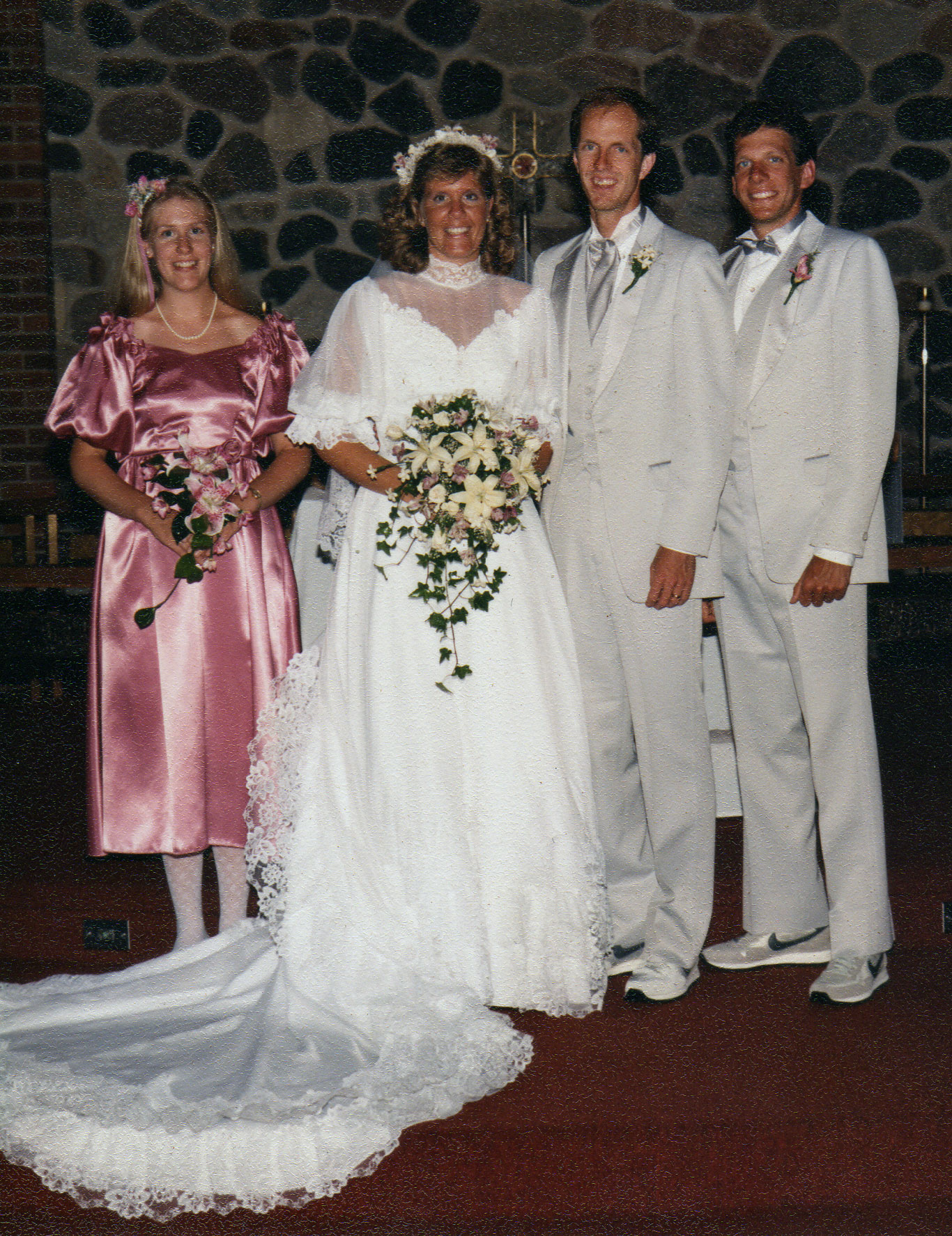
The Nike Air Edge was an evil, brilliantly conceived scheme to take over our lives, you see. In fact, the very next year I got married in a pair of silver Nike Pegasus. It’s true. And I gave Nike Pegasus to all the groomsmen, who wore them in the wedding as well. What kind of person does this? Never mind that it was my wife’s suggestion to make the Nike

The Nike addiction conspiracy is on full display in this wedding photo.

Pegasus our footwear of choice, and that the shoes matched wonderfully with our silver and charcoal tuxedos. That’s how this whole conspiracy addiction thing works, you see. They rope you in and then even your closest associates and loved ones become enablers. You begin to wear Nikes for all sorts of other occasions. Even at nudist camps, for God’s sake. It was a conspiracy, I maintain. It really was. The voices in my head told me so.

It has taken years to get over the Nike Air Edge addiction. Treatment has included wearing racing flats by adidas, Puma and Asics, but nothing worked completely or as well as the Nike Air Edge. And once you’ve had a pair of perfect racing flats, it’s just like being an alcoholic. You can’t just settle for just any old shoe, or race and train halfheartedly. It’s either all or nothing. All in or all out. But I have only myself to blame. Putting one foot in front of the other in a pair of Nike Air Edges was like being hooked on smack. They don’t call it the 12 Step Program for nothing.

The joy of the perfect Air Edge lasted just a year. Then Nike tried to wean us distance runners off the perfect shoe. But it wasn’t easy. The Nike Air Edge appealed to those of us who fell easily for cosmetic gifts as well. For starters, the Air Edge had two different colored Nike swooshes, red on one side and blue on the other. I know, that’s really mean-looking, right? And the texture of the exterior surface of the shoes was almost velveteen. You could have sex with those shoes they were so sweet.

And the tread. Oh, God, the tread. The Nike Air Edge had fabulously designed tread that, get this, actually swayed to the arc of its curved last. Now that’s just cruel. Because it made running so natural and clean, and the rubber on the insole never failed to grip the road surface, not even in wet conditions. I recall running straight through puddles on my way to victory during the Frank Lloyd Wright 10K that year. Splish splash splush. And the water didn’t even seem to soak in, I was going so fast. Tra la la. That is really not something you can sustain forever, you know.

That kind of fearless running is not healthy or realistic. And I think that’s why Nike decided that despite the tremendous success of their experiment, they simply had to discontinue the Nike Air Edge or there would be dire consequences. Like, runners who ran themselves to death. It would not do to have runners collapsed in the ditches with news media standing around, holding out recorders and cameras while the vapid runner gasped his last words, “It was the Air Edges.”

To wean runners off the Nike Air Edge, the company turned the model into an all air-sole shoe the following year, but it was absolutely not the same shoe. Too much cushiony air under the forefoot actually slowed you down.

But now I realize: The “new” Nike Air Edge with an all airsole was like methadone. Not the same rush as the original, but it did serve to mask the the effects equipment addiction and allowed you to again function in society.

Oh, those of us involved in the experiment would still show up at 10ks with that hopeful look in our eyes, dreaming that the new Nike Air Edge would float us to victory. But it was never the same. Not without the original Nike Air Edge.

I once met with a counselor who told me it was important to confront unresolved issues in your life. So this is the first time I have confessed being part of Nike’s Untold Equipment Addiction Conspiracy. It feels good to get it out there, and confess. Tell the world that yes! I wore Nike Air Edges and I’m proud of it. Never mind that I never set another PR on the track or road racing again. It was worth it, damnit! I’m glad they used me and then spit me out. It was wonderful being used, and I’d do it again. And again. And Again. And AGain. Well, I think you get my point. It was wonderful. It really was.

But God I hope they never issue the Air Edge again.

Posted in We Run and Ride Every Day | Tagged , , , , | 4 Comments

For runners, heat is worse than cold. But for cyclists, cold is the worst danger.

As a college distance runner, it was always a challenge to get acclimated for the heat during spring track season because the weather was often so cold that the first 80 degree day was a total shock to the body.

But it was also sometimes just as hard to adapt and adjust to sudden hot days in fall cross country meets. College meets were often held at high noon when the sun and warmth was beginning its peak. But there is really no time of day that dictates how heat will affect you. Mornings or evenings with high humidity and warm weather can be just as risky.

For example, a visiting team from a Minnesota college showed up at our campus in Iowa (75 miles to the south) wearing heavy shirts because the weather in the Gopher State had been 55 degrees and cloudy when they left. It was 78 degrees and sunny when they arrived. Wearing their cool weather uniforms, they started out fast and faded quickly in the heat. We really felt bad for them. Really.

Lessons like these should never be forgotten. But sometimes the basics of heat training and racing have to be refreshed or relearned. In certain cases they even need to be unlearned. But more on that at the end of this blog.

Here’s a quick review of the basics of preparing for and dealing with heat in your racing and training. Some of these are classic knowledge. But remember everything you know or learn has to be placed into context, and most importantly, everything you do is personal and specific to your own body:

  1. Racing in the heat requires a degree of repetitive stress under conditions similar to race conditions in order for the human body to develop appropriate response mechanisms, such as sweating enough to cool the body off.
  2. People also differ greatly in their ability to drink and absorb fluids, so the prescription for heat management that works for one athlete may have little benefit to another, so don’t trust the habit of a friend or anyone else to dictate how much you need to drink.

The goals of heat acclimation are specific and simple:

  1. Learn your body’s signs of heat stress such as lack of sweat, tingling or excessively agitated state of mind. Hopefully you won’t reach these negative responses but when you do, it pays to immediately assess your condition and take the safe route. No training or race effort is that important that you should risk your health. Not even the Olympics. And how many of us really get there? Not many. So back off and live to compete another day.
  2. After a heat stress experience, take time to analyze what conditions or behaviors such as drinking too little fluid, or allowing warm drinks, or wearing the wrong type of clothing, led to heat stress. Often the signs or bad habits were there. You just chose to ignore them.
  3. Practice taking fluids during runs and rides (especially you cyclists).
  4. Don’t eat too much before you run or ride on a very hot day. Many cyclists do not react well to eating large amounts of solid food before or during a long ride because the digestive process can pull away blood flow from performance muscles.  Every cyclist knows at least one friend who could not resist a hot dog or other good-smelling treat during a century ride, only to find themselves parked on the curb exhausted due to the fight between their stomach digesting the food and their legs crying for blood.  Runners and generally cyclists too should not eat a meal within 3 hours of training or competition. This is especially true during hot weather.
  5. To avoid gastric distress or drops in performance, test your body with performance foods that can be eaten in hot weather conditions and that do not “curdle” (such as milk-based drinks) or cause chemical reactions (especially citrus drinks like orange juice) in your intestinal system that can lead to vomiting or diarrhea. Neither is much fun.

Now that you’ve read some of the scary stuff, you should realize that heat is the enemy to almost all athletes, regardless of training. But here’s an interesting maxim that is wise to remember in planning your training for all seasons.

For runners, heat is worse than cold. But for cyclists, cold is the worst danger.

Why? Because runners can bundle up and continue safely on their way, but you can only take off so much clothing in the heat as a runner before you’re naked, and you’re still not cooling off.

But for cyclists, riding in the heat is somewhat more tolerable because there is an evaporative effect to the breeze created by high-paced riding. But there are limits of course, and most of us have faced them and learned the hard way that cycling in 96 degree heat when the road is kicking up the breath of the devil can bring you to a complete stop in a matter of miles. So there are no hard, fast rules. Get the joke?

However, the worse risk for cyclists does seem to be cold weather. Especially wet, windy and cold weather. Because the same breeze effect that can be a favor in summer can reduce you to a shivering wreck at 20 mph on a 30 degree day. Brrrr. Hypothermia.

So knowing the differences in heat and cold management can literally be a lifesaver.

But not so fast. We mentioned earlier in this article that it sometimes pays to “unlearn” lessons about heat tolerance as well. So what do we mean?

This author once wound up in a hospital following a steeplechase race in a national meet. The weather was 80 degrees, sunny and high humidity. There were no ill effects following the event, but that night fever and chills struck with devastating effect, producing violent vomiting and loss of 7 lbs of body weight on a 140 lb frame. Not good. Every part of the body was tingling and dehydration was a real risk. At the emergency room the next morning the hospital staff did the IV trick and things stabilized, but one really feels like dying during an episode like that.

So for a couple years following that race I had somewhat naturally assumed it was heat stroke that caused all those nasty physical symptoms. In fact I fastidiously avoided racing in the heat because it had taken weeks to recover from that “heat reaction.”

But then a 10 mile road race came along during a period of peak summer fitness in post-collegiate racing. It was early July and temps were rising quickly when the gun went off. Yet despite the high heat and humidity I ran to a 4th place finish against many better runners, clocking a 10-mile time of 53:30. Did I mention it was hot? Yet my kick in the last mile helped overtake two runners that had beaten me in a 10k the week before.

That heat-positive race made me think through the whole “can’t run in the heat scenario.” So I thought back to what might have caused the heat stroke during a 3000M steeplechase and then it came to me: It wasn’t the heat that nearly killed me. It was food poisoning. Our team had gone out to eat after the meet at a pizza chain and something in the pizza was spoiled. Was it stupid not to realize that fact? Maybe so. But we athletes are prone to blame our failures on the first thing that comes to mind. That was the heat, not the pizza. Although cold pizza is pretty good too. But that’s a different subject.

It was however liberating and something of a relief to realize I was not some heat prima donna. Over a long competitive training and racing career there have been other successful races in the heat, not including that 5K in the Prairie State Games where I wound up in a wheelbarrow full of ice. No one’s perfect.

But there have been plenty of other occasions over the years when the heat got to me big time. Just this summer the cumulative effects of the hottest July in 60 years caught me by surprise. I had to drop two group rides in a row, find shelter and ice. And running was difficult too. The pace definitely had to be adjusted a couple times. And that’s putting it mildly.

It all comes down to building a clear perspective on how you respond to heat (and cold). That means knowing your history and paying attention to the present. Then you can adjust and adapt as necessary to survive and even thrive in the heat.

Posted in We Run and Ride Every Day | Tagged , , , , , , , , | Leave a comment

The yellow tarsnake of the Livestrong brand

“Fuck you, fucker!” the young man yelled out his driver-side window — at me — as he passed going the opposite direction in his silver Dodge Durango. With a bike rack on it.

I stopped pedaling and looked over in disbelief. What? Why?

These were not the ravings of a cycling bigot, you know, a driver who feels a cyclist has no business on the road, getting in the way, costing said bigot precious seconds on his/her drive to somewhere very, very important. I wasn’t even going the same direction as this guy.

And it wasn’t someone I knew, or wronged in the past. I’d never seen this young man or his truck before in my life.

So why was he, apparently a cyclist himself, screaming obscenities at me?

Livestrong can be a tarsnake for those who engage in Lance Armstrong’s brand and legacy

Then it occurred to me. I was wearing my LiveStrong kit. And LiveStrong is connected, obviously, with a one Mr. Lance Armstrong. Seven time champion of the Tour de France. Cancer survivor. And creator of the LiveStrong charity, a multi-million dollar organization that helps those battling cancer, their families, and cancer survivors. What could be wrong with supporting Lance or LiveStrong, one might ask?

Well, plenty. But only to certain cyclists and bike racing fans.

If you are a cyclist, skip this middle part. It’s backfill. And you already know it. More than likely, already have your opinions about it, too. But for everyone else, here’s the deal in a nutshell: During the years Lance raced and won on the professional, elite level, doping was rampant in the cycling ranks. Testosterone, steroids, EPO, blood-doping, amphetamines were (and some say, still are) a witches brew of pharmo-chemicals used by riders themselves, and sometimes, administered to them by cycling team doctors and trainers. Many riders Lance competed against have been caught doping and stripped of wins and given suspensions. However, Lance maintains he never doped. Not ever. And makes the claim that he’s the most-tested athlete in the world and has never tested positive. However, many people associated with the sport suspect he did dope. He did cheat. He just hasn’t been caught (or if he was caught, he managed to find a way to cover it up). How could Lance beat the best competitors in the world — who were doping — while he was clean? Sometimes soundly? It’s possible, but some argue, not very likely.

Today, Lance (along with his former team officials and doctors) is being accused by the American Anti-Doping Agency (USADA) of having run a doping conspiracy during his historic Tour de France career. USADA is seeking to bring a case against Lance which they say proves that not only was he doping, but was also helping others to cheat as well. As part of their case, USADA is said to have testimony of Lance’s former teammates who have confessed they doped — right alongside Lance. If USADA is successful in bringing their case against Lance in an arbitration hearing, and their findings are upheld, Lance could be stripped of all his Tour de France titles and face a life suspension from the sport.

The case is tied up in the U.S. District Court in Texas as you read this. Lance has filed suit saying USADA has no right to accuse him or try him. There have been charges he’s brought his considerable wealth and influence to bear on members of congress and other cycling governing bodies (specifically the UCI, or the Swiss-based International Cycling Union) to intervene on his behalf. We await the judge’s ruling to see if Lance’s argument to throw USADA’s case out is upheld, or if the judge rules USADA does indeed have the authority to bring this case against Lance.

Of course, this whole mess is quite legalistic and complicated. If you want the details, a quick Google search will bring you thousands of hits on this story. What’s important to note is this case brings to the forefront cycling’s ugly history. It’s no secret that the sport of cycling has been plagued by rumors and reports of dirty riders and rampant cheating for years. Decades, even. And that by charging Lance Armstrong, the most famous cyclist in America (and some would argue, the world), USADA is bringing to a climax the narrative of cheating in cycling. It would be akin to perhaps the NBA taking Michael Jordon to court. It’s that big. That decisive. And divisive.

“Fuck you, fucker!

So divisive, the mere sight of a fellow cyclist wearing LiveStrong kit can illicit frothing anger. At a stranger. On a bike. Just getting in a few miles after work.

So where do I stand on the Lance case, you’re probably asking by now?

What I want to explain to the driver of the silver Durango, and anyone who makes a snide remark about (or casts a crusty glance at) the yellow LiveStrong wristband I always wear: It’s not about Lance. Nor is it for him. At least, not for me.

I don’t know Lance. I don’t know if he cheated. I don’t know if he’s a cool guy and would be fun to hang out with, or if he is a bully flanked by a peloton of bodyguards (as some critics charge). It doesn’t really matter because I don’t wear my LiveStrong bracelet for Lance.

I wear it for my stepdad, who died of lymphoma.

I wear it for my wife’s stepdad, who died of cancer.

I wear it for a dear friend of my stepdaughter, who died far too young of leukemia.

I wear it for my wife’s friend from high school, who is in hospice, still full of life, but in the final stages of her fight against cancer.

I wear it for Chris Cudworth and his wife, as she has bravely fought ovarian cancer for seven years, and continues to do so today.

I wear it to remind myself to say a prayer for all these fighters. The ones who are still with us, and the ones who have passed.

It’s easy to get caught up in the tarsnake of anger and hatred about Lance, LiveStrong and cheating in cycling. To make judgments of others based on their opinions of these things, or their support of LiveStrong. But before you let your wheel get caught and drug down by the sight of a LiveStrong wristband, remember this: There’s probably a very personal story or two behind that bracelet. It may represent someone dearly loved. So say a prayer instead. For justice. For strength. For healing and peace. For those fighting cancer, for those who have lost loved ones due to cancer, and for the sport itself.

–Monte W

Posted in We Run and Ride Every Day | Tagged , , , , | 1 Comment

Heat injury is a real problem when you run and ride

Each fall I try to attend a high school cross country meet or two. Today’s cross country meets are a wonderful mix of boys and girl’s events. There are numerous levels of competition from frosh-soph to Open to Varsity. Often there are hundreds of fans and supporters in attendance. The big meets set up fundraising tents to sell food and drinks. It’s a pleasant atmosphere and a great way for any runner or other athlete to recharge their batteries watching high school competition.

Except last year the invitational I visited in late August or early September saw extremely hot weather. The first morning race, a Boy’s Open competition, kicked off in 78 degree temperatures. Two runners succumbed to the high temperatures. Both were treated by emergency medical teams and released to their parents.

The second race claimed a few more victims, and temperatures reached 83 degrees by 10 a.m. The sky was clear and bright, the sun hot and persistent. No breeze. Humidity was thick and it seemed hard to breathe. You could tell it was not going to get any better. It was hot even standing in the shade.

The objective view

Having already ridden 40 miles on my bike that morning, finishing before 8:30, I knew how warm it was getting. The last 10 miles on the bike had started to wear on me as the sun rose higher.

Heat can last well into the fall competitive season.

You could see the heat stress on the faces of the kids at the starting line. Pink, flushed cheeks. Some of kids with pale skin showed reddish patches on their thighs, and sweat streamed down their faces. The girl’s hair was coming un-scrunchied and flying all around their heads. No one looked all that eager to run.

Each time the gun went off a new group of parents held their breath hoping it would not be their child that wound up in the ambulances, which had now begun to run mercy missions back and forth from the hospital 5 miles away.

In fact the pace of runners dropping out from the heat was so great at one point there were no ambulances left and few emergency medical techs around to take care of the “wounded” runners dropping out from the heat. That’s when they cancelled the meet.

Fans and athletes: Two different worlds

It didn’t feel terribly hot just standing around. You could wander into the shade a few minutes and feel okay when you emerged. But those high school athletes charging around the course in the first big meet of the season got little respite from the oppressive air.

Headed into the final race of the day, things were chaotic back by the starting line. Boys and girls of all ages, size and fitness had been hauled off, parents tailing along in their vans or cars, worriedly following those ambulance lights ahead of them.

And then, meet officials cancelled the varsity race. The whole crowd stood silent for a minute, and a few people groaned. Everyone loves to watch the varsity meet. Some of the athletes cursed to their friends, but many more shrugged their shoulders. One blurted, “Well, it’s better than dying.”

Yes, indeed it is.

A brand new world of heat

The fall competitive season begins in late August and goes through mid-November for endurance athletes in many sports. Cross country at the high school and college level, September triathlons, running road races and season-ending cycling series that include road races, crits and time trials.

We’re used to a scenario where the early September events might get a little hot now and then. All of us who compete recall racing in holdover heat. But the weather patterns this year have been crazy with 80 and 90 degree temps starting in March here in Illinois and lasting throughout the summer. It was officially the hottest July on record. We might see even stranger patterns of fall heat waves given the acknowledged affect of climactic change across the globe.

Being prepared, and how to react 

So competitors who run and ride ought to beware, and be prepared in both meets and training for days when the temps force you to back off, or back down completely.

If you find yourself in heat stress, there are some simple, immediate steps to take to prevent serious problems, including heat stroke:

1. Find a way to immediately cool the body down. Put ice down the front and back of your shirt and even your shorts or cycling bibs. I accomplished during a 35 mile ride by veering off to a store in a small town where a couple dollars (kept in a baggie…) purchased 2 fresh cold Gatorades and more importantly, a tall cup of ice that immediately got dumped down the jersey and shorts. Ahhhh. Cool relief.

2. Find a cool spot out of the sun, and with assistance if possible, first stand to cool off while drinking the coldest beverage you have available, or any liquid at all to make sure your hydration levels are either restored or maintain.

3. Don’t be vain: Remove as much clothing as possible. If you have a double layer of anything on, remove the top layer.

4. If you are experiencing chills, find a place to sit down (with assistance if possible), or get to shade and stand still. Take measure of whether you are dizzy or not. Consider ways to end your workout or race and call for help rather than take a chance that in the next 5 miles you will recover.

Heat injury is real, and it does not always go away quickly. If you’ve experienced profound heat stress you ought to look at your body almost as if you’ve had a bad bout of the flu or a serious case of food poisoning. Things are wounded inside your muscle cells, your lungs and brain. They need time to recover. You might need to work out in the coolest part of the day for up to 2 weeks to avoid recurring problems or a buildup of heat intolerance. Yes, it’s that serious.

Protect the brain, the core and listen to your fingertips

Most importantly your first goal should be to protect your brain and your consciousness. Take any and all steps to reduce heat stress using ice or water over your body to evaporate heat. But if you are experiencing chills, get into the shade, request help and monitoring from fellow athletes and take no chances that you’ll miraculously recover once you’re overheated.

Take it slow from then on, and allow your body time to recover from a heat trauma. It really does injure the body. It may take days or weeks for your body to snap back.

Tomorrow: What it’s like to wade through heat stress, and a couple horror stories and close calls.

Want a tee shirt?

We Run and Ride. It’s a movement.

Posted in We Run and Ride Every Day | Tagged , , , , | Leave a comment

Lake Solitude and Back: The Rocky Road to Enlightenment

As training runs go, or training rides for that matter, it can be fun to put yourself into a position where you face a real test.

Those kinds of runs and rides test your personal character. Push you through fear into new realms of performance. And ruin your psyche if your luck runs out.

It came to pass (a few years ago) that our college cross country team set up camp at Jenny Lake at the base of the Grand Tetons near Jackson Hole, Wyoming. With no real itinerary for training routes or even length of runs, a few team members got together with a topographical map and decided we should run from Jenny Lake up to Lake Solitude and back.

The run was 9 miles one way, 18 miles round trip. The group of 17 runners gathered after an early morning  breakfast of oatmeal or somesuch, stretched our calves a little and took off running single file up the rocky, dusty trail leading to Lake Solitude. Off to adventure.

It is beautiful country, of course. Tall pines and alternate patches of shade and sun. Bright gray mountains peeking through the trees, and daunting snow stuck to them like sugar.

The trails were mostly stable and footworthy, worn smooth by hundreds of horses that make the same loop each year. In fact our group had to negotiate around the big beasty horses many times up the 9 miles to Lake Solitude.

We had but one rule on the run up and back: Don’t drink water from the stream or lake. There were clear and present warnings about giardia, the microscopic bug that can turn your stomach into a maelstrom. None of us wanted that.

But none of us carried any water either. It just wasn’t done at the time. So we ran on, higher and higher into the altitude, until we reached Lake Solitude in separate pods of runners arriving at different paces. I was the 8th one there, as I recall. And feeling competitive about that.

A few stuck their legs and feet in the stone cold lake while waiting for the rest to arrive. The water was clear and beautiful, of course. Small trout swam beneath or feet. The mountain air was bright and clean. Only the smell of a few horse apples invaded the atmosphere. Then one horse took a dump near the lake and we decided it was best not to drink after all.

But before we left, the temptation to drink became too great for some. The water was just so, damn, clear. And inviting. Sparkling too. Like Perrier without the bubbles.

Finally the entire team made it to the top, though some were clearly dragging. Complaining too. Never a good sign. We’d just run 9 miles up 3000 feet in elevation. On a normal day, that would be called a good workout. We still had to go back down.

Little did we know, having little collective experience of running in the mountains, that going downhill on mountain trails can be just as bad, or worse, than running up. The pounding on the thighs and calves was terrible. Plus the cumulative effect of having no water and running at altitude in an already dry climate was working its slow, insidious reverse-magic on many of us.

The top runners fairly soared down the hill just the same. As the marginal 7th man at that time, it was difficult to find a zone of running comfort, and keep going, even though it was the second or third longest run I’d ever done to that point in my career. The longest was an inane (insane) 30-mile walkathon that a group of high school sophomore tracksters had decided to run one raw spring day, also with no water, no directions and no rescue team. But that is a story for a different day.

We all get into these situations sooner or later. The bike ride in a howling windstorm when horizontal rain starts up and your group decides it’s “every man for himself,” or every woman. But women tend to be smarter than that, and stick together.

The mountains look so pretty. Until you run into them.

On the way down the mountain it fell to my mind to just let the body do it’s work. Painful or not, it had to be done. There was no other way home. Not even walking was a superior alternative to the steady downhill footfalls carrying me, and us, back to the campsite. Running became trancelike, then enjoyable even. I was beyond. Caring.

We straggled in exhausted and triumphant. Then waited, and counted, until all our teammates returned as well.

Except a few were missing.

One was an ebullient, positive fellow named Tony. We knew he had not done much training that summer as he was on some sort of political circuit learning how to be a senator or such. When he rolled into camp, cussing and swearing, we knew the tirade would go on for a while. The inherently cheery are insanely vocal when pushed beyond their limit.

That meant one runner remained out on the trail, a frail freshman named Matt, about whom we learned much on the long drive from Iowa to Colorado. He had Tourette’s syndrome, for one thing. Prone to outbursts and sudden twitches, he kept everyone awake during the long driving hours on the road. Before we understood his condition, the guy next to him let loose with an angry retort: “Jesus Matt, you hot tamale. Can’t you sit still?”

But now we were worried about Matt. We had lost a freshman on the trail, and knew it was our fault. Should we run back up and find him? Some set out to do just that, and found their legs too shot to try. The 18 miles, plus resting an hour, drinking Mountain Dews and other stupid beverages had turned us all to hyper mush.

Well after the sun went down and twilight settled over camp, Matt came limping along the last hundred yards of trail. Pine needles covered the surface of the ground, so we could not hear his approach. We all just watched his ghostlike silhouette make its way into our presence. Matt got hugs and quick refreshment. The Prodigal Son (rather in reverse) had returned. We were all safely home.

One of the more coarse characters among us dared to ask, “Matt, what took you so fucking long?”

Matt stared at him vacuously for a moment, then said: “Well, there was a moose. On the trail, there was a moose.”

All of us had seen a moose on the way up and back from Lake Solitude. It had been resting in a thick grove of trees, ears twitching away the flies, back lit by the dappling summer sun. It was a huge beast. Bigger than anyone imagined a moose could be. Even running 20 foot above the moose on the trail gave you the heebie-jeebies.

“Where was it?” someone asked. “How far back?”

“Probably 4, 5 miles,” Matt said. “It was lying across the trail. All the way across. There was no way to get around it.”

“Oh my God,” several of us asked in unison. “What did you do?”

Tony chimed in at that point. “I climbed up the rocks and down the other side,” he said.

“You saw it too?” we asked.

“Shit, yes!” he admitted. “I forgot to tell you about that.”

They had been running together at that point, Matt explained. But Tony climbed faster around the trail moose, then told Matt he’d run down fast as he could in case Matt could not make it around the moose. But looking back along the trail, Tony saw that Matt had made it down and would come along fine.

But Matt had run out of juice. His freshman legs had done little training that summer. Probably he averaged 18 miles of running a week, if that. Now he had covered 18 miles in a single day, with 6000 total feet of incline and decline to cover. At altitude. In many ways, he was the best runner of all, among us.

Matt never amounted to much on the competitive side of the team. Not even sure he stuck around for another season of cross country. But to this day, I think he was one of the bravest, strongest hot tamales we’d ever seen. Here’s to ya, Matt. Wherever you are.

Posted in We Run and Ride Every Day | Tagged , , , , | Leave a comment