The fine line between the Paleo diet and the Oreo diet

IMG_8163I watch what I eat. I really do. I watch it sit on a shelf, and then I eat it. Like this Oreo.

Not exactly the Paleo diet, now is it? I couldn’t help it. The guts were too tasty. I licked them out like the blubber from a dead seal on a platter.

Paleolithic vs. Paleolickit

Back when the Paleo diet was all the rage, human beings had little time for leisure activities and literally had to run for their dinner. That meant there was no time for exercise as we think of it. You exercised or you died. That was that.

The Oreo diet

Now instead of the Paleo diet, many of us are on the Oreo diet. We eat processed foods because they are convenient and we don’t have to chase them down to eat them.

That’s the big difference between runners now and runners then. Back in the Paleolithic era, they ran in bare feet or sandals, carried spears as they ran and did not think much about “watching their weight” or even “watching their diet.” If you felt like chomping your teeth into the fat of an elk or ingesting 5 lbs of seal blubber in a single sitting, you did it. No questions asked. Paleo decisions were simple.

It’s all a process

Now we process our opinions and ideas just like we process our foods. Nothing is simple anymore. Unless you make it simple.

Like, today. I made a simple decision. I ate the rest of the bag of Cheetos I purchased when I ran to Walgreen’s early this morning to buy my wife some of those hot packs for her back. I don’t know why… those Cheetos just needed to be in my belly. There’s not a thing about them that’s good for me except that they’re comfort food. And that’s the modern version of the Paleo diet.

We eat our anxiety before it eats us. 

Comfort food everywhere you look 

Which is also why I stopped into a gas station on the way home from doing an interview with a band for my next article on Yahoo! I didn’t eat lunch before going so I got hungry on the way home and the gas station was on my way and something about that place said “OREOS” and I popped in to buy a 6-pack of Oreo (yes, you heard what I said) for $1.79 and a Diet Coke, which is basically bubbly sewer water in a poison bottle.

Not on the Paleo menu

There is nothing in either of those “food items” that is anywhere on the Paleo diet. I was not being a good little cave boy today, as you can tell.

I didn’t run a step, except with the dog.

I didn’t cycle either, even though the weather was close to 70 degrees here in Illinois. In December. Who does not go out on a day like that? A busy, modern man, that’s who. No wonder we get uptight.

I could have run I suppose. But I biked 20 yesterday, ran 6.2 the day before, biked another 30 the day before that, and ran the day before that.

Listening to God

So Sunday became a day of rest. I went to church. Listened to a beautiful Cantata. And then ate some Cheetos. And Oreos. And a Diet Coke. How comforting. Salvation and comfort food. They go together.

But none of that made me a better athlete, I know. Except the praying maybe.

I mean, what the hell…

Perhaps it was my way of saying, for one day: Screw it. I’d rather relax and eat junk.

Don’t tell me you never do that.

I had a cup of yogurt too. So I ate something healthy today. And two Cutie oranges. So sweet and juicy.

Tomorrow I’ll get back to real eating, like the salad I had the day before, and the pulled pork and whatever I ate last night out at dinner.

We can’t be all Paleo, all the time. There’s a little bit of Oreo in all of us. Once in a while you gotta go with it.

WeRunandRideLogo

Posted in We Run and Ride Every Day | Tagged , , , , , , , , , , , , | 1 Comment

Saturday Original: Watercolor of a once-favorite running route

While living and training in southeastern Pennsylvania, I trained on the backroads around Paoli. A favorite spot in the bottomland was this narrow railroad underpass. This painting was done on site, plein air by Christopher Cudworth.

While living and training in southeastern Pennsylvania, I trained on the backroads around Paoli. A favorite spot in the bottomland was this narrow railroad underpass. This painting was done on site, plein air by Christopher Cudworth.

Posted in We Run and Ride Every Day | Tagged , , , , , , , | 1 Comment

Bigfoot is real. He almost ran me down yesterday.

By Christopher Cudworth

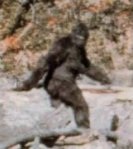
SmalfutWhile rumors of Bigfoot and Sasquatch sightings have fascinated a considerable segment of the general public over the years, it was not until recently that actual DNA evidence of Bigfoot surfaced through the pursuit of science.

The news broke fast and large across the Internet. A genetic researcher named Melba Ketchum claims to have found DNA evidence of Bigfoot in human history. The Huffington Post reported “Under Ketchum’s direction at DNA Diagnostics in Nacogdoches, Texas, a team of researchers has concluded that the creature may be a human relative that somehow developed around 15,000 years ago as a result of a hybrid cross between Homo sapiens with an unknown primate.”

The story continues: “While many people have claimed to have seen the creature, its existence has never been confirmed, despite a plethora of photos and footprints. The ongoing search is the subject of Animal Planet’s “Finding Bigfoot” television series.”

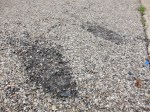
Bigfoot prints

My own documented Bigfoot Evidence is featured in this photo of Bigfoot imprints in a

Bigfoot imprints in local asphalt. Click to view larger image.

Bigfoot imprints in local asphalt. Click to view larger image.

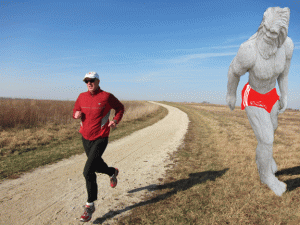
bit of local asphalt. But even greater is the evidence captured in this photo, in which Bigfoot, wearing bright red adidas shorts, appears just off camera as I was running down a forest preserve path near my hometown.


Direct encounter!

This close call with a Bigfoot on a local running path was documented by my photographer.

This close call with a Bigfoot on a local running path was documented by my photographer. Click for a larger view.

The photographer taking the photos was so focused on composition that he did not notice the giant creature whisking through his peripheral vision. But when the digital photos were downloaded, Bigfoot showed up clear and real.

Hard evidence

That seems to be how Bigfoot works. Consider the quote of Melba Ketchum in the Huffington Post story.  On finding evidence of Bigfoot in DNA, she had this to say: “Well, it came to me, I didn’t go after it, that’s for sure,” in her exclusive interview with the Huffington Post. “I did not believe in these creatures. But my lab did a lot of animal testing, and we did species identification. We didn’t have any hits on anything interesting until five years ago.”

The story goes on to note that Ketchum’s professional work includes nearly 30 years in genetics research and forensics. After her team attempted DNA sequencing of hair samples from an alleged Bigfoot encounter, they found some unusual things in the hair. But there wasn’t enough DNA to conclusively verify what they were seeing.

Smells like reality

As for my own encounter with Bigfoot, I noticed a rather pungent smell carried from behind me on the north wind. For a moment I thought it was my own flatulence, as that is a common occurrence on many a run. But the smell was not rooted in the burritos I’d had the day before, but smelled like more natural fare, most likely venison and smaller game such as rabbits and foxes.

So it appears our local Bigfoot is eating well and not relying on fast food like Taco Bell or Kentucky Fried Chicken. And yet you can see the grimace on Bigfoot’s face, as if he’s asking, “Who cut one?”

Well, Bigfoot, I say the one that smelt it, dealt it. So there.

Getting wilder in Illinois

Given the recent Cougar sightings in Illinois, it seems as if things are getting pretty wild around the Chicago area. First mountain lions, now Bigfoot. Although that might be plural if there is more than one Bigfoot around. Then we’re dealing with Bigfeet. And that’s a whole new level of problem for Illinois.

After all, if the Bigfoot population increases in our state, Bigfoot can lay claim to voting rights and even lobbying to redistrict rural areas to influence Illinois politics.

But the problem for us runners and riders will be if Bigfoot entrants start showing up at local races. Who wants to compete with a 9 foot runner that makes the ground shake when they tromp by you in the last 2K? Or who wants to go on a group ride with 15 Bigfoot cyclists elbowing for a spot in the echelon in a crosswind.

Not me, I’ll tell you. My first and hopefully last encounter with Bigfoot was close enough. From the looks of things he almost ran me down already. Or is that a she? Women’s running is on the increase, you know. There’s no reason why a female Bigfoot might not have been out doing some miles to shed some weight. After all, Bigfoot and human beings seem to have some pretty common roots and close relations. That DNA had to get there somehow, you know.

Best to keep on running, folks. That’s my advice.

Posted in We Run and Ride Every Day | Tagged , , , , , , , , | Leave a comment

What to do after the tar snake of a bad race

A bad race can leave you feeling like dead meat.

By Christopher Cudworth

Sooner or later, we all have a bad race.

Running into trouble

If you’re a runner, you might have planned all year for a marathon, and things went sour somewhere along the way. Or that half-marathon you planned to use as a tuneup turned into an injury-hobbled slog and a DNF. You shot for a PR in the 10k and blew up at four miles. Your 5K just pace just never got going. What do you do when those things happen?

Riding away from you

If you’re a cyclist, bad races can happen fast. You can crash, for one thing. That ends your race in a hurry. Or you can make a mistake, get stuck in the back of a pack and miss the break. It’s often “race over” at that point whether you’re in a road race or a criterium. In cycling, contact with the lead group of riders is everything. There’s no making up the difference when the group ahead is sharing pulls at 25 mph and you’re humping along solo at 22. The math is not in your favor.

Everyone blows up now and then. Misses the break. Has a bad day. The reasons are multitude. But the solutions must be simple.

Gaining perspective

Imagine if you are an Olympic athlete and have a bad day? You might have put in 4 years of intensive training, watching your diet and weight work and everything it takes to be world class and still find yourself sick with a cold or not feeling your greatest on the day of the race. The disappointment can be crushing.

The natural response is often to look for excuses. The weather was not in your favor. You can’t help your luck in a cycling pack. On and on.

There are better ways to process what happens during and after a bad race.

What to do after the tar snake of a bad race

  1. Start by making no vows. Often the first thing we tell ourselves during and after a bad race is “I’m never doing this again” or “I quit” or “Why do I even (run) or (ride). Resist the temptation to make vows to quit. It’s natural to want to divorce yourself from the situation, but leave it at that. Confine your anger or disappointment to a single event. Do not case a negative net over your whole love of the sport. Even though you hate it at the moment, you can prevent digging yourself a mental hole by stating, in positive fashion, “Things did not go well today but I will reserve judgment until later how I really feel about this.”
  2. Chronicle the “bad” event rather than ignoring it. You’ll be surprised how liberating it can be to take out a piece of paper and write down all the things that went wrong. Or make an angry entry in your journal if need be. It’s okay to be mad when things don’t go right. It’s even okay to carry that anger with you in constructive fashion.
  3. Find a focus for your anger and frustration. Many times it is the anticipation and stress that cause us to fail under pressure in athletic competition. The first step in finding new focus for our efforts is to discover whether the reason behind your failure was temporary or permanent. If you have overtrained or become stale leading up to your target race, you cannot expect to bounce back out there and try another race. But if you simply got a side stitch running or made a dumb tactical move in cycling, it is possible to recalibrate your objectives and enter another race on the momentum and training you’ve built up. Many an Olympian athlete who failed on the big day goes out and races the rest of the season and salvages their soul by using that hard-earned fitness to other ends. Of course, there are times when it is better to back off completely and not go back out there an race. Which means you must first…
  4. Analyze. Coming off a bad race, make sure you try to understand what contributed to your off day. It could be something simple like your diet leading up to the race, taking in too much or too little fluids, over or under training in the weeks leading up to competition.
  5. Keep the motivation, but also forgive yourself. It’s good to look ahead, determined to do better next time. It is also important to forgive yourself if you screwed up somehow, got too eager or trained too many miles and wound up tired on race day. Everyone makes mistakes. Don’t bury yourself in blame and regret. That’s good advice in running and riding, and in life itself.

Listen to yourself

A bad race is not the end of the world. You don’t need to moan and complain to everyone you know about your misfortune. Your training partners can be a good sounding board if you ask them to help you analyze your training. Often they see mistakes even when you don’t.

Learn from mistakes

I recall clearly my teammates asking me in advance of a high school cross country race on a confusing course, “Do you know the route?”

Arrogantly I assured them I did. Yet when the course went straight on a second loop rather than taking the longer way around a track, I ran the longer way while a competitor went straight––the correct route––and my 200 yard lead vanished. I finished second.

That was a preventable mistake, and the lesson learned from that “bad” race was to pay attention to preparation right up to the minute of the event.

We all learn things the hard way sometimes. It’s how you respond to those lessons that can turn potential bad races into better future efforts.

Posted in Tarsnakes | Tagged , , , , , , , , , , , , , , , | Leave a comment

The Big Wheel Dream that could not be killed

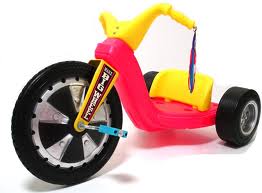
Big Wheel. Because it had a big wheel.

By Monte Wehrkamp

When I was a kid, there was one toy I wanted more than any other.

A Big Wheel.

You remember those, don’t you? Made almost entirely of plastic, the low-slung Big Wheel was (and still is, I’m told) a tricycle for older kids (up to around 8 years old). It looked fast, with chopper-style swept back handlebars, a huge front disc wheel, and a hand brake which locked up the right rear wheel so you could perform tail-out power slides.

No. You’ll kill yourself. 

But my Mom said no. I couldn’t have one. For surely, I’d roll down our steep driveway into the road where I’d be killed by the terrible traffic. We had, counting the mailman and the milkman, perhaps 11 vehicles pass our house daily. Twelve on garbage day. No matter. Were I to be given a Big Wheel, my imminent death was certain, so proclaimed my mother.

But mom, all my friends have one…

Of course, all my friends had Big Wheels. My best friend Todd had one. His house was on an even steeper hill than mine, and 38th Street actually had traffic. We’d post lookouts at the top and bottom of the hill, and when the coast was clear, fly past his house on his Big Wheel, coming to a spinning stop in the intersection below. We were never squashed by murderous Buicks or pickup trucks, though we did manage to crash into a mailbox or two.

http://www.youtube.com/watch?v=HjTAA_da97w

VIDEO CAPTION: As you can see, Marx didn’t do me any favors with this commercial. It only further served to convince my mother I would certainly be killed.

This was only the beginning of my mother’s irrational fear of cycling which she attempted to instill in me early. And often.

My mother’s fear that I’d be killed cycling moved up a notch when it came time for me to get my first bike-bike.

The Red Sting-Ray

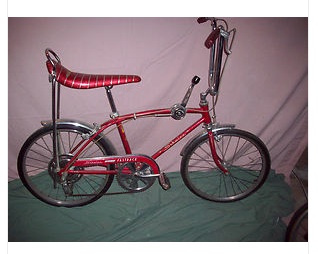
It was a red Schwinn Stingray complete with banana seat, 5-speed shifter, drag slick rear tire, and ape hanger handlebars. And it looked, when I first saw it by the fireplace that Christmas morning in 1972, like this…

The ultimate child ride: A red Sting-Ray

The coolest bike in the world. Ever. But it didn’t look like that for very long.

“Oh George, it looks…dangerous!” Mom said to my dad.

Uh-oh, something bad is going to happen, I thought.

“Just look at those handlebars, sticking up like that!” she continued. “We can’t leave them like that. Those have to be fixed.”

Granny Handlebars

So my father drove to the hardware store where he purchased a granny handlebar — you know, the kind which usually has a wicker basket and a bell attached to it. Off came the ape hangers and on went the grannies. All in the name of safety, don’t you know. (Never mind sticking up from the the top tube was a stick shifter just a couple inches and one big crash away from, well, let’s just call them “Mom’s future grandchildren.”)

In the course of a few minutes, the coolest bike in the world became the lamest bike a young boy could possibly call his own. It was disfigured, maimed, set upon by an overprotective mother. It screamed, “I’m a dork and my mom still cuts my meat.”

But she wasn’t done yet. No, far from it.

The Yellow Columbia 10-Speed

After years of having to endure the embarrassment of my Mom-customized Schwinn, I graduated to my first road bike at the beginning of junior high (since I’d be riding it to school every day, unless there was a blizzard, and even then, only when the snow was deeper than six inches).

Understand that in western South Dakota in the middle 1970s, road bikes weren’t all that common. The most exotic bicycles in our town were 3-speed cruisers. But with 75 bucks burning a hole in my pocket, my father and I went downtown to Sears where I purchased

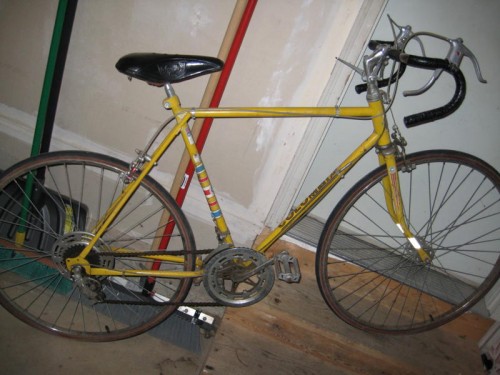
Classic Yellow Columbia 10-speed

a bike even cooler than my Stingray (brief pre-molestation period). A yellow Columbia 10-speed!

My bike was only a few seconds old, shining proudly in the driveway, when my mother pounced.

“What are those things?” she asked my dad.

Oh please God not again!

“What things?” he asked.

“Those curled-under things on top,” she said pointing at the drop bars.

Here we go again.

He’d be killed, George!

“You cannot possibly steer a bike with those…crazy things. He’ll be killed, George,” Mom continued. “Those have to be fixed before he goes anywhere on that bike!”

Off to the hardware store Dad went, with me protesting the entire way (in the passenger seat of his truck, sans seatbelt, of course, because it didn’t have one). But it was already settled. There was no changing Mom’s mind. If I wanted to ride my new Columbia 10-speed, it would have to be made safe with the dreaded granny bars. Complete with rubber grips with little grooves for your fingers.

After a few minutes of wrenching, my new bike was made just dorky as my old bike. Oh, how the neighbor boys all howled in glee. “Oh my God, she did it again! Haaaaaa ha hahha hahahhahha ha.” I tried to smile and go along with the teasing, like it was no big deal. But it was a big deal.  Even now, it’s a shattering memory. Really. I’m scarred. It pains me to type this.

In the end, the Columbia was stolen. Nothing left of it but a clipped bike lock hanging from the bicycle rack at school. A professional hit job. Truth be told, while it hurt for a long time, and I kept my eye out for my yellow 10-speed for months, there was a small sense of relief. At least I wasn’t riding around with granny bars.

The Beater. Beats nothing…

It wasn’t much later when we found a replacement bike — Dad and I went to an old guy’s garage, a kind of secret, underground bike shop. In it was a no-name, used 10-speed, complete with its original drop bars. It was scratched up, well used. This was a good thing, Dad reasoned. Less appealing to bike thieves.

And, as it turned out, able to fly under Mom’s radar as well. Finally, I got to ride a bike that hadn’t been safety spec’ed by my mother. I could pedal to school with my friends on a bike just like theirs. Riding dangerously!

No helmets. Yet we survived. 

Amazing when you think about it. We never wore helmets (not invented yet). Often times, we’d each have an armload of books (backpacks were unheard of back then). And for some of us in band or orchestra, an instrument case miraculously balanced across the brake hoods (in my case, a trombone).

——

Actually, Mom, looking back, it was a stroke of luck that we weren’t all killed. Your maternal instincts were spot-on, if only a little misdirected. Time certainly has a way of changing a child’s perspective, so that as an adult, one can appreciate their parent’s point of view.

But dang, did you really have to insist on granny bars?

Posted in Mechanical Genius, We Run and Ride Every Day | Leave a comment

Which is the harder sport, running or riding?

Which is the harder sport, running or riding?.

via Which is the harder sport, running or riding?.

Posted in We Run and Ride Every Day | Leave a comment

Which is the harder sport, running or riding?

Let’s have a little debate here. Which is the harder or more difficult sport, running or riding? The arguments could start with the basics.

Going Solo

1. In running you cannot coast. Every step you take is one of self-propulsion.

Yet in cycling, you always carry with you the burden of 17-20 lbs. of machine. When you go up hills, you must push the bike as well as your own weight.

Which is more difficult? Consider these other factors.

Wind Drag

2. In running, the draft effect if minimal. Sure, it helps to run behind someone when the wind is in your face. That’s only natural. But you’re largely on your own on a windy day.

In cycling, there is a pronounced draft effect of up to 30% when riding behind another cyclist. Yet the wind can also be your enemy from two sides at once when riding in a crosswind. That means you’re not just pedaling against the wind going forward, but there is also a sideways pressure and additional resistance created in a crosswind. A vexing challenge indeed.

Impact

1. The most difficult aspect of running is minimizing the impact of your own weight striking the ground. Premiere distance runners accomplish this with a smooth, “over the ground” stride rather than a thumping heel strike. But the challenge remains that running involves a lot of pounding, which results in fatigue. The jostling of your innards can also lead to profound stomach upset. Never a fun moment in running. Barfing can turn you into a coward, and quick.

2. Cycling would seem to minimize impact in many ways, yet there are still effects of sitting on the bike for hours at a time. Those effects can be magnified when riding on rough roads or worse, the cobblestones of Europe. Fatigue builds up in the hands and shoulders, for example.

Endurance and oxygen intake

1. Breathing is an absolutely critical aspect of efficient running. Learning how to breathe in a manner that delivers the most oxygen to your body is critical to any runner, and at any distance. Whether you are racing 5k or running a marathon, getting enough oxygen into your body can be a challenge. It is one of the facets of running that makes it a most difficult sport.

2. Cyclists seldom need to think about their breathing on the same par with runners, yet bike position and good form dictate how well the cyclist can take in oxygen. There is also a keen relationship between pedaling efficiency and oxygen use. On the flat a rapid cadence can conserve valuable energy while climbing requires good technique or aerobic debt can quickly set in.

Uphill and downhill

1. Climbing hills in running is obviously no treat. The strain on a particular muscle group can result in cramping that slows a runner to a turtle-like pace. I have known several runners who could not climb well, however, that developed an incredible ability to run downhill, making up for lost time, as it were.

Cycling is a sport that categorizes itself by types of riders, and the most specialized are the climbers. Usually slight of build and long in frame, or else equally small and compact, as in many of the Colombian or Spanish climbers, these riders love to tear up hills as if they were on the flat, leaving others dying in their wake.

Yet it is the descenders who are the bravest of all road cyclists, and the difficulty in becoming a good descender is how hard it is to ride in spite of the considerable fears creating by hurtling downhill at speeds ranging form 50-70 mph. If you are a cyclist that has ridden that fast, you know there is little room for error in your bike handling skills.

2. Cyclists must learn how to climb or risk being dropped on

Hitting the Wall or Bonking

1. Runners who “hit the wall” are reduced to a crawl. Depleted of fuel in their bodies, runners who hit the wall can often proceed, but only at a greatly diminished rate. Any runner that has experienced the feeling of hitting the wall and been forced to literally sit down by the side of the road in an anguish of overwhelming fatigue knows how tough the wall can be. No amount of will can help you break through the wall. Only preparation can do that.

2. Cyclists who bonk speak of surreal moments when you are pedaling the bike and literally nothing’s happening. It is as if your legs have no strength at all. You get spacey and devoid of will, pedaling only to stay upright, and even that can be difficult. The rapidity with which your group suddenly rides away from you is astonishing. When you bonk you are on your own, perched atop a silly machine that no longer seems to work.

Pain

1. Developing pain tolerance is a key part of being your best as a runner. If you want to perform your best you must accept and learn to compete while in pain, out of breath and fighting against the effects of lactic acid in your body. Running “through the pain” is therefore one of the hardest aspects of being a runner.

2. Cyclists often talk of the pain they experience while riding because there is no such thing as “good enough” when training or racing. In other words, there is always a way to go a little harder, ratchet up a couple miles an hour or increase the cadence. This almost existential reality dogs the cyclist every mile, an effect compounded when riding with a group of competitive or serious riders whose pace puts you in the red zone even when you are firmly planted in the peloton. The pain one feels in cycling is most humbling because you are in direct and immediate comparison to every other rider around you.

Willpower

1. The worst three letters in a runner’s lexicon are DNF. Did Not Finish. It can be so tempting when things are not going well to give it up, trot to the side of the road or hitch a ride back to the start. Running through those bad days can be tough. But runners also know it is going to take intense willpower to manage the good days as well, to not screw up a good effort by drinking too much or letting your form go lax and getting a side ache. Then there’s the last mile when the entire body screams to stop and you must force yourself to go on. Running is hard because there is no aid, even a tailwind mocks you.

2. Cycling is willpower defined in 3 phases; the will to pedal efficiently at all times, the will to keep pace with fellow riders and the will to go beyond throw your energy into a machine that sometimes seems to fight back when you are trying to sprint, climb a hill or fight a wind. It’s all about the will, or lack of it, that makes a better cyclist.

Culture

1. The culture of running has changed in some interesting ways over the years. The popularity of the marathon has created novel assistance such as pacing groups that guide runners to their goal in a race. To some degree, there is greater tolerance and respect for runners who simply complete a race versus those who win. It is both a charming and forgiving aspect of the sport.

2. The culture of cycling is clearly delineated in the categories of riders. Each level of cyclist has a skill level or age category in which they can compete. There are pro cyclists at a couple levels, World pros and Continental. Then come Category 1, 2 and 3 riders who dominate regional and local races, followed by Category 4 and 5 riders trying to become better cyclists. These categories are at once forgiving and humbling. Because the minute you begin winning races at one level you are called to a higher category where you will get your ass kicked unless you are an exceptional talent like Matthew Busche, now of RadioShack, whose talent enabled him to convert from college cross country runner to world class cyclist and US National Champion. That’s a rare individual that can do that, eclipsing the culture of cycling in many ways that says you must slowly climb the ladders of categories to get to the top.

So what’s you’re take? Is running the harder sport, or is cycling?

Posted in We Run and Ride Every Day | Tagged , , , , , , , , , , , , , , , , , , , , , , , | 1 Comment

Have you made your November Resolutions yet?

By Christopher Cudworth

January 1 is actually a little late to make resolutions if you are planning to make 2013 a better year than 2012. However if you’re not reading this until January, the suggestions below are still highly valuable in helping you make plans for better running and riding in the new year.

Planning and preparation

Resolutions not only take planning, they take preparation. For people who run and ride, the period right after Thanksgiving and before Christmas is the best time to begin planning––and preparing––to run and ride with quality and appreciation in 2013.

Here’s what that quality and appreciation mean to those who run and ride.

Quality: To engage in focused effort each time you run or ride, and that includes focusing on the easy days as quality time on the run or ride.

Appreciation: To be attentive in all that you do. From organizing and maintaining your equipment to using it well as you train. And then being aware when you get out on the training run or ride why you are out there, and how grateful you should be for each step or pedal stroke.

Those two simple guidelines can be the foundation of planning your year. But the specifics of what you want to do are what real “resolutions” are about. Since I can’t speak for you or your goals, that has to be decided by you alone, the following are goals I have set for myself in 2013. Perhaps they can provide a health structure as you set your own goals for the coming year.

Are there specifics?

Notice that these goals are not yet set in specifics in some cases. Some people will tell you that goals can only be achieved if you apply concrete or quantitive values to them. I say bull to that. Goals are meant to improve the quality of your life, and you often cannot put a strict measure of worth on that. Incorporating specifics in the framework of your goals is fine and a good thing to do. But you should also not allow the specific to override the qualitative aspects of your goals, which may be aesthetic as well as achievement-oriented.

2013 GOALS

Strength training: Daily strength training is key to becoming a better runner or cyclist. Doing foundational core, upper body and leg strengthening exercises improves performance and helps prevent injury. Tip: To prepare for 2013, strength training begins now, in 2012. Work out a routine that you know is simple, effective and fulfilling. Look for results in how you feel as well as how you look. Sure, bulging muscles are great. But muscles and joints that work and do not get break down are much more important. In an upcoming blog I will document a strength circuit you can do at home without much equipment.

3 running races. 6 competitive or event rides: Last year–for a variety of very legitimate reasons–was a “down” year in terms of racing for me (only once on the bike, none on the run) and riding (crashed due to bike wobble at The Wright Stuff Century). In 2013, I am selecting some meaningful events in which to participate. My goals are purposefully modest in terms of the number of events in which I will participate. I would rather exceed my goals by choice rather than fall short by circumstance. This is realistic ambition in action.

My specific running/racing goals in 2013 include: Sub 22:00 5k. 6:00 mile on track. Break 50:00 for 10k (which is 20 minutes slower than my PR, but I am also 20+ years older than when it was set).

Riding/racing goals: Finish in Top 10 in one criterium/age group or category race. Complete a Century (never been done).

Being social and networking at races or training groups can greatly expand your opportunities for quality and appreciation in your running and riding.

Weekly emphasis on speed work: Last year I ran and rode at virtually the same pace or rate all year. This resulted in stagnation and mental staleness. There were reasons for these outcomes, but the goal for 2013 is to exaggerate the quality of effort at least once a week while running (hitting the track for intervals) and practicing higher paced riding on a personal criterium course, and also out on the road with group partners. The purpose here is to increase variety while also breaking out of training ruts that lead to “flat” riding and running, stuck in one pace or one mental framework.

Increase my running and riding network: While I do love the club in which I ride for its devotion to all levels of riders, there is nothing like getting out with people you don’t know to broaden your horizons on the bike, or on the run. As a means to increase my running and riding network I plan to jump into a few of the higher quality group rides in the area once a month. I may get dropped but that’s the point. You have to test yourself or you fall into a rut. The goal will be to increase the length of time I can stick with the Tuesday-Thursday rides in which all the quality riders in the area participate. For running, I plan to join the groups that start at the Great Western Trailhead and expand my social network, thereby discovering the races and running opportunities that exist as well.

Encourage and foster your partnerships: Training partners can be key components of success each year. Start now by asking what your running and riding partners are planning for the new year. You may sync up with them on a ride or race, and set a mutual goal. That is great motivation for the new year.

Use winter training to prepare for spring, summer and fall: All of us tend to fall short in this category. Planning to do at least 2 outdoor rides on the mountain bike each week and a couple indoor rides on the road bike, or outdoors if weather allows as last winter did in Illinois, needs to become part of a mental framework, not just happenstance.

Giving back to the sports of running and riding: Each year I serve as a course marshall for several bike races. It is a really gratifying role because you are looking out for the safety of other riders, and you can learn a lot about racing by being up close to the race and on the course to see how bike racers handle their machines and their racing. I also volunteer on a worthwhile “cause” for the NAMI 5K that raises money for mental health services in our area and nationally.

Keep a simple journal or digital record: In the past I have been fastidious about journaling training and racing. Finding the simplest way to do this might involve purchase of a simple, functional notebook if that’s your style, or using your Smartphone to record your workouts for you. The choice is yours. I will opt for a combination of those two, since I used to cheat on the mileage end of things. Ha ha!

Start now

All these goals take preparation in the here and now. Yours probably do as well.

You can start by reaching out to people who can connect you to valued resources (such as good strength training exercises) or inform you on other aspects of your goals and what needs to be done before the year starts.

But in case you need immediate motivation, I suggest you hit the floor and give me 25 pushups RIGHT NOW! 

Ha ha. Just kidding. But you get the point.

November and December really is the time to start your New Year’s Resolutions. Then you can start preparing for a successful year in 2013. But if you’re reading this January 1 and feeling guilty, never mind. There’s always time to make goals. It’s making the time to achieve them that matters most. And have a great 2013.

Posted in We Run and Ride Every Day | Tagged , , , , , , , , , , , | Leave a comment

Running and riding through grief, both real and imagined

Grief can be a long and sometimes lonely road. But that’s the point. The road to recovery awaits those who run and ride.

Mental health experts and grief counselors have long advised that grief is an emotional phenomenon with several stages. The classic and operative model is one proposed by Elizabeth Kubler-Ross that states there are 5 stages of grief. 

Denial: Helps us survive the loss.

Anger: Really feeling and fighting against the loss.

Bargaining: Trying to regain in some way (or somehow) what you’ve lost.

Depression: Withdrawal or great loss settling in your soul.

Acceptance: Ability to move on in life.

Grief is both real and imagined. 

We tend to think of grief in terms of losing a loved one. Yet people can grieve over many circumstances, both real and imagined. That is not a cynical statement. Real grief and imagined grief are one and the same, but with different processes of recovery necessary to return to wholeness.

We may be experiencing a real loss in our lives, such as death of a parent, a child or a friend, and yet grief plays (or even relies) on the imagination of an individual to perceive what has happened in our lives. Our imaginations are necessary tools to help us process our losses.

Stoking imagination 

Running and riding is known, for example, to help many people combat the effects of depression, which may be one of the most difficult stages of grief for many people to handle. Depression manifests itself in many different ways. It is also unique for every person, yet there are patterns or categories upon which we depend to help us understand the mental and physical states we categorize as depression.

For example, depression can create both physical and emotional lethargy. It can cause us to overeat in compensation, taking in comfort food and resulting in weight gains that depress us even further.

Coping strategies

So you can see why the complexity of grief is so crucial to understand. And why having a coping strategy can be critical to emerging from grief with a healthy respect for the loss you’ve experienced, or are experiencing.

Notice that mention of the word “respect.” The most important thing you can do while going through grief is to remember to respect yourself and others. That can be enormously hard to do. Many people experience guilt over the loss of a loved one, especially in tragic circumstances, such as when illness or disease causes death. It is easy to place the blame on ourselves for losses in our lives. But that doesn’t really change the circumstance, or what we have to face. Nor does it genuinely help us understand what is happening in our lives.

Blaming God or other forces

Some people get so angry they even blame God for the loss in their lives. That crisis in faith can be a grieving process all its own. When you feel as if the very pillar of your belief system has let you down, you feel all alone. Abandoned. Lost. Devastated.

I created this image in collaboration with Sunday School students who drew the outline of a bible story that I enhanced with pastels. Christ praying in the Garden of Gethsemane. By Christopher Cudworth with Gwen Zeiter.

Interestingly the Bible is full of stories about people going through these very same emotions. The pinnacle is the story of Jesus Christ in the Garden of Gethsemane, praying so hard that blood literally oozes from his pores. Now that’s feeling it. Even if you are not a Christian, most people can relate to the idea of fear in the face of death. It is a natural human response. You can grieve your own life before it is taken. You can grieve the life you’ve left behind, or the things you did not do, or say, or believe. Grieve sits waiting for our response to all these emotions. It can be overwhelming.

Imagining the worst, or the best

The imagination can be a terrifying foe or a blessed friend. We feel sometimes that stress and loss are bleeding us dry, emotionally at least. But imagination can also come to the rescue, lifting our spirits and our minds to places where grief does not so easily rule our sensibilities. So how do we get to that better imagination, rather than allowing the worst of our thoughts to own us?

That is where the grief meets an interesting juncture with activities that help us mentally process events in our lives. When grieving, it is most important to get up and take some control in your life. That is when it can be a lifesaver to get out and run or ride.

If you cannot initially bear to run or ride through your grief, then get out and walk for starters. Just move. Once you’ve done that, you might pull down your bike or manage to jog a few blocks. You might be crying as you go, but you must go. That is the path to healthy grieving. If you live in a wheelchair, then wheel yourself around the block. If you’re stuck in bed because you’ve been in an accident, then move any part of your body possible. The morning after the bike accident that broke my clavicle and could well have taken my life, I grabbed my camera and limped a mile down a hill and back, taking photos of anything that captured my attention along the way. I let grief over the injury pour out through movement and creativity. That is active recovery. I could not run or ride, but that first walk was a step back toward doing so.

Simple truths

The most simple truth is that moving our bodies can be a path to recovery from any setback in life. A path for coping. Movement stimulates the mind as well as our body to engage in some type of exercise, in some kind of movement. So if you’ve lost a job, or are working hard to find one, caring for a parent or worrying over the life of a child, get moving. Keep moving. Ride and run your way through grief and you’ll will be headed toward a solution. Creativity and imagination will come into your mind, and help you.

Epiphanies

Perhaps you’ve experienced that moment during a run or ride when thoughts suddenly start entering you mind. Creative thoughts. Problem solving. Solutions! It happens at different times in the effort for everyone, but the ideas do come…

Many times gaining those thoughts is the very reason people love (need?) to run and ride. That feeling of self-discovery goes along with the happy fatigue brought on by genuine effort. To enervate ourselves we must sometimes exhaust ourselves.

That critical element of creativity and imagination is stimulated in our brains when we run or ride. That form of imagination can also be critical to dealing with grief.

Immediate relief

Do not think it trivial. I once worked for a company in Chicago that hired me to open a new sales territory in the suburbs. Their offices were in the John Hancock building, a 1.5 hour commute from my house in the suburbs on a good day, and that’s by train and bus. The plan they laid out was that I was to be trained for two weeks in the Chicago office and then work out of my home in the suburbs while they set up a suburban office in a couple months. Well, that two weeks turned into a month, then three months, and six. All the time, I was commuting downtown. Some days I’d work on sales calls in the suburbs, but in order to process any business or attend meetings meant another trip downtown, which took 3 hours out of my day. It was hard to find time to exercise. Well, depression set in. The train ride became a slog. There seemed to be no relief in sight.

Taking steps 

So I walked from the train station rather than take the bus. My big reward (I say this comically) was walking past the Victoria’s Secret windows in the last block before the Hancock building. I’d wave and laugh a bit bitterly, under my breath, saying “Hi girls!” before heading inside to a job where I knew they’d lied to me.

Having little other time in the day to maintain fitness, I also developed a short strength routine I could do in 10 minutes before getting dressed in the morning. 30 pushups. Lunges. Things like that. Anything I could do to take control of my mind and body before another day commuting.

Frankly I was grieving that aspect of myself that really values quality of life, and time to exercise. I was doing anything I could to maintain and recapture that hope.

The job mercifully ended after 8 months. They’d realized their mistake and inability to set up the suburban office.

Ironically, I was the one left to grieve over the job loss, because it felt like a failure on my part even though they had lied about their promises for the position. So it took months to work through that form of grief as well. There were some long, bitter runs, I will admit, cursing those who’d wronged me. It’s a process, grieving. Sometimes anger is part of that process. But here’s some advice: Good old forgiveness works much better, both for the near and long term. Trust me on that one.

Injured body, injured spirit

On a completely personal front, I also grieved a few years later when I tore an ACL in my left knee. It was a devastating moment, feeling that knee buckle. Then came weeks of hobbled walking, and months until surgery. Then there was rehab, one painful day at a time.

Gone it seemed were the days of playing indoor soccer, my sport of joy at the time. And basketball. For a long time, ballistic sports were out of the question. Yet soon enough, a year into recovery, I did come back. At first with a brace, but always with daily regimens of strength work that frankly changed my world. Old injuries faded away. New ones were prevented.

I went back to playing soccer for 2 years. Then came another setback, beyond imagination at the time. During an outdoor soccer game on a wet field, a player rammed my knee and the ACL popped again. It apparently happens to approximately 30% of all ACL repairs.

Grieving for Jake

To fix my knee, the orthopedic surgeon had used a cadaver that I called “Jake”. But in the end (no pun intended) the cadaver part did not hold. The better way to do ACL surgery is to cut a part of the patellar tendon and stick that in the knee. Real live parts simply hold up better than dead parts, for the most part. By choosing the cadaver option I likely killed the chances for a long term ACL fix. Now that’s real irony.

I knew it didn’t make sense to go through all that surgery and rehab all over again. So I was grieving from the moment I walked off that field. I cried the whole drive back home that day, sobbing as if an old friend had passed away. In a way, it had. That old friend was me. The younger me that had made the same athletic cuts on countless fields and courts all those years with nary and injury. Well, that old me was clearly gone. The new old me had arrived. Which meant changes.

Accepting reality

I accepted that reality. Because beyond that, anything else was just feeling sorry for myself, and I knew that wasn’t right. Not when the world gives people so many other challenges, and much worse circumstance.

But the grief over that “final injury” to my former self was real, just the same.

The Big Picture looms

It turned out there would be plenty other things to grieve. Larger matters than whether I could play soccer or not.

My mother contracted cancer and died in 2005, the very same year my wife was diagnosed with ovarian cancer and was headed into what is now going on 8 years of treatments.

Linda and Christopher Cudworth with Terri Hemmert of WXRT, circa 1984

She has survived through grit and determination, through countless chemotherapies and surgeries, and I grieve with her for the sacrifices she has had to make to stay alive.

All Things Must Pass

On the ride home from church with my wife this morning, we were listening to our favorite radio station, WXRT Chicago with Terri Hemmert. (That’s her in a picture with us, circa 1984). Each Sunday Terri broadcasts a show called “Breakfast With the Beatles” and this morning the George Harrison song All Things Must Pass was playing as we drove home from church while the morning sunlight turned the road ahead to a silver strip of light.

Harrison began to sing: 

“Sunrise doesn’t last all morning

A cloudburst doesn’t last all day

Seems my love is up, and has left you with no warning

But it’s not always going to be this grey

All things must pass, all things must pass away

Sunset doesn’t last all evening

A mind can blow those clouds away

After this my love is up and must be leaving

But’s it’s not always going to be this way…”

Singing the grief away

Many speculate that George was singing about the breakup of the Beatles, a process that would essentially last the remainder of his life, punctuated by the murder of John Lennon that put a finality to any hopes of a reunion.

But George, just like Paul and Ringo, kept moving through life, recording music. In George’s case he joined with lifetime friend Bob Dylan, new friend Tom Petty, ELO’s Jeff Lynne and popular music hero Roy Orbison along with drummer Jim Keltney to form the Traveling Wilburys.

What an example for all of us. Through creative outlets musicians like George Harrison––and the other Beatles for that matter––each found a way to work through the grief of breaking up the biggest rock band the world has never known. Or perhaps will ever know.

Changing your world a step and pedal at a time

Not many of us have the opportunity to be part of such a world-changing music group. But we are, each of us, part of potentially world-changing sports that can and do bring change and hope to the lives of so many. We can even use our running and riding to help others through fund raising and/or benefit runs and rides (link to Team In Training) that deliver money and services to needful people. Many people healthily and actively process grief in these ways.

The most underrated aspect of running and riding may be that these activities, tied as they are to profound human qualities of discipline, dedication, perseverance and yes, promotion of creativity and imagination, are a movement worthy of respect. Self respect and otherwise.

Moving experiences

The lesson for all of us facing grief is to keep moving. Run while you cry, or stop and cry your heart out if you must.

I remember doing just that about one month before my mother died. I was on a run listening to my iPod when a recording of Elgar’s Nimrod came through the earphones. The music filled my head with such beauty and sadness that I stopped in midstride and knelt on the ground, weeping. I knew what was to come. I just did not want to accept it. My grief possessed me for a moment, but that music, and that run, allowed me to move forward. It was a most moving experience.

I ran forward into the future. Sometimes it’s all you can do. Running and riding can give you the strength to face all kinds of strife. It is at once our refuge and our release.

Commitments

It is perhaps no coincidence that I took up cycling just before my wife contracted ovarian cancer. Two weeks before her diagnosis my friend Monte Wehrkamp gave me a Livestrong bracelet to wear. I never knew it would come to represent the struggle we were about to face, and continue to face each minute of our lives.

It has been a long ride thus far. 20,000 miles since the day we heard the doctor say to my wife and I, “It’s cancer.” I’ve written about the process of dealing with a cancer diagnosis. This article earned the Yahoo! Contributors Network 2008 People’s Media award for best writing of the year.

Running and riding through grief is a prescription for sanity that I can heartily recommend. The pain may come along with you, but the act of moving, of finding creativity and imagination are vital steps that can indeed sustain you through dark and difficult times. That is what running and riding provide, among many things.

See you on the run or ride.

Posted in We Run and Ride Every Day | Tagged , , , , , , , , , , , , , , , , , , , , , , , , | 2 Comments

Saturday Artwork: Watercolor of World Class Runners

As featured artist for the Brazosport Run for the Arts, I produced award-winning posters to promote the race and met many world class runners during the event. The wife of one of these runners commissioned this watercolor (8″ X 11″). For information on artwork or illustrations by Christopher Cudworth contact cudworthfix@gmail.com

Posted in We Run and Ride Every Day | Tagged , , , , , , , , , , , | Leave a comment