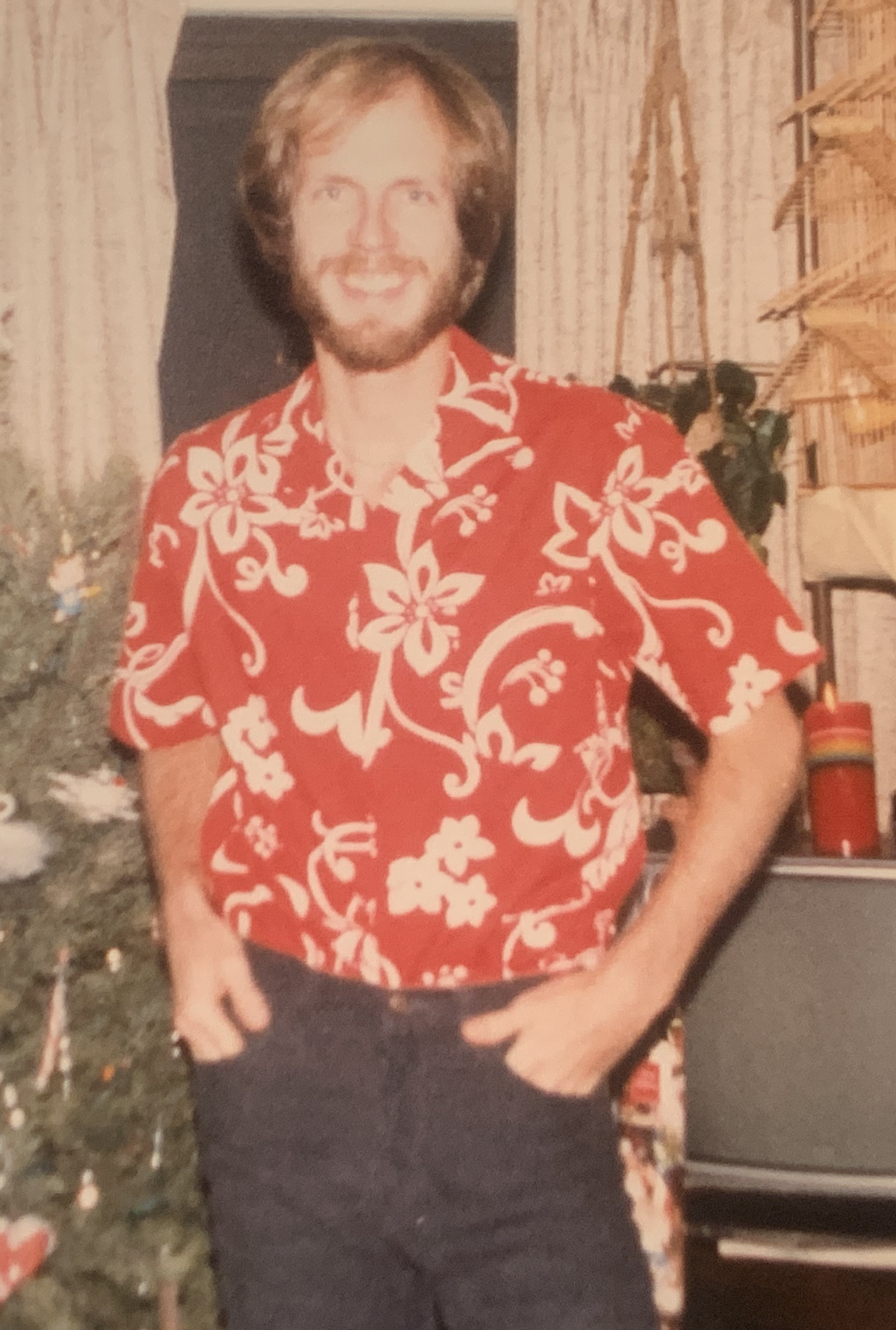
What else was I gonna do?

Over the eleven years since my late wife died and I met and married my wife Suzanne, I’ve given much thought to that choice to date so soon after the loss of a spouse. My answer to that question comes down to a simple statement: “What else was I gonna do?”

I was fifty-five years (or so) old when Linda passed away. Up to that point in time, I’d been through so many transitions in life it is hard to relate them all. Our first family move from one state to another happened when I was five, a change that meant making all new friends, even though I can recall only one definite friend back in Seneca Falls, a kid named Jimmy Morris who taught me how to run without holding my arms close to my sides. That’s how I ran because I was so shy.

We lived in Lancaster for seven years, during which time I worked hard to gain popularity and become one of the best in sports. Then our family moved again, 750 west to Illinois, when I was twelve.

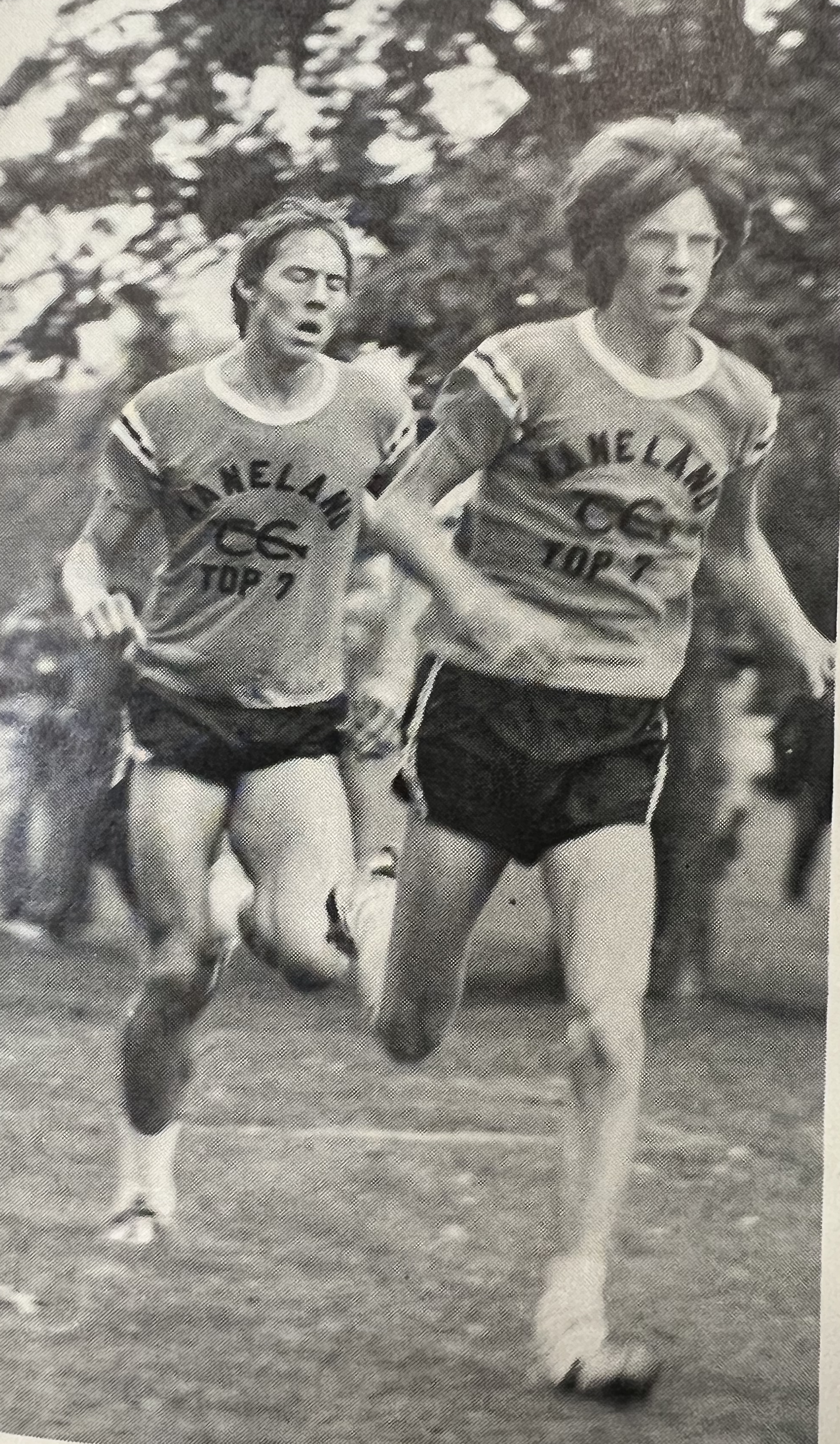
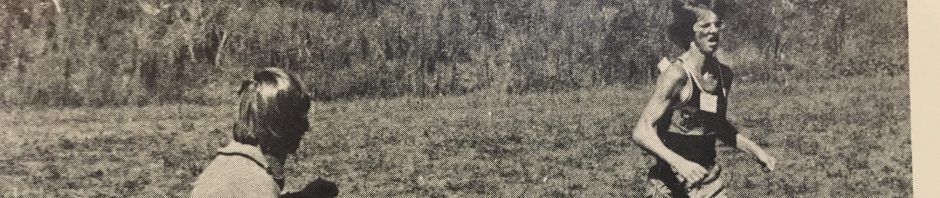
That meant making all new friends in the little town of Elburn, turning into a teenager, navigating a new middle school, and then entering high school where my running career began. I rose to the top of the cross-country team as a sophomore and was elected Class President. Then our family moved again, this time just twelve miles east to St. Charles at a school where I’d compete against my former teammates out at Kaneland.

I protested these family moves in some ways, even suggesting that I stay behind in Pennsylvania to live with my best friend David. We were close friends at the time, but I believe we’d have grown apart in high school as he became conservative, and I definitely developed a more liberal worldview. We met up once years later but having divorced his first wife and family, he seemed to want nothing to do with anything in his past life.

Demands for change

The life transitions and demands for change continued through college and young adulthood. I fell in love at first sight and thought I’d found a woman to marry in the last year of college but she eventually dumped me and married someone else, so I spent a year getting over her and made up my mind to move on. What else was I gonna do?

I dated an older woman for most of a year. She taught me quite a bit about life that I didn’t know before. After confessing to some mistake I’d made, she calmly advised me, “You know, it’s not the mistakes you make that matter. It’s all in the recovery.” Those words stuck with me through the years because fucking up is a big part of life. You might as well have a good attitude about fixing things if you can.

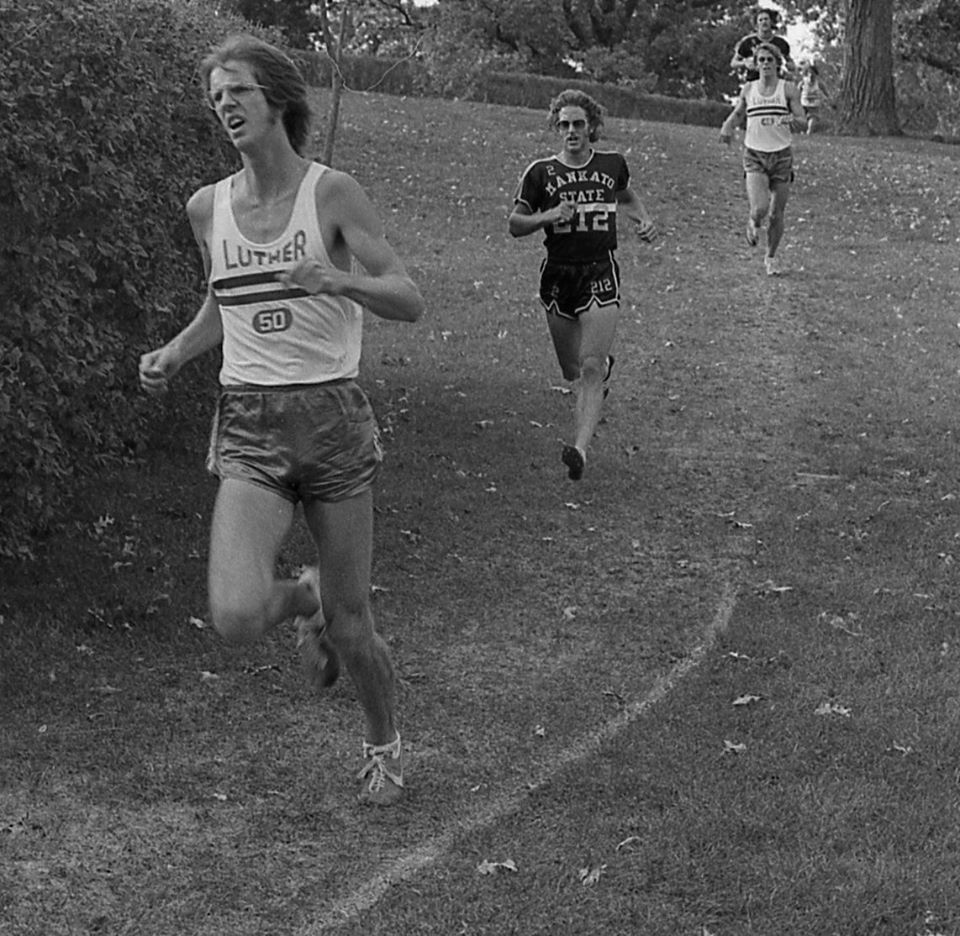
I look back at the chronology of dating life in my early 20s and realize that while there were periods when I was alone and feeling awful about my prospects, those passages didn’t last all that long. Despite my rampant lack of self-confidence, I found my way into the arms of a few great women along the way. At the same time, I grew as a runner and got about as good as I was ever gonna be. Eventually, I decided it was time to give up the competitive running gig by asking the most profound question I could ask of myself, which was familiar yet with a new meaning. “What else am I gonna do?”

A different lens

Life adopts a different lens once one gets married and has children. That answered my question in absolute ways. “What else was I gonna do?” Be the best father that I could.

I loved the role of Dad but the role of Breadwinner was often a tough one for me. Perhaps I didn’t care enough about money to earn enough. Not as much as I should have. Yet I worked hard and pushed for new roles. Bit by bit I crept up the corporate ladder. From sales to promotions. From promotions to marketing. At one point I even earned the title Chief Marketing Officer. Then my wife got sick again and the role ended. Talk about eclipsed destiny. But who knows?

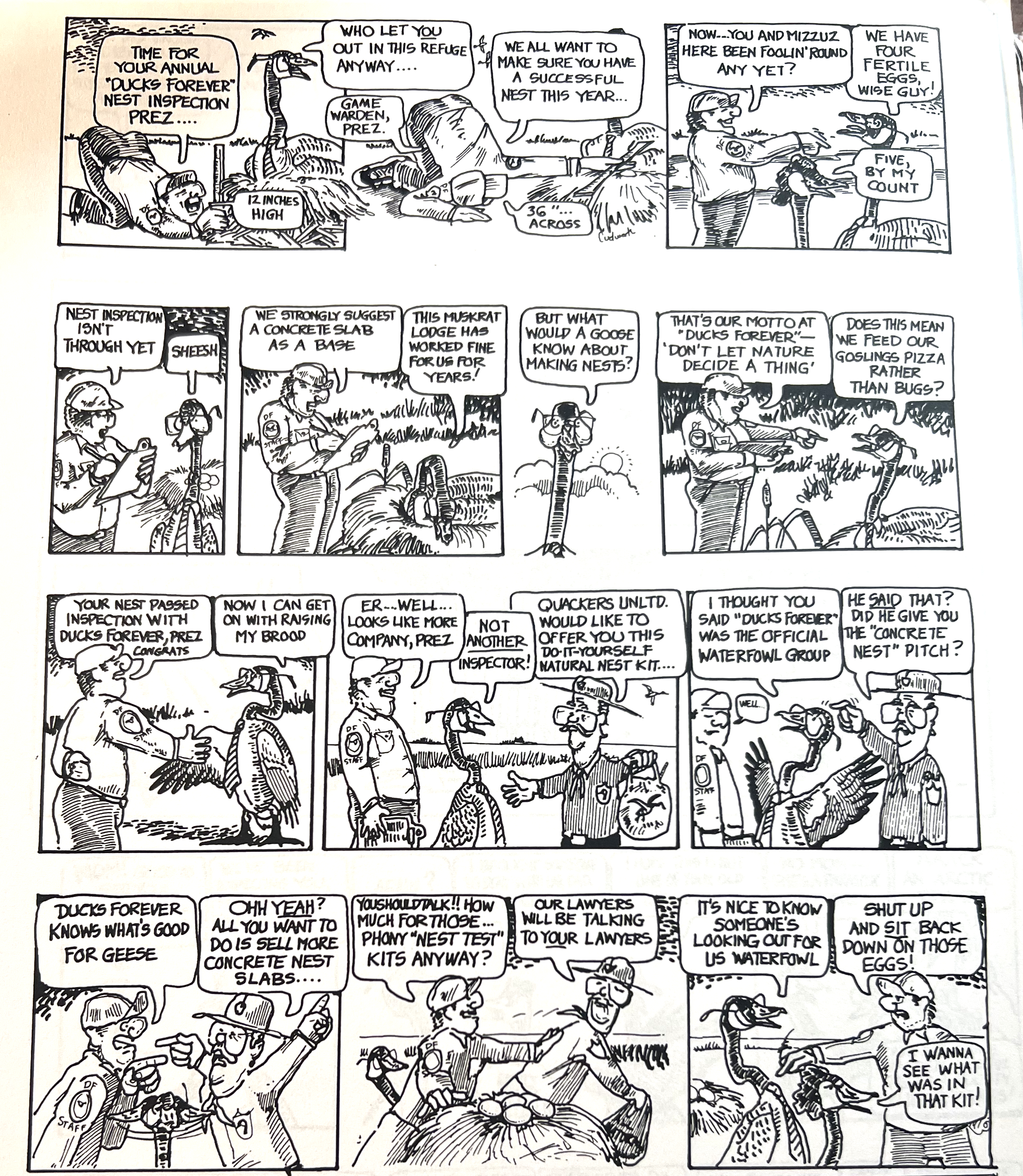
Meanwhile, my instincts focused on doing “the work” of writing and art. Those endeavors were often profitable as I created posters that sold by the dozens and published articles in local and regional newspapers and magazines. I shopped a cartoon called Prez to newspaper distribution agencies but they deemed my strip “too narrow in scope” and not executed well enough to justify syndication. I still laugh at my own comics but realize that the typical reader prefers the simplest humor possible. With rare exceptions such as Doonesbury, it’s all about limiting the words people have to read in order to get to the punch line. I did fiddle with an alternative called EGGS in that vein that had potential, but was so disappointed at the Prez failure I never mounted another charge in the cartoon world.
The point here is that I’ve tried my damndest to compete at every scale possible. There were successes along the way. The Everyone’s A Loon of Some Sort poster I created in 1988 sold quite a few copies up north in Wisconsin. I issued a limited edition print of bison on the western slopes that enjoyed some success, but my mistake in choosing a matte finish paper over a gloss stock ruined the sexiness of the original painting.

During the late 90s, I placed an illustrated essay published on the back page of Runner’s World. That was a dream come true. The success of that article led to an inquiry from a race director in Texas who hired me to contribute originals as prizes for raffle winners. I turned two of those illustrations into a poster that earned a Top Five place in the Runner’s World Cream of the Crop Award. That felt like a touch of fame as I sold hundreds of those posters and signed them like a celebrity at the Brazosport Run for the Arts in Lake Jackson, Texas. The next year I produced watercolors of male and female Texas runners that proved just as popular. Then the race folded and my run of fame came to an end. I enjoyed it while it lasted. What else was I gonna do?

After that, I got poster fever and secured corporate sponsorship for Day Game and Night Game baseball posters for the Kane County Cougars. I painted the originals live at the games, and the project earned $10,000 in sponsorship, of which $4K was spent on printing. I could have done them much cheaper and earned more money, but the mistake I’d made with my limited edition bison print drove me to find the glossiest paper and most high-quality printer. The yin and yang of the art business is tricky.

The ADHD bounce

I bounced in and out of full-time jobs during the 90s due to my ADHD but put programs and creative campaigns together that far exceeded the company’s appreciation of my work. Perhaps I wasn’t the best at self-promotion or just didn’t want to suck up to egotistical publishers and Presidents. Thus I was disposable when it came time to position the company for sale for profit. Even my first job out of college as an admissions counselor was a risky endeavor recruiting students during a time of great transition for the institution I attended. I drove 15,000 miles across the state of Illinois recruiting kids from deeply rural towns to the deepest inner city, hitting my quota of 70 new students by the end of the year, but the Director of Admissions thought I “didn’t have me head in the game.” That hit a sour note with me, so I took a job back in Chicago with a financial firm whose CEO commissioned paintings from me. He wanted an artist on staff to handle marketing. I took the job. What else was I gonna do?

By the early 2000s, I landed a job as an editorial writer for the Daily Herald. My kids were in elementary school and I pushed to move our family from White Bread Geneva to the more ethnically diverse town of Batavia. That proved to be a good move, and we lived in that home for twenty years before Linda passed away from ovarian cancer after my son graduated from college and my daughter was finishing up her schooling too.

I kept that house a few years, but once Sue and I decided to get married, we decided to sell that place and get our own home together. My women friends told me “Not many women want to move into the home of a late wife.”

Cleaning out that house after 28 years of life together was the hardest thing I’d ever done. It was emotionally and physically exhausting. After weeks of tossing boxes of old schoolwork and sorting through stained baby clothes that no one would ever use again, I lost all signs of sentiment and went whole hog into death cleaning. It nearly killed me. My daughter was mad at me for selling. My son wondered what it all meant, but at some point that work needed to be done so I did it. What else was aI gonna do? Going through all of Linda’s childhood collections, the David Cassidy magazine collection, the school notebooks scrawled with pot leaves drawn on the cover, old photos of her ex-boyfriend in all his rabid 70s phases. That was cathartic in many ways. Over many years of marriage she’d collected more than fifty baskets, tons of garden supplies, two full Christmas closets and a kitchen stuffed with grape symbols this and thats. I surveyed the kinds and saved a few keepsakes, but the rest went somewhere in the world. Where, I’ll never know. But it’s where we all go when we vanish into time.

Death cleaning

I left behind a mural on the basement walls of our former home

I was aware of all these demands for change long before I had to execute them. In the weeks following Linda’s passing, I found friends who could use her clothing. We had a solemn yet loving gathering to share her jewelry with her closest friends too. All this pushed me through a transition that I never imagined when we’d met way back in 1981. She was a healthy woman who took good care of herself. Perhaps too good. Research shows that the talc found in baby powder and other products may cause ovarian cancer. But there are many possible causes. STDs. Environmental toxins. Plain old human hormone excesses. If I hadn’t chased her to the gynecologist to get her heavy menstruation cycles checked she might not have lived a year. Instead, the cancer was discovered and she lived eight years. I worked hard to keep her spirits up and her body alive. What else was I gonna do? Ovarian cancer is a known killer. The typical life expectancy is five years at best.

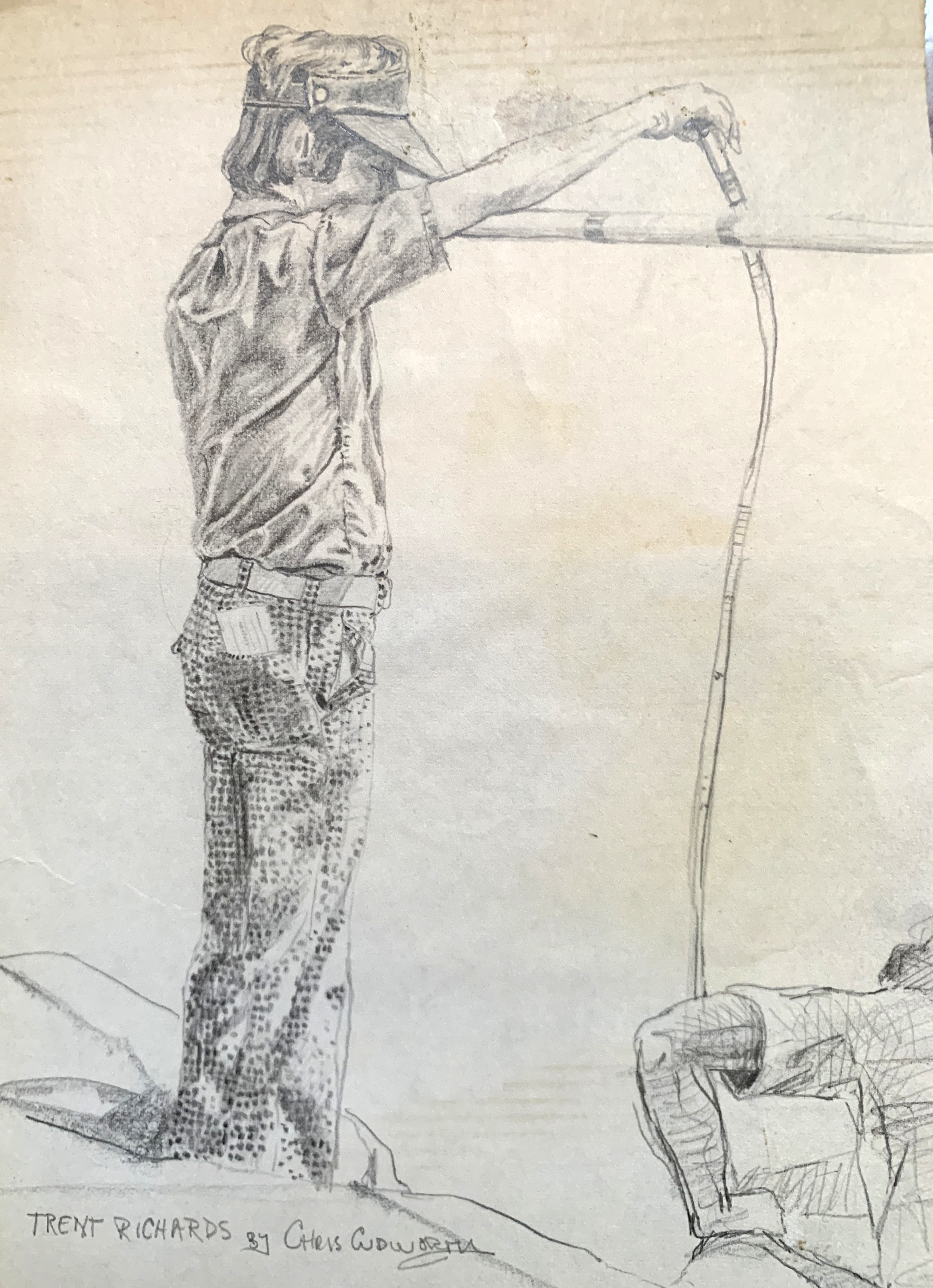
Back when she was diagnosed in 2005 my former track coach Trent Richards called me up to say, “You’ll be good. Your whole life was a preparation for this.” He was right. As I’ve just shown, I’d been through enough difficulties to know that you have to keep moving. What else are you gonna do?

Having courage\
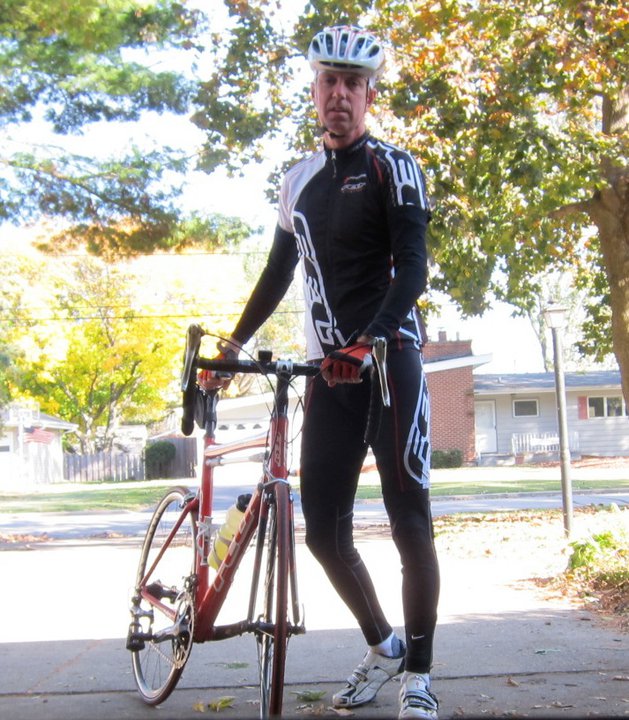
In the driveway of my former home, a selfie during a time in life when much courage was required and cycling helped

What I learned from a life lived “on the run” and “on the move” is to have courage in the face of change. Perhaps that’s something my kids didn’t expect from me, to move on quickly from the loss of their mom and start a new life with another woman. Yet we all have our own brand of courage and it’s not always possible to explain our deepest experiences and motivations to others. I’ve been driven in the past by many different emotions. Anger. Fear. Determination. Vengeance. Faith. Trust. Love. Sometimes these seemingly oppositional thoughts and drives reside closer together in our minds than we might think, or care to admit.

I also learned that waiting to act doesn’t often make things better or easier. As a high school sophomore, I once stood at the outskirts of the high jump pit, staring at the bar set at 5’8″. I’d only cleared that height once before, and the bar was bent a bit when I did it, so I badly wanted a legitimate clearance of that standard. For minutes I rocked back and forth trying to work up the courage to take the jump. I’d seen other jumpers run toward the pit only to veer away and try again, only to fail. Finally, after ten minutes, an older track athlete on our team called out, “Cudworth, are you gonna take a jump or not? We’re waiting.”

Technically, the rules say you must jump within two minutes of being called. I’d wasted eight more minutes and only gotten more nervous as a result. Finally, I tipped my head back to the sky and something cleared within me. For some reason, I’d lost the fear at that moment. I tipped my head down, ran in a straight line to the pit, kicked with my right leg (I was a straddle jumper at the time) and rolled my other leg over the bar. A clearance.

Crawling out of the pit, I shook my fist a little. The older jumper got up from the ground to slap my hand. “About fucking time,” he blurted.

Yes, I admitted to myself. It was about fucking time.

Posted in adhd, aging, anxiety, Christopher Cudworth, college, competition, cross country, mental health, mental illness | Tagged , , , , , , , , , , , , , , , , , , , , , , | Leave a comment

Life in context

Sue and I rode together consistently in the summer of 2013. I recall it as a warm year, and every time she showed up in her little black cycling shorts and sleeveless kit jersey, I admired her arms and overall fitness. Given my situation, coming off eight years of cancer caregiving with my late wife, and dating soon after she passed away, Sue was sensitive to whether I felt comfortable dating one person so steadily. But I loved our evening meals together. She’d get done coaching swim sessions and stop by my house for dinner. One night I made salmon, some green beans and a salad complete with strawberry slices and raspberry vinaigrette dressing. At the end of the meal, I noticed the strawberries left on her plate. “Yeah,” she told me. “I’m not a fan of fruit in salads.”

It’s often small things of that nature that help people get to know each other better.

As our relationship progressed, I got to know her kids better. She met my daughter but my son was living in New York while working in Admissions for the University of Chicago. It was July of 2013, and my late wife passed away in late March. Not long after she died, my son suggested I should “take a trip” somewhere. I had some money from her teacher’s retirement, but not a ton. She’d worked ten years in the public school system and stocked up enough to pay for her funeral expenses, but that adds up quickly. A couple phone calls is all it takes to blow through $10-$20,000 even with cremation. I too well recall walking out of the funeral home with my late wife’s ashes under my arm, and said out loud, “I’m carrying my wife.”

That’s how weird it is to become a widow. One minute someone’s alive, the next minute you’re carrying them around in a canister. I’d already taken my mother’s ashes around before my wife’s passing. Eventually, many years later, I’d also carry my dad in a can. My parent’s ashes are buried in two cemetery plots in upstate New York where my father planned for them to be together. My eldest brother secured the two grave sites with a local cemetery in Afton, New York, near where my dad was born.

My late wife’s ashes are buried with a headstone next to her father’s grave in the St. Paul Lutheran church cemetery in Addison. Her dad had died in 2012, just the December before Linda succumbed after eight years of cancer treatment. It made sense for her to be with her family in the graveyard run by the church where she grew up and attended elementary school. Her headstone reads, “She loved God, Family, and Flowers.” I learned the hard way that grave markers are expensive as hell. Ultimately, I ordered her beautiful dark granite headstone online. It was delivered to a local installer who placed it according to regulations.

All of that business changed something inside of me. While I grieved my late wife, I wasn’t incapacitated by the loss. Having sat by bedsides and watched people die, I grew to see death as inevitable among the people I loved. There’s a freedom that comes with those experiences.

Perhaps that numbed me a bit to how others dealt with my late wife’s passing. I’m speaking specifically of my children, who were essentially adults by the time she died, but that doesn’t change the fact that they’ve lost their mother. Linda was a deep presence in many respects. She lived fully and with much love for others. My kid’s friends adored her welcoming ways.

Yet there was a side to her that she kept hidden most of her life. Those early “party years” from 15-20 years old with a guy she’d almost married were not a point of pride with her. The counterculture lifestyle she’d adopted was not uncommon in the 1970s, but it all ended badly in more ways than one. Once she left that world behind she kept a few friends but everything else about her move from conflicted teenager to adult was absolute. Her abusive former boyfriend who stood her up on a wedding persisted in contacting her but she fended him off. She dug into college, graduated summa cum laude from Northern Illinois University and began teaching high school students at West Aurora. That’s when I met her in 1981.

During one of our first dates, she told me, “You don’t want to know me. I’m not a good person.”

I said, “No, I think you’re a really good person. And we should go out again.”

I’d come off a deep love that sputtered out a year beyond college, then jumped into a spring-through-summer frolic with a woman ten years older than me. There were work romances as well, but my overall confidence was weak when it came to dating because I remained naive in so many aspects of guy-girl relationships. That fall, I drank all afternoon with friends and then met Linda at 2:00 a.m. at a local bar. We dated for four years and got married in 1985. We were together for twenty years before her cancer diagnosis. I view our relationship as a whole lifetime spent together.

A lifetime ahead

But I realized quickly after her passing that there was still a lifetime ahead of me, and I got going on that front. Perhaps being a distance runner and endurance athlete had something to do with my quick transition to a post-grief state of mind. Or maybe it was my writing because I’d processed what we went through every step of the way. In any case, I was reconciled to the truth of the circumstance. There was nothing I could do to change the losses I’d seen. Something in me recognized that it was better to make peace with it and move on.

I know that’s not how many others feel about the loss of their parents or a spouse. I’ve met many people who never get over it or who can’t move past the death of a spouse or someone else they love. That leaves people in perpetual conflict between what once was and what could have been. A year after my wife’s passing, well into my relationship with Sue, a close friend of my late wife turned to me and said, “Did I ever tell you that Linda said she knew you’d date if she passed away? She knew you’d want to be with someone.” That put my life and the decision to date again in context.

Not alone

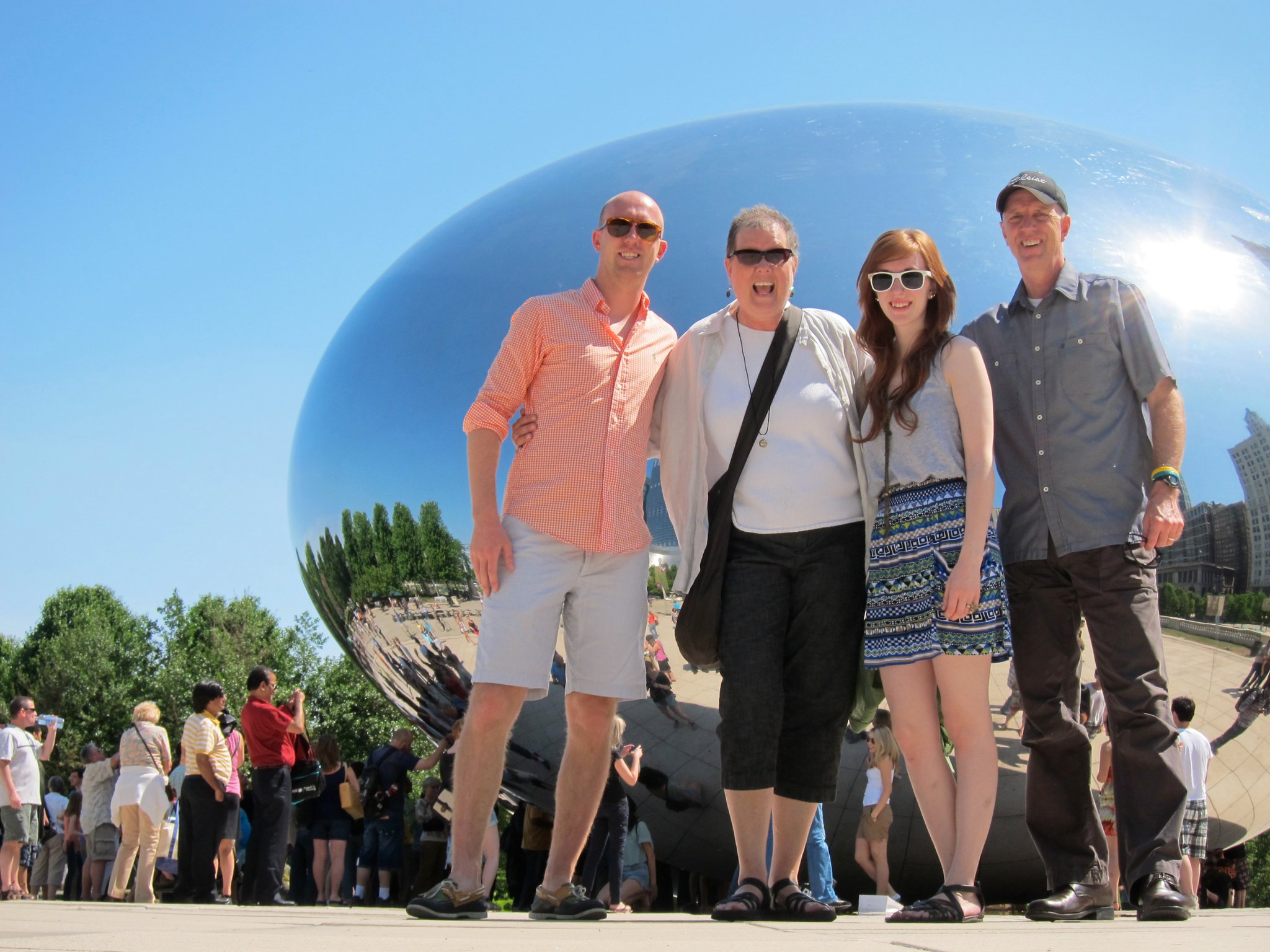
Our family on a Chicago visit the year before Linda passed away in 2013

The problem with that conciliatory approach to grief is that it wasn’t much comfort to my kids. I visited my son in New York that summer and told him, too soon I now recognize, that I’d met someone I really liked in Sue. Evan was in deep pain over his mother’s loss. On top of that, her was immersed in a New York scene where drugs and booze owned the night, and sometimes much of the day. Yet we had a fun time in the Big City. We toured the city on bikes, had dinner at an outdoor cafe, visited the 9/11 Memorial in apt silence, and had ice cream in a sweet little park in the summer sunshine. Then he took me on a shopping trip to the Soho District to buy me something to wear to an evening party other than cargo shorts and the tight Under Armor I’d worn that day around town. He picked out a trim blue plaid shirt, some sharp grey shorts with tiny blue flecks in them, and the right belt. I added some stylish blue leather shoes. He chuckled when he saw what I chose. “That’s right. You got it, dad.”

We arrived at the party and his friend Stina looked me over and said, “I like your dad’s outfit!” Evan laughed his approval.

Later that evening, it was time for him to leave me at home and go out for the actual party. I sat home in his apartment with some dinner, watching a movie about a master chef making sushi. I realized that while we’d always been communicative and close, he had another life to which I was not entirely privy. It would be several years before I learned the truth about the pain he was going through and the drugs he was using to cover his grief. His courage in wrenching himself out of that world and into sobriety has inspired me to cut down on my own drinking.

A daughter’s journey

Linda and Emily. Like mother, like daughter.

That summer my daughter was living at home after finishing up college at Augustana. That last weekend produced an insane event on the way home as a huge storm came through the Quad Cities to cross Northern Illinois just as we set off for home. Dust tornados rose all around us, blocking our view of the road. Her phone was dying as she drove our Chevy Impala and I trundled along in the U-Haul van carrying all her college stuff. The lighting ripping through the massive storm clouds behind us shone red due to the dust. The world looked like the Apocalypse was in full swing. All I wanted to do was get her home safely. She’d been through rough years going to community college while her mother was sick with cancer, then transferred to Augie only to find that the social structure and cliques were considerable, rife as they were with stuck-up “Naperville Girls” and jocks, which was never Emily’s thing.

She made the best of it and, during the previous summer, worked at the public radio station, completing her communications studies. Back in Batavia, Linda and I could listen to her read the news live on the air. We visited her at Augie a few times, including a trip where we drove upriver to LeClaire, Iowa, where the American Pickers had a shop we’d all seen on TV. On a walk by the Mississippi, I snapped a few photos of mother and daughter walking along the river. Admittedly I’d begun to wonder by then how many more years such a thing might be possible. By then, Linda was completely bald and wore a bright blonde wig. Her face was always puffy from the chemo and beneath her clothes, I knew her body was wracked and ravaged by multiple surgeries. She stayed strong through it all.

That was my challenge through those years: determining what to share with my children and what to keep to myself. Evan once told me, “Dad, just tell us the truth.” That’s what I tried to do when it was appropriate. Perhaps the problem with my fatherhood after Linda passed away was that I kept telling the truth after I’d met Sue and was determined to move on in life. I had put everything into a context that suited my nature well. Perhaps that’s the best any of us can do. In retrospect, it was the best I could do. If it wasn’t good enough in some ways, I’ve tried to make it up in other ways.

Posted in aging, alcohol, anxiety, Christopher Cudworth, Depression, fear, foregiveness, healthy aging, life and death, love, triathlete | Tagged , , , , , , , , , , | Leave a comment

Riding and romance

After watching Sue compete in Ironman Racine in July of 2013, I spent more time with her riding and running. It was enervating to have a new companion, but then tragedy came along. On a warm Saturday or Sunday morning following a previous night’s long rain, I led her on a ride that included the Virgil Gilman Trail. That asphalt path leads from downtown Aurora out to Sugar Grove. It passes first through urban neighborhoods and then follows a former railroad bed out to a forest preserve called Bliss Woods. As we approached the deepest part of the woods, the trail was still wet from the previous night’s rain. I tore along ahead of her on my road bike still trying to impress her with my riding ability. She followed behind on her Scott tri-bike, but the conditions were less than ideal for that proposition.

We came to a turn and her front wheel caught wet vegetation and down she went. I heard her exclaim “Oh!” behind me and glanced back to see her bike go out from beneath her on a curving downhill trail section. Hitting the brakes, I unclipped and walked back awkwardly on my bike cleats to check on her.

She sat on the ground in partial shock. We hardly knew each other yet and it’s hard to read how badly someone is hurt when you’ve only been out a few times together. Concerned that she was not moving, I crouched and sat down next to her on the trail. Looking to console her, I reached behind her back to put an arm behind her and felt something gooey and sticky on her lower back. Yanking my hand back, I saw a pale yellow substance covering my fingers.

“What’s that?” I asked her, holding my hand out in front of us. “Oh, darn,” she blurted. “That was a good banana.” The skidding crash had pureed the banana she’d carried in the back of her jersey pocket. I was relieved in some respects. That first feel of goo made me think she’d opened up a gash on her back.

She sat there holding one arm with the other. “My shoulder hurts,” she said. We got her back on her feet, and then called for help, heading straight to Urgent Care with our bikes stashed in the back of my Subaru.

We walked into the care center and I sat down in the chairs next to the counter. Eight years of caregiving for my late wife Linda had taught me to wait for the registration stuff to get through and then try to be supportive. Sue walked to the counter and they asked her name. “Linda,” she stated. Then she spun around and told me, “I forgot to tell you. That’s my real first name.”

Huh, I thought to myself, “Same first name as my late wife.” I sat there pondering that as she filled out the paperwork. Sure enough, it read: “Linda Suzanne Astra.” She sat down next to me to finishing out the forms. “Are you weirded out?” she asked? “No,” I smiled. “All good.”

She still goes by the name Suzanne to this day, but our legal information bears the name Linda. But when we got married years later, it didn’t make sense to change her name to Linda Cudworth. Nor did it make sense to change her name to Suzanne Cudworth, as my brothers are both married to women named Suzanne or Sue. That would make for even more confusion in this world.

I cared not that the name Astra was her last name from a previous marriage. I liked her name as it was.

Alas, she’d torn her rotator cuff in the fall that day. Later that year, in November, she had the torn rotator cuff surgically repaired. After the operation, she wore a big shoulder support cushion under her coat. We attended the Illinois state championship football game on a chilly afternoon to watch her son’s team win a state championship. It was an an up-and-down-and-up-again year for all of us.

As we sat together in the stands I put my arm around her to keep her warm and felt the first surges of love between us. A little riding can lead to a lot of romance. Even if there are a few falls along the way.

Posted in bike accidents, bike crash, Christopher Cudworth, cycling, cycling the midwest, cycling threats | Tagged , , , , , , , , , , , | Leave a comment

Racing in Racine

Sue with her sister Julie at the Racine Half-Ironman in 2013.

A few weeks into our dating, Sue was scheduled to do the Half-Ironman 70.3 race in Racine, Wisconsin. Having just gotten to know her by that point, and eager to deepen our relationship, I decided to drive up early Saturday morning. It’s a two-hour drive from Batavia to Racine, so I left at 4:30 a.m. to make it on time for the 7:00 a.m. start that morning.

My familiarity with the triathlon scene was partial at best. At fifty-five years old, I’d never done a triathlon or duathlon at that point in my life other than a team event in Geneva where I did the running and handed off to a cyclist.

The only triathlon I’d seen, but had watched several times, was the small race held in Batavia. That event was conducted by Experience Triathlon, the club to which Sue belonged. It consisted of a short swim in the Quarry Pool where contestants passed through water so shallow they’d stand up and run. The bike course looped west of town on a fifteen mile route and the run circled around downtown Batavia. I showed up each year to watch the race out of curiosity. While I’d flirted with trying triathlon in the early 2000s before tearing my ACL, I never followed through.

Yet by 2012 I’d raced my bike plenty in criterium events, and already had the running part down thanks to forty years of competitive racing. The thing that kept me away from triathlons was the swimming. Again, back in 2003, I signed up for swim lessons thinking about doing triathlons, but the torn ACL put an end to that too.

None of that prepared me for the scale of the Ironman triathlon at Racine. The number of competitors! Thousands. The setup. The logistics. The scope and scale. Ironman does not mess around.

Sue had given me a description of her sister Julie whom I was going to meet for the first time. I drove up through Illinois and southern Wisconsin in the dark and parked the car on the back streets of Racine, trotted down to the start area, or where I thought it was, and wandered around a bit worried that I’d gotten there too late.

“Julie has red hair,” Sue told me. “You won’t be able to miss her.”

And sure enough, I was standing on the street next to the huge Racine beach and Julie came walking up the avenue. “Hi,” she offered. “Are you Chris?”

Learning the ropes

I quickly learned that the start was another half-mile up the beach. Sue had already gone up to the Swim Start. “We can catch her out here,” she said, pointing to the Swim Out arch across the beach.

Teammates from Experience Triathlon were gathered near the swim start and I half-attempted to introduce myself. The head coach gave me a half-nod of acknowledgement and the other guys sort of said their “heys” with that distracted tone people get when there’s an event about to start.

I looked out at the lake in wonder. I loved “swimming” in the sense of playing in the waves. Down at my sister-in-law’s house in Wilmette, our family went to the beach one August day when the waves were crashing onshore at six feet tall. We caroused and body-surfed for an hour or two. On the way home that day I could feel the waves in my blood, the sensation of rolling and tumbling connected to the Lake Michigan we’d just left.

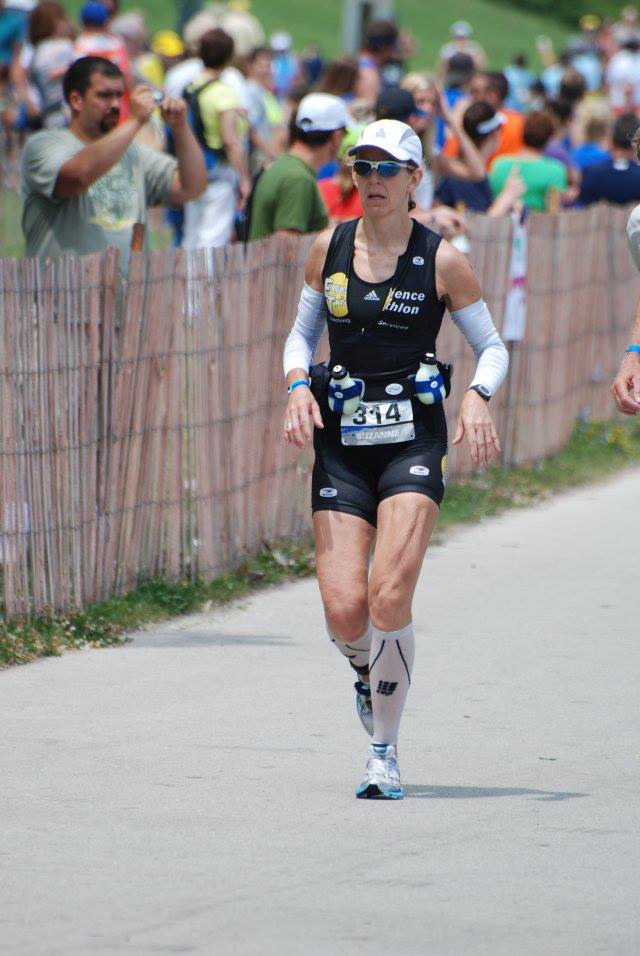
Sue with her trademark white compression socks during the Ironman Racine race in 2013

That’s not what you want when swimming for a triathlon. Any degree of chop is an annoyance at best. Waves can fill a swimmer’s mouth with water and make “sighting” an absolute chore. Fortunately, the lake on the morning of Sue’s race was fairly calm. The water temps were in the mid-sixties, a tolerable range for swimming a mile in open water.

We saw Sue climb out of the water and I gave her a big cheer, drawing a smile from her as she pulled off the swim cap and goggles. Then she took a long jog to the transition area. Again, I had no idea about the scale of a typical Ironman 70.3. Bikes upon bikes on racks. I’d never seen anything like it. We watched her strip off the wetsuit and trot the bike out for the 56-mile ride, and Julie said, “We can chill at the ET tent.”

So we parked ourselves in the shade of some oak trees while Julie pulled out a book to read. But we started talking and a fascinating truth emerged. She’d been through some stuff much like my late wife and emerged healthy and strong enough to do triathlons too. Hearing her story and sharing the journey I’d been on with my late wife made me feel a bond with her. We even talked faith a little bit, and previous relationships. Julie had gone through some serious stuff in life just like Sue with her divorce. Already in my relationship with Sue, she’d wisely stated, “We all have our shit to deal with.”

The bike took just under three hours for Sue to complete. Watching her roll out on her Scott tri-bike had made me cheer like a fool. After she was gone, I thought to myself, “I hope I didn’t sound like an idiot.”

Then came the Bike In. As the day had warmed, I watched one triathlete after another trek north on the path along the lakefront. It was going to be a hot 13.1 miles for everyone.

I chatted more with some ET people and got to know some of the other coaches and prime personalities. I think word got around that I was Sue’s “new boyfriend” and people were curious about that. For all its big-time logistics, triathlon is a little world of its own. For better or worse, it serves as a “transition zone” for many people in life. Some get into it for the sport’s sake, enjoying the training and racing for the thrill of it. Others seem to join in as an escape of sorts. Triathlon is a place to work off––or through––some of life’s disappointing aspects. It often serves as an antidote to early or mid-life malaise. Bodies go through changes due to all that training. As a result, so does the mind. That can lead to breaches in relationships and marriages. As people find a new “self” there is a temptation to leave the old one behind. Plus, being around all that fit or visible flesh brings on temptations of lust and adventure. More than one affair has begun in the pool, on long runs or bikes, and interests flow along with sweat. The clingy outfits don’t hide much.

I didn’t know any of this before entering the triathlon world. I only half-entered it as it was. Even as the next few years unfolded, I didn’t fully sign up to be coached, but did join Sue and company on training rides and runs with the Experience Triathlon crew. Some of the rules of membership I found non-sensical. “You can’t come on a paid training ride,” I was told at one point by the head coach. As a longtime endurance athlete, I found that a bit comical. What negative affect could a single rider have on a group of 20-plus cyclists, all of whom ride in aero without drafting according to triathlon regulations? I wasn’t asking to be coached or given any advice. Dumb.

But I could see that the group was passionately supportive of each other. That I liked. When Sue came trotting down the hill on the first run loop at Racine, the ET folks were screaming and she flashed a smile despite the sun bearing down on her back. “Go Sue, go!” I yelled, trying not to sound too desperately eager to be “her man.”

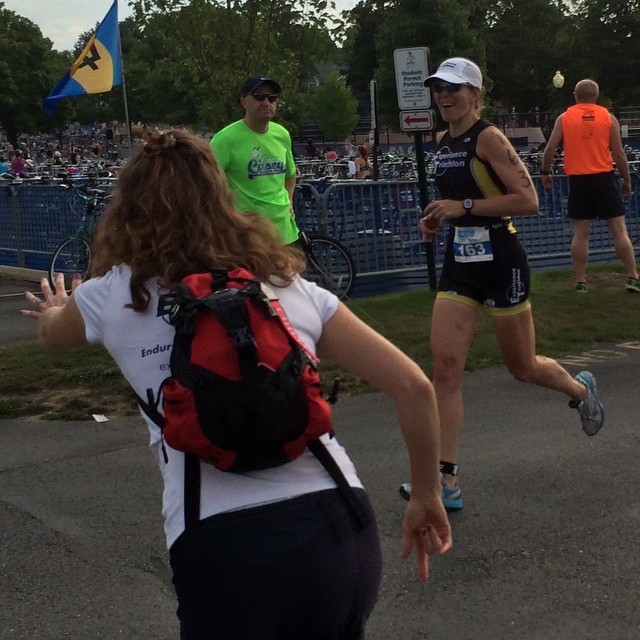
The support shown by ET coaches was a great aspect of the team. Here “Chilly Pepper” urges Sue on.

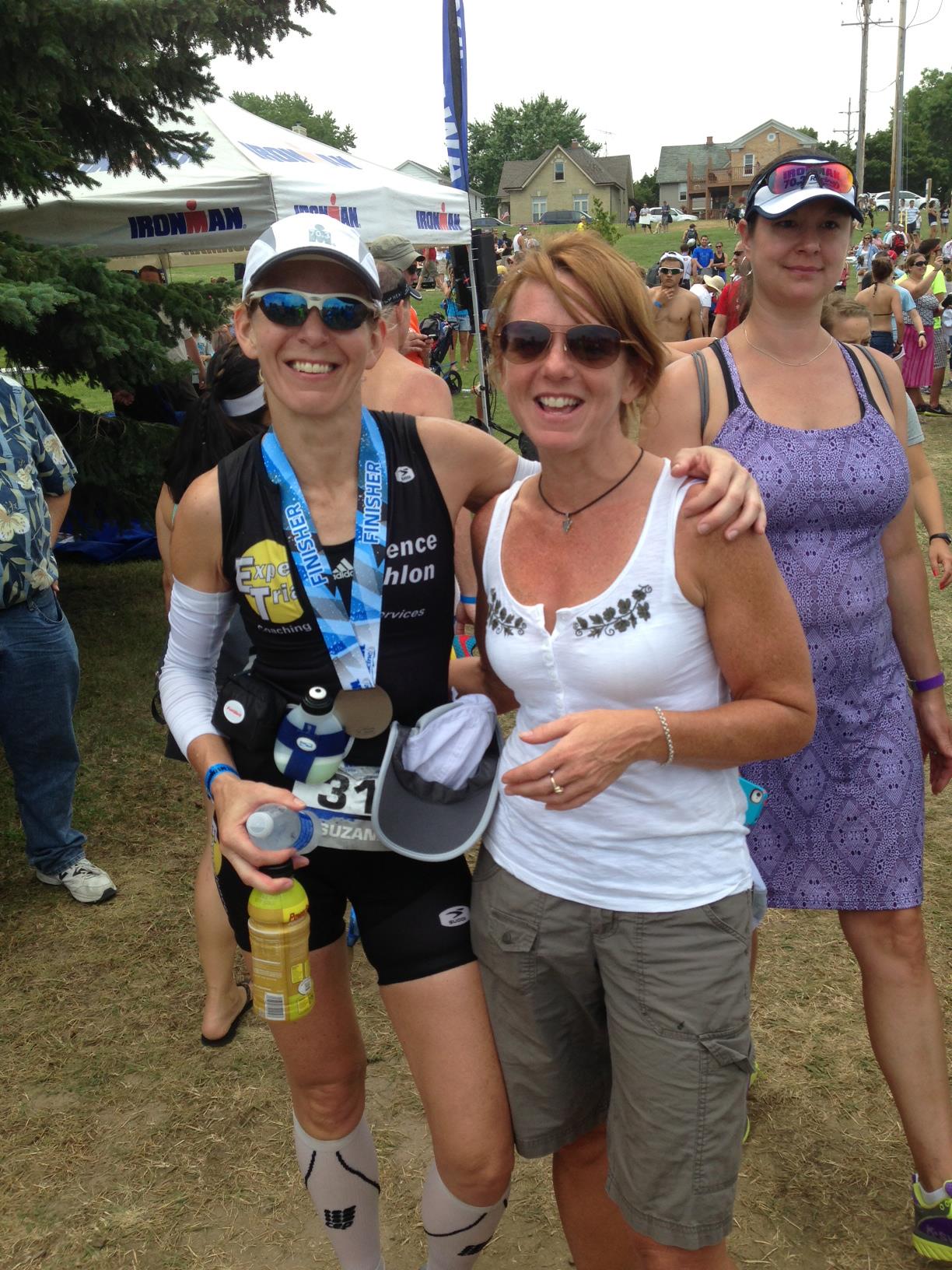
At the finish the crowd lined the course and I’ll admit to relief upon seeing her white knee-high socks come up the path. No matter how you approach triathlon, that last half-mile is a relief for sure. After she finished I walked back to the ET tent where she flopped on the ground with a water bottle in one hand. “How you doing?” someone asked. “Great, now,” she chuckled.

We gathered up all her gear and headed for my car. Her sister would head home to Woodstock and I was driving Sue back to Batavia. “Let’s stop at this gas station and I’ll clean up,” she told me. I sat in the car with the AC on as she carried her tri-bag into the station and did a sink washup. She came back out in the same short white shorts she’d worn in the photo that appeared on FitnessSingles. I was impressed. A low-maintenance woman. She sat back in the car and I could see that the sunburn from the longer bike shorts stopped at mid-thigh. Her shoulders were a bit red too. She plopped into the passenger seat of my Subaru. Then we pulled up to a McDonalds for a cheeseburger and vanilla shake, her fave post-race indulgence. After that she smiled at me and said, “Come on, let’s go home.”

About halfway home, she was getting tired and leaned against the window. A sigh of half sleep emerged from her and I drove along with music playing quietly on the radio. The sun shone down the length of her smooth thighs and flickered across the curls of her hair. “This is good,” I thought to myself. “This is very good.”

Posted in 13.1, Christopher Cudworth, coaching, competition, cycling, IRONMAN, tri-bikes, triathlete, triathlon, triathlons, we run and ride | Tagged , , , , , , , , , , , , , , , , , , | 2 Comments

Carry on

My father Stewart and mother Emily with my daughter Emily, circa 1993.

After several years straight of focusing all efforts on maintaining my late wife’s health through cancer treatments, and stumbling through financially, I had some catching up to do on my own health in 2013.

The previous year ended with a tumble and a shudder. In September of 2012 I crashed my bike and broke my collarbone in a Southwest Wisconsin cycling trip. That same weekend, my wife experienced a series of seizures that should have sent her to the hospital, but she refused. I came home to a surgery but was back on my bike in about four weeks’ time. Her seizures continued, and got worse. That wasn’t a good sign, so I needed that exercise to keep sane as things progressed. Blessedly, at that time the church we attended stepped in with money to help us pay our bills when I was out of work taking care of things.

Then all the “end of life events” came about. I’ve already related those. All that I knew was that I had to carry on.

By late spring and early summer of 2013 I was working as a senior copywriter bringing in money and working through past and current medical debts using some of the money from her Teacher’s Retirement Fund. It felt good to have a chunk of money in the bank, but cremation costs and paying off hospital and hospice bills ate into that quickly.

Then there were the dental costs I incurred. I finally had insurance but didn’t check carefully enough what it would cover (the dreaded ‘out of network!) when it came time for a pair of long-overdue root canals and crowns. Before I knew it, $6000 flew out the door.

I’ve never been good with money. Truth is I don’t care enough about money to always worry over bills and expenses. Yet that same habit causes the problems I most want to avoid. Add in the ADHD and forgotten costs at times, and things tend to swirl around in my head. I’m not an impulsive buyer. That’s never been the problem. More often it’s the day-to-day “spend” that adds up.

Then when big expenditures roll in the burden tumbles over me like a landslide. Anxiety piles on after that. Rumination doesn’t help. Throw in some work problems or doubts about the past and even a break from total stress like I felt after my wife’s passing tends to collapse upon itself.

Still, it felt good to have my teeth cleaned and cavities routed out. The dentist sold me an electric toothbrush but I hated the feel of it. Tickled more than helped. But after a months of treatments and dental visits, I at least felt like my mouth was back together. It’s astounding how dental health affects the whole you.

Taking care of yourself as a caregiver is a challenge at which many seem to fail. The pressing needs of a person at risk of dying from a disease or recovering from some life event take over the psyche. For weeks after my wife’s passing the synapse of ‘what do I need to do for her’ flickered through my head. I also kept thinking about my son and daughter. Was I doing enough for them? Was there anything I could do for them? How does one fill the void with the loss of their mother? I alternately dreaded making mistakes with determination that my examples of strength might somehow sustain and encourage them to carry on. That felt inadequate on many occasions. I forgot the good advice that a counselor at Living Well Cancer Resource Center once posed in a question, “You seem to be good at forgiving others. How are you at forgiving yourself?”

Here’s the thing: I was no longer done as a caregiver after my late wife’s passing. I was still responsible for my stroke-ridden father whose almost daily calls reminded me that there was still a washboard road of caregiving ahead. I’d be at work concentrating on writing SEO copy for a website when the phone would flicker with a notification. “Voicemail.Stewart,” it would read. Then I’d find space over lunch to call him back.

From there it was a ‘game’ of questions and answers with dad to figure out what he needed or wanted. Sometimes it was crucial, and I’d have to call a physician. Other times it was social or about some memory he’d recalled and wanted to corroborate. But half the time I didn’t know the people he was talking about. Then he’d get mad and yell into the phone or in person, “NO NO NO NO!”

That brought up angsty old memories of our disagreements when I was young. He was a sometimes exasperating father figure, prone to criticisms and at the early stages of my life, physical abuse. So I often prayed that I’d get the answer to his questions quickly so that we didn’t drift into a danger zone. A feeling of disappointment followed me around if that happened. I was trying my best to be an attentive caregiver, but often it wasn’t good enough. Now and then, I just left if he was being obstinate. Nothing good ever came of bullheaded disagreements.

Caregivers

I’d often get calls from his caregivers as well. At first it was Olga, the woman that had taken over after my mother’s passing. Then she swapped that role out with her “husband” Leo, with whom she had a child Jessica, who I invited to live at Stew’s house after I found out that Olga had a five-year-old daughter when she first started caregiving.

So it was a strange little family situation I’d created, but Stew loved the company. It was working for him.

He’d processed my mother’s passing back in 2005 with serious consideration. But not long after her passing, he actively cleaned out the closets and had me donate the clothes to area charities. The message to me was simple: Carry on. Stew also kept up friendships with their breakfast buddies on Saturday mornings. Those faithful people never gave up on Stew even when he could no longer conduct a conversation due to apraxia and aphasia. They found ways to converse.

We purchased a converted Mac computer with a “talking” word function display so that Stew could communicate, but I didn’t use it with him that much. I was better at asking questions and getting to the core of the matter than the computer, which only related standard symbols for RIDE, FOOD, etc.

The caregiving I offered had evolved. Following mother’s passing back in 2005, I walked out of my dad’s house after a visit with him and stopped on the sidewalk. “This is all up to me,” I said out loud. I suddenly grasped that I was responsible for the decisions about his care and well-being. Yes, I had brothers to call on for perspective and advice, but I was the principal caregiver. I managed his medical needs, finances and social interactions. It changed me and how I looked at the emotional and practical aspects of life. You have to do what you have to do, and deal with anything that comes along. Don’t be dramatic about it. Carry on.

New acquaintance

Into this world came my new acquaintance Sue, and our evening meals together after she coached swimming became a little ritual. I made salmon on the grill and whipped up salads, but learned she did not like fruit such as strawberries mixed in. In any case, I relished her presence as she loved lively talk, was smart as heck, and didn’t engage in drama. I didn’t need any of that, after all.

A few weeks into our relationship I was driving to work in my new Subaru when a feeling I can only describe as “jangly” appeared in my chest as I thought about our visit together the previous evening. Those were the first stirrings of love toward her. It felt like a “crush” from way back when.

Except it was more mature in its source. We’d attended a friend’s wedding together by then, got dressed in nice clothes and went out for a night of dancing. I liked how she moved. That made me think of a Neil Young song that I listened to when I was thirteen years old:

When you dance
Do your senses tingle?
Then take a chance?
In a trance
While the lonely mingle
With circumstance?

I’ve got something to tell you
You made it show
Let me come over
I know you know
When you dance
I can really love

At that point in life I had another moment of clarity. It was again up to me to make things happen.

I’d loved the previous twenty-seven years with my late wife but she was now gone. Suddenly, I was both obligated and free to make decisions on my own. Some of those decisions would be difficult thanks to the perception of others who didn’t know where I was coming from. Still, I caused some people pain, I’m sure. But through all those tough experiences I’d come to know myself quite well. I knew better than ever how and when to cry, also how and why to laugh. I’d learned how to face adversity in practical ways and also to let some things go into the universe and see what comes back. Call it hope or prayer, whatever you like. I’ve done it.

Perhaps all that endurance training had a purpose after all. Maybe it was indicative of some inner virtue as much as it was a habit or a need. What I really came to understand is that in the long run it’s better to have good company if you can find it. So that’s what I decided to do. And carry on.

One morning I woke up and I knew
You were really gone
A new day, a new way
And new eyes to see the dawn
Go your way, I’ll go mine
And carry on

[Verse 2]
The sky is clearing and the night
Has gone out
The sun, he come, the world
Is all full of love
Rejoice, rejoice, we have no choice
But to carry on

(lyrics to Carry On by Crosby, Stills, Nash and Young

Posted in anxiety, Christopher Cudworth, death, foregiveness, God, healthy aging, love, running, sex, triathlete, triathlon, triathlons | Tagged , , , , , , , , , , , , , , , , | Leave a comment

Beyond the Avatar

Sue competing in the Racine Half-Ironman

Perusing the profiles on the FitnessSingles dating app in the early summer of 2013, I observed that there were plenty of active women out there in the world, but not so many close to home in Batavia, Illinois. I signed up anyway, but was busy going to work and didn’t get to check it until later that afternoon.

As I’ve told the story many times to people over the last ten years, “There were women all over the country, and one in Batavia where I lived.” She was blonde and wearing a cute pair of white shorts, standing in a lake next to a beach. At first I thought she might be an Avatar, just a fake enticement to keep me using the app. But when I clicked on her profile it all popped up. “Hmmm,” I thought to myself on looking at her facts and figures. “Suzanne Astra. A triathlete.”

Then I muttered to myself, “Nice butt, honey” and clicked on the profile.

We chatted a bit through the app, then set up a date at a local pizza place called Pal Joeys. I showed up before she got there and was waiting in the front lobby when she walked down the stairs in a sleek black and white summer dress, gave me a big smile and a quick shake of her head that made the curls in her hair shimmer, and said “Hi!”

It was a humid and warm afternoon at an outside table next to the Fox River. We ordered artichoke dip with some chips and drinks. Our conversation was easy right from the start. She had a nice tan going in early summer and definitely looked fit.

Then I noticed that I knew the woman sitting at the next table over with her husband. Our eyes met and she smiled, so I said “Hi Rita!” At that point Sue turned around to see who I was talking to.

“Wait,” Rita said, quickly pointing a finger at each of us. “Are you two on a date? That’s perfect!”

Sue’s children had been involved in middle school music as well, so Rita knew all of our kids. She’d also known my late wife quite well. Knew of our long history with cancer survivorship, and Rita knew that I was an active runner and cyclist. We chatted with her for a few minutes and then turned back to our own conversation.

I learned that Sue was only recently out of work and looking for a new job. “The one thing I like about is having time for afternoon naps after training. I absolutely love a good nap,” she laughed.

A date on the move

Sue on the Specialized tri-bike she bought after the Scott

Nothing about the date seemed strained or awkward. I really liked her from the start. We agreed to meet up for a bike ride later in the week. Sue showed up in some leggy bike shorts and a cool white top. I’d not been riding that much by that point in the spring but was starting to round into shape. I sat on my Felt 4C road bike and Sue leaned into her Scott aero tri-bike and we took off riding west of town.

Heading out Main Street from Batavia, I looked down at my bike computer and watched it creep up the digital dial. 19…20…21…22…23…we were humming along at race pace for me. I did my best to stay in her draft while guiltily staring at her nice-looking butt in black cycling shorts just a couple feet from my face. Then the pace hit 26 mph and I was at my limit. “You better not get dropped,” I told myself, “or you won’t get a second date.”

We turned onto a long stretch of road rising through the farm fields and she kept up the pace. On the last uphill section of 400 meters I got gapped a bit. She was ahead of me now and I desperately pumped the pedals trying to keep up, but couldn’t. I’d been dropped. Once we hit the flat section atop the hill I recovered some distance and rode up next to her hoping she hadn’t noticed. She smiled at me. “How ya doin?”

What a loaded question, I thought to myself. Should I be honest?

Sue and I during one of our first “official” dates at a wedding for a friend. My daughter Emily was the even photographer.

“Great,” I said. Which wasn’t entirely untrue. I was thrilled to be riding with a woman better than I was on the bike. When I started serious riding six years before in 2007, I was always impressed with the women cyclists from the Athletes By Design racing team with whom I trained. They were talented and strong, and I’ve always liked that in women.

Sue and I rolled out from the stop sign heading west past Johnson’s Mound Forest Preserve. I was glad we didn’t turn in and ride that loop with its nine-degree climb. I’d first trained as a runner on that hill way back in my Kaneland High School Days. As a skinny freshman that hill came as a total shock to my legs. But later in my career I used that hill in post-collegiate training and knew that I was in racing shape when I could run from the gate at the woods opening to the top of the hill in 3:00 or under.

We rode past the preserve and sped up down the long and winding stretch of Hughes Road to the next climb. On that one, my legs were enervated and I kept up fine. We reached Route 47, shot up to Keslinger and rode out to Kaneland High School where Sue pulled over and we took a break for nutrition while sitting on the grass.

“Have you ever been out here before?” she asked.

I laughed, turned around to look at the entrance to the high school and said, “Yes, I went to school here for two years.” Then I pointed to the line of trees out front of the campus and said, “I’ve run around this campus probably a thousand times.”

Sammies and convo

She broke out a set of meat and cheese sandwich bites and Sue delivered a cycling sermon on how real food beats fake nutrition. Those little sammies tasted good. She wrapped the rest in a little baggie and we headed back home. I was comfortable and warmed up by then. She seemed pleased to find a man that could keep her company on the road.

Here’s the thing: Online dating is both exciting and weird. It’s exciting (to me, anyway) to meet new people. But there is the inevitable weirdness of meeting people with whom you’re not compatible. But after meeting Sue and riding that twenty-five miles with her, I knew that we could get along great.

We’d definitely moved beyond the Avatar stage. She was a living, breathing woman who shared with me a ton of interests. Trained as an architect, she understood art as well. We liked the same music despite an age gap of eight years (she’s younger) and now she knew that I wasn’t lying about my athletic ability and love of fitness. “Well, that was nice,” I told her after the ride. “When do you want to go out again?”

Here’s the funny thing. It turned out she only lived six blocks away. Later that week I’d join her for dinner at drinks and meet her kids at her place. A relationship had begun.

Posted in competition, cycling, cycling the midwest, friendship, healthy aging, healthy senior, love | Tagged , , , , , , , , , , , , , , | Leave a comment

Dating as a widower

The term “widower” seems so loaded with tradition and history, it deserves a definition right here and now. I looked it up and this is what it says:

  1. a man who has lost his spouse by death and has not remarried.
  2. HUMOROUSa man whose spouse is often away participating in a specified sport or activity.”her new-found passion has turned me into a tennis widower”

If anything I was a garden widower before my late wife Linda passed away. But that was never true. My job was doing the digging into the ground for her on many occasions. I liked being part of that. The earth behind our Batavia home was deep and rich soil. Back in the late 50s when homes were placed the builders didn’t scrape off the topsoil. I dug postholes in that yard and that required poking through two solid feet of black prairie soil before hitting clay.

That’s where the water table ran. It was a constant battle at that home keeping the basement dry whenever the rains came. One night we wound up running around half naked in the backyard trying to empty the window wells. I didn’t mind. I always liked the look and feel of summer rain on skin.

There’s an amazing scene in the movie Midnight In Paris when the character played by Owen Wilson meets a French woman on the streets of Paris when it’s starting to rain. By that point in the movie, Wilson (who plays a writer) has decided to disembark from his marriage to a materially acquisitive wife who does not understand his obsession with the romance of Paris, both old and new. His high-paying writing work back in LA is not rewarding (he’s a screenwriter) but his experience in the netherworld of time travel convinces him to follow his instincts and write a novel.

He travels back in time through a midnight portal and eventually falls in love with a woman whose notions of the “Golden Age” are similar, yet they have different views of what constitutes the best time in history. For him, it is the period in which she is living. For her, it is decades before. She loves him in a romantic way, but eventually they go their separate ways. Back in the present, he finds a journal she wrote about him in a Paris book shop. It makes him realize that even beyond the bounds of time, love is real.

And finally, as if in a living dream, he encounters a woman he met in Paris while digging into jazz records at a local shop. She recalls his interest. That makes him realize that he’s actually “someone to somebody” in a new and different way. It also points out the possibility that we’re all capable of loving more than one person in our lives. There are indeed different kinds of love

I’ll admit that I’m a born romantic. There were times when I’d fawn over my late wife in some way that just made her wrinkle up her face. Sometimes I’d even fall in love with her all over again. That’s the way I’m wired. I feel things like love quite intensely. The first serious relationship I had was the product of “love at first sight” with a woman I met during my senior year in college. Our relationship was rife with conflicted motives, and after two years we broke up. But it made a deep impression on me, a living expression of Jackson Browne’s song That Girl Could Sing:

She was a friend to me when I needed one
Wasn’t for her, I don’t know what I’d done
She gave me back something that was missing in me
She coulda turned out to be almost anyone
Almost anyone
With the possible exception
Of who I wanted her to be

Given my deep susceptibility to romantic tomes, I used to lay on the couch late on a Saturday morning after morning bike rides of 60-80 miles watching some tear-jerking movie like Dances With Wolves, which I also loved for the western scenery. My daughter used to laugh upon catching me with tears in my eyes, but I liked the feeling of feeling something deeply. It relieved the stress of life to cry hard once in a while. I like crying hard just like I like running hard, cycling hard and these days, swimming hard. Life is hard. I like being hard back.

Hard choices

It was still a hard choice as to whether or when I should start dating after my late wife’s passing. But knowing that I loved company in life, I decided that going on some dates with women would be okay. I certainly saw no sense in moping around the house. The previous three to four years had provided plenty of that including many afternoon vigils in a silent house with a spouse sick or tired in bed. The stress of that adds up after a while. For many years we had to be cautious with physical attention as well. She could not afford picking up any kind of infection when her body was immunocompromised, as it could kill her. We knew that she was susceptible to internal infections from the time I met her.

As I considered dating at the age of fifty-five, I made decisions about the process that were sensible and real. For one thing, I placed a limit on how young to go with women that I’d date. I decided not to date any woman under the age of forty-five (as far as I could tell).

But here’s the thing. A few buddies egged me on to “go get laid a lot,” but I didn’t think I had the constitution for that. That is not a claim to pure intentions or an attempt to win favor in the eyes of readers. I frankly didn’t feel like I could handle sleeping with a bunch of different women.

Dating an Old Flame

But first, I did approach an “old flame” of mine from high school days. We went on a picnic date but she was a bit weirded out by the idea that I was ready to date so soon after my wife’s passing. She’d been divorced a number of years from a real jerk who cheated on her. For fifteen years, she’d been busy with her own life as a teacher, and had faced some personal tragedy as well. We enjoyed our picnic but I sensed her discomfort. A few months out, she did thank me for showing her that a man could be interested in her. She hadn’t thought of herself that way. These days, she’s in a relationship with a man that “gets her.” All power to her. If I helped in some way I thank God for that.

Once I opened the door to dating, I tried the dating app eHarmony. It was interesting trying to “read between the lines” on that app. Many women stated that they wanted to travel. I took that as a dog-whistle sign that they wanted to meet a man with money. Maybe that was just my take, but that’s how I read it. I steered clear. I wanted to meet a woman that wanted to do things together that might not always revolve around money.

So many fish in the sea

Remember when we were kids, and a relationship broke off and hurt? Our parents would often say, “Well, there’s a lot of fish in the sea…” which was another way of saying, “Get over it.” Well, it’s a bit different when you’ve been married for twenty-five years and figuring out what you want to do with the rest of your life. Perhaps part of that process is trying things, and going fishing.

A woman from a nearby city reached out to me through eHarmony and we met at a restaurant for drinks. I quickly met her daughters when picking her up, and they seemed really sweet. Originally, she’d asked me if I wanted to try going to a fly-fishing seminar. I thought that was really interesting. She was also apparently a competitive tennis player, a fact I noticed in photos showing her fine-looking legs. Cause hey, there’s nothing’s wrong with having good legs.

After our second date, we’d had a really nice conversation and were walking back to her cart through the city where she lived when it started to rain. She carried an umbrella and popped it open as the spring rain started to fall. After crossing the street, I bent under the umbrella, said “thanks for a nice date…” and gave her a kiss on the lips. The light reflecting off the wet streets made her eyes shine, and while walking away, I glanced back and gave her a wave. “Well,” I thought to myself in the moment. “I guess I can do this.”

Is something fishy?

Now, dating so soon after my wife’s passing wasn’t met with favor by everyone in my life. Some immediate family wondered whether it was all too sudden. But I’d decided to move forward and took that woman to a friend’s backyard party where the host, a longtime friend of mine, was the lead singer in their band.

It was a fine day, and she looked pretty in her summer dress. We had light drinks and talked with my friends old and new. After that, we drove back to my house after the party. I was not expecting her to stop and stay, but she was careful to make that clear. Then she said, “I think it’s kind of weird that you still have best friends from high school.”

I looked at her carefully because I could not tell if she was joking or not. “Well,” I replied. “Those guys and I share a ton of history. We ran cross country and track together. I went to college with the lead singer in that band today. He and I lived together in Chicago. He was the best man in my wedding…” then I stopped talking. I paused: Was mentioning that going to be a sore subject with her?

“Well, it was a nice time,” she told me, heading back to her car.

A few days went by, so I reached out to see if our dating was through. “Well,” she told me. “I still have feelings for my Mr. Big…” That was a reference to the show Sex In the City. She lived in a town where there were plenty of men with money. As a divorced teacher, she had her eyes on the future…”He’s taking me sailing,” she told me.

Okay, I thought to myself. I can’t compete with that. But a week later, she called back. “Things didn’t go so well with Mr. Big,” she admitted. “Do you still want to date?”

“Um, no thank you,” I told her.

After that, I wasn’t sure how any of the dating scene would turn out. I had date with a woman a bit older than me that went much quicker. We’d scheduled a wine date at a restaurant in my town. When she arrived, it all got real: “Listen,” she told me. “I need a man who’s willing to move south to Arizona with me. I have a son down there that I really like, and I’m not so wild about my son up here in Illinois. He’s a male nurse, and so…I’m thinking of moving…”

She had called ahead to let me know she’d be late. I’d ordered her a glass of Pinot before she arrived. Following her opening pitch, I pushed the wine across the table while saying, “Thanks, but no thanks…I’ll pay for the drink…Nice to meet you.” Then I left the table, and her, far behind.

Was she Mrs. Big?

Perhaps I met a Mrs. Big during a date in Chicago’s south side in Hyde Park. She was a confident, attractive woman who made it clear from the start that she had plenty of dough and wanted a man in her life to share it. We went for a walk in the park. I noticed her checking me out from behind, and I kind of chuckled at the thought that perhaps I was a bit of Man Meat in her eyes. Apparently I passed the test, because from there the convo turned to how often I could make it downtown. Clearly she was feeling a bit lonely in her fine estate. After a dinner date with plenty of wine, we ended the evening with a kiss. I was a bit conflicted about the idea of being some woman’s Kept Man. We’d held hands during our walk in the park and that was nice, but it all felt a bit disparate to me. Still, she had a really pretty face and smile. I didn’t know where to leave that one…

All of this took place over the period of several months. Then one day an email arrived in my inbox from a website called FitnessSingles.com. The site description was clear: “Whatever an active lifestyle means to you, Fitness Singles is the world’s largest online dating community for sports and fitness enthusiasts. Whether you’re looking for a “fitness date,” exercise friends or a workout partner, Fitness Singles is a fun, private and secure environment to meet fit, athletic singles!”

There was a significant cost for signing up, and I balked at first. But the prospect of meeting an active woman really sounded intriguing. I didn’t know where that pursuit would lead, but I filled out the profile with all my running, cycling and birding activities, and hit “Join Now.” I didn’t know that my world would change within a few days.

And just for insight, here’s another scene from Midnight In Paris. The movie contains more than one plot twist and character insights.

Posted in Christopher Cudworth, competition, cycling, death, Depression, foregiveness, life and death, love, track and field, triathlete, triathlon, triathlons | Tagged , , , , , , , , , , , , , , , , , , , , , , , , | Leave a comment

Grief and choices

At times I’ve considered whether I’m “missing a chip” when it comes to grieving lost loved ones. Over the years I’ve met people, both men and women, that can’t recover after losing a spouse. Time magazine dealt with the subject a few years back. Some of the information and statistics prove daunting.

“Losing a spouse forces people into what is often one of the most vulnerable parts of their lives. The negative health consequences of widowhood can stretch years down the line, but in some cases, they don’t get a chance to. The phenomenon in which both halves of a couple die in short succession is so common that it even has a name: the widowhood effect.”

“How at risk is any given person? That depends on many contributing factors, from their religion to race and even their spouse’s cause of death. But the widowhood effect is generally believed to be a problem primarily affecting closely bonded elderly couples.”

“A study published Mar. 22 in the journal PLOS One finds that younger people—especially men—are even more at risk. Researchers in Denmark, the U.K., and Singapore studied data from almost one million Danish citizens ages 65 and older and found that the younger people were when they lost their spouse, the more susceptible they were to dying within a year. Overall, the researchers also found that in the year after losing a spouse, men were 70% more likely to die than similarly aged men who did not lose a spouse, while women were 27% more likely to die compared to women who did not become widowed.”

That’s a load of consideration to process. I’ve known many people who lost a spouse and think of one man in particular whose wife was killed in a random traffic accident. At the time, he was in his late 60s, and he never recovered. They were a leading couple in the Christian church we attended, and he’d been our insurance representative when my late wife and I were young. His promise to us at the time, because we weren’t wealthy, was that “God always provides.”

He and his wife were extremely close, and she was a charitable and loving force of nature in life. She was one of those people whose faith and love for others did not need to be explained. It was evident in everything she did. I was married to one of those too. That doesn’t mean they were perfect people. It simply means they really loved life. It is tragic when people like that are lost too soon. Whether by accident or disease, we mourn the absence of them in our lives.

Yet grief for them also forces us to make choices. For some, that means immersion in the grief process as it is so often defined. You may be familiar with them.

Denial: This can’t be happening.

Anger: Why did this happen? Who is to blame?

Bargaining: Make this not happen and I will…

Depression: I can’t bear this; I’m too sad to do anything.

Acceptance: I acknowledge that this has happened, and I cannot change it.

If death comes as a shock, then the first five stages of grief also arrive as a life-shuddering force. But if death comes as an eventuality, the people close to the person dying have an opportunity engage in what is called ‘pre-grief’ or ‘anticipatory grief.’ Here’s an apt description from the website Open to Hope:

Anticipatory grief: “This means experiencing the emotions associated with grief before the expected loss actually happens. Rather than grieving the loss of a person, anticipatory grief might be better understood as grieving the loss of experiences, possibilities or an imagined future together.”

In every case with which I was associated with death in my family; my mother (2005) my father-in-law (2012) my late wife (2013) and my father (2015) there were many events leading up to their passing hinting at their passing. For my mother, it was cancer and a stroke. For my late wife, it was eight years of cancer treatments and recurrence. For my father-in-law it was a heart attack and kidney issues. For my father, he was a stroke victim living with his condition from 2003 on.

A coach recalled

It wasn’t that I ever gave up on any of these people at any point. There’s at least one more person I’d add to this list of people that I considered “family” of a sort, and that’s my late coach Trent Richards. He was my baseball coach when I was thirteen, and coached me in track and cross country in my high school years. He smoked most of his life and ultimately lung cancer caught up with him. But he passed from this life to the next in the most graceful way imaginable. While cancer took its toll, he met up with former athletes and even took a trip to Cleveland to watch his beloved Cubs win a game on the way to their World Series win. When Cleveland fans learned of his devotion, they bought him food and drinks even though he was rooting against their team in his Cubs hat and jersey. That’s how life should be.

We all saw it coming for Trent. Before he died he commissioned a painting from me of a runner with wings. That meant a lot. It was his way of telling me that he valued our long friendship that went well beyond our coach-and-athlete days into doing business together and sharing life on many fronts. He was the person that called me after finding out about my late wife’s cancer diagnosis, telling me, “Your whole life has been a preparation for this.” And when it came to his own life, he felt prepared to deal with it. I admire that.

Anticipatory grief works both ways, you see. Some people in the process of dying go about it in that way. Some great minds have considered that reality. Way back in 1970 when George Harrison released his album All Things Must Pass, I sat with my head between two large speakers on our living room floor listening to his music. I was depressed after having moved away from friends back East in Pennsylvania, and Harrison was by then sprung from The Beatles. In some respects he was dealing with the grief, yet he also expressed a sense of relief, it seemed, at being released in some fashion. He wrote an incredible song called The Art of Dying. There’s the link. You should listen to it. Astounding. Here are the lyrics:

There’ll come a time when all of us must leave here
Then nothing sister Mary can do

Will keep me here with you
As nothing in this life that I’ve been trying
Could equal or surpass the art of dying
Do you believe me?

There’ll come a time when all your hopes are fading
When things that seemed so very plain
Become an awful pain
Searching for the truth among the lying
And answered when you’ve learned the art of dying

But you’re still with me
But if you want it
Then you must find it
But when you have it
There’ll be no need for it

There’ll come a time when most of us return here
Brought back by our desire to be
A perfect entity
Living through a million years of crying
Until you’ve realized the Art of Dying
Do you believe me?

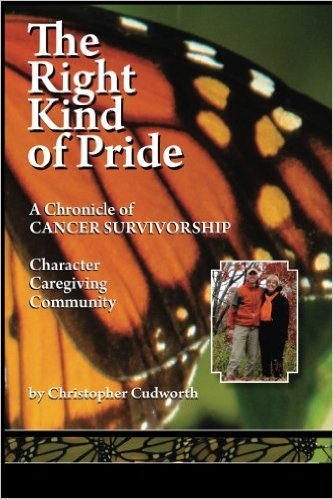
I don’t know anything about the reincarnation hints at the end of that song. That’s something I’ll leave to the mysteries of existence. What I do know about the Art of Dying is that everyone of us will get our chance to consider what that means. For those of us looking on from whatever distance we encounter the act of death, there are many kinds of grief. In my book The Right Kind of Pride, I devote an entire chapter to the Goofball’s Guide to Grief. The thoughts we get in our heads are not always rational. Sometimes we even feel free and relieved to no longer be tied to the pain of someone dying. That’s a fair emotion too. I’ve known it myself.

Perhaps experiencing pain in athletics somehow helps us prepare for grief?

It doesn’t mean we’re unfeeling or callous somehow. Nor does it mean we’re “missing a chip” from some emotional foundation we’re all supposed to have. What it means is that some of us process grief in a quite immediate and present fashion while for others, it is a prolonged process requiring years or even a lifetime to mourn the loss of someone important to us.

A Star Is Dead

Perhaps you’ve even felt grief over the loss of someone you don’t personally know, yet somehow their story resonates with you. I know the death of John Lennon hit me hard. So did the death of Lin Brehmer, a Chicago DJ whose anniversary of passing one year ago was announced on WXRT today.

Once in a while a celebrity of one kind or another will die, and it will me like an emotional brick. Then there’s still the personal stuff. Now and then my late wife will appear in my dreams. She’s a presence in helping me process some current even or emotion, either good or bad. We were married more than 25 years. Why should she not still be a presence in my brain? I loved her. I know she loved me. But I also know that she told a friend before she died that she knew I’d love again after she passed. And that is so.

What it all comes down to is that throughout our lives, we are faced with various forms of grief and choices. It is not ours to judge others, or be judged, with how we face a sense of loss. I mourned my torn ACL years ago because I knew that it meant a form of my youthful activities in ballistic sports was gone along with it. I had it replaced with a cadaver part I called Jake. I did a year of rehab and went back to playing soccer and basketball, but Jake died all over when the ACL popped again.

I keep moving these days in a straight line, swimming, running and riding my way through life. The only time I cut and move is playing with my dogs, which is a joy. But I know that someday they’ll die too. Like the crystal goblet that the Zen Master carries around yet considers it shattered before it ever happens, we must look at life as broken before it occurs. And when we hold the crystal goblet of love for others up to the light, we hope it shines back into our eyes either in the moment or for as long as we hold that memory.

Posted in aging, Christopher Cudworth, competition, death, Depression, friendship, life and death, love | Tagged , , , , , , , , , , , , , , | Leave a comment

The unexplainable

My son Evan Cudworth and daughter Emily Cudworth.

In the wake of my wife’s passing, my children still had obligations to meet. My son was in a job out in New York. My daughter had a semester to finish at Augustana College. Yet all of time seems to stand still when you’ve lost someone that important in your life. A husband misses a wife. A son misses a mother. A daughter misses the mom, especially at the age when young women are forming ideas about a model for their life.

Yet as grief sets in, the human mind does some strange things. In my son’s case, the pain swirled inside him and the temptations of a New York life beckoned him. My daughter wasn’t all that happy at Augustana. She made friends, but as a junior college transfer, there were many social constructs into which you can’t just walk in and adapt, or adopt. Plus the college had broken promises about transfer credits. That was a raw deal, yet she made the best of it in many ways.

In my case, I took a few days off from a new job as a Senior Copywriter at a web marketing agency and went right back to work within a week. I’d been out of a job freelancing to make ends meet the previous year while taking care of Linda and was concerned that spending time away from the new position could impact how they viewed me at the company. I didn’t want to lose a job I’d just started a few weeks before.

Lives in the balance

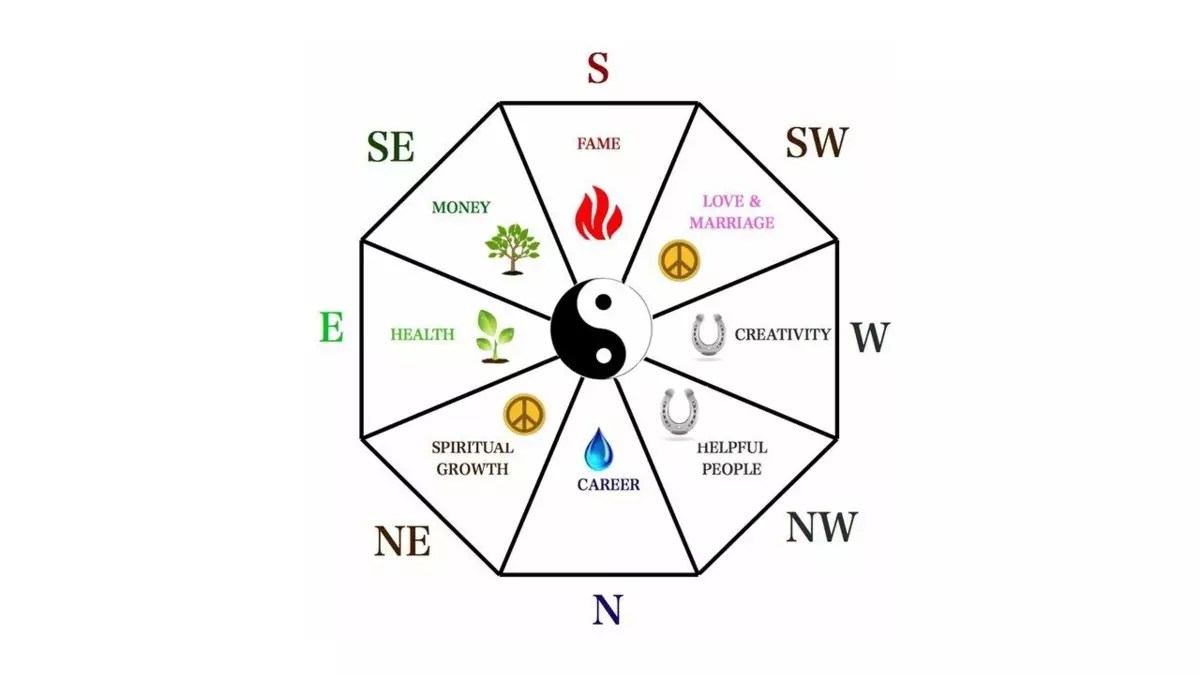
A couple weeks out from Linda’s passing, one of my daughter’s friends came over to spend the night and keep her company. It might have been Spring Break or something, so they both had time off from school. Her friend was an astronomy major. She also came from a culture that favored feng shui. She was invited to sleep over in the front bedroom but something in that layout didn’t set well with her, so she moved out to the living room where our giant Wickes Furniture couch offered a comfortable place to sleep.

I loved that couch and its partner chair. They had an almost denim feel, soft, and offered just the right amount of support and cushioning. Most of all, that furniture was wide enough to relax without feeling like you were going to fall off. Plus, those couches lasted forever and ever. They had been a centerpiece of our existence in the Batavia house for more than a decade.

So my daughter’s friend brought a pillow out and went to sleep on the couch sometime late into the night.

Her feet faced the end of the couch toward the middle of the room. That’s where my late wife’s head had rested on the medical bed the last day of her life. That all took place rather fast. The EMTs had arrived that day to help move her out from our tall bed in the master bedroom into the medical bed in the living room where care could be properly administered. They had nothing to carry her from the back of the house to the medical bed (which surprised me) so the EMTs plopped her upright in an office chair and wheeled her through the hallway to the medical bed. Once she was comfortably situated, I came to her bedside. She looked up at me with that typical twinkle in her eye and chuckled, saying, “I thought I wasn’t supposed to suffer!”

We both laughed at that. Compared to the things she’d been through to that point, the chair ride was nothing difficult, yet it did help to laugh about it. A few days before when things weren’t going so well for her digestively, I helped her with some bathroom issues. That isn’t a comfortable situation for anyone at any age. She was crying from embarrassment mostly, so I looked up at her and said, “Remember our marriage vows,” I urged her. “One flesh. We’re one person right now.”

Even so, there were some changes in her body that were so difficult to manage that I called in help from the wife of one of my best friends. She is a nurse that had helped us through many situations, including Linda’s difficult days after the emotional collapse years she’d experienced after the recurrence of cancer followng a year of “Gold Standard” treatments didn’t keep that awful disease at bay. That same nurse friend drove me home from Dodgeville, Wisconsin the day after I’d crashed on my bike going 40mph on a hill due to bike wobble. She’s the kind of woman you want by your side in any emergency. Calm. Honest. Informed.

The funnel of existence

Watercolor of my young self running. Never knowing what life will bring down the line.

All of that difficulty felt like it poured through a funnel of existence to the moment that Linda died at around nine p.m. on the 27th of March, 2013. The fine caregiver that arrived a couple hours before had stared intently in Linda’s direction after entering the house. She was a small, wonderfully dark-skinned woman with fine features, sharp eyes and a calm personality to match. “I’ll set up in the kitchen,” she told me that night. After Linda’s passing, she pulled me aside and said, “Your wife was already gone when I got here,” she told me. “Her body was still going but she was gone.”

That brings us back to the experience my daughter’s friend had the evening she stayed over to keep us company. To fully understand this story, it is important to acknowledge the framework of this young woman’s mind. She is a scientist by education and training. She is also a no-nonsense type of person in many respects. One afternoon while watching TV with us, she proclaimed, “You need to get rid of that big fat TV.” We still had one of those monster TV sets with the big silver case and a plastic “ass” with vents that stuck out the back of the TV stand. While working at Best Buy to make money for college, she had learned quite a bit about flat screens and recommended we dump the huge old tube set. A few days later, that TV literally blew a circuit with a spark, after which a veil of smoke rolled out the back. “See?” she laughed when we told her. “I told you it was time to get a new TV.”

That’s what makes the events during the night she stayed over so compelling. Sometime during the night she woke up and felt a presence in the room. At her feet near the end of the couch, there appeared a set of three lights. She described them as Orbs. One Red, another Green, and a third one in the middle was White. That same night she noted that one of a set of three four-inch tiles hanging on the wall popped off its nail. The image on it was a dragonfly.

I may not have recalled all those details perfectly. The experience she’d had was unexplainable, so she wasn’t all that forthcoming. It freaked her out a bit. It freaked me out a bit. Yet in some ways it fit perfectly with the idea that my late wife’s spirit or presence had somehow manifested itself in our realm in a way that none of us could fully understand. Some things just are…unexplainable.

No hookum spookum

I’ve looked up “orbs” and there are plenty of references to them online. One writer named “Kimberly Dawn” (real or fake name?) on Linkedin, of all places, shared this perspective about them,

There is no scientific evidence to support the existence of angel orbs. However, many people believe in them and claim to have seen them with their own eyes. Some say that they’ve seen these orbs in photos or even in person. Whether or not you believe in angel orbs, it’s undeniable that they capture the imagination and provide comfort to those who believe in them.

As I’ve shared, this young woman was no “hookum spookum” person prone to making things up for dramatic purposes. I entirely believe in what she’d seen or experienced. Even if she was dreaming somehow, it doesn’t matter to me. The fact that we have these mysterious encounters in any state of mind is important. The night that my mother died back in 2005, I was driving home through a dark November rainstorm when a giant buck deer ran across the road in front of my car. It’s often said that we see some sort of spirit animal in the wake of a loved one’s passing. That’s unexplainable too. I’m plenty satisfied leaving some things to the unexplainable.

I’ve come to believe that our emotional states and our sense of “being” are as “real” as material reality. Even if by encountering death we’re dealing with chemically-driven synapses or electrical impulses in response, those are wrought through millions of years of evolution, as we are all chemical beings. Our feelings of grief and loss are real because they drive chemical reactions in our brains. Our feelings of love and hope and memories are real too. These are all we have to explain our lives. These same thought constructs drive all of literature, and scripture, science and culture and relationships.

And if somehow the collective experience of human consciousness and conscience comes to use through the portal of three lighted orbs, it is there to tell us that life has value, that we should treasure those around us, and that something does exist beyond our material understanding, even if it is unexplainable.

For the full story of this cancer survivorship journey, consider my book The Right Kind of Pride: Character, Caregiving and Community.

Posted in Christopher Cudworth, death, fear, life and death, love, mental health | Tagged , , , , , , , , , , , , , , , , , , , , , , | Leave a comment

Beyond the pain

Her garden being watered during a summer day.

Following the passage of my late wife in March of 2013, we conducted a Memorial Service. The people in attendance ranged from all walks of our life. Along with my son and daughter there were other family, longtime friends and former roommates, church friends from twenty-five years at St. Mark’s Lutheran and the preschool where she taught, and folks from the caregiving group that had built up around us during eight years of cancer treatments and survivorship. The service opened with a performance of Here Comes the Sun by an incredible musician friend named Matthew Boll, and the service was a testament to the way she lived with love and shared it with everyone in her life.

Before she passed away, I sat with her two weeks prior knowing that things weren’t going the direction she wanted. I knew that after all the strength she’d showed for all those years, her physical strength was wearing out. While she’d had doubts over time as I discovered upon reading her journals years later, she never quit trying to stay alive. That was her nature.

It made me think back to the time before we were married that she decided to run a 10k out in Sycamore, Illinois. A few weeks in advance she went for a few runs, but most of her “training” was doing aerobics classes at the time. That was sufficient for her, because her family––or her brother at least––seemed to have a natural gift of high V02. He became a really credible bike racer back in the early 80s. Linda used to run with me now and then, but walking was her real love. She did that quite a bit all the way through her life.

She signed up for the race and it was a chilly day, so she wore tights and a long-sleeve shirt. Running off almost no training, she broke one hour for the 6.2 distance. These days as I’m much older and run 10:00 pace on a regular basis day-to-day, I rather marvel that she was able to clock that time. I remember her coming into the chute with long blonde hair flying behind her. At the time I was quite the prick about running times, but that impressed me.

The woman had perseverance. Let’s put it that way.

A letter she wrote to me while I was living in Paoli.

It was a strange thing in those last days to realize that nothing could be done to sustain her life. That day I sat with her to talk about our lives together I told her something like this: “Listen, I know I’ve not been a perfect husband. You’ve had to put up with my flaws for a long time. (25 years). But I want you to know this. In all that time, I’ve always been faithful to you because I love you. Sometimes I’m not even sure you knew how much I loved you. But if there are things I ever did that hurt you, I’m asking your forgiveness now. Because I still love you.”

We cried together that day. I was proud of her for all she’d done for all of us all those years. I wrote a book about that journey called The Right Kind of Pride. The willingness to be vulnerable at times, which was hard for her. One time the members at our church insisted on a “laying on of hands” prayer session and Linda hated the idea. But like me, she understood that we didn’t have all the answers, she and I. We never know anything for certain, if you want to know the truth. Our phrase was always, “It is what it is.”

I attended the Good Friday service the same week she passed away. The pastor welcomed me at the altar that evening, saying, “It’s good that you’re here.”

One of my brothers commented, “You’re walking right into the pain.” That was true. I wanted it that way. For decades I’d learned to deal with pain, even welcome it, in one of the most honest of all ways, by running. As one great African distance runner stated, “If you try to run through the pain, you will never get through it. But if you learn to run with the pain, you can succeed.”

On our honeymoon in Glacier, 1985.

Going forward from those days of pain and loss, I reasoned that if any aspect of our faith was true at all, she had moved fully on in spirit. There was no holding her back. Her life on earth was finished. Back in 2005, I’d already carried my mother’s ashes back from the funeral home after cremation. I knew what it was like to hold a loved one under your arm. In 2013 I received the call from the same funeral home and picked up my wife’s ashes too. The children and I spread some out at a prairie where we all used to walk. I took a small jar to the Daffodil Glade at Morton Arboretum that April once the flowers were in bloom. The rest are buried in a cemetery next to her father where her mother, who is still living and in her late years and will someday soon be buried next to them as well.

So there was closure. There was honesty about how life takes place in its fullest and how it ends in a physical sense. All the people that know me understand that I process these things fully. Yet I didn’t know what came next. I had just gotten a new job that year and was driving the new car we’d just purchased. The April flowers burst from the ground and May flowers opened up in the woodland garden behind our house. Soon here garden burst into life and it would be my job to keep the garden going. That wasn’t easy. Her avocation was gardening. My job was digging holes in the ground for her plants. There’s a big difference.

Our little pup Chuck was then in my care, and I stopped at a hardware store on a spring day to pick up dog food and wound up buying some plants to fill some spots in our backyard. .That’s how we all move beyond the pain. There are spaces we never fully fill in our lives because grief is odd. Yet we all work to live our lives as fully as possible. That’s what’s meant to be. And grant you, we don’t always know what it means. We just keep trying to grow.

This story is a continuing part of the series for my biography Competition’s Son.

Posted in 10K, aging, Christopher Cudworth, competition, cycling, life and death, love, mental health | Tagged , , , , , , , , , , , , , , , , , | Leave a comment