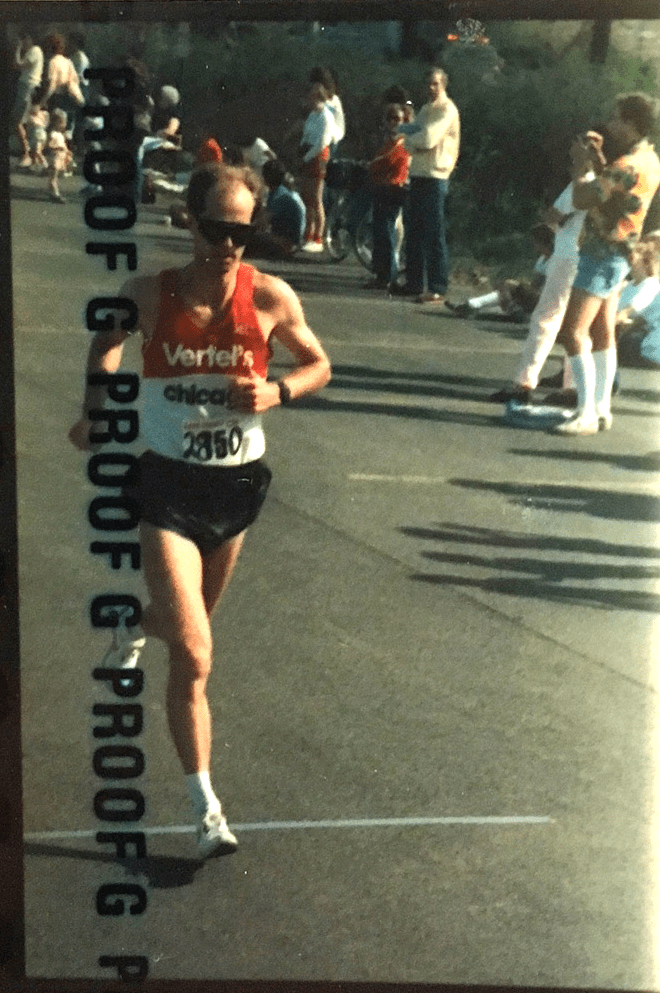
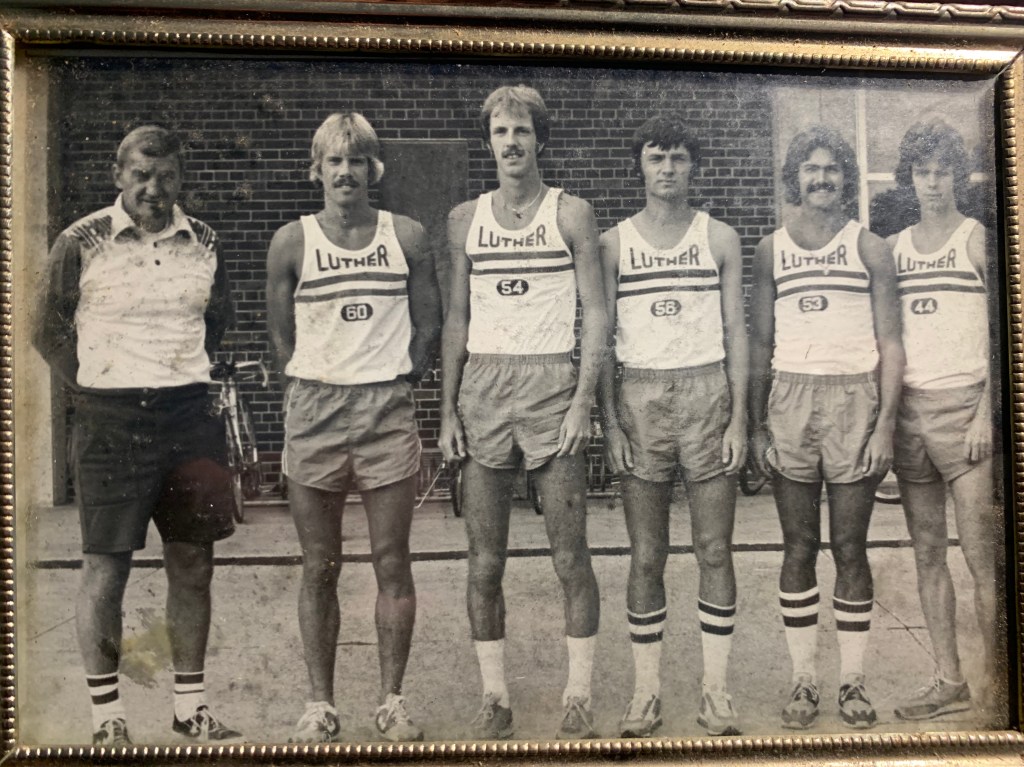
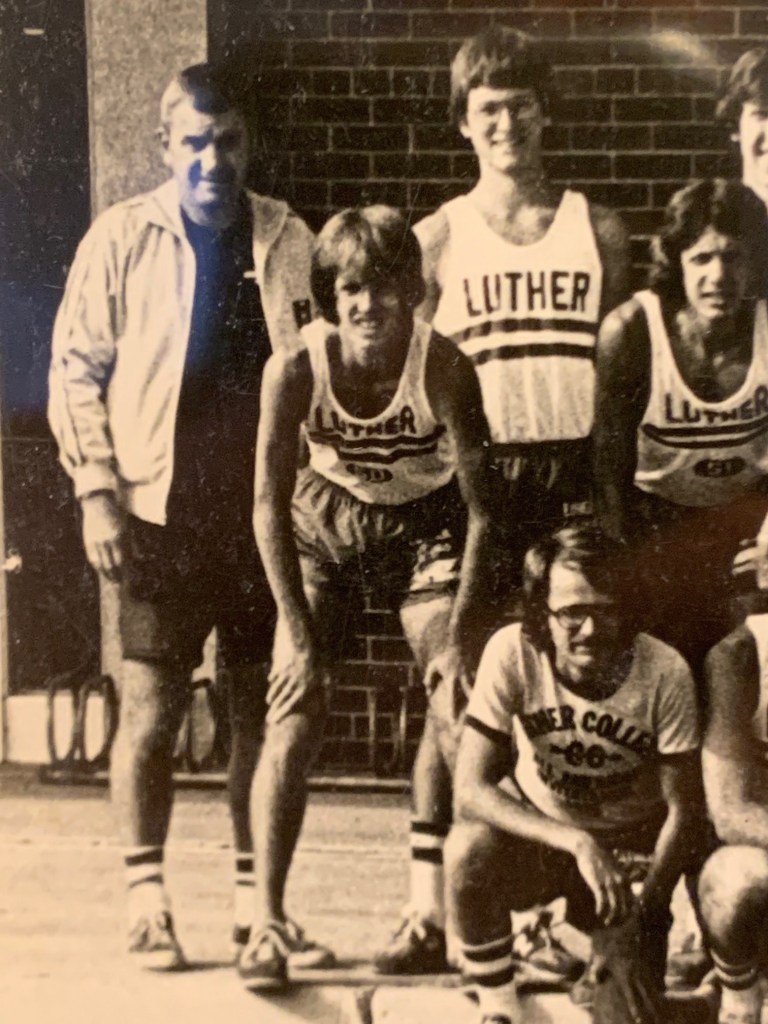
In this photo I’m in 31:00 10k shape (right) with my former college teammates during a 1984 training run.
At one point during my early 20s, I worked part-time jobs while training nearly full-time as a distance runner. Though I knew I wasn’t world class by any means, the mood among serious runners in the early 80s was one of commitment. It felt like mission to find out how good you could be.
In the years 1983 and 84, and bleeding somewhat into the year 1985, we all raced frequently and as fast as we could go. This wasn’t the “I did a 26.2 or 13.1 set.” This was hard, fast 5Ks, five-milers and 10Ks. It was the occasional ten-mile road race in the heat of summer, or the cold half marathons of mid-spring and fall, when the temps shivering your skinny ass at the start and winds often buffeted those willing to stay out that long.
Quite a bit of self-knowledge and discovery comes from a few years of that kind of effort. I learned so much that there came a time, not long after I got married in 1985, that I realized the journey of hard competition should come to an end.
Over the years, I kept running because it saves my brain from the native anxiety and brain chemistry that is part of my genetic makeup. Plus I like staying fit. Finally I added cycling as a complement to running in the early 2000s, and in 2014 even swimming entered the picture.
Perhaps you have a journey that is much different than mine. It might have started in high school or much later in life. I’ve profiled a number of people in this blog during the last eight years. Their stories fascinate me. Their missions too. From young athletes to aging warriors like myself, their stories are all important.
I often compare my own continuing journey to the people met along the way. But sometimes I even compare the journey of today with my own history all those years ago.
That happened while I was engaged in a twelve-mile run with my wife Sue along the Fox River from North Aurora up to Geneva and back. My length of runs has been steadily increasing throughout this winter and spring. After a sucky, painful, disturbing year last year, 2020 has seen a bit of recovery.
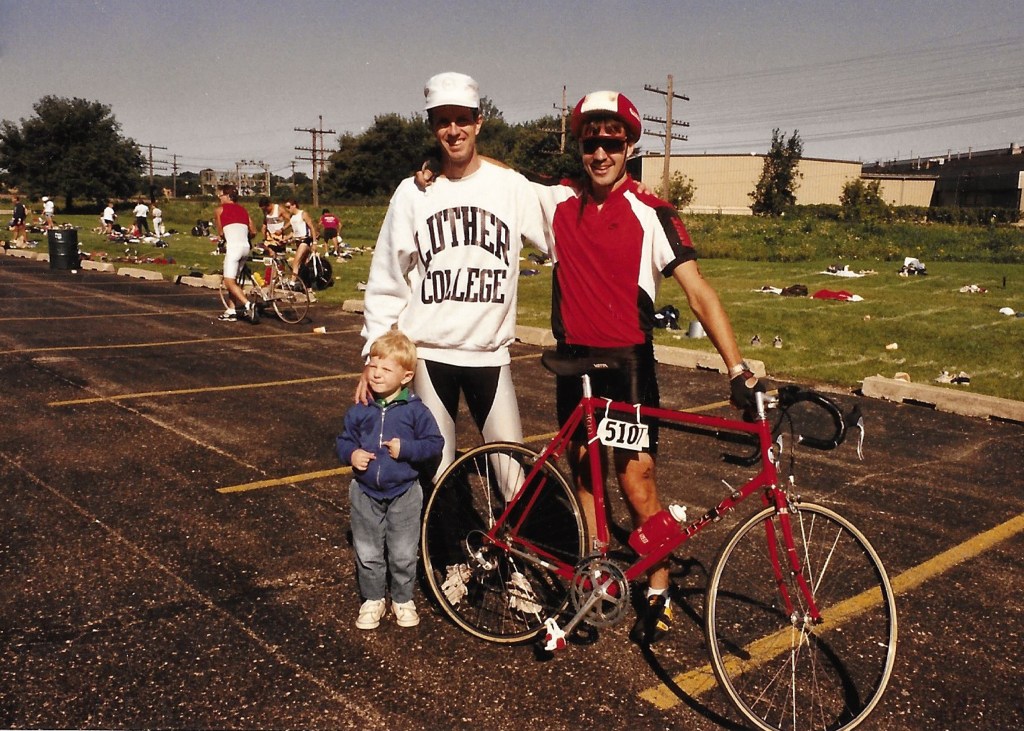
In 1985 with my brother-in-law Paul Mues in which we teamed up for a duathlon.
If that seems strange to say in the face of a pandemic and a wobbling economy, so be it. We can only tend our own garden, to quote the book Candide.
Week-by-week, as my wife can testify, I’ve added a mile to the weekly longer runs. It started with 6-7 miles. Then came a few runs of eight. A nine-miler was encouraging in that my hips did not tighten up as they done the last few years during long days. Finally I topped ten miles and the Garmin said, “Congratulations! Your longest run!”
The goal is the run 13.1 in a healthy fashion so that I can do a Half-Ironman someday. Ironically, I haven’t even done and Olympic. That’s only because I was alternately injured and sick most of last year. But my swimming progressed throughout and swimming a mile is now possible for me. In fact, I enjoy it.
The mission to recovery of fitness includes mental health as well as physical training.
That and the hip tightness was holding me back from tackling a Half-Ironman. But yesterday I ran twelve miles with negative splits the last four miles as I dropped rom 9:00 to 8:40, then 8:20 and actually ran the last mile in mostly sub-8:00 pace.
At the nine mile mark it was clear in my head that the run would end well. It was still possible that I’d tighten up, but every time that thought entered my head I relaxed and shortened the stride slight and kept running easily and faster.
I’ve been on a mission of self-recovery. Perhaps you have been down this path as well. I’d love to hear your story if you’re willing to share. It’s a fun thing to engage in the profile process as my recent subjects can testify. Where have you been? Where are you going? What motivates you? Let’s talk.
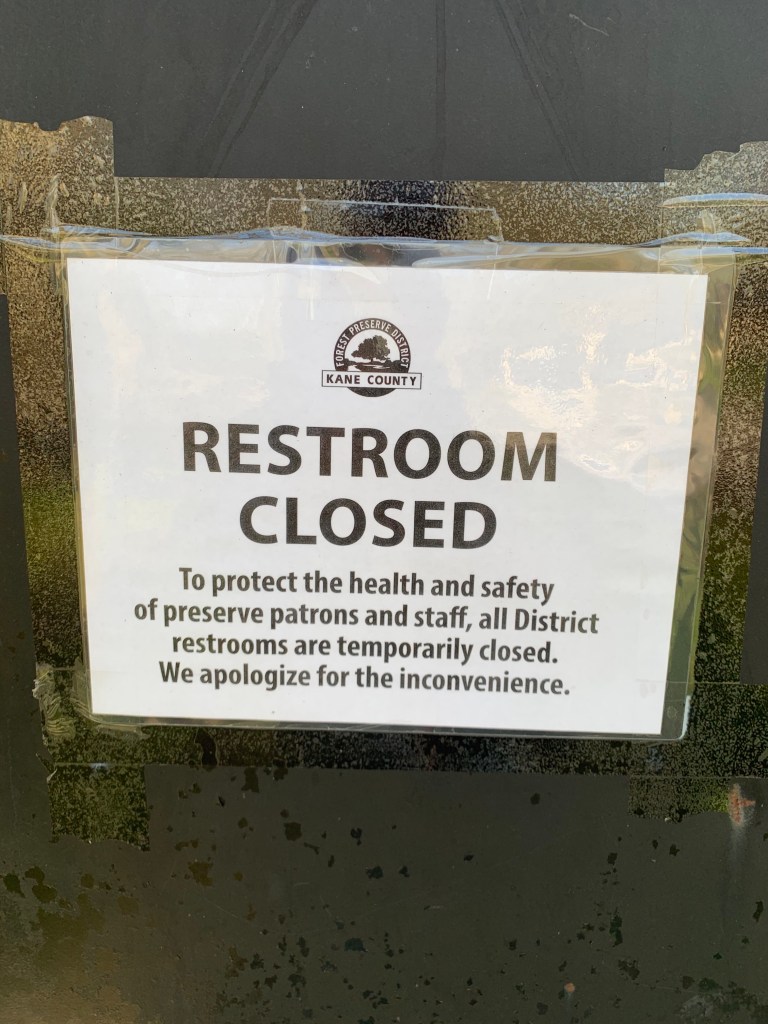
Public Restrooms are closed in most parks and forest preserves. That puts athletes in a crappy bind.
While most of the world is sick of Shelter At Home orders and stores and businesses being closed due to Coronavirus, those of us that run and ride and swim face a genuinely vexing problem while we try to stay healthy, get fresh air and get outside to keep from going crazy inside.
All the public toilets are closed.
At least, that’s been the case here in Illinois for months now. That means when nature calls, especially on the run, one has to improvise. Which means crapping in the woods.
I’m used to that after fifty years of being an outdoors type. And by necessity and years of earnest triathlon training, my wife’s gotten pretty damned practical about these issues too. And they are issues. To be dealt with. Sometimes urgently.
First resorts
During our ten mile running route on trails from North Aurora up to Batavia or Geneva and back, there is just one bathroom that’s been available for the last three months. That’s the McDonald’s in Batavia. So that’s our first resort. But sometimes the urge to crap hits sooner than that, or later. That means hitting the woods is our last resort.
My instincts and nature knowledge point me to wide, broad leafs such as maple or oak. These work well as toilet paper even during the winter months. They may be a little chilly then, but they do the trick. During the summer months, those are good options as well. Grapes leaves are probably the best of all, since they are quickly recognizable, tear off the vine easily and typically offer a plethora of options once you’re near the plant.
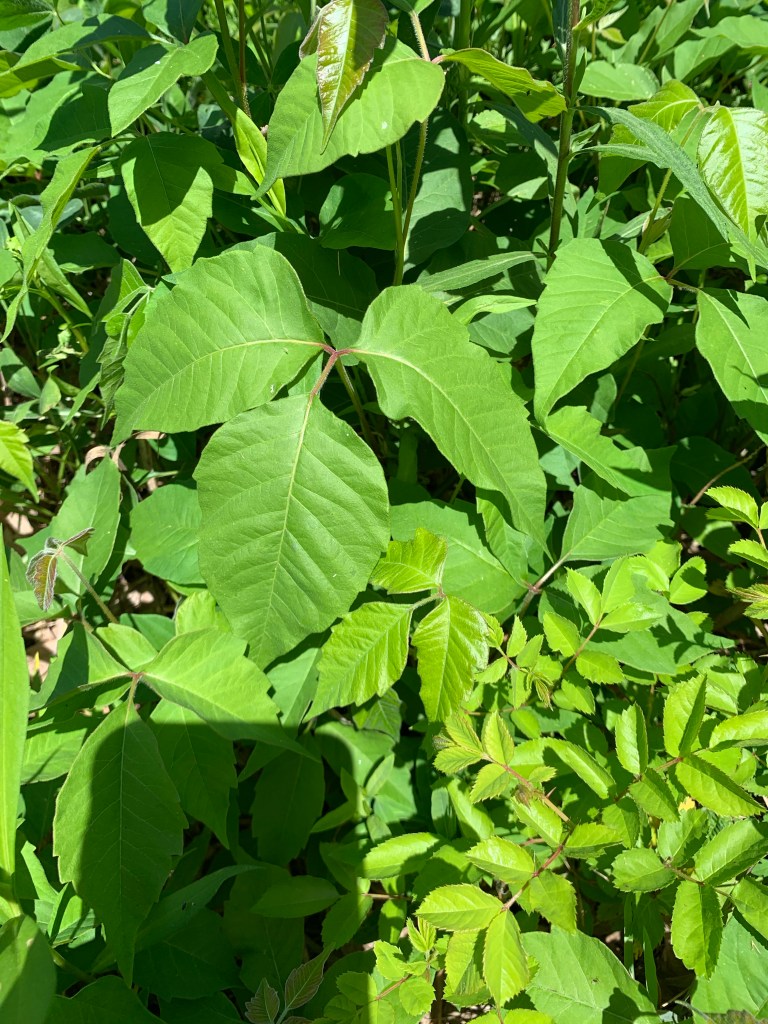
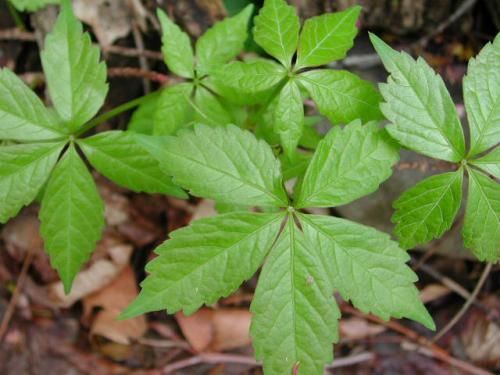
Poison ivy plants have three leaves in a pattern like this.
Leaves of ass
In spring and summer, the danger of going to the bathroom in the woods is coming into contact with poison ivy and poison oak leaves. Both typically grow close to the ground. The classic poison ivy leaf arrangement is three leaves as pictured at right. But sometimes it grows as a vine, and can climb up trees. So does poison oak.
Both are plants that most of us want to avoid touching at all costs. Years ago I contracted a case of poison ivy that would not go away because little to my knowledge, the oils that cause the itching coated my boot laces. Every time I touched those boots I was picking up more poison ivy.
Treatments
I treated it with a product that dried out the oils over a period of a couple days. The stuff is called Tecnu and I will testify that it works. It’s best to use it in the shower as I recall. You scrub it on and leave it on. It’s gritty in texture and actually feels good as you rub it on the red spots. It’s like you get to kill the rash. I like that. After a few minutes you wash it off, being careful to wash your hands with it as well. But follow the instructions on the label. Don’t trust my version of it.
Worst case scenarios
If you contract poison ivy badly from squatting down in the weeds to poop, it can spread quickly and badly. One of our female athletes at Luther College stopped to “go” during a 20-mile run and did not recognize poison ivy when she chose a plant with which to wipe herself. It spread throughout her system and she had to wear bandages all over her body.
So while you might find yourself having to take a crap in the woods while the pandemic restrictions on public bathrooms remain, I’m telling you that you don’t want to mess around with poison ivy. Learn what it looks like, and how to avoid it. The American Academy of Dermatology has information about what to do if you get a serious case of the itches. It is recommended reading if you living wherever poison ivy and poison oak exist.
It’s bad enough having to crap in the woods. You don’t want to take crap like a poison ivy skin infection home with you. It’s one of the tarsnakes of being outdoorsy that you run risks like this. A little knowledge goes a long way.
For several decades our family tradition was spending the 4th of July in my in-laws’ back yard. We’d light small fireworks all day until everyone smelled like smoke and gunpowder. My son grew to love the pyrotechnics and his uncle took him on road trips to sellers like Crazy Kaplans in northwest Indiana to stock up on fireworks for the 4th of July.
One year my brother-in-law invited friends to bring their stash and the sound and fury was so loud the police actually showed up and confiscated piles of unlit fireworks. The more powerful stuff is illegal in Illinois, so it was against the law.
But my quite-conservative father-in-law acted quickly and hid even more fireworks in the garage before the police could find them. He was literally born on the 4th of July. It was an important holiday to him. As a reader of the National Review and devout Missouri Synod Lutheran, his deep strains of independence stretched all the way back to his unbringing on the Republican River in central Nebraska. His brothers used to shoot an occasional bald eagle for sport.
As for my 4th of July traditions, I’d often find a race to run that morning. Typically they were four-or-five milers conducted in the heat and humidity or whatever combination July decided to offer. I well recall the year that I tangled with a local guy on his hometown course. I ran sub-20:00 for four miles and still place second. It was racing fireworks the whole way as we exchanged the lead repeatedly and tried to shake the other on the hilly course. It may well have been the best race I ever ran, but on that day, my competitor’s hometown pride carried him to victory.
I was pissed at losing, but watching his buddies smack his back in congratulation actually made me feel better. At least I gave him a good run. I was part of a thrilling contest for everyone.
After those races every year, I’d go shower and change into shorts and a tee shirt and join the fun blowing off fireworks while drinking beer and eating potato chips, hamburgers and birthday cake in celebration of my father-in-law’s Big Day.
The Big Show
Then twilight would fall and we’d gather in front of the house on Woodale Avenue to witness the unleashing of the Addison fireworks. Our perch allowed us to see everything but the ground displays, but I’ve always thought those were stupid anyway.
Some years I’d be so tired after racing in the morning and drinking and eating all day, it would be hard to keep my eyes open. But I liked when the super thick boom of a strong firework seemed to send a concussion our way. That sound was satisfying. But the strained traces of smoke floating through the air always made me a little sad. They reminded me that summer was also floating away.
Those fireworks displays lasted probably twenty minutes. The Grand Finale would rock the skies and we’d OOoohh and AAAaaah for a few minutes, then give a round of applause to no one but ourselves. Despite all the supposed honor and glory of 4th of July Fireworks and what they’re supposed to represent, in the end they’re just another form of self-pleasure, a form of visual masturbation if you please.
There’s nothing really wrong with that. America has always been a nation driven by symbols, pageantry and coarse stimulation. It is also a nation of self-gratification and perpetual distraction from the problems we actually face. Fireworks act as an antidote to the droll heat and humidity of summer, and the smoke keeps the mosquitoes away. People can’t pay attention to other matters when they’re swatting bugs away from their faces.
Painting by Christopher Cudworth
Fading smoke
The longer I live the less fireworks grip my imagination. Plus the sound scares the daylights out of our dog, and many others. Last year I sat on the couch hugging our shivering pup, whose early life as a abandoned stray included sustaining a broken leg after being tossed out the window of a car. Then the poor thing was kept in a shelter next to a gun range. Now whenever she hears anything resembling a gun shot she cowers and tries to run for home. Even the nail guns of roof construction make her shiver in fear. For these reasons, I’m not particularly looking forward to the 4th of July.
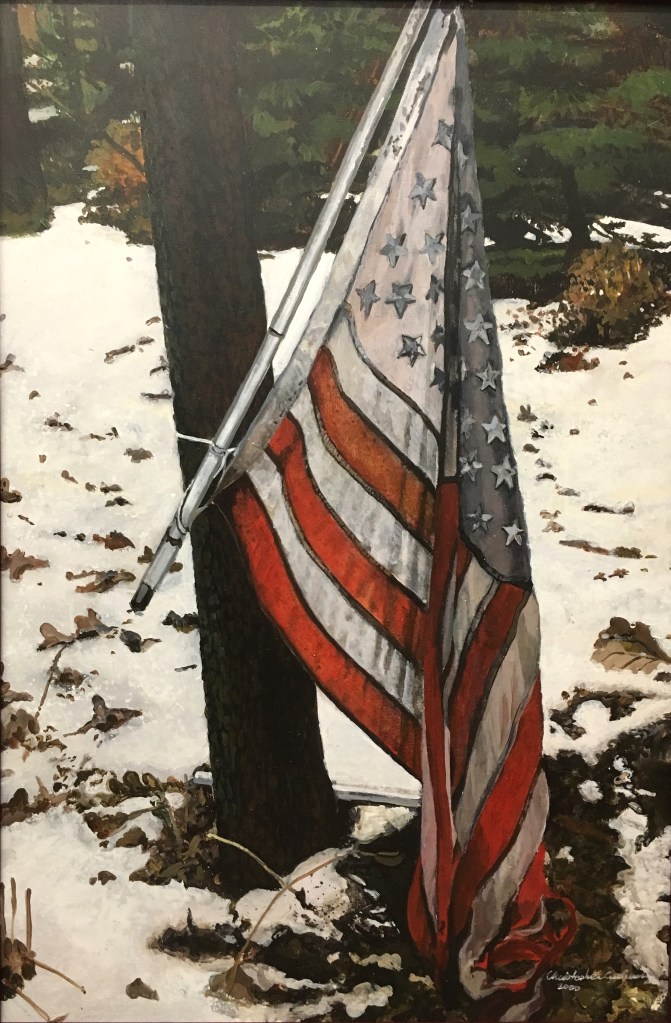
Flag Waiver: Painting by Christopher Cudworth
Plus I’ve come to view such celebrations in alternate terms. I don’t like trucks bearing Old Glory flying next to Don’t Tread On Me flags. I’m not fond of flag-flying other than a modest, attractive, respectful display on a home or a flagpole. And if someone chooses to burn a flag in protest, I care to know the reasons why, not just write them off as a radical. The real American virtue is protest. Our nation was founded on that premise. It’s greatest changes have come about through revolutions of one kind or another.
It’s sad that so many people that live in this country have to fight for rights that the Constitution supposedly provides. That is true for blacks and Native Americans, Latinos and Chinese, Korean and Japanese, East Indian and Middle Eastern. The whole list is impossible to assemble, but it also includes woman and gays, transgender and autistic, the homeless and the homebound. And artists like me. There are as many kinds of discrimination as there are people in this world. Both the Bible and the US Constitution try to prevent that, but often fail.
A nation gripped in irony
To me, our so-called Independence Day has come to represent a nation gripped in irony. And those fireworks we set off every year? They certainly don’t celebrate the rights of all. But the skies may well be largely silent this year. The Coronavirus has turned such celebrations into a risk of spreading that disease.
Perhaps that means there will be even more people blowing off fireworks at home. The police may be kept busy chasing down the loudest of the loud in areas where such antics are still illegal. Here in Illinois, one can only buy the weak stuff. But the borders of Wisconsin and Indiana beckon. For some people, that trip remains a pilgramage. I’ve done that in the past.
Or maybe not. A WGN blog reported, “The fireworks industry has been hit hard by the coronavirus pandemic. With 4th of July fireworks shows canceled across the country, many fireworks companies are seeing a 75 to 90 percent decrease in business. Greg Kaplan, owner of Krazy Kaplans Fireworks, joins Ji to discuss how the virus has impacted his business and the fireworks industry across the country.”
As we’ve seen in regions across the country, there is always the chance that people will flock to fireworks stores once they open up again. Health officials will issue their standard annual warnings about the dangers of fireworks.
People will still go out and blow off fingers and knock out eyesight and damage hearing.
That appears to be what Americans are best at doing, blowing off the law for the right to endanger themselves and claim independence. It’s a frightful little cycle of violence and disenfranchisement that America embraces. But that’s our tradition.
At some point, perhaps in the near future, we’re going to figure out that it’s not the fireworks that really matter. It’s the people watching them, every kind of people, who symbolize the real independence we all claim to celebrate.
As the years pile up, the words “You’re fast” aren’t heard so much. On a typical day, my per-mile pace is 3:00 slower than it was while running in my 20s and 30s.
That is why it was amusing to hear the words “You’re fast” when a young man came running past me on the Great Western Trail today.
I didn’t hear him coming until he was about fifteen yards behind. At that point I turned to see who was catching me. While I’m slower than I once was, there still aren’t that many people that pass me by on a typical day’s run.
I’d covered the first two miles in just over 9:00 pace, which is close to my “base” or average training rate these days. .
The third mile I slowed because it was humid in the woods. I came through in 9:31. But when I started back east I started to feel light on my feet.
Perhaps I was warmed up. Or maybe it was the east breeze cooling me off on a humid morning. Whatever the reason, I was picking up the pace without trying. The next mile dropped to 8:44, and the second half of that mile was much faster than the first.
Young again
During the last mile I felt young again. Clipping along at sub 8:00 pace, I loved the feeling of effortless running.
At the same time, the young man that eventually passed me must have been closing the gap. When he did, and he uttered those words, “You’re fast,” I laughed called out. “Who do you run for?”
“No one. I run for boxing,” he replied. And kept going. There’s a Muy Thai place not far from the trail. He must kick ass there too.
My Old School
Before today’s run I’d stopped to speak with a group of ten kids waiting around at the trailhead to go for a run. The Covid laws still stipulate that even groups of teammates could not exceed ten people. I talked with them at a safe social distance about the fact that their team had won the state title in cross country the previous fall.
“Well,” one of them mumbled. “We’re not the ones who did that.”
I made a sweeping motion with my hand and replied, “Guess what?Everyone here was a contributor to that effort. The whole team matters.”
I meant that. But I should have told them, “You’re fast,” because compared to the rest of us in this world, they probably are.
On occasion here at We Run and Ride, we profile an interesting athlete. Over the eight-plus years this blog has existed, we’ve interviewed dozens of people from local heroes to world class athletes and even world champions such as Craig Virgin and Emma Coburn.
Today’s profile on Karah Osterberg is special because she’s not only a talented athlete who has qualified for the Kona World Triathlon Championships, she’s also a champion for the foster and rescue dogs she and her husband Sean take into their home.
We talked a bit and Karah provided some interesting perspectives on her life as an athlete, a data analytics professor at Northern Illinois University and her commitment to finding safe and loving homes for dogs that get a rough start in life.
And how has this year’s crazy stuff with the Coronavirus affected you?
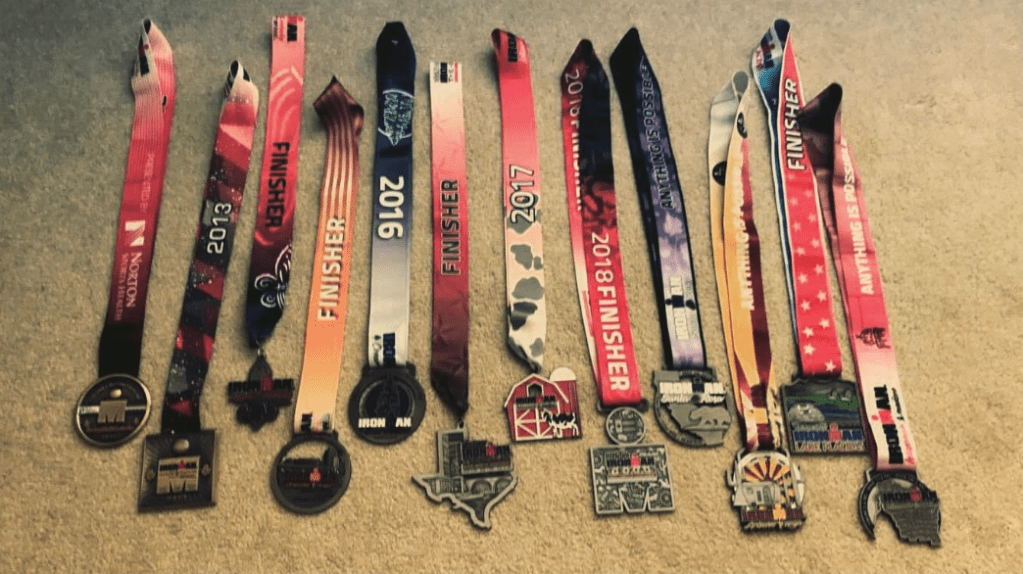
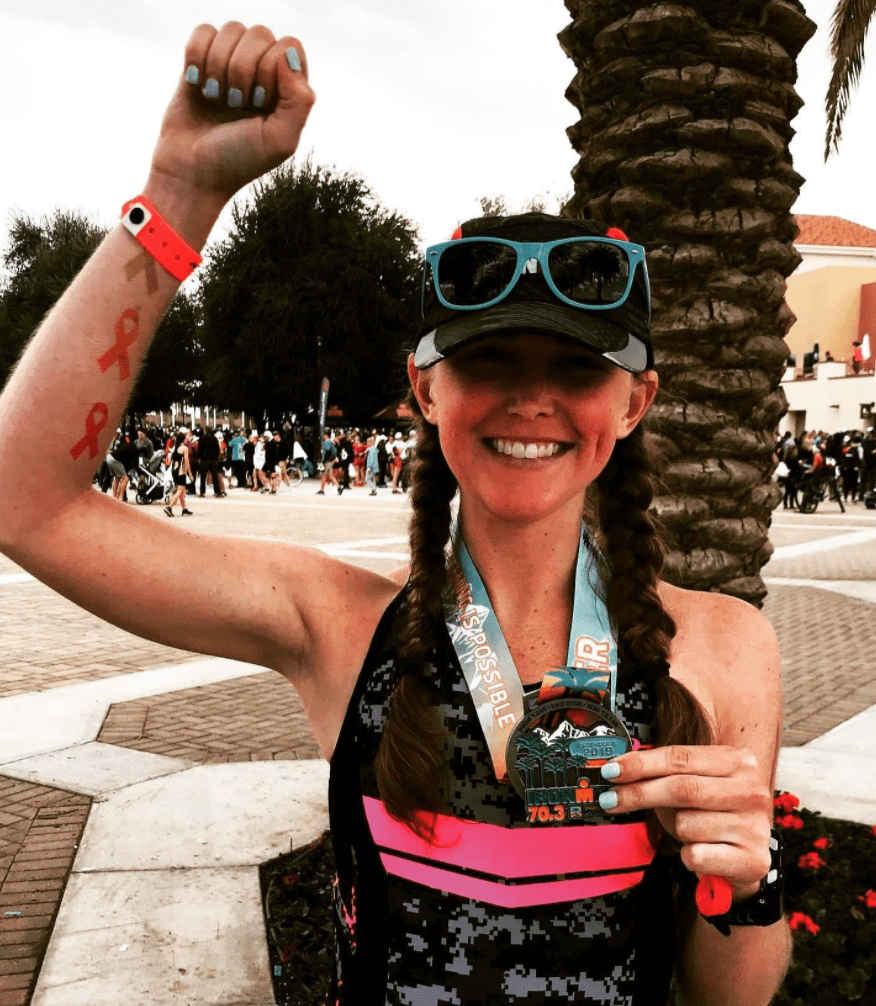
Medals from the 12 Ironman competitions Karah Osterberg has completed. She’s now qualified for Kona.
Luckily, I have a treadmill at home, bike trainer, weights, etc. I definitely missed swimming a ton until I recently could get in lakes and start swimming again. During the 2.5 months or so without gyms being open, I spent a ton of time focusing on run and bike workouts. I also have a strength coach who made me some videos to help me keep in shape for when I went back to swimming and those majorly helped!
In terms of racing, it pushed back a lot of races to the fall which I am hoping those happen! It also postponed me going to Kona until October 2021.
In terms of work, I’m lucky because I already taught half of my classes online BEFORE Covid hit. So transitioning for me was easy and I will be teaching online through the fall semester.
Were you in school athletics? If not, how did you get started?
In grade school I did a lot of gymnastics and volleyball. Once I hit middle school, that transitioned to track and volleyball. In track, I was actually a pretty decent short distance runner (200,400) and did high jump and was the best girl on the team for that (oddly since I’m short).
I then went to high school and did swim team year round. I swam varsity all 4 years and focused on short distance events. Ironically, I would cry my way out of swimming the 500 yard swim in high school, yet now am completely fine swimming the 2.4 mile (4200 yard) long Ironman swim. I sometimes wonder how much of a better distance swimmer I would be if I had accepted that back in high school!
What aspect of triathlon first attracted you…swim, bike, run?
Competing in Arizona.
Actually it was kind of all three. With swimming being my background, I don’t think I would have ever thought about triathlon if I hadn’t swam. When I went away to college, I had spent 4 years swimming competitively in high school year round, sometimes swimming 3-4 hours a day.
It mentally wore me out and I decided I didn’t want to keep swimming in college. However, after going away to college and enjoying the free time I had, I started to miss swimming after a few months but didn’t want to go back to swimming constantly. I decided I’d swim a few days, run a few days, started biking and lifting some.
After a few years, I realized I was basically training for a triathlon and decided to sign up for a local super sprint triathlon, which I won 1st overall female and 2nd overall with the guys. After that, I thought triathlon might be a good sport for me, went all in and purchased a triathlon bike, and did 10+ races the next year. Ever since then, I’ve done 10-15 triathlons a year including 12 Ironmans and 10 half Ironmans!
Osterberg grew up swimming, and has become a strong cyclist and runner as well.
What were a few earlier experiences from which you learned?
I realize now that at first, I really had no idea what I was doing. I ended up running too much or trying to run too fast and ran into a few issues with my IT band. I also refused to take days off thinking I’d lose fitness (sometimes I even did this when sick).
I realize now that triathlon is a lot of easy training with SOME harder stuff and that days off are necessary sometimes. I’d say I just took everything way overboard. I still look back at that as a lesson though. When other people were drinking their college years away, I was getting up at 5 to be in a pool. It taught me a lot of discipline that helped me get my job as a professor and have success in triathlon!
How has having a coach accelerated some of that learning?
Swimming is one of her best triathlon disciplines.
In 2014, I did Ironman Louisville the year it had a 105-110 degree heat index. It was my 3rd Ironman (3 years in a row at Louisville). The first year, I just wanted to finish. The second year, I ran a lot more of the marathon and dropped a few hours off my time.
In 2014, I bought a house and moved out. That kind of led to me easing up on the training. Oh, it’s fine if I cut this 80 mile ride to 60 today or this 20 mile run to 10. That led to me feeling like death in that Ironman and walking half of the marathon (combination of bad training and bad nutrition).
I ended up totally losing motivation after that Ironman and ironically ended up meeting Steve (Brandes, her current coach) at Lifetime. I showed him the training I was doing, and he said why are you doing this? He completely changed it.
In 2015, I remember thinking wow this training is different…harder swim sets, harder intervals, but a lot of easy stuff too. I did everything he told me to do (and still do almost 6 years into our coaching relationship). I did Ironman Arizona in 2015 and ended up going 11:12, 6th in my age group, and ran a sub 4 marathon. It was the first time I thought I might have potential to go to Kona.
By 2017, I won an Ironman swim for my age group and got on an Ironman podium! Since then, Steve has taught me so much about what my body responds to, nutrition for different environments, my mindset, etc. And during these 6 years of coaching, he has set up workouts that have kept me almost 100% injury free! He’s coached me through 9 of my 12 Ironman finishes. Truly I couldn’t do it without him!
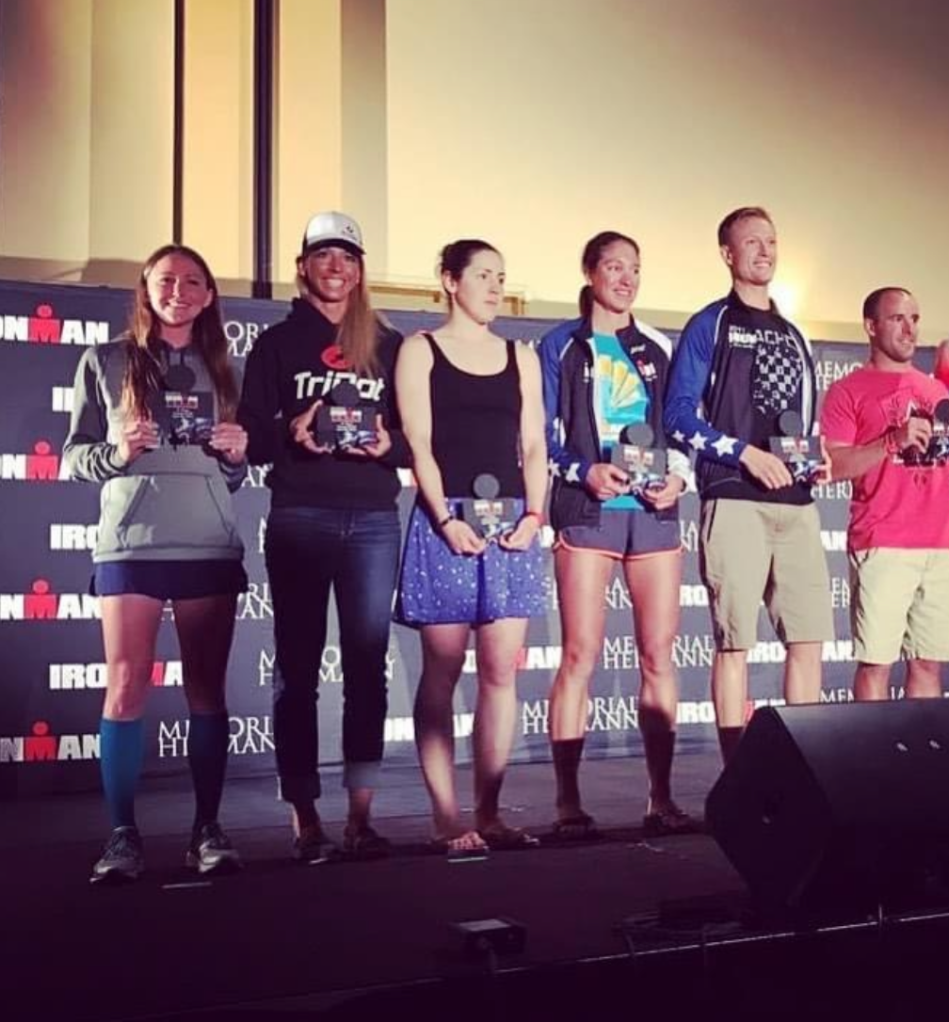
Karah is first at left with fellow podium placers.
Do you have any funny ‘mistakes’ to share; flat tires, forgotten water bottles, dropped nutrition?
Luckily, I have a list I print off to pack with and mark each thing off as I go so I have been pretty lucky in this situation for the most part. One time I went to a sprint triathlon and got there and realized my shoes didn’t have any inserts in them. That was a fun 5k. I’ve also almost hit a cow, a turkey, a deer, a snake, etc. while riding or racing….always an adventure out there!
What is your training load on a typical weekly basis?
This varies a ton throughout the year. In the “off season” or building phase, I’d say I typically train about 10-12 hours a week. This is a lot more of the intensity workouts. During an Ironman build, I’d say I train 20-25 hours a week with a lot more emphasis on distance (while still including some intensity). I also am big into recovery and spend a lot of time on stretching, massage, PT work, etc.
How do you balance work/sport life?
I’m very, very lucky that I pretty much have the best boss in the world. I teach at NIU and he schedules all of my classes for two days a week, meaning I can do work from home on my own schedule the rest of the week. This works out really well for my personal life because I can train a lot during the day when people are at work and it allows me to have time at night to still spend with family.
What are some of your favorite pieces of equipment; bike, shoes, goggles, etc.
I am all about trying things on before ever buying them! So many people buy certain wetsuits because that’s what is considered the “best brand”. But if it doesn’t fit you right, is it really best for YOU? And every wetsuit I buy seems to be a different brand based on what fits me best at that time! And for swimming, I love TYR swimsuits and googles.
I’ve found I LOVE my Trek Speed Concept and my bike shop (Prairie Path Cycles) that takes care of it. They’ve really been key in all of my races because I’ve never ran into any major issues (knock on wood).
I am a huge fan of Saucony and Hoka running shoes. I actually alternate between them each run or based on the type of run because that helps prevent injury by working different muscles. I use a lot of Clif Bloks every year too.
She has completed 12 Ironman events and 10 Half Ironmans.
Do you train mostly alone?
I do 99.9999% of my training alone. I found this is best because it’s easier to do the workouts I’m prescribed without trying to keep up with someone or wait for them. I also found it helps because sometimes I wake up, feel wiped, decide to take it easy and do a workout a little bit later in the day and that extra rest is so beneficial when I need it.
What are some of your goals?
I got into Kona based on legacy status and I would love to eventually get there by winning my age group at an Ironman. I truly think I’m capable of doing it….just haven’t put the perfect race together yet! I also eventually want to do a really crazy trail run like 100 miles or so!
On another love in your life, when did you begin fostering dogs?
I started fostering dogs in January of 2019. My mom was on Facebook and saw this super sad beagle looking for a foster home. As a huge beagle fan (already owned two of them at the time), I decided to foster her. Of course, she never left and is now part of the family and has come a long way from where she was back then!
What are some of the challenges/emotions you feel in that endeavor?
I love every single dog or puppy that comes to my house! Just in the past 12 months specifically, I’ve had 26 foster puppies so far. I really thrive off the craziness of having puppies here constantly.
Shelters are super stressful situations for dogs and puppies! Some of them sit in a corner shaking non-stop. It’s been shown dogs cortisol levels drop significantly just from going to a home for a weekend instead of being in a shelter. By giving them a place to go, they learn to socialize with people and other dogs and it makes them a much better dog in the future when they go to their forever home!
I will admit though, there are some that pull at your heart so much and it is really hard to part with them. I had the sweetest black lab mix puppy right after my dad died that I thought I would never be able to part with. BUT…I also know that if I allow a puppy to leave and find a home, it frees up space to save more.
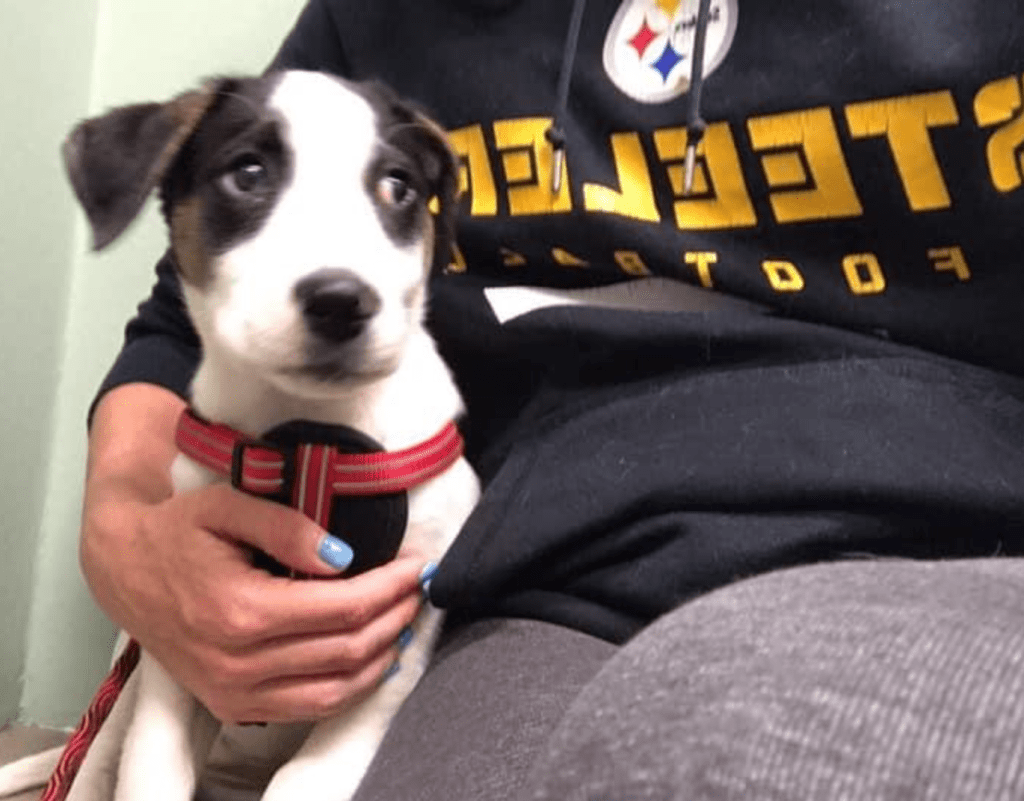
I’ve had a few that really broke my heart and sometimes people question why I’d want to put myself through that! But when puppies are dropped in boxes on the side of the road, thrown out of cars with broken legs (the author’s dog Lucy…) scared to death from being mistreated, covered in fleas or ticks, or sick from lack of blood sugar, I would rather put myself through the pain of losing them (but also the happiness of helping them find a good home!) and allow them find a happy life and home, just like Lucy did!
Why do you like dogs so much?
Dogs are amazing! They’re way better than people, in my opinion (laugh). They love you unconditionally and truly just bring happiness everyday. It doesn’t matter how bad of a day you’re having, a dog NEVER makes the day worse! As an athlete, dogs are active animals that love to go for walks, be outside, or can lay with you when you’re tired.
I just have a massive space in my heart to save them and be around them. I truly can’t imagine a day where I’m not saving dogs now. The current foster puppy I have came here so timid and scared and I have watched her come out of her shell in only a week. It just makes me feel like I’m doing something really good for an animal that can’t tell you what they need…kind of like my purpose in life!
What are some good rescue organizations?
The organization I foster through is called Safe Haven Dog Rescue. They’re on Facebook and also on Petfinder! Also, Tails in Dekalb and Noah’s Ark in Rockford are two that I follow and respect!
A fun conversationalist
As a followup to our interview, my wife and I joined Karah on a training trip up to a local lake for open water swimming. On the way, Karah related that she and her husband Sean both sometimes work out of the home. That’s a convenience for the most part, but they’ve also learned to give each other the professional space needed to do their jobs.
She also related that her husband found it funny when after visiting a local Taco Bell, they found the order was all messed up. “For me, that’s a big problem with some of the dietary things I have to be careful about. That can endanger people.”
So she wrote a strong missive to Taco Bell, chastising them for the carelessness. “Now whenever I have a complaint, Sean says, ‘Don’t go all Taco Bell about this.”
That story illustrates the challenge of balancing so many things in life. Just when some things get under control, other weird stuff happens. That’s certainly the case in triathlon, in fostering dogs and in visiting fast food places where all the ingredients for joy or disaster can be found in one place.
And that’s life for Karah Osterberg. A bit of chaos and a bit of joy in every day. And she loves it that way, and she’s doggone good at it!
Thanks for reading! Any time you would like to comment, ask questions or get feedback please let us know in the Comments section below. If you’re new to the blog, please give us a follow. And if you know someone that you’d like to see interviewed, send an email to cudworthfix@gmail.com. We’re all in this together!
I get why people move to moderate climates. It’s easy to get sick of cold weather. That’s especially true when you like to spend time outdoors.
These last weeks of May and early weeks of June are special here in Illinois. The weather may go up and down from cool to hot but the days between are amazing at times. We’ve sat outside to have dinner several times and the temperature was near perfect.
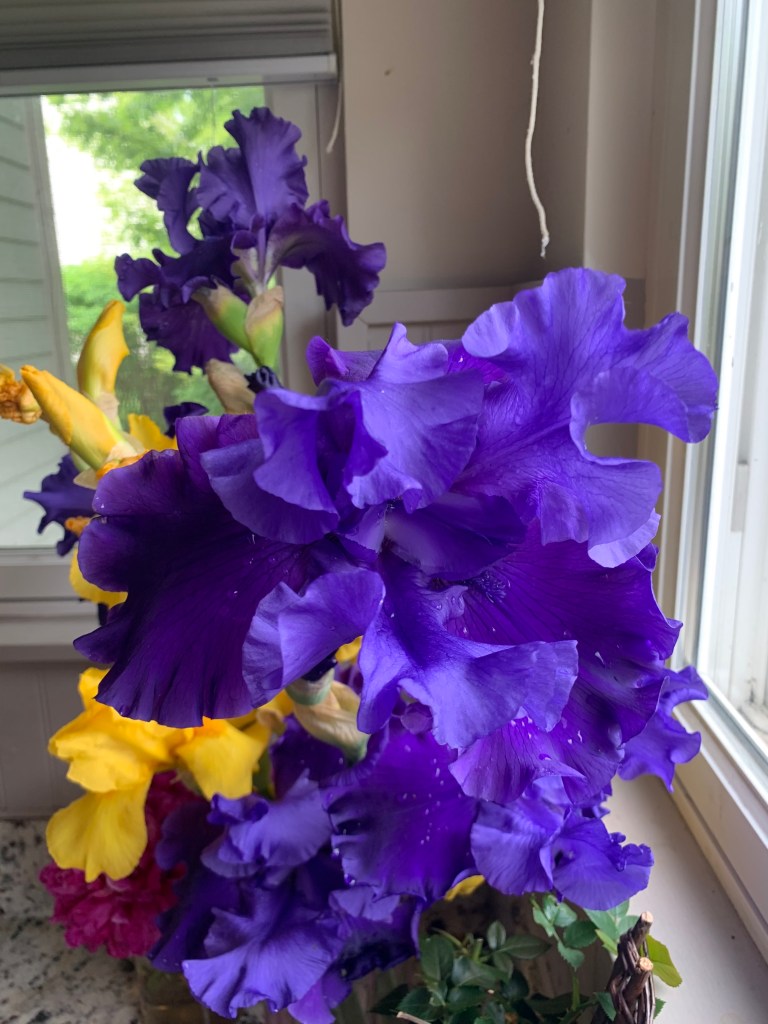
All around our house the irises are in bloom. There are deep purple and light, yellow and Japanese iris all in full regalia. As some of the yellow ones tipped over with the weight of wind and rain, she clipped them to bring a bunch inside. I’m so grateful for that. They stopped me in place to look them over today.
On the other hand, I also love the energy that comes with better weather. This past weekend I cruised through another ten-miler with Sue. At one point she turned to me and said, “I feel good.” Which is wonderful to hear from a person for whom running has not always been easy.
My own running has improved this year after 2019 turned into a debacle with a bike accident early on and health issues later in the year due to a tooth infection. Then a dog at the park ran into my left leg and tore the medial collateral ligament. As a result, I got heavy and slow and frustrated over the winter. But I’ve shed ten pounds and am back running healthier again.
Ready for a five-miler.
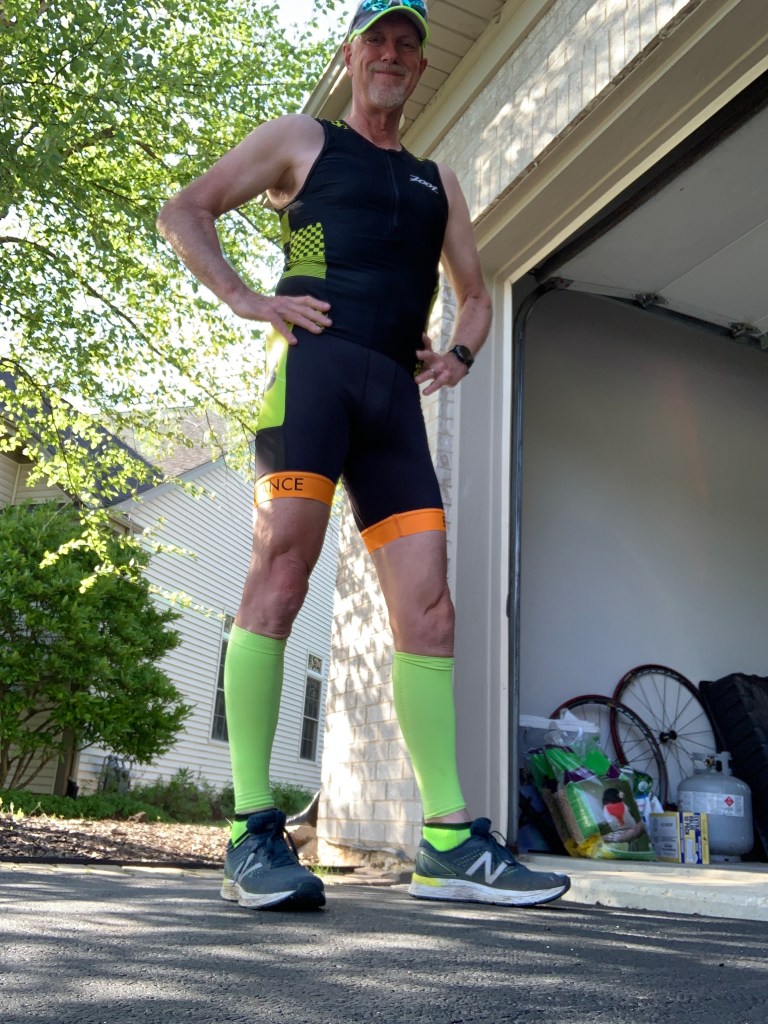
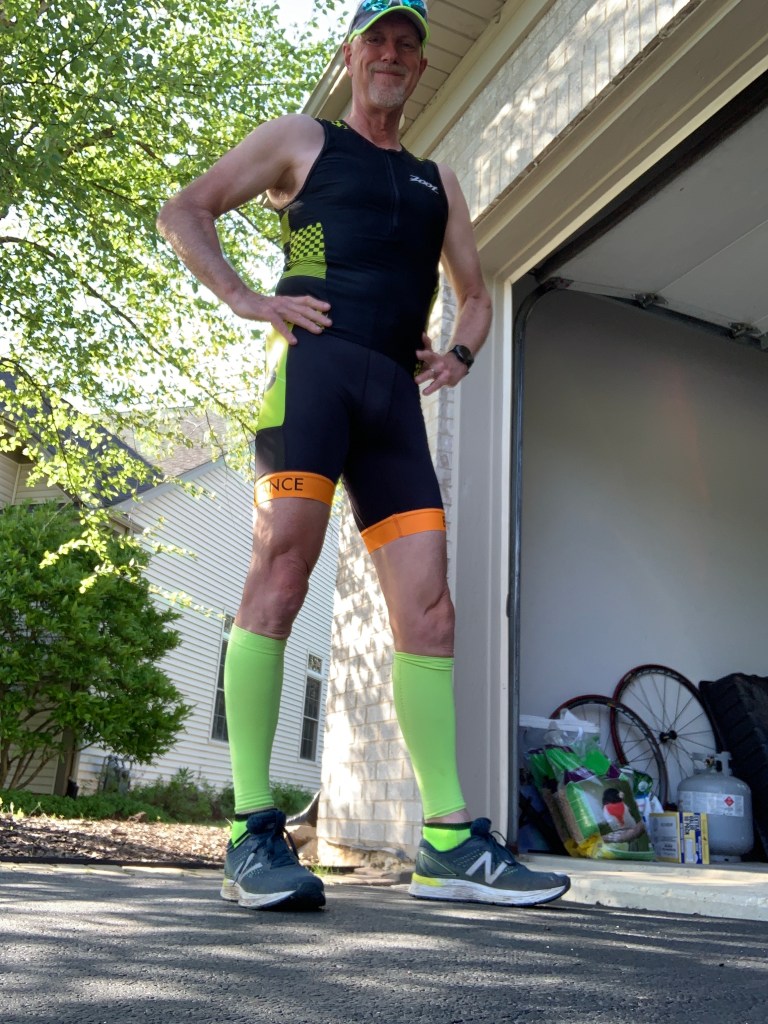
It was hot as heck yesterday afternoon with temps in the high 80s and a thick wind blowing from the southwest. But I put on the triathlon gear and went for a five miler in the late afternoon sunshine.
I didn’t go fast, but neither was I slow as last year. My average times have been dropping steadily in the last month. My Garmin keeps telling me, “You Set a New 5K Record!” or “Your Longest Run!”
All I can say about that is I’m grateful. Just to be running again. And at my age, to be running at all. So many folks get bad knees or have other issues to take them out. I’ve survived my share of strange maladies and have kept going.
There is even hope of a couple races this summer. But we’ll play that by ear. It’s tough to find anywhere to swim right now. But we’re plotting trips to open water at lakes and the few pools open.
For now, I’m happy with the sights, smells and sounds of spring.
And if you’d like to see some of the other stuff I do, here’s a video of my citizen science adventures birding in the prairie. If you ever have a bird you can’t identify, or get an iPhone pic that you can’t distinguish, send it to cudworthfix@gmail.com and I’ll do my best to tell you what it is.
It’s a great time to get outdoors. Iris it could be like this all year round.
This weekend while perusing Facebook I commented on an MSN story and the observation drew more than 270 replies, including one that stated, “Christopher Cudworth you are irrelevant on the world political stage.”
On the surface, that made me chuckle about several aspects of my life. I tried pretty hard to be a national class runner, and succeeded only at the level of a journeyman with no influence on the running scene as a whole. That doesn’t mean it wasn’t worth it at all to train all those miles and achieve what I did. The world relies on all our efforts to experience the fullness of life.
Nor as a writer and artist can I claim to have yet changed the world. But I’m trying.
I’m hoping to do so with the new book I’ve just completed. It is titled “Rescuing Christianity from the Grip of Tradition: What Jesus’ Revolt Against Religious Authority Teaches Us Today.” It is a collaborative project with a Professor of Religion from Luther College, Dr. Richard Simon Hanson. The new book sprang from a gesture by that professor who sent me one of his manuscripts after reading my first book titled The Genesis Fix: A Repair Manual for Faith in the Modern Age(2007.) He liked the message of the book and told me: “If you ever want to write a sequel, you can use all or part of this.” Enclosed was a typewritten copy of a book he’d written titled “Religion From Earth,” that perfectly aligned with the message that there is an organic baseline to all of scripture that enables us to metaphorically resolve all conflicts between ancient truth and modern knowledge.
But the book had other goals as well. The predictions I made about the divisions in culture driven by a combination of authoritarian politics and religious legalism are all coming true. The Genesis Fix examined the roots of racism and its relationship with religious literalism. Then it also warned that the nation is at risk of a new form of Civil War, one built around Red State and Blue State politics. That war would be backfilled by conservative religious desire for power. This is an excerpt from the book:
CIVIL WARS
###
“The current-day battle between liberals and conservatives carries the same stridency and stubbornness that marked the American Civil War. The difficult question we must face is whether we can anticipate the rise of a new form of “confederacy” in the modern age.
The original, Southern Confederacy stemmed from dissatisfaction with the state of the Union and the future of government. It might seem easy to assume that the Union was 100% on the right side of political issues in the Civil War. But no matter how correct the Union cause might appear in retrospect, the Confederacy was not by definition without virtue. As a political entity it may well have been justified in defending itself against economic and military aggression by the Union. And in spite of the notion that the ideology of the Confederacy was purged through the Civil War, the personal and political freedoms advocated by the South are alive and well today in modern society, woven into the politics of libertarians and other conservatives who contend that the best government is that which governs least. These principles the Confederacy sought to defend, and the sense of pride in defending moral principles has never been lost on the South.
However unfortunate it may have been for the Confederate South to secede, one can admire the determination of the movement as symbolic of the American revolutionary spirit. But there is a dark side as well. It may still be possible that partisan politics will produce an America divided over ideology, geography, oligarchy, or all of the above.
Perhaps the most likely scenario is the formation of a “neo-Confederacy” around “doctrinal states” or politics focused on “Red” and “Blue” states. Proponents on either side of the political fence have begun to see the value of the “winner-take-all” approach. We are not far from a moment in history when battles over doctrinal authority could lead to a new secession in the hands of the “neo-Confederates” and the states they represent.
But there are other issues afoot as well. The next Civil War may be fought not in the fields and forests of America, but in courtrooms where armies of lawyers battle over the rights of corporations to control America’s life and politics. Corporate lobbies and revenue now influence every facet of American life. The largest corporations and the individuals who run them have more money and power than many countries in the world.44 It is not a stretch to say that one cannot become a governor, senator or representative without the backing of corporations. A neo-Confederacy of corporate largess already exists in America, and it is not limited to the Republican side of the political fence. It may not be long before the power vested in corporations becomes a self-fulfilling mandate and America will be forced to choose between its original model of a democratic republic recorded in the Constitution and a new, corporate society that is ruled by companies who run the business of America. Whether we have the courage to resist this takeover of American life is a question for our age.
Corporate largesse has a close relationship with the power of doctrinal politics. Any government owned and run by business will obviously favor the interests of business over that of individuals. When religion adds to the clout of corporate government by giving its stamp of approval to something so profound, powerful and self-fulfilling as the military-industrial society, then a nation has lost its grip on democracy and turned itself over to commerce as rule of law.
Part of the reason doctrinal politics, economic aggression and triumphal religious language make such a potent combination is that all three appeal to a sense of personal pride.”
###
TRANSACTIONAL GOVERNANCE
That’s where we are today: trapped in a wicked cycle of transactional governance run by greed and self-interest. It is tied together with the populist racism infecting all of society, and favored by the fascist instincts of fearful rulers such as Mitch McConnell.
So that miserable little troll trying to insult me on Facebook is dead wrong. So is Mark Zuckerberg for trying to ignore the disinformation coming from the Trump administration.
And just as it matters whether we form our character by doing hard things like endurance sports, it matters whether we do hard things like stand up to bullies on the Internet and at the top of all the government. These are hard times and that calls for hard decisions on all our part. Some will run and hide, as our President did last night by turning out the lights at the White House and hiding in the bunker of his self-absorption.
But we cannot let that burrowing, conspiratorial mole and his legion of shallow gravediggers triumph on the national or world stage. Some of us, when called to action, choose to run toward trouble. I know you have it in you as well. Do not run away. Run over the tarsnakes of false information and lies being used to gaslight this nation and the world into submission.
These are critical times. Be critically committed to the cause of social justice in this world. It is both politically and religiously honest to do so.
I’m leading off today’s original thoughts on running, riding and swimming by asking readers to consider a question: How much do you value your college experience?
And then I’ll follow up with a confession. Perhaps I’m one of those people that has valued it too much, but will never apologize. I’ll explain why.
I ran for a Division III school in Decorah, Iowa, called Luther College. While there, I received an education that challenged me to think about many things. Religion. The Philosophy of Existentialism. The Psychology of Adjustment. Art. Biology. English. Even Communism. But that was the product of an extra-curricular movement on campus led by a professor named Oliver Cornell. It was the early 70s. Nixon had just resigned. The Vietnam War had exploded America’s national image. The nation was exploring what comes next.
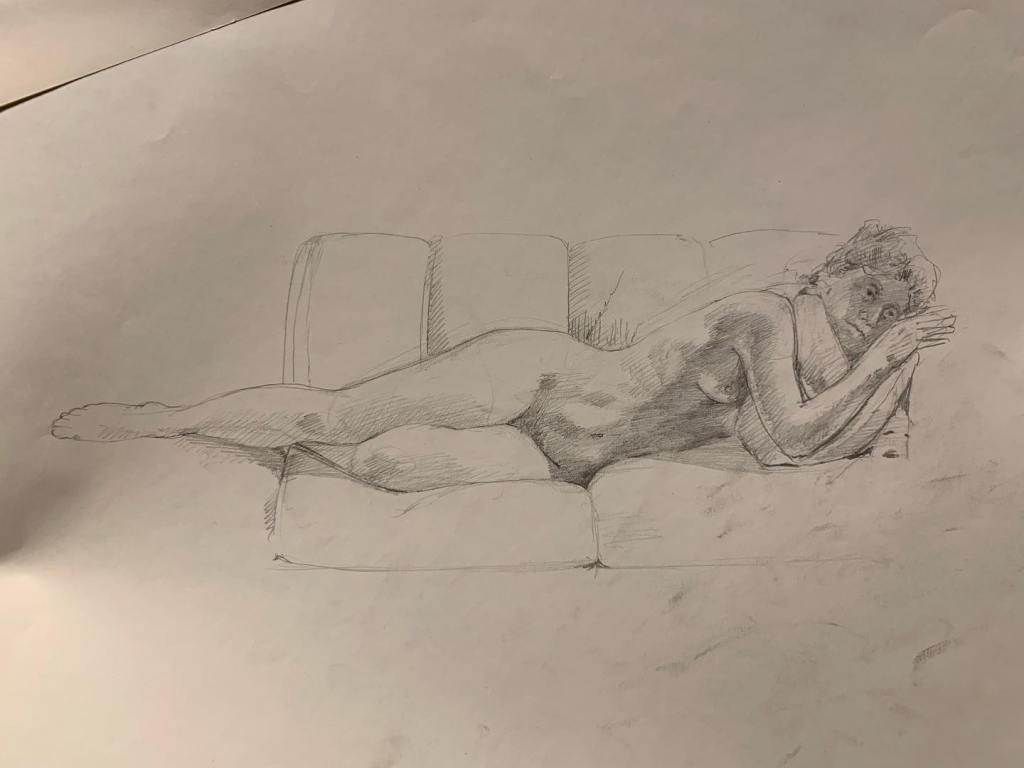
Nude by Christopher Cudworth, circa 1977.
Through all of that study, I ran and ran and ran. Typically 800 miles just during cross country season alone. Then came indoor track. Then outdoor track. Then summer mileage done alone in June, July and August. Then it was back to campus for another go. Another season. Line up and wait for the crack of the gun.
Between all that came January terms in which I drew nudes for six hours a day the first year, traveled to the Cornell University Laboratory of Ornithology for an internship the second year, painted four 4′ X 8′ murals for a nature center the third year and frankly, I can’t recall what took place during January of my senior year. But I was in love with a girl and that was enough, in any case.
When it was all over I fell into a job as an Admissions Counselor for the college and met my quota, but it was a time of disillusionment. The Admissions office was in a period of great transition and the college was facing enrollment pressures. When I popped out the other side I had learned a thing or two about office politics and the realities of the world and money. Frankly, I was embittered.
But I was still loyal to my friends and memories of the college experience. Perhaps a bit too much, as years later my wife finally complained that I talked too much about it all. So I put the edit feature on and realized that yes, maybe romanticizing the college experience was a bit much as you grow older.
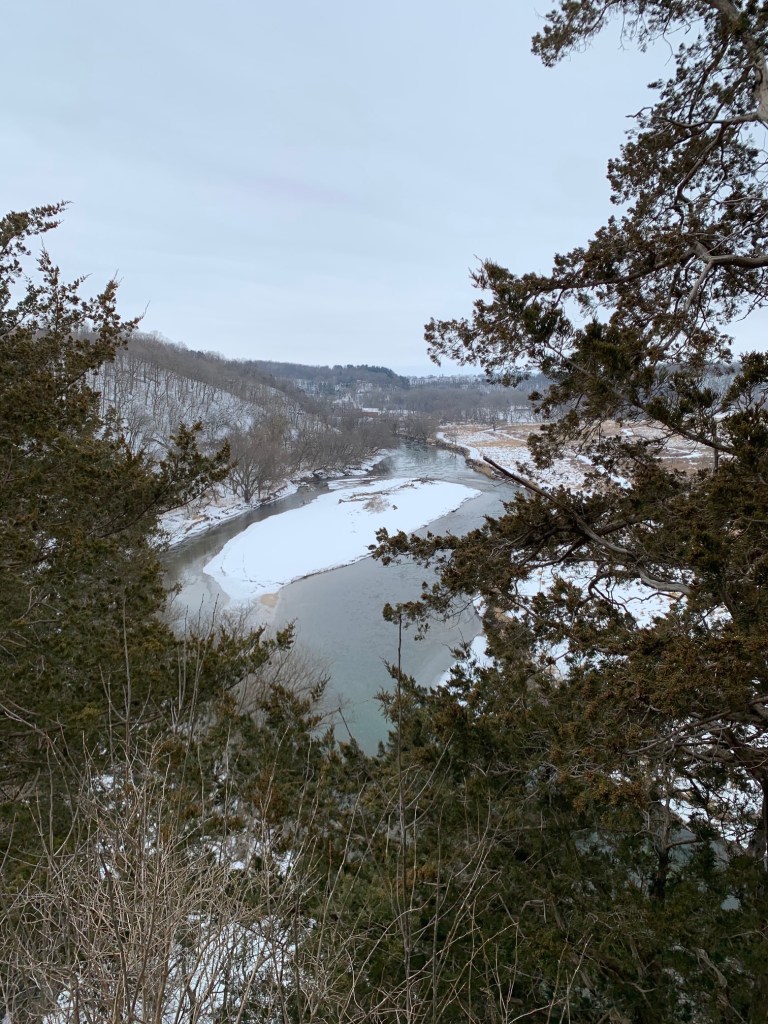
A view of the Upper Iowa River and Oneota Valley in Decorah, Iowa.
That said, Decorah, Iowa has always been a lovely place to visit. It was an enormously beautiful place to train. I’ve probably been back (and I don’t want to exaggerate) nearly one hundred times over the last forty years. To run. To ride. To cross country ski. To canoe and kayak. To have sex in the woods. It always reminded me of the hills in Upstate New York where I was born and returned many times as a child.
Now I’m even collaborating with a retired Luther College Professor of Religion on a new book in review with Literary Agents. It is titled Rescuing Christianity from the Grip of Tradition: What Jesus’ revolt against religious authority teaches us today. So the college of ideas and contributions to the world never really ends. It changes. Undergoes metamorphosis. Matures.
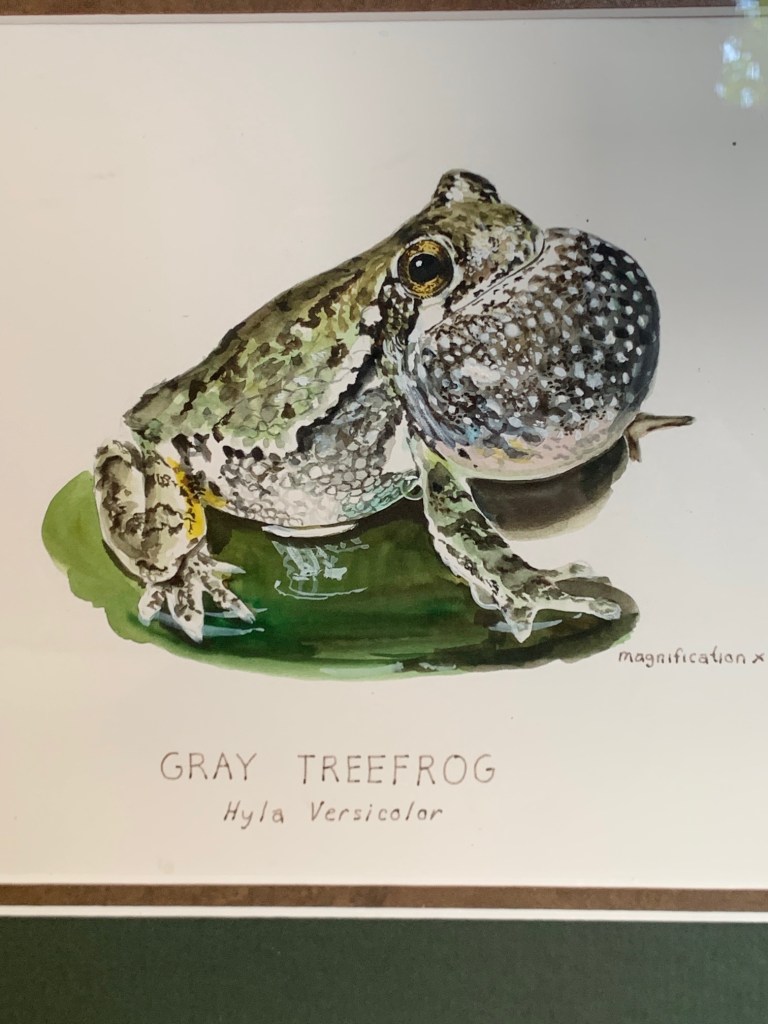
I’ve held art exhibitions on the Luther Campus several times. I often visit my art professors when back in town. And recently, I dropped in to visit a former biology professor to view a collection of frog drawings that I’d done for field biology. He’s always supported my work, and it was fun to see those highly detailed renderings of the frogs I’d studied and painted all those years ago.
And last year I joined one-hundred other former track athletes for a big reunion. It was fun to meet other Luther tracksters, both men and women, that had competed over the years. We covered many of the same roads together, and in separate eras. There’s a bond in that too. I’ve turned some of those experiences into art.
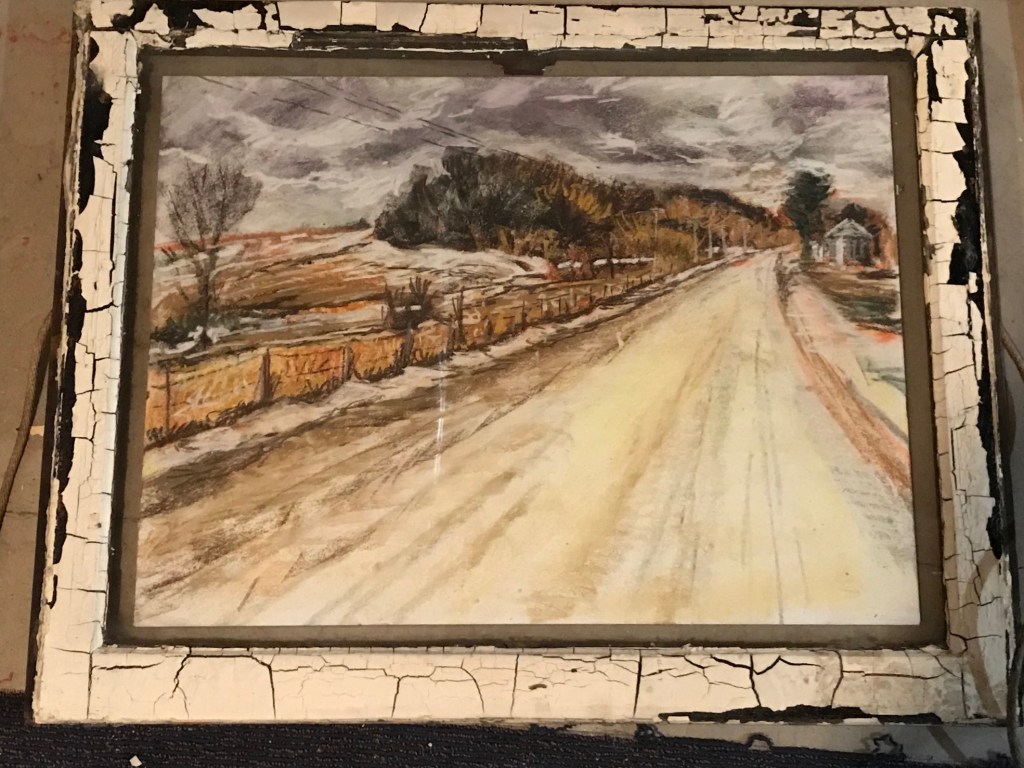
Pastel by Christopher Cudworth
Sometimes I’ve pondered the meaning of those four years against many other friendships and experiences. I’ve had several jobs that lasted twice as long as the Luther experience, and the people I’ve met there are still friends. That’s a good thing.
Yet those college bonds remain something special. And now that we’re “up there in years” in the eyes of society, we all kind of laugh about how long ago we ran together. All those miles. All those stories. All those accomplishments, failures and experiences.
They do matter. They still matter. They were formative. They were shared. They took hard work to achieve. They built loyalty and bonds, both personal and institutional.
And because there is considerable history and tradition behind the idea of “giving it the old college try,” many people do maintain loyalty to their college or university. That’s why big time college sports is so popular. It means something to have a “family” of sorts to which one claims to belong.
In our case, we were able to place second in the nation in cross country, and there were several trips to track national championships as well. That senior cross country season was something of a fluke because one of our best runners was hindered with a bad back, another had a toe injury that limited training and racing. But other people stepped up in the wake of those difficulties and it all came together on the right day. Everyone that ever ran for the program contributed to that achievement. A few years later, another Luther team placed even higher, winning a national cross country title in 1985.
That sort of magic only happens a few times in life for most people. Some never experience it at all. But it is the moments in between that make up most of our lives, and college tends to be a foreshadowing of all that eventually takes place in life. That includes happiness and love as well as sorrow and loss.
So we celebrate the college colors…the Blue or the Red, the Orange or the Green or the Black or the Brown. And once in a while we stumble on a photo of those old college friends and give it the old college try once again. And smile.
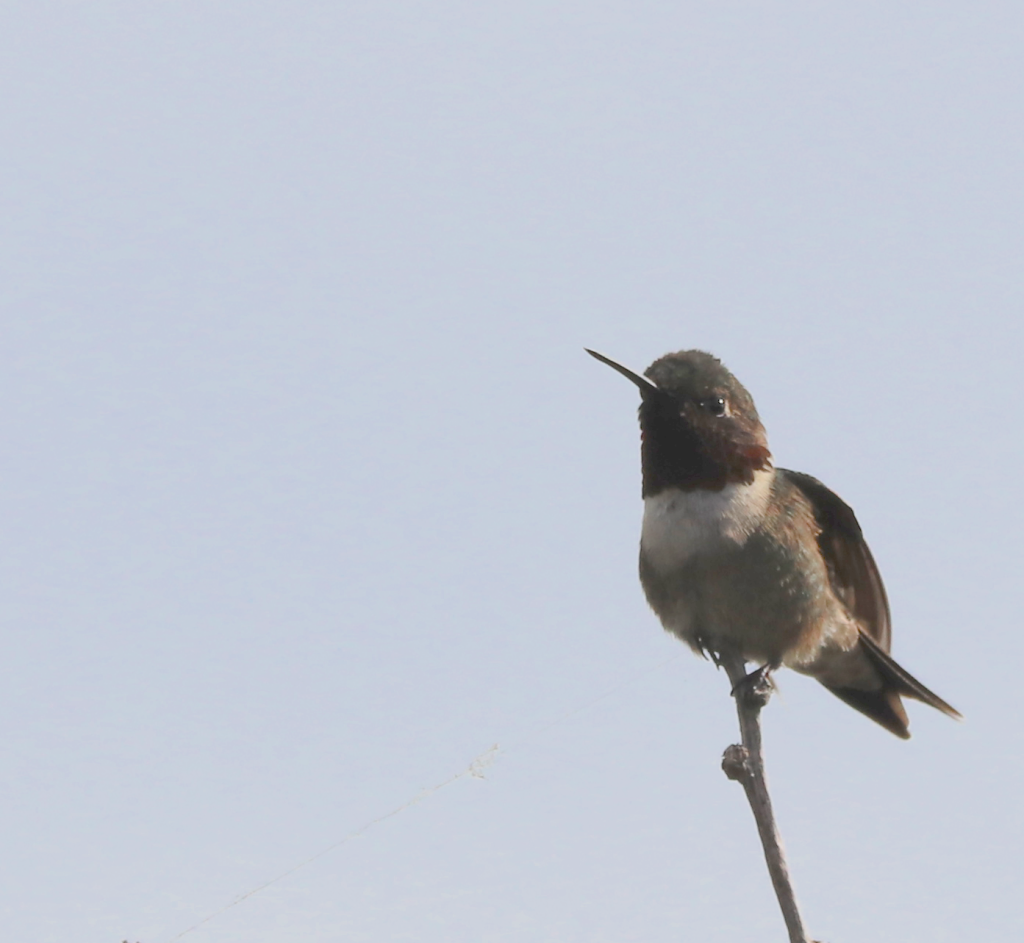
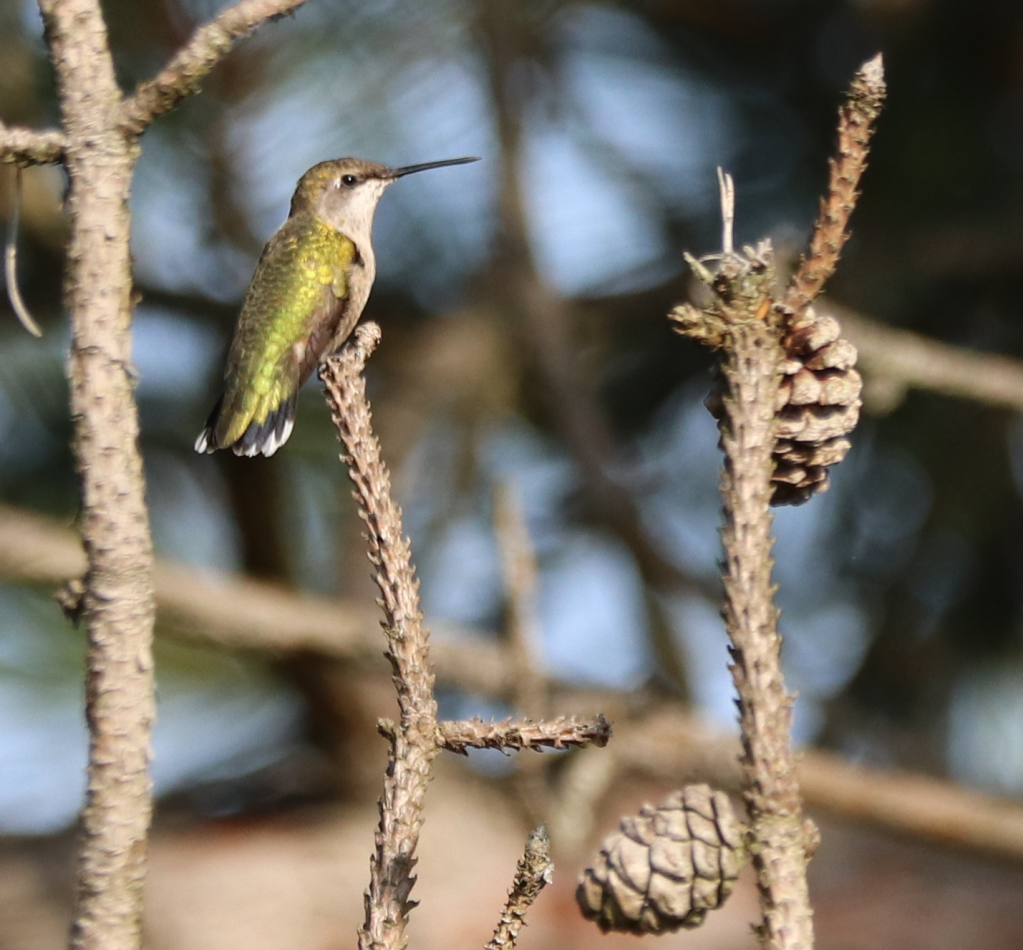
Ruby throated hummingbird just in from Central America.
About two months ago, a flock of hummingbirds gathered near the shores of the Yucatan peninsula on the East coast of Mexico. Their goal was to fly across the Gulf and arrive somewhere on the shores of Texas.
The website Yucatanexpatlife.com carried this fascinating description of their journey north.
“Untold numbers of migrating ruby-throated hummingbirds fly non-stop 600 miles across the Gulf of Mexico from the Yucatán Peninsula and Central America each spring and fall. Even to experts, it’s amazing to think that a tiny bird weighing no more than a nickel could fly 18 hours straight across the Gulf without resting or refueling.
Although modern radar studies and other research bear this out, ornithologists at one time struggled to see how such tiny creatures could be up for the journey. One theory had them flying over land across Mexico, making refueling stops along the way. Some even thought they perhaps flew piggyback across the Gulf, picking up a ride from ducks and geese. Even that was easier to picture than a non-stop flight.”
Ruby throated hummingbird female. Photo by Christopher Cudworth.
Unbelievable, yes. But they do it.
That’s called efficient use of fuel. We can only assume that hummingbirds go Old School to accomplish this endurance feat. They know what to eat and when. Then they choose a southern breeze and make a run for it. They’ve been making the journey for tens of thousands of years as climates moderated and provided habitat suitable for summer breeding in North America.
This morning I was talking with a neighbor when she pointed to a naked limb behind me. I spun around with the camera I was carrying to take photos of the Ruby-throated hummingbird that comes to her flowers and feeder. The bird was silhouetted against a bright morning sky (see photo at top) to gather nectar. The tongue inside the bird’s head protrudes to such up the sugary substance.
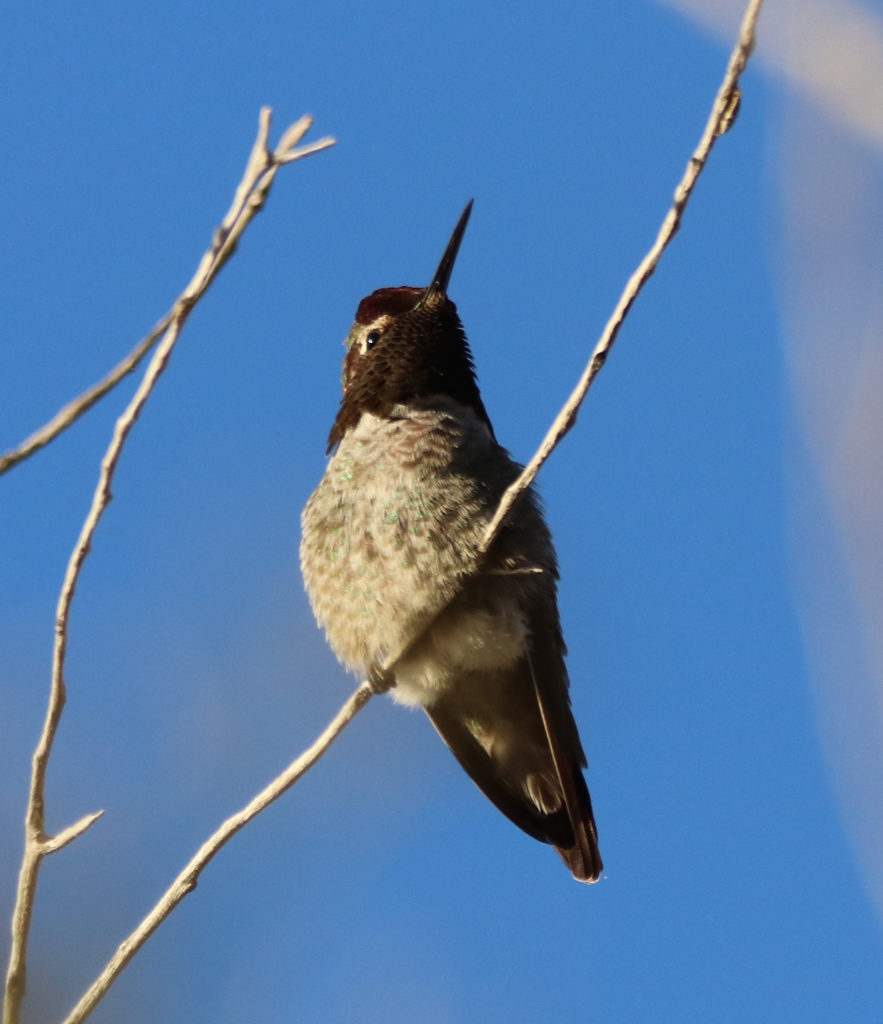
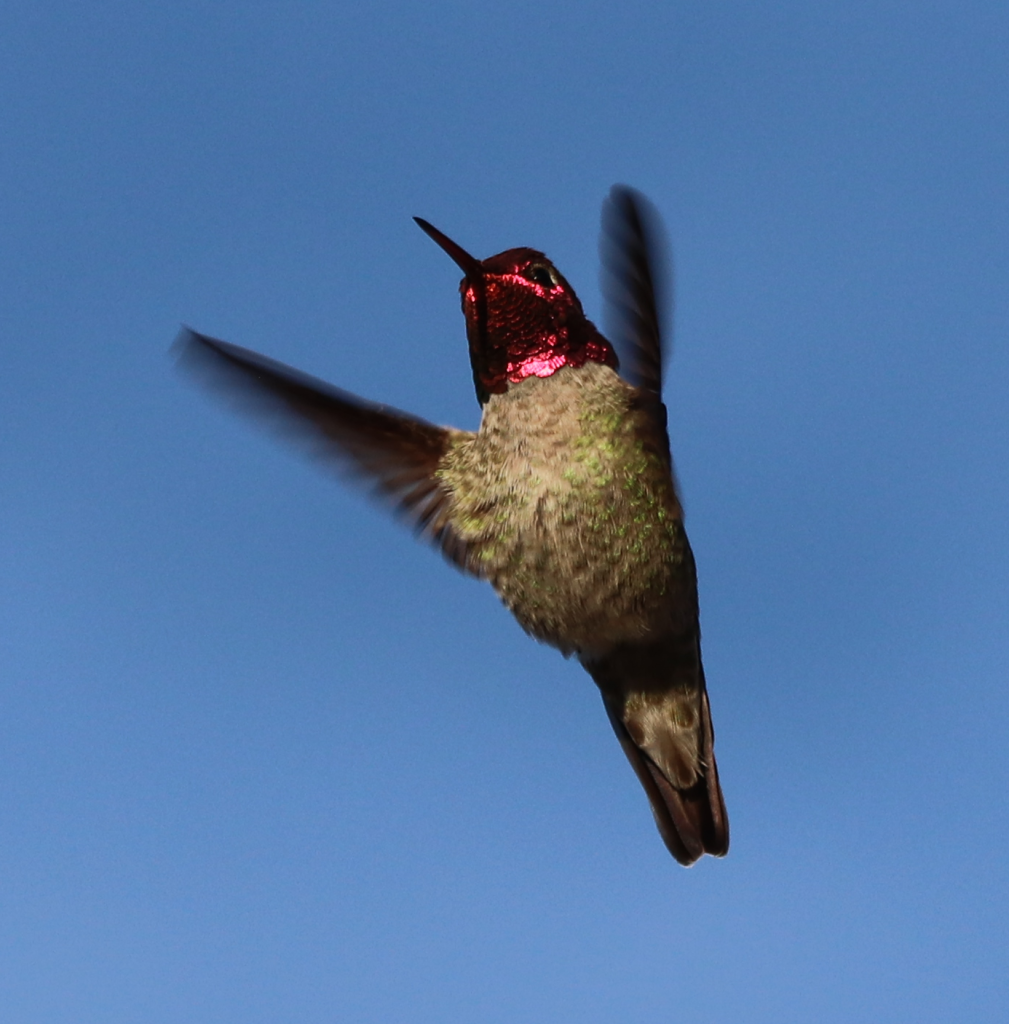
Anna’s humminbird. Photo by Christopher Cudworth
Hummers also capture insects in mid-air. I’ve seen them flycatching and while they don’t plunge out of the sky in a stoop like a peregrine falcon at 190 mph, they are nonetheless merciless in their pursuit of food.
They are also competitive little buggers. If you live in an area with a multitude of hummingbirds, the fights around the feeders can get rather vicious. They may be small birds, but they’re tough.
On cold nights they hunker down and go into dormancy, lowering their metabolism like some sort of Superhero to save energy. Even the Ironman Tony Stark would be quite impressed with that biological technology. And all those Ironman athletes trying to spread their nutrition out across a ten or twelve or fourteen hour day could probably learn a few things from a tiny bird capable of flying six hundred miles straight over the Gulf of Mexico. Yes, a hummingbird kicks your ass in the endurance department.
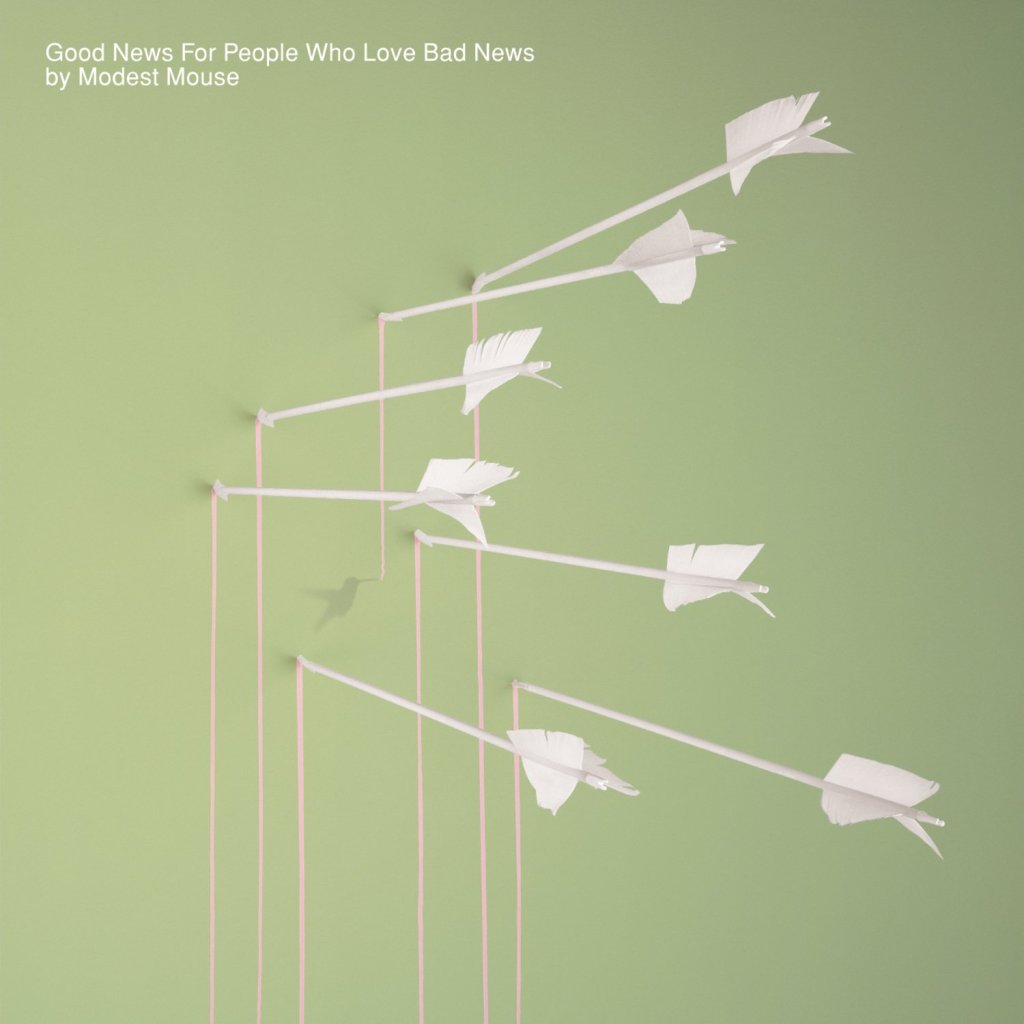
Perhaps all these determined attributes are why the group Modest Mouse chose to place the shadow of a hummingbird between arrows that had obviously missed their mark. It seems to symbolize there is hope in even the smallest bit of resistance to being targeted in this world. That is why the green bleeds pink.
Or maybe being a hummingbird in this world is about standing up to something far bigger than ourselves. It might even be about the fact that the powers controlling this world aren’t as perfect as we’d all like to believe. Consider these lyrics from the Modest Mouse song Bukowski:
If God controls the land and disease, Keeps a watchful eye on me, If he’s really so damn mighty, My problem is I can’t see, Well who would want to be? Who would want to be such a control freak?
An Anna’s hummingbird in Arizona. Photo by Christopher Cudworth.
The Bible suggests as much when it quotes Jesus in saying, “The meek shall inherit the earth.” But perhaps the meek are not so powerless as some like to think. Perhaps there is a hummingbird effect in this universe in which the beating of a billion tiny wings ultimately changes destiny. So many people love to clamor toward the supposed power and elegance of an eagle, but they are ponderous and weak by comparison to the super-fueled grace and agility of a hummingbird.
So be careful where you place your trust in the true powers of this world. As endurance athletes know, it’s not always the biggest or strongest that win the race, but those who can outlast and even outmaneuver others. In the end it may just be a hummingbird that kicks your ass. Or you could be the hummingbird this world needs someday.
With the weather warming up here in Illinois and a three-day weekend ahead of us, my wife and I planned out a bit of cycling and running. It actually started on Friday afternoon with a 55-mile ride in windy conditions. We both rode our tri-bikes in aero, and toward the middle of the ride I felt great and she was supposed to stay in Zone 2 for the entirety, so I asked if she’d mind that I went ahead.
“Go for it honey,” she smiled.
So off I went. The ride wound up being just above 18mph in pretty stiff conditions so that was a happy day. She noted my exuberance to her coach Steve Brandes and he texted back, “You need to give him some little wins now and then.”
I love that kind of humor. Because it’s true. We all do need little wins of one kind or another. The next day I went to the track and did a set of eight 400-meter repeats at 7:14 pace. That’s a major hurrah in my book of late. My running sagged so badly last year due to a string of injuries and one major health problem with an infected tooth that I didn’t think quality would ever come back.
The next morning I rode another 36 miles on my own, again with some stiff winds blowing me about, and took a tour through the little town of Big Rock way down at the southwest tip of our county.
Next time I’ll be heading even further west, out to Plano where one of the Superman movies was filmed. That’s also near Yorkville, Silver Springs State Park and the famous Farnsworth House where I have tried on two occasions to lead some bird walks but they kept getting rained out. At any rate, that led to my producing a poster of the Birds of the Fox that turned out pretty well. It’s pretty territory out there.
That’s what I do this time of year. Alternate between birding, biking and running
Come Sunday it was time for a run with Sue. We queued up by the Fox River in North Aurora where the parking lot was full. The trails were busy too. Some people wore marks and others did not. It was hot and humid, and I cannot imagine trying to wear a mask to run in conditions that thick. So we didn’t. I just made sure to give everyone plenty of space.
And I ran ten miles, which is a big notch for me, as my weak hips and sitting in a desk chair all day have kept my longer runs to seven miles. But I decided to stretch my luck and wound up doing 9:03 pace for ten. Which isn’t bad on a hot Sunday morning with two decent bike rides in my legs already.
Then we rode again Monday morning, this time a slow 36 miles together on tri-bikes, wisely choosing to go mostly East and West to avoid having to grind into a solid 20mph southern breeze.
Memoriable Day
There is more than one kind of patriotism in this world. Social justice is critical to true patriotism.
Monday afternoon we both took short naps with the air conditioning on. I spent a couple hours watching a documentary show about the origins of World War II, how it all got started and how those fascists in Europe came into power. It all sounded really familiar with labor strikes and recessions, speculative investing, the Roaring 20s and the stock market crash fueling a worldwide upheaval while Japan and Germany each eyed expanded territories to feed and fuel their societies. Economic upheavals drove countries mad while authoritarian leaders clawed their way into power. Mussolini cartoonishly took over Italy and turned his sights on Africa while Spain fell under the spell of fascist rule as well.
It wasn’t that long ago, and yet the film was all colorized footage in a speciall called “The World War II in Color. Recently I also watch a big portion of the Ken Burns special on the Vietnam War. And in person, I once ran across the field at Gettysburg where Pickett’s Charge took place. So damned many people have died in all the wars fought by Americans. Some of them here. Many of them overseas.
Civil War redux
About that Civil War here on our soil. It’s feeling more like those old Confederate issues have roared to the forefront of society with selfish states acting like they don’t have to play with others and racists claiming their rights are being impinged upon.
And yet the statistic that shocks me is that more Americans have died from gun violence on American soil than all the soldiers killed in foreign wars combined. It always strikes me that we have a day to memorialize the sacrifice of those soldiers yet nothing is done to acknowledge the lives of the innocent sacrificed for the right to claim selfish ownership of lethal weapons in our country. That is the ongoing Civil War in which we’re all engaged. And recently, those gun zealots even took over a state capitol to prove the point they are a militia under no one else’s control. That’s a breach of the Second Amendment, which clearly states, “A well-regulated militia, being necessary for a free state…” And yet we let these priggish morons walk around toting weapons?
Let’s stop tolerating these abuses. They are terrorists in violation of our Constitution.
The carnage created by the twisted version of the Second Amendment we now abide is a direct result of that perversion of law. I think Memorial Day is an incomplete holiday without some mention of that. It was Memorial Day Weekend, and I think about these things while running and riding those miles. When will our country figure out there’s no such thing as freedom when someone can walk into a church, a concert, a store, a college or a mosque and kill dozens of people at will? That’s not freedom. That’s a sickness of mind to think so. Memorial Day celebrates the freedoms earned through sacrifice while ignoring the selfishly vigilante instincts and rabid brand of fear that dominates so much of America.
And the supposed man in charge calls those “good people.” Let’s all remember that for once. And for all.


















 We Run and Ride