Suzy Favor Hamilton shows how difficult the race against depression and anxiety can be

There is a scene in the movie Men In Black where the characters played by Will Smith and Tommy Lee Jones resort to the supermarket tabloids to find out what’s really, truly, actually happening in the world.

Suzy Favor Hamilton is one of America's all time leading female distance runners.

Suzy Favor Hamilton is one of America’s all time leading female distance runners.

That feeling crossed my mind this morning when encountering a story posted by The Smoking Gun that 3-time Olympic distance runner Suzy Favor-Hamilton has been leading a double life as a Vegas escort.

The story also appeared on the cover of today’s Chicago Sports section of the Chicago Tribune. The article there, posted by respected Tribune Sports reporter and longtime track and field expert Philip Hersh, gets quickly to the point that Favor-Hamilton credits her battle with depression for the “decision” to engage in her double life.

Her husband Mark was apparently aware of the life his wife was leading. That intimates a complexity to the situation that you or I may never know about, nor should.

How it happens

There could be a dozen other factors contributing to such a stunning revelation that the highly attractive, well-to-do and well respected athlete had engaged in such risky behavior.

There was naivety at play. She reportedly did not think her clients would ever make mention of her actual identity when she shared that information with them. She was known in her trade by the name “Kelly” and was regarded as one of the top “providers” at the company where she worked. Suzy Favor-Hamilton was apparently an achiever even in her second life.

Her athletic career had been filled with triumphs, marred only by an apparently purposeful fall at the 2000 Olympics when she realized she could not medal. She had been running to honor the memory of her brother who had committed suicide the previous year. At the thought of failing, she took the fall rather than complete the race. The reasons for those actions might seem like a flaw of character, but in reality they reflect a multitude of issues with which more than a few athletes must cope.

The fine line of Olympic success

Athletically, it might have been that Suzy Favor-Hamilton simply didn’t have that “top gear” that differentiates world class from Olympic champion. She can hardly be faulted for that, nor can any of the other thousands of athletes who have tried to win Olympic medals, and came up just short. Many of the world’s all-time great distance runners including Ron Clarke never earned that medal. Things have to be perfect on that day, and perfect in preparation and even basic talent to make it possible to swing by the pack in that last 100 meters and sprint to Olympic glory.

The Dave Wottle story

dave_wottle_oly_chmp

Dave Wottle came from far behind to win the 1972 Olympic 800 meters

One also has to be lucky. And a little tricky sometimes. And calm. Cool. Have a great race strategy. And trust yourself. Don’t let your image or ranking or anything else control your thoughts. Consider the amazing come-from-behind 800 meter Olympic race of 1972 competitor Dave Wottle. (Youtube video of race). The man with the slow start and the determined kick comes from behind to win against supposedly superior competitors.

Wottle was an unprepossessing type. You can see that immediately after winning the Olympic 800 meter gold medal (see video) he was not demonstrative or flashy. He simply made the rounds with his ugly little golf cap perched on his head, shaking hands with his competitors. No carrying the flag around the track. No prancing and posing and acting like he knew he would win the race all along. In fact Wottle never really made much of his image at that moment or earned big commercial endorsements the way Olympic decathlete Bruce Jenner would go on to do. Wottle went on to coach at a Division III school.

Parlaying sex for success

Compare that with the life and times of Suzy Favor-Hamilton, who while talented and accomplished in track and field also had to wrestle with the fact that she was beautiful. Her profiles in running magazines often centered on her beauty, and she courted that attribute by issuing her own swimsuit calendar. Later, following her Olympic running career, she parlayed her image into a successful career in real estate, motivational speaking and doing appearances related to the Disney Marathon series.

Treatment and coping

Suzy Favor-Hamilton admits she made what she called a “big mistake” embarking on her second life. The Tribune notes that she is now seeking help from a psychologist. Her previous treatments had included taking Zoloft, an anti-depression medicine that has helped her cope with an affliction first recognized during post-partum depression. She has stated, “I realize I have made highly irrational choices and I take full responsibility for them.”

Going back into her career, she notes that she fell on purpose during the 2000 Olympic final because of a panic attack brought on by those self-imposed higher expectations of competing for her brother’s memory.

The costs of scandal

Like the scandalized world class cyclist Lance Armstrong, whose career has been caught up in scandal over alleged doping during his 7-year reign as Tour de France champion, revelations about Favor-Hamilton’s second life has cost her some sponsorships. The Rock ‘n’ Roll Marathon Series has ended its relationship with Hamilton.

Others have been more forgiving, on paper at least. A Wisconsin agricultural group for whom Suzy Favor-Hamilton has done promotional work stated, “We regret having learned about this today. We hope she finds some stability in her life. We will be evaluating our relationship with her.”

Long term struggles with mental health

The Chicago Tribune story notes that “Throughout her running career, Hamilton battled a series of psychological issues. In an interview with the Milwaukee Journal Sentinel last summer, she talked about dealing with anxiety, self doubt, eating disorders and eventually, postpartum depression after the birth of her daughter, not 7.”

Smokey signals

It appears that Suzy Favor-Hamilton was sending out signals all along that she wanted and needed help with her anxiety and depression. The fact that she acted out a dangerous fantasy that was essentially an exaggeration of her already sexualized image is simply an expression of the fact that she did not get the help she was seeking. Not from traditional sources, anyway. Where there’s smoke, they say, there is sometimes fire.

Hope for the future

Perhaps this accomplished athlete can emerge from her emotional challenges with the same strength and purpose that has marked the new career of fellow distance athlete Alberto Salazar, who also battled depression and other physical ailments that shortened his running career. Salazar has now become one of the world’s leading distance coaches, and one of his proteges, Galen Rupp, raced to a silver medal in this year’s London Olympics.

Self-fulfilling prophecies

Anxiety and depression affects more than a few runners, who may even turn to the sport in some respects for its ability to help them cope with an anxious or high-wired personality, or the opposite, a depressive inner persona that needs forcible release.

It turns out that so-called endorphins can be our friend or our enemy. In the case of runner Suzy Favor-Hamilton, it has turned out to be both. May she find truth from her experience, and may others show sympathy for her struggles.

WeRunandRideLogo

Posted in We Run and Ride Every Day | Tagged , , , , , , , , , , , , , , , , , , , , , , , , , , , , , , , , | 1 Comment

Getting out of the rat race

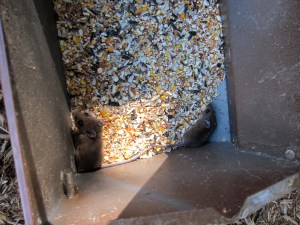
Two mice temporarily escaping from the rat race.

Two mice temporarily escaping from the rat race. Click for larger view.

Imagine the surprise I found a month or two ago when I went to refill the bird feeder that had been hanging on a limb of our pine tree all summer. Upon opening the lid of the bird feeder, what greeted me were two small sets of black eyes. A pair of mice was crouching on the pile of feed!

The mystery of this situation was vexing to me. Had the two small mice climbed up the tree together, dared the 8-foot trek out to the bird feeder and somehow found their way into the bird feeder?

Or, had the two small mice been in the feed that I dumped into the feeder a month or two before? Had they been living high on the hog ever since, gorging themselves on corn and seed whenever they needed. And if so, do mice need water to survive?

The mystery is still open in my mind. I cannot figure out which of these, or some other scenario is true.

But it struck me: For a while at least, these two mice were out of the “rat race.” They had all the food they needed, and were completely protected from potential predators. This was like the ultimate “retirement” plan for mice! If only I didn’t need to refill the bird feeder now and then, their gig was just about perfect.

We all imagine ourselves wishing for some similar situation in life. An environment or circumstance where all our needs are fulfilled. Where our innocence and carefree ways can be sustained. Where the rats in this world can’t get us.

But even the mice didn’t have it perfect, did they? For one thing, there wasn’t a whole lot of room to run around inside that bird feeder. Without exercise or maybe even a little stress, those mice might have gotten fat and died of obesity.

Fortunately there was a varied diet, to some degree. Corn. Cracked sunflower. Millett. Many of their nutritional needs could be met inside the bird feeder, and perhaps the moisture in the food would provide enough drink to sustain the two mice.

Yet we should suppose that mice eat more variety than even the bird feed could provide. Likely some fresh greens thrown in there now and then.

Their circumstance was also a confusion of the evolutionary process. If they were both either male or female mice, they could not breed, and their genetic history could not be passed along. Or, if they grew old enough to become rivals inside the feeder, and mice testosterone or progesterone took over, their might be a fight to the death.

Psychologically, the two mice might have needed stimulation at some point. While mice are good at living in confined spaces, wild animals ultimately need to move. Just look at the wolf at the public zoo, pacing round and round his faux environment. Going in circles gets old. We runners and riders know that. Everyone needs to roam, even get lost once in a while, or lost in the moment. People in cubicles lose their minds after a while. They have to get out. Run or ride around.

Which is why, rather than leave the mice in the hog heaven, away from the rat race the rest of the world must engage, I tipped the bird feeder up and let the two mice scurry off into the garden. They made haste, as if the starting gun had just gone off. Bang. 26 feet to glory. A mousey marathon of sorts. Or maybe just a half-marathon. A 10k? 5K? 100 meters? It’s hard to figure these things out in mouse terms. Or perhaps the mice just don’t care. Only we humans put measure to our running and riding. And who is the wiser, mouse or man?

Back into the rat race they went. Their wishful thinking was over. The bird feeder they’d made their home had to be left behind. They are better mice for the journey. It’s one we must all make, on foot or by bike, that we should enjoy the process.


WeRunandRideLogo

Posted in We Run and Ride Every Day | Tagged , , , , , , , , , , , , , , | 1 Comment

Why we should forgive rather than forget Lance Armstrong

Armstrong at a Livestrong appearance.

Armstrong at a Livestrong appearance.

Retired professional cyclist Tyler Hamilton’s book The Secret Race documents the doper’s decade of the 2000s when bike racers made a common practice of taking performance enhancing drugs and doing blood transfusion to increase hematocrit counts and raise oxygen carrying capacity. It was a turbocharged peloton for many years. In fact, without doping, the book contends, you were relegated to ride in the middle of the pack, or worse.

Lance at a glance

As the world’s premiere bike racer from around 1998 to 2005, Lance Armstrong was not only the fastest on his bike in races like the Tour de France, he was also best at blood doping. Evidence cited in Taylor Hamilton’s books suggests that Lance Armstrong did indeed turn up positive a couple times, but those tests were allegedly dismissed through payoffs or other arrangements with the UCI and other cycling organizations.

Driving force

The extent of Armstrong’s expertise at performance enhancement was not confined to his own bloodstream. He also required that his teammates also dope and do blood infusions. Yet it took a long time for these practices to become public knowledge because the Lance Machine was a big force in driving the sport as a whole, bringing in millions of dollars in team sponsorships and heightening the awareness of the Tour de France and cycling worldwide. To many people, Lance Armstrong was cycling. He was essentially the driving force of the peloton.

Lance the brand

In the public eye, Lance bore the burden pretty well. His carefully crafted image included humorous ads for Nike depicting Lance as a playful type who seemed to know more about the world than the rest of us. His Livestrong foundation paralleled that superhuman vision by leveraging Armstrong’s status as a cancer survivor to build a non-profit organization dedicated to cancer education and support for those suffering from the disease. The brand built around Lance Armstrong leveraged his manufactured good guy image into a worldwide, multi-million dollar phenomenon. The yellow Livestrong bracelet was everywhere. People got it: Lance was an athlete who cared.

Doubters and shouters

There were Lance doubters and haters all along, of course. Many in the French media thought he stole his Tour de France titles by doping. It wasn’t until Lance came back from retirement riding to a 3rd place in the Tour that he won a bit more French support because he seemed like an underdog fighting for a good cause. And in some ways, he was. That does not mean he was innocent of any wrongdoing even then, and his public feud with teammate Alberto Contador, who won the Tour that year, was for some people the first glimpse that perhaps Lance Armstrong was not the nice guy he pretended to be.

Crashing and burning

The next year with a different team, Lance Armstrong had gathered a group of riders that was dedicated to help him win yet another Tour de France. That dream ended with crashes and Lance Armstrong proceeded to finish his riding commitments that year and officially retired again.

Extensive hobbies

Armstrong jumped into the world of triathlons, where he hoped perhaps to use his remaining physical prowess to extend his brand and, perhaps, salve his considerable ego in a different sport where the scrutiny and rules were less onerous toward him.

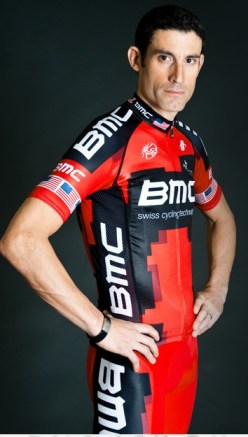
George Hincapie came clean.

George Hincapie came clean.

By George

Then came a Federal grand jury investigation in which close friends and former teammates allegedly testified that Lance had been doping during all those years of Tour success. These were credible witnesses, people close to Lance Armstrong that had good reason to talk. Many were being implicated in other pending investigations and ultimately made public confessions of their doping histories. The most notable of these was cyclist George Hincapie, a stalwart teammate to Lance Armstrong and other Tour leaders who had a crystalline image in the world of cycling as the ultimate go-to guy for team support. Yet Big George turned out to be a doper too. That’s when cycling fans really sat up and took notice.

Yet the grand jury investigation suddenly ended for reasons that were not made clear. That meant the truth would not come out from testimonies made by cyclists close to Armstrong. Some sniffed corruption in the way the Feds gave up. But there was more to come…

USADA strikes

The United States Anti-Drug Assocation  (USADA) went a few steps further, compiling its report and released it to the public. At that point, the Lance Armstrong Legacy started to crumble.

Armstrong tried to kick the accusation can down the road by saying that he would no longer fight the accusations, that they were ungrounded. It seemed like he was wishing the whole thing would blow over. Then he issued a statement (actually, a confession of sorts) that to discerning eyes showed the truth. Armstrong’s statement centered on the fact that he believed his efforts in the 7 Tour de France titles were justification enough for his victories. In so many words, but without saying it directly, Armstrong made the case that because so many people were doping, he had to dope himself in order to start with a level playing field.

Getting popped

And the fact is, Lance Armstrong was right. He was telling the truth about that. He may have been the best and one of the most prodigious dopers of all, but he was not alone. The peloton was a hopped up glory train of overpowered bike racers riding hellbent until they each got caught. And that happened. Tyler Hamilton called it “getting popped.”

Forgiveness and not forgetfulness

Knowing all that we do now based on the power of testimony from so many world class cyclists that they doped and did blood infusions, Lance Armstrong deserves some degree of forgiveness. Here’s why.

Tour winners, stage champions and team leaders such as Bjarne Riis, Christian Van deVelde, Tyler Hamilton, Floyd Landis and many more all were prodigious dopers. To a man, they all insisted they thought it was the right thing to do for their careers at the time. Cycling observers like Greg LeMond had at times publicly challenged the corruption of the sport, but the sport (and Lance Armstrong particularly) fought back the image that everyone was doping. No one should forget that. The sport tried to cover it all up. On that point Lance was not alone.

Ramifications

There are lawsuits against Armstrong for committing the crime of deception. That’s all going to be determined in a court of law, we must suppose. Additional layers of guilt or legal findings will not make the case against Armstrong any more damning than it already is.

Mea culpa lacking, must we make our own?

For perspective, perhaps we ought to consider the case of Lance Armstrong in comparison with other people we categorize as heroes. Some of them seem to have “cheated” in their professions as well.

John, Paul and the rest

Would the Beatles have been as creative without influence of illegal substances such as pot and LSD? Did they literally dope their way to writing the music for the Sgt. Pepper’s album, considered by some their best work? The Beatles also readily admitted “knicking” songs from other artists as foundations for their own music. Is that a form of cheating too? We also know that post-Beatles, John Lennon was no saint, and Paul McCartney got busted for pot. Yet we don’t judge those two geniuses based on their crimes, but on their work.

Bled dry

I’ve decided to look at the career of Lance Armstrong the same way. Like he said in his public statement: He put in the miles. Rode more than 2000 miles in each Tour. Suffered through heat and wind and near-fatal brushes with death in descents and untold pain on climbs. It doesn’t make sense to take that effort away from him. Yes, he doped well enough to win, but there were far more factors at work along the way that could have dumped his arse in the ditch along the way. His Lance-Armstrong-bleeds-fr-003comeback attempt was proof of that. The image of Lance Armstrong with a gash under his eye from a crash on the cobbles is enough proof that it was his hard work and racing that won those Tours, not the dope alone.

Was Lance Armstrong really a liar?

The answer to that question is yes, and no.

Was Steve Jobs essentially (by personality at least) the Lance Armstrong of the computer set?

Was Steve Jobs essentially (by personality at least) the Lance Armstrong of the computer set?

We live in a world where people lie, cheat and steal to get ahead all the time. In business, when software or technology giants steal ideas from one another, they often go to court to battle it out. That’s what’s happening with Samsung and Apple right now. Is that any different than Armstrong versus Ullrich, each doping to maximize his chances for victory? Are there also mysterious “doctors” behind the scenes of those business battles just as there were in the cycling doping wars? Of course there are. Corporate espionage and business intelligence is every bit as competitive as life in the peloton. Perhaps moreso.

The Jobs and Lance parallel

We also know from his biography that Steve Jobs could be a difficult jerk at times. Yet some attribute Apple’s success as a company to that Jobs trait of demand for perfection. In other words, he was just like Lance. The parallels between Steve Jobs and Lance Armstrong seem almost stunning. Two of the world’s greatest brands, and what do we find behind them? Hard-nosed, driven men, both who battled cancer yet defined their life in ways that celebrated the bitter importance of making the most of every moment. Their examples may be flawed in some respect, but they are examples nonetheless. Just like King David in the Bible, who had so much blood on his hands that the Lord denied David the chance to build a temple in His honor. Yet David too was forgiven.

The good, the bad and the ugly. All forgiveable.

The story of Lance Armstrong all breaks down rather neatly through hindsight. The good (winning 7 Tours) the bad (the doping) and the ugly (being a jerk to wives, teammates and some who once helped him.) All of it is true. All of it is ultimately necessary to the story, and whether we forgive or forget Lance Armstrong.

Competitive realities

We have to ask ourselves: Are we intellectually capable of understanding the environment in which Lance Armstrong operated? We can also understand the need for that environment to change, and that appears to be happening. But one can’t permanently blame Lance Armstrong for his response to a competitive reality that many great men, not just Lance Armstrong, chose to engage through doping. As we shall see, going from whore to hero (and sometimes back to whore again) is something of prized tradition in American politics, economics and culture. Happens all the time. Ask Bill Clinton, who as President succumbed to pleasure, but who has gone on to become one of the worlds’ premiere statesman, with a wife who has ably served as United States Secretary of State. Now that’s the power of forgiveness in action.

The porn of the peloton?

Traci Lords shows off her cycling kit from the early part of her racy career.

Traci Lords shows off her cycling kit from the early part of her racy career.

Perhaps the entire era was a bit like the pornography of the peloton, an exaggeration of truth, and a bit sordid. But you know what they say: pornography drives technology. Pornography is a $14B industry and we’ve seen a few porn stars make the leap from hardcore to mainstream roles in society. Traci Lords. Sasha Grey. Ron Jeremy.

We have also seen what the hopped up boys on bikes dressed in tsexy suits can do when their sport is a lurid pantomime or regular bike racing. We’ve watched them effortlessly rolling up mountains when they are engorged with packets of their own blood. Cyclists during the doping era were like giant human erections. But it’s time the sport crossed back into the mainstream again.

No less thrilling roles

Sure, the doping era was thrilling in its way. But now it is up to the un-dopers to surpass those thrills under legal circumstances. The powers that be have passed judgment on Lance and the rest. They have been branded porn stars for their transgressions. But even porn stars can teach us a few things. And they have.

Cleaning up its act, to a degree

The peloton is reportedly cleaning up its act these days, and that will be a good thing if it is true. It’s just not necessary to write off the sports former stars in order to enjoy the stars of the future. That effort is futile, and we should not forget how well Lance Armstrong rode his bike, or Jan Ullrich, or Marco Pantani or Alexander Vinokourov, who by the way allegedly paid off another cyclist to let him win.

We treasure colorful personalities and even a touch of the unimaginable and absurd to allow sport to mimic the good, the bad and the ugly realities of the real world. Right down to the porn stars, whose largely denied role in society nevertheless drives $14B in business per year.

How to forgive, and not forget

We all like to believe we’re people who believe in the value of honesty and virtue. The morals of our religions strike those notes with clarity. Yet the fabled story of the prodigal son shows that it is right to forgive and welcome even the squanderous among us home when we’ve indulged in debauchery. We all deserve a second chance. Even the dopers and the driven, all should be forgiven.

WeRunandRideLogo

Posted in Uncategorized | Tagged , , , , , , , , , , , , , , , , , , , , , , , , , , , , , , , , | 5 Comments

For those who run and ride, the right car can be a Godsend

The Silver Steed Toyota Matrix.

The Silver Steed Toyota Matrix. Click pics to view larger.

By Christopher Cudworth

Anyone who runs and rides knows it is important to have the right support vehicle to enjoy your activities. A good car has to be reliable, get decent gas mileage, hold a roof rack and have storage space for bikes, running gear, cross country skis or whatever activity fills up the calendar of training and racing.

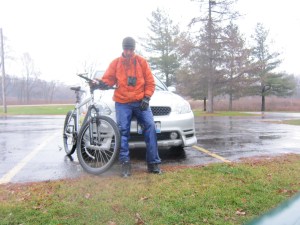
Since 2004 the trusty vehicle that I have driven is a Silver Steed, the Toyota Matrix. A great “little” car.

The Matrix is not often advertised. It’s almost as if Toyota built a bunch of these vehicles and then forgot they left them on the car lot. Seriously, have you ever heard a commercial dedicated to the Toyota Matrix? Guess this review will have to do so you won’t think I’m nuts. But actually I think this guy’s full of crap on a couple points in his review. And maybe the newer Matrix isn’t as good as the original 2004 editions? It can happen?

A trying buying experience

In fact when I was car shopping the sales guy at the dealer listened patiently to my description of what I wanted in a vehicle and proceeded to show me the Rav4 and other vehicles, but never mentioned the Toyota Matrix. It was not until I began to wander the rows of vehicles on my own, admittedly frustrated, that I approached a Toyota Matrix and said aloud, “What the hell is this?”

Like every new car dealership, the new vehicles are locked. So I had to go inside and ask to be let into the Matrix to have a look for myself. The sales guy trudged out in the heat like it was the worst thing he ever had to do, handed me the key fob and said something like, “Have at it. I’ll be right back. One of my customers is closing a deal.”

Fine, I thought. Get the hell out of here. I’ll check out the car and buy it somewhere else if I like it. And that’s exactly what I did.

Like a hatched caterpillar, this cyclist emerges from a Matrix cocoon.

Like a hatched caterpillar, this cyclist emerges from a Matrix cocoon.

There are many reasons why the Toyota Matrix is a great vehicle for those who run and ride. It would have been the absolute perfect vehicle in my mind if they made it as a hybrid. Now the Prius comes in models that mimic the Matrix body style, so that would be a nice alternative one day. But the Matrix does get a steady 30 mpg around town and perhaps 35 on longer trips on rural roads. So not bad, but not perfect.

The Matrix has a roof shaped like the back of a dolphin, arching upward right where you need the most headroom. The driver’s seats also sit up a little higher than many similar small to midsize vehicles, so visibility is great while driving, birdwatching or enjoying the scenery on your way to an event.

Built on a regular Corolla chassis, the Matrix rides reasonably smooth. It isn’t the quietest vehicle on earth. But the shifting on my automatic has always been smooth and dependable, and the pickup even with two or three passengers is great. Even loaded down with a road bike, some art I was toting to a gallery out of town and a bike rack with a mountain bike on top, the Matrix zipped in and out of traffic and got 33 mpg on a 250 mile trip through rolling country in Southwestern Wisconsin.

My daughter’s dark grey 2005 Matrix is all-wheel drive. In the snow it puts my front wheel drive silver Matrix to shame. I feel good that she’s got a safe vehicle to handle trips out to college and back. Unfortunately last spring some nutball swerved into the back of her vehicle, slamming the bumper and frame so hard the car was totaled. After

This ended the life of one Matrix. But just like the movie, it came back in another life.

This ended the life of one Matrix. But just like the movie, it came back in another life.

several months of negotiation with the insurance company and an intense car search online with the list of dealers the insurance company provided, we lucked out and found nearly the exact same year and model Matrix on a lot near our home. It was just like the Matrix movie! A Neo Matrix! Born again from some digital universe!

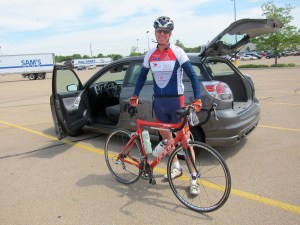
We drove it out to her college town with her apartment stuff and my road bike in the back. Then she drove me back to a Walmart lot in Dixon so I could ride the 70 miles home.

Can you see into the future?

Can you see into the future? Another Arrow in your future.

The Matrix is perfect for such ventures.

Reincarnation

I also realize the Matrix is a reincarnation of the first vehicle I ever owned, a bronzy gold (so 70s-80s) Plymouth Arrow hatchback that was my chariot during primo running years and beyond. That car took my wife and I around the country during our dating years from the East Coast to the Upper Peninsula, from Colorado to the wilds of Iowa (shown here, a canoe trip on the National Wild and Scenic Upper Iowa River). You never lose that feeling of first love…

A stuffed Matrix is a happy Matrix

I have literally stuffed and piled that car with bikes; two in the back and one on the roof when my wife and I went on a riding vacation together with friends. The Matrix looks happy with a bike on its roof. The tailgate hatch opens wide in back, and the hardshell backs on the flop down seats don’t mind when you slide a bike in and out of the car. They’re tough enough to handle a lot of junk like lumber and Christmas trees and dogs when they have muddy feet. You just wipe them down with a wet cloth. Seriously, I cannot imagine a car without these features.

I don’t rep for Toyota and don’t get a damned thing for writing this glowing review of the Matrix. And to be honest, there are a few things wrong with it. The little latch on the front trash bin broke 2 days after warranty on the vehicle ran out, and it fell open so often I just pulled it out.  Also, the center CD & stuff holder lost a bolt somewhere along the way, and it is now loose. And annoying. I should fix it. There’s a resolution.

Will this be house my Matrix looks in another 10 years, when it has 200K on it. We're at 150K now.

Will this be how my Matrix looks in another 10 years, when it has 300K on it. We’re at 150K now.

My Matrix has gotten bumped up a couple times. Turning right onto a street from a commercial parking lot, I accidentally raked the right side on a rock the property owner stashed there out of sight from turning drivers. The repaired paint is showing rust bubbles after 5 years. So be it. Marks of experience.

Repairs have been few. That’s why we bought a Toyota. We also own a Chevy Impala because we wanted to “buy American”, but when we got the car home we noticed that it said on the door, “Made in Canada.” So we felt sort of screwed about that. The Chevy has had all kinds of work done on it; steering column replacements, shivs shoved into the engine block to level it out, and the heater fan has been replaced more than once. A yellow light that says Coolant Low has been on for 40,000 miles and the gas gauge hasn’t worked since we don’t know when. We hear the new Chevy Impalas have very few problems. Our car was the guinea pig, apparently.

But the Chevy can hold a bike in its big ass trunk. My wife has rescued me a few times when I ran out of tubes getting flats on a long ride. The Chevy still looks pretty good from a distance when you can’t see its patina of scratches and mild dents. It’s always a welcome sight when my wife shows up on the road to rescue me from a bad ride. It hasn’t happened often, but it reminds me how much we all depend on certain things to participate in our sport. She’s always got the classical music going when I take off the wheels and toss my bike in the back. Then we chat on the way home like nothing’s happened. She knows I can change a flat these days and never call her unless I’m completely busted down.

Cars and spouses hopefully understand about us runners and riders. We need a good meat wagon when the bad days roll around. Flats. Pulled hamstrings. Busted chain.

For now that’s the posse. The Impala and a Matrix or two. A few friends too, have picked me up over the years. Grateful for them all.

WeRunandRideLogo

Posted in We Run and Ride Every Day | Tagged , , , , , , , , , , , , , , , , , , | Leave a comment

Running and riding past the tarsnake of those sexy cigarettes

By Christopher Cudworth

IMG_8287I once did the math on the number of cigarette butts along a stretch of busy road near my home. It had come to my attention that there were quite a few butts stuck on the roadside between one of the major traffic lights and the entrance to a movie theater ¼ mile up the hill.

So I calculated the number of feet in that quarter mile (5,280 per mile divided by 4 = 1320) and counted the number of cigarette butts in a few different spots along the length of this road. There were literally cigarette butts in every foot of that ¼ mile section of road, and the average turned out to be 16. Not exactly scientific, I know, but my curiosity demanded some mathematics, so you’ll have to bear with me. But I do not think it is an exaggeration to say there were at least 21,120 cigarette butts along that ¼ mile stretch of road.

A concentration of butts

The concentration of butts was exceptional at that little point in the universe, I will grant you that. But the math experiment illustrated the point that there are one helluva number of cigarettes thrown out of car or truck windows by smokers every day. Suffice to say the ashtrays in those cars do not likely see much action. It must be far simpler to litter the roadways than deal with the visible and olfactory consequences of your own smoking habit. That’s a living, breathing tarsnake if one ever existed.

Think for a moment about that word: ashtray. It’s a tray. For your ashes. Basically that is also what smoking does to your lungs. Cigarettes are the ultimate tarsnake of vices, you see.  They provide such pleasure and stimulation to the senses, yet leave deposits of tar, ash, smoke and poisonous additives on your lungs, throat and mouth. We all know what that produces. Cancer. Which among smokers is far more common than the general population.

Cancer sticks

Some basic information listed on About.com sums up just some of the risks of smoking. “Most cases of lung cancer death, close to 90% in men, and 80% in women are caused by cigarette smoking. There are several other forms of cancer attributed to smoking as well, and they include cancer of the oral cavity, pharynx, larynx, esophagus, bladder, stomach, cervix, kidney and pancreas, and acute myeloid leukemia. The list of additives allowed in the manufacture of cigarettes consists of 599 possible ingredients. When burned, cigarette smoke contains over 4000 chemicals, with over 40 of them being known carcinogens.”

The article goes on to document just how much smoking increases your risks of cancer, especially lung cancer, which is an unforgiving form of cancer that often literally chokes you to death. “Compared to nonsmokers, men who smoke are about 23 times more likely to develop lung cancer and women who smoke are about 13 times more likely. Smoking causes about 90% of lung cancer deaths in men and almost 80% in women.”

That’s an awful lot of risk to take on for a filthy habit that also makes you stink, costs thousands of dollars a year to sustain and creates so much waste in terms of cigarette butts, packaging and secondhand smoke, which also causes cancer. So while you’re smoking, you’re also helping to kill the people around you, even your kids.

Fortunately, if you quit smoking, the bad effects start to go away immediately, and your cancer risks are cut way down. Possibly even eliminated. That’s the New School of thinking. The Old School ignored all that.

Old School Smoking

When I first started working at a newspaper in the late 1980s, smoking was still allowed in the newsroom. Which was basically a set of cubicles in the same offices as the sales team and photographers. Writers and editors lit up all the time while working on stories. It is not clear to this day why smoking was so prevalent among journalists. Perhaps they are an anxious crew by nature. All that intense desire to seek the truth. They smoked and they drank. A lot.

Their columns of smoke (I know, what a pun) would rise up and disperse along the ceilings. If you wanted to enter or leave the building, it meant wading through a wall of smoke to get outside. Some of us held our breath. Some women even went the long way around, through the production facility to avoid having to smell like smoke when they headed out for appointments.

No smoking laws

Now that smoking is banned inside buildings all over Illinois, smokers congregate outside for “smoking breaks,” whatever that means. Most stand and shiver or sweat, depending on the season, dodging raindrops or snowflakes or bird droppings depending where the SMOKING zone is situated. They look to be pretty miserable, those smokers.

Except they’re generally nice people. I’ve talked to many of them over the years. They are not mean or snarky or bitter, although they deserve to be in some ways. How would you feel if you were banned from chewing gum indoors? Or taking breath mints? Or farting. What if society banned indoor flatulence? Half the workforce would be running outside every hour to crank off farts in a windstorm. Instead they surreptitiously sneak to the bathroom and let off their dangerous gassers where the collective air of the bathroom stalls serves as a form of collective forgiveness. Just don’t breath that bathroom air. Given what most people eat and drink, it just might be carcinogenic.

Vices everywhere

Smoking is a bad habit just like eating too much. Both are dangerous choices, but one is a known carcinogen while the facts about food and cancer are just too scary to consider. Food provides necessary nutrients for survival, but there is nothing so scary as learning what we’re really eating in this world. Pink slime. Red Dye #Whatever. Preservatives. Farm chemicals. Pesticides. Bovine Growth Hormone. Herbicides. Even residual psychotropic drugs in our water and food supply, and arsenic in our apple juice? Maybe the smokers have it right. At least they know what they’re getting. The bulk of the world (another pun!) eats at McDonalds and thinks nothing of it.

Smoking kills

Still, there’s no real excuse for smoking unless you are perhaps a soldier in a really threatening war zone. Then you are forgiven for smoking cigarettes. Because if you choose to risk your life for your country or were drafted into war and don’t really want to be there at all, you deserve to do anything you bloody well please to quell your nerves and pass the time.

The armed forces has distributed plenty of smokes over the years, and some (but not all, we know…) of those nicotine addicts come back home from wars and can’t lick the habit of smoking.

So for quite a few years (from 1945 to about February 23, 1968 I think it was, when the Marlboro man accidentally coughed up a lung while riding his horse on TV) we romanticized smoking instead, until it became too evident that smoking really was killing us. Then we started a war on smoking. Funny how it all works.

The losing war on smoking

Despite our declared war on smoking there are millions of new smokers who start every year. According to the website Creators.com (a syndicate of talent, they say) an average of 3000 new smokers starts up the habit each day. That’s 1,095,000 new smokers every year. That’s over a million newly dumbed down people.

Why do we call smokers dumb? Because of this statistic from the Centers for Disease Control website:  “More deaths are caused each year by tobacco use than by all deaths from human immunodeficiency virus (HIV), illegal drug use, alcohol use, motor vehicle injuries, suicides, and murders combined.” Holy shit. I didn’t know that.

The cognitive dissonance of smoking

Yet I’ve met so many smokers who are absolutely brilliant people. See, there’s this cognitive dissonance to smoking. We wonder why smart people smoke. Then we see the dimension of this dissonance when people finally quit and become anti-smoking zealots. We must sympathize, empathize, whatever. But we should not look down on smokers. I really don’t. Because as we’ll see, we runners and riders have a few more things in common with the smoking set than we might care to admit. Which brings us to…

Sexy cigarettes

We used to think smoking was damned sexy. Didn’t we? Movie stars. Famous people. People with money, who gambled well, drank expensive scotch and got laid a lot. Those were the people who smoked.

It must be the packaging,
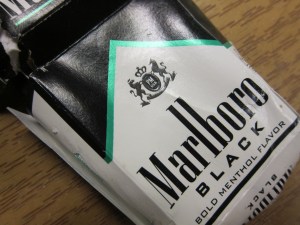
Sexy packaging sells more cigarettes.

Sexy packaging sells more cigarettes.

The packaging of cigarettes is obviously somehow sexed up. When you’re out running or riding and pass by a cigarette package on the ground, it is striking how beautiful and simple some of that packaging really is. Recently I was running home and found an empty package of Marlboro Black Bold Menthol Flavor cigarettes. That package was so bold and wanton lying there on the wet road it was literally like a box of sex on the street. “Why don’t we do it in the road?” that package seemed to sing. So I can see how people might start smoking just for the pleasure of handling all that sexy packaging.

If she smokes…

I once dated a woman who smoked, but usually only when she drank. Or smoked pot. Which was also fun. That meant most of the terrific sex we shared was tinted with the smell and taste of menthol cigarettes and alcohol of one form or another. She smoked Kool cigarettes. And she was cool. I’m speaking in the aggregate here.

I can remember her tapping the package on her wrist in that way smokers do. Just the other day I saw another guy do that with the  cigarettes he’d just purchased at a gas station. That tapping makes a strangely sensual whackwhackwhackwhackwhack as he thumped the package first on his wrist, then on his thigh. I wondered if it was some sort of smoker mating call. At any rate, I refused to answer.

Yet I actually wondered, what does that whacking do? I never asked the girl with the good sex, nor did I dare ask the brazen man whacking his cigarette pack in public. I’m rather surprised no one has made a law against that.

Role models and iModels

Although it is less common, we still do see people smoking in the movies. Some say that is one of the reasons why kids start up smoking. Role models. Cigarette advertising.

I say bullshit. Kids start smoking because deep inside most of us have a dark little death wish and a desire to be entertained at any cost. We’re deathly afraid of not being entertained or stimulated, and the excess emotional, physical and sexual energy coursing through our bodies needs a fix of some sort.

Fortunately smartphones have come along to wick away some of our nervous tension. Think about it: every time you watch a person text or check their smartphone think of them as a cigarette smoker. Perhaps what we really need is an app that emits smoke out of the phone. Don’t laugh, it could work. There are already electronic cigarettes that do the same thing. The Apple iSmoke is just around the corner, it seems.

Seeking release

Let’s admit it publicly: our deepest anxieties need some sort of release, and we need it now. But rather than engaging in a permanent game of hard-wired, evolutionary “fight or flight” where our minds and bodies are in constant conflict over what to do with ourselves, smoking steps up and says, “I’m going to stay right here and light up. I may be a nervous evolutionary wreck, but this little cigarette is going to bridge the gap between fight or flight.”

Don’t worry, we’re getting to the running and riding part. I promise.

The history of smoking in four seconds

Sucking on a stick lit with flame on one end is an exotic response to the human anxiety that has tendered the nerves of societies around the world for millennia. The aboriginal peace pipe. The dope smoker in his dorm room. The brilliant surgeon who can save your life with a scalpel, then goes outside between cutting up patients to suck on a cigarette.

We’re all in denial of the dangers life throws out way. Even when we hold the lives of others in our very hands. Especially then. Some humans just need a smoke. Or something. Which is why so many used to smoke after sex. The “little death” some philosophers call it.

Beating the odds one way or the other

As runners and riders we mimic the odds and dangers of smoking in a number of ways. Some do so blatantly. Running in the same direction as traffic, or riding our bikes against it. Thrillseekers and cyclists sick of road rules dive out into traffic and flaunt the law. You know it’s true. We’ve all run a few stop signs, cut across traffic at high speed, run through dangerous neighborhoods at high speed. It all happens before you know it. Fight or flight.

To raise the stakes, we could all put on a blindfold and just ride by sound, or wear sunglasses at night as we run down roads with no streetlights, just to prove we can do it. That’s the same thing as smoking, you see. Dare yourself to dive through the funnel of odds and desperation.

Fork in the road

I’ve said a few times in life that if I hadn’t become a runner or cyclist I’d have to find some other vice to occupy my brain. I recall the feeling after the first cross country practice in high school. I was a freshman and had never run more than a mile or two consecutively in my life, not even in middle school track. Yet my body was truly wired for running with a thin frame and an anxious mind that loves to be propelled through space as fast as it can go. When that first practice was finished I was exhausted.  But happy. It was literally like a drug, running. I could not get enough. So I’ve run and run and run ever since. Because I have to. Want to. Need to. Now I ride too. We Run and Ride. Welcome to the club.

It’s a fine line, hate to see it go…

There have been a few runners I’ve known, some of them world class in fact, that have actually quit the sport and taken up smoking. One was a friend and high school teammate who turned out to be a 4:01 miler in college. He studied fire science and later became a fire chief as well as a chain smoker. Perhaps in his case it was destiny to become a smoker. It’s a fine line, you hate to see it go. Its his choice, not mine. Perhaps his highly athletic body will keep him from getting cancer somehow.

A very few people I’ve known were both runners and smokers at the same time. It was always strange to watch them finish a run and then light up a cigarette. It made me strangely envious, having two intense habits like that.

Smoking and cycling? 

I’ve not been cycling long enough to meet someone who smokes cigarettes and rides with any consistency. Surely a few of them exist. Yet it seems that most serious cyclists are converts of some sort from some other old habit. Too much weight. Divorced. Former sex addicts. Converted runners. People with bad knees, hips or brains. We’re all rolling around on damaged goods, it seems, pedaling like a pack of freaking madmen on roads marked by tarsnakes, potholes and glass. It’s like a scene from a Hunter S. Thompson novel. Who, by the way, was a noted smoker. The picture really does fit together somehow. Fear And Loathing On the Journey of Life.

Tarsnakes and lung power

A tarsnake meets some tar sticks. Convergent evolution?

A tarsnake meets some tar sticks. Convergent evolution?

There’s a real connection, you see, between the tar in cigarettes and the tarsnakes we traverse on the roads. It is literally the same substance smokers are sucking into their lungs. So it seems that tarsnakes creep into our lives one way or the other.

We face our worldly conflicts with both trepidation and denial. Then some of us snuff out the butt, flick it out the window and leave it for someone else to worry about. There be roads to travel, says the pirate smoker in his ’89 Dodge Neon or his 2012 Infiniti. Ash trays must be keep clean, like a good luck charm at a gambling casino, because the goal for all of us is to beat the odds somehow. We’re all dodging tarsnakes one way or the other.

We think ourselves unique just because some vices make us healthy and others turn out to kill us. But the convergent evolution between smoking and exercising has a strange vanishing point. Cigarettes help you lose weight after all, and calm the nerves. Same as cycling. Same as running.

We’re all cruising around trying to get our sexy little packages on. Some of us glimmer. Others shine. Some wind up in the ditch with the other butts, ciggie type and otherwise. Some of us just like to get there with a little less coughing, hacking and overall bodily decay. That’s why we run and ride. See you on the side of the road.


WeRunandRideLogo

Posted in Tarsnakes, We Run and Ride Every Day | Tagged , , , , , , , , , , , , , , , , , , , , , , , , , , , , , , , , , , , , , , , , , , , , , | 4 Comments

Sunday contemplation: A rider in the rain

Dim prospects for birds. Dampened even further by impending rain.

Dim prospects for birds. Dampened even further by impending rain.

By Christopher Cudworth

Click on pics to view

The Christmas Bird Count comes around once a year, usually in the second week of December. Having worked both the Christmas and Spring Bird counts (technically part of the Fermi Circle Count) here in Illinois for the last 30 consecutive years, I try not to miss doing my part. Sometimes it is small. Just me and a bike path, counting birds as I go, trying to find an unusual species or two as I trudge or ride along. Sometimes I’ve joined a group of several other people, fanning out across a forest to find long-eared owls lurking in a pine grove, or looking for a lingering hermit thrush in the thickets.

Hoping something unusual turns up

Birding on the Christmas Bird Count goes on rain or shine. If the temperature is 6 below zero, you dress warm and go out. But it hasn’t been like that for the last 15 years or so. The coldest I remember it getting on Christmas Bird Count day in the last 15 years is about 15 degrees. And windy. Not exactly fun weather or productive weather in which to bird, but even on the worst days something unusual often turns up.

For the last few years my assigned area has been a stretch of bike path leading from the Leroy Oakes Forest Preserve in St. Charles, Illinois west almost to Wasco and back. But before I head out on the trail there

A rock from a different age still lingers on the burnt, wet prairie.

A rock from a different age still lingers on the burnt, wet prairie.

is a loop around the restored prairie at the trailhead that must be ridden to check for sparrows and cardinals that like the underbrush. This year the prairie has been burned with nothing but black stubbled tufts and glacial rocks to consider. The birds know better than to hang here. Only a lonesome red-tailed hawk slouches in the cottonwoods above.

Out on the trail 

One of the old train markers. 39 miles west of Chicago.

One of the old train markers. 39 miles west of Chicago.

It is a humble and strange little tract of turf, this trail I ride. I can actually recall when the trains still used to blast through this corridor, headed west toward Iowa and east toward Chicago. The Chicago and Northwestern Line used to deliver to the lumberyards west of St. Charles, with spurs heading off to lumberyards and factories along the way. That industrial strip went soft 30 years ago as well. Finally the train line itself went under. That left a long railroad bed open for development into the Great Western Trail, the most popular section of bike trail in all of Kane County.

Nearly bird less

Still, I wipe off the binoculars and check out every bird. They all count on the CBC.

Still, I wipe off the binoculars and check out every bird. They all count on the CBC.

But in winter the trail can be pretty dead in terms of birds. The trees on either side of the path are most junk trees. Overgrown buckthorn and species that throw their leaves down at the first winds of autumn or else cling to them all winter. There even used to be a large homogenous pine forest at the start of the trail where we could count on finding long-eared owls in winter, and great horned owls as well. A developer mowed those trees down 5 years ago, and with them all hope of finding the owls, hawks and pine forest species we looked for each December.

An orphaned territory

It is an orphaned territory, this stretch of land I now bird on the annual Christmas Bird census. It is a linear territory, so I ride my bike because to walk out and back would take hours, and there just aren’t that many birds between the hotspots to justify hoofing it.

I have walked it nevertheless, in other years, making calculated side trips onto the long strips of farmland that sit on the north side of the trail. One of the farms is technically an Indian reservation: says so on the sign leading into the property, which also bears multiple No Trespassing signs.

So I don’t, except on the far stretches too far from the house to see. But there’s nothing much there to find in most years anyway. I know. I’ve tried. An occasional kestrel or belated thrasher might show up in the thin woods, but I’ve learned it is just as efficient to ride slowly down the trail, looking and in particular, listening for the slightest tweet or tseeep that indicate a song or white-throated sparrow, cardinal or chickadee making its way alongside the bike path. I check the wet ditches below the railroad grade for the wayward snipe or killdeer. Once in a while you stumble on such a bird, if you’re careful and go slow enough to notice.

Slow ride

Going slow and stopping often is the bike by bird method.

Going slow and stopping often is the bike by bird method.

Pedaling slow on my Specialized Mountain Bike, in other years I have left tracks in newly fallen snow in some years. Other years it has been a balanced act trying to navigate fat knobby tires over hard packed snow with an icy patch now and then. This year it was just wet and soggy. Rain fell intermittently throughout the two hours I birded.

Here was the day’s list. Not bad for a 40 degree day in December in the rain:

Sandhill cranes are one of the expected yet prized species on the Illinois CBC.

Sandhill cranes are one of the expected yet prized species on the Illinois CBC.

Cardinal, hairy woodpecker, downy woodpecker, red-breasted nuthatch, white-breasted nuthatch, house sparrow, black-capped chickadee, house finch, red-bellied woodpecker, harrier (marsh hawk), red-tailed hawk, common crow, Canada goose, mallard duck, blue jay, dark-eyed junco.

Count ’em, common or not

The dark-eyed junco or snow bird is one of the most common winter birds in Illinois.

The dark-eyed junco or snow bird is one of the most common winter birds in Illinois.

Those are all common birds for Illinois in winter. The hairy woodpecker is about the best find, not as common as the downy. I knew he’d be there–– you can tell it’s a “he” by the red patch on the back of his head–– because the feeders by the houses along the bike path always attract birds. Everything else you find in the territory is pretty much left to chance, dumb luck and good ears and eyes.

The Indian reservation has yet to kick up any real surprises over all these years, although I did find a hermit thrush in the tangles along the former railroad bed once. The hermit thrush has a warm brown plumage, spotted breast and rufous red tail, which it twitches, like a magic wand, whenever it sits still long enough for you to see it.

Just a rider in the rain

As the birding wore on today (Saturday, December 15, 2012) the rain fell heavier and the wind picked up. My rain pants shone and my North Face hat nearly soaked through. Thank goodness for the fleece lining under the knit cap. It kept my bald head warm despite the cold rain pelting through on occasion.

The cross country girls pass by. I'd rather have been running. It would have been over quicker.

The cross country girls pass by. I’d rather have been running. It would have been over quicker.

Small groups of runners were still out training on the trail. A group of 3 high school girls, all fit and thin and surely recently finished with their cross country season came running by.

A little later their 4th partner came jogging  behind by a quarter mile, looking nervous at being by herself when approaching a stranger all soaked from head to toe, carrying binoculars around his neck and perched precariously on a soaking wet bicycle. I was a sight, I admit. So I waved as she approached and hollered out, “Not much of a day for a Christmas Bird Count, I must admit.” She looked at me like I’d been speaking in tongues. Ah well, you can’t explain yourself to everybody.

It’s a tradition

The end result. A lot wetter. But not much fitter. But it's a tradition. One you keep.

The end result. A lot wetter. But not much fitter. But it’s a tradition. One you keep.

And I’m sure the cars passing me on Dean Street as I pedaled my miserable way back into the southeast wind and rain wondered what the hell a guy in a wet winter coat was doing riding out in that kind of weather.

“It’s a tradition, goddamnit,” I laughed as one after another car passed. Suffering is a goddamned tradition. And I plan to keep it that way. Rain or shine. Birds or not. Just a rider in the rain. With a purpose. However obscure or insane it might appear to be.

WeRunandRideLogo

Posted in We Run and Ride Every Day | Tagged , , , , , , , , , , , , , , , , , , , , , , , | 3 Comments

Saturday Artwork: Migration Marathon by Christopher Cudworth

This whimsical artwork by Christopher Cudworthdepicts more than 25 bird species lining up for the “big race: down south. It’s a Migration Marathon with an eclectic set of competitors just like the human race. You can easily order a print or cards in multiple sizes online.

MigrationMarathon

To view the order options, visit: http://fineartamerica.com/featured/migration-marathon-christopher-cudworth.html?newartwork=true


Posted in We Run and Ride Every Day | Tagged , , , , , , , , , , , | Leave a comment

I yam what I yam. Hewwhhgh. A runnersk and a cyclisk. Hek hek hek.

By Christopher Cudworth

We could all use a little Popeye in this world.

We could all use a little Popeye in this world. Here he sets off for his morning run.

“Hewwwgggh. Hi theresk, mateys.

Gladsk to sees yah’sk.”

Heck eck eckeck. 

Ahhh, Popeye. You could hardly understand a word he said, but that was the point, wasn’t it?

Popeye was a man of action. Once he got around to it.

Sure, it took a little provocation from Bluto at times, and Popeye would sometimes take a lickin’ before he fought back. Guess that’s another

Bluto. The perfect bully.

Bluto. The perfect bully.

great moral lesson for us. Be slow to anger. Then eat your spinach and teach the bad guys a lesson. Heck eck eck. But we’ll get to that spinach thing later…

Let’s talk about the physiques and psyches of the Popeye cartoons.

Olive Oyl

Olive Oyl. The height of feminine internal conflict over which man to choose.

Olive Oyl. The height of feminine internal conflict over which man to choose.

It appears to me that Olive Oyl might have been the the first role model for the hyper-thin female runner. I mean, look at that build! She was one skinny chick. Yet Popeye loved her.

So did Popey’s big rival Bluto, in his way. Seems like he almost crushed Olive Oyl half the time, yet  Olive Oyl sort of seemed to like all that brusque attention.

Were we witnesses to the early version of 50 Shades of Gray?  Kinky girl, that Olive Oyl. Wonder how she got her name? 

Ahead of their time

Those cartoon characters were a lot more kinky and progressive than we sometimes give them credit for. Olive Oyl with her model-thin body and Popeye tanking up on spinach. Was that spinach simply an early

One hot little Olive Oyl, Sheryl Crow is reputed to have known about Lance Armstrong's use of "spinach" to win bike races.

One hot little Olive Oyl, Sheryl Crow is reputed to have known about Lance Armstrong’s use of “spinach” to win bike races.

form of steroids? If so, was Lance Armstrong really doing anything wrong by doping up to win the girl? After all, he hung out with that Cougar Sheryl Crow for a while.

Alice the Goon

By comparison, the truly breathtaking character in the Popeye cartoons was Alice the Goon. Talk about your politically incorrect depiction of the not-so-lovely female! My brothers and I would completely freak out when Alice the Goon showed up on Popeye. She literally made our skin crawl. Some protective mothers even protested her presence on the show, because she was so domineering and persistent. But you know, if you’re the Sea Hag and need an Amazonian warrior on your side in a fight or a pursuit of hidden riches, you couldn’t do much better than Alice the Goon. There was a woman who could have broken the glass ceiling with ease.

What was in that spinach that Popeye always ate? Did someone ever dope-test that pop eyed sailor?

What was in that spinach that Popeye always ate? Did someone ever dope-test that pop eyed sailor?

Was Popeye a doper?

For all the challenges he seemed to face in life, it all seemed to work out in the end for Popeye. He ate his spinach and won the day, thumping his rivals in a swift and fearsome pounding that included the famous “twister punch.”

But we really need to consider whether that spinach was laced with some sort of performance enhancer.

I mean, consider the forearms on Popeye. You don’t get those by lifting weights alone. Honestly, we’ve probably let Popeye off the hook for a little too long. Perhaps it’s time to call in the USADA and strip away a few victories over Bluto from the good old days. You know, our heroes sometimes never change.

Makes you wonder if we should be so rough on the dopers in the pro peloton, or those Olympic sprinters like Ben Johnson cranked up on steroids. It’s all just about going faster, getting stronger and whupping our rivals, isn’t it? Would you take something that you knew would guarantee you victory? Don’t you eat your spinach? Take a bottle of something good (Gatorade, whatever…) with you on your rides? Gobble a Gu during a marathon?

Popeye on bike

Could Popeye ride to victory in the Tour de France, or win the NYC Marathon if he ate his spinach?

Are we hypocrites here? Are we ignoring the lesson of Popeye, Bluto, Olive Oyl and Alice the Goon? Is anyone really clean and innocent in the end?

Hecck eck eckkeck. C’mon over heresk, Olive. I’ve gotsk some Baby Oyl I wantsck to use on yer backsk.

Heck eck eckeck.

WeRunandRideLogo


Posted in We Run and Ride Every Day | Tagged , , , , , , , , , , , , , , , , , , , , , , , , , , , | Leave a comment

Concealed carry laws open new roads for cyclists and runners

By Christopher Cudworth

Bang bang, shoot shoot. Happiness is a Warm Gun.

Bang bang, shoot shoot. Happiness is a Warm Gun.

Before anyone gets all hot and sweaty about what they’re about to read, know that I am not against the right to own guns. I respect the Second Amendment like every other aspect of our Constitution. But it is important to consider the state of gun ownership rights in America, and what it really might mean to the future of the country if we fail to grasp the portion of the Second Amendment that says we must maintain “a well-regulated militia.” So what you are about to read is a playful consideration with regards to the “other half” of the Second Amendment has to say. Now half fun. 

Concealed Carry in the Land of Lincoln, who would be proud…

Here in Illinois (the Land of Lincoln) the courts just knocked down the last remaining concealed carry weapons ban in the country. We must suppose that makes a whole lot of people happy to be able to carry guns around hidden on their person.

Yet one simply must wonder what our 16th President Abraham Lincoln might have thought of the new law, considering that Lincoln himself was shot in the head from behind by a gunman who concealed his weapon, crept into a theater and assassinated the President in cold blood. Concealed carry indeed.

Violent fantasies and other practical matters

Let’s face it, we all have violent fantasies at times. I know I’ve fantasized about having a gun on me while running and riding on the very public roads of our state. When a truck or car buzzes me on the bike or while running (less common, but it still happens) it would certainly be tempting to shoot out the tires of the offending driver at the next stop light. After all, using a vehicle to harass or threaten a harmless cyclist really is a life-threatening gesture. We would be justified in pulling out our weapons to protect ourselves in those instances.

More than perceived threats

When a motorist is motivated enough to stop their vehicle and yell threats at you, like the time a guy with a bright red angry face and veins bulging out of his forehead leaned out of his pickup truck to yell at me, “I should come over there and break your f#cking pencil neck.” Well, that’s pretty much a clear threat of physical harm, wouldn’t you say?

If he actually got out of his truck, it would be fair and right to shoot him in the kneecap or right in the balls if I wanted. Because he shows a lot of balls getting so worked up over a 170 lb. cyclist on a 17lb. bike on a bright day in August when there’s plenty of room for everyone on the road if you have the basic intelligence to separate hazards, as Illinois motor laws suggest, rather than blasting around like a Humvee in the Iraqi desert. But perhaps we’re mixing fantasies here. Are we really at war for ownership and use of the roads here in America?

Packing heat while riding

Yes, I’ve had fantasies of packing heat while riding. And I’m curious (I suppose) how it would make me feel to have a handgun concealed in the back of my cycling kit pocket along with a Clif bar and my cellphone. I mean, think of the native possibilities there. If need be, I could shoot someone in so-called self defense, break out my Clif bar, take a bite, spit out some chunks in a fit of justified revenge (just like Clint Eastwood!) and dial up the cops to come get the body.

That’s the American form of justice we’re advocating these days. With laws like Stand Your Ground (Fla.) in force, you can logically or even illogically shoot someone for the reasons you choose. As reported on the Huffington Post, the story of the most recent fatal shooting in that state goes like this: “According to authorities, 17-year-old Jordan Russell Davis, a black teenager, and several friends were confronted by (Michael) Dunn, a white man, who pulled alongside the teens’ SUV in the parking lot of a Jacksonville, Fla., gas station. Dunn asked them to turn their music down, and after an exchange of words, he fired between 8 and 9 shots at the vehicle, several of which hit Davis, causing his death.”

The case may yet be decided in favor of Dunn (depending on Florida’s brand of justice), but there are a whole range of gray areas to consider. Was the shooting racially motivated? Was Dunn justifiably threatened by the teens playing loud music in the car? The list goes on.

Roll Your Ground

Now imagine that some cyclist in Florida is pedaling down the road and a vehicle flagrantly drives too close to the biker. Those of us who ride (and run) know that happens with some degree of frequency. Now imagine that the cyclist chases down and pulls up next to the vehicle at the next stop light, whips out a gun and shoots the driver in the face. There you have it, a violent fantasy comes to life.

The Ted Nugent Law

America’s “favorite” gun-toting, rock ‘n rolling gun rights advocate Ted Nugent says, “The only misuse of guns comes in environments where there are drugs, alcohol, bad parents and undisciplined children. Period.”

Which of those supposed environments was in play in Florida with Michael Dunn? All of them? Or was Dunn just a pissed off dude lacking self respect and self control who wanted to teach someone a lesson of his own accord.

And if the Ted Nugent Law were invoked, how does it apply in the case of  the murders at Northern Illinois University where a gunman walked into an academic lecture hall and opened fire, killing students, or Virginia Tech, or Columbine, or a shopping mall? Nugent is a liar, you see. His ideology presupposes real law, and his is a worldview obsessed by self-interest. But that is exactly where we are in America right now. No wonder so many gun rights advocates like his “clear talk” about guns, meat and the apparent vegetable brains of liberals who dare question any aspect of gun laws. It suits their hatred of anyone they envision infringing upon their so-called rights.

Go ahead and use it when you lose it  

We can talk about “responsible gun owners” all we want. We certainly need to maintain the right of an individual to protect their own home, family and property by use of force if necessary.

But we’ve burst out of that model so that now all 50 states have essentially said that it is right to hide a gun on your person and use it, if necessary, when you judge yourself to feel threatened. That is vigilante justice. Stop pretending it isn’t.

Operationally, there really are no laws when it comes to guns, so let’s quit mincing words here. With concealed carry in effect in all 50 states, people can buy and use guns however they like, then plea to the courts for support of their mission after someone else has lost their life. Right or wrong.

The open road is an open range

That means as cyclists and runners we can pack heat just like we carry water. And we can fire away at anyone on the road we deem to be a threat.

Wowzers! That should make the Saturday group ride quite an interesting venture. It will be like the posse days in the Wild West. Ride around for 50 miles looking for trouble, if you like. Shoot out a few tires. Take down a few dogs. Blast that minivan with the distracted mom talking on the cell phone and swatting the kids in the back seat. When she swerves at your group, plug her Caravan with 50 bullet holes. Never mind the kids inside. Legally, they’re parties to the potential crime of vehicular homicide. Seriously. Those little bastards will learn to settle down and shut up now, or pay the price.

Let’s say you have 20 people in your group ride, all packing heat. There’s no reason you can’t function like a freaking rolling militia out there, protecting the general public from bad drivers and vehicular miscreants.

Bike Wars and the Tour de France

We might even start a new cycling sport and a reality TV show to boot: Bike Wars. There will likely be a lot of holes in stop signs as a result, the result of target practice while riding along. Gives new meaning to the phrase “blowing a stop sign.” Just put a camera on a motorcycle and the peloton can roll across the countryside waving pistols and AK-47s at anyone who dares step on the road in front of them.

Imagine what that kind of force can do in a race like the Tour de France! That guy running ahead of Alberto Contador in the bright green string thong? El Pistolero can pull out the Real Thing and take him down. Let’s just say the climbs up Alpe du Huez will look a lot more orderly when pro riders carry concealed weapons.

Can cliches kill people?

We’ve all heard the line “guns don’t kill people, people kill people.” But when you consider that 50% of gun deaths in America are by suicide, the facts seem to circle back on themselves, don’t they? Without use of a gun, we can suppose that people will find other ways to kill themselves, of course, and they do. But guns make it a whole lot easier to shoot yourself dead. And what is left after the deed? The gun, of course. Is it an innocent victim of the act of suicide? Hardly.

The tragedies of gun violence have claimed the lives of so many, and almost claimed many others. JFK. Martin Luther King, Jr. Bobby Kennedy. Ronald Reagan was shot in the chest. And John Lennon was shot dead in the streets of New York. Apocryphal, isn’t it? Happiness is a Warm Gun.

Are we giving up? 

Have we begun to give up trying to make sense of the number of guns present in America? In his book “I Want You To Shut The F#ck Up,” author/actor/comedian D.L. Hughley begins his chapter on guns with these words: “I have been around guns my entire life. I will be around guns for the rest of my life. Any attempt to get guns off the street is an impossibility––and a policy based on the impossible is a failure at best and counterproductive at worst.”

Hughley’s words remind us that we are reaching a tipping point where the American imagination is succumbing to our inability to interpret the Second Amendment with any sense of balance.

The side of America that seeks to legislate common sense on the purchase and use of guns is being browbeaten and overwhelmed by a swarm of people addicted to to the notion that guns not only equal justice, they define it in both a legal and active sense.

We see it every day in our movies, on TV and on the daily news, where nightly newscasts about gun violence sell viewership by feeding the notion that somewhere out there is an American we’ve got to fear. So perhaps we have created a self-fulfilling prophecy?

Who is it we choose to fear? The potential lists are unlimited. A black American? A teen playing loud music? Maybe even a distracted mom driving a minivan threatens to run over cyclists or runners?

Do we all really need guns to protect ourselves from these fears? Looks like we do: we’re halfway there in terms of the number of guns in American compared to households.

The Whatevers Are Coming

Some people invoke the notion that as a nation we need guns to protect ourselves in the event of foreign invasion. But what is the real likelihood of anything on that order happening? Our country already spends more on military defense than the next 17 countries combined. We can blow up the entire planet 50 times over, so you won’t be needing your handguns to fight the Chinese or whoever you choose to fear. True sovereignty has succumbed to the tsunami of frightened self-interest.

Now we have the doomsday nuts on top of all that.

Let’s face it, America has gone insane over guns.

Required gun ownership? 

A leading conservative talker on the Bill Maher show Politically Incorrect once said that he thought Americans should be required to own guns.

Well, that really is the law in Switzerland. But that is a country where it makes sense to own guns considering the presence of all those mischievous gnomes and faeries running around the forests hillsides. They’re literally taking over Scandinavia, those freaking tiny fantasy creatures.

We don’t want those threats to get out of hand like that here in America, where it could happen just as easily. Just look at how the Christmas season has taken over much of our calendar. Someone had better shoot Santa Claus, for starters, because he’s the ultimate home invader.

Let’s get Jesus while we’re at it. After all, the Good Shepard was an anti-government anarchist who encouraged disciples to mooch off other people and wipe the dust off their feet if they didn’t like how they were treated. Jesus was a threat to society. Better take him out too.

Don’t point fingers

The only gun I could find in the house today is pictured in the photo above. I point it at a lot of things these days, because it’s hard to find things to write about if you don’t keep an eye on what’s happening in the world. But I’m also pretty careful not to use the wrong finger, such as the middle one, in case someone gets the message I’m pointing a f#ck you weapon at them. After all, given the new concealed carry laws in Illinois, pointing the wrong finger can get you shot.

WeRunandRideLogo

Posted in We Run and Ride Every Day | Tagged , , , , , , , , , , , , , , , , , , , , , , , , , , , , , , , , , , , , , , , , , , , , , , , , , , | 2 Comments

Is 12/12/12 a supposedly lucky day? Well, bring it on.

Chris, Linda and our dog Chuck on a healthy hike in a forest preserve. Ironically, it was my back that was out that day. Ha ha.

Chris, Linda and our dog Chuck on a healthy hike in a forest preserve. Ironically, it was my back that was out that day. Ha ha.

A year ago this morning my wife Linda emerged from surgery to remove a cancerous tumor at the base of her pelvis. The surgeon also repaired a hernia resulting from several previous surgeries. For 7 years my wife has been an ovarian cancer patient. It has not been an easy road.

Our hopes were lifted when the surgeon let us know that a colostomy was not necessary, and that he’d gotten the tumor out with a colon resection. Success for now.  Yet there is no way to really know if you’re cancer-free until you take more chemo, pass the tests and can move on in life.

Not so fast

It is never easy when cancer comes back, as it has several times with my wife in the last several years. In some ways you get better at dealing with it––if only because you don’t get your hopes so high that life will ever return to normal.

She’s being sustained with Doxil now, after a short and somewhat failed experiment with tamoxifen, the breast cancer drug that apparently doesn’t work all that well on ovarian cancer. But America had run out of Doxil for several months when my wife came out of surgery, then the drug came back on the market in March. By then her cancer had gotten active again.

Let’s not lie to ourselves: taking all these drugs over the years adds up.  My wife is like a marathoner who has done so many races a normal stride isn’t possible any more. So we take it slow to let her neuropathic feet adjust to sudden movement and adjust our activities to accommodate other side effects as well. But she’s still trucking. The dual tarsnakes of cancer and chemotherapy have not taken her down. Nor me.

High altitude and a tiny tent

This is a woman who with very little training hiked from 8000 feet up to 12,800 feet and back in the Maroon Bells of Colorado. She’d had bunion surgery only the month before, and she nearly collapsed with altitude sickness on the way back to camp. But she’s so tough we kept going. All it took was the rest of my water and a lot of coaxing.

Then we huddled together in a tiny tent for 7 hours while a massive Colorado rainstorm pummeled the valley where we camped. We talked and laughed and cried and got angry and finally emerged from the tent under a canopy of shining stars. That’s when I knew we could be married. Through thick and thin.

So it hasn’t really surprised me that she’s survived cancer for the last 7 years. We’ve survived it together. Just like we survived 7 hours in the tent. On summer nights we still sit out and look at the canopy of shining stars.

And life goes on beneath them.

Loss and grief

A year ago on January 2 we also lost her father to complications from heart disease. Only a week after her cancer surgery we checked her out of the hospital and the very next day she insisted we drive over to the hospital where her dear father lay in bed hooked up to who knows how many wires and a life support unit. He made it through Christmas and New Year’s Day, but passed away on January 2, 2012. We had Christmas together by his bedside last year, with his second daughter who is a violist for the Chicago Symphony Orchestra playing Christmas carols on her instrument. The nurses all appreciated the atmosphere.

Employment challenges

We hoped to have time recover from her surgery and the loss of her father in the new year, but storms were brewing on a different front. The company where I worked had lost some critical business from the largest account and things were getting tight. Pressure built to bring in new business but it didn’t come in fast enough to stop the bleeding. The President warned that without a miracle someone would have to go. It turned out no less than 3 employees departed the firm last year.

It had already been an edgy year living with the secret of my wife’s cancer. As an employee who has had trouble before with small employers who express nervousness about having a cancer patient on their health care plans, I had kept my wife’s illness a secret from the day I was hired. After all, in my final hiring interview the President had said, “The only reason we can offer these benefits is that no one on the staff has had cancer.”

Forging ahead

It was too late to turn back, by then. So, rather than complicate things, we kept my wife’s cancer a relative secret. I just wanted to do my job, and did it well, earning a continual series of marketing and public relations awards for the projects I have led and collaborated on.

But in early April the news came that my wife’s cancer had again returned. This really was another shock. Fortunately I was home for lunch to take the call in case the news from the test was bad, and it was. I called into work that Tuesday to let them know I needed half a day off for a personal day, the first time I had ever done that.

The office wrote back an email that said they wanted to know how they could help, and they seemed sincere. So I prayed about it and told them I would like to meet with them the next morning to discuss things. It seemed like the right time to let them know my wife was going back into treatment. Keeping the secret through the previous fall’s chemotherapy treatments had been rough. Yet my wife still made it to a couple company functions to show her face. Her brave face.

Na na na nahhh…hey hey hey…goodbye…

But the day after I let the company know that my wife had cancer, they let me go, citing differences over office policies. I had a few high-powered lawyers look at the legal ramifications of what they’d done, and who wanted to take the case, but it is not in our family’s nature to sue them or any other employers over the years who have pulled similar stunts. Two others had either tried to cut off our right to be insured or create circumstances to make me want to leave. It’s not really a surprise, you know. It happens to people all the time.  Yet suing a company is an ugliness my wife and I have simply decided we do not want in our lives. We’ve had doctors and nurses make mistakes, too. I think of one Easter holiday when we sat in the hospital watching chemo leak from the port in my wife’s stomach. The doctor came in looking like his career was over. We only wanted things made right.

Small business romanticized

It’s time for some hard truth: the world of small business (and medicine, for that matter) is not the pretty picture painted by politicians who tend to romanticize small business owners as heroes for ideological gain. You hear it all the time, politicians blabbing on about how the so-called “job creators” are saints for taking on the burden of employing others. They go on to complain how beset they all are by regulations, tax laws and other obstacles to success. Well, I’ve run my own business before, and the people with whom I collaborated or hired to do the job were not some commodity to be traded off or dumped at will. Without them, the business would not exist. So it is my belief that the perspectives we sustain on labor and ownership in this country are somewhat skewed.

I say it is ambiguous laws, not excessive regulations that make it hard for small businesses to operate by refusing to give them the clarity to effectively hire and sustain their companies. The same company that haggled me over office policies also flaunted independent contractor status with an “employee” who really did not work there, yet had a desk, phone, computer and office like the rest of us. It literally happens all the time. But you see, it’s the American Way. Business people want to have their cake and eat it too. They want to play by some rules that suit their needs, and dispense with those seemingly inconvenient rules that are too hard to manage.

Clear the decks

Our country could start by altogether removing the burden of health insurance from businesses large and small. There’s no reason why health insurance should be connected to your place of employment. None at all. Instead these poor (and rich) companies spend probably 30% of their time farting around with benefits and such because of the huge mistake America made years ago by letting an experiment in benefits become the norm.

Bring on the public option, I say. It will save American business billions in wasted “man-hours” administrating health insurance for employees, and take away the costs of paying for it too. At least Obamacare is a step in the right direction, ultimately removing pre-existing conditions as a disqualifier for coverage while raising the age of covered family members to 26 as well as a host of other benefits. It’s a step toward normalcy and a level playing field for everyone.

Different rules = difficult circumstances

The rules for employment and insurance are different for employers under 20 people. Go ahead and find out for yourself, if you like, but I’ve read the laws governing insurance and employment for small companies and they really are ambiguous. If the laws for employment and insurance were clear in protecting either the employee or the employer that would be fine. But they are not, and that leaves employers and employees in a netherland of disagreement over who owns what rights. It’s a disgrace of quasi-favoritism, authored by politicians without the guts to provide clarity to the situation because they constantly try to play both sides of the fence, ingratiating themselves to business while trying to mollify the voters. It’s bullshit.

Personal toll

All told the stress of keeping going during all the change and strain––including being primary executor for my stroke-ridden father’s care––has been quite a bit to handle.

Keep on running. That's sometimes all you can do.

Keep on running. That’s sometimes all you can do.

I tried to run and ride through all these challenges, and being out of work gives you a certain degree of freedom, but it is the type of freedom you don’t really want.

I do have a strong faith in God though, and can tell you that a trust in that relationship takes some of the pressure off. As such, many things have happened to help us through this strange year. I do not hesitate to call them miracles, because to us they were miraculous; in substance, timing and grace. You’ll have to trust me to that level of detail, because to delineate those miracles is to commit a breach of trust to those who have helped us, often without being asked, and that is how the kingdom of God often works. It is at once humbling and inspiring.

The road to salvation, of sorts

While my running and riding helped relieve the stress and keep me sane, I started to notice a strange effect on group rides, and when I tried to race. My mind was not capable of fighting through challenges as it normally likes to do. It felt like I had Post Traumatic Stress Disorder (PTSD) where situations of stress shut down my ability to function.

On long rides when the going got tough I would hang for a couple miles but ultimately did not care if I stuck or not. It was like there were too many emotional parallels between the stress of competition and the stress of life. My mind chose on its own not to double its burden. Same thing with running. I could compete with myself but not with anyone else.

One crazy attempt at racing

The lone criterium I tried to ride turned into a crazy attempt at riding off the front in the early going. I was like a magnet being driven off the front of the peloton the first two laps. My fitness was good but no one can do that, just ride away from the pack! Insane. When I pulled over after two laps my cyclometer showed an average speed of 24mph but my legs were torched. I pedaled to my car, threw the bike in the back and drove home with my cleats on, shaking my head the whole way. “Enough of that for now,” I said.

The anxious mind

Anxiety and depression act that way on the human mind. Stressful situations and chronic anxiety force you to enter life through a new corridor. It felt like I was riding through a tunnel of ambiguity even as the riding miles piled up. 1000. 2000. 3000.

Then fall came around and I was really physically fit, with weight down to 165 and feeling healthy. I’d landed contract work and was getting job interviews. It was only a matter of time before something clicked. I wanted to get back to work for a hundred reasons.

And then the bike wobble crash happened on a hill in Wisconsin. That meant surgery and recovery and working through the stress of being injured. Yes, folks, it’s been quite a year.

Today is 12/12/12. Supposedly some sort of lucky day. Bring it on. This is one guy who would appreciate a little luck to go with the grace that has been shed on me. Bring it on.

Posted in We Run and Ride Every Day | Tagged , , , , , , , , , , , , , , , | 2 Comments