Wondering about the Wonderlic

By Christopher Cudworth

Anyone who has ever taken the Wonderlic test knows that it is a supposed measure of your general cognitive ability. And having taken it myself, and wondered quietly to myself why I still don’t “get” math under any circumstance, I am a believer of sorts not only in the Wonderlic, but a few other tests taken over the years. It’s been astounding to see how well some of these things work in assessing who you are, and what you do, and what you can or can’t do well. Yet still I wonder about the wonders of the Wonderlic. Perhaps it’s the journalist in me, but I see flaws in relying on tests to judge the human character. The real answers are ultimately found in others ways.

Checking in and checking out

The Wonderlic test is quite popular as a qualifying tool for new employees, team building and sundry other purposes concocted by human resource departments who don’t have time to actually talk to people. Too many people looking for work.

tom_landry1_102411Which is why is interesting to note that the Wonderlic test is popular among NFL teams, and was first used by none other than Tom Landry, that tight-lipped, hat-wearing dude who coached the Dallas Cowboys. Of course the Cowboys were accused of playing like a silver and blue machine, which is either a credit to the Cowboys organization or an accusation of corporate soullessness in sports. But that depends on if you bet on football or not, or have a fantasy football roster. In either of those scenarios, all you want to do is win. And that begs all kinds of questions about pro sports in general, which in the end are all about artifice, and how to support the kind that attracts enough attention for people to shove buckets of money your way.

Even Cowgirls get the blues

Take that, Wonderlic.

Take that, Wonderlic.

One must wonder if the Wonderlic test is administered to the Dallas Cowboy Cheerleaders, who (rather ironically) are quite famous for their ability to reduce cognitive abilities in many men. That gives a whole new meaning to the term Wonderlic.

Brain squish

Perhaps the Dallas Cowboys Cheerleaders are an attempt to direct attention away from the league’s rather prodigious ability to grind so many great athletes into dust by the time they retire. No matter how smart a player might be (Wonderlic or not…) when they’re starting out, it has been proven that playing NFL football can squish your brain through repeated concussions that ruin your ability to think at all.

There has even been talk that the NFL, even football as a sport at all levels may not survive the wave of litigations now surfacing. The evidence shows that the sport and its helmets flatly fail to protect its participants. You’d have to be pretty dumb to deny what’s come to light, but the NFL must certainly be doing its best to avoid the courtroom over such matters. Granted, not every player who emerges from an NFL career has a squishy brain, but there’s a whole line of guys ready to file lawsuits against the league because they can no longer remember how to tie their shoes.

UnknownFootball great Dave Duerson even took his own life with a shotgun blast. But he did not shoot himself in the head.  He was smarter than that. A head shot would have destroyed evidence that his brain was traumatized by his football career. Instead he aimed at his chest so that his brain could be preserved for research and prove that something was going wrong up there that he could not control. Face facts: pro football was to blame, and no amount of cognitive testing could have prevented such a scenario. Junior Seau took his own life as well, and his family is suing the NFL as a result. There’s a pattern going on here, and it’s not one measured by the Wonderlic test.

True assessment

It seems like there should be a Wonderlic test or some other cognitive test administered to players at the start of their career and one given after they’ve finished. Let’s keep track of how many IQ points they’ve lost or what level of cognitive ability they’ve sacrificed. And it should be ongoing. Sometimes the damage shows up years later.

But that would be a just approach, and the NFL is all about entertainment, not justice. So don’t hold your breath on that one.

It all begs the question why employers like the NFL administer a test like the Wonderlic at all? Are people really intelligence commodities? Is the Wonderlic test the Great Predictor it purports to be?

 Human nature

Apparently plenty of employers still think so. Never mind that people are adaptive creatures who employ all kinds of creative workarounds to problem solve. Or that nature imbued the human species with the ability to compensate in many ways in order to survive. Our intelligence is a pliable resource that we now know relies upon multiple types of intelligences and sensory channels that enable us to take in and process  information.

The massive test that brought all that to being is called evolution, and it’s a helpful result whether you’re skinny hominoid standing semi-helpless on an open savanna or a wide receiver executing a 10-yard pass completion on the sidelines to run out time.

The only test that matters in evolution is not how others can test your abilities, but whether you succeed or not. Take that, Wonderlic. Evolution kicks your ass.

Testing, testing

People with dyslexia often learn to read and comprehend quite well. But if you start out using dyslexia as a disqualifying trait for success in academics or employment because the candidate failed a Wonderlic test, you’d lose all that potential.

People deserve better that that.

Just kidding,

Of course we must reckon as well with a curious side of human nature that avoids all sorts of tests, or questions their merit at some level. For example, what would happen if we applied the Wonderlic test people before they entered the world of world of running and riding? We might find some rather curious results.

Qualifying traits

A typical question on the Wonderlic test works like this:

When a rope is selling 20 cents per 2 feet, how many feet can you buy for 30 dollars?

Now, we all know that the way the human brain works while you’re out running is rather complex, and sometimes silly. That’s because your brain is trying to trick your body into running or riding as fast as you can. Sometimes that’s all the room you’ve got in your brain, so logic gets confused.

In facing the Wonderlic question posed above, a runner’s response to the question might go something like this,

“Let’s see: What kind of feet are we talking about? Because my feet are not exactly 12 inches. I’m a size 11, sometimes 11.5 depending on what brand of shoes I’m buying. And also the time of day can affect my feet size too. So in this case it’s really not fair to compare actual rope to actual feet, because it all depends on what brand of shoe you buy. I’m a size 11 Nike and a size 11.5 Brooks, and while both are good companies, the Nikes always look smaller even if they aren’t really smaller, and I don’t like looking down and thinking I have big feet, because it makes me feel slow. Now, what was the question again?”

And that’s how it works. When you’re out running thoughts seem to come at you like seagulls in Alfred Hitchcock’s movie The Birds. And who’s to say the runner’s answer isn’t just as legitimate as the Wonderlic version, which is based on boring things like basic facts.

And who wants to stop there? This example just proves that the Wonderlic test totally sucks because it doesn’t take all the possible variables into account when you’re talking about feet and rope and someone’s 20 cents. That’s how the mind works in the real world.

Confusing numbers

The same this goes for thinking while out riding. When cyclists encounter a typical question on the Wonderlic test, their minds might begin to assess a lot of factors. For example, here’s another Wonderlic wonder:

Which of the numbers in this group represents the smallest amount? A) 0.3 B) 0.08 C) 0.08 D) 0.33.

Now don’t tell me you have the answer already. Not if you’re a true cyclist.

Because we all know that you pretty much lose your ability to figure numbers out while you’re riding, which is the whole reason why the Strava app was invented. It does your numbers thinking for you.

Otherwise the cyclist’s brain works in weird ways when facing all those letters and numbers in the Wonderlic question. You’d first have to ask yourself, “Do these numbers pertain to my cadence, current mph or average speed?” Right away, your mind spins off into a thousand calculations, all designed to distract your brain from the pain your legs are feeling on the 9% grade you just entered.

But you keep on trying to think about cadence, mph, average speed. And think again, but it escapes you because the pain is so, so intense after 400 meters of climbing that 9% grade you’ve stumbled upon that all concepts of time and space and average speed blow up like the human body in outer space. Poof! Nothing’s left of your prior thoughts but a red mist and some new floaters in your eyes.

Real problem solving

And that’s why runners and cyclists tend to do so poorly on the Wonderlic test. Most of us have minds that operate like the hyper Genie Robin Williams character in the Disney movie Aladdin. We can’t sit still to take no stinking test, and if we do, a thousand million answers come to mind. Which explains why so many runners seem to be babbling when you hear them pass by.

Or, our mental faculties are absorbed by other important issues, like why your boobs seem to bounce more on a Tuesday in June, or whether today is a right or left day for that unit in your shorts, and how many days it is until Saturday when you can actually get out and do real distance training for once.

We runners and riders really do concentrate on all the important stuff, you see.

But if you skip the Wonderlic test and hire us anyway, we work tirelessly to find creative ways to team build, such as cutting the donuts in thirds so no one gets too fat. Now that’s a valuable career skill.

Waiting for the call

As for me, I still wonder about how I’ve actually done on the Wonderlic test at times. But they never tell you. You spend 12 minutes of your precious life scrambling to answer as many inane questions as you can and then never find out the results? Where’ the fun in that.

Too bad. Someone else owns this information about your brain. The CIA maybe, or the NSA. It’s a spooky notion these days. There’s no such thing as private information any more. In fact, I’m tracking your eyes as you read these words, and it appears you are reading them backward. So straighten up!

I admit no one has ever called me back after the Wonderlic test and said, “You’re a genius! Off the charts! Mr. E. F. Wonderlic (if he’s still alive) himself wants to talk to you about your answers. You got them all wrong, and it takes a near genius to do that.”

So I’m still waiting for that call. In the meantime, you know where to reach me and others like me. We’re out solving problems on the road. Like how to change a flat in a rainstorm, and looking for places to pee when you have a shy bladder. This is the important stuff. We all know that.

WeRunandRideLogo

Posted in We Run and Ride Every Day | Tagged , , , , , , | 1 Comment

Is it possible to overcome pain?

By Christopher Cudworth

Pain can short circuit our best-laid plans.

Pain can short circuit our best-laid plans.

Pain is an integral part of any endurance sport. It follows that overcoming pain and discomfort is an element of success.

But what is the actual secret to the ability of overcoming pain? Is that even possible?

You have two choices. You can either try to beat the pain outright, or you can excel within the confines pain and still try to achieve your best effort.

So which is better?

Pain tolerance

The secret of pain tolerance is not derivative of race or even culture. In fact the ability to endure pain is not even connected to raw physical talent.

Pain runs parallel to the human condition. It is the great equalizer, a humbling reminder that for all our brain power, we are still animals at a base level. Our ability to feel pain and express its impact on our lives is what makes us human. We can all identify with the unintentional grimace of pain on the face of athletes as they compete. We either empathize with the pain of others, or we are psychopaths. There isn’t really much of an in between.

Dealing with pain

Running and riding psychology is composed of two distinct methods of thought: association and dissociation. The first means you choose to accept the pain and work with it. The second means trying to forget the pain using some method of distraction.

If you associate with pain, you do not ignore it. You may try to rationalize it in some way however, in order to get through the periods in which pain is most acute. Our college cross country coach used to joke with us about how difficult a sport running could be. Seeking to replace negative thinking with positive attitude, his favorite phrase during our most difficult workouts was legendary.

“Wow! Fun! Wow!’ he’d cheer us on. You can’t beat fun!”

To which one of us would inevitably reply: “You can’t beat fun. It’s like a sore dick.”

But the fact is we generally embraced his fun approach to dealing with pain while running.

It’s only temporary

One of our teammates even came up with his own brand of mental device that caught on within the team. We all used to get us through. His phrase was, “It’s only temporary.”

That’s a very associative approach to pain management while running or riding. “It’s only temporary” helps you get through the worst points of pain until you can recover. It certainly applies to running or riding tough intervals. But it also works in a race when you are up against your own will and feeling pain from the pace. “It’s only temporary” can work wonders if you use it wisely. The reward of having made it through the pain to a better result sticks with you too. Next time around you are encouraged by your previous success.

Yin and yang: Dissociative thinking

If you prefer not to think about the pain and want to run a marathon using some dissociative method like listening to music during the race, who’s to say you are wrong?

But here’s some good advice. You should still have a backup plan to assess and manage your discomfort level if you find yourself at a tipping point. Because sooner or later if the pain gets too bad, your brain is going to revert to associative thinking whether you want it to or not.

Being realistic

Pain is indeed the great equalizer, but some of us wind up being “more equal” than others. If all of us could simply “run through” the pain somehow we’d all be 2:03 marathoners.

We train ourselves through intervals to accept faster tempos and callous our minds and bodies to a new pain tolerance. These combined practice methods make it mentally and physically possible to run and ride through the pain.

The secret but still painful truth to overcoming pain

Teammates, coaches and competitors are also important tools in developing greater pain tolerance. Our teammates urge us on when we’re tired. Our coaches train us to accept and work outside our perceived limits. But most importantly, our competitors drive us to run harder, forcing us through pain. That may be the truth you don’t want to hear, but it is true in almost every aspect of life. Despite all our faith and morals and attempts to deny the truth, in the end we are competitive beings. Competition is the one true method for overcoming pain, as well as fear. It hearkens back to instinct for survival, for besting rivals for mates, and yes, to get the best gossip possible.

Probably it is some combination of coaches, teammates and competitors that makes us do our best and overcome the pain necessary to succeed. It also takes some good old self motivation to make us run or ride into pain and beyond.

Yet another painful truth

That last bit of reality is the incredible secret behind pain tolerance. Whether our competitor is the clock or another athlete, the best-known way to deal with pain is to recognize that losing—or failing our goals––sometimes hurts far more than the temporary pain we feel during the race. Some people will almost turn themselves inside out to achieve their goals. It’s almost as if there is an entirely separate section in our brains that motivates us to suffer positively in order to reach some abstract version of success. We athletes live in a strange world where our worst fears are both self-imposed and yet also externalized.

Life imitates the art of pain

And of course some say athletics prepares you for the pain and triumphs of life, both of which are also–only temporary. There’s certainly a lesson to be learned there.

WeRunandRideLogo

Posted in We Run and Ride Every Day | Tagged , , , , , , , , , , , , | 1 Comment

Is there no escape from the Legendary Land of Hathead?

By Christopher Cudworth

No, this is not me. This is a Hathead fail on several levels. The sunburn yes. But the rest of his head should be shaved too. Then, no hathead, hairwise.

No, this is not me. This is a Hathead fail on several levels. The sunburn yes. But the rest of his head should be shaved too. Then, no hathead, hairwise.

It is my job here at We Run and Ride to expand your mind on a number of subjects related to running and riding. Today’s illuminating blog is about both a real and imaginary place called Hat Head. The real place is a village in New South Wales, where I would like to visit because I find such places interesting.

By contrast, the Legendary Land of Hathead exists only on the borders of your mind. Hathead is also frequently called a Bad Hair Day, and it feels like a place from which there is no escape, especially when you wander into Hathead unintentionally. So let us explore that imaginary place, and come to terms with living in Hathead, a real or imaginary place.

The Legendary Land of Hathead

‘Twas a land with no seeming end. For travelers could wander to and fro, through heather and gorse, fair winds and raging gales, and still find themselves on the wide moors of Hathead. Some wondered if it was actually a land you could never leave, both accursed and enchanted. Yet a merry band of wise souls did know the way out of Hathead. One was heard to mutter; ‘Tis the road of Reality and Humility you must take. Anything less will wind you back round to Hathead.”

knorr-naturals-soup-hat-head-small-49118And in recent years, it hath become a road more traveled, bare and ancient though it may be. But to the surprise of many who go there, no shame could come of riding or running on it, for it laye naked and true as a bare razor, and twice as sharp for those who knew its secrets. But it led the way out of the Land of Hathead. And those with the courage found that the road led to a place called Freedom. From shampoo. From combs. From hair dryers and gels. Some go there not by choice, and must live with the opposite of Hathead. For those people we hold admiration, for they live beyond convention in every way. But for those who live in Hathead and care not, the Legend lives on.”

It’s all true

Yes, the legends are true. There truly are paths that lead out of Hathead, the land where your hair always looks like hell from wearing baseball caps and cycling helmets, or else  weird lines appear in your locks when you remove your Giro or Specialized aerodynamically grooved lid.

Hathead can also occur during the Walk of Shame, after you’ve shacked up with some fellow cyclist or runner following a mutally great performance at a race. Then the pos-tace beers take over and before you know it you’re lathering each other up in a hotel shower and piling under the sheets for…well, we digress. The point here is that Hathead comes later, while leaving the hotel with the half-sweaty stretch cap pulled down over your embarrassingly lusty-looking hair style. You pretty much wish you were invisible, yet you feel damned happy. A PR and getting laid in the same 24 hours is always good. But if you were to actually take that hat off your head, even little children would point at you in the hotel lobby and shriek, “Oh my God Mommy. That person has Hathead!”

And that would be embarrassing because you know that you look exactly like a guilty person at that point, and you didn’t really mean to take off your hat and expose your Hathead, but all that hair piled up on once side of your noggin’ was just feeling so, unever, you know? So you pulled off your cap and happened to glance in the hotel lobby mirror and wondered who that lopsided loser in the mirror really was and you suddenly realize it is you. You, with Hathead.

A reformed resident of Hathead

It's pretty easy to prevent hathead these days.

It’s pretty easy to prevent hathead these days.

I used to live in the Land of Hathead with some regularity. Blessed with exceedingly thick hair as a youngster, I also chose to wear a baseball cap almost everywhere I went. Well, that’s not a good combination. Thick hair does one thing when you put a baseball cap over it. If forms that weird Continental Shelf just above your ears, then it flairs out like a hairy waterfall over each ear. For the rest of the day, no matter what you do,  that Waterfall Over the Ear look persists. That is called a terminal case of Hathead.

It was excusable when you were actually playing the sport of baseball. Hathead is part of the deal.. along with scratching your nuts and spitting things onto the floor of the disgusting dugout But once you leave the baseball field, Hathead is terminally uncool.

When people say these words to you:  “Nice Hathead” they are seldom if ever being complimentary. So you have a choice. You can live in the land of Hathead and face ridicule, or you can try to break free in a variety of ways.

The science and politics of Hathead

Scientific studies have shown that women regard men with Hathead as less attractive, less intelligent or charming and generally less desirable.

To make matters worse, medical studies funded by the Heartland Institute show that Hathead has actually been known to result in penis shrinkage in some men. But then, all studies funded by the Heartland Institute point to the fact that men are being emasculated on every front. So you have to consider the source.

The rape and pillage of Hathead

Most men have simply learned to avoid the realm of Hathead with one simple act: They shave the hair on their head so short that Hathead is not possible.

This solution might have started with the pre-eminent athlete of the last 25 years, one Michael Jordan who, upon discovering hair loss that would have made him look too old for his role as Best Basketball Player Ever, decided to shave his dark dome completely clean. And he looked awesome. More than awesome actually.

The list of athletes who have escaped the Land of Hathead are many these days, led by pioneers like pro cycling superstars Levi Leipheimer and Chris Horner, both of whom escaped the Land of Flathead by shaving their heads. They are shorn and happy for it.  

Less cushion?

Of course, there may be drawbacks to having no hair as well. Chris Horner crashed and took a straight shot to the noggin’ during the Tour de France a few years ago. He was so concussed no one knows how he rode the next couple dozen miles, because  when he completed the stage, he asked, “Did I finish?”

That’s a different kind of Hathead. That’s called Crazyhead. They kept Chris in the hospital a few days while the concussion wore off and then flew him home ot recover in earnest.

It is doubtful a layer of hair would have done much to keep Horner from getting a concussion. Hockey players are some of the hairiest athletes on earth and they’re getting concussions at an increased rate it seems. Most players are going round on their 3rd or 4th year of getting concussions. If you shaved their heads and then showed a blue light on them, their brains would show up like fluorescent indicators of heat and stress. But man, when a hockey player without a shaved head takes off their helmet, that is some of the worst hathead styling you can ever see. Along with a playoff beard, hockey players are officially full time residents of HatHead, the place where people go because they just don’t care how they’re hair really looks.

Fortunately there are millions of men who prefer to avoid all this Hathead stuff. They’ve taken the sensible option and buzzed their heads if their hair won’t grow naturally or if they simply think they look better sans locks than having a regularly unkempt pile of flattened or unhealthily bound hair up there.

 Outside Hathead

No this is not the answer to Hathead.

No this is not the answer to Hathead.

The condescending phrase “Bald is Beautiful” has been replaced by calculating silence, for the whole bald thing is no longer an issue. Men with self-confidence don’t buy into Hathead sub-issues such as comb overs or toupees. No more hair transplants or cornrow spots on your scalp when the transplant wears out. All of that is part of the Hathead psychology in which you’re covering up your hair out of insecurity, desperation, laziness or guilt. Or the opposite; you love your hair too much and get all insecure when a baseball cap puts a pressure ring around your noggin.

Gone for some, but not forgotten

If you’re a person who runs or rides and find yourself suddenly stuck living in Hathead, there are quite a few ways to get out of Hathead fast.

The quick use of a finish line water hose can help, and fast. So can a richly deserved towel. Then dry your hair and fluff up the Hathead. You may still a little bit of that dreaded loo, going on, but at least people won’t think you’re a permanent resident.

Because if you think about it, just about every homeless person you know takes up some form of residencw in the Land of Hathead. Hathead is a fashion statement for bums.

stephanie-pratt-hairYou can help the homeless, but you don’t have to walk around looking like one. Either find a way to cure Hathead when the run, race or ride is through, or else free yourself from the bonds of Hathead forever, and go shave your head, unless you’re a woman, in which case you always have the pony tail. Then all is always forgiven. Because pony tails rock.  Especially under a baseball cap. Which is where we started. See, everything comes full circle if you let it.

WeRunandRideLogo

Posted in We Run and Ride Every Day | Tagged , , , | Leave a comment

A 50 mph descent is a bit of a rush

By Christopher Cudworth

Watching the Tour de France race go through and up and over the island of Corsica has been an exciting start to the 100th Tour. Corsica from all angles is alternately rocky, woodsy and beachy. That makes it perfect for a Tour stage or three.

A bus wedgie

With the first day’s racing almost running into the back of team bus wedged under the finish line scaffolding, things could not have been more odd and tense.

Today’s stage saw some idiot trying to cross the course like it was a parade route, and a tiny little dog almost getting run over by the peloton, which was traveling nearly 40 mph at the time.

Grab your seat

But the descents were what made you grab your seat, and I mean that literally and figuratively. Cyclists cutting tight corners at very high speeds are possibly participating in one of the most dangerous sports on earth short of a UFC fight held on a hockey rink.

At one point the riders screamed through their radios to get the TV helicopter to pull away from the race because the cyclists could not hear the safety signals normally used to read the actions of the riders around them. The screeching of brake pads on rims, for example, is a key device to know who’s going faster or slower.

But when one rider breaks away, that’s when the risks get interesting. It’s hard to stay ahead of the peloton in any circumstance. But when you’re heading downhill at more than 50 mph on a mountain road where the wall against which you almost nick your wheels is an absolute boundary, it takes more than mere experience to handle your machine. You have to know what risks and rewards really are.

50mph barrier

Having only topped 50 mph once on my bike, I cannot speak to the rush of doing that consistently or in a race. My 50mph experiment occurred on a long steep section of road in western Pennsylvania. I was there on vacation to view the Frank Lloyd Wright creation Fallingwater. A morning opened up and the bike and I went for a 30 miler on the tight roads around a state park. It was harrowing to be a cyclist on those roads. There are no shoulders. None. Logging trucks and campers and semi trucks come whaling over the hill and around the corner. You learn quickly to ride on the defensive.

Tempting proposition

But let’s say there’s a quiet section of road and it just stretches invitingly out in front of your bike and you start to pedal with the momentum. With ease you’re up to 40 mph. Then 45. The road keeps going. Nothing is coming up behind you. Nothing ahead either. The pavement is smooth. No tarsnakes. No thumping cracks. Just smooth asphalt and a clear view for about a mile ahead.

You go for it, pedaling in the highest gear and the cyclometer seems to quiver as you inch on up, 46, 47, 48. You wonder for a moment is this is wise. 49mph. This is all new territory. You turn your head to look at the bushes rushing past on your right and the whole bike does a swerve. The grooves in your helmet suddenly have an effect on your aerodynamics. Then the cyclometer pops up with a 50. Five-Oh. You’re going 50 mph. Then 51. 52. When you hit 53 the road starts to flatten slightly and the opportunity for more speed wanes. But 53 is good enough. That’s a little more than half a hundred miles an hour. It’s quite a rush.

Wobbly perspective

I’m glad I did it. But won’t be trying again unless I swap my Mavic wheels out someday. I’m pretty sure they’re what caused my 40 mph crash last Labor Day. My original Shimano wheels that came with the bike were what handled 50 mph. I simply don’t trust the Mavics, I’m sad to say. Even crimping the top bar with my knees would not provide the assurance I need to go 50mph again.

Which makes what the Tour riders are doing all the more real to me. I could never do 1/100th of what they do in terms of riding. They are the world’s best cyclists, and I’m not even the best in my home town. Not by far.

But at least I’ve gone 50 and know what that means. It’s a rush. And that means something.

WeRunandRideLogo

Posted in Tarsnakes, We Run and Ride Every Day | Tagged , , , , , , , , , , , , , | Leave a comment

3 timely lessons about running and riding in the heat

By Christopher Cudworth

Lessons learned are like bridges burned, you only need to cross them but once… Is the knowledge gained worth the price of the pain, are the spoils worth the cost of the hunt?   –Dan Fogelberg, from the song Lessons Learned

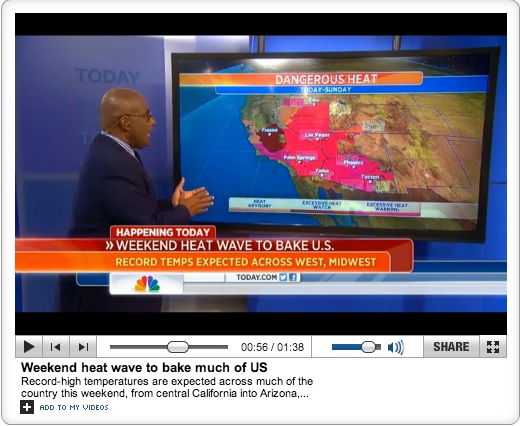
With record temperatures becoming commonplace, we all need a heat strategy.  Even Al Roker.

With record temperatures becoming commonplace, we all need a heat strategy. Even Al Roker.

With a major heat wave predicted across much of the West and Midwest this weekend, and heat seeming to be on the increase thanks to global climate change, it pays to do a little thinking about your heat tolerance. Temperatures of 119 are predicted in Phoenix, Arizona this weekend, and 101 degrees in Boise, Idaho. There may be world record heat in Death Valley, with temperatures predicted to climb to 134 degrees. That, my friends, is hot as hell. No questions asked.

LESSON ONE: HOW TO RIDE THROUGH HELL, AND A LITTLE BEYOND

It was 96 degrees outside. My wife and daughter dropped me and the Felt 4C at a parking lot near the junction of Genoa Road and Interstate 90 just east of Rockford, Illinois. I planned to ride home from there. 

The three of us had spent the morning in Madison, Wisconsin visiting the university and tromping around the fantastic Farmer’s Market in the square around the capitol building. I’d planned all along to ride part of the way home that afternoon and had brought my bike along in the back of the Toyota Matrix. The remaining jaunt from Rockford promised to be between between 40 and 45 miles, depending on which route I’d take.

Uh Oh. Hotter than hell.

But 4 miles into the ride, heading south into a blast furnace breeze and heat rising off blacktop in visible waves, I knew I’d chosen wrong. It would not matter which way I rode home. It was foolish and hot to ride in any direction.

Wanting to stock up on cold drinks, I stopped at a gas station in the town of Genoa. It was a tricky deal figuring out what to do, but 3 Gatorades seemed like a wise investment. I stocked two in my shirt and used a bigger bottle to fill two ice-filled water bottles.

They were melted within two miles. So this really was a form of hell on earth. The Gatorade inside my bottle was getting hotter by the minute. The two bottles stashed in my shirt, freezing cold just 15 minutes before, were now almost two warm to drink.

A deal with Beezelbub? 

Then I realized I’d taken a wrong turn 10 miles into the ride. Suddenly I thought; What the hell? Where did I miss that road I know? But it was one of those circumstances where it’s just about as far to go back as it is to take a risk going forward. So I kept on rolling.

And wound up in the outskirts of Sycamore, about 5 miles off my planned route. Ooops. It was like a deal with Beezelbub. You don’t come out winning either way. One way you melt. The other way you bake.

An angelic break

At one point the only sane thing to do was stop in the shade and try to breathe smooth and slow. My skin tingled. It felt like little angels were fluttering around inside my hot noggin’.

All the fluids I had were now actually hot, not just warm. I drank anyway and glanced to see a cool blue pool behind a house where it looked like no one was home. Tempting, I thought. But the little cycling angel over my shoulder whispered in my ear that sometimes when you stop, you really can’t get going again. And then you suffer all the more.

So I sucked it up and rode on, staying just below the threshold where my body felt strain. It was kind of like riding around the edge of the fiery abyss, but not quite falling in. 14mph, I have discovered, is an appropriate speed to ride through hell. It worked for me

The tarsnakes were rising out of their road crack burrows on a hot summer day.

The tarsnakes were rising out of their road crack burrows on a hot summer day.

anyway. All the while the tires were smacking over the tarsnakes, which raised their oozing black heads slightly as I passed, hissing in the heat like Serpents of Satan. “Come down to us,” they whispered like the hissing of summer lawns, “Join us on the road.”

“Damn you to hell!” I hollered, pressing my front tire down on one of their heads. They pulled back into the crack of the road, their black souls disappointed at not winning my own.

Kept on moving. I could barely feel a breeze while moving that slow. It was hot. As hell. And humid.

Salvation at the water pump 

My goal was a cold water pump at the Great Western Trailhead, 15 miles southeast. All I had to do to keep going was to focus on that cold water even though I knew it tasted like crap because of the sulphur content in local groundwater. I made it with a little energy to spare by avoiding hills where I could on the route home, just to save the legs. The last 5 miles home even felt easy. I wondered what I’d been worried about. Then I thought back to those first 10 miles through absolute cycling hell on the hot road, and remembered: Hell is really not a lot of fun. The lesson learned was that you should never ride in intense heat without a backup plan.

LESSON TWO: NOT ON TRACK FOR SUCCESS IN THE HEAT

There’s nothing quite like the heat on a running track on a mid-summer day. It swelters up around the runners and can turn the air you breathe into a seemingly soupy concoction without much oxygen. But competing in the Prairie State Games, the first Olympic-style event ever in the history of Illinois, was unique enough to want to watch some of the other athletes compete.

And that was stupid, because heat saps distance runners more than any other type of athlete. Sprinters usually love the heat. It keeps their big muscles loose and flowing. But distance runners are built like thermometers, and our bodies react to the heat in much the same way. The red mercury core goes up and up until our heads are at risk to explode.

Hot enough for everyone

Adjust your pace on hot days or risking crawling home.

Adjust your pace on hot days or risking crawling home.

So by the time the 5000 meters came around at 8:00 at night, I’d probably already lost the race. Yet I felt pretty good going through 2 miles in 9:28. I had a shot for Bronze. The leader, a top distance runner from University of Illinois was half a lap ahead and looking easy. In second place was a really nice guy I’d met from the University of Chicago Track Club. 4th place was way behind me. I figured to run a 5:10 mile and call it a day.

And then the side stitch hit. It wasn’t your average side stitch, but one that extended from my left nipple down to my waist. It almost bent me over at one point, but I kept running.

Slow going

Within the next lap my body was thinking about shutting down. Everyone could see that. The medics swooped on the track and dragged me over to a wheelbarrow full of ice and sat my very skinny little ass down in a pile of ice. And there I sat, sphincter growing colder by the second, until the spots before my eyes went away.

Heat prostration they call it. The humidity and heat from the day had caught up with me. There would be no medal, and that was regrettable, but the lesson learned was that you have to concentrate on only one thing when you’re competing in hot weather: Save all your energy for your own race. The rest simply cannot matter.

LESSON THREE: SOMETIMES YOUR SELF-PERCEPTIONS ARE WRONG

In May following my junior year at Luther College, I competed in the nationals for steeplechase but did not make the finals. It was 83 degrees outside, even hotter than that on the track. After finishing the race my stomach felt a bit queasy, but by the time dinner rolled around I was recovered enough to eat an entire 14” Pizza Hut pizza.

Puke city

That night I awoke to a raging stomach ache and proceeded to throw up more than 27 times between 11 pm and 7 am. I was already a skinny guy at 140 lbs, but when the hospital weighed me that morning while checking me into emergency, my weight was down to 133 on a 6 ft. frame. Dangerous territory. They pumped me full of fluids and electrolytes and made me eat bananas and warned me to be careful running in the heat from now on.

An overheated belief system

And for 3-4 years after that, I believed that I was destined not to be a heat runner.

Sprinters tend to like the heat. But distance runners tend to suffer in it.

Sprinters tend to like the heat. But distance runners tend to suffer in it.

Then came a July 10-miler in which the temps were in the high to mid 80s. I ran so strong and easily in the first nine miles of the race and outkicked 4-5 guys in the last mile and a half–finishing fourth overall. This was a race in which I figured to finish no better than the top 15, the competition was so good.

The experience of running so well in the heat made me re-think the hot-day steeplechase and the advice the physicians had given me the next day. I realized I’d been fine for more than 4 hours following the race and that heat had nothing to do with why I’d gotten sick that night.

Then it struck me what had happened. “Food poisoning,” I said out loud. It had been the pizza, not the heat that made me sick.

Liberation in the heat

After that there were many more summer races that went well in the heat, including one 4th of July affair on a hilly course in Glen Ellyn, Illinois in which I battled a hometown boy for the win but came up just 10 yards short in 20:01. But the heat wasn’t why I lost. He’d bested me fair and square with a better kick.

Heat and humility

You have to be careful though not to get cocky about your heat tolerance. During last summer’s heat and drought in Illinois there was day after day where the temperature topped 80 and even 90 degrees, and I’d still get out on the bike at various times of the day. Slowly however my body wore down and then came a series of rides where I got into serious trouble from the heat. Twice I needed to stop at a store and get ice because the pace was too fast with other riders and dizziness took over during the ride.

Longer you go. Hotter you’ll get. 

These lessons are more pronounced the longer you plan to go in the heat. When marathoners showed up in Chicago a few years ago and temps climbed into the 80s by race time, there was little anyone could do to prepare for that kind of heat. Hundreds of runners suffered ill effects and the race was actually stopped, a first-ever occurrence at such a major race. But it was the wise thing to do.

Dying to run

We all know people have died from racing in the heat, and many of those circumstances are tragic.

But some people just go out asking for trouble. And then some. As a course marshall at one 10K I witnessed one idiot collapse with a failed liver thanks to drinking 6 beers before the start of the race on a very hot day. He turned around and sued the race organizers for making beer available before the start.  

Sum heat for all of us

The lessons learned in sum are that sometimes both our long and short term perceptions about our heat tolerance can be wrong . Our bodies can take some pretty hot conditions, but we can also get cocky and deceive ourselves into thinking we are immune to the effects of heat. Then we begin to suffer like the frog placed in a pot with the flame on low, not knowing we’re quietly cooking, especially over a period of weeks or months.

It is important to remember that the effects of heat can be cumulative over time as well as sudden. Keeping track of your body’s signals during summer heat waves and over the entire heat season can be important to safe, effective training during the summer months.

WeRunandRideLogo

Posted in Tarsnakes, We Run and Ride Every Day | Tagged , , , , , , , , , , , , , , , | Leave a comment

Understanding our appetites

By Christopher Cudworth

Today we’re here to talk about appetites, so a definition is in order:

ap·pe·tite. Noun. A natural desire to satisfy a bodily need, esp. for food. A strong desire or liking for something.

Appetites. We all have them, or we die.

Appetizing or not? Depends on the nature of your appetites.

Appetizing or not? Depends on the nature of your appetites.

Losing your appetite for something is usually not a matter of fun. When you’re sick with the flu you can lose your appetite for food, but often not for drink. Yet even that won’t stay down. Sooner or later we have to eat and drink. Or we die.

Singer Jim Morrison of the Doors once sang, “But, if, we don’t find, the next whisky bar, I tell you we must die. I tell you we must die. I tell you, I tell you, I tell you we must die…”

And he did. We know for certain life often imitates art. But we sometimes lose lives in the process

Watching our appetites

So we have to watch our appetites carefully. Otherwise they can evolve into obsessions. Then addictions. And we can die from those.

By now you’re catching onto the theme here. We need our appetites to keep us going, but you can overeat, overdrink, over-sex and overthink. All our appetites are good for us, and bad for us too.

So what to do?

Going too far

You can run and ride to keep your appetites from making you fat or depressed or suffering from high blood pressure. But your appetite for running and riding can go too far. We’ve all seen it.

One former competitor from high school decided when he reached college that 250 miles a week was a good training program. He ran a marathon a day for weeks on end. Later on in life he developed a full-on mental illness. One suspects the latter actually dictated the former. His mental illness was present, just not fully manifested in his college years. Mental illness is a serious issue that deserves respect and treatment. It should not be stigmatized or ridiculed. But the interesting aspect of mental illness is that in this circumstance it illustrates the dangers of succumbing completely to our appetites. My friend and former competitor had an insatiable appetite for running, for sure.

But it was not the healthiest thing for him, either physically or mentally.

Cross training not always the answer

A teammate in cross country once developed a love for cycling. Instead of running all summer like the rest of us harrier mopes slogging mile after mile on foot, he decided to ride his bike for training. He rode and rode. 4000 miles he rode that summer, which for a high school kid on a half-assed shifter road bike was a lot of riding.

When he showed up for cross country practice that fall, he was in great shape. For cycling. His running wasn’t for crap because he had not been doing much of it. He’d only been riding. Which for the rest of us was a lesson in the specificity of training. It’s a lesson I’ve never forgotten, for sure. Running and riding are complimentary, but they are not necessarily conducive in terms of performance enhancement in one or the other sport.

The triathlete’s dilemma

Of course triathletes have to balance all that specificity and yet get in enough training to be able to swim, ride and run well. All in the same race. That’s a tough thing to do, especially if you’re not rich or retired.

There’s not a triathlete alive who does not obsess over the tri-balance. It’s the nature of the beast, and what a beast when it comes to the Ironman distance. And as any tri-guy or tri-gal can tell you, by the time you have trained to swim two miles, ride 112 and run a marathon, there is not a whole lot of room for anything else in your life.

Loss of sexual appetite

If you can't get it up pretend you're Donald Trump and erect a building in your own.

If you can’t get it up pretend you’re Donald Trump and erect a building in your own.

Here’s a little Warning: If you’re training for a marathon or triathlon and start neglecting other “responsibilities,” (male or females, listen up) your spouse or partner could get a little edgy when you’re too tired for sex, much less a candlelight dinner on the patio. And who can blame them?

Here you’ve got this toned, probably tanned body just begging for a ruckus in the sack– and you’re consistently not available?

Hell, even your dog knows better than that, following a rough day of lying on the sofa, pooping in the yard and tugging on the leash for a half mile walk, the dog still has the energy to hump your leg once in while. Or lollygag around the lawn, just a bitch in heat, begging for it like those seemingly insatiable gals on the Internets. Woof woof. Come doggie. Stay.

The whole country struggles with appetites

So despite your appetite for Ironman success, never neglect your partner’s appetites. “I’m too tired” does not fly well with those who can see our exercise appetites in fuller context.

And you know, divorce or a broken relationship is simply not that appetizing. Those with direct experience in those categories can fulfill your appetite for a reality check on that front.

Of course the genre we know as country music would not even exist were it not for cavorting lovers and the sweat-stained beds of pickup trucks. A gal I know insists it is true that country music is about much more than backwoods affairs and out of control appetites for beer and Bubbas. But it must be said that a little twang is usually good South of the Mason Dixon line. Just ask any gal you know.

A biblical perspective

Even the Good Book admits that it universally hard to control our many appetites. For example, when the bands of wandering Jews led by Moses and Abraham humped around the desert all those years, they literally got sick of munching scorpions and other crappy food.

So when God or a low flying pack of angels threw down manna from heaven, some people could not resist picking up more than they needed, just for overnight snacks. Because it looked like White Cheddar Cheese Popcorn, and who could resist?

Yet we know that God kicked their asses for being greedy and not controlling their appetites. And that suggests that whether you carbo-load or protein load, too much of a good thing is too much.

Guilt and sin

Our appetites hit us at the worst times, don’t they? Usually late in the evening when we’re going to bed. Then, it’s potato chips. Brownies. Apples and peanut butter. At least those are partly healthy.

Some people seem to avoid all that. We’ve all read about these amazing running athletes like Dean Whats-his-Ultra (starts with a K) who only eats ground up celery stalks and carrot shavings. And that’s for breakfast.

Rumor has it some cyclists only suck on wet washcloths between stages of the Tour de France climbing stages to keep their weight down.

Or perhaps that’s the mechanics, who are so stressed they can’t eat. We wonder why we can’t be just as disciplined. And you know the answer. We can’t control our appetites. That’s why ultramarathons even exist. We run and then run some more. Until we can’t. Then we blame our bodies, not our minds.

At war with our appetites

A contro

Control Your Appetite. For donuts.

If there was a Control Your Appetite App it would sell 7 billion copies, because that’s how many people there are in the world (who knows for sure?) and every single one of them has an appetite. Sadly about 1/3 of them are actually hungry. All the time. It seems have the world is lustfully pursuing more while the other half would be happy for the healthier scraps. Appetites are relative in many cases.

We also can’t know the world’s population for sure because we can’t honestly tell if China is really telling the truth or if they’re busy hiding a billion or so soldiers in the mountains,armed to the teeth in case someone is actually stupid enough to invade their nation over cheap iPhones or something of that order.

America is stupid enough to do such things. Viet Nam comes to mind. And Iraq. Afghanistan II. We supposed the Taliban or some pack of nuts last time the world invaded there. To sum it up, we’re on an unappetizing losing streak when it comes to wars. Only the first Gulf War was an exception, and that’s because we quite before taking Bagdhad. Sometimes we get lucky.

Conservative appetites no oxymoron

Our appetite for world power seems to demand these ventures somehow, and war hawks from the radically conservative Right cheer from the sidelines or the backrooms while their war profiteer buddies haul in the dough.

War dodgers like Rush Limbaugh and Dick Cheney still seem to possess enormous appetites for the fight. Their greed and not-so-quiet hatred is propped up by populist piles of pent-up political frustration, jugs of liquid racism and multiple vials of illegal prescription drugs. Dick Cheney’s appetites for control have led to a series of heart attacks, and finally a transplant. But he never had any heart to begin with.

As for Rush, four failed marriages and the recent abandonment of millions of dollars in advertising have not convinced Limbaugh he’s wrong about anything. But we can be quite sure never admits to losing a fight, yet he would most likely advocate invading China if it would drop the price on oxycontin.

If America follows the appetites of power-drunk conservatives like Rush & Cheney to lead us into war with China someday, the results might unleash a fury never before seen on the earth. Out of the mountains might come that extra billion people they haven’t been telling us about, all with very shiny bayonets and flags bearing the slogan, “We Will Kill Your American Appetites.” That pretty much what any war is about. And that really is ironic since it is the politicians, not the soldiers who do the fighting, who have any real appetite for war.

At war with yourself

So let us be clear. Short of running into the enemy, it is good to have an appetite to run and ride. But you should know better than to turn it into a war with yourself over all the other things you need to do in life.

Okay: If you’re rich as the dickens and can train all freaking day, or you’re poor as hell and need a way to recover some dignity in this sometimes ugly, uncaring world, then have at it. Let your appetite for running, riding and swimming take over if you choose. No one will question you as long as you empty your garbage and mow the lawn once a month.

As for the rest of us lurking somewhere between part-way fit and oxygenatedly obsessed, we’re stuck chugging light beers and eating guilt slices of wheat or gluten-free toast, with honey if you’re lucky.

No appetite for corruption

Let us confess: It doesn’t even help much to turn a religious scrutiny on our appetites. Jesus never seemed to have it so bad, for example. For reasons that might have had to do with being the Son of God, he appeared to have absolute control of his appetites.

Except of course when he showed up at the Temple and got pissed about the money changers and selling those doves for sacrifices. Then he went absolutely bonkers, turning over tables and chasing people around like a man possessed. And yet, he told many people to sell their possessions. Being possessed and craving possessions do seem to go together. It’s called hoarding.

Thinking back to the angry temple incident, perhaps Jesus thought the doves would have been better used in a pie? Or maybe I’m missing the point.

Just like us

The Son of God certainly had appetites if he was fully human, but he did have one unfair advantage. If he didn’t want water at the time, he simply changed it into wine.

Only have 5 fish and a few loaves? Wave a hand and feed the five thousand.

That would certainly come in handy after a 5-hour training ride. You wouldn’t even have to run out to 7-Eleven for chocolate milk, because that’s your After, or your Everafter, or even your Hereafter. With Jesus it seems it’s all the same anyway.

Jesus and Arnold apparently had a lot in common, according to some artists.

Jesus and Arnold apparently had a lot in common, according to some artists.

High protein savior

There are rumors Jesus was really quite an athlete, as this picture of Jesus as a muscular hunk of manhood seems to imply.

What we do know is that he hung around the Sea of Galilee quite a bit, which could be a sign that he was trying to master the open water swim. Oh wait, he did walk on water. Is that cheating if you’re a triathlete? Insert your own Tri pun here. Jesus could swim. The Holy Ghost could ride and God could probably run a pretty decent marathon. A Trinity Team Triathlon! How awesome is that? Pretty awesome I’ll bet.

Prime time for fitness

If you read the Bible literally, Jesus did seem to get from Nazareth to Bethlehem awful fast. That suggests he either ran or rode to get from point to point. No one walks that kind of distance in the Middle Eastern heat. Not sane people anyway. Oh wait, the Disciples did that all the time. That’s probably why Saint Paul saw that vision in the street. It was just the heat. He was a pretty good writer at any rate. Love that Corinthians stuff. Makes a good wedding even greater. Love is patient, love is kind. Love does not boast, like most endurance athletes do after a marathon…

A devil of an appetite

The devil even tried to tempt Jesus with all kinds of appetizing offers, but Jesus held his own on every item. World power. Riches and kingdoms. Free Nikes. Jesus told the devil Stand Down! I’m doing my Spartan thing.

It’s hard to tell you this, but he did seem to have good abs in all those religious pictures from the Middle Ages. You don’t get that fit-looking without a few runs and rides under your belt. We don’t know much about Jesus between age 12 and age 30. Was he in constant training all those years, running the Bethlehem Marathon and competing in the Jordan River Ironman.

Suspicious years of absence

The Bible doesn’t say. And neither will we speculate. But most of the greatest distance athletes consider the years from age 12 to age 30 prime time for athletic greatness.

Did anyone check the records of the Roman games, circa 12AD to 30AD? Perhaps the Jews can lay claim to an Olympic champion.

Or just a champion over his own appetites. That’s enough for the Greatest Story Ever Told. About how a man nailed to a cross thought nothing of himself, instead giving up his life and conquering the dangers of our appetites that lead to sin.

It’s a pretty good plot line, you have to admit. Especially for those with an appetite for drama, mystery and a whole lotta faith.

WeRunandRideLogo

Posted in Uncategorized | Tagged , , , , , , , , , , , , , , , , , , , , , , , , , , , , , , , , , , , , , , , , , , | Leave a comment

Orange Crush redux

I've got my spine, I've got my orange crush

I’ve got my spine, I’ve got my orange crush

By Christopher Cudworth

Ask me why I take pictures of things run over on the road and I’ll share the reason that the road is a transient place, its surface is ever changing, and there is something symbolic about that fact, for it resembles our memories, and how we form them from impressions we choose to hold about something in the past.

Just passing through

The road also holds our running and our riding, but only lightly. We pass objects on the road with blithe disregard. But some of us take a prurient fascination in the discarded and found objects of the world. It works with people too. I have always held a soft spot for the lost souls of this universe, and their traces. Including my own.

Reunion with my former self

Once I attended a 2oth high school reunion for the class with which I would have graduated had our family not moved away from Pennsylvania to Illinois when I was in 7th grade. I felt at that time, living in Pennsylvania, that the future held all sorts of good things. Which meant that tearing me away from my best friends really felt like middle school hell. It was sad and devastating, but we drove off to Illinois anyway.

So it was both strange and fun to go back and visit those people left behind. Yet when one walks into a room of people with whom you attended both elementary and middle school, it’s like you never left. You know every one of them somehow.

Not quite

Minutes into the reunion one person did ask me what I was doing these days, and when I told him about the move to Illinois back in 7th grade, and how I’d gone on to college in Iowa, he looked puzzled. “Wait,” he said. “You moved away?”

Nice, I thought. Glad you remembered me. That’s how it goes at reunions. For a moment, I was crushed.

Not so crushed

Some impressions stick while others ultimately fade away, like an orange peel on the street. Real orange crush.

Some impressions stick while others ultimately fade away, like an orange peel on the street. Real orange crush.

Yet some impressions do stick. A quiet guy in the corner nursing a tired looking beer actually perked up when he saw me. “Hey, Chris Cudworth,” he exclaimed. “Welcome back!”

I smiled and shook his hand. Then he said, “You know what I remember about you? You were always nice to everybody.”

Unpopular ways

It’s strange thing to hear your young life encapsulated like that. But you feel good that it was a decent observation, and hopefully true. And I do recall having friends that weren’t popular. We met for ballgames and played with toy soldiers and all kinds of other geeky, self-absorbing kid things that feel now a little like road kill in the stretched out, flattened memories of an adult. But they were very real then. And that matters.

Running for your life

I also knew that my running career really began in 7th grade in Pennsylvania. Our gym class did a series of tests for fitness measurement and one of them was a 12:00 run. Round the cinder track we went. I was literally wearing Red Ball Jets, the most famous sneaker of the day, but hardly a set of running shoes.

At 11:49 I crossed the 2 mile point, 8 laps, and continued for another 10 seconds further around the track before the whistle blew to stop. A sense of power and joy instantly filled my head. Only one other kid, a boy named Ward Shope, who would later go on to be the top runner at Lampeter Strasburg High School where I would have gone had we stayed in Pennsylvania, ran 2 miles in 12:00.

An unfolding spirit

That was my goal, to run two miles, and I don’t know exactly why, or how I figured out that 6:00 pace was possible at 12 or 13 years of age. Sometimes we’re called to destinies about which we know very little. We chase them just the same.

Some aspect of running and riding has offered balance all these years.

Some aspect of running and riding has offered balance all these years.

It felt so good to run, and run hard, that some part of my brain knew it was good for me too. Not just physically, but mentally. Even at a young age I felt anxious inside, wired that way from birth I have learned. Running helped to erase those feelings, that anxiety, and also freed me from standing still, which was the worst fate I could think about. It still is, in some ways.

By 8th grade track in Illinois, I’d found a new calling in running, choosing to run for an hour in gym class rather than play badminton, which I thought was a stupid, sissy game.

Then came outdoor track and running the half mile, the longest distance available, in 2:23. We ran against street toughs from Aurora and country bumpkins from Sycamore. All of them put up a good fight. A weird bond was felt even with competitors. Anyone with the guts to stick it out on the cinders, in the wind and around two laps and 880 yards deserved a little respect.

True and untrue measures

By high school I was ran Varsity cross country as a freshman, and earned top points my sophomore year. That following spring a bunch of us naive sophomores ran a 30 mile walkathon out in DeKalb, Illinois. There was no water along the way and it became a marathon death march, 26.2 miles plus nearly four more. That convinced me the marathon was not something special, just something stupid, and I never completed a competitive marathon because it was not a top priority. It was like asking to be road kill. I learned that once and didn’t have to learn it again. My best attempt was 1:25 at the 15 mile mark before hypothermia forced me off the course at the Twin Cities Marathon.

For the same reasons, I’m not obsessed with fixed measures of endurance in cycling, either. If I never ride a Century I might be disappointed, but certainly not crushed. Is 80 miles of riding really so different than 100? Are we to only feel good about ourselves if we put stickers on our vehicles proclaiming our achievements?

Stickers do fade, but some experiences do stick. Cars with stickers on them also get old, and faded, and then get crushed. Your once new car is now on the junk heap. It’s all part of the process of being. The sage knows that the crystal goblet he carries about in his knapsack is already technically broken. It only exists as a whole in the present moment, so he knows to enjoy it while it exists. When it gets broken, or crushed, the wise soul holds onto the feeling of when it was whole. It no longer matters that it is gone.

Most of our fates work that way, and our memories too. We try to cling to what matters, not what must be discarded, lest it hold us back.

Other crushing experiences

As a junior in HS it was my job to lead the team and that meant running into real competition. One local stud named Tom Burridge read an article in the newspaper about my supposed success and when he lined up against me in a triangular meet, he first sneered and then left me in the dust. I felt flattened that day, finishing in a good time, but way behind a guy who would go on to become All State in Illinois and later All American at University of Kentucky. He was a great runner, where I was only above average.

Sometimes we win. Sometimes we get crushed.

Little reminders

All it takes to remind us of the humility we feel in those moments is a discarded orange peel on the street, or a flattened can of Orange Crush. One faces decomposition, the other recycling. Meryl Streep once noted that her pride about having her photo on the cover of Time magazine was crushed when she saw people stepping on her image while walking over discarded magazines on the street.

That part of ourselves that gets crushed in any pursuit; be it athletics, or in life, is the part we should remember when things are going really well. Then it’s important to be grateful, lest our inner egos get flattened. It seems ironic, but our humility is sometimes the one thing that helps us survive in the face of all else. Even when we’ve supposedly been crushed. There are whole religions based on that simple fact.

As REM once put it, I’ve got my spine, I’ve got my orange crush.

WeRunandRideLogo


Posted in We Run and Ride Every Day | Tagged , , , , , , , , , , , , , , , , , , | Leave a comment

Screaming serenity

Serenity is perfection of the senses in such a way that your mind is patient with all things.

Serenity is perfection of the senses in such a way that your mind is patient with all things. Click to enlarge image. Click again for zen view. 

As it crept into the vernacular as an enticing notion of mind control, the idea of zen thought has been twisted and turned into just about anything a person wants to call it.

The Urban Dictionary defines zen this way: One way to think of zen is this: a total state of focus that incorporates a total togetherness of body and mind.

So it’s that zimple, right? Just stick the letter z into your head and focused thought will occur.

Shortcuts and major memes

The Western mind always seeks such shortcuts.

For one grandiose example, that’s why biblical literalism and its pursuant product, legalism is so popular among fundamental Christians. It’s a seeming shortcut to truth. It gives the illusion of simplicity.

Just believe what the Bible tells you and life is so zimple. Isn’t it?

Not so zimple

Never mind that Jesus Christ thought legalism was a scourge (and said so repeatedly) on the faith of his Father.

And while we’re at it, we can also ask what the original author of the Muslim faith––who shall go unnamed––might think of the tactics of those who murder others in the name of God as a means to earn a passel of Virgins in the next life, and who think that imposing religion through law is going to make real believers of anyone.

The two major faiths of the world could use a little zen, it turns out. They’ve lost their focus. Grabbed the wrong Golden Ring. Wandered off course into zealous dogma in hopes of winning the faith war. It’s been like that for 2000 years.

Zip It, Zealots.

Jesus didn’t like zealots, that’s for sure. He called the Pharisees a “brood of vipers.” But that insult could be aimed at anyone who takes religion and turns it into a tool for power and manipulation. And when confronted by the very zealots who demanded answers from him, Jesus adopted zenlike techniques to upset their motives. He’d draw a line in the sand. Tell a story. Do a little healing. Consideration trumps bluster every time.

Imitations of wisdom

So many contrasting messages confuse our minds.

So many contrasting messages confuse our minds. Click to enlarge.

All these imitations of wisdom helped me realize, during a recent walk through the woods, that so many of us have it all wrong.

Painfully wrong, actually. Which is why I burst out laughing when, upon stopping to take a photo of a fern hanging over a sun-dappled boulder, a friend said, part jesting, “You know, that fern just about screams serenity.”

How perfect! I thought. How very Western and post-Modern such a statement really is! We’re all screaming serenity.

Road warriors

It’s like that when we’re out cycling on the roads, cars roaring past, chasing our cyclometers and worrying about the fat on our sides or our bellies or our ass. We claim that we do all that exercise for mental health when in fact we’re just screaming serenity.

And those runners piling up the mileage like horse dung in preparation for a marathon?

They are incrementally challenging themselves in hopes that on theone day they’ve chosen, everything will be spot on and go well. And if it doesn’t, well hey: You gave it a good try.

Then you walk off injured or sick and find yourself…screaming for serenity.

There’s no peace in having not achieved a goal.

Yet there’s no peace when you actually do. Because it’s just a PR, something you’ve got to beat someday to prove yourself better than you were yesterday, or yesterweek, or yesteryear. Some people measure themselves in minutes or seconds. Others by dollar and cents. Still others by years and common sense. All personal records. Some are closer to zen thought than others. Some people just don’t care.

But those who do live a richer life indeed, and in deed.

Better than nothing

I have PRs that are better than 99.9% of Americans who run.

Those PRs do give me some peace these days, but not for the reasons you might think. It’s not because I’m a better runner than you or anyone else.

It’s because I know there are not many more things I could have done to run any faster. I sacrificed in ways that even now seem foolish relative to my career. At one point I even told my own mother that what I’d done was probably selfish and stupid. She said something you might not expect from a Unitarian. “Well I liked you then. You had focus. It was a beautiful thing to see.”

Objectivity

Sometimes we do drift away from the things that make us whole. That give us focus. That serve as a gateway to zen living.

Again, I’ll repeat. My PRs do not make me a better runner than you. I do not think my PRs (31:10 10K, 14:45 5K, 4:18 mile, etc.) entitle me to a particularly zen insight into running today.

Or cycling. I ride between 18-22 miles an hour during peak fitness months, but so what? Technically I’ve now ridden once around the world. Does it truly matter how fast you’re going? Sometimes. Never. Yin and yang.

Choosing zen

Moss is patient. It mindlessly seeks out the places where it best belongs.

Moss is patient. It mindlessly seeks out the places where it best belongs. Click to enlarge image.

So we have to choose our zen moments. That’s the point. If we set a PR at some moment in time, what does it mean?

I’ll tell you with a question: what do you recall from that moment that made it significant? That is zen. 

The zen of running and riding is what enters you from the experience.

What inner sensations were brought from the external world to make you feel whole, even serene?

When you see a fern leaning over a boulder on a sunlight day, what do you really see? Is it the shape of the fern, or the shadow beneath it that is most beautiful? And the sunlight, which has traveled some 93,000,000 miles to reach that rock, what does it say to us? How can we focus ourselves on that level of perfection in understanding that all things are perfect, if we let them be?

When you are in the arms of your lover, is it you that is important, or them? When we give ourselves over to the moment, or to another, we discover who we really are, and what our minds need to survive, and thrive. That is zen. 

The art of living, running and riding

An artist rendering a scene must consider all these things. A true artist or writer or musician or dancer or singer uses his or her talent and focus to give over––completely––their ability to see the world in a right and true way. That is zen. 

You should consider your efforts running and riding with the same intensity and focus.  When you step out the door to run, or clop out the garage door to ride, what does it mean?

To run.

To ride.

Finding significance in the insignificant

Are you starting to see why tarsnakes are significant? They are placed there by people, but in random fashion. It is up to us to make something of them.

That something might really be nothing, yet the effort of consideration can be pleasing, like a garden.

The shimmy of black tarsnakes underfoot or rippling ahead of you on the road is the reverberation life itself beneath your feet.

And once you notice that, you can move your mind to the grasses in the ditch. The swaying limbs of the trees. And if you dare, the patient shadow of a fern over a rock, which does not relent in its perfection. Not down to the leaf. It is so patient it awaits your patience. That is zen.

Old habits die hard

Or must we scream serenity these days in order to hear it? That is the modern problem. Our ears are ringing from the volume we use to talk  ourselves into our own beliefs.

Anxiety rumbles. Depression growls. That ringing in our ears is from too much sugar or whatever substances we shove in our body that feel like comfort and cause us pain.

Stop screaming serenity

Start listening to the light. Start hearing the reflection off a pond.

That is zen.

You must turn your perceptions inside out to do something focused with your mind. To be original, definitive, attentive and creative requires patient focus. That is zen. 

And it is worth pursuing. Ever patiently.

WeRunandRideLogo

Posted in Tarsnakes, We Run and Ride Every Day | Tagged , , , , , , , , , , , , , , , , , , , , , , , , | Leave a comment

Leaving the bike behind to run

By Christopher Cudworth

Pretty soon I’m packing up for a trip to Southwest Wisconsin. Some friends and I are going to visit Taliesin, the home of Frank Lloyd Wright south of Spring Green, Wisconsin. We’ll also enjoy a play the next night at the American Player’s Theater, the outdoor Shakespeare venue where whip-poor-wills often sing over the voices of the actors. Pure Wisconsin. Oh wait. That’s Michigan that’s pure. Ah, what the hell. It’s just advertising.

Logistics

And while I love riding in southwest Wisconsin, it’s time for a little break from the bike even though I haven’t even been riding that much this year. And how does that make sense? It’s partly logistical. When you go cycling you not only have to carry the bike in the vehicle or on the vehicle or behind the vehicle, but you pack a whole set of kits and shoes and helmets and socks and shades and water bottles and you get the picture. I love cycling, but life has been full of one thing after another and it hasn’t slowed down all that much, lately. So I’m simplifying. For a weekend at least.

Just last September I hit the ditch across from the American Player's Theater.

Just last September I hit the ditch across from the American Player’s Theater.

Scene of the crash

Strangely, I’ll be thinking about cycling even without the bike. Because directly across the street from the American Player’s Theater is the ditch where I wound up after a 40 mph wipeout thanks to bike wobble last September during The Wright Stuff Century.

Confluence

So you see there’s an odd little confluence of life events going into this weekend. The FLW connection. The Shakespeare play (we’re seeing a comedy called Too Many Wives, or something) and the site of the bike crash. Somewhere in that ditch is one of my water bottles, I’m pretty sure. And a few shards of my cycling innocence. I had never crashed before that horrifying 10 second incident.

Echoes of tremors

But the possibility remains. Just last week going down a hill at 35 the bike began to shimmy beneath me and I immediately clamped my knees to the top bar as I’ve been told. And the bike settled down. But it’s like riding a nervous horse or something. Or maybe I’m the nervous horse. Some cycling experts actually theorize that fear makes bike wobble worse. Or even makes it happen. Self fulfilling prophecy?

Shakespearean 

Which is positively theatrical when you think about it, and Shakespearean in origin. It seems so many Shakespeare plays make observations about self-perception and how our vision of ourselves and others is seldom accurate. Plot twists. Character shifts. Gender and love and expectations all shift like tectonic plates. Life changes us, or we change lives. And then there’s death, too.

The Bible presents similar scenarios. Stories that twist back on themselves and result in tragedy before you can see it coming. Then redemption. Salvation even.

A deep breath

Which is why, in some dark recess of my mind, it is fine to leave the bike behind this time. Go up there and run a couple times, suffering up the hills in my half conditioned condition. Think back to a time when I was 21 years old and fell in love with the green eyes of a woman I met at a college RA Retreat. You don’t think it can happen, falling in love at first sight. But it can. Eyes can do that to you.

That week I also ran 80 miles, getting up at 5:30 a.m to get in 8 before breakfast, and another 8-10 miles at night before dinner. It was August. The crickets cheered me on and the bright purple faces of bergamot flowers shone in the happy dew and buzzed with bees all day. I could run forever, it seemed, with scenes like that to cheer me on. Who needs crowds when you’ve got crows and cows?

Sanctity

One sees why Frank Lloyd Wright loved the Highlands of Wisconsin. There are ideas behind every tree and flowering hopes on the hillsides. Even in winter the place has a loopy, deep topographical signature that calls your mind beyond a present that always seems steeped in obligations. You can get away there. Especially if you run and ride.

Then when night arrives you wait for that haunting moon, if it is full, to heighten the mist in the valleys, where secrets go off to sleep. Then they awaken again with our senses, and new ideas on what to do, and how to think.

You can feel as alive as the swallows dipping over the meadows. That is why we run and ride. But not always both.

WeRunandRideLogo

Posted in We Run and Ride Every Day | Tagged , , , , , , , , , , , | Leave a comment

Trying not to ride off the Cultural Shelf

By Christopher Cudworth

In some places the Cultural Shelf is a geological reality.

In some places the Cultural Shelf is a geological reality.

On the western edge of the sprawling Chicago Metropolis is an ancient ridge of gravel deposited by receding glaciers 10,000 years ago.

Most people who live in region seem to have no sense of this geological fact, or the history of this part of Illinois, and its subtle glory. But those of us who run and ride on it can literally feel the glacial ridge as we cross from east to west in Kane County.

The highest points in the region, after all, are glacial hills. They rise 150 to 200 feet above the otherwise low, rolling landscape. One such hill is called Johnson’s Mound. The steepest grade on the road up and over this prairie kame is 9%. Not much by mountain standards, but enough to challenge the legs and make the false flats feel like nothing when you ride back out onto the road.

The Cultural Shelf

Beyond topography, there is a geopolitical ridge in our region as well. One might call it the Cultural Shelf. Of course the giant city of Chicago dominates state politics for better or worse. But where the city ends, resistance to the urban, liberal, Democratic regime that runs it begins.

Illinois is technically a Blue State according to political analysts. But Illinois has also had its share of Republican governors. The last good governor was probably Jim Edgar, the only Republican or Democrat that, in recent years, has not gone to jail for corruption of some sort or another. Of course the most famous Republican of all was Abraham Lincoln, and Illinois is called the Land of Lincoln. But by today’s standards he would be a Democrat: Freeing the slaves and combatting the so-called government intrusion claimed by the Confederacy were all liberal ideals. The Cultural Shelf also shifts tectonically it seems.

Expectations high and low

So the Cultural Shelf in Illinois is not one of mere politics, but of highbrow and lowbrow expectations. If you know how to look, you can feel the Cultural Shelf just as surely as you can feel the glacial spine that splits our region in two.

The road divides

One can only hope drivers take the sign literally

One can only hope drivers take the sign literally

Riding your bike on the roads west of the Tri-Cities of St. Charles, Geneva and Batavia is an experiment in tolerance and the supposedly highbrow practice of sharing the road. There are even signs stating SHARE THE ROAD on every major county highways.

Another road sign says  CYCLISTS USE CAUTION, which is just brilliant, because the wording can apply to motorists as a warning to watch out for people on bikes and to cyclists as an instruction to use caution when riding.

The CYCLISTS USE CAUTION sign sits on one of the hilliest roads in the whole county. My Strava app lists the sequence of hills as the Burr Road Rollers, but what they really are is a product of some long ago glacier stalling out, leaving uneven piles of gravel in deep hills and pits. There are also little bowls of vernal wetlands here, and rare species of plants and frogs as a result. But it takes highbrow thinking, not lowbrow ignorance, to discover or appreciate these things. And it is symbolic in some way that the rollers sit precisely on the divide of the Cultural Shelf.

Backlash and backwaters

The county has for years now been buying up the most natural parts of our local landscape with $70M in funding handed to it through a tax referendum granted by the citizens of Kane County to preserve some of the better aspects of an otherwise egregiously abused landscape.

Once a prairie state, Illinois has but 1/10th of 1% of its natural prairie remaining. Some tiny shards of that pristine land are found in Kane County. Most of it cowers along railroad beds or other remote spots where native plants like bluestem, compass plant and prairie dock grow, and even rarer plants, if they’ve been lucky enough to hold on. They literally escaped the plow.

Restoration

The remaining prairie is in restored remnants, placed there by volunteers in painstaking efforts lasting more than 40 years. I personally planted a 15’ X 15’ plot of bluestem and Indian grass back in 1973, working with a fellow student on a hot summer day when it seemed like nothing we planted would ever amount to much. The seeds we planted that day had been carefully prepared for the moment, frozen and set into pots for propagation and that we later shoved into the ground. Those plants are now part of a four acre restored prairie at the trailhead of the Great Western Trail, a bike and running path that now extends from St. Charles all the way out to Sycamore, 17 miles away. The prairie now serves as a kickoff for hundreds of runners and riders who may have little knowledge that their first steps pass through a couple of acres of plants with a 10,000 year history in Illinois.

Reversion

The point here is that the Illinois landscape has been undergoing a tiny but persistent reverse transformation in some places. Some might call it a regression of sort, for it flies in the face of the supposed progress that brought civilization and prosperity to Illinois 180 years ago when the landscape was first settled. Farmers used steel plows to tear up the prairie and turn it into sod for crops. Then they placed drain tile in the soil to siphon off the giant marshes. It worked too well. Within 30 years the prairie was gone, and with it went prairie chickens, upland plovers and dozens of other species of birds and animals whose very existence depended on the prairie ecosystem.

Nowadays the county is breaking those drain tiles, restoring water to ancient swales and magically, the plants that once existed there come back, like dormant souls. But the tendency in some quarters is still to label such places a swamp and turn them into retention ponds, the ultimate insult to nature. But a recent series of floods has made it clear that natural water sinks are vital to real water management. Illinois is reclaiming its natural history in some respects.

But the notion of restoring the prairie is a highbrow but backhanded slap at the somewhat lowbrow (drain, plant and harvest) initiatives that killed off the prairie in the first place. Sure, it was hard work being a settler. But couldn’t we have saved at least some of the land that early explorers in Illinois called the most beautiful they’d ever seen? The highbrow succumbed to the lowbrow.

Debts and assets

And here’s where that kind of thinking starts to get real tricky.

The natural processes that built the rich farmland in Illinois are the same processes prairies restorations are trying to restore. The prairie built the soil inch by inch over 10,000 years, and farming cast away that rich soil by feet in some places in less than 100 years.

5362_10151621036542092_962342200_nWalking through a restored prairie west of Batavia where I live, there is evidence of this soil loss along a fenceline. The posts stand on ground that is two feet higher than all the land around it. Until just 10 years ago, this property was farmed, and as a result, for 80 years the soil either sank, washed or blew away. You don’t see it happening as it is occurring, but it does.

It would have continued that way until we hit clay, one must suppose. That’s the dynamic in Illinois and all around the world. We’re feeding the people and starving the land of its richness at the same time. Industrialized farming has not cured the problem. But the fact may be that we can only fool ourselves for so long. The soil itself is not inexhaustible,  we just like to believe it is during these times of seeming prosperity. Somehow the people who think most about the sinful nature of man do not seem able to connect that sinful nature to a propensity for destroying God’s creation. They simply don’t believe in it.

Why is that?

Dust Bowl lessons

We think back to the Dust Bowl on the Great Plains and how seemingly obvious it was that you can’t scratch up the grass holding the soil down and expect the resultant dry soil to stay put. The billions of tons of soil that blew around the plains for 10 years is evidence that human stupidity is damaging not only to the earth, but the people who live on it too. Dust Bowlers clung to their property (and their former prosperity) as it literally turned to dust, then more dust. People died by the thousands, choked to death by dust in their lungs. The land choked them to death.

It was lowbrow agriculture and greed that produced the Dust Bowl. IT was lowbrow thinking that drove the agricultural policies of the times, with false promises of riches, and slogans like Rain Follows the Plow that deceived people into planting the dry prairie.

Settle the Land was the goal. And how ironic. The middle of the nation ran up a big debt, in essence, to the land itself. And that debt, disguised as dust, even blew over the buildings of New York City at one point.

Cycles 

One could argue we’re stuck in a similar cycle today, with nowhere to go but deeper into our own till. Our extraction and pollution policies never fully account for the damages wrought by industry or agriculture. We privatize the profits and socialize the losses. This is lowbrow thinking at its very worst. Then we tack on corporate welfare contributions giving incentives to companies to promote jobs, only to see those jobs shipped overseas. It’s like an economic Dust Bowl. Future for the Middle Class (like the middle of America, the Great Plains) turned to dust and blew away, on the wind.

Making things worse

IMG_8829And where manufacturing was once 47% of the American GDP it now constitutes only 9%.

Sound familiar?

It’s just like the soil in America. We can see what was once there, and is now lost. Washed away from the Cultural Shelf, which sounds an awful lot like a Fiscal Cliff. Life imitates art.

Denial as a worldview leads to cliffs

Yet, we seem happier than ever to celebrate America’s lowbrow culture and policies.

Our politics, for example, are essentially divided over issues like guns (and denial that guns kill people) the Bible (a literal interpretation that results in a denial of science) and sex, marked mostly by a prurient obsession for controlling the sexual behavior of others.

As a nation we’re preoccupied with these issues yet 50% of the population seems bent on denying even a shred of common sense in defining them logically rather than emotionally, or religiously. That sort of ignorance is a straight path off the Cultural Shelf. A plunge toward idiocy.

It’s a country thing

Out past the Cultural Shelf the music on the radio changes to country music where laments over cheating wives and husbands, liquor and a strange brand of patriotism rules the airwaves. You can even haul your country music lowbrow worldview along with you thanks to satellite radio these days. That means the cultural shelf goes where you go.

Lowbrow drivers

More than one cyclist has encountered the citizens who live in lowbrow country, driving a red pickup with guns in the back and all too happy to buzz a cyclist…wearing lycra and riding inside the white line.

Fact is, when you ride out past the cultural shelf, you put your life in the hands of those who don’t give a shit whether you live or die. Because they think they own the road.

Yet the same guy who runs you off the road with his pickup tends to hate big government, which built the roads in the first place. So the whole worldview doesn’t make much sense. But that doesn’t matter to lowbrow thinkers beyond the heights of the Cultural Shelf. They’ll take simple thinking over highbrow reasoning and a skinny cyclist any day.

Lowbrow patriots

One of two bombs explodes during the Boston Marathon

One of two bombs explodes during the Boston Marathon

Lowbrow thinking also tends to love the military over all else. Even God and country. Some people confuse the two readily, becoming terrorists for religion, or for nothing at all but their own aggrandizement and feelings of reconciliation. Others join racist militias, spouting conspiracy and exploding bombs in public places or clinging to guns as if they were representative of freedom itself. Those people, all of them, are lowbrow patriots.

Because the ugly fact about our militarized society is that more Americans have been killed on American soil by guns than all the soldiers in all our foreign wars combined. That’s a pretty lowbrow statistic, yet citizens who prefer living beyond the Cultural Shelf would say that’s the price of freedom. The 2nd Amendment is more important to them than human life. Selfish bastards don’t like looking up to anyone with standards. That’s the lowbrow way.

Even our movies celebrate lowbrow types with supposedly high ideals; gun runners, rum smugglers, dope dealers and vigilante cowboys new and old. It’s people who have fallen off the cultural shelf everywhere you look. The new American dream is a lowbrow worldview of “take what you can, any way you can get it.” It applies to Wall Street banksters as much as rural hucksters.

Not so smart

America is supposed to be better than this. But the proliferation of lowbrow thinking and the falloff in appreciation for considerate thought is on the upswing on every front. Even smartphones are apparently dumbing us down. Texting is gutting the English language and the Internet has cut attention spans, a phenomenon started by the supposedly smarter USA Today conversion of newspaper stories from long form to short tidbits. We saw it coming and we still didn’t do anything about it. And some political parties and certain partisan news channels really like low-information (lowbrow) voters who respond better to gut-level, visceral opinion than news or facts.

It’s like a game of chicken pitting a bike against a giant gravel truck. You know who’s going to win because stupid usually wins in such contests. Stupid has no conscience nor fear.

Mark Twain once said, “All it takes is ignorance and confidence, and success is sure.”

Unsustainably lowbrow

That doesn’t mean the type of success bred by ignorance is necessarily sustainable. The Dust Bowl is a classic illustration of that, but so was the pollution rampant in the 1970s. We recovered with a liberal dose of humility and changes to our habits. But now we’re facing global climate change, and the lowbrow, off the Cultural Shelf thinking that drives climate deniers is the same brute force stubborn thinking that makes people in country music songs do stupid things.

A new Dust Bowl?

Toward the end of May I drove home from my daughter’s graduation in Rock Island, Illinois. The same windstorm that kicked up that killer tornado down in Oklahoma was blowing like crazy in western Illinois. Farmers had just tilled their drying fields and the dust kicked up by the winds swirled dust-filled mini-tornados everywhere you looked. My daughter was in the car ahead and could hardly see the road ahead at times, the dust was so thick. She got a little freaked out, to be honest, and called me on her cell phone. “Can we pull over?”

So we did, and I ran up to her car and looked her in the eye and said, “We need to keep going or this is going to catch us for real.” She glanced back at the black wall of clouds now shrouding the western horizon. “Okay,” she said. “Let’s go.”

Actual photo of a New Dust Bowl taken in May 2013 in Illinois

Actual photo of a New Dust Bowl taken in May 2013 in Illinois

We tarried on, keeping the speed around 50mph as wave after wave or dry brown dust blew so heavy and thick the taillights of the trucks in front of us looked like they were underwater. In the rearview mirror of the U-Haul truck I looked back at the giant black cloud and saw lighting flash red as blood in the clouds. It was a biblical-looking scene, like the rest of America west of the Mississippi River was being closed off for good. Do not pass Go. Do not collect $200. Maybe the Left Behind folks were right after all. America was f’cked.

Finally the dust cleared up a bit and I called my daughter on the cell phone and told her, “Hit it.” We jammed the accelerator and rose up to 75 and got the hell out of that storm.

Parallels on the open road

Some people hate the sight of a cyclist on the road. It bugs their lowbrow worldview. 

It occurred to me at that moment that last summer I had ridden my bike from Dixon back to Batavia on country roads parallel to the road I was now driving. That day there was a tricky East wind that made the ride a lot tougher than it needed to be. But it was fun, and being out in the country on your bike is a feeling like no other. I had ridden back up the cultural shelf to my home on the ridge of the American divide. Surely the people who look out their car windows and think of cyclists or runners as nothing more than selfish, narcissistic nuts fail to appreciate the basic desire to both be in touch with the land and in touch with yourself.

50% lowbrow

One wonders, in a country where something like 50% of the population is chronically obese and another 50% believe in a dumbed down, literal interpretation of the Bible that even Jesus would not have liked, whether the cultural shelf has not already eroded right up to the banks of sanity itself.

Those of us who hear the shrill shriek of voices shouting at us to get the hell off the road, and who hear the gunning engines bearing down on us from behind know that truly selfish thoughts have more to do with aggression than intelligence or consideration. Surprise, surprise.

Cultural freedumbs

But we must draw our own conclusions and in turn, live our lives even in context of those who do not think like us, even those who appear not to think much at all, or at least want to. The freedoms guaranteed by the United States Constitution do not demand that people give much thought to how their supposed freedoms, like being a bully with their truck on the roads, can impact the lives of others. We’re as free to be dumb as we are free to be enlightened. The Cultural Shelf is proof of that.

We’re all just trying not to ride off the edge, or be driven off by others.

WeRunandRideLogo

Posted in We Run and Ride Every Day | Tagged , , , , , , , , , , , , , , , | Leave a comment