Whatever suits you

In the spring of 2007, toward the end of a seven-year tenure at the Daily Herald, I was freelancing with a marketing agency run by a guy named Vince. My role was serving as a creative director of sorts, writing content in collaboration with the designers and some other staff. Vince was a ‘make it up as you go along’ type who had worked several years as a car salesman before moving into the marketing world with Pat O’Rahilly, a wunderkind type who sold his auto dealerships to start up a direct response marketing firm.

I worked for Vince for a couple years at that agency before getting dumped in a downsizing move to position the company for sale. But Vince always liked my work and I’d helped him win a ton of business at the prior agency before so he brought me in to help the agency he started once he got dumped as well.

I freelanced for Vince while working full-time at the Daily Herald. He paid me really well for the work I was doing with rates over $100 an hour. I received a check or two for $6000 over time and the bank where I kept my accounts sent a young investment kid after me once they saw those deposits. Money sniffers are everywhere in this world.

Sales Junkets

My boss at the Daily Herald didn’t care if I took a vacation day or two to go on sales junkets with Vince. Frankly, I think he hoped I’d up and leave the company because his only goal was limping along until retirement. He was sick of me because I was hard to manage and actually kept trying to make things happen rather than keeping our heads down hoping no one would notice the marketing department.

So I flew out East with Vince and some other agency team members to make a pitch for the business of a company that specialized in men’s suits. That company had just been sold by three Jewish businessmen that had built a chain of more than 100 stores across the east and southern portions of the United States. They were smart for selling, as the tide was about to turn on suit sales in the nation. Business casual was about to take over corporate America and I think those guys knew it. They sold their company for plenty of dough to a Wharton School graduate and some internal managers who took it over. They were cocky and sure of themselves, and my spidey sense told me that’s never a good thing.

We met their entire management and marketing staff and the mood of our pitch meeeting was not all that pretty. It was clear that the folks working there weren’t that convinced about the new management team. They mostly sat silent during our pitch or asked pointed questions trying to punch holes in us. I didn’t really blame them. But I’d led plenty of pitches over time and knew how to turn negative comments into positive points. That wound up being a good strategy. At one point the new President of the company pointed a finger at me across his chest and said, “It’s nice to have a really intelligent guy in the room.”

What I was actually doing was convincingly selling a thick and rich line of bullshit. Our agency didn’t know a damned thing about some of the things we’d be called to do if we won that account. I think their people knew it. Yet I knew just enough to talk about the work in a way that made it look like we knew what we were doing. To my relief, the new leadership was impressed. They became our in-meeting advocates. At that point, the internal team didn’t want to challenge their authority. I felt bad about that because my honesty was going tested but like so many things in business where there’s a job to do and money to be made, honesty takes a back seat. My rationale was that we’d figure it all out once we won the account.

Victory dance

We walked out of there having won the business and Vince was ecstatic. We climbed into the rented Cadillac and he honked the horn and drove around like a madman. That night he treated us all to dinner at a fine restaurant. “Surf and Turf!” he chortled, opening yet another bottle of wine. “We just won a million-dollar account!” He turned to me and said, “YOU fucking nailed it.”

Toward the end of the meal, Vince took a look at the gutted lobster and said, “Watch this!” He called the waiter over and began stroking the lobster’s back and making an indetectable squeaking sound with his lips. The waiter froze, thinking the damned lobster was still alive. Then another waiter came over and Vince played the trick again. A look of horror locked on both their faces. Then Vince began laughing and said, “I was just kidding ya! I can make that noise, see?” Then he did it without the lobster stroking for effect. I admit that I adored that side of Vince. He was a character with often good intentions that could make me laugh in many ways.

Yet that dead lobster routine would turn out to be a grand symbol of the coup we’d pulled off that day. The entire clothing business and all hundred-plus stores in the S&K chain would go bankrupt by 2009. Google shared this review: “What happened to S&K Menswear…” and says “S&K Famous Brands is the latest national retail chain to succumb to bankruptcy. The Virginia-based company will close all 105 of its S&K Menswear stores including three in Buffalo Niagara. In spite of our best efforts, the current economic climate left us with no choice but to close down the business.”

Bushwhacked

The “current economic” climate was due in major part to the Bush-induced recession. Yet that wasn’t the only (or real) reason S&K succumbed to economic forces beyond their control. The overall market for business suits was eroding fast. Men just weren’t buying as many suits as they once were.

While chains like Men’s Wearhouse have survived since then, far fewer suits were being sold by many suit-sellers. During the early 2000s, I’d regularly shopped at a store called 3-for-1 Suits Direct and loved their prices and styles. But by 2010, the call to wear suits to work was fading and that company eventually went under too. So did a few formally successful formal wear companies.

Companies like S&K did great business for many years when suits were required business attire across corporate America. So while my business acumen wasn’t always the greatest, I witnessed people supposedly far smarter than me making huge business miscalculations, including running a multi-million dollar company into the ground. Over the years I saw plenty of “behind-the-scenes” activity that was not so pretty either. I’ve never liked how some “business” is consummated in the dark world behind the deals.

Making it happen

As for our role as an agency, to the credit of the people with whom I worked on the account, they figured out how to manage the expected marketing tactics and make it all happen. But I was forced off the S&K work by an aggressive account manager eager to protect her own job. I didn’t have the will or competitive spirit by then to fend her off. The condition of my wife’s cancer and the stress it placed on me made it difficult to play any sort of leadership role at that time. I was hollowed out and could feel my star fading at the agency even though I’d originally won the business. I did some copywriting and collaborated with the S&K marketing manager, but even he seemed to sense that nothing good was going to come from the enterprise.

By November of 2007, it was clear that things would come to an end for me at the agency. I wrote in my journal, “I’m just so tired of my heart beating through my chest. Wonder if this is how my dad always felt.” My father had his own problems keeping jobs over the years.

Brainwise

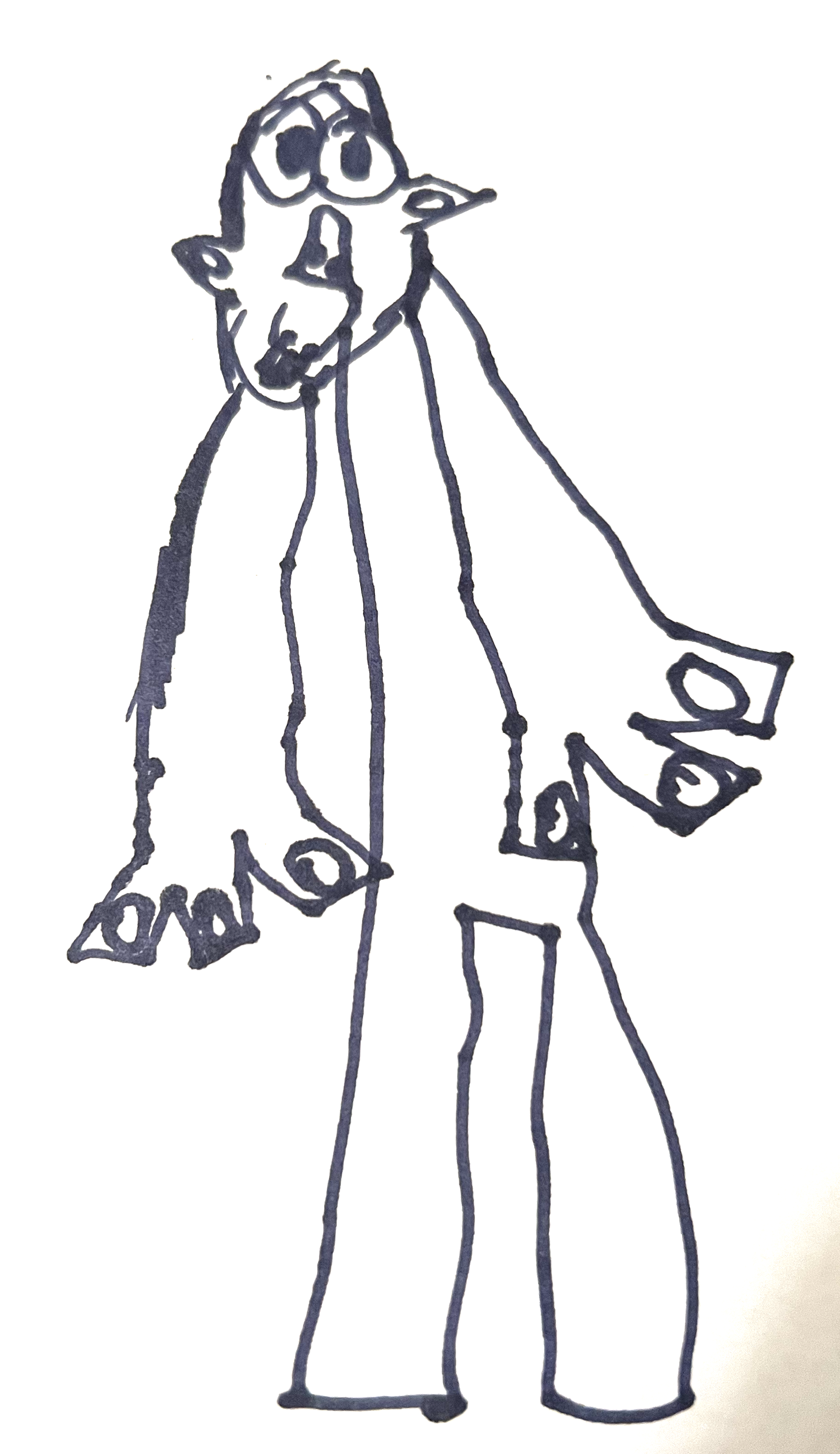
Recent drawing of Chris Cudworth by a four-year old daughter of a friend

By the age of 50, I recognized that my brain had some symptomatic problems. What they were exactly was hard to define. I wrote in my journal and called it “impatience” for lack of a better description. “I just can’t shake some old habits that bring me down,” I wrote. “I’ve noticed my impatience with everyone.”

What that really meant was a lack of ability to pay attention when I got bored, distracted, or felt that the ideas being put forward were somehow wrong.” I had zero patience for that.

I did not yet realize these were symptoms of Attention Deficit Hyperactivity Disorder, a condition I’d had my entire life, but had not yet put a label on it. “There’s something wrong there,” I noted. “Anyway, go for a run and roll up to work late morning. Meet with Vince and move on in life.”

That fall I met with a psychologist who… I noted in my journal “seized on my work situation as the most serious and difficult part of my fear matrix.” She recommended I try to get back with the agency where Vince and I had both worked before. That was good advice. I tried a few channels yet in my hurried, worried, distracted ADHD state with all that caregiving burden and financial issues I actually missed an invitation to follow up on that opportunity. A possible cure for my worst problems had escaped me.

Ultimately, I stumbled on an online article and made a note about it in my journal: “Generalized Anxiety Disorder.” I wrote: “At least this feeling has a name. This quivering, low-grade fear that escalates into near panic. That debilitates my well-being. That interrupts my functions.”

I was essentially struggling with the gutted lobster of my full-time employment but couldn’t whistle away the reality that my attention and abilities were being undercut by stress and the distraction of worry. Vince once told me, “I like you better when you smile.” Then one day in November, he called me in and said, “You’re done. You can turn in your computer today.”

I said, “Fuck that. I’m keeping the computer. I’ve earned that.” He didn’t argue. I packed up my stuff and drove thirty miles home, relieved that the conflicted situation at the agency was over. I couldn’t honestly say that I “tried my best” because my best wasn’t really available that summer and fall. All I’d done is survive for a while.

A salvation that suited me

At the same time my work on a book I was writing neared completion in 2007. That book, titled“The Genesis Fix: A Repair Manual for Faith In the Modern Age” was a project I’d worked steadily on from the early 2000s. It addressed the “Effects of biblical literalism on politics, culture, and the environment.” It was my response to the insanity of conservative religiosity corrupting American politics. I wrote, “Jesus was legitimately worried that people were taking the word of God too literally. The priests he chastised used a literal interpretation of scripture to dictate the conduct and faith of others. it was a common problem then and remains so today that religious leaders focus too heavily on the law and letter of God and lose sight of the meaning behind the words. What Jesus represented was a new form of truth, strikingly rich in symbolism at its core. The religious leaders of his day were largely unable to free themselves of legalistic restraints to accept the methods and ministry of Jesus. ”

I designed the cover using a photograph taken of the metal industrial dock at the Daily Herald a few months before. For a few years, I’d advance pitched it to publishers and some said “the idea’s great and necessary…” but informed me that since I wasn’t a pastor or professor or a famous person, the likelihood of getting a book deal was nil. So I self-published.

Because you know what? Sometimes the definition of being a winner is to do something in spite of everyone else telling you it can’t be done. Finishing that book and holding it in my hands despite all the caregiving responsibilities and work challenges was a great satisfaction in life. Despite all the political bullshit I’d been through at work, I’d made this one pure thing happen in life. I’d written a book. No one could take that away from me, and that’s worth something because it means that you’re still competing in life and determined to speak some manner of truth no matter what else the world throws at you. That’s one of the tarsnakes of life. Sometimes you gotta do whatever suits you.

This content is a continuing contribution to a book I’ll be completing titled Competition’s Son.

Posted in anxiety, Christopher Cudworth, Depression, running | Tagged , , , , , , , , , , , , , , , , , , , | Leave a comment

Through a glass darkly

Note: To see “through a glass” — a mirror — “darkly” is to have an obscure or imperfect vision of reality. The expression comes from the writings of the Apostle Paul; he explains that we do not now see clearly, but at the end of time, we will do so.

We’d been optimistic through my late wife’s diagnosis and treatment for ovarian cancer. From the summer of 2005 to the early summer of 2007, we did everything the doctors told us. She had surgery, then worked through eight chemo treatments followed by three intraperitoneal “injections” straight into her abdomen. The cancer was gone according to all practical measurements. CA-125 was down below 10.

The challenge in dealing with cancer is beating it at the cellular level, and cancer is adept at hiding below the detectable level until the chemo fades and the doctors get busy with other patients. Then it raises its tiny fucking little head and starts taking over tissue in its inestimably devastating habit.

Eventually, it builds back its foundations and a tumor grows or blood levels rise. Then the host body starts feeling odd and the tests show the CA-125 numbers rising. From 10-20. From 20-80. And from 80 to 800. Then the doctor goes “Well we better look into this.”

When cancer returns it is devastating, sometimes worse than the first time around when innocence keeps the facts at bay. For my late wife, the news that cancer was back caused a complete mental breakdown. I was in the living room when the phone call came through. She went into a rage, then tears of frustration and fear, and rage again. She collapsed in our bedroom and did not come out for a long time. I could hear the sobbing and when I came in she muttered “NO!” in a hard voice and kept on crying.

She did not emerge from that state of mind at all well. Her affect disappeared into a mute phase. I called a nurse friend to visit us the next day and during her visit, she told me, “She needs meds and a psychiatrist.”

Getting a psychiatry appointment when your health insurance is held by an HMO is basically impossible. I called every psych within fifty miles and finally found one that would see her. I could barely get her out the door. The world at large frightened her. All the spirit in her had vanished. No amount of prayer changed her demeanor. We entered the psychiatrist’s office to be greeted by a room full of people staring at us. That didn’t help at all. The meeting went quickly and we walked out of there with a prescription for depression and anti-anxiety medicine.

During those difficult weeks, even a visit from her parents was too much for her to bear. All the world was seen through a glass darkly.

A drawing of the author by the four-year-old daughter of a friend

This all took place while I was trying to hold that job together at the agency where I’d taken the position of CMO. The signs of weakness in my daily affect were obvious and respect for my abilities diminished by the day. The President told me, “I like you more when you smile.”

Within a few weeks, the company gave me the heave-ho and I didn’t tell my wife at first. I called our two closest friends to come over for support. By then, my wife’s mental health was at least stable, and the news of yet another job loss hit her in the numb spots. For that I was grateful. She stared at me with a strange look of sadness mixed with terminal resolve.

“We’ll get through this too,” she said.

It’s all we could do. Sometimes that’s all you can do. Just get through it. My life as a distance runner taught me that many times. It’s called “survival stride.” Art imitates life and life imitates art.

It keeps you running.

Posted in death, life and death | Tagged , , , , , , , , | Leave a comment

A Sprint to Respectability

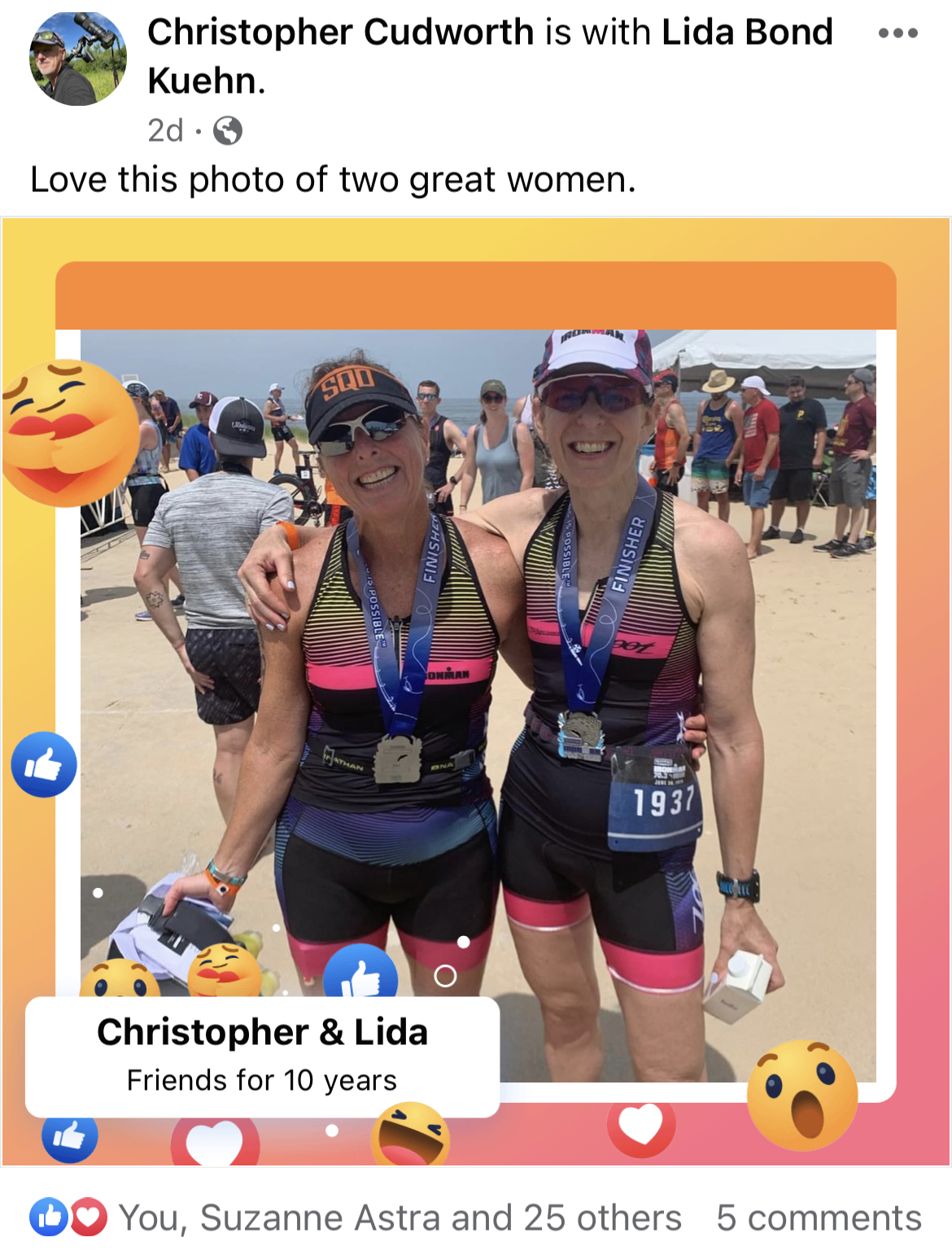
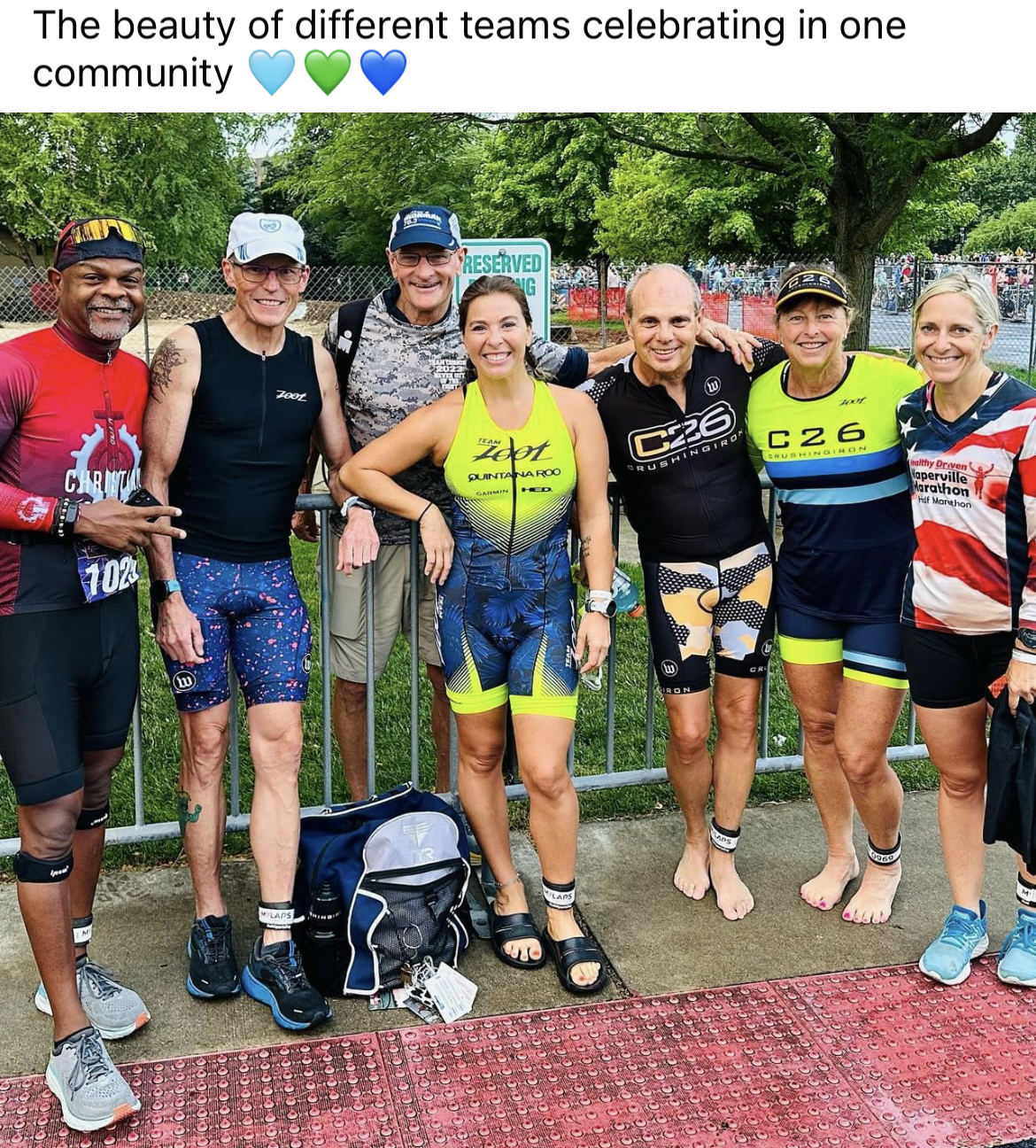
Lida Bond Keuhn (left) with my now-wife Suzanne Astra. Lida met me first when we competed in the Naperville Sprint triathlon relay ten years ago. While Sue rode the bike portion, Lida “vetted” me and declared me a “nice guy” so I ‘passed the girlfriend test as we began our relationship. We got married six years ago.

The Naperville Sprint Triathlon is the first real triathlon I participated in ten years ago with my wife Sue. We’d met in July of 2013, gone riding and running together right away, but then she had a bike accident (her tri-bike slid on a slick section of bike path during our ride together) that injured her shoulder badly enough to require surgery during the fall for a torn rotator cuff.

With her shoulder out of action, she couldn’t do the swim portion of the Sprint Tri, so she recruited a friend Lida Bond Keuhn to swim. Sue would do the bike portion, and I ran the 5K to finish the relay.

During the morning, Lida and I talked quite a bit and I passed the ‘girlfriend test.’ And then, we won that day! Lida’s a former collegiate swimmer who went on to become a solid triathlete not long after that sprint relay. Her career includes Olympic, Half-Ironman, and Full Ironman finishes. She travels to Worlds 70.3 in Finland later this month.

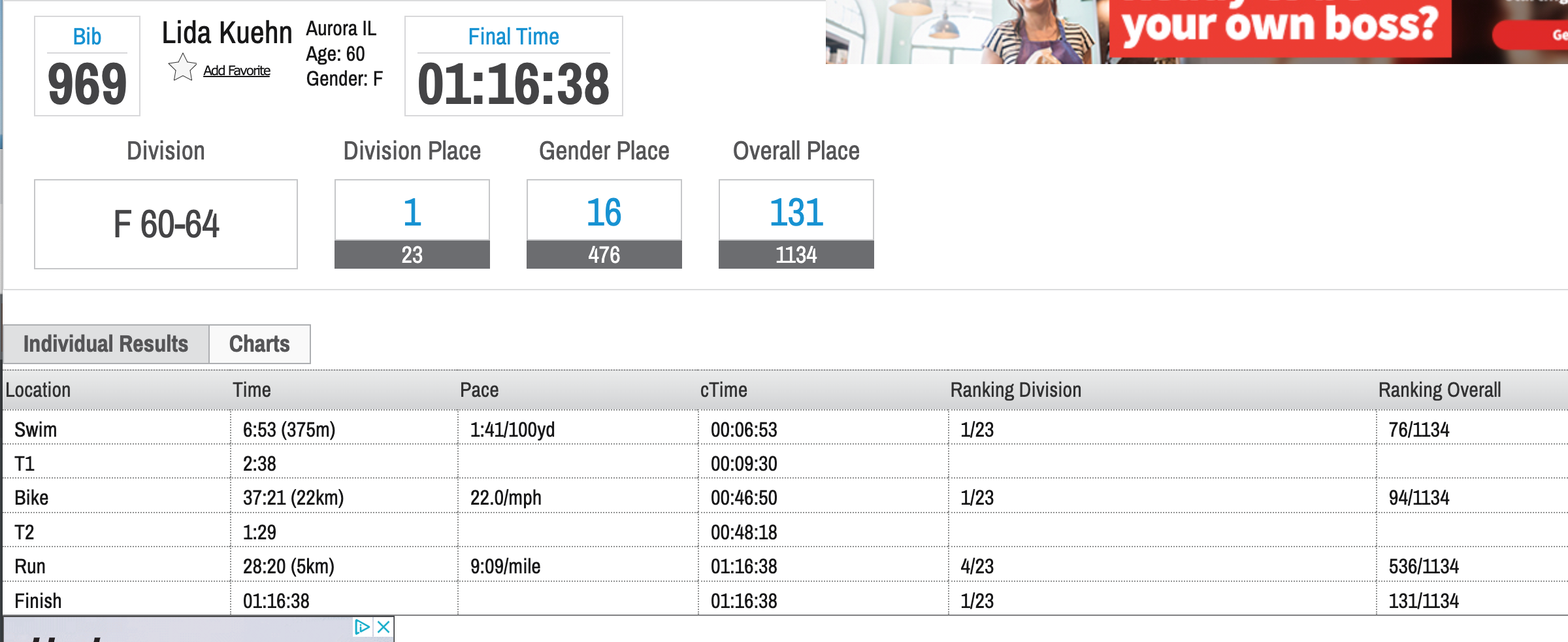
And, she won her age group yesterday! Even with all the turns in the swim course, she swam 6:53 to complete it. Her bike pace was 22 mph and she ran 9:09 miles for the women’s 60-64 group win.

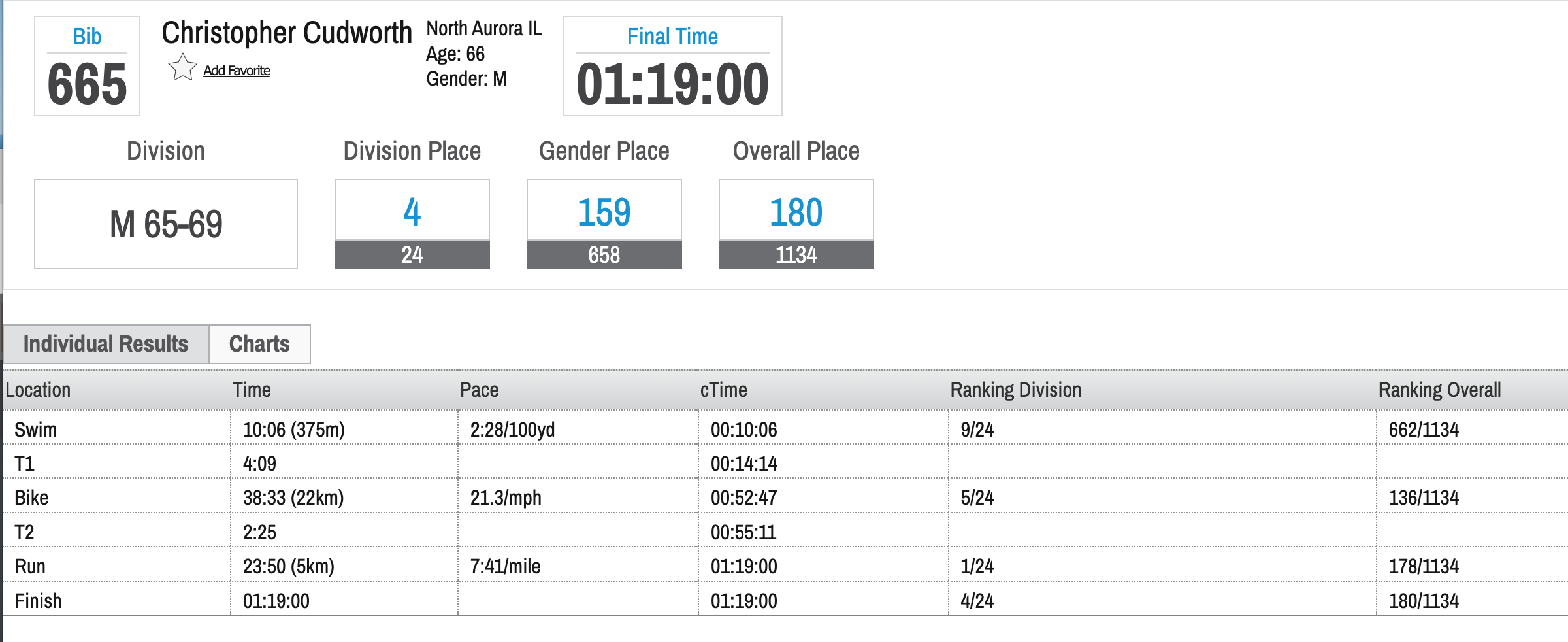
I was not so fortunate, placing fourth in the 65-69 age group division after a travesty of a swim segment in which I stopped and started so many times it did not qualify as a “swim” so much as a paddlefest through dozens of competitors thrashing the water from start to finish. Perhaps I should have started at the back of the 6-8:00 group rather than in the middle of the 8-10 group where much slower swimmers got out ahead of me, creating an impenetrable logjam through which I did not navigate well.

The Naperville Sprint Tri swim is conducted in the Centennial Pool, which is a chlorified quarry of sorts with a sandy bottom. It’s a large swim area if you’re not jamming thousands of people through a looping set of roped-off areas monitored by a phalanx of lifeguards. I don’t do well in those conditions at all. I’d warmed up thoroughly in the pre-race swim and felt relaxed waiting for my turn in the 8-10:00 group after the 6-8:00 bunch took off. I learned (yet again) that standing around for 15 minutes isn’t the best preparation for the swim portion. I need to keep my arms warmed up especially.

Thus the swim segment didn’t go well at all. I have only myself to blame for that. My mindset should have been more progressive (even aggressive) rather than regressive (responding with trepidation). Yet my past associations with that swim including the last race in which I encountered a woman treading in place while slapping the water and shouting “Goddamnit Goddamnit!” Anxiety is my tarsnake when it comes to the swim segment triathlons.

I’ve had many successful open-water swims thus far. But this was something different. That panic mood probably stuck in the back of my mind, and stopping and starting isn’t my favorite thing to do. This year it wasn’t much different. As I was heading toward the third turn, a lifeguard dove into the water right next to me to haul out a swimmer whose head dropped below the surface for far longer than it should be. He hauled the woman out of the water with his float.

Gathering my wits

Turning to the breaststroke at that point, I gathered my wits around a turn where we could stand up in the shallows. Breathing out to relax my mind, I dove in and swam the next fifty yards with something resembling an actual freestyle swimstroke. But then we got plugged up all over again at the next buoy, with people clamoring this way and that. There was no flow. The last 75 yards were slow and I got out of the swim at 10:00 plus. “Damnit,” I muttered to myself. “Oh, well.”

That was all disappointing because in a pre-race swim workout the previous week I’d done sets of 50-yard intervals adding up to 400 meters (the Sprint Tri swim was 375 meters). In practice I’d averaged a healthy 1:47 per 100 pace.

Great! I thought, thinking I could do perhaps 8:00m for the swim. That was not to be. But it would have kept me competitive with the other guys in my age group.

The rest of the race was super respectable. I was a mile-an-hour slower on the bike than the winner and two miles-an-hour slower on the bike than second place. But on the run, I kicked all their butts with my 7:41 pace. The other drawback was that my swim-to-bike transition was long too, over 4:00 due to having to cross two full parking lots in a mincing set of bare feet.

Bike out

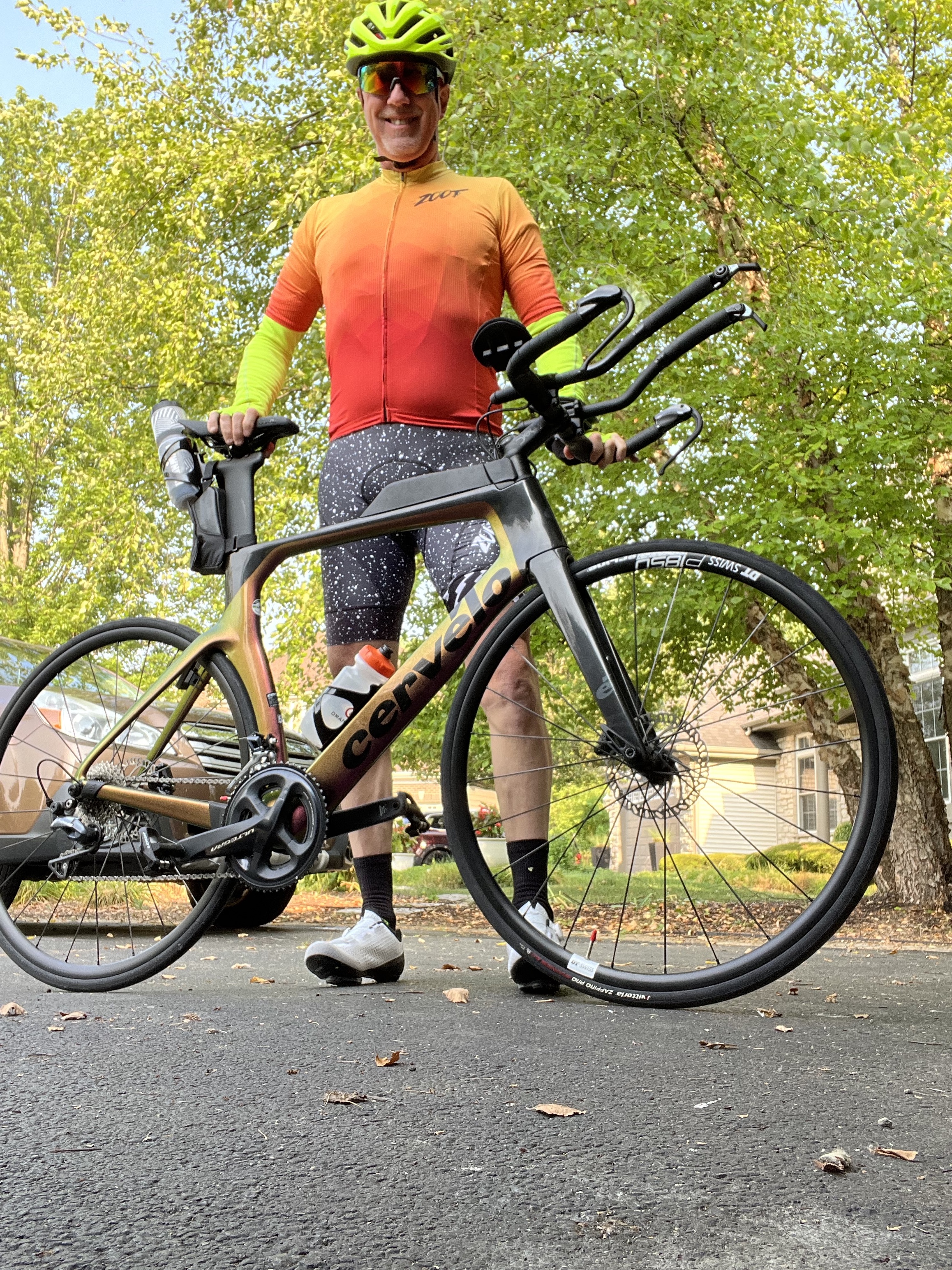
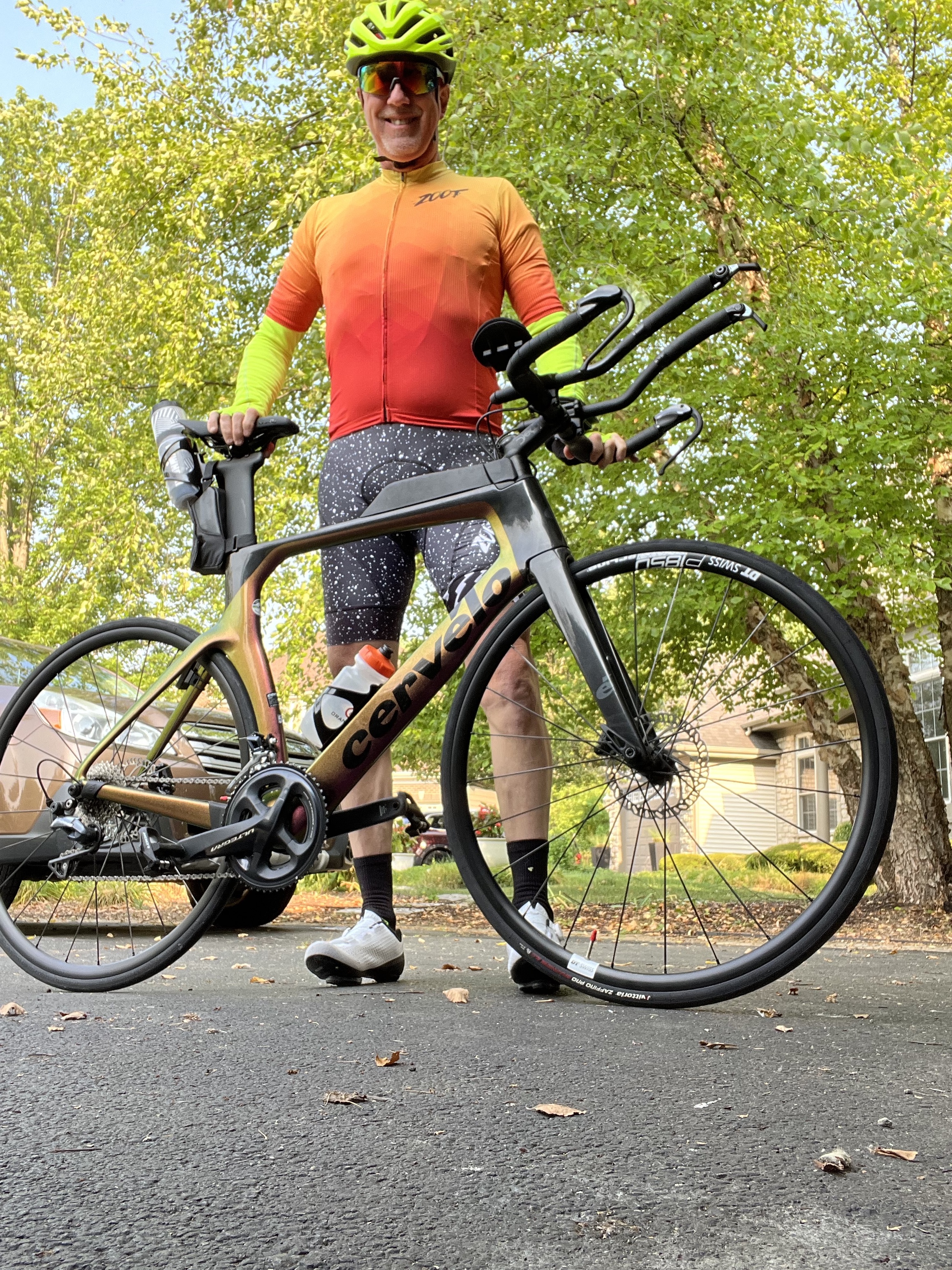
I’d done enough bike workouts to figure that a 21 mph average was possible for me over 13 miles. A few weeks back during a Swedish Days group ride with some faster friends, I’d managed 22 miles at 21 mph on my Felt road bike in a group ride. So I knew the legs were in decent enough shape. The new Cervelo Tri-Bike in aero should deliver the same level of performance, I figured.

It did indeed. I averaged 21.4 mph for 13.3 miles on the out-and-back bike course, proving yet again that I’m not the world’s strongest or fastest cyclist, but I am still improving. At sixty-six years old, I’ll take that as a good sign. The wind was tricky at some points but I concentrated one being “one with the bike” in terms of pedaling smooth for the ride so that I’d have good legs for the run too.

That was a great strategy, as I ran really well yesterday. On Thursday, I’d gone to the track with Sue and did a set of two one-mile paced internals with a 7:12 and 7:19 result. That meant I had something in reserve with plans to run sub-8:00 miles for the 5K in the Sprint and ultimately the 10K in my Olympic races. In this race, my run pace was essentially a sprint to respectability even if it fell short of a podium finish.

No complaints or woulda-coulda-shoulda

No complaints really about this race. I learned that my brain still doesn’t deal with crowded swim conditions that well. The same thing happened earlier this summer at Pleasant Prairie, where I had a strong panic attack at the start and had to calm myself to actually get swimming. I’ll need to work on that to avoid having swim calamities in future races. In previous 1.2 mile swims segments I’ve been swimming the 1.2 mile distance in Open Water in about 38:00 .

When I do the Muncie 70.3 this fall my plan is to try to ride close to 3:00 for the 56-mile bike, then average 8:30 for a significant portion of the first half marathon, likely slowing to 9:00 miles at some point, and seek to break 2:00 after the 56-mile bike. If all that goes well, I will be close to 6:00 or just over.

Most of all, I need to stock up on nutrition during the bike segment, and do a salt load in advance of the race and take salt tablets/capsules during the ride and run. I’ve learned the hard way that I’m a salty sweater and that guts me if I don’t take that aspect of nutrition seriously.

But overall the Sprint taught me that I’m progressing well on the bike and run. Adding more time in the pool is good, and adding more salt to the race-day diet is paramount. I’ll close with this photo taken from Lida’s Facebook page. It captures what I most like about triathlon. We’re all individuals even if we’re all coached by different people and compete for different teams or brands. Encourage each other. It’s the best part of the sport.

Posted in 13.1, 400 meter intervals, 400 workouts, 5K, aging, aging is not for the weak of heart, anxiety, bike accidents, bike crash, Christopher Cudworth, competition, cycling, friendship, IRONMAN, love, PEAK EXPERIENCES, race pace, racing peak, riding, running, swimming, Tarsnakes, triathlons | Tagged , , , , , , , , , , , , | Leave a comment

A Burridge over troubled waters

I’ve written before about my talented longtime friend Tom Burridge. He’s become one of the top age-group 60+ cyclists in the country and continues his exploration of cycling with gravel races where his endurance base serves him well in distances from 100 to 200 miles.

My wife Sue and I stopped to visit Tom and his wife Barb on our way to Chattanooga for the 70.3 Ironman earlier this year. We hung out for an evening sipping drinks (I dispensed with the sour beers that somehow found their way into his fridge) and caught up on times old and new.

Burridge leading the district meet with my former teammate and future D3 All-American Merid Dates in the Kaneland shirt right behind

It was fifty years ago this fall that I first met Tom when he transferred from Hersey High School, where his cross country team placed in the Top 3 at state. He then moved to Batavia High School, where he led the team to great improvement while achieving All-State status during a highly competitive era in Illinois cross country. Later he went to the University of Kentucky, and won SEC titles in distance events. After college, he contributed to national team titles and even set the American record in the half-marathon. He raced successfully against the likes of American greats Frank Shorter and Bill Rodgers.

Legacy time

Last year he was interviewed by the University of Kentucky for their sports archives. When it was done, he shared the discussion with me to get an opinion on how he sounded. I loved how he was authentic about his experience and assured him that while he came off as competitive, he didn’t come off as being arrogant.

Tom is still competitive in the best ways possible. He loves the challenge of training and racing at the highest levels possible. This past weekend, he invited his middle school coach Dennis Courter to join us at Alter Brewing. Dennis saw the potential in Tom and got him into running. We hung out at a communal table at a fun restaurant with craft beers and an outdoor cafe. We shared formative experiences and compared notes on people from the world of running with whom we’ve collectively crossed paths over the years.

Out on the road

While all that stuff is fun, what meant most to me yesterday was riding twenty miles in the company of Tom and another longtime friend Jack Brandli, who is training well for a 90-mile cycling road race later this summer. Along with one more cyclist, we hummed around the first loop of the Swedish Days Ride, averaging just over 20 mph with some wind mixed in. That’s not hard for Jack or Tom. They rode 87 miles total yesterday averaging 21mph before it was finished.

For me, it was a notch up this summer as I’ve just started rounding into shape. Riding in the draft for much of the way, I rode my sixteen-year-old Felt 4C and kept the pedals spinning. After a pee break, the two faster boys kept going. I rode out solo to do another 20-mile loop and averaged 19.3 for the day after a long pull into the wind before turning around and coming back.

Riding with the faster guys was like a “Burridge over troubled waters.” At one point, he gave a quick show of encouragement with a “Nice pull, Chris,” while at the same time advising, “Maybe not too many pulls. Save your bullets for later.” I knew my state of fitness and had no inkling that I could go 87 miles at 21mph. That was not in the picture, I knew.

But a good day at any length is encouraging and helps one get over the “troubled waters” of self-doubt. In June I did ride a solo 26-mile time-trial at 19.3 fighting a bit of wind for 15 miles so it’s coming around. I raced at Pleasant Prairie where the wind was heavy and averaged just under 19 for the day. My goal is to hit a 20 mph average in the next Olympic triathlon but Wauconda might not be the place because it’s pretty hilly. The Cervelo is faster than the Felt so I’m feeling confident that 20mph is in my future.

Gold star

Tom rode an all-gold Cervelo road bike that glimmered in the sun. It made me happy that I’ve got a similar bike that shifts from gold to purple to green. That symbolizes how my brain’s been working lately––transitioning from one life change to the next.

It also symbolizes how relationships and friendships often change over the years. For much of life, we view relationships based on presumptions about the people we call friends. Some of these may not be accurate. We also share events and histories and can have different interpretations of those as well. Or, we share what we think, but only at the level that we’re comfortable with exposing our true feelings.

As time moves on, we hopefully mature in our understanding and increase our appreciation for events of the past, be they good or bad. Then acceptance moves in to replace any consternation over what other people think of us.

That’s what’s happened with many of my longtime friends. While we all have had troubles of one kind or another “along the road,” the goal, in the end, is to find that bridge from the past to the present that works for us. A bridge over troubled water, is what that is.

When you’re weary
Feeling small
When tears are in your eyes
I’ll dry them all
I’m on your side
Oh, when times get rough
And friends just can’t be found

Like a bridge over troubled water
I will lay me down
Like a bridge over troubled water
I will lay me down

When you’re down and out
When you’re on the street
When evening falls so hard
I will comfort you
I’ll take your part
Oh, when darkness comes
And pain is all around

Like a bridge over troubled water
I will lay me down
Like a bridge over troubled water
I will lay me down

Sail on silver girl
Sail on by
Your time has come to shine
All your dreams are on their way
See how they shine
Oh, if you need a friend
I’m sailing right behind

Like a bridge over troubled water
I will ease your mind
Like a bridge over troubled water
I will ease your mind

–Paul Simon

Posted in aging, Christopher Cudworth, cross country, cycling, cycling the midwest, half marathon, healthy senior | Tagged , , , , , , , , , , , , , , , , | Leave a comment

Naked, Cheeky, and Unafraid

(NOTE: NSFW, this post does contain some nudity)

A few years back when the show Naked And Afraid started appearing on television, my prurient interest was piqued. Of course, the show blurs out any show of genitals, but naked butts are not off -imits. That’s an interesting fact of modern life. Just fifteen years ago it was illegal to show ass cheeks in public spaces. Now, ass cheeks are an integral part of modern life. That’s a good thing. Ass cheeks are just muscles covered with skin. Sometimes the skin is tan. Other times it’s white skin visible. In any case, ass is ass. Deal with it.

What I found initially interesting about Naked and Afraid was whether it was driving social perceptions or reflecting them? It seems to be a little bit of both.

One of the contestants on Naked and Afraid was asked if he minded being seen naked. His reply was enlightening. Gassaway: “I don’t know if you’ve noticed, but I have a really nice butt. (Laughs) Nah, nudity doesn’t bother me. That’s how we were born, that’s what we were given. I couldn’t care less who sees me naked. I’m more worried about how I’ll be portrayed. Will I come across as a good guy? I want the perception of me to be good.”

The female contestant looked at the prospect of being totally naked from a social standpoint as much as a physical one. Jones: Honestly, it wasn’t hard for me at all. You’re talking to the girl who got expelled from school in junior high for skinny dipping! The part that was strange was meeting this stranger — this man — and he was completely naked.”

Outside of the societal demand for modesty, the reason most people wear clothes is for protection against the elements including such annoyances as bugs, scrapes, possible infections, and a myriad of other unfriendly outcomes for exposed skin, including sunburn.

That means the romance of being naked outside in many circumstances isn’t that joyful. Unless you’re hanging out by an ocean or other body of water with a towel, showers and the chance to retreat if things get uncomfortable, being naked is typically a case of necessary circumstantial management.

Here in the United States, outright nudity such as exposing nipples on the breasts or showing genitalia is specifically banned in most places. For people that like being nude, it is nudist colonies erase those barriers But the US is still a pretty uptight country compared to many places around the world.

Many people in the world like the feeling of being naked. Skinny dipping is a darn fine way to feel a sense of freedom. Diving into the water totally naked is a liberating sensation. Given the styling of many women’s swimsuits, they’re pretty much skinny-dipping anyway. The world is getting used to the idea that women shouldn’t have to hide their bodies anywhere.

For men, it’s a bit different, and for a variety of reasons. As Elaine on Seinfeld once stated, “The female body is a work of art. The male body is utilitarian. It’s for gettin’ around. It’s like a Jeep.”

It’s still true that unexpectedly encountering a naked man is considered a shock. There are enough addled individuals out there that the sight of a naked man in public situations is still a bit disconcerting. At times it’s even perceived as a threat. That makes it extra important for people in the United States to be judicious with their choice of time or place for nudity.

But sometimes the shock wears off when the nudity is no longer a surprise. The college guy that insisted on being naked a whole semester proved that point.

Limitations

While swimming naked is generally kind of fun, it’s not that fun to be naked while running or cycling. There are body proportions and comfort issues to be considered from breast size in women to flapping genitalia in men. Those of us that have engaged in the lark of running naked know that the act can get old (or cold) quickly. Our college cross-country team was fond of stripping down once a season and running naked back through town. Running a mile or two with your dick slapping around down there isn’t that fun. I can’t imagine it’s fun for women dealing with flopping breasts either.

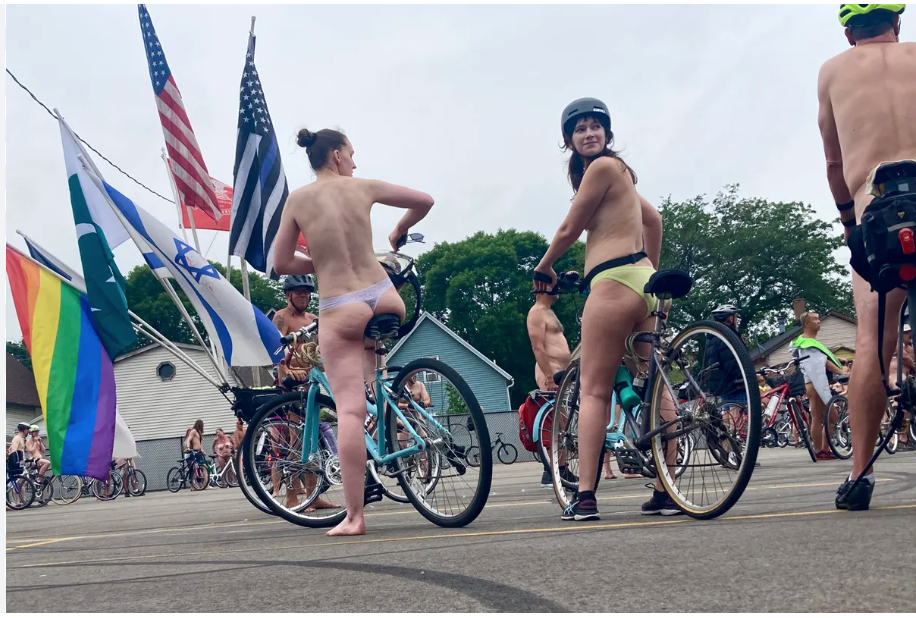
Naked bike rides are a bit more practical and in many places really popular. The number of people that love getting naked in public is nearly unlimited. The same goes for the Burning Man Festival, an event that my son has attended many times. He’s an unabashed guy and always had a love for the theatrical, hence Burning Man is a soul-satisfying venture. I wouldn’t mind attending that festival because it’s good for the head to throw off the constraints of society now and then. It seems like everyone’s welcome as long as you’re willing to make some sort of artistic contribution to the event. I’m thinking a tee shirt made from this irreverent pastel celebrating the freedom of sexuality that I produced would be just about perfect given the open-minded attitudes about nudity at Burning Man.

Perhaps you’re getting the picture by now that much of the world could care less if people are naked or not. In my own backwoods travels I’ve skinny-dipped with bald eagles diving over my head so close that I could feel the rush of wings from the big feathers. On another occasion, a mother otter brought her four kits (or whatever they’re called) to swim nearby. I climbed out quickly for fear of being perceived as a threat.

I don’t want to be anyone’s threat. Nor do most of us want to offend or frighten anyone else by being naked when we shouldn’t. But when summer calls, it isn’t a bad thing to find a remote corner of the world and feel the sun on your skin. What you choose to run or ride or swim while doing so is up to you. My son is attending the Burning Man festival again this year. There’s quite a bit of willing nakedness out there in the desert. That’s a good way to thumb your nose, or whatever else one might choose, at social mores and reality conventions. The world needs far more Burning Man and far less Ron DeSantis and his repressive, bigoted, control-seeking authoritarianism. Same goes for the bloated orange thing they call Trump. Seriously, who takes these idiots seriously? They are nakedly stupid individuals.

And for the NSFW folks among you, the photo below is one that I took of a bird called a Dickcissel. It’s a bird that openly and honestly sings its own name, “Dick ciss ciss ciss.” It seems to be proud of its own dick, you might say, and that’s the naked truth in the bird world.

Apparently, beyond the world of healthy nudity, there’s a brave new world of “dick pics,”that seems to be a convention on the rise, here’s an interesting post from a blog I follow called The Dihedral.

Get naked, but be civil about it. That’s the moral here.

Posted in Uncategorized | Leave a comment

An unpleasant start to an ultimately pleasant triathlon

Yellow sleeves visible during swimming.

Open-water swimming is one of life’s acquired joys. Unless one grows up swimming in ponds, lakes, or oceans it takes a bit of practice to get used to the idea of climbing into the water and swimming over whatever depths a day might call for. I’ve gotten used to the open-water segment of triathlons through a few years of practice, but that doesn’t mean race day always starts out smoothly.

Most of the races I’ve done have had “rolling” starts. That is the method by which three people at a time enter the water together and it’s all spaced out by 15-second intervals. In that circumstance, I find my rhythm quickly and know not to start out too fast. It takes a good 5-10 minutes of swimming (or running) to get my (senior) body warmed up and working efficiently. Start too fast and fatigue goes ripping through the upper body. The breathing goes shallow. It’s easy to panic a little at that point.

That is precisely what happened yesterday duringn the Pleasant Prairie Olympic Distance triathlon. At the start I treaded water among the group of 55+ swimmers and when we began swimming the water churning all around me put me on edge. In response, I swam too fast for the first two minutes. Plus, I had big goals for improvement in the swim. Over the past year, my per-100 time has dropped to a best pace just above 1:40, which is a significant improvement over my previous 2:00 per 100 pace. But I had no business going so fast from the get-go. I paid a price.

Anxiety seemed to rise up from below the surface and take over my mind. I stopped, breathing too shallowly for comfort, and glanced at the shore. Every ounce of me wanted to swim in and call it a day. Instead, I treaded water while talking to myself. “Be cool,” I said out loud. “You can do this.” The wetsuit kept me afloat as I calmed my nerves.

I regained some confidence and started swimming again, but the panic had not subsided completely. Stopping again, I realized that the strange tugging feeling of the sleeves on my Zoot kit was giving me the willies. That’s my bad, not Zoot. I had not practiced swimming in that new kit and it felt a bit restricting at first. Then it loosened up. So I paused, cursed a little, and did a few breaststrokes to keep moving. Only then, after probably three minutes of messing around with my brain did I get back into a solid, less frenetic swim stroke.

Passing the first orange buoy, I told myself “Okay now just keep a rhythm.” But dangit… I was pulling to the left and soon found myself in the company of an event kayak with a kind young paddler who told me, “Hey, you need to go back over that way…”

I looked to my right and saw the line of swimmers about twenty yards away. I was heading off course. I cursed again out loud, asking myself, “How the f***?” and heard the kayaker laugh. In a minute or so I was back on course.

From there, most of the day went much better. The swim wound up taking me 39 minutes versus the expected 35 or so with my self-predicted pace. Perhaps it was the sudden sensation of being surrounded by forty other swimmers, or just the anxiety of being in the event at all when life itself has thrown me a few things to be anxious about lately. Whatever the case, I’m proud that I was able to calm myself down, push on to the Swim Out and smile at my wife who was taking photos. “I had a little trouble out there,” I told her.

The chop that blew up during the swim didn’t help either. It was flying right in my face as I breathed on the right side. That meant adapting the stroke to longer rotation to allow for breathing. But again, I’ve gotten good at some of these things. And here’s the joy in how the race swim ultimately went: I actually swam quite well once the anxiety thing subsided. Take away the frenetic mess at the start, and t actually swam my target pace. There’s something pleasant to build upon.

There’s an allegory for life itself in that eventuality. As lifelong owner of Generalized Anxiety Disorder, time and circumstance have always caught me off guard now and then. I’ve learned how to deal with much of it. Perhaps that’s part of why doing endurance sports is important to me, and why I still do them. There’s nothing like facing fears head-on. I believe it’s not so much about “conquering fears” as learning to move through them.

If the bike fits…

During the transition, it’s always a challenge yanking off the wetsuit and pulling on the bike helmet and shoes. Then it was time to get on the bike and ride. Recently I invested in a new triathlon bike, a Cervelo P Ultegra. As with any new bike, it takes time to tweak the fit and see how your body works with the machine. I’ve gotten in a series of perhaps ten rides, long and short treks on the Cervelo. Getting the new cleat angles took time as well as finding out how the cadence rate (spinning pedals) and shifting work to create a “whole package.”

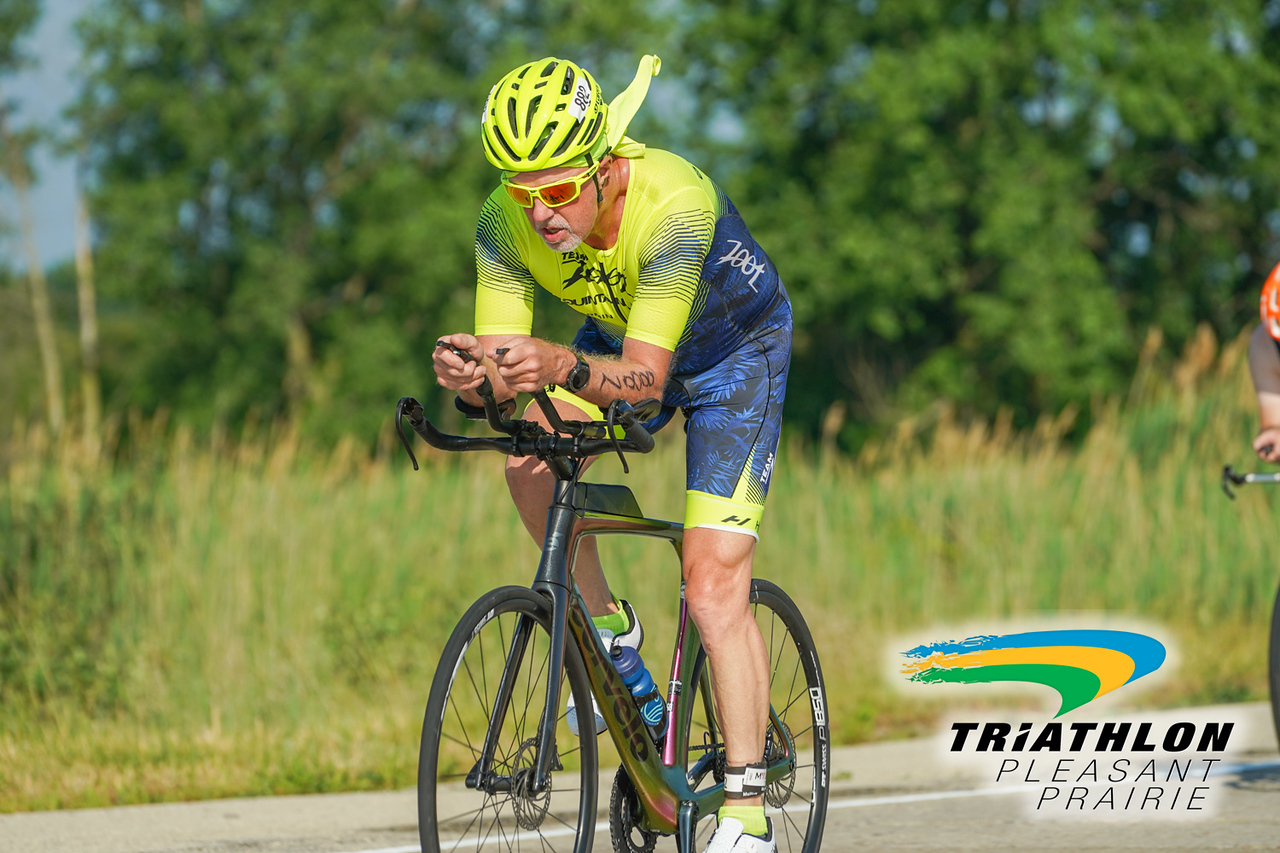
I’d say that I’ve reached 80% efficiency so far. As my wife pointed out when looking through the race photos she took, it looks like my seat needs to come up a centimeter or two. That’s typical when dialing in a bike fit. It takes some serious tweaking to get everything right.

Raising the seat just a touch will put me in a better aero position.

Racing a triathlon bike is an odd sensation if you’ve never done it. Pros spend hours getting it “just right” to maximize aerodynamic efficiency. I’ve been riding in aero using my Felt 4C and aero bars for two years, so I’m used to it. But having the shift levers on the bar ends changes things with an actual tri-bike. I learned from practice that there are basically two gears where I can spin efficiently at 20+ mph. Any higher gear than that, and right now my legs tire out. The strength for high gears needs to be built up over time and through many miles. I’ll work on that.

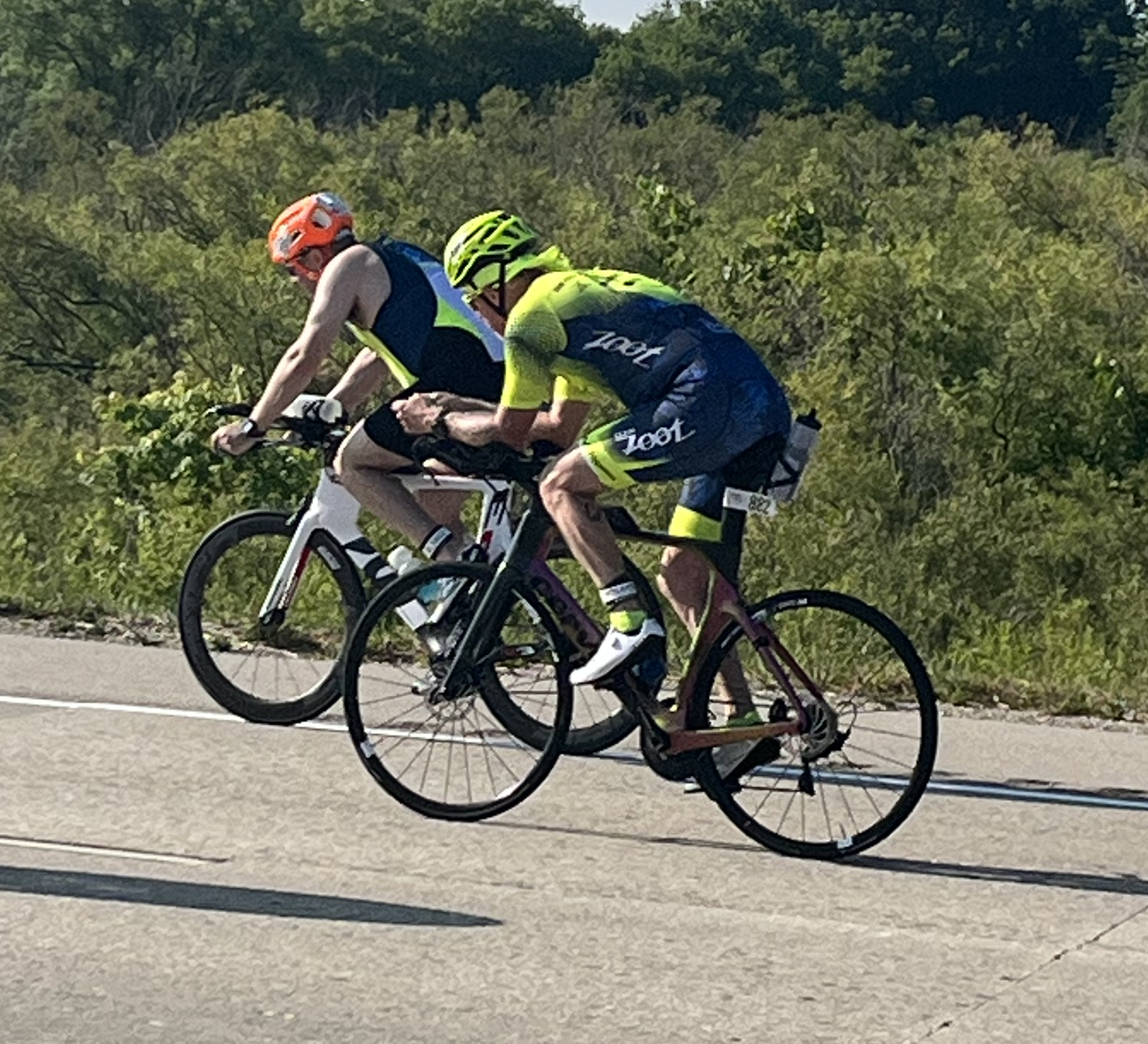
Learning to navigate in the wind on aero bars is important. The Cervelo is the most aerodynamic bike I’ve ever ridden. It feels like it cuts through the wind. That’s a confidence builder. I still struggled up the false flats a bit and the crosswinds were cruel, but still managed to average 18.5 mph for 25 miles on a really windy day. That’s a start.

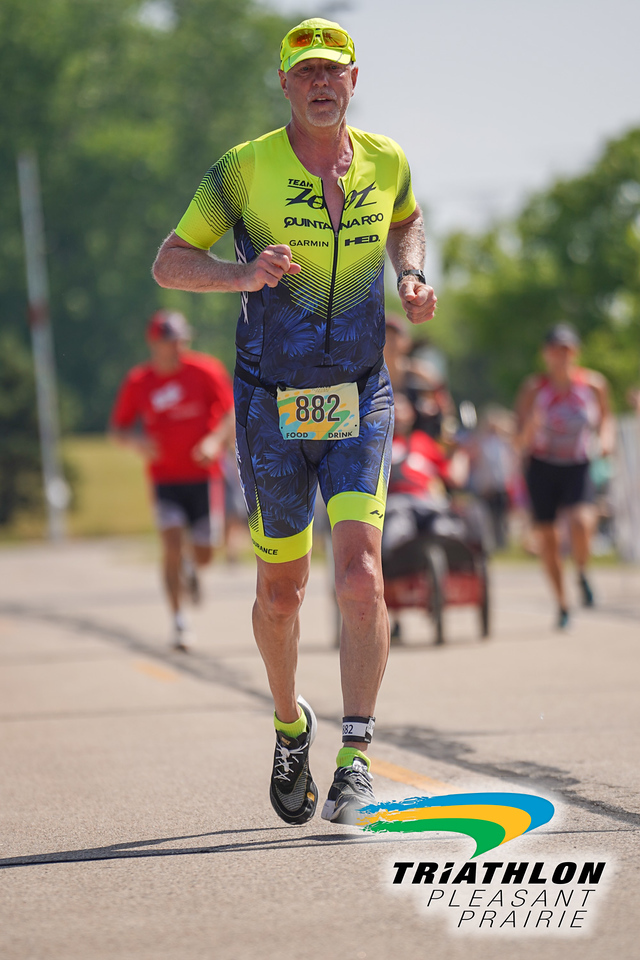
The bike course is interesting as it makes a loop around the Haribo candy factory on smooth corporate drives, then a long out and back to the Southeast (with a south wind) on some rolling and somewhat scenic territory. On a less windy day (which may not happen often given Pleasant Prairie’s proximity to Lake Michigan) the course is fast. But that’s the thing with triathlons. You race in whatever conditions you’re given. It started out cool in the morning and as you can see from the photos that follow, got hot on the run. That’s triathlon. That’s also life.

Coming off the bike, I’d eaten a set of Shot Bloks and a couple salt tabs. But my water intake was low, and as my wife also pointed out after the race, I’d taken the Light Hydration bag to fill my bottles. It wasn’t enough “substance” to hold me through. I ran through three miles at 9:00 pace, then turned onto a long curving stretch of crushed gravel path with the wind behind us. Lacking that cooling effect, and with temps in the low 80s, along with others I began to suffer. Miles four and five were slow, even walking a bit to catch my wits back up to running.

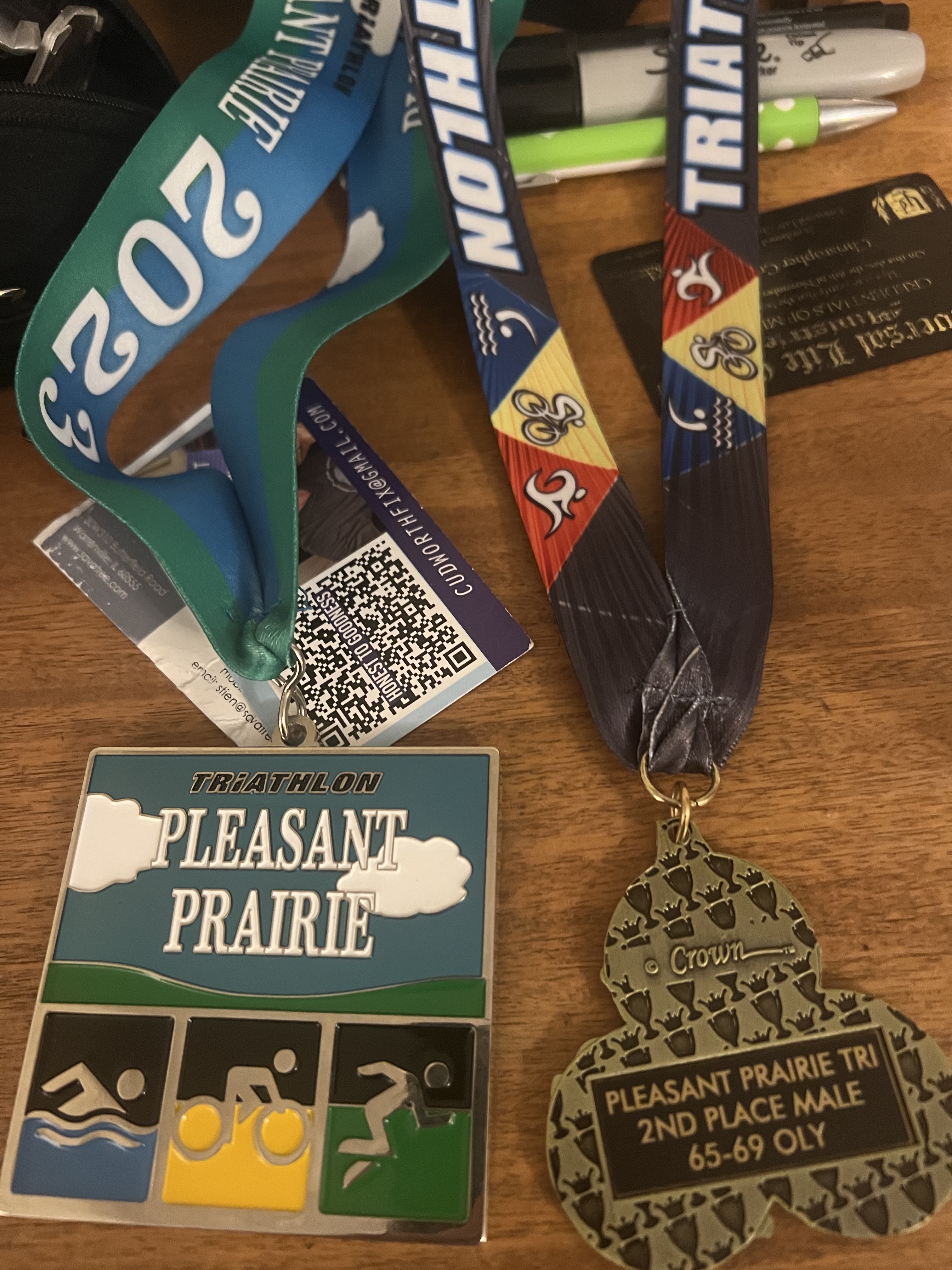
The last mile went fine as a couple glasses of water at four miles kicked in, and a cup poured over my head felt good. I felt disappointed that the day had not gone more smoothly, but as it worked out I still placed second in my age group. So I’ll take that for a day’s work and look forward to the next Olympic distance tri with a bit less anxiety, a lot more nutrition, and the pleasant notion that I’ve done all this before. I just need to emphasize the good stuff to cancel out the bad.

I recommend the Pleasant Prairie Triathlon, by the way. It is exceptionally well-run, has a great vibe, and deserves the support of the triathlon community. They always give out great shirts and you get free race photos, as you can see. Plus you can visit the Jelly Belly store.

See you next time!

Posted in anxiety, Christopher Cudworth, cycling, Depression, fear, mental health, PEAK EXPERIENCES, race pace, racing peak, riding, running, swimming | Tagged , , , , , , , , | 2 Comments

Not “woe is me,” but resiliency

Following the emotional breakdown of my wife after the cancer returned in 2007 after two years of treatments and remission, I proceeded to lose my new job at the marketing agency. It had taken months to work up the courage to accept the position, and it only a lasted a few months after the decision. One of the last things the head boss told me before felling the axe was “I like you better when you smile.”

But I had few smiles to give at that point. Life’s convergences were testing my resiliency. I was caregiver to a wife and father with a child in college and another in high school. I was working hard to keep up yet things were sometimes slipping by. Yet all told, I refused to get into the “woe is me” mode. I was searching for answers though…

I’d manufactured the positivity for that job in the first place. On January 9th of 2007, I’d noted in my journal the ovations being made by the President and VP of the agency where I’d freelanced for several years. And why not? The pay had been awesome at times. Nothing feels as good as taking a $6,000 check to the bank and putting it in the account. I was being paid $100 an hour for my creative work.

I wrote, “If I leave Daily Herald it will likely be for $95,000 a year…$15,000 increase…that’s only $1000 a month more.”

In fact, the offer from the agency came in at $110,000 a year. But the VP and CFO that pushed me to accept the offer also seemed eager to make me feel guilty about it. “Do you really need that much?” they pressed me. Perhaps that was some kind of test. Of course I needed the money. “Yes,” I told them.

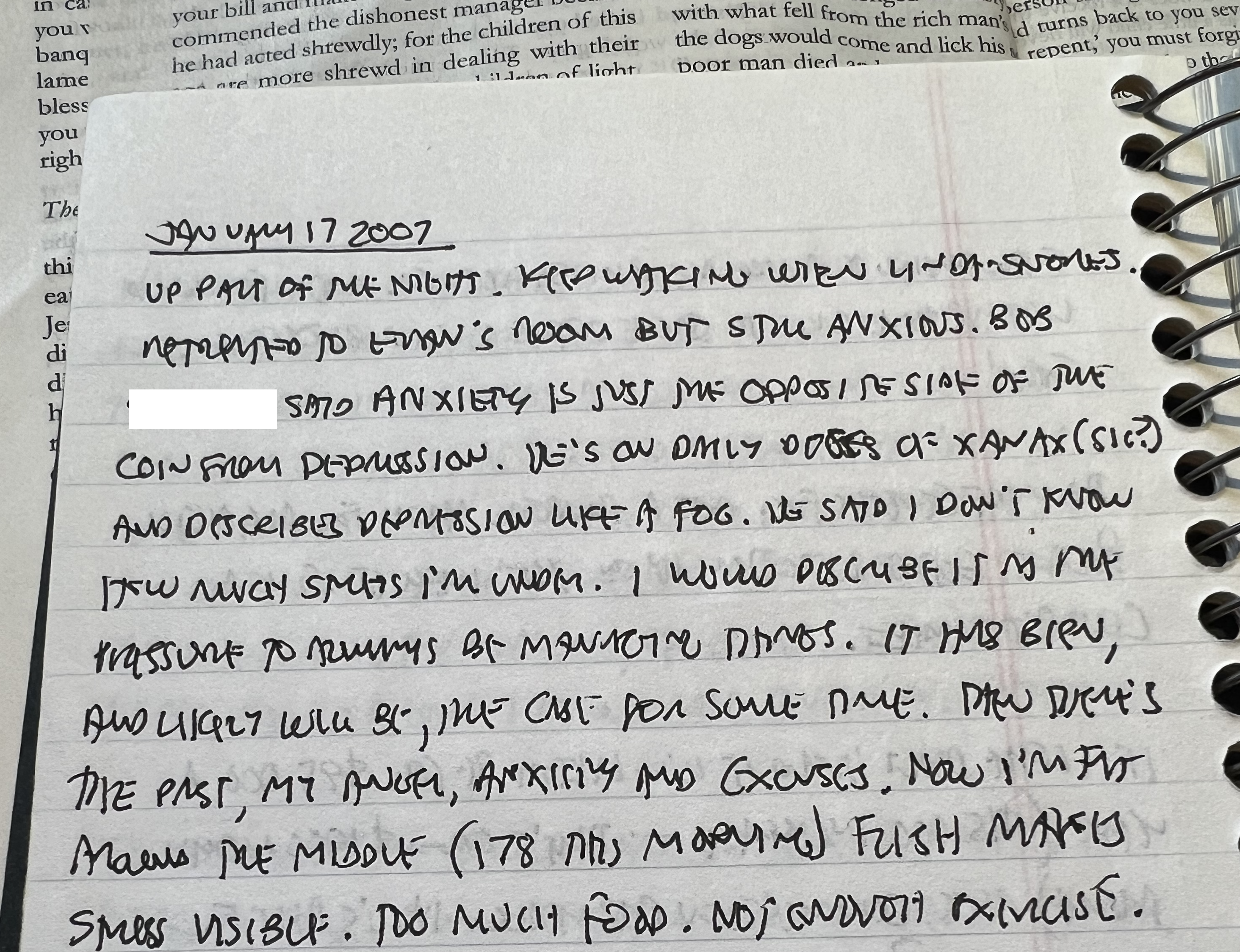
At that time, my wife was snoring every night thanks to the after effects of chemo on her sinuses and lungs. For me, sleeping became difficult. Anxiety built within me as a result. A friend at work told me, “Anxiety is just the opposite side of the coin from depression.” That friend told me he was on a daily dose of Xanax, and offered me one. I declined.

“You don’t realize how much stress you’re under,” were his next words. “Depression is like a fog. It make it hard to realize what’s really going on.”

I was gaining weight too. “Now I’m fat around the middle,” I lamented. “178 this morning.”

Granted, I’d been way for years as a distance runner, weighing only 140 lbs and skinny as fuck. But now I was nearing forty pounds heavier than my old competition weight. It weighed on me.

“At least I’ve resisted playing soccer and tearing up my knee permanently,” my journal recorded. “The desire to play is so great.” Even after a torn ACL, surgical repair with a cadaver and another tear, my brain still craved the dopamine of being on the pitch. And feeling like a kid again.

What I’d felt in the wake of the second ACL tear was a form of grief. A grief for a lost childhood, or youth. It threw me into the “second half of life” apart from the games I loved to play. I was now a grownup, and hated not being able to “go back.”

Clinical anxiety

On January 18, 2007 I wrote: “So if I were to accept a general diagnosis of clinical anxiety, what would that mean? Certainly would not make me unique. Plenty of people have anxiety. Plenty of people apparently get treated for it. But how, and why?”

Looking back, it astounds me that it took me that long to acknowledge the fact that I was anxious by nature. I’d been a habitual nail-biter all my life. Worried about winning and losing. Dogged by dread in sales and work and relationships. Of course, I had anxiety.

I went on to write, “Would it affect my writing, painting, performance? Certainly it now is, affecting me…And it likely has for years.”

Epiphany (about time)

Who among us has not had these types of slow-moving realizations? The revelations of self that finally sink in? My journal continued the analysis: “Anxiety. Look at that word. Worry. Lack of confidence. Need for approval. Fear. Stress. Depression. Control. Manipulation. Anything to make it go away and give you a sense of…hope.”

And more: “When I fell in love, anxiety dissipated..until love itself became something to lose, and losing it. Loser. You always hated losing. With a passion. Sow what do I do, if anything? Glass half empty. Glass half full? Write your brothers. Pray and think.”

On January 21, 2007, I mentioned an idea to write a book called Competition’s Son. “So many valid instances and stories to tell.” You’re reading echoes of that here. A serialized life story. Post by post.

On January 30 I wrote an entry that described my attempt to get hired back on at Aspen where I’d had success through 1999. “This is so, so typical of me. Last night I noticed in reading the e-mail reply from Cathy (name redacted) that she had been straightforward in telling me how to get hired.”

I was well aware of one more flaw in my thinking by then. While it would take years to put a name on it, I was recognizing the signs of a condition often associated with anxiety. ADHD. “The invitation was there all along!” I wrote in exasperation. But fear blinded you to it.” Fear, and lack of executive function. My brain often skipped over the most important details of many things in life. It had cost me once again.

Following up on that thought, I wrote…”You also…keep losing sight of what is important to you. What you want to do.”

The ADHD Kid

All of these things were and are classic signs of ADHD. It would be just a few more years before my late wife told me outright “You’re ADD” after sitting through a seminar on the subject through her preschool training.

These days, I look back and realize what a damned struggle life has been due to a brain that is immensely creative and productive, yet lacking in certain mundane functions that people measure you by. It’s an insane world that expects everyone to fall into the same way of thinking in every situation. That’s what I say.

Yet this isn’t “Woe is me.” It’s a chronicle of resiliency. Of hanging in there despite my own flaws and life’s twists and turns. It’s all that any of us can do.

Posted in anxiety, Christopher Cudworth, competition, Depression, fear, mental health, mental illness | Tagged , , , , , , , , , , , , | Leave a comment

Rough landings

I was a high jumper during my high school career and first year of college. I jumped 6′ 1/2″ in college, my best ever. Not bad for a distance runner with skinny calves and not much in the thigh area either. I jumped to earn points in high school while trying to help our team win. During some dual meets, I’d run the two-mile, go do the triple jump, high jump, and come back to run the mile at the end of the meet. I never won all four events in one meet, but I did win the two-mile, triple jump and mile one meet.

Early in my career, way back in junior high, we jumped over the bar into crusty foam rubber strips wrapped in nets. Foam bits would fly up in your face every time you landed, and the netting was no bargain either, leaving striped welts wherever it scraped the skin.

By the time I was in high school, a new invention called the Cloud Nine came into play for high jump and pole vault pits. Those inflatable pits relied on the force of a big fan at one end. If you landed on the edge somehow, the rebound of the air inside would send you sideways. The risk was far greater for pole vaulters landing on those pits from heights of 12-14 feet, which our Kaneland vaulters often reached.

Occasionally a big gust of wind would catch the Cloud Nine pit with enough force to rip the stakes out of the ground. The pit would flip over and people would run to grab it before it blew completely away. I documented these experiments in high jumping in a previous post, but the main allegory that matters here is that the Cloud Nine invention was not that great at providing safe landings. Rough landings were quite frequent.

I also slid off the edge of all-foam mats later in my career. All it took was a good rainstorm to create a slick surface and off you’d go. By then I was a Fosbury Flop guy and landing on your back and shoulders only to slide off the back of the pit was never a joyride.

Getting off the ground

That brings us to other kinds of rough landings in life. I’m thinking specifically of a period in late 2006 and early 2007 when it became evident that staying in my job as Community Marketing Manager for the Daily Herald was becoming untenable. I’d survived a 360-degree review during a tough period in my wife’s cancer treatment and was trying to settle back into a consistent work routine when the newspaper started panicking out losing readership. Some desperate minds at the company decided to build a youth-oriented newspaper called Beep, and recruited one of my direct reports, a young woman two years into her job, to lead the Street Team in some nighttime antics at bars and events.

She wound up working twenty to forty hours extra every week. Running around handing out Beep newspapers at nightclubs was awkward at best, and also stressful. The guy behind the Beep project was a VP to whom she had a “dotted line” report, and I never knew what that meant other than she was racking up hours on her personal time on top of her regular job.

I raised this issue in an email to the VP and got no response at first. So I raised it again in a meeting with my boss, who told me “Well, you’ll just have to find ways to reduce her hours overall.”

That wasn’t actually possible. Our little department managed more than two hundred community events every year. We prepped booths and tents and got them shipped out to locations like community festivals where the circulation department depended on us to get their salespeople in front of potential subscribers. The pressures to maintain circulation revenue required us to increase those opportunities, not reduce them. My direct report person was stressed beyond belief by all these demands.

So her hours piled up and I told her to document them. We added them up and I put them into an overtime report submitted to my boss, and he blew up. So did the Operations VP in charge of Beep. “How could you let this happen?” they both demanded.

“I didn’t let it happen,” I calmly replied. “You made it happen.”

You can imagine how well that was received. The HR department pulled me down for a talk. “You can’t talk to a VP like that…” she told me. My boss sat there mutely, not eager to defend me or enter the situation in any way. His main goal, I always knew, was to make it another 6-7 years muddling along as an Assistant VP with access to all the pro sports tickets and free admissions to show at the Allstate Arena. Beyond that, he was never really interested in much else in the way of marketing. He came from the sports department, after all. The job was a salvation after twenty-five years of writing fishing columns and the like.

So the atmosphere got heavy, but she got paid for her time after all. Then VP kept on assigning her extra hours and I told my boss, “You need to stand up for her. This is beyond my pay grade, obviously.”

“Don’t let it happen again,” he told me. But I was following employment law. So I turned the hours in again.

At the same time, the paper was convulsing with threats of layoffs. I began to look at opportunities outside my job knowing that marketing is almost always one of the first chopping blocks, and our department was flush with specialized employees. One of them managed the weekly auto reviews in a shrinking Automotive Section. The Special Sections editor was also targeted, and both were soon let go.

Parachute

I’d built a parachute for myself by freelancing outside the company for several years. A former associate and boss from Aspen Marketing had started his own company. At his request, I’d flown to Richmond, Virginia with his team to do a pitch and land a $1M account. That day was so successful he spent $800 on four of us with a Surf and Turf dinner that night. When the meal was over, he leaned over the table and said, “Watch this.”

As a high-spirited Italian guy with a crude sense of humor and a history to match, our leader at the agency was a master of pranks. Seated at the table after the meal, he called the waiter over and pointed to the five-pound lobster whose flesh we just consumed. Somehow he’d learned to make a Squeaky Toy sound with his lips that he used for humor and pranks on many occasions. He’d squeeze things at random while making the squeaky noise and people would stare, thinking the sound was coming from whatever he squeezed. It worked on escalators, at stores where he’d make a mannequin squeak, and so on.

That night, with the lobster laying there with its body open and its claws splayed on the plate, he started rubbing the lobster’s back with his index finger while making the squeaky nose, he told the waiter, “I think this thing is still alive…”

The waiter was instantly horrified. He called a fellow waiter over and our leader rubbed the lobster making the squeaky noise again. The rest of us were trying hard not to laugh, and finally, when the waiter turned to get a manager, our man said “Nah,” he told them. “I’m just kiddin’ ya…”

Making the leap

A few weeks later I decided to make the leap from the newspaper to join the agency full-time. With all the threats of layoffs and the bad vibes emanating from HR and management, I decided it was time to vacate the premises. I’d had seven great years and loved working with those peers on many fronts. I wrote a note to the Publisher thanking him for the opportunities I’d been given and started with the agency a few days later.

The only challenge was the need to commute even farther from Batavia up to Palatine, an hour each way. But the salary was good, more than $30K more than I’d been making with the newspaper, so my wife and I decided it was a worthwhile risk.

Sadly, the woman that I most trusted at the agency, a highly competent former AT&T manager than had driven the company to profitability announced her departure around the same time I was investigating the change. She was doubly incensed when the owner told people what she’d been making, a faux pas of the highest order, but by then I was too far into the process to back out.

My title as Chief Marketing Officer (CMO) because I’d led more than one successful pitch. But internal politics made the title seem insignificant. I was given a desk out in the open with the rest of the staff because there were relatives and friends involved. My first meeting as CMO was not a show of strength either. I took a friendly approach and kept my talk short when people were actually expecting a person like me to fill the void of the woman leaving the company.

Meanwhile, leadership on the account I’d won for the company was taken over by an aggressive account executive. The big paychecks felt good, but I was far from happy.

“Such is life,” I told myself and kept working on copy assignments and pitching new accounts, the work I’d been hired to do. I’d learned from years of running and training that the best way to make progress in any situation is “one step at a time.”

Into a shell

About three weeks into the job, my wife had a checkup with the gynecological oncologist. We’d finished up cancer treatments 18 months earlier and she wasn’t having much trouble overall, but the CA-125 numbers on her blood tests had risen suddenly. I arrived home from work one day to find her anxiously waiting for a phone call from the oncologist. When it came, she sat there stunned for a moment, then hung up the phone. “The cancer’s back,” she screamed and cried together. And she went into a fit of rage.

Who could blame her? The stress of chemotherapy had almost killed her. Surgery hadn’t caught all the cancer either. I watched her tear at the world in that state of mind. When it was done, she’d had an emotional breakdown.

The next day, I called a nurse friend to come by. “She’s had a nervous breakdown,”‘ she told me. “here entire affect is gone. “You’re going to need a psychiatrist’s help, possibly some medication to help her through this.” She’d retreated into a shell of herself.

I still needed to go to work, so her parent took turns coming out to the house to take care of her. I spent hours on the cell phone consulting with medical experts between work sessions and lunch breaks trying to help my wife through a horrible time. After the “gold standard” chemo she’d endured, she felt betrayed in some respects. She was silent most of the time, and physically convulsed, especially when we had to go out in public to doctor’s appointments and such. I protected her.

One day at the office I was feeling beaten down by it all when the owner looked up at me and said, “I like you a lot better when you’re smiling.” He was right. I was having a rough time putting on a good face. After another week of that, he called me into his office and said, “We’re gonna have to let you go. You can turn in your computer this afternoon.”

I said “No, it’s mine. I earned that,” with such force he realized I wasn’t messing around. I drove home that day as angry as I’d ever been. The same guy had failed to protect me when I was laid off during a downsizing at the agency where he’d been my boss before. Now he was cutting me loose during one of the most stressful times of my life.

More bad news followed. COBRA premiums for insurance were going to run $2000 a month. Another really round landing. My “parachute” plan had turned into a lead weight. But I was determined to make good of everything no matter what else happened.

Posted in anxiety, Christopher Cudworth, fear, mental health, mental illness | Tagged , , , , , , , | Leave a comment

A new way of racing through life

As the cancer treatments from 2006 did their work on my wife, she eventually moved into a period of remission. But it wasn’t an easy path. After eight rounds of harsh chemo, they told her that she’d done the ‘Gold Standard’ using intravenous fluids. It was hard. They’d pumped it through a vein in her arm for eight treatments that eventually laid her so low it was hard to function in her job as a preschool teacher. Hair fell out and her feet got numb, but she endured near-killing doses for months on end. I read the Lance Armstrong book “It’s Not About the Bike” and was sobered by the moment when Lance told the doctor, “Give me all you got. You can’t kill me.” To which the doctor replied, “Oh, yes I can.”

Right before the last treatment, the gynecological oncologist told us they wanted to try another series of treatments to really go after cancer cells that had spread around her abdomen. The local gynecologist that did the exploratory surgery that found the ovarian tumor had actually broken the cyst, releasing cancer cells throughout the abdominal cavity. When the surgical gynecologist originally opened her up to feel around inside the abdominal wall and surgically removed any cancer nodes, he said that he’d found what felt like sandpaper lining the smooth surfaces. He’d nicked away all that he could, but it was impossible to know if he’d excised all of it. Given the fact that chemotherapy works through the system to kill the most active cells in the body, it was not certain whether even eight rounds of Cisplatin and some other toxic “drug” would reach all the way into the abdominal wall.

More chemicals

It wasn’t good news to be sure. But we buckled in for three more rounds of chemo after a port was planted in the right side of her stomach.

Think about the strange logic of that for a moment. If you outright drank the chemo substance you’d die within minutes. But dumping it right into the abdominal cavity somehow works at killing cancer.

Or at least, that was the plan. But one Easter Sunday after her second intraperitoneal injection, a leak developed at the port and fluid drained down the front of her stomach. That left a vicious white burn on her skin, a chemo stain that when inspected by the presiding medical oncologist made his eyes go wide. I think he was preparing himself for a potential lawsuit. But we liked the guy and told him to just fix it. That’s all we cared about. When it was all done she was so wiped out it took months for her to recover, grow back some hair and get back to the gardening she most loved.

The Felt

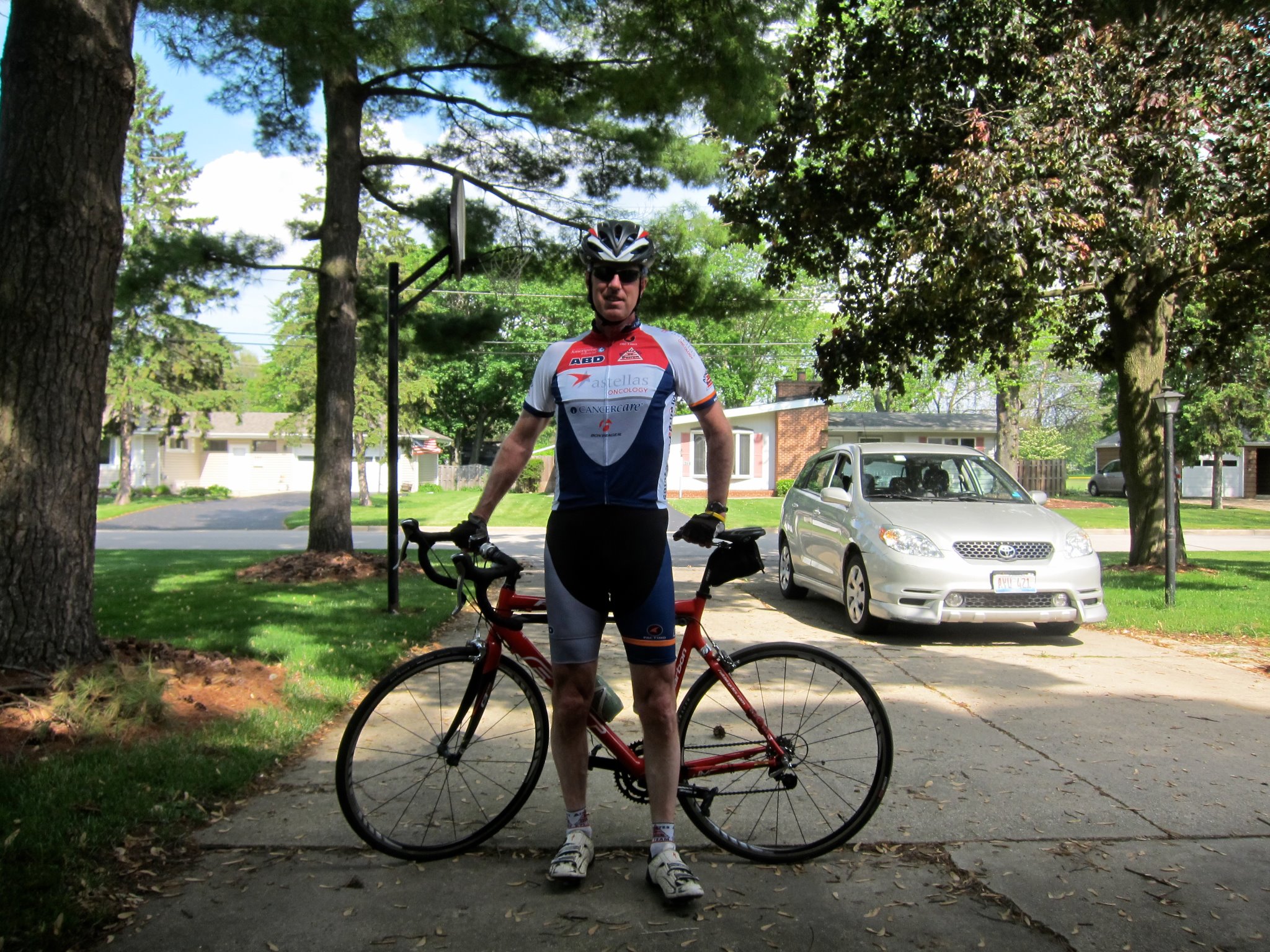
The Felt 4C and Felt riding kit.

During all of that, I’d kept up my running to keep sane, but was feeling like it might be time to add another activity as an alternate fitness option. So I finally bought a new road bike to start serious cycling. I’d ridden a beater Trek 400 for several years, but couldn’t keep up with my two best buddies and their roadie friends don’t 60-80 milers on weekends.

Along with my wife’s needs, I’d also been caregiving for my father after my mom passed away in 2005. My brothers offered verbal support and I wasn’t taking any payment for the extra work, so they voted that I could take a bit of my dad’s money to buy a new bike. I visited Spokes, a bike shop in Wheaton, and they sold me on the purchase of a 2006 Felt 4C, a model named “Bike of the Year” by Bicycling Magazine. It had a carbon-fiber frame and Dura-Ace derailleur and brakes. High quality stuff.

The first ride on that bike was like a dose of heaven. It was hard to make the Trek go faster than 17 mph most days. On the Felt, I flew along at 18-20 and was about three miles from home that first day when I struck something with the wheel and heard the awful ‘PHFFFFSHHHHH’ of a flat tire. That meant I had to stop and change it. I’d hit a piece of metal on the shoulder. It left a mark in the rim that remained there the entire time I rode those wheels until the spokes broke, and I bought a new set.

It was good that I had to stop and change that flat. I’m not the most mechanical guy on earth and having to deal with the vagaries of flats is one of the aspects of cycling I needed to learn. I rode tough old tires on the Trek and hardly ever flatted. That new racehorse of a bike was something different.

Gaining speed

Adding cycling to my life was a point of sanity that complemented the running. I joined the Athletes By Design racing team and rode with the group every Wednesday. There were also Saturday morning rides with twenty guys motoring out of St. Charles. Talk about a testosterone test! I did my best. Usually, I’d hang the bunch through sixty miles at a 20-22 mph average and get dropped when they really started ripping. Most of those riders had 10-20 years of cycling experience in their legs. I was the newbie, even showing up that first day with the reflectors still pinned in the spokes and a “brim” on my helmet that no serious roadie keeps.

On top of those rides, I started bike racing in criteriums. Adding all that in the face of the caregiving and work I was already doing sounds insane, but once my wife was in remission, it was my goal to get back in touch with some of my own interests. Bike racing was an education all its own. The first race I entered was a madcap course in Elgin, Illinois where the first turn when steeply downhill and turned again. A guy when skipping past me sideways when trying to brake and slammed into the hay bales keeping riders out of the lake. I stuck with the pack a few laps and then a bunch of riders in front of me imploded. I was left with a ten yard gap between my bike and the bunch rolling away. Rather than ride on like I should have, I figured to catch back on gradually. Big mistake. I got dropped.

But the race that seemed to symbolize life at the time was a criterium in Elk Grove. At one end of the crit loop there was a hairpin turn right after the starting line. For ten laps or so I worked to stay up front because the lag behind guys turning was so huge. Lap after lap I kept the gas on, even leading into one of the last go-rounds. Excited to be so close to the front when the final lap bell rang, I turned the corner once more and tried going with the lead pack. At that moment, it felt like that scene in the Star Wars movie where the Millennium Falcon tries to go into hyperspace and instead virtually shuts down. I had nothing left in the legs and got dropped immediately. The racers tore on ahead and I tailed along as they disappeared around the block.

That moment symbolized the “one step forward, two steps back” challenges of life’s competitive needs at the time. I was trying to hold down the job, take care of dad with a stroke, a wife with cancer and kids in high school and middle school. Obviously I could not do it all, but kept on trying the best that I could. As my former coach said upon hearing that my wife had cancer, “Your whole life is a preparation for this.” Truer words could not be said.

Posted in cycling, cycling the midwest, riding | Tagged , , , | Leave a comment

360 Degrees of Suck

The thing I’ve always both loved and hated about running is its empiricism. Either you run fast enough to win or place or you don’t. At times, when I was running well, that harsh reality was a blessing. During periods of lost fitness or mental regression, empiricism was an unforgiving judge. Yet I embraced both extremes because at least I/you knew where you stood.

Things weren’t so cut and dried out in the real world. By the time I was thirty years old, I’d already experienced the vagaries of working in different types of organizations and industries. There were revelations along the way. While working at the Kane County Chronicle, the company had us take a personality test. I was surprised at its accuracy and felt a bit exposed. Yet the test also noted, “Christopher does not reveal certain aspects of his personality.”

Looking back, I’m guessing that a hidden part of my personality was a resistance to authority, especially the false kind. Something in my nature fights whatever I consider injustice, and a portion of what drove me to run so much and “prove” myself after college was a response to some of the unjust ways that people treated me over time, including my own parents. I don’t think I’m alone in that reactive motivation among runners. Plenty of us seemed to “run made” to keep from going mad at the fucked up nature of the world and its occupants.

That defiance toward the “regular world” included those that did not understand or refused to accept the “hard, clean, severe” nature of honest reality earned through running. All the nasty calculations, backstabbing and selfish behavior in the work world disgusted me. The incidents of bad behavior were surprisingly frequent. In particular, I remember a co-worker sandbagging during an advertising sales contest to turn in just enough results to win. While it wasn’t “cheating” per se, it also wasn’t an entirely honest way to win the contest. I believed in being a leader and actually posting what I’d sold. That came from my running background.

I learned that kind of leadership isn’t always respected or appreciated in the work world. Nor was speaking your mind honestly on a number of subjects, especially the vagaries and weaknesses of upper management. I once questioned the judgment of a Vice President in how they were making an employee work overtime without pay and was told by the HR department, “You don’t have a right to question them. They’re an officer of the company.”

In defiance, I turned in her hours anyway. Because that was the legal and right thing to do. Acting that way has caused a number of problems. Perhaps a small shred of Howard Roark from The Fountainhead resided in my head after reading that book in my early twenties. The book is described this way: “The novel’s hero, a brilliant architect of absolute integrity. Roark has friends and colleagues, but relies on himself alone.”

Again, that radical independence is a distance runner “thing” for sure. Self-reliance is not beaten into us from all those miles of training and racing. More accurately, it is absorbed direct from the earth and sky, dust and rain, facing snow, sunburn, and sweat equally, with little complaint. You either get the miles done or you don’t. Either suffer to gain fitness or not. Improvement and a sense of self-confidence and righteous belief in hard effort go together. There are days when it call comes together and others when it all falls apart.

Sadly, those pure principles don’t necessarily apply in a world where people seek convenient compromises or easier paths to whatever someone wants to call an achievement. The finish line even moves at times, leaving hardened, honest souls to fight on as if trapped in a gauntlet of perpetual annoyance and emasculating pokes. Women branded as witches have in the past been hung and burnt in public for less than some people do in the corporate sector. Yet the VP sign on the door works as a talisman against all forms of perceived evil, but mostly against the truth that might contradict the accepted (or desired) beliefs.

In this maelstrom, a person like me that was accustomed to putting one foot in front of the other as fast as possible is quite likely to get tripped up. Some call for “emotional intelligence” to navigate through the morass of conflicted employment. Inner doubts are the enemy there just like they are at the starting line of any race. Fear is the ultimate crucifix of false hopes. Either you’re ready to meet the challenges of the day, or you are not.

Some of us learn the difference between association and disassociation early. I recall the day I spent reading an inspiring book titled The Peregrine while sitting on a high school football stadium steps. My mind was lifted clear of all other considerations, and I ran to first place that day leading our team to victory over a team that had not lost a dual meet in sixty straight competitions. Perhaps it is the most successful people that can recreate that level of transcendence in all of their existence.

But some things can’t be transcended no matter how hard you try. And in 2005-2006, while immersed in stressful caregiving first for my dying mother and then for my wife sick with cancer and father compromised by stroke, the company where I worked put me through what they called a “360 Degree Review.” My boss sent out surveys throughout the company asking associates to provide feedback on my performance. Much of it came back critical, and the manner in which the supposed facts of my shortcomings were delivered sucked the life right out of me. After being named Administrative Associate of the Year in 2003 and taking on additional responsibilities in Community Relations to help out the company during a tight set of economic years, I was being stripped naked for faults a bit beyond my capacity to handle everything coming my way in personal and work life.

That was 360 Degrees of Suck, and I felt betrayed by many people that I’d helped in many ways those first five years of employment. I wondered, “If things were supposedly so bad, why didn’t people ask me about them?” Indeed, upon hearing the complaints, there were some legitimate concerns, but they were mostly that: concerns over communications and such, not lost revenue or bad public relations. It wasn’t failure, in other words. It was being overwhelmed.

That all felt much like the feedback one gets after a less-than-stellar race. “Listen, you seem to have lost focus somewhere,” a coach might say.

I felt like that would have been a constructive discussion to have at that point rather than conducting 360 Degrees of Suck. Find out, perhaps, if Chris is having issues outside of work that might be impacting overall performance? The associates I managed were all immensely helpful and supportive. But my boss had his own set of fears and resentments in that period, and those came through loud and clear in his assessments of me. Overall, that 360 Review felt like being loudly “booed” by a crowd. I didn’t know how to handle it. My emotions were already all over the place.

So I did the one thing I knew how to do in the face of strange realities. I kept on running to sort out the suck from the “fuck yous” and start thinking about what should come next in life. There were signs that the company itself was suffering in many ways. The Internet had sucked literally millions of dollars out of the newspaper industry and our company. While I loved it there and wanted to stay, I also recognized that belt-tightening was likely on the horizon on many fronts. The economy was getting shaky under George W. Bush and the insane wars abroad in the wake of 9/11 made the entire country feel like living with a crazy uncle possessed by an alcohol problem.

Perhaps the only thing to do, I decided, was to get a little crazy myself.

Posted in adhd | Tagged , , , , | Leave a comment