50 Years of Running: Cataclysmic convergence

Oil and Water, Acrylic painting by Christopher Cudworth

My competitive instincts had not abated much in my early forties, but one quickly learns as a caregiver that being competitive is not the answer to every problem. In fact, it constitutes an answer to few problems. It doesn’t help to be competitive while sitting in a waiting room while your wife is getting treatment and consultation for ovarian cancer. That demands patience, not competitive fire. The same holds true in caregiving for a father beset by the effects of a stroke, who can’t talk or communicate other than with “Yeahhh” or “Nooohhh” for answers. That takes patience too.

Nor was it helpful to be competitive in guiding my mother through her fears over her own health, which in 2005 was taking turns toward more difficulty than she imagined. Her lymphoma was manifesting in mouth sores and other signs of increasing impact. Knowing that things were changing in her life, she asked me to meet her at the bank to sign on as the executor for all their financial matters.

But at work, I still needed to be competitive in order to handle the demands of a job in marketing and community relations covering five separate counties and ninety different communities large and small. I traveled from office to office seeking to leverage the small budgets accorded to each regional manager the biggest results we could find. Every area had different demands and opportunities. In Lake County, we partnered with a radio station to provide news in exchange for daily mentions of our product. In DuPage County, our goals were spread over a series of major events, festivals, and the like, and also partnering with high schools for editorial exposure tied to theater programs. In the Tri-Cities, we worked through area Chambers and partnerships. In the Elgin market, we sponsored large-scale bike races and a collaborative relationship with the Hemmens Auditorium. All these disparate aims required attention, and I did my best to keep all the balls juggling at once. Truth be told, I was just beginning to realize that my brain lacked some critical aspects of corporate performance, particularly executive functions. I sometimes joked that I had what I called Creative ADD. What I’ve realized later in life is that I have full-blown ADHD.

Occasionally, sometimes more than that, a ball would drop. But I apologized to fellow managers and worked back around to pick it up again. On top of all that the Big Ticket Reading Project was growing by 20% every year, reaching more than 100,000 families. Then I launched the West Suburban Theater Connection and our editorial coverage deepened in that important segment.

Running commentary

I’d go for daily runs or rides thinking all this through, all while trying to balance my wife’s concerns as we waited for surgery that would remove as much cancer as possible from her abdominal cavity. The gynecologist that did the original laparoscopic surgery broke the tumor, which released cancer cells into the body, and when the gynecological oncologist finally got in to examine and extract cancerous indications, he described its impact on the body walls as feeling “like sandpaper.” That was not good news. Still, he was such a pro that he felt like the prognosis was good after her operation.

Then came chemotherapy a month later. She recuperated from surgery well even though the impact on her body was profound. But we had hurdles to jump with health insurance because the HMO demanded that we do chemo at a different hospital than the Advocate General location where our GO was based.

That meant traveling to a Rush Medical Center location in Aurora where we met a new doctor and scheduled a series of chemotherapy treatments. There would be eight total with Cisplatin and Taxotere, both toxic drug mixes that enter the body intravenously and kill the “most active” cancer cells, which are the fastest-growing cells in the body. Basically, chemotherapy kills the body slowly, and when the world-class cyclist Lance Armstrong challenged his doctor during treatment for testicular cancer to “give me all you got, you can’t kill me,” the doctor replied, “Oh, yes I can.”

At first, the chemo didn’t hit her that hard. Her cheeks grew flush and her hands tingled. But as the treatments accumulated with pursuant fatigue and nausea, the risk of infection increased and her mental state deteriorated. Still, she kept on teaching at the preschool where she worked. Her fellow teachers were immensely supportive, especially her close friend and the school’s director, a woman named Linda who promised us that we would be there for her all along. She’d called to tell me, “Listen, we know this is going to be hard. So we’re going to let you in the Girl’s Club. But the Girl’s Club has One Rule. You have to tell us everything that’s going on. Otherwise, you’re out of the Girl’s Club. Can you work with that?”

I told her, “Absolutely. I’m in.” And from that point on there was hardly a moment where I feared not having support. For that, I am eternally grateful and mean that in the most profound sense of the word. Vulnerability is the greatest tool for cancer survival.

But some types of vulnerability are also devastating. After my wife endured eight rounds of traditional chemo, we received a recommendation to partake in a renewed practice calling for the introduction of chemo drugs straight into the abdomen. Intraperitoneal chemotherapy, it was called. So they installed a port in her belly and dumped the chemo straight inside her body. The unstated goal was to kill off cancer cells lining her belly walls. It all went well until it didn’t. Somehow the nurses let chemo leak out the port and it burned the skin all down the outside of her belly. We wound up calling the hospital on a holiday to drive her there for emergency treatment. The medical oncologist showed up and it was clear that he feared there was potential litigation afoot. The situation had medical malpractice written all over it. But we liked the doctor and told him, “Listen. We know this is bad, but we’re not here to cause trouble or sue. Let’s fix this and move ahead.”

The stress of that day was awful. The nurses felt awful about it because we had a good rapport with them all. We knew it wasn’t carelessness that led to the problem. They were diligent in everything they did otherwise. Sometimes bad things just happen.

360 Degree Review

All that medical stuff might all have been enough for me to handle were it not for the fact that my immediate boss at the Daily Herald decided that year to send out surveys to conduct a 360 Degree Review on my performance at the newspaper. Word came back that I was dropping a few more balls. Some of the reviews were harsh. I felt betrayed. Yet clearly, I couldn’t handle things the way that I’d done up to that point in time. After being named the 2003 Administrative Associate of the Year, I was falling behind in my job on some fronts. With so many cataclysmic events taking place, I was a bit overwhelmed.

In many ways, all I was trying to do was be honest about the possibilities defined by the changing world of the newspaper industry. The Daily Herald had cut ties with its advertising agency for budgetary reasons, so there were no billboards or radio investments to promote the company. The Allstate Arena still displayed the logo prominently along I-90, one of the busiest corridors in the Chicago area. But one day in a collective management meeting, the Publisher of the newspaper stated, “I don’t really believe in marketing…” and I sat there stunned, realizing that support was certainly not going to come from the top down at that point.

After the results of the 360 Review came back, I was depressed. The criticism hurt, and there was little I could do to defend my performance. “You just have to accept this feedback and change,” my boss told me. I found that ironic. My boss was not a well-regarded manager in his own position. I’d learned that his entire department had resigned or quit before I was asked to come on board in marketing. People pulled me aside and asked, “How can you work for that guy?” On some front, I empathized. He was a former sportswriter whose main interest was working out partnership deals with the pro teams and landing tickets to the best shows at Allstate Arena. He never really liked all the risk and reward stuff of hardline marketing. When I came on board and pushed the envelope on so many fronts, it pissed him off more than anything.

So the 360 Degree Review was an opportunity to foist some frustration on an employee that had shown him up a little. I couldn’t entirely blame him. That’s the nature of corporate competition. It’s quite typically an alternating cycle of pats on the back and backstabbing paybacks. I’d challenged him on many fronts about his managerial style, and this was his turn to shift the narrativve. He had every right to initiate the review, but the timing could not have been worse.

That summer my wife’s health was going downhill due to chemotherapy, as was my mother’s condition. My father was still highly compromised by his stroke. I bounced from caregiving for one person to the other. Then, come September, my mother found she had an underlying case of pancreatic cancer. Not good news. Her physicians recommended a round of chemotherapy but her age worked against her. At eighty years old, her body was slammed by the strength of that toxic treatment. While working at the Tri-Cities office one morning, just two miles away from my parent’s house, I heard the police scanner in the photo room announce that EMTs had just arrived at my parent’s address. I rushed out the door, climbed in my car and drove straight to my folks’ house. There I saw my mother on a gurney being loaded into an ambulance. She looked up at me and said, “I can’t walk. The medicine’s too strong.” They drove her away with the lights flashing.

I tended to my father that day. His in-home Polish caregiver Ivana asked me what happens next. I told her, “I don’t know yet.” I appreciated Ivana, whose patience with my often exasperating father was legendary. Still, she admitted that it got to her sometimes. She once told me, “I have date tonight with Johnny and Jack.”

“Who’s that?” I asked.

“Johnny Walker and Jack Daniels,” and she laughed.

That weekend, my mother did not improve much. On Sunday morning, I received a call from a doctor at the hospital brusquely informing me that my mother needed to go home. They offered to send an ambulance to make that happen. She couldn’t walk or even sit upright much to get into a wheelchair. I showed up at the hospital to preside over her departure and watched them walk her out the door.

The presiding physician thanked me for coming, then quickly departed, clearly not wanting to talk over the situation much. On my way out the door, I met a physician from the family practice my mom and dad had long trusted. We stood in an open space far from anyone else’s earshot. “Listen,” he kindly told me. “They don’t want your mother to die here, and there’s little else they can do for her. It’s time for hospice. The pancreatic cancer is too far along and she can’t handle any more chemotherapy. She’s better off at home.”

He was right. Many of her friends came by to visit, essentially saying goodbyes. One of her closest buddies was an intelligent Black woman named Phyllis whose company she treasured on many fronts. The racial reference is relevant given the relatively white-bread composition of the community in which my parents lived. That woman was one of the most well-respected community leaders despite the racial composition of St. Charles. My mom always appreciated her proactive ideology and faith in humanity. It meant the world that this woman came to visit her.

By Sunday afternoon my mother seemed relaxed, even happy at having welcomed her friends and grandchildren including my daughter Emily, who played my mother’s violin for her. That instrument was built by her own father in the 1930s. That evening, my mother gave me a big smile as she rested. But overnight, she suffered a stroke that took away her ability to speak or swallow. From that point forward, it was hospice for sure.

Hospice conclusion
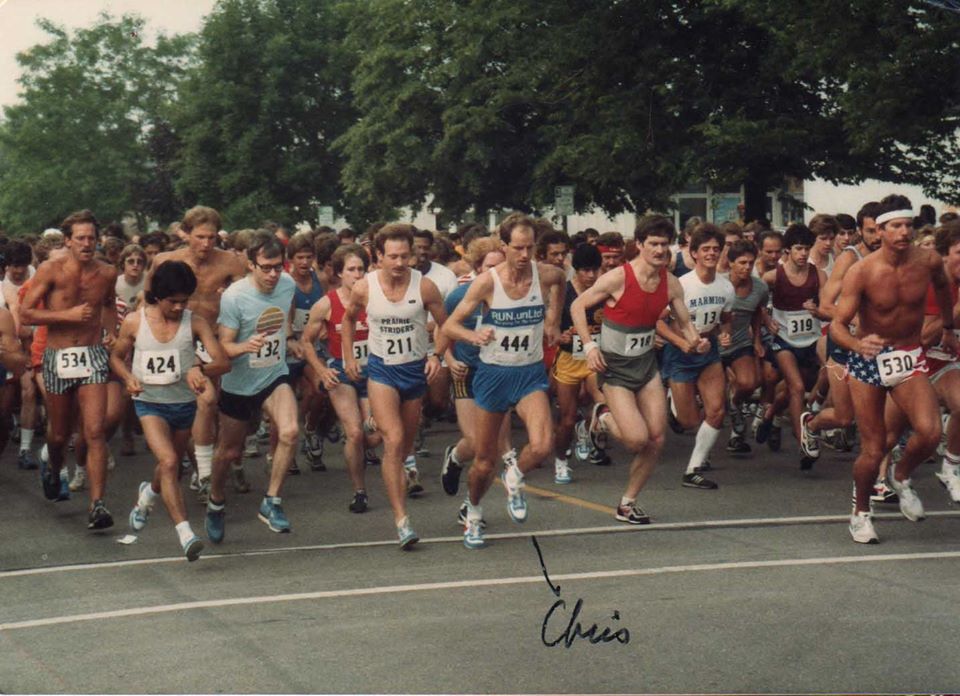
My father and mother were in attendance at the Geneva Community Classic in 1984 when I won the race in 31:52 on a long course. The record stood for more than 20 years. She wrote my name on the photograph.

She died on the evening of November 7, 2005, with my father by her side sitting in his wheelchair and holding her hand. That afternoon much of the family had come by, but she seemed to wait until my daughter Emily could make a visit. An hour later she passed away.

It had been an up-and-down year. During her hospice period, I was wracked by guilt the first night when she gestured for water and food, but we could not give it to her. I went home crying and leaned over the kitchen table praying about what to do. My wife was sick in bed from chemo and I felt all alone. At that moment my brothers were driving out to Illinois from back east and called me on the phone. “We were driving through Indiana and saw how clear the stars looked,” they told me. “We thought it would be good to call.”

I confessed my guilt at not being able to help Mom in any way. “There’s no choice in her condition,” they assured me. “We’re all doing the right thing.”

On the evening she died I drove home through a large woods on Route 25. A giant buck deer burst from the forest and ran in front of me through the headlights. Granted, that’s a natural coincidence. But it felt like her spirit was sending me a message that she was going somewhere else. She loved nature in all its forms.

I felt calm upon arriving home that evening. She was at peace now, no more pain or fear or frustration. No more worrying about by dad. That was up to me now, I knew. I also knew I could handle it. I might fail on some fronts, but I was going to see it all through, whatever the cost. In some respects, that was my competitive nature showing through. But there were different kinds of “wins” from crossing the finish line first in a race, or helping a team win a game. This was about winning in life and competing with the challenges it presented. On that front, I knew that I could be a winner no matter what it took.


Posted in 10K, aging, aging is not for the weak of heart, Christopher Cudworth, competition, fear, foregiveness, life and death, running, we run and ride | Tagged , , , , , , , , , , , , , , , , , , , , , , , | Leave a comment

50 Years of Running: coming to grief through soccer

The typical indoor soccer field with boards all around.

In the five years leading up to my late wife’s diagnosis of ovarian cancer, I experienced a period of grief related to my own physical and mental health.

During one of the last years my daughter played soccer, her coach invited me to join an indoor team he organized each winter. That first year we traveled from Batavia to Darien, a forty-five-minute drive in post-rush hour traffic. Games generally started after 7:00 p.m., so we’d leave just after dark once the time changed in October. On the way we’d pick up another player or two, each of them typically saying goodbye to a wife and kids, because most of us were in our late 30s or early 40s.

The Darien field had boards around it, and indoor soccer under those conditions is fast-paced and often rough. Our squad usually had ten to fifteen players minimum so that guys could “sub out” after two minute stints on the field. Even though I still ran quite a bit to keep in shape, and played a fair amount of basketball as well, that first time playing indoor soccer was a harsh experience. All that sprinting caused my heart rate to shoot up, and the first time I came off the field the other guys on the team saw the expression on my face and started laughing. “Kind of intense, huh?”

The other difficult part of indoor soccer was the pressure to improve on foot skills. During all those years of coaching (ten in total) I’d kicked the ball around plenty with kids and juggled the ball for fun, but that’s quite different than reacting to an opposing player trying to steal the ball from you or even knocking you against the boards to make sure it happened.

I adapted quickly enough and found out that I was a better defender than an attacking forward. My foot skills just weren’t quick enough to swerve through defenders on a small field, so I prided myself on making it harder for opponents to get near our goal. I got good at soccer defending just as I’d gotten better at defense in basketball during my twenties and thirties.

My other “skill” was making sweet bending passes to our own forwards. All the years of kicking soccer balls with my older brothers when I was kid paid off as an adult. It felt great to get assists and my teammates began to realize that I played a good role on the team.

Broken ribs

But one day I was caught at the midline with a tall and talented player from the other team. The ball popped out from their goal and his teammate advanced it with a quick touch. I saw the ball but not what was coming next. That big guy slammed me in the ribs with an elbow and I bent over as he raced ahead for an easy goal. It looked like I’d given up, but in truth, my ribs were in hot pain. I’d spend the next three weeks recovering from the two broken ribs he gave me.

As it happened, we were playing the same team when I returned from rib rehab. For most of the game I steered clear of his elbows, but with about five minutes to go I saw him pin a ball against the boards and I came in for a spot of revenge. Spinning around as I heeled the ball free, I gave him a shot to the kidneys with my bony elbow and he turned and hollered at me. “What was that for?”

I replied. “You’ve got a short memory. I’ve been out three weeks thanks to you breaking my ribs.”

New league

Playing without boards was a more organic form of indoor soccer

We switched leagues the following year to a facility without sideboards on the field. The game felt better there, more real without the rebounds and enclosed spaces of the board. Plus, Just For Kicks was closer to home. We played teams from all sorts of nationalities; Greek, Polish, Mexican, and more.

One night our opponent was a tremendously talented team whose members were mostly from England. In warmups, one of their guys launched a shot at the goal while I was standing nearby. The ball sailed so close to my ear that it created a vacuum. I quickly moved away from the goal to avoid getting blasted. That player could launch shots with speed using just one step. I thought to myself, “No way that we beat these guys.”

But we played above our heads all night. Even the Team Hothead stayed cool. He was a great footskills guy just past age thirty but was prone to getting mad during games and frequently “lost it.” But not that night. He played well, scoring two goals to keep us in the game along with a third goal from my friend Dave, who fielded and one-touched a curling lead pass I made from the backfield to tie the game at 3-3 with just a couple minutes to go.

Everything seemed to go into fast-motion in the last two minutes of the game. Even without boards, the ball never left the field and there was no time for substitutions as a result. Both teams tore around the field until suddenly the ball popped out to me on the wing where I was open. Taking a look upfield, I saw no one and took off at full tilt, dribbling madly to keep the ball near my feet. An opposing player swept up beside me but I kept my focus on the field ahead. Nearing the left side of the other team’s box, I swerved out two steps and launched a shot at the near upper corner of the goal. It slipped past the outreaching hands of the goalie and I’d scored with just thirty seconds left to play in the game.

Walking back toward the center of the field, I was greeted by the English team’s coach. He was a stocky, short guy with a big mustache and a thick accent. “Noice styroike on the ball!” he chortled, shaking my head. “Youew wont’ be sleepin’ tonight!”

He was right. I lay awake in bed after getting home to take a shower at 10:30 p.m. My heart was still beating hard from all the running, and I settled under the blankets next to my wife who rolled over and asked, “How’d the game go?”

I smiled in the dark and said, “We won. And I scored to win the game.”

“Mmmm, that’s nice…” she responded. Then rolled back over in bed.

I lay there replaying that shot again and again in my head. The best part about it was not thinking too much. For once, unlike so many other nights on the soccer pitch, I didn’t overthink the moment. Like a kid again, the motion just came from within. It was glorious. I was so grateful to experience something like that given my relatively late return in life to playing soccer.

Sportsplex

Sportsplex had glass walls allowing spectators to see all the actin.

Then we joined another league at Sportsplex in St. Charles, and given the number of age groups from youth to adult using those two fields, sometimes our games wound up being played really late at night. Arriving at 10:30 p.m. to start a soccer game at 11 p.m. is not the most inspiring situation. Even worse was the fact that only six of our guys showed up. We had no subs.

By halftime, I was completely gassed. Even as a defender, I would up running steady for all twenty minutes of the first half. And then, just as the last minutes of the first half was winding down, I found myself at the top of the box wide open for a shot because we’d pressed up field and our best forward had the ball on the wing. He sent a direct rolling pass my way and my reaction time was even slow. The ball rolled right past me because my legs were too tired to get into position to shoot. He was livid, throwing his hands up in the air. I’d just fulfilled every doubt our team ever had about my ability. At that point, I did not care. All I wanted to do was sit down for five or ten minutes and gather some energy for the second half.

During the winter soccer season I also played basketball in open gym. But at the age of forty-five years old in 2002, I’d begun to experience new kinds of pulls and tears playing that sport. My basketball game was always a slashing, attacking kind of approach, driving to the rim for acrobatic layups. Then during a Sunday pickup game, I jumped from one side of the lane to land with a twisting hop and something popped under my pelvis. Instantly I was out of action.

Physical therapy

Our medical plan was with an HMO at the time, and I was just getting to know our family doctor. Showing up at his office, I explained the injury and how it happened. “Maybe I need some physical therapy,” I suggested.

“Oh, that stuff’s a bunch of fluff,” he replied. I sat there aghast. “But if you want to go, I can write you a referral.”

The only physical therapy practice in our plan was a thirty-minute drive away. The offices were plenty nice, and I was optimistic that I’d get some good advice. But the physician poked around a bit and said “There’s nothing we can really do unless you want to consider surgery.”

I left that appointment angry as hell. Going under the knife for what was likely a pulled tendon was a ridiculous recommendation.

It took a month or two for the pull to heal up, but it only hurt when I jumped and landed. That meant I could largely manage to play soccer, but then I pulled a groin muscle warming up because my pelvis was all out of whack.

Trek 400

That series of injuries convinced me that it might be time to add alternative sports to my training regimen. If basketball was going to be out of the picture someday, I wanted to find other pursuits. For a decade or so I’d been interested in getting into cycling, and my brother-in-law gifted me an old Trek 400 road bike he was no longer using. I’d already purchased a Specialized Rockhopper mountain bike for banging around forest preserves, so the instinct to get on a bike felt natural at that point.
My Trek 400 was red.

The Trek had shifters on the down tube, which took some practice to use. I owned some mountain biking shoes and put clip pedals on the Trek to start riding the roads. At one point I even entered the Four Bridges bike race criterium that I’d sponsored as Marketing Manager for the Daily Herald. That experience was a rude shock. What looked so easy from the sidelines with bike racers whirring past was humbling when I got dropped immediately. Watching the pack roll away on the first hill made me both angry and sad. I vowed to get better at it somehow. But I wondered what it might take? I’d shaved my legs like an actual cyclist, experiencing razor burn for the first time in my life. How does one get better at cycling, I wondered? That answer would be years in the making.

Triathlon and transitions

At the same time, I got thinking about the sport of triathlon, so I signed up for swim lessons at the Norris Recreation Center. The instructor was a relaxed woman who taught me some stroke basics. But during that first lesson, I popped a contact out while removing my goggles and couldn’t make the next session, so it all fell away. It would be years before I sought the triathlon thing again.

Playing pickup soccer at the Sportsplex was still possible, and I’d gotten healthy enough to regain all my speed. One night a guy turned to me in the bench area and asked, “How old are you again?”

“I’m in my forties,” I replied.

“Well, you don’t run like it,” he said as a compliment. “You’re one of the fastest guys out there.” That made me feel good. But a couple weeks later, that relative speed would cost me dearly.

Toward the end of an evening of soccer, I was playing midfield because I’d gained confidence in my foot skills. When the ball came out of the backfield and I sprinted over to collect it. A guy tumbled in front of me and I jumped over him, planted my foot on the artificial turf, and went to turn. My left knee couldn’t handle the torque. I felt it disassemble from within. Rolling to a heap on the field, I grabbed my knee with both hands and rolled around on the ground. Guys gathered around to see what was up and one of them muttered, “Torn ACL, I’ll bet.”

Hobbling to the bench, I took off the soccer cleats I’d been wearing that night. They were “hand-me-ups” from my son’s soccer-playing days, a set of Red Nike cleats with reflective swooshes on the side. They used to flash in the sun when he was playing outdoor.

I set the shoes in the bag and limped out of the gym that night dreading the reality of what I’d just experienced. During all my years of sports from early baseball and sliding practice to thousands of hours of basketball on all kinds of surfaces, and even running steeplechase in college, I’d never hurt much of anything but a couple ankle ligaments.

Arriving home, I told my wife, “Well, I really did it this time.”

“You’ll be fine,” she tried to console me.

“No. This is a bad one.”

Surgery and rehab

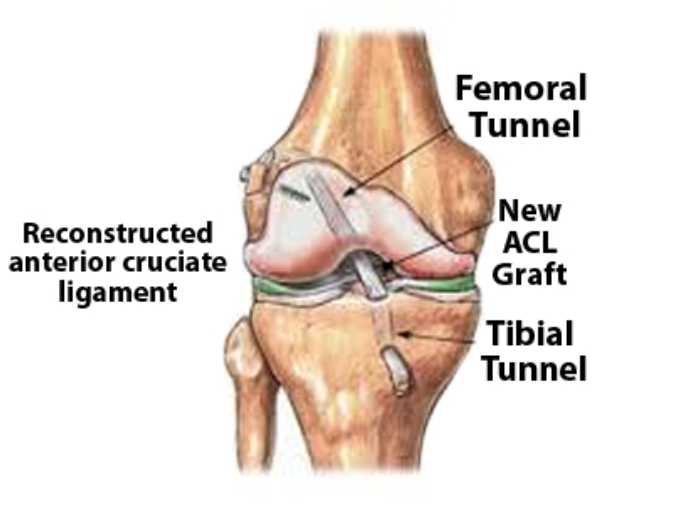
Sure enough, once the swelling went down after a week I met with an orthopedic surgeon, as our medical plan at work had changed by then, and we scheduled surgery. “You have two options,” he told me. “We can take a bit of your patellar tendon or we can use a cadaver part. The first option takes longer to heal,” he warned. “But it’s a bit more likely to hold.”

For some reason, mostly vanity I now believe, I chose the cadaver part. I wanted so much to get back in action that I chose the less desirable option. My decision was affected by a sense of grief, a realization that the carefree physicality of youth was disappearing. Fearing some weird loss that was hard to express, all I wanted to do was get the knee fixed and prove that I could come back.

The doctors actually told me that people often get stronger overall thanks to physical therapy after surgery. That made me think back to our HMO doctor and his claim that PT was “fluff.” Now I’d have the opportunity to find out what actual physical therapy could do.

Lying on the bed waiting for surgery, I wasn’t nervous, but when a nurse walked in to check on me, I had to laugh. There I was, naked from the waist down, and the nurse attending the surgery prep was the mother of one of the youth soccer players I’d coached. “Oh, hello,” I managed to say. She chuckled and said, “Let’s get you ready.”

Rehab from surgery was painful and hard. The knee was thick and swollen. They gave me a machine that slowly bent the leg back and forth. I took a week off from work to recover, then wore a tall brace and used crutches. My daughter was still playing soccer with a different coach, so I attended one of her tourneys and walked all over the place on crutches, gaining raw armpits and a sore Achilles tendon on the opposite foot in the process.

Eventually, the PT helped. I loved the creepy-crawly sensation of the electro-stimulation they used on my quads. However, one of the therapists dialed it up too high one morning and my leg started jumping around like a science experiment. “Heyyy,,,, Heyyyy,,,,,,” I called out. They turned it down.

The wounds were weepy at first, draining down the compression socks I wore to work. My foot also stung from swelling, and I’d elevate the thing after driving thirty miles to work at the Daily Herald Arlington Heights office.

Recovery

Then came the long road from walking with the brace to going without it. That took a month or so. Running was still not possible, so I walked the three-mile loop around the Fox River Trail and back. I could ride the bikes but had to be careful getting on and off, for fear of tearing the repaired ACL. I called it “Jake” after the guy that donated his “organs” and such after death.

For six months I patiently engaged in rehab and strength work. One benefit of the treatments was ridding myself of chondromalacia, a condition in which the patellar tendon rubs on the knee bones as a result of muscle imbalance and misalignment. PT cure that, and I was glad. After a few months, I dared a few steps running. I’d walk a ways then jog a little. It was all coming back together again.

A friend that I’d met through soccer gave me a sweet deal to join a chain of physical therapy facilities. That enabled me to work consistently. He prescribed even more exercises, and I did them. The company had a working agreement with the Chicago Fire soccer team, and I met the World Cup player Chris Armas and trained in the presence of others as well. One day a Fire player left a set of his uniform shorts in the locker room. I considered keeping them but decided that was a bit creepy, so I turned them over to my friend that ran the gym.

Returning to the pitch

After a year of rehab, and wearing a brace to stabilize my knee, I returned to playing soccer again. At first, I took it easy, but as time wore on my confidence in the knee grew. Our team was still functioning and I was invited to join the outdoor crew for the summer season.

But first, they asked me to help them out in a basketball league. I’d gone back to playing some pickup ball on weekends, so I accepted. However, their team was terrible. Most of them were decent soccer players, but they sucked at basketball. We had one decent other guy, our goalie in soccer, who was 6’5″. We lost every game all season by margins of 10-20 points. By the last game of the season, I’d had enough. I was determined to win at least one game. I told the team, “I know we normally sub on rotation. But I’m going to be honest, I need to stay in the game to keep it close at all.” They agreed.

For most of the first half, I kept us close, racking up points on jumpers and layups. Then the other team started to key on me and I got exhausted. We were down one point with two minutes to go in the first half when I subbed out and sat down. We went down seven points in the next minute, and were down twelve by halftime. At that point, I didn’t give up. But I was furious at the other team for mocking me when I got back in the game.

My competitive sense always treasured fairness. When teams acted like that in any circumstance, it made me crazy. Yet there’s only so much you can do. I was glad that basketball season was over.

Outdoor soccer

Then came the outdoor soccer season, where I quickly found that my running ability was a massive advantage in an over-30 league. Most guys were fit enough to cover the field with any consistency. But I was. So I started at forward, a new sensation for me. In the first game of the season, I broke free on the wing and was heading toward the net when the goalie came out. I tried dribbling around him but he got a hand on the ball. A teammate came over to instruct me on the right thing to do. “When that happens, just chip it over him.” My apprenticeship as a scoring forward was just beginning.

Had our family not moved to Illinois when I was heading into eighth grade, I’d likely never joined cross country in high school. My brothers both played soccer and it’s more than likely that I’d have followed in their path. As a speedy kid with great endurance and a scrappy demeanor, I might have been a decent player. My best friend from age 5-12 back at Lampeter-Strasburg HS played all four years, and I was a better athlete than him. So that’s my only measure of what “might have been.” Out at Kaneland in Illinois, the had neither baseball or soccer teams at the high school level. So I wound up in cross country and track. Such is life.

So the mid-life romance with soccer was a deferred and somewhat guilty pleasure. Getting to play outdoor was especially nice, because I could use my speed on the open pitch. Our next match was held on a smooth field in Schaumburg, but rain had fallen the night before and the turf was slippery. The footing was lmost greasy with underlying mud. Only eight guys showed up on our side and we were down 8-0 by half as a result. The other team was having a field day at our expense, laughing when they scored and playing rude games of keepaway. My anger grew by the minute. Right before half, I stole the ball at the top of the box and set my left foot on the turf and was about to strike the ball at the open net when a big old guy from the other team plowed into my leg and I felt a profound “Click!” inside the knee. Instantly I knew what had happened.

The joint felt loose as I walked off the field. I tried jogging on the sideline, but it was a no-go. I gathered up my gear and told the guys, “I’m sorry. I’m injured and can’t play anymore.”

Climbing into my car, I bent over and cried in the front seat. After two years of recovery, and a full return to playing sports, I knew that I’d torn the ACL all over again. I parked my car at a park on the way back home and sat there thinking. “Well, that’s that,” I said out loud. “I’m not fixing it again.”

I understood then, at the age of perhaps forty-seven years old, that the days of playing ballistic sports were over. I wasn’t alone in that. Guys my age were dropping out of ballistic sports right and left. Our Sunday night basketball groups fizzled out. Even our soccer teams dissolved. It was time to move on in life.

A deep grief caught up to me during that drive home. “Jake” had died all over again.

Posted in aging, aging is not for the weak of heart, Christopher Cudworth, coaching, competition, cross country, cycling | Tagged , , , , , , , , , , , | Leave a comment

50 Years of Running: Going Big Time

Site Icon

After the 9/11 tragedy rocked just about everything in American life, people looked for normalcy just about any way they could find it. At the same time, the newspaper industry in which I worked was getting slammed right and left by revenue shifts thanks to the advent of the Internet. First the Recruitment/Jobs advertising dollars migrated online. That cost the company millions of dollars in revenue. Then came the Real Estate market, followed by Auto ads and finally, retail advertising money. Millions of dollars of revenue started disappearing from newspaper pages and the newshole shrank as a result.

This image has an empty alt attribute; its file name is screen-shot-2023-04-11-at-11.51.25-am.png

The Daily Herald was forced to look at its business model, and one of the ways that life changed dramatically in my position as marketing manager was the use of “trade advertising” to work out relationships and partnerships. A new director was brought in to run the advertising department after years of phenomenal success under the prior guy, but when business takes a hit, someone has to take the fall. The advertising staff was shocked to see their leader ushered out because he was well-liked and did a good job. Then a “numbers guy” took over, and things changed fast.

We ran fewer “house ads” in the paper as well. These were ads run as ‘section balancers’ when the page counts were off. Newsprint was shooting up in price and it was expensive to throw paper at the issue. The Daily Herald had invested something like $50M in a new printing facility during its high times but when the Internet shock came along the margins to pay for that literal brick and mortar and the giant press it contained suddenly looked far less inviting.

Stewardship

While I’d predicted some of these problems to my marketing boss in the earliest meetings we held, I certainly didn’t view the newspaper’s money problems as mistakes caused by management. Quite the opposite. The measures we took to compensate for revenue losses were intelligent and well-advised. There was no precedent for the economic changes taking place in the early 2000s.

This image has an empty alt attribute; its file name is screen-shot-2023-04-11-at-11.52.54-am.png

Amid this environment, I wanted to find ways to promote the newspaper that didn’t cost money. In a previous job at the Kane County Chronicle, I’d organized a literacy program in collaboration with local libraries and the local minor league baseball team, the Kane County Cougars. The Rountripper Reading Program attracted sponsorship that I recruited with Everfresh, the juice company, as well as partners Pheasant Run Resort and others. It was a huge success with thousands of participants.

Big Ticket Reading Project

But the Daily Herald was a regional newspaper, not just a local one. So I decided to replicate and expand the concept of the summer reading program, calling it the Big Ticket Reading Project. First I reached out to ten area librarians and held a meeting with them to share the concept and explain that it was going to provide three levels of incentives for summer reading program participants. Once they approved the idea, I reached out to Panera Bread and landed a primo first-level sponsor. They agreed to provide a free Kid’s Lunch to every child that completed reading ten books. I targeted Panera as a sponsor because their food was legitimate. Real food, as opposed to fast food. Sure, the kids still got cookies with the meal, but treats are good too, right? The libraries tracked and distributed these prizes, so everything was well-documented.

The next level in reading twenty books was a Culver’s Ice Cream Cone, a great mid-summer treat.The final incentive was a booklet filled with free admission tickets to the Chicago area’s leading museums, cultural attractions, and entertainment complexes. The original list of fifteen sponsorsincluded the Art Institute of Chicago, Brookfield Zoo, Shedd Aquarium, Chicago Children’s Museum, and many others.

This image has an empty alt attribute; its file name is big-ticket-collateral.jpg

The program started with 35 public libraries enrolled and 50,000 kids/families registered. Completion rates shot up to 75% at many of those libraries. That made the children’s librarians look good with well-documented metrics proving their effectiveness.

In 2003 the Publisher at the Daily Herald followed up on the program and called me. “I hear you built a reading program with 5,000 kids in it,” he said. “50,000,” I replied. “There are 50,000 kids in the program.”

“Well that’s great,” he responded. “What’s it cost?”

“Nothing, other than some time,” I told him. “The printing costs are all covered by Jiffy Lube and everyone in the program receives a subscription offer. “Toward the end of the year, I was notified that I’d be the recipient of the Administrator of the Year Award. Going Big Time had its rewards.

Growth and value

Over the next couple years we kept growing the program, adding libraries in every town the Daily Herald served. That was 90 communities, and we started receiving requests to participate from libraries outside our service area. Knowing that the Daily Herald grew by expansions, we added cities on our market borders including Aurora, one of Illinois’ largest cities, and other strategically targeted communities. Our booklet containing admission passes as rewards to those completing the program grew to 27 organizations with an average ticket value of $10. That meant every kid completing the program earned $270 worth of admission passes. With more than 100,000 kids then enrolled in the program, that amounted to a total value of $27M in incentives.

There were some near hiccups along the way. Some moms decided it would be cute to gather groups of kids together to take them to Panera all at once. That flew in the face of the program’s potential value to that sponsor. They legitimately got behind the program to promote “family time” at their many restaurants, and the offer of a Free Kids Meal was generous and a powerful incentive. When moms started showing up with bunches of kids in two, we had to send out word that the practice was frowned up. Sure, they had the legal right to do whatever they wanted, but we stood by our sponsor in principle.

This image has an empty alt attribute; its file name is screen-shot-2023-04-11-at-11.55.19-am.png

We also collaborated one year with Krispy Kreme, the “new kid in town” whose donut restaurants caused a massive rave across the Chicago area when the company entered the market. Given the buzz and popularity of Krispy Kreme, our circulation department was eager to meet with them to put together some subscription offers. I held an internal meeting with one of our circulation managers and made it clear to him that there was one rule we had to follow. “No discounting their products,” I told him. “That’s against their entire company policy.”

We were scheduled to meet with the public relations agency representing Krispy Kreme in Chicago and I asked our circulation guy if he needed any help putting the presentation together. “No,” he told me. “This is my specialty. I’ve got this.”

We drove into the city together and rode the elevator up to the PR agency offices. I will admit that I did not like that circulation guy one bit. The first day we’d met in a joint marketing/circulation meeting he’d reached across the table with his ugly chain bracelet rattling on the wood desk surface. He wore thin white short-sleeved dress through which you could see his wife-beater tee shirts and his ties were always a little too short. He wore a combover haircut and some aviator-style glasses with an annoying tint to them. Did I mention that I didn’t like the guy? He was a bossy little asshole who boldly told me that first day, “You job is to serve me!”

Exiting the elevator I noticed a fine sheen of sweat on his forehead. “Oh boy,” I though to myself. “What’s he got up his short sleeve?”

That moment made me recall the day I’d presented a value-added sponsorship program in the company of an advertising rep in the Tri-Cities office. During the presentation he started sweating so badly I was concerned for his health. It dripped off his balding head and his armpits bore dark stains.

I worried that the circulation guy was going to melt down in a similar fashion. We sat down and an account executive from the famous PR firm entered the room and said, “Thanks for coming down today. What have you got to show us?”

Then the circulation guy flipped open his computer and proceeded to show her three different programs discounting their product to help sell our newspaper. She stood up, stepped back from her chair and said, “I gave you specific instructions that our product was not to be discounted. This meeting’s over.” Then she walked out of the room.

I was furious (and embarrassed) but said nothing. He’d fucked up so badly there was nothing else to say. Every suspicion I’d had about his character was confirmed at that moment. He was a small-time thinker whose selfish instincts cost us dearly. Now I’d have to find a way to make up with Krispy Kreme and try to win them back as a partner.

The next day, I moved into damage control, apologizing to the PR rep for his mistakes. After apologizing, I laid out the benefits of working with us on the Big Ticket Reading Project and she liked the program. We’d landed a new, exciting sponsor. As a result, the circulation department also eventually got a deal from them. I demanded to see the final product before it went out. I didn’t trust them, to be honest.

Goals and changes

The original point of the Big Ticket Reading Project was to help our circulation department reach potential new subscribers. As I grew to understand the problems of circulation over a few years of working at the Daily Herald, it was “churn” among existing subscribers that presented a massive challenge. The job at hand was replacing somewhere between 30-40% of dropped subscribers on an annual basis. As it stood in the early to mid-2000s, the paper cited a circulation of nearly 140,000. that made it the third-largest newspaper in Illinois behind the Chicago Tribune and Sun-Times. But the truth was something different. Like many newspapers, that circulation mark was essentially a mask worn to project total readership to advertisers and attract revenue.

To cover those churn numbers, the most effective form of circulation sales was person-to-person. Our marketing department booked more than 200 annual events at which the circulation department worked our booths and sold subscriptions. The contractors earned about $35 per sale so it was the incentive to earn hard cash and the ability to recruit subscribers that served as the lifeblood of the newspaper. They also traveled door-to-door selling subscriptions, targeting neighborhoods with special offers, usually discounts as low as $.99 per week versus the $4.99 many longtime subscribers paid. I found it a bit disturbing that our most loyal subscribers paid so much while new and often flighty households got the cheaper price, but the circulation department hated the idea of creating a “flat rate” for everyone. Many newspapers played that sort of game in those days, protecting baseline revenue while covering churn with special offers.

We also partnered with non-profit organizations offering to make a contribution from a paid circulation to a given group. I was responsible for many of those relationships, managing their respective trade advertising packages in exchange for using the names of those non-profits to sell subscriptions. One of the “best sellers” was Special Olympics, with whom we worked as partners at many levels. I attended Winter and Summer State Games, got to know their PR and management teams, and visited their big fundraising events of many kinds.

So our circulation people had the right to sell using the Special Olympics name. Then one day I received a call from the Director of Illinois Special Olympics with a complaint. “One of your people stopped by my house and told me they’re from Special Olympics and invited me to make a contribution and get a free subscription to the Daily Herald. What’s up with that?”

“Well, that’s clearly wrong,” I quickly admitted, then hung up and contacted our circulation department to receive a grudging admission that “some of our people might have done that.” So we put a quick stop to it. I’d worked hard to build trust with the Special Olympics people. I also understood the pressure to sell subscriptions, but doing so by deceiving the public was not acceptable. Few other methods worked as well as direct sales, so it was vital to keep the circulation sales dynamics working.

Tough sell

On the Big Ticket Reading Project front, we integrated a newspaper industry program called Newspapers In Education by bringing sponsors in to pay for copies distributed to libraries to provide “samples” of our product that counted as paid circulation. But the ABC (Audit Bureau of Circulation) was at that time cracking down on third-party circulation schemes because so many newspapers were playing games to cover circulation losses, and the ABC was responsible for readership integrity. So that ended.

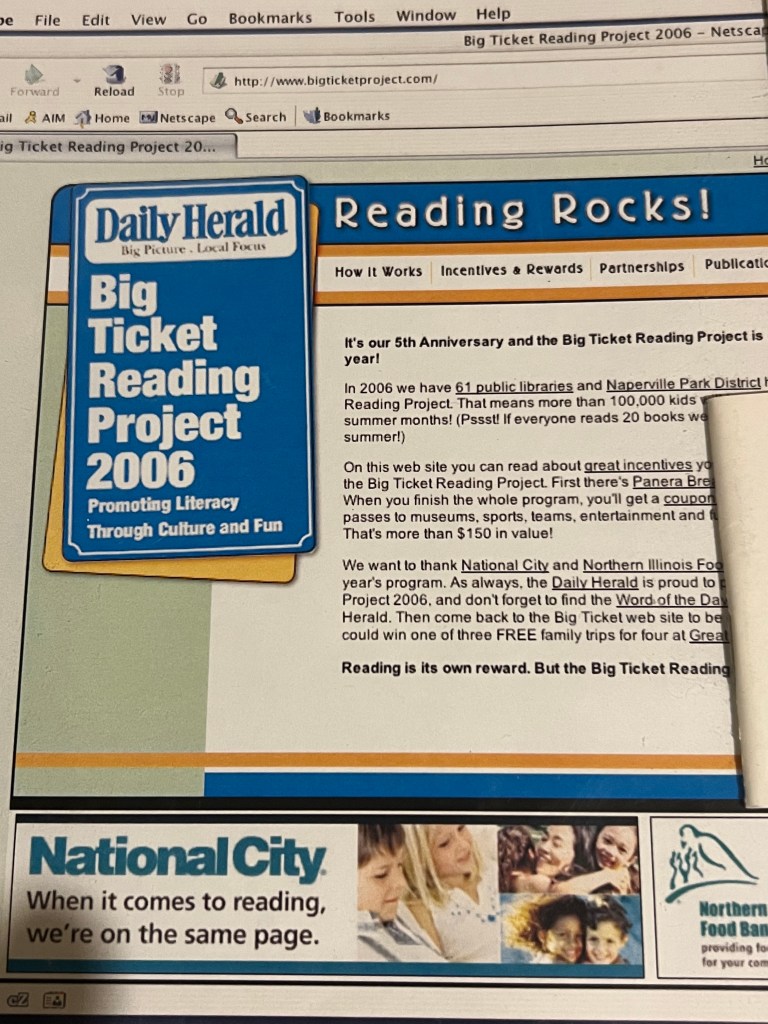
And yet, the Big Ticker Reading program continued growth every year. By 2005 it passed the 100,000 participants mark. That’s when I lobbied to build a free-standing website. The regular Daily Herald website was deemed out of bounds for a promotional program because the newspaper so concerned with grabbing readership on the site and maintaining editorial integrity that there was no essentially “no room at the inn” for a program that wasn’t a mainstream product.

So I took a small budget of $5K to produce a Big Ticket website. Admittedly, I had little experience with website development at that point, so the initial site was basic at best. Working with a third party, we launched a website providing program information, sponsor listing and participating libraries.

What I really wanted to build was something far bigger than a mere portal or hub. The dream I had in mind with the Big Ticket Reading Project was to create a “community” all of its own, a “literacy hub” offering content focused on reading for everyone from kids up to adults. Back in the Roundtripper Reading Program days, I’d worked with an author named James Lehman conducting events at which he read his children’s book and families flocked to hear him. I saw the Big Ticket site as a potential revenue-producing entity all its own with content centered around reading but also drawn from the DH site as backlinks to the main website. I was frankly way ahead of the curve on that, and because the Daily Herald was so absorbed in its own website challenges, it was a struggle to get management to look beyond immediate matters and think bigger about what online “communities” might look like in the future.

Life interrupts

Into this mix of purposes, a hard shock of reality came into my life. During the winter of 2005, my wife Linda began experiencing severe menstruation problems. Her family wasn’t keen on rushing to the doctor, believing most problems resolved themselves in time, so she wasn’t eager to visit a doctor about all that. Besides, we were working with an HMO through the Daily Herald health plan which meant dumping the longtime family physician that had delivered both our children. Our new doctor through the HMO was a somewhat gruff former military doctor.

Despite these changes, I researched and found a female gynecologist and made an appointment for Linda. A scan showed some potential issues with Linda’s ovaries. That made me think back to when she’d had large ovarian cysts removed during the first few months I knew her. After that operation in 1981, I visited her in the hospital where proceeded to yank up the gown to show me the Bikini cut scar and I thought to myself, “Well, I guess we’re serious.”

So I knew that when the gynecologist recommended a laparoscopic surgery I should be there for Linda after surgery. I took a day off from work and sat in the ambulatory surgery center during the operation. After an hour, the gynecologist came out carrying several photo sheets and took me to a private room. “There were cysts on her ovaries,” she told me, handing me photos of what looked liked like a busted up meatball. “I did my best to remove them but they broke.”

I sat there for a moment trying to grasp what that might mean. Then she intoned: “We’re sending these off for tests because we’re concerned they might be cancerous. I’m sorry.”

Linda came out of anesthesia and I had no idea what to say to her. By the year 2005 we’d been married for twenty years. Our two kids were in high school and middle school. I was pragmatic in talking with her that day because we didn’t know what to expect. “Maybe they’re benign?” she offered at first.

Several days later the test results came back. “Your wife has ovarian cancer,” they told me. “It is Stage IIc, but it’s an aggressive form of cancer.”

I was on my way to work that morning, driving on the 30-mile commute from Batavia to Arlington Heights that I typically covered five times a week as well as drives to satellite offices in Dupage, Lake, and Kane Counties. I was constantly on the move in that job running events like golf outings, awards banquets, bowling tournaments, editorial symposiums, and collaborations with pro sports teams and non-profits such as the American Cancer Society…

Suddenly, in the midst of all that hubbub, I was the husband of a wife with cancer and the father of two children to whom I’d need to explain, if at all possible, what it all might mean. At the end of that first week, my former track and cross country coach Trent Richards got news of our situation and called me up. “Your whole life has been a preparation for this,” he told me. His words resounded in my brain. He was right. All the pressures and preparation I’d done in running, the competition and training, and conquering fear in the face of the unknown contributed to a sense of self-control in many situations.

But that wasn’t the last bit of bad news that spring. In May, we received the news that my mother was diagnosed with a form of lymphoma. She chose to be treated with oral medication rather than doing chemotherapy because she was the main caregiver for my father, a stroke victim living with partial paralysis on his left side as well as apraxia and aphasia, the inability to form words or speak.

Carry on

This image has an empty alt attribute; its file name is big-ticket-website.jpg

The emotional duress was considerable, but we launched the Big Ticket Reading Project in June 2005 despite the fact that one of my assistants miscounted the 75,000 Krispy Kreme free donut vouchers we’d been granted and sent bulks of them to just a few libraries and suddenly “ran out.” I had to let the KK people know the problem and they threatened to charge us for all 75,000 if they were somehow “lost” but fortunately we’d built a great partnership with our libraries and they counted them up and resolved the issue within a couple days.

That was payment for being as forthright as possible during the entire formative years of the program. I held annual program critiques with a panel of librarians that volunteered from within their ranks to troubleshoot each year. They knew that we were committed to doing things right. If mistakes happened, as they sometimes do, we communicated and solved them as quickly as possible.

Then the newspaper assigned a woman to “oversee” the program. Her title at the newspaper was Quality Control but basically, her job was hunting around to find things to stick her nose into so that she could justify her own salary. She pushed her way into our meetings with an insistence that the job at hand was making the program sell more newspapers and generate its own source of revenue. I explained that both of those things were possible with actual support from the organization, but she was determined to prove that she was the one that knew how to make things work going ahead. I will admit that I despised her intrusion, especially in the company of a Circulation Department Vice President whose people had behaved so badly on so many fronts. I told her, “We have enormous potential here. This could be its own source of revenue if we keep building it the right way, in collaboration with our partners.”

She was having none of that. “We want to see some revenue from this or we’ll kill it,” she told me.

A Facebook Moment

My goal all along was to create something “new” for the newspaper, an opportunity to capitalize upon “down the road.” I’m not saying that I’m Mark Zuckerberg, or that there was necessarily FACEBOOK potential to the Big Ticket Reading Project. But as Zuckerberg was shown speculating in the movie The Social Network “We don’t even know what this is yet,” I had a feeling that the program had potential beyond the traditional concept of newspaper business models. I was trying to go Big Time and the smaller thinkers and bean counters were having their way. Look at this video at about 1:40:

Unfortunately, I would struggle from that point on to control anything in my life, but especially corporate expectations. Life was hitting me from all sides in 2005. The only thing I knew how to do in some ways, given my long competitive history, was hit back. That’s not always the best strategy.


Posted in adhd, aging, Christopher Cudworth, coaching, competition, cross country, running | Tagged , , , , , , , , , , , , , , , | Leave a comment

50 Years of Running: When the shit really did hit the fan

Back in college days, I became a big Warren Zevon fan. I dug into his albums because I liked the twisted lyrics and sad, crazy, needy, nutso characters he created. Zevon later became friends with Dr. Hunter S. Thompson, one of my favorite writers. They used to shoot and blow away shit in Hunter’s backyard in Owl Creek, Colorado.

I particularly liked Thompson because from the 70s on he tore into the increasingly deadly brand of conservatism he saw emerging from the Reagan years and on into the George. H.W. Bush era. Somewhere around this house of mine there is a Thompson book called Generation of Swine that tears apart the falsehood of Reaganism and the sinister evil behind the whole Bush family cabal.

Reading any Hunter S. Thompson essay is a satisfying venture. Short of Henry Miller’s description of sex scenes in books like Tropic of Cancer and Sexus, or the poems of Charles Bukowski, there are few writers as capable of literary catharsis as Hunter S. Thompson. I even loved when he ripped on the whole marathon running craze in his book The Curse of Lono. Because why not? I was a dedicated competitive runner when Thompson wrote that book but I always thought that running marathons was unnecessary to prove yourself.

Even the preeminent marathoner Bill Rodgers described the efforts of slow marathon runners as “graceless striving.” That was a cruel take on the marathon trend at the time, but it was true. When I accompanied Rodgers during a race appearance, a girthy guy shoved his head in the Volkswagen where Bill and I sat together and asked, “Bill, do you have any advice for a four-hour marathoner?”

Rodgers raised his famous eyebrows and replied, “You can run for four hours?”

The mythos of marathon running in its early days spoke often about the dangers of “hitting the wall.” One doesn’t really hear the term much these days. That’s because most marathoners treat the race as a running smorgasbord, gorging themselves on enough sugary fuel and water to propel a small truck if all those calories were converted to ethanol. Runners these days go chugging along for mile after mile, slugging gels and pouring energy drinks down their gullet, then throw their arms in the air after 26.2 miles and slap a sticker on their bumper matching their achievement(s.)

That’s all fine and good. The sport has changed from when I competed. We often raced 20+ times a year, with perhaps a half-marathon or two mixed in for interest. But multiple marathons? Or just two races a year? Bogus.

Now, I’m not one to complain that the shoes we wear these days are now “juiced” compared to the footwear from thirty-plus years ago. And I greatly admire the elite marathoners of today, and have grown to appreciate the marathon lust for what it’s worth. I’m slower now, and respect that trundling along at 9:00 pace does take work and dedication.

But we were guinea pigs in many ways back then. For the most part, the elites and sub-elites in our sport ran their guts out at shorter distances, frequently pushing the pace until, as Warren Zevon sang in Lawyers, Guns and Money…the shit has hit the fan. Most of the time we could see or feel it coming. That “shit has hit the fan feeling” is also known as “the bear jumped on your back.”

It takes courage to run right into that zone where reality shifts and you sense that things are going to slow down in real-time. Life becomes a mini-nightmare in those moments. Legs become uncooperative. In fact, nothing seems to work the way you think it should. But many times, as a distance runner, you find a way to persevere nonetheless. It’s called having guts.

Then there are those people that are too stubborn or stupid to see it coming. Their training doesn’t prepare them properly and they either blunder or will their way into situations beyond their scope of ability. Perhaps you’ve seen this face before.

The look on the face of George W. Bush that day he was reading a children’s book in a schoolroom and the Secret Service came in to tell him that a plane just crashed into the World Trade Center was a definite “shit has hit the fan” moment for the then-President of the United States. His face went into a mask, you might say. The blood clearly drained from his brain, for a second, or at least the realization that his life just changed somehow altered the blood chemistry up there. Lord knows he understood something bad just happened, and he might be at fault.

Plenty of people say that George W. Bush could never have prevented the 9/11 attack. Well, that’s an opinion, for sure. He and Cheney were handed clear warnings about such attacks by the outgoing administration of Clinton/Gore. Then a key security advisor Richard Clarke reminded the Terror Twins that they might be advised to look out for bad guys trying to crash planes into buildings.

The Brookings Institution in 2004 outlined the facts this way:

“This, by any measure, was Richard Clarke’s week. The former counterterrorism czar roiled Washington and the nation with his accusation that U.S. President George W. Bush had failed to understand the threat al-Qaeda posed to the United States before Sept. 11, and bungled the U.S. response afterward. It was a stinging indictment of the Bush presidency, delivered with stiletto precision. And the impassioned response from White House showed that it hurt.

Mr. Clarke categorically denounced Mr. Bush’s handling of the terrorist threat. He blamed the President for “continuing to work on Cold War issues” even as the al-Qaeda danger mounted. He says that National Security Adviser Condoleezza Rice ignored his memo in January, 2001, “asking for, urgently—underlined urgently—a cabinet-level meeting to deal with the impending al-Qaeda attack.”

But Bush and Cheney were so giddy at having basically stolen the 2000 election thanks to his brother’s voter suppression efforts in Florida and the compliant resolve of the conservative members of the United States Supreme Court that they were rolling along like a pair of kids racing ahead of the pack giddy from the dopamine and endorphins of highly oxygenated politics until they ran the wrong way on the course and the truck of 9/11 ran their stupid asses over.

This is why millions of Americans and billions of people around the world sat staring at their TV sets the morning of September 11, 2001. Working in the newspaper business at the time, I knew that this was one of those times when time ceases to exist. Journalists do not sleep when the shit hits the fan. They refuse to close their eyes for any reason. One never knows when some bit of information or gem of truth might fall from the screen or come looping over the wires.

While I no longer worked in the editorial department––having migrated over to marketing the year before––I figured that anything was possible at that moment. I might be called back into action if extra staffing or editorial support was needed. That didn’t happen. Our staffing was prodigious at the time. We had the highest circulation-to-editorial ratio in the country. Our newspaper zeroed in on local angles and tracked down families or friends whose loved ones died in all that 9/11 carnage. One thing was always certain about the Daily Herald newspaper: with a very few exceptions (as with any organization) the editorial people were top-notch and dedicated. I keep in contact with many of them to this day because they are also honest, caring people with an objectively liberal sense of right and wrong, and I care about that.

The morning of 9/11, I watched on TV as the buildings tumbled straight to the ground. To my eyes, it looked as if they were denonated from the inside. A building next door went down that way as well. To this day I get a creepy feeling looking at that footage and thinking about the look on the face of George W. Bush that day. As a regular practice, I refuse to buy into conspiracy theories, but I also tend to trust what I see with my own eyes. The same sick feeling grabs me when looking at footage from the January 6th insurrection. If it wasn’t a pre-calculated event, then was it permitted, condoned, or somehow allowed from within to achieve some sinister agenda? That type of information, along with the Kennedy Assassination, is never fully revealed in the United States. We’re a country long dependent on obscuring its darkest secrets to make the claim of American Exceptionalism.

To say that I don’t trust Dick Cheney or George W. Bush is an understatement. I never trusted them long before 9/11 happened. Then their actions in the wake of that tragedy only proved the specious nature of their dogmatic determination to impose and execute their calculated neoconservative agenda on the world. Whether it was a grand plot or a grand excuse is hard to tell. The unbudgeted $7 trillion in American tax dollars that we spent in Iraq while cutting taxes on the wealthiest Americans is the type of corrupt dichotomy and hypocrisy the likes of Hunter S. Thompson never trusted, but often revealed.

It’s no wonder the economy eventually collapsed under the weight of such deception and lies. The same thing happened under Trump when lying about the Covid pandemic. Economics are highly susceptible to the poisons of untruth.

Trump caricature by Christopher Cudworth

It’s only gotten worse during the Trumpian age. Like that daft demagogue Ronald Reagan, Trump thinks his own shit doesn’t stink. And now, the ugly loop of Christo-fascism dawned during the Ronnie Days is closing tightly around the neck of actual democracy. Trump keeps tugging on it, hoping to choke the life out of any resistance he can see or sense. His ignorant henchmen and that toxic cabal of Bowling League Organizers like Marjorie Taylor Greene and Matt Gaetz, Jim Jordan, and the rest have hold of it too.

They screech and cry that death to democracy means liberation for America. Meanwhile, Trump’s cult of Make America Great Again sycophants actually believes that less oxygen for democracy means more breathing room for them. We are in the age of Vindictive Vultures, the kind that both scavenge and kill for a living. They certainly can’t distinguish between people that “know their shit” and those that literally shit their pants, as Trump does, whose power Depends on others to ignore his lies, hold their noses and vow absolute fealty to a hero with a bad combover, fake tan and a Diet Coke demeanor that Warren and Hunter would both have blown away if were perched on a fence in a Colorado back yard.

Posted in Christopher Cudworth, competition, marathon, marathon training, race pace, running, running shoes, training, training for a marathon | Tagged , , , , , , , , , , , , , , , | Leave a comment

50 Years of Running: Transition times

As a triathlete, I’ve gotten used to the term “transition times” to indicate how long it takes to go from swim-to-bike to bike-to-swim.

The first time I did a duathlon, before I took to swimming along with running and cycling, I ran the first two-mile section in just over 12:00, jumped on the bike and road as hard as I could, then moved through transition back from cycling clothes to running gear. As I emerged from the bike zone, my legs felt like liquid cement. I’d never really done a bike-to-run transition before. For all the running I’d done in life, including the most difficult distance race in track and field, the steeplechase, my legs had never felt that specific kind of “dead” before.

My wife stood outside the transition zone waiting for me. When she saw me trundling along with legs barely lifting and a sagging look on my face, she called out, “Keep going, honey!”

After the race, I laughed pretty hard about that moment. She was trying to be kind and encouraging, but there was also a bit of “I told you so!” in those words. I’d not done any “brick” workouts to practice the feeling of running after cycling as hard as you could. Lesson learned.

There are other kinds of transitions in life as well. Moving from one job to another can be a big of a drag. One day you’re engaged in familiar routines and the next you’re learning all-new tasks. The “new job” feeling can rob you of self-confidence quite quickly. It’s best to do some prep going into any new situation so that the shock isn’t too bad.

Transition to marketing

That said, I’d been with the Daily Herald for most of a year when the directive to transition to marketing came along. That meant an hour-long commute from my home in Batavia to Arlington Heights, a big suburb where the office sat facing I-90. The building looked like a ziggurat, with stairstep architecture from the lower stories to the top floors. Competitors in the region called the DH office the Death Star, named for the habit of consuming territory and growing circulation by reaching into towns across the Chicago suburbs. They weren’t wrong about the tactics. In many cases the strategy worked, but only to a degree. Circulation in new territories often hovered at 10% among households, whereas local papers; weeklies in particular, might reach 20-25%.

But the news coverage was exceptional, with the highest circulation-to-editorial relationship of any newspaper in the country. The brand tagline was “Big Picture.Local Focus.” That’s why I was promoted to market the company. The reach was big but the penetration, not so much.

I met with my new boss, a former Sports Editor who was bumped into marketing a few years before I arrived. He had a skydiving photo of himself on the wall. Ultimately I learned that he was extremely risk-averse. The photo was a weak attempt at showing what a venturesome guy he was. Most of the time he was reticent to try anything new. He didn’t like sticking his neck out in any fashion within the organization. I was the opposite, and felt I had a mandate of sorts to shake things up. When the President said, “We need new ideas in marketing,” I took him seriously.

So the dynamics were a bit awkward as we moved into the rhythms of working together. I was hired to cover all the regional offices, and there were several of them spread across the suburbs in Lake County, DuPage County, Elgin, and the newest Tri-Cities office where I’d been hired to work as an editorial writer.

Regional coverage

We had monthly meetings with the Advertising and Editorial managers at each of the offices. Each had a tiny little budget of a few thousand dollars to last them the whole year. A year into the new job, I’d hear the same President that hired me stated in a full-staff meeting, “I don’t really believe in marketing.”

What they did believe in was high-profile branding. That wasn’t a terrible strategy. The regional and main offices were all located on major Interstates or on high-traffic roads where the blue Daily Herald logo could be seen by thousands of commuters a day. The paper also served as the media sponsor for the Allstate Arena, a big-time venue situated on I-90 east of our main office. Our company had an entertainment box overlooking the main stage for concerts and shows and there were ice hockey and basketball games held there as well.

That’s the stuff my boss liked to do, hang out a high-profile sporting events and concerts. He also negotiated all the pro sports contracts with the Cubs and Sox and Bulls and Bears and Blackhawks. There were all sorts of deals made, mostly trading tickets for some levels of ads.

But the Allstate Arena deal was the biggest promotional expense our company had. The specific advertising agency with whom we had a promotional contract kept asking why we didn’t budget any dollars to do media or billboards. But that’s not where the company put its money, and that contract eventually dried up entirely.

What we had left was a marketing agency tied together with the Allstate Arena deal. It was staffed by a pair of women that showed up once a month to schmooze with my boss, and I wasn’t allowed into those meetings at all. I often wondered what happened in there, because that company and those women were supposed to bring us promotional partners. But that never seemed to happen.

Then my boss went on a trip to Vegas, which is where he liked to go on vacation for some gambling and drinking. Those trips were the only other time I saw him willing to take any sorts of risk.

Unfortunately, he came down with a bad case of thrombosis in his legs on the way back, resulting in a blood clot that could be life-threatening. I felt bad for him because it seemed like he at least came back from Vegas a bit relaxed. But not this time.

That meant I was suddenly tasked with managing his contract activities on top of mine. And since I’d just taken on the specific role of Community Relations Manager (with a $10,000 pay raise, so I was playing the game right for once…) the activity around the office picked up quite a bit for me.

So it was transition time. While I’d been kind of marshaled around behind the scenes with my boss in place, now I was an open-faced sandwich ready for inspection by everyone in the organization. But again, I was prepared. I’d studied what the organization was doing with its money and where its revenue strengths and weaknesses were. In one of the first meetings held with my boss and our staff, I remarked, “You know, we’ve got an 8% profit margin, which is fine as long as we don’t lose any advertising categories.”

But life was changing fast in the media world. The revenue from job listings was quickly moving over to the Internet. The company had to institute a cutback in revenue, and did so with a staff-wide requirement to take one unpaid day per month. Frankly, everyone loved the change, and when the policy ended, people were sad to lose that “benefit” even though it was nothing more than a cost-cutting measure.

But speaking of cost-cutting, I quickly realized upon first meeting with our marketing partner that the investment we were making on a monthly basis was not delivering the ROI anyone expected. The outlay was thousands of dollars per month, and I realized that the only thing that money was doing was paying the salaries of the two women that showed up once a month with their blouses unbuttoned so that their bra and boobs showed. At least, that’s what happened the first meeting I had with them when my boss was out of action.

So I made up a cost-analysis sheet and handed it to the Advertising Department head and within a few weeks the marketing agreement was over with that firm. I felt bad cutting the women out of their sweet deal, but given the company’s overall narrow cost-benefit margins, I felt it was my responsibility.

From that point forward, the Advertising Department took over negotiations with potential promotional partners at the Allstate Arena. I felt I’d done my job helping the company transition to a better option. We’d save more than $100,000 a year going forward.

World in transition

But things in the world at large were going to get strange. Because on September 11, 2001, while I was home waiting to head to the Tri-Cities office meeting near my house, I turned on the television to see smoke billowing from one of the World Trade Center towers in New York City. By then my boss was back and work and I called to tell him, “I’m driving up to the office today. We need to see how this is going to play out.”

A bit later that morning, I stepped outside my house to skies gone silent. All air traffic was halted in the wake of the 9/11 attacks. My wife came home from her preschool and we wondered whether we should pull our kids out of school. Yes, life changed that day. The whole world knew it was going through some kind of transition.

Posted in duathlon | Tagged , , , , , , , , , | Leave a comment

50 Years of Running: Great joys and hard lessons

Before taking the job as an editorial writer for the Daily Herald, I wrote letters to the editor at the Chicago Tribune and other media outlets.

The day-to-day joy of writing full-time for a living was not lost on me. I truly loved writing columns and found it fascinating to edit national columnists’ work from all sorts of political perspectives. As editorial writers, our job was to take the bulk column writing from the nationally syndicated writers and pare it down slightly to fit the column-inch space our newspaper provided on the daily opinion page. Our newspaper published perspectives from Cal Thomas, Ann Coulter, George Will, Molly Ivins and several other political or social scions trying to get their point across about the American scene. We didn’t have to edit much, but taking out even 100 words from a column is tortuous work because it is important not to diminish the meaning or leave out some critical thought during the process.

It was easier to edit a rational conservative such as George Will than it was to condense the extreme screeds of Ann Coulter. Will often used baseball or other analogies to explain his positions, while Coulter just bellowed at whatever she did not like, and that was everything. Cal Thomas was as predictable as could be. He always took the stance that things were better in the old days and America was going to hell because of godless liberals. Then there was Molly Ivins, the liberal columnist from Texas whose jibes were lively and typically filled with colorful imagery.

I’d spend time reading each column through and tried to genuinely respect the intention of the writer. That’s hard when you disagree with nearly every word written down. Then it was sent over to a copy editor for grammatical checks and into the newspaper it went. As a kid, I always hated when my mother served us fried liver and lima beans. That’s what those conservative columns tasted like in my mind. The Bush II debacle was just beginning in America, and despite that rather obvious theft of power in the state of Florida, there was considerable tribal crowing going on from the Right about the mandate they’d received in the Bush election. That triumphal call to arms empowered conservative columnists to blame every wrong on “the libs,” and swallowing that brand of content while trying to do a fair and equitable job was not always fun. Plus, back then I did not fully realize that I have ADHD. But sometimes it caught up with me.

The real hard lesson came the day that I dashed off an editorial written in the voice of the newspaper that I had not thought out all that well. Later that day, I received a call from my boss, one of the greatest managers I’ve ever known, a guy named Dave Beery. He was one of the most rational, considerate, and intelligent men I’d met thus far in my career. I took his advice seriously.

“Hey,” he told me in a calm yet serious tone. “You’re getting an inter-office envelope today. I want you to look it through, and if you have any questions, let me know. I think it’s best if I don’t coddle this for you. Just read through what the Publisher had to say about that column you wrote and take it to heart.”

I opened the envelope to find a column I’d written (and published) marked up in red. Hardly a word in the 200-word column was left untouched. For a moment, I was crestfallen. It’s hard to see your work chopped up like that. Dave was right, however. A real journalistic pro needs to take every word seriously, and I had not done that. It went out as the voice of the newspaper, and I had to be accountable for that.

Hard lessons learned

I learned a hard lesson that day.

It reminded me of those running races where I wasn’t quite mentally prepared for competition. All it takes is a slip in concentration or even a second’s loss of will and boom! You’re out of the mix. So I slowed things down a bit and took into account that it was easy to slack off if you’re all hopped up on writing and start thinking you can do no wrong. That was the farthest thing from the truth.

I’m pretty sure some of the other full-time journalists wondered what I was about and why I’d been installed in the position, not having come up through the ranks as most editorial writers did. Our weekly meetings in which the other editorial writers convened by phone to discuss assignments taught me even more lessons about respecting points of view. My naturally competitive personality was not always appreciated, I’m sure. I also felt that the reporters on staff in our local office took a much drier view of what newspaper columns should be rather than some of my lighter attempts at entertainment. Such is the life of every writer. One has to learn their limits.

Change afoot

It was all going to change quite quickly anyway. Just six months after starting the job, the President of the company called me up one day with a proposition. “Listen,” he told me. “We’ve known each other a number of years, and you did some great marketing work for us back when you were a contractor. We need some new ideas in marketing. We want you to come to the Arlington Office as the community relations manager.”

“Does it come with a raise?” I was immediately bold enough to ask.

“We’ll see where it falls on the grading scale. But probably yes.”

That was that. After my short stint as an editorial writer in the eventful period when history passed the year 2000 mark (remember Y2K?), I was heading back to the marketing side of the business. Indeed, I received a $10,000 raise and my wife was ecstatic about that. For once after many years of flailing around in the corporate landscape, I’d played my cards somewhat right and was being welcomed into a business world where perhaps my talents were needed and appreciated.

10 That Do It Right

That was a heady time. The Daily Herald had just been awarded a prestigious recognition as One of Ten That Do It Right by Editor&Publisher Magazine. The publication reached 90 communities with a paid circulation of nearly 140,000. At the time, it was the third-largest newspaper in Illinois behind the juggernaut Chicago Tribune and its weird little tabloid-size blue-collar newspaper the Sun-Times. Everything in the business was about competition for revenue and circulation. Little did anyone know that the entire media business––and all other realms––were on the verge of being transformed by a new information channel that would take over the world. The Internet.

The surprise and shock of dealing with online competition reminded me of the time that our Luther College track team was faced with the spectacle of a runner that the previous year had been nothing special but arrived during our senior year in a form so quick that no one knew what to make of him. A guy that the previous season wasn’t breaking 4:10 in the 1500 meters turned into a sub-3:55 runner who was also capable all the way up to 5000 meters and down to 800 meters. Talk about changing the nature of competition! That’s how it felt to newspapers all over the nation when the Internet came to town. What is this fast animal we’re encountering?

The question was the same for everyone in the news game: How do we compete with that?

Posted in adhd, anxiety, Christopher Cudworth, college, competition, mental health, running | Tagged , , , , , , , , , , , , , , | Leave a comment

50 Years of Running: Moving meditation

When I landed the job as an editorial writer for the Daily Herald, nothing excited me more than producing weekly columns for publication in the newspaper. I’d first done a column back in 1980 when I was just out of college. It was titled Field Day, a weekly set of 500 words published in the Chronicle Newspapers along with my illustrations. I always wished I could have done that for a living somehow.

Having a weekly byline was therefore a dream come true. So I decided to double the fun and write two.

It wasn’t hard for me to come up with topics. Some journalists and columnists seem to lament the “burden” of having to come up with ideas for columns. I viewed the process differently. It was fun to write, and subject matter was everywhere. All I had to do was read the Daily Herald and there were controversies, political actions and news features all waiting to be written about.

I learned quickly that clarity is critical to being fully understood. When a restaurant owner sought approval to build a hotel on the empty lot next to his business, local residents burst into action with protests. But looking at the law and rights of ownership, I learned that the owner had the right to build what he wanted on the property because it was zoned for commercial.

Knowing that the neighbors were not in favor of the development didn’t sway my perspective. Yet I tried to write a column taking their concerns into consideration while still stating that the property owner had a right to use the space for a hotel as long as the city approved it. Well, both sides of the issue saw my column as favoring their position. My attempt at providing a “balanced” view only confused people.

Home school zealots

From that point forward, I stated my case in much clearer terms on the issues I wrote about. Some local homeschoolers were pushing the idea that they should get to play high school sports because the families paid taxes, and I pointed out that being home-schooled was a significant advantage in sports. It allowed students to practice at will without the constrictions of regular class schedules, and also provided unfair opportunities to rest or even sleep off early morning workouts. My argument was simple: “If you don’t attend public schools, you shouldn’t get to participate in public school sports.”

My column hit a giant homeschooler nerve. It spread across homeschool networks and the letters came from everywhere. “Who are you to decide what my kids can and cannot do?” was the basic refrain. I pointed out that my position was based on real-life experience as a competitive athlete. As a distance runner from middle school through college sports, I knew the demands of endurance sports first hand. But that didn’t assuage the homeschool rants. People and their money don’t like to listen to rational arguments about actual sports training and competitive advantages. Those folks only cared about their kids having it both ways.

I still think my position is correct to this day. It turns out the Illinois High School Athletic Association feels pretty much the same way. As stated on a homeschool website, here’s how it works:

The public school in question may be amenable to homeschooler participation, but they are held by IHSA rules which specify that all members of the teams that represent it, actually attend that school. The reasons for this are easy to understand. A school should not be able to use “ringers” or superior athletes who do not even attend their school to attain an unfair advantage over other schools in their league.

So if a public school wishes to offer this opportunity to a homeschooler in the area, how can it be done? IHSA 2003-2004 rules state that a homeschooled student may participate if the student is “enrolled at the member high school, …taking a minimum of 20 credit hours of work at the member school or in a program approved by the member school, and the student must be granted credit for the work taken either at the member school or in a program it approved.” (quoted from “Illustrations for Section 30.10 of the By-Laws”; also see “Illustrations for Section 4.010 of the By-laws”)

Despite the clarity of the law, the letters from homeschoolers poured in protesting the supposed injustice of my position on the matter, and those letters were pursuantly published in the newspaper. That seems like a bad thing from the perspective of getting bashed, but it was actually my job as an editorial to generate interaction with the paper. It is sometimes said of celebrities that “there is no such thing as bad publicity.” For editorial writers it is a bit different. It never pays to be dead wrong or to slander someone, as a columnist for another newspaper did. They got sued for $7M by the Illinois Supreme Court Justice and former Bears kicker Bob Thomas.

Gun scare

I did have one scare as an editorial writer. Every week we received letters from a guy that wrote basically the same gun rights letter week after week. He’d move some words around but it was basically the identical rant week after week about total gun freedom. We printed one of his letters a month, but he got mad when our paper wouldn’t publish his reiterations. Finally, he demanded that we talk it out. He showed up at our office in a green Army coat with his hands stuffed in the pockets. That made me nervous so I met with him in the outside lobby rather than bring him into the office space.

Fortunately, he wasn’t there to kill me. Instead, I calmly explained that our policies apply to all people and that our letter policies are clearly defined in our editorial page masthead where they were regularly published. He’d never seen them, and after that his pressure relented. I gave him some helpful hints about how to make his points in different ways, and he thanked me upon leaving.

Idea Generator

So I never lacked ideas but did think up many of the columns I wrote while out running. That’s always been my Idea Generator. That’s still true to this day. Some of my ideas for articles, columns, poems, or even whole books arrive as if thrown from outer space. I’ll be running along thinking about one thing and my mind races through a series of thoughts and suddenly something comes to me. I love that about running. It’s true with walking sometimes, and I now record TikTok content (@genesisfix) about my book Honest-To-Goodness: Why Christianity Needs A Reality Check and How to Make It Happen while out walking my dogs.

Moving Meditation

The other benefit of running is that it’s always been a form of moving meditation for me. The deep breathing involved in running enervates yet also calms my body and mind––together. I’ve done yoga and like it, especially once the racing thoughts have fallen out of my head and that space comes along in which I’m released from anxiety or the influence of ADHD. Vinyasa too.

But that sense of clarity and calm has always happened with running. It’s a cleansing act. Even worries dissipate or disappear during runs. I’m also better able to focus on executive functions after running or cycling or swimming. That’s why some schools are giving kids exercise as an antidote to ADHD. It wicks off excess energy and oxygenates the brain.

Slow to go

Sadly, it takes a bit longer to get warmed up and going well these days. One of the drawbacks of aging is the longer warmup time required to be fully efficient. Slogging through the first ten minutes of a run or a swim takes patience that sometimes lack. Now I try to be more forgiving with myself about slower average times overall, knowing that the first 2-3 miles are going to be in the 10:00-11:00 mile range. I still close under 9:00 and even under 8:00 per mile. My runs often result in negative splits. That’s okay. I’m still running.

I’ve always needed moving meditation to help my brain be creative and deal with the vicissitudes of life. In many ways, it has been the pen that writes my stories for me, wherever they appear.

Posted in aging, Christopher Cudworth, Depression, foregiveness, healthy senior, mental health, running | Tagged , , , , , , , , , , , , | Leave a comment

50 Years of Running: They called me Coach too

Following years of coaching my son’s youth soccer teams, I started coaching the girl’s teams with my daughter Emily. She liked the concept of playing soccer, but not so much the running and such. So it was a constant issue to get her to play the open field even though she tended to be among the fastest girls on the pitch.

In fact, my favorite memory of her during soccer is a reel that plays in my mind to this day. During her last year of soccer at the age of twelve, she was signed up for a team that I did not coach. But the guys leading the team made a smart decision to bring a trainer in to get the girls in shape. He had them doing all sorts of strength-based workouts, and the girls were rather surprised how it made them feel. They’d also gather on the outskirts of practice to compare ab muscles. Even Emily kind of enjoyed the sensation of strength and speed.

During that season she played defender quite a bit. At this, she excelled. But one time as our team’s defenders were all pushed up to the half-line, an opponent launched a kick that sent one of their faster forwards chasing after it. Emily turned and sprinted after her, closing down the distance with long strides. It struck me that at full speed she ran with the same form as her father. I was looking at a female version of myself. She crossed the path of the forward while stealing the ball, gave it a touch to clear it sideways, and delivered a pass to her teammate. If nothing else ever happened in her soccer days, that was enough to demonstrate her athleticism.

Rec league rhythms

We spent many days on the pitch when I did coach her. That all began when she was about eight years old. Before that, I was still coaching my son and she played for rec teams. We attended all her games, and all of that was classic soccer stuff. Warm fall days fell into cold, wet mornings on the giant sets of fields at various park districts. We went through shirts of many colors, all of which served as a backdrop for her bright blonde hair. Like most soccer players, she shed cleats each season as her feet grew, but in her case, it was her feet that would cause some challenges.

She was born with a slightly curved foot structure on both sides. That meant wearing orthopedic shoes that straightened the bones but left her with really low arches. Not the ideal situation for running or sports. But even world-class athletes like Sebastian Coe have flat feet. So we did our best to find supportive shoes as she grew into the sport.

Coaching a daughter

A photo by photographer Karen Woodburn of Emily at age three. We snuck out to take photos and I made her promise not to tell her mother. But when Linda walked in the door, Emily’s first words were, “We got our pictures taken!” She later went on to become a fine photographer herself, as you’ll see. This photo captures Emily’s always impish nature.

Once I began coaching her girls’ teams, we engaged in fairly constant dialogue about the ups and downs and the social aspects of each group. I’d done that with my son, but those conversations were more about the capabilities of the respective players, and how to engage them strategically.

With Emily, the conservations were more about the personalities of the girls and how to work with them. Emily had little tolerance for the sometimes calculating ways of her peers or the cliques that formed within teams. I respected her ability to see how other girls interacted. Together we figured out how to help the girls all work as a unit.

But it was hard at times. During her fifth-grade season, one of the girls was actively provocative in her discussion with other girls. She was always sharing sexual tidbits about what she’d learned from somewhere. At one point I felt it best to let her father know what was going on.

I’d seen that kind of behavior before when I taught grade school phys-ed as a summer job during college. One of the girls in the fifth or sixth-grade class was ahead of her time in terms of interest in boys. She was just starting to develop physically and even snuck one of them off behind a hedge one morning to see what she could make happen. I turned that issue over to the supervisors right on the spot.

During high school, one of my best friends volunteered us to coach a girl’s basketball team. He later went on to manage a YMCA as a career. Even as a high school senior he understood and shared a great approach to coaching that was equitable for all. I never forgot that example and always tried to substitute players in the fairest fashion possible.

So I did my best to manage all that and help the girls have fun. We’d typically have one or two girls that were far superior in athletic talent each year, and in youth soccer, that means they’d do all the scoring. I remember a girl named Casey whose competitive spirit was quiet but fierce. She was never demonstrative in her play or actions, but she never messed around. Her focus was admirable. She’d come off the field with a sheen of sweat on her forehead, take a few sips from a water bottle, and stand ready to go back in whenever she was called.

Emily liked and admired that kind of player. Not all talented players were so egalitarian. One of our forwards was extremely fast, but she was also fond of the adoration she got from other girls on the team. It got to a point of exclusion within the ranks if someone didn’t cow to her demands. I pulled her aside to have a Ted Lasso talk, but I’m not sure it ever really helped. For some athletes, it takes years to learn how they fit into a leadership role, especially when their talent races ahead of their maturity.

Moments of joy and laughter

There were many moments of joy in coaching girls because their personalities at a young age are often irrepressible. One of the players on Emily’s U-9 team was a redhead named Garney. Walking off the field on a hot May morning, her face dripped with sweat at the temples and she flung a pile of thick red hair over her shoulder and stood resolute on the sidelines. “How you doing, Garney?” I asked.

She thrust one little hip to the side, turned to me with a flushed face, and said, “Fine. I just wish it wasn’t so frickin’ hot.” I laughed hard at that one. I knew her dad, a down-to-earth guy that probably used phrases like that quite often. Moments like that were what made coaching special to me. Unadorned reality.

There were some weirdly fantastical moments too. We joined her coach and his daughter to attend a USWNT game in Chicago. The event was sponsored in part by the American Girl company, and there was a doll giveaway at halftime. I was working at the Daily Herald at the time, and perhaps I had a promotional conversation with that group, I don’t remember. But out of 20,000+ mostly girl fans at the game, Emily won the doll, a Black soccer girl. Was it chance, or did the sponsors make an inside decision? We’ll never know.

We had fun, and plenty of laughs along the way. While driving Emily and some friends around one day, I had a new Modest Mouse CD playing on the deck. I’d heard their music in a record store and bought the album on the spot. As we drove around with the music playing one of Emily’s friends leaned forward and said, “Mr. Cudworth. Did you know there’s swears on this record?”

Emily burst out laughing. “That’s why he likes it!”

During her teenage years, I drove her to rock concerts all over the Chicago area. She’d become an excellent rock photographer and followed bands that used her photos on their album covers and merchandise. But when one of those rockers tried to lure her into their bus like a groupie, she told him to get lost. “That’s not what I’m here for.”

Her credibility grew and she was selected to be one of two rock photographers at a Maroon 5 show at a giant concert venue near Chicago. Her friends were a bit jealous about her close proximity to the lead singer Adam Levine. But she always focused on the work, not the FanGirl aspects.

I didn’t “coach” her at these endeavors so much as I tried to provide support when there were late nights and somewhat sketchy venue locations involved. One of the interesting payoffs from her work during those years was a deal she worked out with a top-ranked group called Goldhouse. She’d done their album cover work but wasn’t paid for the images. So she pushed them to perform at her high school graduation party. The group was a headliner for Warped Tour, a national concert series, and when they started to play in our 40-foot basement that June afternoon, people were blown away.

To this day, she’s a talented woman that approaches life on her own terms. And like her father, she’s faced her share of idiocracy in the workplace and beyond. The fact that we lost her mother to cancer ten years ago in March 2013 has not made life easier for her in many ways. Even a father can’t be a substitute for some things in life. I haven’t been perfect in that regard, for sure.

But I think back to the day when we traveled together to meet up with a falconry group so that she could do a college term paper using her photography. That day, she wore a black jacket with a fur collar on it, and the falconers told her, “Oh no, that won’t do.” Instead, they outfitted her head to toe in Carhartt clothing, including a jacket too large for her 5’6 frame and a set of canvas chaps so that she would wade through the undergrowth as we followed the falconers carrying a red-tailed hawk and a European goshawk.

It was a chilly winter day, but sunny. Her hair was dyed red during her college years, and it shone in the low January sun. One after the other, the hawks dispatched rabbits. Some let loose death squeals, and a falconer turned to her and said, “Does that bother you?”

She replied. “They gotta eat.” And we traveled on.

During the morning the goshawk got a bit fussy and nipped the owner with its sharp bill when he tried to substitute a chunk of meat for the rabbit. We stood there looking at the blood pouring from his bare hand, and knew that he’d need to wash it quickly. The rabbits all had some sort of parasite in them, and letting their blood mix with his might be bad news.

At the day’s end, we stood around talking when the goshawk owner came over to Emily and said, “Here, you can hold it.”

She blanched as the glove went on her hand and the hawk leapt onto her arm. “Oh my god,” she blurted.

The hawk sat there as she held it at arm’s length and a famous wildlife photographer stood back to take an image of her. I think that image (above) symbolizes her nature. I could not be more proud of my daughter in every way.

Posted in Christopher Cudworth, coaching, competition | Tagged , , , , , | Leave a comment

50 Years of Running: They called me Coach

This image has an empty alt attribute; its file name is local-285.jpg
The Local 285 team for which I played. I’m second from left in the second row. Always a goof.

As a young kid, I was obsessed with everything about sports. My brothers and I played every sport imaginable, all the time. Our side yard in Lancaster, Pennsylvania was the site of pickup football, soccer and baseball games of many kinds. I lived to impress others through sports.

While I excelled at an early age and even helped win a city baseball championship by pitching our team to a win in the second game of the Lancaster New Era baseball tournament, and was a starting guard in basketball all the way through my sophomore year in high school, by the time was a Junior Year it was time to specialize. My father had guided me into running that first year at little Kaneland High School, and I was the top runner before transferring to St. Charles where I also led the team. So it finally made sense to concentrate solely on running.

I didn’t necessarily want my choices to define those of my children. My son was born in 1986 and by the age of six or seven, he was signed up for soccer which proved to be a fun, healthy activity for him. Had our family not moved to Illinois when I was twelve years old, I’d have likely played soccer in high school, not become a runner. So I coached his teams with varied “success” because at those early ages, there is no predicting who you’ll get on a team and frankly, it doesn’t really matter. In fact, I coached one team that was 0-9. We almost had a chance to tie a game on a cold November day with rain pouring down on the field. The kids were soaked, and the parents were miserably huddled under umbrellas in the raw wind, yet we held out hope to have a shred of success with just one tie in the last contest. Then the ball squirted free at midfield and some kid dribbled toward our goalie and kicked it right at him. The shot hit his hands, went between his legs and dribbled into the goal.

A parent chuckled darkly under their umbrella and said, “Well, that’s our season in a nutshell.”

The Travel Team

By the time my son was nine years old a different type of fortune fell into a place and I unwittingly inherited a pile of talent on a single team that won the rec league. Traveling soccer was just being formed in the Tri-Cities league so I asked the parents if they’d like to carry the rec league success over to a traveling team. “We’ll keep it affordable,” I promised. Top-tier local teams were charging $1000 and more for kids to join. “Just $250 per season and we’ll play two tournaments and ten games.”

The parents loved that idea. So we formed the Tri-City Sky, a name I willfully chose because the typical names like Raptors and Killers and Eviscerators (I made that up) all sounded stupidly aggressive to me.

That team was built over time to include other players as a few kids came and went. The soccer hierarchy was Platinum, Gold, Silver, Blue, etc. We typically played in the Blue or Silver categories. My son Evan was a solid player among a group of athletic kids. We subbed as equitably as possible so that all kids got to play. Most years we had winning seasons, which was gratifying.

But one year we showed up for the annual seeding tournament that determines where you wind up in the league. As happens often with preteens, a couple kids were out with the flu. During the first game, two more players grew sick and dropped out of the tournament. We lost that game. When the next game began, two more kids were throwing up or looking peaked. We were down to ten players able to play and during that game, my son came over to me at halftime and said, “Dad, I don’t feel good. But I can still play.” He was always much tougher than me about things like that. I once watched him barf a cheeseburger into the garbage can during an indoor soccer game and go back out and play. “I guess I ate a little too close to the match,” he told me.

Even with that level of tough attitude from all of our players, we lost all three seeding tournaments games. The last one was by 6-0 or something on that order. That result dumped us all the way down to the Orange or Yellow or Green bracket, I can’t remember, for season play. I called the league to beg deference given our consistent winning record in Blue and Silver during previous seasons, but no go. We went 10-0 that year against weak teams and most of the scores were that high too. It was a tragic experience and the kids didn’t take that season all that seriously.

Mr. Loudmouth

I was a loud and boisterous coach that didn’t always know what he was doing. I cared a bit too much about the outcomes. As in, winning. I admittedly yelled at referees, not always justifiably. At one game I grew so frustrated with our team’s efforts that I literally tore my hat in two. The kids roared at that one. No, I wasn’t always a good role model.

By contrast, my assistant coaches were a grace in many ways. A faithful guy named Mark helped coach the team for many seasons. His son Nick, while a bit overweight, was a great goalie in many respects. The other assistant for a season or two was a humorous guy named Todd, whose son Peter filled in at goal when Nick took a break to play hockey or some other sport. Peter was a tempestuous kid, prone to loud outbursts when frustrated. During our first practice together with him, he yelled “Fuck!” when a goal shot zipped past him. I had to pull him aside and explain that we can’t use that kid of language. Ever. It didn’t stop it completely, but it helped.

His father Todd was a great motivator to the kids, a sideline coach with a big voice who could get the kids’ attention when needed. During one fast-paced match, one of our midfielders took a point blank shot to the face and fell over. As he got back up, looking a bit wobbly and disoriented out, Coach Todd called out, “Joey, answer the phone!” We all laughed hard because Joey was one of those hard-nosed kids that ran through just about everything. I think he wound up playing football in high school.

We had a giant player named TJ Quinn whose sense of humor was a foundation of joy at every practice and game. He walked like Sasquatch and played with an assertive finesse that belied his height. During one massively losing effort in the championship match of a tournament where we were outclassed by a team from St. Louis, the score was 8-0 when TJ snatched the ball as a defender, did two dribble crossovers, and launched a giant kick placing the ball upfield for the first time in the second half. Even the other team found it a hilarious display of frustrated prowess. TJ just smiled. At first, I was going to yell at him for the antics, then realized his take on the game was spot on. From that point, the other team took it easier on us anyway.

This image has an empty alt attribute; its file name is tri-city-sky.jpg

We ultimately did win one tournament and posed for a photo in the fading sun of a June afternoon. The kids played well and it was almost a relief to win after seasons of coming so close. Thinking back, I now realize how little I actually understood about the game. It wasn’t until I played a few seasons of adult league soccer on my own that I began to think, “Oh yeah, I get it now.”

Memories, or not

Years later I told my son a story about the best memory I have from his Youth Soccer playing days. “Do you recall the time you took the ball down the sidelines and crossed it for Patrick with a perfect header?”

“Dad,” he replied. “I don’t remember any of the games. But I remember the practices, and we had fun.”

Thus in part, I did my job. Nine out of our sixteen players from the last season went on to play high school soccer. At times during those eight or nine spring and fall seasons, the Campton Soccer Club that took over the traveling program from Tri-Cities tried raiding our team for their Elite clubs. When they held tryouts I didn’t deny my kids a chance to test their skills. But when Campton chose the least talented player on our team, a kid that couldn’t even dribble the ball well, to join their club, my son told me, “Dad, this is bogus. Let’s just keep our team together.”

So we did. All but one player stuck with us because we still charged just $250 for a season. Late in the last spring with the club, when the kids were twelve or thirteen years old, we gathered for a practice and the Girl’s U-12 team challenged us to a game. We’d played them on and off for several seasons, but now our boys were getting big and fast. I could certainly no longer outrace my players in a sprint even though I could still run a 5:00 mile when fit. I’d forgotten how fast kids can be.

We lined up and I agreed to ref the game while the girls’ coach had to leave for some appointment. He assistant stayed behind. The game quickly devolved into the boys dominating the field. AT that point, the girls convened after one of several goals scored against them and began rolling up their shorts and uniform tops to show off their thighs and bellies. One of them yelled, “Felipe, Beckie loves you!!!” And my boys began ribbing him badly.

The boys were wrecked from that moment forward. The girls club quickly scored a goal and one of their players walked past me and said, “Coach, your boys are so easy…”

That’s when I blew the whistle, called the game a tie, and sent the girls off with their assistant coach. My boys were mad. “Coach, we were beating them!” one of them told me.

“Well, you lost in the game that counts,” I laughed.

This image has an empty alt attribute; its file name is screen-shot-2023-03-09-at-9.31.12-am.png

We did have a ton of laughs over time. During one drill with the Campton coach that was assigned to help the kids with skill drills, he had them doing some sort of crouched walking exercise that looked so ridiculous when Nick and TJ started to trundle along the entire club fell down laughing. I couldn’t blame them. They looked like something from the Addam’s Family.

We had another trainer that hailed from Morocco. He was used to coaching super serious players back in his country and could not understand the jovial nature of our group of soccer misfits, many of whom played different sports ranging from basketball to football to baseball during our regular season. They’d show up half-tired some nights, so I often built practices around what we could get from the kids given their respective energy levels. Sometimes that was frustrating to our trainer, but after that Addam’s Family scene he kind of understood that we’d learn what we could. The other detraction was that players sometimes bailed on the team for an important game in some sport. But flexibility was part of the program, so we did our best.

A few of our players came to us from interesting circumstances. One Latino player was my son’s friend, but his mother was suspicious of club soccer and didn’t want her son placed in situations where he was not respected or treated well. Eventually, he joined the team and largely thrived, becoming one of our most dynamic players. On some weekends, he’d play with his father’s team instead. That was part of the deal. Twenty years later, I sometimes see his mother around town. She still calls me Coach.

Not so positive

Not every experience coaching youth soccer was positive. We competed in a league across the Chicago area and some clubs had a culture about them that was aggressive, if not downright dangerous. One suburban team had six coaches along the sideline, which is against the rules. All of them were stalking up and down and yelling, even crossing onto our side of the field, another infringement. The referee said nothing. Toward the end of the half, one of our players broke free with the ball just outside the box. As he made his way toward goal, the team’s goalie grabbed him by the shirt and dragged him to the ground. No call. Later we learned that the referee was the goalie’s older brother.

This image has an empty alt attribute; its file name is screen-shot-2023-03-09-at-9.59.33-am.png

Their best player was exceptional, that is for sure. We had to put one of our players on him one-on-one in the second half to keep him from scoring all the time. That drove the opposing crowd nuts. They started shouting obscenities. Then the opposing coach confronted me at midfield, muttering invectives and threats. It got uglier as the game got out of control. Sensing that my parents were looking to me for guidance in the situation, I kept my temper and myself under control. The game ended with a loss for us, but I was glad it was over.

Walking to our car with my wife, daughter, and son, I sensed that someone was following us. Ushering my family into our car, I turned around to find one of their assistant coaches pushing a finger in my face while lecturing me about the game. I stood still, staring straight into his eyes, making no aggressive moves. Then I calmly stated: “You do know how wrong your behavior is right now, don’t you?”

At that moment, something within him seemed to collapse. He stepped back, dropped his shoulders, and said, “I’m sorry. You’re right. I got carried away.”

“All good,” I told him. “But I am calling the league about your team and your coach. This entire thing was inexcusable.” Good to my word, I called the league, who called the coach, who later called me complaining that I’d told on him. I didn’t care. The crew of fans and players and coaches on their side was out of control. It was like being caught up in an insurrection of sorts. People going out of their minds and dishonestly obsessed with an outcome they didn’t like.

High school soccer

When my son went on to play in high school he earned his way into the starting lineup. I was happy for him, and the coach of the team rightly didn’t invite parent input on any team matters. But one week I showed up to find my son sitting on the bench at the start of the game. I was fuming, wondering what decision drove that situation. After the half, he got into the game and scored the team’s only goal to win. Back at the car, I sat down expecting to grill him about why he didn’t play in the first half and he plopped down in the passenger seat and said, “Dad, I didn’t feel good when we got to the game today. I told coach to keep me out. But I felt better by the half, so he put me in. And hey, I got a goal!”

Lessons like that are important for parents to learn. Things are not always what they seem.

Moving on

My son gave up soccer after his sophomore year because the varsity coach never talked to him or invited him to try out the next year. Some of his soph teammates got called up and Evan never did. I think he saw that the makeup of the team and the guys playing weren’t people he liked that much anyway.

He also ran track and by his sophomore year had run a sub-2:00 half-mile, faster than I ever did in high school. But he came home from a meet one day and said “Dad, when I’m doing track I’m like 25% happy. But when I’m doing Drama I’m 100% happy.”

“Well then,” replied. “That’s an easy decision to make then.” He went on to act and direct in many plays through high school and college.

I never wanted him to feel like he had to become a Mini-Me. Yet these days we’re finding that we’re alike in many more ways than we ever thought. In my next column, I’ll share what it was like to become a coach on my daughter’s side as well. Coaching girl’s teams was an entirely different experience.


Posted in Uncategorized | Leave a comment

50 Years of Running: New situations, new locations

Mu daughter Emily at our first home in Geneva. My late wife’s garden was her favorite avocation.

Starting the new job at the Daily Herald newspaper felt a bit like coming home again. But that wasn’t the only way that life felt like it was getting back to normal. The year that I joined Aspen Marketing we made a family decision to move from the White Bread America town of Geneva to a bit more ethnically diverse Batavia. I’d driven the move for the most part. We recognized that our boy and girl needed their own rooms now that they were in 1st and fourth grade. Having spent years working in Batavia and volunteering with guys whose kids attended the schools, I knew the community well enough to call around and figure out a way to find a home there.

We hooked up with a Realtor to help us find a new place. My wife had specific instructions. “No Split Levels,” she told him. He nodded and said, “Gotcha.”

When it came time to tour houses, the first house we visited was a split level on the southern edge of Geneva. My wife glanced at me, looking disturbed. But the realtor was the father of a close friend, so we said nothing. Stepping inside the house, I was shocked to see the walls next to the stairway covered floor-to-ceiling in mirrors. Next to the door,, there was a giant, bowling-ball-sized hole in the wall. The Realtor almost choked on his words as he invited us to tour the house. We walked upstairs to find a giant iguana sitting inside a massive dirty aquarium. It glared at us as my wife turned to both of us and said, “I think we’ve seen enough here.”

We toured several other houses on our trip that day, but none in Batavia. I asked why, and the Realtor told me there weren’t many homes on the market there. The next day, I decided to drive the streets and see the situation for myself.

With an interest in older, more established neighborhoods rather than the cookie-cutter houses being thrown together on the edge of town, I drove down Route 31 to the west side of town. Pulling onto Maple Lane, I drove past low-slung ranches and other modest homes. “This looks good,” I told myself. Then I turned on Republic Road, a street that runs several blocks bordering the large park surrounding Memorial Field on the east side.

There, on the front lawn of a white ranch home, was a sign that read For Sale by Owner. I parked the car, walked up to the house, and noticed that the stones forming the front were limestone and sandstone. Two tall white pines towered over the driveway. I’ve always loved white pines. They remind me of the north woods and wild places.

367 Republic Road. The place is not well-tended these days, but the basketball hoop I installed years ago is still standing.

Walking around the back of the house, I spied a glass-enclosed porch with the window shades rolled down. However, I could peek between the blinds and saw a composed of red-stained knotty pine. “Oh My God,” I said out loud. “I love this place.”

It only took one phone call to reach the man selling the home. His name was Bart, and the home had been his father’s place for many years. “The family was thinking of keeping it,” he told me. “But our stepmother wants the money. So we’re going to sell it. The going price was $170,000, a fair deal for a ranch home. “We want to buy it,” I told him.

“Great,” he replied. “The family wants it to go to a couple that appreciates the house.”

We called the bank and got the loan moving. I drove down the next day before work at Aspen to snoop around some more, I could see that the floor plan was largely open with a large front window. A part of me was nervous about acting so quickly to buy a home. I’d only been working at Aspen a few months. Upon mentioning my plans to a co-worker, he looked at me and said, “Pretty bold buying a new house when you’re only been here a month or two.”

The way I saw it, we had no choice. The home we owned on Anderson Boulevard in Geneva was only 750 feet of living space, and half of that was comprised of a basement with profound leakage problems. Whenever a hard rain came, the water poured in streams from the floor and wall seam to a series of drainage holes in the floor. After the rain subsided and the water stopped running, a spate of “water bugs,” better known as cockroaches, would invade the homes. Sometimes we resorted to setting off a “bug bomb” pesticide to kill them off. Then I’d scrape them up with paper towels and conduct a funeral pyre outside with a bit of lighter fluid and paper towels. “Die, you fuckers,” I’d mutter.

Definitely the culprits.

The kicker for me was the night that I came into my son’s room and turned on the light to see a roach crawling across his forehead. After that, I didn’t care what it took to get out of that place. We were moving.

Leaving it behind

The negotiations with Bart about the Batavia place continued. “I have an absolute deadline. We have to get this thing done by April 1st. Can I count on you to make that happen?”

“Yes,” I told him. Then I called the mortgage broker we used and she said, “Well, I hope we can hit that deadline.” And she did.

Closing on the house went quickly, but before all that took place, I asked Bart if we could get into the house to tear up the green carpet covering the living room floor and hallways. During one of the house tours, I’d pulled at the edge of the shag to find a layer of fine oak floors beneath. “Well, I shouldn’t do this, but I trust you,” Bart told me. So we hired a floor contractor called Bill and Sid’s Most Excellent Floor Refinishing. They tore up all the carpet and refinished the floors with a water-based varnish. The place looked awesome. Bart was a good man to let us do all that before moving in.

Then we closed on the loan and Bart got his check to satisfy the stepmom. We shook hands and he said “Thanks for making this happen.” I smiled and said, “Same. You’re a good man.”

My kids loved the new place, especially having their own bedrooms. They also liked the old Princess telephones that had neither a # or a * button. The prior owner had worked for Illinois Bell and the old equipment, including an in-house intercom system, still worked. He’d also left behind a line of tamarack trees transplanted south from their Wisconsin vacations.

Moving day

So we moved our stuff out of the Geneva place with the help of friends and settled into life in Batavia. We even hauled along a set of smooth river rocks gathered from a spot where a stream emptied into Lake Superior neared Porcupine Mountain.

Heading into first grade, my daughter Emily had not yet learned to ride her two-wheel bike before we moved. The big driveway in front of the new house served as an encouragement to her riding skills. She dumped the training wheels soon and spent her time circling round and round under the shade of the giant white pines.

The sprinklers watering the family garden in Batavia.

My wife Linda invited her mom out to help her tear up large chunks of lawn and convert it to garden. We painted the walls pale green but left the wallpaper that while old in design still had major integrity. It had been originally hung in 1956 when the house was built. However, we tore up the green linoleum floor in the kitchen with its swooping sides and pock marks from all those years when the former woman of the house made meals while wearing high heels.

Then we ordered the most comfortable sofa in the world from Wickes Furniture. It lasted us twenty years before the piping frayed. That sofa served as “home” for us in so many ways that it’s hard to describe how important it was to all our lives. I’d come home from work or a run or a ride and could flop on that smooth fabric and not itch. Plus the couch and chair was wide enough to truly stretch out. At times, I loved that goddamned sofa as much as life itself. But it finally did wear out. I cried while putting it out to the curb.

Training grounds

One of the other great parts of living where we did was the access to running routes of all kinds. The Fox River Trail was just a mile away, offering unlimited protected running in both directions. I’d raced and won races on that trail, so the associations were forever positive. I could head south to North Aurora for a ten-miler or north to Geneva for an eight-miler. While I was no longer running tons of miles, it felt great to go out in any direction and have a fun time.

Linda also liked the house location. She walked a route the first day that we moved in and used the same route from that point forward during all twenty-plus years that we lived there. She never varied her course. Nothing provides a sense of security like repetition, and she never had problems with anyone bothering her on that route, so she trusted it. I had my share of favorite running routes too, including the quick three-miler down to the west side trail and back. Familiarity is encouraging in some ways. You know how much time it will take, and the seasons take care of enough changes to make things interesting. New situations and new locations are great, but so is the feeling that you have a few things under control. That’s a rare thing in this world.

Sadly, we quickly learned that the Batavia home also had its share of water problems. Even with a waterproofing system built into the home, the west side of the house faced a key groundwater source. During heavy rains, the window wells would fill up and water would come streaming in. The chimney was also cracked, and water would fly into the furnace room as it followed the vent. I called the waterproofing company multiple times for new and more power sump pumps, and we gladly paid the $50 annual renewal fee to keep the contract in place. Sometimes life is about the most basic things, and not letting problems get ahead of you. That was a lesson I was finally learning after hitting the age of forty years old.

Posted in aging, aging is not for the weak of heart, cycling, running, running shoes | Tagged , , , , , , , , | Leave a comment