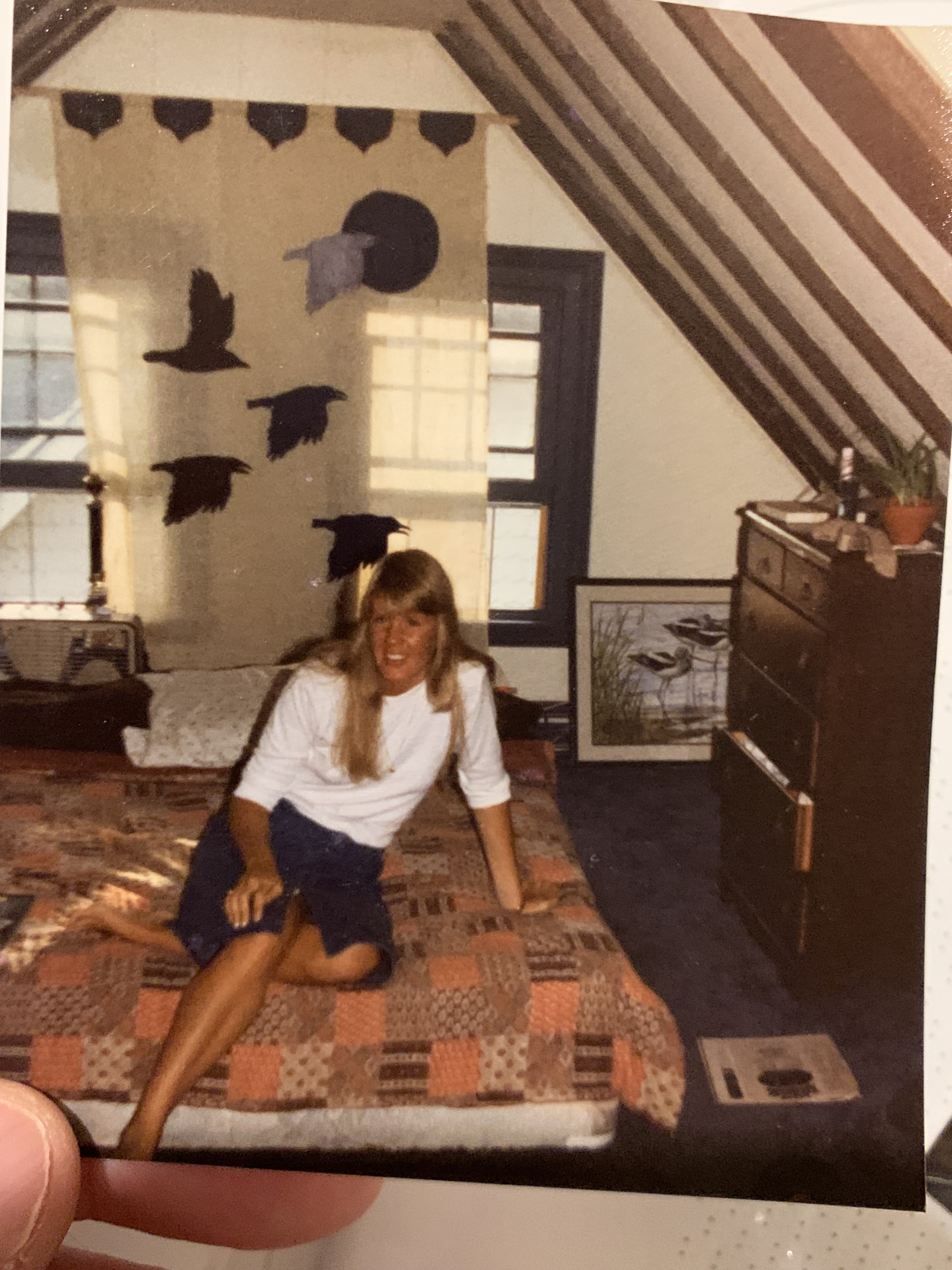
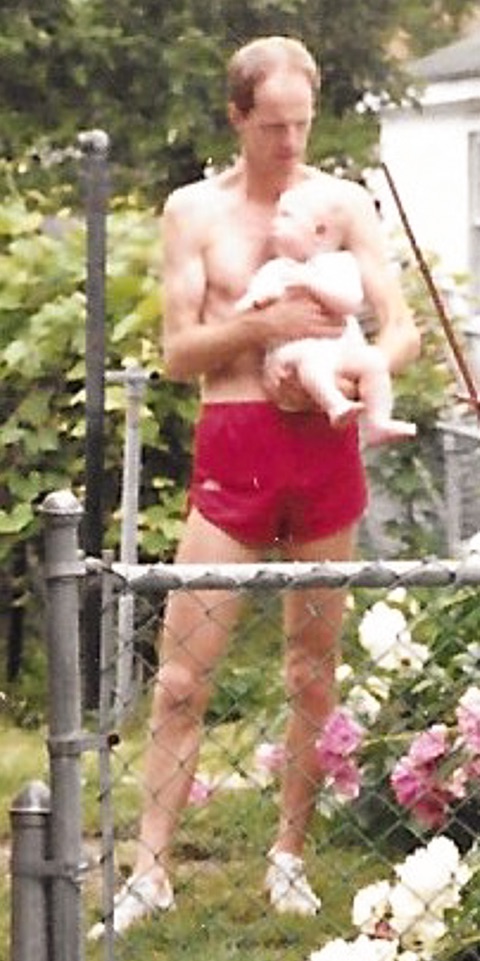
Peter Crooke (at left) was one of the premier runners with whom I trained during nine months in Paoli, Pennsylvania.
Back when I lived in Paoli, Pennsylvania (182-83) during a short stint with the marketing department at Van Kampen Merritt in Philadelphia, I joined a great group of runners through the Runner’s Edge running store. Most of those guys, the Crooke brothers Rich, Peter and John, and Dick Hayden, to name a few, were faster runners than me. They also knew how to train smarter, and I benefitted from running and racing with that team in many ways. Plus I’d never worn a green uniform of any kind, and the Nike nylon warmups and racing kit were a keen departure from the orange, black and white I’d worn at both Kaneland and St. Charles high schools, and the Luther College Norseman blue I’d worn during four years of racing in Division III cross country and track.
During some of the long runs with the Runner’s Edge guys, I hung near the back of the group so that I wouldn’t make the wrong impression of trying to push the pace. That’s because I’d made a fool of myself the first day I ran with them by taking off at 6:00 pace like we used to do at Luther. After building a “big lead” I glanced back in surprise to see that no one followed me. Circling back, I met up with the group again while asking, “What’s wrong?”
“Nothing,” one of them replied. “What’s wrong with you? We’re running 7:30-8:00 pace for fifteen. Then at 18 miles we’ll pick it up, okay?”
Presumptions
In the fall of 1983 after training with the Paoli group I won the Frank Lloyd Wright Run with 3000 runners.
What a lesson in training and life that was. Sometimes our presumptions about how to do things right are all wrong. Running with that group was great, and yet I still overtrained too often, running too many fast workouts back to back, and humming along at 6:00 pace during midweek runs. I’d get sick or hurt, and have to circle back to a more sane approach. Old habits die hard. Still, during that period I dropped my five-mile time to 25:30, my ten-mile time to 53:30, and my 10K to 31:59, the first time I broke 32:00.
That improvement all came down to that moment I circled back and accepted with humility the guidance of the group to get me on the proper training track.
Life applications
Following that principle years later after the harsh debacle of trying to race ahead in my creative endeavors at Aspen Marketing, I probably got a bit ahead of myself, or worse, too inside my own head to see things clearly, or as they really were at the time. Those are symptoms of both anxiety and ADHD. But I didn’t really understand either of those mental health issues at the time.
When the year 1999 rolled around and I was laid off in a downsizing at Aspen Marketing, I was adrift and out of work with a family to feed, After taking stock on the situation, I circled back (at 42 years old) to my prior career in the newspaper industry. Things were still going strong in the print business up to that point. The Internet was stumbling along still making up its mind which way it wanted to go.
On the political front, the Clinton-Gore term in office was winding down and the Y2K phenomenon was starting to wind up. Some people were panicky. The Doomsday Preppers at the conservative church we attended started warning people to stock up for the coming apocalypse. There was a strong belief among some Christians that the Year 2000 was ripe for the Second Coming. As for that idea, I was cynical about the whole thing. As a guy that once jacked off five times in one day during my horny early 20s, I considered teasing the Second Comers… “What’s the big deal? Only the Second Coming? Even I could beat that!”
I thought better of that, but as it turned out, they were the whack jobs, not me. Y2K came and went without Jesus making a peep. Even the computer glitches predicted by the Code Busters working madly to add slashes and Os to save the world had to admit that things came off pretty smoothly.
Political tectonics
Oh, how I despised these two presumptuous liars. My original instincts about their dishonesty proved correct.
A political cataclysm did come about as a result of the 2000 Presidential election. That’s when the politically dyspeptic George W. Bush (“I was a pilot!) and the terminally heartbroken Dick Cheney (the cardiac kid) conspired with Jeb Bush, the Bush Brother that worked to suppress minority voting in the state.* Then the Florida Supreme Court handed the election to two future war criminals whom far-right militaristic Christians welcomed as a sign that Armageddon could now be initiated in the Middle East.
Bush and Cheney also attacked environmental regulations, and I recalled too well how the likes of that bigoted despot Ronald Reagan behaved by handing James Watt the Secretary of the Interior job. Watt famously stated, “When the last tree falls, Jesus will come.” And I thought, “These fuckers never quit.”
So I decided to attack the misappropriated authority of the Christian religion at its source by penning an essay, “How the Earth Was Forgotten After Creation.” That work addressed the many ways that conservative Christianity gets the Bible wrong about the meaning of “dominion over the earth.” The essay was a hit when I read parts of it in public forums, so I took that foundational document and began writing an entire book that would come to be titled, “The Genesis Fix: How Biblical Literalism Affects Politics, Culture, and the Environment.”
That book would take seven years to complete because work and life and all its vagaries would enter the picture. But the love of writing was as strong as my love of running, so I also focused my work search in that area.
Back in 1994, I’d done a marketing project for the Daily Herald, the third-largest newspaper in Illinois behind the Chicago Tribune and Chicago Sun-Times, the two urban powerhouses. The DH was branded the Death Star by other suburban local newspapers because it had expanded to reach more than ninety communities across the Chicago suburbs. So I started tracking the paper to look for job opportunities, and decided to open the gates myself by volunteering to write a complimentary column for the Tri-Cities edition.
During the summer of 2000, while I was producing columns, the staff needed an extra volunteer to help paddle their entry in the Dragon Boat races during the Pride of the Fox River Fest, a big community festival in St. Charles. I wound up sitting next to one of the HR directors and struck up a conversation. She made note of my interest in joining the company and within a couple weeks received an invitation to apply for the position of Editorial Writer, and I interviewed a week or so later.
I wasn’t a traditional choice for the role because I didn’t come up through the ranks of journalists as most editorial and opinion writers do. Yet I’d published hundreds of articles in newspapers and magazines beginning in the early 1980s, so I got the job. Part of that was due to the advocacy of the Advertising Department leader Bob Strasser, who knew me from my days in ad sales and promotions for the Chronicle, a Daily Herald competitor.
So I was back in the newspaper game again and loved it. Circling back was a smart thing to do in many ways.
Karma: The sum of a person’s actions in this and previous states of existence, viewed as deciding their fate in future
Screen capture of the Maurice Sendak artwork I coordinated for use by a corporate client.
As my relative successes at Aspen Marketing piled up in 1997 and ’98, I allowed a bit of self-confidence to creep into the mix. Big mistake. Too often it is hubris that blinds a person to events taking place behind the scenes that add up to ill outcomes. Often our perceptions of what is required in life are often mistaken. In fact, you can do a really good job under absolutely shitty conditions and people will still tell you that it was you that did a shitty job.
That’s because people hate sticking their necks out for others if it means putting their own security, whatever way they perceive it, at some kind of risk. They’ll even compliment you to give you a sense of security if it helps them keep you under their control.
Compliments versus complements
Let’s talk about the meaning of compliments, or shall we say complements. I used the latter term “complements” in a bit of marketing copy that led to a prophetic incident. The man we called Mr. Big brought his wife Mary to work at the firm in some sort of quality control role. The real intention was never clear, it could have been in response to costly mistakes that were taking place because, as those of us in the creative department put it, “Always time to do it fast, never time to do it right.”
From what I can see from thirty years in the business, that’s how it always works. False urgency leads to crap results. All because agencies typically don’t respect their clients, even mocking them behind their backs yet still too scared to stand up for themselves for fear of losing the business.
So Mary the schoolteacher entered the fray. Her training and manner did not sit well with some people, because no one really likes a scold. Quite often it was the wrong people being blamed for the firm’s mistakes, which were derived from bad or partial information delivered by the client or the account rep. One day I spent time writing a clean set of copy only to receive it back with rewriting stating, “The word complements is incorrect. Only compliments is a word.”
My vocabulary is pretty decent, and I knew that the word complements was real. It means “a thing that completes or brings to perfection.” That’s how I’d used it in the content. I brought the copy back to her and explained the meaning. She was adamant and made me change it. It was clear she did not like being second-guessed.
Living under a bad sign
I seethed, yet quietly. Even I understood that it made no sense to make a scene with the boss’s wife, no matter what role she played. So I kept my mouth shut, and kept my head down with her. Yet something told me that from then on, my mild resistance meant living under a bad sign.
Plus bigger plans were afoot of which I was unaware. The company was being positioned for sale to a larger firm and numbers were being run to make the firm look good for sale. That meant cutting total costs by reducing payroll to show a better number against revenue. The old Cost Vs. Return Analysis.
Perhaps it was just the numbers that did me in as a middle manager type, seemingly a dispensable associate creative director at a firm that already held its creative staff in low regard. Never mind that I’d been the lead creative on an Ameritech account that grew by around 30% in a year. The thinking on middle managers typically goes, “There’s another one where he came from once we need them again.”
And thus, after two tumultuous years of loving the work but dreading the sometimes conflicted culture of the firm, I sensed my time might be up. I’d seen movies where the mob boss sends a warning signal to a “middle man” that was no longer needed or favored. One small mistake can cost a life. Then one day after a project meeting, Mary the Quality Keeper reached up and gave me a condescending pat on the face, as if to say goodbye after the conversation. I sat down that day in my office and shivered with dread. I tried talking with my two bosses, the VP of Business Development and the VP of Creative. The conversations were clipped and cold.
A week later, I came into my office and noticed that all the Zip disks on which I stored files for internal transfer were missing from my desk. I walked out of my office and looked at Andy, the production department head, and he looked away. Minutes later I received a call from Mr. Big summoning me to his office. I walked through the perimeter of the office sensing what was to come, stepped into his office heard the door unlatch from a remote click as it shut behind me. He had a button under his desk that allowed him to remotely open and close the door. A Power Move. That was his style, just like he once told me “I can beat you at any sport that involves a ball.” Who says shit like that?
But that day, he put both hands on his desk and said, “I suppose you know why you’re here.”
Where the Wild Things Are
I understood that I was being dismissed, but the reason why was never made clear. There were undoubtedly some challenges with projects that I’d been assigned. That’s how it is in the marketing business. I was the lead project manager on a collaboration with the Ameritech people, a big fundraiser to be held by the President of the company, Dick Notebaert, whose wife Peggy was big into the nature scene. A few years later she’d have a museum named after her in Chicago. My role was leading negotiations with the agency representing the work of Maurice Sendak, the famous children’s book illustrator and author of the book Where the Wild Things Are. His drawings were going to be used as the theme and backdrop for the fundraiser. It was my job to make sure things were done right.
I entered into discussions with the agency to work out details on how the images could be used. It took several weeks to determine proper usage and approve the rights. I checked those details with the Ameritech people and at one point was told, “You don’t need to let them know everything. Just get it done.”
That’s the problem with negotiations of that sort. The Sendak people were enormously focused on protecting his work and not allowing it to be compromised or used in inappropriate ways. Meanwhile, the Ameritech people had this big-picture thing going and didn’t want to slow down for anything.
I was stuck in between. As it worked out, the event came off wonderfully, but I’d made a negative impression on the Ameritech contact, and she was in charge of a ton of business for CMI…soon to be Aspen. I’m fairly sure there were discussions about my management ability even though, from the perspective of the third-party “client,” the Sendak people, I’d done a thoroughly great job.
But a few negative words from the top ranking Ameritech contact were all it took to unseat me from the lead creative work with that client.
After that, my star fell a bit. If you’ve ever worked at an ad or marketing agency of any kind, you likely know the feeling. Suddenly I was not working so much on Ameritech projects. My immediate boss who had been out of the office for several months with some physical illness, and right about the time that the Sendak project ended, he returned to work. At that point, most of the copywriting work on the account was redirected to him. He ignored the fact that I had done the heavy lifting for months on copywriting. Perhaps he was insecure about his job, and simply saw it as a competitive thing.
Once again, I was learning that it’s not just performance that counts in the working world. Unlike distance running, where results are largely empirical and the fastest runner is clear to see, the corporate world is a contest over power and control. As a person with native anxiety, my awareness of these situations was never the best. I either imagined the worst and lived in fear or lived in ignorance blindly hoping for the best.
The Frightful Thing
Screen caps of Sendak work. If you want to see more, buy the book. I did long ago.
Worst of all, I trusted people to be true to that word. That’s probably the biggest mistake one can make in this world. The frightful thing about trusting people is that there are almost no rules to the game.
Adding to this confusing mix was the fact that the principal Vice President in charge of business development was a guy whose tactics for building relationships weren’t entirely ethical. He frequently bribed clients with gifts to build our business. As it happened, I was the guy assigned to lining up and purchasing those gifts, including a $4000 road bike for a client lead at Ameritech. I still recall his name but I won’t mention it here. Again, the frightful thing about telling the truth is that you can often be penalized or sued for sharing the facts, and people will often gaslight the hell out of anyone daring to question their integrity even if they have none.
Changing times
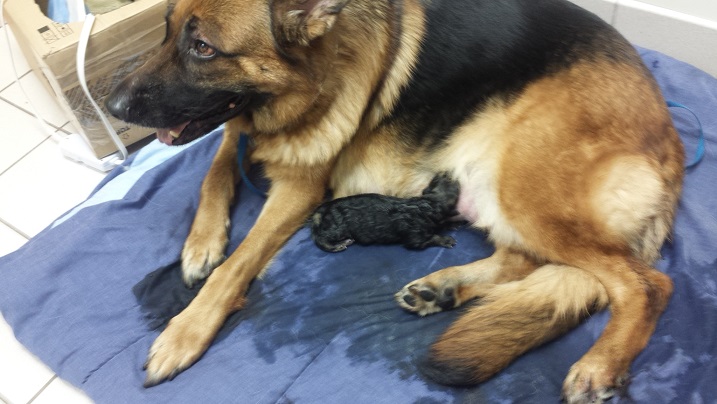
But it wasn’t long after I left the firm that I heard Ameritech (now SBC, then AT&T) had done an internal review of some sort and banned the receipt of gifts from vendors of many kinds. There were other strange adventures with Ameritech personnel, including the account manager that insisted we deliver advertising proofs to her personal residence one afternoon. I traveled with an account executive named Erin to bring the material to the house, and we walked in to find the entire floor covered with the afterbirth of a German shepherd that had just delivered puppies. No padding or anything on the wood floors. Just liquid and blood clots. Erin hiked up the legs of her pantsuit and we walked across the slick floor. As we left, she turned to me and said, “We’re never doing this again.”
Over the years, I tried a couple times to get back into Aspen Marketing, which was purchased by Epsilon and later Publicis. Just recently I did a copywriting assignment for the MSL Group, also a Publicis company. But to this day I don’t know if I was dismissed for strictly financial reasons, which is harsh in its own respects, or for some aspect of performance about which I was never informed.
Karma is a bitch
I do know this, however. Eventually, Mr. Big got hungry for even more money, and hired a CMO with AT&T experience who basically took over running the company. They also fell into a romantic relationship, and that meant bye-bye to Former Mr. Big. The woman that insisted that “complements” was not a word got shown the door back home. I always wondered if he patted her on the face as the divorce took place, or if she patted him on the face for taking all the money she could out of his pockets in payments and alimony.
I recall a high-toned company Christmas Party out at Eagle Ridge Resort. Before the night was over, almost a dozen couples had devolved into fights, with some breaking up on the spot and others physical confronting each other in the stairwells and hallways. Surely there was alcohol involved in those conflagrations, but it was also probable that the conflicted nature of the company as a whole had an impact. I considered all that a trickle-down effect from the mixed-up personalities at the top. From what I’ve seen, if you dig even a little deeper at most companies, the truth behind how they are run is genuinely fucked up.
Those breakups and remarriages and selfish acts that turn sour are all evidence that condescension often leads to the type of karma one doesn’t really want to experience. Like the runner showboating by waving to the crowd on the homestretch of the track only to get passed by on the inside by another athlete, karma does have a way of delivering payback.
As noted in an earlier story in this series, one of the vendors at Aspen once stood toe-to-toe with Mr. Big and said “Fuck You!” to his face. I guess this is my long-delayed “Fuck you!” to the same guy. For all the corruption and sexual harassment, illegal dealings, and broken promises experienced at that firm, some people might tell me that I was lucky to leave. But the fact remains, I loved doing the work and appreciated many of the people working there. That project where we used company staff as models was evidence of how well some of us worked together. I made it work under budget and on time, which was far better than many projects at the company.
I regretted losing the job for those reasons. It hurt and the severance felt like just another slap in the face, along with the Letter of Recommendation Pat O’Rahilly wrote for me. The whole damned thing was absurd. I was bitter, for sure. Yet I eventually headed in a direction that proved beneficial in the long run. That’s all I knew how to do.
Despite the atmosphere of sexual harassment and general crudity, I genuinely liked my time at what was to become Aspen Marketing, Inc. because I liked the work. There were daily opportunities to take on new creative assignments. Some of them were large in scope while others were the kinds of smaller projects agencies take on while they’re still in a growth phase.
One of these flopped on my desk one afternoon with a note from the President, Pat O’Rahilly. “There’s a new hockey team coming to Geneva and they need a logo.” Pat loved hockey, and the Junior A league team was to be called the Chicago Freeze. I was not an expert in the hockey world, but I read up on who their likely fan base was going to be, and it consisted of families and up-and-coming players. So I designed a logo that was essentially a play on the word FREEZE by drawing a Blue Sun with skates and a hockey stick.
The Chicago Freeze logo with its companion “banner” designed by another creative. The stitching for the hockey sweater is evident on the larger image.
The logo was accepted and soon built into all kinds of materials, including a 50-foot painted version under Center Ice. Of all the things I’ve designed, that logo probably got more impressions than any other. It was on everything.
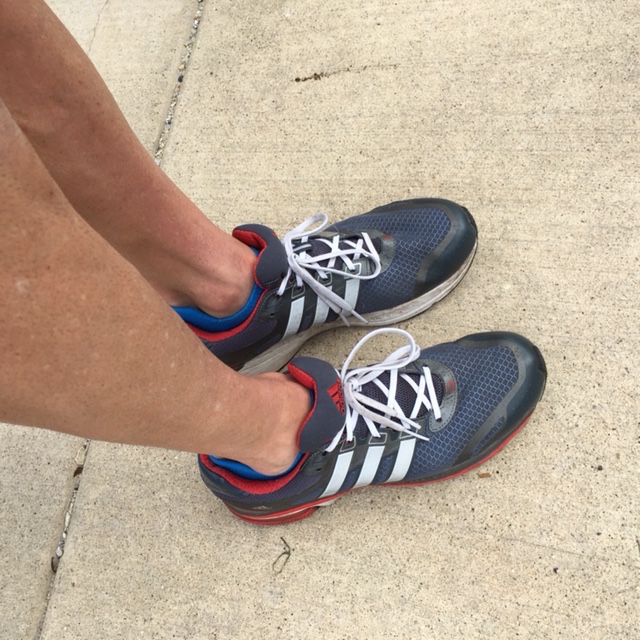
So I was in generally good favor at the time when I was asked to join the President on a presentation on the work I’d done on an Ameritech project. Those were arriving thick and fast at the time, and we’d drive up to Schaumburg from West Chicago in the limousine driven by Pat’s favorite chauffeur. I was waiting in the back seat when Pat plopped down, turned to me and said, “What’s the best running shoe?”
Frankly, he didn’t much like making conversation with underlings, and that’s where I sat on his totem pole. Yet he’d also grown to understand that I was a decent athlete, especially a runner, so I began explaining the attributes of various kinds of running shoes, when he interrupted me and said, “No, I mean, what’s the most expensive?”
I sat there for a moment, then realized his actual question had nothing to do with what shoes might work best for running. That offended me to some degree, because he didn’t really care about my relative expertise. Instead, he viewed so much in life as a hunt for trophies, and I represented a shortcut to the knowledge he wanted about expensive running shoes. His pursuit of status symbols included his ultimate desire to have a company jet, which I believe he ultimately achieved as his company and wealth grew enormously with each successive sale or consolidation with larger firms. No one knew how to rake in the dough like Pat O’Rahilly. I admired that about him even though his values and perspectives were entirely different than mine.
He could be a hard driver in many ways, and people that crossed him either got dressed down or weren’t around any longer to vex him. I was always careful how I phrased things, and made it a habit of sorts to compliment him on work projects or perspectives. But I don’t think he ever took my insights all that seriously. I wasn’t one of the Rainmakers yet, a guy that really drove the Big Bucks.
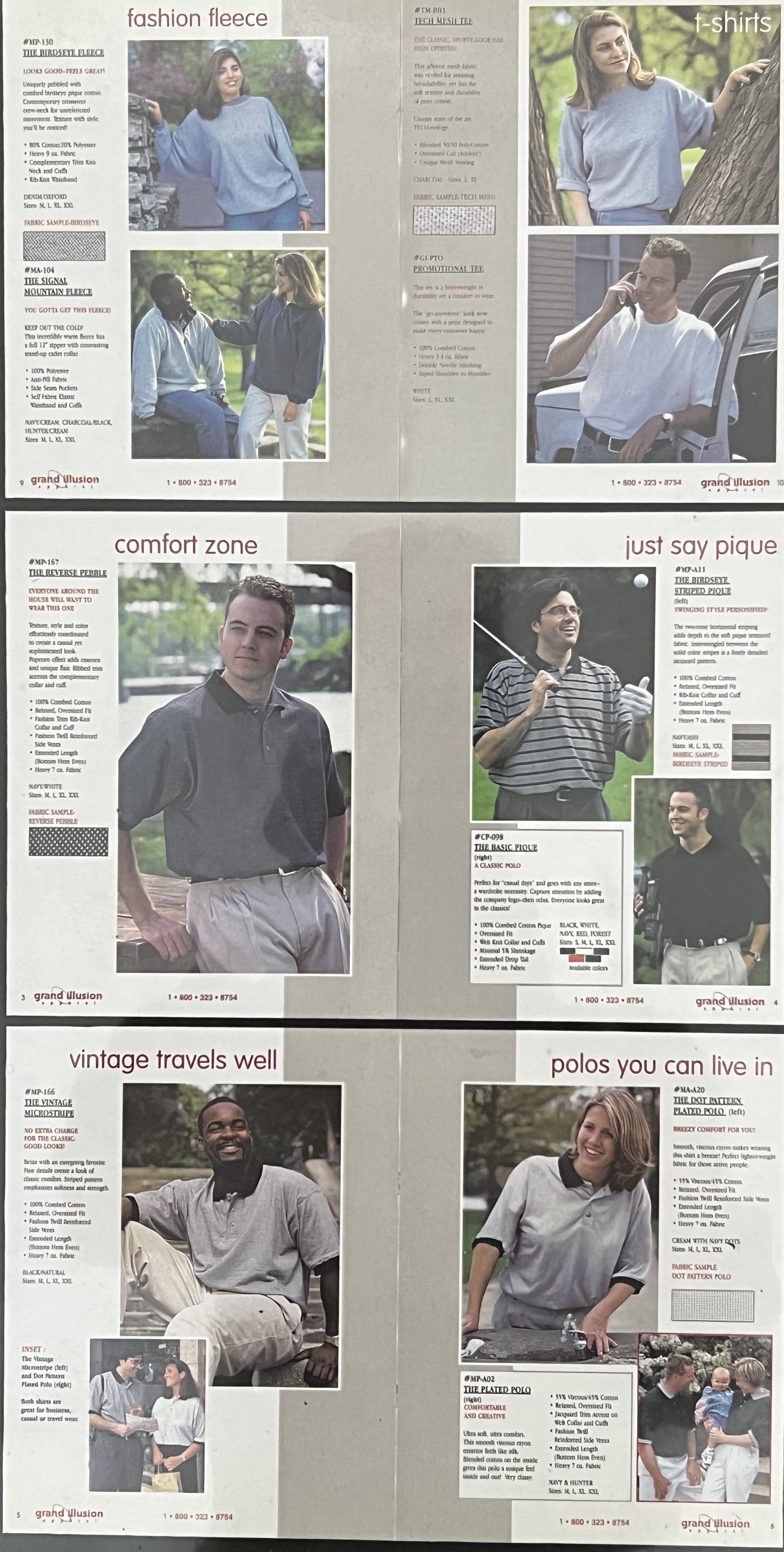
In fact, I was more often the guy that the firm turned to drive or mop up peripheral projects. That was the case with a low-budget project for a fashion and sportswear company called Grand Illusion. They only had a working budget of $5K or so to conduct a photo shoot, so I recruited members of the Aspen staff and some friends from outside the firm to serve as models. Then I hired a local photographer I knew from newspapers days, and we set out to do location shoots with samples of the clothing. It was interesting work piecing together the plan for the right people to wear the clothing. That was one of my few real immersions in what basically became a fashion shoot.
Both the guys and the gals from Aspen turned out to be great models. There were good-looking people throughout the firm, and I drew from that base to create the shots we needed. But when the first round of photos came back, the client had a complaint. “The boobs on too many these women are too big! Can’t you find some models that aren’t stacked?”
That was a bit of a problem, especially because our point of contact with the firm was an attractive woman with her own set of prodigious breasts that seemed to stand straight out from her chest. And wouldn’t you know it, she wanted to be in at least one of the photos. So we did our best to diversify the breast sizes of our models and in the end, I designed the brochure in Quark XPress software and it turned out great. I was eager to see what the higher-ups at Aspen thought of the work we’d done while keeping the budget in line, but the response was bland at best. “That deal isn’t making us much money,” was the main reaction.
There was not much to do but move on at that point. No amount of bragging about how good the brochure looked was going to change the impression of the project as a near-losing proposition.
On the other hand, I was tagged to be the prime developer of a massive project for Ameritech that would involve creating sales materials for thousands of call center employees across the Midwest. There were dozens of products, mostly landline phone options at that time, as cellular was just starting to take off for the company, and the call center employees needed to have educational material near-at-hand. So I designed a format for all the pages, pulled in all the technical information and created a “library” of products that would be ringed onto plastic mounts above their desks.
The job to create the plastic mounts was jobbed out to a local provider, a fabrication whose owner Don was an interesting character. He always looked a bit disheveled, and his assembly plant was located in a small warehouse off a state highway between cities. On the morning that we were supposed to stop by the plant to pick up thousands of the plastic mounts, it was still dark at 4:30 a.m. when we arrived. Our scheduled called for us to drive north from Chicago to Appleton, install as many of the mounts as we could throughout the call center to show how it’s done, and likely return that night.
But when we arrived at the plant, I could immediately see by the look in Don’s eyes that something was amiss. Plus, there were only a dozen or so boxes of plastic mounts sitting on the floor. It was clear that they’d fallen behind schedule somehow. Pat O’Rahilly walked up to the owner and said, “You told us there would be three thousand ready for pickup. How many do you have?”
“A thousand…” Don replied. “These take a long time to make. You didn’t give us enough time!”
He was likely right about that. Our company was always doing things last-minute. The phrase around the firm was “Always the time to do things fast. Never the time to do things right.”
Yet here we were ready to drive to Wisconsin with only a third of the mounts we were scheduled to pick up. Pat was furious. “What the fuck’s wrong with you?” he demanded.
At which point Don leaned in and put his nose right in front of Pat’s face and hollered, “Fuccccckkkk…Youuuuuuu….”
I was shocked, for sure. I’d never really seen anyone respond to someone like that in business. But after we walked out of the room, Pat turned to me and said, “You know, you kind of have to respect someone that sucks Fuck You to your face.”
And so it was that we grabbed what we could to drive to Wisconsin and get the job going. While there, one of the key account executives and managers for Ameritech walked up to me and said, “What’s the creative guy doing up here installing plastic mounts? Don’t you have people to do this for you?”
I was quick to reply. “Quality control. We want to make sure it’s done right.”
That’s right, I toed the company line for sure. In fact, I’ve always been something of a loyalist even if I’m not the happiest with the circumstances faced at work. I’d learned the hard way at the Chronicle job that a single bad word can cost you big time if it gets back to management. That’s true even if you’re not the one that originally said anything at all. Most managers (and I said that generally, yet honestly) do not like to be questioned or hear anything negative about the company even if they’re the ones that habitually complain or badmouth the place their own way.
So I sucked it up and the installations went went across multiple Call Centers across the Midwest. The fabricator got caught up in his work and my design work was greeted with appreciation by the client.
The Claustrophic Mascot
Then another Ameritech project for the Call Centers came my way. “We need to design a mascot for one of their CPE division,” our VP Vince Marinelli told me. So I got to work using Adobe Illustrator do designed the life-sized costume and sent it off to a production facility. The day it came back from the manufacturer, Vince pulled me out of my office and said, “Here, you can be the first to try it one.”
There wasn’t an instruction sheet, so we laid the costume down on the floor and I crawled inside. I was expecting a breathing portal somewhere near the face, but as I rolled over on the floor all that hit my cheeks was a layer of plastic. I started panicking. Claustrophobia hit me hard. I started gesturing to get out because I couldn’t breath. At first people thought I was joking. Then two of our women account executives shrieked, “He can’t breathe!”
Someone grabbed the suit near the knees and lifted it up so I could crawl out. My mind was racing and I tunneled my way back down through the suit and emerged flushed and a bit angry. Vince couldn’t help laughing at that point, and helping me to my feet he said, “I bet if you’d had a knife, you’d have cut your way out huh? Then we’d be out $5,000…”
Indeed, that was a great expense. But the laughter I heard during my sojourn inside was a great expense to me. Because as it turned out, there was a fan attachment for the back of the suit that someone had left on the dock. Once that was attached, the suit filled up with air and the next person into the suit walked around the office like a hero. I admittedly sulked and felt stupid for not being more careful. At that moment, the lyrics from the song Hotel California by the Eagles came to mind, “You can check out any time you like, but you can never leave…”
A week later, still stinging from my panicked reaction inside the suit, I wanted to prove that I was still game enough to take chances. Vince asked if I still wanted to participate in the CPE product launch at the Ameritech office. This time, he told me, I didn’t have to wear the CPE suit. “But I do need you to wear a woman’s dress…and act a part” he told me. I tried it on in the restroom. But fortunately, my shoulders were too damned wide to fit into the thing.
By then, I’d had enough exasperation and embarrassment to last me forever. I was trying to prove myself a valuable part of the team, but when stuff like that happens, it undermines the self-confidence. It’s hard not to feel a fool in the workplace sometimes. That’s one of the tarsnakes of life, I guess.
At the age of 39, I was trying to figure out if I was too old for certain occupations, or possibly cursed in some way.
Coming off a year of running my own business and a debacle job in which Paladin Interim Staffing hired me to open a suburban Chicago office but never followed through on their promises, I floated into the spring season looking for work and a more stable situation. One of the things I’ve always done when processing loss in life is going for long runs and trying to think it all through.
That is the salve that keeps me going during tough times. It was hard to reconcile my feelings of defeat as if I’d done nothing wrong, yet here I was out of work at 39 years old with a family to support. So I ran some miles, then focused my daily efforts on applying for jobs. That is always exhausting work, no matter how old you are.
The year was 1996. My son was in fourth grade and my daughter was in first. They shared a small bedroom in our 750-square-foot brick bungalow in Geneva. It was starting to get awkward for the two of them, and cramped in terms of space. So the pressure to move our family forward was getting greater as well.
It is depressing to send out resumes, write cover letters, go through interviews, and not land a job. Yet the discipline I’d learned from running helped me keep my head together. One day I called my former track and cross country coach Trent Richards to network and he told me, “Well, they’re hiring an associate creative director here at CMI. Do you want me to tell them about you?”
I almost jumped through the phone to tell him “Yes!” The next day I interviewed and was offered the job at $50,000 a year. I took it willingly. It was an exciting way to start the new year.
But the day that I started, the company President Pat O’Rahilly informed me that I’d be earning less than they’d originally promised. For what reason, I never had the courage to ask. I needed work, and they likely knew it. Why not cheap the guy down? Perhaps it was just some sort of power play. But by then, I’d already moved into the office in which I’d be working, met the creative staff and one of my bosses, Ken Konecnik. I was so damned excited to be working I figured it was best to suck it up and keep on moving.
I also met a guy that I’d call a friend for many years. Monte Wehrkamp was a creative director whose office was crammed with Car Guy stuff because he was a wizard of automotive direct mail copywriting, cranking out direct response mailers week after week for Cadillac, Chevy, Ford, Volvo, Chrysler and whoever else the sales team brought to the door. He seemed possessed of the right kind of snark to survive well in the agency world. I vowed to learn from him.
The sales team with whom we worked closely was composed mostly of former car salesmen that Pat brought with him when he sold off a number of the car dealerships he owned and started a marketing agency to leverage his car-selling expertise. It was a successful formula from the get-go. O’Rahilly barely earned an Associate Degree from the College of DuPage, yet he possessed a genius for the hard sell that drove the entire company. In his own inimitable fashion, he was a self-made man.
The car guys that served him were just what you might expect from expatriated used and new car salesman. They loved crude jokes and told rude (but true) stories. That included throwing customers’ car keys on the dealership roof to put pressure on themselves to sell them a new car. Sometimes they’d play a betting game to see which sales guy could get a customer to climb into the back end of a car “to show them the trunk space.” And so on.
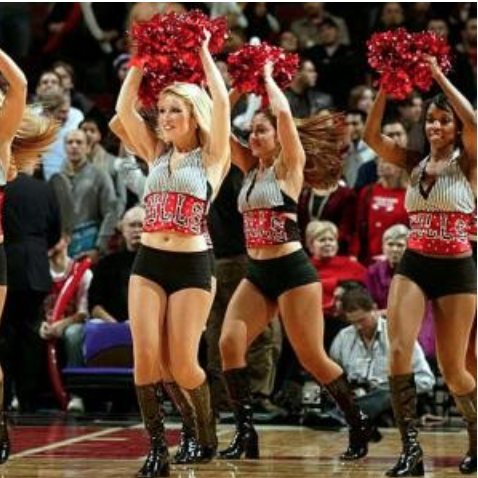
Some of those guys were strikingly handsome and possessed a brand of self-confidence many people wish they had. One dated a gorgeous woman who worked at the firm in the administration department. She worked nights as a Luvabull dancer for the Chicago Bulls and wasn’t afraid to flaunt her legs in short skirts worn around the office. I happened to follow the two of them up the stairs one afternoon and nearly fell backward at the sight of her thong and ass cheeks peeking out from beneath her dress. The image seared into my brain so quickly I could see it even after I looked away. Was I any better than the rest of the hogs in that place? I didn’t really know in that moment.
Sexual harassment and more
There were beautiful women working in every corner of the office, but while their looks were favored, and it clearly helped them get a job with the firm, it wasn’t an easy situation for any of them. Sexual harassment was rampant due to a general atmosphere of office misogyny. There were rumors of legal settlements on behalf of several women working at the firm.
One day while sitting in the front seat with a work group on the way back from lunch, I listened to a young woman we’ll call Monica describing how her boss was treating her. She was a young, impressionably sweet Polish girl that had grown up on the west side of Chicago. She wasn’t entirely naive to the world, but she was certainly not accustomed to what her boss was saying to her on a daily basis. “He asks me what I’m wearing under my clothes,” she related. “And what I’m doing with my boyfriend in bed.”
We were almost back to the office, so I asked the driver to pull the car over to the side of the road. Turning around to face the back seat, I told her, “Monica, you don’t have to put up with that. It’s sexual harassment.”
She sat there looking scared, so I continued. “I have a close friend that specializes in labor law. Let me give him a call and we’ll see if you have a case here.” That evening, I reached my friend who referred me to a female attorney that specialized in harassment cases. I never learned the exact details of the settlement she received, but it was rumored to be in the range of $50,000. She left the firm soon after that exchange.
Then the company hired a new “secretary” for the man that had been harassing Monica. The new woman was tall, strong, and had a domineering personality. There was no more harassment after that.
Wealth and warped ideals
That same guy, who was quite married by the way, once told me that he was afraid to have children because, in his own words, “I don’t make enough money.” I knew from internal sources that he in fact earned a base salary and commissions totaling $250,000 per year. And there I was earning under $50K as a father of two children. His words might have made me reconsider my life choices if the guy wasn’t such an obvious asshole to begin with.
There were other problems within the organization as well. One of the top salesmen was a devoted racist and gun nut who once loudly proclaimed to the Creative Department that he was well-prepared with an arsenal of weapons in his home if ever “the n******s come to get me.”
He was the same guy that erupted in anger when one of our creative staff placed an image of a Black player on a March automotive mailer with a basketball theme. “Everyone of my customers knows that I’d never put a n***** on one of my mailers,” he announced.
We were all disgusted by such behavior, but there wasn’t much any of us could do about it. Even the President, who branded himself Mr. Big, was known to call the creative department the Design Fairies. Layers of false bravado, ugly machismo, and toxic masculinity were everywhere. A woman could not wear an outfit that showed traces of whatever she wore underneath without drawing some under-the-breath comments about her appearance. I worked directly with two classy female account managers that certainly heard that type of commentary, yet knew how to dispense with those making the comments in a most emphatic way.
And childish behavior
The behavior around the agency sank to an ultimate low when guys started faking crotch grabs on each other while walking the halls. That 7th-grade-level behavior was considered “funny” at the time. Forms of immaturity existed at every level of the organization. The President himself once challenged me by saying, “I can beat you at any sport that involves a ball.” That type of comment was not uncommon at all, especially because we were half-required to participate in agency-client basketball games on the President’s backyard court. I was a good player that could nearly dunk even into my late 30s. By contrast, the ball-hog style of O’Rahilly was mostly pass-and-grunt stuff that made him feel like more than a big deal than he ever was.
Despite all the distractions, I concentrated hard on the work at hand and got involved in top-tier projects with Ameritech, one of our biggest non-automotive clients that would become SBC before evolving back into AT&T.
The shirts from the Too Big To Resist campaign are still apparently available on Etsy. Or were at one point.
One of those “big” projects was a muffed assignment by the Agency of Record, Ammirati/Purus/Linus. Our little direct response firm was given a crack at doing a national campaign for a new Ameritech product involving a complimentary CallerID offer. With only a couple days to craft the campaign, I came up with Two Big To Resist and the client loved it. When it went back to APL for production, they dumbed down the slogan to Too Big To Resist, which made no sense, but they did use the art idea I created with a tag to promote the offer. By then we’d been paid for our work, so Mr. Big was happy with the outcome. I’d made it happen on short order despite the inane over-processed interference of another Chris that had joined the organization and wanted to spend two whole days putting Post-It Notes on the wall to come up with the campaign. I hated the Post-It Notes technique because it wastes a shitload of time and seldom generates good work. So I retreated to my office, came up with the campaign, and brought it to Mr. Big. That’s what we used.
During that first year, I’d earned a reputation as a thinker within the organization. But it was a serendipitous encounter that earned me a new nickname. One day a salesman walked into the Creative Department and asked aloud, “How do you spell pterodactyl?” I immediately spelled it out for him as he wrote it down. Then he glanced up at me with an odd look on his face and asked, “What are you? Some kind of Professor?” That nickname stuck. From then on, I was The Professor.
So I was feeling confident overall and decided to press Mr. Big for a raise, telling him, “I’ve stepped up. I want a $10K raise.” He said, “You’re right,” and my salary was increased. Of course, that only raised my earnings to what was originally offered when I took the job. But I considered it a win anyway.
Meanwhile, one of my immediate bosses was the VP of Sales, Vince Marinelli. He was celebrating my contributions, giving me key assignments, and even told me, “You’re like #3 behind Mr. Big and Me.” My sorry admission is that I’d actually started to believe him. Some lessons can only be learned the hard way. The second year of my employment at CMI would prove to be filled with both success and harsh realizations.
In 1995 I was thirty-eight years old with a wife and two kids, and suddenly, out of work. The ENVIRONS business I’d cobbled together with a spate of contracts fizzled out with the failure of the development company to land a hospital partner and build the healthcare facility that was to become the main focus of my efforts and income. Then the Chronicle hired an internal resource to take over the business I was managing for the company, and $60,000 in income flew away in a matter of weeks.
I made ovations to the Daily Herald as their marketing collateral project turned out well, but they weren’t quite ready to hire me. That would come along five years down the road, but I had no idea it would take that long to latch on with a growing newspaper like that.
Instead, I was left looking for a job, and pronto. The Internet and email job hunting were starting to fire up in earnest, but it would also be a few more years before job postings migrated from print to digital. So I pored through the Chicago Tribune and local papers to find jobs suitable to my marketing, promotions, and creative services background and started applying.
Building a resume is not the most fun thing in the world to do. But I got some response even though I’d been working for myself for a year. That was met with some suspicion, but I tried to present it as a sign of initiative, rather than a break in actual employment.
Late in the year, I landed interviews with two companies. The first interview was with Wilton Industries, a kitchenware company based in the southwest suburbs. They needed a creative director. The salary was excellent, nearly $80,000, more than I’d ever made in a single year. The only drawback was the daily commute of thirty-five miles from our home in Geneva. In most morning traffic conditions that would mean an hour’s drive in the car. I’d rented a new Dodge Neon during my year in self-employment, an act that drew derision from one of the partners in the real estate company. “You just started a company and you’re renting a new car?” he cynically inquired.
I had no choice, actually. The Ford Fairlane I’d been given by my wife’s family had died from a broken seal in the engine block. The thing leaked oil so fast that it had to be filled every other day. The Neon was a gas-efficient car that would require no maintenance or upkeep. I still think I made the right decision. The payment was just $206 per month. As long as I didn’t exceed 20,000 miles per year, that car was a wise decision.
The other job opportunity was with Paladin, an interim staffing firm based in Chicago. They were seeking a salesperson to oversee expansion into the Chicago suburbs. The plan was to connect their computer system to a remote office from which I could work. The salary base was $60,000 and the commissions were healthy and structured around a collaborative program in which everyone in the firm had a stake in helping the other. If the company hit the sales goals the commission rates were 36%, 18%, and 12% based on revenue numbers.
Short-term commute
They told me that I’d need to commute to their office in the Hancock building on Michigan Avenue for two weeks for training. Then I’d be set up to work from the burbs in their new office. The arrangement appealed to my entrepreneurial spirit. It also sounded like I could make equally good money. I liked the idea of helping other creatives (like me) find work. I turned down the Wilton offer and signed up with Paladin.
New foundations
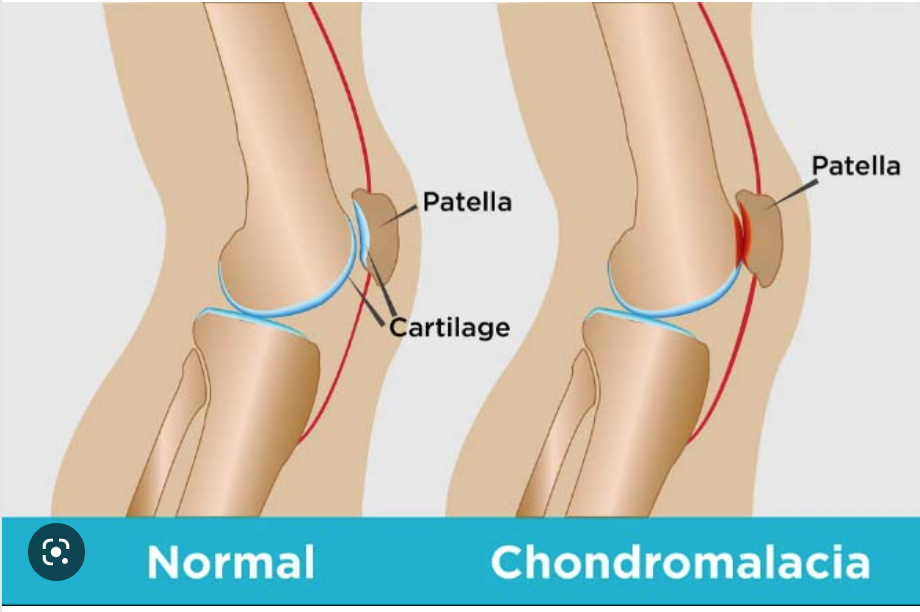
During 1994 my running volume went up and down due to a new type of injury. My left knee developed a condition called chondromalacia. That means the cartilage under the kneecap wears down, especially along a ridge at the center of the patella. It causes a burning sensation, and at some point, running at all becomes painful and ultimately impossible. Thus I visited a running podiatrist friend named Dr. John Durkin, whose reputation for treating runners included the likes of the British world-record holder Sebastian Coe, American Olympic distance runner Jim Spivey and World Cross Country Champion Craig Virgin. I’d illustrated his book on running biomechanics and learned quite a bit about the value of orthotics, so he fit me for my first set. Within a week, the knee problem went away.
That’s because my left foot in particular was pronating a bit, pulling the angle of my knee inward. The resulting torque on the knee joint and a set of weak quadricep muscles was allowing the patella to be pulled ‘off-line.’ The orthotics stabilized the situation. Some physicians prefer a different approach, such as using physical therapy to build up weaker muscles. In some cases, that works. In my case, I was relieved to be able to run again and have worn some kind of orthotic device in my shoes ever since. About ten years ago, I had a set built by a pedorthist, but those orthotics were extremely bulky and stiff and I grew to hate them. Running fast in them felt like you were fighting the shoes on your feet.
Then I visited a local running shop that had a scanning machine to fit runners for Aetrex inserts, a flexible solution. They worked instantly, and I’ve never gone back to bulky orthotics.
But that first pair proved to be lifesaver. I still loved to run recreationally and jumped in the occasional race if I felt like it. I also wore those orthotics in my dress shoes, and that’s where this aspect of the story about orthotics begins to converge with my work world at the time.
Because Paladin’s promise to allow me to commute to the city of Chicago for just two weeks never came to fruition. The interim staffing company underestimated the difficulty of getting its database to operate remotely. This was 1995, after all. The Internet was still a clunky thing. Thus rather than working from an office in the suburbs, I was forced to commute to the City of Chicago daily in order to do my job.
That broken promise meant getting to the train each morning by 6:30 a.m. in order to get to the Ogilvie Transportation Center by 7:30 a.m. Then there was still a distance of a couple miles to cover in order to get to the Hancock Center at the northern end of the Loop on Michigan Avenue. There was a bus that wound around the city on its way north across the Loop, but sometimes it was too exasperating to sit there with the other commuters waiting to get to work. And as long as I wasn’t getting much running done by leaving at 6:00 in the morning and getting home at 6:30 at night, I decided to walk on many days.
That walk was also a sign of protest on many days. I was angry that I’d been lied to about the remote office. Yet finally, after a couple months, I began going on sales calls out in the suburbs. But any work that I drummed up needed to be entered into the database downtown. That meant another day’s commute to the city. That’s why I was glad to have those orthotics in my shoes.
All told, the sales job presented an odd tension to manage. It was largely new business that I was developing. The sales curve on relationships like that tends to be long. But I pressed on, making phone calls and visits to the best prospects. Still, the pressure to bring in sales grew as time went by.
Meanwhile, another new salesperson was brought on board to work with downtown clients. She was handed to some business to manage. It didn’t take her long to land other business downtown. That made her the “new star” on the staff.
Competitive as I was, glorifying her for a much easier job pissed me off. As a means to motivate me, I was told to go to lunch with a longtime sales guy we’ll just call Roy (name changed), whose sage advice I was supposed to embrace. We sat down to lunch and he began grilling me about my tactics and approach. Yet when I expressed frustration with the promise I’d been given to work in a remote office, he barked, “Well, that’s not going to happen. So you’ll have to find ways to make this work if you want to succeed.”
That reminded me of the time I was riding the train into Philly for my job with Van Kampen when a friend that worked in the Wholesale Investment department turned to me and said, “What are you guys doing in marketing? We’re not getting anything we need! If this keeps up you’ll all be out of a job!”
I was only dating my future wife Linda for six months when the company sent me to Philly. This was my upstairs apartment in Paoli, a suburb.
His prediction came true, and my life was turned inside out. I’d moved all the way to Philadelphia in August of 1982 at the behest of the company when it consolidated the marketing department in that office. By April of 1983, the whole thing imploded thanks to the daft inattention of the VP of Marketing, whose theoretical approach to the job wound up costing most of us our positions. None of that was my fault, but it somehow still felt like it.
So my alarm bells went off when Roy uttered his words of warning. Then he took a phone call during lunch. It turned out his teenaged kid was caught up in some sort of bad behavior. Drugs and such. Then Roy told me they were largely estranged. After listening to him brag about his long record in business and great relationships with the companies he served, it made me question whether his dedication to work had somehow eclipsed his parenting obligations. That’s a common story in this world, and it made me think about my own son back home. Was I doing the right thing trying to make this job work? Was all the hustle and commuting even worth it?
The self-doubt crept in gradually, but I kept up my sales calls and actually made some great headway with a company out in the suburbs. Excited to have landed a big bed of business after the sales call, I called the potential job into the company. Connecting with the office Director, I told her, “This client wants to place seven full-time employees. That should build a solid relationship with them!”
Rather than compliment me on the breakthrough, she drolly announced. “You know that’s not really what we do. We want to place people in temporary jobs. That’s our bread and butter.”
I stammered for a second, and said, “But, there’s more than 4,000 people in our database. We can spare seven, can’t we?”
“Well,” she replied. “We’ll talk about it internally first.”
The next day, I came into the city hoping to enter those jobs, each of which would have generated about $10,000 in placement fees for the company, in the company database. Finally, I had something solid to build upon, and justify my base salary. But the potential commission on the sale at a rate of 36% was what I was really banking on. Instead, they told me the sale was a No Go. “Try to get them to use temporary employees,” I was instructed. “We can’t afford to sell off our good talent.”
I was incensed. I knew for a fact that there were thousands of people languishing in their database eager for work that gladly would have taken a full-time gig. I’d been one of them at some point. I’d originally interviewed with the company to do contract work through them. They were the ones that asked me to apply for the new business development job.
But they lied to me. They were never prepared to fulfill their promises.
In the Loop
That walk from the train to the Hancock got harder every time I did it. At the office, I sat right next to the woman they were glorifying for closing the business they basically handed her. About the only thing that felt like a reward on those city days was walking past the Victoria’s Secret store where giant images of women showing their tits and ass greeted me in passing. Along with that dip into sexual distraction, the company receptionist was a stunner herself. She became known for wearing revealing outfits to the office. She had the chest and figure for it, for sure. Yet women in the firm started to complain that she was dressing too risqué. The company director issued her a warning to dress more “appropriately,” but she adamantly refused. I respected her stalwart desire to dress as she pleased. It sure pleased me, and I used to chuckle a bit on hearing her say, “Welcome to Paladin. How can I help you?” So I was sad when they dismissed her, which I also found ironic, as one of the company’s directors was a gay woman. Is it misogynistic to say that I thought she’d enjoy the view? I get that there were professional standards and decorum to uphold. But she was a fitness model on the side, as I recall. To her, there was no big deal. It was more like, “This is how I look. Deal with it.” More power to her.
Her dismissal stank, but not as bad as the increasing stench from the orthotics I wore in my dress shoes. One day I was sitting in our line of desks when the waft of foot sweat drifted up from my feet. I saw the Glory Girl saleswoman next to me blanch at the smell. I instantly realized it came from my running orthotics. They weren’t washable, so the cumulative odor was strong. I moved away from the table and went to the washroom to extract those stinko inserts and returned to the desk. But in a way, I was happy to stink up the place. “Fuck them,” I thought to myself. “This whole place is starting to stink.”
It became obvious I was not going to last in the job much longer. One afternoon I stepped out to have lunch and walked to the little park by Oak Street Beach. It was a glorious early spring day. I could hear warblers flitting around the trees above me. But I was sad and bent over crying in the park. That’s the day I knew that either I’d have to leave that job or they’d fire me. Which was the better option?
High and mighty thoughts
My painting of a peregrine falcon in the city of Chicago.
Perhaps I was never meant to work in a corporate environment at all. I probably should have become a teacher, but when I was young and dumb, that felt like giving up on my dreams of being an artist or writer. I know. How horribly cliché it all sounds.
But I recall sitting in a team meeting on the 36th floor of the Hancock building, and I was facing the window that overlooked tall towers across the way. Into that scene floated a wild peregrine falcon. I saw it drift cleanly on an updraft, hovering before the window in its amazing evolutionary glory. I couldn’t help myself in that moment. I pointed out the window and said “Look, it’s a peregrine falcon.”
Everyone in the meeting looked at me, then looked out the window where I was pointing. A few muttered “Huh,” and then they all glanced at me with a frustrated look at having interrupted the meeting. Perhaps I was the country boy in the city. But at that point, all I could think about was how stupid and dull they all looked for not having a sense of wonder.
The same thing had happened the day I looked out the window and saw a rainspout rising up from Lake Michigan. It was an astounding sight, but no one seemed to care too much at that amazing natural phenomenon. I kept thinking, “How can people be so dull?”
Then the rains came
Toward the end of my tenure, in late spring of 1996, I finished the workday when a massive rainstorm crashed into downtown Chicago. Sheets of rain came pouring down. When I stepped outside the Hancock to hail a cab, it was obvious they were already taken. I stood there a moment in my black suit wondering what to do. Then I said, “Fuck it, I’ll run to the train.”
So I took off full bore down Michigan Avenue as the rain pounded me. I carried the computer case with me, which slowed me down with its bulkiness. But I didn’t care what happened in that moment. I ran laughing and cross Huron and Ontario and Superior and the lot of the “lake” streets on my way to Upper Wacker. I took that long curving street around to the train station and arrived in time for the 5:20 or whatever it was I was trying to make.
My black suit was 100% wool, and I smelled like a wet sheep after running through the rain to reach the train. The pleats and line down the front of the suit were all erased. My head was soaking wet and I stood in the space between the cars with water dripping down my back and legs. “I think that’s it,” I told myself that day.
Parting ways
Sure enough, the company and I parted ways a few days later. I was relieved because the lies were now over. The lie the company told me about opening a new office in the suburbs. Done. The lie that it was not possible to provide me a big payday by placing permanent rather than temporary employees. Also over. The lie I’d been telling myself that I could somehow make it work out? Over and over. I’d taken that job with the best intentions and the height of optimism. Yet day after day, that attitude was kicked to the curb by the selfishness of management and their own failed plans. I was frustrated that essentially, I’d let that happen to me again. By the age of 38, I’d been in a series of jobs that were undermined by either false promises, dishonest conduct, or egotistical actions. I’d tried so hard to overcome my own lack of self-esteem, and made it happen in many ways. But the lessons of life were still hard to learn.
This is what an ocular migraine looks like.
A week after that job ended, I was driving my car to a job interview when the vision in my eyes started to close down like a dark blanket from top to bottom. I pulled the car over and squeezed my eyes shut, wondering what was happening. Was I going blind? Actually, I was having an ocular migraine. I called my doctor about it and he sent me to have a brain scan in an open MRI machine.
“Fortunately, there doesn’t seem to be anything to worry about. Migraines like this can come from a number of things. Are you feeling any stress lately?”
I chuckled, and kind of forgave myself in the moment. With so many situations in life, that’s all one can really do. Then I set about the business of finding a new job. It was about to happen quickly.
Toward the end of my full-time employment with the Kane County Chronicle, the Publisher got frustrated with something within the organization and sent out a company memo that read, “The Truth, The Way, and the Light, The Chronicle Way.”
The reception toward the memo was less than enthusiastic by many of the company staff. A week later I raised the issue that people shared concerns with me that the memo was considered offensive. I thought the Publisher ought to know how people felt. I was being honest, in other words.
As it turned out, someone on the staff stapled a copy of the memo to an image of Jesus and sent it off to Tom Shaw, owner of Shaw Publications, the parent company of the newspaper chain to which the Chronicle belonged. That put our Publisher in hot water with the higher-ups. He arrived at one of our weekly management meetings furious that he’d been called out for using Jesus’ words for his company communications. “No one can question my faith,” he sputtered. “I go to church every week!”
By his own frequent pronunciations, he was a devout Catholic. But I already had some perspective on the church he attended. I was the youth group leader at a Lutheran church in town and brought our high school kids to other churches as a way to experience other Christian traditions. During the service we visited, we knew not to take communion because the Catholic version of Christianity is rather insular about that. So we watched and listened and kneeled and participated in everything that was obvious to us.
Then came the priest’s homily. He preached about the challenges of having wealth as Christians. That was pertinent because the church congregation drew from an affluent area. He intoned, “God blesses us in many ways.” Then he clasped his hands together in front of him in an isometric pose, tugging one hand against the other. In a fatherly tone often used by religious leaders seeking to excuse what they’re about to say, “You are fine in God’s eyes as long as you feel the tension between what you have and those in need.”
I sat there stunned at the words I’d just heard. That statement was about as far from sincere Christian doctrine as anything I’d ever heard. No one else in the place seemed to notice the hypocrisy and falseness of the claim that essentially said, “It’s alright to be rich as long as you feel a little bit bad about it.” Then the music started to play. People sang some sort of hymn. Everyone seemed to leave the church happy. I was disgusted.
Exonerations
John the Baptist’s head on a platter.
So it was no surprise to me that the Publisher felt comfortable using Jesus’ words to justify his own corporate doctrine about competition with other newspapers. But gosh! was he offended when people questioned him. In fact, he called me into his office a week later and accused me of being the one that sent the memo with the stapled picture of Jesus to Tom Shaw. “It wasn’t me!” I said flabbergasted. That didn’t convince him. “I’ll expect you to turn in your resignation,” he pronounced. “I’ll give you two more weeks of working here to transition. Then you’re gone.”
That was shocking, but I was determined to prove him wrong about me. A day later, I held a meeting with a pair of prominent women representing a key non-profit organization in the area. The meeting went well. They thanked me for the support I’d provided them all year and left happy to have worked out another year’s agreement with the newspaper. After that, the Publisher pulled me aside and said, “You know, it’s funny. Our customers seem to love you. It’s only me that has a problem with you.”
I couldn’t help myself and replied, “What does that tell you?”
He responded. “Listen. I still need you to resign. But I’ll hire you back as a contractor if you want to continue working with the newspaper.”
I didn’t know how that made any sense. But what I did understand is that his massive ego needed to feel like he’d earned a “win” somehow, a way to prove his own worth in that situation. My mistake was in assuming that being honest about the nature of the problem with the memo would be taken the right way, as a means of support, not criticism. Yet as many people in history have learned (including one John the Baptist) it is often those being honest whose heads wind up on the chopping block.
The Publisher’s desperate need to utter the words “You’re fired!” remind me of the made-for-TV antics of a man we’d all meet in the future. That would be Donald Trump, another egotist claiming (and demanding) religious fealty while acting brutishly in his business dealings.
Run with it
There was nothing else for me to do but take the dismissal as an opportunity and “run with it.” I’d been freelancing in writing for several years, and helping friends and other companies with their marketing on the side to make ends meet beyond the stingy $40K I was making at the Chronicle.
Fortunately, the world seemed to open up with other opportunities. Once I was free to work as a contractor, there were no constrictions on my client base. I didn’t have to sign a non-compete agreement with the Chronicle, and I’d been approached by a much larger newspaper, the Daily Herald, to write and design their marketing collateral. They’d heard of my work for the Chronicle and there was already dialog going on. So I landed that contract.
A fitness challenge
Then a friend named Dennis Piron for whom I’d done freelance marketing for his Westbank Fitness business called me. “Hey, I’m selling our club to some developers that are going to combine the membership with another fitness club in St. Charles. They’ve got land at Keslinger and Peck Road and want to build a health-based fitness club. Can you help us with the marketing and proposals?”
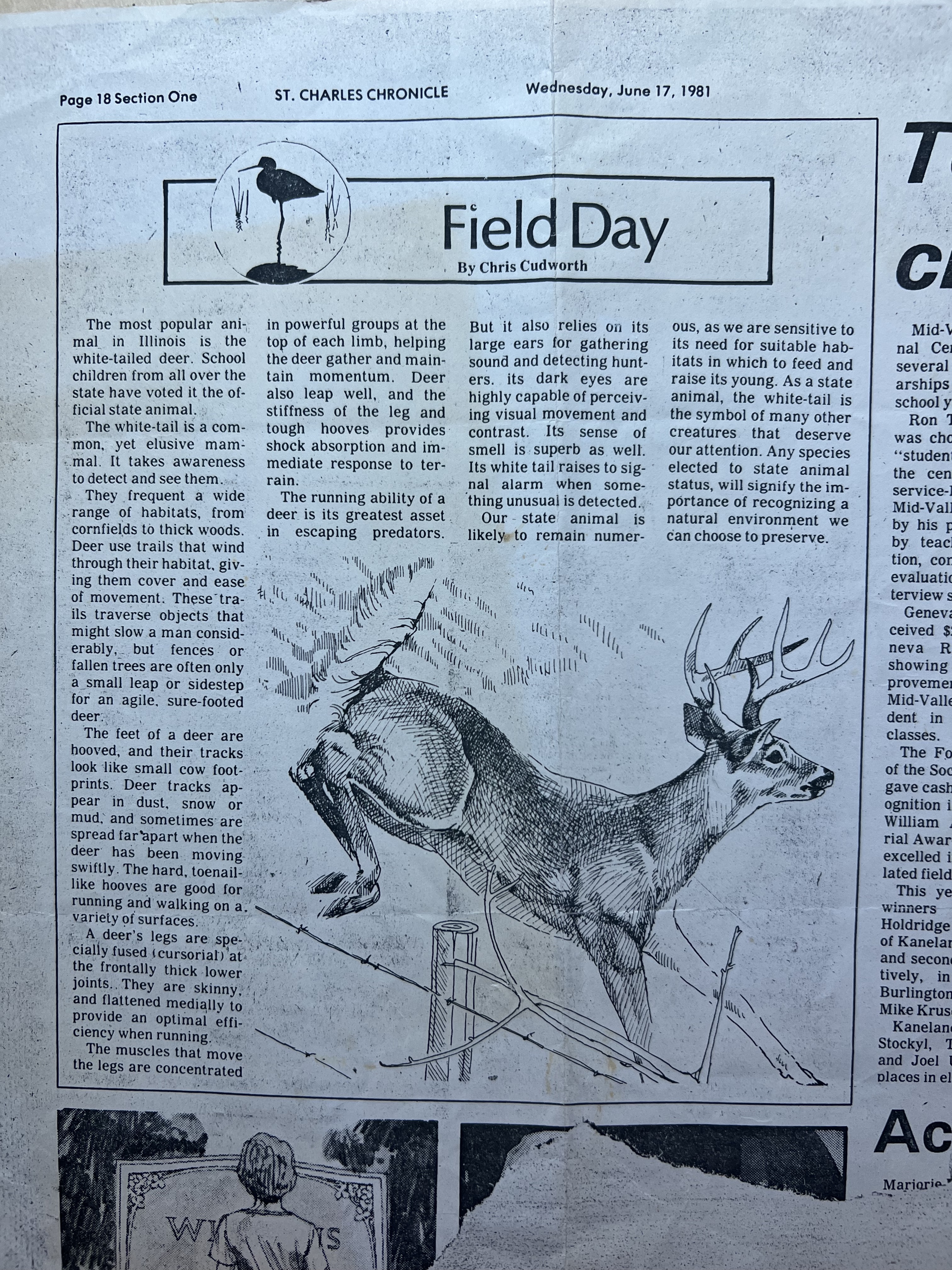
So it all came together in rapid fashion. I also continued producing the content I’d been developing for the Chronicle, a full-page monthly feature titled ENVIRONS. I’d first written a nature column titled Field Day for the newspaper back in the early 80s, reprised it with a retitled column called STRAIGHT NATURE in the late 80s, and built that template into the ENVIRONS content with interviews and commentary.
All told, my new “business” would bring in nearly $100,000 in 1994 money. However, by the time company expenses were extracted and taxes paid, the family income wasn’t that great. I was learning the hard way that “paying the company first” meant that you didn’t get to keep everything you earned. That drove my (late) wife crazy. While her father ran his own business for decades and had multiple employees, she’d never seen how it all worked or been front and center with the books. The ordeal of running our own business made her anxious. It was hard on her, I’ll admit. I was trying my best to create a big break for us.
So I bounced from one obligation to the other, working out the details of Chronicle programs and promotions one day, writing content and leading photography sessions for the Daily Herald the next, and diving into day-to-day marketing for the developers the other days of the week.
On the run
In between, I’d go for brain-clearing runs. While I kept some office hours with the developers, the other work going on allowed me the freedom to run when I wanted. That felt more like the years I spent working for myself in the City of Chicago. But back then (83-84) I had no wife and no kids. Now I was a young father with two children. They’d loved all the perks we got when I was full-time with the Chronicle. Free entrance to the circus that came to town. Tickets to Kane County Cougars games and shows and concerts. Memories of those early years with the Chronicle are fun to think about.
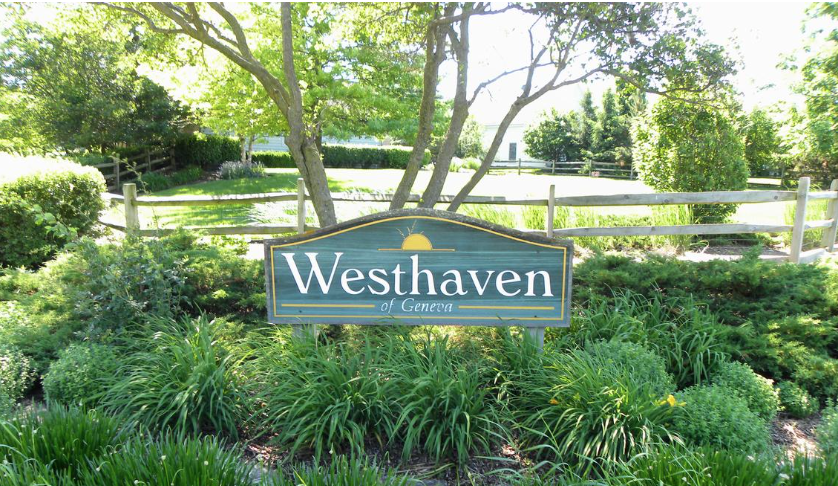
The developers needed help the most. They’d nearly completed the build-out in a subdivision called Westhaven, but time pressures and a fluctuating market had soured relationships with the builders putting houses on their lots, so relationships needed to be repaired. I reached out to the builders and put together a press release and a half-page Real Estate ad to run in the Chronicle. It looked great to get some exposure for the development in the papers and got some things moving again.
But the two guys running the business were a bit stingy about putting in the sign in front of the development. The residents in the subdivision complained that the promised entryway sign was never placed. It stunned me that the delay had happened at all. Compared to some of the other investments the company was making, the sign seemed a pittance. I urged them to finish off the deal. It still stands there to this day. But frankly, it was never very impressive compared to other entryways of similar developments in the area. It almost screams Cheaphaven.
Fitness in action
In the meantime, the work to consolidate the two fitness centers continued. We met with another developer, an active player in St. Charles that owned Fox Valley Fitness, a 1000-member club situated in the Piano Factory Outlet Mall, the retail center operating in a former industrial building (now torn down.) But our first meeting with the developer gave me the creeps. He showed up with a crocheted cross stuck in the breast pocket of his suit jacket. My religious Spidey-sense screamed PHONY!
Apparently, he wanted to make a show of his fine Christian nature. Yet the more we looked into his business dealings, the more we found out his entire methodology was a sham. He was even telling his contractors to sue each other to get the money he owed them for their work. In many respects, he foreshadowed another corrupt developer and fake Christian the world would meet in the future. That would be Donald Trump, again.
Despite these hiccups in relationships, we got busy making pitches to hospitals about the health-based fitness center. The first group we approached was Central DuPage Hospital, a non-profit known for its quality of care. Their board representatives loved the idea, but the proposed Geneva location was a bit out of reach for their current service area. So they passed.
Primary objective
Then we pitched Delnor Hospital, the main medical center in the central Fox Valley serving St. Charles, Geneva, Batavia, and Elburn. That was the original target anyway, but it was helpful to test market the pitch while making it to Central Dupage. The Keslinger-Peck location made sense for Delnor as it was just down the road from its new campus on Randall Road. They listened intently, asked many questions, and ultimately expressed interest in doing a joint venture. “There’s one thing we ask,” they wrote in a confirmation letter. “We want $250,000 for the use of the Delnor name.”
To their ultimate detriment and for reasons I never fully understood, the developers chose to balk at that requirement. And guess what happened? Delnor contacted the architects that our team had contracted to design the proposed plans for the fitness center, flipped them around to fit the campus site on Randall Road, and built the damned thing where it stands to this day.
Real Live Disappointment
My friend and business associate Dennis was rightfully disturbed by that turn of events. He’d poured his expertise into planning a great facility. He’d sold his Westbank Fitness club for a shot at a great opportunity and a vision for the Fox Valley. But it all came to naught because the guys with the money were too stubborn or insecure or incapable to see the Big Picture. I still don’t understand it. Perhaps the project was ultimately too big for their britches. Who knows? One of them has gone on to become a successful commercial real estate broker. He’s a good guy, but he was a bit too particular for me. He once tried to convince me that using keyboard scrolling was better than depending on a mouse or trackpad. I frankly didn’t buy that bullshit. We were just different kinds of people. And that’s okay. To each their own in that respect.
Fitness connections
For a while, one of my closest friends, and then one of my fellow church members wound up running the Delnor Fitness Center. Then a company called Power was called in to take over and the locals were booted out. At the same time, Central DuPage grew its service area westward and an entire network of healthcare locations was created through consolidation into the Northwestern Hospital System. So the entire circle of healthcare systems we contacted is now part of the same organization. My connections there include a former backdoor neighbor that is their Internal Communications Director.
It all proves that sometimes the harder you reach for something the further it gets away from you. Of course there’s also the existential principle of the irreversibility of time, which means you cannot go back and fix your own mistakes, or those of anyone else. You’ve just got to keep moving on–or ahead– or whatever. If my habit of running isn’t the perfect metaphor for life itself, nothing is.
What comes next?
The dissolution of the hospital fitness center deal left me out of that chunk of work. They dissolved my contact in late summer even though I’d been representing them showing other commercial real estate space they owned. By September, I’d also finished the collateral work for the Daily Herald, providing them with an all-new sales brochure for which I’d hired friends and associates to be models.
Then in October, the Chronicle announced that they were hiring someone to take over the work I’d carried forward for them. The year was 1994. It had been a tumultuous year in many ways, and now I had to look for work going into the year 1995. My wife Linda was worried. What could possibly come next?
I went for long runs trying to figure it all out and can’t say there weren’t a few regrets and a touch of resentment to work off. Much of it was due to a long line of people conflicted by their own sets of conflicted beliefs and/or selfish fears.
All I could say to myself was this: “Welcome to the world, Competition’s Son.”
During the same set of years that I served with the Batavia Chamber of Commerce, I signed up for the local Rotary International club in Batavia. I already had a history of working with service clubs and organizations. My friends and I all joined Key Club, the high school version of Kiwanis. We did community projects, but the main benefit was holding the key to the lunchroom candy machines. As a distance runner, I loved having quick access to the carbs and sweets inside that machine. I’d be lying if I claimed that I paid for every single candy bar consumed that year, but I kind of viewed it as a scholarship of sorts.
Yes, that was dishonest. Like many teens, my morals were dependent on circumstance at times. Running all those miles burned a ton of calories, and at 6’1.5″ and 138 lbs, I needed every calorie I could get. It didn’t help that my daily lunch consisted of a baloney sandwich on white bread with mustard complemented by a bag of Fritos, a Hostess Apple Pie or pack of Ho Hos, and a Coke. It’s amazing I could run well on that kind of fare. But run I did, 50-60 miles a week, with races on Tuesday, Thursday, and Saturday. That rotation was capable of chewing up and spitting out distance runners, and that level of competition was stressful in many ways. It consisted of weekday dual and triangular meets against conference rivals and invitationals held on weekends. That type of schedule produced many finely talented distance runners but also many burnouts. When I arrived at Luther College in Iowa, the reputation that Illinois made burnouts preceded me. Indeed, several of my Luther teammates from Illinois either fizzled out in college from lack of interest or got caught up in cycles of drinking or smoking pot. I made Varsity my freshman year, finished in the Top Ten in Conference three out of four years, and captained a team to Second in the NCAA Division III National Championship.
So while I never reached the truly elite ranks of distance runners, I proved to be something of a survivor. Living through the ups and downs of distance running is a great teacher in life.
That attitude of perseverance was proving vital in the work and political world of my early career. The power trips and machinations of working in the newspaper industry tested my talent for self-control and confidence. So did volunteering for the Chamber, where nothing that I did was compensated except for the social and cultural capital it offered. Those efforts were unappreciated by the newspaper. I was still a young man trying to make it day-to-day, but learning that most people really didn’t give a damn about much other than themselves.
Then I got invited to join Rotary, and it was an entirely different atmosphere. Though many of the club’s members were top executives at the local banks and savings and loans or business owners, there wasn’t much ego going on and everyone got along. Even the four bank presidents that were members of the club got joked and kidded with each other. You’d never know they were in competition for customers in town. At first, I tried to figure out my role in the club. Native anxiety still afflicted me in many social situations, leading me to wonder if I was truly accepted. At that point, I was one of the younger professionals in a group that consisted of attorneys, doctors, salesmen and even some retired Rotarians that still attended weekly meetings. One of those members had memory loss yet was picked up by various members at his house to attend meetings each week. I appreciated the respect shown to him by club members.
Finding a Purpose
Once I took on a more active role within the group, any worries about being accepted melted away. I volunteered to book the speakers each week and loved the creativity of finding interesting people to talk about their careers or organization. One week I hired a comedian from a company called Sultan’s Delight, known more for its entourage of strippers than its jokers. But the comedian showed up and rocked the house as a mocking ventriloquist using a puppet in his routine. Handing the puppet to one of the Rotary guys, he told him, “Go ahead, put it on!” Then he roared, “What are you, a proctologist?”
Of course, you had to be there because much of the hilarity in his routine relied on delivery and inflection. One of the most interesting speakers was a legally blind woman that explained the challenges of living with a disability. The group was fascinated and asked lots of questions. But when it came time to do our weekly raffle drawing, the President at the time invited her to draw the ticket and then withdrew the basket while saying, “Oh, I forgot, you can’t see.”
The room fell quiet for a moment. That particular President was not known for his social awareness. In fact, he was something of an oddball. We had a few of those and everyone accepted that no one was perfect.
That Good Old Boy Done Bad
I was encouraged to invite our Congressman Dennis Hastert to speak to the group. At the time, he was not yet Speaker of the House but an Illinois politician rising in the ranks of Republican leadership. The group was excited to have him speak, and I arranged for the visit during our breakfast meeting. Hastert showed up in the company of one of his staff members and gave the classic political “update” speech that covers the top priorities of the party. When he was finished, the floor was opened for questions. After a few responses, I posed a question about a key environmental issue in Illinois. To both my surprise and horror, Hastert literally laughed out loud at my inquiry. My face flushed in anger. Some of the members laughed nervously knowing my background as an environmental journalist, and the moment passed.
But I was President of the club when Hastert returned a year or two later to speak again. When it came time to introduce him, I was handed a protocol sheet listing his title and background. Instead, I stood straight and tall while looking right at him, and said, “Today’s speaker is Dennis J. Hastert.” And I sat down.
He kind of rose to his feet and ambled up to the podium and launched right into his stump speech. “What was that about?” one of my fellow Rotary members asked. “If you give respect, you get it in return. He laughed at me the last time he was here. I don’t owe him respect if he doesn’t choose to give it to me.” Frankly, I viewed Dennis Hastert as a prick.
Years later, Hastert was caught up in a scandal as a “serial child molester” for sexually abusing youth as a high school wrestling coach. Learning of that history, my response to him felt justified. For years I’d watched him muck about at the top levels of government proudly signing malignant aspects of the Republican agenda. I’d recognized the sour soul at the heart of his fraudulent persona. I see ex-President Donald Trump in the same sick light, a phony jerk claiming heartfelt patriotism when the disturbing truth of his psychosis lives barely out of sight.
Bumping into another kind of Good Old Boy Network
Even though I loved most of the people in Rotary, there were internal politics I did not care for. After our club failed miserably at a spaghetti dinner fundraiser, one member came up with the idea for an annual Corvette Raffle. The benefits were immediate, netting the club an annual profit of $10,000. But when I became President, I asked a simple question, “Have we ever taken outside bids on the Corvette?”
The club had consistently purchased its Corvette from Avenue Chevrolet. That dealership was owned by Don Clark and his son John. I got along well with both of those men, and actually stepped in early to run the Chamber when John had a stroke. Don was an avid Rotarian with perfect attendance after forty years by visiting other clubs for “makeup” visits when he wasn’t in town for regular meetings. He was a fun-loving and social guy, but he could also be a taciturn guy by some measures. He also had a habit of chain-smoking his way through life back when smoking wasn’t banned in public places.
So knowing that Don could be a tough character, I knew it wasn’t going to be easy to mess with “business-as-usual” on the Corvette Raffle front. Still, I’d had enough life experience by then, especially having straightened out the finances of the Chamber a year or two before, that my belief in the merits of financial transparency was strong. I collaborated with the Rotary Board to put together the request for a bid, then went to visit Don Clark in the company of Bob Becker, the President of the local Savings and Loan.
Bob was one of the most genuine men I’d ever met. He was the one that invited and sponsored me to join Rotary. I’d called on him for several years during my advertising sales for the newspaper, and we built a fun relationship. His main challenge in life is that he seemed to want more from it than he was somehow getting. At one point he self-published a book of his own short stories, each with some kind of western theme. He printed a sepia-tone photo of himself dressed in cowboy gear on the cover. I gave the book a read the book but the stories were mostly descriptive with little plot. There were few high points to engage the reader. Secretly it made me fear that my own writing would turn out that mundane. My fellow Rotarians rather agreed, but we loved Bob for trying to break out of the mold.
Over time, Bob and I built a friendly, supportive bond. After all, I’d probably saved his house from burning down the night he hosted a Rotary Christmas dinner for the club. During dinner that evening, I noticed that one of the wax candles on a table had overflowed and set the wood on fire. I jumped up and ran over to put out the fire with another tablecloth.
Such are the unexpected fires of life. He was a kind man that just wanted a little excitement in life. On one trip home from northern Wisconsin, he stopped at a local mall and had a diamond pierced earring placed in his ear. So he could be a little impetuous, which is perhaps why he supported my idea to put the Corvette purchase out for bid. I trusted Bob because I knew that he meant well, and while he expressed concern that we were going to run into some resistance from Don Clark, he agreed with the idea that on principle, the club should get a competitive bid from another dealer. So we showed up at Don Clark’s ofice and explained our plans. As predicted, he erupted in anger, and pointing at me with the hand clutching a cigarette at me, he roared, “You don’t know how things work around here!”
I calmly stated, “Actually, I think I do.” Then I said, “You’ll be given the same chance to bid on the Vette as other dealerships.” We planned to bid the Vette with a dealership out in Elburn before making our decision. As it turned out, that business came in with a much lower price, so the Rotary Club made several thousand more dollars to apply to its service projects.
I didn’t blame Don. He was right that his longtime membership in the club justified a certain level of deference. But we’d done the raffle several years and it was so successful that more community organizations were making appeals for the money we raised. So the goal in bidding the car was to maximize the proceeds from the raffle. Okay, perhaps I was wrong in putting the business out to bid. Perhaps I just wasn’t a fan of the Good Old Boys Network way of doing things.
Even Rotary International was a bit “behind the times” in those days. Up until the early 90s, the entire organization was a Good Old Boys Club. Membership only began to open up to women a year or two into my own membership. To their credit, the first women in our club were an important factor in the club’s growth and success. They were successful, confident women whose presence broadened the perspectives of the group as a whole. One worked in the travel industry. Another led the administration of a local community college. Soon enough we had women lawyers and other executives in the club, which made for a better atmosphere overall.
I teamed up with two of those women and one other male Rotarian to compete in the District Bowling Championship. We clobbered the field. Our two women team members Lynn and Joan each bowled over a 170 average for three games. I did the same and our fourth bowler Tom was not far behind. We won the overall title. That really pissed off men in Rotary who could not stand the idea that women kicked their ass. “Tough luck,” Joan Roverud chuckled.
Time to Fly
Eventually, after eight years I left Rotary upon starting my own business. I didn’t want to keep up with attendance on the weekly meetings. Those rules have changed for that reason.
Yet I fondly recall the honesty and humor of the men and women of Rotary. They were a valuable influence during those formative years of my business journey. At the same time, some of the members never quite knew what to make of me. My background as an artist was particularly vexing to some. I didn’t quite fit the mold of what they perceived an artist to be, so they’d give me Paint By Number sets as White Elephant gifts every year. I had four or five of them before it was all through.
Yet that was nothing new to me. For all my attempts at fitting in with different social circles, my life from an early age has been marked by a feeling of “otherness.” Sometimes that feeling came from external sources, yet it also came from some sense within. That sense of “otherness” was particularly keen during those early days as a distance runner. Running all those miles made people think we were crazy. Runners were depicted as lonely and weird and considered the “odd birds” of society. Well, so be it. I ultimately learned to embrace the feeling of being “the other.” To this day, it seems to run as a constant rotation in my life. Because as they say, what goes around, comes around.
At about the same time that I won the position of Promotions and Creative Services Manager for the Kane County Chronicle in 1990, my activity in the city of Batavia led to a rise in responsibilities in the local Chamber of Commerce. I’d served as an advertising salesperson for three years, calling on all sorts of businesses, including retail stores, banks, furniture stores, hair and beauty salons, fitness centers, travel agencies, education centers, and restaurants. I also managed Real Estate and automotive accounts. Calling on these businesses led me to get involved as a Board Member on the Chamber of Commerce.
Building relationships in the community was an important part of the job in ad sales. But when I moved to Promotions I was no longer serving only Batavia, but the cities of St. Charles, Geneva, and the Village of Elburn too. Still, when the invitation to become Chamber President came along, I accepted.
I thought that decision would be welcomed at the Chronicle because other company leadership was involved in the Tri-Cities. But the head advertising manager offered not encouragement, but a warning. “Don’t let it interfere with your job here.”
He was the same guy that told me “Anything that you earn in salary will come out of your overall marketing budget.” So he wasn’t the most visionary manager. In fact, he was a bit of a self-centered prick that ultimately divorced his wife and left her with his special needs son. Sometimes you have to believe people when they tell try to you who they really are, and how they think.
So my work in the Chamber was something that I kept to myself back at work. That led to something of a dual life trying to balance increasing obligations on both ends. And yet, the kickoff to my position in promotions was a huge one. I conceived an Open House for our new building, inviting the public to tour the building and learn more about the business of putting a newspaper together. To increase the allure, I also recruited third-party vendors to provide additional interest in the event. One of those vendors was an A&E movie producer and historical re-enactor named Gary Foreman. We took a liking to each other during the event planning. His work in film was fascinating, and his knowledge would help illuminate the 120-year history of the Chronicle newspaper business that reached back in the 1800s.
We pulled 100-year-old issues from the basement archives to frame and display. Gary would appear in full pioneer costume to talk about the settlement of the Midwest. The more we talked, the more we had in common, so Gary accompanied me to Batavia because he’d learned that the inventor of Flag Day, Bernard Cigrand, had roots in Batavia. Gary was keen on Big Ideas, and he talked up the idea of developing a National Flag Museum in Batavia. “It would be a fantastic tourism draw,” he enthused. “Batavia’s right off I-88. They could put it right downtown and create an entire cottage industry and a retail community focused on history. They’ve got the windmills too…” He was right. Batavia was once known as the Windmill Capitol of the World.
But when Gary and I pitched the idea around town, people were less than enthused. “We don’t want tour buses blocking our business,” one leader of a dental practice and a council member told us.
“Talk about small thinking,” Gary sputtered. We were both a bit disgusted by the treatment we were receiving. No one seemed to understand the potential of the idea, and how it could raise Batavia’s profile on a local, regional, national, and even international level. “They basically own Flag Day,” he mused. “Why not use that?”
The final straw came during a meeting with the Chamber of Commerce leadership. One woman, in particular, showed a small-minded disdain for the Big Idea of a Flag Museum. “She should go back to organizing bowling leagues where she belongs,” Gary spat.
So we gave up on the Flag Museum idea and focused on the Open House. Thirty-two years later, Batavia will be building a flag monument next to its City Hall. That’s proof the idea had merit from the beginning. It just took three decades to realize it.
Back then, I turned my attention away from that effort and focused on the Chronicle Open House. I ordered food through a local restaurant and 800 sugar cookies glazed with Chronicle Blue and a big circle C on them. More than a thousand people attended the event, and as the night wrapped up, I walked over to the cookie table and saw the final one picked up by one of the last visitors leaving the event. “That rocks,” I smiled at the Circulation Manager. He was happy because he’d sold or extended a number of subscriptions that night.
Not long after the Open House I sat in a Batavia Chamber meeting with nineteen other people parked in a large ring of chairs around the City Council room. I thought to myself, “This is absurd, there are far too many people on this board.” I vowed to shrink it down if ever the opportunity presented itself.
Carpetbagger?
By 1991 I was the father of two children and busy as heck doing work for both the Chronicle and Chamber. Yet when I was nominated to be the President-Elect, the Executive Director branded me a “carpetbagger” because I didn’t own a business or live in the community. The claim was that I only cared about getting ad revenue for the newspaper. No credit was given for four years of service on various Chamber committees. I’d also pushed to change the name of the annual retail festival from the archaic “Boo Boo Days,” a term describing retail purchasing mistakes… to a more positive Windmill City Festival that featured both retail sales and community events. Truth be told, Batavia had a terminal reputation for backward thinking. I thought a more modern take on its annual festival would be beneficial, so I designed a new logo for the event and the name was changed.
Ignoring the snarky comments about “carpetbagging,” I started a term as President-Elect behind John Clark, whose family owned a Chevy dealership in town. I liked John because he was a straightforward guy, as opposed to some other Chamber members that insisted on talking through back channels and engaging in community gossip. When I slapped back at some of the comments, I was told, “If you think you are so smart, why don’t you run the Chamber?”
“Okay,” I told them. “I will.” And that’s how it all transpired. I put my name in for nomination and it took hold. But halfway through the year as President-Elect, President John Clark had a bad stroke. He was disabled for the short term, and I assumed full leadership. When the half-term ended, I began preparing for the full term in office. On the night of my installation, the Executive Director met my wife in the restroom at the Lincoln Inn where the annual dinner to change officers was held. “Well, you’re not going to see your husband much this year,” the director told her.
My wife offered an instant retort, “Then you don’t know my husband.”
And sure enough, I cut the Board from twenty people to nine Board Members, also recruiting representatives from the City, Park District, and School District to increase communication between the three government bodies and the Chamber. I planned meetings for one hour and kept the promise. It was also required that all Chamber committees have an advance budget and provide a report on profit and loss. I was no financial wizard, but I could look at a spreadsheet and see whether it had a – or + in front of the final number. Up to that point, people too often conducted events and left the Chamber to mop up the difference. Under my direction (as I recall…) the Chamber finished in black for the first time in years. Yet someone complained, “We’re a non-profit. We’re not supposed to have money left over.”
It was that kind of thinking that drove me crazy. I can’t say that I was the most popular Chamber President as a result. I didn’t mince words, and that pissed some people off. Admittedly, I also sometimes failed in the organization department due to the multiple obligations I was juggling. That said, I still pushed to have all new collateral produced, and Board Members took that on and produced all-new brochures that looked great. To them goes all the credit.
At year’s end, I gladly handed over the reins to the next President, who was a community favorite on many fronts. From my perspective, I’d done the job of bringing the Chamber into some degree of compliance in keeping with its charter. Membership grew a bit thanks to a guarantee of services that we put together.
During those years of tight involvement with Batavia, I’d sometimes go for a run during the noon hour to clear my mind and assess, to the best of my ability and emotional intelligence, what was really going on in life and business. I’d run those few miles on the Fox River trail out of sight from anyone but the other people trying to reclaim some sanity from a hectic world. Sometimes I’d change clothes downstairs at Foltos Tonsorial Parlor, where my friend Craig seemed to understand my need to work off the frustrations caused by trying to exercise emotional intelligence in the face of Corporate and Community Politics. He also had a hot tub down there, and I’d park my carcass in the warm water for ten minutes and try to figure out who the hell I really was. I was a young father with a one-year-old girl and a four-year-old son just trying to get ahead somehow. But was the formula?
I’d start to learn about that from another Batavia organization of which I was a member. The Rotary Club.
During my early thirties, I came up with a personal motivational concept called “transfer of excellence.” The idea centered around taking the best things you’ve learned from doing one thing and applying it to another. I wanted to carry over the experience I’d gained from years of running from the age of twelve through the age of twenty-eight. That’s about when I “retired” from competitive racing to focus on my work and family life. The goal I had in mind was simple: What can I take from all that training and competition?
I’d already learned early in life how to transfer experiences from one sport to another. My baseball career started at the age of nine when I tried out for the Local 285 club but didn’t quite make the cut. I played for a less prestigious team that summer and gained the motivation to try out again that following spring. I practiced hard on my own in advance of the tryout. I made the team and even pitched in the crucial second game of the region’s top baseball competition, the Lancaster New Era tournament. We won that contest and the final game as well. We became champions, and I was a part of that.
So I learned early on that I had a powerful capacity for persistence in competition. That continued through middle school years with the sports of baseball, then basketball, and finally track and field in eighth grade, where I was the top 880-yard runner for the Kaneland Junior High team, setting a school record of 2:25 on the cinder track.
Our basketball team also won the conference that year. I was a starting guard along with a top athlete named Ron Ackerman. But it was the bucket I made from half-court in the final game of the season that fulfilled a fantasy held by every kid that ever played the sport. 3…2…1…!!
Through high school, I led the distance squads in the cross country and track programs at both Kaneland and St. Charles high schools. Yet I also learned that while I was a good runner, I was not a sensational one. The pursuit of excellence also involves learning the limitations of one’s talent. Sometimes even hard work can’t fulfill all your dreams. For example, I never made it downstate in either cross country or track. Some of that was context. We competed in some of the toughest district and sectional meets in Illinois. But there’s no value in woulda-coulda-shoulda claims, because they mean nothing. So one learns to move on in life.
The writing life
While I was trying hard in sports to be among the best, there were other pursuits claiming my attention during those formative years of high school. One of those ventures was writing. I joined the English and Writing club called “Circus” at St. Charles. Getting my first short story published in “A Journal of Creative Writing” felt just as good as winning any cross-country race.
My story was titled “The Hunter’s Loss.” It was based on a friend I knew back at Kaneland high school who hunted the fields east of Elburn where we lived. I imagined what it might mean if he took to hunting a snowy owl in the fields of Illinois.
The story began, “It had been a calm winter until January, when moist southern had crept into the area, causing a heavy blizzard. From that storm until now there had been a perpetual covering of snow on the ground. Each new snow made while the facing sides of the trees and the evergreen shrubs held icicles aloft ’til they stretched to the ground. Cardinals searched longingly and silently in the naked limbs for a seed or two. The rabbits had pared the bark and dying berries from every bush, leaving their droppings and shuffling tracks as a testimony to their harried search for food. Some deciduous leaves still hung stubbornly to the oak’s cold twigs, their chatter and flutter interrupted only by the sibilant call of a migrating lark that had come to light on the windswept giant of a tree in the yard of the farm.
Now, I’ll admit that story could have used some editing. But here’s the point: life itself is a series of hard edits. We all seem to do a little more than we should. From that bulk of experience we learn what matters and counts most. We learn to edit ourselves.
The Hemingway Factor
Consider what Cliff’s Notes observes about Ernest Hemingway’s writing style: “From the beginning of his writing career in the 1920s, Hemingway’s writing style occasioned a great deal of comment and controversy. Basically, a typical Hemingway novel or short story is written in simple, direct, unadorned prose. Possibly, the style developed because of his early journalistic training. The reality, however, is this: Before Hemingway began publishing his short stories and sketches, American writers affected British mannerisms. Adjectives piled on top of one another; adverbs tripped over each other. Colons clogged the flow of even short paragraphs, and the plethora of semicolons often caused readers to throw up their hands in exasperation. And then came Hemingway.”
What a wonderful metaphor Hemingway makes about my prized belief in the “transfer of excellence.” Good writing is all about learning to cut out the excess and arrive at our best efforts. There’s a parallel there in words written by Olympic marathoner Kenny Moore, who once stated, “Running is hard, clean, and severe.” I strive for that. It’s hard work, but I love it.
Ethics and values
As my story about the hunter and the snowy owl evolved in my mind back then, I thought about the values at work in the pursuit of such prey. What might be the goal of bagging such a bird? Was the hunter aware of the illegality of shooting a protected bird? Would it matter? Here’s what I wrote about the moment the hunt concluded:
“The white giant sat nervously on a post by the pond. Mark could feel it watching him as he stood erect on the ridge. He felt alien to this perfect predator; his gun was brutal and primitive in his hands. Mark felt the compulsion to get closer. He lowered his binoculars and crept carefully from post to post on the wire fence. He was a hundred yards away now, and again he stood erect to see the bird through magnifying glasses. The owl crouched low on the post now, fearing Mark in his human form. Its feathers quivered in the wind. Again the bird lifted its wings to fly, but Mark gave it several great strokes of leeway and fired at the great owl. The bird stuttered in its flight with the pain of the lead. It flapped higher against the wind before its wings collapsed in poison death. The owl hung limp and heavy in the air and fluttered down into the wet, gray lake. Mark sat in a slump in the deep snow and watched through the glasses as the owl’s white feathers soaked through with the dirty water of the pond. The rabbit it caught was still clutched in its once powerful talons. Mark had lost the only fruits of his hunt to a hungry bird, and they sank with the owl to the bottom of the pond.”
Pathos
I wrote that passage nearly fifty years ago, and the pathos is still recognizable. I was writing to process feelings about the world, especially how greed and the acquisitive need to conquer seemed to overwhelm justice, social and otherwise. I saw nature as a pure form of existential reality and hated the idea that some people felt the need to destroy it in order to satisfy their sense of worth or fulfill some notion of biblical dominion over the earth.
Those values of justice and nature’s worth remain consistent in my life. Along with trying to do my best at whatever I tried to accomplish, those truths remain at the core of my being.
The artist’s life
Through college I kept pumping out poems and stories, writing and producing cartoons for the College Chips newspaper. I also dove into my artwork. While my interests were somewhat provincial with a focus on painting birds, I kept taking risks, both competitive and otherwise, to “push the envelope” as people say. And life keeps handing you challenges.
I once fell in love with a girl who was given the advice (while I was listening, no less) to “never marry an artist.” She ultimately married someone else but confessed in a moment of doubt that she regretted it. Well, I don’t begrudge her. She was better off with the other man. Life with me would not have been as predictable as she would have liked. That much I do know.
Paper thin
Yes, I’ve spread myself too thin on many occasions in life, and that artist’s life is filled with cycles of wins and losses, some as thin as the paper on which that reality plays out. Yet at sixty-five years of age, I believe that my work is better than ever, and the best is yet to come. That’s as it should be. And I can still give credit to that seventeen-year-old kid for writing and painting his heart out. For better or worse, on that part, I’ve been consistent.
Perhaps I’ve been clear enough in these explanations of motivation that you grasp the broader meaning of “transfer of excellence.” It’s not a claim to superiority. But I’ll also not apologize for pursuing whatever talent I possess to the fullest of my ability. That said, we all seem to make mistakes and harbor regrets that can never be reconciled. Time calls us to an honest accounting. If we’ve tried to transfer whatever level of excellence we can achieve from one part of life to another, that is a life well-lived.
Illustration of Christopher Cudworth by Christopher Cudworth
At some point either when I worked at the Chronicle or not long after that, the editor Dave Heun recruited a bunch of his buddies to form a softball team and join the Leisure League in St. Charles. Dave wasn’t the most talented player on the team, but his passion for sports (he was a former sportswriter and editor) had its own gravity.
Now, the Leisure League wasn’t as soft as it sounds. The dominating team during the first year that we joined was a big pack of loudmouth muscleheads that specialized in hitting home run balls. Their defense was acceptably good, but the way that they won games was mostly pounding the ball so far that no outfielders could catch them.
Our team changed all of that. Nearly every guy on the Chronicle softball team had played either high school or college baseball. Hardball, that is. Two of the guys on the team, the Horlock boys, played shortstop and centerfield. They both had 90 mph arms, and their brother Scott was not far behind. That trio of brothers gave our club an electric feel. Not only could they field, all were great percentage hitters as well.
I was already friends with their father, Bob Horlock, who was my high school biology teacher and a birding buddy from the early 70s. I’d seen the Horlock boys grow up from toddlers into competitive men about to start families. I think it was Scott’s children that later had my late wife as their preschool teacher.
Beyond the Horlock Boys our team had a full complement of solid baseball players. Every position on the field was solid defensively, and many of us had enough speed to make baserunning a big part of our success.
Our home run hitter was a big man named Joel Crafton. I worked with his wife at the Chronicle, and thus the connection to the team. He always hit fourth or fifth in the lineup because we’d put three guys on base and Joel would crush one deep enough to allow at least a couple runs to score. Often enough he clobbered a home run or two as well. We had a couple other big hitters but most of us specialized in placing well-hit line drives in the outfield gaps, then we’d run the bases like mad. In eight years of softball seasons I only had one home run. Once that ball soared over the gap in right center, I knew that I had a homer in the making. It still felt good to tear around the bases at full speed, kicking up dust under the summer sun.
We played in a “limited arc” league in which the pitcher was not allowed to loft the ball more than twelve feet in the air. The balls themselves were unlimited flight, which meant they flew as far as you could hit them, versus “limited flight” balls that muted the game for reasons of safety or space. I could never stand those unlimited arc games where the softball came straight down from the sky.
Nor did I ever want to play 16″ softball without mitts, like my late wife did. She played first base during her teens and early twenties paid for her 16″ softball career with a couple of bent fingers. I’d gone to see her team play a few times when we were first dating. They were a tough team of factory girls and hard drinkers, that gang, with a few motor-cycling lesbians to round out the lineup. They won plenty of games and had some pretty spiff uniforms in all blue with orange accents. But my wife left that all behind once we were married.
A gang of misfits
But guys have a harder time giving up the sports thing, cause we still liked to play. We all still liked banging our bats on our cleats and driving softballs past the infield. But we looked like shit. The amusing thing about our team was that while most teams wore matching softball uniforms, our gang of talented misfits wore no matching uniforms at all. We wore what felt best each weekend, and let our talent do the talking.
We’d show up on Sundays in our favorite gear of whatever we could find that day to fit our needs. My chosen uniform was a set of slim gray sweatpants with a tight drawstring and an old Luther College football jersey that I’d copped from the locker room before graduating. The football jersey (number 85) was thick and absorbed sweat on hot summer days. I cut off the sleeves to increase the breathability and that opened up the arm space as well, so that I could throw and catch easier. My chosen headgear was a collection of dusty baseball caps with various logos or an Oakley running cap because it was light on my bald head and wicked away sweat on hot summer afternoons. My baseball glove was large Spalding given to me by my in-laws. I wore a set of running shoes or a set of old soccer cleats as footwear.
I played right field still had plenty of running speed. I’d give away some distance along the first baseline and dare hitters to plant a ball in that space. Many times I robbed guys of what they thought was an easy hit. Others tried but hitting to the opposite field was hard. They often fouled the ball off trying to squeeze out an easy hit, and I’d shag down their soft popups in foul territory. I loved that chess match because most teams put their least capable player out in right field. I turned the position into a chess match and an art form.
League dynamics
That first year in the league we were winning regularly until we came against a band of Big Boys with large muscles and a macho demeanor. They were a bombastic crew, yelling boisterously to create an atmosphere of total dominance. Perhaps in that first game, it worked. They pounded out runs against us, cheering and chortling as they ran the bases. But then our outfield learned their lineup and their hitting preferences. We started to adjust and knew where the ball was going. We closed down the runs on their side and started banging out singles and doubles off their pitcher, who got rattled. He walked a guy or two, and the tone of the hollering from the other team started to change from bombastic to a tinge of fear. We kept up the pressure beat them. The next year, we took the championship away from them as well, and never looked back.
They’d always start with the same loud attempt to intimidate us. But all it took was a couple runs from our side to shift their voices from that macho tone to one of anxious desperation. We “had their number” once we’d beaten them soundly a couple times. After winning six years in a row, we gathered around home plate to accept our league championship trophies and one of their players wryly noted, “Just another one to gather dust.” And he was right. But for us, it was never about the trophies anyway. While the core of the team remained year to year, there were shifts in personnel depending on work schedules and family commitments. We kept finding ways to win through it all. That was the satisfying part of those competitive years in softball.
I kept up my running during all those summers as well, putting in weeks of 20-40 miles depending on the weather and such. That kept me lean and fast, and I relished the feeling of showing up for softball games on the weekend. My wife wasn’t always keen on the schedule. “We could do other stuff on Sunday’s,” she sometimes complained. And we did on occasion forego my softball stuff for family priorities. I was never a jerk about it. It was just enjoyable to spend time with the guys with the sounds of softball to fill the senses.
One summer the neighbor next door called me over to the fence and asked, “You play softball, right?”
“Yes,” I told her. “Every Sunday. Why?”
“My husband is a good athlete,” she offered. “Can he join your team and play? He was a football player in high school.”
“Well, sure,” I replied. Then I talked to her husband and told him to show up for that week’s game. When he walked up to the field I told him, “Let’s play catch!”
He pulled on his glove and I threw him the ball. We stood about ten yards apart. He tried throwing the ball back and it made it about halfway. I trotted to fetch it and tossed it underhand to him, and ran back to my spot. He tried throwing it again and it popped up above his head. I stood there in shock, thinking, “This guy can’t throw a ball.”
My teammates had heard that I’d be bringing a possible new player. I glanced around and felt the stares as my protege smacked the ball in his mitt, admittedly embarrassed. “I guess I’m out of practice,” he offered.
I decided not to pussyfoot around. “Yeah, well. Softball’s not for everybody. Thanks for coming out.” He rolled the ball on the ground back in my direction. I never talked to his wife about that day. I think he told her to forget about it.
Big Arms
By contrast, I had to be careful around a couple of teammates, especially in the outfield if they came up throwing the ball back to the infield. The youngest Horlock boy was a kid named Brett, a lefty with a cannon arm. He played right center and I ran over to catch a ball but he called me off. I stood there as he whipped the ball past my ear, and was glad it didn’t catch me flush in the face.
His brother Jim was just as fast with his throwing arm. At shortstop, he’d field a grounder and stand there a minute watching a guy tear down to first base. Then he’d cock and throw and zip the ball over the infield to grab another out. It tore the heart out of many a team to realize that anything he caught was a sure out.
But when his brother Scott played outfield, there was always a chance that they’d collide with any ball hit between short and Left. A couple times they crashed into each other and we wondered aloud if one of them was dead. I had my own collision with other fielders a couple times, because we hated letting anything get through the gap. After getting completely flipped in mid-air by a fellow fielder, I lay on the ground laughing. The rest of the team joined in, but I felt around my body to see if everything was still okay.
One Final Year
As the years wound on, and we’d won multiple championships (eight total) with our core group, many of us by had kids by then. Their activities were taking bites out of our schedule and softball had begun to feel a little selfish. We’d lost a few important guys to parenthood duty and a couple moved away fro work purposes. So we talked among the team and agreed that we’d had a good run and it was time to retire from softball after one final season.
But that summer there was a hard drought. The softball fields turned brown by mid-July and the dirt grew hard as rock. Fly balls to the outfield bounced high in the air, forcing us to adjust our outfield tactics. It proved to be a difficult season to win. Still, we made it to the championship game after advancing through the playoffs. That set up one more encounter with the Big Boys. On the weekend that the game was supposed to be played in the first week of September, a massive rainstorm swept through the area. The rain soaked the fields and washed out ruts that had to be repaired. A week went by and there were rumors that the championship game wouldn’t be played at all.
Finally the park district got the fields back in shape. There was even a tinge of green in the grass again by late September. We stepped on the field with a tinge of autumn chill in the air and scudding clouds rolling low overhead. We won the first game as the afternoon sky darkened even more. With a 1-0 game lead, we pushed to score runs, but the Big Boys hung tough and caught up. With an inning to play and home field advantage, we led by just two runs. The Big Boys smelled blood and were yelling like crazy for one of their home run hitters to crush one with two outs down and a man on first.
At that moment the sun popped through the clouds. Then our pitcher tossed the ball and I heard the bat smack it hard, and it was coming my way. I watched it rise high in the sky toward my position in right field. The ball seemed to shrink in the heights and it looked no bigger than an aspirin against the dark clouds above. But that burst of afternoon sun shone on the ball like it was the face of the moon. I got under the arc of the fly ball and waited.
“Squeeze it!” one of my teammates yelled out from the infield.
As the ball came down out of the sky I realized it would be the last catch that our team ever made on the field. Fortunately, I didn’t drop the ball in some tragic consequence of misattention. I caught it cleanly in my Spalding and raised my glove in victory. Then I opened the mitt took a look at the ball sitting there. “And that,” I said quietly to myself, “Is the end of an era.”
Those eight years of softball served as our own little Field of Dreams. We’d emerge from the respective cornfields of our lives to play softball two hours and go back to wherever we came from. Perhaps it was crazy to care as we listened to the voice in our own heads telling us to play. But we all have to be crazy about something.
Beyond the games
After that last game we all headed home and on to the rest of our lives. Over the years I have seen a few of those guys since we played ball together. One runs the local public golf course. The Horlock Boys pop into my life now and then. We lost their father and my birding buddy to a heart attack back in 1993. He passed away while burning a prairie in April of that year. That’s thirty years ago now.
It’s still fun to see someone and share a memory or two. But playing for that team was never about being the closest of friends. We were never the kind of softball team that went drinking after our games or spent any time together outside the ballfield. We lived for the competition, and that was that. There was a purity to our efforts, showing up each week to play catch before the games and then running out on the field or standing in the dust waiting to bat. Perhaps it was all an echo of youth sustained, but we made the most of it. That is not to say that everything was perfect. There were a few temper tantrums among us when guys couldn’t get a base hit. In fact, one of our it teammates was a genuine hothead who consistently protested calls, screaming at the umpire and throwing gloves in anger. We all knew his anger was mostly a release from the frustrations of his work life.
The simple truth is that we came to play the best we could and that was the entire focus of our being together.
Gathering memories
Years later after I moved our family moved to Batavia, we lived next to Memorial Park where a set of three softball fields hosted many games. I walked our dog on the path circling the park and watched softball and hardball games being played at many levels from youth up to men’s and women’s adult leagues.
Often when the games were through for the day, I’d find lost baseballs or softballs in the grass. Over time I collected quite a few. Lifting those hardballs brought back my pitching days, when facing batters was the most important thing to me in the world. I’d grip each hardball I found in the familiar feel that a pitcher never loses. I well remember positioning the seams for a curveball or a sinker, and think back to my father teaching me how to throw a knuckleball. I love that scene in Field of Dreams where Shoeless Joe catches the doctor before he leaves the field and tells him, “Hey kid. You were good.”
Or something like that. I was good competitor, that much I do know. And had a mean curve.