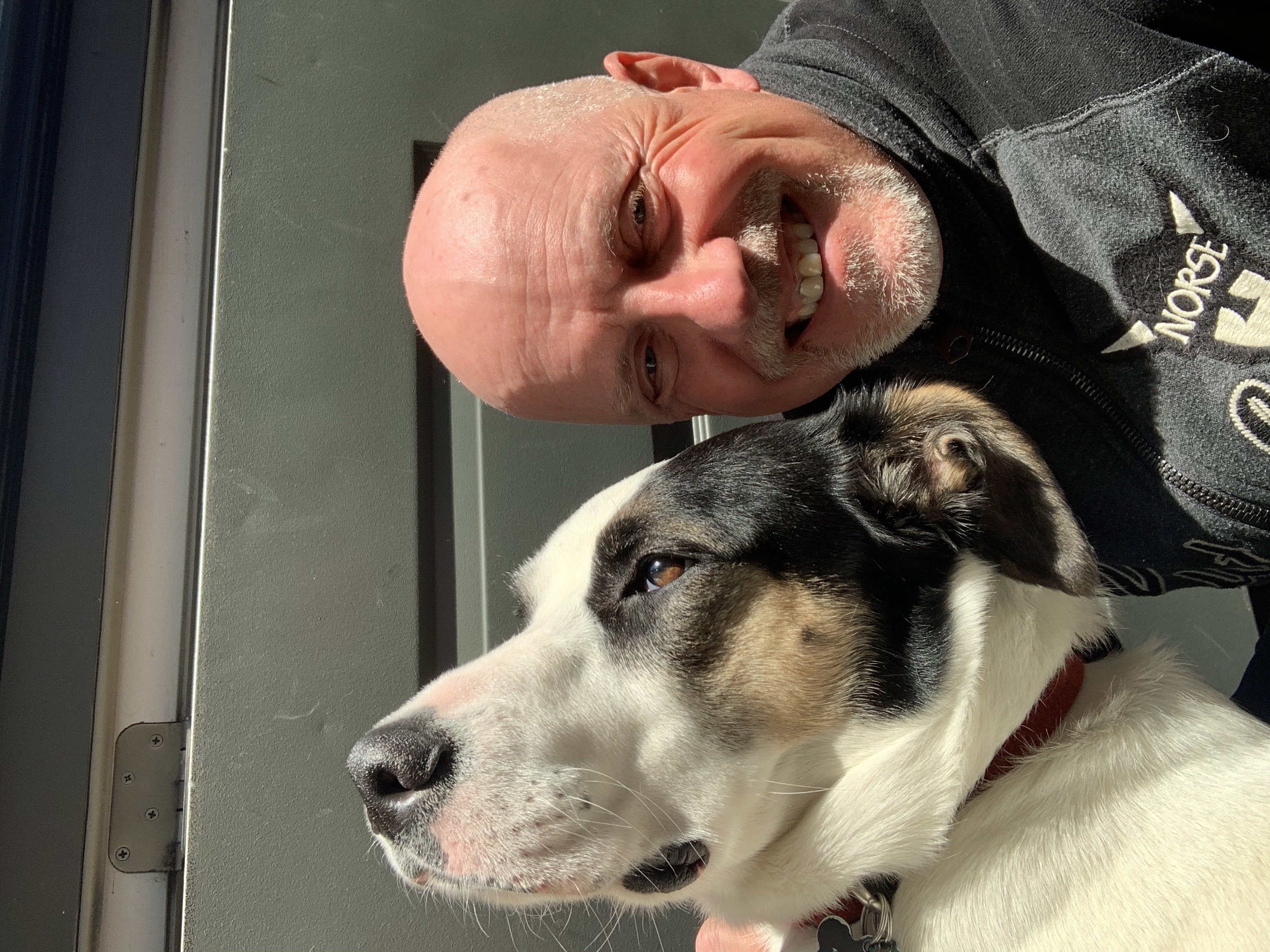
This morning while running our dog around the dog park, she took to playing with an same-sized pup named Evie. She’s a shepard mix of some sort who loves to run and growl and tumble with Lucy, our pit/border/beagle/boxer mix.
I don’t let Lucy pick up sticks or balls or ropes much at the dog park because she quickly becomes possessive. But today, the dogs collectively gathered so much detritus from the ground I gave up. Then one of them dropped a piece of rope near my feet and I picked it up and ran.
That’s when Evie ran after me and chomped on my butt. It wasn’t hard. No more threatening that what she does with Lucy. Dogs love to gnarl on each other and Evie simply applied Dog Rules to my glutes. I stopped, laughed and looked back at the other adults watching the dog circus. We all chuckled. Lesson learned, I thought.
Not all dog chomps are so playful or benign. Many years back I was running on a path that passes through Island Park in Geneva, Illinois. Suddenly I felt a painful bite on my left butt cheek and swung around to find a collie standing there with its teeth bared.
Normally I don’t think of collies as an aggressive breed. But sure enough, this one bit me in the ass. I stood there rubbing my butt when the owner yelled at me. “What are you doing running on the trail?”
“It’s a running path,” I replied, a bit flabbergasted at the question. “People run on it.”
“Well, you scared my dog,” he barked back.
“Your dog should be on a leash,” I replied. “Those are the rules in this park.”
The owner stomped over and collected his dog. I continued my run and checked my butt cheek when I got home. Sure enough, there were reddish blue teeth marks on my little white ass.
I’ve been run over by dogs. Snapped at by dogs. Barked at by dogs of many kinds. But none surprised me so much as that collie on the running path that day.
Some people just don’t get it when it comes to their dogs. I like to think I do, but not always. I make mistakes in interactions with dogs and assume some are more friendly than they really are. Dogs have their own rules. And unless you’re a dog, and not a runner, you probably don’t understand them in the moment.
This photo from my wedding at the age of 27 years old shows the groomsman outfitted in silver Nike Pegasus running shoes to match the silver tuxedos we chose for the occasion. Those shoes were the gift I gave to the groomsman in our wedding.
I’d worn many pairs of Pegasus by that point in time thanks to sponsorship by the Running Unlimited shoe store. Our team of racers all wore Nike shoes and gear as provided by our contract.
The decision to buy sets of Pegasus for my groomsman was an easy one. The two guys on the right were teammates of mine in high school cross country and track. The Best Man on the far right also ran with me in college. That youngish looking character right next to the myself and the bride is my brother-in-law.
The year that I got married was the last full year of truly hard racing in my career. After that, we conceived our first child and I decided it was time to dedicate less time to training and more time to being a father. After all, I’d been competing year-round from the age of twelve to the age of 27. That’s fifteen years of dedicated training and racing. It was time to move. To grow up.
I moved into a space where running was still a big part of my life, but not at the forefront. Many years were spent coaching other athletes and directing youth soccer teams. Then I started playing indoor soccer and wore Nike cleats and indoor shoes. I loved a set of soccer cleats that was a “hand-me-up” after my son finished using them in high school soccer. They were bright red with a reflective silver swoosh on the side. I recall seeing them flash in the sunlight when he was tearing up and down the field.
During all that mid-life stuff, Pegasus shoes would float in and out of my training gear, as did other Nike models. But so would shoes by many other makers; Saucony, Brooks, Puma, Reebok, New Balance, adidas and many more.
Something in me still holds a warm spot for Nike shoes. In college I raced in Oregon waffle racers and Nike Elite waffle racing shoes in cross country. I wore Nike spikes in the steeplechase, an event in which I qualified for nationals three times.
Post-collegiately, I raced most of my PRs in Nike racing flats, especially the Nike Air Edge and the Nike America Eagle. At midnight on the North Central College track in May of 1984, I ran my 5000 meter PR in a set of Nike Zoom track spikes. Those spikes were clean white with a simple sky-blue swoosh. They were light and fast.
Yesterday I received a set of Nike Pegasus Shield training shoes from the online Nike store. They’re obviously quite different from those prototype Pegasus I first bought back in the 80s. I normally buy my running shoes locally from Dick Pond Athletics, but with online credits to burn I chose the Nike Pegasus as my second set of running shoes to train during the winter months. The fact that they’re a bit waterproof is a real benefit during December, January and February here in Illinois. That mushy snow can be a soggy problem.
I’ve worn the new Nikes around the house trying them out. My stupid ankle bones stick out so there’s a lacing strategy necessary to wear the shoes well. But I plan to keep them. We have a lot of years of history together, these Nike Pegasus. A ton of miles and a lot of smiles.
I created this quasi-art piece a few years back. It still holds true.
With the lack of competitions this year due to the pandemic, we’ve adjusted our plans and expectations like everyone else. Yes, we did get in three triathlons that were held this summer. But we learned that the Florida Half Ironman my wife planned to attend in December was not going to happen. We ‘half-expected’ that, of course. Races are being cancelled for good reason. It doesn’t pay to be ignorant or selfish in the face of this tricky-ass, random disease called Covid-19.
So we decided to run 13.1 miles together as part of her workout plan. Her coach scheduled the run, so why not do it together and see what comes about?
We chose the Fox River Trail for its convenience and it amenities. There are a couple bathrooms along the way in case of need, and that works best for us. So we set out on a calm, clear day to run 13.1 miles our way.
We hit the turnaround point at exactly one hour. She still had a two-mile interval to do so we took the short recovery period and then nailed those two miles at near 9:00 pace. We took the three minute rest interval, then picked it back up and finished in 2:02 for the full half-marathon. That was exciting.
That’s such a great sign for Sue’s running fitness. Her times have come down from the 2:10 zone to the point where she can run sub-2:00 with a bit of concerted effort. It’s been an interesting journey training with her along the way; watching her endurance progress, to see her running form grow more efficient and watch her confidence build.
Training partners
I’m not her coach but feel some gratification in helping her achieve these pillars of progress. Running with her has built my own mileage back up to 25-30 miles a week. A few years back, I’d sort of given up running 13-milers. My hips tightened so bad during the Madison Half just three years ago that I was reduced to lying down on the ground to stretch in order to continue at all. I finished just over two hours that day after racing 8:00 pace for the first nine miles. You can see how slow I ran the last five miles! That was a tarsnake moment for sure. But I didn’t let it stop me. This summer I cranked out a ten-mile at 8:30 pace. So the times are coming down. I’ll never touch my PRs of years ago, but that doesn’t matter. All that matters is working on what you can achieve in the present age.
This summer, I ran a 2:01 half to conclude a Half Ironman after the 1.2 mile swim and 56-mile bike segments. That’s progress of a sort.
So I’ve come a ways too. I’ll never run a 1:10 half marathon as I once did, but that would be an unrealistic expectation after four decades of running!
Recently, I also had the chance to work with a 60s-ish friend seeking to break 2:00 in the half-marathon. After a couple consultations he followed the pace plan we mapped out and cranked out a 1:51. He has his eye on even faster times.
This is all part of the fun of achieving progress at any age. Surely it is remarkable to coach young athletes setting PRs as they develop. It is just as satisfying helping people look at themselves through new eyes in endurance sports. Setting goals and making them happen is satisfying at any age. When you think about it, every race or great workout you do is one for the ages.
If you have questions about hitting your objectives, shoot them my way. We’re all in this together!
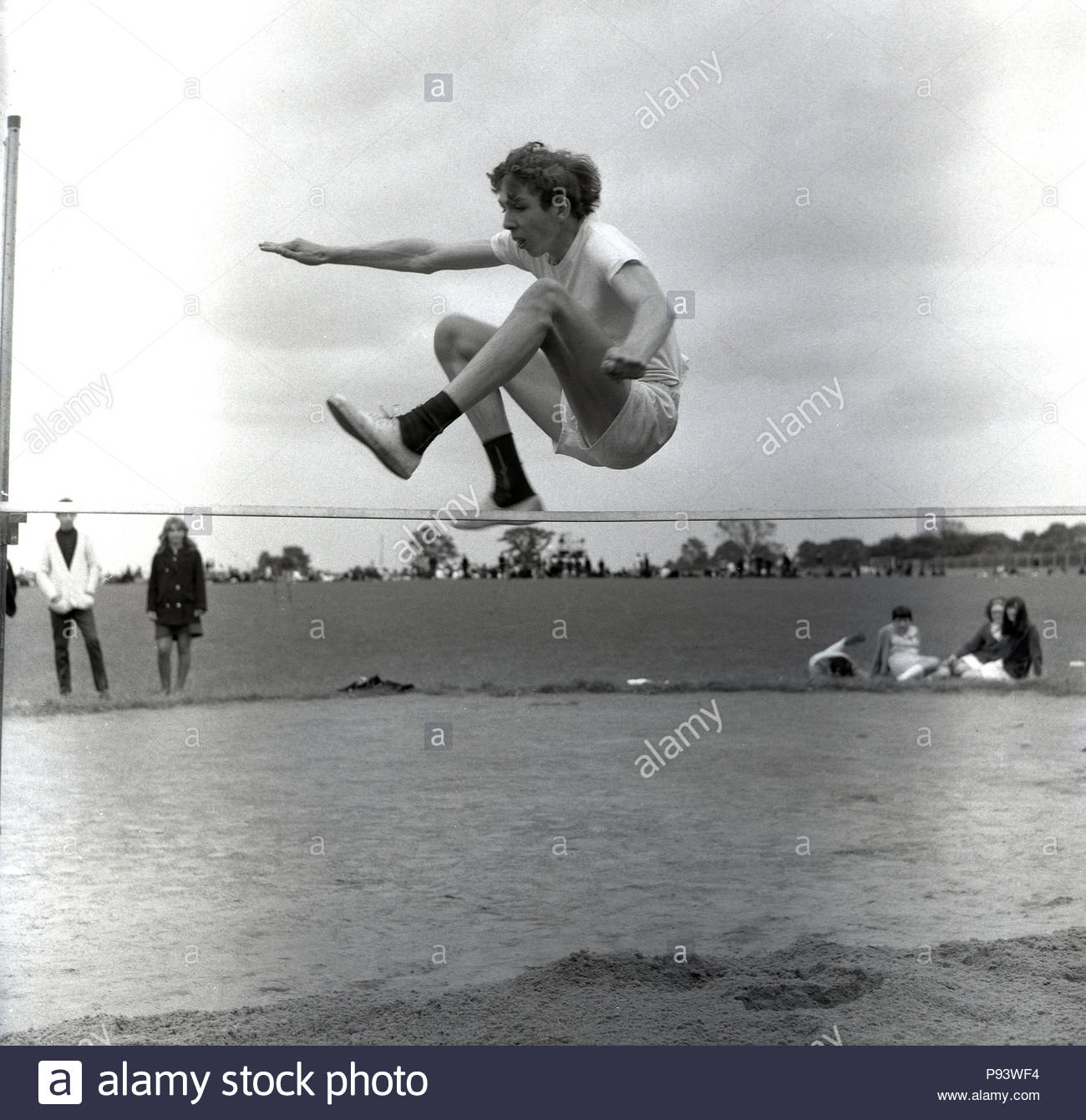
Somewhere in the late 1960s as a student at Martin Meylin Junior High near Lancaster, Pennsylvania, I was introduced to the sport of track and field. One of the events I tried was the high jump. At that time, the pits into which we jumped were made of piles of rope bags holding strips of foam together. It was primitive at best, but something about jumping over that bar excited me.
Before those high jump bags were contrived, athletes jumped over the bar into piles of sawdust. I recall doing that on our own with some friends. You either did the Western Roll or “straddle” as it was called, or the scissor-kick. Then hoped you landed safely.
The scissor kick was the truly archaic way to jump. Even back then, no one took it seriously. Running at an angle toward the bar, you kicked one leg up and over the bar while keeping the torso largely erect. You landed with one foot and then the other, typically kicking up a bit of sawdust or tangling your feet in the bags of foam in the process. It was an awkward era, to say the least.
Run and jump
I looked up the history of the high jump and apparently it all started with competitors running straight at the bar like the long jump and going over the bar that way. The record for that style, set in the late 1800s, was around 6’2″. That was a long time ago, but it still means that someone lifted their fanny that high off the ground. Sadly, that is also the exact height I eventually jumped in my career in both straddle and flop styles. That shows how mediocre I was as a high jumper.
Then came the scissor kick. The world record for the modified scissor-kick technique wound up at 6’9″. That is also extremely high! Eventually the roll technique took over, and according to LiveAbout.com, the world record for the roll climbed over a period of a decade:
“Russia’s Valeriy Brumel was even more prolific, setting six world records from 1961-63. He improved the mark by 1 centimeter each time, topping out at 2.28/7-5¾. Brumel’s last mark stood for eight years, but Pat Matzdorf brought the record back to American shores by clearing 2.29/7-6¼ at a World All-Star meet against Soviet athletes in 1971.”
Jumping evolution
I share all this because my little evolution as a jumper traced all these techniques. But none of it would have been possible without changes in the style of pits in which we landed. In a short period of time from 1969 through 1971, high jump pits evolved from bags of strung-together foam strips to solid foam high jump mats that stood three feet high.
In between, there was a period when we jumped into inflatable pits called Cloud 9. Both high jump and pole vault used these marginally insane devices. I was still jumping straddle when the first Cloud 9 pit showed up at little Kaneland High School out in the corn fields west of Chicago. It was always windy out at that track and more than once when I was approaching the pit for a jump, the Cloud 9 shifted or unhinged or pulled up from its stakes. It would rise up and flop over like a fat cow in a field of grass. There is nothing more unnerving during high jump than making at attempt at full speed only to watch the pit disappear.
It was also common to land on the edge the Cloud 9’s rounded front end and bounce back onto the tarmac. For pole vaulters (and I never did that event) it was even more treacherous. Thanks to these problems, and within a couple years, those Cloud 9 pits disappeared. That was likely the result of litigation against them. A Google search doesn’t even turn up an image of those pits. The Cloud 9 brand name is still used for those inflatable bouncy playgrounds castles and such used at children’s parties. So perhaps the company never disappeared. It just lowered its standards, so to speak.
Fosbury’s World
Of course, high jump really started to change after Dick Fosbury invented an all-new method of high jumping called the Fosbury Flop. He won the Gold Medal at the 1968 Olympics and the world of high-jumping never looked back.
About the time the Cloud 9 vanished from the scene, I started to experiment with the Fosbury Flop technique. It was much safer once the high jump pit was a heavy foam mattress firmly fixed to the ground. Even so, I once jumped 6’0′ in rainy conditions and slid right off the back of the pit.
High jumping was a tool for scoring points. During high school dual meets I’d jump right after running the two-mile at the start of the meet. Then I’d go triple jump after that, and complete the day by running the mile. I did all that to help the team earn points. I did win all four events a few times.
That wasn’t necessarily the way to become a better distance runner, but it was a period when multisport athletes in general were common, so doing multiple events in track was typical as well.
Now about that triple-jumping. I came to track and field from a background in basketball. While I was never a pure leaper in the sense of vertical leap, I was good at converting speed into height and distance. My best effort in the triple jump was 40’4″, a school record at the time. I will confess that record should not have counted, as there was a healthy wind behind me at the time. The record didn’t last long after I graduated anyway, as triple jump was a relatively new event at the time. Once the real jumpers took over my record vanished into the ether of time.
Jumping for the joy of it
Before taking up triple jump, I long jumped quite a bit as well. My best was 19’1″, which in retrospect I find rather respectable. The fact that my skinny distance runner legs with calves like toothpicks were able to jump that far is no small feat. I really wanted to go twenty feet, and wasn’t for lack of trying. I’d sometimes go out and long jump before school at Kaneland HS when I should have been spending time in early morning study hall. I’d back up that runway and tear down the asphalt with all my might. With no tape measure to gauge my efforts, the notion of success or failure depended walking back from every jump with my feet to guess how far I’d gone.
In college I abandoned both long jump and triple jump. But I kept high jumping through my freshman year. At the end of the year, I competed in a ‘jump off’ to earn a chance to compete at the conference meet because the three distance slots per event (1500, 5000, 10000) were all filled by older, faster runners. In that meet, I jumped 6’1.5 inches to place in the Top Ten but the winner went 6’8″.
At one indoor meet that year at the University of Wisconsin-LaCrosse, one of their high jumpers cleared 7’0″ using a modified gymnastic run-up in which the athlete did a forward hand spring and dove over the bar after both feet contacted the ground in a powerful fashion. That was the problem. It was impossible to tell if that jumper was hitting both feet or one at a time. The rules disallow jumping with both feet. So his technique vanished. How many athletes could do it anyway?
I actually coached jumpers during my tenure as assistant coach with the St. Charles Track Club in the mid-1970s. In particular there was a series of girl jumpers who did quite well in state competitions. Andra Olson was one of those athletes from Sycamore. Her brother Gail won a state championship and cleared 7’0″ in high school. Some of the most unique jumpers were the tween girls whose gymnastic backgrounds gave them spring and flexibility, both great attributes in high jump. Several of them jumped 5’8″ at the age of twelve of thirteen. Of these athletes, I’m pretty sure a sprite named Kelly Murphy jumped 5’8″ along with a couple other athletes of that period. Perhaps that was Patty MacLaughlin. Hard to recall after all these years.
In any case, Kelly had an especially ebullient personality that complemented her considerable athletic ability. She ran fast as well, and was one of dozens of kids who made that program special back in the day. It’s not that hard to coach talent. Just say “Go!”
Steeplechase
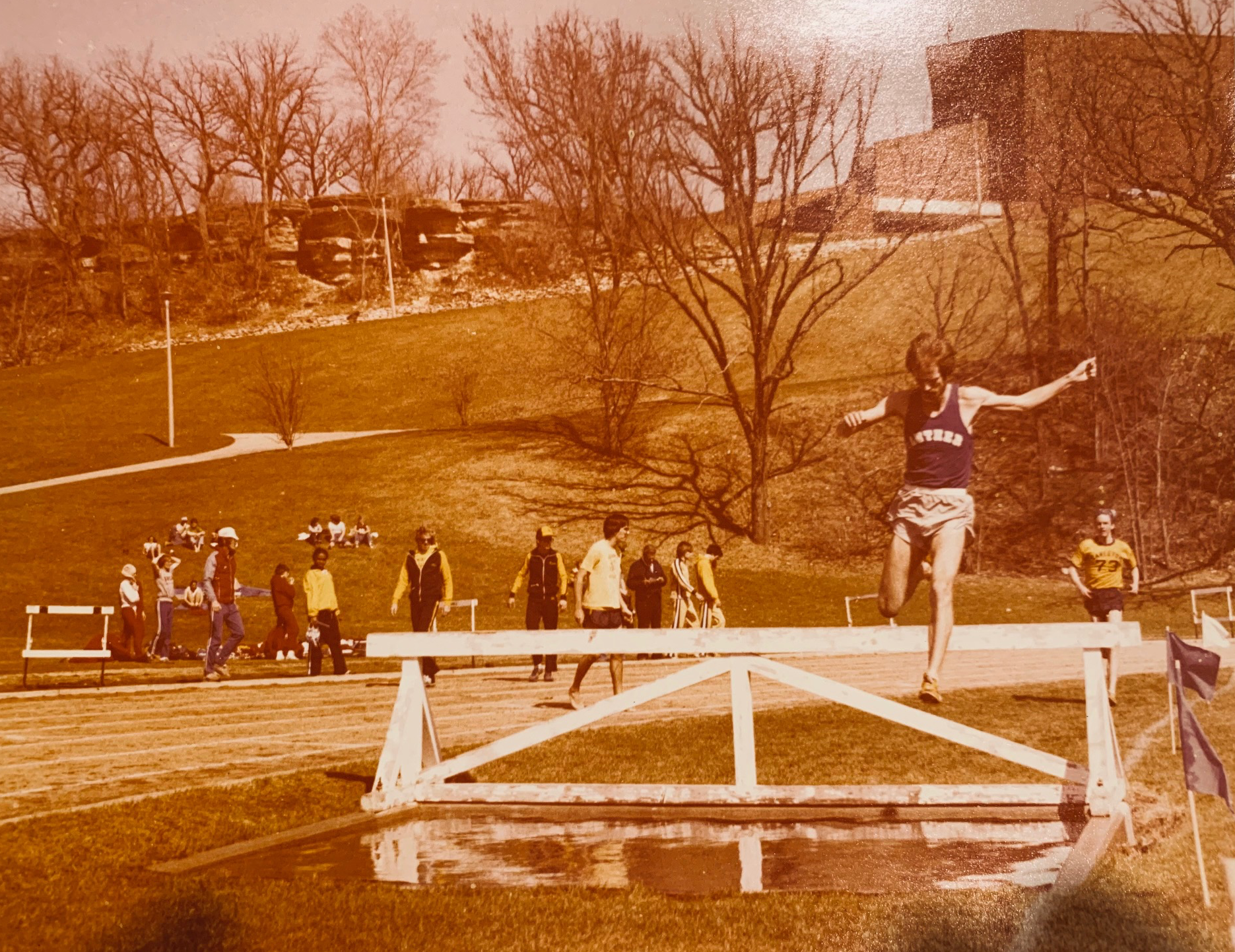
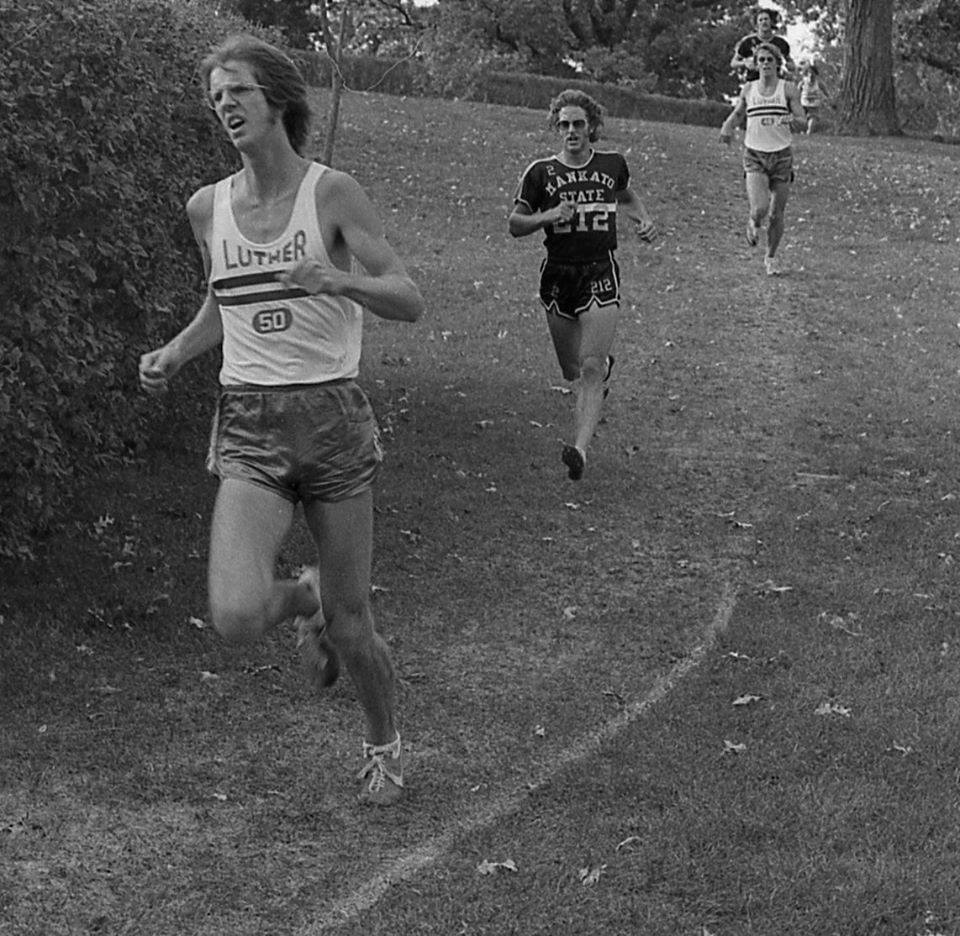
By the time I was a sophomore in college, I gave up field events such as HJ, LJ and TJ entirely because a new focus had taken over my track career. That was steeplechase, the event in which distance runners cover 3000 meters over 35 barriers and 7 water jumps. My jumping ability helped with the hurdling. Where it really helped was clearing the water jump. The pit was 2.5 feet deep below the barrier and rose to a zero depth incline twelve feet away. I’d step on the barrier and leap out and over the water, often without getting even one foot wet.
That’s a helpful advantage in a race where soaking wet shoes are a common aspect of the event. I went on to qualify for nationals in steeplechase three times, with times dropping each year until I ran a 9:19 at a conference meet while keeping the pace under control to save energy for a 5000 meter double. One of my few regrets in track and field is not having the chance to run all-out that day. My PR would be perhaps 5-10 seconds better, but sacrificing that chance to try to help the team win the conference meet was the right thing to do. We still didn’t win, but we tried. And that’s what counts in the end.
All that high jumping and long jumping and triple jumping I did for all those years… falls into the same void between vainglorious indulgence and being a team player. It as fun. That’s all I can say. It also taught me that there are limits we all encounter in life. Plus it teaches you humility to shake that sawdust and foam dust out of your shorts and get that sand out of your ass crack.
This morning dawned bleak and snowy. Many would be tempted to look outside the window and remark, “What a depressing day.”
Ironically, many of us that have dealt with depression in life rather embrace these darker days. Like reverse osmosis, sometimes the lack of need to show a brighter side of ourselves serves like a release from pressure to put on a happy face. I personally love wandering through dank woods, or through the sullen fog of a November morning. There is no need to pretend in those moments. Life is what it is.
I found a quote that describes the way depression not only moves within and through us, but around us as well.
“If you know someone who’s depressed, please resolve never to ask them why. Depression isn’t a straightforward response to a bad situation; depression just is, like the weather.”― Stephen Fry
Like the weather? I’d say it goes a bit deeper than that. Depression is more like an internal climate within which one lives. It’s actually bigger and broader than a weather system. That is why there’s no such thing as completely running away from it. Weather comes and goes. The climate is where you live.
Granted, even the climate can change. We’re seeing that now around the globe. I just finished reading a startling article in National Geographic about the Great Lakes and how climate change is warming the waters, killing off certain species of diatoms critical to the entire ecosystem of those bodies of water, which hold 25% of the surface freshwater on earth. Those microscopic creatures also produce about half the air we breathe. Climate change threatens to kill them off.
Those are depressing facts. Then again, there have been a ton of them this year. From a cultural, social, political and environmental perspective, 2020 is the roll call of depressing years.
Coming through it…
That said, for me, 2020 was not half as bad as last year. 2019 was the year I nearly died from a tooth infection that nearly took me out. I also got clobbered in a bike crash by an idiot who stepped out in from of me. That led to injuries that would not heal quickly. For much of the year, I was scared, and hurt. It was depressing.
Yet I’ve gotten good at coping with bad news of many kinds. My years as a caregiver to a wife with cancer taught me that even seemingly terrible news often turns out to be not so bad as it seems on the surface. You always have to wait. See what comes next.
I also learned to damp down the drama in your head. Many of us are great at imagining the worst even when things are going fine. Our anxious minds invent reasons to be afraid. That is why it is often said that anxiety is the flipside of depression.
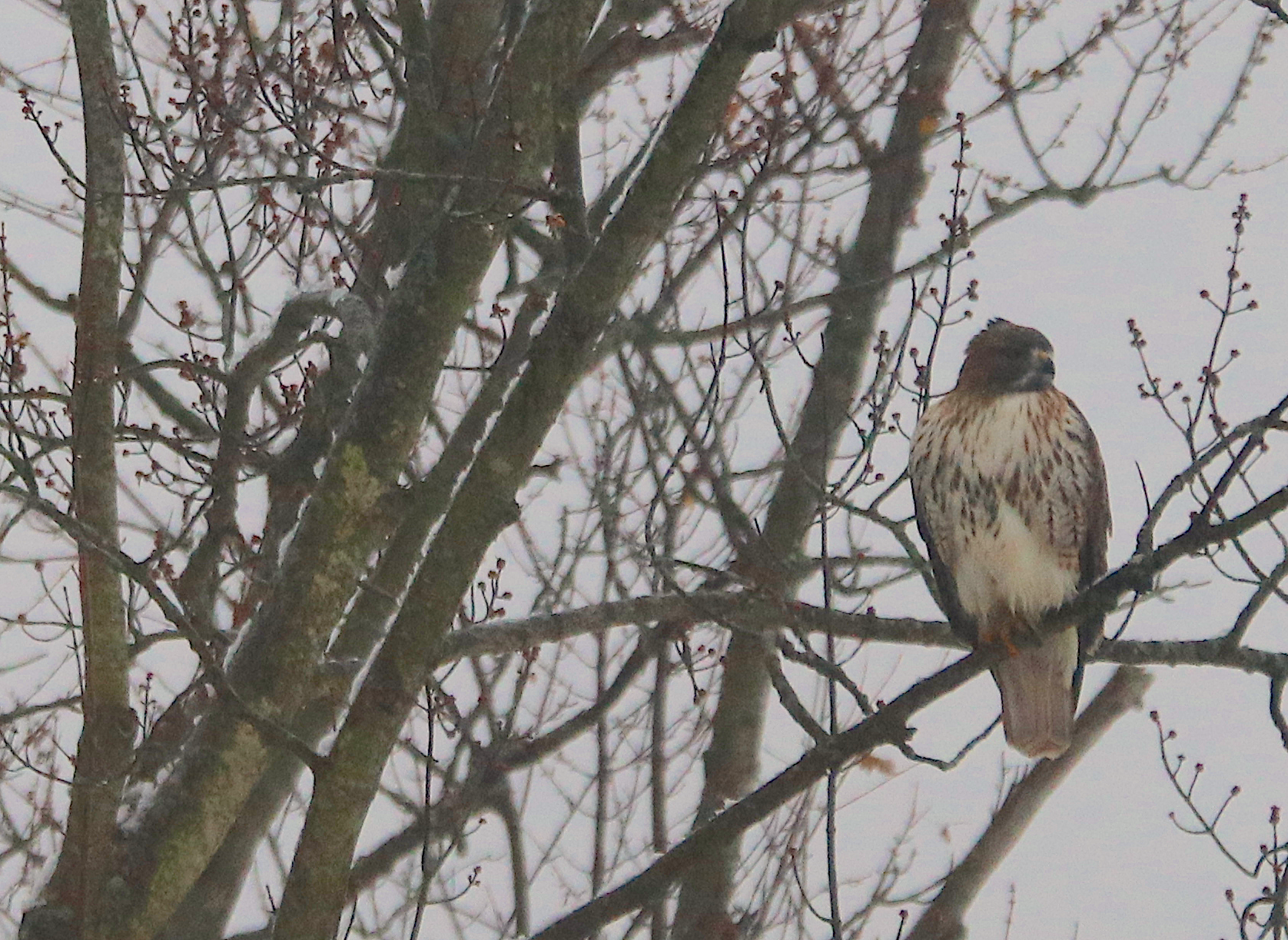
Yet we still have to go about our business. Like a hawk sitting in a soaking wet tree, the day still demands that we get out there and hunt for whatever it is that sustains us. It may require a different kind of motivation, or perhaps just dull determination, but the hunger and need to survive remains.
Through it all, and over the years, I’ve relied heavily on the ability to go out and run or ride or swim to gain perspective and move outside the limitations that depression sinks into your brain. Moving around through exercise makes my mind work in new ways. Then again, it’s a fact that depression can make you not want to move. It can make you want to lie down and sleep instead. It takes courage at times to get out the door. Go do it. Just Do It. Whatever works for you.
I well recall a floormate in our freshman dorm who went into depression and slept for days and days. We’d peek in on him to make sure he was alive. He might have gotten food from a roommate. I never knew. He finally emerged and moved out of his funk. It was hard for him because football season was over at that point. There was no motivation to get the hell out of bed and deal with the dank condition of his mind.
Times change and time changes
Those late teenage years are often the period in life when people discover the meaning and effects of depression. I had a bout with depression during my junior year cross country season that ruined my efforts at the conference meet. I recall the amount of daylight fading toward the end of the season with daylight savings expiring. We trained in the dusk and something sank inside of me. Probably a case of SADD. It caught me at the worst time, and I struggled to break 28:00 for five miles during a season in which I typically ran that distance in close to 26:00. Yet I bounced two weeks later to run as fifth man on a team that placed 8th in the nation.
Fortunately, the world’s comprehension and acknowledgement of how depression affects the world’s population is much more transparent. Public education about depression is doing wonders to help people feel less shitty about having the condition. With that knowledge comes access to hope through coping strategies. Therapy, healthy medications and societal appreciation that people with depression aren’t somehow worthless all contribute to a better world for those involved.
That is refreshing. The stigma of depression is reduced when more people open up about its effects on (and in) their lives. It also helps to learn about family history and realize that relatives in the past or present have dealt with the condition. I’m pretty sure it was the terminally depressed mind of Pete Townshend of the Who that wrote these lyrics to the song The Real Me:
I went back to my mother I said, “I’m crazy ma, help me.” She said, “I know how it feels son, Cause it runs in the family.”
The dark days of depression, like tarsnakes of the soul, can make you feel like you don’t belong in this world. But that’s not really true. What doesn’t belong is the sense that you don’t have worth. Forgiving yourself for that first feeling is important, because the world can make you feel worthless even if you don’t deal with depression. Let’s be plain about this: the world itself can be a depressing place.
Look around you. Covid19 and a manic nutcase of a President here in the United States have made a depressed mess out of the entire country, and for that matter, the whole world. Even his supporters are now depressed because they won’t have their ray of gaslighting sunshine to preach their case of victimhood and rage. Don’t you see that worshipping Trump with all his dismissiveness, criticism and anger is just another way of coping with the depressing realities of this world? This is just people grasping for understanding, and Trump with his slogans and simplistic policies of America First and MAGA appeals to the depressed minds of those who just want their problems to go away. It’s too depressing for them to think of anything else. And too much trouble, in their minds, to deal with it all.
Trump sulks.
Trump salves their collective depression with his downtalking and seeming sympathy for the populist collective mind of disenfranchisement and selfish need for approval. But it doesn’t mean the people who support him are mentally or emotionally healthy in having embraced his inauthentic brand of greedy and dismissive politics. Look at him pouting and emoting now on Twitter. Does anyone honestly think that is the behavior or a sane and healthy human being? It is not. He is a sulking mess of self-pity and fear. He always has been. Now he’s the ultimate Has-Been. Frankly, he brought it upon himself.
And for that, I have empathy for the man. I think he’s got ADD as well. He’s assembled a worldview that enables him to deal with things on a simple and somewhat casual level. But he was never fit for the job that he was granted through his genius for manipulation. That’s the depressing truth in America right now. Trump is way more conflicted and confused than most of us. Some people love him for it.
Those of us who recognize the manic nature of this age know it’s time to move on. It’s enough to make you want to strap on your best fitness gear, step out the door in any condition or climate, and run or ride or swim until you can’t feel the awfulness in your head anymore. Sweat it out like there’s no tomorrow. Depression can’t own you if it can’t hold onto you. Let it slip away and wash down the dark drains of a slushy street.
Given the fact that the “fruit” we call bananas is so common and inexpensive to buy, it is easy to take for granted that the Cavendish bananas commercially available in stores are a production miracle brought to the United States from literal “banana republics” in Central and South America. You can read more about that process here.
For our purposes, it is enough to consider the fact that bananas often arrive in stores well before they turn yellow. At that stage, they are green and not really edible yet. The peels don’t cooperate and the fruit is tough and unripe. It usually takes a day or so for bananas to turn yellow once we bring them home from the store.
Banana farmer
That means bringing bananas to market is all about timing. That means have a plan in place for planting, tending, ripening, harvesting and logistics. Perhaps you can see where this is going. It doesn’t pay to pick bananas too soon or too late, or they’ll spoil before reaching their market destination.
Every training plan for endurance athletes equates to a bunch of bananas. The work of doing the training is the plantingphase of the operation. That’s the base endurance work of building heart and cardiovascular fitness. It can’t be rushed or the bananas will not come to fruition.
The next phase is the tending phase. In endurance sports, that’s a question of protecting one’s health as training loads increase. This is where the banana grows the most.
The third phase is the ripening phase. That’s the period in which quality training work enters the picture.
A bunch of bananas
Each banana in the bunch represents a future race. They may differ in nature, but they are genetically similar because each draws upon your base abilities to swim, run and ride.
The ripening phase is when athletes and coaches need to fine tune their approach to meet the timing of races on the schedule. This takes place when bananas are still in the green phase. That “greening” of the bananas in question will involve time trials and other methods to test fitness and adapt where necessary to bring each “banana” in the bunch to market.
For a triathlete, that could mean a series of races increasing in length; sprint, Olympic, Half or Full Ironman distance triathlons. Or it could be a 5K, 10K or other races in prep for a full marathon. There could be an open swim competition to prep for open water racing. Each race is part of the ripening phase.
The harvesting phase begins as the peak racing season truly dawns. That’s when your training and racing bananas are at their fullest, brightest yellow. And remember, you’ll be out there with people just as bananas as you are. That’s part of the fun and joy of competition.
The first couple races you may still feel a little “green” as your body adapts to the pressures of hard effort. But as the racing season progresses, the bunch of bananas you’ve stored up in your system gets brighter and lasts as long as you can sustain conditions ripe for the plucking. It’s not a perfect metaphor, as real bananas generally last only a week or so. But if you imagine that each race is a banana to pluck and peel, you get the picture.
Cashing in your bananas
There’s also a risk during all these training phases to go a “little too bananas” and overtrain during the tending and ripening phases. That results are then disease or fatigue-driven illnesses such as a sore throat, the common cold, or worse. You can recover from these situations, but typically that means you’ve sacrificed one or more of your carefully tended bananas. You’ll have to move on to others in the bunch.
Then there’s the “banana peel” of injury as well. That comes from trying to go “too fast, too soon” or doing too much volume. It’s obviously easy to peel a banana apart during periods of great excitement. That’s known in running parlance as “leaving your race on the track.” If hard intervals or speed work are done too hard or in too much quantity, the body flares into peak condition, then goes stale.
All that gets you is bragging rights about being the Big Banana in training. We all know someone like that. Remember, it’s not all about the size of the banana in this world. It’s what you do with your bananas, and how to use them. Don’t slip up in this category because an injury can turn all the bananas in your bunch rotten in a hurry.
Anyone that has trained a long time also knows that after the harvest and logistics phase in any bunch of bananas, there comes a point when the bananas start to develop spots no matter what you do. At that point, the insides of the fruit go soft and brown. The appetite for racing and competition wanes. It’s time to cash in the bananas at that point and make banana bread or a smoothie. Let the body rest.
There you have it. A model for understanding the the “appeal” of a training plan built in phases.
These days, with Strava and Garmin and MapMyWhatever to track our every movement by satellite, it seems quaint to think back to a time when all we had to document our efforts was a stopwatch and personal perceptions.
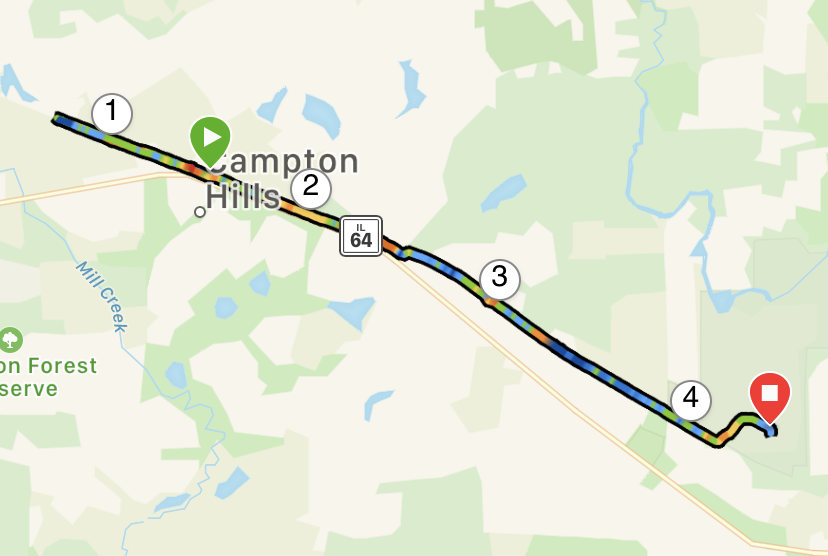
This morning after our eight-mile run together, my wife and I could compare everything from the length of our strides to the cadence used to execute those strides. We compared average heart rates before, during and after the run. We ran the same pace together, so that wasn’t really fodder for comparison. But we did have fun looking at the color-coded pace map on the out and back course of the Great Western Trail. It resembles a candy of some sort.
All this data is fun, for sure. Every effort recorded through my watch blasts out from Garmin to Strava, where people offer Kudos and repetitive efforts can earn athletes a Local Legend rating. The app is doing everything it can to get people to stay engaged in hopes that more people will invest in deeper data and actually pay for the service. I do plan on doing that, because I don’t think it’s fair to usen that technology without paying something back to its creators.
No data geek
While I appreciate the information, I’m not a complete data geek these days. But long ago, when I first started running, I did document race efforts according to my own standards. There was a purpose to all this that I’ll explain in a minute.
Racing log from 1972.
The image above is a picture of the racing journal. It was kept on a single page of art paper during my sophomore year in high school. I finished the year tied for Varsity points with a senior named Bill Creamean. But the most fascinating thing about this racing journal is the honesty by which I measured my own efforts. In some ways, the criticism I leveled at myself was far more empiric in value than whatever raw data I might have gathered during these races if it had been available.
Typically the only feedback we received during races were split times at the mile markers. Many races, we were lucky to receive even that. We ran “by feel” and learned to associate closely with the sensations coursing through our bodies. The fact of the matter is that if you didn’t learn how to read your own body you would crash into reality––with often calamitous results. Those were lessons learned. Trial and error.
Of course, the real goal was learning to face that fact and still try to exceed your own expectations. When those breakthrough efforts came about, you had to analyze what led you to achieve them. Without data to study, it came down to a simple formula: Confidence > fear.
That type of internal “data” is what really counts in the end. Is your confidence greater than your fear? No amount of data teaches you how to build those instincts. You have to learn that formula on your own. Yes, the workouts tell you where your potential performance levels are. But you still need to go out and put that information to use.
That journal in the picture above is a chronicle of how confidence builds through trial, error and success. There’s great value in that.
Let’s talk about aging faces. I have no real way of knowing the age of the people who read this blog. There are about 1500 subscribers, and there are some who don’t subscribe but read these words through social media and other portals. But no matter what age you are, we all deal with the aging on our faces.
When you’re in your tweens and teens, those facial changes have profound impact on your self image. Getting zits and growing facial hair is a part of growing up. Dealing with tweezed eyebrows and the right makeup mix, or watching a callow jaw shift to manhood are all part of the process. Hair length also affects how facial changes are seen.
So the process of dealing with our aging faces starts early in life. Add in the impact of getting braces on your teeth, or in my case having a baseball accident smash a front tooth, and the changes never cease.
Those of us that compete in athletics put our faces through an entirely different kind of strain. The grimace lines wrought by the pain of endurance sports begins the process of forced aging that continues throughout our lives.
The effort shows in our faces.
So perhaps it’s time for all of us to take a healthier form of pride in that aging face we see in the mirror each day. That face of yours has so much to tell about all what you’ve gone through. There is laughter, joy and excitement. There is sorrow, fear and depression. All in the same face. It’s a wonder we don’t wear them out with all these emotions.
In recent years, I’ve worried that the look of my face has begun to limit opportunities in life. The ugly specter or ageism creeps up on you secretly. People aren’t going to tell you to your face that they consider you “too old” to do a job or fit into a workplace culture, but it happens. By law, age discrimination is illegal. Yet we all know that it still happens.
Wattled and tired
I was sickened one day while reading an article that popped up in my social media feed. A younger writer crowed that he wants nothing to do with people whose faces are “wattled.” That’s a disqualifying factor in his mind. His thinking seemed to be centered around the idea that if someone looks old, they must be unable to think clearly or creatively.
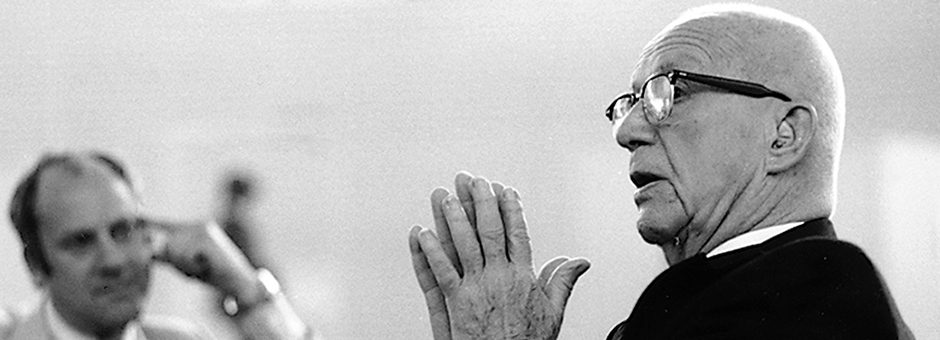
That would be news to millions of people throughout history whose contributions to this world continued or even began in their later years. I think in particular about the life of R. Buckminster Fuller, one of the most creative yet practical individuals to ever live. One of my favorite quotes by Mr. Fuller evolved from an experience of intense sorrow and near defeat in his life. He’d experienced a great personal tragedy and was depressed beyond imagination. He indulged in a period of intensive personal isolation to figure out what to do next and emerged with a vision of new purpose, “You do not belong to you. You belong to the universe.”
He used that perspective to face the world in a new way. Among his many inventions were the geodesic dome, a mathematical breakthrough in architecture. His influence and thinking continue to expand to this day. No one cared that he looked young or old. What matters is how he thought. We all need to grab that truth and never let it go.
We should also never forget that our faces are attached to our bodies. Today I read an interesting article in the Chicago Tribune about the fact that people who do something more than walking in their exercise routines wind up having better efficiency and posture as they age. While walking is beneficial, it doesn’t stress the body in the same way that cycling, running or swimming do. It’s the classic training principle that applies to life itself: you have to push past your boundaries to gain the most benefit.
That seems to be the principle at work when we consider the condition of our faces as we age. If you’re engaged and passionate and pushing yourself to continue learning and trying new things, it shows in your expression and even the condition of your face.
Facing life
Until a few years ago, I’d never heard the term ‘resting bitch face’ applied to the baseline expression of someone who looks dour or unhappy all the time. Is that term as bad as dissing someone through ageism? It certainly seems cruel. Yet there is a reality at work in how we project our emotions through our visage. I’m perpetually aware of the value of smiling during conversations with people.
That’s especially true in business situations. I once had a boss tell me, “I like you a lot more when you’re smiling.” He was right. I wasn’t a happy person during that period. My late wife had just experienced a recurrence of cancer and had a nervous breakdown as a result. I was scared, felt alone, and had little tolerance for the daily vicissitudes of business, which seemed so insignificant compared to what was going on at home.
Those internal conflicts showed in my face. There was little I could do about it at the time. Just put on the best face I could, and get through it.
Facial control
So we perhaps don’t always have control of what our faces say about us. There’s always the possibility that a person with a ‘resting bitch face’ has gone through so much in life their face reflects that path. But then again, some people develop attitudes of victimhood and duress that dominate their existence. There is such a thing as becoming so bitter about life that it shows in everything you do.
I’ve got enough life experience now to look back and understand the causes of the challenges I’ve faced in life, and the reasons for the mistakes I’ve made. I’ve come to realize that a native anxiety affected many of my decisions. So did a likely associative form of ADD, a lifelong challenge that often determined the manner in which I processed information, or did not. In summary, I’m proud of having dealt with these challenges and adapted to succeed in some ways along the way. It all comes with knowing yourself well enough to accept past mistakes and not let them rule the present.
I can look at my face in the mirror now and see all sorts of experiences etched there. I see miles of training and racing, and the self-belief emerges from all those tests. But they keep coming. A former coach once told me, upon hearing that my late wife was diagnosed with cancer back in 2005, “Your whole life has been a preparation for this.”
He was quite right. That coach later faced cancer himself. He passed away a few years ago. The thing I remember most of all about him is still his face. I don’t see him as young or old. There’s a spiritual aspect to that, I believe. Take pride in that aging face, no matter what age you are.
When my kids were little, we played a game called I Spy in which we named something in the room and the other person had to guess. It was particularly fun during the holiday season with the Christmas tree stood in the living room and we’d take turns picking out ornaments and giving tiny hints about what we saw while the other person tried to find the right ornament.
Focusing on details like that is fun while you’re tucked into a living room sofa with the lights down low and a warm kid snuggled up against your side. I so well recall the feel of their soft hair as I stroked their heads. They’d cuddle against me with a finger to their lips concentrating on finding something they hoped I could not guess in the I Spy game.
We also had a collection of I Spy books illustrated that featured photo compilations of objects like two full pages of old Teddy Bears. It was just as fun playing with those books as it was picking things out in real life.
I Spy the world at large
In many respects, I often play a game of I Spy while out running and riding. Every training route has its share of familiar objects. I can always add to the game by scanning the world for birds of various kinds. Being a birder means never having to struggle for entertainment in this world. Everywhere you go, there is something to find. Go to a different part of the country and it’s an all-new I Spy game. That’s how I approach life in general.
Last night while walking the dog at twilight, I stopped for a moment to look at the eastern horizon. At that moment I cared not about the details in front of me. What caught my eye was the purplish shadow of the earth itself as the sun went down. That shadow and the horizon line express the bottom portion of a geometric phenomenon known as the azimuth: “the direction of a celestial object from the observer, expressed as the angular distance from the north or south point of the horizon to the point at which a vertical circle passing through the object intersects the horizon.”
The diagram at right better explains what an azimuth is. My main point here is that we’re all subject to a limited perspective in this world. Even math doesn’t explain it all. Sometimes I shudder at how naive I am about things in this world that others clearly understand. On some things I consider myself a reasonably smart person. On other things I recognize that I am nearly hopeless.
Playing I Spy with my children taught me that we’re all involved in a perpetual struggle to see the world in new and better ways. But if you want to feel really small, wait for that moment when the sun goes down and you can see the shadow of the earth fading off into the heavens. We’re all perched here on a small orb in the vastness of space. I Spy infinity.
In my life I’ve run and cycled the equivalent of traveling several times around the earth. Yet in many ways I’ve gone nowhere, I know] nothing and am left playing a game of I Spy in a world where innocence and ignorance are the price you pay for merely opening your eyes.
We often lose our sense of wonder as we age. It’s easy to become ambivalent. Feel like there’s nothing new under the sun. Regaining that childlike regard for the world is difficult, especially when life’s pressures crowd in from all angles.
All I’m saying here is that it pays to look around you, take stock and soak in what you’re doing while you’re doing it. Playing I Spy can keep you alive and thriving in this life.
We ran a long way in the wind and rain yesterday. Fortunately, the trail we use sits down in the Fox River Valley, providing shelter from the storm bringing gusts of 20-30 mph.
At the start, a spitting mist struck our faces. Then it full-out rained a little. Eventually it stopped. In places where there were gaps in the trees, the west wind buffeted our bodies, throwing us off stride. We laughed.
Sue was running fourteen miles. I was doing ten. At the five-mile point, we paused to exchange a kiss and she went north while I turned south. We got to share some fun suffering before heading off for our own workouts.
We commiserated on the conditions once we arrived back home. I was already showered and reclined on the sofa when she came in through the garage. Our dog Lucy leapt up to give Sue a set of hearty kisses.
“That shower will feel good,” I called out to her.
“I’ll say,” she replied.
We’ve shared many such workouts over the years. The process of sharing fun suffering is what we like to do. I confess (at times) to thinking back to our warm bed during some of these early morning runs and rides. Spending time in each other’s arms and then going out to test the heart and lungs in every season is a fuller way to live. My male mind sometimes recalls sweet sensations as we truck along together at 5, 10, 15 or 20 miles or faster. The fastest we’ve gone together is 43 mph down a long hill in Wisconsin.
Love is both a patient and speedy thing, it seems.
We all ache for connection in this world, building relationships around all sorts of experiences. Sharing in fun suffering is one of the best ways to get past the shallow and find a deeper sense of purpose, even if it means nothing to the rest of the world. We have our problems and challenges in this world like everyone else. Fun suffering is just another way to get through them.














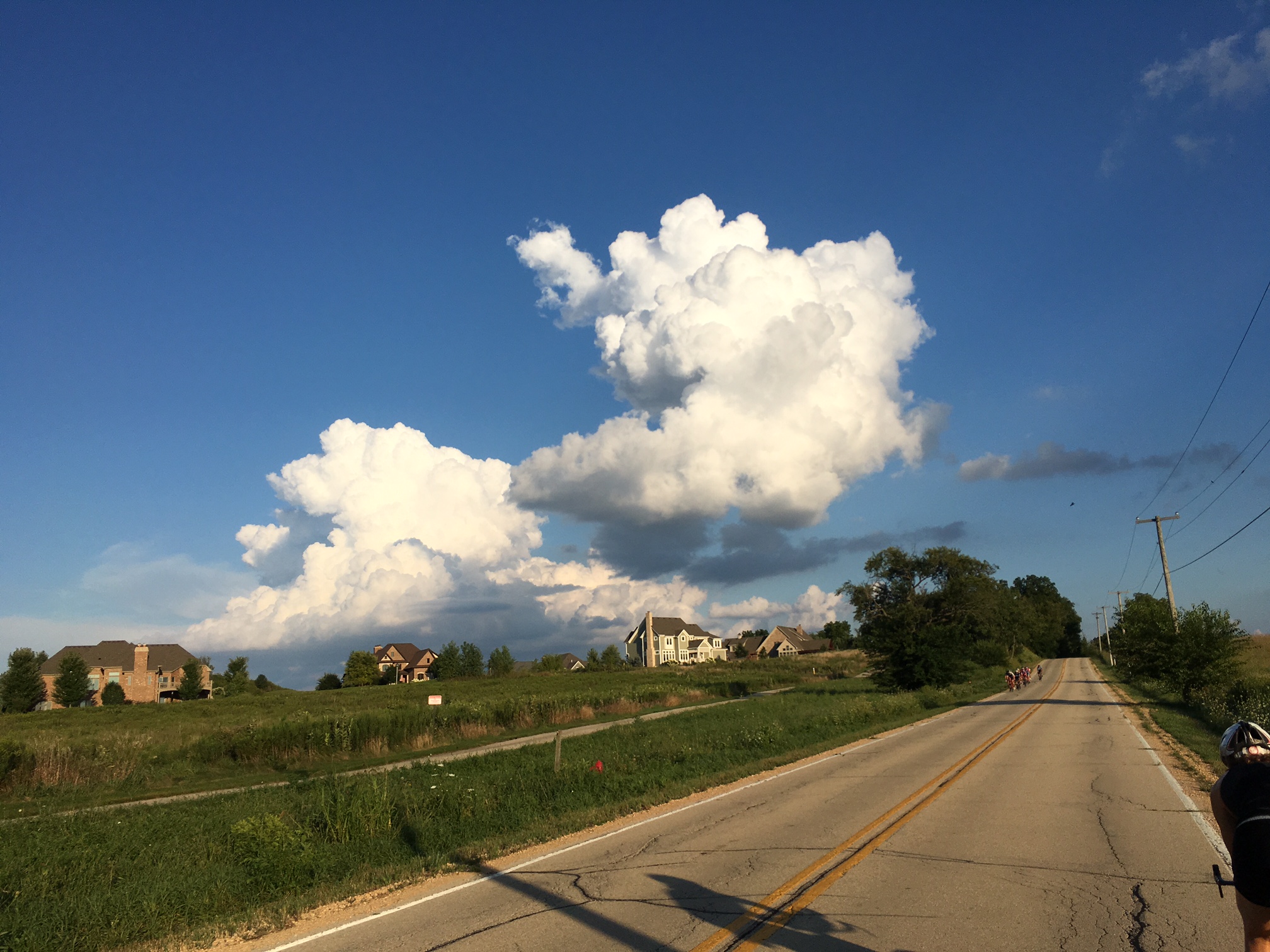


 We Run and Ride