The spring track season in 1976 broke typically cool, windy, and wet. Not great weather for any type of runner. The sprinters sought to avoid muscle pulls while the distance runners suffered in shorts through cold winds, puddles on the track and the pangs of not-quite-fitness in the legs and lungs.
That said, I decided to make my track experience even tougher that freshman year by competing in one of track and field’s most challenging events: the steeplechase.
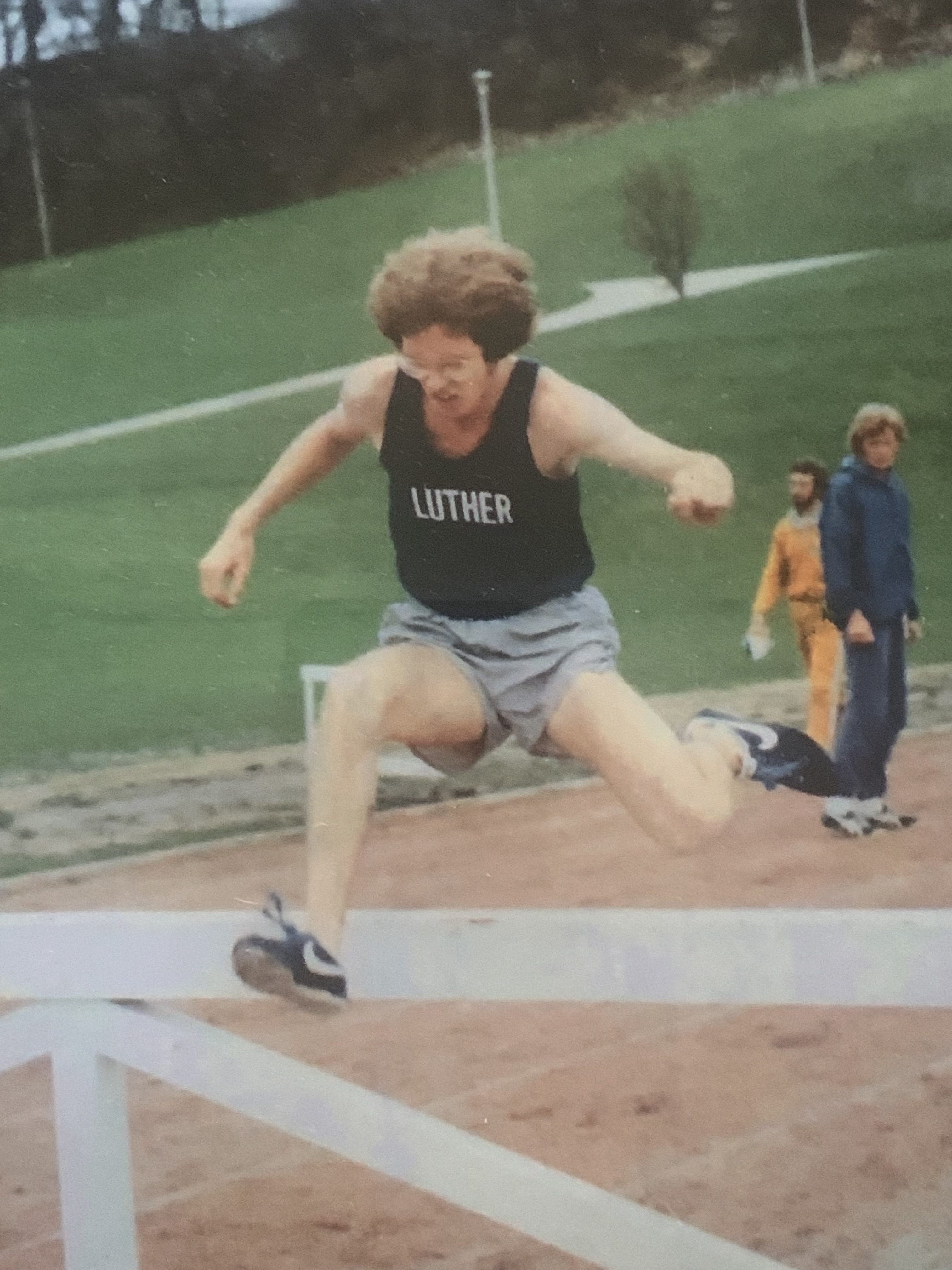
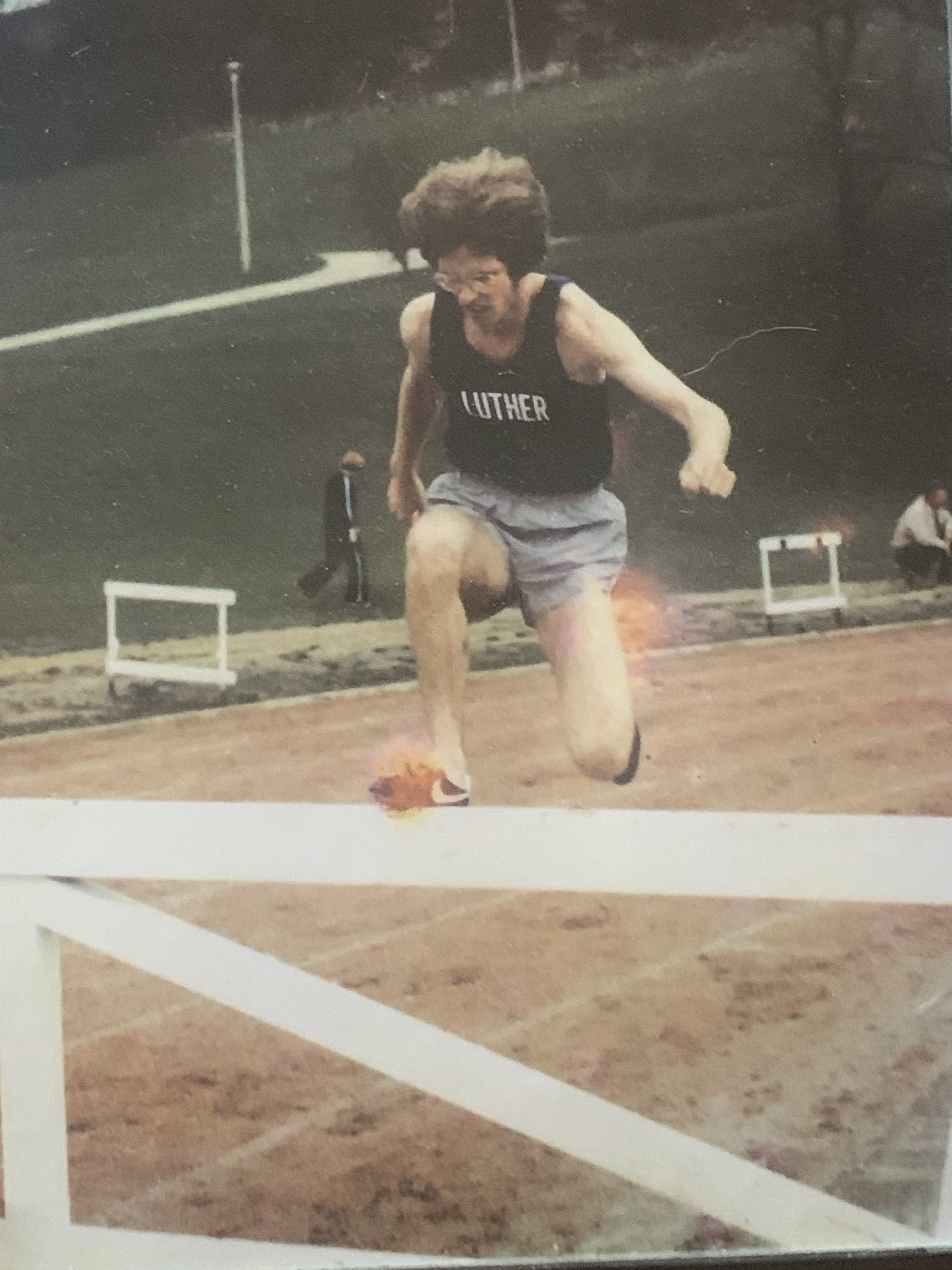
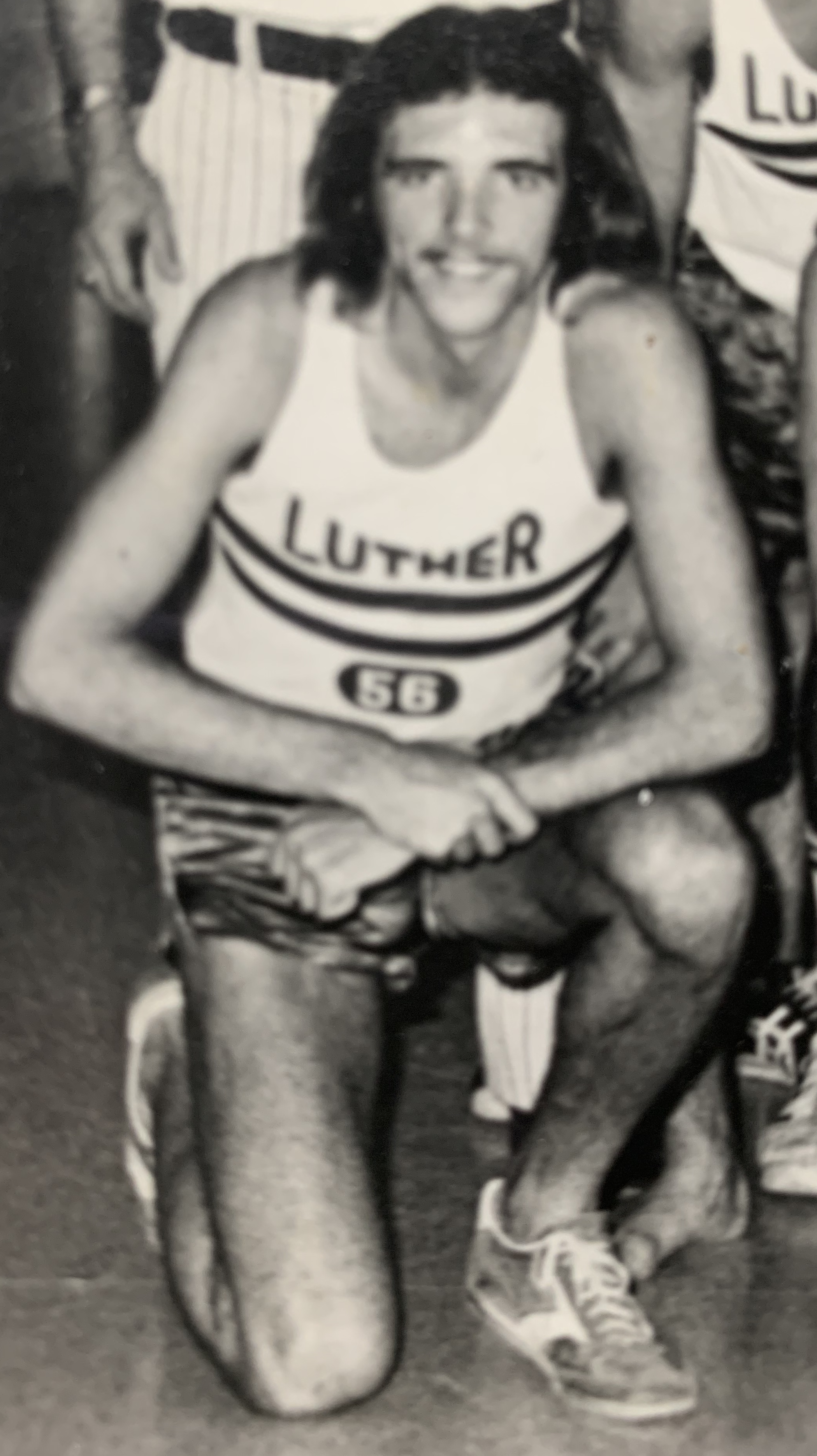
Competing in the steeplechase at Luther in a year when the grass runup was too soaked from rain to do the water jump. We jumped an extra barrier in the rain-drenched inside lane.
My background as a multi-sport athlete helped me adapt quickly to the steeplechase, a race that involves running 3000 meters over 35 barriers (42″) and 7 water jumps (with a 12′ zero-depth pit). Growing up, I always liked making obstacle courses. The steeple felt natural to me.
I loved running up to that water barrier, stepping on the top and flying out over the water. If the pit was set up properly, there was about a one-foot gap between the water and the end of the pit, so I worked at landing in that water-free zone. That way, my lead foot would not get so wet.
I’d been a forty-foot triple-jumper in high school, so I had good hops. My hurdling form needed work, as I’d not hurdled much before college. But in terms of inspiration, I was following in the footsteps of a cross country teammate Dave Hanson. He’d been an All-American steepler for Luther the year before.
My best that spring was not that consequential. We competed at several tracks where there was no steeplechase bit at the track. In that case, the meet organizers simply put another barrier on the track where the water pit would have been. That was not nearly as much fun. Still, I won a race and finished well in all the others.
I later used my steeplechase hurdling form to run the 400IM hurdles.
But the Iowa Intercollegiate Athletic Conference had not yet added the steeplechase event to the final meet of the year. As I learned just this year from Coach Bob Naslund, the other schools in the conference were not keen to give Luther’s distance runners one more event in which to rack up points.
Lacking a spot in my event, I looked around at the other distance events and realized that the top three spots in the mile, three-mile and six-mile were all taken. That was the last year in which we ran yards instead of metric distances.
So I was stuck without an event for conference. But I’d been high-jumping off and on that spring, so I competed in a jump-off and won the third spot.
Then I overheard that there was going to be a run-off for the third spot in the 400-meter hurdles as well. I told coach Naslund I wanted to run the event and showed up for the trial during practice.
My steeplechasing taught me decent hurdling form. Not super-efficient, but I could get over the hurdles with minimal loss of speed. Part of me felt bad jumping into the trial because there were three other guys that had been doing the IM hurdles all spring and wanted to race at the conference meet. But I wasn’t going to be deterred.
I ran 59.6 in that hurdle trial, earning the third spot on the team. At the conference meet, on an all-weather track, I lowered my best to 59.2.
Stepping on the barrier was a safety precaution in really wet track conditions.
God, that race was difficult. There are few events that so thoroughly exhaust your legs as the 400M hurdles. It is extremely difficult to get that last jump over the hurdle to fit in your stride pattern. Miscalculating can put you face-first on the track. But I managed to run well enough to have an assistant coach ask if I wanted to run the event the following year.
I don’t think that would have worked out. My basic 400 speed was only just sub-55. I retreated to distance running and the conference held a steeplechase the next three years. I won the race my senior year, and may have won in previous years as well. I don’t recall. My job was to earn as many points as possible to help Luther win meets.
Challenging the freshman squad at Luther was admittedly a “makeup game” for an aborted career during high school.
Between cross country season and the start of indoor track at Luther College, I’d often play pickup basketball in the gym. While I’d ceased my official basketball career after junior year in high school, my game actually improved because I was a Gym Rat by nature. All winter long, my brothers and I would hit open gym on Saturdays and Sundays to play basketball all afternoon. We’d start at noon and play all day until the gym closed at six p.m.
Playing basketball was great cross-training for track, plus it provided a consistent outlet for competitive energy. The proprioception was good for the legs, and an excellent injury prevention measure. I later read that world-record holder Sebastian Coe spent 6-8 weeks doing bounding and strength drills. Well, I’d play basketball all winter and be ready for indoor track come January and February.
At Luther, I was in great basketball shape in late January when I walked past the freshman college team practicing in the gym. A friend of mine and former high school teammate played on the team. I stood there thinking that it might be fun to scrimmage them if I could put a team together.
Back at the dorm that afternoon, I started asking other expatriated basketball players if they’d like to scrimmage the freshman team. There was immediate enthusiasm for the idea, and I recruited all the best athletes I could find. We had some big guys too, for the rebounding. We set up a time with the freshman team, and it was game on.
The romantic plot would have our hardscrabble dorm team winning. That did not happen. We played even with them for one half of basketball. Our street ball carried us that far, but the freshman team pulled away in second half. Raw talent does not often win out in the real world of sport.
That said, there were some joyous moments during the game. One of our long jumpers, Jeff Wettach, came flying down the court to pin a layup against the backboard. We worked up some plays that were effective the first half. But as our big guys tired, the rebounding was a lost cause.
I scored nineteen points in the game, so I felt personally satisfied with trying that proving ground on the basketball court. I think there was a score to settle within myself. The whole thing was a bit of a prick move on my part, sort of trying to make up for faltering in basketball during my high school years. From then on, I settled into pickup ball never wondering whether I could compete with “real” ballers. I’d proven that I could at some level. Yet I knew that real college ball was a ton tougher than some scrimmage on a Saturday afternoon. That was all I needed to move on in life.
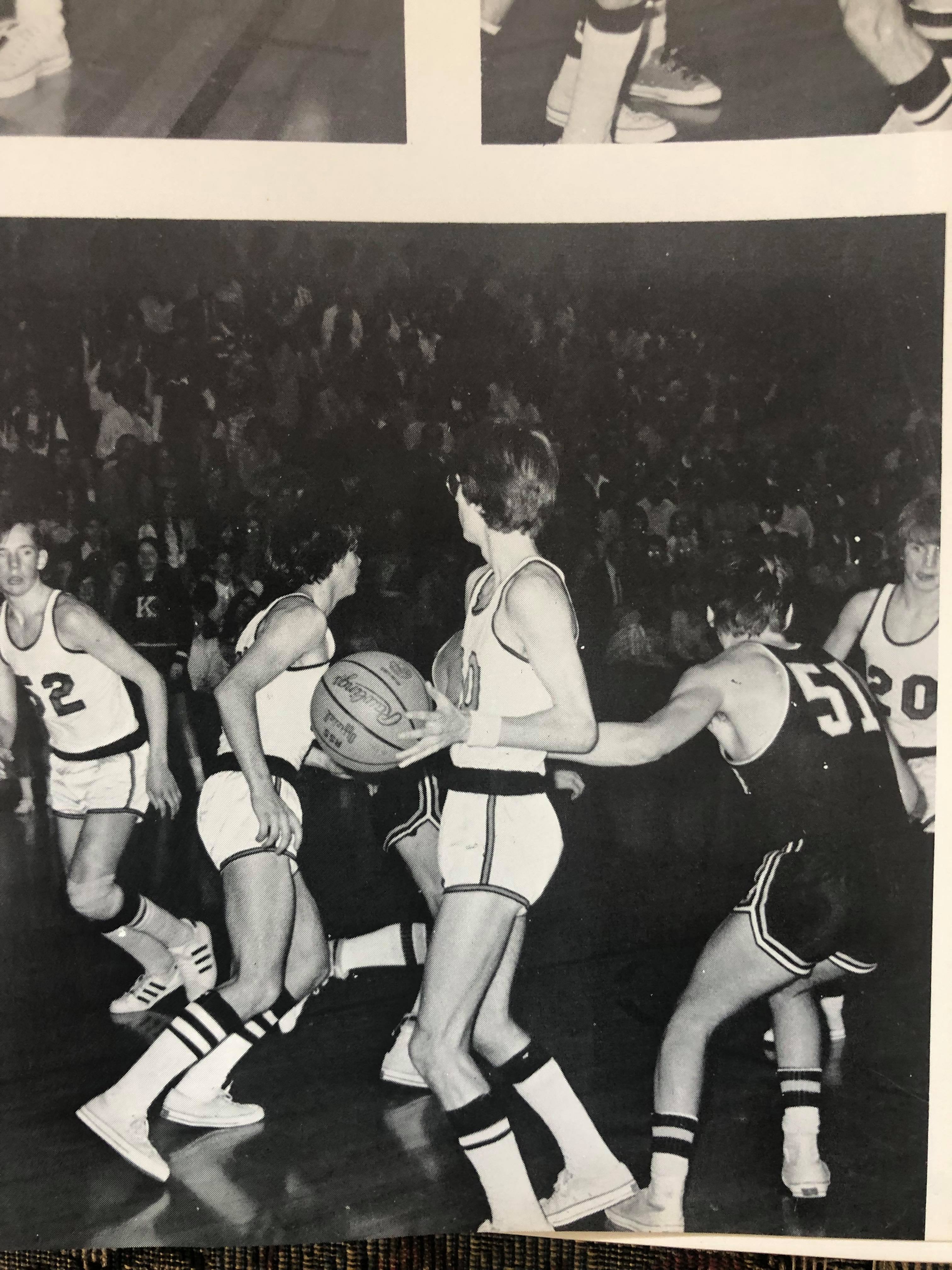
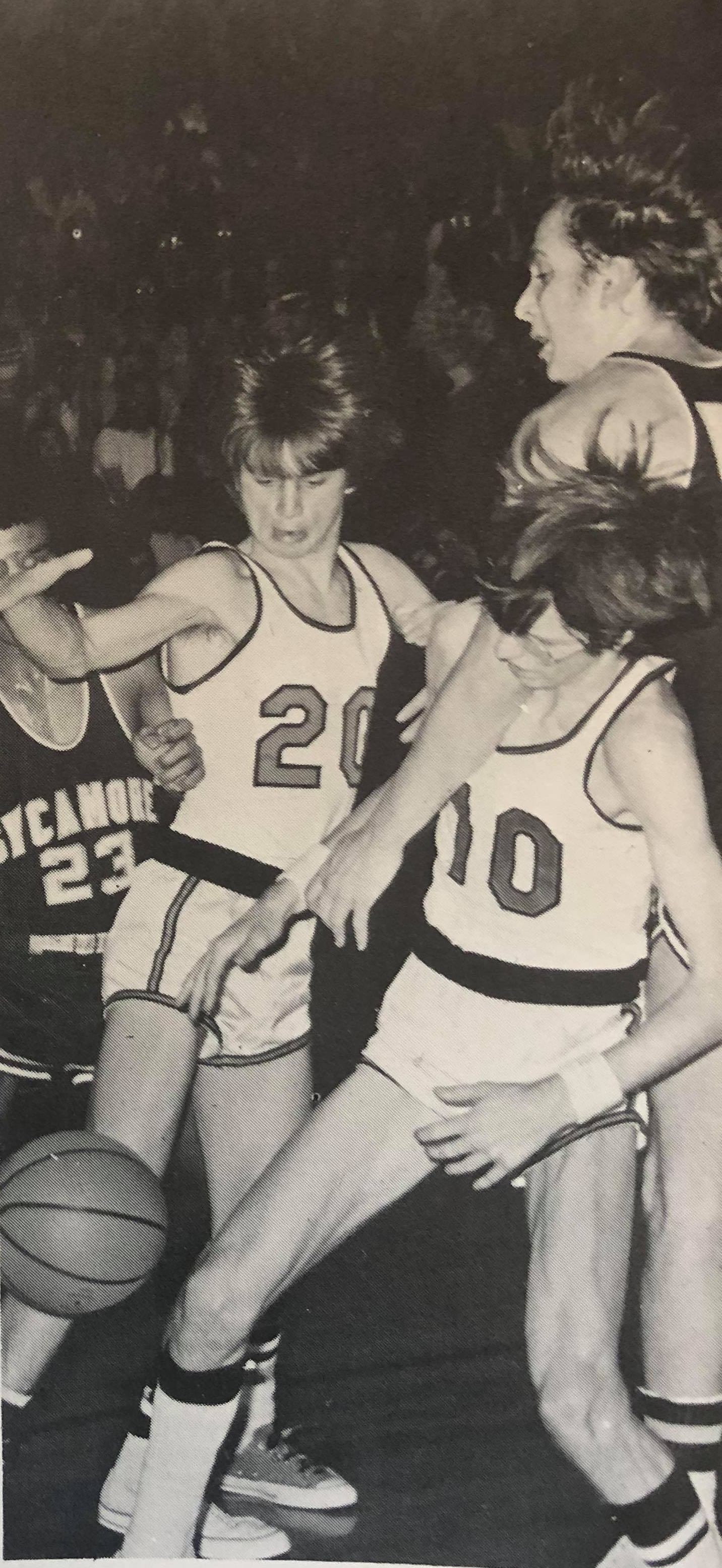
Hoops was always a good way to let off steam in the gym. This photo from my sophomore year in high school shows that I was never afraid to mix it up. (#10)
By that point in time, the indoor track season was calling. The month of February rolled around and our team started traveling to meets in LaCrosse and other colleges with indoor facilities. My basketball fitness proved helpful when racing on the 176-yard indoor tracks with tight turns and slippery floors.
I also high-jumped some, but by college standards, I was a below-average jumper, clearing 6′ 1.5″ at a LaCrosse dual meet. That day, a gymnast-style high jumper from LaCrosse was experimenting with a handspring style of high-jumping. He ran straight at the bar, did a frontwards flip, and then dove over the bar. There was one problem with his technique: no one could tell if one or both of his feet were striking the ground on takeoff. The rules state that high jumpers must use only one foot to leap. That said, I watched that guy jump seven feet, but he was disqualified for improper takeoff.
I ran the mile and two-mile at most indoor meets and took the baton for relays. As a freshman, I was approximating my best high school outdoor times on the indoor track. All winter we trained through snowstorms and freezing cold weather. Every night after showers we’d march from the fieldhouse up to the Union in sub-zero temps and my big head of hair would freeze solid like a helmet.
Then we’d scarf down dinner and kid around until it was time to head back to the dorms and study. But most nights I’d go play ping-pong with my friend Jim Nielsen. After that, I might get around to studying.
All that distraction with basketball and table tennis and kidding around was still better than going out drinking every night. Still, I do recall a fun evening with my friend Dave Hanson and some other teammates. We retreated to some downtown pub and had a few 50-cent beers. The joint had blank walls on which everyone was drawing pictures, and the bar welcomed it. So I drew a hot-looking nude girl on the post and we all had a good laugh about it. I remember walking back from the bar on a freezing cold Northeast Iowa night without many cares in my head. The beer in my brain and the stocking cap on my head was enough to keep things warm.
Then March came around. Indoor track was over and it was time to face the real world again.
Once the cross country season was finished that freshman year at Luther College, I experienced dorm and campus life without the daily commitment of early morning runs and afternoon practices. That was liberating, to some degree. It left time open to do and try other things.
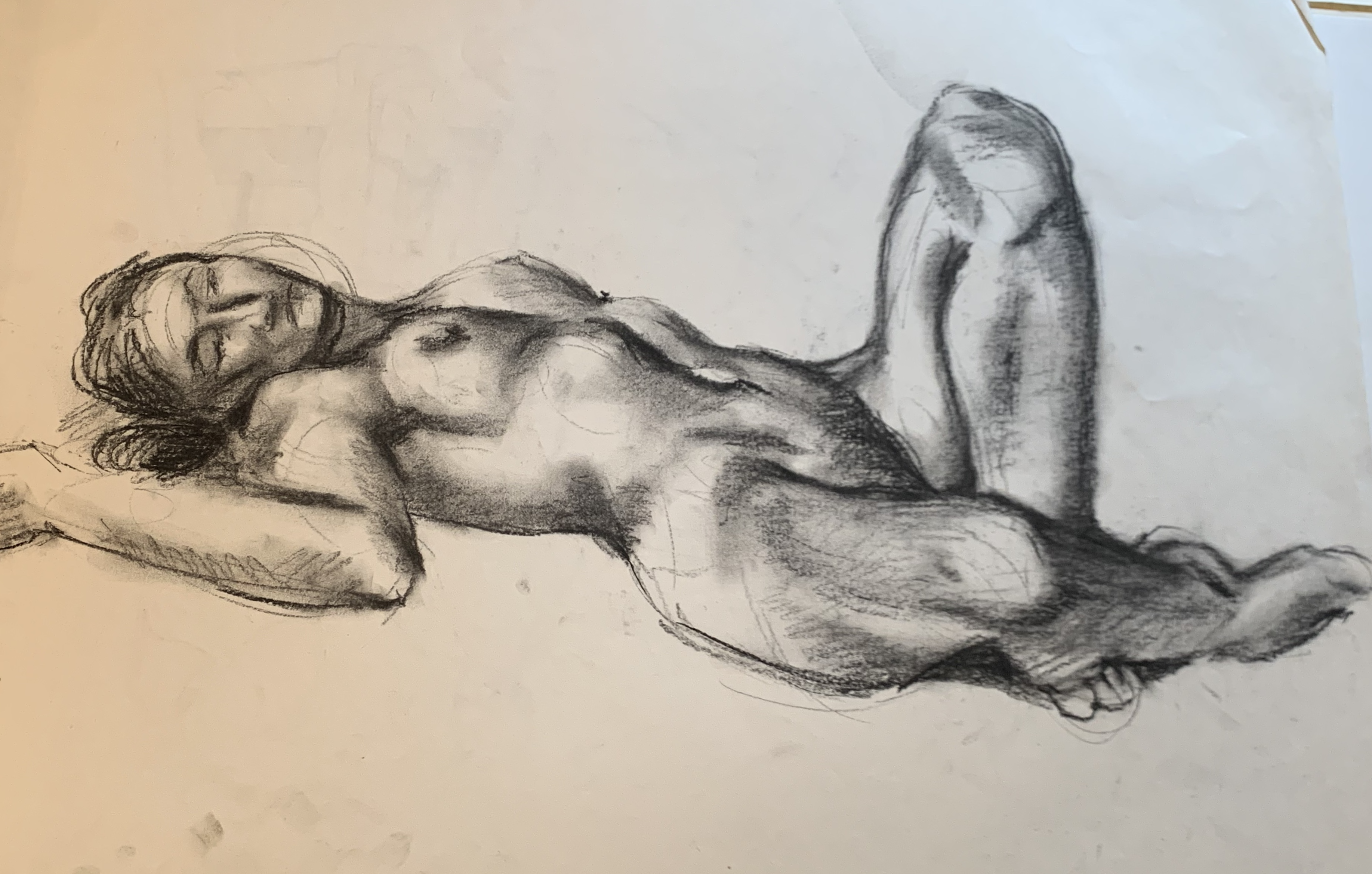
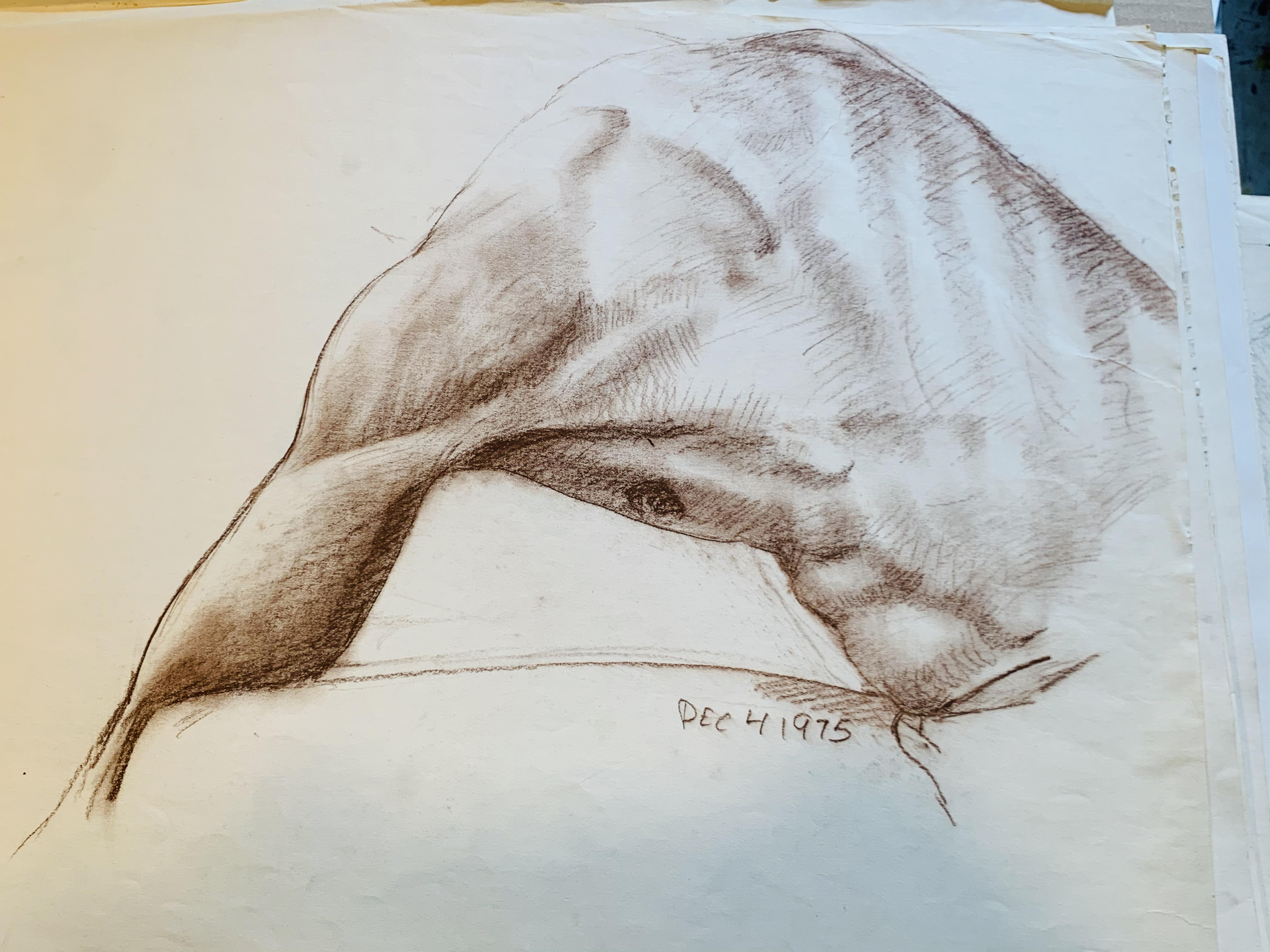
Following the winter break for Christmas, I returned to school for January Term. At Luther, that meant taking a single subject for three solid weeks. I chose a life drawing course. Six hours of drawing a day. I loved it.
A life drawing from January Term, 1975
Being able to focus on one subject like that was both absorbing and amazing. Our teacher John Whelan played classical music, to which I had not been much exposed, and we drew for three hours in the morning and three more hours in the afternoon. I’d never drawn live, nude models before. It was challenging to manage proportions and the subtleties of the human figure, especially women. Admittedly, I’d not seen fully nude women standing before me. Yet I can say that the experience in that environment was not sexual for me at all.
I can’t say the same for my dormitory brethren, who often gathered around my room when I returned from class. “What did you draw today?” I’d get asked. The guys all wanted to see naked women. All I wanted to do was learn to draw better.
A life drawing from January Term, 1975
We also had male models, but they were rarer. I recall the first day a man modeled nude for the class. I could see the women working their way around the drawing until they were almost forced to draw the crotch. Who can blame them? Dicks are kind of weird, especially when you look at them for a while.
Come January, our indoor track team started practicing. Our distance team ran 6-10 milers daily from the fieldhouse. The gravel roads around Decorah were covered with a layer of crushed snow and ice. We learned to navigate those surfaces even in the dark. We’d head out into the twilight at 4:30 and run as a pack through the gloom. Often the road ahead was quite visible even in near darkness. The cold was a challenge, as our equipment was basic; cotton sweats and layers worn as strategically as possible. One night a teammate forgot to wear nylon shorts underneath his cotton sweats. The sub-zero wind cut through his sweats and he feared getting frostbite on his crank. Not knowing what else to do, he stuffed a hand down his pants and ran that way home for several miles.
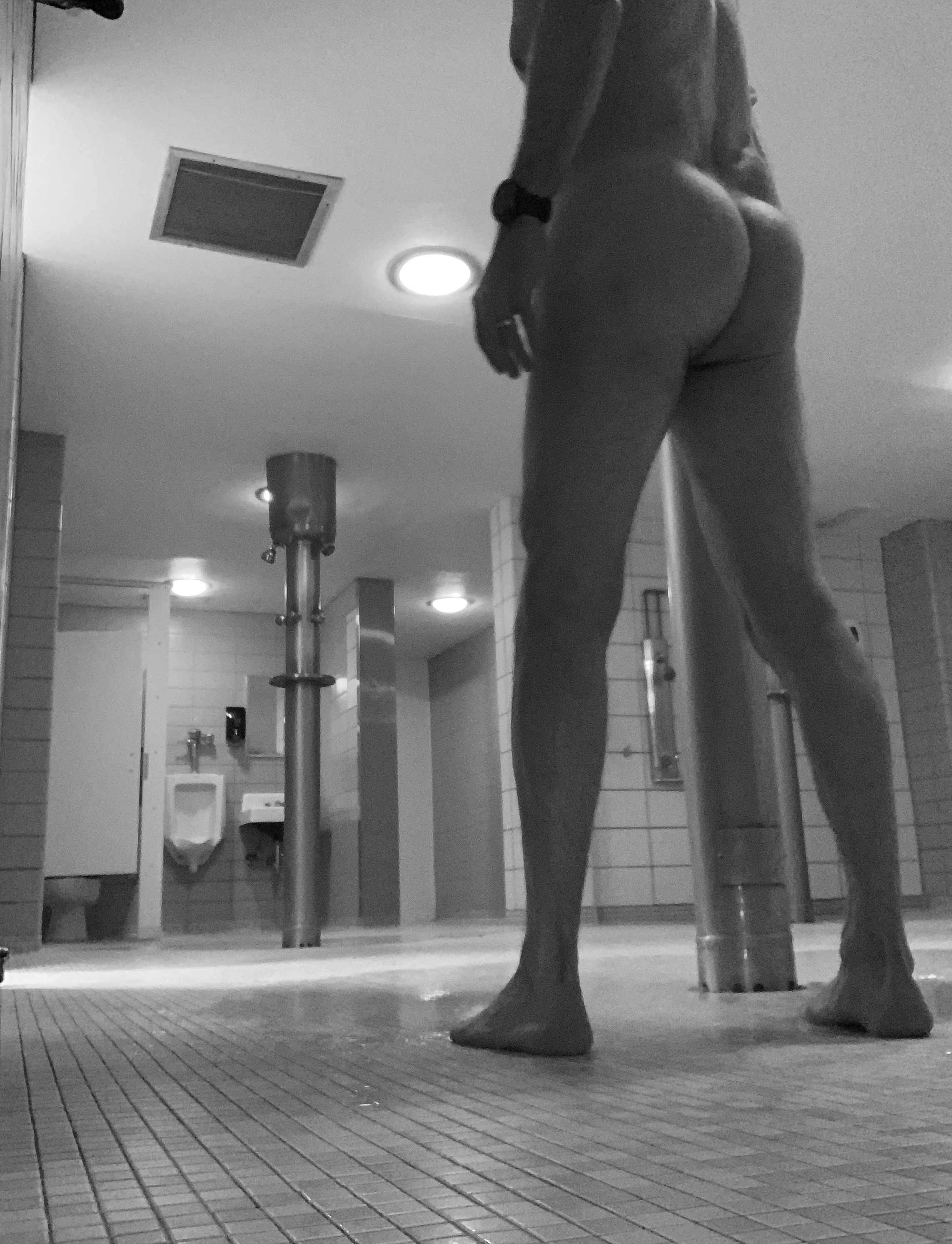
Our facilities at Luther consisted of a central set of lockers and a rack of showers around which we’d all stand waiting for the water to warm up. It always took a while on those cold winter nights, so we’d stand there telling jokes or talking about upcoming meets. We never thought much about the fact that we were naked. The locker room environment was not a big deal. I’ve gone back to Luther many times over the last 40+ years. Those basic showers are still in place. The water doesn’t warm up much quicker.
These days, athletes in high school and college often ignore locker room facilities to shower elsewhere. Somewhere along the way, young people were convinced that showering together was a bad idea. What caused that change? Was it fear? Embarrassment? Comparison? Naked lies about some aspect of being naked? It all seems silly.
The Luther locker room showers where we never thought much about being naked.
Well, times change. But in other ways, they don’t. During that era, those life drawing classes at Luther were still a tiny bit controversial. To some people, the idea that Luther students should see naked people every day in class upset the more conservative factions of the college hierarchy. Yet there we were, walking about the locker rooms completely, stark, raving naked. It was hypocritical to object to nude figure drawing. There was apparently particular concern about the presence of male models. And, it was strictly forbidden to have male or female students pose nude for the art department. Our nude models came from the community around Decorah. We got to know their bodies particularly well, male or female.
Modeling is not an easy job. Holding a pose for a long period requires discipline. We grew to appreciate our models for their dedication, and frankly, their professionalism. Still, the guys back at the dorm still just wanted to see them naked.
Yet Luther was not about to stifle the realities of life in the 1970s. One of the weekly movies chosen by the Student Activities Committee to show in Valders Auditorium was the adult film titled Emmanuelle. Most of us had no idea what was coming, so to speak, and the sex scenes were quite illicit. We walked out of the science hall a bit dazed and extremely wound up. We were all a bit wiser for the experience.
The young Sylvia Kristel starred as Emmanuelle.
We all spilled out into the night a bit horny and crazed after having watched that film. Some knew what to make of it, while others, like me, wondered when something like that woman might enter our lives. The pack of us skinny runners weren’t the top pick of the litter at the bars, but somehow some of us found our ways into the arms of a woman or two. Those efforts were the center of discussion on many a long run. Who got laid? Who didn’t. We all wondered if we’d find our own Emmanuelle.
A scene from the movie Emmanuelle.
For me, it was quite a leap from those graphite images that I created on my art room table and the graphic images of Sylvia Kristel on that movie screen that night. Without a woman to bridge that gap, I was left to run it all off and hope that someday a real woman would fall in my lap. Such is the loneliness of the long-distance runner.
Following a successful conference meet, our team earned a trip to Nationals out in Boston, Massachusetts. We’d swept the top five spots at the IIAC race and our coach Kent Finanger followed through on getting us an entry to the NCAAs. That was the ticket we needed, as there was not yet a Regional meet to determine qualifiers.
I was included on the Top 7 roster thanks to my ninth-place finish at the conference meet. But it was also thanks to the graciousness of senior Kirk Neubauer, who turned down a nationals spot to allow me to run despite the fact that we’d tied for team points that season. “Let Cud run,” he told Kent. “It will be good for the future of the team.”
At-home training in the mid-1970s.
So we all traveled to O’Hare airport in Chicago. Several of the small-town Iowa guys on the team had never flown on an airplane before. We landed in Boston and somehow wound up having dinner with an MIT runner named Frank Richardson, who’d go on to place 4th in the 1976 NCAAs and have a solid career at a marathoner, winning the 1980 USA marathon championships and the1980 Chicago Marathon in 2:14:04– at that point a race record. He went on to place 9th at the US Olympic Trials as well.
What I recall about Frank was his natural humility and somewhat wry sense of humor. To us, he seemed like a worldly fellow, not nervous at all about the upcoming nationals race. In fact, he’d finish fifth the next day behind Tim Fleming of Lowell. Bruce Fischer of North Central was 4th.
First Nationals competition
Luther did not have a great effort that day. Boston was a big city in all our eyes, and we ran a bit intimidated. We didn’t have any clue how we stacked up against other NCAA teams, and went into the race trying to figure that out. North Central College won that year with 91 points. Luther finished 16th with 441 points. Our top runner was Doug Peterson in 47th. Paul Mullen ran 75th, Mike Smock 85th, Damian Archibold 100th and Keith Ellingson’s place is now illegible in my result book thanks to the fading mimeograph ink. I finished 171st and Dave Hanson rolled in 203rd. That first experience running at Franklin Park Golf Course in Boston prepared us for bigger things to come. There were 318 runners that race, so I didn’t even finish in the top 50% overall. But that’s expected for most freshman. You run for experience as well as a result. Someday that experience would pay off.
We dined that night in downtown Boston at a restaurant overlooking the water. I downed a plate of soft-shelled crabs before asking, “Was I supposed to eat the whole thing?” I’m not sure I ever got an answer.
Back in Decorah following Nationals, the team prepared for its annual Cross Country Party. We gathered at a small house somewhere off-campus and the mood was light and humorous. I watched some team members haul in large bottles of alcohol and pour them into a giant barrel. “What is that going to be?” I asked innocently.
“Wapatuli!” someone crowed.
The Hard Stuff
Up to that point in life, I’d never drunk any hard liquor at all. Just beer, for the most part. So I didn’t know the punch was that strong as I downed a couple cups while trading stories with the boys. A band of women showed up to witness the spectacle of skinny guys getting wasted, and I was talking with one of them when I started to feel a heavy drunk coming on. I turned away to gather my courage to engage with one of girls and turned around to try giving her a drunken kiss. She’d stepped away and I planted a smacker on the thermostat right next to my head.
That is when I knew I was in trouble.
Perhaps I stopped drinking at that point. Or perhaps not. In any case, I recall the party ending for me at a point where someone said, “Maybe we better get Cud home first.” They piled me in a car and we drove up to campus where they helped me up the stairs, took my keys to open the door to the dorm room, and left me sideways on the bed to “sleep it off.”
The next thing I knew, I woke up dead. Or so it felt. My liver hurt like hell. Or at least, that’s what I figured out. I never knew I had a liver before that night of insane drinking. I felt sick in the stomach and my head felt like it was turned inside out. For a few minutes, I just lay there wondering how to get to the bathroom. It did not feel like I was in control of my 138 lb body. Everything hurt so bad I wondered if I was fully alive, or was I half deceased? It was that bad.
If I’d crawled to the bathroom, I would have forgiven myself. Instead, I lurched and leaned down the hallway and leaned over the toilet, but nothing came up. There I hung for a bit, head leaning on the toilet seat with an arm underneath. Pathetic and ignorant of what I’d just done to myself.
Recovery
It took the entire day to recover. It was more than a hangover. Looking back years later, I realized that what I’d survived was alcohol poisoning. One more cup of Wapatuli might well have killed me. I was that close to being dead, I’m pretty sure.
I took some kidding about that massive drunk over the next few days, and laughed along with my friends. But deep down, the experience scared me. Never had I blacked out or had that type of reaction to drinking. While I’d go on to get drunk more than a few times in college and beyond, there was only one other moment when I was that drunk again.
It happened during my junior year in college with a girlfriend who got me ripped on rum and Cokes. Our relationship was a tug-and-pull affair of sex and commitment, and at some point, she expressed jealousy over my dedication to running. It felt like she wanted to destroy that part of me. We partied in LaCrosse and I wound up falling over drunk in a McDonald’s.
After that, I started looking ahead at life without her. She may have been sweet in some respects, but the fear and resentment I felt in her presence never really left me. Perhaps she felt the same about me.
Self-awareness
It takes years to develop self-esteem and awareness.
There’s no question in my mind that my dangerous drinking was the result of a lack of personal confidence and self-esteem. That was combined with an intense desire for acceptance and approval. So many of us wrangle through life with these conflicted internal dialogues going on in our heads. Add in some self-medication due to anxiety or depression, or to cope with social situations, and we find ourselves in toxic cycles of self-doubt that can lead to drug abuse.
I never fell into addiction or anything at that level, but to this day I watch my alcohol consumption carefully because no one is really safe from their weaker instincts.
There are better ways to approach the party life, and my son Evan Cudworth has astutely created a way to approach matters of self-awareness with his coaching business, Club7van. He’s been through some big life challenges and has much to offer people seeking ways to party healthily. Many of us could have used that perspective during our lives. He even featured some of the advice I used to give him when I was a young father.
I’m just glad to be alive, rather than living as someone’s tragic memory of a person that once was, or the guy that drank himself to death at a college party. The risk is real. Too many kids get themselves into situations they can’t handle. My liver hurts just thinking about that November day when I woke up dead. I don’t wish it on anyone. Ever.
This past weekend I traveled to Decorah, Iowa to watch the conference cross country championship held at Luther College, my alma mater. I joined two long-ago teammates, Paul Mullen and Dani Fjelstad, to have dinner on Friday night and watch the meet on Saturday morning. We were joined at dinner by our former coach Bob Naslund, for whom the college fieldhouse will be named after its renovation.
At dinner, we talked about old times and shared some classic tales of competitions won and lost. We also talked about how things have changed about Luther and college running over the years. Our school is no longer the dominant conference powerhouse in cross country or track and field. There are a host of reasons for that and proposed cures in terms of recruiting and such, but that does not mean there are not good things happening for Luther College runners. The cross country and track directors Steve and Yarrow Pasche do an excellent job coaching runners and have success every year. This is no “alumni complaint” about things not being what they used to be. Quite the opposite.
While us old guys and gals are proud of our era, we also recognize that things were not perfect in those days. This weekend, we discussed how often we overtrained or ran too hard, or too often. We lamented some of the unnecessary injuries that resulted from those tactics.
It’s a fact of the sport injuries and bad luck come to everyone. Just this week, one of Luther’s top women tore her ACL during a pre-race skit. She attended the race in a full leg brace. I walked over to console her and relate that I’ve been through that injury and come back strong. I could see the competitor in her aching to run that day. The fact of the matter is that in running, shit happens.
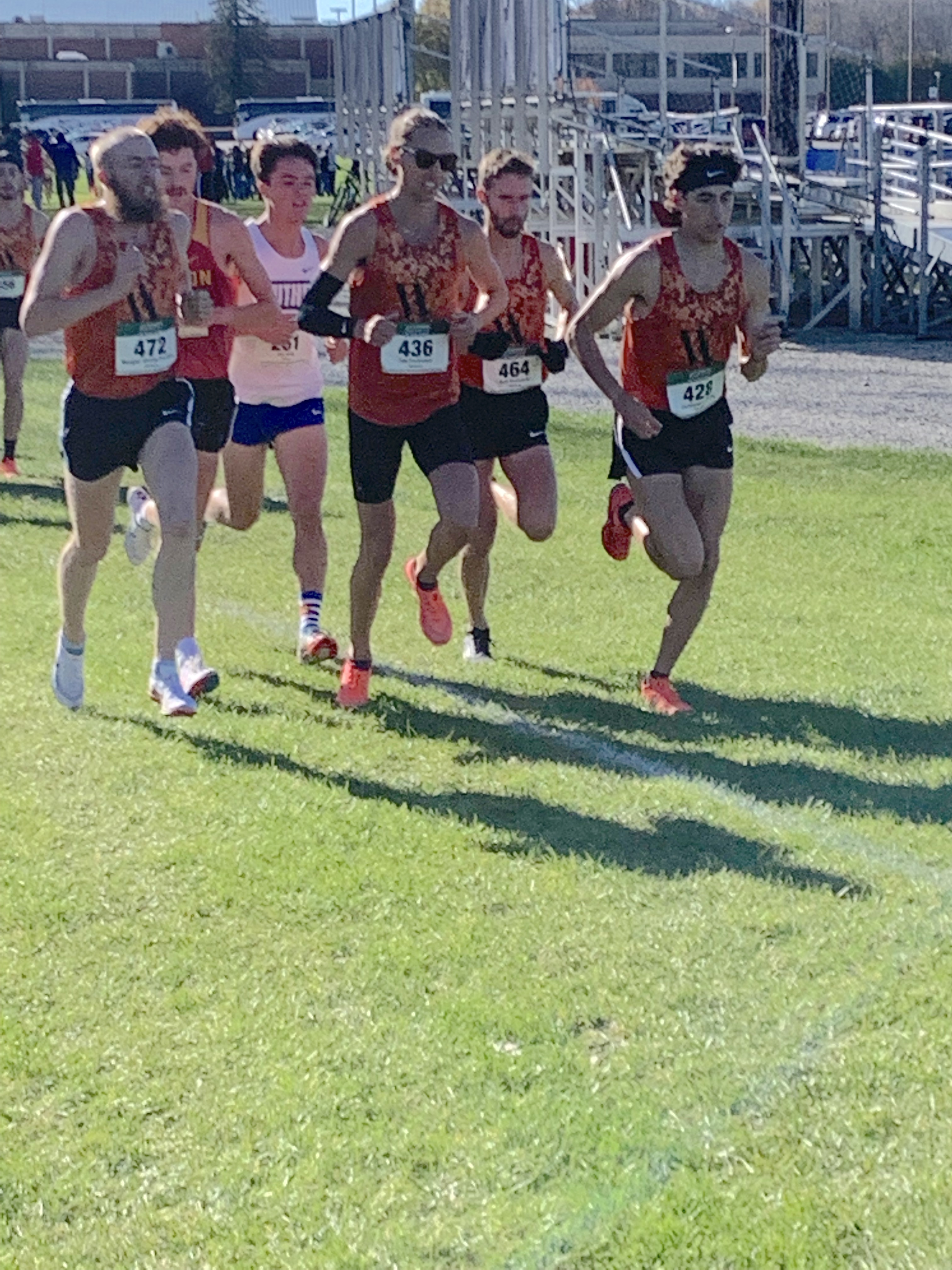
The Wartburg pack leads the race at 800 meters.
The other truth about running is that times do change. It was odd for us long-graduated Luther guys to watch the Wartburg teams sweep the top spots at the conference meet. Their pack in both the men’s and women’s race was deep and impressive. I don’t doubt that our 1978 team that placed second at nationals could give them a run if we were to transport forward in time, but kudos to the Warts for assembling a program worthy of a #1 national ranking. Whatever they’re doing appears to be working.
My Luther teammates and I were wondering if Wartburg would be able to match the feat that we achieved by sweeping the Top 5 places in the conference meet back in 1975. They didn’t, but they came darn close.
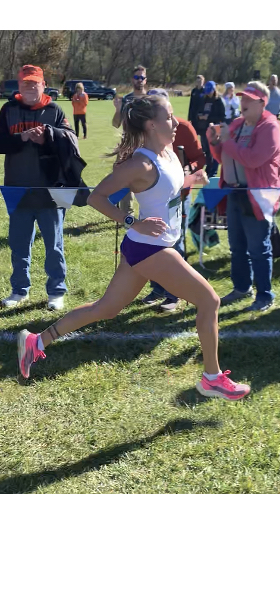
The most impressive performance of the day came from a runner representing Loras College. Kassie Parker ran to a half-mile victory with a time of 20:43.0 over 6000 meters. She appeared to be flying in the home stretch. Though she’s a Division III runner, I predict that we’ll hear about her competing for national teams in a few years.
Though the Luther women’s team was wracked by late-season injuries, they ran well as a pack and coach Yarrow Pasche was pleased with their effort. The program grew from the two first women to run cross country at Luther my freshman year to a team that embraces the sport with enthusiasm and good numbers. That’s really what the sport is about for most runners.
Later, at the cross country picnic following the race, we met with Luther parents (still younger than us!) and some recent alumni runners. It is interesting to move amongst those people and realize that it was our parents mingling together 40+ years ago. They were just as happy that their young men and women were competing in a positive fashion and growing in life.
It’s still a beautiful sport and always will be. When the gun goes off and a hundred or so runners go running across a green field on a fall day, there is no place in the world, or in time, that I’d rather be.
The 1975 season saw plenty of jostling among the top ten runners to remain in the Top 7. Everyone had their ups and downs, but one runner in particular, my roommate Keith Ellingson, started coming into his own. At a dual meet in LaCrosse, he was our top man against a powerful team led by Joe Hanson, whose twin brother Jim made up a fearsome duo. Ellingson ran 26:10 over the five-mile distance, which seemed to suit him even better than the four-mile races we’d been doing.
My painting of Keith Ellingson for a memorium at Luther College.
I’d been running sixth and seventh man most of the season, running times in the low 27:00 range for five miles. Our other promising freshman Dani Fjelstad fought some injuries, and even Ellingson had a toenail removed mid-season. He came back to the room and pulled the bandage off his toe for a new one. The spot where the nail had been was bloody, red, and pulpy. I wondered how he’d run at all the next day. But he did.
Keith was a funny guy by nature. Extremely wry and quick-witted. He also had a funny knack of complaining in a way that you never knew if he was serious or not. But this time, I knew his toe hurt plenty, so I tried helping him out with stuff. We ran within a few seconds of each other at a triangular meet at Wartburg where he ran fifth man and I ran sixth. I don’t recall being jealous of his rising up the ranks. I could only be concerned with my own efforts.
That wasn’t the case with everyone on the team. Some inter-team rivalries cost more in terms of personal relationships. There were always certain guys on our squad to whom I did not like to lose. While we were all running for the same cause as a team, I admit to viewing myself as a superior runner to teammates on the cusp of the Top 7. I think that kind of comes with the territory in distance running. Nothing much can change that.
It also worked the other way around. I got a thrill out of seeing certain teammates achieve success. And when Paul Mullen and Keith Ellingson, two of my freshman class teammates, took 1-2 in a dual against Loras with Dave Hanson third, Mike Smock fourth, and Damian Archbold fifth, it was pretty cool to see things go good for all of them. We had a perfect score in that meet. I hated that hilly course, and ran 28:00, but still qualified as our seventh man behind Kirk Neubauer.
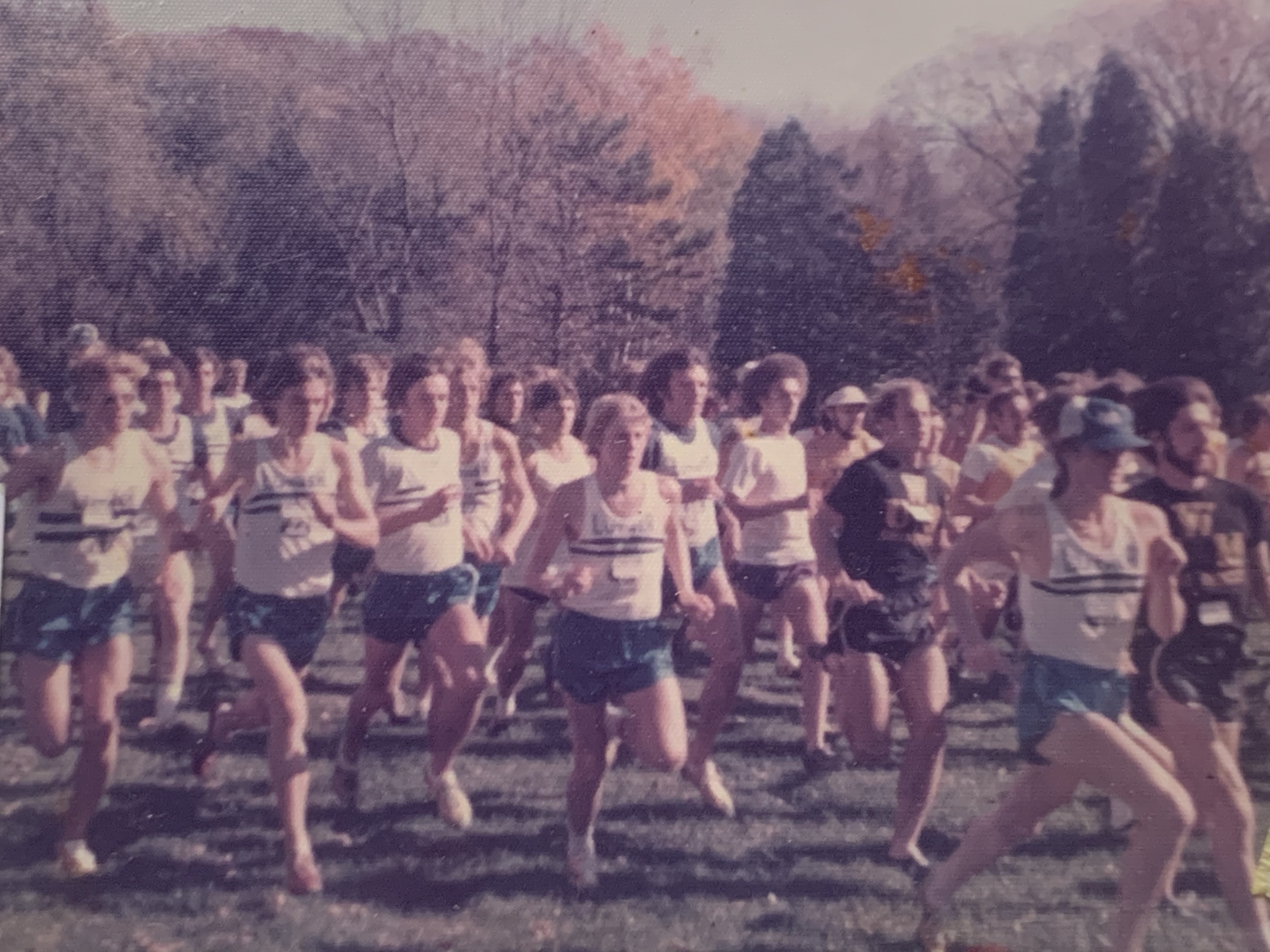
In this photo Luther runners at the front appear, from left to right: Dani Fjelstad, Paul Mullen, Christ Cudworth, Doug Peterson and Mike Smock (in hat).
I finally cracked the Top 5 at the Carthage Invitational, held at a park called Petrifying Springs outside Kenosha, Wisconsin. Our top guy Doug Peterson ran 26:08 and I ran 27:00 behind Smock, Ellingson, and Mullen. It felt great to finally count as one of our scoring runners. We finished fifth behind Western Michigan, Northwestern, Stevens-Point, and Wisconsin-Parkside. All far bigger schools.
We were coming together as a team, yet some of our collective judgment was lacking. On the way back from the Carthage meet we engaged in college kid antics that were both dumb and dangerous. Some things you only learn by experience. Exceeding one’s capacity for risk-taking and stupidity is one of them. We were fortunate to make it all the way back home.
Conference time
Finally, the day came for the IIAC Conference meet. Luther had already won the conference for four straight years under Coach Finanger’s guidance. Yet due to the graduation of two top-level runners, Tim Williamson and Steve Murray, the rest of the conference thought they had a shot at us in 1975.
As it turned out, the Luther College cross country program was not depleted. It had merely reloaded. We traveled to Oskaloosa, Iowa, to race at William Penn College (now University). The course was an up and down affair with long stretches and abrupt turns. By that point of the season, I’d earned enough points to tie with Kirk Neubauer as our seventh man. Graciously, Kirk suggested that I be given the chance to run as part of the development of the team. That showed Kirk’s vision and grace. He would later go on to coach successfully in the Luther College running programs.
An interview with Coach Finanger after the IIAC conference meet.
The honor of running in the conference race was not lost on me. As a team, we talked through a plan to run together the first mile. We rolled in a pack to a 4:55 mile. That must have been a daunting sight to the remainder of the runners in the conference. Just blue and white, in a horde. We weren’t behaving arrogantly. We were running a smart race.
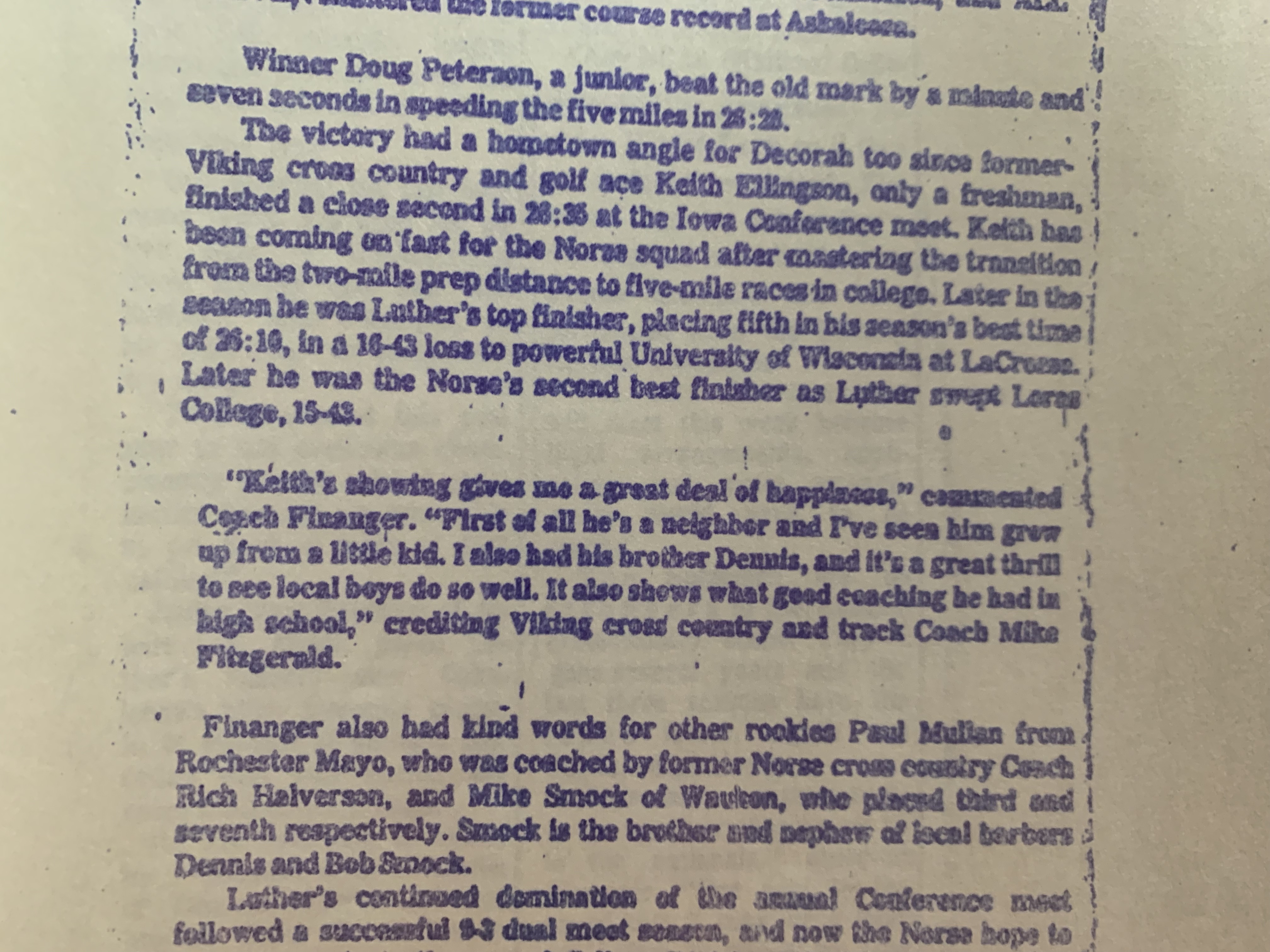
The course went uphill and from there, the Luther pack split up. My goal was to finish in the Top 10. As it turned out, all seven of our runners finished in the Top 10. I was ninth. Our first five guys of Doug Peterson, Keith Ellingson, Paul Mullen, Dave Hanson, and Damian Archbold ran to a perfect score of 15 points. Mike Smock and I both finished within a minute of our lead guy Peterson over the five-mile course.
The Decorah newspaper had a nice profile on Coach Kent and the hometown boy, Keith Ellingson.
Thinking back on the race, I recall a conversation about it with my late buddy Keith Ellingson. During the last year, I spent quite a bit of time on the phone with him. Through the fall of 2020, he’d been dealing with Parkinson’s disease for nearly ten years. Then came another diagnosis of Lewy Body Dementia. He was in assisted living and during the Covid-19 pandemic, was not allowed visits from his family. His girls missed being able to be close with him, and their children too.
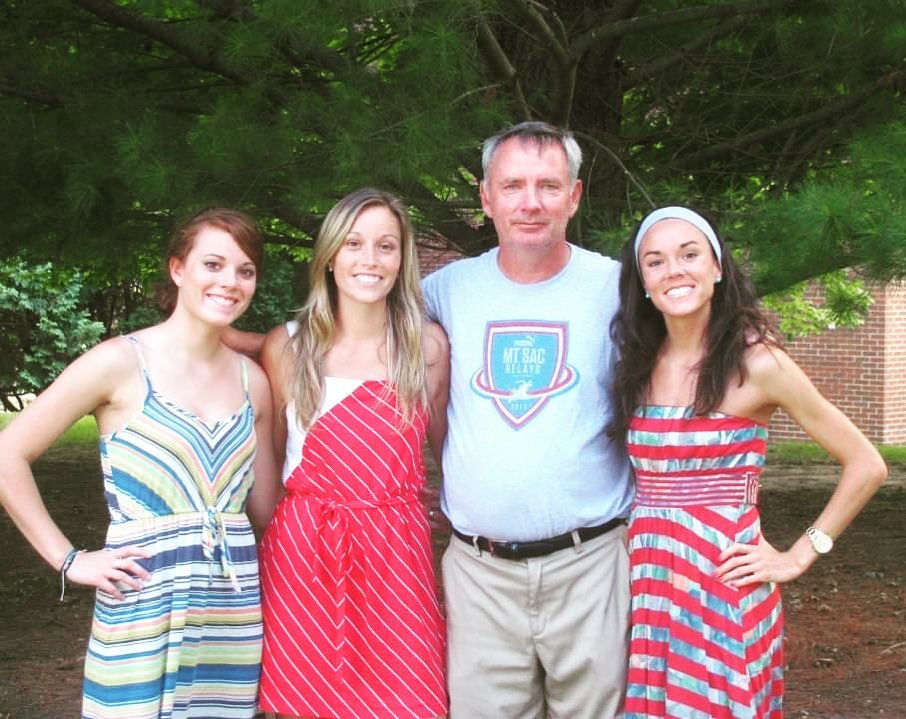
Keith with his daughters Bailey, Jessica, and Catie. No one loved family more than Keith.
For all that thickening of body and mind, Keith kept up his interest in sports and distance running. Following graduation from Luther, he had moved into coaching and developed more than 60 athletes into All-Americans during a Hall of Fame career at Simpson College. Over the first months of 2021, we talked about his coaching and laughed about our college days and beyond. We’d both worked in college admissions for Luther. Then we both served as Class Agents. So we’d kept in touch off and on.
Keith and I also had one common tragedy in common. We both lost wives to ovarian cancer when they were in their fifties. I knew his wife Kristi well from having met her all those years ago when they were young and dating in college. They got to know my late wife Linda quite well through many meetups at Luther reunions and such. When both women were going through cancer treatment, and we crossed paths at reunions, the two of them talked softly with each other about their respective challenges. Kristi’s mousy-brown hair turned silver and curly when it grew back after chemotherapy. My wife Linda’s hair fell out several times over eight years of treatment.
So Keith and I had many things to talk about during the last months of his life. But I recall one quiet evening he began talking about that Iowa conference meet where Luther swept the top five spots and Keith took second. As a junior, he would win the conference in a tie race with Paul Mullen. Yet there was something special, Keith insisted, about the dominating win and the perfect score. “I don’t think anyone will ever replicate that,” he told me. It was a perfect score for the ages.
The thing about distance running is that you never, ever know what can happen. Our team was proof that year of the capacity to rebound during a year in which were perhaps expected to lose. Perhaps there was a life lesson in that for Keith and the rest of us. We’d done something special, but nothing is ever truly “perfect” in this world. We certainly weren’t. Not as a team. Not as individuals. But we came together on a cloudy day at the height of our youth and accomplished something unique. That wasn’t the last time we’d enjoyed success. Yet sometimes the first victory is the sweetest.
So here’s to Keith Ellingson and his appreciation of perfection wherever one can find it, make it, or live it. God Bless you, Keith.
Dual meets were often mano-a-mano affairs versus the madness of large invitationals.
Those first few weeks of cross country competition as a freshman in college always features ups and down. At our most important early season meet, the Luther All-American Invite, I ran a credible 21:23 four-mile on the rolling home course. That left me as ninth man overall because two runners in the JV race including freshman Eric Inbody beat me. He ran 21:09 in the JV race.
I bounced up and down in the Top 7 those first few meets, so it was a bit of a downer to be sent with the JV team to a meet with the University of Northern Iowa. I shouldn’t have been disappointed, as capable runners like Keith Ellingson and Dave Hanson also traveled to the meet. In any case, I was determined to run well to prove myself worthy. The day was overcast and gray. When the gun went off, I felt strong from the start. In fact, I gravitated to the front, unlike other races in which I’d competed that season. One of our worst enemies in running is a limited self-perception, as in…thinking that other runners belong in front of you. That is a good way to get left behind.
I raced along with two UNI guys and finished third overall in 20:52, our top guy and my second-best time of the season. My roommate Keith Ellingson ran 21:05 and Hanson was our third guy at 21:09. It felt a bit liberating to run without the burden of keeping up with our top guys ahead of me. As Kent Finanger told me often that year, that’s how I should always run. “Let yourself feel the pace of the day,” he advised.
A bird moment
As I raced along at UNI, the course turned around a golf pond and I glanced down to see a strange bird spinning around the water. As a birder with a growing life list at that age, I almost paused to get a positive ID. All I knew was that it was a late-arriving phalarope, a species of shorebird that to that point in my birding career I had never seen before. I craned my neck around to study the bird as long as I could, but at 5:15 mile pace with a mile still to go in the race, my running priorities won out.
This time, following the race, I actually got to turn around and watch the rest of our dedicated team members come in the chute. Jim Holt, Wayne Monson, Brad Stene, and Tony Amabile. Mark Finanger (the coach’s son) and Bill Higgins. He was followed that day by a runner that the year before was one of our top guys. Now he was running in the middle of the pack in the JV races. What was up with that?
He perplexed me. But as time went by, we all realized what was going on with him. He’d developed a habit of smoking pot. He was high most of the time, even during workouts. His eyes were often red, and he was definitely unmotivated compared to the guy who ran in the top tier at the NCAA meet the year before.
It would have been a good thing to have conducted some kind of intervention with him. Perhaps there were other things going in his life that held him back or caused him to self-medicate. I could be all wrong, but the 1:1 relationship was obvious to most. Like many other people in that era, he was hooked on pot and couldn’t give it up. He was not alone. We had other runners at Luther that got too into drinking or smoking pot as well. I’ve read many times that marijuana is not an addictive drug. I don’t buy it, having witnessed both friends and associates try to come to grips with it over time. Certainly, alcohol is an addictive substance. Pot is too. In any event, it was always tough to watch a guy like our teammate succumb to its powers, especially considering all the talent that guy had.
Along the way, I’d have my own negative experiences with partying. But that comes later.
The Dedicated Crew
I’m pretty sure the guys that finished just behind him that day at UNI would gladly have absorbed his talent for their own hard-working purposes. My big friend Walt Maakestad ran 22:56 at UNI. Dennis McCann, Jim Nielsen, and Dan Knutson finished out our squad, all running just over 6:00 miles for the four-mile race. That’s credible stuff, if you ask me.
The point behind sharing that story is that every guy in the Luther cross country program was highly valued by Coach Finanger. We ran a meet at Mankato that season, driving up from Iowa to Minnesota on an increasingly chilly afternoon for a race on their campus. The seasons seemed to change even as we drove north with the trees finishing their fall colors the further we drove. There were long lines of bright yellow beech trees out on the cross-country course. A chill breeze blew out of the Northwest.
As we lined up for the race, Mankato’s coach announced that split times would only be given to the top runners at the mile markers. “The rest of you are on your own,” was his message that day. I saw Kent Finanger slap his clipboard on his thigh in disgust. “No!” he muttered half under his breath. The decision to skip mile times for the rest of the team was not acceptable to Kent. I think he sent our equipment manager out to one of the mile markers with a watch. Somehow there were other people shouting times as we ran around the course. Kent believed that every single runner on that course deserved the same level of respect.
When the horse smells the barn…
That message that everyone matters got through clear and strong to our team every day in practice. That said, there were still grumblings if one of the guys outside the Top 7 took the lead and picked up the pace on a day that was supposed to be slower. But we all had the tendency to race home in the last mile. When that happened, someone would mutter, “Uh oh, the horse smell’s the barn…” and off we’d all go, running like a bunch of madmen on Pole Line Road back to campus.
I liked all the guys on that team, but a runner named Jim Nielsen and I spent loads of time together around the freshmen dorm. We both loved playing table tennis. During the evening we invested many hours in the rec room challenging each other in ping pong for the fun and competition of it. That was our own little world, that ping pong table. We ultimately entered the college tournament and finished second in a doubles match against two superior Asian players. I wound up playing for the college championship against a tennis star named Jeff Renken. He beat me by a few points to claim the title, but I gave him a good match.
Our four-mile meets were all used up by mid-season. It was time to graduate to running five miles in competition, all with our sights set on winning the conference meet in a few weeks time.
With several weeks of running in the tank, it was time for the team Intrasquad meet. Everyone knew it was coming because the course was marked out by the loyal campus groundskeeper. There was just one problem. He was a bit cross-eyed. The first mile of the line marking the course on the massive intramural field sometimes turned out wavy.
That wavy line got some interesting attention in other years. I recall standing at the start of the Luther All-American Invitational a few seasons later. The teams were all lined up, and an Augustana runner looked ahead at the curvy white line crossing the IM field and asked, “What the hell?”
I looked over at him, smiled, and said, “Just run straight. That’s our groundskeeper. He can’t see right.”
Off course
As the Intrasquad approached, I was feeling good about my prospects of making the Top 7. But the Thursday evening before the Saturday race, I began to run a temperature. Sweat covered my body and nausea caught up with me. I had the flu. It was bad.
I struggled over to the Student Health Center and checked in with the nurse. She plopped me in a room with a bedpan and a couple thick sheets to wait it out. It was Friday evening by then, and I could hear the college kids ramming around campus getting ready to have fun that night. All I could think about in those moments was trying not to throw up again. The more I thought about not throwing up, the more I threw up. That is the yin and yang of the flu.
Clearly, I was going to be in bad shape and probably miss the Intrasquad race. Something in me still thought it might be possible to run, but a long Friday night passed and I asked the nurse to pass along word to Coach Kent Finanger that I was out of commission. He likely knew that already, since I’d missed practice Friday afternoon.
That night in the health center was filled with a delirious reaction to the fever. I dreamed that I was back at the farmhouse where my Uncle Kermit and Aunt Margaret lived in Upstate New York. That dream came about because the Luther nurse had a high voice much like my aunt, who I loved so much because they took care of me when my mother was ill after the birth of my younger brother, who arrived breach into the world.
My work from Life Drawing class in the fall of 1975.
The flu finally broke on Saturday afternoon. I lay there in the greasy-feeling sheets for an hour or two. My condition went back and forth between feeling better and having that low, sinking feeling that it would all come back again. Beyond the running I’d missed, it occurred to me that there was a biology assignment due that Monday morning. I’d missed some lab notes and would have to copy them from someone. Such is the yin and yang of college life.
On Sunday morning I gingerly walked back across campus, stopped to nibble some food at the college cafeteria, and returned to the Ylvisaker dorm room where my roommate Keith Ellingson filled me in on who ran what at the Intrasquad meet. Our team leader Doug Peterson ran 20:53 to win the race. Damian Archbold was second in 20:56. Dave Hanson ran third in 21:47. Paul Mullen (a freshman) ran fourth in 21:51. Dani Fjelstad, another freshman, ran 21:52 and Steven Inbody, the older brother of another freshman from our class, ran sixth in 21:52 as well. Kirk Neubauer was seventh in 21:59.
I was left wondering how I’d have placed in that array of Luther guys. All I could do was get back into training and plan for the next meet. Come Monday, I hopped back in with the guys and felt remarkably good running a ten-miler out to the trout farm south of town and back. It stunned me to think that I could feel so good on that run after feeling so awful and crappy just two days before. Yin and yang.
Getting the flu meant that I had to wait until September 13 to run an actual college race. We took second as a team behind Carleton, beating St. Olaf, Winona, and Macalester. I was the seventh man that day in 21:11, not a bad effort for a first-ever college cross country race.
Non-scholarship running
That first semester at Luther also introduced me to the world of campus employment. My college aid package included a portion of loans, but also Work-Study funds that had to be earned each term. I was assigned to the Dish Room at the Union cafeteria. Work started at 5:30 a.m. and lasted a few hours. My work-study program required me to work three times a week. Pay was $1.10 per hour. Annual tuition at Luther was about $3700 per year.
I’d show up for dish room duty sleepy and tired from running the night before. None of us talked much during those morning shifts. We were all too tired and grumpy to care. The kitchen operation was overseen by a taciturn woman named Gladys, whose opinion of students seemed to border between viewing us as “necessary” and “evil.” The Dark Side of yin and yang.
I particularly hated working in the dishroom where the steaming hot plates came out of a giant industrial dishwasher on a belt that never stopped. We weren’t issued any rubber gloves to protect our hands from the heat emanating from the plates. I tried waiting for the plates to move down the incline enough to cool off, but that created additional pressure to unload them in time. It was a living hell to me. Gladys would walk over and stare at you if they dishes backed up at all. My hands and fingertips ached with pain from the constant flow of hot dishes. More than once I cursed her under my breath.
Cooking for dollars
Whenever I could, I weasled my way over to work the cooking stations where we dumped liquified eggs out of gallon jugs to scramble them on giant grills. I liked that work, and making English Muffins too. But Gladys would always pull me back to the damned demon of a dishwasher. I despised that machine. And her, quite frankly.
Certainly, that job taught me the value of work, but it didn’t help my distance running any. Such is the plight of the Division III runner, where there are no scholarships allowed or available. Rather than being given money to run for the college, I worked in the dishroom for several years. That’s the yin and yang of college running at the sub-elite level. You do it for the love of it, and hope you don’t burn out in the process.
One day, as I was finishing lunch and walking out of the cafeteria to go to class, a young woman that I knew from the dishroom was cleaning up the cups and saucers left behind by students. Students were all supposed to take their trays up to the conveyors and send them into the dishroom. Some students seemed to feel that task was beneath them, and left piles of dishes, napkins and leftover food on their tables. The young woman piled some cups on a cafeteria tray and spun to head back to the cafeteria, but she didn’t succeed. I wrote a poem about what happened next.
Waittress Since Thirteen
Although the saucer fit the dish, she turned too quickly, threw the cup, and watched in vain as coffee stained her shoes and left her morning drained, “You’d never know,” she said to me, “I’ve been a waitress since thirteen.
All that Work-Study experience in college saved me from feeling like I needed to flip burgers in some sort of ritualized right-of-passage summer job during school. I certainly had enough of that type of labor for three years at Luther. By the time I was a senior, I got a campus job outside the cafeteria that didn’t require all those early hours. All I can say is that change had a dramatically beneficial effect that I wish I’d figured it out much earlier in college. But that’s life. It’s yin and yang.
The hours spent running with twenty-four guys proved to be great way to get to know people that freshman year in college. While dorm life was a rush of introductions and a socially manic environment by nature, running cross country was like an extended live therapy session. The upperclassmen generally led the way, but as time passed our group of freshman learned to chime in.
One of the chat leaders was a senior, Kirk Neubauer. Possessed of a naturally wry temperament, Kirk would truck along teasing other guys about whatever topic came to mind. Somehow, the topic of summer jobs came up, and Kirk related his summer work as a typewriter repairman. The first time he described the work, we all listened intently, not knowing exactly where he was going with the story. In fascinating detail, he related the order in which the keys needed to be checked or fixed. At least, that’s how I remember it. The funniest part of the day was that Kirk’s Typewriter Repair story lasted almost the entire ten-mile run.
Kirk Neubauer (left) and Walt Maakestad (right)
It’s hard to describe why the story remained fascinating given its seemingly innocuous detail. The way Kirk told the story was the key to its amusing magic. He spoke methodically, with a seriousness of detail that defied its otherwise mundane topic. He spoke as if he was divulging great secrets or actually teaching us how to work on typewriters. Plus Kirk has a natural lilt to his voice that makes just about everything he says a point of amusing fascination. That’s who he is.
The next day, as I recall anyway, someone began the run by repeating the question of what Kirk did for a summer job. In spirited fashion, Kirk responded in deadpan fashion, as if he’d never talked about it before, describing how he’d repaired typewriters for a summer job. Members of the team pitched in and peppered him with questions they could recall from the previous day’s descriptions. And so it went, for another long run, as we all joined in asking about Kirk’s typewriter repair skills.
The Bird Man
As I got to know the guys, I dared to point out some of the birds I saw along the way, because Decorah is a birding hotspot with pileated woodpeckers, wild turkey, bluebirds and yellow-headed blackbirds. There was never that much interest from the group, who considered birds more of a distraction than a point of interest. But one day a tall figure loped up next to me and in a soft voice, inquired, “How do you know so much about birds?”
That big guy was an Alaskan named Walt Maakestad. He stood something like 6’5″ with a full reddish beard and a shake of wild blonde hair atop his head. He proved to be a great influence for me as the weeks went by. Just running next to him made me feel more confident. About running. About life. One day he showed up to model for my freshman art class. He peeled off his shirt and we call did our best to capture the big man in the light of the art studio. I still have that drawing to this day.
My drawing of Walt Maakestad in December of 1975.
Headless Dave Hanson
Dave Hanson (left) racing with Christopher Cudworth in an early season dual meet. I recall that during this meet, I accidentally put a spike through the instep of a competitor’s shoe, stripping it right off his foot. Those are the Tiger spikes I was issued that first season at Luther. I didn’t like them especially.
There was another wry personality on the team by the name of Dave Hanson. He hailed from the small town of Grinnell, Iowa. We both shared a love of writing. His nickname was Headless because in part because he wrote a column for the College Chips called the Headless Norseman. When Dave learned that I could cartoon and write, he invited me to get involved in creating an alternative college newspaper. I don’t remember what he named it, but a crew of us put the paper together with articles, photos and all. The only thing we’d forgotten to do was sell advertising to pay for its publication. The alternative publication never came out, but we had a blast writing the thing. I’d written for the high school newspaper back home, and would later write for the College Chips at Luther, but the notion of developing our own unhindered voice on campus intrigued me to no end. In some ways, that motivation to write in alternative fashion drives me to this day.
The Revolutionary
If I had wanted to follow a true revolutionary, there was one of those on the team as well. He was an Illinois boy like me, hailing from Elk Grove where he was a standout distance runner with two-mile times in the low 9:20s. At Luther, he ran in the wake of Steve Murray and Tim Williamson the year before I arrived, but he was one of the lead guys on the team in 1975.
Damian was an alternative thinker by nature. He was smart, aggressive and open-minded. The 1970s were the perfect storm of opportunities for that kind of person. Damian got interested in the work of a professor named Oliver Cornell that was getting students interested in communism on campus. Those lessons didn’t stick forever, as Damian turned out to be immensely successful in selling Real Estate out west. I do recall coming home from college that year and talking about communism with the father of one of my one of my best friends. His dad was a keen IBM executive and I thought his head was going to explode as I talked about communistic principles.
The closeness of team travels really did mean you got to know guys well, for better or worse. Damian and I got paired as bunkmates on one of our cross country road trips. It turned out he liked to sleep naked, and my shock at bumping into him at night resulted in a yelp and a jump to other side of the bed. The other guys in the room had a laugh about that the next morning. That was just Damian. He was a no-filter kind of guy.
The Long Run
We’d all gotten to know each other pretty well by the time Coach Kent Finanger prescribed a twenty-mile run down to Calmar and back. I’d never done a 20-miler in training, but I did have experience running that long by accident. Back in high school, a group of us sophomore distance runners signed up to run a 30-mile route during a Walkathon out in Dekalb, Illinois. Long Walkathons were popular fundraisers in the early 1970s, replaced these day by road races and other events. Some Dekalb HS runners showed up at the start and we all took off running at a competitive 6:00 pace for the first 10k. Eventually, a bunch of guys dropped out and a few of us were left covering ground in the dead-looking April cornfields in Illinois.
Our plan was not well thought out. As we quickly discovered, none of the aid stations were set up because we reached them long before the volunteers assigned to provide water and other support material showed up. That meant we had nothing to drink or sustain us the entire way. At twenty miles, a few more guys from my team cut back into town, but they were far enough behind me that their voices were lost in the wind. I wound up running all alone with nothing but a hand-drawn map to follow for the last ten miles. For some inane reason, I persisted.
I ran and ran, not knowing the pace or what I hoped to achieve. My legs got sore and tired as hell. At 27 miles, the route finally entered town again and I stopped at someone’s house to ask for something to drink. They were a bunch of college kids. One of them offered me a Coke. I’d been told by my Kaneland cross country coach never to drink Coke during the season, but at that point the thirst within me trumped all other perspectives. I downed the soda and thanked them. Then I continued running. The Coke helped, of course. I arrived back at the NIU fieldhouse exhausted, only to be asked by a few teammates, “Why didn’t you stop?”
It was that experience that convinced me there was nothing special about running exceptionally long distances. That’s why I never focused on marathons during my competitive career. Mostly, I considered them stupid. I still think I’m rather right about that.
A different animal
Perhaps if I’d recalled that adventure I would not have felt trepidation about the 20-miler at Luther that freshman year. We took off south on the shoulder of a state highway and reached Calmar ten miles into the run. I don’t recall getting any water there. We likely just turned around and came back. For all his exercise physiology knowledge, Kent wasn’t one to push us to drink much. He’d have a big cooler and a few cups to share, and that was that. The Old School Way of thinking is that hydration was more of an afterthought than a necessary habit. We never drank water or anything else during any of our ten-milers, and we ran them hard, at 6:00 pace most days.
Fortunately, it was a blessedly cloudy morning that Sunday. A few of the freshman hung in there through 14-15 miles, then dropped out. The van followed us along and I kept going for another mile or two before I was thoroughly bonked. Finally I stopped, climbed into the van and watched the rest of the team heading toward Decorah without me. That left me wondering whether I’d be judged for quitting.
I’d failed the Long Run test but actually didn’t feel too bad about it. Other than the insane 30-mile debacle I’d done in Dekalb that one time, that sixteen-miler was the longest run I’d ever done in my career to that point. It honestly felt great to climb into that van and sit down. There were several of us, including several of the other top-flight freshman with whom I was competing for a Top 7 spot on the squad.
For all the tale-swapping and team building that went into that first few weeks, it was competition that drove us all, all the time. We competed in practice. Competed at the foosball table after dinner. Competed with jokes at the dinner table and even competed for attention with women. Competition was never far from anyone’s mind. Every step, every movement, was about getting better and beating somebody else. That’s the harsh truth of the sport. It’s all about competition.
On equipment day for the cross country season at Luther College, I was handed my first set of Luther Blues for training. I loved the simple dark blue tee shirt with the big number on the front. We got some nylon shorts, and a couple pairs of tube socks. I already had a set of blue Adidas SL-72s to train in. But then I was handed a set of Tiger suede blue spikes, and my heart sort of stopped.
I’d ordered a pair of Adidas blue spikes but either they weren’t in stock or considered too expensive for team issue. The Tiger spikes felt a bit clunky by comparison. I gulped a little, and asked if I these were the right pair. “Yup,” was the response I got. So I moved on.
Such is the nature of the Freshman Blues. So many new experiences that don’t match up with what you’ve done or seen before.
Once our gear was all handed out, we dressed in the pale blue locker room of the Luther field house and gathered upstairs for the first team talk with Coach Kenton Finanger. His stocky build and close-cut hair reminded me more of a football player than a cross country runner. Indeed, I’d learn that he’d been a Little All-American in football and basketball, the other sport he coached at Luther. Forty years later, walking next to Kenton while entering a campus building for the induction of his son Phil into the Athletic Hall of Fame, I noticed him walking with a bent back and a lurch in his stride.
“Well,” I commented cheerily to the man I knew so long. “I guess all our athletic pursuits have a bit of a cost,” and chuckled.
He stopped, looked up at me with that familiar glint in his eye, and said, “I wouldn’t change a thing.”
Kent was an instructor in the Athletic department. His background in exercise physiology and kinesiology came into regular play in his instruction to us about running. The main theme he stressed often was “run from the hips.” He wanted to see that flow in your stride.
His pet word for his runners was “horses.” During one long run that freshman season, our team was cruising on a long downhill toward Decorah when a herd of four actual horses started running alongside us in a field. “Heyyyy….” I can hear Kent calling out the car window. “There’s my horses!” We all laughed.
Beyond all that, Kent was a first rate motivator. His favorite phrase, spoken quite often and scrawled across many mimeographed pages of coaching literature over the years, was “Wow! Fun! Wow!” It sounds cliche, but it wasn’t cheesy coming from the mouth of Kenton Finanger. He was serious about the Wow part because he admired the work done by runners to get fit and compete. He was also serious about the Fun part because he genuinely believed in Fitness for Life.
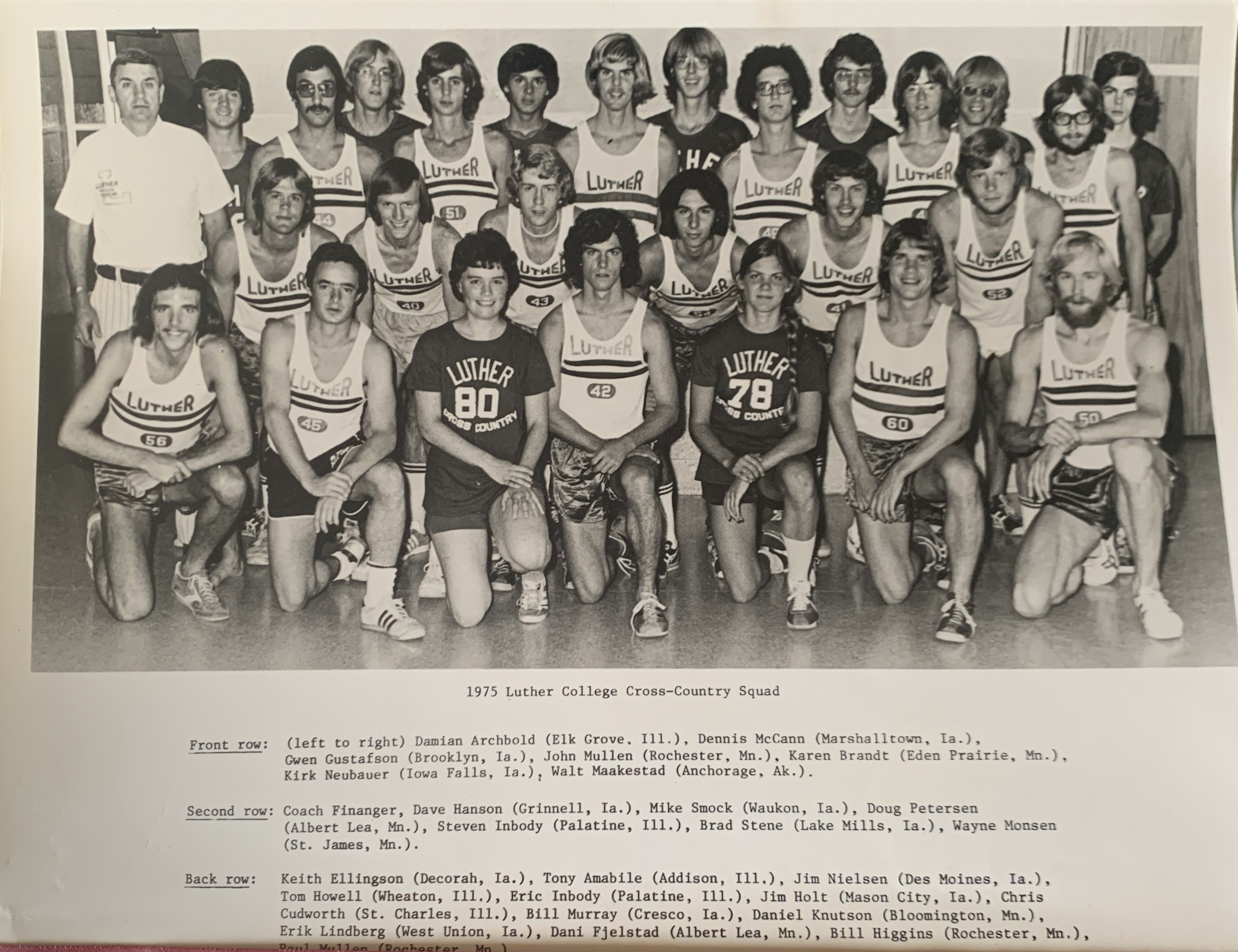
Kent also was a forward thinker. In 1975, the first two women showed up for cross country at Luther College. Lynne Schmidt and Karen Brandt were issued Luther Blues along with 25 or so men runners. Some of the guys in the program welcomed the girls. Others were not quite convinced. Kent set up training and races for them. Within ten years or so, Luther College women were winning national titles.
Before workouts, we’d gather in a fieldhouse locker room for Kent’s famous pre-workout talks. His rolling conversation style was often filled with anecdotes and stories about other athletes or inspiring examples of achievement. His most pointed language was about learning to believe in yourself.
I wish I’d listened more closely to that lesson at times. When you’re a freshman, and a bit scared by the idea of trying to make the team, all you can think about is keeping up when the running starts. More than once Kent counseled me to believe in myself. He even did it during races. A couple of times, I actually abided in his advice.
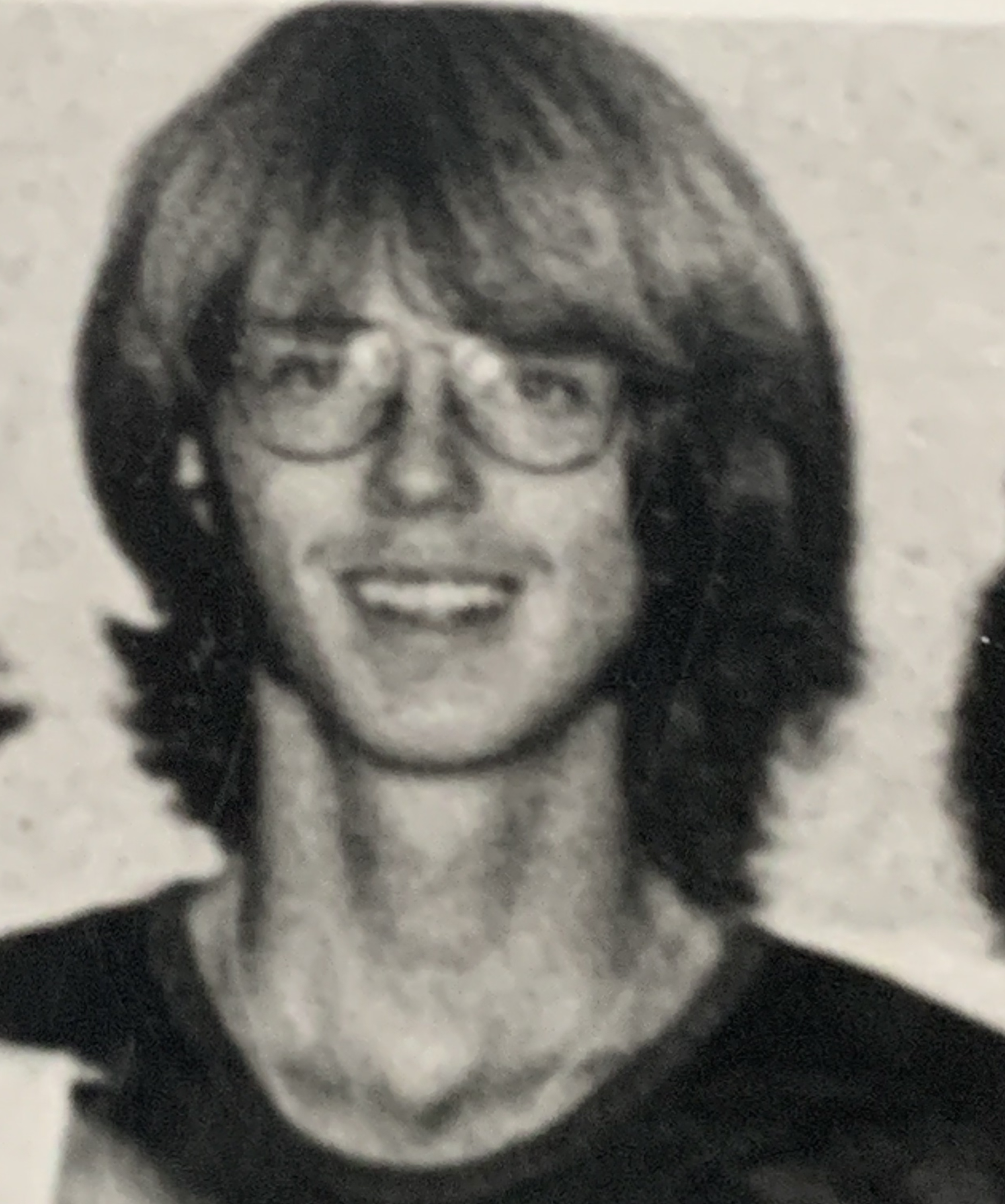
A Luther freshman with a big head of 70s hair and a pale wisp of a mustache.
Rich with talent
That freshman year scenario was complicated by the fact that our freshman class was rich with competitive talent. We had five or six guys that had run sub-15:00 for three miles in high school. They included Eric Inbody from Palatine, Illinois, Dani Fjelstad from Albert Lea, Minnesota, Paul Mullen from Rochester, Minnesota, and Keith Ellingson, the hometown boy from Decorah, Iowa.
Keith lived right across the street from Kent Finanger in residential Decorah. There were quite a few Decorah guys in our freshman year class. I was a bit envious of the fact that his friendships carried over into college. He also had a sweet girlfriend named Kristi, also from Decorah, who came by the room to visit occasionally during that first semester. Sometimes she’s bring cookies. And sometimes I’d steal one. Or two.
We needed all the carbs we could get. The training regimen for our team was 70 to 80 miles per week. I’d never run that much in high school. Plus I was still recovering from the massive party my friends and I held when I arrived on the Luther campus that first week.
Nothing could have prepared me for that first day of running with the Luther boys. We took off south toward Pulpit Rock and ran through the campground to the gravel road below Phelps Park. The pace was fast, nearly 6:00 per mile, and the sound of our feet on the gravel road came up like a roar.
We cut through downtown Decorah and ran across a rickety metal bridge. Then we turned right toward Palisades Park. That’s when the college running scenario got Super Real. The road rises at first, then flattens out for a bit. It gains height again and turns abruptly up the side of a bluff overlooking downtown Decorah. I could still the see the front guys up ahead, but just barely through the trees. Around me there was plenty of hard breathing. Much of it was my own. We crested the top of the hill and ran dipping and weaving through the woods road.
Then, without warning, the road dropped back down the hill at a horrific slant. My toes slammed against the front of my running shoes and my knees bore the shock of the descent. Guys cursed. I muttered “Oh crap” and pushed up my glasses as we turned right yet again to fly back down the first hill we’d climbed up. By then, I was so disoriented by that point I had no idea where we were. Nor did I care. One thing ran through my mind.
Keep. Up.
We climbed the steep incline onto Ice Cave road and tore along its gravel as a manic bunch. Finally we arrived back in town and turned onto Leif Erickson drive toward campus. It was warm outside, and cloudy as I recall. I felt turned inside out as cut through campus and ran back down the slope to the fieldhouse. There we stood, trying not to look exhausted. I looked around to see that there weren’t that many guys back yet. I’d done alright. I’d hung in there.
Once the group settled down, a runner named John Mullen, the older brother of my future roommate Paul, pointed at my head and declared, “Look, this guy’s not even sweating!”
He was right. But that was true for all the wrong reasons. I actually think I was still dehydrated from the party effects a few days before. In fact, I was so out of whack I wouldn’t succeed in going to the bathroom that first couple days on campus. My body was rebelling in the vortex of all that hard running. Plus, I was shy as hell about the dorm stalls at first. Credit that to native anxiety. It was a great relief when I finally had to empty my gut after that first couple days of training.
We all adapt in our own ways to change. That’s the nature of the Freshman Blues.