50 Years of Running: The Big Sendoff

Heading off to college in 1975, one didn’t know much about what lay ahead.

With the summer job completed, and college bearing down on our collection of friends, there was only one thing left to do before starting the next important stage of our lives. Hold a The Big Sendoff Party.

Our clan was a mix of cross country guys with a few other peers thrown in. We gathered at the home of a friend whose parents never seemed to be home. That left the house open for the night. His place sat at the end of a deadend road, so the neighborhood wasn’t dialed into our activities either.

My personal party history wasn’t all that much to brag about, but things were accelerating going into my freshman year in college. Earlier that summer, we made a trip up to Mirror Lake in the Wisconsin Dells. It was supposed to be a fun camping trip, but the Boone’s Farm wine took over early in the evening. There was some prodigious barfing going on with one of our friends late in the night. Come morning, the riverine traces of his misery cut through the sandy soil below his tent. We got up early and decided to go home rather than stay around and try to make something better of the day.

We’d lashed a Sunfish sailboat to the roof of the ’67 Chevy that our friend Rob Walker drove. But given our condition that afternoon and night, we never took the boat near the water. The next morning, in our hungover state, no one thought to check the integrity of the tie job we’d done on the 15-foot boat. Roaring down I-90 back to Illinois, one of the lashings came loose and the boat swung sideways from its streamlined position to catch the full brunt of the wind at 60+ miles an hour. We felt the car lurch to one side and the other. Rob kept it on the road, but we pulled over to tie the boat firmly back in place. Most of us were too stunned to say much. Once it was secured again, we felt safe enough to laugh it off.

Nothing symbolizes the vicissitudes of life more aptly than the effect that sailboat had on our car that day. One minute you’re sailing along, so to speak. The next minute, something in your sphere catches the winds of life the wrong way and it almost drives you off the road.

Often as not, these events are self-inflicted, yet seldom intentional. In running, something as simple as a shoe coming untied can screw up an entire race. So can eating the wrong food before a hard run, or forgetting to hit the bathroom that last time. Among runners, shit really does happen. As in, all the time.

But when you’re a male teenager, the frontal cortex of the brain is not fully developed. That’s the risk-taking segment of the mind. I recently listened to a neurologist on NPR explaining that the decision-making capabilities of teens, especially male teens, is further compromised by the priorities that young men place on peer acceptance over the actual dangers of whatever activities they choose to engage. Young men view losing peer acceptance as a far greater risk than getting into trouble.

That explains why our party at the end of summer got so damned out of hand. We all had a little money from those summer jobs. Some of it found a vodka bottle or two, a ton of beer and perhaps even a little pot to smoke outside. We roiled around the house that night in late summer of 1975 drinking and laughing and wondering what comes next. As midnight neared, someone announced they were hungry for donuts. A few guys piled into one of the cars and off they drove, pretty much drunk as hell, to the Dunkin’ Donuts four miles away.

To their shock and dismay, the store was nearly devoid of donuts at that time. “No fucking donuts?” one of them asked. “This is a donut shop, and you ain’t got no donuts?”

I can’t claim that was a direct quote.The incident was related to me third or fourth hand. I wasn’t there to witness the Drunken Donuts scene, but I got the gist when they returned. Admittedly, I was also disconsolate at the lack of donuts to hand out.

My interests were elsewhere that evening. A former girlfriend showed up at the party and the quiet sparks of a summer night flew between us. We were getting busy beneath the back porch deck when the donut caravan rolled back to the house. The headlights hit us and we quickly separated and zipped up to greet the drunken merrymakers. Never was I so sad to see my friends return.

Things only got uglier and stranger––as Hunter S. Thompson might say––as the evening wore on. Somehow a few of us decided that skinny-dipping in the quarry pond a quarter mile away would be a good idea. We hiked through darkness and stripped off our clothes. The water was black and foreboding, with no moon to light the night. I dipped a toe in the water and recalled, through my own weakly functioning frontal cortex, that quarries often have steep banks. It might be ‘all or nothing’ if one stepped into the water.

In any case, that lake was warmer than the night air and a mist was rising by that time in the morning. I swam in circles without my glasses on. The darkness beneath my chin seemed close as death.I kicked hard to keep my head above water. At that moment I heard raucous giggling by the shore, and looked up to see the shapes of several young women running away with our clothes.

We shouted after them in that muffled voice one uses while trying to be both forceful and secret about it. Then we swam back to shore. Naked in the night, the few of us looked down at our dicks shriveled from the cold and began mincing along the shore to get back to house. The stones hurt our feet. A branch raked across my shoulders, giving me a start. Then we humped our way through a field of wet grass and up the road to the house.

There, standing on the porch where we’d messed around earlier that evening, was the former girlfriend in her tight white jeans and tube top. By contrast, I stood shivering with my hand over my junk and asked, in the most masculine voice I could muster, “Could I have my clothes back, please? I’m cold.”

She chuckled, tossed them in my direction and walked back inside. I never saw her again that evening.

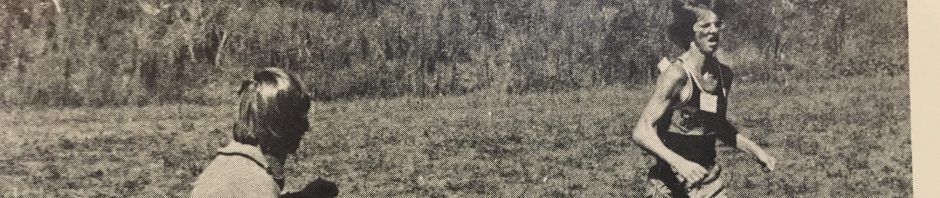
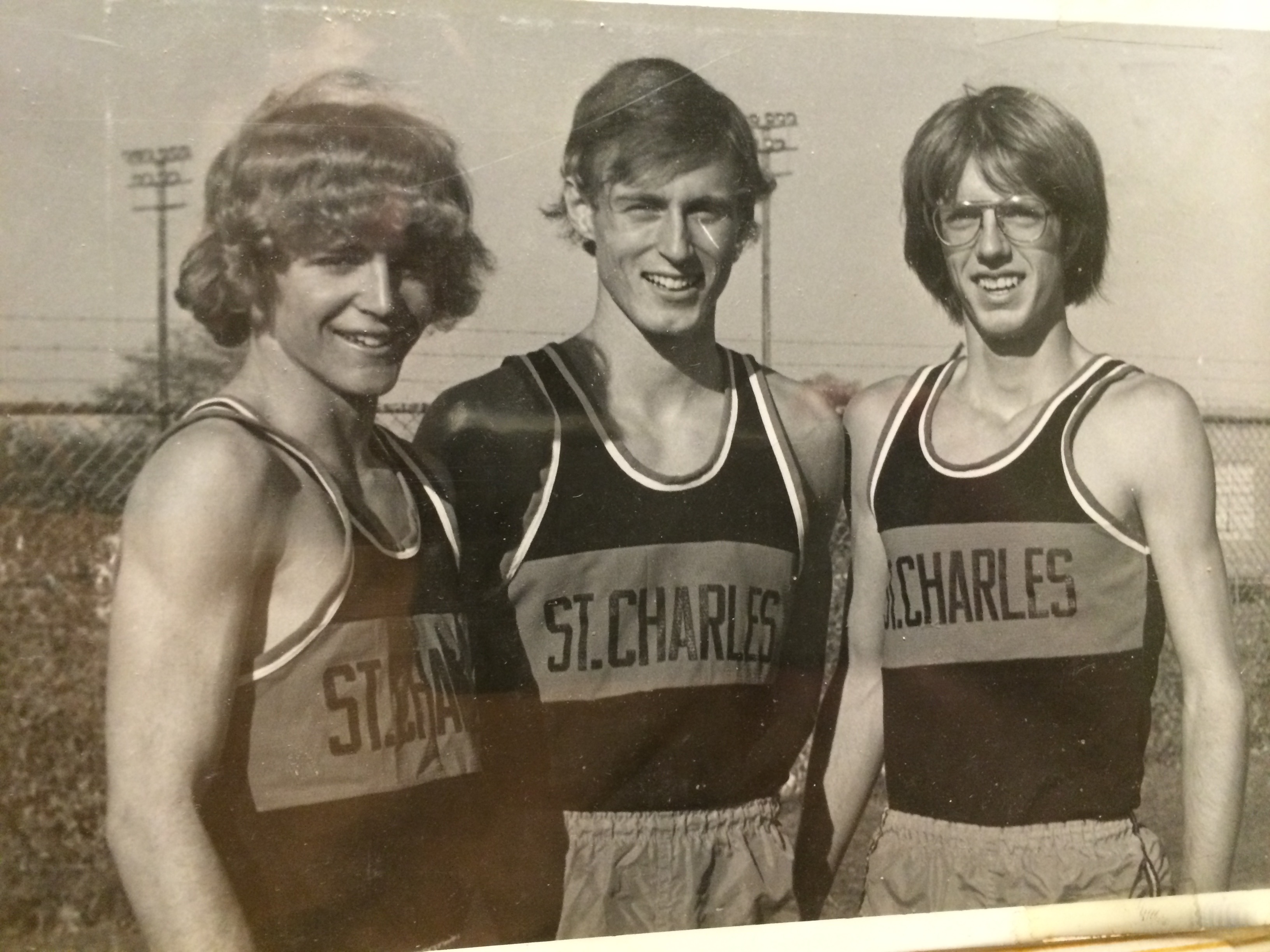
A photo of Christopher Cudworth in the fall of 1975.

Eventually we all did crash on the basement floor. The cold swim sobered me up, so I sat there wondering if I could find that girl somewhere in the house. I didn’t dare go upstairs in case my friend’s parents had gotten home.

It took several days to recover from that party. I went for short runs to work off the fatigue and the stress of staying up all night to drink more booze than I ever did before. Like I said, partying was not my forte, but that night stretched both my expectations and frontal cortex a few notches.

The Big Sendoff signified the dissolution of that group, to some degree. Most of us went off to college. A few stayed and worked local jobs and held the town down while we college boys were gone. That last week of summer I packed up some clothes and ran as much as I could to get ready for the first cross country practice at Luther College.

My parents took me up to school and we walked the Luther campus together with my friend Paul Morlock and his folks. Later that day, I showed up at the fieldhouse to get team-issued tee shirts and shorts, a set of running shoes, and some spikes. I placed them all in a locker and said to myself, “Okay, this is happening.”

Yes, Christopher Cudworth. It really was.
Posted in alcohol, Christopher Cudworth, college, cross country | Tagged , , , , , , , , , , , | Leave a comment

50 Years of Running: Sweet summer sweat

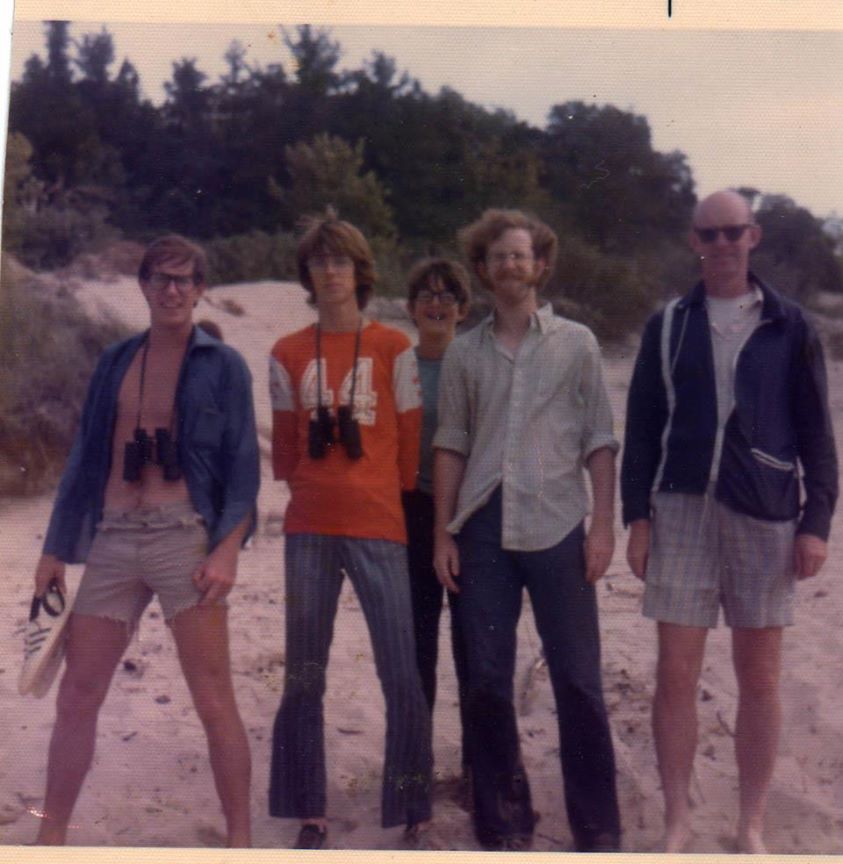
A photo of the Cudworth brothers and our father at the Indiana dunes during the mid-1970s. I had on the Sears binoculars we all used to go birding together. Note that my brother Jim is flipping the bird. We were a snarky bunch.

Following high school graduation, the pressure to find a summer job and earn “money for college” entered the picture for the first time. I stumbled around the first few weeks looking for who-knows-what kind of job, then got offered a chance to be an assistant coach for the St. Charles Track Club.

The work paid $500 for six weeks of work. That sounded like a ton of money to me in those days. I’d signed up for Augustana College after visiting the campus earlier that year in track. I ran with the Augie guys who took me for a five-mile run around Rock Island, then did some kind of interval test on the track facing the railroad tracks and highway to the north. No one went easy on me. It felt like a test of some sort.

My father was the one that drove me out to the Quad Cities. He waited in the car while all this was going on. During the visit I met Coach Paul Olson. I remember liking the guy, and we had a little talk. A few weeks later I received a letter of acceptance from Augustana, but the letter said, “You will be on academic probation the first term…” I didn’t like the sound of that.

So I sat on the letter knowing I’d at least gotten into college somewhere. We also visited Illinois Wesleyan that year, whose square-ended indoor track did not seem so great. So for the time being, it was Augie for me.

Summer track world

Not knowing how else to approach the big changes to come, I retreated back into the cozy and familiar world of coaching summer track. There were great boy and girl athletes in the club, including Mark Claypool, the Kaneland runner who won national AAU titles. I once did a workout with him in which he gave me 25 meter head starts while he ran 200 meter repeats. He still ran me down. Later in his career, he pumped out a 46.8 400 meters or somesuch fast time for the University of Illinois.

The littlest athletes were great fun to coach as well. We had a team of nearly 100 kids, traveling around to meets in Moline, Bloomington-Normal, Sterling, Belvidere and other cities. I was secretly smitten with a few of the female athletes my age, but knew that my role as a coach was to stay objective and help them any way I could. Still, it was summer, and the short shorts of that era didn’t make it easy to hold back the hormones coursing through my veins.

It helped that the head coach by then was Carol Rosene. She had taken over the club from Trent Richards, my high school cross country and track coach, and threw her heart and soul into the program. Her husband Bob Rosene was a blind runner of some renown. His dog ran with him in many events.

Coach or athlete?

Participating in a rare summer race on the black cinder track at St. Charles High School.

Sometimes I’d choose to race in those summer meets, but I was never fit enough to make much impact. I recall running a 4:40 mile in the blazing heat on that wide-open track at Belvedere. When I got done, I swore never to race the rest of the summer. I don’t think I did. But my rival from Burlington Central, John Rath, kept on racing and getting better. He was a quick little bugger in the mile. His times dropped into the low 4:20’s as the summer went on. As I recall, he advanced to nationals and did quite well. I secretly hated him for that.

Meanwhile a coach from that part of the county named Mr. Riley came down to help out the program. He mainly coached the girls in many events, especially the high jump, where athletes like Andra Olson and the irrepressible Kelly Murphy won meets on a regular basis. We also had a spunky young athlete from a gymnastics background who jumped 5’8″. She’d run up to the bar and you’d think “that’s too high for her” but she’d bend like a licorice stick and come down in that shredded foam pit with another successful attempt. Our equipment wasn’t always the best, but we made it work.

The other guy that helped coach summer track was my close friend Rob Walker. We’d shared our high school junior and senior year together, and he would go on to a career in sports facilities management. But we coached girls basketball together during the winter of our senior year. I learned much from his measured approach and commitment to the kids. His little brothers ran for the St. Charles Track Club and Rob was an exceptional influence on kids of all ages.

Rob Walker running cross country for St. Charles High School.

Inner-city days

We also traveled to Chicago to run in inner city meets that were all-day affairs where the summer sun burned so deep into your brain you’d feel like a creature from another planet by the end of the day. I recall admiring the sweat-soaked foreheads of the black head coaches running those inner city teams. Some of them were former Olympians giving their time to coach kids.The weren’t all the picture of fitness, yet they seemed indefatigable, guiding those kids in sprint heats all day long. Their dedication and stamina was tremendous.Meanwhile, I’d be hiding in the shade whenever I could.

Our band of mostly blonde-headed little white kids ran around like little wisps of suburban fury and the entire Chicago track scene had a carnival feel. Years later, as a father, I took my extremely blonde-headed, six-year-old daughter to a track meet where she ran a series of races and sat down amongst a crowd of same-aged black girls talking and chatting the day away. She was fascinated with their social dynamics, listening intently to their conversations and laughter. My daughter was no slow-poke, but she’d run enough races to surmise, in her own six-year-old mind, what she thought about the day. “Daddy,” she turned to me and said, with positive and open honesty. “Black girls are faster than white girls.” In that moment, I didn’t disagree.

Formative times

My path would continue following a close friend Paul Morlock, at left in the diamond tie, at Luther College.

Coaching kids that summer between my senior year in high school and freshman year in college was indeed a formative experience. As mid-July approached, the pending need to prepare for college arrived. I learned that my close friend and high school teammate Paul Morlock had committed to attend Luther College in Decorah, Iowa. “You should check it out,” he told me. “It’s really beautiful up there.”

For reasons that only my father understood at the time, he agreed that it would be a good idea to visit Luther. We piled into our giant white Buick LeSabre and drove the back roads through southwestern Wisconsin to arrive in Decorah late on a summer July morning. The sun was shining brightly, and the quaint downtown looked like a picture postcard.

Pulpit Rock south of the Luther Campus.

We sat down for lunch before driving up to campus. The hippy-style restaurant we chose had open seating. I noticed a set of Luther athletes sitting next to us. “Hi there,” I told them. “I’m visiting Luther. I’m a runner.”

The guys laughed some, then one of them pointed at a blonde and lean figure at the far side of their table. “So is he,” they informed me. Indeed. It turned out to be John Jorgenson, a recent All-American in the 440. We talked a bit and he encouraged me to sign on. “You don’t want to go to Augustana,” he contended. “You’ll like it here better.”

The Luther cross country coach Kent Finanger was not in town that day, so I didn’t have a chance to meet him in person. But my father was so impressed with the look and feel of Luther, he worked to convince me that it would be a great place to be. “You could cook a wild game dinner in the dorm,” he enthused, looking around at the hills and wild areas surrounding Decorah. “Your birdwatching would be great!”

A week later, I received a letter of acceptance for Luther, along with a financial aid package that was a bit better than what Augustana offered. Best of all, there would be no academic probation for me. The letter stated: “Based on your involvement in extracurricular activities, we think you’ll do fine as a student here at Luther College.”

SOLD.

We sent a letter of declination to Augustana that day. They actually refunded my $100 application fee. I was admittedly no great loss to their academic prowess. My C+ grade point average was not anything to brag about. But Luther wanted me, with no strings attached. So from that point on, I was a Luther College Norseman, whatever that would come to mean.

A few days later, we received a letter stating that my first college roommate would be a Decorah native by the name of Keith Ellingson. He was also a cross country runner, the letter said. My mother insisted that I should call him and ask if he’d like to purchase matching bed covers. After I talked with him a few minutes, I brought up that subject and Keith was like, “Sure, whatever.” I hung up aghast that my mother suggested such weirdness. But sure enough, our bedcovers matched the day we both showed up for campus and that first cross country practice in August of 1975. Little did we know how many ways our lives would match in the future.

Posted in 400 meter intervals, 400 workouts, Christopher Cudworth, college, competition, running, track and field | Tagged , , , , , , , , , , , , | 1 Comment

50 Years of Running: Sweet consolation

When indoor track rolled around in the winter of 1974, our track team moved over to an elementary building called Davis School five blocks from the high school. There we engaged in an intense series of proprioceptive exercises under the guidance of our coach Trent Richards. We hopped and bounded, did strength workouts and generally built up our bodies for distance training. In some ways, those workouts were a throwback to gym tactics of 40 years before. In other ways, they were filled with foresight, as Trent was progressive in his knowledge and interest in sports physiology.

Years later through Trent I met the world’s best middle distance runner at the time, Sebastian Coe. He was trained by his father Peter Coe, and articles about their approach emphasized how much preparatory training they did before starting the running portion of his program. Sure enough, Coe did many of the exercises Trent had us doing that winter of 1974.

We were relieved that winter that our training involved less running in the hallways of St. Charles (Thompson) High School. During January, we’d do interval workouts on those tile floors and it was dangerous as heck. We’d start upstairs at the south end of the building, tear down the dusty hallways to the stairs at the far end of the building, run down at full tilt, then sprint back to finish as the base of the stairs at the south end of the building. It was insane and exhausting work. We did it because there was no indoor track available to us.

That meant it was treat to run on actual indoor tracks when the season started. I recall feeling free and strong that winter thanks to our bounding workouts. That first indoor race at the West Aurora track I ran a 4:35 mile, at that point the fieldhouse record.

When outdoor season came around during my senior year, I tried my best to help the team win meets every week. Typically that would involve running the two-mile to start the meet. Then I’d go high jump and triple jump. I set a school record at 40’4″ in the triple jump. I high jumped six feet. At the end of the meet I ran the mile. On a couple occasions, I won all four events.

My drawing of Trent Richards measuring the high jump at a meet. He stood 5’7″ and one jumped over 6’5″.

That schedule was fun, in its way. It made me feel important, which for a kid in perpetual need of affirmation and self-esteem, worked wonders.

In truth, it wasn’t helping me become a better runner. Lacking the focus on how to actually improve my mile and two-mile times, such as breaking the races down into splits to hit, I kept running the same times week after week. For example, I ran a 4:29 mile six weeks in a row. Nothing worse. Nothing better. At the county meet, I took the field out in 2:10 at the half, hoping to improve my time. The pack came by me at the 3/4 mark to finish in 4:24. I ran 4:29. Again. I ran the same exact time at the district meet in an attempt to go downstate. The state qualifying standard was 4:29, which I equalled, but finished seventh, one place out of qualifying. My best two-mile time wound up 9:58. I ran faster than that at the two-mile mark of dozens of cross country meets. I had a mental block.

Getting through high school is always a transition of one kind or another.

Missing state again hurt quite a bit. It doubly hurt because the Kaneland track team for whom I would have competed had we not moved to St. Charles won the Illinois Class A state meet that year. My former classmates Ron Ackerman, Jim Bishop, Larry Will, Mark Claypool and others all won individual state titles or made All-state. They were a dominating bunch, that Kaneland team. They even won the mile relay too. How such a small school developed such a collective of top-level talent is a credit to its coach Bruce Peterson. He was a hard man, but his athletes did great things. To this day I wonder if I’d have run faster in track as a Kaneland Knight than I did as a St. Charles Saint. I would not have needed to do all that high jumping or triple-jumping, because there were athletes far better than I competing in those events. Maybe I’d still have tried. It’s a fault of mine.

Watching the Kaneland team crush it at Eastern Illinois made me jealous, I’ll admit. My friends and I got sunburned in the May heat and piled into our cars to drive home. On the way, I noticed a carload of former Kaneland classmates driving back the same road. The car filled with girls I knew, and we laughed and waved. Then someone started flashing us, and the fun began.

Fruit baskets

So many body parts were pressed against car windows that day it defies description. Breasts and balls, butts and wankers. We laughed so hard it was difficult to keep the car on the road. The girls were great sports about it. They definitely got as much laughter out of the situation as we did. Suns out, buns out. We were all just kids having fun with body parts.

Along the way, we must have stopped to get food, or else I somehow followed up with one of the girls to get her phone number. I set up a date for the following weekend. We met up to go to a movie. I chose a brash bit of comedy called Shampoo, starring Warren Beatty. It was all about sex.

I’ll describe my date not from my own perspective, but through the words of one of the other women in the car that day, who turned out to be a lifelong friend of mine. She collected my artwork, and I patronized her flower shop. Every Christmas, I’d buy “Flowers for a Year” for my wife. Each month I’d pick out flower arrangements with that friend and we’d catch up and tell stories. She had the same birthday as my wife, and they were similarly built. Funny thing is, I knew what her breasts looked like because I’d seen them plastered against the car window years before. She knew a few things about me too. Such are the sweet contradictions of high school antics and lifelong friendships.

Anyway, I finally confessed to that lifelong woman friend that I’d gone out with a girl that was also in the car that day. “Well,” she said quietly. “That must have been nice. She’s the prettiest woman I’ve ever known.”

She was, that. So while I never made it downstate in track, there was sweet consolation in securing that date for some parking time out in the cornfields. I learned that young women sometimes wander outside their social circles for adventure in life.

High school was over then. We all graduated and got spit out the other side of scholastic life. The next steps were ours to choose. It was time to run head-on into life.

Posted in love, running, sex, track and field, training | Tagged , , , , , , , , , , , , , , , | Leave a comment

50 Years of Running: Full Circle and Football Fantasies

After eighteen meets during the regular season in 1974, it was time to run in Districts, the first toward going downstate. In my case, that race would bring me full circle to the Kaneland High School cross country course at Elburn Forest Preserve.

I knew the course well after four years of racing out there for Kaneland and St. Charles. It felt like my home course even though I was two years removed from running for the host school. The start faced south toward the railroad tracks, and getting good position at the first turn toward the woods meant going out strong.

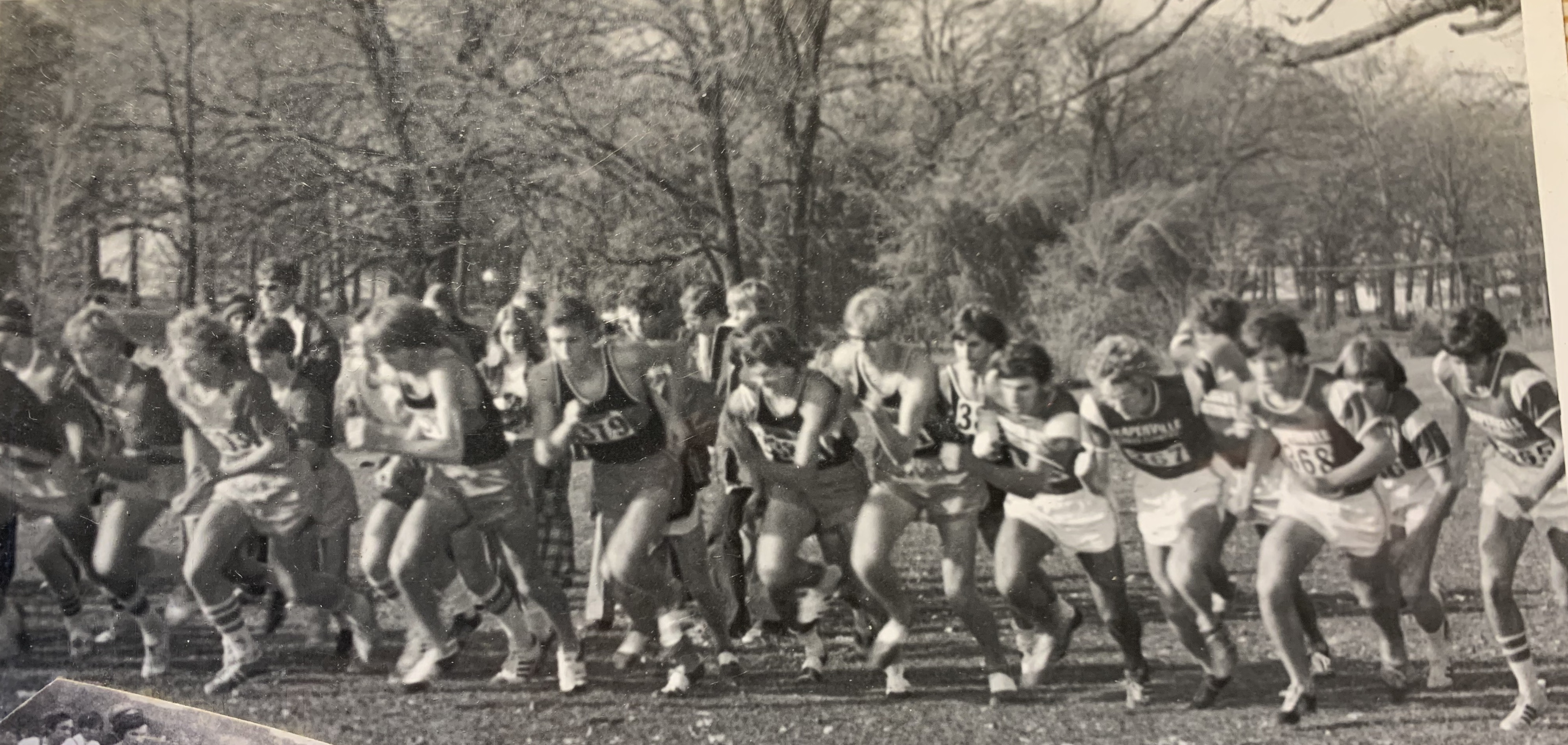
The starting line of the District meet 1974. My former Coach Rich Born is behind the bunch at far left.

My record of the race that day, in which I finished fourth behind Ken Englert of Elgin, Rick Hodapp of Naperville Central and Jeff McCoy of Lake Park, is captured in both “official” and “unofficial” photos. A St. Charles photographer took great photos during the race. My father Stew also moved around the course capturing the event on his trusty Polaroid.

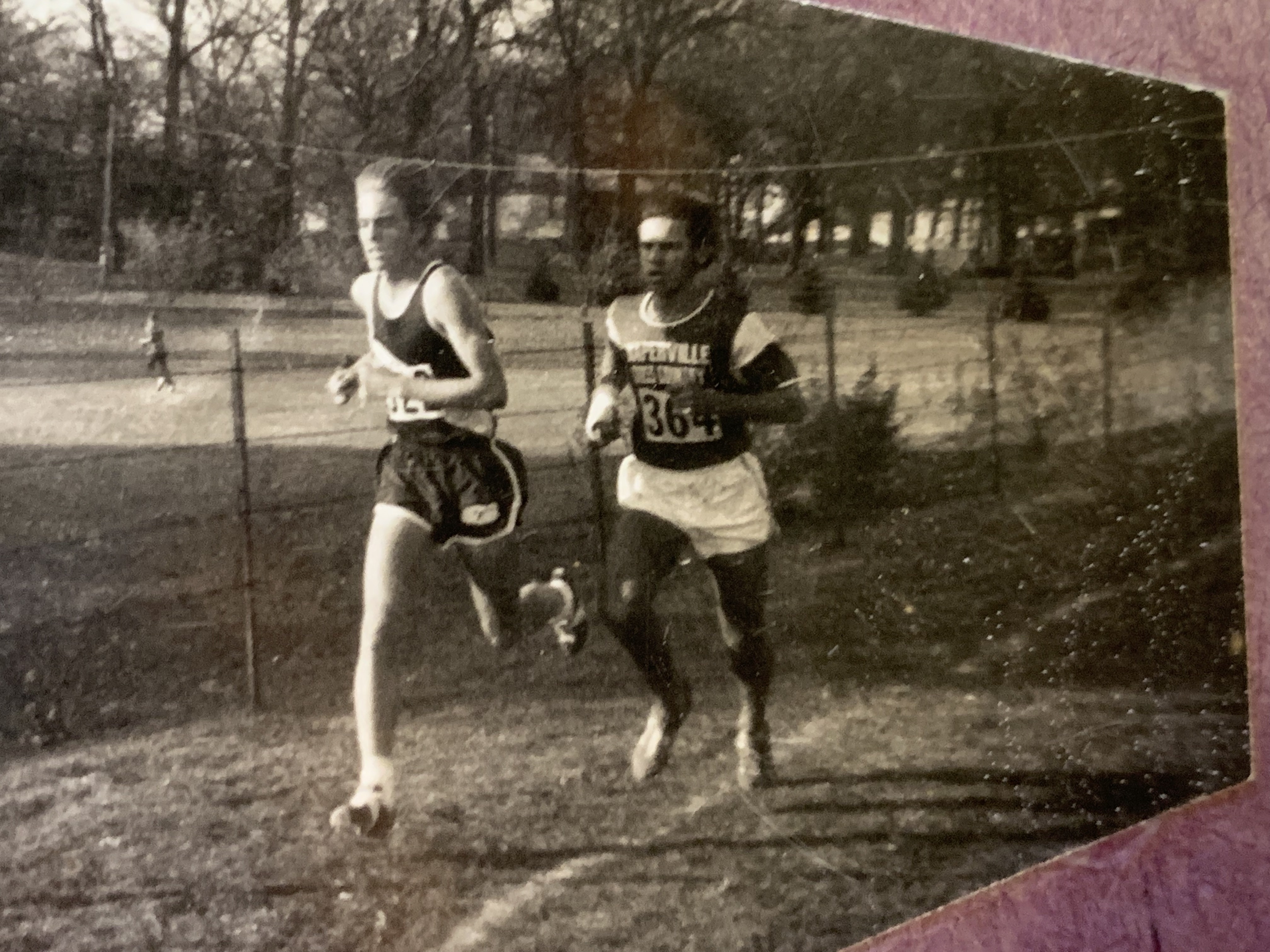
The problem with Polaroids is that they were susceptible to double imagery on occasion. This photo shows a Central runner, I think it was Randy Russell, along with my teammate Paul Morlock, #379. The runners in the middle are Jeff McCoy and John Rath.

After taking the hill at Elburn, the two two top guys Ken Englert and Rick Hodapp were battling together at the 1.5 mark.

This is the exact same spot as the photo above. My dad knew a good photo op at that course.

You can see that Englert and Hodapp were flying down that straight for the second loop on the course. These two guys had many great races against each other, having just fought it out at the Upstate Eight Conference meet the week before. But Englert pulled away in the middle mile, as evidenced by the picture of him taking the lead along the east woods. This section of preserve is now covered over with dense undergrowth.

You can see Hodapp turning the corner behind Ken Englert

I was not far behind these two guys fighting it out for one of the coveted top five spots that would move on to Sectionals.

Racing at the 1.5 mark.

At some point, Jeff McCoy slipped past me into third. I held fourth through the last mile and had to sprint like made to keep John Rath at bay in the last 100 meters. You can see in my face how much it hurt those last few yards. But I beat Rath, a keen rival all season. He’d go on to beat me by 30 seconds at Sectionals the following week. The guy did know how to rise to an occasion.

My father took photos of the top finishers receiving their awards.

Districts winner Ken Englert
Rick Hodapp in his funky cap
My fourth place award. My father must have missed third, or the photo didn’t come out.
John Rath. Goofy hats were “in” back then.

It was a nice accomplishment to advance out of Districts against that level of competition. The Sectional meet was held a week later. I arrived nervous and a bit overwhelmed at facing the level of competition in the sectional featuring York High School, the perennial state championship team famous for The Long Green Line. To make matters worse for my anxious state of mind, my starting stall was right next to the York team. Despite my general love of competition, I was intimidated. The guy next to me was also Dave Finnestad, a former rival from the Little Seven Conference and a rising star in Illinois running. He’d finish a few seconds behind me that day. Neither of us ran up to full potential.

My nerves got the best of me. The gun went off and I developed a side stitch in the first mile. Anxiety sometimes caught up to me in high-level competition. I willed myself to a 15:51 three-mile and finished in the Top 25. But it was disappointing. That was not good enough to advance in a sectional where the top individuals compete for select spots outside the team competition. The battle between Rick Hodapp and Ken Englert flipped again as Rick outran Ken by four seconds at Sectionals. The York sectional was one of the toughest in the state, with several Chicago-area sectionals typically dominating the top ten positions in state cross country. The Sectional Wall had held against me.

My father captured a photo of York’s Ron Craker leading the race.

Ron Craker finished second in the Section to his teammate yet went on to win the state individual title that year.

The season’s end came with a combination of disappointment and relief. I definitely wanted to go downstate, but the pressures of trying to win against the top guys from every team each week added up to a state of mental fatigue by that first week of November. My mother’s illness scared me that fall, and the rapid succession of meets combined with schoolwork and social life made me tired in the head. Then my girlfriend decided to break up with me. She’d fallen for some surly dude that I instantly hated because he looked like a no-good character. So I was depressed.

I weakly went out for basketball and learned quickly that I was not going to play that year. I felt anger and relief at that too.

Free Time

That meant there was free time after school. A band of us cross country guys started playing pickup football on the grassy area where our home course chute was typically placed. We were joined by a girl or two, including a super-cute cross country cheerleader named Mary Ellen Pooley, who was also a good athlete. She made touch football a joyous bit of laughter and beauty. After four solid years of sports dedication in cross country, basketball, and track, it felt good to let down for a bit and just be a high school kid.

One of our Campus Life counselors heard about our football games and showed up to ask if we’d like to join him in playing in a flag football tournament in Wheaton. We put together a bunch of guys and showed up for the tourney not knowing what to expect. I played quarterback because I had a great arm and accuracy. My cross country teammate Rob Walker played running back and our big Campus Life counselor Gary provided the bulk of the blocking, pun intended. He’d played in high school and was tough to get around. It was fun competition.

The tourney lasted all day.We kept winning games. The longer we played, the more that our cross country conditioning came into play. I’d done a fair amount of scoring, and during the final game the score was close and I wanted the ball. But my best friend Rob wanted the ball even more. “Cuddy,” he told me. Trust me. I can run it in…” Rob said. He was actually the faster runner and I did trust him. He would have been a great soccer player if we’d had the sport in the day. I handed the ball off and he faked an inside run, the tore down the sideline for a winning touchdown. I can still see that image of him with legs flying and guys diving after him. What a run!

After the tournament, tired as we were, we all went to the movies to watch the flick The Longest Yard. I remember there were some disgustingly sweet donuts involved in our celebration, and fizzy Cokes. Through all my years of organized sports and official teams, there was still something quite satisfying about that ad hoc flag football victory. We finished the day in fading light and light rain that November afternoon. We were soaked through with mud and thoroughly tired and satisfied. That tournament experience put a cap on my freshman fantasies of going out for football years before at Kaneland High School.

I kind of laughed at the thought that all that cross country running had gone to good use in a football game.

Posted in Christopher Cudworth, competition, cross country | Tagged , , , , , , , | Leave a comment

50 Years of Running: Jousting Knights

My mother was no great photographer, but she captured this image of my racing to the chute at Naperville.

One of the unique aspects of cross country running in the 1970s is that dual meets were held between every team in the league. The Upstate Eight Conference consisted of St. Charles, Elgin, Elgin Larkin, Wheaton Central, East Aurora, West Aurora, Naperville Central, and Dekalb. Each of these programs had a lead runner of course. Some had more than one.

At Naperville Central the top runner was Rick Hodapp. We toured the course and I thought I had it memorized, but would soon learn that memory fails, especially in the brain of a kid with partial ADHD. I raced to a significant lead and had Rick beat, but upon reaching the North Central College track the second time around the course, I turned right again to go around the backstretch. To my horror, I glanced left to see Rick headed straight down the track across from me. I sprinted to protect my lead but he reached the chute six or seven yards ahead of me.

I’d like to think that there should have been someone posted at the part of the course to direct runners, but there was not. My mother was at the race that day and took photos of the race. I can’t look at those photos without thinking about losing under those circumstances.

A week later we met the Elgin Maroons on their home course. The previous season our two teams had slugged it out in a dual meet out on our home course. St. Charles barely won 27-29. Elgin came back and won the county meet over us a week later.

My senior season the dynamic was a bit different. The pressure to concentrate on winning individual races was more intense. At least, that’s the impression I was given. The goal going into the Elgin race was to give it all I had against Ken Englert.

That race was one of the most intense experiences I had in all my distance running. Ken and I traded leads several times during the race. I’d beat him up a hill. He’d race past me going back down. He’d dump me on the next hill. I’d come racing back against him. We pushed and pulled and increased the pace on the flats. Neither of us gave an inch, that’s for sure. As we topped the final hill and did a U-turn toward the finish, we ran side-by-side toward the chute and crashed into it together. Ken fell a bit further forward, and the victory was given to him. As I recall, we broke the course record by nearly 20 seconds.

I have no problem with “losing” that race to this day. I’m thankful to have had the ability to race like that with a guy that I respected. He actually was the superior runner, as proven by other results in which I did not keep up with him. Somewhere along the way, Ken offered me a compliment in stating, “You were a force to be reckoned with.” That might be based on that single race alone.

Again, my mom tried her best, but this cropped-off photo of a race at Leroy Oakes shows the intensity of racing.

Following the Elgin race, some events at home took over my concerns. My mother Emily was hospitalized with serious abdominal issues related to giving birth to four boys. She was massively sick and could have died. My younger brother and I were taken to the hospital to visit her. The room was half-dark and my mother was barely able to talk with us. At home, my brother and I said little about the visit. In fact, no one talked to either of us about it. My father was obviously concerned, but it wasn’t his style to go all explanatory on such issues. Such was mental health in the 1970s. No one talked about anything. We were left to deal with our moods.

I tried leaning on my girlfriend at the time for comfort. She was super-smart, but just a sophomore in high school. She was the younger sister of a cross country teammate, who was also dating a sophomore. The senior guys were all dating sophomores because their class had a massive number of cute girls. My girlfriend’s name was Meg. Later in life I dated a woman named Jenny. I found that funny because growing up the brown and black dachsund dogs next door were named Meg and Jenny.

At any rate, my mind was not completely into racing after my mom fell ill. I was distracted by difficulties in class too. My grades in Algebra II were tanking. Ultimately, I’d get a D in the class, and that was a gift. I saw no purpose for Algebra and found it exasperating. The further I fell behind, the more it gutted my self-esteem. On Sunday nights I’d dread going to school knowing that my Algebra homework was not done. I didn’t understand the formulas. They made no sense to me. I’d done fine in geometry but algebra was toxic to my mind. There was no tutoring involved or assistance offered. I just struggled along like a half-brained idiot.

Mid-season, we traveled to Elgin Larkin to race in a downtown park. The kid from Larkin leading the course tour took off at six-minute pace. We all tried to follow and were exhausted by the time we finished. When the gun went off, I was confused and angry. Their top runner John Ciontea left me in the dust. He was the better runner, I’m sure. But I’d have liked to have had a fair shot at him without that speedy course tour. Following the race, I was approached by the St. Charles Chronicle sports writer Elmore McCornack. He asked me what I thought about the race and I blurted, “I don’t know.” That wasn’t like me, but the pile of issues in my head was too thick to relate.

Against Wheaton Central, I again raced to a lead only to be reeled back in by their top runner Paul Vestuto. He ran with patience and focus, moving past me at a point when I felt the energy start to lag. That was a lesson in racing tactics that I needed to learn again. My habit of front-running evolved out of a weird combination of determination and fear. On one hand, I ran with impunity in the style of a Steve Prefontaine. On the other had, I hated being caught and dreaded the idea it could happen. Later in life, I learned that those are patterns of anxiety. At the age of eighteen, I hardly knew what that meant.

Racing cross country is often mano-a-mano.

I’m pretty sure that’s how the Knights of old once felt about jousting. Surely there were plenty of anxious moments knowing that you could be wracked in the chest by a pointed lance. So many small things contribute to a big hit. A moment’s distraction. Lack of practice. It’s pretty easy to get knocked off the horse in a second. Such is the case with the sport of cross country. You race your best. Sometimes you win. Sometimes you get knocked off.

Our meets against West and East Aurora were less eventful. I won those races easily enough. Then came the last dual meet of the season, against Dekalb. We raced on a big campus somewhere. It might have been a golf course or a park. Whatever the case, it left us out in the open with nothing but a few trees and flags to run around. Unlike other teams in the league, Dekalb didn’t have just one top runner. They had five. Those five guys chatted to each other and ran easily while running me into flags as a group and toying with me on the straights. It was one of the more humiliating races I’ve run in life. I don’t recall if I beat any of their runners, but it didn’t matter. Their team was in a ‘different league’ than us that year. I admit to being a bit envious of their dynamic even though I hated them for the moment. They looked intimidating and ran with such confidence. I was not typically that type of runner. At least, not that season.

Near the mile point in the 1974 Conference meet, I’m next to Rick Hodapp with Ken Englert over his right shoulder. Dekalb has three runners in the front pack, and Elgin’s Karl Ulrich is right there too. This Polaroid was taken by my father Stewart.

When the Upstate Eight Conference meet came around, I girded myself for a battle with the top guys from all those schools. We ran on the golf course campus of Elgin Community College. For the first mile or so, everyone ran as a pack. Something in me decided to take the lead and stretch it out. During the middle mile, I felt strong and determined. But the likes of Ken Englert and Rick Hodapp and all those Dekalb guys were not fooled. They roared past in the last mile and I finished sixth overall. I took my chance and tried to win it all. There’s no shame in that.

Finishing hard at the 1974 Upstate Eight Conference meet. Polaroid by Stew Cudworth. Shoes: red suede Adidas Saturn.

The ups and downs of that senior season were plenty. The yearbook states that I won ten meets that season, but I don’t remember them all. There were meets against teams from other conferences, and an invitational or two as well. We did fairly well as a team coming off the previous successful season, but our pack was more spread out so winning invitationals wasn’t in the cards. What I most recall is the friendships. Singing in the locker room showers. Training together on wet grass in early morning workouts. Running until it got dark later in the season. We did so much together.

That said, we traveled to Peoria for a mid-season invite on the state cross country course. The night before the race, our coach tossed my teammate Paul Morlock and I in a hotel room with a Playboy, and told us to get to sleep. The rest of the team stayed up late. We could hear them down the hall.

I ate breakfast the next morning and drank some iced tea. Paul turned to me and said, “Are you sure you want to drink that? Is that good for you?” I hadn’t thought about it. But sure enough, I ran the first quarter mile hard to get ahead of the large pack and wound up with a painfully sharp side stitch that stuck with me the entire race. I learned the hard way that my body and caffeine don’t get along together.

Such are the vagaries of all sorts of competition. Little things add up to big mistakes. I’m sure those knights that jousted felt the same way years later. More likely it was like, “What the fuck were we thinking?” Then again, how many of them lived long enough to tell those tales? I guess that’s the difference in this day and age.

Posted in Christopher Cudworth, competition, cross country, running, running shoes | Tagged , , , , , , , , , | Leave a comment

50 Years of Running: Picture this

Leading the Plainfield Invitational in September, 1974. Photo by Kurt Mutchler.

Following a couple of early season dual meet wins, I lined up for the start of the Plainfield Invitational. The race was not held on the golf course usually recruited to host the school’s races. Its new course was on a converted quarry.

There were sections of flat turf grass that constituted much of the race. But there were wild and wooly injections of gravelly hills that we climbed up and scurried down. I loved that kind of running because I grew up a partly wild child roaming the woods and fields of eastern Pennsylvania. One of my favorite memories from grade school was running the obstacle course during outdoor education. I set the best time early in the day and kept going back to improve my time. Finally the teachers told me “That’s enough” and blocked me from any other attempts.

I wore running spikes that day in Plainfield, and they came in ultra-handy as we cut across sandy barrens covered by autumn leaves. Then the course turned right into a cattail marsh. I don’t mean “around” a marsh. I mean “through” a marsh.

By that point, I had a hundred yard lead and was feeling victory at hand with a mile to go. The sight of a cattail marsh straight ahead gave me some pause, but not really. I checked the flag direction approaching the marsh, and it indicated “straight ahead.” So, straight ahead I went. Right through the water and muck and trimmed down cattail stalks.

I don’t know who designed the course for that meet, but I love them to this day. In all my other cross country experiences, nothing matches the joy I felt racing through that water in plain old cross country fashion. It suited a hayseed, nature-loving kid like me to run through that shallow, water-filled ditch.

Tromping through the water served as a precursor to my college steeplechase career. When I emerged on the other side, I was laughing and excited and was almost tempted to slow down and watch what happened to the rest of the field. Instead, I picked up the pace and raced the last mile for the win.

A photographer named Kurt Mutchler took photos of the race that day. I saw them all when he developed the roll the following week. How I wish I’d snagged one or two of them, but they were bound for the yearbook editor and I was denied the opportunity. Kurt shot those photos in a calculatedly grainy fashion. They captured the best of what cross country was about. Unfortunately, they were likely tossed out years ago in some file-cleaning effort at the high school. I think I’ll ask about that. Perhaps they’re in some storage bin or archives…

Kurt Mutchler was a cross country teammate that went on to become the National Geographic magazine Senior Science Picture Editor. So I’d like to take credit for his amazing career because I was such good subject matter on that day in September, 1974. You’re welcome, Kurt.

Posted in Christopher Cudworth, competition, cross country | Tagged , , , , | Leave a comment

50 Years of Running: Don’t be a dick about being a jock.

Heading into a senior season in high school cross country, I can’t say that there were a list of concrete goals at work. Knowing that the Sectional Wall awaited me at the end of the season, I had little confidence that I’d make it downstate against such tough competition at York, where the perennial state champion York Dukes were one of several talent-filled teams that dominated the top spots. I didn’t mark that down as an ultimate goal. That would be a ‘wait and see’ objective.

The “Duke” jock strap

What I did know is that I was running really well during early season practices. That created some odd friction and awkwardness within the team, as I was torn between running my best and helping the other guys along. I loved my teammates and wanted them to do well as a team. At the same time, the pressure to beat the top guys from other schools required absolute intensity. That comes with the territory. So I can’t say that I was the best teammate to everyone on the squad. I was too focused on trying to beat everyone I could.

Our first meet against Lake Park was held at Leroy Oakes Forest Preserve, a rolling layout that included a mile loop through thick woods on the east side. I took off in the lead and raced through the familiar trail knowing when to duck under a series of overhanging blackberry bushes. There were two guys from Lake Park on my tail until that section, and I could hear them griping about the blackberry branches over the trail. It was kind of a dick move to take the lead there. But hey, all’s fair in love and war.

Then the course moved along the flats next to Ferson Creek and climbed a gravelly trail to to the upper level of the preserve. By then, I’d built a decent lead and was preparing to bring it home in under 15:00 for the three-mile when I felt something go slack down low.

Earlier that day, I’d found a beautiful set of silky orange running shorts in one of the gear bins of uniforms. There were a holdover from the classic uniforms of the late 1960s. I loved their look and frankly, they felt great compared to the clunky nylon shorts we were issued for meets. So I snatched the orange silk shorts for use in the first meet that day.

Up until that moment before the finish, I was looking forward to running home in first place with my flashy retro orange shorts. As the finish line neared, what I felt was a strange loosening in one side of my jockstrap, which I’ll have to admit, was only hanging by a few threads when I pulled it on. It was an old, worn-out thing that I liked because it wasn’t so bulky. It held your junk in place without chafing in the heat.

With 200 yards to go, the old jock snapped. Suddenly I felt a rush of air down below and realized my dick was popping out from beneath the silky shorts, which were considerably shorter than the standard nylon shorts we were supposed to wear. I quickly turned around to see if the Lake Park guys were catching me, but I still had a good lead. I panicked for a few strides as I bore down on the chute.

All I could do was take hold of the edge of the shorts to hold them firmly in place as I ran in the last fifty yards. From there, I ran straight to the team bus and pulled on some sweatpants. Unfortunately, that meant I could not stick around for a handshake with the guys from the other team as they rolled through the chute. It probably looked like a prick move.

Yes, that was an obvious dick joke.

That night, I had to explain to my mother why we needed to go out and buy a new jockstrap. That wasn’t a favorite thing to do, go jock shopping with mom. But with four boys involved in sports, she was not squeamish about such things.

When I was really young and not yet participating in school sports, I saw my brother’s jocks in the laundry and wondered what it would be like to be old enough to wear them. My brothers also wore cups in their jocks while playing baseball and soccer. That was a good strategy to protect the junk in potentially damaging sports.

Of course, runners don’t need protection as much as they needed support. Over the years, more than one gym teacher warned us that if we didn’t wear jocks while we were young, our balls would hang down to our knees in old age. We had no way of knowing whether that was true or not. But the first jock I was required to wear was for 7th grade P.E. class. Our gym teacher was a stickler about wearing jocks. If you got caught wearing regular underwear beneath your gym shorts, the punishment was writing “I WILL NOT FORGET MY JOCK STRAP” fifty times on the locker room chalkboard. Writing those words on the blackboard burned the commitment into your brain. I only forgot my jock one time that whole year.

That gym class teacher saw jockstraps as part of the discipline of physical fitness. He was a wrestling and gymnastics coach at the high school level, so he knew the importance of functional apparel and equipment. That gym teacher was right on all counts. As I learned in cross country a few years later, taking care of your equipment (that’s another dick joke) was an important part of being prepared for competition.

Jockstraps eventually became less common as running shorts evolved with briefs built into the shorts. Even those required a period of adjustment. I too well recall the first time I ran in a pair of silky Sub-4 shorts that I’d ordered for my senior cross country season in college. I went jogging in those new shorts with my girlfriend one afternoon, and immediately got a full-on erection from the back and forth stimulation of the smooth briefs. She found that pretty funny.

So we did away with jocks at the running garment industry improved their wares. Along the way, however, the word “jock” became a derogatory slang word to describe guys (and even gals) in sports. A couple years after college, I was hanging out at a local bar trying to meet women and started a conversation with a gal I’d known in high school.

She asked, “What are you doing now?”

I replied, “I’m a graphic designer in marketing…”

She stared at me. “You’re an artist? I thought you were a jock…”

“I didn’t know the two were mutually exclusive,” I responded.

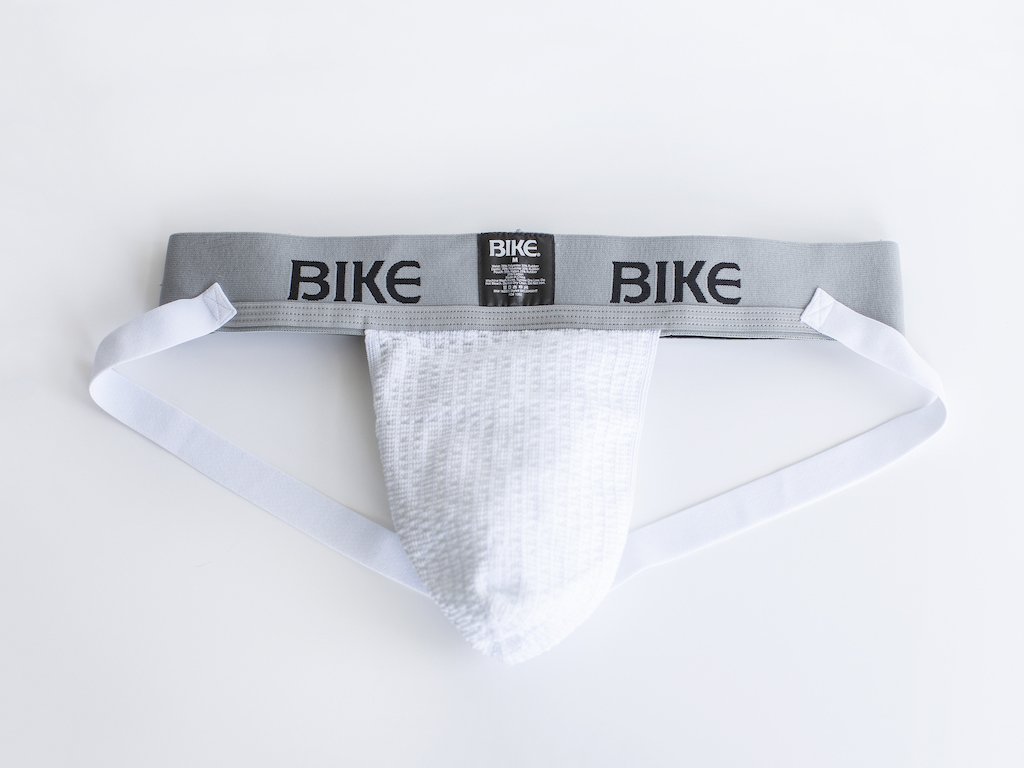
Little did she know that jocks would someday become an erotic fashion statement, as evidenced by the selection shown below.

I doubt any of my teammates would have sported these jocks in the locker room back in the day. The see-through models in particular would have drawn some comments. We pretty much ignored each other’s dicks even though we spent plenty of time naked in the shower. Being naked in front of others just wasn’t something we worried much about.

But that didn’t mean I was going to complete the first race of the season in “balls to the walls” fashion before the home crowd. I happily wore the new jock the rest of that year, and ditched those tiny silk running shorts for good.

Posted in Christopher Cudworth, college, competition, cross country, running, sex | Tagged , , , , , | Leave a comment

50 Years of Running: Another Turn of the Page

The three Varsity cross country captains of 1974: Rob Walker, Paul Morlock, and Chris Cudworth.

After a largely uneventful junior year spring track season, in which my mile and two-mile times barely improved year-over-year, I stumbled into the summer season not quite knowing what to do with my time. We had no organized summer run program. I begged my mom to buy me new running shoes but the only thing running shoes sold at the downtown shop in St. Charles was a pair of paper-thin Tiger running flats suited more for bowling that putting in miles. I went for a few runs in them and my knees instantly started to hurt. So I said, “F*** it” and played hoops to stay in shape instead.

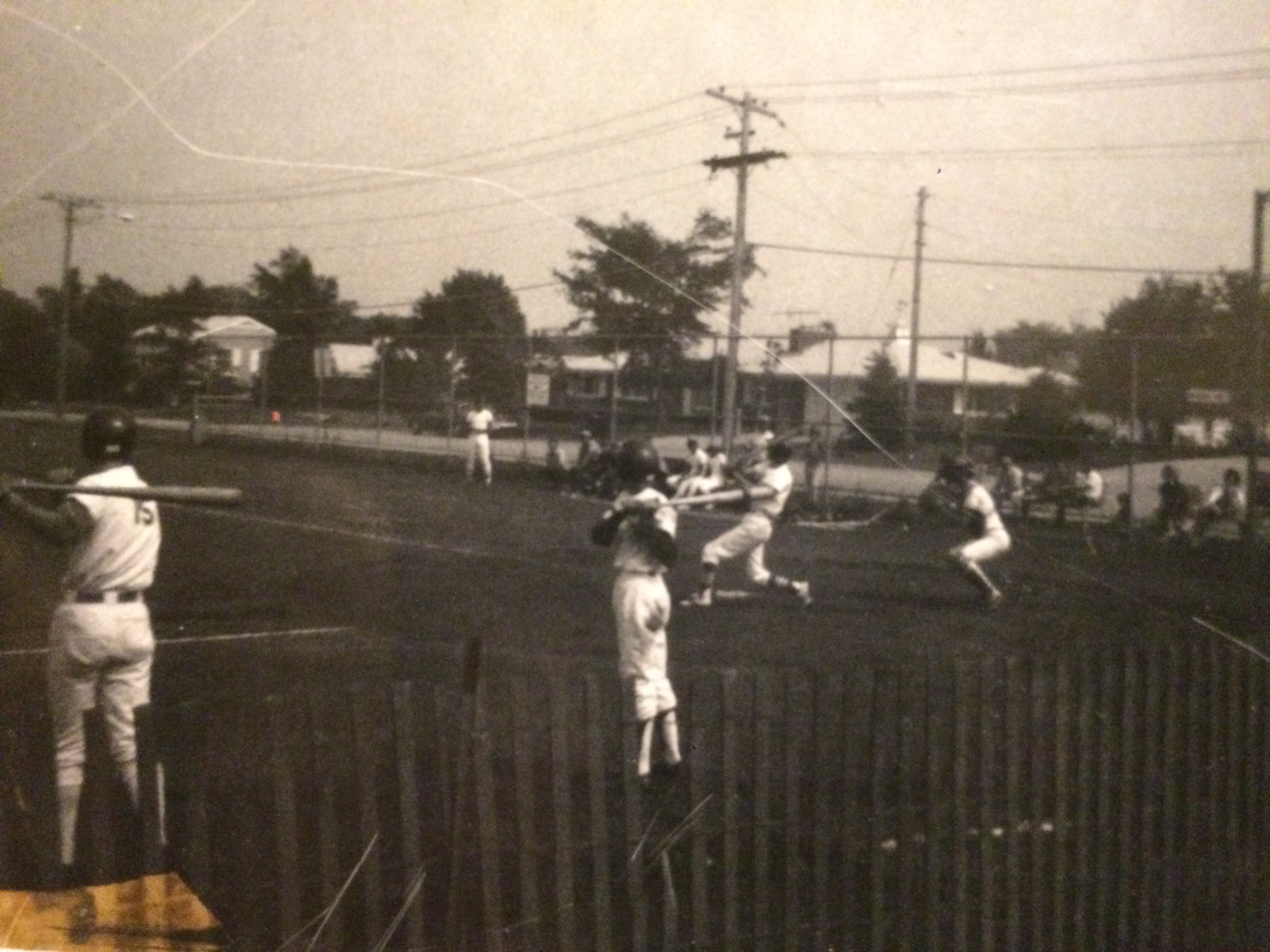
Batting for the Blue Goose baseball team.

The previous summer I’d played baseball on the Pony League team sponsored by the Blue Goose Supermarket. But the age group for that league ended at fifteen, and there were no American Legion teams available in St. Charles. That was a shame, because I’d pitched to a 7-1 record the previous summer and wanted to continue playing baseball. The door to joining the older teams out in Elburn had closed, thanks to our move to St. Charles. My lone tryout with the Kaneland varsity summer program ended badly when I showed up for a tryout and took an at-bat only to miss all fifteen pitches thrown to me. It might have helped to actually swing a bat a few times before that adventure.

Pitching for the Blue Goose.

Left in a void in the summer of ’74, I played tons of golf at Pottawatomie Golf Course with my close friend Rob Walker. He’d been employed the previous summer in the locker room at the St. Charles Country Club, shining shoes for golfers heading out on the links. I caddied some but hated it. So I spent my summer days golfing in the morning and drawing and painting the birds I loved to watch the rest of the day.

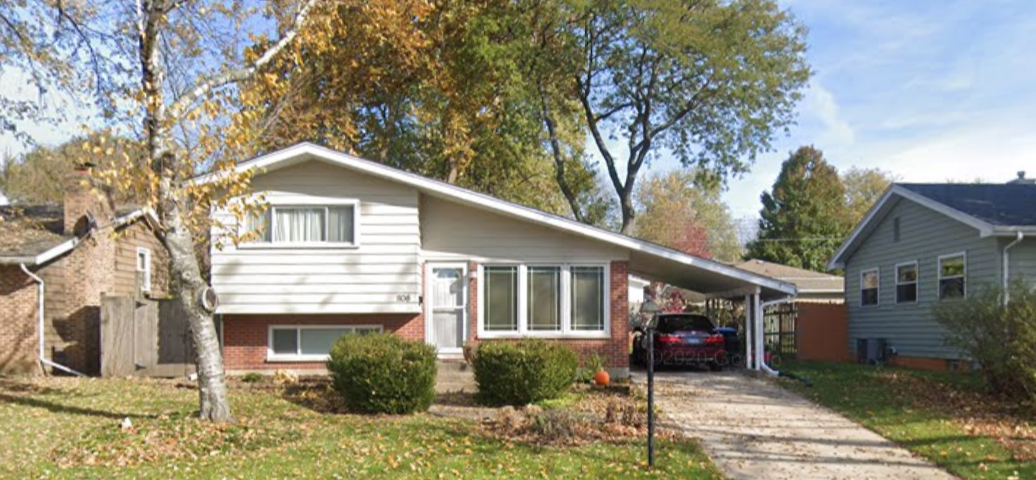
1108 S. !1th Avenue. The tiny split-level where our family moved to St. Charles

The ugly little house to which we’d moved in St. Charles was a less-than-inspiring place to live after the three story house we’d occupied out in Elburn. Frankly, I was a little depressed all that summer.

417 Gates Street in Elburn where our family lived in a three story home.

When August came around, I went out for a run with my two best friends Paul Morlock and Rob Walker. We met in the parking lot of a grocery store and ran for a few miles. I got an instant sideache and felt sluggish the whole way. That didn’t seem to bode well for the season ahead.

Then cross country practice started and it was an explosion of activity and training, with two-a-days in the heat and humidity of late summer. Our coach Trent Richards invited two stellar runners that were headed off to college to join our practices. Greg Birk and Tom Burridge led the way every day. The rest of us suffered in their wake. That lasted only a week as they took off for Wabash College and the University of Kentucky, respectively.

I might have been relieved at their leaving if their presence had not jolted me into reality and snapped me into shape. After a week of running all-out, I could feel my body come alive. That left me in the company of yet another outsider in our presence. His name; John Rath. He was a short but highly competent distance runner from nearby Burlington Central High School. We weren’t in the same conference, but I felt an intense rivalry toward him just the same. He was the faster miler, but I tended to keep even with him over longer distances.

Trent knew Rath through coaching him in the summer track club. They both had the same acerbic temperament, a bit testy at times. I wound up running some summer track races against him the following summer. He was always a bit fitter and more intense during the summer months. As the days went by that fall of ’74, we fought for dominance in practice when he showed up on breaks from running with his own team.

Then came our St. Charles intrasquad meet. Before the race started, John suggested we run race pace together but not compete. I agreed. We took off running at 5:00 pace in the August sun with sweat already dripping into our eyes. At the mile mark, John’s shoe came untied and he stopped to tie it. Not knowing how that affected our agreement, I glanced back, paused a moment and kept running. My reasoning was basic: “Why should I stop if he forgot to tie his shoe?”

Thirty years later, I met John at some social function and he still seemed pissed about that day. He openly harbored bitterness about the incident. That’s how competitive he was. I thought I was competitive back in the day, but he was far more intense. That’s why Trent liked him. John Rath never backed off.
Summer track running was always a mixed bag of half-fitness and hard efforts. My close friend Jack Brandli is in the URP Brothers shirt. Geneva’s Dave Bashaw is right off my right shoulder. The dog is the guide for Bob Rosene, a blind runner whose wife Carol coached summer track.
I don’t know whether I was right or wrong not to stop that day. At the time, I figured, “This is my intrasquad. I’m supposed to do my best.” So I left him behind.

Later that season, John would finish one second behind me at the District meet at my old Kaneland High School course at Elburn Forest Preserve. He’d turn around and beat me at the York Sectional. He never backed off. But neither did I. I call that fair game in running.

If he still thinks I cheated him, so be it. With some things in life, you gotta turn the page.

Posted in college, competition, cross country, running shoes | Tagged , , , , , , , , , | Leave a comment

50 Years of Running: Basketball Jones

Sometime in the school year of 1973, the duo of Cheech and Chong came out with a comedy album featuring a novelty hit song titled Basketball Jones. It was filled with bald-faced cliches and overwrought background singers singing the refrain over and over. It was dumb. And we loved it.

Yes, I am the victim of a Basketball Jones
Ever since I was a little baby, I always be dribblin’
In fac’, I was de baddest dribbler in the whole neighborhood
Then one day, my mama bought me a basketball
And I loved that basketball
I took that basketball with me everywhere I went
That basketball was like a basketball to me
I even put that basketball underneath my pillow
Maybe that’s why I can’t sleep at night.

That song, while it was a parody, was actually quite descriptive of my life. I was obsessed with basketball from the age of eight or nine years old. I got good at the game, was a starter on every team on which I played, and achieved some heroics along the way such as sinking a half court shot at the buzzer to beat a rival and win the conference championship. Just like you pretend on the playground.

By the age of sixteen, as a junior in high school, I’d reached six feet in height and could touch the rim with ease. At 137 lbs, I was lean and fast, and had built a flashy game around the style of Pistol Pete Maravich. Perhaps that was a mistake.

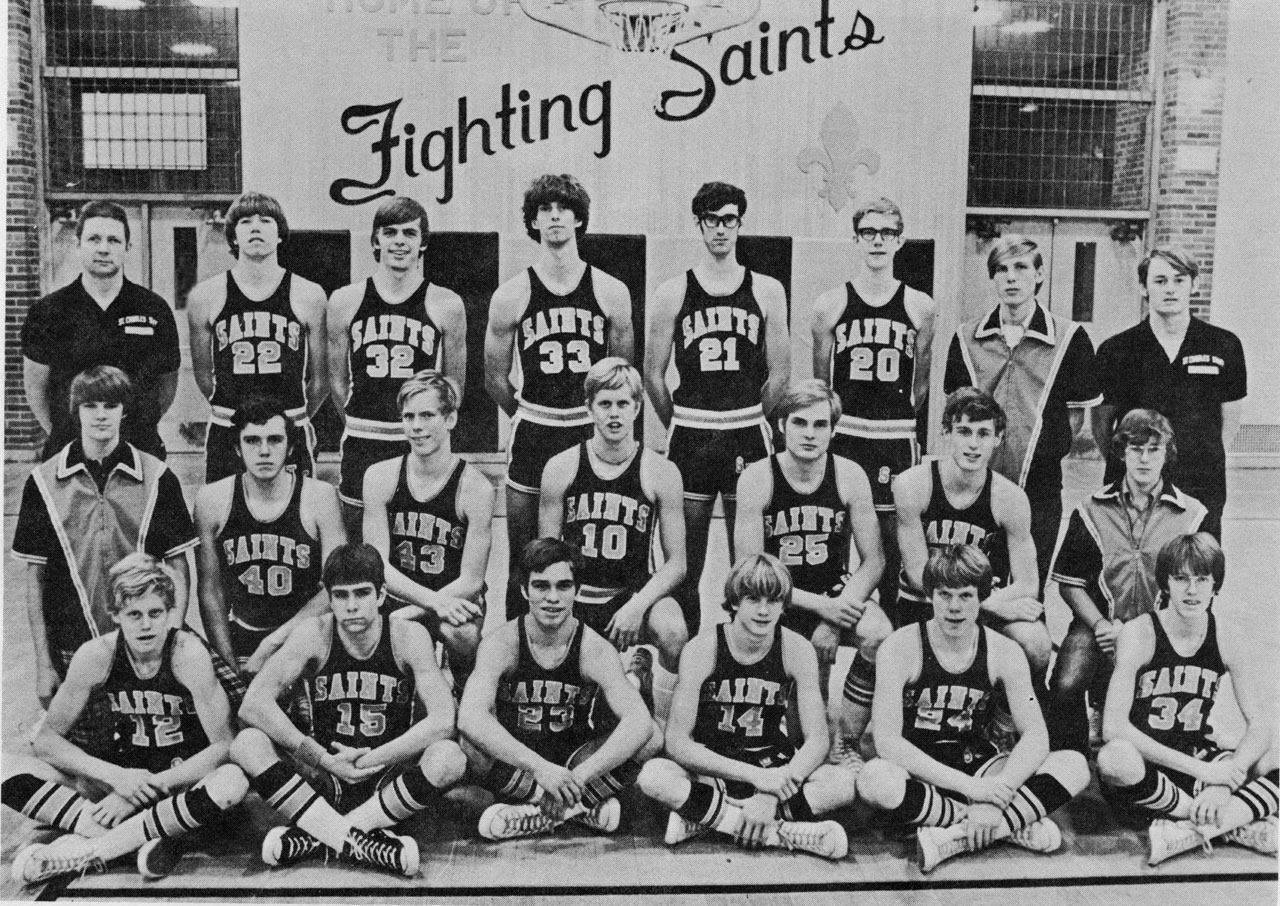
Basketball 73-74. I’m at the far right, first row. My friend Curt Berg is next to me, and Steve Mendel, the other guy that skipped hoops camp senior year, is next to him. Paul Morlock is over my left shoulder, and above him, #20, is Deane Westland, another cross country runner turned hoopster. I later played lots of open gym with #32, Bill Birkinbine, a great guy and equal gym rat.

When cross country ended in 1973, I showed up for basketball practice and quickly learned that being a transfer from another school meant having to start all over. The varsity team sorted itself out with some pretty fine players and the rest of us muggled around on the JV squad. I was a starter there, but it didn’t mean too much. Come varsity game nights, we sat sweatless and morose on the team bench.

I still wore glasses, and at that level of basketball, they were not helpful at all. During one practice, our top forward came down with a rebound and mashed my wire-rimmed frames into my face. The lens popped out and shattered into a thousand tiny fragments on the slick gym floor. The look on Coach Ron Johnson’s face was beyond disappointment. I felt guilty and chagrined.

Up for a jump shot, wire-rimmed glasses and all. Nice Converse.

Rather than buy me contact lenses, which I would have preferred, my mother dragged me to the optometrist for a pair of black horned rimmed “sports glasses.” Those were awful. Sickening, really. I couldn’t see out the side of my eyes, which is important in basketball, especially for my sleight of hand game.

Our team did win the Dekalb Holiday Basketball Tournament that season, and I got some playing time when we ran up the score. But mostly my classmates and I toiled away in empty gyms on Saturday mornings. We played the same offense under the guidance of the assistant coach, and I scored plenty and helped lead the team. That didn’t transfer to varsity action.

If anything, showing leadership at the JV level led to confrontations with other teammates. One of them accused me of being arrogant and looked to start a fight in the locker room. He was bigger and stronger. I was not about to take up his offer to slug it out.

The fact of the matter is that competition for playing time is ugly in the underbelly of any program. That’s why I liked cross country. You either ran faster, or you didn’t. That gave me great admiration for guys like my teammates Bob Baert and Dave Brown, Orland Cole and many others who put in the mileage week after week in cross country, competing mainly in Open or JV races. That respect continued through college when many other guys ran 70-80 miles a week along with the varsity guys and appreciated the sport for perhaps different reasons than the fastest among us.

Sure, there are measures of success in basketball, like points and rebounds and steals. But one still has to impress the coach in terms of game awareness and fitting into the system. I admittedly didn’t always have a grasp of the bigger picture, at least not at that age.

Hanging out on the perimeter, #30. Cross country physique.

Ten years after high school I was playing in pickup games at a local high school and had learned much more about the game after hours honing my Basketball Jones in Open Gym. I’d settled down the floor game and worked as a swing forward. I didn’t weigh much more, perhaps 145 lbs by that point, but I could still jump and run better than most players. After finishing a game, I walked off the floor and met up with the assistant coach for whom I’d played JV ball in high school. “You know,” he told me. “Maybe we made a mistake with you. You’re really good.”

“No, probably not,” I told him. “At that age I didn’t really understand the whole game the way I should.”

It was nice to receive that compliment anyway. Yet a part of me never trusted that coach. At one point during the JV season that year, my friends Paul Morlock and Rob Walker rode out to visit a college in Pennsylvania. We left on a Thursday as I recall, and were back by Sunday.

That Monday when I showed up for practice, the assistant coach treated me with a weird deference. That weekend, we were scheduled to play my former teammates from Kaneland High School. I was excited to have the chance to meet those guys on the floor, but when the game began, the coach had me sitting on the bench. I’d started every game up to that point in the season. Anger welled up within me. It was embarrassing to not play against my friends. What would they think?

After half, the coach finally put me in the game. I was wild at heart by that point, and playing recklessly. I picked up fouls, and the referee was a former teacher from Kaneland that counseled me to settle down. But I couldn’t. I was so frustrated and angry at the hard sleight from the coach that I nearly fouled out with ugly hacks and raw defensive moves. It wasn’t me that was playing by that point. It was my wounded ego.

Following the game, I asked the coach why I didn’t start. “You missed a practice,” he told me. “That’s against team rules.”

“But we told you that we were doing a college visit,” I protested.

“Doesn’t matter,” he replied. “Don’t miss practices.”

My longtime friend Paul Morlock shooting a jump shot as I scope out the rebound prospects.

By that point in the season I’d begun not to care about basketball so much anyway. Indoor track season was approaching and my interest in hoops was waning. Still, there were a few games to make it through. As one contest wound down and the varsity pulled away from a weaker team, I watched the clock tick off the seconds until there were only thirty left in the game. My playing time that season was always confined to the last two minutes or so. After sitting in the stands for that long, getting in to play without warming up was almost a worthless thing to do. So when the coach turned to me with thirty seconds to play, and asked, “Cudworth. Do you want to go in?” I shook my head no.

That next summer I didn’t show up for basketball camp. But following the senior season in cross country, I showed up for basketball practice thinking I’d give it a go. Immediately, another teammate and I that skipped summer ball were sent to a corner to “practice passing.” We were in the dark part of the gym, actually, when my cross country coach Trent Richards walked by and said, “Cudworth. You know you’re not going to play this season, right? You didn’t go to basketball camp. I talked with Johnson. Don’t waste your time. We’re starting indoor track in December.”

He was right. In fact, our entire senior class didn’t get much playing time that year. The coaches made the decision to transition to younger players and bring them up from scratch rather than give the seniors a chance to play much. My friend Paul Morlock did go out for hoops, as did another friend Curt Berg. They saw little varsity playing time, and at one point a group of us sat up in the stands chanting their names to get them into the game. Maybe it worked. Maybe it didn’t.

Far away from the glory, things tend to get ugly.

That year I played intramural ball, and illegally switched teams in mid-season to help confront a bunch of cocky guys beating up on other lesser squads. During the championship game, play got rougher until their big center flipped me over his shoulder. I slammed to the ground. Before I knew what I was doing, I jumped up and slugged him flush in the eye. I could feel my knuckles embed in his flesh. He reacted with a wild swing that I ducked. Then I ran out the door into the cold winter air and kept running all the way home. That night, I got a phone call at home telling me not to come to school the next day or I’d get beaten to a pulp.

Forty years later, I showed up for a high school reunion and the guy I punched was sitting at the front of the room. I blanched at the idea that he might recall our encounter. But he didn’t. I reason that he was in so many fights that he didn’t recall that lone punch I threw.

Following my aborted career in scholastic basketball, my younger brother Greg entered high school and earned All-State Honorable Mention. He went on to play D1 basketball for Kent State University. As I mentioned in an earlier article in this series, my father had moved us from Kaneland to St. Charles in part to advance my brother’s basketball career. And it worked. He built his vertical leap to 36″ and had a wonderfully soft left-handed jump shot and a mobile floor game. He was a joy to watch when I got the chance to see him play between my college time and commitments.

I’d also loved watching my oldest brother Jim play basketball when I was growing up in Lancaster, Pennsylvania. He was an exceptional all-around athlete who ran a 4:40 mile as a freshman in the late 1960s. He could dunk the ball from a standing position and was great at defense. He played a season at Millersville College until he contracted mono.

My other brother Gary was a great defensive player with quick hands. He later became a competent fencer and exceptional table tennis player. We both won some local tournaments in that sport. But mostly we enjoyed hitting Open Gymn.

As adult siblings, we played together many times over the years. We jokingly branded ourselves the Flying Zambini Brothers. One time we were shooting around on an outdoor playground basket when a group of much younger players showed up and challenged us to a game. They had no idea what they’d just done. We wiped the court with them, including a couple resounding dunks from Greg.

I have no regrets about my Basketball Jones. All that lateral movement kept me largely injury free as a runner for many years. The jumping also prepped me for competition in the steeplechase, where the act of stepping on the barrier and leaping over the water jump was just another day at the office for one of the Flying Zambini Brothers.

As for me and my temper, I learned to tame it thanks to an incident I witnessed at Open Gym one Saturday. A player known for his temper got worked up and started threatening everyone. He even picked up a chair as if to hit someone. At that point, a massive former football player with a scary blonde buzz cut stepped in front of him and said, “Go ahead. Hit me. It will be the last thing you’ll ever do.”

The chair dropped to the floor, and the player walked out the door. We all went back to playing basketball, and I vowed never to lose my temper again.

Posted in competition, cross country, running | Tagged , , , , , , , | Leave a comment

50 Years of Running: The Sectional Wall

As the cross country season rolled to a close in November1973, our squad ran in a tough sectional in the Chicago suburbs and didn’t advance downstate. That would have been a stretch for a program that was just beginning to grow into believing that it could compete with bigger schools such as York, Glenbard East and other powerhouses in Illinois cross country.

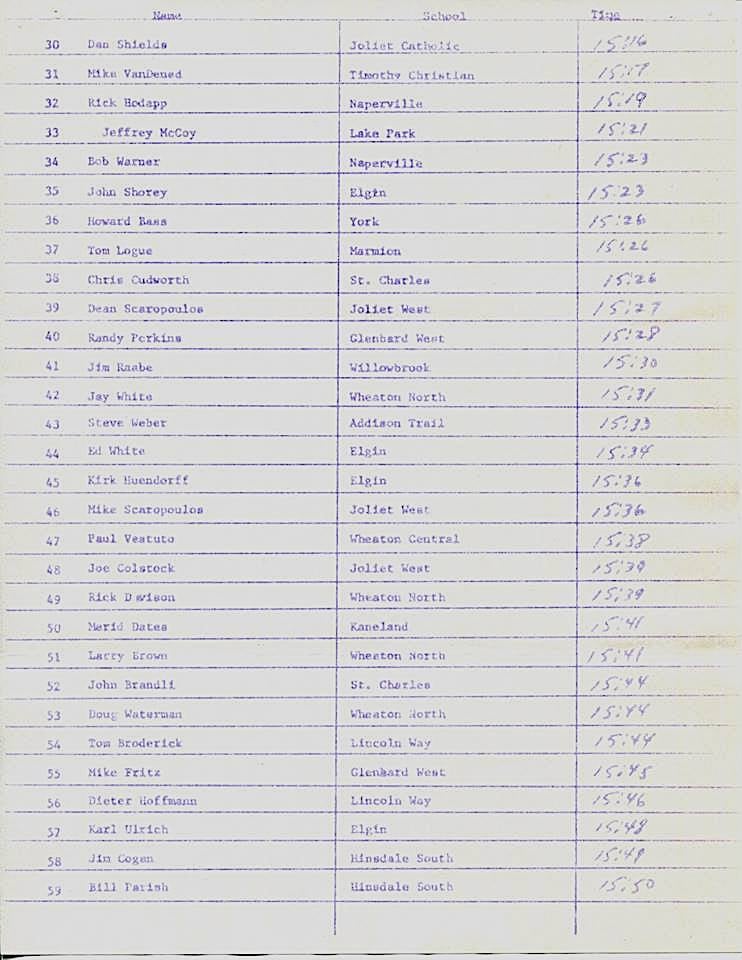
That day would arrive in a few years for both St. Charles East and St. Charles North, the two schools that emerged from the single high school serving the community through 1978 or so. As it was, I ran 15:26 at that Sectional, a credible time but nothing spectacular. I finished 20+ seconds behind Elgin’s Ken Englert and a few seconds behind his teammate John Shorey. The big names in Illinois running at that time dominated the day: Bill Fritz in 14:05. Dave Walters in 14:20 and Batavia’s Tom Burridge moving downstate in 14:37.

We’d run into the Sectional Wall, as it were. I ran nearly the exact same time the next year at sectionals, and placed in a somewhat similar position. Never quite made it downstate thanks to that Sectional Wall in Naperville and York.

The Open Toilet

There’s one amusing aspect of competing in a meet that season that was held at the North Central College campus. I believe it was the Naperville Sectional, but I could be wrong about that. Whatever the meet, I felt the classic need to hit the bathroom before the race began. Walking into the old North Central fieldhouse, I searched around for a toilet and walked into a room where a lone runner sat on an open stool with a line of guys waiting to go next. I stood there aghast. In the back of my mind, I vowed, “I am never going to go to this school.”

As luck and life might have it, I received a recruiting letter from Coach Al Carius a few weeks later. Knowing nothing about the North Central cross country tradition or what it might have meant to my career, I set the letter aside and didn’t take it seriously. As it was, our Luther College team placed second to NCC five years later in the NCAA D3 championships. The course of my running career was literally shifted by the sight of an open toilet. I have no regrets about that, but it is kind of funny that it was an open toilet that determined my choice in a college.

Growing futures

As for the program in St. Charles, there were other signs that the cross country team was developing talent in a positive way. A sophomore named Greg Andrews had won both the Kane County invitational and the Conference meet in 1973. That’s a difficult double in any season. He ran Varsity during dual meets to get used to the three-mile distance, but his accomplishments showed the importance of helping distance runners develop at their own rate.

Greg and I would soon travel similar paths with interests that converged not only around running, but around music and writers such as Hunter S. Thompson, Tom Robbins and others. He also grew close with another St. Charles runner, (John) Jack Brandli. Those two would dive deep into the sports of cycling, cross country skiing, roller skiing and triathlon together. I went cross country skiing with them dozens of times and took up cycling and triathlon years later. Our lives converged and mixed over the years. We definitely had some crazy times together.

The significance of our respective high school classes diminished as the years passed on. At one point, a fourth St. Charles runner named Greg Birk came back to Illinois from his job in Europe. We all cycled fifty miles together on a cool day swapping stories about our days running for coach Trent Richards, the girls we knew and life in St. Charles.

“I can’t believe you guys stayed here,” Birk wryly observed at one point. The rest of us laughed. We’d all been plenty of other places in our lives, but arrived back in the Tri-Cities. I’ve run something like 50,000 miles in my life, and cycled that and more. All that moving time amounts to plenty of travel. In the end, it’s all a journey within our minds, and breaking through the walls of our perceived existence. As Beatle George Harrison once wrote:

Try to realise it’s all within yourself
No one else can make you change
And to see you’re really only very small
And life flows on within you and without you

St. Charles runners: Cudworth, ’75, Birk, ’73, Andrews, ’76 and Brandli, ’74.
Posted in aging, Christopher Cudworth, competition, cross country, cycling, cycling the midwest, running | Tagged , , , , , , , | Leave a comment