50 Years of Running: Forgettable and Unforgettable

Looking back at a running career is a bit kaleidoscopic. Memories sometimes mix and turn circles in the mind. Others bubble up unintentionally, driven by autumn light or the smell of the air on an October day. While many of my recollections of certain events are clear, others escape me until a friend or former teammate tells a story. Once in a while, I’ll turn to one of them and say, “I don’t remember that at all.”

Some memories bubble up to the surface easily. Others we cannot so easily recall.

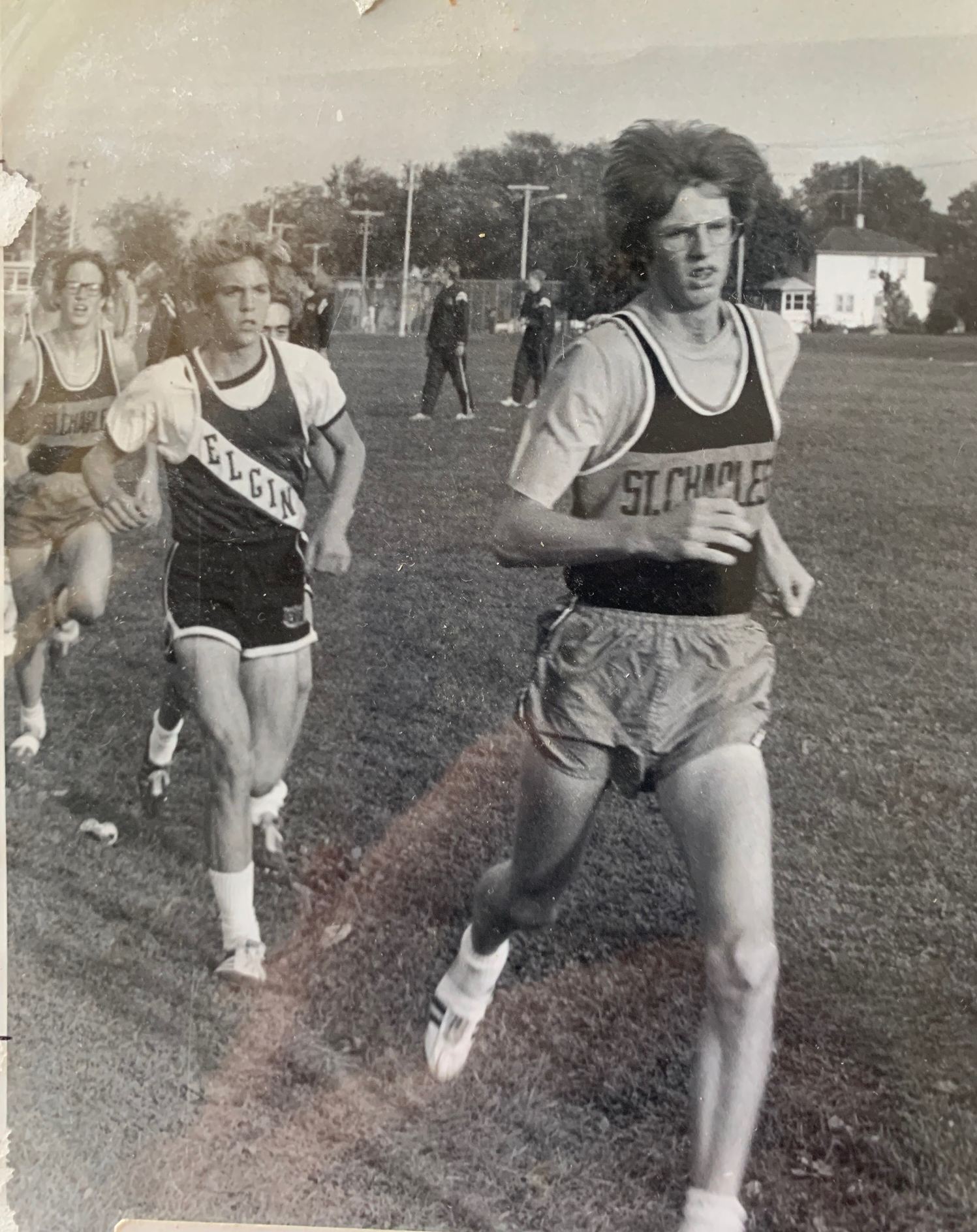
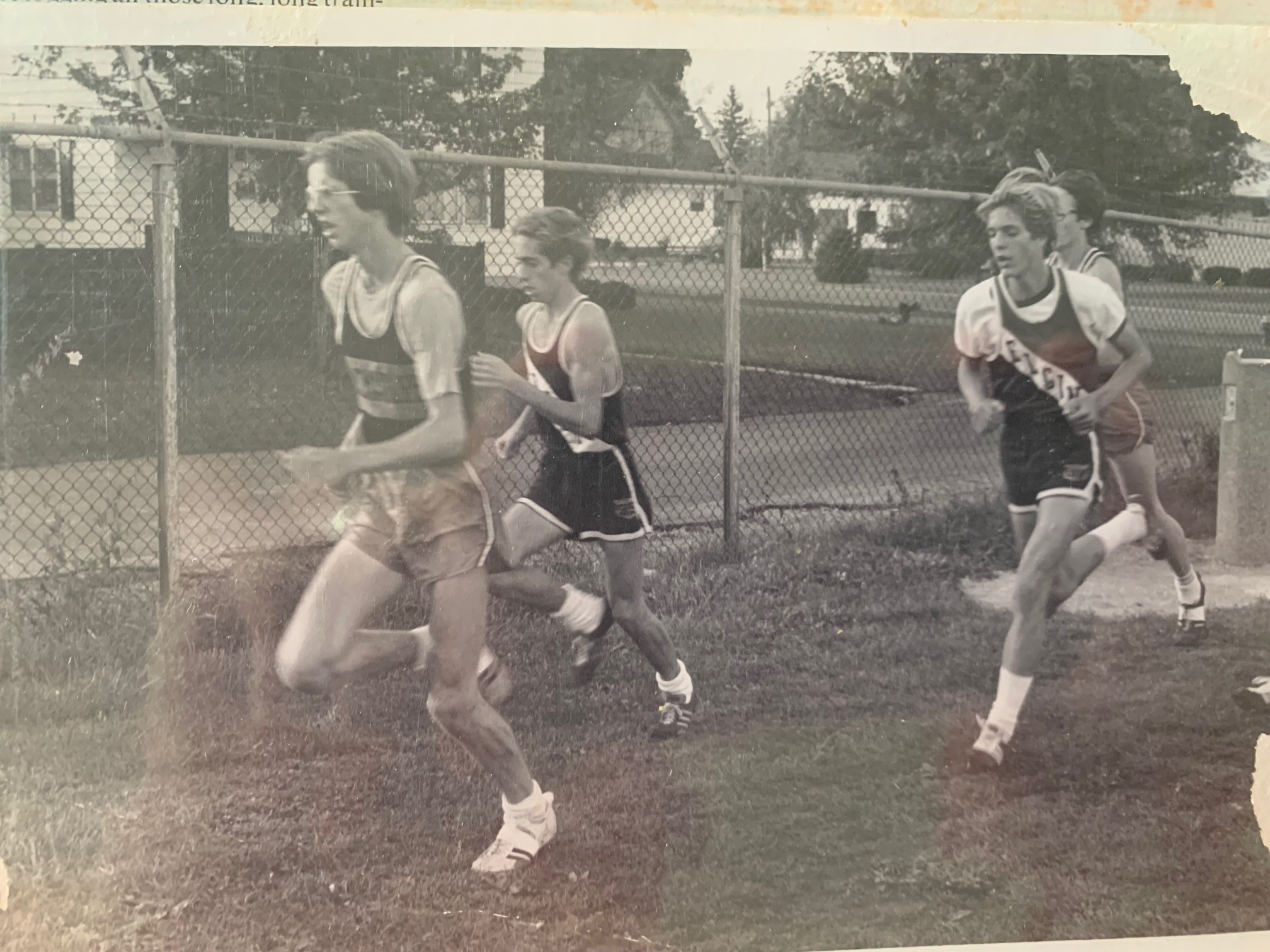
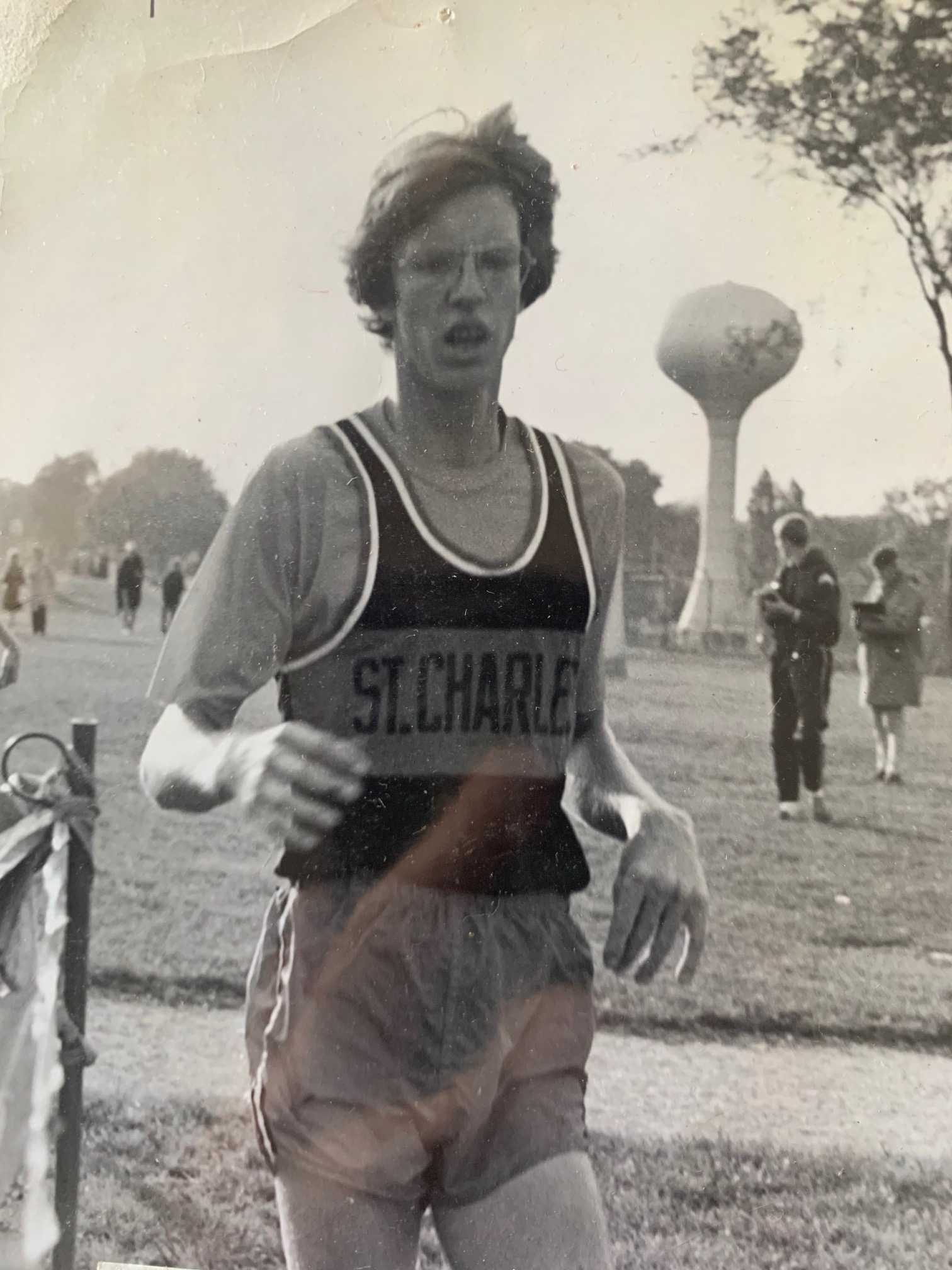
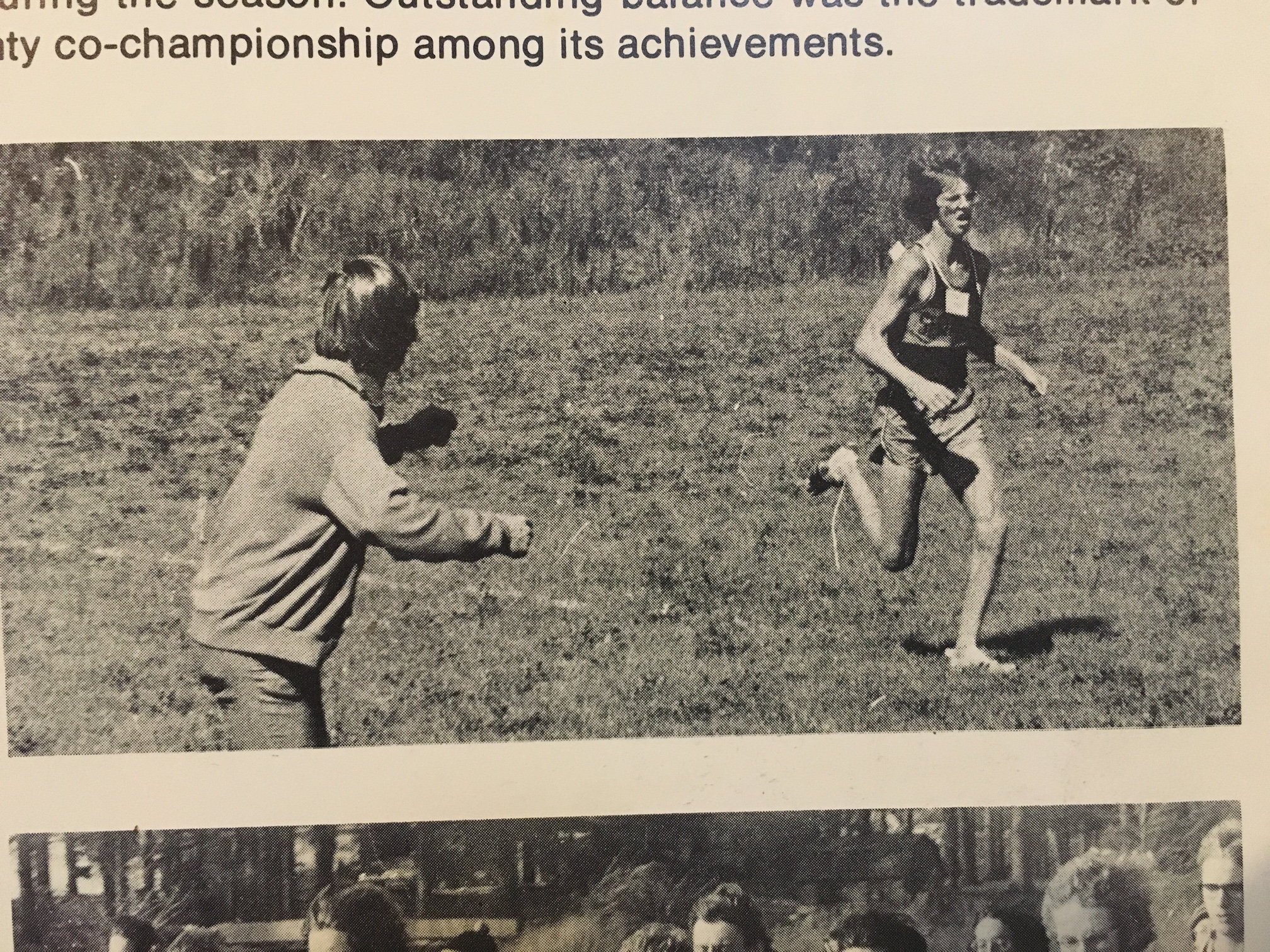
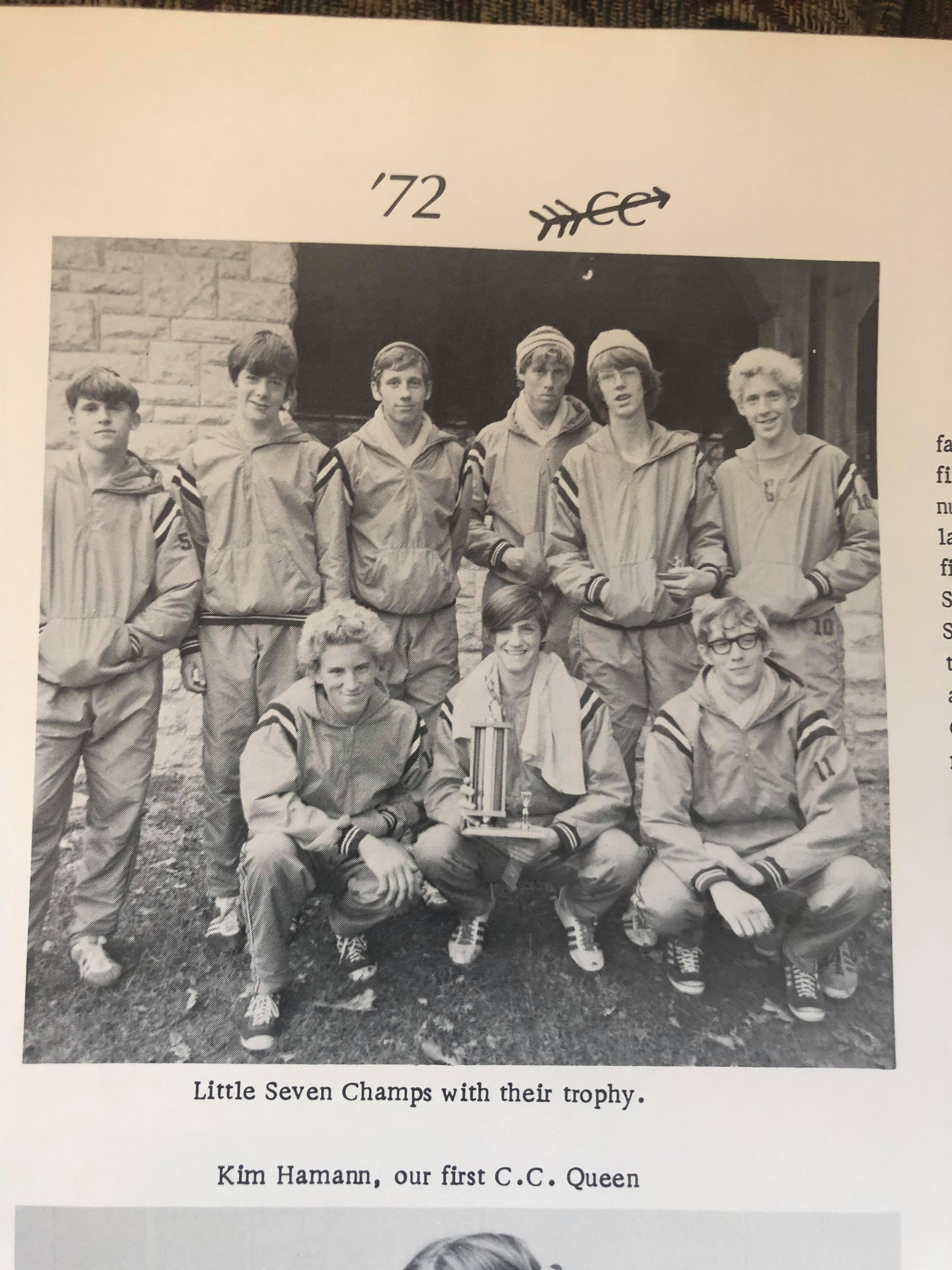
Even some entire races are collectively forgettable. I’ve asked teammates from the 1973 St. Charles High School season about our performance at the Upstate Conference cross country meet, and few can recall much about the day. We finished third behind Dekalb and Elgin. I placed sixth overall.

That would have qualified me as an All-Conference athlete once the high school started recognizing Top Ten performances in each sport. Years later while walking the hallway of the high school for a speaking engagement with the art department, I noticed a long line of photos mounted in the hallway leading to the locker room. I recognized a few runners that in later years were given the All-Conference designation, and admit to feeling cheated out of similar status. Once I gave it some thought, the jealousy felt petty. I finished sixth the next year in conference as well. Not a bad performance, but nothing to brag about really.

As a team, we’d somewhat failed in that conference meet after a largely triumphant season. For some reason, we weren’t “up” for that race as we’d been in others. Perhaps it was something about the odd course at Elgin Community College, or the strange pressure of forced expectation. In any case, we’d missed our goal of winning the Upstate Eight for the first time ever. Dekalb and Elgin were tough teams. They outran us that day. But we’d come back…

The next opportunity for success came at the District meet held on our home course. Our program had achieved some previous success in District competition, but we turned our sights on winning at our home course.

Former St. Charles High School runner Rick Wolhuter became one of the best American distance runners of all time.

Individually, the highest accomplishment in St. Charles cross country history was an All-State performance by Rick Wolhuter, the sprinter turned distance star who went on to run for Notre Dame and then the University of Chicago Track Club. Running for a school where an athlete of Wolhuter’s caliber once competed was by nature humbling. Yet he didn’t hold our school’s mile record, focusing on the 880 instead. By 1974, he held the world record in the 880 with a time of 1:44 and had run the mile in 3:54. He also ran a 1:43.9 800. If you’ve never read about his track and field career, Track and Field News wrote about it in their profile of Rick as their 1974 Athlete of the Year.

Despite the fact that our coach Trent Richards knew Rick Wolhuter, not much was said about his accomplishments during our 1973 season. They really weren’t relatable. As our top guy, I wasn’t about to place third in the state as Wolhuter once did. My goal was to run the best I could and help lead our team to Sectionals if possible.

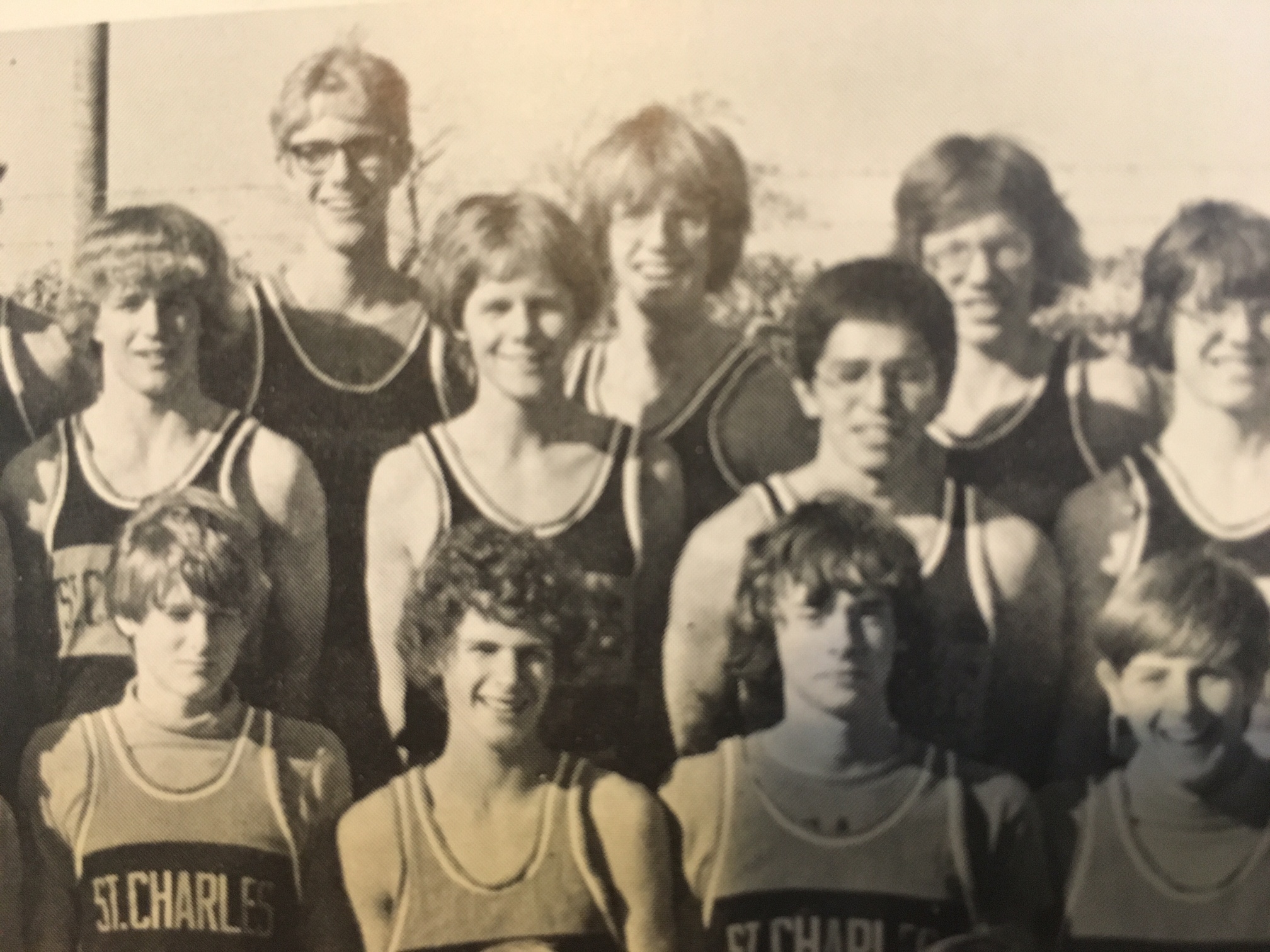
Our team had an unforgettable day that day at Districts. All of our guys that had trained and sung together all season ran really well. Each of them had their own personality and style. Marty Van Acker, quiet and bookish. Paul Morlock, enthusiastic. Jack Brandli, a rocker on foot. Kevin Webster, determined resolve. Rob Walker, inspiration and grit. Again, I finished sixth overall, which seems to have been my favorite Big Meet placement. The truly interesting result that day was the run by John Ellwanger, a protege of Tom Burridge in Batavia, as their team qualified for sectionals as well. He’d been a decent runner up to that point, but racing with Burridge improved his running so much that he placed seventh place overall at the District meet. I was always impressed by that.
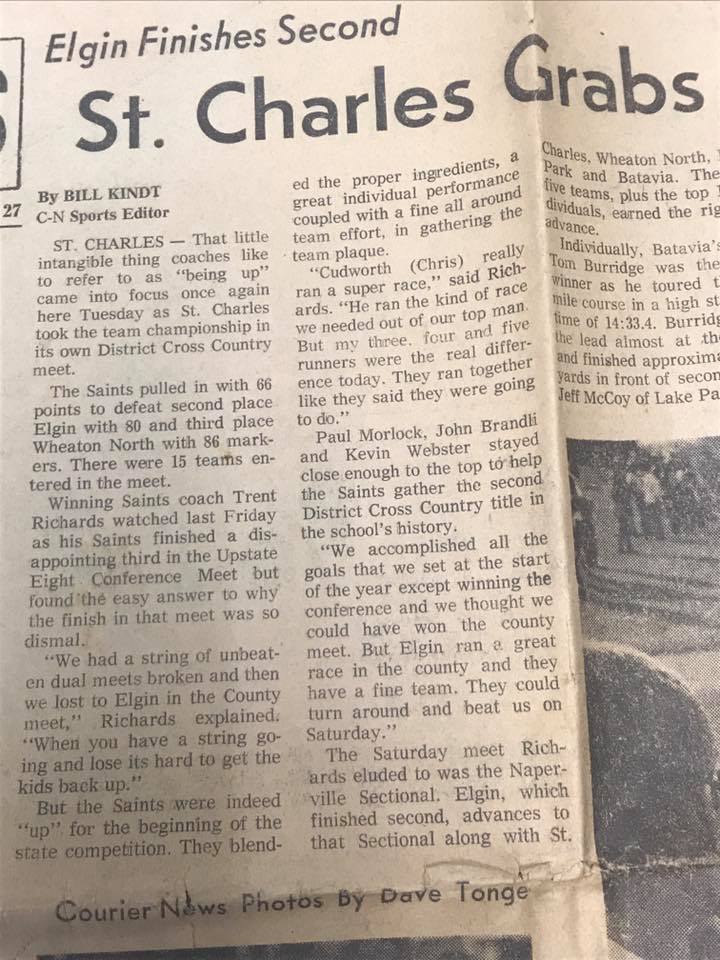
Looking at the newspaper clippings and photos from that era, I realized how times have changed in so many respects. The coverage on cross country meets given by local newspapers was gratifying through both the wins and the losses. Bill Kindt of the Beacon News was a longtime sportswriter among many in the Chicago suburbs who dedicated their lives to covering high school sports. I later contracted with him at the Beacon to write a yearlong series of nature articles for the newspapers.

Our local meets in St. Charles were covered by Elmore McCornack, whose family was a big part of St. Charles history. I don’t know why Mac wrote about cross country meets, but he was this classy gentleman who showed up at meets and knew the sport well. One of Mac’s nephews (or such) named Evan Clarrissimeaux went on to run for St. Charles and then the University of Iowa, where he posted a 4:07 mile. Evan and I trained together some after college. Our lives, and my connection to the McCornack family, converged again when I served as an officiant in the wedding of Evan’s sister Annie in January of 2019. That was a great honor.

There was a wonderful anticipation and joy to opening the weekly newspaper to read about meet results. We’d walk down to Bagge’s Pharmacy in downtown St. Charles and buy copies of the St. Charles Chronicle. Sometimes there were black and white photos accompanying the stories. These we kept as images that defined our accomplishments and our lives. Some of those clippings have survived decades in my collection, but a few are now lost.

They remind us that as young men and women, we pushed ourselves to efforts that in our later years become hard to imagine. We know that our results were not “woulda-coulda-shoulda” or Glory Days recollections. The outcomes are there in black and white, quite literally. Forgettable or Unforgettable, the record speaks for itself. There is great satisfaction in that, and no hubris or false pride in doing so.

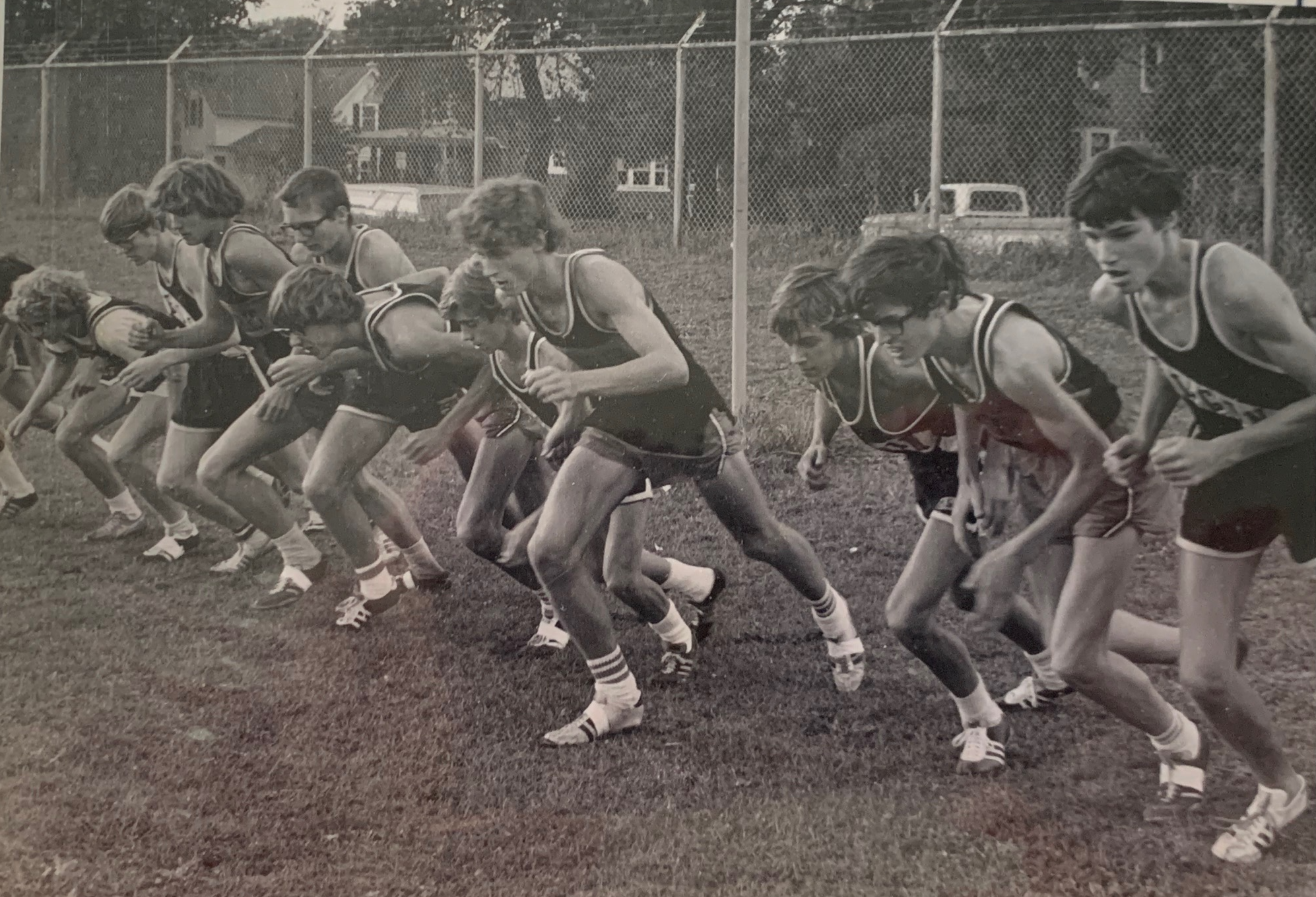
Bill Sanders (Kaneland) John Schumaker and Jeff McCoy (Lake Park) Ken Englert (Elgin) Randy Russell (Burlington Central) Jay White (Wheaton) Chris Cudworth (111) John Shorey (Elgin, 47) Jack Brandli (115, St. Charles) Kevin Webster (St. Charles 114) and John Ellwanger (Batavia, headband.)

Posted in aging, aging is not for the weak of heart, Christopher Cudworth, competition, cross country, running | Tagged , , , , , , , | Leave a comment

50 Years of Running: Where Respect Is Due

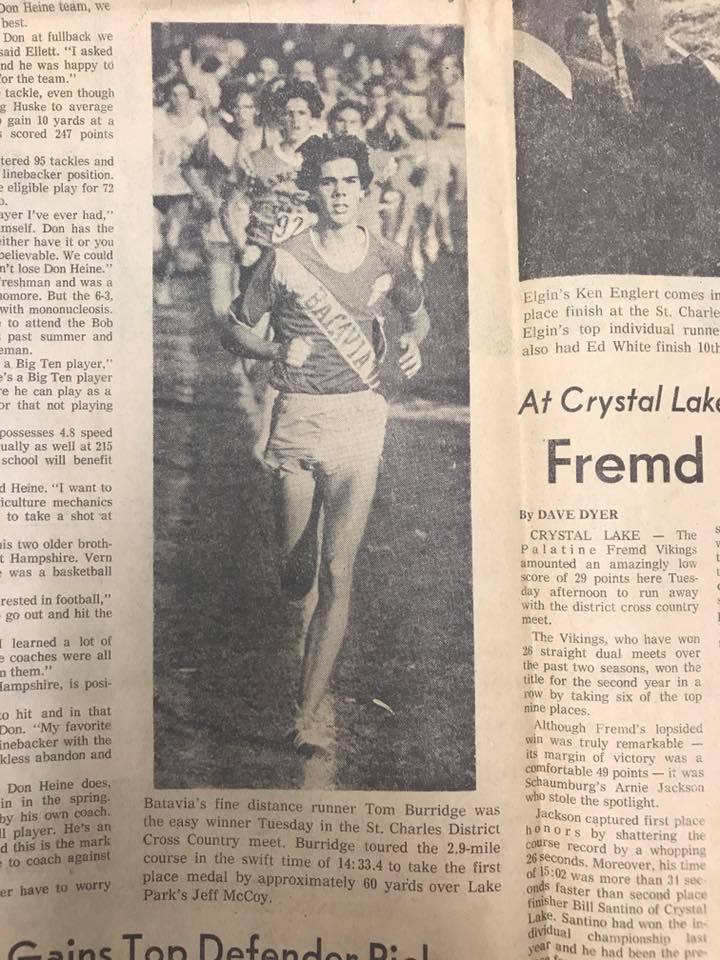
Tom Burridge leading the St. Charles District race in 1973. He won and went on to earn All-State honors in cross country. Immediately behind him are my former Kaneland teammates Merid Dates and Bill Sanders.

Midway through the 1973 season, I’d run well enough, and our team was doing so well, that we began to gain the attention of some local sportswriters. The newspapers that covered our team included the St. Charles Chronicle, the hometown newspaper, and a larger paper out of Aurora, the Beacon News.

The Beacon published a story that documented our team progress and mentioned my name as a “junior sensation” leading the squad. In that same article, Coach Trent Richards was quoted, “Cudworth is a good runner, but not a sensational one.” He was absolutely correct in that statement. My times were decent, but not exceptional in any sense of the word.

When it came to revving up a potential rivalry in an upcoming race, the timing of that article could not have been worse for me. It published the week that St. Charles, Geneva and Batavia were scheduled to compete in the Tri-Cities meet. The rival that I both respected and feared in that meet was a runner named Tom Burridge.

Close associations

I knew about Burridge because my coach Trent Richards was consulting with the Batavia coach Joe Yagel, who knew enough to know that he did not know enough about running to coach an athlete like Tom, who had transferred from Hersey High School in the northwest suburbs where his prior team enjoyed success at the state level. Plus I believe Tom ran with the St. Charles Summer Track Club that Trent coached as well.

There were few more competitive runners in the Chicago suburbs than Tom Burridge. Yet I recall their being a friendly atmosphere before the Tri-Cities cross country meet because his father was there along with other parents and families of many other runners from all three teams. There were even folks watching the meet from previous teams at St. Charles. These included Herb and Joyce Birk, the parents of Greg Birk, the St. Charles athlete that graduated the previous year to run for Wabash College in Indiana. The Birks were present at almost every St. Charles meet that year because they loved running and always had kind words of encouragement for us (and me) after every race.

Neutral territory

The Tri-Cities meet was held on “neutral” territory that year rather than on anyone’s home course. The site was a three-mile route mapped out in in Fabyan Forest Preserve, one of the most popular spots in all of Kane County for nature and recreation. In those days, the railroad beds that once served the tri-city trolley line were not yet converted to bike trails, so the course was confined to a series of loops over and around the Fox river. We ran on both grass and asphalt with metal spikes rattling underfoot. I recall that the conditions were not ideal for those of us wearing 1/2″ spikes.

As the race neared, I was nervous at the thought of running against Tom Burridge. I knew that he was a superior runner but didn’t know by how much, since I’d been competing with other top runners fand doing well. But Burridge wasn’t messing around that day. He stepped up next to me on the line with his bright red and yellow Batavia jersey on, He didn’t even turn his head and muttered, almost under his breath, “Junior sensation my ass…” Then the gun went off and he left me in the dust. I watched him pull away with the skittering stride and the thought went through my head, “Man, you got to respect that…”

That was Tom. The fire within that guy always impressed me. Even so, I decided to go with him as long as I could. At the mile mark I was already 50 yards behind. After that, the race was not a matter of contention at all. In fact, I recently learned that while Tom was racing ahead of the rest of us, he spied Herb Birk and his wife along the way. He knew them because he was friends and sometimes training partners with their son Greg. He paused, then stopped, and politely told them. “Mr. and Mrs. Birk, you’re standing on the course.”

That’s how much of a lead he had at the time. I could see him crossing the river well ahead of me, the autumn light flickering on his crimson and gold jersey. By then, I didn’t care. I was feeling fairly decent myself and happy to be in second place. I knew where respect was due.

A rising tide lifts all ships

Tom’s leadership of the Batavia team lifted their entire squad to better performances that year. While St. Charles won the meet, his crew of John Ellwanger and others made it a tight score. I think Geneva’s Dave Bashaw had graduated by that point or I would have placed third in the Tri-Cities meet behind him as well. “Bash” was a tough runner in every respect.

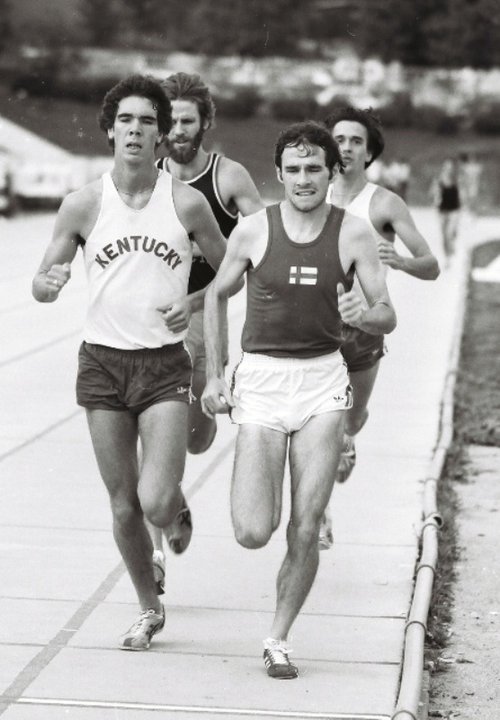
Tom Burridge went on to run for the University of Kentucky. As I understand the story about how he arrived at that decision, he was introduced to Kentucky’s coach by my coach Trent Richards, who set up the meeting following a state meet. The Kentucky program was focused on recruiting Illinois runners, and attracted some of its best, including Craig Young of Stillman Valley and many others. The strategy worked, as Kentucky became one of the strongest running teams in the nation.

Tom went on the win distance titles in the Southeast Conference and set a PR of 13:45 in the track 5K. My personal best at that distance wound up being 14:45, demonstrating that I’ve always been in a bit different league than runners like Tom Burridge, who I’ve always considered a sensational runner.

Not one for compliments

Of course, knowing Tom as I do from years of association, he might argue with that characterization of himself as sensational. No one is more judiciously critical of his own performances than Tom. But he was always a fierce competitor no matter who he ran against. I raced in the same Chicago Distance Classic 20K in which he competed with Frank Shorter, the Olympic marathon champion and one of America’s best-ever distance runners. Tom kept up with Shorter quite a ways before the two-time Olympian smoothed away with his bellows-breathing stride to win the race.

One of my favorite Burridge stories is centered around the fact that he once held the American Half-Marathon record. He sit it during a race in which he finished behind some international runners, so he didn’t factor the idea that he might have set a national record. A couple decades later, Tom looked up the history of the American half-marathon and learned that he’d been the best-ever American half-marathoner with a time of 1:04.

A late cycling prodigy

These days he’s one of the top Over-60 road cyclists in North America, so he’s still putting that “big engine” to use. He’s won 200-mile races and competes in criterium races across the country. That competitive verve has cost him a few broken bones, including a busted thigh and a whole rack of broken ribs. Yet he keeps coming back to top form because his persona does not have any quit in it.

I loved running against the likes of Tom Burridge and other top Midwestern runners in high school and into my college career and beyond. I had the occasional great performance against some of those guys, but its a privilege to have gone toe-to-toe with better runners even when I got my unsensational ass kicked. That’s what distance running is all about. You put it out there, do your best, and show respect where respect is due.

That’s all any of us can do.

Posted in 13.1, Christopher Cudworth, college, competition, cross country, cycling, cycling the midwest, half marathon, healthy aging, PEAK EXPERIENCES, race pace, racing peak, running, running shoes | Tagged , , , , , , , , , , , , | 1 Comment

50 Year of Running: The Maroons Come to Play

Coming off the St. Charles victory in which we snapped the 60+ dual meet streak of Naperville Central, we faced a squad from Elgin High School that was more than our equal. The afternoon broke cool and slightly overcast. Classic cross country weather. The late afternoon sunshine cast long shadows even as we toed the line. Our seven guys and their seven guys lined up at the bottom of the athletic fields near Route 64 in St. Charles, and we took off running up a series of inclines to the upper campus.

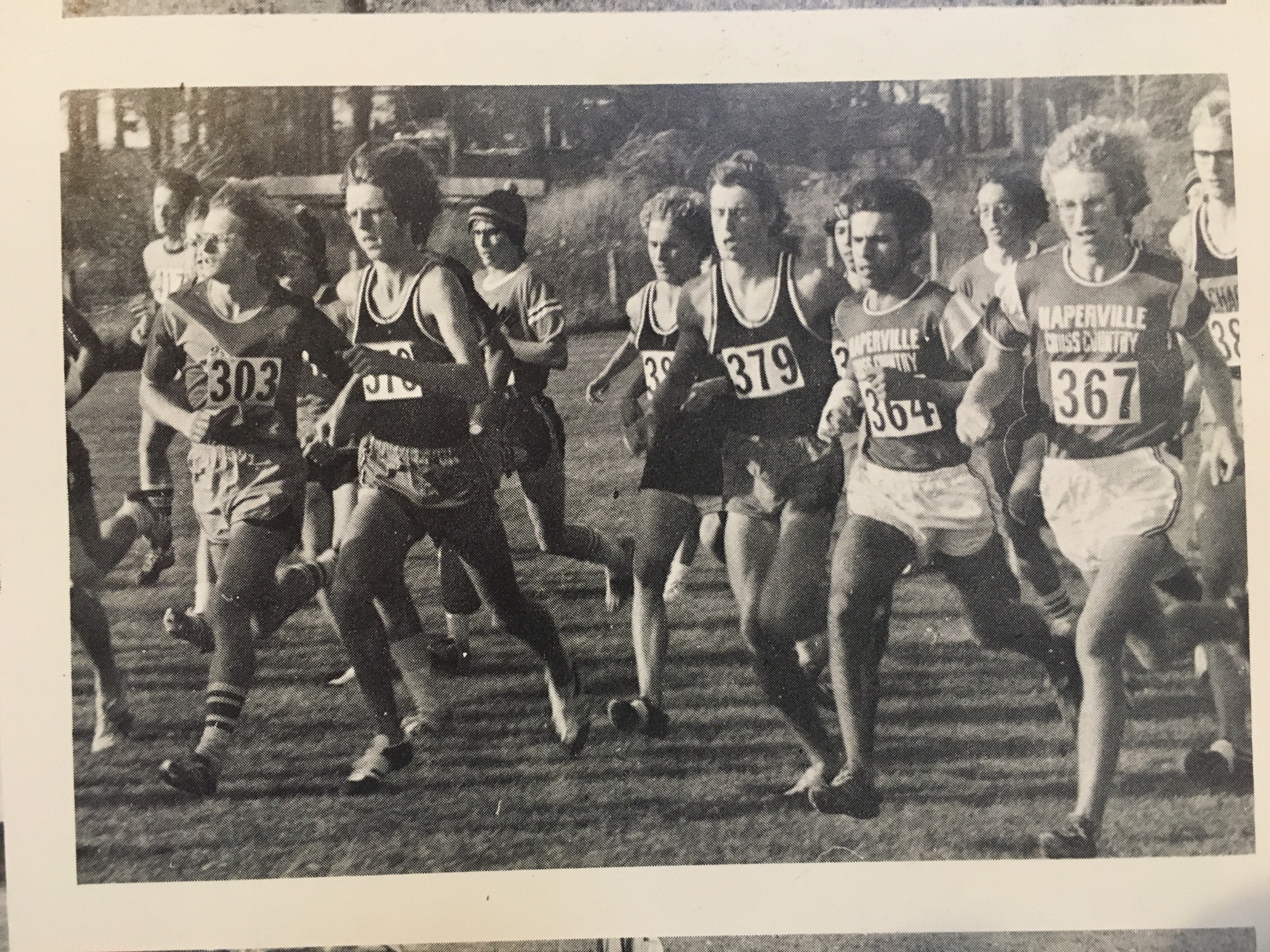
From right to left, and corrections are accepted: Karl Ulrich (Elgin), Marty Van Acker (STC), Ed White (Elgin), Paul Morlock (STC), John Shorey (Elgin), Kevin Webster (STC, (unknown Elgin), John Brandli (STC), (unknown Elgin) Rob Walker (STC).

The St. Charles High School Campus course was a series of loops that included some sharp turns so that it was easy to see how the race was developing. That day in 1973, there was little separation between the two sides. The squads were so evenly matched that it only seconds separated the first through fifth men.

Chris Cudworth leading Ken Englert, John Shorey and Marty Van Acker

I led the race early with Elgin’s Ken Englert a step behind. He was an intimidating opponent with his strong legs and surfer boy looks. His teammate John Shorey stuck close and our second runner Marty Van Acker was right behind. All within two seconds of each other nearing the mile mark.

Cudworth, Shorey, Englert and Van Acker

We circled past the start and began climbing the west side of campus in a series of right turns culminating at an elementary school on the far southwest side of campus. The four leaders stayed close through every turn. Englert and Shorey kept the pressure on.

Shorey, Cudworth and Van Acker

As we made the last turn toward the finish chute John Shorey had crept ahead and Ken Englert launched a sprint. My teammate Marty Van Acker was right there as well. The placement of this foursome would effectively decide the outcome of the meet.

Engler, Cudworth, Shorey

I launched my own sprint in an attempt to catch Englert. But as you can see from this photo, he was in full flight and not to be caught this day. I had my eyes on the finish line, and our cheerleaders had seen us home, but Ken won the race.

In the finishing chute

The final score of the meet was 27-29. St. Charles won the dual.

But a week or so later, Elgin outran us at the Kane County meet. Their coach Jerry Cusack knew how to motivate and coach kids as well as our coach Trent Richards.

The thrill of that rivalry was something that I thought I alone relished all these years. Yet one day about six or seven years ago, I received a phone call from an Elgin runner whose name I can’t recall. He talked about the joys of competition between our two teams, and we reminisced while recalling the names of our fellow teammates. “You guys were fun to run against,” he told me. I agreed. It was always fun when the Maroons came to play.

Then he made a proposal of sorts. “Would you want to get some guys together again to run a cross country meet?”

I laughed a bit at that. While I’m still running and competing, and a few of my teammates still put in some miles, the substance of a full squad just isn’t there fifty years later. “I love the idea,” I told my fellow running enthusiast. “But I don’t think that’s going to happen.”

The newspaper clipping to that Elgin versus St. Charles race got lost in a move a few years back, but I feel blessed to have gotten the yearbook photos from that year to share the atmosphere of a cross country race that was epic in its small little sphere. As I’ve written, I also found this old program photo that lay buried next to the football field for ten years.

I guess we can all thank our rivals for creating those moments in time. Win or lose, it makes you part of an intense ritual that in many respects can last a lifetime.

That starting line when everyone is nervous and anxious. The first mile when the legs and lungs starting talking together. The pack forms and the positions jostle. The hills come along to test your resolve. The turns force you to slow and start up running again. Then that finishing sprint. Do you have what it takes?

In fifty years of running, those are the sensations that I treasure the most.

The other interesting facet of this rivalry is that my competitor Ken Englert and I share a love of nature that has carried through our lives. Ken is an exceptional wildlife photographer and I’m a wildlife painter.

Posted in cross country, running | Tagged , , , , , , , | Leave a comment

50 Years of Running: The Peregrine

My painting Peregrine and Prey, circa 2016.

This morning while walking the dog in late September sun, I thought back to one of the first cross country meets of the season for St. Charles in 1973. Our team was training well, and we knew that there were good things to come. Yet a tremendous obstacle stood in our way. We were about to face a Naperville Central cross country program that had won more than sixty dual meets in a row.

Not having spent the first two years of my cross country career in the Upstate Eight Conference, I was not aware of the Naperville Central reputation. All I knew is that I was performing as our top runner in practice, and needed to get ready to face whatever came our way.

There was a gap in time between the end of school that day and the scheduled time for the meet. I took the book I was reading to the top of the bleachers in the football stadium and sat in the sun. That book was titled The Peregrine by J.A. Baker. I didn’t know it at the time, but it is considered one of the all-time greatest naturalist books ever written.

What I did know is that it inspired me. As a sixteen-year-old kid I was already deep into birding. My lifelist had grown to more than two-hundred species. My brothers and I would often visit forest preserves to find new birds. But I had not yet seen a peregrine falcon.

That’s because peregrines were rare and endangered in the early 1970s. So were bald eagles, ospreys, and other birds at the top of the food chain. All had their populations decimated by the presence of DDT in the environment, causing eggshells to thin and bird populations to drop as a result.

I’d found The Peregrine on a bookshelf in the high school library. I believe my biology teacher and birding friend Bob Horlock had recommended it to me. That copy of the book was simply bound with a plain black cover and the title embossed in gold on the front.

My drawings of a gyrfalcon and peregrine done from live birds at Cornell University in 1977.

I carried the book around with me for days, poring through its tales about tracking peregrine falcons along the coast of England. The romance of that immersion entranced me. I could feel the cool breeze off the ocean. Sense the flow of bird flocks in the wind. Smell the scents of heather and surf. And thrill to the idea of a peregrine in full stoop striking down a fleeing gull.

Already I had a deep interest in writing as well. That’s what made the book so compelling. Few writers in history have achieved such glorious economy of words, yet rich in meaning. J.A. Baker was a master at that.

“Crows flew up again to chase the hawk away, and the three birds drifted east. Dry feathered and more buoyant now, the tiercel did not beat his wings, but simply soared in the abundant warmth of air. He dodged easily the sudden rushes of the crows, and swooped at them with waggling snipey wings. One crow planed back to earth, but the other plodded on, beating heavily round, a hundred feet below the hawk. When both were very small and high above the wooded hill, the hawk slowed down to let the crow catch up. They dashed at each other, tangling and flinging away, swooping up to regain the height they lost. rising and fighting, they circled out of sight. Long aferwards the crow came floating back, but the hawk had gone. Half-way to the estuary I found him again, circling among thousands of starlings. They ebbed and flowed about him, bending and flexing sinuously in the sky, like the black funnel of a whirlwind. They carried the tormented hawk towards the coast, till all were suddenly scorched from sight in the horizon’s gold corona.”

So immersed was I in reading The Peregrine that a teammate had to find me atop the bleachers and call me to the task. “C’mon, Cud. It’s time for the meet.”

My drawings of a gyrfalcon and peregrine drawn from life at Cornell University in 1977.

I walked down the bleachers in the pleasant fog of literary disassociation. In the locker room I pulled on the St. Charles uniform and shoes, then went out to jog and warm up. Images of peregrines were still floating around in my head. My mind and body were relaxed even to the point in time when we pulled on our spikes and stepped to the line. The gun rang out and I swept in with the top two Naperville runners Bob Warner and Rick Hodapp. We ran the course together and I felt in complete and absolute control the entire way. No fear entered my head. It felt like one of those good dreams when you actually can run and nothing is holding you back.

I don’t recall whether I won or took second place that day. It didn’t matter because my teammates also ran astoundingly well. We won the race against Naperville Central, snapping their dual meet streak and proving to ourselves that we were legitimate in some way.

We cooled down with an excited jog after the race. Only then did my head seem to come out of its peregrine-induced state. We joked and laughed among us, waved to our cheerleaders, and thrilled to the idea that we had support from a great group of young women who seemed to understand that this was a team with a purpose.

That night I lay in bed reading yet another chapter of The Peregrine. The language drew me in: “East of my home, the long ridge lies across the skyline like the low hull of a submarine. Above it, the eastern sky is bright with reflection of distant water, and there is a feeling of sails beyond land. Hill trees mass together in a dark-spired forest, but when I move towards them they slowly fan apart, the sky descends between, and they are solitary oaks and elms, each with its own wide territory of winter shadow. The calmness, the solitude of horizons lures me towards them, through them, and on to others. They layer the memory like strata.”

I fell asleep with peregrine dreams in my head.

Running that day was one of the most liberating experiences of my life. I wish that I’d learned to live all of life that way, without fear, anxiety, and full of purpose released. Or perhaps it is best that we have these experiences that remain unique and transcendent, as sudden and free as a peregrine falcon floating across the sky.

Posted in Christopher Cudworth, competition, cross country, race pace, racing peak, running, running shoes | Tagged , , , , , , , , , , , , , | Leave a comment

50 Years of Running: A Force of Nature

Coach Trent Richards, a “force of nature” cheering me on at the Plainfield Invitational.

Few activities put you more in touch with nature than distance running. That’s especially true in cross country, where the training often takes you into the woods and fields where it’s you, the air you breath and the ground you have to cover. Pure. Simple. Profound. That is the force of nature. It compels you to deal with reality in many ways.

In joining the cross country team in St. Charles, circa 1973, my fate collided with another ‘force of nature,’ a coach named Trent Richards. He was the cross country head coach and assistant in track and field at St. Charles High School.

Before I moved to St. Charles as a pending junior in high school, Trent was my baseball coach for the Elburn American Legion team. At the age of thirteen and fourteen, I pitched against kids several years older. Trent saw potential in me that other coaches did not. Following tryouts for the regional All-Star team that would travel to play a tournament in the Chicago suburbs, I overheard him talking to the lead coach that was making selections. “Cudworth isn’t much to look at, but he throws hard,” Trent told him. “And he’s super competitive.”

At the first regional All-Star game, the hard-throwing pitcher the lead coach chose was knocked out of the game in the first inning. I was placed in the game and our team scored several runs in the next few innings as I held the opponents at bay with a mix of pitches; a wide curveball, a slider, a sinker, a screwball, and a fastball.

Our fielders were excellent and the sinker produced a ton of ground balls, so we got people out. Then a big old batter from the other team got hold of a fastball and drove it toward the left field fence. I watched the ball fly through the air as our outfielder Jeff Healy ran to the fence, leaped high in the air, and snagged the fly ball before it went out of the park for a home run. I knew Healy as a long jumper for the Kaneland High School track team. I was grateful for his hops that day.

We ultimately lost the game on a passed ball to our catcher Rick Lay when he called for a slider and I threw him a screwball. He was a lefty catcher and the screwball hit him in the bare hand. Ten years later I saw Rick working at a tool rental place and he recognized me. Holding up his left hand, he showed me the bent finger that I’d given him that day. He laughed, “Thanks a lot. I’ll always remember you!”

Wild adventures

I recall that playing baseball for Trent was always a raucous, wild adventure. I have a false front tooth because he was hitting grounders to us one twilight afternoon and he accidentally hit a line drive that struck me in the mouth, knocking out a tooth so that it hung by a bloody thread. That’s kind of how it was with Trent Richards. He drove you to be your best, but his influence could also be sort of chaotic, even damaging in some ways.

His coaching style was similarly dynamic, shall we say. His hoarse voice could be heard across any field in the universe. He could also whistle like a groundhog on steroids. Plus he’d show up on the course at unexpected moments cheering you on as if it were the last step you would ever take on earth. Running for Trent sometimes felt like you were running from Trent.

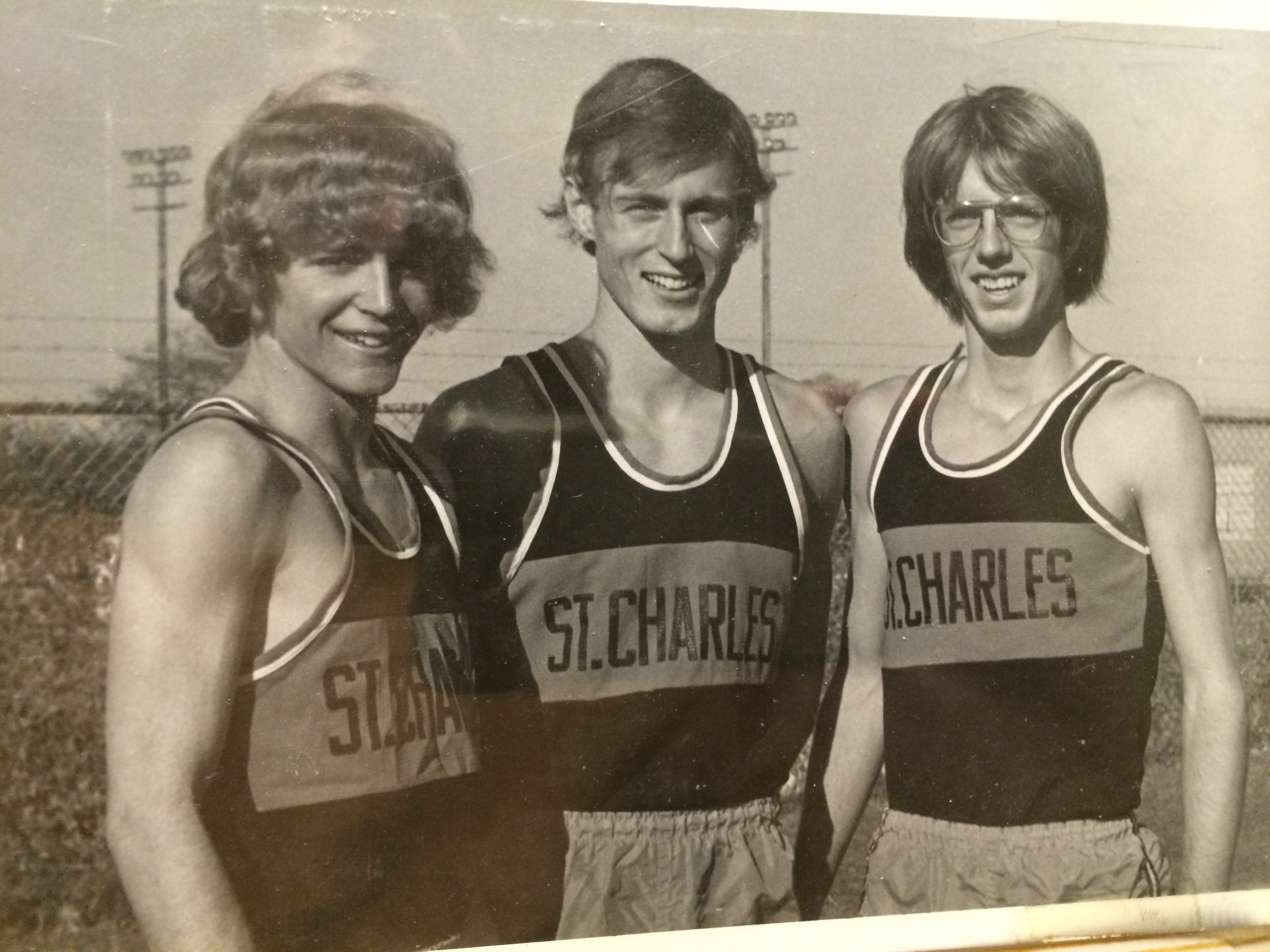
Yet he also loved the team concept so much that he found ways to bring us together that few other coaches could manage. When we started the cross country season in 1973, there was a unique chemistry going on, because I’d arrived in town to provide a lead runner after Greg Birk graduated, My newfound friend Paul Morlock ditched football to become a cross country runner. We also had Marty VanAcker, a tough runner with black Elvis Costello glasses who was so consistent that he kept me honest every race. Kevin Webster was the wry counterpart of VanAcker, a tall and olive-skinned runner with quiet determination. John (Jack) Brandli was the energetic soul of the team, and Rob Walker brought the camaraderie of Who songs to the locker room showers. Entering the season in 1973, we didn’t know what lay ahead. But it felt like something special was going on.

Trent ran around the school campus as we did our workouts. He carried a stopwatch with him at all times and was even known to toss it at us if we were lagging in workouts. He often sported plaid pants and wore a St. Charles jacket of one kind or another everywhere he went. His presence in the regional cross country scene was well-known to other programs by all these trademarks. He was unafraid to talk up the opposing coach or pass along a competitive word if he felt it might give us some sort of advantage. Trent truly was a force of nature.

A coach’s coach

However, he was also consulted by coaches from other schools, including Batavia’s coach Joe Yagel, whose top runner Tom Burridge had transferred from Hersey high school that year. Trent knew Burridge from summer track racing and other connections, so he helped Yagel guide Burridge through training. As a runner, I understood that Tom stood at a different level than I in terms of ability. That’s why I never objected to Trent offering to help Burridge in any way. Trouble was, Tom’s presence in Batavia raised the quality of that program through his talent and determination. Like I said, Trent’s force of nature approach sometimes had reverse consequences.

That said, Trent challenged me to challenge Tom Burridge whenever we raced. I always got my ass kicked, but it was not in my character to back down either. But looking back, I undestood that in essence, Tom was in a different league than me. That reminds me of the scene in Field of Dreams when the young kid Moonlight Graham gets a chance to bat against the big league pitcher, He almost gets beaned for winking at the tough older pitcher. He retreats for advice from Shoeless Joe Jackson, who tells him not to wink again. “And look for the fastball…” he tells him. “But watch out for in your ear…” Midnight Graham manages to hit a sacrifice fly to right, scoring a run for his team. Some of our lesser triumphs still count for something.

That scene was much like Trent’s approach in all situations. So what if you were outmatched? There was no backing down. No room for compromise. Get out there and get it done if you can. Have fun along the way, but keep the goal in mind. But watch out for “in your ear.”

Rocking and rolling

Thanks to Trent’s presence, those first few days of cross country at St. Charles in 1973 were familiar in some ways and yet a big adjustment from the previous year at Kaneland High School. As a team, we got out there and sweated together in the August heat. When practice was over, we avoided the horrific gauntlet of stinky football players filing into the locker rooms if we happened to arrive at the same time. We’d slip through the locker room doors and strip off our running stuff to gather naked in the showers singing those brilliant 70s rock songs at the top of our lungs.

Ever since I was a young boy
I’ve played the silver ball
From Soho down to Brighton
I must have played ’em all
But I ain’t seen nothing like him
In any amusement hall
That deaf, dumb and blind kid
Sure plays a mean pinball

We sang tunes by Chicago. Yes, Neil Young, Elton John, David Bowie. That music fueled so many steps…but the irony of our young circumstance was not lost on us. Pink Floyd’s Dark Side of the Moon album made sure of that.

And you run and you run to catch up with the sun, but it’s sinking Racing around to come up behind you again The sun is the same in a relative way, but you’re older Shorter of breath and one day closer to death

Trent left us to those devices. He knew that bonds were building that would help drive us to team success. There are few moments in life like these, when disparate dreams come together in one place. Everyone seems to feel the momentum, and special things start to happen. The fall of 1973 cross country season was like that. Good things were coming our way.

Posted in aging, aging is not for the weak of heart, Christopher Cudworth, competition, cross country, running, track and field | Tagged , , , , , , | Leave a comment

50 Years of Running: The adidas factor

The year in which I began my running career were a transitional time in terms of available running shoes. The gum rubber flats we used for training in 1971 and ’72 were not much good for road running. I was glad when the German shoe company adidas penetrated the American market and we could put good running shoes on our feet for the first time.

In the spring of 1972, the Varsity track team at Kaneland High School was issued a shoe called the adidas Gazelle. The pair that I received were a brushed suede leather. They were sky blue with three white stripes. The sole was flat with a textured rubber grip. I loved those shoes because they meant that I was accepted as part of the varsity team as a sophomore.

I wore them several weeks in practice. Then we headed out to a meet in Rochelle, Illinois. It was a cold, grey day with a sullen wind blowing. I reluctantly dropped my sweats in a bundle near some other Kaneland runners and pulled on my running spikes. They might have been adidas too, but they weren’t the super-comfortable kangaroo-leather Pumas that I’d been given to wear as a freshman cross country runner. Despite their heinous origins, I will love those shoes as long as I live.

I ran the two-mile that day, and returned with cold-chapped legs and a head full of sweat. Pulling on my sweats, I looked around for the adidas Gazelles and realized they were missing. Frantically, I looked all around the area in case someone had moved my sweats. No such luck. The Gazelles had been stolen.

The anger that welled up in me at that moment was uncontrollable, and sad. I asked around to see if anyone had moved my shoes. That was hopeful at best. “You lost your shoes?” a teammate asked. “No, I think someone stole them.”

“Yeah. You shouldn’t leave stuff out like that,” he reminded me.

For sure, I was too trusting of the world at that age. Far too trusting.

That theft meant I had nothing left to wear on my feet the rest of the meet except my spikes. I pulled those on sullenly and sat on the cold ground. I was scheduled to double back and run the mile that day. I was less than enthusiastic about that.

The next day at school, I had to inform the team manager that my shoes had been stolen. That afternoon I received another pair of gum rubber flats to wear for the rest of the season. Talk about depressing.

A new year, and new shoes

So it was with a certain amount of appreciative glee that I received a set of adidas Italia running shoes on showing up for cross country practice at St. Charles High School in the fall of 1973. They were white leather with an attractive green sole and matching three green stripes. They soles were practical, and flat. The grip was a sort of hexagonal pattern that I held up to the light to behold.

Italias were an immensely functional shoe. They held up quite well running on dew-soaked grass. They felt good on the roads as well. I received a set of adidas running spikes as well. They where white with black stripes. We’d usually use athletic tape to cover the shoelaces after tying them. That kept the shoe from coming untied. A pretty practical measure, one that I wished I’d followed on occasion later in my running career.

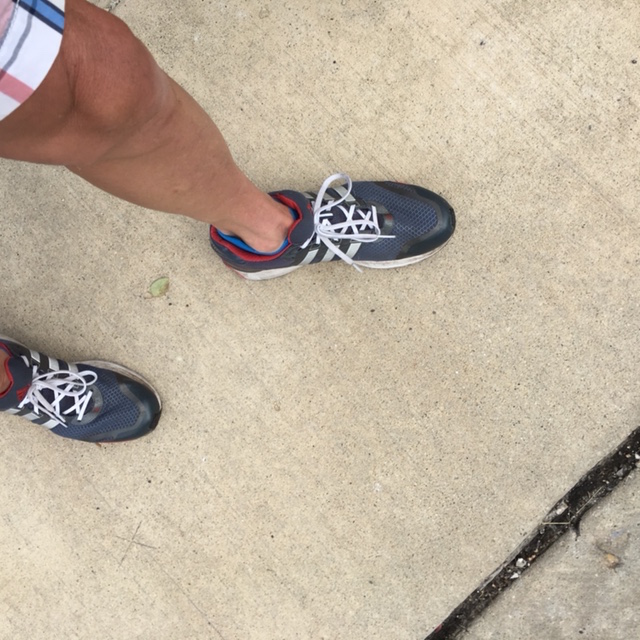
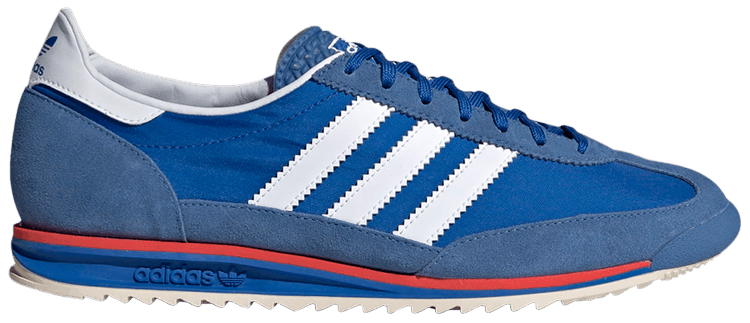
That same year, adidas came out with a running shoe called the SL-72. It was a blue model with white stripes and a much more aggressive sole structure and pattern. That model set the tone for running shoe evolution for years to come. They were issued in kind with the 1972 Munich Olympics. I trained in several pairs of those shoes, which featured nylon uppers. They were lighter than the adidas Italia and breathed better. Another adidas model called the SL-76 would come out in time for the Montreal, but they were stiff by comparison with the SL-72 and about that time an entire range of running shoes from Nike to Brooks had emerged on the market.

But a part of me will always hold dear the first season of training in actual adidas running shoes. They made me feel like a real runner, and my performances that year honored those instincts in many ways. One can argue that the shoes don’t make the man, and I would agree. But they sure can help.

So thank you, adidas. I will love your three stripes forever.

Posted in Christopher Cudworth, competition, cross country, running, running shoes | Tagged , , , , , , , | Leave a comment

50 Years of Running: No Man’s Land

My watercolor illustration the State of Golf In Illinois. All rights reserved.

As summer proceeded in 1973, I spent many days playing golf at Pottawatomie Park in St. Charles.

My new friend Rob Walker and I were members at the park district course, which probably cost $35 for the entire season. We’d sometimes play 36 holes carrying our bags on the nine-hole course. Sometimes we’d keep score, sometimes not.

Rob also worked at the St.Charles Country Club, the private course on the north end of town. I’d stop by while he was shining shoes at the back end of the club house. Eventually I got roped into caddying, a job I hated. Lugging a bag of golf clubs around for someone else felt like a gross indignity to me. Not that I was some spoiled rich kid that didn’t want to work. I just found the whole caddying thing absurd.

I grew up on the Meadia Heights Country Club in southeastern Pennsylvania from the age of five through twelve. Before that, my brothers and I hung around Seneca Falls Country Club in Upstate New York where my parents were members. We learned the game of golf early on in life, and all of us were decent if not great golfers. It disgusted me to carry a golf bag around for someone else while they hacked up the course.

My favorite thing to do on the Meadia Heights Golf Club was golfing on rainy days. I’d grab a three wood, a seven-iron and putter, then head out on the outer reaches of the course where I couldn’t be seen from the club house. My golf ball collection was pretty large as I’d picked up many a golf call on journeys to my best friend’s house on the 17th fairway, so I was never lacking for equipment.

I’d often play barefoot, running from shot to shot as I played from tee to green. I’d tee it up and hit the drive, then scoop up the tee and take off running, sometimes barefoot, on the rain-soaked fairways. I loved the feeling of playing golf that way, so free and unencumbered by the rules and etiquette of golf. Instead, I’d catch up to my golf ball and toss the clubs down on the ground, line up the seven iron and hit it as far as I could with the iron, then chase after it again. I’d play nine holes out of sight from anyone on earth. The golf course was my own. That was the right kind of No Man’s Land.

The caddy life

One of the holes at Meadia Heights where I’d run hole-to-hole playing barefoot in the rain

As I grew old enough to caddy for other golfers, the money seemed irresistible. I quickly found out how stifling it was to carry a golf bag for stuffy members trundling around with their stupid clothes and rotten swings. Frankly, I hated it. I didn’t caddy much at Meadia Heights, but at least I learned the skills needed to carry it further.

Once we moved to St. Charles, I started caddying again and wound up assigned to carry for the pro one afternoon. He was a terse gentleman about his game. Obviously, it was serious business for him to play well. It didn’t bode well for the club pro to get beaten by any other members. So I hauled his giant golf bag around with the best intentions, but it was a hot day and I kept getting distracted by my own thoughts. Such is the life of a young man with a mild case of ADHD. That was the last time I carried for the pro. He tipped me well, but I wasn’t asked back again.

So I didn’t caddy all that often afer that, and found myself in a sort of no-man’s land with no paper route, no other job and a month to use up between schools and school years. I didn’t have anyone urging me to run some summer miles at that point, so I played basketball, rode my crappy bike around town, and played golf for hours on end.

Rude audition

One late summer afternoon, Rob and I were done golfing and wound up on the west end of town where the Dairy Queen stood on Route 64. I think I’d made a few bucks carrying a golf bag that day. The weather was hot and muggy, so I ordered a giant chocolate shake at DQ. Then we walked across the street to the high school and stumbled on a practice for the St. Charles Track Club.

The club was coached by Trent Richards, my soon-to-be cross country coach and formerly my baseball coach in Elburn. He spotted Rob and I walking on the sidewalk outside the track and called us in. “Come on in here, Cudworth,” he yelled in his raspy voice. “We’re doing 400s. Come show these people what you can do…”

By that point, I’d already downed half the chocolate shake. I could feel the cold liquid in my stomach. It was hot and humid outside, warm enough that just walking made you break a sweat. I was wearing a set of jean and a pair of worn-out Chuck Taylor shoes. A few sets of eyes were upon me as I set down the milk shake and stepped out on the track. “Cudworth here is going to run for me this fall,” he announced to a band of track athletes gathered near the starting line. “You ready, Cuddy?”

I was not ready. I was feeling thick and slow with a gut full of milk shake and fully out of shape. But Trent wasn’t one for patient considerations when it came to sports of any kind. He raised his stop watch and called out, “Go!” I took off running on the smooth cinder track with that milk shake gurgling around in my gut. At 200 yards, I was ready to barf.

At the finish line, he called out my time in his barking voice. “67…68…69…. Then he intoned, “Hell, Cudworth. I’ve got girls here that can kick your ass with that time…”

“I just drank a milk shake,” I complained.

“That shouldn’t bother you,” Trent replied. “You should come here more often.”

He was right. That would have been a good thing to do.

The St. Charles Track Club had some of the best athletes in the region, both men and women. Trent was especially far ahead of his time in terms of encouraging women runners. I recall women runners breaking 60 in the 400. High jumping 5’8″. I remember being intimidated by their athletic shapes that afternoon. He coached some of the finest female athletes in the region in that summer track club.

There were quite a few leading men runners involved as well. To be truthful, I was a bit scared to come run with them. I hated getting my ass kicked, and there were runners far better than me in the STC Track Club.

The team traveled across the state to cities like Rockford, Moline, Bloomington, Belvedere, Chicago and Aurora to compete. Trent helped build the careers of Junior Olympic champions. Many went on to place in Illinois state meets and even win national AAU championships.

But that summer, I’d had enough change for one year, and I was new in town and reticent to join the traveling track club party. That was a missed opportunity. It would have been good for me to get involved in a track program where it didn’t matter what school you attended. Plus the girls were active, smart, athletic and fun. It would have been healthy to meet women that were defined by effort rather than their social order

The following summer, I did involved.

But for a kid in No Man’s Land during that summer of 1973, that quarter mile interval with a milk shake in my gut followed by insult was enough to keep me away from the track until August. When cross country practice started, I’d meet a whole new crop of runners from other schools thanks to Trent’s connections. That first few weeks would prove to be a testing ground like none I’d ever experienced before.

Posted in Christopher Cudworth, running, track and field | Tagged , , , , , , , , | 2 Comments

50 Years of Running: A New Kid In Town

Johnny-come-lately
The new kid in town
Everybody loves you
So don’t let them down

You look in her eyes
The music begins to play
Hopeless romantics
Here we go again

Once the school year ended and my daily commute from St. Charles to Kaneland High School was over, my life turned a page that would not be turned back. As I could not yet drive, there were no trips out to hang with friends. Plus my closest buddies were spread out across several towns in the Kaneland district; Elburn, Sugar Grove, Kaneville, Maple Park, and Virgil. There was no real way to connect with anyone given the era. So for the first few weeks, I spent time exploring our new neighborhood and learning where the nearest basketball courts could be found.

Rob Walker, Paul Morlock and Chris Cudworth. We met in the summer of 1973, and remain close friends to this day.

My mother Emily was the one that planned a meeting with a guy whose friendship would last a lifetime. His name was Rob Walker, she told me, and he ran cross country for St. Charles. My mom worked with his mother at Wild Rose School, and they’d become close through that association.

It was probably a Saturday night that my mom or dad dropped me off in the parking lot of St. Mark’s Lutheran Church in St. Charles. I got out of the car and waved to the guy with the curly blonde hair and a wry grin standing in the parking lot. “Hey man!” he called out. “Nice to meet you! I’ve run against you but we’ve never met!”

It was late afternoon and we walked down toward the river and met up with a couple girls named Marge and Rita. We hung out playing basketball in the yard and then Rob announced, “It’s time to go get PJ.”

Walking to PJs

I didn’t know it at that moment, but PJ (Paul Joseph Morlock) lived a couple miles away across the river and nearly into the town of Geneva. Rob and I walked the whole way over while getting to know each other. He made me feel at ease, cracking jokes and talking about our respective running careers.

We arrived at PJ’s house and I walked in behind Rob to be greeted by Paul’s parents. His father spoke with a strong stutter that sometimes took a moment to crease as his tongue clicked in his mouth. Then he said, with a warm, full voice: “Nice to meet you.”

His sweet mom Joan was a prototypical 1970s mom. The house was arranged neatly and the kitchen adjoined the living room, which was clearly the center of family life in the Morlock household. I sat down after a moment and was immediately greeted with the dark nose of the family pup, a spaniel mix named Pokey. He growled at me and a muzzle pressed against my leg. The message was, “I don’t like strangers.”

No one seemed to notice my dilemma with the grumpy family dog. Rob kept up the banter as Paul’s younger sister Mim swept through the room on the way out the door. I was struck by her simple beauty and tried hard to hide the fact that I’d noticed. Perhaps the worst thing a guy can do is scam on a guy’s little sister the first time you meet him. She was heading into her freshman year at the time.

We sat there having conversation, and Pokey finally relented from his guard duties. I was immensely relieved. Rob kind of held court with the Morlock parents who clearly adored his polite yet friendly conversation. PJ kind of observed the goings-on as was his habit, I would learn across a lifetime. Then he announced, “Well, we should probably get going.”

Nighthawks

We walked into the twilight with the sound of nighthawks falling to our ears. It was another mile’s walk back to downtown St. Charles where a school dance was being held at the Powder Keg, a downstairs room at the St. Charles park district Baker Center. To this day, I have no clue why the place was called the Powder Keg.

Rob and PJ and I walked down 3rd Street in St. Charles and turned to find a stream of kids heading for the dance. It was probably late June and the air was warm and sweet. I felt at home with these two new guys that I’d met. Along the way I learned that Paul was going to leave the football program at St. Charles High School and join the cross country team.

It was then that I also realized I’d likely seen him before at the regional Punt, Pass and Kick competition in Naperville or some other suburb. I recalled a tall, strong kid that beat me. At St. Charles he was one of the top prospects to take over as quarterback at some point in the varsity football program. But Paul was close with Rob Walker and the cross country program was showing improvement after a year when the recently graduated Greg Birk moved on to run at Wabash College. So he’d made the decision to switch sports. His father was not too happy about the decision. But that would change.

We walked inside the Powder Keg and I think a live band was playing. We met up with Rita and Marge and a gal named Roxanne. Before I knew it, I was out on the dance floor immersed in the music. I loved to dance and during the night was kept busy because there were plenty of girls who also like to dance and not as many guys were willing as I. That was the first impression I made upon new classmates at St. Charles High School. The skinny kid with the mop of hair really knew how to dance. I guess there could have been worse ways to introduce myself to a new peer group.

When the dancing’s over

When the dance ended we walked back out and found a warm evening awaiting us. I wipe the sweat from my hairline and adjusted my wire-rimmed glasses in the orange glow of the streetlight.

We said goodbye to PJ, who walked home alone while Rob and I headed back toward the church lot where we’d met. We stood in the parking lot waiting for our parents to pick us up and conversation finally lagged.

“Well Cuddy,” Rob intoned, using my favorite nickname already. “This was fun. See you soon?”

“For sure,” I replied. “I had a great time. Let’s play some hoops or something sometime?”

“Maybe some golf?” Rob responded. “Down at Pottawatomie?”

And so it went that first evening in the summer of 1973. I met two guys with whom I”d spend a lifetime together. After jumping through so many hoops that winter and spring, it felt good to be getting some traction in a new town.”

Posted in Christopher Cudworth, cross country, running | Tagged , , , , | 2 Comments

50 Years of Running: Jumping Through Hoops

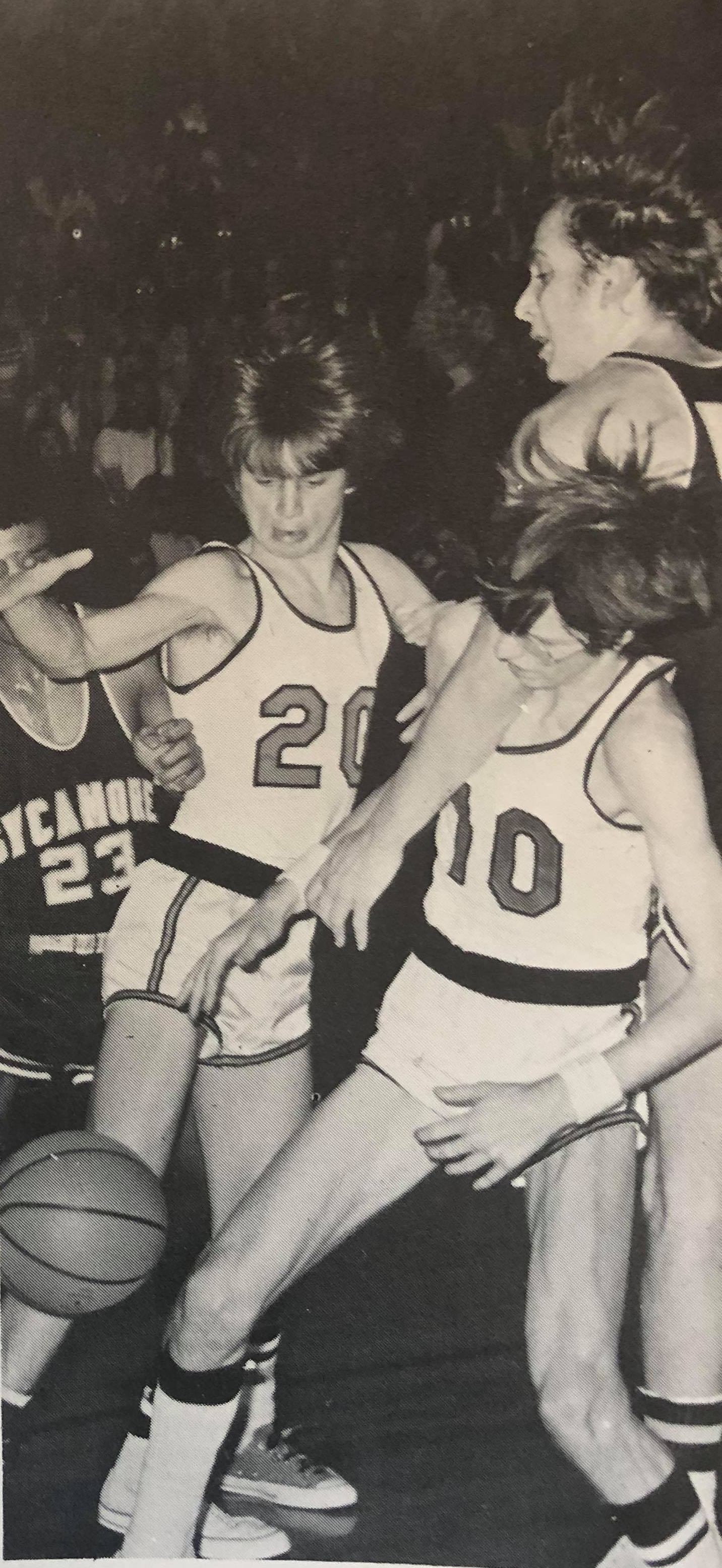
I’m #10, getting crushed while fighting for rebounds under the boards.

While my love of running had grown through a pair of successful cross country seasons, I’d been raised in a basketball family and went straight to practice the week after the Sectionals meet where our small school got handed a lesson amongst the much bigger programs east of us toward Chicago. In 1972, there were no Class A or Class AA divisions in cross country. Everyone got lumped together.

We might have done pretty well at the Class A level if there had been one. But lacking a chance to run in the state meet, I quickly shifted priorities and strapped on the Chuck Taylor lowtops to start basketball season. Our Coach Harold Anderson was the teacher who helped cross country coach Rich Born take on the program. I liked the way that Anderson coached basketball too. While we followed the Varsity program’s slow-down offense to some degree, he improvised and loved the transition game as well.

I did too, because my endurance, speed and ball-handling skills fit that game perfectly. Granted, I was also a hot-dogger to some degree, having developed a massive skillset of behind-the-back and between-the-legs dribbling and passing modeled after my hoops here Pistol Pete Maravich. More than once I heard coaches call out, “Cudworth, make the easy pass.” But that didn’t register entirely with me. Making behind the back passes was easy for me. Perhaps if they’d said “Make the simpler pass” it might have kicked in. But I doubt it.

Our sophomore squad one quite a few games but I don’t really recall the record. There isn’t even a photo of the full sophomore squad in the Kaneland yearbook in 1973. That’s because the varsity team had a far more compelling story to tell.

As I recall that year, the Kaneland varsity basketball team got roughed up quite a bit during the regular season. If memory serves, they won just 11 games to 17 losses against conference and other foes. But toward the end of the season, thanks to a classmate of mine named Ron Ackerman, the Kaneland system of slow-down offense (it was called the Hokey Pokey) and 1-3-1 trap defense started winning games in the post-season tournament.

Ackerman was indefatigable at the point guard position. His ability to harass and push opponents into full and half-court traps resulted in many steals. His baseline endurance was exceptional, after all. He went on to win the state meet in the 880 with a time of 1:52 and ran for the University of Kentucky. I watched him run a leadoff 4:01 mile in a 4 X 1 Mile relay at Drake in 1979. As the Kaneland team played better as the season wore on, I felt good for my friend Ron Ackerman and my cross country teammate Kirk Kresse, who was a rebounding force on the inside game.

I was scoring and playing well enough for the sophomore squad that I started getting pulled up to Varsity practices right when the team was entering post-season play. But just as that tournament run was getting started, my father announced that we would be moving to St. Charles in the next month of so. Suddenly my Varsity call-up came to an end. But the Kaneland basketball team roared on to take second in the Class A state basketball tournament.

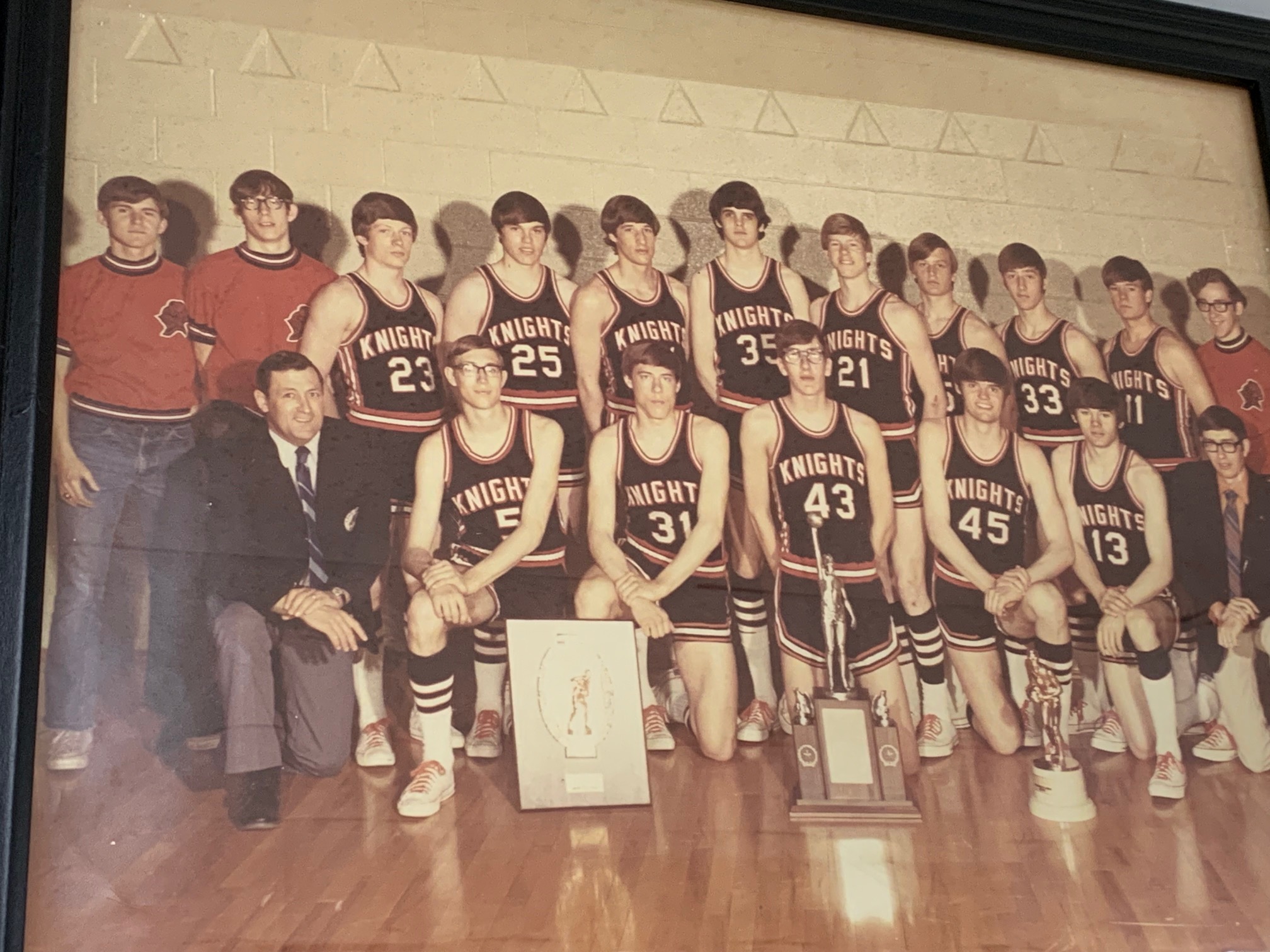
The Kaneland team that placed second in Class A basketball, 1973.
As a skinny sophomore, my flashy game in hoops was not always welcomed by basketball coaches.

While disappointing, that last-minute decision to leave me off the Kaneland varsity roster was actually quite reasonable to me. It was already crowded with good players that had earned those roster spots in support of the team all season. I’d only been participating in varsity practices a few weeks. My only triumph during that period was out-shooting a few of those players during jump shot practice. I was a good shooter and once made 29 free throws in a row at the Elburn Days Free Throw contest. That mark lasted from Friday all the way through Sunday when a former Kaneland and Illinois State player named Doug Witt shot something like 45 straight to take home the prize money. I was seriously pissed.

After the thrill of the Kaneland state tournament run, about which I felt a little jealous and disavowed, I began my weird journey as an expatriated Kaneland Knight. Our family moved that same week to a small home on 11th Avenue in St. Charles in February, 1973. That meant I still had half an academic year to finish, and Illinois High School Association rules stated that anyone transferring from one school to another during an academic year would lose a semester’s sports eligibility.

Saving grace

I painted this watercolor in my early 30s to describe the feeling of displacement from home.

From that day forward through the end of the school year, a group of Kaneland coaches alternated weeks picking me up at my house in St. Charles. That was truly an act of saving grace. Every morning I traveled the fifteen miles out to Kaneland High School for classes. My father apparently talked to the Athletic Director at Kaneland, Bruce Peterson, to work out a system where coaches George Birkett, Dennis Hendricks, Harold Anderson and Peterson delivered me to each day so that I would not miss any spring sports eligibility. What kindness! What patience! What teacher wants a snot-nosed fifteen-year-old in their car on the way to teach school?

The friends issue

There was some talk among my friends that my move from Kaneland to St. Charles was the product of recruitment by the St. Charles cross country and track coach, Trent Richards. He’d been a Kaneland student himself a few years before. At just 21 years old he coached the Elburn baseball team when I was thirteen. We’d had some early success together, and I was grateful for that. But there was no conversation between Trent and I, much less my father, about switching to St. Charles.

While I’d helped lead the Kaneland cross country program and done decently, but not spectacularly, in track and basketball, I wasn’t a good enough athlete to be recruited by anyone.

In fact, when I asked my father twenty-five years later why we moved to St. Charles during the early 1970s, he told me unequivocally, “I didn’t want your younger brother to play basketball for that slow-down offense at Kaneland.”

“What about me?” I retorted. “I was Class President and the one of the best runners on the team!”

“I knew you were a social kid,” he responded dryly. “I knew you’d survive.”

A real reason to move

To my father’s credit, he saw potential in my younger brother that would flourish to an All-State Honorable Mention in basketball. He helped lead the St. Charles team to the Sectional Superfinals in his Junior year. The St. Charles team played a mobile offense and my brother’s hieight of 6’6″ and a vertical leap of 36″ made him a dominant force inside. But he also had a soft left-handed jumper that was great from the perimeter. He was a basketball player ahead of his time in many respects.

With his jumping ability, he also made it downstate in high jump under the tutelage of coach Trent Richards. My brother went on to play hoops on a full scholarship with a Division 1 university in Ohio.

Our move from Kaneland to St. Charles proved to be a successful decision for our family in the long run. While my last few months at Kaneland were in many ways hectic, I’d simply traded the morning hour that I typically spent delivering papers in Elburn for riding to Kaneland for school. I recall my mother telling me, “You don’t have to take another job, Chris. You have enough to do right now.”

Little did I know that within a year of this photo, I’d be competing against these teammates.

It was a bit like attending a commuter school for the rest of that semester. I’d get there so early I should have spent time studying and kept up my grades. Instead, I’d often go out to practice long jump or high jump. I recall that one cool spring morning that I’d raked the long jump pit smooth and trotted back to line up for a jump. I felt a surge of energy in my legs and took off running. My foot hit the board perfectly and I felt a clean sensation flying through the air. Landing in the pit, my feet left a clean mark and I popped out with excitement only to realize that I had no way to measure the length of the jump. My best to that point was nineteen feet. Nothing to brag about. But what if I’d jumped twenty that morning? Some feats on sports are never to be known. And what does it actually matter?

I ran well enough in track that spring, dropping my mile time down to 4:42 at the Kane County meet. I recall that my future coach Trent Richards approached me carefully before the race to give me some pacing advice. He spoke so quickly that I didn’t actual understand what he was telling me. In any case, I set the sophomore record that day, a mark that would not last long as other Kaneland runners quickly surpassed it in the coming years. But given the circumstances of my quasi-year at Kaneland, I was happy to see improvement that spring hauling back and forth between towns to attend Kaneland those last few months.

Saying goodbye

My close friends were still suspicious of the supposed reasons for my move to St. Charles. I felt a distance grow between us as the year wound down. I kept trying to explain that my move had nothing to do with wanting to switch schools. I even told them, “I’m not good enough for anyone to recruit me.” At one point I even considered whether I should try to live with another family and finish high school at Kaneland. Grief and guilt had caught up to me. Also a bit of fear at the need to change my life all over again. It was a confusing time. I felt like I’d been jumping through hoops for months just to make life feel somehow normal again. I was ready to be done with it all.

The year closed with what felt like a bump and a clump. I walked out the doors of Kaneland High School that last day and took a look around, realizing that I’d never attend the school again. It felt weird. I felt a bit betrayed by the lack of trust that friends had shown me. Of course, they felt the same lack of trust toward me. For a fifteen-year-old kid, that was a ton pf social pressure to handle. All I could do was get in the car with a coach and ride away.

I missed my Kaneland friends, but the opportunity to make new friends would arrive quite quickly. Again, running would come to the rescue.

Posted in Christopher Cudworth, competition, cross country, running, track and field | Tagged , , , , , | Leave a comment