The inevitable product of fuel and flame

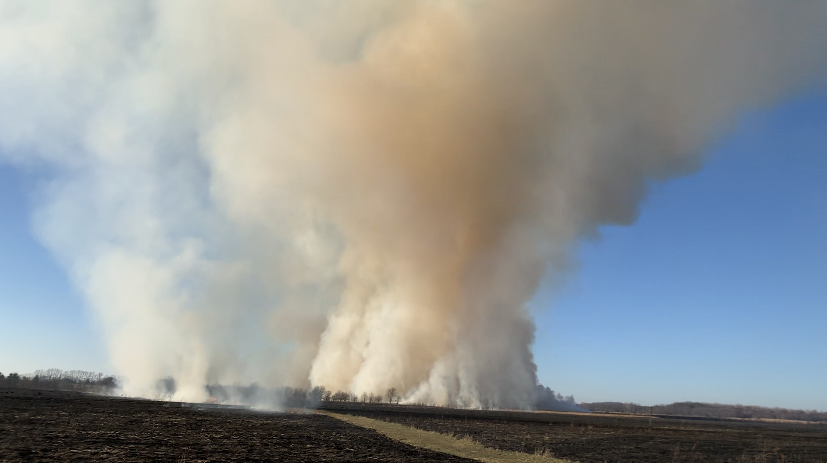
Two days ago I went for a run to Dick Young Forest Preserve for a closeup look at the prairie burn taking place in the western reaches of the property. Flames tore across the ground and smoke rose up in a yellow and white column. The billowing core twisted and spread east across the sky to mix with ellipses of smokey clouds flowing south from another prairie burn fifteen miles to the north.

Look at the trees in the photo above. They are tiny compared to the tornado of smoke columns rising in swirling fury from the prairie.

These cycles of growth and fire fascinate me. The scale of a prairie burn is so interesting to witness and consider. Each tendril of prairie grass or stalk of dried out bluestem contributes to the conflagration. Bits of burnt and ashen plant material rise with the heat and smoke pushing high into the air. The bits of carbon come floating down miles away, black curls wrought by combustion.
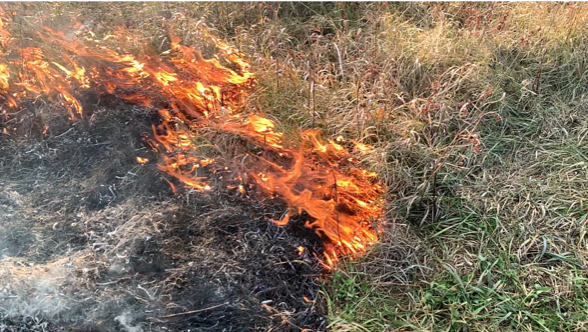
The fire stops when it reaches the green grass of a hiking path.

Imagine what prairie fires must have looked like when they were not conducted in controlled burns. They would have raced wherever the wind took them, tearing down ten-foot-tall walls of dried out grass with twenty-foot-tall walls of flame. You could not outrun them. That is why it is so important for professionals to manage prairie burns these days. The flames can easily get out of control.
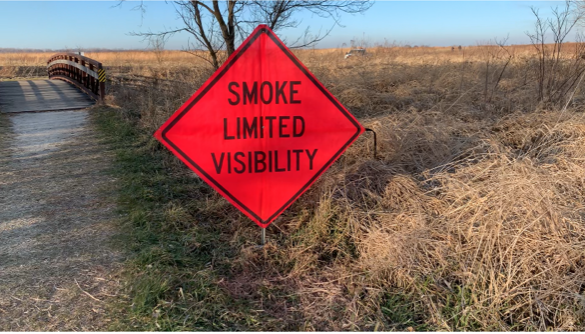
These days, fire technicians study the wind and torch grasses in strategic places to conduct prairie burns. That said, the wind shifted during the burn I witnessed and a new strategy had to be adopted. The fire crew burned the prairie from both ends and flames met in a fantastic conflagration at the center. It was such a beautiful thing to witness.

During the early stages of summer, the prairie is where I monitor birds each year. Everything is fresh and green then. Where ashes now sit, bobolinks will fly. Meadowlarks will sing. Milkweed will push up from the soil and welcome monarch butterflies. Cream wild indigo plants lurch upward and butterfly weed crouches like a flowery orange torch among the grasses.

Earth history

All the richness is fueled by roots sunken deep into the soil. That earth was farmed for decades dating back to the mid-1800s. Much of it was scraped off, blown away on winter winds or washed away in rainstorms. Evidence of the loss is clear in the long spine of raised earth marking the old fenceline at the center of the prairie. That line juts 18-25″ above the farmed dirt. It tells the story of many millions of pounds of earth gone somewhere else over time. The original prairie was formed during 10,000 years of geological and botanical change following the Ice Age. It all disappeared in a span of less than fifty years. That is why botanists seek to restore the prairie in this day and age. It is a heritage reclaimed.

So the soil cycle is now running in reverse. Prairie plants are growing and dying again, adding critical nutrients back to the soil as matter decomposes and falls like sediment upon the land. In five hundred or a thousand years the soil itself may rise back up again.
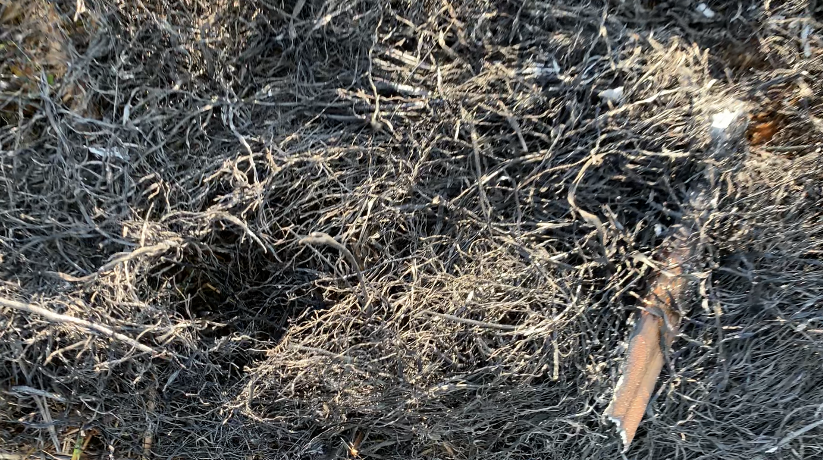
The blackened aftermath of a prairie burn. Nothing but tendrils of carbon and ash.

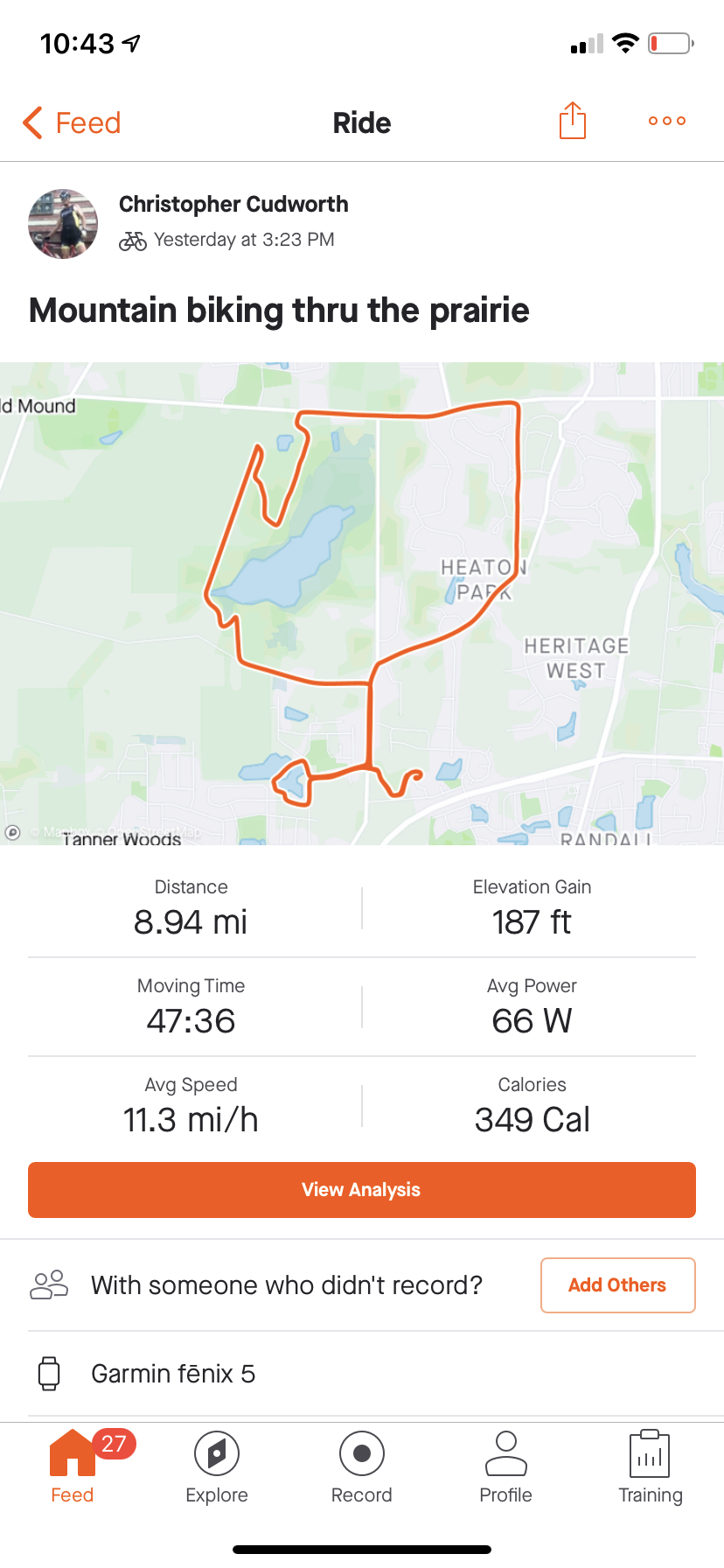
As I ride my bike through the prairie the trail rises up toward the north end of the preserve. There is glacial deposit underneath that rise in the earth. Less than a mile to the west is a spot called Bald Mound that is mined for sand and gravel. Even father west stands a glacial esker sticking up from the ground like a solitary earth pyramid. It stands thirty feet high, left there by a wall of ice a mile thick that once covered Illinois. Those glaciers melted north into Canada and beyond, leaving kettle moraines in southern Wisconsin and scraping off the flat central plains we cover in corn and bean fields to this day.

That ice tradition is melting faster than ever now. The human race is conducting what amounts to an uncontrolled burn all across the earth. Our combustion is heating up the earth’s atmosphere. The result is climate change. Global warming. We can see the effects in the plants that grow and the behavior of birds and animals. They are already beginning to adapt to the changes. Some will survive. Some might not.
When a tree falls in the woods

It is a warm December day as I pedal the mountain bike around the trails and head toward the wall of bur oak trees overlooking the marsh. I’ve been present when one of those giant trees fell to the forest floor. I was standing in the woods when a small crack of noise caught my attention. I turned my head to watch that oak lean and whoosh to the ground, sending leaves and branches flying.

What a sobering gift it was to be present for that moment in time. When a tree falls in the woods, it does make noise. When the prairie burns in the wind, it crackles and smokes. When a man pedals his bike along a trail, the sound of his breath echoes in his own head.

It strikes me that the thoughts that cross our minds are as ephemeral as the grasses growing in the prairie. We consume them at will in the prairie fire that is life, burning through the days as if there is no end to them, and no end in sight.

Burning to live

During my youth, it was common for my friends and I to “burn the candle at both ends,” working all day, running miles in workouts and partying late into the night. Sleep was the green path across which the prairie fire could not leap.

There is no other way to live. I have zero regrets in having burned as brightly as possible in those energetic, hormone-driven years. Perhaps they were not prudent or wise, but they were the inevitable product of fuel and flame, I realize.

If you liked this article, please share!

Posted in aging, aging is not for the weak of heart, cycling, cycling the midwest, death, running | Tagged , , , , , , , | Leave a comment

How is your pandemic experience so far?

A few weeks ago, following a 10-mile run on the Fox River Trail from North Aurora up to Geneva and back, I stopped at a 7-11 to pick up some hydration and food as I’d forgotten to bring anything in the car. Pulling on my mask, I walked through the door and immediately noticed a tall, fairly overweight man in a Trump hat standing with his daughter next to the Slurpee machine.

I eased past them to pick up some iced tea and a slice of prepackaged banana bread, then moved to the counter to pay. The big dude lined up a couple feet behind me with his daughter clutching her Slurpee and sipping on it while they waited behind me.

It was hard not to make a comment about their lack of masks. The early fall rise in Covid-19 infections was all over the news. Yet here stood this guy with his little girl wearing no face protection at all.

Perhaps you’ve seen similar people out in public without masks. Which raises the question: How is your pandemic experience so far?

It’s not hard to draw the straight line from his Trump hat to the choice not to wear a mask while out in public. We all know the nature of those objections. That Covid-19 is a supposed hoax. That wearing a mask is a government intrusion in the lives or private citizens. All of that points back to the fact that Trump himself publicly denied the threat of Covid-19 on many occasions.

In interviews responding to the release of the Bob Woodward taped interviews in which Trump admitted to downplaying the dangers posed by the Coronavirus, the President claimed he was trying to prevent ‘panic’ in the American public by releasing the truth about the potential effects of the disease. The fact remains that Trump lied to the American people by insisting the pandemic would either just go away on its own when the weather got hotter or run its course by some sort of magic to which only he was privy.

Instead, the pandemic has swarmed through the American population, killing hundreds of thousands of people. As it took hold, Trump defied scientists and medical experts trying to contain the virus through protective measures. Now he has tried to claim credit as pharmaceutical companies used research done well before Trump was President to push a vaccine into action.

Back in March of 2020, Trump tossed the federal government’s response into the feckless hands of his son-in-law, Jared Kushner, who cynically tossed it over to the states to handle it on their own. Then he ran off and started a side business grabbing up PPE supplies to parcel out as he wished, especially to whom he wished.

States struggled to find enough PPE supplies to help first responders in overburdened hospitals. All the while, Trump kept insisting that there wasn’t really a problem in America. He spent all his time whining that the “China virus” wasn’t his fault and that Democrats were making too much of the surge in infections. He also cynically claimed that the only reason there were more infections in America was the increase in testing. How that justifies his claim that Democrats were playing the virus for political purposes was never explained. It was a 1:1, logical fact that testing was revealing increased rate of infections.

Stats about the deaths of Americans don’t lie. Which raises the question: How is your pandemic experience so far?

But Trump has never let cause and effect get in the way of his political ambitions, personal greed and narcissistic need to always be right. Those were the reasons he denied the threat of the virus in the first place. He was anxiously aware that a pandemic, if it got out of control, would affect his chances at re-election. The reasons why he so feared losing were financial, legal, emotional and criminal.

Yet despite Trump’s attempt to avoid economic collapse by lying about the Coronavirus, that is exactly what happened. The economy tanked, and that frail claim to authority was the main tool Trump hoped to leverage in his re-election campaign. Trump had greedily claimed credit for the straight line recovery and growth coming off the Obama years. To make his case, Trump eagerly touted stock market numbers as a sign that America’s economy was booming. Then he and the GOP tossed billions in tax cuts to the most wealthy citizens in this country. The middle class? The poor? He doesn’t consider those people worthy of his attention despite what his cult worshippers insist. Now he’s bilking those same people out of millions in contributions after he lost the election. That’s called being a sucker.

Trump’s rabid support was cognitive dissonance considering the massive number of people thrown out of work by the economic collapse caused by the pandemic. State governors imposed Stay-At-Home orders in attempts to corral the effects of the contagious virus. Trump and his Republican minions griped that such orders were too stringent and were harming businesses nationwide. They were correct about the latter, but ignored the true source of those problems, which was Trump’s denial of the threat in the first place.

The Chicago Tribune carried a story today that cited the fact that under Trump, the federal government has ramped up the rate of executions, but for what purpose? Is his base somehow eager for people to die as a sign that Trump is loyal to them, or to satisfy the bloodlust lurking just behind the vigilantism, gun culture and militia mentality of the uncivil population?

Most of us got small pandemic relief checks months ago. Which raises the question: How is your pandemic experience so far?

The bulk of us were left to figure out how to survive Trump’s selfish denials. A Covid relief bill was passed, and unemployment benefits were extended, but those were short-term actions that barely carried people through their breaking point. People living under the poverty level increased dramatically. America was in crisis.

The nation has 25% of the deaths worldwide yet only 3% of the world’s total population. There is no way to portray those numbers as anything other than a massive failure in leadership by the Trump administration.

Yet Trump’s followers, including that big dude behind me in line at 7-11, refused to admit that Trump was in any way at fault. The armed vigilantes who stormed the Michigan state capitol building and spewed spit in the faces of police offers tasked with protecting the government…were there to whine that the governor was being too hard on the citizens of the state by imposing restrictions designed to control the spread of the virus.

Millions of people are trying their best to prevent the spread of Coronavirus. But others don’t seem to care. Which raised the question: How is your pandemic experience so far?

Those of us wearing masks and giving up most of normal life to protect the lives of others found the arguments of Trump’s obviously selfish supporters alarming beyond reason. The anti-masker movement flourished beside Qanon conspiracy theories and calculated attempts by Trump to undermine the upcoming election by compromising the US Postal Service to hinder mail-in balloting.

Trump’s failures and corrupt actions were catching up to him like an Ironman triathlete who cut the course in the swim, drafted during the entire bike segment and refused to take either nutrition or hydration along the course because he considers himself a superman. Indeed, the sight of Trump standing on the balcony of the White House, breathing heavily and walking shakily down the steps is something every endurance athlete recognizes. He’d just run into his own wall of dishonesty and cheating.

Those of us who accept and abid by the state strictures to social distance, wear masks and generally avoid large public gatherings find the Trumpism refusal to help the country reduce infections and deaths beyond disturbing. This morning I heard a physician describe the fact that he had just checked in 36 new Covid-19 patients, four of who went straight to the ICU. Those are someone’s relatives, parents or grandparents. They might well die before the week is out. If so, they’ll join nearly 300,000 Americans that have passed away under Trump’s less-than-honest watch.

The other thing that Trump has ignored is the threat of climate change. That worldwide problem is another danger to the lives of Americans, yet Trump denies that it is real, even engaging in attempts to undermine the ability to pass laws controlling pollution of any kind. Trump is a calculating killer and despot. That’s all there is to it.

We’ve all tried to rationally engage in some kind of normalcy during the pandemic. Which raises the question: How is your pandemic experience so far?

My wife and I admittedly got out to do a couple triathlon events this summer. The precautions put in place by those events during a low ebb in infection rates ensured that people were safe. There were no reported infections from those races.

But we canceled a scheduled race in Florida this coming weekend because we deemed it unsafe and selfish to fly and race during this massive surge in infection rates. The race was canceled anyway, but we’d made our decision well before that.

All of us has had to sacrifice in one way or another during all this madness. Yet the one man who could have made it all better continues down his selfish path of trying to overturn the election he likely lost because his lies about the Covid-19 disease caused such hardship for millions upon millions of Americans. Those who voted for him anyway ignored these facts out of some sense of loyalty to his narcissistic claim to lordship over all.

I found some final pieces of evidence that reveal the vicious nature of the Trump administration and why so many people have died as a result of his actions and inaction. The clippings in this article reveal that Trump and his administration care only about ideology, money and power. The rest of us, in his eyes, can all go to hell.

Which raises the question: How is your pandemic experience so far?

Posted in coronavirus, covid-19 | Tagged , , , , , , , | Leave a comment

I never dreamed that I’d be missing the pool

With all the ups-and-downs, back-and-forths of Covid-19 precautions, it has been difficult to plan workouts at the pool. Currently our facility has an online schedule to grab workout times. It’s a pain in the butt. For a while during the summer when Coronavirus infections were down, you could show up at the pool during off-peak hours and get a lane no problem. Now everything is scheduled and workout blocks are being nabbed a week in advance.

Some of this is my own lack of workout discipline. I don’t really schedule times to work out. I take it as it comes. That is a response to many years of obligatory training and the sense that I was missing out if I didn’t get a workout in. That’s changed with age and my more relaxed approach to fitness.

Still, I managed to improve my swim this past summer, covering one mile in 36:00. That’s a good time for me. I did that on 1-2 swim workouts per week. The minimum that most experts recommend is three workouts a week if you want to improve endurance and speed. So it’s obvious that by putting in a bit more work, I could swim faster.

I do miss the pool. I like the feeling of getting into a groove and doing a set of 10 X 100 without thinking all that much about it. As a confessed user of wetsuit shorts, I enjoy my swim time much more these days. I’ll not apologize for that.

But it’s time to swim on over to the pool website and set aside a couple times and make the commitment. My pectoral muscles are begging for action. My shoulders want the reach and catch. My brain loves the bubbles. My lungs want to chomp on some chlorine.

See you at the pool. I never dreamed I’d be feeling this way.

Posted in swimming | Tagged , , , , , , | Leave a comment

On winter and fading tan lines

During the summer I always put sunscreen on my arms, face, ears, neck and nose. But that’s a rather recent habit. For most of my running career before taking up cycling fifteen years ago, the thought of putting on sunscreen was a non-starter. We just didn’t do it in the Old School Days.

I do recall that a teammate from college went to South Padre Island one spring break. He slathered sunscreen on most of his body but could not reach his back except with the back of his hand. In a rush, he smack the middle of his back with sunscreen and went about the business of teenaged frolic in the sun. That left a big hand print surrounded by sunburn on his lower back.

Family history

My father dealt with skin cancer on his head for the latter years of his life. I don’t recall him wearing hats much during his lifetime, even while golfing. Instead he wore dark shades over his eyeglasses. Thus his bald head was exposed to countless hours of sunlight. The cancer treatment that resulted from his skin exposure was not a pretty sight. The physicians operated and burned away patches from this scalp that his caregiver Leo tended with great kindness.

Thus I don’t take the issue of skin cancer lightly. Yet where my father never wore hats much, I have covered my noggin’ with hats of various kinds most of my life, especially since I began losing my hair during my 20s. There is small hope in that, but no guarantee.

I figure I’ll still get the treat of dealing with some sort of skin cancer up there, or on my face. This summer I had a small nib of squamous cell skin cancer taken off my right arm. I keep a close eye on my skin and noticed a 1/8″ spot that needed checking. Sure enough, it was worth the notice.

As I departed the doctor’s office after the stitches were removed a few weeks later, the physician had the simplest advice of all for me: Stay Pale.

Part of me really wants to do that. Another part of me loves the sight of tan lines during the summer months. I know that’s stupid, but the look of brown legs shining with sweat in the summer sun is something I associate with hard days in the saddle and becoming a Hard Man. Shaved legs, tan lines and a battle-hardened body just go together.

But time and age have different plans anyway. The final weird component of this skin journey is the onset of crepey skin that comes with being in my early 60s. That freaked me out at first. That’s a body change I perhaps should have seen coming, but it came about fast, almost overnight it seemed.

I think we all imagine ourselves traveling toward the grave or cremation without the real effects of age ever catching up with us. I admit that’s probably why I still like tan lines. They speak to the long candle of youth burning slowly and not worrying about skin cancer or time or mortality. But the wax of time is not eternal.

When winter rolls around and the tan lines fade, the leg hair grows out and our bodies are covered by layers of warm clothes, it is much easier to think in terms of common sense. Last Saturday, I bundled up and rode 21 miles in forty degree temps and enjoyed the experience without seeing the skin on my legs shine in the summer sun. There’s a lesson in that. We shouldn’t run and ride for ego’s sake or for vanity, but for health purposes. It’s a little boring that way, but a much better strategy for the long run.

Posted in cycling, cycling the midwest, cycling threats, death, healthy aging, healthy senior, running | Tagged , , , , , , , | Leave a comment

Understanding dogs can be a real bite in the butt

This morning while running our dog around the dog park, she took to playing with an same-sized pup named Evie. She’s a shepard mix of some sort who loves to run and growl and tumble with Lucy, our pit/border/beagle/boxer mix.

I don’t let Lucy pick up sticks or balls or ropes much at the dog park because she quickly becomes possessive. But today, the dogs collectively gathered so much detritus from the ground I gave up. Then one of them dropped a piece of rope near my feet and I picked it up and ran.

That’s when Evie ran after me and chomped on my butt. It wasn’t hard. No more threatening that what she does with Lucy. Dogs love to gnarl on each other and Evie simply applied Dog Rules to my glutes. I stopped, laughed and looked back at the other adults watching the dog circus. We all chuckled. Lesson learned, I thought.

Not all dog chomps are so playful or benign. Many years back I was running on a path that passes through Island Park in Geneva, Illinois. Suddenly I felt a painful bite on my left butt cheek and swung around to find a collie standing there with its teeth bared.

Normally I don’t think of collies as an aggressive breed. But sure enough, this one bit me in the ass. I stood there rubbing my butt when the owner yelled at me. “What are you doing running on the trail?”

“It’s a running path,” I replied, a bit flabbergasted at the question. “People run on it.”

“Well, you scared my dog,” he barked back.

“Your dog should be on a leash,” I replied. “Those are the rules in this park.”

The owner stomped over and collected his dog. I continued my run and checked my butt cheek when I got home. Sure enough, there were reddish blue teeth marks on my little white ass.

I’ve been run over by dogs. Snapped at by dogs. Barked at by dogs of many kinds. But none surprised me so much as that collie on the running path that day.

Some people just don’t get it when it comes to their dogs. I like to think I do, but not always. I make mistakes in interactions with dogs and assume some are more friendly than they really are. Dogs have their own rules. And unless you’re a dog, and not a runner, you probably don’t understand them in the moment.

Posted in running | Tagged , , , , | Leave a comment

That’s a long time in a pair of Nike Pegasus

This photo from my wedding at the age of 27 years old shows the groomsman outfitted in silver Nike Pegasus running shoes to match the silver tuxedos we chose for the occasion. Those shoes were the gift I gave to the groomsman in our wedding.

I’d worn many pairs of Pegasus by that point in time thanks to sponsorship by the Running Unlimited shoe store. Our team of racers all wore Nike shoes and gear as provided by our contract.

The decision to buy sets of Pegasus for my groomsman was an easy one. The two guys on the right were teammates of mine in high school cross country and track. The Best Man on the far right also ran with me in college. That youngish looking character right next to the myself and the bride is my brother-in-law.

The year that I got married was the last full year of truly hard racing in my career. After that, we conceived our first child and I decided it was time to dedicate less time to training and more time to being a father. After all, I’d been competing year-round from the age of twelve to the age of 27. That’s fifteen years of dedicated training and racing. It was time to move. To grow up.

I moved into a space where running was still a big part of my life, but not at the forefront. Many years were spent coaching other athletes and directing youth soccer teams. Then I started playing indoor soccer and wore Nike cleats and indoor shoes. I loved a set of soccer cleats that was a “hand-me-up” after my son finished using them in high school soccer. They were bright red with a reflective silver swoosh on the side. I recall seeing them flash in the sunlight when he was tearing up and down the field.

During all that mid-life stuff, Pegasus shoes would float in and out of my training gear, as did other Nike models. But so would shoes by many other makers; Saucony, Brooks, Puma, Reebok, New Balance, adidas and many more.

Something in me still holds a warm spot for Nike shoes. In college I raced in Oregon waffle racers and Nike Elite waffle racing shoes in cross country. I wore Nike spikes in the steeplechase, an event in which I qualified for nationals three times.

Post-collegiately, I raced most of my PRs in Nike racing flats, especially the Nike Air Edge and the Nike America Eagle. At midnight on the North Central College track in May of 1984, I ran my 5000 meter PR in a set of Nike Zoom track spikes. Those spikes were clean white with a simple sky-blue swoosh. They were light and fast.

Yesterday I received a set of Nike Pegasus Shield training shoes from the online Nike store. They’re obviously quite different from those prototype Pegasus I first bought back in the 80s. I normally buy my running shoes locally from Dick Pond Athletics, but with online credits to burn I chose the Nike Pegasus as my second set of running shoes to train during the winter months. The fact that they’re a bit waterproof is a real benefit during December, January and February here in Illinois. That mushy snow can be a soggy problem.

I’ve worn the new Nikes around the house trying them out. My stupid ankle bones stick out so there’s a lacing strategy necessary to wear the shoes well. But I plan to keep them. We have a lot of years of history together, these Nike Pegasus. A ton of miles and a lot of smiles.

Posted in 10K, 13.1, 5K, Christopher Cudworth, college, competition, cross country, running, steeplechase | Tagged , , , , , , , , | 1 Comment

A half marathon for the ages

I created this quasi-art piece a few years back. It still holds true.

With the lack of competitions this year due to the pandemic, we’ve adjusted our plans and expectations like everyone else. Yes, we did get in three triathlons that were held this summer. But we learned that the Florida Half Ironman my wife planned to attend in December was not going to happen. We ‘half-expected’ that, of course. Races are being cancelled for good reason. It doesn’t pay to be ignorant or selfish in the face of this tricky-ass, random disease called Covid-19.

So we decided to run 13.1 miles together as part of her workout plan. Her coach scheduled the run, so why not do it together and see what comes about?

We chose the Fox River Trail for its convenience and it amenities. There are a couple bathrooms along the way in case of need, and that works best for us. So we set out on a calm, clear day to run 13.1 miles our way.

We hit the turnaround point at exactly one hour. She still had a two-mile interval to do so we took the short recovery period and then nailed those two miles at near 9:00 pace. We took the three minute rest interval, then picked it back up and finished in 2:02 for the full half-marathon. That was exciting.

That’s such a great sign for Sue’s running fitness. Her times have come down from the 2:10 zone to the point where she can run sub-2:00 with a bit of concerted effort. It’s been an interesting journey training with her along the way; watching her endurance progress, to see her running form grow more efficient and watch her confidence build.

Training partners

I’m not her coach but feel some gratification in helping her achieve these pillars of progress. Running with her has built my own mileage back up to 25-30 miles a week. A few years back, I’d sort of given up running 13-milers. My hips tightened so bad during the Madison Half just three years ago that I was reduced to lying down on the ground to stretch in order to continue at all. I finished just over two hours that day after racing 8:00 pace for the first nine miles. You can see how slow I ran the last five miles! That was a tarsnake moment for sure. But I didn’t let it stop me. This summer I cranked out a ten-mile at 8:30 pace. So the times are coming down. I’ll never touch my PRs of years ago, but that doesn’t matter. All that matters is working on what you can achieve in the present age.

This summer, I ran a 2:01 half to conclude a Half Ironman after the 1.2 mile swim and 56-mile bike segments. That’s progress of a sort.

So I’ve come a ways too. I’ll never run a 1:10 half marathon as I once did, but that would be an unrealistic expectation after four decades of running!

Recently, I also had the chance to work with a 60s-ish friend seeking to break 2:00 in the half-marathon. After a couple consultations he followed the pace plan we mapped out and cranked out a 1:51. He has his eye on even faster times.

This is all part of the fun of achieving progress at any age. Surely it is remarkable to coach young athletes setting PRs as they develop. It is just as satisfying helping people look at themselves through new eyes in endurance sports. Setting goals and making them happen is satisfying at any age. When you think about it, every race or great workout you do is one for the ages.

If you have questions about hitting your objectives, shoot them my way. We’re all in this together!

Posted in category | Tagged , , , , , , , , , | 1 Comment

Confessions of a mediocre jumper

The way it used to be done.

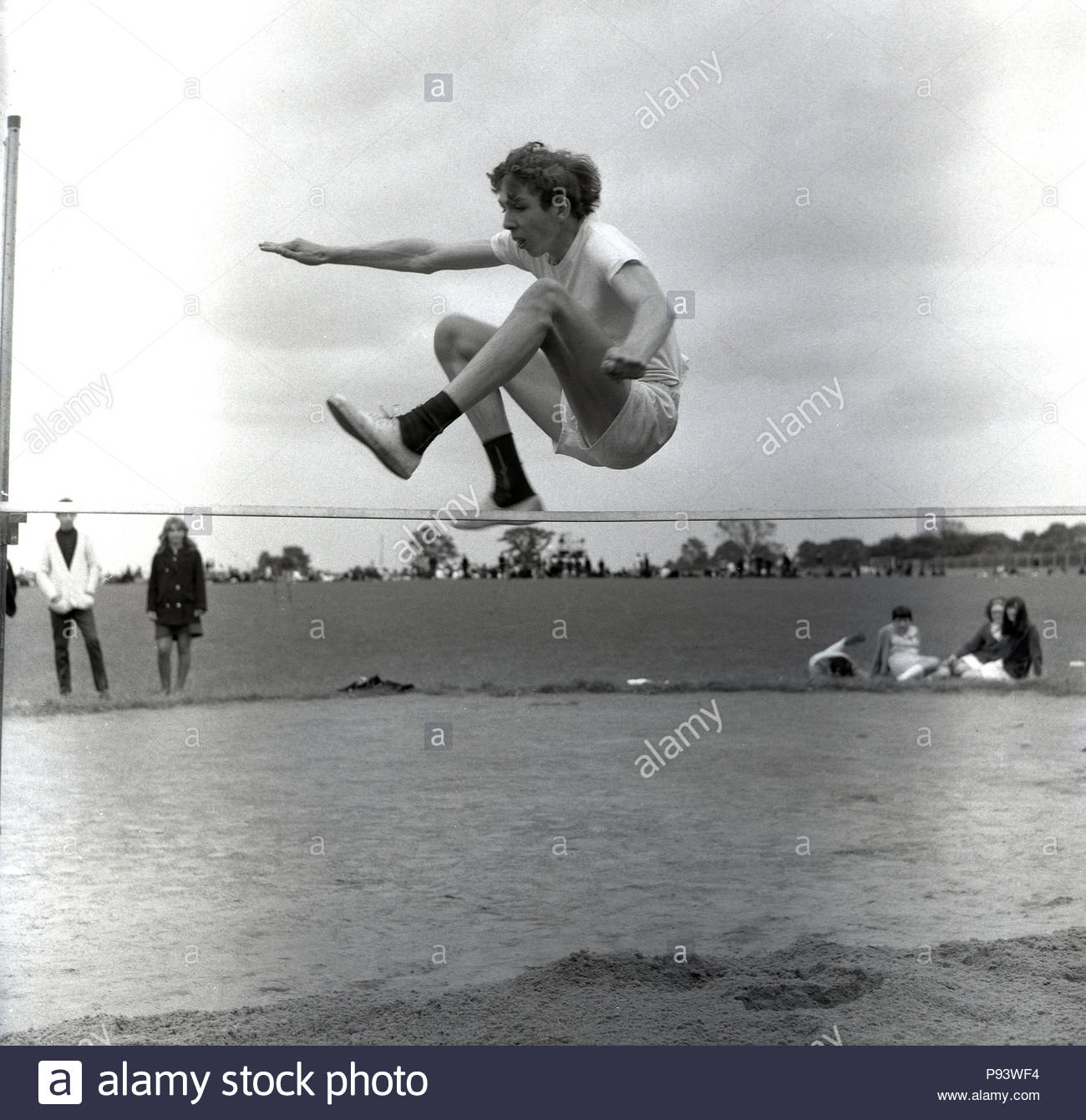
Somewhere in the late 1960s as a student at Martin Meylin Junior High near Lancaster, Pennsylvania, I was introduced to the sport of track and field. One of the events I tried was the high jump. At that time, the pits into which we jumped were made of piles of rope bags holding strips of foam together. It was primitive at best, but something about jumping over that bar excited me.

Before those high jump bags were contrived, athletes jumped over the bar into piles of sawdust. I recall doing that on our own with some friends. You either did the Western Roll or “straddle” as it was called, or the scissor-kick. Then hoped you landed safely.

The scissor kick was the truly archaic way to jump. Even back then, no one took it seriously. Running at an angle toward the bar, you kicked one leg up and over the bar while keeping the torso largely erect. You landed with one foot and then the other, typically kicking up a bit of sawdust or tangling your feet in the bags of foam in the process. It was an awkward era, to say the least.

Run and jump

I looked up the history of the high jump and apparently it all started with competitors running straight at the bar like the long jump and going over the bar that way. The record for that style, set in the late 1800s, was around 6’2″. That was a long time ago, but it still means that someone lifted their fanny that high off the ground. Sadly, that is also the exact height I eventually jumped in my career in both straddle and flop styles. That shows how mediocre I was as a high jumper.

Then came the scissor kick. The world record for the modified scissor-kick technique wound up at 6’9″. That is also extremely high! Eventually the roll technique took over, and according to LiveAbout.com, the world record for the roll climbed over a period of a decade:

“Russia’s Valeriy Brumel was even more prolific, setting six world records from 1961-63. He improved the mark by 1 centimeter each time, topping out at 2.28/7-5¾. Brumel’s last mark stood for eight years, but Pat Matzdorf brought the record back to American shores by clearing 2.29/7-6¼ at a World All-Star meet against Soviet athletes in 1971.”

Jumping evolution

I share all this because my little evolution as a jumper traced all these techniques. But none of it would have been possible without changes in the style of pits in which we landed. In a short period of time from 1969 through 1971, high jump pits evolved from bags of strung-together foam strips to solid foam high jump mats that stood three feet high.

In between, there was a period when we jumped into inflatable pits called Cloud 9. Both high jump and pole vault used these marginally insane devices. I was still jumping straddle when the first Cloud 9 pit showed up at little Kaneland High School out in the corn fields west of Chicago. It was always windy out at that track and more than once when I was approaching the pit for a jump, the Cloud 9 shifted or unhinged or pulled up from its stakes. It would rise up and flop over like a fat cow in a field of grass. There is nothing more unnerving during high jump than making at attempt at full speed only to watch the pit disappear.

It was also common to land on the edge the Cloud 9’s rounded front end and bounce back onto the tarmac. For pole vaulters (and I never did that event) it was even more treacherous. Thanks to these problems, and within a couple years, those Cloud 9 pits disappeared. That was likely the result of litigation against them. A Google search doesn’t even turn up an image of those pits. The Cloud 9 brand name is still used for those inflatable bouncy playgrounds castles and such used at children’s parties. So perhaps the company never disappeared. It just lowered its standards, so to speak.

Fosbury’s World

Of course, high jump really started to change after Dick Fosbury invented an all-new method of high jumping called the Fosbury Flop. He won the Gold Medal at the 1968 Olympics and the world of high-jumping never looked back.

About the time the Cloud 9 vanished from the scene, I started to experiment with the Fosbury Flop technique. It was much safer once the high jump pit was a heavy foam mattress firmly fixed to the ground. Even so, I once jumped 6’0′ in rainy conditions and slid right off the back of the pit.

High jumping was a tool for scoring points. During high school dual meets I’d jump right after running the two-mile at the start of the meet. Then I’d go triple jump after that, and complete the day by running the mile. I did all that to help the team earn points. I did win all four events a few times.

That wasn’t necessarily the way to become a better distance runner, but it was a period when multisport athletes in general were common, so doing multiple events in track was typical as well.

Now about that triple-jumping. I came to track and field from a background in basketball. While I was never a pure leaper in the sense of vertical leap, I was good at converting speed into height and distance. My best effort in the triple jump was 40’4″, a school record at the time. I will confess that record should not have counted, as there was a healthy wind behind me at the time. The record didn’t last long after I graduated anyway, as triple jump was a relatively new event at the time. Once the real jumpers took over my record vanished into the ether of time.

Jumping for the joy of it

Before taking up triple jump, I long jumped quite a bit as well. My best was 19’1″, which in retrospect I find rather respectable. The fact that my skinny distance runner legs with calves like toothpicks were able to jump that far is no small feat. I really wanted to go twenty feet, and wasn’t for lack of trying. I’d sometimes go out and long jump before school at Kaneland HS when I should have been spending time in early morning study hall. I’d back up that runway and tear down the asphalt with all my might. With no tape measure to gauge my efforts, the notion of success or failure depended walking back from every jump with my feet to guess how far I’d gone.

In college I abandoned both long jump and triple jump. But I kept high jumping through my freshman year. At the end of the year, I competed in a ‘jump off’ to earn a chance to compete at the conference meet because the three distance slots per event (1500, 5000, 10000) were all filled by older, faster runners. In that meet, I jumped 6’1.5 inches to place in the Top Ten but the winner went 6’8″.

At one indoor meet that year at the University of Wisconsin-LaCrosse, one of their high jumpers cleared 7’0″ using a modified gymnastic run-up in which the athlete did a forward hand spring and dove over the bar after both feet contacted the ground in a powerful fashion. That was the problem. It was impossible to tell if that jumper was hitting both feet or one at a time. The rules disallow jumping with both feet. So his technique vanished. How many athletes could do it anyway?

I actually coached jumpers during my tenure as assistant coach with the St. Charles Track Club in the mid-1970s. In particular there was a series of girl jumpers who did quite well in state competitions. Andra Olson was one of those athletes from Sycamore. Her brother Gail won a state championship and cleared 7’0″ in high school. Some of the most unique jumpers were the tween girls whose gymnastic backgrounds gave them spring and flexibility, both great attributes in high jump. Several of them jumped 5’8″ at the age of twelve of thirteen. Of these athletes, I’m pretty sure a sprite named Kelly Murphy jumped 5’8″ along with a couple other athletes of that period. Perhaps that was Patty MacLaughlin. Hard to recall after all these years.

In any case, Kelly had an especially ebullient personality that complemented her considerable athletic ability. She ran fast as well, and was one of dozens of kids who made that program special back in the day. It’s not that hard to coach talent. Just say “Go!”

Steeplechase

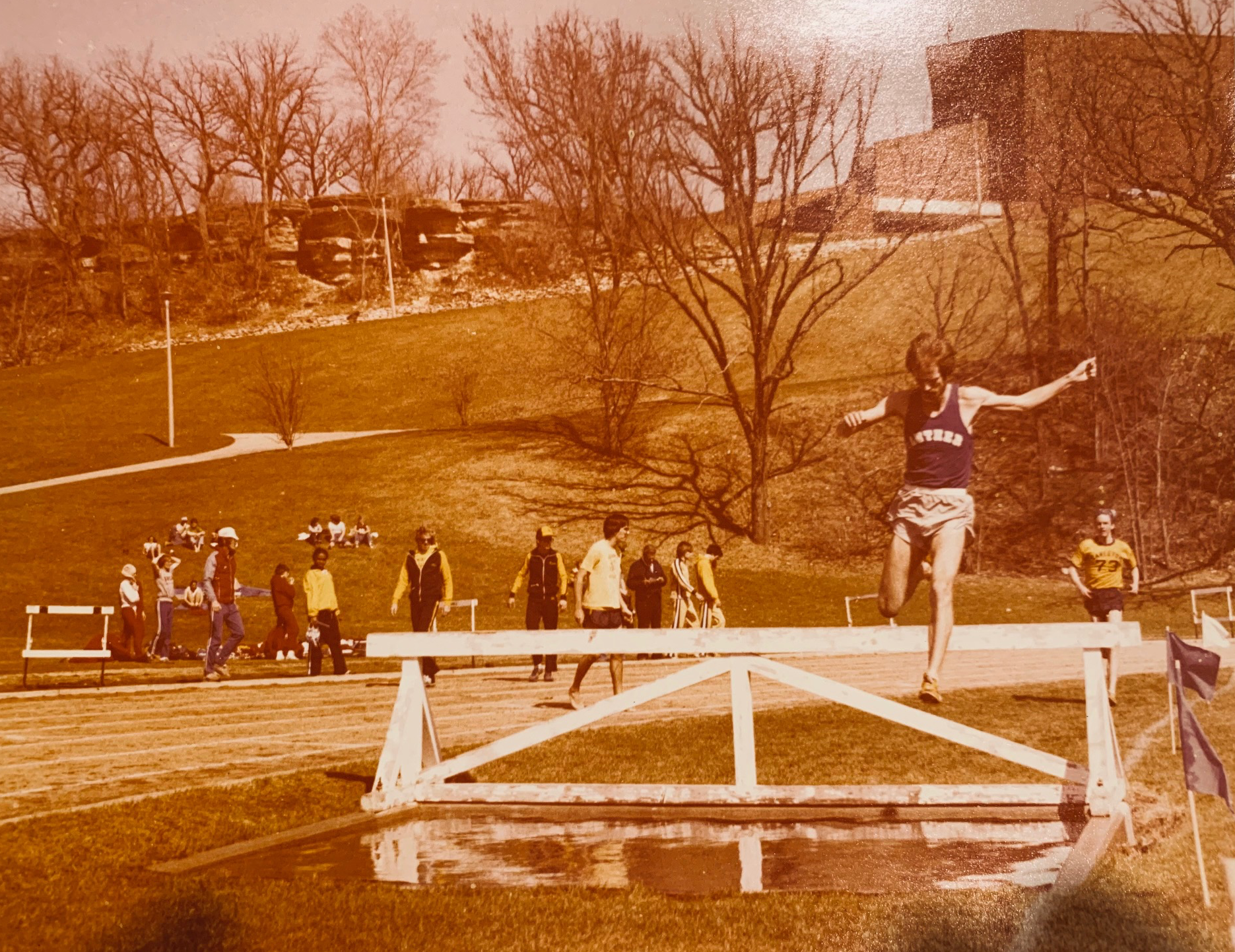
By the time I was a sophomore in college, I gave up field events such as HJ, LJ and TJ entirely because a new focus had taken over my track career. That was steeplechase, the event in which distance runners cover 3000 meters over 35 barriers and 7 water jumps. My jumping ability helped with the hurdling. Where it really helped was clearing the water jump. The pit was 2.5 feet deep below the barrier and rose to a zero depth incline twelve feet away. I’d step on the barrier and leap out and over the water, often without getting even one foot wet.

That’s a helpful advantage in a race where soaking wet shoes are a common aspect of the event. I went on to qualify for nationals in steeplechase three times, with times dropping each year until I ran a 9:19 at a conference meet while keeping the pace under control to save energy for a 5000 meter double. One of my few regrets in track and field is not having the chance to run all-out that day. My PR would be perhaps 5-10 seconds better, but sacrificing that chance to try to help the team win the conference meet was the right thing to do. We still didn’t win, but we tried. And that’s what counts in the end.

All that high jumping and long jumping and triple jumping I did for all those years… falls into the same void between vainglorious indulgence and being a team player. It as fun. That’s all I can say. It also taught me that there are limits we all encounter in life. Plus it teaches you humility to shake that sawdust and foam dust out of your shorts and get that sand out of your ass crack.

Posted in steeplechase | Tagged , , , , , , , | 1 Comment

Depression and dark days aren’t the end-all, be-all

This morning dawned bleak and snowy. Many would be tempted to look outside the window and remark, “What a depressing day.”

Ironically, many of us that have dealt with depression in life rather embrace these darker days. Like reverse osmosis, sometimes the lack of need to show a brighter side of ourselves serves like a release from pressure to put on a happy face. I personally love wandering through dank woods, or through the sullen fog of a November morning. There is no need to pretend in those moments. Life is what it is.

I found a quote that describes the way depression not only moves within and through us, but around us as well.

“If you know someone who’s depressed, please resolve never to ask them why. Depression isn’t a straightforward response to a bad situation; depression just is, like the weather.”― Stephen Fry

Like the weather? I’d say it goes a bit deeper than that. Depression is more like an internal climate within which one lives. It’s actually bigger and broader than a weather system. That is why there’s no such thing as completely running away from it. Weather comes and goes. The climate is where you live.

Granted, even the climate can change. We’re seeing that now around the globe. I just finished reading a startling article in National Geographic about the Great Lakes and how climate change is warming the waters, killing off certain species of diatoms critical to the entire ecosystem of those bodies of water, which hold 25% of the surface freshwater on earth. Those microscopic creatures also produce about half the air we breathe. Climate change threatens to kill them off.

Those are depressing facts. Then again, there have been a ton of them this year. From a cultural, social, political and environmental perspective, 2020 is the roll call of depressing years.

Coming through it…

That said, for me, 2020 was not half as bad as last year. 2019 was the year I nearly died from a tooth infection that nearly took me out. I also got clobbered in a bike crash by an idiot who stepped out in from of me. That led to injuries that would not heal quickly. For much of the year, I was scared, and hurt. It was depressing.

Yet I’ve gotten good at coping with bad news of many kinds. My years as a caregiver to a wife with cancer taught me that even seemingly terrible news often turns out to be not so bad as it seems on the surface. You always have to wait. See what comes next.

I also learned to damp down the drama in your head. Many of us are great at imagining the worst even when things are going fine. Our anxious minds invent reasons to be afraid. That is why it is often said that anxiety is the flipside of depression.

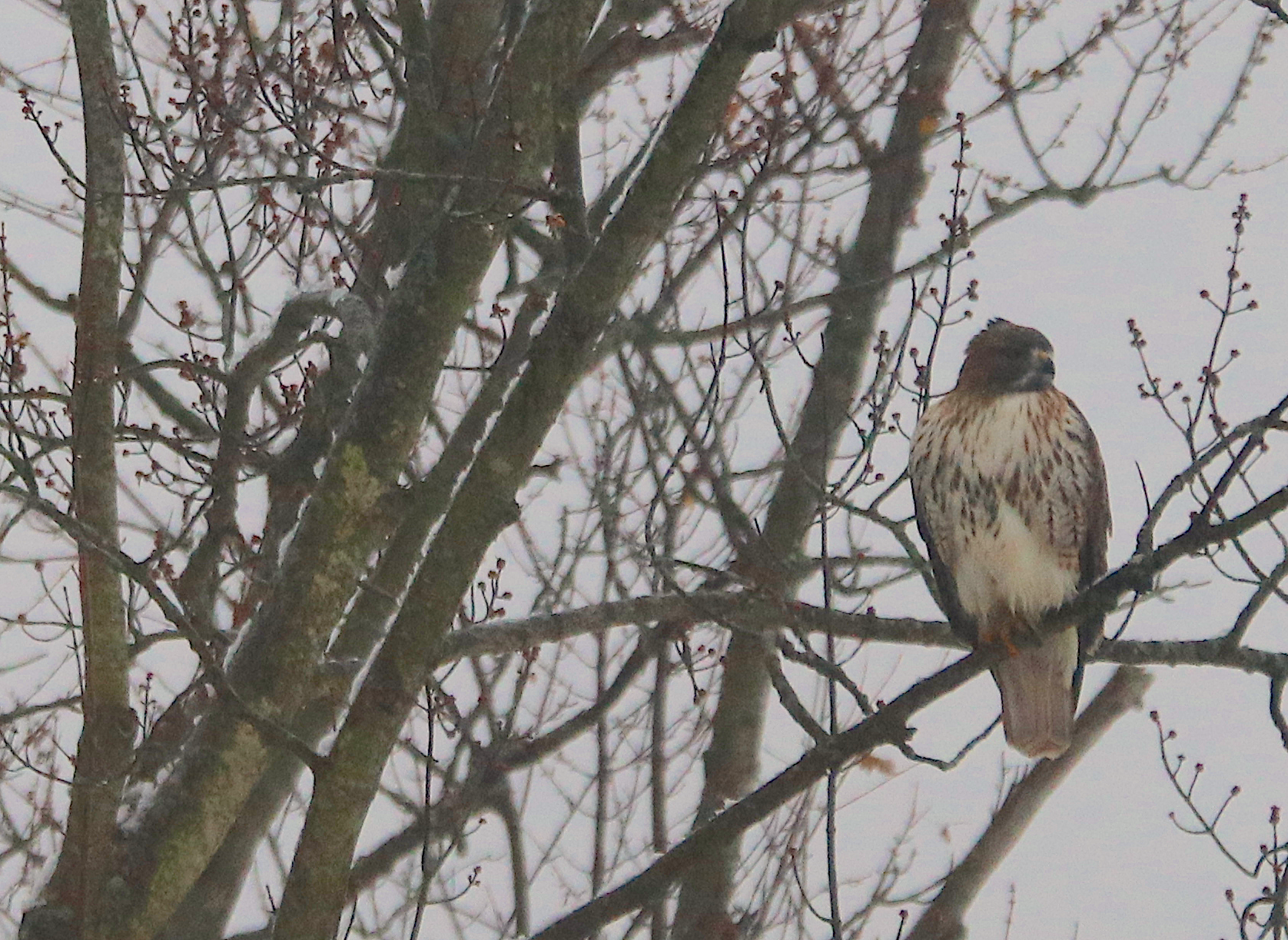
Yet we still have to go about our business. Like a hawk sitting in a soaking wet tree, the day still demands that we get out there and hunt for whatever it is that sustains us. It may require a different kind of motivation, or perhaps just dull determination, but the hunger and need to survive remains.

Through it all, and over the years, I’ve relied heavily on the ability to go out and run or ride or swim to gain perspective and move outside the limitations that depression sinks into your brain. Moving around through exercise makes my mind work in new ways. Then again, it’s a fact that depression can make you not want to move. It can make you want to lie down and sleep instead. It takes courage at times to get out the door. Go do it. Just Do It. Whatever works for you.

I well recall a floormate in our freshman dorm who went into depression and slept for days and days. We’d peek in on him to make sure he was alive. He might have gotten food from a roommate. I never knew. He finally emerged and moved out of his funk. It was hard for him because football season was over at that point. There was no motivation to get the hell out of bed and deal with the dank condition of his mind.

Times change and time changes

Those late teenage years are often the period in life when people discover the meaning and effects of depression. I had a bout with depression during my junior year cross country season that ruined my efforts at the conference meet. I recall the amount of daylight fading toward the end of the season with daylight savings expiring. We trained in the dusk and something sank inside of me. Probably a case of SADD. It caught me at the worst time, and I struggled to break 28:00 for five miles during a season in which I typically ran that distance in close to 26:00. Yet I bounced two weeks later to run as fifth man on a team that placed 8th in the nation.

Fortunately, the world’s comprehension and acknowledgement of how depression affects the world’s population is much more transparent. Public education about depression is doing wonders to help people feel less shitty about having the condition. With that knowledge comes access to hope through coping strategies. Therapy, healthy medications and societal appreciation that people with depression aren’t somehow worthless all contribute to a better world for those involved.

That is refreshing. The stigma of depression is reduced when more people open up about its effects on (and in) their lives. It also helps to learn about family history and realize that relatives in the past or present have dealt with the condition. I’m pretty sure it was the terminally depressed mind of Pete Townshend of the Who that wrote these lyrics to the song The Real Me:


I went back to my mother
I said, “I’m crazy ma, help me.”
She said, “I know how it feels son,
Cause it runs in the family.”

The dark days of depression, like tarsnakes of the soul, can make you feel like you don’t belong in this world. But that’s not really true. What doesn’t belong is the sense that you don’t have worth. Forgiving yourself for that first feeling is important, because the world can make you feel worthless even if you don’t deal with depression. Let’s be plain about this: the world itself can be a depressing place.

Look around you. Covid19 and a manic nutcase of a President here in the United States have made a depressed mess out of the entire country, and for that matter, the whole world. Even his supporters are now depressed because they won’t have their ray of gaslighting sunshine to preach their case of victimhood and rage. Don’t you see that worshipping Trump with all his dismissiveness, criticism and anger is just another way of coping with the depressing realities of this world? This is just people grasping for understanding, and Trump with his slogans and simplistic policies of America First and MAGA appeals to the depressed minds of those who just want their problems to go away. It’s too depressing for them to think of anything else. And too much trouble, in their minds, to deal with it all.

Trump sulks.

Trump salves their collective depression with his downtalking and seeming sympathy for the populist collective mind of disenfranchisement and selfish need for approval. But it doesn’t mean the people who support him are mentally or emotionally healthy in having embraced his inauthentic brand of greedy and dismissive politics. Look at him pouting and emoting now on Twitter. Does anyone honestly think that is the behavior or a sane and healthy human being? It is not. He is a sulking mess of self-pity and fear. He always has been. Now he’s the ultimate Has-Been. Frankly, he brought it upon himself.

And for that, I have empathy for the man. I think he’s got ADD as well. He’s assembled a worldview that enables him to deal with things on a simple and somewhat casual level. But he was never fit for the job that he was granted through his genius for manipulation. That’s the depressing truth in America right now. Trump is way more conflicted and confused than most of us. Some people love him for it.

Those of us who recognize the manic nature of this age know it’s time to move on. It’s enough to make you want to strap on your best fitness gear, step out the door in any condition or climate, and run or ride or swim until you can’t feel the awfulness in your head anymore. Sweat it out like there’s no tomorrow. Depression can’t own you if it can’t hold onto you. Let it slip away and wash down the dark drains of a slushy street.

And look toward a better today, and tomorrow.

Posted in Depression | Tagged , , , , , , | 3 Comments

There’s a right way to go bananas in endurance sports

Given the fact that the “fruit” we call bananas is so common and inexpensive to buy, it is easy to take for granted that the Cavendish bananas commercially available in stores are a production miracle brought to the United States from literal “banana republics” in Central and South America. You can read more about that process here.

For our purposes, it is enough to consider the fact that bananas often arrive in stores well before they turn yellow. At that stage, they are green and not really edible yet. The peels don’t cooperate and the fruit is tough and unripe. It usually takes a day or so for bananas to turn yellow once we bring them home from the store.

Banana farmer

That means bringing bananas to market is all about timing. That means have a plan in place for planting, tending, ripening, harvesting and logistics. Perhaps you can see where this is going. It doesn’t pay to pick bananas too soon or too late, or they’ll spoil before reaching their market destination.

Every training plan for endurance athletes equates to a bunch of bananas. The work of doing the training is the planting phase of the operation. That’s the base endurance work of building heart and cardiovascular fitness. It can’t be rushed or the bananas will not come to fruition.

The next phase is the tending phase. In endurance sports, that’s a question of protecting one’s health as training loads increase. This is where the banana grows the most.

The third phase is the ripening phase. That’s the period in which quality training work enters the picture.

A bunch of bananas

Each banana in the bunch represents a future race. They may differ in nature, but they are genetically similar because each draws upon your base abilities to swim, run and ride.

The ripening phase is when athletes and coaches need to fine tune their approach to meet the timing of races on the schedule. This takes place when bananas are still in the green phase. That “greening” of the bananas in question will involve time trials and other methods to test fitness and adapt where necessary to bring each “banana” in the bunch to market.

For a triathlete, that could mean a series of races increasing in length; sprint, Olympic, Half or Full Ironman distance triathlons. Or it could be a 5K, 10K or other races in prep for a full marathon. There could be an open swim competition to prep for open water racing. Each race is part of the ripening phase.

The harvesting phase begins as the peak racing season truly dawns. That’s when your training and racing bananas are at their fullest, brightest yellow. And remember, you’ll be out there with people just as bananas as you are. That’s part of the fun and joy of competition.

The first couple races you may still feel a little “green” as your body adapts to the pressures of hard effort. But as the racing season progresses, the bunch of bananas you’ve stored up in your system gets brighter and lasts as long as you can sustain conditions ripe for the plucking. It’s not a perfect metaphor, as real bananas generally last only a week or so. But if you imagine that each race is a banana to pluck and peel, you get the picture.

Cashing in your bananas

There’s also a risk during all these training phases to go a “little too bananas” and overtrain during the tending and ripening phases. That results are then disease or fatigue-driven illnesses such as a sore throat, the common cold, or worse. You can recover from these situations, but typically that means you’ve sacrificed one or more of your carefully tended bananas. You’ll have to move on to others in the bunch.

Then there’s the “banana peel” of injury as well. That comes from trying to go “too fast, too soon” or doing too much volume. It’s obviously easy to peel a banana apart during periods of great excitement. That’s known in running parlance as “leaving your race on the track.” If hard intervals or speed work are done too hard or in too much quantity, the body flares into peak condition, then goes stale.

All that gets you is bragging rights about being the Big Banana in training. We all know someone like that. Remember, it’s not all about the size of the banana in this world. It’s what you do with your bananas, and how to use them. Don’t slip up in this category because an injury can turn all the bananas in your bunch rotten in a hurry.

Anyone that has trained a long time also knows that after the harvest and logistics phase in any bunch of bananas, there comes a point when the bananas start to develop spots no matter what you do. At that point, the insides of the fruit go soft and brown. The appetite for racing and competition wanes. It’s time to cash in the bananas at that point and make banana bread or a smoothie. Let the body rest.

There you have it. A model for understanding the the “appeal” of a training plan built in phases.

Posted in 400 meter intervals, 400 workouts, competition, injury, marathon, marathon training, mental health, PEAK EXPERIENCES, race pace, racing peak, running, swimming, track and field, tri-bikes, triathlete, triathlon, triathlons | Tagged , , , , , , , , , , | 2 Comments