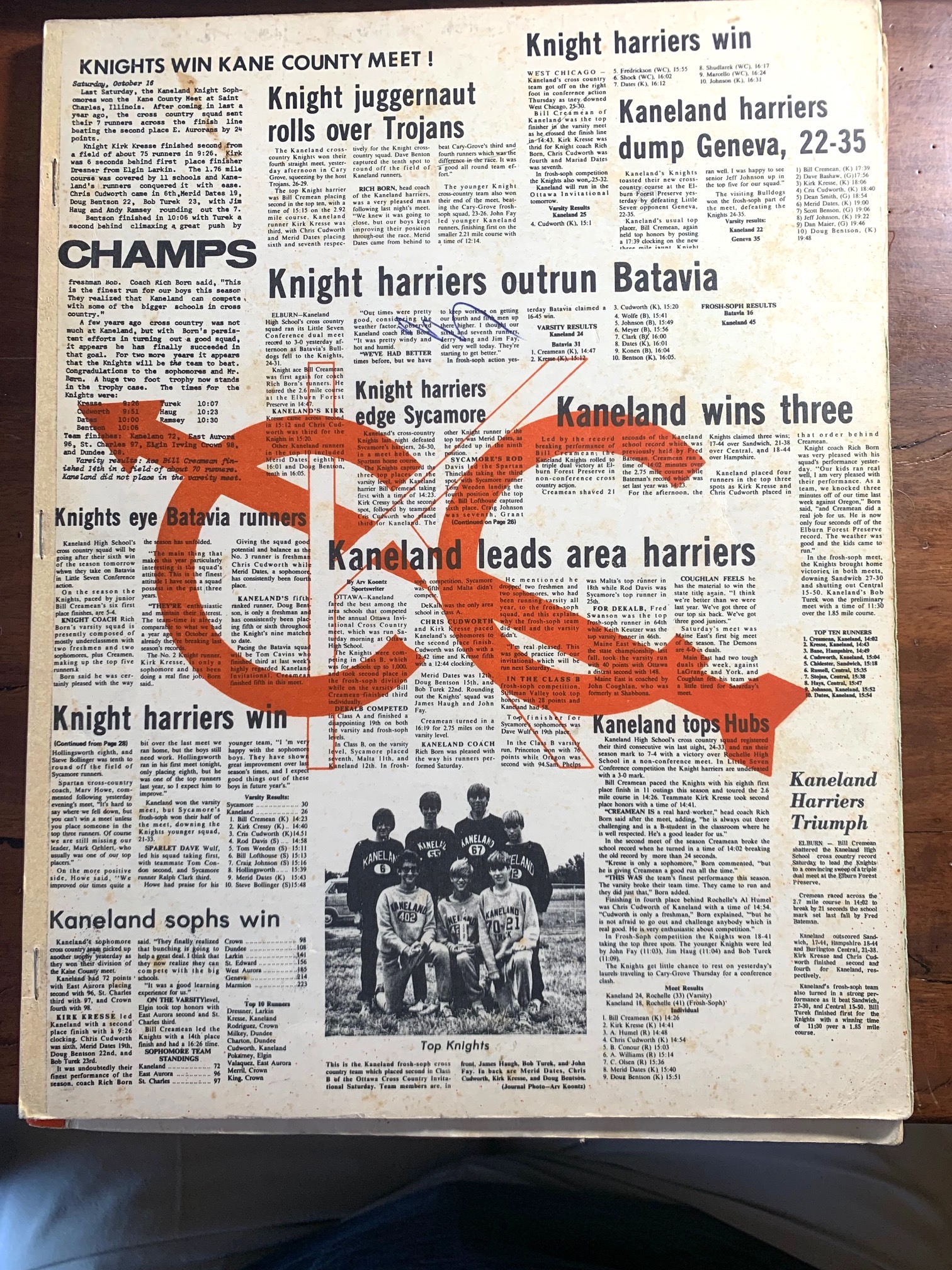
Following each cross country season, Kaneland coach Rich Born put together a results booklet containing training advice, inspirational quotes and––after my freshman year––a cover comprised of newspaper stories about our success. I remember feeling a great sense of pride and accomplishment on receiving that booklet, which I’ve kept all these years because it marked the official beginning of my running career.
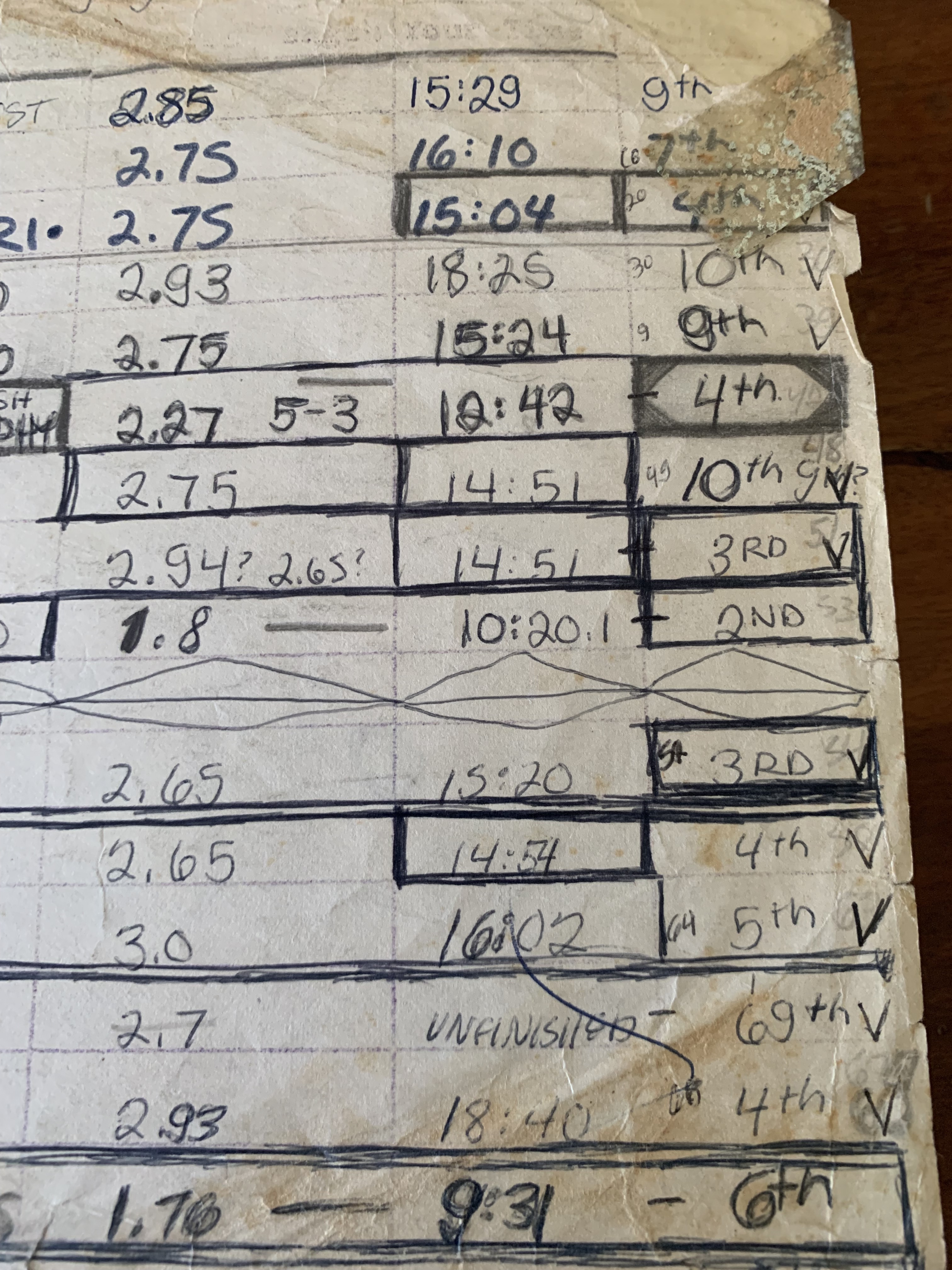
Looking through the booklet these days, I see that my initial 3-mile times were in the neighborhood of 18:00 to start the season. Far more Varsity meets in those days were held at distances from 2.56 to 2.75 miles. My best effort of the year overall was a 10:40 two-mile at the LIttle Seven Sophomore Conference meet, where we took second to Plainfield.
Building on successes like these was the goal going into the season in 1972. While we were a small school of 750 total students, Coach Born noted in several cases that we’d begun to beat teams from much larger schools.
I recall the excitement in the locker room after a headline in the Dekalb Chronicle declared, “Night Juggernaut rolls over Trojans.” These days a headline like that would generate snarky laughter in the locker room. But that day, a teammate asked, “What’s a juggernaut?” That led to a vocabulary lesson, in which we learned what a juggernaut is. It felt good to learn that we were building a reputation as a force to be reckoned with.
So yes, despite my late summer grumpiness at being called skinny by everyone I knew, I arrived on campus for the August 28 opening cross country workouts with a high degree of anticipation and excitement. I loved the feeling of joining those teammates again.The early years of the Kaneland program had been built on the shoulders of its top runner Fred Bateman. We’d followed in his footsteps as a young team and had success at both the soph and varsity levels. Now it was our turn to carry on and build on that tradition. We set high goals for ourselves, yet all goals are achieved by increments. So it was that we took to hard training.
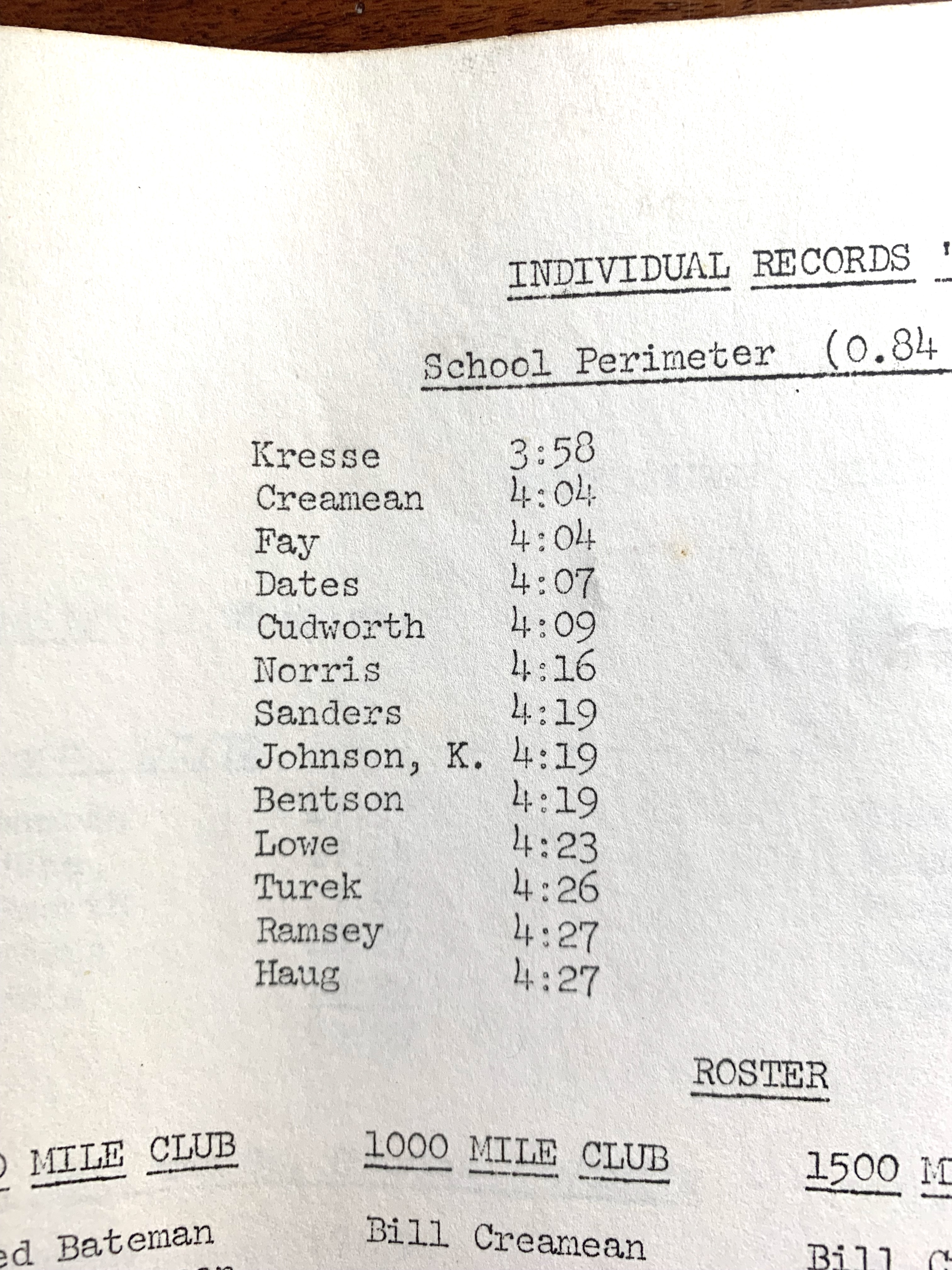
One of the measures of potential success were the times we posted for the Campus Perimeter. We’d start on the track and head west to the grass along Meredith Road, then turn south in a long, arcing path around the ring of trees surrounding the south end of campus. I wrote about this experience in the illustrated article I published in Runner’s World in the late 1990s. It read, “A rut in the grass. That was our training loop in high school. Every scrawny tree was a checkpoint in a perimeter around the campus, carved out of cornfields.”
I wasn’t the fastest guy on that perimeter loop. My teammates Kirk Kresse, Bill Creamean, Jim Fay and Merid Dates all bested me. But the confidence it gave us all to run under 4:10 for that loop was enough to set us up for other successes, to prepare for race pace knowing you had even more in the tank if necessary. For the kick, especially. Not only could we feel the improvement, now we could see it. Right there. In Black and White. It told us, “You’re faster now.”
And yes, I got my recollected facts wrong in the Runner’s World article. The goal was for the Top Five to break 4:10 for the perimeter. But it doesn’t change the sense of accomplishment.
Most cross country runners recall a similar test of endurance and speed in their own programs. It might be a hill they climbed, as we did at Johnson’s Mound. Or a specific track workout that resulted in a team breakthrough. Almost any kind of test will work if it challenges runners to go beyond what they think they can do and prove that there’s something more there, if they give it everything they’ve got
In fifty years of running, there have been many such moments and tests. I’m grateful for them all. There’s nothing else like success in running to make you feel like you’ve accomplished something real.
A sketch dashed off in anger and frustration at being called “skinny” all the time… the night before cross country season began in 1972.
As fifteen-year-old kid during the summer of 1972, I was frustrated by the fact that I’d sustained a chipped bone in my elbow that erased the summer baseball season. Neither could I go out and run with the cast on. So my exercise was limited to some weekly tennis sessions with my mother.
Many an afternoon was spent lying on the dull red carpet in our Elburn living room, head between two speakers listening to music and almost dozing off. It wasn’t the best prescription for good mental health perhaps, but it’s what kids in the 70s did when there was little else to do.
My favorite album that summer was George Harrison’s “All Things Must Pass.” It has recently been re-issued in celebration of its 50th Anniversary, and it is tempting to buy it because I still have the original three-record vinyl. There are serious philosophical and spiritual insights on that album that still ring true to this day…
Watch out now, take care Beware of the thoughts that linger Winding up inside your head The hopelessness around you In the dead of night Beware of sadness
Lord knows the world recognizes the morose nature of some teenagers. Some kids go through entire phases of their life in Goth mode or hide themselves under their hair, their clothes or whatever method it takes to hold the world at bay. There are so many things that seem to poke at you through those teen years. The incessant prodding of parents. The teasing rivalry of siblings. The battle for control and approval within friendships. The desire for attention from whatever gender you desire. My brothers once accurately called it the “social maelstrom” and they were absolutely right.
On August 2 of that summer, I received a letter from Coach Born with an encouraging note on the bottom. He wrote, “Chris–I hope that you have been recovering from your elbow injury in baseball. Good luck on your x-rays on the 6th. Was glad to hear from you. Have an enjoyable August. R Born.”
His note was written on the summer cross country letter to “Prospective Cross Country Member.” That little note meant the world to me at the time.
The x-rays turned out clear. The cast came off on the 6th of August and I was free to start getting back in shape. Not that I was fat or anything. Quite the opposite. As a rail-thin kid without an ounce of fat on my body, I suffered far too many comments and criticism about being skinny. I was sensitive as hell about it. By the end of August, the day that cross country was to begin, my frustrations had come to a boil. I pulled out a piece of notebook paper and scrawled my anger out in pictures and words.
I wrote:
“I feel pretty goddamn bitter. Every fucker this side of Peoria is calling me skinny. Any fucker who wants to fight me can fuck off. I’m gonna whomp the hell off Creamean, Kresse, Sanders, Norris, Dates, Fay and Myself. Zap first time out I run a suckin 4:21 Perimeter. I’ll break goddamn 4:00s aint nobody gonna lick me.”
Tomorrow night is August 28th it fuckin rained tonight. (Elburn Days) Parade called off. Maybe I’ll act like Mr. Stud for the hell. Tomorrow night I’s a gonna hustle all hell. Heh heh ha ha ah.”
Reading those words, the lyrics from Beware of Darkness cry out to me again:
It can hit you It can hurt you Make you sore and what is more That is not what you are here for
The teenage years are always a period of coming to grips with emotions and moods. It’s quite likely that by missing out on baseball and much that I loved about summer as a whole, I was depressed during the summer of 1972. Later in life I learned to recognize the signs of depression and symptoms of anxiety that contribute to it. The most important thing that I learned along the way is that running helps me with both those conditions. Having a physical and mental release for depression and anxiety is an acknowledged form of mental health management. It’s not a cure-all, but it helps. The release of endorphins helps rebuild a constructive attitude and a dose of competitive dopamine ironically helps with anxiety. Add in exercise as a constructive way to manage ADHD as well. Basically, the more exercise I tend to get, the better I can concentrate.
And most of all, running helps with anger management. It is far better to go out and run your brains out than focus all that negative energy in ruminative thoughts of revenge. The ironic part is that an angry runner may be an effective competitor as long as they understand how to channel those feelings and that energy in constructive fashion. It’s not always an easy balance. Down the line in this series, I’ll address that relationship in a deeper way.
Yet looking back, I recognize that running helps with all these psychologies. It’s still how I roll. Rather than dealing with it all in silence, I try to help others with their psycho-social challenges as well. It’s not trite to recognize that hearing the problems others face is a great way to put your own issues in perspective.
As for my being “too skinny” as a fifteen-year-old kid, that was part of my native physiology in much the same way that a propensity for moodiness is part of my mental soul. Combined with artistic sensibilities, this is who I am. That is why, fifty years after taking up running seriously at age fourteen, I’m still out there running on the roads and trails, reconciling the thoughts and dreams that still run through my head. I get all my best ideas out there. I wick off anger at what the world dishes out. I connect with nature and see how many people abuse and are separated from it. And I sing to myself, Beware of Darkness…
Coming out of spring track into the summer of 1972, I was excited to get back to playing baseball. The Elburn Babe Ruth team had a fantastically fun team the year before. We traveled to small towns like Hampshire, Huntley and Lake-in-the-Hills. It felt like the movie Field of Dreams, with close buddies enjoying all the sensations of baseball. Roger Thompson even tried chewing tobacco in the car on the way up Route 47. When he tried to spit, the gooey saliva strung from his mouth and started floating toward the back window. From the backseat, I rolled up the glass just in time to prevent his gob of slobber from striking me in the face. A few minutes later, we pulled the car over to let him get out and throw up. So much for chewing tobacco.
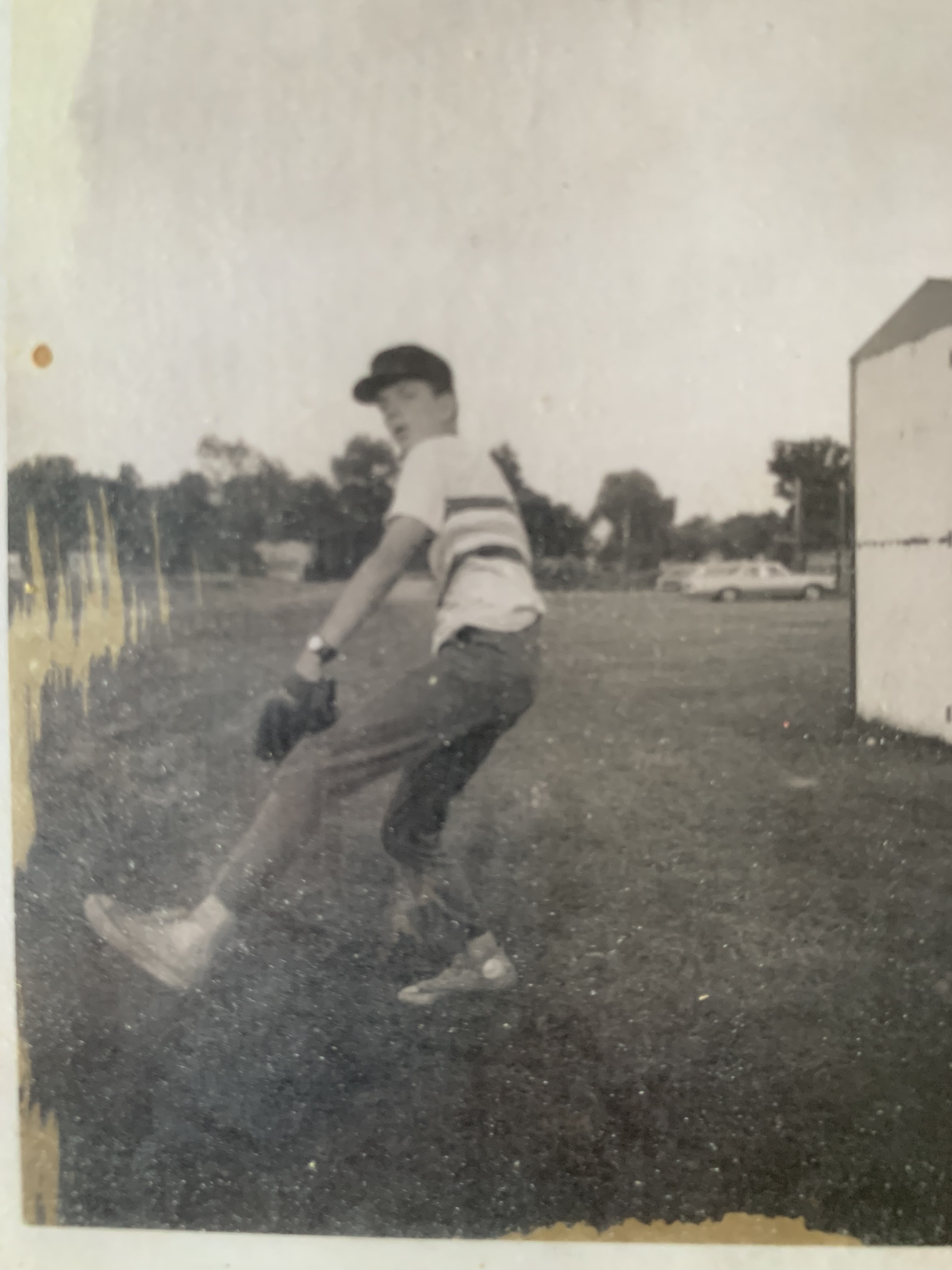
That summer I made the regional All-Star team and pitched the club to a near-win in the regional championships. I loved baseball. But during the summer of 1972, that was not to be…
Season opener
A hard-throwing fourteen-year-old. Nice Chuck Taylor’s kid.
We held practices and got ready for the first game, a home contest on the dirt field at Lions Park in Elburn. I was pitching that day and struck out the side in the first inning, then came up to bat. After lining a hit to center, I wound up on second base, stole third on a dropped pitch and was standing next to the third base coach who eased up next to me and said. “You can steal home. This pitcher won’t expect it.”
Always up for a challenge, I began a long walking lead and then took off running toward home plate. The pitcher was indeed surprised, and tossed the ball home. The huge catcher behind home caught the ball high and leaned toward third to block the plate. I slid under his tag and he came down on top of me in a huge, slumping fall. It felt like something sharp came loose in my left elbow as I lay there under his hulking catcher’s gear. He weighed around 200 lbs and I was a skinny 14-year-old just under 130 lbs.
I think I was called out, and waited for the massive catcher to get off me. He rolled away like an elephant seal disengaging from a beach battle. Then I tried to get up. Instantly I knew that something was wrong with my left arm. I pushed myself up with my right and retreated to the bench. There I sat, dusty and dazed. A few batters later it was time to go back out and pitch. I pulled on my baseball cap and picked up my glove and walked out to the mound. The moment that I went into a windup, a sharp pain ran from my elbow up to my brain and I stopped, stood there, and dropped my mitt in the dirt.
The coaches came out and we agreed that I couldn’t play anymore that day. After a trip to the doctor, we learned that I had chipped a bone in my elbow. It was the first injury of that kind I’d ever had. And it hurt.
No more baseball
That meant no more baseball that summer. The doc put a half cast around my arm and I was out of commission for weeks. Suddenly I realized there was another problem to address. How was I going to put in any miles of cross country training with a cast on my arm?
I wrote a letter to Kaneland’s cross country coach, Rich Born. He wrote back a note of encouragement that said something like, “Get better. We’ll see you in the fall.”
I knew that my Kaneland teammates would be out there plugging away all summer. One or two of them would run 1500 miles between June and August! A few others ran 1000 miles, and plenty of guys put in 500 miles. I ran zero. Well, maybe six if you count the one run that I did before the baseball accident. I’d gone out Keslinger Road and turned on Francis. Immediately I was surrounded by a large pack of baying, snapping dogs. Yelling and fending off the dogs, I broke free from the pack and tore off in a sprint up the dirty road toward Route 38. I’d been so scared from that encounter I had not run again the entire week.
That next weekend I chipped the bone in my arm. But once I got the cast on, I learned that I could play tennis well enough. The cast kept my arm at a 90-degree angle, but I could toss a tennis ball high enough to serve. So that’s what I did. My mother and I went down to Waubonsee Community College where there were nice tennis courts, and we played. Not to keep score. Just to play. She liked playing tennis with me because I did not criticize her like my father was known to do.
Running the paper route
A retro version of the original Huffy 3-Speed that I rode around Elburn. And yes, I rode the women’s model when my dad’s Huffy broke down.
I still had my paper route as well. That provided exercise every morning. I’d rise at 5:30 am and ride a Huffy 3-speed bike on a 3-4 mile route. I loved having that job. I made $8.50 a week and didn’t have to “collect” because the customers all paid for the subscriptions and delivery at Smith’s Bar-B-Cue in downtown Elburn. Smitty gave me a free chocolate donut and a Cherry Coke if I wanted it. Of course, during cross country season I turned down the offer. “I’m in training,” I told him proudly. He seemed to understand.
At night I’d ride around Elburn with my friends Eric Berry and Mark Strong. We’d ride past the homes of girls we liked, hoping they’d be outside so we could stop to talk. Sometimes they’d be out on the porch braiding each other’s hair or soaking up the cool evening air. But sometimes they’d have tough older boys visiting from other towns, so we’d stay away.
As the evening cooled, we’d tool around that small town with the streetlights blinking on. Above us in the purple sky, the nighthawks fluttered about with their raspy calls and the dogs would bark at us from the houses we rolled past. I loved the feel of bike tires on the smooth tar-covered roads. Occasionally a tar bubble would pop as the tire rolled over it. That was true summer, and we lived it.
Toward the end of July that year, I was allowed to get rid of the cast. The summer sweat had soaked into the wrappings of the cast and it stunk like road kill. When the doctor pulled the cast off the last time, the arm looked tender and frail under the fluorescent light in his office. He glanced up at my worried face and said, “You’ll need to get the arm back in shape.” He knew that his words meant more than that. I’d missed running all that summer.
Alternative training
As it turned out, I never did much summer running during my high school years. More typically I played basketball, baseball, and rode bikes or walked everywhere I needed to go. Come fall, I’d show up and start running and wound up leading the team every year anyway. Perhaps that was native ability, but whatever, it worked for me. Perhaps I lost an opportunity to be an even better runner by failing to run much during the summer months, but the other sports kept me in decent shape anyway. Plus with 21 meets to run every year, there was no shortage of opportunities to get in shape. For the most part, those first three weeks of hard running for cross country every fall whipped me into racing condition.
Once college came around, I did put in some summer miles. But I always remembered what Coach Born had told us going into the summer months. “If you can run through the heat in the month of July, you can run through anything.” That’s a thought that I’ve never forgotten, and sometimes while running on a hot July day, I think back to being a kid and realize that being a kid is what I needed to do at the time.
In this photo I’m lining up to long jump as one of Kaneland’s best track athletes Jeff Johnson, also a cross country teammate, flies toward the pit. My skinny legs were decent jumping tools, but not really.
Following a freshman basketball season in which the team’s emphasis on court fitness tailed off toward the end, I took a weekend off before turning out for track that following Monday. Their was a ritual in receiving cotton sweats and a set of gum-rubber-sole track shoes. That previous fall I’d worn both grey and black sweats as a competitor at both the sophomore and varsity letter. Somehow I thought that success would translate to a Varsity status in spring track as well.
That was not to be. Those credentials still had to earned, not given. The Kaneland track program was basically the only men’s sport offered in the spring. There were no baseball teams or soccer programs. The Athletic Director and head track coach Bruce Peterson saw to that. He wanted no competition for athletes, so there was no choice for me to play either of the sports I’d grown up playing in the spring.
But that was in a different state. Back East in Pennsylvania, my brothers had played both soccer and baseball. I’d likely have done the same if we’d stayed in Lancaster. But here we were in Illinois at a high school plopped down in the middle of sodden cornfields where the wind had nothing to stop it between northwest Alberta and the western edge of Elburn, Illinois.
Snow and cinders
Times have changed.
The Kaneland track was a deep bed of cinders. In late February or early March when track season started, there was no chance of running on that oval. Typically the entire campus was deep in snow. Even the parking lots were rife with slush left behind by the snowplows. That was our training grounds. It was a Love It Or Leave deal if there ever was one.
Basketball season lasted long enough that some of the track-only guys had two weeks of training before the rest of us showed up for workouts. The typical workout consisted of running one-lap intervals of between 600-800 yards around the asphalt parking lots that surrounded the school. We’d take off straight west in groups of like-talented runners, turn slightly northwest around the edge of the school and run smack into the cold winds tearing across the low-slung cornfields.
It was cold, miserable business on many afternoons. Those first couple weeks also hurt like hell. My indoor basketball lungs and short-sprint legs were of little help on those long outdoor intervals. The burning sensation would last well after each interval, so that starting the next lap was like skipping a needle across a revolving record. The same painful song played again and again. Sometimes it was impossible to tell one song from another. You just put your head down, pulled a wool cap farther over your ears, and started all over again.
The wry dreams and harsh realities of a freshman
My freshman year photo.
My memories of those days as a 14-year-old runner involve plenty of blown snot, dandruff, semen-stained underwear and cold longing for some comfort I could not identify. The same hormones that drove those physical realities also wrapped themselves around the stem of my brain and controlled my thoughts. In class each day, I’d be exhausted and stimulated at the same time. Those Kaneland girls were lovely distractions. Short skirts and tight shorts were everywhere. All I wanted to do is somehow impress them. Or at least one of them. I had a deep crush on one particular cheerleader. She was beyond cute and actually graced me with a night of close dancing one winter’s evening at the high school. So all was not futile. With an ounce of self-confidence perhaps it would have turned into an actual relationship. But that was not to be.
The problem with those young desires is that distant runners at that age and in that era were frequently a sorry sight. We’d come in from track practice with ruddy faces and snot-worn cheeks. Our hands would be red from the cold and stiff as hell. Once I lost a glove or mitten somewhere during an interval session and had to run the rest of the workout with one sleeve of my sweatshirt gripped around my fingers to ward off the sleet striking every bare part of our bodies.
I also recall many track athletes coming down with shin splints due to running on asphalt for weeks on end. The supposed cure for that condition was wrapping the entire calf from ankle to knee in a combination of Ace stretch bandages and athletic tape. The use of plastic heel cups was also common. Basically, anyone with a tiny bit of pronation or supination in their footstrike was susceptible to injuries of that type. It was thought that the heel cups would help. That is doubtful.
I was grateful not to experience any kind of injuries like that. It would be a couple years before the shoe industry caught up with the running movement. adidas had good track shoes already, and the SL-72 would arrive on the market in time for the Olympics in Munich. Somehow those shoes didn’t find their way to our cozy neck of the cornfields. Nike was still two years away from developing its Corsair shoes, and then it would be off to the races for that company with its waffle and air-soled shoes.
Indoor track
The goal of all the focused misery of winter training was to get in shape for the few indoor meets in which we competed. As a freshman, I was assigned to run the 880-yard “run” as it was called back then. Sometimes it would be listed as the 880-yard “dash. I soon learned that there were people capable of running that fast over the two-lap distance. One of them was my cross country teammate from the previous fall, Kirk Kresse. The other was my classmate Ron Ackerman, who in 1975 would become Illinois state champion in the 880. Those guys were subjected to some of the most difficult workouts I’d ever seen anyone do. I’d be running with the distance guys and watch Kirk and Ron do sets of twenty to thirty 300-yard intervals with just 30 seconds rest. There was some outright barfing involved. But by the time they graduated, each was running times in the low 1:50s. They had more talent and perhaps more guts than me.
I dutifully competed in the indoor 800 in several meets. We drove down to the University of Illinois for the Joe Cognal Relays. I was assigned to ride with Coach Peterson, who smoked a big green cigar the entire way down. My gut was sick and my lungs felt awful by the time we rolled into town. When the time for my race came, I didn’t feel like running at all. But I did, and though I’d run sub-2:30s in the first couple meets, I fell short of that standard. Coach Peterson asked me what was wrong that day, and without thinking I blurted, “It’s your stupid cigars!”
He looked at me oddly, then tipped his head back slightly and gave a quick chuckle. “Okay,” he responded. Nothing more was said. He didn’t smoke one on the way back home.
Outdoor track
When spring finally arrived and we could run on the track, I also participated in the high jump and long jump. I recall going 5’8″ as a freshman, which won a few sophomore meets. But my obsession with long jump was considerably less productive. I tried many times to jump farther than 18 feet as a freshman, but that was that. Again, some of that multiple-event participation was an odd mix of joy in competing in more than one thing, which I thought proved my athleticism. There was also the vain hope that something I did would be as impressive to girls as some of the more dynamic and outstanding athletes in the Kaneland track program. There were plenty of studs on those teams.
One of those was a fantastically tough quarter-miler known for his ability to close out a race. I don’t recall his name, but I do recall overhearing a conversation he was having with a cute girl that he knew. He was ribald in his approach. “Are we going out tonight?” he asked her.
“Only if you promise not to hurt me,” she replied. I tried not to show that I’d overhead that exchange, but I well recall the flash of her eyes as she responded. To this day, I still do not know what it meant. All I knew was that I was privy to a brand of interaction that for better or worse, was far out of my league.
All I wanted was to be noticed by the girls in the stands. “Please Lord,” I’d effectively mutter on a daily basis. “Let me do something big.”
Kaneland girls watching a sporting event.
Moving up in distance
Partway through that first track season, I mostly watched as my cross country teammates ran the mile races.That was longest distance offered freshman and sophomores at that time. I knew that I could beat those guys in the mile if given a chance. So I approached one of the coaches and told them, “I want to run the mile.”
“Oh, okay,” he responded to me. And then absently replied. “That’s longer you know. Are you sure you want to move up in distance?”
“I raced three miles in cross country last fall,” I responded. “Yes, I want to move up.”
In that first race, I set the freshman school record at 4:57. I remember the feeling of satisfaction on crossing the line in first place. I’d actually asserted myself on something that was important to me. I’d talked to adults and influenced my future.
In study hall the next day, one of my female friends actually turned to me and said, “I hear you broke a track record…” I blushed and said, “Well, it was just a freshman record. I’m hoping to get better you know.”
It wasn’t a world-beating time by any measure, and track is an unforgivingly harsh judge of good and bad efforts. Records are made to be broken, and it was, by quite a bit. Yet it felt good to glean something of merit during that first track season after a cold, thankless spring. It would set the stage for much better things ahead.
The faded mimeographed meet schedule no longer shows the names of our competition, but my Bic pen and pencial notations have survived for fifty years.
The Kaneland Cross Country team competed in 21 meets in 1971, my freshman year in high school. That wasn’t just the number of teams we competed against during duals and triangulars.That’s the total number of races we ran.
The weekly meet schedule consisted of Tuesday-Thursday-Saturday meets. We competed in individual meets against every Little Seven Conference team; Batavia, Geneva, Sycamore, Oswego, Plainfield, Cary Grove, and West Chicago. We also ran duals and triangular meets against schools from outside the conference; Hampshire, Burlington Central, Oregon, Sandwich, Stillman Valley, and others. We also hosted the Kaneland Invitational, ran in the Kane County Meet and a couple more invites, then finished the season with the conference meet, then Districts and Sectionals, if we made it that far.
Racing that often was considered normal back then. We didn’t view it as unusually hard, but later, when I joined a college program, the comments about “Illinois runners” centered on the idea that we were all “burned out” from racing too much. Perhaps there was some truth in that. Cross country programs don’t race nearly as much these days. Probably that’s a result of coaches from our era who recalled their intense racing days and took steps to lighten the meet load so that kids would not be burned out.
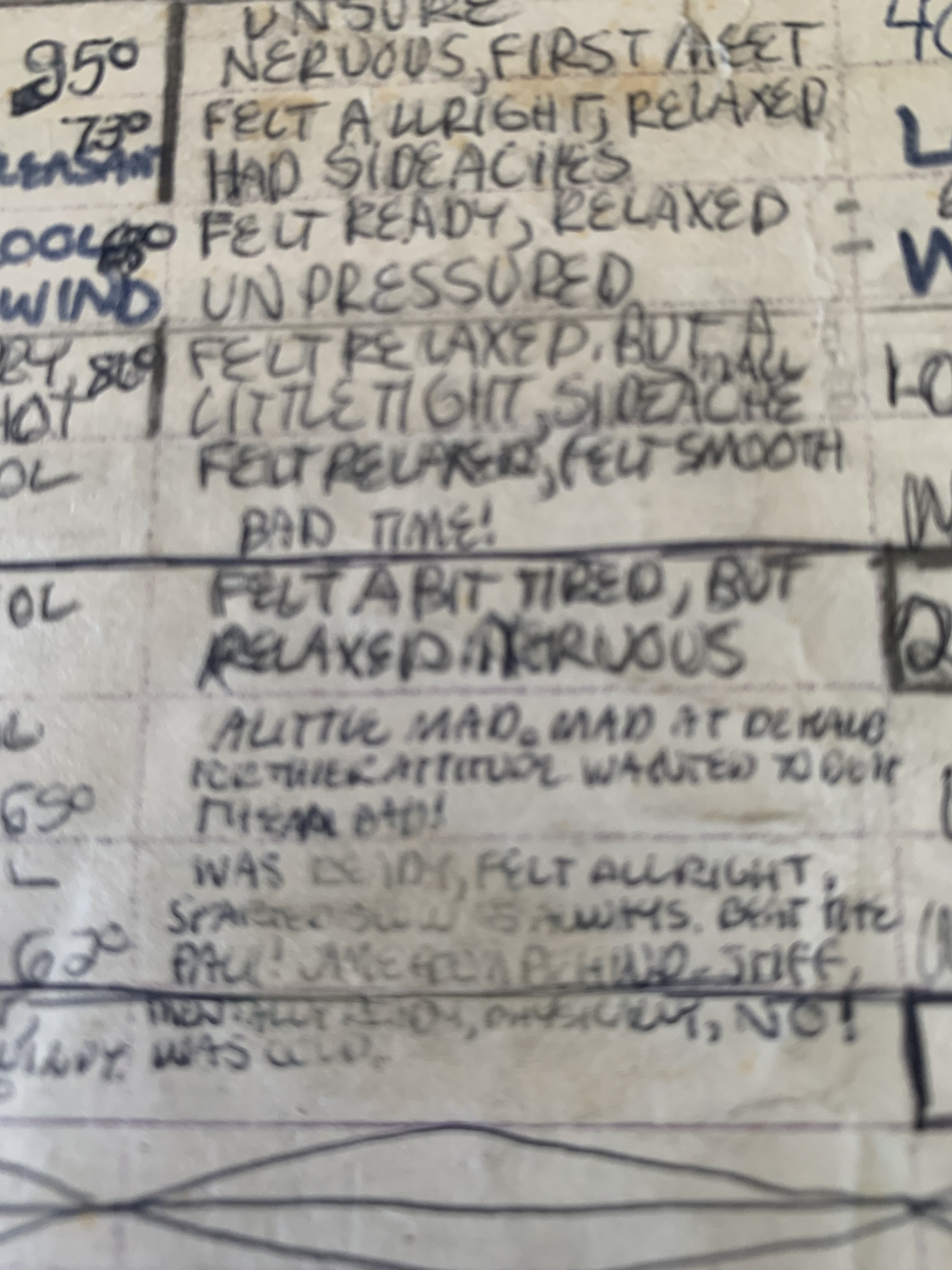
A ton of us still went on to long running careers. I still think all that racing was a great way to learn how to deal with all kinds of meets and circumstances. But I measured success in several ways. First there was how our team did. Then came my place on the team and in the race. Most of the final times were relative to the style of the course, but they still mattered to me. On my race commentary, I also included subjective emotional observations about my state of mind before and during the races. There were plenty of comments about nerves, pressure and fatigue. That’s part of running.
We didn’t always run a full three miles in cross country in those days. The standardization of that distance for high school races was still a year or two away. I also bounced up and down from running with the sophomore squad at two miles and varsity meets of 2.65 miles and up.
Times and distances from Kaneland Cross Country 1971.
I liked running varsity meets while sporting the Kaneland orange team shirts with the black-and-while epaulettes. I loved those uniforms. In this photo, you can almost see the velcro flaps on my Puma kangaroo-skin spikes.
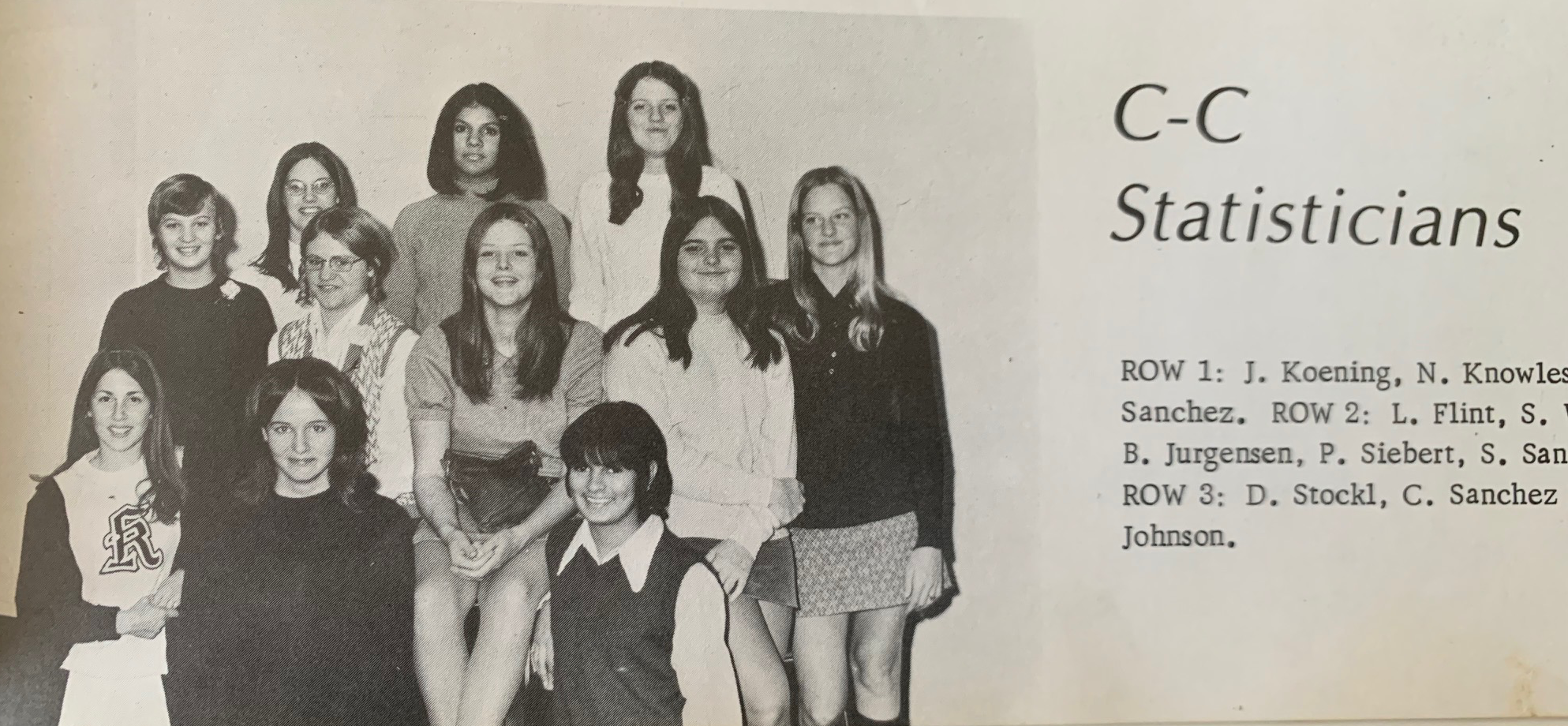
We won the sophomore conference title that freshman year in cross country. It was the first conference team victory for Kaneland Cross Country. The following year, we won the Varsity Little Seven Conference meet as well. Those were foundational accomplishments for a program that was just a few years old in total. Even at that age, I understood what it meant to help build a winning program. Coaches Rich Born and Larry Eddington were a wonderful compliment to each other. We even had a team of statisticians that timed and tracked our performances at every meet.
Kaneland Runner Kirk Kresse leads our team off the starting line at the Kaneland Invite.
That freshman year was a true character-builder. Days after the season was over, basketball season started. In that sport, I wound up moving up from the freshman to the sophomore squad . After a winter of indoor hoops, the indoor track season started up in late February or early March. There was really no rest for the weary in those days. It was all part of being an athlete.
I was proud to be on this team, not so proud, as you can see, in the photo for the freshman squad. I think I had some homework overdue when this photo of the freshman basketball team was taken.
I was too young to have read anything by Hunter S. Thompson when I was a freshman in high school. But it would have been good for me to absorb some of the fearless antics of the Gonzo journalist that hung out with Hell’s Angels and got beat up during his efforts to integrate with the traveling band of motorcyle thugs and their culture of confrontation and violence.
Thompson wasn’t afraid of much in this world. At least, he waded into situations that most of us would avoid. Often that fearlessness was fueled by massive amounts of drugs and alcohol, so he wasn’t much of a role model for most of us. But there is something to be said for facing life with the belief that you’ll pretty much get through anything you encounter if you’re willing to kill it, rhetorically or not.
Stepping to the line
A pre-race counseling session is often about overcoming doubts and fears.
That first time you step to the line as a young runner in cross country, the sensations are overwhelming if you let them drag you under. Typically those first meets are held in late summer heat, so there’s sweat soaking your hair and trickling down bare arms. Standing beside you are teammates that you’ve trained with, and who represent the same school. Yet you still want to beat them in the race because that determines how valuable you are as an individual runner. The whole experience can create conflicted emotions.
Yet Hunter S. Thompson never seemed to feel conflicted. One of his most famous quotes is, “Buy the ticket, take the ride.”
He also described his approach to life in terms that make most hearts tremble: “The Edge… there is no honest way to explain it because the only people who really know where it is are the ones who have gone over.”
The same can be said of distance running. Once the gun goes off, the entire race is an attempt to run on the edge: of exhaustion, fear, and pace. To really improve, one has to push through the edge of those things to find out what lies beyond. It could be collapse and exhaustion. But it could also be transcendent. Remember those breakthroughs? The days when it finally came together. When you actually ran past fear and into anticipation?
That is what runners live for. And it starts the day you realize that’s what it’s all about.
Seasoning
That yin and yang of fear and excitement is how I felt that entire first season of freshman cross country. Dealing with fear is a key aspect of learning how to run and compete. Fear begets nerves. Nerves turn up more fears. It’s possible to ruminate yourself right into the ground with questions swirling around your head.
“Will I run well?”
“Can I beat my newfound rival?”
“What if I fail? What will people think?”
“Are the girls watching me?”
And fear? It also leads to loathing. That sensation of self-disrespect is the worst enemy of any runner. Kids are especially prone to self-loathing due to peer pressure and other factors at work on the young mind. Add in parental approval and sibling rivalry and the mix can get a little toxic. All you can hope to do is run past it all.
No waiting around
So I’ll toss out another quote by Hunter S. Thompson that fits here: “A man who procrastinates in his choosing will inevitably have his choice made for him by circumstance.”
That’s about the most truest thing I’ve ever read. It certainly applies in the realm of distance running, especially in those formative years. Every second of every race is an exercise in self-determination. Finding success in running is the exact opposite of procrastination. You cannot put off until tomorrow what you need to do today. It doesn’t pay to wait around and see what will happen next. If you’re not moving, you’re not improving. That’s not an absolute, because we all need rest too. But effectively, that is how it works.
It also comes down to this: fear and loathing can have no permanent place in your psyche if you want to succeed in distance running. That’s why I treasure those early experiences in Kaneland cross country. They taught me lessons that my father tried to install in me, but I was too stubborn to receive. I learned how to accept responsibility, to do the work, and put that effort to good use on any given day. I think my father saw that in me eventually.
Stepping up
It’s not that I had never stepped up to the plate in sports before. Already by the age of thirteen I’d gotten good enough as a pitcher to play American Legion baseball with players three-to-five years older than me. I’d sunken a half-court shot with three seconds left to win a basketball game against an undefeated 8th grade rival the year before. I wasn’t afraid to compete. Yet sometimes, fear of success is as great an impedance to individual development as fear of failure. You have to learn to accept the next level of pressure and achievement to continue to improve. For some athletes, that’s a source of fear and loathing unto itself.
Learning to deal with success and how to handle it among teammates and peers is a critical aspect of self-actualization and personal development. It meant something more to compete for a real school team. I’d watched my brothers do it. Now it was my turn.
That meant facing the fears that come with lining up against older, faster, tougher runners. There were plenty of them around in those days. Illinois cross country was a hotbed of top-level athletes in the early 1970s, including a guy named Craig Virgin that in 1972 would set a course record at the state meet in Peoria. I was there that day. Little did any of us know that his time of 13:51 would stand as the course record for almost 50 years before it was broken. Many great runners tried, and barely missed over those five decades. All I can say is that watching him run that day inspired me, yet it also planted a bit of fear and loathing in me. Could I ever come close to running anywhere that fast? I sincerely doubted it.
Honest take
My pencil drawing of Frank Shorter circa 1971 as a freshman in high school. I was obsessed with running in all its forms, and considered Shorter a keen inspiration along with Steve Prefontaine.
Frankly (pun intended, see illustration above) I was not afraid of trying. Instead, I was being honest with myself. While I set goals and met many of them over fifty years of running, improving along the way, I also learned that I was not a national or world-class level athlete. Even at the age of fourteen, I saw that while I had talent, there were others that had more. Much more. The thrilling truth is that once in a while I was able to beat some of them on a given day. But many times not.
I would never reach the levels that runners like Craig Virgin, or my former track teammate Ron Ackerman who ran at University of Kentucky along with Tom Burridge, a conference rival from Batavia. I revered the likes of Frank Shorter, and later Bill Rodgers. Of course Steve Prefontaine was a favorite icon as well. I imagined myself running in their footsteps in some way. As Hunter S. Thompson described it, the lifelong pursuit of running falls into the category of obsession pretty well when he said, “Faster, faster, faster, until the thrill of speed overcomes the fear of death.”
Drama child
If that seems a bit dramatic, then perhaps you’ve forgotten how the mind of a fourteen-year-old kid (or a 64-year-old man) sometimes works. Failing was worse than death to me. Losing felt worse than torture. I resented the people that caused me to fail or lose. I wanted to beat them more than anything in the world. My brothers branded me The Mink for the competitive fury I’d show in a fit of spit and determination. Even Kaneland Coach Rich Born once stated in a newspaper interview, “Cudworth isn’t afraid to compete with anyone.”
That was accurate on the surface. Yet not completely true. I was afraid in many ways. But that’s the thing. Being nervous is part of competition. We all have self-doubts and fears. Killing them off is the height of satisfaction.
I think that’s how many of us go through life. We put on the face we need to compete and succeed, yet secretly each one of us harbors doubts and fears. A few of us even confront personal loathing at times, thought we dare not show anyone. Fortunately, even that is changing as mental health rises to the forefront of public consideration.
Running for fifty years has confirmed what Sports Illustrated writer and author Kenny Moore once wrote, “Running is hard, clean, and severe.” That’s what I always liked about it. And I still do. And I’m no longer afraid.
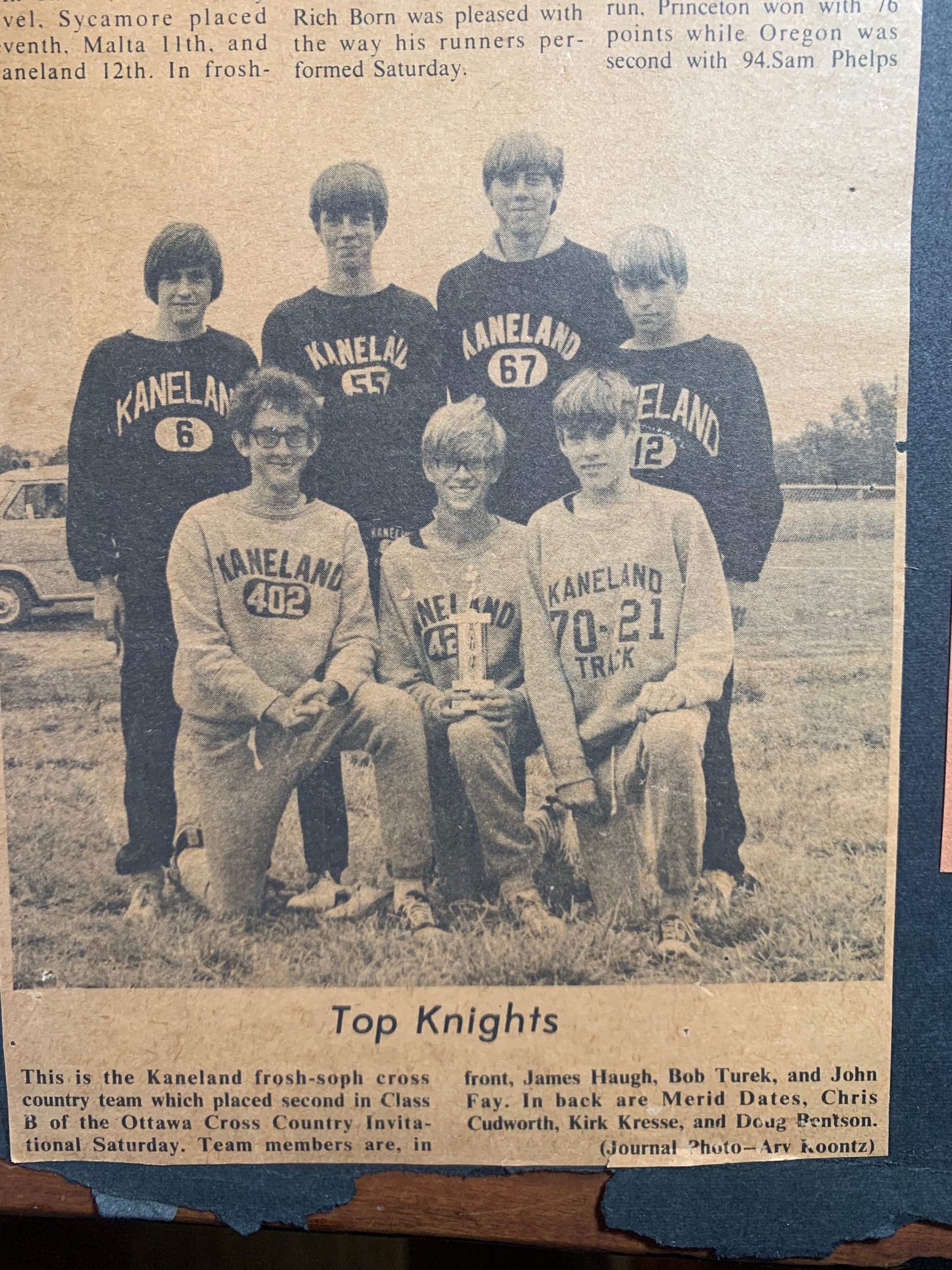
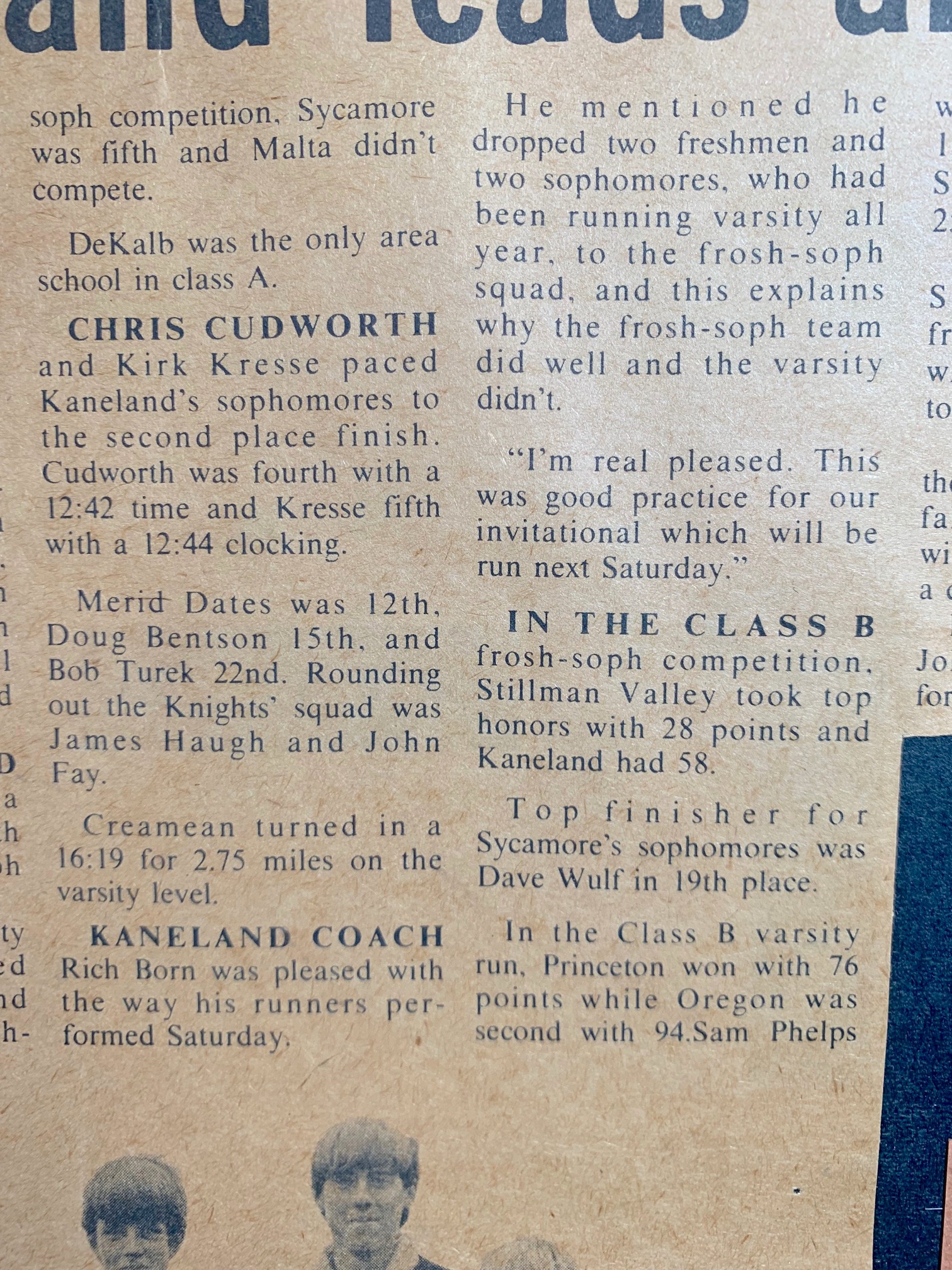
Our sophomore team after winning the Ottawa Invitation in September, 1971. I led the team that day with a 4th place finish in 12:42 for two miles. And boy, I loved those black sweats. They fit well and were bad-ass looking in all circumstances. The guy named Merid Dates went on to become an All-American 1500 meter runner at Division III Principia College.
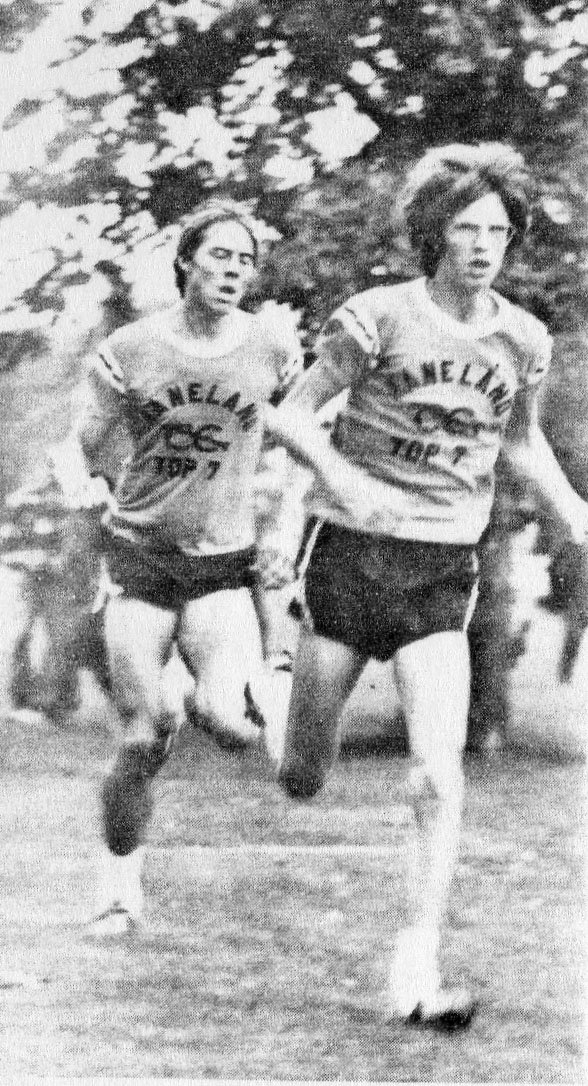
After the first few days of cross country practice as a freshman in high school, the team began to sort itself into shape. Every member of the Kaneland team had the goal of making the Top 7. After a week of practice, I realized that I would become part of that mix.
Runners are built of several different components. There is natural ability. That’s a key aspect of how well you’ll ultimately do. Then there’s the training, and the discipline that comes with it. Finally, there is competitive instinct. In other words: how bad do you want it?
That third quality was inherent in my nature. As the third of four athletic brothers, I also learned quite a bit about competition through sibling rivalry. But more than any of that, I was always a kid that could not stand losing.
That never meant that I would cheat to win. While my desire to come out on top was always front of mind, at the core of my soul was a deep sense of social justice. I loved to win, but also had a deep concern about equality that applied to every aspect of life. In fact, I got booted out of Cub Scouts because some kid cheated in kick ball and I called him out on it. The Den Leader blamed me for starting a fight, so I never went back.
I never felt guilty for winning in a fair contest. Frankly, I relished kicking ass in whatever sport we were playing. In baseball I was a pitcher, a position I loved for the constant stimulation of challenging batters at the plate and being in on every play. I was successful at that all the way through my junior year in high school when the choice finally had to be made between playing baseball in spring and running track.
So constant was the thrill of competition in my life that I could not be happy without it. I played basketball through my junior year as well, and was a three-sport athlete up until my senior year, when I competed in indoor track rather than basketball. Even in college, I organized a game between the official freshman team and a group of guys that I hand-picked to challenge them. We did well through the first half but the street ball we played wore out in the second half. Still, I scored 19 points and we made the point that some of us could probably make the real team.
I brought that competitive instinct to running, and the first moment that I recognized the combination of talent and competitive instinct was in seventh-grade gym class at Martin Meylin Junior High in Lampeter, Pennsylvania. Our teacher had us run a 12:00 time trial as part of the overall fitness testing program he’d contrived. The reward system was a set of satin stripes that were affixed to your gym shorts. A red stripe was the lowest. A white stripe was the middle. The blue stripe was the best. I wanted that blue stripe more than anything.
But I knew that I was weak in the pullup category so I had to make up for it with a great run in the time trial. We ran on the cinder track in regular old gym shoes, but I found a groove early and ran 8.25 laps, a bit better than 6:00 per mile.
In 8th grade at Kaneland Junior High, I ran the half mile as there were no mile races at the time. My time of 2:27 was respectable and won a few races. But I was no world-beater.
Thus I had something to prove going into freshman cross country. By the third week of practice I was positioned as the third guy on the Varsity squad. That was how I finished in the first race of the season. For the rest of the year, a pair of sophomores and I would move up and down from the Varsity to the Sophomore team depending on the meet and our potential to place at either level. We won the Ottawa Invite for the sophomore squad and the Little Seven Conference title at the sophomore level as well. The rest of the 16-17 meets we ran (it was a lot of competition) were Varsity events for me.
Early in the season, the coaches doled out running spikes to everyone on the team. I was quietly handed a set of Puma shoes. They were soft as silk, and made from kangaroo leather. I looked up at the coaches upon opening the box and realized the vote of confidence they were giving me. It also came with a bit of pressure, of course. But somehow they knew I could handle it. Still, I heard a few snarky comments from teammates about the fact that some “freshman” was given such a nice set of spikes. But damnit, I proved myself week in and week out.
Formative experiences in high school cross country. You go out and compete, do your best, and learn.
However, it was a pretty tough schedule (18 meets) for a first-year cross country runner. As competitive as I was, the training and racing did wear me down a couple times. While competing for the Varsity on a hilly course in Oregon, Illinois, I bonked out and had to stop. I recall Coach Larry Eddington finding me on the course. I was kneeling on the grass plain exhausted from all the running. As he approached, I worried that I was in trouble. Instead, he told me, “You’ve been doing a great job. Don’t worry about today. It’s only one race.”
That was a lesson well-learned about the nature of competition and our ability to sustain it. Even with all the training and discipline built up over a month-and-a-half of cross country, my fourteen-year-old body had hit a limit.
That’s a lesson every runner has to learn. Our competitive instincts are vital to success. But even those can’t carry us through every situation in running.
I walked back to the team bus with Coach Eddington. Coach Born walked over and gave me a hearty pat on the back and a knowing smile. It felt good to know that those men and my teammates understood that I while I was an ardent competitor, I wasn’t perfect, either. And that was okay.
The next race I bounced back and ran well. We all need to learn how to deal with failure or loss along the way. All feed into the realm of competitive instincts. Because while we excelled at our level, I also recognized how many runners were better than we were. In some respects, I feared those guys. Learning to manage those fears is a big part of becoming a better runner. We’ll take a look at those instincts in the next installment of 50 Years of Running.
This prairie hill may well be what Johnson’s Mound looked like before its current crown of trees grew tall.
Perhaps a couple weeks into that first cross country season in 1971 at Kaneland High School, our team piled into a yellow school bus and traveled east for ten miles to a park known as Johnson’s Mound Forest Preserve. That name describes it well. From a distance, the hill isn’t much to look at. It is a lump in the landscape covered in tall trees that have grown up over the last century. Somewhere back in time it was likely covered in prairie grass, and before that, nothing but a pile of gravel left behind by glaciers 10,000 years ago.
At some point in its recent history, the property comprising the Johnson’s Mound forest preserve was a farm, probably with cattle on it. But the trees are too tall and the soil on top of the gravel likely too shallow to support crops like corn or beans. Besides, who wants to plow a hill with a 10% grade on it, and soil rife with stones and gravel?
The county installed thin asphalt road through the preserve that loops north from the parking lot, winds through the primeval-looking woods, then turns sharply uphill in a vicious little bend. From there, it is uphill for perhaps a quarter mile. Near the top, the grade jumps to 9%, a real soul-tester.
First hilltop encounters
That gray day in 1971, the school bus dropped us off at the forest preserve that day and sat idling in the parking lot as if to taunt us. We were there to run hills in preparation for the fall cross country season.
Surely the upperclassman had been there before. Or perhaps not. All I recall was a bit of shock when we ran that first loop around the road. My legs had never experienced anything quite like that first climb. Or the next. And the next. Those hilltop encounters were true character-builders.
That hill training was vital to our racing plans that fall. The Kaneland cross country course at Elburn Forest Preserve started with a quarter mile run on the flats leading to a long climb up another glacial hill. The grade changed from 3% to about 9% in the final 100 meters. Then the road dipped back down the north side of the preserve through deep woods. It was a rather epic experience racing on that course. The crunch of gravel under our long spikes accompanied by the crunch of autumn leaves as the seasons changed. But it was the hill that made that course so unique and tough.
So we ran a workout or two at Johnson’s Mound to prepare for the rigors ahead. I recall barely being able to look our coaches in the face after that hill workout. It hadn’t gone that great for me. Other guys on the team proved to be better climbers than I. That’s the thing about cross country running that you learn with time. It is important to learn your weaknesses and if possible, train to cover them up.
Dutchman’s breeches grow alonside the loop road in early spring.
Years after high school as a journeyman road racer, I returned to Johnson’s Mound to do hill workouts. By then I was a young man of 21-24 years old. I’d competed in college cross country and my times and fitness capabilities were much more mature. I’d start at the southeast opening of the woods and race along the black strip of asphalt leading to the bottom of the hill. Then I’d run up that hill as quick as I could. My repeat workouts often consisted of 6-8 loops at .85 miles per loop. The rest interval consisted of a jog down the front side of the hill toward the main road and back around again.
Running hills alone in a quiet preserve delivers a sense of intimacy. You join with the environment in ways that other training does not provide. I wore racing flats for those hill workouts, because I wanted to be as light and agile as possible. There was a 1:1 relationship between how fast I could run that loop from bottom to top and how ready I was to race on the roads. If I could complete the hilltop encounter in 3:00 or less, I knew that I was super fit and ready to go. Built up by that type of training, my times in the 10K dropped from 33:00 down to 32:00 and finally to 31:00 in three years. And, I was unafraid of any hill that I encountered. These days I also go cycling on that hill, and the tests are similar.
Robins and hermit thrush on the loop road in April after a spring snowstorm covered Johnson’s Mound.
Yet there are also times when I visit Johnson’s Mound for different reasons. It is a great place for encountering nature in all seasons. In winter, the road is closed but the birds don’t know that. I’ve also found robins and hermit thrush feeding on loose worms after an April snow. Come spring, the wildflowers are profuse: wild ginger, bloodroot, Dutchman’s breeches and trout lily. In summer the wood thrush and scarlet tanagers sing in the woods. One year, a pair of Swainson’s hawks nested over the road. They are a rare species in Illinois, with the only known breeding pairs east of the 100th Meridien annually nesting here in Kane County, typically up by Hampshire. I like to think they chose Johnson’s Mound out of some ancient instinct about the prairie back in the day. They are typically birds of the Great Plains, with long, thin wings and a dark russet chest. “Not from here,” you might say.
Yet there are days when I just park and walk around the loop, with nothing planned except to soak in some woodland air. Even on cold, windy days the woods offer shelter. It is funny how the hard places sometimes offer the greatest shelter.
Hilltop lessons learned
I haven’t run up that hill in a couple years. Perhaps it is time again. It is the most difficult and humbling experiences that teach us the most and motivate us. They help us overcome that feeling of “I can’t do it.” At least, that’s how it is the world of running. Perhaps that makes us runners all a bit weird. We are a widespread band of misfit boys and girls seeking pain and finding pleasure in it. Until you’ve gone that distance uphill when it feels like gravity hates your guts, it is hard to describe why it feels so good to jog down the other side and try it all over again. It makes me laugh to think that I’ve been returning to that sharp little hill all these fifty years. It means something to me.
Many great figures in history and religion found their gods on the mountaintops. Yet sometimes it only takes a lump in the landscape to peel back the layers of reality and find the soul within. Hilltop encounters are the best for that reason, and I thank those fifty years of running for giving me plenty of them.
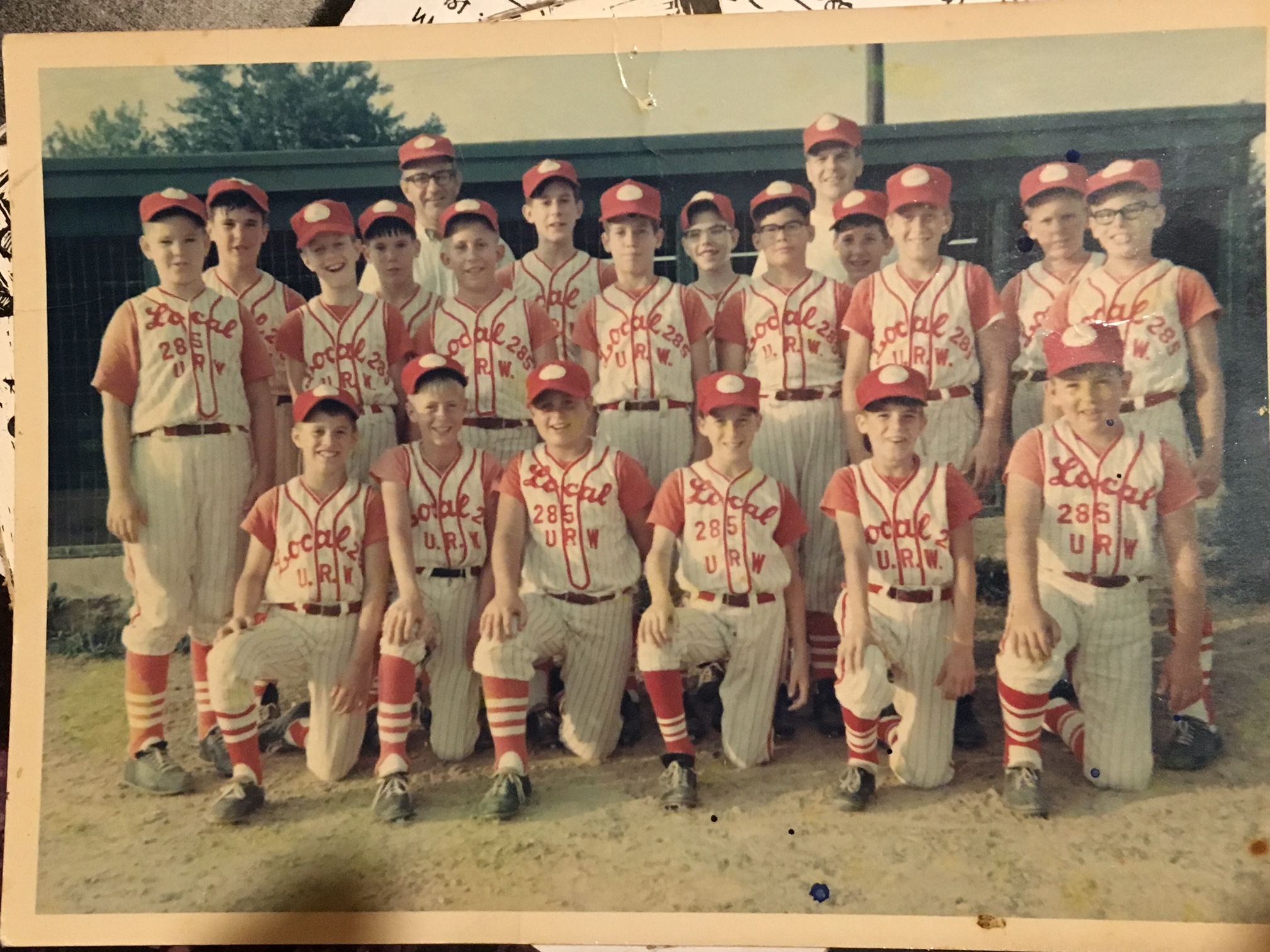
My first organized sports experience was the Local 285 baseball team in Lancaster, Pennsylvania.
As a kid I wasn’t happy about being told what to do. My father was a bit authoritarian in his approach, and something in me always fought back. Classic father-son stuff, really. Nothing that millions of kids in the 60s and 70s didn’t also deal with.
For all my resistance to fatherly guidance and the exasperation that often came with it, none of those instincts carried over to the world of sports. The baseball team for which I tried out as a ten-year-old kid had plenty of rules to follow. No playing softball at all. That harmed your hitting. No swimming on the day of baseball games. Too easy to get tired out. Don’t wear the uniform except on game days. That included the red hat with the oval Local 285 union emblem on the front. I was proud of that hat, because I’d earned it by making the team the second time around.
So I respected the rules, then learned the fundamentals of baseball through constant drills in practice. We were taught how to bunt properly, and how to slide into bases. I dreaded sliding practice those first few sessions because the side of my hip was got bruised and the skin was an abraded mess. Then one day, I ran toward the base and felt a sweet spot. From then on, sliding was not an act of fear, but a point of pride. I could slide into the base and pop back up on my feet in one smooth motion. That came in handy whenever the ball was overthrown. With a pop-up slide, you could run to the next base and into scoring position. Learning fundamentals was part of the discipline of playing baseball the right way.
I learned the 1:1 relationship between discipline and success with that baseball team. We won the prestigious Lancaster New Era baseball tournament, and I pitched the team to an 8-6 victory in the second game of the series. There wasn’t much to me in those days except a wiry frame and a strong arm, but that was enough to become a solid contributor.
Discipline afoot
I hit Play in another sport.
I brought that respect for discipline to the world of running as well. Our coach Rich Born gave us a handout with a list of guidelines on how to be a better runner. One of the “rules” was avoiding soft drinks such as Coke during the season. And from the first day of practice through the end of cross country season, I didn’t touch a Coca-Cola or any kind of soft drink. Other runners volunteered their experience and the value of that rule. “Coke gives you sideaches,” a teammate warned me.
I knew what sideaches felt like. I didn’t want them. Avoiding Coke was not a hard rule to follow. It didn’t require much discipline.
We were got some dietary advice as well, such as avoiding eggs for much the same reason as we didn’t drink Coke. It was thought that eggs could cause sideaches as well. So I didn’t eat them either. Later in life, we learned that the cholesterol in egg yolks isn’t that good for you. So who knows?
Despite all these sensible directions, some kids on the team neglected them on occasion. Minutes before an invitational on our home course at Elburn Forest Preserve, I watched one of our runners scarf down a greasy donut offered to him by one of the parents carrying a big box of pastries.
“What are you doing?” one of our guys asked.
“What?” the donut eater replied. “I’m hungry!”
“You’re going to barf that up,” someone said, and we all laughed. He didn’t exactly barf. But he did run horribly with that awful feeling of food nearly coming back up. I remember Coach Born shaking his head with a mix of disgust and amusement.
All about discipline
It’s not a stretch to say that everything about running is a discipline. Granted, that’s a word traditionally associated with a form of punishment. But there’s another meaning to the word as well. To excel at a discipline is to work at achieving a high level of proficiency. That’s the type of discipline we’re talking about here. From the get-go, that’s how I viewed running. Not as a punishment, but as an expression of will and control of mind and body. It was also a source of freedom in many respects.
That doesn’t mean I was never forced to run as a form of punishment. In eighth grade gym class, I refused to play badminton for some reason. The gym teacher Bob Welke turned to me and said, “Fine, you can run the whole hour then.”
Little did he know that I would relish that hour as an act of defiance and expression of personal discipline all at once. Perhaps my entire running career, even my entire life, has been a balance between acts of defiance and expression in different kinds of disciplines. That’s true in writing. In art. Even my trips afield to study or count birds have long been a counterculture discipline.
Occasionally I’ll drive or cycle past the Kaneland High School campus and recall the many laps we did around the grass. We wore a rut between the trees in the campus perimeter. That was evidence of our discipline, but also an act of defiance by a bunch of skinny young men who didn’t always fit the perception of what it meant to be cool or manly.
But we learned how to run, and faster. That was the appeal of discipline.
Finishing a race for Kaneland Cross Country with Kirk Kresse
The first few weeks of freshman cross country season in 1971 were rife with tests of many kinds. Building endurance takes time. Yet the days keep coming despite sore legs and a growing sense of overall fatigue. Our coaches Rich Born and Larry Eddington kept a close eye on the condition of everyone on the team. I’m sure there were some shin splints and other small injuries to address. All I remember is a hunger building in me. A hunger to beat other people in running as often as I could.
That’s the strange thing about cross country. The people around you are all teammates, yet it is your job to run faster than them every day. At the same time, it’s your job to push those ahead of you to become better. That sort of competition brings a certain amount of respect. But I’ll admit to a sense of superiority building within me as our team sorted itself out.
In cross country, there are “types” of runners just as there are “Houses” in the Harry Potter world of Hogwarts. The Sorting Cap of distance running groups runners into four basic types as well.
There are Endurance runners. They may not be that fast but you can never lose them. They keep plugging from start to finish.
There are Haymakers. They run “hot and cold” on given days. You never know if they’re going to beat you, but often show up at key times.
There are Journeymen. These are the guys and gals who come to the sport of cross country from other running and sport disciplines. Back in the day they included sprinters in track and even basketball players running to get in shape for their sport. The sport welcomed and absorbed them all.
Then there are the Pure Runners. These are the core distance competitors who likely also run the longer events in track and field.
Our team at Kaneland had all these types of runners on it. One of the guys I most admired was a senior named Jeff Johnson. In track he was a fast sprinter, pole vaulter, and long jumper of top calibre. Yet here he was out running cross country with his lean frame, perfect “apple” calves and tall socks pulled up to his knees.
The teammate that mentored me some was a tall Adonis named Kirk Kresse. His Greek heritage showed in his olive skin. He was a finely built guy with muscular arms and legs. He’d become an All-State half-miler while at Kaneland, yet in cross country he spread that speed out over three miles.
I liked him because he also had a smooth, almost soothing voice. We sat together on the bus to some meets and I recall him relating that his eyes were getting worse for distance sight, so he’d pulled his eyelids taught and that seemed to help him see better. He made me laugh more often than not, and had the genuous nature of a guy that did not care if I was a year younger than him. In those days, that class judgment was common and sometimes brutal. I appreciated Kirk for his open-mindedness. It also proved the other value of cross country and running as a sport. You’re most respected for what you do than any other value.
Leadership
Kirk was my main competitor for second spot on the team. The top runner was a pure distance runner named Bill Creamean. He was a soft-spoken young man of fair complexion and a low-slung stride that caused him back problems during his senior year in high school. He put in tons of summer training miles and showed up for cross country in fine shape. He was the prime example running dedication and focus, a fine role model that I never quite emulated in approach.
I showed up that freshman year with zero training miles in my legs. What I did bring to the sport was a summer rife with games of basketball, baseball and riding a Huffy 3-speed all over the town of Elburn morning, noon and night. In some respects, that mix might have been the right diet of activity for me.
In any case, I learned how to apply myself in running on a daily basis. There’s a fine art to being tested and standing up to the micro-pressures of distance running. The split-second decisions of whether to fight off a competitor or let them go and catch them later. The will to push the last bits of intervals and stay with the bunch. The determination to stand at the line every day and say to yourself, “I can do this.” And then go do it.




















 We Run and Ride