Questions and answers on training and racing with competitive cyclist Tom Burridge

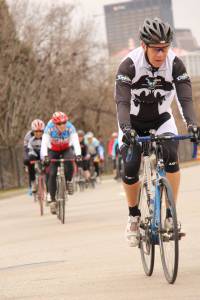
Kentucky resident Tom Burridge bike racing.

Kentucky resident Tom Burridge bike racing.

I asked my longtime friend, running competitor and Master’s cyclist Tom Burridge to outline his training program for cycling. The request came on the heels of one of Tom’s recent races in which he covered 61.7 miles in 2:25:49 on a hilly road race course at the Indiana State Road Race Championships. His initial comments about the race included these:  “Stacked field…3Rd with 1k to go but got swallowed up by peloton with 300 yds to go ended 13th.  A ton of team tactics but I had no team.”

Which makes his ride all the more impressive. Like Peter Sagan in some stages of the Tour de France, he freelanced his way in the draft, attacks and chases. But he could not have done all that without a solid, intelligent training program. And that’s what today’s blog is all about.

Tom’s training holds interest for all who ride. As a rider in his late 50’s, he is competitive with cyclists 10, 20 and even 30 years younger than him in road races and criteriums. 

How does he do it? Time in the saddle of course. He typically rides between 250 and 300 miles per week. He also credits his coach Curtis Tolson for guiding him into solid racing and training tactics. 

I submitted a list of questions to Tom so that he could provide perspective on his training and racing. Here are some of Tom’s plans and insights on his cycling career thus far. 

What is your typical training load during a cycling week?

Tom’s Answer: 290 non racing week.  240. Race week

WRAR Comment: For those of you who are math challenged, that works out to an average of 42 miles per day over 7 days. Obviously those miles can be broken out in different days each week, with longer weekend rides often making up the bulk of riding in many cycling schedules. 

Do you do intervals specific to criteriums and/or road racing?

Tom’s Answer: I do intervals on Wed.  Not road or crit specific.  Some are sprint oriented, some are hill repeats. Tomorrow is 2 long efforts slightly above race pace with a number of 10 sec. spurts and then settling back down to race pace.

WRAR Comment: Notice the insertion of harder riding within race pace work. Too many of us simply go out and ride some sort of steady road pace as fast as we can manage or handle. But that’s not really how races work, nor is it the best way to train your body for maximum stress. As in running, speed workouts must be pointed toward an ability to respond and recover from competitive pressure.

3. What type of cross-training (weights, etc.) do you like to do prior to or during the season?

Tom’s Answer: I work out with weights 2 or 3 times a week during off season, focusing on quads, hamstrings, and calves along with back, shoulders and core planks etc.

WRAR Comment: This regimen does several things. First, it builds toward the coming season by building a strength foundation. It also contributes to riding comfort and preventing “saddle fatigue” and shoulder weakness that can undermine your pedaling strength, especially the core work that enables a cyclist to maintain a relaxed yet responsive position on the bike.

4. In the recent race where you rode 2:25 for 61 miles, what was your average pace? By comparison how fast do you ride solo for that distance typically?

Tom’s Answer: Avg for that road race was 25.4mph.  Avg around 19/20 mph on solo rides.  Still transitioning from runner’s body to cycling body.  Biggest improvement has been being able to hammer in the low 30s mph on the flats for an extended distance.  Still have trouble jumping and staying with the big guns on real fast accelerations.  Usually have to rely on catching a wheel and clawing my way back which is easier for me when it is a hilly course.  I struggle on flat technical courses with a lot of turns and accelerations.

WRAR Comment: Lots to learn for all of us here. Tom’s prior life as a national class distance running prepares him in many ways for competitive cycling. His native abilities in endurance events are well-proven, yet the specificity in muscle group training and base necessary for cycling must be built over time. Many older riders are quite competitive with much younger riders because they have trained and competed so many years they have a strongly established cycling foundation in terms of muscle group strength. Yet they also know the best ways to ride efficiently, how to hide in the wind and when to lead out an attack or meet a challenge. Tom is successfully building toward that level of ability. He enters races frequently and that is the best training of all.

5. How much does your mental training from competitive running affect or contribute to your cycling career?

Tom’s Answer: The mental side from running is good and bad.  The good side is for training and being consistent and keeping focused on long term goals.  The bad side is that cycling is so much more tactical and you have to check your ego at the door.  Cycling results are so much more sketchy than running.  I have never experienced a sport where I do so much second guessing after a race.  That being said, I have definitely caught the racing bug and really love it.

WRAR Comment: The mental toughness developed in other endurance sports can transfer to cycling, but it is not always a direct or 1:1 relationship. As Tom suggest, the sport of cycling involves a mass effort to progress. So you can’t even take credit for all your speed. Yet you can often question your tactics or decisions, which are often driven by fatigue. Yet the challenge is so interesting the “racing bug” can definitely take hold.

6. What food/fuel do you prefer for road races?

Tom’s Answer: Oatmeal, bananas and maple syrup pre-race meal.  Might have a couple of gel packs last half of the race.

WRAR Comment: Every rider is different when it comes to dietary needs. But Tom’s basic diet tells much about good fuel for racing. Food that sticks with you for a while! Then accent your nutrition as you go. That requires a degree of experimentation. Some riders need more fuel and food than others. Testing that out in training is crucial to long term succes.

7. What was your tactic given you did not have a team to rely upon during the race?

Tom’s Answer: The main tactic during the race was staying up front in lead pack, staying out of the wind and being prepared to cover the breaks. I should have done more research identifying key guys before the race.  In hindsight I would have shadowed the top 2 guys who made a break 2.5 laps into 6 lap race.  There was a lot of blocking in this race despite relatively high mph for the race.

WRAR Comment: It’s not always possible to know who your rivals will be in a given race. But when you can certify who the leaders will likely be, knowing that can help you determine whether breaks are for real or just testing the peloton to see who’s weak or strong. Effort wasted in covering false breaks cannot really be won back.

8. Given the opportunity, do you think you could manage to compete/complete a flat Tour de France stage?

Tom’s Answer: Stay on a flat stage on the Tour?  I have no idea!  I guess I could hang in there for 130 miles at 25mph if I could hang in the pack and stay out of the cross wind.  Whether that would still keep me in the pack, it would have to be a pedestrian pace.

WRAR Comment: Tom’s answer exhibits respectful humility, but also his well-proven ability to compete at a high level when given the opportunity. His running career pitted him against world class runners like Frank Shorter. Tom competed well including a 13:45 5K. His observations and self-knowledge likely have validity that sustaining a 25mph pace might well be possible for 130 miles or so. Of course the tough part of the Tour de France is that riders come back and do that type of effort for 21 days with only a couple rest days. Sort of puts that race into perspective, doesn’t it?

9. What bike are you riding now, and if you had your choice, what would you buy?

Tom’s Answer: Still riding the 2010 Canondale six carbon six.  Haven’t even thought of getting another bike.  Another year of hard training before I look at upgrading.

WRAR Comment: Who doesn’t dream of a new bike? Yet notice Tom’s focus on improvement in this year’s competitive efforts before getting distracted by technology or shiny paint jobs. Tom’s focus is on refining his riding on a decent bike, not approaching it the other way around.

10. What advice would you provide for cyclists over 50 in terms of consistency, injury prevention and competition?

Tom’s Answer: Still new to this but the weight training seems to help.  Need to stretch more, and going real hard on the hard days and really easy on the easy days.  When in doubt rest.

WRAR Comment: There is 40 years of competitive wisdom wrapped up in this comment, especially the advice about going hard and easy. Too many of us average out our efforts and do not improve as a result. As athletes age, they also need to recognize the need for rest. Yet that advice can do so much for younger riders as well. Going hard all the time will make you fast, for a while. Yet the body cannot sustain or even attain peak fitness without rest.

Thanks to Tom Burridge for providing his perspectives on what it takes to ramp up the competitive efforts and improve as a cyclist. As we engaged in conversation via email he laughingly inserted the comment “Also, I am still getting my ass kicked out there.”

But his riding has a certain quality to it that other people recognize. “One benefit of my running background… I have received a number of comments that I have an easy wheel to follow on fast group rides. I don’t make any sudden moves but have a knack to move into the draft efficiently which might be a product of a ton of indoor (track/running) racing and being comfortable racing in a crowd but always looking for a chance to move up.”

“Actually results have been mixed this year but I think I’m approaching 20 races for the year.  Just trying to cram in as many race experiences as possible.  Found out that my sweet spot in crits and road races are on courses that have a hill where I can get some seperation.”

Following his big effort at the Indiana State Champs, Tom had this comment to add about his next race. “Came back yday in State Crit champs thought the legs wld be toast but just got nicked the last 50 yds for the win 55 Masters ended up 7th in the 35/45/55 overall.”

So the keen message of all this cycling talk is that it’s a process, not an event or even a year that makes your career. Certainly a good event or a good year contributes to your progress, but like all sports that require perseverance, cycling is a constant question of staying “in the draft” and doing your training while looking for your opportunity to attack and shine.

WeRunandRideLogo

Posted in Christopher Cudworth, We Run and Ride Every Day | Tagged , , , , , , , , , , , , , , | 1 Comment

Do you know how to read your running shoes?

By Christopher Cudworth
Here is an image of my right show sole. It evidences wear on the outside, indicating a general position of supination and some forefoot striking. This is the result of orthotics and my running form.

Here is an image of my right show sole. It evidences wear on the outside, indicating a general position of supination and some forefoot striking. This is the result of orthotics and my running form.

When your running shoes start to wear out you can usually tell all the way up your body. From tired feet to sore ankles or achilles, tightening IT bands and knee or hip problems, worn out shoes reverberate throughout your musculoskeletal system.

It makes logical sense that you can trace your injury problems back to your shoes in many case. Your feet make thousands of impacts during even a two-mile run. Depending on your body weight, that’s a lot of pounding and shock for your shoes and feet to absorb.

You can argue forever which type of shoes is better for you, minimal or maximum padding, zero elevation or pumped up heels. The running shoe industry conducts plenty of experiments on us running guinea pigs, some imagined, some not so.

The latest HOKA One One shoes are as thick as industrial sponges. One of my acquaintances loves them because frankly his running stride looks as if he’s in the process of defecating a corkscrew with the wine bottle still attached. He is absolutely not light on his feet. The HOKAs make it possible for him to fake it a few miles anyway.

That is not some judgmental statement or cruel joke. We all get that some people are better built for running than others. People who like to run are going to try to do their favorite sport whether they are built for the activity or not.

In my case the new shoes I bought were the exact same size and model. Looking at "fresh" soles versus my worn shoes (500+ miles) allows me to read the wear patterns.

In my case the new shoes I bought were the exact same size and model. Looking at “fresh” soles versus my worn shoes (500+ miles) allows me to read the wear patterns.

It is still rather important to come to grips with what your shoes might be telling you about your running efforts. The recommended wear term for running shoes these days is anywhere from 300 to 600 miles. Some people squeeze more out of their shoes, and many more rotate several pairs to protect themselves from overuse injuries by using just one pair of running shoes.

But know this: You can pretty much throw any pair of running shoes you like on your feet and the net results will be the same in terms of ultimate wear patterns. Learning to “read” your shoes to understand what’s going on with your stride, footplant, running form and biomechanics can be helpful in anticipating your risk of running injuries.

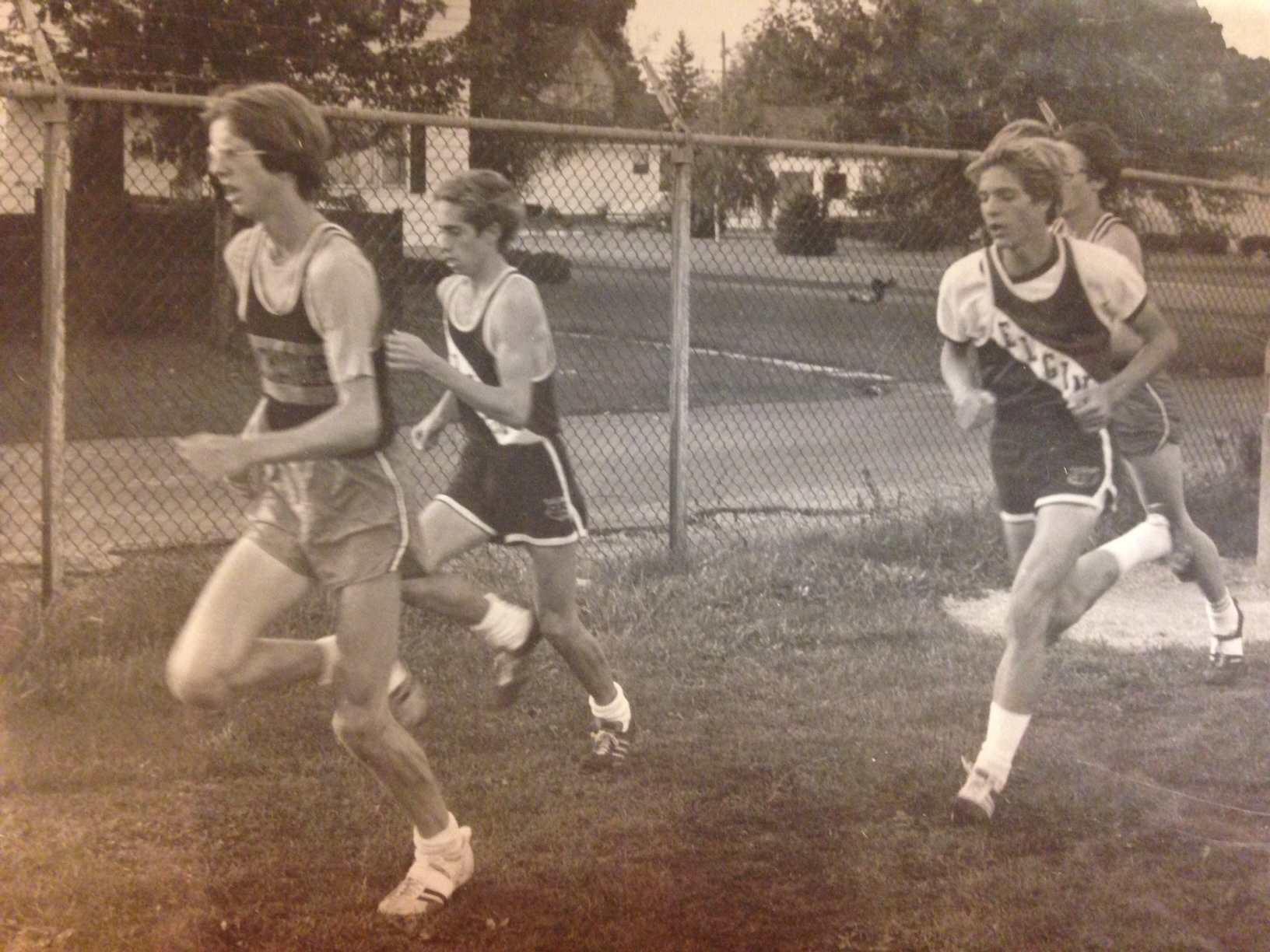
For example, one of the most classic wear patterns among millions of runners is the wearing down of the outside heel area. Just about all of us wear our shoes down in that pattern at some level. In college in the 70s our cross country team countered this wear pattern by using athletic tape applied daily to keep the rubber from wearing out back there on the heel. It’s a pretty nifty trick if you think about it. We needed to make those shoes last as long as we could on a college budget.

Whether it was advisable given the fact that the rest of the shoe was also wearing out is debatable. Yet we had relatively few injuries and keeping our heels from wearing out and keeping them even was a practical response to footwear. Later the invention of products like Shoe Goo enabled runners to conduct self-administered shoe repair.

The classic heel wear pattern on many running shoes belies the effects of slower mileage

The classic heel wear pattern on many running shoes belies the effects of slower mileage

One doesn’t see much of that any more. We’ve fully entered an era of the disposable running shoe. Perhaps that’s because running shoes are so much better designed than 40 years ago. Support systems, sole materials and even insoles are vastly superior in terms of comfort and performance compared to early iterations of Brooks, adidas, Nike, Saucony and many other models.

But what hasn’t changed is the fact that every runner wears out their soles in a slightly different way. And it can change as you age, adopt new training methods or get inserts in your shoes for stride balance.

You’ll particularly notice the phenomenon of altered shoe wear when you get orthotics. The whole purpose of orthotics is to balance the position of your foot upon impact. A sports podiatrist or pedorthist will often examine the soles of your shoes to determine where and how your foot is striking the surface of the ground. These days this information from your sole wear will be combined with video recordings of your foot plant and even your body carriage. Using this information is like detective work. You try to determine what if any imbalances exist, and fix them using shoes, orthotics and perhaps strength work as well.

So the soles of your shoes are like a piece of evidence at a crime scene. Your crime is not having perfect running form or a perfect body, you see. The signs are there. You can’t hide from them.

If one heel is more worn than the other on your running shoes, it is possible to extrapolate a potential bio-mechanical difference. It might mean a leg length discrepancy. Or perhaps you’re simply running too often on the same side of the road, against traffic, and your shoes wear unevenly as a result.

Honestly you can't tell much about the remaining life of a shoe by its upper. Modern materials keep shoes looking good as new. But they aren't.

Honestly you can’t tell much about the remaining life of a shoe by its upper. Modern materials keep shoes looking good as new. But they aren’t.

Same goes with wear patterns on your forefoot. Runners with a midfoot or forefoot stride are highly dependent on lower leg flexibility to propel them over the surface of the ground. You are running cursorially, like a deer striking its toes on the ground. That’s great if you want to go fast, but running 26.2 miles on your forefoot puts a lot of responsibility on your feet and calves to sustain your pace.

Recent advocates of CHI running and minimalism encourage moving more efficiently across the ground with a running motion in which the foot essentially paws the ground. This is optimal for some runners but requires considerable focus and training to sustain the method over multiple miles.

You are still at risk for injury if your foot is not structurally pre-disposed to run that way. Forefoot imbalance and weakness is just as real as heel pronation or supination. Your shoes will show compensatory wear in response to these forms of imbalances as well.

So given the many types of shoe wear, here’s a short primer on common shoe wear problems and where they might be coming from:

1. Excessive heel wear

When running long distances, many of us roll back on our heels and plod along with a heel strike that is just forward of our knee upon footplant. There’s nothing essentially wrong with this but it can wear down shoes too quickly and result, especially if there is a foot imbalance, in an uneven wear pattern between your two shoes. When that happens, watch out. You are instantly setting yourself up for injury. It is wise after 100 miles or so of running to inspect your shoes for signs of excessive heel wear on one side or the other. It may indicate a functional imbalance, a bad habit of running too much on one side of the road or a leg-length discrepancy.

2. One side “hot spot” shoe wear

Many of us have lumpy feet or else our strides put undue pressure in a particular area of our shoes. This can produce unusual wear patterns in running shoes that can tell us where or how our feet are striking the ground. This can affect efficiency, so understanding why a hot spot might be occurring is critical to knowing your body well enough to make adjustments. People doing track training may find their outside or right foot putting greater pressure on the outside. This helps you turn. Many of us also have “inside out” wear patterns where the heel on one shoe will wear more and the forefoot of the opposite shoe will also wear in compensation. That usually means there’s a leg-length difference as your body learns to hit the heel with the longer leg and “reach” with the forefoot to strike the ground. You can usually see this pattern in the person’s stride with one leg doing more work than the other. Arm carriage is also a sign of “inside out” wear patterns caused by body mechanics. When one arm swings out you can almost always figure that leg will be a bit shorter.

3. Forefoot and toe-off issues

There are people who run entirely on their forefoot. As mentioned, that’s both more efficient and in some ways can be more work. But truly efficient runners who kiss the ground with their feet will wear off the forward soles of their shoes and that’s a thing to be cautious about. As you wear out the outsoles the insoles and cushion of the shoe is always being compressed. In that regard the shoe may look perfectly new but it’s real cushion value might be greatly diminished.

4. Share and share alike

Whenever you visit your run doctor or running shoe store, bring along your old shoes for a diagnosis of these and other problems. Experienced shoe professionals can help you “read” your shoes and discuss options in new footwear that might help your safety and performance. That’s good reading any day.

WeRunandRideLogo

Posted in Uncategorized | Tagged , , , , , , , , , , , , , , , , | 4 Comments

Birds of a feather go aero together

By Christopher Cudworth

A group of triathletes prepares for a brisk 35-mile ride on a Sunday morning. Most rode aero or tri-frames.

A group of triathletes prepares for a brisk 35-mile ride on a Sunday morning. Most rode aero or tri-frames.

In the never-ending pursuit to produce faster rolling bikes, the bicycling industry has squeezed the frames, raised the seat posts, dropped the handlebars and turned the wheels into flying disks with flattened spokes.

Time trial, triathlon and aero bikes of an ever-diversified assortment now make up the top-end models of the cycling industry. Just say a name like Cervelo and you think right away of aggressive geometry, wide but lean frames and forks and strangely bending parts that were once inconceivable.

All that aerodynamic design is meant for one thing: to help you go faster.

Even at rest a tri-bike aero frame looks more aggressive.

Even at rest a tri-bike aero frame looks more aggressive.

But there’s a tradeoff of course. A cyclist on an aero bike is crouched so low in the tuck and with arms so far forward there’s not a lot of handling capability in the aero position. Which means that riders putting in miles together in aero positions must be careful to not cross wheels or take each other down in a swerve of wind.

Triathletes and time-trialists don’t need to worry about handling their bikes in groups or a peloton. There’s either no draft available or no drafting allowed.

But when it comes to training, there are occasions when groups of aero riders get together like birds of a feather. For those unprepared for the dynamics of group riding in aero, things can turn into a flap quite quickly.

The face-first, thigh-pumping riding style of aero cyclists can lead to a unique form of wobble. Pouring all that power into a responsive frame teetering on a tight line of tire frequently results in a bit of a rocking motion.

Add in a bit of wind to fight, especially a crosswind, and these tendencies become accentuated. The irony of a fast-forward tri-bike with a flattened frame and deep disk wheels is that a crosswind can create conditions that are a real drag. That’s one of the tarsnakes of the aero world. What helps you go fast in a straight line can turn into a havoc of sideways pull in the wrong conditions.

A group of tri-bikes awaits  the return of riders from a rest break at the halfway point.

A group of tri-bikes awaits the return of riders from a rest break at the halfway point.

But like we’ve said, it’s all good when you’re on your own flying down a lonely road with no one around to worry about. But put a pack of 10-15 riders together on a weekend group ride and paying attention to one’s line is paramount.

It is additionally interesting to be the lone road bike rider in a group of aero missiles. Hugging the wheel of an aero rider simply isn’t that advisable. The difference between full force ahead and sliding sideways is very subtle. The tight margin you might keep with keep a group of roadies is just plain dumb in a pack of aero riders. Even with superb bike handling skills there are too many things that can contribute to touching wheels or getting pinched between two cyclists, one swerving from the right and one from the left.

Bike frame geometry has gone through massive evolution in the last 15 years.

Bike frame geometry has gone through massive evolution in the last 15 years.

So it’s rather like the one roadie in the bunch has to have the extra etiquette. That sounds crazy since road bikes handle better, but that’s no excuse for cramping the style of a group of aero riders accustomed to wider margins and the basic philosophy of hammer till you drop.

You usually won’t find aero riders rotating pulls in tight sequence. An echelon may or may not form in a crosswind. Aero riders are more accustomed to handling all conditions on their own. Roadies share the pace while aeros lend it, sometimes with interest.

I rode 35 miles with a triathlon group this past weekend and the riding was a blast. A bit less collaborative than a typical group ride, but snappy and fun nonetheless. Because it doesn’t really matter who you ride with when you test your cycling wings flying along on an open road with 10 or more other birds on bikes. Birds of a feather flock together. Even when one’s a roadie.

WeRunandRideLogo

Posted in Christopher Cudworth, We Run and Ride Every Day | Tagged , , , , , , , , | Leave a comment

Are things going swimmingly for you this summer?

by Christopher Cudworth

The alarm rings at 4:30. It doesn’t care how you feel. How you slept. Who you slept with. Or how many days this week you rose at 4:30. It’s 4:30. Get up.

The windshield wiper does not seem to want to do its job. Perhaps it’s too early. Too dewy. The wipers swing back and forth to remind you: in 10 minutes you’ll be swimming.

People in swimsuits sit at pool’s edge staring at calm water. There are good swimmers here. Women and men. They know what they’d be doing in the pool.

I do not yet know my capacity. It is just past 5:30 a.m. on the first day of August and the rest of eternity.

Will I get better at this? How many days a week will it take? Can I kick with any force rather than creating surface waves?

Things are improving. My stroke starts to come back. Then the swim coach wanders to my end of the pool. He stands looking at the nine swimmers in their various lanes. But his eyes see me. Instinctively a coach can read what you’re doing in the water. Are the arms flailing or pulling. Do your feet cross when you kick?

Because, you see, your feet are like a propeller. That’s what he explains when I ask him what I can do to improve my kick. He demonstrates by sitting on the aluminum bench by the pool to show me how your feet should actually rotate back and forth when you kick.

Then he has me put a hand on a triangular float and swim sideways with my head tucked back in the water and it is really hard to to. I swim in a C shape at first. Weak back muscles, he tells me. All runners seem to do that.

I look over at the lanes where good swimmers are hard at work. Their shoulders glisten as they pile through the water. Here am I, kicking for all I’m worth. Going nowhere. Or so it seems.

I can only imagine how it must feel for someone just starting out as a runner. That first few steps. The first mile. Then two. Then three.

Or cycling on a road bike the first time. I recall tipping over with my feet clipped in. “Now you’re a real cyclist,” my buddy warned me.

It’s been 10 years or more since I tipped over like that. Yes I’ve crashed, but that was from going too fast, not too slow. Part of the sport.

Swimmers know the road ahead is full of ripples of awareness and small breakthroughs. You can only improve to the degree that you’ll keep at it. Conditioning. Practice. Commitment.

“So are we going to see you more often?” my girlfriend’s swim friend asks.

“Uh, yeah, I think so,” I tell her.

“Because if we don’t see you, we’ll miss you. Then I’ll have to ask Sue, “Where’s Chris?” every time you don’t come.”

Way to guilt me there, sister.

But guilt is only one of the many motivations one can find to swim.

There’s that feeling that your chest and shoulder muscles are full of blood. That’s cool.

There’s that zen motion of moving through the water when even the bubbles seem to fall silent because your brain refuses to hear much of anything.

And there’s the incredible notion that one day you could actually be good at this. Because I’m not hopeless. I swam as a kid and am re-learning the skills buried deep in the muscle fibers and recesses of my brain.

We’re home before 6:45 a.m. She makes a breakfast of eggs and English muffin. We sit in the sun outside on a summer morning and you realize, “I just got done swimming.”

It’s a cool feeling. One that could carry through the winter months and cold mornings and driving through snow to go swimming when the water is as blue as the cold sky outside.

But for now, it feels good to sit with light clothes on in the morning sun after a swim. To feel her skin rich with baby oil on a summer morning as we hold hands.

There is nothing wrong with this swimming thing. Nothing at all.

WeRunandRideLogo

Posted in Uncategorized, We Run and Ride Every Day | Tagged , , , , , , , , , , , | Leave a comment

Why I never run from liberal instincts

By Christopher Cudworth
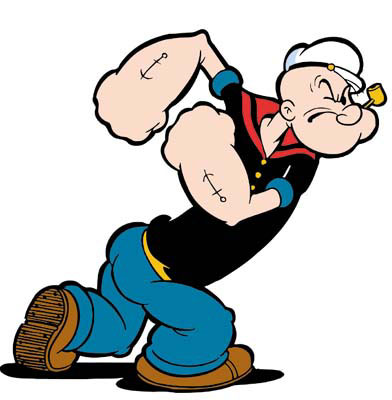
Popeye13As kids we played sports in the neighborhood and at the local pool. One of the key things I recall is that we always worked to make the teams fair. There would be arguments at times over who should play for each team, but we all knew the game was much more fun when the wealth of talent was balanced.

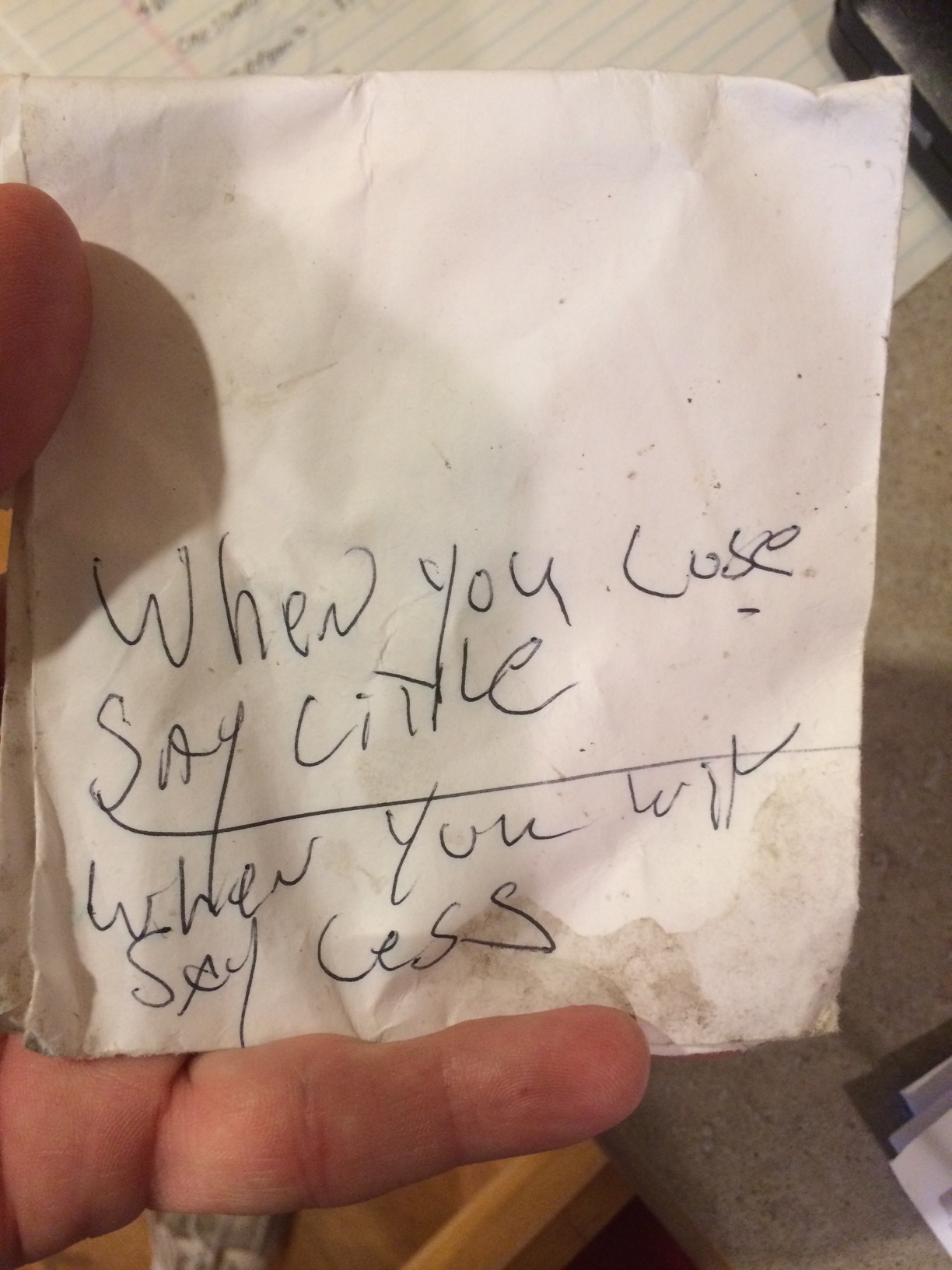
I also recall hating to lose. That meant once the teams were decided, I would do everything possible within the rules to win.

Of course there were stories about the merits of winning and losing everywhere we looked. I recall long sessions watching Popeye cartoons in which the perpetual underdog Popeye battled with his rival Bluto over the love of Olive Oyl. It wasn’t hard to see the liberal storyline behind the plot of an ordinary sailor battling the big bully Bluto. As a skinny kid I often wished there were a can of spinach available to make me stronger when needed.

Prudence for Popeye

But things weren’t always so simple. At one point my best friend pulled me aside and pointed out the fact that if I wanted girls to like me, I shouldn’t try so hard to beat them in sports. “Play nice,” he told me. “Let them win now and then. They’ll like you more.”

He had sisters, and I did not. So he knew a few things about women that could be helpful in this world. But I could never quite embrace the idea that losing to girls on purpose did anyone any good.

Later in life, when women’s sports began to flourish in American culture, I encountered women who were more talented than me in sports. On one date I lost 21-3 in racquetball. She trounced me so severely it was tough to even return a serve. It helped me realize that the whole Battle of the Sexes thing was not what it seemed. I learned that it didn’t hurt any man for a women to be as good or better than them in sports. Or anything else for that matter.

What actually hurt was people trying to keep women from playing at all.

Liberalities

For these reasons, sports are an interesting forum in which to test your liberal instincts. Our so-called liberalities often end at the point where we find ourselves winning or losing. It’s hard at times to be a gracious winner, even more difficult to be a gracious loser.

There’s been so much liberal-bashing in the public form the last 15-20 years that the term “liberal” has now come to be used by some people as a targeting adjective to describe someone who lives without principles. To be “liberal” in their eyes is to be nearly lawless, lacking morals and discipline in personal, political or religious life.

But real liberalism is quite the opposite. It takes much more discipline to be liberal in this world and hold to your principles during moral challenges than it is to be so set in your ways that you refuse to give consideration  to other viewpoints before making decisions. A liberal believes that there is always more to learn, and that what you learn may benefit you. That’s the primary foundation of higher education. Some people seem to hate that.

But in order to better understand what liberalism really is, it helps to go back to its root definitions so that we can sort out fact from political fiction. Here, for our mutual edification, are a set of definitions of the term liberal:

liberal:

1. Favorable to progress or reform, as in political or religious affairs.

2. Noting or pertaining to a political party, advocating measures of progressive political reform. 

3. Of, pertaining to, based on, or advocating liberalism, especially the freedom of the individual and governmental guarantees of individuals rights and liberties. 

4. Favorable to or in accord with concepts of maximum individual freedom possible, especially as guaranteed by law and secured by governmental protection of civil liberties. 

5. Favoring or permitting freedom of action, especially with respect to matters of personal belief or expression; a liberal policy toward dissident artists and writers. 

One must challenge anyone reading those definitions to prove why or how liberalism runs counter to principles of democratic freedom or the formation of a Republic based on such? Every one of those definitions aligns with the reasons and purposes for which the American Constitution was written. They are beautiful, bold principles by which to live, especially as they relate to both the protection and expression of individual freedoms and a government dedicated to supporting those rights.

So what does all this have to do with running and riding, you might ask? Because running and riding are the most liberal of activities, that’s what.

Running a democracy

One of the things I always liked about the sport of running is that it was entirely democratic on principle. If you ran fast enough, you generally made the team. The only time there was an exception to that rule was when political interests stepped in to override the liberal principle of individual ability.

That’s where one begins to learn that life is not always fair. The subjective judgment of coaches can determine your fate just as quickly as a poor race. If for some reason a coach does not like you, the opportunity to even participate in a fair competition and prove yourself may be denied. It seems we all experience situations like that in life. Sooner or later in sports, in business or in politics we find out the playing field is not fair.

Schoolyard games 

Whenever that happened to me or someone else on my team, my liberal instincts flared into action.

I recall a day when my 5th grade son came home from school one afternoon and told me that the playground soccer game had evolved into something very ugly. “All the best kids join up on one side,” he told me. “They win every day, like 10-1. So I purposely joined the losing side. I do everything I can to stop them. But there’s so many. It’s pretty hard. And then they make fun of us.”

photo (75)My son’s liberal instincts were being put to the test in that situation. He saw the injustice of the fearfully composed side that cared only about winning, not the quality of play. We see that kind of partisanship in Congressional and Senate majorities that quell any attempt to pass legislation designed to help the nation. They ignore their liberal and primary responsibility to govern… especially as guaranteed by law and secured by governmental protection of civil liberties.

Instead they engage in schoolyard games, childishness and a brand of persistent bullying that began, for example, the moment Barack Obama was elected. Now Congress has taken a partisan vote to sue the President in an ironically liberal abuse of law to achieve a political statement. They are literally suing the President to make him enforce a health care law that they politically opposed from the start. Talk about taking false liberties with the political process!

But let’s admit it; Democrats and Libertarians and the Tea Party are all just as prone to political chicanery and abuse of liberal principles as anyone else. But there is such a thing as moral equivalency. Our liberal instincts are valuable in detecting these challenges.

Further abuse of liberalism

As a nation, America finds itself in the sights of overly liberal gun laws, another example of turning the good principles of liberalism into bad policy. The NRA and other gun advocates have successfully worked to pass Concealed Carry laws in all 50 states of the union. This does not indicate wise policy so much as it demonstrates a falsely liberal interpretation of the Second Amendment, which begins with the phrase, “A well-regulated militia…”

Already in Illinois we’ve seen incidents such as the case when an 86 year-old man pulled his concealed weapon and tried to take law into his own hands. The Chicago Tribune carried this bit of enlightening perspective: “The (86-year-old) man stayed outside to prevent anyone from entering, police said, and after he saw the suspect leaving through a back door, entered the store and chased him. A police officer also was pursuing the suspect but had to duck for cover when the shots were fired. No one was injured.”

That’s a fine example of vigilante justice in action, just like the Wild West. Concealed carry is technically little more than organized chaos and constitutes a form of national madness when it come to gun rights. America has more gun deaths per capita than any nation on earth, and our answer to the problem? Licensing more people to own more guns and allow them to hide them on their person.

Our current gun laws are indeed liberal in scope, yet lacking in legal and moral principle in failing to acknowledge the massive carnage and loss of human life taking place in mass shootings and gun deaths each year. There is little if any supporting evidence to suggest that further weaponizing society will have any deterrent effect on people who make their minds up to use deadly weapons to kill and maim others.  In fact Concealed Carry fairly legitimizes the ability of people to hide weapons in order to plot and execute murders. That is madness, and hardly a conservative approach to an orderly society.

So we see that liberalism is itself not the problem in America, but the abuse of liberalism by those willing to manipulate society for their own purposes, such as satisfying the interests of gun and weapons manufacturers. Same goes for the military-industrial complex whose appetite for the federal budget knows no bounds. These economic interests grab the profit and socialize the costs. That is an abuse of all Americans, our civil liberties and of liberalism as a principled foundation of democracy.

That’s one of the tarsnakes of liberalism. When used properly, it represents the primary core of democracy. When it is abused, it produces social imbalance. It is true on both ends of the political aisle.

The so-called winning side

We see this lack of principle at work all the time in politics. People join up with a political party simply to be on the winning side, or to have their pet issue represented. They will compromise all sorts of principles in other parts of their life in order to see action on that one political issue that gnaws at them. Despite what many have come to believe, that is not how democracy is really supposed to work. Compromise is the moderate solution to impasse, and that appears to be something of a lost art.

We knew more about compromise as kids on the playground picking fair teams than some of the politicians today who only know how to win one way, and that is by destroying the other side. We lose so much as a nation from those attitudes. We lose our standing in the world. We lose the purpose of our government. We lose whatever exceptional qualities we might once have had to an attitude of hubris and selfish aims.

What Would Jesus Do? 

It is a biblical fact that Jesus detested hypocrisy and the use and abuse of moral law to gain political power. The very liberal principles of scripture; caring for the poor, resisting the love of money, embracing fidelity and trust are tossed out the window when people are so determined to get their convictions imposed on others they turn to religion or politics and use positions of authority to make themselves feel important and justified.

But know this: there’s a major difference between seeking justice versus finding justification in your actions. It takes works to maintain justice. It only takes the stroke of a pen or a backroom deal to provide justification for actions that may not be moral at all. We’ve seen it throughout history. Wars break out when people choose not to be liberal with human rights or play fair.

Just like in the movies

The Mel Gibson movie Braveheart depicts the travails of one William Wallace, a Scottish citizen fighting for his country’s freedom under the rule of the King of England. To subjugate his Scottish subjects, first the king issues an order that all marriages must be consummated by allowing an Englishman first access to the bride on her wedding night. Wallace’s own wife then gets her throat slit by an English general trying to tame an uprising. So the story escalates into war. But what it’s all about is freedom, a liberal principle by definition.

Even as Wallace leads his nation into successful battle, secret and conservative dealings are at work all around him. The Scottish Lords want to broker a deal with the English King. But that would only benefit the privileged few. Wallace wants more.

An even more sinister plot evolves as the heir apparent to the Scottish throne finds himself in a position of betrayal to Wallace because his power-mongering father, hidden from society by his own desperate condition and physical illness, makes moves to betray Wallace into the hands of the King, where he is tortured and killed. It’s all very nasty business. Liberalities are not tolerated.

For fear of something

Today Scotland (my home country, I someday hope to visit) is still considering a move toward independence. So these stories hold more truth than fiction sometimes.

There have been many times when the backroom dealings in business have driven me to the roads in search of answers. I have run entire 20-milers trying to figure out why people act the way they do, and why they sometimes seem bent on taking positions that even run counter to their own interests.

Usually it is fear that is at work in them. They are afraid to lose their station in life, or are afraid to take a risk for fear of being seen as incompetent or a failure.

Courageous principles

None of those things is a product of liberal thinking or principle. Liberalism has been at the source of courageous actions on every social front. It was liberalism that drove Americans to form their own country and declare independence from Great Britain. It was liberalism that drove Abraham Lincoln and his peers to condemn slavery, fight and win the Civil War over unity and civil rights. It was liberalism that also drove the march to freedom in the 1960s, defeating the worst kinds of racism and fomenting fuller respect for women’s rights.

It is liberalism that continues this fight to this day, with liberals demanding access to birth control for women because it empowers them to manage their reproductive lives.

Liberalism is also at work securing equal rights for people who are gay, transgender and bisexual, and protecting the liberal enterprises of science, medicine and even religion from influences that would confine their free expression based on constrictive ideology.

Creativity

One of the most passionate forms of liberalism is creativity. The instinct to create also requires courage. And for all the supposed love for “out of the box thinking” expressed by so many companies in so many corporate presentations, true tolerance and encouragement for creativity is surprisingly lacking when the rubber hits the road. Creativity is too often seen as counterproductive to successfully established business practices.

Yet creativity is nothing more than problem solving. Creative solutions provide new opportunities. That’s true whether you are marketing a new or existing product or service. The conservative approach to business is to continue making what you are already making, selling it the same way you have always sold it and expect that business model to stay consistent and dependable.

Liberal business practices

But of course we would not have Nike or Apple or Trader Joe’s if only conservative business practices were allowed to rule. Granted, even these companies evolve their own brand of conservatism over time. Wall Street demands profits and reporting, and shareholders demand returns. These forces are creative in another sense, that of capitalism, the most liberal enterprise of all economic models.

Does that surprise you to read those words together: capitalism and liberalism? They are not by definition oppositional.


Troubles with liberalism

But in fact if there is any drawback to liberalism it is in the economic sector. To be too liberal with spending can get you in deep trouble, even bankrupt. To be too liberal with your taxation can be just as vexing. All systems require checks and balances in order to function smoothly.

No one source of liberalism is a single key to the problem. But no one source of conservative action is a cure, either. We’ve learned that through the austerity attempts in Europe.


Productive compromise

Our genuine problem in the world today is that people seem to fear compromise most of all. That’s because compromise is also a liberal principle, and it requires giving somethin up something to achieve the greater good. That’s all that is required sometimes. Yet some cannot bring themselves to do that.

Where can we learn how to compromise intelligently? It turns out the world of sports is especially suitable to teach us those lessons.

If you are planning to run a marathon, it makes no sense to go out and run the first mile in under 5:00 if your best mile time is 5:00. You need to pace yourself. You need to compromise your near term capability to achieve your long term goals.

Same goes with a cycling race. If you try to simply ride away from a pack of 50 other riders it is unlikely you will last very long. Instead you must learn to leverage the power of the peloton to your advantage. If you are smart you even have a team to help pull you along. Using the draft is a creative solution. Conserving energy is important to success. So you find a liberal or creative approach in combination with a conservative method. That’s how you achieve success. Productive compromise.

A liberal dose of optimism

So we run, and we ride, and we enjoy both the freedom of individual expression and the honest competition it represents. Of course we can’t all be victorious in every race we enter or there would be point in it all. In some respects our supposed failure to win a race actually illustrates the merit in participation. We test ourselves and we learn where we stand, or sit, or run, or ride, or swim.

But the most important and most liberal principle of all is to respect all those who try. We must also work to protect the idea that a fair playing field is best for all. We must root out the backroom match fixing in sports and politics. And if drugs are providing an unfair advantage to athletes, we likely need to monitor and manage that challenge as well. Because cheating isn’t nice. It’s the opposite of fair.

All that said, we must all be a little more liberal with our hopes, our love and our grace toward others as well. Whether you are a person of faith or a devout humanist, these liberal principles are the best part of life. It’s why we stand on the sidelines cheering our fellow competitors on toward the finish line. It’s why we use our races to raise money for good causes.

Despite what some people may try to tell you, liberalism is a good thing. It harbors hope for the oppressed and freedom for all, as long as justice is served.

That’s why I never run, or ride, or swim away from my liberal instincts.

WeRunandRideLogo


Posted in Christopher Cudworth, We Run and Ride Every Day | Tagged , , , , , , , , , , , , , , , , , , | 1 Comment

Summer’s just getting started

By Christopher Cudworth

base layer 1Summer 2014 is officially just over one month old. Whatever you want to call it; meteorological summer or whatever, the season officially starts June 21 and ends September 20 or so.

I know, I know. For those of us in the Northern Hemisphere, the start of August feels like the beginning of the end of summer. But unless you ignore the principle of basic fractions, you’re very wrong. We’re 1/3 of the way through summer and none of your negative shit about the end of summer can change that.

Of course we’re all programmed to think Back to School when August rolls around. If you’re a mom or dad with kids between the ages of 5 and 20, that’s probably true. There’s elementary school and middle school and high school and college to consider. In that sense, summer technically ends when the kids go back to school. So be it.

But for the rest of us, and that means millions and millions of people who no longer attend school, but who work and want to enjoy the warmest months of the year for what they are––summer––there’s no reason to depend on that psychology at all.

photo 3 (1)I’ll admit one thing: As a runner August has always meant the start of real training for the fall season. High school cross country season began sometime in the middle of August with two-a-day workouts. That was hard, hot, sweaty stuff.

Same with college. We gathered before the fall semester on campus or took training trips out West to get in shape for the cross country season. August meant it was time to buy new training shoes and increase the mileage.

If you’ll recall correctly, the often intense warmth of August and early September was not something to take lightly. That’s because it was STILL SUMMER! I can recall cross country meets in high school when there were mosquito warnings issued to spectators. That’s because, and you’ve guessed it by now, it was STILL SUMMER!

I’m not falling for that Summer Is Almost Over crap this year. I love August. I have always loved August. I love training through the August heat when you sweat so hard your clothes almost peel off. I love riding on calm mornings because August is one of the least windy months I know. I love stripping off clothes after a hard workout and lying on the bed to let the warm air coast over your body. I love the smell of August flowers wafting in the bedroom window, and the sound of a patient sprinkler keeping plants alive outside.

When summer storms do blow in I love the scent of rain on the otherwise dry air. I love when the green leaves turn white and flutter in the force of an oncoming storm. I even like getting caught in the rain on my bike or while running.

photo (1)Once while running in a remote forest preserve a rainstorm came tearing up from the west and I got soaked to the skin. It rained hard at first and then settled into a steady August drizzle. All was quiet and wet. The earth seemed to be reaching for the sky. All was magnified and illuminated. I stripped off my clothes and my shoes and ran naked for two miles on lonely trails far from civilization. Talk about getting back in touch with the earth, and who you are, and why you run. It was elemental. You should try it sometime. Minimalism isn’t just limited to no shoes. No clothes feels just as good.

Or find a beach. Hide out somewhere and let August soak into your skin. Or September for that matter.

The summer racing season extends into September after all. Triathletes peak for events when the water isn’t so freezing and the winds are not knocking you off the bike.

Road racing in late summer as a runner is an absolute joy as well. All that summer fitness adds up to great feelings if you plan it right.

Cyclists indulge in one last burst of big riding and racing in August and September. In our area there is a series of events over consecutive September weekends. Riders squeeze out criteriums and road races and time trials before accepting that waning summer light means less training time in the evenings. Then the cyclocross bikes come out.

So there’s no real reason to give up so soon on summer. You wouldn’t run through two miles of a 10K and say “Well, this race is almost 1/3 done. I might as well coast in from here.”

Of course you wouldn’t. So don’t fritter away the rest of summer. Dig into it with gusto.

And if you live on the other side of the world in a place like Australia where the winter months are now in full swing, think ahead to your next summer and plan to make the most of it.

WeRunandRideLogo


Posted in Christopher Cudworth, We Run and Ride Every Day | Tagged , , , , , , | 3 Comments

Attack of the wetsuit strippers and other triathlon chaos

By Christopher Cudworth

A scientific experiment in progress.

A scientific experiment in progress.

Ever since I started associating with this triathlon crowd, I’ve had a sense that there is something more to the sport than meets the eye.

Thanks to intensive research at the recent Racine 70.3 Half Ironman Triathlon, I am now officially able to expose the truth about triathlons. I believe we are witnessing a giant series of scientific experiments.

If you study the sport carefully and with the right perspective, triathlons have all the elements of science in action. Science requires several things:

Numbers of participants: There are hundreds and sometimes thousands of test subjects in triathlons.

Controls: Experiments being conducted by the Ironman organization includes highly controlled processes, logistics and controls, guaranteeing consistent laboratory conditions.

Variables: Weather and temperature conditions during each individual triathlon provide variables necessary to test the performance and tolerance of each individual.

Data: Data chips are attached to each triathlete, documenting every movement by time, distance and transition.

Watching science unfold can be fun.

Watching science unfold can be fun.

So there you have it. All the elements in triathlons point to some sort of giant social or political experiment designed to test human stamina and functional capacity of all those involved in the sport.

To what end, you might ask?

All great experiments begin with a question. The easy question might be along the lines of something like, “How much can they take?”

Yet typically the triathlon experiment goes for something much, much deeper.

Living near the Fermi National Accelerator Laboratory has given me something of a neighborly insight into the nature of science and the science of nature. Fermi scientists long used a particle accelerator to break down the Fermi Labelements of nature to its smallest components. Quarks and such.

There is recent evidence that the elusive Higgs Boson has been discovered in experiments at the Lucerne, Switzerland supercollider.

LiveScience describes the Higgs Boson this way: “The Higgs boson particle, which was detected for the first time in 2012, is essentially tossed around like a ball between two force-carrying particles known as W-bosons when they scatter, or bounce off of one another.”

So there you have it. Life is basically one big game of catch at a very, very small level.

Our very existence is both a game and an experiment, and triathlon starts with the process of bouncing people off each other in the water, proceeds to placing people on highly spinning wheels and finishes with a highly impactful exchange of energy with miles and miles of ground.

Just as important, we know that competition is the foundation of all nature. But it all starts with a chemical and energy exchange inside our bodies and proceeds in an arc all the way to the start of a triathlon with people swimming and kicking each other in the head so hard that some get concussions.

You’re lucky if you don’t sink to the bottom at that point. Anyone that has done an open water swim knows this elemental feeling of existing between the planes of water and sky. You are swimming for your very survival. If the water’s cold enough you wind up shivering and stiff, sitting in the medical tent where people say things like, “Here, drink this.” And then you start to wonder…who is really controlling all of this?

A scientific experiment in action. The operation known as wetsuit stripping

A scientific experiment in action. The operation known as wetsuit stripping

But if you make it past the swim segment you emerge and shed your second  skin like some formidable amphibian. If you’re lucky there will be wetsuit strippers there to help you moult into another type of creature. A cyclist. Then a runner. It’s all transitions and time and movement. You breathe in. You breathe out. You execute thousands of swim and pedal strokes and take thousands of steps to complete the experiment.

It’s all going into a giant database, you know. Someday a brilliant scientist will publish the results. It will be a finding on the order of global warming, I predict. What will emerge are patterns that tell us things are changing. The world is changing and it is being caused by human beings. No amount of denial by fat cat ideological tyrants will change the fact that the human race is trying to wrest free from the petri dish fat bath we’ve created through ingesting huge amounts of sugar and fat.

And what else might be found when this large-scale triathlon experiment gathers enough information to reveal some new scientific truth?

A test subject prepares for immersion in 60-degree water.

A test subject prepares for immersion in 60-degree water.

I predict what we’ll find is the equivalent of the Higgs Boson of emotion and soul. That effort equals some form of elemental sustenance. That every athlete is a key component in the molecular foundation of society. We move energetically, just as electrons and protons and all those smaller components of the universe move. Yet through our movement, we are somehow holding all of society together. That from chaos order can evolve. It is true throughout all of creation. That is the tarsnake of all existence.

It may in fact be found that without such movement, society either congeals or dissolves. Hence the compelling nature of events that test the limits of human endurance. We are witnessing an experiment in holding the fabric of culture together.

This is vital because there are so many other forces try to pull us apart; politics, religion, money and conflicts of national and international interests.

Instead, the act of watching people reduced to elemental efforts is the last string of commonality, the Higgs Boson of human nature. It really is a beautiful thing to see, like watching penguins or seals at play in the ocean.

Yet even when it is ugly, difficult or painful to witness or endure, the Higgs Boson of triathlon is one of the ties that bind. It helps us recognize the tenuous structure of all matter––and, all things that matter. Which is being human, and recognizing both the individuality and interconnectedness of all things.

WeRunandRideLogo


Posted in Christopher Cudworth, Tarsnakes, We Run and Ride Every Day | Tagged , , , , , , , , , , , , , | Leave a comment

Running and riding through the weird world of a third-person attitude

By Christopher Cudworth

Christopher Cudworth thinks Big Glasses make him look Almost Famous.

Christopher Cudworth thinks Big Glasses make him look Almost Famous.

Perhaps you’ve met someone who talks about their life and exploits in the Third Person. It’s a weird habit. It’s hard to do if you’re not accustomed to the egotistical take on life. But it goes something like this:

“Christopher Cudworth’s got to go now. Christopher Cudworth has got a workout to do.”

At what point does a human mind switch from a normal worldview to speaking about oneself in the third person?

Perhaps the whole talking about yourself in the Third Person happens after some traumatic event in life. Or maybe people get so tangled up in trying to communicate their personal brand to the world they just shift over and take on a third-person personality.

It’s a lot of work though. You have to shift over permanently to the Big Gear of Personal Objectivity, which is basically just Ego on the Single Speed bike of personhood.

Which reminds me of the dude I saw riding in The Wright Stuff Century last year. He was doing the whole trip on a single-speed bike and the hills were just killing him. His little red beard was covered in dripping sweat and his round little military-style bike helmet was sitting a little crooked on his head. It would have been a perfect moment for a third person comment like, “Whoa, Single Speed Guy is about to Bonk!”

I watched him at the rest stop. He sat dripping sweat while downing a couple Salted Nut Rolls and a quart of Gatorade. But he kept on going, Single Speed Dude had balls, I’ll grant him that.

Christopher Cudworth wants you to know his recent bike wreck was really the product of his amazing imagination that distracted him from the big tree across the path.

Christopher Cudworth wants you to know his recent bike wreck was really the product of his amazing imagination that distracted him from the big tree across the path.

I’ve met many a runner who fit the whole Third-Person Runner gig. One was Mr. One Step. I’ve written about the time I decided to teach him a lesson by getting in good enough shape to bury his annoying habit of turning every Saturday morning group run into a race. For every half-step he surged ahead that day, I countered his move until we pulled away from the group at sub-6:00 pace. For a couple miles we went flying along until he finally broke. We talked it out and he finally got the message. But if he had been a Third Person kind of guy it might have gone like this:

“That’s it! Mr. One Step wants to know what’s going on!?”

I told him, “People are sick of you racing them in training,” I actually explained. “I’m a hired gun to help you realize what it’s like.”

I’m not sure the lesson was fully learned. He took to cycling a bit more that summer. No doubt he was Mr. Half Wheel at that.

See, we all have a bit of Third Person personality in our souls. It helps us drive forward in all our endeavors. Putting in the work to set a PR at some distance, to finish a half marathon, marathon or triathlon all requires a bit of calculated objectivity on our part. We become Marathon Woman or Half Ironman Person for a time.

Christopher Cudworth is here to tell you that his bike wreck was really just an exercise in creating Bruise Art.

Christopher Cudworth is here to tell you that his bike wreck was really just an exercise in creating Bruise Art.

When we achieve our goal the entire enterprise shifts over. Sometimes we raise the stakes. Okay, now Christopher Cudworth doesn’t just want to complete a marathon, Christopher Cudworth wants to set a new PR too! 3:00 hours here we come! Go for it Christopher Cudworth!

Yes, we all know it’s geeky and a little pathetic the way we set ourselves up to win or fail. But what would life be without a little Third Person drama to kick us down the path toward temporary stardom?

We may not be aware we’re doing it, but becoming Fund Raising Woman or Summer Road Racing Man is part of the Third Person venture of being an athlete at any level.

Just ask the Frank Thomas, The Big Hurt, who was just installed into Baseball Hall of Fame. Third Person always worked for him. It was much better than talking directly to journalists anyway.

WeRunandRideLogo

Posted in Uncategorized | Leave a comment

An unexpected birthday gift

By Christopher Cudworth

I don’t usually blog on the weekend but when good things happen they deserve to be celebrated.

And this morning I ran well. It felt good. I ran faster than I have in two months. And I wasn’t in pain the entire way or following the workout.

The best I can figure is that two things were at work.

1) Today is my birthday, and cosmos had mercy on me.

2) My speed workout earlier this week blew out the carbon in my veins, muscles and everywhere else.

We ran at a forest preserve called Herrick Lake. Lately I’ve been happy to get through the 5.5 mile loop before my body started to hurt too badly. Even last winter I was running twice that far without much problem.

But then I ran into a tree going 20mph while not paying attention and the last 5 weeks have felt like I had ropes for veins. Everything was knotted up and unwilling to unwind.

Then I went to the track and did a 4 X 400 workout and the rest of the week felt much better. We slipped out of town for a three-day mini-vacay in Oregon, Illinois and biked and ran and golfed and ate.

So perhaps things are coming back together in some other way.

And today I felt like the girl in the new movie Lucy, in which Scarlett Johansson plays this chick who by some freak accident gets to use an increasing amount of her brain power, and the results are fantastic. She got so smart she could even tell you what McDonald’s uses to make Chicken McNuggets. Because we all know it’s not really from this world.

But we digress. In my humbly enlightened state of being running felt fun again. We ran the first mile together as a group of four at about 9:00 pace. Then a young man drifted forward and picked up the pace. My companion muttered to me, “Go ahead. I know you want to.”

So I did. It’s been a while since I ran a little faster. And when I did, things fell even further into place.

It was fun running with this 20-year-old kid. We talked about his soccer career and how much it was fun to put a shot on goal. We traipsed along in the low 7s and it did not feel hard at that effort. I was looking around at the bergamot and chicory, the coneflowers and the day lilies and feeling like I loved to feel. I was running.

After three miles together the young man decided he needed a break. His wisdom teeth had just been pulled a week before and his jaw was starting to ache from the increased blood pressure.

So I fist-bumped him and said thanks, but I was going ahead.

There is no feeling on earth like running well again after a prolonged period of injury. You really feel free. Yes, I might not be as fast as I was 20, 30 or 40 years ago. But I’m proud of my years. I can still run as fast as most people out there, especially in my age group. And I have the times to prove it.

But the greater gift in all this is being grateful for the ability you have to do what you can do. It’s all relative. Even world record holders slow down someday.

The birthdays keep coming, and that’s a good thing. Especially when you keep moving in between those humble little events. The cosmos smiles on you if you’re grateful.

May you enjoy the same. And Happy Birthday to me.

WeRunandRideLogo


Posted in Uncategorized | 2 Comments

On dopey drivers and the Doppler Effect

By Christopher Cudworth

Musical symbols for retard. My companion and I were pedaling up Illinois Highway 2 between Dixon and Oregon, Illinois, minding our line next to the white line when a small silver car came buzzing past us with the windows wide open. The driver yelled something at us but we could not hear exactly what he said.

See, there’s this thing in physics where sound gets distorted by speed and distance. You might be aware of the Doppler Effect when a train goes by. You’ll hear the horn and it will go something like ___Nyyyyyyyyeeeeeeeoooooooooooowwwwwwwwnnnnn_____

I’m no physicist of course. But I know enough to know that yelling out of a car window results in about the same sort of sound distortion. Which means that dopey drivers yelling things at cyclists out their car windows think they’re making some really cogent point about the fact that they hate the idea of sharing the road with cyclists.

They’ll yell something like “Get OFF THE ROAD” and what we actually hear is something more like this…”getttorrffooooaadddd.”

The sound is retarded, you see. But just in case you think I’m making a personal insult relative to the functional intelligence of the driver yelling out the window, what we’re actually referring to here is retardation as it relates to musical sound. I’m no music theory specialist, but here’s the definition:

noteRetardation is the act or result of delaying; the extent to which anything is retarded or delayed; that which retards or delays.

If that doesn’t satisfy you, perhaps you’ll better appreciate retardation in context with this glossary of musical terminology. You can look it up, in other words. There really is such as thing as being retarded.

See, when you are a dopey driver who yells out the window of a speeding vehicle, the sound you make is retarded. It is delayed until you are past the cyclist at whom you are yelling. We don’t hear it. So it really is retarded.

So if you don’t want to be retarded, don’t yell at cyclists out the window of your car or even your potentially retarded, oversized red pickup with the gun rack in the back. Because even your pithy comment about our choice in cycling attire will surely be retarded as well. And you don’t want that.

When you really slow something  down or delay it, it might even reflect back you you. So better to delay your stupid comment together rather than have it come out retarded. Better to keep it to your retarded self. Because even when you fling an angry insult out the car window with all the invective you can muster, your comment will certainly be retarded if your vehicle is moving faster than the bicyclist at whom you are directing your ire.

So save yourself the embarrassment of being misunderstood, and don’t be retarded. Simply keep your mouth shut. Save your insults toward cyclists or running or else risk exhibiting the lower intelligence that might technically qualify you as the other kind of retarded, which is having lower intellect than what we brand “normal” society.

And you don’t want that.

WeRunandRideLogo

Posted in Christopher Cudworth, We Run and Ride Every Day | Tagged , , , , , , , , , , , | 1 Comment