What’s bugging you on the run or ride?

By Christopher Cudworth
Every summer while running and riding there seems to be something new and annoying that comes along to bug you from one end of the season to the other.

Itching to run and ride

A simple itch can make you crazy when you run or ride.

A simple itch can make you crazy when you run or ride.

For me one summer it was itchy clothes. No matter what garment I chose to wear that year it seemed there was some sort of seam or tag or zipper scratching or digging into my skin to cause an itchy spot that did not respond to scratching. Itchiness is not good. It is distracting and that can take away from your effort.

It can also be a safety risk. One day while riding I was fussing with a tag just above my shorts line and while reaching back, I had just one hand on the handlebars when a giant truck filled with 8” metal pipe came whooshing past. The air compression of that heavy, giant truck passing at high speed pulled me half a foot into the lane. Thanks to my itching and scratching with that tag on my shorts, I was not in a good position to fully control the bike when the truck came by.

Wasp attacks

Out to get you.

Out to get you.

I survived the summer of itchiness only to ride head-on into the summer of bee stings the following year. Yellow jacket wasps suddenly had it in for me. While cycling I got stung twice on the same spot of my face within a two week period. There I was, pedaling along at 20mph in a group ride when a yellow jacket came into my riding path and clung to my face like Tom Cruise in an action movie. Then he stung me. It happened again a week later, and that sting hit a tender spot in the middle of my face, which swelled thanks to that skanky stinger poison those wasps inject when they go on the attack.

And the wasps wouldn’t quit bugging me even when I wasn’t on the bike.

I got stung four more times that summer, however. Not all while riding, grant you. But I did get stung on the arm while running. By my calculations 45% of my bee stings came while running and riding, with no explanation except that I got in the way of bees and wasps that had nothing better to do. Which is entirely random, if you ask me.

Except it wasn’t. A couple of those stings came while cleaning gutters on my house where a small colony of wasps had built a nest under the protection of the shingles and gutter guard. When I popped open the plastic two guard wasps came flying out to protect their home and nailed me on both sides of the face. Again my reaction was instinctual. I jumped off the ladder and stood there rubbing both my cheeks. “What the f***?!” I hollered.

Gnat hard to swallow

Good protein.

Good protein.

This summer it has been gnats and smaller insects on the attack. I have swallowed at least 8 bugs this summer. For a minute you try to gack up the bug but it won’t come out.  Then you must proceed with the ignominious task of actually washing the bug down with some Gatorade or water. If they taste bad, and some do, you gladly eat the bug to get rid of the taste. But the idea of eating a bug still isn’t that appetizing in our part of the world.

Cyclists and runners almost universally pronounce the benefits of eating bugs however. “Good protein,” they’ll say, as a good-natured way to rib you about eating some insect matter.

Gnatella

Gnats are almost unavoidably ingested. You hit a cloud of those buggers and five or six of them can wind up in your gullet. Spit and cough and one or two might come out, but the rest become breakfast, lunch and dinner.

They also get in your eyes even if you’re wearing shades. It’s an odd thing to ride for 20 miles knowing there’s a fat little bug in your eye. You pick them out later with the tip of a finger and pitch them in the wastebasket. The biologist in me asks whether a gnat in the eye constitutes either a symbiotic or parasitic relationship.

Defiant little buggers

Perhaps the final thoughts in the small minds of a bee or a gnat are vindictive cries of defiance. The bee gets revenge with a sting, and the gnat does it’s best Mel Gibson imitation screaming like the character William Wallace in the movie Braveheart, shrieking in its high gnat voice, “Freeeedooooooommmmm!”

I know that doesn’t make any sense. I just like to think of that little gnat with wild hair and blue makeup charging across the gnat battlefield to challenge the cycling or running world to a duel. It is noble. It is good. If a gnat gives it life for the cause of gnat freedom, who are we to question its moral character?

WeRunandRideLogo

It pays to think about these things in symbolic terms when things really are bugging you. Because whether it’s itchy clothes, angry wasps or freedom-seeking gnats, the things that bug you most can seem so senseless and random.

Ever had something bugging you on the run or ride? Feel free to write. It helps to get it off your chest, literally and figuratively. Leave a comment below. 

Posted in Uncategorized | Tagged , , , , , , , , , , , , | 1 Comment

Cancer Rocks like you never imagined

By Christopher Cudworth

This it the 300th post on We Run and Ride. Thank you for your readership. 

As one who has never been afraid to write about cancer and the effects it has had on our family with the loss of my mother to pancreatic and my wife to ovarian cancer, it might seem counterintuitive to proclaim that Cancer Rocks. And you might wonder how it relates to running and riding. But hang tight, and we’ll explore that together…

No, You Rock!

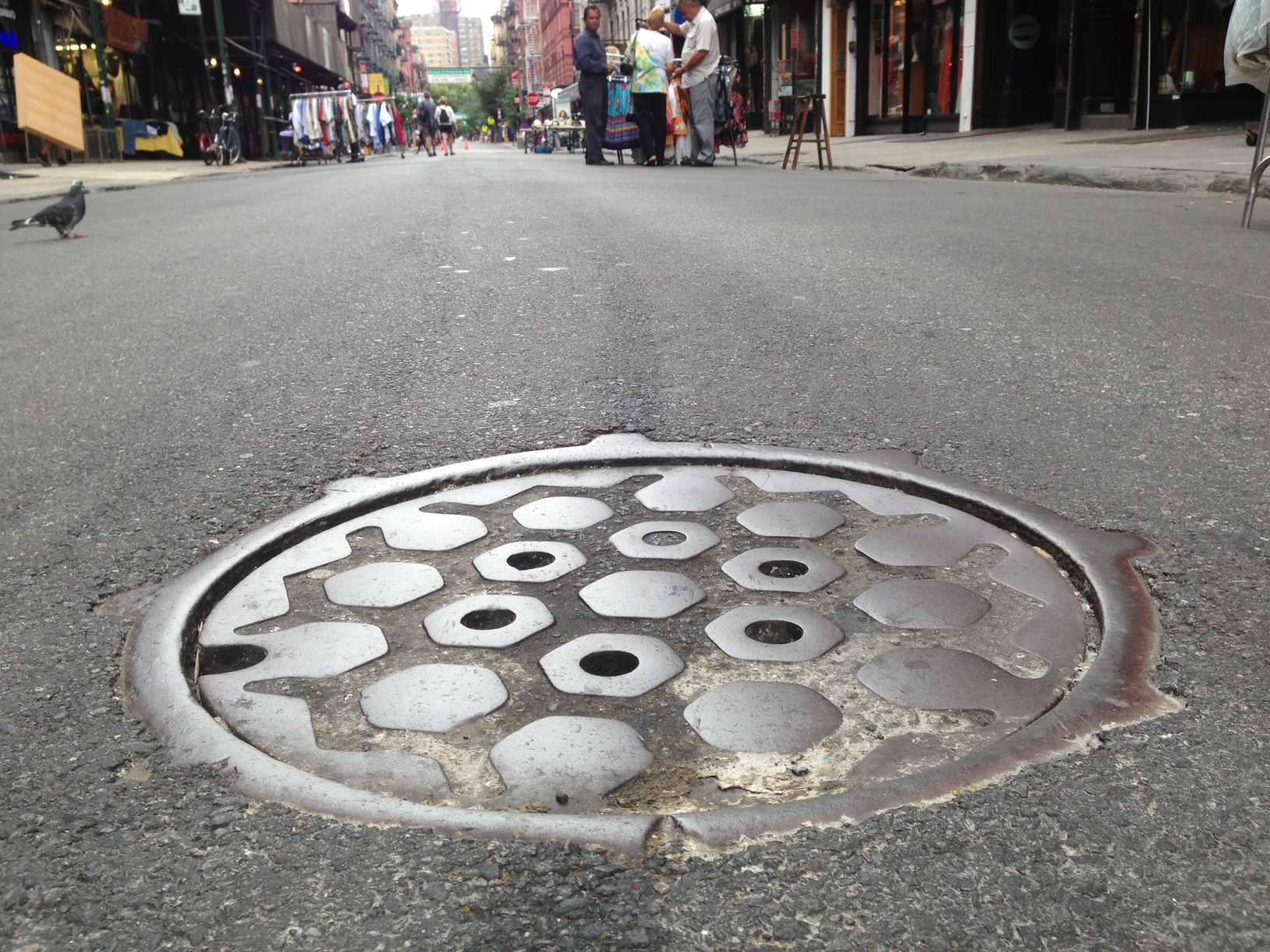
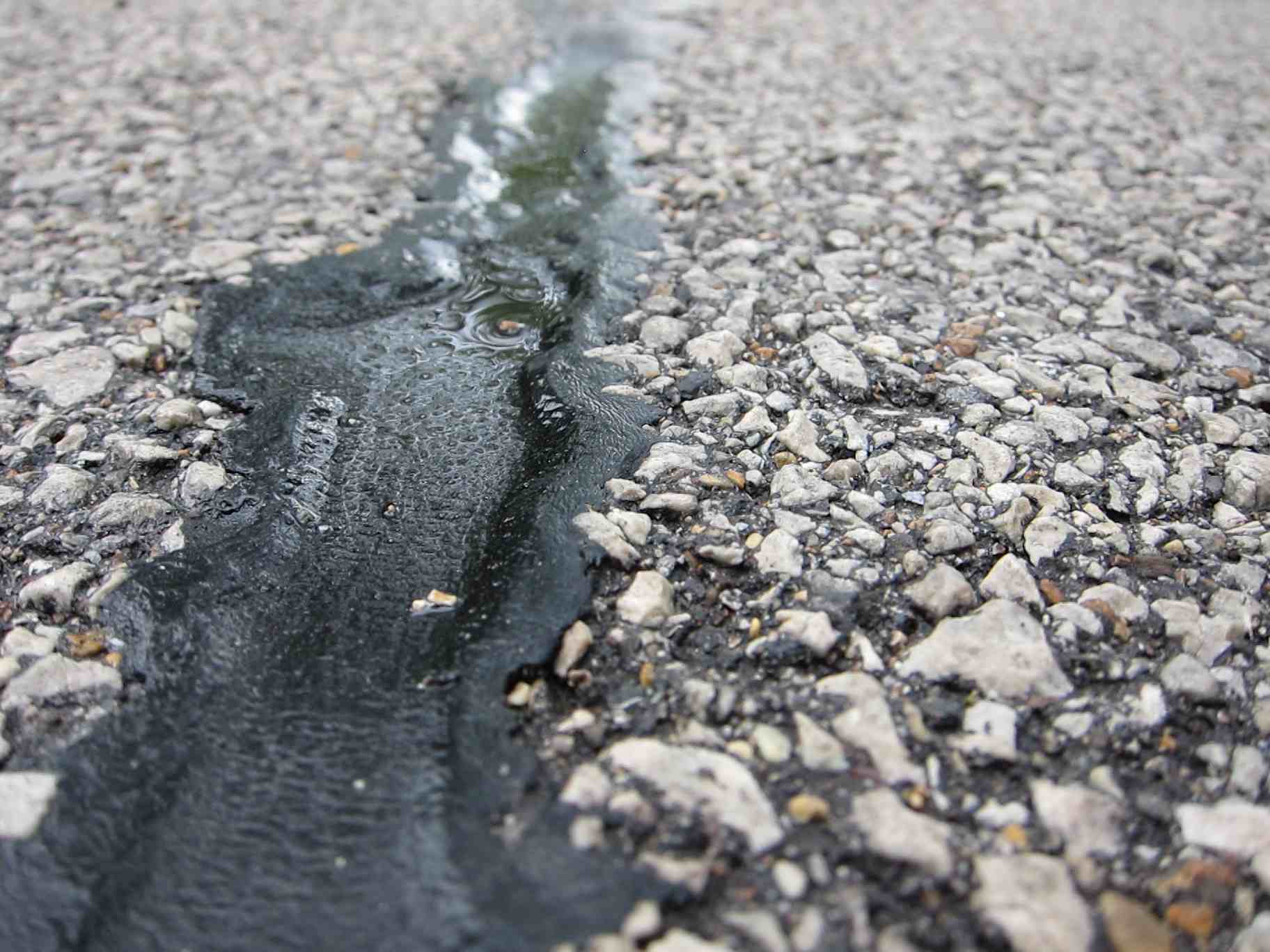
Road features made of tar.

We use the term “You Rock!” to describe so many things.

Win a volleyball tournament? You Rock!

Nail your cello solo? You Rock!

Finish a marathon, a half marathon or a triathlon? You definitely rock…

Earn that promotion at work? You Rock! You Rock! You Rock!

Deceptive words

But such enthusiasm can be deceptive. Our proclamations really are sort of a dismissal, if you think about them in any depth. The term “You Rock!” is often shorthand for “Don’t tell me any more! I’ve just given you the ultimate compliment.”

And what is that? You Rock.

Which eclipses all other conversation about the subject.

A partial eclipse

Cancer Rocks in a different way than that because after all, most people would say cancer does not rock, Cancer Sucks.

Cancer makes people sick and kills them. And that does sort of “suck” whatever that means, because there’s not really much we can do about cancer even though we’ve spent billions developing research and treatments that cure some people but leaves others to rot away and die. It’s harsh and it sucks, if you insist on colloquializing it.

Our shallowness in saying Cancer Sucks is about as meaningful as uttering the phrase Cancer Rocks. Those bookends don’t begin to tell the full tale of courage shown by people trying to live their best through nearly barbaric treatments. What it comes down to is this: the people seeking to help those stricken with cancer are pretty much at a loss for words. So we lean on words like “Cancer Sucks” to get us through the awkwardness of not knowing what the hell else to say.

It’s the tarsnake of conversation about cancer.

Unformulaic

So you have to shake up the formula to get past the Cancer Sucks and Cancer Rocks levels of consideration to reach something substantive about the subject of cancer.

Having served as direct caregiver to two loved ones who died from the disease, and having witnessed their determined hope right up until the end, I base my observations on an intimate but limited experience with cancer as a condition.

I got to know enough other people with cancer in waiting rooms to reveal a truth behind it all. Cancer is its own reality.

Dealing with that reality is the part we find hardest to grasp.

Unreality

We essentially lost a hero in that regard with the downfall of one Lance Armstrong, who failed the image he’d built up and the example he’d set when it was revealed that he was doing a bit of cheating all those years he won the Tour de France.

His Livestrong Foundation remains an inspiration to many apart from his apparent disgrace as a doped up cyclist. He’s the ultimate poster child for the opposing worlds of Cancer Sucks and Cancer Rocks. He’s essentially shown us how tough it is to draw a clean, clear line of demarcation between the bookends of treatment and success. There is tremendous value in that if we are willing to grasp it.

Life changing

Lance claimed that cancer changed him in significant ways. His motivation to ride (and to live) after cancer pulled him through. Only during the absolute depths of chemo did he lose some degree of hope. When you’re just trying to survive, climbing to the top of a mountain you might say, the vision of hope is just as important as the prognosis. I know that for sure, because I’ve seen it firsthand.

Perhaps Armstrong might never have reached the heights he did without the depths of cancer to scratch free the bonds of anger hemming in his soul. We will never know the answer to that question, just as we will likely never know how much his doping actually helped him win 7 times at the Tour de France. It is impossible to separate the effort he put out from the drugs he put in.

Opposites attract

You could say the same of many people in cancer treatment. How do you separate or categorize the courage of one person who survives cancer treatment with the effort of another who succumbs? Every circumstance is different. To claim that one person was braver than another is passing a complex and dismissive brand of judgment. And that’s ugly territory.

Cancer isn’t just one thing, anyway. It is a disease of many forms even within one person.

My mother started treatment for lymphoma over a year before she learned of the fatal pancreatic cancer beneath it all. The chemo she took to combat the disease caused a stroke. And she died. Cancer didn’t kill her. But it did rock her world in a bad way.

My wife began treatment for ovarian cancer in 2005. She took everything they threw at her to put it into remission. 11 grueling chemo treatments. Surgeries. And it came back. We hit it again with a regimen just as strong. And it came back. It came back again and again and again. It rocked her world in all the wrong ways. Finally it showed up in her brain, and the doctor’s said, “Hmmm. It’s not supposed to do that.”

Ya think?

Tending the rock garden

All she wanted to do was live without cancer as the foundation of her existence. So she gardened and taught preschool and loved her family.

Maybe that sounds familiar to you? Perhaps you know someone else with cancer and a similar story. You might have lost them to eternity as well. And what do we make of that?

As a caregiver I can only tell you my personal experience, and what it now means to me.

I feel like I crawled out from underneath a rock after 8 long years of worry and strain. I could feel guilt for feeling better or I could be grateful that we survived as long as we did. Cancer rocked us this way and that. It rocked our finances. Rocked my employment. Rocked our family and friends. Rocked our marriage, but we held strong in faith and fidelity.

Yes, Cancer Rocks all right. It rocks you in ways that equate to throwing someone under a bus or in front of a train. You might not get hurt at all. Or you could get destroyed.

My perhaps naive take is that our blessings were indeed fulfilled while she lived. We had help. We made the best of it. When it is all said and done, however, one must move on. There is no other choice.

Acknowledgement

You must simultaneously acknowledge that cancer changes you in ways that perhaps nothing else can. Is it ironic or inevitable that some of those changes turn out to be for the better?

Originally bitter people can come to appreciate life through their experiences with cancer. Faithless people might find God, if that’s their bent. Lives are changed. Cancer rocks that way too. It goes both directions.

We just don’t like to think that much about the fact that it might have positive effects on us.

Gun to our heads

It’s like that character in the Flannery O’Connor story, a grandmother who bitches her way through life until she witnesses her entire family slain before her by feckless thieves on rural backroads.

With a gun held in her face she repents and speaks kindnesses to the murderous men. They pull the trigger anyway. One turns to the other and says (in paraphrase): “She would have been a good woman with a gun to her head her whole life.”

It’s that way with cancer. It’s the gun to our collective heads. We can either be better people for it or we can let it consume us entirely.

Like the old woman spitting invectives through the veil of her bitterness, the ugliness of cancer is ultimately shallow. We all die sooner or later. Life is a pre-existing condition, and nature doesn’t view it as all that precious.

So Cancer Rocks, in that it reveals strange truths about life.

Of course Cancer Sucks for the same reason.

It’s what you choose to make of that apparent dichotomy that matters. We run and ride to sort out the difference, and to make a difference where we can.

WeRunandRideLogo

Posted in Tarsnakes, We Run and Ride Every Day | Tagged , , , , , , , , , , , , , , , | 2 Comments

Grasping age-related athletic reality does not mean stopping in your tracks

By Christopher Cudworth

Having teammates can be a fun motivator for better performance...at any age.

Having teammates can be a fun motivator for better performance…at any age.

When you haven’t run a 5K or any other kind of running race in a while, there are all sorts of things that go through your head as you warm up. You wonder about your training prep. Was there enough speed thrown in? Should you have done even faster intervals? More intervals?

The questions are classic, and nothing novel about them. Every runner has doubts leading up to a race. There are probably only a few times in every runner’s career where you step to the line with almost absolute confidence. Even that is a risk. Running has a way of humbling even the most prepared athlete.

Comparative challenges

The odd part of racing these days is the comparative challenge of figuring out what’s possible when your PRs are so considerably faster, set at a much younger age, and you don’t know what the deleterious effects of age really are? How much do you typically lose in 5K speed over a 30 year period?

Playing soccer in my late 40s, there were frequent questions about how old (or young) I really was. Those were compliments of a sort. Compared to the other players on the field, I was not any slower, and that was amazing to players 10 or 15 years younger.

I took pride in that fact until my son showed up to play one weekend. His speed was obvious on the field. He was a full gear faster than any other player in the 30 and over league. At 20 years old he had the same build and frame that I once possessed, and he was quick and aggressive. In other words, he gave me a glimpse into my former self. He scored goal after goal that day, while I had but one, a volley off the front of the box that required no speed at all.

You go to war with the Army you have…

But like the militarily dismissive prognosticator Donald Rumsfeld once said, “As you know, ah, you go to war with the army you have—not the army you might want or wish to have at a later time…”

Not exactly a confidence builder, that Donald. But that’s how most of us do feel on the battlefields we choose to face in athletic competition. We can’t change the fact that age diminishes our skills and our endurance. Ultimately there is a decrease in performance compared to running during our athletic peak.

Renewed interest

So when I ran a 21:51 5K leg on the tail end of a triathlon race recently, it was cause for a certain sort of celebration. Of course my PR at 5K is 14:45, about 6 minutes faster for the distance.

But it wasn’t like you could not see that coming. Practical intervals were good predictors on how fast I could legitimately run. My max interval pace was 1:30 for 400 meters, or 6:00 per mile pace. That’s not a tremendous strain to do, but going faster would create some real stress. During each interval, passing the 200 meter mark at around 45 seconds, it occurred to me what a fine line it is between what I used to run and what I can run now. At peak fitness for a 14:45 5K, I once did 8 X 400 at an average of 63 seconds or 4:12 mile pace. Now I can probably do 8 X 400 at 1:33 or 6:12 pace. I’m literally two minutes per mile slower, more than one full lap, than I was 30 years ago.

How much can you improve? 

Run and ride hard. Enjoy it. Grasping reality is not the same as stopping in your tracks.

Run and ride hard. Enjoy it. Grasping reality is not the same as stopping in your tracks.

I expect to improve some, but how much is impossible to predict. Age is simply an unknown factor.

Except that it isn’t. The 55-59 age group 5km record is owned by Vic Heckler of Park Ridge, IL. He ran 16:07 in September of 1997. The 8km record is held by Norm Green, now of Naples, Florida. But I raced against Norm on the road race circuit in eastern Pennsylvania in the early 1980s. He was an age phenom even then, and he managed to run 27:00 for 8km (almost 5 miles) in January of 1990.

The 10km record for ages 55-59 is 32:27 by Jim O’Neill, set in 1993. O’Neill also holds the 10 mile masters 55-59 age group record of 54:25.

Good old Norm Green set the Half Marathon record of 1:10: 23 for the age group back in 1987. That time happens to beat my all-time best when I was at peak fitness. I ran in the mid-1:10s as well. At age 24.

The marathon record for 55-59 year old males is 2:33:49 by Norm Green, who seems to have secured his place in American distance running history.

Women’s age group marks

The women’s marks are similarly impressive. Shirley Matson set the women’s 55-59 record of 18:32, the 8Km at 30:10 and a few other marks including the Half Marathon of 1:23:09. G’ job Shirley!

S. Rae Baymiller owns the Marathon record of 2:52:14 and several other records as well.

If you want to see how you compare to road racing records for your age group, it’s rather fun to look at the USA Track and Field website.

Apparent limits and perceived efforts

The point here is that all of us sooner or later do face some apparent limits in terms of age group pace and time. The fact that 14:45 is no longer possible for me should not deter the effort, however, of getting fit enough to compete well in age group competition. You have to swallow a little competitive pride at the start when the younger athletes take off at 5:00 pace. But who says running 6:45 the first mile is the pace of a slug?

That’s what happened as I took part in a triathlon relay. Even forcing myself to slow down resulted in a faster pace than I’d planned in the first mile. Then came a 7:00 middle mile, followed by a 7:15 third mile. Not exactly even splits, but not having raced in a while meant that most of the sensations were new all over again. The flirting twitch of a potential side stitch. The reminder to stay on the midfoot and stay smooth. It all worked. The race felt fluid and smart. And I knew I could do it. That’s a great sensation too. When you hit your goal it is satisfying even if that goal is not what it might have been 30 years ago.

It’s true in cycling too. Most of us are not thinking about age on the group ride or even when racing a criterium. You don’t have time. You have to think about cadence and bike position and keeping in the draft. Only when you’re done do you have time to worry about who you were riding with. Even then it doesn’t matter. We all work to keep up or get ahead. Competing as you get older (and that happens without exception) is the tarsnake of competition as a rule. Sooner or later, you must accept some limits.

Worried about diminished performance relative to younger athletes?

Not me. Not anymore. I still like the feeling of getting on the track at twilight and running as fast as I can go for 400 meters or a mile. I’ll never run a 60 second 400M again. I know that. But grasping reality does not need to be the same as stopping in your tracks. Not by a long shot. And not in the long run.

We Run and Ride. So do you. Let's share original thoughts.

We Run and Ride. So do you. Let’s share original thoughts.

Posted in We Run and Ride Every Day | Tagged , , , , , , , , , , , , , , , , , , , , | Leave a comment

Coming full circle on Schwinn

By Monte Wehrkamp and Christopher Cudworth

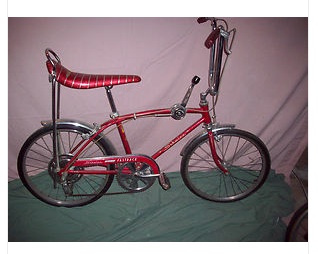
SchwinnFitness-quality-sealExactly what is a Schwinn? This family-owned Chicago bike company grew and became the zeitgeist of a generation with bikes called Stingrays that often featured banana seats. Whether single speed, 3-speed, or 5-speed, the banana seat and ape hanger bars captured the hot rod, muscle car craze in America at the time and gave to us young boys the hope, however slim at times, of actually being cool.

Remember the colors? Orange Crush. Candy Apple Red (that’s the one I got for Christmas). Perfect. 

Then Schwinn launched the concept of bike as transportation in America by bringing us the 10-speeds like the Varsity. Sure, there were Columbias and other brands of bikes, and later Raleighs won a certain zeitgeist as well, but it was Schwinn who originally drove the consumer bike market with their Varsity line — much like how GM dictated the entire car market when they accounted for fully half of all American sales up through the early 70s. 

To accommodate a not so Tiny butt. It's basic geometry. Put part of the seat under the "sit bones."

To accommodate a not so Tiny butt. It’s basic geometry. Put part of the seat under the “sit bones.”

Alas, Schwinn began to suffer under its own weight, literally. The bikes were being outclassed by imports, which were also cheaper. Schwinn found it impossible to compete price-wise with its Chicago-built bikes vs those from Taiwan and Japan. The European bikes, while more expensive, were made by master race bike builders utilizing Campagnolo components, so Schwinn was getting beaten in the race bike market as well.

So Schwinn sought to find a partner – someone overseas with cheap labor but a good manufacturing base. Someone they could teach bike building to, then import these Schwinn-Approved (and branded bikes) to the US to compete with Japan Inc. They found a company in Taiwan, sent over designers and engineers from Chicago, tooled up their plant, taught them how to build very good bikes.

In the meantime, Schwinn closed down Chicago but kept their custom shop in Waterford, Wisconsin, where the hand-made Paramount was built.

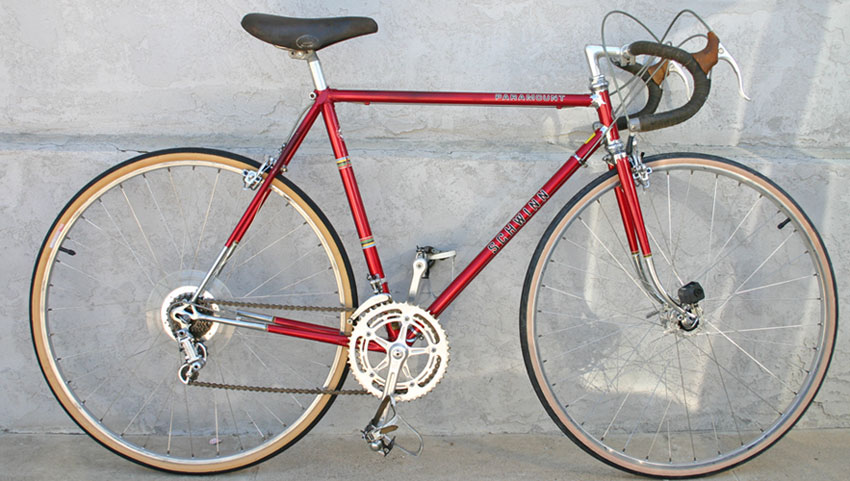
paramountThe Paramount was Schwinn’s answer to the Euro race bikes. Top end components. Lustrous paint. Race geometry. But too expensive. Some of us settled for the last US built Schwinn race bikes built that were a step below Paramount. Shared geometry, but with slightly heavier tubing and instead of Campy components, the next-level Schwinns were fitted with Suntour (now making a comeback today) components. 

But for Schwinn, it was apparently all too late. They’d lost too much market share. Their brand name, which was once very much in their favor, became known for stationary exercise fan bikes. Independent bike stores became the trend and the old Schwinn bike store locations, with their perceived fuddy-duddy Schwinn bikes, slowly closed, or re-opened selling other brands, like start-ups Trek and Cannondale, and the European invasion – Calnago, Bianchi, Willier, to name just a few. 

Schwinn launched a new ad campaign. The creative director that worked on it took off six months from work and rode bikes. Marin County, California. Hung out with the mountain bikers. Learned the culture. The language. Came back and wrote brilliant stuff. Great ad campaign. But too late. Schwinn went bankrupt. Closed its doors. 

Today, Schwinn, the brand, is owned by a Chinese investment group and they slap the Schwinn logo on mass-produced assembly line bikes that are sold mostly in Walmart.

The ultimate child ride: A red Sting-Ray

The ultimate child ride: A red Sting-Ray

They’ve started to build up a decent line as well, mid-price point, mostly sold through Performance Bike and their subsidiary.  Those bikes are sold by Nashbar (Famous Maker No-Name Bike, they call them). They even brought back the Paramount name for awhile. Didn’t stick. No young riders today remember Paramount and what it meant. Toward the end of the product run last year, you could get a new Dura-Ace gruppo’ed carbon Paramount for under $1500. Incredible bargain, but no brand recognition. 

The Waterford, WI plant never closed. A Schwinn grandson runs it to this day, and if you want a custom fit, custom built steel bike, you won’t go wrong having Waterford build you a dream bike. 

Vestiges of the original Schwinn also lives on in Taiwan. The manufacturing company Schwinn selected to build their bikes — the one that learned from the original Chicago Schwinn engineers and designers — is still going strong today. They go by the name Giant, and they build both recreational and world-class bikes used by pro road and mountain and cyclocross teams all over the world. 

So Schwinn, in a way, lives on. Just like its old bikes, made in Chicago many decades ago. 


WeRunandRideLogo 

Posted in We Run and Ride Every Day | Tagged , , , , , , , , , , , , , , | Leave a comment

The geometry of a Schwinn bike

By Christopher Cudworth

About the only math subject in which this art major ever excelled was geometry. So I understand the basics of how geometry works. Or at least I think I do. There are shapes. They behave or are formed by certain rules. Those rules relate to mathematics. There is a certain predictability to those rules if you pay attention to the numbers.

The classic geometry of a Schwinn bike.

The classic geometry of a Schwinn bike.

The same thing goes for bikes. As a rule, bike geometry has not changed all that much in the last 100 years. You have a crankset at the bottom where the pedals are attached. A chain leading to the rear hub. That’s what makes it go. Then there’s the rest of the frame, which typically forms a sort of triangle, for strength, with the front and rear forks holding the wheels. Then you have handlebars and a seatpost.

If you accept this premise as basic bike geometry, then your prejudices toward the modernization of bikes will not sway you from the value of a classic bike. In yesterday’s story about a Schwinn Varsity that moved to a new owner, the bike symbolized something important in life. That is, the weight of our being can be tough to carry. Meanwhile, it works the opposite way as well. Sometimes the things we bring into our lives, or the things that get dumped on us at times, have to be carried as well. That’s what the Beatles were talking about when they sang those lyrics at the end of Abbey Road, side two.

“Boy….You’re gonna carry that weight, a long time…”

But everything is relative, and how you carry that burden can determine how you view the burden, and what it is in life that slows you down, or not.

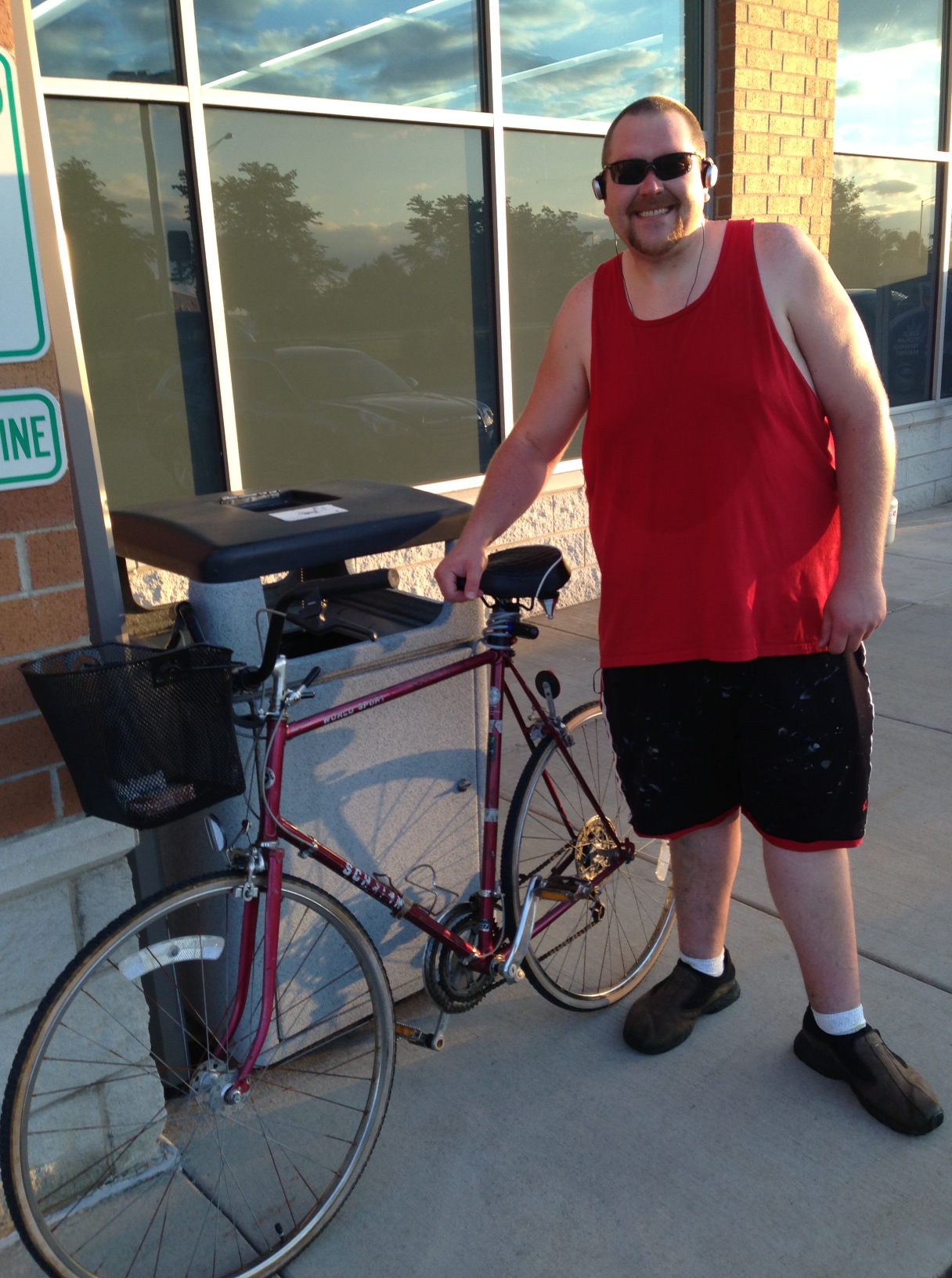
Tiny, also known as Kevin, stands with his Schwinn.

Tiny, also known as Kevin, stands with his Schwinn.

Which is why I was so fascinated to meet a guy named Tiny.

He’s anything but tiny. His real name is Kevin, but I don’t know any more about him other than what he told me about liking to ride his newfound friend, a Schwinn bike that had been sitting in the garage of a friend. The friend was going to give the bike away or sell it, and Tiny decided he wanted that bike. “I’ve always liked to ride,” he told me outside the Walgreen’s store in Batavia where he’d parked the bike while going inside to get some cigarettes and a Gatorade. “So I asked him for the bike.”

That Schwinn bike has what can only be called a classic bike geometry. The bottom tube is 8″ down from the top tube on the front tube. Makes a big triangle, that.

The bike is also constructed with very thin metal tubing. It almost looks frail by comparison to today’s fatter, sleeker carbon fiber bikes. Even the most basic road bike models have elongated shapes in the tubing. The better to mount the logos of the bike makers?

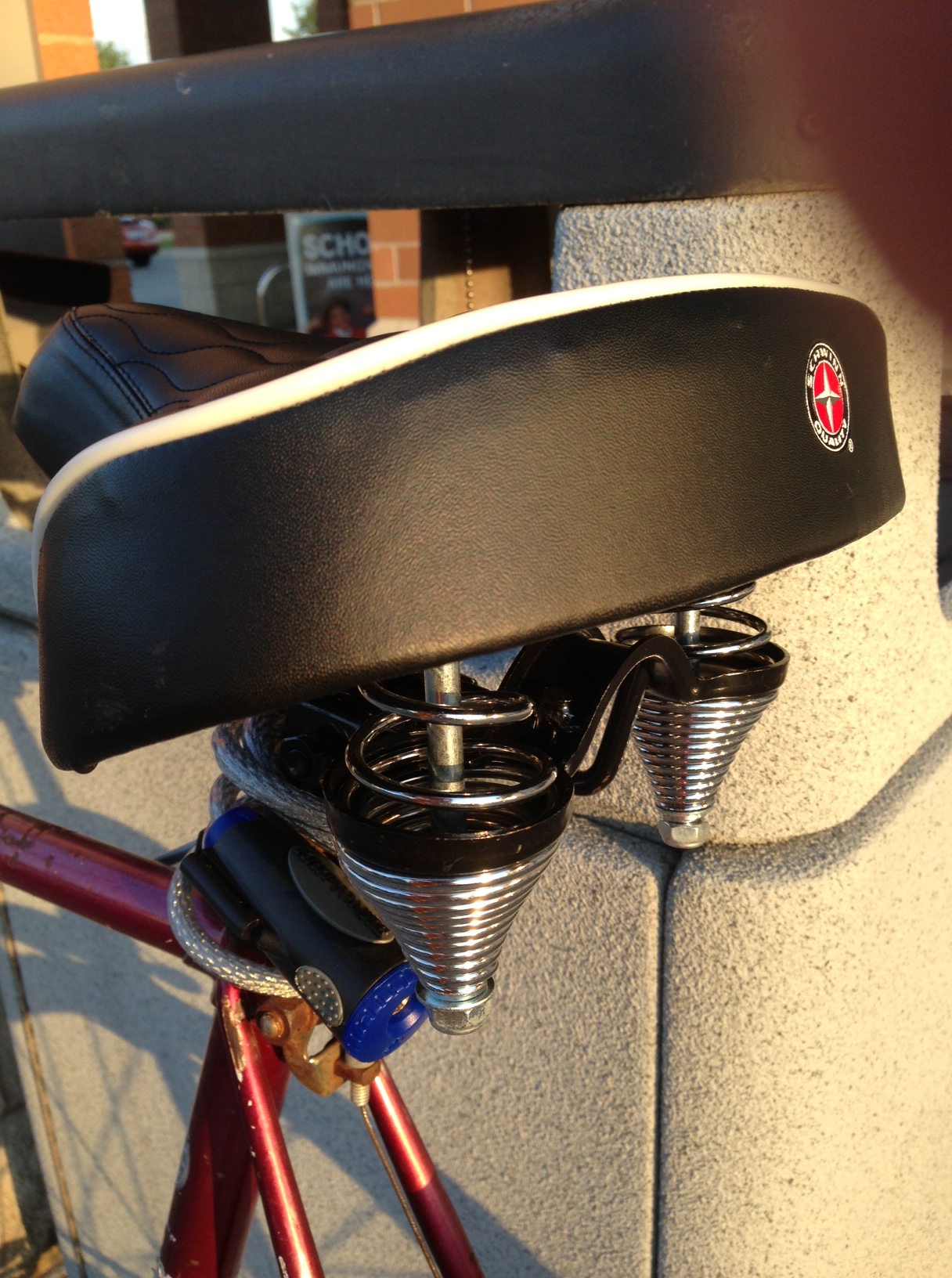
To accommodate a not so Tiny butt. It's basic geometry. Put part of the seat under the "sit bones."

To accommodate a not so Tiny butt. It’s basic geometry. Put part of the seat under the “sit bones.”

Tiny loves his Schwinn. He’s put a new seat on it. “That’s to make my butt fit,” he chortles. He also hung a sturdy wire basket on the front so he can carry shit around if he likes. And he likes.

Standing with a sheen of sweat on his body and dripping from his head, it was obvious Tiny had ridden hard enough to get some exercise. He makes no pretense about his size. He carries his weight with personality and panache. Some of it may go away, that weight, if he keeps riding a lot. But not likely. Some people move through life and carry that weight in a sphere of their own. They are happy doing what they are doing. No amount of lycra would change them. Nor would a bike with a different, more radical or race-oriented geometry.

Because it turns out that for some people, life is not a race at all. They get from Point A to  Point B faster or slower, and it doesn’t matter to anyone but them. Then they go from Point B to Point C, closing the loop for that day, and the next. Their geometry is different, you see, from the Strava and the like. Their internal maps are all they ever want. And a Schwinn is plenty capable of taking them there.

It’s classic geometry.

WeRunandRideLogo

Posted in We Run and Ride Every Day | Tagged , , , , , , , , , , | Leave a comment

The Journey of a Schwinn Varsity Bicycle

By Christopher Cudworth

The classic Schwinn Varsity.

The classic Schwinn Varsity.

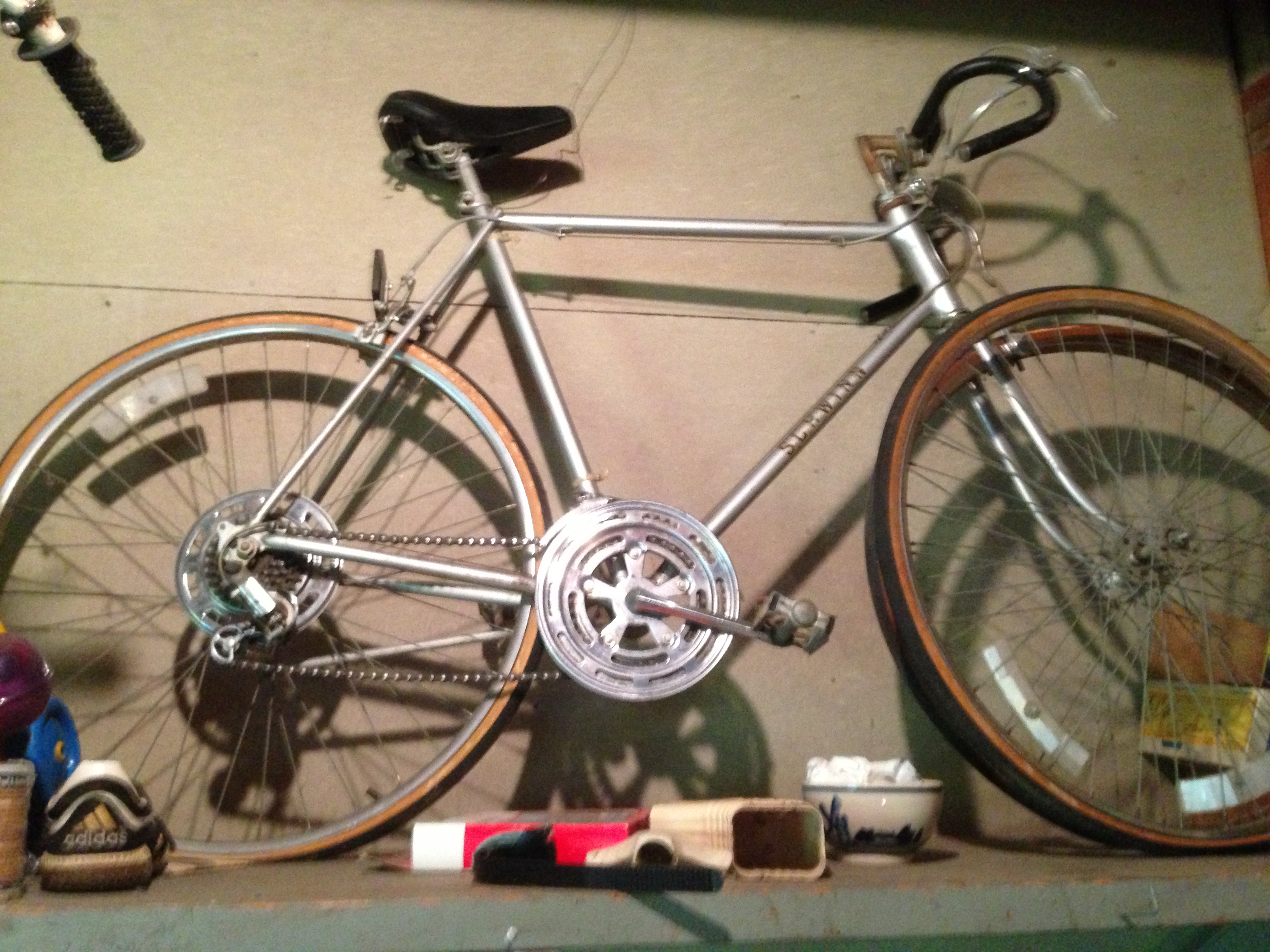
In 1968 the Schwinn Varsity was one of the “must haves” among bikes in North America. Heavy and durable, yet racy with drop handlebars and an actual 10-speed derailleur, the Schwinn Varsity knocked it out of the park as an object expression of cycling freshness and freedom.

Seeing the world on a Huffy 3-Speed

Confined to a Huffy 3-speed during my teen years, it was raw jealousy that haunted my heart when riding with my friends from wealthier families who actually owned a Schwinn Varsity. My buddy Eeker (a nickname) possessed a yellow Schwinn Varsity with those industrial-looking pedals and the tightly taped drop handlebars. On the rare occasions when I was allowed to ride his bike, the speeds were confusing because the most I knew about shifters was the little thumb tab on my Huffy 3-speed. The Schwinn had levers and if you didn’t know anything about derailleurs it was like a complex algorithm trying to figure out how to shift gears. Yet finally you’d grab one and pump your damned legs and the thing would really go. Sure, the Schwinn Varsity weighed about 40 lbs, give or take a dozen, but once you got rolling momentum would take you quite a ways.

Sports marketing mystique

Like a pair of Red Ball Jet sneakers, part of the mystique of Schwinn bikes was the perception of its brand. So we all learned an early lesson in sports equipment marketing, because everyone I knew wanted a Schwinn 10-speed bike. The lust for a piece of athletic equipment is sufficient at times to outstrip all rationality. Our yearning for play exceeds our capacity for self-control.

Many more sports marketing lessons would be learned in a life in athletics. Nike. Adidas. Reebok. Brooks. New Balance. Tiger/Asics. Tinley. Sporthill. Livestrong. On and on we go.

But the Schwinn Varsity was one of the first brand lusts of the modern era. We were innocent partners in an industry that would grow and grow over the last 40 years. Trek. LeMond. Scott. Felt. Orbea. Cervelo. You can almost feel the bikes changing underneath your butt as you ride them. Trickle down technology works from the ground up. But the Schwinn Varsity was something of a beginning.

Inheritance

Hidden in the garage for nearly 30 years.

Hidden in the garage for nearly 30 years.

My late wife owned a Schwinn Varsity with a silver paint job. She told of riding that bike around the neighborhoods of Addison, Illinois, and sneaking away on the freedom it gave her in her teens. Really, it felt like a Schwinn Varsity could take you anywhere.

One day while riding up the narrow strip of asphalt called Woodale Road, a passing truck clipped her with its passenger side mirror. The mirror knocked her off her bike, tore off her shirt and caused a massive gash on her left shoulder. The truck stopped and the driver stood around sheepishly until she could be carted off bloody and scared to the hospital for treatment. The trucking company paid her bills in those days, but nothing more. In the late 1960s society was not so attuned to the idea of recompense for pain and suffering. At least not for her.

Damage done

The accident made it tough for her to ride a bike on the road the rest of her life. We kept that Schwinn Varsity all those years. It hung in various dusty, hot places in the garage as we moved a few times. Finally the Scwhinn came to rest high up on a set of wooden rafters in our home. The light reflecting off the garage floor would often illuminate that silver Schwinn Varsity, and occasionally I would take it down just to admire its finish, and its heft. It weighed a ton, but I’d ride it up and down the street with its dry-rotting tires just to see what it felt like to ride a Schwinn Varsity again.

Changing gears. Changing years. 

It is funny how the objects of your early desires in life can come to feel like a burden once circumstance and technology enter in to change the world. Despite the fact that some people might feel the Schwinn Varsity was a perfectly good bike, my wife refused to ride it. The seat was uncomfortable. The bars were dropped too low. It was creaky and dangerous feeling.

To Linda, it was not the only weight and structure of the bike that made it untenable to ride, but the weight of the early experience she’d had getting knocked off that bike that made it so undesirable to ride again.

The simple truth is that the Schwinn mystique had grown heavy with time. So we bought her a clean new Trek Navigator 2.0. Twice as light. Nice full seat. Better ergonomics. Teh Schwinn Varsity was permanently relegated to the garage attic.

Repeating patterns 

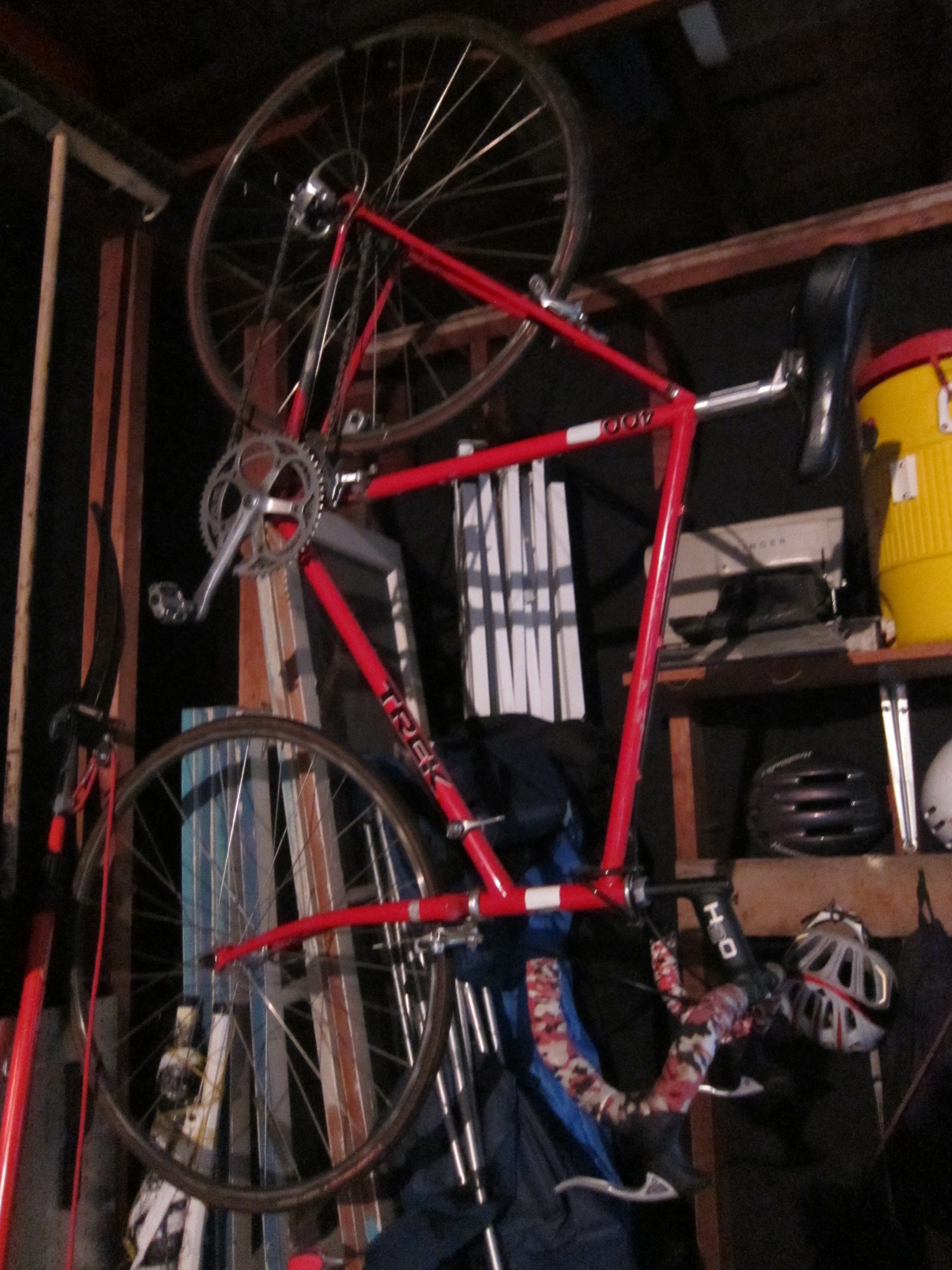
The red Trek 400 that launched two riders' cycling habits.

The red Trek 400 that launched two riders’ cycling habits.

The pattern of bicycle obsolescence repeated itself in the Trek 400 steel frame road bike my brother-in-law gave me to begin cycling. For two or three summers I rode that bike as hard as I could, trying like hell to build cycling muscles and keep up with the occasional group rides.

I clipped in with mountain bike shoes and SPD pedals, and could average up to 18 mph for 30 miles on the Trek that had similarly introduced my brother-in-law to cycling. He graduated from the Trek 400 to carbon fiber bikes and then purchased a sweet Waterford crit bike emblazoned with his team name and his own name in decals on the top tube. He raced CAT 3 and lived the sport fully until one day his fever ebbed and he stashed all his cycling stuff and jumped into the sport of skydiving.

Moving on

So we grow, and we graduate to new things and changed circumstances. The things we once prized become garage ornaments or mementos of the people we once were. But I could not bring myself to turn the Schwinn Varsity into a garden ornament. Giving it to Goodwill didn’t seem the right route to go either. I always wanted to find it a good home. Someone who really wanted and appreciated the Schwinn Varsity would be able to identify. That’s what I figured anyway.

At one point I put the Schwinn Varsity out on display during the lone Garage Sale I’ve ever conducted. A local bike expert who fixes up bikes and sells them on his front lawn came by to inspect the Schwinn. His careful eye noted a slight ding to the rear wheel, which was out of true. There was rust on the handlebars in dark brown pits. He didn’t buy the bike. “Too much work,” he told me.

Do It Yourself

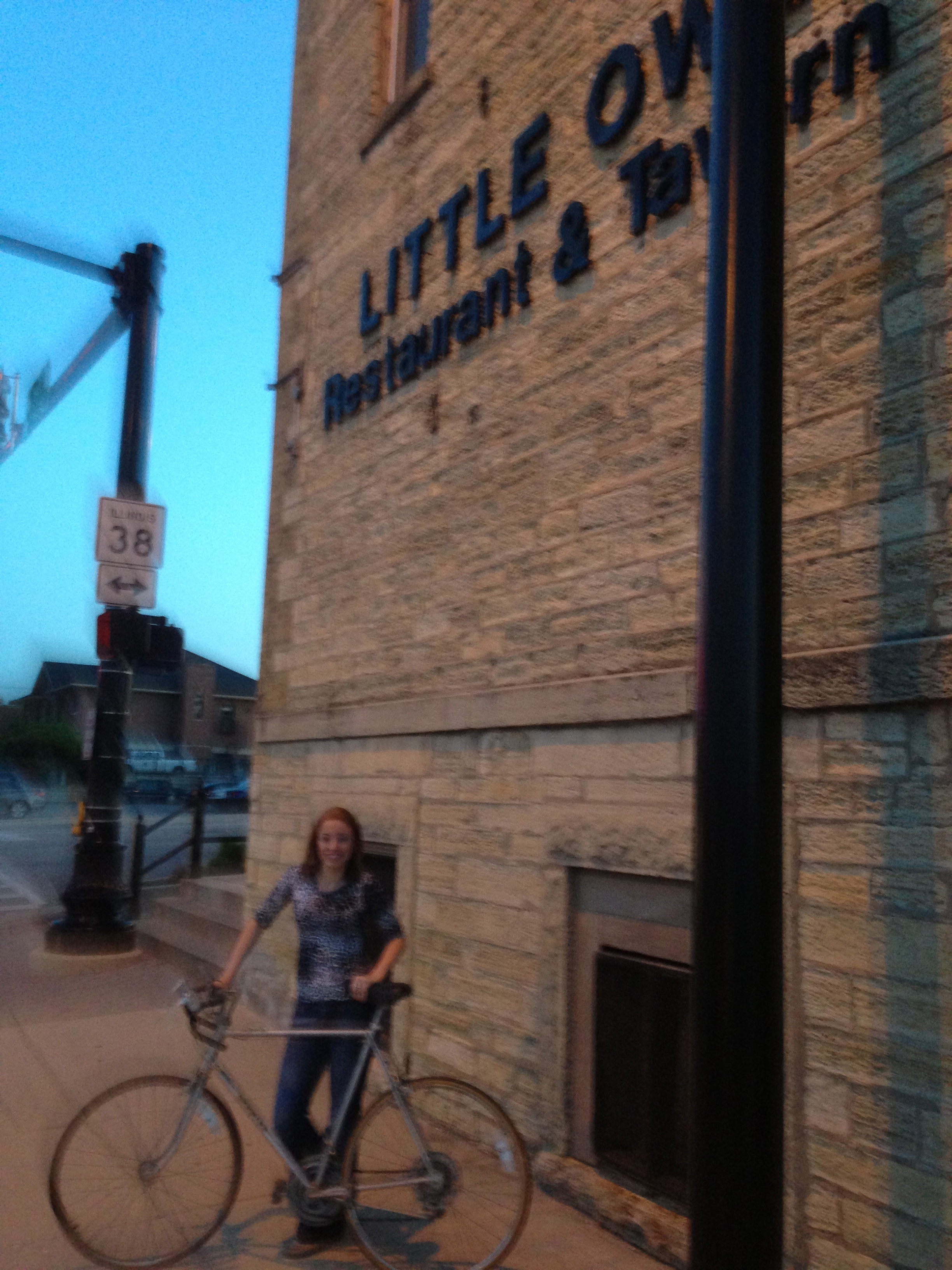
The new owner of a very old bike. And happy for it.

The new owner of a very old bike. And happy for it.

So I took the initiative this year to fix up the Schwinn, using WD-40 to clean the rust off everywhere. The bike shone. Even the wheels. Put new tires on both wheels. The shifters and brakes were still fine. Then I waited for the right cosmic moment and the right person on whom to bestow the Schwinn.

It happened one night at a bar in nearby Geneva, the Little Owl. While waiting for friends on a slow Friday night I struck up a conversation with the bartender, a young woman working her way through college. She took an interest in the fact that I was meeting up with cycling friends for a beer and said, “I like to ride. I just need to get a bike. But I want something cool and old I can knock around on.”

I told her I had just the bike. Just for her. Her eyes brightened, and a couple weeks later I returned to the Little Owl to give her the bike.

My daughter had joined me for drinks and we chatted with the bartender for a while and then went to get the Schwinn out of the back end of the Subaru. The bike wheeled its way happily through the night air, and when the young woman saw the bike, she declared it “perfect” and happily posed for a picture on the sidewalk outside the bar.

A new home for the Schwinn Varsity

The Schwinn Varsity now had a new owner, and a new rider, after more than 40 years. It’s the heaviest damn bike you’d ever want to feel, yet its weight is also its charm. It is far better off in the hands of someone who will love and cherish it than it was hanging like an odd ornament in the garage.

That’s how it is with all kinds of objects and dreams. Sometimes we mothball them for too long. It takes a little lubrication and a bit of elbow grease to get them back in shape. Then we take them out for a ride, and/or share the joy with someone we hardly even know. And the purity of the moment is made from the absence of time.

WeRunandRideLogo

Posted in We Run and Ride Every Day | Tagged , , , , , , , , , , , , , , , , | Leave a comment

Enjoying a bloom of fitness

By Christopher Cudworth

Every bloom has significance.

Every bloom has significance.

Athletic fitness, like the bloom of a brilliant flower, often lasts a few days, or at best a few weeks, before the peak fitness must fade.

The rhythm of blooms

Our bodies, like annual or even perennial flowers, are simply not designed to be in the height of competitive fitness at all times. The human body works on natural cycles of high energies, followed by rest.

It happens at work. And at play. We learn what it means to be in full bloom. And in faded glory. Sometimes both at once.

Recently at a party a friend came up and was talking about having to switch to working the night shift. His eyes grew wide as he described the strange difficulties of tricking his body and brain into being up all night. He was frankly a little pissed that it was necessary at all. Having worked for the same company 23 years, it seemed like some seniority should have come into play. But there are hardly any rules any more. The fact that capital now controls labor so strongly has changed the rules across many fronts. So he’s the one that has to adapt. But you could see the bloom wearing off his exterior self. He rubbed his hair back. Dropped his chin and sighed. We all empathized.

Protecting the bloom of vitality 

You can't leaf your bloom of vitality to chance.

You can’t leaf your bloom of vitality to chance.

In Europe workers have far more vacation typically than their American counterparts. Having a month or even 6 weeks off is not uncommon. The restorative power of that type of time off is tremendous, of course.

Those of us who run and ride and swim know that having time like that to train is pretty much a luxury. That is why I’m so glad to have done a bit of a social experiment back in the 1980s at the peak of my competitive running career.

After having moved to Philadelphia for a job and then having the whole department axed because the VP of Marketing wasn’t really doing his job, I felt lost and a bit insecure. So I came back to Chicago to work out my frustrations by running.

In 1984 I raced 24 times and won 11 of those races. In many others I placed high or set PRs for distances ranging from 5K to Half Marathon. It was quite a way to regain some needed self esteem after the shock of a job loss. But even that drive didn’t last forever.

Facing fitness bloom

By November that year the bloom quickly wilted. It only took one extra race to know that my fitness flower was finished. The first two miles at 5:00 felt strained, then came a 5:30, and a 6:00 mile and pretty soon I was jogging slowly, feeling stale and tired as a piece of wet bread. Finally I walked off the course at 33:00 with a half mile to go. The season was over, I knew.

While it lasted however it was a charming thing to feel. There were weeks of 2-a-day workouts and long, solo runs on the lakefront of Chicago dodging girls in bikinis between Oak Street Beach and Montrose Harbor. Almost every day I’d run up and back those 8 miles, clipping along on the cinder paths of Lincoln Park and breathing deep the breeze by Lake Michigan. Getting faster by the week. I knew even while I was doing it that my efforts were a temporary, ethereal effort at enjoying the bloom. And I loved it.

Practical woes

Sure, I could have been working too. I know that now. But at the time it felt right to try to dedicate myself completely to the effort. It earned me a running contract with a shoe store. Our team had fun racing almost every week. It was a dose of unreality, for sure. But it was a fun dose. I lived on severance pay and worked at the running shoe store.

Would I recommend that strategy to anyone? Not really. Companies aren’t fond of career gaps on your resume. Yet when I think about opportunities in life, that was the one time when I could run my very best, and I’ll never have to question whether I could have gotten any better at distance running. I know the answer to that one. Ran my hardest.

Practical solutions

There’s a value to that, knowing you’ve done your best at something, even if it has little apparent value on the open market. I do recall being invited to interview with the advertising agency Leo Burnett because they wanted me for their racing team. But times were lean at ad agencies in the early 1980s, so even though the employees who ran thought it a great idea to hire me, that was not enough to get in the door, and I never got to show what I could actually do in terms of copywriting. Rather odd, in a way.

photo (8) sb10067340d-001Still, the idea was tantalizing. Who knows where life might have led had that happened? Your flower of fitness sometimes attracts more than one kind of bee.

When mentioning that period to my mother years later, I lamented that I might have wasted time or opportunity doing all that running. “Nope,” she corrected me. “I liked you then. You had energy and focus.”

It was true. Perhaps I didn’t even push it hard enough? You never know. That’s the bloom and fade of risk-taking. Sometimes you simply don’t know whether to quit or push on.

Stop and smell the roses?

The sage advice is always to stop and smell the roses in life, lest it pass you buy.

But the facts are more complex: those roses may appear at different times in life.

Your sole bloom may not be in your 20s or 30s or even your 40s. People everywhere are defining what it means to be any age. By chance or by force in many cases, people are moving into different careers at different stages of life. Some start new businesses or switch careers. Others switch sports, from running to cycling, or from cycling to swimming. Many now combine all three, challenging themselves in ways they never dreamed. They are pursuing the bloom of life without apology.

We really are the flowers we imagine in our own minds.  So the advice on that front is simple: Enjoy the bloom wherever you find it, and don’t be afraid to go out and create your own.

The garden of running and riding

Recently I’ve become a gardener due to the fact that I inherited a garden on the passing of my wife. And while that sole fact has been a point of remembrance, it is also one of renewal. Because a garden is not a fixed object, but always a work in progress. It so resembles the bloom of running and riding or swimming in fact, that those activities go together really well. There is nothing so rewarding as pushing yourself hard, into a bath of sweat and coming home to rinse off your head with a hose and start weeding and plucking and pushing mulch around. Talk about the perfect cooldown!

As it is said in the book Candide, “We must cultivate our garden.”

Want a tee shirt?

We Run and Ride. It’s a movement.

Posted in We Run and Ride Every Day | Tagged , , , , , , , , , , , , , , , , , , , , | Leave a comment

You’ll be glad to know that the pain really matters

Pain tolerance and the dentist chair

A visit to the dentist sends some people into trepidation over pain.

A visit to the dentist sends some people into trepidation over pain.

Sitting in the dentist chair with heavy lead vest draped on my chest and a dental assistant prepping the x-ray machine for another set of images, I thought back to the many other trips to the dentist during my lifetime.

Some of them went smoothly, like the time I cracked a molar on a nut and the dentist to whom I was sent because my regular dentist was out of town proceeded to remove the tooth shards and pop a crown in like it was no harder than making a chicken sandwich. He was a brilliant dentist, and I went home ebullient that my shattered tooth was now permanently fixed. It was a like a miracle in my mind because it did not hurt a bit.

That’s what we want from the dentist, things fixed without pain. I walked out astounded someone could be so proficient in dentistry. His hands had worked miracles.

Losing and regaining a busted toofer

Then there was the time a front tooth got knocked out in baseball practice. With the afternoon light fading fast my coach yelled at me to take “one more grounder” at third base and tossed the ball into the air to hit it in my direction. But rather than a grounder the baseball flew through the air as a hard line drive and struck me flush in the mouth. Blood poured out in thick red spurts. My tooth hung by a nerve and the coach somehow reached my house by phone so that my dad could come pick me up.

I held the tooth up with my right hand and we traveled that way 10 miles from our home in Elburn to a dentist in Geneva, who stuck the tooth back in my head. It wasn’t the dentist’s fault that time that the tooth hurt.

Numbed up and ready to go

Fear of the unknown is part of the challenge of facing pain.

Fear of the unknown is part of the challenge of facing pain.

As kids we’re told it’s a big deal to come home from the dentist with no cavities. You can’t realize the importance of dental health until something really goes wrong. Then it’s time to have your tooth ground out or worse, a root canal.

That shit really hurts.

Even when you’re all numbed up with Novacaine and you can’t feel a thing on one side of your head, there’s a kind of emotional trauma knowing that there actually is pain going on in your head. You just can’t feel it because the medicine is masking the nerve reactions.

Recently a pretty good dentist did some work on a lower molar and the cavity underneath the old filling had come pretty close to the nerve. She numbed me up, then numbed me up a bit more when my body jumped as she skirted the area next to the nerve. I was jumpy and nervous because no one likes dental pain. But it got me thinking…

Pain tolerance

Life can be difficult when you are in the grip of pain.

Life can be difficult when you are in the grip of pain.

Was all the pain tolerance developed over the years or running and riding any use in a dental situation? The two types of pain are quite different. One is self induced, while the other is unpredictable and as a result, scary as hell.

As young (or new) runners or cyclists we all tend to be pretty frightened of the pain factor in endurance sports. Marathoners and half marathoners spend months training in order to delay the pain of exhaustion as long as they can. With luck and good training in the marathon you can make it through 20 miles or beyond before real discomfort or The Wall (if you’re unlucky) hits you hard.

Yet we’ve found that with proper training you can avoid such desperate situations as The Wall or Bonking On the Bike.

Sustained pain

There have been cycling rides where the pain started in the first 5 minutes and lasted for 3 solid hours of riding. Finishing in 3 hours flat at a rate of 20mph you feel pride in having fended off or ridden along with pain for that long. You wonder how you do it. Or, as my daughter is fond of saying, “Why do you do that shit?”

It can be hard to explain to those who regularly avoid pain of any kind. Why do you go out and run till you puke, or until your legs give way in fatigue and your lungs heave with effort?

You do it because it feels good not to be a wimp. That’s the best explanation there is, quite frankly. Yet it’s a tarsnake of sorts. You pursue pleasure through sustained pain? How f’d up is that? Well, a lot of people embrace that philosophy. So either we’re all fucked up or else we’re really on to something…

Pain by degrees

Triathletes specialize in facing three different kinds of pain.

Triathletes specialize in facing three different kinds of pain.

Pain defines us for better or worse. When I watch triathletes emerge from the swim and trot to their bikes, then hang up their bikes and transition to the run, it is impossible not to think, “What kind of sadist thought this up? Was it really a bar bet that started the Ironman Triathlon?”

It’s like triathletes aren’t satisfied with just one kind of pain. They have to explore three different kinds; swimming until their arms ache, cycling until their legs turn to jelly and then pounding out a half or full marathon while trying to eat at the same time. It’s insane. But they love it, clearly, or thousands of people would not line up on Sunday mornings dressed like seals to participate.

Marathoning and other 

I was not really “marathoner” per se during my peak competitive career, that period when you set all your PRs and if you’re lucky, win a few races outright.

I simply liked racing shorter distances too much. 5K. 10K. 10M. Even the occasional half. But I ran several marathons and trained the distance several times in practice. Here’s what I can tell you about running 26.2 miles. It hurts sooner or later. Sometimes a lot. Your only goal is to survive sometimes.

But what’s it worth? Does suffering in sports make you better able to suffer in life?

Here’s what I can tell you about that.

Painful lessons in life

Who would think that a simple bike could both cause and save you from pain?

Who would think that a simple bike could both cause and save you from pain?

When my wife was diagnosed with ovarian cancer and my mother turned out to have pancreatic cancer and died the same year, there was plenty of pain to go around in life. But here’s the truth: I knew how to get through it. You set short term goals to help take the next step. You have come to realize that even profound pain is usually temporary. You can survive if you are patient and perseverant. Just like the bible says.

I made it through the first few months with my wife getting sick from chemo and my mother fading fast, when one day I got a call from my former high school coach cross country and track coach who heard about my situation. We talked a bit and then he sagely said, “Chris, your whole life has been a preparation for this.”

He wisely meant to say that all the pain does matter. It counts toward our emotional salvation. You even appreciate your own vulnerabilities better. You know how to accept and handle humbling situations. And when small victories come around, or even large ones, you know how to celebrate with dignity and respect.

That’s what the pain can teach you, because once felt, you know it can always come back. And that is an invitingly humble, profound fact. The pain matters. It really does teach you things.

WeRunandRideLogo

Posted in Tarsnakes, We Run and Ride Every Day | Tagged , , , , , , | Leave a comment

Your sock drawer may be key to success in life

By Christopher Cudworth

A sock drawer when poorly maintained can cause you all sorts of problems in life.

A sock drawer when poorly maintained can cause you all sorts of problems in life.

Many years back there was a Thorlo sock campaign in which people ran marathons in their Thorlo socks as a means to prove the quality of the Thorlo brand.

Thorlos really are a superior sock. The thickest socks in their brand simply don’t wear out until the elastic up top gives out or else the dog chews a hole in the ball of the foot.

Beyond that, Thorlos almost cannot be killed or destroyed by normal wear and tear.

I myself have Thorlos that are more than 10 years old. They’re a bit thinner as you’d expect, and show some sport sock string hanging off the ankles, but they can still be worn.

Amortizing Thorlos

Sure, they seem expensive when you buy them. But when you amortize the $14.00 you pay for Thorlos over a lifetime of 600 runs, it comes to $0.07 per run. That’s a pretty good deal.

But it’s not comfort that keeps most socks from performing their best in the life of a runner or rider. It is organization that counts.

Organizing your sock drawer is vital if you hope to be a successful runner or rider. When you arise at 5:00 a.m. and have to search through your sock drawer to find a pair that matches, precious time is wasted. You may get out the door 10 minutes later than you would if you have folded two socks together and been ready to run come morning. If you’re running 5 days a week that 10 minutes per day can add up 50:00 per week. The typically time-crushed athlete who works a job cannot afford to give up that training time. Not if he or she wants to succeed in the long run.

Organization doesn’t stink

That means an organized sock drawer can be one of the foundations for better performance. Laugh if you want. Make jokes about the fact your training stinks as much as your socks. If you’re going to change what you’re doing now and improve your odds for better performance, start with your sock drawer

One touch of organization tends to set off another. You might organize your running shorts drawer next.

God forbid a cyclist should have his or her gear organized. There is so much equipment to count up on cycling you had better not be disorganized or it can take an hour to get out the door.

Organization tarsnakes

Of course organization is a tarsnake of sorts. In order to be organized you have to take the time to organize, of course. That seems counterintuitive to some. The world is filled with busy workingpeople who claim their messy desk is actually a valid indicator of their true productivity.

That’s a hard argument to make, and be true. I cite the example of a TV critic that wrote for the newspaper where I once worked. His desk was a mountain of tapes, DVDs and press releases heaped higher than your head. Rumor has it there was a few Beta tapes of films from the mid-80s lurking deep in the pile.

It is hard to argue that is the most efficient way to fly. That’s rather like conducting security checks in the parking lots.

Organization as an aphrodisiac

But I do recall a time in my early 20s when I was trying to impress a woman visiting my apartment that I had my shit together. I made a point to fold my running socks and place them neatly in the top drawer where she could see them. Sure enough, she noticed the drawer left open carefully and commented, “You fold your socks?”

It is a very attractive trait, folding your socks. Habits like that cut through evolutionary and human history and are an intense aphrodisiac to women, especially those who hate dirty socks in the hallway, or hate hearing you complain about not being able to find a matching pair when you’re digging around at 5:30 in the morning, cussing like an evil circus clown and keeping them awake when they could be sleeping an extra half hour.

That type of scene is proof that organizing your sock drawer not only increases your productivity and athletic efficiency, it could damn well save your life. Do not, and I repeat, do not deprive any woman (or any partner) of an extra half hour of sleep when you can avoid it.

In fact, that is Partner Lesson 101 for you dopes out there who think your morning workout and the socks you wear are more important than the health and beauty rest of your significant other. If you believe that, you are naïve and sadly mistaken.

The Inquisition socks it to a poor soul

Inquisitors torture an innocent subject. It is rumored his sock drawer was completely disorganized, a heresy under Catholic Orthodoxy.

Inquisitors torture an innocent subject. It is rumored his sock drawer was completely disorganized, a heresy under Catholic Orthodoxy.

But if you organize your sock drawer, you will be forgiven. Sometimes that can be a lifesaver.

There is a legend that tells of a man condemned to death for heresy of one sort or another during the Inquisition. Rumor has it the blasphemy was a smelly, disorganized sock drawer. A sign of sloth and disrespect for God.

Yet when the Catholic Storm Troopers showed up to cart him off for torture by stuffing small bits of fabric down his mouth until he choked to death, the leader of the group sent to capture the man went to grab a stocking out of the drawer to begin the torture and noticed that the stockings were all neatly folded and lined up by sheen and color.

“This man cannot be condemned,” the Grand Inquisitor opined. “His sock drawer is immaculate! That is a sign of pure character. In fact, we’re lucky he wasn’t already up and running this morning!”

Then the Grand Inquisitor turned to the accused and asked, “By the way, why aren’t you already up and running this morning? Your socks are perfectly organized. Share with us your excuse!”

To which the accused gave the dumbest answer in the history of mankind. “It’s a rest day from running,” he said. “I was sort of thinking of lying in bed to masturbate instead.”

“Take him away!” the Grand Inquisitor said. Then they took his neatly folded stockings and stuffed them down his throat until his chest bulged with the mass of Tyson Gay, Lance Armstrong and the rest of those VO2 max sinners who do performance drugs and don’t even keep their sock drawers straight.

WeRunandRideLogo

Posted in Tarsnakes, We Run and Ride Every Day | Tagged , , , , , , , , , , , , , , , , , , , | Leave a comment

Time out of mind in the triathlon

By Christopher Cudworth

The beach in Racine, Wisconsin prior to the Ironman 70.3

The beach in Racine, Wisconsin prior to the Ironman 70.3. Click photo for larger view. 

The beach in Racine, Wisconsin must be shockingly cold in wintertime. There is nothing stopping the winds from the northeast with 300 miles of cold and sullen lake to put a murderous chill in the wind.

But in July the sun comes up to warm the day, and happy chop ripples the surface and dumps mumbling waves on the shore. It is a peaceful scene to those standing on the deep sand looking out to the water. Waves are nothing to those standing safely on shore.

It’s different when you plan to go out and swim in them. All that wave action near the shore on the lake can be unpredictable, even terrifying if it is your first time competing in a triathlon. You stand near shore and realize there is a mile of open water to cover from the lighthouse down to the breakwater, and it suddenly strikes you that despite the chirping sound of families splashing in the shallows near shore, the lake is not that friendly a place. It is something else. Reality perhaps.

Swim or sink

A seemingly calm lake still holds perils.

A seemingly calm lake still holds perils. Click photo for larger view. 

The idea of stuffing your head under the next wave and embarking on a 1.2 mile swim can bring on actual waves of nausea and wide-eyed fear. But if you’re lucky, some other competitor will sense your trepidation, pat you on the shoulder and say, “You can do it.”

But there are no guarantees. Open water swimming is nothing if not unpredictable. When you’re running a marathon you might fall down from exhaustion or sit on the curb to recover when the wall hits. But if you sink in an open water swim, you lose in more than one way.

That is why a line of life rescue workers and volunteers sits in the lake about 200 yards off shore. It is there, where the lake bottom starts to slope toward an eventual abyss of several hundred feet, that is the defining line between innocent paddling and serious swimming. It is a cultural shelf, of sorts, for to swim in open water requires both practice and some healthy brainwashing. Otherwise no one would do it.

Open water

Usually there is some sort of open water practice for every triathlete getting ready for a race like the Racine 70.3 Half Ironman. It’s part of the initiation as a triathlete. It makes you realize just how many people have real courage, when it comes down to it.

Which means the bulk of competitors (both literally and figuratively) on the morning of the Racine Half Ironman make it through the swim and the extra 15-30 minutes required to finish on a day when the lake seems to want the upper hand, sloshing water into the mouths of all those who dare, by habit or by chance, to breath on the left side, where the waves break over you.

Evolution of purpose

Pro triathletes pop up from the surf like liquid cyborgs

Pro triathletes pop up from the surf like liquid cyborgs. Click photo for larger view. 

Spectators stand near the transition zone where a subtle selection is occurring. A very few athletes emerge from the lake and then grab their bikes and walk off the course. The $225 entry fee no longer matters. Nor do months of preparation. If the body and mind aren’t willing on the day of the race, there is nothing you can do about it. None of the many forces of the cosmos can compel you to continue. Nor God. Nor family.

It’s a fact. Circumstance can be cruel. It is nature’s way, the process of elimination in a triathlon. Natural selection of a metaphysical order. A choice is made, and an opportunity lost. The triathlete necessasrily evolves or devolves in the moment. All that can be passed along to the next “generation of self” is that thing we call experience. Or failure. Often they are one and the same. Most triathlons contain a healthy dose of both, it seems. That is the challenge.

Natural selection

The race is for the strong, and so many! The first athletes out of the surf after 30:00 or so of swimming are the buff pros. They crawl up from the whooshing waves as if they were formed from powers of the surf and water itself. Dripping and stripping as they go, they tug wetsuit draw strings like land-based ripcords as they sprint over the sand and cross under a big inflatable marking the Swim Out section of the course.

Following the pros are competitors in the age groups, starting with the oldest, who will need the most time to complete the race. You are shocked in some ways to see people who do not look anything like real athletes crawling out of the water, because some are actually overweight and others have no muscle definition other than the body parts that shake and flex as their bare feet cover the sandy ground.

First metamorphosis

Competitor Susan Astra of Batavia, Illinois works through the transition zone

Competitor Susan Astra of Batavia, Illinois works through the transition zone. click photo for larger view. 

The bike zone is raided by competitors after the swim. They all look like they’re stealing their own bikes, hustling to assemble their gear and put it on. Before it’s all over at least 2 million dollars worth of expensive tri-bikes and retrofitted road bikes are surreptitiously absconded from the transition zone. The competitors seem to sneak out of the transition zone and try to clip into their pedals below an uphill section of the course, which responds like a slap in the face. “This is not going to be easy,” the hill seems to say. “I won’t let it be.”

From the massive bike field the competitors continue to emerge like plovers out of a deep field. Or, they are mimicking the metamorphosis from caterpillars in wetsuits into cycling butterflies on brightly colored bikes. One spectator stands by the zone where the cyclists are emerging. Her eyes are bright with lust for a new bike of her own. “It’s like a candy store,” she enthuses.

One triathlete who is not competing this day decides a chili cheese dog is a good breakfast

One triathlete who is not competing this day decides a chili cheese dog is a good breakfast

By the time the cyclists return from 56 miles of riding, spectators have downed late breakfasts or an early lunch and have settled in to sit in the sun and wait for the chance to cheer on their favored participants. Some express guilt lounging around during the wait. Others think ahead to their own competitions, including a few future full Ironman participants. These people take measure of the sensations, wondering perhaps who will be tending to their efforts on that day, much longer, and filled with pain.

Spectator perspectives

A young mother awaits for "dad" to come by in the first lap of the 13.1 mile run

A young mother awaits for “dad” to come by in the first lap of the 13.1 mile run

There are families everywhere. As his father approaches on the bike, a little child responds to the call for “more cowbell” by shaking his bell with a Cheerio-caked fist. Young parents corral their kids and wait for their spouse or partner to come by. The little children get high- fives as their parent (or both parents!) head out for 13 miles of running.

It’s a process of support we spectators offer. You need to move around to see the race, or at least portions of it. A community forms at every stop, asking who everyone else is cheering for. So you share that moment, and learn how long the participant has trained, and why they’re there.

Time out of mind

But it turns out there is no “there” there. The triathlon is both a highly visible and invisible event. The person for whom you’re rooting exists in another dimension for those six hours away; swimming, running and riding. You can’t really share in what they’re actually doing out there, other than by cheering or slapping a hand.

Sue Astra takes off on the run leg

Sue Astra takes off on the run leg. click photo for larger view. 

It can get a little lonely as a participant, so the cheers do help. But progress can be incremental. Every footstrike counts in your favor. But the doubts work otherwise. You drift between two worlds, the tangible and the intangible. Those who know the sport recognize this. They see themselves in other competitors. Time out of mind.

Transience of the triathlon

It can make you wonder why anyone does it, if it is so transient. But that is the point. In fact it seems the entire point of a triathlon. You own the parts you remember and enjoy, and try to forget the parts that hurt or caused you fear.

Coaching can help. The triathlon teams that bring participants to races provide support photoand guidance before and during the race. In Racine a team from Experience Triathlon had 10 or so participants. Each had their goals mapped out, even to the nutrition schedule mounted on a bike top bar. Joe LoPresto of Experience Triathlon works with athletes of all abilities and speeds, from elite to beginner. Each is on that most personal journey of what it means to try your hardest at something.

Takes a team

The triathlon as an event may be transient against the broader spectrum of the elements it traverses, but inside your head it lets you know you’re alive and not stuck in time. You may struggle and falter, or you may fly and transcend, as liberated as the gulls above the surf, where waves will roll up again and again, on the morrow. The race will be said and done, and the clouds will cover the sun.

But those who have been able to claim the day for their own will have owned something precious in concert with all of nature. And with human nature. The triathlon exists in the space between.
WeRunandRideLogo

Posted in We Run and Ride Every Day | Tagged , , , , , , , , , , , , | Leave a comment