
Embracing our animal characteristics


Red Footed Booby

The red-footed booby. It’s not what you think. 

While sitting in the doctor’s office waiting for a physician’s assistant to look at the weird bruise I picked up on the back of my arm, I glanced through a children’s nature magazine sitting on the counter. And there were revelations to be had there.


But first let’s talk about the bruise, and put that behind us. Because a week ago the back of my arm starting hurting like a fat bee had just stung me. And that’s a possibility, because it’s August, which is better known as the start of Bee Sting Season. Or Yellow Jacket season. But I had not been stung by a bee. In fact I could not recall anything that happened to the back of my arm that would cause both surface and deep-seated pain.


Well, fortunately, the doc thinks I just popped a blood vessel in my arm. We’ve been cleaning house prepping it for both occupation and sale as my fiance moves in, and I might have jammed the back of my arm with a blunt object and never realized it. And now that the Physician’s Assistant has prodded my arm and explained the blood vessel thing, it feels exactly like it does when I pop a blood vessel in my finger or hand.

So that’s a relief. And while I sat there thinking about the sequence of events* and looked at that kid’s animal magazine, it made me wonder how animals survive without ever seeing a doctor. Our pets for sure get to go see a vet if they’re sick. There is even health insurance for your pet. They sell that these days. It’s a little know fact, perhaps, but you can get it.

The other fact of the matter is that wild animals depend more on adaptive evolution to get through disease and life rather than running to the doctor every time they get a suspicious bruise. Instead they just scratch it or lick it and move on with life.

But that got me thinking about what other animal characteristics would be helpful to have if you swim, run or ride?

And as I looked through the magazine about animals, I found some answers.


Hippo

That’s right. Hippo sweat is red. 

For example, did you know that hippotomas sweat is red? Think how useful that could be to triathletes? Rather than that crusty white salty sweat we all release into our clothing, we could sweat red like a hippo and actually see how much hydration we need to replace?


And did you know that a butterfly’s wings are actually covered with tiny scales? That is the secret to all those beautiful patterns, bright colors and cryptic eyeballs crafted so that their enemies will think they are looking back at them. If human beings had tiny scales growing out of their skin, they could replace Ironman tattoos and save people a ton of angst over the choice of a design and the pain of getting inked.

And how cool is it that a chameleon has eyes that can look two directions at once? That animal characteristic would be enormously helpful when riding a bike or running on a

Chameleon

Look out! Being able to see two directions at once could be confusing. 

busy road. It would be great in the swim leg of the triathlon too, so you could see who to follow and who is coming up behind so you don’t get run over by some behemoth who swims like a crocodile. Cyclists could keep an eye on the road ahead and the road behind, and runners of both sexes could check out those cute potential partners with a discreet glance. How useful!


We all know cyclists love their kits. All those engaging designs and bold fashion statements in lycra are the mark of a real cyclista. But cyclists aren’t the only ones with

Skunk

Think if you could spray stinky juice from your ass. Your enemies would quiver in fear. 

flashy kits. A baby skunk is also called a kit. And its cool black & white pattern is well within the cyclist’s call to Obey the Rules.


And think how very useful it would be to be able to simply raise one of your legs or point your tail and squirt an offensive smell at people who stop their cars to yell at you for riding on the road. That would shut them down in a hurry. Sure, the stench might stick around a few days, but what cyclist doesn’t stink after a four hour ride in the heat. It’s an animal thing to smell when exercising. Let’s be honest about this.

And when it comes to getting nutrition during workouts, no human being has anything on a catfish. See, these fish have taste buds all over their body, not just in the mouth. Which means you could take a PowerBar or some other source of nutrition and just rub it on yourself to get the same effect eating things on the go.

Some species of catfishCatfish can also live outside the water and walk across land to get from pond to pond. This would be a very helpful skill among triathletes seeking to become better in transition from Swim Out to the bike. Grow some fins and your swimming will improve, but being able to breathe through your skin while trundling up some sandy beach onto a sidewalk to transition could be really helpful too.

So there you have it. Animal characteristic from which we could all benefit. And given that we human beings shared 90% or so of our DNA with all sorts of living things, we’re not that far away from being able to sweat red, grow reflective scales on our bodies, or shoot stinky fluids out or butts as a defense mechanism. We’re all just a science experiment away from perfection. Just ask all those Hollywood actors and actresses getting all that work done. They all look like strange animals in the end.

Bruise*The sequence of events ot which I’m referring is the cellulitis that somehow appeared on the back of my hand earlier this summer. The Urgent Care people assigned antibiotics, which I merrily ingested for several weeks. When they were over, my gut bacteria was all messed up and I got this weird condition called C-Diff, in which bad gut bacteria takes over your lower abdominal region and turns your butt region into a zoo without cages. 

Which is a wild place, if you catch my drift. So that meant even more antibiotics to knock back the bad bacteria. So my body was basically like a Superfund site in which chemical warfare was taking place. 

Finally the C-Diff was eliminated and I tested negative for that. But them my body was wracked by a weekend bout of the flu. Most likely I got the flu from the little animals I taught in Vacation Bible School, where Kid Bugs are likely rampant. 

So finally, after eight weeks of medical experiments I was starting to feel normal, and could run again without hiding in the bushes to take a spray dump, and even felt safe to get into the pool. 

Then the bruise showed up. And I was like, “Whoa, WTF?” Because I’m not a hypochondriac, but when one bad event leads to another you learn not to take any of this stuff lightly. 
Posted in cycling, running, triathlete, triathlon, Uncategorized | Tagged , , , , , , | Leave a comment

What it means to have good legs

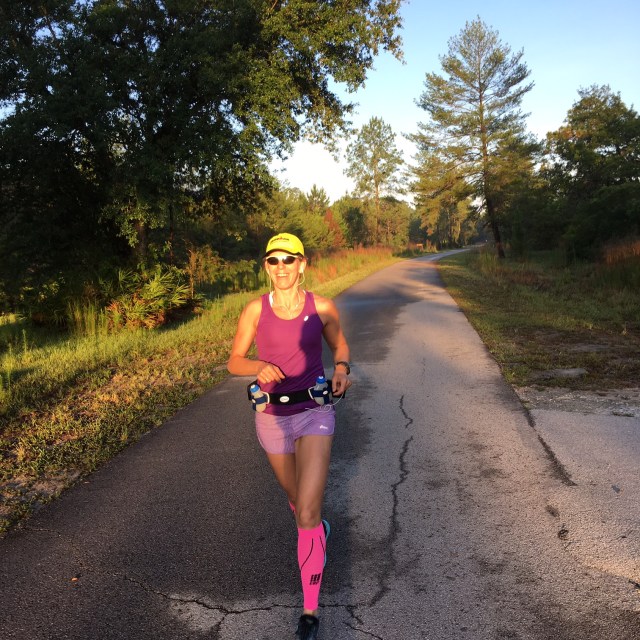
Sue RunningWhen watching a cycling or triathlon broadcast, one often hears the announcers refer to an athlete as having “good legs.” And while that is often true in the sense of appearance, the condition to which they’re actually referring is the athlete’s conditioning and how it is paying off that day.

There are tangible aspects to having “good legs” on any given day. At a recent gathering of triathletes, conversation turned to issues that affect performance such as training fatigue, cumulative fitness and tapering before a race.

TRAINING FATIGUE AND “GOOD LEGS”

Looking at the first component, training fatigue, we can examine how training affects having “good legs” on any given day.

One of the principles of training is doing work while your body is already tired. In college cross country, we used the term “chronic fatigue” to describe the rollover effects of consistent training. During the week, this consisted of twice-daily workouts usually with a 5-7 mile run in the morning and a 7-10 mile fartlek, speed or base-building workout at night. On Saturdays, we’d race distances of 4-5 miles with a four-mile easy workout after getting out of bed, then a one-mile race warmup and one-mile cooldown. Sometimes we’d get home and go for a short run to shake the travel out of our legs. On Sundays we’d do training runs of 15-20 miles. Often (and not wisely) we did these runs at 6:00 to 6:30 pace.

But that’s how one reaches a level of 100 or more miles per week. There were days  when the legs were tired, for sure. But there were also many incredibly loose days because the muscles driving all that work dispense the lactic acid and the body gets very efficient at replacing liquids and nutrients. And while 100 miles a weeks sounds like a ton of running and a guaranteed way to create training fatigue, I also knew a Division III runner who put up weeks of 250 miles in training.

The purpose in all this is to point toward races during the season where you were racing on tired legs already. So you can imagine, having “good legs” becomes a relative aspect of your overall training. We still raced at between 5:00 and 5:20 per mile in cross country competition. One learns to find the most efficient form and tempo, learned in large part through speed and interval work done on the track or in timed mile intervals. That race pace becomes ingrained in your body and the ability to sustain it too.

Chris running Intervals 2This last component is what most distance athletes who coach themselves learn to neglect. Training fatigue is your friend, but only if you are able to teach your body to perform under duress at the race level you want to achieve. That’s why some triathletes struggle to improve their runs. They simply do not do enough pure running volume to require the muscles to perform at a faster tempo. Brick runs will teach you to run tired to some degree, but the real secret is planning your run training to have at least one period per week, ideally with back to back days, where you press your body into service with a long run and then come back the next day with intensity training on the track. That is how you teach the brain to cope with training (and racing) fatigue.
This is the solution to having “good legs” on race day. And you’ll notice when watching races such as the Tour de France, that some cyclists will surge to the front on a given day. Ruling out the onus of performance-enhancing drugs, pro athletes in endurance races and their more modest kin at the regional and local level all experience relative degrees of positive biofeedback and energy.

There is nothing like the feeling of “good legs” when one has been training hard and yet the body responds with eagerness to the tests of the day. That is how athletes truly build confidence and learn to exceed former limitations in performance. Gaining good legs is all about creating the circumstances where the true mystery of training effects can show throw.

It can be amazing how fast you can perform when you open the doors to training volume and intensity. Then when your legs respond, there is less mental resistance to the idea that you can’t do what you set out to do. You are transcendent, and good legs carry you there.

Cumulative fitness

Training fatigue seems like a negative concept that adds up to positive results. So let’s consider the opposite angle of this equation. Cumulative fitness is the degree to which your training is already working and in place.

That’s not just your “base” by the way. Cumulative fitness incorporates intensity along the way. An athlete pointing to a September marathon or triathlon, for instance, will quite often add in some tuneup races. This helps the athlete develop functional performance strategies and other tangibles that contribute to success. In endurance sports this includes strategies for hydration and nutrition.

Typically during a peak racing season the early races are exercises in fitness testing. An sub-elite distance runner might start out running 33:00 for their first 10K in September and be aiming for a 31:30 or below by season’s end in late October or early November.

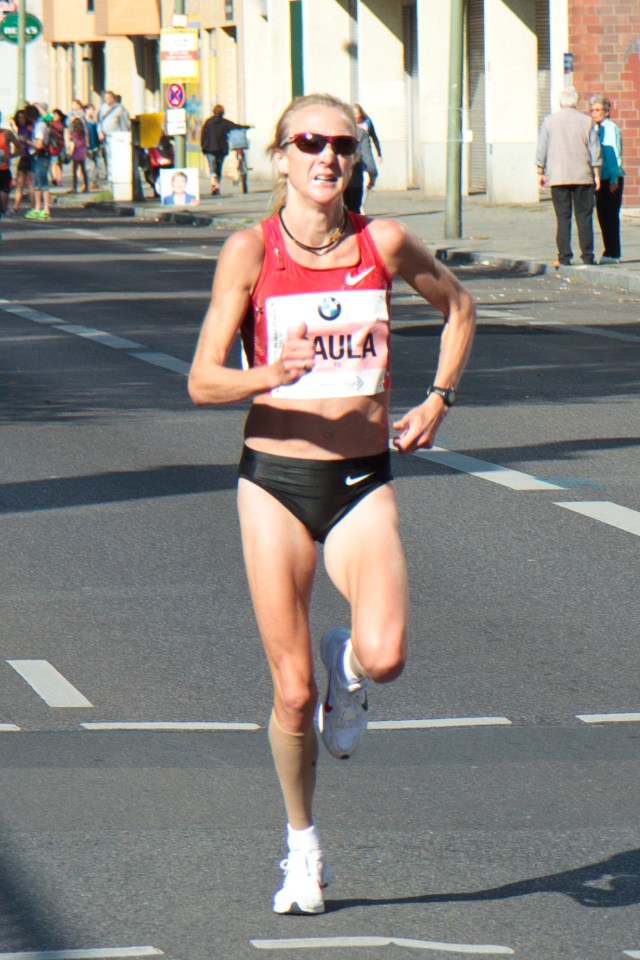
Paula_Radcliffe_at_the_Berlin_Marathon_2011The method here is to tap your cumulative fitness by planning around paces that one is already able to do in training. If a 43:00 10K runner can do 7:00 pace interval work or under during practice, that is evidence there is potential to manage that pace through the early going. But if one does not back off in training until a couple days before the race, there is not much training lost, yet the legs will feel fresher for those test races.
The same holds true for all three disciplines in triathlon. A swimmer hitting workouts five days per week or chops out two sessions in advance of a competition is not going to lose much training, but the confidence they’ll get from the feeling of “good legs,” or this case, “good arms,” is a motivational boost that feeds back into training adjustments. Races are excellent feedback even when they are not done all out. The opportunity to run or ride or swim at least an 80% effort tells you where you stand in the goal of having “good legs” in the long run.

TAPER

The delicious thought of a training taper is like a seductress waiting during the process of getting fit. The chance to back off on training is, for an Ironman competitor, almost too good to be real. Long rides of 100 miles or more, and 20-milers in the heat are all tough challenges in your schedule.

But the taper must be timed right and done properly for it to work. One cannot just go “cold turkey” and sit around waiting for the rest to start. It’s much more like active recovery from injury. Because training essentially does injure your body every day. When you keep training on top of that, the body is forced into action to build new capillaries and make us of oxygen transport from lungs to muscles to heart and again. It’s a cycle we all engage in just to live. The athlete in training simply pushes this cycle to its fullest.

Chris thumbs upThere is risk in the taper, in that athletes can be prone to relaxing their diet by putting things in the body that have not been ingested during training. Even a casual Coca Cola when one is not generally drinking soda during training can really mess up an athlete’s stomach. And a bad gut almost never leads to good legs.

So the taper, while it is received with such relief at times, comes with a responsibility for discipline. Otherwise all that training can be wasted, undermined by some last-minute weakness or personal failure.

Ironman triathletes joke about covering themselves in bubble wrap during taper. So much work requires a protective attitude before the race. Some athletes take the opposite approach, entering tuneup races with short but flared intensity. Some 10K runners race competitive miles the weekend of their race. Some triathletes do Sprint or even Olympic distances. If so moved, it is likely that the taper might include some surrounding rest around those short but intense efforts.


Intangibles

As mentioned, there are also many intangibles to the notion and joy of good legs. There are simply times when the human body is in a state of positive fitness where it acts as if it simply wants to “take over” the wheel and drive you home. It’s on those days that breakaways work in bicycle races. A rider with “good legs” becomes fearless, engaged and ready to win.

The same can apply to those who swim and run. “Good legs” sometimes come around when you least expect them. During those moments it pays t ask yourself, “Will this feeling come again?” Perhaps it will, but there should be an athlete’s maxim in play here, as in: “Goods legs are a bad thing to waste.”

So go for it next time you feel a set of “good legs” coming on. Take extra pulls. Run near the front. Swim in a lane with a faster swimmer. You might be suprised how far and fast a set of good legs is capable of taking you.

IMG_6262

Posted in Uncategorized | Tagged , , , , , | Leave a comment

Stoned band of Olympians arrives weeks late for Rio games

It happens now and again that athletes get mixed up in activities that are not exactly conducive to racing or training. It now appears that a band of athletes from six different countries got waylaid by their own party plans on their way to the Olympic Games. They all turned up yesterday wondering when and where their respective events were scheduled to begin.

Stunned Olympic Diver.jpgDiver Caroline Matscusheva of Argentina was one of six slightly stoned athletes who showed up late for the competition. “We all met up on Facebook and agreed to fly to Bolivia to meet up in La Paz,” she related. “But My God, we didn’t party that much. The games are still in August, right? August isn’t over, is it?”

Triple-jumper Eric Stott from Scotland was one of the six athletes stunned to learn that the Olympics were officially over. “I can’t believe it, Dude! I mean, we were all training so hard to get here. Well, maybe not the last two weeks or so. What day is it, anyway? Can I jump today and enter my distance to see how it I would have done?”

A pair of Cameroon soccer players were amongst the athletes who never reported for national team duty in Rio. But in truth, it turned out that the Cameroon Lions had actually not qualified for the Olympic soccer tournament in the pre-Olympic tournament to determine which countries get to play in the Games. “It is really disappointing Cameroon soccer playersthat we know now,” the two midfielders admitted. “We thought for certain we had won enough games to make it to the Olympics. Perhaps we were celebrating too much and did not check the Internet.”

Distance runner Mannio Spagnoil of Italy was the stonedest looking athlete of all. As the six lonesome figures stood together at the gates of the Rio Olympic stadium, the tired-loStoneroking Spagnoli kept rubbing his red eyes while alternately nibbling on PowerBars in each of his two hands. Periodically he would set the nutrition bars down on his gym bag and reach for his bottle of water, then seem to forget what he was doing, and grab the two nutrition bars again. “Io sono davvero molto in forma. Questo fa schifo!” he insisted.

The final athlete in the group was a very distraught-looking synchronized swimmer from Sweden who kept asking, in an anxious yet slightly slurred voice:  “What did my team do without me?” She spun in circles every few minutes and wiped a loose strand of bright blonde hair from her otherwise tightly coiffed scalp. “My one friend is so scared of the water. I hope she was okay.”

Rio Olympics Tinder

FILE – In this July 23, 2016 file photo, a representation of the Olympic rings are displayed in the Olympic Village in Rio de Janeiro, Brazil. Athletes increasingly are using apps like Tinder as they look to have fun and escape the pressures of competition inside the Olympic Village. (AP Photo/Leo Correa, File)

The group of six athletes was last seen wandering the streets of Rio at 10:30 at night inquiring at every gate whether the Olympic Village was still open. Stott tried his best to persuade the remaining security of his athletes’s status, even flashing his Scottish team badge with the promise, “We ken give you some graaate weed if you let us in the fookin gate,” he insisted. “I knewh I’m a very pale white Scotsman, fer shorr. But I kin promiss yew, thiss is pure Bolivian Gold straight from the mountains therr. Good stuff, man.”

Then Stott glanced down in a panic. “Dammit, me phone battery’s leow again. Who’s got the chargher? I’ve got to get on Tinder, stat.”

The six have set up a GoFundMe site to get money for their return flights to their respective countries. Stott already sold his bright yellow and red Nike spikes to get part of his air fare. “Sum demn kid stole me wallet out of me back pocket, though. Thank Gewd I was carrying me money where my stash seets in me crotch.”

Interested parties who would like to contribute to the plight of these stoned and wasted athletes and visit the  GoFundMe Site and search for Desperate Stoned Olympians.


Posted in Uncategorized | Tagged , , , , | 1 Comment

The wonderfully sexy world of hip flexors

We’re not super big into technical discussions here at WeRunandRide. But we do believe in basic instinctual lessons that can help those who run, ride and swim to be healthy and keep active.

hip-pain-hip-flexorWhich is why it’s time to talk about your hip flexors. This illustration shows the precise point where a group of muscles and tendons convene in the area known as your “hip flexors”  to make it possible for you to run.
Your “hip flexors” are actually a group of muscles that work together to help you lift your legs while running and doing other activities. They also help propel your legs during the kick in swimming. In cycling, they provide an oppositional tension in the pedaling motion. To put it simply, your hip flexors are the crux of forward motion in many respects.

You can do the series of exercises listed here, or which all happen to benefit other parts of your hip and glute region as well. The more you strengthen this support system, the less likelihood of injury you will have.

Smart runners, for example, know that tight hamstrings can lead to knee injuries. It seems counterintuitive to think that when something is not working on the back of your leg, it can be the front of the leg that gets injured. But it makes sense. Muscle imbalance leads to oppositional strain. This is biomechanics at work.

In the same way, weak hip flexors can lead to lower back pain. It is no coincidence that people who sit in office chairs for long periods of time often have tight hip flexors. That’s because the position of your body while sitting in a chair puts your hip flexors in an almost permanently kinked condition. When you go to straighten them out, or use them to run long distances, the unnaturally tight condition of that muscle group can lead to problems.

The best exercise I’ve used to isolate the hip flexors is a simple one that you can do at home. Take an mid-size exercise ball and lie flat on your back. Hold the ball in your hands and swing the legs up above you while swinging your arms down to place the ball between your ankles. Repeat this exercise 20 times and you’ll feel your hip flexors start to tire at 10-15 repeats. Go slowly if necessary, and be careful to train, not strain the region.

You can also do bent knee versions of the same exercise. Both work on your core strength at the same time.

If you’re a swimmer, putting fins on your feet and kicking from the hip with full leg motion can strengthen the hip flexors as well.

Hip Flexor Illustration.pngThink about the many runners you see out on the road. How many actually appear to engage in a fluid stride, one that moves freely from the hips rather than scuffling along. You can see the difference in hip flexion between the fluid stride of the gal versus the tighter stride of her father. Granted, they are in a slightly different phase of the running stride. But age is no friend to our hip flexion capacity. That’s the point.

Flexibility works

So to maintain this youthful vigor and fluidity in the running stride takes some work. The gym is a perfect place to engage in hip flexor exercises. Use the groin machine in which you place pads on the inside of the knees and pull them together to strengthen you groin and hip flexors. Lunges with 20 lb weights in each hand will help as well.

And for God’s sake, go out and do some speed work. Runners are so damn concerned about efficiency they often fall into these shuffling strides and wonder why they never get any faster or always get injured. You can’t increase your hip flexor range of motion doing 10- minute miles. It just isn’t going to. So even if your race pace goal is 1o minute miles, and that’s okey, you need to do some sprints on the track where you force your hip flexors into action. Loosen up. Run fast. Get up on your toes. Sprint, goddamnit!

High hurdles.jpgThink about the comparative hip flexibility of high hurdlers in track. They can run with their legs extended horizontally and snap them through all the way into the next stride. Their hip flexors are exceptionally loose and strong at the same time.
Doing so-called “hurdle stretches” in which you perch on the ground with one leg bent back so the heel nearly touches your butt used to be common practice for the running community. Some physical therapists and trainers do not recommend them. But in 40 years of running, I have seen no ill effects on the knees or any other part of the body from doing hurdle stretches. I also competed in the steeplechase which involved hurdling no less than 35 barriers and 7 water jumps over 3000 meters. I also competed in the 400 hurdles, running under 60 seconds while jumping those 13 (I think) intermediate hurdles on the way. By the last hurdle, your hip flexors are definitely tired in that race, along with every other inch of your body. Pure hell.

Hip flexor cross training

While we did not do specific hip flexor training over the winter months or during indoor track, my own training program included playing plenty of basketball. Hours and hours of basketball in fact. That sport really helps your hip and groin strength. Tennis works just as well, and cross-country skiing in winter.

One of the other exercises that really works the hip flexors is to find one of those pieces of gym equipment where you place your arms perpendicular to the body on pads and lift your knees to your chest. That’s a killer exercise for groin and hip flexor improvement.

Sexy hip flexors

Swimmer.7What we’re saying here is that having really strong hip flexors is a very sexy thing when it comes to how well you run, ride and swim. There’s always something about watching really fluid looking athletes that is visually pleasing. Think of those sexy male swimmers in the Olympic pool. Slick as seals and just as fluid, you might say.

And also, how about those track girls running in those tiny shorts? You can see the hip flexors and butt muscles going to work to make speed happen. All the strength and grace you could ask for is composed in their strides.

The world moves on a woman’s hips

Years ago one of the songs on the Talking Heads album Remain In Light contained some interesting lyrics about the foundational aspect of a woman’s hips. The words seemed to imply that the female form around the hips has played an important role in the history of the human race. From procreation to delivery there is mystique in the feminine form, but sometimes its just the motion that seems to make the world go round.

A woman's hipsThe world moves on a woman’s hips
The world moves and it swivels and bops
The world moves on a woman’s hips
The world moves and it bounces and hops
A world of light…she’s gonna open our eyes up
She’s gonna hold/it move/it hold it/move it hold/it move it hold/
it move it
A world of light…she’s gonna open out eyes up

See, hip flexibility really is a really functional yet sexy thing in this world for both men and women. It not only gets us where we want to go, it helps us look good going there.

Posted in running, swimming, Uncategorized | Tagged , , , | 3 Comments

From paper boy to pool boy

Luther College PoolThe first three minutes when you wake up at 4:45 a.m. to go swimming at 5:30 a.m. can be pure hell. Typically you’re waking from a deep sleep at that hour. With your head still pinned to a pillow and the light not yet turned on beside the bed, the instinct to roll over and go back to sleep is so powerful it can feel as if your brain is made of melting cotton candy.
Paper boy

But years of practice in rising early can get you through. At the age of fourteen, I had a paper route that required me to be out delivering newspapers starting at 5:30 a.m. I learned to get my hind end on the Huffy Three Speed and pedal down to Smith’s Bar-B-Cue in time to load up the mix of newspapers for the four-mile ride around town to get them in the door before 6:30 a.m.

Being a paper boy paid $8.50 per week in those days. But I didn’t have to collect. Just get the papers to the homes on time. I was a paper boy and made some money. It gave me a sense of pride and a feeling that I was needed in this world.

That experience served well when it came time to do two-a-day workouts in college cross country. We’d get up at 5:30, run six miles in 40:00, get showered and eat breakfast to be to class at time by 8:00 a.m.

Back at it

It’s taking a bit of practice to get back in 5:30 a.m. shape again. I’m a bit older than I was as a stupid teenager dragging my young body around on that Huffy bike. But truth be told, there are many days I feel as young as that teenager. I can still run two miles as fast as I could at 12 years old. So what’s the problem?

Well, the problem is that life gets a little more complicated as you add obligations. Which means that sometimes you get to bed on time, and sometimes you don’t. My fiance excels at getting up early but it does have a cumulative cost sometimes. That happens to any athlete. Every Olympian we just watched in Rio faces the same challenges. It’s no easier to get up at 5:30 to work out even when you do that for a living. The previous day’s training lags in your veins. I know that feeling well from having done intense and long training for so many years. Those 100-mile running weeks in college were an exercise in radical exercise.

Laps

I pondered all this while swimming laps in the middle of the pool this morning. The workout was broken down into increments and I’d bob up after each section to check the next group of intervals. We all need our checkpoints.

As a kid, I memorized that paper route and could nearly do it in my sleep. Once in a while, a home might drop the newspaper or a new customer would come online. Then I’d have to make a mental note about which paper they wanted. It always took a few days and sometimes I’d forget and have to backtrack, smacking my head in the process. On cold winter mornings, that meant even more freezing hands and cold feet. The elements are unforgiving. But it’s how you learn to think ahead.

It’s a very similar process to learning how to swim. You have checkpoints of distances to consider. Form counts too. Keep those elbows high. Point those hands on entry. Pull with the arm all the way back. I used to take the same sort of pride in delivering papers. Quick off the bike to the door. Slide the paper in an close the door in one smooth motion. Trot back to the bike. Finish the route in under half an hour.

Pool boy

Slowly I am becoming a pool boy just as I was once a paper boy. It only costs me about $8.50 a week to use the pool in the Master’s program. About the same amount I once earned as a paper boy. It’s funny how life offers up these strange balances of investment and extraction. In between we pedal and run and swim, keeping track of it all in our heads.

Paper boy. Pool boy. Let’s see if I can deliver on this promise too.


Posted in swimming, Uncategorized | Tagged , , | 1 Comment

Honey I Shrunk The Bike

Shrunk the bike

Honey I Shrunk The Bike

I have a confession to make. I’m sitting here eating the last bowl of cereal from a box of Cap’n Crunch that I purchased on sale at our local Jewel grocery store. It was a bit of nostalgia to into a bowl of that sweet stuff. We ate it as kids. It’s pretty terrible stuff, but was fun in its day.


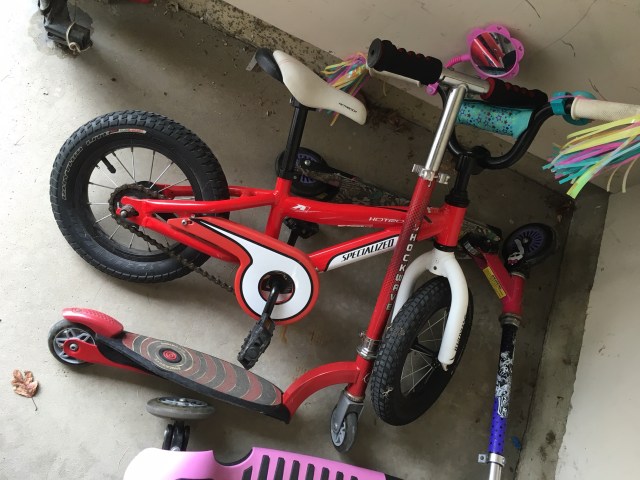
Similarly, I glanced down at a bike on the floor of a cycling friend’s garage yesterday and noticed a kid’s bike on its side. My own children had bikes that size on which they learned to ride. I had a bike nearly that small too.

I well recall my father pushing me across the yard of our home in Seneca Falls, New York. I was five years old when I broke free from training wheels and took off on that venture across the grass. That’s a bit of a devil’s bargain, you know. It’s much tougher to ride a bike on the grass but it hurts less when you fall. I made it across the lawn before tumbling to the earth. No harm, no foul. The feeling of liberty and balance was secured.

Then we moved to Pennsylvania where our neighborhood offered a network of smooth roads named for golf clubs. Niblick Avenue. Yet even our own long driveway was suitable for that type of riding you do as a kid. Circling round and round, just enjoying the feel of tires on the asphalt.

I lusted for a Schwinn Sting Ray bike in those days, but had to settle for a copped pair of Sting-Ray handlebars that I stuck on my fat tire bike. That worked until the moment that they dropped toward the ground because I had not tightened the nuts that held it in place. So down I went, chagrined and hoping no one had seen.

Felt 4C.jpg

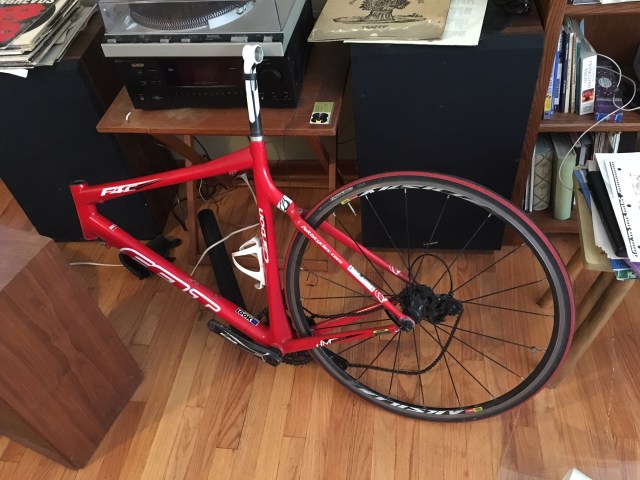
The Felt 4C post garage incident

That was not the last bike crash due to my mechanical failures. I tried putting a smaller front tire on my bike and again, did not tighten it sufficiently. When I yanked up to make a jump off the hill in our yard the wheel flew free and I crashed into the ground with a front fort that stopped my progress cold. Lying there in a grass with a smashed pair of nuts between my legs, I groaned into the turf until I started to laugh. Because it was pretty darn funny, and I shared that tale with many a friend. Most of them had a similar story to share.


That big bike was simply not meant for doing stunts like that. I tried to shrink it but that wasn’t going to work. The little bikes on which I’d learned to ride and even do wheelies were better suited to that kind of riding. But it would be decades before those smaller stunt bike evolved into being. The bike industry shrunk the Schwinn Sting Ray into BMX bikes but by then I was grown well past the desire to sit so slow and tear around the dirt.

When we moved to Illinois I was thirteen years old and we left most of our fat tire bikes back eat. My father purchased two Huffy Three-Speed bikes, one for him and one for my mom. His was black and her’s was light blue with a drop center bar. A girl’s bike, in other words.

My friend’s Eeker and Roy (nicknames) would come by and we’d ride around the little town of Elburn all day and all night. There was nothing else to do, really, except troll for time and the hope of meeting some girls.

I was always embarrassed by that Huffy Three Speed. My buddy Eeker had a bright yellow Schwinn Varsity. His was the wealthiest family in town and my Huffy seemed to symbolize our own family’s modest means. Truly, I’ve always felt like a Huffy Three Speed in many phases of life. Even in running, I never had the biggest engine but always tried to go fast enough to keep up with other athletes and their better means.

Specialized.jpg

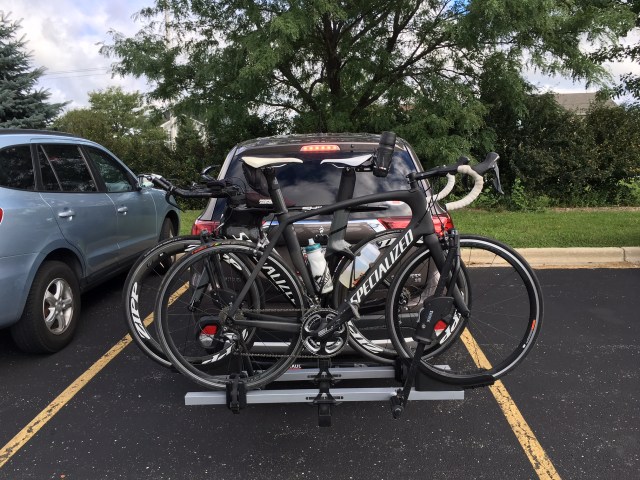
Perhaps the Specialized Venge Expert is compensatory for my mother’s blue Huffy 3-speed

Then one year the gear cables on my dad’s Huffy gave out. I was reduced to riding my mother’s blue Huffy. That was near tragic at the age of thirteen or fourteen years old. It already felt like my masculinity was being questioned on a daily basis. That’s simply how it works in small towns.


Then three big hotshots from another town came to visit a girl I really like. They saw ample opportunity to ridicule my “girl’s” bike under their breath. It was evil and mean and they knew it. But they wanted me gone in competition for attention from the cute girl in our town. I hated didn’t like how they talked about her. “She’s got a nice jelly ass,” they’d murmur to each other. “And nice titties too.”

There were three of them, and one of me. I really liked that girl, and yes she did have those attributes, and I fully admit that I noticed them. But we also walked the streets talking to each other about life. I felt like I knew her better. But there I was, still riding my mom’s Huffy Three Speed around town while those three boys would pull up in a Camaro with a cassette deck mounted under the dash. Which is more likely to impress a girl?

In college, I borrowed a friend’s Schwinn to ride out of town into the secret canyons around Decorah, Iowa. The bike took me on birding junkets where I’d spy wild turkey, ruffed grouse and pileated woodpeckers flying among the cedars and white birch. These were great escapes from my daily grind of running 70-90 miles a week. Sometimes my legs would be so tired from training it was tough to pedal the bike at all. But I’d go. And find some birds. And come back to the dorm unable to describe to my friends the delicious mysteries of all that I had seen. You had to be there.

After college, I purchased a Columbia 10-speed. It was heavy as a rock, solid metal and trimmed with black and gold letters. I’d ride that cumbersome thing around on summer evenings because a college town in summer can be one of the most lonesome places on earth. That bike kept me sane. I was in love with a girl who lived three hours away. Yes, I owned a car. But those lonely summer nights almost killed me a times. So I rode, and I ran, and plunged my tired legs into the ice cold water at Dunning’s Springs.

Then came a procession of bikes through marriage. The Raleigh Assault 10 speed mountain bike I bought was used for short commutes and riding around local forest preserves. I’d take that bike up north to Wisconsin as well, pedaling the sand trails and hammering around the actual mountain biking routes at Chequamegon east of Eagle River.

Sometimes I’d tie my clothes around my waist and ride naked around the woods. The national forests were so remote there was never anyone around. I’d ride till I was sweaty and go for a naked swim in some deep forest lake lined with a sand bottom, which made mine sandy too. Just me and my skin and the call of ravens coursing through the woods. Freedom. From life

Mountain bike

The Rockhopper. 

15 or so years ago I bought a Specialized Mountain bike, a Rockhopper that I still own and ride in the winter months. It takes me back and forth to my art studio as well.


But in 2003, I got the urge to try road cycling and was given a Trek 400 steel frame bike. That got me through a few seasons, and I even averaged 18 mph one ride on that baby. It was a bit tall and clunky, but it fed the appetite.

Then came the Felt 4C, the first carbon fiber road bike. It was fast and light and I raced it in criteriums. Some years I topped 4000 miles on that bike. Enough to call myself a cyclist anyway.

But I crunched the Felt last fall while driving into the garage and it suffered mightily from the encounter. Now it sits like a wall ornament ready to be stripped for parts.

Its replacement is a Specialized Venge Expert. It’s a fast bike too, and my riding has actually improved this year. Yesterday we rode 35 miles under cloudy skies that felt like fall. On a section of country road that curves multiple times and I felt that sensation we all love as a kid. Lean deep into the turn. Swing through and turn again. It recalled all those moments on the bike, for all those years. The kid in me emerged, and Honey I Shrunk the Bike for a moment there. It’s a wonderful feeling, isn’t it?

Posted in Uncategorized | Tagged , , , , , , , , , | Leave a comment

When you’re feeling gassed

DieselLast night I just took a night off. The week had been full of workouts already. Morning swims on both Monday and Wednesday. Cycling all three days. Some hard riding, some easy. So I was feeling a bit gassed by last night.

There was a time I’d run right through that feeling. Obsession helps you do that. But I’m no longer obsessed with fitness. Once in a while it’s okay to refuel the mind and body. Take a break. I went out in the garden instead and pulled some weeds with my mosquito buddies helping out. The creeping charlie was demanding attention too. Yank and toss. Then I came back inside when the rain threatened and lightning flashed to the northwest.

Down into the basement I went. It’s cool down there in summer and warm in winter. But it needs to be cleaned out. The clutter of existence included boxes and bins of abandoned bike parts. Old running shoes that never quite got tossed. Lots of extraneous stuff, including old boom boxes from when my kids used to hang out with friends down there.

Toss and pitch. And once you get going, it’s a gas throwing things out. You take a look and ask the question, “When’s the last time I used that?”

Cleaning up your fitness program

The same attitude applies to old training methods as well. Doing the same thing over and over, year after year creates a malaise and a sort of clutter in your head. It’s time for fresh territory.

That’s why swimming with all its challenges in building endurance and learning proper form has been enervating. There have been rewards. Those moments in the cool open water swimming the day before the Pleasant Prairie Triathlon were superb. I was anxious before the start but thrilled as heck during the swim. Sure, my arms cramped a little after 700 meters but what do you expect. I’m not experienced at this yet.

Open water, open mind

This past three years has been a bit of open water for me. When you spend eight years trying to keep someone else alive through cancer there is a mental cost to it all. The same goes for people going through divorce or other life-altering experiences. Yesterday I was interviewed by a local media maven named Dolly McCarthy. I was interviewed about my book The Right Kind of Pride, and my new art show Urban Wilds. I also talked about my next book Nature is My Country Club. When people ask me “How do you do it all?” my response is simple. “I can’t not do it.

That’s sort of the opposite of the Nike slogan “Just Do It.” When I wake up with blog topics already fully formed in my head, I need to write them down. Some of this might be an escape from reality. I’ll admit that. There’s been a lot to process in life, and I didn’t come to all this blank-headed or light an empty slate. When my late wife was diagnosed with cancer, my high school track coach called and said, “Your whole life has been a preparation for this.”

He meant that the perseverance gained from endurance sports like running can be directly applied to life. And one of the other skills you learn from distance sports is how to detect when the mind and body are nearly on empty. When you get gassed and you are running on fumes, it is important to pause and refuel your mind, body and spirit.

Managing up

My son Evan has set a wonderful example this past year. He’s gotten into a number of activities that combine fitness, meditation, and mental release. He’s been through a lot in his life as well. We share some of this, and his big measurement of my actions and well-being comes through the question, “But Dad, are you happy?” Because he sees me frustrated by the world of politics and injustice. He knows I project some anger through those social media channels. So I’ve been working on balance. But I will never quit working for equality and social justice. Neither will he, I suspect.

That “Are you happy” phrase is a complicated question. At times happiness has simply been freedom from immediate strife. For weeks after my father passed away I’d make mental checks to see if he needed something. Coming to grips with the fact that he was actually dead was a strange experience. For years, I’d built in mental space to prepare for all those last-second calls. See, he never called ahead about anything, nor did his caregiver. I was On Call 24 hours a day, 365 days a year.

Decluttering

Now I’m trying to de-clutter my overall existence and look ahead. While I’ve done well in my business in many respects, and gotten some great results for my clients, I’m looking at the long-term plans and where I best belong. I just took a test on the Northwestern Medicine website where I inquired about a marketing position and was interested to see the questions they asked. “Do you like helping people?” was one of the questions. “Strongly agree,” I responded. “Are you uncomfortable around people of different backgrounds, race or religions?” it also asked. And I said, “Strongly disagree.” And as well, “Do you like being a member of a team?” And I thought, Yes, and I’ve also led them quite often.

And while my art and writing are often done in solitude, both are actually ways of reaching out in communication with the world. They also refuel me when I’m otherwise gassed. Of course, there are times when I get tired while writing or painting. So I go for a run or a ride, a swim or a garden walk. It’s a positive circle if you’re mindful.

Batavia Night and Day PosterAnd speaking of circles. I’ve completed some new paintings that are going to be installed in the new hallway at Water Street Studios. They depict the parallel worlds of everyday existence and the decision-makers who help our community grow and change. A pair of figures walking on the roof of some buildings symbolizes those people who do all the high-level decisions, yet also work on committees and commission.

Meanwhile, the days and nights of Batavia go by, and in that sphere, almost like a dome over the city,  is pride of place as well. You can see the two paintings in their original form at top. But they also “pair up” with the circles built into each work. The two unite in concept.

It’s work like this that helps me feel real and involved in the world. And even when I’m gassed, or lying down on the bed at the end of a long day or waking up in the morning, that is often when a spark of creativity will come along, and I fan it into flames, and make it come alive.

And that’s always a gas.


Posted in triathlete, triathlon, triathlons, we run and ride | Tagged , , , , , , , , | Leave a comment

Through clouds and winds and mountains

Clouds 1We’re called Flatlanders here in Illinois for a reason. The terrain does not feature many hills, much less mountains. 150 miles to the north, west of Madison, there are plenty of hills. We travel there to ride the Ironman course and participate in rides such as The Wright Stuff and Horribly Hilly. The last hill in the latter features a 2000 foot climb to the top of Blue Mound, a rise in the landscape visible from 40 miles away.
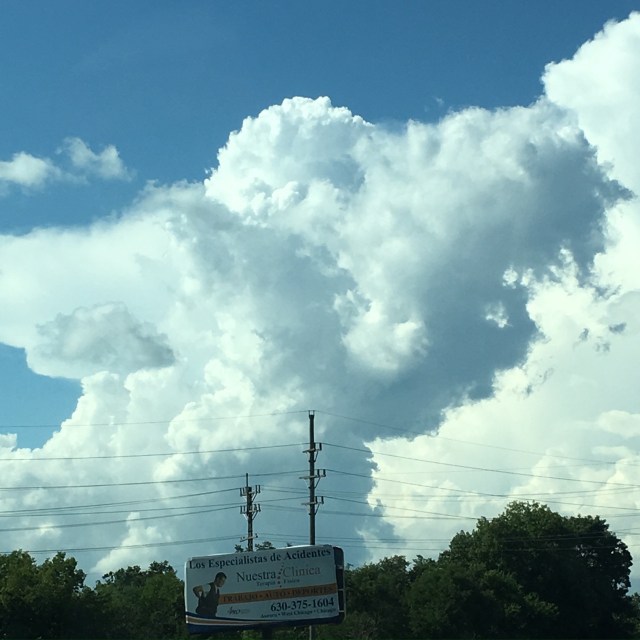
But back home in Illinois, the best we can offer is a glacial moraine called Johnson’s Mound. The road curls through deep woods into the park and climbs the northern side of the closest thing we have to a mountain. It has a section of 11% grade. That’s what you get when you live in Illinois.

Clouds 2Yet we have something else to offer resistance on the road, and plenty of it. That something is called wind, better known as the Illinois Hill. There are headwinds and crosswinds, tailwinds and shifting winds. Winds that change from West to East when you turn around and head back home. Winds that kick your tail and then kick it some more. Winds that grab your bladed spokes and laugh at your aero bike and position. Winds that try to wipe the contact lenses right out of your eyes. And winds that lovingly caress you on calm summer evenings.
We have it all.

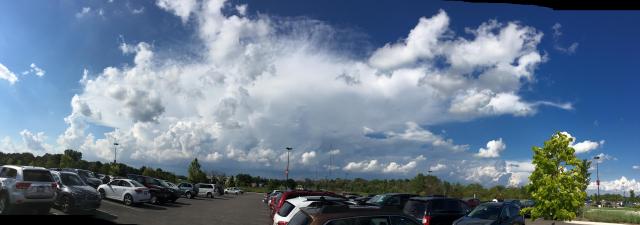
Clouds 3We also have plenty of clouds, in equal variety to the types of wind. There are high floating cirrus clouds in fall. Low scudding storm clouds, gray and sullen in winter. Impetuous mixes of nimbus and cirrus in spring. And tall, foreboding storm clouds in summer.
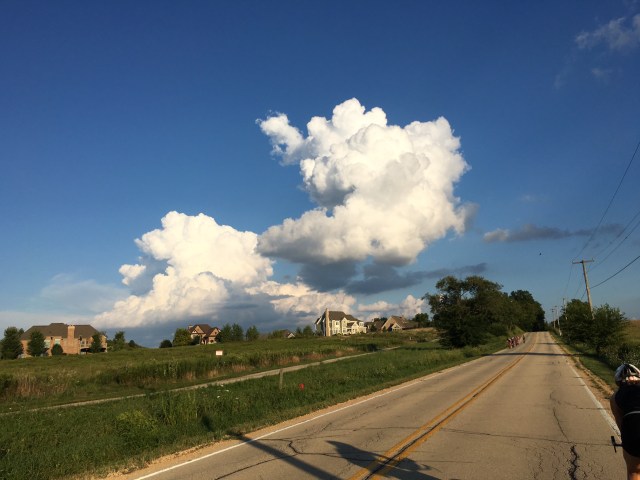
These last clouds, filled with the furious energy of heat and moisture and sun, can tower 50,000 feet over the earth. Some rise over Lake Michigan to the East like a wall of mountains. They have their bright peaks and low valleys just like real mountains in the Rockies. As we ride toward them with the sun setting, they grow temperate and morose, a purple mountain’s majesty of angled sun. The tops glow pink and the horizon mixes with their bottoms. Sometimes lightning flashes and we know it will rain over the lake.

Clouds 4There are tall cumulus clouds that rise over the farmland. That landscape, formerly composed of deep prairie, is now a corn desert that extends 150 miles to the Mississippi. The clouds over this terrain rise in anvil shapes. They take on the size of furious gods. If these clouds roll or drift east we get rain.

Storms typically arrive on a crisp ridge of dark clouds  punctuated with a clean white line where the temperature of the air changes. The air then cools. Rain pours across the earth in sheets. Once the dark clouds move past, a wall of gray, flat rain and clouds takes over, driven by the sometimes insane winds raging through the maple trees.

A few years back a storm that held a microburst came roaring right through our neighborhood. The winds uprooted aged old maples and knocked down an entire parade of power lines. It took days for the work crews to fix the mess and right the poles. All because some angry clouds and a bitchy little wind wanted to have some fun.

We’ve been caught in conditions similar to that while cycling. We tried to beat the storm one night a few years ago, but it caught us out in the open. The rain stripped the mascara right off my girlfriend’s face. I felt rivulets of cold water slipping between my ass cheeks. We were soaking wet, and half laughing. Yet the storm was scary.

After it cleared, and the storm clouds passed, bright white clouds appeared on the western horizon. We pedaled home grateful to be safe and not struck by lightning. It is reported that a lightning strike can stop your heart and disturb the electromagnetic pulses that keep it beating for the rest of your life. If that happens, it takes powerful medicine to kickstart the ticker lest it just stop beating and you die.

Clouds 5Which should make you appreciate the power of the skies, and not worry whether you get to ride among mountains or clouds. There is majesty everywhere if you respect it. But don’t always expect it to respect you. That’s not how it works.
So we run and we ride and we even swim under these furiously changing skies. It is ours to draw energy from the experience.

Posted in cycling, Uncategorized | Tagged , , , , , , , , | 2 Comments

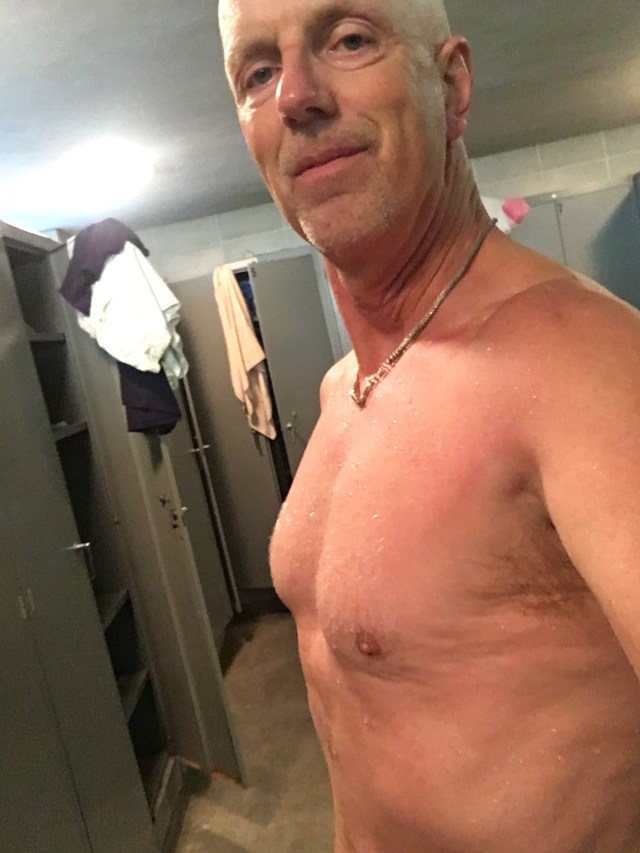
Gotta Love A Locker Room

Gotta Love a Locker Room.jpgThe timeworn cliche of a rough old coach on the playing field calling an end to practice by yelling, “Hit the lockers, boys…” may not be what it used to be. Times have changed. Some kids refuse to use the locker room at all, and for a variety of reasons. That’s none of my concern any more. People too shy to use a locker room have problems that will likely haunt them the rest of their lives.

You just gotta learn to love a locker room. I recall the introduction to the locker room at Martin Meylin junior high just south of Lancaster, Pennsylvania. Our gym teacher Mr. Davis was a disciplinarian. If you forget to bring  the right gear for gym class, he’d make you pay the price by writing 100 times on the locker room blackboard, “I will not forget my athletic protector.” There were inspections and everything. Like the military.

From gym class to sports teams, the locker room was the passageway to participation. That musty gym smell rising from the sweaty, wet gear of 50 or 60 athletes just became part of your daily life. And most lockers rooms were used by multiple sports teams. To get to our cross country lockers in high school we had to wade through the steaming mass of football players who were rank and defiled by hours of practice in the heat. We’d slip though without shirts on after practice and try to avoid rubbing against their heaving, pimpled bodies. But it wasn’t easy.

Then we’d retreat to the showers, where we sang songs by The Who and The Beatles, laughing at the fatigue rife without our bodies. .

And in college, the locker room became transporter like the one in Star Trek where people would be beamed from student to athlete and back again.

Beyond high school and college and into real life, the locker room turns into something of a social litmus test. At the XSport gym where I lift and swim, there are almost always 15-20 guys milling around getting changed. But some literally stand there and flex in the mirror, drinking protein shakes and glaring at their reflections.

One huge guy with massive rolls of fat on his body perches himself at a shelf with a mirror in the middle of the locker room and does who knows what for close to half an hour. It takes him forever to change. You have to walk past or around him to get anywhere in the locker room. Perhaps he should just paint his big body red, white and blue like a barber pole, and charge admission.

While working out years ago at the East Bank Club in Chicago, I found myself standing between TV star Robert Wagner and tennis great Arthur Ashe. Just people. But it’s a strange thing to be in a locker room with famous people. It just is.

So many locker rooms over the years. At posh golf clubs, I’ve watched Japanese executives lead their corporate proteges in a line. The pawns fall into formation and follow that social protocol without exception. Out to the golf course they go in a line.

At the finer golf clubs I’ve visited, it was always interesting to have my golf shoes shined spotless, and to have warm towels handed to me as if I were someone important in life. It always stuns me to be treated to luxury moments like that. I can’t help thinking the service people see through my lack of real expectation. I tip them the best I can. But I don’t travel in that brand of locker room very often.

Outside of town here in Batavia, there’s a golf club for MEN ONLY. It’s called Black Sheep and it thrives on the idea that men need a place to retreat without the imposition of women. The same guy that formed that club also mowed down a patch of woods at one of his other golf course locations because the city was trying to get him to preserve it. He didn’t like being told what to do so he sent in bulldozers overnight and knocked down all the trees.

One does not get the feeling he was a very good locker mate in high school. And to that end, I can recall a few locker room confrontations with teammates over the years. One objected to my being chosen for the opening lineup in a JV basketball game, so he tried to start a fight in the locker room. The idea seemed so foreign to me, and yet there’s a pecking order to everything in life. I stood my ground but almost got pummeled.

Recently White Sox baseball pitcher Chris Sale took offense to an ugly set of throwback uniforms the team was scheduled to wear. He hated the floppy collars on the old White Sox jerseys, so he went around the locker room with scissors and cut up the shirts. To me that’s funny. But he was fined and banned a day for team insubordination.

I love the scene in the movie Moneyball in which the Billy Bean character played by Brad Pitt walks down the hall after yet another loss by his high-risk baseball team and hears party music being played in the locker room. One of his more controversial players has a boom box playing while doing a bump-and-grind dance while the other players clap along and laugh.

Bean trashes the rooms with a baseball bat, smashing the boom box in the process. Then he points his finger to the sky when silence overcomes the room. “That’s the sound of losing,” he says.

And from then on, the team starts to make progress.

Our cross country coach in college had pre-workout talks in a classroom, but the locker room was still reserved for the athletes. I’ve never known any coaches that made a habit out of hanging around the locker room. I do recall a football coach walking through the college locker room and catching sight of my 140 lb. body. He turned to me and said, “I don’t know how you guys do anything.”

Not exactly a compliment. But again, when a coach is accustomed to the sight of multiple pounds of ballistic flesh, the sight of a runner strained thin through miles of training is likely a scary sight.

This morning after the swim workout I stood in the tiny locker room of the Regole Natatorium at Marmion High School and beheld the space of the locker room. I was amused comforted at the sight of worn out benches and dead gray locker doors. It’s a familiar environment, as welcoming as a local forest preserve with all its quirks and benches and rusted signs. Countless athletes and coaches have passed through that space, all with hopes and dreams and plans of victory. Many have succeeded, and many more have failed. But the locker room welcomes them all. And you gotta love that.


Posted in Christopher Cudworth, cross country, running, Uncategorized | Tagged , , , | Leave a comment

Pool time and conquering fears

The process of learning a new discipline in triathlon takes time. There’s the experimental phase in which you simply try running, riding or swimming the first time. That might bring the thrill of trying something new, but also the frustration of having a hard time trying to improve.

Me in the Pool

Masters coach Chris Colburn captured me checking my watch between intervals. 

For example, I love working with people learning the running trade. I’ve coached the sport many times over the years, and offer more than 40 years of experience as a competitive distance runner. So for me, the excitement in helping others comes from identifying problems they can avoid in the learning process.


This is true for people who coach swimming as well. Most are happy and excited to share their experience. But it’s a different process. Because while running is done on land, and the effort is difficult at times,  you aren’t exactly at risk of sinking when you’re running over the ground. And let’s face it, not too many people actually fall over while learning to run. You can just stop.

Different animal

Swimming is a different animal entirely. Pool time comes with the obligation to actually stay afloat. Really rookie swimmers need to start with this simple principle: keep your head above water.

It still astounds me that you can submerge a baby in water and they’ll not suffocate or drown. No fears. The innocents instinctively know from wallowing around in the womb not long before… how to navigate underwater.

So we must ask ourselves: Does the experience of swimming as an adult recall any of those tiny instincts? Hard to tell. When I see my fiance in the water, how natural and smooth she moves, I feel as if there is something aquarian in her soul.

Only when we grow up and develop fears by association do we struggle so much in the water. One could see that as an allegory for life as well. We see and hear others expressing fears and we might see fit to adopt them. Or, some traumatic experience exposes the raw nerves of the inner conscience and a phobia develops. People spend lifetimes in the grip of these fears. Some can be cured. Some cannot.

And in that context, some folks absolutely dread the act of swimming. They either miss the opportunity to learn as a child or find some other excuse to avoid it their entire lives. The water thus frightens them. Even the Sundance Kid perched on that cliff above a canyon stream had to shirk his fears and jump into the water after admitting, “I can’t swim.” But that was as much allegory as a literal statement. The entire movie was about the act of facing fears in life, love and relationships. Sometimes you choose to jump on in. At other times, you have no choice. In either case, you are forced to act.

Leveraging fears

We must maintain empathy for the fears of others. The great religions of the world are heavily focused on helping people overcome fear in all phases of life. Isaiah 41:10

So do not fear, for I am with you; do not be dismayed, for I am your God. I will strengthen you and help you; I will uphold you with my righteous right hand.
Fears alone are never the foundation for personal progress in any category of life.

Entire nations can be caught up in the grip of fear, especially after some traumatic event such as Pearl Harbor or the 9/11 tragedy. In those times, it’s as if everyone is swimming in the same cold pool of fear. Leaders are the lifeguards in those moments, translating the meaning of those moment, and promising to assuage our fears.

In the wake of the surprise attack on Pearl Harbor by the Japanese navy, President Franklin Roosevelt spoke boldly when he said, “The only thing we have to fear is fear itself.” He recognized the importance of confronting fears first, then taking action.” 

By contrast what George W. Bush said after 9/11 did little to assuage fear, but instead encouraged it: “Every nation, in every region, now has a decision to make. Either you are with us, or you are with the terrorists. From this day forward, any nation that continues to harbor or support terrorism will be regarded by the United States as a hostile regime.” 

It is much too easy to mistake bluster for courage in such times, and fear for patriotism. Because what if you did not accept the administration’s course of action in the aftermath of that tragedy? Did that make you the enemy as well? Thus Bush put millions of Americans in a position of conflict with their own nation. I was one of those people who recognized the falsehood of the tales constructed to justify going to war in Iraq (not with Iraq). In that period, I stood against our own government in that respect. My conservative friends tried to lecture that I was “weak” in my liberal position, and “unpatriotic.” Having been proven right about my doubts over the misdirection and tragedies that resulted in Iraq, I have no fears of resisting further acts of bluster and false courage now on display in the political process. In turbulent times, the pool in which we swim is not a comforting place to be. But you either choose to swim your own path or get drowned in falsehoods and waves of fear.

Conquering fears 

All my life I’ve lived with an inherent form of anxiety that is wired into my brain. Through long consideration and acknowledgment of this innate wiring, I’ve come to recognize the ruminative quality of thoughts that feed or increase chronic anxiety. I’ve become far more mentally healthy through a cognitive approach to personal, political and religious considerations. But breaches of justice and equality still piss me off. That trait of righteous anger I will never relinquish. It is not liberal guilt, but simple conscience that drives the desire for social justice. In fact, it is our job to live according to principles that honor the equality and assuage the fears of others. Anything else succumbs to the temptations of money, power and corruption.

Through long experience in the workplace and world, I’ve also come to recognize fears in its many forms, and why they come about. The very personal act of overcoming fear is a practiced art. Learning to swim again is just such a journey.

That’s that part of learning how to swim again that feels so real. Conquering fears is a critical part of every person’ personal growth. It’s taken a little longer than I’d like to get confident in the water, and I’ve yet to swim a mile continually. But that is still my goal this summer. The local outdoor pool shut down this weekend with the lifeguards going back to school, but the indoor pool is just as good a place to build endurance.

And, there is an opportunity coming up in a few weeks to participate in an Olympic triathlon. So we’ll see how it goes.

Mastering swimming

In the meantime, I’m finally signing up for the Masters Swim program at Marmion high school. It’s an early morning commitment that requires a bit of change, because the swimmers in the program gather at 5:30 a.m. before school opens for the day. I’m an early riser by nature, but heading to the pool and swimming two or three times a week is a real commitment at that hour. My fiance does it with panache. So I have a role model. Damnit.

Chris Colburn coaches the program and his sweetheart has improved so much in swimming this past year she is headed for long course nationals out in Portland. I shared a lane with her this Monday morning and enjoyed watching her smooth swimming form. Nikki Marasco has lost a bunch of pounds and gotten to be a really good swimmer through persistent dedication. She’s also a mother of six or seven kids. I’ve lost count because they’re so active and vibrant it’s like counting chicks in a pen. It hasn’t been easy for her to make all this happen. Next she’s going to learn to ride her new triathlon bike, and I’ve offered to help her learn.


Nikkie and Chris

Nikki Marasco and Chris Colburn with some creative progeny in the background. 


The first thing I realized upon entering the pool this Monday morning is that I’ve learned to like the water much more than I used to. The second thing I’ve learned is that I’ve probably been warming up for swimming all wrong.

Typically I’ve been getting into the pool with a swim buoy and freestyling away for 200-400 meters. That’s not bad, but perhaps it’s not allowing my body to fill those corpuscles with life-giving, oxygenated blood. I get out of breath too soon.

So the shorter intervals of 50 and then 25 meters that we used with punctuated rests at the beginning of the workout worked wonders. So by the time the actual workout came around I was far more ready to participate. That gave me the confidence to do the 125 meter repeats in succession. I took more than 20 seconds rest between, but it all still worked pretty well. Other than the bathroom break in the middle, I did the entire workout. Yay! I didn’t feel like the loser at the far end of the pool getting away with murder.

Pool time is a strange combination of focus on the workout and letting yourself go into the act of swimming. You still need to count laps in a 25-meter pool, but soon enough that becomes a native instinct.

I’ve also learned there are a couple tweaks that need to be done with my freestyle stroke. My left arm swings a little low, and Coach Tim noted that I was pinching my elbows and impinging my shoulder. In fact, I’d noticed on watching swimmers in the Olympics the difference in how world class swimmers flash through the water. Their windmill strokes were different in form and function than mine. So it was interesting to hear how to refine my stroke for the future.

Then I watched the 10K open water swim in the ocean outside Rio. Unreal. Crazy. Waves and shit. Different world altogether. Not sure that will ever be my goal. Ocean swimming? What am I, made of kelp?

And so it will go. Pool time for the fall and winter and spring. And by next summer, confidence in the open water, wetsuit or not. That’s the goal. I can be a good swimmer with practice, dedication and pool time. I have no fear of that.


Posted in swimming, Uncategorized | Tagged , , , , , | Leave a comment