50 Years of Running: Gamesmanship and sandbagging

As an advertising salesperson, I not only competed against the previous year’s sales numbers in my territory. The daily game included competing with other salespeople and also other print publications and radio stations in the Fox Valley.

The towns we served were St. Charles, Geneva, Batavia, and Elburn. All had their own sales zones. Mine also added Aurora and North Aurora, a larger city and its humble twin sister that sat downstream from Batavia. The challenge in selling to businesses in those communities was heightened by a healthy competitor, the Aurora Beacon News, with a far larger total circulation and thus, the main source of spending for most Aurora businesses. We also had a lowbrow competitor called the Bonnie-Buy’rr that was an all-advertising, no-editorial rag delivered by mail every week to every damned household in the area. We hated that thing.

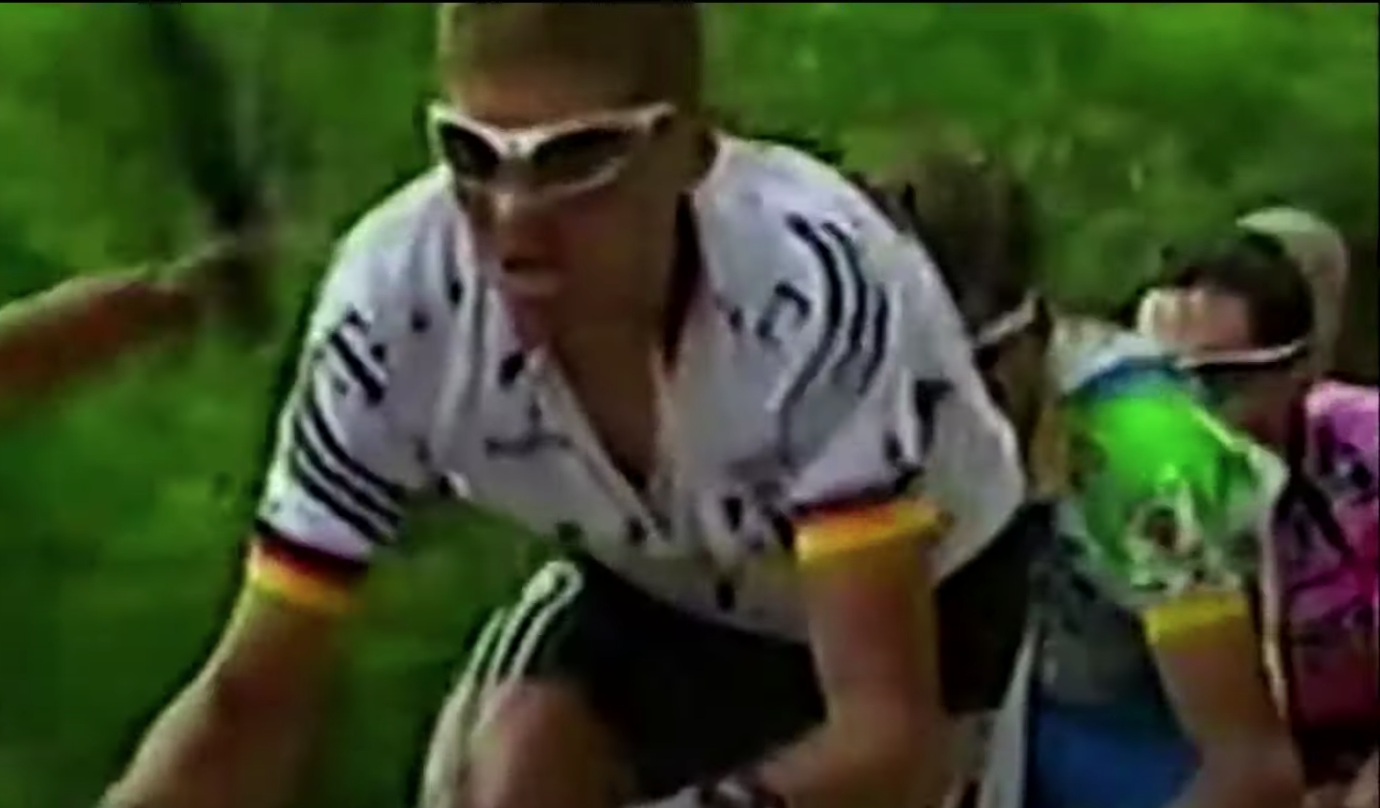
My Jan Ulrich

I’d followed a really good salesperson named Curt that was previously in my position. He was a handsome, charming guy loved by every advertiser, especially the ladies in boring jobs where they sat behind desks all day until a welcome visit from a stud-looking guy broke up their routine.

Curt sold really well. He was self-confident and had a smooth voice that complemented his overall gig. He went into selling spirits after ad sales.

So in my new role, I was competing against Curt’s strong appeal. He was the Jan Ulrich to my Lance Armstrong, and it all came down to the power numbers. To that end, the company provided all the previous year’s sales figures, and I kept a running chart of how I did against his performance year-to-year. Those numbers were a topic of discussion in our weekly sales meetings managed by our collective boss, a Sales Manager named Bob. He was in turn managed by Roger, the Big Boss, who was Publisher of the newspaper group.

Bob’s obvious goal was to hit the total weekly sales numbers for the group. If we kept pace with or exceeded the previous years’ numbers, Bob’s job was safe. Then he could hang around town enjoying martini lunches. Sometimes he’d come back to work a little snockered. Such was life in the newspaper business in the late 1980s.

Happy Slackers

I eventually learned that my fellow advertising account executives had their own tactics for dealing with the pressures. One of them lived in Batavia, the primary zone of sales in my territory, so he invited me to stop by his house one morning during my sales calls. I walked into the house and found my golf buddies Corey, Jim, and Joe all parked on his couch drinking sodas and munching on donuts or somesuch. “What are you guys doing?” I asked.

“What we do every day,” Joe piped up. “Watching Mayberry R.F.D. and the Dick Van Dyke show. Sometimes I Dream of Jeannie or Bewitched, too. ”

“You’re kidding,” I muttered, astounded, looking around at their coats and ties hanging on the dining room chairs.

“No, for real! You should join us!” Joe replied. They all laughed.

They were serious. Almost daily they took a break before doing any sales work to watch TV. I couldn’t imagine that luxury. I was having trouble hitting my sales quotas while using every minute in the day. It made me think, “What am I doing wrong?”

The difference between our respective territories had much to do with the work involved. Both St. Charles and Geneva had healthy downtowns. Batavia kind of sputtered along. There was a True Value Hardware store and a Coast-to-Coast, but both of them advertised primarily through fliers or “inserts” as we called them, and none of them ran in our papers often. I also called on some Batavia travel agencies, a few banks, a savings and loan, some hair salons and a tonsorial parlor, a fitness business, and a little collective of antique stores. Then I had some Real Estate advertisers and a few car ads to pick up. That was my weekly routine.

There was one high-end furniture store in Batavia called Hubbard’s Ethan Allen. It was run by a family whose lead manager Bob became a friend over the years. Bob’s main concern was the positioning of his ads in the paper. His ads all looked great, being produced by the Ethan Allen company. But if his ad ran in the Sports section or flirted with the back end of the paper where the Classified ads began, I’d get a call. Then I’d have to apologize to Bob and promise to get better “placement” next time.

Control Issues
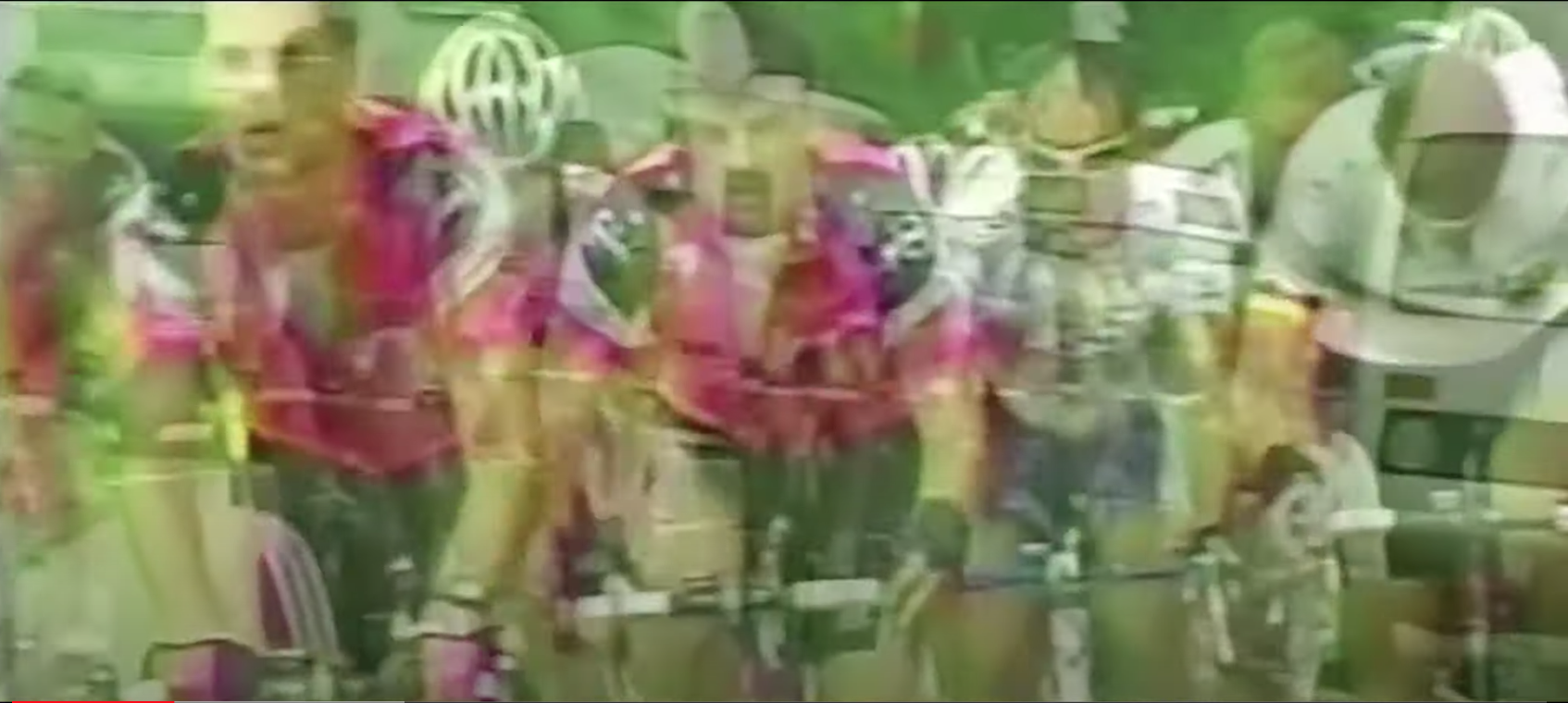
Salespeople had little control over where ads appeared. That was determined by the total volume of ads placed in that week’s paper, and when we went daily, each issue was a battle for position among advertisers. Every one of them wanted to appear in the first four to five pages if possible. That competition reminded me of the jostling to get up front in cross-country races. If you were too far back by the time the first turn came around, it was easy to get stuck in the pack where you had to fight back through the crowd to make up lost time.

The people in charge of laying out the paper were merciless in their claim of objectivity toward one advertiser over another. But that’s where gamesmanship entered the picture. The layout people had their favorites among the salespeople, and working to preserve whatever status you maintained among them was key to keeping your own advertisers happy.

It could get to be an ugly scene at times with the layout people, especially if you were guilty of bringing in any “late ads,” or space placed near to or after the deadline. My struggle to keep the numbers up meant I was often out selling until the last minute. Then I’d race back to the office and start writing up work orders in quadruplicate with white, yellow, pink and blue sheets all shuttled to their respective pins. Each order had to have the right rate code, instructions for section placement ( a wish list in many ways) any Velux or printed ad material to submit, and sometimes a long list of pricing or other information critical to the content of the ad.

We lived in fear of inaccurate ads in the paper. My main horror show was the advertising for a Standard station that sold tires. The type of tire by size and its corresponding price had to be correct or the ad was deemed “wrong” by the station manager, a man named Stan that I really liked. But when his ad was misprinted, the disappointment was evident on his face. He’d carefully point out the error, write it out in clarity and ask for both a correction and a credit. Then I had to crawl back to the sales manager, explain what the error was, and ask permission to issue a credit, which went against my sales numbers for the day and the week, and try not to get angry at the typesetters if they’d blown it somehow.

The typesetters and layout people all worked in a dark space back by the printing plant. We’d come back to find them banging away with their faces lit by the computer screens. If an ad was late, it was a salesperson’s chore to convince the folks in charge of that day’s paper to allow an “extra” ad to be included. If the paper was already composed, that meant moving things around, and the editorial department did not like to be informed that they’d lost part of their “news hole” either.

Native anxiety

So the rolling impact of trying to get our advertisers into good position and getting late ads posted was stressful business. With native anxiety always clawing at my soul and an unrecognized case of attention-deficit disorder affecting my attention to detail, I’d typically collapse intp my chair at the end of each sales day if everything finally got done and into the paper.

We’d sit around and chatter as salespeople do once the day’s deadline was passed. We’d also try not to breathe the thick smoke floating toward us from the editorial side of the office. At least half the writers were smokers, and cigarettes burned in their ashtrays from dawn to well-past dusk. As a runner, I worried about my lungs when breathing that smoke. The bad news about secondhand smoke as a health hazard to everyone was not yet public knowledge. We’d complain some days if the smoke got too thick, but the editorial department was “god” in those days, so nothing much was said.

Losing it

But one day I got so frustrated by the whole scene that I basically “lost it.” I’d been called by the sales manager late that afternoon and told that it was my job to find an ad to fill a full page space on the back of one of our entertainment sections. Full-page ads didn’t just fall out of the sky. So I rushed to one of my bank clients and basically begged him to fill the space. He asked for a discount and I called in to get that approved, then rushed back with the ad copy to get it place. Traffic was heavy on the way back to the office and I missed the 5:00 deadline. When I walked back to the layout room with the ad in my hand, I was greeted by a bunch of suspicious, and not-too-kind eyes peering out at me from the dark room. At that moment, a woman named JoAnne that I did not like blurted, “What do you want?”

“Bob told me to get this ad in for Our Towns,” I explained.

“We’re running a house ad because you’re too late.”

“I have the full-page Velux,” I told her. “I’m sure Roger and Bob would prefer paid over unpaid space.”

That clearly ticked her off. She grumbled, snatched the plastic ad folder out of my hand, and blurted, “We’ll make no guarantees…”

I spun around to head back to the sales department. On my way I kicked at the swinging door and my foot went right straight through it. “CRACK!” the noise resounded through the room.

That set off a series of shouts and the next thing I knew I was in the Publisher’s being asked to apologize or be fired. First, I tried to explain why the ad was late. That didn’t matter. Then, I explained a basic reality. “That door is cheap,” I offered. “I was only kicking it open to get through.”

Those types of explanations don’t always (hardly ever) help a situation. The larger world has many such examples. I think back to when Lance Armstrong first using drugs in his cycling. His internal story probably went something like this, “Here I’m breaking down doors to do good things for you people, and all you do is criticize me and act suspicious.” On one hand, Lance was absolutely right. That whole Livestrong thing was amazing. So was winning multiple tours. He was genuinely “breaking down doors” in perception and reality.

But while he was doing great things, he was also breaking the rules. Those have to matter at some point. And it did catch up with him. He was also wrong in how he treated some people in his life.

These days, he admits that he was never perfect, and confesses that he certainly isn’t perfect today. Some life lessons only come with age.

It seems that for all of us, there are times in life when you feel truly alone. The day that I plunged my foot through that door was one of them. It shocked everyone. My fellow salespeople, both men and women, kept their distance because they didn’t know what was going on, or why I looked so dour. No one knew at first what that meeting in the Publisher’s office was about. So everyone stayed away.

Call it the Dead Meat syndrome. People are smart. They keep their distance when there’s blood in the water and fear in the air.

The managers warned me about having anger issues, and they were correct. I did have anger issues going on. They stemmed from a number of incidents growing up as a child and beyond. My brothers had long called me The Mink for my habit of engaging in angry outbursts. Most of those were in defense of what I considered justice in the moment. Sometimes I was right. Sometimes not.

But this time it almost cost me big time in the workplace. I apologized for my behavior on the spot, promised it wouldn’t happen again, and didn’t lose my job.

Yet I was still seething inside. Justice had not actually been served. I’d only followed the instructions of my direct boss to place that ad. The fact that it was late was not totally my fault. That didn’t turn out to be a solid piece of defense in my case. That incident reminded me that there isn’t always justice in the workplace. Things aren’t always fair. In fact, more often, they’re not.

Trying to get a leg up

Knowing that things aren’t always fair should have told me to be wiser when it came time to compete for one of the biggest prizes in the sales department. We were publishing the Progress Edition, a major revenue producer into which we sold as many advertisers as possible. There was a big fat commission check waiting for the top salesperson, so I set out hard and fast to earn it.

That’s how I often raced back in my high school days. Take out the pace fast and dare them to catch you. Sometimes it worked. Other times I got caught. But I was looking like the big leader going into the last week. I’d come back from a day of sales and post my ad counts (sold by column inches) that represented real dollars for the company. I thought I was earning the respect of my peers, too. Each week in the sales meeting my leadership was on full display, and the ad manager made a point out of holding me up as an example, even admitting, “He’s got one of the toughest territories, yet here he is, leading the pack.”
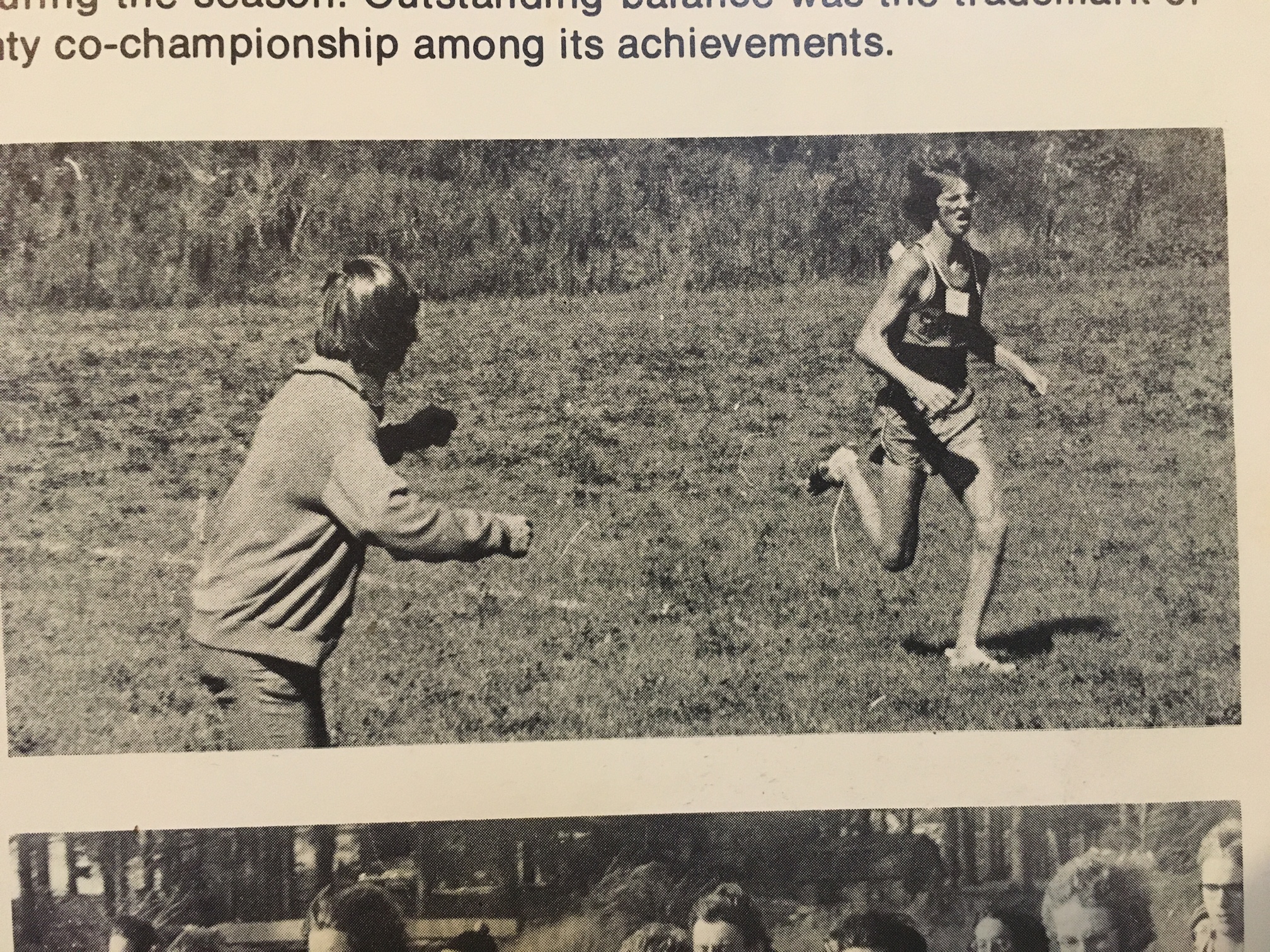
Then the last day of the sales content deadline came around. That day, one of my fellow salespeople dumped a huge stack of orders in the In Box and sat back down. He ran the biggest sales territory of all, and he was sandbagging all along. His numbers rolled past me that afternoon, and I was out of gas.

I knew from running that being the lead and losing it at the last minute is the worst feeling in the world. And again, I was angry at the sneaky tactic of saving all those ads for last-minute placement rather than honestly posting his total progress on the daily leaderboard. I considered it a cheap stunt. But he still took home the check and got the big kudos for being the highest-grossing salesperson

Because life’s not fair. Gamesmanship and sandbagging are part of the deal. Even the great cyclist Lance Armstrong once sandbagged during a Tour de France stage to make Jan Ulrich feel like he was going to win the day. Then Lance burst from behind the pack and roared to a stage win. Gamesmanship. Sandbagging.

And lessons learned all around.
Posted in adhd, anxiety, Christopher Cudworth, competition, cross country, cycling, cycling threats | Tagged , , | Leave a comment

50 Years of Running: Chasing career options

By the time I’d turned 27 years old, the decision to stop racing and training so hard was well-established in my mind. With a child to raise and a wife to please, I focused on work-life as the central priority. I kept running for fitness and mental health, but the commitment to serious racing took a back seat.

That didn’t remove competitive instincts from the forefront of my existence. As an advertising salesperson for a small group of local newspapers, my daily “numbers” were critical to achieving higher commissions and what I ultimately earned. Like so many salespeople, I drew a “base” salary and earned a percentage of sales from the ads I placed in what was then a weekly newspaper. There were four of publications in the group; the St. Charles Chronicle was the oldest and most established. Its roots dated back to the late 1800s. There were ancient copies of that newspaper stored in the archives of the publishing company. It was originally called the Valley Chronicle.

As the tri-cities grew, so did the group of local “Chronicles.” Geneva came next. Then Batavia. Yet every ad placed in the group ran in all the newspapers, including the Elburn Chronicle, a newly formed publication when I joined the company.

I quickly made friends with the other staff. We played golf together some afternoons, with Jim, Corey, Joe, and I making up our typical foursome. Sometimes the Publisher Roger would ask us to join him, but I quickly learned that he was not the most ethical golfer I’d ever met. On several occasions I watched him use the foot wedge to move a ball into play along a fence line. He often fudged his scores after every hole by refusing to take penalties for balls lost or out of bounds. We ignored these infractions because he was our boss. We dared not question him. From a competitive standpoint, that drove me nuts. Having come from an athletic tradition such as running, where it’s really hard to cheat, I found his antics despicable. I hated losing to a cheater.

Vain pursuits

Part of his behavior stemmed from core vanity that knew almost no limits. On every front, he was immensely protective of his public image. That showed up in his physical appearance with a perpetually dark tan and carefully coiffed salt-and-pepper hair. Beyond that, he was ardently defensive when it came to any discussion of his business acumen or accomplishments.

That became known in the greater community. Once, while having lunch with a group of Rotary buddies where were some of the leading businesspeople in the valley, they directed a question my way. “Why your boss is such a tight-ass?” they inquired with a wry chuckle.

I burst out laughing because it was certainly true. But in professional loyalty, I told them he had to manage a business with a ton of angles. The group nodded knowingly and one of them said, “Well done.”

Trickle-down effects

The slightly corrupt and uptight nature of the boss had trickle-down effects within our organization. At one point, a reader wrote a Letter to the Editor identifying the fact that our boss was seen driving a long way down the shoulder of the road approaching our office in order to access the turn lane. The writer questioned whether our boss respected the law, or thought himself above it?

That sent Roger into a rage during our weekly manager meeting, at which he typically “held court” on whatever subjects without or outside of the newspaper. Whatever caught his attention was the subject of the day. Once, during a period when the newspaper was consolidating into a single Kane County edition from four newspapers, he wrote a company memo with a title that said, “The Truth and The Light…The Chronicle Way.”

Some people in the organization were offended by his use of Christian language in a corporate communication. One of them sent a letter of complaint to the CEO of the Shaw family that by then had purchased and owned the Chronicle. The next week in our leadership meeting, Roger went off on the subject, “No one can question my Christian faith!” he protested. “I go to church every week!”

Little did he know that I’d recently visited his church. I’d taken the youth group that I led from our Lutheran church to see what other church traditions were like. During the priest’s homily, I was shocked to hear him state that while the parish was in a largely wealthy area, it was not necessary to apologize or feel overly compelled to go out of the way to help the poor. He locked his fingers together in an act of isometric symbolism and said, “As long as you feel the tension, that’s okay.”

I was shocked to hear the call to service in the Christian tradition dismissed so easily. But it helped explain (in part) why our boss seemed to possess half a conscience over cheating or using Christian language to control those under his management.

A price to pay

Because I was one of the few people willing to raise issues of conscience in our weekly group meetings, Roger figured that I’d been the one to write the letter to the CEO of the Shaw family. He pulled me into his office in a rage, and then brandishing the letter containing a copy of the company newsletter, he asked, “Why did you write this?”

I pointed out that the writing on the letter was clearly not mine, and affirmed that I’d never seen the letter before. He eventually relented in his accusation toward me, and then demanded, “Who do you think did write this?”

“I honestly have no idea,” I told him. I didn’t. Of course, I did agree with the intent of that letter but said nothing at the moment. He likely would have fired me on the spot. As it was, a few months later he found a different reason to fire me. I’m certain that the former incident had plenty to do with the latter. Sadly, all of that happened following seven years of largely happy employment with the newspaper group. I made many great friends with whom I keep in contact to this day and got to chase some early career goals in the process.

New meanings for “competition”

I was rapidly learning what it meant to “compete” in the working world. Rather than the ‘clean, hard, and severe’ world of which my favorite running writer Kenny Moore once spoke, I was experiencing the nuanced, foggy, and often cynical side of competition where emotional intelligence played such an important part of life. Admittedly, I struggled with some of that. As a person with anxiety (and even depression at times) I often worried about all the wrong things and imagined problems into reality that weren’t there at all. All while failing to recognize the genuine threats posed by sales sandbaggers, conflicted bosses and people that cheated at golf.

To process all this, I kept on running, going out almost daily as my son grew and the birth of my daughter approached. On some days, those runs were the only way to preserve my sanity.

Posted in anxiety, Christopher Cudworth, competition, Depression, God, mental health, mental illness, race pace, racing peak | Tagged , , , , , , , , , , | Leave a comment

Racing along with ease and joy

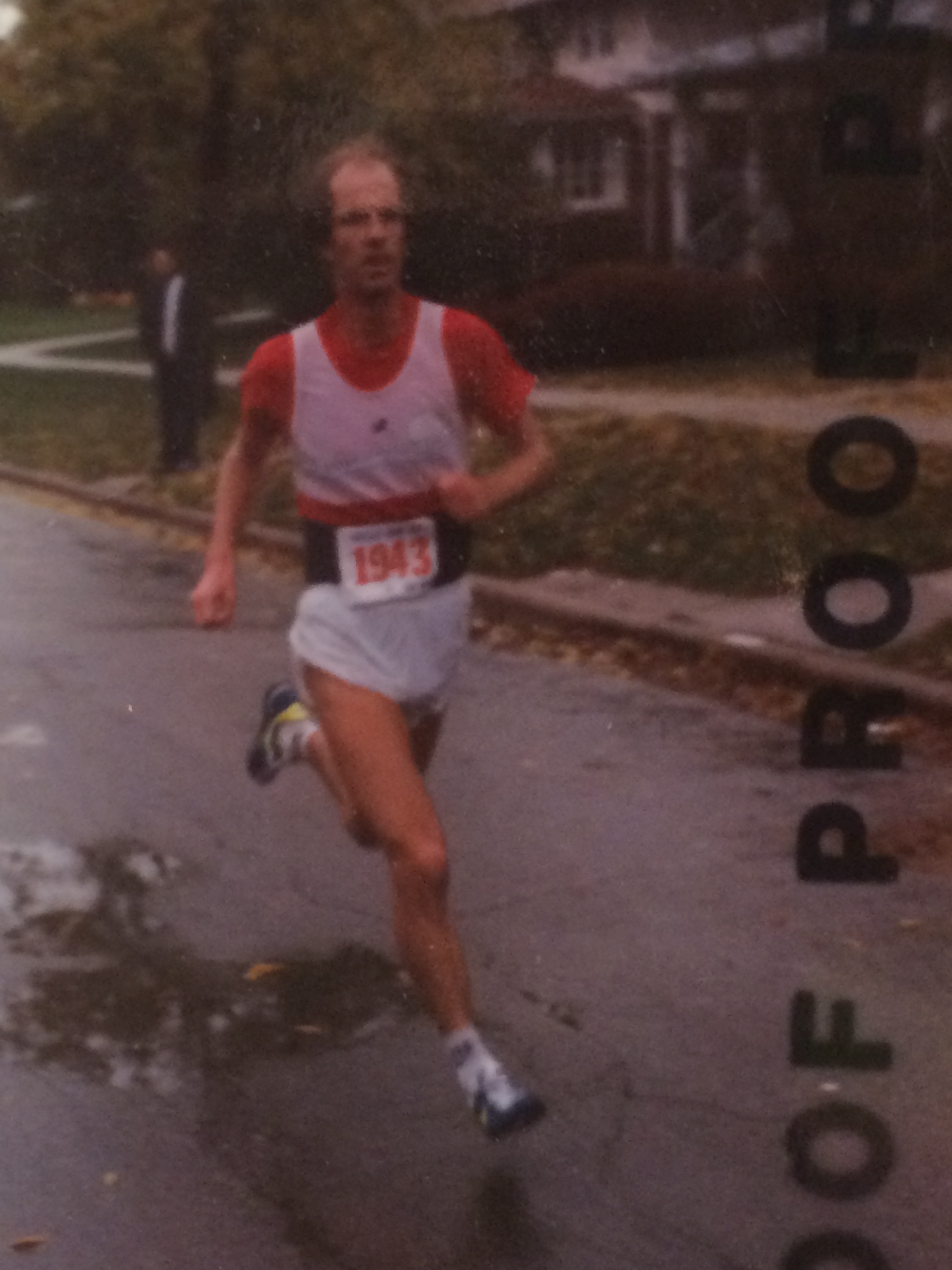
Yesterday on October 16, I competed in the Frank Lloyd Wright Races in Oak Park, Illinois. This was a return adventure to an event I won twice back in ’83 and ’84. That was 39 years ago. I ran 32:00 to win that first year on a rainy, cool day in October.

I recall the feeling of ease that day as I raced along at 5:10 pace. The roads were wet with rain and puddles, but I wore my Nike Elites, a set of racing shoes with a decent heel and waffle soles. I took the lead early and ran the angular course rife with young strength and speed.

The victor during those years received a beautiful silver cup large enough to store champagne, and I’ve used my two cups on many occasions. It’s been a few years since I polished the genuine silver on them to make them shine, but now I’m inspired again to do so. Those cups are one of the few awards retained from years of running and earning medals, ribbons, trophies and other such rip-rap from races.

One of the Frank Lloyd Wright winner’s cups from the 1980s

My interest in racing this weekend was more about the experience than earning awards. Plus the race was priced reasonably, just $48 for an entry fee in an age when you seldom get to compete for less than $100. I get that races are expensive to conduct. The costs of insurance and police, tee-shirts and awards adds up quickly. So many races are fundraisers for non-profit causes it can be tough to keep any share of the profits.

This year, I made a $1 contribution on top of the entry fee, which I admit was cheap. I was in a hurry and eager to get the entry through in case they suddenly closed down according to some unannounced timeline. I had that happen several weeks ago while I was attempting to sign up for a triathlon. I went away to get some information needed to sign up and when I came back to refresh the site said ENTRIES FOR 2022 NOW CLOSED.

All you can do is laugh at that point. So I didn’t fool around. I sent my entry in and gratefully received confirmation. Then I looked at the course map again to see if the course followed some of the streets I raced almost forty years ago. Indeed, they did.

Race prep

I was excited to race because my pre-race time trial on a local track went fairly well. I warmed up two miles and ran a 7:03 without terrible strain. That meant I could probably run 7:30 pace without crashing. Years of experience time-trialing and racing taught me that thirty seconds is a consistent buffer for me to race above a time-trial pace. Imagine the confidence I had back when I planned to run a 15K and raced a 4:22 mile in an All-Comers meet a few days ahead of the race. I made my friend swear that he’d not reveal the type of race fitness I had before running against a bunch of college teammates and some other Luther grads in the 9.3 mile Elvelopet race on a hilly course in Decorah, Iowa that year. Toward the finish it was just me and a talented runner named Mark Glessner together with a mile to go. I knew that he’d run a 10K in the low 30:00 range that year, but I tried to take the sting out of his speed from a ways out. But he caught me with just 100 meters to go as we both finished just over 50:00.

Those experiences fuel my more casual racing these days. The one race I ran this summer was a triathlon that ended on a massively hilly run course in Wauconda, Illinois. I’d run 8:00 pace on the flats and get reduced to a crawl on the hills on a hot day.

Bright prospects

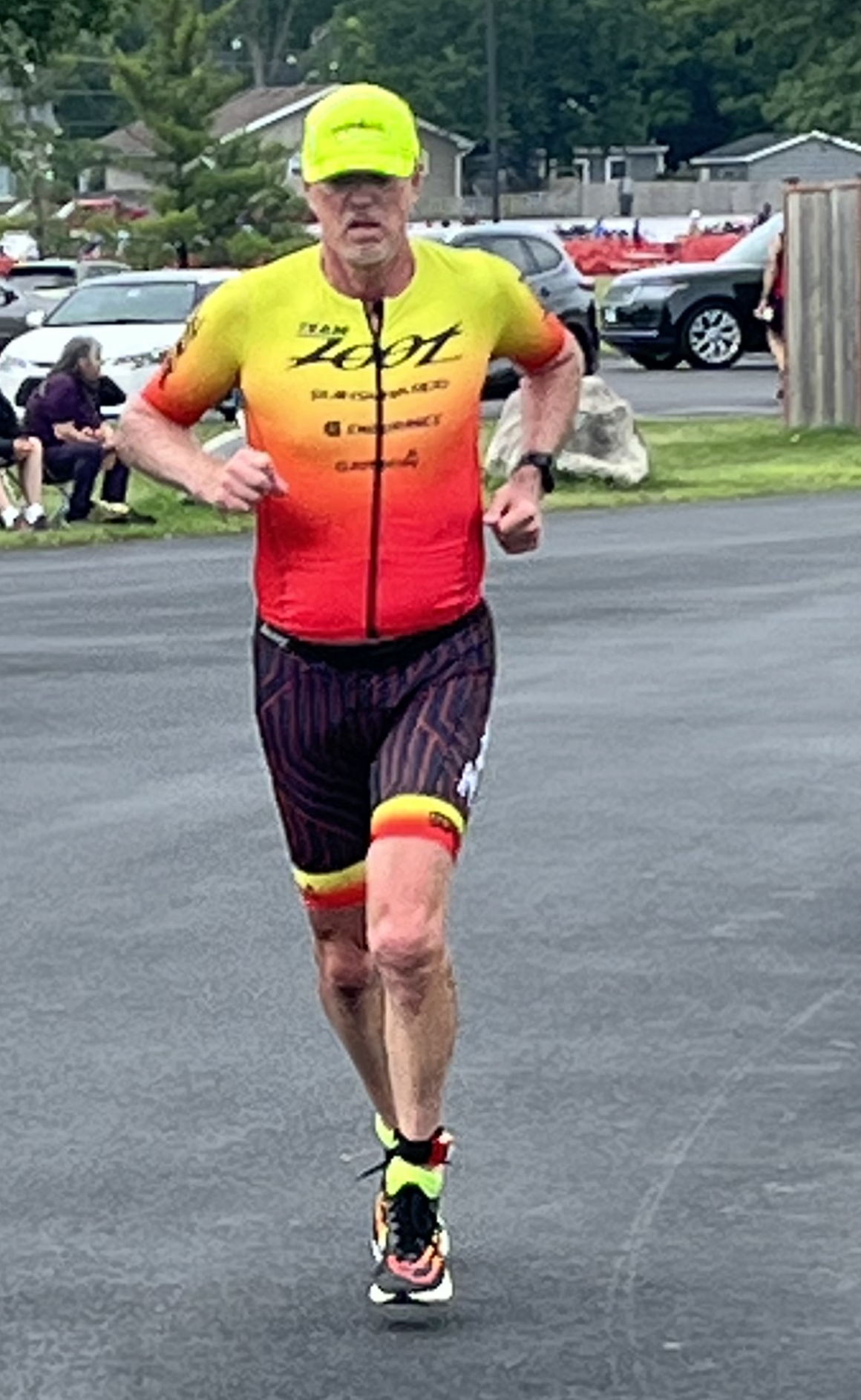
Yesterday dawned chilly and sunny. I drove down early and found one of the first two parking spaces on Lake Street, picked up my registration packet, pinned the number on my Zoot racing shirt and settled in for a half-nap in the reclined front seat of my Subaru.

At 7:00 a.m. I got up and ran a few short laps around the soft surface of the artificial turf field in Oak Park. My legs felt alive after the previous day’s easy 30-mile cycling journey with my wife Sue. I was happy to feel my legs responding. I was so relaxed it was fun to spend time chatting with other runners and stopped to pet a few cute puppies too.

The Nike Vaporfly shoes I’d purchased on sale at Dick’s Sporting Goods felt good on my feet. It took a few runs to get used to the squishy feeling of those shoes even though I’ve been training in a set of Nike carbon-fiber plate shoes the last few months. The Vaporfly’s are good for forefoot striking but I’ve also learned to shift from midfoot to heel for a bit to change up and prevent muscle fatigue.

I arrived at the Start line right as the siren sounded to start the race. It took a bit of dodging to get into the 7:00-7:30 pace group but once I was there, and glanced at my watch to see 7:02 on the pace indicator, I eased back a bit and ran through the first mile in 7:33, right where I wanted to be.

Then I concentrated on relaxing at that pace, practicing some of my own advice to carry my arms in the “Spindle Swing” that I’d taught to a running group this past summer. It involves putting an imaginary “spindle” about eight inches in front of your chest and pretending to pull a string back and forth with your hands.

I also thought about the P.A.W.S sessions conducted this summer to teach people running efficiency. That stands for Pushing Along With Speed, or ‘pawing’ your way with the heel and forefoot to cruise over the ground rather than raw, hard heel-striking or running so high on your toes that you stop yourself.

The second mile passed in 7:36, just a touch slower than the first. There were many turns in that section of the race, and I kept to the corners the best I could, but ultimately saw that I’d run 6.26 miles according to Garmin and Strava. You have to run the tangents to be most effective in a race.

The third mile passed in 7:35, and I felt really great. The thought passed through my head that I should test a faster pace. I ran the next mile in 7:28. Still good.

Right at that point, I noticed a guy about my age on my left. I thought I’d left him behind in the first mile but apparently, he’d either been tracking me or just plain caught up. “Hey,” I called over to him. “How old are you?”

“62,” he replied.

“Good,” I responded.

He retorted: “How old are you?”

“65,” I chuckled. Then I said, “We’re safe in our age groups. Now we don’t have to suffer unnecessarily.”

Meaning, he could focus on his race and I could focus on mine. So that’s what we did. He pulled ahead and wound up with about 100 yards on me by the time we finished.

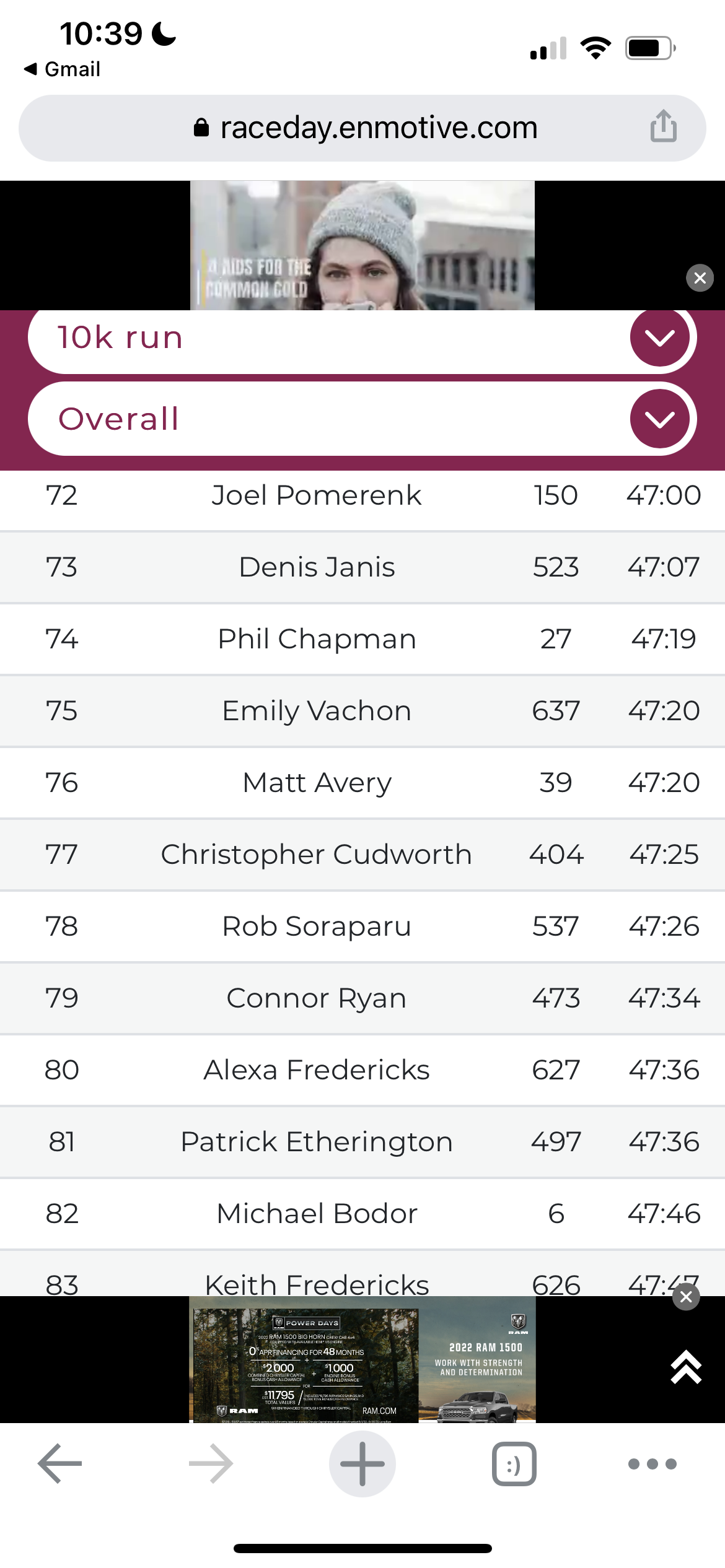
The fifth mile had a couple turns that slowed my pace a bit. I passed that mile in 7:36. The sixth mile had some inclines and I managed a 7:49. But with .2 of a mile to go, the road turned down a slight downhill. I raised the pace in a kick. In all, I ran 47:25 according to the race clock, but my Garmin showed 47:04. I’d also started a bit back from the starting line and noticed that my times and distances were slightly off from the mile markers along the way. My Garmin congratulated me for the fastest 5K (I think it was 23:45 or something like that) and third-fastest 10K.

Now, I didn’t run as fast as I did a few years back at Sycamore (43:50) where my pace per mile was closer to 7:00. But neither do I feel like that’s impossible to reach that again. I had the best racing experience feeling good the entire way even though my gut flirted with some heaviness and side stitch possibilities at the first mile. I willed that away, breathed from the belly and kept it rolling. I said out loud, “This is fun!”

I also thought to myself. “You’re Christopher Cudworth. You’ve been doing this a long time. Yes, you’re sixty-five years old now. That’s a senior athlete for sure. But you’re in the top 100 in this race for sure.” Indeed, I finished in 77th.

I was so happy and satisfied with the day that I didn’t really care about awards. There wasn’t a ceremony anyway. I guess they’ll be available at Fleet Feet Sports in Oak Park. I’ll decide if it’s worth the drive to pick that up or not. My real reward was the feeling of smooth running on a bright fall morning. It’s not always that easy. But there’s really nothing like it when it comes to feeling young again. I felt a definite joy in that.

I called Sue and we talked on Facetime. She was out riding her bike 70 miles in training for two upcoming races. 70.3 Worlds in St. George and the Arizona Ironman in November. She wanted to come watch me race in Oak Park since she’d lived there for many years, but she also needed to get her racing bike over to the Trek store for shipment to Worlds.

That’s the life of competitive athletes at any level. It takes flexibility along with dedication to enjoy success of any kind. Come to think of it, that’s a good approach to everything in life. Be dedicated, but also be flexible because you don’t always know what life is going to throw your way. Then race along with ease and joy the best that you can manage.

Posted in 10K, aging, anxiety, Christopher Cudworth, competition, cycling, cycling the midwest, healthy aging, healthy senior, race pace, racing peak, running, running shoes, track and field, training, TRAINING PEAKS, triathlon, we run and ride | Tagged , , , , , , , , , , | Leave a comment

50 Years of Running: Stumbling into “real life.”

Running with Don Kardong and a group of sub-elite distance runners at the 1985 Twin Cities Marathon, my last fully competitive race. I dropped out with hypothermia.

Thus far in this series on 50 Years of Running, I invited readers on a journey through my competitive career beginning with high school cross country and going through college and beyond. Then I went back and covered the formative years, those early experiences that added up to the drive––and sometimes anger––fueling that competitive career.

Thus we pick up this story in my late 20s, right after quitting (or being chased out…) of the Boy Scouts of America job that I endured for two years through corrupt leadership and lying volunteers. In late 1985 I made an attempt at running the Twin Cities Marathon, but the weather turned cold in early October and I pulled out after sixteen miles at 5:20 mile pace in the company of Runner’s World author Don Kardong and a phalanx of other sub-elites running together.

Essentially, that was my last serious race as a truly competitive runner. I’d still race now and then going forward, but never with the investment in miles or dedication of those years as a free-wheeling athlete. My son was born in October 1986. I took a look at myself and decided that it was time to take real life a bit more seriously.

Pounding the pavement

At the age of 27, I took a job as an ad salesperson with Chronicle Newspapers, a family-owned group of publications known for local news focus. From that point on, my running turned from a competitive focus to a tool for managing my brain for other purposes. I was pounding the pavement for new reasons now.

Once I stopped competing, it was like something cut loose inside me. I woke up one night pounding the pillows with my fist. Some kind of deep anger still resided in my soul. Then an incident from my childhood popped into my head. I lay there on the mattress next to my wife making a deep groan. I was recalling the day that my father lit into my brothers in front of me. That was a deep childhood emotional scar. Once I realized its impact on me, I started to work on what it all meant. How could I process why that moment affected me so much? Was it even wise to do so?

I knew that I had anger issues of some kind. They ran in direct proportion to my native anxiety. No one had ever described to me what anxiety was all about, or that it could be characterized as a condition people deal with all of their lives? Certainly, I’d been a nail-biter since birth. Often I was moody and even depressed. Through it all I’d found ways to survive, mostly through sports and by running. But I’d come to realize that for me, anxiety was one of the key tarsnakes of life.

Counseling

Now that I was taking a more pragmatic approach to life, I decided to seek counseling. That wasn’t much help at first. “Your wife just wants you to be stronger,” a psychologist advised me. Looking back, I’m convinced she was projecting some of her own problems onto me. I came home even more frustrated.

The new job in ad sales didn’t help my anxiety. Having daily and weekly sales deadlines put perpetual pressure on my psyche. I was learning on the job and also from my mistakes. But I was getting better at it, and my training as a runner taught me persistence. The guy that preceded me in the position was a natural charmer with good looks and high confidence. He went on to sell spirits in the liquor industry.

I called on small businesses, banks, car dealers, furniture stores, hair salons and other clients in the towns of Batavia and Aurora. Finally, I built my book of business to a steady commission stream. Then the sales manager handed the real estate and car business over to a specific sales team, and I was left with 3/4 of my weekly billing. As a young husband and father, that was tough to take. “You’ll have time to find more business now,” the sales manager told me.

That’s the typical pitch so many sales managers rely upon to put pressure on their team. I’d sell most of the day, place the ads back at the paper and do it all over again the next. I was living the Jackson Browne Song titled The Pretender.

I’m going to rent myself a house
In the shade of the freeway
Gonna pack my lunch in the morning
And go to work each day

And when the evening rolls around
I’ll go on home and lay my body down
And when the morning light comes streaming in
I’ll get up and do it again, Amen
Say it again, Amen

But we’d purchased a house with help from my wife’s parents. We lived in a nice neighborhood in Geneva, Illinois and I was finally making a living at a job that seemed like it had a future for me.

And that alone helped with the anxiety. A little. The anger was still an issue I needed to confront. Those opportunities would come along. I was stumbling into real life.

Posted in Uncategorized | Tagged , , , , | Leave a comment

50 Years of Running: About religious dedication

A longtime female friend told me a few years back that she recalls walking the streets of small-town Elburn with me as I philosophized about various issues. That’s no way to win the heart of a girl. Somehow I could not help myself. I’ve always cared about the deeper issues.

We were in eighth grade at the time. Our family was “new in town” because my father moved us from Pennsylvania to Illinois when I was thirteen. That meant establishing an entirely new friend set. That happened like most junior high social interactions. One connection at a time.

My next-door neighbor was the minister at the United Church of Christ church in downtown Elburn. A band of us somehow wound up attending confirmation class together at that church. Somewhere in my clippings file, there’s a photo of that group with about fifteen of us meeting each week to talk about God and Jesus.

First Presbyterian in Lancaster, Pennsylvania

That was not the church that my parents attended. They drove ten miles east to Geneva to the Fox Valley Presbyterian church. We’d attended the First Presbyterian Church back in Lancaster, Pennsylvania. I loved that church, especially one of its deep blue stained-glass windows that cast an ethereal light each Sunday morning. I think that’s why I’ve also always loved blue Christmas lights for decoration. There was a house along the road to the junior high in Lampeter, Pa. that used only blue lights each year. It gave me a holy feeling inside to see those blue lights against the black night sky and the illuminated snow.

Confirmation class was its own kind of community for us eighth-graders. While there were a few more popular kids in the group, we left most of that social stuff behind in the context of those weekly sessions with Reverend Willhite. He was a caring man, serious and eager to challenge our minds in his conservative way. We held a discussion about the musical Jesus Christ Superstar, of which he was no real fan. It all seemed irreverent to him, but he also didn’t tell us not to listen to it.

I recall having an odd sense of nerdy pride in having chosen to be confirmed in a Christian church without my parents telling me what to do. In some sense it was an act of independence, an early recognition that I could think for myself, and did. One or two of those fellow classmates are still Friends on Facebook fifty years later. They are the people that are as open-minded in their thinking as I am today.

My brothers chose to have far less to do with religion than I. Their intellectual pursuits took them in different directions. But on that subject––despite my almost worshipful desire to earn acceptance from them–– somehow I didn’t care. That’s still kind of the case to this day. We all go our own ways.

Table tennis realities

So I kept up my interest in religion while rebelling against certain aspects of its proclamations. That came to be symbolized in the table tennis match I played against Reverend Willhite in the giant attic of our Elburn home. He loved playing table tennis and I’m half certain he expected to beat me in the game. What he did not count on was the fact that my brothers and I played relentlessly up in that attic, which was a perfect venue for the sport. Its high arched ceiling allowed for the “loop” shots we’d all learn to make using the smooth rubber paddles that provided a better grip. The Reverend played with a pebbled-rubber paddle without any foam between the rubber and wood. Those were better than the sandpaper paddles commonly used at home ping pong tables, but not by much.

The game was close in the early stages, but my aggressive loop shots pushed him back away from the table (a foldable construction built by my father out of plywood) and as the match grew lopsided I was amazed to hear the Reverend let loose a profane invective. “Shit!” he spat after going down about 11-4. We played games to 21 back then.

Part of me wanted to let him catch up. The other part of me saw the match as an opportunity to score theological points. I often argued with him about the more conservative aspects of the Christian religion. For me, the chance to drive ping-pong balls past him was as good as winning discussion points. As it turned out, I won the game.

About competition

That’s how I am about many things in life. Inseparably competitive. I like to win discussions and arguments as much as I like to win races or age group titles in running or triathlons. Now grant you, I’m far less competitive than I once was. I’ve learned to let some types of arguments go. But not all.

And recently, upon invitation from my brother Gary, I was invited to re-enter the table tennis world with a group that plays at a local recreation center. The first week back I was so unsure of my game that I backed off and didn’t continue. Yet the second week I arrived early, hit for a while with my brother, and won two out of five matches in a fun set against a good player.

Life is much like table tennis, you see. Every second of the day there are choices to be made. The accumulative effect of those choices constitutes who you are and what you do, or think. I care about the nuances of all that. I care about how people think, and how they arrive at their beliefs. I’ve always been that way, and always will be. If life is indeed a game of some sort, then the points and games and matches we engage in are what form our whole selves.

The writing game

I asked my daughter (age five at the time) to draw an outline depiction of angels in “heaven” and life on earth. I completed the work in pastel. Those symbols are upper left are music and their voices.

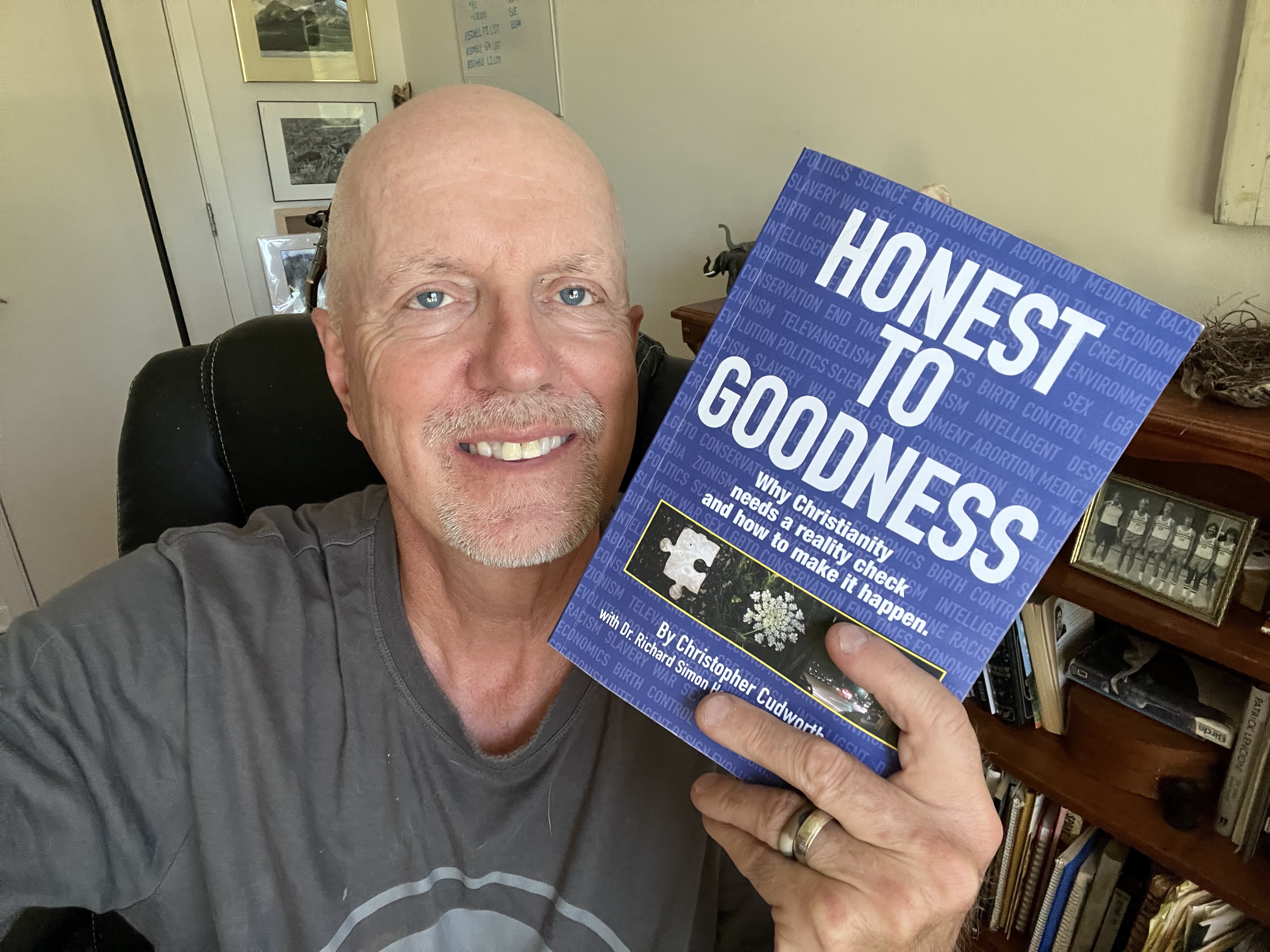
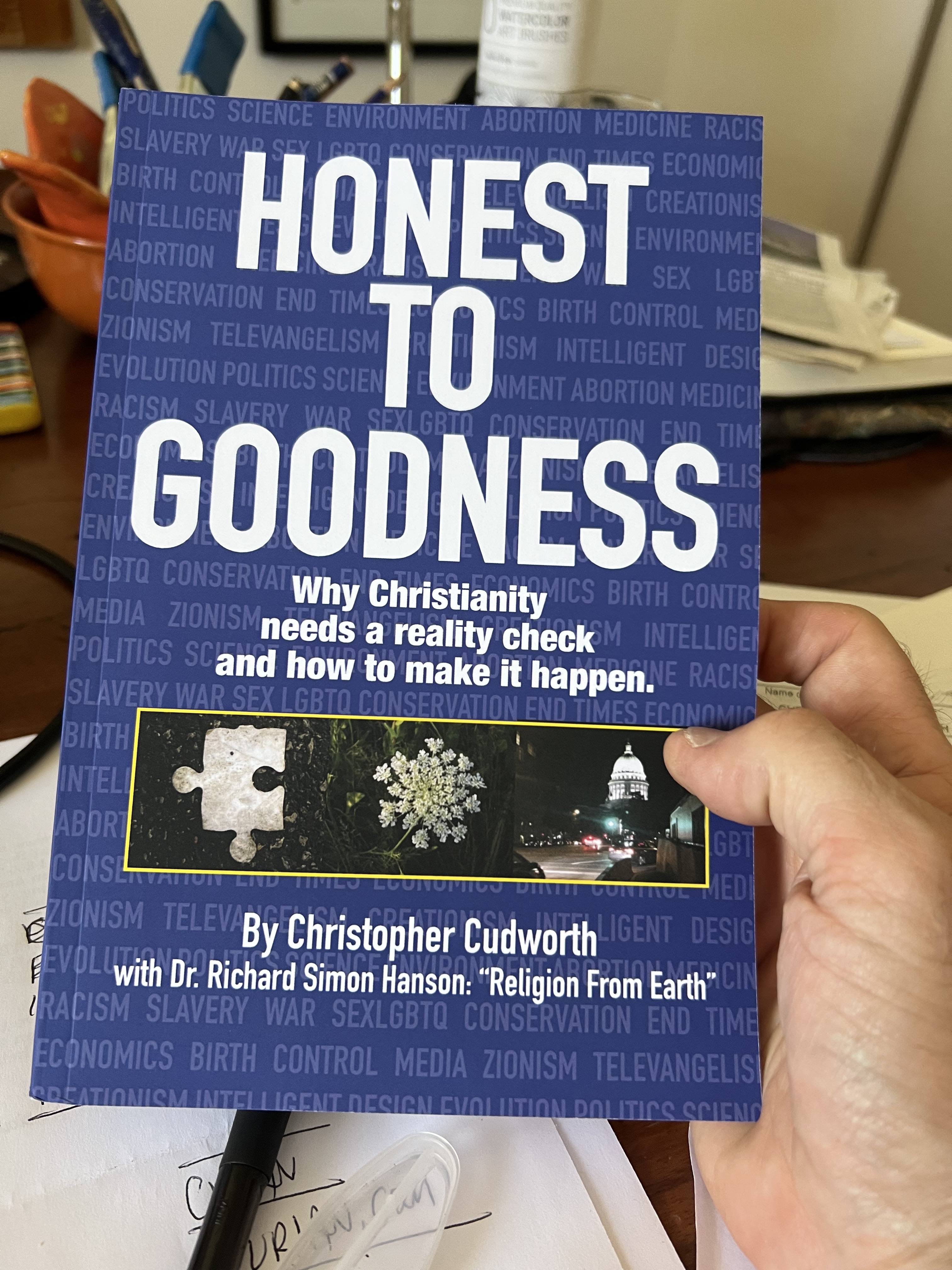
That’s what I also love about writing. It is a challenge to pull thoughts together into a conscious whole. Over the last five years, I’ve worked on a pair of books that I care deeply about. One just published on Amazon. It is titled Honest-To-Goodness: Why Christianity Needs a Reality Check and How To Make It Happen.

The book is a collaborative work with Dr. Richard Simon Hanson, a Professor of Religion from my alma mater Luther College. His work and mine combine to propose solutions to the legalistic misdirection of the Christian religion over time and in real-time. The book is a consummation of my lifelong interest in ideas, the verity of theology, and the realities introduced to use by science.

Many ideas in the book have been worked out during my training runs, rides, and swims. That’s where solutions to theological or philosophical problems often occur to me. I’m grateful to have those activities to process events of the world and make sense of them so that other people can look them through and consider their own beliefs and ideas. In the case of this book, I’m not trying to win some game or beat someone in a competition. The opposite is true. I’m trying to get people to come along on a journey, like riding bikes or running together to share an experience and decide what really feels true.

A great read on religion and life

So I invite you, WeRunAndRide readers, to give my book a try. It’s an afternoon’s read, and available in softcover, hardcover, and Kindle editions. Here’s a link to purchase the book.

I’d love to hear your feedback here or please consider writing a review on Amazon.

The book is about giving Christianity a reality check because the religion is being used in so many historically corrupt ways. In some quarters, the Christian religion is even being turned on its head or reverse or inside out by people eager to have it serve their political, economic, cultural, or selfish ideals. That’s been the case since the inception of Christianity, as you’ll see in reading the book. But people also eagerly deny that, and when bad theology gets unleashed on the world the effects are often devastating. Holy Wars. Genocide. Torture. And theocratic attempts at controlling others. Christo-fascism. It’s a reality. What we’re notw facing is a “Christian” nationalism and political entity essentially seeking to take control of entire countries in both the United States and Russia. That’s how messed up religion can get when it stands on the opposite side of the original goals of the faith.

Here’s an excerpt from the book that describes the problem:

“Getting Christianity back on the right path today is a difficult task because many believers refuse to admit that the Christian religion has ever been wrong about anything. That is why it is so hard to help folks comprehend that religion is capable of causing real suffering in this world. The track record does not lie. Legalistic brands of Christianity have been used to support slavery, block civil rights,17 brand love between two people sinful,18 and denigrate useful science19 based on a biblically literal interpretation of scripture. And that’s just the start of the list. 

None of that negative behavior serves God in any useful way. Yet, these seem to be some of the highest priorities among legalistic Christians determined to “win” what they term a Culture War.20 We must ask: What kind of worldview works so hard to deny obvious material truths and block equal rights to people deserving of them? The answer is that Christian legalism needs to aggressively protect its worldview because it does not necessarily stand for truth. That is why scriptural legalists defend their theology from any sort of objective analysis or criticism, lest many theological manipulations or contradictions be exposed.”

So you see, just like that kid walking the streets of Elburn in eighth grade, I’ve thought things through and brought them all together to make clear points so that readers like you can gauge where the truth really resides. We need honesty in this world more than ever. Please give this book a chance to show you how to get there. I promise it is an interesting, clear and satisfying read.

Posted in Christopher Cudworth, competition, evangelical Christianity, God, life and death, religious liberty, triathlete, triathlon, triathlons | Tagged , , , , , , , , , , , , , , , , , | Leave a comment

50 Years of Running: Eighth-grade realities

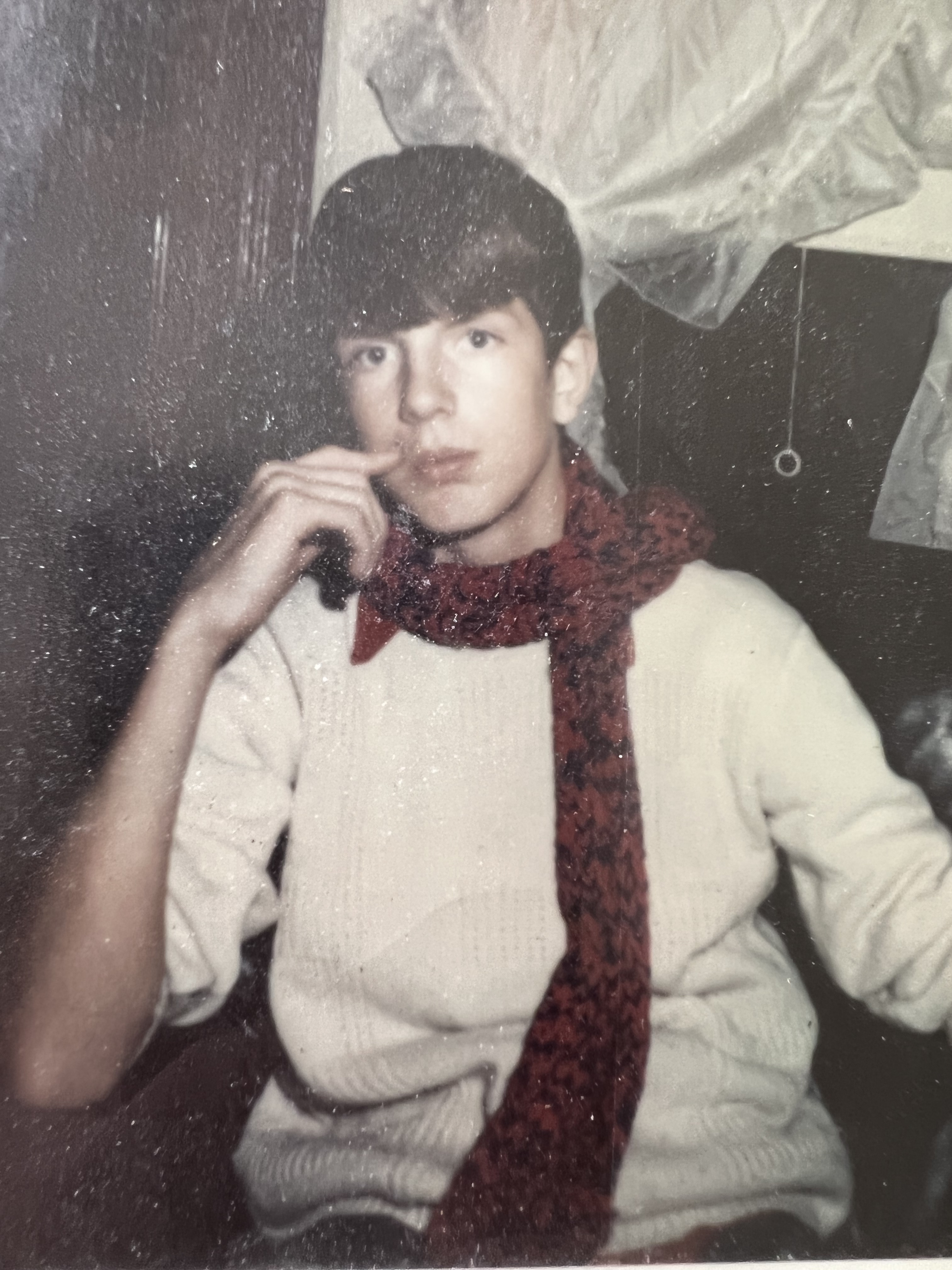
A thoughtful pose as a thirteen-year-old kid

Despite my love of laughter and being considered funny if I could make that happen, my anxious nature also meant grappling with a conflicted mind. I loved making friends but worried about what they thought of me. I worked hard to earn favor with older kids but found their company overwhelming due to my lack of knowledge about things that seemed to come easily to others.

I never understood how or why so many people seemed to know things that I didn’t know much about. On the subject of sports, I could hold my own of course. But on the subject of sex, for example, I pretended to know far more than I did.

My lust for girls in our neighborhood included teasing games of tag where I could easily outrun most of them, but dared not touch for fear of getting caught invading some zone that was out of bounds. If perhaps the lone sister my mother delivered had not died at birth, I might have gained some valuable understanding of the female mind and body. My friends with sisters were far more comfortable around girls.

Adolescent tectonics

Navigating that world and trying to prove what you know while protecting the edges of your frail sensibilities is never easy. The tectonics of adolescence result in frequent crashes and clashes with reality over what you did and did not know.

To make matters worse, I always considered myself a serious person. Fifty years after I was in eighth grade, I had a short conversation with one of the women that I’d know when she was a girl. “Oh, you were always philosophizing,” she told me. “We’d walk around town and you’d be talking about all these serious subjects. A deep thinker, I think we called you.”

Well, that was nice to hear I suppose, But that’s definitely not (necessarily) the way to endear yourself to girls of the same age. The fact that I also liked birdwatching, wrote poetry, did artwork, and took nature hikes with binoculars painted me as at least a partial nerd. Even (most) smart girls don’t want to be bored to death listening to some guy try to figure out the meaning of life.

So my seriousness was in some respects my relational downfall. And worse, I took any of the insults directed my way just as seriously. Even insults not directed my way elicited a defensive response. My sense of social justice was a mile wide but tolerance for penetration of its surface was an inch deep.

And that’s why teasing always gutted me. And bringing it on myself? The worst. Making some attempt at a joke or other verbal blunder in mixed company almost killed me. When things got really bad, and someone reached me with a hard fact about my person or my appearance, I’d suffer a condition that my brothers and I called getting”bent.” Getting bent could happen in any number of ways, such as finding out that something said or done previously was regarded as stupid. Of if something made me feel a deep sense of guilt. I’d walk around bent for half the day.

Shallow benefits

It always amazed me that some people didn’t seem to suffer the same depth of concern or angst over the same things I did. In some cases that was a ruse, and later in life we learn that some people are just good at hiding what hurts them or makes them feel guilty. In other cases, people are genuinely immune to insult or fear because they lack the conscience, intellect, or sensitivity to care. These people I eventually learned to label assholes.

An author named Aaron James wrote a bestselling book titled “Assholes: A Theory.” James is a philosopher, which means he tries to sort out the reasons why some people think and act like they do. He documents many types of assholes in this world, and yes, there are many kinds. By the time I was approaching eighth grade, my ability to identify assholes was growing day by day. I was learning that while men were often assholes, women could quite frequently be assholes too. This was confusing to me at first because lacking any sisterly relations in which I could learn what asshole girls were like, I projected a certain form of perfection on all the girls and women I met. This grand mistake haunted me in many ways, cause as Aaron James documents in his book Assholes there is a particular form of female asshole called a bitch.

“A person counts as a bitch, we may say, when, and only when, she systematically takes special advantages in interpersonal relations out of an entrenched sense of entitlement that leaves her open to the voiced or expressed complaints of other people, but immunized against their motivational influence.”

Perhaps you’ve known a few assholes and bitches in your life. Eventually, we all have to develop some level of defense (or tolerance, take your pick… it’s basically the same thing) for such people. But when you’re just twelve or thirteen years old and prone to getting bent by your own social miscues, it seems like assholes and bitches know something that you don’t.

Assholes and bitches at large

It’s a fact that they sometimes do know something you don’t. Like knowing that using intimidation to get your way is a frequently advantageous personal trait. It’s also true that really smart and talented people can turn into the worst kinds of assholes or bitches.

The most extreme of these are sociopaths, people with no concern for how others feel at all. They couldn’t give a rat’s ass if your feelings are hurt or if you disagree with them for legitimate purposes.

About the age of thirteen years old, it starts to become evident that the world has many people that are either assholes, bitches, or sociopaths. You don’t know it yet, but some of them will someday be your boss at work or even the pastor at your church. Others will run for office, (even in high school) to get their way about everything they want. These are some of the purest assholes and bitches on earth. The most dangerous assholes are the control freaks working as judges or taking out their frustrations in law enforcement.

The list goes on and on, and the sick part of this formula is that so many people grow to admire and worship the biggest assholes and bitches in this world. This habit imbues them with some sort of satisfaction through associative or vicarious power.

Think about it: the movies and TV shows we watch are filled with archetypal assholes and bitches, especially those carrying guns as if that were a sign of intelligence, grace, or real power. We live in a world where people embrace an “ends justifies the means” philosophy if it appears to represent a chance to get on the “winning team.” You know the type. It’s grade-school-level stuff, but the “winner by force of association” dynamic becomes more deadly and serious as people cement their prejudices in this life

It’s almost too much, at the still-tender age of thirteen years old…to imagine that the world is filled with so many awful people. As an eighth-grader, I walked around philosophizing because I was trying to figure all that out. By that age, I’d learned to deal with bullies and such, and hoped naively, they’d someday go away when we all grow up. Too bad. So sad. That doesn’t happen.

The harsh truth is that things don’t change all that after you’ve reached eighth grade. That’s true whether you take life seriously…and engage however you can…or try to skate through life listening to Jimmy Buffet songs, smoking weed, and watching The Big Lebowski…as if that answers any of life’s most serious questions. The Dude Abides? By what reason? The assholes and bitches are still out there, of course. Even the Dude admits that. His best friend is a big asshole. But he loves him, for reasons not fully explained. So stop pretending they’re not out there. And understand that they’re eagerly awaiting the chance to collide with you. They even make up slogans to browbeat the world or cling to religious lies by tradition to justify their assholey instincts. ASSHOLES. BITCHES. They never change.

That is perhaps the reason why I so enjoyed the feeling of crossing the finish line in first place (or nearly so) and why it felt so goddamned good from such an early age. I’ll admit it: there was always a tinge of revenge and released anger behind all that energy. It felt like a form of justice to leave the assholes and bitches behind where they could marinate in the bitter sauce of their woulda-coulda-shouldas recipe for self-justification.

So it was for me on every competitive arena. But the distant running was the best. Nothing makes you feel better than running so hard and so fast that the worst people in this world can’t keep up. The fact that some great people get left behind isn’t a problem. I’ve also also gotten left behind or cast out of the race many times in life. It builds character. Unless you’re an asshole. Then it doesn’t.

These days I’ve mellowed and no longer feel the need to beat everyone at everything I do. Competition’s Son has grown wiser, and I choose where to compete and when. Because they’re still out there. The assholes and bitches, sociopaths and zealots. The only way to keep them from running over you is to keep moving, or turn around and face them with the facts. They always seem to run away from those.

Posted in aging, aging is not for the weak of heart, anxiety, Christopher Cudworth, competition, cross country, fear, healthy aging, healthy senior, life and death, love, mental health, nature, running, running shoes, trail running | Tagged , , , , , , | Leave a comment

50 Years of Running: Making impressions

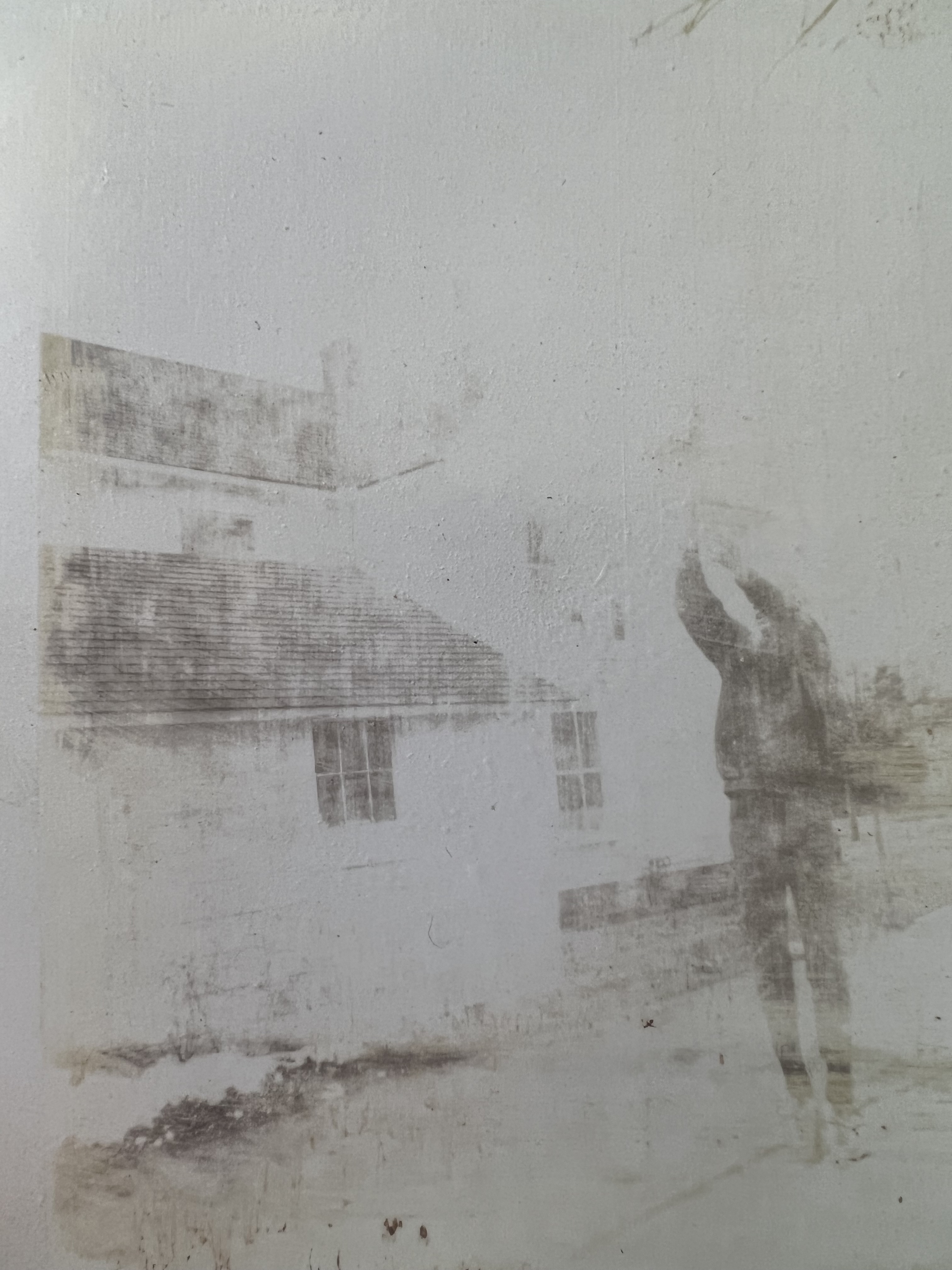
A faded Polaroid photo of my jump shot taken by my father in 1970

The first thing I wanted to do upon arriving in Illinois as a twelve-year-old kid was to get signed up to play baseball that summer. My folks lined me up with a team in the 8-12 year old league, which was a similar age grouping to the Local 285 team back in Lancaster where I helped pitch the team to a Lancaster New Era Tournament championship two summers before, and led the team as its top pitcher the following year.

That league was immensely competitive. You had to try out to make a team, and the first year I tried that as a nine-year-old, I got cut. So I understood what it meant to earn a spot on a baseball team, and I was determined to make that happen again in Elburn.

The coaches saw me warming up at the park that day and offered to let me be the starting pitcher. I struck out the side in the first inning. And the second. And so on. Before all was said and done, I’d thrown a perfect game with no one on the other team reaching base either on a hit or a walk. I don’t recall anyone really touching the ball with a bat that day. Perhaps a foul tip, but that was about it.

Following that game, a group of parents gathered around to discuss what to do with me. They talked to my dad, and he pulled me aside and told me kindly, “They said you’re too good to play in this league. I think they want you to try out for the American Legion team.”

There apparently wasn’t a Pony League team for 13-15-year olds. The next step up for Elburn baseball was the American Legion squad, which started at age 16.

I showed up for practice and met the coach, a 22-year-old firebrand named Trent Richards. He was assisted by another young man named Jim Yagel, a well-known athlete from the region who would help out from time to time.

The top pitcher on the team was a guy named Dale Garmin. He was a quiet, studious guy with a decent set of pitches, and he led the squad. But I got to pitch quite a bit that summer, and while it was intimidating at first to face batters a few years older than me, I was used to pitching to my older brothers and their friends, so I got over those fears pretty quickly.

I was happy kicking around in the dust of that baseball field that summer. I turned thirteen on July 26 and the transition to being a teenager was nothing special. I was just as horny and naive about sex and girls as I was at twelve years old. But I felt like something of a man playing baseball with those older guys.

I hung out with some of Elburn’s best athletes, including a guy named Kevin Peterson who was also a good basketball player. Rumors went around town that I was a pretty good player. Some of that reputation caused jealousy and eventually ridicule by some of the more cynical guys in town. But Kevin always treated me well.

So I got pulled into the hoops arena as well. We played basketball all year around at the Morris Barn court just west of Elburn. It was nearly a full-length basketball court in what would have been a hay loft. The floorboards were worn smooth from all the years of basketball played there. A couple of those boards were “dead zones” where we learned not to dribble the ball. We’d play in the heat of summer and through the cold of winter, sometimes wearing full gloves on our hands as we worked up a sweat in the cold air streaming between the wooden slats of the barn.

But for all that acceptance and interaction I was still an anxious and sometimes depressed kid that summer. I had made new friends named Mark Strong and Eric Berry (Eeker, RIP) that were my age. We rode our bikes around Elburn trying to connect with the girls we liked. Twyla. Allison. Ellen. Mary Jo. Sometimes we’d sit on their porches and compete for attention. It felt like the world expanded in their presence. I lived for the ability to make them laugh, even a little. But no matter how hard I tried, they still seemed to know so much more about the world than I did.

One of my fave friends Twyla.

We’d all be attending eighth grade together that fall. That meant a whole new wave of introductions was at hand. I was the New Kid In Town that year for months at a time. On one hand I loved the attention. On the other hand it meant I was always on trial with the new people I was meeting. As always when seeking a competitive social advantage, I turned to sports as my proving ground and social outlet. That’s all I knew how to do. Focus on making impressions and hope for the best. Thirteen years on this earth isn’t that long a time to know how the whole place works. But we do our best. That’s all anyone can do.

It’s a funny thing how we circle around each other trying to match priorities and make contact in this centrifugal world of inner existence. We spin and brush up against the events going on around us, and whatever rubs off on our being is what we wind up calling experience. It’s a thin veneer in some ways, this impression we make of ourselves. But it’s all we have to protect ourselves from the pressures the world places upon us.

Posted in Uncategorized | Tagged , , , , , , | Leave a comment

50 Years of Running: Becoming a Midwestern boy

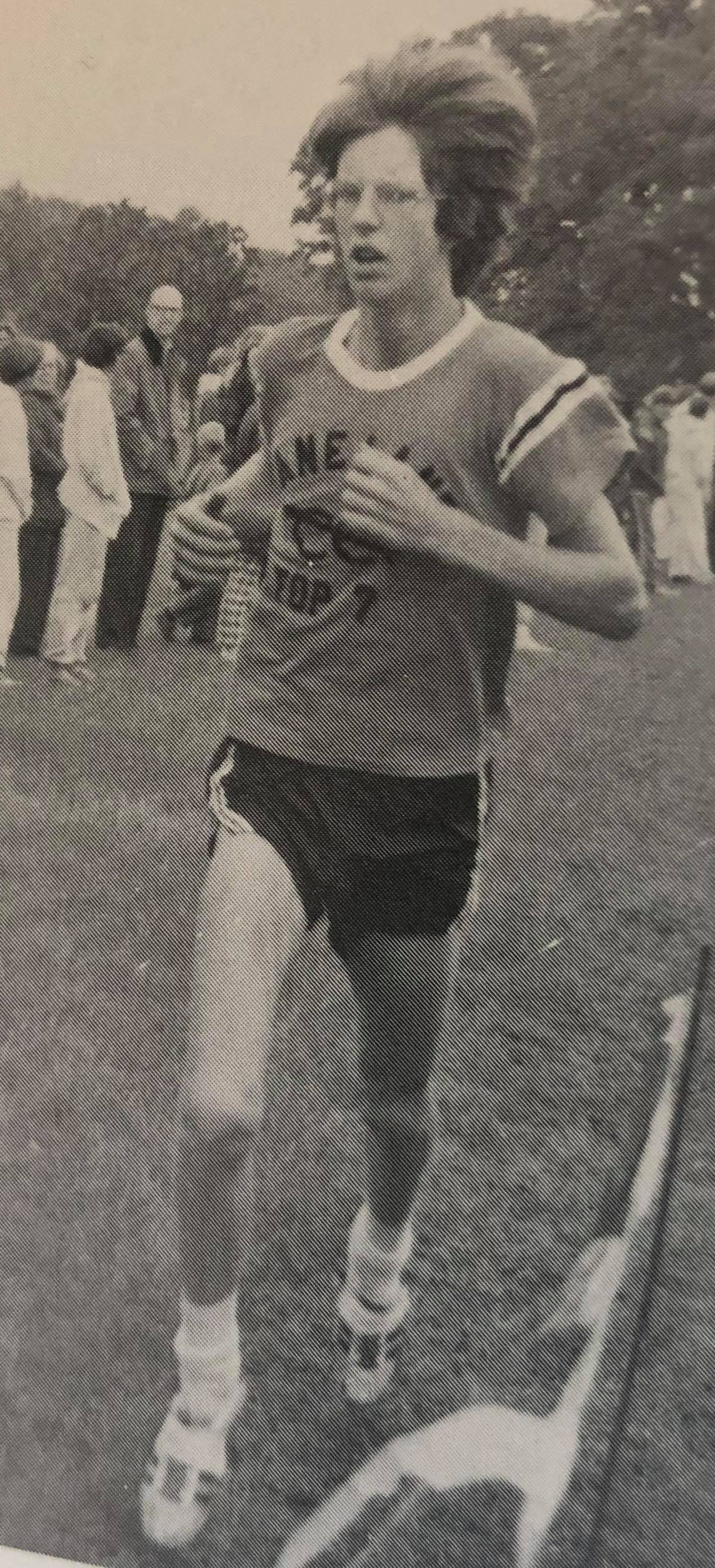
Finishing a race (1972) at the beloved Elburn Forest Preserve where we also birded and escaped from life in general.

As our family drove west through Ohio and Indiana toward our new home in Illinois, the land flattened out and the trees disappeared into distant blue clumps dotting the horizon. I’d been to Chicago once as a small child, but had no real memories of the trip. This time around, at the age of twelve years old, I struggled to process the change in landscape. It all looked so different.

The first thing I recall while pulling off Route 38 onto Route 47 at the north end of Elburn was the color of the soil. Back east in Pennsylvania the dirt was reddish brown. The Amish farmers grew tobacco on the reddish soils of Lancaster County. The smell of that crop drying in the factory just past the steel bridge over the Conestoga River south of town reminded me of the breakfast cereal Cheerios.

By contrast, the Illinois soil was dark and sullen. But as the corn and beans grew thick it disappeared beneath a layer of agricultural homogeny. We would not see the soil again until November when the farmers tilled under that season’s crop detritus. Come spring the soil might get turned yet again, revealing the shining faces of black chunks of near-perfect dirt.

Years later I’d learn that the soils in Illinois were created by the roots of prairie grasses. When settlers arrived, the farmers broke wooden plows trying to cut those roots. But when steel plows were invented the entire state fell victim to the ravenous desires of farm production. Today, less than 1/10th of one percent of the original Illinois prairie remains. I’ve visited small pieces of original prairie alongside railroad tracks and rural cemetaries. These feel like botanical graveyards, and yet prairie restoration projects are preserving the legacy of many amazing plants. I helped start such a project in 1973 under the tutelage of Bob Horlock, the high school biology teacher and birdwatching buddy of mine that passed away during a prairie burn in 1993. He was fifty-three years old.

Regrets

Just fifty years after I first recall seeing those rich, black soils on our move to Illinois, farmers here are acknowledging that they’ve laid waste to some of the best soils on earth. Over the last 100 years, thanks to aggressive farming techniques that amounted to a rape of the land, much of the best soil on earth either blew away or washed downstream to the Gulf of Mexico. In some regions of the Midwest, more than six feet of rich, loamy topsoil is now missing in action.

These days, while running the paths of the restored prairie at Dick Young Forest Preserve, I cross a two-foot high rise in the earth where a fenceline once crossed the property. You can see the rise in the landscape because the plows didn’t cut close to the fenceline. The height difference between that rise in the earth and the land around it is a clearcut illustration of topsoil loss everywhere across the Midwest. Trillions of tons of topsoil is now gone. The pale brown caps of earth mounds once covered by rich prairie soils now remind us that sustainability is important.

The restored prairie where I run now goes about the slow business of rebuilding that soil. It will take thousands of years to raise the soil profile, but if left alone, that’s how it works. The prairie built great loamy soil after the glaciers ground stone into loess and left the land behind for grassland plants to own.

We found species like the brown thrasher at Elburn Forest Preserve

Birders

One of the first things my brothers and I did upon moving to Illinois was seek out natural places to engage in birdwatching. We’d taken up the avocation thanks to my eldest brother’s experience in a college ornithology class, and we were on fire to find new species. The closest forest preserve was just a mile west from our house in Elburn, and we spent many mornings searching for birds while walking the gravel road that looped through that preserve.

We found owls and flycatchers, several species of woodpeckers, dozens of warblers in spring, and a pair of resident red-tailed hawks that soared over the thick oak woodlands. That preserve became our “home away from home” because it most resembled the woods we’d left behind back east.

The Oregon Trail

At the front of the preserve, there was an odd “ditch” of sorts where the entrance road crested a small hill. One day I finally noticed a sign indicating that this drop in the land profile was a feeder route leading to the famous Oregon Trail. The “ditch” had been cut into the earth by the movement of covered wagons and other human migration through the area 150 years before. I stood there one day thinking about that trail and how it represented both a scar on the landscape and also the mark of so many dreams.

Two years later, as a freshman member of the Kaneland Cross Country team, I’d run races right past that deep cut in the earth. We’d start on the bottomland of the preserve, race up the broad glacial hill on the south end of the woods, tarry through the oak forest on a winding gravel road, and pop back out front next to the section of the Oregon Trail. Sadly, the county has allowed trees to grow in the groove in the landscape. That should never have been allowed. Much of the cross-country course is also “wooded over” and the large open grassy area that served as the starting point of the race has been allowed to revert to wetland. Those are all good things, mind you. I’m comfortable allowing my high school memories to dissolve into those natural areas. Nothing lasts forever if nature has its say.

Becoming a Midwestern Boy

Running in Elburn FP 1972

I never knew when we moved to Illinois that there would be so much to learn about the land and its history. It might have been great to remain in Pennsylvania, but perhaps I was meant to expand and experience the many things the Midwest has to offer. I moved back to Philadelphia for a short period during my early 20s, but by then I felt out of place. The landscape back East felt crowded and intense compared to the open skies of Illinois. I’d also grown to love the diversity of birds and the open-faced nature of Midwestern people. While I’ll always think of that Pennsylvania house and yard as my original boyhood home, I grew to make the best of it here in Illinois. I’m a Midwestern Boy for sure.

I’ve always loved running where you could see ahead, and dream a bit on the way. And yet, as I ran at Luther College, I also loved winding between cedar-covered bluffs on dirt farm roads. The mystery of that I also loved. But it is uniquely Midwestern as well. The Driftless Region is one of the most beautiful places on earth.

Perhaps I wasn’t so different than those travelers on the Oregon Trail, each seeking their own version of a new frontier. Learning to call a new place home is a valuable part of life, indeed.

Posted in Christopher Cudworth, college, cross country, nature, race pace, running, we run and ride | Tagged , , , , , , , , , , | Leave a comment

50 Years of Running: It’s about time I raced again, and what fun!

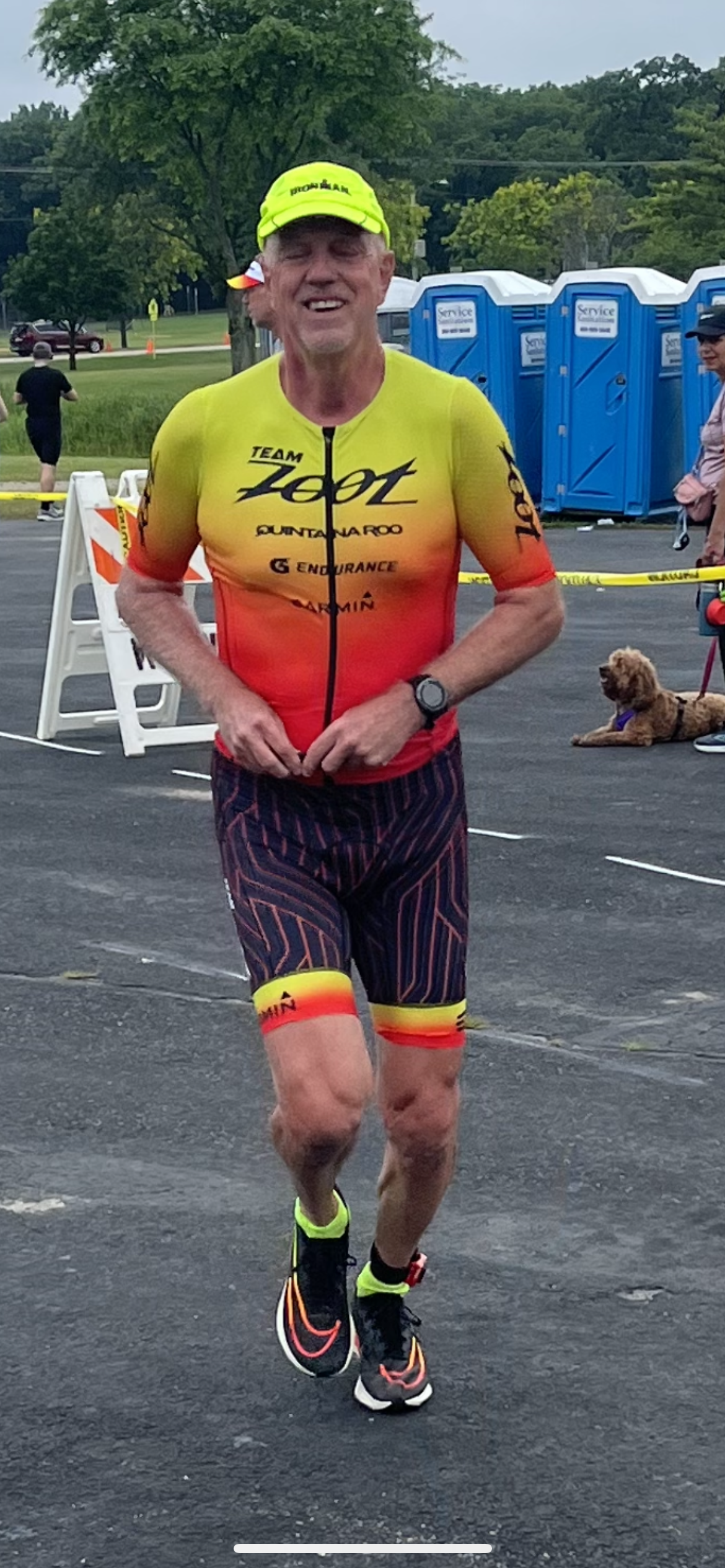
Heading into the Run Out zone, I ran over to give my wife a kiss

Standing in the sand at the beach next to Bang’s Lake in Wauconda, I felt one small tremor of nerves. Then I remembered that these days competition is more about the experience than the result. I swung my arms a few times to loosen them up before the mile swim I was about to do, and smiled.

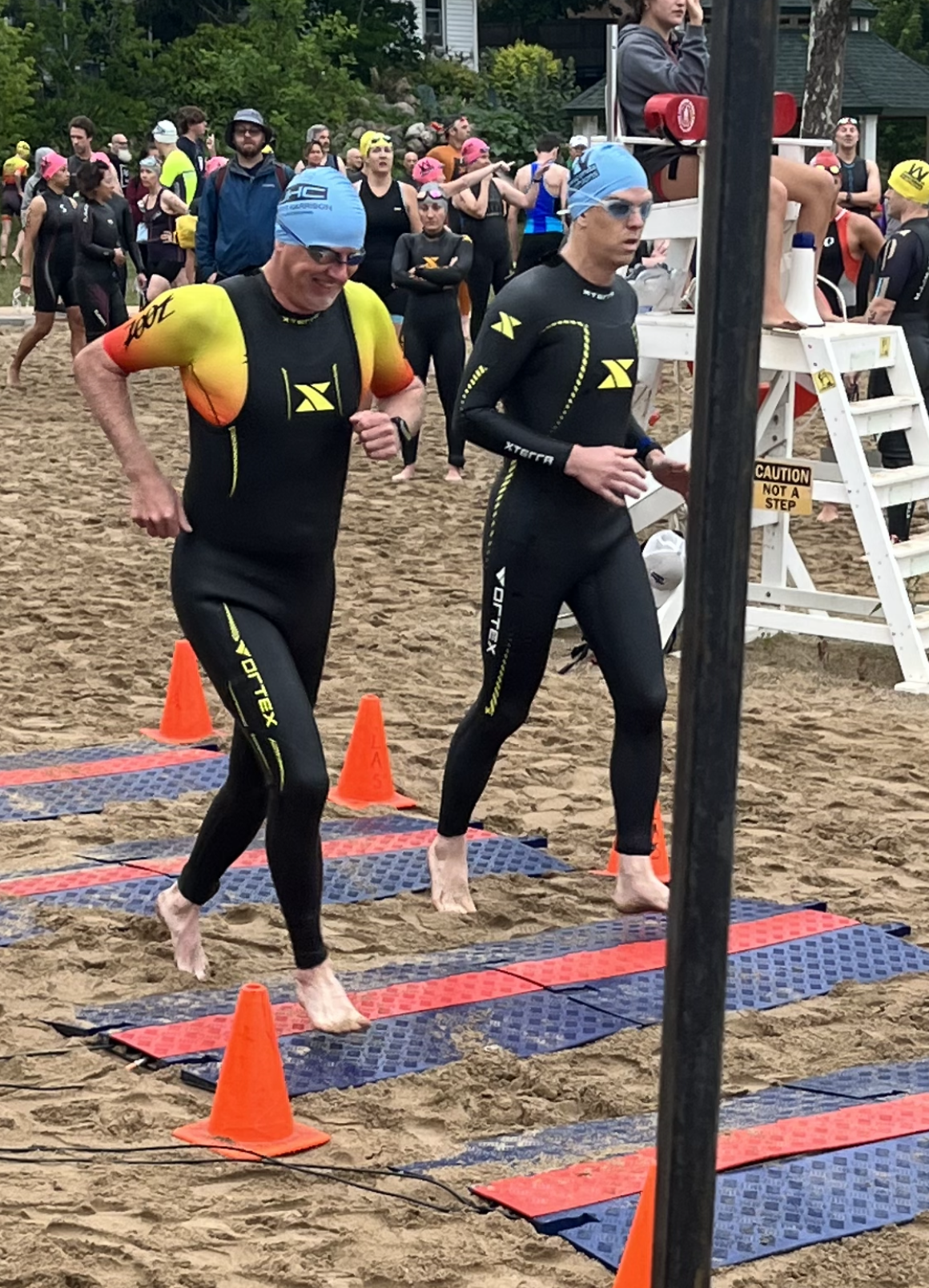
I’d already warmed up in the lake yesterday morning. The water temps were cool enough to make the swim “wetsuit legal” so the queue of 500 competitors was largely cloaked in black, some with arm sleeves, others without. My Zoot kit sleeves poked out the holes of my sleeveless wetsuit and I felt ready to go.

Last Thursday I went to Vaughn pool to test swimming in the Zoot kit. The shirt crawled up my belly a bit even when I tucked it into the ROKA shorts. It’s important to test these things out in advance of any race. For a bunch of reasons, including a bout of Covid one month ago, I’d waited all spring and half the summer to race this year.

It felt good to splash into the lake and get swimming. Both of my pool workouts went well last week, with per-100 times in the 1:47 range. And as it turned out, my fastest 100 split in the Wauconda Olympic triathlon swim was exactly 1:47. It pays to practice these things.

Coming out of the water in 38 minutes was about my target time. There was some chop in the lake from a northeast wind on the way out. I dialed into a cleaner stroke on the way back and was pretty sure I’d gotten faster as I went. Much of that is a matter of warming up this soon-to-be 65-year-old body. My birthday is July 26, so I’ve shifted age groups this year.

Getting through transition is a matter of calming the brain after the freneticism of the swim. I stopped to let my friend Trudy pop open the back of my wetsuit. She smacked me on the back and away I went. Then it was time to stomp out of the getup and pull on the cycling shoes, shades, socks and helmet. These days I don’t bother with cycling gloves because they’re one more thing to pull on during transition.

It was cool riding at first with an entirely wet tri-kit. The north breeze made it hard to get rolling along with the group of inclines over the first four miles. My legs always feel tired on the bike right after the swim even though I barely kick. Something odd goes on there, and I haven’t quite figured that out. Once I get going, another issue crops up. My upper hamstrings often tighten up if I ride a gear too big for my britches at the start.

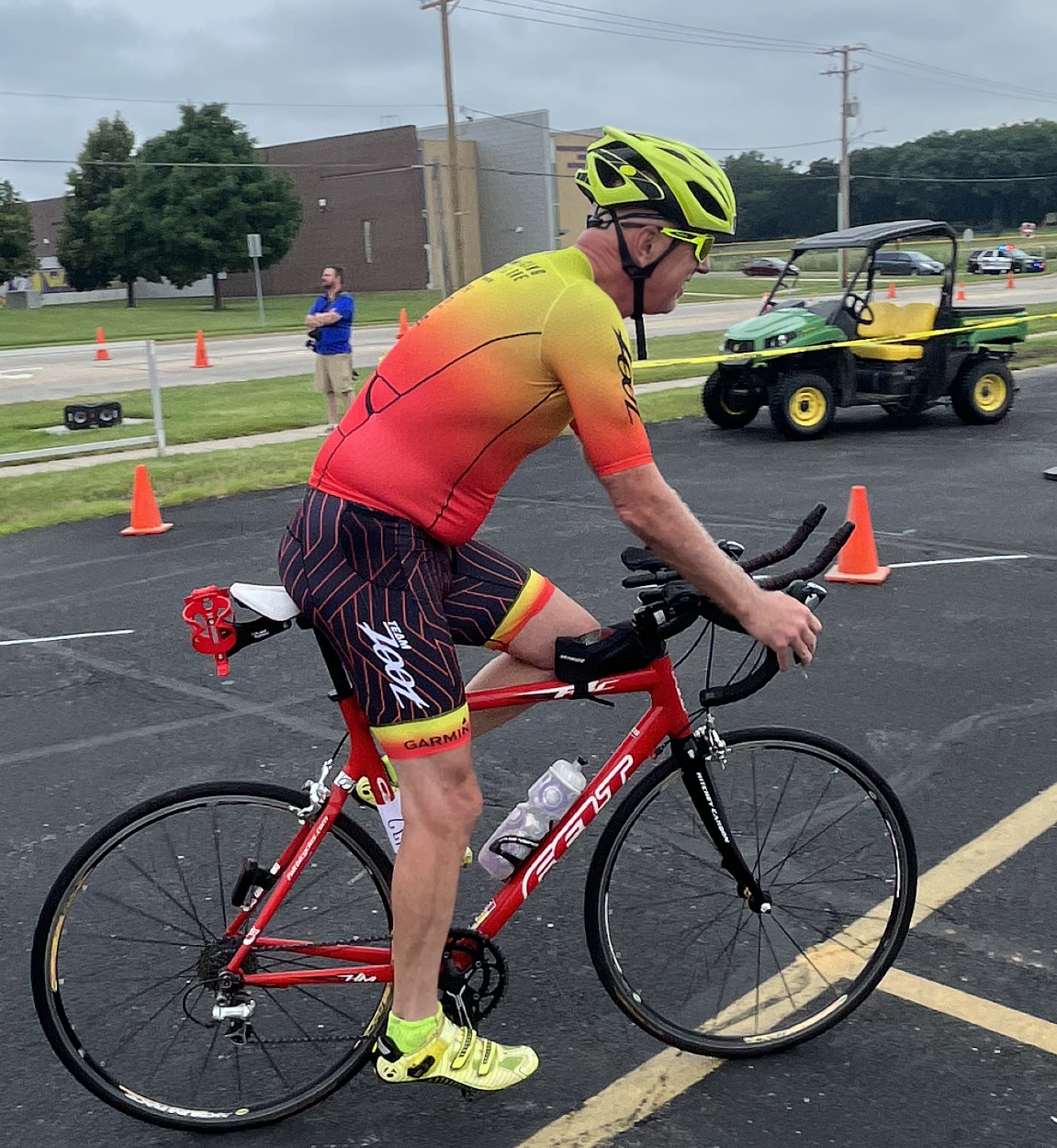
Coming in off the bike course

Up we went over a series of hills to the northernmost point of the bike course. I didn’t really study the facts of the race carefully enough to know that we were doing two loops of the same course. My vision was that we were riding one big 24-mile loop, but that was not the case. My lack of attention to detail sometimes gets me into trouble in circumstances like that. My sweet wife kept checking my gear list the morning of the race. “Helmet? Shoes? Running shoes…” but yes, I had it all with me. I’ve learned to focus on what’s needed to succeed. But I never bristle at a few reminders.

Heading down some back roads, I dug into the Clif Shots to chew a few down for nutrition’s sake. It wasn’t super hot so I wasn’t panicked about water, but six miles in the sweat did start dripping off me. I was ripping along at 24-25 miles per hour at some points on the course.

But the climbs were weak. I felt the stress in my upper hamstrings and that’s a sign that in truth, my bike geometry is not ideal for triathlon racing. The Felt 4C I ride is a faithful companion. It is the bike I raced in criteriums back when I had the nerve for such things. Now I fix aero bars to the front and ride in the best position I can. Which isn’t terrible. I averaged 18.5 mph for 24 miles on a course the race information calls “challenging.”

Heading into Bang’s Lake for the swim.

The men and women riding true tri-bikes came zooming past at times. The sound of their carbon wheelsets preceded their arrival. It sounds like rolling thunder in the background. Then they whoosh past at warp speed and I watch them go. Younger and stronger, and likely trained much more seriously than I, the age-group elites have all the time in the world ahead of them. I remember being the race leader on so many occasions at road races. Whipping past slower runners on the return trip of an out and back course, I accepted their cheers and often cheered back. “Way to go!”

I uttered that phrase to all kinds of participants in yesterday’s race. “Way to go!” is a gender-neutral, positive bit of encouragement that isn’t judgmental in any way. There’s nothing wrong with being respectful toward even the slowest riders out there. Some of them rode mountain bikes with sneakers flat on the pedals. Their age and race numbers were still scrawled in black marker on their calves. They’re after their own race experience.

A 60-year-old Zoot woman came ripping past me with four miles to go. I decided to ride in sync with her the rest of the way, and allowing six bike lengths to avoid any drafting penalties, I dialed in a faster cadence and rumpity-rumped through Wauconda on its bumpy streets and finished the bike with my wife cheering.

I’d had a bit of a mixup the first time around. The woman giving directions for Sprint and Olympic competitors got confused and stood right in the middle of the bike lane as I approached. “Olympic!” I called out while approaching the race split point. “Left!” she yelled back.

“Left?” I asked, and veered into the space outside the cones. Looking ahead, I saw competitors riding on in the Olympic distance. But as stated, I hadn’t studied the details much and perhaps I missed some sort of roundabout we all had to do before heading out on Loop 2. So I soft-pedaled over to the sidewalk and down about fifty yards before swinging back onto the race course proper. Catching back on with a younger rider, I told her, “They f’d me over back there,” I laughed. “This is the Olympic loop two, right?”

She smiled and said yes.

So I was glad to be done with the riding section of the race by the time we pulled back into transition. I love cycling but the slow inclines on that course ground me down a couple times. I need to work on that aspect of my riding.

I did do something on the bike yesterday that I’d never accomplished before. I peed while riding! Yanking down on the bike shorts in a section of the course where no one was near and there were no competitors in sight, I whipped out the nard and relieved myself while in motion with a helpful wind to blow the results away. I was so, so proud of myself for that move. Hey, you take the small victories where you can in this sport.

But I’d hydrated enough that I still had to pee coming out of transition to run. My wife Sue was waiting for me with her iPhone to take pictures as I ran past. Instead, I veered off to the Porta Potties for a ten-second pee. I hate running with that tingle of having to pee. It was worth it to get rid of that sensation when it was most convenient.

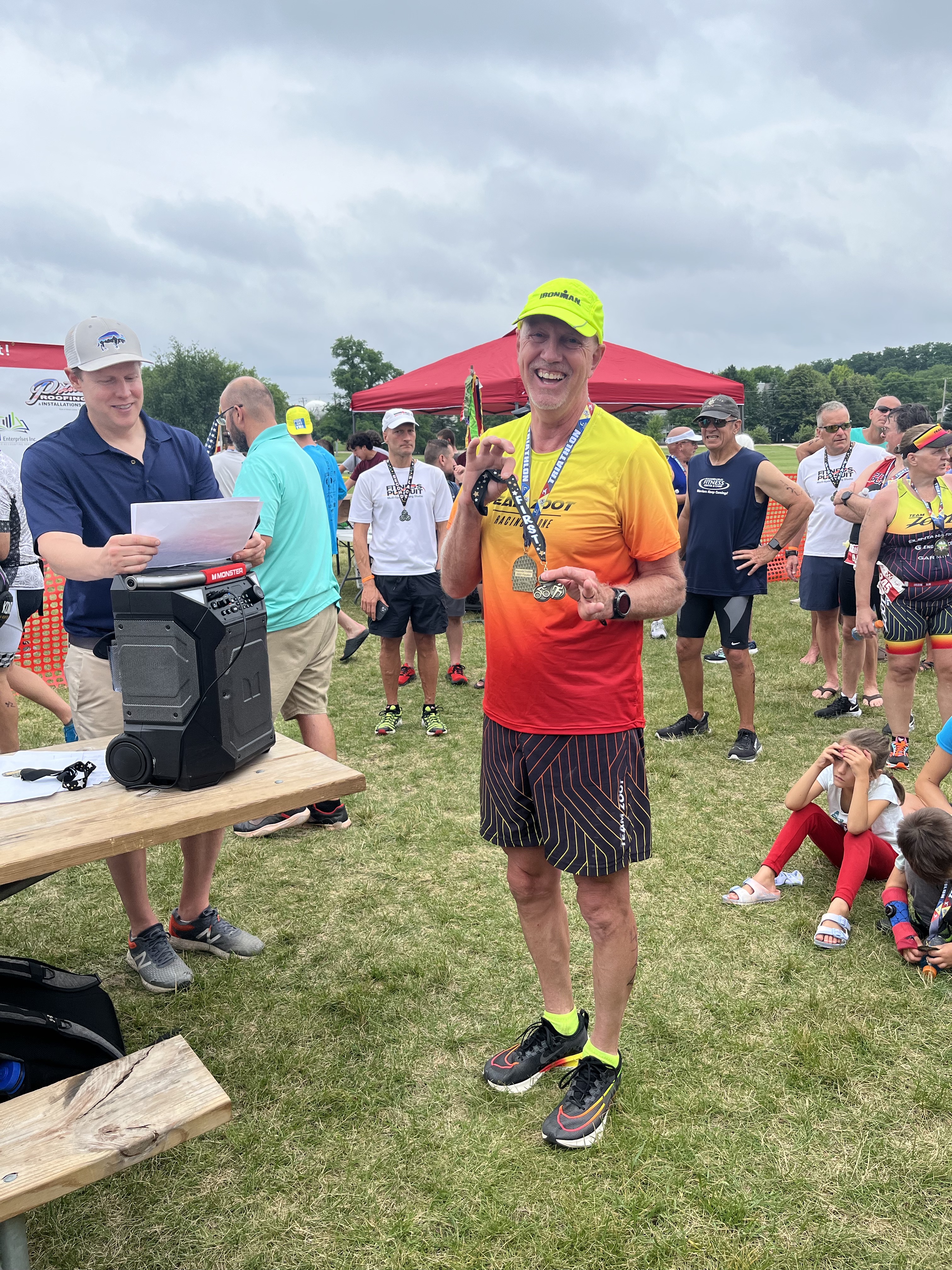
Age group champ. Aren’t I “matchey!”

There was one more problem to solve coming out of T2. I’d tried to use the Triathlon setting with my Garmin watch but at some point pushed the wrong button and I didn’t know what to do next. Was it tracking transitions still, or just adding it all up. The face read 1:50 and I tried to save it but the watch decided it wanted to find Heart Rate data. “Nooooo!” I yelled at the watch, pushing all sorts of buttons at the same time. Finally, as I approached two minutes on the run I dumped and discarded the whole setup. I wanted to see split times on the run.

That first half mile is always a drag. The legs are dead from cycling and the human body needs to figure out what it has stored up for a six-mile run. I lumbered along for a half-mile and finally things started to come together. The first mile was relatively flat and I passed through the mile in 8:38. A good start.

Then things got interesting. I wasn’t trying to pick up the pace but I was running along at 8:00 per mile by then. “This is great!” I told myself. “Just don’t push it and let the body do what it does best. Run!”

Then we turned the corner near two miles and the hills came one after another. Much like on the bike, I could not climb for beans. My butt was tight and the legs were tired. Cresting that first hill, I looked ahead to see another. “Well damn,” I muttered out loud.

A half mile before the turnaround we turned right and spilled own a 300-meter hills. “You have to climb this coming back,” the volunteer at the turn told us. “Thanks,” I breathed.

We climbed yet another hill to reach the turnaround. I slowed to a near-walk and then the road flatted for a while. Turning back, I tried to remember how many hills we’d have to climb on the return trip. Plus that one big one. So yes, I slowed a bit through that middle mile, hitting a 10:03. That was all I had in me running up and down those hills. Midway through the 300 meter climb back to the highest point on the course, I walked for fifty meters. A woman in front of me was walking backward to deal with butt cramps. Coming off the top of the hill I commiserated. “My butt locked up too!” She huffed in that shared suffering triathletes love to endure.
We got to go downhill at last. I locked into 8:00 pace on the flat again, and reasoned that perhaps I could sustain that going back in. My stomach felt side-stitchey the first few miles, and now my throat felt a bit acidic after taking a sip of water that floated the gel I’d taken at the last minute on the bike. I’m no wizard when it comes to triathlon nutrition. Pretty much I try to take the minimum required to get through without gastrointestinal issues. After the race, our friend the race referee Maxine-Franck Palmer laughed and told me, “Well, if you almost barfed it means you did it the right way.”

Right at four miles I saw three cheering faces as my wife, my step-daughter Stephanie and her partner Yomi appeared on the course dancing and swaying their arms. That cheered me up and I was thankful that I was moving decently at that point. At least I didn’t look like hell.

Then a surge of reality kicked in. I’d not taken quite enough nutrition to last me the whole race. During the last two miles I stopped for a few five-second breathers and walked a couple times. I was still managing to move along at 9:30 per mile. “Just get this thing done,” I said out loud.

On a nice long decline I was joined by two young women running on either side of me. Both were encouraging after I told them, “Good job!”

Trucking it home

“You too!” they said. Then I watched as their fit butts moved on ahead of me. I thought about the first two women that started the Luther College Cross Country program my freshman year in college. How far the sport has come in terms of equality! Gender really doesn’t matter out there on the course, does it? We’re all just people trucking along.

Blessedly, the last half mile was mostly downhill and then flattened out in the park to the finish. I glanced at my watch to see an 8:20 pace pop back up and was glad to run strong into the end of the race. My wife was there to capture the moments, and I was there to have fun and do my best. My splits on the run weren’t great, but they were respectable on that kind of hilly course. 8:32, 8:48, 9:13, 933, 10:11, 9:04 and a total time of 55:25.

Turns out that “aging up” has its advantages. I took first place in the 65-69 age group with a creditable PR of 2:59:49. Yay!

We made the long drive home from Wauconda to North Aurora and I actually did some yard work after a restless nap. My heart rate data from the race showed that I topped out at 179 bpm. That’s nice and high for a guy my age, and it shows that while I was trained enough to do decently in the race, there is still fitness to be gained, for sure.

My body was buzzing most of the day. I felt strong, almost liberated in some respect. Perhaps I’m one of those people that needs to push things to the limit now and then. This life we live too easily become mundane if you don’t raise the needle of effort now and then.

It inspires me to do that in other phases of my life. I’m a week away from fully publishing my book Honest-To-Goodness: Why Christianity needs a reality check and how to make it happen. It takes a ton of work and focus to make a project like that happen. There are stops and starts, and detail matters just like it does when running a race.

I believe that one good thing feeds another. It was about time I raced again. And it’s about time I tried to change the world with this book I’ve written.

Posted in running, running shoes, tri-bikes, triathlete, triathlon, triathlons, we run and ride, We Run and Ride Every Day, werunandride | Tagged , , , , | Leave a comment

50 years of running: Saying goodbyes and taking on a new life

As the school year wore down in 1970, the time for our family to move to Illinois soon arrived. My father moved out to Illinois after taking a job with an electronics company in rural Geneva. He lived in an apartment in St. Charles for months. Looking back, the uncomfortable truth is that he likely valued the time away from the family––and perhaps even time away from my mother. He let loose in a bit of mid-life crisis. But when he crashed the greenish ’57 Chevy at an intersection one day, the crush of reality probably caught up with him quickly. Some omens arrive by way of metal. Others take the form of flesh. In either case, the collision with reality can be awkward, and often rough.

My mom worked hard to keep our family together back in Pennsylvania. She worked all day teaching school and ran her boys around to practice most evenings. On weekends she tutored students from my class with special learning needs at our home. She made sure I made no mention of their difficulties lest they be mocked at school. The social order was merciless back then.

Holding pattern

To me, that spring was a strange holding pattern between normalcy and all the changes that I sensed were about to come. I was a self-conscious kid with crooked teeth who refused to fully smile when having my picture taken. It was hard enough maintaining some sort of social status among kids with whom I’d grown up from the age of five until seventh grade. Now I was going to have to reinvent myself in an entirely new state? It was best not to think about it day-to-day.

Then one day my father called long distance to relay that he’d found a house in a little town called Elburn. He sent us Polaroid photos of the house and driveway. I noted that the basketball backboard affixed to the barn had a nice orange square behind the basket. That was an all-new feature of basketball backboards in those days. It gave me the slimmest hope that life in Illinois could somehow turn out to be cool.

A Polaroid photo of the Gates Street house in Elburn in 1970.

The news that I’d be moving out of town swept through our class at school. People wanted to know why I was leaving, and I didn’t have much of an answer except that my dad had gotten a job far away. Even relating that bit of foreign information made a difference in how some friends treated me. There are always people that don’t cope well with any change in a relationship, especially when it means you might be moving on in one way or another. Often to protect their own sense of security, they hide their true feelings and the person leaving winds up getting treated like dead meat. That’s how it worked with some, but not all classmates.

Over the years, I’d feel that same sensation in other situations as life went on. When things weren’t going well at work, or if you actually got laid off or fired, the ‘friendship’ dynamic changed in an instant. Whether for superstitious or practical reasons, people don’t want to associate with anyone anywhere near the chopping block. If someone is sick or worse yet, even dying, people have trouble knowing how to act. They don’t want to say the wrong thing, so they say nothing at all.

And if a lover cheats on you and other people find out about it but are afraid to tell you, the communication dynamics get awkwardly clipped and odd. In all these situations, people often choose to avoid or hide from the truth. Perhaps there is some evolutionary explanation for these types of human interactions. People see any form of weakness or signs of separation from the herd as a potential threat to themselves. It’s a dynamic as old as wildebeasts and lions, and it is one of the tarsnakes of human existence that even longtime friends will duck and run if they don’t feel they have the emotional energy to sustain you in a time of need.

But that was not the case with everyone in our class. Some of the junior high teachers sympathized with me about moving away. One in particular, a music teacher and the choir director, organized a Going Away party that my classmates attended. Someone took a collection and the group purchased me a an actual sweep-second-hand wristwatch, the first I’d ever owned. I was overwhelmed by the gift even though it probably wasn’t all that expensive. Others gave me 45 RPM records that were popular at the moment. That included the newly released Let It Be single, a 45 single that had the amazing parody number You Know My Name on the back. I loved that song because it captured the odd humor of my brothers and I. We all looked a life like a parody in so many ways.

But the record given to me that hurt the most was the single Get Back by the Beatles. Its refrain…”Get back to where you once belonged” was hauntingly real to me that last month in Lancaster.

Natural retreat

I’ve always lost escaping into nature.

After all that social attention, I did the one thing that comes natural to me when human relationships get too much to handle. I retreated to nature. I headed to the woods and walked trails along the small brown river called Mill Creek, and wandered over to the Conestoga River as well. Even as a young kid I loved spending time alone. On warm days I’d sometimes strip naked and walk through the deep woods feeling free and wild. To this day I love the feeling of being naked outdoors. Not everyone appreciates that sensation, but millions do. It would be better for the world if more people did, and if it were legal in the United States, the most uptight country on the planet.

Of course, a little kid, I was afraid of being caught while naked. But I was cautious as heck and that never happened. I was like a wild little animal carrying my clothes around or leaving them in some safe spot to run back and forth for twenty or thirty yards like the skinny little roadrunner that I was. These days, I’m not beyond finding some massively remote place to strip down and stand a few minutes in the sun. It is cathartic in many ways.

Anxiety reigns

Finally I’d get anxious enough about getting caught naked to throw clothes back on and hike out of the woods and find something else to do.

Along with my human friends I’d made friends in those woods and streams with crayfish and salamanders, frogs and fish including bass, suckers, carp, catfish and bluegill. While fishing, I once watched a squirrel try to leap from one tree to another and fall into the stream, only to swim back out. In winter the ice from Mill Creek heaved up during an ice dam. It collected on the banks and made an astounding playground, but I was always careful not to fall and hurt myself. I never liked the idea of dying alone.

There was a massive aviary near the golf course and I loved visiting the fenced in area to stare at the peacocks strutting with their raised tails. You could hear them calling at all times of the day, and the guinea fowl would race around with their insane clucks and protestations if you got too near.

Time to move

Then came the day that the Mayflower moving van showed up with that classic mustard yellow and green pattern with red lettering. I can still feel the dull pain of seeing that truck in our driveway. The movers hauled all our furniture and belongings out to the giant truck. Then our home at 1725 Willow Street Pike sat empty, and I walked around the house with my footsteps echoing off the walls. I could not believe it was actually happening. We were leaving home, and for what? What awaited us?

I walked around the yard with its newly grown layers of green grass. I stood there and thought about the seven years we’d spent living there. I loved that home with all my heart. Because despite the pains of growing up, and the occasional whippings we’d get with a switch or a brush, or a hot pan of water thrown by my mother to settle our asses down, that house would forever be considered the place I called “home” no matter where else I lived. I knew every corner of that lawn. I’d learned to pitch a baseball, throw perfect spirals with a football, and kick a soccer ball with the side of my foot like you’re supposed to do. And I also ran my first timed race around the side yard that was the size of a tennis court, because that’s what it used to be.

Life in images and sound

I loved how the dogwood tree blossomed white in spring and how fun it was to climb the tall hemlock on the east side of the property. Looking out from the upstairs windows of my bedroom, I could always see what was going on in the yard. My mother used to send me to bed before dark in the summer months, and I’d be jealous of my older brothers and their friends running around outside playing Kick the Can or Capture the Flag. But eventually I grew up enough to join them, and racing around as the fireflies rose from the grass is the substance of my youth.

So many evenings we’d be out there playing in the yard or somewhere nearby in the neighborhood and my mother would come out calling our names for supper. She’d mix them up half the time, “Grary, Chrimmy, Jissy…” she’d call out in some kind of confused hurry. That was because she loved us all equally, and deeply. For all our fights and differences at times, in many ways were were inseparable.

My memories of that home include birthdays spent working on plastic models given to me as gifts. Sometimes I spent hours doing watercolor paintings or pastels with the art supplies that my mother purchased for me.

In the summer of ’69 I sat with my mother watching the moon landings together in the living room. And my dad once turned to his kids before a Muhammad Ali fight being broadcast from the other side of the world, and said, “Have you ever seen a miracle?” Then he explained how those pictures were being bounced off satellites in space. But we were all so excited about seeing Ali in action we hardly absorbed the lesson. Float like a butterfly. Sting like a bee. Rumble, young man Rumble.

We watched the television shows Laugh In and Batman together. On Sunday afternoons and evenings, we’d lock in for the sequence of American Sportsman with Curt Gowdy, Mutual Of Omaha’s Wild Kingdom, then an episode of Daniel Boone or Davey Crocket, all capped by the Sunday Disney show that week. Of course, half the time I’d be watching those Sunday shows knowing that I’d not done my homework.

One fun summer we roared over the Marty Feldman comedy show as a family. The program began with the wild-eyed Feldman playing a hole of golf in which he putted into all kinds of crazy situations. On Saturday mornings, I’d watch Looney Toons with Bugs and Daffy, Elmer Fudd, Yosemite Sam, Sylvester and Tweetie, and Roadrunner, my favorite. Then came the weird-ass live shows like the Banana Splits (whose them song Bob Marley copped for one of his songs) and HR Puffnstuff, with its tongue-in-cheek drug references. and the Monkees. Then we’d watch American Bandstand and go outside after that and play.

With all those memories and joys stored in my conscience, I was numb that day we packed up to leave. The day before I met with my best friend out on the drop hole of the golf course, where he asked, “Why does everything I love have to leave me.”

As for me, I felt raw emotions burrowing into my soul. But I tried to be brave and hide them. The night before we left Lancaster, I stayed next door at the neighbor’s house. The girl next door named Amy was a sweet and kind friend all those years. Her mother Van made a special meal for us. Her father Dick used to take me fishing down at the Susquehanna dam. His eldest son was too old for going fishing with dad by then, and his two daughter had no real interest in it. So he’d ask me to go along, and I loved plunking a heavy line and sinker with a worm on the hook into the swirling waters. He trusted that I would not fall in, and I never did. Some aspects of common sense in those days were assumed.

I knew that he worked at a meat-packing plant in Lancaster. On his wall at home was painting of a bullfighter and a bull done in cow’s blood. I didn’t think much about it back then, but it is amazing how the sensibilities of generations change with time.

The morning that we left, my family arrived back from the various houses where they’d stayed the night before. My friend David and I hugged liked we’d never hugged before. We both cried deeply, sobbing. And then he stopped suddenly. That was his nature. We were two twelve-year-old boys knowing that they were losing a longtime friendship, and there was nothing we could do about it. But David learned along the way how to put pain behind him. After his parents’ divorce, and so on, he processed what he could and moved on.

The Trip West

We climbed into the 1967 Buick Wildcat with my younger brother sitting between my parents in the front seat and my two older brothers parked on either side of me in the back seat. Normally they didn’t want me touching them in any way, but that morning my oldest brother leaned close to me and we sang the refrain from the backside medley of the Beatles Abbey Road album. “1 2 3 4 5 6 7…All good children go to heaven…” Somehow that was a solace to us both.

Down the driveway we rolled for the last time. Then we drove straight through Lancaster past the Armstrong baseball fields where we all learned the game. The Buick Wildcat with its .357 engine wound onto the Pennsylvania turnpike and we traveled west toward Illinois and an entirely new life. I wasn’t exactly happy about it. Nor were my brothers, or even my mother, I’m willing to bet. But my dad had made up his mind that his future lay with that new company out in Illinois, we were all along for the ride. We’d stop in St. Clair, Michigan that night to stay with his former Cornell University college buddy. I recall having an immediate attraction to the prettiest girl among the three. She was my age and know she was pretty, so she took to running me around all afternoon, exploiting my desire to please and earn favor from her. Such is one of the tragic flaws of my personality. It always comes out during times of great duress.

The cute girl in the middle knew exactly how to tug my boy strings.

Then we drove the rest of the way through Ohio and Indiana to Illinois.

That period was all part of a horrifically awkward period of transition. My oldest brother was just enrolled in college back at Millersville next to Lancaster. My next oldest brother would be a senior in high school that year, and it was the worst possible timing to move to another state. I was only heading into eighth grade, and I’d soon enough make new friends and adapt to the new life in Illinois. My youngest brother was a mere nine years old, but growing like a big weed.

I was determined to hit the ground running once we arrived. Few things in life make you run faster in place than moving to an all-new town. Within a week or two, the word got out about my basketball skills, and I tried out for the local baseball team only to throw a perfect game against much less skilled players. So they moved me up to the American Legion ballclub that started at sixteen years old and there I was, a soon-to-be thirteen-year-old pitching against the older kids.

As a baseball pitcher, I feared no one.

And Competition’s Son was suddenly in his element.

Posted in aging, anxiety, Christopher Cudworth, competition, death, Depression, healthy aging, life and death, love, running | Tagged , , , , , , , , , , | Leave a comment