Sexuality, gender identity and the will to endure

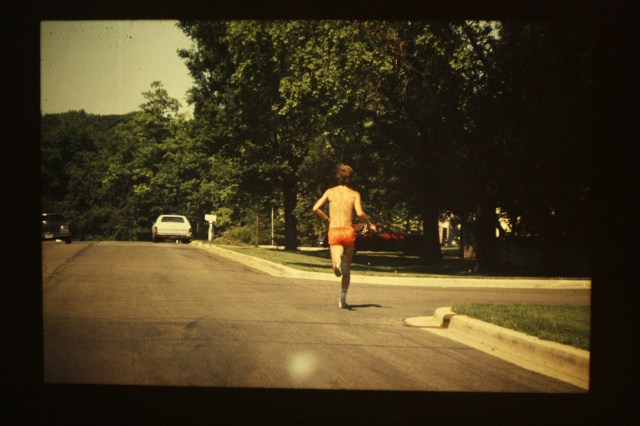
IMG_4864.JPGThe summer before my high school senior year, I knew that getting in training miles was critical to fall success. My old pair of adidas Italias were already worn out from a full season of running, but back then no one seemed concerned that kids might hurt themselves training in less-than-adequate or worn out shoes. So I did my best with what I had.

I also actually owned very little running gear. The one pair of shorts I’d kept from cross country season were getting frayed at the edges. So I visited a local department store to find something else to wear while running. My mind was full of ideas but my wallet was not full of money. So I chose a pair of plain white shorts with a drawstring in the waist.

That afternoon, I tossed on the shorts, paired them with a white running tee shirt I’d owned for several years, and headed out the door for a four-mile run.

About half a mile into the run, I glanced down at my outfit and realized it looked like I was running around in my underwear. I’d worn a jockstrap underneath the shorts, but the shorts themselves looked all the world like an extended pair of boxer briefs. Those were not even popular at the time.

I was already chagrined by my appearnce by the time I reached a house where a group of pre-teenagers was playing wiffleball in the front yard. One of them called out, “Are you a boy or a girl?”

Androgyny

With my long blondish-brown hair trailing behind me, the nature of my gender probably was not all that clear to anyone that saw me. I flushed with embarrassment at the notion that they thought I might be a girl. But one almost couldn’t blame them. Women’s running gear was so unflattering in those days it made even the most attractive girls look androgynous.

Yet the appearance of my own androgyny was disconcerting. There was very little tolerance for boys who looked or acted like girls in the 1970s. The descriptive terms typically used for homosexual men were far from complimentary.

Tough guys

Thus the competition to exude machismo in every circumstance was real and often demonstrated. As distance runners, we’d learned to defend the “toughness” of our sport against comments from football players trundling into the locker room during two-a-day workouts in the August heat.

It helped somewhat that the cross country team went 9-1 the previous year while the football team went 1-9. If you can’t be outright macho, the lesson seemed to say, at least have the power to endure.

All these thoughts went through my head as I ran in my Underwear Outfitthat day . I’m sure I drew other looks about town as the run continued. Yet at some point, as the running itself seeped into my soul, I simply ceased caring what I looked like. I was running. Fast.

Mandrogyny

These days things have changed in how people dress or view themselves in terms of gender and sexual identity. Androgyny is no longer a threat to rational people. Athletes of all genders traipse around in onesie skinsuits with little to hide.

There was a time, you may recall, when only women wore swimcaps. If you don’t recall that era, that’s only proof how much fashions and gender identity has changed in the last forty years.

Swimmers and cyclists shave their legs. It doesn’t make them gay or straight any more than wearing a swimcap affects someone’s sexuality. Body hair is a fetish for some people while others it is an offense. Again, that doesn’t dictate a person’s sexuality, or even their gender. Sexuality and gender identity should take a backseat to performance. The same might be said for transgender people in the military. It’s all about what you can do, not what people want to define for you.

Enduring thoughts

While riding last night I glanced down at my skintight shorts and shaved legs and thought back to that day when the wiffleball kids could not tell whether I was a boy or a girl. I’ve come to realize with time that is their problem, not mine.

And I kept on riding. Every person’s main priority in life is to endure.


Posted in aging, Christopher Cudworth, competition, cross country, cycling, triathlete, triathlon | Tagged , , , | 2 Comments

Weak-ass logic from the supposed strongman at the gym

For some people, the gym is a social atmosphere. They make friends, share the workouts and joke around between sets. At our local gym, a park district facility that serves a major city in Illinois, there are all kinds of people who show up. And I love it.

There are also distinctive personalities who stand out. One of the gym regulars is a senior guy with silver hair pulled back in a pony tail or something like it. He’s a down-to-earth dude who looks quite a bit like Hulk Hogan. I once spied the Hulkster trundling down the street in Clearwater, Florida in his black outfit, trademark bandanna and shining blonde hair. He looked like a homeless center reject. The deceptions of fame are such that people often can’t distinguish between true character and the nature of the person behind the image.

And then there are the copycats.

Hulk Hogan.pngI’m reminded of the movie Multiplicity, in which the character played by Michael Keaton gets cloned repeatedly and things only get worse as they go. By the eight round of cloning, the replica Keatons can’t intelligibly communicate. He repeats sound bytes in random order, determined to hold court despite his unintelligibility.

Clone Hulkster

That’s how it sounded when the Clone Hulkster started preaching politics in the middle of the gym this morning. He’d turned the topic to Donald Trump, the pro wrestling candidate for the new age of politics.  The Clone Hulkster wanted everyone to know that he generally approved of the job being done by the Trumpster. “Now, he wasn’t my choice as a candidate,” the Clone Hulkster proclaimed. “But he’s doing better than I thought.”

I went back to the set of leg lifts I was doing and tried to ignore the guy and his Trump banter. But he kept on. “Anything’s better than that Crooked Hillary,” he thundered. His lifting mates seemed to be nodding their heads.

It was tempting to ask Clone Hulkster a few questions to see if he could back up his claims that Trump was doing so well. But I resisted. And then, a few minutes later, Mr. Clone Hulkster drifted by the television in front of me just as a Fox 32 broadcast carried the headline, “Body parts found in garage.” He turned to me and said. “There’s a lot of messed up people in this world.”

At that point I wanted to reply: “And one of them is President of the United States.” But again, I said nothing. There are arenas where civility is important. The gym is one of them. I’d hate to get thrown out of my membership because some loud jerk was holding court about politics and took offense at something I said. But that’s often how those things happen. It’s seldom the provocateur that gets punished.

By the numbers

On the way driving home from the gym I listened to a news show guest sharing poll numbers about the Donald Trump presidency. “His base is extremely loyal,” the reporter explained. “86% of Republican voters have a favorable view of the job the President is doing.”

That obviously includes Clone Hulkster, I thought to myself.

Then the reporter went on to share information about the views of Independent voters. “Only 38% of Independent think Trump is doing a good job. That’s a telling number because national success is dictated by approval of Independent voters.”

That made me think for a moment. Then a light went on in my head. “If Independent voters don’t approve of Trump…what does that make Republicans who do approve? Dependent Voters?” And if so, upon what information do those voters depend upon to uphold a favorable view of the President.

Facts and such

Donald Trump pointing.jpgWell, the economy is doing well on the surface. Trump claims the tax cuts have driven that success. But the trends begun under President Obama were already in place when Trump arrived in office. The facts don’t lie. Unemployment has been falling for successive years.

The analogy to that effect would be a relay runner (Trump) who took the baton for the last lap of a mile relay when his teammate(s) ran the first three laps. You can’t really take credit for winning the whole race when the lead was well-established before you did your part.

Also…the rich and big corporations got their big tax cuts, a move that is supposed to incentivize or grow the economy so that companies do even more hiring.

Perhaps that only works if you don’t mess with the other quotients in the equation. Because the news out in flyover country, where farmers depend on global markets to make profits, is not good. Trump’s tariffs and the retaliation of market nations threaten to erase the profits across a spectrum of industries.

Meanwhile, workers who were formerly employed by American industries in small towns and coal regions are finding out the Trump approach to tariffs and trade wars is having the exact opposite effect. Harley-Davidson, a prototypical American success story, just announced it is sending its jobs overseas. Whoops.

The economy of the conscience


Plus there’s another kind of economy at work in America as well. That is the economy of conscience where the market for truth and honest values is traded. Under the current administration, those emotional commodities are under consistent assault both at home and from foreign nations.

Trump’s brand of bully pulpit attacks are major sustenance for those plagued by a weak conscience because they serve as some level of assurance that the game is being won.  But those attacks play far differently among those who are the targets or victims of those attacks, and Trump could not even get along with ally nations at the G-7, including an attempt to take down one of America’s closest allies in Canada. This is a demonstration of massive insecurity on the part of the president, and it threatens international security when other nations can’t expect any degree of loyalty.

Religious lies

Trump loyalty.jpegAgain, all this is illustrated by the “you know this is true” approach of the strongman at the gym. He obviously expected those within earshot to agree with his viewpoints or else he might not have shared them so openly. That’s the zealot’s version of “political correctness.” Dare to expose any disagreement.

That approach even extends to the religious zealots in America, in which the evangelical voter bloc seems to think that a lying, serial adulterer who holds tiny children hostage is a man of godly and noble character. Trump speaks to that segment of Americans as if he were a preacher in a Sunday sermon.

But think about the truth of the current situation: Donald Trump is literally holding tiny, helpless children hostage: def. (“a person seized or held as security for the fulfillment of a condition…”) in order to get his way on immigration and the Wall. That Big Government approach seems exactly the opposite philosophy to that of true conservatives, who don’t want government intruding in anyone’s live. Of course the argument would be that so-called illegal immigrants, who in many cases are seeking asylum and safety in America, should be blocked at the border under any circumstance.

That’s not what the Bible or our Constitution says about immigrants at all.

From Leviticus: “When a stranger sojourns with you in your land, you shall not do him wrong. You shall treat the stranger who sojourns with you as the native among you, and you shall love him as yourself, for you were strangers in the land of Egypt: I am the Lord your God.”

But for Trump, it’s all about assuming the role of authority, and the authoritarian. Because unlike Jesus Christ, who asked questions of the religious authorities of his time in order to illustrate the error of their ways, the Trump Way always seems to depend on some level of extortion, threats or outright lying to justify its cruel objectives. There is nothing Christ-like at all in the man. No humility. No turn the other cheek. No “love your enemies.” He’s even called the Free Press the “enemy of the people.”

Right and wrong

These are all acts that depress the economy of the conscience. People struggle to know the difference between wrong and right when so much wrong is foisted upon them. It’s gaslighting writ large. Dictator wanne-be’s like Trump have always used the most vulnerable people to negotiate greater power for themselves and wrench loyalty from their fecklessly dependent supporters. There is literally no excuse, God-given or not, for supporting the likes of Donald Trump. He is a con man with zero morals and zero conscience. He courts racists as allies and threatens entire nations with nuclear annihilation if they don’t obey his word. He is, in truth, a threat to the entire world.

And his dependent supporters love it. That brand of vicarious triumphalism is contagious and addictive.

Co-Dependency

Thus the weak-ass logic of the supposed strongman at the gym demonstrates just how un-American and hateful the entire Trump populism is turning to be. It’s all based on a political dependency: defined as;  a dependent or subordinate thing, especially a country or province controlled by another. 

In fact, one could describe the 86% support by Republican voters for Trump as a sign of co-dependency. ”

Codependency is characterized by a person belonging to a dysfunctional, one-sided relationship where one person relies on the other for meeting nearly all of their emotional and self-esteem needs.

So much for land of the free, home of the brave. It’s all about denying conscience in order to justify a show of strength. The strongman at the gym admitted as much, but he still doesn’t understand the fake nature of his loyalty,  his co-dependency on the strongman nature of Donald Trump, or how often he has been cloned for those purposes.


Posted in Christopher Cudworth, training | Tagged , , , , | Leave a comment

Not a second to waste

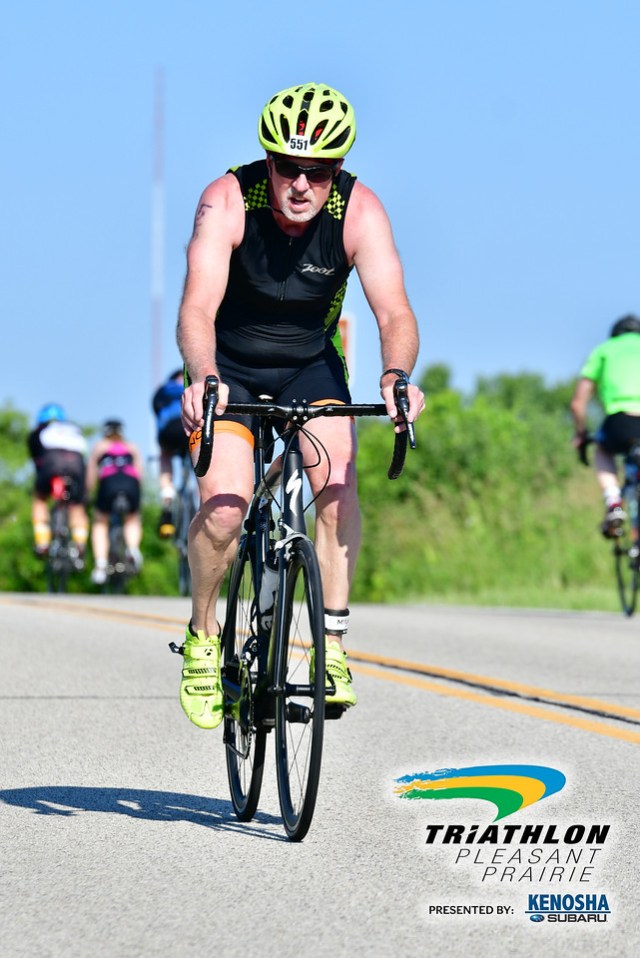
Pleasant Prairie 1

Clipped in and battling the wind. 

The wonders of technology have transformed racing to an instant gratification cycle in which we do our endurance stuff, then turn to our watches or Garmin or Strava devices and know instantly how it went down.

In those respects, technology truly is a wonderful gift. Yet in the world of triathlon, where “waves” of competitors take off at intervals, there is no exact way to know who is ahead of whom at any given point in a race. The swim often mixes competitors like Skittles in a bowl, with colored caps bobbing in the splash and spray of an early morning triathlon.

So the strategy is simple: just keep going as fast as you can. Let technology sort out the rest.

Swim out

Thus I emerged from the Swim Out at yesterday’s Pleasant Prairie Sprint Triathlon in something-or-other place. My sighting during the swim had sucked. At a couple points along the way, I found myself all alone in the water off to one side. I’d stick my head up, laugh and say, quite literally, “Chris, you suck!” and head back to the main fray where semi-tragic swimmers like myself were engaged in their respective course of flailing onward toward the next buoy.

My time of 17:00 in the swim or so meant that I’d probably averaged about 2:00 per 100 meters. But considering I’d probably swum 850-900 meters, I did not feel that bad about it. Climbing up the sand incline I felt my legs turn a bit wobbly. “That’s weird,” I thought. “I didn’t kick that hard.”

But I did, actually. And the slow trot from water to bike felt strange.

Bike out

After 2:00 in transition ditching my wetsuit and donning shoes, helmet, socks, race best w/number and shades, I trit-trotted in cleats to the bike mount and noticed the fresh feeling of cool air on my wet body. That’s part of why I love to do these races. You feel alive in those moments. Even if it sucks to get up at 4:30, the experience of getting excited during the race is worth it.

But somewhat dreadfully, I realized quickly that my legs felt a bit dead. My thighs made that inaudible ‘Millennium Falcon not-making warp speed sound,” …beeeyyyyyouuurrreeeadddrrttt…so I geared down and started to spin like a wise cyclist should.

The light but long climbs were a bit of a grind. They were mostly into the wind going out, which is my Kryptonite on a non-aero bike. Still, I was passing people. It always helps to be passing people.

Return trip

Pleasant Prairie 2.jpg

Heading downhill and into a turn at the Pleasant Prairie Sprint Triathlon

For some of the return trip, the wind was at our backs. The quiet hum of my bike in those moments was a pleasure to behold. But I kept getting passed by some large gal wearing a black kit. She rode a matching bike and kept piling past me at 25 mph and would then let up. I muttered to myself, “Make up your mind, darling.”

In the last three miles, I traded leads with a much younger athlete as we climbed up the hills and sped down the back side with the wind at our backs. I went into a tuck instead of pedaling and kept pace with him. Every ounce of energy counts in the end.

Most of all I was having fun. I hadn’t crushed bike leg for sure. Probably averaged just over 18 mph, maybe 19 if I was lucky. I know that I could break it all down using the results from the race, which are returned in real time at the finish, but did it really matter? I rode what I rode. Obsessing over the pace doesn’t really change anything, and I haven’t been riding with a cyclometer for a couple years. But I am soon inheriting my wife’s other Garmin. No excuses then. LOL.

The running thing

Coming off the bike my high upper hamstrings always cramp up the first 40 seconds of the run. Still, I cruised through the first mile at 7:45, hit the two-mile mark at 20 seconds under 8:00 pace and set my mind on running a hard last mile.

But I had forgotten one important detail. Back at transition I had not double-knotted my shoelaces. That meant stopping in the first mile to tighten the left shoe. Then I had to tighten the right shoe just before the two-mile mark. The guy that I’d been keying on for pace had fallen behind in both places and passed me back each time I stopped to fix a shoe. Ah well, stuff like happens in a triathlon, I though to myself. You can’t remember everything. But there was a lesson to be learned.

Kicking home

Pleasant Prairie 3.jpg

Stride for stride my closing mile partner and I chose to finish together. 

Just before the two-mile mark, I’d found another guy running my pace and was pleased when I picked up the cadence and had gotten a little lead. But then I faded from lack of concentration going around the big sweeping turn that follows the lakeshore toward the RecPlex. He caught me again. Then he told me, “You’re pulling me home!”

I laughed. “Well, that wasn’t the only reason I came to this race. But if it works for you, I’m game for that.”

From then on in, we stayed stride for stride. Neither of us breached the contract and we crossed the finish line side by side.

Results

Stumped

While it was nice to almost podium in my age group, the day’s real accomplishment was sawing down what had been a massive eyesore in our backyard. 

Later when I looked at the results, I openly chuckled while tracing my finger across the results sheet to see my final position (72nd overall) and age group: 4th by one second!

That’s right. I’d missed 3rd place in the race by one second. I thought of all the things I’d done during the race; the swim, the moments on the bike, the transitions and the modest push at the end of the run without a true kick and realized: one second is a helluva lotta time.

But it doesn’t matter whether you got fourth place by one second or one minute. It is what it is. And actually, our bigger priority (between Sue and I) was to book to the hotel for a shower at the hotel before checkout at noon, then head home so that I could do some needed work in the yard.

So I spent almost two hours sawing down a stubborn stump behind our house. When the job was complete, there was nothing but wood chips and sawdust strewn over the place where the ugly, humpy, dingy little stump had been.

And that was a win. I wasn’t counting the seconds or worrying about a podium finish. All that mattered was reducing that bastard stump to grit and slices of wood toast.

Victory. 


Posted in aging, cycling, tri-bikes, triathlete, triathlon, triathlons | Tagged , , , | Leave a comment

Getting psyched up

IMG_2764Today I wrote a Quora answer about an encounter I had two years ago with a crazed Trump supporter that happens to be a Ph.D psychologist. He’d posted a video on my Facebook wall in advance of the 2016 Presidential election that depicted President Obama as a ‘narcissist’ because he repeated his name a number of times during a campaign speech on behalf of Hillary Clinton.

You’ll have to read the Quora answer (link above) to see how disturbing that exchange actually became. It is pretty strange to be stalked and verbally assaulted through Messenger by a professional psychologist. But then again, perhaps he’s not so professional as he likes to claim.

But here’s the sobering fact: that level of derangement isn’t that uncommon among psychologists, it turns out. As this article in Psychology Today points out, there are a fair number of warped people who go into psychology as a means to figure out their own shit.

Psych One

I’ve visited therapists on a number of occasions beginning in my early 30s. I’d just come off my own journey of personal therapy in which the primary treatment was massive amounts of running. My therapy sessions consisted of running 10-20 miles at a time at six or seven-minute-mile pace. Typically I’d go into “treatment” with a particular problem in mind. Sometimes I’d contemplate the deepest levels of theology I could imagine. Or think about politics. Or work problems. Solutions. Artistic ideas. Story lines and plots. Even book projects emerged from all that think time on the run.

The other dimension of running psychology was learning how to deal with pressure. All those races served as a refining fire to my spirit and mind. Competition teaches you how to put it all on the line and live with the consequences and the achievements of your efforts. That may be one of the most effective psychological treatments one can hope to have: Learn how to deal with it. Whatever happens. 

Psych Two

When I backed off the running I was a relatively new father. Thus new experiences were arriving nearly every day. Being responsible for the first time for the young life of a son and then a daughter brought on whole new levels of second-guessing my values, behavior and self-worth.

Some of these I tried to work out in conversation with my wife. But she wasn’t one to dwell too much on introspection. And thus, in an attempt to gain what seemed like important answers for myself, I booked an appointment with a counselor. From my late 20s on I’d come to recognize some patterns of anger, anxiety and depression over which I did not always have control. I yearned to know the source of those feelings, and decided to try to dig them out through therapy.

That first counselor was a psychotherapist, as I recall. She specialized in family practice, which sounded perfect. But by the end of our session she had not really shown a willingness to go back in the past and dig up the grunting sources of my life’s disaffections. The only thing she could only offer was a bit of cool observation about what my wife really wanted from me:  “You seem very well-adjusted. But perhaps you shouldn’t try to involve your wife in your worries along with you. She clearly wants you to be strong.”

Psych Three

It felt good, in a way, to be told that I was “well-adjusted.” But then I wondered: what does that even mean? The other reason I’d visited the counselor was an emerging pattern of co-dependency between my wife and I. As a really social guy, I wanted to get out more with her and meet new friends. She loved our close stable of buddies. As a mildly hyperactive and needy person, I also wanted more affection and affirmation. My wife was a reserved person, not prone to a bunch of compliments or terms of endearment. We had our little jokes, don’t get me wrong. The relationship was not unloving. I just wanted to continue to evolve.

Thus the counselor’s advice wasn’t really that helpful. It only put all the burden back on me to carry the weight of the worries and resolve my own needs, if need be.

Psych Four

The next time I chose to meet with counselors was years later during a period of time when my wife was going through repeated cancer treatments. By then I’d well-learned what true patience really means. Fatherhood had bred into me the will and ability to put the needs of others before mine. Kids barfing down the front of your pajamas at two in the morning tends to temper any attention disorders.

But other people entered life with good advice. My high school track coach called the day he learned that my wife was diagnosed with cancer, and told me, “Your whole life has been a preparation for this.” If you think about it, that’s really close to what that first counselor told me. The difference was context. “Draw on the strength you know you have,” was his approach.

Psych Five

I was definitely psychologically strong most of those years. But time and age also have their effects, while stress and grief do their work as well. So I chose to avail myself of the psychological care of a counselor from Living Well Cancer Resource Center. The sessions were provided free as a part of the programs they offered, and I met bi-weekly with a psychologist named Gretchen.

She dug into my life story, family history and caregiving commitments including the care I was providing for my father during that period. He was a stroke victim and I was his executor, working with a live-in caregiver to take care of his needs. But it was still hard, with many emotional traumas and past associations with which we had to wrestle as my sometimes impatient, exasperating father pushed buttons on many fronts.

So I shuddered a bit from all that stress. Then one day Gretchen asked a question that is probably part of the litany of things all counselors ask their patients. But for me, the question nailed me to the wall. “You’re good at forgiving others,” she observed. “But how are you at forgiving yourself?”

Psych six

That made me think. And it made a big difference in how I began to look at the world. I’d long seen the power of forgiveness at work when I let go of a workplace conflict and forgave a tormentor all his sins. That resolved the situation in ways that I never dreamed possible. To continue fighting with him would likely have led to my dismissal. As it was, he was the one that got fired for a variety of reasons that had little to do with me. Was God at work in my life? That was my only explanation.

So I began to forgive myself some of my own failures and internal conflicts. That’s a lesson one must repeat on occasion. It’s so easy to look back and blame yourself for failing at one thing or another. It might be a financial, familial or frivolous situation. But one must forgive it and move on.

The surprising effect of that self-forgiveness is that some of the successes come back into a clearer, more rational light. They no longer seem just compensatory. Esteem grows when it is allowed to breathe, not be suffocated under layers of anxiety and self-doubt.

The world opened up somewhat during that period. I even gathered private courage to imagine what life would look like if the treatments for my wife did not work. Could I forgive myself for allowing her to die? Could I get over the grief and guilt of that? Could I ever love again if things turned for the worse?

Psych Seven

Eventually, but not right away, she did die. So did her father just before her. And then my father too. My mother had passed away eight years before, in 2005, the same year that my late wife was diagnosed with the disease. All that loss. It has a way whisking away the unimportant things in life.

I talked with one more counselor after that. She was a referral by the hospice agency. We talked a few times and I described how it had all transpired. How I felt that I’d loved my late wife fully and did all I could to keep her alive.

I’d even been sure to get to her bedside and apologize for any failings that I’d had.  I asked forgiveness for the things that I knew had bothered her at times. My ADD. The lost keys. Things that got started, but perhaps not finished. And the backwards locks in our house doors. I’m not joking. Some of those things really are bothersome.

But then, most of all, I told her that I loved her. It’s amazing what the psychology of love can do in your life if you let it in.

Psych Eight

Still, I accepted an invitation to head downtown to Chicago and participate in a mental health survey with researchers from a university. They survey consisted of a long set of questions and interviews with mental health professionals. They all concluded that while I’d experienced periods of depression and anxiety in my life, my coping mechanisms were robust. With the help of a little Lorazepam during the truly anxious parts, I’d come through the storm with my sails tattered but intact.

Then they handed me a report that said I was not bipolar or manic, schizophrenic or otherwise dangerously disposed to mental health risks. I walked out of that research facility to a bright Chicago afternoon and said out loud, “Well, I’m not as fucked up as I might have thought.”

And that was a liberating notion too.

Psych Eight

Emerging from that long period of caregiving, grief and difficulty, I decided it was not healthy to lay too low or stick around the house and mourn all day and night. My friends knew that too, and encouraged my positive attitude toward facing life again. When I began to date, there were quiet words of encouragement and support. That was very important to me. It told me that I wasn’t being selfish or crazy for wanting to find ways to be happy again.

I’d been through so much stress, loss of work and financial challenges during those years of caregiving my brain literally felt beat up. So my friends served as my counselors and praised efforts to get out and live.

Then I met a woman who seemed to understand that too. Over four years of dating our families began to integrate. It wasn’t all easy. I rushed a couple things and it upset my children. But when we got married in 2017, we all became a family.

Like all couples, we had much learn about each other but took it slow enough to let that happen. We talked at one point about going to a counselor to work on any hidden relationship challenges we might not see in ourselves. But she’d been through marriage counseling before and I’d seen my share of thin advice, so we’ve largely decided to trust our own counsel on how to live. It’s our job to encourage our twenty-somethings in their lives and share the challenges and joys of marriage the best ways we know how.

And I’m pretty psyched up about that.

Posted in Christopher Cudworth, competition, healthy aging, PEAK EXPERIENCES, race pace | Tagged , , , , , , | Leave a comment

Sandals vs. orthotics

IMG_4447.jpgDuring the early 1980s, I illustrated a book on running biomechanics that was authored by Dr. John Durkin (deceased) and famed running coach Joe Newton of York high school (also deceased). Durkin was a podiatrist to some world-class athletes including Sebastian Coe, the Olympic champion at 1500 meters. Coe had flat feet and kept getting injured. The man could leg-lift 700 pounds, but the force of his own body pounding along the track with a bad case of pronation was injuring his calf muscles. Newton was helping with Coe’s training leading up to an Olympic year, and he introduced him to Dr. Durkin to help with a chronic leg injury.

At that time that I met Coe at Durkin’s office, I was young enough that my feet weren’t giving me many problems. Thus I viewed Coe’s issues with a cold objectivity and was actually sworn to keep his flat feet a secret. This was pre-HIPPA laws I believe, but there are some aspects of privacy that are just plain common sense.

Truth be told, Sebastian Coe was not alone among world-class distance runners having injury problems. There were other top-flight athletes visiting Durkin for help. He specialized in making orthotics for runners and when runners experience success with any kind of treatment, word tends to get around.

Twinges

cudrunI’d had some twinges in legs and joints as early as high school. That’s when my dad fashioned a heel lift for my track spikes. He made it out of brush denim, a fashion favorite at the time. His engineering mind helped him structure the counterbalance in my shoe, and it worked. I was able to complete the season injury-free.

In college as a steeplechaser, there were plenty of times when my left calf would get injured from making that leap of twelve feet from the barrier to the water pit. But that injury was less about biomechanics and more about the extreme stresses of jumping from a 42″ barrier over water to land on an incline.

That injury would always heal up. Overall I was pretty lucky not to have many overuse injuries during the competitive years of my career.

And then I got older.

Chondromalacia strikes

Somewhere in my mid-30s, I started to notice a burning sensation under my left kneecap. It persisted for months. Finally, I bought this gadget called a Cho-pat knee strap that lifted the kneecap to keep the underlying cartilage from rubbing the wrong way beneath the patella. That worked for a while, but it was kind of annoying to run with that stupid strap on my knee all the time.

I finally visited Dr. John Durkin and got a set of orthotics. He was rather dismissive of my knee strap. “You’re not dealing with the source of the problem,” he told me. Durkin was a bit brusque in many ways.

The orthotics worked. My knee pain subsided and I actually increasing my running mileage for a while. Yet I was also a prisoner of sorts to the orthotics in my shoes. I could not go anywhere without them or the knee would start to ache under the patella.

No more sandals

That was a pretty profound lifestyle change in some ways. No longer could I wander around in summer sandals of any kind. I even wore the orthotics in my dress shoes. The problem with that strategy was the smell. The orthotics made by Durkin has an insole glued over the top of a plastic insert designed to keep my feet stable. All that running and sweat and confined spaces made those orthotics stink so bad they could kill small animals if I crossed their path.

I recall wearing them to a new job where I shared a space with another new employee during the first few weeks. The foot odor from my orthotics was so strong it was embarrassing. I tried everything from sprays to powders to keep it at bay. But all failed.

Round II & III

Finally, I went to see another podiatrist in 2002. He made some dress orthotics that had thin leather covers that never absorbed odor. Problem solved. I still have those orthotics and wear them daily. So I’ve certainly gotten my money’s worth out of them.

I even used them running for many years. That strategy worked until calf cramps took me down. Then I consorted with a pedorthist, Shelley Simmering, who built a new set of orthotics specifically for running. They are relatively thick and somewhat heavy, but they do the trick. I get them tweaked now and then.

Principles of orthotics

IMG_3392In case you are lucky enough not to need such devices, the basic premise of orthotics is simple: They put your foot into a neutral position so that your legs and knees do not have to compensate for the imbalances caused by structural faults in the bone and ligaments of your feet. While human bipedalism is a miracle of evolution, it is a far-from-perfect process. With 7 billion people in the world, the odds are plentiful that some of us will have feet that are either flawed from the start or develop problems over time.

Some medical doctors seem to scoff at the whole orthotic paradigm. A triathlon friend we call Dr. Joe has steadfastly refused to get orthotics even as his knees and hips give him problems. I also have a triathlete friend whose feet were aching. She tried orthotics for a while but then went into intensive physical therapy. That seems to have helped immensely. It was all about using strength training to compensate for the imbalances in her foot structure.

I rather admire those who refuse to go the orthotic route. Sometimes I look at the devices in my shoes as a ‘crutch’ of sorts, an affectation of purpose that is only necessary because I’m too lazy or busy or cheap to actually invest in the strength training that might cure the source of the problem.

Maybe so. But until then I’m grateful for the TEVA sandals that I own. They have a degree of arch support and I can wear them without typically sticking the orthotics inside the open banded sandals.

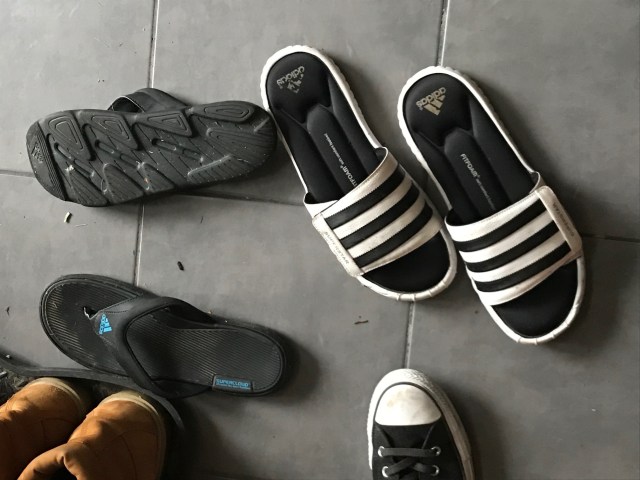
But good old flip-flops? Those don’t really work for me over any sort of distance or time. I can wear them in and out of the pool, or maybe to the beach. But the souls of those rubber floppers are largely safe from wear. In the game of sandals vs. orthotics, it is likely always the orthotics that will win.


Posted in aging, aging is not for the weak of heart, running, Uncategorized | Tagged , , , , , , , | Leave a comment

Trading paces

IMG_3820Midway through this morning’s swim workout, I paused to glance at the lane next to me where my wife Sue was doing her 75m IM repeats switching from freestyle to backstroke to breastroke with each lap. She loves swimming, and grew up competing for clubs. Now she competes occasionally in Master’s meets. Mostly she swims to train for her Ironman events. This fall she’s doing the ocean swim at the Half-Ironman in Wilmington, North Carolina.

I grew up swimming as a little kid and even competed in meets between pool clubs over the summer. But once we moved from Pennsylvania to Illinois, pool access was not available in the small town of Elburn, Illinois. Being landlocked, I eventually turned into a runner. There was plenty of space in the Illinois cornfields to do that, as long as you could avoid the farm dogs.

Love and like

These days Sue loves to swim and gets in 2-3 workouts a week. I have grown to like swimming now that I can actually cover a few laps in the pool without flailing and gasping to a halt after 50 meters. But my stroke still needs work. Even though I know better, my elbows still come out of the water too low and my catch is inconsistent underwater. I’m improving, but there are days when the pool still feels like a struggle.

Sue feels a bit the same way about running. She took up triathlon almost ten years ago and has run a half marathon under two hours. But like me in swimming, there are a few rough patches to her form. Her coach Steve Brandes had her do strength and bounding drills this winter along with speed work on the indoor track. That whipped her into shape. She was running 8:00 pace in interval workouts when her normal race pace is about 9:00 per mile.

There are interesting similarities between where Sue still needs work on running form and my challenges with swimming. Both sports require form efficiency to perform well. Unless you train to develop the strength and form needed to sustain pace, things fall apart in a hurry.

Or worse, they sometimes fall apart slowly. It can creep up on you. Before you know what’s happening, you’re going slow as molasses. We’ve all been there.

Sue thinking

Here’s the law that covers that problem: When endurance athletes get tired (and this applies to almost all of us) old habits tend take over. Yet it is ironic that we tend to revert to bad form right when we need good form the most.

That’s why we always need to train beyond good form in order to compensate for those times when we regress. At least in that mode, we’re only back at a midpoint.

Swimmers achieve this ‘overtraining’ effect by using pool implements such as floats, hand paddles, kickboards and fins. Each of these tools puts a stress on the body that trains the muscles to exceed the lazy norms to which we gravitate when tired.

The “feel” of good form

In running, the stretch effect takes place as a result of speed work. But a runner can also add range of motion and introduce form improvement using bounding, toe running and even running backwards to teach the body the “feel” of good form foundations.

Swimmers at Marmion 2Sue’s not super keen on tossing me advice while we’re both swimming. Afterwards she’ll sometimes point out problems she can identify from one lane over. I just like the look of her in that sleek swimsuit, especially with the tan lines she just brought back from Florida. I’ll admit I like the feel of that good form.

But I digress. Husbands will do that.

Handing out advice

I don’t always like to correct her running form issues during track workouts. But when pacing her in intervals I do give hints on how to maintain focus on good form. Mostly it is simple stuff such as “stay on your toes” or “drive you knees” to add purpose to the pace. These small measures can get us through bad patches. After we’ve completed the interval I might have her try a few things. This also works before we get started.

Trading paces

In essence what we’re doing is trading paces. She teaches me how to swim faster and I train with her to help her fun faster.

Out on the bike, it all happens in real time. She’s a strong rider and some days she gets the better of me, especially when riding her tri-bike in aero position. But there are days as well when I’m feeling fast and conditions favor my riding style. So we trade drafts like good cyclists should anyway.

When it is all said and done and we’ve showered and changed and hydrated and dined, it’s nice to be able to cuddle up next to her on the couch and share space with her until one or the other of us dozes off at our own pace. And that is divine. Because I love this woman.

Posted in TRAINING PEAKS, tri-bikes, triathlete, triathlon, triathlons | Tagged , , , , , , | Leave a comment

A social kind of brain injury

In recent years news has come forward that playing professional football in the NFL can produce severe brain injury. The result is a condition, chronic traumatic encephalopathy, that is abbreviated as CTE. The brain becomes so concussed after multiple collisions (both direct and indirect) that the brain ceases to function in a normal manner.

The stories of former NFL players trying to cope with the effects of CTE are heartbreaking. Just as heartbreaking are the tales of spouses and friends trying to help those whose minds are addled by CTE.

Hockey playersSome players have taken their own lives as a result. Yet they are not alone in the game of football in dealing with CTE. Hockey players such as Daniel Carrillo, who played for several NHL franchise, has recently elected to donate his brain to science and the study of CTE. Carcillo was a hard-charging hockey player with more than 1400 collisions chalked up in his career. He also endured a few fistfights, if memory serves.

In an article on philly.com, Carcillo’s story reveals the frustration many former pro athletes feel once they retire and get outside the spectrum of money and pressures that drive them to play without regard for their health the rest of their lives. The article states: “Earlier Wednesday, he answered questions on his Instagram live concerning the NHL – which he calls the “league of denial” – and implored players to learn the risks associated with repeated hits to the head.”

The crushing impact of blows to the head is one type of brain injury. But in a strange little convergence of news this morning after reading about Carcillo’s story yesterday in the Chicago Tribune, I was listening to music through YouTube on my phone while cleaning up my bedroom. A video came on featuring actor Denzel Washington talking about the dangers of social media and cellphone addiction.

The dopamine kid

IMG_3767I stopped to listen. There were discussions on how cellphones and social media apps and sites are specifically designed to produce an addictive desire to use them. We all might joke about the dopamine effect and how phones and apps work together to give us short little charges of chemical excitement, but our brains can get numb to the early levels and start to crave more. And more.

Before we know it, we’re emotionally and chemically hooked on using our devices to feed our brains the brands of stimulation they crave. For me the problem is doubled by the fact that using social media is a significant part of my job. I also have two cellphones, one for work and one for personal use. That means keeping both phones charged and checking apps on one phone that I don’t carry on the other. It can become unmanageable in a hurry. 

Looped in

The “two phones” thing is purposeful, but perhaps misguided. It’s easy to make a mistake and cross those worlds on work and personal phones and social media. One cannot even manage a company social media page on Facebook without having a personal account. At the same time, Facebook makes it impossible to post a comment on some social media pages under the name of the company you represent. Instead it appears as a personal post.

I’ve talked with many other social media users about these problems and all share the same frustrations. We all live in a digital web. But are we spiders, or are we flies?

red-orange-green-traffic-lightsThat’s the question that has begun to bother me. It took me years to come to grips with aspects of my brain chemistry. Acknowledging and coming to grips with the conditions of anxiety and depression, and learning how to employ coping strategies to avoid ruminative or damaging thought patterns has taken hard work and years to accomplish. Sometimes when you change one part of your brain, the other part takes over. It’s like a traffic light. 

Add in the fact that I have likely dealt all my life with some form of ADD or ADHD, which is technically ‘undiagnosed,’ and I might just be the #1 candidate for social media addiction.

School daze

Back in school I often had a hard time concentrating. The attention disorder also results in a propensity to make mistakes or fail to recognize them in my own work. My mind wants to believe something is correct, and it skips right over the problem. You’ve seen that in this blog, I know. I hate when I go back through and find errors, and I often go back and do that when it’s been published. So it’s not laziness on my part. It’s how my brain functions/dysfunctions.

So I’m writing this blog from now on in Word to copy it over rather than writing the pieces straight into WordPress as I’ve long done. It’s more fun that way, but it’s also a recipe for consistent, bothersome errors. Thus the layer of writing in Word is an objectivity that is necessary. Mistakes in grammar, spelling or other flaws clearly undermine my efforts at credibility. I love writing. Why poison it with bad habits? 

Social absorption

I’ve also realized that despite the healthy breaks I give my brain by swimming, riding and running, those benefits can all be wasted by allowing too much absorption in social media. Over the last ten years, I’ve gotten out of control a few times. Not only have I behaved like a manic soul on occasions, I’ve hurt people that I know, and been hurt in return.

All because the chemistry of my brain flips into conflict mode when faced with consistent sources of stress. It is one of the ironies of human existence that we sometimes crave the things that damage us the most. These stimulations may be wholesome or healthy in moderation, such as sex or food or alcohol or gambling, but when craving takes over the human brain there is little one can do to stop the craving as it turns into a need and an addiction. Then it’s time to get help. 

Running addiction

Chris Running 1978I was once addicted in some respects to running. It held up my self-esteem. Whenever anything bad in life would occur, or I felt like I needed a dose of self-worth to keep myself afloat, I’d pour my efforts into running. Often that resulted in some fine results. But of course they were fleeting, and deep down, few people really care if you’ve just won a local 10K. 

Finally I decided in my late 20’s to break that cycle. I had a family on the way and it was time to put things in check. I transitioned to being a ‘fun runner’ and have continued on that path with relative consistency. These days I do triathlons for fun. Sometimes I do well in age group competition, but mostly it is the peak experience of concentration and focus that I enjoy. 

Not everyone has that epiphany. I recently encountered a woman I met in a naturalist certificate class a few years back. She was very slight but had strong calves and arms. Over the years I’ve watched her shrink from too much exercise. She’s participated in every kind of severe distance events you can imagine. Now her complexion is almost yellow. She’s growing hair on her cheeks. It seems to me that she might exercise herself to death.

Taking stock

All this has made me take stock of how my own brain is functioning of late. There are times when I feel the pull of the phone and it makes me anxious all on its own. And lifestyle issues enter in, because when I leave my phone to work in the yard or go for a ride, the pressure to be available all the time is pervasive.

There’s no such thing as getting completely away from that. I know that now. But there are things we can all do to avoid this prison of perpetual complicity we’re all in. Once I eagerly hoped that the Apple computer company would triumph over the Microsoft copycats of the world. I considered Apple the more creative and therefore purer company.

Well Apple triumphed alright. I’ve used Macs and iPads, iPods and iPhones. I don’t think I want an Apple watch because it is attached to my body.

Partitions

Feet On TrackSo I’m planning to partition my brain somewhat from the impacts of all this digital deference. That may involve blocking out portions of the day where I do not touch the most consistently used apps of Facebook, Twitter, Instagram or Linkedin.

But we all know how difficult it can be to give something up cold turkey. I know a young man who got hooked on heroin and had to go through rehab. When he came out, he told his parents, “I won’t do heroin but I’m gonna keep on smoking pot.”

An adult friend of mine who was going through a divorce was told by a counselor that he was an alcoholic. He responded, “I have a drinking problem, but I’m not an alcoholic.” And to his credit, he moderated his drinking. For a long period he took it down to near zero. He can now drink socially and not get drunk all the time. I’m proud of him for that. He knew his own mind pretty well.

Productive use

Which shows that the message for some doesn’t always sink, while in others, there is hope for self-remediation. In my case, I know my mind well enough to recognize the fact that the sensations I’m feeling in my mind toward phone and social media use are not normal, healthy brain functions. But having dealt with my own brand of addiction to running in an earlier phase in life, I think it’s possible to continue use of social media without remaining a full-time addict.

The core issue is using social media and smartphones for productive, not escapist reasons. That will be the measure for the change. I don’t know how you feel about all this, but if you’re feeling the numbness and addiction creep in on you, perhaps it’s time to address yourself with honest and authenticity. Use the phone for safety, constructive dialogue and personal goals. Beyond that, the rest is just trying to own you. It’s a social kind of brain injury, but it may be just as real as CTE. 

And that’s a sobering realization.

Posted in Uncategorized | Leave a comment

There are some real asses out there

IMG_4276I’ve never really been an ass man, per see. But in this day and age, there are so many more asses on display thanks to changes in the fashion spectrum, it’s getting difficult not to be an ass man of some sort. Fashions from jean shorts to triathlon kits now provide ample opportunity to share ass cheeks with the world. It’s also no longer a taboo to do so. Asses are asses, and that is that.

But before we say much more about asses, especially the word “ass,” you should check out this hilariously insightful routine about ass by Finnish comedian Ismo. It will help you understand the direction of this blog once you reach the end.

Thumbs up for butt cheeks

I tend to appreciate the ass meme taking over the world not just for its sometimes pleasant display of human assage, but for thumbing its butt cheeks at the uptight notion that the human body should always be covered up.

In some respects we owe what amounts to an Ass Revolution to the progression of swimwear over the last twenty years. Perhaps we can credit college girls on Spring Break for flaunting the rules on swimwear to the point that it turned Floridian law on its head. That resulted in a release of all-out Ass Energy that has resulted in the cultural Big Bang of an ever-expanding universe of planetary assage that we’re now witnessing.

You may recall that a while back there were attempts to contain this metaphysical event before it got too far. I seem to remember that Florida legislators were trying to actually regulate the amount of ass-cheek that could be shown in swimwear on Spring Break beaches. But that dictated trying to define exactly where the human ass begins and where it ends. That pretty quickly turned into a repressive admission that no one had any idea what an ass really was, or how it worked. Plus the female anatomy in particular is not always so definitive. Truth be told, the whole swimwear debate has been going on for more than a century, and so, for the most part, the swimwear zealots have given up. Asses are in, and there’s nothing anyone can do about it.

Not the same

Since some women are naturally curvy and others aren’t, it isn’t easy to say that a swimsuit on one woman will not be deemed obscene on another. The same can be true for men, but for completely different reasons having to do with the sadly odd nature of certain parts of the male anatomy along with the general census that male buttocks are far less frequently attractive than those of women. Thus naked male asses are not making the same play for mainstream attention as the female ass. Nor is the male version of camel toe a particularly welcome sight in public. Nuts are just nuts to show.

One could credit this imbalance in taste to raw male chauvinism and the consumer market for sexual titillation in seeing women’s ass cheeks. That would be partly true. But there’s more to this matter when it comes to cultural acceptance than, shall we say, meets the eye. 

Women Power

Ass runnerGiven their far more considerate nature as a gender,  women seem to be able to appreciate and accept the whole lady ass genre as part of an evolution in spirit. There is both an appreciation and a liberation to not worrying whether one’s ass is showing. For women who want to ass it up as they run, ride or swim, such as triathletes or track stars, there are fashions that encourage full-on ass liberties. And among the women I know, they tend to say, “If you got it, flaunt it.” 

Yet for women who really don’t want their ass to show, there are still plenty of options to avoid that circumstance. That’s called freedom of choice. It’s very American at its core. Women who don’t want to show off their asses should have that right too. Women’s sportswear designers have come a long, long way in that regard.

Strong ass, strong will

Ass muscles are most definitely a display of strength. So are leg muscles, arm muscles, back muscles and calf muscles. Muscles are a sign of work. Work is a sign of self-worth. Self-worth is a sign of self-esteem. Good self-esteem cannot be stolen when it is hard-earned. Thus a strong ass can be a sign of a strong spirit.

But not everyone is gifted with naturally strong ass muscles. Yet we still see women working their asses off; doing their runs, getting in their swims, going for long rides. It does not necessarily produce the type of tone in them that we find in pictures of world-cl(ass) athletes, but that does not matter. Women are diverse in structure and perception of self. That’s what the fitness revolution is all about.

Put simply: Everyone’s ass is fine. But the first rule of assessing assage is this: It’s their ass, not your ass. Take care of your own ass first. The Bible says so. People who make snide comments about other people’s asses are mostly making asses of themselves.

Sorting out ass from asses

Now you might say that showing your ass in public is a risk you should not take. Critics might say, “If you don’t want people to comment on your ass (or other parts of the body) then why show it?”

antelope.jpgTo that one must reply, “You’re a hypocrite.” Because unless someone is disfigured by an accident or disability, everyone in this world; male, female or transgender, has an ass of their own. That’s both a fact of nature and a human right.

Beyond that, there is another fact of nature, proven by everything from antelope to elephants: One cannot move through the world without someone else seeing your ass. We all get to have an ass, and the degree to which we show it should largely be our own choice.

In pursuit of an ass, I can honestly say that I once ran two full miles up the Chicago lakefront trying to keep sight of the ass of a young woman in order to get a date. I asked her out. She accepted. We went to some bars and it turned out she was out of my league because she did cocaine and knew all the bouncers at the clubs. In terms of a life experience, it was still worth two miles of chasing her ass to learn something about the world. Some asses are unattainable.

But a few months later, I chased another woman’s ass around the track during workouts and we wound up dating more than a year. Asses can do good things, you see.

Asses and good taste

Is it in always in good taste to show your ass when it isn’t the greatest looking ass in the world? Perhaps not. But who is the ultimate judge of that? People make odd fashion choices all the time that are not in the best interests of good taste when it comes to public displays of flesh or behavior.

I worked for years in journalism, and those people were some of the worst dressers in the world. But their job was not looking good, but writing well. And finding the truth. Some of them were asses in some respects to the people from whom they were trying to extract that truth. For those reasons, journalists are sometimes hated. But we need those people to keep the real asses of this world from taking advantage or exploiting our political, financial and social sphere to an unethical degree. In that respect journalists are the pinnacle of good taste in human culture. They are largely the truth seekers. And people who brand them Fake News are typically the ones with the most to hide.

And they tend to be dressed in suits and ties.

Trump suit and tie.jpg

The smile of a proud and arrogant ass. 

Genuinely offensive

Because if wearing something that offends others is going to be outlawed, then let’s talk about the abusive traditions long associated with the male suit and tie.

Lord knows there are plenty of men in this world who look and act like total asses while wearing that outfit. Some can’t keep their hands off other people’s asses (or pussies, or more) whether they have permission or not.

Some even choose to brag about it, then deny it when challenged by the likes of journalists.

But when the truth becomes known, they turn around and try to defame those who try to hold them accountable. Then hire a “fixer” to pay them to be quiet. Then hire sleazy lawyers to attack their character. All because they want to avoid accountability for being asses in the first place, even when running for President of the United States. This is what’s called an all-around Asshole March of Champions.

Giu.jpeg

A complete and total ass(hole): Rudy Giuliani

The ass threshold

In fact, many of the world’s biggest asses do their worst work while wearing suits and ties. In this attire, the cross the entire ass threshold by turning into total assholes in public and private. Their own bodies may be covered in a suit and tie, but their corrupt ambitions and conflicted appetites are both grossly naked and blatantly untrustworthy. Some even have the gall to hide the weakly bulging gravity of their untruths behind the cloak of religion. Those are the most nakedly disgusting hypocrites of all. Jesus says so.

All these behaviors and the repressed wardrobe of falsehoods with which they adorn themselves are far worse than the careless glimpse of a butt cheek with cellulite or a bit of female whale tale peeking above a set of mom jeans. That’s a whoops in the cultural acumen, but not a crime against humanity.

Thus we must ask which is worse; seeing an actual ass in public or dealing with someone who is clearly an ass in public. 

That Ismo comedian was right. There really are many meanings for the word ass in the human language. Perhaps it’s high time we deal with the weight of the truly gross behavior in order to better understand the ugly nature of the bullies who give people political wedgies to show them who’s boss.

There truly are some real asses out there in the world. But the muscle of the gluteus maximus is not our biggest problem.


Posted in Christopher Cudworth, duathlon, track and field, training, triathlon | Tagged , , , , , , , , , , , , , , , | 1 Comment

No good deed goes unpunished


LUW 1Last evening I was cycling down a country thoroughfare called Bliss Road (you’ll see the irony soon) during the opening miles of a 31-mile ride. The road crosses a bridge over Interstate 88 and one lane is closed to trafficto repair frost-related pockmarks in the road surface. The bridge needs to be closed on one side in order for the construction crew workers to do their job.

Over the last few weeks, I’ve ridden through the construction zone at least ten times. The route down Bliss leads to a number of options for 20-40 mile rides.

White line fever

On Bliss and many other roads, I often ride with my tires outside the white line. I don’t trust that people driving will abide by the law requiring them to give cyclists a full three feet when passing. Most people can’t seem to separate hazards that way. They seem unable to judge how to avoid an oncoming car when they are passing a bicyclist. Perhaps it’s not in their genetic makeup to figure it out. Instead, they attempt to race by in a burst of speed as if that excuses or lessens the impact of their portent.

I stay out of trouble for the most part while riding this way. It takes some decent bike-handling skills to use the 12-18″ of road margin rather than riding on the main road surface. Still, that’s not good enough for some motorists. They honk or buzz me anyway.

As I approached the Interstate bridge the light was red and cars were coming across the one-lane passage from the other direction. That meant traffic on our side was backed up about ten vehicles waiting for the light to turn green. So I slowed and rode gingerly up the road margin past the cars toward the front of the line. I did this for a simple reason: to get to the other side safely.

Shifting scenario

As I approached the row of cars I noted that there was a large gap between the two vehicles near the stop light and the other eight cars in line. As I neared the front of this group, I saw there was a blue Corvette positioned as if the driver wasn’t sure where he should be on the road. The Vette then shifted its wheels and jerked a bit to the right as I rolled up the side of the road. “Hmmm,” I thought to myself, “He might be moving.” So I slowed even further and was going less than five miles an hour when I rolled past his passenger side window, which was wide open.

Blue-on-Blue-Corvette-0 “Hey!” the guy inside the Vette shouted. Then he started gesticulating at the cars up ahead on the road.

Here’s where our worlds divided. My plan going forward was to avoid blocking traffic as a cyclist by heading up there and slipping past the light to cross the bridge just inside the line of cones separating the traffic lane from the construction work. That way I would not hold anyone up, and no one would miss their opportunity to get through the light. Waiting for cyclists in situations like that really pisses people off. I knew this corridor existed because I’d ridden across that bridge the day before. Even without traffic present, that is where I rode my bike. Because it’s safer.

But the Corvette Guy seemed eager to push my buttons on the issue before I even got there. His little dodge move with his Blue Corvette seemed an attempt block me or force me to stop. Perhaps he’d seen make the turn onto Bliss Road a half mile back, and did not care for my presence on the road in the first place. Whatever his motivations or the source of his angst, he was clearly ready for a confrontation of some sort to prove his point. Whatever that was.

Courtesy and the lack of it

I made for the other side of the bridge without interfering with any of the cars in line. I reached the other side before the lead vehicles passed. Then came a quiet pause as the rest of the cars caught up. That meant the approach of the Blue Corvette.

The driver rolled up next to me and the first words out his mouth were a loud “Fuck you!” He was driving slowly next to me, holding up the traffic behind him as he shouted more invectives and insults at me. I kept up my pace as he rolled along at what was now 20 mph on a downhill. He kept on yelling and was leaning over the passenger seat pointing at me. His dirty old trucker hat was perched on his head and a prodigious white beard spilled down to where the crease of his chest met his bulging gut. A pair of large-aviator glasses covered his eyes.

Threats and intimidation

He pulled ahead of me in his car until he could pull over in the turn lane of a subdivision. His brake lights were blinking on and off and other cars swerved to go around him. I eased my bike out onto the road surface to roll on past. What was he planning to do, I wondered?

It seemed his logic must have told him that I should have waited far back in line with the rest of the cars rather than riding past them to go across the bridge under construction.

By that point, I looked at that situation as a danger both to myself and the other drivers on the road. Just then his intentions got dire: “I’m following you!” he screamed. “I’m gonna follow you wherever you go!”

Outfoxing him

In that regard I already had him outfoxed and out-calculated. He was absolutely keen on showing me “Who’s boss” on the highway, and I was keen on ridding myself of an angry old dude with whom I should have had no quarrel. I’d done nothing that inconvenienced him in any way. Had I slowed him down? Caused him to have to swerve in any manner? Created any danger to his car or his person? None of the above.

So his angry tirade was about something else. Perhaps I was witnessing a campaign to teach me that  “his rights” were being violated by my presence on the road. I

Provocation

And maybe I could have avoided the situation by letting him have his anger to himself and not yelled,  “Yeah, Fuck you” right back to him in his car. I should have turned the other cheek. No doubt. But from long experience, I know that even if I’d remained silent, he might still have pulled over in front of me to get out of his car and yell. I’ve seen it many times over the last twenty years. His actions were calculated to intimidate and project some deep-seated anger on the world. This particular cyclist happened to ride into the perceived path of his trajectory.

Backstory
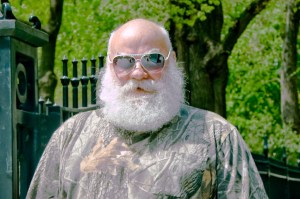
White guy with beard and glasses and camo

This is almost exactly what Blue Corvette guy looked like. It’s a look.

Obviously, I don’t know the man’s backstory. Often when you get an opportunity to actually sit down with some folks, especially angry people, their anger toward some facet of the world is truly legitimate. Probably in the past, some cyclist did cut him off in traffic or cause him to hit the brakes. I see that all the time, and I’ve been in my car when cyclists do stupid things in front of me. It makes me angry too, but in a different way. I wish people on bikes truly would wise up. It would help us all.

That said, I’ve made plenty of genuine mistakes on the road. Usually, I gain the motorist’s attention, point to myself, offer a wave of apology and yell out, “I’m sorry! My fault!”

Most people appreciate the admission and forgive the breach on the spot. That’s the truly civil way of doing things. Whenever I make a mistake, and I try to prevent that, I go out of my way to apologize. Because next time that driver encounters a rider like me, they might be a little bit nicer.

But some cyclists really are arrogant. Many do break the law and seem not to care if the rest of the world hates them. The world is full of fucked up people doing fucked up things. I wish that weren’t true for cyclists, but it is.

My backstory

My backstory is simple. I ride because I like it. I ride because it keeps me healthy. I ride to reduce stress (most days) and ride to have new experiences in new places and make familiar places more interesting. That’s about as deep as it gets.

I’m not riding to purposely piss people off, flaunt laws or show that I somehow rule the road. That’s absurd. I defer to traffic almost 100% of the time because I frankly don’t want to get killed by someone that is not paying attention on the road. Now that people are texting and driving, I’ve had no less than four really close calls in the last year alone. I fear for my life out there some days. That’s disturbing, I’ll admit.

And despite all that deference to traffic, people still assume I’m trying to fuck them over by riding my bike on a public road. They yell things such as, “Get on the bike path!” In fact, most bike paths either don’t go anywhere for very far, are jammed with people, dogs and children, or pass through parks or urban areas where riding your road bike at even a middle pace of 16 mph is a danger to everyone. I ride faster than that. Road bikes are designed to go as fast as you can make them go. And cyclists have that right.

So we ride on the roads. Because that’s what “road bikes” are designed to do. And laws are put in place to govern our access and our rights. America is based on a simple premise on such matters: deal with it or shut the hell up.

Wise and aware

So cyclists are not the ones that are always fucked up and always looking for a fight. Most of us have grown wise and aware in decades of riding. We know and calculate the meaning of our actions. And I maintain that by pulling ahead of traffic on that bridge with room to ride off the actual one-lane access surface I actually saved everyone parked in that line precious time. That’s called being considerate, and nice.

But Mr. Blue Corvette Guy translated that as my version of cutting in line. And as he proved by his behavior, that’s more his problem, not mine. As for his possible anger at the world? About that he needs to talk to God, if he chooses, or at least a good therapist. There is help and forgiveness aplenty in this world if you have the character to admit that you need it.

Getting off

Through four or five rounds of cat and mouse the Corvette Guy was swerving on and off the road to block my way. That game was getting old and I guessed it might soon turn ugly. After I pedaled up an incline and down a hill, I knew that my time of departure was near.

Gull Against Dark SkyHis car actually got pinned in front of a truck that had seen his antics and was tailgating him to force him on down the road. That meant Blue Corvette Guy could no longer keep his eye on me in his rearview mirror. That must have royally pissed him off. The one thing a vigilante craves is having the target of his ire in sight.

And just like that, I was gone off the road. I’d planned my point of departure at a point where a bike path crossed the road and dove down the trail into Bliss Woods. Goodbye, Mr. Blue Corvette. It’s time for me to fly. Away from you.

Rules of the road

I maintain there are situations while riding a bike that is not clearly defined by law. Instead, they require good human judgment and courtesy. Cyclists encounter many such situations in their travels. Here are just a few:

  • When to ride inside the white line, and when to avoid it.
  • When to brake and come to a stop when traffic is too heavy for safe riding
  • When to ride single file or double for group communication
  • How to address stop signs in various neighborhoods where traffic may be absent
  • What roads to travel at all; many are not suited for bike riding

I learned a few things from my experience with the Man in the Blue Corvette. Perhaps a short stop would have been helpful to explain, “Hey, I’m going to ride off the road up ahead to avoid holding you up.” I do things like that all the time, gesturing to traffic to let them go through at four-way stops, and the like.

I somewhat regret my Robert DeNiro moment in shouting “Fuck you!” back at the guy. But not entirely. I’ve dealt with bullies in this world long enough to know that the one thing they ultimately understand is defiance in the face of their habitual intimidation. The same holds true with the gaslighters of this world, who try to make you feel crazy about your own reality. And the abusers; domestic, sexual and otherwise, who think it’s their right to take advantage of people mentally and physically to cover up their own insecurities and shameful needs.

I was trying to do a good thing for the other people on the road last night. But as we know, no good deed goes unpunished in this world. I just wonder if the Blue Corvette Guy is still out there driving around, looking for a way to mow me down. I hope I don’t find out someday that he is.


Posted in cycling, cycling the midwest, cycling threats, game of chicken, Uncategorized | Tagged , , , , , , | 3 Comments

Even flat turtles have their day in the sun

IMG_4150This morning I ran what might possibly be the slowest three miles I’ve done in a long time. Along the way, I chanced to look down and see a flattened turtle on the gravel shoulder of the road.

It bugs me to see nature wasted that way. Millions of years of evolution flat as a pancake. But it happens every day. Where human activities and animals intersect, the animals often lose.

Nature itself is merciless when it comes to who survives and who doesn’t. Science tells us that 99% of all species of living things that ever existed are now extinct. What the creationists won’t admit is that it took millions and billions of years to accomplish that level of extinction. They like to compress it all down to the biblical flood.

But that doesn’t come near explaining the fact that there are still millions of species of living things that still exist on this earth. Some of them, like blind cave salamanders and the species of turtle I saw along the road had no way of crawling all the way across the North American continent, swimming several thousand miles of ocean and again crawling across desert landscapes and mountains and valleys to reach some tiny ark in the Middle East. It’s a fantasy of religious fervor and an all-out lie to make such a claim as literal truth.

But then again, some people still believe in a flat earth despite all evidence to the contrary. And I place the Flat Earth believers and creationists in the same bucket of denial. Both constitute belief systems as flat and shallow as a squashed turtle. All shell, no real guts.

Holdouts

Chris_Cudworth_GBHeron.jpgIt helps me a bit these days to realize that not all the dinosaurs are actually extinct. Turns out birds are basically dinosaurs that survived the weaning throes of evolution. Now, you’d think that it helps that birds can fly. But that’s no promise of survival either. Those of us who run and ride find plenty of flattened birds out there on the highway. All it takes is a fatal swoop of a bird over the road and the game of life is over for that individual. Smack.

Holding onto life

I once witnessed a young Cooper’s hawk get smacked that way on the front of a car windshield ahead of me on the road. It lay there stunned in the middle of the lane after the car that hit it passed by. Pulling over, I parked my car on the road edge and jogged out to retrieve the stunned raptor. Grasping it by the “shins,” I lifted the bird up to carry it off the road. At that moment, my eyes met those of the bird and it gathered its wits, flickered out of its stupor and stared at me with cold furty. A flare of light seemed to emanate from its eyes and the bird gave two sudden, strong flaps of its wings, and I was forced to release it.

I thought about that hawk and the flat turtle as I ran home this morning along a quiet road. My pace was more than 10:00 a mile. Slow as a turtle, you might say. For me, anyway. So slow in fact that a homely little pair of ticks proved how ignorant I was about nature’s ways.

Tick tick tick

IMG_3E3C95E5FF0B-1.jpeg

Last week I went for a run in the grasslands of a forest preserve on a five mile run. The breeze made me want to just stand there and look at the sun. But then I felt something crawling up my leg. It was a pair of ticks that had clung to my socks somehow and were busy making their way up the bare skin of my calf. I shuddered and flicked them off. I hate ticks.

And I thought that was the end of the tick situation. But a day later while working in my office, I felt something on the back of my arm and found two ticks crawling under my shirt sleeve. Somehow they’d gone along for a ride on my clothes or my body. Then they emerged a full 24 hours and had decided sneak out from whatever crevasse they’d found. I’d even taken a shower and they survived that. But I’m thinking they plotted some other way to stick around.

I know, it’s totally gross to think about. But nature is nothing if it not persistent, particularly if it wants your blood. Beyond ticks, there are species of leeches, mosquitoes and even bats that will feed on your blood if they get a chance. And don’t tell me these things all hung out on an ark for weeks without feeding on something. If you think that’s true, you have never met a real tick. Or leech. Or mosquito. When they want blood, they will not wait around for anything.

In disgusted horror, I plucked one of those ticks from my arm and set on the edge of my computer to get a better look at it. I wanted to identify the species, and it turned out to be a common dog tick.

With furious angst I watched it flail its arms about as if to scream, “Give me your flesh!” Then I knocked it off and stabbed it clean through with the sharp end of a roller-ball pen. The tick was dead. I’d won in that round of evolutionary fury. Red in tooth and claw. I was faster on the draw and the tick lost.

Stayin’ alive

All it takes sometimes to make it through the qualifying rounds of evolutionary survival is to be one step faster than your nearest rivals. As the saying goes, “I don’t have to outrun the bear. I just have to be faster than you.”

But then there’s the other saying that goes, “When you’re wrestling with a gorilla, you don’t quit when you get tired. You quit when the gorilla gets tired.” That’s a phrase popular among cyclists, particularly those in a road race, where the only thing that matters is staying on the wheel of the rider in front of you. Close as a tick, you might say.


On my best days as a runner, I’m still faster than probably 97% of the world’s population. It’s a poor test sample upon which to base the assertion, but I finished in the top 15 out of 300 or so competitors in the 5K race I raced last week. Of course, there was a time when I’d have beaten the winner of that race by more than three minutes. I was a different kind of creature back then, a type of desperately skinny animal. My body looked like a turtle that had lost its shell and was running around naked looking for another one.

But I was stayin’ alive, I’ll tell you.

Defying time

I still go to the track to defy time and celebrate that feeling of stayin’ alive now and then. I may be a relative turtle some days on the roads, but there is still some zip in these legs despite their age. If someone wants to make fun of me for being slower than I used to be, that’s fine. Even flat turtles have their day in the sun.


Posted in Uncategorized | Tagged , , , | Leave a comment