With dogs and cats the gratitude goes both ways

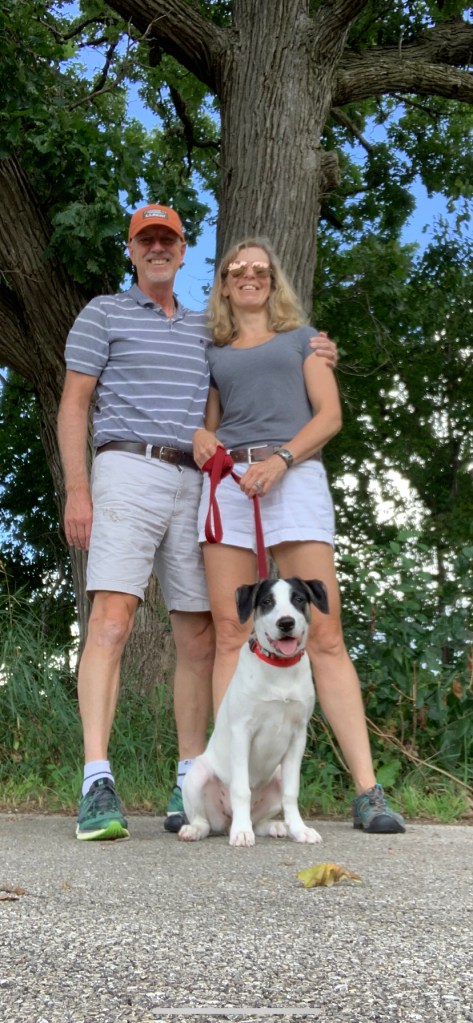
Our dog Lucy is just over a year old. She’s a mix of pit, boxer, border collie and beagle.

Just over a year ago we adopted a rescue dog that had been abandoned on a roadside in Tennessee with a broken leg. She was gathered up by Safe Haven, a Chicago area dog adoption organization and fostered by our friend Karah Osterberg.

The leg required an operation to place in a rod for support. The surgery scar is somewhat raised and she licks at it because there appears to be some scar tissue putting pressure on the joint just below the patellar tendon.

That’s right, much of a dog’s anatomy has parallels in the human body. It’s easy to forget that they have tendons and muscles just like us. These can turn into areas of tension or result in compensatory habits if left to become imbalances. In that respect, dogs are much like human beings as well.

Dog massage

That is why we called on a specialist in dog massage to give Lucy some attention where she needed it. That leg scar has caused her some trouble over the last year. At one point she licked it so much the flesh opened up and a small staph infection occurred. That required antibiotics to cure.

We all know what it’s like to have an injury that won’t heal.

Runners develop overuse injuries that can last for months, even years. Sore achilles. Stress fractures. Knee pain. Shin splints.

Cyclists similarly can develop problems with the hip joint or knees from pedaling with the wrong angle or pressure on the bike.

Swimmers are famous for shoulder problems due to repetitive stress injuries.

And triathletes can develop problems from all three sports! That’s a doggone shame when that happens.

So for Lucy’s sake, we’re looking to reduce that irritation under the skin where the scar tissue is impinging on the joint function. The dog massage therapist first relaxed her without pressure and gently built trust with our pup by petting and rubbing her body and face. Then she calmly worked on the larger muscle groups, working blood flow into the depth of the muscle as our dog laid down her head and began to relax into that zone where the massage offers the most benefit.

I hope you’ve been there too. If you’ve never been to a sports massage therapist, it is highly recommended not just for injury treatment or prevention, but to experience letting go of control.
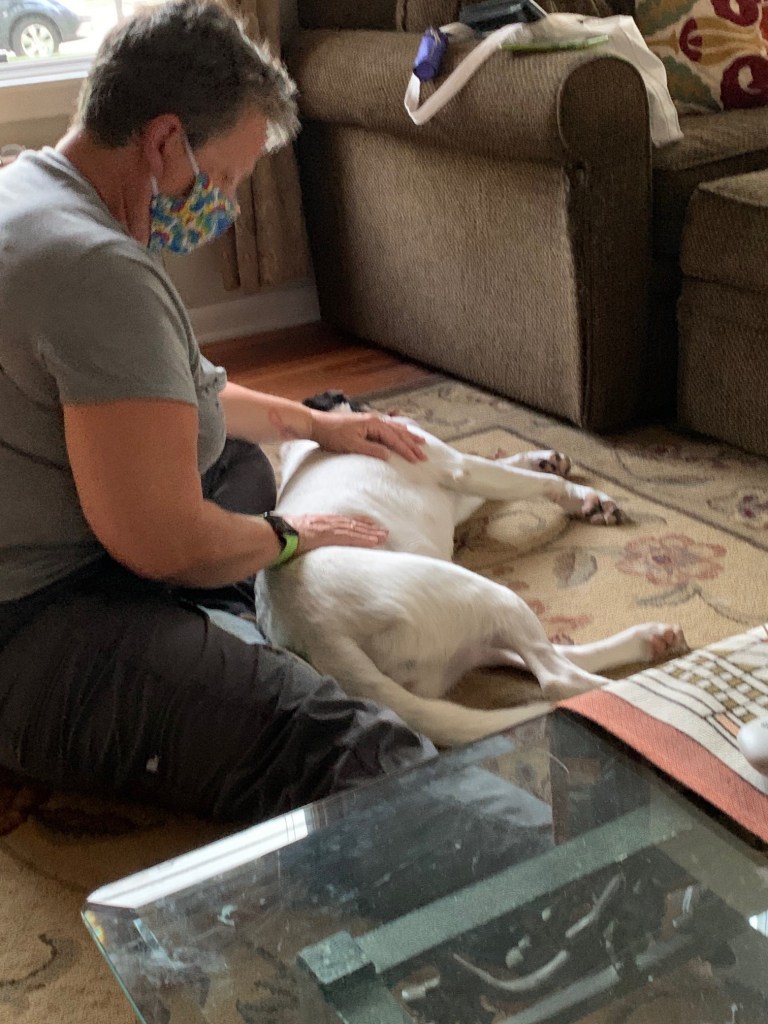
Lucy relaxed into her massage session.

That’s tough for some people, and dogs, to do. Allowing someone to take control of your body without tensing up at first takes some practice. Many people have sensitive areas of their body even outside the erogenous zones, which professional massage therapists avoid anyway. Learning to relax when a touch to the lower body causes you to cringe is part of the collaborative experience.

On occasion, Lucy would raise her head to look at Sue sitting on the floor next to her while the massage therapist applied gentle pressure and taught us the art of supporting joints and limbs while applying massage. Then we learned how to apply mini-massage techniques to the sensitive area around her scar. That involved light grasping of the skin to loosen fascia and bring blood flow to the area.

Addressing trauma

A few years ago following an unfortunate incident on my bike, my lower back developed serious scar tissue after a collision. It hurt like a bit of fire inside the body and did not dissipate on its own. So when I visited a chiropractor she suggested using a scraper to apply pressure on the affected tissue and break it up. It hurt like heck, but it worked. The trauma was reduced considerably.

That’s true for much physical therapy as well. We all tighten up with age and hard work and often it takes compensatory strengthening to build balance back in the body.

This morning Lucy came bounding up the stairs as usual after coming out of her crate. We fed and walked her, then I started trotting with her on the bike path behind our house. We ran a quarter mile together with Lucy running easily beside me. We’re building that kind of trust too. It’s a wonderful feeling to have a companion like that who enjoys the feeling of movement as well.

Luke Skybarker (left) and Chuck (right)

I’ve always massaged Lucy since we got her. I think about the trauma she went through as a puppy. Those harsh experiences can have lifelong effects if they aren’t addressed with love and attention. I’ve worked through my own share of issues over these many years, and have particular compassion for this dog and the Schnoodle mixed-breed pup that my son rescued off the streets of Chicago twelve years ago. That dog’s name is Chuck, and he still lives with my daughter nearby. I saw him recently on a visit. His energy is still good and I rubbed his little leg muscles as I always used to do.

This year, my son out in Venice, California also adopted a Corgi-Chihuahua mix named Luke Skybarker. He’s the rescue papa to two of the sweetest dogs in the world.

To complete the picture, Sue and I also have a rescue cat named Bennie, an orange and white kitty who was a stray that crawled up in a car engine for warmth and got burnt along with a broken leg when the engine was started. Our vet friend Jeff Palmer treated the cat and my wife saw his photo on Facebook and he’s been with us now for five years. All of these creatures make our lives better. The gratitude goes both ways in this world if you let it.

But we all have different energies and approaches to life. It can take a little patience and forgiveness on all our parts to heal our souls and come together. Rub it out, people. Rub it out.
Posted in bike crash, Christopher Cudworth, cycling, running | Tagged , , , , , , , | Leave a comment

If you want better workouts, warm up like the pros do

Over the past few months I’ve conducted an unintentional experiment with which you may be familiar, but don’t always abide.

It’s called doing a legitimate warmup.

On runs, this means taking the first two miles no faster than your body wants to go. As I’ve aged that pace means running 10:00 per mile on average. Frankly, I don’t think my body will allow me to run any quicker those first 3,520 yards or 10,560 feet. It simply won’t do it.

So go slow, and let it flow.

Running slowly at first is a really beneficial thing to do. It allows the body to produce additional blood flow, pushes oxygenated blood out to vital muscle groups and enables the heart to adapt to an increase in beats per minute. Lacking a decent warmup, the body reacts in adverse fashion. The rest of the workout can be compromised.

After two miles of slower running, it seems like miracles begin to happen. On the way back today after two miles of running at 10:00 pace I ran successive miles of 8:30, 7:55 and 8:03. And it all felt effortless.

What goes around…

The same principles apply to cycling and swimming. Last weekend we rode thirty miles with friends at just over 15 miles per hour into a north wind. Nothing about that riding was hard. By the time we turned around our bodies were well tuned to faster pedaling and when I split off from my wife, who was doing eighty miles to my sixty, I rode back averaging 20 mph through the northerly crosswinds. That felt effortless too.

But warming up is most important in the sport I have done the least. That is swimming. Being patient enough to warm up properly in the pool or open water is absolutely vital to success. For me, it’s the difference between feeling crushed in the water or having a positive experience.

The reason I share all this “news” about warming up is that there is a temptation for all of us athletes to go too hard, all the time. I once trained with a guy who went out the door running at six minutes per mile. He always had injuries and could never figure out why.

Watch it now

These days the pressure partner is our watch. Getting done with a workout and finding our pace per mile was slower than we wished is the constant bummer of this data-driven world. I spoke with a well-known triathlon coach recently who mentioned that she’d ditched her Garmin for most running workouts. “It’s too much,” she observed, holding up her regular watch for proof that running sans data device is good for you.

I did the same for an entire year on the bike. Never even put a computer on the headset. Just rode whatever pace I felt like doing and in group rides committed to pulls mostly on feel. Did I make a few mistakes? Sure. But the self-awareness gained from riding without the persistent pressure to drive myself was healthy.

Not every workout is a race

I know there are theories that riding with a power meter is the answer to understanding actual output and endurance. I’ve never had one, so I don’t know. What I do know is that the few cycling and running pros with whom I’ve trained or consulted do not go blasting out the door like a race just started. They warm up, often for long periods, before doing any type of quality work. That’s what pros do.

If you want proof, take a look at the cyclists on their bikes before a time trial in a major race. They spin and spin and spin until their muscles are thoroughly enervated.

When I ran with a group of national class distance guys out east in the Philadelphia area, they started out long runs of 15-20 miles pretty much jogging. Then they finished off the run with a string of three sub-five-minute miles.

Building toward speed

That’s how the pros do it. They build toward speed, but don’t rush it. We can all do a better job of that. And if you’re average pace on a six mile run seems slow because you’re only jogging to warm up, tell your average pace to go fuck itself. You’re in this for quality, not the wham-bam-thank-you-ma’am temporary thrill of a Strava Kudo.

The pros know you don’t have to go hard all the time.

Posted in 400 meter intervals, 400 workouts, aging, aging is not for the weak of heart, Christopher Cudworth, competition, cycling, running | Tagged , , , , | Leave a comment

An August afternoon with bikinis, sunshine and running

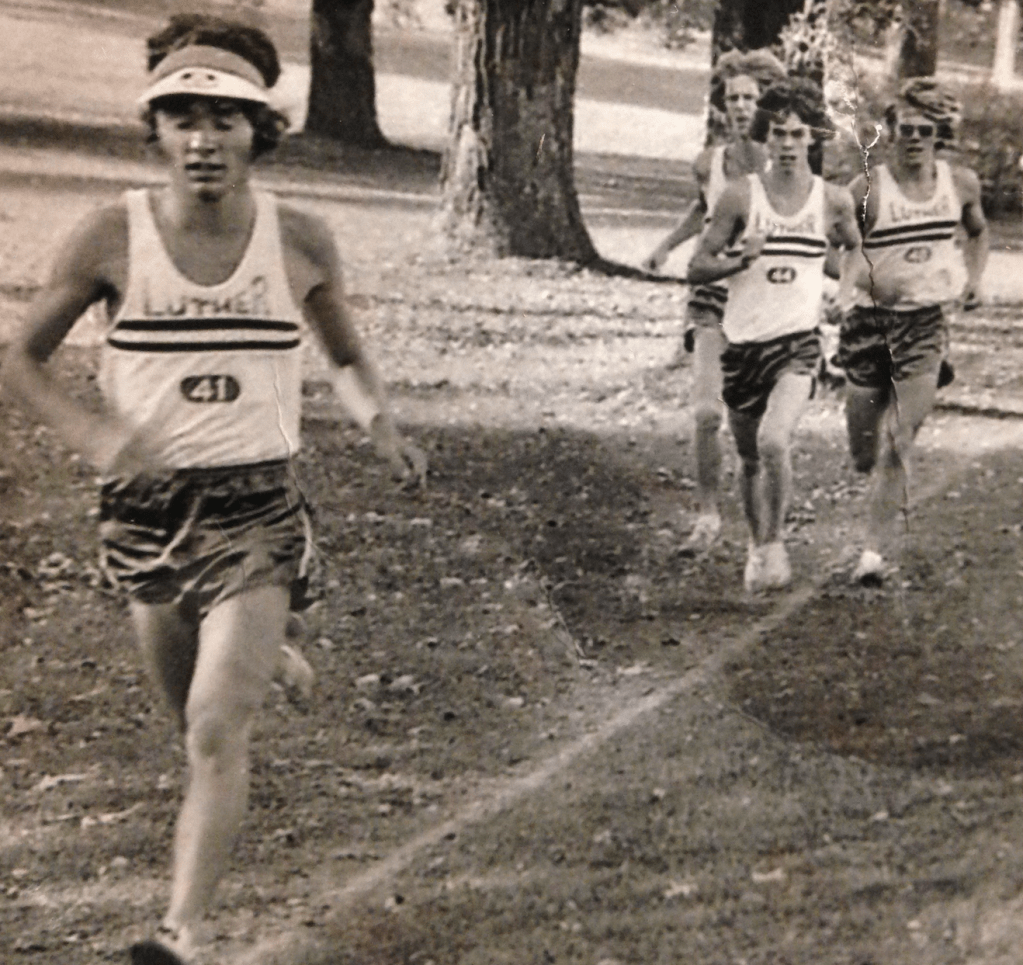
My friends Rob Walker, Paul Morlock and myself in August of 1974.

During the summer of 1974, anticipation for the fall cross country season was high. We’d done well the previous year in both the conference and district meet, and a core of seniors was returning to make it a fun and productive season.

But first there was August training to do. Those first two weeks of running were stultifying in the summer heat. I can also well recall the feel of a pair of dew-soaked adidas Italia running shoes on my feet. So the first two weeks of training passed and thanks to some guest appearances by runners from other schools at our practices, I was feeling strong going into the season.

In the swim

A few days before the actual start of school, my friend and teammate Rob Walker received a call from his cousin Anna, a gal that I had known before transferring from little Kaneland High School in the cornfields to St. Charles, a bit larger school on the outskirts of the Chicago suburbs. I always liked Anna. We were in confirmation class together in 8th grade. And even after my transfer to another school, we saw her annually at Christmas when the Walkers invited our family along with all their cousins over for Christmas Eve.

Seeking a little late summer fun before school started, Anna asked us to come out and swim at her pool that day. The invitation was too grand to resist. But neither Rob or I had a car that day, as our parents were working and our siblings were using the spare vehicles. So Rob said, “Let’s run out to Anna’s.” That was easily an eight-mile trip one way. But we set out with our goal in mind and arrived bathed in sweat and carrying our swimsuits in our hands. Then we dove into the bright, sparkling pool overlooking some cornfields in a hilly countryside.

Anna had invited a friend as well. I knew her well, as we’d been classmates out at Kaneland. She was one of those women that guys had teased for being flat-chested her freshman and sophomore year. But she’d since gained a healthy degree of revenge, since that was no longer the case. She was tan and lovely to boot, with sun-streaked hair and a bikini, like the imagined object of a Beach Boys song. And it was 1974, with swimsuits doing only what they needed to do.

So Rob and I sat playing cards with Anna and her friend all afternoon in the sunshine. We probably drank Cokes or somesuch, which was not an ideal training menu, but this was teenage stuff and we weren’t pounding beers, so what the hell? As the afternoon waned, Rob and I accepted a ride back to town from his aunt and arrived for cross country practice relaxed and mildly sunburned. The girls had been so pretty and fun it seemed like the day lasted forever.

A workout without pain

With eight miles in our legs in a run added to an early morning workout with the team, Rob and I worried that we’d be too exhausted to run well that evening. Instead we both ran like we were living in a dream.

See, there comes a point where a runner’s body falls into a groove that does not care any longer how far it is asked to go, or how fast. My body and mind were so calm from a day spent in the good company of the two girls that nothing bothered me at all. And I will never apologize for that. Rob and I exchanged high-fives after the workout and laughed that we’d never felt better before.

Years later I’ll see the sunlight in my wife’s hair or the tan on her legs and think, “Women are just great.” Together we rode a long workout on Saturday (Sue–80, Chris–60) and ran six miles together in the sunshine on Sunday morning. It’s true that we can’t be teenagers forever, nor would we likely want to be, but the summer sun and sweat and the feeling of companionship never needs to fade. And frankly, my wife looks great in her bikini. In fact, I’m buying her another for her August birthday.

And life goes on.

Posted in Christopher Cudworth, cross country, swimming | Tagged , , , , , , | 1 Comment

Turning too fast and all that garbage

A few years back when I was first putting in big miles on my road bike, I came to a turn at the juncture of two semi-rural roads. It had rained slightly that morning. When I leaned into the right turn and tapped the brakes, the rear wheel of my bike started to come around to my left. I was about to lose it at a bad time. There was a vehicle approaching in the opposite lane from where I was making the turn.

Fortunately, the rear tire grabbed a spot of dry cement and I got control of the bike and kept rolling. But that moment came to mind when I was cycling yesterday and stopped to take a photo of the garbage truck that had tipped over while making an angled left turn.

That must have been one strange moment for the driver of that truck. He must have bounced around in that cab even with a seat belt on. And…Who knows how they’ll scoop up all that stinky garbage? Will they load the truck back up first, then pull it back on its wheels? Or will they empty the whole load to avoid the peril of shifting loads?

I couldn’t stick around to observe their choices. But seeing the scene of that accident did make me think of my own experience driving commercial trucks. I worked one summer as a delivery driver for a U-Haul distribution center in the Chicago suburbs. Using classic paper maps, I’d drive all over the region in vans and box trucks bringing trailer hitches and other goods to gas stations and other customers. I was nineteen years old and not possessed of the greatest attention span.

One day the back of the truck was filled with refrigerator cartons. Those get heavy when stacked one on top of the other. I was driving through Roselle, Illinois on Roselle Road at Route 19, one of the busiest intersections in the area, when the stoplight turned red in front of me.

Mapping out trouble

Admittedly, I’d glanced down at the map in my lap while tapping the brakes before the intersection. But it had rained that morning after a few dry weeks and the asphalt had a slick layer of summer oil on the surface.

When I pumped the brakes harder the truck refused to stop. It started skidding toward the intersection. Then the back end swung around so that I traveled backward through the intersection. Keeping a cool head, I steered in the direction of the skid and wound up bringing the front end around in perfect harmony with the slide. One of the best driving stunts I’ve ever done, thank you.

It took the entire intersection to accomplish that spinning slide, but the truck and I rolled on our way. I gave a little “Whoop!” as I tapped the accelerator again and continued on my merry way.

Death shiver

But a half mile down the road I had what I call a Death Shiver. In the moments when the slide began, I’d reacted swiftly and kept a crash from happening. Fortunately there was no traffic in the intersection at the time. Yet it suddenly dawned on me how dangerous the situation had been.

I pulled the truck over and sat there a few minutes, gathering my wits. It took a few minutes. Then I took a long sip of a cold Coke, sat up straight and vowed to pay better attention on the road.

So I feel empathy with that truck driver who dumped his garbage load on the roadside yesterday. That stuff happens fast, and it really stinks when it happens.

Pun intended.

Posted in bike crash, bike wobble, cycling, cycling the midwest, cycling threats, death | Tagged , , , , , | 2 Comments

Summer running, or not

After freshman year in high school cross country, I was set to begin training the summer before sophomore year when a big fat catcher from another baseball team dove on top of me when the third base coach sent me toward the plate in an attempt to steal home.

I actually scored the run, but it came with a cost. That giant lardass catcher came down on me with a thump that fractured my elbow. I still remember his sweaty face inside that mask as he laid on top of me grunting to get back up. “Safe!” the umpire yelled. “Get off of me!” I grunted.

I went back to the bench clutching my left arm. When the inning was over, I walked back out to the mound to pitch. I’d carried my glove in the right hand and when our catcher tossed a baseball to I had to shove the glove on my left hand quick. It hurt to move the arm. Then I tried to raise my arms overhead in a windup and nearly fell over backwards from the shot of pain going from elbow to brain.

Nothing doing

That busted elbow meant wearing a cast for the rest of the summer months. I wrote my Kaneland cross country coach Richard Born and told him that I wouldn’t be able to put in many miles. He wrote an encouraging note back that said something like, “Hang in there. We’ll see you in the fall.”

I do recall going out for a summer run that year before the baseball injury occurred. I trotted out of town in Elburn and turned on Keslinger Road to reach a gravel strip called Francis Road. About a mile into that lane I was surrounded by a large pack of loudly barking farm dogs. Not knowing what else to do, I walked along swinging my arms and yelling at the damn dogs. There were no leash laws back in those days.

About a half mile up the road they finally began to let me go on my way. That was one of my lone runs that summer. But every morning I’d get up at 5:30 a.m. to deliver newspapers on a three-mile route. I’d ride a Huffy three-speed bike as fast as I could go while carrying that big newspaper bag filled with the Chicago Tribune, Chicago Sun-Times and the Daily News. That “training” kept me in a semblance of shape along with walking around town with friends all the time.

Finding excuses

I suppose I could have run some more that summer. I did play tennis with my mother on occasion down at the community college courts. The cast on my arm only wrapped around half of the forearm. Back in those days, the cast interior was some sort of soft meshy stuff that got pretty stinky as the weeks wore on. I was super glad to take that thing off. By then it was August again and time to start up cross country season.

Summer running was tough in those days because there were no teammates in the town where I lived. Our school district had the largest geographical territory in the entire state of Illinois. I didn’t drive yet and none of us could really get together. So it was either train alone or don’t run at all. So in some respects, that broken arm provided a good excuse to not go out in the heat of summer. Finding excuses is something I’ve often been good at. It would be a few more years before I took summer running seriously, well into college.

Results, just the same

Despite my lack of summer running those first years in high school, I wound up tied for the most varsity points scored my sophomore year. Our top runner had some back problems, limiting him some races, but we ran so many meets back in those days it was competing in roller derby. There as always another chance to run again. Illinois cross country was structured that way. By the time the end of the season rolled around, many of us were gassed from running so many races. But what the hell. It was fun.

My lack of summer running was an inauspicious way to begin a long running career. Yet several of my teammates managed to run 500 miles that summer. A couple even ran 1000 miles. I’m going to admit here and now that I had nowhere near the discipline to make that happen. Yet somehow every year I managed to lead the team. It was a combination of raw determination and a harshly competitive spirit. Perhaps a bit of natural talent was involved. But mostly I did not like to lose.

Missed potential

Perhaps there was some missed potential along the way as well. By the time senior year rolled around, I was running for a different school that landed in the most competitive sectional in the state with schools like York and other powerhouses. I missed going downstate by a couple places. It was disappointing of coruse. But that’s life.

I’ve wondered at times if more summer running might have gotten me there. But I sincerely doubt it. I was running sub-15:00 three mile races and still losing to guys that were just as good as me, and often better. There were simply a lot of good runners, and quite a few great ones. I fell somewhere in between I suppose.

Yet when I see kids running together in groups a part of me always says, “That’s good. Keep it up.” Because you don’t want to leave any potential on the table. You only get one shot at these things in life. Might as well make the most of it.

Posted in cross country, running | Tagged , , , , | Leave a comment

Fools in the pool

Our fitness center at the Fox Valley Park District has been working hard to provide opportunities for people to return to their facilities for training.

The pool was one of the biggest challenges because the health precautions necessary to prevent the spread of Covid-19 are fairly prodigious.

The pool finally opened a few weeks back. It was odd to visit the facility and find people washing down every square inch of the pool deck between sessions. But here’s the thing: that pool was already well tended by the maintenance team. Even before the Covid crisis, I admired the cleanliness of the facility and often complimented those who performed that work.

Chemical universe

In fact, one morning while swimming a year ago I noticed the strong scent of bleach passing over the water. I made mention to the staff that the chemical smell was strong. “This whole pool is a chemical experiment though, isn’t it?”

The pool maintenance manager nodded. “Yes it is.”

That said, it is still important to take the extra measures necessary to wipe out traces of Coronavirus at the pool. So they’re even more aggressive in the daily plan.

Appreciation

Hopefully, that is appreciated by those who use the pool. But when it opened again, and lap swimming became available through the FVPD website, some people went in and locked up all times, then didn’t show up to swim.

That left many of us unable to get a lane. There were clearly lanes sitting open every day. We kept hearing from friends that four or five lanes a day sat idle. That wasn’t the fault of the park district. That was the fault of selfish, fearful people being hogs about their own instincts.

Fear and Selfishness

Such are the effects of fear and selfishness on the human psyche. These two vexing instincts are rampant in American culture right now. On one hand, many people are afraid of catching a potentially deadly disease while others consider the pandemic a conspiracy to take down the president. Thus we have people protecting public health by wearing masks while others are screaming that it violates their personal rights. Presumably this is because they fear that the government will take over their lives if they abide by some simple public health considerations.

Fear. And selfishness. It is sometimes impossible to separate the two. One is the motivating factor and the other a reactive symptom of poor conscience and conflicted ideology.

Fear. And selfishness. The cure for the former is education. Learn the source of your fears they often dissipate. But when people resist all information about the cause of their fear it only magnifies. It is further fed by conspiracy and false blame.

That’s when the latter instinct kicks in. In response to fear, people often engage in selfish behavior. That was what drove the shortage of toilet paper when the Trump Virus (thanks to his feckless denial of its presence) first swept over America. Fear drives millions of people to buy guns with the expectation that they have to defend themselves from other people with guns. Or, they imagine those fears into place based on issues of race or distrust of the government. The tautology of fear and selfishness is a pandemic all its own.

As we’re seeing on a daily basis, that selfish response to fear becomes an almost autonomic reflex. The psychology of “I’ve got mine and you can’t take it away” is the result of both fear and selfishness. The same mentality drives much of our economic policy in America. The wealthy are some of the most fearful people you will ever meet. Their money is a source of insulation against the raw realities of the world.

That same rancid ideology of fear and selfishness drives the Make America Great Again slogan that is nothing more than a dog-whistle signal to Americans whose fears over race and civil rights for black people, gays and women have never really abated in this country. And MAGA wants to drag the country back to a time when that fear and selfishness was acceptable and the dominating premise of citizenship. It’s a sickness all its own as well.

Empty lanes

Swimming pools are a collective exercise in public cooperation. Some people don’t get the concept.

Those empty lanes at the pool were a testament to people fearing they wouldn’t get a chance to swim. So they grabbed up reservations in a selfish reaction to the one of the most minimal forms of government possible. Their perception of the public pool is plain enough to see: they think their membership means they literally own it, and their needs come first.

That’s how many people view the entire nation, as their personal property. No sharing it with foreigners or people different from them. The psychology of “I’ve got mine…” and “We don’t need your kind around here…” go hand in hand. Fear. And selfishness. Prejudice. And false patriotism.

The park district has now wisely changed its policies because people were selfishly abusing them. I say thank you to all involved, because life in America right now is a conflicted mess of fear and selfishness. The nation is drowning in both of them.

Posted in swimming | Tagged , , , , , , | 2 Comments

Keeping your distance while going the distance

While setting up transition for the Springfield Olympic distance triathlon this past Saturday, I was greeted by a tall guy parking his bike on the same rail. It was Denny Koonce, a reader of this blog and a solid triathlete. We exchanged hellos and got about our business in the warm summer sun.

Denny took second in the 60-64 age group, so this is a congratulations to him for a nice effort in conditions that grew kind of stifling toward the end. That’s a nice swim time on his part, and he rode nearly 19 mph for the 26 mile out-and-back course, much of it on new chip seal roads. The surface was steady but rough, with a slight breeze into our faces the whole way out. He finished off the day with a good run and did his hometown of Benton, Missouri proud.

Learning experience

I can’t quite say the same thing, mostly because I’m not from Benton, Missouri. But there’s also the part about not swimming, biking or running as well as Denny.

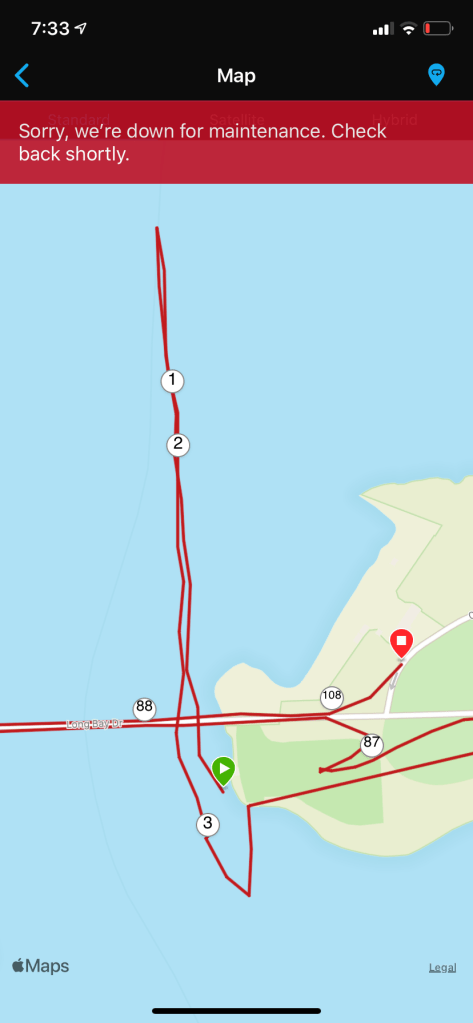
My swim took a massive amount of time. I’m still downloading the course map because poor old Garmin got struck by Ransomware and only now are the results spinning around inside my phone.

But I know from the race results that it took me 38 minutes to go from Point A out to the northern buoy, back under the bridge and out to Point B and in for the Swim out.

There could be a wide number of reasons why that swim was so slow. 1) I’m a slow swimmer. 2) I swam much farther due to wandering along the way. 3) I swam the uphill part of the course.

But I just downloaded the swim tracking with the map and much to my credit, I swam straight as hell. So the fact of the matter is that my lack of swim training (probably four times in the last three months) and sloppy stroke probably cost me. Seeing that I swam straight is actually encouraging to me. The night before the race, I asked Sue what might help my sighting technique and she shared that I should look during the left arm rotation since I breathe on my right. It worked. I felt smooth. And frankly, this was my first competition one-mile swim. So my goal was getting through it efficiently and not blowing up. I’m excited because I know I can do better.

But still, I was stunned to read that time of 37+ minutes on my watch when I climbed out of the water. I thought I was doing pretty well with a time of 15:13 around the north buoy.

The funny part about that part of the experience is that I didn’t hit the Lap marker properly on my watch coming out of the swim. So the Triathlon splits never kicked in and my race showed up as one long swim. Which was kind of apropos, it turns out.

Nothing doing

Because as it turned out, the day did feel like one long swim. Heading out on the bike my legs were a bit soggy feeling. I don’t know why. I don’t kick much in freestyle.

But the instinct to ride in a higher gear than I should proved fatal. I rode out into the wind mashing away. As I came back the wind was favorable and I averaged 20 mph. But when I got off the bike I could not move. My butt muscles were completely locked up. It really hurt. Like, really.

I’ve had forms of that cramping happen in Sprint triathlons too. Clearly I’m doing something wrong in my cycling form during races that causes my upper hamstrings and gluteus maximus to clinch unto madness. So I stood there at T2 thinking about what to do. Was it even worth continuing?

Making contact

The sweat was pouring off my head and I took off the sweat cap and bumped my eye in the process. The contact lens shoved up into my eye and I spent a minute trying to push it below the iris so I could slide it back into place. Then the lens popped out into my hand.

All I had to put it back in was the water in the hydration belt my wife suggested I wear for the run. Gingerly, I poured some fluid out and filled the contact lens. It stung horribly when I put it back in my eye. That’s when I remembered that I’d put some electrolyte powder in each of the bottles. Ouch.

Finally I trundled out of T2. Tossing the belt aside, I decided to use just water out on the run course. But running wasn’t possible at first. So I stood at the eastern edge of the bridge for a minute or two, contemplating the situation.

I had grabbed a cold bottle of water to start the run and stood there drinking it down. So I started walking to see how the butt muscles would feel. Not good. It really hurt. As in, “Can’t really run at all” hurt.

It felt like a giant wasp had bitten me in both ass cheeks. It think I found a model of the wasp in a display about pollinators at a rest stop on the way home. Given the size of this thing, it seems obvious that was what bit me. I’m sure of it now.

I’ve ridden plenty of times this year at an even faster pace for longer than the 26 mile segment of an Olympic Tri. Most recently I did a 40K time trial and average 19.5 mph. So there’s no reason why my butt muscles should lock up during a race except for making bad choices in pedal stroke and gearing. We all make dumb mistakes in this sport at times, but this is a repeated issue. Time to make better decisions.

Moving on

Despite the ass-bitten state of my condition, I decided to do the run because I’d come all that way and there wasn’t likely going to be another chance to do a race this year. It was humbling to be moving so slow, but I’ve experienced so many of these moments in life they no longer daunt me. One foot in front of the other. That’s the way to go.

It took two full miles of shuffling to get feeling back in my ass cheeks. Then I started to run a bit better. By the last three miles I’d dropped down toward nine minutes a mile and was passing people. The butt still hurt, but at least I could move.

My watch still showed a swimmer icon. It was giving me some sort of readout that fluttered around the 3:00 mark. So I used that as a demarcation to sense my general pace and dropped it down to 2:40. Then I kept it there until the last half mile when the course opened up into bright sunshine and the heat whacked me like a thick stick.

I know my body well enough to realize it was time to back off a bit. So I rolled on in the last quarter mile at a sensible pace because I knew there was no chance of placing in my age group by that point.

Still fun

Despite all that back and forth, I still had fun doing the race. That might seem weird to say, but frankly, my only goal was finishing the first time out at the Olympic distance. Last year was a disaster for me with races cancelled due to weather and my own health issues, including an infected tooth that nearly killed me. Literally.

Then 2020 rolled around and the Coronavirus pandemic is crushing the sport of triathlon.

This race was considered dicey by many within the sport. The race director plowed ahead despite strong skepticism from the racing community as well as community, state and national officials.

His pre-race talk was all about being grateful for the opportunity to race and urging us to take responsibility for keeping the course clear of litter. We all social-distanced on every front, wearing masks when we were close to others through registration and meals and the like. It was a successful day by many estimations.

Hometown feel

There were no crowds around the finish line. It all had a hometown feel as people sat far apart and clapped and cheered as competitors came across the finish line. Our friend and dog mama Karah Osterberg took second overall among women behind a pro racer.

My wife rocked her Half Ironman as well. She missed out on racing at Muncie due to Covid cancellations. So this race was perhaps her only opportunity to use her considerable fitness this year. She won her age group, was 12th overall among women and was only fifteen minutes off her best time in conditions that were hot and muggy overall. That’s a great performance, if you ask me.

Looking ahead

It’s hard to tell what else will happen with the sport of triathlon this year or next. One thing seems clear: there is a call for more independence and personal responsibility before, during and after an event. Athletes are being asked to carry their own nutrition and water. With less available volunteers, that’s the direction the sport is headed.

But we can tell you that even with those guidelines in place, this race was a nice experience. Everyone kept their distance, you might say.

Posted in Christopher Cudworth, competition, cycling, half marathon, healthy aging, healthy senior, mental health, racing peak, swimming, triathlete, triathlon, triathlons | Tagged , , , , , , , , | 2 Comments

Gearing up for an Olympic distance triathlon

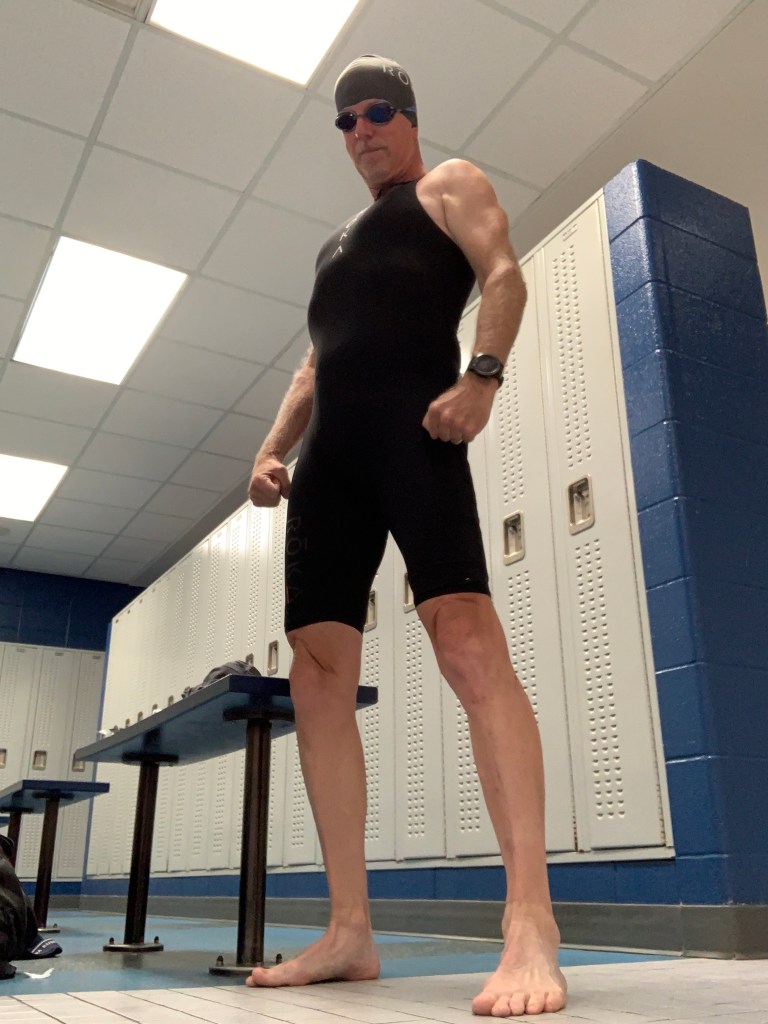
That’s my Avengers pose in my new Roka skinsuit and matching cap for swimming.

Thus far, my triathlon career has consisted of Sprint and Duathlon races. But last year, my goal was to do a pair of Olympic distance races. Weather, injury and illness intervened to keep me from racing at all in 2109.

2020 rolled along and we all know what’s going on with races. Most are cancelled or postponed until who-knows-when. But there is one race on our calendar that is going forward. It’s in Springfield, Illinois this weekend.

The number of competitors has been pared down to reduce transmission risks, and the race start and transition areas will be vastly different than the recent old days. Competitors are urged to self-supply nutrition and water, and not expect normal water stations at all. Bottled water will be available, but then you need to carry it on your own, and not toss bottles by the side of the road. That’s a big penalty.

Which means this race will be a bit like a homespun triathlon or a glorified training experience.

In anticipation of the race, my wife Sue gave me a Roka skinsuit in advance of my birthday this Sunday. I tried it out in the pool on Wednesday and while it’s not as buoyant as the Roka wetsuit shorts I own, or the sleeveless wetsuit I’ve typically worn in races, it is an interesting and sleek piece of gear.

The water temperatures are expected to be 73 degrees this Saturday, so we’ll probably be wetsuit legal. If that’s the case, I’ll wear one. But we’ve done a couple outdoor, open-water swim sessions up in Crystal Lake and I feel ready at last to swim a mile in competition. I’m not fast, swimming along between 1:55 to 2:00 per 100, but what I care about is getting to the Swim out, jumping on the bike and hustling through the run.

Training has gone really well of late. So we’re heading down to Springfield to see how this works and looking to get at least one race going in 2020. The piles of gear on our bed are classically triathlon. Goggles. Bike shoes. Helmets. Body Glide. Shorts. Tops. Nutrition. Sunscreen. You name it. This may be a simple sport in concept, but it takes a lot of gear to get it done.

Posted in PEAK EXPERIENCES, race pace, racing peak, training, triathlete, triathlon, triathlons | Tagged , , , , , , , | 2 Comments

Have you ever been underestimated?

When my son Evan was perhaps ten years old, he turned to me and said, “Dad, have you ever noticed that when people say “Good for you” they are often being condescending?”

Yes, my son understood the meaning of condescension at ten years old. He started talking at six months old and went on to major in English at the University of Chicago. And perceptively, he was correct about the fact that some people use the phrase “Good for you” as a sort of faint praise when secretly they either don’t really admire your achievements or are jealous.

More often than not

While subtle, that type of human dialogue is more common than we might like to think. It’s not always true that people say “Good for you” in a dismissive manner. But take a look around at the nature of communication on social media and it’s clear that people look for any minor advantage they can find. Everyone wants to be the winner.

It is also true that some people forcibly underestimate the ability of others. If you’ve ever worked for a boss with those instincts, it is incredibly frustrating. They project limitations and low expectations on you because they hold close to their own fears and insecurities. Ultimately, they’ll chase you out of their sphere if they feel threatened by the fact that you refuse to abide by their perception of you.

Being underestimated

Those of us in athletics often experience the harsh lessons of being underestimated. If a coach doesn’t think you’re good enough for the team, you might never even get a chance to prove yourself. Even if you do make the team, and the coach views you as a chink in his winning armor, there might be bench time in your future.

Even in raw endurance sports such as running, where the clock is the seeming final determinant of success, teammates can play subtle power games with verbal manipulation. They may want to beat you badly enough to seek to undermine your confidence somehow, which is a brand of active underestimation.

This is especially true for athletes moving up the ranks. A runner who suddenly improves may have been underestimated by teammates and competitors for a while. It takes a bit of confidence to break out of the expectations of those who benefit by keeping you down.

Early counsel

When my children were in elementary school, I counseled them to be smart about their relationships. “Friends are just as likely to try to control you as people who don’t like you.” If that seems harsh, so be it. The truth hurts sometimes, and I would rather my kids understand the challenges of social dynamics than be broadsided by people who claimed to be your friends, yet through selfish or unthinking behavior might cause you pain.

I gave somewhat the same advice to a group of young people that I mentored in the INCubator program at our local high school. Their job was to come up with a product that they could all work together on and learn to market to the world. But I warned that it’s often difficult to embrace the ideas of others, and that conflicts could occur. That advice proved true for them, and what a life lesson it was.

Fractured loyalties

The world is full of people pretending to be loyal even as they maneuver for advantage or to protect their own interests. It is a common tactic for these folks to underestimate others as a means to control them. The tools of this underestimation include gender prejudice, selfish interests, racist beliefs, ageism, political alliances, wealth, and religion. All these viewpoints are used to cast other people as inferior. Yet when the people targeted by their bigotry speak up or resist their impositions, the perpetrators of that prejudice claim to be victims themselves.

In gaslighting fashion, they’ll even calculatedly question the loyalty of those they are trying to control. It’s all a product of forceful underestimation. The sad, sick thing about all this underestimation is that entire factions of society buy into it in one way or another. Then it becomes a cultural belief unto itself. Those outside the sphere of that cultlike underestimation become the “other,” and live with the burden of those demeaning stereotypes. That’s exactly what all the unrest in America is about these days. People of many backgrounds are sick to death of being underestimated.

Breaking free

If you’ve ever been underestimated, you likely realize how much work it takes to break down those perceptions. But in athletics, when you finally run a great race and the coach or teammates that didn’t think much of your abilities are forced to look at you in a new way, there is a great feeling of liberation that takes place.

I follow a Linkedin group called The Female Lead. It’s principal province is to encourage women to buck the underestimation imposed on them in the work world. There are many men commenting on the posts within the group that exemplify the misogyny and male bigotry the group is specifically designed to resist. And they don’t get how blindly ignorant they truly are.

Fortunately, there are many great companies, programs and teams that do the opposite of underestimation. They are encouraging in their culture and eager to guide all others toward success. I just interviewed a female engineer who works as a director in what has largely been a male-dominated industry. She started out as a graphic designer, learned drafting and now runs the show in a large swath of the country. That’s how one blasts through the ceiling of underestimation.

Underestimation=frustration

But even within positive circumstances there are sometimes reasons to be frustrated. Old perceptions and aggressive habits die hard.For example, a running team that adopts a philosophy of overtraining going too hard all the time can turn out to be a toxic environment, and lead to burn out. Yet having the courage to speak up in the face of that culture puts one in a position of keen vulnerability. Admitting that you’re struggling with workouts even when other people are getting sick or hurt is a tough thing to do, because machismo is valued in so many sports. That is frustrating.

Yet that’s as true in the workplace as it is out on the roads. On one hand, it is harsh to be underestimated. On the other hand, it is scary to stand up for sound behavior and ethical balance in the face of an errant work culture. I once backed one of my employees in a dispute over massive overtime hours she was being forced to work on a company project while holding down her real job. The manager above us underestimated the time necessary to launch the new project and my employee was bearing the brunt of his mistake as she completed her day job to go out and work until eleven at night, often on weekends.

So my employee was exhausted, and in tears. So I turned in the forty hours of extra work to be paid to her, and the company reacted by punishing me for submitting those hours to be paid. They’d underestimated my commitment to principles and legality, but I was the one that paid the price. Unfortunately, that’s how life works sometimes.

If you’ve ever been underestimated, you’ll recognize those feelings. They’re not fun. But one thing is important to realize. You’re seldom actually alone in those feelings. And once one person builds the courage to speak up, others will typically join in. Certainly the #metoo movement in America is proving that. So is #blacklivesmatter. And what do we see in response to those movements. Those threatened by the truth of their forceful underestimation are retaliating and trying for force people back into place. People are even dying under the oppressive thumb of forceful underestimation and intimidation. The son of a female judge assigned was just murdered by a man whose hatred for women was used to justify the attack.

The Pre Factor

Injustice is everywhere. Four decades ago, it was athletes being told to be satisfied with amateur status by Olympic and AAU administrators who basked authority and even gained wealth at the expense of those athletes, whom they greatly underestimated. That era of suppression resulted in a revolution of resistance to false and selfish authority. One of those people was Steve Prefontaine, who along with running greats like Frank Shorter began to take matters into their own hands to change athletics from a falsely governed amateur sport to a paid vocation based on personal performance.

The same holds true with the likes of marathon runners such as Katherine Switzer, who defied the limitations and underestimations being placed on her by men to run the Boston Marathon.

The lesson is that it’s always dangerous to underestimate somebody. You never know who you’re facing in this world. Some of us refuse to take that shit anymore. They might call us anarchists or liberals, fake news or Antifa, Feminazis or n*******, but that won’t stop the pushback against fascist control of the streets of America.

Posted in anxiety, Christopher Cudworth, competition, cross country, cycling, marathon, marathon training, mental health, running | Tagged , , , , , , , , | Leave a comment

A minute can last a lifetime

I had a nice conversation yesterday with Craig Virgin, one of America’s greatest distance runners whose 27:29 10K still ranks in the top ten all-time. He was also a three-time Olympian We talked about his book Virgin Territory, which I highly recommend for its candor and insight on what it takes to become and stay a world-class runner.

Craig noticed a photo in the blog about the late Dave Bashaw, a former Geneva, Illinois runner who passed away in early July from the Covid-19 infection. The photo showed Dave in the company of his North Central College teammates, and it struck a chord with Craig, as that era in Illinois distance running was both quality and classic in its competitive nature.

That led to us discussing Craig’s motivational speaking and addressing young runners about the opportunities and impact that running provides all who engage in it.

I’ve written many times that I was present the day that Craig Virgin ran the three mile course record in Detweiler Park (Peoria) that stood for four decades. That iconic mark set in 1972 motivated many a runner over the years. It was finally broken by a second or two in 2019.

Timeless advice

That means Craig’s relevancy as a speaker has lasted all these years. It is for a great reason: No one but one runner in forty-plus years has ever beaten his time on that course. Thousands and thousands of kids at every class level and school size have raced in state meets, pushed themselves to the limit and entered that chute having given their best efforts, yet none of them until last year ever ran faster than Craig Virgin that day in the early 1970s. The Lebanon Greyhoud remains a legend.

As we talked, Craig shared some insights about what he tells high school kids about the nature of racing. I hesitate to state them in full because I think they are his to own. But the advice centers around how to concentrate and process your efforts before and during a race. As he demonstrated many times in competition, for Craig there’s a special “secret sauce” of motivation that has genuine value to kids and adults alike. It has to do with how you perceive time, discomfort, pain, and motivation. If you want to know the full story, you’ll have to book him as a speaker.

Success and failure

This much I can tell you. During my own career, in which both failure and success played a big role in education about life, there were moments when I definitely knew that a portion of personal destiny was on the line. Coming through in those moments is what personal legacies are all about. They may not mean a whole bunch to the world, at least not at the level that Craig Virgin attained as a two-time world champion in cross country, but the moments in which you test yourself and succeed most certainly matter to you.

So what I can offer (again) is my favorite saying from the book Ambiguous Adventure by Cheik Hamidou Kane. This phrase is true more for endurance athletes than almost anyone else. Here it is:

The purity of the moment is made from the absence of time.

If that seems counterintuitive, it is purposely so. We may indeed live and die by the clock in this world, but surpassing that truth is exactly the point. There are some efforts in which we engage that actually force time to expand, or at least how we perceive it.

What a gift that is when we come face to face with it, and recognize the moment and its worth. Perhaps you’ve come down toward a finish line and felt the sensation as even discomfort and pain fade away and you become an instrument of training and determination. That is the purity of the moment creating the absence of time.

Let’s all stop a moment to consider the degree of falseness and fecklessness in this world, and realize how exceptionally valuable it is to have achieved the sense of wonder that comes from genuine effort. It helps you see beyond the ticking irreversibility of the clock and surpass the limitations that people often want to place upon you.

That’s why we’re all here. That’s why a minute can last a lifetime.

Posted in 10K, aging, competition, cross country | Tagged , , , , , , , , | Leave a comment