This is the first in a series of articles chronicling fifty years of running since I went out for cross country as a freshman in high school.
Some point in the middle of August 1971, my father drove me from our house in Elburn, Illinois to the Kaneland High School campus in the middle of still-green cornfields three miles away. The drive might have been a bit quiet that day. I had expressed interest in going out for high school football late that summer. My father was adamantly against any of his boys playing that sport, or wrestling. He considered football unnecessarily dangerous to the joints and wrestling, simply inelegant.
Chris Cudworth and Greg Cudworth with trophies from the Elburn Punt, Pass and Kick competition.
That meant I didn’t really have a choice about whether to go out for football or not. Not happening. Yet something in my teenage brain, hormones and a desire to impress girls, most likely, convinced me there was still a chance. I’d won the local Punt, Pass, and Kick competition in Elburn and competed at the District level, where I did pretty well. That gave me the idea that I could be a quarterback or some other glory position. I was fast afoot, agile and quick, and reasoned that football was mostly about passing, running and making diving catches. That’s what I’d done all the time while playing with friends.
My father knew the game of football was about something completely different. He’d seen friends of his with torn-up knees and lifelong injuries. That was not a fate he wanted for any of us.
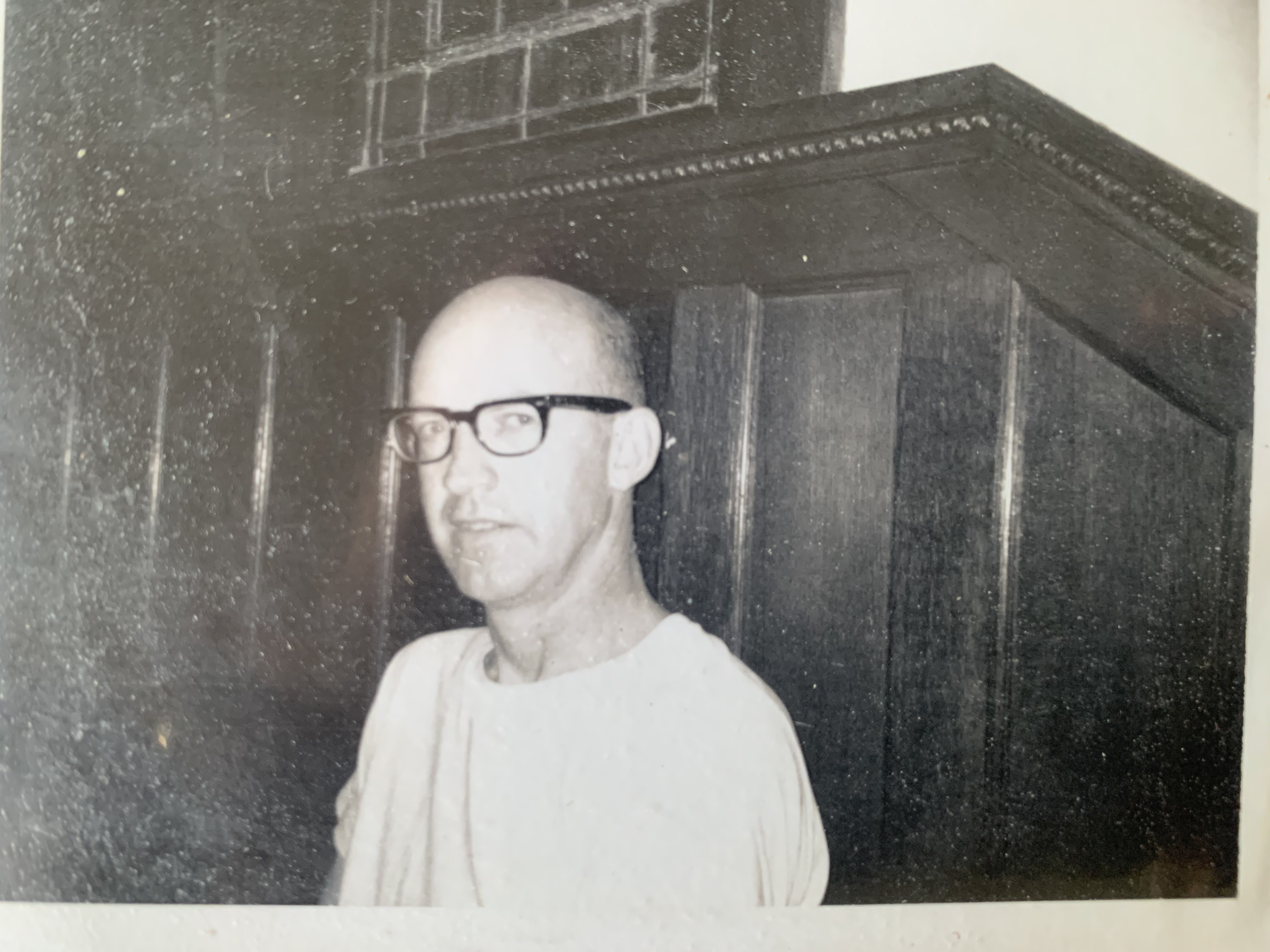
My father Stewart Cudworth in 1971. He was 45 years old at the time with four boys.
For these reasons, my next eldest brother had run cross country the previous fall as well. In an ugly twist of life’s fate, our family moved from Pennsylvania to Illinois the summer before his senior year. Back east in Lancaster, he’d been a steady goalie in soccer, played basketball in winter and was a pitcher in baseball. The Kaneland sports program offered neither soccer in the fall or baseball in the spring. Accustomed to a three-sport regimen due to family tradition, my brother ran cross country in the fall and track in the spring.
I was so preoccupied that year dealing with 8th-grade social and sports activities that I never attended one of my brother’s meets. He related to me recently that he struggled at first getting used to distance running. By season’s end he was reaching the coveted Top 7, even earning a few points toward his Varsity letter.
None of this occurred to me as my father drove our 1965 Buick Wildcat out Keslinger Road to Kaneland. I was still torn about the whole football thing. We arrived at the school and he walked to the locker room with me. Then placing a firm hand on my neck, he said, “You’re going out for cross country, and if you come back out of that locker room, I’ll break your neck.”
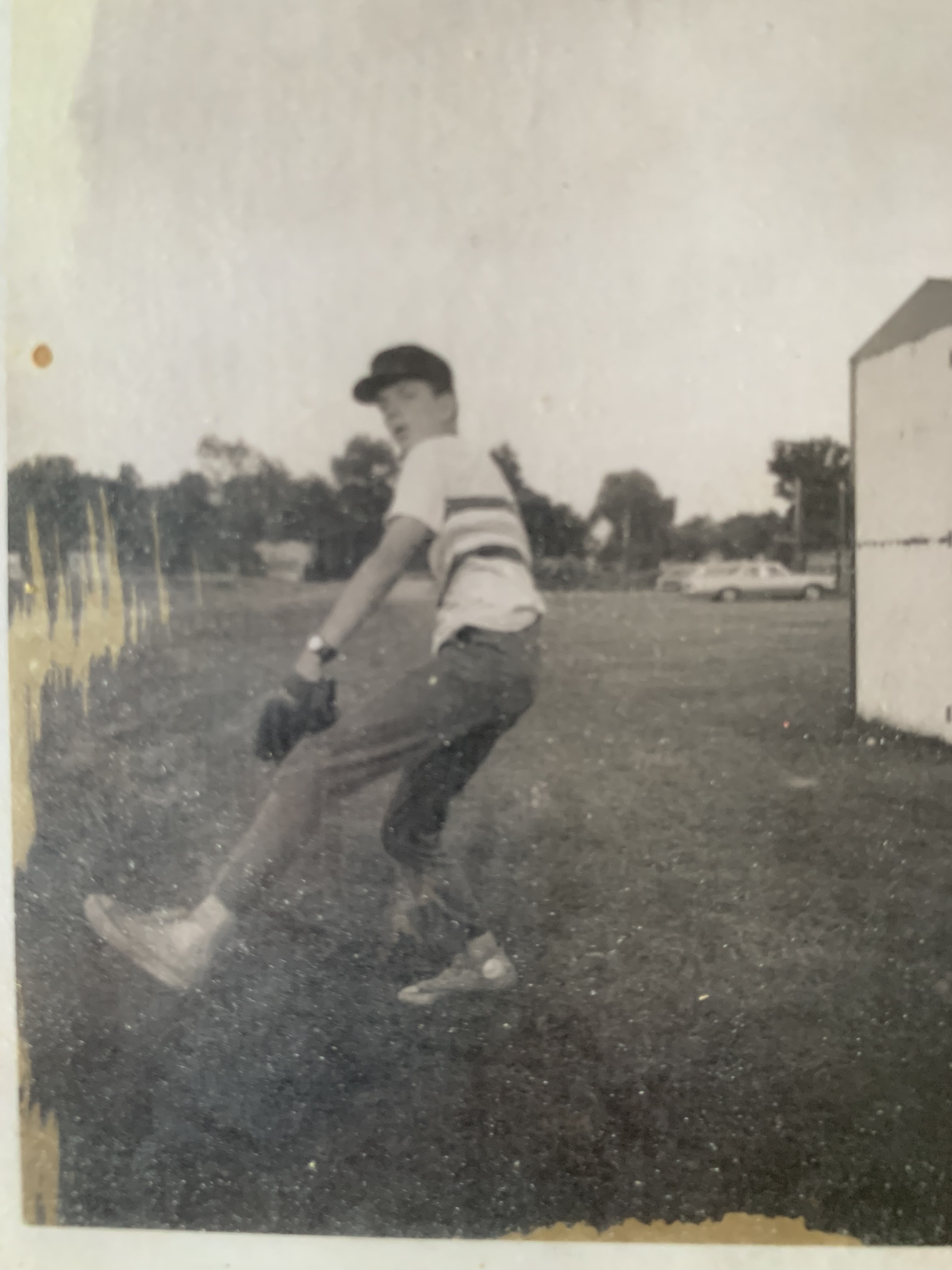
Christopher Cudworth doing his best 8th Grade Philosophical look.
That may seem like an inauspicious way to begin a running career, but it’s the truth. The previous year in 8th grade I’d been one of the top 800-meter runners, running 2:28 with basically no training. So I knew that I could run pretty well. Back in Pennsylvania, I’d run 8.25 laps in a 12:00 gym class time trial, the best in the school. Even before that, the coaches on my baseball team made me do extra pushups to keep me from lapping the rest of the team during the end-of-practice running drill out to the center field light pole and back.
Entering freshmen year at Kaneland, I was a skinny kid of about 125 lbs. at nearly six feet tall. The team issued a set of black and white running flats with gum rubber soles. The coaches gave us a few encouraging remarks and we set off running together in a pack to warm up. After that, the pace picked up, and we all got our first season’s introduction to pain. I loved it.
Up until cross country my freshman year, baseball was the main sports occupation in life.
We covered perhaps six miles that first cross country practice in mid-August, 1971. My lungs hurt a bit and my legs too, but I was never bored. That was the key thing to me. I liked the feeling whenever there was something going on “in the moment” and competition to be had. The side benefit is that any anxieties I felt that day or beyond seemed to vanish in the wind. I was tired when finished, but relaxed in a way that made all of life seem to make sense. Of course, sensations like that only last so long…
When practice ended my legs throbbed in happy exhaustion. I dared to take a sip of the warm, iron-infested water that flowed from the Kaneland faucets. It had a strong sulphur taste and I nearly gagged. After we showered and changed, the line of cars showed up to take everyone home.
Except me. I walked out on the parking lot and remembered then…what my mother had told me as my father and I left the house that morning. “You’ll have to walk home today, Chrissy. Your father will be at work and it’s my first day of teaching in St. Charles.”
I stood there in the mid-morning heat wondering what to do next. The rest of the team had slipped into cars and rode away like spirits into the cornfield void. There was no one even left to ask for a ride home. So I walked slowly out to Keslinger Road as the sun beat down on my head and started walking home. My legs were aching and I felt a mad thirst coming on. The road edge was slanted gravel that made walking on it difficult. That meant I had to walk inside the white line on the road and step off when a car or truck came rushing by. I squinted in the sun and kept trudging on in my worn out Converse basketball shoes.
Chris Cudworth with Kaneland coach Richard Born and top runner Bill Creamean in fall of 1972.
I don’t recall if we had an afternoon practice that day. Yet by week’s end we were running double workouts. There was a ton to learn about the more intense schedule of high school athletics. Like how to suffer and come back for more.
Often enough, the shorts and jock I’d worn that morning would still be wet from the first workout of the day. A few guys came down with jock itch for that reason. We’d climb in and out of our running shirts and shorts as time demanded, day after day, as fitness improved.
We ran the campus perimeter again and again, or ran on the track and did intervals on cinders marked by ghostly white lines from the track season before. The weather reeled back and forth between late summer heat and the first hints of fall. We ran through dew so thick out gum rubber soles slipped and slid. Yet we kept on. Stride after stride.
Then I came home one day and told my father. “I like cross country. I think I can do pretty well.”
This time of year is one of the best for cycling with golden flowers and blue skies abounding.
Last weekend was a great chance to indulge in serious mileage on the bike. While I’m not a mega-mileage kind of guy these days, I still relish the chance to get out there and see the wheels spin beneath the bike.
The first ride was a mutual training gig with my wife Sue and a host of triathletes from Madison Multisport coached by either Steve Brandes or Cyndi Bannink. We enjoyed a great introductory dinner at their home on Friday evening and rose super-early to get in a swim in downtown Madison.
Rising at 4:00 a.m. isn’t anything new to me these days. That’s when our cat Bennie likes to be fed, so I pop up, pop open a can of cat food for his breakfast, and pile back into bed.
On Saturday morning we woke at 4:00 a.m. as triathletes are also wont to do in preparation for a race or early morning practice, but it felt a bit tougher as the day before I’d also gotten up at 3:00 to drive a relative to the hospital in Chicago for a procedure. I was back home by six a.m. on Friday, but it’s always tough to get back to sleep after staying awake to drive 80+ miles.
The water felt cool but not cold as we slipped in following a pre-swim talk about the 500-meter course with its buoys and floatie cones. Sue is a much faster swimmer, so I waited a bit to wade up to my shoulders and start freestyling into the sunrise.
It’s been a while since I wore a full wetsuit and the sensation surprised me. Pleased me, actually. The swim was smooth and relaxing if a bit slow. But I swam straight as can be for most of the course, then climbed out and got stuff ready for the ride to come. We’d heaped our gear in the car haphazardly due to the early rise and sleeping in a bit by accident. I sorted through all the crap to assemble myself as a cyclist with 70-80 miles to ride.
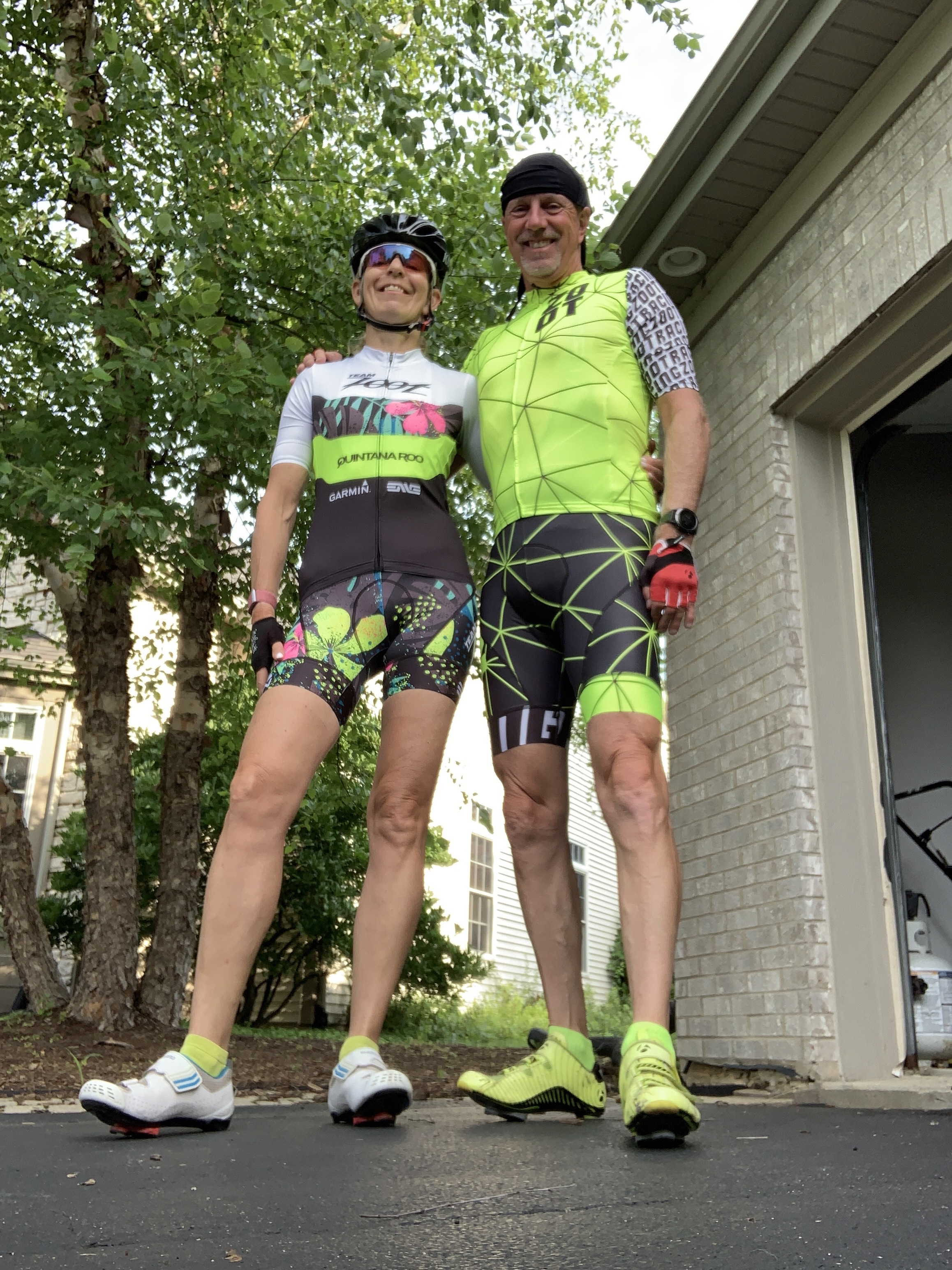
Once we got on our bikes, the morning air was cool and pleasant just like the lake water. The sun was up and Sue’s Zoot suit shone like a blue-green gem as she pedaled ahead of me. She bought me a complementary kit and added this gem of kit for herself for our riding.
We know the Madison Ironman course nearly by heart from “stick” all the way around the 40-mile loop from Verona to Mt. Horeb to Cross Plaines and back. While the scenery is familiar, the enjoyment is balanced by the challenging terrain. My tri-bike does not have a climbing gear on the cassette like my Specialized Venge, and I plan to remedy that soon. So i focused on full pedal strokes as we climbed and pinched my knees on the top bar as we descended. It’s been almost ten years since my bike wobble accident in Spring Green, Wisconsin, but I never want to repeat that adventure.
Sue wasn’t crushing the pace due to the fact that she was planning a two-loop day totaling nearly 100 miles, so we cruised along together and conquered the “three bitches” late in the Ironman Loop and arrived back in Verona with energy to spare. We refueled, traded hugs and a kiss and parted ways as I was riding back into town on the Stick.
As I rode back into town, I gave thought to the fact that Ironman Wisconsin may move from the fall to the spring. Apparently, the Ironman organization engaged the city of Des Moines, Iowa and Madison, Wisconsin in a bidding war to see who would gain the coveted September race slot. Des Moines outbid Madison, and that city will likely host a great race, as we learned from the Half Ironman they put on this summer. But the loss of a September slot for Madison is sad. There is a great tradition up there with thousands of triathletes visiting the city from April through fall to ride the course, stay in the hotels, spend money on meals and support the bike shops tied to the September event. It seems like the City of Madison didn’t take everything into account or else succumbed to the raw value of money over the more intelligent choice to invest in the future and consider opportunities for even greater growth. If the conservatives nipping at the State of Wisconsin all the time overruled the liberal instincts that made Madison such a great place all these years, shame on them. The tradition and epic nature of that fall race was not something to dump for a few mere dollars. Perhaps there is something that can still be done. But I also think there’s room for both races in September. Some people would choose an easier Des Moines course over the tougher Madison race. I think they should both go off in September.
The real deal
On the way back into town last Saturday, I got buzzed by some jerk in a tiny white sedan who also roared close to a row of cyclists ahead of me on the road. So perhaps the ugly conservatism of backroads politics is affecting the Madison decision as well. We’ve been harassed in the past by trucks and people filming cyclists far out in the country where it’s easy to pass unless a stubborn strain of selfish jerkism appeals to the driver and passengers. That brand of narcissism is rife in this country right now. Choosing to feel inconvenienced when there’s plenty of room for accommodation through the simplest actions is what half of American seems to thrive on. Hence the pandemic of the unvaccinated and the reality of insurrection.
Wrapping it up
My plan was to finish up 80 miles with a loop around the lake, but the roads on the way back to Madison are so wretched and bumpy that my shoulders were a knotted mess by the time I arrived at the lake parking lot. I switched into running clothes and was about to go out for a run when a couple that I’d seen during the late stages of the ride revealed that they’d lost their car keys somewhere out the road.
We discussed what they planned to do and I offered to drive them anywhere they wanted to go. The two truck arrived and the stuck Subaru they own was dragged onto the flatbed truck and they decided to go with their Crosstrek to the dealership and get things resolved.
Once the vehicle was safely loaded and I knew they had a plan, I drove out to meet Sue at Verona. She was experiencing some new bike seat issues at nearly a hundred miles and was ready to call it a day.
Despite such challenges, riding in Madison is always a treat. Sometimes it comes with a menu of problems ranging from flats on railroad track to dead Di2 batteries, but we always have fun in the end.
Everybody Rides
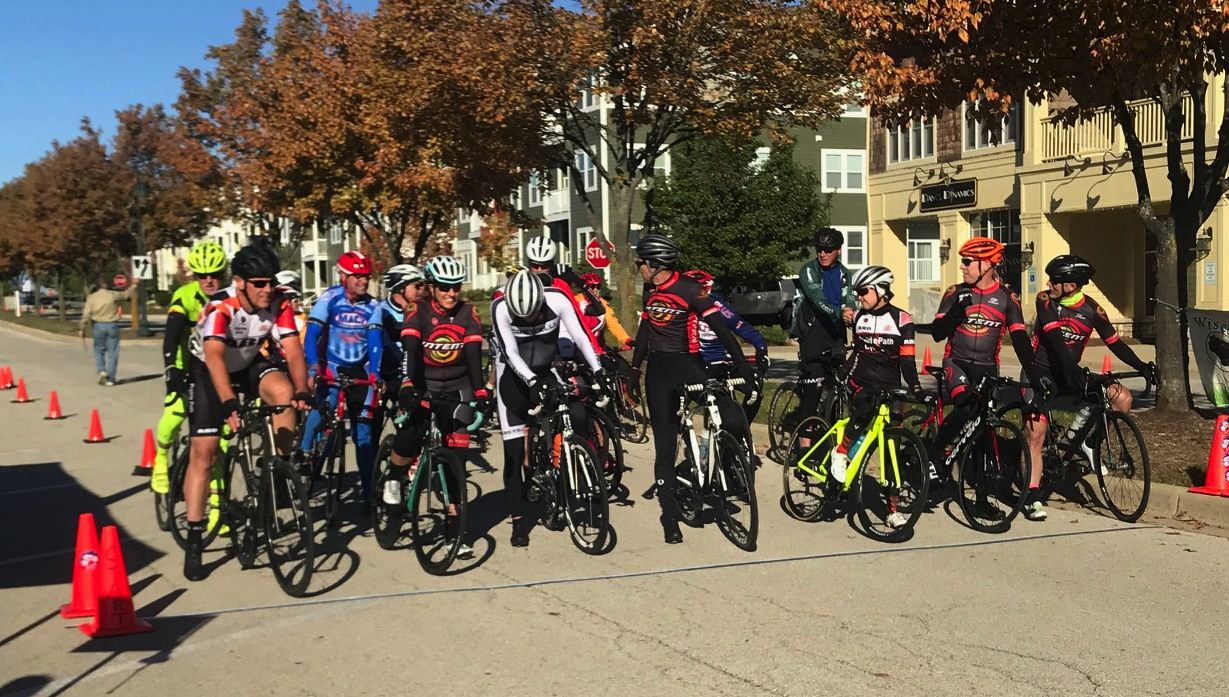
Come Sunday morning, I was back on the bike with friends to pedal the Everybody Rides fund raiser loop from St. Charles out into corn country and back. My buddies advertised it as an “easy” 62-mile ride, but I knew better than to expect a slow pace. The group we joined dialed it up to an average near 20 mph and kept it there for mile after mile. My body actually felt great and my legs on the flats were efficient and strong.
When it came to the two big climbs nearing the finish however, the muscle fibers deep in my thighs showed fatigue from the day before. The rest of the riders took off in a “horse smells the barn” finish with five miles to go, but I was content to spin up the hills and tear down the backside in a tuck position to close the distance again.
Back at the park, we chowed on burgers and pasta, salad and sweet corn… washed down with a beer and a hard seltzer or two. The morning was cool and the mid-day temps turned warm and gracious as a summer day can be. After driving a friend home with his bike, I tooled back to our place and showered. Then I crawled on the bed next to my wife who was drained from the day before and enjoyed a nap with the kitty at our feet and the dog basking downstairs in the afternoon sun.
I’d ridden 130 miles in two days and had a good nap to show for it. What better weekend could there be?
A drawing and message by my daughter Emily from elementary school. Looks like she won!
As a young father in my late 20s and early 30s, I made the decision to back off heavy training to concentrate more on making a living and being a good father. That doesn’t mean I quit running altogether. It just meant giving up the 80-mile training weeks because that amount of running would not have been fair to my wife in terms of taking care of our children.
She knew that running was good for me overall. Having met in our early 20s, she saw many of my best days and some of the worst when it came to racing on the roads. From 1981 through 1985, I raced between 10-25 times each year, with a peak competitive schedule of 25 races in 1984. We were married in 1985.
Our first child was born in October of 1986. Fatherhood arrived with more daily activities than I’d previously experienced. Between feeding my son and changing diapers, driving him to daycare when she went back to work and picking him up at the end of the day, life was suddenly a string of commitments.
I still kept running. Sometimes it was early in the morning. Other times right after work while the kids were playing and I had 45 minutes to an hour to train.
When my daughter was born three years later the commitments didn’t exactly double, but by then I had developed a far mellower outlook toward running in general. Racing was reduced to 2-3 times a year. Running was 4-5 times a week. Finding time for workouts was challenging, but it worked out.
I never liked racing when I was half in shape. That’s what people in our running group used to asked me on weekly Saturday morning group runs. “Are you still just fit enough to get fit?” a former competitor once scolded me.
“Yep,” I’d say.
A lean and mean young dad on the road.
It wasn’t that we were running slowly. Some of those Saturday runs dialed up to six-minute-per-mile pace. That’s quick, but anyone that has raced at 5:00 pace per mile can tell you there’s a major difference when running sixty seconds faster per mile. I knew that my intensely competitive days were through.
The other hard part about finding time for workouts in those era was balancing work and fitness. Occasionally I’d sneak in a workout during the lunch hour, but the idea that daytime workouts contributed to productivity was not yet accepted in the work world. As an employee in sales and then marketing, there were quotas to fill and anxieties to manage. Running with a guilty conscience never felt good to me.
I was already an anxious person by nature. Ironically, to my nature, running actually helped manage those ruminative thoughts. Despite my conflicted conscience, finding time to work out during the day actually made me a better employee in many ways. Often while running I’d come up with a solution to some marketing challenge. It also helped my self-esteem to wind up some daytime endorphins. I’d be much more relaxed in presentations and sales calls.
As my children grew up, they noticed my love for running of course. Fitting it into the schedule came with a different type of guilt as I tried to balance parenting choices with how long I got out to run. That meant I frequently kept a strict schedule, telling my closest training partner and friends, “I can run from 6-6:45, but I have to be home by then.”
One friend gave me grief about that quite often. Sometimes he wouldn’t be ready when I arrived, or not even changed into running clothes. Then I had to wait. On more than one occasion I took off without him.
Ten years later, when he was raising kids of his own, he called one day and said, “Hey, I owe you an apology. I used to give you shit about going out running. My son is here literally clinging to my ankle telling me not to go. I’m sorry.”
In the summer of 1986, about to become a father for the first time.
These days all our kids are grown up, but sometimes there is still a tug and pull between us over what time to work out, and where. At this stage of life, we’re far more blunt about needs and time commitments. With age comes honesty.
Way back when I was training hard there was a phrase from the book Hotel New Hampshire by John Irving that used to cycle through my head. One of the main characters in the book was a wrestler urged by his coach, “You’ve got to get obsessed and stay obsessed,” he’d tell him. That was the key to success in his mind. For many things in life, that is true.
When it comes to finding time for workouts, here’s a bit of sage advice. There’s more than one kind of success in this world. Sometimes we gain more by giving up our most selfish concerns. I think that’s what these many years of training have taught me.
These days, I enjoy being a training companion for my wife. I admire her regimen and discipline. She never had the chance in life before to test her athletic abilities. Now she’s doing well. In a couple weeks, we’re traveling to Ironman 70.3 Worlds in St. George, Utah. She qualified this summer and has earned the chance to compete there.
I’ve been happy to be her support crew at races this year. My own racing schedule might come down to a late-September Olympic triathlon, and I’m happy with that. I find time for my workouts between other things in our schedule. I’m actually becoming a better husband this way, taking care of daily chores including feeding and walking the dog, emptying and filling the dishwasher, getting the pup to Doggy Daycare or the Bark Park, and making meals so that she can fit in the workouts she needs to succeed. I’ve been known to cry happy tears when she races well and is satisfied with her effort.
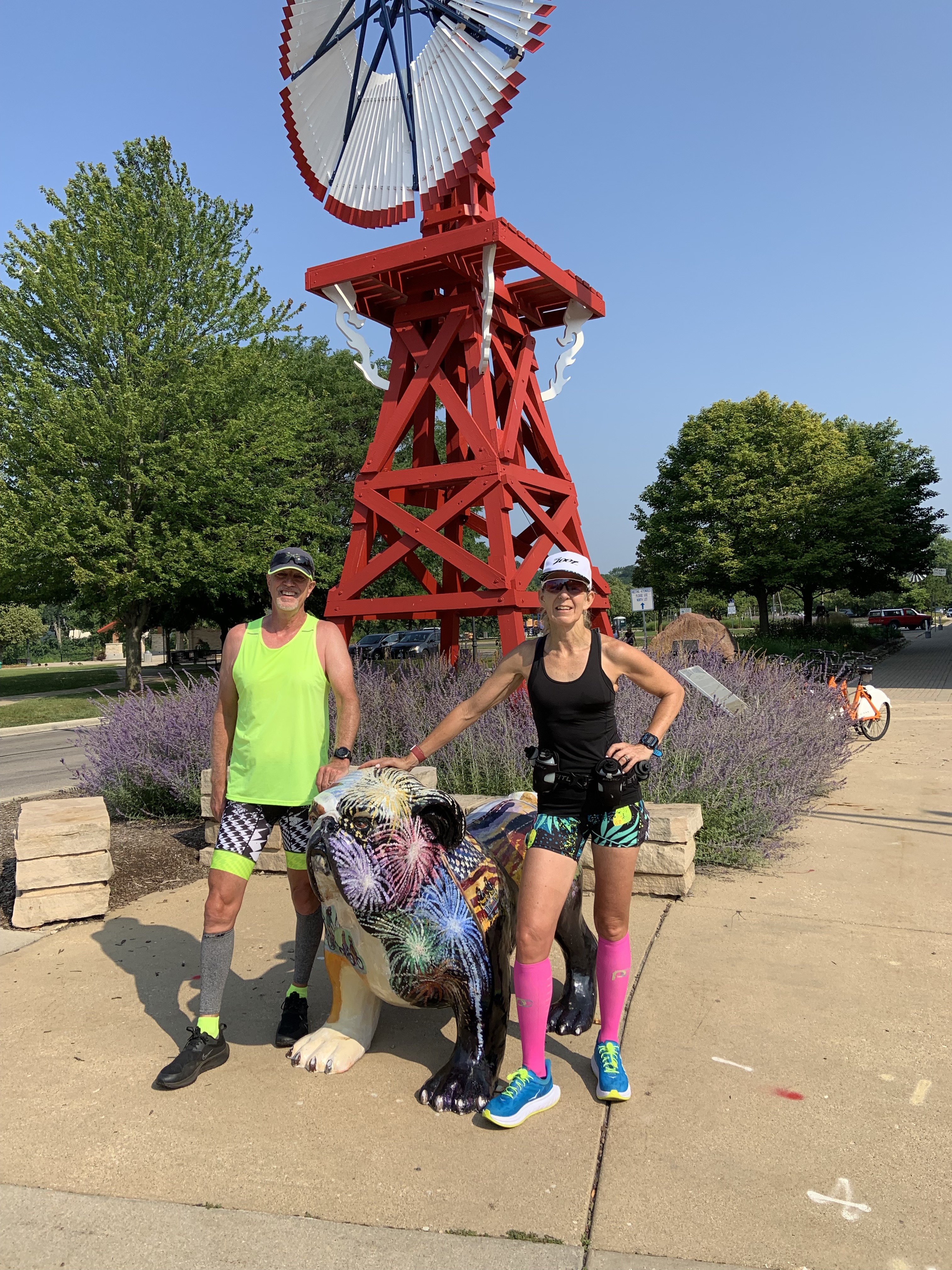
We stopped during a ten-mile to take our picture with the bulldog I painted in the City of Batavia.
I do several workouts with her every week, usually a long ride on Saturday and a long ride on Sunday. During the week I fit workouts in where time permits. I do have flexibility in my schedule and find the time as it fits my writing and work obligations. This morning I ran five miles starting with a 2.5 mile warmup at 9:30 pace followed by a quicker 2.5 miles back at 8:23 pace. It was humid as hell and tough to run, but I congratulated myself on making a good decision to keep it simple and not turn it into a humidity sufferfest.
I laugh because during my warmup miles, a guy about my age rolled past doing probably 9:00 pace. I know because I tracked him a few hundred meters before the 2.5 mile mark. Part of me was tempted to follow him out the next half mile and scorch him on the way back. Instead I turned around at the planned 2.5 miles and left him in peace.
The same thing happens often in cycling. I love a good 25-30 mile ride or two during the week, and sometimes I get passed by a young buck or some determined type. If they say hello, I never mind. If they roll past like they’re all superior, my instincts are to run or ride them down. I’m still wired to a competitive scale, but also have a governor on those urges.
Last Saturday we covered 50 miles at 18.6 mph. We rode with friends and took turns leading. We were all different athletes with different aims, but the ride went run. Finding time for workouts is often a matter of making workouts a good time. For fitness. For thinking. For life.
I got out the Shop-Vac to clean up the stick shavings our dog left on the living room carpet last night. Somehow she snuck a ten-inch stick into the house without our noticing it, and chewed a big section off the end.
It didn’t take long to vacuum up the remnants. But when I picked up the Shop-Vac to take it back to the garage, I lifted it the wrong way and tweaked the fascia in my lower back where the muscles connect with the sacrum.
I’ve waited a bit to see if they’d loosen up or tighten too much to run. Eventually I went out the door to run and got my answer. Too tight. A risk of actual injury.
So here I sit, All Dressed Up and staying home for the moment. Better to be prudent and recover a bit than to go out and force a run when those connective tissues are in a state of mild tension and spasm.
The hawk talisman around my neck provided inspiration at a critical time in life.
Heading into my senior year at Luther College, my fitness was good and I’d used the summer to clean up my act. I cut off the long, thick hair that shrouded my face. Dumped the thick glasses and got a set of contact lenses. Shaved the scraggly Lasse Viren beard and ran some smart mileage heading into the season.
The final touch was creating a talisman of sorts to inspire my efforts in cross country that fall. I was out running one afternoon and found an adult red-tailed hawk that had been struck and killed by a car. As a field biology student and a wildlife painter, I’d done taxidermy on a few raptors and decided to bring the hawk home to save its parts for future painting reference. I know. That’s illegal.
Chris Cudworth photo of a red-tailed hawk at a roadside memorial marker.
I’ll admit to breaking conservation laws. No one without a permit is allowed to collect or keep feathers or body parts of any raptor species. But I’d already collected a great horned owl and done some great paintings using its feathers for reference. I also kept dead songbirds in our freezer at home to thaw them out and do paintings. In my younger mind, these efforts were justified. I was celebrating the creatures I’d found. While human society often lays waste to wild things, the artist in me sought to bring them back to life.
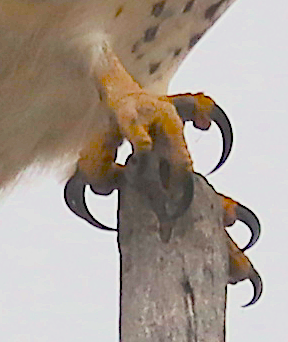
Studying the red-tailed hawk I’d found made me appreciate its evolutionary history even more. The thick, gnarly feet were equipped with knobby scales to grab prey and hold it. And those talons. Lord, those talons.
As I completed my drawings, the bird began to get a bit ripe. I carved up the hawk into wings and feet and disposed of the decomposing body out in a field. Then I got an inspiration. Wouldn’t one of those talons look great on a silver chain?
I took the talon to a jeweler that obviously knew or cared nothing about game laws. They mounted the talon in a silver semi-cube and slipped it onto a flat silver chain. I loved it.
I’ve written about how that talon and chain provided inspiration going into my senior year cross country season. It symbolized the fact that while I knew that running would take most of my time that fall, I’d someday get back to painting the birds I loved.
The season went great that year. I soared like never before. We placed second in the nation in cross country that fall.
That talisman was a link between my love of nature and the freedom that running afforded me. In many respects, running was the activity that cleared my head of anxiety and depression. It was also the yin and yang of my existence. While the act of running brought freedom, the commitments of competition required year-round dedication. Such is the conflicted nature of life. We are all wild things at heart yearning to break free yet bound to our commitments in order to survive.
My photo of a red-tailed hawk after snatching a vole from a roadside grassland.
The life of a red-tailed hawk is quite similar. While their high, soaring flight is an inspiring thing, it also has a highly-evolved purpose. Hawks excel at flying because they are predators. If they don’t catch something to eat each day, they may die. Young birds struggle at first to be good hunters. The mortality rate of young hawks is thus high.
This past weekend I watched a trio of red-tailed hawks, two adults and one young bird, soaring above the wetland behind our house. They were vocalizing as they tipped and turned in the wind. I brought my camera out and took photos of the young bird. It is already equipped to be a grand predator, yet still obviously being weened off the food supplied by the parents.
There is no way to count the number of red-tailed hawks I’ve seen over the years. They are one of our most common buteo species, found from coast-to-coast and from lowlands up into the mountains. Many’s the time that I’ve been running or riding on a country road when a red-tail launches from a telephone pole and flies ahead of me. Yet I have also seen them flying through and over the skyscrapers in Chicago, lifted on thermals on bright fall days and sitting sullenly on snow-covered branches on cold winter days. They are my longtime friend, these red-tailed hawks. We have seen many of the same places together.
The juvenile red-tailed hawk soaring over our home last weekend.
The day that my wife and I first visited the house where we now live, I walked out back to see what the yard was like. At that moment, a large red-tailed hawk swooped into the yellowed cottonwoods at the edge of the wetland. It perched there and called. Quite likely it is one of the same birds seen soaring over our place this weekend. My wife walked out to find me staring at the hawk up in the tree. When I turned around, there were tears in my eyes. “Oh, so you like this one?” she inquired.
Like all half-assed journalists, I didn’t really confirm the facts about whether cross country meets will still be hosted at Kane County Forest Preserves.
After receiving a nicely worded email from Alan Edgecombe correcting me about the status of cross country meets at forest preserves, I emailed Monica Meyers, Executive Director of the Kane County Forest Preserve District, and she wrote me back, in simple and complete language.
“The District has not changed anything. Cross country scheduling is in full swing within our preserves throughout the county.”
That means regularly scheduled meets at most locations will likely go on as planned. In the case of the Leavey Invitational, it is moving to the new Settler’s Hill site.
About those facts, sorry folks, I was wrong!
Changing management plans
The part about which I was correct on cross country meets being held at area forest preserves is that some are being managed with an emphasis on restoring natural areas rather than mowing everything in sight. Even old golf courses are being repurposed, as indicated by this excerpt from the KCFPD Minutes:
The board conducted a tour of several district properties, concluding with a visit to the former Deer Valley Golf Course. “The fifth and final site was the Deer Valley Golf Course. This site was recently closed, and is currently being transferred, back to a natural state. This site consists of the clubhouse, machine shed, and a small out-building. The Sub-Committee has determined that the club house may be of some value and would like to have this structure advertised to be sold and moved by the purchaser. The Sub-Committee has determined that the remaining out-buildings do not serve as viable assets to the District, and recommends the structures be removed.”
The lesson here is that “change happens.” The other lesson is that partial sentimentalists like me should not be so fast to jump on a rumor rather than checking our facts first.
New facilities
As for the course at Settler’s Hill, Al Edgecombe provided some nice information about the value of that new facility:
“We do believe that for many schools, the Northwestern Medicine Course will be a very good and cost-effective option. Also, regarding the amount of money spent on the Course, let me point out that no tax dollars were spent on the Course. The Settlers Hill landfill closed in 2006, and dumping fees that had been collected for 30 years had accumulated in a fund that could only be used for restoration of the site to a recreational use. In 2011, Kane County put out a call for proposals on how to use the site. My organization, the Chicago Area Track & Field Organizing Committee (CATFOC), was one of about a half dozen organizations that came forward with ideas. Over the next several years, all of the other ideas were deemed infeasible, and CATFOC moved forward with the county to build a championship-caliber cross country course for the local middle schools, high schools, and colleges. The Course will be open to the general public when meets are not being held. The Course includes options for 2 km, 3 km, 4 km, 3 miles, 5 km, 6 km, 8 km, and 10 km. The Course has been built to the specifications required for NCAA and USATF championship events, and will serve very nicely for large high school invitationals like the ones held at Detweiler Park in Peoria every Fall.”
Christopher Cudworth Photo
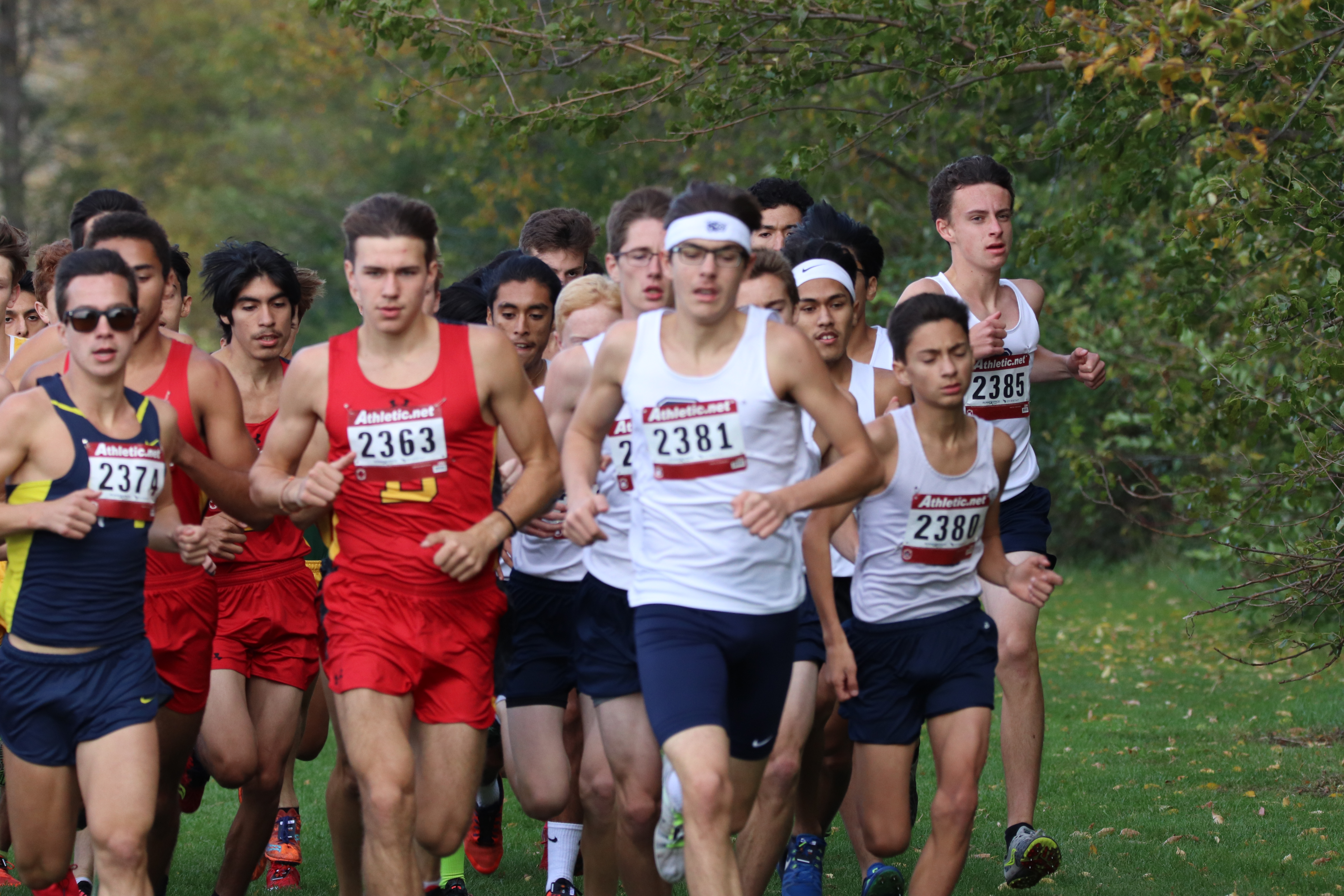
I’m still a fan of cross country and look forward to attending meets at Settler’s Hill. There are few more inspiring sights than a pack of runners launching from the starting line, or seeing dozens of kids finishing their race no matter what place they achieved.
Proposed: Rejected
I’ll close with a sort of backwards commentary on the proposal I submitted to the Kane County Forest Preserve District at the behest of a former administrator. It was reviewed and deemed unfeasible in the face of resistance to cyclists using the Settler’s Hill property due to perceived disturbances by mountain bikers making trails in the far-eastern section of Fabyan Forest Preserve. That plot of woods backs up to homes built on the former site of an institutional home facing Route 25 in Geneva. The mountain bikers built jumps and trails in the preserve perhaps without permission, and their presence also angered residents who might have felt their privacy was being invaded.
At any rate, without that knowledge, I’d proposed a cycling facility to be sited at Settler’s Hill. I still think it’s a good idea. But it’s one that will never likely take place.
Midwest Cycling and Recreation Center
Settler’s Hill, Kane County Illinois
Christopher Cudworth photo
PROPOSAL
Establish a recreational and competitive cycling facility utilizing the unique topography of the landfill property at Settler’s Hill in Geneva, Illinois. The purpose is to provide a magnet facility for cyclists in the Greater Chicago region and Midwest.
Site Benefits:
Settler’s Hill is a valuable and somewhat commodity for Midwest Cyclists with its potential for elevation-oriented roads and the climbing pattern possible. Plus, the opportunity to provide isolated, traffic free training and racing over the large potential acreage on the property is unique in the region. It is also accessible by bike from the Metra Train Station in Geneva, enabling Chicago and suburban cyclists to reach the site with ease through public transportation.
Benefits of a Cycling Focus:
In terms of recreational and competitive facilities in the Chicago market, there are only two principle cycling-dedicated locations. The Village of Northbrook has the track known as the Velodrome while the region around Palos Hills hosts mountain biking single tracks. Neither of these serve a very large and active market of road cyclists seeking challenging yet safe competitive opportunities. There is no single self-contained cycling center in Northeastern Illinois.
The Cycling Market
Cycling in the Chicago region is an immensely popular activity, reflected in the commercial market for bikes in this region. According to the website ChicagoBikeShops.com, there are more than 200 bicycle shops in the Chicago market. In fact, the far western suburbs within 25 miles of Geneva, Illinois hosts more than 50 bike shops. In the Tri-Cities market alone there are 15 bike shops. These commercial businesses serve a diverse cycling community of recreational, serious, competitive and professional bike riders. The global bike company SRAM also has its headquarters in the Chicago market.
Community involvement
In the Tri-Cities market, bike racing has also hosted events of considerable scale, bringing thousands of participants and fans to communities such as Geneva, Batavia and St. Charles. Bicycle Heaven in Geneva and Mill Race Cycle in Geneva has both hosted national scale bike races attracting international fields. Sammy’s Bike Shop in St. Charles has also hosted large-scale multi-category bike racing for women and men. Athletes By Design in Wheaton and Batavia hosts multiple cycling criteriums, road races and time trials in events held in Batavia, Winfield, Itasca and rural areas where true road races can be staged. All these these events enjoy popularity but do require substantial logistical support including street closures, police support and other community resources.
The Pelladrome
However, within two miles of the existing Settler’s Hill landfill facility, there is a site where bike racing is conducted weekly from April through September. The course is set up on the roads of an underdeveloped industrial center behind the Pella Windows manufacturing facility on Fabyan Parkway one mile east of Kirk Road. This three-quarter mile loop of underutilized industrial streets is where Prairie Path Cycles (Batavia/Wheaton stores) and Athletes By Design cycling team host weekly criterium bike racing. These events are conducted under the legal management of American Bike Racing and attract more than 200 athletes (male and female) in racing Categories from novice (CAT 5) to Category 1 and 2 cyclists training for national competitions.
The “Pelladrome” as it has been named has been in operation for more than seven years and attracts cyclists from throughout the Chicago region. Thus there is an established tradition and market for cyclists to visit the western suburbs for bike racing.
Settler’s Hill Location
The existing market for bike racing and training is further supported by Kane County’s unique location at the western edge of the Chicago. Hundreds of recreational and serious cyclists use the existing Fox River Trail system for training and fitness riding. This trail is already connected to the Settler’s Hill site by a full bike lane along Fabyan Parkway.
Kane County’s existing current land us offers a developed eastern corridor and open territory (agriculture and low density housing) west of Randall Road. This plan allows for the country plan for access to suburban populations yet provide access to desirable bike trails and country roads where cyclists prefer to train.
Settler’s Hill site
The site itself at Settler’s Hill with its prominent rise in topography and planned running trails is ideal for a collaborative use for cycling and running. Hill training and racing opportunities are rare in the Chicago area. This makes Settler’s Hill an exceptional attraction for cyclists and fitness enthusiasts of many types.
The Settler’s Hill site offers the unique opportunity to install both perimeter and “peak” trails. Asphalt trails would provide road cyclists a “safe haven” for training and criterium work. The opportunity to install a profit center facility to serve food and drinks, sell cycling supplies and provide a mechanical support service could be established as part of a cycling consortium with area bike shops.
Recreation Categories
In addition to cycling, the Settler’s Hill site could provide designated hours for recreational walkers and runners to use the cycling roads. In winter these same paths could be groomed for cross country skiing without adverse impact on the installed roads or facilities. Forest preserves such as Herrick Lake in DuPage County and Arrowhead Golf Course already offer cross country skiing. But none have the challenging topography of the potential Settler’s Hill property.
ECONOMIC BENEFITS
OF THE SETTLER’S HILL CYCLING OPERATION
Midwest Cycling and Recreation Center (Proposed title)
Creates a “destination” site for recreational activities
Serves as a direct revenue source through fees and membership
Generate revenue through on-site retail and rental
Invite sponsorship revenue from area businesses
Drive event and ticket sale revenue from March-November
Taxpayer Offsets
Property becomes self-sustaining profit center
Reduced usage fees for Kane Country residents/registrants
Funding can be pursued from bike advocacy groups
Corporate naming rights
Summary
The purpose of the Midwest Cycling and Recreation Center would be to provide an exceptional recreational facility that serves as a return on investment to Kane County Residents. It’s goal is to create opportunities for safe and unique cycling experiences for racers and recreational riders throughout the Midwest.
Midwest Cycling and Recreation Center
Settler’s Hill, Kane County Illinois
PROPOSAL
Establish a recreational and competitive cycling facility utilizing the unique topography of the landfill property at Settler’s Hill in Geneva, Illinois. The purpose is to provide a magnet facility for cyclists in the Greater Chicago region and Midwest.
Site Benefits:
Settler’s Hill is a valuable and somewhat commodity for Midwest Cyclists with its potential for elevation-oriented roads and the climbing pattern possible. Plus, the opportunity to provide isolated, traffic free training and racing over the large potential acreage on the property is unique in the region. It is also accessible by bike from the Metra Train Station in Geneva, enabling Chicago and suburban cyclists to reach the site with ease through public transportation.
Benefits of a Cycling Focus:
In terms of recreational and competitive facilities in the Chicago market, there are only two principle cycling-dedicated locations. The Village of Northbrook has the track known as the Velodrome while the region around Palos Hills hosts mountain biking single tracks. Neither of these serve a very large and active market of road cyclists seeking challenging yet safe competitive opportunities. There is no single self-contained cycling center in Northeastern Illinois.
The Cycling Market
Cycling in the Chicago region is an immensely popular activity, reflected in the commercial market for bikes in this region. According to the website ChicagoBikeShops.com, there are more than 200 bicycle shops in the Chicago market. In fact, the far western suburbs within 25 miles of Geneva, Illinois hosts more than 50 bike shops. In the Tri-Cities market alone there are 15 bike shops. These commercial businesses serve a diverse cycling community of recreational, serious, competitive and professional bike riders. The global bike company SRAM also has its headquarters in the Chicago market.
Community involvement
In the Tri-Cities market, bike racing has also hosted events of considerable scale, bringing thousands of participants and fans to communities such as Geneva, Batavia and St. Charles. Bicycle Heaven in Geneva and Mill Race Cycle in Geneva has both hosted national scale bike races attracting international fields. Sammy’s Bike Shop in St. Charles has also hosted large-scale multi-category bike racing for women and men. Athletes By Design in Wheaton and Batavia hosts multiple cycling criteriums, road races and time trials in events held in Batavia, Winfield, Itasca and rural areas where true road races can be staged. All these these events enjoy popularity but do require substantial logistical support including street closures, police support and other community resources.
The Pelladrome
However, within two miles of the existing Settler’s Hill landfill facility, there is a site where bike racing is conducted weekly from April through September. The course is set up on the roads of an underdeveloped industrial center behind the Pella Windows manufacturing facility on Fabyan Parkway one mile east of Kirk Road. This three-quarter mile loop of underutilized industrial streets is where Prairie Path Cycles (Batavia/Wheaton stores) and Athletes By Design cycling team host weekly criterium bike racing. These events are conducted under the legal management of American Bike Racing and attract more than 200 athletes (male and female) in racing Categories from novice (CAT 5) to Category 1 and 2 cyclists training for national competitions.
The “Pelladrome” as it has been named has been in operation for more than seven years and attracts cyclists from throughout the Chicago region. Thus there is an established tradition and market for cyclists to visit the western suburbs for bike racing.
Settler’s Hill Location
The existing market for bike racing and training is further supported by Kane County’s unique location at the western edge of the Chicago. Hundreds of recreational and serious cyclists use the existing Fox River Trail system for training and fitness riding. This trail is already connected to the Settler’s Hill site by a full bike lane along Fabyan Parkway.
Kane County’s existing current land us offers a developed eastern corridor and open territory (agriculture and low density housing) west of Randall Road. This plan allows for the country plan for access to suburban populations yet provide access to desirable bike trails and country roads where cyclists prefer to train.
Settler’s Hill site
The site itself at Settler’s Hill with its prominent rise in topography and planned running trails is ideal for a collaborative use for cycling and running. Hill training and racing opportunities are rare in the Chicago area. This makes Settler’s Hill an exceptional attraction for cyclists and fitness enthusiasts of many types.
The Settler’s Hill site offers the unique opportunity to install both perimeter and “peak” trails. Asphalt trails would provide road cyclists a “safe haven” for training and criterium work. The opportunity to install a profit center facility to serve food and drinks, sell cycling supplies and provide a mechanical support service could be established as part of a cycling consortium with area bike shops.
Recreation Categories
In addition to cycling, the Settler’s Hill site could provide designated hours for recreational walkers and runners to use the cycling roads. In winter these same paths could be groomed for cross country skiing without adverse impact on the installed roads or facilities. Forest preserves such as Herrick Lake in DuPage County and Arrowhead Golf Course already offer cross country skiing. But none have the challenging topography of the potential Settler’s Hill property.
ECONOMIC BENEFITS
OF THE SETTLER’S HILL CYCLING OPERATION
Midwest Cycling and Recreation Center (Proposed title)
Creates a “destination” site for recreational activities
Serves as a direct revenue source through fees and membership
Generate revenue through on-site retail and rental
Invite sponsorship revenue from area businesses
Drive event and ticket sale revenue from March-November
Taxpayer Offsets
Property becomes self-sustaining profit center
Reduced usage fees for Kane Country residents/registrants
Funding can be pursued from bike advocacy groups
Corporate naming rights
Summary
The purpose of the Midwest Cycling and Recreation Center would be to provide an exceptional recreational facility that serves as a return on investment to Kane County Residents. It’s goal is to create opportunities for safe and unique cycling experiences for racers and recreational riders throughout the Midwest.
Midwest Cycling and Recreation Center
Settler’s Hill, Kane County Illinois
PROPOSAL
Establish a recreational and competitive cycling facility utilizing the unique topography of the landfill property at Settler’s Hill in Geneva, Illinois. The purpose is to provide a magnet facility for cyclists in the Greater Chicago region and Midwest.
Site Benefits:
Settler’s Hill is a valuable and somewhat commodity for Midwest Cyclists with its potential for elevation-oriented roads and the climbing pattern possible. Plus, the opportunity to provide isolated, traffic free training and racing over the large potential acreage on the property is unique in the region. It is also accessible by bike from the Metra Train Station in Geneva, enabling Chicago and suburban cyclists to reach the site with ease through public transportation.
Benefits of a Cycling Focus:
In terms of recreational and competitive facilities in the Chicago market, there are only two principle cycling-dedicated locations. The Village of Northbrook has the track known as the Velodrome while the region around Palos Hills hosts mountain biking single tracks. Neither of these serve a very large and active market of road cyclists seeking challenging yet safe competitive opportunities. There is no single self-contained cycling center in Northeastern Illinois.
The Cycling Market
Cycling in the Chicago region is an immensely popular activity, reflected in the commercial market for bikes in this region. According to the website ChicagoBikeShops.com, there are more than 200 bicycle shops in the Chicago market. In fact, the far western suburbs within 25 miles of Geneva, Illinois hosts more than 50 bike shops. In the Tri-Cities market alone there are 15 bike shops. These commercial businesses serve a diverse cycling community of recreational, serious, competitive and professional bike riders. The global bike company SRAM also has its headquarters in the Chicago market.
Community involvement
In the Tri-Cities market, bike racing has also hosted events of considerable scale, bringing thousands of participants and fans to communities such as Geneva, Batavia and St. Charles. Bicycle Heaven in Geneva and Mill Race Cycle in Geneva has both hosted national scale bike races attracting international fields. Sammy’s Bike Shop in St. Charles has also hosted large-scale multi-category bike racing for women and men. Athletes By Design in Wheaton and Batavia hosts multiple cycling criteriums, road races and time trials in events held in Batavia, Winfield, Itasca and rural areas where true road races can be staged. All these these events enjoy popularity but do require substantial logistical support including street closures, police support and other community resources.
The Pelladrome
However, within two miles of the existing Settler’s Hill landfill facility, there is a site where bike racing is conducted weekly from April through September. The course is set up on the roads of an underdeveloped industrial center behind the Pella Windows manufacturing facility on Fabyan Parkway one mile east of Kirk Road. This three-quarter mile loop of underutilized industrial streets is where Prairie Path Cycles (Batavia/Wheaton stores) and Athletes By Design cycling team host weekly criterium bike racing. These events are conducted under the legal management of American Bike Racing and attract more than 200 athletes (male and female) in racing Categories from novice (CAT 5) to Category 1 and 2 cyclists training for national competitions.
The “Pelladrome” as it has been named has been in operation for more than seven years and attracts cyclists from throughout the Chicago region. Thus there is an established tradition and market for cyclists to visit the western suburbs for bike racing.
Settler’s Hill Location
The existing market for bike racing and training is further supported by Kane County’s unique location at the western edge of the Chicago. Hundreds of recreational and serious cyclists use the existing Fox River Trail system for training and fitness riding. This trail is already connected to the Settler’s Hill site by a full bike lane along Fabyan Parkway.
Kane County’s existing current land us offers a developed eastern corridor and open territory (agriculture and low density housing) west of Randall Road. This plan allows for the country plan for access to suburban populations yet provide access to desirable bike trails and country roads where cyclists prefer to train.
Settler’s Hill site
The site itself at Settler’s Hill with its prominent rise in topography and planned running trails is ideal for a collaborative use for cycling and running. Hill training and racing opportunities are rare in the Chicago area. This makes Settler’s Hill an exceptional attraction for cyclists and fitness enthusiasts of many types.
The Settler’s Hill site offers the unique opportunity to install both perimeter and “peak” trails. Asphalt trails would provide road cyclists a “safe haven” for training and criterium work. The opportunity to install a profit center facility to serve food and drinks, sell cycling supplies and provide a mechanical support service could be established as part of a cycling consortium with area bike shops.
Recreation Categories
In addition to cycling, the Settler’s Hill site could provide designated hours for recreational walkers and runners to use the cycling roads. In winter these same paths could be groomed for cross country skiing without adverse impact on the installed roads or facilities. Forest preserves such as Herrick Lake in DuPage County and Arrowhead Golf Course already offer cross country skiing. But none have the challenging topography of the potential Settler’s Hill property.
ECONOMIC BENEFITS
OF THE SETTLER’S HILL CYCLING OPERATION
Midwest Cycling and Recreation Center (Proposed title)
Creates a “destination” site for recreational activities
Serves as a direct revenue source through fees and membership
Generate revenue through on-site retail and rental
Invite sponsorship revenue from area businesses
Drive event and ticket sale revenue from March-November
Taxpayer Offsets
Property becomes self-sustaining profit center
Reduced usage fees for Kane Country residents/registrants
Funding can be pursued from bike advocacy groups
Corporate naming rights
Summary
The purpose of the Midwest Cycling and Recreation Center would be to provide an exceptional recreational facility that serves as a return on investment to Kane County Residents. It’s goal is to create opportunities for safe and unique cycling experiences for racers and recreational riders throughout the Midwest.
Runners take off at the start of the 1974 District Cross Country meet at Elburn Forest Preserve.
A friend and former cross country coach named Jeff Leavey noted on Facebook that the Kane County Forest Preserve district board voted to boot all cross country programs out of the parks starting in 2021.
The board may have an ulterior motive in taking this action. The county approved construction of a $2.9M permanent and specific cross country course on top of the Settler’s Hill landfill in Geneva. It makes economic sense for the county to push cross country teams to use and rent those facilities. They want a return on investment.
The problem with that potential logic is that cross country programs and the schools that host them aren’t all concentrated in south-central Kane County. Hosting meets is a logistical challenge that requires volunteers as well as paid staff to conduct a safe event. Traveling 20-30 miles to host a “home meet” isn’t really practical on a regular basis.
That’s why county forest preserves have long served as welcome sites for cross country meets because they fit several key criteria for high schools:
They are local or in proximity to the host schools
They offer significant open areas or trails where courses can be mapped out
They are scenic
Our coach Trent Richards dispensing pre-race advice before a meet held at Elburn Forest Preserve
For these reasons, the two cross country programs for which I competed in high school hosted most of their meets at county forest preserves. Kaneland high school hosted many meets, including county and district championships, at Elburn Forest Preserve.
In the early 1970s, the park consisted of a long stretch of mowed grass on the west side of the preserve. That’s where a large part of the course was sited because much of the ground beneath the large oaks east of the main road was mowed. A wetland at the far south tip of the preserve was consistently drained through a tunnel that emptied south of the railroad tracks.
I loved racing at that preserve because it was a tough course and felt like real cross country with its mix of grassy flats, gravel road, steep hills and twisty, turny white lines through the trees. The course climbed a hill for 400-meters at the start. That quick challenge ensured that the race was an honest effort. Many cross country runners tested their fitness, and their souls, on that hill. It rose to a 7% grade near the top. Then the road wended its way through mature woods and emerged at the front of the preserve where mile times would be called out.
That’s where I learned the cross country trade. The sensation of running through those woods in early September meets with heat and mosquitoes was epic. Once autumn arrived, the crunch of leaves underfoot as dozens of runners tore through the woods was classic cross country.
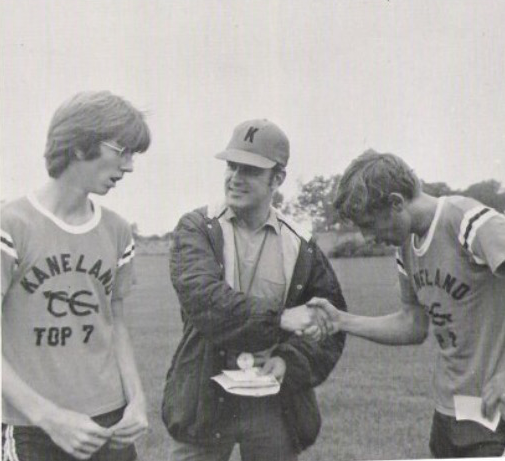
My teammate Bill Creamean receiving a congratulatory greeting from Kaneland coach Richard Born after a meet at Elburn FP. I loved those uniforms.
Elburn Forest Preserve has not been used for cross country meets for some time now. Land and wetland management policies embraced by the country to naturalize forest preserves changed all that. The wetland section of the preserve was allowed to go wild. No more mowing was applied to those acres. Poplar trees sprung up. Tussocks of wild grasses and cattails moved in. The county also stopped mowing underneath the woods east of the main road. A healthy undergrowth developed.
These changes actually aligned with my other keen interests in this world: nature and wildlife. While I ran cross country in Elburn Forest Preserve during the fall, I also went birding there in all seasons of the year. I watched great horned owls nest in the cold months of January and February. Welcomed spring warblers during migration in April and May. In summer there were kingbirds and swallows and then-rare Eastern bluebirds to be found. The songs of wood thrush and pewee flycatchers calling on hot summer days cemented my love for the place.
A great horned owl.
As the preserve naturalized, cross country meets were no longer practical. Still, during a bird walk last spring, I saw three Kaneland runners training on the gravel road high up on the hill. Their team had won the state championship the year before. It gave me a little pride to know that I’d contributed to that program’s success in its earliest days. Now their meets are held on campus as they were before the move to Elburn Forest Preserve. The only thing left of that era are the memories of what it was like to compete on that tough course. That is a collective memory held by thousands of runners over 30+ years of competition there.
Another program, another preserve
During my sophomore year at Kaneland, our family moved ten miles east to St. Charles. The home course at St. Charles was a series of loops around the high school campus. It was a confusing course in many respects, but it was great for fans because the runners passed by the finish line several times. We had some classic battles on that course, but our coach and one of the runners on our team made plans to set up a new course at Leroy Oakes Forest Preserve on the west side of town.
After moving from Elburn to St. Charles, I joined a team that first competed on the high school campus. We’re posing in front of the football stadium fence. I found this photo in a program buried in grass next to the fence ten years after graduating from high school.
A runner named Kevin Webster designed that first course. It included a loop on the “fire trail” through dense woods on the east side of the preserve. Then it coursed along the mowed flats where traces of oxbows next to Ferson Creek belied the former placement of that stream. Then came a dreaded section up a gravelly dirt path climbing the glacial hill laid down millennia ago. I used that hill to dump many rivals over the years.
Leroy Oakes remained the home course for St. Charles cross country for many years. The course evolved from our original layout to starting on a wide mowed grass section near the “red barn.” That was the site of dozens of meets, including the prestigious St. Charles Invitational, later named the Jeff Leavey Invite in honor of its longtime coach and director of the St. Charles East program.
As a fan returning to watch high school cross country meets at Leroy Oakes, I saw many quality runners compete in invitationals there. While studying eventual American steeplechase record-holder Evan Jagr run on that course for Algonquin Jacobs High School, I took note of his fluid stride and turned to someone at the meet and said, “See that guy? He’s going to be world-class someday.” Jagr proved me right.
But now the county has decided to end the long tradition of cross country meets held at forest preserves. That decision aligns with golf courses that used to host meets as well. In the end, it’s all about end-use, public interest and land management policies. Leroy Oakes has undergone significant habitat improvement programs over the years. Generally, that involves a lot less mowing and a whole lot more growing of native plants, especially prairie and wetlands. Earlier this week, I ran through the Leroy Oakes prairie where the cross country country course once ran and observed dozens of rattlesnake master plants and thick sections of sunflowers and bergamot growing where raggedy weeds once stood.
I’ve also birded at Leroy Oakes for decades, and was part of the original high school prairie restoration group that planted the first big bluestem and wild indigo plugs where a healthy prairie at the Great Western Trailhead now begins. Just as my relationship with Elburn Forest Preserve was dualistic, such is also the case with Leroy Oakes Forest Preserve.
I loved running in both those preserves, and still sometimes take a running loop around sections of the old course. But much of the landscape has changed, and for good reasons. I’m sure there are conflicting budgetary priorities that contributed to the decision to ban cross country meets at county forest preserves, but I think they’re missing something important in that decision.
Those meets brought thousands of people to those preserves over the years. Those course largely made use of existing paths and trails with the exception of the large mowed areas where cross country invitational runners lined up for the start. The sight of those kids running with the backdrop of trees and fields is irrepressibly classic. I wonder if sometime in the future that legacy will be restored. The parents and fans who come out in all kinds of weather to watch kids compete and endure the climbs and turns, the finishing sprints, seems worth a bit of respect, don’t you think?
I think the two purposes are compatible, and believe there will be plenty of business for the new cross country course built on top of the landfill. Give it a few years, perhaps. But in the meantime, some will be deprived of that wonderful feeling of showing up at a quiet preserve and feeling the meet tension grow as fans gather and the warmups conclude. Suddenly, it always seemed, it was time to step to the line with other runners and wait for the sound of the starting gun. Then it was off to the races in a most literal way.
There’s something quite natural about all of that. At least there is to me.
This morning my Facebook news feed opened up to reveal a telling juxtaposition of two images and competing headlines.
The first story link documents the decision by German gymnastics competitors to wear full body suits rather than participate in the Olympic Games wearing the much skimpier costumes the sport has adopted for women.
The second story is clickbait that likely leads to exactly what it says: Abby Dahlkemper posing partially clothed for the Sports Illustrated Swimsuit edition.
The dichotomy of those two stories illustrates the sexualization of women’s sports (and women) as a whole.
The Norwegian women’s beach handball team at the Olympics also protested the requirement to wear far less clothing in competition than men. This photo shows the stark difference.
It’s pretty hard to argue that there isn’t a major amount of sexualization of women going on here. The question is whether it was women that pushed competition uniforms to the bare minimum (for comfort or efficiency?) or whether it was men slapping those standards on them?
The question of whether outfits are performance-oriented or exploitation is a tough one to answer. Those volleyball bikini briefs are much smaller than the bun-hugger shorts worn by female track athletes, especially distance runners.
The sight of athletes stripped down to their bathing suits or underwear, as the above story about Abby Dahlkemper hints, is due to public fascination with finely toned bodies. On that front, one could argue that while there are sexual aspects to the outfits––or lack thereof––largely the choice remains with the athletes as to what to wear. But when that choice is removed, there is definition exploitation involved.
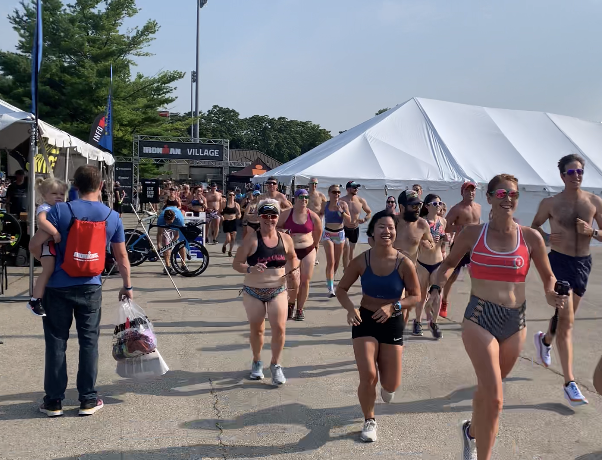
Then there are the freedom riders. As these amusing pics from the Undie Run at the Ohio Ironman we attended last weekend reveal, there’s a whole bunch of people who think the world is too prudish for their own good.
As those people sexualizing themselves? Seems like the opposite.
That said, there is pressure on many athletes to “compete” in the world of sexual politics, especially in the social media era. Even top-flight women (and some men) athletes known for setting national records and competing in the Olympics are known to pop a swimsuit shot in their Insta feed now and then. This is Karissa Schweizer, a qualifier in both the 5K and 10K for the Tokyo Olympics. I follow her career and this was her photo before flying off to Japan.
What I see if a fit distance runner with tan lines wrought from miles in the sun. She’s not got an ounce of fat on her of course. Her swimsuit fairly small, but not crazy. This is a photo that both women and men can probably appreciate as she’s a role model for a fit lifestyle.
Is it sexy? I think so. Having followed Karissa and other women athletes for the last few years it is common for most of them to post “glamour” shots now and then. The rest of the time it’s pics of them training, racing, fixing healthy food or hugging their partners or their pets.
I find my wife sexy in a swimsuit too. She’s also fit and works hard to keep her body in shape. She also set a personal record this past weekend in the Ohio Half-Ironman 70.3. She wears a great Zoot suit that compliments her form. Some people might find it too revealing for their taste. The body-hugging gear in triathlon doesn’t try to hide anything. Mostly it is designed to allow athletes to go faster. Flappy shorts or shirts slow you down.
So there’s a bit of performance-based technology behind these athletic styles and pressures to wear them.
I’ve written about this a few times because the needle keeps shifting. At this point, some women are seeking to push the boundaries of what they’re required to wear in competition back from the nearly-naked version to something that lets them be women, still looks attractive, and doesn’t show off every bit of breast or butt or genitalia in the process.
The same thing’s been going on with men’s junk for a while as well. Considering that athletes once competed naked a few thousand years ago, it seems like we’re all struggling with what being naked really means.
Much of the world doesn’t worry about what we see or don’t see on the beach. Nudity is accepted as part of the culture. I think those Undie Runners have it about right.
A week ago the Linkedin group The Female Lead that I follow posted an image of three ‘women of color’ athletes who won’t be competing at the Olympics due to “rules” they supposedly broke in the past few months. The women included Sha’Carri Richardson, who got booted for smoking some pot, a small infraction that violated anti-doping rules, Naomi Osaki who ran afoul of authoritarian rules about press interviews when she stood aside to protect her mental health, and Gwen Barry, whose podium protest got her in trouble for not saluting the flag during the national anthem.
None of these women did anything intrinsically illegal by the laws that most of us follow every day. Granted, in some states, smoking pot is still illegal. But Sha’Carri was disturbed after finding out from a reporter that her biological mother had died, and took some steps to calm down after that shock. She self-medicated to handle difficult information that came from a completely unexpected source.
Several male jerks on Linkedin stated that these women were deserving of their bans because they exhibited a “lack of accountability” and brought their circumstance on themselves. This type of rude commentary happens frequently on The Female Lead’s Linkedin feed on. In case you didn’t know it, there are still a large number of misogynistic jerks out there in the world that like to malign women about anything they can find to criticize. Who knew? Yes, I’m being sarcastic.
Dark hearted factors
Some of the comments made are clearly racist in origin. Others seem specifically aimed at suppressing women at any cost. In any case, they are largely flat-out ignorant.
That sets the stage for a look at two women I encountered while running this weekend.
One young runner was standing by the trail in a forest preserve adjusting her earbuds because she heard outside music and thought her equipment was faulty. It turned out that there was a Christian praise band playing loudly on a platform across the road at a big white church that reflected the sound. There was no audience for the band. They were just blasting away singing into the wind. I could hear them two miles away.
We both chuckled at the seemingly fruitless blare of noise coming from the band, then started talking about running. She’s doing a marathon in September and is working her way up to the distance. I shared that I ran for the same high school that her tee shirt showed, and she indicated that she’d loved her experience there.Sweet and eager to laugh, she’s stepping up to a challenge that isn’t easy for anyone. I wished her well and offered to provide any advice if she’s interested. Then I told her where to look me up on the Internet.
Further down the trail I passed a woman that I’ve known for more than a decade. I’ve seen her dozens of times over the years. She’s always hyper-thin to the point where it is obvious there are dietary or emotional issues going on, or an exercise addiction. She loves doing super-long races and there is clearly a cost to that.
When you think about the population of this world, it is clear that all of us are colored by some sort of emotional markers. Some people codify these and hide their fears in political fury while others lay themselves out there, exposed and honest, reflecting the world in all of its chaotic glory.
I thought about the range of experience between those two women that I encountered, and how they illustrate the spectrum of emotional challenges all athletes face in this world. Add in the factors of race or culture, or Olympic-sized pressures, and it seems like we should all be more conscious of how impactful self-image can be, and why it is so false to pass judgment and pretend to know the deep motivations of those who act out on a larger stage.
The Olympics are coming. These are just people. Like you and me, they’re not perfect. Let’s all keep that in mind as the Games proceed.
The iconic song Strawberry Fields by John Lennon celebrates the place he used to visit as a child where his mind could wander. Apart from the restrictions of society, he felt inspired and freed from false expectations.
Let me take you down ‘Cause I’m going to Strawberry Fields Nothing is real And nothing to get hung about
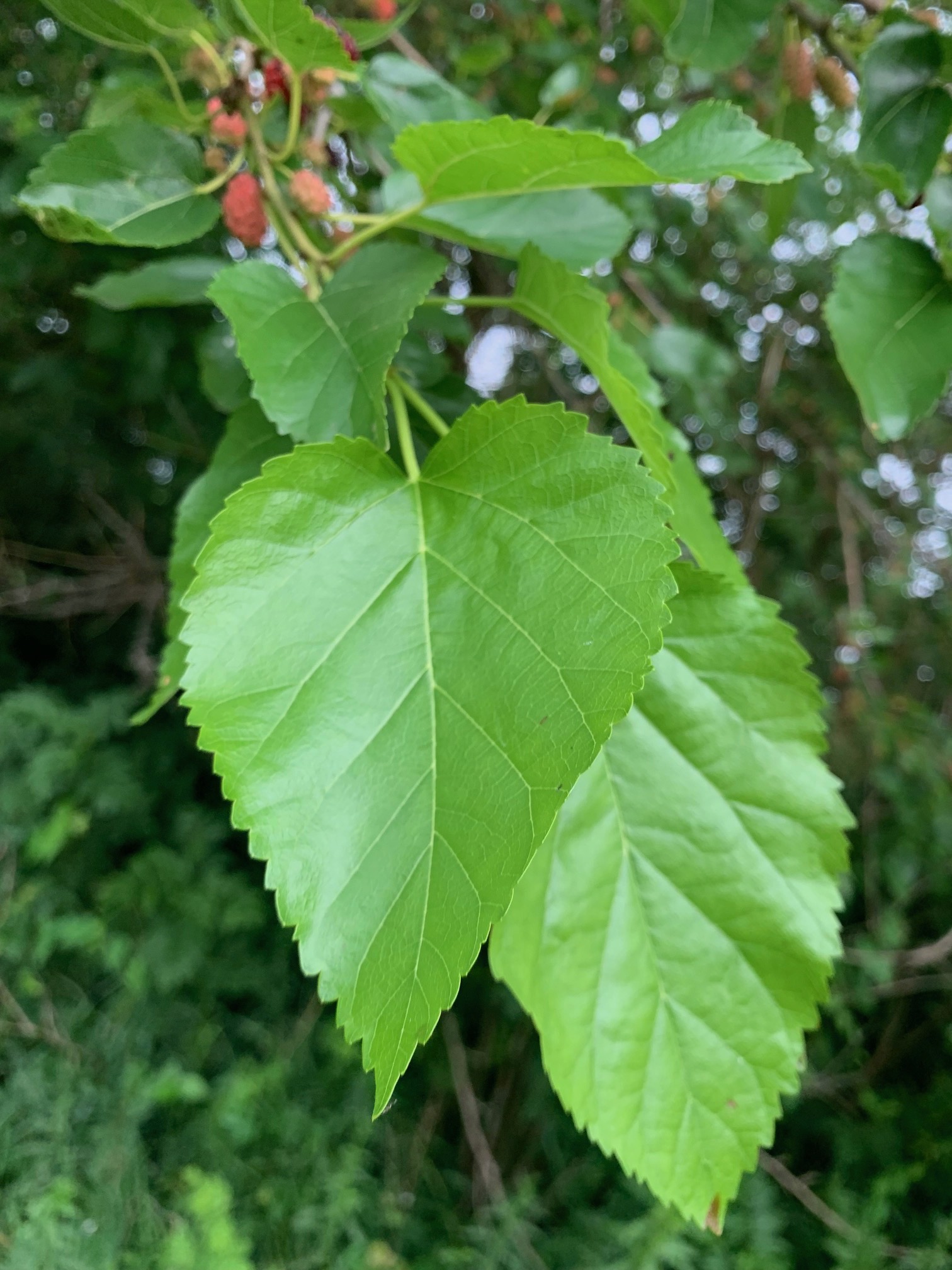
I was a child much like Lennon who sought out places where people couldn’t bother me. Possessed of a wild and somewhat ripe imagination, I’d find places in the woods or meadows with bugs and birds to keep me company. Sometimes, I’d find mulberry fruit growing on trees. And when they ripened, I’d eat them. Forbidden fruit.
As I aged, I kept this sense of wonder about nature despite teasing from friends who thought my interest in birds meant that I was weird. I loved learning about such things, and began to draw and paint what I loved most. But those patrons of middle school ignorance pursued me nonetheless.
Living is easy with eyes closed Misunderstanding all you see It’s getting hard to be someone But it all works out It doesn’t matter much to me
One can imagine the hunger that John Lennon must have felt to know more about the world at time when so much loss came his way. He father left and his mother died early in life. In later years, Lennon wrote many songs about those aching griefs. But one song stands out as the ultimate survival guide.
No one I think is in my tree I mean it must be high or low That is you can’t, you know, tune in But it’s all right That is I think it’s not too bad
I felt pain as a child due to the tragedy my father experienced at the loss of his mother at age seven. His father Harold also suffered in life, being subject to depression worsened by the death of his wife, the loss of his farm and livelihood. My grandfather needed mental health treatment so my father and his sisters were sent to live with aunts and uncles on a farm hunkered beside a Catskill mountain. I don’t think much counseling took place to help my father and his kin deal with such changes. They absorbed the pain and moved on.
Some of that pain got passed along to us boys during the early phases of my father’s parenthood role. As a sensitive child, all I knew to do was heal in the open air where natural sights and sounds were took me away from the tension and anxiety I sometimes felt around home. It wasn’t an entirely unhappy childhood, just a complex one.
On those days when I’d wander afield, I’d sometimes find wild fruit on the trees of fields. In summer I’d dine on mulberries, that strangely seeded faux grape that turned from white to pink to purple. The taste was sweet, and the juice stained the fingers. It always felt a bit naughty and exotic to eat mulberries. Did one need permission? Could they harm you?
To this day I still worry that some form of worm or other nasty bit of exotic nature might lurk in the heart of a mulberry and cause me sickness. The fact that wild creatures like coyotes dine on mulberries is not much comfort.
Many times the squashed fruit of mulberry trees falls onto running or cycling paths to be run over by passersby. The berries stain the path and even flip up from the bike tires to strike you in the face.
Birds dine on mulberries and excrete them on cars. That’s nature’s way of reminding us that while some people view themselves as separate or specially created, we’re really just part of a cyclical flow of life from seed to juice to a stain in history.
Always, no sometimes, think it’s me But you know I know when it’s a dream I think I know I mean a yes But it’s all wrong That is I think I disagree
Yes, life is often confusing. As I write this I’m both excited about things that I’m accomplishing and feeling the effects of personal and financial challenges wrought from the long line of life’s vagaries; caregiving, cancer, emotional intelligence and the lack of it.
All we can do is keep eating mulberries where we find them and being as honest as possible about ourselves. As for me, for better or worse, I’ll be living in Mulberry Fields Forever.




















 We Run and Ride