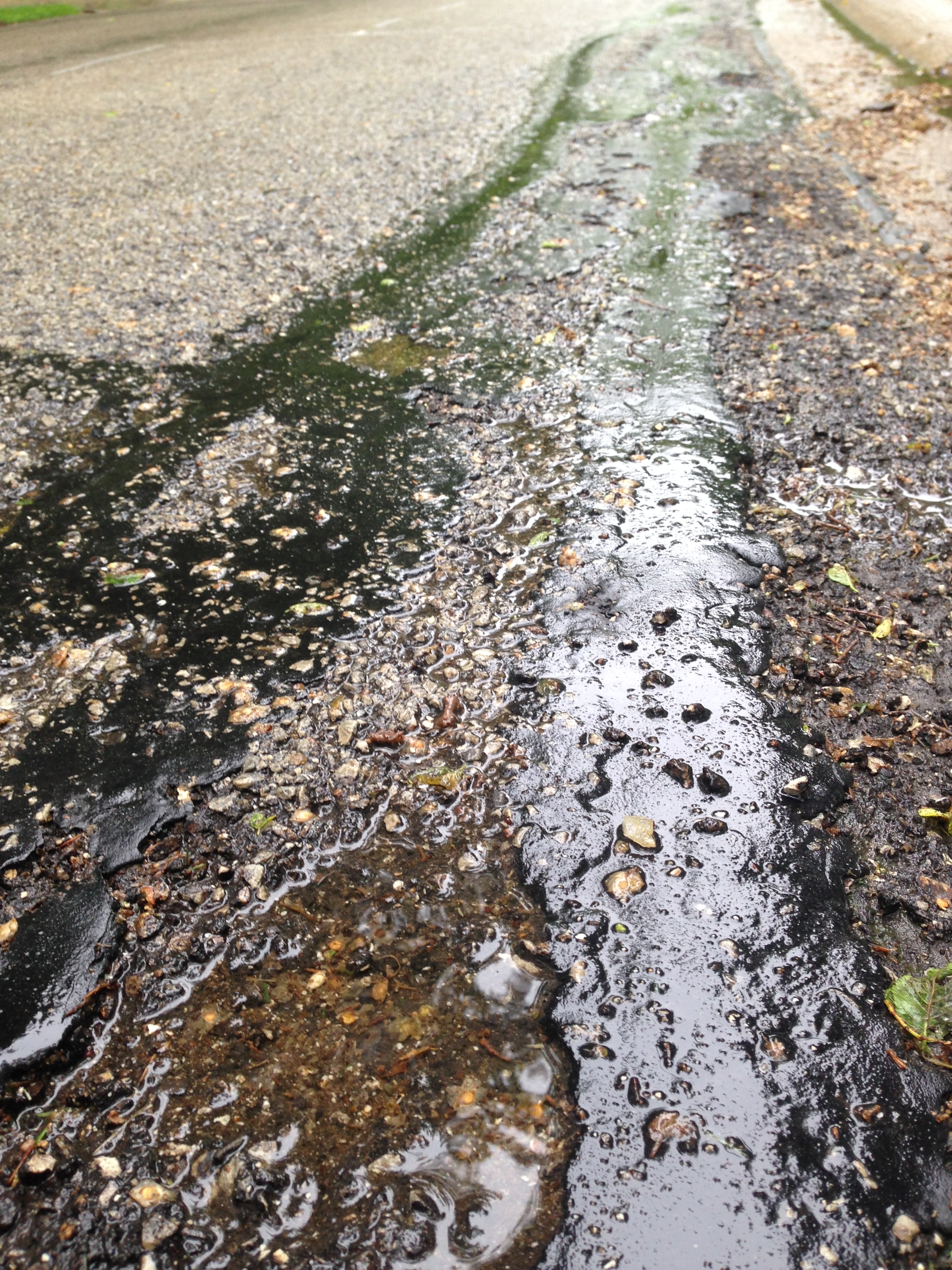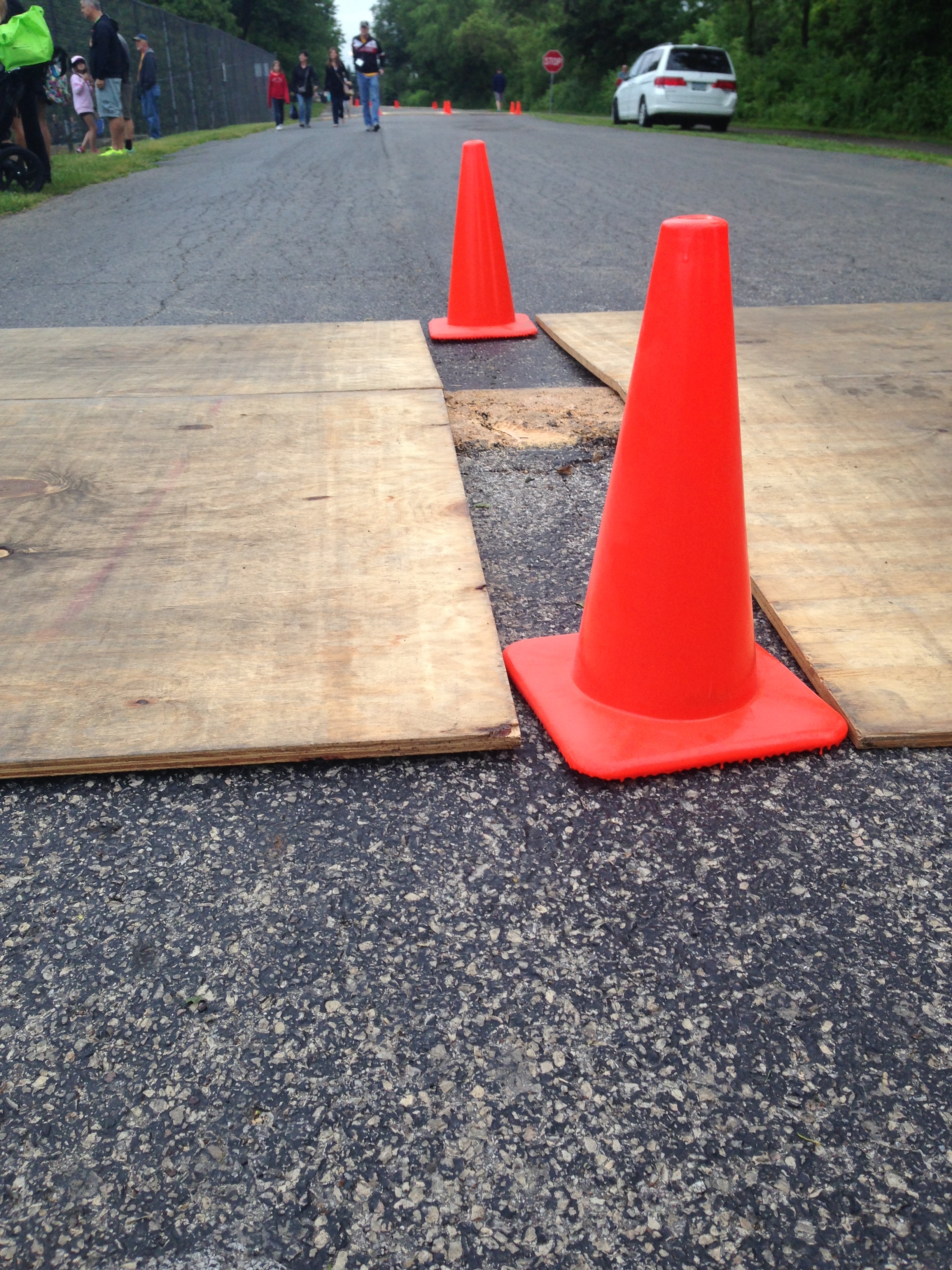
You really can judge a book by its cover, also known as keep your eyes on the trail or you’ll crash

By Christopher Cudworth
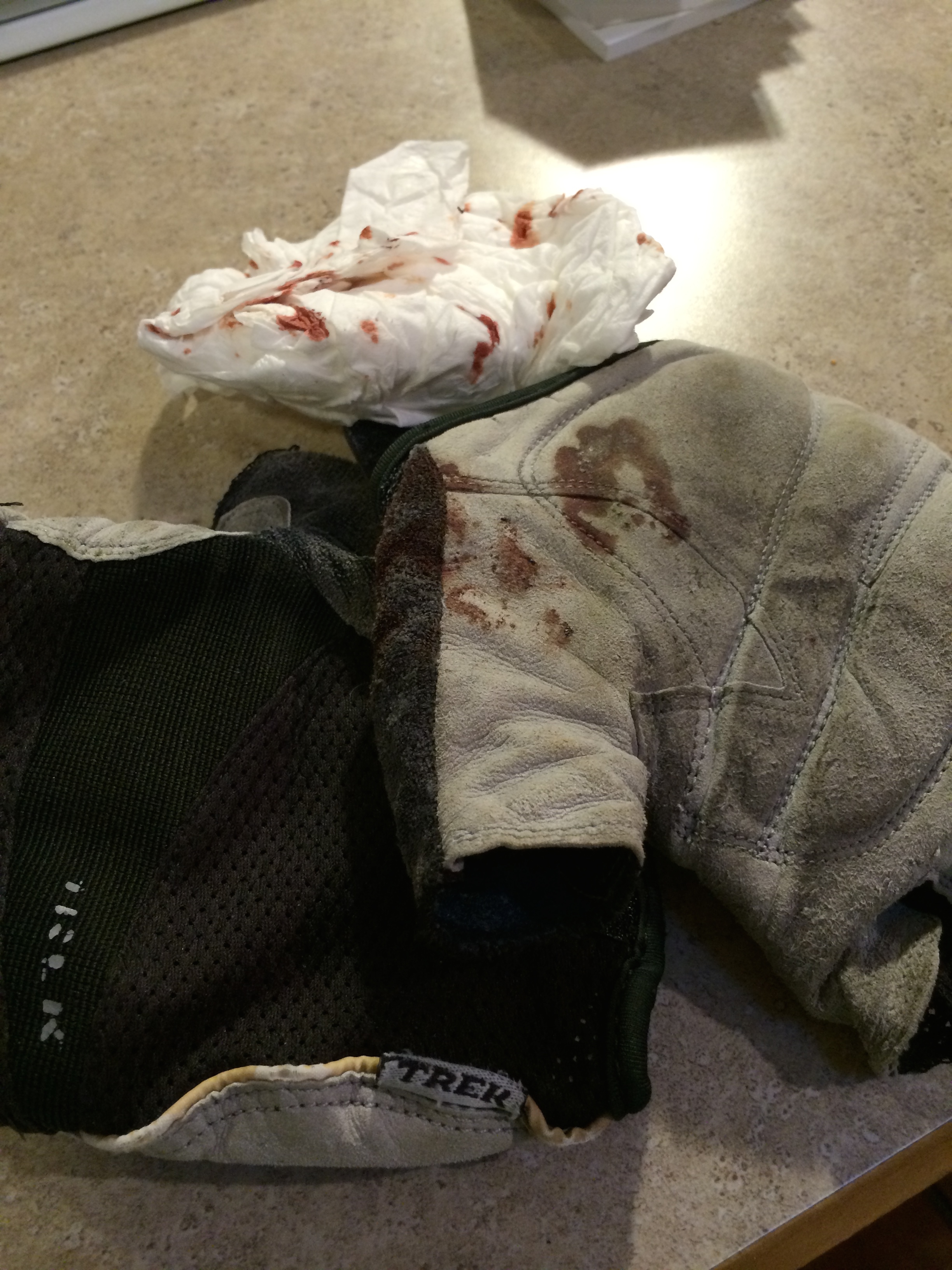
Evidence of recent events includes a pair of blood-soaked gloves and tissue.

Evidence of recent events includes a pair of blood-soaked gloves and tissue.

Having not hidden much of my life while writing this blog, which now totals more than 500 entries, this is probably not the time to start hiding things now. So I will immediately confess that I did what seems like an impossibly stupid thing last night. I crashed straight into a large tree that had fallen across the bike trail.

That sequence of words is exactly how it should be stated. The tree had only recently fallen across the trail. A large storm passed through yesterday afternoon south of where I live. At 12 miles into a 25 mile ride I chose to cut west on the Virgil Gilman Trail, a well-maintained route that stretches four miles from downtown Aurora to Bliss Woods, a beautiful forest preserve with lots of birds and trees and plants to enjoy.

I wasn’t exactly trying to kill it on the bike last night. But my fitness is good so I was pedaling at a high cadence on the trail at a speed of 18-20 mph. I know that because I had just glanced down to look at my pace and distance and got distracted by a creative concept that was running through my head.

I’d been careful so far on the trail because there were lots of families walking on the trail so I was careful to slow and swing around the kids toddling along and moms pushing strollers. Once you’re out of the family zone the trail opens up and there are very few people, just other cyclists and joggers as you head west toward the preserve. That is where my mind started to wander.

Again I’m not in the habit of riding with my head down very long. I’ve ridden 25,000 miles the last 10 years and have had exactly one crash. That was caused by bike wobble on a long section of downhill in Wisconsin. I escaped with only a broken collarbone. To this day I am thankful for the ability to steer my wobbling bike off the road and into the grassy ditch. Even there I was fortunate not to strike a wire cable with my head or neck. Talk about lucky. Or smart. I prefer to think the two combine well.

But sometimes I admit I am wont to immerse myself in thought while on the bike.

Last night I was thinking about a specific topic which was to conceive the right design and image for a book I’ve written about helping my wife through cancer. The book is now complete. It is titled The Right Kind of Pride: Character. Caregiving. Community. It’s about caregiving through 8 years of ovarian cancer treatment for my wife Linda, who passed away in March 2013. Pretty soon it will be available through Amazon.com where I’ve published an e-Book of my short stories titled Not Far To Fall.

You’ll see in a moment how ironic that title can be. Each of those stories is about people caught up in circumstances that they would rather have avoided, and how they respond.

Deep in thought

See life really does imitate art in a number of ways. I was thinking about the cover design for my new book and running a set of images through my mind. A cover can make a big impression on people if you design it correctly. I have a background in creative concepts, design and marketing as well as being a writer.

So the subject had my brain occupied. My head was down as I pedaled along. Like I said, I had just checked my speed and trip time, so I don’t know how long I was thinking and not looking ahead. It must have been 8-10 seconds. Suddenly something appeared in the upper periphery of my vision and my mind woke up just in time to react to the tree lying on the trail. I pulled the bike sideways and crashed into the limbs at hip height. Which hurt. A lot.
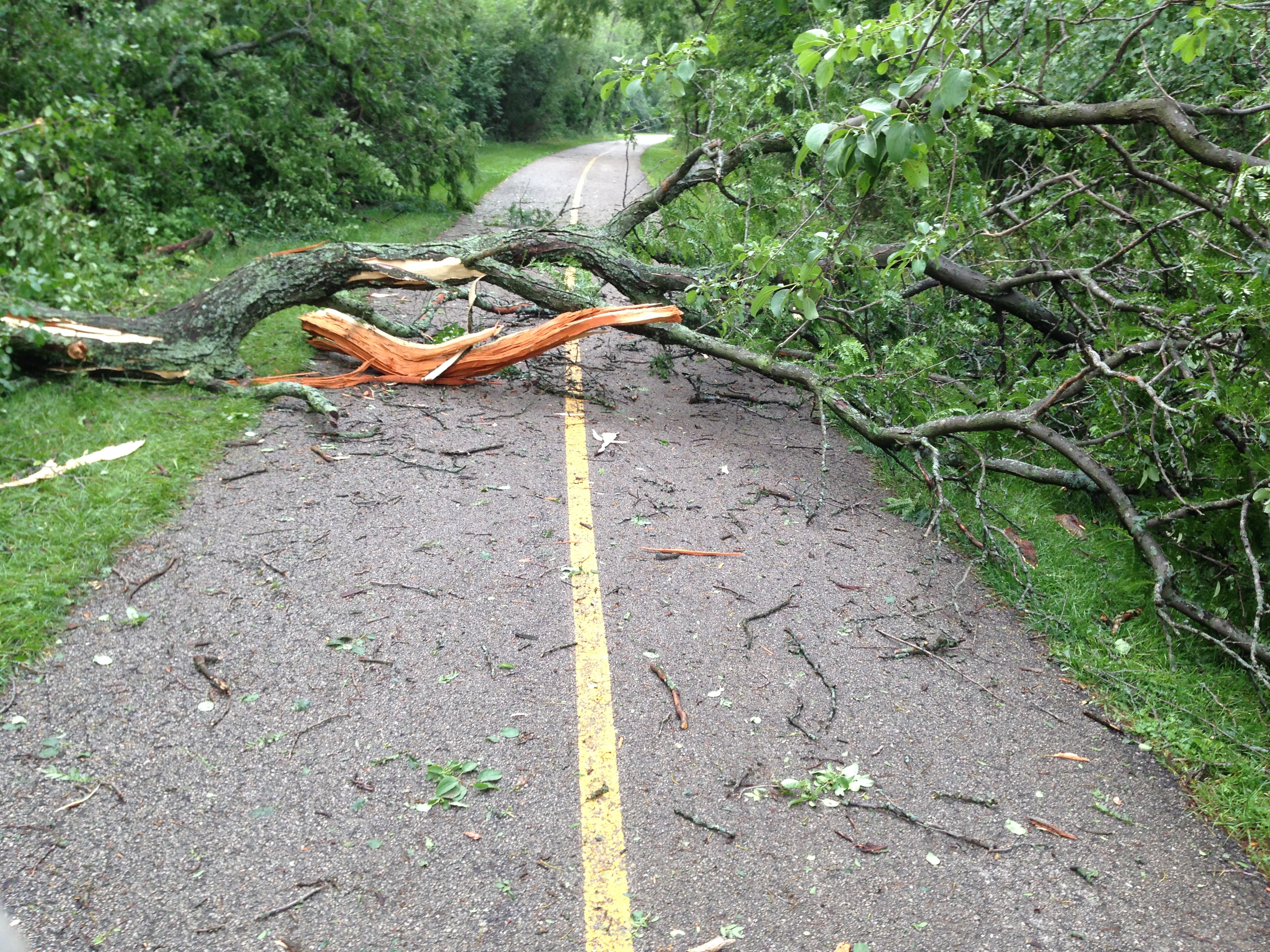
Did this tree fall just before I got to this point? It sure seemed like it. I struck it at the hip and with my chin.

Did this tree fall just before I got to this point? It sure seemed like it. I struck it at the hip and with my chin.

It was a pretty solid tree. The trunk was about 10 inches across and the branches not much thinner at the point where I struck them with my bike and then my body.

Miraculously the bike was fine. My reaction turned the wheel so that it didn’t collapse. All that happened was a minor “adjustment” to the handlebar. They were pushed to a 45 degree angle and the one brake hood was tipped in. Other than that, the bike was fine.

I stood there bent over that tree groaning for about 30 seconds. My lower back was convulsed from the impact and my chin was feeling a bit sketchy too. Those were the two points of impact.

Pulling the bike free from the shattered limbs, I stood there feeling like a broken scarecrow for a minute. At that moment a couple rode up on their bikes and asked if I was okay. They must have wondered how on earth a cyclist could smash into a downed tree in plain sight. I did not try to explain. Thinking about a book cover is a pretty odd explanation for a bike crash.

Obstacles and stumbling blocks

I’ve had plenty of opportunity in life to crash into things in the past, and largely managed to avoid them. Sometimes cars seem to crop up on the streets when you’re least expecting them. I’ve hit nudged one of those before. But managed to miss quite a few more.

Tarsnakes wait to take you down.

Tarsnakes wait to take you down.

Then there are tarsnakes on hot summer days to grab your tires and make you flip if you’re not careful. I’ve stayed upright through all of those, too.

I can’t make excuses for taking my eye off the trail last night. It’s one of those things that happens sooner or later to us contemplative types. Lost in thought, they call it. Well, the tree found me for myself. One of life’s very real stumbling blocks reached out and made itself known. And yes, I was wearing my bike helmet. What I forgot to wear is that Star Wars gear mountain bike riders prefer when crashing through the woods. But I was not expecting the woods to come and get me.

Triage
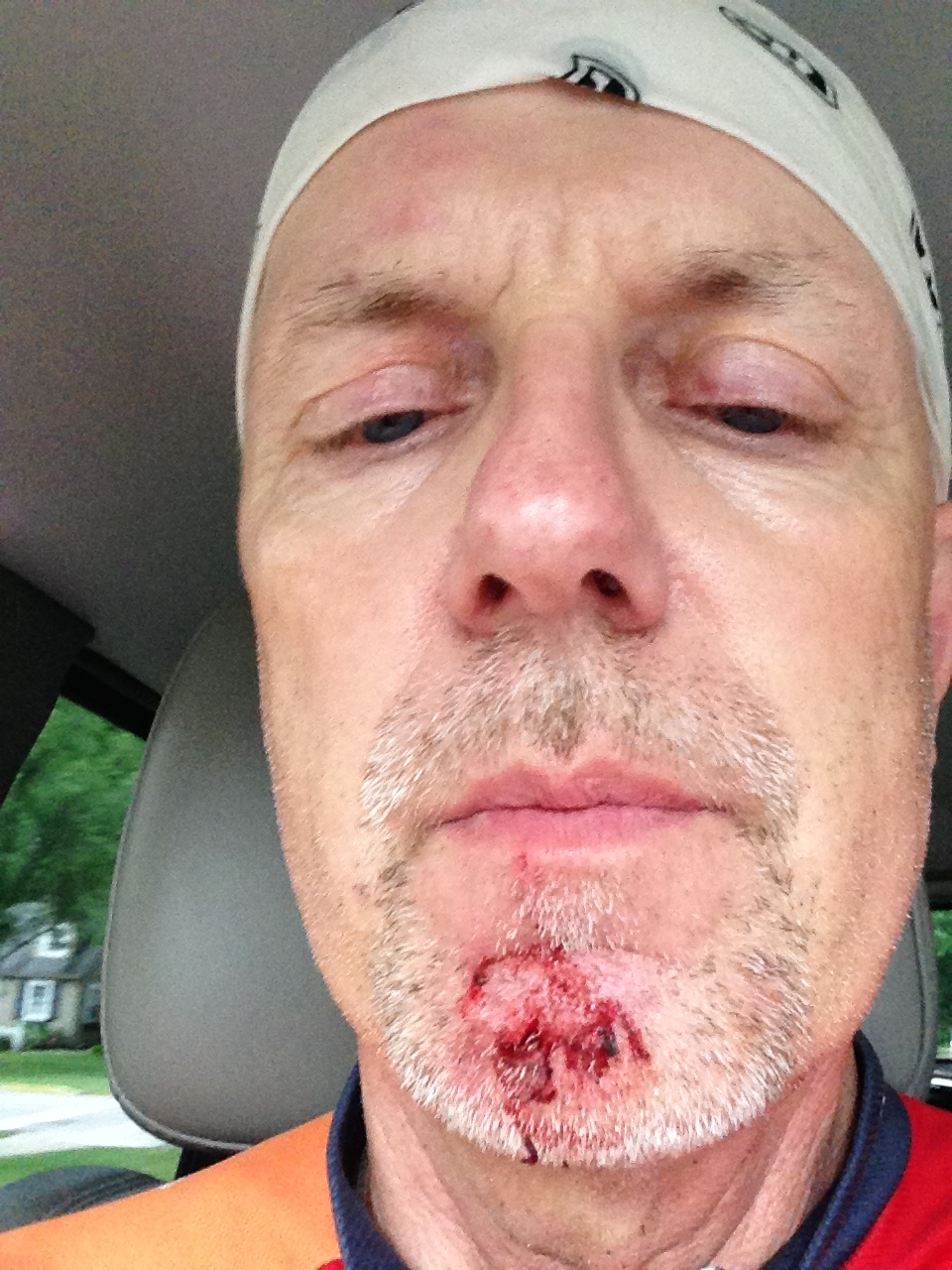
The wound required four stitches.

The wound required four stitches.

The couple that found me offered to walk with me a bit and get my bearings. Fortunately my head was clear. My stomach was a little woozy. And how ironic it was that my crash site was about a mile before the spot where my companion went down in a sliding wreck last July when the trail was wet from rain and plant debris caused her front wheel to skid out. Later in the evening when I finally talked with her, she suggested we avoid that trail altogether from now on. “It’s cursed,” I think she said.

There were practical considerations to address in the minutes following the crash. “Your chin’s bleeding pretty badly,” the woman told me. “And you might be in a little bit of shock.” Meanwhile gentleman with a Felt bike (must be a good guy, I ride a Felt too) suggested “You should still walk around a little bit.”

“Yeah, I feel like barfing,” I laughed. Adrenaline. Can’t live with it. Can’t live without. Fight or flight. Might makes right.

So for the moment it was enough to get off the trail and start pedaling toward the house of some friends about three miles away. I felt fine on the bike and it was working properly so I pedaled along at 12 miles and hour and focused on getting to some help.

Collateral damage

While stopped at a traffic light I pulled out my iPhone to call ahead and ask if they were home. The phone seemed to be working. It was lit up and the Contacts list showed up. But when I tapped the number to dial it just sat there. It could not make calls. Or send or take texts.

Somehow the case survived but the iPhone in the hip pocket of my kit got smunched. The doctor said it probably saved me some pain.

Somehow the case survived but the iPhone in the hip pocket of my kit got smunched. The doctor said it probably saved me some pain. The phone is bent, and now retired.

I pulled the phone out of its protective case and looked at it. The iPhone was literally bent in the middle. I know. That seems impossible. The case was fine but the phone was most definitely dented. I put it back in the case and rode on toward my rescuers.

They were not that surprised to see me a little banged up. We’ve known each other for 30+ years and all my running and riding has provided plenty of adventures over time. One of them drove me home with an offer to take me to the hospital but I declined because I knew it would take a while to be seen and it would get late.

Repairs

My lower back too a beating from an 8" tree limb. But at least there were no broken bones or ribs.

My lower back too a beating from an 8″ tree limb. But at least there were no broken bones or ribs. Don’t worry, that’s my lower back and not my ass. It’s so swollen you can’t tell.

In the car on the way home I felt something odd on my chin for the first time. Dabbing at the trail of blood coming down my chin I could feel a pretty big slab of skin hanging loose. Stitches, I thought to myself. I’m going to need stitches. My back also hurt pretty bad. There were big contusions and swelling had already started. But I could walk. That’s all that counts.

Sure enough, the Urgent Care doctor sewed me up after a good, stinging batch of numbing medicine on the chin. Getting the stitches in didn’t hurt. That always amazes me how fast you can get numb when they want you to feel no pain.

I’ve had more than a few numbing experiences in my lifestime. Over the years I’ve had a tooth stuffed back into my head from a baseball injury. Gotten stitches in my noggin from being pushed into a cement ditch during a pickup football game. Had a laser coterize my retina from a small detachment. Had ribs broken in adult soccer. Tore an ACL in that sport too. Then tore it again playing soccer two years later.

In 2012 I busted a collarbone when my bike wobbled going 40mph down a hill in Wisconsin. Then last fall there was surgery on my hand when a sliver caused a potential bone infection in my knuckle. That sliver cost me about $2000 in deductible payments. The entire pricetag was $25K. All because of a tiny sliver in my middle finger. F That, I say.

Life is freaking random, people.  Better get used to it.

Some accidents are your own fault. Others just seem to come out of the blue. In either case I’ve always believed there’s some kind of cosmic message being driven home by sudden trauma. This time it was simple. Pay attention, dummy.

History

This is pretty much how I looked from age 7 through age 11.

This is pretty much how I looked from age 7 through age 11.

Thinking back even further, to episodes long ago when I was still very much a kid in elementary school, my history of bashing into things is rather colorful. Pretty much every other week my poor mother would have to come to school at the request of the nurse because I was constantly running into the swing set while chasing down a kickball or baseball to prevent someone from getting a home run. My intensely focused competitive streak resulted in an absentmindedness of a sort. Call it the price of early drive and creativity. My mind was not always where it should be. And so it goes.

Truth be told, after a while my mother simply quit coming to check on me at school. She knew I had a hard head and the goose egg would go down given time and a little ice.

Perhaps there was a concussion of two thrown in there, but most likely not. The nurse would give me an ice pack to carry to class and I’d sit there with a cartoon-egg bump forming on my forehead. It was hard to concentrate on schoolwork between the pain and the dripping ice pack and the giggling stares of other kids trying not to laugh at me lest they get in trouble in class. I was quite the package alright.

Sharing the pain

I always felt really guilty when my athletic antics caused pain to other kids on the playground. I was the product of a highly competitive family and growing in a family of four brothers taught me to play sports all out, all the time. Not every kid on the playground could handle that level of intensity. I could throw a ball so hard some kids could not catch it. As a result a throw I made to second base from the catcher position struck a kid in the eye socket and detached his entire retina. His eye was still red from the trauma a year later. Another kid named Jimmy got in the way of my efforts to catch a fly ball during a game of 500 and bit clear through his tongue. He never had it fixed and could poke a pencil through it. That was really gross.

So I’ve gotten it from both ends of the attention spectrum.

And I’m rather proud of that actually. There’s really no reason to be embarrassed about kicking your own ass or busting up your own head once in a while. It means you’re alive. And thinking.

But if you’re going to judge this person by his cover, you’ll have to look a little deeper first. To find the scars. The bumps. The bruises. And the will to keep on going despite all that.

WeRunandRideLogo


Posted in Christopher Cudworth, Tarsnakes, We Run and Ride Every Day | Tagged , , , , , , , , | 4 Comments

The worldwide and very local geometry of a running track

We each bring individuality to the track.

We each bring individuality to the track.

By Christopher Cudworth

The standard running track all around the world is 400 meters in length on the inside lane. But that just begins to tell the story of what a track is all about.

Those of us who grew up running on cinder tracks came to appreciate that every track surface was different. Some were hard and flat. Others were cinder, deep and uneven. When rain fell, puddles would gather on the low points, and especially around the turns. On the inside lane where everyone tried to run, water would form an imperfect groove and cinders would fly up in your face from the heels of runners in front of you.


We push our very organic forms around the geometry of a track as if your very lives depended on it.

We push our very organic forms around the geometry of a track as if your very lives depended on it.

The process of getting a track ready for competition back then was part art and part science. Think about it: the lines on a track had to be manually applied using lime. But first the track surface had to be raked and then rolled. That way every lane was considered fair and equal to those running, and in a multitude of events from distance runners that was no easy feat to get a track fit for competition.

How ironic it was that the order of track events began with the two mile in high school, and the 4 X 800 relay as well. Those two events alone would chew up the track for all the other runners that followed.


But that’s track. You deal with it.

IMG_8609

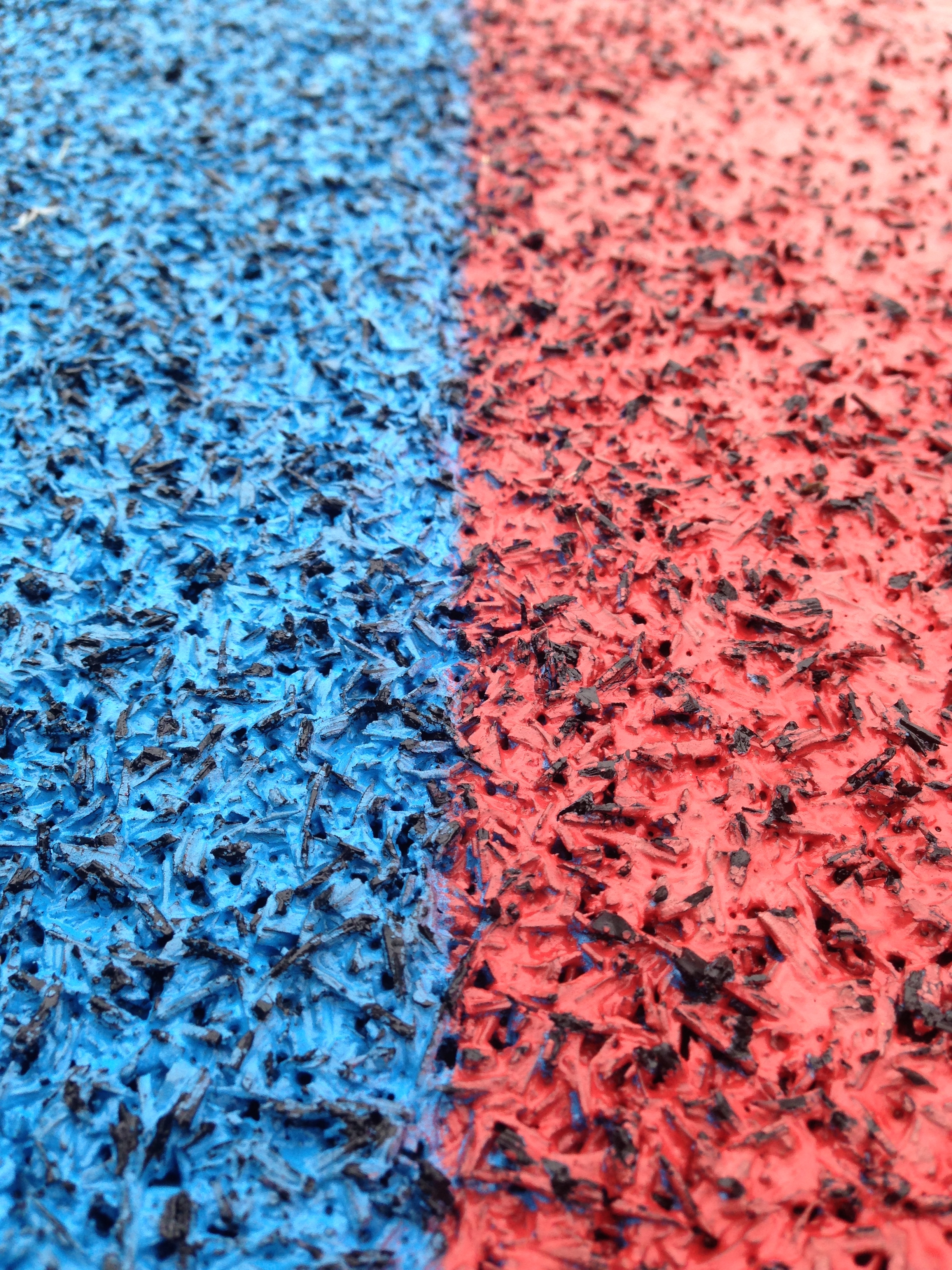
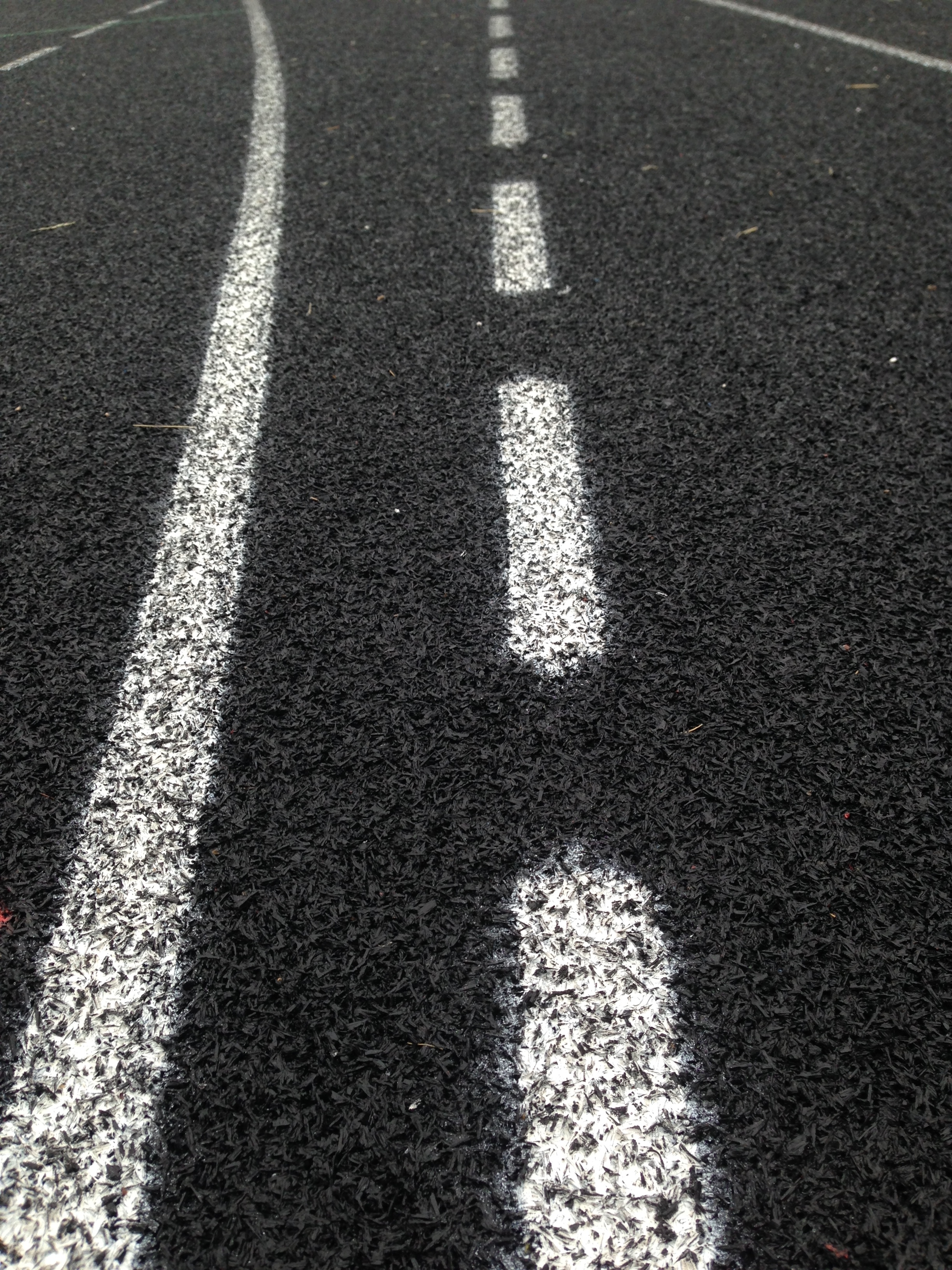
Our lives intersect with a surface that we rarely consider close up. Yet it has much to tell us about the infinite variety of the world.

These days the surfaces are all-weather. There’s no need for elaborate preparation and protection of the surface before a competition. You just step out and run.  At times you must pay attention to the finely painted lines on the black or red or blue rubberized surface. Exchange zones. Start and finish lines.

Sometimes those colors intersect in a colorful geometry that only means something to those who run. Yet there are times we hardly pay attention to these zones and transitions. Instead we pave the way ahead with our own desires and expectations. Ignore all that geometrical gobbledy gook. Just run.


Numbers and words dictate where events start and finish. The track is both a finite and

Runners commit to intervals long and short on the track.

Runners commit to intervals long and short on the track.

infinite world where your reality is defined by your purpose in being there. Short sprints. Long intervals. Mile repeats. Races.

As we study a track it becomes obvious there is a language exclusive to that world. It is spoken in symbols and directions that are designed to be universal. Yet each and every track has its own dialect the world over. No surface is precisely the same and even the most accurate form of measurement cannot confine the distances you run around a track to an exact 400 meters, or 800, or a mile. By the time you race 10,000 meters you may have run 10,200 meters if you stay out in the second lane to avoid colliding with other runners.

So think about it: to set a world record on a track conditions must be ideal. But know that they will never be perfect. There is

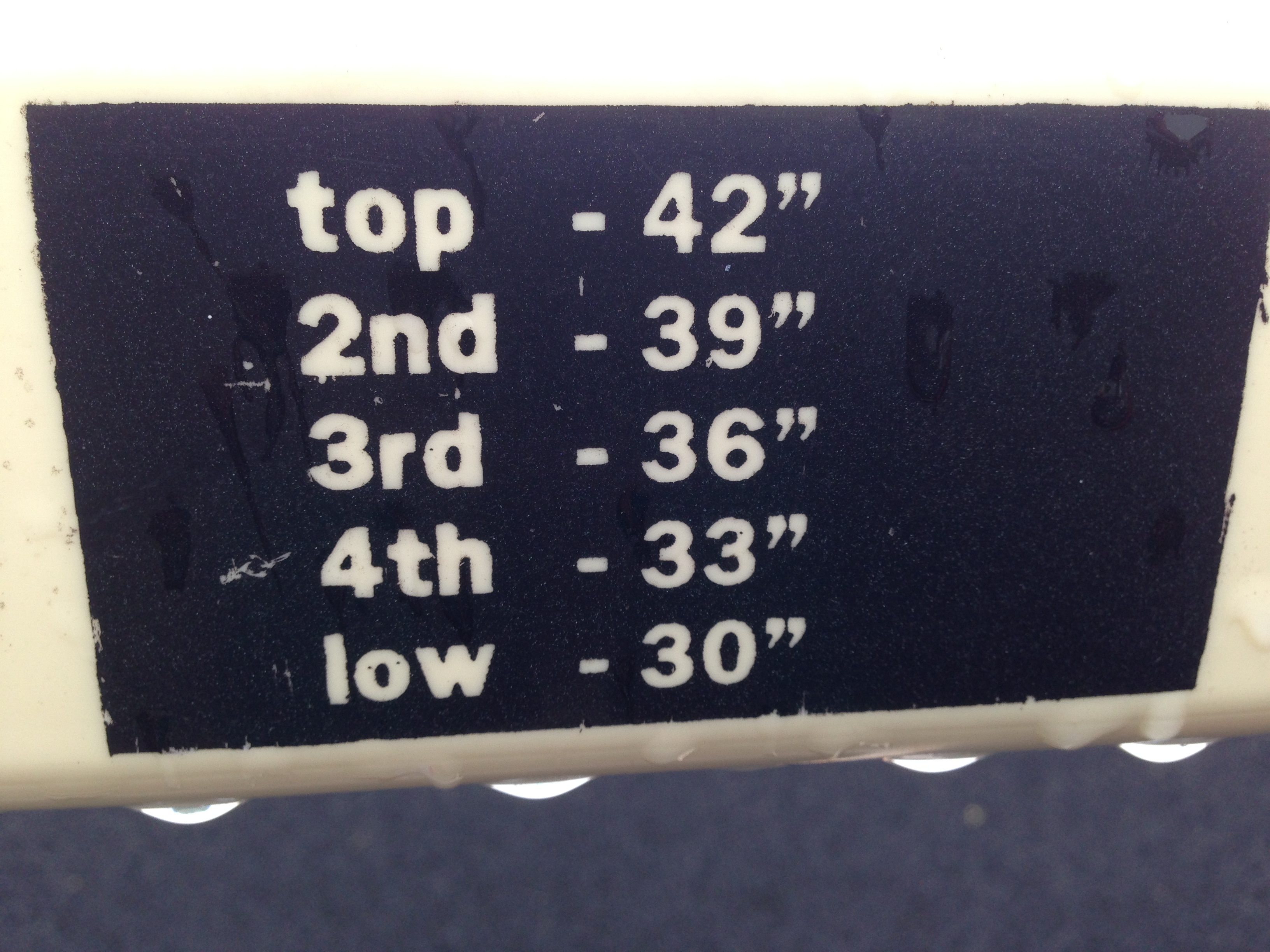
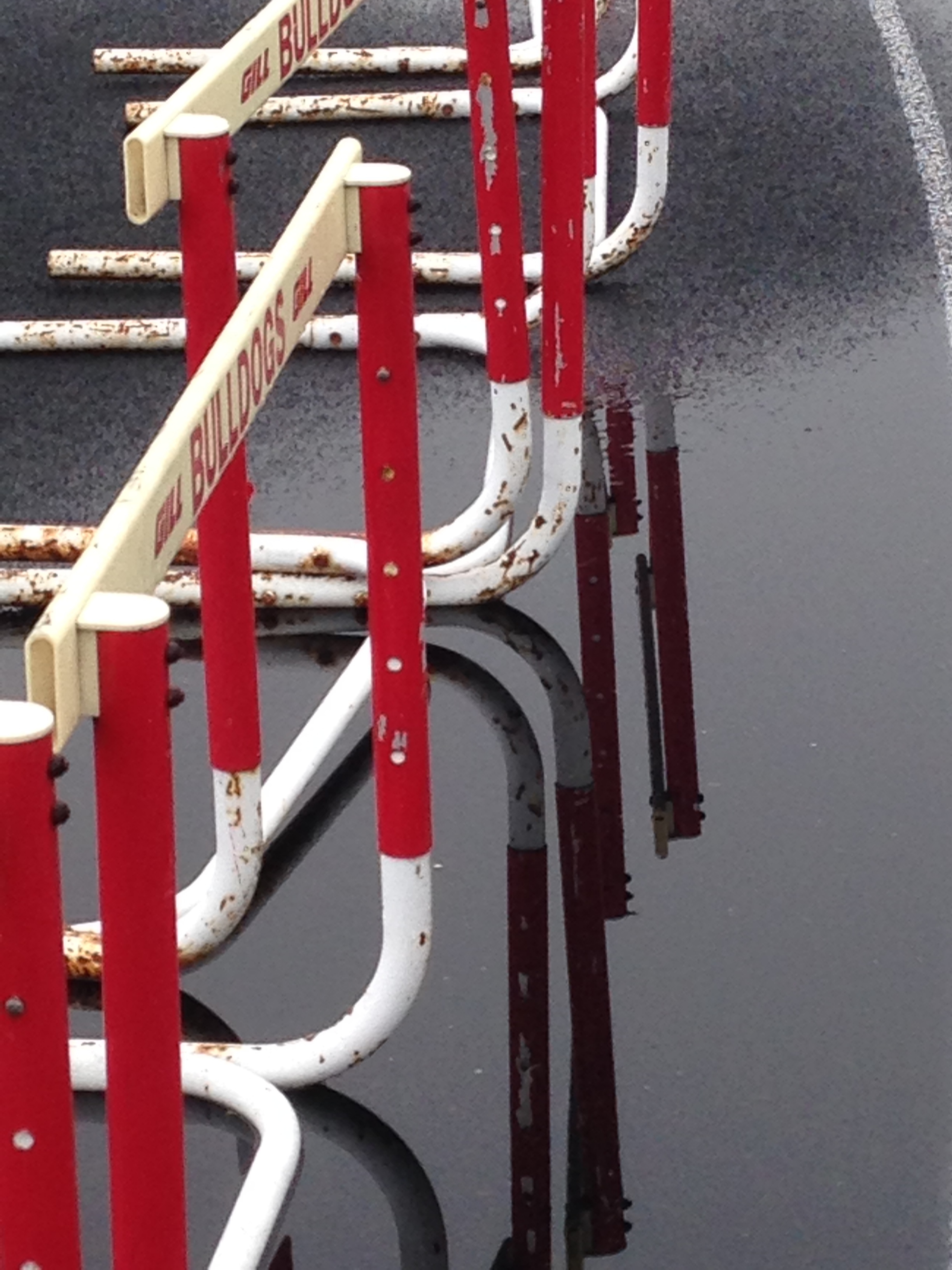
Hurdles are not a static height between events. Each race and gender has its own level.

Hurdles are not a static height between events. Each race and gender has its own level.

no such thing as perfection in running. Every footplant varies slightly. Every stride wavers off center to some degree. Our very earthy bodies long to be free of the earth in fact.

Yet gravity pulls us back down. With hurdlers that relationship is profoundly defined by the height and distance between each barrier. Some runners do 13 strides between hurdles in the 400M intermediates while others do 15. Male runners jump higher barriers than do female runners. Only the need to get over the hurdle is the same. But that

The goal of hurdling is never to fall. But that's for starters. The real goal is toe move over them as fast as you can.

The goal of hurdling is never to fall. But that’s for starters. The real goal is toe move over them as fast as you can.

denominator is held in perpendicular relation to gravity. Horizontal speed versus vertical height. In all events that is what adds dimension to the world of track and field.

When you show up at a track all these numbers and textures and heights may not be on your mind. All you care about is speed and how much you can manage to muster in a given workout or race. You calculate for wind not knowing its true effect on your net times in interval training. Then there is heat, humidity and the pliability of the track surface itself. On hot days it will be mushier than during cool temperatures. It all figures into the final result of your effort.

Slower. Or faster. You are an organic form moving around so much inorganic material.

But look closer. The track is actually a living thing as well. The grass that flew from the mower on the infield yesterday is strewn across the surface in abstract patterns. If you turned that into a painting it could hang in a gallery or a museum.

Suddenly realize everything around you and within you is alive. Your footfalls make sound. Your breathing has a rhythm and pattern similar to the songs of birds in the trees. Even your sweat seems to sing as it flies off your forehead.


The track has many dimensions that we often do not perceive.

The track has many dimensions that we often do not perceive.

Around the first curve there is water gathered from a storm the night before. You have little choice but to run around its arc and complete your laps with a few extra meters of effort. You see your own reflection as you skirt the puddle and it makes you think of all the other times you have run around this oval, or others like it. You have a relationship with the track. It may be a love/hate relationship, but you have it nonetheless.

It’s not a very forgiving place, the track. But if you respect its geometry and its circumference and all the conditions it suffers; through wind and rain and sun and even snow, the track can be your friend. It might be a painful relationship at times, but it can also be rewarding. Because when you have forged a relationship with a track it actually begins to give back what it takes from you initially. You can feel your fitness grow. Your body becomes stronger. Those raggedy weeds along the edge of the track look like so many cheering fans as you whip by on one last interval before calling it quits for another week.

It is a place where character is built and races are won. It both welcomes and challenges you. It is the geometry of distance and of soul. Every angle of your

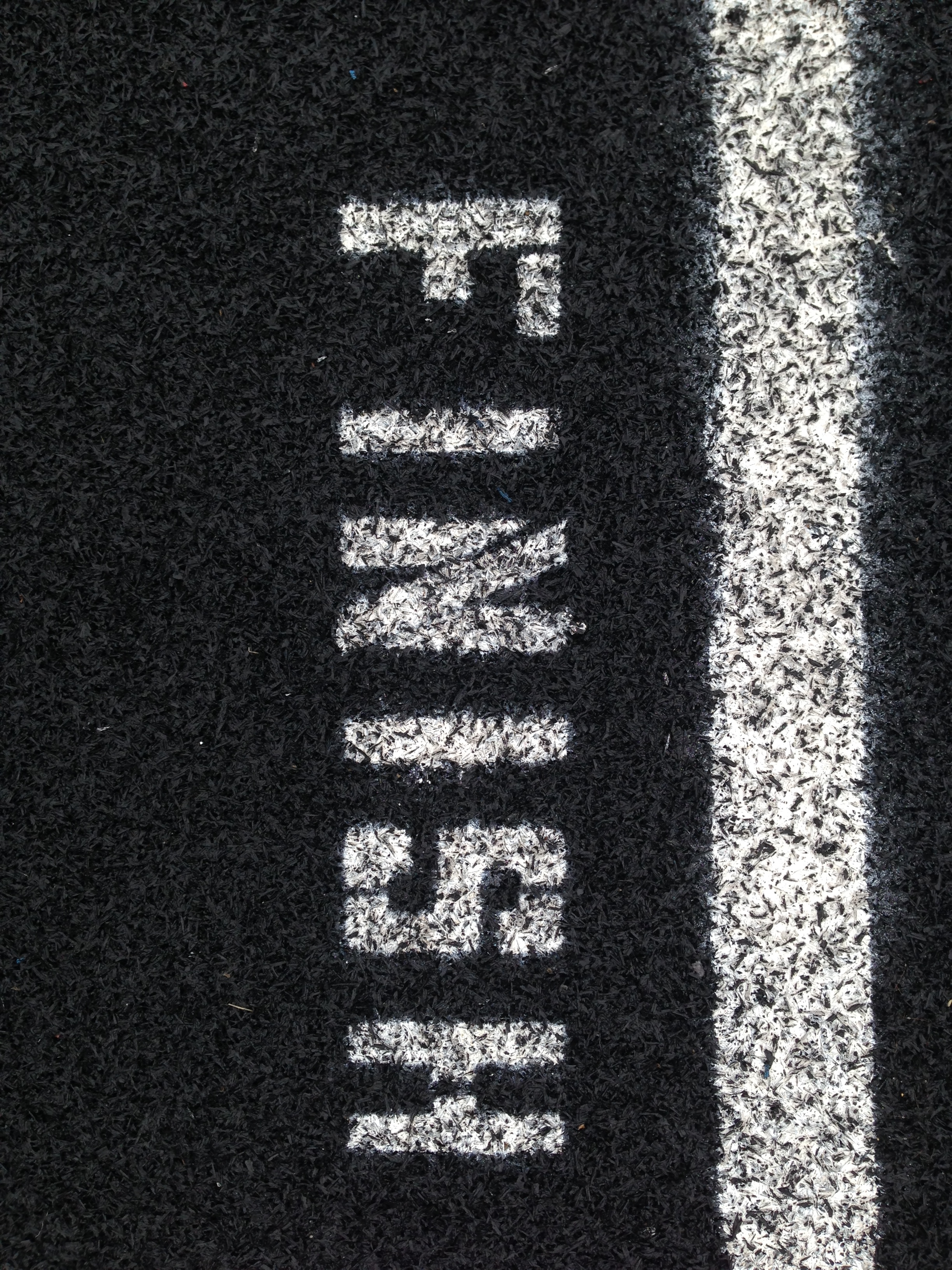
Way you run and FINISH well next time you visit the track of your choice around the world.

Way you run and FINISH well next time you visit the track of your choice around the world.

being counts in this finite and infinite world. You are a runner. On a track. And you are trying to become better at the former while negotiating with the latter. So much like the rest of the world.

WeRunandRideLogo

Posted in Christopher Cudworth, We Run and Ride Every Day | Tagged , , , , , , , , | Leave a comment

O Brothers Where Art Thou?

By Christopher Cudworth

This 1980s photo shows the Cudworth boys with the father and my son.

This 1980s photo shows the Cudworth boys with the father and my son.

I’ve had a long athletic career thanks to a family of four brothers who all played sports. The eldest was a driven player of soccer, basketball, baseball and track and field. In the 1960s as a freshman in high school he ran a 4:40 mile. You still don’t see many young track stars going that fast at 14 years old.

My next eldest brother has had the more artful career in sports. He was a masterful goalie in soccer back east in Pennsylvania, played basketball and baseball and actually wound up running cross country and track at the little school in the corn where our family moved going into his senior year in high school. That sucked because he was poised to star on the teams back east and starting over at a new school is never easy. They didn’t even have soccer or baseball because the athletic director wanted his track teams to excel. Talk about harsh fate.

My youngest brother grew to be bigger than all of us. At 6’6″ with a vertical leap of 36″ he helped lead a talented basketball team to Super Sectionals his junior year. But not before he was urged to go out for cross country as a freshman. That was painful as he was growing so fast his knees could not take all that running. Still it built character and he earned All State Honorable Mention as a basketball player and went on to a scholarship at a Division I school.

My sports career began and baseball with a team sponsored by a union back in Lancaster, Pennsylvania. We won the prestigious Lancaster New Era tournament and I pitched four innings to close out a win in the second game.

When we moved out to Illinois there was still summer baseball to be played but no soccer in fall or baseball in spring at the high school. And despite winning the local Punt Pass and Kick and advancing to regionals with a good arm for football and a decent kicking leg, my father wisely discouraged me from enrolling in football. He likely saved my life.

Growing up with such a sports-oriented family was fun. We spent entire afternoons playing wiffleball and Glo-Ball as we adopted a brand of rubbery plastic balls to play home run derby. Those Glo-Balls were even used in massive neighborhood pickup games with 18 players, gloves and everything.

The Cudworth boys drove a lot of games of all types. Constantly on the run, we’d round up kids to play soccer or baseball or basketball. There was a sweet hoops court just two yards away at the home of a friend where we’d play for hours at a time. The guy who lived there was an average basketball player, but he went on to run a 4:04 mile for Penn State. I can recall his training runs in the company of a barking hound dog. They’d take off across the golf course for 5-10 miles with the dog barking the whole way. You could hear the noise of that dog off in the woods a mile away.

As a family we were fiercely competitive all the time. Many of our games resulted in angry fights over who won, but that was part of the process of forging the competitive resolve necessary to play team sports in the world at large.

When we couldn’t get outdoors we played indoor sports such as table tennis for hours at a time. This was not sandpaper paddles or cheesy implements. We bought good paddles and Halex table tennis balls and really played. My brothers won city and school table tennis tournaments and I wound up in the finals at Luther College against an athlete who became a Hall of Famer in tennis.

Our father was a latent athlete who never got to play many sports growing up. His mother died from complications related to breast cancer when he was seven years old and his aunts and uncle thought it better for him to work on the farm than to mess around with all that sports stuff. It was the Depression and the 1930s anyway.

So he had an urgent and somewhat vicarious interest in our success. Often he’d stand on the sidelines watching his anxious sons on the pitching mound and holler “Stay Loose!” which was well-intended but often had the precise opposite effect. He could be a hard man sometimes, prone to angry outbursts when we failed him in some perceived way. So relaxing at his command was not exactly instinctual.

Much of our sporting interest I am now convinced was our way of pulsing away the energy of our father’s forceful personality. It was our escape in some ways to a world where play meant everything. The fact of the matter is that not everything in sports transfers to the sober world of business and survival. There is a certain fantasy to sports. My brothers and I all prioritized and planned our respective careers around the idea that sports might somehow advance our prospects in the world. It did earn my younger brother a full college education and I attended a school a bit better than my average grades in high school thanks to my running. So it wasn’t all fantasy.

On the other end of the spectrum we were all interested in the arts as well. My eldest brother taught English for 30 years. My next eldest brother majored in art and created amazing sculptures out of paper that looked like metal. They sold for thousands of dollars. I majored in Art and English and have sold 1500 paintings and published more than 5000 articles in print and online. My youngest brother is a painter and outdoorsman.

In fact we all love nature. But we were also competitive in our birdwatching. With one set of binoculars we’d head out together on May mornings to count more than 20 species of warblers in the trees. Then we’d sneak away with binoculars again the next few mornings to pick up species not seen on our group venture. That’s how we rolled. Everything was a competition.

So by the time I was a freshman entering high school the idea of competing in cross country was not a daunting prospect. I ran varsity that first year and led the team in points as a sophomore. Then we moved to a nearby town and I led that team to its first ever District championship. The coach once said “He’s not afraid to compete with anyone.” But that was not precisely true.

I wasn’t a supreme talent. When a newspaper called me a “junior sensation” because I’d won a string of meets the timing could not have been worse. The very next meet was a race against a runner from a nearby town who was a full minute faster than me at three miles. We stood together on the line and he snarled, “Junior sensation my ass…” and he proceeded to bury me on the course.

But I was used to that kind of treatment because of my brothers, who put me in my place many times before that. I loved to compete but also respected that sooner or later you’ll run into someone stronger and faster than you. Even the most indomitable athletes meet their match sooner or later.

So the pecking order has its purpose. It’s been said that our siblings raise us more than our parents. That certainly held true to a great extent with me and my brothers.

What I really miss being largely far apart from them is the humor we shared about all of that. Our careers in sports brought many good memories and also a number of laughs. In one Saturday pickup game at a local gym one of my brothers was on the same team. We were fit and running the court pretty well when a turning point came in the game. I knew it was important to win a possession to hold the court and went sprinting for a loose ball. Tapping it with one hand away from an opponent, I desperately tried to keep from falling. That meant running a huge circle with my body angled at 30 degrees while still running. Coming out of the curve I headed up court to get the ball on a pass and make a layup. My brother stood laughing and branded that play ‘Doing the Dolphin.’

It’s been truly rare that we all got to play basketball together. Our ages and locations have simply been too spread out to manage all that. But one afternoon we were shooting around a school court when some younger men rolled up with a ball and challenged us. “Want to play for the court?” they asked. There was more than a hint of assumption they would kick our ass.

And you just don’t do that to the Cudworth boys. We can all shoot the eyes out of the basket and our youngest brother was still smashing home towering dunks at the time. We looked old by some standards but we played 10 or 15 years younger. And we buried those punks. Totally. By the time it was 9-1 and we were playing to 15 one of them finally muttered. “Holy crap.”

O Brothers, Where Art Thou? The years have piled on like a game of football in the back yard when someone grabs the ball and everyone sets loose to tackle them. Everything’s a jumble when you go down. Arms and legs and hot breath and people laughing at how massively crunched you really got with that last tackle. Then you all disassemble and someone else takes the ball and starts running.

We all still keep active. My eldest brother cycles in the hills of eastern Pennsylvania. My next eldest still plays table tennis and once in a while executes a few fencing moves because he became pretty good at that for a while. My younger brother played basketball until his ankles told him to stop. All that height and jumping ability takes a toll over the years. But none of us has turned out to be a slob.

That’s life in a nutshell. And it proves that sports really do matter. It’s not just a fantasy after all. The seams. The throws. The perfect arc of a Sunday golf shot or a spinning basketball softly passing through the net. And the call of a brother or father saying, “Wanna play catch?”

I recall a day when my oldest brother and I were walking through a local woods about a mile from our house. We’d been birdwatching and needed to get home for dinner so we headed out across a stubble corn field as a shortcut. He turned to me and asked, “Are you in shape?”

I’d just finished the first season of college cross country and was home for break so I replied, “Yeah, I think I’m still in shape.”

“Then let’s race,” he told me.

We took off through the corn. Sharp stalks tore at my shins as my brother pulled ahead. He was 6′ 3″ and strong, but he sure could run. And run he did. I was left gasping and mincing through the corn as he triumphantly sprinted ahead. It was a lesson to be learned. Even when you think you’re something special, maybe you’re not.

That’s the tarsnake of it all, and the ultimate lesson learned from a lifetime of sports in a family of athletes. Even when you think you’re great, you’re gonna get your ass kicked now and then.

WeRunandRideLogo

Posted in Christopher Cudworth, Tarsnakes, We Run and Ride Every Day | Tagged , , , , , , , , , , | Leave a comment

Running and riding through a guilty conscience

You probably have not thought much about it lately, but guilt is one of the most powerful emotions on earth.

We don’t really like to think about guilt. It feels naughty and dark.

Yet it follows us around like a shadow. You can run and ride for thousands of miles and never outpace your guilt.

And what’s worse is that your running and riding can actually make you feel guilty.

You become like a dog chasing its own tail. Round and round you go.

Instead it pays to recognize the sources of guilt in your life.

Guilt comes from regrets about things you’ve done and left undone.

Guilt comes from not achieving your goals.

Guilt comes from relationships challenged by circumstance, bitter feelings or unresolved issues.

Guilt stems from hurt you’ve done to others.

Guilt even roils up when you’ve got it good and witness the plight of others.

Then there’s religious guilt passed along by the notion of original sin, which basically states that no matter how much you confess to your sinfulness, you were born a sinner and will be a sinner until the day you die. Even grace does not absolve you of that. Confession and absolution get handed to you by a priest or a service. You move on. But guilt follows you around.

Snow globe of guilt

So we live in this giant snow globe of guilt where it is perpetually falling from the sky even when you take it upon yourself to work through guilt issues in an effort to find mental health.

And as if all that were not bad enough, you feel guilty that you cut short that last workout to get home in time to fix dinner or get to bed at a reasonable hour. Your mind starts to imagine a superior motive and talent among everyone else in your sphere of friends and enemies. They work out more than you. They just set a PR. You feel guilt and at the same time ache for revenge.

Ahh, guilt. It runs in our veins. It rides our conscience. We push and push to remove it through effort and achievement. Still there’s that nagging feeling…

So how do you get over guilt, or get through it?

Be patient with yourself

It’s a process, not a one-time event. Because when you get over one type of guilt, another one just as easily comes along. So it’s not just one process, but many avenues of guilt that we must navigate to stay on a straight course in life.

We’ve already put our finger on the key issue with guilt. That is, it can come from many sources, and the fact that it can be so difficult to parse makes it difficult at times to identify its source.

Personal affairs

For example, a work associate once embarked on an illicit sexual affair with another woman in the office. At the start their excitement at having sex outside their own marriages drove their behavior and everything seemed so fun and alluring.

Then guilt set in. He turned to me in a moment and panic and asked what to do.

I explained it in these terms. “It’s like using a road map. Marriage is the straight road and that can seem boring. But when you started your affair all roads became possible. Now you feel lost and guilty for that. It’s like you don’t know where to turn next.”

That made sense to him. He ended the affair, went back to his wife and made me swear on a stack of bibles I would never breathe a word about his dalliances.

Moving on

Lesson learned.

But guilt is a persistent opponent. It can be at once a controlling force and a confusion of the mind. It stems from your sense of right and wrong and grows into a cancer of the conscience.

It helps to understand the difference between constructive forms of guilt, the kind that helps keep us on the narrow road, versus destructive forms of guilt that push us to feel inadequate or lacking in some way.

Constructive guilt helps us avoid harmful behavior. That is, guilt serves like a filter on our desires which so easily run out of control.

Destructive guilt is a form of neurosis. It forms from worry or anxiety over the scope and degree to which we engage in even healthy behaviors.

Running into guilt

So you can see how guilt related to running and riding can get so complex. We engage in healthy activities and that is good. But those activities can become unhealthy when we indulge ourselves to the point where other activities or relationships in our lives begin to suffer.

If you drew a line with healthy guilt on one end and unhealthy guilt on the other end, you can typically measure where you fall by asking yourself one simple question. “Am I feeling guilt because I failed somehow or because I fear to fail somehow?”

In either case the best response is to forgive yourself or ask forgiveness if you’ve harmed someone, somehow. Then take stock of what you’re doing and write down the emotions that go with your guilt.

Often you’ll find the answer to your guilt in that range of emotions. It works almost every time. Then you can get back on the road with a clear conscience and a clear road ahead.

WeRunandRideLogo

Posted in Christopher Cudworth, Tarsnakes, We Run and Ride Every Day | Tagged , | 1 Comment

How running and riding teach important leadership skills

By Christopher Cudworth

MScottIn the iconic television show The Office we encountered an odd mix of incapable and sometimes unwilling leaders. The character Michael Scott played by Steve Carrell wanted to lead but had no real idea how to do it. His triumphs were often by accident while his earnest attempts at true leadership often went down in flames.

Meanwhile his Type B sidekick Jim Halperin wanted little to do with leadership. He was happier to bust on his arch-nemesis Dwight Schrute whose leadership consisted of massively obvious power grabs accented by an odd mix of family tradition and secret love affairs.

The whole point of the show is that leadership is not always easy. We may criticize our bosses and executives, but the fact that they are attempting to lead is generally deserving of some respect.

Or perhaps not in some circumstance. Thinking back to the early days of a running career that began at age 12, it is easy to recall the wide variety of so-called leadership styles you inevitably encounter in sports such as cross country and track and field.

Faux leaders

The “leaders” we least liked were runners who killed everyone in practice and could not perform well in meets. One such teammate could run 5:20 miles forever it seemed. Our distance runs were often pulled below 6:00 mile pace as a result of his desire to constantly prove his prowess on long training runs. That meant we never fully recovered from races. By mid-season the whole team grew stale because of one runner. Finally we rebelled and told him, in so many words, to f*** off. We let him go. It made no difference to our own training and race performance how fast that guy ran. Our job was to run 5:00 pace in races, not 5:20 miles in training. There is a time and place for speed, but not on every training run.

It’s true in cycling too. There are riders who can hold 20-24 mph forever but when it comes to racing a criterium at 26-28 they are nowhere to be found. That type of leader is not the kind you want to follow if you plan to improve your own racing plans. Even in individual sports like triathlon you have to choose your leaders carefully or risk being pulled out of the training regimen that best suits your plans and your needs.

Control freaks

Another type of faux leader is the Control Freak. These “leaders” are constantly manipulating the group in terms of workout planning. Sometimes the top runners assume this role and refuse to change the overall plan even when the middle or slower runners can’t handle the mix of training doled out by the Control Freak. Good coaches will spot that problem right away. Oregon coach Bill Bowerman was known to prescribe workouts specific to the ability of each runner. A Control Freak can’t handle that kind of individualized freedom or personalized attention. It’s their way or the highway. They’ll even control who gets to take the lead in distance runs or rides. Yes, control freaks often great gains in the short term. Yet they often neglect to appreciate the Big Picture and you lose opportunities for peak performance or new opportunities in the process.

So one must be careful how much you fall in line with the goals of a control freak. Remember their objectives are primarily self-centered. They may sound like they know what they’re doing but that is not always true when it comes to what’s best for you, your team, or your company.

The So-called Friend

Some people view leadership as a tool for gaining friends. The ironic aspect of this type of leadership is that ultimately every person has their own competitive goals and when a so-called friend gets crossed up by someone doing better than them they can get a little testy. When you beat a “friend” there are consequences to live with. They may not call you any more or else get snarky in some other way, posting disparaging comments on social media or talking behind your back. In other words, The So-Called Friend is not so much a friend as a person that needs you to bolster their own ego and sense of power. I often counseled my own children in middle school and high school that it not always your enemies you need to keep an eye on. Even the best friendships can be a power struggle.

ON THE BRIGHT SIDE

So, we’ve covered a few of the negative types of leadership and how they impact others. What does it take to become a positive leader in your running, riding or other pursuits in life?

The Exemplar

To be exemplary is to be strong in your behavior no matter what your actual talent level. Set the example for good conduct by taking on your share of the burden. In cycling that means sharing the pulls especially on windy days. In running that means taking your turn at the head of the group during interval training. Be an example in leadership and do your part even if it means you struggle a bit during the rest of the workout when you are not playing the lead role. That hard work in the wake of stretching yourself builds character. A true leader is willing to sacrifice themselves in training knowing that the long term benefits will come forward when asked to push it in a race. The same thing is true in business. People appreciate those willing to invest in the foundation of any plan even if it means they don’t get to take full credit at the end. Real leaders recognize the value in that.
The Positivist

Being positive is important in all sports. That does not mean being unrealistic or such a cheerleader no one can stand to be around you. It does mean controlling your negative thoughts and doubts. it also means being judicious in what you verbalize, especially in group situations. Be positive and that will reinforce your confidence and put you in a position of natural, organic leadership. People draw strength from those willing to put themselves on the line and lead by positive example.

The Performer

The ultimate expression of leadership is performance. That is, keeping your energies firmly focused on doing your best when it counts.

Sometimes encouragement from others can provide you the inspiration necessary to lead. I recall a teammate coming up to me the week before a race to bolster my confidence. “Cud,” he said. “We need you to step up this weekend. You can do it!”

So simple. Yet so profound. Leadership also comes from expectations, in other words. By supporting others you can be a leader for those who need extra confidence.

The idea (and ideals) of leadership

The whole idea of being a leader is not just to come in first. It is also to build up a team and yourself in ways that provide lasting strength and improvement. That is one of the hardest things to achieve. When you are running or riding your best it is hard to want to slow down and pull along a teammate. But if you simply pull away every day in training that person loses hard. The same thing goes with including someone on a project at work. Respect their contributions and you’ll find yourself respected as a leader in all the right ways.

Again, if you are blessed to have a really great day in a race and exceed your personal record in running, cycling or triathlon, you know what it feels like to lead from the inside out. There is no greater feeling than knowing you have done your best, but great athletes and great leaders know how to handle themselves. Recently at the end of a long run I spotted a piece of paper on the ground and bent down to pick it up. In scrawled handwriting on the back of an envelope it read: “When you lose, say little. When you win say even less.”

I wondered who had written those words, but they capture the spirit of leadership in a number of ways. It doesn’t mean you cannot recount the hardships of training and racing. We all learn from how others describe their perceived efforts. It does mean you should not complain during or after a tough effort. You also should not gloat if you’re feeling great. Remember your day might come when you don’t feel so well. You don’t like to listen to others gloat then either, do you?

People will respect you even more if you abide by these leadership guidelines. The sports of running and riding naturally place you in positions where you are called to lead. So how does that transfer to other aspects of life?

Perhaps the most important thing you can do to transfer that type of organic leadership training is to become aware of leadership principles. Then you can build on the mental strength gained from running and riding and build it into your business acumen, your avocation, volunteer leadership or family life.

5 Great Principles of Leadership

1. Respect the time of others. Being a leader means being organized enough and confident in your plans to get the job or workout done in the time allotted. Nothing says “I don’t respect you” more than wasting the time of others.

2. Respect the contributions of others. Even if you do not agree with how someone does a task or a workout, show respect and deal with your differences in a constructive fashion when there is time to discuss it .

3. Show faith in the group. Even if you are the best athlete or smartest person it is important to show leadership by immersing yourself in the group effort. Otherwise you will find your leadership dissipating even as your supposed status increases.

4. Give praise intelligently. Going overboard in praise is never wise, but praise earned by hard effort is always worth sharing.

5. Balance your strengths and weaknesses. No one is perfect. Every leader has flaws. But if you make clear your efforts to improve you will receive support even in those areas where you leadership, raw talent or hard work falls short. Leadership is a process, not a single event. That’s why balance means the most to leadership over the long term.

WeRunandRideLogo


Posted in Christopher Cudworth, We Run and Ride Every Day | Tagged , , , , , , , , , , , , , , | 1 Comment

Are we ready for Concealed Carry for those who run and ride?

By Christopher Cudworth

The inside scoop on Concealed Carry is that people really don't know how the law works.

The inside scoop on Concealed Carry is that people really don’t know how the law works.

In 40+ years of running and 10+ years of cycling, I’ve spent thousands of hours on the roads encountering all sorts of traffic and other random ass behavior.

Which has taught me a few things about random ass behavior. One: it really is random. Two: there are quite a few asses in this world.

Things have actually gotten better over the years for those of us who run. Back in the 1970s when I started training on the roads runners were a real novelty. That meant people felt it was funny to lean out the car window and shout things at us. Some even threw bottles at me, or half empty cans of beer. But there was a time….

So funny. Not.

One enterprising group of kids happened to have water balloons in the car for some reason. If it sounds funny to throw a water balloon at someone considering the fact that a car traveling at 25 mph increases the velocity of that balloon and it realllly hurts when you get struck in the back. I could hear them laughing as they drove ahead down the road but had I had a gun at the moment I would gladly have shot out their tires.

Knife attack. 

A year after that incident I was running through the quiet little town of Geneva, Illinois when a group of kids hanging out in front of the theater decided to harass me as I ran by. One yelled something about my manhood and I turned and gave him an angry fist pump in return. Big mistake. He came running after me with all 250 lbs of his girth but lost the footrace. Then he jumped in an orange Renault and a car full of them pursued me around the block until one of them jumped out and literally threw a big knife at me.

Had I been armed at that point, I would gladly have shot him in the kneecap.

Road rage. In deed. 

Then when I took up cycling the threats to my health turned even stranger and more dangerous. People seem to get angry that they have to share the road with a bike. It happens fairly often, usually once a week in fact. Some turbocharged soul drives by with his engine gunning and flips you the bird. A month ago one of them yelled “Get on the bike path!” even though there were no bike paths in sight. Not for 10 miles in fact. Talk about irrational thinking. See, he’d stored up his anger and was just waiting for someone to release it upon. But his anger backfired.

I kept my pace of 20mph and rolled up behind him at the next stop sign. That’s when he pulled his truck onto the gravel shoulder to block my path. So I stopped and said calmly to the open window in the back of his pickup cab, “It’s called a road bike genius. That’s why we ride it on the road.”

Fist fights.

If only most encounters ended so mildly. Because quite a few drivers over the years have turned anger into threats. One of my riding companions was accosted physically by a man who first swerved his car at the group of cyclists and then pulled his vehicle to the side of the road, jumped out in front of them on their bikes and threw a punch at a rider while yelling something about “getting off the road.”

That fellow got the worst of it when his punch missed and one of the cyclists responded with a solid punch to his tense jaw. Down he went. Then the cops arrived and the guy who threw the first punched pressed charges. The cyclist who connected was issued a ticket by the policemen who arrived on the scene.

How is that even close to justice? It isn’t. The aggressions shown toward cyclists and runners don’t always ends in fist fights or thrown knifes. But those are genuine threats.

The law.

What also constitutes a threat? Is driving too close to cyclist a threat? Passing inside of three feet of a cyclist with a vehicle is against the law here in Illinois. But what is the implication if along with passing too close a driver lays on the horn loudly and hollers a threat or makes an obscene gesture. How do we determine if that is intended as an act of violence toward those innocently using the roads for transportation or recreation.

If we abide by the Concealed Carry laws now in effect in 50 states, one could legitimately argue that in such circumstances a cyclist or runner would have the right to defend themselves. If you carry a firearm and perceive yourself to be at risk for physical harm or even death, it is technically your call on how to use that firearm. You could shoot out the tires of a truck or car whose driver showed open aggression toward you. Or you could shoot the driver who jumps out of their vehicle brandishing a knife or throwing punches in your direction.

Ignorance abounds.

The fact of the matter is that very few people really know the law as it pertains to these situations. If those actions stemming from Concealed Carry are not lawful, then they must be delineated through firearms education.

A story on CBSLocal.com outlines the poor understanding of how Concealed Carry laws really apply. “Even McCarthy (a state police officer) who has been one of the most vocal critics of the law allowing Illinois residents to carry concealed firearms in public, warned there will be confrontations that could escalate into a deadly shooting – similar to January, when a retired police officer shot and killed a man who had been using his cell phones during the previews at a movie theater; or when a Florida man shot four teens – killing one – during an argument over loud rap music in 2012.”

Beyond theory. 

So it is not some theoretical issue that those who run and ride might want to protect themselves. One could definitely understand the reasons why a woman might want to carry a pistol to protect themselves while running. The risks of rape or harassment are indeed real in many locations. So if a woman runner or cyclist pistol-whipped a potential rapist how would the law determine if his intent were real or misunderstood? Our culture and especially politicians clearly struggle with understanding rape and how to interpret what actually constitutes rape.

Violent fantasies.

My own violent fantasies have often escalated when threatened by crazed drivers. Sitting there on your bike at a stop light while some deranged guy yells epithets at you can make you feel pretty vulnerable. And pretty angry. And if that guy gets out of this truck with a weapon of some sort, even a hammer, what is there to defend your honor and well-being except a bike pump and maybe a wrench?

But if you whip out a pistol things get even real quick, don’t they?

Pro-gun? Not really. 

Now I’m not a gun advocate. I think Concealed Carry laws are nuts. The fact that we have them in all 50 states is testament not to the intelligence of our culture but the power and ability of the most stupid interpreters of the Second Amendment to threaten and cajole the public into approving of Concealed Carry. They have played on our fears and our most aggressive instincts, and plied the political process with money and threats to the point where justice can no longer be managed or served.

That’s because the type of guns and the number of them now available far outstrips the Second Amendment law that says our nation shall have a well-regulated militia. The Second Amendment does not, as gun proponents like to claim, guarantee absolute freedom to own weapons without restrictions. A well-regulated citizenry must absolutely protect against the establishment of vigilante justice, which is where the laws providing Concealed Carry now rest. More Americans have been killed by gun violence than all the soldiers who have ever died in American wars on foreign soils. We’re literally at war with ourselves. All because of the fantasy that guns protect our freedoms. It’s a violent farce. A black comedy. We see proof of that every time a new rash of gun violence and mass killings breaks out. It will never stop unless we hold the Second Amendment to its promise of a well-regulated gun culture.

Surprise, surprise. 

See, right now the balance is tipped heavily toward those who love to own guns and see them as the great equalizer in society. And we all expect as a rule that gun owners abide by the law. But what does that really mean? If self-defense is that important to society, what if it starts to get turned on its head by the weakest elements of society such as cyclists or runners who simply want to Share the Road and keep getting threatened by those who don’t know how to abide by the law. A vehicle can serve as much as a weapon as any gun you might want to own.

So it is interesting to think about the surprise of some gun-toting pickup driver jumping out of his F-250 with angry threats toward a cyclist for riding on the road only to face the barrel of a dark little glock pistol held by a lycra-wrapped cyclist with blood-red eyes behind his Oakley shades. “Get back in your fucking truck right now,” the cyclist would growl. “Before I give that ugly tire around your waist a permanent flat.”

Oh, the violent joy in that would make the papers indeed. But would all those traditional gun lovers love the tale? Or would they accuse some liberal candy-ass cyclist wearing a stretchy outfit and bright colors of taking liberties against someone with more rights to the road. Would the conservative faction of this nation jump to the defense of the motorist as having more rights than the cyclist? Or would the conservative crowd find merit in the idea that freedom means freedom for all, not just those with motorized wheels? That’s the tarsnake of all this Concealed Carry stuff.

Those are questions yet to be asked or answered. But perhaps it’s time someone took a shot at it. Because that’s how America rolls.

WeRunandRideLogo


Posted in Christopher Cudworth, Tarsnakes, We Run and Ride Every Day | Tagged , , , , , , , , , , , , | 6 Comments

New types of yoga for those who run and ride

By Christopher Cudworth

YogaForRunningJan500x310Here at We Run and Ride we’re always trying to stay on the forefront of what’s hot and what’s not in training for running and riding.

Just so’s you know: yoga for runners and cyclists is really hot right now.

In fact Hot Yoga is really popular. But guys and gals, be careful not to get confused. Hot Yoga is not supposed to be gawking at the great bodies in your yoga class. It’s not polite to judge such things.

In fact you’re not supposed to judge anything at all in yoga-anonymous-greenyoga. “This is not a competition,” our instructor always says. But try to tell that to my hamstrings when my quadriceps are competing for dominance of everything below the buttocks. And competition hurts.

Yoga is like that. You are not supposed to feel pain per se but I will let you in on a secret. Unless you’re the Boomshamalama Yogi from somewhere south of New Delhi, yoga hurts and always will. That is one of the tarsnakes of practicing yoga. It often hurts to get better.

Tarsnake Principles

It’s a simple principle you see. Cyclists are quite familiar with the saying “It never gets easier, you just go faster.” The entire enterprise of fitness is based on the principle of pushing yourself well past your ability to tolerate pain and exhaustion. No pain, no gain they say. Yoga begs to differ but yoga begs a lot of things from you. Best to ignore that small voice in your head saying that you’re about to break in two and do your best to get that heel up over your neck and shut the hell up.

New Forms of Old Pain

No matter what actual type of yoga I am practicing, it feels like Inquisition Yoga. That is, a nice little combination between torture and confession. When the instructor walks by and whispers “How are you doing?” she might as well be discussing the feelings of a man about to be drawn and quartered by a set of four powerful horses driven by the evil henchman of a corrupt Pope.

Maple leaf in rainThat is not what yoga is supposed to be like. You’re supposed to be increasing your flexibility and strength while moving toward a state of inner bliss equal to the feeling of Haagen Das® Rum Raisin Ice Cream coating your brain.

So okay. I still suck at yoga. But wait, that might mean I simply invented a new form of practice. Suck Yoga is for all those people who cannot not reach their toes if you pay them a million dollars. That means you simply suck in your gut and stretch as far as you can while thinking to yourself, “I suck at this but at least I’m trying.”

Come to think of it, I have actually experienced an entire litany of new styles of yoga. Here are descriptions of some of the types of practice that are not well documented, but just as real for many of us trying to use yoga to improve our running and riding.

2010jp_bananaBanana Peel Yoga

You start with the imagined feeling  you are piece of long pale fruit and wind up feeling like a brown banana coated with bruises from pressing body parts down onto the mat so hard your clothes almost peel off your body. Welcome to Bananarama, my friend, where all you want to do is strip off your clothes and inspect the damage for yourself. Just be sure you don’t slip into something too comfortable or you’ll never get out the door for a run or a ride.

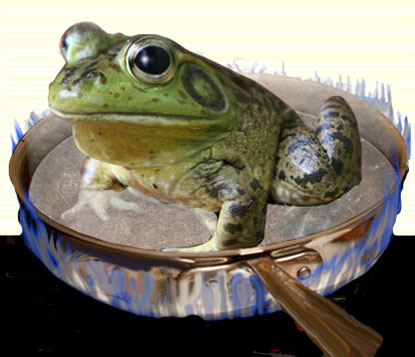
frogsBoiling Frog Yoga

There’s this wonderful fable about the fact that a frog dumped into boiling water will immediately jump out while a frog placed in water which is then raised to boiling temperature will sit there and slowly cook to death. Well, when it comes to yoga, sometimes I am that frog in the slowly heated water. My body is cooking from the inside out and I am anxious and impatient rather than meditative as the hour of practice whiles away. I wind up a gelatinous green heap by the end of the class, apparently devoid of bones and with a very stupid expression on my face. I can tell you this much: it can be very hard to go out and run when you are in a gelatinous state, but it does teach you how to survive the last few miles of a marathon or a cycling Century.

imgresBury Me Now Yoga

There are times when yoga puts you in a state of bliss. Of course that involves quite a bit of concentration, sometimes to the point where you actually achieve an out of body experience. Things get so peaceful it almost makes you wonder if it is worth all the trouble of coming back into this world. Bury Me Now Yoga puts you in that state of mind where you are faced with that awful choice of actually returning to reality to pay your bills or going instead for a long, long run or ride with the angels. Trust me there are days when that choice is much harder to make than you might imagine.

Wicked Witch of the West Yoga

imagesIf you do yoga properly, the deepest muscles in your body are engaged and the world starts to shimmer and shine with promise and enlightenment. The inside of your brain feels like the Emerald City in the Wizard of Oz. But then sweat starts to stream down your body as if there is no tomorrow. At that point you begin to realize that there is far more water in your body than solid matter. You begin to melt into the floor like the Wicked Witch of the West when she gets hit with water. “I’m melting….melting!” you cry as you slip down between the cracks in the yoga studio floor. All that is left of you is a stretchy little yoga outfit and the RoadID bracelet you forgot to take off your ankle. At least they’ll know who you were to call your family.

Gumby and Pokey Yoga

41g82G2myWLMost of us familiar with Gumby and Pokey know their amazing flexibility. It helped they were made of rubber with twistly little wires for bone structure. Unfortunately most of us are not borne with Gumby and Pokey anatomy, but that is a fact entirely lost on most yoga instructors. Instead they encourage you to twist into shapes and poses that are not meant for humans. Downward Dog? Sure. Child’s Pose? Okay, all good. Head Up Your Ass? That’s asking a bit too much of your yoga practice. But don’t be discouraged. We can’t all be Yogi Shamalamadingdong. Settle for imitating Gumby and Pokey, the original yoga practitioners from the 60s.

Now you know more about yoga for runners and riders than you probably ever hoped to know. Here at We Run and Ride we’re always on the forefront of current trends in running and cycling. So we encourage you to go find your own brand of yoga bliss. Because that’s the right spirit, you adventurous little minks and minkettes. Run on. Ride on. And yoga down. It all works together.

WeRunandRideLogo


Posted in Christopher Cudworth, We Run and Ride Every Day | Tagged , , , , , , , , , , , , , , | Leave a comment

The great joys of running and riding in the summer rain

By Christopher Cudworth

Fun, but not exactly a ride for fitness.

Fun, but not exactly a ride for fitness.

A recent weekend full of fun obligations kept me from any serious time on the bike. I did get out for a couple 6-mile rides with friends and family, but nothing to build any real fitness.

By Tuesday I was aching for a ride but the skies were low and wet. Thankful for the rain however, I stood looking out at the garden soaking up needed moisture and considered whether it was worth suiting up for a ride or a run.

Actually running was not really an option. Not until I solve the achilles tendon soreness that cropped up two weeks ago. That means a trip to the pedorthist and a pair of new shoes at least. Like so many things in life, when it rains, it seems to pour…

Rainy running

The Meadia Heights Golf Club in Pennsylvania where I grew up running in the rain.

The Meadia Heights Golf Club in Pennsylvania where I grew up running in the rain.

Not that I don’t like running in the rain. I love it. Always have. By the time I was nine years old I can clearly recall running barefoot on the short wet grass of Meadia Heights Golf Club outside Lancaster, Pennsylvania.

We lived next to the course, and I’d grab a set of golf clubs; 3-wood, 7-iron and putter to play the remote holes when no one else was around on a rainy day. Lacking a cart or bag, I’d run the distance from shot to shot. Often I could find my golf ball by tracing the little lines it left on the damp fairways. Putts would throw up little rooster tails and often the cups were filled with clear, cool rainwater. All told the experience was actually something more than golf. Everything shone and hummed in the soft light of a rainy day. And I ran and ran and ran from hole to hole.

Owning it

I knew the course so well I could play 14 out of the 18 holes without being seen from the clubhouse. It was my private country club in that sense. I was connected to that property more intimately than many of the golfers who paid thousands of dollars to be members of the club. There is no greater privilege than running barefoot on the cleanly mown grass of a golf course during a rainstorm at dawn. I’d be soaked to the skin and slightly out of breath after two or three holes. And man was I alive.

Every summer I’d run and golf in the rain. There would be deer running through the wet forest some mornings. The pelting rain made noise on the leaves and springs bubbled up from the Pennsylvania ground.

During one long rainstorm those springs ran for hours and my friend and I stripped naked on the 17th fairway where he lived and we turned the fairway into one long Slip and Slide. We’d run headlong and dive into the cold clear stream ahead, or ride on our naked butt cheeks as long as our momentum would take us. We were twelve years old and had no worries about what others would think. His sisters came out to watch and we cared not one whit that we were naked. And that, my friends, is how life should actually be lived.

Associations

By the age of 12 I had learned that my running ability was better than most. I dominated the training runs in baseball practice and led the 12:00 minute run in gym class. But the formal training that would follow never diminished that love of freedom and joy at running in the rain.

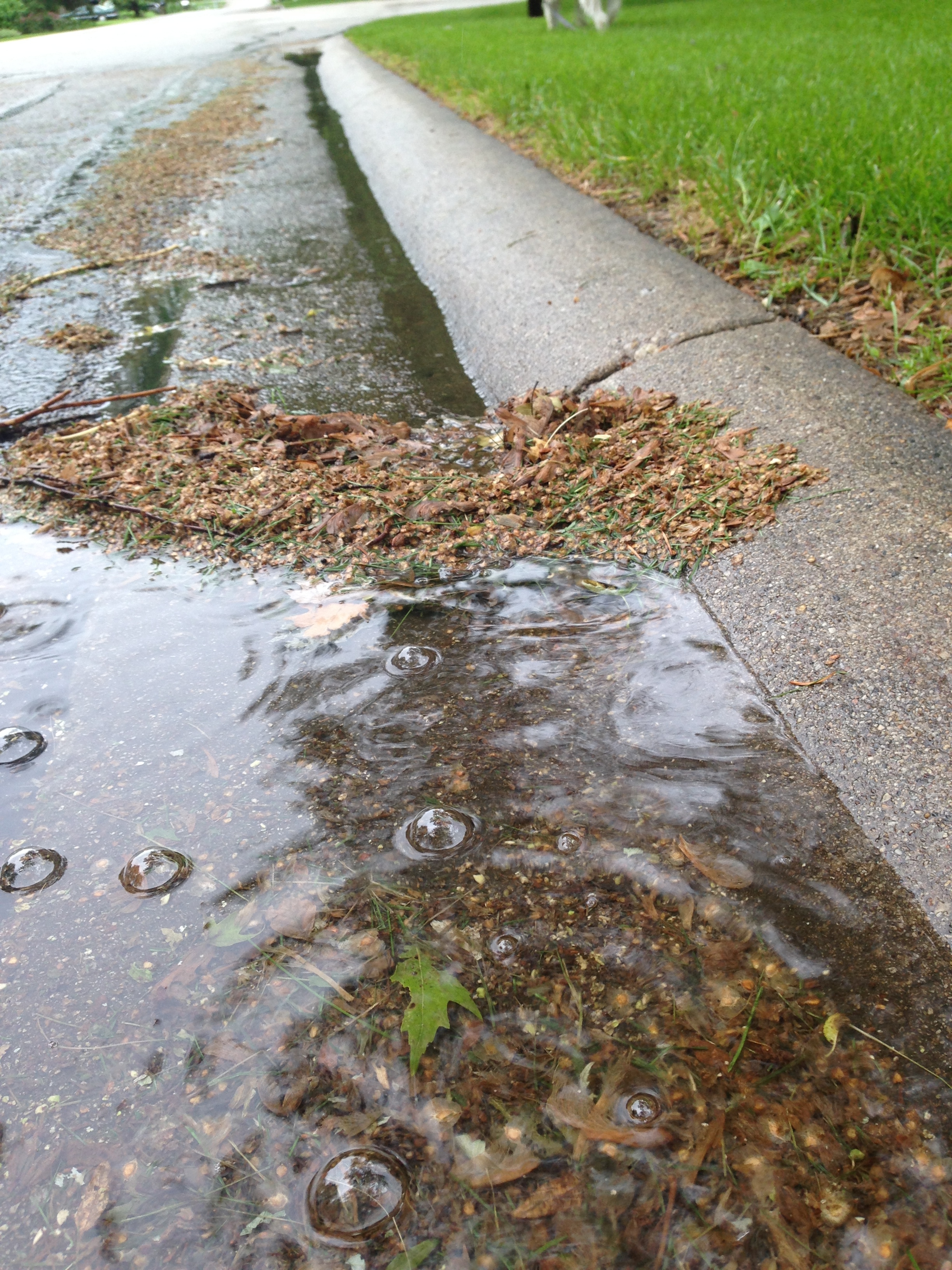
Full gutters and wet streets make for interesting running and riding.

Full gutters and wet streets make for interesting running and riding.

We’d get caught in thunderstorms as a team in high school and come trundling home from a wet practice laughing and splashing each other in deep puddles along the curbs. Really, we were still just kids.

In college one spring we set out for a 13 mile run and the skies opened up at three miles and never let up. Our cotton sweats got heavy and baggy. The crotch of the sweat bottoms sagged to our knees. We had to run like Oompa Loompas. Our shoes were heavy too. After the run we weighed ourselves and realized there were six to seven pounds of water bogging us down. “Training effect!” my teammate laughed.

Running in the rain brings out the kid in you, which may be why I specialized in running the steeplechase in college. The chance to splash through the water was too much to resist. And everyone would gather near the steeple pit secretly hoping someone would go down in the drink. It’s human nature. A baptism of sorts. Even Jesus got dunked when he was ready to begin his ministry. Water is like that. A cathartic force in this world.

Hurricane

Even as a supposedly mature adult that feeling of liberation at running in the rain is still familiar and joyful. A few years back when a hurricane swept up through Illinois from the Gulf of Mexico, the rain it brought was so prodigious it called me outside to run. Wearing a pair of older shoes I took off into the gusts and giant raindrops ripping across the landscape. At times the rain was so loud it hurt your eardrums as raindrops the size of ping pong balls bashed down on my hat and struck the ground. The street was alive with cats and dogs and there were really no puddles because everything, everywhere was a puddle. Then a stream. Then a river. Running water. Life water. Crazy, happy water.

Beware of wet tarsnakes and water-filled potholes. Or not.

Beware of wet tarsnakes and water-filled potholes. Or not.

Drivers honked their horns at the sight of a crazy runner piling through the rain. It even stopped me cold at times. The drops hurt so bad I had to stand under a tree to gather my wits, chuckling like a madman.

But it was fun and I was laughing and even perhaps crying a couple times at the joy of nature’s force and frivolity. The skies had pulled out all stops and the feeling of running in those conditions was like being in a race where you lost your fear of pain and were just letting it all go. It was raining so hard you felt like a winner and a loser at the same time. And man was I alive.

Rooster Tails

In recent years the joy of running in the rain has been transferred to cycling. Of course early memories of riding a fat tire bike through puddles after a rain storm feed the mind with memories of rooster tails behind a rear wheel with no fenders.

A post-ride pic through the plastic Baggie in which I stashed the iPhone during a ride in the rain.

A post-ride pic through the plastic Baggie in which I stashed the iPhone during a ride in the rain.

So standing in the kitchen looking out at the garden yesterday I decided to go for it. The rain was coming down solid and steady as I pulled on my best-fitting cycling kit along with a day-glo green rain jacket and headed out for a ride.

One could take the sensible advice and avoid riding in the rain. It’s not safe, people will tell you. Those road tires can slide or skid. Tarsnakes can take you down. Drivers won’t see you through rain-slick windshield.

Out we go

Blah blah baaaalaahh. I rode 20+ miles with no problem and averaged just over 17mph despite a strong north wind and a hilly route. The tires shone and the road hissed as I rolled downhill and back up. 17, 18, 19 miles an hour. Let it rip. Have some fun. Be a kid again.

Go ahead. Run or ride through a puddle or two. Or three.

Go ahead. Run or ride through a puddle or two. Or three.

Riding in the rain really rules

I don’t care about getting wet or being wet. I’ve gone out into the rain to ride before and the fact of the matter is, once you’re wet, you no longer notice it. Not if you use some equipment to keep warm in some intelligent way. Plus riding in the rain is actually necessary to gauge the full range of experience in cycling. Just ask any pro rider in the Giro de Italia or Tour de France. Riding in the rain tests your character. Makes you live in the moment.

And, according to The Rules on Velominati it also means you are a badass. For example:

Rule #9

If you are out riding in bad weather, it means you are a badass. Period.

Fair-weather riding is a luxury reserved for Sunday afternoons and wide boulevards. Those who ride in foul weather – be it cold, wet, or inordinately hot – are members of a special club of riders who, on the morning of a big ride, pull back the curtain to check the weather and, upon seeing rain falling from the skies, allow a wry smile to spread across their face. This is a rider who loves the work.

That’s a pretty eloquent way of capsulizing our madness. Or is it sanity? Because life is much too short to try to ride or run between the raindrops. Better to go straight through them and actually feel what it means to be alive. And that is why I went out the door into the rain. Life requires more than just fair-weather participation. It’s a law of the universe: If you don’t do out in the rain, the rain will come find you. Guaranteed.

WeRunandRideLogo


Posted in Uncategorized | Tagged , , , , , , , | 1 Comment

A bumpy run and ride through the Social Media Landscape

By Christopher Cudworth

What would happen in the Social Media Landscape if by  chance your Strava route resembled an outline of the Virgin Mary?

What would happen in the Social Media Landscape if by chance your Strava route turned out someday to resemble an outline of the Virgin Mary?

It happens so suddenly. One minute you’re harmlessly running or riding your way through the social media landscape, posting to Strava and enjoying a few kudos from friends and followers in return.

Next thing you know, you’ve been pushed off the main road of the Internet highway into an environment you can hardly begin to negotiate. The road is wide but ridden with tarsnakes. You careen from slick to rough road with every new step or pedal stroke. It feels like an amusement park and house of horrors all at one. A joyful and terrifying journey, this is. 

You are running and riding freestyle through the Social Media Landscape.

You don’t know how you got here. You innocently shared a workout on Strava and somehow it showed up on Pinterest. You think, Strava on Pinterest? How the heck? 

Well, running and riding on the the Internet highway can be a confusing place at times. All it takes is an inspired share from someone’s Twitter feed to a Pinterest page and suddenly your innocent little workout is being assessed not only for its telling stats but also its post-Modern commentary on the nature of narcissistic activity. But let’s also not forget its artistic value. The Internet is so confusing you see. It’s easy to get lost in a hurry. 

You suddenly find yourself running and riding through an alternate universe of Social Media Destinations.

You suddenly find yourself running and riding through an alternate universe of Social Media Destinations.

Virgin Territory

That Strava map of your 26.5 mile ride just happens to look like an outline of a praying Virgin Mary? It just went  viral. Now you’re running and riding just to keep up with the digital life of your happenstance Virgin Mary.

People across the Social Media Landscape want to know if you planned the whole route?.Zillions suddenly find you on Facebook. The religious try to recruit you while the irreligious seek to revile you. 

Sharing a Virgin

The Post gets 50,000 Shares, 4326 comments and floats back over to Instagram, where your Virgin Mary ride becomes the sensation of thousands of photo-obsessed smartphone users aching interesting content to make themselves look aware in this digital age. “Look at this!” someone posts. “Somebody rode the Virgin Mary and put her away wet!” The Internet. So classy. 

Uh Oh…

Then your Virgin Mary ride map slides over to Reddit, where a band of vicious little trolls take exception to the entire idea of your Virgin Mary ride having any significance or resemblance to the Holy Mother at all. They start using the word “mother” in a far less

It can be a workout just keeping up with your Social Media connections some days.

It can be a workout just keeping up with your Social Media connections some days.

complimentary way, and it is all aimed directly at you. So you do everything you can to run like hell away from the hecklers but they follow you like a band of cannibals, gnawing at your Gravatar with vicious green teeth. You discover the Redditland can be a very cruel place and determine take a detour next time you run or ride through the Social Media Landscape. 

Escape from Redditland

But you get out of Redditland before you are consumed alive. But without even trying you became the target of thousands of haters issuing down votes on the content you never really wanted to Share on Reddit anyway. Because that’s how the Internet works. It mimics the process of evolution in crucial and verifiable ways. Red in tooth and claw. 

Geek Salvation

So you’re actually somewhat relieved when some techno-geek with a GPS fixation and the equipment to prove it decides to analyze your ride and the actual odds of it forming the shape of the Virgin Mary. He posts his analysis to that business social media site known as LinkedIn. That unleashes your Virgin Mary ride around the world to India because that’s eventually where everything on LinkedIn seems to wind up. Suddenly you get 1,376 Connection requests that simply say: अरे तुम मेरे साथ कनेक्ट होगा?

Before you know it your options multiply. You're lost and almost out of hydration. But you keep on going.

Before you know it your options multiply. You’re lost and almost out of hydration. But you keep on going.

Before you can turn around and come back home from the dry deserts of LinkedIN land your Virgin Mary Strava Ride has taken you tumbling through Tumblr and stumbling through StumbleUpon.

Then someone takes your Strava Ride and creates a YouTube video using Google Streetview and suddenly your day feels like a Social Media Century or Major Messaging Marathon as you struggle to keep pace with the Post That Would Not Die. 

Stravafied

You’ve got 4,000 new followers on Strava now and news media in Australia and the Vatican Press have reached out to you through Twitter. All because you did a mid-tempo ride on a new route because you were bored with doing the same route every week. 

But the Internet loves happenstance reality. Now you’re a Social Media Hero for the amazing journey your Virgin Mary Strava Ride has taken through the Social Media Landscape. You wonder what you can do for an encore. So you begin to plot your next great adventure. Because that’s what we do. Those of us who run and ride.

WeRunandRideLogo

Posted in Uncategorized | Tagged , , , , , , , , , , , , , , , | Leave a comment

The pleasures of a trippy little triathlon

By Christopher Cudworth

Safety is the first priority in all tris and dus.

Safety is the first priority in all tris and dus.

For 11 years the town of Batavia, Illinois has hosted a sprint triathlon and duathlon. The event sells out every year and has grown to more than 800 people. That’s still a lot of swimming, running and riding to support. So the race committee deals with the same logistics as one of the larger triathlons such as those in Naperville, where the Danskin Women’s Triathlon took place the same day.

It is rather funny that an event still comes down to putting boards over speed bumps and plopping orange cones where you need them. You are a fortunate race organizer indeed if nothing happens to any of the competitors. No crashes or wipeouts on the run. The rain predicted the night before turned into spits and not downpours, and the maple leaf helicopters that can turn streets into dangerous slicks did their duty of falling two weeks before the event. So conditions were relatively safe and manageable.

Still, the unknowns are always what you want to calculate. As such, an Experience Triathlon race volunteer named Kurt Woodward was up at 4:00 a.m. driving the city and country roads with an eye out for road kill. “Last year we brought a big flat shovel to scoop up the dead animals,” he related. “And one of them was spread out about 12 feet from front to back. By the time we got done that shovel stunk so bad we could not take it home. We put it in the car at first and then said ‘No way’ and then tossed it in the dumpster.”

Swim competitors line up for their chance to hit the 68-degree water. It was warmer than the air.

Swim competitors line up for their chance to hit the 68-degree water. It was warmer than the air.

So it’s the goal of any race director to have clean streets so there’s no humans hitting the streets in road kill fashion.

A peoplish event

A triathlon and duathlon is totally about people. Lots and lots of people. Spectators line up to watch their friends and family as a show of support. You’ve got your top competitors in their skin suits and $8000 tri-bikes and also people participating in the race wearing baggy shorts and riding mountain bikes with squeaky chains and spider webs between the seat and seat tube.

One determined soul emerged from the swim and began pedaling his bike from transition onto the course only to encounter the steep hill leading out of Quarry Park where the swim segment took place. That rider did his best but there was no way he was going to make it up that hill. For starters, his bike was too small for his own prodigious frame, which likely topped out at 280-300 lbs. Still, he pedaled as far as he could and it was good that he had no toe clips. About halfway up the hill he turned his bike sideways to gain some momentum and almost took out two other riders. At that point he stepped off the bike and began pushing it up the last 30 yards to the top. Then he remounted his trusty steeds and headed off for 14 miles in a strong breeze. Someone quietly muttered, “That’s going to be a long ride for him.” But there was no lack of respect in those words. Just empathy.

The women's winner took home honors from the middle of the overall pack.

The women’s winner took home honors from the middle of the overall pack.

Triathlons are like that. They usually contain a core sample of the human condition. Speedsters strip off their wetsuits and emerge onto hi-tech bikes like hungry larva popping out from some black egg.

Indeed, the national level triathletes in Batavia queued up closely, 1,2,3 as they came out of the water. It remained a tight race between the three all the way through the run. All were in their early 20s. Fit and fast. Having fun unleashing all that training in an environment where there was very real possibility of victory.

That is why we need races large and small, to accommodate those for whom the journey is just a chance to test themselves in some way and an opportunity for those on their way up the triathlon ladder to find passage to a better ranking through adrenaline and hope.

It’s an interesting mix to watch, especially when you’re working the course with a duty to fulfill. Every competitor rolling or running past has that ‘I can do this’ look in their eye. Of course as the racers get to a slower breed that look transforms to an ‘I hope I can do this’ look. Generally these people also have a good sense of humor. So you cheer and even fist bump them into a grin or a ‘yeah baby’ as they move past. Getting a smile out of a tired-looking racer is often the most important thing you can do as a volunteer.

Obviously this woman was competing in the duathlon.

Obviously this woman is a duathlete.

It had been my plan to be one of them. First the goal was to do the triathlon. But learning to swim half decently took more time than I had this spring. The running went well all winter and for some great reason the cycling has gone really well this spring. So I was thinking duathlon at the very least.

But something in my training went awry and an achilles turned sour and sore the last couple weeks. So that needs to be solved. New shoes? A tweak to the orthotics? We’ll see. Whatever the story, it came to a bleak and honest end about a week out from the race.

Volunteering is the next best alternative to doing the race. It was however quite funny that my assigned race post was directly next to the city’s sewage treatment plant. “I’m sorry about this,” the event director said. “I know this spot stinks. But we need someone to keep the runners on course.” The northern breeze was strong but instead of helping it tended to intensify the smell somehow. Like snorting a constant line of stench cocaine it was. Ah well. Such is life.

Like all smells good and bad, you tend to forget about them after a while. Your nose just says ‘screw it’ and stops smelling the highly processed crap smell coming from the giant aluminum dome next to you.

Spectators welcomed the morning sun when it finally emerged from behind the clouds at 7 a.m.

Spectators welcomed the morning sun when it finally emerged from behind the clouds at 7 a.m.

After three or four hours of coaxing runners straight ahead I began to feel like a breed of deranged bird with just one song to sing. “Go to the yellow shirt up ahead” I chirped over and over again.

I could see that it worked however. There were three more miles to run for these triathletes and duathletes emerging from transition a half mile back at the pool parking lot. Their job was just beginning in many ways. This was a ‘brick’ with a purpose. To finish, and finish well.

Soon enough the spectators wanted to follow their chosen participants to the finish line as well. Women with baby strollers and tired looking tweens moved sullenly past. Kids of all ages who got up way, way earlier than they like to do on a Saturday turned out to watch mom or dad compete. All paraded along looking for instructions on where to go next. I dutifully pointed them toward the guy in yellow shirt ahead. Some birds never change.

The reward for those of age was some excellent Samuel Adams beer at the finish line.

The reward for those of age was some excellent Samuel Adams beer at the finish line.

At the actual finish line even the little kids that competed in the Splash and Dash were happily consuming Pal Joey’s pizza by the slice along with cookies and apples, bananas and sports drinks.

Samuel Adams brew was flowing freely even though the people drinking it were confined inside a big plastic fence.

Joe LoPresto, President of Experience Triathlon, handed out the raffle stuff and the medals. Everyone who finished walked away with a participant medal. Those little chunks of metal flashed and shone in the morning sun.

That reminded me of the moment back at 7:00 a.m. when a woman in a short blue skort stood there shivering while clutching her bejeweled cell phone case. The weather app in her phone insisted that the sun was supposed to come out in six minutes. Damned if it didn’t do just that, as if it were all scheduled ahead of time. Then the goose pimples on her tanned legs receded into nothing and we were all just a bit happier in 56 degree temperatures on a June morning. Good day, sunshine.

Someone to root for. Mu companion Suzanne Astra climbs the first hill in the Batavia Triathlon. She finished fifth overall in her age group.

Someone to root for. My companion Suzanne Astra climbs the first hill in the Batavia Triathlon. She finished 5th overall in her age group.

Those who swam and then jumped on their bikes were even chillier of course. I worried about my companion who was racing that morning. Her back has been twitchy at best the last two months. But she swam pretty well and motored up the first hill on that compact frame Scott bike with that familiar smooth style. She took off for the open country and a decent ride leg.

It’s funny how every race is so real for the competitors and nothing more than an hour or more of imagination for those of us stuck along the sidelines. It’s like there are three dimensions to every triathlon. Competitor. Volunteer. Spectator. Varying degrees of participation. All bound up in these protracted moments we call an “event.” It’s all about dimension and perspective. And finding our way to the finish line. Together.

Disclosure: Blogger Christopher Cudworth is a member of Experience Triathlon but has never actually competed in a triathlon other than as a team relay member. Which they won. Yah. His fervent goal is to actually compete in the sport for which the club is named. For now, it is back to cycling criteriums until the achilles heals up. 

WeRunandRideLogo

Posted in Christopher Cudworth, We Run and Ride Every Day | Tagged , , , , , , , , , , | Leave a comment