Does it pay to be passive-aggressive when you run and ride?

By Christopher Cudworth

Having worked with (and for) a number of passive-aggressive people over the years, and noticing how they somehow succeed in this world despite their ugly behavior, it occurred to me that being passive-aggressive might actually be a competitive advantage in the world of running and riding. Or is it?

For example, when you’re on the starting line in really great shape and someone standing next to you asks, “Are you ready for the race,” you can reply with a cryptic little aggressive answer such as, “I don’t know. Why do you want to know?”

Of course they’re generally asking you the question just to be nice nice. But that weird little guilt thing that drives passive-aggressive people kicks in and you find yourself saying something a little more passive in response like, “Actually I’m not really here to race. This is really just a training effort.”

That’s a fucking lie of course. Because in fact you’ve trained your ass off for this race of 8 months and all you can think about is the joy of kicking the ass of everyone that has wronged you in some way the last 12 months.

Don’t lie. We’ve all been there. 

It's supposed to be about balance. But passive-aggressive people aren't so sure about that.

It’s supposed to be about balance. But passive-aggressive people aren’t so sure about that.

Passive-aggressive behavior is basically the line down the middle of the yin and yang symbol. You want to achieve inner balance but your brain engages in these perambulations in which your passive side, the part of you that is not so confident, gets in an argument with your aggressive side, which makes you want to run down old ladies with your $10,000 Cannondale carbon fiber road bike with sharpened front forks.

Yes, you know that state of mind, don’t you? You love to run and ride because it helps you achieve that carbonic bliss in which you are in tune with the whole universe. But on that way to exhausted Nirvana there are just a few too many things to work out in your head. So you go passive in some brands of thinking and aggressive in others.

Not laid back

It begs the question, why be passive at all? But there are answers to that question. If you are engaged in an event like a marathon or a half marathon, it simply does not pay on an average day to go out at a pace you cannot sustain for 26.2 miles. So you use your passivity in a constructive manner.
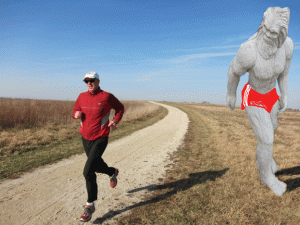
Our aggressive side often lurks just outside the perimeter of thought.

Our aggressive side often lurks just outside the perimeter of thought.

Only when fatigue sets in should you release your aggressive side. And even then you need to process it through the filter that does not allow you to drop down to a pace that is 30% faster than your target pace. Not unless you are named Meb or Rono or some other constructively African name should you allow your aggressive side to completely rule the day.

Given the very clear value of balance in events like running and triathlon, where a mindful approach is always best for success, it makes you wonder why so many people in the workplace seem to get away with passive-aggressive behavior.

Workplace woes

Well the answer there is simple. The workplace is not a just place. It is a concept as well. By comparison with running and riding, where judgment is based on empiric values such as finish time and place, the workplace is full of ugly little nuances of personality and politics. So being passive-aggressive is not a bad strategy for some people. They actually value keeping everyone else on edge because competition in the workplace is like that. Having a way to keep your friends and enemies off kilter as you compete for recognition and ownership of key projects really can function as a competitive advantage. That’s why so many bosses seem to be passive-aggressive. It works. And it makes hell for other people.

In the epic existential play No Exit by Jean Paul Sartre the opening scene begins with hints of passive-aggressive exchange between two of the characters:

GARCIN: (enters, accompanied by the VALET, and glances around him): So are we here?

VALET: Yes, Mr. Garcin.

GARCIN: And this is what it looks like?

VALET: Yes.

GARCIN: Second Empire furniture, I observe…Well, well, I dare say one gets used to it.

VALET: Some do, some don’t.

See, it’s all about being cryptic. Of course Garcin has no idea he is being enrolled in an eternal scenario in which hell is other people.*

When we’re not sure about the future or the present or the past, it is somewhat natural to engage in passive-aggressive behavior. It helps us calculate the odds and the risks of any given situation. P/A behavior is like sticking out your antennae to see which way the social wind is blowing. This is done out of uncertainty and fear.

Passive-aggressive. It’s the ugly truth of modern politics where people cry loudly or pretend to cower when you question their opinions. Then they come back with full force in a personal attack in order to put you on the defensive or try to crush your hopes. It’s an almost institutionalized political method used by people like Karl Rove and other psychopathic personalities. Passive-aggressive behavior is currently crushing America’s soul, in case you haven’t noticed. It’s not only the big players in politics. It’s also all over social media sites such as Facebook where people beg compliments daily or post egregiously partisan content and then get angry when people debate those posts with rational arguments. They call you intolerant if you do and uncaring if you don’t. It’s a really fucked up passive-aggressive world we live in.

Fortunately those of us who run and ride actually can achieve some clarity.

Real winners

Because by contrast it helps to just jump to the point of the matter. It helps everyone involved. Rather than engage in some sort of passive-aggressive banter, just cut to the chase and tell it like it is. You’ll be surprised how nice it feels. While the honesty may hurt a bit at the start, people either deal with it or recover. That’s the world of running and riding. Most of the time.

Racing is a pure and clean pursuit if you go about it honestly. Watercolor by Christopher Cudworth

Racing is a pure and clean pursuit if you go about it honestly. Watercolor by Christopher Cudworth

For example, during the opening mile of a 5 mile race I was once asked by a fellow competitor what pace I expected to run. I glanced over at him for a half second and replied, in earnest: “Faster than you.” Then I took off and won the race by 35 seconds in a final time of 24:49. Kick ass. Talk later.

Oh, but were the world world so clean and honest at times.

Sure, I could have stuck around and chatted with this passive-aggressive sort for a few minutes. And perhaps he might have convinced me to run along at his pace for a while as he gauged my strengths and weaknesses. Perhaps his language could have raised some small doubt in my head at which point he could have taken the lead with me left believing that I did not have the fitness to counter his objectives. And that is how passive-aggressive behavior works. It can really be a manipulative advantage if the victim allows it to be.

Are all competitive cyclists passive-aggressive pricks? 

Unfortunately cycling is by nature a passive-aggressive sport. You can’t just ride off from other people like you can in running. The power of the group of peloton can just reel you back in. So you have to play the game of passive-aggressive behavior by riding in the group for the most part. This means sucking wheels for miles at a time in hopes that you can find the merest advantage at the end of a race or ride.

I always find it a bit ugly and yet amazing that sprinters can ride all that way in a Tour de France stage and then sprint it out at the end. Talk about your passive-aggressive instincts come to life. They sit behind a mass of teammates for 100 miles or so over the mountains and through the wind for the opportunity to dial it up for three minutes and try to grab victory without crashing the entire race by running into someone sideways as you literally throw the bike forward. All to “win a stage.” Sheesh.

So it’s not surprising that a lot of cyclists are pricks of one sort or another. They love the concept of a free ride and hate their fellow competitors and riders for having to rely on it. The peloton is really like the hell in No Exit in a lot of ways.

Sometimes you can’t even get your fellow riders to agree what their purpose is on a given day. Or they state something passive like, “Let’s go easy today.” But then they’re the first ones to one-wheel you for 10 miles, or do long aggressive pulls that leave everyone exhausted and angry. One rider with whom we ride would rather gutter the group the entire ride than move to the center of the lane and allow everyone else to use the draft to keep up. That’s passive-aggressive bullshit. But when you’ve got the legs, you’ve got the license.

Of course even those P/A riders get their lunch handed to them sooner or later. If a pro shows up for the group ride the bully gets dropped just like the rest of them. There’s always someone willing to kick the ass of those who make life hell for others. But was Jesus even passive-aggressive? Some people ask that question. 

Beware the tarsnake of passive-aggressiveness

So passive aggressiveness is not a useless behavior even if the people who engage in it are often snarky, disgusting creeps at times who try to alternately cajole and scare you into agreeing to whatever madness they want to foist upon the world.

So be aware. Don’t be a passive-aggressive jerk even if it is a tempting way to win a race, lead a training run or achieve some other form of pyrrhic victory. You may win the day, but you lose in matters of character.

Being passive-aggressive in relationships is wrong, controlling and evil. Don’t do it to your spouse or partner or even your biggest competitor.

Find a way to be honest with them and yourself in the process. And when you’ve learned the lesson about how not to be passive-aggressive when you run and ride, remind yourself and hopefully others that being that way in the world of work and relationships is wrong, wrong and wrong again.

Or is it? Do you really think so? I’m just going to go off and think about that and let you decide. 

But when I get back you had better have an answer. 

It never ends.

*Want to read an interesting bit of theology about the concept of hell, and how it was never meant to be presented as we think of it today. Read this piece about it. 


Posted in Christopher Cudworth, Tarsnakes, We Run and Ride Every Day | Tagged , , , , , , , , , , , , , , , , , | Leave a comment

A running feud with chipmunks

By Christopher Cudworth

This photo I took of a chipmunk shows a rather unforgiving face.

This photo I took of a chipmunk shows a rather unforgiving face.

Before I get on the bad side of animal rights activists, let me go on record in saying that I’m a huge nature buff. I even spend time in the buff in nature whenever possible, so long as there is no one else around.

So before I digress too far from the subject of a long-running feud with chipmunks, let me state that I literally mean them no harm.

Which is not to say that I have never harmed a chipmunk. Quite by accident many years ago I stepped on the back of a chipmunk crossing my path while running and killed the little bugger. I felt horrible of course. Because I like chipmunks. I really do.

But this was in my prime as a runner, and while training on the campus of the University of Wisconsin-Madison with a college teammate, we were flying along at 5:00 pace and feeling great when a chipmunk darted out on the path, changed directions halfway across and ran right under my right foot at the moment it was striking the foot path. And damn, the poor thing was dead in an instant.

“You KILLED IT!” my friend said as he stood there in amazement. “You’re going to go to chipmunk hell!”

And so it was that chipmunk karma began.

Another chipmunk tragedy

Because a little while later that year, I was walking across the campus of Luther College when I spotted a chipmunk writhing in the grass. It appeared to be hurt so like the good biology student I was at the time, I bent down to pick it up and got hold of the tail. Not a good plan. The tail came right off its little butt and the chipmunk jumped up and ran away.

That’s nature’s strategy you see. Better to lose a tail than to be eaten on the spot. Just ask the Fantastic Mr. Fox. He later recovered his tail and pinned it to his ass for appearances, but everyone knows that once you lose your tail it’s never quite the same.

Getting some tail

After all, human beings lost their tails about 1.5 million years ago and we’re definitely not as interesting or attractive as we used to be. The phrase “I’m going to go out and get some tail” so often uttered by bachelors on the prowl never had the same meaning.

And think how awesome it might be to have a little bit of tail sweeping out the back of your Nike shorts as you raced down the boulevard. That would make you feel and look really fast.

Why, we’d almost be as studly amazing as chipmunks, who run around the yard with their tails raised whenever they are alarmed or in a hurry.

Chipmunk strategies

See, it’s pretty cool being a chipmunk in this world. Generally you run around stuffing your face full of seeds and other foods and run back to your hole in the ground. Then you squeeze your face through the hole and dump all that stuff out of your mouth into a little food cache for safe eating later on.

A woman doing her best chipmunk imitation

A woman doing her best chipmunk imitation

In fact while stuffing their faces chipmunks look a lot like triathletes or marathoners or any number of other endurance athletes so hungry for nutrition they cannot slow down enough to actually chew their food. Rumor has it that the typical insides of an endurance athlete contain whole, undigested bananas, long wedges of fermenting raisins and entire half slices of bagels, unchewed and unmolested. That’s because we make ourselves so hungry from all that endurance training our bodies crave food beyond reason. Oh yeah, there’s always a few Oreos down there too.

Which means the typical endurance athlete often shits out an entire grocery cart of perfectly good food whenever they take a dump. I’ve seen bananas still inside the peel left along the road when the urge hits a runner and they need to excavate their bowels. That explains why you sometimes see food wrappers at the bottom of Porta Potties. Those plastic wrappers do not digest well.

So we kind of have a kinship with chipmunks in that we run around shaking our little tails and eat like insatiable pigs, sometimes stuffing our faces so full there is no getting around it: we are little more than giant rodents when it comes right down to it.

Living with chipmunks

When a chipmunk moves in, they seldom move out.

When a chipmunk moves in, they seldom move out.

It’s even hard for human beings and chipmunks to share the same living space at times. The pair that lives under my back steps loves to tease my dog when he comes snuffing out the back door on the hunt. Then they race up the drainpipe while he goes apeshit sticking his nose up the pipe because he can smell those little buggers up there and they’re Oh So Close.

Catch and release

Some people don’t put up with chipmunk antics. They catch them and cart them away to other places. My uncle did this for years until one day while he was driving a chipmunk away from his home the little guy escaped and ran up onto his shoulder. That gave my uncle such a start he almost wet himself.

And catching a chipmunk inside a car is no easy feat. There are a zillion places for a chipmunk to hide, and there’s usually plenty of lost peanuts under the seat. So they can live in there for days.

Settling in

A squirrel's nest extricated from the front of an SUV engine.

A squirrel’s nest extricated from the front of an SUV engine.

A close relative of the chipmunk is the gray squirrel, and they are even known to make nests in the engine of your car. Here’s a photo with living proof of that phenomenon. Talk about “going along for the ride.”

If chipmunks catch up with that mentality, we’re all really screwed. I once had a mouse set up shop in the heating vent system of my Subaru. When the heat came on in fall a giant blast of mouse chewings came flying out the vents into the car. If chipmunks follow those habits and learn how to invade our cars we could wind up with peanut casings up our nose.

Stuff like that can drive people to criminal levels of chipmunk hatred. It’s bad enough they climb to the top of your sunflowers and knock the 10 foot plants to the ground. They really are destructive little buggers when they try.

Too cute for their own good

But they’re so darn cute in all their chipmunkness that it’s hard to get really mad at them. Which is why I put up with the pair (or more) that has now taken over the space known as my garage. Every time I open the door they are scampering in or out. I’ve let my dog chase them around the garage and they inevitably escape. They really liked the pile of wooden fence posts that sat on the north side of my garage for a few weeks. It was like a chipmunk hotel with holes in the fence posts so they could go over, under and through the posts. It was like Disney World for chipmunks.

So there is always fun company when I go out to the garage to get one of my bikes down or stand there stretching in the shade before going out for a run in the summer sun. I’ve offered an apology for killing one of their cousins way back when. But pretty much those chipmunks sit there and stare at me without an ounce of forgiveness in their hard little eyes. There is still some penance to be paid, perhaps. Which is why I don’t ever talk about the chipmunk that got rolled under my bike wheels a few years ago, or the ones that succumbed under my car wheels. We won’t go there at all.

Was this the act of revenge by chipmunks for my long ago crimes?

Was this the act of revenge by chipmunks for my long ago crimes?

Because if my local chipmunk friends ever get wind of those incidents, there may be a full-on war declared against me, with chipmunk karma raining down on head from all quarters.

So I’ll beg you to keep all that quiet, lest they all gang up and try to take me down on the bike by felling some giant tree in my path as an act of sedition toward their hated enemy. That would be bad, because if you’ve ever crashed your bike into a tree you know how bad the damage can be.

Heyyyy, wait a minute. Now that I think about it I think there were some teeth marks at the base of that tree that fell across the trail where I crashed the other day.

Those little bastards.

WeRunandRideLogo

Posted in Christopher Cudworth, We Run and Ride Every Day | Tagged , , , , , , , , , , , , , | 4 Comments

iRun and iRide and my iPhone saved my butt

By Christopher Cudworth

The bent iPhone.

The bent iPhone.

The folks at the AT&T store had not seen anything quite like the shape of my iPhone the night I brought it in for inspection after crashing into a tree with the phone in the hip pocket of my cycling kit.

“It’s bent,” the store manager said with some degree of admiration. “How’d you do that? I’ve never actually seen one bent like this before.”

I explained that the $650 iPhone 5 was perched in my hip pocket inside a $40 protective case when I slammed into the thick trunk of a downed tree.

“Interesting,” he said, holding the phone up for another look. “It really is bent. It might have saved your ass.”

“That’s what the doctor said, too,” I offered.

“I don’t think it can be fixed,” the AT&T guy told me.

I already figured that one out.

“But the screen didn’t crack,” I laughed. “So maybe I can sell it for parts.”

Other store employees gathered around to admire the damage to my phone. “That must have hurt,” one of them said when I described the bike accident again. Actually, the bike was not at fault I told them. It was purely my lack of attention that caused the accident. My bike was an innocent participant.

At least I wasn’t texting, I told them. See, I’ve seen several videos recently about driver safety that scared me into safer driving and safer cycling. This PSA from New Zealand puts safe driving in a compelling human context.

We’ve all made mistakes while driving and cycling. 12 years ago when I was first taking up riding and was doing a 25-mile tour of a suburban bike trail I was nearly struck by a vehicle traveling 40 miles an hour. The trail dropped suddenly onto a street from the height of the former railroad embankment and I did not see it coming. I hit the brakes and barely avoided getting crushed by a fender.

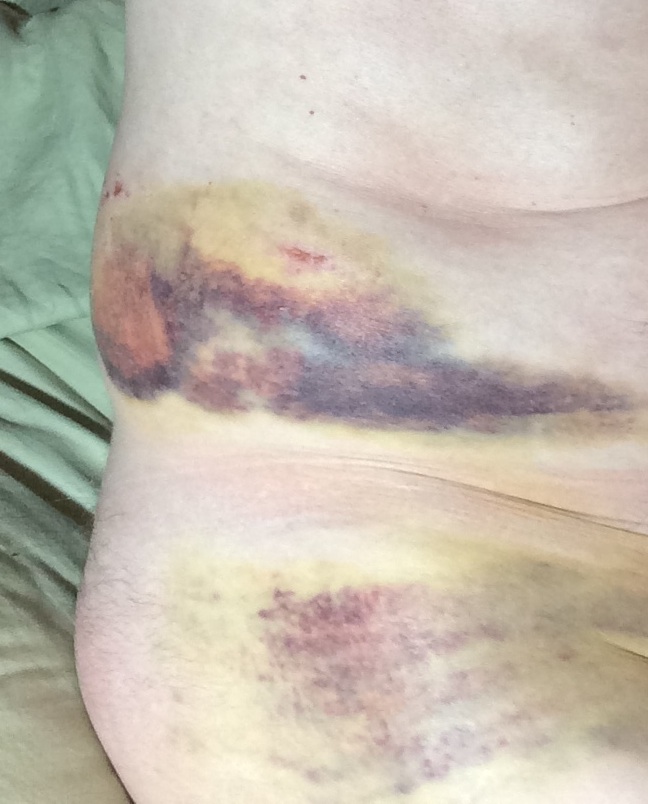
I look like the planet Jupiter.

I look like the planet Jupiter.

So I was lucky this time that my inattention on the bike resulted only in a painful encounter with a fixed and immovable object like a tree. The daily pain in my lower back is the swelling wisdom of experience. The bruises are a clear reminder that paying attention is paramount when you run and ride.

But honestly, there is a chance that the damage done to my iPhone actually saved me from injuries that might have been worse. Fortunately there was a provision in my plan to get a new phone. It cost me $50. Who knows what the stitches on my chin will run me when that bill arrives?

So while I feel stupid for crushing an iPhone and crashing my bike into a tree, I feel a bit wiser for the experience. I’ll still ride hard and fast, but there’s a call to attention in all this. For all of us.

Learn from my experience if you must. Save your own phone from destruction, and save your ass from a really colorful, painful week of recovery.

Because accidents happen. They really do. iKnow from experience now.

WeRunandRideLogo

Posted in Christopher Cudworth, We Run and Ride Every Day | Tagged , , , , , , , , , , , | 1 Comment

In life and on the road you sometimes get only one shot at success

As a tiny little kid I recall the day my father called us all inside the house and ushered us upstairs to the attic where a tall window overlooked the back yard.

“Now be quiet,” he told us. “I’m going to shoot the groundhog.”

The groundhog, you see, had been digging under the barn foundation. My father did not like that. So he loaded his .22 caliber rifle and propped it on his forward hand while his finger rested calmly on the trigger. We all waited quietly.

Crack. That was the noise the rifle made when dad pulled the trigger. At the same moment it seemed, the groundhog fell in a heap.

“You got him!” we all cheered.

There was no remorse. The groundhog was not going to see his shadow ever again. Dad had proved himself in the eyes of his sons and the barn was now safe from the portly rodent piling dirt around its edges.

So many times in life we get one shot at success. The moment is right. Perhaps we’ve even planned for days, months, years to accomplish some goal. Then you get one shot at success.

I recall the day I sat with a potential sponsor for one of my print projects. I made my pitch and showed him the painting that would be turned into a poster for promotional purposes. The painting was executed on site at a baseball stadium. The sponsor’s logo was visible above the left field stands.

Somewhere I had heard the proviso. “He who speaks first, loses.” After I made my sales pitch I sat back in my seat and waited. Not saying a thing. The client looked at the painting and held it up and set it back down again. Minutes passed. Still I said nothing. Finally he responded in a somewhat flat voice. “And where would my logo appear? On the bottom?”

And I had him. One shot. Then I sold the other sponsorship with even more confidence.

All around the world people are taking their one shot at one thing or another. It might be a marriage proposal or an attempt at a 10 kilometer record under the lights at some European track.

I recall a hometown race in which a major regional competitor unexpectedly showed up at the line. His presence turned sure victory into a challenging race. He led the first 5K in 14:55 and it was my turn to take over. And from there I dared not let him have the lead back. If he surged, I surged. We moved up over a hill in Mile 5 and I could feel his stride beginning to shut down. Finally as we approached the last mile I gained 2-3 yards  and won by 6-7.

But that move at 5K was my one shot at victory. It was either going to stick, or not. Which proves that sometimes your one-shot opportunity might take quite a while to complete. Just stick with it.

One shot. That’s all you get sometimes. Set aside the fact that there are too many guns in this world and too many people are killed or hurt by them. This isn’t about guns. It’s about opportunity and recognizing that some moments are absolute. Carpe diem.

So it occurs to you:We only get one shot at life here on earth. So you’d best make the most of it.

WeRunandRideLogo


Posted in Christopher Cudworth, We Run and Ride Every Day | Tagged , , , , , , , , , , , , , , , , , , , | 1 Comment

Comparatively and artfully bruised

By Christopher Cudworth

IMG_0082So the aftermath of last Thursday’s crash into a downed tree while riding my road bike at 20 miles an hour and letting my attention drift to creative ideas rather than paying attention to the trail ahead is this: I’m now a very colorfully adorned guy. The bruises look like a work of art. So I’m really pleased about that. Really I am.

The canvas actually extends all the way from my lower back to a patch of apparently floating blue bruise material migrating toward my crotch. Blood is weird. Especially dead blood. But it makes good art. I can tell you that.

Back at it

By Saturday afternoon I rode the bike for 15 minutes to see how I felt and everything was fine except for the pain getting on and off the bike.

Sunday morning I went to church and it actually hurt pretty much to get up and down from the pews. But like all good Christians I fought through the pain because someday if I’m lucky that could make me a Saint. Never mind that we Lutherans don’t really brand people saints. I figure if I suffer enough for God the Catholics will pick me up on a free agent option and a player to be named later. I think that’s how they got their current Pope, who seems a lot more like a bleeding heart Lutheran than some hardass Catholic like Rick Santorum.

So, after church I was visiting with congregants when one of them said, “Have you seen (name redacted)? He was in a bike accident yesterday…”

I thought, “What?” My buddy never gets in bike accidents.

And then I thought again. Actually he’s been in quite a few accidents of many types. Just last winter while skiing in the Birkebeiner he did a forward flip so legendary the fans who witnessed it were talking about it in the bar a few hours after the race. Listening to their conversation he asked, “Where did you see that guy flip?”

They described the location and he admitted, “That was me.”

“Dude!” they all yelled in beer-soaked voices. “That was epic!”

History

He’s a good athlete. One of the best pure endurance guys I’ve ever known in running and cycling. A few years back in his middle 40s he was riding with the hotshot Tuesday-Thursday group that averages 28 mph on training rides and regular flips it at 30-35 plus. So my boy can ride and he could always run.

But once he gets turned sideways, he goes down hard.

And this time was no exception.

He and a riding partner were turning onto a trail when his tires slipped out from underneath him on a bridge and down he went. His entire hip and butt are an oozing mess of road rash and bruises. About an hour into a graduation party we were both attending we slipped aside to compare war wounds. He won. Hands down. Mine are prettier, but his are worthy of every Expressionist artistic work every completed.

I was secretly relieved that he had gone down too. He’s the more experienced cyclist having ridden since the early 1980s. I was worried what he’d say about my stupidity in not paying attention on the trail. As it turns out, you can crash whether you are paying attention or not.

Life likes to kick your ass. That’s all there is to it.

So we’ll both spend a week getting our lower back flexibility back. Like I said, he’s got a bit more experience in that area than I. Over the years he’s gone down in cyclocross and other bike accidents. It’s familiar territory.

Which makes it all the more funny now that I look back on our first “serious” ride together back in the early 2000s. I had my red Trek 400 but my other buddy insisted on me riding his Pinarello so that I could get the feel for a “real” bike. And one mile into the ride I fell over sideways trying to clip in and he quipped, “You’re a real cyclist now.”

WeRunandRideLogoWe rode 20 miles down a bike trail and out into the country. Then we swung back into town and I was glad because it was pretty tiring trying to keep up with those two.

Being clipped in was both a death-defying and liberating experience. It became moreso after we stopped at a place called the Mill Grill and drank 4-6 beers. I lost count at some point.

Then we climbed back on our bikes for the ride back home to his place and I never managed to get the second shoe clipped in. I was a little drunk from the beer and should not have been riding a bike at all, much less clipped in when I was over the legal limit drinking-wise.

But I half-pedaled the whole way home not saying a thing about my inability to get the other half of my cadence to work.

Sometimes the cycling gods have mercy. Sometimes they do not. That is the moral of this story. It is what you gain from the experience that counts.

So yes, I’ll be paying better attention from now on. But I was already doing that because of some videos I’d seen about the dangers of driving while texting and all sorts of other shit on the Internet that can scare you into being a better driver. In general.

The question for me is not just safety, where I’m being pretty careful about intersections and traffic lanes and such. It’s about paying respect to the cycling gods. Yes, that’s a bit of a pantheistic philosophy but when you’ve gone down because some random tree seemed to appear out of nowhere it may be time to burn some incense and pray that you don’t run into anything again soon. The cycling gods must be assuaged. In the blood or smoke of life, you make your own choices. Nudge your own fate. Or go down trying.


Posted in Christopher Cudworth, We Run and Ride Every Day | Leave a comment

You really can judge a book by its cover, also known as keep your eyes on the trail or you’ll crash

With a couple fixes. To the blog. Not me. Although that too.

Christopher Cudworth's avatarWe Run and Ride

By Christopher Cudworth

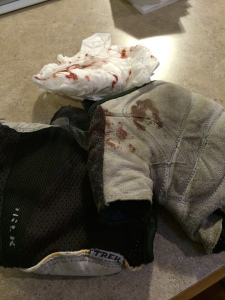
Evidence of recent events includes a pair of blood-soaked gloves and tissue. Evidence of recent events includes a pair of blood-soaked gloves and tissue.

Having not hidden much of my life while writing this blog, which now totals more than 500 entries, this is probably not the time to start hiding things now. So I will immediately confess that I did what seems like an impossibly stupid thing last night. I crashed straight into a large tree that had fallen across the bike trail.

That sequence of words is exactly how it should be stated. The tree had only recently fallen across the trail. A large storm passed through yesterday afternoon south of where I live. At 12 miles into a 25 mile ride I chose to cut west on the Virgil Gilman Trail, a well-maintained route that stretches four miles from downtown Aurora to Bliss Woods, a beautiful forest preserve with lots of birds and trees and plants…

View original post 2,141 more words

Posted in Uncategorized | 2 Comments

You really can judge a book by its cover, also known as keep your eyes on the trail or you’ll crash

By Christopher Cudworth

Evidence of recent events includes a pair of blood-soaked gloves and tissue.

Evidence of recent events includes a pair of blood-soaked gloves and tissue.

Having not hidden much of my life while writing this blog, which now totals more than 500 entries, this is probably not the time to start hiding things now. So I will immediately confess that I did what seems like an impossibly stupid thing last night. I crashed straight into a large tree that had fallen across the bike trail.

That sequence of words is exactly how it should be stated. The tree had only recently fallen across the trail. A large storm passed through yesterday afternoon south of where I live. At 12 miles into a 25 mile ride I chose to cut west on the Virgil Gilman Trail, a well-maintained route that stretches four miles from downtown Aurora to Bliss Woods, a beautiful forest preserve with lots of birds and trees and plants to enjoy.

I wasn’t exactly trying to kill it on the bike last night. But my fitness is good so I was pedaling at a high cadence on the trail at a speed of 18-20 mph. I know that because I had just glanced down to look at my pace and distance and got distracted by a creative concept that was running through my head.

I’d been careful so far on the trail because there were lots of families walking on the trail so I was careful to slow and swing around the kids toddling along and moms pushing strollers. Once you’re out of the family zone the trail opens up and there are very few people, just other cyclists and joggers as you head west toward the preserve. That is where my mind started to wander.

Again I’m not in the habit of riding with my head down very long. I’ve ridden 25,000 miles the last 10 years and have had exactly one crash. That was caused by bike wobble on a long section of downhill in Wisconsin. I escaped with only a broken collarbone. To this day I am thankful for the ability to steer my wobbling bike off the road and into the grassy ditch. Even there I was fortunate not to strike a wire cable with my head or neck. Talk about lucky. Or smart. I prefer to think the two combine well.

But sometimes I admit I am wont to immerse myself in thought while on the bike.

Last night I was thinking about a specific topic which was to conceive the right design and image for a book I’ve written about helping my wife through cancer. The book is now complete. It is titled The Right Kind of Pride: Character. Caregiving. Community. It’s about caregiving through 8 years of ovarian cancer treatment for my wife Linda, who passed away in March 2013. Pretty soon it will be available through Amazon.com where I’ve published an e-Book of my short stories titled Not Far To Fall.

You’ll see in a moment how ironic that title can be. Each of those stories is about people caught up in circumstances that they would rather have avoided, and how they respond.

Deep in thought

See life really does imitate art in a number of ways. I was thinking about the cover design for my new book and running a set of images through my mind. A cover can make a big impression on people if you design it correctly. I have a background in creative concepts, design and marketing as well as being a writer.

So the subject had my brain occupied. My head was down as I pedaled along. Like I said, I had just checked my speed and trip time, so I don’t know how long I was thinking and not looking ahead. It must have been 8-10 seconds. Suddenly something appeared in the upper periphery of my vision and my mind woke up just in time to react to the tree lying on the trail. I pulled the bike sideways and crashed into the limbs at hip height. Which hurt. A lot.

Did this tree fall just before I got to this point? It sure seemed like it. I struck it at the hip and with my chin.

Did this tree fall just before I got to this point? It sure seemed like it. I struck it at the hip and with my chin.

It was a pretty solid tree. The trunk was about 10 inches across and the branches not much thinner at the point where I struck them with my bike and then my body.

Miraculously the bike was fine. My reaction turned the wheel so that it didn’t collapse. All that happened was a minor “adjustment” to the handlebar. They were pushed to a 45 degree angle and the one brake hood was tipped in. Other than that, the bike was fine.

I stood there bent over that tree groaning for about 30 seconds. My lower back was convulsed from the impact and my chin was feeling a bit sketchy too. Those were the two points of impact.

Pulling the bike free from the shattered limbs, I stood there feeling like a broken scarecrow for a minute. At that moment a couple rode up on their bikes and asked if I was okay. They must have wondered how on earth a cyclist could smash into a downed tree in plain sight. I did not try to explain. Thinking about a book cover is a pretty odd explanation for a bike crash.

Obstacles and stumbling blocks

I’ve had plenty of opportunity in life to crash into things in the past, and largely managed to avoid them. Sometimes cars seem to crop up on the streets when you’re least expecting them. I’ve hit nudged one of those before. But managed to miss quite a few more.

Tarsnakes wait to take you down.

Tarsnakes wait to take you down.

Then there are tarsnakes on hot summer days to grab your tires and make you flip if you’re not careful. I’ve stayed upright through all of those, too.

I can’t make excuses for taking my eye off the trail last night. It’s one of those things that happens sooner or later to us contemplative types. Lost in thought, they call it. Well, the tree found me for myself. One of life’s very real stumbling blocks reached out and made itself known. And yes, I was wearing my bike helmet. What I forgot to wear is that Star Wars gear mountain bike riders prefer when crashing through the woods. But I was not expecting the woods to come and get me.

Triage

The wound required four stitches.

The wound required four stitches.

The couple that found me offered to walk with me a bit and get my bearings. Fortunately my head was clear. My stomach was a little woozy. And how ironic it was that my crash site was about a mile before the spot where my companion went down in a sliding wreck last July when the trail was wet from rain and plant debris caused her front wheel to skid out. Later in the evening when I finally talked with her, she suggested we avoid that trail altogether from now on. “It’s cursed,” I think she said.

There were practical considerations to address in the minutes following the crash. “Your chin’s bleeding pretty badly,” the woman told me. “And you might be in a little bit of shock.” Meanwhile gentleman with a Felt bike (must be a good guy, I ride a Felt too) suggested “You should still walk around a little bit.”

“Yeah, I feel like barfing,” I laughed. Adrenaline. Can’t live with it. Can’t live without. Fight or flight. Might makes right.

So for the moment it was enough to get off the trail and start pedaling toward the house of some friends about three miles away. I felt fine on the bike and it was working properly so I pedaled along at 12 miles and hour and focused on getting to some help.

Collateral damage

While stopped at a traffic light I pulled out my iPhone to call ahead and ask if they were home. The phone seemed to be working. It was lit up and the Contacts list showed up. But when I tapped the number to dial it just sat there. It could not make calls. Or send or take texts.

Somehow the case survived but the iPhone in the hip pocket of my kit got smunched. The doctor said it probably saved me some pain.

Somehow the case survived but the iPhone in the hip pocket of my kit got smunched. The doctor said it probably saved me some pain. The phone is bent, and now retired.

I pulled the phone out of its protective case and looked at it. The iPhone was literally bent in the middle. I know. That seems impossible. The case was fine but the phone was most definitely dented. I put it back in the case and rode on toward my rescuers.

They were not that surprised to see me a little banged up. We’ve known each other for 30+ years and all my running and riding has provided plenty of adventures over time. One of them drove me home with an offer to take me to the hospital but I declined because I knew it would take a while to be seen and it would get late.

Repairs

My lower back too a beating from an 8" tree limb. But at least there were no broken bones or ribs.

My lower back too a beating from an 8″ tree limb. But at least there were no broken bones or ribs. Don’t worry, that’s my lower back and not my ass. It’s so swollen you can’t tell.

In the car on the way home I felt something odd on my chin for the first time. Dabbing at the trail of blood coming down my chin I could feel a pretty big slab of skin hanging loose. Stitches, I thought to myself. I’m going to need stitches. My back also hurt pretty bad. There were big contusions and swelling had already started. But I could walk. That’s all that counts.

Sure enough, the Urgent Care doctor sewed me up after a good, stinging batch of numbing medicine on the chin. Getting the stitches in didn’t hurt. That always amazes me how fast you can get numb when they want you to feel no pain.

I’ve had more than a few numbing experiences in my lifestime. Over the years I’ve had a tooth stuffed back into my head from a baseball injury. Gotten stitches in my noggin from being pushed into a cement ditch during a pickup football game. Had a laser coterize my retina from a small detachment. Had ribs broken in adult soccer. Tore an ACL in that sport too. Then tore it again playing soccer two years later.

In 2012 I busted a collarbone when my bike wobbled going 40mph down a hill in Wisconsin. Then last fall there was surgery on my hand when a sliver caused a potential bone infection in my knuckle. That sliver cost me about $2000 in deductible payments. The entire pricetag was $25K. All because of a tiny sliver in my middle finger. F That, I say.

Life is freaking random, people.  Better get used to it.

Some accidents are your own fault. Others just seem to come out of the blue. In either case I’ve always believed there’s some kind of cosmic message being driven home by sudden trauma. This time it was simple. Pay attention, dummy.

History

This is pretty much how I looked from age 7 through age 11.

This is pretty much how I looked from age 7 through age 11.

Thinking back even further, to episodes long ago when I was still very much a kid in elementary school, my history of bashing into things is rather colorful. Pretty much every other week my poor mother would have to come to school at the request of the nurse because I was constantly running into the swing set while chasing down a kickball or baseball to prevent someone from getting a home run. My intensely focused competitive streak resulted in an absentmindedness of a sort. Call it the price of early drive and creativity. My mind was not always where it should be. And so it goes.

Truth be told, after a while my mother simply quit coming to check on me at school. She knew I had a hard head and the goose egg would go down given time and a little ice.

Perhaps there was a concussion of two thrown in there, but most likely not. The nurse would give me an ice pack to carry to class and I’d sit there with a cartoon-egg bump forming on my forehead. It was hard to concentrate on schoolwork between the pain and the dripping ice pack and the giggling stares of other kids trying not to laugh at me lest they get in trouble in class. I was quite the package alright.

Sharing the pain

I always felt really guilty when my athletic antics caused pain to other kids on the playground. I was the product of a highly competitive family and growing in a family of four brothers taught me to play sports all out, all the time. Not every kid on the playground could handle that level of intensity. I could throw a ball so hard some kids could not catch it. As a result a throw I made to second base from the catcher position struck a kid in the eye socket and detached his entire retina. His eye was still red from the trauma a year later. Another kid named Jimmy got in the way of my efforts to catch a fly ball during a game of 500 and bit clear through his tongue. He never had it fixed and could poke a pencil through it. That was really gross.

So I’ve gotten it from both ends of the attention spectrum.

And I’m rather proud of that actually. There’s really no reason to be embarrassed about kicking your own ass or busting up your own head once in a while. It means you’re alive. And thinking.

But if you’re going to judge this person by his cover, you’ll have to look a little deeper first. To find the scars. The bumps. The bruises. And the will to keep on going despite all that.

WeRunandRideLogo


Posted in Christopher Cudworth, Tarsnakes, We Run and Ride Every Day | Tagged , , , , , , , , | 4 Comments

The worldwide and very local geometry of a running track

We each bring individuality to the track.

We each bring individuality to the track.

By Christopher Cudworth

The standard running track all around the world is 400 meters in length on the inside lane. But that just begins to tell the story of what a track is all about.

Those of us who grew up running on cinder tracks came to appreciate that every track surface was different. Some were hard and flat. Others were cinder, deep and uneven. When rain fell, puddles would gather on the low points, and especially around the turns. On the inside lane where everyone tried to run, water would form an imperfect groove and cinders would fly up in your face from the heels of runners in front of you.


We push our very organic forms around the geometry of a track as if your very lives depended on it.

We push our very organic forms around the geometry of a track as if your very lives depended on it.

The process of getting a track ready for competition back then was part art and part science. Think about it: the lines on a track had to be manually applied using lime. But first the track surface had to be raked and then rolled. That way every lane was considered fair and equal to those running, and in a multitude of events from distance runners that was no easy feat to get a track fit for competition.

How ironic it was that the order of track events began with the two mile in high school, and the 4 X 800 relay as well. Those two events alone would chew up the track for all the other runners that followed.


But that’s track. You deal with it.

IMG_8609

Our lives intersect with a surface that we rarely consider close up. Yet it has much to tell us about the infinite variety of the world.

These days the surfaces are all-weather. There’s no need for elaborate preparation and protection of the surface before a competition. You just step out and run.  At times you must pay attention to the finely painted lines on the black or red or blue rubberized surface. Exchange zones. Start and finish lines.

Sometimes those colors intersect in a colorful geometry that only means something to those who run. Yet there are times we hardly pay attention to these zones and transitions. Instead we pave the way ahead with our own desires and expectations. Ignore all that geometrical gobbledy gook. Just run.


Numbers and words dictate where events start and finish. The track is both a finite and

Runners commit to intervals long and short on the track.

Runners commit to intervals long and short on the track.

infinite world where your reality is defined by your purpose in being there. Short sprints. Long intervals. Mile repeats. Races.

As we study a track it becomes obvious there is a language exclusive to that world. It is spoken in symbols and directions that are designed to be universal. Yet each and every track has its own dialect the world over. No surface is precisely the same and even the most accurate form of measurement cannot confine the distances you run around a track to an exact 400 meters, or 800, or a mile. By the time you race 10,000 meters you may have run 10,200 meters if you stay out in the second lane to avoid colliding with other runners.

So think about it: to set a world record on a track conditions must be ideal. But know that they will never be perfect. There is

Hurdles are not a static height between events. Each race and gender has its own level.

Hurdles are not a static height between events. Each race and gender has its own level.

no such thing as perfection in running. Every footplant varies slightly. Every stride wavers off center to some degree. Our very earthy bodies long to be free of the earth in fact.

Yet gravity pulls us back down. With hurdlers that relationship is profoundly defined by the height and distance between each barrier. Some runners do 13 strides between hurdles in the 400M intermediates while others do 15. Male runners jump higher barriers than do female runners. Only the need to get over the hurdle is the same. But that

The goal of hurdling is never to fall. But that's for starters. The real goal is toe move over them as fast as you can.

The goal of hurdling is never to fall. But that’s for starters. The real goal is toe move over them as fast as you can.

denominator is held in perpendicular relation to gravity. Horizontal speed versus vertical height. In all events that is what adds dimension to the world of track and field.

When you show up at a track all these numbers and textures and heights may not be on your mind. All you care about is speed and how much you can manage to muster in a given workout or race. You calculate for wind not knowing its true effect on your net times in interval training. Then there is heat, humidity and the pliability of the track surface itself. On hot days it will be mushier than during cool temperatures. It all figures into the final result of your effort.

Slower. Or faster. You are an organic form moving around so much inorganic material.

But look closer. The track is actually a living thing as well. The grass that flew from the mower on the infield yesterday is strewn across the surface in abstract patterns. If you turned that into a painting it could hang in a gallery or a museum.

Suddenly realize everything around you and within you is alive. Your footfalls make sound. Your breathing has a rhythm and pattern similar to the songs of birds in the trees. Even your sweat seems to sing as it flies off your forehead.


The track has many dimensions that we often do not perceive.

The track has many dimensions that we often do not perceive.

Around the first curve there is water gathered from a storm the night before. You have little choice but to run around its arc and complete your laps with a few extra meters of effort. You see your own reflection as you skirt the puddle and it makes you think of all the other times you have run around this oval, or others like it. You have a relationship with the track. It may be a love/hate relationship, but you have it nonetheless.

It’s not a very forgiving place, the track. But if you respect its geometry and its circumference and all the conditions it suffers; through wind and rain and sun and even snow, the track can be your friend. It might be a painful relationship at times, but it can also be rewarding. Because when you have forged a relationship with a track it actually begins to give back what it takes from you initially. You can feel your fitness grow. Your body becomes stronger. Those raggedy weeds along the edge of the track look like so many cheering fans as you whip by on one last interval before calling it quits for another week.

It is a place where character is built and races are won. It both welcomes and challenges you. It is the geometry of distance and of soul. Every angle of your

Way you run and FINISH well next time you visit the track of your choice around the world.

Way you run and FINISH well next time you visit the track of your choice around the world.

being counts in this finite and infinite world. You are a runner. On a track. And you are trying to become better at the former while negotiating with the latter. So much like the rest of the world.

WeRunandRideLogo

Posted in Christopher Cudworth, We Run and Ride Every Day | Tagged , , , , , , , , | Leave a comment

O Brothers Where Art Thou?

By Christopher Cudworth

This 1980s photo shows the Cudworth boys with the father and my son.

This 1980s photo shows the Cudworth boys with the father and my son.

I’ve had a long athletic career thanks to a family of four brothers who all played sports. The eldest was a driven player of soccer, basketball, baseball and track and field. In the 1960s as a freshman in high school he ran a 4:40 mile. You still don’t see many young track stars going that fast at 14 years old.

My next eldest brother has had the more artful career in sports. He was a masterful goalie in soccer back east in Pennsylvania, played basketball and baseball and actually wound up running cross country and track at the little school in the corn where our family moved going into his senior year in high school. That sucked because he was poised to star on the teams back east and starting over at a new school is never easy. They didn’t even have soccer or baseball because the athletic director wanted his track teams to excel. Talk about harsh fate.

My youngest brother grew to be bigger than all of us. At 6’6″ with a vertical leap of 36″ he helped lead a talented basketball team to Super Sectionals his junior year. But not before he was urged to go out for cross country as a freshman. That was painful as he was growing so fast his knees could not take all that running. Still it built character and he earned All State Honorable Mention as a basketball player and went on to a scholarship at a Division I school.

My sports career began and baseball with a team sponsored by a union back in Lancaster, Pennsylvania. We won the prestigious Lancaster New Era tournament and I pitched four innings to close out a win in the second game.

When we moved out to Illinois there was still summer baseball to be played but no soccer in fall or baseball in spring at the high school. And despite winning the local Punt Pass and Kick and advancing to regionals with a good arm for football and a decent kicking leg, my father wisely discouraged me from enrolling in football. He likely saved my life.

Growing up with such a sports-oriented family was fun. We spent entire afternoons playing wiffleball and Glo-Ball as we adopted a brand of rubbery plastic balls to play home run derby. Those Glo-Balls were even used in massive neighborhood pickup games with 18 players, gloves and everything.

The Cudworth boys drove a lot of games of all types. Constantly on the run, we’d round up kids to play soccer or baseball or basketball. There was a sweet hoops court just two yards away at the home of a friend where we’d play for hours at a time. The guy who lived there was an average basketball player, but he went on to run a 4:04 mile for Penn State. I can recall his training runs in the company of a barking hound dog. They’d take off across the golf course for 5-10 miles with the dog barking the whole way. You could hear the noise of that dog off in the woods a mile away.

As a family we were fiercely competitive all the time. Many of our games resulted in angry fights over who won, but that was part of the process of forging the competitive resolve necessary to play team sports in the world at large.

When we couldn’t get outdoors we played indoor sports such as table tennis for hours at a time. This was not sandpaper paddles or cheesy implements. We bought good paddles and Halex table tennis balls and really played. My brothers won city and school table tennis tournaments and I wound up in the finals at Luther College against an athlete who became a Hall of Famer in tennis.

Our father was a latent athlete who never got to play many sports growing up. His mother died from complications related to breast cancer when he was seven years old and his aunts and uncle thought it better for him to work on the farm than to mess around with all that sports stuff. It was the Depression and the 1930s anyway.

So he had an urgent and somewhat vicarious interest in our success. Often he’d stand on the sidelines watching his anxious sons on the pitching mound and holler “Stay Loose!” which was well-intended but often had the precise opposite effect. He could be a hard man sometimes, prone to angry outbursts when we failed him in some perceived way. So relaxing at his command was not exactly instinctual.

Much of our sporting interest I am now convinced was our way of pulsing away the energy of our father’s forceful personality. It was our escape in some ways to a world where play meant everything. The fact of the matter is that not everything in sports transfers to the sober world of business and survival. There is a certain fantasy to sports. My brothers and I all prioritized and planned our respective careers around the idea that sports might somehow advance our prospects in the world. It did earn my younger brother a full college education and I attended a school a bit better than my average grades in high school thanks to my running. So it wasn’t all fantasy.

On the other end of the spectrum we were all interested in the arts as well. My eldest brother taught English for 30 years. My next eldest brother majored in art and created amazing sculptures out of paper that looked like metal. They sold for thousands of dollars. I majored in Art and English and have sold 1500 paintings and published more than 5000 articles in print and online. My youngest brother is a painter and outdoorsman.

In fact we all love nature. But we were also competitive in our birdwatching. With one set of binoculars we’d head out together on May mornings to count more than 20 species of warblers in the trees. Then we’d sneak away with binoculars again the next few mornings to pick up species not seen on our group venture. That’s how we rolled. Everything was a competition.

So by the time I was a freshman entering high school the idea of competing in cross country was not a daunting prospect. I ran varsity that first year and led the team in points as a sophomore. Then we moved to a nearby town and I led that team to its first ever District championship. The coach once said “He’s not afraid to compete with anyone.” But that was not precisely true.

I wasn’t a supreme talent. When a newspaper called me a “junior sensation” because I’d won a string of meets the timing could not have been worse. The very next meet was a race against a runner from a nearby town who was a full minute faster than me at three miles. We stood together on the line and he snarled, “Junior sensation my ass…” and he proceeded to bury me on the course.

But I was used to that kind of treatment because of my brothers, who put me in my place many times before that. I loved to compete but also respected that sooner or later you’ll run into someone stronger and faster than you. Even the most indomitable athletes meet their match sooner or later.

So the pecking order has its purpose. It’s been said that our siblings raise us more than our parents. That certainly held true to a great extent with me and my brothers.

What I really miss being largely far apart from them is the humor we shared about all of that. Our careers in sports brought many good memories and also a number of laughs. In one Saturday pickup game at a local gym one of my brothers was on the same team. We were fit and running the court pretty well when a turning point came in the game. I knew it was important to win a possession to hold the court and went sprinting for a loose ball. Tapping it with one hand away from an opponent, I desperately tried to keep from falling. That meant running a huge circle with my body angled at 30 degrees while still running. Coming out of the curve I headed up court to get the ball on a pass and make a layup. My brother stood laughing and branded that play ‘Doing the Dolphin.’

It’s been truly rare that we all got to play basketball together. Our ages and locations have simply been too spread out to manage all that. But one afternoon we were shooting around a school court when some younger men rolled up with a ball and challenged us. “Want to play for the court?” they asked. There was more than a hint of assumption they would kick our ass.

And you just don’t do that to the Cudworth boys. We can all shoot the eyes out of the basket and our youngest brother was still smashing home towering dunks at the time. We looked old by some standards but we played 10 or 15 years younger. And we buried those punks. Totally. By the time it was 9-1 and we were playing to 15 one of them finally muttered. “Holy crap.”

O Brothers, Where Art Thou? The years have piled on like a game of football in the back yard when someone grabs the ball and everyone sets loose to tackle them. Everything’s a jumble when you go down. Arms and legs and hot breath and people laughing at how massively crunched you really got with that last tackle. Then you all disassemble and someone else takes the ball and starts running.

We all still keep active. My eldest brother cycles in the hills of eastern Pennsylvania. My next eldest still plays table tennis and once in a while executes a few fencing moves because he became pretty good at that for a while. My younger brother played basketball until his ankles told him to stop. All that height and jumping ability takes a toll over the years. But none of us has turned out to be a slob.

That’s life in a nutshell. And it proves that sports really do matter. It’s not just a fantasy after all. The seams. The throws. The perfect arc of a Sunday golf shot or a spinning basketball softly passing through the net. And the call of a brother or father saying, “Wanna play catch?”

I recall a day when my oldest brother and I were walking through a local woods about a mile from our house. We’d been birdwatching and needed to get home for dinner so we headed out across a stubble corn field as a shortcut. He turned to me and asked, “Are you in shape?”

I’d just finished the first season of college cross country and was home for break so I replied, “Yeah, I think I’m still in shape.”

“Then let’s race,” he told me.

We took off through the corn. Sharp stalks tore at my shins as my brother pulled ahead. He was 6′ 3″ and strong, but he sure could run. And run he did. I was left gasping and mincing through the corn as he triumphantly sprinted ahead. It was a lesson to be learned. Even when you think you’re something special, maybe you’re not.

That’s the tarsnake of it all, and the ultimate lesson learned from a lifetime of sports in a family of athletes. Even when you think you’re great, you’re gonna get your ass kicked now and then.

WeRunandRideLogo

Posted in Christopher Cudworth, Tarsnakes, We Run and Ride Every Day | Tagged , , , , , , , , , , | Leave a comment

Running and riding through a guilty conscience

You probably have not thought much about it lately, but guilt is one of the most powerful emotions on earth.

We don’t really like to think about guilt. It feels naughty and dark.

Yet it follows us around like a shadow. You can run and ride for thousands of miles and never outpace your guilt.

And what’s worse is that your running and riding can actually make you feel guilty.

You become like a dog chasing its own tail. Round and round you go.

Instead it pays to recognize the sources of guilt in your life.

Guilt comes from regrets about things you’ve done and left undone.

Guilt comes from not achieving your goals.

Guilt comes from relationships challenged by circumstance, bitter feelings or unresolved issues.

Guilt stems from hurt you’ve done to others.

Guilt even roils up when you’ve got it good and witness the plight of others.

Then there’s religious guilt passed along by the notion of original sin, which basically states that no matter how much you confess to your sinfulness, you were born a sinner and will be a sinner until the day you die. Even grace does not absolve you of that. Confession and absolution get handed to you by a priest or a service. You move on. But guilt follows you around.

Snow globe of guilt

So we live in this giant snow globe of guilt where it is perpetually falling from the sky even when you take it upon yourself to work through guilt issues in an effort to find mental health.

And as if all that were not bad enough, you feel guilty that you cut short that last workout to get home in time to fix dinner or get to bed at a reasonable hour. Your mind starts to imagine a superior motive and talent among everyone else in your sphere of friends and enemies. They work out more than you. They just set a PR. You feel guilt and at the same time ache for revenge.

Ahh, guilt. It runs in our veins. It rides our conscience. We push and push to remove it through effort and achievement. Still there’s that nagging feeling…

So how do you get over guilt, or get through it?

Be patient with yourself

It’s a process, not a one-time event. Because when you get over one type of guilt, another one just as easily comes along. So it’s not just one process, but many avenues of guilt that we must navigate to stay on a straight course in life.

We’ve already put our finger on the key issue with guilt. That is, it can come from many sources, and the fact that it can be so difficult to parse makes it difficult at times to identify its source.

Personal affairs

For example, a work associate once embarked on an illicit sexual affair with another woman in the office. At the start their excitement at having sex outside their own marriages drove their behavior and everything seemed so fun and alluring.

Then guilt set in. He turned to me in a moment and panic and asked what to do.

I explained it in these terms. “It’s like using a road map. Marriage is the straight road and that can seem boring. But when you started your affair all roads became possible. Now you feel lost and guilty for that. It’s like you don’t know where to turn next.”

That made sense to him. He ended the affair, went back to his wife and made me swear on a stack of bibles I would never breathe a word about his dalliances.

Moving on

Lesson learned.

But guilt is a persistent opponent. It can be at once a controlling force and a confusion of the mind. It stems from your sense of right and wrong and grows into a cancer of the conscience.

It helps to understand the difference between constructive forms of guilt, the kind that helps keep us on the narrow road, versus destructive forms of guilt that push us to feel inadequate or lacking in some way.

Constructive guilt helps us avoid harmful behavior. That is, guilt serves like a filter on our desires which so easily run out of control.

Destructive guilt is a form of neurosis. It forms from worry or anxiety over the scope and degree to which we engage in even healthy behaviors.

Running into guilt

So you can see how guilt related to running and riding can get so complex. We engage in healthy activities and that is good. But those activities can become unhealthy when we indulge ourselves to the point where other activities or relationships in our lives begin to suffer.

If you drew a line with healthy guilt on one end and unhealthy guilt on the other end, you can typically measure where you fall by asking yourself one simple question. “Am I feeling guilt because I failed somehow or because I fear to fail somehow?”

In either case the best response is to forgive yourself or ask forgiveness if you’ve harmed someone, somehow. Then take stock of what you’re doing and write down the emotions that go with your guilt.

Often you’ll find the answer to your guilt in that range of emotions. It works almost every time. Then you can get back on the road with a clear conscience and a clear road ahead.

WeRunandRideLogo

Posted in Christopher Cudworth, Tarsnakes, We Run and Ride Every Day | Tagged , | 1 Comment