Breakfast by bike at Daddio’s

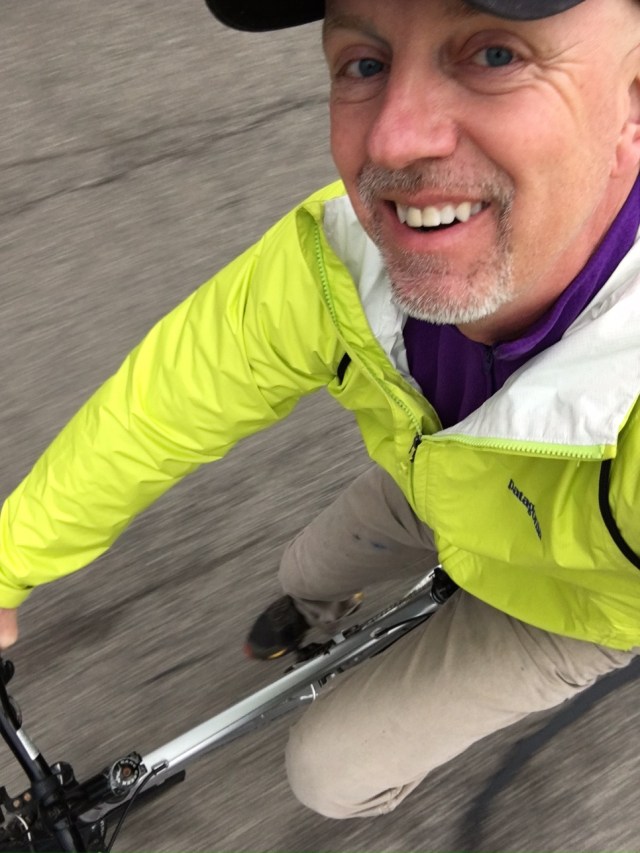
Me on SpecializedYesterday I used up the last of the milk in the gallon jug from Trader Joes. Never got by the grocery store with business things to do, and woke up this morning knowing there was no moo-moo for the cereal.

It has been warm the last few days. This morning the air smelled fresh and wormy. The earth is emitting its spring smells, and that is one of my favorite things in the world.

All was moist, but it wasn’t going to rain, so I decided to jump on the Specialized Rockhopper and pedal down to the Walgreen’s store in downtown Batavia. It’s only a mile away.
SpecializedSo that was like my morning commute. Because I work a combination of places during the day. Sometimes with tight deadlines, I jump right into writing at the desk set up on the north side of my living room. From there I have views out huge windows in front and back of the house. My bird feeders are out the back window. Or should I say squirrel feeders. Who cares? I like the critters.

On days when my girlfriend needs rides to the train, I drop her off and hit one of the Starbucks in downtown Geneva and St. Charles. There’s also one near my health club, so when I swim or lift from there, that’s a good place to stage before or after. All have their attributes. Some have favorite tables. Others have nice views. But all have good, fast Wi-Fi, and no hassles about it. And to the credit of the Starbucks franchise, all their people are always pleasant and well-trained. I say that without exception. It was true over in London too.

Me with ConeBut this morning my obligations were a bit lighter, so I pedaled my bike downtown and arrived to find the Walgreen’s store closed. Too early, it was.

So I looked next door at Daddio’s. It’s a diner right with all the Right Stuff. The decor is Americana from the 50s and 60s and 70s. Rock album covers. Kitschy Disney and Looney Toons characters. All authentic stuff, including this giant foam fake ice cream cone. Fake is real cool.

At Daddio’s they make a wicked good breakfast. And dinner too. I don’t care what you order. It’s good. The people who run the place are so down to earth and real it makes you want to cry. On some days, the place is hopping and there is a wait for tables. But you know these are local business people who make their living serving great food to others. And it’s worth the wait.

So it was only ten to 7:00 a.m., and I still did not have milk to take home and have cereal. I’d made an omelette for dinner two nights ago and my body has a limit on omelettes per week. Then it hit me that Sue would be heading home from swim at the Marmion pool. So I called her and sure enough, she was in the car coming through downtown Batavia. So I talked her into joining me. And we had a delicious little breakfast together. Just like real life. Only better.

Her hair was wet from swimming. When it starts to dry, she gets these two curls that hang down on her forehead. I really like those curls, because they’re her, without adornment. She muttered as she drank her coffee. “It’s funny. I can go swim and still not be totally Mountain bikeawake. I’m just now waking up with this coffee.” And it was true. She was coming out of that early morning fog that only athletes now how to operate within.

I know the feeling, because I’ve ridden 10 miles into a bike ride and not had a sentient thought go through my brain. I’ve even run four or five miles before popping awake and joining the conversation. And I’m a morning person! But you still need the time to become fully functional.

Breakfast by bike at Daddio’s was fun. Now that the seasons are changing, I also will commute by bike to my gallery at Water Street Studios. My carbon footprint is relatively low other than the electricity used to run this Mac.

I am fueled by dark chocolate and ideas. Many of which I get while out on the bike, or on the run, or now in the pool. I can finally swim well enough to let my mind drift a little.

It would be wonderful if all of life worked like this. Maybe I’ll do that. Make it work.

LOVE LIFE. BE ORIGINAL.

WRARShirtGraphic


Posted in cycling, Uncategorized | Tagged , , , | 2 Comments

My girlfriend, the swim coach


IMG_1993

Sue (left) with her best swimming buddy and training partner Lida. Both of them completed Ironman Wisconsin this past fall. This photo is from MOWS, Madison Open Water Swim. 

There are a lot of things I love about my girlfriend Sue. We share a ton of interests. Even beyond the running, riding and swimming, we love the arts, live theater and watching John Oliver.


But there’s also a thing I admire about her specifically. She’s a very good swim coach. I’ve seen her in action. Working with swimmers takes focus and patience. Learning to swim, as I have done this past year, is a difficult endeavor. You start out so slow and out of breath. The stroke seems impossible to sustain.


IMG_2577

Sue with good friends and fellow Experience Triathlon members Jada and Suzi. 

Here’s the funny thing. She hasn’t been MY swim coach, per se. I decided that the best way to learn to swim was to get instruction from a gal at the club where I swim. Being the student of your bestie has its upsides, perhaps. But I did not want to explore the potential downsides.


Getting through the frustrations of learning or re-learning swimming (which was my case) requires a nudge now and then. It helps to have that objective voice to say “You can do this. Here, focus on this…”

As the process grew in my instruction with a coach named Whitney there came breakthroughs that I’d share and check with Sue. She put up with my overly enthusiastic musings about finishing a 100, then a 200. Then the workouts grew.

So it’s interesting to see her coach other athletes, and hear about their struggles and triumphs too. Many of her students I know at least casually. Some I get to know strictly from our conversations. Her descriptive abilities in relating how they got through a particularly difficult aspect of swimming actually help me learn as well.

But it’s her presence on the pool deck that I most admire. She has a wonderful ability to spot what needs to be fixed or improved in a swimmer’s stroke. Her ability to communicate these things has helped many a beginning swimmer gain confidence. She has also helped a number of serious triathletes improve their endurance and speed in the water.  She coaches for Experience Triathlon doing Swim 101, Masters Swimming and video analysis.

IMG_0924It makes me think back to that day in Governor Dodge State Park. It was early in our relationship. We were floating around in the water together, just swimming around like kids. She asked me to swim a little ways to show what I could do. “You’re not terrible,” she said, or something on that order. I found that encouraging.

Then she swam a bit on her own and I was mesmerized. She was like a seal in the water. It made me want to hug her. And I did. Our bodies bumped together under the water and we kissed. Then we both swam some more, enjoying the cool water after a long bike ride in the heat earlier that day.

The summer sun was on that angle where everything looks joyous and restful. There was no one left on the beach. Just us and the call of evening birds in the pines. We were learning how to swim together.

LOVE LIFE.

WRARShirtGraphic


Posted in swimming, Uncategorized | Tagged , , , | 2 Comments

The question of emotional intelligence

Having rightly been accused of lacking emotional intelligence at times, I took a quiz at Lifescript.com to see how I fared. The results were spot on.

Emotional Intelligence.jpg

As an athlete for many years, I recognize the value of emotional intelligence in both training and competition. And like many athletes, there have been times when my shortfalls in emotional intelligence have harmed me, while in other ways I’ve succeeded due to personality traits that include leadership, risk-taking and passion.

On many occasions in my work life, I’ve been told that people admire the ability to keep a cool head under pressure. “You’re unflappable,” a co-worker once said. At one point a company of 800 people chose me to be the lead public relations contact in an emergency management plan. That was all fine and good until I pointed out the fact that I lived an hour away from the main office. Then they went, “Oh yeah. Maybe that wouldn’t work.”

In sales, there were many moments where keeping a cool head was important to pitch or close a deal. While marketing my own paintings for a poster project in collaboration with a semi-pro baseball team, I first sold a law firm looking for regional exposure. Then I pitched an auto dealership. Their sign was on the left field wall and thus appeared in the painting, but I was asking $3500 in sponsorship for the poster project. I made my pitch and shut up. There’s a rule in sales that says the first one who talks, loses. So I sat. And sat. And I waited. Minutes went by. Then the client asked, “Where would my logo go, here on the bottom?” And that was that. Keep cool. Get the sale.

Emotional competition

There’s a certain amount of that “keep cool” vital in competition as well. Before the race, with competitors milling around, keeping a calm yet determined face is part of the psychology.

Swimmers often wind up sitting in the same room together before going out on the deck. That can be nerve-wracking. It takes confidence to win that quiet battle and go do your best.

Like all athletes, I have at times failed the emotional intelligence game in sports. Having confidence going into big events is key. If there’s a gap in your training or some other nagging fear grips you, the poison of doubt can creep in. And when faced with the challenge from competitors in that mindset, you either crack or resign yourself to a performance below that which you are capable. Been there. Done that.

By contrast, having the emotional intelligence to assess your true fitness and even to some degree deceive yourself through training, brings you into a state of relative fearlessness that can bring handsome rewards. That’s where the supposed control earned through emotional intelligence isn’t everything it’s cracked up to be. Athletes simply need to be risk takers at times. That’s not necessarily an emotionally healthy state of being. Athletes also need to be passionate, at times to the point of obsession. Those aren’t necessarily emotionally healthy periods in life. As the wrestling coach in the John Irving book Hotel New Hampshire once said, “You’ve got to get obsessed, and stay obsessed.”  Which is true, but that has nothing to do with emotional intelligence.

Because getting crazy dedicated can be a good way to achieve your goals. I don’t regret for one minute taking a year of two of my life to run as hard as I could and succeed. Not letting anyone stop you is a liberating feeling. Not letting your own fears stop you is just as important. But again, that’s not emotional intelligence at work.

Emotional justice

See, the difference here on emotional intelligence in athletes is learning to identify opportunities versus refusing to accept challenges. If you’re scared to do or try something, then it might feel emotionally intelligent not to take that risk. Why take the chance of blowing everything you’ve earned?

But then again, if you never speak up in a meeting because you don’t want to offend someone, or never speak up at all, that isn’t emotional intelligence either. That’s just fear.

Justice Clarence Thomas has spent years as a Supreme Court Justice and for a decade or so never said a thing or asked a question. That silence has raised the issue whether he is even qualified to serve in that role. Justice requires inquiry, after all. By contrast, Justice Antonin Scalia was an activist in his role, often barking out opinions and writing dismissive missives through his dissents. He believed passionately in originalism, the idea that only an interpretation of the Constitution as it was first written would produce justice. Was he intelligent, emotionally intelligent, or just an anachronistic asshole? Hard to tell.

Emotional leaders

We see similar breadths of difference in how athletes go about their work. The austere and seemingly aloof Frank Shorter competed against his rival Bill Rodgers, a goofy “people’s champion,” for years in the marathon. Probably Frank was the more emotionally intelligent competitor. Yet people loved Rodgers because his lack of emotional intelligence made him seem like the rest of us. People love the underdog. That’s why the movie Eddie the Eagle is so popular.

So this thing we call “emotional intelligence” is not some cut and dried formula for personal success. In fact, we have to be careful how much we ascribe to this aspect of personal brand. The world needs people willing to speak out against injustice. The world’s greatest figures in history all did that. Some did so with great emotional intelligence. Ghandi comes to mind. Martin Luther King, Jr., with his call for peaceful protest. There was some of the greatest emotional intelligence ever expressed. And Nelson Mandela. In the face of class and racial persecutions, these people showed enormous emotional intelligence.

Yet they did not shut up. Their voices were not silenced by fear. They were unpopular even to the point of incarceration and death.

Emotional inspiration

When you see a person cross the line in a triathlon, especially an Ironman, it is natural to admire their effort. It is also natural to question their sanity a bit. Some of us are willing to explore that world in order to know ourselves better. We’re willing to fight as well the temptation to quit when it makes all the sense in the world to do so.

We’re also willing to take that brand of determination and apply it to the world at large. You can be called a lot of things for doing so. A certain fellow named Jesus was branded a blasphemer for challenging the authorities of his day. They had their rules and they wanted to enforce them. They conservatively wanted to preserve order in the society they controlled. They did not want change. Yet they were pinnacles of what most people (present and past) would likely brand emotional intelligence.

Yet they were, in the end, quite wrong about the world.

Emotional zealots

There have been many other prophets in history, people willing to call forceful alliances to account, and to confront those determined to dictate the emotional intelligence of a community, a country, or the world. The paragon of corrupted emotional intelligence in history was none other than Adolf Hitler. Fascism is defined as “a form of radical authoritarian nationalism that came to prominence in early 20th-century Europe.” It worked because it appealed to the emotional side of the national personality. It essentially manipulated emotional intelligence into a singular motive using nationalistic fervor to replace normal moral standards. It made people turn away from their conscience in favor of worshipping the idea that they were a superior race, or people. It made people willing to support rampant anti-Semitism, and to torture and kill anyone deemed inferior. The Hitler movement made people willing to ignore that gas chambers were a crime against all humanity.

Emotional heroes

There’s a movie out right now about Jesse Owens, the athlete whose performance in the 1936 Olympics defied all of Hitler’s claims to racial superiority. There’s a supreme lesson in that. Unfortunately, it could not prevent World War. But that athletic performance stood in defiance against Hitler, and came to symbolize all the millions of people who would resist and give their lives to fighting the emotionally forceful man whose hatred drove his ideology.

But let’s be honest about something. That brand of emotional corruptions still exists in this world. Instead of emotional intelligence, it takes emotional courage, and risk of reputation self to stand up to the pillars of oligarchy, emotional manipulation and worship of wealth that seek to control and vex this world.

Emotional guts

I for one am willing to take that risk. I believe that’s what makes the Kingdom of God real here on earth. Too many Christians and the population at large refuse to recognize that connection. They’re more concerned with siding with leaders who seek to own and dictate the rules, as the Pharisees tried to do against Jesus, than they are with genuine moral and civil justice in this world.

We see it every day in people whose money is more important to them than the well-being of the world and its people. They bark: “Don’t use my tax dollars for the poor! All they want is handouts.” And from a strictly material perspective, this manner of thinking is understandable. People whose livelihoods are hard-earned often do not feel the call to extend mercy to others. They attribute their own success as a sign of equality for everyone, even when that equality, through prejudice or through expression of law, clearly does not exist.

The values of equality, liberty and opportunity are built into the United States Constitution. These are human values, however, not dictated by any particular faith. Nor does one need to have a particular faith to abide by them. That is the true emotional intelligence of the American proposition. It has a moral but not a strictly religious foundation. Too few Americans get that. Too many ascribe the emotional intelligence of the American proposition to Christianity, or to the free market, to capitalism or the NFL, for God’s Sake. They confuse their interests with their country.

Emotional concerns

The ultimate form of emotional intelligence and the foundation of the American proposition is to care, and to care about equality. In spite of yourself or your position in this world, you must continue to care about the welfare of others. Even those who are seemingly far different from you. Care. Even your enemies or competitors. Care. Often they turn out, upon full inspection or dissolution of differences, to be your ultimate allies.

In athletics, be coachable but ask to know the reasons why you’re being told to do something. If it doesn’t feel right, there may be a reason. Sometimes it takes emotional intelligence not to go along with the extremes of absorption the world can present. Always be willing to try, and take risks. But also be willing to question, and justify.

But most of all, don’t turn away. Care enough to engage.

Do yourself a favor today and visit a site called biblegateway.com. Enter the word “turned away” into the search category and see the many results you will get. Study them all, and you’ll come to realize that caring is the true call for all the human race.

But we’ll close today’s blog with a famous passage from Mark 10. It shows how difficult it can be to relinquish your supposed “emotional intelligence,” and all your material success and the position that goes with it, through the call to care. This lone passage explains almost everything wrong with America today. And it’s true whether you are religious or not.

The Rich and the Kingdom of God

17 As Jesus started on his way, a man ran up to him and fell on his knees before him. “Good teacher,” he asked, “what must I do to inherit eternal life?”

18 “Why do you call me good?” Jesus answered. “No one is good—except God alone. 19 You know the commandments: ‘You shall not murder, you shall not commit adultery, you shall not steal, you shall not give false testimony, you shall not defraud, honor your father and mother.’[d]”

20 “Teacher,” he declared, “all these I have kept since I was a boy.”

21 Jesus looked at him and loved him. “One thing you lack,” he said. “Go, sell everything you have and give to the poor, and you will have treasure in heaven. Then come, follow me.”

22 At this the man’s face fell. He went away sad, because he had great wealth.

23 Jesus looked around and said to his disciples, “How hard it is for the rich to enter the kingdom of God!”


SEEK JUSTICE
WRARShirtGraphic

Posted in Uncategorized | Tagged , , , , | 3 Comments

11 triathlon “things” we all know about

It’s a bit of a lifestyle, this triathlon “thing.” And even though I can’t call myself a true triathTRI SWIMMERlete yet (…yet) I’ve done some duathlons and added the swimming to the point that my first Sprint is under my belt.

Because it’s really all about the training most of the time. Triathlon also requires a lot of transitions. From work clothes to workout clothes and back again. So here are 11 triathlon “things” that one discovers along the way.

  1. The smell of chlorine while you’re eating. It happens. Even if you whip through the shower after a swim session, the chlorine often hugs your skin. And while you’re downing a bowl of raspberries and strawberries, that rich smell of chlorine finds your nose again.
  2. That weird feeling of driving a car after you’ve biked 80 miles. It’s. So. Easy. People who don’t ride bikes long distances take driving a car for granted. Once you’ve begun the real training miles, the car feels like cheating to get somewhere.
  3. Those bags of equipment in your trunk or SUV. Your gear makes a rotating journey in and out of your vehicle. And there’s nothing like the feel of a freezingly damp swimsuit left in a vehicle overnight and you need to wear it for your next swim session. Talk about a cold dose of reality.
  4. Your collections of things to rub on your body. From chamois lube to sunscreen, wetsuit glide to good old body lotion, the triathlon world is one long effort to keep skin lubricated, safe and unblistered.
  5. That cabinet with all your fuel junk. Every triathlete eventually turns over an entire cupboard in their kitchen or somewhere in the house to house all the necessary Clif Bars, NUUN tablets or fuel packs of choice. Don’t worry, it’s a necessary practice of hoarding, not an indication of impending OCD.
  6. Water bottles out the yin-yang. You know it’s true. It’s matching the tops to the right bottle that matters. That really is an OCD thing at some point. So it’s best to accept that if the top fits, let it TRI GUY.jpgride. And don’t forget the collection
    of bottles left in your car. Those need to be washed. Pronto.
  7. So many bikes. If it’s not your bike that you’re piling into the back end of your car or lashing onto your vehicle, then it’s someone else’s bike as well. Bikes and bike and bikes and bikes. So many bikes. And though we try, we can’t ride them everywhere.
  8. Perpetual cycles of running shoes. Big training miles require big shoe transitions. You’re either wearing down your last pair or breaking in a new set. Most of us have more than one pair of shoes, and that’s a wise idea. Then there are the shoes we don’t quite get around to recycling or giving away. They hang around for gardening or trekking to Trader Joes. “Hello,” you say to those pairs of expatriated footwear lurking in the front hall closet. “I remember you. Let’s go run an errand.”
  9.  Your triathlon friends. Generally, these are a collection of happily flawed people trying to make the best of “things”… ranging from their competitive efforts to their personal relationships. Triathletes (like anyone) are prone to say or do some stupid things along the way. Relationships are a big part of this supposedly solo sport. And that means participating in triathlon often consists of a long string of apologies for whatever shortcomings you find out about yourself or others along the way. But in one of life’s contradictory truths, that only makes you a stronger, better person in the end.
  10. A social media feed of everything “tri.” Let’s admit it up front. Everyone in TRI TREATMENT.pngtriathlon wants “that body” with the sculpted abs, the perfect shoulders, legs of steel, perfect (blue/brown/green/gray) eyes and hair that looks like it fixes itself. Our social media feeds seem to suck that stuff up like a triathlon Black Hole. We only hope it emerges through us on the other side.
  11. A very intimate relationship with the bathroom. Taking care of “business” is one of the most important aspects of perpetual training. Getting that good dump to unload before a swim, a bike or a run is vital. And having to pee can be at least half as bad. So the toilet is a close friend, yet any toilet will do in a pinch. So to speak. Then there is the personal hygiene, ladyscaping and manscaping that must go on, lest something protrude or rub or appear unkempt should the inevitable nakedness occur somewhere along the way.

And there you go. 11 triathlon things we all know about. And are largely better off for knowing them.

TRAIN HARD • COMPETE WELL.

WRARShirtGraphic

Posted in Uncategorized | Tagged , , , , , , , | Leave a comment

A beautiful way to ride more

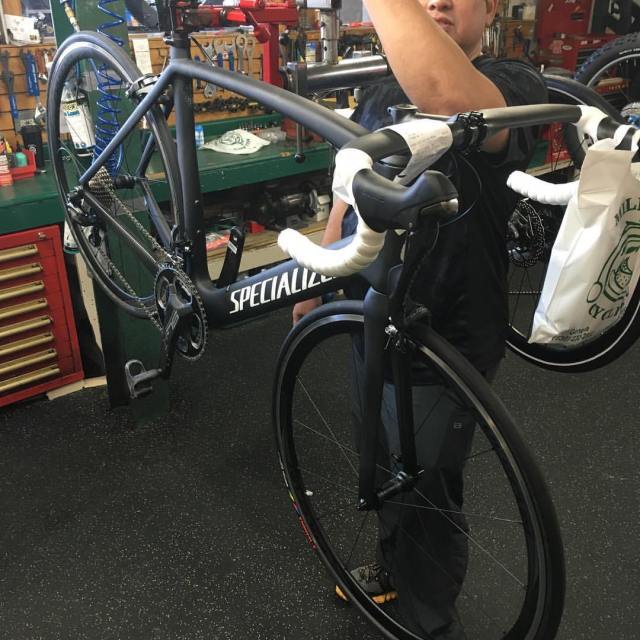
In all things of importance in this world, perhaps owning a nice bike isn’t the top priority. But while researching my next bike after crunching my Felt 4C while pulling into the garage following a long, tired ride in which I felt sick the whole way, I looked at a lot of options and decided to invest in a Specialized Venge Expert.

Specialized VengeI picked the bike up yesterday and it is leaning against the wall 10 feet from my writing desk in the living room. On Instagram yesterday I posted a photo of the bike having its KEO pedals installed, and shared it on Facebook. A young man that is a pretty good athlete had one of the first comments: “The bike doesn’t make you fast, you make you fast!”
I asked him what he rides.

“I’ve got a $1000 Tomasso internet special. I pass people on bikes that cost 5x. Hell, on my old $250 Performance Bikes hybrid, I’d pass people on bikes that cost 10-20x as much. And then there’s the guy that did Madison faster than me on a fat tire bike. It’s not the bike, it’s the motor pedaling it…”

I understand all that. And I wrote back; “I guess the entire bike industry is wrong then. But I agree with you on the motor. Mine is just average. Glad you’re fast.”

The grey area in all this is about riding comfort and enjoying what you do.

So I chose a bike after much consultation that fit the goals of my riding.

1. Do more of it.

2. Race in duathlons and triathlons.

3. Race criteriums.

4. Ride with my friends.

5. Have some adventures.

I also own a nice Waterford given to me by my brother-in-law. That’s the bike I’ve been using on the trainer these last few weeks. I’ve never had a bike fit done with that nice frame, but it is a pleasure to ride on the road because it is so smooth. It’s also a bike built for racing, for sure. My brother-in-law rode was a much faster rider than me. So the bike is not as fast as it used to be. He had a better engine. I get that.

SpecializedThe advice one receives about all this bike stuff can be conflicting. Some of the bike experts with whom I discussed my purchase, including the CAT 2 guy who leads our CT sessions and rides a top-grade Specialized Venge, conferred on the efficiencies of the Venge over other models I might choose. Many others confirmed this as well. The Venge is simply a good bike to own for a variety of reasons.
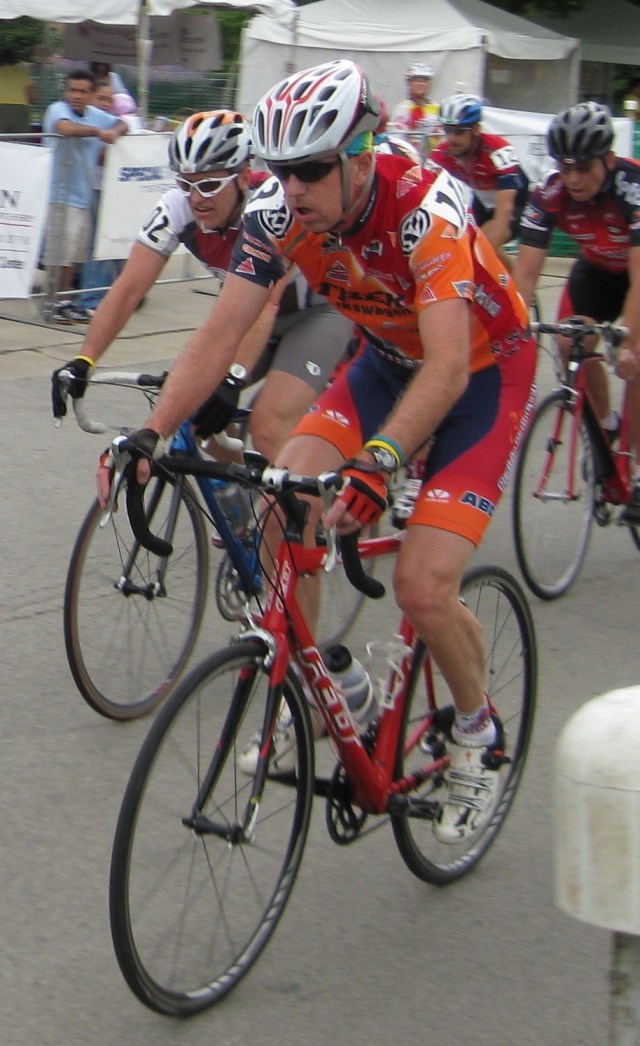
The motivation to buy the Venge was severalfold. It can be set up for aero, a distinct advantage while riding solo in triathlons and duathlons. There’s a demonstrated efficiency to being in an aero position. No matter what your “engine” is like, if you cut down wind resistance you’ll go faster. That’s a known fact. So to leverage your own cycling abilities, and to perform to the best of your capabilities, it makes sense to own a bike that allows you to do that.

When I started out riding a decade ago, I was perched on a steel frame Trek 400 with shifters on the down tube. I trained like crazy at the start, and was proud at last to average 18 mph for a 30 mile ride. But when I rode with guys on much better bikes, I could not keep up. But when I purchased the Felt, the ride was lighter and more responsive. And I kept up. Then I raced it in crits and did some long riding events. It performed well. And I regret crunching it.

cud-racing

The Venge is essentially a road bike and tri-bike rolled into one. The frame is narrow and aero. Yet the top bar has that distinct Specialized arc that its top road bikes have, such as the Robaix, which is known for its comfort on long rides. The Venge already has a sister in my garage. My Specialized Rock Hopper mountain bike is 15 years old and still a joy to ride.

I have not ridden the Venge Expert yet, except for a 100 foot tool around the parking lot before putting it in the car. This weekend we’re having bike fits done, and from that point on, I’m more concerned with having a beautiful way to ride. If it makes me faster, so be it. If it makes me fitter, all for it. And if it makes me happy, that’s what it’s all about. Nothing complex or technical about that.

TRAIN HARD • COMPETE WELL

WRARShirtGraphic

Posted in cycling, Uncategorized | Tagged , , , , | 5 Comments

Naked selfies, narcissism and athleticism


MichelangeloDavid

Is that a smartphone David’s holding? Is this the world’s first selfie?


The convergence of smartphone technology with the rise of social media has at once reflected and directed the deep strains of self-indulgence present in society. The narcissism of selfies is often criticized, yet the tradition of posting depictions of ourselves (even naked) for others to admire is not without some history.

Going way back to the culture of the ancient Greeks, in which depictions of naked athletes romping across elegant clay bowls was a common theme, human culture has celebrated itself. The sexual undertones were sometimes subtle, but always there. Naked athletes are a great excuse to look at people…naked.

Sports Illustrated has made a massive enterprise of its annual swimsuit issue. Ostensibly it was because the girls were somehow “athletic,” and indeed some were. But mostly they were naked. And it was in a sports magazine. So that was okay. Both men and women seem to love the sight of a comely woman. And occasionally, a comely man.

Such was the apparent motivation in part for Michaelangelo’s David, whose svelte yet delicious body is an inspiration to both men and women alike.

As documented in this fascinating blog, the work it took for Michaelangelo to create that sculpture and others like it would have stopped lesser souls in their tracks. And in fact, so talented was Michaelangelo that a competitive rivalry sprung up between himself and Leonardo da Vinci, who were contemporaries. We think of these great artists as having existed outside of time and possibly apart from each other. But they were just as real and subject to harsh rivalry (and difficulty) as the rest of us.

Yet their work endures. And so it paints a potentially harsh comparison between a world in which people are largely engaged in creating beauty not from stone or clay, but from pixels and posts. The Internet is one massive digital sculpture, you might say.

RedditOne can find women posting naked selfies on Reddit where they gain 100,000 views a day. And on Instagram, many of the most popular feeds are little more than pretty or fit people flexing their muscles, doing yoga and taking pictures of themselves in really nice places. Because they can.

Admit it. Athletes are some of the most narcissistic members of society. Our habitual obsession with our bodies is sometimes beautiful, but other times ugly. I’m as guilty as the next person when it comes to looking at nice images of women and men. In many case, I simply admire their work ethic. I’m jealous. They don’t get bodies like that by accident.

It has also been interesting to watch the emergence of the human buttock into acceptable society. Think about it:  glimpse of ass used to be a scandalous thing. Well, no more. Tits and ass and six packs and sperm channels are everywhere. Above the fold, as they say. And below the belt as well. Narcissism rules.

Triathletes more than any other endurance sports shed their clothes with panache, and evolve from one creature to another in transition. Reports from the changing areas at Ironman competitions is that men tend to behave like naked hogs in there. It’s balls out and ass crack to the wind.

Yoga girlWomen, by contrast, tend to have to deal with anything in life that comes their way. If it means being naked for a few minutes, so be it. With all the poking and prodding it takes to be a regular , everyday woman, along with bleeding and birth and makeup and hair and nails and sweat and the secret life of orgasms, there is little in this world that doesn’t already either slow a woman down or make her go about things a little too fast.
So it’s no wonder there are girls out there that have decided WTF…a few half-naked pictures to boost my self-esteem or get some feedback can’t really hurt. It sort of goes with the thinking that a certain segment of men are likely going to be pigs anyways. Why not take that power and use it? Selfies are, in some respects, a way of fighting back. Taking control. Saying “fuck you.” Or fuck me. Please. If that’s what thrills you.

You can slap a thousand bumper stickers on the issue of narcissism, but in the end it’s all about human need and loneliness. The main problem with narcissism is that it also attracts the freaks out there in the world who think of women only as objects. They don’t care to think about the list of obstacles to womanhood that were just listed, or what it actually takes behind the scenes to deal with that shit. Then that attitude spills into the workplace, and into politics. It all has to be fought and countered eventually.

Because as the pornography industry so clearly illustrates, when it’s only about the tits and ass or size of a man’s penis, ultimately it’s quite easy to lose interest. The image becomes disposable. The person behind it, expendable.

The contrast is what George Harrison and the Beatles once brought for in the song, “It’s all too much.”

When I look into your eyes, your love is there for me
And the more I go inside, the more there is to see

Yet sometimes the internal spaces of our minds go forth in the sun. Many years ago, I remember hanging with a group of semi-friends. We were drinking beers around a Volkswagon in the glare of the hot sun. Everyone was wet with sweat and a bit drunk. The lone woman in the group wore blue jean shorts, and nothing underneath. As she rollicked around amongst her guy friends, who happened to include her steady boyfriend, the fact of her openly relaxed state was exceedingly obvious. Yet none of her guy friends was lascivious. She got to be what she wanted to be. Sexy and free. And why should that not be?

In fact, if anything, she was protected by her male friends in this role. Sure, they all got to glimpse her cooter. But in time, what does that really, genuinely matter? Everyone was having a good time. That’s what mattered.

So we can compare the world’s obsession with selfies to  Michaelangelo’s David and learn a few things about ourselves. Because of all the statues ever created, that work in marble captures the honesty of a naked male figure and its compelling grace. But notice something fascinating in the pose. It looks very much like a narcissistic selfie someone might post or share.

One can even imagine the marbled figure of David holding up his smartphone in front of the mirror to take the image. His figure is relaxed, and his manhood revealed. Not in turgid glory, as so many men are wont to do. But in humble grace. Desire is a choice here, not an issue of force.

And that’s where narcissism falls away like the sheet from the body of a figure model. The conclusion we can draw is that we are all at some point destined to be naked. Yet few of us want to be alone.

Floating down the stream of time, of life to life with me
Makes no difference where you are or where you’d like to be

Indeed.


Posted in triathlete, triathlon, Uncategorized | Tagged , , , , , , | Leave a comment

Installing the governor

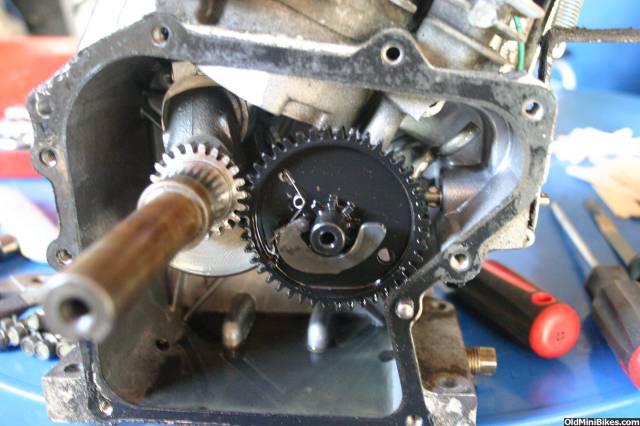
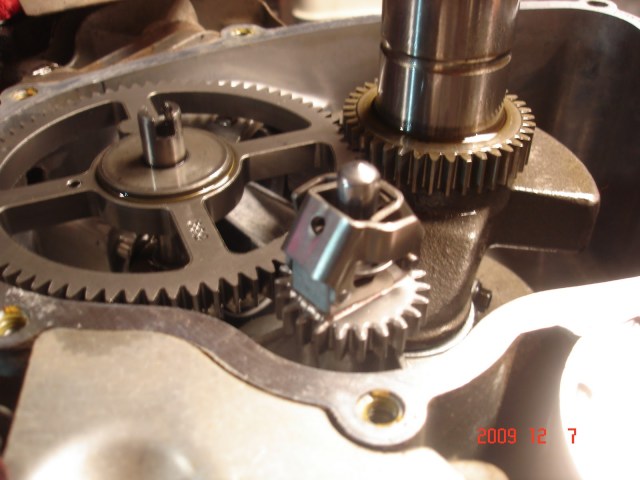
GovernorBack in my early 20s, I went balls out in trying to be the best runner I could. For a couple years, I didn’t even take a full-time job. That was a convenient choice, because the economy rather sucked at the time. So I worked in a running shoe store, managed a sports complex and ran my skinny little ass off.
The results were pretty good for a journeyman or “sub-elite” runner.  I ran 31:10 for 10K and about 14:45 on the track for 5K. Won a bunch of races. Lived on waffles, eggs, pizza and frozen peas.

But when I got married, I knew things had to change. I had a full-time job, for one thing, making it a bit more difficult to train 80-100 miles a week. Then came kids, and a mortgage. And I was happy about all that. So don’t get me wrong. As I turned 30, my goal was to put more of my energy into life outside the world of running. So I installed a mental device in my head that changed my priorities about how to live life day-to-day. I installed a governor in my brain.

“What’s a governor?” 

The first time I heard the word “governor” in relation to a control device on a motor was in middle school. I knew nothing about engines, by my motorhead buddies knew a lot and were always tinkering with mini-bikes and go-karts. They wanted them to go fast.

And I recall them complaining when they realized a g0-kart engine they’d stolen somewhere had a “governor” on it. I asked what that meant, and they all looked at me like I was the most stupid kid on earth. Whatever, I thought.

Eventually I learned what a governor meant by riding that go-kart. At a certain point the gearing would kick in and the motor would slow down, or “govern” its output. You’d go fast to a certain point and that was it. Disappointing in some ways.

Yet it made sense if you think about it. Some go-kart tracks are just not designed for all out speed. An engine without a governor on it might send karts flying over the barriers into the cornfields. So a governor has its purpose.

Installing a governor

So I installed a form of governor in my head when it came to running, or the commitment to it. That meant that running did not take top priority over my work or family life. Sure, my 10 times dropped from the low 30s to the mid-30s by the time I was 35. And by the time I was 40, my 10k time was 36:00-40:00. And that’s where it stayed for a couple decades.

Now I run 42:00 for 10K, and ran a 5K at 7:00 per mile pace last year. And that’s all fun and good. Competing in duathlons for the last couple years, I’ve made progress learning how to go from run to bike to run. Won my age division in the Batavia Duathlon, and placed in the top three for my age group out in Galena. My first sprint triathlon saw me finishing 10th out of my age group.

And while those were fun results, they don’t make me want to strip the “governor” out of my brain. Not in terms of shifting all my priorities and trying to become some sort of Senior Savant in the triathlon. Like I just shared, I already know what training like a maniac involves. I installed that governor for a purpose, and the purpose still holds. Fitness is an important part of my life strategy. But it is not the most important thing in my life.

Fast up to a point

That does not mean that I cannot train hard. When I do go out for runs, especially speed work, my goals are clear. I run as fast as I can. Then, there are long runs for endurance. Shorter runs for recovery. All these add up to a form of racing fitness. So when I step to the line each time, I accept where I am, and where I am not in terms of peak fitness. No nerves. No anxiety. Just excitement to see what I can do.

governorDSC01964It turns out the governor is not such a buzz kill after all. Perhaps I could have installed it much earlier in life, but it just wasn’t in fashion. Back when I was a training maniac, it was commonly accepted that sub-elites threw themselves at the sport of running. Your whole goddamned identity and self-respect seemed to hang on how you ran the week before. At least, it did for me. But I also know that I am not alone in that. Conversations with many runners from that era have affirmed that we were all a little nuts about our running. It’s what you did.

Times-a-changing

And to that end, I’m not sure there are as many people willing to do that whole sub-elite commitment thing. The race results these days don’t suggest there are a whole lot of those anachronistic running nutcases left in this world. The winning times at 10k and 5K races are typically 33:00-35:00 at local races. 5Ks are even won in 17:00. So perhaps people have more common sense and now how to have fun in running at least.

Not so sure the same thought line yet holds true in the worlds of triathlon or cycling. I’ve seen what it takes to train and complete an Ironman. Lots of training.

Yet last summer a friend of ours named Glenn did a lot less training than the rest of the people in our triathlon circles yet he not only finished, but came out just fine. And seeing results like that, one wonders if the psychology of Ironman and the triathlon community is not in process of maturing and undergoing a change as well.

Then there’s Kona

The obsession with making it to Kona requires that you probably throw your training governor into the gutter. It flat out takes hard training to drop your IM time that low. But those without lofty goals like that may be choosing a different course of training.

The early days of Ironman competitions with Dave Scott and Scott Tinley and Mark Allen paralleled the intense running boom of the early 1980s. Dave Scott was a seven-time champion, with a best time of 8:10 when he finished second to Mark Allen, with whom he “enjoyed” a competitive rivalry. There’s nothing like a rivalry to make you throw the governor in the gutter and just go for it.

According to the Wiki site on Ironman, “The current Ironman Hawaii course record was set in 2011 by Craig Alexander (Australia), whose winning time was 8 hours 3 minutes 56 seconds. Mirinda Carfrae (Australia) set the women’s course record in 2013 with a winning time of 8 hours 52 minutes 14 seconds.”

When you read times like those, it tends to put your own efforts into perspective. I know it happened for me in my late 20s when I realized that I could not train forever at the levels I’d sustained since high school through college and beyond. At some point installing the governor was simply the right and sensible thing to do.

Riding high

I just attended an organizational meeting for a cycling team that races throughout the spring and summer. There were guys like me and men my age and older in attendance. My new bike has raised my interest in racing again.

And frankly, cycling is changing as a sport in some ways. There are more bike racers ignoring the rules of leg-shaving, for example. It’s becoming more about how fast you can ride than what you look like. So the governor there is more about so-called tradition and appearance than it is about performance. And isn’t that interesting?

Again, nothing says we can’t train hard and try out best at what we do. But perspective is critical in all endeavors. Especially so in our avocations.

So we’ll see you on the race course, governor.

TRAIN HARD • COMPETE WELL

WRARFrontGraphic


Posted in Uncategorized | Tagged , , , , , , , , | Leave a comment

Those days you wake up determined not to fail

By Christopher Cudworth

The world’s greatest wisdom comes from sources as seemingly polarized opposites. We’re talking about the worlds of both scripture and science.

IMG_9862For example, the Bible shares this gem about self-discipline.
[ The Need for Self-Discipline ] Do you not know that in a race all the runners run, but only one gets the prize? Run in such a way as to get the prize.
Cut and dried. Clean and simple, right?
Yet we study our bodies through science and tests to understand how it is that we perform our best. We do FPT threshold tests on the bike. We do intervals on the track. We test swimsuits that help us move more smoothly through the water.
Our science affirms our desire to do better. Our self-discipline makes us want to understand the manner in which we succeed as well.
There is a crux to all this, a psychology that everyone must understand in order to succeed. Because… the morning we wake up determined not to fail… does not emanate from the same source of self-respect as the morning we wake up determined to succeed.
Self-respect and self-discipline
Victoria dancing

My niece Victoria Cudworth knows the balance of science and faith in action

This is no indictment of the general will to succeed. It is simply an observation on the order of that scriptural quote above. Having real faith in your success starts with belief and a love for what you are doing. But it is also confirmed and achieved through hard work and self-discipline. You can pray all you want to ask God to help you run a 2:22 marathon. But unless you put in the miles, eat right, manage your risk of injury and build the endurance to achieve that goal, it will literally never happen.

Real faith in your performance comes from belief not just in your goals, but in the process. That’s where it gets interesting. I have long counseled my children to “enjoy the process.” That means loving what you do. If that’s not happening, then it is wise to take a step back and analyze the source of your concern. Are you overcommitted? Working for reasons other than your own? Conflicted by some other issue? All these are legitimate human experiences. They do not mean you are a failure of any sort. Yet they can put you in a position where you’re more determined not to fail than excited to succeed.
When you’re truly loving what you do, you develop a different sort of belief system than just wanting not to fail. You find yourself waking up in the morning determined to succeed.
Personally, I’ve taken some risks the last few years to push my career and life in a direction that aligns more with the will to succeed in my own way. Going to work at jobs where I was determined not to fail was not a satisfying proposition.
The change has required some investment and risk, and a few “failed” experiments, including investment of some real money in a content marketing technology that turned out not to be scaled to my needs or ability. Sometimes we force ourselves to think that we don’t have the real answer within us.
But like they say, if you’re not failing your way forward, you’re likely not trying hard enough. My running, riding and swimming all these years have taught me that.
Sports psychology
Chris Swim OutThis is where the example of sports really works in our lives. If you engage in an effort like running a marathon or doing an Ironman, and things don’t go exactly the way you planned, then the (b)right thing to do is learn from that. You already know what it’s like to fail, and it didn’t kill you. It may have shaken your faith a bit, or made you question your methods. But that’s how we all grow.
The greatest tests of faith in history all exhibit these challenges in action and belief. When the Israelites were wandering the wilderness under the guidance of Moses, the Bible says God provided enough food to help them survive. But the people were not satisfied. They lost discipline. And in the result, they lost faith as well.
They woke up fearful, dissatisfied, and less than determined not to fail. But the determination of Moses was to succeed. That meant salvation. And Moses had to be a social scientist of a sort. He told the people to eat what was provided, and keep it simple. That’s what gets you through. Think about it: that trial of people surviving in the wilderness was all about the discipline of sustainability. We’re still learning these lessons to this day.
Greater forces in the universe
Psalm 31 ImageIt’s true that if we show ourselves enough respect to be self-disciplined, it seems as if the greatest forces in the universe align with our goals. That’s why science is no contradiction to our faith when it is put to good use. Modern medicine is a result of that alignment. Medicine is a direct example of the fact that society wakes up with a will to succeed rather than the determination not to fail. It is the hope of a cure and a will to succeed that encourages athletes to run and ride to raise money towards a good cause.

So we reiterate: Self-discipline is waking up with the will to succeed rather than the determination not to fail. It is perhaps a subtle distinction, but it is all important in all that we do. It is a sign of self-respect to abide with both the faith and science of our endeavors. That is the secret of success.
SHOW RESPECT
WRARShirtGraphic
Posted in Uncategorized, we run and ride | Tagged , , , , , , , | Leave a comment

The mortality running through us all

MortalityI was exchanging texts this morning with fellow artist Kerri Hoskins Branson about a painting project we’re working on together through Water Street Studios, the artist’s collective where we both have gallery and studio space.

I profiled Kerri in this blog a couple years back. She’s been a runner and done martial arts training.  She also played the role of Sonya Blade in the game Mortal Kombat, has been a model and a mom and even ran for political office at one point.

From any perspective, she’s lived a couple lifetimes already. Several years back she felt a drive to begin painting, and like her mother, discovered she has artistic talent and a strong drive to express herself. Since that time she’s been doing shows and her work now sells for thousands of dollars.

She never sits still, you might say. Because she’s also invested another lifetime within her own raising four children, two of whom have severe physical disabilities. The challenges of raising those children have not been light. Her husband Scott Branson and she have literally had to parcel their lives out, trading time and duties and responsibilities to make it all work.

Paths in life

You can imagine that’s no easy chore. There was no way those two could imagine the path on which live would take them. The boys have required extensive medical help, and those decisions are not simple, and take will and courage to achieve.

Today while on their way to the hospital for a consultation with physicians about surgery for one of their sons, she snapped a photo above and sent it to me. It captures one of those moments in traffic when, if you’re driving, you don’t dare study the scene too long. But when you’re the passenger, and big life decisions are running through your head, it’s funny how the very touch of light in the morning can capture a mood.

And having been through plenty of consultations about surgeries and tough decisions during eight years of cancer caregiving for my late wife, I know those trips in the car on the way to see the doctors can be difficult. All the thoughts of risk and reward go through your brain. The first thing you want to know is, “Will it work?” The inevitable next question is always, “Will it be safe?”

Different realms

You almost feel like as if you’re in a different realm when making such difficult considerations. The rest of the world seems to buzz around you on its own time and schedule, unconcerned that you are in emotional pain or consternation. Indeed, people seem so completely ignorant of the types of realities you might be facing. But unless you tell them, how could they know?

Well, that’s the issue isn’t it? As supposedly intellectual creatures, we should know better. Yet so many people seem to encounter the world in numb and number fashion. Most folks simply do not consider the meaning of life. Its precious flavor.

Which means that the significance of their own mortality completely escapes them.

Distractions from life

Instead, the world offers up violent entertainment to fill that tender void where recognition of our own mortality should reside. It seems the human race will do anything to escape recognition that we’ll all die someday.

Take for example the spectral sport of NFL football, which has become a religion of sorts, rife with tribal symbolism, a brand of nationalistic fervor and stoked up masses as passionate as a Hitler rally. Some call it harmless fun.

But distractions of that level create parallel realities. And the sport has oozed out like a pool of blood across the media landscape, spreading from pre-season to regular season to post-season. Then it continues from draft to NFL combine to European games and beyond. Like a tool of the devil, football drives gambling and cannot stand to go a week without begging attention from the masses. And when fans aren’t watching, millions play video versions of the sport. And when they’re not playing video football, they’re using the toggle in splatter games that mimic killing. Because anything’s better than being left alone with the thought of your own mortality.

It’s a confusing scenario for us all. We need distractions because entertainment is simply part of human life. But when we confuse our entertainment for reality, that’s when the humanity of our existence gets lost in the shuffle.

Vicarious pursuits

Because all that stimulation is to protect people from the passive, neglected boredom they might otherwise feel with their own lives. One of the artists from the famous Wyeth family that includes painters N.C., Andrew and Jamie once said there was no more reason to paint if you watched an NFL football game. “How could you even compete with that powerful imagery?”

Vicariousness is a disease of the American mind, and too many Americans as a result, take their own lives for granted. That’s why they are so liable to hand their futures and fortunes over to people who sell bombast and conflict as part of their persona. That’s how our electoral processes have turned into selfish grabs at power, and displays of prejudice. Conservatives love to blame liberalism for the so-called “decline of America.” But if you study how politics really got where they are, it is not liberalism, but ignorant selfishness, distraction and vicarious power mongering that is leading the way to America’s intellectual and moral decline.

We should know better

GraveyardWe really should know better. Especially you and I. There is no more powerful experience than running or cycling (or whistling…) past a graveyard to adjust your perspective. At that moment you realize what the phrase “the quick and the dead” really means.

There is a small gathering of gravestones on a small rise in the land far out in the country where I ride. They often show light and dark in the morning sun as I ride past. Those stones are silent except for the names and dates on their faces. There is a conversation there to be had, if one stops by. And I have done that. The words say MOTHER or FATHER, SON and DAUGHTER. Some stones date from the 1800s. They have sat in that loamy soil so long the rest of the dirt around them has sunken or blown away. Over the years, human activity has worn down the land. The dead have risen up not by coming back to life, but by our own obsessive activities all around them.

And then we all go there, one way or another. Either we are buried or are turned into ashes and cast unto the wind.

But that should make you feel more alive, not fearful of death. Because do what you will,  you cannot change the time when you will die. But you can change the quality of life that you will live.

I’ve long said my favorite line in literature is this, from the book Ambiguous Adventure, by Cheik Hamidou Kane: “The purity of the moment is made from the absence of time.”

That means time expands when you are doing what you love.

And what better way to describe the experience of running, riding and swimming? The purity of the moment really is made from the absence of time. That’s true in love, and life, and hope. May it be true in all that you do. Live well.

LOVE LIFE


Posted in aging, Christopher Cudworth, cycling the midwest, Uncategorized | Tagged , , , , | 3 Comments

Secrets to successful high intensity workouts

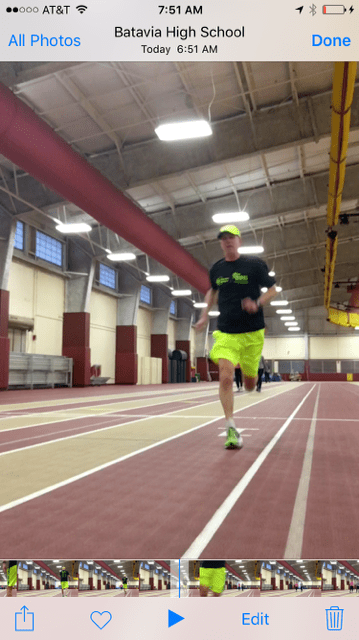
NoraShhhhh! I met up with a younger woman at the track this morning. So, that’s the secret. Of course, it had nothing to do with having an affair or anything like that. I was interviewing her for an upcoming article.

Because, for one thing, she’s faster than me these days. Her workout consisted of a quirky ladder of 200s, 400s and 800s. Up and down the ladder in a repeat cycle she went. All at sub-6:00-minute mile pace. My workout consisted of 6 X 400 in a descending ladder of 1:39, 1:38, 1:37, 1:33, 1:32 and 1:31. And yes, those were my specific times, on the money. But I’ll explain that in a bit.

Fast runners do things with a purpose

First, let’s talk about the workout my interview subject was doing. Her name is Nora. She runs for New Balance at an elite level and competed at North Central College, one of the top Division III running programs in the country. She just finished her first indoor meet a week ago and is pointing toward the road season.

That means the “down” season for most other runners is an “up” season for Nora and her elite kin. One of the secrets of successful high-intensity workouts is to actually do them. That’s where indoor competition comes in. As a prep for the outdoor road racing season, Nora races indoors. She’s in her early 20s, so all this is recently familiar territory, having come off a college schedule of cross country, indoor and outdoor track. Most top athletes take a break in December or so, then build back up with a base in January, begin adding speed late in the month and race indoors through February and early March. Then comes a period of more base miles, and outdoor track work begins.

That is how you get fast. There is simply no substitute for up-on-your-toes, racing fast track work for runners. Nora is running her workouts at mid-5:00 per mile pace. Not just because she can, but because she must. She competes at those speeds.

Indoor intensity

Triathletes and cyclists have also discovered the value of high-intensity workouts through indoor triathlons and computraining. Runners can get some of that from hard workouts on a treadmill, but there is no substitute for hard running on an indoor track.

So Nora has been joining other runners for high-intensity track work since the start of the year. This is another secret to the value of hard running or any other venture. Putting yourself in positions where you’re pushed beyond what you’d likely do on your own can be important to developing speed.

Chris Running intervals 3Understand there are limits to what you can expect when you begin the season. It does you no good to jump into a workout at a scale that is clearly beyond your present fitness level. All you’ll do is manage a few intervals and be slogging along after that. Same on the Computrainer. It’s important to get a realistic measure of your state of fitness before you go hammering into a high-intensity session you cannot sustain. Most indoor training facilities will conduct that test, which typically consists of a 20 minute, sustained push to determine where your limits are.

That’s why it was a relief of sorts to get test behind me on the bike, to establish at what point of effort a high-intensity weekly workout should begin.

Personal knowledge

In running, I know these limits innately. 40 years of running experience helps me identify where I am on the training ledger. That said, my training philosophy has maintained the practice of doing weekly sessions of high-intensity running in all seasons. Winter, spring, summer and fall, I go to the track for hard intervals.

There’s a performance-oriented reason for that. For one thing; high-intensity workouts have been shown to be key for athletes as they age. I always envision it as a “stretching of the heart.” Raising the heart rate beyond typical training range is key to stressing the body in a positive way.

Chris running Intervals 2.pngThere’s also another form of stretching that goes on. There is no substitute for the longer, harder stride lengths you get from speed. Because how can you possibly expect to race fast if you don’t train fast? It’s illogical.
In my peak years, February races were a measure of fitness and anticipation. The year that I ran all my road PRs, including 19:50 for four miles and a 31:00 10k, I ran an indoor two-mile in February at 9:30. I knew that’s where I needed to be.

That’s why I still train on the track these days, but at around 6:00 per mile pace rather than the sub-5:00 I used to do.

My racing pace is closer to 7:00 for a 10K, but that’s the point. High-intensity workouts are designed to make that pace feel easier. In fact, even if you are an Ironman competitor scheduled to do a marathon, it is clearly possible (and possibly preferable) to prepare for that distance using a combination of high-intensity strength training, running and intelligent base mileage rather than plugging away with multiple super-long runs. Risks of injury are too great. Yes, it’s likely fine to do a 20-miler at some point along the way. But then I believe it’s possible to back off to 10-15 milers in the weeks before the event. This guy claims to have it down to a science.

High-intensity training has enabled me to improve performance in duathlons and now triathlons. Coming off the bike the first few times I tried a duathlon, the sensation of the “brick” was daunting. But actually, it’s just running with tired legs. Nothing more. So I do track workouts that mimic that experience. Hence, the ladder workout I did this morning. Adding speed as you progress through the workout simulates the fatigue you feel coming off the bike. My per-mile pace in duathlons and tris has dropped from 8:30s to the low-7:00s. Bricks are okay, but they don’t actually teach you to race with tired legs as well as high-intensity workouts can.

Variety helps

Here’s your other secret to successful high-intensity workouts. Variety can help. And why? Because high-intensity work requires intense concentration. It can be very easy, if you are not accustomed to doing fast workouts, to slack off when the intervals add up. That is why variety can help you concentrate. When you’re not running the same interval over and over, you have to focus more on what your pace should be for that specific interval. That’s what Nora was doing this morning. A set of 4-6 ladder segments consisting of 200s, 400s and 800s. That will keep you honest.

CHRIS Running Intervals 1.pngPersonally, I’ve been able to drop my 10k times by 2:00 over the last two years by keeping up the intensity even when my weekly mileage has never topped 25 miles. Last year I ran 42:00 and I honestly am thinking about a 40:00 10k this fall.

Beyond that, I simply don’t care that much to get any better. The amount of effort and time it might take to run 38:00 at my age is not worth it. I’ve already run much faster than that in life, at a time when I was much, much younger. Having fun and having a challenge is enough. The joys of training hard are enough reward for me, and high-intensity workouts make life interesting. They also keep one’s mind sharp to disciplined thinking. That transfers to other pursuits as well.

March is a great time to begin adding track workouts to your mix. As the snow melts away, look for days when the wind isn’t fierce and get out there for a few 800 repeats. And throw in some shorter intervals just to stretch the legs. It’s a great return on investment.

TRAIN HARD.

WRARShirtGraphic


Posted in aging, aging is not for the weak of heart, Christopher Cudworth, IRONMAN, Uncategorized | Tagged , , , , | 1 Comment