
 This morning while doing a leg workout at the Vaughn Center, I pulled out my phone between sets for who knows what reason. And I thought: What the hell? Can’t I get through five minutes of working out without checking my phone?
Here’s the concern: I’ve never had the world’s most devoted attention span. During school I had trouble concentrating if the subject didn’t interest me. These days experts might call it a condition on the order of ADHD. Teachers back then called it various things, but “distracted” comes to mind.
A life of distraction
 So much of life is built around distraction. For example, the NFL is short-attention-span theater. It’s like brain food for the terminally numb. Violence and sex, bright colors and shiny helmets. Blathering announcers and crowd noise like an electric vacuum left on for four hours. And it sells.
The same can be said for so much of what constitutes ‘politics’ these days. If a president or Congressman wants to avoid responsibility for their actions or hide some bill or executive order from the public, they know that it works to pump up some other distracting issue to take the public’s mind off what is actually going on. Issues such as abortion and war work best, but so do sex scandals and terror alerts. Everything is about distracting the public from the rational workings of the inner mind.
Mind games
But this is a problem when it becomes a game in your own mind to concentrate on what you need to do. If doing even basic things like weight work requires a distraction to get you through, there might be a problem going on.
The online version of Psychology Today points out in a 2012 article that studies show a chemical response going on inside our brains whenever we use our smartphones. As the article points out:
“You may have heard that dopamine controls the “pleasure” systems of the brain: that dopamine makes you feel enjoyment, pleasure, and therefore motivates you to seek out certain behaviors, such as food, sex, and drugs. Recent research is changing this view. Instead of dopamine causing you to experience pleasure, the latest research shows that dopamine causes seeking behavior. Dopamine causes you to want, desire, seek out, and search. It increases your general level of arousal and your goal-directed behavior.”
That passage reminds me of the Saul Bellow book Henderson The Rain King. The main character is a disillusioned soul who can’t figure out what he desires from the world. The Wikipedia summary of Henderson does a noble and succinct job of describing his lament: “Eugene Henderson is a troubled middle-aged man. Despite his riches, high social status, and physical prowess, he feels restless and unfulfilled, and harbors a spiritual void that manifests itself as an inner voice crying out I want, I want, I want. Hoping to discover what the voice wants, Henderson goes to Africa.”
Mind travels
That’s what disillusioned people did before the Age of Distraction. They went places. Several times in my 20s I took off for places unknown with just a few bucks in my pocket and a voice much like Henderson’s ringing in my head. But mine spoke more along the lines of “What do I want? What do I want?”
 Native Americans had methods of dealing with distracted thinking.
Young men participated in rituals such as the Sun Dance, in which participants were sent through a rigorous and painful test of mind and spirit. Men would pierce the flesh of their chests with sharp objects knotted into leather. Then they’d lean back to let the pain sear through their brain and see what kind of visions their brain chemicals would produce before someone cut them down and tossed them back in a tepee.
Modern Sun Dances
Those of us that participate in endurance events may be seeking a sanitized version of these seemingly barbaric practices. Yet we’re not so far away as we might think. Plenty of people these days are getting their bodies pierced or having painful tattoos seared onto their bodies. Are these markers of commitment or the scars of a struggle for existence?
Triathletes can testify that the Ironman experience itself is a rite of passage requiring intense concentration. And yet, at the same time, the event has been known to produce a state of total dissociation as well. Athletes live for that rite of passage at the finish line when the announcer calls out their name and proclaims, “You’re an Ironman!”
The only thing missing in that ritual is the assignment of some sort of Spirit Animal to guide Ironman athletes through the rest of their lives.
Not alone
 Some ultra distance runners readily admit to “out of body” experiences during 100-mile races. Extreme cyclists are also known to go into a state of hallucination during cross-country events. Surely long-distance swimmers lose themselves at some point during the trek across a large body of water. There may be nothing that so closely resembles a near-death experience than the most extreme forms of endurance training and racing.
Yet lacking these tests of endurance on an everyday basis, most of us opt instead for the quick fix and dopamine hit brought on by a glance at our cellphones. We check our Instagram and Facebook accounts to see how many Likes our posts have gotten. We share in the sorrows and joys of others as well. All these interactions hit our dopamine centers and draw our attention from consequential things to matters that may not be so important. We simply don’t want to be alone.
And there is a connectivity that comes with our distraction. Many people feel genuine empathy and a sense of community through their social media accounts.
Addictive traits
But that connectivity can be addictive too. Our brains rewire themselves to expectations and stimulus quite easily. Our phones are just like a coffee or caffeine habit in that they are as much much emotive as they are chemical. We even eat ‘comfort food’ because it bears an association with feelings of well-being. That’s how we compensate for the tradeoffs in life. We put up with all sorts of difficulty and then bury our wounded hearts and bothered minds in things that make us feel good.
A few months ago while participating in a training seminar for work, the leader had u-s raise our hands if we think we’re good at multi-tasking. I raised mine of course, the only person in the room to do so. Then she had us all do an exercise with a single focus and then one with a multiple focus, and we all failed miserably. The point she was trying to make is that none of us can focus on more than one thing at a time. But I find that still hard to believe. If that was the case, the human race would never have evolved, and even Noah could not have built an ark, if that’s what you choose to believe.
Multi-tasking is a native part of being human. It is how our minds evolved. It is the painful oppression of a singular focus that actually causes so many problems in this world. There’s not a human being alive who thinks only of one thing at a time.
That does not mean categorizing and prioritizing the multiple distractions we face every day is not an important aspect of our existence. But to pretend that only one thing is going on at a time in the human mind is like believing in a literal bible. It insults the creative powers we’re all given to freely associate and assimilate information to produce a grander whole.
So there.
But there is great value in forcing our concentration through the keyhole of what unlocks our core thoughts and activities.
Deprivation counts
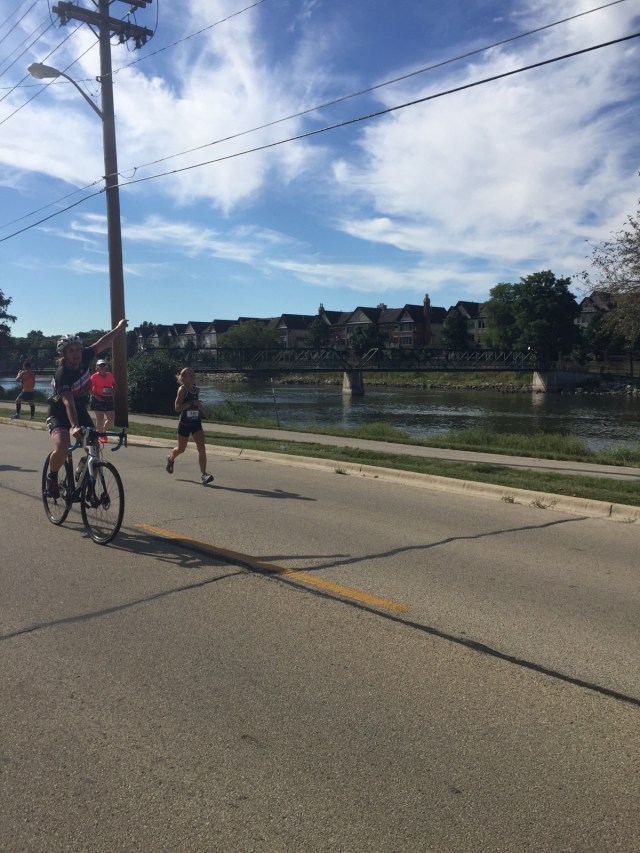 But think how good it actually feels to go through a bit of deprivation now and then. When your last water bottle runs out during a long bike ride, it takes real focus to get to the next water stop on the route. But you bite into the challenge. Make it yours. Own it. And when you make it through, there’s a quick sense of accomplishment. Hell, yeah.
Even when you’ve finished a tough workout and haven’t yet had time to eat, that intense hunger can actually make you feel real and alive.
It turns out that the urgency of existence when funneled through a portal of real effort feels much more satisfying to our normally fat-fed attention spans. A hard workout cleans your mental palate, wicks off random thoughts and rumination and can even cure depressed and anxious feelings.
Best of all, working out can give you clarity that adds up to the ability to find solutions. It can make you worry less about your attention span and find the path to focusing more on what really matters. In some strange way, a dose of deprivation and difficulty counts most of all, and you no longer have to worry about your attention span because you have other things more immediate and important to think about.

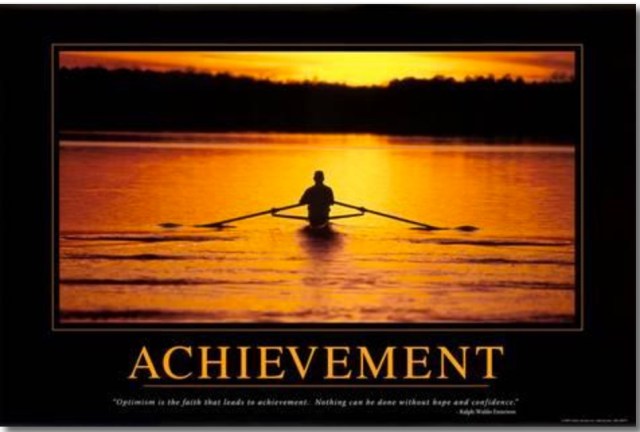
 Which really is the more effective motivator? Powerfully positive words? Or honestly negative phrases?
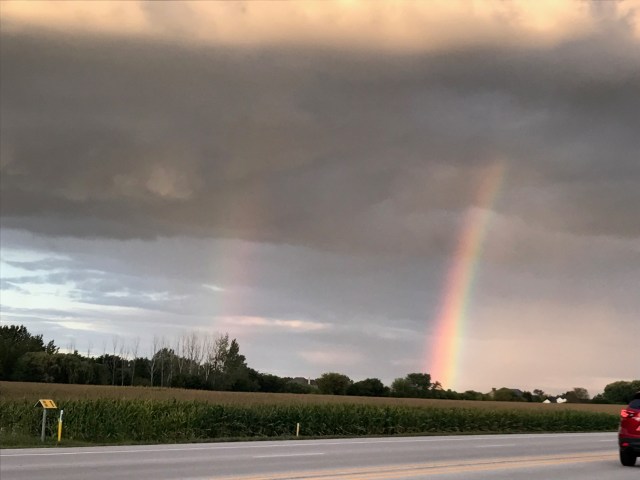
 Last evening while driving from home to my art studio for a painting session, the clouds to the east grew dark at twilight. Then the sun broke through from the west and caught the edge of the clouds. Up from the earth rose a segment of rainbow.


 Ten years ago in the throes of caring simultaneously for a wife with cancer and a father who was a stroke victim, the emotional toil became too great. I met with my doctor who prescribed an anti-anxiety and anti-depressant medication called Zoloft.
 We’re all trained to follow doctor’s orders. And my long experience in athletics also taught me to be disciplined and try to see things through before quitting anything. A race. A job. A workout. A relationship. Tough it out until the outcomes are obvious.
 These patterns are simply a much subtler way of “going nuts” but they are just as real. Our emotional health depends on understanding how our own brains function. All of us are susceptible to negative sources of stimulation. Emotional waves can function like storms that cross our minds, wreaking havoc and leaving devastation in their wake. That’s why big storms like Harvey and Irma make us feel all feel a little nuts inside. Storms are symbols for our own internal tempests.
 We don’t necessarily need to “go nuts” in order to experience these things. We’ve all seen people go “off the deep end” in endurance sports. Some are in recovery from a life event that gutted them. Others might be facing some emotional challenge that needs to be worked off or blown into the karmic atmosphere. So they go nuts training to the point where people worry about them. Some achieve success. Win the day. Go social with their achievements.
 This proved to be an extremely constructive way to “go nuts.” I’ve done it a few ways myself over the years.
 Which all added up to a clear conclusion my freshman year in high school. My dad drove me to the school and walked to the locker room door with me. Perhaps he’d already talked with the cross country coach, but in any case, he sternly said: “You’re going out for cross country. And if you come back out that door, I’ll break your neck.”
 Given these statistics and the apparent will of the people to allow more than 30,000 people die each year from gun violence, the game of football hardly seems like a risk at all. But that may still be a deception. In fact, the history of America actually rests on a disturbing foundation of cultural bloodshed, genocide, racial and religious violence.
 So the real question behind all this concern over football is whether the game symbolizes some aspect of national fatalism in general. Is there, in other words, some aspect of self-disdain hidden behind the very design of the sport? Is football, for all its association with teamwork and discipline and motivation…in fact a fatalistic denial of those very ideals? Is football, like the habit of smoking or overdrinking, more likely an indulgence than a character-builder?
 All the time there were little streams popping out of hillsides. They trickled like ideas that could not be ignored. In winter these artesian springs would freeze leaving tall ice falls or patches of slick ice across the road. You either had to go full force across them or slow down and gingerly find the few spots where stones and gravel shone through. Decisions, decisions. A symbol for much that was to come in life.
 We’d run across these bridges in all seasons. Some years the river would be high and exceed its banks. Other years the river would get low, exposing pale rocks that once harbored fish. These would be tough years to kayak and canoe because hauling your boat over shallow areas until the next open patch of river is no easy journey.
 Such were the tests, at times, in the environment around Decorah. Running was tough because of the hills. But put on cross-country skis and try them? Even tougher. So the place had a way of keeping you honest no matter what you did.

 So this made me double proud of my ability to fall under the most casual circumstances. It seems I can ride my bike at 30-40 mph on a steep descent with no problem. And back when I experienced the horrors of bike wobble at 40+ I even got the bike under relative control during a horrid incident of bike wobble a few years back.

 There was another life lesson that Miss Kegerreis imparted that would prove important over time as well. Not every aspect of my home life was positive. My father could be rough and critical in many ways, and sometimes even physically abusive with us. So my tender young brain was beset with some challenges in self-esteem. Some of those it has taken a lifetime to overcome.
 The anger somehow stuck with me through some aspects of life. And heading into my sophomore year in high school, I was determined to prove myself to anyone that would listen. At the same time, I was also desperate for approval. That’s not a good psychological mix. Every rejection or failure seemed double in dimension. Success sometimes seemed fleeting, and the cycle could repeated itself. I had anger issues.
 With August nearly over and the sun starting to slide south toward twilight, it is hard not to draw some associations with seasons past. With fall approaching, there is not a runner alive whose senses do not perk up while recalling the feel of feet racing through the grass. Those instincts might be some ancient bedouin blood in our veins, or perhaps we share a shred of our genetics with wildebeests, coyotes or cranes.


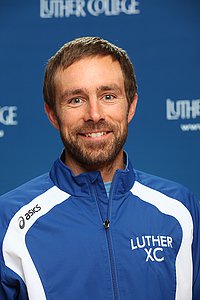

 Glenn laughs a bit at his own longtime penchant for detail. “I kept a journal of every race I did. So when people want to know what happened, I often have it written down. I was a little obsessive.
 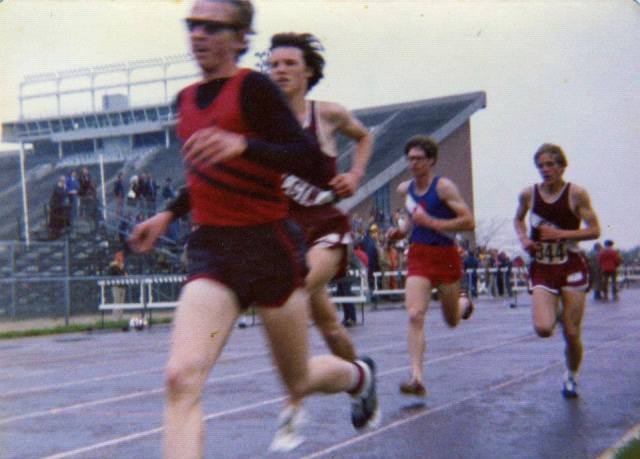 So the labor of love continues, and the little site known as Glenn’s continues to grow. Recently a former world record holder named Henry Rono requested to join the group. “I don’t know why,” Glenn admitted. “We’re kind of limited to the Illinois region and I want to keep it that way. But it’s interesting that a guy that set records from 3000 to 10,000 meters might be interested in other runners like us.”


