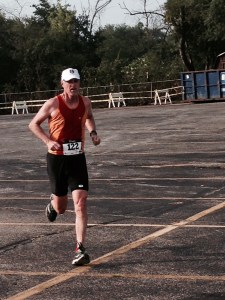
A 20-miler in 80-degree heat and no water. Insane? Or just another day’s work…

photo (1)

Times change but some things still stay the same. Long runs in early September, for example.

In the early days of a warm September, our college cross country team was scheduled to run a 20-mile run. The route called for ten miles up to a school called North Winnishiek and back. We ran on the gravel shoulder much of the way, trotting along in our Nike waffle shoes or some classic Brooks footwear long lost to running antiquity.

We ran fast, averaging 6:00 per mile up the long climb from the Oneota Valley to the limestone hills above Decorah, Iowa. The conversation would be peppered with tales of debauchery from the night before. One guy was running with a big bruise on his left ass cheek because he’d gotten a little lit at a kegger Saturday afternoon and fell off the back of a Triumph TR6 while trying to hitch a ride back into town. Plop, he fell right off the back onto the road. Right on his ass. He limped a little, but kept up at the pace of the day.

Bright highways

There were 25-30 of us trucking along. Ultimately the top 15 guys separated into a lead group and the talk quieted a little. We ran along with eyes fixed on the curving road ahead. Just a white strip of Iowa concrete with even brighter gravel strips on either side. We’d go up one side and come back the other, running with traffic the whole way.

The walls of corn on either side of the road were changing from green to brown. In a couple weeks the loud, dusty combines would whip through the cornfields and strip out the crop to be sent to the big feed silos for market. Much of that would wind up in processors down in Cedar Rapids where the Archers-Daniel-Midland company would turn it all into starch and syrup. Whatever the world demanded.

Water stop

Our own bodies were fueled on the merest of calories. Perhaps a slice of toast with butter snagged at the college union before heading out for the ‘Sunday long run’ as we called it. There were no Power Bars or gels. No water belts or aid stations set up. Our main hope was that coach might put some water in a big jug and cart it with him to the ten-mile mark. There we’d stop for a few minutes in the warm morning sun, milling around with our hearts pumping and sweat pouring down our necks. We’d take a sip or two if the water or lemonade wasn’t too warm, then turn around and run back to Decorah at the same pace we came.

Bird calls

As a birder even back in college I amused myself with the calls of meadowlarks in the field, or red-tailed hawks soaring on thermals above the cliffs shrouding the Upper Iowa river. Some days the clarinet-like sound of a pileated woodpecker might clatter down from the woods, or the jabbering of blue jays tearing around after acorns.

As we passed farms, the smell of manure might waft our way as we ran past a pig farm or dairy operation. Inevitably the smells of those farms would bring fart jokes, and anyone could turn into a target for that low-level humor. It never really stopped actually. Actual farts were the best remedy of all for boredom on the run. One learned to treasure those opportunities.

Sex jokes

That and sexual jokes carried us along for miles. Anyone that had a girlfriend risked attention about the previous night’s ‘action.’ Most men of honor would mutter some acknowledgement that sex had indeed taken place. That was a far better approach than outright denying the fact, which only wrought more teasing and descriptive examples of imagined escapades.

But in fact, some of us had had sex that very morning. One might arrive for the long run on a Sunday morning with cheeks flushed from the warmth of intercourse just minutes before. Some freshman would notice the color in the cheeks and blurt, “You just got laid!” But that would generally earn a guy a pat on the back, not teasing. “You’ll run well today,” someone would whisper.

Hard tempo

For there’s nothing better than lovemaking to breed confidence in a skinny runner borne by the pace of the day up hill and down. Thoughts of those moments and the look in the eyes of a lover were sure to carry you farther. The feel of running might disappear altogether, miles at a time. The mind would be carried along by the body in those moments. Even a hard tempo felt easy.

Yet somewhere around fifteen miles the pace would ultimately get harder, for 6:00 per mile has its own unique rhythm…not quite the turnover of race pace at 5:00 per mile, nor the relative jog of 7:00 per mile when the body is trained to do 80-90 miles per week.

No, 6:00 per mile is its own little world, as if the ground is rolling under your feet. All you have to do is paw along, run from the hips, let the body do the work, and things will be okay. Don’t overthink it.

Concentration

The fatigue finally does catch up around fifteen miles That’s when concentration comes into the picture, and conversation turns to races past, present or future. Motivation seeps into the system as adrenaline wrought by thoughts of racing peaks the system. Sentences get shorter, and there is no talking on the hills, just hard breathing.

Eventually, the thirst borne of distance and heat and long miles truly begins to set in. The water fountain back at the campus beckons. Runners did not think in terms of dehydration in the early days. There was either ‘thirsty’ or ‘not thirsty.’ There was no in between.

Take it easy

At eighteen miles the talking might cease for almost a mile. Then someone would sing a snippet of a familiar tune. “Well I’m running down the road trying to loosen my load, I got seven women on my mind…”

Someone else takes over. “Four that wanta own me, two that wanna stone me, one says she’s a friend of mine…”

And everyone sings: “Take it eas-eeeah, take it ea-eah-eah zee…don’t let the sound of your own wheels, drive you crazy.”

Finishing kick

Then there’s just a mile to go. Someone lets out a whoop. The college is in sight through a slot in the trees. It’s all downhill coming back into town. And despite legs that are sore from the race the day before along with nineteen miles covered on a Sunday morning, the pace picks up. Then a runner toward the back of the group surges past with half a mile to go. The entire group drops onto the bright green grass of the intramural field and there are no rules about how to finish. Some take off in a sprint and everyone follows because they don’t want to be left behind. Just ahead, a flock of crows rises from the field, calling as they go.

“Wow fun wow boys,” someone calls out, repeating ae favorite phrase of our coach. “You can’t beat fun.”

“Yeah,” comes the smart retort. “It’s like a sore dick.”

“Yes it is,” comes the laughing response. “Yes it is.”

Back at the fieldhouse the water fountains greet the group of thirsty runners. Faces flushed with sweat and hide darting eyes. “Well boys, we made it. 20 miles.”

“With nothing but warm lemonade at the ten-mile mark,” someone laughs. “Is coach trying to kill us?” “Maybe. But we made it.”

“Yes indeed. We made it.”

A 20-miler in 80-degree heat and no water. Insane? Or just another day’s work…

How times have changed.


Posted in race pace, running, Uncategorized | Tagged , , , , , | Leave a comment

If it’s change you want, it pays to invest in the Performance Piggybank

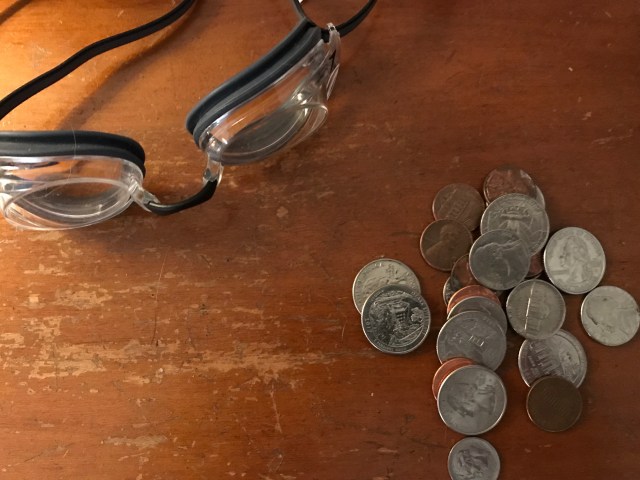
Change and Goggles.jpgAs athletes, we might imagine that change comes about in big breakthroughs. We train everyday hoping there will come a day when the nine-miler that felt hard last weekend suddenly feels easy.

Yet that’s not how it usually works. Instead, some segment of that nine-miler might feel good one week. Yet it gets buried in concerns over how slow we felt at the start, or how hard it was to finish.

That means we lose the good for the luxury of worrying over the not-so-good. I use the word “luxury” for good reason. Worry is a luxury you cannot afford as an athlete. If something worries you, there are two options. You can obsess over the cause, or you can do something to fix it.

Here’s where the process can get confusing. Fixing problems is seldom the result of an “instant” solution. Only once in a great while does that happen. I can point to the fortuitous gift of a pair of free Saucony Triumph running shoes as the near-immediate cure to my nagging Achilles tendon problems. It turned out that the angle of the heel counter on my Saucony Ride shoes were impinging those tendons, causing dire soreness.

The minute I tried those shoes, the problems went away. That was damned lucky.

More often, curing a problem such as an injury takes incremental steps to ascertain the source, implement the steps to adjust or adapt, and focus on the building blocks to return to health.

The same goes for training toward a goal. Progress typically does not happen by major leaps in performance. But anyone that has trained for weeks in the summer heat knows that the first cool day can result in surprisingly fast results. Absent the stifling heat and humidity, the body says “Let’s Go!” and suddenly the average pace per mile drops in chunks.

Solstice SunTraining on hills or in consistent winds can make it seem as if you’re making no progress as well. But the minute you get on the flat, seemingly major changes take place. Actually the change was taking place all along. You just can’t see it when you’re climbing. The pace per mile doesn’t show the training effect taking place.
Out here in Illinois where it is flat and open, the winds are almost always a factor in how a training day goes. Riding 40 miles in what feels like a consistently strong wind from all directions can be most frustrating. If you’re alone, there is no break. Most triathletes have the relative benefit of getting down in aero position to slice through the wind.

But you get the point. Even on days when it feels like you are the slowest athlete on earth, good changes are still taking place. Strength builds in the legs when pedaling in the wind. It is important to pay attention to form and not try to “cheat” yourself into short bursts of speed just to make yourself feel better on the bike computer. Most times that results in equally flat sections of the ride where instead of going 21 you’re slogging along at 15.

Sue's Mows compositionIt is in swimming that the positive changes are often the most difficult to ascertain. That’s why the change tossed next to my goggles on the nightstand caught my attention this morning. Swim training, more than any other segment of triathlon, is like putting change in the Piggy Bank of Performance. Swim workouts are typically done in an indoor pool or one that measures 25 or 50 meters. That brand of experience does not exactly replicated the open water experience. Which means open water is an almost entirely different sensation. NO need to stop, flip or turn! Just get out there and swim!

It’s not easy putting change into the performance bank in any of these three sports. Sometimes you don’t get the feedback you want. It can be frustrating as hell feeling like you’re not making progress. But there will come days when you can feel the progress you’ve made. Take stock and go “Alright! That was good!” And then get back to putting change in the bank.

It’s amazing how much that process can change you for the better in the long run.

PiggyBank.jpg

Posted in tri-bikes, triathlete, triathlon, triathlons, we run and ride, We Run and Ride Every Day, werunandride | Tagged , , | Leave a comment

Thinking about bucket lists

IMG_2741

This trip out west to ride in Arizona was a bucket list moment. But not officially. 

I’ve never really sat down to make a bucket list. Perhaps you have, and it would be interesting if some of you would be motivated to share it. You don’t have to give your name if you would prefer anonymity. But if you have a bucket list of things you want to do in life, please share.

One of my favorite lines from the movies is one uttered by the Burt Reynolds character in The Longest Yard: “I’ve had my shit together a long time. It just doesn’t fit in one bucket.”

I guess that’s how I feel about bucket lists too. If I got started making one, it would never fit in one bucket.

But having done some fun things in life, I’m not feeling guilty about not having a truly defined bucket list. As a college sophomore I drove through blizzards and studied bird art for a month at the Cornell University Laboratory of Ornithology in Ithaca, New York. It was a stretch experience. Thanks to absolute naivete and overall lack of money at the time, I lived in a house down the road from the Lab that had no hot water. The house sat next to the wolf reserve, and one night I went out to wash my hair to find a large wolf staring at me through snowflakes in the dark.

I only ran occasionally during that month of study. But toward the end of the trip, I slipped into the indoor track facility at Cornell and did some interval training on the track. A few of the Cornell guys were there, and things got competitive as they kept perfectly synchronous pace on the opposite side of the track. I tired fairly quickly for lack of training, but kept the pace out of a sense of pride in my Luther College tee shirt.

That same week I visited the college dorm room of a childhood friend that I’d left behind back in Lancaster, Pennsylvania. And had I not been such a self-conscious geek in those days, that night could have fulfilled a major bucket list checkmark.

Such is life. We fill our bucket in some ways, and dump opportunities out in others.

But the running bucket list in my mind is relatively full. I took those years in the early 80s to train full time and honestly got as fast as I could get. I never broke 31:00 for 10k, which was on my bucket list at the time, but came damn close.

PP Clicking In

Triathlons expand bucket list potential.

The cycling bucket list was always looser than that. I raced a bunch of criterium races those first two years. It was fun, but the appetite for that kind of riding comes and goes. I talked with a guy this past weekend who said it best. “It would be okay if you could be sure that everyone in those crits knows what they’re doing. But you get into CAT 4 races and some guys are crazy and others know how to ride. I’m not sure it’s worth it. Too much chance of a crash. Broken bones. Road rash. Who needs that?”

Indeed, neither of those two painful things are on anyone’s bucket list to pursue. “Let’s see, this weekend I want to go out and crack my clavicle in two and get oozing sores all down the same side of my body. And oh yeah, a nice brain injury would complete that bucket list.”

It’s not just age that convinces you to move past the most dangerous forms of racing. It’s experience. All of us get some road rash eventually. If you ride fast at all, there will come a time when things just don’t add up. The bucket, as it were, is forced to tip over. So you learn from that, and move your bucket over a couple squares. And you place those cautionary experiences into the bucket holding the bucket list as well.

That does not mean you stop taking chances. You just learn to avoid the really dumb parts of the bucket list.

Now I’m doing triathlons, and this summer the swimming improved to the point where a bucket list effort came about during the Holidayman Triathlon. I swam a half mile with no problem in the open water. That opens the channel for bigger efforts next year.

Some of us do our bucket list accomplishments incrementally. We wish they could all be peak experiences, but in many pursuits in life, that’s just not how it happens. Someone who walks into their own home the first time may have rented first. Someone getting into the car to drive the first time requires lots of practice. Someone having real sex for the first time likely engaged in some heavy petting first. Some things are meant to be incremental. It doesn’t mean you can’t check them off on your bucket list.

Finish RunSome bucket list items are unintentional. Taking part in the Horribly Hilly ride in Wisconsin took a place in my uncalculated bucket list. Riding up that long climb to the top of Blue Mound was epic. It was hard. It took all my concentration. That’s a bucket list accomplishment right there.

There are plenty of things that I might like to add to a bucket list that I’ve accepted as part of an Unbucket List. Making a guitar cry and sing is one of those. I don’t think in music, and the learning process to do that would distract from so many other things I’m not sure it’s worth it. I don’t think I’d ever get good enough at guitar other than my trade in stock strumming of chords. And that’s okay.

But perhaps my imagination is too limited. Would love to hear what’s on your bucket list. Anyone care to share?

Posted in running, track and field, tri-bikes, triathlete, triathlon, triathlons | Tagged , , | Leave a comment

America, where are you now?

America.jpgThe late 60s were a heady time to be a pre-teen in America. My brothers were insightful sources of musical taste, and my 7th-grade friends were likewise caught up in the wonders of that era.

I specifically recall a classmate named Jeffrey Eisler singing the lyrics to a Steppenwolf song in the back seat of a team bus on the way back from a basketball game.

His voice was wonderful, and we all sat in rapt attention as his face contorted with the intensity of his singing, and the lyrics:

America where are you now?
Don’t you care about your sons and daughters?
Don’t you know we need you now
We can’t fight alone against the monster

As he concluded those lyrics, a coach of the 8th grade basketball team came trundling down the center aisle of the bus and hollered, “We lost! No more singing! You should be thinking about how to win next time!”

The bus fell silent of course. The irony of that authoritative voice thrusting itself into our midst was not lost on anyone. The coach retreated back through the darkness and we all fell back into our seats. Everything about that instance seemed to reflect the nature of America at that time. The Vietnam War. The racial strife. The death of President Kennedy and his brother Bobby. The murder of Dr. Martin Luther King, Jr. Yet here was this coach:

“We lost! No more singing!”

But it felt like singing was the best thing we could have done then. Losing a basketball game meant nothing. We knew that already. The coach was right about only one thing: there would be other games to play.

Sure, playing games in a team sport brought us together. That’s why we were all on the bus in the first place. But coaches are mistaken if they think the games are the only things that matter to those that play them. A team is primarily a vortex of relationships. You learn from each other. Even competitors play a role in the intensity of competition. Because without interesting or challenging opponents, and the personalities that drive it, there is no reason to compete at all. It is our differences that ultimately bring us together. Old competitors become friends, and even new teammates. That happens a lot in life.

And that is the real America.

Come together

And on that team bus, with kids from different grades ignoring social structures to share the excitement of hearing our friend sing a Steppenwolf song with such clarity…it made us feel we were members of an entirely different kind of team. We were raising our collective and individual consciousness through shared experience. That was something that really seemed to matter.

Yet that moment was lost entirely on the coach who came to chew us out for ‘celebrating’ because the eighth grade team had lost. To him, winning only meant one thing. His personal gratification.

Turtle.jpgMood of the times

I can’t say that there were a whole lot of coaches in tune with the political mood of the times. All through the 70s, things were pretty mixed up about who was right and who was wrong. But there were some who saw beyond the age-old constructs.

My track coach Trent Richards was politically involved, and campaigned for causes in which he believed. To his credit, he never argued with us singing rock songs in the showers, win or lose.

He knew well that the past could not be revised by silencing the voices of the present. He truly hated losing, but he never let that stand in the way of the relationships that were built through mutual strife.

He understood that it wasn’t worth worrying about a loss except to work harder to win the next time. Ultimately, he knew that you could not keep kids motivated for the future if you quell their spirits. So we ran with our guts, and sang our hearts out. That’s really all you can ask of anyone. Trent Richards wasn’t a perfect man by any stretch of the imagination, but at least he let us stretch ours. And that’s a form of leadership.

In many ways, that’s how I’ve felt about all the people I’ve trained and run with all these years. Many have been inspiring. Some have been conservative. Some have been liberal. Some claim to be Libertarian. In every case, I’ve learned there are no shortcuts to truth or fitness. That much is true.

Politics and religion

My training mates and I have discussed politics and religion and sex and war during all those miles together. Real engagement is what makes America truly tick. Sure, some people say you shouldn’t discuss those things. But I say they’re simply afraid to admit they don’t know really know what they’re talking about.

How many Christians do you actually know that can conduct an informed discussion about whether the bible actually contradicts evolution? They may be armed with all sorts of anecdotal evidence fed to them by the church or their favorite hard-right website, but deep down they have no idea if those supposed “facts” are right, or what the bible really says about the subject of material science at all.

Just as importantly, there are too few people who actually stop to think what the bible really says about politics and religion. How profound it is that John the Baptist and Jesus both branded the religious and political authorities of their day a “brood of vipers” and “hypocrites” for their legalistic, authoritarian ways. This important lesson in the bible is most often ignored by Christians eager to ally themselves with powerful worldly figures for the chance to “win” at life somehow. How sad. And how bitterly ironic. That brand of religion deserves to be challenged, because it is false, yet feeds so much of what passes for Christian input in politics these days.

Shallow ways and a flattened nation

People go out and vote based on the shallowest threads of political or religious fabric. It’s tragic, but that’s an America tradition of sorts. Our nation is not so much exceptional as it is shallow in its weak depth of conscience and rabid willingness to fight to the death for the right to stay that way. Hence we find Nazis and white supremacists demanding legitimacy for their viewpoints despite the fact those worldviews have been discredited and defeated in wars that cost millions of lives. It’s not just our right to shout them down, it is our obligation. And the claim that “both sides” are at fault is a sickly attempt at political gerrymandering.

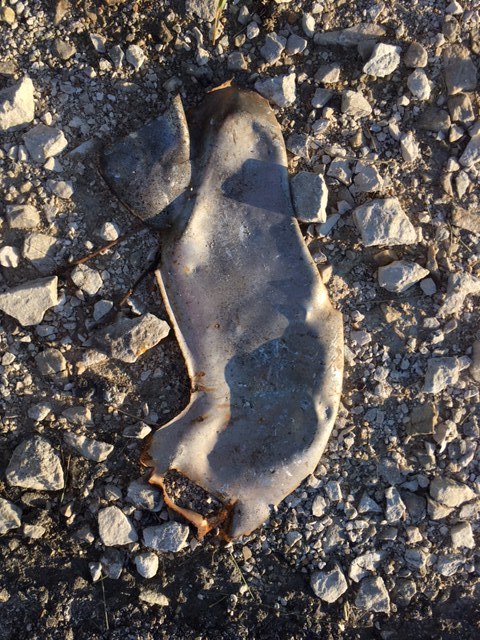
That’s why, as I ran home yesterday and spotted that flattened “AMERICA” can on the road, I could not help stopping to take an image of it. On many types of social media people complain that politics and religion should not be discussed, yet that’s exactly what we should be doing. People complain about the ‘intrusion’ of politics on Facebook, and whine on Linkedin that politics has nothing to do with business. The shallowness of both claims is breathtaking. What matters more than god and country? Cats knocking things off shells on YouTube? People posting their self-aggrandizements on Linkedin?

At least Twitter is honest, for it tends to be the most political social media tool of all. That’s because politics and religion are fair game on Twitter. They are also the two factors that drive everything that happens in America. But because people are reticent to truly engage and go to the trouble of defending their viewpoints rather than spouting borrowed phrases and manufactured memes, we wind up with a flattened version of what America is truly all about. Twitter is no exception.

Why Budweiser’s America sucks

Detritus.jpgIt disgusts me that a beer company had the gall to put the word AMERICA on its can in the first place. In a nation where supposed patriots are bitching about confederate statues being torn down and football players are derided for kneeling during the National Anthem in protest of ugly racial politics, hardly a word was uttered against the idea of putting a popular name for our country on a Budweiser beer can.
You want to know where we should draw the line on respect for our country? I say it starts right there. No faux patriotism on beer cans. Because what’s next, the United States of Tampons? The Declaration of Depends?

Budweiser thought it would be clever, picking up on the political mood of the time when Trump supporters were going bonkers for anything with a red, white and blue theme. Some advertising agency said sure, why not shove some liquid swill their way and see if they’ll drink it in celebration of their supposed triumph?

America, indeed. But let’s be clear: the marketing scheme has failed in one critical way. The symbol of a crumpled beer can on a dirty street absolutely describes the low measures we’ve adopted as a means to make America great again. It has accomplished the precise opposite of its intended effect.

What it will take to restore some sense of conscience is people willing to sing in the back of the bus, and stand up to the bully coach who thinks that winning means only one thing in this world.


Posted in running, track and field | Tagged , , , | 2 Comments

Riding smack into the Butterfly Effect

The butterfly effect is the concept that small causes can have large effects. Initially, it was used with weather prediction but later the term became a metaphor used in and out of science.[1] In chaos theory, the butterfly effect is the sensitive dependence on initial conditions in which a small change in one state of a deterministic nonlinear system can result in large differences in a later state.

I went down in a minor bike accident while ushering a young rider through his second real road bike ride. It wasn’t his fault really. It was windy and he was trying to hear instructions on where to turn next. He simply hit the brakes suddenly. I veered to miss hitting him but did not quite complete the maneuver and tumbled to the ground.

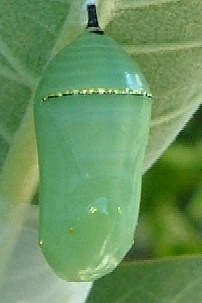
Monarchpupa.jpgIt’s all good now. Not the young rider’s fault, for sure. During my first year of riding I was similarly trying to follow instructions when I misunderstood directions on where to turn from a experienced rider and plowed right into him. The impact knocked him off the bike and he struck the ground with an elbow. The wound bled down his arm for ten miles until the blood coagulated at his wrist. Confusion on the bike can result in accidents. But that’s what they are: accidents.

It happens when we’re green.

The impact knocked the wind out of me. I sat there trying to catch my breath. It took thirty seconds to get it back together. For a few moments it was like being a prisoner in my own body.

Chrysalis of pain

Monarch chrysalisDays later my chest is still sore. I really hit the handlebars hard. Same with my right hand. The actual night of the fall my right wrist hurt like crazy.  I iced it for two hours. The wrist healed up enough to do rides of 40 and 65 miles on Saturday and Sunday. But it felt like I was emerging from a chrysalis of pain.

Look at those Tour riders getting into crashes all the time. All it takes is a touch of tires in the peloton and anywhere from two to fifty riders can wind up involved. We don’t think much of such falls, and the pros usually jump up and ride away. But they still hurt.

Slow or fast 

Richie PorteEven experienced riders can fall badly at very slow speeds. But when you ramp up the pace to 35 or 40 miles an hour, things get hairy in a hurry. Watching Richie Porte crash on that mountain road during the Tour de France was agonizing. First his tire grabbed some soft gravel on the left side of the road. Then his bike pitched right and he cut on an angle taking out Dan Martin before slamming flat against the rock wall on the other side. I cannot imagine how much that hurt.
Or how long it must be taking Richie to recover. A crash at that speed, and of that magnitude, can disable a rider for some time. During the Tour we heard the story of Taylor Phinney who broke his leg badly in a crash with a guardrail. At one point they thought he might not even walk again. Yet he trained back into shape and led the inaugural stage of the Tour for many miles before the group passed him for the bunch sprint.

Snapping bones

I was fortunate that nothing actually broke the other day. One of my best friends snapped a finger last spring and his broken hand took months to heal. He was going only 10 mph when the surface of a bridge slickened by fog caused his tires to go out from beneath him. He could not shake hands for months.

My own right had was quite sore this weekend, a familiar feeling because I once broke the outer bone in my right hand years ago while coaching soccer. I was tending goal as the kids I coached took shots. I dove for a stop and slipped on wet grass. There was a loud snap from my hand, and a nurse mom took one look at the hand as it swelled and informed me, “It’s broken.”

Sure enough, it took six weeks to heal the hand with a clamp that held the bone in place. They call that injury the “wifebeater” break because it’s the spot where men engaged in domestic violence suffer well-deserved injury.

Shaking hands

It’s been 40+ plus years since I last punched someone with that hand. It happened while defending myself during a high school intramural basketball game. My violent impulse came about after a guy tossed me over his shoulder during a rebound battle. I jumped up and swung, and hit the guy flush in the face. It gave him a black eye. I saw that big fellow at a high school reunion two years ago. Thankfully he forgot my transgression.

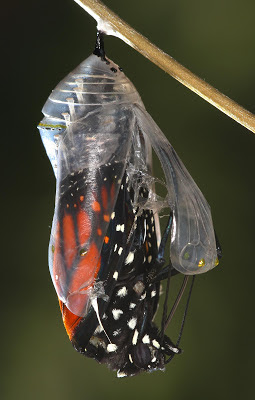
Chrysalis Emerging 4.jpgSo the human hand is a remarkable structure but not infallible. Even without a break, the resultant soreness from the crash last Thursday left my hand in a tender state. That led to a hard wince after shaking hands with a cyclist I met at Rocket Bicycle Studio. The guy was a physical specimen in that tanned, fit, muscular way only cyclists seem to achieve. On top of that he was a former professional polo player from the nation of Jorden. He gave off the vibe of an athlete through and through. And when he shook my hand after our conversation he gave a hard grip and I thought I was going to crap my pants. Instead I laughed, and explained why I almost jumped out of my skin. He said, “Ahhhh, I get it.”

Bad ideas

Every summer I get into some situation where something stupid takes over my brain and a crash takes place. Trying to jump a curb? Never a good idea. Riding with my head down on a bike trail? Crashed into a tree.

All I can say today is: “At least nothing’s broken.” However my ribs were also bruised and the muscles of my back so tight that I have had to sleep like a 2′ X 4″ tipped on its side.

Such is the price of a moment’s inattention. But we emerge from these experiences just a little wiser. The fact of the matter is that accidents happen even if you’re 100% focused and riding like the wind. It’s the product of chance and the Butterfly Effect.


Posted in Uncategorized | Tagged , , | Leave a comment

Appreciating service and a gift to self

Cyclist on Tarmac.png

I noticed this tarsnake tarmac rider on the sidewalk near my office this morning. 

I know there were plenty of people out there who rode more miles than we did this weekend. The social media feed of any triathlete usually fills quite quickly with the efforts posted by others about their training and racing. “Century in under five hours,” the feed goes. “Would have been quicker without the wind…”


And you think to yourself, “Oh, fuck you.”  So you put down the phone. And sigh. “Oh my God, I’m fine with my 65 miles.”

Because let’s be real. None of what other people do really matters to you. Not in terms of how it helps your training. Sure, it matters to them. It’s fine and fun to give them kudos and wish them well. Maybe tease a little if the friendship is close enough. “That’s all?” you might ask? “Just 150 miles in two days?”

But what matters to you is what you do. Never forget that. It will keep you sane.

Gotta Getaway

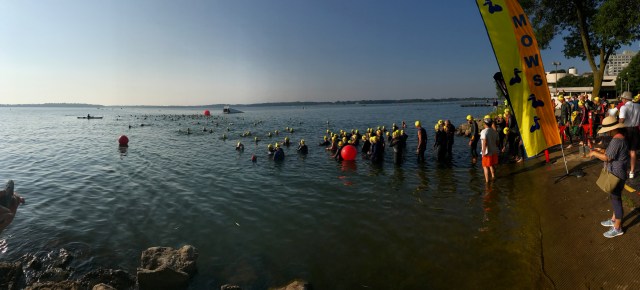
And in that light, it was a good weekend for us. Sue and I traveled to Madison for a combination Birthday Getaway while Sue did the Madison Open Water Swim (MOWS) on Saturday morning. Then we were headed to a cycling trip on the Ironman course.

Sue's Mows composition.jpg

We stayed at the Doubletree in downtown Madison. Every employee from the friendly maintenance man in the elevator with his toolkit to the gal that spotted us with bikes and put them in storage was awesome. The staff took initiative as individuals, proving there really is an “i” in “team.” They deserve credit for that. The welcoming atmosphere really makes a difference.

Rocket Bicycle Studio 

The same can be said for Rocket Bicycle Studio out in Verona where we parked before heading out for the ride. Jessica Laufenberg and her partner Peter run a great bike shop, and on Saturdays they wind up fixing all sorts of mechanical and bike/personal problems brought to them by the staff. From nutrition counseling all the way to replacing cleats and tweaking derailleurs, the pair give heart and soul to their customers. And I’m serious. This is the ‘lite’ description of their services on their website:

Be taken care of.

Ride something different.

Learn about you and your bike.

It’s the difference you’ll enjoy.


Casey's

Even friendly service at a pit  stop such as Casey’s is appreciated

Perhaps I’m the opposite of jaded these days. Because I appreciate when people make you feel welcome and take an interest in your needs. Service to others is a noble ideal. You know, sometimes it’s the merest tweak on a bike or the adjustment of a cleat that can save a hard bike ride in the hills from becoming a miserable slog. On the Madison course, there are people doing three loops of that forty mile loop some weekends. With a ride that long, things need to be right or some undue suffering may occur.


The Barlow Factor

We rode the course in company with some other folks and came to a decision point where the new Ironman course splits onto a new section called Barlow Road which climbs a series of big goddamned hills. Or maybe it’s one big hill in three parts. No matter. It’s hard.

Now the Ironman course formerly known for separate climbs known as Three Bitches has added the Big Bastard, a multi-level climb that hits 18% at some points. It’s a hard climb even on a road bike. I made it all the way up on my Specialized Venge. However, the geometry of my bike versus a tri-bike is quite different. On a tri-bike it can be impossible for some to climb the Barlow hill.

We talked with one guy while getting food and drinks at the gas station in Mt. Horeb that admitted, “I’ve ridden up Barlow and I’ve walked it with my bike. The difference is only 47 seconds.” It’s a steep hill, in other words, with diminishing returns in riding versus walking for people in the middle of 112 miles in an Ironman. So call that the Barlow Factor.

Horribly Hilly

The last time we rode Barlow was the Horribly Hilly ride two years ago. There are quite a few nasty hills on that route, including the last long-ass climb up the park road into Blue Mound State Park that concludes the ride. I think that was 2000 feet of climbing, if I recall. I stood on the pedals for quite a long way toward the end.

So we rode and rode in the hills, and it got hot and windy.  And given that our schedule was delayed getting out on the course after the MOWS event, we were running out of time to get back home on Saturday night. So we bagged the day’s riding after a single loop of 40 miles and had a quick dinner with Sue’s sister July and her friend Trudi at Gray’s Tied House in Verona. Good food.

Sunday riding 

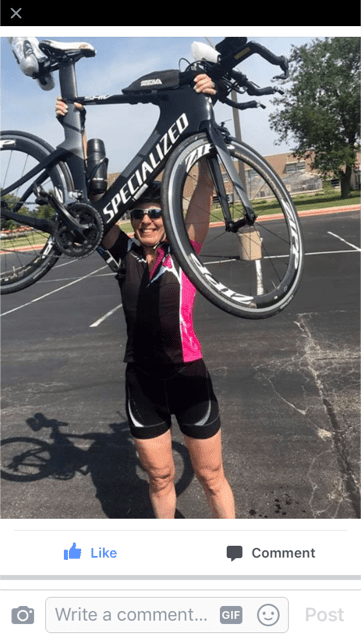
Sue 52.pngThen Sunday morning we rose again to ride 65 miles in the flatlands of Illinois. Sue’s fifty-plus friends insisted that she stop at 52 miles in celebration of her 52nd birthday and hoist her bike over her head for doing a Birthday Ride. On the day, we averaged about 18.5 despite some fatigue in our legs from the hills the previous day, and that completed the Weekend of the Century. 105 miles. And it was good.
105 miles of riding is still….105 miles no matter how you look at it. The ability to ride that far is proof that over time the unimaginable becomes practical, even desirable. The whirr of tires on tarmac sinks into your soul. The soreness from the day before flows out of your legs and the efficiency of muscles cleansed and open for oxygen becomes your reality. You feel like you could ride for a hundred years. And that’s what matters. What you do. Not someone else.

So the moral of this tale is to be willing to serve others, but also to celebrate what you do. That’s a gift to self. And there’s nothing wrong with that.


Posted in Christopher Cudworth, climbing, cycling, Uncategorized | Tagged , , | Leave a comment

One for the Birthday Girl

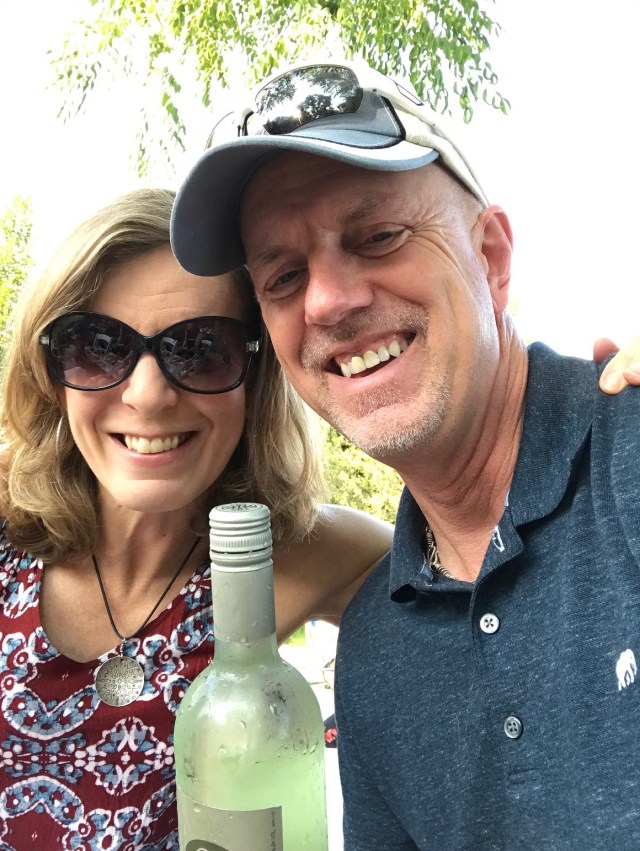
Sue and me.jpgIn May of this year, I married the woman I met through FitnessSingles.com. If that sounds a bit cold or commercial, be assured the story behind our relationship is much warmer.
Sue and I were both going through considerable life changes four years ago when we met. During our first date, she chuckled and said, “I hope you don’t mind dating someone who is unemployed right now.” Well, I’d had enough experience in that category myself to know what it’s like to be working for a new job, exploring options and earning your way back into the workforce.

She is a talented project manager and an architect by trade. So she dug into fields where her talents would best fit, and wound up with two strong opportunities. To make her decision, she went for a four-mile run and told me later that night, “I know which job I want to take.” I thought to myself, “This woman is a lot like me.”

The job has turned out to be great, and she recently moved into another role with the same company. Life (and triathlon) is all about transitions.

The Racer

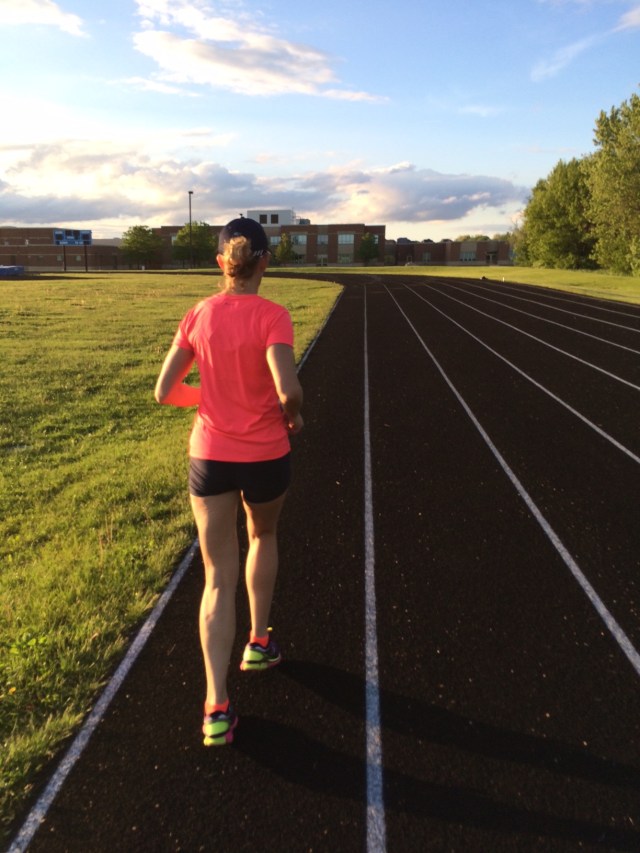
Sue RunningOn the second week that we were dating, I drove up early on a Saturday morning to watch her do the Racine Half-Ironman. She linked me up by phone with her sister Julie, a breezy counterpart for the day, and we shared histories while sitting in the sun and shade as Sue competed. Julie is a cancer survivor who also competes in triathlons. The two sisters would ultimately complete their first Ironman race together in Madison two years later.
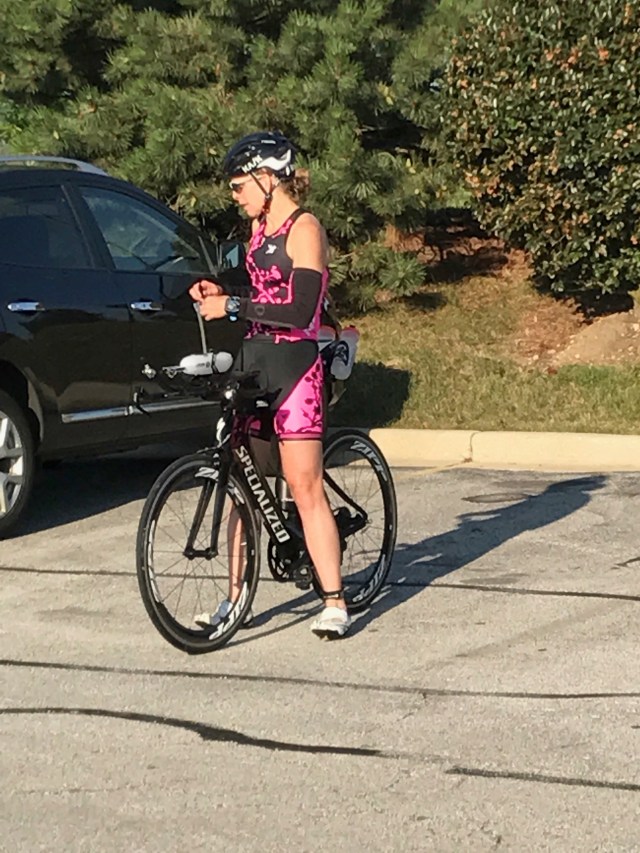
I began training with Sue of course. That was one of the reasons why FitnessSingles was a solid option for us both. We wanted someone with similar interests. It has turned out to be the case across so many fronts.

The miles on the bike and on the run were a bonding force. Some of those days were hard and long. Weekends spent in Madison training on the hilly Ironman course tested both our characters. We also did Horribly Hilly together, and it was not Sue’s favorite weekend in athletic pursuits. At one point I commented, “This is such a pretty valley,” and she blurted. “Yeah, well, it just means we have to go back up again.”

Sue in Kit.jpgWhat a perfect symbol for so many things in a relationship. There were weekends where I did not feel my best either. She is a strong rider and sometimes I could simply not keep up. That meant we needed to develop a fair and honest dialogue to cope with our ‘in the moment’ differences. That too is a symbol for how relationships grow and change.

What I found in Sue was space to think, change and breathe. She is a strong woman who does not wallow in past difficulties. Acknowledge the change. Learn from it. Embrace what you need. And keep moving. Above all, share love and memories with those close to you.

And sometimes, with strangers. We both like meeting new people. Petting dogs and going out to dinner. The meat of life.

Through it all we keep changing. That came in handy when the time arrived to get married and consolidate our housing arrangements. Clearing out the house where I’d lived for 20 years took both a forceful determination and a patient will to capture and keep significant items that my children and I wanted.

Yet that was the same year I cleared out my father’s house after his passing. So it was the end of a long two weeks toward the end of that process. Sue saw up close how much it had drained me. On the final night before turning over the house after thirteen hours of work filling dumpster and carting boxes out of the place, she got me home, fixed me dinner and laughed when I could not even lift the fork to eat some green beans. “You’re done,” she laughed. “It’s time for you to get to bed.”

Podiums and Bling

Sue on Podium.jpgI saw her in the same state for different reasons. During her Ironman year, things kept going wrong. Some were little. Some were big, including an incident in which an Escalade driver ignorantly parked herself in the middle of country road forcing Sue to ditch her prized Scott tri-bike to avoid crashing into the white hulk blocking her way. The bike was trashed due to fractured rear struts. That forced Sue to substitute bikes. One training ride in Madison turned into a desperate slog. But she got a new bike at virtually the last minute…

And she transcended all that to finish her Ironman in Madison. I ran along next to her crying tears of thanks and joy. What an example of perseverance! She’d accomplished her goal. “It wasn’t the day I wanted,” she smiled as she headed to the chute. “But I’m gonna be an Ironman.”

Sue at Churchill.jpgWe’ve learned so much together and had so many moments of laughter and joy between. Our children have gotten to know each other and our families have blended into a support system all around. From loss has come gain. And from gain we draw hope.
For me, the changes have helped me regain a training mentality, and I’ve even learned to swim, for God’s Sake. That has taken two years, but the challenge has been wonderful to engage. Sue recently tuned a couple things in my “catch” by watching me from the next lane over. She’s a swim coach but not directly in my case. I swam the 800 meters at the Holidayman Triathlon with ease. I feel like we accomplish these things together.

Which is why every birthday is significant in our lives. Birthdays are for an individual, but they are meant to be celebrated together. I love this woman because she knows all this, and more. She is training for her second Ironman and had a strong performance in the Steelhead 70.3 last weekend. It is fun to be her companion in this, and her kids are likely going to join us to watch her compete in Louisville.

So it’s Happy Birthday to you, Sue. We all love you and wish you the very best.


Posted in 13.1, competition, cycling, swimming, training for a marathon, tri-bikes, triathlete, triathlon, triathlons, We Run and Ride Every Day | Tagged | 2 Comments

The light and shadow in your eyes

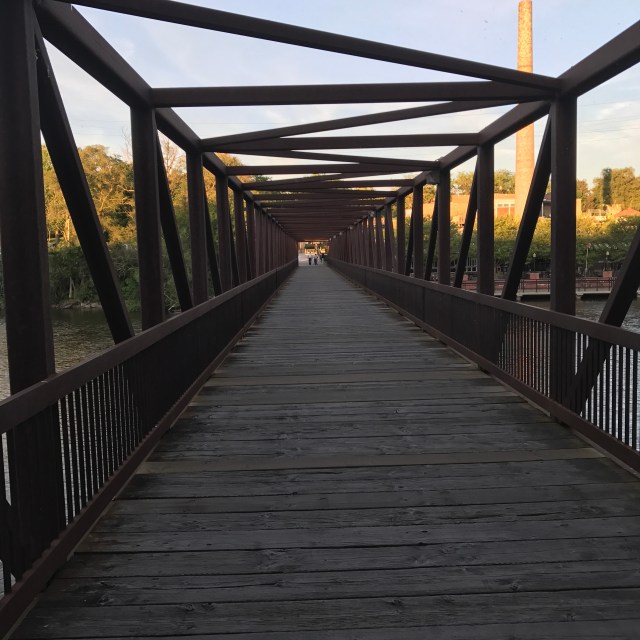
City Photos Peace Bridge.jpgIn late summer when the sun goes low in the sky, the shadows thrown across the road by trees or other structures can produce a flicker that seems to reverberate deep inside your mind.
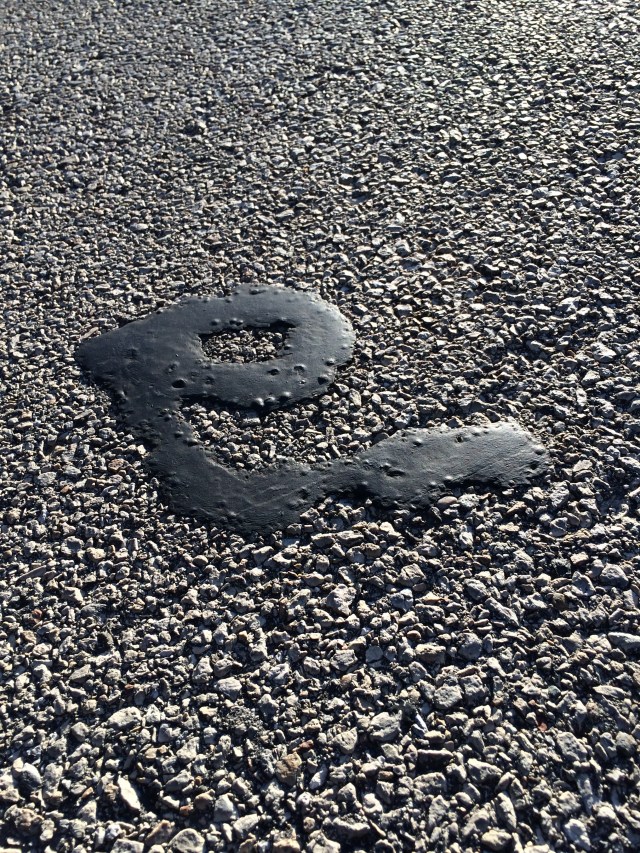
And it is known that the effects of strobe lights can cause people with certain medical conditions to have seizures. Something about pulsing light sets off an array of synapses that can overtake the mind and body as well. So light is no trifle thing. Nor is darkness. And in rapid sequence the world can seem to be coming apart.

Light and dark 

I thought about the power of light and dark as I drove home last night and felt that flickering light sensation as my car coursed south along a low road with a row of trees to the west. A few days ago I was speeding down the side of the road on my bike at a rate of 23 mph when the trees produced that flickering sensation as well. It was disorienting, hard to keep track of my line on the road.

In a few days we’ll be witnessing a solar eclipse here in America. I’ve seen this before. The light goes all thin and weird-looking when the moon screens out the sun. No wonder the ancients thought the world was coming to an end. For all they knew, their depressed menagerie of gods were fed up and ending it all. Some people still think like that. Primitive, and fearful. Every new eclipse gives the latter-day version of religious fanatics a new reason to predict the End of the World. But all it ever proves is their lack of credibility. Such are the risks of building religious faith on literalism.

Taking screens for granted

IMG_2953Perhaps you’ve seen video in which a computer screen is lit up in the background. The screen flickers and pulses. A computer screen is not what we think it is. It is granular. The light inside is all broken up.
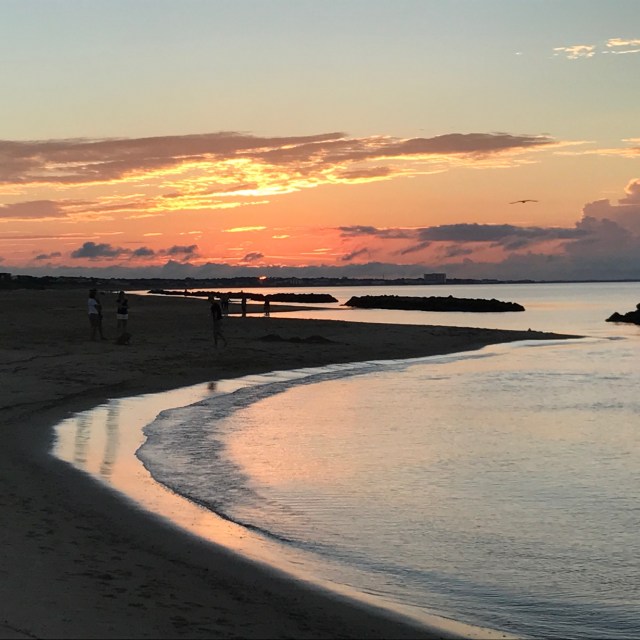
This is so typical, that what we take for granted is not often what we truly see. Our minds are capable of such incredible assimilation we assume that images projected on a movie screen and pumped to us through the Internet are “real” in the sense that they exist as whole or consistent entities. Yet even the words you read here are nothing more than a series of slashes and Os. Pixellation generates the desired image.

Pause in time

There have been many times during my running and cycling career when my mind just seems to stop, for a second or five, as it realizes where I am in the moment. Sometimes the entire world seems abstract in those few seconds. It is not cliche to suggest that in some way we all live in a dream that we call reality.

After all, even our thoughts are the direct result of electrical impulses. Way back before all this digital universe was invented, people struggled to put a face on this idea of consciousness. The Bible itself can only summarize what it means to be alive and have some sense that there is a Creator of all this. Here is what John 1 says about that:

1 In the beginning was the Word, and the Word was with God, and the Word was God.

2 The same was in the beginning with God.

3 All things were made by him; and without him was not any thing made that was made.

4 In him was life; and the life was the light of men.

5 And the light shineth in darkness; and the darkness comprehended it not.

One can almost feel the flickering frailty of that attempt to grasp the meaning of eternity, and how humankind came into being. Members of the human race flicker into being and pulse back into darkness. None of them mean that much. Even our greatest heroes collapse into bones and dust.

The race laid out

Norfolk BeachIn between, we run the race laid out for us. We try to run it well. That is true both literally and figuratively. Here is what the King James Version of 2 Timothy says about that: 7 I have fought the good fight, I have finished the race, I have kept the faith. 

“I have kept the faith” can mean a number of things. In its context, it means a faith in God. But keeping the faith and keeping faith are merely twins separated at birth. If we so choose, we keep the faith by which we are raised. But we also keep faith in this life through our associations, our friends, and trusted partners. That is the race laid out for us as well.

Faith in ourselves

We also keep faith with ourselves; the motivations and goals we map and execute. But there are times in life when these purposes seem in danger of flickering out. We pass through stages where everything in which we believe seems to disassemble.

I have kneeled in fall fields praying to God to get my confidence back. I have seen the blue sky look cruel and cynical as I searched my heart for reasons why the world seemed so dark when light was all around me. I have struggled to understand why there always seems to be ‘just enough’ and never as much as I wanted at some moments in time. And I have asked for forgiveness from others and for myself. These are the flickering lights of existence.

But most importantly I have learned to accept that I will never understand all the reasons why things happen the way they do.

EgretIn the end it is that embrace of self that keeps faith intact throughout many flickering moments of doubt and joy and pain and happiness. Through those sequences one must simply reckon with the present. As we run or ride along, we have a chance to do just that. We learn to calm ours mind and  soul with the thought that it is still good to be alive.

The light and shadow in your eyes has a story to tell, if you will listen. It may well flicker at times, or catch you by surprise when the clear still vision of where you are in the moment catches up with you. Embrace it. This is your time. This is your place. These are your footsteps, turns of the pedal and eternal flow of water across your body. This is your light and darkness, and no one should claim it from you without the firm resolve of love to bind those moments together. That is the connection and sustaining truth between light and darkness. Call it love. The light and shadow in your eyes reveals it.

Posted in cycling, triathlete, triathlon, triathlons | Tagged , , , , , | Leave a comment

Is racewalking the sport of the future?

IMG_4118.jpgWhile doing my strength worth this morning in our home fitness room, I turned on the television to watch the morning session of Day 10 in the World Track and Field Championships. And there was a sport that I’d forgotten about. Racewalking. 

The rules are strange. Athletes move across the ground as fast as they can, but one foot must be in contact with the road surface at all times. There are judges who specialize in watching the athletes to make sure they’re not technically “running,” which would mean they are moving with both feet off the ground at the same time.

IMG_4116.jpgAs a result, racewalkers move with exaggerated arm movements. They are the exact opposite of the Ninja runner that we witnessed in the women’s marathon. She ran with both arms straight down at her sides and very little hip movement at all.
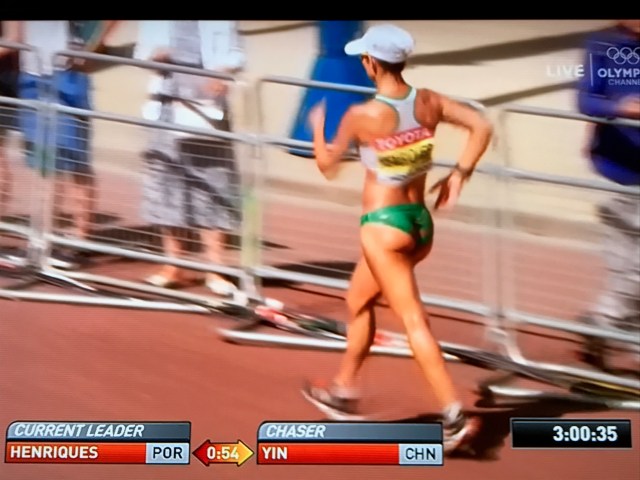
Racewalkers “roll” through every stride. Their hips swivel up and down in exaggerated fashion. They might almost qualify for the Ministry of Silly Walks if the sport was not so damned hard to do. The four-hour competition was won by a Frenchman on the men’s side and a Portuguese woman that has devoted, the announcers were clear to say, more than 20 years of her life to the sport.

And women around the world should perhaps pay more attention to this event. From the looks of the competitors, racewalking is a great way to shed some pounds and get that butt in fine shape. Running is a risk for many women and men with all that pounding. Granted, for the men, that swivel walk may get you some strange looks in some states, but racewalking is far less pounding than running. You just have to work on your strength and flexibility. Racewalkers can get injured too. It’s always about overuse versus weak connective tissues.

IMG_4101.jpg

It was interesting to watch the introductions of the competitors. All were rather humble in their demeanor. No mugging like the sprinters in track or rehearsed moves like Usain Bolt or Mo Farah. They even introduced the men’s and women’s competitors at the same time. That’s because they competed in the same race on the same course.

IMG_4123.jpgThere is no danger of running into one another during the event, because they’re not running. They’re walking fast. There is plenty of time to merge after water stops, and competitors still traveled in race packs that broke up like meteors re-entering the atmosphere after an hour or two.
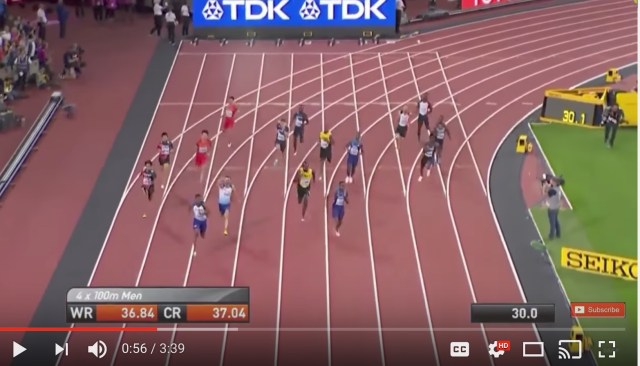
Every racewalking event is a study in perseverance. One male Norwegian competitor got pulled aside and given a red card penalty for lifting his feet off the ground. But that seemed like the least of his problems, for his shirt was stained red from his bleeding nipples. It was hot outside, and four hours in the sun and sweat and abrasion gave him a bad case of bloody nips. Which was fitting because the competition was held in London, where everything was bloody beautify during the World Championships except this guy’s poor nipples and Usain Bolt’s supposedly cramping hamstring.

Usain Bolt behind.jpegI don’t exactly buy all that. When Bolt got the baton, he was already far behind. He’d gotten beat in the 100 meters earlier in the meet, and knew he had no chance of running down the athletes ahead of him. I think he “cramped” in order to avoid another disgrace. That may seem cruel and cynical, but I don’t blame the man. He likely regretted coming to the meet at all. He accomplished so much in so many amazing ways the last meet of his career was bound to be a letdown. Usain Bolt I don't Buy it.jpeg

So I don’t blame him. But luck runs out even for the most talented athlete in the world. But if his hamstring truly was cramping, he should have just finished the last forty meters racewalking. Everyone would have thought he was gaming the world like he’s always done. And more power to you Usain. More power to you.

Usain grabbing


Posted in Uncategorized | Leave a comment

The bumper crop of America

Killdeer.jpg

When I stepped out of my vehicle in the Remote Parking Lot at O’Hare airport, it shocked me to look at the front end of the car across from mine. There was an adult killdeer smashed into the grill.

Killdeer are a common species of plover that loves open spaces near water. They have beautiful markings on their wings and rump. Adult birds are known to feign injury to draw potential predators away from their nest or young. It works.

But killdeer have a habit of flying low over roads, and occasionally one of the birds gets smacked by a passing car. That seemed to be the fate of this particular killdeer.

The fact that the bird was still stuck in the grill is what surprised me. The options are intriguing:

  1. The person who drives that vehicle never noticed the bird in the grill
  2. The person(s) who drive that car are frightened or can’t stand the idea of touching a dead bird
  3. The person who drives that car is proud of the fact that they hit the bird in the first place, and are carrying it around with them like a trophy and a bumper crop

Obviously the bird will never get what qualifies as a dignified burial in any case. But neither do millions of other creatures smashed and smangulated by cars and trucks, trains and planes every day.

Tallying up the damage

I have run nearly 50,000 miles in my lifetime, and cycled another 50,000 more.  Generally there is a road kill of some sort along the road every five miles. That means during all my running and riding, I’ve seen probably 20,000 road kill victims including raccoons, squirrels opossums, skunk, chipmunks and foxes. Coyotes, deer, rabbits and plenty of domestic cats and dogs. There are lizards and butterflies, dragonflies and snakes as well. So many frogs and toads, salamanders and worms than I ever care to think about.

More than once I’ve gotten out of the car or stopped while running and riding to carefully move a turtle across a street or highway. They simply aren’t evolved to avoid vehicles speeding along from twenty to sixty miles an hour.

Is anything? Even human beings?

Avian debris

I’ve also encountered thousands of dead birds. Swallows, pheasants, owls. Hundreds of robins, cardinals and goldfinches. Buntings, warblers and thrushes. The carnage goes on daily. These are valuable individuals lost to eternity. More bumper crop.

Indigo Bunting

Most people never take notice of road kill while hurtling over the road in their heated or air-conditioned vehicles. Those of us who bare our souls and bodies and minds to the seasons also know that even road kill has its rhythms. In the words of Tom Waits,

“Road kill has its season just like everything, you got your possums in the autumn and your farm cats in the spring…

Human road kill

Only once or twice have I happened upon car accidents bad enough to witness death among human beings. But it has happened. There is human road kill as well.

That’s the principle threat to people who cycle and run on the open roads. Despite the law that requires drivers to give cyclists three feet margin when passing, some people are too stubborn or too stupid to manage that simple driving maneuver.

Listen people: Separate hazards. It just takes a little planning. Some can’t be bothered. Others can’t do the math. But murder can be intentional or manslaughter. The results are the same.

We runners and cyclists don’t want to be road kill. Yet there is so much testimony to the hard facts of distracted driving it is hard to ignore the facts. The Pedestrian and Bicycle Information center says, “In 2015, 5,376 pedestrians and 818 bicyclists were killed in crashes with motor vehicles (National Highway Traffic Safety Administration, Traffic Safety Facts). These two modes accounted for 17.7 percent of the 35,092 total U.S. fatalities that year.” And: The total cost of bicyclist injury and death is over $4 billion per year (National Safety Council).

Statistics like these do make one worry about winding up like that killdeer on the front grill of the red Toyota. The brand and style of vehicle doesn’t matter. When it comes to flesh versus metal, it is no contest. When that metal is pushed into action by a furious human being, you might as well throw the odds out the window. Anything can happen.

Angry drivers

It doesn’t take much to set some people off. Just get in their way on the road and they start screaming about paying taxes for the roads and the fact that they own them. And then it quickly can get ugly. It doesn’t take a crowd to incite violence. Note:: the video on this link shares graphic violence of an angry motorist attacking a cyclist with a club after he knocked the man to the ground with his vehicle. 

There really is no accounting for the levels to which human rage can be carried. The recent incident in which a driver in Charlottesville, Virginia chose to plow into a crowd of people is a keen illustration of the fact that there are people who regard their vehicles as a legitimate weapon against those who pose a hindrance to their perceived cause. The rest of us are mere bumper crop to their anger.

Driver -plows.jpg

Other close calls

Of course, not all threats to life are calculated. I’m actually fortunate to be here on this earth given the fact that my father almost got clobbered by a train in his youth. He waited for one train to pass, then jumped across the next set of tracks and was almost struck by a speeding train engine headed the other direction. Close call.

Orange traffic signal08-trump-good-news-folder.nocrop.w710.h2147483647.2xSo the fates are certainly fickle when it comes to who survives in this world. Most of us try to avoid ugly circumstance any way that we can. I personally grown more cautious on the roads the more I run and ride.

But it sure doesn’t help when people with anger in their hearts choose to buzz close to you, or from behind, and out of some sense of perceived privilege or affront try to run you off the road. They seem willing risk of stealing the life of someone else for the perceived satisfaction of cashing in their bumper crop.

There’s a whole world out there filled with idiots like that. When one of them gets into power, it emboldens the rest to play rough with the fate of others.

Civility itself seems to be stuck like road kill on the grill of America. Whether the nation has the conscience to slow the pace of terror in the post-modern world is a question for the ages. Those of us who love real freedom, not the freedom to maim and murder according to race, religion or refusal to share the road, cannot afford to back down. We must resist those who insist that it’s okay to view the rest of the world as bumper crop for anger and fear. That resistance must go all the way to the top. And to the very end.


Posted in cycling, cycling the midwest, cycling threats, riding, running | Tagged , , , , , | Leave a comment