Black and white ice in a grey world

IMG_9581Early morning freezing rain made the roads slick for running today. I got out the door by 6:30 a.m. and immediately found my daughter scraping away the thick crust of ice on her Honda windshield. She’d gotten through the top layer of ice but the visibility was still zero through her windshield. I stopped to take the scraper for her and ground away as the ice turned to powder and fell like little bits of snowstorm on the now-bare window. It turned from black to white ice before our eyes.

That was all I needed to learn about the conditions outside on the roads. The footing was not going to be great.

It took quite a bit of concentration to keep my stride even as I made my way down the back streets. I wasn’t worrying about how fast I was going. My plan was to just keep going and see what the morning would give me.

The route I chose was along Orchard Road where the salt trucks had already traveled past. Under the glow of the traffic light ahead, one could see a clear line between black ice and the wet road. Different kinds of shine.

I ran mostly flat-footed, not quite forefoot-striking. I used the pad of rubber for gripping all I could on the alternately slick and sodden road. That meant my shoes sometimes skritched from the crunch of salt and squeaked as rubber met wet asphalt. It was a very tactile experience, running in such conditions.

Days of ice dreaming

This was certainly not the most extensive ice storm I’ve ever seen. There was a massive ice storm in Pennsylvania when I was a child. It laid down a coat of ice an inch thick even on the streets. It looked as if the entire world was encased in rippled glass, as if the world had been cloaked in some sort of icy dream.

We lived next to a golf course, yet the first thing I saw while dragging my sled out toward the sledding hill was an older neighbor who could ice skate gliding up the center of the small street behind our house. Then he stopped, stepped over a chunky snow bank and skated away across the fairways of Meadia Heights Country Club. The world was one giant skating rink.

Making the grade

I was in third grade or so when the ice storm hit. There was no school for several days, so we were free to explore the icy world at our leisure. As an experiment, we took our red Coleco sleds out to the head of the practice range of the golf course. There was perhaps a 2% grade leaning toward the creek in the valley. We didn’t know what would happen when we pushed off from our spot on Niblick Avenue. To our surprise, we quickly gained spiraling speed as our sleds whipped across the ice layered on top of snow. The sensation was was both thrilling and terrifying at the same time. Had we chosen a steeper grade, we could easily have been killed by losing control of our sleds and running into a tree.

As it was, we slid down the entire length of the 400-yard practice range, picking up speed as the incline increased toward the creek. Fortunately we’d aimed luckily and wound up spinning our way down a wide open fairway. It finished with a long cascade downhill. Our sleds roared across the ice down toward the valley until we bottomed out and went slinging up the other side. In summer that hill was a steep one to run up or climb. But in icy conditions, the physics were ideal for us to come to some sort of sliding, sideways halt. We lay there on our sides laughing and somewhat out of breath. I think my friend and I had both been holding our breath for most of the run.

White ice fever

We’d covered close to a half mile on what amounted to white ice. But then came a long, slippery trudge all the way back home. “That was fun,” I said to my friend. “But let’s not do it again. I’m exhausted from walking back.”

After a couple days, school beckoned and the streets finally melted after multiple applications of salt from snow trucks.  But even after we returned to school and life got a bit back to normal, talk around school centered on all the cool things we had done. The sensation of being freed from normalcy stuck with us a while. Even the teachers indulged us in conversations about the ice storm that had changed the world for a few days. We all had white ice fever.

Back to reality

Thoughts of that ice storm ran through my head as I ran 4.5 miles on the slick roads this morning. I treasure those memories about the ice storm in Pennsylvania. Then it struck me that they date back five full decades. Yet they still contribute to the sensations I still feel today. How miraculous and wonderful is that?

Admittedly, I have grown much more cautious when it comes to encounters with black and white ice these days. I learned some hard lessons over time.  Twenty or so years ago while out running on a cold morning in February, I got frisky and elected to hurdle a low-hanging chain blocking the entrance to a forest preserve. Unfortunately, on the other side of the chain there was a large patch of snow drainage that had frozen overnight into a layer of clear black ice. My lead foot went out from under me and I crashed to the ground. In trying to catch myself during the fall, my hand and wrist jammed into the hard ground. That resulted in a sprain whose effects lasted for a full year.

So I took no chances while out running this morning. Even stepping up a curb level was risky business, so I stuck to flat sidewalks and where possible, ran on the crunchy snow left over from yesterday’s snowfall.

The world is a slippery place in both literal and abstract terms. The dangers of black and white ice are not exactly yin and yang. They can combine to make danger and turn the world into a grey and dangerous place.
Posted in aging, aging is not for the weak of heart, Christopher Cudworth, running | Tagged , , , | Leave a comment

Come with me on a little run in the morning light and falling snow

CloudsA near silent hiss of granular snow had fallen overnight. This was a surprise to see as I opened the blinds to peek into the pre-morning gloom. “Huh, snow,” I muttered to myself.

Sue was already down in the exercise room riding her bike on the trainer. The sound of her wheels on the cylinder thrummed through the house. She was on the bike by 4:45 a.m. I was just rousing myself to the task of a half-hour run at 5:00 a.m.

My clothes were piled on a chair next to the dresser. This is the most important step of all for an early morning runner. Chasing down equipment is the greatest delay and the most difficult task in the early hours. For one thing, the cats come begging food if you dally too long. I also did not want to wake our newest house guest, the dog Chuck that has come to live with us while my daughter and her beau plan their next stage in life.

Sue’s kids are still with us another week. Their stirrings on the way to work usually do not start until 6:00 a.m. Some mornings there are vehicles to move so that everyone can get on their way on time. That always comes before my runs. The basic consideration of joint living.

With all that out of the way, I stepped into the morning air outside our house and felt the first draft of what the day would be like. By chance of availability in the running gear drawer, I was wearing my black balaclava hat. Despite this covering, the crisp kiss of blowing snow still reached my face.

Snow scratches.jpgIt turned out to be the perfect solution on a brisk morning with a north wind pushing icy crystals of snow southward. The street was covered. Only one set of tire tracks circled round the cul de sac. That was the newspaper delivery truck. The track of the skidding paper slid up the driveway. Later I’d come back to find the thin tracks of mourning doves around our bird feeder, and the clean lines of the primary feathers of a bird that lifted off the ground when I approached.
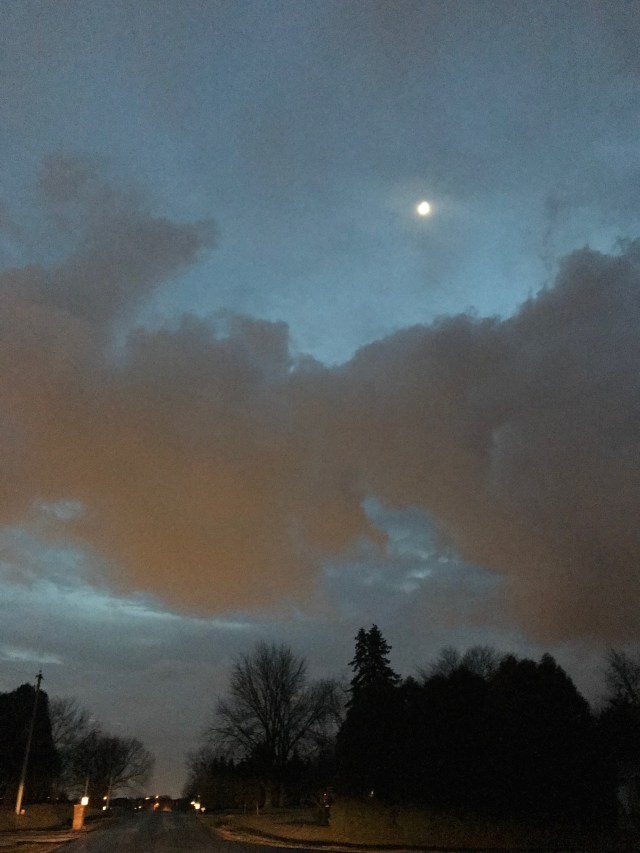
Looking to the south, the sky was lit by the cluster of car dealerships down by Interstate 88. The car stores bleed light into the sky, the mark of eternal commerce.

I turned east and then north, straight into the wind and the snow. It flecked my eyes and bounced off my cheeks. Then it is forgotten somehow. The elements of the day are what they are. You can’t change them. So you run.

A half mile in the urge to pee comes over me. There is not a soul around, so I stop just past the reach of a streetlight and pull it out for a pee. When finished, I bend down and write in the snow. “Wee wee.”

I know, stupid, right? I can’t help myself. I like stupid stuff.

The hill up Hickory Lane goes by smooth enough. Then I’m on the flats of what my wife and I jokingly call the Penis Route. The three-mile loop goes out, makes a loop on Horsehoe lane and heads back home. On Strava, it looks like a dick. Or so we’re told by our pervert friends who love to tease us about it. We love that. Nothing wrong with some dick humor in this world.

On the way home my body is warmed up and I pick up the pace. This past Sunday I ran with a friend named Jeff Palmer. He’s a lanky guy in his late 40s who can still motor it. While Sue ran with his wife Max, I joined Jeff during the warmup phase of his 1:20 run. We dropped from 8:30 to 8:00 to 7:20 mile pace as we ran together. He threw in an interval or two but I kept trucking along. During the last half mile I shut the hell up and just ran. I could feel that I had about another 1.5 miles of that pace in me that morning. Then I’d have to shut it down.

But it gave Jeff someone to run with for a bit. That was my duty. I’m sort of a Sherpa runner these days. My training takes place by osmosis.

As I tooled back down the hill on Hickory Lane this morning a short burst of gratitude caught up with me. I thought about the fact that I’m sixty years old, have no ACL in my left leg and a torn meniscus poking out from the core of the same knee. Yet here I was trucking along in the dark on a crunchy snow street and fairly loving it. What’s not to like?

On the return trip I stopped where I’d taken a pee on the street and bent over to write the words Oui Oui in the snow below the dark pee patch and the words Wee Wee above it. I had to finish my work of art, you see.

Turning onto the bike path that leads toward home, I saw the tracks of a fox heading down the pure white path. There are coyotes here too, but they seem to come and go. That’s why the fox could move unmolested by his fellow canids.

I ran together with the fox tracks for 400 yards and reached our house. It felt good to be warmed up. Surely I could run another three miles, and probably should. The run cleared my head of any dark little thoughts rattling around my brain. That’s the purpose of some of these runs. To let the darkness and the snow and the north wind blow away the anxieties of real life.

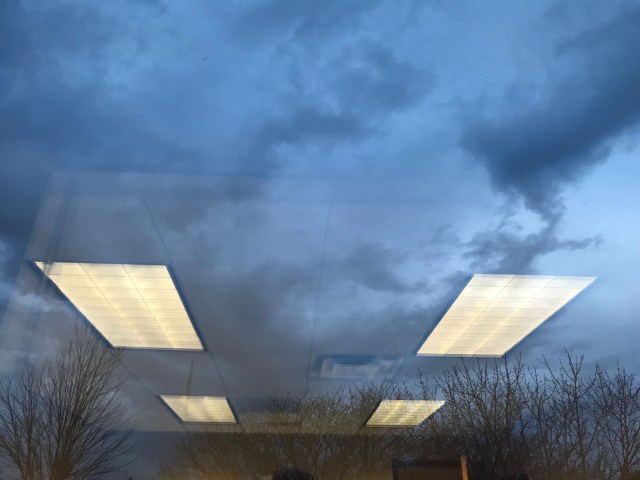
WindowsBehind me, as I stepped up to our porch and the front door, the lights of the car dealerships blared behind into the morning sky. They were diffuse, so different than the illusory images of fluorescent lights reflected on the glass of my office window as I turned to leave work last night. Those were crisp and defiant against the darkening sky. This light thing is all a game. An illusion of self and perception.
On the drive home last evening the clouds to the south flickered with lightning as the last warm air of the week passed over. Those clouds were shedding rain and pulsing with lightning and thunder as they traveled. Perhaps the sky has its own share of dire little thoughts or worries it likes to shed from time to time. For some,  this is the nature of being. Nothing tragic at work, nor habit of mind any longer. Just a part of existence and the daily transition from darkness to light.

Thanks for coming with me on a little run in the morning light and the falling show. May you find the light of meaning on your own today.

Posted in aging, Christopher Cudworth, running, Uncategorized | Tagged , , , , | Leave a comment

Best efforts

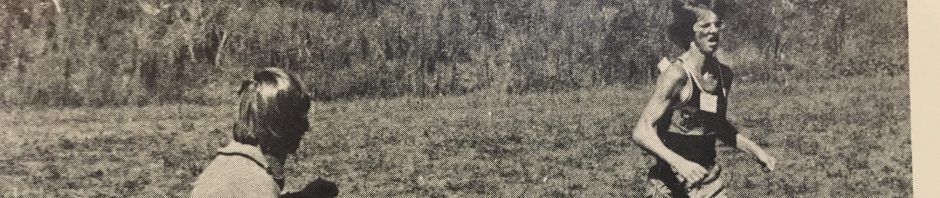
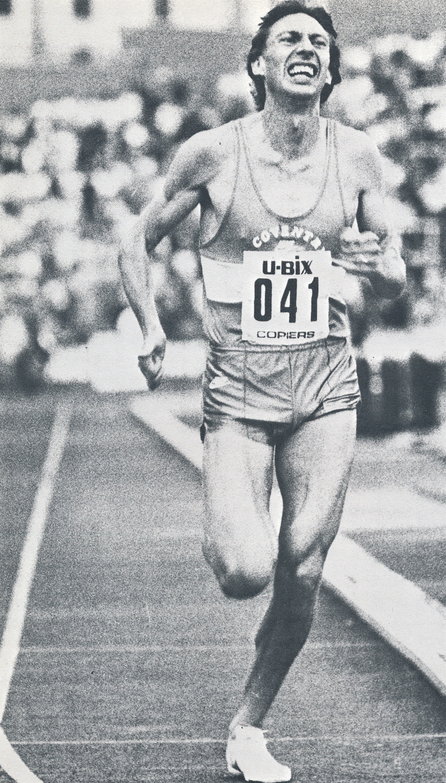
Moorcroft.jpgThirty years ago sportswriter Kenny Moore published a compilation of his best writing about runners for Sports Illustrated.
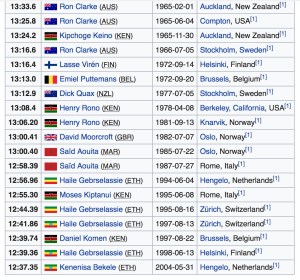
His stories included profiles of people such as David Moorcroft, the British runner who ran 13:01 for 5000 meters, breaking the world record by a full six seconds. About that day, Moore quoted someone who said that Moorcroft had gone “wonderfully mad.”

There are few instances in an athlete’s career when everything comes together that way. Moorcroft was already a successful miler with times in the low 3:50s. That meant he had the speed to run the 5000 meters at a fearsome pace and not feel like he was burning out his jets.

But when he let loose and ran six seconds faster than anyone else in history, that was a wonderfully mad moment.

Moorcroft’s record stood for two years until a Moroccan named Said Aouita broke it. The continued to drop until 2005, when Kenenisa Bekele set the current world standard of 12:37.35. It hasn’t budged since. But I’m not about to take a shot…

5000 timesMy personal best 5000 is essentially two minutes slower than the world record. I ran 14:45 in the year 1984. That race was an all-comers meet at North Central college. The gun did not go off until midnight, but we all raced as hard as we could. The personal triumph of my PR was essentially my own to share except for a female friend that had come back to watch me race. I thanked her for that. It always meant a lot.
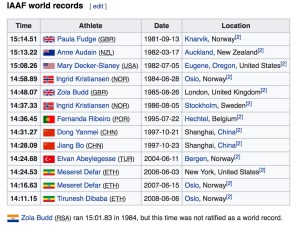
The time I ran that night was roughly equivalent to the women’s world record at the time. A Briton named Zola Budd ran 14:58 in 1985 and a Norwegian named Ingrid Kristiansen ran 14:37 a year later. The women’s world record for the 5000 meters now stands at 14:11, run in 2008 by Ethiopia’s Tirunesh Dibaba. 

Womens 5000 mThere’s a chance I could have run a bit faster with other opportunities to race. But likely not by much. We all have limits to our natural abilities. I honestly feel that I ran as fast as I could that evening, and every other race in which I competed. If I ever dogged it on purpose, I cannot recall.

With 99.9% of my races, I don’t look back at my best efforts and say that I could have done better. There is only one exception. During my senior year at Luther College I won the conference steeplechase while holding back for a double in the 5000 meters. That entire race felt easy, which is saying something in an event like the steeplechase, which consists of 3000 meters of running over 35 barriers and seven water jumps. I ran 9:20 that day, and felt like I could have run 5-10 seconds faster.

My teammate Paul Mullen finished second in the steeple that afternoon. But he was coming off a victorious 10,000 meters the night before. Think about that double! His performance was exceptional. He later ran 9:14 to place 7th at the NCAA Division III national meet, missing All-American by just one place and a single stride.

Perhaps I had that 9:14 in me too. Running that fast might have delivered a nice boost in confidence going into nationals had I let loose that afternoon in Pella, Iowa and gone “wonderfully mad.” But our priority that day was trying to win the 18th consecutive IIAC conference title, so it was “all hands on deck” for the distance events where our school had always been dominant.

But times were changing before our eyes. Our competitors from Central College and Wartburg had caught up and even gotten faster than us during my four years. We’d given them something to shoot  and they took aim and succeeded. We lost the meet that by a couple points, but learned a life lesson in the process. You can never, ever try hard enough.

I did try to double back in the 5000 meters but did not produce any points, finishing right in the middle of a quick pack of competitors. In both races I put forward my best effort in the moment. It was disappointing not to place in the 5000 or help the team, but some of us are superheroes, and some are not.

These days I can’t run a single 400 meter repeat at the pace I once used to race. My best efforts are a full minute-per-mile slower than that. There’s no shame. It still feels good to run as fast as I can. Unless you’re the best in the world at a given moment, all our best efforts are always relative. We all try to go “wonderfully mad” in our own way. May you find your wonderful madness your own way.

Posted in 10K, 400 meter intervals, 400 workouts, 5K, aging, aging is not for the weak of heart, running, steeplechase | Tagged , , , , , , | Leave a comment

Super balls and Red Ball Jets

Lancaster HouseI grew up in a four-square house south of Lancaster, Pennsylvania.  I loved that home for a million reasons, but mostly because our family was all together when I was 5-12 years old. Flawed as we were, there were many joyous days.

The period we lived in our Lancaster home was also a unique time in American history. We moved there in 1962 when I was five and lived there through 1970 when I was about to turn thirteen. The world changed right before our eyes. News that John F. Kennedy was shot came through when I was on the playground at Willow Street Elementary. The Vietnam War raged. Civil rights protests flared. Then Bobby Kennedy was shot. Martin Luther King, Jr. too.

All the while, the songs of the Beatles rang through our four-square home. It started with Love Me Do and rattled all the way through to Why Don’t We Do It in the Road on the White Album. I admittedly struggled at times to understand it all. Then the Beatles broke up I was twelve years old. That spring, my father announced that we’d be moving away from our Lancaster home to Illinois. It felt like my world was falling apart.

My 7th-grade friends held a going away party.  The presents included the Beatles single record Get Back on 45 RPM. I played that 45 with the Red Apple on it . The music sounded and felt so bittersweet. Get Back…get back…get back to where you once belonged…

But I couldn’t. Our family was moving away from Pennsylvania. All that love and innocence and coming-of-age experience from our Lancaster home was packed in yellow and green Mayflower moving boxes and stuffed in a big  truck that sat in our dour driveway with sadness written all over it. We got in the car and drove to Illinois, which was 750 miles away.

All good children go to heaven

That day, my brothers and I piled into the back of our 1965 Buick Wildcat as dad pulled the car into gear and we rolled down that long driveway the last time. We felt sad. We felt lost. We felt torn from our friendships and ripped from that house we loved.

But our father had found work out in Illinois and that meant we had to move. As we drove up Route 222 toward the Pennsylvania Turnpike, my oldest brother and I put our heads together and quietly sang the entire medley off the back of Abbey Road. The lyrics covered almost all of life and included things to come for both of us…out of college, money spent…and in the end, the love you take is equal to the love you make. 

But what a childhood. No regrets there. And it’s funny what you retain from periods of great change and joy. Here are just a few.

Rat Finks

Rat FinkThe period of my elementary to junior high school days was a time of great change in children’s toys.
Technology was starting to deliver all kinds of wonders, including incredibly pliable plastics that enabled the creation infamous toys such as the Rat Fink line. These grossly detailed creatures captured the revolutionary snark of the 60s and the disdain of a New Generation toward authority and The Man.

Super Balls

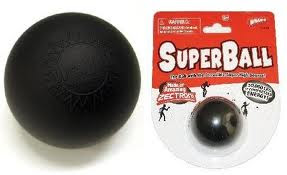
super ball.jpegNew kinds of rubber were being developed from space research and material experimentation. These included the first amazing Super Balls that bounced so high and far it was easy to lose them in the weeds if you couldn’t catch up.
Super Balls were so superior to cheap red foam rubber balls that hardly bounced at all. You could slam those stupid red foam rubber balls on the ground and they’d still barely make it over your head. They were the height of mediocrity. There was a life lesson in that too.

Super Balls, by contrast, made us believe in the possibilities of a better world. The feel of that hard compressed rubber in your hand was like owning magical powers. The sensation of sending that ball so high in the air was a release of emotion as well as energy.

Red Ball Jets

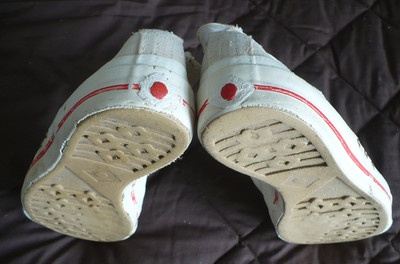
Red ball jets.jpgTo go out and play, we all wore tennis shoes or “sneakers,” as we called them.

I ran around in a brand called Red Ball Jets. It always bummed me out when that little tab of rubber with the Red Ball would come off one of the shoes. And it always would.

Then I’d have to pull the other little Red Ball off the back because my childhood version of OCD would not allow me to leave one Red Ball on the back of my shoe and not have another.

But while those red dots lasted, I’d go running around the yard glancing back at how they looked as I ran in my Red Ball Jets. And yes, I once ran into a tree while doing that.

But I swore they made me faster. One of life’s other lessons is that what you believe about yourself is as important as the reality you face. Certainly that proved true in the world of sports.

Branding and self-perception

Thus I experienced, in some small way, the power of brand marketing and self-perception. It would come true again with the running shoes I’d wear years later in cross country and track. I was a high-school runner when Nike first emerged on the market. Then came college and along came Brooks. Etonic. New Balance. Reebok. Tiger. 

The list of new running shoe brands kept growing, and has never stopped. Runners keep trying and trying, in essence, to find their next pair of Red Ball Jets so they can go faster.

As the saying goes, you’re only young once, but you can be immature forever. 

And forever it shall likely be. Life is filled with both the joyous and the bittersweet. What never changes is our desire to find our way back home somehow. I cherish those childhood memories. But I also cherish the child that still remains within me.

And my belief in Red Ball Jets shall never wane.


Posted in running | Tagged , , , , , | Leave a comment

Nude selfies and other truth-telling

Don’t worry. You’ll find no nude selfies of me in today’s blog.

But let’s be honest here. We all take them once in a while. If not nude, then at least partially clothed to check on our bodies. How do we look?

Chris In White ShortsTaking photos of ourselves is a patent form of truth-telling or self-revelation. Way back in 1979 I snapped this photo of myself in a mirror with my Olympus OM-1 camera. I wore white cutoff jeans and a blue running tee shirt. My hair was blonde from the summer sun and my thighs tanned from hundreds of miles running in the short shorts of the era. I thought I looked pretty good. 6’1″, 140 lbs.
Those were fun times, and those shoes I’m wearing are Brooks Varus Wedge, one of first running shoes designed with an orthotic dimension inside. Our coach bought them for all of us during cross country season when we came down with achilles problems after a particularly hard interval workout done on a country road with a profound slant to the asphalt.

Broad narratives

It was a solution that worked for some of us because it helped us supinate (foot angled outward) rather than pronate (foot collapsing inward.) To tell the truth that was a broad-based attempt at curing injury. For some, it did not work at all. Yet that step toward achilles health enabled us to get through a tough period in training and go on to place second in the NCAA Division III National meet.

So much truth-telling is like that. We make up a narrative for ourselves that covers a given moment in time and that’s what we come to believe. It happens even in the present. Which is why nude selfies can be such a shock to the senses.

I really look like that? 

Over time we learn how to take pictures that are far more flattering. Every guy who takes a dick pic sooner or later learns how to use the camera to make his unit look huge. Women learn how to make their breasts or butts look inviting. Nude selfies are an art unto themselves.

Self Survival

We learn to flatter ourselves on many fronts. It’s a self-survival tactic. Craving feedback and compliments or a cure for loneliness, some take the nude selfie thing a bit further and willingly post their nude selfies on sites that draw millions upon millions of views. One could say that it’s a form of truth-telling. Certainly there’s no excuse for anyone growing up these days not to know what the human body really looks like.

Has it ruined our culture? Turned kids into absolute sex fiends? Probably no worse than forty, sixty or one-hundred years ago in the 1920s. The Roaring Twenties, remember? Ever seen the movie Chicago? Lust is evergreen, folks. Nudity and the perpetual tease is part of the human race going all the way back to bible times. Even Adam and Eve walked around naked, and King David lusted after Bathsheba,

and David sent someone to find out about her. The man said, “She is Bathsheba, the daughter of Eliam and the wife of Uriah the Hittite.”

Spirit and soul

Nudity is ostensibly able to reveal the spirit and the soul. The human body is thus the subject of thousands of years of art. One of the most revelatory experiences I’ve ever had was to sit in a Life Drawing class six hours a day during a January Interim term. The class had live nude models, both male and female. Our instructor played classical music over the sound system and there were times when I’d completely lose myself in the process of studying the human figure while trying to balance line, shading and texture. There was nothing sexual about it.

And I remember a pose the model took in which she was curled almost like child pose in yoga. Her arms were tucked around her head. The slope of her back was so wonderful and clean. Her nude figure was pale and serene. The glimpse of her vagina from behind was both mysterious and so commonly real that it defied the notion of sexuality. It was just part of her. An honest part, for sure. But just part.

These days, with the Internet rife with billions of women and men in every pose imaginable, the honesty is almost too much at times. It can numb the senses to try to be creative in the face of all that.

N.jpg

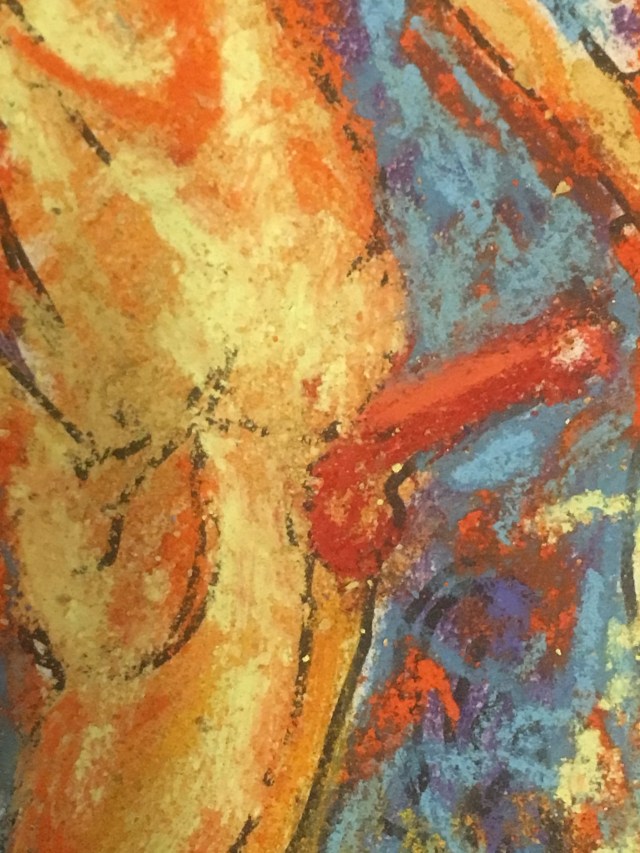
Pastel drawing by Christopher L. Cudworth 2018 “Reddit World”

Yet art can lift us past the taboo into the realm where honesty and truth are far more engaging than the basic instincts of lurid attention or lust. Those have their purpose in this world. There is nothing wrong with sex. It depends on context and the focus of the moment. People who lose sight of that have problems engaging with the real world. That’s why some object so strongly to pornography.

But it’s still just the human body. I well recall drawing the shape of a man’s penis the first time in art class. The flaccid fall of the shaft. The round turn of the testicles. It was just that. The women in the class squirmed at first while facing the model and staring at the penis. Then it all became drawing what they saw rather than what they sought not to encounter. Penises are honestly sort of sad in some sense. But as Henry Miller once wrote, they can also look downright murderous.

E.jpg

Detail of pastel drawing “Reddit World” by Christopher L. Cudworth 2018

Years later I went back to my college campus and while there, visited the art studio of a student in the art program. My college art instructor was by then a personal friend who showed me around the new art building and the row of small houses converted for use by advanced students as personal workshops. We stepped into one of those studios to encounter large, colorful paintings featuring bold male nudes sporting huge erections. The works were actually executed quite well, so you could not miss the subject matter. We both kind of chuckled and realized how much times had changed.

Was it pornography..?  “the portrayal of sexual subject matter for the purpose of sexual arousal.”?  It didn’t matter. An artist has a right to portray what they like, or don’t like, about the human condition. Sometimes such imagery is used for the opposite purpose. There are passages in the bible that depict women lusting after men with genitals the size of donkeys. This is intended to convey a sense of depravity and lack of self-control.

Or was it just plain jealousy? There’s a hint of that in the passage too. The bible was written by men, after all. Many men are often intimidated by the virility of their perceived enemies or those they fear might steal their women.

Comparing ourselves

The inevitable instinct of all nude selfies and any such truth-telling is that we seek to compare ourselves with others, and with ourselves.

It’s all about how can we make ourselves look better to others, and to ourselves. Of course that’s a constant process. And just like craving junk food versus real food, sometimes we deceive ourselves.

Go ahead and take a surf through the Instagram app and you’ll find thousands of fitness buffs posing to show off their BEFORE and AFTER bodies. Some of the results really are impressive. Then the admiration gets tossed around, and it crosses all lines of sex and gender. “

You go girl!” shouts one woman to another woman.

“Nice pecs bro!'”  says one admiring male to another.

Let’s stop pretending this isn’t all normal.

Manufactured truths

It’s all a form of truth-telling. Yet it’s also the truth we manufacture for ourselves that ultimate determines who we are. That’s the really hard thing to get past. To accept. To embrace. And to transcend.

Some say the camera doesn’t lie. But that’s not really true either. We can make  a camera do almost anything we want. The honesty to know and admit that fact is the truly rare commodity in this world.

To move past our vanity and find beauty in that honesty is the sexiest thing on earth. Try it sometime.

Posted in Christopher Cudworth, cross country, mental health, same sex adults | Tagged , , , , , , , , , | Leave a comment

Changes in latitude, changes in attitude

Evan in HelmetThat young man in the photo is my son, Evan Cudworth.

He lives in southern California.

When he moved there a year ago, he mentioned that he wanted a change in latitude.

If I recall correctly, he described it this way. “Everywhere I’ve been, even in Europe and China, I was on the same general latitude.”

That might not be exactly true. But you get the picture.

He wanted to make a profound change in his life. Perhaps it would be good to go somewhere warm. Maybe by the ocean. And how about Venice Beach, California? So he went.

He’d lived in New York City a few years and was living there in 2013 when we lost his mom to cancer. The grief from her passing proved a rough journey with depression always lurking in his soul. The party scene proved tempting. Like all 20-somethings, the experience proved a rite of passage in many ways.

Cleveland.RockHallHe tried moving to Cleveland after that, but despite the Cavaliers winning the NBA championship and finding a decent place to live in the Lakeland district, he still craved more from life.
I visited him during his time in Ohio and we went to the Rock and Roll Hall of Fame together. We had a fun time, but how many suits worn by David Bowie and Michael Jackson can one really endure before wanting to move on in life?

Evan took his job with him out to California, but the startup for whom he’d been working a couple years was giving up after all. That meant a gap in time and employment to really think things through. He’s a strong kid, and works out doing CrossFit, but those of us that have been through periods of employment transition know that it’s tough getting up every day without that work foundation beneath you.

Like son, like father. I’ve been through all that too.

Admissions

Many years ago I wrote a book titled Admissions about a college counselor working through life’s challenges. It centers around a fictitious college in Wisconsin called the University of Wisconsin-Dells that is funded by tourism. Many things that I predicted in that book composed in the early 1980s have come true in the present. In fact, my prescience almost frightens me. I plan to transcribe it from my old Mac computers into publishable form.

Life tectonics

Outside predictions about the futures, the philosophical point of the book (circa 1984) is that we all have to admit our flaws to really make progress life. I also wrote about a concept called Life Tectonics, in which the various aspects of our character (along with other people and events) crash together over time like continents on the surface of the earth. What ultimately emerges is the map of our being. I wrote about this concept a good twenty years before Dave Matthews recorded his song Crash…

Oh and you come crash
Into me, baby
And I come into you
Hike up your skirt a little more
And show the world to me

I often think about that concept of life tectonics while riding my bike. I’ve crashed a few times and each one has taught me valuable lessons about paying attention and dealing with surprise, fear and the consequences of ignoring all of the above.

Well as they say, so much of life is like father, like son. Recently my son Evan was riding his bike in Santa Monica and found himself bearing down on a car at full speed. I’ll let him tell the story as he shared it on Facebook:

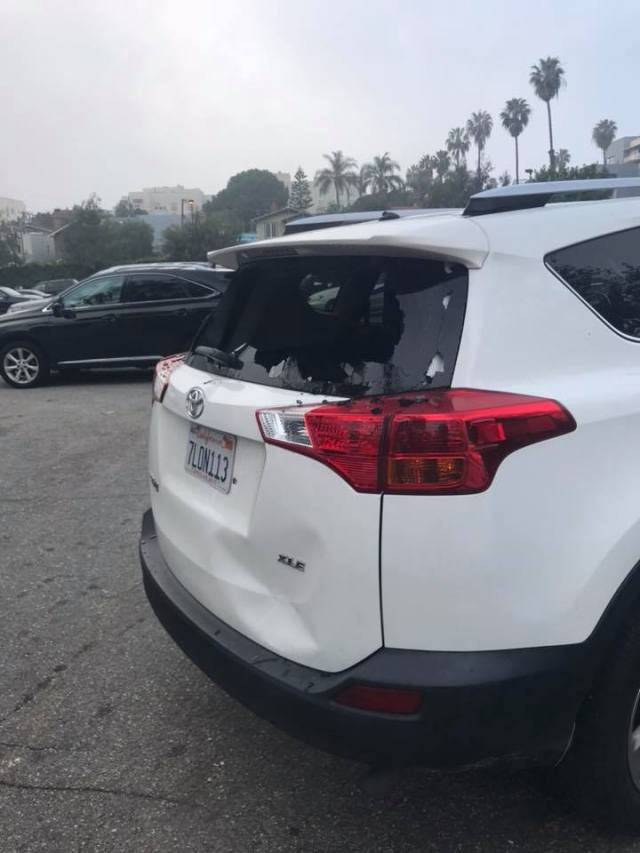
Bike crusher back window.jpg“Had a pretty scary experience yesterday, and want to share what it gave (and took from) me.

Biking from work, I made a hard right turn in Santa Monica where there is a fairly steep incline down to the ocean, and there was a car pulling into a garage. I tried to break, but it was slightly wet and I slid at pretty much full-speed into the back of a Toyota. My shoulder and head destroyed the window, while my body and bike massively dented the car.

It could (should?) have been REALLY bad. Despite repeat warnings from smart friends, I wasn’t wearing a helmet. Yet I walked away completely unharmed. Although my jacket is shredded from the glass and the water bottle in my backpack cracked and I initially thought the gushing was blood LOL.

The man driving the car got out and was immediately concerned about my safety. He didn’t even look at his car. His English was decent, but he didn’t quite have the words to describe what he wanted so he just kept saying, “Go to doctor, buddy!”

After much reassurance, we exchanged information and I tried to go work out at Paradiso CrossFit Venice cause I felt FINE but my coaches smartly told me to just do a stretching WOD for an hour 😉

This man called me 4 more times last night “sure you ok buddy?” I kept asking him what he was going to do about his car. Technically, this WAS my fault. But his insurance wouldn’t cover. There are not clear rules on these kinds of bike accidents.

Car driverHe called to check up on me again today and I asked him again if he had a damage assessment. He was hesitant to say, but when he gave me the figure I gasped—it was almost exactly the same $ I won playing roulette in Vegas this week. I had planned to use those winnings to pay down some of my massive credit card debt, but hey. After talking a bit more, found out he was a line cook at a hotel bar I’ve frequented.
Karma only exists if we make it. So I biked over and met him on his shift. We hugged and I apologized for ruining his week. He said, “Buddy, you are still here! Week is good.”

Wear your helmet and do the right thing. Thankful and wishing you all a good week.”

This incident happened just last week. I called my son to discuss it a bit further and to make sure he wasn’t experiencing any side effects that he might be dismissing. People that haven’t been in a bike crash before often don’t realize how sore it can make your body for days, even weeks after.

“Seriously, I’m fine dad,” he assured me. “I don’t know why, but my body crushed the window but nothing hurts.”

I’ve had one crash like that. I’ve also had others that hurt like hell. I’m glad he’s experiencing the former, not the latter.

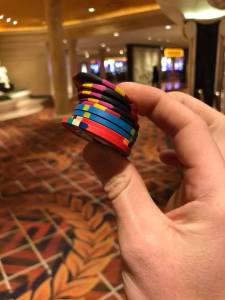
Chips he wonHe also explained to me how he won the money playing roulette in Las Vegas during an electronics show he attended for the company where he now works, Epidemic Sound.

I won’t give away the number he plays or the method he uses to win (more than $700!) but it has its benefits. Most of all, he knew to walk away when he was ahead. That’s a life lesson if you ever saw one.

To conclude the episode, this was definitely a Life Tectonics experience for my son. Some might say an angel was looking out for him. If so, well that’s nice.

Others might say he was damn lucky not to get seriously hurt, and perhaps a bit stupid for not wearing his helmet. He’s admitted that, and has now corrected that flaw with a helmet he now wears proudly while riding his bike around Venice and Santa Monica. Here’s what he wrote to his followers on Facebook:

Bike helmet galThanks for all the well wishes and I hope my bike crash story can bring some caution and compassion into the world this week. Helmets are sexy! — at WeWork Santa Monica.

 As you can see from the photo here, one of his friends posted a photo of herself with a rad helmet and super cool shades. That shirt is super beautiful too. Cyclists in helmets don’t have to be nerds, that’s for sure.
Changes in latitude, changes in attitude. Nothing remains quite the same. 


Posted in aging, aging is not for the weak of heart, bike accidents, bike crash, bike wobble, blood on the highway, Christopher Cudworth, cycling, cycling the midwest, cycling threats, Uncategorized | Tagged , , , , , , , , , , | Leave a comment

It isn’t rocket science

As kids, my brothers and I would make rockets by wrapping aluminum foil around pencils to create the fuselage, which we’d fill by cutting match heads off paper matches. These would fill the cylinder from front to back. Then we’d pinch the back end of the “rocket” into a dovetail point with one or two match heads sticking out the back. Then the rocket was ready to launch.

We’d put it on a slight incline in order to create a little lift. This enhanced the dramatic effect because it didn’t really amount to the same thrill when your rocket shot off the platform and fizzled to death in the grass.

Matches-with-PennyA really good rocket would shoot from five to ten feet through the air and then lie smoldering on the sidewalk or somewhere in the grass. It is a wonder we never caught anything else on fire. That didn’t happen because we were smart enough to know that any accident would mean a permanent end to our fun. It doesn’t take a rocket scientist to realize that.

These rocket-making endeavors might occupy a couple hours on a summer afternoon. Strangely enough, my parents would fund these endeavors with the purchase of boxes of “paper” matches. Or perhaps we simply raided the pantry on a whim and our mom just didn’t care as long as we were outside and keeping busy. Such were the 1960s.

Each pack contained probably 24 cardboard matches. These we’d cut off at the head, careful not to waste any of the precious “fuel” at the end by cutting them too close. Yet we also wanted to avoid leaving too much paper “waste” attached to the match heads. We learned, in other words, to respect our craft.

It’s interesting how the native instincts of a child operate on projects such as these. When given the opportunity to learn, most kids do quite well by trial and error. The same held true while learning to play basketball or baseball. Through constant repetition and experimentation, we learn to adapt our methods toward better results.

This continues all through life if we keep our childlike minds open to possibilities. During the peak training months of summer, I can often find my wife with her bike up on a stand while she hand-spins the pedals around testing the flow of the gears on the cassette. It’s a pleasing sound to hear the chain whirr and the gears shift. She says nothing for the most part while doing this exercise. Her attention is fully occupied on the task at hand. Literally.

Usually, she’ll come inside after a while and make some observation about how the drive train is operating. She’s not mechanical in terms of being Mrs. Fixit, but she sure has a sense when something is wrong. More than once she’s carted her bike into the shop for a tuneup and the mechanic confirms her suspicions.

I’m not mechanical at all. After fifteen years of cycling, I still can’t tune my derailleur or adjust the tension on the brake pads. That’s why I bring my bike to the shop for checkups. Without that, the thing would fall apart underneath me.

paper-matches-257x300.jpgThat doesn’t mean I’m benign to problems. I sense them well enough when things get loose or weak or the chain rattles. Parts wear out. Things get stretched. We depend on instincts in many cases. It isn’t rocket science.

Yet I think back to those early experiments with match rockets and realize that we were literally engaging in rocket science. We had to be cautious and smart with our materials. The balance in thickness of the aluminum foil we wrapped around the pencil to make the rocket had to be calculated against the total thrust and explosive power of the fuel load, which was matchheads.

My brothers were fond of engaging in such experiments. Once my brother and his friend Marty spent an hour constructing a Mega Rocket. They wrapped aluminum foil around a toilet paper roll instead of a pencil. It took almost an entire box of match packs to fill that damned rocket. It sat there on the launch pad all wrinkled and thick like a turgid penis. We all had a laugh at that.

Then Marty took a match and struck it against the black strip on the pack. It was launch time. The first match lit and sputtered at the back and then the real fire began. Inside the rocket the match heads exploded in a furious release of energy.

Then we had liftoff. It blew out the back of the rocket and blackened matchheads were left behind like the detritus of a volcanic eruption. The rocket lurched up the pad and blasted into pieces just beyond the first length of sidewalk.

We all cheered because it was a spectacular deal even if it was not an entirely successful flight. Years later when the Challenger space shuttle exploded after launch I would recall that attempt of ours to build a badass rocket. It’s not easy. These days the SpaceX crews send rockets into space with relative frequency. They have brilliant minds at work. Real rocket scientists sending hundreds of thousands of pounds of equipment out of earth’s gravity into space.

Earth View Four.jpgThe principles at work in all this are maddeningly consistent. It’s always a question of weight versus propulsion capacity. It’s true with our bikes. It’s true with our running. It’s true in the pool. It’s all weight versus propulsion.

The matchheads we place in our bodies are the food we eat, the drinks we consume and the energy bars we pack into our bodies hoping to sail through yet another workout or race.

It’s not rocket science. But it works like that. Weight versus propulsion. Think about it next time you’re on the road or in the pool. Go light a match. Or more.

Posted in Uncategorized | Tagged , , , , | Leave a comment

Cold, hard facts

IMG_2764We’ve been spending some good time on the indoor track, seeing results in our efforts. As a specific result, my wife Sue is learning the beauty of speed training and how it makes your base pace and even your race pace feel more achievable.

That’s why we all do speed training of any type. In the pool. On the bike. On the run. It raises our capacity while it diminishes our perceived effort. Pretty cool huh?

There is a challenge that comes with doing speed work that has nothing to do with how fast we perform “in the moment.” It’s great when we can exceed our expectations on the track, doing long pulls on the bike or nailing our pace-per-100 to the pool wall. Because when it comes to speed work, we still have to transfer that to our other training and race pace in open applications.

By that, we mean going fast when it counts in other places. It’s tricky when the wonderful, empiric world of the indoor track is so clean and neat. The environment and the distance are under relative control. There’s not even any wind!

IMG_9058Which is why I laughed in disgust yesterday after doing a 4.5 mile training run outside. It was cold, just under ten degrees, and a ten mph wind was coming from the west. But I traipsed along with a quick leg turnover to cover the miles. Granted, I ran much slower on the paths of a forest preserve during the run, so in essence that was a period of jogging.

Yet Strava delivered the hard, cold facts. According to the app, I’d only averaged 9:16 per mile. And I thought: “Bullshit. I know how I’m running faster than that.”

My wife had even pulled up next to me during the run. She was on her way to do some errands and at that point, I was trucking along pretty well. I told her it frustrated me that the run was only 9:00 pace. “That’s weird,” she said. “You were running way faster than that when I saw you.”

But according to Strava, I was only doing 8:45 pace at that point. Well, we’ve been running 8:00 pace and under on the indoor track on all our intervals together. On my solo workouts indoors, the pace drops to 6:20 on my 400s at some points. So I know how fast I’m going.

Trouble is, this trend toward as lapse in perceived performance versus real performance has a long history. In college we’d run fast indoor times and have massive trouble converting that speed into outdoor racing. My junior year in college I raced sub-4:20 on the indoor track. But when it came to the first outdoor race, I did not even break 4:30 for several meets. Part of that had to do with conditions as well. It would be cold or the track was wet. We raced home meets on cinders back then. Wind was a problem in April too. It would be late April at the Drake Relays before some of us would accomplish respectable outdoor times to match our speed indoors.

Usain grabbingWe all have this challenge of translating speed from the treadmill or indoor track or pool to the outside world. Open water swimming can be quite the vexation for those accustomed to doing laps in the pool. You have to swim straight, for starters. And you have to negotiate other people, on top of that. There might be waves to consider or even current. In the Louisville Ironman that Sue did last October, the swim starts upstream in a channel of the Ohio River. Then the swimmers get out into the main body of water and the current pushes swimmers out toward the middle of the water. Even the overall direction of the water doesn’t help if one goes with the wrong flow.

The cold, hard facts of the world outside our speedwork is the reality we must navigate. Take that into account when you go from controlled circumstances to the open road or water. It’s a reality we all must face, and it teaches a ton of lessons in the long run.

Posted in Uncategorized | Tagged , , , , , , , , , , , , | Leave a comment

Coyotes and poodles

Coyote licking.jpgOur home backs up to a wetland. There is a pack of coyotes that frequent the wilds back there. They feed on rabbits and other furry edibles. Recently, they also snatched a neighbor’s poodle.

I met the owners that morning, a distraught mother and daughter. They were half-walking, half-running down the trail when I approached them coming in from a run. The mother had that look in her eyes that all mothers do when they know something is seriously wrong. The daughter trotted 20 yards behind her, a wild and worried look in her eyes as well. She looked so vulnerable and alone the whole world seemed amiss.

They told me the dog’s name, and asked me to keep an eye out. Over the years during runs and rides, I’ve caught up with a few wandering dogs and used the number on their tags to called their owner on the phone. Glad when that happens.

Two days later at a neighborhood party, I learned the fateful truth. The lost dog, a small poodle, had been snatched by a pair of coyotes. A neighbor witnessed the event by sound and let the family know their dog would not be coming home.

Coyotes.jpgThere are plenty of ways to look at that event. It’s a dog-eat-dog world… is one of them. We all know the world can be a harsh and cruel place. Whenever I watch one of those World War II movies set in Poland or France, I think about the desperate people bombed from their homes and wandering the streets with nowhere to go. I think of the soldiers marching through with weapons raised, the untold mission or more mayhem in mind. In some circumstances, they can’t stop for anyone. Orders must be followed. People are left like poodles in the rain. Or worse.
Our own family dog was rescued off the streets of Chicago by my son and a friend eight years ago. Our pup is a schnoodle or something of that order. We don’t know the real mix and don’t care that much to know. He does have a bit of separation anxiety. You can imagine why. He was tiny, cold, and huddling in a paper bag covered in white paint when found. So the fact of those people from our neighborhood losing their dog to coyotes hits home. There are painful realities around every corner in this world.

Yet I’ll admit I find the sight of coyotes behind our house fascinating. Their calls and yips and cries are some of the wildest sounds you’d ever want to hear.

But when it comes to civilization and the American Dream, there is only so much wildness most people care to take. We love the sight of a coyote, but not the implications when our small dogs are at risk.

The problem with small dogs is that they often don’t know how small they really are. They may rush a coyote as an act of territoriality, but they don’t know what they’re getting into. Our dog barks wildly at certain dogs when he’s on the leash. It’s called leash aggression. We don’t understand the psychology of it fully. But it’s real.

I don’t think human beings are all that different from dogs in that respect. We’re all tugging at a leash of some sort in our lives. Sometimes we make mistakes and bark at the wrong dog or try to chase a squirrel into traffic. I’ve done it more than once in life, and sometimes it is our naivete, our poodle mentality that there is always protection waiting for us, that gets us into the worst trouble.

It’s also true that some people adopt a coyote mentality because they’re the ones that feel wronged. Something has hurt them in some way, and from then on, every dog they can find is a target. Some pump that anger into sports such as dog-fighting. Others troll the Internet looking for people to harm, to criticize, to penalize for their own pain. It’s one giant pissing match out there, with everyone raising their legs on the feed or wall of another.

Harsh world, it is. Some fold up their fences and simply stay indoors. They’d rather be a poodle that’s alive than try to fake being a coyote, or a troll.


Posted in running, Uncategorized | Tagged , , , , , , , | Leave a comment

Miles of asking why…

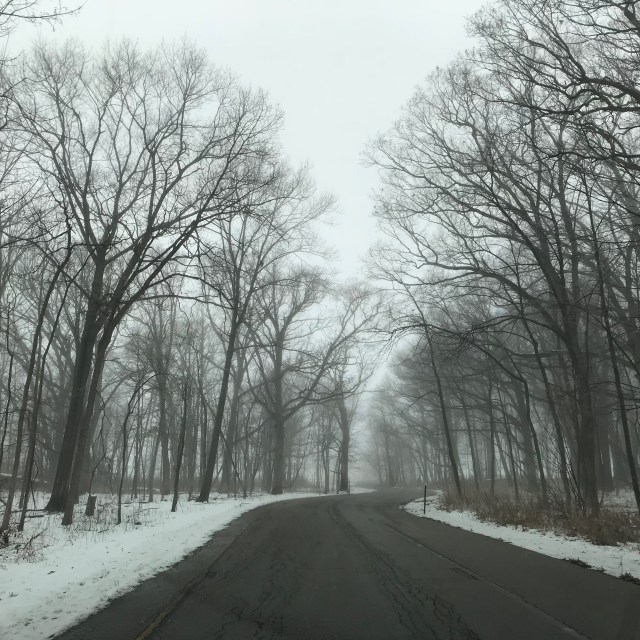
IMG_2764.jpgThis morning’s run was conducted in deep fog. The sub-zero siege that had hold of the American Midwest has let up long enough to allow a surge of warmer air to flow over Illinois. The snow on the ground and the warming air produced morning fog thick enough to bring a mysterious feel to the most mundane scenes.

Somehow I preferred to go on a quiet run in these circumstances rather deal with the four-mile loop I’d planned to run toward the shopping centers and car dealers down Orchard Road. Instead I turned north to run up Hickory Lane, the unincorporated stretch of road that bears little traffic at 5:30 in the morning.

Once I got under the big trees along Hickory Lane, their shapes were outlined in black, profound and simple. As I stared at them, the structure of each tree made sense in a new way. So many times I’ve drawn or painted trees and gotten them all wrong. Either the branches look clumped and out of order or else the trunk is too thick or thin in relation to the branches.

But this morning all that fell away because I saw the reason why trees and branches grow as they do.

That sounds so simple, yet the profundity of “why” branches grow as they do is both pragmatic and evolutionary. Each branch has a role to play in the life of a tree. Yet that specific role is in many respects defined by external forces. The direction and position of each branch on every tree on earth is determined by the ongoing interaction of available light and the ‘competitive collaboration’ in relation to other branches on the same tree and other trees as well. It is, in many respects, a long and difficult dance for existence.

Trees in Fob.jpgLooking at trees this way makes sense of the “why” , in which a given tree exhibits a certain shape. It’s a dance of sorts between the limbs of the tree and any other source of change that comes along. When trees grow together in a forest, they both exploit and respond to this constantly shifting feedback of light and shade, moisture and wind. And that’s only what we see above ground. But when people speak of being “grounded,” they refer to this idea that for all the things going on around us, we still know how to find our place.

As athletes, we are just as moldable as trees. Each of us is “shaped” by external forces and the internal responses they engender. Our training takes us out into all kinds of conditions. We breathe air moist and dry and clamber through temperatures cold to hot. We swim in water than can be bone-chilling or warm and overwhelming.

All these influences force us into the “why” mode of our bodies and how we are able to respond. Thus we learn how to dress for any occasion. We also learn how to keep our digits warm and our private parts too. In turn our bodies are shaped and shorn by all this training.

Trees on the move

Ultimately, we look in the mirror and can see evidence of the “why” resulting from our training and racing experiences. Like ambulatory trees, we start to carry ourselves a bit differently when we’re fit and strong. Each of our limbs has more purpose and finds its way to its respective mission.

And when I was done standing there looking up at the tree silhouetted against the pale morning sky, I started running again and felt composure in the moment. Grounded, as it were, in a sense of wonder. That only comes about in having stopped to think about the “why” of some place or thing in this world. Then I realized I’d had three miles of asking myself “why” this morning and was grateful for that curiosity about the world. It can disappear you know. People can stop caring about the “why” and barely only focus on the “what.” They grow numb.

Which is why thinking about the why is much more important than stopping at the what. IMG_9454

If you get the difference, you are truly on the journey to a more enlightened life. Asking “why” is the path to both a spiritual and a practical awakening.

“Why” is the question so many two-year-olds ask about everything they want to know in this world. It can be annoying. But those who continue to ask why are the people revealing the most mysteries about the world.

The photo that appears above shows the main building at Fermi Lab, the research center that for the last 50 years has conducted experiments on matter to determine not just the “what” but the “why” of how the world works. It is both scientific and spiritual work, if you think about it. Those scientists want to know the “why” of the universe, and are now shooting neutrinos through the earth from Batavia, Illinois to a lab in South Dakota to find out why our universe works like it does.

And that’s beautiful thing.

Posted in Christopher Cudworth, competition | Tagged , , , , , | Leave a comment