“Believe in something” is good advice from Nike

Nike Cudworth.jpg

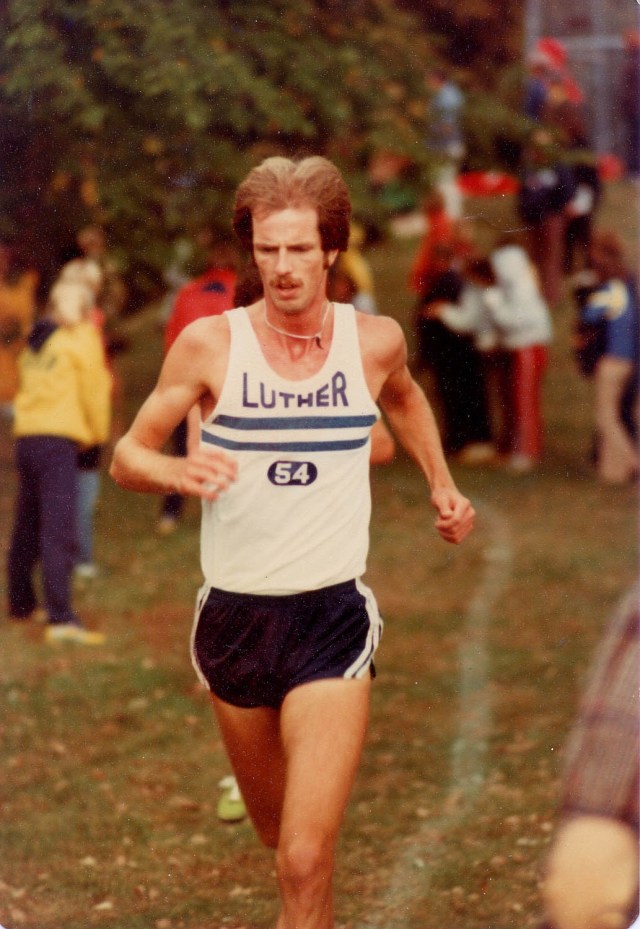
I was seventeen years old and a high school distance runner when my coach handed me a pair of blue shoes with a white swoosh on the side. “Here,” he told me. “Try these on. They’re from a new company called Nike.” They fit. I wound up wearing Nike running shoes all through college, where we placed second in the NCAA Division III nationals in cross country. Post-collegiately, I was invited to join two Nike-sponsored teams representing running shops in Philadelphia and Chicago.

And then, in 1985, I actually got married in a pair of silver and grey Nike Air Pegasus. Gave them to all my groomsman too. They matched our tuxedos.

So my relationship with Nike as a company goes back a ways. But the Believe In Something campaign featuring Colin Kaepernick made me think back through my own history with Nike and what the company has come to represent in the present era.

Instincts and principles

I’ll be first to admit that Nike is not a perfect entity. Many have questioned their labor and environmental practices. And let’s be honest: there are certainly commercial instincts at work even in this current “Believe in something” campaign. But from personal experience watching that company grow from hardscrabble shoe merchants to an organization with global influence, one can admire the will to take a stand for equality in the face of so much patent ignorance and selfish jingoism going on in America.

It’s also plain that pro football could use a good kick in the conscience. It took years (decades) to admit that NFL players were going brain-addled from concussions and CTE. The game also had a practice of turning away from issues of domestic abuse. It’s also a  fact that many players, after sacrificing all their young lives to make the league, were actually winding up financially stressed despite gambling all on their prospects for a pro career.

Follow the money

Believe in something.jpgMuch has also been made of the comparison between well-compensated NFL players such as Colin Kaepernick and the poorly compensated people serving in the military––and veterans to boot. But America is conflicted on that issue from many fronts. Presidential candidate Bernie Sanders once stated, “If you can’t take care of your veterans, you should not go to war.”

But let’s face it: America stumbles into most of its wars by nature of its conflicted character. And given that nature, I personally believe that everyone who serves in the military should be paid at least $100,000 a year, receive free medical care for life and get a free education after at least four years of service. We should literally pay them well for our collective mistakes. Because war is almost always the result of many mistakes.

Get real

If someone complains about that program being “too expensive,” then how is it that America spends more on its military than the next seven nations in the world combined? Where, in God’s name, is all that money really going? We should pay our troops more.

Because if we’re truly going to “support the troops” it has nothing to do with whether someone stands or kneels at a football game. It has everything to do with managing wasteful military spending and making a commitment to the human capital that genuinely protects our nation. Until that happens, shut the ever-living-hell up about Colin Kaepernick or any other protestor by claiming they don’t “support the troops” when kneeling during the national anthem. Colin Kaepernick didn’t mess up America. He’s just pointing out how messed up our country has become as a result of its inability to address its addiction to violence and prejudice as supposed solutions to tribal difference.

And for bringing that ugly fact to light, some people hate him for it.

No blame

Because we can’t blame Colin Kaepernick or Nike for the flaws in political logic that impoverish our troops or leave them struggling as veterans. That responsibility rests squarely on the shoulders of every American citizen. And bitching about your personal tax rates while rewarding America’s wealthiest individuals and corporations with massive tax cuts is not the path to patriotism. It is the sign of vain, selfish and ignorant empire. This much we know for sure: America has been screwing its veterans since the Revolutionary War. 

If we all want to believe in something, then let’s show our gratitude to the troops and our flag not through jingoistic displays at football games. Let’s commit to a nation where  communal investment in America provides not just for our people in the military, but also quality healthcare for all its citizens and an intelligent, economically sound social contract (without borrowing against it, as with Social Security) where no segment of society is discriminated against or abandoned according to race, religion, age or economic status.

That’s what the Constitution and Declaration of Independence set out to deliver: the equal opportunity for pursuit of life, liberty and happiness. Those are prime American values. But we don’t honor them by refusing gays the right to marry, or blocking women from reproductive rights and birth control. Those initiatives are the work of bigots and zealots obsessed with a control-freak version of authority.

A clear vision for America

City Photos Flag copy.jpg

And let’s get a few more things clear about America.

The Constitution clearly promises freedom from religion as well as freedom of religion.

It demands a well-regulated militia, being necessary for the security of a free state to be legislated before the right to bear arms is provided.

Just as importantly, our Constitution guarantees the right of anyone to stand or kneel in protest, especially when the flag of injustice is the one being waved in their faces.

Because ultimately, justice is something to believe in. Even if it means sacrificing everything.

Real freedom is self-generated, but that comes with the obligation to respect that in others as well. It does not come about by dictate, but by the people, for the people, and of the people.

Something to believe in. America.

Nike’s got that right.

Posted in Uncategorized | Tagged , , , , , , , , | Leave a comment

Have you ever been broken?

IMG_5417Recently a young runner friend who is just a year out of college made a confession on Facebook. He related his experience with depression and urged others to seek help and counseling.

Depression can leave a person feeling defeated and broken. The first time I truly dealt with that brand of emotional depths was my junior year in college. I was twenty years old and running headlong through four straight years of college. The previous summer I’d worked an absolutely terrible job in a paint factory where the conditions were dangerous and the co-workers detached, cold and often brutal. Plus the atmosphere inside the plant was rife with fumes from turpentine and paint.

So I arrived on campus that fall feeling a bit fragile yet determined to have a good cross country season. Thanks to an interminably competitive spirit at that age, I managed to run in the Top 7 much of the season. But when the time came for the conference meet, I found myself trapped inside a dark mental space that would not let go. Every step of that race was a massive struggle. I recall the sensation of racing into the dark of night, both literally and figuratively. I survived, but it was not a performance of which I was proud. In four years of cross country, it would be the only year I finished that poorly.

I felt broken.

IMG_5403That winter was cold and snowy. We trained on country roads in the dark, racing along as we always did at 6:00 per mile pace no matter what the conditions. Between my generally dark mood and the relative stupidity of what we were doing, I began to complain. Perhaps I should have approached that a bit differently, engaging in some sort of “off session” discussion to moderate our approach.

Instead, my depression drove me to an outburst in which I took off from the group in anger. I raced ahead at near 5:00 per mile pace. I recall the cold wind whipping my face and body. Soon I was hundreds of yards ahead and now committed to a pace that would be hard for anyone to sustain in a race, much less a training run.

But of course, I would not give up. I kept running as hard as I could.

A few weeks later my roommate counseled me on the dangers of engaging in that approach. “Cud, you just need to shut up and run.”

it was good advice in the circumstance. For better or worse, I was not going to escape the culture of the team, especially at the time.

I’ll confess that several teammates from that dark period in my life branded it “Cud’s Weird Year.” And I’ll cop to that. Like I said, something in me was broken. I needed to fix it. But I did not know how, just yet.

cudrunWhen the spring track season ended, I had fully begin to emerge from the grips of depression. At home for the summer, I took a look in the mirror and did not like what I saw. My thick hair framed an extremely narrow face. My thick glasses made me look like Napoleon Dynamite. The Lasse Viren beard I’d grown for inspiration that winter suddenly looked desperate and dumb.

I literally took shears and cut off large chunks of my own hair. I shaved the beard. It all looked horrible, so I drove our Buick Wildcat into town and paid for an actual haircut, the first I’d had in more than a year. All that was left was a superb 1970s mustache. I picked up a nice tan that summer and pushed my parents to finally allow me to get contact lenses.

I showed up for college that fall feeling like an entirely new person. In fact, no one recognized me at the first party fraternity party of the fall. That made me reconsider that whole scenario as well. I left fraternity life pretty much behind. I decided that some of the things once needed to prop up my ego were more like tarsnakes in my existence.

I had been broken, but now I was fixed. I had fallen in love with a girl and our cross country team placed second in the nation. Life was not perfect, but it was humming along in a pretty good way.

Admittedly, that dark year in my life would not be the last time I encountered the difficulties of depression and anxiety. But I learned enough from the experience to know that doing something is better than doing nothing.

Depression hurts. Emotional pain is real. Running and cycling and swimming can really help. But it’s not the cure-all for everyone. We all need healthy discussion of our emotional framework. Some of us benefit from counseling. More than a few of us can benefit from medical support. The important thing is to not give up.

We all need support from friends and even work associates. Over the years, I’ve gotten all of that, and am very grateful. When I can, and the situation seems appropriate, I also try to reach out to others who seem in need of help or emotional support. My personal faith is also an important component of my life, but I view it as a compliment, not a replacement for dealing with the practical reality of depression and anxiety on its own terms.

Being broken does not mean we can’t be helped, or help ourselves. That’s an important lesson to grasp at any age or stage in life.

Have you ever been broken? How have you recovered? What might you share with others about your experiences? Reply anonymously if you like to cudworthfix@gmail.com. Perhaps your story can help others too. 

Posted in anxiety, Depression, healthy aging, mental illness, riding, running, swimming, Tarsnakes | Tagged , , , , , , | 2 Comments

Wish you were here

Pastiche.jpgThis morning as I ran my typical 8:30-9:00 pace for four miles in the early September humidity, I thought back to the training I was doing 40 years ago, in 1978. That was the year our college team took second place in the NCAA Division III national cross country meet. I ran 25:12 for 8K as our fifth man. It was quite an experience.

But it was a long and fast road getting there. I was a roommate to our top runner, a Minnesota product that had put in 1000 miles over the summer. He won our own invitational meet against many of the top college teams in the Midwest.

He liked to run fast whenever we trained. I specifically recall an 8-mile run we did together in the morning before an 8:00 a.m. anthropology class. As we took off from the dorm, he reminded me that we needed to cover all those miles in 6:00 pace. That we did. Flying along before the sun was even up, we whipped through mile after mile at a pace I cannot even achieve any more. Not for a single mile.

Pastiche 2So this morning I had one of those weird synapses in which you wonder what it would be like to time travel. What would it be like to go back and have that kind of speed again? That endurance. There’s a part of me that wishes that was possible.

But what would I actually say to that twenty-one-year old self if I were to go back in time and talk to him? Or just as importantly, what might that twenty-one-year old say to me today?


In either case, the answer might be, “Wish you were here.”

Which brings me to the music I was listening to this Labor Day while completing two new paintings for my upcoming art show titled Road Trip. I listened to three entire Pink Floyd albums: Dark Side of the Moon, Wish You Were Here and Animals. But it was the words from the title song Wish You Were Here that sort of captured it all. They work whether they were being addressed to my 21-year-old self or my 61-year-old self:

So, so you think you can tell
Heaven from hell
Blue skies from pain
Can you tell a green field
From a cold steel rail?
A smile from a veil?
Do you think you can tell?

Those are good questions to ask at any age. But then there’s that “gap” in the middle of life when you’re going through so much stuff (at least I did) that you can hardly make sense of it all. The middle lyrics of the song cover the realm of principle. These are tough questions to answer at any age:

Did they get you to trade
Your heroes for ghosts?
Hot ashes for trees?
Hot air for a cool breeze?
Cold comfort for change?
Did you exchange
A walk on part in the war
For a lead role in a cage?

Pastiche 3About ten years ago I attended the funeral for the sister of a friend. She’d gotten caught up in alcohol consumption and never wrestled free of it. My friend’s wife had also been an alcoholic for years, and over the stretch of several high school reunions she made no secret of the fact that she’d had a high school crush on me. She’d get drunk and start telling me (in front of many others) that she wanted to go somewhere and fuck.

So perhaps it was no surprise that at her sister-in-law’s funeral, she walked across the room and stated, quite loudly, “I’ve been waiting to do this for a long time!” Then she opened her arms wide, threw them around my waist and grabbed both of my ass cheeks in a firm grip.

The buddy I’d brought along to the funeral looked at me in terrified wonder. What does one even do in a circumstance like that?

Thus we walked into the funeral feeling a bit out of place. Then the entire scene morphed into a post-modern scenario. Partway through the ceremonies, a group of three people walked to the front of the room and picked up guitars. They started strumming, and then singing…the words to the Pink Floyd song Wish You Were Here. 

Pastiche 5How I wish, how I wish you were here
We’re just two lost souls
Swimming in a fish bowl
Year after year
Running over the same old ground
And how we found
The same old fears
Wish you were here

The effect was a bit macabre for a typical funeral service. But the entire world has now moved past traditional remembrances to these era-sensitive adaptations of what dying is all about.

Pastiche 4Yet I recall feeling very much alive and yet wanting to be in a different place one day while listening to those exact same Pink Floyd lyrics floating down to a running track on a hot spring day in April, 1979. The song was blasting out the window of a dorm room on the college campus where our track meet was being held. The hipsters of the day were hanging out their windows smoking pot and drinking beer while watching the track and field spectacle playing out below them.

I was lying on the grass waiting for the 5000 meter run to be called. The day wore on and the meet schedule fell far behind. I warmed up a couple times and laid back down. Warmed up again and learned the race was still not going to be held for another hour. It got hotter and hotter as the day wore on. The will to run seeped right out of me.

At that point, I would much rather have been up on one of those windows smoking a joint and drinking beer than running a three-mile race in hot and humid conditions.

Yet if my sixty-one-year-old self were to walk up to my twenty-one-year-old self at that moment, I would likely say: “Go find some shade. Just do your best. You won’t be able to run this fast forever. Appreciate it.”

And truth be told, that’s pretty much how I deal with it back then. I did go find some shade, I did okay that day. Not great. But okay.

And if my twenty-one-year old self were to pop out of time to find my sixty-one-year-old self running past in the forest preserve this morning, I think he’d say, “Keep it up dude. You’re doing great.”

So it turns out that there’s no real wishing I was here in all this. I really have been here all along. And that’s a good thing.

Posted in Christopher Cudworth, cross country, PEAK EXPERIENCES | Tagged , , , , , , , , , , | Leave a comment

Hitching a ride

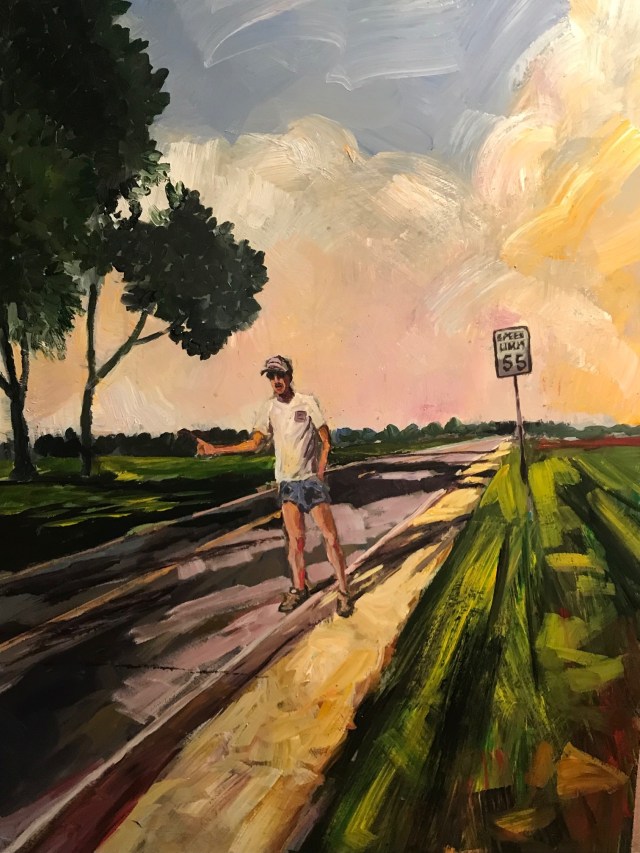
Hitching a ride.jpg

Painting by Christopher Cudworth, 2018. Titled “Last Ditch Effort”

In 1979, the summer after I graduated from college, I moved temporarily back to Illinois from Iowa before starting work that fall as an Admissions department counselor for the college from which I’d graduated. My girlfriend was staying on campus that summer working a local job before starting her senior year.


I hated being apart from her for even a week. So, lovestruck and determined to close the mid-summer gap, I begged a ride from a friend headed the general direction of Iowa. He dropped me on the outskirts of Madison, Wisconsin in a town called Verona. I stuck out my thumb to begin hitching rides across the western part of the state and hopefully, the last forty-mile stretch from Prairie du Chien up to Decorah, Iowa.

As journeys like this typically begin, I quickly caught a ride from Verona to the next town, Mt. Horeb. Then I stood by the road for a long time sweating in the sun. No one would pick me up.

Finally a farm truck pulled over to the side of the road. I climbed into the cab and the farmer gave me a second once-over. I was dressed in a running tee-shirt from the Drake Relays and some really raggedy blue-jean shorts cut off high up on the thigh. He did not seem to approve.

Stretch of highway

Those were the “fashions” of the time, but the farmer wasn’t buying it. He shoved the truck back into gear and we trundled along Highway 18 heading toward Barneveld and points west. The truck struggled to climb the long hills and decades later, I would relate to that sensation while cycling in the Driftless region of western Wisconsin. But that day, I was just glad to have a ride.

I’d traveled that same highway many times during four years of commuting to college. There were bright summer days in August traveling with my parents on the way to begin college each fall. Dank November days coming back for Thanksgiving. Snowy December trips on the journey home for Christmas. Frigid January road trips crammed together with college friends from the Chicago area. Heading back and forth to school. Back then it took nearly six hours to drive.

So I thought I knew the road well, and the towns conjoined by the highway. But when you’re hitching a ride things seem very much longer and definitely more confusing the farther you go. It’s easy to forget which town comes after the next, and how far you actually have left to travel. The sun stares blankly at you. This is your problem, it seems to say.

Connections

Frank ShorterThe farmer dropped me off where the road to his property crossed the main highway. I was officially standing in the middle of nowhere. The only thing I carried with me was a silver Frank Shorter running bag with that logo of the famous runner printed on its side.

As a distance runner I admired Frank Shorter on several levels. I’d drawn his picture many times by copying photos from Track and Field News during my high school study halls. He’d raced against the likes of Steve Prefontaine and even won the Olympic marathon in 1972 and was second in 1976. A genuine hero. Thus it was my wishful thinking that somehow my own running career connected me to the likes Frank Shorter, the rail-thin runner from Florida and then Colorado.

Yet somehow standing on the side of the road in the middle of southwestern Wisconsin, none of that seemed to really matter. I was tired from standing on my feet so long and hoping (wishing) for another ride. At least to get to the next town. Hitching.

No AC

Finally a van pulled over and I hopped in, thanked the driver and suddenly we were moving again. The air conditioner wasn’t working so the ride was hot and windy. I put my hand out the window to direct some breeze into my face. He drove to the next down, pulled the van to a stop and just motioned me to get out.

This time I wound up on the west side of Barneveld, a town that would later get flattened by a violent tornado. For years following that incident the trees on the south side of town stood ragged and torn. But just like the oceanside town in the story by Pearl S. Buck The Big Wave about a Japanese fishing village, the town rebuilt itself in defiance of yet another storm. That is the perverse miracle of human nature, yet some recognize its dangers, as captured in this excerpt from the book:

“Since Kino enjoyed looking at the waves, he often wondered why the village people did not, but he never knew until – he came to know Jiya, whose father was a fisherman. Jiya’s house did not have a window toward the sea either. “Why not?” Kino asked him. “”The sea is beautiful.”

“The sea is our enemy,” Jiya replied.

“How can you say that?” Kino asked. “Your father catches fish from the sea and sells them, and that is how you live.” Jiya shook his head. “The sea is our enemy,” he repeated.

I was starting to feel bedraggled myself, and my own worst enemy. True to form in the last 1970s, I wasn’t really drinking many fluids. None of us runners ever drank much water back then. We’d run twenty miles at 6:00 pace with hardly a sip.

But hitching was hard work too. And finally I had to drink something. So I purchased a Coke at a gas station and stood there by the side of the road sucking on that bottle with my thumb sticking out. An icon for the ages.

My next ride was a truck heading out to Ridgeway, a mere patch of a town perched high on a hill with view far to the south and north. The summer heat had turned the distant knolls a faded gray. Yet looking back toward the glacial kame of Blue Mounds State Park the 2000-foot mogul looked cerulean in the summer light.

Home turf of a sorts

Finally I reached the city of Dodgeville, which is also the site of Governor Dodge State Park and Bethel Horizons camp. That was where I’d met my girlfriend the year before during a Luther College Resident Assistant (RA) retreat. It seemed we felt a spark right away. Then I fell in ‘love at first sight’ when she laid her head on my knee during a campfire meeting. The light of an August moon illuminated her bright green eyes. I was smitten.

Thus I felt wistful and sentimental riding through the Dodgeville area, but that passage happened fast as my ride cheerfully offered to take me a little farther.  We zoomed through town with green lights all the way as I’d shared my tale of my first real love. The driver liked the story and offered to bring me all the way through to the west side of town.  “I hope you make it to her before dark,” he offered.

Dusk approaches

That was the first time I actually realized the risks of the day. By then, the afternoon was mostly gone. The sun was turning yellow in the western sky, and what if it did go down, and the skies grew dark? Would I ever catch another ride then?

I kept hitching and made it towns named Edmund and Cobb and Montfort. Bought a candy bar and another Coke. Stood by the road with my thumb out and as patient a look as I could muster. People kept stopping and I kept smiling and thanking them.

It made me wonder (even back then) what it might be like to try to hitchhike as a woman. The risks were so much greater. The rape factor alone would be terrifying. Yet I’d seen a few gals with “Don’t mess with me” looks on their faces hitching  rides. That took something like courage. Not sure what I’d call it. But it definitely never happens any more.

Hard Bitten.jpg

Detail from a painting by Christopher Cudworth, “Edge of Town” 2018

Time running out

All I knew was that time was running out for me. It was 6:00 in the afternoon and I was genuinely getting tired, hungry and a bit fearful of the sun going down. I got dropped by the side of the road on a hill west of Fennimore, Wisconsin. The guy seemed guilty about it. “Sorry!” he shrugged as he turned his car around and crunched his wheels onto the gravel shoulder on the opposite side of the road. “I have to get back to my place for supper.”

That made me homesick as I stood there all alone again. To make matters worse, there was a dark rim of clouds building to the west. It filled me with dread to think that I might get caught out in a thunderstorm with no raincoat and no place to hide.

I was getting a touch frantic. Several rides back, I’d been so eager to catch a ride I almost left my Frank Shorter bag back on the roadside. I had to tell the driver to stop. “Wait! I left my bag.” Then I ran back to grab the bag and arrived back at his car covered in sweat.

Quiet highways

cricket.jpgThere is nothing like a spell of near silence to create tension in the mind of a lonesome journeyman. The roads definitely got quieter as the evening traffic ebbed. Crickets were joined in their songs of seeming solidarity when in fact it is the dirge of competitive fury and the right to breed. Large crickets will catch and kill smaller specimens, biting off their heads territorial defense. I’d seen it in firsthand in field biology and learned that nature in many other ways is the most unkind host in all the universe.

I was exposed to the elements, and feeling much like a bug in some weird scientific experiment involving human territorialism . Trucks and cars would ease up as they approached. The driver would give a long glance, sizing me up, then take off with acceleration as they decided to drive on past. I began to worry that my face was giving off some sort of dire reflection of my mood. Perhaps my ugly shorts and worn out running shoes sent some signal that I might be a danger.

And through it all, the crickets kept on singing. 

The entire mood of the day was changing quickly. The sun slid behind the big swath of clouds forming to the west. As the light drained away the landscape turned dour. Trees seemed to change from green to black. The road itself shifted from a silver sliver heading west to a dull grey that now seemed interminable and threatening. Even the street signs seemed to blink out as the sun’s rays vanished behind the clouds.

Then I truly felt alone.

Bucking up

Yet I’d learned from many situations in life that you have to be most determined when you get tired. Certainly that was one of the lessons I’d learned from distance running. So I shifted my shoes in the gravel, stood tall as I could, and stuck out my thumb with a bit more urgency. Which was wise, because as I glanced to the west, the first flash of lightning emanated from the heap of clouds gathered near the horizon. So despite my renewed focus, I felt a genuine surge of fear pulse through my brain and body.

As luck would have it

Hitcher Man.jpgThen a small red sedan pulled over to the side of the road and before it reached me, flashed its lights to garner my attention. I grabbed my bag and trotted back to meet the vehicle by the road. To my surprise the driver was a woman in her late 20s. She reached over to roll down the window and said. “Where are you going?”

“To Iowa,” I said.

“Well….” she smiled…”The reason I’ve stopped is that I’ve seen you several times today as I was visiting friends. I figure if you’re still out here hitching rides you must not be dangerous. Where in Iowa?”

“Decorah,” I told her.

“Get in,” she replied. “I’ll take you there.”

I opened the door, placed my Frank Shorter bag in the back seat and turned to her. “Seriously?” I asked. “Isn’t it out of your way?”

(Look at it on the map. Decorah is out of everyone’s way.

“I’m going up into northeast Iowa anyway,” she responded. “You can keep me awake.”

Relief and gratitude

Off we went. I sank down into the seat relieved that good luck had come my way. We talked a little but she seemed to sense that I was exhausted. As we crossed into Iowa I recovered a little and started a conversation without getting too familiar in the topics. I certainly didn’t want to frighten off the driver. Night was coming on and we were headed up the hill from the Mississippi River to the upper plains of Iowa.

It took forty minutes to arrive, and as pulled into Decorah she drove me straight to the college campus. I thanked her and we shook hands. She seemed to know I had no money to offer for gas, so she waved and said, “Give your girlfriend a hug!!”

Her gracious help was a lesson that I would carry with me for a very long time. Later in life, while serving as caregiver to a long line of relatives and friends facing illness and death, I recalled the significance of that help along the way in my journey.

Sometimes all people need is to be picked up for a while and carried to the next town. At other times times it really helps if you’re willing to go the extra mile and complete the journey with them. And always be prepared to expect nothing in return. Offering help should be sufficient reward, for it often pays more back than what you need to give.

That’s what the woman did for me that day on my hitchhiking journey from Madison to Decorah. Helped me complete my journey.

Tears for fears

Once I was inside the dorm where my girlfriend was living, I walked to her door and stood there letting a few tears of relief roll down m face. It had been a long, emotional day in many respects.

Then I knocked on the door and she let me with a large hug. She knew I was headed her way but there were no cell phones in those days, and pay phones were often hard to find in small towns. It had been a journey of faith in some respects, and determination in other ways. Sticking out your thumb and trusting the kindness of strangers is not so common these days. But it sure taught some lessons in its day.


Posted in Christopher Cudworth, competition, cycling, cycling the midwest, Uncategorized | Tagged , , , , , , , , , | Leave a comment

Run right past the junkyard

I have a social media fetish just like millions of people around the world. I wake up in the middle of the night and think, “That was stupid what you posted yesterday. Why even engage with that stuff?”

Even my stepson advised me to back off on the political end of the Facebook posts. He’s not the only one to tell me that. My son and others have said, “Relax, it’s not going to change anything.”

Part of me accepts that. Another part of me, the competitive side that has been part of me since Day One in this world, believes that it’s important to demonstrate that not everyone is complicit in a corrupt worldview.

Earlier this week, a longtime associate and dare I say “friend” with a small “f” and Friend with a social media Large F, sent a photo through Messenger that I found pretty stupid and offensive.

This friend/Friend has known me since 2000. He very well knows that I believe strongly in civil rights for all. We’d talked at length over the years about religion and politics. When I published a book titled The Genesis Fix: A Repair Manual for Faith the Modern Age in 2007, he read the book and had lots of questions about how it intersected or contradicted his own background with his Catholic faith.

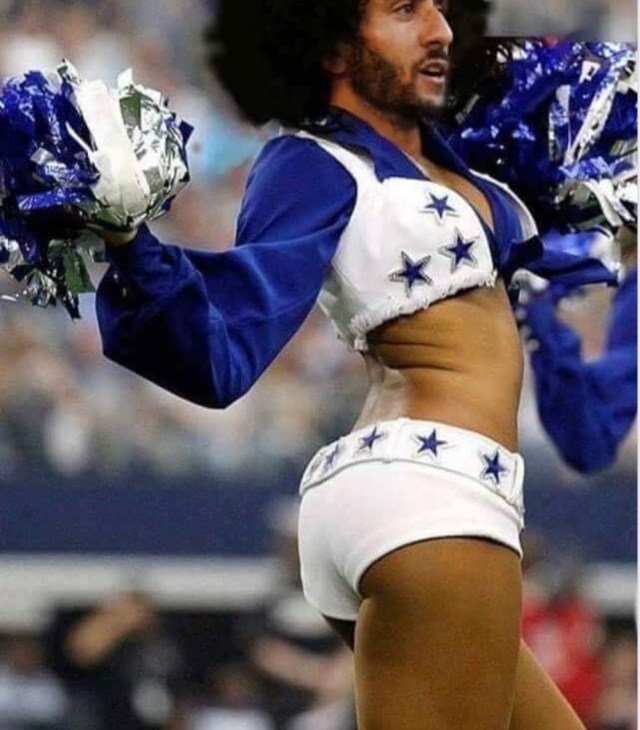
Colin two.jpegSo I’m sure that some small synapse in his brain at least considered the possible response when he clicked on my name and sent a pic with the face of former football player Colin Kaepernick photoshopped into a Dallas Cowboys cheerleader outfit with a caption that read something like, “He’s found a new team.”

The commentary below the picture was just as enlightened:

Comment: I don’t know about..landing a job…looking at that pic…if he kneels, he can give a job 🤣
So it’s not only ignorant but sexist too.

Adequate response

So I responded. And in my response I included an explanation of the real reasons why Kaepernick thought it important to protest by taking a knee during the National Anthem.

My Friend’s big response? “He’s disrespecting the flag,” he said.

But that comment is wrapped up in so much recent history and ancient prejudices it’s going to take a bit of work to unpack it all here. The campaign against Kaepernick has components of racism, false machismo, jingoism and fearful envy of “the other” all wrapped into one.

Unpacking it anyway

So I explained in return that the flag has already been disrespected in the manner in which patriotism in general has been commodified for entertainment purposes by the NFL. That football league views the military as a moneymaker and the Army sponsors games as a recruiting tactic.

Now we all know the economic system in the United States is supposed to be based on capitalism. That means nearly everything we touch, including the supposedly sacrosanct tradition of Christmas, (the War On Christmas!, screams Fox News) has long been whored out for commercial causes having nothing to do with Christianity. So this isn’t about naivete toward economic realities. We all know the NFL exists to do one thing: make money for the owners. 

Commodities

The players are a commodity within that business model. I personally think the player selection system amounts to a form of glorified slave trading, evidenced grandly by exercises such as the NFL Draft, which is one of the most demeaning bits of programming on all of television. But in this Reality TV world where fantasy supplants reality, the players are glorified hunks of meat because that is the one thing people really like to believe in. They’re superheroes in a banal world. Fantasy Football only proves that outlook.

But I’ve met and talked with a number of NFL players. Their lives in the game and after their career are often a confusing mix of “love of the game”, football lore and the raw desire to find alivelihood. But here’s the cogent fact we need to consider: Most football players are expendable within a few years. Here’s another cogent fact: “According to a 2009 Sports Illustrated article, 78% of National Football League (NFL) players are either bankrupt or are under financial stress within two years of retirement and an estimated 60% of National Basketball Association (NBA) players go bankrupt within five years after leaving their sport.”

So this idea that pro footballers are automatically millionaires for life is a massive lie. That makes the National Football League a massive lie.

Durability and CTE

A few stalwart players stay in the game for 10-20 years. Yet many more wind up with crippling injuries from which there is no recovery. Ever. Players are getting bigger and stronger and faster by the year. Perhaps the human body reaches limits of how much it can take at some point?

And then there are players suffering CTE, the brain discombobulation that comes from sustaining too many concussions over the course of a football career. Granted, players choose that risk and are ‘compensated well’ in the pursuit of a football career. But are they really? Is the risk of ruining your brain truly worth a few years of supposed glory?

Take a knee

And thus when players “take a knee,” their cause may seem to be focused on civil rights, but there’s something more as well. The original purpose of  “take a knee,” if we can even break it down that far, was to protest treatment of black people in America. Too many black people are arrested with no real cause, and numerous black citizens are brutalized and even shot dead by police.

This is because America has an ugly, nasty history of racial prejudice that it cannot seem to reconcile with the rights guaranteed to all in the United States Constitution. The only thing those players are protesting is one simple question: Where is the equality for all?

But the inflammatory question that stands in front of the simple ask is this: Why does brutality and institutional racism and white privilege persist in a society that claims to have advanced? Because it has not. So, take a knee and call attention to that.

Ignorance defined

But when it comes to protesting these issues, the institution of pro football prefers to ignore and chastise the players for their actions when they “take a knee.” But then, it took decades for pro football to admit that the game was ruining the brains of the very players it hired to perform for entertainment. So it’s no surprise that something so subtle as a social issue related to prejudice might be hard for football to address. That’s because it falls outside its business model. Yet somehow fans of the game see to shove all this under the rug and ridicule a player with the brains and guts to point out the egregious nature of it all.

While some teams have wonderful records and great relationships with their athletes, others still impose sanctions on the players under their employ. Where’s the consistency? Now the President of the United States sees fit to bitch about football players “taking a knee.” It is apparent our nation has an identity problem that has nothing to do with identity politics.

Thus it pays to back it up a bit, and consider all the contradictions in “respect” that we’ve just covered. That’s what I attempted to point out to my “friend” who saw fit to send a really stupid meme through Facebook Messenger.

Lacking a justification for his actions, he finally  resorted to condescension toward me:

“Sorry Chris, I know you have been through a lot in your life, but I need to be surrounded by friends with positive attitudes and a sense of humor. Yours is missing. It’s better if I unfriend you now so I don’t upset you. So sorry. Bob”

I’d just been dumped into someone’s social media junkyard.

Big loss, huh? 

The social media junkyard

That action by my so-called Friend made me realize that social media is a junkyard in general. Human beings are great at creating lots of junk.

In the old days, when there weren’t so many people in the world, people built their homes on hillsides and just tossed their junk out the window and down the hill. That was called a midden. Here’s the meaning of that: “A midden is an old dump for domestic waste which may consist of animal bone, human excrement, botanical material, mollusc shells, sherds, lithics, and other artifacts and ecofacts associated with past human occupation.”

Midden search.jpegWell, I’ve sorted through a midden close to my own home. The forest preserve where our high school cross country meets were held was once the site of a farmstead. There was a small home that stood near the railroad tracks. It was perched on the edge of a steep embankment. All down the hill there were half-buried remnants of antique bottles, old metal cans and whatever else the long lost occupants of that home did not want.
Midden for humanity

What we all need to realize is that the earth is one large midden for humanity. Our plastics even clog the oceans. Even the slopes and peak of Mt. Everest is a midden of dead bodies and human waste. Our very atmosphere is stuffed with carbon dioxide from industry, agriculture and transportation activities. Now the entire climate is heating up. We’re steeped in the remains of our own waste.

Now we’ve abstracted that concept through social media. People dump their garbage on social media sites such as Facebook and Twitter and Instagram every day. There are even social media apps such as Snapchat and others that cover over the contents within minutes of its import. Junkyard mentality is alive and well in this world.

Clearing my head

While I was out cycling last night, I felt entirely in tune with my bike. The temps were seventy-five degrees and dropping due to a cool northeast breeze blowing west off Lake Michigan. I started at 5:15 and rode until 7:00 p.m., arriving home just as the sun was going down. With four miles to go I stopped to text my wife that I was nearing completion of the ride, since she worries if I’m out there past sunset.

When I got home I realized something had truly changed in my mind. I’ve come to understand that living in the social media junkyard and constantly sorting through its contents may not be the best way to live. Like the day that I realized anger had consumed enough of my life and it was time to put forgiveness to work, I believe a sea change has come.

There are still things to learn from the midden of social media. We all know people who wander through a Goodwill or thrift shop learn and find treasures there. Not all junk is worthless. And not all objects and ideas are junk. There have been links I’ve followed on social that have bettered and even changed my life. So I’ll keep looking for those.

But the junk spewed out by people such as my “friend” who felt compelled to shit on my social media lawn and then blame me for protesting does not need to be tolerated. I’m the Colin Kaepernick of my own life. So I’m making a vow to myself to “take a knee” when corruption besets me. But I’ll also get up and run past the junkyard. If there’s something there that’s worth seeing, I’ll stop and check it out. But the crap that people pump out just to prove they’re alive and not well? Who needs it?

Run right past the junk yard.

Posted in Christopher Cudworth, cross country, cycling, cycling the midwest | Tagged , , , , , , | Leave a comment

Finding ways to focus on the positives

IMG_7846.jpg

The end of a day. But the beginning of a tomorrow.

Three nights ago with the sprain still fresh below the ball of my foot, I awoke to the throb of pain and swelling. For a few minutes I tried to ignore it, but sleep wasn’t going to happen like that. I crawled out of bed, took two Advil and crawled halfway back under the covers.

That’s often how it goes when you’re injured. Athletes can often deal with every kind of pain life dishes out except the kind of pain they don’t impose upon themselves. Yet most of us learn not to whine, and if we’re smart, not to rush the recovery process too much.

Grant you, I got up and went for a two-mile walk at the indoor track the morning after my meniscus repair surgery. But the knee did not hurt. Nor was I drugged up or anything from the anesthesia. With all signs go, I got up and went.

Did the same thing the morning after my bike crash in the hills of Wisconsin. Once they pushed me out the door at the hospital with a sling on my arm and some Vicodin in my veins, I knew the recovery process had to begin right away. After a weird night sleeping in the chilly tent on a Labor Day weekend, I pulled on some loose sweats and walked a mile down a big hill to the lake and back.

On the way back up the hill, I chuckled out loud recalling a midnight venture in the moonlight the night before. I’d crawled out of the tent take a whiz and had to let my pants drop to my ankles because I only had one arm free to conduct the operation. I’d make noise getting out of the tent that my longtime friend was sharing to keep an eye on me. He peeked out the tent flap to the odd specter of my white ass shining under a full moon. “What the hell are you doing?” he asked.

I was shivering from the combination of the cold night air and the effects of the Vicodin. My teeth were chattering as I tried to reply. “I’m…taking…a piss,” I laughed.

Like a wasp in water

Wasp in Water.jpg

Sometimes we feel isolated in our difficulties or injuries. Keep talking positive.

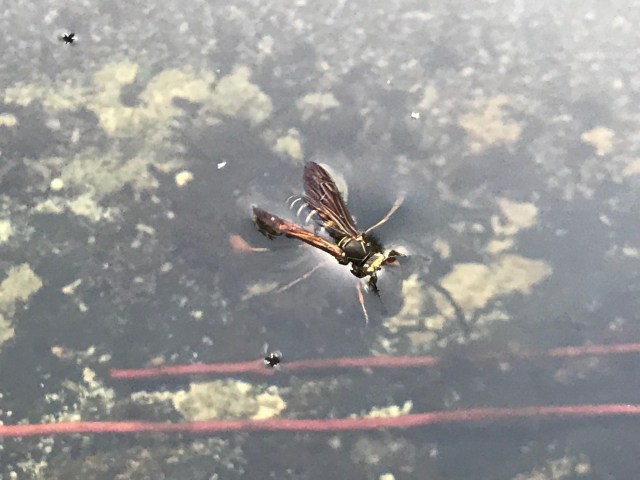
So let’s swim headfirst into an allegory here. This morning I watched a wasp fly right past me and  <plop> in the water. I wondered why that happened, then noticed another wasp lying flat on the water, its body held aloft, for the most part, by surface tension.  The first wasp wasn’t moving, but the second wasp was swimming in that way that creatures shocked by immersion in water often do.

And I thought: That’s how most of us respond when we find ourselves in suddenly foreign circumstances. We emotionally flail around a little bit. That’s what happens when we get injured. There’s the shock of immersion in that reality. Then the slow realization of what really happened. A touch of panic and even some feeble attempts at pretending it didn’t happen. And then, if we’re lucky and smart, we figure out how to slowly work our way across the surface of our inactivity and climb out of water to fly again.

Well, I had mercy on both the wasps. I actually put a leaf down to help them climb on and get out of the water. That’s kind of what our doctors and therapists do. They extend the branch to recovery. If we accept it, we typically climb out faster than we might on our own.

But not always. Sometimes our injuries nag us, or even become permanent fixtures in our being. Then we have to find the positives even in that circumstance. We might cut down our running and add biking or swimming. Whatever the circumstance demands. We’re all different. Find your own positives.

Relapse 

Bright Kind of Guy

Heaaaayyyyy….Look on the bright side!

The worst thing that can happen is a relapse of the original injury. That means it doesn’t pay to push it too hard, too soon. But there’s also a risk of stiffening up after an accident or surgery, so you must engage in an active recovery of some sort. Typically that begins with supervised exercise under the guidance of a physical therapist or trainer.

Even then, the best approach is to listen to your instincts and learn how to distinguish between types of pain. The soreness of recovery or swelling may be uncomfortable, but it also tells a story. Limited range of motion from swelling is a natural way of telling you “This spot must be protected.”

That type of pain is quite different from the acute pain one feels when an injury first strikes, or surgery is just completed. Those first few days after real pain hits requires ice and pain medication. As need for the meds abates, then you’re dealing with the honest feedback from your body. After that the testing process begins. Stay sensitive to the pain, but keep moving.

And be positive in your outlook. Even small progress is still progress.

Emotional pain and positivity

The same goes for recovery from emotional pain. When we experience a loss or failure in life, recovery can take time. There is no set schedule upon which we can depend. If genuine grief is involved, or emotional shocks from personal loss drive you into anxiety or depression, the process of recovery may be one step forward and two steps back for a time. With support (therapy, friends, time) the recovery balance evens out. Finally, you can make real progress again. Imagine a future. Be yourself.

Back on the bike

Tonight I’ll get back on the bike. My foot was too sore to even do that for the last few days. Over the last four days, I was careful to keep my walking to a minimum. But yesterday I “strolled” down to the drug store print some photos for an upcoming exhibition. That walk went well and I sent a text to my wife: “My foot’s healing up. But I may need some hugs to help it heal all the way.”

Typically I don’t really complain about being injured. It doesn’t help much. But I will confess to milking the situation for some loving arms around me. I will not apologize for wanting that.

And I did get a sweaty hug when she returned from her interval workout at the track. The sun was going down by then and a wide swath of pink clouds spread across the sky behind our house. It was a nice reminder to focus on the positives, and set the stage for a brighter tomorrow.


Posted in Christopher Cudworth, injury, Uncategorized | Tagged , , | Leave a comment

Living with pain

IMG_7821I hurt my foot while out watering the plants two nights ago. It was dark outside when I pushed open the sliding door and eased onto the stairs leading to the patio. As I stepped down the concrete block stairs, the heel of my foot caught under the ridge of the stairs and it scraped my heel, but not too badly.

The next morning was when the pain began. Not in my heel, but under the ball of my right front toe. It still hurts today, and will likely hurt for at least four or five more days.

For the meantime, I will be living with pain.

I’ve lived with all sorts of pain over the years. Most of us learn to limp along one way or the other. The risk in doing that is in coming down with some compensatory injury on the other side of your body. Putting additional stress on an opposing limb to make up for an injury is not always the best strategy.

Hit pause

I know this much: I won’t be running for a few more days. That means preparation for the October half-marathon planned as a teammate with my sister-in-law must be delayed. I ran seven miles on Saturday and have not run since.

Fortunately I can swim and likely cycle. At least the aerobic side of things will be maintained. Many times I’ve lucked through a running race based on my long history in the sport.

But a half-marathon is a different animal for a man my age. My joints protest after eight miles or so. That means it’s time for strength work to build up my hip flexors and quads for the additional miles.

Hit the pace

This year I raced 5K at 7:20 pace. Last year I raced 5K at sub-7:00 pace. But my goal for a half-marathon is going to be maintaining 8:30. If somehow my body wants to do more, that’s fine. But being realistic is important when you have not run that distance in training or racing in so many years.

At some point the race will start to hurt a bit. Fatigue will kick in. But that sensation I can handle. It’s the sharp soreness in my foot right now that gives me pause. Will it go away on something resemble a normal recovery time from injury? Or has something more dire transpired?

All one can do is wait, ice and medicate. So I bought a bottle of Advil and that helps. Living with pain requires a strategy. It’s part of life, but living with pain takes patience is a question of hedging our bets, and limping as little as you can.

Posted in aging, aging is not for the weak of heart, Christopher Cudworth, running, Uncategorized | Tagged , , , | Leave a comment

There’s only so much sex the world can take

We subscribe to Direct TV for our television programming. When we moved into our house, our connections were all from AT&T. But by some vagary of local wiring, the data was so slow and the Internet so patchy we had to do something in order to placate the house of twenty-somethings that we hosted, yet would move out in a year, so we split our connections into Direct TV for programming and Comcast for the Internet.

Direct TV.jpeg

There’s an entire culture devoted to Adult Channel “entertainment” 

So that’s the lead-in for what comes next. Because the programs listed in the mid-to-high 600s on DirectTV are all paid options for porn channels. Scrolling through the menu, the titles are unavoidable, and frankly quite funny. One in particular made me laugh yesterday. It was something on the order of Busty Young MILFs Ready for Action. That’s a potential contradiction in terms, but then it’s kind of not. MILF stands for Mother I’d Like to F***. But a mother could just about any woman capable of bearing a child. So a MILF could technically be 12 or 13 years old.

That’s how the world of porn tends to get twisted around a bit. Add in 24-hour access and an Internet chock full of sexual content, and one has to ask: Is there some point where the world has too much sex?

Contradictory instincts

Direct Too.jpeg

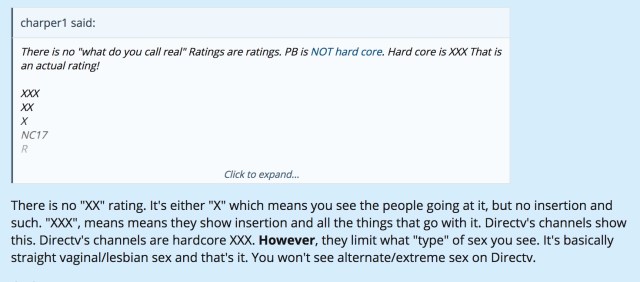
Actual screen cap from search about discussion of Direct TV porn offerings. 

The predominant users of porn are men. There is also evidence that Christian conservative men are some of the most ardent porn fans. That would seem to be a contradiction of terms when it comes to morality. But studies have shown that supposedly moral men conveniently dismiss their so-called values when it comes to satisfying their sexual energies.

In other words, they’re hypocrites. This excerpt from an article on PsyPost.com describes it this way: “Having studied what conservative Christians think about pornography as well as their consumption habits, I started to notice a bit of a discrepancy. In every study of which I’m aware, conservative Christians are far more likely than other Americans to reject pornography on moral grounds. There is basically no justification for it whatsoever in their minds. However, I also started to notice that, despite their unequivocal rejection of pornography, conservative Christians aren’t considerably less likely than other Americans to report viewing it.”

Dismissive types

direct TV 3.jpeg

“The most important thing” is how this user describes it. 

That seems to explain a lot about America at this point in time. If people in their personal lives are so willing to subjectively dismiss (and compartmentalize) their morals for purpose of gratification, certainly it is no great leap in faith to think they will easily do the same in the realm of politics, business or inter-personal relationships. That directly explains why so many men seem to think it’s “normal” to sexually harass women. “Who is it really harming?” they ask.

Direct XX.jpeg

“The good stuff,” is how this user characterized it. And watching with “a friend?”

That forces us to ask some difficult questions. Does the inverse standard of morals subject to desires therefore apply even to priests who molest children?  That means the supposed bulwark against sin provided by religion is no match for the overwhelming lusts of carnal desire. Even Pastor Bill Hybels at Willow Creek, one of the most famous megachurches in the country, could not reconcile his supposed morals to his actual behavior.

Endurance sports

But I’m here to say that there is a method for controlling the appetite for sex in the healthiest way possible. Those of us that swim, run and ride get quite used to the sight of half-naked, often sweaty bodies writhing through the throes of intense effort. Some might even say that a really good workout can be better than sex.

ET

A triathlete body is something to achieve. 

Endurance sports are literally the flipside of sex in that people grow used to sight of body parts revealed through skintight suits and sweaty clothing. And here’s the real rub: about the tenth time a man glimpses a woman’s erect nipples through a sports bra, the spell of that sight wears off a little. That’s particularly true if she’s just kicked your ass in a ten-mile run or dropped everyone midway through an eighty-mile bike ride. Suddenly she’s not a sexual object. She’s an athlete.

It comes down to independence. The idea that you somehow own or deserve to ogle that person in a gratuitous way is absurd against the reality that they are an independent, completely capable human being who happens be a given gender.

But still…

This is not to say that triathletes and other endurance athletes lack sexual instincts. There is plenty of evidence that the sport of triathlon is capable of inducing extra-marital relationships and sexual escapades. But a look behind the scenes often reveals that there was some other level of dissatisfaction going on in marriages or relationships that break up due to relationships built through associations made in triathlon.

That’s the somewhat inevitable product of social dynamics. People unhappy in their marriages will often find a way out that is either blunt, unconventional or quite conventional. I have a friend whose wife walked into their home the day their son graduated from high school and said, “I’m bored. I’m done. And I’m moving in with that guy I know who lives out on a farm four miles out of town.”

People leave for a thousand reasons. Triathlon is just another excuse to go. So the endurance sports world is not necessarily the cause of adultery. But it is a convenient portal. The emotional intimacy wrought from sharing mornings at the pool, long conversational rides and deep confessionals on the run have been known to turn casual friendships into ardent love affairs. Sometimes it’s the occasional urgent bang session in a far-flung race hotel that leads to all that too.

But that’s still quite different from pouring one’s life into porn portals with what hope of a return on investment?

What porn can teach us

Yet if pornography teaches us anything, it is the commonality of the human body, not its differences. One can only look at so many vaginas before it becomes evident that their similarities and differences are only that: slight variations in the human condition. And while men tend to be obsessed with penis size, and really large cranks can be impressive in appearance, it is also evident there are limits even to the value of that commodity.

Direct final.jpeg

It all comes down to how many X’s you desire. 

So it is with amusement that one scrolls through the titles of all those porn channels on the way back down to the slightly less titillating world of Starz, HBO and Showtime. It’s a bit like running through a gauntlet of sex.

Despite what the Christian moralizers and creationists say about the human condition, we’re comprised of same DNA and evolved from the same curling flesh of ancient zygotes. We’ve simply grown into complex beings with brains attracted to the folds and cavities from which we all originated.

But we’ve only evolved so far. There’s a primeval instinct within all of us to crawl or jam ourselves back into the womb. We still find the fetal position after sex, and share it with our lovers be they man, woman or gender whose realm is independent of terminology. We’re all made of the same stuff.  Yet the tendency remains to fetishize and at the same time resist and make a taboo out of that which bears mystery and echoes a return to oneness with the dark origins of our being. That fear of the unknown is behind the religious and creationist denial that human beings trace their ancestry back to apes, and before that, the process by which evolution brought us all up from the murk. There is a prurient fear of the dark past that translates into an obsession with owning and translating it through religion. And that constitutes the greatest pornography of them all, for it denies our true humanity by replacing it with origins based on the fantasy of simplistic imagery drawn from oral tradition.

That is a pornography of sorts as well. Because while the definition of “porn” is typically defined by explicit depiction of sexual organs or activity, and considered a ‘perversion’ in the sense that it stimulate erotic rather than aesthetic or emotional feelings, the pornography of human ‘origins’ and ownership of that narrative is equally fetishized by those who choose to focus on the fantasy rather than the reality of evolutionary development and by proxy, the true functions of sex as they define breeding and the purposes of sexual attraction in the material world.

Denying that reality is the pornography generated by a ideologically retentive worldview.

Clamor for attention

The writhing character of human existence is a direct reflection instead of the entire history of evolution. On one hand we clamor for attention and crush ourselves into the flesh of others in hopes of feeling alive. Lacking that companionship, it is clear from the multi-billion dollar porn industry that people are trying to achieve some level of connection somehow. Evolution describes that as ‘redirected aggression.’ It also produces sexual harassment in the workplace and in politics. And it explains why so many supposedly moralistic politicians and public figures get caught in sex scandals. Quite typically they make a public show of their high morals while behind the scenes are engaged in sexual indiscretion, at least according to the moral codes they supposedly follow.

It all makes one wonder while  scrolling through the porn channels on Direct TV: Doesn’t all this sexual obsession get old at some point?

The answer, we must surmise, is that no, it never does get old for some people. They would rather die than confess to themselves that they don’t somehow own the people on the other side of that screen. That explains the rest of what’s going on in America today, where some people’s selfish sense of “ownership” fetishizes the idea of what it means to be a ‘patriot,’ a true citizen or an American. Yet claiming ownership is a risky thing,  because as we all know, there is more than one way to get owned in this world. We are witnesses to that every day.


Posted in triathlete, triathlon, triathlons | Tagged , , , , , | Leave a comment

When the track calls you back

Track from aboveThose of us that ran track and field in high school or college feel quite at home doing intervals on a running track.

That’s not the case for many people who did not have that opportunity. They seem to dread the track for many reasons.

First, the track usually means that you’re there to do a speed or interval session, and that hurts.

So people would rather avoid it.

Second, the track is an empiric environment. You know exactly how fast or slow you’re going because the measurements are precise.

Third, the track involves repetition. Some feel bored by doing multiple laps.

#2 Choice

I cannot say that track was my favorite running sport during my scholastic and collegiate years. Cross country was more fun. And yet I had some success in track, even winning races and setting school and conference records.

Some of my best indoor and outdoor track times still reside in the Top 10 category of all time records at my college.

But the thing one most remembers about time on the track is the workouts. We did track workouts for cross country as well as indoor and outdoor track. The fact of the matter is that there was no escaping it. But when you’re out there working in the company of other runners, it’s like the track is a reality separate from the rest of the world. A really hard interval can drain your strength entirely away. Then you wait through those precious seconds of recovery, or jog around the track to the next one, and do it all over again. It’s insane in some respects, but also the most tangible thing you’ll ever do.

img_1811Track running is far different from cross country or racing on the roads. You learn how to run right next to each other, for one thing. There is contact going around the curves.

I ran the steeplechase, an event that involves hurdling 35 barriers over 3000 meters, and seven water jumps. You had to gauge your space and speed pretty well in approaching those hurdles. Otherwise you could get tangled up and fall, or drag a leg and strike a knee against one of the 4″ X 4″ solid wood barriers. And that hurts.

Pace per mile

But what also hurts is the effort of trying to run a specific pace that is faster than you’ve ever run. Still, there were moments when that sort of effort turned into a magical romp around the track. There is nothing quite like being fit and racing on a good track. The footing is great. The spikes are light and the sensation of leading an event on the track is like nothing else on earth.

So the track sometimes calls me back. Last evening I had 45 minutes in which to work out before picking up my wife from the train, so I buzzed over to the middle school track where we do our workouts. It is a black rubberized oval in an open landscape. The running surface is responsive and great for doing intervals.

I ran 6 X 400 meters at 1:38. No faster. No slower. That’s just over 6:30 pace for the mile. I’m not very much faster than that currently. But I wasn’t dying either.

Over the next few weeks I’ll push that average pace per quarter mile down to 1:30. That’s 6:00 pace and a good way to induce the type of anaerobic training necessary to lower my race pace in general.

Aging on the track

As I’ve aged, it’s been difficult to watch my speed seep away. There was a time when I ran a workout of 10 X 400 at 60-63 seconds per lap. At the lower end, that’s four-minute mile pace. I once went through three quarters of a mile in 3:09 before tying up the last lap to finish in 4:19. That was during college.

Track TurnA part of me dearly wishes that I’d run a competitive mile post-collegiately. The summer of 1984, I ran my 5000 meter PR of 14:47. It would have been fun to apply that fitness to the mile distance, because a 4:15 was very possible for me. Perhaps even a 4:12, given the workout I just mentioned.
But those days are gone. Lost to the past on the timeline of a runner’s life. I still love going to the track even if I’m not as fast as I used to be. It stuns me that the intervals I run these days are not even as fast as the pace at which we ran our 20-milers in college. It almost feels like that must have been a different person doing that.

The track calls me back to remind me that I am still that person. A bit slower in some respects, but still in love with the speed I can generate, and that’s still better than many.

See you in lane one.

Posted in Uncategorized | Tagged , , , , , , | 1 Comment

Craning for meaning in this world

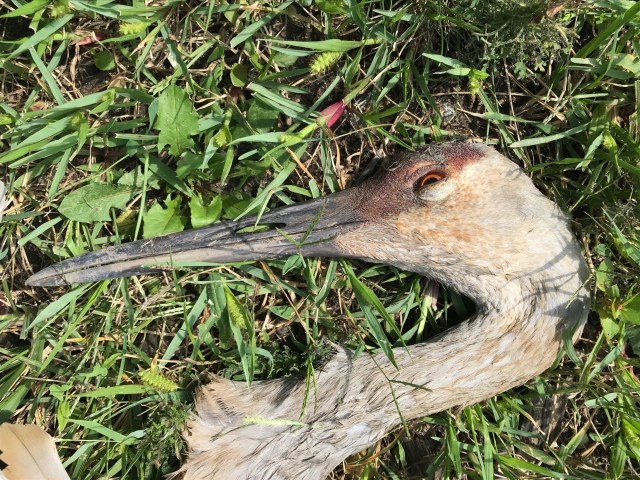
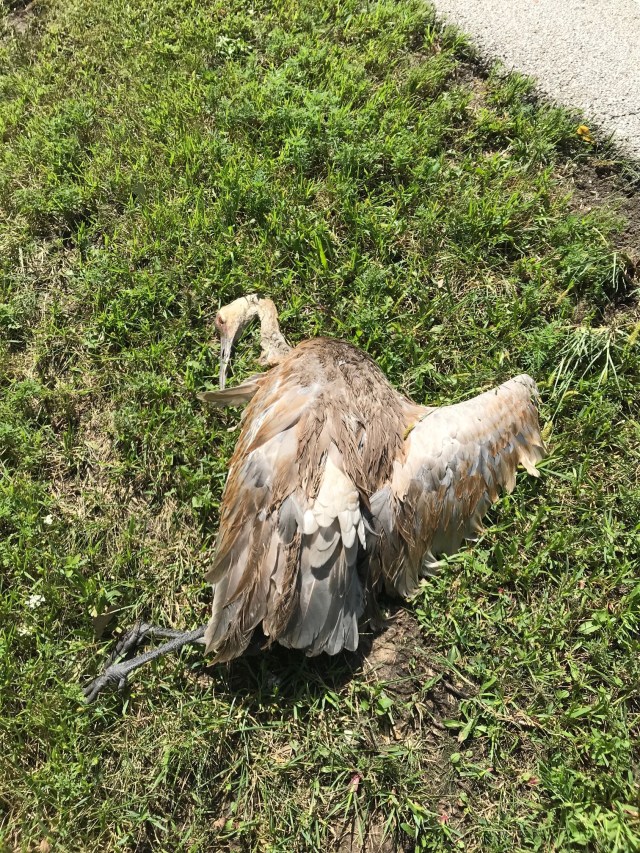
Crane 1.jpgThe sandhill crane lay dead in a roadside ditch. I’d read about its demise on a Facebook post earlier that morning. A school bus driver had seen the bird while covering her route. She’d seen the crane family––mother, father and “colt” of the year––many times while driving kids to the nearby elementary school. Now one of them was dead.
And we’ll get to the significance of that incident in a moment.

Because own relationship with sandhill cranes goes way back to March 27, 1973. That’s when my brother and I were playing catch in the street in front of our home at 1108 S. 11th Avenue in St. Charles, Illinois. By that time in our lives, we’d already been birders for almost three years. Our interests had been stoked by my eldest brother’s enrollment in a college ornithology class. We’d been adding birds to our life list through every season of the year.

Athletes and birders

Most of this was done between our involvement in year-round sports. I was by then an athlete in cross country, basketball and track and field. All those practices and games absorbed much of our time. But when we had a chance, we’d escape to the woods and fields or bird the banks of the Fox River.

Yet nothing prepared us for the moment when a flock of more than 400 sandhill cranes came flying through the grey skies over our heads that March day. At first, we only heard them. We paused in our game of catch and wondered at the sound; a low, sort of guttural call that carries quite a long distance.

Then the first vee of birds showed up over the trees and they kept on coming. We didn’t even have time to run inside and grab the binoculars. Instead, we stood with our necks craned as the flock passed over like military aircraft headed for a bombing mission. There were so many it took them several minutes to pass. We watched them disappear to the north and then kept our eyes and ears peeled for more. But that was all.

Revelations

Those were the first wild sandhill cranes we’d ever witnessed. In the intervening years, there were increasing reports of pairs breeding in local marshes. A statewide census was conducted to monitor their populations in Illinois, where they had once bred commonly but were then almost endangered as a result of habitat loss and other factors.

Slowly at first, their populations did rebound. Now there are cranes breeding all over northern Illinois. They are a common sight at most marshes. They even stroll through suburban neighborhoods plucking food from the ground.

Crane 2.jpgBut with that establishment of home turf among humans, there are also greater risks of mortality for their young. This is particularly true in areas with busy roads. The bird that was found along Deerpath Road near my home was only one such victim. Coyotes also steal a few birds, and others die from causes we may never know about. Nature has an entirely objective process of selection in place. Yet sandhill cranes have descended from lines of birds extending 10 million years back in time. The Wiki description of this bird’s origins is fascinating:
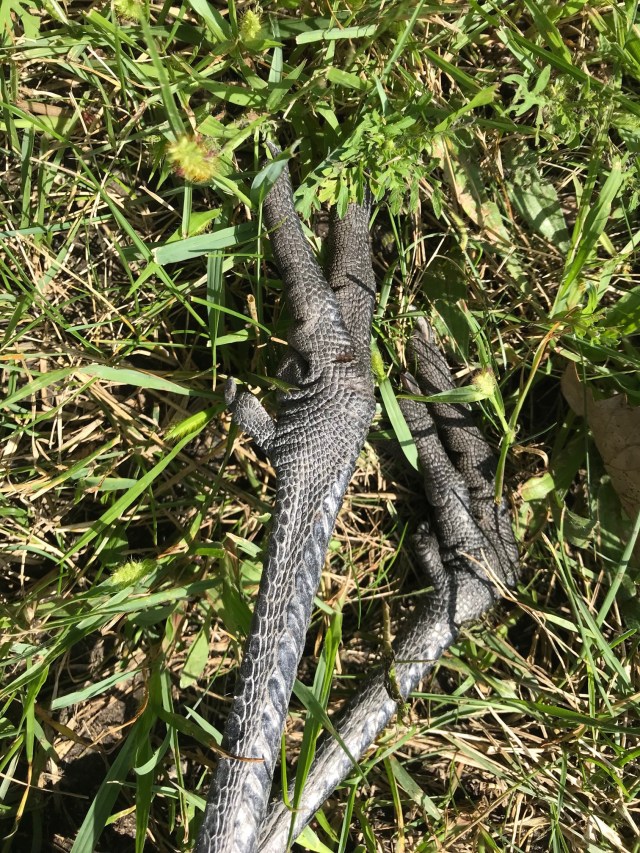
“Sandhill cranes have one of the longest fossil histories of any extant bird.[13] A 10-million-year-old crane fossil from Nebraska is said to be of this species,[14] but this may be from a prehistoric relative or the direct ancestor of sandhill cranes and not belong in the genus Grus. The oldest unequivocal sandhill crane fossil is 2.5 million years old,[15] older by half than the earliest remains of most living species of birds, primarily found from after the Pliocene/Pleistocene boundary some 1.8 million years ago. As these ancient sandhill cranes varied as much in size as present-day birds, those Pliocene fossils are sometimes described as new species.[16] Grus haydeni may have been a prehistoric relative, or it may comprise material of a sandhill crane and its ancestor.[17][18]

But most significantly these days, we’re learning that birds are actually…dinosaurs that have survived a thin lineage to flourish into all new species that occupy the whole earth.

Crane 3.jpgThus sandhill cranes have an evolutionary history about parallel in terms of timeline with that of the species homo sapiens. Many times I’ve stood in an early morning marsh and wondered at the sound of their calls resonating over the water. Those calls have a haunting quality about them. And I have also witnessed the birds in full mating ritual. The male and female dance around each other in fanciful ways, raising their wings and bowing their heads. One April morning I witnessed a pair copulate with the sun lighting their wing feathers as if they were angels. It is one of the most magical moments ever to be witnessed in nature.

Cranes are such large birds, and seem possessed of much intelligence and awareness, that they almost defy our categorization of them. Perhaps that is why human beings identify so closely with these birds. Thus when a crane is struck down, people seem to feel a particular regret. Indeed, in many Asian countries cranes are regarded as mythically significant beings.

“In Japan, the crane or tsuru, is a national treasure. It is the symbol of longevity and good luck because it was thought to have a life span of a thousand years.  Tsuru are also monogamous, therefore, often used for wedding decor.  An example of this is seen on formal wedding kimonos, and the uchikake, a decorative kimono that goes over the actual kimono, where beautiful images of tsuru are often embroidered.”

It is these connections to nature that seem so vital to human existence. To garner some perspective on these connections, I turned to a close friend whose wife is Ph.D psychologist. He is also a brilliant writer and a friend in whom I’ve confided so many times I can never return the favor. I shared with him the story of this fallen crane, and how it seemed to affect people. This is what he wrote me in return:

“I think it’s like that for most of us. Human suffering is extremely hard to get our heads and hearts completely around. When you get to the heart of it, literally, it can paralyze us emotionally. To really think of the indiscriminate barrel-bombing of the Syrian population, with kids missing parents, and limbs – it’s just too hard. For us to conceive of an innocent pair of cyclists, circumnavigating the globe (again) being caught by ISIS and having their heads hacked off for video propaganda is a trauma that normal, empathetic people cannot hold in their hearts for long.

So we store all that emotion up, and then we see a dead bird, or dog, or cat and we transfer all that injustice and pain onto that animal, which represents all the unfairness and pain that this world can deliver onto people, the ones we know and love, and strangers whose stories reach us and tear at our hearts. The dead animal is a trip-switch that lowers the walls put up to guard our feelings about fellow man, and shows us that we are not emotional robots. Not quite Orwellian zombies. At least not yet.”

Sandhills Sunset.pngThat may explain why I felt such compunction to honor the fallen crane by putting its death to some use in life. So I contacted a group called the Bird Collision Monitors, a non-profit that literally walks the streets of Chicago during spring and fall collecting birds that have collided with buildings in the city. They bring the dead ones to be turned into scientific specimens at the Field Museum of Chicago. They take injured or live birds out for assessment and rehabilitation to the Willowbrook Wildlife Center in Glen Ellyn, thirty miles outside Chicago in the suburbs.
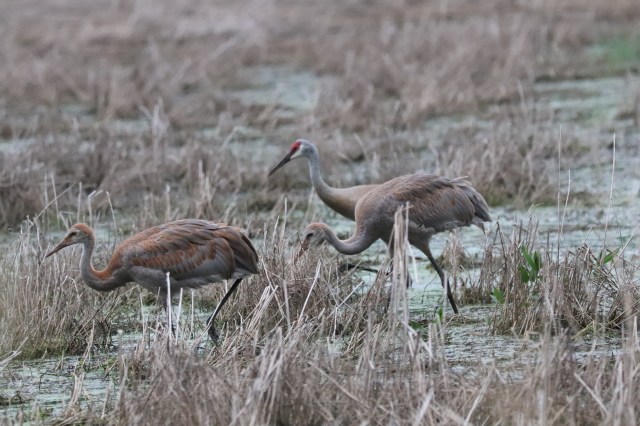
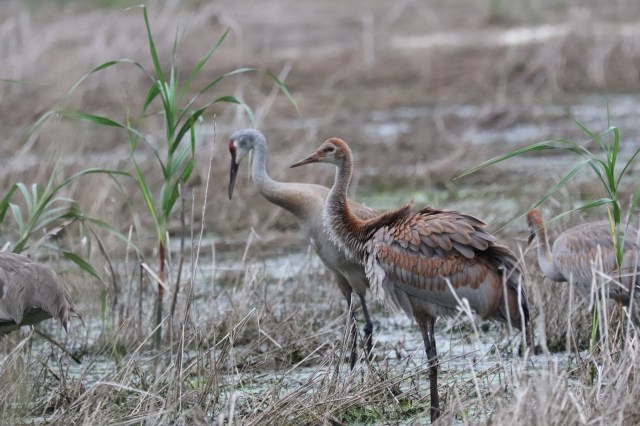
The crane was still baking in the heat of the day when I pulled up to collect it from the ditch. I slipped the tall (almost four feet) specimen into a plastic bag and placed in the back of my Subaru. That evening, my wife and our kids had a laugh at my propensity for collecting dead things to study over the years. During my days as a wildlife painted, I’ve either picked up and studied or taken photos of wild creatures of all sorts. A few of them wound up in our refrigerator and that habit is deemed too gross to handle by those who aren’t accustomed to dealing with wildlife, dead or alive, in the hand.

But I was trained in taxidermy during Field Biology at Luther College. One gets used to the sensations of dead things in the hand. I stuffed birds and mice and all sorts of other things. It is a lesson in appreciation when you’ve skinned a bird and turned it inside out all the way to the grip of its eyelids around the eyes.

And one day my classmates in biology played a prank on me while working the dishroom at the college. They lopped the head off a squirrel and carried it over to be garnished with lettuce and a big carrot in its teeth. They sent it in on a cafeteria tray with its gnarly orange incisor teeth exposed as if it was biting the carrot. The gal working next to me literally swooned as it came into view.

I found it hilarious, however.

IMG_6701.JPG

Photograph of sandhill cranes by Christopher Cudworth, 2018

Many times on long runs I’d spy road kill that was in good shape along the highway. There were owls and hawks, turkeys and pheasants. It is illegal to pick up some of that stuff and keep it. Bird protection laws prohibit owning the body parts of protected species. Yet in my work as a wildlife artist, I felt justified in turning those bits of nature into art the best way I knew how.

So I didn’t feel weird at all driving the deceased sandhill crane over to the wildlife center so that it could be frozen and passed along to the Field Museum for scientific purposes. My wife even ignored the smell of the dead crane as we drove her up to the train for her morning commute. She must love me, that’s all I can say.

IMG_6713.JPG

Photo of sandhill cranes by Christopher Cudworth, 2018

Because in the end, I feel that I’ve honored the short life of that bird and its evolutionary history as well. We all become more human by caring about the living things around us. Life has flourished and vanished in big ways and through massive extinctions at least five times on this planet earth. Despite what some may claim in their reading of the Bible, it is a rude assumption to think that human beings really enjoy any special status. After all, the Good Book claims that even God wiped out all but a few of the human species during a great flood. Supposedly our rainbows are signs that God won’t do that ever again.

But I prefer the more connected symbolism of acknowledging and respecting the death of a crane, and what it teaches us about life.

You simply can’t appreciate it enough, perhaps until it’s gone.


Posted in Uncategorized | Tagged , , , , , | Leave a comment