That’s why they call it a criterium

A criterium, or crit, is a bike race held on a short course (usually less than 1 mile), often run on closed-off city center streets. Race length can be determined by a number of laps or total time, in which case the number of remaining laps is calculated as the race progresses.

Bike Racing 2.png

That’s me at back left, behind the guy that would take it out so fast I got left in the dust. 

On Friday morning the 28th of September during work, I decided to see where the Athletes By Design Fall Fling bike races were being held this weekend. To my pleasant surprise, they’d landed a course in a calm little subdivision five miles from my home.

I sent an email to my wife and said, “I’m going to race my bike tomorrow!”

“Sounds good, honey,” came the reply.

Crit racing

When I first purchased a real road bike in 2007 (a Felt 4C carbon fiber road bike) one of the first things I did was enter a number of criterium races in the Chicago area. Back in the early 2000s, as marketing manager for a regional media company, I’d committed sponsorship money to support major bike races in the region. Through those experiences, I came to learn a bit about the sport. On a whim one time, I even entered a race with my Trek 400 series steel road bike to try it out. I got dropped in the first 400 meters.

So I’ve always had a deep respect for real cyclists. My two best friends raced for years before I ever touched a road bike. I’d visit their races and watched a few crits along the way. I also learned the dangers and joys of criteriums. That first year of racing I watched more than a few guys skitter into hay bales and crunch their bikes, or themselves. The basic truth is that crit racing is dangerous. It’s easy to forget that.

Bike Racing 3.png

Perhaps it was the bright greenish-yellow triathlon kit that turned out to be a jinx. 

Over the years I’ve let up a bit on crit racing. Usually, I’d head at least twice a year to the local scratch and handicap races held by the ABD Cycling group at a local industrial park.

Time trialing

Most of my bike racing the last four years has been done in triathlons. That’s quite a bit different than true bike racing. For one thing, there’s no drafting allowed. In crits, you don’t survive a lap if you don’t draft. It’s either hold the wheel of the guy (or gal) ahead or get dropped.

So I’m sitting at the start line yesterday with a fit-looking band of 60+ cyclists that I recognized a few from years past. Cycling is an evergreen sport. Age does not matter much to those who keep at it. Thus I knew the pace would be solid from the get-go despite the laconic instructions being doled out by the race director.

Off to the races

Sure enough, the whistle blew and the Alaskan-sized guy in front of me sped off. I clipped in cleanly enough but in that spare moment a much-older woman rider drifted toward me and the path was cut off to catch the draft of the lead guy or anyone else.

The race composition was basically every guy over the age of 60 and every woman too. So I applauded the presence of a woman that was 75 years old. Yet I should also probably have been alert in case of slower riders, but I wasn’t. Haven’t not raced all year I forgot that sometimes bike races start like that.

So I hustled like hell to get around the first circle and tear into the 300-meter incline toward the first turn. That required some slalom work too. That early delay really cost me.

Bike Racing 1.png

That’s all it takes, the woman to my right slipped in ahead of me and I was out of the draft. 

Heading into the first turn, I swung wide to avoid another cyclist and got out into the ruts at the far side of the road. This crit was held in a standalone suburban development called Mill Creek outside Geneva, Illinois. The roads are in great shape right in the middle. But on the edges, the asphalt was cracked and foreboding. When I hit that zone on the turn, my front wheel jumped from one crack to the other. I skidded into the curb itself and knew I’d be going down.

Drop it like it’s hot

During all those years of crit racing I’d learned lots of fine bike handling skills. This situation was not dire, and a voice in my head told me to just relax and find some grass to land on if possible. That’s what happened. I leaned over at a high rate of speed (more than 20 mph) and performed a sort of glancing slide. I laid ‘er down, in other words.

It didn’t really hurt and I popped right up, stood the bike on its wheels and looked down. The chain was loose. Otherwise, I could have basically kept on riding.

There were also some colorfully shaggy dirt clods stuck in the side of my bike shoe and sticking out of my left brake hood. I plucked those out and started walking back toward the start with my bike. A race marshall called out and said, “Come on back. You get a free lap.”

I knew that. Sort of. But something about going down like that took the joy and anticipation out of the day. I got back on the road but actually let the lead group swing past so I would not interfere with the pace line of six guys as they entered the corner. They were the real racers from that point on. I’d be nothing but a pretender.

So that was that. I pulled over again and told me wife, who was standing near the finish. “Ahhh, I’m done.”

Everyone near the finish was really nice. “Are you sure?” the race director offered. “You can just ride and have fun.”

But it wasn’t fun for me at that point. I go to bike races to race, and while I’ve never won, I’d stuck with the bunch a number of times. But this time I wasn’t really ready to do that in a number of respects.

Specificity

Jumping into a late-season crit after not really racing any crits all summer is not the best game plan. I’m sure there are riders who are capable of that. But not me. 90% of my riding has been between 18-22 mph all summer. Most of these were long haul training rides with occasional sustained speed, but not much surging or real sprint training.

This crit started at 22 mph and was roaring along at 24 mph on the 300-meter uphill. In warmups I rehearsed those surges and could feel the internal engine overheating. It was perhaps a bit insulting to those other seasoned riders to think that I could take my multi-sport cycling and apply it to a crit and hope for success.

As it stood, it was the mental side of the game that tripped me up. To crit race well, you need to anticipate the actions of other riders, especially the slower ones. And stay out of trouble.

Or trouble will find you, as it did me. Fortunately, all that I got for the trouble was a bit of a sore shoulder. Nothing broken. No road rash. No busted bike parts.

Just some dirt clods and a few confessions under the late September sun. “If it was easy,” I told myself, “Everybody could do it.”

And that lesson applies to just about everything. But it’s the true criteria in bike racing. That’s why they call it a criterium.


Posted in competition, cycling, cycling threats, Uncategorized | Tagged , , , , , | Leave a comment

One Sweet Season: Volume One

This will be the first in an installment of eight blogs about a cross country season forty years ago.

Over the next eight Thursdays, I will recount a most significant period in life,  entering a senior year in college.

That’s when hard work paid off, self-belief took hold and gratifying results took place. All while love entered the picture.

A Key Transformation

Chris Running 1978.jpgComing off a year of genuine transformation, I entered the summer of 1978 with a will to change. Arriving home from college, I couldn’t find a summer job at first. We were living way out in the country on a farm property eight miles from the town where I’d attended high school. So the idea of cycling to the golf course or working some other local job wasn’t an option.

1978 faceThat meant I had time to take stock and figure out what came next. One morning I got up and took a long look at myself in the mirror. My hair was long and thick. It framed a set of harrowed cheeks that had been thinned by hundreds of miles of training that spring. That had led to dramatic drops in my racing times from distances ranging from one mile to 5000 meters. But my outward demeanor and appearance had not changed.
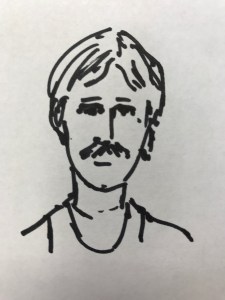
My face was covered with a dark yet thin beard. So I took out shaving cream and dragged a somewhat dull and long-neglected razor over my face to remove all of it but the mustache.

The bearded look had indeed served me well as I vicariously assumed the pale form of a Lasse Viren wannabe during the winter and spring track seasons. I’d trained hard during January and February and dropped my indoor mile times down to 4:20, and my two-mile time to 9:30. Then during the outdoor season, I lowered my 3000 meter steeplechase time to 9:23, which at that moment was a school record. It was later broken by a teammate, but the achievement built confidence in me just the same.

Confidence is almost everything in life to a distance runner. Which is why I stood in front of that mirror as a 20-year old kid assessing my self-image. Those thick glasses on my face were doing me no favors. It was time for a transformation.

Makeover

After shaving the beard, I took out big scissors and sheared off large chunks of thick hair. Of course, it looked awful, and I looked ridiculous. So I grabbed the keys to my parent’s car and drove to the barber shop in town. “I need a haircut,” I told them. That was the understatement of the century.

The barbers seemed to sense my predicament but said little to embarrass me. I’d been to the barber so few times during my college years that when asked to put my head over the sink to have the hair washed, I leaned forward with my face down in the sink rather than backward so that my hair could be washed and rinsed. Again, they corrected me with little comment.

When the haircut was finally complete, I felt liberated from a dark period of my life.

Contact lenses

Luther Runners

That’s me at the far left at Nationals in track and field

The next change that took place was getting rid of the Coke-bottle-thick frameless glasses that made me look like Napolean Dynamite. I’ll admit that probably there were elements of that movie character in my own persona. I was an avid birdwatcher, for example. Not exactly a turn-on to the ladies in the late 1970s.

Well, I didn’t give up that avocation, but I was interested in giving up those glasses. So this time around I literally begged my parents to let me get contact lenses. Fortunately, they were by then feeling grateful that I was likely the first boy in their family to graduate in four straight years. My two older brothers, to their eternal credit, largely put themselves through college on their own money and volition. So this is not an indictment of them. My only point is that it was almost time for my younger brother to enter college, and he looked to be getting a full ride in basketball, and that came true. So my parents felt they could spare $100 to help me out.

Seeing my way clear

1978 makeoverAlso by that time, my folks had made the decision to move our family back into town. Then I landed a job doing janitor work at a building managed by my best friend’s father. So everything seemed to be changing at once. My folks had purchased a home in a newly built subdivision. They occupied that same home for the next thirty+ years.

But for me, the new start actually represented a chance to get back to my old running routes in the towns where I’d built my run career during high school.

It was time for a new look at the world, and it was quite gratifying to put those contact lenses in my eyes and take to the streets without heavy glasses bobbing on my face, or those damned glasses straps pinching up behind my ears.

Close call

During the very first run on which I embarked, I was ecstatically covering a nine-mile route that took me on a rolling stretch of asphalt called Country Club Road. It was a warm June day, and as I wiped sweat from my eyes, the contact lens in my right eye popped out. I didn’t notice it for at least twenty yards, but when I did, a wave of panic shot through me. I turned around and trotted back the twenty yards while trying to calculate how far I’d run since wiping my eye. Then I stopped, bent down to peer at the gravel, and sure enough, found my contact lens sitting in a stretch of well-lit pebbles. Close call.

Now I had to get the thing back in my eye. I was a rookie at that. But I managed to stick it on the surface of my eyeball even in its dry state and keep it there until I arrived home. Not a word was said to my parents, who had warned me that I better not lose them.

Racing away

It took several weeks to get used to those contact lenses. At first, my eyes could only take about 2-3 hours of wearing them. then it was back to glasses. But when July came around I was getter better at wearing those baseline hard contact lenses and could stand them for 5-6 hours.

So my friend and I drove up to Decorah, Iowa to participate in the annual Nordicfest Elvelopet 15k, a 9.3 mile race that covered streets and trails in the hilly environs around town.

I felt like a new man with all that hair chopped off, the beard gone and those glasses removed from my face. All that I recall is putting those contacts in that morning and feeling like a surge of open-faced confidence. The race went well, and following that effort, the feeling of liberation and hope was profound.

Post-race, we all gathered at the home of our cross country coach sat to have some beers (drinking age was 18) and talk about the upcoming season. My eyes had tired out from wearing the contacts so I put the glasses back on. In some respects, that meant my transformation was not complete. Yet deep inside I felt a quiet determination to break free from all that had limited me in the past. My dark days were over.

Turnaround

Weeks later I was scheduled to participate in a retreat for Luther College residence hall managers. The event was to be held at a camp called Bethel Horizons north of Dodgeville, Wisconsin. That meant packing up all my college stuff to deliver it a week early to the campus, then get dropped off back at the retreat.

I clearly recall my father driving me through the Wisconsin hills on the way back up to campus. He’d been the one that suggested Luther would be a good place for me. He knew that I’d love the close access to wild woods and streams in Decorah. We’d also visited the campus at Augustana in Rock Island, Illinois. And while that school accepted me, I’d been placed on academic probation from the get-go. My grades in high school were merely Cs and low Bs, but I took that decision by Augie as a slap in the face.

Luther didn’t look at me that way. So when my dad and I drove into Decorah to visit the Luther campus for the first time that summer day in 1975, we stopped at a cafe in downtown and had lunch together. I could see that he was happy and relaxed in being there. That was a seemingly rare condition for my father in those years. For all our differences and difficulties through my early and teen years, these were moments when we finally relaxed together.

We didn’t even know where the college was located in relation to the main part of Decorah, but my dad smiled and said, “Don’t worry, we’ll ask around.” After that weekend, I pulled my application from Augie and signed up for Luther just a month out from the start of cross country season.

Those first three years at Luther were from 1975-1977, all tough winters and challenging academically I’ll admit. But I’d made it through and the drive back to campus my senior year with my father felt mildly triumphant. Along the way, we admired the sight of purple bergamot (bee balm) blooming in the fields next to bright yellow sunflowers. My dad sensed and appreciated that I’d cleared my head from the year before, and was excited to see me showing self-confidence after years of holding myself back. “Have a good year,” he told me after our trip up to the campus and driving me back to the RA retreat site. Then he set off toward home, and I was all alone.

The August mist

Bald Eagle PaintingDespite some deep insecurities during my first three years in college, I’d done quite a bit to establish myself as a student and athlete. My artwork had progressed in maturity, and my internship at the Cornell University Laboratory of Ornithology had seen me curate their entire collection of bird art while studying raptors in the “hawk barn” in real life. I’d earned a reputation as a person willing to push myself and try new things.

So it wasn’t as if I was emerging from a complete shell or anything like that. I’d also painted four large murals for a nature center in Calmar, Iowa, and held several solo shows of my work, much of which sold and provided needed money for my life on campus. And I’d greatly improved as a runner.

Retreat

Those experiences were why I’d applied and was accepted as a Resident Assistant (RA) on the Luther Campus. That required some preparation and training. So I joined dozens of other RAs at the retreat held in mid-August of 1978.

We met throughout the day for training and discussions. That left early mornings and late afternoons open for my running. I’d been building up to higher mileage through the month of July, concluding with the Elvelopet race in Decorah, and had made it a point to shoot for an 80-mile week during that August week at Bethel Horizons.

bethel-horizons-1-600x378.jpg

The wonderful aspect of that retreat was its location, which bordered a state park called Governor Dodge, a site to which I’d return many times, and over many different seasons, during the ensuing decades.

August provided supreme running conditions. I’d rise at 5:30 and trot silently away from the campsite in one of many directions. Often there would be morning mist obscuring the roads. It invited me with its mystery. As I ran, the mist would grace my skin with a cooling effect. Then the sun would rise and the mist would burn off. I’d arrive back at camp in a sheen of sweat of my body, shower up and be completely relaxed and focused for the day ahead. Then I’d repeat the process in the glowering heat of late afternoon. I was honing my body for the cross country season ahead.

The lure of the August moon

A few days went by like that, with long runs both morning and night, and socializing during the day. During all that interaction, I’d met a woman to whom I had an instant attraction. She seemed to respond in a similar way. Thus I felt competitive toward the attention she was getting from other guys. Thus I found myself tracking her whereabouts during every social break.

By the fourth day, we’d begun to hang around together a bit more. Then as evening fell, we sat together beneath an August moon with other people we’d met during the retreat. Everyone was talking quietly when she eased her body onto the blanket under us and placed her head on my knee to relax. She looked up at me with bright green eyes that reflected the August moon. I fell instantly in love.

Return to campus

From that point forward, we were a couple. Everyone at the retreat recognized what was happening. I spoke to that fact with a series of guy friends as we were walking to dinner one night. “Now, you boys stay away,” I told them. They all laughed and knew what I meant.

Later that week, we returned to campus and I walked into a party being held by the fraternity of which I’d been a member since sophomore year. But things seemed changed. No one seemed to know me. Then a frat buddy walked over and asked who it was that I knew at the party.

“Dave,” I told him. “I’m Cud.”

His eyes flew open and he replied, “Dude, I didn’t even know who you were.”

We both roared.

First practice

The very next day I joined up with my cross country teammates for the first workout of the season together. Most had been on campus for the week that I was stationed out at the RA retreat. That meant the hierarchy of team dynamics was already in play. Runners tend to sort themselves out quickly by pace and competitiveness, and here I’d arrived in the thick of that process. There were a few quality freshmen that were sticking with the seniors through every workout. That day we ran a track workout in late summer heat, and I felt good all the way. The hill running in Wisconsin had done my legs a world of good. Plus I was tan, had those contact lenses and a new girlfriend.

The stage was set for one sweet season.


Posted in Christopher Cudworth, competition, cross country, running | Tagged , , , , , , , , , | Leave a comment

When things are looking up, don’t look down

Looking upI once had a boss who told me, “I like you a lot more when you’re smiling.”

Now, the circumstances surrounding my resting dour face were not exactly common. So let’s set the stage.

I’d just started a job as Chief Marketing Officer for a marketing agency. I earned the position after helping the company land a million dollar account. That was all exciting. It came with a larger salary and a chance to make a real impact helping lead the creative department.

But three weeks into the gig (this was 2007) we learned that ovarian cancer was back in my late wife’s body after nearly two years in remission. She had an emotional breakdown as a result of that shocking news. I didn’t blame her. She’d done the “gold standard” recommended by her doctors and still the cancer came back.

So I walked a daily balance between handling the excitement and challenges of a new job and conducting daily conversations by cell phone with family while trying to manage the health needs of things back home.

Ultimately, it didn’t work out. The job ended after two months, partly the result of my inability to muster full energy for the work at hand. But once I was let go, that allowed me to take care of things directly during a period when the needs back home were profound. And they were.

But we got her through. Then on the very day she was informed of her remission following extensive chemo, surgery and emotional therapy, I landed another job. Wasn’t that interesting timing?

I’m not saying things worked out perfectly in all respects. Going forward, I wasn’t able to paste a smile on my face every day, as my former boss once suggested. But I had kept looking up even when things were truly looking down. That is the yin and yang in all this life on earth.

Persistence pays

Throughout my life to that point, I’d learned that keeping faith is important when faced with challenges. Persistence is sometimes all the salvation we need. I recall a moment during my years in advertising sales when an account that had been lost to a competitor finally called me back to purchase an advertising campaign. “You know, I’ve never met anyone more persistent than you.”

I’d never pressured him. Yet I did make consistent courtesy calls to stay in touch. When the day finally came for him to advertise with us again, he knew where and how to find me. I’d kept looking up even when things were looking down.

Motivation from somewhere

No one really coached me on that. Some of these things we do by nature. Yet coaching can help bring out our better traits.

For example, that boss who encouraged me to smile was suggesting it doesn’t help to be negative about anything. Two weeks before my late wife passed away, her gynecological oncologist phoned me up to talk. “Okay,” he told me, “This is coming to a close now. There’s nothing more we can really do. She’s made it eight years and she’s done a really good job. So be positive. Lie to her if you need to. Make the most of this time.”

Now, some people would be surprised or offended by what that doctor said to me: “Lie to her if you need to.” But he didn’t mean what most people might think upon hearing that advice. It wasn’t about engaging in deceit or being false with a loved one. He was suggesting that while walking the tightrope between life and death, it simply pays not to look down.

Sometimes we do have to “lie” to ourselves when fear threatens to overcome us. We overcome our fears by focusing on the present and the job at hand. Sometimes that means smiling even when things get tough.

That’s all her doctor was telling me.

Lessons learned

Pleasant Prairie 1Some of that desire to be resolute can emerge from your experiences as an endurance athlete. There are few things that test your character and ability to remain positive in the face of suffering than pushing yourself to near physical exhaustion. The lessons learned in those pursuit really do matter in life. You come to understand that you can take a lot more pressure and fatigue than you might ever have imagined.
Then when “real” events in life come along, you have the perspective to look at things more objectively, to assess your options and to compartmentalize those moments of fear and doubt.

That’s why achievements liked finishing an Ironman mean so much to people. Those races are symbolic not only of human spirit, but of persistence in the face of challenges. Many people hope that type of persistence pays off in other aspects of life.

Not an Ironman

I’ll never do a full Ironman. That much I know. My body has too many miles on it already from years of training and competitive distance running to embark on that particular journey. So I don’t really feel the compulsion to become an Ironman. I’ve gotten satisfaction from so many other experiences in life that the lure of trotting down that runway and hearing my name called out is not on my bucket list. I am working toward a series of Olympic distance races in the coming year. That makes me happy. And I love a good Sprint Triathlon. Fun and fast.

Yet I certainly understand that for many people, competing in big time events such as an Ironman is a peak experience of great value. Thus I openly thrill at the efforts of others, which is why I support all those who take on the challenge of doing an Ironman or whatever you choose to pursue from long swims to epic rides to gnarly runs.

We all benefit from seeking new heights of personal experience because that’s where we learn to avoid looking down when things are actually looking up.


Posted in anxiety, Depression, IRONMAN, marathon, marathon training, running, training, TRAINING PEAKS, triathlete, triathlon, triathlons | Tagged , , , , , , , , | Leave a comment

Coming alive on the track

Coming alive.jpg

It was a gray day and this Instagram filter emphasized the fact. And I dressed all gray too. 

Late last week I wrote a blog lamenting how slow I was running in the late September heat. Well, last night I took a turn on the track and it literally felt like I was coming alive again.

Some of you who read this probably hate training on the track. It might symbolize pain and suffering in your run training. Granted, those things are sometimes true. But the reason most of us go to the track is to get faster. Track training offers the empiric feedback you need to know exactly how fast you’re running. So it hurts a little? A price worth paying. There’s simply no fudging it when you’re running repeats of 200, 400, 800 or mile intervals.

That’s exactly what I did. 2 X 200, 2 X 400, 2 X 800 and a full mile. All at 7:00 mile pace (or *nearly so).

That’s not nearly as fast as I once did that workout. Forty years ago the bulk of that workout would have been done at 4:00-mile pace for the intervals up to 400 meters, and a couple 800s at 2:10 to 2:15 pace. Then the mile would be finished off at 4:30 or under. I’m not lying about those times or exaggerating them for effect. That’s what I could do back then. I was young, decently fast and loved running. Probably I’d have turned around and done the ladder in reverse too.

Age adjusted

But everything is relative. So is the age-adjusted sensation of what feels “fast” while running. It’s not the same at 60 years old as it was at 22. But I keep trying. soon enough I plan to be running some of those shorter intervals at 6:00 pace. That’s only 45 second 200s and I’m currently traipsing through at 50-51. All good. Could I run a 37.5 second 200 these days, which is 5:00 pace? Hmmmm. That might be stretching it. But I’ll try.

I’ve got a friend and former teammate Dan Johnson that is nearly my age and just ran a 5:26 mile and a Half-marathon in 1:23, an age-group state record for Minnesota. That’s pretty damned fast. I have no illusions of getting that fast ever again. So kudos to Danny. Carrying the Old Guy Torch with pride.

Smoothing out

As for me, I love the feeling of “smoothing out” as the intervals build up in my legs. The first two 200s admittedly felt a bit cloddish. It takes a few solid laps of faster running to loosen up aging joints. Those warmup laps loosen the muscles and set the tone for the rest of the workout. By the second 800, I was running efficiently. Everything felt like it was back in place. It was like reversing the aging process.

Dialing in

After the second 800, I jogged a lap and started to get my mind in the right place for keeping that 7:00 pace going. It’s easy to talk yourself out of being able to handle a target pace on a longer interval. So I said it out loud: “You can do this. Run smooth.” 

I felt good but also fell a couple seconds behind the first lap. Same with the second lap. Ooops. That meant it was makeup time on lap three.

The pace quickened and my footstrikes felt more purposeful. I even leaned forward a bit to gain speed and hasten my footplant. That third lap went well.

Then it all came down to the final lap. I was breathing harder but not laboriously. My mind touched on the fact that I’m actually recently capable of running a 6:30 mile. Picking up the last lap should not be a problem.

I brought it home in *7:09. A little over the objective but a great starting point for October speed training. Loved the feeling of new shoes on a responsive all-weather track. With my big clunky orthotics in training shoes, it’s not the same as running intervals in featherweight Nike Air Edge racing flats. But I also no longer weight 140 lbs and have 3% body fat. So there are a few compromises one must make.

But it’s all good. It’s all very good. Following the workout, I again said some words out loud. “Good job. It might be hard to race at that pace, but this was a start.”

Then I looked up and noticed that a couple had just walked past me on the track. I laughed while catching up to them on the jog and told them, “You know, a guy has to talk to himself when he’s training alone. The left side of my brain tells the right side how fast to run.”

They laughed and said, “We wondered about that.” Then I walked a couple laps with them to cool down and learned that he’d once played Division I football at Kansas State University. His arms were huge. We talked strength work and aging. “Don’t do the heavy stuff,” he warned me. “We need the medium stuff and high reps.”

Good advice and a good plan for the weight workout I plan to do tomorrow. Weights help speed and keep injuries at bay. It all fits together.

May you find your speed on your own terms as well.

Posted in 400 meter intervals, 400 workouts, running, we run and ride | Tagged , , , | Leave a comment

Life is just nuts sometimes

The Acorn

IMG_8790While talking with my brother-in-law this weekend, I learned that he is heavily involved in removing acorns from his lawn. He’s not one to exaggerate. He’s always been a person to calculate his statements with some accuracy given his background in mechanical engineering. So he literally added up the number of pounds of acorns that he raked up and bagged as lawn waste. “I took 450 pounds of acorns out of my lawn,” he said. So that symbolizes a microcosm of the bigger dynamic at work here in Illinois. It’s a big year for nuts around here.
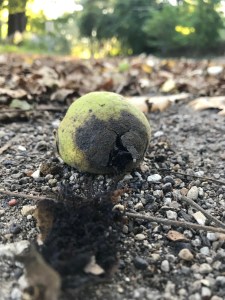
For cyclists like me, that means danger lurks by the side of the road. Acorns tend to fall en masse (in fact, it’s called ‘mast’) thus leaving road shoulders covered in long swaths of half-inch variety nuts. A road cyclist barreling along at 20 mph can be thrown for a loop if the rider enters the Nut Zone and catches a few too many under those skinny tires.

The Walnut

The same holds true for walnuts. Those can be hazardous for both cyclists and runners. A triathlon friend was incapacitated last year with a broken ankle after stepping on a large walnut during a training run. He broke a bone in his ankle from the force of how far that walnut twisted the ankle joint. Ouch.

IMG_8813So walnuts are not a nut case to be trifled with. The exterior husk is further laced with a stinky musk that stains the road. When that decomposes, the inner nut shell is ribbed with deep striations. And when that breaks down the shell splits in two, leaving cases that resemble black pig noses.

It’s an elaborate system evolved over many millennia. Squirrels steal away with walnuts to extricate the fine meat within. Some will bury them in the ground to be consumed later. A few get forgotten along the way, and that gives the walnut a fair chance to germinate and grow. Evolution has built some twisty-turny, symbiotic relationships when it comes to the “life goes on” scenario. Squirrels get food from the walnut tree, but in turn they help walnuts get a lease up on life. It’s a fair trade.

But some years nuts are so numerous the bulk of them go to waste. You’ll find them scattered all over the bike paths and roads. They become a source of genuine danger.

While riding my bike on a section of the Virgil Gilman Trail to get out of the wind after 25 miles of fighting it in open country, I rode through a deep woods section of forest preserve. I kept my eyes on the trail for potentially offensive walnuts and other fall tree debris. The shade was so deep in places the trail was not really visible through my dark cycling sunglasses. To make matters worse, the husks of walnuts tend to go black after a few days of exposure to rain, sun or crunching tires.

So there was plenty of reason to be on cautious. And where the sun did penetrate the trees, the beams were so bright and sudden and clear that my eyes could hardly adjust quickly enough to discern what kind of nut might be lurking on the exposed asphalt.

Fortunately I noticed a large green walnut just in time to swerve the bike and avoid getting flipped off the trail. Now granted, should I have slowed down enough to avoid the challenge? Of course. But something the human spirit always likes to live on the edge, meet the challenge and take a risk. It’s called being stupid.

Barefoot and painful

IMG_8800In college a few of us decided to run barefoot in an early season cross country meet. That worked fine on the lower campus where the intramural fields were composed of cleanly mown grass and there were no trees around.

Then we raced up the dirt trail that led to upper campus and found, to our horror, that the oak trees covering the Quad had shed thousands of acorns.

Running barefoot on paths covered with acorns is one of the most painful experiences you can imagine. Our coach was not pleased that some of us had shed our shoes. But knowing that was the case, most of us sucked up the pain and managed to come within a few seconds of our previous times. That came at a price, because it hurt like hell. After that, the barefoot running experiments were over.

Acorn rings

IMG_8231Compared to their gratuitous presence in fall, the growth of acorns and walnuts is a background process marked mostly by the calls of cicadas and the occasional summer lyricism of the wood pewee and red-eyed vireo.  All summer long acorns and walnuts grow silently in their respective trees.

While still green and firmly affixed to the branches, they look as appetizing as fresh apples. And so, as children, we used to pluck green acorns from the trees and pop off their caps. Then we’d sit on the ground and rub them on rough cement until both sides were worn off. Then we’d poke a hole in the middle and make an acorn ring.

On more than one occasion I gave an acorn ring as gift to a girl I admired next door. She even once returned the favor. Sometimes life is just nuts. Then you grow up and girls favor diamonds over the gift of acorn rings. But which truly has the most value?

The ways of (human) nature

Just over 100 years ago the annual harvest of acorns and other nuts in North America was consumed by a species of bird called the Passenger Pigeon. Those lean and lovely birds were apparently fiercely fast in flight and also numbered in the billions.

“Men still live who, in their youth, remember pigeons; trees still live who, in their youth, were shaken by a living wind. But a few decades hence only the oldest oaks will remember, and at long last only the hills will know.”

—Aldo Leopold, “On a Monument to the Pigeon,” 1947

Because of the enormous numbers of passenger pigeons, they were shot by market gunners who lurked by their roosts and blasted away at the birds. So they came and then they went.

Pass-PigeonUltimately there were no more birds left to shoot. They had all been killed by people too selfish, shortsighted and ignorant to realize that human beings really do have an impact on the way nature works.

The number of passenger pigeons had once been so great the branches of trees would break off from the weight of so many birds. But the bounty of that population and the ease by which they could be taken was their downfall.  Now the acorns fall and there are no passenger pigeons to consume them.

The last passenger pigeon known to the human race died forlorn, largely ignored and quite alone in a zoo. The once numerous species had gone extinct. And that was stupid too.

Acorns and life itself

IMG_8806.JPG

A young oak tree gets started in a forest filled with 150-year-old ancestors

So while the abundance of acorns and walnuts is a indeed a nuisance on our roads, a risk to cyclists and runners alike, I tend to still revel in abundance in many ways.

The reason why trees produce so many nuts is related to the numbers game of life itself. Between the natural destruction that occurs when nuts fall to earth, combined with the impact of so many creatures that feed on nut meats, it is important for trees to basically “breed” like crazy to produce the few nuts that will ultimately germinate. That’s how young trees get a start on life.

IMG_8814Nature is, when you study it closely, a sacrificial instrument to life itself. As human beings, we are no different. The Bible encourages us to “be fruitful and multiply,” but that’s also because we die in droves every day.
We must come to understand that there is more than one way be fruitful in life. It is important to be abundant in spirit in order to share the true bounties of nature. Otherwise we insult the order and significance of creation itself.

We are truly fruitful when we share the infectious joy of being alive to revel in a world that both celebrates and humbles us every single second of existence. Our running and riding experiences are part of that connection process. But a simple walk in the woods may be the best compliment of all to that effect.

Thus what I see a patch of acorns or the black stain of walnuts on a road it serves as a signal to slow down not only for my own safety, but to immerse my mind and spirit in the changing of the seasons. This has happened 61 times in my life. It is important to cherish the memory of those past and build new associations as the years go by.

It is true that the waste and wonder of life itself is all around us. It is ours to keep a sense of wonder about it all, or wind up in a ditch or a rut because we ignore the very thing that warns us of our own mortality.

Life is just nuts sometimes. And that’s a good thing.


Posted in aging, aging is not for the weak of heart, bike accidents, bike crash, Christopher Cudworth, cycling, cycling the midwest, cycling threats, Uncategorized | Tagged , , , , , , , , , , , , | Leave a comment

25 answers to how slow I ran yesterday

High on grasses

It’s been hot, hot, hot in Illinois the last few days. It was 95 degrees in the shade when I went out the door to run yesterday. There was a flat, dry wind blowing from the south. so as I trotted toward the start of my 4.5 mile running loop, I made the decision to run a little slower.

How much slower? Here are 25 examples of how slowly I ran yesterday.

  1. I ran so slow yesterday my own shadow passed me up. Pleasant Prairie 3
  2. I ran so slow that a fly laid eggs on me and they had time to hatch before I got home.
  3. I ran so slow the moon went through it’s full cycle before I got back.
  4. I ran so slow my thought bubbles kept tumbling off the top of my head and landing on the ground.
  5. I ran so slow I passed a sun dial on the way out and it had come all the way around to where it had started on my return trip.
  6. I ran so slow I was mocked by about thirteen snails. It might have been more but I could not keep up with the others as they slid by waving their little antennae laughing at my sweaty, slimy predicament.
  7. I ran so slow a farmer cleared all the corn from a seventy acre field with his combine before I arrived on the return loop.
  8. I ran so slow I could not even keep pace with the rate of movement by plate tectonics on the North American continent.
  9. I was moving so slow on my run yesterday that a pair of robins built a late season nest in the crook of my neck, hatched and fledged their young and took off for migration before I got home.
  10. I was trundling along at such a slow pace my Timex watched literally gave up, detached itself from my wrist and laid down on the side of the road while uttering the words, “It’s not worth keeping track.”
  11. I ran so slow yesterday that a band of opossums bitched me out for crossing the road at a pace that even made them look good.
  12. I was running so damn slow a chunk of road kill blew along the road at a faster pace than I could move.
  13. You know how slow I was going? So slow that I got a text message from a sloth in the South American jungle bearing only two words: “YOU SUCK.”
  14. It’s true. Then I got an email from one of Donald Trump’s porn star mistresses bearing a nude photo and Comic Sans message typed below it that read: “Make America Great Again, I Like It Slow.” 
  15. If that isn’t slow enough for you, I was running so slow yesterday that Fermilab  invited me to trot around inside their retired particle accelerator so they can crash atoms into my nearly immobile frame and measure the results for Old Quark’s Sake.
  16. I was so slow on the run yesterday \my IQ dropped 20 points from the sheer weight of my brain as it sagged into my occiput losing contact with the electronic impulses necessary to drive human thought.
  17. I was so slow my selfie came out backwards.
  18. I was so  slow that I was chased down and nearly eaten alive by a pair of tarsnakes. IMG_8190
  19. I was slow enough on the run yesterday I was ready to call myself a marathoner. Back in the day, that was not a compliment. It meant you were too slow to compete in “real races.” And yes, we were snobs because we liked to run fast.
  20. I was slow enough on the run yesterday that a West Nile infected mosquito bit me and died on the spot because the thickness of my slow-moving blood blocked its nasty little proboscis.
  21. I was so slow on the run yesterday a dozen Catholics offered to pay my way through purgatory just to move things along.
  22. I was so slow that a Lutheran waved me into the church to hold their proscribed seat in the pews until next Sunday.
  23. I ran slow enough to ensure that my soul will get into heaven with no problem because all my past sins got bored with my pathetic pace and raced ahead of me.
  24. I was so slow yesterday that Yoda dispensed the entire history and knowledge of The Force to me by the time I got home.
  25. I was soo, soo slow that when I got home my running shoes were there on the steps waiting for me to return.

It was a slow, slow run, in other words. But at least I got it done. There’s always tomorrow to go faster.


Posted in 10K, 13.1, aging, Christopher Cudworth, marathon, marathon training, race pace, running, Uncategorized | Tagged , | Leave a comment

The glory and humility of choosing new running shoes

IMG_8676I like to spread my business around to local running stores. But my longest relationship is with Dick Pond Athletics, whose founder I first met in the late 1970s when he was selling running and wrestling shoes out of his garage.

Last evening I visited the St. Charles (IL) store to cash in a $15 customer reward voucher and buy a new pair of running shoes. I was greeted by a fresh young face working the floor that I had not met before. She is a recent graduate of Illinois State University and is studying to become a pediatric physical therapist.

Transitions

I’ve grown accustomed to walking into running stores and telling them what I want. For the last four years that has been the Saucony Triumph ISO in size 11.5. I’ve worn probably 12-15 pairs of those in various colors.

But the most recent pair feels like their design had changed with a drop in the heel a bit. My Achilles tendons tend to hurt while running in them. So my alternate pair of New Balance 880s in sky blue with accents of bright green have been my “go to” shoe for a while. They’re what I’ve worn for speed training and races. But even that pair of shoes has close to 500 miles on them. It was time to get a new pair.

Testing the waters

My helper rolled up my pant legs and had me walk on the treadmill in socks. I told her all my flaws, which were clearly evident on the screen. Slightly bowed legs. Varus angle a bit more on the left left. And so on.

She pulled out a set of New Balance 860s and a set of 880s as requested. But also a pair of Brooks (maybe the Ghost, or the Glycerin, I didn’t check) and a set of Saucony Rides.  That’s the shoe I was training in before I got hooked on the Triumph after a Saucony rep gifted me a pair outside Geneva Running Outfitters.

Sweet surprises

So I appreciate consistency but always keep an open mind. That’s the liberal in me, and it has produced some sweet surprises over the years in many facets of life. Variety is good when it comes to running shoes and I’m still quite proud of having discovered a set of Puma running shoes a few years back that were one of the most comfortable pair of running shoes I’ve ever worn. But most running stores don’t sell Puma. So I gave up trying to stick with that brand.

When training big miles in my youth I always alternated running shoes day-to-day. That kept my legs from getting too grooved by wearing only a single model (or brand) of shoes.  Avoid overuse injuries. Those are never sweet surprises

Cardinal sins

Back in those days I will also admit to committing the cardinal sin (and boy, that phrase that has taken on a whole new meaning, hasn’t it) of wearing running shoes far beyond their prescribed life.

In particular I wore a set of New Balance training flats until there was literally a hole under the forefoot. But I liked those shoes because until the sole wore through, they felt good. They were navy blue with a silver N on the side. Simple and classic. But when I felt pebbles poking me under the ball of my foot during a 20K Chicago Distance Classic race in 1982 I realized I’d pushed my luck a little far. That was a humbling moment actually.

Planned obsolescence

These days I don’t let shoes get anywhere near that worn out. My body won’t let me. Which is also why I let the sales gal at Dick Pond put me through some tests and pinch my arches to see if I was in any kind of obvious pain. That was all okay. What did hurt was a poke on the Achilles. “I need to stretch,” I admitted.

I’d also mentioned that my hips were tight and tired. So the gal walked to the front of the store and brought over an elastic band. Then she showed me a few exercises to do to strengthen my hip flexors. I swallowed my pride and listened closely to what she was telling me. Even us old dogs need to be reminded how to lift our legs once in a while.

Good choice

Her counsel made me feel a lot better about my purchase. Those Brooks just felt a little low for my needs and the Saucony Glides felt good too. But gosh darn if those New Balance did not feel snappy with my running form and foot plant while skimming along at 6mph on the treadmill.

The glory and humility of buying new running shoes is that its wonderful to have that fresh out of the box feeling on your feet, but it certainly doesn’t cure all your bio-mechanical flaws or weaknesses by any means.

Instead it’s a precious illusion we create for ourselves with a pair of new running shoes. That feeling lasts a few hundred miles and then we start all over again. Glory and humility just seem to run hand in hand.


Posted in running, training | Tagged , , , , , | 1 Comment

Thought bubbles from the pool edge

The perfect lane

Thought bubble.pngI think I’ve found the perfect window for getting a lane at the Vaughn Center pool. It pays to get there after the Early Morning Diehards leave and just before the Slow Paddlers arrive.

That means arriving at 6:15, which is the time when lanes are open and I can swim in my favorite depth of water: five feet.

That way I can stand there and put fins on without climbing out of the water. It also works well for a quick change of hand paddles or grabbing the pool buoy.

The only thing bad about developing habits like that is getting so accustomed to certain routines and conditions that when you’re forced to swim in a different lane the changes throw you off.

I’ve seen people who get all upset and agitated about things like that. You can tell when they arrive at the pool to find their favorite lane filled. They pace around the pool deck like aardvarks at an ant hole on a rainy day. Creatures of habit don’t like change.

So…the trick in all of life is to not get too fixed in your ways. Otherwise when old age creeps up the love of habit produces a cranky old lady or a bastardly old man.

Water temps

Thought bubble 4The water felt cooler than usual today at the Vaughn. I noticed on the way back to the locker room that the pool temperature is listed at 80 degrees. Not too hot, or too cold.

Perhaps it was off a degree or two on the cool side this morning. But cool pool water is far better than too warm. Swimming laps in a too-warm pool gets uncomfortable in a hurry. I never thought I’d believe that given how much I used to hate getting into cool pool water. But now I’d rather deal with a bit of a shiver at the start than overheating like a frog on a frying pan as the body warms up.

Lifeguard life

The young man working the lifeguard chair this morning looked so bored.

I sincerely thought he was going to die.

He was half slumped over and looking like he dreaded being there watching mostly older people splash back and forth in their swim routines.

I get it dude, the work isn’t exciting.

But I popped up below his feet and told him, “Hey, we appreciate what you’re doing. Having lifeguards is important.”

He managed a nudge of a smile, if you could call it that. Later he was working at the checkout desk while I was leaving the pool and I told him, “Have a nice day.”

He looked up from under his hat and muttered, “What?” I said, “Hope you have a nice day.”

“Oh, yeah,” he replied. Don’t try too hard kid. You might hurt yourself.

New Wave

And listen, the lifeguard life isn’t all that bad. Occasionally, and depending on your sexual orientation, you’ll get to glimpse some bodies worth going to work about. They might even be built like this model posing for New Wave Swim Buoys on Instagram. Sex still sells even when it’s redundant.

Bleach baby

As I was swimming this morning, the smell of bleach kept entering my nose. That scent is just a touch off the chlorine used to keep the water clean and swimmable. But it is also a bit more harsh, and it gave me the creeps to smell it just over the water.

It took a couple laps before I realized that it was the guy mopping the pool deck who was using bleach. The odor had spread across the pool water. Every breath that I took offered a touch of that acrid smell. Funny how we can swim in some chemicals while others would kill us.

Speed and pace and age

Thought bubblePace is a funny thing too.

I’m now swimming between 1:50 and 1:55 per 100. This past weekend a friend told me about a 65-year-old swimmer that he’d met who can swim 2:00 for a 200. “He’s fast,” my thirty-something friend told me.

I guess that gives me hope that I can still get faster at this swimming thing because I have so little history at it.

With running, I burned a lot of mojo back in my heavy-duty training days. There’s no way that I’ll ever set a PR of any consequence in running. I can’t even run a 75 second quarter mile these days, much less four of them in a row, or finish a 10K at 5:00 pace. I did that once upon a time. Almost forty years ago.

But swimming? I can legitimately still improve at that. So I’m like one of those beginning runners I used to meet at races who were trying to break 30:00 for a 5K the first time. All full of expectation and wonder, while real swimmers roll that eyes behind me.

My best 200 swim time currently stands at 3:40 or so. I’d have to chop off 1:40 to come anywhere near a 2:00 time for the 200. Let’s be honest: that’s not going to happen.

People swimming that fast at my age (and older) are like cyclists who’ve kept their fitness up all the way through their 40s and 50s. Muscle memory and endurance carry over from consistency and concerted maintenance. Typically, that’s what enables “aging” athletes to achieve much faster times than one might imagine possible. But even Lance Armstrong recently admitted that he could not ride and finish the Tour de France these days. Age has caught up with him.

So I can still improve at swimming, but there are likely limits to how low that progress can go. That would have had to start forty years ago.

Or maybe not. I’ve also met plenty of burned out swimmers and beat up runners who never want to get in the pool or run another step in their lives. It’s all relative.

A lot of things can happen

Thought bubble 2While changing out of my swim suit in the locker room, an elderly man that I see at the Vaughn quite often was just arriving to work out. Many days I’ll see him sitting with a friend who works the front desk for the track. They sit and talk for hours, it seems. The Vaughn is this guy’s social life. Nothing wrong with that.
I asked him how it’s going. He replied, “So far, so good. But the day’s young and a lot of things can happen.”

Okay, you can make that as profound a statement as you’d like. But he’s right.

Yesterday I met an artist friend who found out just six weeks ago that he has a blood cancer. He is now in treatment and needs a bone marrow transplant treatment that will be flown down from Canada where his “match” donated the T Cells he needs to survive.

He was growing tired and visited the doctor and now his life has changed entirely. We talked about the importance of good medical care and also about faith. I stopped short of saying a prayer with him but the 30-minute talk we had served as a prayer of sorts.

That’s how it is in life. Every day is like a pool workout in which you immerse yourself in the day’s activities and haul yourself out when it’s over. So much goes on beneath the surface just to keep yourself afloat and going in the right direction. Some of that we confess to others. Much of it we keep to ourselves.

When each day is done the things that happen to us rise up to our brains and then float away like thought bubbles. Then we fall into sleep where the echoes of the air we breath come floating up in dreams. This world we live in seems so much like a mirage at times, or a pool where the bubbles we make are the lone and lingering trace of our existence.


Posted in swimming | Tagged , , , , , , | Leave a comment

Drugs from days gone by

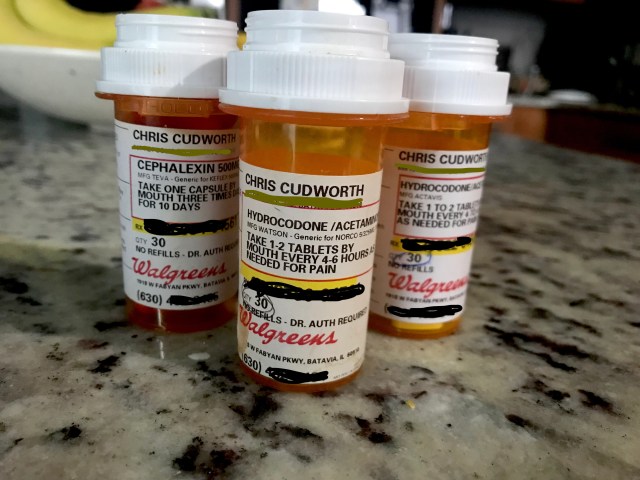
IMG_8545A set of familiar orange bottles with Walgreens labels on them have rattled around my bathroom cabinets for several years now. The Hydrocodone / Acetaminophen bottle from October 25, 2013 was filled with painkillers prescribed after surgery on my clavicle after the bike wobble accident in September 2013.
The Cephalexin antibiotic 500 mg capsules might have been from treatment of a finger infection caused by a sliver in the middle digit of my left hand. But I might also have taken that medicine for a bout of cellulitis caused by a cat bite. That led to loss of my good gut bacteria and even more antibiotics to kill off the c-diff that vexed my innards for months on end.

Another bottle of Hydrocodone was prescribed after my meniscus surgery this past April, 2018. I never took any of those pills because I wasn’t in much pain and actually got up the day after surgery and walked two miles to begin rehab.

These were the drugs from days gone by. Painkillers. Antibiotics.

But now, into the medical disposal unit at our City Hall they went. It’s important to dispose of these substances correctly. We don’t want them showing up in our water supply or falling into the hands of those who might abuse the opioids.

In case you had not heard, there is a genuine opioid crisis going on. 

Duel in the Sun

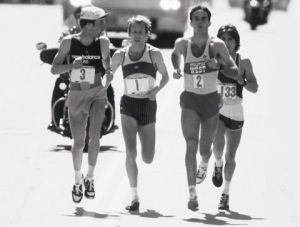
duel-hot-streak-1529606748If you’ve never read the book Duel in the Sun about the lives of marathoners Alberto Salazar and Dick Beardsley, at least half of the book deals with the addiction Beardsley developed while taking painkillers to deal with the effects of a brutal farm accident. The runner’s life got turned inside out due to his addiction to those narcotics. He essentially constructed an entirely parallel life, forging prescriptions with pharmacies across an an entire region of Minnesota in order to gain access to more opioids. His dependence on those drugs had turned into a full-blown addiction.

These are powerful substances. I’ve also been prescribed Vicodin during my ACL repair surgery and recovery. But I didn’t take all of them either. I wound up putting those in a drug disposal bin at some pharmacy as well.

Drugs are great things when used at their appointed times, and for appointed purposes. I appreciate the pain-killing effects of Ibuprofen, for example. There are no noticeable side effects if taken judiciously. The same even goes for the Citalopram I take as a management tool for anxiety and depression in maintaining good mental health.

The personality of drugs

During high-stress periods as a caregiver for both my late wife and father (one with ovarian cancer and the other a stroke victim) I was prescribed a drug called Lorazepam to help me cope with anxiety. Rather than a maintenance or stabilizing drug, Lorazepam’s purpose was immediate relief from stress. It really helped me sleep and deal with the pressures of medical and personal supervision.

But a doctor’s experiment with placing me on Zoloft, did not work out so well. It produced in me a state of very high agitation and feelings of loss of control. That treatment ended in just four days.

Eventually the need for Lorazepam receded. I’d been refilling the bottles with a pharmacy for several months. Then during a doctor’s visit he asked, “You’re still taking this?”

Turns out Lorazepam isn’t really a drug recommended for long-term use. So I started physically cutting down the pill sizes by lopping them in half, then into quarters. Over two-week period the pill size got down to a fleck of the drug, and then none at all. And I was fine.

But I know other people who took Lorazepam that could not kick the habit. It’s a simple fact that drugs affect people differently. My Zoloft experienced proved that to me. And that’s what makes drug prescription on the front end and possible addiction on the back end so difficult to treat.

It can be difficult to separate the physical effects of the drugs from the complex variety of components at work in each individual. drugs both reflect and adapt to the personality of an individual. That’s not a clinical assessment by any means. I’m no psychiatrist and will never pretend to be. It’s just common sense when you introduce a substance designed to impact levels of neurological substances that occur naturally in your brain and body are going to react differently for some people than for others.

Evolution within

Bottomlands.jpgTo draw an allegory of sorts: Drugs become their own environment at some point. And like all aspects of evolution, the interaction between the drug and the user creates a form of natural selection from within. That’s why some treatments involve attempts to effectively replace, contain or erase chemicals that work on the internal environments of the brain and body.

Depending on which direction this ‘evolution’ takes, it can have dramatic effects on the internal ecosystem of an individual. In the process, it can also produce a “survival of the fittest” scenario in which the personality of that individual either survives, is changed, or is replaced almost entirely by the influence of the drugs involved. As you can imagine, that is a “for better or worse” scenario depending on the degree of impact a specific drug (or drugs) has on that individual.

For some it’s a lapping at the feet. For others, it’s a tsunami.

Running out of mind space

I witnessed a top runner on our college team succumb to the effects of pot. That’s “not supposed to happen” according to some advocates for the drug. I personally believe it should be legalized, but I also recognize its potential impacts on some individuals.

The pot use by one of our teammates just seemed to remove any motivation to succeed. Pot seemed to occupy the entire personality of this individual, and that was that. It all took place followed a freshman year cross country season in which that runner nearly became an All-American, a relatively rare achievement. But after that, the pot took over his mind space.

Another teammate ultimately did lose his life to alcoholism. The early symptoms of hard consumption were already there in college. We found it funny and joked about it at the time. But actually, it really wasn’t funny at all.

Enduring qualities

Drugs really can take over the time and space of your life. Those who go into treatment learn how strong the discipline must be to break the cycles of dependency. That’s why endurance sports can be an effective road to recovery. Replacing the quick-fix reactions provided by drugs with a slow-fix treatment through exercise may not be the cure-all, but it holds potential to bring balance back to the internal ecosystem and gain a foothold again in the evolution of personality.

The same holds true for treatment of mental health challenges. It’s all about evolving a way to cope with the drives and desires can vex us if we don’t understand the triggers well enough to put them back in place. My own episodes with alcohol abuse were mostly that: drinking too much and too fast. It all had to do with insecurity and anxiety at times. But it nearly killed me once, and I’m lucky alcohol poisoning didn’t take me down that night of a cross country party in which I drank to such excess my liver hurt the next day and I could not move for hours.

Parents who worry about kids going off to college and falling into drinking have legitimate concerns. Between peer pressure and the odd circumstance where a person gets rolling and doesn’t know when to stop, those are high-risk moments in our lives. At all stages of our existence it pays to think about the interior landscape of our minds as an environment unto itself. We must tend our respective gardens, as Voltaire once stated in the book Candidate. Otherwise we may not survive and thrive.

Drugs from days gone by remind us that it is possible and important to weed and be mindful of what grows within us, and why.  Then we can get on with the opportunity to fill our lives with the type of purpose we choose.


Posted in Uncategorized | Leave a comment

Wanted: dead or alive

dead or alive.jpgOver a lifetime of athletics, I’ve been fairly fortunate to only break and tear a few things. But they’re starting to add up these days, and it’s got me thinking about how it all started, and where it’s going.

The main thing that contributed to injuries early in my life was a deep obsession with winning. I competed so hard on the playground at games like kickball there were repeated bumps on the head from smashing face first into the swingset in center field that served as the “wall” for home runs. Anything that was kicked over the top of the swingset like a field goal counted as a home run.

Unless, of course, someone could charge out there and catch the ball on the other side. I’d had enough success stealing home runs from other players by running beyond the swingset to steal their glory that I judged it worth the occasional goose egg on the forehead caused by smashing into the bare metal poles sunk into the asphalt.

Competitive abandon

The same competitive abandon spread into all the sports I played, including backyard tackle football games. The older brother of a best friend once shoved me out of bounds so hard I tumbled into a roughly constructed cement ditch and struck the side of my head. That gave me a massive head wound and a concussion so bad I was seeing double on the way back home. I’m not sure if they conducted a lobotomy but the stitches were many.  So perhaps I’m lucky that I didn’t die from that incident or many other near-fatal encounters involving my head and other body parts.

Line drives and other hazards

At some point, the universe must have decided, “Well, we can’t seem to kill this kid. Let’s just keeping steal body parts to remind him of his mortality.”

Which is why a baseball eventually struck me clean in the mouth, knocking out a front tooth to the point that it was literally hanging by a tenuous bloody thread. The coaches that day reached my father by phone, and he rushed down to the field to drive his bloodied kid to the dentist, who laughed a bit and then stuck a post in my upper gums. Then he shoved the tooth back into place and said, “There. Fixed.”

And it stuck. But with time the tooth slowly died and turned gray. It wasn’t horrid-looking, but it wasn’t the kind of look that made girls swoon either. It ultimately survived a bout with braces to straighten the rest of my toofers. But eventually, I hired another dentist who tore out the old dead tooth and put a newer-looking fake tooth in my head. Such are the compromises we make to keep up appearances in this world. We want to look good whether our body parts are dead or alive. Or neither.

The ACL

Which brings me to another big injury that took place later in life. I tore my ACL playing indoor soccer. I waited six months and then had ACL replacement surgery. The choice I had to make was whether to take a bit of my own patellar tendon (below the kneecap) or stick a cadaver part in there. “The first works best but takes longer to heal,” the doctor told me. So I made the dumb decision to go with the cadaver part. I called it Jake in honor of whoever the “donor” was in life.

Well, Jake died all over again when I re-tore the ACL two years later. What fun.

But again, was Jake ever really alive again? Was that cadaver ACL expected to revascularize? All I knew was that I lost Jake to another tear, but was it dead or alive?

Meniscus fracas

Years later I stupidly jumped over a traffic cone during a running race held on snowy roads in Wisconsin. That stunt hyperextended my knee and caused a meniscus tear that didn’t really cause much problem, until it did.

So the doctors again operated on my left knee with their arthroscopic toys and clipped off the “excess” meniscus that was now uselessly dangling and sticking outside the joint. And that hurt. So they warned: “That tissue will die if we don’t get rid of it.” At least that’s what I thought I heard the doctor say. In any case, that meant another chunk of my body was gone. I’m starting to shrink from the inside out it seems.

Root of the problem

And joy of joys… this week it was back into the dentist’s chair for a root canal. The endodontist numbed me up good and then used a needle-like drill to bore out the root canal material. It felt weird. It also meant that I’d be living with yet another dead body part.

At this rate, I’ll be dead before I ever get around to dying. And I’m not even really old yet. The years to come will surely provide a ton of surprises, what with a family history that’s not exactly encouraging on a few fronts.

In the meantime, I’m one of the healthiest members of the walking dead you’ll ever see. And Halloween’s just around the corner. I’ll see you around.


Posted in Uncategorized | Tagged , , | 2 Comments