Carry on

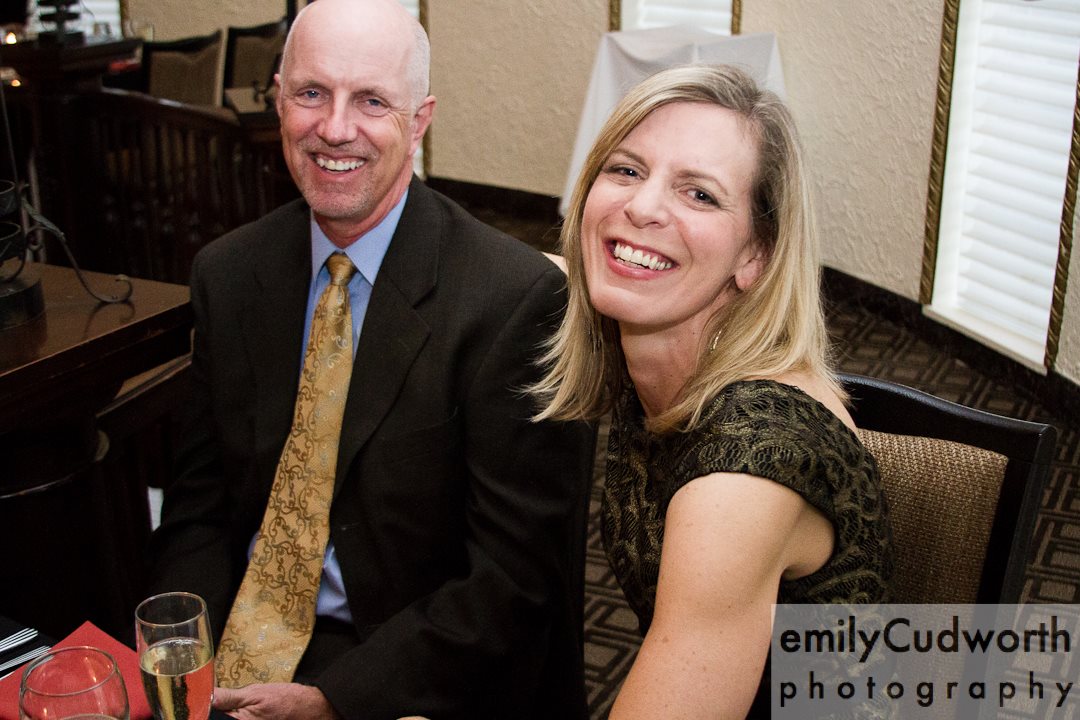
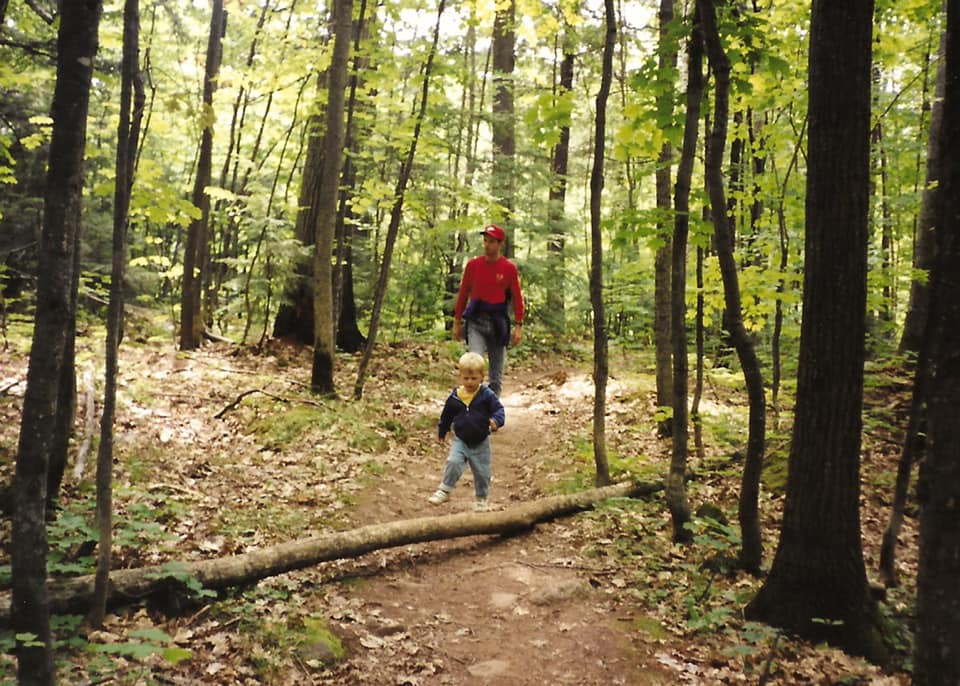
My father Stewart and mother Emily with my daughter Emily, circa 1993.

After several years straight of focusing all efforts on maintaining my late wife’s health through cancer treatments, and stumbling through financially, I had some catching up to do on my own health in 2013.

The previous year ended with a tumble and a shudder. In September of 2012 I crashed my bike and broke my collarbone in a Southwest Wisconsin cycling trip. That same weekend, my wife experienced a series of seizures that should have sent her to the hospital, but she refused. I came home to a surgery but was back on my bike in about four weeks’ time. Her seizures continued, and got worse. That wasn’t a good sign, so I needed that exercise to keep sane as things progressed. Blessedly, at that time the church we attended stepped in with money to help us pay our bills when I was out of work taking care of things.

Then all the “end of life events” came about. I’ve already related those. All that I knew was that I had to carry on.

By late spring and early summer of 2013 I was working as a senior copywriter bringing in money and working through past and current medical debts using some of the money from her Teacher’s Retirement Fund. It felt good to have a chunk of money in the bank, but cremation costs and paying off hospital and hospice bills ate into that quickly.

Then there were the dental costs I incurred. I finally had insurance but didn’t check carefully enough what it would cover (the dreaded ‘out of network!) when it came time for a pair of long-overdue root canals and crowns. Before I knew it, $6000 flew out the door.

I’ve never been good with money. Truth is I don’t care enough about money to always worry over bills and expenses. Yet that same habit causes the problems I most want to avoid. Add in the ADHD and forgotten costs at times, and things tend to swirl around in my head. I’m not an impulsive buyer. That’s never been the problem. More often it’s the day-to-day “spend” that adds up.

Then when big expenditures roll in the burden tumbles over me like a landslide. Anxiety piles on after that. Rumination doesn’t help. Throw in some work problems or doubts about the past and even a break from total stress like I felt after my wife’s passing tends to collapse upon itself.

Still, it felt good to have my teeth cleaned and cavities routed out. The dentist sold me an electric toothbrush but I hated the feel of it. Tickled more than helped. But after a months of treatments and dental visits, I at least felt like my mouth was back together. It’s astounding how dental health affects the whole you.
Taking care of yourself as a caregiver is a challenge at which many seem to fail. The pressing needs of a person at risk of dying from a disease or recovering from some life event take over the psyche. For weeks after my wife’s passing the synapse of ‘what do I need to do for her’ flickered through my head. I also kept thinking about my son and daughter. Was I doing enough for them? Was there anything I could do for them? How does one fill the void with the loss of their mother? I alternately dreaded making mistakes with determination that my examples of strength might somehow sustain and encourage them to carry on. That felt inadequate on many occasions. I forgot the good advice that a counselor at Living Well Cancer Resource Center once posed in a question, “You seem to be good at forgiving others. How are you at forgiving yourself?”

Here’s the thing: I was no longer done as a caregiver after my late wife’s passing. I was still responsible for my stroke-ridden father whose almost daily calls reminded me that there was still a washboard road of caregiving ahead. I’d be at work concentrating on writing SEO copy for a website when the phone would flicker with a notification. “Voicemail.Stewart,” it would read. Then I’d find space over lunch to call him back.

From there it was a ‘game’ of questions and answers with dad to figure out what he needed or wanted. Sometimes it was crucial, and I’d have to call a physician. Other times it was social or about some memory he’d recalled and wanted to corroborate. But half the time I didn’t know the people he was talking about. Then he’d get mad and yell into the phone or in person, “NO NO NO NO!”

That brought up angsty old memories of our disagreements when I was young. He was a sometimes exasperating father figure, prone to criticisms and at the early stages of my life, physical abuse. So I often prayed that I’d get the answer to his questions quickly so that we didn’t drift into a danger zone. A feeling of disappointment followed me around if that happened. I was trying my best to be an attentive caregiver, but often it wasn’t good enough. Now and then, I just left if he was being obstinate. Nothing good ever came of bullheaded disagreements.

Caregivers
I’d often get calls from his caregivers as well. At first it was Olga, the woman that had taken over after my mother’s passing. Then she swapped that role out with her “husband” Leo, with whom she had a child Jessica, who I invited to live at Stew’s house after I found out that Olga had a five-year-old daughter when she first started caregiving.

So it was a strange little family situation I’d created, but Stew loved the company. It was working for him.

He’d processed my mother’s passing back in 2005 with serious consideration. But not long after her passing, he actively cleaned out the closets and had me donate the clothes to area charities. The message to me was simple: Carry on. Stew also kept up friendships with their breakfast buddies on Saturday mornings. Those faithful people never gave up on Stew even when he could no longer conduct a conversation due to apraxia and aphasia. They found ways to converse.

We purchased a converted Mac computer with a “talking” word function display so that Stew could communicate, but I didn’t use it with him that much. I was better at asking questions and getting to the core of the matter than the computer, which only related standard symbols for RIDE, FOOD, etc.

The caregiving I offered had evolved. Following mother’s passing back in 2005, I walked out of my dad’s house after a visit with him and stopped on the sidewalk. “This is all up to me,” I said out loud. I suddenly grasped that I was responsible for the decisions about his care and well-being. Yes, I had brothers to call on for perspective and advice, but I was the principal caregiver. I managed his medical needs, finances and social interactions. It changed me and how I looked at the emotional and practical aspects of life. You have to do what you have to do, and deal with anything that comes along. Don’t be dramatic about it. Carry on.

New acquaintance
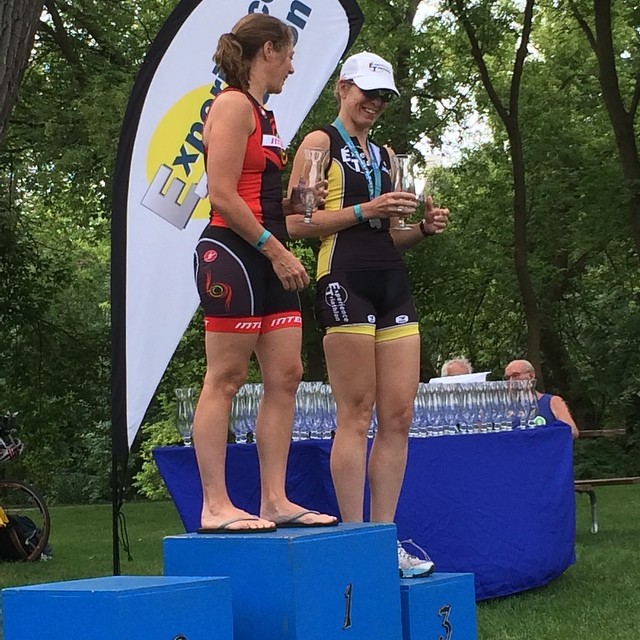
Into this world came my new acquaintance Sue, and our evening meals together after she coached swimming became a little ritual. I made salmon on the grill and whipped up salads, but learned she did not like fruit such as strawberries mixed in. In any case, I relished her presence as she loved lively talk, was smart as heck, and didn’t engage in drama. I didn’t need any of that, after all.

A few weeks into our relationship I was driving to work in my new Subaru when a feeling I can only describe as “jangly” appeared in my chest as I thought about our visit together the previous evening. Those were the first stirrings of love toward her. It felt like a “crush” from way back when.

Except it was more mature in its source. We’d attended a friend’s wedding together by then, got dressed in nice clothes and went out for a night of dancing. I liked how she moved. That made me think of a Neil Young song that I listened to when I was thirteen years old:

When you dance
Do your senses tingle?
Then take a chance?
In a trance
While the lonely mingle
With circumstance?

I’ve got something to tell you
You made it show
Let me come over
I know you know
When you dance
I can really love

At that point in life I had another moment of clarity. It was again up to me to make things happen.

I’d loved the previous twenty-seven years with my late wife but she was now gone. Suddenly, I was both obligated and free to make decisions on my own. Some of those decisions would be difficult thanks to the perception of others who didn’t know where I was coming from. Still, I caused some people pain, I’m sure. But through all those tough experiences I’d come to know myself quite well. I knew better than ever how and when to cry, also how and why to laugh. I’d learned how to face adversity in practical ways and also to let some things go into the universe and see what comes back. Call it hope or prayer, whatever you like. I’ve done it.

Perhaps all that endurance training had a purpose after all. Maybe it was indicative of some inner virtue as much as it was a habit or a need. What I really came to understand is that in the long run it’s better to have good company if you can find it. So that’s what I decided to do. And carry on.

One morning I woke up and I knew
You were really gone
A new day, a new way
And new eyes to see the dawn
Go your way, I’ll go mine
And carry on

[Verse 2]
The sky is clearing and the night
Has gone out
The sun, he come, the world
Is all full of love
Rejoice, rejoice, we have no choice
But to carry on

(lyrics to Carry On by Crosby, Stills, Nash and Young

Posted in anxiety, Christopher Cudworth, death, foregiveness, God, healthy aging, love, running, sex, triathlete, triathlon, triathlons | Tagged , , , , , , , , , , , , , , , , | Leave a comment

Beyond the Avatar

Sue competing in the Racine Half-Ironman

Perusing the profiles on the FitnessSingles dating app in the early summer of 2013, I observed that there were plenty of active women out there in the world, but not so many close to home in Batavia, Illinois. I signed up anyway, but was busy going to work and didn’t get to check it until later that afternoon.

As I’ve told the story many times to people over the last ten years, “There were women all over the country, and one in Batavia where I lived.” She was blonde and wearing a cute pair of white shorts, standing in a lake next to a beach. At first I thought she might be an Avatar, just a fake enticement to keep me using the app. But when I clicked on her profile it all popped up. “Hmmm,” I thought to myself on looking at her facts and figures. “Suzanne Astra. A triathlete.”

Then I muttered to myself, “Nice butt, honey” and clicked on the profile.

We chatted a bit through the app, then set up a date at a local pizza place called Pal Joeys. I showed up before she got there and was waiting in the front lobby when she walked down the stairs in a sleek black and white summer dress, gave me a big smile and a quick shake of her head that made the curls in her hair shimmer, and said “Hi!”

It was a humid and warm afternoon at an outside table next to the Fox River. We ordered artichoke dip with some chips and drinks. Our conversation was easy right from the start. She had a nice tan going in early summer and definitely looked fit.

Then I noticed that I knew the woman sitting at the next table over with her husband. Our eyes met and she smiled, so I said “Hi Rita!” At that point Sue turned around to see who I was talking to.

“Wait,” Rita said, quickly pointing a finger at each of us. “Are you two on a date? That’s perfect!”

Sue’s children had been involved in middle school music as well, so Rita knew all of our kids. She’d also known my late wife quite well. Knew of our long history with cancer survivorship, and Rita knew that I was an active runner and cyclist. We chatted with her for a few minutes and then turned back to our own conversation.

I learned that Sue was only recently out of work and looking for a new job. “The one thing I like about is having time for afternoon naps after training. I absolutely love a good nap,” she laughed.

A date on the move

Sue on the Specialized tri-bike she bought after the Scott

Nothing about the date seemed strained or awkward. I really liked her from the start. We agreed to meet up for a bike ride later in the week. Sue showed up in some leggy bike shorts and a cool white top. I’d not been riding that much by that point in the spring but was starting to round into shape. I sat on my Felt 4C road bike and Sue leaned into her Scott aero tri-bike and we took off riding west of town.

Heading out Main Street from Batavia, I looked down at my bike computer and watched it creep up the digital dial. 19…20…21…22…23…we were humming along at race pace for me. I did my best to stay in her draft while guiltily staring at her nice-looking butt in black cycling shorts just a couple feet from my face. Then the pace hit 26 mph and I was at my limit. “You better not get dropped,” I told myself, “or you won’t get a second date.”

We turned onto a long stretch of road rising through the farm fields and she kept up the pace. On the last uphill section of 400 meters I got gapped a bit. She was ahead of me now and I desperately pumped the pedals trying to keep up, but couldn’t. I’d been dropped. Once we hit the flat section atop the hill I recovered some distance and rode up next to her hoping she hadn’t noticed. She smiled at me. “How ya doin?”

What a loaded question, I thought to myself. Should I be honest?

Sue and I during one of our first “official” dates at a wedding for a friend. My daughter Emily was the even photographer.

“Great,” I said. Which wasn’t entirely untrue. I was thrilled to be riding with a woman better than I was on the bike. When I started serious riding six years before in 2007, I was always impressed with the women cyclists from the Athletes By Design racing team with whom I trained. They were talented and strong, and I’ve always liked that in women.

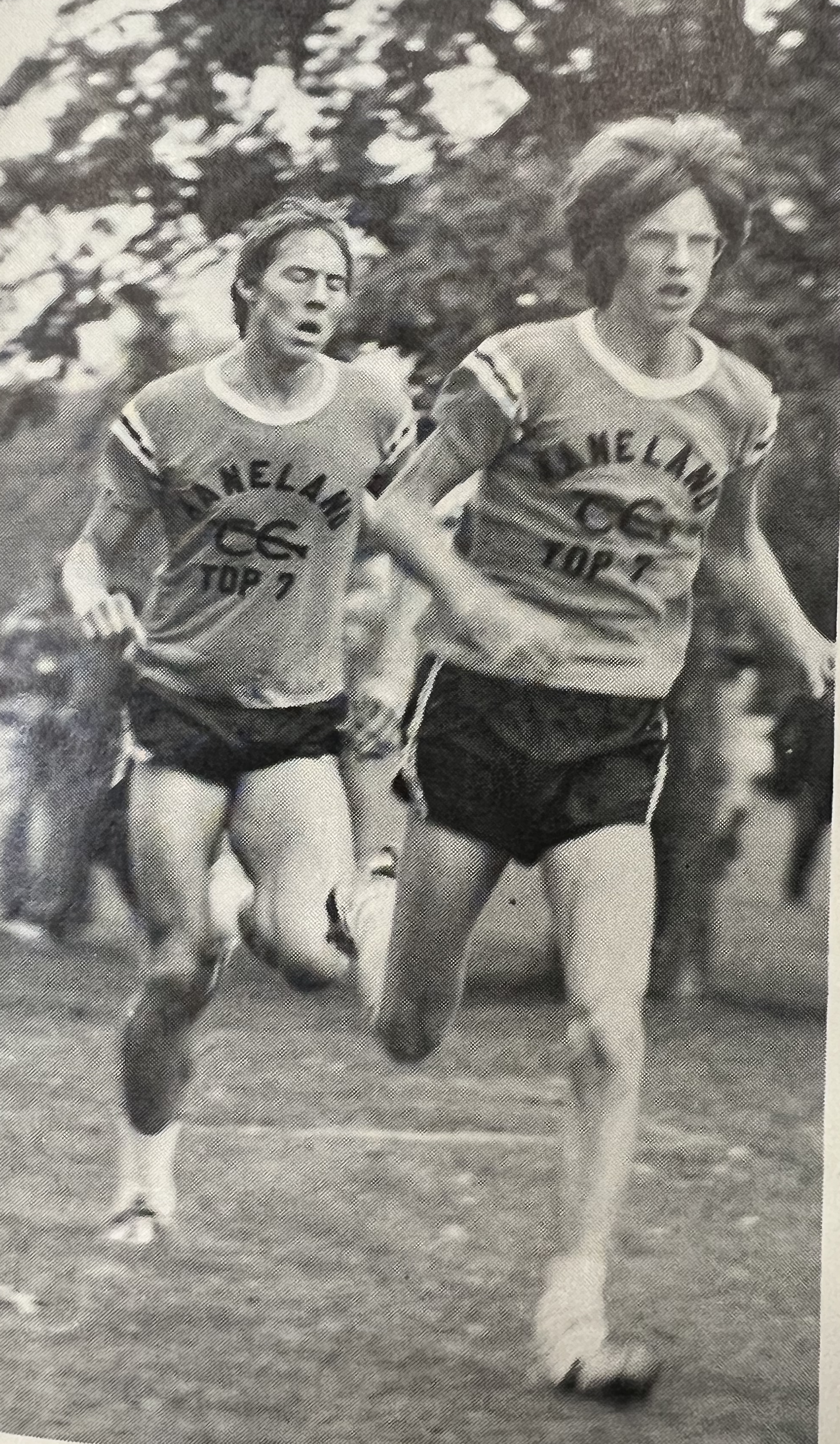
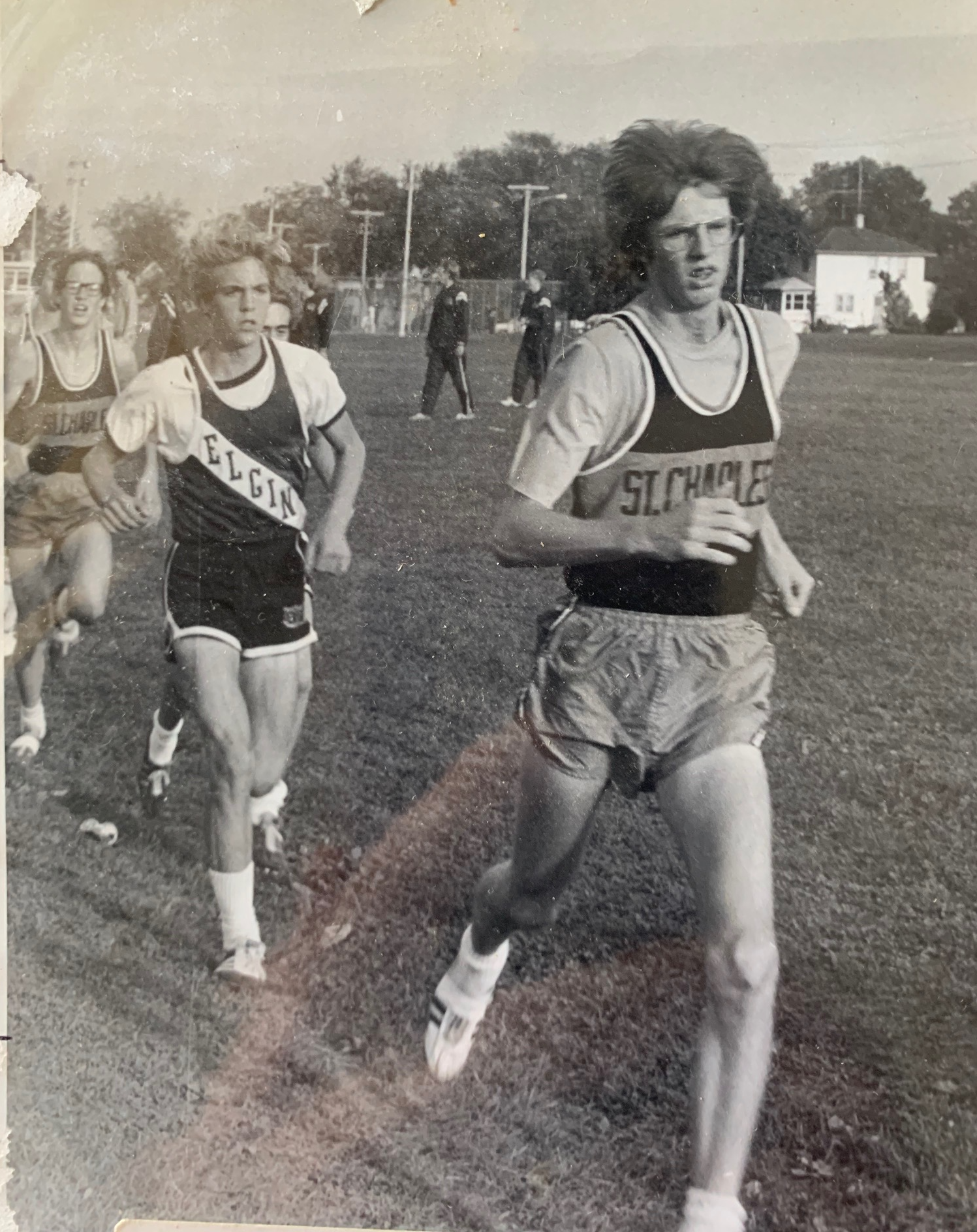
Sue and I rolled out from the stop sign heading west past Johnson’s Mound Forest Preserve. I was glad we didn’t turn in and ride that loop with its nine-degree climb. I’d first trained as a runner on that hill way back in my Kaneland High School Days. As a skinny freshman that hill came as a total shock to my legs. But later in my career I used that hill in post-collegiate training and knew that I was in racing shape when I could run from the gate at the woods opening to the top of the hill in 3:00 or under.

We rode past the preserve and sped up down the long and winding stretch of Hughes Road to the next climb. On that one, my legs were enervated and I kept up fine. We reached Route 47, shot up to Keslinger and rode out to Kaneland High School where Sue pulled over and we took a break for nutrition while sitting on the grass.

“Have you ever been out here before?” she asked.

I laughed, turned around to look at the entrance to the high school and said, “Yes, I went to school here for two years.” Then I pointed to the line of trees out front of the campus and said, “I’ve run around this campus probably a thousand times.”

Sammies and convo

She broke out a set of meat and cheese sandwich bites and Sue delivered a cycling sermon on how real food beats fake nutrition. Those little sammies tasted good. She wrapped the rest in a little baggie and we headed back home. I was comfortable and warmed up by then. She seemed pleased to find a man that could keep her company on the road.

Here’s the thing: Online dating is both exciting and weird. It’s exciting (to me, anyway) to meet new people. But there is the inevitable weirdness of meeting people with whom you’re not compatible. But after meeting Sue and riding that twenty-five miles with her, I knew that we could get along great.

We’d definitely moved beyond the Avatar stage. She was a living, breathing woman who shared with me a ton of interests. Trained as an architect, she understood art as well. We liked the same music despite an age gap of eight years (she’s younger) and now she knew that I wasn’t lying about my athletic ability and love of fitness. “Well, that was nice,” I told her after the ride. “When do you want to go out again?”

Here’s the funny thing. It turned out she only lived six blocks away. Later that week I’d join her for dinner at drinks and meet her kids at her place. A relationship had begun.

Posted in competition, cycling, cycling the midwest, friendship, healthy aging, healthy senior, love | Tagged , , , , , , , , , , , , , , | Leave a comment

Dating as a widower

The term “widower” seems so loaded with tradition and history, it deserves a definition right here and now. I looked it up and this is what it says:

  1. a man who has lost his spouse by death and has not remarried.
  2. HUMOROUSa man whose spouse is often away participating in a specified sport or activity.”her new-found passion has turned me into a tennis widower”

If anything I was a garden widower before my late wife Linda passed away. But that was never true. My job was doing the digging into the ground for her on many occasions. I liked being part of that. The earth behind our Batavia home was deep and rich soil. Back in the late 50s when homes were placed the builders didn’t scrape off the topsoil. I dug postholes in that yard and that required poking through two solid feet of black prairie soil before hitting clay.

That’s where the water table ran. It was a constant battle at that home keeping the basement dry whenever the rains came. One night we wound up running around half naked in the backyard trying to empty the window wells. I didn’t mind. I always liked the look and feel of summer rain on skin.

There’s an amazing scene in the movie Midnight In Paris when the character played by Owen Wilson meets a French woman on the streets of Paris when it’s starting to rain. By that point in the movie, Wilson (who plays a writer) has decided to disembark from his marriage to a materially acquisitive wife who does not understand his obsession with the romance of Paris, both old and new. His high-paying writing work back in LA is not rewarding (he’s a screenwriter) but his experience in the netherworld of time travel convinces him to follow his instincts and write a novel.

He travels back in time through a midnight portal and eventually falls in love with a woman whose notions of the “Golden Age” are similar, yet they have different views of what constitutes the best time in history. For him, it is the period in which she is living. For her, it is decades before. She loves him in a romantic way, but eventually they go their separate ways. Back in the present, he finds a journal she wrote about him in a Paris book shop. It makes him realize that even beyond the bounds of time, love is real.

And finally, as if in a living dream, he encounters a woman he met in Paris while digging into jazz records at a local shop. She recalls his interest. That makes him realize that he’s actually “someone to somebody” in a new and different way. It also points out the possibility that we’re all capable of loving more than one person in our lives. There are indeed different kinds of love

I’ll admit that I’m a born romantic. There were times when I’d fawn over my late wife in some way that just made her wrinkle up her face. Sometimes I’d even fall in love with her all over again. That’s the way I’m wired. I feel things like love quite intensely. The first serious relationship I had was the product of “love at first sight” with a woman I met during my senior year in college. Our relationship was rife with conflicted motives, and after two years we broke up. But it made a deep impression on me, a living expression of Jackson Browne’s song That Girl Could Sing:

She was a friend to me when I needed one
Wasn’t for her, I don’t know what I’d done
She gave me back something that was missing in me
She coulda turned out to be almost anyone
Almost anyone
With the possible exception
Of who I wanted her to be

Given my deep susceptibility to romantic tomes, I used to lay on the couch late on a Saturday morning after morning bike rides of 60-80 miles watching some tear-jerking movie like Dances With Wolves, which I also loved for the western scenery. My daughter used to laugh upon catching me with tears in my eyes, but I liked the feeling of feeling something deeply. It relieved the stress of life to cry hard once in a while. I like crying hard just like I like running hard, cycling hard and these days, swimming hard. Life is hard. I like being hard back.

Hard choices

It was still a hard choice as to whether or when I should start dating after my late wife’s passing. But knowing that I loved company in life, I decided that going on some dates with women would be okay. I certainly saw no sense in moping around the house. The previous three to four years had provided plenty of that including many afternoon vigils in a silent house with a spouse sick or tired in bed. The stress of that adds up after a while. For many years we had to be cautious with physical attention as well. She could not afford picking up any kind of infection when her body was immunocompromised, as it could kill her. We knew that she was susceptible to internal infections from the time I met her.

As I considered dating at the age of fifty-five, I made decisions about the process that were sensible and real. For one thing, I placed a limit on how young to go with women that I’d date. I decided not to date any woman under the age of forty-five (as far as I could tell).

But here’s the thing. A few buddies egged me on to “go get laid a lot,” but I didn’t think I had the constitution for that. That is not a claim to pure intentions or an attempt to win favor in the eyes of readers. I frankly didn’t feel like I could handle sleeping with a bunch of different women.

Dating an Old Flame

But first, I did approach an “old flame” of mine from high school days. We went on a picnic date but she was a bit weirded out by the idea that I was ready to date so soon after my wife’s passing. She’d been divorced a number of years from a real jerk who cheated on her. For fifteen years, she’d been busy with her own life as a teacher, and had faced some personal tragedy as well. We enjoyed our picnic but I sensed her discomfort. A few months out, she did thank me for showing her that a man could be interested in her. She hadn’t thought of herself that way. These days, she’s in a relationship with a man that “gets her.” All power to her. If I helped in some way I thank God for that.

Once I opened the door to dating, I tried the dating app eHarmony. It was interesting trying to “read between the lines” on that app. Many women stated that they wanted to travel. I took that as a dog-whistle sign that they wanted to meet a man with money. Maybe that was just my take, but that’s how I read it. I steered clear. I wanted to meet a woman that wanted to do things together that might not always revolve around money.

So many fish in the sea

Remember when we were kids, and a relationship broke off and hurt? Our parents would often say, “Well, there’s a lot of fish in the sea…” which was another way of saying, “Get over it.” Well, it’s a bit different when you’ve been married for twenty-five years and figuring out what you want to do with the rest of your life. Perhaps part of that process is trying things, and going fishing.

A woman from a nearby city reached out to me through eHarmony and we met at a restaurant for drinks. I quickly met her daughters when picking her up, and they seemed really sweet. Originally, she’d asked me if I wanted to try going to a fly-fishing seminar. I thought that was really interesting. She was also apparently a competitive tennis player, a fact I noticed in photos showing her fine-looking legs. Cause hey, there’s nothing’s wrong with having good legs.

After our second date, we’d had a really nice conversation and were walking back to her cart through the city where she lived when it started to rain. She carried an umbrella and popped it open as the spring rain started to fall. After crossing the street, I bent under the umbrella, said “thanks for a nice date…” and gave her a kiss on the lips. The light reflecting off the wet streets made her eyes shine, and while walking away, I glanced back and gave her a wave. “Well,” I thought to myself in the moment. “I guess I can do this.”

Is something fishy?

Now, dating so soon after my wife’s passing wasn’t met with favor by everyone in my life. Some immediate family wondered whether it was all too sudden. But I’d decided to move forward and took that woman to a friend’s backyard party where the host, a longtime friend of mine, was the lead singer in their band.

It was a fine day, and she looked pretty in her summer dress. We had light drinks and talked with my friends old and new. After that, we drove back to my house after the party. I was not expecting her to stop and stay, but she was careful to make that clear. Then she said, “I think it’s kind of weird that you still have best friends from high school.”

I looked at her carefully because I could not tell if she was joking or not. “Well,” I replied. “Those guys and I share a ton of history. We ran cross country and track together. I went to college with the lead singer in that band today. He and I lived together in Chicago. He was the best man in my wedding…” then I stopped talking. I paused: Was mentioning that going to be a sore subject with her?

“Well, it was a nice time,” she told me, heading back to her car.

A few days went by, so I reached out to see if our dating was through. “Well,” she told me. “I still have feelings for my Mr. Big…” That was a reference to the show Sex In the City. She lived in a town where there were plenty of men with money. As a divorced teacher, she had her eyes on the future…”He’s taking me sailing,” she told me.

Okay, I thought to myself. I can’t compete with that. But a week later, she called back. “Things didn’t go so well with Mr. Big,” she admitted. “Do you still want to date?”

“Um, no thank you,” I told her.

After that, I wasn’t sure how any of the dating scene would turn out. I had date with a woman a bit older than me that went much quicker. We’d scheduled a wine date at a restaurant in my town. When she arrived, it all got real: “Listen,” she told me. “I need a man who’s willing to move south to Arizona with me. I have a son down there that I really like, and I’m not so wild about my son up here in Illinois. He’s a male nurse, and so…I’m thinking of moving…”

She had called ahead to let me know she’d be late. I’d ordered her a glass of Pinot before she arrived. Following her opening pitch, I pushed the wine across the table while saying, “Thanks, but no thanks…I’ll pay for the drink…Nice to meet you.” Then I left the table, and her, far behind.

Was she Mrs. Big?

Perhaps I met a Mrs. Big during a date in Chicago’s south side in Hyde Park. She was a confident, attractive woman who made it clear from the start that she had plenty of dough and wanted a man in her life to share it. We went for a walk in the park. I noticed her checking me out from behind, and I kind of chuckled at the thought that perhaps I was a bit of Man Meat in her eyes. Apparently I passed the test, because from there the convo turned to how often I could make it downtown. Clearly she was feeling a bit lonely in her fine estate. After a dinner date with plenty of wine, we ended the evening with a kiss. I was a bit conflicted about the idea of being some woman’s Kept Man. We’d held hands during our walk in the park and that was nice, but it all felt a bit disparate to me. Still, she had a really pretty face and smile. I didn’t know where to leave that one…

All of this took place over the period of several months. Then one day an email arrived in my inbox from a website called FitnessSingles.com. The site description was clear: “Whatever an active lifestyle means to you, Fitness Singles is the world’s largest online dating community for sports and fitness enthusiasts. Whether you’re looking for a “fitness date,” exercise friends or a workout partner, Fitness Singles is a fun, private and secure environment to meet fit, athletic singles!”

There was a significant cost for signing up, and I balked at first. But the prospect of meeting an active woman really sounded intriguing. I didn’t know where that pursuit would lead, but I filled out the profile with all my running, cycling and birding activities, and hit “Join Now.” I didn’t know that my world would change within a few days.

And just for insight, here’s another scene from Midnight In Paris. The movie contains more than one plot twist and character insights.

Posted in Christopher Cudworth, competition, cycling, death, Depression, foregiveness, life and death, love, track and field, triathlete, triathlon, triathlons | Tagged , , , , , , , , , , , , , , , , , , , , , , , , | Leave a comment

Grief and choices

At times I’ve considered whether I’m “missing a chip” when it comes to grieving lost loved ones. Over the years I’ve met people, both men and women, that can’t recover after losing a spouse. Time magazine dealt with the subject a few years back. Some of the information and statistics prove daunting.

“Losing a spouse forces people into what is often one of the most vulnerable parts of their lives. The negative health consequences of widowhood can stretch years down the line, but in some cases, they don’t get a chance to. The phenomenon in which both halves of a couple die in short succession is so common that it even has a name: the widowhood effect.”

“How at risk is any given person? That depends on many contributing factors, from their religion to race and even their spouse’s cause of death. But the widowhood effect is generally believed to be a problem primarily affecting closely bonded elderly couples.”

“A study published Mar. 22 in the journal PLOS One finds that younger people—especially men—are even more at risk. Researchers in Denmark, the U.K., and Singapore studied data from almost one million Danish citizens ages 65 and older and found that the younger people were when they lost their spouse, the more susceptible they were to dying within a year. Overall, the researchers also found that in the year after losing a spouse, men were 70% more likely to die than similarly aged men who did not lose a spouse, while women were 27% more likely to die compared to women who did not become widowed.”

That’s a load of consideration to process. I’ve known many people who lost a spouse and think of one man in particular whose wife was killed in a random traffic accident. At the time, he was in his late 60s, and he never recovered. They were a leading couple in the Christian church we attended, and he’d been our insurance representative when my late wife and I were young. His promise to us at the time, because we weren’t wealthy, was that “God always provides.”

He and his wife were extremely close, and she was a charitable and loving force of nature in life. She was one of those people whose faith and love for others did not need to be explained. It was evident in everything she did. I was married to one of those too. That doesn’t mean they were perfect people. It simply means they really loved life. It is tragic when people like that are lost too soon. Whether by accident or disease, we mourn the absence of them in our lives.

Yet grief for them also forces us to make choices. For some, that means immersion in the grief process as it is so often defined. You may be familiar with them.

Denial: This can’t be happening.

Anger: Why did this happen? Who is to blame?

Bargaining: Make this not happen and I will…

Depression: I can’t bear this; I’m too sad to do anything.

Acceptance: I acknowledge that this has happened, and I cannot change it.

If death comes as a shock, then the first five stages of grief also arrive as a life-shuddering force. But if death comes as an eventuality, the people close to the person dying have an opportunity engage in what is called ‘pre-grief’ or ‘anticipatory grief.’ Here’s an apt description from the website Open to Hope:

Anticipatory grief: “This means experiencing the emotions associated with grief before the expected loss actually happens. Rather than grieving the loss of a person, anticipatory grief might be better understood as grieving the loss of experiences, possibilities or an imagined future together.”

In every case with which I was associated with death in my family; my mother (2005) my father-in-law (2012) my late wife (2013) and my father (2015) there were many events leading up to their passing hinting at their passing. For my mother, it was cancer and a stroke. For my late wife, it was eight years of cancer treatments and recurrence. For my father-in-law it was a heart attack and kidney issues. For my father, he was a stroke victim living with his condition from 2003 on.

A coach recalled

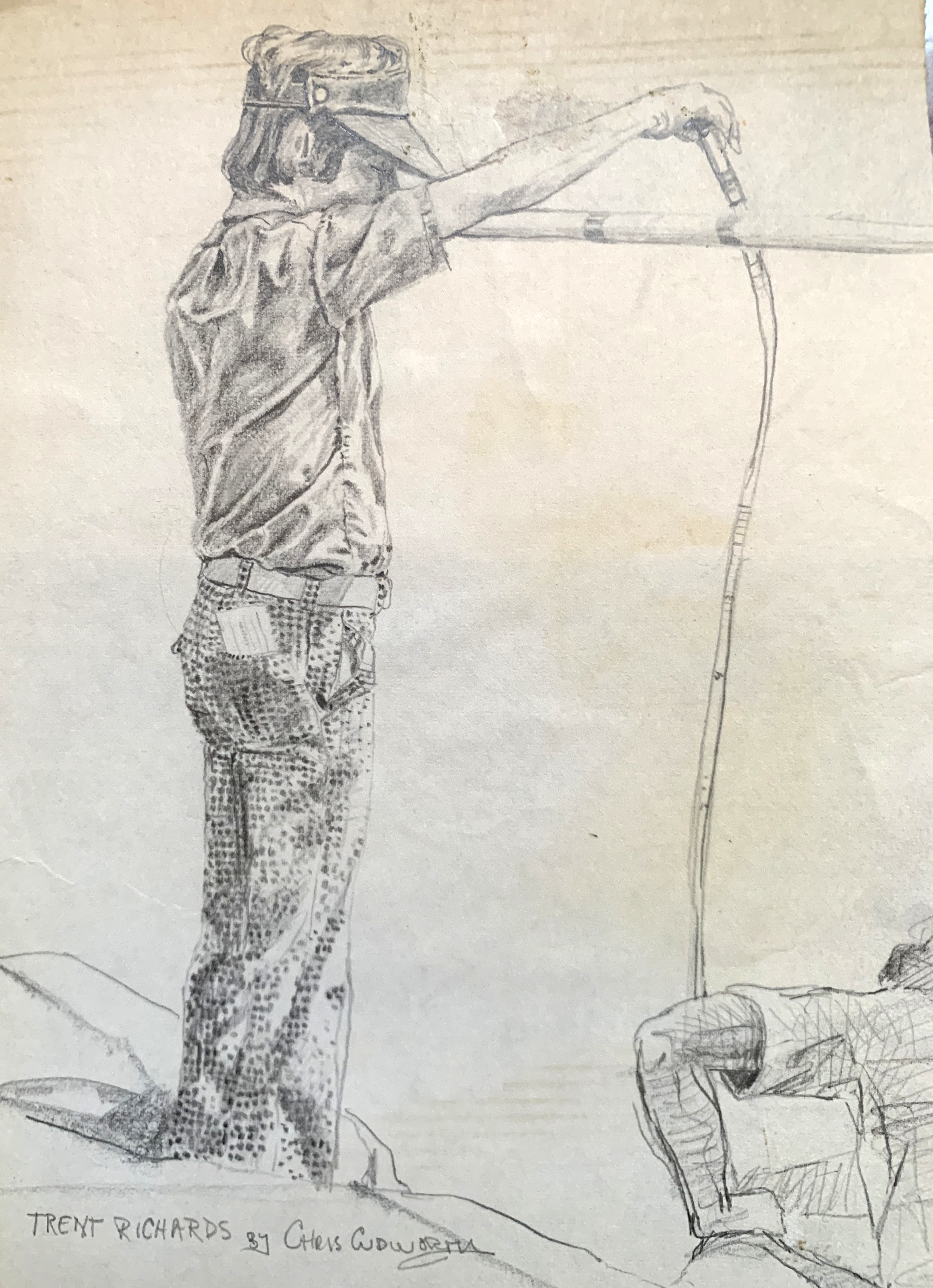
It wasn’t that I ever gave up on any of these people at any point. There’s at least one more person I’d add to this list of people that I considered “family” of a sort, and that’s my late coach Trent Richards. He was my baseball coach when I was thirteen, and coached me in track and cross country in my high school years. He smoked most of his life and ultimately lung cancer caught up with him. But he passed from this life to the next in the most graceful way imaginable. While cancer took its toll, he met up with former athletes and even took a trip to Cleveland to watch his beloved Cubs win a game on the way to their World Series win. When Cleveland fans learned of his devotion, they bought him food and drinks even though he was rooting against their team in his Cubs hat and jersey. That’s how life should be.
We all saw it coming for Trent. Before he died he commissioned a painting from me of a runner with wings. That meant a lot. It was his way of telling me that he valued our long friendship that went well beyond our coach-and-athlete days into doing business together and sharing life on many fronts. He was the person that called me after finding out about my late wife’s cancer diagnosis, telling me, “Your whole life has been a preparation for this.” And when it came to his own life, he felt prepared to deal with it. I admire that.

Anticipatory grief works both ways, you see. Some people in the process of dying go about it in that way. Some great minds have considered that reality. Way back in 1970 when George Harrison released his album All Things Must Pass, I sat with my head between two large speakers on our living room floor listening to his music. I was depressed after having moved away from friends back East in Pennsylvania, and Harrison was by then sprung from The Beatles. In some respects he was dealing with the grief, yet he also expressed a sense of relief, it seemed, at being released in some fashion. He wrote an incredible song called The Art of Dying. There’s the link. You should listen to it. Astounding. Here are the lyrics:

There’ll come a time when all of us must leave here
Then nothing sister Mary can do

Will keep me here with you
As nothing in this life that I’ve been trying
Could equal or surpass the art of dying
Do you believe me?

There’ll come a time when all your hopes are fading
When things that seemed so very plain
Become an awful pain
Searching for the truth among the lying
And answered when you’ve learned the art of dying

But you’re still with me
But if you want it
Then you must find it
But when you have it
There’ll be no need for it

There’ll come a time when most of us return here
Brought back by our desire to be
A perfect entity
Living through a million years of crying
Until you’ve realized the Art of Dying
Do you believe me?

I don’t know anything about the reincarnation hints at the end of that song. That’s something I’ll leave to the mysteries of existence. What I do know about the Art of Dying is that everyone of us will get our chance to consider what that means. For those of us looking on from whatever distance we encounter the act of death, there are many kinds of grief. In my book The Right Kind of Pride, I devote an entire chapter to the Goofball’s Guide to Grief. The thoughts we get in our heads are not always rational. Sometimes we even feel free and relieved to no longer be tied to the pain of someone dying. That’s a fair emotion too. I’ve known it myself.

Perhaps experiencing pain in athletics somehow helps us prepare for grief?

It doesn’t mean we’re unfeeling or callous somehow. Nor does it mean we’re “missing a chip” from some emotional foundation we’re all supposed to have. What it means is that some of us process grief in a quite immediate and present fashion while for others, it is a prolonged process requiring years or even a lifetime to mourn the loss of someone important to us.

A Star Is Dead

Perhaps you’ve even felt grief over the loss of someone you don’t personally know, yet somehow their story resonates with you. I know the death of John Lennon hit me hard. So did the death of Lin Brehmer, a Chicago DJ whose anniversary of passing one year ago was announced on WXRT today.

Once in a while a celebrity of one kind or another will die, and it will me like an emotional brick. Then there’s still the personal stuff. Now and then my late wife will appear in my dreams. She’s a presence in helping me process some current even or emotion, either good or bad. We were married more than 25 years. Why should she not still be a presence in my brain? I loved her. I know she loved me. But I also know that she told a friend before she died that she knew I’d love again after she passed. And that is so.

What it all comes down to is that throughout our lives, we are faced with various forms of grief and choices. It is not ours to judge others, or be judged, with how we face a sense of loss. I mourned my torn ACL years ago because I knew that it meant a form of my youthful activities in ballistic sports was gone along with it. I had it replaced with a cadaver part I called Jake. I did a year of rehab and went back to playing soccer and basketball, but Jake died all over when the ACL popped again.

I keep moving these days in a straight line, swimming, running and riding my way through life. The only time I cut and move is playing with my dogs, which is a joy. But I know that someday they’ll die too. Like the crystal goblet that the Zen Master carries around yet considers it shattered before it ever happens, we must look at life as broken before it occurs. And when we hold the crystal goblet of love for others up to the light, we hope it shines back into our eyes either in the moment or for as long as we hold that memory.

Posted in aging, Christopher Cudworth, competition, death, Depression, friendship, life and death, love | Tagged , , , , , , , , , , , , , , | Leave a comment

The unexplainable

My son Evan Cudworth and daughter Emily Cudworth.

In the wake of my wife’s passing, my children still had obligations to meet. My son was in a job out in New York. My daughter had a semester to finish at Augustana College. Yet all of time seems to stand still when you’ve lost someone that important in your life. A husband misses a wife. A son misses a mother. A daughter misses the mom, especially at the age when young women are forming ideas about a model for their life.

Yet as grief sets in, the human mind does some strange things. In my son’s case, the pain swirled inside him and the temptations of a New York life beckoned him. My daughter wasn’t all that happy at Augustana. She made friends, but as a junior college transfer, there were many social constructs into which you can’t just walk in and adapt, or adopt. Plus the college had broken promises about transfer credits. That was a raw deal, yet she made the best of it in many ways.

In my case, I took a few days off from a new job as a Senior Copywriter at a web marketing agency and went right back to work within a week. I’d been out of a job freelancing to make ends meet the previous year while taking care of Linda and was concerned that spending time away from the new position could impact how they viewed me at the company. I didn’t want to lose a job I’d just started a few weeks before.

Lives in the balance

A couple weeks out from Linda’s passing, one of my daughter’s friends came over to spend the night and keep her company. It might have been Spring Break or something, so they both had time off from school. Her friend was an astronomy major. She also came from a culture that favored feng shui. She was invited to sleep over in the front bedroom but something in that layout didn’t set well with her, so she moved out to the living room where our giant Wickes Furniture couch offered a comfortable place to sleep.

I loved that couch and its partner chair. They had an almost denim feel, soft, and offered just the right amount of support and cushioning. Most of all, that furniture was wide enough to relax without feeling like you were going to fall off. Plus, those couches lasted forever and ever. They had been a centerpiece of our existence in the Batavia house for more than a decade.

So my daughter’s friend brought a pillow out and went to sleep on the couch sometime late into the night.

Her feet faced the end of the couch toward the middle of the room. That’s where my late wife’s head had rested on the medical bed the last day of her life. That all took place rather fast. The EMTs had arrived that day to help move her out from our tall bed in the master bedroom into the medical bed in the living room where care could be properly administered. They had nothing to carry her from the back of the house to the medical bed (which surprised me) so the EMTs plopped her upright in an office chair and wheeled her through the hallway to the medical bed. Once she was comfortably situated, I came to her bedside. She looked up at me with that typical twinkle in her eye and chuckled, saying, “I thought I wasn’t supposed to suffer!”

We both laughed at that. Compared to the things she’d been through to that point, the chair ride was nothing difficult, yet it did help to laugh about it. A few days before when things weren’t going so well for her digestively, I helped her with some bathroom issues. That isn’t a comfortable situation for anyone at any age. She was crying from embarrassment mostly, so I looked up at her and said, “Remember our marriage vows,” I urged her. “One flesh. We’re one person right now.”

Even so, there were some changes in her body that were so difficult to manage that I called in help from the wife of one of my best friends. She is a nurse that had helped us through many situations, including Linda’s difficult days after the emotional collapse years she’d experienced after the recurrence of cancer followng a year of “Gold Standard” treatments didn’t keep that awful disease at bay. That same nurse friend drove me home from Dodgeville, Wisconsin the day after I’d crashed on my bike going 40mph on a hill due to bike wobble. She’s the kind of woman you want by your side in any emergency. Calm. Honest. Informed.

The funnel of existence

Watercolor of my young self running. Never knowing what life will bring down the line.

All of that difficulty felt like it poured through a funnel of existence to the moment that Linda died at around nine p.m. on the 27th of March, 2013. The fine caregiver that arrived a couple hours before had stared intently in Linda’s direction after entering the house. She was a small, wonderfully dark-skinned woman with fine features, sharp eyes and a calm personality to match. “I’ll set up in the kitchen,” she told me that night. After Linda’s passing, she pulled me aside and said, “Your wife was already gone when I got here,” she told me. “Her body was still going but she was gone.”

That brings us back to the experience my daughter’s friend had the evening she stayed over to keep us company. To fully understand this story, it is important to acknowledge the framework of this young woman’s mind. She is a scientist by education and training. She is also a no-nonsense type of person in many respects. One afternoon while watching TV with us, she proclaimed, “You need to get rid of that big fat TV.” We still had one of those monster TV sets with the big silver case and a plastic “ass” with vents that stuck out the back of the TV stand. While working at Best Buy to make money for college, she had learned quite a bit about flat screens and recommended we dump the huge old tube set. A few days later, that TV literally blew a circuit with a spark, after which a veil of smoke rolled out the back. “See?” she laughed when we told her. “I told you it was time to get a new TV.”

That’s what makes the events during the night she stayed over so compelling. Sometime during the night she woke up and felt a presence in the room. At her feet near the end of the couch, there appeared a set of three lights. She described them as Orbs. One Red, another Green, and a third one in the middle was White. That same night she noted that one of a set of three four-inch tiles hanging on the wall popped off its nail. The image on it was a dragonfly.

I may not have recalled all those details perfectly. The experience she’d had was unexplainable, so she wasn’t all that forthcoming. It freaked her out a bit. It freaked me out a bit. Yet in some ways it fit perfectly with the idea that my late wife’s spirit or presence had somehow manifested itself in our realm in a way that none of us could fully understand. Some things just are…unexplainable.

No hookum spookum

I’ve looked up “orbs” and there are plenty of references to them online. One writer named “Kimberly Dawn” (real or fake name?) on Linkedin, of all places, shared this perspective about them,

There is no scientific evidence to support the existence of angel orbs. However, many people believe in them and claim to have seen them with their own eyes. Some say that they’ve seen these orbs in photos or even in person. Whether or not you believe in angel orbs, it’s undeniable that they capture the imagination and provide comfort to those who believe in them.

As I’ve shared, this young woman was no “hookum spookum” person prone to making things up for dramatic purposes. I entirely believe in what she’d seen or experienced. Even if she was dreaming somehow, it doesn’t matter to me. The fact that we have these mysterious encounters in any state of mind is important. The night that my mother died back in 2005, I was driving home through a dark November rainstorm when a giant buck deer ran across the road in front of my car. It’s often said that we see some sort of spirit animal in the wake of a loved one’s passing. That’s unexplainable too. I’m plenty satisfied leaving some things to the unexplainable.

I’ve come to believe that our emotional states and our sense of “being” are as “real” as material reality. Even if by encountering death we’re dealing with chemically-driven synapses or electrical impulses in response, those are wrought through millions of years of evolution, as we are all chemical beings. Our feelings of grief and loss are real because they drive chemical reactions in our brains. Our feelings of love and hope and memories are real too. These are all we have to explain our lives. These same thought constructs drive all of literature, and scripture, science and culture and relationships.

And if somehow the collective experience of human consciousness and conscience comes to use through the portal of three lighted orbs, it is there to tell us that life has value, that we should treasure those around us, and that something does exist beyond our material understanding, even if it is unexplainable.

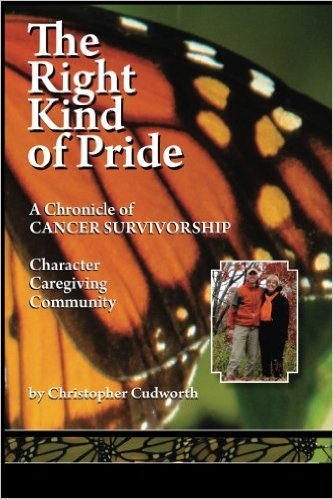
For the full story of this cancer survivorship journey, consider my book The Right Kind of Pride: Character, Caregiving and Community.

Posted in Christopher Cudworth, death, fear, life and death, love, mental health | Tagged , , , , , , , , , , , , , , , , , , , , , , | Leave a comment

Beyond the pain

Her garden being watered during a summer day.

Following the passage of my late wife in March of 2013, we conducted a Memorial Service. The people in attendance ranged from all walks of our life. Along with my son and daughter there were other family, longtime friends and former roommates, church friends from twenty-five years at St. Mark’s Lutheran and the preschool where she taught, and folks from the caregiving group that had built up around us during eight years of cancer treatments and survivorship. The service opened with a performance of Here Comes the Sun by an incredible musician friend named Matthew Boll, and the service was a testament to the way she lived with love and shared it with everyone in her life.

Before she passed away, I sat with her two weeks prior knowing that things weren’t going the direction she wanted. I knew that after all the strength she’d showed for all those years, her physical strength was wearing out. While she’d had doubts over time as I discovered upon reading her journals years later, she never quit trying to stay alive. That was her nature.

It made me think back to the time before we were married that she decided to run a 10k out in Sycamore, Illinois. A few weeks in advance she went for a few runs, but most of her “training” was doing aerobics classes at the time. That was sufficient for her, because her family––or her brother at least––seemed to have a natural gift of high V02. He became a really credible bike racer back in the early 80s. Linda used to run with me now and then, but walking was her real love. She did that quite a bit all the way through her life.

She signed up for the race and it was a chilly day, so she wore tights and a long-sleeve shirt. Running off almost no training, she broke one hour for the 6.2 distance. These days as I’m much older and run 10:00 pace on a regular basis day-to-day, I rather marvel that she was able to clock that time. I remember her coming into the chute with long blonde hair flying behind her. At the time I was quite the prick about running times, but that impressed me.

The woman had perseverance. Let’s put it that way.

A letter she wrote to me while I was living in Paoli.

It was a strange thing in those last days to realize that nothing could be done to sustain her life. That day I sat with her to talk about our lives together I told her something like this: “Listen, I know I’ve not been a perfect husband. You’ve had to put up with my flaws for a long time. (25 years). But I want you to know this. In all that time, I’ve always been faithful to you because I love you. Sometimes I’m not even sure you knew how much I loved you. But if there are things I ever did that hurt you, I’m asking your forgiveness now. Because I still love you.”

We cried together that day. I was proud of her for all she’d done for all of us all those years. I wrote a book about that journey called The Right Kind of Pride. The willingness to be vulnerable at times, which was hard for her. One time the members at our church insisted on a “laying on of hands” prayer session and Linda hated the idea. But like me, she understood that we didn’t have all the answers, she and I. We never know anything for certain, if you want to know the truth. Our phrase was always, “It is what it is.”

I attended the Good Friday service the same week she passed away. The pastor welcomed me at the altar that evening, saying, “It’s good that you’re here.”

One of my brothers commented, “You’re walking right into the pain.” That was true. I wanted it that way. For decades I’d learned to deal with pain, even welcome it, in one of the most honest of all ways, by running. As one great African distance runner stated, “If you try to run through the pain, you will never get through it. But if you learn to run with the pain, you can succeed.”

On our honeymoon in Glacier, 1985.

Going forward from those days of pain and loss, I reasoned that if any aspect of our faith was true at all, she had moved fully on in spirit. There was no holding her back. Her life on earth was finished. Back in 2005, I’d already carried my mother’s ashes back from the funeral home after cremation. I knew what it was like to hold a loved one under your arm. In 2013 I received the call from the same funeral home and picked up my wife’s ashes too. The children and I spread some out at a prairie where we all used to walk. I took a small jar to the Daffodil Glade at Morton Arboretum that April once the flowers were in bloom. The rest are buried in a cemetery next to her father where her mother, who is still living and in her late years and will someday soon be buried next to them as well.

So there was closure. There was honesty about how life takes place in its fullest and how it ends in a physical sense. All the people that know me understand that I process these things fully. Yet I didn’t know what came next. I had just gotten a new job that year and was driving the new car we’d just purchased. The April flowers burst from the ground and May flowers opened up in the woodland garden behind our house. Soon here garden burst into life and it would be my job to keep the garden going. That wasn’t easy. Her avocation was gardening. My job was digging holes in the ground for her plants. There’s a big difference.

Our little pup Chuck was then in my care, and I stopped at a hardware store on a spring day to pick up dog food and wound up buying some plants to fill some spots in our backyard. .That’s how we all move beyond the pain. There are spaces we never fully fill in our lives because grief is odd. Yet we all work to live our lives as fully as possible. That’s what’s meant to be. And grant you, we don’t always know what it means. We just keep trying to grow.

This story is a continuing part of the series for my biography Competition’s Son.

Posted in 10K, aging, Christopher Cudworth, competition, cycling, life and death, love, mental health | Tagged , , , , , , , , , , , , , , , , , | Leave a comment

How time slips away, but not with 4WD

Well, hello there
My, it’s been a long, long time
How am I doing?
Oh, I guess that I’m doing fine

It’s been so long now
But it seems now, that it was only yesterday
Gee, ain’t it funny, how time slips away

=Willie Nelson

The last post here was in October, and I apologize for that. While I know you don’t hang on my every word, for the last ten-plus years I’ve kept a pretty steady flow of blogs going here on WeRunAndRide. Part of the reason for my absence is practical: I’ve been writing articles to submit to national magazines, working on the completion of my next book Nature Is Our Country Club, and substitute teaching each day, which is something I also love doing.

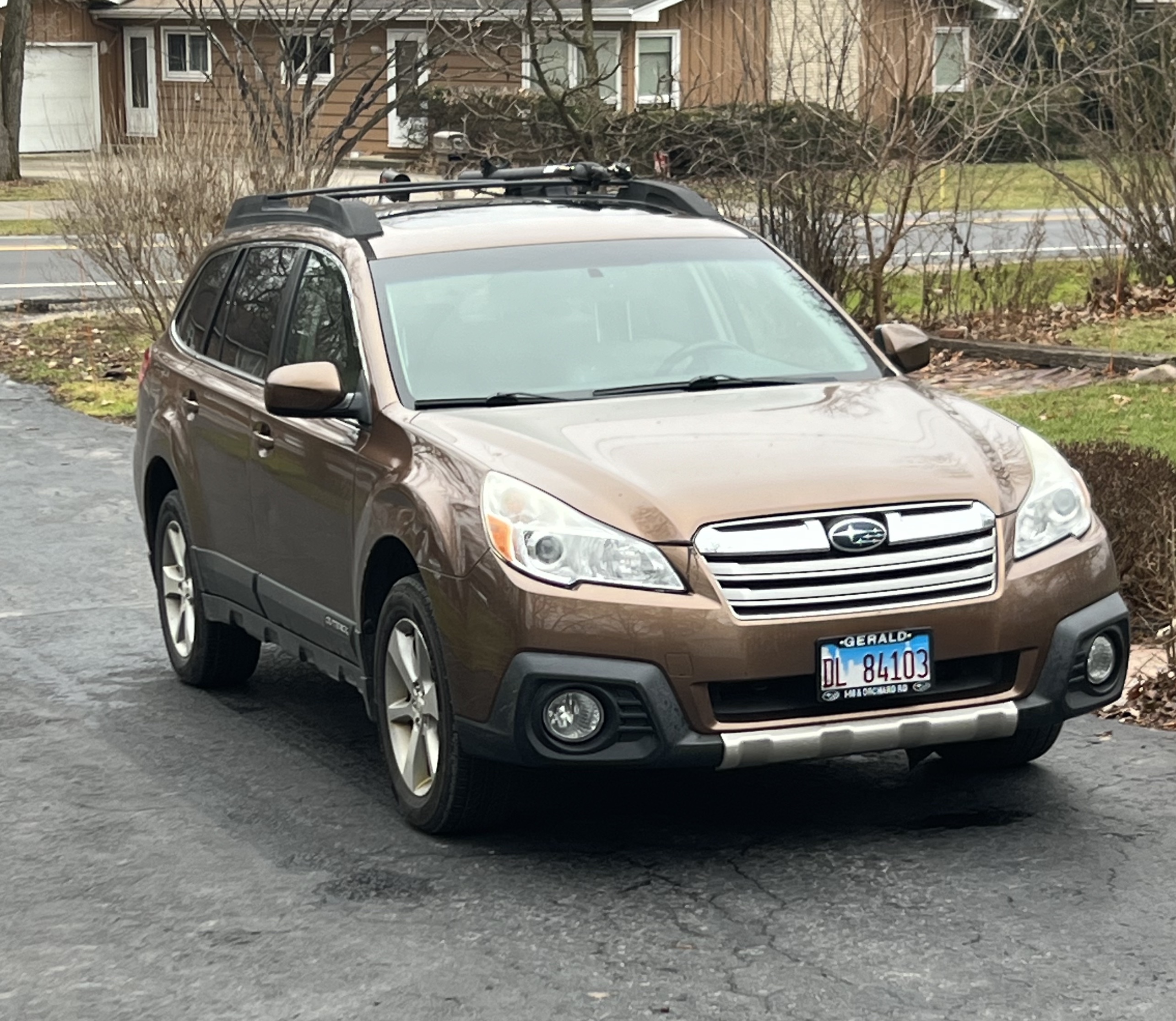
But earlier this week a significant event took place that took and shook me back in time. I traded in the bronze Subaru Outback that my late wife pushed to purchase while she was in the last stages of survivorship from ovarian cancer. After her diagnosis with a brain tumor in December of 2012, she had surgery and radiation through the top of her head and was dosed up with heavy steroids to deal with the swelling. In that “state of mind” she was spending money we didn’t really have and living life at high speed despite her progressing cancer. It had spread to other organs and the private prognosis by medical oncologists was that she was likely not going to have that long to live.

In that situation, it was my job to keep her stable, but one morning she woke me up at 4:00 a.m. waving a printout in front of me. “I found the car I want,” she stated emphatically, showing me a complete description (with photo) of a bronze Subaru Outback. Our 2000 Chevy Impala was feeling its age, so we drove to the dealer that morning and bought the car. My credit rating was high and they approved us for a loan on the spot even though I wasn’t technically employed.

After driving home that day, we got to ride in that vehicle three times in March of 2013. The first time in the car, we went to lunch at a restaurant as she was still functioning well on steroids. But after those doses were complete, her condition worsened rapidly and our last two rides together in the Subaru were to get to medical appointments. Each time the reality was a bit more dire than last. I could barely get her into the vehicle that day after the medical oncologist reviewed her condition. We skipped the other two checkups schedule for that afternoon. She passed away on March 2013.

So I permitted myself a tear or two this week before turning the car over to the dealer. They gave me $3000 on trade-in, which given the advancing problems with the Subaru, I accepted with humility. The rear bearings had been roaring for a while, and when I had them checked at the dealership, they also pointed out a compromised exhaust system, with holes at the joints, that I’d begun to hear as well. The repair bills would have been close to $2K for the bearings and another $2K for the exhaust. Plus, the dealership told me that the transmission was making a noise indicating potential failure of the CVT system.

Total recall

I did some homework and quickly learned that there had been a recall on 2013 Subaru Outbacks for that precise problem. I’d never noticed a recall in the mail or by any other means, but I might have thrown it out thinking it was an extended warranty offer or attempt to get me to trade in the car. The supposed recall was apparently extended in 2017, but no one ever told me about it. I don’t think the dealers want to deal with that, and certainly Subaru prefers to avoid paying for expensive repairs on their vehicles if they can help it. The estimate on transmission repair was $11,000.

That all bugged me because other than a ripped leather seat on the driver’s side, the Subaru was clearly in good shape. A few dents and dings, but almost zero rust. Relatively new wheels. The leather seats were still decent looking. And for the last six years or so, the dealership granted me free oil changes after I shared the story about my late wife purchasing that Subaru. That was pretty nice of them. Classy, in fact. So, I’ll say it clear and simply. I loved that car, just like Subaru says. The 4WD kept me from slipping on the roads even when things in life were slip-slidin’ away.

After my wife passed away I’m not sure I was the best father in every way to both of my kids. We all try to cope with grief the best way we can. As a longtime distance runner, my instincts were to keep moving. Don’t stop. Never quit. And perhaps, don’t grieve too much. My son and I are working things out at this stage in life and our family still has work to do. I know that. Losing their mom was a tough, tough thing to accept and live with. So many people lose their parents too soon in one way or another. It may be death. Estrangement. Mere distance.

And I know a father
Who had a son
He longed to tell him all the reasons
For the things he’d done
He came a long way
Just to explain
He kissed his boy as he lay sleeping
Then he turned around and headed home again

I checked all the problems out with my local repair shop with whom I’ve done business since 1988. They confirmed all of the above problems, plus… my check engine light popped on one morning. The mechanic there said it might be a vapor leak. Or just a loose gas cap. I tightened it. Problem solved.

Obviously there are a ton of memories woven into that Subaru vehicle. It has taken me on many trips. Plenty of cycling and running races along the way. And triathlons. I owned that car nearly one-sixth of my life. So again, while I wasn’t a bundle of bawling tears at its departure, I felt a touch of sentiment letting go of the Subaru. It’s weird how time slips away. It really does seem like yesterday that I drove that car with my wife to the restaurant that first time. I recall walking out after lunch and thinking, “I can’t believe that’s ours.” Yet while everything was all fresh and new with that car, she struggled to get into the seat. I turned on the key. The engine revved quietly into action. “We’ve got to keep moving,” I comforted myself that day.

We’d owned other Subarus before. A set of sedans and a little green Impreza wagon. They’d all done their time in ushering our family around. The brown sedan was a stick shift that got me 450 miles to the tank on highway driving. That was our first new car purchase as a couple. It served us well. The Impreza was a neat little car that I damaged by driving into the garage with my mountain bike affixed to the roof rack. Then my son crashed it into a Toyota Silhouette coming home from a drama party early one morning. There was frost on the windows and he didn’t see the intersection. Totaled it. But like we all have to say, “Life does go on.”

And time slips by. Day by day. Year by year. Mile by mile. We are all vaporous travelers in the slipstream of time. Never forget that and you’ll live fully, or to the best of your ability. Then we get traded in for something else in this universe, either carbon or spirit. But who knows for sure?

Note: I bought a new car, but that’s a topic for another day.

And: an interesting newsblock. “When Subaru first came to the United States, it sold small funky cars that were decidedly un-American. As the company grew its own identity and became more established in the U.S., it became the first automaker to offer an all-wheel-drive passenger car in 1975. Subaru was also an early-adopter of turbocharged engines to bring more power to its line of quirky cars and wagons. Subaru was also one of the first manufacturers to produce a crossover SUV with the Forester in the late ’90s.”

Posted in aging, aging is not for the weak of heart, Christopher Cudworth, coaching, death, love | Tagged , , , , , , , , , , | Leave a comment

On the run through a world of hurt

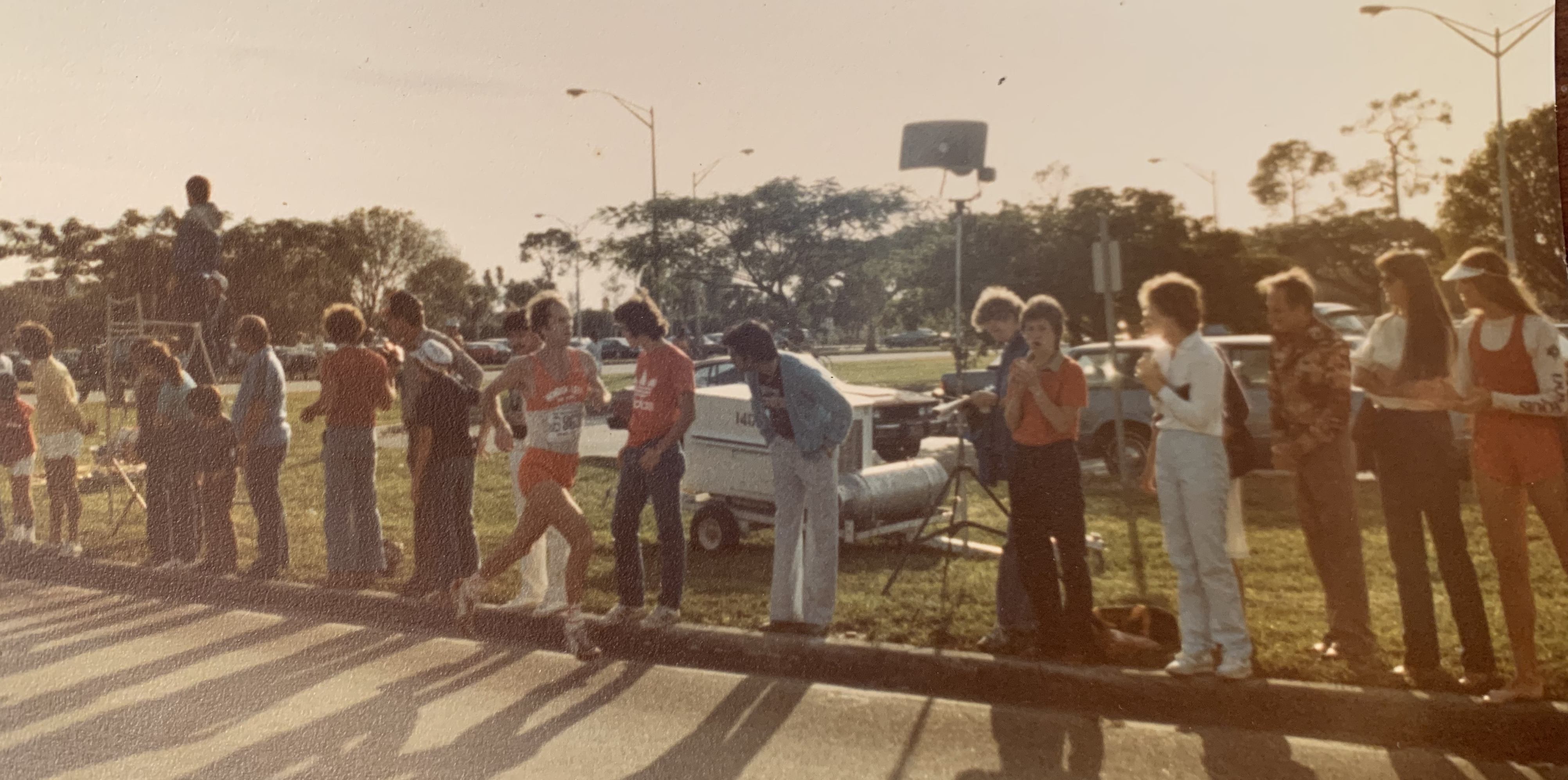
Competing in Miami during Race of the Americas, circa January 1983.

One of the key things a distance runner learns over time is how to deal with a world of hurt. Among track athletes, it is those who circle the oval multiple times that learn to deal with sustained levels of pain and discomfort. That is why my former track and cross-country coach offered sage advice when he learned that I was about to enter into caregiving for a wife with ovarian cancer. “Your whole life has been a preparation for this,” he told me.

In his later years, that same coach was diagnosed with lung cancer, the likely result of decades of cigarette and pot smoking. I never heard him complain or bemoan his circumstances during his long struggle with declining health. In part, that’s because the disease did not result from circumstance. Cigarette smoke is a known carcinogen.

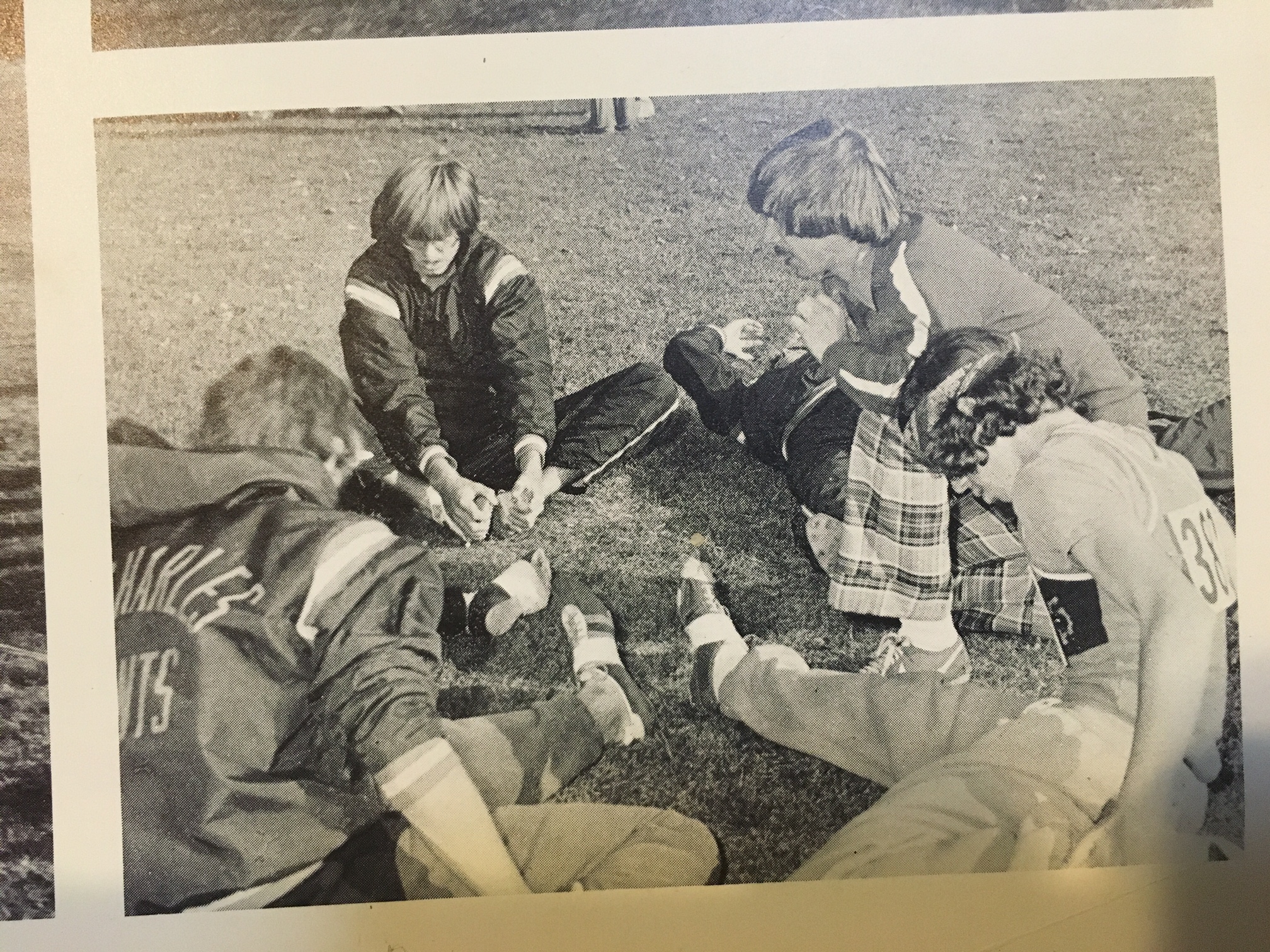
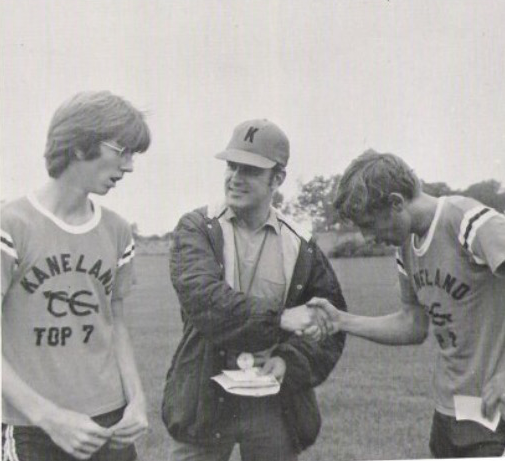
Coach Trent Richards dispensing pre-race advice as I grab both feet to stretch before placing 4th at Districts, 1974.

The source of my late wife’s disease was unknown. Ovarian cancer is also known as the ‘silent killer’ because its symptoms resemble so many other conditions in women’s health; bloating, a feeling of fullness, that females of the human species experience during menstrual cycles and other daily or monthly patterns. I watched my wife go through a year of odd bleeding and prolonged periods and figured it was time to push her to see the doctor. She was not eager to do so. For financial reasons, we’d opted for the HMO version of the company health plan and our regular physician didn’t accept the coverage. The doctor we found was a nice enough soul, but kind of ‘old school’ in his approach. He’d gotten his medical degree through the military and his bedside manner fell into the “kind male” category.

She didn’t have a gynecologist at the time. I looked up a women’s health clinic and made an appointment for her. That turned out to be a reasonable resource. When the doctor found what looked like a cyst on my wife’s ovary through ultrasound, laparoscopic surgery was scheduled to have a look. My wife had a history of ovarian cysts. We’d met on October 23rd, 1981, and began dating right away. That hardly prepared me for the news a month later that she was having surgery in December to remove ‘orange-sized’ ovarian cysts. At that point, we might not have even slept together, so the whole female region was not a part of our daily discussion. Our dates were mostly nature hikes, parties, and the occasional dinner out with friends. But when I visited her in the hospital the day after her surgery she yanked her medical panties down to show me the ‘bikini scar’ where the surgeon cut the abdominal muscle to remove the cysts. “Well,” I thought to myself. “I guess this is a serious relationship.”

Those cysts were benign tumors, an apparently common condition for many women whose hormones kick into high gear. So here’s the deal. In case this information ever helps a woman reading this blog. If you are experiencing issues “down there,” don’t waste time. Get checked for ovarian cysts. Here’s a summary from the Ovarian Cancer Research Alliance website about the difference between ovarian cysts and ovarian cancer.

“Having an ovarian cyst does not mean you have ovarian cancer. Ovarian cysts can be fairly common, while ovarian tumors are quite rare; ovarian cysts are fluid-filled while ovarian tumors are solid masses. Most ovarian cysts are not harmful, don’t cause symptoms and are not indicative of risk for future ovarian cancer, though some complex ovarian cysts may raise the risk. Ovarian cysts are common in women with regular menstrual cycles, and less common in post-menopausal women. Approximately 8% of pre-menopausal women develop large ovarian cysts that require treatment. Ovarian cyst symptoms are uncommon unless they twist or rupture, or become large enough that a woman can feel the cyst.  While many ovarian cysts come and go with a woman’s menstrual cycle (functional ovarian cysts), or go away without treatment, some may require surgery to remove.

While ovarian cyst symptoms are uncommon, they can include some symptoms similar to ovarian cancer, such as:  abdominal pain or ache, bloating, pain during intercourse, menstrual irregularities, and more rarely in ovarian cysts, frequent urination. More specific to ovarian cysts, unusual growth of facial and body hair may occur due to an increase in the production of male hormones called androgens. And in rare cases, sudden sharp abdominal pain, fever, and nausea may indicate a cyst has twisted or ruptured, and requires immediate medical attention and likely emergency surgery.”

I do know that my wife qualified in several risk factors for ovarian cancer. One of them was a prior medical procedure before she met me. She also used talcum powder for feminine hygiene, and there are class action cases actively working on that issue. I found that information out far too late to gain any compensation from that legal action. There may have been HPV issues too, mine or hers. We can never know the true source of her cancer.

My son Evan and daughter Emily at Christmas with the Red Ryder BB gun.

Once the cysts were out, we didn’t think about her ovaries again until we got married four years later in 1985. She got pregnant with our son on our first try. From there, it was off to the races for nine months after which she delivered a healthy baby boy following a fifteen-hour labor in which she did as instructed and blew on my finger as they taught us to do in Lamaze class. Our son Evan was born on October 30, 1986. Our daughter Emily was born on April 26, 1990, and none of that activity resulted in complications of any sort.

In other words, we headed into the rest of our lives figuring the whole ovarian cyst thing was done and over. She went back to teaching at our church preschool and I lumbered along in my up-and-down career in marketing until that fateful day in 2005 when the gynecologist broke the tumor on her ovary while trying to remove it.

That mistake let loose an array of cancer cells that spread throughout her abdomen. After we found a gynecological oncologist through the HMO network, he frowned upon hearing what the previous gyno doctor had done and vowed to get in there and fix things. Following that surgery, he informed me that her abdominal walls were peppered with what felt like “sandpaper” across the muscle where the cancer had attached itself. “I excised everything I could,” he told me calmly in the post-op interview. “Now we’ll do chemotherapy and try to kill any cancer that I might have missed.”

That doctor was one of the most amazing men I’ve ever met. His focus on helping women survive ovarian cancer was relentless. We trusted him completely, and for good reason. She lived another eight years under his care, as he performed multiple surgeries, directed chemotherapy regimens, and kept regular checkups to monitor CA-125 numbers as we swerved in and out of remission.

My job was keeping our kids informed and coordinating her care on top of the jobs I held. And keeping myself mentally and physically healthy at the same time. By 2006 I’d taken up cycling more seriously and in 2007 purchased the Felt 4C road bike and started racing it in criteriums. I needed that exercise along with running to keep my brain from overloading. That said, I still took some Lorazepam to help me through anxious periods. During long chemo sessions, I’d sit and write while the prescribed poisons dripped into her system through ports in her arm or belly. I used those hours of support and companionship to complete my first book, a treatise on theology titled The Genesis Fix. I published it in 2007. That was one of my big goals in life: to write and publish an actual book. I’ve now written and published three.

But now, a confession. I’m not sure I ever believed she’d be completely cured of cancer. The statistics about ovarian cancer survival are too stark and real. My experience as a runner taught me that you can’t fudge reality. Even she knew that. Our pet statement was, “It is what it is.”

My hope from the get-go was that we’d somehow find a path to a longer survival rate, and we did that. Living eight years was a massive accomplishment. She had to go through a world of hurt to get there. Even our trusted gynecological oncology physician admitted to her, “I don’t know if I could do what you’re doing.” He admired her toughness. So did I. For all the pain I’d experienced in endurance events, at least I knew the pain was mostly temporary. In her case, as she writhed on the couch with pain and discomfort after chemotherapy, there were no laps to be counted or finish lines to cross. I was humbled by her determination many times over the years.

Linda visiting my Paoli apartment in 1982.

The will to live is one of life’s most obvious mysteries. While she had tons of encouragement from family, friends, and strangers, it still came down to her wanting to go through the world of hurt necessary to keep living another year. I like to think that I might do the same thing, but none of us is ever sure about that. We don’t know for sure what our bodies and minds can take until we face the trials set before us. Then we find out.

That’s what made me mad when employers wrenched me around during caregiving for my wife. One of them put me through a 360-degree review. That stress didn’t help our situation during those first years of taking care of her. Other companies found reasons to fire me out of fear that their insurance rates would rise with my wife included in our healthcare plan. That misinformed approach came with initial promises of “support” followed by cynical claims that I’d unforgivingly breached some company policy or that my performance wasn’t up to par.

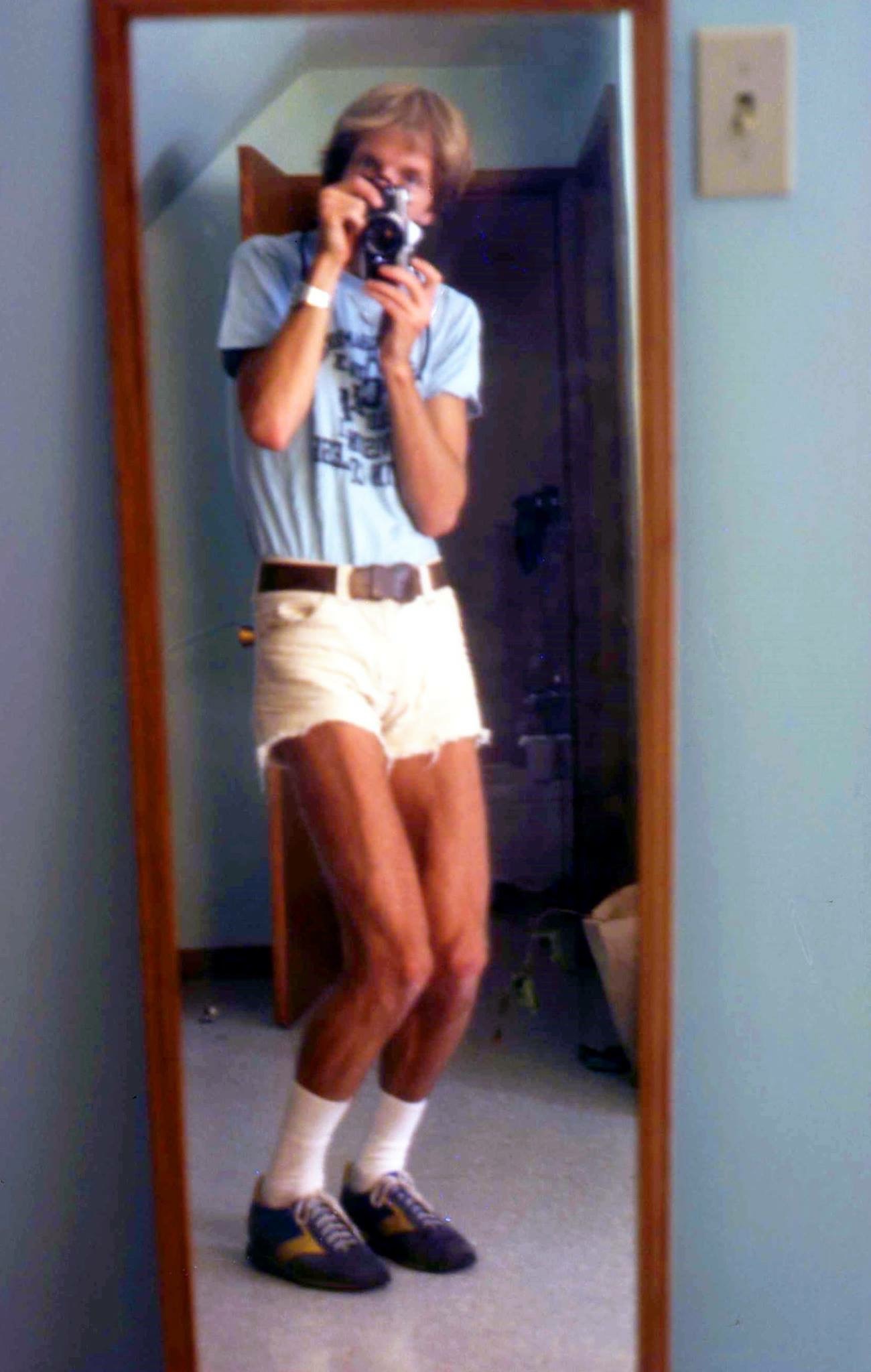
A selfie from 1980, long before the “age of selfies” took over this world.

That was my “world of hurt.” I share it in this book I’m writing through my WeRunandRide website because the injustice of the healthcare system in the United States is an inexcusable travesty. Her situation as a person with a “pre-existing condition” was somewhat ameliorated by passage of the Affordable Care Act, but the corporatized healthcare system we have in this country is a horrible example of a mistaken policy gone wrong. The fact that Republicans cling to the idea that our healthcare system was ever a ‘free market’ solution is a farce.

The basic fact is that healthcare equality does not exist in this place we call America. The best coverage is leveraged to the advantage of people working for corporations that foot the bill, and from there, insurance companies play actuarial games while healthcare organizations scramble and re-scramble to grab as much of that insurance money as they can. The result is perpetually rising healthcare insurance costs (which went up by 96% during the George W. Bush administration alone, Source: Crains) and consolidation of healthcare providers into ever-larger networks in a Darwinian race to market domination. All of this economic nonsense is cloaked in corporate healthcare slogans or mission statements promising the best while pretending to the public that it isn’t all about the money in the end.

Here’s one example. I’m a patient of Northwestern Medicine. Largely I do get good care, but that’s because I’m now a Medicare patient, which is a wisely socialized form of medical coverage for people enrolled in Social Security. This organization does a good job. That doesn’t mean the healthcare system in the United States is either fair or ideal.

Mission. Northwestern Medicine is a premier integrated academic health system where the patient comes first. We are all caregivers or someone who supports a caregiver. We are here to improve the health of our community.

What people need to realize, especially dispassionate conservative people claiming to care about others while passing laws that discriminate or produce healthcare inequality is that the entire world is a “world of hurt,” and that truly caring about the health and welfare of other people and our environment requires something more than a blanket of ideology and a transfusion of dogma to protect and value life on this planet.

I’ve earned my opinions on these subjects, having been the beneficiary of great kindness as a caregiver, so I know what gratitude feels like. I’ve also seen what healthcare non-profit charities can do to help people in this world. The people who make that happen, including many wealthy people with hearts for society, deserve great credit. Thank you.

Yet I have also witnessed what it looks like when disinvestment rules the day and people don’t have access to decent healthcare either for insurance reasons or lack of available resources.

We all live in a world of hurt and it’s disturbing that some people feel that the solution to that problem is to dispense more hurt through selfish beliefs and try to tell you that it’s the best medicine God our country or political parties can buy.

Posted in anxiety, healthy aging, it never gets easier you just go faster, life and death, love, mental health, running | Tagged , , , , , , , , , | Leave a comment

A trip back east in search of a sense of hope

Following a departure from an audio-visual company reeling from its inability to finish a new product for which they never completed the software, I engaged in full-time caregiving for my wife as she sank into another recurrence of the ovarian cancer that spread through her body since its first inception in 2005. We’d made it all the way to 2010, passing one of the “life expectancy” hallmarks of five years listed on nearly every ovarian cancer description on the Internet.

And yes, it is a bad strategy to self-diagnose or take anything on the Internet as stock truth. Yet that stuff still trickles back to you one way or another. By 2010 we’d been through multiple surgeries and more chemotherapy treatments than we cared to count. I attended nearly every one of those sessions. She’d park herself in a chair and nurses would tap on her arms to find workable veins. Then came the fluids followed by different sorts of poison chemicals designed to kill the fastest-growing cells in the body. Those were typically cancer cells, identifiable on PET or CAT scans by hot spots or growths. Sometimes an actual tumor would show up. Then our gynecological oncologist would dive into her abdomen or slice a bit off her liver to fight the most obvious and aggressive regions of cancer in her body.

She was perpetually tired and sick during treatments, often experiencing medical side effects as well. Rashes and peeling skin. Chemical burns and reddened ports. The vexations never ended. When treatments ended her hands and feet were still numb from neuropathy. Her hair fell out and grew back, fell out and grew back again. Then it stopped growing back altogether. Toward the end of her journey, she wore wigs that were often itchy and hot. But while she could, she made the best of the hair she had.

One summer when she felt half decent during a remission period, we took off on a trip with our daughter to visit Niagara Falls and tour wine country in the Finger Lakes of Upstate New York. That first evening, hotels were all booked in Seneca Falls where we’d planned to stay. We didn’t book ahead as our trip itinerary was flexible and we debated how long we should stay in Niagara after doing some touristy things on both sides of the falls. Linda wanted to stay longer but my daughter and were somehow eager to move for reasons I cannot recall. That afternoon, we drove west to Seneca Falls where the hotels were all filled by Upstate New York vacationers. That meant we had to move on to Auburn, where the only available room at a budget chain hotel had a single Queen-sized bed, and the room stank of cigarette smoke. I slept on the floor.

The next day we down Cayuga Lake toward Cornell and Ithaca, we booked a hotel room early and traveled out to wineries. The sun was high in the sky and the air was bright, but the summer air was thick with humidity, and hiding in the shade felt no cooler. At one of those wineries in the hills, I took a photo of my wife and daughter standing together in a field of sunflowers. It was one of those moments when mother and daughter felt bonded. That’s sometimes hard to find when young women are marching through their teenage years and mothers often don’t want to admit where they’d been and what they’d done at that same age. The fear of truth often keeps us apart, yet it’s the one thing most relationships crave. But it’s hard. For all of us.

I was born in Seneca Falls. My father was born in Cortland. He attended Cornell University in Ithaca, where in 1976 I studied at the Laboratory of Ornithology. My father had his stroke in Seneca Falls in 2003, and was taken to the Syracuse hospital but my mother was sent to Rochester and had to drive east to find dad. I flew out after months of hospital stay to fly him home from Syracuse in his wheelchair with my mother and brother in tow.

On that first day in the Finger Lakes, we discovered that the wine from that region was generally sweet. In the heat of summer, it was somewhat hard to swallow. My wife and I both liked dry wines, and there were none to be found. In her post-chemo state, those sweet wines tasted like bad candy, but she drank them anyway. We were making the best of it.

That felt about right because life itself wasn’t that sweet at the time. Gripped with a conflicted sense of conscience about my work struggles and more, I struggled with impatience during the early phases of that trip. We’d had a great visit with my younger brother and his family along the way in Ohio, sharing dinners and playing in their pool with his two girls. But after that, my sense of accumulated anxiety set in, a state compounded by the vagaries of ADHD. That angst was the result of long-term caregiving and financial struggles back home. I was also the prime caregiver for a father deeply compromised with apraxia and aphasia, both effects of his stroke. We could not talk directly about his needs, but I still called home daily to make sure his live-in helpers had everything he needed. I often felt pulled in many directions. Living in the moment was tough.

That first morning in Ithaca, I awoke early and was aching to get outside on a hike or something with my wife and daughter. Instead, my daughter just wanted to sleep in a little. Who could blame her? She was never an early riser and we’d bounced along for days. Plus, my wife was anchored next to the bed with her morning coffee and grapefruit. I stood in the doorway of our hotel room fussing about what to do, and snapped in anger, gathered up my gear, and went running in the damp morning air. I spent five miles regretting going on that trip at all. When I was done, and the anger subsided, I returned to the hotel room and apologized to my wife and daughter for my being an asshole. The hurt was still palpable. That’s one of the tarsnakes of life. It’s hard to take back the ache of words spoken harshly.

Heading south

Fortunately, that run cured the worst of my depressive mood and we agreed that the New York part of the trip should be over. “Let’s go down to visit my brother in Lancaster now,” I suggested. Off we went. Along the way, we stopped to visit one of my favorite aunts, one of my father’s sisters, in Binghamton. She was a writer by trade and we always had tons to talk about. My wife and daughter liked her manner and we shared a minty lemon tea on a shady porch for part of an afternoon.

My uncle sat down and shared a hilarious story about how he’d been carting away chipmunks from their yard that summer. He’d catch them in traps and dump them in a nearby forest. The ethics of that plan were not part of the discussion, as he’d been at it a long time and there were still too many chipmunks in the yard. One incident left me laughing the rest of that afternoon. “I caught one in a trap and was driving over to the woods when I felt something on my shoulder,” he chuckled. “I looked to the side and there was a chipmunk sitting right there,” he said, pointing to his right shoulder. “It somehow got out of the trap and I never caught it in the car. All I could do was park the car, open the door, and let it run out when we got there.” Something about that story released the humor hiding away in my soul. My spirits lifted further.

The decision to head south after the New York sojourn was therapeutic. We relaxed during the trip through the eastern mountains and arrived in the little town of Willow Street where I’d grown up going to elementary school through junior high. I had fond memories of our house at 1725 Willow Street Pike and pointed it out as we drove past on our way to my brother’s house south of town. To some degree, it felt like coming home.

Lancaster, Pennsylvania is always a place I’ll consider “home” thanks to our lives next to the Meadia Heights Golf Club, fishing in the nearby creeks and finding my first connection to the running world in gym class at Martin Meylin Junior High.

My brother’s house sat next to farmland on the east side of Willow Street. We grilled dinner and listened to crickets sing as we sat on the back lawn after dinner. His wife has a calm, intellectual manner about her and my brother wrapped my wife and daughter in studied conversation, his specialty. For years he invested in postage and cards and time, writing and sending her encouragement cards through all her treatments. He’d often find ugly cards on purpose to make her laugh, even sending particularly bad designs as “repeats” while branding them “classics.” He’d write wise or witty messages on the back of each card composed in the signatory angular handwriting that I’d always loved. To him, I’m forever grateful for the support and long-distance care that he provided to her. They’d sometimes share extended phone calls, catching up while drinking margaritas.

In many ways that trip east restored some hope for all of us. It made her survival seem possible during the middle stages of her cancer survivorship journey. That’s the right thing to do when facing life-threatening challenges. Immerse yourself in the moment and accept that nothing’s perfect in this world.

Posted in anxiety, Christopher Cudworth, fear, foregiveness, friendship, mental health, mental illness, PEAK EXPERIENCES, running | Tagged , , , , , , , , , , , , , , , , , , , | Leave a comment

Unfinished Business

What follows is an expanded version of an essay I recently entered in the Writer’s Digest Personal Essays writing contest. It aligns with this serialized “life story” I’m writing here on We Run and Ride. This is a slightly expanded version of the 2000-word entry.

Turning in results with my first cross-country coach.

Unfinished business

I knew that I was fit enough to win at the starting line of a five-mile running race on a cool spring morning. My plan was to run a 5:00 first mile, then pick up the pace and see who could go with me. At exactly the mile marker, another runner turned to me and asked, “How fast are you going today?”

“Faster than you,” I answered, and took off at a 4:50 mile pace, leaving everyone behind. I won the race in 24:49.

That’s how we rolled in the early days of the modern running scene. Winning races meant dispensing with posers and pretenders. It was harsh but true. During high school cross country, I’d won several races in a row, prompting a local newspaper journalist to brand me a “junior sensation.” My coach sought to set the record straight in that article. “Cudworth’s a good runner,” he observed. “But not a sensational one.” He was right about that. I ran against a far superior runner the next meet who confronted me at the starting line and snarled, “Junior Sensation my ass…” He beat me by thirty seconds that day.  

Running is merciless in many respects, but the results aren’t always cut and dried. I once traded leads with another cross-country runner until we crashed into the finish chute and knocked it down. He fell a few feet ahead of me and was declared the race winner. I’d pushed him to a home course record by more than twenty seconds but never beat him during our many other encounters. Years later we talked about our rivalry on a social media runner’s group. He admitted, “You were a force to be reckoned with.” Such are the little victories over time.

Racing against a rival I never beat in any races, though all of them were close.

My fascination with competitive running began with a twelve-minute time trial in seventh-grade gym class. Wearing a pair of Red Ball Jets sneakers and running on a cinder track, I covered 8 ¼ laps that day leaving most of my classmates behind. Our normally grumpy gym teacher acknowledged the quality of that effort. Yet when I got home that day and told my older brother about my time, he punched me in the shoulder calling me a liar. His doubt and insult burned inside me. I vowed never to let anyone question my running ability again. That was where my sense of unfinished business in the running world began.

The tests of will kept coming. In eighth grade, I expressed disinterest in playing badminton during gym class, so the P.E. teacher sentenced me to run laps around the lower and upper gymnasium for the entire hour. Rather than resist, I embraced that act of running rebellion. A friend pulled me aside after a full week of running laps and said, “You actually like this, don’t you?” I grinned and kept on running.

Heading into ninth grade, I was making plans to play football after winning the local Punt, Pass, and Kick contest. My father knew what was better for me in the long run. At age fourteen, I was a skinny kid at 5’10” and 128 pounds and might have been crushed playing football. On the morning of high school fall sports registration, my father walked me to the locker room door and warned, “You’re going out for cross country. If you come back out that door, I’ll break your neck.”

That was a life-changing decision in all the right ways. Forget all those pads and the smelly mess of the football locker room. All it took to make me happy was a pair of gum rubber flats, a set of running shorts, and a team tee shirt. I’d found a home in running and made the Varsity squad as a freshman that fall. The following year I was the top runner on a team that won its first-ever conference championship. Running became part of my identity.

At center with the cross-country cheerleaders at the new high school.

Our family moved ten miles east to a different town the next year. At the new school, I again led the cross-country team while making friends that would last a lifetime. Early in the season, we raced against a team that had a winning streak of sixty consecutive dual meets. Before the meet, I sat on the school bleachers immersed in a literary masterpiece titled The Peregrine by J.A. Baker. He wrote about chasing wild falcons on the English coast, and my mind took flight from worry. I won the race while our team snapped the opponent’s dual meet win streak.

At that stage in life, I’d begun taking my writing more seriously and worked for the school newspaper while publishing prose and poems in our writing club’s journal. Story ideas often popped into my head during runs. That brand of hard exercise also helped me deal with native anxiety and an undiagnosed case of attention-deficit disorder. The flipside is neurodivergent hyperfocus, the ability to concentrate on topics or tasks of interest for long periods of time. Many of the greatest accomplishments in human history are produced by individuals with this superpower. Hence the cliché of the “absent-minded professor.” The distracted genius. There’s honor in that.

The three books I’ve published since 2007. Two on theology, one a memoir of caregiving during cancer survivorship for my late wife.

Some of my earliest educational experiences stemmed from the seeming inability to pay attention or remain on task. One year we crafted construction paper ships to track our progress in the SRA Reading Program. The ships raced around the room with each book we read. I lost interest after a couple dull stories and my ship lagged. My mother showed up for a teacher conference and appealed to my competitive nature to get me reading again. “Don’t you want your ship to keep up with the other ones?” she asked. I looked at the ships ahead of mine and replied, “I’ll wait ‘til they come around again and race them from there.” That response symbolizes the nature of coping with unfinished business when attention deficit takes over. We pick up where we can and move on.

My busy brain was drawn in many directions as I pursued diverse interests in nature, sports, art, and writing through high school into college. I emerged with a Bachelor’s degree in Art and English, then drifted into an admissions counselor’s job as a means to stay close to a college girlfriend who still had a semester to complete before graduation.

During the lonely occupation of college admissions work.

I started admissions work that summer and that first month on the job required sitting in the office eight hours a day sending out recruitment cards to prospective students. My brain turned to mush. I responded by drawing cartoons to entertain myself and my colleagues. That restlessness did not amuse the Admissions Director. He pulled me aside and asked, “Is your head really in the game?” I answered that question emphatically, traveling 1500 miles a week during recruiting season to secure the 70-student quota from the city of Chicago and Illinois. During that year of travel, I stayed in the required low-budget motels and went for sullen runs to clear my head and keep my spirits up. When I complained to someone about the lack of time for running in my new job, their response was unsympathetic. “Welcome to the real world, kid.”

All that travel led to a breakup with the college girlfriend. Plus, her parents wanted her to marry a businessman, and I did not fit that mold in their eyes. Leaving the college world behind, I took a job in Chicago as a graphic designer for an investment firm. After a year the company transferred me to the Philadelphia office in a marketing department consolidation. By then, I’d fallen in love again and the thought of moving 750 miles east was another hard tug at the heart. “Oh boy, another long-distance romance,” I thought.

The college girlfriend and I later parted ways.

I rented an apartment twenty-five miles from downtown Philly in a small town called Paoli on the Conrail commuter line. There was a running shoe store a few blocks away that sponsored a racing team and I was invited to join. During the first training run, I took off running at 6:00 per mile pace like we did back in college. At two miles I was way ahead, so I turned around, ran back to greet them, and asked, “What’s wrong?”

“Nothing. What’s wrong with you?” one of them snarled. He told me, “Listen, we’re gonna run fifteen miles at 7:30-8:00 pace and do the last three miles faster. Can you deal with that?” I got the message and learned much more about proper distance training from a group rife with top-flight runners. On weekdays we gathered at the Villanova track for speed work. The rest of the week I filled with mid-tempo runs, yet still sometimes overtrained, coming down with colds and injuries. Once I achieved proper training balance my times dropped including my first sub-32:00 10K. Our team raced against other clubs almost every weekend. I’d found a new running reality.

The job in Philly ended when the marketing VP got fired and they cleaned house. I packed up and moved back to Chicago to share a Lincoln Park two-flat with a close friend and former cross-country teammate in high school and college. He was working day and night to complete his master’s degree. That meant I had tons of time to write, paint, and run. I joined a downtown track club and met some of Chicago’s best runners. The “Running Boom” was in full swing, and the Olympics were coming up in 1984. I made a journeyman’s vow to train full-time and complete the unfinished business of my running career.

Winning the Oak Park Frank Lloyd Wright 10K in 1983 (and ’84).

That fall I won the Oak Park Frank Lloyd Wright 10K ahead of 3,000 runners. A week later I won the Run for the Money 10K race in 31:52 on a course deemed “at least 200 meters long” by one of the locals. After winning more races that fall, a running store offered sponsorship for the coming year. They paid all race entry fees, provided free racing shoes, a full team running uniform, and deep discounts on training shoes. I felt like a fully sponsored runner. Running was my life for the time.

With that focus in place, I set out to surpass all my running PRs. During a May All-Comers meet at North Central College, I lined up with 25 other runners for a 5000-meter race that was delayed until midnight due to the number of competitors in all the other events. The hour was late, but the conditions were perfect: No wind and temps in the low 60s. The pace went out fast and I passed through two miles in just under 9:20 and held on to run a 14:45 5K, a PR by twenty-five seconds.

At the start of the Community Classic 10K where I won an dran a course record that stood for 20 years.

I lowered my 10K road PR to 31:10 that summer and won a high-target race in a course record time that stood for the next twenty years. All told, I competed twenty-four times that year, won eight races, or placed high while setting PRs at every distance from the mile up to the 25K. I should have run a marathon that weekend, completing those 15.5 miles at a 2:25 marathon pace. By November, my body was exhausted. I dropped out of the last race entered but felt no shame. I’d hit my limit.

I raced more in 1985 with some great results, but a January engagement and June wedding turned my attention to future goals. The woman I married had stuck with me through the Philly move and my Bohemian adventures in Chicago. She’d seen me win races and there was nothing to prove to her or anyone else. The unfinished business of my competitive running career was complete.

With my late wife Linda after winning the Community Classic 10K.

A few years later, I openly lamented in my mother’s presence that I was perhaps self-indulgent in spending those two years running full-time rather than advancing my career somehow. She turned to me and said, “I don’t think so. You burned brightly.”

I tried to burn brightly over decades of life’s ups and downs that included years of caregiving during my late wife’s cancer and my father’s stroke recovery. Those years of mapping out running goals, building training plans, surviving intense workouts, and handling race stress bolstered my caregiving abilities, which are all about discipline, patience, and focus. Upon learning about my wife’s cancer diagnosis, my high school running coach called to offer words of encouragement, telling me: “Your whole life has been a preparation for this.” He was right. I was her primary caregiver through eight years of ovarian cancer survivorship. She passed away in 2013. We all miss her.

Over time I chose to date again and met a woman through the dating app FitnessSingles.com. She’s a triathlete and we share many other interests as well. I am grateful for her low-drama approach to our relationship. She doesn’t focus on my neurodivergence as a problem, instead offering gentle reminders on the to-do list, allowing me to catch up with unfinished business before it becomes a problem. That reduces the pressure in my head.

During a golf round with Sue. We married six years ago.

To this day, the benefits of running counteract my native anxiety and attention deficit disorder. I have been better able to handle professional life and avocations, but not without costs along the way. My ADD has at times resulted in job losses and difficulties in personal or professional relationships. The challenge of living with neurodivergence is real. Yet in some respects, finding my limits in running helped me put other pursuits in perspective. I still compete in triathlons, but my life’s primary focus is on writing and art these days.

A famous runner named Rick Wolhuter once said, “Pressure is self-inflicted.” He used that mind awareness to manage competitive anxiety and set world records. That insight is a bit of wisdom we can all use in coping with fear and uncertainty in life. The ability to manage distractions and find priorities is important to all of us. In my case, tackling the unfinished business of competitive running was symbolic of other challenges I’d face in life. What felt like self-indulgence in my early years turned out to be a helpful exercise on the path to caregiving, career, and self-fulfillment. I’m grateful for that.

Posted in Uncategorized | Leave a comment