
Data tells a story, but not the whole story

I’ve never been a deep data diver. The data that I know well includes my average resting heart rate (47) blood pressure (118/78) and how fast (or slow) I typically cover training miles.

After a six-mile run on Sunday, I swiped Left a few times on my Garmin readouts to view data related to the miles I’d just completed. The data on heart rate caught my eye.

What this shows is a chart of heart rate (red) across a six-mile run in which the pace ramped up to 7:14 at its fastest point with an average over the last four miles (or last 3/4 of the run) of about 8:30. I warmed up at 10:00, ran the second mile at 8:50, dropped to 8:25 the third mile, 8:18 the fourth and then started to feel it through the hills on the east side of the Fox River Trail.

My pace sank to 8:46 as fatigue caught up with me. But as you can see, the pulse rate stayed high except for that dip where I stopped to pee. It rose again to near 170 for the remainder of the run at 8:55 pace.

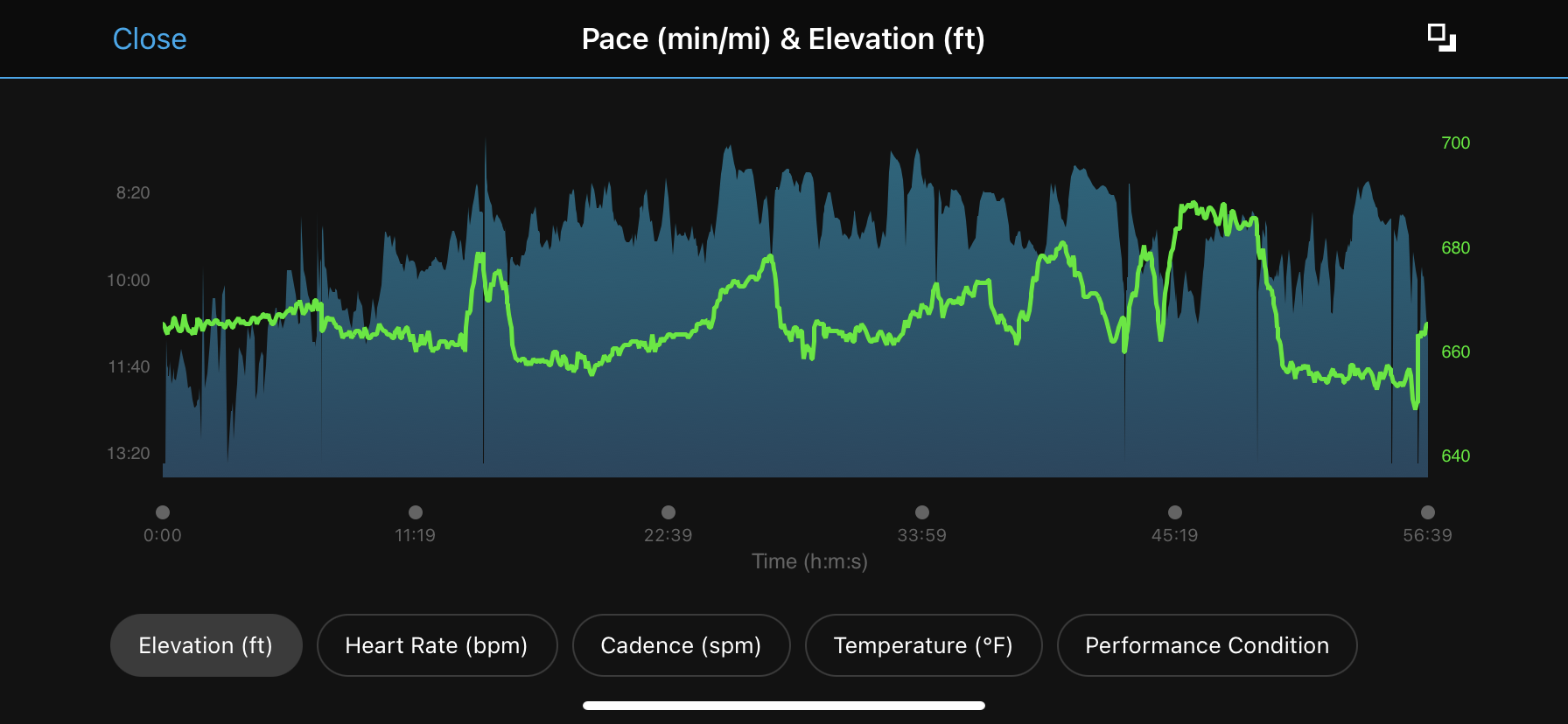
Important note: it was 76+ degrees at the start and finished near 86. Pretty hot, and heat accelerates the heart like nothing else. The hills were a factor too. You can see the impact of the climbs in this pace-per-mile (gray) versus elevation (green) data chart. That last big hump toward the end of the run is the rise through a forest preserve that ends with a 400 yard downhill onto the flats next to the Fox River.
While I didn’t sink to a complete jog, I could not wait to finish that run yesterday. The Zone chart tells why. I spent quite a bit of time in the Red Zone with a heart rate above 150 bpm, which is what I expected from a relatively hard effort on a hot day.
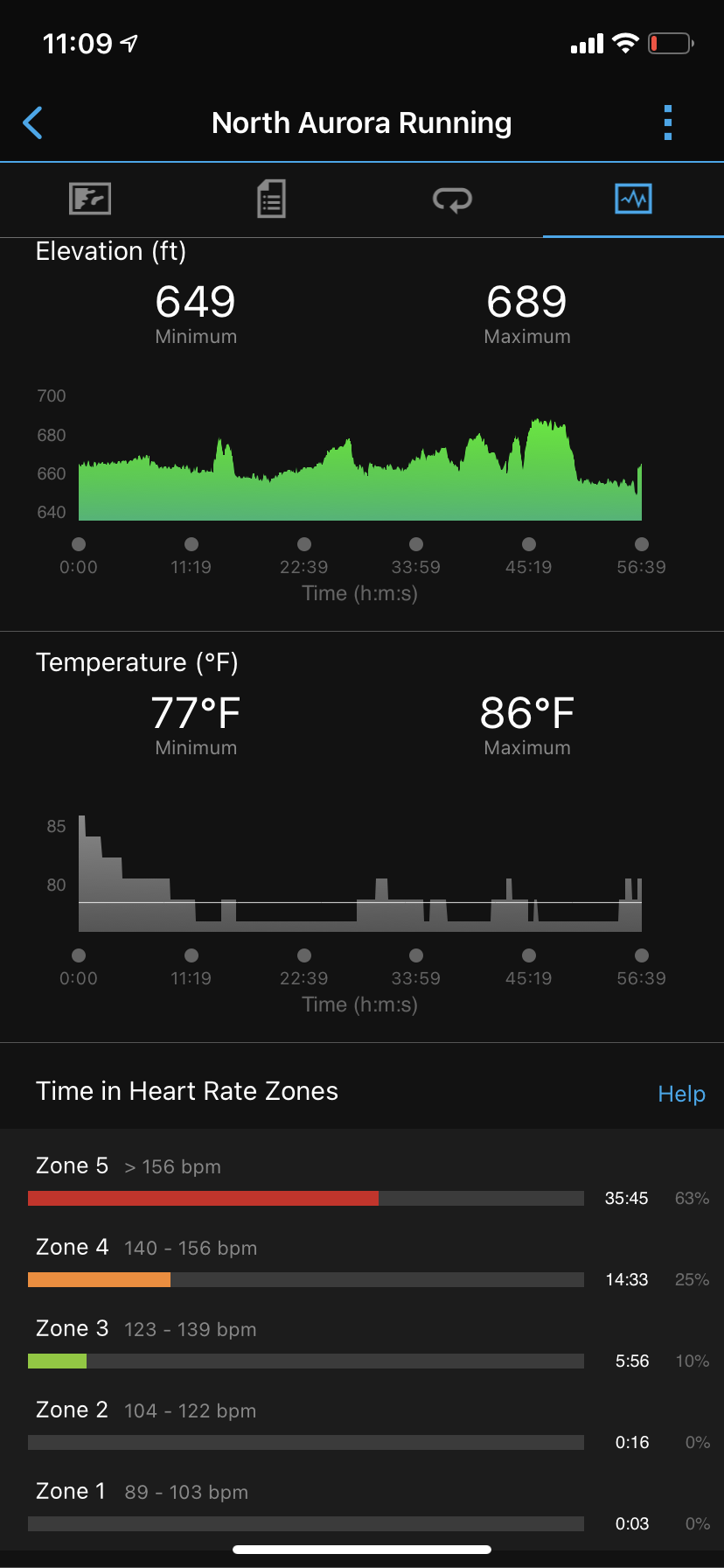
That’s how I like to go about things now and then. Train steady most of the time, and do about 20% overall at a harder tempo, including some speed.

My maximum heart rate these days tops out around 180. Or so it seems. I’m pretty sure that I could drive it above 200 in my youth during athletic prime. Running at sub-5:00 pace for six miles requires that kind of heart performance.

I’ll never know what my heart could do forty years ago because there was no such thing as a heart rate monitor. Tracking devices such as Smartphones and Garmin watches were not invented yet. All I had was my Timex watch and an index finger on my neck to determine how well my body was responding during training.

Sometimes I’d be close to sleep at night and would test my resting pulse rate. In 1984 when I raced 24 times at distances from one-mile to 25k, my heart beat just 38 times per minute. I can still recall its slow, consistent thumping.

Ten years ago during a period of high personal stress from caregiving, I felt some palpitations or fluttering sensations in my chest and worried that I’d developed arrhythmia or some other condition. I got checked out at the hospital and did a stress test on a treadmill that slowly raised the incline up to 18%. I ran steady for several minutes until the pitch became so steep that I began to struggle as my heart rate soared.

“When can I stop?” I finally blurted to the technicians. “Oh, anytime,” they answered. “You were done three minutes ago.”

They got their stats that day, all the data they needed to know that my heart was doing okay. Yet even those stats and data didn’t tell the whole story of a runner too dumb and obsessed to know when to quit.

That’s a lesson we seem destined to learn time and again.

Posted in 10K, aging, aging is not for the weak of heart, competition | Tagged , , , , , , , | Leave a comment

Bone on bone

I saw a former running acquaintance riding his bike on the road outside our cul-de-sac this morning. The bright blinker mounted on his aging Trek Madone caught my eye. As he passed I called out his name. He kept rolling but then turned around to see who had recognized him.

It’s been twenty years or more since I last ran with him. He was a tough little runner, but known for half-stepping everyone in the group that met on Saturday mornings for a five mile run down the river trail and back. At one point the other runners in the group begged me to teach him a lesson about constantly upping the pace. So I trained to get in shape and showed up ready to push him till he popped.

Some might call my actions mean-spirited, but in fact it was a favor to a group that had grown tired of his weekly throw-downs.

I’ll admit that I relished the chance to be the bad guy acting as the good guy, and confess that part of my competitive spirit has often been tied to a sense of vengeance. I used running to take out my frustrations with the world. There were also many occasions in my running career when it felt good to beat an opponent I didn’t like. I’m sure there were plenty of runners over the years that didn’t like me either. I’m not always a likable guy.

This fellow I taught a lesson wasn’t a ‘bad guy’ by nature. He just had a habit, perhaps innocent in a way, of pushing the pace by one-stepping everyone. We had a conversation not long after the run where I explained the situation. He seemed to understand.

On the bike

Today we talked about cycling instead of running. I complimented him on getting out for rides, and commented that I’d seen him frequently during the cycling season over the last few years. He seemed surprised and I told him, “Well, that’s why I called your name this morning. I wanted to say hello.”

“Cycling’s good as you age,” he told me, glancing down at a black brace on his right knee. “This one’s bone-on-bone,” he said, pointing at the joint.

That’s not the first runner I’ve heard use that phrase. I don’t always know the cause behind many of those bone-on-bone stories, but many of them are no doubt the result of unfortunate biomechanics and structural deficiencies that add up to worn-down cartilage.

So far, I’ve managed to maintain decent knee health, but not without incident. I’ve torn my left ACL a couple times, and had meniscus surgery on that knee too. Then last year a dog ran into me at the Bark Park and tore the MCL. I was so angry and depressed by that because the knee was healed well from the meniscus tear. It took 18 months, but finally the damned soreness of the MCL tear healed and I’m back running ‘pain-free’ in that region of the body.

That’s one of the tarsnakes of the running avocation. For some people the risks of wearing down joints increases the more they run. For others, it seems like running actually keeps the knees, hips and other joints healthy. I know runners with total knee and hip replacements. Some keep going after that, while others figure the wear and tear is not worth it, and take to walking, cycling or swimming instead. No shame in any of that. Just keep moving.

Are you still running?

Before my friend left he turned and asked, rather wistfully, “Are you still running?” I explained that I’m now married to a triathlete and do get out running fairly often. “Well that’s good,” he replied, and “congratulations.”

That is the farthest thing from a ‘bone-on-bone’ statement one could imagine. For all of our competitive instincts over the years, age helps us wish each other well, and to find the best resolution for fitness as time goes by.

We exchanged waves as he circled around an intersection while looking out for cars. “You have to watch for traffic more as a cyclist,” he called out. Then he pedaled away.

It was a nice way for old running friends to share a moment. I wish him well and hope no more joints give him trouble on the road to keeping up (or ahead) with his health.

Posted in aging, aging is not for the weak of heart, bike accidents, Christopher Cudworth, competition, cycling, cycling the midwest, cycling threats, running | Tagged , , , , , , , | 3 Comments

Measuring your hydrate to pee ratio (HPR)

Knowing your Hydrate To Pee Ratio (HPR) can save a lot of trouble in endurance events.

The triathlon world is awash in a new study on the subject called the Hydrate to Pee Ratio. It is the key measurement of how often you take in fluids versus how often you have to pee.

A group consisting of World-class athletes and Age-groupers were studied to determine the ideal Hydrate to Pee Ratio. The purpose was to determine the critical What Goes In Must Come Out (WGIMCO) factor.

Every athlete needs to hydrate to compete at their highest level of performance. But nutritionists working with athletes at all levels noticed that many athletes exhibited a WGIMCO ratio above 8:12. That is, athletes consuming eight 12-oz glasses of hydration per day were visiting the restroom twelve times or more during a typical 16-hour day.”I have to pee all the time,” one athlete complained during the study. “I hope this helps me figure out why I have to pee so much.”

“It really becomes impractical,” one of the study’s participants observed. “I mean, how do you hold it during a Zoom call with twenty people watching? I make the worst faces.”

A new syndrome called Pee Anxiety emerged during the study. The condition is marked by immense relief after a good pee followed by dread that the urge to pee would return again before getting back to the desk chair.

Pee Factors

Other factors affecting the HPR Ratio are caffeine and alcohol consumption. It was also noted that Perceived Distance to Restroom Facilities (PDRF) was a psychological factor along with beliefs about bladder size.

It was determined by the HPR study that athletes deal with HPR, WGIMCO and PDRF ratios in many ways. One male athlete told the study’s directors, “If I have to pee during a workout, I just pull over and let it rip. I can spot a good Pee Tree from 400 yards out.”

Female athletes noted that the logistics of Pee Management Syndrome (a version of PMS related to urine and emotional strain) included wearing cycling shorts rather than bibs during workouts and learning to pee in the pool without guilt. “Finding a spot to pee when you’re a woman is a completely different problem than when you’re a male. We’re not known for being able to pull over and ‘let it rip,’ you know. It’s more like Squat and Hope…no one comes along at the wrong time.”

The study’s directors noted wide variability in the HPR factor within genders. “One male athlete with a sensitive bladder has literally worn out a path in his carpet between his home office and the bathroom during the pandemic,” the study report concluded. “We call this a HPR Pattern. It is not particularly evident on tile floors except among athletes ingesting sixteen or more 12-oz glasses of hydration.”

Prescription for sex

Males with BPR (Benign Prostate Enlargement) are particularly susceptible to an off-the-chart HPR. Physicians recommend “frequent sex” to reduce the load-bearing capacity of the prostate, the organ responsible for storing sperm in the male body. When gorged with semen, the prostate can block urine flow. Several extremely hopeful-looking male participants in the study requested a prescription they could present to their partners to relieve the problem. Several female participants in the study responded that, “We might like to help our guys out. But right now, we’ve really got to pee.”

The HPR study was concluded with this critical advice for athletes at all levels. “When you gotta go, you gotta go.”

Posted in aging, anxiety | Tagged , , , , , , , , | 2 Comments

Seven yards of deep thought and a winning effort

Endurance athletes are typically accustomed to thinking about workouts in terms of accumulated miles. Strava and Garmin add them up for us in neat piles of data to be picked apart ad infinitum.

Athletic performance becomes all-consuming that way. “You’re only as good as your last performance,” the hardline theory goes.

It’s easy to become obsessed with that self-measurement data, to the point where we judge ourselves first and only grow to accept our efforts later. There’s also a problem in viewing athletic endeavors as our primary purpose. A few years back I read a hilarious takedown of a high-quality yet self-absorbed cyclist who wrote to a pro columnist named Phil Gaimon about a problem he had at home. “I don’t want to mow the lawn and tire out my legs for riding,” the cyclist complained. “My wife doesn’t understand me!”

Gaimon wrote back and chided the guy for being a petulant jerk. “Unless you’re a pro, your first job is not cycling,” he counseled. “Mow the law.”

I confess to having a touch of Golden Leg Syndrome back in my competitive years, but I wasn’t so obsessive that I wouldn’t mow the lawn or take care of business around the house. At that time I had few obligations anyway. I lived on my own. My only concern was not getting stuck at some party where we stood around for hours the night before a race.

These days I enjoy the feeling of getting things done. This weekend we ordered seven yards of high-quality mulch. It was satisfying to move that stuff from the big steaming pile on the driveway out to the beds around the property. My wife also removed a weedy tree that was overgrown and dominating some pretty bushes in one of the beds, and the new mulch improved the new space even further.

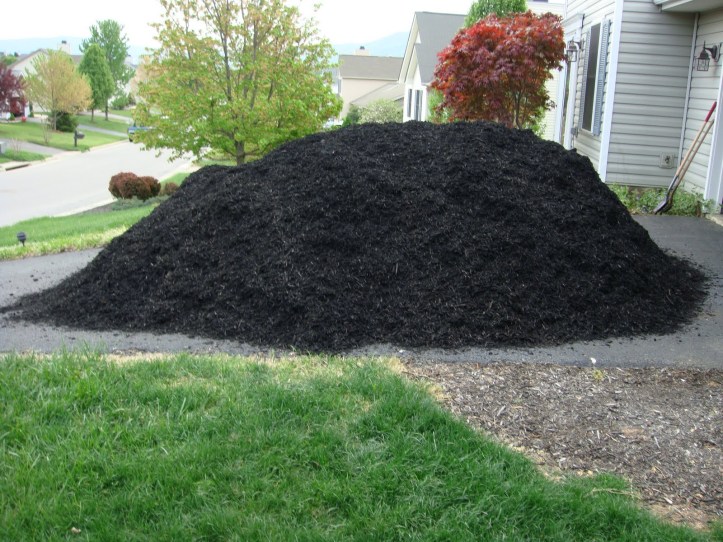
Seven yards of mulch is a healthy amount. That’s about as much as shown in the picture I stole off the Internet at the head of this blog. One key takeaway: I probably would have been smart to wear a mask while moving all that much. The dust swirled around and gathered in my throat over time. With my history of strange infections and weird afflictions, I got a bit nervous about the possibility of getting Mulch Lung or something odd affliction like that.

Halfway through, my stepson borrowed a mulch shovel from work that made the job easier. From there it was an incremental job of hauling wheelbarrow loads out to each bed and spreading them by hand. I became quite adept at spreading the right amount across the crusty mulch beneath that was compressed by the deep snows of winter.

When all was done the satisfaction was equivalent to the completion of a good race. The mulch-moving process also offered plenty of time for deep thought. I didn’t even listen to music, just moved at the pace necessary to get the job done while singing songs or thinking about things on my own.

When it was all over, I received the greatest compliment any man can get after doing something needed around the house. “Nice job, honey,” my wife told me as we sat outside on the back patio having dinner and sipping a quiet Memorial Day drink. As far as I’m concerned, that encouragement from her makes me a winner this weekend.

Posted in cycling, love, running, tour de france, TRAINING PEAKS, tri-bikes, triathlete, triathlon, triathlons | Tagged , , , , , , | Leave a comment

The toughest thing out there is believing in yourself

I’ve had plenty of time and reason lately to think about things that have gone well in life, and things that have not. Plus my son Evan is aiming to do wonderful things with his company dedicated to helping people come to grips with their perceived failures in life.

My greatest challenge, and this is one I likely share with millions of people, is believing in myself. When you stop and consider what that means, it quickly starts to separate into all kinds of categories. There’s work. There’s family. And for those of us who run and ride and swim, there are all the extras that come with trying to believe in yourself in training, races and the outcomes of all that.

I’ve been through major ups and downs in life. Most people have. I admit to liking those signs in public places that say something like, “Be nice to people, you never know what they’re going through.” That’s so true. When my late wife was dealing with cancer we’d have people reach out to us and many would come to confess that they were facing a challenge too. They’d say, “I’ve got this thing going on, but it’s nothing compared to what you’re going through.”

We’d ask them about it and often, it would turn out to be something really significant. That would lead to a conversation and remarkably, the tables would sometimes turn. We’d often confer after those moments and respond with a “Who knew?”

The answer is often that nobody knows what you’re going through. And people that are critical without knowing the truth about what’s going on in your life? They have their own issues. Ignore them.

Think about things on your own terms. Some aspects of life seem too embarrassing to confess, while others involve too many elements to begin to describe. Health issues are especially difficult. Plus, when athletes get hurt or overtired, there’s an aspect of guilt or feeling like you’re stupid for winding up with an injury or illness. That can eat at your confidence and belief in yourself.

But here’s the truth: Not everything is “your fault.” We all get hurt. Feel pain. Lose confidence. Question ourselves.

For some people, it helps to have a coach or counselor to guide you through those rough periods. Having people around you that can encourage you through therapy or the healing needed to get back to normal are quite valuable. Yet when the wounds are psychological, and emotional pain is real, it can be hard to confess that you’re even suffering. That is a tough place to reside. Don’t do it all alone. Find someone who can (and will) listen.

I can think of one profound moment early in life when I should have spoken up about my mental health. I was a junior in college and the previous summer I’d had a really shitty summer job in a factory where the work environment was physically and emotionally abusive. As a kid growing up with anxiety and reaching adulthood, I didn’t know how to process all that I’d gone through that summer. Come fall in cross country my head was a bit fragile. I remained in the Top 7 but seldom had many breakthrough results.

Then came the conference meet and my mood somehow went completely dark. I’d experienced dark emotions before, but nothing like the emotional tank I found myself in at the starting line. That five-mile race felt like a living hell of negativity and abject disgust with myself. It took me over 28:00 to run a distance I had covered in the low 26:00 minute range that season.

The effects of that terrible run were devastating. Granted, it wasn’t an easy course to race on, and looking back, I don’t recall how my teammates reacted. We’d won the meet by many points so my results didn’t hurt us.

Then came nationals.

Somehow, out of some sense of ultimately determined self-belief, I ran as our fifth man at the national meet even though it was conducted in terribly cold conditions. I’d come through in the end. We placed eighth in the nation that year as a team.

That next year in cross country, I ran as our second man for much of the season, and placed as our fifth man at nationals where our team took second in the nation. I’d overcome the darkness to run in the light.

Those looking for evidence of how sports can toughen you for life need look no further than examples like these to realize that we can train ourselves for life’s difficulties by taking on athletic challenges. When we fall short in those endeavors, it teaches us to look within to find new––or different––sources of strength when needed. We can also turn to others for inspiration or motivation. We learn to believe in ourselves that way.

I’ll admit that I need some of that strength right now in life, as losses of several kinds grind at my generally positive nature. I do believe that I’ll come through in time, and many good things are happening. Because…I’ve come through before. I will do it again.

So when you need that motivation to “come back” from a loss of some kind, or a fear you need to overcome, it pays to look at how you’ve dealt with challenges in the past, and examine where you found that self-belief. Then stand up, take a deep breath, and put those muscles into action. The brain will often follow. Then they can start working together again.

Posted in anxiety, Christopher Cudworth, college, competition, cross country, mental health, mental illness, running, training, triathlete, triathlon, triathlons | Tagged , , , , , , , , | Leave a comment

This is what heaven feels like

This morning was heavenly here in Illinois. It was warm and humid with the smell of phlox and honeysuckle in the air. I ran the first downhill mile of a trail that I’ve been training on since 1981 when the railroad bed was converted to a recreational path.

Catbirds were calling in the hedges as I ran past. The urgent ‘fitz-bew’ call of a willow flycatcher sounded overhead. Rufous-sided towhees were singing in the woods, “drink-your-teaaaahhheeaahhh.”

My pace was slow as the legs were tired from running ten miles two days ago. It takes longer to recover than it used to. I alternate training days with swimming, cycling and running to keep soreness at bay.

Out on the run the arc of trees shaded the limestone path. People were out walking and running, riding bikes and watching their shadows trail ahead of them.

That path goes on for seventeen miles out to Sycamore, Illinois. Today was a five-mile run, so I turned around just before Wasco and picked up the pace on the return trip. That’s how it always works these days. I start out really slow and wind up running a minute or two faster per mile on the way back. The days of bending over a few times and taking off at 6:00-7:00 pace are long gone. That’s okay.

The days that I do feel good on the run are not lost on me. The last weeks of May are particularly heavenly, especially after the cold February we had in Illinois with snows two feet deep. I even appreciate the struggle of getting going on the run, all the while knowing that eventually the pace will pick up. The struggle makes the good running seem so much more valuable.

If all we get to do in heaven is enjoy mornings like these May days, I’d be satisfied. I don’t think literally about such things, nor do I think we actually have any idea what “heaven” is like––or even if it actually exists in some way. We are free to indulge our imaginations. It seems harmless to think that our spirits might persist after our earthly bodies are gone. Some even believe we get an all-new version of a body in heaven.

What would that mean? What age might we be? Who determines whether we’re the age of 15 or 25, 35 or 55 when (and if) we reach heaven? Do they hold races in heaven? And if so, does everyone get a participation ribbon at the finish line?

Those of a conservative bent will likely hate heaven if that’s the case Some people aren’t happy unless someone claims the win and other people feel the sting of losing somehow. That attitude proves what Jean Paul Sartre set out to describe in his existential play No Exit, in which three people are locked in a room for eternity––and at any point in time, two of them don’t get along with the third. The conclusion to be drawn from that work of fiction is simple enough: “Hell is other people.”

All I know is that a day in May is just right for enjoying the moment for all that it is worth. The smell of purple and white phlox wafting across the path is perfection, even if it doesn’t last forever. I’ll take it in any case because to me, this is what heaven feels like.

Posted in competition, nature, running, We Run and Ride Every Day | Tagged , , , , , , , , | Leave a comment

Apple tree wisdom

I had a best friend while growing up in Pennsylvania who lived in a modest home at the center of a golf course south of Lancaster. We did everything together from playing sports to learning about girls as we entered middle school.

One of our favorite places to talk or hide out on quiet afternoons was the giant apple tree that stood in a stone well next to the front porch. We’d climb out on a fat limb worn smooth by our visits and talk about what mattered in our lives. When apples were in season we’d pick a pair and chomp into them with relish. Sometimes we’d be a little early in choosing to try the apples and experience a tart surprise. We’d laugh and challenge each other to keep eating as our faces squinched up in sour delight.

As we aged our apple tree talks turned to sports. We both had favorite baseball and football teams, and followed some classic World Series contests on AM transistor radio.

At age ten we tried out for baseball and made the team. Our club won the Lancaster New Era city championship. Both of us earned our own “letter jackets” in glorious red with large sewn-on patches. His jacket stayed emaculate, while mine got dirty and the sleeves turned to threads. I wore that jacket proudly and also wore it out. Such are the fortunes of souls whose self-esteem is tied so closely to their athletic endeavors.

We also competed in gym class at Martin Meylin Junior High. Every kid in the class had to take physical fitness tests and the outcomes branded you for half the year at least. A Blue stripe marked the most accomplished, a Red Stripe was second rank and a White Stripe was pretty much the ribbon of disgrace. I missed the Blue Stripe by two mere pull-ups, and was devastated. But my friend missed out too. So we consoled each other in the apple tree.

That year in gym class I did learn about my running ability. We all lined up on the cinder track next to Lampeter-Strasburg High School and took off running for twelve full minutes. The goal was to cover as many laps as you could in the allotted time. I led the way with 8 and 1/4 laps, the best in school.

I’m second in the second row and my best friend is right in the middle

Not long after that our family moved to Illinois and my boyhood friend and I were separated by distance, time and the cost of long-distance phone calls. We met up again over the years, but the connections dissolved and finally fell apart.

But when we were close nothing made more sense than making sense of life while sitting in that apple tree. There was certainty in the comfort of that smoothed out bark. The dappled light. The sound of our voices, and I loved his voice, was a vital part of growing up. He had three sisters and knew tons more about girls and women than I ever would. I had three brothers and found most everything about girls mysterious and somewhat confusing.

He’d sometimes explain why certain girls liked me and why others might not. At one point he explained that if I wanted girls to like me, I’d have to learn to let them win at sports once in a while. Even at that age, I refused to think that way. If my goal was to impress girls, how would letting them beat me do that?

HIs advice was a bit of apple tree wisdom I chose to disregard. Sure enough, I was right about women in that respect after all. They are perfectly capable of beating me on a number of fronts. I rather take pride in my version of apple tree wisdom. Along the way the feeling of losing to girls and women in sports was a tart surprise at times, but soon enough the apples ripen and you realize that sharing time in the apple tree with women is worth the taste of a few sour apples along the way.

Posted in running, Uncategorized | Tagged , , , , , , | Leave a comment

A new twist on the meaning of “run and ride”

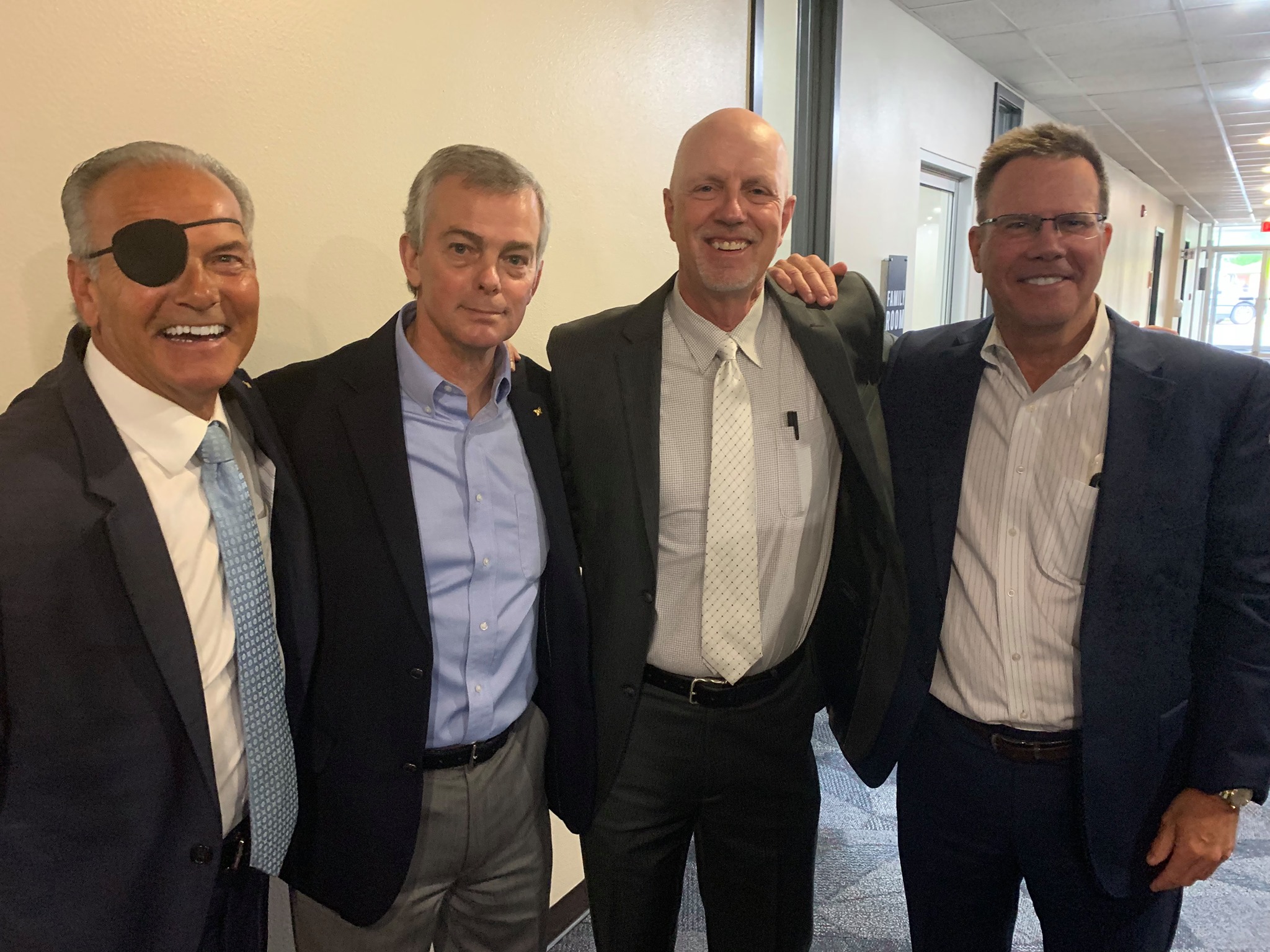
Keith’s teammates gathered in his memory. Steve Corson, Paul Mullen, Chris Cudworth, Dani Fjelstad,

Yesterday I woke up early at a hotel in Indianola, Iowa and pulled on the running clothes. The weather was damp and spitting rain, so I wore a rain jacket and took off south into town. I was heading for Simpson College, the school where my friend and former teammate Keith Ellingson coached for many years.

I ran a mile to campus and it felt good thinking about all the miles we’d run together in our years at Luther College. Over the last few months I’ve learned much more about Keith’s life by connecting with his former athletes in Zoom calls. He was a tremendous influence on the lives of so many people.

The track gate was open when I arrived. I said a little, “Thanks, Keith,” out loud and began trotting around the inside lane. It was humid so I tossed the jacket on the fence and started picking up the pace. It still feels really good to run on a track.

Running at eight minutes a mile these days feels like five minute pace once did. The sensations of moving at an age-appropriated pace aren’t much different, you see. The breathing. The attention to foot plant. The flow.

These are things I shared long ago with my friend Keith. I shared them again yesterday in memory of his prodigious running talent. He was a joy to watch run.

The memorial service later that morning was heartfelt and bittersweet. Keith’s patient perseverance through ten years of Parkinson’s disease was on everyone’s mind. Yet it was his dedication to others that came through fullest in every word about his life. I’d cried hard earlier that morning so that I would not lose it emotionally during the eulogy. Part of me regrets that aspect of my talk about our friendship. It was not for lack of feeling. My knees were shaking as I walked carefully up the stairs to address those in attendance. The goal was to be fully present, and composed. I think that’s what Keith would have asked of me.

Or he would have laughed at my careful preparations and shared some lilting anecdote about a speech he’d given in his life. That’s what made him so special. His abilty to knit experiences together into a meaningful whole. And when that wasn’t the goal, he’d often introduce ideas through stories meant to convey some sort of standalone truth.

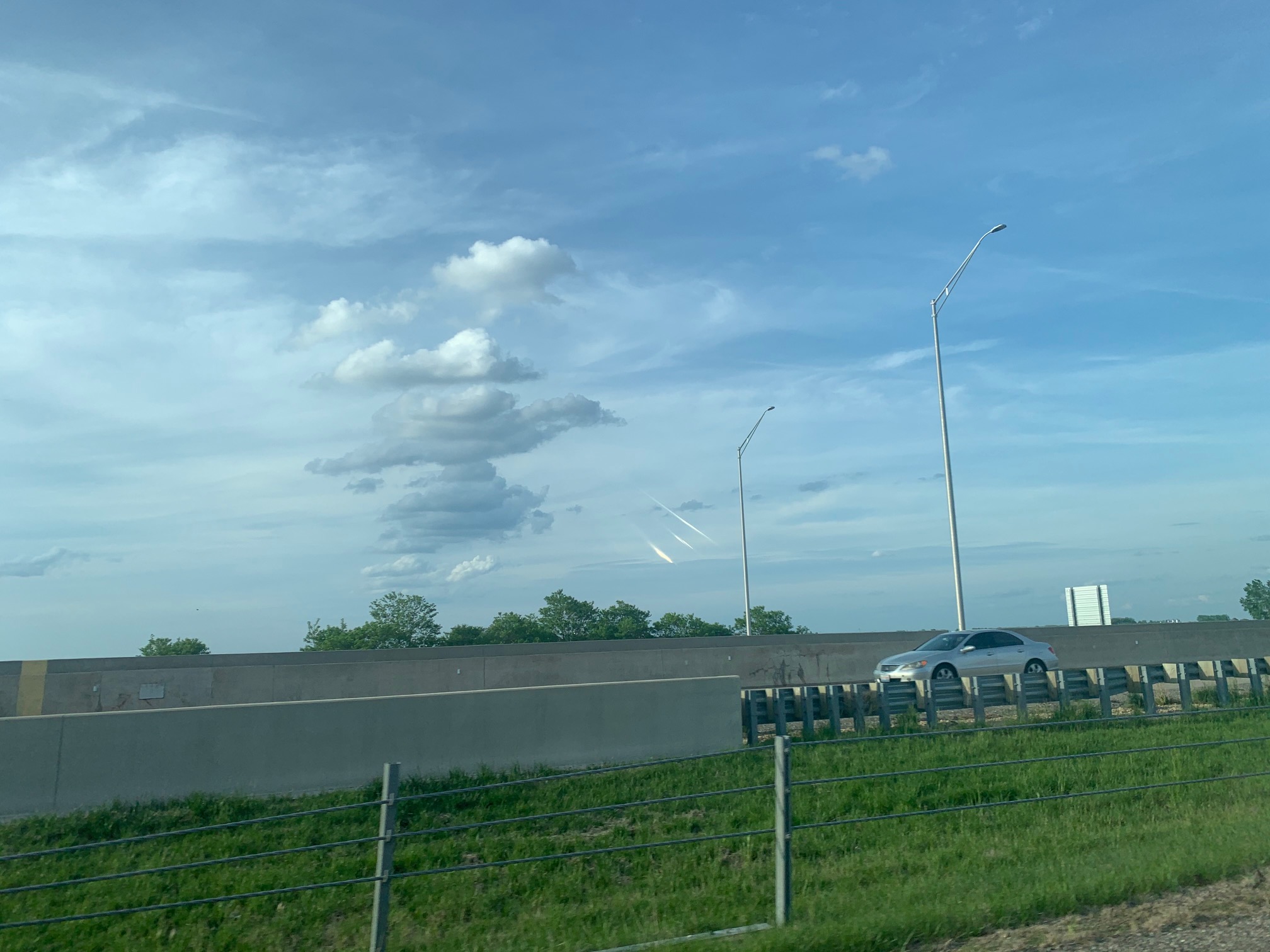
Clouds rising up during my ride back home.

I feel blessed to have reconnected with him this past year. That was not some prescient notion on my part. I just enjoyed talking with him again. His passing due to a cardiac event was a shock to us all, but especially to his daughters, to whom Father Keith is the parent who served as both mom and dad these past ten years after losing Mother Kristi to ovarian cancer.

We all keep company in our comings and goings.

So I was sad but felt embraced in the moment by all the wonderful people who joined in celebration of his life. Then we said goodbyes in parking lots and I got into my Subaru for the ride back home. I’ve driven plenty of miles this past week, including two back and forth six-hour stints between Tampa and Panama City last weekend for my wife’s triathlon.

On the return trip from Indianola I turned on an Indie station on Pandora and let the subtle music wash over me. For some reason I took special notice of the pavement sliding beneath my vehicle. Time itself. The sun was setting behind me as I crossed into Illinois and curved home on I-88 toward North Aurora.

That ride back was an ideal time to reflect and process what it means to be alive with all its joys and tribulations. It made me consider that the title of this blog, We Run and Ride, has an alternate significance. The pastor at Keith’s service talked a bit about that when citing the Bible verse,

2 Timothy 4:7-8

7 I have fought the good fight, I have finished the race, I have kept the faith. 8 

We’re all on this “run,” this “race” of life together. If you keep a sense of wonder about you, it can be a wonderful ride as well. That’s what I encourage you to do. Enjoy the run, but appreciate the ride.

Posted in Uncategorized | Leave a comment

What it means to lose a longtime friend

Sharing this from my other blog, The Right Kind of Pride. May you all find gratitude in life, and cherish those you love; friends, family, and more.

Christopher Cudworth's avatarThe Right Kind of Pride

Five Luther College teammates, from left to right: Dani Fjelstad, Steve Corson, Paul Mullen, Keith Ellingson and Christopher Cudworth.

I’m driving out to Iowa today to share in the visitation and funeral for a longtime friend, Keith Ellingson. He was a freshman year roommate at Luther College where we were also cross country teammates.

After that, we worked together in college admissions, then parted ways as we got married, raised children and engaged in our careers.

He built a legacy as an excellent coach in track and field and cross country. His worked earned him a place in the Simpson College (IA) Hall of Fame. Dozens of his athletes earned All-American status, and one of his decathletes made the United States Olympic team.

His achievements were many, but he was perhaps proudest of his three daughters, Jessica, Bailey and Catie, all of whom I’ve followed in their careers and family…

View original post 760 more words

Posted in Uncategorized | Leave a comment

The cycling tragedy of Helmut Jahn hits close to home

CNN photo of Helmut Jahn

World-famous architect Helmut Jahn was killed in a cycling accident in an area known as Campton Hills, Illinois, outside the City of St. Charles. The intersection where he was struck twice by a pair of vehicles is quite familiar to me. I’ve approached Burlington Road on Old Lafox Road many times in fifteen years of cycling.

It isn’t apparent from accident reports why Jahn elected not to stop at the intersection but that is what witnesses reported. Perhaps he swung right not noticing oncoming traffic. The stretch of road immediately to the north (left) bends and cars aren’t immediately visible. He may have turned casually, swung out into traffic and was struck on his bike.

I would never think to criticize Helmut Jahn for poor decision-making. I’ve had so many incidents and close calls I’m probably lucky to be alive myself. Nearly nine-hundred people a year die in bike accidents. Some are experienced riders while others, not so much. Some accidents happen in urban environments while others take place in remote locations where either the cyclist or the driver make a fatal move and that’s it. A life is over.

The Chicago Tribune reported on the life and work of Helmut Jahn this morning. He was educated at Illinois Institute of Technology in Chicago. HIs famous works include the revitalization of the O’Hare terminal from a dull passageway to a celebratory tour through light. His accomplishments were many, and even his failures bore the stamp of fame. The State of Illinois/James Thompson building was one such “failure” in the sense that it had loads of heating and cooling issues. The building “made his reputation internationally and ruined it in Chicago,” the article noted.

If all fairness, there is no way this tree is normally stretched across the pathway.

We all want to feel like we’ve made some sort of mark in this world. Helmut Jahn appeared on the cover of GQ magazine and his work is known for its clarity and simplicity. That’s a coarse summary for a life lived so fully, yet it ended so quickly and tragically that the ultimate lesson is conflicted by the nature of his demise. Perhaps he was dreaming of a new project when he drifted out in that lane of traffic. Creative minds tend to do that. I once ran smack into a downed tree because I had my head down thinking about a book cover design while riding.

If we have to go, perhaps that’s the best way to go about it. Immersed in a dream of our own making, we move into another realm without even trying. We call it a tragedy from our earthly perspective, but it is our ideas that live on. In that respect, Helmut Jahn transcended life even as he lived it. That’s a great legacy to leave, on two wheels or not.

I can’t leave this topic without making the one cycling joke that fits this tragedy. The story about his death did not say whether Helmut was wearing a helmet. That’s because it likely did not matter. Traffic on Burlington Road moves swiftly, I can tell you that. I’ve ridden that road all the way from Wasco out to Route 72. Cars fly and if they strike a cyclist, people would die. All this hits close to home with me, and to that note, I’ve been extra cautious these past couple years while riding my bike. That’s the takeway here. Look twice, and always brake at intersections. Always.

Posted in aging, aging is not for the weak of heart, bike accidents, bike crash, blood on the highway, cycling | Tagged , , , , , , | Leave a comment