New Running Shoes for 2014 Show Some Real Innovation

By Christopher Cudworth

In the never-ending quest to differentiate their products from other running shoes on the market, running shoe companies such as Brooks, New Balance, Mizuno, Skechers, Reebok, Nike, Puma and Asics are producing shoes so innovative that consumers almost need an education to keep up with the features and technology that go into each model.

At We Run and Ride, we have wear tested some fantastic products for 2014. These shoes are so new they do not even have product photos available to illustrate their amazing attributes. But we don’t want to hold out on you. So here are the newest running shoe products on the market. Some are designed for every runner, while others have specific niches they hope to occupy in the retail running shoe market. We think you’ll find them all compelling.

BROOKS BOOBJOB

Brooks BoobJobThis shoe is designated as a Fund Raiser model for 2014. The BoobJob looks just like its name. The toe boxes feature two rather prominent female breasts, complete with aureola and nipples to celebrate the prominence of the female breast in the non-profit world dedicated to wiping out breast cancer. The BoobJob comes in four cup sizes: A, B, C and DD for women and men with wider feet or fat toes. In our wear testing, we found the BoobJob a bit on the rubbery side for everyday running. They were great for plowing through snowdrifts however, and the silicone boobs on the front of the shoe really do provide excellent warmth in all conditions. Suggested retail price for the Brooks BoobJob is $144.99 for the pair.

NEW BALANCE NOTHING

NB NothingNew Balance has been innovating shoe styles for so long they simply ran out of explanations for what their 2014 model really does for runners. Product representatives interviewed about these shoes tell We Run and Ride they are simply going to let the buying public decide for themselves what the New Balance Nothing does for them. Wear testers did report excellent traction from the Question Mark soles. Many also reported experiences in which other runners followed them for several miles asking, “What’s the question? What’s the question?” Given this pattern we suggest the New Balance Nothing may be a great shoe for religious agnostics, Unitarian Universalists, converted Catholics and evangelicals who really cannot decide whether abortion or gay rights is the more significant issue in the 2016 Presidential election.

MIZUNO MS VAGINA

Mizuno MS VaginaThis shoe was designed as a women’s only model but our male wear testers insisted on wanting to try them out. The women pretty much found the Vagina uninspiring while giving it credit for a close fit, even without socks. Men raved about the Vagina however. One enthusiastic wear tester even wore them to work, where he was given a commendation for showing his feminine side and was assigned to a committee to encourage other employees to talk about their feelings during company meetings. All told, the Vagina received passing marks as a running shoe. Its cushiony insoles were particularly popular, and to prevent blisters during marathons the Vagina comes with an available lubrication kit, sold separately. Suggested Retail: $169.99.

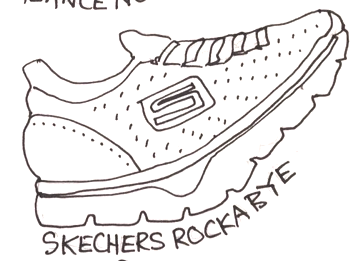
SKECHERS ROCKABYE

Skechers RockabyeSkechers entered the running shoe market a few years back after spending its early iterations making shoes for skateboarders and sidewalk loads. Now the company wants to revolutionize running, and this entry in the market walks an interesting line between a serious running shoe and a fun weekend if you know where to score some dope. The Skechers Rockabye is designed with an Instant Roll outsole. You can run on your heels and scoot along in a reversal to Chi Running. Or, you can lean forward and run on the forefoot as if you’re falling down a skating ramp the entire run. Our wear testers found both running styles rather fun, although a few did wind up with extremely pulled hamstrings and blood on their chins. But considering how much weed they smoked before taking the Rockabye out for a run, they really didn’t care. Because when it’s all said and done, you’re going to kick back, take in some brownies and sleep it all off. Suggested Retail: Make an offer. Seriously dude, Skechers needs the business.

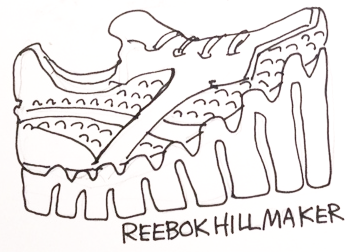
REEBOK HILLMAKER

Reebok HillmakerThe first shoe manufactured to create artificial hills where there are none, the Reebok Hillmaker continues the Reebok tradition of invented weird-ass workout stuff that lasts about two years and is forgotten forever. With this shoe, think “step aerobics” only you’re moving forward in the same direction and with the same effect as running uphill the entire way. We do not recommend wearing these shoes on an actual hill because you will certainly topple over backwards and wind up with a sick little dent in your occiput. But if you live in Illinois or some other boring, flat state or province, the Reebok Hillmaker can get you in shape for Boston or whatever hilly race you choose to enter. Wear testers tried out the Hillmakers while wearing an oxygen filtration mask to imitate conditions in the Western States 100. One of those wear testers has not yet returned. So if you see a dude laying flat on his back in Kentucky, please give us a call. We need to get the shoes back to the manufacturer. Suggested Retail Price: $79.00 (Originally $179.00.)  No one’s going to pay full price for these.

NIKE FART ATTACK

Nike Fart AttackAt last, a running shoe that is part trainer and part Whoopee Cushion. Strap on the Fart Attacks and head out on the trail in front of your buddies and let ‘er rip. The sound effects emitted by the Fart Attack are awesome. You can dial them in for squeaky farts or let them flatulate in full Fart Mode. The Fart Dial on the back of the shoes also lets you adjust for the type of smelly air you want to emit from your NIKEs. That’s right, the Fart Attack comes with a set of Fart Inserts. Simply slip one of the Fart Supply tablets in the slot provided in the insole and choose your stench. There are nine odors, including: Sunday Morning Beer Blast, Chili Extra, Post Flu Pandemic, Puzzle Fart, Elementary School Wonder, Foreign Food, Fox Smells His Own Hole and Rectum Hell It Killed Him. The Nike Fart Attack costs $139.99 and each insert lasts approximately one week. Entire pack of 8 Fart Inserts is $29.00.

PUMA PHATFOOT

Puma PhatfootEver have a friend who breaks down running shoes before they even leave the store? You’ve got to get them a pair of Puma Phatfoots. These shoes have absolutely no structure or stability features at all. Their sole purpose is to celebrate the Buddhas of running. Hence the rotund forefoot design, which resembles a very round gut and ManBoobs. But honestly, you can’t really tell what gender those boobs are. The Puma Phatfoot is perfect for all weather conditions. It is not only waterproof, it also floats. The carbon-injected insoles soak up as much as 4 pints of water during a 10-mile walk-run. Just squeeze out the shoes when you’re finished and they pop back into shape, whatever that means. Our wear-testers found these shoes a little cumbersome, but one wore them to a bar and reported that his feet came home completely dry. Suggested Retail Price: $200.00. (One catch: You have to put your own Puma Swoosh on the shoes. The manufacturer is too embarrassed to do it themselves. )

ASICS GEL-LO

Asic Gel-LoLongtime track aficionado and comedian Bill Cosby has been a spokesperson for Jello brand products for years. These two interests are combined in the new ASICS GEL-LO trainer. Cosby himself designed the shoe around the shape of one Fat Albert. That accounts for the round middle and the really high arch. You will never get plantar fascia problems with the Gel-Lo. It is designed for optimal arch support and to make you run like you’re about to let go of a really big turd. And that’s funny, which is why Bill Cosby liked designing the shoe so much. Anything that makes you look like a cartoon from the 1970s is pretty funny, we’ll admit. Only two of our six wear testers got arrested for acting weird while wearing these babies. Suggested Retail: $100 and a subscription to the Bill Cosby Daily Email. (only $29.00 plus tax in most states. )

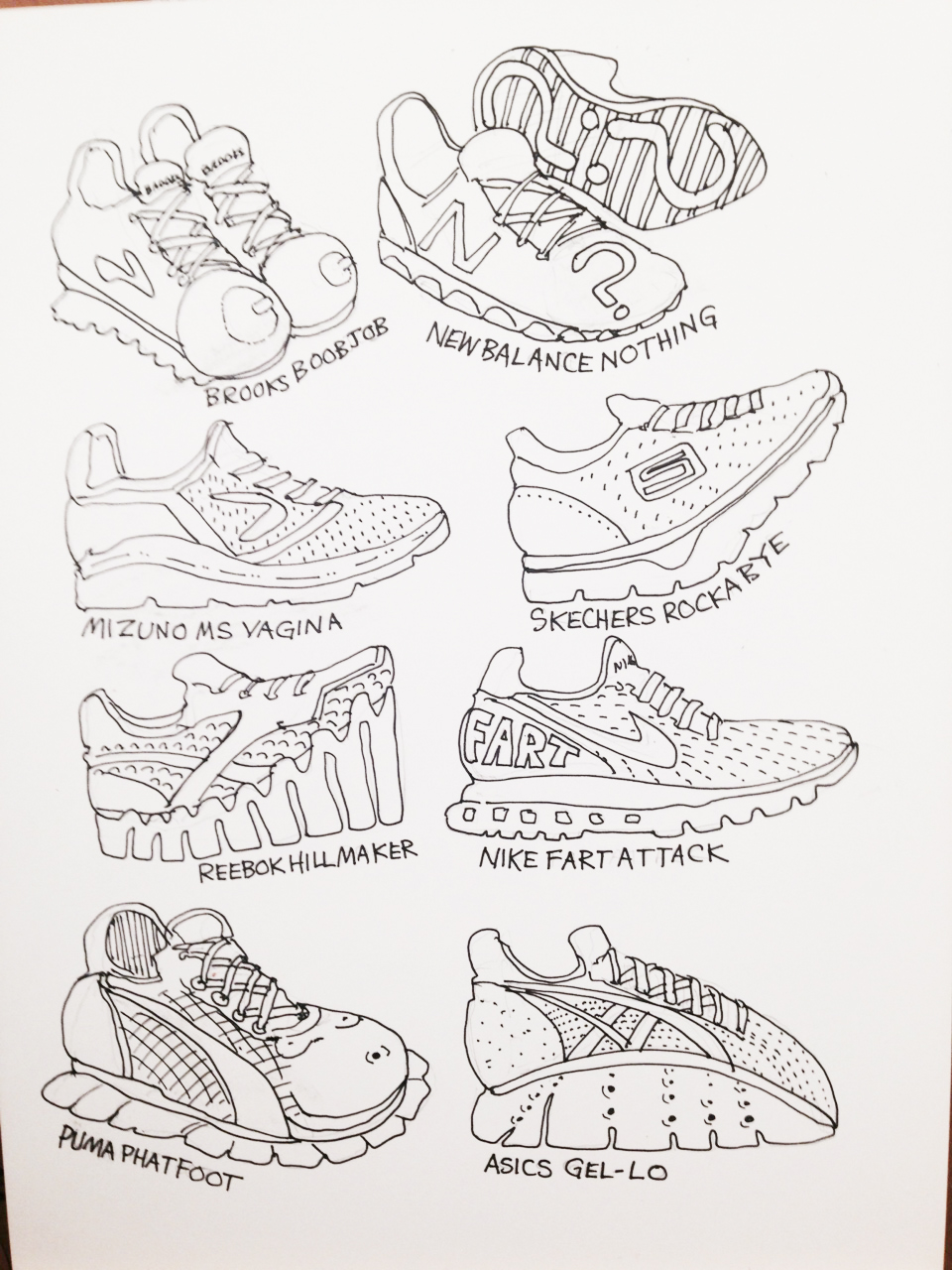
That’s it so far. No other manufacturers have allowed us to test their Super Secret models so far. But here’s a summary photo of the models we tested, just in case you forgot what we said about them.

Shoes 2014

Posted in Christopher Cudworth, We Run and Ride Every Day | Tagged , , , , , , , , | 6 Comments

Not exactly the Birkebeiner, but cross country skiing just the same

By Christopher Cudworth

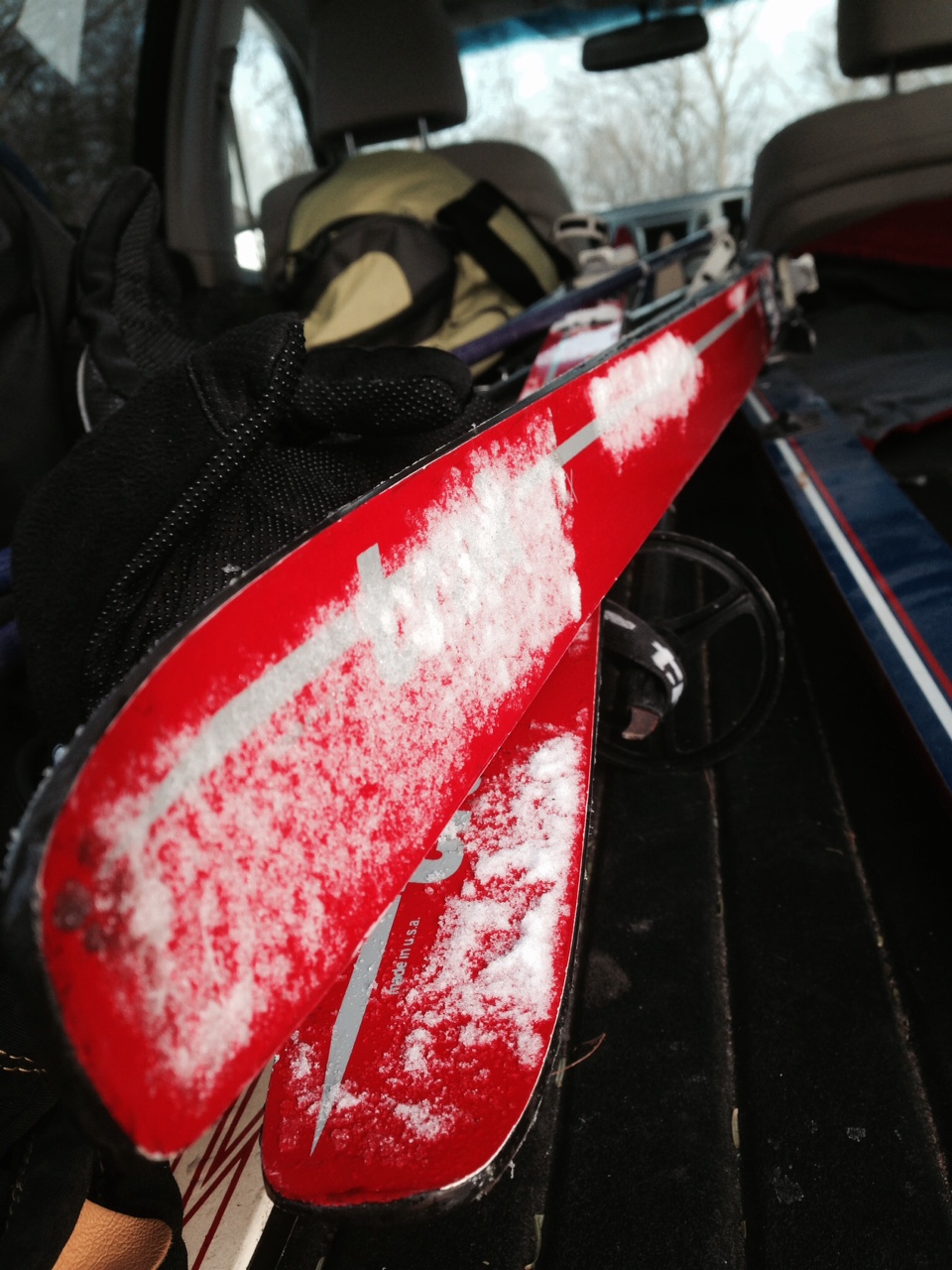
Skis in car On Sunday morning, my companion up and announced that we should go cross country skiing that afternoon.

Conditions were perfect. Sunny skies predicted. Temperatures in the high 20s. Newly fallen snow on groomed trails at Herrick Lake.

First she had to finish a cycling Computrain workout that started at noon. Her legs were going to be fried. We’d also run 10 miles together the previous day in 7 degree temperatures. So I was in the mood for a recovery workout. So was she of course.

Skiing at the speed of light

We set out wanting nothing more than a nice experience together. Her shoulder is still coming back from rotator cuff surgery. Fortunately mild skiing does not strain the shoulder. You simply push along with the poles angled back and be careful not to fall.

Easier said than done sometimes. She bought it on a small downhill but had sense to slide to the side and use a butt roll for safety.

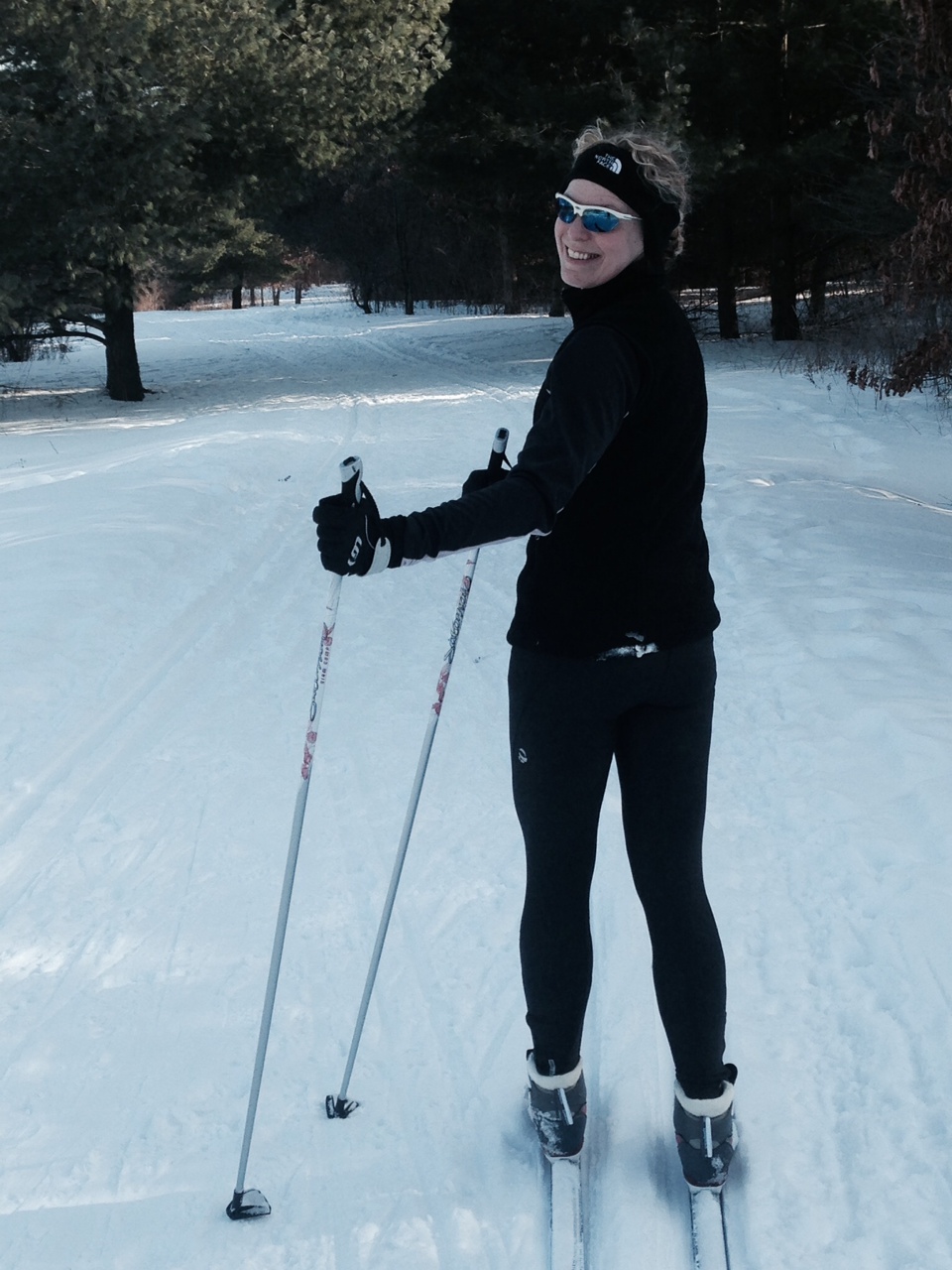
Sue Astra skiingWe rolled along the trails studying the light between the trees at Herrick Lake Forest Preserve in DuPage Country. I pointed out the fact that the snow in footprints actually appears lighter than snow on the surface. We stood together looking at that play of light and heard a barred owl calling in the distance. The afternoon light was getting softer, more purple around the edges. We were glad to be back home after an easy 5 mile ski.

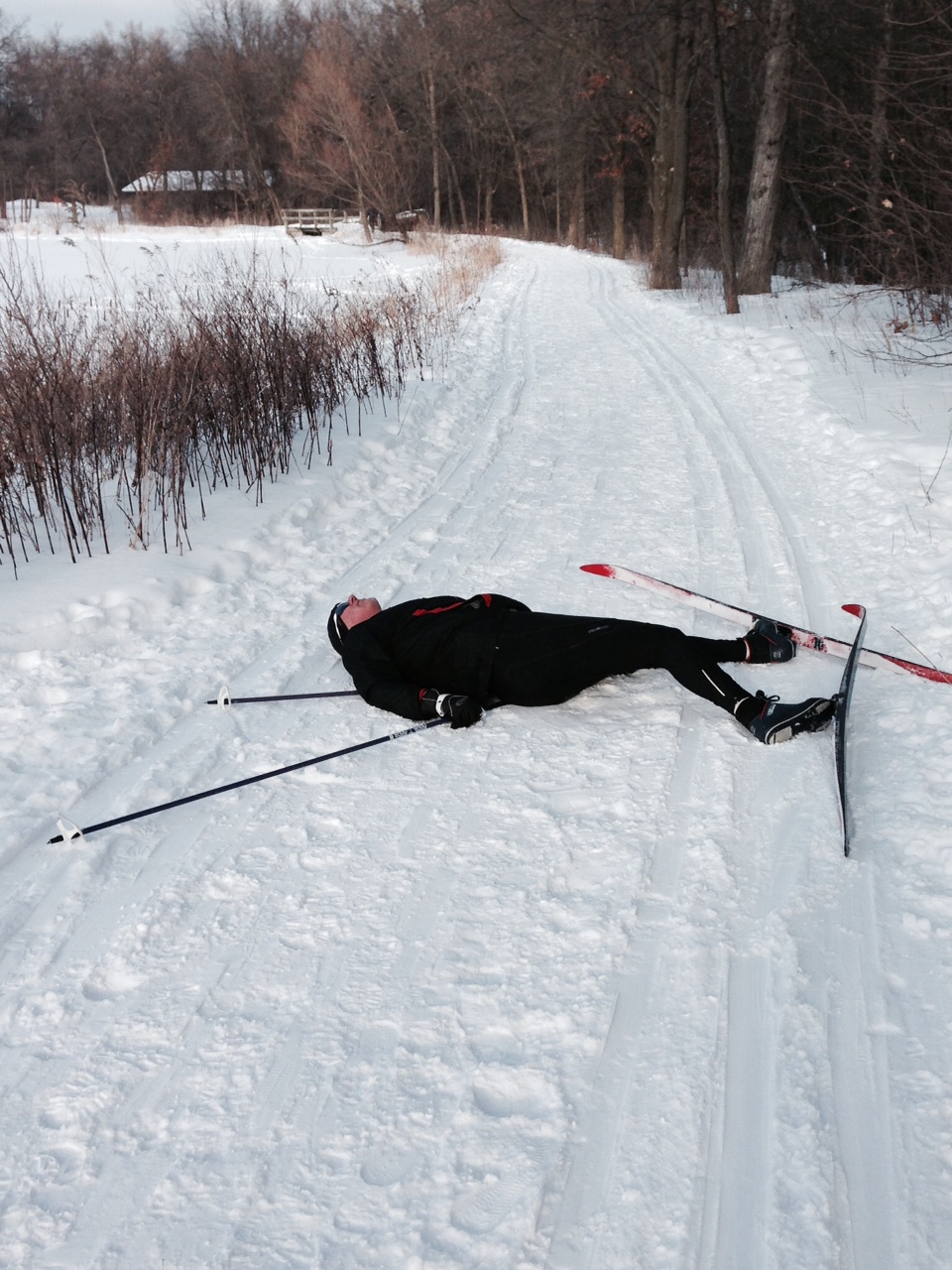
At the end of our ski I also did a classic “reach for the boot” to adjust it and fell flat over. Once you’re tipping on skis, there is no real turning back. It is much like being clipped in on a bike. All that weight up around your head and shoulders has to go somewhere once you lose your balance. Down you go.

Humbling enterprise

A few years ago I jumped in with my serious skate-skiing buddies and headed to southern Wisconsin. They lent me a set of skate skis and took off down the trail. I set up to go and…nothing. I’d forgotten almost everything I’d ever learned. They were already 50 yards up the trail when one of them turned around and waved at me to pick it up.

I waved back. “Go on ahead,” I said. “This is going to take a while.”

Trying to pay attention to what they told me took real mental work. Skate skiing is almost counter to all your instincts. You rock a bit when skiing, and push off with your knees and feet to propel yourself forward. And considering that I have spent an entire running career concentrating on good form that includes pointing my toes straight forward for maximum efficiency, the idea of pointing my toes out while skiing just feels wrong.

Ski FailAnd it wound up wrong too. About a half mile into the first lap I tried to pick up the pace and things went all to hell. I not only fell, I fell hard. The sunglasses tucked so carefully in the front pocket of the Pearl Izumi cycling vest I’d co-opted for skiing took the brunt of my fall. Those glasses got crunched.

Casual observers

I lay there in the snow wondering how to untangle my skis when along came a band of those fit-looking characters you find all the time in Wisconsin. From the age of 26 through the age of 66 they have the same chiseled look about them, with perfect shoulders and calves, and just a touch of grey at the temples. It never gets grayer and it never goes away either. I’m rather convinced there is a spa somewhere in central Wisconsin where athletic residents go to dip themselves in water rife with sandstone to keep their bodies perpetually young.

Anyway, these guys took one look at me carving Hell’s Angels in the snow with my skis and stopped. “Are you alright?” one of them asked.

It did not look like I was alright. I know that much. There was a big chunk of snow stuck under the left side of my cap. I think one ski pole was officially sticking out my ass and the other once went from ear to ear.

“Yah, I’m fine,” I said back, trying to sound like a local.

Silence. “Are you sure?” the guy asked again.

I laughed, my face so close to the snow that I probably woke up some snow fleas, thinking it was spring. “Fine, yes,” I said. “I’m new at this.”

Snowincarnation

The rest of them skied past without looking. They did not want bad snow karma to wash off on them. They were probably skiing for the next four hours. That’s what skate skiers do. They ski until they literally disappear into the winter mist like a ghost. Then they are reincarnated the next day in time for work.

I used up several lives lying there in the snow. It took me five minutes to get up. Something hurt, but I did not know where. It was like taking one of those finger tests where they have you clench your fists backwards and then they point out a fingertip and say, “Move this one.”

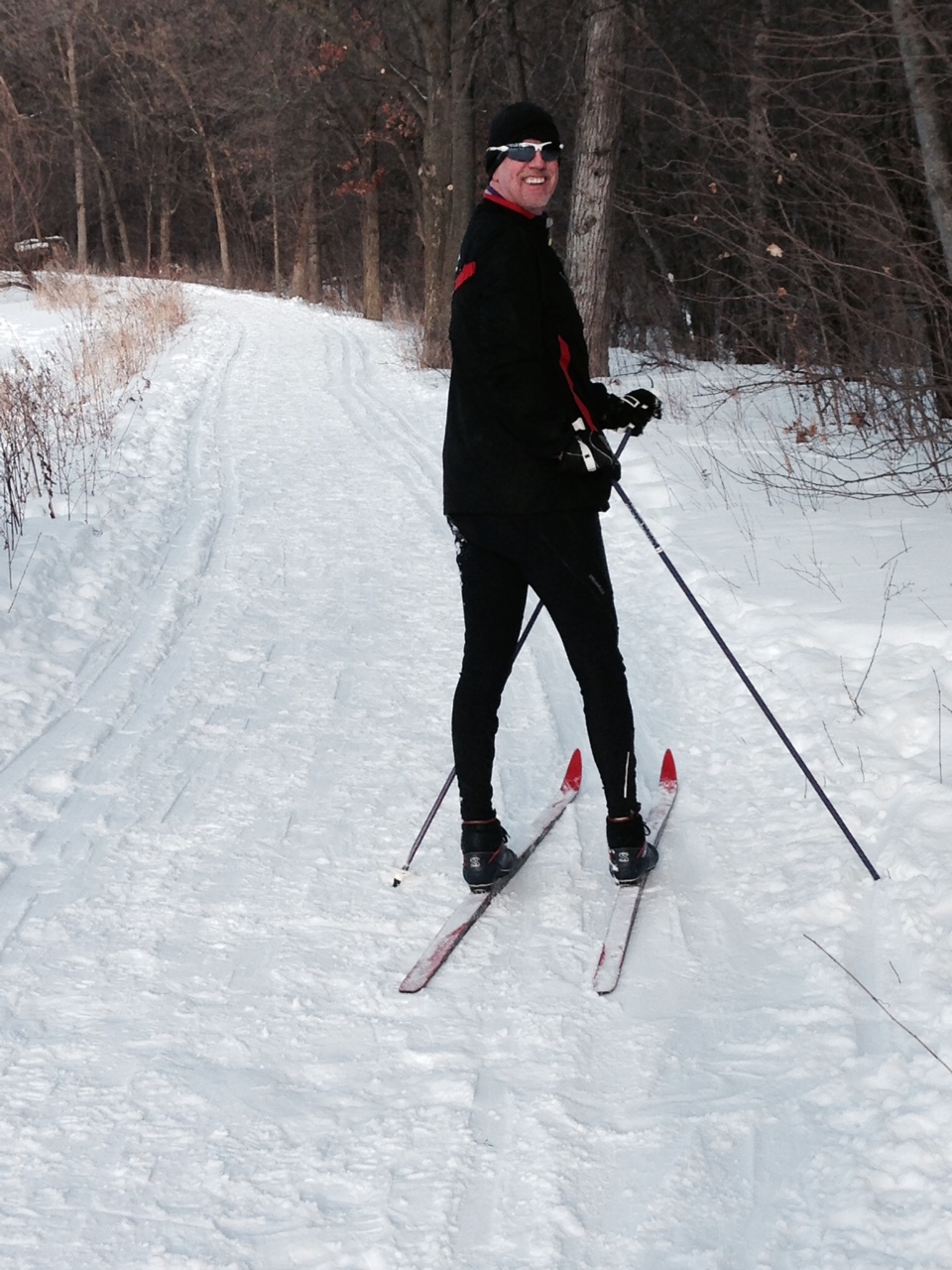
Sue and Chris SkiingBut you can’t. Your mind does not want to talk to your hands at that moment.

And that is why I currently still view cross-country skiing as an activity, not a sport. I can ski classic pretty decently, and have skied up to 15 miles. But skate skiing still eludes me as a sport. Maybe next year.

Sport versus activity

And like I just said, at least in-line or Classic cross-country skiing is not so difficult as skate skiing. My two best friends are excellent skate-skiers. One is doing the Birkebeiner® (or Birkie) this year. In fact they’ve both done it many times.

The Birkie is way more than a simple ski race these days. There’s a 50K Birkebeiner® Skate race. There’s a 54K Birkebeiner Classic (Inline) ski race. There’s a 23K Kortelopet and a 12K Prince Haakon. I presume that’s the race for people with bad chest colds.

It’s all held February 22. Hey, that’s this weekend! Guess I better start getting in shape if I plan to ski the Birkie this year!

People I know have done it on even less training. Just like marathons, there are always nuts who get out there and compete with little or no training. They trust their bodies or else just flail on through. What pisses you off sometimes is how well they do. People train for months to run a 4:00 marathon and then some joker with thick calves, a beer gut and a bad pair of shorts goes out and does 3:56 without running a step in advance. You ask them how they did it and they say something stupid like, “One foot in front of the other, bro!”

You secretly wish they would die right in front of you. Yet you must up the courage and politeness to say. “Nice job! Very impressive!”

Then you go drink yourself silly. Because there is no real justice in this world.

Alternative Birkie events

But let’s say you don’t really like skiing at all. You like biking in the winter instead. Then you should sign up for the Fat Bike Birkie March 8. In fact that race has been designated the Fat Bike National Championships.

Where is all this Birkie stuff held, you might ask. In the far north woods of Wisconsin, I might answer. Hayward, to be exact.

Me SkiingSo if you’re feeling frisky the last couple weekends of February into early March, and you don’t mind driving to where the roads end and the northerly version of Honey Boo Boo proudly resides, head on up to Hayward, Wisconsin for a Birkie of one sort or another.

I’ll be home skiing safely round the 5-mile loop at Herrick Lake this year. I’m already cycling, running and now swimming these days. For now I view cross country skiing as an activity, not a sport.

WeRunandRideLogo

Posted in Christopher Cudworth, We Run and Ride Every Day | Tagged , , , , , , , , , , | 2 Comments

Running at the speed of life should not mean you leave your past behind

by Christopher Cudworth

Learning to turn even bad things in the past into good experience is the art of life.

Learning to turn even bad things in the past into good experience is the art of life.

In the television show LOST, all the main characters learned through hard experience that the past really can catch up to you. The mind-bending mixture of time travel juxtaposed with the consequences of short-term choices made plenty of people think harder about the present and whether the past could indeed catch up with you.

If we have done something bad in the past it can still be forgotten over time. We learn to forgive ourselves somehow or another. Or Jesus does. The past does not need to catch up with you for every wrong you’ve ever done.

But what about the things you’ve done right in the past? Do you need to forget those too?

Passing on the past

IMG_8216Some people seem to think so. They no more want to entertain discussion of the past than they want to have their teeth pulled without painkillers. Some find the past insufferable. Even the recent past. Insufferable. Don’t bother them with things that happened an hour, a week or 50 years ago. Those things are behind us. Tell me what’s happening now. What’s going to happen next? Tell me my future, if you can. Now that’s interesting.

Of course it is. The unknown fascinates us while the seemingly banal, ever present reality we face every day loses its luster so quickly we resort to virtual reality to entertain ourselves. It’s a very sad way to live. Yet it generates billions of dollars for those who know how to exploit it. Our shallow desires for stimulation and fulfillment.

Even business seems to have a problem with the past. Specifically, business does not seem to like the fact that some people have a past at all. Job candidates are warned to show no more than 10-15 years of job experience. The rest is just baggage. The experience you’ve worked so hard to earn is recycled into dust.

Besides, what value could anything that happened 25 years ago have to do with today? 

Strange that conservatives claim to love business so much when business seems to hate personal tradition and experience while venerating sometimes naive enthusiasm over experience. They would rather pay less for that and show a short term profit than compensate for better thinking.

Three Speed Yet the other end of the spectrum is true too. Kids coming out of college are told they need 2-5 years of experience to start a job, yet no one will credit them their studies and internships and sacrifices as “experience” worthy of consideration for a position. It’s a Catch-22 and a tarsnake of ugly proportions. Enough to make you think that business itself has some sort of mental flaw that makes it impossible to think clearly about time, tradition and potential.

Ageism at all ends of the spectrum is now a cultural norm in business. It is considered a job-seeker’s sin to list your age if you are over 40 years old. Yet the kids are getting beaten up too. What’s the point here?

It’s called laziness, actually. Sure, the euphemism is that the job picture is now ruled by a “buyer’s market.” But really it comes down to respect for time and past of a person asking for gainful employment. There’s simply not time to think about all that, so it’s easier to dispense with experience and hire based on a bunch of search terms and a perhaps  dehumanizing interview process. It’s a system with as many flaws and broken parts as the health care system, yet no one seems to be talking about it. Hiring is the province of a million businesses large and small. There are literally no standards of operation except those strange perceptions that float around in the news whenever job numbers are reported.

Steve Jobs of Apple was 56 when he died of pancreatic cancer

Steve Jobs of Apple was 56 when he died of pancreatic cancer

Supposedly it is about relevant experience. Yet you cannot be President of the United States until you are past the age of 35. More commonly our Presidents get elected in their 50s or 60s, even serving into their 70s, as Ronald Reagan once did. Many people consider Reagan the most beloved President in the last 50 years, yet his model of seemingly youthful exuberance is apparently lost on the business types who revere is economic policies yet ignore his example of working during his senior years.

In fact it is President’s Day here in America. Men like Abraham Lincoln, George Washington, Theodore Roosevelt and Franklin D. Roosevelt are celebrated in our nation’s history. But not because they were necessarily more vital in their constitution (or Constitution, as it were) than the average human being. It was their ability to overcome their collective flaws that made them great. FDR led America through the most massive war in history while sitting in a wheelchair. Abraham Lincoln fought the mental illness we call depression. One could argue that their flaws and yes, their age were immense benefits in making them the leaders we needed at the time.

Should we not be asking the important question here? If Ronald Reagan and other presidents had something to offer society, should we be dispensing with millions of experienced people simply because they turned 50 or 60 years old? Was Steve Jobs all “used up” at age 56 when he died of pancreatic cancer? Hardly. There were those on Wall Street who thought Apple would collapse without his genius. They are the stupid sharks of short term profits. The vision of the man is what counts long term. He inspired others to think and believe as well. At times like these we should tell Wall Street to shove it.

Dealing with time

Time is both relative and omniscient, if you know how to live right. The experiences each of us has in our youth can contribute in great ways to understanding and even predicting the future for each one of us. And as a society, our collective memories are necessary to recognize the flaws in short-term thinking that so often fall powerful enterprises that are so often focused on short-success. The next quarterly profit report.

If we constantly find ourselves defending the past and the value of our experience, how can we account for the brilliance of great literary talents who draw on the past or even set their works in a time period in order to frame it in a relevant context.

There are cultures in the world who do not view time as we do in Western Culture. They see it either as a continuum or a circle upon which we are all moving. There seems to be a sense in that. We all know that those who cannot remember the past are condemned to repeat it. So if some of us take pride in recalling our exploits, both successes and failures, we should not only be forgiven the habit, but given an ear.

Speedy lessons about time and age

A man who runs a 4:00 mile 50 years ago still has plenty to teach about going faster than any human being ever went before. But some people seem slow to pick up on that fact. And that’s where we seem to be today.

It is fascinating, having invested considerable effort in one phase of life to become the best possible runner I could be, to look at the efforts of those now trying to do the same, and at any age. I believe there is plenty to offer those people. How to avoid injury. How to keep from getting sick. What workouts sharpen fitness or build endurance?

Much of that basic stuff will never change. So what if it was done 30 years ago? If the times one ran 30 years ago are still faster than 99% of the people who run today––the empiric results of time and distance prove that––then the experience of one person is still relevant to almost every situation.

I know several people who worry that their relevance has diminished. Their careers seem to be swimming sideways as a result. But I seek to tell them they have much to offer the world. Our presidents prove that time and again. So do people who reinvent themselves, and who take up a sport like swimming, riding or running (or all three) to prove to themselves they are not all used up.

None of us are. Don’t listen to the world, because the world and business and even religion often don’t know what the hell they are talking about. Every time you put one foot in front of the other, you prove them wrong. Now go out and do it. We Run and Ride for all the right reasons.

WeRunandRideLogo

Posted in Christopher Cudworth, Tarsnakes, We Run and Ride Every Day | Tagged , , , , , , , , , , , , , | Leave a comment

Would you run or ride 1000 miles for water?

By Christopher Cudworth

2166c17Justin Ahrens is the Principal and Creative Director for his own marketing agency, Rule29 in Geneva, Illinois. The company’s objectives are simple and upfront as stated on Justin’s LinkedIn profile:

“Justin Ahrens’ passion for life is rooted in his creative firm’s commitment to “making creative matter®”. For over 10 years now, Justin has led Rule29 in their commitment to both great design and helping others think differently about the world around them. Through a collaborative approach in both strategy and design, Rule29’s culture is just as important as the work. This is particularly evident by Rule29’s involvement in numerous social causes, including their substantial work in Africa. Justin has also been a consistent voice for the design and business community as it relates to balancing life and career (For more on this check out his book – Life Kerning™: Creative Ways to Fine Tune Your Perspective on Career and Life).”

Life In Abundance

Life Changing

Recently that philosophy on pushing your life and work in a different direction to make a difference brought Justin to a point that is both a reconciliation and a challenge. Over the past few years his work with a project called Life In Abundance changed his life in significant ways. Justin traveled to Africa and learned some filthy, gut-wrenching truths about poverty, and what you can and cannot do about it on the spot.

But rather than producing despair, those experiences encouraged Ahrens to invest further in the process of innovating ways to make the world a better place.

Lifewater

That is how he came up with the idea of working much deeper with his non-profit client Lifewater, an NGO dedicated to bringing drinkable water to people around the world.

Lifewater Kids

Image from Lifewater website

As his company worked collaboratively to generate an all new brand presentation for Lifewater, it occurred to Justin that his call to act on behalf of the cause might involve something more than building a website and thinking through the brand.

As his mind percolated on that, there came about an opportunity to speak at a conference in Boston, Massachusetts. That’s when Justin began to literally “connect the dots” in terms of what he wanted to do to raise awareness and money for Lifewater.

The Riding Life

Justin Ahrens is an avid cyclist whose riding career began a few years back when he wanted to lose weight. Earlier in life he’d been an athlete with a goal of playing football in college. But a torn-up knee on the second day of practice at Division III Illinois Wesleyan ended that vision. Yet it opened up time to study design and be guided into the career he now lives and loves. There’s a bit of spiritual recognition looking back, that his goals may have been altered but his mission was defined.

Yet he’s human, and immersion in business can easily put a few pounds on your frame without looking. So Justin rode 80 lbs. off his body despite what could be a bum knee and now he’s looking to do more with his cycling.

An Idea Come Alive

Boston to ChicagoThis spring he and a fellow creative, Brian McDonald of Wonderkind Studios will ride from Boston, Massachusetts back to Chicago to raise awareness for Lifewater and specifically, to raise money to provide water in an impoverished region in Uganda.

But first, some theatrics. “I was hoping to peel off my speaking clothes and reveal my cycling gear underneath,” he laughs. “But the schedule did not quite work out that way.”

Effectively he will still do that. He and McDonald will be trekking a still-to-be-determined path between Boston and Chicago, a ride of perhaps 1100 miles. “We’ll do about 80-100 miles a day, but we hope that schedule also gives us time to do a couple lighter days and meet with people.”

The trip will be called Wheels4Water. Here are links to all the ways you can help.

Wheels site: http://wheels4water.org/
Donate: http://wheels4water.org/donate/
Give miles: http://wheels4water.org/donate/give-miles-2/
Corporate sponsor: http://wheels4water.org/donate/be-a-sponsor-2/

There’s also a video about the trip.  http://vimeo.com/86114192

Participating partner agency: Wonderkind: http://www.wonderkindstudios.com/

The Lifewater Way

Lifewater Kids too

Image from Lifewater website

Along the way, the riders will be filtering their own water from natural sources to illustrate the availability of water if you can treat it properly. “It costs Lifewater $40 to provide water for life for one person,” Justin explains. “It’s a question of eliminating water-borne disease from the water source.”

The Lifewater website stated “Investing in rural water development is the most effective way to alleviate poverty.”

Living Water

In so many ways the convergence of thought in such statements is anchored in truths deeper than any well. The Christian mission behind Lifewater is brought to life in “living water,” which serves as both a practical and spiritual resolution to help others.

That is why Justin Ahrens is riding 1000 miles for water this summer. It’s an opportunity for education and an expression of commitment that has become his life’s philosophy. That is also what he hopes will come true in the lives of others, that people will be moved to commit to their own causes, and in their own way.

It’s a little understood fact in this world that creative people are some of the deepest thinkers on the planet. They care, and sometimes they smolder in that concern for the world and don’t know exactly how to act on it. But for Justin Ahrens, bringing the power of creativity to the fore and inspiring those who were or are stuck in cubicles is a great example that the world is out there waiting for one more creative turn, and the commitment to make it happen.

So get out there and run or ride (or swim!) your way to doing some good this year.

WeRunandRideLogo

Posted in Christopher Cudworth, We Run and Ride Every Day | Tagged , , , , , , , , , , , , , , , , , , , , , , , , , , , , , , , , , , , , , | Leave a comment

10 things that I plan to do on the bike this year that you might like to consider too

By Christopher Cudworth

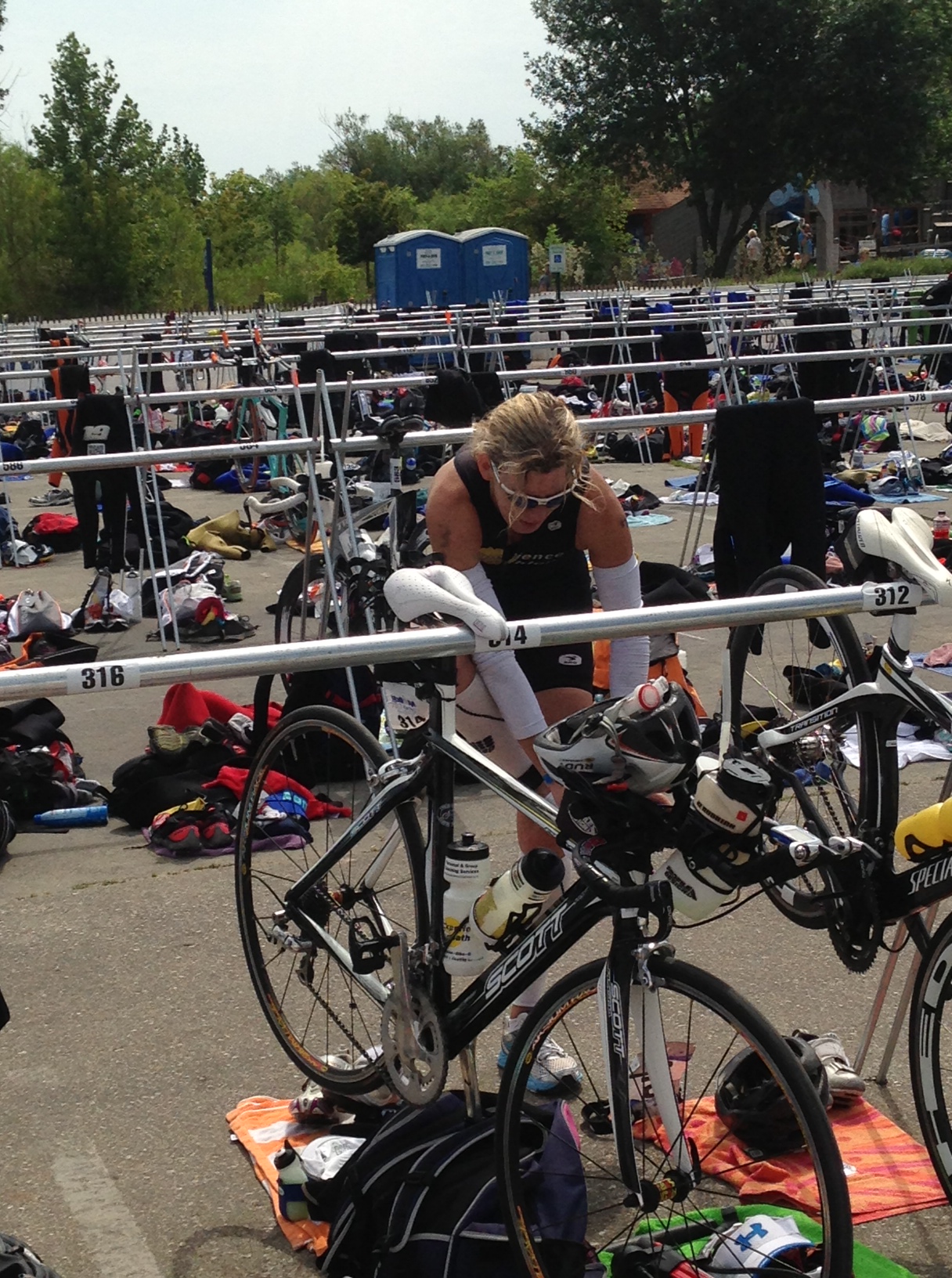
One of the new things I'll do on the bike this year is race a triathlon.

One of the new things I’ll do on the bike this year is race a triathlon.

This is essentially my 10th year of what I’d call “serious cycling.” In 2004 I was riding a Trek 400 steel frame road bike and not getting much faster. It was a tremendous accomplishment to average more than 18 mph for a 30 mile ride on that bike. It simple wasn’t set up to generate that much speed.

Yet the foundations for successful riding were being built even on that bike. Some of those foundations have been ignored to my detriment. Here they are, with an explanation of how they can help you become a better rider.

#1. Try new things in terms of distance and types of riding

When you start out in cycling, everything is new. As you grow in ability, you need to seek out new things in order to keep growing in your strength and endurance. If you’ve never done a criterium, give it a go. Same goes for road riding, or centuries. Choose something new to do this year.

#2. Ride with people better than you

With a few years under your belt it is easy to fall into a pattern of riding with people you know and trust. But that makes you too comfortable and can actually hold you back. When you choose to ride with better riders on a regular basis, you are neither limited by your own expectations or hemmed in by theirs.

#3. Go for the long and short of it

To grow as a rider, you must learn to vary your riding style in  terms of terrain and pace. Start the year by going for really long, slow rides by yourself, and don’t hurry. Just build time in the saddle. During the work week you can jump on your bike for a one-hour ride and not feel guilty for pedaling a little faster. That’s faster, not harder. Spin like the devil and keep your cadence above 95 for an hour. Teach your legs tempo and down the road you’ll be happy for it.

#4. Fix your diet a little bit

We all eat too much crap. Supplanting even 10-20% of our diet with better foods in the veggie and lean meat category is far better than filling those hunger gaps with carbohydrates and sweets.

#5. Assess your gear and protect your rear

So many of us cyclists store up gear that we rarely use. It’s important to determine what works best for you on your bike, then take care of it. Be diligent in your washing and drying routines, taking care to protect your best gear from accidental over-drying. But always, always change out of your gear as soon as you are done riding. Even the best equipment is no good for you once you’re done riding. 20 minutes in wet gear for coffee with friends is okay. After that, get out of your wet stuff and save your rear, and other body parts.

#6. Plan at least one destination ride

DSCN0731Riding from one clear place to another can be great fun. If someone you know is “heading west” and can drop you off for a 60-mile ride back home, toss your bike in the trunk and ride your way home. It’s an adventure, and fun to capture on your camera. Obviously let people know where you’re going and when you’ll probably be back. Carry a phone and a Road ID in case of accident and be sure to have ready food and water supplies along with some cash for stocking up if things take longer than you think.

#7. Enter a race

Even if you get cooked in the first few laps of a criterium, the sensation of lining up with other cyclists is a thrill, and the dangers are really overplayed. Even criterium racing typically levels out in a lap or two. Then it’s a question of finding a draft and staying alert.

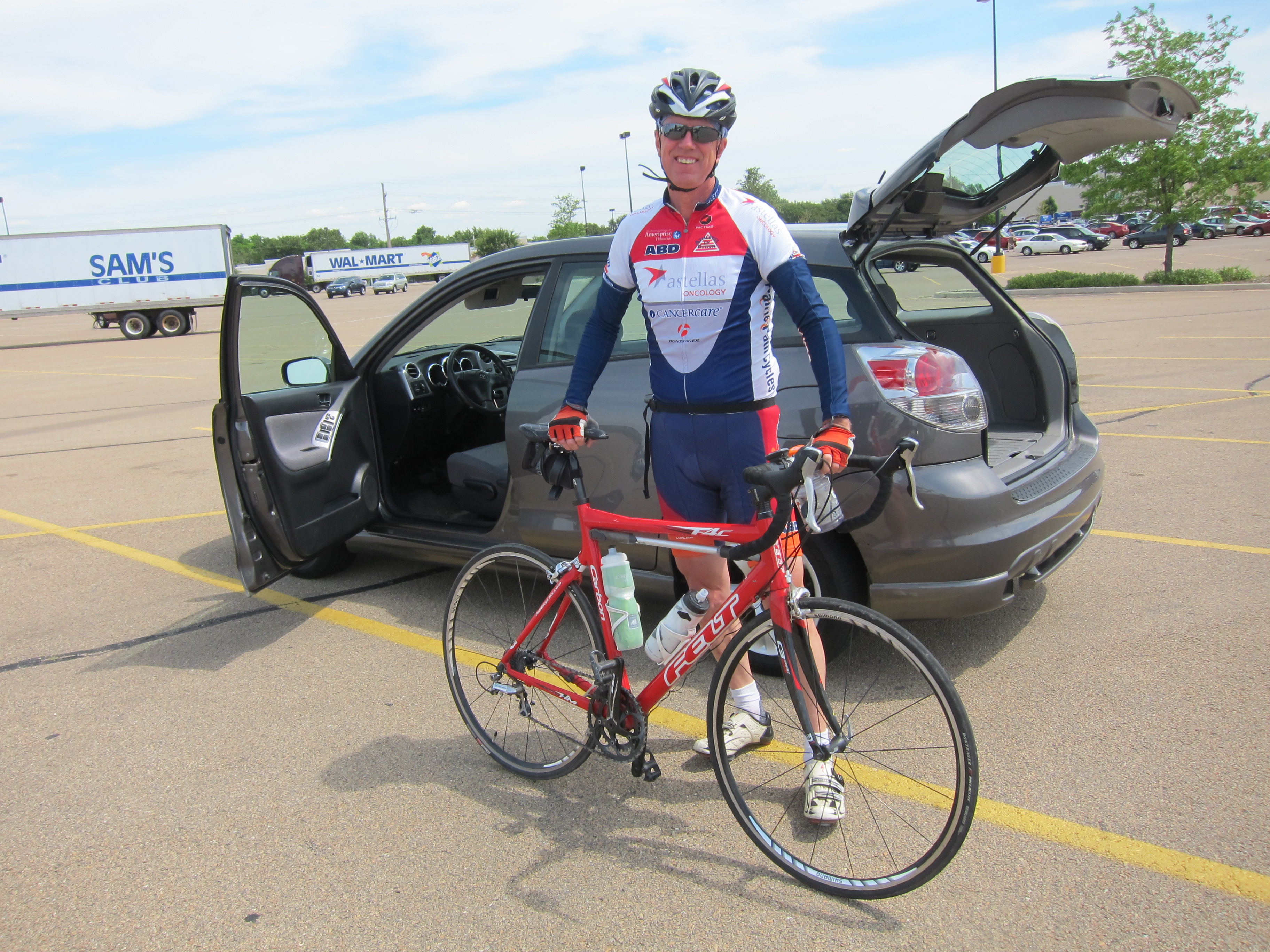
The Felt 4C Red Rocket has been a faithful training partner. Really.

Getting ready to race at a criterium or taking it on the road for a destination ride are great ways to vary your cycling. 

Many regions now host “practice” criteriums where you can test your riding ability in a variety of categories including CAT 5 and Master’s races. But be advised, many of the Master’s Races are far faster than the lower category races. I averaged 23.5 in one CAT 5 Criterium and 26.8 in a Master’s race before getting dropped after 25 minutes. It’s all fun.

#8. Go somewhere new to ride

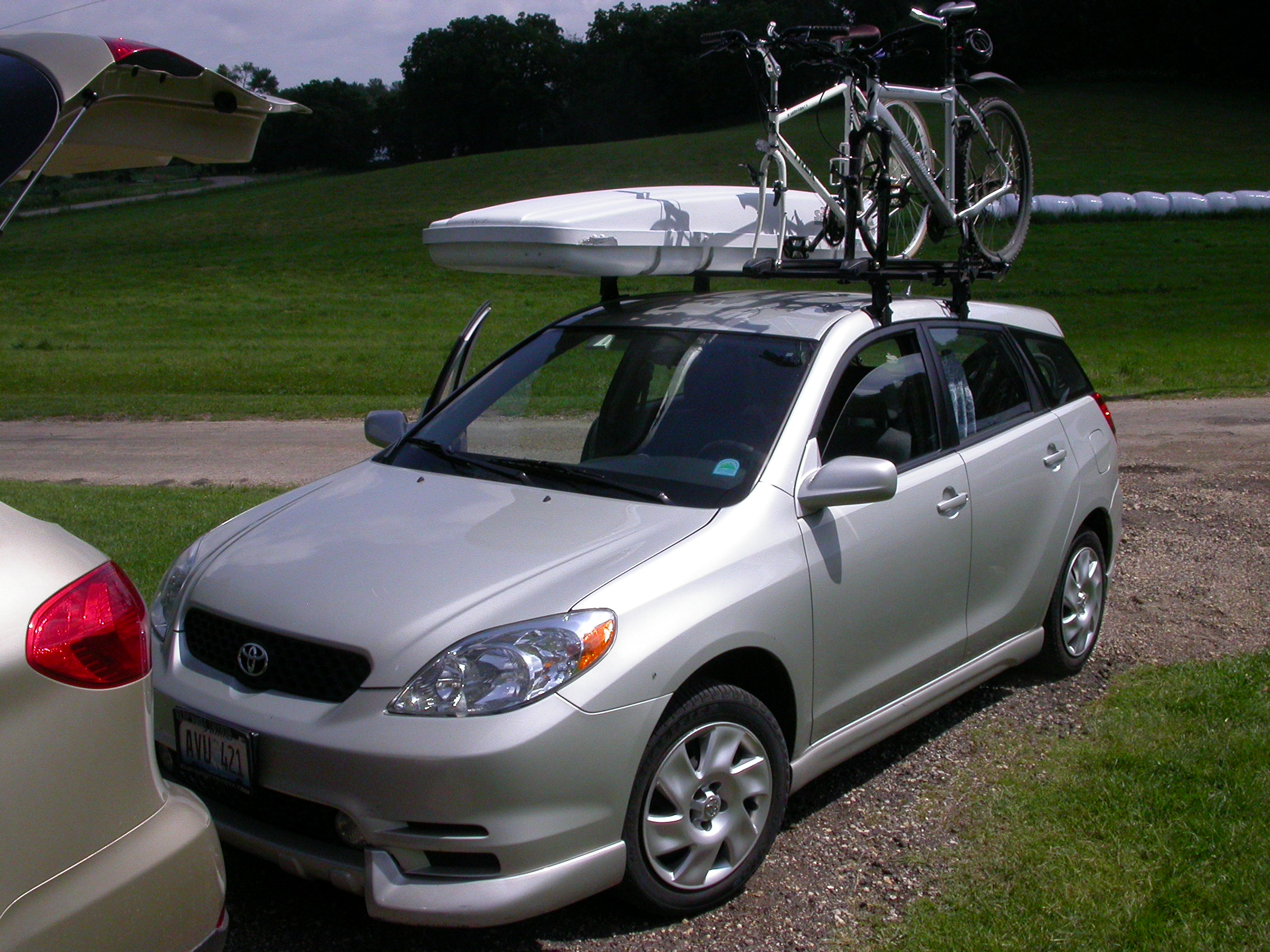
It sounds simple, but throwing your bike in your car and planning a ride in a new location is really critical to breaking up your riding year. You should plan to do an “away” ride at least once a month from April through September. The riding season in Illinois is not much longer than that, so we try to make the best of it.

My buddy Monte is going to make a comeback this year.

My buddy Monte is going to make a comeback this year.

#9. Bring someone new into the sport

Helping someone else learn to ride is a great joy. You need to be patient and keep the distances down at first, yet shared riding and the progress you’ll see in others is one of the great rewards of cycling.

#10. Be grateful

There are so many great things about cycling that we forget. Even the dullest scenery changes with the seasons. Getting out early to ride is the ideal way to experience the world in a new way, every day. Being grateful for the ability to ride gets you through the tough days too. When it’s windy or cold or wet, you can always think aloud, “It’s still better than…_____________ (fill in the blank.)

It’s going to be a great year for riding if you get out there with a new plan in mind.

WeRunandRideLogo


Posted in Christopher Cudworth, We Run and Ride Every Day | Tagged , , , , , , , | 10 Comments

Pills

Pills verticalBy Christopher Cudworth

We run and ride to get healthy.

But sometimes that’s not enough.

We get sick. We go to the doctor. Or the pharmacy.

Then we take pills. They heal us sometimes. Cure a fever. Stop a cold.

We also take pills for sustenance. Vitamins. Minerals. Herbal supplements.

Some people believe that makes all the difference.

The pills don’t say a word. Down the hatch. Dissolve. Chemicals release.

You feel better? Someone asks.

tornadoPills for depression and anxiety can have side effects far worse than the conditions they are created to ease. If you’ve ever been in that situation, you know that pills can be unsettling.

Pain pills can be addictive. They keep you from acute discomfort and then numb your mind with their achingly narcotic pull.

Innocent pills. Guilty pills.

We start when we’re small with St. Joseph’s aspirin. Small orange pill. You can chew it.

Then we learn to swallow pills. First we barf them back up.

Some religions don’t take pills. Christian Scientists pray for everything a pill can do.

Athletes take pills to produce performance. Steroids. Amphetamines. PEDs.

Three SpeedDo pills make us better people?

Do pills make people better?

If you don’t take the Pill, you might make a new person. Whether that is better or not depends on whether you expect that outcome or not. Pills are the tarsnakes of the human mind.

That’s true with all pills, it seems. We take them to help us get through life. Through a run. Through a ride. Through a swim. Through a triathlon.

Through a test. Through a divorce. Through a marriage. Through trials of any kind.

It’s all about the pills. Or is it?

Those who benefit from pills are grateful for the help. They put air back in our tires. Help us cope with a senseless world. Calm our overanxious nerves. Help us ease pain from training too hard.

If you can take all the pills that someone else was supposed to take and gather them in one bottle, as I did after someone I loved passed away, it makes you think.

Are we all just a pill away from sanity or safety?

They are remarkable inventions, in any case. One cannot argue for or against them and be right. It all comes down to circumstance and the choices you make.

Yet to “be a pill” means making life harder for someone else. So go figure.

And every run, ride or swim we make is like a pill. It changes our head. Forms our body. Releases endorphins. Buys you time. Or spends it well.

We run and ride for all these reasons. And to avoid taking any more pills than necessary.

For the most part.

WeRunandRideLogo

Posted in Christopher Cudworth, Tarsnakes, We Run and Ride Every Day | Tagged , , , , , , , , , | Leave a comment

Sometimes we all need a good swift kick in the…

By Christopher Cudworth

BootOn my way out of the health club this morning, there appeared on the driveway a lonely boot, right side up on the asphalt, looking a little lost and a bit forlorn.

Down the street and around the corner I noticed its partner. It was going to be a long day for someone in the trades, it looked like. Working all day in your sneakers is not the best thing to do in a winter this cold and rugged.

I empathized with whatever dude left his boots on the top of his truck and drove away. And yes, I’m being cliche about this. The boots were big enough and broken down in such a way that they gave away the fact that the guy who wore them was likely, big, rugged and forgetful.

We’re all forgetful at times. At least those of us who are human. I left my first new pair of swim goggles hanging on the shower knob the first week of my swimming workouts. They were nice goggles too. Paid $24 for them at Dick’s. They fit well and didn’t fog up, which I’m learning is not true of every pair of swim goggles you buy.

So when I got home and realized I’d left them at the club I called up there and asked them to look for them. But too late. The next day I asked at the desk to see if someone had turned them in. No go there either.

Which raises the question: What kind of Club Creep keeps your swim goggles? Wouldn’t you turn them in at the desk if you found them? I certainly would. So some joker is swimming now in my goggles, which is wrong.

I once worked out at a club where a Major League Soccer Player from the Chicago Fire did his workouts. One day he left a pair of really nice soccer shorts behind in the locker room, which was used by very few people because the club was mostly used for rehab clients and wasn’t so much used for the general public.

I thought for a moment about keeping those shorts. They were really nice material and I was playing a lot of indoor soccer at the time. Having an authentic pair of Chicago Fire uniform shorts might have been sweet.

But then I thought about that player, and what a nice guy he was, because I’d met him several times and had seen him play. He was a class act. I thought about the fact that even pro athletes value their stuff. For all I knew those were his “magic shorts” that were helping him get back into shape after an injury.

Plus I value honesty. So I kicked thoughts about keeping the shorts out of my head and took the shorts up to the front desk, where they thanked me. Because everyone liked that player. And that made me felt better about myself the rest of the day. Besides, had I kept them, karma would surely have paid me back.

Loves and losses

Over the years I’ve had my own share of equipment stolen. A pair of blue suede adidas shoes I cherished got stolen from a track meet back in high school. Then after college a nice Frank Shorter training jacket got stolen from my car in Minneapolis.

In every case however, you could argue that my own negligence contributed to the thefts. To avoid theft in this world you have to be diligent. Not everyone has scruples. Some see stealing as the real game in life.

Sometimes we make it too easy for thieves to act. We leave our valuables unlocked in a locker, or we leave our swim goggles hanging on a shower handle. Stupid me. I deserved that.

Kicking your own ass

treadwaterIn a way you have to kick your own ass in those circumstances. Either learn from your mistakes or you lose stuff all the time.

Get organized. Establish a routine. Don’t leave valuable stuff where it can get stolen.

Because in the long run, we have to kick our own asses in other ways as well. If you’re not diligent with your stuff and are sloppy in your routine, it will sooner or later show up in your workout or racing plans. When you forget equipment for a workout, like leaving your cycling shoes at home when you drive to the start of a distant group ride, there’s no turning back and no real solution. You’ll be very lucky if someone has shoes and cleats that fit your feet and your bike, right?

And if you lock your racing shoes in your car just before the start, as a friend once did, it can be tough to get them out on time.

That’s why that boot on the road reminded me so much of myself. I’ve done stupid stuff like that. I once neglected to lock down the Thule car carrier on my car and it flew open. My clothes wound up strewn all over the road for half a mile behind our car. People passing me by in the other lane pointed and laughed as I walked along picking up underwear and running shorts. I deserved their scorn.

We all need a good swift kick in the arse sometimes. You either give it to yourself in private or someone administers one in public. Take your choice. The former is less embarrassing. The latter hurts a lot.

So give yourself the boot when it counts. You’ll appreciate it down the road whenever you run or ride.

WeRunandRideLogo

Posted in Christopher Cudworth, We Run and Ride Every Day | Tagged , , , , , , , , , , , | Leave a comment

To Answer the Growl or not, that is the question

By Christopher Cudworth

Answer the GrowlThree miles into a nine-mile Saturday morning run, my companion announced it was time for a bathroom break. Fortunately she knew there was a Mobil station along the trail. We’ve had a number of such lucky strokes the past few months. We definitely don’t take them for granted.

While she did her business I stood in the front of the convenience store grateful also for a few minutes of warmth. Temps outside were 10 degrees and light snow was beginning to fall. It was actually a gorgeous day for running.

When you come inside from the clean, pure world of running outside to the necessarily overheated front portion of a junk food store, the senses can get a bit confused. The air feels warm, yet stale. It’s hard to stand still. Sweat forms on your body and you wonder what it will feel like to head back outside.

Shifting from foot to foot I noticed a sign below the tall stack of snack foods forming a wall at the front of the store.

“ANSWER THE GROWL,” it read.

ChipsI’m always hungry, yet at that moment nothing on the rack looked all that appetizing. Fast food is false food, and not what you normally crave during a 1.5 hour workout. Only the nuts were technically edible. Oversalted of course. Possibly laced with preservative or sugar. Plus you pay $7.99 for about 3 ounces of product these days. Nuts are no bargain.

Distanced from the desire for all that junk food by my perspective as an endurance athlete, none of that junk food caused any real appetite. Needless to say, I did not ANSWER THE GROWL.

Isn’t it interesting the difference in appetite and attitude when you’re immersed in what you love to do versus those moments of weakness when you wander into a junk food store during your commute or between appointments?

The person you are when you’re in the middle of a workout is not the same person you are when you’re wandering around hungry and susceptible to the marketing call to ANSWER THE GROWL and eat things that are not good for you.

The watershed is clear. The things that may taste good and satisfy your cravings are often not foods or drinks the support improved performance.

You need to objectify the process. That’s why it was so interesting to see my ownSurveillance image on a surveillance monitor in that store. The person staring back at me was a runner, not a junk food customer.

It’s one of the tarsnakes of a fitness lifestyle. We like to workout so that we can eat what we like. But if we want to work out well, it matters what type of food s we put into our bodies.

We need to be our own surveillance. Our self-image may need to be objective to the point where we can see the runner or the rider or the swimmer in all situations. And when you’re tempted to ANSWER THE GROWL the athlete in you can put a cuff on your wrists and say, “YOU’RE BUSTED. NO JUNK FOOD FOR YOU!”

The only growl you should answer is the growl in your stomach after a workout, and you should be growling for good stuff, not bad stuff.

Of course it’s even tougher for cyclists. When you’re in the middle of an 80-mile ride and the group stops to fuel up, that $20 bill can load up on a ton of junk rather than buying the right kind  of food. The Growl can be your enemy over the long haul, after all.

Again, start to see yourself as an athlete at all times, especially when you’re in the middle of a workout. The sooner you start to do that, the faster you’ll feel the kind of fitness that makes you look good, even in the surveillance camera. Or especially so. WeRunandRideLogo

Posted in Christopher Cudworth, Tarsnakes, We Run and Ride Every Day | Tagged , , , , , , , , , , , , , , , , , , , | 1 Comment

Training journals and success: How planning and chronicling your workouts makes you a better athlete

By Christopher Cudworth

Click pic to enlarge. An outtake from my training journal leading into senior year at Luther College. I met the stated goals because I envisioned them first. Even the social components are important in the life of an athlete.

Click pic to enlarge. An outtake from my training journal leading into senior year at Luther College. I met the stated goals because I envisioned them first. Even the social components are important in the life of an athlete.

In ramping up for any athletic competition, planning and preparation are key. But so is recording how training leads to success.

These days with a host of digital options to record your workouts, the handwritten training journal might not be as popular or necessary as it once was. But I encourage you to consider it. There is something about seeing your workouts written in your own hand that makes it all so real, and so memorable. Even the social comments are an important part of the mix.

A training journal plays a number of roles in the life of an athlete. Even if you are being coached, the process of recording your workouts fixes them in your mind. You write it down, then you make it happen. There’s a certain control that comes from that. In endurance sports where control is not always possible, that bit of assurance can be quite valuable.

The reasons for successful training and racing are not always evident when you’re living the experience. Step back a few months or years and you can see the patterns for success emerge. Seeing your mileage patterns and times is excellent feedback on what you need to do to build endurance or speed.

Of course some of that feedback needs to be adjusted as the years add up. You’re not going to run the same workouts at 50 as you were able to do when you were 20. But you can do the same TYPES of workouts adjusted for pace and recovery. Many athletes are able to sustain high quality performance as they age because they learn how to manage their training efforts in context of their “body years.” Athletes in their 40s and 50s need to allow more time for rest and recovery than athletes in their 20s and 30.

Recording your workouts during rest periods is as important as those written down during peak efforts. Sure, it feels much more gratifying to write down “10K PR” than it does to write “6 miles easy. Felt sore.” But on any given day your efforts are relative.

My journal from 1978 records the anticipation felt at the start of the most important season of my career thus far. It reads: “This season we have 13 meets in 2 months and 1 week’s time.”

Already the foundations for success are being laid. “With over 2500 miles of training within a year’s time…350 miles this summer.” In truth I never trained too hard in the short period between the end of May and track nationals and the start of August when cross country training began. Usually the month of June was little more than soft jogging after 4 months of training for indoor and outdoor track.

July held a few longer runs in the heat. Then the ramp up began in August.

In this journal mileage jumps up quickly. I attended a college RA retreat at Bethel Horizons north of Governor Dodge State Park in Wisconsin. The hills and beauty were inspiring, and I shot from 33 miles to 80 in a fit of inspired running. Part of that mystique was that I’d fallen in love at first site with a green-eyed girl in the moonlight.

Love is good for runners. Having a record of it is precious.

That fall I’d move from 7th man to running in the top 3 most of the season. “My goal is to compete as 3rd man or above,” I wrote. “Track season indicated I am capable.” A journal helps you build confidence. Writing down your goals is key. It builds the commitment you need to endure the training.

“Staying healthy is the number one concern,” I wrote. “Stay fit comes second.”

YOU BEGIN TO BELIEVE IN YOURSELF BY FINISHING WHAT YOU HAVE STARTED is what I wrote at the top of one journal page.

YOU BEGIN TO BELIEVE IN YOURSELF BY FINISHING WHAT YOU HAVE STARTED is what I wrote at the top of one journal page.

I’d learned lessons the hard way, you see. The natural ups and downs you experience in endurance sports can put you at risk of colds or injuries. In fact that fall our entire team came up lame with sort achilles tendons from a speed workout on a cambered road. The whole season was at risk of coming apart 6 weeks into the competitive schedule. The Top 7 all took a trip to a doctor at the Mayo Clinic. This was before the age of good biomechanics understanding. But we all bought Brooks shoes with a camber to them and it worked. But my prediction about injuries was prescient.

Before the season I’d written. “13 meets. I can be ready for each one. This is my last cross country season. Eight years of getting ready. I can honestly say I’ve never been more prepared. Ready for once.”

That last statement was a loaded one. It shows the pressures I was willing (and needed) to put on myself. My first three seasons had produced mixed results in college. Freshman year I was All Conference in 9th place and competed at Nationals. Sophomore year was only slightly better. Junior year was a tragic attempt to work through depression brought on by a horrid summer job working in a paint factory where the fumes vexed my lungs and the verbal abuse was devastating. That season did not go well.

But the summer after that was revelatory. I cut off my long hair and got contact lenses. Had a little summer romance and put in some happy miles while working a no-brainer job as a janitor at a high rise. Circumstances really do make the man sometimes.

But the man also makes the circumstances. You need to remember that. A training journal is a great way to put your circumstances in perspective and to someday learn what it was that made you successful once before. So that you can be successful again.

It’s even more important for multi-sport athletes to keep a journal. As I’ve gravitated toward cycling the last 10 years, I wish I’d kept better records of my training. Because as a result of not doing so, my summer almost melted me a couple years ago when I overtrained. I wound up washed out and exhausted. Yet my response was to train even harder, putting in long miles on weekends and squeezing in quick hourlong rides during the week. I should have known that overtraining does nothing but kill your hopes.

Now that swimming is part of the mix, I’m picking up a training journal again. As I bent over the water the other day between 25 meter intervals, the method I’m using to build muscle strength in swimming, I could see the patterns of my breath on the bottom of the pool. The depth of that zen moment struck me. We’re all trying to reach deep within ourselves. It helps to record what’s happening on the surface, but also down to our very toes. A journal can help you do that. And remember. And learn. And succeed.

The discipline you learn from sports is transferable, of course. Keeping a journal for business purposes can be just as telling in terms of how you plan for success, and accomplish your goals.

We’re all running and riding through life in one way or another.

WeRunandRideLogo

Posted in Christopher Cudworth, We Run and Ride Every Day | Tagged , , , , , , , , , , , | Leave a comment

Trying to get fired up for the 2012 SoLympics in Sochi

So, the Winter Olympics just got started. In Sochi. Which is reportedly a mess. But the games will go on. And on.

luge_men_singles_slYes, I thrill to the danger of the luge. Wonder at the power of speed skaters. Cringe at the danger of downhill skiing. Lust for the endurance of cross-country skiers. Yawn at the theatrics of figure skating. Sorry, they’re talented, but they’re basically gymnasts on ice. I don’t like gymnastics.

ski_crosscountry_men_4x10kmrelay_slThere’s one thing I really do appreciate. The fitness and talent of the athletes and how they all got there. Training four years for the opportunity to compete, much less achieve Olympic glory with a medal is something we should all try to comprehend. Four years.

Of course these athletes compete during all those years. Same goes for the summer games. There are national and world championships to win.

Perhaps you’ve encountered a world class athlete now and then. They might show up at an all-comers meet, a road race or a triathlon in your hometown or at some race where you’re competing. That’s when you see the real difference in these people who excel at the sports we choose, and those we do not.

A really talented runner sticks out with their efficiency and form. A great rider moves off the front with ease, or controls the race from behind. Great swimmers seem to launch through the water.

Oh, wait. That's not Shaun White. That's, that's Syndrome from The Incredibles. To some people, same difference.

Oh, wait. That’s not Shaun White. That’s, that’s Syndrome from The Incredibles. To some people, same difference.

So the least we can do in appreciating the athletes in Sochi is to try to grasp the tremendous skill it takes to snowboard like that. I keep thinking about the fact that Shaun White must be in really terrific shape to do what he does in the air. Can you imagine the core strength? The leg muscles? They should show that on TV. Film him half naked and in slow motion to illustrate the athleticism of that sport, instead of just the theatrics and showboating. These are athletes, not circus clowns. Sometimes the Olympics fail to help us grasp that fact.

I have run with Olympians. I have ridden my bike with an athlete who won Paralympic

I raced for two mlles of a 5-mile race with Alberto Salazar. Then he dumped me on the way to victory. But I tried.

I raced for two mlles of a 5-mile race with Alberto Salazar. Then he dumped me on the way to victory. But I tried.

cycling events the last time around. He has only one arm and handles his bike far better than his multi-armed fellow racers. His athleticism is not diminished by his lack of an arm. It is accentuated.

So let’s all do ourselves a favor and not let the Sochi Winter Olympics turn into the SoLympics, where we watch with jaded eyes as if the screen were a cotton candy maker.

These are not cotton candy athletes. Their performances may be sweet, but there is substance there we all need to grasp. Years of weight work for the skiers. Focused endurance and sprint training in preparation for a push of the bobsled. Thousands of miles of wheeled cross country ski training to be prepared when winter comes.

These people are doing much of the same stuff as you or I. Only better. Much, much better.

If only Russia respected that fact enough to be ready to host these games. Because that might turn out to be the story of the SoLympics. How Russia was not fit to be a host.

WeRunandRideLogo

Posted in Christopher Cudworth, We Run and Ride Every Day | Tagged , , , , , , , , , , , , , | 2 Comments