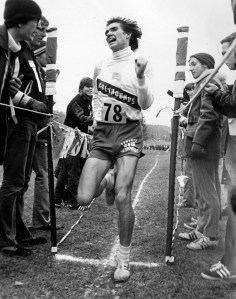
Cross country is liberal. Track is conservative. Both are great.

Sue RunningThere are many “disciplines” in running. These include cross-country, track, road, trail, fell, marathon, ultra-marathon and just plain insane. But the two sports in which many runners get their start are in cross country and track.

Cross-country running is now offered to runners as young as five years old. Locally, our Accelerators running club holds summer cross country meets to encourage youth running. These low-key meets are held in a park where the grass gets trampled down by dozens of small feet. The sport continues into middle school, where kids now have organized programs for boys and girls. By high school the sport of cross-country is held with state finals finishing up in November.

Cross-country is a liberalized form of running. It takes place in all kinds of environments and locations, and these often vary by the week. A three-mile course may be flat or hilly. It 4eb059ceb92a4.preview-1024may take place in a park or on school grounds. Some courses cut through woods and even traverse small streams. The beauty of the sport is its textures.

40 years ago, there were many cross-country races held on golf courses. But as the sport of golf has gentrified in its conduct, and become much more protective of its literal turf, there seem to be fewer races held on fairways. It was a great tradition to run on golf courses. The grass was cut smooth and the environment was well-groomed. You could often see the runners across several fairways and fans could trot back and forth to different vantage points. if you didn’t feel like running after the runners, you could always yell across the course.

But then more conservative interests took hold, and many golf courses closed access to runners year round. Liability is one reason given for the ban on runners. Our litigious society produced a fear of being sued for any accidents that might occur to runners at all times of the year. That meant cross country as a sport was chased off golf courses too. Too much wear and tear on the carefully coiffed turf, one must suppose.

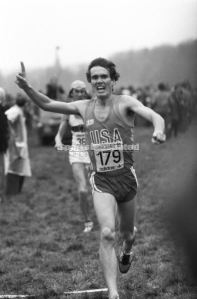
CraigVirgin2At the national and international level, cross-country running takes on the feel of countrified track racing It takes place on dirt or grass, but often the courses are manicured in a way that encourages track-style racing rather than agility and dealing with the environment.

That takes some of the fun and liberality out of the sport. I once raced on a course that had never been used before. Part of the course took the runners straight through a cattail wetland. As I approached that point of the course in the lead, I followed the direction of the flags and sprinted right over the muck and vegetation.

No such adventures occur in track and field unless you’re a steeplechaser. Then you might get your feet wet too. Most everything about track is conducted in a highly controlled environment. The eight competition lanes and hand-off zones are cleanly marked. There are even small numbers indicated which race starts where, and how long it is. 200. 400. 800.

ScottEverything is measured in track. The number of laps determines the distance. Unlike cross country or road racing where runners must choose their line and run the tangents, track reduces those choices to cutting in during waterfall starts.

There are tons of rules in track as well. The field events are nothing but rules and how to measure results. It’s all done by inches and adds up to feet or meters.

Track and field is teaching to the test. Cross country is learning through formative and collaborative means. Runners that excelled in all these sports, such as America’s Craig Virgin, should be admired for the ability to transfer their running talent to all surfaces and situations. In fact, more than 40 years after he set the cross country record on a course in Peoria, Illinois, the record still stands. I know that I’ve written many times about Craig, but other than Frank Shorter and a couple others, few have done so well across so many running disciplines from cross country to track to road. Not every runner can do that.

But it is all still running. One can equally love the liberal sport of cross country and appreciate the conservative beauty of track. One measures the absolute spirit of the competitors. The other measures their absolute performance.

In some way that’s proof that the two sides of a competitive nature can always get along. You may enjoy one more than the other, but you can certainly appreciate why they both exist.

To make you better. As a runner, and as a person.

werunandridelogo

Posted in cross country, track and field | Tagged , , , , , | Leave a comment

Beware the lair of a crappy chair

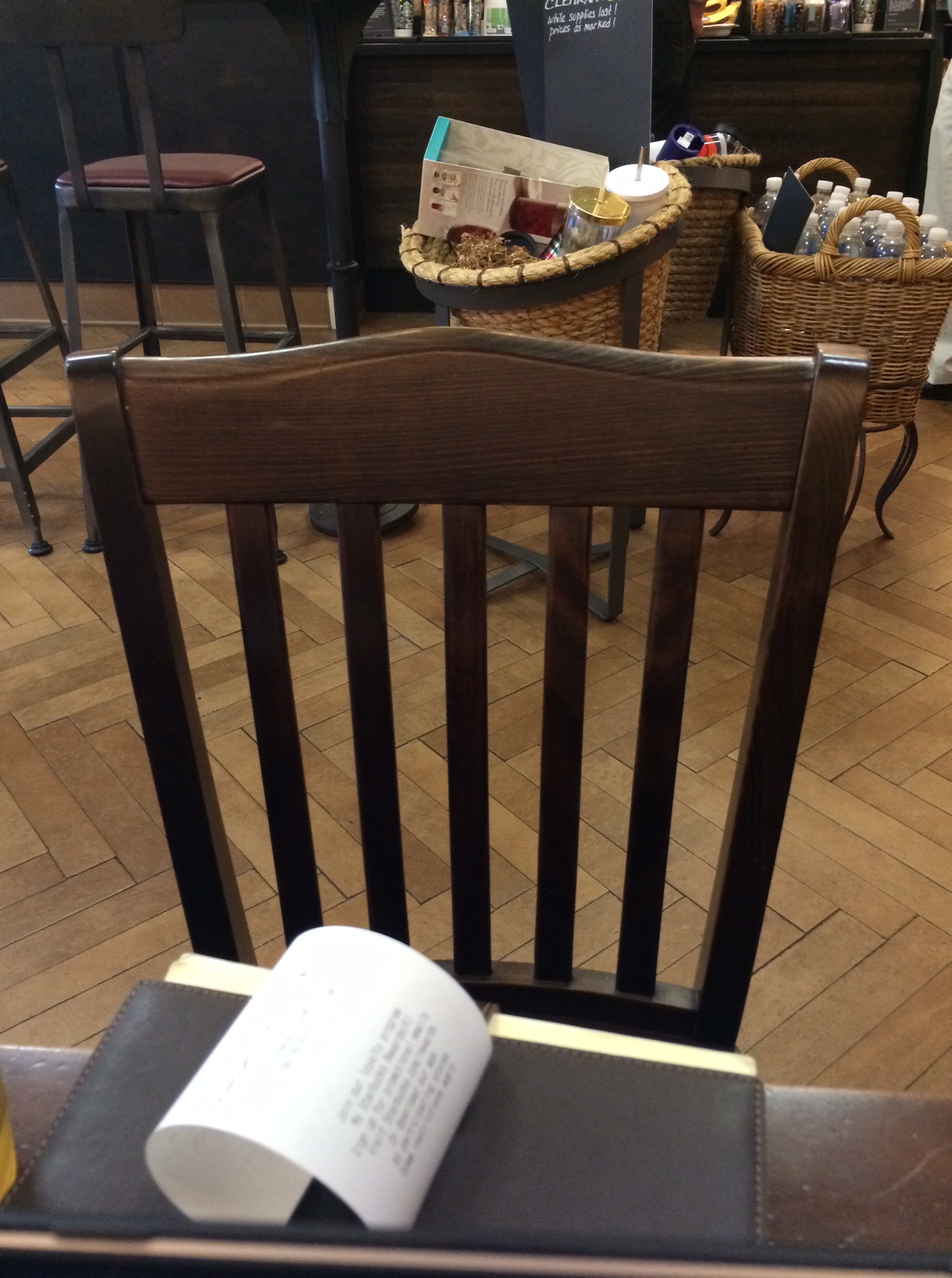
IMG_3012Those of us who work, and we can presume that means all of you that are not independently rich or retired, need to understand an important tenet of existence.

You must avoid the lair of crappy chairs. 

They’re everywhere, you see. A crappy chair is any piece of furniture that becomes uncomfortable in a matter of minutes. The theory of ergonomics covers this important area of human existence and is defined as follows: the study of people’s efficiency in their working environment.

Another website describing the theory of Ergonomics says this about it: “Ergonomics derives from two Greek words: ergon, meaning work, and nomoi, meaning natural laws, to create a word that means the science of work and a person’s relationship to that work.” 

Ergo, don’t be stupid. Avoid crappy chairs. It’s that simple.

But one has to wonder if the next theory to be tried by a certain political party is trickle-down ergonomics. Because you know, everything trickles down and sooner or later it will have to hit our chairs.

Priorities

It’s a plain fact: Next to beds, the chairs we use are the most important pieces of furniture in the world. When it comes to comfort and protecting the health of our often delicate physiques, chairs are paramount to health.

Office space

Perhaps you’ve worked in an office where the chairs aren’t comfortable. If that chair happens to be your office chair, the hours when you work can be equivalent to spending time in some medieval torture rack. Your back can become inflamed with sciatica or some other ailment that affects your workout schedule and a wicked cycle begins. You miss a few strength training sessions and suddenly something else gets out of whack.

TarsnakesSo you must beware the lair of the crappy chair. It is one of the tarsnakes of athletic existence. A crappy chair can take you down faster than riding 100 miles on a bike. Although your bike seat can be just as bad if it is not suited to your butt bones, and position on the bike is critical.

Car seats

The car seat can be an even worse enemy, you know. Some auto manufacturers actually seem to care about the fact that people will spend hundreds of hours sitting in their car seats and design lumbar support and adjustability into the seats of their vehicles. Even the simplest bit of concession to this fact can be helpful. One of the Subaru’s I once owned had a simple bar in the seat you could flip forward to provide lower back support. It helped tremendously.

But the next Subaru we owned was an Impreza wagon. For some reason there was no lumbar support bar in the seat. When I inherited that car in our family structure because my late wife got the new Chevy Impala, I wound up commuting 60 miles round trip in that car. My lower back got so bad that it was impossible to get out of the car by normal means one morning. I was forced to literally lift my left leg out the door and hobble into the building.

Lower back issues

7e8f7__782468-9f8b3344-8e1c-11e3-836d-02ea2adb9f0aUgh. The lair of a crappy chair had done me in. So I bought a lumbar pillow that helped a bit, but then it felt like my ass was sinking even further down into the seat. Truly I loved that little car for everything else it offered. We went on family vacations to the north woods in our little green Impreza. But when my son was driving it home one morning after a post-drama production play party, there was frost on the window that blinded him to an intersection. He slammed into the rear wheel of a Toyota van and totalled the Impreza.

The airbag went off and the car was filled with that weird white dust that usually indicates you will never see that vehicle again once it goes into the insurance void that absorbs all such cars. Of course some of those vehicles pop out the other end of a process very few of us know about, in which they are repaired and then sold to Mexican druglords as a means to raise money to buy weapons for white supremacist militias who hate the government. I know it all sounds very confusing but that’s how the world typically works so deal with it.

So perhaps our little green Impreza is still out there on the road somewhere, camouflaged and armed to the teeth. But I pity whoever drives the thing, because that really was a crappy car seat. It nearly killed my back.

Now I drive an Outback that has so many seat adjustments you there is no excuse for being uncomfortable.

We should know better

Bunny earsAs athletes we should know better and not put up with crappy chairs or killer car seats. But in that ironic twist of fate we call character, we often put up with loads of personal pain others will not tolerate. Rather than complain or demand a better chair, we try to will our crappy chairs and bad car seats into submission. Determined to win this test of character, we sit harder on our hard seats and wriggle our sore backs into unforgiving chairs as if there were a reward in heaven for doing so.

For months I wrote at the kitchen counter and sat in tall chairs from Pier One Imports. They are made from metal and have a modest cushion on which the butt perches. Those chairs are designed for sitting at a counter drinking wine and noshing on cheese and crackers. Somehow I tried to make them into a comfortable place to write. My back and hips complained and grew tighter as the weeks went by, but I would not listen.

Treatment

That’s just stupid. But we all seem to do it. My gal pal Sue had a sore back last night because she worked at home for a day following her Ironman. By evening her back hurt like crazy. There were knots in her muscles and tightness in that zone leading from her back to her butt. So she laid down with a couple cats keeping watch as I massaged her back and pushed my thumbs into the sore spots. This morning she was fine.

IMG_0124We should all do ourselves a favor and become more aware of the lair of a crappy chair. Seriously, there’s no reason why you have to sit on that shit. Move your ass to something more comfortable and healthier for your back, your butt and your hips.

If it’s just a few minutes or you’re out for dinner, sometimes the lair of a crappy chair is unavoidable. But take your long term sitting seriously. Consider it part of your training routine, because if you don’t, you’re training routine will have to be seriously considered when you can’t do it.

Beware the lair of a crappy chair.

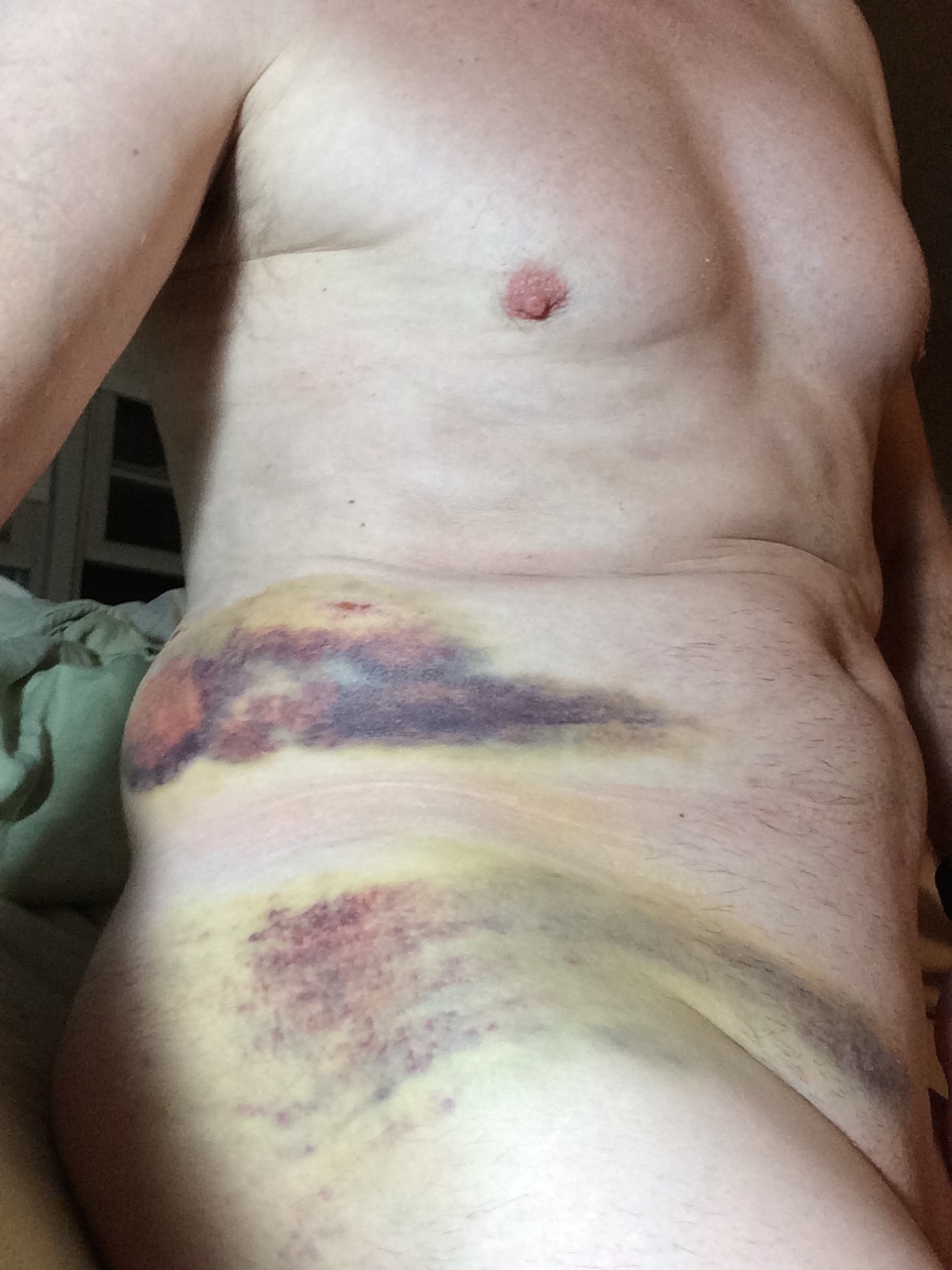
*note: those bruises in the photo above are not from sitting in a crappy chair. But they could be. Ha ha. 

werunandridelogo

Posted in Uncategorized | Tagged , , , , , , , , , , , | Leave a comment

When the Other Man is an Ironman

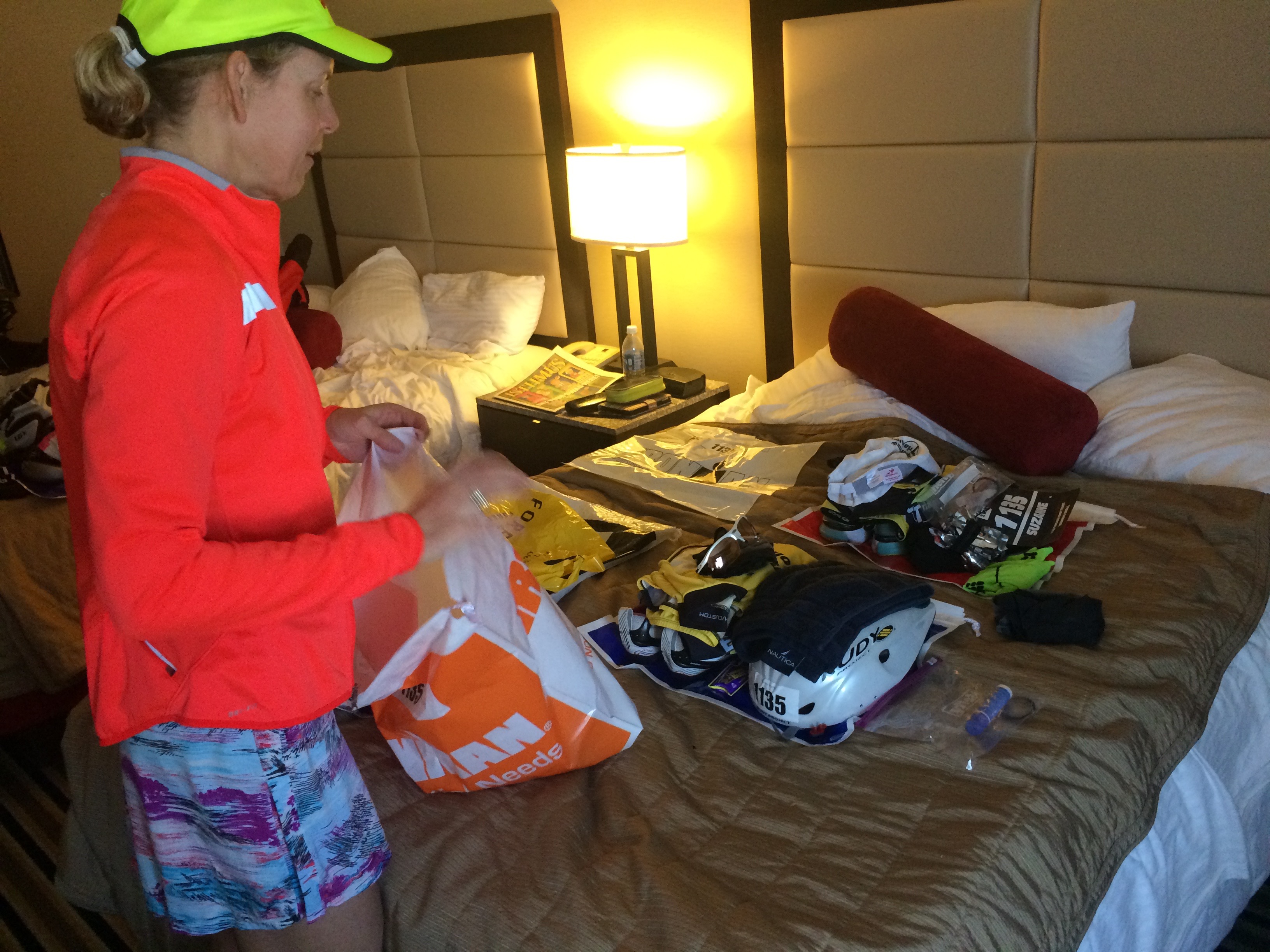
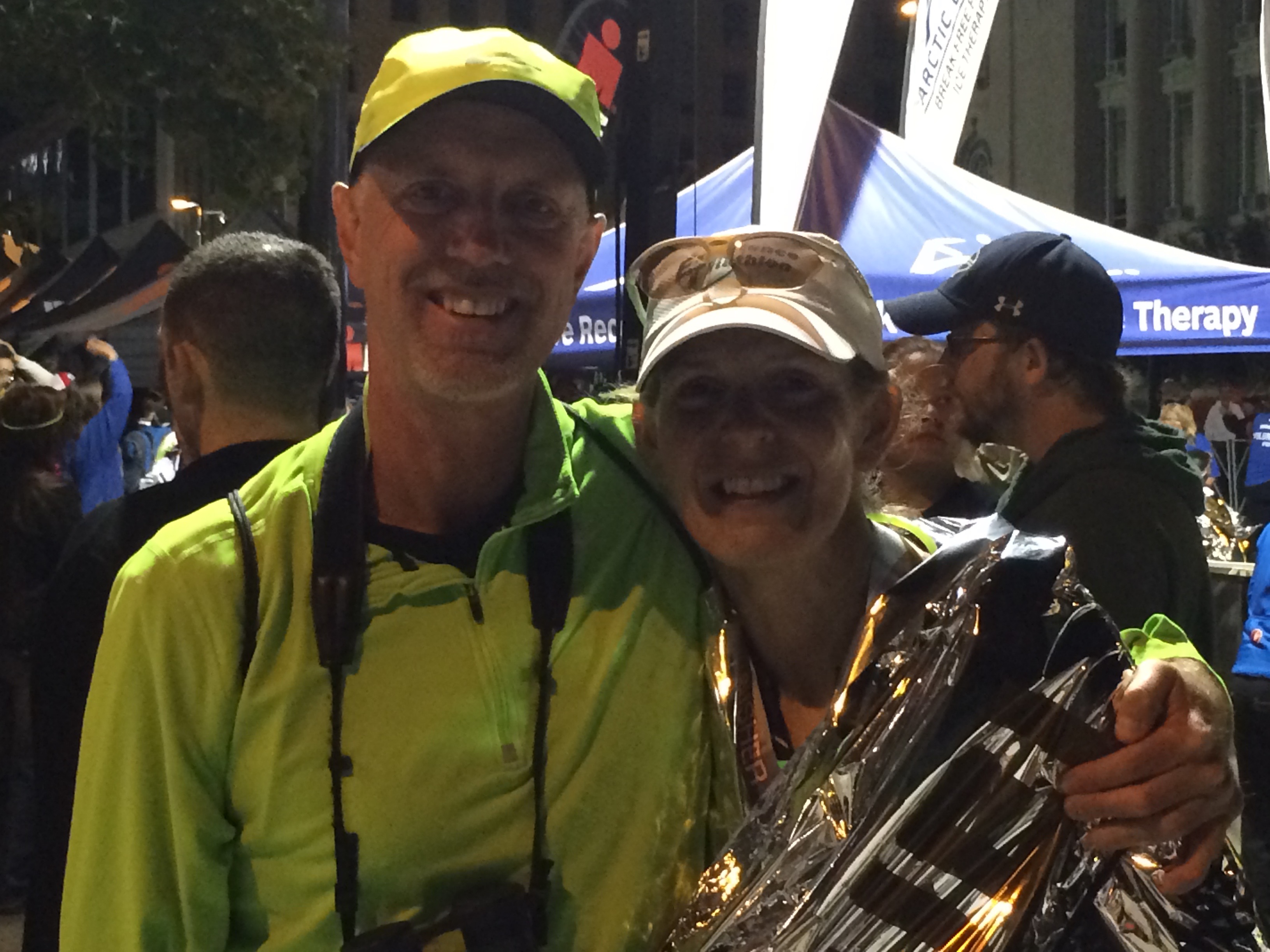
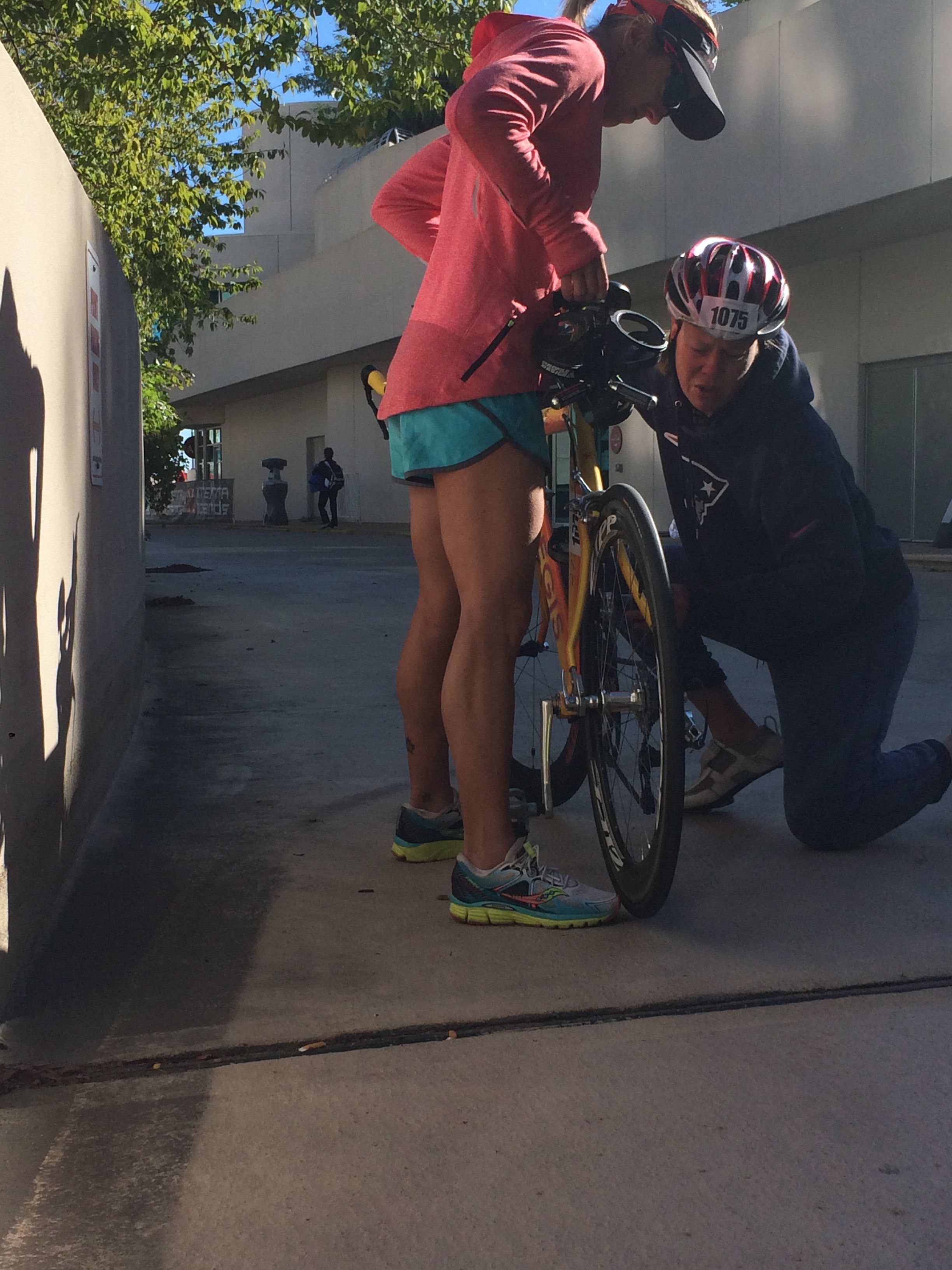
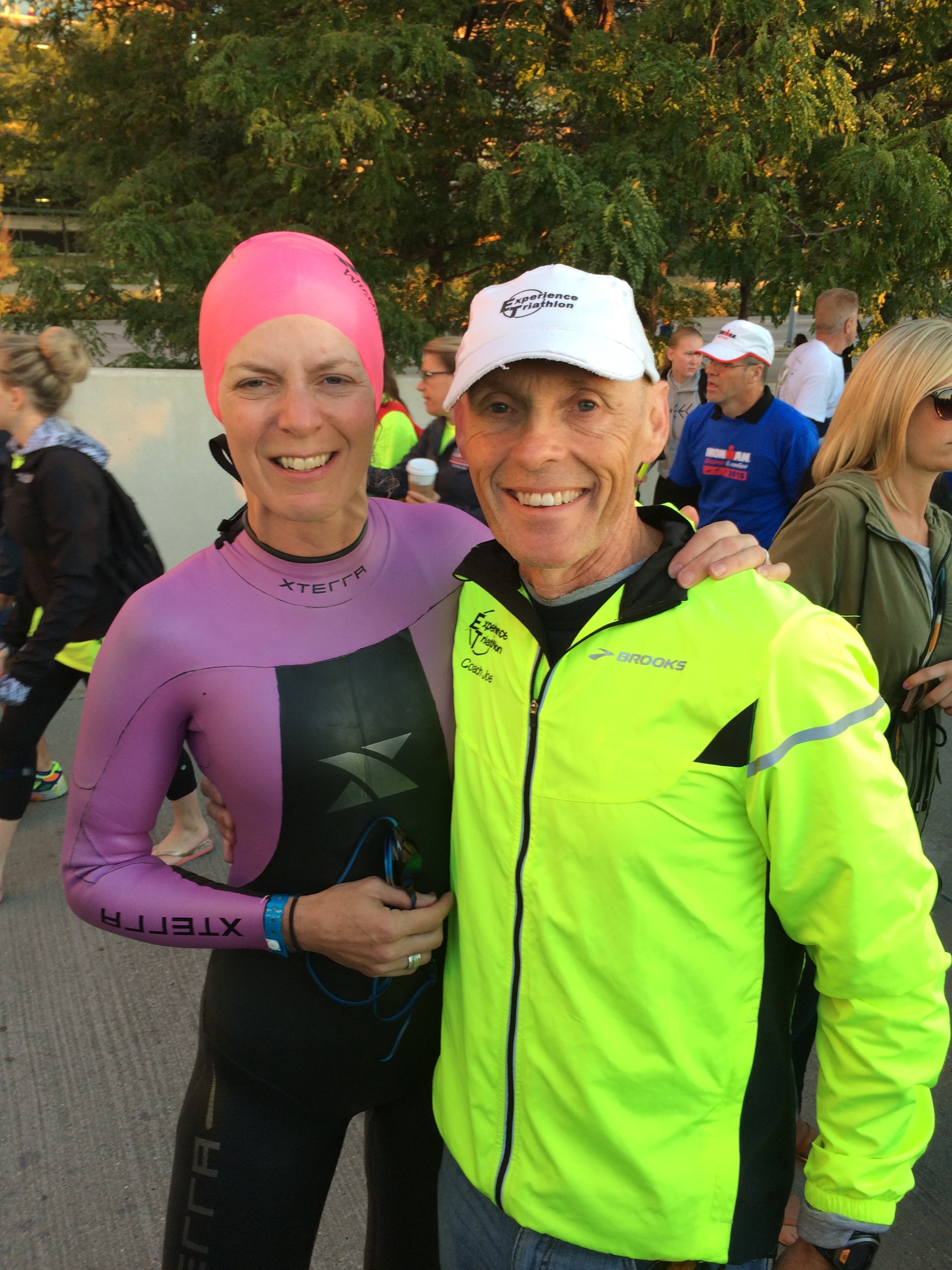
IMG_2802With the race the size of an Ironman––and there are no small Ironman races––athletes have a ton of gear to organize. Much of that gear is stored in bags and deposited with race organizers at designated rooms or zones so that it can be carted off to the proper location for use during the race.

Another round of gear has to be schlepped around by the athlete, especially wetsuits, which serve as a form of baptismal attire when all the athletes gather at the lake or river or reservoir or ocean to swim 2.4 miles together.

IMG_2853But once the wetsuits are stripped or shed, the real logistical program begins. During the cycling segment there is nutrition to cart and liquids to be sucked from sloppy straws sticking up from the bike.

Truly, the most expensive triathlon bike in the world is nothing more than an elongated high chair in which the athletes perch for five to seven hours trying to eat and drink enough to sustain themselves for the duration of the 112 mile bike ride. Everything gets all cloggy and crumply and sticky by the end. All that separates a typical triathlete on their $5000 bike and a hungry tw0-year-old in a high chair is a tray of half-chewed Cheerios. And don’t be too sure about that either.

Aid stations

Then comes the run, where aid stations serve the purpose of providing fuel for the fire burning within the athlete. And that’s literally what’s happening. The nutritional fuel that goes into the body gets burned off like cordwood, emerging as sweat and steam. We are all carbon machines inside and out, fueled by sugars and proteins and water and salt. So that’s what’s on the menu for any athlete finishing an Ironman triathlon.

IMG_2870Then there are all the support structures necessary to do the race. Before getting to the starting line, all those bikes and gear and nutrition and extra shirts and sunscreen and chamois lube must be get schlepped from place to place. And that, my friends, is where Ironman sherpas come in.

Ironman Sherpas

You all know what real sherpas do, right? A sherpa by definition is a very specific sort of helper, defined as “a member of a Himalayan people living on the borders of Nepal and Tibet, renowned for their skill in mountaineering.” And many are amazing people. So by no means do we mean to demean their skills by comparison to some first-world ideal that has nothing to do with climbing above 20,000 feet.

The word “sherpa” does have some contextual relationship when used to describe people schlepping gear around for Ironman triathletes. After all, the Ironman is all IMG_2776about creating peak experiences. That a parallel exists in the symbolic virtue of “climbing mountains” of our own creation is no coincidence. Ironman sherpas, like real sherpas in the Himalyan mountains, work alongside triathletes to help them have a better experience.

Here and there

In either case, it can be rather amusing to think of all those people trekking to mountains the size of Everest in the Himalayas, paying tens of thousands of dollars for the chance to climb and stand atop the tallest mountain in the world. And yet the Sherpas see it as their line of work. Another day at the office. They live there. To them, one mountain is as good as the other. It’s both a paycheck and a way of life.

Logistics and statistics

IMG_2878It can be the same way with the Ironman, where “sherpas” tasked or volunteering to support their athletes take up residence for a long day of logistics. There’s the raw fact of getting bikes and gear from one place to another. There’s also the goal of getting enough places to actually cheer on your athlete, sometimes two.

Late in the day there’s the anxious hope that your athlete will make it all the way to the end and hear their name called over the loudspeaker, “You’re an Ironman!”

It doesn’t always happen. About 20% of the people in any given race do not make the cutoff times in the swim, the bike or the run. So finishing an Ironman is no given. Nor is having the experience you even hoped to have. But it is this challenge of adversity that makes people pay hundreds of dollars for the right to participate in an Ironman race.

Noble enough

Pre-Ride PartnersIt’s a noble enough goal that requires tons of training and dedication and time. Some sherpas actually do much of the training alongside their athletes. Couples even do Ironman races together.

They all need sherpas of some sort or another, or they simply become their own sherpa, schlepping stuff where it needs to go and trying to stay calm and casual about it all. That’s not easy, but people do it. It’s all about organization for the sake of endurance.

Support crews

The athletes have their plate full for the day, swimming 2.4 miles, riding 112 and running 26.2. Any one of those endeavors IMG_2885would be worthy of a sticker on the back bumper of a car. But combined, they make that special category of Ironman status, worthy of a tattoo on the leg or the burning desire for achievement in the heart. And so it goes.

Sherpas form into support crews sporting tee shirts and signs of support. They stand on often crowded sidelines with other focused support crew members. One sherpa at Ironman Wisconsin had her hands full beyond the duty of supporting her Ironman in action. “It must be something to have a child with you all day,” someone said to her as she coddled a two-year-old on her chest.

“Try six,” she stated flatly, waving her hand at the band of kids crawling in and out of the metal barriers. It is truly a question for the ages who had the tougher assignment, the husband doing 140.2 or the wife ushering six children through a very long day.

Long days

So it is not for one sherpa to imagine they have it harder than the others. It is hard for all to make it through the long day, which typically starts at four a.m. and may last until the cutoff at midnight that same day.

IMG_2897If a sherpa is lucky they will find respite from standing on their feet waiting for the athlete to come by. There are tracking apps to help that process, but even these can produce frustration and anxiety given their propensity to slow with all that Ironman tracking clogging the data channels.

And the glimpse of an athlete along the way does not always tell you much. “How’s it going?” can be taken so many ways.

What. in the long run? Okay. But right now? It hurts!

Glimpses and grub

So sherpas are left with fleeting impressions and perhaps the occasional kiss or hug along the way. But you don’t want to slow them down, so you take what you can get.

If all goes well between sightings, a well-organized sherpa can grab a meal or even a workout between duties on the road. With Ironman athletes out of reach for hours at a timeIMG_2906, it makes sense to go run a few miles on your own, then take  a shower and grab a good meal…likely one of three during the long day of an Ironman or Half Ironman.

A few drinks can help as well. If there’s a bar handy there’s nothing like a cold beer or glass of wine when the day begins to wind down. Elite athletes finished up by late afternoon, but the majority ease into the evening hours running, plodding or walking their way through the marathon leg to the finish. The swim leg can seem comically distant by this time of day. Memories of the cannon going off and the mass start with people flailing through the crazed start can feel like a long lost dream by six o’clock in the afternoon when the sun in a September sky starts to cast long shadows.

Achieving the goal

It’s enough to make a sherpa wistful. All that preparation and all those long training days either apart or together. It’s enough to either make a relationship stronger or tear it apart IMG_2928at the seams. Sherpas need to be sensitive and wise to this fact. There are often times when neglect creeps in with the fatigue an athlete imposes on their body. The long stare into the abyss of training long miles sooner or later must take over the personality of the athlete. Like oxygen deprivation on the slopes of Mt. Everest, fatigue saps the will and can bring on lack of hope.

During those training phases, it can be the duty of the sherpa to carry the weight of the relationship all on their own. It may be the most important burden they carry all year. A sherpa may need to step in and restore hope with an encouraging word or small acts of self-sacrifice.

Crazy or not

It can all seem crazy at times. Why all this energy for a seemingly indulgent
IMG_2797attempt at glory? Why succumb to the power of the Ironman branding at all?

The answer is simple: If there weren’t an Ironman challenge already out there, human beings would invent something else. It all happens because people need peak experiences. They seek these rites of passage to escape from the mundane, day-to-day existence as well as the emotional pain of mortality. Better to damn near kill yourself doing something hard than to lie down quietly and slowly die over a lifetime.

Sometimes those hyperbolic paradigms are literally true. One sherpa at Ironman Wisconsin shared that her husband had been doing a marathon when he experienced cardiac arrest and later flatlined. That was just two years ago. “So now he’s here,” she said with a trace of wonder in her voice.

Life and death

Fortunately or unfortunately, it is the nature of this search for meaning and intensity that IMG_2856sometimes pulls people apart. The Ironman can be a wedge as well as a glue in many relationships.

But it can and does also pull people together. The abiding feeling one gets out there on an Ironman course in a town packed with cheering fans is one of community.

Perhaps the Ironman in some strange way is filling a need that people around the world want to feel. Toss out the rampant stupidity of so much religion and politics, along with the terrorism and tribalism that continually vex the human race and this earth, and what you have left is people of all races, colors, genders and orientations doing something that constitutes a wonderfully flawed commonality. Even if the Ironman is in some ways a stupid thing to do, it is a really good kind of stupid to experience.

An answer, if not “the” answer

Ironman may not hold the answer to the world’s perpetual geopolitical conflicts or its massive socioeconomic problems. But it is an investment of spirit in something that feels IMG_2827like it matters even if it ultimately doesn’t.

Yes, there is a massive amount of consumerism on display in all the shiny bikes and spandex kits. Yes, the narcissism sometimes runs so deep you get a feeling there’s a tsunami of selfishness at work in the world.

But then you see a child with his mom or dad cheering for their partner and you think to yourself, “Okay, this is not such a bad thing.”

Then you see a heavyweight guy or gal grinding up a long hill wth every pedal stroke a profound effort, and wonder to yourself, “How do they do that?”

The best and the worst are equals

The same thing goes when you do see a magnificently fit athlete ripping by on the bike. It is clear there needs to IMG_2813be a stage for every level of accomplishment. You can appreciate both the fat guy with the fat tires plugging up a hill as well as the svelte female in her skintight outfit and shiny calves and not lose sight of what really matters. We’re all in this together.

Just remember this for your own sake: there’s no escaping the fact that communication is important going into an Ironman year. Both athlete and sherpa need to know what’s coming––or at least be committed to the idea of what might come about along the way. You simply must agree to work together on it.

When the Other Man is An Ironman® (and I’m writing a book about that) all sorts of emotions enter the picture, from jealousy to frustration with this “other” person in your life. You will still have financial and work challenges to address. You might crash your bike or cut your knee in gardening accident. All kinds of stuff can happen that you might not expect. That’s life. It’s a rockpile, and it isn’t going to change.

That’s why it is the duty of both sherpa and athlete to climb those rockpiles together. It is over those obstacles one must climb to reach the top of any mountain.

Please share this post with your triathlon friends and community!

werunandridelogo

Posted in Christopher Cudworth, When the other man is an Ironman | Tagged , , , , , , , , , , , | Leave a comment

Answer to the creepy question “Who’s following me?”

One of the keen realizations one should have as a male athlete is that we seldom have to worry about who’s following us on the roads or trails. The risks to men while out training are far smaller than those faced by women, who must be more concerned about sexual assault.

A participant holds up a sign during the Slut Walk demonstration in Philadelphia, on Saturday, Aug. 6, 2011. Organizers of the walks aim to raise awareness for womenís issues including the fact that no woman asks to be raped because of her style of dress. (AP Photo/Joseph Kaczmarek)

Fear of assault is obviously not limited to women who run. Statistics on sexual assault on college campuses, for example, present a sobering picture. One in four college women report surviving rape or attempted rape at some point in their lifetime.

A world of targets no longer

Those are discouraging facts. Yet we don’t want to discourage women from pursuing such healthy interests as running, riding or swimming either, especially on grounds that it is a threat due to greater risk of sexual assault.

The response to such statistics can often be seen on the trails. Many women train with partners, be they male or female. The great equivalency that has emerged from long, steady increase in the number of women runners is that gender barriers between men and women training together as athletes has fallen away. In fact, it no longer exists at the practical level of track workouts or long training runs. Women run right alongside men and there are almost no concerns over who is running faster than who.

So the threat to women either in terms of casual harassment from within these sports is at least partially reduced. Perhaps not eliminated entirely, but reduced. Men and women now sweat and train together, and sexual tension or gender awkwardness is not the problem it once was. Equality stems from shared experiences.

Cultures of dominance

4340578092_68e88e6765_zIt is where women are isolated from these supportive environments, or where they confronted by groups aggressively embracing dominance that problems arise. Thus where college fraternities develop cultures where women are viewed as objects of conquest or worse, as disposable forms of entertainment, that rape and sexual abuse become perceived as acceptable or expected expressions of manhood.

Troubling as those trends seem, the greater culture in America has threads of these mindsets running through it as well. We can only imagine the workings of the disturbed male mind at work, who calculates or stalks an attack on a female runner. But it happens too often to ignore or write off as an inevitable product of the male psyche and sexual aggression.

Reasons why

The presumptive, controlling and aggressive nature of rape has been analyzed from both a sexual and criminal perspective. It is difficult to separate the two, but it is critical not to dignify the violence of rape with the excuse that it is merely sexual desire gone out of control. Even in the context of a relationship, rape is always a violation and a form of violence.

Cynical statements such as “You can’t rape your wife” do an injustice to all women. Then there’s the old joke that says “Do you know the difference between rape and rapture? Salesmanship.” Just as bad.

Fortunately, through hard work and advocacy on behalf of women’s rights, those attitudes are being pushed back by a culture that is growing in maturity toward the rights and perception of women. Yet American culture remains highly sexualized, and women are still struggling to own their own bodies and not be victimized by stares, lust or the controlling instincts of men. And avoiding rape.

Harassed and sick of it

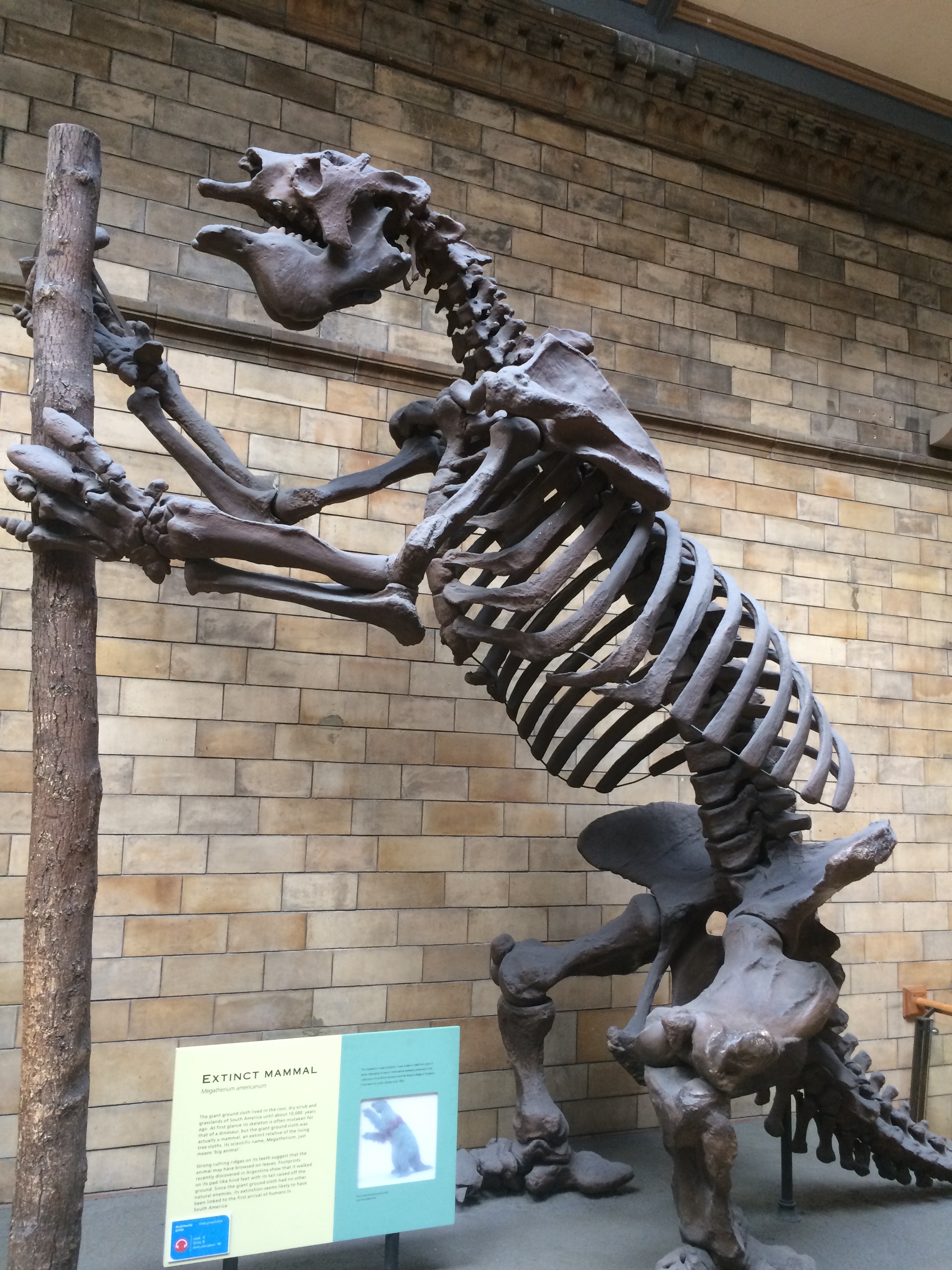
Natural History.

Sexual harassment laws are deemed by some as too politically correct and restrictive in the workplace and beyond. But talk to any women (or men, for that matter) that have experienced sexual harassment and you will learn that it is a damaging, distracting force in your life. And it still goes on.

The harsh reality is that these primeval attitudes about what constitutes fair and reasonable behavior are not only extant in business and society, they are also canonized in some wings of politics, where control of women’s bodies and reproductive rights are still considered the province of men. These anachronistic tendencies, often to the point of misogyny, closely parallel the approach of rapists who force themselves over the rights of women to control their own bodies. We could legitimately argue that the former even leads to the latter.

Biblical references

The ugly truth is that this aspect of patriarchal control, ownership and exploitation of women hearkens all the way back to the bible. And for evidence let’s start with the ostensibly Virgin Mary.

Patriarchal societies treated women as property and were threatened by the notion of a sexually mature and active female. That is why the mother of Jesus is depicted as a Virgin, to uphold the dualistic idea that no man ever touched her, and that God the Father through the Holy Spirit was the parent of her child. Talk about layers of jealous fear!

sperm_raceAncient Judeo-Christian authors had no problem projecting their jealous views of womanhood on the mother of Christ. But there are questions to be answered in this process. Was Jesus later profaned by the fact that his mother had children through the womb that bore him, and through normal sexual means? And did her womb, having received semen from a man, become a place of defiled grace?

One could excuse all the Virgin talk by claiming that it didn’t matter what happened inside Mary’s vagina after she gave birth to Jesus. But that’s just a convenient rationalization of the patent jealousy and fear. The made-up story about Joseph almost disowning Mary thanks to pregnant state is just another assuagement of patriarchal guilt.

Rank and file

This false brand of reverence actually does damage to our perception of women. If giving birth to a child through sexual means is considered beneath the dignity of a woman, what message are we sending to women throughout history about their value and role in culture? The corresponding fear of menstruation expressed in early scripture also isolates women as unclean creatures. These false standards create unnecessary taboos.

And these taboos have a violent nature to them as well. Some men can’t handle the richness and symbolic virtue of women and the female body. In some dark way the breaking of that taboo becomes an obsession. Sexual impulses may drive it, but it is ultimately an angry fear of having to respect a woman that drives so many men to rape. Consent is the obstacle to which rapists do not want to submit themselves.

Strange games and repressed desires

I once met a man who insisted that he would never allow himself to come inside a woman because he believed it gave her power over him. He’s probably right, to some degree. But that’s precisely the point. All meaningful sexual relations require some level of submission to the will and care of that other person. Rapists somehow can’t negotiate that brand of submission. As a result they ultimately choose to force themselves on their subjects, without consent.

Prison rape is another example of that force of will. Any sexual or physical dominance of another individual is a sign that there is both lack of respect along with an operative fear of rejection in the mind of the individual committing the rape. They predictably have little self-respect to offer, and thus offer none of it to others.

Bleed over

IMG_1357It is not just women who suffer the consequences from lack of self-control and self-respect, especially linked to sex and sexual identity. The correspondent fear of homosexuality among so many people in society is driven by fears as well. Even the intimation that some aspect of behavior is “gay,” is enough to offend some, or give them reason to lash out in verbal or violent ways.

The idea that someone can be “made gay” through an encounter with a gay person is just one of many such fears, for it has long been promoted that being gay is somehow a sign of lack of strength or self-respect. Neither is true, of course, but that’s how fear and projection work in tandem.

Codified fears

We should understand that the Bible codifies such fears in stories such as Sodom and Gomorrah. In that passage we learn that Lot defends comes to the defense of two men rescued from the streets after dark and brought inside his house. He protects them from a madding crowd that wants to “know” them in the streets. In other words, the men might be subjected to abuse including gang rape.
IMG_6923This scene is often depicted as a sign that homosexual activity is a sin. But in truth, the threat to the two men is not in fact homosexual by nature, but indicates instead the very real violence being aimed toward a stranger in the community. Proving this point, Lot offers up his own daughters who “have not been with another man” as an attempt to draw off the violent, selfish temper of the crowd. If the crowd was only interested in having gay sex, why would Lot offer them his young daughters?

Instead the story is about the sins of control and violence, not homosexuality. It is also about rape, but not by a specific gender of another. So we see that rape and sick desire for control and abuse of others is a sign of morally compromised individuals and a disturbed society.

Tradition gone awry

Yet people have been taught so forcefully through use of this story from the bible that homosexuality and rape go together, they cannot conceive of loving homosexual relationships. As a result, they also cannot conceive of gay marriage as a responsible way for gay people to live together and fulfill roles in a functional society.

Do you see how culture becomes twisted by these patterns and trends in thinking? The seemingly diametric presentation of the (temporarily) innocent Virgin Mary juxtaposed with the ostensibly horrific behavior of the crowds at Sodom are actually far more closely related that many might think. Our taboos become confused by these presentations of extremes. As a result, normal human functions such as having sex between two consenting individuals can be turned into ugly notions that drive deep fears into the minds and hearts of individuals.

Spectrums

400px-Moreau_Monkeys_cropWe wind up with strange expressions of these taboos, such as pornography becoming one of the most popular forms of entertainment in the Bible Belt. That’s one end of the spectrum.

At the other end we wind up with men fearing women so much they can only think to rape them in order to gain control or have some way to process the taboos we’ve created and imposed through our traditions.

And yet another layer of confused ideology is that those who profess a literal interpretation of the Bible fear that belief in science or evolution will result in animal behaviors. There is absolutely no proof of such contentions. In fact the opposite is true. Science and knowledge of biological, social and cultural interactions all contribute to a more civil, better-functioning society because they reduce our fears. Meanwhile, anachronistic religion and a patriarchal worldview play on fears of emasculation, immorality and loss of control.

Surprise, surprise

So the answer to the creepy question of “Who’s following me?” turns out to be one of a surprising nature. The creepiest aspects of society are hidden in traditions that serve up the taboo as norms for a healthy society. These taboos turn normal inside out.

That’s how men come to think of rape as a viable or acceptable form of behavior. Their minds are preoccupied by the will to dominate the feminine ideal or their own repressed urges. Anything that is mysterious, vulnerable or unavailable to them becomes something to abuse and kill. We see the same sick mindset at work in people who abuse or torture animals.

No surprises

So it turns out these creepy attitudes follow all of us, and everywhere. They are woven even through our politics.

Chuck with LambsThe only way to stop the pattern is to confront those following us around while spouting creepy anachronisms and engaging in sexual harassment or rape. We need to turn and face the anachronistic fears and beliefs that drive them.

We could start by demanding that college men learn what respect for women really means. Every college freshman should be required to take a course in civics, social ethics and sexual politics. No excuses. And if fraternity and sororities continue to be a wellspring for bad behavior, ban them. They’re unnecessary and in some ways anachronistically based as well.
SwimmersThen segue into talk about why women are really out exercising, and why their outfits are not an invitation to sexual advances.

Then confront the failure of society to grasp that homosexuals and all intergrades of orientation and gender identification are a natural part of human evolution. This idea that the bible should dictate what constitutes normality in modern culture is outdated, timeworn and twisted.

Not the final authority

The bible, it turns out, is not our best or final authority on these issues. Not if left to its literal devices, where it can literally become the creepiest book around. If we abided by some of the creepier laws laid out in the bible we’d still have slavery, among many other things to worry about.

VTa8lAdmittedly, these misappropriated messages of bible are difficult to contravene. Its’ seemingly wholesome––yet ultimately creepy––literal messaging is woven through the culture of the world in so many ways it can be difficult to root them out.

That’s because many of the patriarchal, violent messages still have mass appeal to millions around the world. Just look at the violent world of the NFL, where men are often destroying their very minds and bodies for millions of dollars while scantily clad women dance around on the sidelines for almost no pay at all. It’s a sickness of the mind, yet the NFL is one of the most popular sports leagues in the world.

Real faith in humankind

Fortunately, Pope Francis is trying to lead the Catholic faith toward a more enlightened worldview. But his conservatives opponents within the church and those with political motives that benefit from protecting the patriarchal worldview of a male-dominated society are trying to undermine the good work he is doing.

The ultimately creepy answer to the question “Who’s following me?” can be found hiding in plain sight. It’s all those people who want to rape your rights based on a fearfully founded worldview rooted in biblical literalism and the taboos of ancient times.

And that’s the creepiest notion of all.

WeRunandRideLogo

Posted in running | Tagged , , , , , , , , , , , , , , | Leave a comment

You’ve got a good head on your shoulders, sometimes

IMG_2093So yesterday while running I had an embarrassing thing happen. My damn head fell right off.

At first I didn’t notice. Not for a few strides. But then my head was lying there watching my body running off without me and I called after it. “Hey, stupid body! Come back! You done left your head back here on the roadside.”

When my head falls off I tend to talk like a hillbilly. That explains a lot of modern politics, by the way.

But my body, being rather lost without a head, had already turned back around. It reached down with an arm and picked up my head again. Then it placed one hand under my chin and we started off again.

“Turn left!” my head called out to my body. “We need to head back home and get this straightened out,” I demanded.

But my body wasn’t listening. Again. It has a habit of doing that. Sometimes when the head says to do one thing, the body completely does another. Maybe you know that feeling too. 

If it wasn’t sewn on…

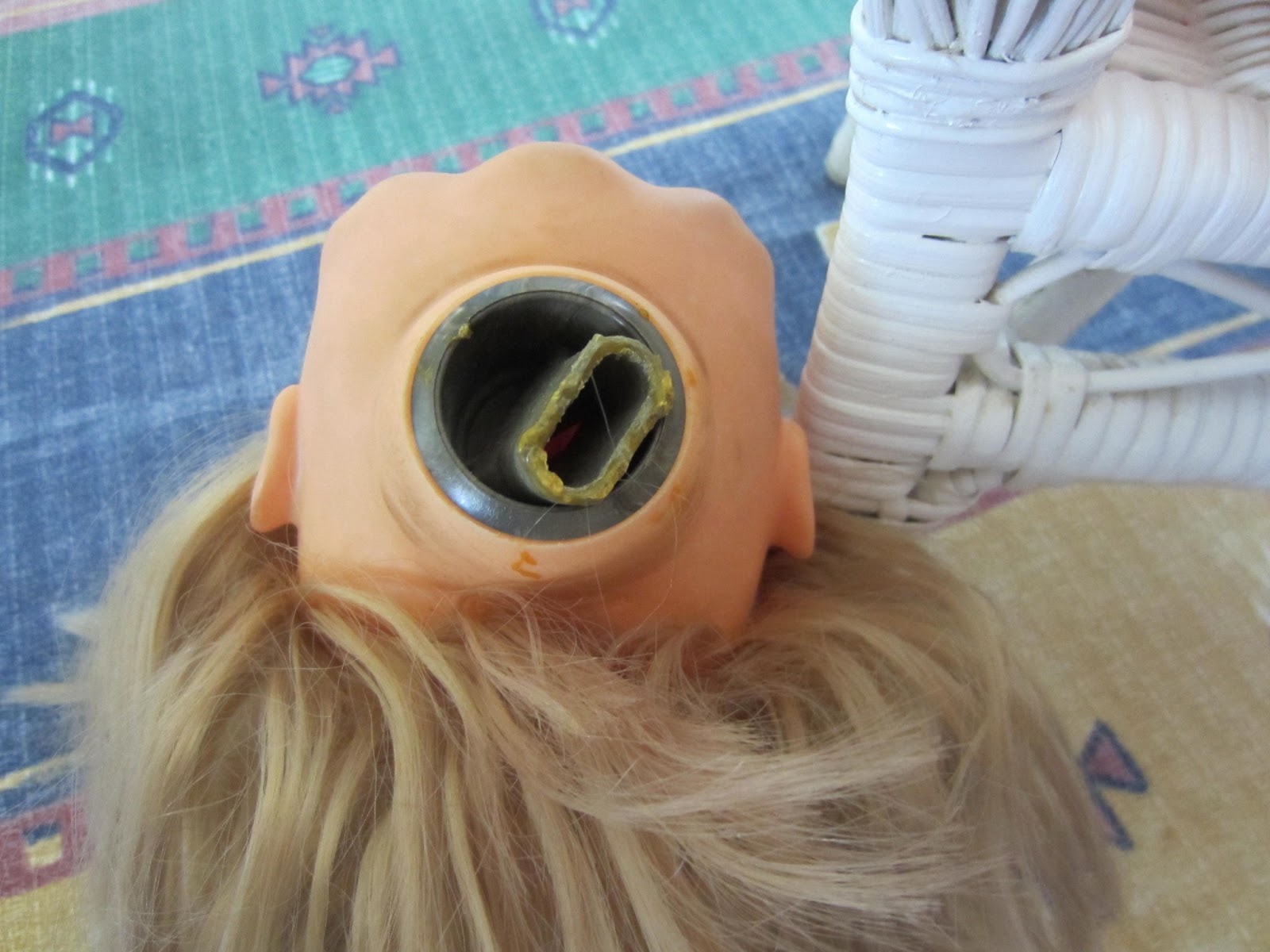
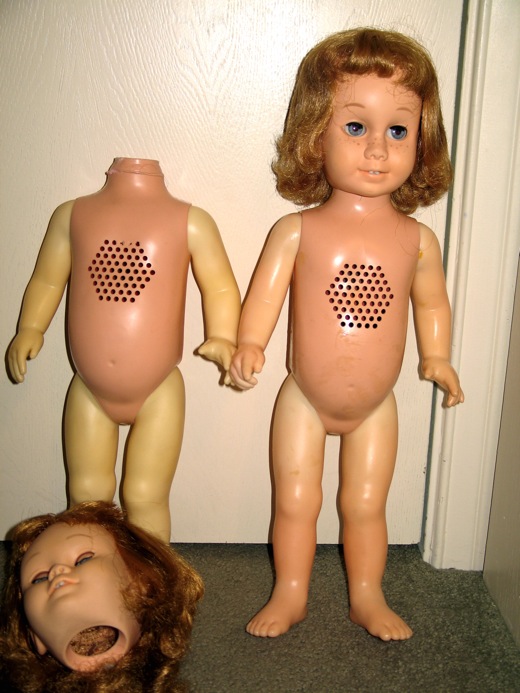
Head Fell Off American GirlBecause you likely know that phrase, “You’d probably lose your head if it wasn’t sewn on.” We all have those moments. Some of us live those moments every day.

And as an endurance athlete, you know there’s a whole ‘nuther level of head games going on where mind meets body.

You can find yourself running down the road having this conversation between your head and your body, and wonder who is actually listening to who? Or is that happening at all?

Even worse, there are days when you feel as if you’ve gone and simply left your brain at home. Your can feel that your head is most definitely attached to your body, but inside your noggin’ there is very little going on. There seems to be no motivation to run, or ride, or swim.

brainDuring Ironman or marathon training this is known to happen daily. Your brain is simply too tired to come along for the ride, so sometimes it simply stays home. 

Maybe you left your brain home on the bedroom end table, you think? Or was it sitting on the bathroom sink where you put on your makeup or stick those contact lenses in your eyes? Whatever the case, your squishy firm brain is left sitting somewhere at home when you need it most. But really, it’s best to carry it along somehow if you can. Perhaps those new tri-bikes will invent some way to do that.

Stop and think

Creepy head dollsI don’t know about you, but sometimes I just stop in my tracks when my brain and body refuse to communicate. It happens more frequently than I’d like to admit. So I stand there staring mutely at the trail ahead and finally the body typically says something like, “Um, what’s going on?”

To which the brain, or the lack of one, replies: “We’re trying to figure out what we’re doing here.”

The body is seldom amused by this. “Well let’s just go home then.”

“We can’t,” the brain stubbornly says. “There are six more miles to run.”

And the body always laughs a little. “Yeah, right.”

Then the kidneys chime in and say to the bladder. “I don’t think we’re going to last that long.” So it often happens that while stopped by the side of the trail trying to get the brain to talk with the body, the kidneys or bladder or lower intestine take over and start to grumble, groan and twitch.

“What’s that noise down there?” the brain asks.

Then the body just farts and giggles a little. It seems the body is as immature  as a child or grumpy as an old lady at a nursing home. That’s why the body thinks farts are very, very funny. It’s the shock value, we must presume. 

Strange relationships

antique_doll_head_7_heime_by_falln_stockIt can be pretty awkward when you’re in mixed company and the brain and body get into fights like that. The brain might be trying to impress some handsome or cute companion while out running or riding, but the body cares not one whit about the vanity of the brain. So it rips one of those audible farts, and the first time it happens every instinct in your body tells you to take your head off your shoulders and throw it in a ditch.

So it’s a rather strange relationship we maintain between brain and body. It’s easy to wonder what the hell’s going on sometimes. Thus it doesn’t entirely surprise me when my noggin’ falls completely off like it did the other day. It’s just part of the routine. 

This is your mind on race day

11336898_10153355466639313_5963747517278445329_oRace days are even worse. It’s almost like the mind has a mind of its own that day, and the body is having an out of body experience. It can be difficult to get all the mind and body parts working together. Sometimes it works. Sometimes it doesn’t. 

So you finish the race and try to reassemble all the parts. People ask you how you did in the race and your brain starts spouting all this woulda-coulda-shoulda nonsense about how your mind and your body just didn’t seem to be working together that day. Then people stare at you for a moment and walk off to steal another bagel from the nosh tray. 

Pumpkinheads

PumpkinheadBut don’t worry. You’re not alone. We’ll all a bit like zombies or that pumpkin-headed character from Sleepy Hollow some days. Just carry your head home and lie down and take a nap. That usually works to pull the brain and body back together again.

But if it doesn’t, you can always ask for help putting your head back on your body. That’s what real friends are for. You can call them up and say “Help! My head just fell off my body,” and they’ll understand right away what you’re talking about.

Of course it gets a little creepy when your best friend comes over to find your head sitting on the floor next to your body. But usually they’ll say something nice, such as: “Did you go do that 28 X 400 workout again last night? You silly girl.”

Barbie lost her headAnd then they stick your head back on your body, and you go for a run or ride together.

Bobbing along

The only real problem with your head falling off occasionally is when you’re swimming. A bobbing head in the pool can really, really freak people out. It’s bad enough when there’s a turd floating in the public pool and the place closes down for Code Brown. But when people find a slobbering head bobbing around in the pool, they can really lose it.

But if it’s your head bobbing there in the pool, simply say something polite such as, “Have you seen a fit looking body doing backstroke anywhere? We forgot that we needed to look up at the edge of the pool, and this is what happened! Sorry, this is a little embarrassing.

People who don’t run away are usually quite willing to help. And if that doesn’t work, simply call out the word ‘MARCO’ and see if the body responds ‘POLO!’ It’s a fun little game to play.

werunandridelogo

Posted in Christopher Cudworth, competition, cycling, running | Tagged , , , , , , , , , , | Leave a comment

A simple technique to running faster that is simple, hard, and it works

IMG_8601With all the theory and articles written about how to become a faster runner at any distance, there is one simple thing you must do to improve your speed, your stride and your overall race pace at any distance.

Run 400 intervals.

Really, it’s that simple. There is no other technique for getting faster and knowing you’re getting faster than running 400s.

Whether you’re training for a 5K or a marathon, run 400s at your race pace or slightly faster. As you progress through the training season, simply cut down the rest interval from a 400 to a 300 to a 200 to a 100 jog between intervals. The reduction in rest time builds fitness while you develop a strong sense of pace in proportion to the race.

If you think running 400 intervals is boring and repetitious, you simply aren’t engaged enough in your goals. So make it even tougher, and smarter. Because if you really want to get faster, you should be running your 400 intervals at a pace 10 to 20 seconds faster than your desired race pace.

For example, I want to race my 5Ks in triathlons at 6:30 pace or under. That means I run my 400 intervals at 6:00 pace. Early in the season the rest interval is a full 400 jog, then it drops to a 200. Finally, as the race season approaches, intervals are indeed being bitten off with only a 100 jog between. It’s all at faster than race pace.

ArrowPointingRightIt all works whether you race 5:00 pace, 6:00 pace, 7:00 pace or 10:00 pace. You need to run faster than race pace and do repeat 400s at that pace in order to improve your speed and endurance. If you don’t do any other speed training, at least build one workout per week into your schedule where you go to a track and do 400s.

To start, do a set of 6 X 400 to see how your body responds to intervals at race pace with that 400 jog in between. If that goes okay, add two more 400s the next workout. Warm up well (usually a one-mile jog) before each interval session.

You can add more volume and at the same time cut down the intervals as the season goes on. That combined pressure of doing more repeats and allowing yourself less rest builds fitness quicker than any other method in running. It’s a proven way to improve your race times. Runners have been doing 400s this way for as long as there have been tracks.

When you’re finally ready to test your fitness, you run half mile intervals at race pace and guess what? It feels easy. About three weeks out from you race, do a couple 400 repeats to warm up your body and then run a full mile to test your “governor.” Your sense of pace should be well-tuned from practicing the 400 meter distance.

IMG_8603You could give all this training some fancy name like the Principle of Relativity, but honestly, it’s just teaching your brain and body to run at a faster pace so that race pace feels easier. It absolutely works for all runners and at all race distances. If you’re doing a marathon you can throw together a workout featuring 28 400s at race pace and determine as you go along how much interval of rest you need.

Running 400 eliminates the need to count laps or think as you go. Wherever you start, that’s where you finish on the track. Simple. Hard. And it works.

werunandridelogo

Posted in 400 meter intervals, 400 workouts, marathon training, race pace, racing peak, training, training for a marathon | Tagged , , , | Leave a comment

Rust never sleeps, but neither do swimmers

IMG_2598It’s been hot outside and Sunday presented an opportunity to perhaps gather our swim gear and take one last trip to Centennial Beach in Naperville. But by the time we go home from riding and a meetup with friends at Starbucks, it was 1:00 p.m. and the day felt squeezed enough.

So Sue and I parted ways for the afternoon to get things done on Labor Day weekend. I cleaned house for several hours and organized my closets, which resulted in a needed trip to Goodwill.

Then we got back together to grill and plan Labor Day itself. We have a party at 10:300 with Mojitos and Bloody Marys on the menu. Then it’s up to Wilmette for a family gathering and back home to share time with her kids as well.

But last night she said, “I’m getting up to swim tomorrow.” And I said. “I want to go along.”

That means getting up at 5:00 at the latest to make the trip to a local natatorium where Master’s Swim takes place. It’s a local high school long known for its swimming prowess. There are a few in our area like that. My alma mater in St. Charles was once a dominant swim program with a coach nationally known for his coaching ability. Several swimmers in that program have gone to the Olympic Trials and beyond.

It takes a ton of dedication to be a good swimmer. Swimming tens of thousands of meters a day requires lots of time. And you often have to rise early to do so. That’s true whether you’re a student or working.

IMG_2599My plan is to begin swimming at least two days a week. I have the fortunate flexibility to work remotely and thus, can arrange my schedule to swim and get back home easily in time for phone meetings and the like.

But I like the discipline and structure of workout times. That’s how I’ve lived life since I was the ripe old age of twelve. I need and want that structure. It’s the glue that holds me together.

Yes it can suck to have the obligatory rise and shine of a 5:00 a.m. wakeup call. But back when I had a paper route in the little town of Elburn, Illinois, I rose every day at 5;30 even when I was fourteen and fifteen years old.

Different PersonEven as a stupid kid at Band Camp I got up for the Polar Bear swim at 6:00 a.m. I don’t know why, other than it made me feel better than the other kids. I needed that at times. So perhaps it’s just a strained form of ego that makes me want to rise early and go work out.

This summer I’ve been a bit of a lazy butt. Not compared to some I suppose. The latest I’ve stayed in bed was 8:10 one more. Most other days I’m up by 6:30 at the latest. So it won’t be a shock to start up with swimming.

But it might take some time to get the rust off. The difference between 6:30 a.m. and 5:00 can feel quite profound.

And then there’s the swimming itself. This year I’ve made significant progress bettering my stroke. But pick up any swim magazine and you begin to appreciate that runners and cyclists have nothing on swimmers when it comes to obsessing about technique and proper form.

My God, I swear I’ve read some strange articles in those swim magazines at my GF’s house. Swimmers obsess about every body part positions. And then there are all those strokes to consider.

“HOW YOUR SPHINCTER CAN PROPEL YOU.”

“KNUCKLE YOUR WAY TO FASTER TIMES.”

“BALD MASTERS HAVE AN ADVANTAGE.”

“KISS YOUR ELBOWS AND IMPROVE YOUR FREESTYLE.”

Of course that last headline illustrates the problem with many swim techniques and drills. No one of normal build can kiss their elbows, but if you attend a swim lesson and ask a coach for advice, they often come up with insane things like that.

“How’s my stroke look, Coach…” I asked innocently.

“Well, we need to get you started on kissing your elbows,” he started out. “And licking the backs your knees would help as well. So take this board here, and hold it out like this…nice, now tread water until you run completely out of breath and turn into a panickly pile of flesh. Good, that’s perfect!”

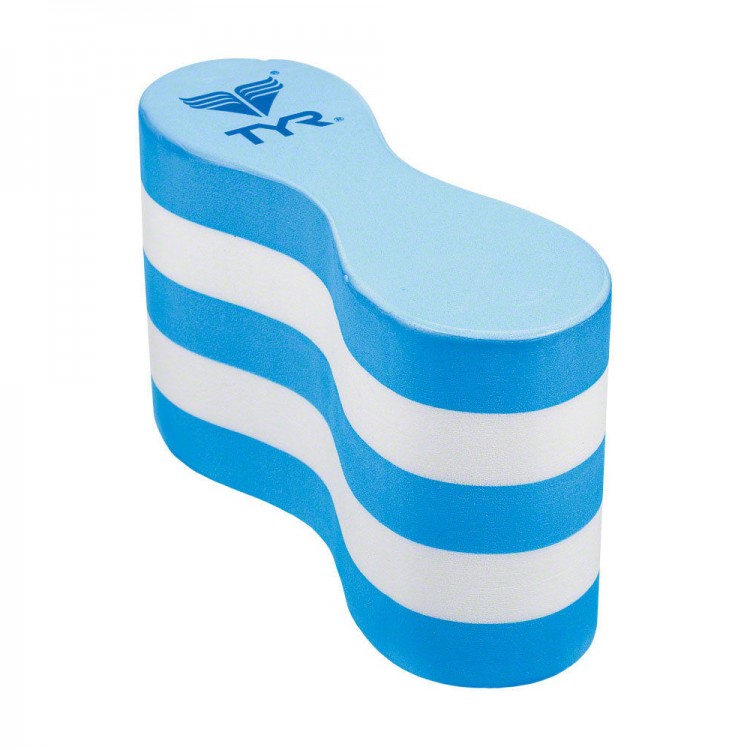
Invented by Dr. Seuss, this swim training float is made by Tyr.

Invented by Dr. Seuss, this swim training float is made by Tyr.

Seriously, swim drills were all invented by sadistic people who with a foam object fetish. There are foam objects of all types and shapes at the pool, like kickboards and floats and whodats and bloats. Dr. Suess invented everything used by swimmers, you see.

Which is perfect, because everything swimming is a lot like a Suessical World in which none of the rules of gravity or modest behavior apply. For one thing, it’s not exactly normal for a human being to try to propel themselves through the water at high speeds. It’s a well-known fact that world champion Michael Phelps depended on prodigious amounts of weed to help him imagine swimming 100 meters in under what, 40 seconds or something insane like that.

He even swims 100 meters doing the Butterfly at insane speeds. But even Michael Phelps was a little rusty in his recent return to swimming. “I did what I had to do,” he said. “Afterward, I can say my stroke didn’t feel good, I needed one less stroke, I needed to kick more, the breakout on my turn was bad. I could pick apart the race a hundred different ways, but just getting in the water and racing was something I was looking forward to.”

World class swimmer Michael Phelps tries to splash off some of the rust following his return to the pool.

World class swimmer Michael Phelps tries to splash off some of the rust following his return to the pool.

Fans reported seeing a long streak of red rust coming off the frame of Michael Phelps. Hi keen rival Ryan Lochte, also an interesting character, blamed the high iron content in the water for his own slightly slower time in the race, but was enthusiastic that his pool buddy was back in the water after vowing that he would not return after the 2012 Olympics.

“I called him a liar,” Lochte said with a grin. “I said you’re going to come back, guaranteed. He’s like, ‘No I won’t.’ … When you do something for so long and you have that passion, when it goes away, you miss it.”

Proving that swimmers are even more insane that cyclists and runners combined. At least when other endurance athletes train, they get to see something along the way. All that swimmers see is the bottom of the pool or the top of the natatorium. And oh yeah, all the bodies of the other swimmers at the pool. So there’s that.

Swimmers are probably crazy and Seussical in many ways simply because they are sleep-deprived, and may have rust deposits on their brain due to all that time in the water. You never quite get all that liquid completely out of your ears, they say. So if you hear a swimmer say they’re feeling a little rusty in the water, they aren’t kidding. They really are.

werunandridelogo

Posted in swimming | Tagged , , , , , , , , , , | Leave a comment

Did you have a good summer?

This time of year it is inevitable to think back on the months of June, July and August and ask yourself, “Did I have a good summer?”

So I’m going to offer up a little perspective to help you think about your summer, and indeed your life in general. We’d love to hear about things you did that you really enjoyed.

IMG_8774As for me, here’s a little operative in which I believe when assessing your life. I always look for opportunities to have what I call “peak experiences.” These are events or moments that cause you to live tremendously in the moment. That’s not always an easy thing to do. Being so busy all the time can cause you to just roll through everything you’re doing. That can include something so profound as riding a Century or even racing a triathlon.

We don’t have peak experiences when our minds are so distracted by the import of life that we cannot focus on what we’re doing in the moment. As a result, you can finish a run or a ride or a swim and hardly know you just did it.

But there were wonderful exceptions to this habit of mine (anyway.) I’ll share because they serve as allegories for peak experiences all on their own.

The Peak Experience of SHARED TRAINING

Sue RunningThis year has been an interesting year in a significant way. We started out with a trip to Great Britain where a training run took us on the banks of the Thames in Oxford and through the heart of London. We had to stop at times and just consider what we were doing. The birds singing in the hedgerows. The Tower of London across the river. The bustle of people heading to work in the financial district of London. We took a risk, spent some money and had a peak experience for the first time overseas for both of us. And that was a great way to transition from spring to summer.

But then our attention turned to a task at hand. Doing large chunks of training with my girlfriend Sue in preparation for her Ironman on September 13 has stretched us both in several directions. My runs have gotten longer and some rides too. That culminated in runs of an hour or more, a significant change for a guy that had been keeping it to half an hour or less for years. The peak was a 2-hour run with Sue that led up the Fox River Trail and back. It was almost strange to be running pain-free for so long. Granted, my hip flexors got tired toward the end, and that hurts a little. But a few trips to the gym fixed that problem.

It’s a peak experience to be running longer, and faster. Our track training has pushed me back down to 6:00 pace and below in training. That opens up some interesting ideas in both road racing and in the triathlon.

The Peak Experience of the GALENA DUATHLON

11336898_10153355466639313_5963747517278445329_oGalena is situated in a hilly region of northwest Illinois. Racing a duathlon in that area means that you have to adjust all kinds of expectations. For my first duathlon of the year, and second in my life, there were other logistical problems. The Galena race does not start and stop in the same place. That meant planning to use my dress orthotics in the first pair of running shoes, jumping on the bike to ride nearly 20 miles on a hilly (wet) course west to Galena, and throwing on my actual shoes with orthotics in them. The course went straight uphill for nearly half a mile. That was a peak experience indeed. Talk about in the moment soul-searching.

But I set aside such anxieties and raced well enough to place 8th overall and win my age division. And that was a peak experience.

The Peak Experience of HORRIBLY HILLY

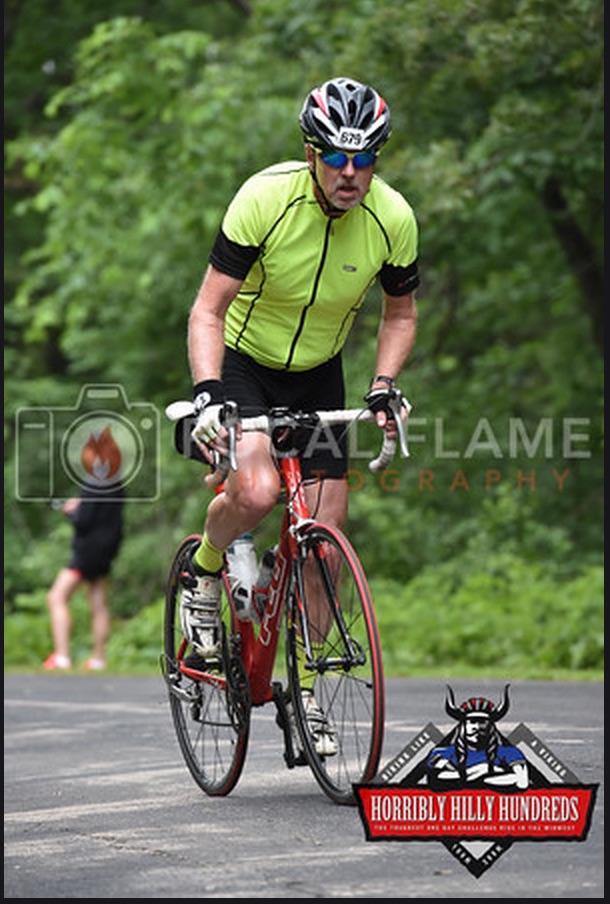
Last Climb Horribly HillyA few years back a friend and I entered the lottery to get spots in the Horribly Hilly 100, a highly respected event held in the Mt. Horeb area of Wisconsin. Having ridden several times in the Wright Stuff Century the loops from Mt. Horeb to Spring Green, I knew some of those roads and that the climbs could be difficult.

The trepidation was somewhat real, therefore, that this would be a difficult ride. And it did not help that on the way down the first hill, my front tire flatted at the same point that some enthusiastic rider had gone too fast and pitched into the ditch. An air-vac helicopter was hovering above the course and paramedics were attending to the rider.

It all brought to mind my own crash during the Wright Stuff in 2013. There I broke my collarbone after bike wobble sent me careening to the ditch at 40mph.

Once the flat was fixed I gingerly braked down the half mile of the whole first hill.

And from there, things got better. All day my legs felt strong and the climbs went well. Some topped out at 18-degree grades, and they were tough. People on tri-bikes had trouble getting that geometry up the steepest hills.

The peak experience came on the last long climb. It was 1200 vertical feet to the finish. There were people lining the course cheering as rider after rider crept up that hill. It had rained and the wind had blown. The sun came out for a brief moment near the end however, and we all smiled at the fact that we’d ridden a tough training ride that was its own reward. But we had frozen chocolate custard anyway. And that capped off a peak experience.

The Peak Experience of the IRONMAN WISCONSIN LOOP

Following the ride in the Horribly Hilly 100 we returned to Wisconsin on a few separate weekends to ride the “stick” and the “loop” portions of the Ironman bike course so that Sue could prepare both physically and mentally for the fall race.

Coming off the Horribly Hilly ride, the set of three hills known as the Three Bitches were not so daunting for Sue. And I had recalled struggling up those hills myself last year. But this year we pedaled right up together, almost laughing at our former selves. And that, my friends, is the peak experience of having gotten over your fears.

The Peak Experience of the Swedish Days Century

 What I learned from this ride was how to eat better and how high I sit up on my bike. Sue’s low aero position was hard to follow in the wind. But I thrilled in truth to see her pulling away from me at 80 miles because it meant her fitness for the Ironman was coming together well. She was thrilled at the end, and went for a good brick run following the ride. She wasn’t even tired.

However we stopped for beers and food with friends following the ride, and by the time I brought her home she was nodding asleep in the car. A foot rub put her to sleep on the couch and I went home to bed. It was a peak experience to share that nice fatigue that comes from doing something big and real together. There were many such nights, and part of being a Sherpa to an Ironman triathlete means you get to see your sleepy companion nod off during evening television. It’s part of the gig.

The Peak Experience of the Naperville Sprint Triathlon

Chris Fun Pic TooIn the weeks leading up to the race, my swimming was still a concern. In my head I had the swim segment at 700 meters. That’s a long way for this beginning swimmer. It wasn’t until race day that I actually figured out that the swim was only 400 or so meters.

But there was still a logistical issue. The water was so warm the race declared wetsuits illegal if you wanted to get included in the race results. Having no idea how I’d do, but banking on the fact that I’d done okay in the Galena race, I stood by the shore contemplating whether to wear the wetsuit and be disqualified or overcome my concerns about swimming without it and give it a go.

Sue stood by the start as I walked about getting my feet sandy. Finally I stripped off the wetsuit and said aloud, “I can do this.” And I did. It was chaos in the water given the fact that I started with a load of swimmers that turned the place into the Panic Pool, but I made it in just under 9:00 exactly as I predicted. And that was a peak experience of shedding fears to do something new that I really wanted to do.

By next year I plan to be able to swim a mile and perhaps enter the Racine Half Ironman. I can do it.

A peek at a Peak Summer

So it turned out this summer had quite a few peak experiences. I’d mention the fact that we also swam at Centennial in Naperville one hot Sunday afternoon. Sue rode 80 miles with friends and I pedaled 40 before meeting up with them at the pool.

And when she walked out to greet me in a borrowed bikini that complimented her figure, that was a peak experience for me as well.

IMG_1357It was a good summer because I spent more time in the water and even got the requisite bikers’ tan that makes you feel like you’ve actually done something with your life and lived in the moment. There’s nothing I like better than looking down during a ride to see sweat shining on the legs. Then you look up at your riding companions and realize, “I’m here. We’re riding hard. This is real. This is fun.”

Of course we’ve also overcome obstacles along the way. Late this summer Sue was forced off the road by an absent-minded driver. The insurance and legal protections for cyclists are ill-defined. There have been personal challenges and opportunities as well. I’ve started working with GreenMark, a public relations company I just love. That was one of my peak goals heading into the new year of 2015: set your career on a track that makes sense with your values, your passions and your knowledge base.

The Peak Experience of FRIENDSHIP

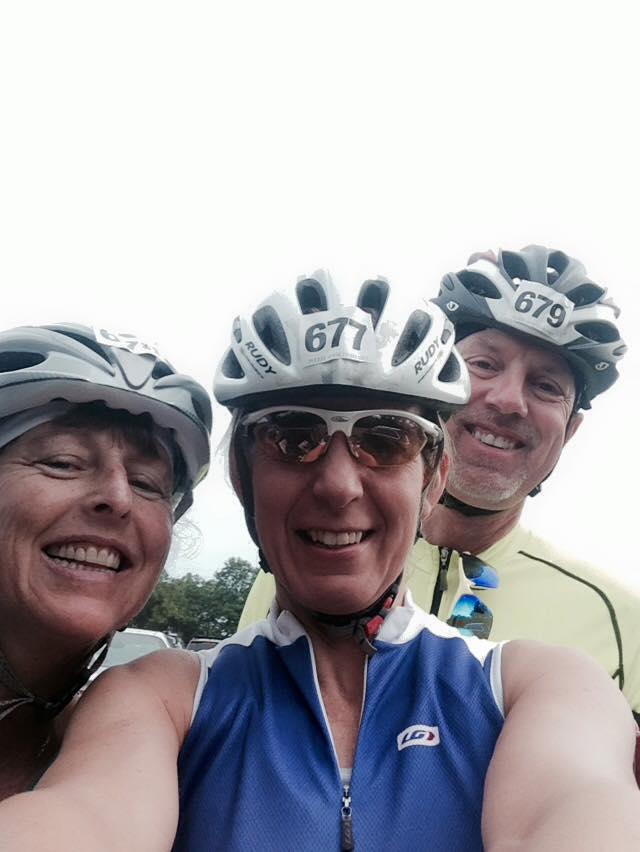
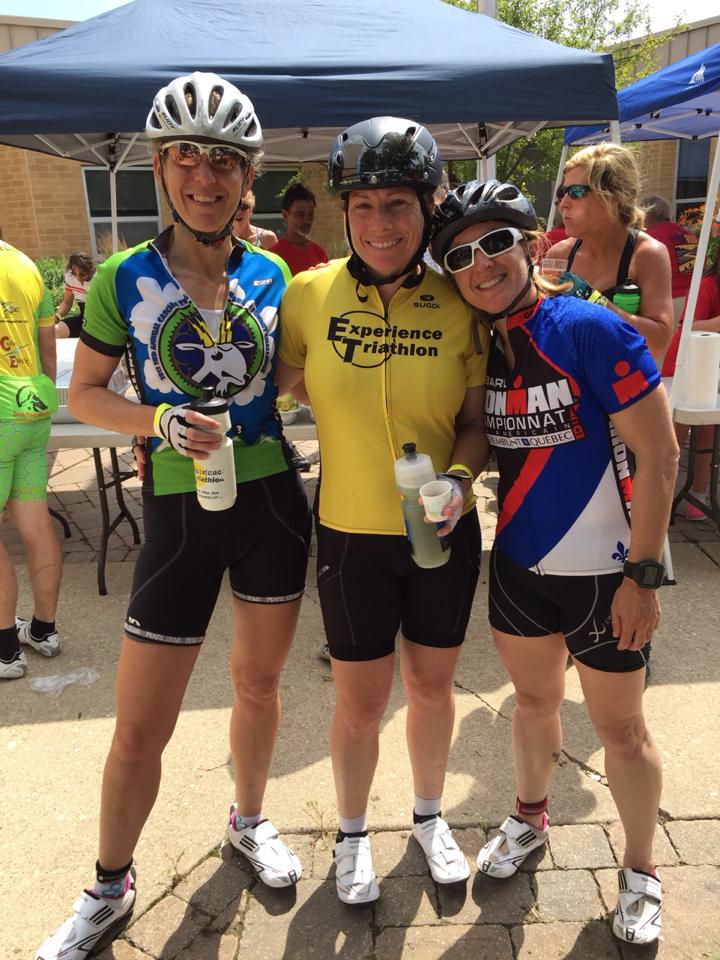
Pre-Ride PartnersWe shared many of these training and racing moments with Sue’s original swim buddy Lida, who committed last year to do the Ironman this fall. It has been fascinating to watch her gain confidence and strength on the run and the bike. We ran together all winter in the blasting cold. Then we trained through the damp spring and rode up and down those hills in Wisconsin. She and Sue are true friends. They trust each other implicitly. So it has been a peak experience to share in their mutual motivation. And as the race approaches, I fully expect they will both have peak experiences that will last a lifetime.

And that’s how life should be.

werunandridelogo

Posted in IRONMAN, PEAK EXPERIENCES, TRAINING PEAKS, triathlon | Tagged , , , , , , , | Leave a comment

The triathlon of eating, sleeping and shitting

I once dated a gal in college that professed not to like eating, sleeping or shitting. “I just don’t like to waste time doing those things,” she admitted.

That relationship broke off after two years, but not for those reasons. She met another guy who fit her vision of security and they had four daughters, I have been told. So I hope she’s happy.

But I suspect she’s not if she still hates eating, sleeping and shitting. Because those are all things people I know really enjoy.

At the time I dated her the only four things I was doing were eating, sleeping, shitting and running. An oh yeah, dating her as well. We both had fun in our respective college endeavors. She was an actress in a musical and I was Captain of the cross country team. We fell in love and that was great.

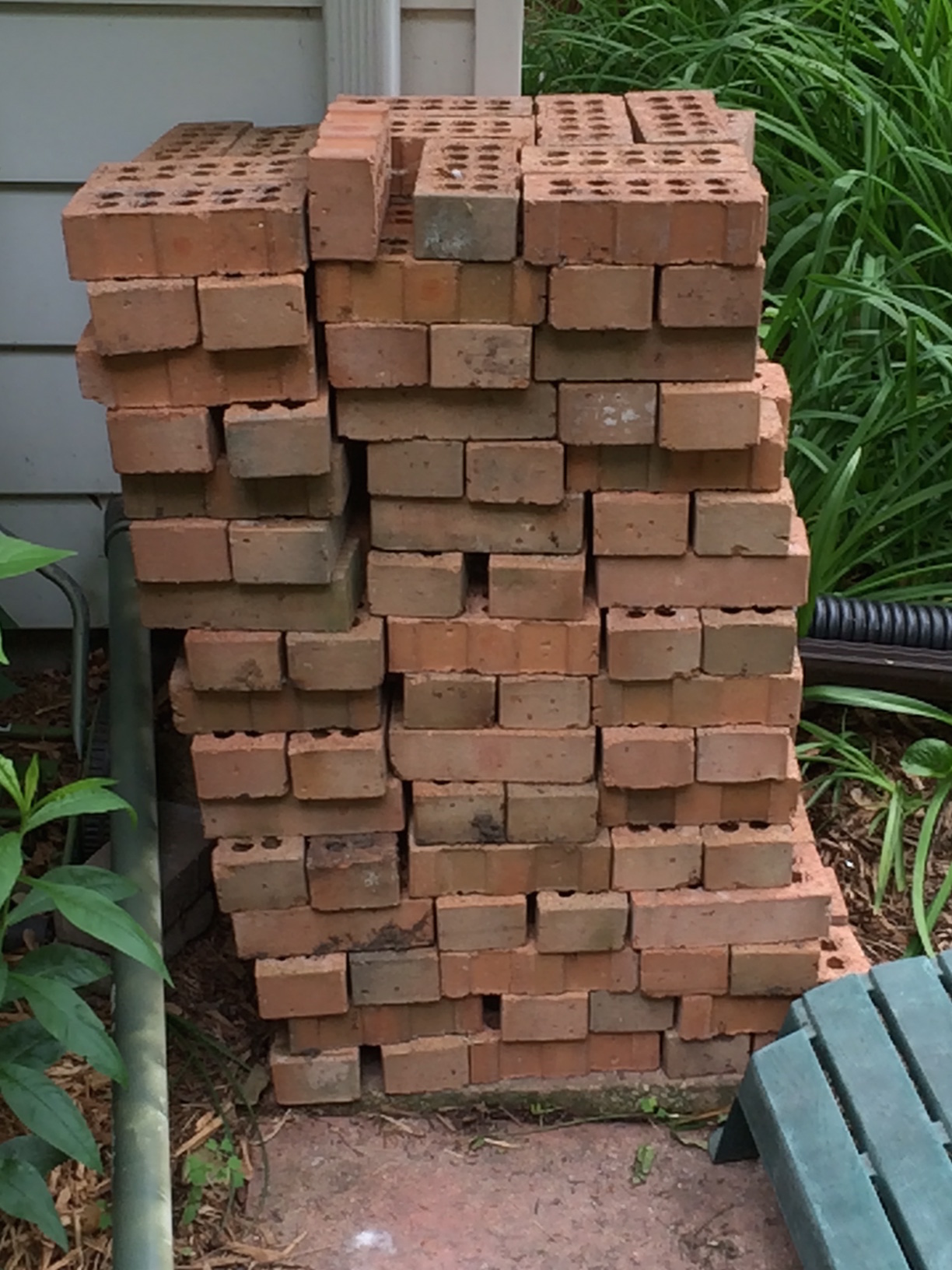
Otherwise known as shitting a brick.

Otherwise known as shitting a brick.

But while doing 100 miles weeks it was important that all those natural rhythms fall into line. So I loved to sleep. That was restorative. I loved to eat. That was nutritional. And when nature called, it was a damned good thing to take a good shit.

Some people spend eternity on the toilet, reading magazines or books. In the age of cell phones one can only imagine where some of those posts to Facebook originate. That’s right, people are probably doing a ton of social media from the throne.

You probably don’t want to think about that, but now it’s too late. The next time you get a weird, vacuous post from a Friend give it some thought. Could they be sitting on the shitter?

And what about Strava? Could there be anything more entertaining while taking a crap than looking at your Run or Ride stats and those engaging little maps that show where you went? I think not. Strava was born to entertain athletes occupied with taking a good crap.

Actually there ought to be an app just to measure your efforts on the toilet. Call it JockStool or TriPoop or SphincterLinkter. Something like that. You could take pictures and share them with your friends. “Nine inches today,” a typical post might say. “That’s a PR! Poop Record!”

Let’s get real about this, people. You measure everything else you do in life, why shouldn’t you measure your own poop? Some days it’s the best thing we produce in this place we call The World. As anyone who works in the corporate world can tell you, there’s a very fine line between taking shit in your job and taking a shit while you’re on the job.

It just proves that most of the shit we do doesn’t really matter half the time. But when you turn around and look at that squatter lying in the bowl, admit it. You think to yourself, “That was a really good shit. At least that was one good thing today.”

And that’s the glass half-full attitude, redefined.

cyclists.31-550x300It’s a cycle, you see. The more you run and ride, the more reason you have to eat. And the more you eat, the more you have to poop. I mean look at these people. You can see it in their eyes. Coffee was great, but they’re all really looking forward to finding a place to take a good shit. That guy on the left may already be doing that. And the guy on the right? He’s already done. Look how happy he looks. The rest of the ride will be a little squishy, but he won’t get saddle sores.

It’s true that sometimes our body rhythms get messed up, and the worst feeling of all time is having to get up and poop in the middle of the night. When you’re sleeping, you should be allowed to sleep. But when your body has different plans, there is no holding back. Getting up to pee is one thing. Getting up to poop when you’re in the middle of a deep sleep is quite another.

Once in a great while, my ass will send alarm signals up to my brain in the middle of the night. It’s like there’s a turtle down there trying to push its way out of a sand bank. It hurts. You try to go back to sleep and there’s No. Way. In. Hell. That’s going to happen.

Porta_Potty.jpgAC79941A-A6DB-4897-BC5AB086AEBEE81D.jpgLarger

An angel put it there for you.

See, our bodily functions don’t always follow The Rules. Sometimes hard training results in hard poops. You get constipated or the opposite, generate a case of the runs.

And how ironic is that? You run and you run and you wind up with the runs. That’s when a Porta Pottie can look like a literal Gift from God.

By contrast, constipation is serious business to many people. You simply can’t afford to be blocked up. It’s not good for your body, plus you might be carrying around more than a couple extra pounds.

It’s easy to have happen. Miss the proper hydration and your body sucks water from every corner of your system. That leaves your poop a bit dry. It compacts. Fills the lower cavity with its shitty girth and then you have to resort to some Roto Rooter drugs to loosen it all up.

Recently when I had a colonoscopy I got thinking about all the poop sitting in there. By the time it all came out I felt like the mouth of the River Ganges. It looked like that too. It all happens because we have to eat, or else we’ll die. And we have to poop, or else we’d explode.

human-rhinovirus-16But just think about all the poop that gets dumped on the world every day. Fortunately it breaks down when exposed to water, bacteria or flies. Cause if it didn’t, we’d be up to our collective ears in the stuff.

Perhaps you’ve heard that joke about the guy who dropped his sunglasses down a deep latrine. He goes in to retrieve them and his buddy calls down to ask, “How is it down there? I’ll come in to help!”

“It’s only ankle deep!” the first guy replies.

So his buddy jumps in and the crap is up to his chin. “What the hell, dude? I thought you said it was only ankle deep!”

“I dove in,” his friend admits.

Proving that his sunglasses must have been Oakleys. That’s the only explanation to that joke.

The biggest piece of shit in Wisconsin: The House On the Rock.

The biggest piece of shit in Wisconsin: The House On the Rock.

At any rate, we really should consider that eating, sleeping and shitting are pretty worthwhile and necessary activities. So screw that college girlfriend and her corporate attitude about bodily functions. Maybe she changed her ways after I dated her. But maybe not.

As for me, these days I still like eating, sleeping and shitting. What’s not to like?

You have to do all three to be healthy and survive. They’re like the triathlon of existence. Each discipline requires its own training and dedication. And like the triathlon, it’s the transitions between the three that sometimes cost you the most time. Don’t you just hate it when the rest of life gets in the way?

As for pooping when you are in the middle of the pool, I have just two words. Code Brown. Get out now. Please.

werunandridelogo

Posted in cycling, running, triathlon | Tagged , , , , , , , , , | Leave a comment

The speed question

Felt Bike ShinyAs a cyclist the most I’ve been able to accomplish is to avoid getting a ton slower than I was 10 years ago when I started. Some might say that’s a pretty fair accomplishment. It’s not easy to go faster as you get older.

The only exception to that rule is between the ages of 15 and 25. That’s when athletes are supposed to build upon their maturity to reach a speed peak. Some athletes continue well into their 30s competing at the highest level for their native abilities.

Technically I can still run as fast for two miles as I could when I was twelve years old. That’s when I ran my first 12:00 two-mile in gym class, in Red Ball Jets on a cinder track. The feeling of that accomplishment set deeply with me, and running became something of a release.

By contrast in cycling I did not begin trying to race until I reached my late 40s. Entering criteriums as a CAT 5 racer, I learned every sort of lesson on how not to win or go faster.

There was the race where I thought the best way to catch on was gradually. Mistake #1. Then came the race where I caught on every time around a hairpin turn on the course. That was mistake #2 because I had nothing left for the last lap. And so on.

Ultimately the lesson one learns from speed in cycling is that very few people are actually fast all on their own. What you need to learn instead is how to go fast borrowing from the company of others. Then if you’re smart, you’ll have saved enough energy toward the end of the race or for an intelligent breakaway, again usually in the company of others.

LegsBy contrast runners often pour on the gas and create their own space in the lead. The wind can be a factor in running races, but it usually isn’t the determining factor in the outcome of a running race. In cycling however, the wind factor and staying protected in the draft is everything. In bike racing, that is.

In time trials and triathlons, no drafting is allowed. So you have to depend on the aero position on your bike to go faster and be competitive. If you can’t do that, you will lose time compared to others. Almost guaranteed.

So the speed question is relative in cycling and direct in running. Of course great cyclists can ride off the front, but the power of the peloton in both criterium and road racing usually pulls back all but the strongest of riders.

By contrast in running it is common for a surge to create panic in the front pack, and runners must weigh their capacity for additional speed to catch up or keep up.  It really doesn’t often help to have additional runners chasing down a lead breakaway because the draft effect is minimal.

And since triathlons typically involve a lot of lag time even among the leaders, it is obvious when someone who led out of the swim stage gets caught only if you are in the same wave. More typically in duathlons and triathlons the only way you can tell if you’re beating your age group or category competitors is by sex or by the age marked on their bodies.

Think about that. You manage your own speed as best you can until that moment when competitive awareness sparks and you must face the speed question. Am I going fast enough? Am I going too fast? Can I sustain this pace till the finish? Will this pace leave anything for the next stage in the triathlon?

So for all the training you do to get faster, the speed question ultimately comes down to a test of character and faith in your training, and in yourself.

It’s a fascinating reality that all of us face. All speed is relative to circumstance. There’s very little you can to do change that fact. Except go faster. Which is the best answer to the speed question.

werunandridelogo

Posted in Uncategorized | Tagged , , , , , , , , , , | Leave a comment