

My father Stewart Cudworth (center front) at my late wife’s funeral (2013) joined by (from left to right) my daughter Emily Cudworth, Christopher Cudworth, James Cudworth, Diane Mues, Joan Mues, Evan Cudworth and Paul Mues.
My father was a complex character. He was prone to some mean and wild fits of anger at times. He was also capable of incredibly sensitive and meaningful insights. In other words, he tried to raise us the best way he knew how.
On that front, he didn’t let any of us boys go out for football or wrestling. One he considered brutish, the other graceless. But he supported us madly in the sports of basketball, baseball, soccer, track and field, cross country and more.
I can say the man was looking out for our best interests in the long term. Yet sometimes in the short term he fell far short in terms of recognizing our core motivations and approach to life. As the father of four willful boys, he did have his hands full.
Depression kid
It was tough for him growing up in many ways. During the height of the Depression when my father Stewart Kirby Cudworth was just seven years old, his mother was being treated for breast cancer. Back then it had to be an awkwardly shrouded secret, and contracting cancer was often a death sentence. Still, she had a double mastectomy. Then she contracted an infection and died.
This set off a chain of events as my grandfather struggled to manage the farm he owned and take care of four children of his own. My father had three lovely sisters; Marion, Helen and Margaret. For a time after my grandmother died, the kids had to fend for themselves in many ways. Then my father lost his farm to the Depression. This and other events did not help his underlying symptoms of depression, the emotional kind.
Thus his kids were shipped off to a farm in Bainbridge, New York to be cared for and raised while my grandfather received institutional treatment for his depression. This may have involved some difficult treatments given the time period. That’s something I may never know. We met him several times in the 1960s, but he died in the winter of 1971, if I recall. My father went for a long, long walk that day.
Emotional costs
In any case, the emotional weight of all those early-life events surely had a profound effect on my father as a boy of seven-to-ten years old. Yet to my father’s credit he adapted to life on that hardscrabble upstate New York farm. His “parents” became two spinster aunts and an Uncle Leon.
That farm sat on the banks of the Susquehanna River. My father learned to hunt and fish and worked hard on the farm. He ran up and down the large hill behind their house tending cows. But when it came time for school and sports, my dad didn’t get much opportunity to participate. There was work to do on the farm.
Tinge of bitterness
This loss of opportunity in his life may have colored his view of our own sports careers. There was always an urgency and a tinge of bitterness behind his desire to see us succeed. That fear of watching your kids fail when you never really had the chance to try many sports on your own is painful. But perhaps it’s much worse when a dad didn’t succeed at a desired level in his career. That deep sense of loss is responsible for the creation of many an angry sports dad in this world.
My dad just wanted to see us all get the chance to play. I recall a baseball team on which I was one of the younger members and wasn’t getting any playing time. My father called the coach anonymously to suggest (rather fervently) that all the kids get a chance to play. I listened to that phone call from the other room, and felt a bit weird that my dad would go to those lengths to see his kid play.
The next day at practice I heard the head coach complaining that some dad had called to demand that his kid get playing time. “He wouldn’t even tell me who his kid was,” the coach complained.
But of course, that proves the coach never got the concept my father was trying to convey. It’s not about that ‘one kid’ or doing some snarky dad a favor by playing his kid because he complained. It’s about finding ways to get past your own Sports Dad desires to accept that not every kid on the field is going to be a star. Then play them. Teach them. If it’s an instructional league, then instruct.
Success at a young age
The next year I successfully tried out for one of the top competitive teams in the city league. That season we won the prestigious Lancaster New Era tournament, the World Series of kids baseball in that Pennsylvania city. I pitched to an 8-6 victory in the second game of the tournament despite some vocalized misgivings from my own teammates who did not have confidence I could get the job done. But I showed them. That much my father had instilled in me. Play ball and let the results speak for themselves.
Even at that age, I understood the value of gift of whatever talent I possessed. I’d never go on to be a pro baseball pitcher, but that was never the point. In fact, it was those games of catch with my father and brothers in the side yard that were worth so much more. We had fun throwing knuckleballs at each other. My father once tossed a pitch that came in ‘head-high’ until about 15 feet out and then wound up dipping down to my brother’s feet. Now, that’s a knuckleball. Hard to believe. And I know this to be true because I watched my dad throw that ball through the dim light of dusk. It was magic.
Decision time
Somewhere along the way on my path to high school, my father recognized that while I was a tough and scrappy kid, I had no business going out for football despite the fact that I’d won the local Punt, Pass and Kick competition. So my dad shunted me into the cross country locker room and said, “You’re going out for cross country. If you come back out of that locker room, I’ll break your neck. ”
For two seconds I was actually disappointed. But honestly, I’d already assessed the culture of the football program and found it thick and dull. The next year the cross country team went 9-1 and the football team went something like 1-9.
Found destiny
Those first few strides in school-issued running shoes felt great. And after five miles of running that afternoon in the August heat, I was hooked. My father was pleased that I’d found my place. In fact I’m pretty sure he knew it all along.
That didn’t heal some of the earlier wounds carved into me by his fatherly angst. That would take decades of consideration and ultimately, a will of forgiveness to achieve. But the start of my running career was indeed a case of Father Knows Best. For that I have to thank my dad.
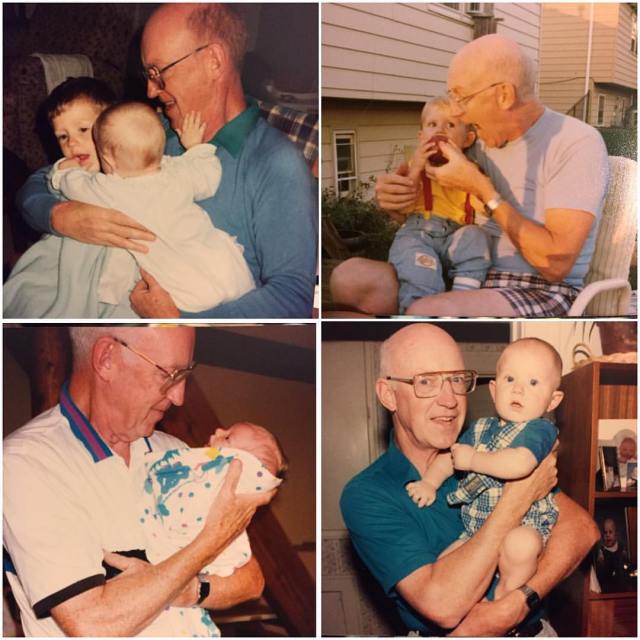 He passed away a few years ago now. I served as his caregiver for ten+ years after my mom died in 2005. But he lived to see many grandchildren born, both boys and girls. But he definitely doted on the girls who became part of our lives as one after the other granddaughter was born.
It wasn’t always easy taking care of my dad after my mom passed away from cancer. Our roles as father and son were sometimes reversed. He got no less cantankerous as he aged. Perhaps that was a bit of payback from him having to deal with my own feisty spirit as a kid.
So we had to learn how to communicate even though he could no longer talk after the stroke he suffered in 2003. That’s a long time to relate to your dad without being able to converse. But we managed. Lord knows we managed.
Breaking the ice
I remember the moment when the ice first broke a bit between my father and I after the testy teenage years with all those fights over studies and long hair and music. Our college cross country team had placed second in the nation that fall of 1978 . My father and mother were there to witness it. I’d run well enough to serve as fifth man that day. The feeling of accomplishment was rife within us all.
After hugs and photos with teammates and coach, I walked across the flat ground at the Rock Island Arsenal park where the meet was held. There my father was standing with my mom. He had a big grin on his face. I walked straight over to him and threw my arms around him, probably the first time I’d done that since I was ten years old. We held each other for a moment and I backed up with tears in my eyes and told him, “I love you dad.”
And that was enough. Father knows best.
 In 1981 the world was going nuts for running. The second phase of the American running boom was in full swing. As an avid runner, I thought (and was sincerely hoping) that it might mean women would find me more attractive.
 One summer evening we walked a mile to a local ice cream shop. On the way back we stopped at a park bench to smoke a bowl of her powerful Turkish weed. I was instantly so high that walking in a straight line was difficult. I’d already run 6 miles that morning and eight miles in the afternoon with some fartlek thrown in. I was so tired. And so goddamn high.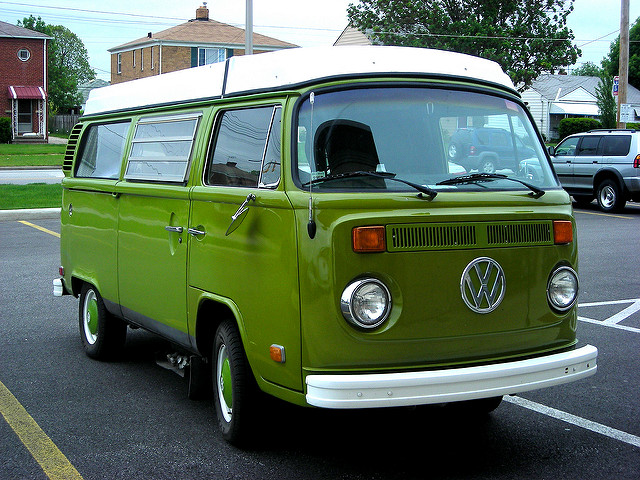
 Then she’d issue an invitation: “I wish you could skip work and ride around the country with me,” she’d say.
 As I shared the tale of my relatively recent breakup with the woman I’d dated in college, she listened closely to the story of our promise ring and the pressure to get married. It didn’t help that my faux-fiance’s less-than-supportive parents held a dim view of my future. To them, it wasn’t good.
 The three of us waited a long time outside in the car until my girlfriend and her roommate had enough waiting. “We’re leaving,” my girlfriend said.
 Because what else could cause young men to sexually pleasure themselves many times a day, or run workouts so long their bodies are thinned out like carefully shaven pencils? It’s the manic energy of youth that all men must learn to contain and put it to good use down the road. But the real problem in this world is that some men never grow up. That’s why the #metoo movement is necessary. It’s all about teaching the self-absorbed how to show respect, and to stop testing the patience of women who actually want to get things done.
 When the orthopedic surgeon showed me photos from my recent meniscus repair surgery, I was a little shocked. The images looked like something you might find on a porn site dedicated to prurient naughty part closeups. Every image was salacious in its detail and quite revealing about the inner workings of the human body. The inside of my knee actually looked quite like a well-known erogenous zone of the female anatomy. And thanks to actual pornography, which is a multibillion dollar industry, there are very few mysteries left in this world.
 We try to deny this fact with all sorts of pleasures. That’s how we get fat from eating and drinking stuff that isn’t all that good for us. We bury our sense of mortality with our appetites.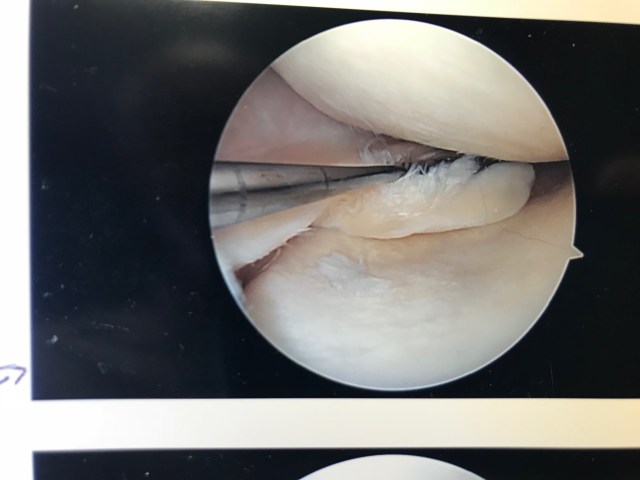
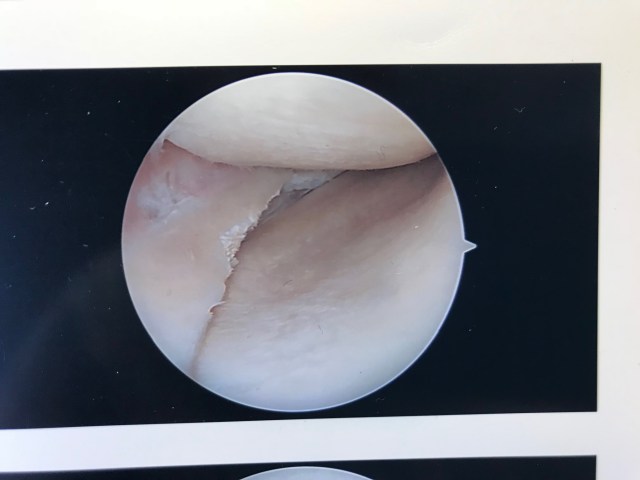 I find my knee porn images somewhat funny. If these were dick pics or a closeup of some woman’s vagina, this blog would be Rated R and the content considered scandalous. The second image does look quite a bit like a shaved mons venus. But since these images were actually taken inside my knee, they have no scandal value at all. In fact, they mean very little to anyone but me.
 For targeting longer races, one should count on racing shorter distances during the buildup. This accomplishes several things.
 The notion of a “PR” in pure bike racing is so highly dependent on the behavior of the pack that one cannot even measure the results or speed of one race against another without factoring in the speed of the group as a major component of a given average speed for any distance. The “PR” of which most cyclists speak is often reduced to “I was there for the bunch sprint and averaged 24 mph.”
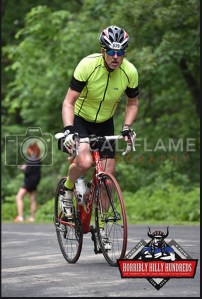 Thus the “common theme” in failure to set PRs is that athletes simply do not challenge themselves sufficiently along the way. That is the only way to gain confidence and strength in the pursuit of PRs.
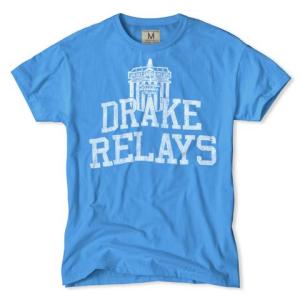 As a senior in college, I was chosen as the anchor leg of our 4 X 1-mile team for the Drake Relays in Des Moines, Iowa. My position as the anchor leg on the relay was not assigned because I was the fastest miler at our school. In fact, I was the least fast of the four small-college runners from Luther College lined up against the likes of Arkansas, Kentucky and Kansas. But I still had a role to play. Finish the damned thing.
 My real hope is that some hipster digging through the bins at Goodwill found that classic Drake Relays tee shirt and wears it around proudly these days. What greater honor could there be in life than to have a shred of your personal legacy become part of the Hipster movement to honor bad fashion from years past?
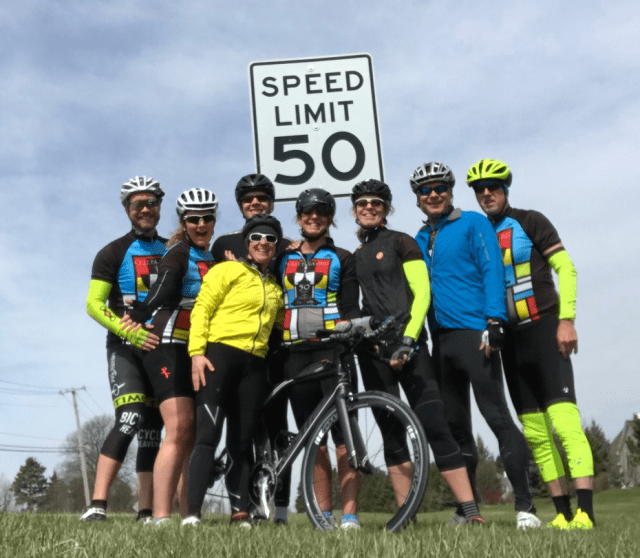 Together the kits made us look like we were an actual organized team (or something.) In truth, our morning objective was to either ride 50K or 50 minutes, whichever came first. Then we’d dive into the quiche and mimosas that Sue had waiting for us back at the house.
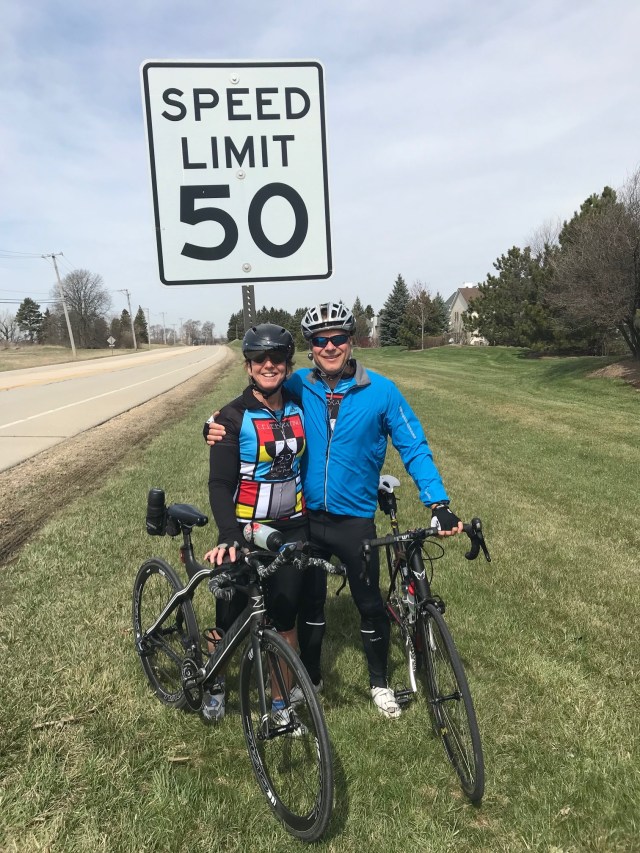 Given the windy conditions and the fact that Julie has been jetting back and forth between Texas and Illinois reorganizing her life at age fifty, we didn’t want to drag her too far in what became a vicious April wind. It turned out to be a nice hourlong ride with a stop for some photos (with her beau Mike) at a 50 MPH road sign out in the country.
 The only question remaining is why I Look so GIANT in this group photo (I’m at far right). Sue is 5’9″ and I’m 6′ 1 1/2″. But I look like a relative of the half-giant Hagrid from
  Harry Potter. I look so freakishly tall.
 When you’ve been away from any of your favorite activities for a while, the return feels pretty sweet. Which is why it felt so sweet to run a few steps from my car to shut the front door this morning as we headed off to take Sue to the train.
 By now you’ve heard about the ugly incident in which an employee of Starbucks called 911 to have two black men removed because it seems they had not yet placed an order. Here’s the skinny on the story as it was described on LinkedIn:
 Consistency
 But the manager eventually got wary that James might be annoying customers. It’s a difficult and touchy situation engaging with the homeless. Who (and what?) determines how long is too long to hang around a store? After all, some Starbucks customers stay all day long working on their laptops or jabbering on their phones. Are they homeless as well?
 But like I said, I’m no real coffee clutcher. I’m not speaking out of fear of losing access to my favorite drink if a boycott were to sink the Starbucks chain.
 Yesterday a nurse from the orthopedic office called to follow up on my recovery progress after surgery. They actually called a couple times immediately following the surgery, but I missed those calls. So the nurse sounded a little surprised when I answered the phone.

 Endurance athletes also have to deal with delayed reactions related to diet and nutrition. An athlete who eats the wrong foods may enjoy early success in a run or ride but are not properly fueled for the long haul. This can happen easily on a longer bike ride. Forgetting to eat or drink early on can result in a bonk when the body runs out of fuel.
 I well recall trying to train on the bike when I was using a drug called Lorazepam for anxiety treatment during all those years of caregiving for my late wife. The drug helped alleviate anxiety in the moment. But it wore off with time. Then it was back to square one.
 Yet I still kept running and riding, because those were my true salvations. Granted, my efforts were full of shortcomings. At times, I had no will to compete on the weekly group ride and would simply fall back, too tired and depressed to care if I was anywhere near the top dogs. I had to swallow some ego many of those weeks. Sometimes I’d get angry, pissy or moody along the way. That had its own value. Since I couldn’t really afford to get angry with my patients, it helped to curse the winds of destiny, be they headwinds or crosswinds. That’s both a literal and metaphorical analogy.


