50 Years of Running: Chicago Time

The Rookery in Chicago

I have an embarrassing confession to make about starting the job with Van Kampen Merritt in the late summer of 1980. On the first day of work, I was scheduled to show up at 208 S. LaSalle, the office headquarters for the company. I put on a suit and tie, drove to the train station in Geneva, and rode the train into the city. Not knowing much about city life, I tucked my wallet down the front of my pants just to be sure that I wouldn’t get robbed.

The absurdity of that action given the way I’d driven all over the inner-city the previous year is obvious. Somehow I allowed naivete to consume my brain in the moment. But once I walked to the office and saw all the other businesspeople bustling around the Loop, I stopped worrying and started to embrace this new life I’d discovered.

Not long into my job as a graphic designer in marketing, I was taken under the wing of Ralph Van Kampen, the elder brother of Robert Van Kampen, the firm’s owner. Ralph was a huge fan of architecture, and Frank Lloyd Wright especially. The Rookery in Chicago was his pride and joy. He took me on a walking tour during the lunch hour, effusively pointing out the finer points of the building. Ralph also lived in Oak Park, the home of the Frank Lloyd Wright studio and many other fine examples of homes and buildings designed by the famous architect.

To that point in life, I had not thought much about architecture other than what I’d read about in Art History class at Luther College. At one point, I wrote an ignorantly contrived paper about the play of light in European Cathedrals, a missive that my art professor John Whelan firmly returned to me with instructions to take up an entirely different topic. I’d based my paper on photos in art history books. That’s about as idiotic as claiming the moon is made of cheese.
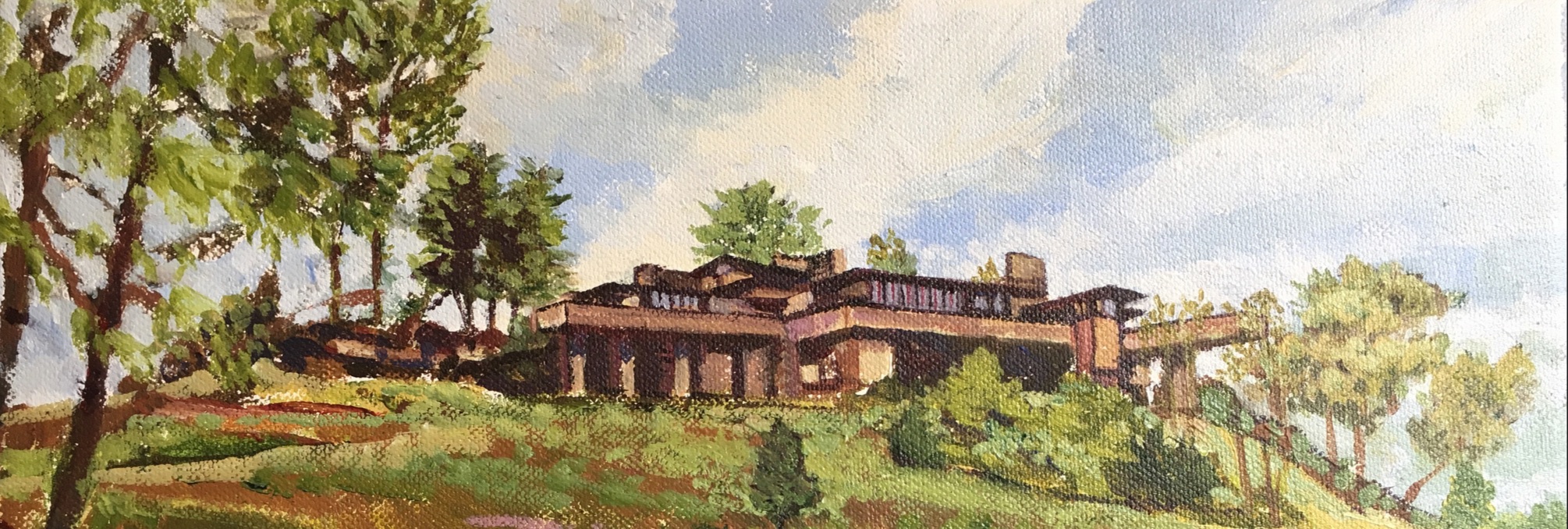
My acrylic painting of Taliesin, the Spring Green, Wisconsin home and studio of Frank Lloyd Wright.

Much later in life, I’d take a greater interest in the work of Frank Lloyd Wright, touring properties the Robie House in Hyde Park, Taliesin in Spring Green, Wisconsin, the Fallingwater and Kentuck Knob homes in Pennsylvania, the Johnson Wax building and home in Kenosha, and finally Taliesin West north of Phoenix. I grew to appreciate and even love Wright’s incredible vision of prairie-style architecture. But at 23 years old, my education was just beginning.
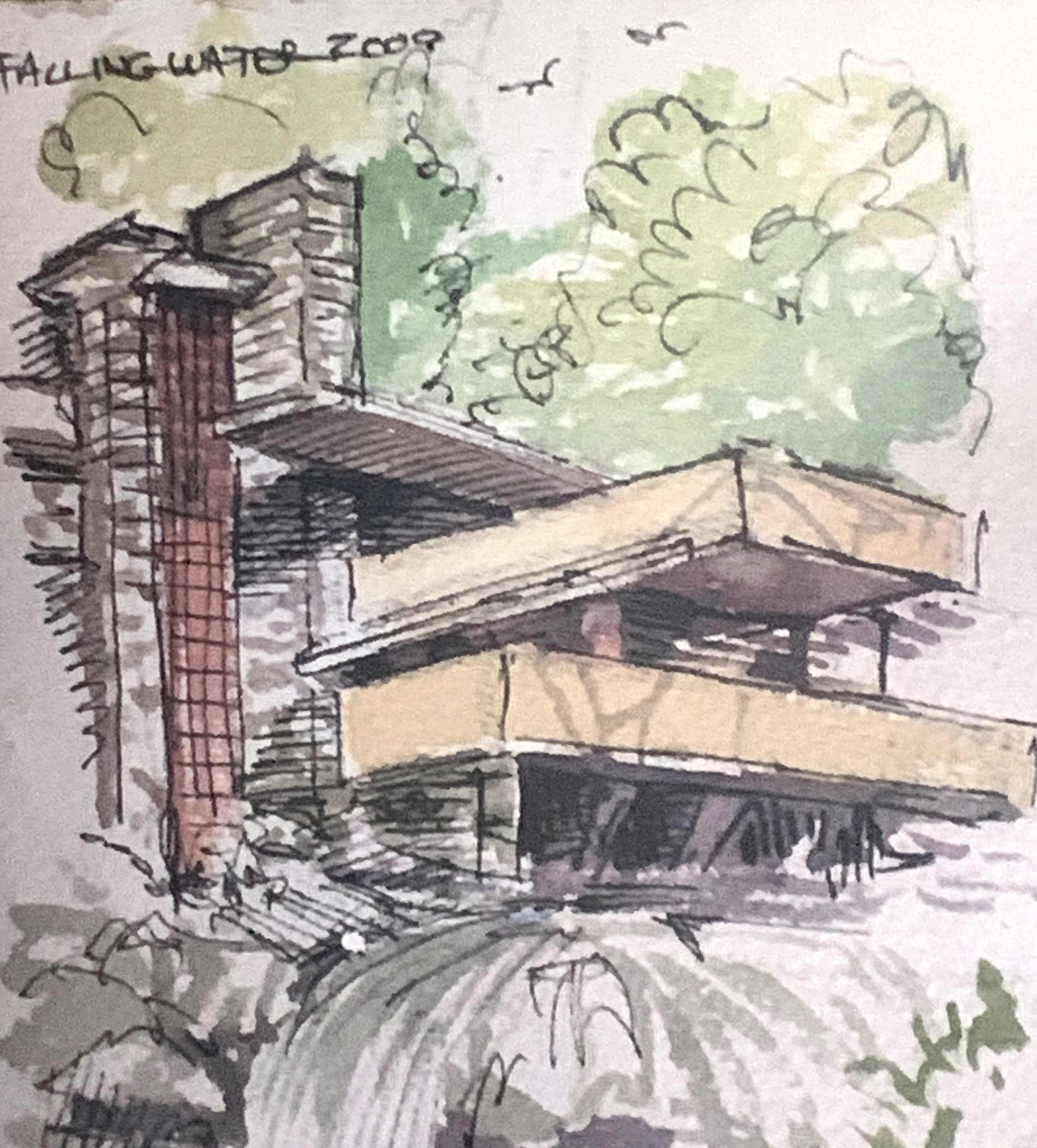
Watercolor and ink drawing of Fallingwater by Christopher Cudworth

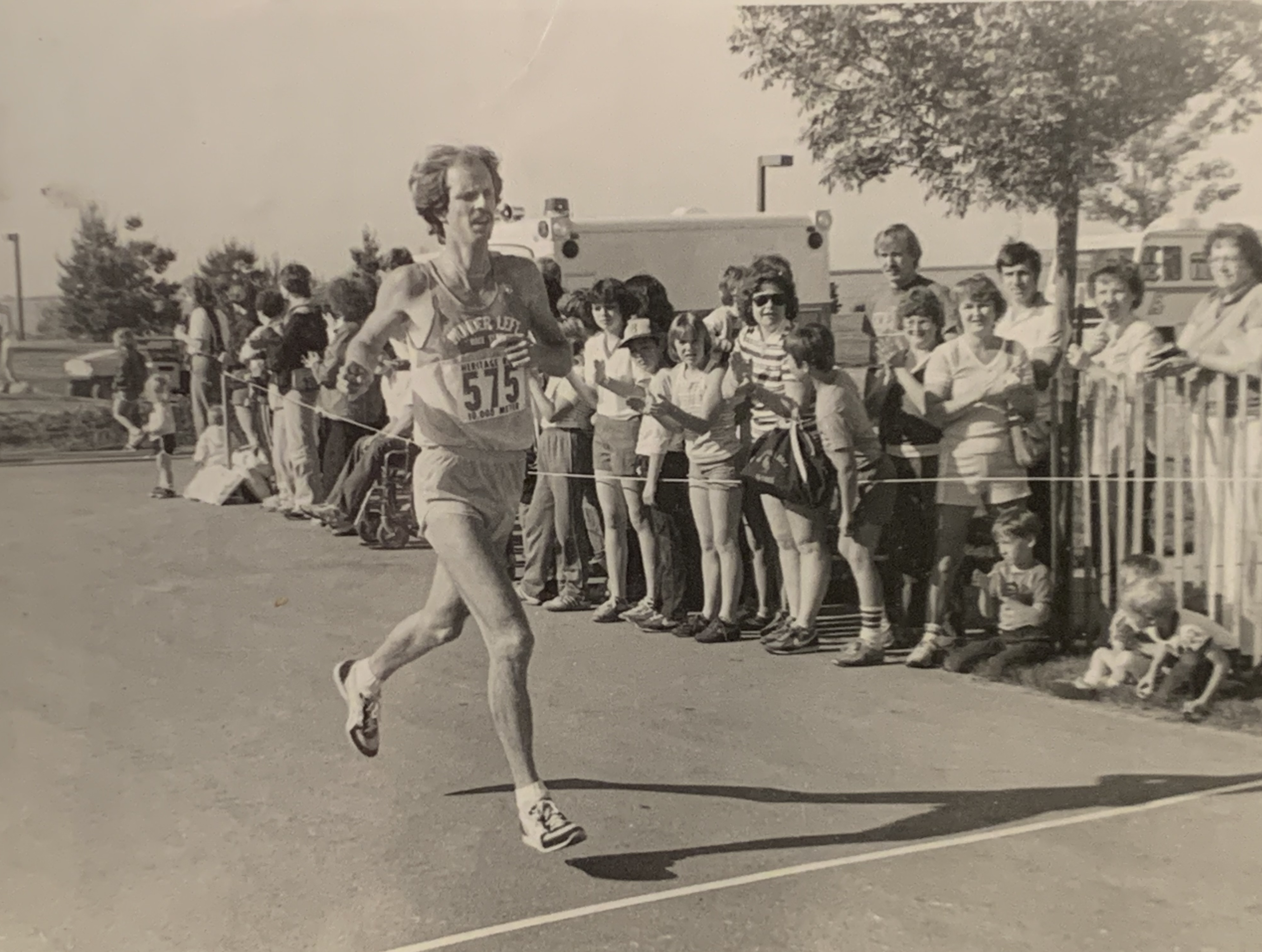
The joyful and humorous part of this story that relates to running is that in 1983 and 1984, I won the Frank Lloyd Wright 10K in Oak Park. During the first race, I held a big lead over 3,000 other runners, and who should burst off a lawn and run beside me for fifty yards? It was Ralph Van Kampen. He shook his fists and cheered. I can still see his excited expression and his eyes wide beneath his wire-rimmed glasses. He thrilled to the idea that I was winning a race in the locus of his life’s interest. I was proud to give him that moment as well.
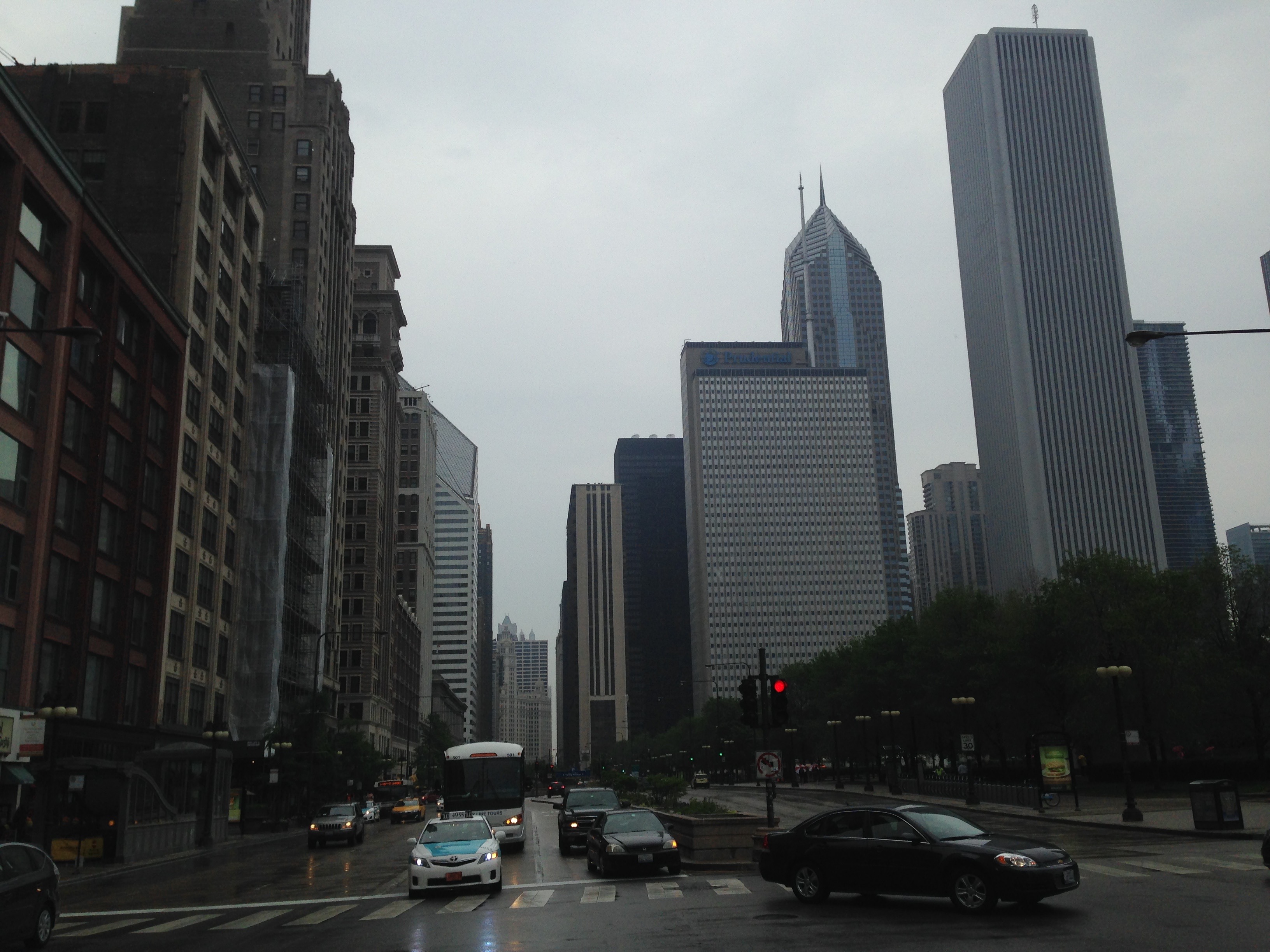
The City of Chicago

The daily commute to the city was not my favorite aspect of the job. But it did give me time to write, and I began to compose a book titled Admissions, writing out chapters on yellow legal pads in my capital letter handwriting. I’d mapped out the plot and wanted to look into the future with the book. I’d learned so much about the admissions process in that single year of recruiting that it seemed like a topic ripe for exploration in a book of fiction.

Remember that I was writing the book in 1980. I conceived a place called the University of Wisconsin-Dells. The college was funded by tourism rather than corporate money, tuition, and alumni donations. All the students were employees of the college rather than just students. The campus drew on the same markets as the Tommy Bartlett Water Show and other tourist attractions popular in central Wisconsin.

The main character was a young man named Sean whose impatience with his first job out of college as a park ranger led to his getting fired. His father landed him a job as a pressman working at a Vietnam War buddy’s printing business in Chicago. From there, the adventures began. His boss at the printing plant was a seemingly abusive floor manager named Eugene Tierney who ran a clandestine porn business out of the back of the plant. Sean could see that the profits were good enough for this dad’s buddy to justify that seedy side of the company. But Tierney mocked Sean’s innocence, stuffing copies of the magazines in his locker until Sean eventually begged to move into sales. His wish is granted thanks to the fact that his dad once saved his buddy’s life in Viet Nam, so Sean feels like his life is about to take a turn for the better.

To compose the book, I sifted through ideas on my nightly runs. I’d get home from the commute out of Chicago, shift into running gear and blast away for a few miles. I’d sort through the plotlines of the book while running, and try to imagine what life would be life in the future so that I could write about it. I wanted the book to predict the future while taking the characters through twists and turns––the way life itself seemed to do. I also wanted to write the book in freestanding chapters dealing with cultural and political themes linked together by the characters and the plotline.

Sean meets a girl named Charise who works for her aunt’s real estate business in the city. Sean and Charise carry on their relationship in secret because her mother back home in rural Illinois fears for her independent daughter’s safety in the big city.

As the book built out and the storyline broadened, I looked for the plot twist that would set things in real motion. That’s when Tierney messed with Sean by slipping copies of pornography into a presentation he was scheduled to give to a well-known Christian client seeking printing for his religious publishing company.

The meeting explodes when the pornography falls out and the Christian publisher freaks out. In fear, Sean drives out of the city to points west without even knowing where he’s going. He continues north on I-90 all the way north of Madison and winds up pulling off the road out of exhaustion in the Wisconsin-Dells area. From there, the chapters take on an observational tone as Sean links up with a professor of biology at the University and quickly finds out that the college is seeking admissions counselors to recruit students for the all-new school.

But Sean’s recent past follows him. The Christian publisher turns his name over to The Mandate, a moralistic, religiously-driven, quasi-political organization that buys up AM Radio stations all over the country to broadcast its messaging to willing ears.

Again, recall that I was writing this in 1980. The idea of completely biased media channels was still a decade or more away. And the network I imagined used its radio reach to empower citizens to act in vigilante fashion by harassing supposed enemies of the organization.

During 1980, when I was writing the book, an actor named Ronald Reagan began running for President. He would introduce an entirely new level of conservative oppression of competing ideals, crushing unions, cutting taxes for the wealthy, and introducing men such as James Watt, who publicly stated that “When the last tree falls, Jesus will return.”

Sean runs afoul of The Mandate, who at one point track him down to harass him during his commute from the Dells to Chicago. But Sean leans on the life experience of his newfound friend, the professor at UW-Dells, to keep away from his tormentors.

Following Sean in his travels, we encounter a new radio network called the All Beatles Channel. Again, I was writing the book in 1980. The concept of an actual all-Beatles channel was still two or three decades away. But as I did my daily runs, I studied the news and kept thinking “What could happen in the future?”

I wrote about a motel property out in the stick of Wisconsin where Sean stopped to gas up one day. In talking with the owner, he learns that the joint had bec=me a swingers palace. The “wildlife” within the motel was exceeded only by the native wildlife residing in the wetland and swamp formed when broken field tiles flooded the property. But the motel is seized and closed when it is discovered that the liquid underground storage tanks (L.U.S.T) under the property are leaking toxic fluids into the environment.

In his travels, Sean also meets a woman with a unique fetish for seducing team mascots and other costumed characters. Eventually, he connects back up with his Chicago girlfriend, whose running career takes off when she turns out to be more talented than she expects, and wins a major marathon. That brings her into the spotlight, but a photo of her and Sean together, and a reporter’s byline that they are a “couple” following the race again attracts the attention of The Mandate. The pair of them are forced into hiding because Sean fears for himself due to possible legal ramifications from the pornography incident. He reasons that Tierney placed the stuff in his presentation, yet doesn’t know for sure whether the company president would believe him. Charise in turn fears that her aunt will tell her mother about their relationship and she’ll have to give up her life in the city.

So they take off north together, and Sean brings her to meet his professor friend. He is a unique character indeed, the progeny of an East Indian and Native American mother and father. He is an expatriated professor from Eisenhower College in Seneca Falls, New York, a school where he loved to teach, but the school closed for lack of funding. That embitters Jith Lakota, who embraces the commercialized atmosphere of the University of Wisconsin-Dells as a vengeful antidote to the death of his purely academic career.

He schools Sean in the use of new technologies such as the Voice Recognition Device (VRD) that takes voice samples from prospective students and runs them through data analysis to assess and summarize key personality traits and psychiatric tendencies. “Mostly,” the professor tells Sean. “It tells you what you’re not good at. We use it to help people avoid failure and give them a profile of what they should do. Sometimes you have to be stupid enough to know what’s good for you.”

Upon meeting Sean’s girlfriend Charise and learning about her marathon success, the professor grows excited. “I will put you in touch with some tribes in northern Wisconsin,” he tells her. “They have created a process using petroleum to suck the toxins out of your system. It has been shown to improve athletic performance by as much as 7-10%. Think about what that could mean to your running!”

Then he takes Sean out to show him a new car prototype that the University’s experimental automotive division has created. “Look,” the professor says, opening the hood. “The engine is replaced by a set of oppositional magnets in a coil,” he explains. “When you magnetize the two coils, the force of opposition is transferred to the drive shaft. No emissions. No pollution. And every vehicle on the road can be retrofitted with this technology.”

He sends Sean and Charise north for her detoxifying, and Sean drives the magnetic car up and back. “Think what this will mean for the automotive future,” the professor enthuses before they drive away.

Following the treatment, she and Sean head south with the intention of arriving back in Chicago. Charise reasons she needs to inform her aunt of her whereabouts. But somewhat along the way, Sean is spotted by a member of The Mandate, and they are pursued by a convoy of vehicles with AM radios blaring, all the way to Chicago.

They use back streets to escape and park in the underground garage of Charise’s apartment. Sean tells her, “I’m sick of this. I need to get this figured out. I’m going to meet with Tierney and the President. What about you?”

“I’m going to get in touch with my aunt,” she admits. “I’m tired of hiding from everyone.”

The Chicago skyline.

Sean runs on foot over to the printing plant, and enters the building through the back. There he immediately encounters his nemesis, Eugene Tierney. “Sean,” he says. “I’m glad you’re here. Come with me.” Sean balks, but Tierney assures him in a tone he’s never heard before. “Seriously. We’ve got important news to tell you.”

They meet with the President, and Tierney lays it all out for the three of them. “Listen, Sean,” he begins. “I admit that I put that porn in the presentation to the Christian publisher,” he says.

“I knew it was you,” Sean says bitterly.

“But I did it for a purpose,” Tierney continues, glancing over at the President, who stands up from behind his desk and says, “Sean, we had a plan all along.”

“That operation in the back, the porn plant?” Tierney explains. “All of that is funded by The Mandate. It’s their profit center. And that Christian guy you met? He’s the operational head. Their whole organization is a hypocritical farce. They claim to be high on morals, but actually, they’re really scummy people who exploit women through porn to advance their political agenda. We needed you to draw them out and create a way to expose them.”

Sean stands shocked. “You used me.”

“But we knew it would work,” Tierney says. “And we’re on solid legal ground. Because actually Sean, I’m not really a press floor manager by trade. I’m an attorney. A prosecutor. Your father and I also served in Vietnam together. He saved my life too.”

“So, my father knows about all this too?”

“He does, Sean. And he’s really proud of you for staying out of trouble while we made all this happen. The newspapers are breaking this story tomorrow. The Mandate will be destroyed, or at least in its present form. You’re really part of a heroic tale, kid.”

And that’s the plot of the book I wrote back in 1980. It predicts many things that came true in the future, some of them decades away. I conceived it all while out running, and wrote is all while commuting back and forth to the city in the fall and winter of 1980-81.

The Macintosh 504c on which I transcribed the book Admissions.

A few years later, having transcribed the book from handwritten legal pads through an IBM Selectric, then a Swintec typewriter with 10KB of memory, I attempted to enter it on magnetic floppy disks on an Apple computer my wife brought home from school. That was abortive, because the disks kept fillingup or failing. I finally copied it all over to a Macintosh Powerbook 540c laptop. Where much of it sat for several decades.

Recently, I received a tool to transfer files from floppy disks to my current laptop. I saved the files first as Raw Text, then loaded them onto a set of floppy disks I’d kept all the years, and plugged the transfer tech into the USB of my Mac laptop. I’ve saved the entire book now in Word form, and plan to edit and publish the thing someday because, as I’ve stated, it predicted so many things correctly about the future.

It may be a labor of love that only I appreciate, but what the heck! I love writing as much as I love running, and so much of what I write comes to mind while out on a run, or a ride, or while swimming. They all go together. Why not honor that even if it was years in the making?
Posted in aging, Christopher Cudworth, running | Tagged , , , , , | Leave a comment

50 Years of Running: Detachments

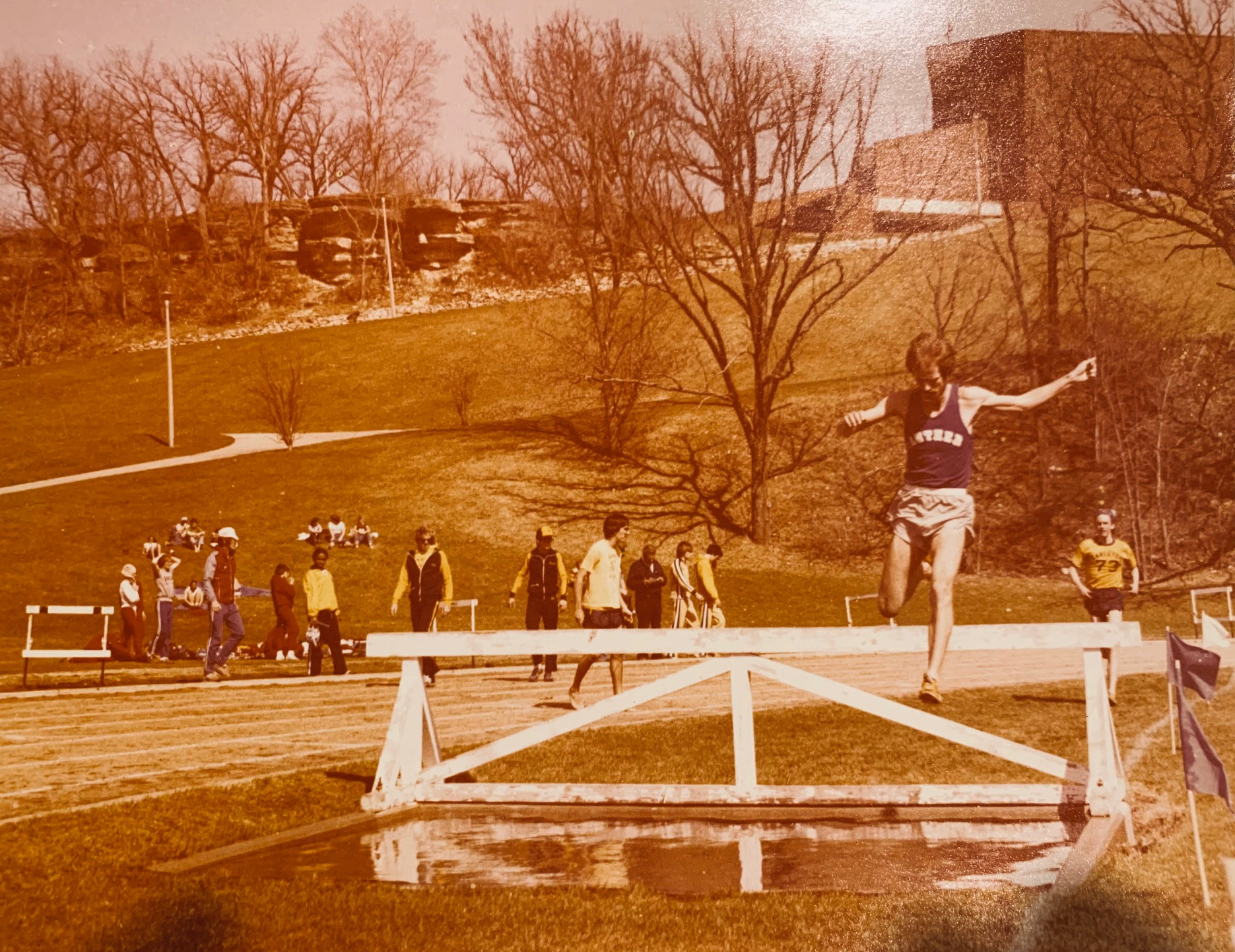
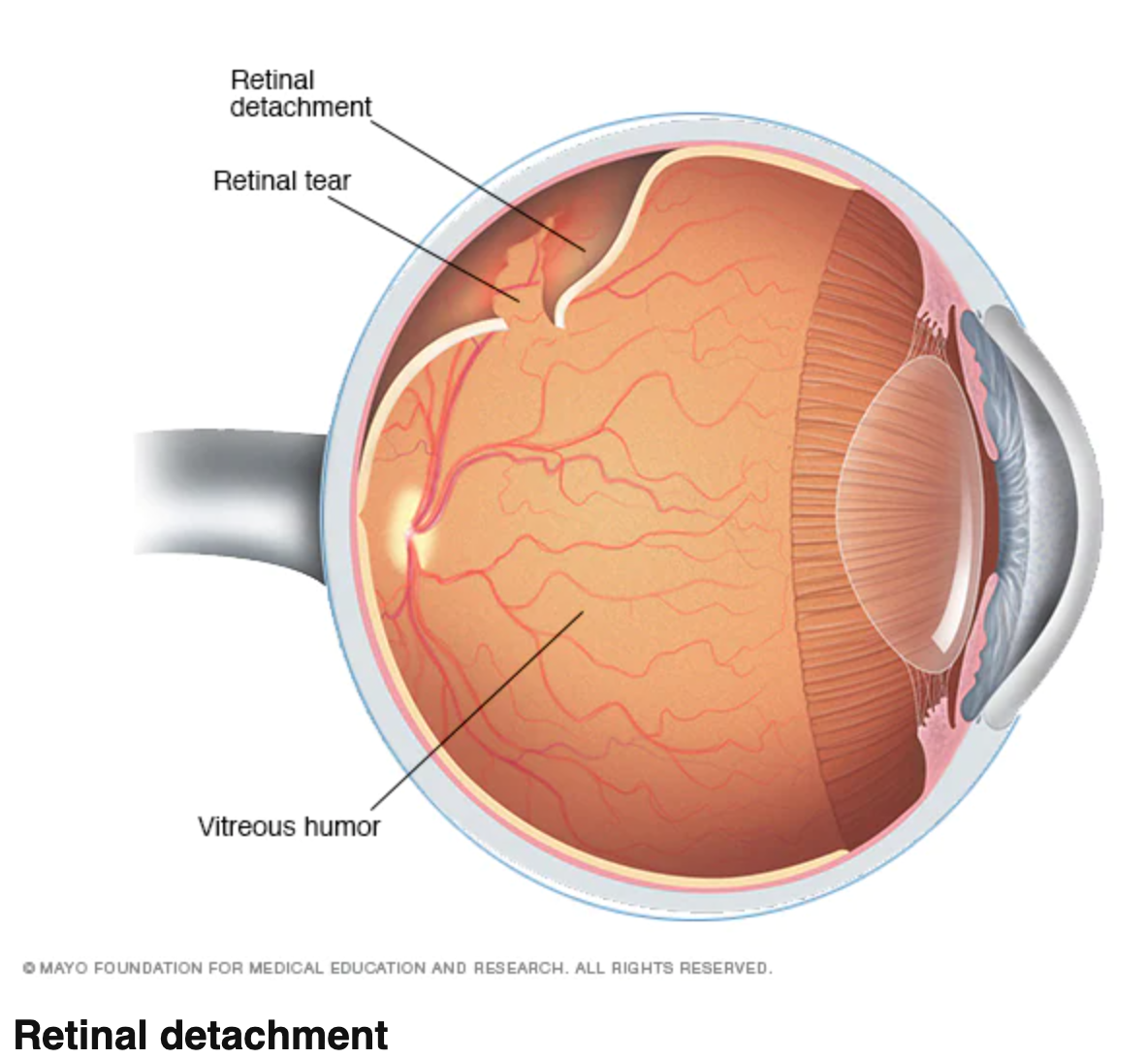
Once the optometrist found the retinal detachment in my left eye, all the other stuff that occupied my mind fell away. I pushed him for information about how the condition came about. Was it trauma? I’d recently gotten hit in the eye by a tree branch that snapped back at me while birding. He said that was unlikely the cause. Was it my steeplechase career? All those water jumps and hurdling? Not likely either. What might have caused the retinal detachment was the rapidly changing structure of the eye related to astigmatism.
The detachment in my retina was on the lower side in the back of the eye. It was cauterized with laser surgery.

So there I was, a 22-year-old kid who considers himself an artist fearing that the vision in one of his eyes might disappear overnight. Thus far, I had not experienced any symptoms such as flashes of light that would indicate a retinal tear. But I was not going to mess around waiting to find out.

“These two days––and the past week, have been a struggle with emotions. The eye appointments, and the brevity of hard truth of eyesight, scared me into a near adolescent state. Silly jokes. Angry silences.”

A friend of my girlfriend drove me up to LaCrosse, but I had mixed up the appointments. Nevertheless, I saw a physician who inspected the eye. ‘The Doctor in LaX let me know the story. I can’t lose my right eye. I love to see too well. My paintings sit here before me. They are right-eyed paintings. Lord, let me keep what I have.”

An appointment for laser surgery to cauterize the retinal detachment was scheduled for the next month. But that scared me. Was it safe to wait that long? Could I go blind in the meantime?
That afternoon, after getting back from LaCrosse, I went for a long run in the summer heat, then stripped naked and knelt down in the cold water of the Upper Iowa river. “I bathed in the river,” I wrote. “Hard and hot, I knelt in the muddy rush. My brown thighs looked strong. I dug my body. I wished she were here to cool off with me. The catharsis of frustration.”

Not knowing what else to do, I was looking ahead. “Running went well this past month. Next week I run the steeple (in a Chicago All-Comers meet). I hope my middle-of-the-road strength and layman’s flexibility will allow me to excel. I can run hard. One more cool, tough session on the track, and go for it all, as best I can.” I planned on sneaking out of town to have some fun back in Chicago. At long last, the admissions work was winding down.

Catching a break

Then came some good news. I received a phone call from a longtime art client to whom I’d sold a number of paintings during my high school and early college years. His name was Robert Van Kampen, and he’d started his own investment firm. The company was growing fast, he told me, and they needed a graphic designer in the marketing department. “Can you do that?” he asked me. Without pause, I said “Yes.” He also wanted watercolor illustrations for the company’s collateral. “That sounds exciting!” I told him.

On June 16, I journaled: “Today, and yesterday, I decided on working for Robert Van Kampen. I asked too many opinions, though I received the same answer. Do it. She and I are really nowhere near getting married. I love her though. I think she’s glad I’m taking this job. As she said, “I had a chance to go on my own. This is a real opportunity.”

My relationship with Robert Van Kampen was interesting all on its own. During my high school years, he’d seen some of my watercolor paintings hanging in Manor Pancake House restaurant in downtown St. Charles. The credit for that opportunity goes to my father Stewart, who framed up my paintings and worked with the restaurant managers to hang my art on their walls. Some of the work featured hawks and owls, and that’s what caught Van Kampen’s attention.

Robert Van Kampen was a hobbyist falconer. He was interested in having some paintings done of his hawks. He owned a red-tailed hawk and a kestrel, and I seem to recall a prairie falcon that was not entirely legal to have. The red-tailed hawk was kept in a cool basement room with a single window. He sat me on a stool behind a stand where a hunk of bright red meat hung from the perch. “Now watch this,” he told me. The hawk flew across the room and landed on the meat with a loud thump. “Did you see that?” he asked. “How the wing feathers don’t separate during flight? Your painting shows them separating, but they don’t do that.”

I replied that I didn’t see that particular detail. He laughed and brought the hawk back to its original perch to fly again. That time, I did see how the wings worked. “Okay,” I replied. “I got it.”

We went upstairs to share a meal with his family, whereupon he walked out with a small falcon on his fist. It was the kestrel––known back then as a sparrow hawk. Painted on its chest was a small black cross. “What’s that?” I wanted to know.

“It’s the cross of Christ,” Van Kampen answered. “These birds wear the same colors as the knights of the Crusades. I quickly learned that his Christian faith infused everything he did. After I finished the first two paintings he’d commissioned, he contracted me for a larger project, a bald eagle painting. I worked long and hard on the project, and someone in my family told me, “You should be charging more for that painting.”

So I showed up at Van Kampen’s house with the painting, displayed it proudly, and asked him for more money. “I would like to be paid $120 for this piece,” I told him. A stern look crossed his face. “I thought we had a bargain,” he told me. Then he pulled out his Bible and read a passage about honoring your word, and looked me in the eye. “What do you think about that?” he asked.

“That’s great,” I told him. “And I get it. But I worked really hard on this and I still want $120.” He gave a wry chuckle. “Okay,” he told me and wrote out the check. “But we have a bit more to learn about doing business in the future.”

My watercolor of the bald eagle painted for Robert Van Kampen in 1974 wound up in a Michigan antique shop where one of my brothers found it for sale in 2019.

Negotiations

After the hard year that I’d experienced working in admissions, I was elated when Van Kampen offered me the job, He told me to show up later that summer to start work in the fall. My girlfriend was not satisfied with that approach. She pressured me to call him back and demand a contract. I followed her advice, and he laughed a bit and said, “My word is good. You don’t need a contract.” I trusted him. From that point forward, I focused on taking care of other business so that I’d be ready to start a new job with a company called Van Kampen-Merritt.

Operations

The summer still held a number of challenges. I set up the laser surgery appointment in LaCrosse, then sat down to write out some feelings. “I’ve got a lot ahead of me,” I wrote. “The eye appointment. Moving. The trip to Pennsylvania (with my girlfriend). The internship in Minneapolis. The new job.”

On the 22nd of July, I traveled to LaCrosse to have laser surgery done on my right eye retina. They sat me down in a chair facing a large machine. Once dilating medicine kicked in, the nurse slid my seat forward until my eye was an inch from a gooey lens. At that point, I started to hyperventilate and fainted. I was so woozy when I woke back up that I hugged the nurse around the waist and told her that I loved her. She sternly sat me in the seat and again and said, “Okay, we’re going to get this done. Now breathe, normally.”

The green flashes pulsing in my eye reminded me of the lights in a copy machine. Nothing hurt, but the tension of sitting still with an eye was smashed onto a long lens was difficult to handle. Finally, they finished, and I was beyond relieved. “It went well,” the physician told me.

Back in Decorah, my ride dropped me off in town and for reasons only I understood at the time, I wound up going to a dive bar called The Pub in Decorah. My right eye was still severely dilated, and the guy sitting next to me at the bar noticed the big black orb of my dilated pupil, He leaned back and started to ask…”Dude, what’s up with your….”

I blurted, “I’m half drunk.” And laughed out loud.

The whole world felt half-real by that point. All through June and July, I’d been running decent miles to keep my sanity as I wound my time in admissions and dealt with the ongoing vicissitudes of my love relationship. “She was cold on the phone tonight,” I lamented. ” Has she turned off the faucet of her emotions? Our last goodbye was so painful I’m not even sure she wants me anymore. This time apart is so unfair.”

Following the eye surgery, I could not run for ten full days by doctor’s orders. I had a quiet 23rd birthday on the 26th of July and went another whole week with no running. Once the eye surgery quarantine was over, I jumped back in to run 49 miles the week of August 10-16th. I wrote, “I’m really ready to race. Running felt good.” And then, reality came boring down, as I came to the realization that the whole girlfriend thing was coming apart: “She’s out with some guy. We met another time today. I’ve not dated anyone else in so long, why must she? Is this penance paid? Am I subtracting without balancing? I love her so. But I must not take pain for granted.”
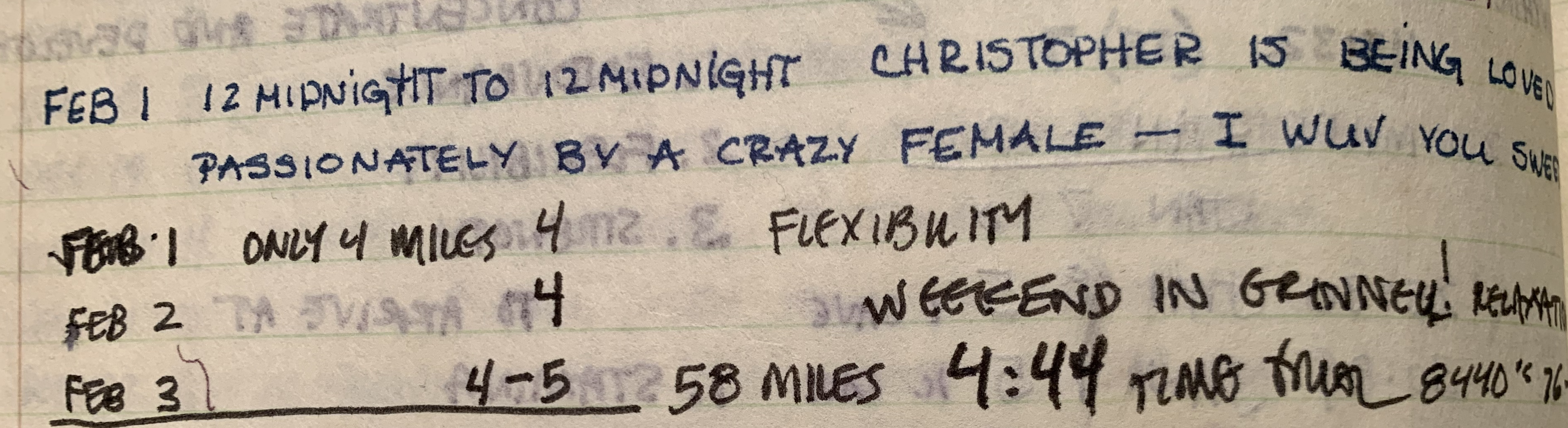
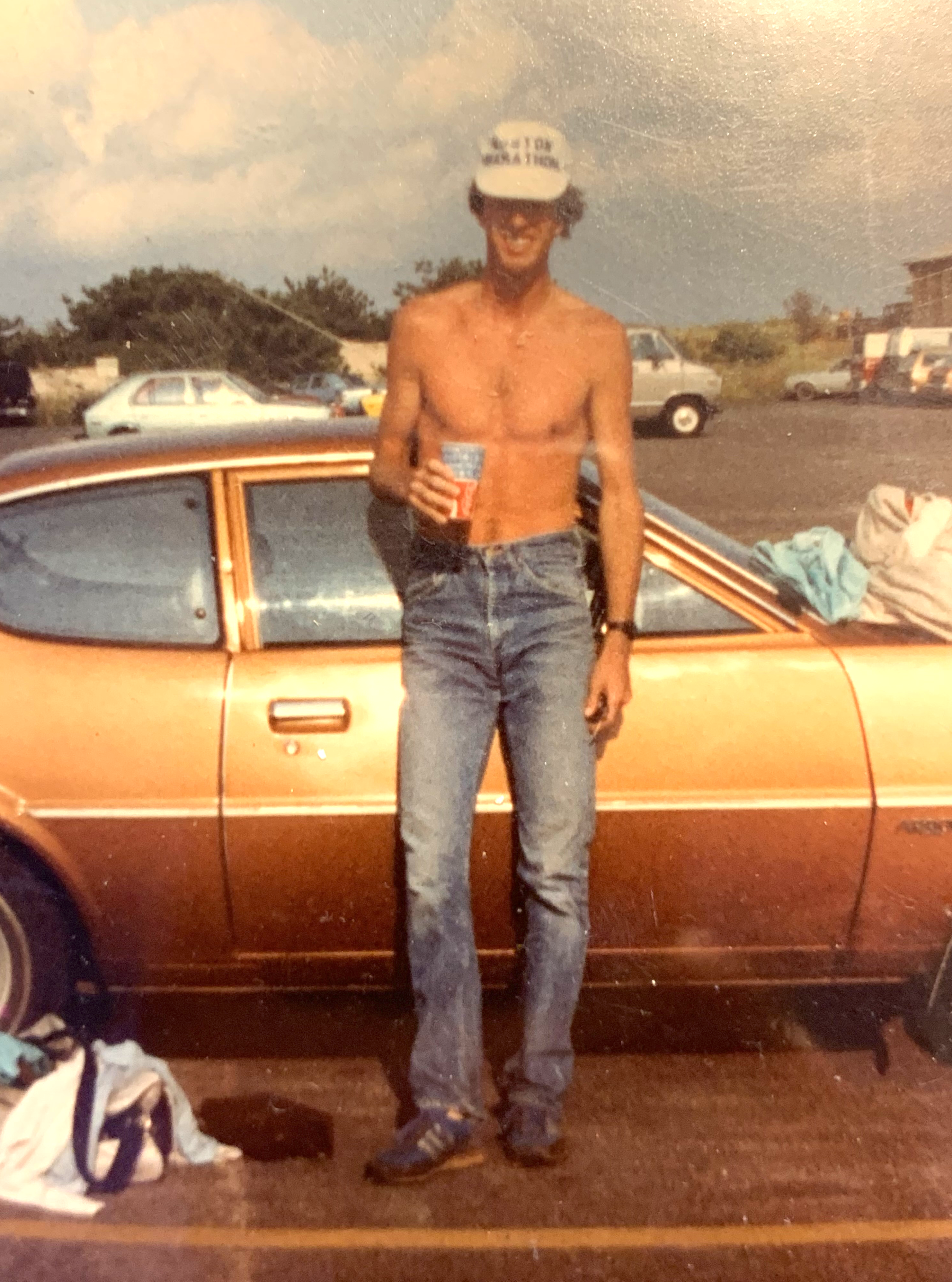
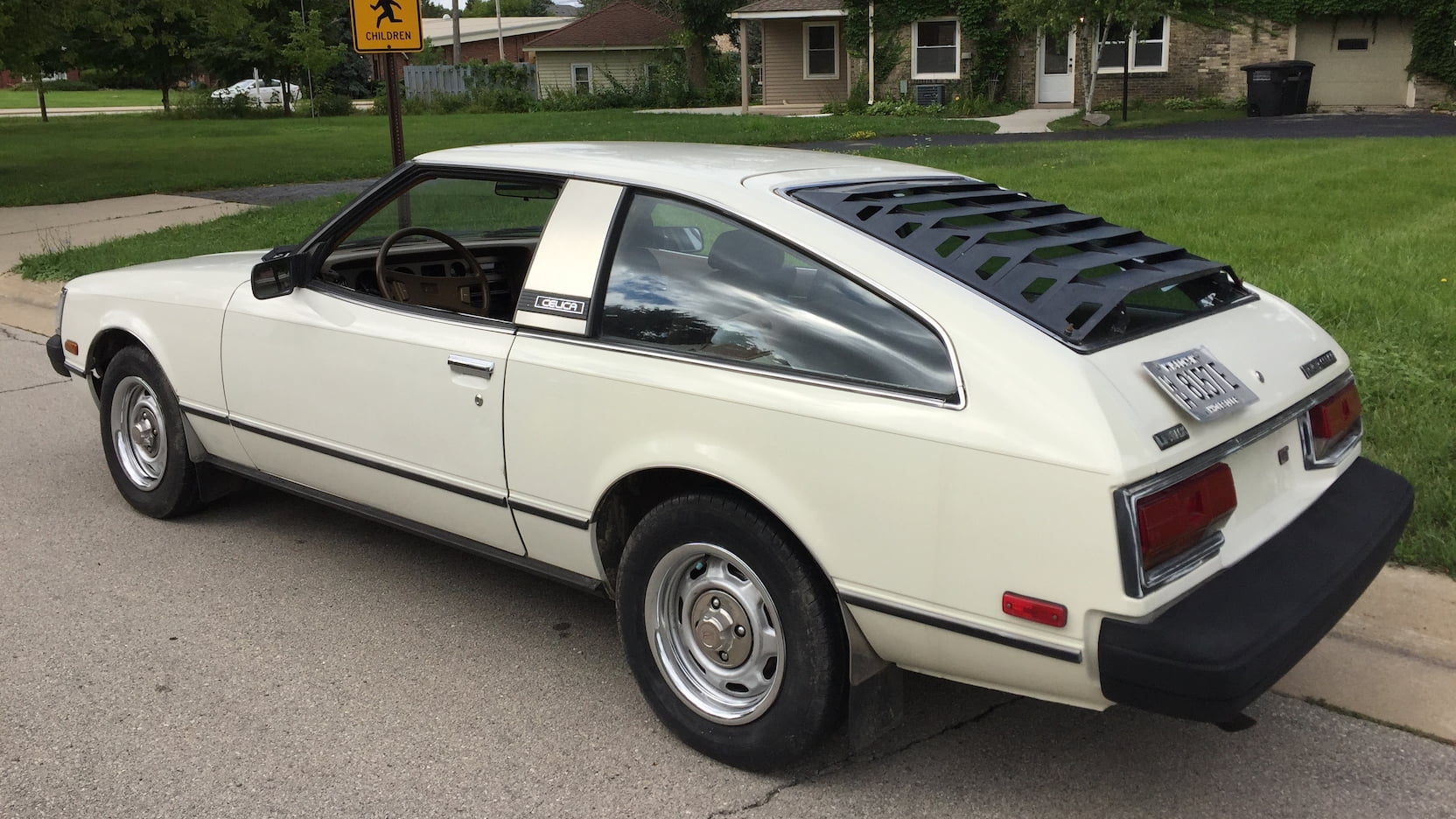
Other realities were dawning on me as well. That July, knowing that I’d soon need a car of my own to get around in the world, I’d taken the $1500 I’d been given for graduate school and purchased a bronze Plymouth Arrow from a retired Naval engineer in Decorah. The car was tuned so well that you could not hear the engine running. My father lectured me that I should have consulted him on the purchase because he considered himself an expert on used cars. But the car was almost brand new, and given the fact that my father’s cars often broke down, I made the decision on my own to buy it.

Posing with the bronze Plymouth Arrow that I purchased in the summer of 1980. That silver Frank Shorter back at lower left was one of my all-time fave pieces of equipment.

The Load Out

Finally, the admissions job ended for real, and the time came time to move out of my little upstairs apartment in Decorah. I grew to love that little place that year, as it was rented from a Luther custodial employee and birdwatching friend named Arnie Rolm. That “home” upstairs was like a little refuge from the world. Yet one night, while sitting in the kitchen with the lights off while talking to my girlfriend long-distance, I glanced across the yard to the house next door to find a woman undressing in her bedroom. I tried like heck to pay attention to the conversation at hand, but as the woman across the way peeled off her top and then her bra, revealing a wonderful set of breasts, I lost track of thought and shifted my attention fully to the event taking place next door. Off came her jeans and panties as well. By then, I was transfixed. After all, how often does it happen that an attractive woman bares all before your eyes. Sure, I was being a voyeur in that moment, but it was not calculated or intentional. What was I going to do, look away?
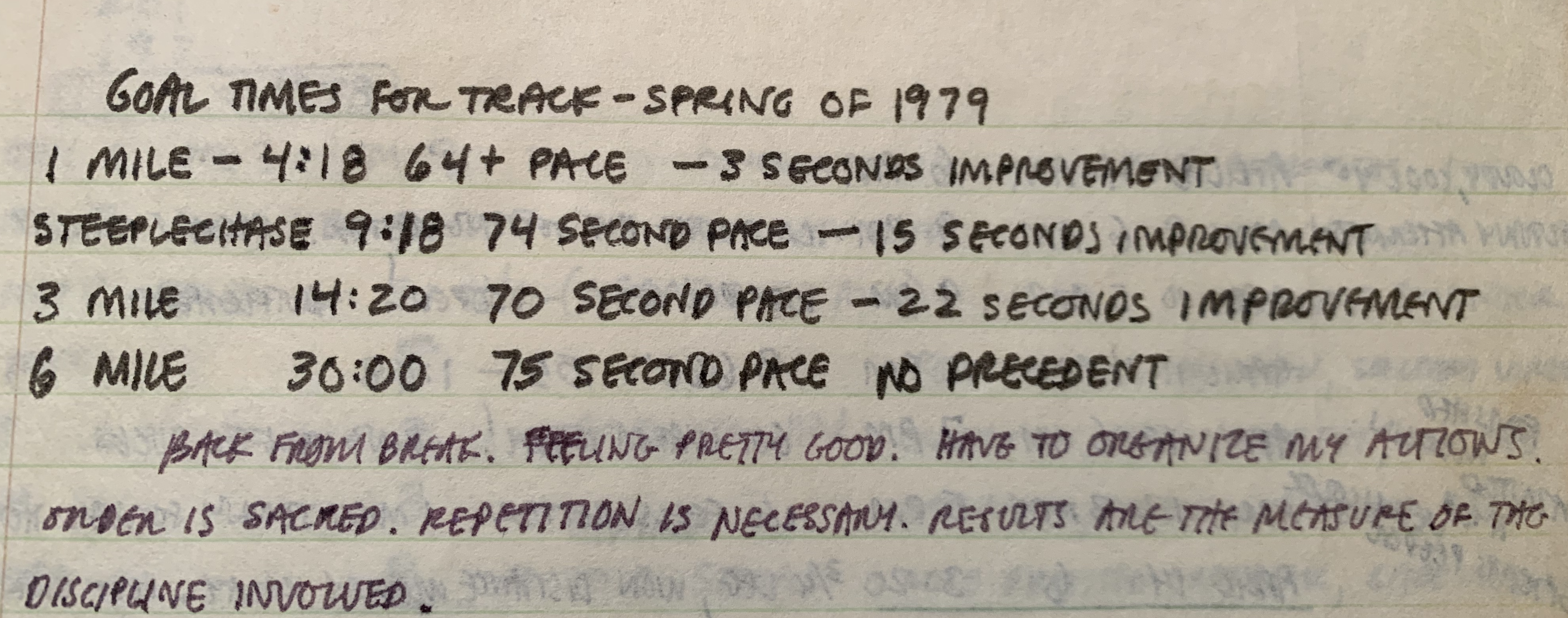
“Are you there?” my girlfriend asked.

“Um, yeah,” I told her. “I thought I saw an owl outside.” For me, that was a plausible excuse for my distraction. I was always looking at birds.

The last day in Decorah, I collected the security deposit, emptied the bank account in downtown Decorah, and loaded up my car with my most valuable and portable belongings. I headed up to the Twin Cities for one more visit with her before heading back to Illinois and the job in Chicago.

I stayed one night with her at her apartment, but her roommate was fussy about groceries and such, so I drove across town to stay the week with my former college roommate Dani Fjelstad at his St. Louis Park condo. That night, when the car was parked in the condo lot next to a set of railroad tracks, thieves smashed out the windows and stole all my good stuff. Whatever they didn’t take was strewn all over the parking lot. The belongings they did take were heartbreaking to me. The Olympus OM-1 camera and accessories that my parents gave me for college graduation. The deerskin art portfolio that my girlfriend’s parents gave me. My favorite brown dress suit. The tape deck and speakers. My prized Frank Shorter running jacket. All so they could either sell the stuff for cash or keep it for themselves. I seriously wanted to kill them.

The robbery frightened and depressed me. My girlfriend was less than sympathetic. “I can’t believe you let them steal that portfolio,” she said. I wrote in my journal, “Is this God teaching me simplicity? I’m weak for now.”

Hold on, hold out

That summer, I fell in love with the Jackson Browne LP Hold Out. How a guy can write lyrics that relate to so many people always impressed me. But his music helped me process all that was going on in the world of love and loss.

Give up your heart and you lose your way
Trusting another to feel that way
Give up your heart and you find yourself
Living for something in somebody else

Still, I stayed another week in the Twin Cities and even ran a 21:37 four-mile race. A day after that, I ran around the Twin Cities lakes with my former roommate Dani. He got so coated with summer flies that he ran straight into the lake, shoes and all. I stood there on the shore laughing my ass off as he climbed back out. “I can’t stand bugs,” he told me. The next day I ran with my girlfriend, “Nice and slow.” Then I made the long drive back home to Illinois. “Some tears,” I wrote. “Hold out.”

You’ve done your time on the bottom line
And it ain’t no thrill
There’s got to be something more
Keep a hold on still
You know what it is you’re waiting for
Now you just hold on
Hold on hold out, hold on

I knew by then that no matter how hard I tried, things with my former lover would never work out. I recalled sitting with her on a 4th of July night to watch fireworks over a lake in the Twin cities. As we waited for the skies to grow dark for the fireworks display to begin, a massive thunderhead rose to the east of us. A constant show of lighting flashed inside the towering structure of the cloud. The deep sound of thunder rumbled across the smooth water between us. The vibrant light show inside the cloud was more thrilling than the fireworks to come. There was nothing fake or contrived about it. Just the earth’s heat and moisture, rising up to heights of 40,000 feet or more, all while electricity ripped through it all. The thunderhead looked as if love and life were being born within, like the beginning of time itself. I remember thinking that our lovemaking earlier that evening was akin to that thunderhead. The roaring pleasure of inseparable elements. Then, as night came on, the thunderhead calmed and dissipated in the east and the fireworks burst and poured across the sky. A human contrivance replaced all the natural glory that we’d witnessed. So much of life is like that. The glitz and drama of instant gratification too often replace the glory and simplicity of genuine experience. So it was that the towering thunderhead sank into the night. What matters most is whether bearing witness to such events creates a change within us.

Posted in aging, Christopher Cudworth, college, competition, Depression, God, life and death, love, marathon, mental health, race pace, steeplechase, track and field, We Run and Ride Every Day, werunandride | Tagged , , , , , , , , , , | Leave a comment

50 Years of Running: Sorting through a box of slides

One of the most challenging aspects of life on the road doing admissions work was feeling disconnected from the core mission of Luther College. It all seemed abstract out there in the field; showing photos ins a binder, talking with kids and parents, and standing there at college nights wondering who might come along. What I did realize was that Luther’s growing fears about enrollment and funding were pressing. As admissions counselors, we were called upon to be the cure.

Yet no one really had that conversation with us, at least not with me. Perhaps the senior admissions counselors knew what the numbers meant, but those of us just starting out in the admissions game were given some near-term numbers, our quotas, and little else to go on. Go get it done.

Running blind

I felt a parallel between that circumstance and all the running I’d done. Distance runners in the 1970s and 80s were running blind, in many respects. We had no technology or data to measure our efforts other than a watch and a resting heart rate. The training strategies now available simply didn’t exist. Of course, there were evolving “theories” about training. Some, like Arthur Lydiard, advocated Long Slow Distance while others like Brooks Johnson at Stanford insisted that running long and slow was a waste of time.

So we picked and stole what we could from the prevailing theories. Most of the time––in track especially––we made it up as we went along. Steal a workout concept here. Borrow a training schedule there. Hope that your coaches knew what they were doing. Sometimes they did. Sometimes they didn’t. For most of my four years, we just ran hard every single workout. That wasn’t the best approach, but it’s all we knew how to do.

That “run hard all the time” was how it felt out in the admissions world as well. Throughout February and early March of 1980, I went all out on the high school visits and college nights. Then I’d drive back to Luther and work in the office on Saturday, meeting students and parents, leading campus tours, and making follow-up phone calls with prospects I hoped to meet in the following weeks. I drove thousands of miles to reach students in all kinds of situations, from rural homesteads to inner-city tenements in the space of a single day.

Yet in mid-March, when I got back to Luther, I was pulled aside by the director of admissions who had a message for me. I journaled: “I got a talking to from (name redacted.) He asked me if I “was really in the game.”

Surely he was getting pressure from the higher-ups to make the numbers that year. Like all small colleges operating during the crunch of a recession, Luther was facing tough economic circumstances in the late 1970s and early 1980s. As documented on FederalReserveHistory.com, “The economy was already in weak shape coming into the downturn, as a recession in 1980 had left unemployment at about 7.5 percent. Both the 1980 and 1981-82 recessions were triggered by tight monetary policy in an effort to fight mounting inflation.”

I understood why the director of admissions had that conversation with me, but I got the feeling he still categorized me as the guy that couldn’t navigate a stick-shift car up a hill––as if that was all he needed to know about my problem-solving capabilities. But I looked at the job from a highly objective and analytical viewpoint. I understood quite well that I was a rookie admissions counselor taking over the territory of a guy that was successful in that role for ten years. I knew it was a big task to do better than he had done. From the outset, I was running just to keep up with the past pace.

My numbers to that point were decent, but not superior to prior years. So I kept up the spin cycle of weekly trips to my territory, meeting new prospects (juniors) while encouraging high school seniors to get their applications submitted and their deposit fees in. More than any other territory in the Luther domain, recruiting students in Illinois and Chicago was a complex process. I visited Lutheran churches to meet with pastors, and followed up with guidance counselors after my visits. I was making connections and building relationships. It all takes time, and I knew that.

Spoke in a wheel

Years later I had an incident that served as a perfect metaphor for my admissions experience. I was out cycling on a 60-mile ride when one of the spokes in my bike wheel snapped. It rattled for a few hundred yards before I figured out what was making the noise. I tried to keep riding, but the entire wheel started to shimmy and go out of shape. At that point, the bike was unsafe to ride. I never knew that a single broken spoke could undermine an entire wheel. That’s why bicycle maintenance before a ride and tying your shoes before a run is so important. Success––even basic survival–– is about taking care of the small things the best way you can. As an admissions counselor, I was one of the spokes in the big wheel of Luther College. The college had made some big changes, but I’m not sure they understood all the pressures it was placing on the spokes in the wheel.

I tried to be honest with myself about my performance. “Come to think of it,” I wrote in my journal. “I treat this (job) like I used to treat basketball––I play how I like and don’t sense the concept of the game. I wonder, does Elly? Even Mary?”

I was referring to two fellow “freshman” admissions counselors. Years later I learned that the President of Luther College invited them in to discuss their admissions experience and how the department could be improved. They pointed out inefficiencies in the recruiting process and proposed changes that the college made the following year, including a salary increase. The most significant change made from year-to-year in the Illinois territory was a return to the policy of allowing the Chicago market admissions counselor to reside in the market rather than driving back and forth every week. That took the pressure of a critical spoke in the wheel. I was glad about that for the guy that followed me in the role.

In the city

I spent the third week of March meeting with students in Chicago’s inner-city schools followed by college fairs at night. “How frustrating,” I wrote. “School visits were the pits.”

It was tough getting inner-city kids to attend a college six hours away in rural Iowa. In particular, it was difficult to get the parents of young black women to consider sending their daughters so far away. I met many athletes interested mostly in our football and basketball programs, but they’d walk away upon hearing that Division III offers no scholarships. Who could blame them?

The other challenge was aligning kids academically with a school like Luther, where the average ACT score at the time was 24. Studies over the last four decades indicate that the ACT test has a built-in cultural bias. As chronicled on FairTest.org, “Race, class and gender biases give White, affluent, and male test-takers an unfair edge. ACT scores are directly related to family income: the richer students’ parents are, the higher are average scores. But score gaps between groups on the ACT cannot be explained away solely by differences in educational opportunity linked to social class. According to ACT research, when all factors are equal, such as course work, grades and family income, Whites still outscore all other groups. If the ACT were not biased, Asian Americans, who take more academic courses than any other group, would likely score even higher. Moreover, boys score slightly higher than girls across all races, despite boys’ lower grades in high school and college when matched for identical courses.”

When meeting with inner-city students that had less-than-average ACT scores, I’d still encourage them to apply to Luther. They’d clearly worked hard for the grades they’d achieved, and it didn’t seem to matter what some test said about their learning ability. One student had a composite score of 8, and I had no idea what to make of that test outcome. Who knows the circumstances in which that student took the test? And years later, I read an unconfirmed story that some whiz got a score of 0 on the ACT. That’s probably an urban legend, but to do that, one would need to know all the right answers in order to get them wrong. One of my best friends scored a 35 on his ACT, but I still refer to him as the “dumbest smart person I know.” He shouldn’t get too cocky, right?

Yet somehow, despite the hurdles of culture and location, we did have success enrolling students from Chicago at Luther. Today, the campus encourages and embraces diversity in many ways, including cultural, academic, sexual orientation and more. Some even say that the college has gone too far in the diversity direction. So the debate over admissions policies continues to this day.

Pragmatic concerns

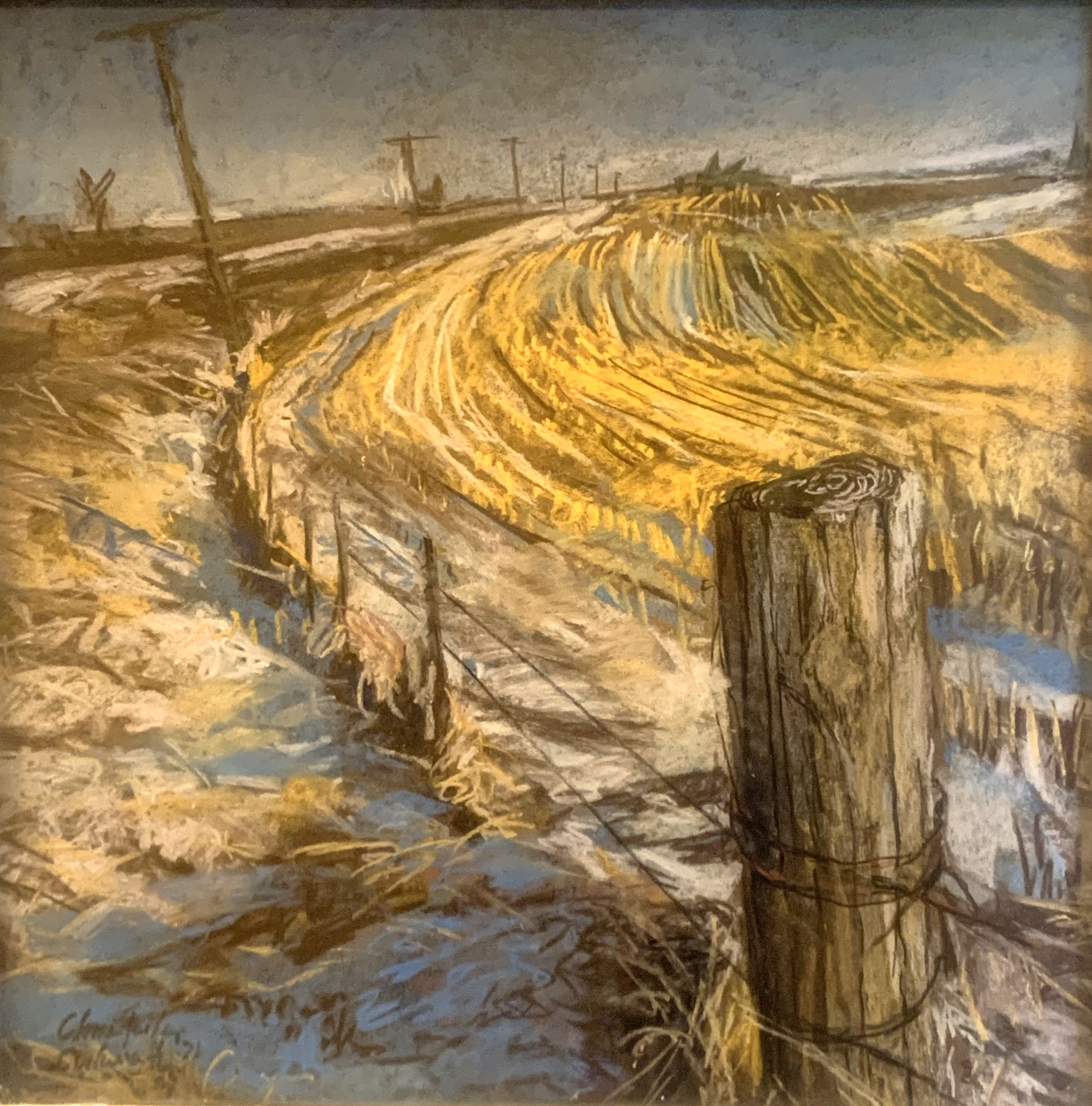
Rural Iowa: Pastel by Christopher Cudworth 2020

As for my own state of mind, I was getting fed up with the insane amount of traveling to do my job. On March 24 I wrote, “This situation sucks. This job has no demands, just a complement of necessities (hassles––by my attitude) I have to leave.”

The doubts on other fronts didn’t help. My girlfriend continued yanking my chain. “(She) is half-courting it again. She shoots nothing but jumpers, saving her heart, in my eyes. Her parents think I lack ambition. Yet if I make it, they’ll say it was their way of helping me achieve my potential. They distrust me.” I wrote a few comments about her drinking, smoking, and sleeping habits, and observed: “I may not be holy, but I’m healthy. My maturity may be behind two years, but everyone is nowadays.”

There was another incident that didn’t help my attitude in late winter. I dropped into a Luther friend’s college dorm one weekend while I was in town. The Pink Floyd album The Wall was playing, and his friends were toking up and took delight in mocking me for giving in to “the man.” The implication was that I’d somehow “sold out” by going to work for Luther––or even going to work at all.

I thought to myself, “Screw them. They’ll get their turn.”

Besides, I was quite familiar with the meaning of Pink Floyd songs. During one of our college track meets at some other small school, I looked up to see a counterculture kid perched in his dorm window with his giant speakers blasting Pink Floyd’s Have A Cigar toward the stadium. The lyrics are disdainful toward businesspeople thinking they know everything yet are in many ways clueless:

Well I’ve always had a deep respect
And I mean that most sincere
The band is just fantastic
That is really what I think
Oh by the way, which one’s pink?
And did we tell you the name of the game, boy
We call it ‘riding the gravy train’

I wasn’t riding the gravy train at Luther. I knew where I was struggling, and the reasons too. Most of all, I was trying my best to be honest with myself––and with them. On April 10 I wrote, “I’ve made up my mind to leave Luther. I will try to weigh my strengths and go for a position that will contribute toward or make a career. I have not done Luther justice, although I have tried––my successes have been in the quality of my work, and quantity is what we need this year. Too bad it happened so fast. But I must be myself now, and work on the talents I have.”

Attempting to gain some normalcy through it all, I ramped up my running mileage in late March and early April with a a set of fifty-mile weeks. During that whole month, I used the time between the high school visits and college fairs to go for runs or get out birding. Spring migration was underway. It was a tremendous relief to get out in the woods in the early morning with the birds singing and forget about tracking down high school kids.

As for migration, I felt the urge to move on myself. On April 21 I returned to the Luther campus and let the director of admissions know that I’d be leaving at the end of the year. “Today I told Dave I am through with Admissions. He didn’t seem too disappointed.” I would finish out the year and fulfill my commitment of recruiting 70 students. I had not failed after all.

The Big Exhale

Mirror selfie taken in my Decorah apartment.

Feeling relieved and determined to move on once the job was done, I jumped into a six-mile time trial with some Luther guys in early May and ran a time of 33:00 with splits of 5:13, 10:23, 15:51, 24:30 (4.5). I ran decently, but was pretty tanked. I wrote: “A struggle. Glessner 30:29.” Mark Glessner was Luther’s top runner at the time.

On May 10, I watched Luther win the conference meet at home, reclaiming the title we’d lost the year before when our pole vaulter screwed the pooch by passing to an impossible height. Watching Luther win again should have felt like a vindication of some sort, but by that point, it didn’t seem to matter.

The weather was warming and my hormones were flowing. I missed my girlfriend who was busy bouncing around in her first job for the Dayton-Hudson company up in Minneapolis. To work off energy, I piled on the running miles as a way to process all that was happening.

Blindsided

Then I sat down for an eye appointment with a local optometrist and received the scare of my life. At first, the doctor would not tell me what was wrong.

He said, “Oh…” and stepped back from the examination. ‘

“What… Oh?” I demanded to know. “I’m not leaving this chair until you tell me what you saw.”

“Well, I can’t be sure,” he replied. “But I think you have a retinal detachment.”

I’d never heard of that. He explained that if left untreated, the lining of the eye would likely come undone and I’d lose sight in that eye. I sat there stunned.

“What do we do?” I asked.

“You need to go to the Gunderson Clinic in LaCrosse,” he told me. “I’ll call right away.”

That was how the summer of 1980 began.

Posted in adhd, bike wobble, cycling, mental illness, nature, race pace, racing peak, sex, steeplechase, track and field | Tagged , , , , , , , , , | Leave a comment

50 Years of Running: The Hardest Thing in the World

During the month of November, when traveling for admissions wore me down to a nub of a human being, I ceased trying to keep track of daily runs because it meant nothing. If you’ve ever run a race where you just didn’t “have it” that day, and the last couple miles were awful, you know how it feels to wander through the final stages of a work commitment with little support or sense of purpose.

“I’m at least maintaining my health,” I wrote, “At most I’m keeping in contact with the sport of running by what I do. It’s maturing.”

Then to top it off, the flu struck. I was out of action for two solid days. Then I hustled back to my folks house in St. Charles (whoopee, another trip to Chicago!) and managed to run 26 miles that week and “partied with the boys” on December 26.

Life was turning corners in a number of ways. “(She) and I are talking about scads of uncertainties,” I wrote. “She is scheduled to begin work in January in Minnesota. I guess that means I’ll be working my butt off just to keep from getting lonely. Oh, the faith will have to be strong. The work will have to be done. I do hope we make it––together.”

At home in St. Charles, I greeted 1980 with a birding hike to my favorite preserve and found a northern shrike along with other winter birds. But I had not given up the idea of gaining some kind of running shape as we turned to the corner to 1980 and a new decade.

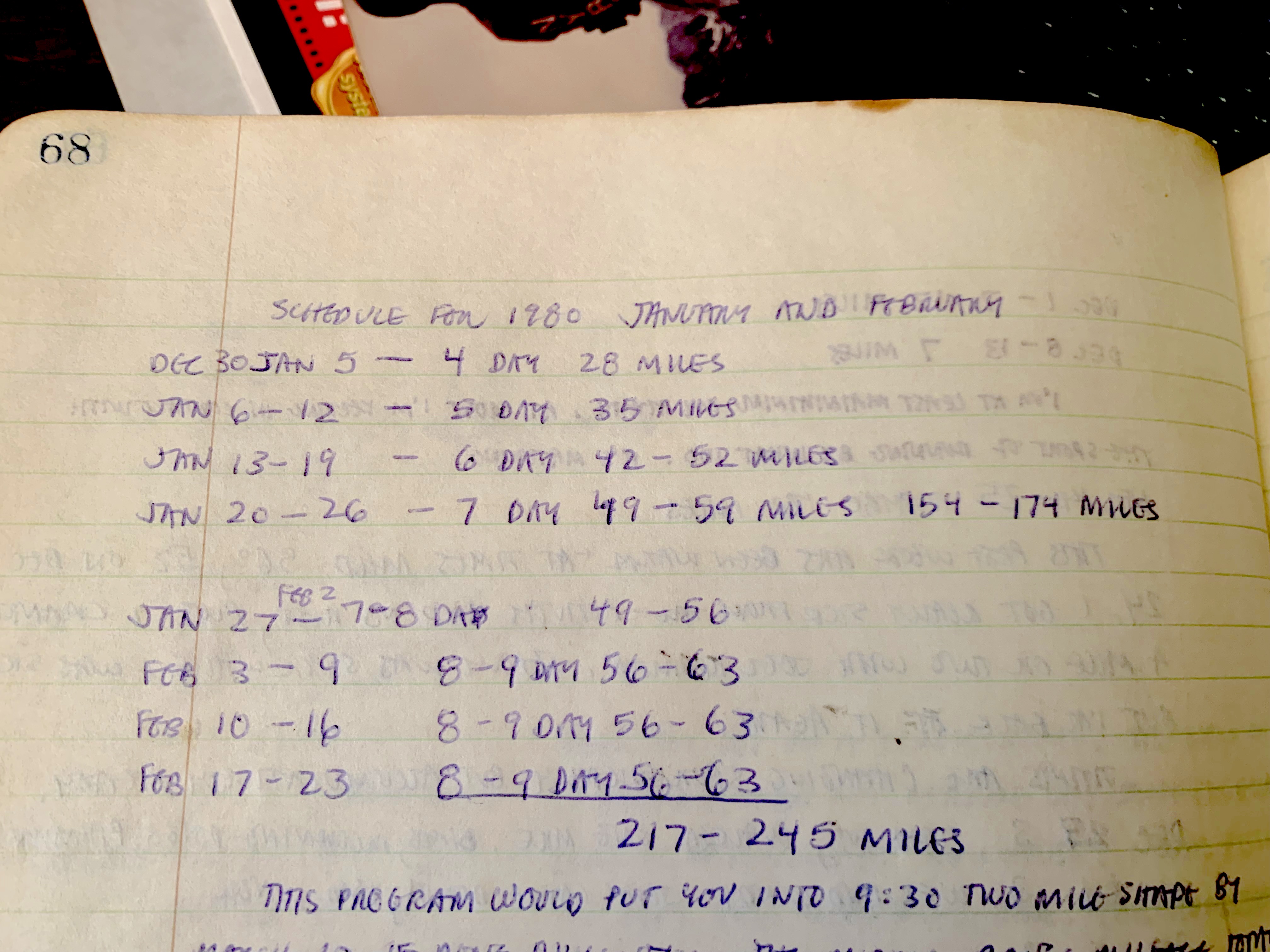
“This program would put you into 9:30 two-mile shape by March 10 if done diligently. The middle range mileage totals will probably produce the best results. Everything should be done with the job and painting in mind. Stay healthy. Also stay on top of things.”

I also wrote out some larger goals for the year:

1. Win Iowa Duck Stamp Contest.

2. Marry her.

3. Begin Graduate Work.

4. Save $3,000

5. Run over 2500 miles.

Those goals illustrate the age-old challenge of engaging in diversity versus finding purpose through focus. With so many interests, I was perpetually shifting from one goal to another. Going into my senior year in college, I recognized that I’d have to give up some things to run my best that fall. I had a talisman necklace made from the claw of a red-tailed hawk that I’d found beside the road that summer. It symbolized my will to get back to serious painting after that fall of absolute focus on running.

Sporting the hawk talisman necklace I’d created as a promise to get back to painting and writing.

“God, I hope I win the Iowa Duck Stamp Contest,” I wrote on January 14 1980. “What it might mean I don’t know. I just want to win it. Possibly to get it over with.”

One of my entries in the Federal Duck Stamp contest. I kept trying.

“I don’t want to be famous,” I continued. “I want to be good. I don’t want people by the hundreds to know me just to say they do. I want the important people who know what art and feeling is to say, ‘That Chris Cudworth, he’s worked well and hard at what he does and he does it fine.’ Fine. What a word.”

The mid-January blues were nailing me after an intense cold spell with wind-chill factors of -40 below. Then the weather turned. “It’s warm out today. 35 degrees. Not January weather. My mind has been talked into spring. My body is alive but tense. Nearly sleepless but never dreamless. Poems run through my head like used-up bits of recording tape. Like those fractured porno movies I found on the railroad tracks when I was fourteen. They move me but I squint to find their meaning, and what is ultimately perverted, the film? No, my senses.”

A few days later I followed up with this: “The hardest thing in the world is to figure out how complex you are. I understand the thinking of centuries-old masters and contemporary bestsellers. But how does my own thinking measure up? How calculating can one be and still be contemplative? What destroys which? Maybe I shouldn’t look for reasons, but the book tells you to look for motivation, and what is better than a good reason to do something, as a motivator? I’m just going to do my version of the best, using my good judgment and never give up. I love my poetry. I love my painting. I love Her. I love my parents. I even love my job. I’m a lucky man.”

With all the supposedly deep thinking I was doing, I felt adrift without the steady presence of the woman I loved. “I miss her companionship,” I wrote. “The goofing around. I get a lot done but I want one to share it with.”

On February 1st, I hit some sort of emotional wall. “Today I was driven wiry at work. What it was I’m not sure. Maybe my hyper session with myself at lunch. After a long run with Doug Nelson (a Luther runner), I felt calm inside. I think I was lonely. Then I got a call from her, depressed for the second night in a row. I guess I’ve been relying on her for optimism.”

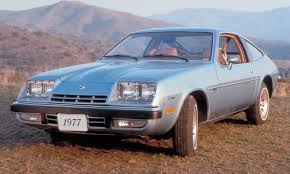
Then her folks stopped by my Decorah apartment to gather stuff she’d stored with me. They were taking it up to her place in Richfield, MN. As we carried her furniture out to their U-Haul, they offered me cursory pleasantries at best. Perhaps they were still mad at me for the car crash back in October when she’d almost broken her nose on the dashboard of that cursed Chevy Monza. Whatever their attitude, I was glad when they left. That’s never a good sign.

On February 3, I was preparing to go on the road again for Admissions, but sensed that a tectonic fracture was forming on the relationship side. “I wish she would call and let me know how she is. She wasn’t fair telling me she wants to quit all that…her parents probably had it out with her. Oh well, I must put it all out of mind while I work this week.”

That next weekend I got back from Chicago and drove up to Minneapolis on Saturday. “The weekend was intimate and precious,” I wrote. “We light each other’s fire again.” But I also noted that a former Luther teammate living in Minneapolis had his eyes on her, and I observed, “How odd.”

But it wasn’t really. He was already successful in his job. That’s mostly what she and her parents wanted for her in a man. Yet here I was, schlepping around the state of Illinois as an Admissions Counselor. Were they right in claiming that I had no ambition? In the moment, I wrote, “I am giving her total freedom within the norms of any 1 1/2 year relationship. She loses sight of me quickly.”

In other words, I wasn’t a rube. I was looking ahead. Thinking about graduate school again. Or whatever comes next. But life on the road was a killer. I knew that my cohorts in Admissions were also traveling, some of them going considerable distances into Wisconsin, Minnesota, and across Iowa. But the 250 miles I drove just to get to my territory––and driving back again on Friday––was kicking my ass.

Two days later I lamented, “Here I sit in LaSalle-Peru, Illinois, with no radio and a rotten B&W TV. A Motel 6 day. I rambled across Western Illinois from Rock Island to Galesburg, Lacon, Wenona to L-P. I’ll never stay at one of these joints again.”

I had some history with the Motel 6 chain. During a multiple-day track meet in the Quad Cities my junior year at Luther, none of our rooms ever received new towels. We were left trying to dry off after showers using soaking wet rags. On the last day of the trip, one of our teammates got so disgusted and angry with the lack of towel service, he pried open the bedframe, took a shit inside, and nailed it back shut. Then we closed the door and left. “Serves them right,” someone said. And we laughed.

As college kids, all had a propensity for expressing disgust and frustration with life in graphic ways. Our pre-race chant before college races went like this: “B-F-S, B-F-S, Bull Fucking Shit!” That was our way of sending any of life’s bullshit back where it came from before going out to do something pure and clean like running as hard as we could.

As I drove back from that second week on the road I felt like yelling the BFS chant out the window of my car. I was starting to realize that even some of the things in which I truly believed were turning out to be bullshit. The relationship, for one thing. My idealistic vision of Luther College, for another. I was naive to the world in many ways, but in some respects, I saw through bullshit like no one else in the world.

So I kept on rolling, and at some point, the college purchased a sweet little fleet of Dodge Omni vehicles for the Luther Admissions staff. Mine was blue. It had a decent radio and got great gas mileage. At least if I was going to drive all over Hell’s Acres recruiting kids for Luther, I could now trust the car I was driving to get me there.

As for that Chevy Monza that I was forced to drive the first half of the year? May it rest in 1970s Vehicle Hell for all of eternity. That was BFS.

Posted in anxiety, Christopher Cudworth, college, competition, cross country, Depression, God, life and death, love, mental health, mental illness, running, track and field | Tagged , , , , , , , , , , , , , , , , , | Leave a comment

50 Years of Running: Road Trippin’

On the 17th of September, 1979, I climbed into the beatup Chevy Monza that Luther College assigned me for road trips and drove the 5+ hours to the Chicago market for the first college fair of the fall season.

For those unfamiliar with the college admissions process in the good old days, it was basically a semi-controlled crapshoot in which college recruiters attempted to make contact with 18-year-old kids trying to make college decisions in their last year of high school. We’d meet a share of junior-year students as well, and getting them to apply was basically seed stock for the coming years. But the money game was landing commitments from seniors. First, you tried to meet a student and their parents. Then get a college visit, followed by an application, and finally, if you did your job well enough, a full-on commitment to attend Luther indicated by a deposit toward their education.

My assigned quota was to recruit 70 students from Chicago and the State of Illinois. After scheduling high school visitation days and college fairs with counselors and organizers, I’d sent out postcards to prospective students in hopes of meeting them during in-school visits. From there, it was a matter of making some sort of connection with the kids, finding out what they might like to student, or learning other reasons why they were interested in Luther, including the great music or athletic programs.

We carried applications to hand out and a binder with photos of the Luther campus. Sometimes, we even had a slide projector and presentation tool to show the same basic images. Before the Internet, there was no website or other material to share with students. Basically, the information that today exists on a website was all kept in your head.

The first time I drove to the Chicago market in that beatup Chevy, the engine quit when I reached Park Ridge. I had to rely on the help of a loyal alumnus to help me get the car to the shop for a repair and still make it to that night’s college fair.

I wrote, “Did OK the first day. Little depressions set in. Hard to stay UP. Run was strained attempt at normalcy. I don’t know if I’ll ever get used to this. I miss her company. Thrushes at Illinois beach.”

I’d driven 270 miles to start the week in Zion and worked my way down the North Shore stopping at high schools on the way to Park Ridge. To my stunned disappointment, I learned that some of the scheduled schools were basically shut down due to Jewish holidays. Why hadn’t the guidance counselors at those schools warned me? I was angry about the wasted opportunities to meet some really good prospects. In any case, I made it through that first week and eagerly drove the 256 miles back to the Luther campus Friday afternoon. Back in town, I went for a three-mile run with my former teammates Elly and Moon, then collapsed into bed.

The next day, I gathered up some cash and bought my girlfriend that cat-eye stone pre-engagement ring she’d picked out at a local jeweler. But I was so busy working in the admissions office that Saturday that I held off a week for a better time to give it to her.

On Sunday night, I turned around and drove back to the western suburbs of Chicago. The autumn sunset faded fast behind me as I crossed Wisconsin through Fennimore to Dodgeville and Madison, where I typically stopped at the McDonalds on Route 18 before swinging around the Beltline and heading south on 1-90 to Chicago.

When I returned the following weekend, I gave the ring to my girlfriend and wrote, “Felt good about it.”

I worked all day in the Admissions office, as was the requirement every other week. That’s how it went throughout the fall, including long downstate trips to far-flung places like Danville and Decatur, Springfield and Lincoln, Illinois, where I was invited to dinner with a warm and welcoming family whose son would later commit to Luther after they flew up by small plane to the Decorah airport. After their campus visit and the tour I gave them, I drove them to the airport where the kid’s father pressed a twenty-dollar bill into my hand during our goodbyes, and told me “Thanks, you’re doing a good job.”

I thought so. The student applications were starting to come in, and kids were paying deposit fees as well. But my boss still did not seem to trust me. That made life on the road a bit tougher, as it fed an already unhealthy level of self-doubt and the inevitable loneliness of staying in hotels and motels on the outskirts of dark little towns or the bustling suburbs of Chicago. One depressing episode found me staying at a Motel 6 next to a trainyard where long lines of coal and freight rattled loud and angrily from end to end as the engines moved them into position for the next day’s journey. I couldn’t sleep that night for the terminal racket, and I left that Motel cursing at the place. I drove the three hours back to the Chicago market and finished up a Friday of high school visits before piling back into the car to drive the 5+ hours back up to Luther.

Driving range

Typically, the weekly driving mileage ranged between 1000 and 1500 miles. That was necessary to reach all the high schools and college fairs I could manage between September and the end of November. On several trips, I joined Luther professors and administrators for special projects including science student recruitment fairs and alumni fundraisers as well.

By October 22, I was feeling the mental strain of all that traveling, and wrote, “Cut out on a college fair. The work on the weekend fucked my attitude up. This Admissions job comes and goes. I hope I can make tomorrow go better on the South Side.”

Recruiting inner-city students was one of the more interesting aspects of the job. I had little knowledge about the location of Chicago high schools, and relied on a giant city map to find my way around. I was told by my bosses to wait for colder weather to visit the city schools. “There’s less crime when it’s cold out,” they insisted. I’d wear my three-piece suits to visit with inner-city students. Most would show up prepared with their grades and ACT scores in hand.

Lessons learned

On some trips, I’d be accompanied by my former Luther track coach Aubrey Taylor. One day we were scheduled to do some home visits with a couple football prospects, and as we pulled up in front of the Robert Taylor homes on the south side of Chicago, Aubrey instructed me, “You stay here in the car. It’s not safe for you to come up in there.”

He met with the kids and we drove to the far southern suburbs and met with the family of a brilliant young woman whose family was eager for her to gain admission to Luther. The meeting in their living room was both informative and cordial. I was excited to meet the family and as we walked out with the front door closing behind us, I was set to pause with Aubrey on the sidewalk when he shot a glance my way and said, “Keep on walking.”

I trusted Aubrey on many levels, so I followed him out the front walk and back to our car. We sat down inside and he turned to me with an earnest look and said. “You didn’t do anything wrong. But don’t stop and talk like that in front of the family. It sends a bad message… like you’re talking behind their back.”

We attended a daytime college fair at one of the technical high schools the next day. The culinary program served lunch for us. I sat chatting with a group of students and faculty, and absentmindedly starting cutting one of my baked potatoes in two when half of it shot up from the lip of the plate and landed !plop! down the front of my vest. Everyone saw it, but no one laughed. They were too polite. But I did. “Okay, I’m an idiot,” I chuckled. Only then did people smile and nod in sympathy. The potatoes were a bit undercooked. Otherwise, the meal was delicious.

Recruiting minority students was actually one of my favorite parts of the job. Luther had around one-hundred black students on campus out of a student body at that time of about 2400. I’d roomed many times with black teammates in track, and saw the social dynamics at work in other ways. Many of the black students dined together at the far end of the Union cafeteria. That was never a sign of malice, but a sign of commonality. The Black Student Union was formed to give students support on campus.

Lifelong learning

I’d grown up south of Lancaster, Pennsylvania, a racially rich city. At the mere age of five or six years old, I got to be a batboy with my oldest brother’s team. Sometimes I’d go up on the athletic fields above the baseball stadium and run around with groups of other kids. A set of twins became my favorite playmates. Their sense of humor and playful intellect even at the age of three or four years old made me want to hang out with them. But one night I accidentally ran smack into one of the brothers with my boney elbow. He ran home crying. I didn’t see the twins for several weeks. But when they finally showed up again, one of the twins still had a black eye, and they told me, “Our momma said we can’t play with you, because you hurt us.”

Surely their mother thought the boy’s black eye was no accident. What I learned from that incident was that people can get the wrong impression even when you’re trying to do the right thing. I also learned that black children perhaps live in a different world than me. That may seem like a simplified civil rights lesson, but it stuck with me all my life.

That’s why I listened so closely to Aubrey Taylor during our recruiting trips. I also trusted the other Luther coaches and faculty, because I’d seen their commitment to equality in education firsthand. It wasn’t easy for some black kids from the city to attend a small liberal arts college out in farm country. The same held true for Asian people and for that matter, gay students in the 1970s. I’d made a few gay friends through my girlfriend that senior year in college. Getting to know them changed everything about my perception of what it meant to be gay.

My Life As An Art Major

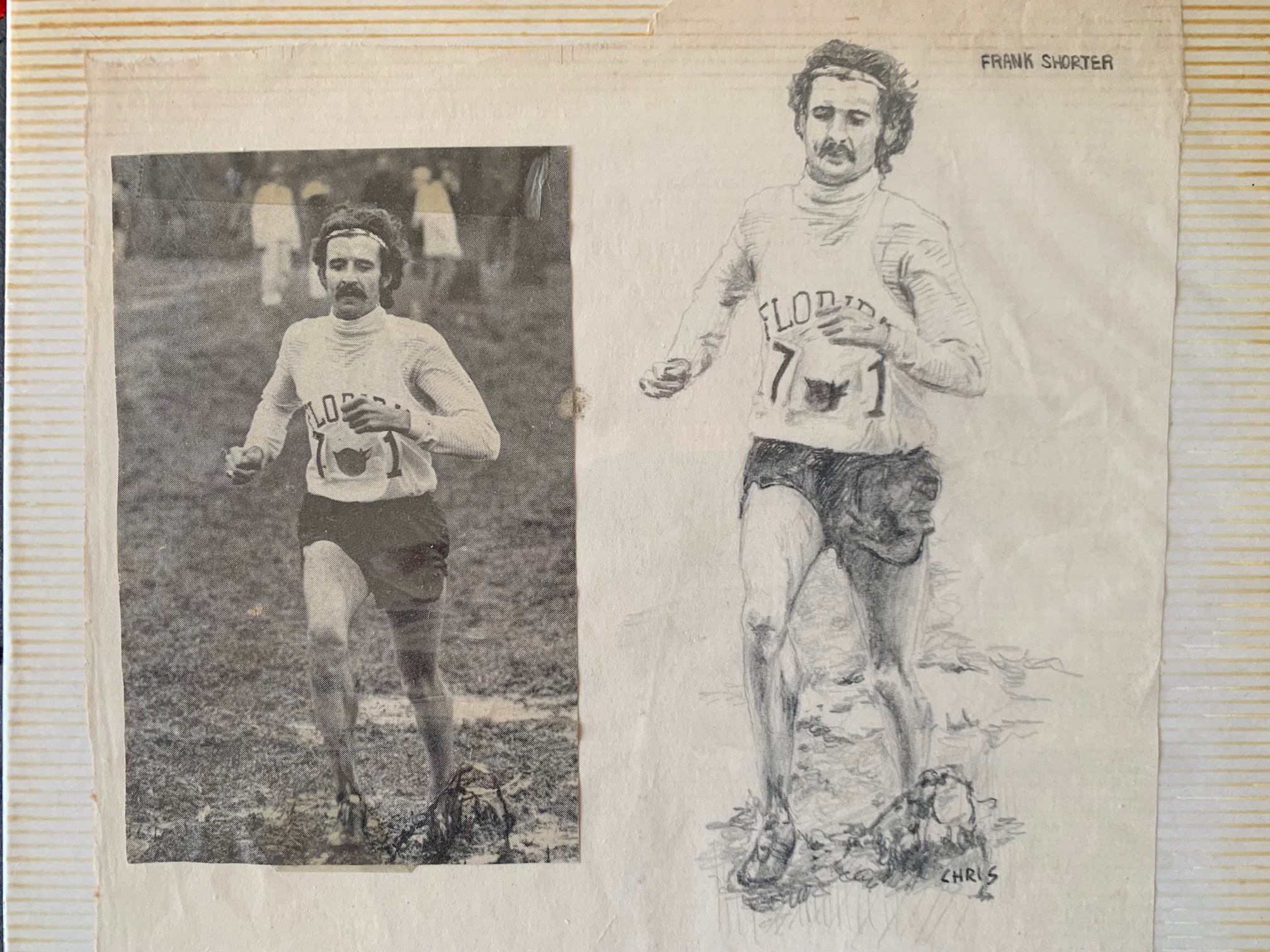
One of my pencil drawings of runner Frank Shorter from the mid-1970s.

Part of my empathy stemmed from the fact that I had my own issues with self-perception relative to my artistic brain and how it did or didn’t mesh with the world. A few years after college, I wrote an article titled “My Life As an Art Major: Or why we qualify for the Americans With Disabilities Act.” I guess I’ve always empathized with people over their struggles. Whether I did so perfectly or not, I cannot say. But the key point in life from my perspective was trying to understand others. To me, that was what working in college admissions was all about. Making those connections. Helping people find their path.

I had so many alternative aspects of character within me, from the birdwatching to the art, my writing and a weird sense of humor, that there were times when I wondered if I just a hopeless oddball compared to other people that seemed to have a central purpose and a plan in life. It didn’t help that during the 1970s, runners were considered oddballs as well. But I kept on.

Long commutes

Back and forth I went from Decorah to Illinois in the long commute from the college to my territory. I planned extended trips and roamed all over the state some weeks. Then I’d take a week and concentrate on the “hot spots” for students from the Chicago area. In all, I’d made that 500-mile round trip drive from Luther to Chicago and back nine times by the middle of October. That rattletrap Chevy Monza was a terror to drive. One day, the stick knob just popped off in my hand. The inside core was a spiral of solid porcelain, and the grooves just wore out. There I was, rolling up I-90 from Janesville toward Madison with the stick knob in my hand and a bundle of wires and parts justting out from the stick shift lever. I rolled the car to the side of the road and eased the stick knob back onto the shifter, and blessedly, it worked.

But a week later, real calamity struck on October 26. I’d stopped on my way back from Chicago to pick up my girlfriend after she visited her parents that week in the Northwest suburbs. I was looking forward to all that time in the car with her, but her mother was less sanguine, repeatedly reminding me to drive carefully.

We were chatting merrily and catching up on things when I pulled to a stoplight in Delavan, Wisconsin, and waited for the light to change. When it turned green, the car ahead of us just sat there for several seconds. I was about to honk the horn when the car finally started to move. I shoved the stick knob into gear, stomped on the clutch and lurched the car forward with that half-assed stick knob still doing its job. They couldn’t get a replacement for it quick enough for my next trip. So I’d made the best of it.

I was focused on shifting the gears while looking down at the stick knob when the car ahead of us slammed on the brakes for some reason. I was going fast enough that the hood of that Chevy Monza piled right under the rear fender of the Ford Granada.

The impact slammed my girlfrien’ds face into the dashboard. When she sat back, blood streamed out her nose. I started cursing and reached over to hold her in my arms.

The police soon arrived and she got treatment for her banged-up nose. I called the college long-distance to let them know about the accident. For some reason that I can’t recall, the car had to be hauled all the way over to Beloit for repairs.

Let’s spend the night together

She and I stayed that night in Beloit, then called her parents in the morning. They were incensed upon hearing that we’d spent a night in the hotel together. I don’t know what they thought we were up to all that time dating each other, but it was certainly not the first time that we’d spent the night together––including several hotels along the way. Her folks were angry, and demanded to come pick her up, but I’d already rented a car, so we told them we were okay, and drove the rest of the way to Luther. We made an ice pack for her nose, and at that point, finally found some humor in the whole scene. By the next day, things were basically back to normal and we went out for a bird walk together in Decorah. That walk felt good because my running mileage thanks to all the traveling had dwindled to less than 20 miles a week.

By that point, I really couldn’t afford to care about how much running I did. But during that last week of scheduled high school visits, I dropped in at Carl Sandburg HS and asked the cross country coach if I could run with the team that day. The varsity had already left the building for their run, so I joined a group of sophomores and freshman. Seven inches of snow had fallen, and we wound up running ten miles on the trails of a local forest preserve. By the end of the run, our feet were caked with snow and I was so exhausted I could barely managed to get changed back at the hotel and make it to the college fair that night at Sandburg. But I did go, because despite what my boss thought of me, I was dedicated to hitting my quota of 70 students that year. I may not have been a conventional admissions counselor in some ways, but I took pride in the relationship building aspect of my work. I could feel that I was making good connections with students. Plus, the applications were coming in, and the deposits too.

Despite all the adversity I’d been facing with the admissions and the lack of running and the back and forth of our relationship, I still maintained a positive attitude the best I could.

But I’ve always been an analytical person when it comes to the sense of right and wrong, and the best way to do things. During all those miles spent driving around Chicago and the state of Illinois, I kept thinking, “There has to be a better way to do this.” At that time, no one could imagine the miracle of the Internet, the convenience of email or the connections made possible through remote video conferencing. Back in 1979. That all seemed like Dick Tracy stuff. I still had the sense that the admissions process was one fucked up mess.

As I later learned, I was not alone in that perspective. But we’ll get to that.

All I was trying to do was survive in the face of the circumstances I was given. That included trying to keep on running and holding together the relationship I treasured with my girlfriend. The lyrics to the 1977 song Running On Empty by Jackson Browne seemed to fit my life precisely, with just a tweak of one number:

Gotta do what you can just to keep your love alive
Trying not to confuse it, with what you do to survive
In ’79, I was 21 and I called the road my own
I don’t know when that road turned into the road I’m on

Running on (running on empty)
Running on (running blind)
Running on (running into the sun)
But I’m running behind

Posted in adhd, anxiety, Christopher Cudworth, college, competition, mental health, running, sex | Tagged , , , , , , , , , , , , , , | Leave a comment

50 Years of Running: What a fool believes

Somehow I managed to squeeze in a race back home in Illinois amid all the new obligations with the admissions job. The race raised funds for my high school cross country program, and I ran a solid 25:40 five-mile after going through the three-mile mark in 15:13. Then I drove back up to in the Chevy Monza the college had given me, and met my girlfriend before she headed out for the same RA Retreat in which I’d met her a year before. Life seemed to be swirling all around us.

I dove back into the job, but was still unaccustomed to the grind of a daily routine. “I can barely keep track of what day it is,” I wrote in my journal. “The job threatens. My head aches. But there are rewards. Anticipation. Motivation. I’ve got to justify my existence to myself. Clearly and openly. God help me know myself.”

I was still running and trying to think it all through. “As I look through these yearbooks (journals) and at last year’s workouts, it’s easy to see that life is changing. And so it does. I have enjoyed the difficult changes and strength of mind that I feel. Yet people watch you change and they enjoy any pain they can envision and impose on you. They want you to suffer along with them, no matter how good you feel about yourself. Well hell with them. Be sure of yourself. I will. These times are times to be looked back upon, and how soon. Youth is the experience that that one is made up of, and experiences keep one young. What a fool believes. I am not trying to reason away the problems and sorrow. No way. I’ve grown too much from pain. Just give me; let me, know me, as a man who cares what he’s all about.”

What was the source of all the pain I was talking about? Most of it (but not all) was the sense of being caught between two worlds. The world I longed to create… and the one that was actually taking place. Dealing with the office atmosphere with all its subtle quirks and political expectations was not to my liking. I generally liked and appreciated most of the people on the admissions team and the support staff too. But there was an odd sensation, communicated in sometimes not-so-subtle ways–– that my relationship with my girlfriend was somehow now out-of-bounds. “College staff cannot date students,” I was told at one point.

What was I supposed to do about that? She and I had been dating more than a year. It wasn’t like I picked her up at some campus bar over the weekend. Other college couples had met on campus. I didn’t get the difference, and didn’t dare to ask.

That feeling was made worse by the fact that I didn’t genuinely understand where she and I were headed. On Sept 6, just over a month into the new job, I wrote, “(She) and I have talked unendingly about our affinities for each other. And I don’t care what she says from now on, should I decide to call it nil on the engagement…”

Yes. She was pressuring me to get engaged. Back at home in July, I’d even gotten some pressure from my mother to honor that idea if it came up. I wrote, “It’s fair to her to let on how I feel about her and respect her. I understand the need for a promise now after a talk with mom.”

So my mind was swirling about all of that. Yet my feelings were real. “I’ve loved her with all my heart, every cent, all my talents and with my mind. I still love her. She’s very intelligent but possessive. It is not as if I have not beckoned her to love me. I am a sorry sort at times and she has helped me immensely. Without her I might have been lost at times. But it’s still me inside her love, and I have to do the going for it. I don’t know how to tell her I care for and about her. This need not be the forever end. Am I a quitter? I think not. I’m just going to find my way and be ready for next time around.”

On September 7th it all came to a head: “(She) told me to get lost today. I don’t plan on it. She has treated me so fine. I feel no bitterness, but remorse at my not having the foresight to manage things earlier. Maybe we will hit it off again sometime, when some of hers and mine attitudes have changed. It is my guess she will have nothing serious to do with men for a while. I will probably not be capable of meeting anyone else either. I won’t lie. She hurt me last night, smiling and laughing and looking so fine.”

After our big row, we wound up at the same bar that night, where I almost died from the tension of seeing her. Whatever the case, we made up that week and I noted on September 13, “I begin traveling next week. What a change that will be. I must get totally prepared for each trip. Maybe’s can’t be counted on. Anyway, do your best.”

I ran six miles with the college cross country team that week, sneaking out of work a bit early to catch them for a run. My week totaled 25 miles. Just hanging on. Sensing even more change in the coming days, I wrote, “That Mistress of Mine” probably means more to me than ever before.” That was a reference to a song hiding on the back end of a Little River Band album. The music was mesmerizing, and the lyrics compelling:

She turns like the tide and takes me where I’ve never been
There’s peace at her side, she’s a lady and a gypsy queen
I’m caught by her spell, sometimes I wish I’d never seen
That mistress of mine, that mistress of mine

But the bigger theme playing in my head was the song What a Fool Believes, a major hit by the Doobie Brothers that year:

He came from somewhere back in her long ago
The sentimental fool don’t see
Trying hard to recreate what had yet to be created
Once in her life, she musters a smile for his nostalgic tale
Never coming near what he wanted to say
Only to realize it never really was

She had a place in his life
He never made her think twice
As he rises to her apology
Anybody else would surely know
He’s watching her go

But a fool believes he sees
The wise man has the power to reason away

What seems to be
Is always better than nothing
And nothing at all keeps sending him

Somewhere back in her long ago
Where he can still believe there’s a place in her life
Someday, somewhere, she will return

On September 16th I wrote: “I go on the road tomorrow. God, let me do well!”

Posted in fear, foregiveness, love, mental health, race pace, running | Tagged , , , , , , , , , , | Leave a comment

50 Years of Running: Ch-Ch-Ch-Changes

With nearly two months to spend before starting the Luther admissions job, I hung out at home musing about the future and doing a bit of maintenance running. By early July, I was restless and jumped into a 15K stretching from Crystal Lake to McHenry. “Felt smooth and strong,” I wrote in the journal. “51:51.”

I wasn’t doing big mileage that summer with the biggest week at 56 miles. But two weeks later, I raced against the Luther boys at Nordic Fest in Decorah, taking 4th on the hilly Elvelopet course in 50:30. I’d just turned 22 years old. Then I took a trip to Grinnell, Iowa with my girlfriend, and returned to Decorah for the first day of work as an admissions counselor.

The changes were coming thick and fast by that point. “Looked at the apartment,” I wrote. “It’s nice enough. I think I should see if Elly will split the rent and live with me. (She) was of great help to me. She buffered me from all my blundering with other people. I bought two suits, two shirts, and a short-sleeve shirt. I put $500 in my savings account, $500 in my checking. I still have to buy more clothes, and have another $100 in my wallet. $30 more coming from my painting for Kim Haugen. They liked it, I guess. Maybe I should sell a few more at Nordic Fest.”

My running mileage went up and down with all the commitments coming at me. I was learning the hard way that the sport I’d done to anchor to my existence the previous eight years often took a back seat to the realities of life.

August 3 “Third day of work. Learning this job takes concentration, which I have, but I’ll have to fight the yawns! The people in the office are all very human and seem to function well. The job has some inherent contradictions or paradoxes, most them based on money! But I think I can motivate well enough. All of Illinois, go get ’em!”

At home with little else to do in the rented upstairs apartment, I sat down with the running journal to do some figuring. “August 4. Ok. Get this. My 6 month total mileage from 1978 January to June is exactly the same for both years. Talk about consistency!”

These two days of observation actually revealed key aspects of my personality. One: I recognized my challenges with the consistency of concentration required to get things done. Two: I also recognized the value of running in helping me feel actualized and stable over periods of great change.

By August 9 I was feeling out of sorts. “Little sick from stress of job. (She’s) staying with me on this.”

That week I went out to lunch with the boss of Admissions. We piled into the crampled little Chevy Monza the college had given me to drive. The car was a claptrap in many ways. Stuff was hanging off the sides and the stick knob was loose. As we left a stoplight and turned up a hill in downtown Decorah, traffic came to a stop and I was stuck riding the clutch on the uphill. I still wasn’t that adept at driving a stick-shift vehicle, and I couldn’t get the car going frontward again. My boss looked over at me anxiously from the passenger seat and my girlfriend sat rigid in the back. Finally, I lurched the thing into gear and we got going again.

That little episode seemed to impact his trust in me. From then on, I was always getting questioned about what I was doing. He wasn’t the only one. On August 16, I wrote, “Job is going well, but. There’s always buts. I have to learn to function and discern the intentions of people around me!”

What I sensed in myself was a struggle with what modern psychology calls “emotional intelligence.” Between the trouble staying focused during the long stretches of boring office work, the doubts cast my way and a native lack of self-esteem, the Ch-ch-ch-changes were not coming easily.

Decades later I’d learn that my troubles all fell under the category of Attention Deficit Hyperactivity Disorder. ADHD. I didn’t deal with it back then in the most constructive ways. To entertain my mind and win perceived approval from others, I drew cartoons about our work and posted them on the bulletin board in the office. People found them funny, for sure. But there were also some really talented and serious folks with whom I worked. They didn’t need to draw cartoons to get their jobs done. They’d sit there and send out stacks of student appointment cards with hopes of attracting kids during school visits, and I could only handle that repetitious work for an hour or two before going mentally bonkers.

A former co-worker told me decades later that she and my former roommate Keith Ellingson, who sat facing each other in the Admissions office, would often look up at each other when I flaked out and say, “There goes Cud again.”

For all my distraction, I also did some keen homework on what lay ahead. I understood the process of recruiting students in Chicago and Illinois because I’d met with the recruiter that had worked the territory before me. We’d become close over those four years after helping me sign up for Luther. Sometimes we’d collaborated on talking with kids visiting Luther from Illinois. So I knew the admissions routine. But I also knew that he’d been allowed to live in the market full-time, and had built up a healthy market of contacts throughout the state.

By contrast, I was being required to commute to the territory from Decorah every weekend to reach the high schools and college fairs where students could be found.

There was also background noise. The college made the decision to move that successful counselor out of his territory during a period of deep concern over enrollment numbers. When I first interviewed, I did not know that it would be my job to replace him. Once I got the position, I was instructed to resource with him and tap into his network of high school guidance counselors, pastors and Luther Alumni that he used to find and recruit students.

I knew enough to realize he was not all that happy about those changes. In fact, he was legitimately a bit bitter in some respects. So it was tough to ask him to share the knowledge he’d worked so long to accrue as if it was something to be handed over like a book of magic. I learned all that I could those first few weeks and would check in from time to time, but it was clear that he was ready to leave it all behind if he wasn’t appreciated.

I used the information to reach out to some of his contacts, who received me warmly enough. Yet those long-distance phone calls were awkward given our office situation with everyone sitting within earshot of each other in a single room. Whenever folks on the other end of the line asked what happened to the former counselor (whom they really liked) I offered some cloistered line about how there were positive changes in his future and I was taking over. Sometimes there was cool silence on the other end. People aren’t stupid. They can read between the lines. Within a few weeks, I’d be heading on the road to meet some of those people in person. That’s when the real questions got asked, and I told the truth the best I could. “The college made some changes. I’m here to do the best I can.” People seemed to respect that.

Toward the middle of August, I entered and won a road race down in West Union, Iowa. I’d purchased a set of Tiger racing flats and was excited to run in them. But they had pretty thin soles, and they just didn’t feel that fast. During the first four miles, the lead between another runner and I see-sawed back and forth, but as we turned down the last hill I pulled ahead to win in 26:22 for five miles. Ever quick with the wry comment, my former teammate and friend Keith Ellingson who watched the race said, “It looked like both of you were trying to lose.”

I remember thinking, “Fuck you. I did my best…” But honestly, none of us were too commiserative in our racing days. Friends or not, we didn’t go easy on each other much of the time.

The one thing that kept us sane through those dull office days was knowing that we could play Frisbee Golf at the end of the day. I’d gather with Kirk Neubauer, Mike Kust and Keith Ellingson, and a few other guys on alternating days. We’d create ad hoc “holes” around the campus, including one in which we threw our Frisbees from the deck of the Union down to the goalpost on the football field below. Perhaps we didn’t invent the game of Disc Golf back then, but we certainly celebrated it in our own way. The Luther campus with its giant oak trees and rolling topography was a perfect venue. It was an hour or two filled with jokes and teasing with guys that were quick-witted and hilarious. That helped me feel normal during that period of intense change.

That whole summer was a grand experiment in Welcome to the Real World. Adapting to the schedule of a full-time job was admittedly tough for me. In 1979 and ’80, we earned $9500 a year in Admissions, plus travel expenses, which we all tried to pad a little. There were definite limits to that. We even had daily limits on hotel costs, which made it tough at times to find decent accommodations in the Chicago area, where a $50 hotel could turn out to be pretty seedy.

Throughout that summer, I clung to my relationship with my girlfriend. We spent as much time together as possible when she was in town. She had one more semester to finish up at Luther, then she’d be graduating too. Ch-ch-ch-changes were still afoot.

Still don’t know what I was waitin’ for
And my time was runnin’ wild
A million dead end streets and
Every time I thought I’d got it made
It seemed the taste was not so sweet
So I turned myself to face me
But I’ve never caught a glimpse
How the others must see the faker
I’m much too fast to take that test

Ch-ch-ch-ch-changes
Turn and face the strange
Ch-ch-changes

Soon it would come time for me to go on the road with recruiting trips to Chicago and the rest of Illinois. I was about to learn about the strange world of windshield time, cheap hotels, and meals on the run. All with the goal of recruiting 70 students to attend Luther College the following year.

Posted in 10K, addiction, adhd, aging, anxiety | Tagged , , , , , , , , , | Leave a comment

50 Years of Running: Snake Eyes

During four years of college in Decorah, Iowa, I got to know the landscape pretty well. It helped to be enrolled in a field biology class, where we explored native prairies, caught frogs in cold freshwater springs, did duck surveys at Cardinal marsh, and performed taxidermy on all sorts of found creatures brought to the lab by helpful locals. I learned how to stuff pheasants, great-horned owls, voles and chickadees, and many other species. We’d peel them all the way back to the eyelids, then sew them back together again.

One day I ran out of time to finish up stuffing a squirrel as a museum specimen. I asked some biology buddies to complete the job, then raced off to work the noon shift at the dish room. My job that day was taking glasses off the trays at the head of the line. Suddenly I heard laughter outside the drop zone, and looked up to see a small plate bearing head of a squirrel outlined with a lettuce garnish. In its big teeth was a bright orange carrot. The plate rolled along like balloon in a Thanksgiving Day parade, causing the girl next to me squeal and faint. I calmly plucked the squirrel head from the tray and heard my biology buddies roaring in laughter outside the dishroom. They got me good.

Pastel “Decorah Farm Roads” by Christopher Cudworth, 2020.

Yes, going to Luther College was an organic experience on many levels. Our daily training runs took us far out into farm country. Some of the homesteads were neat and well-kept. Others seemed ready to collapse into the dirt. We ran past muddy yards rife with pigs and cattle, sheep and chickens. Outside the pens, the dank pastures on rocky hillsides bore livestock paths between the black cedars and white birches marking the rugged limestone hills. Steep limestone chimney bluffs stood like sentries overlooking the valleys. Through it all ran the Upper Iowa river, a national wild and scenic waterway. This was the Driftless Region, a section of landscape that escaped glaciers during the Ice Age ten thousand years ago. There were petroglyphs carved into rock by native populations eons ago, and the rocks themselves were deposited by ancient inland seass. Every run was an epic journey through time.

“Decorah Bluffs,” pastel by Christopher Cudworth, 2020.

Among those hills was a never-ending array of wildlife to find. Even in town and on campus, I’d spot Cooper’s hawks, screech owls, wild turkeys, and sometimes even a bald eagle flying overhead. Our national symbol was extremely rare back in the mid-70s. Yet in recent years, the “Decorah Eagles” became Internet stars.

While the wildlife was always interesting, sometimes it was the local human population that was the most interesting to study. Decorah has long stood as a liberal enclave in a largely conservative landscape of conservative farmers. Both these factions contribute to an odd reputation. During our years in college, that little town had the largest number of bars per capita in the entire state. If I recall correctly, it ranked right up there in total alcohol consumption as well.

I sat in a downtown Decorah bar with friends one night watching a man dressed in an all-white cowboy outfit drink until he literally lurched off the barstool and fell to the floor. That brings me to the story of Snake Eyes, the bloodthirsty killer I met while running during the last two weeks of college at Luther.

The Oneota Valley of Decorah, Iowa.

One of our go-to running routes in Decorah was a pleasant six-mile loop leading from the campus south past Pulpit Rock, through the Decorah campground to a bluffside road under Phelps Park, across town to a bridge over the Upper Iowa, and back to campus past the Ice Cave geological feature. We ran that route at least once a week for all four years at Luther.

During one run on that route with my teammate Paul Mullen, we moved to the edge of the road to avoid an oncoming car and he popped into the air just like he was hurdling a steeplechase barrier. “What the…?” I asked. He turned around and pointed. There, basking in the dust, was a small snake. I looked closer and identified it as a Massassauga rattlesnake. “Good jump,” I told him. “Those are poisonous.”

On a similar warm spring day I was running Under Phelps-Ice Cave alone thanks to class schedule delay that kept me from making the regular workout time. Fit and fast near the end of the track season, I clipped through town and was climbing the hill leading to Ice Cave when a man in an all-white cowboy getup jumped out from behind a tree. He stopped out in the middle of the road and with both hands gesticulating, pointed toward a big tree, and yelled: “Do you wanna see mah snakes?”

That’s when I noticed a streaked spatter of bright red blood covering the front of his pure-white cowboy shirt. My instincts told me to make a right fake and sprint past him to get away. But he jumped both ways as if to block me. So I figured, “Let’s see what this joker is all about…”

Keeping watch from the corner of my eye in case he tried to stab me with something, I walked over to see what he wanted to show me. Plus, I always liked snakes, so I wanted to see what he’d found. Then came the shock. Nailed to the tree was a ring of snakes. There were several different species including a canebrake rattler, a bull snake, a garter snake and a fox snake.

A canebreak or timber rattler

I couldn’t think of much to say other than “Why?”

“I killed ’em mah-self,” he told me.

“I see that,” then I repeated, “Why?”

He stood staring at me for a moment, so I got spooked and turned to leave. Then he jumped back in front of me, so I did my best football fake and darted around him and went running back to campus. Glancing back, I saw him standing alone in the road, looking forlon, as if I’d abandoned him in some moment of need.

He really didn’t seem to understand the nature of my question, “Why?”

I recall that he had Snake Eyes. Two beady dots of black that looked locked into place. Perhaps he was high. Maybe mentally ill. In any case, I was impressed by his ability to find and kill snakes. That’s not an easy task. But to some these days, it has become a profession.

That fellow could probably find work and be happy down in Florida these days where thanks to the release of Burmese pythons into the wild, there is now a dangerously expanding population of those snakes killing local wildlife. That species of python grows larger than fifteen feet, and are definitely hard to catch in boggy conditions. They can bite and coil around anyone that tries to catch them.

A recent news story documented the problem: “It’s official. An invasive Burmese python captured in the Everglades over the weekend has broken the state record measuring 18.9 feet long. The previous record was 18.8 feet long. Ryan Ausburn, a contracted python hunter with the South Florida Water Management District, and Kevin “Snakeaholic” Pavlidis, a contracted python hunter with the Florida Fish and Wildlife Commission, captured the monster-sized python Oct. 2 along the L-28 Tieback Canal about 35 miles west of Miami.”

No one believed me

There were no such problems in Decorah back when I encountered Snake Eyes. When I got back to campus that day, I told the story to my teammates, who laughed at me and said, “Sure, Cud.” So I told them, “Come on, let’s run back out and I’ll show you.”

It was nearly two miles out to the site. We arrived at the big tree where Snakes Eyes had nailed his prey and they were all gone. Nothing remained but the blood marks where the snakes were nailed to the tree. No one really believed my tale of the encounter with Snake Eyes.

But I know what I saw that day.

Or at least, I think I do. Some events are so strange they defy our notions of reality. I’ve told that story dozens of times over the years, because I’m always curious how people will react. It is often hard to tell what people really think about it. Sometimes it feels like people are judging my mental health and social propriety for relating such a weird saga. But I’m a weird thinker anyway, and I’m used to being judged for thinking differently. My experience tells me that many people would rather live a life of quiet denial than deal with the odd realities of society where the madness of human society and wilderness converge.

In fifty years of running, that where I’ve often roamed. It’s hard to explain to some people why runner or other endurance athletes want to go to places where others choose not to go. We push ourselves until all that’s left is a set of Snake Eyes from the fatigue. That’s how we get a glimpse of the twisted nature of our own internal dialogue.

I couldn’t help myself the day I met the blood-smeared guy in the cowboy shirt that day. I should have run away, but I rolled the dice and it came up Snake Eyes.

Posted in addiction, alcohol, anxiety, mental health, mental illness, racing peak, running, track and field | Tagged , , , , , , , , | Leave a comment

50 Years of Running: Graduation Blues

With nothing left but nationals in the 1979 track season, I walked across the stage to pick up my degree with my parents present during graduation. I’d earned a precious “D” in that horrifically dry and accounting-based marketing class that my girlfriend recommended that I take, and took comfort in the fact that I had enough credits to finish a Bachelors Degree with a 3.1 GPA. No, I wasn’t a star student at the college. There were far better students than I. Smart people. Men and women from my class that would go on to become stellar in their fields. Doctors. Lawyers. CEOs. Teachers. Nurses. Coaches.

My college professor Doug Eckheart

Two weeks before graduation I received a call from my staff advisor and the head of the Art Department, Doug Eckheart. “I have some good news for you, Chris,” he told me. “Someone gave you some scholarship money for graduate school.” The amount was $1500. I was excited that someone understood my interest in pursuing that as a career. As it turned out, my mother’s longtime friend from college had followed my art career and wanted to help out. She owned a couple of my works and saw some talent in me.

Eager to find out what that money could do, I immediately contacted Northern Illinois University, the school that my older brother Gary attended. I sent a transcript sent over along with a slide or two of my work. They took a look at my studies and said, “You’ll have to start over here at Northern. Take all four years.” They never asked to see more of my portfolio. Nothing. They’d written me off as too literal, since most of what I’d painted the previous four years was birds. Years later, the same University told my daughter that her Associates degree in photography from College of DuPage would not count toward her education either. “You’d have to start over,” they told her. Such are the echoes of history.

But when I heard that news from Northern, I was aghast. It shocked me so badly that I didn’t even inquire at other graduate programs after that. Plus, I didn’t have time to make that type of decision before the end of the school year. Events at Luther were roaring along, and I still had the race at nationals to consider.

Then someone mentioned that several jobs were opening in the Admissions Department at Luther. “You should apply,” they told me. “You’d be a good representative of the college.” My freshman year roommate Keith Ellingson was also applying. I put in my name, and had a job interview the next day. It did not go well. My mind was so scattered from the end-of-year activities that I interviewed distractedly, and told them so as I was leaving. I dropped a note apologizing for that, and was invited back for another opportunity. That interview went much better. I was hired.

That solved another issue in the moment. What to do about my relationship with the girl I loved? She still had another year of college to finish at Luther. Working in Admissions would allow me to keep close, or so I thought. We talked, and frankly fought a little, about my decision to take the job. The entire mood of those discussions was odd. The campus had fallen silent after the students departed following graduation. We felt both wonderfully alone and isolated at the same time.

Meanwhile, my steeplechase teammate and former roommate Paul Mullen was also in discussion with his girlfriend about post-collegiate plans. None of these decisions were easy. We all fought some.

Meanwhile, without much direction in the wake of regular track season concluding, Paul and I trained together trying to keep our fitness going after the buzz of the season was over. We did a week of maintenance workouts and climbed into the college van to head east to Cleveland with a few other track and field athletes. One of them was our top javelin thrower who led Division III that year. We stopped to visit the campus of Notre Dame University and acted like kids running around the football field tossing Frisbees. Then our javelin star threw out his arm trying to heave the disk down the entire length of the football field. He could not compete at nationals.

The weather was typically sullen and dank out in Cleveland. The excitement of track had by then seeped out of me, especially with all that took place at season’s end. We’d only run about 25 miles that week, and later in life, I learned that I’m a runner that needs to keep the engine revving full bore to compete at my best. Thus during my steeple heat, I managed only a 9:31, several places out of qualifying for finals. Had I made it through, it is unlikely I could have competed. I badly strained the sheath between my calf and Achilles in a bumping accident through the water jump. I could barely run the the next day anyway.

But Paul Mullen ran well in qualifying and made it through to finals. He ran a smart race there as well, and I remember the thrill of seeing him in sixth place–– the final All-American spot––while doing the last hurdle on the backstretch before turning for home. His growing fatigue was evident, but he always had an amazing capacity to run through pain at many levels. Yet with 100 meters to go, another competitor closed on him and Paul missed become an individual All-American by a few steps at the finish. Still, 7th in the country is a damn great finish.

And what a race he ran! Through all the events of graduation and the conflicted feelings of finishing college, he ran a 9:14, the time that I wished I’d run at conference two weeks before. In my book, he’s an All-American. That and other Luther accomplishments deservedly placed in in the Luther Hall of Fame.

Recovery

We drove back from Cleveland and I spent the next week with my girlfriend back at Decorah. She was finishing up some campus project during the final week of May. She’d gotten into reading the C. S. Lewis series the Chronicles of Narnia, and that’s what I did to keep myself occupied between seeing her. Both of us escaped into the fictional tales of a Christlike lion and kings and queens living in another world. Immersing my mind in this stories gave the week a magical feeling. It almost felt like we could walk through to another world as well. Part of me wished that were true.

Then she left for home and my folks arrived in Decorah to bring me back to St. Charles for the first part of the summer until I returned to start the Admission job later on. I’ll admit that I never liked that house where they lived, and I fell into an emotional void. “It is summer and I am haunted by my hormones. You’ve found your dead end, lower limits. Let’s bounce back. There are only rewards in things you can share. Do some.”

Sweet release

Then I got a call from a family that needed someone to drive their vehicle from St. Charles to Ocracoke, North Carolina. I’d never been to that part of the country and the idea of a road trip sounded fun. But when I showed up that weekend to pick up the car, I found out that it was a manual shift Toyota Celica. I’d never driven a stick shift car in my life, so I had no choice but to fake it. I said some ceremonial goodbyes and then kind of eased the thing down the hill from their house to get out of sight behind a thick row of trees. That’s where I practiced how to start and drive the damned thing.

Lurching along at first, I eventually got decent at shifting. Ten miles later I swung onto the expressway for the trip east. At the first toll booth on I-88, I shifted from fifth all the way down to first and the engine roared back like an angry lion. “Well, that’s not good,” I laughed out loud.

Through Indiana and Ohio I went, a young man on a lark. I’d brought along some reading material for the trip, a book by Tom Robbins called Even Cowgirls Get the Blues. It was alternately sexy, hilarious, and philosophical at every turn of the story. The book was about a girl with big thumbs that turned hitchhiking into her life’s adventure, exactly what I needed to read while driving through the initial absurdities of life beyond college.

My first stop going east was in Pittsburgh to stay with an aunt and uncle. Parking on the hills in that city proved frightfully difficult. Then I drove east across the mountains of Pennsylvania to stay at my brother Jim’s house in Lancaster, where I’d lived from the ages of five through twelve.

Then I drove south through Delaware and Virginia. That drive down to Assateague Island turned difficult as rains pelted the East Coast. As I crossed the Chesapeake Bay Bridge-Tunnel, the winds whipped up as a squall covered the road with inches of water. I looked over the side of the bridge that stood high above the bay waters. Suddenly, the Toyota started to hydroplane. The car went sideways and I could do nothing but steer in the direction of the skid and hope that I could avoid going into a total spin. That worked, but after that, I slowed the car to a crawl, inching along in 3rd gear for miles as cars passed me by. When I reached the other side, I got out of the car, walked behind some trees at the side of the road and took a long piss behind some bushes in a grand combination of emotional and physical relief.

The weather finally cleared as I drove over the causeways leading to Ocracoke. I saw terns and gulls and willets flying around, and caught glimpses of egrets and herons in the backwaters. I found the house where I’d be staying and collapsed on the couch with some take-out food and a six pack of beer. I picked up a book they had at the cabin about the ghost of Blackbeard the Pirate, who’d made a life around Ocracoke. I got scared as hell when a storm arrived and whipped the pine branches against the windows, making me think, in my half-drunken state, the Blackbeard arrived to take away my soul. That night, I huddled under the covers and fell into a deep sleep.

The painting of a Least Tern and ghost crab that I produced after a trip to Ocracoke, North Carolina.

In the morning, the air was fresh and salt-tinged, so I drove over to the beach. I pulled on my running shoes and went for a jog up the sand with the waves smashing nearby on the shore. It was warm and humid out, with a liquid form of wind coming in off the water. The further I ran, the less I felt the need for clothes on my body. Well up the shore from the parking lot, there were no people in sight. So I stripped naked, stashed my shoes in the dunes and ran another mile or two up the shore. Finally, I saw a couple swimming in the ocean. They were naked like me, and the white of her breasts and the cheeks of his ass made the whole world seem free and real. I waved, kept on running, and finally turned around to run back and gather my clothes from the spot where I’d hid them in the dunes. Yes, I’d marked the spot carefully.

On the beach at Ocracoke

That week I went birding quite a bit and added eleven new species to my life list. Somewhere along the way, I met a surfer-carpenter dude who lived in an house built on pylons just outside town. He had several female companions hanging out with him, and on my last night in Ocracoke, they invited me to have a going away party. I drank blueberry daiquiris all night long and fell asleep fully drunk back at my house .

The next morning, I was scheduled to fly out of Ocracoke in Piper Aztec plane that would take me all the way back to Chicago. I was still half-drunk. My eyes didn’t want contact lenses on them, so I gathered up my stuff, tossed it in the back of the plane, and sat in the seat next to the pilot. He could sense my condition, and said, “Well, I think we have enough runway to take off.” Then he gave a little chuckle.

I stared ahead with my blurred vision. My head was a fog of blueberries and alcohol. I was sunburnt and astigmatic without my contacts, yet happy from running naked on the beach and having a chance to decompress. I didn’t really give a damn what happened to me that morning. The propeller roared into action and the plane started to whip its way down the runway. As the sounds of sand under the tires bhissed beneath us, we lifted into the air over the Outer Banks. I glanced down at the blue ocean with eyes that could not see clearly and gave a soft laugh. Then I closed them as we banked west away from the sunrise. That’s how my life after college began.

Posted in aging, alcohol, anxiety, Christopher Cudworth, college, Depression, healthy aging, healthy senior, nature, race pace, racing peak, running, running shoes, track and field | Tagged , , , , , , , , , , , | Leave a comment

50 Years of Running: On the Runway to Life

At the end of January Term, with a mere197 miles under my belt, it was time to get serious about training. But there was also the question of a serious relationship going on, and I didn’t mind that one bit. At some point my girlfriend grabbed my running journal and wrote me a note…

We traveled that next weekend to Grinnell, Iowa with my former roommate Paul Mullen and his soon-to-be fiance. He and I went to the indoor track at Grinnell and paced through a 4:44 mile just to see how it felt. The weekend after that, I ran a 4:28 indoor mile and a 9:48 two mile. The first felt “easy” and the second one “smooth.” That’s all you really want from that first indoor race. To feel decent. My mileage was back up to 66 miles and my love rating was off the charts. I wrote in the journal: “I’m whipped. And you KNOW it girl.”

I came down with the flu and a cold and skipped an indoor meet. I still managed 59 miles through the illness but was careful not to overtrain with too much fast pace. The next week I raced a 9:36 two-mile and a 4:31 at the UNI Dome. That was the site of an amusing mile the previous year. I’d barely made the bus after getting it on with my junior-year girlfriend that morning. The whole way down to Cedar Falls from Decorah I was sort of lazy and sleepy from the lovemaking. We parked our stuff in some far corner of the UNIdome and I laid down to wait through the entire meet because my sole race that day, the mile, was next-to-last on the schedule.

I dozed. And dozed. Then I heard “Last call, one-mile run.” I snapped to attention, pulled on my racing spikes and ran over to the starter. “Are you Cudworth?” the guy asked. “Yes,” I replied breathlessly. “Well, line up.”

The gun went off, and I ran with the pack through a 200-meter lap before moving up. My legs felt great and the pace was manageable. I moved up more and was in position to kick with the leaders with a lap to go. Sprinting around the track, I felt free and loose, and finished in 4:21, my best indoor mile ever. Absent the regular nerves I built up for races, I was free and easy that day.

In late February of 1979, my girlfriend left to attend an education seminar of some sort in Texas. “She left for Dallas this morning for a week,” I wrote. “I’m off tune without her. My schedule today was quite hectic, but I managed some effective racing, An up in mileage is now in order. Other competitors kicked your butt. Get some work, studying and painting done.”

Then I mused, “I love (her) she has helped me come to grips with some things about myself. But it is up to me to remain, no, develop even further.”

The following week we traveled for a dual meet in LaCrosse. I always loved racing against those guys, and I’d plugged in a week of 71 miles with two-a-days as the weather started to moderate into the 20s and 30s. I won the two-mile in a smart race, running 9:27 with a hard finishing kick on the 176-yard indoor track. “Fast run Thursday helped my confidence.” That meet closed out our indoor schedule. I went home for spring break and got in training weeks of 70 and 71 miles. the weather snuck into the 40s.

While at home, I watched my younger brother Greg, who attended Kent State on a full scholarship, play a basketball game at Northern Illinois. I was stunned at the nasty behavior of the NIU fans, some of whom ran on the court next to the Kent huddle during a time out. The rest of the game they screamed and acted like idiots. The Northern team was a bunch of muscleheaded brutes, and I left that contest angry and frustrated. But my brother played with intensity and cool. I admired him so much. He’d fulfilled my father’s wishes of having a truly elite athlete in the family.

The weather warmed into the 60s the third week of March, as my girlfriend and I traded visits while at home in Illinois. I ran four mile intervals under 5:00 per mile, then banged out a 14-miler a couple days later in 1:35. That was sub-7:00 pace. I was starting to feel real fitness and wound up the week with 82 miles. I wrote down some goals for the spring.

On March 28, Coach Bob Naslund assigned us a set of three-mile “intervals” around a route we called Short Loop. The temps were 50 degrees and breezy, and we warmed up for twenty minutes, then took off on the first three-mile interval. We finished that one in 17:17. Thoroughly warmed up now, we ran the second three-miler in 16:17, then finished with one in 16:45. That was nine miles at about 80% effort.

That weekend at Augustana, on March 31st, I ran a 14:37 three-mile after a 78-mile training week. I’d wrapped up February with 251 miles and March with 303 miles. That was 751 miles leading into the outdoor season.

The first week of April, we cranked out a session of 20 330s at 55-57. I wrote, “Just plain horseshit weather. 50 mph wind.” That weekend I raced the first steeplechase of the season with a time of 9:30.7. A good start to my goal of qualifying for nationals.

The previous year, I’d won a steeple in a declared time of 8:47. Problem was, the lap-counters made a mistake and shot bell lap gun with two laps to go, not one. So I kicked in with the win. The time, though highly inaccurate, somehow got out to state officials, and I got an inquiry about running the steeple at the Drake Relays against the likes of Henry Marsh, the American record holder at around 8:15. I think the word got back to Drake and others that my race was a lap short.

On April 17 we traveled to LaCrosse for an outdoor dual meet. Again, I loved racing against that team on every occasion. There was something about the dedication of their guys that I respected. Strapping on my spikes, I jogged to warm up and felt exceptionally loose. Within the first mile, I’d grabbed a lead and ran to a 14:40 win in the three-mile. And just like the race indoors where I won the two-mile in 9:27 and got a compliment from one of the LaCrosse guys, a pair of their runners trotted past and said, “Great job.” Nothing means more to a runner than a compliment from a competitor. You have to earn those.

To me, that was always what running was about. Finding that sweet spot or groove where the pace feels good and you run relaxed. But track and field is not the most relaxing environment in many ways. There are so many races and any delay in the meet screws up the warmup schedule. During high school dual meets, I was typically competing in four different events; the two-mile, high jump, triple jump, and mile. Several times I won all four. But I should have been concentrating on improving at distance running, not messing around with my keenly average jumping abilities.

Strange times

Such are the strange aspects of track and field. At Luther, we also endured many long bus rides across Iowa to compete at far-flung colleges such as Buena Vista, where the 50+ mph winds were so fierce that the pole vault was canceled. I ran a 9:49 steeple that day against a guy from Dubuque College who wore painters’ gloves on his hands and placed his hands on the barriers to vault over them rather than hurdle. I got blown backward on one hurdle and actually grazed my butt cheek on the 4″ x 4″ barrier.

That race was frustrating because I was hoping to get a qualifying mark for national. The standard had dropped from 9:35 my freshman year to 9:24 as a senior. I knew my fitness was good enough. I just wanted the chance at a good race. On April 28 we traveled to the Drake Relays where I ran a 3:09 3/4 mile on the Distance Medley. That showed good promise on the speed end of my training.

The pressures of classes began to add up by early May. I was struggling through a Marketing course that my girlfriend suggested I take. It was taught by an accounting professor named Frank Barth, so the subject matter had nothing to do with creativity or ideation. It was all about the numbers, how to budget for marketing against other expenses, and I was in that class with a bunch of number crunchers. I almost failed the course. I tersely noted: “Getting things done. 5 1/2 hours of sleep.”

We held a dual meet on Luther’s crunchy crushed brick tack and I ran an unmotivated and exhausted 4:34 mile time. The entire scene was getting to me.

“(She) and I need a change of pace. She is too serious for me at times. I desire a strong relationship and she is one to handle it, but the control ebbs and flows so commonly that I am at a loss to refuse the good parts, the fun parts, and my errors and flaws shoe. I still love her.”

What did I mean by that? I wanted, no…desired simplicity. And wasn’t feeling it. On any front.

My mileage dropped to 48 that difficult week of April 29-May 4th. I didn’t even have time to get out birding when the spring migration began. I could hear warblers singing in the trees as the weather warmed, but didn’t have the time to get out and see them. That was a shame because, for four years at Luther, I’d delved deep into the woods in all directions. I even had a secret spot southeast of town where one could stand on a bluff and look back up the Oneota valley and see the campus. In that gorge, I’d once found a Townsend’s Solitaire, a wandering migrant from the Pacific Northwest that showed up on a cool fall day the previous autumn. That was magical. I’d experienced many such moments in the hills and fields around Decorah, Iowa.

That love of the region was all coming to an apparent close as the semester wound down. There were two big orders of business before me in the track and field world. First; competing at the IIAC Conference meet, and second, getting the nationals qualifying time for the steeplechase.

There was just one problem. Our conference rivals, Central College, had grown so strong as a track and field program our 17th straight conference title was no lock. Leading up to the meet, Coach Naslund was figuring points and had us coming out on top if everything went well in every event. The biggest challenge was, quite surprisingly, the emergence of several fast distance runners within the conference. These were Jerry Fitszimmons of Central and Jim Thompson of Wartburg, who was running out of his mind times.

That Friday night, our 10,000 meter guys Joel Redman and Paul Mullen went 1-2, a good start to the meet. Paul was coming back the next day to run in the steeplechase. We’d both been to nationals a number of times during our career, and he was the slightly better runner than I. But having run a 14:37 three-mile earlier in the season, I was asked to double in the 5000 at conference.

So here was Paul, trying to run a good steeple with a 10K from the night before in his legs. Then there was me, trying to run the steeple and save something in my legs for the 5000 meters an hour or so later.

Have rested some that week to begin peaking for the last meets of the year, I felt easy and smooth in winning the steeplechase in 9:20.2. That was the qualifying mark I needed to make nationals, and I didn’t feel like I’d taxed myself too badly to double back in the 5K. Mullen placed second behind me in amazing fashion considering the fitness required for that 10K-Steeple double in 24 hours.

Fighting words

The meet was close from beginning to end. Tempers flared when one of our premier athletes, a 400-meter hurdler named Jerry Peckham, broke his leg while running over the last barrier. He’d been pool-training all season due to a stress fracture, and was on pace to win the meet and qualify for nationals when the leg snapped with a loud noise and he crumpled to the track. In horrific fashion, some of our opponent’s athletes cheered and laughed while mocking the injury. Fights nearly broke out at the track.

With even more motivation, our top distance guys fought hard for places and ran well. But with an event to go, it came down to the 4 X 400 relay and one other event: the pole vault.

Perhaps Luther won the 4 X 400. I don’t recall. But our pole vaulter elected to pass heights all the way up to fifteen feet in an attempt to win the title. Then he missed all three attempts at the height. With zero points in the pole vault, Luther lost the conference meet for the first time in nearly two decades.

We were angry, depressed and frustrated at the outcome. Those of us that attempted to double, and did, were shot-through with frustration. All our pole vaulter had to do was make a decent height, such as 13′ 6″, and we’d have won the overall title. Back home in Decorah, we headed down to the bars to drink away our frustrations. Some guy at the bar made a comment to one of our distance guys about losing the meet, and he decked the guy with a punch.

Looking back, I have a sole regret from that day. If I’d not needed to double, my time in the steeple would likely be five or even ten seconds faster. That would have positioned me in an entirely different frame of mind going into nationals. Running a 9:15 would have been a great confidence booster. But our priority as distance guys at Luther was always the team. I ran the 5K and didn’t score any points. The pace was wicked and even with fresh legs, I’m not sure I would have placed. But at least I gave it a shot. If I hadn’t run that 5K, I might be wondering forty years later whether I could have gotten a few points and saved our day.

Against the bigger picture in life, these things don’t really seem to mean that much. But they do teach us a level of integrity that comes with the territory of sacrificing individual glory for the sake of the team. That’s a much more valuable skill in the real world.

Posted in 400 meter intervals, 400 workouts, 5K, Christopher Cudworth, college, competition, steeplechase, track and field | Tagged , , , , , , | Leave a comment