Mortal soles and immortal souls

This outcrop of sandstone along the Mississippi is near MacGregor, Iowa. I've driven this road perhaps 200 times.

This outcrop of sandstone along the Mississippi is near MacGregor, Iowa. I’ve driven this road perhaps 200 times.

While driving from Batavia, Illinois to Decorah, Iowa for a reunion at Luther College this past weekend, I performed a little math in my head. In a way I’ve always loved numbers, but adding them up in my head is has never been an easy enterprise. Still it seemed important to do a rough calculation on the number of times I’ve driven to Decorah and back.

During college each year there were six to 10 trips each year during breaks. So that adds up to about 30 trips in four years.

After college I worked admissions in Illinois for a year, a position that required driving back and forth to Chicago and Illinois every week from September through November and again from February through May. That adds up to another 30 or so trips.

For the next twenty years or so I’d visit campus or meet up with friends at least twice a year for road races or reunions. That’s another 40 trips at least.

In the last 10 years or so the trips diminished a bit as my late wife had grown tired of trekking to the same place and back. Can’t say that I blame her.

Topography

The limestone bluffs of Decorah, Iowa are some of the most scenic in the Midwest.

The limestone bluffs of Decorah, Iowa are some of the most scenic in the Midwest.

Except Decorah, Iowa has a strong call with its natural beauty and exceptional topography, great for running and riding, cross country skiing and paddling the Upper Iowa river.

The 100 or more trips I’ve made over the years from the Chicago area to Decorah and back have made those roads a template for memories. The trip involves a northwesterly shot up I-90 through Rockford to Madison, then rolling through Verona, Mt. Horeb, Dodgeville and Fennimore to Prairie du Chien on the Mississippi. From there its a 40 mile jaunt through the Driftless Region to the town of Decorah on the national wild and scenic Upper Iowa river.

This time of year the leaves on the tree-covered bluffs along the Mississippi turn the river valley into a candy-colored joy. My art professor Douglas Eckheart often travels the forty miles down from Decorah to stand on Pikes Peak, a park overlooking MacGregor. His paintings of that area over the years have taken wonderfully bold turns over the years, celebrating the feeling of the place as much as the reality.

This print by Douglas Eckheart shows his wonderfully bold treatment of landscape.

This print by Douglas Eckheart shows his wonderfully bold treatment of landscape.

I share those bonds, having studied with Doug at Luther College and sold work through his gallery. Over the years it has been a pleasure to stay with him at his home on Day Street. That tradition has covered many years. First it took place with a college girlfriend with whom I was much in love, but it did not last. During 28 years of marriage to my late wife Linda there were many such visits. She shared the struggle with cancer with Doug’s wife Georgiann, who fought breast cancer during the same period my wife was being treated for ovarian.

Along with a college reunion, my purpose at Luther College as to conduct a book signing for The Right Kind of Pride, a memoir of character, caregiving and community.

Along with a college reunion, my purpose at Luther College as to conduct a book signing for The Right Kind of Pride, a memoir of character, caregiving and community.

There are special bonds that form from such struggles. As it turned out, my freshman year roommate and fellow cross country runner at Luther College also lost his wife to ovarian cancer two years ago. The odds of life are sometimes strange.

He has been Class Agent for 20 years or so after my 10-year stint in the role. At this year’s 35-year reunion my longtime friend received a standing ovation for his service to our class. He’s turning over the reigns as he has his own serious health issues, as random as cancer, to address in life. They slow his speech and his physical affect.

But to me he will eternally be the friend in full flight, possessed of a stride that was both fluid and strong. He won our college conference meet before back problems his senior year caused him to miss most of the training that season we took second place at nationals.

Quick wits too

He was always an insightful sort, quick of wit with a sort of sardonic sense of humor that on more than one occasion left me chuckling for hours after a prime joke. At one point he took aim at a freshman teammate that was trying to prove himself smarter than the rest of us in some way that was far too obvious. “Matt,” he barbed. “You’re such a thick quinker.”

Another cross country teammate attended the reunion. We got out for a 7-mile run on a crisp Saturday morning. The route we chose was a standard during our college days, yet never loses it beauty. It hides under tall limestone chimney bluffs in several places, then loops up and over a park that stands 150 feet above the city of Decorah. The hill is a tough climb. The back side of the park is these days lined with mountain biking trails that everyone in the Midwest should experience.

Dream sequences

Fat tire bikes are simply a blast.

Fat tire bikes are simply a blast.

In fact Decorah is a bit of a dream place for runners and cyclists. My girlfriend Sue and I rented fat tire bikes and pedaled out onto the back roads north of town. “It’s like going back in time,” she observed, and it’s true. Nothing has changed along the gravel roads around town. Farms built into the sides of steep hills resemble Wyeth paintings. Bald eagles nest in the area and wild turkey lurk in the dark canyons.

Sue and I pedaled deep into the hills and stopped briefly along Malanaphy Springs, a linear park that leads to hillside waterfalls emerging from the limestone hills year round. Later we stopped for a rainy visit to Dunning’s Springs, where the waterfall serves as the sight for hundreds of reunion photos and wedding proposals.
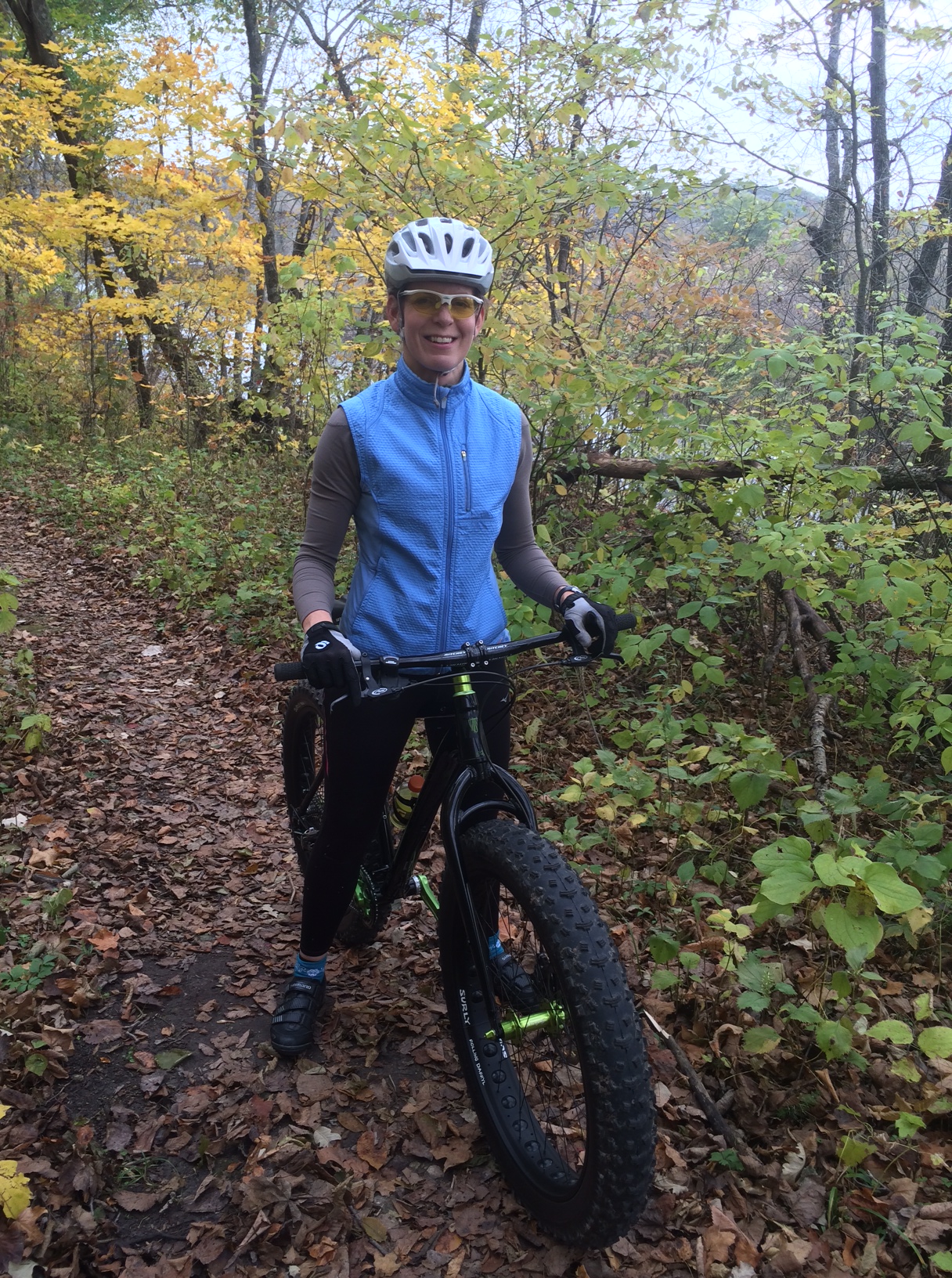
Pausing at Malanaphy Springs outside Decorah, Iowa.

Pausing at Malanaphy Springs outside Decorah, Iowa.

It’s funny the hold that natural places like this have on you. Yes, the Luther campus is more beautiful than ever, graced with new buildings and landscape that pulls you through the bluff-top scenery in all seasons.

But a big part of the reason I attended Luther College was the draw of nature. Our running routes were both gorgeous and difficult. The route my companion and I rode was called Wonder Left, and to my surprise I did not recall that going counterclockwise meant a lot of climbing. Yet the fat tire bikes we rented for the journey made the climbs fun even on thick gravel.

In college we my teammates and I ran 100-mile weeks on those roads. The twisting routes took us through dark hills and cedar-lined bluffs. Mornings were often bone-chilling cold in winter. The roads in deep shadow were blue as arctic ice. In spring the rains turned them to mud, yet the rich gravel gave us footing. We suffered ourselves to fitness over and over again. We wore out shoes on those roads, for all soles are mortal.

Immortal feelings

The eternal flow of water emerging from deep within the hills at Dunning's Springs in Decorah, Iowa.

The eternal flow of water emerging from deep within the hills at Dunning’s Springs in Decorah, Iowa.

And yet there is a feeling of immortality in returning to that place. The memories roll along with you or pop up in conversation.

Lying in bed I could truly feel the years. For one thing, my calves and thighs hurt from the hills! But that was just a temporal sensation. What I could really feel was the relationship with that place, both in time and in the present. This weekend was thus a journey through both time and the present with my friend Sue, who enjoyed a good dose of Decorah hospitality in getting to know the place.

One is capable of loving in the moment, and also loving over time. Perhaps love is the fuel of the immortal soul, not discriminate by time, but sustaining in truth. We travel to find ourselves standing still in the moment, trusting our minds to make sense not just of the journey, but the company as well.

Lifted up

When we attended the Sunday morning chapel service in the Center for Faith and Life building that was constructed during my years at Luther College, it was impossible not to feel lifted up in the eternal tones of the music rising from the bell choir and the amazing choral groups that sat in the seats with us. Their voices immersed us in that sad and yet joyous beauty of Christian liturgy and song.

In the end it is true. There is only so much running and riding we can do. At some point we must be carried along by music and time and memories.

Yet while we’re living and can keep moving, these experiences are like time travel, going back and forth from the past to the present. Mortal soles blend into immortal souls, and we imagine the future into being. That is as it should be.

WeRunandRideLogo

Posted in Christopher Cudworth, cycling, running | Tagged , , , , , , , , , , , | Leave a comment

In which we learn that we’re all really playing on the same team

903f28e3788238b257b8be49b6f33425Today’s We Run and Ride features a link to my Pulse article on today’s on LinkedIn. It reveals how even people in sports, business, politics and religion are actually collaborating in an evolutionary process known as competition.

https://www.linkedin.com/pulse/article/20141009151308-18039128-there-may-be-no-i-in-team-but-there-is-one-in-evolution

Posted in Uncategorized | Leave a comment

The Ebola virus is about to run rampant

By Christopher Cudworth

I have this friend that gets sick fairly often. When he gets sick, he gets very sick. Coughing, hacking, spitting blood even. For years he has jokingly called these episodes for what they are.

“I have Ebola,” he’d say.

And for 20 years or so, that has been the running joke.

Bad diarrhea? Ebola. Stomach flu and vomiting? Ebola. Bad headaches that make you feel like your brain wants to bleed? Ebola.

Then he got a hemorrhoid so bad it required surgery. Before that he was literally bleeding out his ass. The pain was so bad he considered, for a crazed moment, cutting the offending pulpy nodule off his own ass using one of his razor sharp arrow tips. I talked him out of it by text. I did not want to see the selfies from that operation.

That’s what Ebola can do to you.

All these run-ins with Ebola have cost him training time. Or perhaps it was the opposite way around? His training brought on these cases of faux-Ebola.

Ebolification

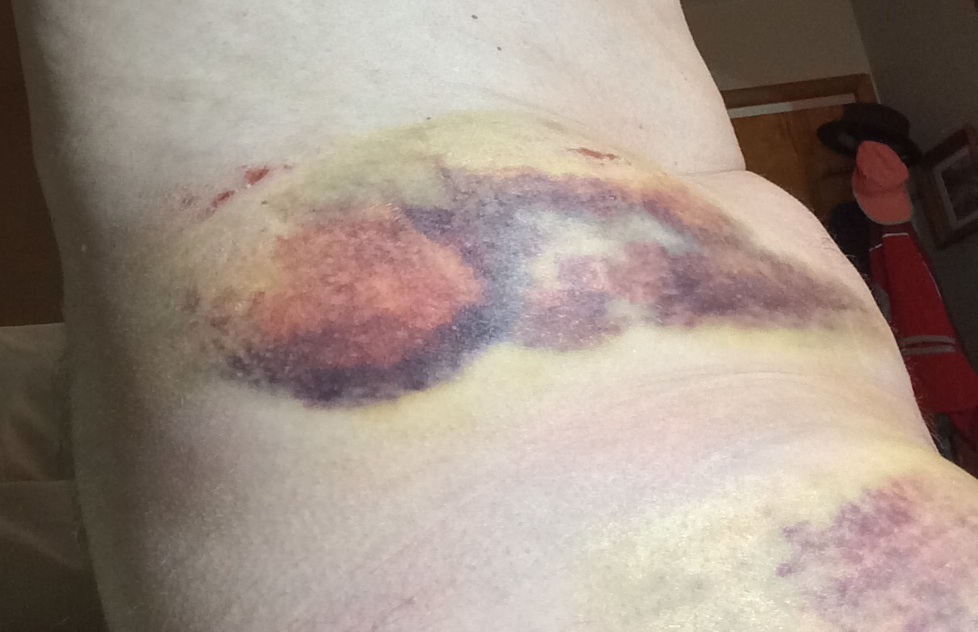
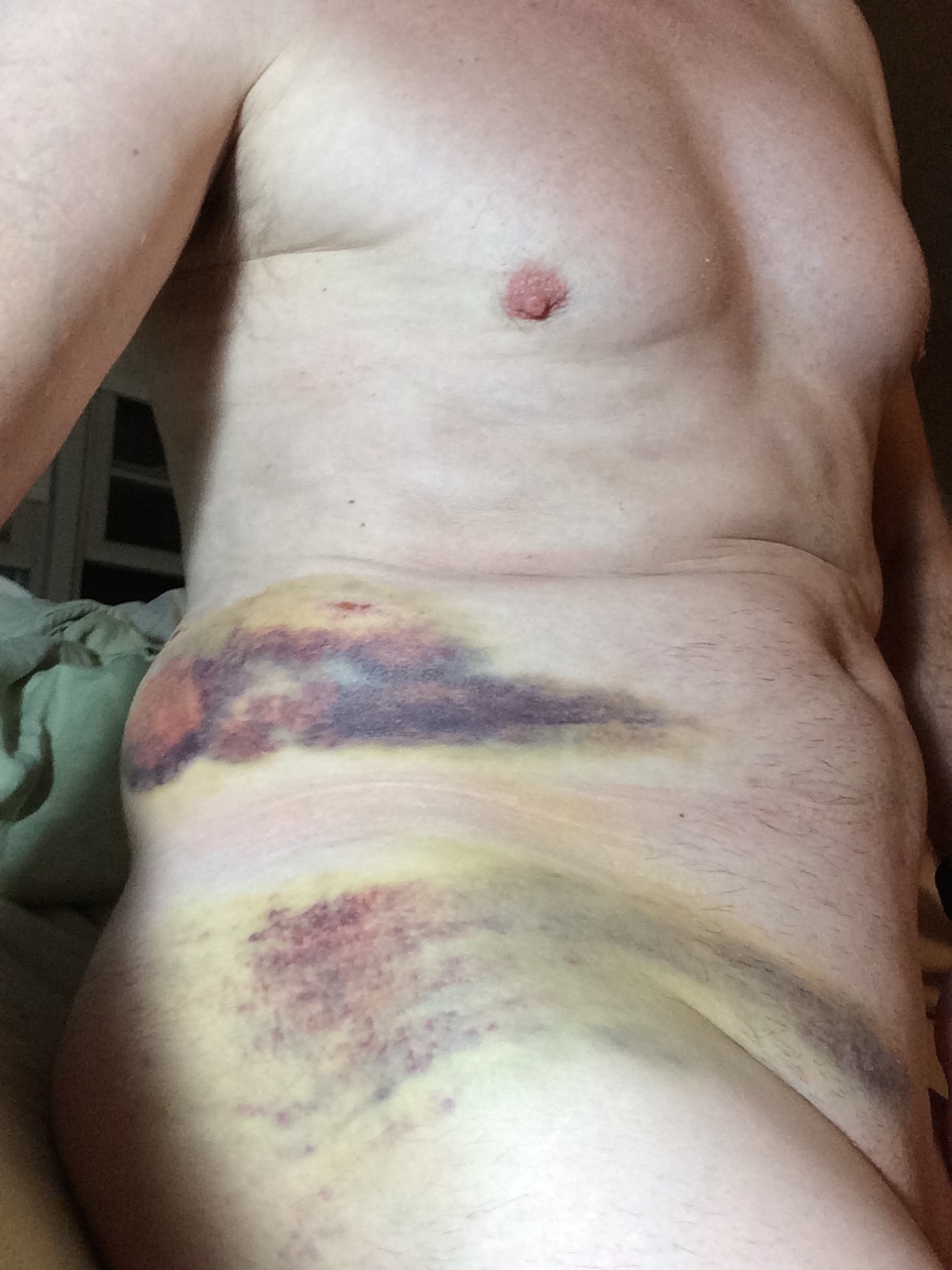
Was this a bruise or an early case of Ebola virus?

Was this a bruise or an early case of Ebola virus?

That’s how it was for me way back in the early 1980s when I was running 90-100 miles per week and trying to get by on six hours of sleep per night because I was young, horny and stupid. Drinking some too.

But I was fast, goddamnit.

And then the crash would come. It would start with a cold and migrate into something much worse. I’d get so sick it was impossible to function in daily life. Then I’d recover and cough up a bunch of green and purple phlegm and wait for the next cold to come around in six months. I was good at that.

Colds are caused by viruses too, you know. There’s no real cure, only stopgap and preventative measures can deal with the effects of the common cold. I choose zinc.

Perhaps zinc will be effective against the Ebola virus too. Wouldn’t that be marvelous? If a bleeding emigrant from another continent stands next to you on the commuter train tracks and you’re wondering what to do, just pop a Cold-Eaze and hope for the best.

No mercy

It may be our only real defense. A disease such as Ebola has no real mercy you see. Infectious diseases propagate by fucking you over and then moving on to the next blind host that can be eaten from the inside out and left as a bleeding hulk. Dust to dust, baby. Don’t say God didn’t warn us.

Are we to blame other apes for all this Ebola stuff?

Are we to blame other apes for all this Ebola stuff?

There is no ethical or moral lesson in any of this unless you consider the workings of evolution, which is the most ethically advanced system of all. It rewards the strong and punishes the weak. But just like religion, sometimes it works the other way around. Evolution does not care who survives and who doesn’t. Which is why sometimes a really successful disease can burn itself out because it runs out of hosts to feed upon and kill.

The entire evolutionary concept of survival and death is played out regularly in shows that feature zombies, the living dead who seem to want to feed on living flesh. Well, that’s not so very different from the Ebola virus. Only we stand the chance to become the walking dead if we contract the virus.

Payback?

And that sort of sucks, if you think about it. But are we really surprised? Human beings have been fucking with the environment in a big way the last 250 years or so. There are 7 billion of us on this earth. Yes, there are major expanses where there are no people at all. I’m thinking Terre Haute, Indiana on a Sunday night mostly, but we digress.

It’s our concentrated populations that make us vulnerable to diseases like Ebola. Out where the virus evolved in the African Outback, to mix a few terms, there is not such a concentration of human beings.

Dark thoughts

It also happens that the predominance of human beings in Africa happen to have dark skin, which makes them less a focus of concern for billions of other people in the world who base their values upon such things.

But Ebola does not care if you’re black or white or Asian or Inuit. It wants to eat you no matter the color of your skin. Inside, we’re all pink and bloody and yummy. Just like Ebola likes it.

A frail proposition

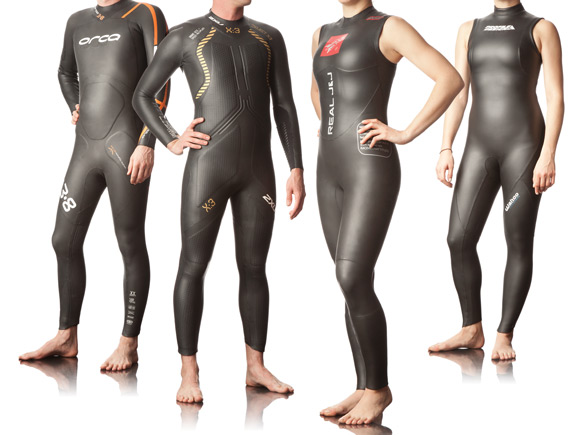
Triathletes sporting protection against Ebola virus.

Triathletes sporting protection against Ebola virus.

Who knows if any of the things we do to keep ourselves healthy will be of much value if the Ebola virus takes hold on other continents besides Africa. While a healthy constitution from running and riding can help us combat the common cold virus, it may turn out to make us more susceptible. Efficient cardiovascular systems may carry the virus faster to other portions of our body. It may turn out the fattest people on the planet are the ones that survive. Like I said, evolution works in strange ways. It does not always favor the strong or the fit. Sometimes it just likes to fuck with you for the fun of it.

Emigrants

International travel almost guarantees migration of the virus to other human population centers. We’ve long been dealing with the effects of world travel on native plant and animal populations. A few years ago when the nuclear reactor blew up in Japan it unloosed a giant concrete raft covered with all sorts of nasty, aggressive forms of sea life that if unleashed on American shores could devastate native wildlife and plants. Scientists converged on the thing when it reached land and exterminators arrived in quick pursuit to alternately sample and then kill whatever came across the ocean.

There are feral raccoons all over Germany and Japan because some idiots decided they should import the critters based on how cute they looked in the book about raccoons called Rascal. Now they’re a pest that can’t be eliminated.

Asian carp are fucking up the Illinois River because they breed so fast no one can keep up with them. They also jump up in the air when frightened and can take out a fisherman flying down the river in a boat.

That’s one crazy twist on evolution if you ask me.

A marathon to end all

Watch out for Ebola zombies in next year's Chicago Marathon.

Watch out for Ebola zombies in next year’s Chicago Marathon.

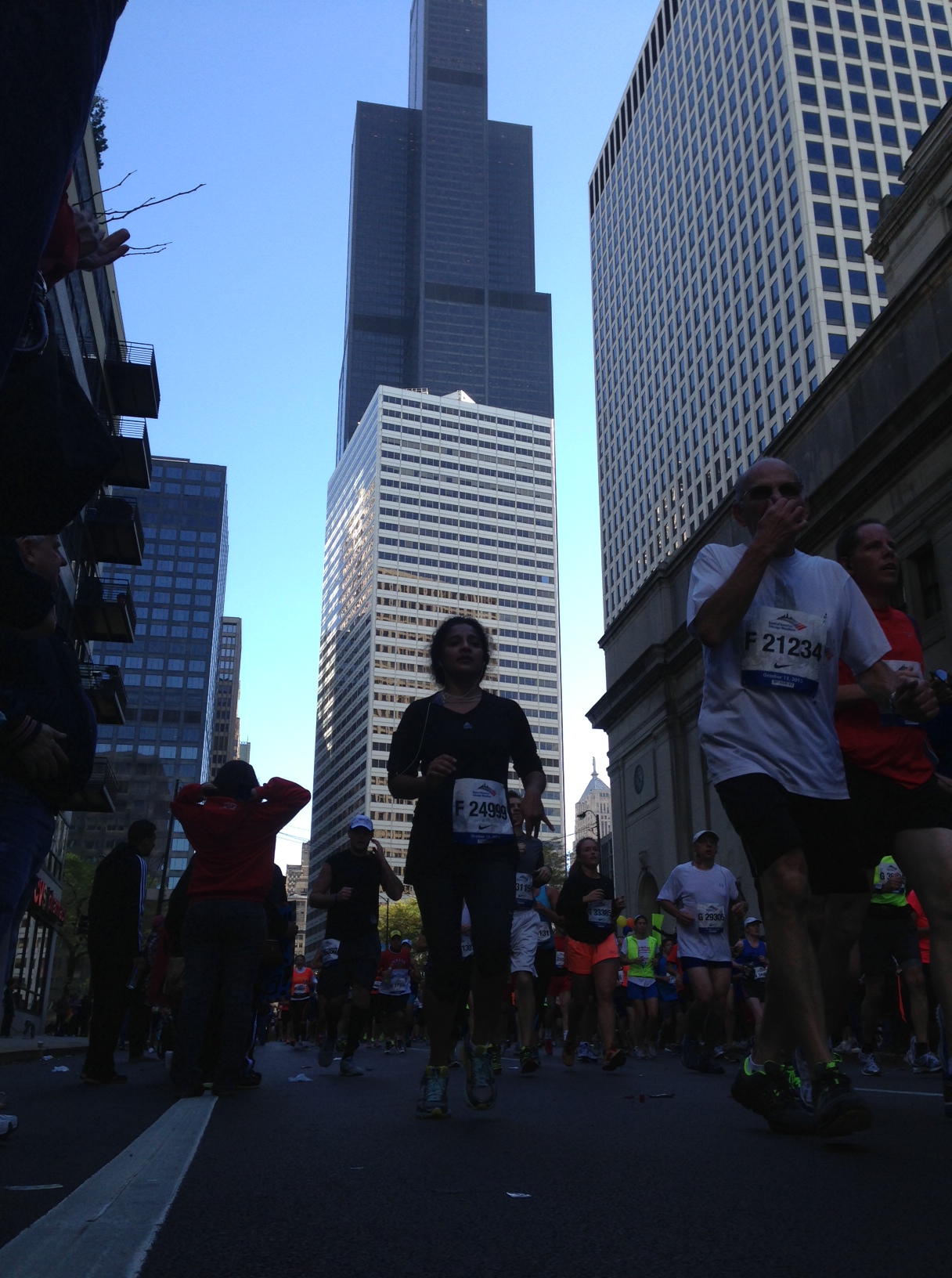
There is the very real possibility that by next year’s Chicago Marathon, there may need to be a division for Ebola Zombies. They’ll have their own cage at the starting line of course, but other than that they’ll have every opportunity to compete like the rest of us. Never mind the bloody trail and body parts strewn on the course. You’ll just have to step around them or else run fast enough to keep ahead of the Ebola crowd lurching toward the finish line. The goal for all such participants will be to finish before they die.

Yes, Ebola is running rampant. Best to keep on running and riding to stay ahead. Otherwise you could be part of a human race that you wish no part in.

WeRunandRideLogo

Posted in Christopher Cudworth, cycling, duathlon, half marathon, marathon, running, triathlon, We Run and Ride Every Day | Tagged , , , , , , , , , , , , , , , , , , , , | 3 Comments

There’s a little Apocalypto in us all

By Christopher Cudworth

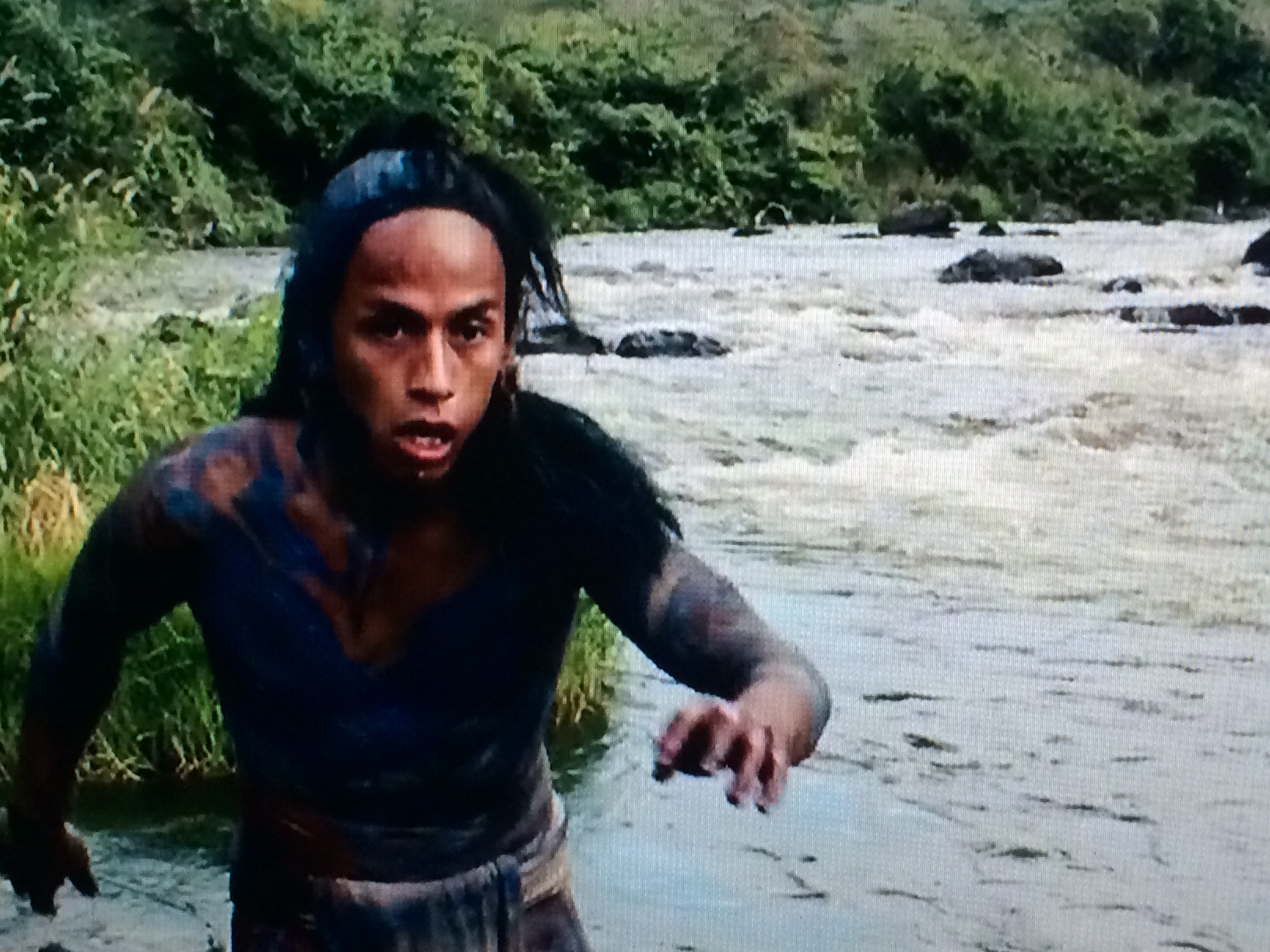
BlueThere are certain movies that are watchable again and again. One of my guilty cinematic pleasures is the movie Apocalypto. It is directed by Mel Gibson, whose Passion of the Christ and Braveheart films are some of the most violent movies on record, and Apocalypto is no exception to the rule that gore makes for entertainment.

The plot is simple and fairly stolen from a movie I also liked as a kid. That was Naked Prey starring Cornell Wilde. Basically the hero of both movies uses their wits and will to elude hunters determined to kill them.

In Apocalypto, the pursuers are killed off one by one as the alternately blessed and cursed hero runs for his life. His hunters, both bloodthirsty and dismissive of the hero’s culture and individuality, regard him as something just above an animal.

pursuersWhich makes it all the more symbolic when the runaway hero emerges from the jungle being pursued by a black panther. His speed enables him to stay ahead of the cat, then he cuts in front of one of the men trying to kill him and the cat opts to strike the man down and gnaw on his head. It’s not the best cat gnaw you’ve ever seen, but you pretty much get the picture.

The hunters impale the cat but can’t save their compatriot. They debate the vision and merits of a prophet among them who claims the death is a “bad omen.” You think?

One by one the hunters die at the hands of the runaway whose goal is to get back to his former village where his wife sits at the base of a cave in the ground. The rest of his people were killed or taken captive by the warring Central American tribe that used slaves as sacrifices to the sun god. They cut out the heart of their victims, lop off the heads and toss them down the stairs of the giant altar where men with nets play games by catching the tumbling heads in nets.

So you can see why the hero really wants to run. He was himself laid out for sacrifice when the sun goes into eclipse (a little fast, mind you, but it’s the movies) which results in the “release” of captives in a game where the hunters force them to run a gauntlet of arrows, stones and spears before being whacked upside the head by the “finisher” before they can escape complete or incomplete into the jungle.

But our hero is faster than his pursuers. We see that from the start when he sprints in zigs and zags down the length of the arena where his first two companions are struck by stones and spears and slaughtered.

fallsHe escapes into the jungle wounded and afraid, but this is his turf. He washes the blue dye of captivity off his flesh and turns into a fast-as-hell killing machine in order to survive.

The vengeance is wonderful. Perhaps it’s a Guy Movie in that respect. Competition is fierce when it’s your ass on the line. As the young warrior rips through the jungle he resembles a world class sprinter or a wide receiver in full flight. His pursuers try to take him down, but he’s too fast, too smart and too determined to save his life and his wife.

The whole thing is an allegory for life in general. There are elements of faith and prophecy communicated by a sickened child standing in a devastated field where his tribespeople lay ill or dead with small pox or some other disease. The main character is even laid out Christ-like on the sacrificial stone before his life is spared by the eclipse.

apocalyptoBut it all comes down to outrunning and outgunning his pursuers. His worst enemy gives him the name Almost as an insult and the promise to dispatch him one way or another. In the end the hero slams the guy’s head open with his own club. Sometimes almost is just good enough. That’s the message.

The Big Kill is saved for the leader of a killers, a giant man with piercings and armor and tattoos that say I’ll Kill You. He threatens to skin the hero and wear it in front of him.

But he gets his due when a booby-trapped spear swings out from a tree to put a hole in his body. End of story for Mean Guy.

We all know we’re supposed to turn the other cheek. We all know that movies use blood for drama. Violence makes our blood run faster, and our hearts too.

But the fact of the matter is that we’re all running from something, in some way. It’s the mark of human evolution that we’re in a competitive race to see who wins and who survives. All the faith in the world really doesn’t change that for most of us.

There’s a little Apocalypto in us all. So get out there and run. It’s your only way to survive.

Posted in duathlon, half marathon, marathon, running, triathlon, We Run and Ride Every Day | Tagged , , , , | Leave a comment

What a 5K for the National Alliance on Mental Illness (NAMI) and National Mental Health Awareness week can teach us all about healthy minds

By Christopher Cudworth

Trees

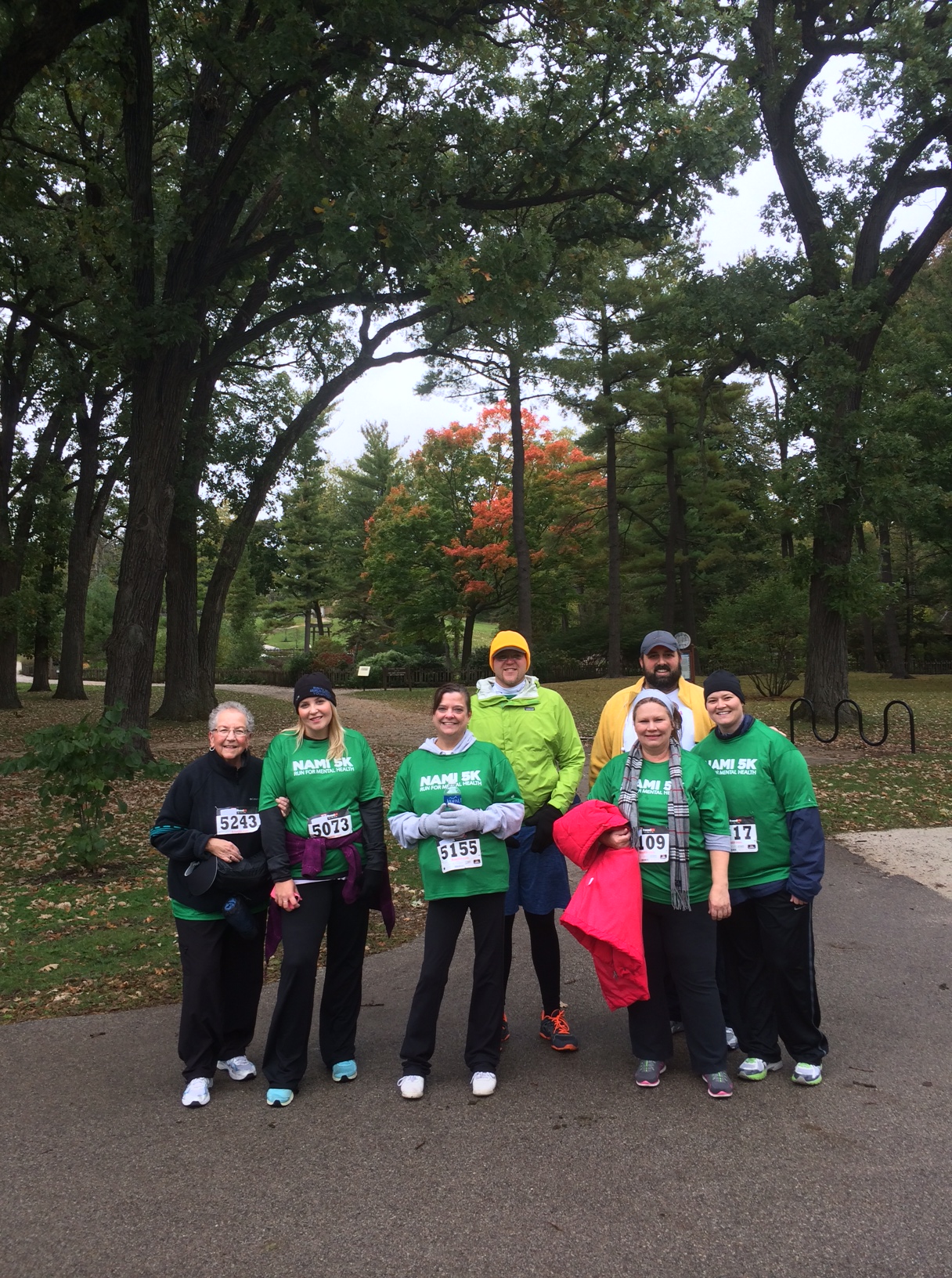
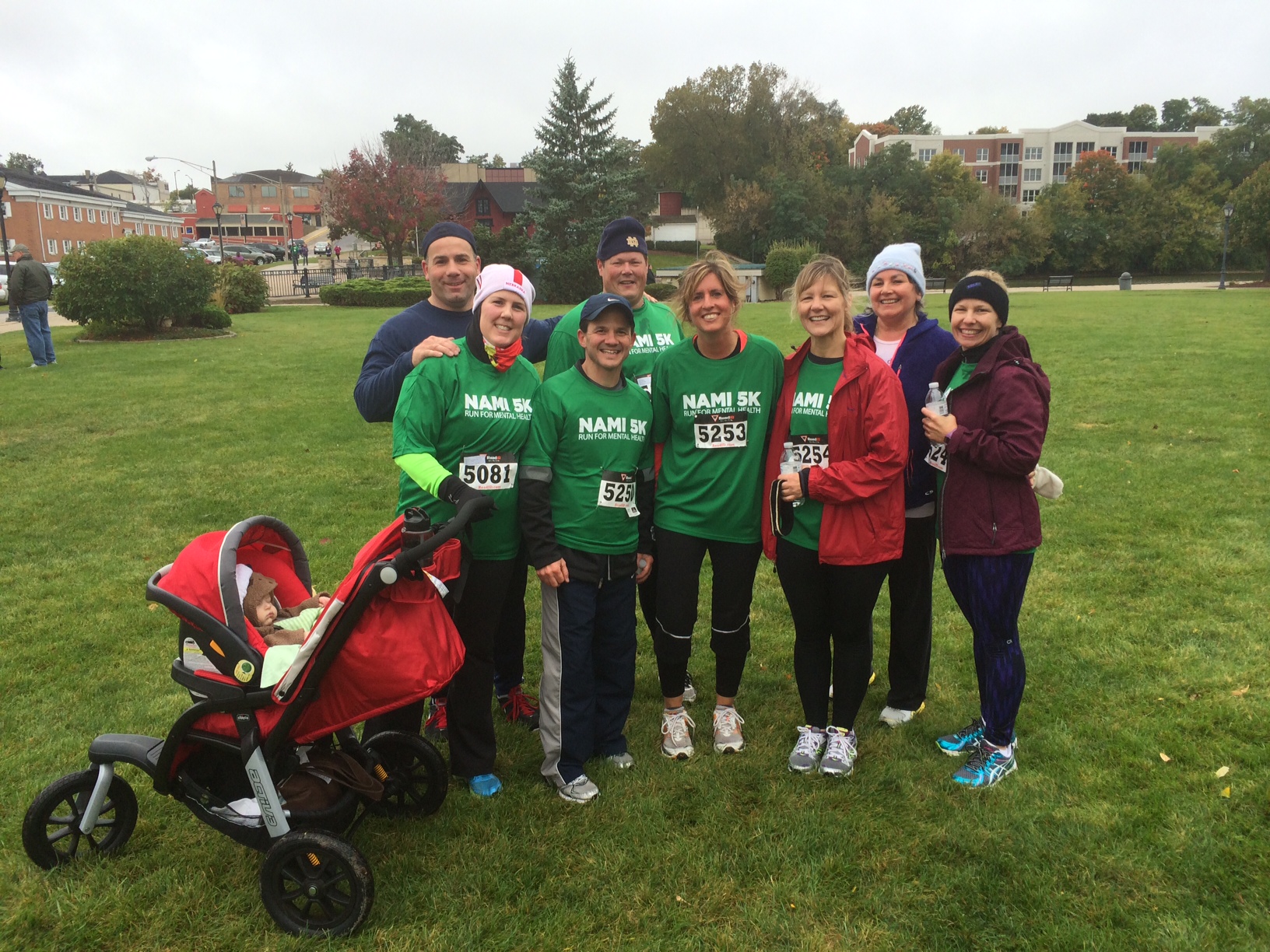
Families and friends walked and ran in honor of those who face mental health challenges.

For the last six or seven years it has been a joy to rise on an early October morning to support a local race in Batavia, Illinois called the NAMI 5k. The race raises money each year for a local chapter of NAMI, the National Alliance on Mental Illness.

Originally the race was called the BatRun, a race title I convinced them to change. I just didn’t think the term “bat” or “bats” went well with the serious issue of mental illness. The organizers meant well, trying to relate to the Halloween season and all, but my point was in trying to place the focus on something more important than frightening fun.

For years I’ve pedaled out to the one-mile marker to read times. It is a race after all, and usually the winner breaks 18:00 or so.

But the bulk of runners and walkers cares less about time than participation. The race this year raised $10,000 for the local NAMI chapter. That’s important funding for an organization that provides mental health guidance and resources to individuals and families impacted by people with mental illness.

That’s a wide range of the human population. This fact sheet outlines the scope of people impacted by mental illness in America alone.

bridge

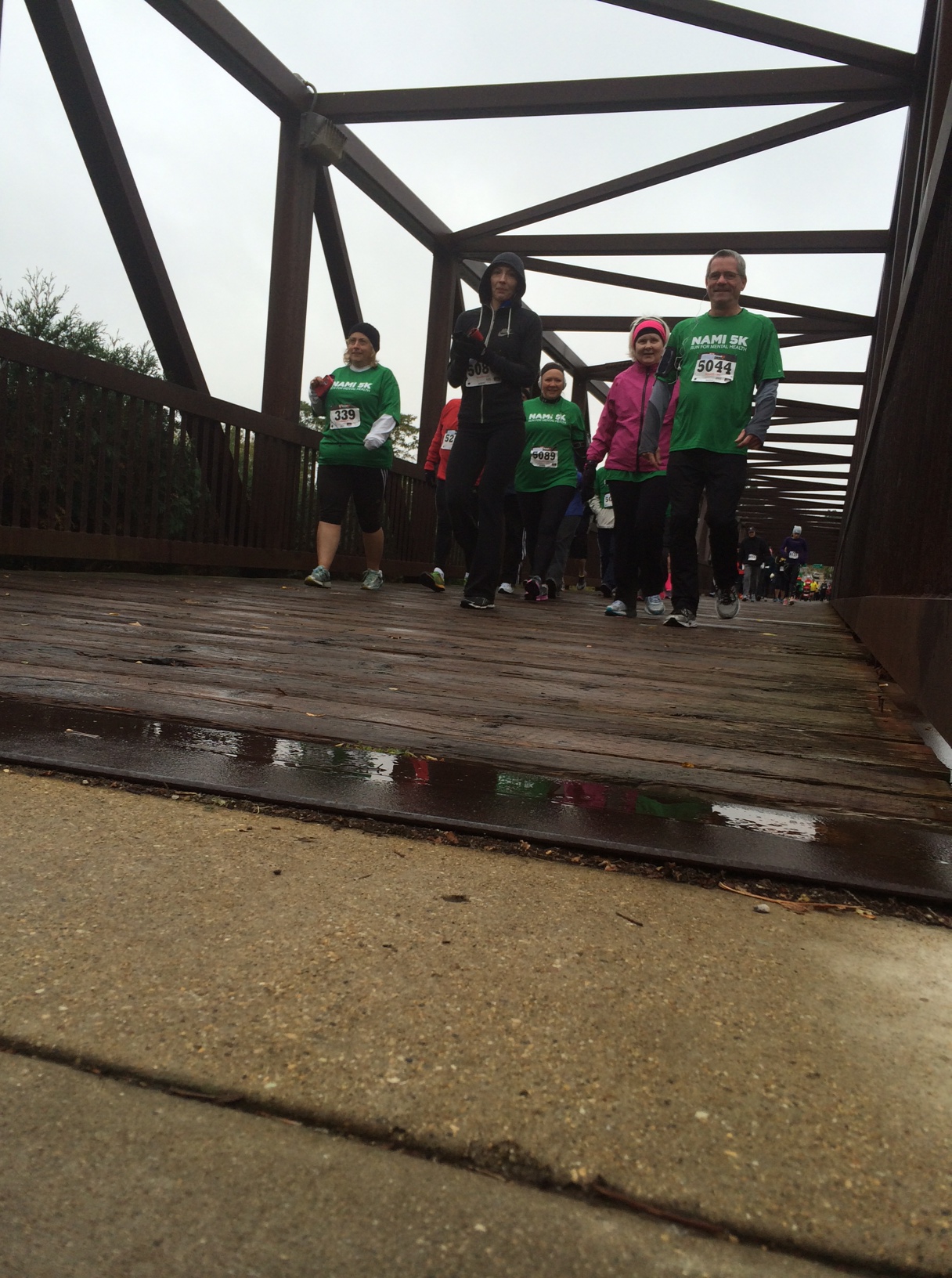
Participants walk the bridge across the Fox River to the start of the event, which is all about creating a bridge to people with mental health challenges.

One in four people in America experiences mental illness in a given year. Too many don’t want to admit their challenges. They might see it as a sign of weakness or disability. That keeps people from reaching out for help, leaving them to suffer alone.

13% of youth face mental illness issues that legitimately require treatment. Society too often writes these serious issues off as “kids being kids” or “moody teenagers.”

In fact most mental illnesses are a direct product of chemical imbalances in the brain. Some forms of mental illness are not only chronic, they are debilitating. It is estimated that the cost of lost earnings due to mental illness reach $193B per year.

So one would think that there would be more fund raising to address these issues. Certainly the various channels of cancer fund raising are admirable and worthwhile, but perhaps the idea of raising pink funds for “the girls” and breast cancer is a bit more alluring than raising money for darkness of the soul.

Nuts

Having mental health issues does not make you “nuts.”

Yet it’s possible and people do get the idea that mental illness is a serious issue once they engage with the issue. With one in four people experiencing difficult challenges in mental health every year, it is obvious we are all in contact with people with depression, anxiety and other disorders of the brain that produce dramatic or unseen costs.

So much about mental illness is a question of context. While roaming the race grounds taking pictures the song Born to Run by Bruce Springsteen came pouring through the speakers. In context of the NAMI 5K the lyrics took on a whole different meaning…

The highway’s jammed with broken heroes on a last chance power drive 
Everybody’s out on the run tonight 
But there’s no place left to hide 
Together Wendy we can live with the sadness 
I’ll love you with all the madness in my soul 
H-Oh, Someday girl I don’t know when 
We’re gonna get to that place 
Where we really wanna go 
And we’ll walk in the sun 
But till then tramps like us 
Baby we were born to run 

Anyone that has felt genuine depression and anxiety knows that there is a fine balance between determination to survive and complete ambivalence at the same time. If that fine line slips there is even the intent of suicide that can creep in. Mental illness can take away the will to carry on or even survive.

Mental health issues can flare due to seasonal, dietary or stress factors.

Mental health issues can flare due to seasonal, dietary or stress factors.

The degrees of mental illness put individuals at other risks if their condition removes social constructs or rationality. When people lose their ability to reason their behavior can even run afoul of the law. One of the important NAMI initiatives is working with law enforcement to provide education about how to identify and handle people experiencing profound mental health episodes.

So it was heartening to see families walking in honor of their loved ones or friends with mental health. Some wore placards on their back stating “I’m walking for my mom” or other friends and family.

It was cold. And it was windy. Yet there were breaks in the forest where the winds abated and people ran or walked along without being buffeted by the brisk October weather. It was perfectly symbolic of the entire journey through a life impacted by mental illness. There are calms and there are storms. There are dark moments and also trees bright with color and hope.

People of all ages need to be assessed for good mental health.

People of all ages need to be assessed for good mental health.

Because it is also true that people with mental illness often experience life at a more intense level than some of the rest of us. Certainly the challenge of working with someone gifted with savant capabilities yet nicked by the inability to recognize social cues is becoming more of a mainstream issue. Conditions such as Asperger’s and autism are now discussed with more frequency. Schools have struggled with whether to be inclusive or exclusive in these efforts. But at least there is a social movement to recognize the value of better engagement.

It’s National Mental Health Awareness Week October 5-11th, 2014. Take some time to visit the NAMI website to educate yourself on mental health issues and learn where you can find resources for people you know or yourself. There are many healthy ways to gain better mental health.

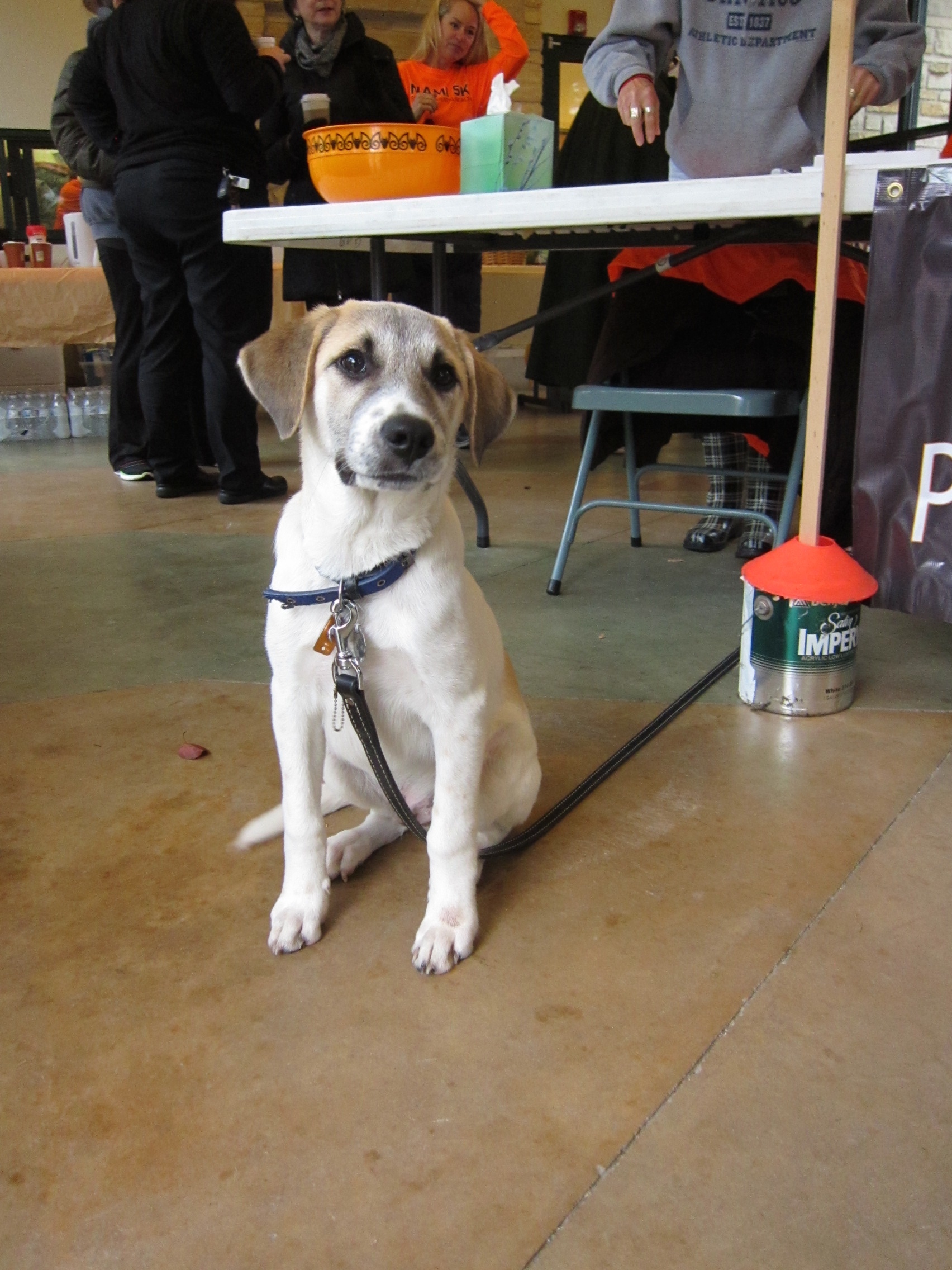
Even our pets need to be watched for good mental health. They can also provide a healthy support mechanism for all of us.

Even our pets need to be watched for good mental health. They can also provide a healthy support mechanism for all of us.

I know. I’ve worked through a lifelong engagement with anxiety. The effects have been profound and impactful at times. My running and riding are healthy ways to deal with anxiety and the flipside of depression that can go with it. Through all the frightening challenges of caregiving for my late wife when she had cancer, it was important to get both chemical treatment and counseling to better deal with life events that can accentuate one’s propensity for compromised mental health.

It’s not just something you will or pray away, although cognitive and spiritual attentiveness can help. Good mental health is primarily awareness of your condition and finding ways to not just cope, but thrive in your own context.

It’s very possible, but if you or someone you know is struggling with personality or mental health disorders it is so important to seek help. Don’t be afraid. You are far from alone, and that’s the point. We’re all in this together.

WeRunandRideLogo

Posted in Christopher Cudworth, cycling, duathlon, half marathon, running, swimming, We Run and Ride Every Day | Tagged , , , , , , , , , , , , , , , | 1 Comment

A long and complicated relationship with the shower

By Christopher Cudworth

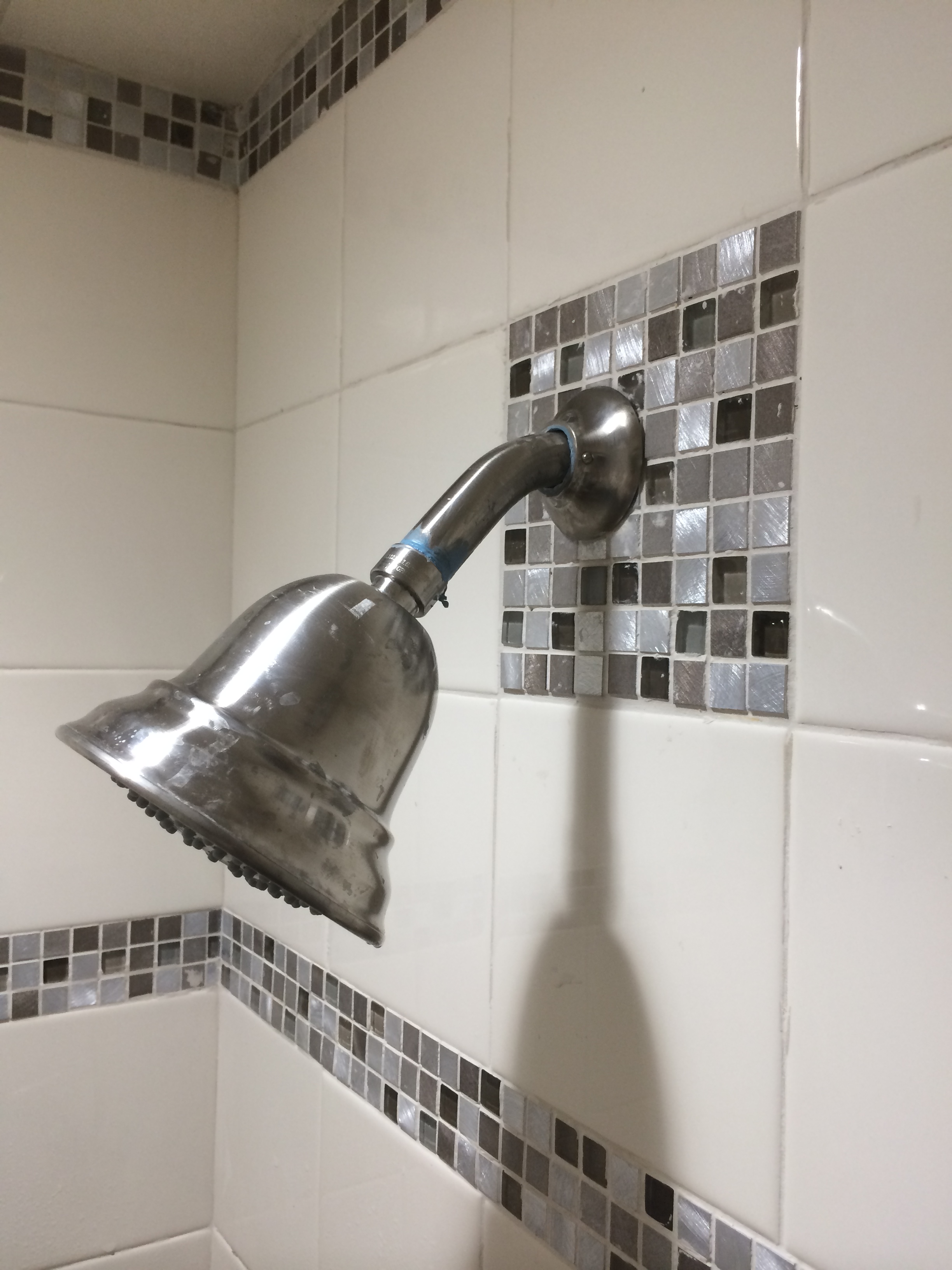
shower headAs a matter of tradition, the phrase “hit the showers, boys!” used to ring out after every high school and college athletic practice. We’d drag our tired bodies back to the locker room, strip naked and stand under the forgiving spray in hopes of either getting either warm or cool water depending on the season.

Athletes once thought nothing of standing around naked in the showers. Why would they? Being naked at times is part of sports. It still is with the pros.

Who knows exactly what’s happening these days? Kids apparently don’t shower after gym class during school hours. One frustrated kid put the question up on the Internet, “Why don’t schools make kids shower after gym any more?” Here’s were her observations:

My mom was recently talking about how she had to take showers in gym when she was younger. My school doesn’t make us shower (actually, they dont LET us shower) and neither do any of the middle schools in our area. at first i thought it sounded horrible, getting naked in front of everyone like that, but then i thought it would be nice to go back to class feeling nice and clean rather than hot and sweaty. and the kids could wear swimsuits if they feel embarrassed. why dont they make them shower? do they want their students walking around sweaty and smelly?

One respondent’s succinct reply said a lot:

A number of reasons:

-Time
They would have to cut the class time to make time for a shower

-Cost
Using all that water every day for hundreds of students adds up

-Personal Problems
incidents that could happen in the shower, like sexual harassment, because a teacher could not be present, also imagine the scandal if there was a homo sexual around you? Also guys running in on the girls etc.

-Liability
Schools became afraid of being sued. You could slip and fall. lol

But i think you should be able to if you want to… but still that would still have to cut down class time, to allow time for the shower.

Yes, all the insecurities of the world seem to come together in the shower. Not to mention fears. Who can forget the scene in Psycho with the blood washing down the drain? School showers simply aren’t safe or emotionally healthy places…

So much ignorance and so many selfish fears afoot when it comes to showering after exercise. Let’s not forget that some very recent studies have shown that recreation time is actually critical to student performance in the class room. There’s also the growing challenge of childhood obesity lurking around every school corner. To help manage their wait, kids actually need to be working out hard enough to work up a sweat. That means they should shower following exercise for purposes of hygiene and potential body odor.

At the gym

Showering at the health club where I belong is kind of fun. They have giant shower stalls lined with cool tile and a never-ending supply of hot water. You can work out hard, take a rinse off shower, go swimming, hit the hot tub and come back for even more hot water before you change and head back out into the world. The showers are like a refuge from everything else that’s wrong in the universe.

My membership is coming up for renewal and I can pay $19.99 for the simple version of the club with no showers or else pay $25 or $30 a month and be able to visit the bigger gym with the pool and all. The luxury of those showers may be worth the extra dough.

Cold comforts

Because for years the showers at the gym were a tarsnake of sorts. It was great to get done working out and hit the showers to cool off or warm up. Yet so many school and college showers were utilitarian. Our college locker rooms had those tower showers where everyone stands around a pole with water squirting at them. Sure there were towel fights and the occasional joke about a body feature, but no one really came to much harm from it all.

After showering we’d often stick our heads under the heated blow driers so that our hair would not freeze during the walk up the hill in freezing temperatures to the college Union. Yet it was sort of fun to have a Helmet Head made of ice. But some of us got sick of all that and started showering in the dorms not out of embarrassment but of convenience in getting changed.

Going without

During lunch hour workouts over the years, there were times when a shower was not always available. I’d run four or five miles and change back into work clothes after dousing myself with deodorant. That feeling of being grimy or sweaty under the clothes was never great.

My dentist used to run during his lunch hours and come back shining from sweat. Then he’d towel off with no shower and go back to work. Honestly that grossed me out. I switched dentists.

Home sweet home

CoolOver time we develop a funny relationship with the shower. Everyone has a rhythm to their showering. Some are fast and efficient. Others take their time and dawdle, letting water wash their troubles away.

In summer nothing feels better than a cool shower after a long bike ride. If the legs need a shave I plop down on the tub floor and aim the shower head to the wall. Then I can shave and rinse. The feeling of smooth legs for cycling is simply I’ve grown to appreciate at a whole number of levels. It just looks better, but even the art of getting a smooth shave is a pleasure of sorts. It’s like painting a wall or writing a story.

Then you come out of the shower and move into your day with a zing and a tingle. The shower makes you feel truly alive, or at least brings you back from the dead after a killer workout.

Extracurricular

Sharing the space with a treasured companion can be fun too. Everything’s better when wet. Of course I tried that once with a college girlfriend in a dorm during summer break and the floor maid heard us talking. She burst in to investigate as I hid behind the door. It was like one of those scenes from an exploitation comedy about teen lust. But she didn’t find me even though she asked my girlfriend all kinds of questions.

Yes, it’s a long and complicated history one has with the shower. Perhaps you’d like to share your experiences…for better or worse?

WeRunandRideLogo

Posted in cycling, duathlon, half marathon, marathon, running, swimming, Tarsnakes, triathlon, We Run and Ride Every Day | Tagged , , , , , , , , | Leave a comment

The danger in running away from ourselves

Still don’t know what I was waitin’ for
And my time was runnin’ wild
A million dead end streets and
Every time I thought I’d got it made
It seemed the taste was not so sweet
So I turned myself to face me
But I’ve never caught a glimpse of
How the others must see the faker
I’m much too fast to take that test
–David Bowie, Changes
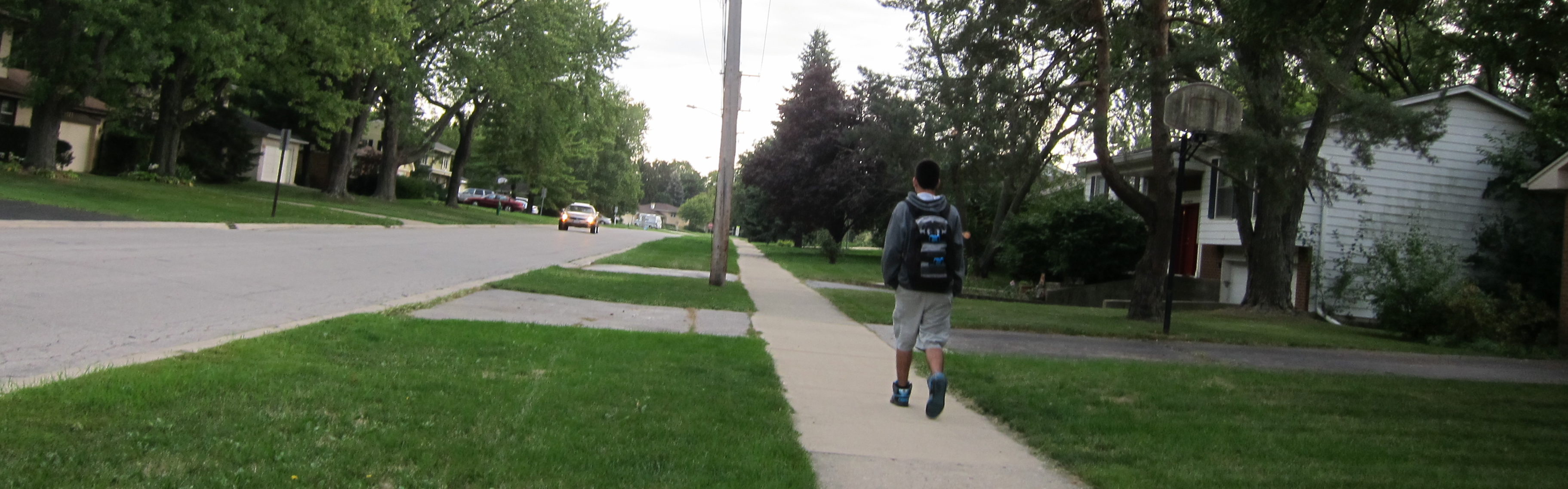
Walking to SchoolPerhaps you’ve gone for a run or a ride in a strange neighborhood or even a foreign town and wound up in a cul de sac or a dead end street. It’s a strange sensation in many ways. You know you need to retrace your steps but something in you wants to keep going the direction you were already headed. To the point of near insanity, some of us choose to pursue a singular path over being willing to change directions for any reason at all. Our determination exceeds our common sense.
Sometimes our friends see that path and try to counsel us: That’s not a good way to go. Yet we fake ourselves into thinking it’s the best course (a marathon when we’re already injured…)  because we’ve put so much effort into getting to that point that going back feels like giving up. It’s an admission of sorts that we’ve failed in some way.
Admissions
I wrote an as-yet unpublished novel back in my twenties titled Admissions. It uses the paradigm of the college admissions process to explain that the best thing most of us can do in life is to admit our flaws first, then find the right course of action. Think about it. If instead of listing all our best attributes on a college application or a resume, we were instead motivated to place all our worst flaws on paper first., and set out to fix them.
“I suck at details,” we might write, or “I hate long meetings” could go a long way toward helping us make changes beneficial to our faulty natures. That would be a lot more helpful than trying to bolster little egos with statements such as “I excel at innovation and creative solutions.” Ask any Human Resources associate. The cliches outnumber the truths.
Not that painting a negative picture would get you the job. But it might help you prevent those flaws from showing through in ways you never intended. There’s a lot of things in life like that…
Great lengths to avoid embarrassment
photo (6)We go to great lengths to create this “person” that does all sorts of things for us. It’s our “personal brand” or so it goes.
But in many ways this personal brand we create is sometimes running away from the part of us that truly needs fixing. Because none of us is perfect. You can prove that fact with religion of with harsh secular rationality, but the same holds true. Our flaws hold us back from success.
Look at the way you run, ride and swim. The whole enterprise is about fixing things that don’t work and overcoming flaws. This coming week I’m going to embark on a winterlong mission to become a better swimmer. I’ve got decent swimming form I’ve been told. Yet the breathing part holds me back. I exhale through my nose and gape with my mouth but somehow I’m still not getting enough air. After two decent laps the whole thing starts to bog down. I run out of breath. That weird panic of losing air shuts me down and bam, I’ve stopped cold. Dead in the water, so to speak.
What I really fear is embarrassment at stopping all the time while others swim back and forth for 45 minutes. We don’t like to admit that we’re not as good as others at something we’re trying to do.
Negatives and positives
This isn’t negativity ruling the psyche. As athletes most of us learn the power of positive thinking or else we quit. It’s that simple. You can’t do a marathon, half marathon, triathlon, Ironman, 5K, 10K or open water swim without some degree of confidence that you can finish. You tell yourself you can do it, and you do it. Nothing complex there.
Doubt enters the picture in more subtle ways. We may prepare ourselves for an event and yet get to the line with questions.
“Have I done enough mileage?”
“Can I hold the pace?”
This is both healthy and a drawback. It’s one of the tarsnakes of endurance sports that the caution we need to apply holds us back, yet throwing that caution to the wind can cause us to blow up, drop out or hit the wall. Which means that despite all our preparations there’s always a part of us that feels like we’re “faking it.” We try to run away from those emotions and as time goes by we might actually become confident enough to believe that we are no longer simply faking it. We’re actually as good as we claim ourselves to be.
Life changes
DecorahNightNothing lasts forever. So we engage and embark on test after test, pushing ourselves to find out if we’ve still “got it” in one way or another. Are we still as fast or faster than we used to be? And if that isn’t possible, we stave off the inevitable with age group efforts knowing that the people we’re racing face the same shit as the rest of us.
Jealousy enters in when competitors seem to transcend all that. They don’t seem to be running away from anything. They not only complete their races and workouts, but seem to fly through them.
Again the perilous pit of comparative reasoning draws us down.
It’s like this:
Every time I thought I’d got it made
It seemed the taste was not so sweet…
Because even success can leave us feeling vacuous and empty. There is often a feeling of a letdown after a major race or goal is accomplished. Your body and brain cry out for new objectives. “What now? Who am I? Where do I go?”
Answering questions
It is far better to take a moment to stand there and answer those questions than it is to run away from ourselves with a head full of unresolved questions about why we do what we do. The risk is finding ourselves among a bunch of other people similarly disengaged from perspective and reason about our choices, or absorbed in unrelenting focus on the ego of a thing.
photo (7)We lose ourselves in that process at times. Then the changes that come our way are sometimes not by choice. Our sport becomes our self-image, and we find ourselves running away from ourselves.
There’s more to all of us than that. Yes, it’s good to be disciplined and driven when we set our goals. As John Irving once projected through a coach character in the novel Hotel New Hampshire, “You’ve got to get obsessed and stay obsessed.”
But the fact of the matter (even in the novel sense) is that obsession is just one tool for self discovery. It is not the entirety of any of us. That’s true whether you run, ride, swim or do all three. Our sports can change us in very good ways, but it is important that we do not fake ourselves out in the process. We all tend to be good at that. We don’t want others to see the faker, and we’re much to fast to take that test.
Changes inside and out
It’s okay. It feels so good at times to be in control of our health and fitness that it can take control of our entire being. The danger is when you lose that sense of control through injury, illness or other life circumstances. Then the real you is forced to take over once again. That’s the person that exists whether you run or ride or swim or not. Don’t forget that person exists. They’re pretty important in times of crisis or during those periods when our avocations necessarily take a back seat. There’s a person in there that loves and marries and keeps track of the kids. Who gardens and walks the dog and actually goes out to make a living.
Life is full of changes. It requires that we look outside ourselves for feedback, and to understand who we really are. Yet the ultimate process is one of self-examination.
So I turned myself to face me
But I’ve never caught a glimpse of
How the others must see the faker
I’m much too fast to take that test
Run, but don’t run away from yourself. Ride, but don’t ride until you’re out of touch with reality. Swim, but don’t drown in your own ego about what all this really means.
It’s about self-discovery, and nothing more. Your running, riding and swimming are not in fact the whole you. That’s always going to change depending on what life throws at you. You can’t really run away from that.
WeRunandRideLogo
Posted in Uncategorized | Tagged , , , , , , | 2 Comments

Here’s to a bloody good time when you run and ride

By Christopher Cudworth

IMG_1019Something in us is wired to recoil at the sight of blood. Yet the phrase “bloody” or “bloody good” is used as an “intensifer” to describe all sorts of activities from drinking to comedy to simply hanging out with your homies. If you’re British, that is.

Whenever I try to give blood I faint. It’s not the sight of blood that gets me. I last all the way through the withdrawal process only to fade at the very end. Some sort of imbalance takes hold and out I go. So I don’t try to do that any more.

Last year I got stuck in the finger by a tiny sliver and it infected the joint in my middle finger. That required bloody surgery, stitches and a pick line in my arm that looked like a Frankenstein experiment. There was blood under the clear bandage that perpetually looked fresh and frankly freaked me out. Was I leaking?

IMG_8648Then came the accident last June in which I had my head down during a bike ride and crashed face first into a fallen tree. That required four stitches to sew up the bloody wound on the front of my chin. Right after the accident a sweet young couple had ridden up behind me and asked. “Are you okay?”

I told them I was fine, but she pointed to her own chin and grimaced, stating, “Um, you’re really bleeding.”

Indeed I was. There was blood all over my neck and face. I wiped it up with cycling gloves and it finally clotted into a dark black clump. The doctor hosed that down with alcohol and sewed me back up. But he missed. A fleshy dome of skin still hung from the wound. If I touched it the wound reopened. Later I met a nurse who told me the doctor messed the thing up. There was nothing to be done by then. For weeks afterward the bruises under my skin migrated around my body carrying dead blood to who knows where. It was like a map of destruction, colorful and crazy in its construct. The bruises settled in my ass crack and migrated up the shaft of my penis, then disappeared. Like a magic act, the blood performed its functions and then vanished into thin air, or thin blood.

IMG_1020While shaving my legs for cycling this summer I resorted to some cheap fixed blades and wound up taking chunks of my skin off the shins and knees. While writing this blog that morning the blood ran down my legs and pooled on the ground by my feet. I hadn’t noticed the wounds that much. My feet smeared the blood on the floor. It looked like a crime scene. My girlfriend blanched that evening when she saw the raw flesh. “What did you do?”

I lied and told her it was yard work that caused the blood. Actually it was that too. Shaved legs do not hold up well in the garden. Every loose stick or thorn bush takes a chunk of flesh. Cyclists who shave their legs should probably not be gardeners as well. I dumped those cheap blades just the same. It was not worth the compromise to shed so much blood.

Then over the next couple weeks I would absentmindedly pick at the scabs and the blood would come rolling out again. Don’t pretend you don’t do that too. Scabs are irresistable. It’s true whether they are physical or emotional. We pick at them because we want the flesh or emotions clean again. Yet here comes the blood, reminding us there is something deeper to the issue.

People who cut themselves gravely crave this cycle of bleeding and scabbing. People who can’t leave emotional wounds alone suffer the same fate.

IMG_0124Those of us who run and ride cut into the soft flesh of every new day with hard or soft efforts. We’re rehearsing the pain that comes of full intensity. We bleed ourselves from the inside out. Our blood carries oxygen to our muscles and returns to the heart blue with exhaustion. Our veins and arteries do their work without complaint unless we open them up. Then the conversation turns bright red. Then our animal nature is exposed.

It hurts us when we see our pets exposed to the horrors of blood. When my girlfriend’s cat was attacked this summer by a neighbor’s dog, the blood flowed freely. Only it was not just the cat that got bloody. That sweet feline clamped her claws and teeth into the face of that dog. The dog paid dearly in blood and pain.

We speak of becoming “blood brothers” when we exchange blood as a bond of loyalty. Slicing the hand open and pressing it to the flesh of another bleeding palm is a pretty strong commitment. Likewise the moment when a man penetrates a woman for sex during menstruation. The aching need for love transcends even blood. There’s a clinging lust in the warmth and draft of all that. Some can handle it. Others cannot.

Maple leaf in rainAt a running race I once visited a Porta-Potty where the bright red blood of a woman’s period graced the top of the messy pile of urine and feces. It struck me that men know nothing of this export, this ability to bleed without dying. Yet women do feel pain in the process. The cramps of the female body unloosing eggs that will never see or meet sperm. It’s so earthy at some level it was considered taboo by those who wrote the laws that became scripture. Menstruating women were considered “unclean” and were to be isolated from the rest of society until their “period” was over.

Without blood we’d all be dead in a minute. A soldier shot on the battlefield bleeds out, becomes cold and then shivering on the brink of death. In great battles it has been reported that blood flowed like water down the street. Human lives washing down the gutters.

baselayer2I once had a teammate whose nose burst forth with blood during a cross country race. His white uniform was splattered with his own blood. Yet he kept running despite the bubbling red froth in his mustache. We all stood in awe at the sight of him. “It doesn’t hurt,” he blurted while spitting red bits of blood around him. “Why stop?”

Similarly I was once arm-wrestling a kid in 8th grade study hall whose nose spurted blood from the effort. It shot all over the table and my companions all shouted and jumped back in their chairs to avoid the pool of blood rolling across the table. The study hall teacher came angrily over to check out the situation and was aghast at the scene. She gave us a stern lecture and ushered the wounded kid off to the nurse’s office.

When he left we all stared at each other and said, “Coool.”

So we love and hate the sight of blood. When blood spills in the movies, we marvel at the special effects or label it “fake” if the blood looks too red or not gory enough. The blood spilled from the body of Jesus during the film Passion Of The Christ was meant to change the hearts of those that had never considered the gore and pain endured by the man the Jewish populace of those times called Yeshua. People either worship the man or ask “What’s the bloody difference?” if they believe or not.

Surgeons and nurses mop blood off bodies and off the floor. They witness the warm smell and feel of blood and it is nothing to them but an occupational necessity when getting in and out of the human body. The same goes for veterinarians, scientists and everyone else who turns the universe of the body inside out.

During college biology I conducted a series of experiments on animals in the lab. One test involved convulsed the leg muscles of a frog using electricity to test its performance as lactic acid built up in the muscle fibers. I have never forgotten the sight of that frog’s legs twitching their last, too fatigued by lactic acid to carry on. The blood could no longer carry away the bad stuff and replace it with good stuff.  It gave new meaning to the term “frog’s legs” to me. I have had that feeling in my own legs many times over the years.

IMG_7315That experiment with the frog went well enough, but the tracheotomy on a live rat did not. My lab partner cut the carotid artery and blood spurted straight up and hit the ceiling. It pulsed like a geyser until the rat finally died as the blood fell in a shallower ;arc until the experiment was over by default. Nature seems to use the color red as a warning, that life is just beginning, or may be over.

Those experiments may seem cruel to some, but they’re really not so different from what we do to ourselves in events like a marathon or Ironman. We push and push and push, blood coursing through with vital nutrients carried to muscles that die without them. We either transcend or bonk on the way to the finish. Our faces grow flush with blood just below the surface.

Cud RacingRed also makes a bloody good sign to Stop lest you get flattened and bled out by a passing car. Those of us who run and ride would be well served to remember that.

Then there are those pursuits that put life, limb and our very blood on the line. If we crash in a high speed accident during a criterium, the blood spilled on the coarse road surface marks our commitment to speed.

We literally race to defy the end of life. We wrestle with youth and age with blood racing through our circulatory systems in defiance of the dust to dust reality that is so dry compared to the plasma to platelets reality of our day to day existence.

We speak of “feeling the flow” during peaks in performance. That is no coincidence. It is all a product of a blood good time when you run and ride. Here’s to hoping you have the best of luck with your blood without showing too much of it at the same time.

WeRunandRideLogo

Posted in Uncategorized | Tagged , , , , , , , , , , , , , , , , , , , , , , , | Leave a comment

What one small bird can tell those of us who run and ride

By Christopher Cudworth

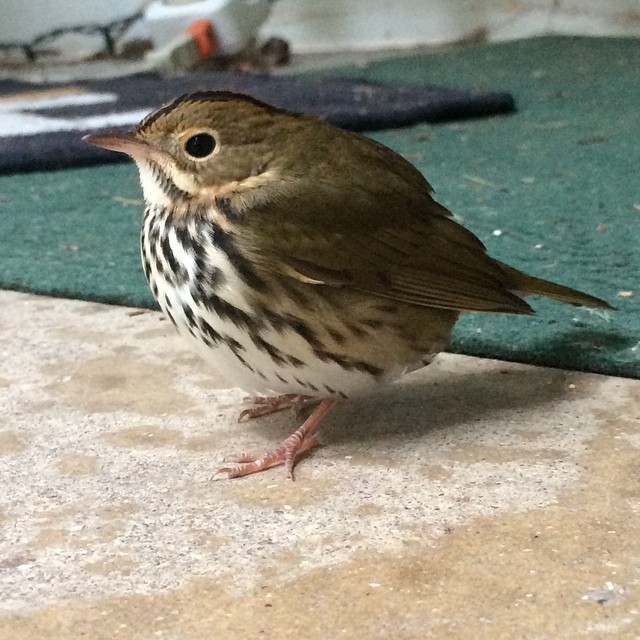
OvenbirdThis time of year is peak migration season for songbirds. Millions of birds are moving south for the winter in search of food sources and warmer temperatures.

It’s a tough go, made even tougher by the fact that in the last 250 years there have been a lot of obstacles erected in the path of flying birds. Tall buildings in Chicago regularly knock thousands of birds from the sky. By necessity and out of compassion a volunteer crew of avid birders moves through the city streets from dawn until rush hour each morning collecting dead birds and shipping stunned but still living birds out to the Willowbrook Wildlife Haven in Glen Ellyn where they are rehabilitated if possible, and released.

The birds that aren’t collected are often eaten by crows or gulls, which also move through the city at dawn scarfing up free meals. Up to 5000 birds a season are rescued and released. Many of these are rare or precious species of birds whose populations have been impacted the last 200 years by human changes to the environment.

Fight or flight

IMG_1152Humans have a lot in common with birds you see. The adverse environmental impacts that affect birds include pesticides, pollutants, habitat and wetland loss. Climate change of any type, warming or cooling, is also known to have major impacts on bird and human populations. The somewhat ironic fact now is that anthropogenic (caused by humans) climate change is turning tables on everyone who lives on the planet. Birds and humans are now interlinked in new ways.

There is talk that climate change may reduce bird populations by millions. Entire species may vanish from the earth, creating a mass extinction on par with past decimations wrought by meteor collisions with earth, volcanic eruptions and long term climate heating and cooling brought on by natural shifts and systemic change.

This time climate change is happening so fast the effects are measurable by visible degrees. The rate of change is unprecedented. Ice core samples in the Antarctic show consistent, regular cycles of climate change over 800,000 years, but never has a spike like this one occurred. As a carbon-spitting race of beings we’ve spiked the climate punch.

Strange histories

IMG_8455Climate change deniers like to point to the long and ancient history of earth as a sign that human beings could never affect systems so big and large. Ironically these perspectives are partnered with religious view that contend the earth is not that old, perhaps 10 to 30,000 years old, tops. Collectively these views are held by something like 30% of the American population, the exact figure that matches up with diehard conservative voters.

What an odd, contrarian mix of beliefs it is that forms the alliance of climate change deniers! Meanwhile changes to our weather produced by global warming confuse the issue even more in the minds of those who choose to deny climate change on ideological grounds. Here in Illinois last winter we had the coldest, snowiest weather imaginable. Some seemed spitefully content to grumble “so much for climate change,” yet they should have listened to their own words. Climate change was exactly what set up a new Polar Vortex that sent cold air rushing down from the arctic.

Big patterns

We’ve known about systems like this for a couple centuries now. The Gulf Stream keeps northern Europe climatologically stable. Without that warm water from the south, Europe starts to freeze. Climate change could screw with that.

Already we’ve seen glaciers melt away from major mountain systems. There is concern that reduced snows in the mid-Rockies could result in river systems drying up across the central United States. Irrigation is fading in California due to drought, and messing with agriculture and the ecosystems of that state. Major economic, political and social changes have already been implemented to contend with such changes. Is it a symbol for what’s to come on a global scale?

Rolling changes

IMG_0330So you can see that we humans and birds are dependent on the same natural systems to sustain us all. And how does that affect those of us who run and ride?

A few love to jest that warmer weather would be a welcome adjustment in the northern climes. Some speculate that in 100 years the climate of Chicago could be just as warm as New Orleans. We know from the fossil record that entire continents once received much warmer temperatures. Massive tropical environments hosted dinosaurs that grew to huge proportions because there were food sources and the environment to sustain them.

But when the climate changed, things got serious and massive die-offs occurred. It can still happen. Denying the impact of human effects on the atmosphere and the climate does no good. When big picture climate change gets really rolling, there’s no stopping it. It’s like trying to stay away from the peloton as a solo rider. We could all get scooped up by the fast pace of hot weather brought on by global climate change.

Tiny signals

I studied that little ovenbird carefully this morning. I’ve seen birds that were stunned before. This one sooner or later got its wits back together and flew away. That bird was victim of an artificial circumstance. The reason birds hit windows is that they perceive the reflections they see as a reality. They fly right at the window as if it were a woods in which to escape.

The only way to change that perception in birds is to alter the false appearances by placing objects on the window that warn them off. It’s not just cosmetic. But its also not perfect. Sometimes birds still hit the windows even when there are stickers or other prevention measures set up.

Chipping SparrowIt’s almost a perfect parallel: the human race is about to strike a giant window of our own making. We’ve placed an obstruction to a healthy future in our own path.

The impact on the human race could be severe. There could be droughts that kill crops, loss of water sources leading to major international conflicts, and changes in the oceans that could lead to flooding and radical shift in population centers.

It’s not alarmist. It’s common sense. More than 90% of the world’s scientists agree about the facts of climate change. It’s not some political conspiracy or partisan plot to get funding for science. In fact it’s the opposite way around. The people who don’t want to fund climate change prevention seek only to keep money for themselves and protect a status quo that is costing the rest of us dearly. They are the selfish bastards, in other words.

Human nature

IMG_1165Let’s apply some theology and some logic here to consider the contentions of climate change deniers.

If on religious grounds one determines that humans cannot effect something so large as the order of creation, how does one explain the fact that the Bible chronicles the creation of a fallen world based on original sin, the acts of one man and one woman? If human beings can’t affect the order of creation, then the Bible is a lie.

If on economic grounds you contend that preventing climate change will adversely impact existing industries, then you refuse to consider the striking parallels between the dynamic environments required by both an economy and an ecosystem, both of which are dependent on healthy environments (conditions) to thrive.

If on political grounds one contends that dealing with climate change is a waste of money compared to other social issues, then you’ve divested your politics from common sense, because a nation is first and foremost composed of the health and availability of its most resources. Climate change puts those resources at peril and risk.

If on ideological grounds one maintains that climate change is the creation of a liberal faction that is always inventing social problems, then you likely refuse to acknowledge that effecting social change and responding to human needs and civil rights has always been the province of liberalism. That’s a proud and demonstrable fact, one that goes all the way back to the founding of the American Republic and the quite liberal document known as the Constitution. Civil justice and environmental justice are inextricably linked.

We all have a lot at stake in terms of overcoming such unsound objections to action on climate change.

In the same boat

All this matters to those who run and ride because our treasured activities truly do depend on a healthy climate and ecosystem. That’s what makes prosperity possible. Without that firm dynamic in place, life quickly turns to issues of survival. There is no time for leisure when food and water is scarce. There is no time for fun and running and riding when nations are at war over dwindling resources and land.

The bird on my front porch this morning was a patent little warning that human beings really can screw things up without really trying. We’ve wrenched the climate loose from its slow moving moors and are adrift in history. It’s not too late to throw ropes and pull ourselves back in. But the boat is moving even if some people refuse to see it.

WeRunandRideLogo

Posted in Uncategorized | Tagged , , , , , , , , , , | Leave a comment

Time as measured by pumpkins and apple cider donuts

By Christopher Cudworth

Mo Pumpkins

America seems to believe that mo pumpkins is always better.

There was a moment in the mid-season finale of the Starz series The Outlander in which the main character Claire Randall Beecham Frazier (you’ll have to watch to understand) approaches a set of stones on the hill of Craigh na Dun in Scotland… where she can travel back through time. As she nears the Stonehenge-like gathering of stones, she calls out to her husband who is at the same spot in “the future” to hear her voice coming to him through the stones. Tantalizingly, his voice can also be heard by her in return. They near the same point in the universe but in fact are 300 years apart…

I won’t spoil the plot for anyone interested in watching the intriguingly crafted series. It’s not that it makes time travel seem possible, or even desirable. It’s that it makes time a commodity about which we should all be more aware.

My own piece of Scotland

I’m Scottish, and there is a spot in my life much like the hill of Craigh na Dun. It sits at the intersection of two roads in central Kane County. The roads themselves have been altered over time. At one point they formed an odd junction in which the curved road and its t-intersection formed a triangle among the cornfields. That spot seems to draw me back again and again. Many of my cycling rides pass that spot. It has significance to me.

Chris Cudworth 7The campus of Kaneland High School where I attended 8th-10th grade meets that arc in the road. Our cross country team would run that curve around a set of trees planted in a long semi-circle. For decades after I ran there as a freshman and sophomore in high school, an indentation from our many footsteps could be seen in the ground.

That trace of the past may have been meaningful only to me. Who knows if anyone else ever even noticed it, or knew its origins? But when I moved away to another school a part of me got left behind on that campus. It lurked as an artifact of times past just like the trace of the Oregon Trail that sits one mile north and east of the Kaneland campus. It only means something if you know the history.

Time on earth

The simple footpath that stood up through multiple mowings lasted for decades. It held the early secrets of my running life, those first moments when you realized you could really do something in this world if you worked at it.

Of course I’m no more important in the world of running than a million or more other runners with similar abilities. So I’m not suggesting there is any value to these memories other than a link to some sense of self.

But there are paths of a similar order that do bear greater significance, and to which so many others do have connections. I think of the cross country course in Peoria where the state championships are held each year. That’s where I watched Craig Virgin set the state record that still stands. Though thousands of other runners have tried, no one has ever run faster than Craig did that day. That time warp feels like a worm hole in my mind. I was there to witness history and realized even at that moment… the chasm of time between a talent like that and my own. Yet those connections are real.

For there is triumph in the feverish memories of our own efforts on a path around a thousand campuses just like the one on which I once ran. Our coach once challenged the Top 5 to complete the .87 circle in under 4:10 to earn a steak dinner. And we did it. So there are cogent miles of effort tied up in that space.

Being present

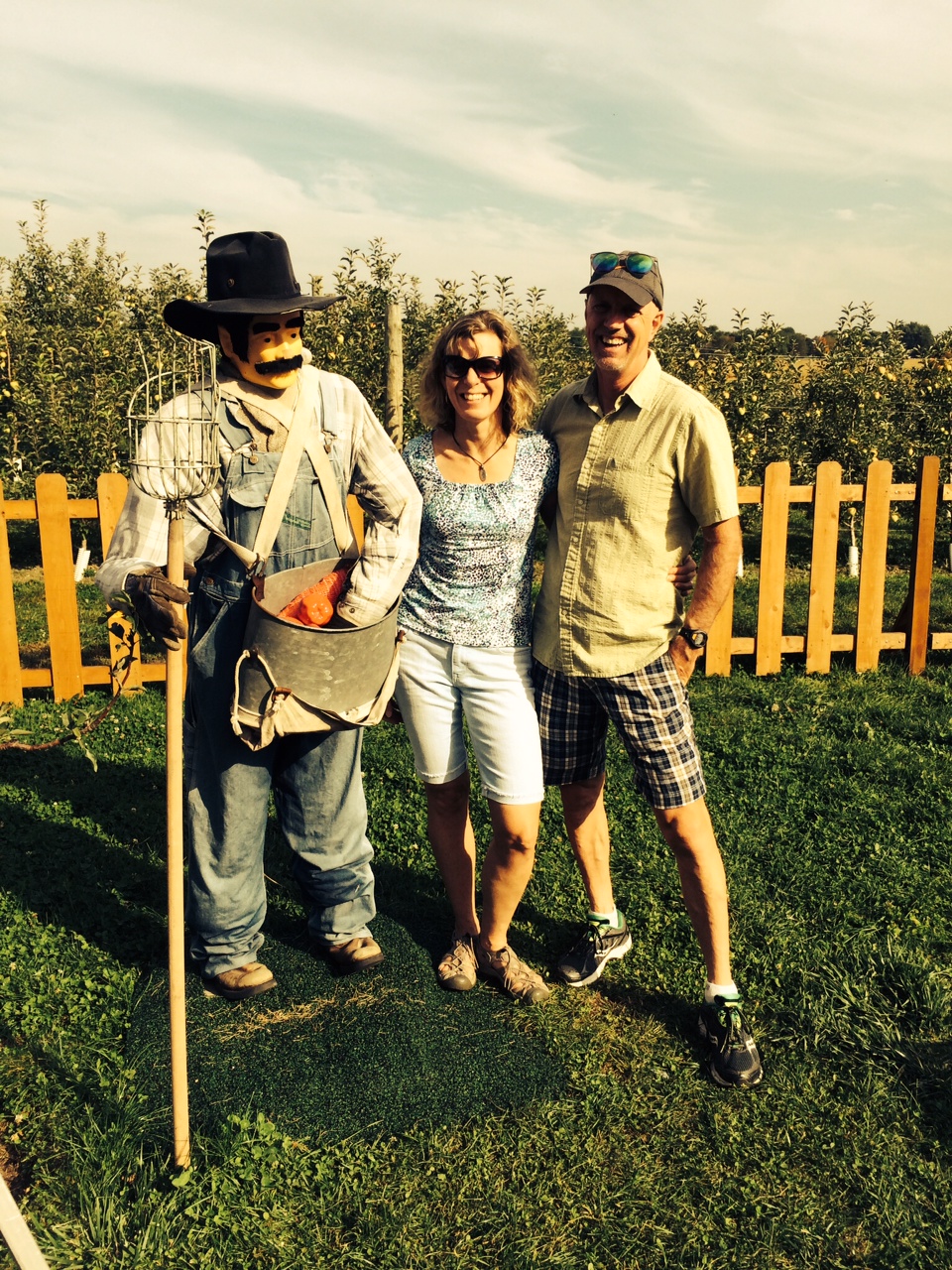
Sue and Chris and Guy

Getting in touch with our inner farmer.

It so happened that 40+ years later, on the very first ride I did with my companion Sue, she liked to pause on that same campus as her turnaround point of a 30-mile ride. So she plopped down on the very grass where I once ran as a kid and sat back with a smile to ask, “So, what do I want to know about you?”

You can imagine the sweep of thoughts going through my mind at that moment. Here we sat literally on the path where I’d once run my guts out as a 15-year-old sophomore cross country runner. We were also in sight of the cafeteria where I once danced so close with a girl named Joanie Hankes that I thought I’d absorb right into her skin. Or wished I could. So what do you say at moments like that? What do you choose to reveal about yourself?

It turned out we talked about a lot of things, especially our current interests and our growing interest in each other. She knew the story of how I’d lost my wife Linda to cancer several months before. She learned of my pride in that woman’s life, and her perseverance and character. That was ground we’d continue to cover together. The grieving process is individual, and I had nothing to hide. Life and time go on whether you acknowledge that fact or not. I had made the decision that time should not stand still.

Turning points

A few weeks later while riding with Sue she had a crash. I accompanied her to the Urgent Care Center and a rush of familiar sensations came over me. In eight years of cancer treatment with my wife I’d spent many moments sitting in waiting rooms as the medical teams gathered information about her.

Now here was Sue giving information to a medical team. They asked her name and she replied, “Linda.”

Then she quickly turned to me and said, “Oh, I forgot to tell you about that. I go by my middle name Suzanne. But my real first name is Linda.”

I was not freaked out. Just intrigued by the enormous circumstance of how odd life can be.
Time travels

Which brings us to the present and another spot not far down the road from the Kaneland campus. There sits an apple orchard and pumpkin farm that turns into a major tourist attraction each fall. The Kuipers family farm erupts each September into a fest of autumn goodies, honey-crisp apples and a hundred other opportunities to celebrate the transition of the seasons.

Last year my daughter Emily and I made a pilgrimage to Kuipers in memory of her mother. We both made it through the store until we hit the spot where they make apple cider donuts. That’s where we both lost it. The memories were still fresh from the year before. So we stood there and hugged in line without being able to tell the people around us exactly what the tears were for. But it was good. That was a place were my wife Linda and her family liked to go each fall. Our memory of her was partly wrapped up in that place. Even when it was hard for her to walk during the worst throes of chemotherapy, we still made it out to the apple orchard for fall goodies. She never gave up.

We’d purchase bushels of apples and her late father Melvin would peel them all and make dozens of apple pies and pans of apple crisp. Before his health failed and he died three years ago, Emily sat with Mel to learn the craft of his pie-making.

So you can sense the meaning of applies and pumpkins and cider donuts. They represent both the preciousness of the moment and the passage of time. They come together in one place and we are transported in some way.

Present hopes

90 lbs of pumpkins

Kyle lifts 90 pounds of pumpkins.

This year our little clan headed out to Kuipers for some fun and the day was magnificent. My daughter Emily and her boyfriend Kyle joined Sue and I for an afternoon drive and a wander through the Kuipers campus that has grown into a regional attraction. The weather was 80 degrees and sunny.

Just the day before I’d biked up the hill on the south side of the apple orchard with a couple friends and told them, “We’re heading there tomorrow.” In fact I’ve ridden past the orchard many times this summer. Every time the swirl of recent and past memories flow through my head.

Yet I don’t feel these memories the same way I once did. Maturity and age give you perspective than can be mistaken for ambivalence if you’re not careful. There were times in life when I felt emotions so passionately they threatened to melt me down like a ring of solder. My anger and love and competitive fury mixed together, making victories and losses feel like life and death.

Time has a purpose

photo (89)There was a purpose to all that. When life and death really did come along, I was prepared to deal with them. That’s what’s so hard to explain to people who might wonder what it is like to deal with the death of a spouse, and why it is okay to feel love again, and want that flow to return to your life. All of us encounter those cycles of time and life and death. Future, past and present seem to combine in those moments.

I love my children so much and it has been painful thinking about the loss of their mother this past year. As wordy as I can be at times, there have been moments when words or the opportunity to say them have perhaps failed me.

I did not lose my own mother until 2005 when she was 80 years old. By contrast their mother was just 56. She’d worked through cancer treatments so many times it seemed impossible she’d ever die. My method of coming to grips with that possibility involved writing my way through both the fears and blessings of all that we experienced.  That has helped me face all kinds of life challenges. I can only hope my example and love for them is sustaining. That and telling them that I love them.

Less fear

The fact of the matter is that I emerged on the other side of life with less fear. There was help. While my late wife was taking steroids to treat the side effects of surgery for cancer that had migrated to her brain, she once woke me up at 4:00 one time to tell me to go for it. Write my way to the life I wanted to lead. Do it, she told me. She’d seen me race and win and live life without fear when we were first dating. Get it back, she seemed to be saying. And so it goes.

Flipsides

That type of confidence in faith and hope has helped dispel any fears toward making it on my own. With the many challenges of forging your way in your own business, there also comes a freedom that makes life feel more real. I first felt the flipside of that emotion while being a caregiver to my father once my mother died. I realized his care was now entirely in my own hands, and that there were really no rules to follow. One learns to step up in that moment to accept the responsibility. You lose fear over making decisions and accept the consequences, both good and bad, of being the one who cares. 

So when our group of four wonderful souls walked around the Kuipers pumpkin patch it struck me that when it comes to making decisions in life, you either go big or go home.

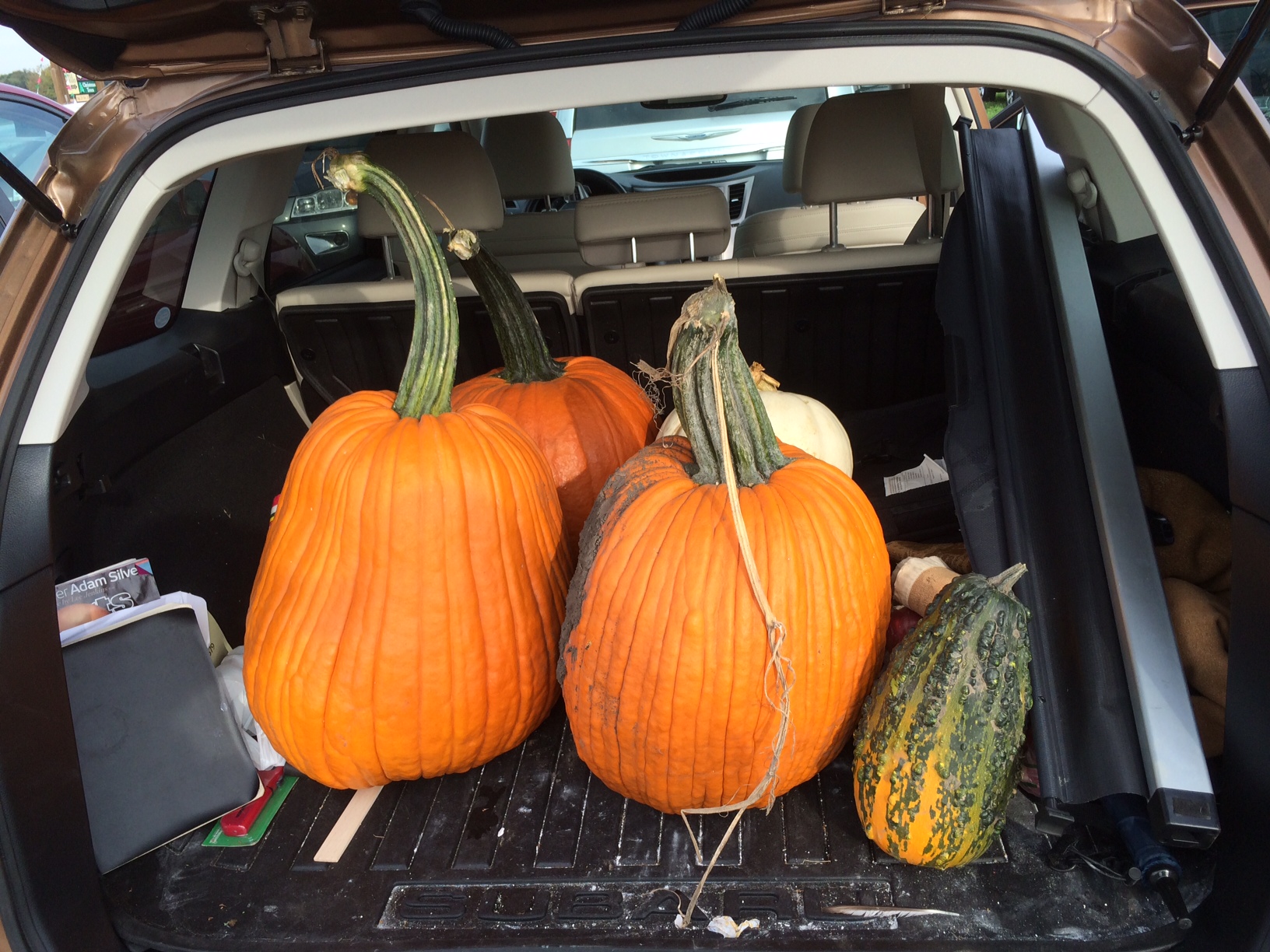
PumpkinsThe pumpkins at Kuipers in fact looked like they were raised on other-worldly fare. The stems were huge and phallic. The bodies of those gourds stood two feet tall in some cases. There was a fecund quality to all of them, an inspiration in some ways to me. They cost 39 cents a pound and we bought three of them and stored them in the back end of the Subaru. We came home with $100 worth of popcorn, apples and apple cider donuts. So goddamnit, we went big and we went home. Who says you can’t do both? That’s how we’ve got to roll in this world.

Ironman pumpkins

Ironman Pumpkins

Sue Astra poses with Ironman Pumpkins in anticipation of her race next year.

In a week Sue and I will ride the Pumpkin Pedal down in Ottawa, Illinois. Last year the winds were so strong at times they nearly stripped the kits off our backs. It’s likely after a warm, dry and calm spell here in Illinois that we’ll see a shift in the weather for next weekend. It may turn cold or wet. But we’ll be there. She’s in the early phases of training for next year’s Ironman Wisconsin. Every ride counts whether it builds fitness or builds character. We’re traveling through time together now.  And through time, every effort counts for something.

WeRunandRideLogo

Posted in Uncategorized | Tagged , , , , , , , , , , , , , , , , , , , , , , , , , | 2 Comments