The legacy of Kent Finanger at Luther College


Luther Runners.jpg

Keith Ellingson, Chris Cudworth, Steve Corson, Paul Mullen and Dani Fjelstad. Class of 1979. Luther College, Decorah, Iowa.

This week my college cross country coach Kent Finanger celebrated a birthday. Kent always encouraged his runners to appreciate that day in their life. “This is your day!” he’d egg us on! “Wow Fun Wow!”


That was one of Kent’s favorite sayings. The Wow Fun Wow! slogan was a simplified way of stating that no matter how hard the work might be, how tough the conditions in which you train or compete, it is always important to realize that being able to perform on that day is a great gift that should not be taken for granted.

And Kent took nothing for granted.

A few years after I graduated, the 1985 Luther College cross country team won an NCAA Division III national championship. The day was hot for the meet, yet the Luther runners peaked at the right time and brought home a cherished accomplishment for themselves and for Coach Finanger.

Raw young men

That win came on the heels of our 1978 team that placed second in the national meet behind North Central College, whose coach Al Carius is one of the most respected running coaches in all of college sport. The respect these two coaches always showed their runners is a hallmark of both their legacies. So many raw young men come under the tutelage of coaches like these and emerge as people with character, perseverance, and adaptability.

That’s certainly the job of a college coach, and Kent Finanger worked individually with every one of his athletes to bring it out. I recall so clearly a meet we ran in Mankato, Minnesota. The day had gone cool as we drove north from Decorah, Iowa, yet the trees along the course were bright yellow. Much of the running path was cinder and snaked around the campus. At the start, the opposing coach bluntly announced to the runners on the line that mile times would only be given to the first bunch past the markers, and that there may not even be mile times given along the latter parts of the course. This clearly agitated Coach Kent, who could be heard muttering about the other coach. This was a grand offense in his mind, because his philosophy was that every man counted.

Advocate for women

It was also true that Kent cared about the women he coached. In fact, the program at Luther College hosted its first two women cross country runners in 1975, my freshman year. Those two women who started the program trained together all season. Not all the men at that time showed them the respect they deserved. Yet a few years later Luther College would enjoy the accomplishments of women such as Tureena Johnson, who won individual national championships in both track and cross country. Many other great women runners went on to similar honors.

So Kenton Finanger was both a visionary and major advocate for women’s sports, and women in general. Sadly his first wife Lucia, who was a near-saint for adapting to Kent’s often overcommitted and hectic schedule, passed away from cancer in her 40s. He remarried and has lived a full life that includes spending time up north in Decorah, Iowa and winters in Goodyear, Arizona.

Shared experiences

Little did I know that I would share that pattern of losing a wife to ovarian cancer in my own life. Or that my roommate from freshman year at Luther College, Keith Ellingson, would also lose his wife Kristi to ovarian cancer as well. Convergences such as these are mysterious and yet too common. But it was Kent’s example of fortitude in life that stood strong in my mind during my grief.

Five guys 


kent-finanger

Kent Finanger celebrates his birthday in the company of family.

I entered college at Luther along with a set of runners that formed the nucleus of the team over four years. As shown in the watercolor painting (above) that I did for Kent Finanger a few years back, the five runners were Keith Ellingson, Chris Cudworth, Steve Corson, Paul Mullen and Dani Fjelstad. At various points in those years all of us played leadership roles, and Mullen and Fjelstad are installed in the Luther College Athletic Hall of Fame.


It would have been quite a fairy tale for us to have all scored points that day in 1978 when our team placed second in nationals. But alas, Keith Ellingson, a runner with a dynamically fluid stride, was slowed by a painful back that season. Mullen dealt with a chronic toe injury, yet consistently scored in the top five all season. Both were previous conference cross country champions and in a fully healthy state would have pulled our team even higher in the ranks. Perhaps we’d have even challenged North Central for the #1 spot. But cross country is a tough sport, and even Fjelstad, our team leader that season, came down with injury mid-season. That left it to Steve Corson, a runner who converted to cross country from playing football his fresman year, to lead us at the NCAA national meet. He barely missed All American status as an individual. And so depended on a couple freshman, Rob Serres and Tim Smith, to pull Luther into second place at nationals that year.

Psychology

But that’s how a sport like cross country works, and Kent Finanger brought out the leadership abilities of his athletes in different ways. As we approached the national meet and were feeling the effects of heavy training, someone on the team blurted that we might be burnt out. Dr. Kent Finanger with degrees in kinesiology and physiology knew better. But he was also a master of psychology.

So Kent called his coaching proteges at the University of Wisconsin, the University of Chicago and well-known coaches from all over the country to corroborate the training methods we’d used. He sought to back up the idea that we were ready to compete in both regionals and nationals. As Kent read aloud the words and letters of those famous coaches, we sat in awe and wonderment. Who would go to such trouble? Kent would.

Shut up and run

Then he told us to go out and run six miles without talking. There was an edge in his voice and we knew he meant it, because hearing Kent show frustration or anger was a rare, rare thing. So we ran those miles with nothing but the sounds of our own footsteps crunching on the semi-paved roads. We took a route called Under Phelps-Ice Cave, which passed below tall chimney bluffs of limestone that leaked water over the roads. Our footsteps echoed off the walls of limestone as we went, as if ghosts of runners past were  coursing along beside us.

At four miles we crossed the Upper Iowa river over a rickety old suspension bridge as dusk was closing. We made the climb up a 300-yard hill and came onto the long incline back toward town. By now we were cruising at sub 6:00 pace, a bit hard for a training run, but everyone was determined now to not let anything distract us.

The tests

The challenge was not through, because we barely squeaked through regionals in fifth place overall. We had not backed off training but effectively “ran through” that critical meet. But when we tapered the week before nationals, our legs surged with energy and it felt like something special would happen. And through it all, Kent had made inspirational tee shirts made up each week to inspire us in the the leadup to nationals. He sent encouragements through out SPO boxes. By the time the meet rolled around, we were fired up and ready to go.

And we made it happen. Second in the nation.

When the race was done, all of us shared hugs and posed for photos with Coach Kent. But it wasn’t until an hour into the ride back from Rock Island that it really dawned on all of us what we’d done. Coach Kent stopped the car and climbed out on the shoulder of a high road overlooking the Mississippi River. He stood there and shook his hands in the air, calling out the words, “Second In The Nation!” We all cheered because this was a man that deserved the honor of seeing his team succeed.

There were many such teams in all the years he coached. But it was perhaps the least talented runners that Coach Kent most admired. The guys and gals that would show up and train and never stand a chance to lead a race, or come anywhere close. Those were the runners that Kent invested so deeply in, and that is the hallmark of truly great man.

Posted in cross country, running, Uncategorized | Tagged , , , | 1 Comment

Stumbling on The Fountainhead

Fountainhead.pngJust one more day of house clearing and the cleaning begins. Then we close on the sale of the house. It’s been a long journey. Almost like training for a big race. Every day there has been a workout to do. Lifting dozens of boxes out to the car and loading them back into the new house. Tromping up and down stairs. Throwing away tons of unneeded paper, and passing books along to any number of organizations.
I did stumble on my copy of The Fountainhead, the book by Ayn Rand that has garnered recent attention thanks to dedicated followers such as Speaker of the House Paul Ryan (R) whose political philosophy is a confusing mix of conservative Catholicism and Ayn Rand self-determinism. In other words, he pretends to care about everybody but doesn’t seem to actually give a shit about anybody that isn’t either rich, Republican or Catholic.

Impressionable youth

I read The Fountainhead when I was a determined young man. I was taking a year or two off career matters to train and run full time. I wanted to see how good I could get if I dedicated myself to running. So I worked in a running store, managed a fitness complex and ran as much as I could. There were weeks of 80-90 miles, and in 1984 I raced 24 times and won quite a few of those races. I have no regrets about that because it was my one chance in life to race at that level.

Once it was done after three years of pumping myself up to run all the time, I decided to back off and give more time over to my new family. A couple years into my new life as a married man with children, I turned to my mother and lamented a bit that perhaps I’d been selfish doing all that running. “I don’t think so,” she replied. “You burned with intensity.”

Other pursuits

The same could be said of my writing and my painting. I wrote a book titled Admissions during my 20s, and so much that I wrote in that book has come true over time. I predicted the rise of a conservative-driven media channel on the order of Fox News. I predicted a conservative political movement I called The Mandate that took over AM radio to make its voice known across America.

But I knew nothing about publishing a book in those days and so it still resides on a Powerbook 540C computer and a set of floppy disks to which I transcribed longhand legal pads because that’s what I used to write the book while commuting by train to Chicago in the very early 80s.

I’ve decided to bring that book to life. Because as noted, so much of it has come true. I even predicted the creation of a university funded strictly by tourism and kitsch entertainment. And sure enough, the Disney corporation created something along those lines.

The one thing that I predicted that has not come true is the invention of car engines driven by magnetism and metal coils within the car frame. You’d stop to remagnetize your vehicle every 500 miles or so. I still think it’s a helluva an idea. But I’m an art major, not an industrial engineer. So it will likely never come to fruition. It will have to be left an attractive thought.

Write on

So while I transcribe that book and finish a couple more, I’ve been thinking back on what has been accomplished so far. Over the course of a lifetime, I’ve produced and sold more than 2000 pieces of art and have published more than 5000 articles as well as two books and many blogs. This is the stuff I burn to do. Every day.

I still run and ride, but with a bit more flexibility than in days past. Because I still recall the theme of The Fountainhead, which tracked the life of an uncompromising soul who floated from architecture and sculpture to work breaking rocks in a quarry. Or something like that.

See, I’ve lived that type of uncompromising dichotomy, and have learned a few things from it. But rather than turning me into an uncompromising conservative, Ayn Rand helped me realize that compassion and forgiveness should play in your life.

But even our selfish pursuits can contribute to our personal growth. A coach once told me that all my running––and the perseverance it required––was preparation for the role I’d need to play in life as caregiver to a wife with cancer. He was right.

Now that same coach that I’ve known for more than 40 years is in a fight for life with lung cancer. He has conducted himself with such character and fortitude it is inspiring to realize that he is living according to his own words, and his own rules. God Bless you Trent Richards.

Good advice

Because he has always known that life is a series of choices. Sometimes you must accept the path life gives you and make the best of it.

If you’ve ever been running in a pair of new shoes and come upon a place in the path where there is no way around a big patch of mud ahead, you know the feeling. Suc it up and run through it. Sometimes you have to accept that your new shoes will no longer be so pretty. They’ll still work even if they look dirty.

Hayseed with heart

That’s my life’s philosphy in a nutshell. I’m still a hayseed at heart that has learned a little sophistication. I’ve read books on the Philosophy of Existentialism and No Exit by Jean Paul Sartre, and accept the grim reality that life sometimes does feel like a dead end. I’ve been through bouts of depression and valleys of anxiety, and learned that trusting yourself can get you through. And trusting others too. And trusting there is even more than that out there. So I believe in both the human and the Holy Spirit, in my fashion.


James Urban Wilds Show.png

“James in the Street,” a painting of a homeless, wheelchair bound man in Geneva, IL. by Christopher Cudworth, 2016. I provided a new chair for James.

Thus I don’t abide by the philosophy that Ayn Rand has some sort of special insight into the human spirit. And take notice how I’ve combined the two from the previous paragraph. Men like Paul Ryan seem to have completely lost the capacity to meld compassion and determination. Their compassion stands in raw separation from their political and religious ideology.


These were exactly the types of people Jesus tried to warn us about when he called the Pharisees and Teachers of the Law a “brood of vipers” and “hypocrites.” They cannot get over the stumbling blocks of their own self-determined view that scripture and politics should serve their own needs. In the same way, The Fountainhead serves political purposes by taking a literal view of how self-determination should be used to dominate the business world and society. It is an immature and tragically selfish viewpoint. And extremely popular because it makes people feel like big shots.

Selfishness

There are far more of these selfish bastards lurking out there in the world than we’d like to admit. And while I’m not perfect by any means, I’ve at least made my choices by having taken a hard look at what really matters. And I’ve determined that caring for other people is even more important than caring about yourself. If that makes me a bleeding heart liberal, then so be it. I will happily die that way someday.

That does not mean I won’t challenge people or their thinking, or compete to win in those areas. That is also human nature that models the likes of Jesus Christ, who never met a challenge to which he did not respond. That’s the difference, you see. Ayn Rand’s character ran off to pound rocks when he did not get his way in the world. We’ve seen a lot of that lately in the world too.

I’ll take my lumps and admit my faults, but I haven’t let childish competitiveness of the brand advocated by Ayn Rand dominate my thinking. Nor have I let the limitations of  literalistic biblical interpretation dominate my world or religious viewpoints.

The world is better than that if we work to keep love at the heart of it.


Posted in running, Uncategorized | Tagged , , , , , | 9 Comments

Gaming the system when we run, ride and swim

img_3987Perhaps some of you are into gaming, the virtual kind. My son played Warcraft and Halo and tons of other games through his early high school years, then kind of dumped the whole thing. His friends used to like when I joined in their multi-monitor games in our huge basement because I was always someone the worst players could kill. Repeatedly.
I never minded being the virtual patsy. My competitive urges have never really resided in the virtual world. However, there have been moments in my career when reality seemed like virtual reality.

Time warps 

For example, during the national cross country meet in which our team placed second, I was running 5th man, the final runner who would count in team scoring. The race went out fast, with the leader Dan Henderson going through the first mile in under 4:20 and finishing somewhere in the high 23:00 range.

That meant the rest of us flowed in his tow. And in the last half-mile I realized that it was absolutely vital not only to hold my place, but to pass two or three runners if all possible. And it wasn’t easy.

It didn’t hurt like I thought it would, but I pushed even harder. And at that moment, the entire race (the whole world in fact…) seemed to turn into a slow-motion reality play. My brain took on what seemed like an extra dimension. The last 100 yards of the race felt surreal, as if my entire being was traveling through some alternate time awareness.

And sure enough, we only beat the third place team by a couple points, and fourth was just a couple points after that. Needless to say, I was both ecstatic and relieved at the same time to have been a part of our team’s success. Typically, you only get one chance in life at such endeavors. And it was real.

Sound effects

With most virtual reality gaming, you tend to lose more than you win when you start out. And so it was in the Elk Grove Criterium, in which the racing took place on suburban streets. It was like a scene from one of the disturbing video games where everything seems like it should be quiet, but something is always happening.

There was a hairpin turn on the far northern end of the course, and all 50 cyclists in the race would slow down to squeeze around the bend, then sprint like crazed Mario characters to get back into the group. If you didn’t do this, you got dropped.

So I did it over and over again. And with a lap to go, I was happy to find myself in second place at the start line with just one more hairpin to go.

Only I’d used up all my GREEN ENERGY getting back onto the pack all those times. And when it came time to ride hard the last lap, the sound effect would have been like this….BEEEPbeeeoooooooooowwwwwhhhhooooooooooooo   clunk.

Because I was dropped like a rock.

Swim for your life

Everyone knows their first open water swim is no joke. It’s just you and the deep water and perhaps some nasty waves to make things really interesting. And this summer I donned my wetsuit and took on my first real open water swim.

Now granted, had the event been a video game, there might have been sharks chomping my legs off at the ankles. Or giant pterodactyls nipping at my head to keep me underwater. That would certainly have been interesting.

Lacking that, it was only my fears that were dragging me down.

And yet they didn’t. And I felt wonderful in the water. Liberated, really. And when it was over, my companion Sue slapped wet hands with me and said, “Good job!”

Somehow reality still feels better to me than virtual reality. Especially when I got a wet hug as well. Who really needs a controller and toggles in that situation?


Posted in Uncategorized | Tagged , , | Leave a comment

The Opposite of Goodwill


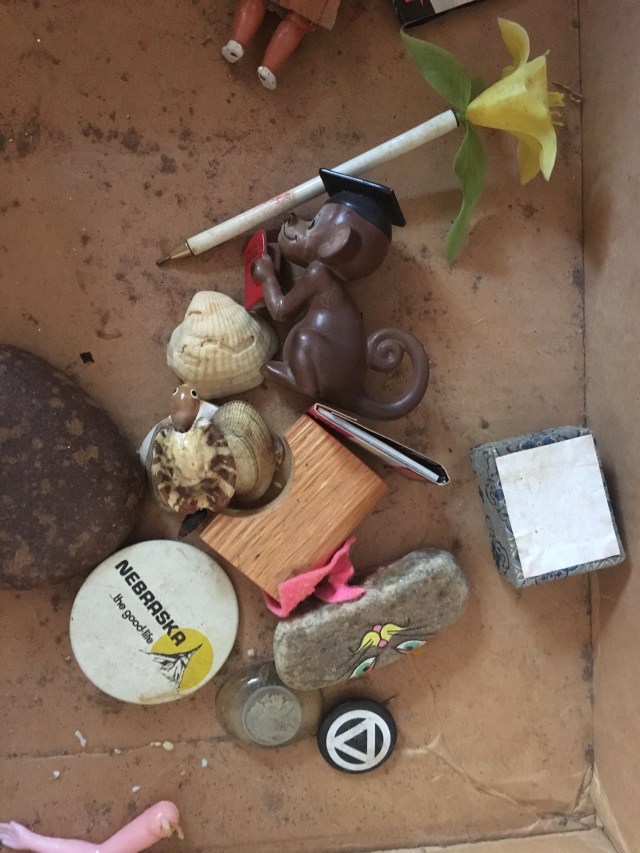
weird-shit-from-grandma

This box of long forgotten items turned up while cleaning out my house. It consists of items brought back from world travels by my late wife’s grandparents.  

You gotta love a Goodwill store. Whether you buy things that no one else needs, or drop things off that you don’t need, the Goodwill store is the place to be.


And I have been there. A lot. Lately.

That what happens when you clean out a house in which you’ve lived for nearly 20 years. Actually, I’ve visited the Goodwill store pretty consistently for the last three years. Before my late wife passed away, she told me in the last week of her life, “Chris, I’m sorry about all the stuff.”

I had no idea what she was talking about.

But I do now. She was no hoarder. But she did have layers of prized possessions and family keepsakes that if laid end to end, could have formed a bridge across Lake Michigan.

Many of those things that have true family value, I’ve kept. But let’s be honest, there are lots of things we tend to keep in our basements and such that nobody else wants. So I’m going to give you some good advice. Start throwing away the shit you don’t need.

Do it now. Start with something recent like those 10 sets of old running shoes jamming your closet. Throw a bike or two away, or do what I did with my wife’s Silver Schwinn. Find someone who can really use it. Spruce up the Old Bike and Give It Away. It will make you feel great. I guarantee it.

Once you’ve done something like that, the whole universe will open up. You’ll find grace in giving away dishes and plates you no longer use. Or all those wedding gifts that never saw the light of day after that precious little shower they held for you. Today I gave extra KitchenAid stuff to a young couple that stopped by on bikes to inspect it on the curb. I gave them a set of dishes I no longer needed as well.

The Spoils

People who get divorced have to go through this process without choice. Splitting up the goods gets rid of the sentimental attachments mighty quick. The bitterness might remain, but that’s a different story. That’s the opposite of goodwill, you see.

But if you investigate the recesses of your soul, you will also find that you can give away the hurt too. There this thing called forgiveness that is like a Goodwill store for your hurt feelings. It works wonders. I’ve used it many times.

In fact, the first thing you should do is give away all that resentment you have toward yourself. Failings are heavy baggage to carry around. Yet we all have them. Some drag like a chain on our necks, keeping us from looking up at happiness. Even a bad race effort can sling to your conscience and haunt you for weeks, months or even years. Let it go. You don’t need that shit.

Too much shit

I had to laugh this afternoon on my way to the actual Goodwill store. I imagined that they were sick of all my trips to the dropoff station. “We’re sorry sir, the entire store is full of your shit. We have to ask you to take that stuff back home. We don’t have any room left for other customers.”

That was really funny to me. Maybe it’s not so funny to you. But here’s the weird thing about making multiple trips to the Goodwill store. You actually start to feel guilty for giving so much stuff away. It’s true. It’s like the Opposite of Goodwill. You ask yourself: “How could anyone want this shit? If I don’t want it, why would anyone else?”

But people do. Because some people like the thrill of discovering that other people’s shit can be useful in their lives. And people find “deals” on valuable stuff someone else does not want. And that is the entire principle driving the Goodwill chain’s success.

Deal with it

Weird Shit Too.jpgBut it does not save you from dealing with your own shit, and that can bring on a case of Shit Fatigue.

We all have too much shit that we own and keep. Yet when we try to get rid of some of it, a combination of sentiment and sheer physical exhaustion (from carrying it around, but it’s a workout at least) can grind you down to a pulp.

Then you start to feel something like the opposite of goodwill coming on. “I hate my shit,” you mutter as the car seems to drive itself to the Goodwill store. “And I hate everyone else’s shit too.” 

America’s Shit

In fact, that’s a great symbol for what’s going on in America right now. Everyone is sick of everyone else’s shit, so the entire country is caught up in a streak of emotion that is the Opposite of Goodwill.

The World Series of Shit

And you’ll probably see this shitfest in full action when the Cleveland Indians play the Cubs for the World Series. See, my brother informs me that while Cubs fans are hungry for a World Series title, the City of Cleveland and its Indians might want it just as bad. Or worse.

See, the ONLY TITLE that Cleveland as a city has won since 1954 or so is the recent NBA Championship. Chicago has seen the Bears, Bulls and the Blackhawks win titles. Even the Chicago Fire soccer team won a soccer title or too. But that’s been a while, for sure.

Meanwhile Cleveland has not won a goddamned thing.

So they’re not going to have any sympathy for the tragic backstory of the Chicago Cubs and the Curse of the Goat.

And let’s consider something else as well. The Cleveland Indians, for God’s Sake, are named after a population of people that were essentially wiped off the face of the map here in America. Genocide.

So we’re talking the total Opposite of Goodwill when talking about the INDIANS, because that was a different kind of World Series altogether. So the Indians are carrying around cultural shit that most Americans don’t even want to acknowledge, or like to pretend that naming a sports team after “the Indians” is some kind of honor for their fighting spirit. Sure, they did not give up without a fight in many cases, and the word Chicago is actually a confused version of a Native America word.

But truthfully, “Indians” never existed as a “thing” until European settlers gave them that generalized name based on idea that the people they’d found on the new continent sort of resembled people from India. Yet that country was still another 15,000 miles away to the West. So the name Indians was prescribed by a bunch of geographical dumb shits.

Travel light

So let’s focus for a moment on the cool thing about the original people who lived here in North America. Most of them did not carry a lot of shit around with them. The Plains Indians traveled with tipis and slung their belongings on a rack of poles. They ate what they needed and kept a few precious items. Oher than that, they lived pretty light on the land. Considered it sacred. Let it renew for the most part, and seldom conducted wasteful activities as a rule.

Same with many other cultures of people on the North American continent. The people that came over the land bridge and spread over the continent were used to traveling and keeping it simple and smart. They knew how to manage land to their needs. Of course, some of them likely still hunted the megafauna like mammoths and mastodons to extinction. The same thing happened all over the world, and is still happening to day.

move-goodsBecause no one’s perfect, and people are acquisitive by nature and try to take everything for themselves. And we wind up with basements and attics full of shit that our kids typically have to throw away when we’re dead.

So do the world a favor. Lighten up. Clear it out. Consume with conscience. Buy what you need and get rid of the rest, recycling it if you can.

Because to do anything else is the Opposite of Goodwill. And that makes you a shitty person. And you don’t want to live that way. Do you?

Getting rid of all this shit has certainly given me pause. It’s even made me think about other ways I impact this world. Yet I have recycled a ton of running shoes, and sold off a bike or two along the way. I’m doing my best to keep my shit together while getting rid of as much shit as I can.


Posted in running, Uncategorized | Tagged , , | 1 Comment

Music matters

Florida SkyThanks to the wonders of Sirius XM radio, one can now listen to music in all sorts of categories. There are stations for every era of music from the 40s through the Y2Ks.
One can also stream music through Spotify, or throw yourself to the Random Gods through Pandora, which uses algorithms to select music similar to the artists you love.

Think about that for a moment. Pandora “knows” what you like based on all sorts of factors related to music structure and popularity.

There is even a recent theory that outlines a certain pattern of notes commonly used in many of today’s popular music. It’s like a “go to” chord progression that musicians stick into their songs in order to provide a sort of “dog-whistle” familiarity to their work.

It’s similar to the invention of “the hook” in pop and rock music that served as a signature for a song. You think about the opening chords of the Rolling Stones “Satisfaction…bop bahhhm, ba dah dahhn, ba bop bopb, da da dommmm…” and that’s a helluva hook.

The Stones created so many classic hooks, yet many of their greatest hits owe great debt to the soul and blues musicians that served as their inspiration. I once visited the Chess Records building where Chicago Blues legends recorded their music and that band of skinny white boys from England came to learn some of the ropes.

Certainly, the Stones went on to create original music, yet they drew on the roots of music that filter all the way down to the American South, and in some respects, all the way back across the ocean to the African West Coast.

These patterns are elemental to the human condition. They draw up in us almost tribal instincts. The deep beats of Scottish or Celtic drums stirs the heart in familiar ways no matter what race or tribe of heritage we share. There is commonality in that trade of notes and rhythm and melody.

The same holds true for those of us who run. It is the most basic of human activities, yet there are many traditions that we draw upon to this day. Certainly, we know the heritage of the African runners who dominate everything from sprints to distances. And yet they do not dominate completely, as athletes from all over the world compete at their level.

This is the wondrousness of the human race. It is also one of the reasons it can be so beautiful to set a movie clip of running to music. Those athletes on the shore of the English coast in Chariots of Fire, with that iconic music playing in the background is certainly inspiring.

Perhaps you listen to music while running and find your own coast to romp in the surf. If so, you’re lucky. We don’t all get glamorous circumstances in which to train. But you can still find inspiration on your own city block, or traipsing through your local woods. Let a song enter your head. Let the music carry you along. Music matters. Sing your own song.


Posted in running, Uncategorized | Tagged , , , | Leave a comment

Packing it up but not packing it in

Home.jpg

Watercolor by Christopher L. Cudworth 2002

Yesterday the moving truck arrived at my home to haul the large furniture items from my house of 20 years to our new place. We’ve already moved two households of boxed goods. My process began two months ago, clearing out things that were no longer needed.

It’s been a long time since I moved, but it’s always a familiar sensation once you’ve done it before. The smell and feel of cardboard boxes. The rip of tape over folded box sleeves. The thump of once box over another.

There’s also a fair amount of potential sentiment tied up in moving. Whether you’ve lived in one place a long time or been transient through any number of transitions in life; college or grad school, marriage, work moves, divorce, death in the family or any number of other scenarios in which we haul up and move, we packed a certain store of memories in those boxes and try to carry the rest around in our heads.

Gypsy athletes

RMKY_9275-X3It’s a funny thing that we mimic this process in the sport of triathlon. We pack our stuff into bags and wheel our bikes to the starting line. Then we unpack it all and arrange it in our little “home” amongst many other little homes in the transition area. Then we go out and swim and come back. Then we bike and come back. Then we run and cross the finish line unattached to any of that other stuff until we come humping back to gather it all up and plan for another day.
It’s no coincidence that the long course triathlete typically needs some assistance in all that. An Ironman race is an exercise in logistics as much as it is in endurance. There is gear to consider, for sure. But also nutrition and even “special needs” bags to assemble. The same goes for a stage race in cycling. All those vehicles tailing pro cycling are basically satellites from the home front carrying food, water bottles, spare tires, even spare bikes should the need arise.

On the road again

Some people love to participate in stage running events such as RAGNAR as well. 8 or 10 people pile into a van to jump in and out and run legs over distances in the hundreds of miles. There is nothing like a van to make you feel a bit utilitarian about your existence in any endeavor. Vans are built for two things: To haul people and to haul goods. Even with the seats in place, a van is never a glamorous existence. You can dress it up any way you want and it’s still just butts in seats. And when you’re trying to grab a dose of sleep along the way, it’s not uncommon to contort the human body into positions one would never assume if one were not desperate for rest.

But that’s the fun of it, isn’t it? Living like a complete hobo for hours with 8 or 10 other crazy running nuts can be painful and difficult. The legs cry for help as the leg of each journey comes to a close. Yet when it’s done, and you clamber back into the van covered in sweat and smelling like hell, that slap of hands from your teammates when you jump back in the van makes it all worth it. You’re travelers together in this compressed world of going one place to another. Of running shoes and sweat socks. Of towels and drinks and food if you like. You sleep together and see each other half naked and it doesn’t matter one damn bit. It’s all just flesh on the move. Male and female and all points in between. One flesh. Moving through this crazy life. You’re packing it up but you’re not packing it in.

Moving on

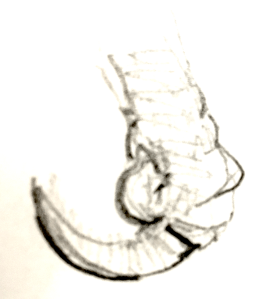
And so it goes in many walks of life. I’ve moved many times in life, and this one feels right. Our new home overlooks a running path and a greenway. The first day we visited the home, I was standing in the backyard behind the house when a red-tailed hawk swept toward the cottonwood trees against a clear blue sky. At the sight of the hawk, I cried. During my college years, I’d found a red-tail freshly killed beside a highway. I was hawk-clawinvolved in taxidermy student in college bioloty at the time, and extracted a couple hawk claws from the foot of the bird. That was illegal of course, but in my petulant youth I ignored many rules from trespassing to underage drinking. So I took the hawk claw to a jeweler and had it set in a silver clasp to hang on a silver chain. And I wore that during my senior year in college when my entire being was consumed in running above all other things; my art and writing in particular. That hawk claw was a signal to myself that I would get back to those other loves when the intense running was over.

Yet that link to a hawk also signified the freedom in life I so longed for and desired. So wearing that hawk claw also inspired me, and I helped lead our team to second place in the nation in college cross country. For much of that season I ran second man on the team after languishing from 5th to 7th man in previous years. I was a young hawk that grew into a hawk in full flight.

Even eagles need a home

bald-eagle

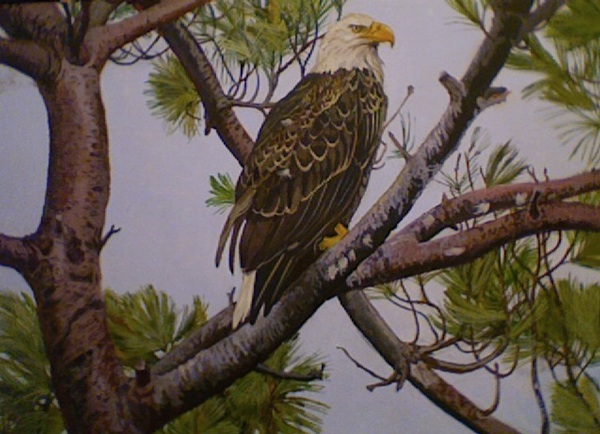
Bald eagle painting by Christopher Cudworth 2013

Yet during any given year year, even a freewheeling hawk or eagle is bound to its nest. That is a lesson learned from many years of observing them. Even that symbol of freedom, the bald eagle, has to have that homing instinct. Eagles build giant nests, often in abandoned trees. The young take months to fledge, and that is part of nature’s plan. The young return for food and support from the parents. It’s their job to make sure the young figure out all they need to know in order to survive.

Parental bond

This week a set of three sandhill cranes has been feeding close to the roads in the harvested fields near our new home. The parents will guide the young birds south for the

sandhills

Photo of sandhills feeding on a suburban lawn. Christopher Cudworth. 2016.

first year of migration. They are largely inseperable along the way. As I watched the cranes  feeding, one bird kept watch while the others gleaned seed from the fields. Then from some invisible clue the parents began to dance together as if they were courting in spring. Their elegance is stunning. These big birds with long legs pirouette with wings raised. It absolutely lifts the spirit to see them engaged in the dance.

I have been witness to the consummation of such dances. At a forest preserve near our new home, I stood on an observation platform one March morning as the sun rose. Two sandhill cranes were dancing in together on a section of flattened grasses. They jumped and twirled in their places. Then the female bowed and the male rose above her with wings raised and illuminated. They mated, and then bowed and raised their heads together. The pair bond is strong in all of nature, and whether we make our homes in one place or travel together these ties that bind are a good thing. Friends. Family. Training partners.

Yet we must keep moving in one way or another. I’m excited for the new living situation but also eager to push forward in my career. I’ve been packing it up in terms of belongings and such, but not packing it in.

It has been interesting to sort through samples of my writing and art and design deciding what to keep and what has meaning. And yet for all I’ve accomplished in life, I feel at the height of my creative powers these days, and eager to do new things. I’ve had solo art shows this year and collaborated on projects with other artists and business leaders. In no way am I ready to retire, or even thinking about it. Life is too exciting with the work I’m doing, and that includes the running, swimming and riding every day.

Posted in triathlete, triathlon, triathlons, Uncategorized | Tagged , , , , , | 1 Comment

She’s got it all together

IMG_3260At the early hour of 4:30 a.m., the alarm rings and she stirs in bed. Then come the contact lenses and the hair cinched into a ponytail. Through the clothes drawer she searches out a sports bra. Then socks. Matching socks can be hard to find. But it should not matter. It’s still dark outside.
She got in late last night from a meeting and didn’t have time to lay out her run gear like she usually does. The shoes come out from under the bed. They’re a bit stinky because the workouts have been increased lately. Race coming up. Motivation.

There’s a bottle to mix up with sports drink. It goes in the belt for a short run. Three miles, plus hills and sprints. It’s still dark outside. Barely any traffic. She breathes and keeps her stride at a brisk tempo.

At this time of day, there are few cars out. That makes it all the more important to be alert. But it’s hard. It is still only 5:10 in the morning. The eastern sky barely shows a tinge of light. There’s a firm wind out of the south. She feels it tug on her ponytail and the front of her hat. Everything’s still in place. She thinks about her pace. Keeps an eye on the sidewalk ahead with her head lamp.

The miles go quicker than she expected. Her legs are tired, but they keep moving. More distance. More speed. Race pace sits out there like a carrot at the end of a stick.

Back home, she tosses dirty laundry into a hamper that is filled with the week’s efforts. Down the stairs she goes, carrying the lot. Into the washer it goes, lights with lights. The wet stuff from the washer makes it into the dryer. It is 6:05 in the morning.

Next comes the shower. The grateful feeling of washing off sweat. Tugs and strains at the hair. She needs a haircut. One more thing to book. The nails could use a touch up too, both hands and feet. The things a woman does to be presentable.

She dresses in stages. Bra and panties. Then clothes decisions. Switching one shirt out for another if there’s a change of heart. Then shoes. Always choices of shoes. Then there’s makeup to do. A face to prepare for the world. Then the hair dryer roars into action, and a straightening iron as well. She smooths her naturally curly hair into a look that goes well with her pressed clothing.

Then it’s out of the bedroom and into the kitchen to make coffee. It brews quickly, an invention she truly appreciates. Life has certainly changed within her lifetime, she observes.

But some things stay the same. She grabs from the fridge an egg concoction wrapped in aluminum foil that she made on Sunday evening. She cooks them in muffin tins and pops them into the refrigerator. One for each day of the week. Then the hotcoffee goes into a travel mug and eavy computer and file bags are slung onto a shoulder and she’s off in the car to make the 7:20 train.

This is hard work some days, she admits to herself. But she loves it. Even when it kicks her ass.

The sun peeks through a line of trees during her drive to the train. A thin veil of leaves shifts across the road with the breeze of each passing vehicle. Fall is here. It’s only 20 days until race day.

First, there are days at the office in the world she’s created in her professional life. More details to manage. More things to accomplish.

But as she gets off the train she can feel that her legs have recovered from the morning’s workout. She feels strong and walks fast through the terminal. Stepping out on the street of the city, she feels tall as the buildings that rise around her. Those incremental activities of the morning fall away. She is both an athlete and a woman which are good things to be even if it takes more work to be both than any man can ever imagine.

Her work shoes are in her bag as she strides down the city block crossing beams of sunlight along the way. She’s got it all together now, and whatever it takes to keep it that way, she’ll get it done.


Posted in Uncategorized | Tagged , , , | 3 Comments

Inspiration from the skies


Gyrfalcon.jpg

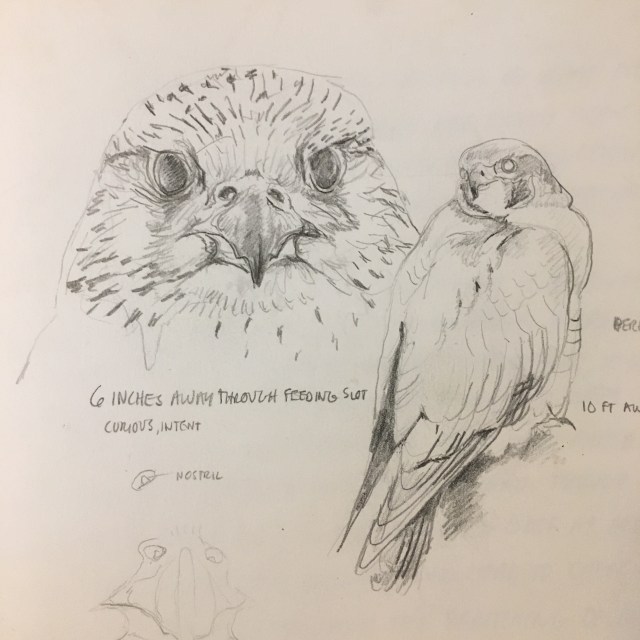
Gyrfalcon and peregrine falcon drawn from life at Cornell University Laboratory of Ornithology. Christopher Cudworth. 1976. 

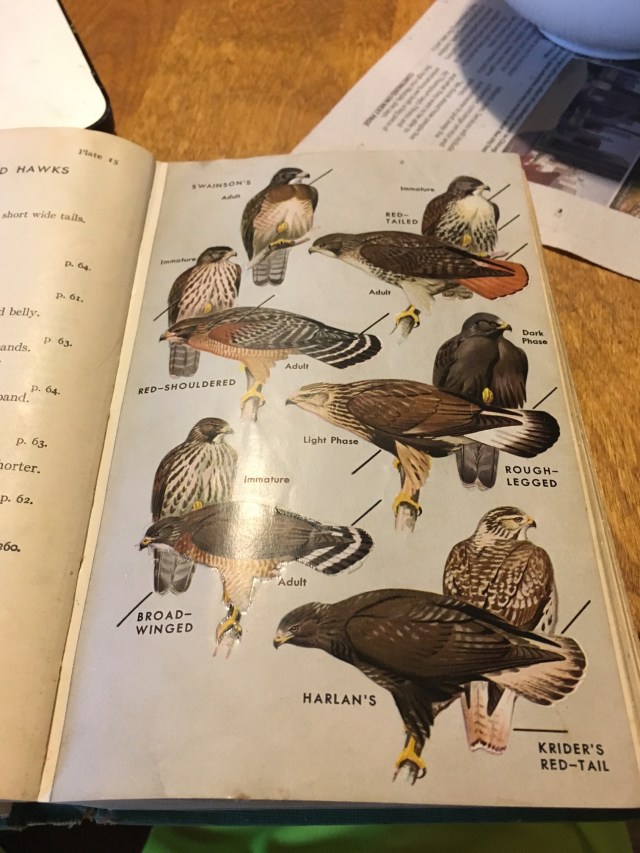
At the age of 5 years old I was given a Peterson’s Field Guide to the Birds. The book was a gift from an aunt that seemed to sense that I’d have an interest in such things. I still have that original field guide with its dried out binding and a hapless piece of masking tape long since lost to its purpose.


IMG_1507 (1).jpg

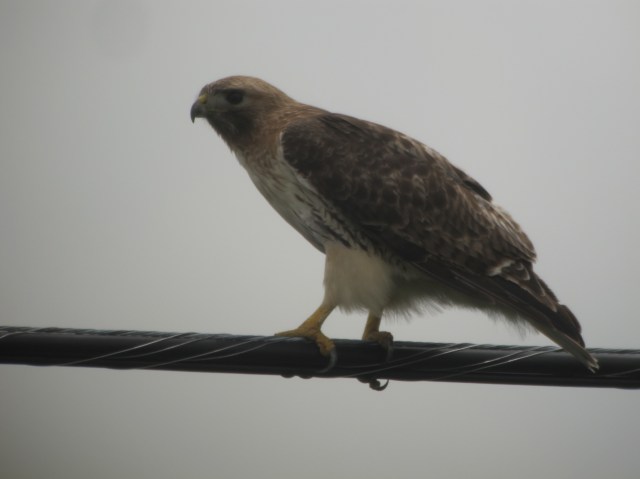
Photograph of a Red-Tailed Hawk by Christopher Cudworth. 2016. 

I purchased another edition when the the Peterson Field Guide to the Birds was updated. It was lost during a field trip in which I was collecting nests in autumn. Somewhere along the way I set the guide down and left it behind, never to be found again. That meant the precious records I’d kept for my life list were gone as well. A harsh lesson was learned about keeping track of my most important belongings.


Hawks.jpg

Page from Peterson’s Field Guide to the birds, given to me at age 5. Note the tracings around the shape of the Broad-Winged Hawk. Done at age 6. 

That’s a lesson we seem to learn time and again throughout life. We can even lose parts of ourselves if we’re not careful about keeping track of who we are.


To that end, my relationship with birding is not quite as passionate as it once was, but it is still there. The desire to chase down new species has mellowed. And yet, there have been some fun moments over the last few years when extremely rare species of birds turned up in our area and I made the quick trip to see them. So the thrill of the chase still exists.


Feet of Red-Tailed Hawk.jpg

Drawing of red-tailed hawk feet by Christopher Cudworth. 1980.

And actually, I’m much more interested in observing the fine details of birds these days than chasing down rarities. As an artist that has drawn and painted birds my whole life, and sold thousands of paintings of these creatures, it is still thrilling for me to look through binoculars and a scope at an interesting species of bird and study the facets of its feathers or the construction of its beak.


But I don’t always have binoculars in hand when birds turn up. I was running a four-mile loop along the Fox River last week when a first-year Bald Eagle came coursing north over the Batavia Depot Pond. I watched it flap and glide toward Fabyan Park and then it apparently turned around. It came back over my head as I was running, so I stopped, and pointed it out to a couple who were already staring up at the bird. “That’s a bald eagle,” I informed them, and went on to explain that it could well be one of the two young that fledged in a nest on the Mooseheart property two miles to the south.


Bald Eagle.jpg

Painting of Bald Eagle by Christopher Cudworth. 2013. 

Actually, there are now dozens of eagles along the Fox River. In the last ten years or so, their populations boomed and there are eagles of all variations along the river. It takes bald eagles four years to reach maturity with their white heads and tails. Before that, they are dark all over with a white belly and flecks or patches of light plumage cropping up on their bodies.


Which is confusing to people that don’t know eagles, or birds in general. The same holds true with hawks. There are 10+ species of hawks that occur in our area. Some are falcons, others accipiters. The largest proportion of the hawk population are red-tailed hawks, the most common species of hawk in North America.


Red Tailed Sketch.jpg

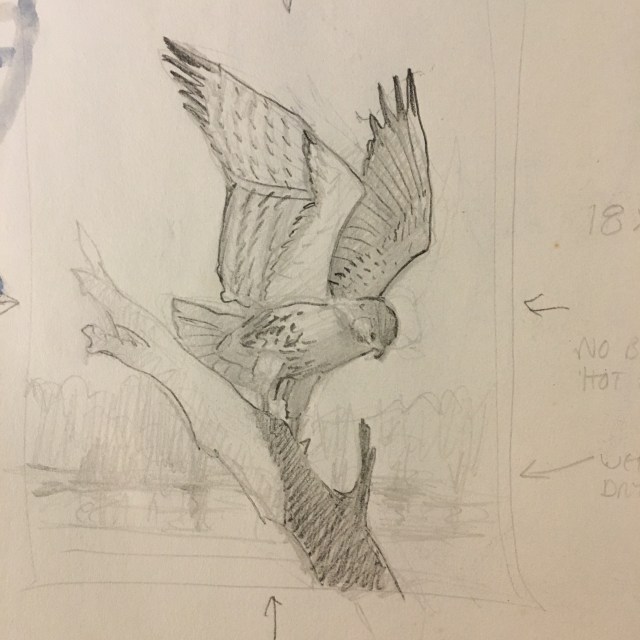
Pencil sketch of Red-tailed hawk by Christopher Cudworth. 1985. 

Red-tails also vary quite widely in coloration. They start out brown and mottled and mature into adults with russet red tails. But there are color variations even among adult red-tails, with some individuals completely chocolate brown while others are nearly white all over. There’s a purpose to all this in terms of evolutionary adaptation, and what we see in these variations is ultimately the manner in which speciation occurs. If a population becomes isolated in its genetics or preferences over time it may become a distinct species.


When I’m out cycling or running and see a hawk species, I can identify most of them within half a second. I know their shape, their flight profiles and their manner of perching or landing. Each of these characteristics has been ingrained in my birding memory bank from years of studying hawks and other species of birds in the field. I get fooled now and then but 95% of the time I’m right.

Having this type of information ready makes my outdoor activities a bit more interesting. Some people like to know what they’re seeing when a hawk flies overhead, but others could not seem to care less. I recall the moment in a business meeting on the 36th floor of the John Hancock building in Chicago. A peregrine falcon floated up level with the window, riding an updraft. We were four feet from the bird, a rare opportunity to study such a wonderful creature so close. The meeting was not that important, just a review of the

gyr-and-peregrine

Pencil sketch of gyrfalcon and peregrine by Christopher Cudworth. 1976. 

client activity that week, but somehow people could not spare thirty seconds to take in an amazing sight like that. There were other things wrong with that company at the time, and one of them was a narrow-minded view of its core business opportunities. I’d tried to expand this view during my time there, but management was stubborn. Six months after I left the company, they implemented the very policies I’d proposed. I’ve always seen that hawk floating by the window as symbolic in some ways of how close-mindedness can prevent people from seeing outside their little boxes.


How can one not be inspired by the sight of a hawk floating on the wind? Are we not envious of that ability, and mimic that ability with our tall buildings and airplanes? And those of us that run and ride love the free-wheeling feel of coursing over the ground like a harrier.

Of course not every moment of a hawk’s life is so graceful. I’ve also witnessed a red-tail pigging out on a big snake it had caught. The bird was so full, it’s crop stuck out the front of its chest. It could not fly with that weight in its craw, so it hopped awkwardly across the ground and sat with its feathers sticking out at odd angles until the snake was digesting. Then it flapped away from its low perch as if it had just eaten a giant pizza.

And isn’t that inspiring? Perhaps not.

But the more graceful aspects of hawks and eagles is still inspiring to most. When you come around the corner of a road in the hills to find a hawk with its wings spread in the wind, it makes you feel as if you could fly as well. And perhaps you can, in spirit.

Because there was a day in 1973 when our cross country team was about to face an opponent that had won dozens of dual meets in a row. Our team was the upstart, and I was nervous about the day. So I retreated to the top seats of the bleachers with a book titled “The Peregrine” in hand. The descriptions of a man in Great Britain following the rare falcons to the very shores of the coast was so inspiring that I was lost in a dream world. The feeling I got from that literature carried right into the race with thoughts of falcons free on the wind. I led the team to victory that day, and give all credit to the inspiration of those hawks coursing over the English moors.


tom-maecthle-too

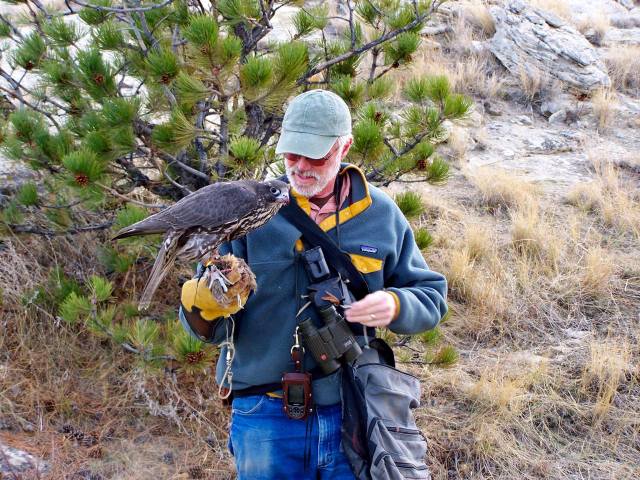
Photo of Tom Maechtle, an associate with whom I once birded. He now works at Big Horn Environmental Consultants. 

Of course, there are some people who are driven in their entire careers to protect and save raptor species. A long-ago friend named Tom Maechtle and I used to run around the fields looking for hawks and owls together. Tom followed his passion for hawks into a career in which he’s done field work with falcons on the cliffs of Idaho and high in the trees of Amazon jungles. He never had time for sports despite the fact that he stood 6’4″ and would have made a fine basketball player, for he was robust and had a high level of endurance. I know this because I traipsed after him through deep snows and thick brush. I admire what the man has done in his life, protecting these inspiring birds from unnecessary extinction.


Posted in cycling, Uncategorized | Tagged , , , , | Leave a comment

Leave your worries behind

img_0996Over the course of a career, athletes experience a variety of circumstances as they approach competition. Every race is different even if one is competing on a perfectly composed and constructed 400-meter track.

That means mental preparation for competition is always about anticipating the unexpected. Volumes have been written about sports psychology and how to prepare the mind to drive or respond to competition. But the strangest aspect of getting mentally ready for competition is that it sometimes pays to not prepare at all.

The ultimate moment of this counterintuitive thought for me occurred during a college track meet. We were competing at the amazing indoor facility at the University of Northern Iowa. The track was a full 200 meters and housed under a domed facility. Tracks that size were rare in those days, and everyone on our team was psyched up for fast times.

But the mile race I was scheduled to run occurred toward the tail end of the meet. So I parked myself along a wall and went to sleep. Frankly, I’d gotten laid that morning by my college girlfriend and the world felt like it was in perfect order.

So I dozed, and woke up now and then. The meet rolled through its events and I dozed some more. Then I woke up to hear the announcement. “Last call, one mile run.”

I jolted upright. “That’s my event!” I called out. My teammates laughed.

In a rush I pulled off my sweats and tugged on my spikes. There was no time to warm up. I ran to the starter and reported for the race as everyone was being called into line. I tried to act casual. Normally a warmup session for the mile run involved at least ten minutes of running followed by stretching and sprints.

None of that was possible. We lined up, the gun sounded and the race began.

I tucked into the middle of the bunch and was surprised how good I felt. That sleep was still coursing through my veins to some degree. Everything felt relaxed.

We passed through 200 meters in 32 seconds. 400 in 65. I still felt great. No tension. No fatigue.

The entire race went like that. Passing 800 meters at 2:10, I considered speeding up. But I was so relaxed and the slot where I was running felt so unimpeded I just went with the flow.

I ran negative splits for the second half of the race and finished in 4:19, an indoor personal record.

After the race my teammates gave me a hard time. “You should skip your warmups all the time,” they teased. Just sleep until the gun goes off. You’d probably run 4:10.”

That’s the thing with the strange world of being mentally prepared for competition. Sometimes it pays to not have all that baggage of anticipation and fear rolling around in your head. Just go out there and run. Let it ride. Let yourself go.

Leave your worries behind. 

That may be the best strategy of all.


Posted in 400 workouts, running | Tagged , , , | Leave a comment

A non-fiction journey through a peak racing season


Memories 2.jpgThe schedule

While cleaning out my house to move, I dug up some running journals that included a summary of a peak competitive season.

So I invite you to Come With Me on a non-fiction journey through a peak-period racing season. I was in my early 20s and sponsored by a shop, Running Unlimited, that paid for our entry fees and gave us shoes. Our commitment to the racing team was to compete in at least 12 times per year in our team gear. I essentially doubled that in a year that saw 24 races between February and November.

Indoor track

A typical race season in those days would be for distance runners to compete in indoor track events to tweak and tune the legs after putting in base mileage during November, December and January.

Thus the racing season began with a pair of indoor two-mile indoor races out in Sterling, Illinois. Quality indoor tracks were rare then, and athletes from Chicago such as Mike Conley (a future Olympian) and Tim Witherspoon would sign up for several events.

The best distance runners would compete as well. And in February I competed in the two mile, running 9:30 and under both times.

Road Racing

Then came the first outdoor race, a 5-miler in 16-degree temps with a stiff wind blowing off the lake during the Shamrock Shuffle at Montrose Harbor. The 26:10 time was indicative that my base mileage had done its work.

As a sponsored runner, my next obligation was the Lake County Half Marathon, a point-to-point affair. I set a PR that season with a 1:10:58 and finished in 12th or so place.

Outdoor track

Three weeks later I lined up at midnight with a pack fo 25 other runners to compete in an All-Comers meet at North Central College. Olympian Jim Spivey won the race, which was delayed for hours due to the number of athletes trying to get qualifying times for national meets and the Olympics, in just over 14:00. I ran 14:47 for a 5K PR, and got home at 1:30 in the morning.

Can you take the heat? 

At the end of May our team competed in the Elgin 10-Mile Fox Trot. I ran 54:40 on a hilly course in the heat. That was a disappointing effort in some ways, but I was still top 10.

Next came a qualifying event for the Prairie State Games, which was Illinois’ attempt at an Olympics-style athletic competition. On a hot June afternoon, I won the qualifying 5K race in 15:40, running just hard enough to hold off other competitors.

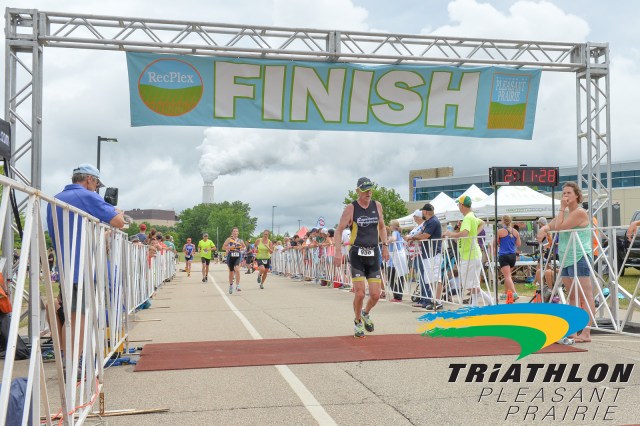
In late June I raced a 10-mile event held in Melrose Park. My future mother-in-law had never seen me run, so I was inspired to do well and impress her. However, the temps rose into the low 80s and the race coursed through old industrial parks, which seemed to breathe even more heat in our direction. Yet I felt fantastic the entire race and found myself passing runners I had never beaten before in races. With a half mile to go I kicked even harder and passed three more guys to finish in fourth place overall with a PR of 53:30. I was ecstatic.

The next weekend I won a 10K road race, the Community Classic in Geneva, running 31:53 (later revised to 31:52) to set a course record that stood for 20 years.

On July fourth, I raced in Glen Ellyn, Illinois against a solid competitor. We ran step for step on a four-mile course until he beat me at the finish line. I ran 20:05 for second.

July cometh

Our racing team brought nine athletes to a 10K in Mt. Prospect, a community next to the running shop in Arlington Heights. We took the top nine places and I placed second overall in a 10K PR of 31:10.

So I thought I was in for a good performance at the following week’s Prairie State Games. Only I probably overate and drank too much soda leading up to the race thanks to the fact that the cafeteria was free and everything was unlimited. I managed to get through two miles in 9:30 in 80-degree heat and 88% humidity before succumbing to a side stitch and dizziness that put me in a wheelbarrow full of ice. DNF.

Coming off that odd experience, I traveled to Decorah, Iowa for a 5-mile race with college buddies. I was still feeling weird from the DNF experience and ran an uninspired 26:00 in a high-humidity event for second place.

Obligations

The next weekend I planned to take a break, but the Running Unlimited shop owners, Frank and Carolyn Gibbard, called to ask me to race in a 5K that Sunday morning. I’d left my racing shoes at my apartment in the city, so they gave me a new pair of Nike American Eagle racing shoes and I took second in 15:04 to a teammate that decided to show up at the last minute.

Such are the vagaries of obligatory racing.

In August I took a racing break, and perhaps watched the 1984 Olympics on TV. Then I ramped training back up in preparation for the fall racing season.

I ran both 10Ks in September in 31:53, winning one and taking second in the other to a teammate.

Busted by Boston Billy

Leading up to a race in late September, I was asked to serve as an event guide to American marathoner Bill Rodgers who was showing up to run at a 25K in Joliet, Illinois. The race rented us a Volkswagon Beetle because Bill liked those cars, and I drove out to his hotel and knocked on his door. He opened the hotel door in his underwear and I waited for him to change. He was half-asleep and told me, “You know, I’m not feeling that great and I’m probably not gonna race this weekend? If you want my race number you can have it.”

That was a bit of a dilemma. Thinking that I was not going to race that weekend, I’d done a hard 15 miles (1:35) on Thursday and another 10 miles hard (60:00 on Friday) as part of my training. Yet here I was on Sunday morning, feeling a bit peppy in the presence of one of the world’s best runners, and frankly I was inspired out of my gourd.

So I took Bill Rodgers’ race number and jumped into the 25K race. I felt great the entire race and placed 3rd overall in a time of 1:24:47, another PR.

I was ecstatic but also worried after the race. My hamstring had tightened up in the last three miles and I was a bit sore coming over the finish line. Jogging back to the car after the race with Rodgers, I enthused that I’d done so well after the big training days leading up to the race. “That’s good if you can do it without getting injured,” he wryly observed.

Busted. The best always know how things work.

Raring to go

However, the hamstring healed up quickly with a couple day’s rest. And to this day, I wish that I’d somehow been lined up to run a full marathon that weekend. I was in peak fitness and obviously had the endurance to go the full 26.2 at racing pace.

But we just weren’t that marathon focused at the sub-elite level in that era. Our focus was always finding another race to run, not spending it all on one long-ass race like a marathon.

So I came back in 32:00 two weeks later to win yet another 10k in the Frank Lloyd Wright 10k in which 3000 runners competed. It was one of the finest racing efforts in my entire career, leading from start to finish. Because that’s what you do when you’re 25 years old and raring to go.

Race for America

With that confidence under my belt, I showed up in Chicago’s Lincoln Park to compete in the Race for America. The event had recruited some of the top distance runners in North America. I lined up in the first row next to Alberto Salazar, Thom Hunt and a slew of other actually elite runners. The gun went off and the first mile passed in 4:45. And I was with the leaders. The next mile passed in 4:45 as well. And I stuck with the pace. Three miles passed in quick succession, and I blew up. The lead runners pulled away into the fourth mile and I literally gave them a little wave, and finished among the sub-elite at 25:30, slowing quite horribly in the last mile.

That race told me that despite all my training and effort, I was still not a world class runner, and likely never would be. It did not crush my hopes entirely or defeat my goals as as a runner. But it did show me that elite runners compete at a level that I just did not have.

Winding down

I took second in the Sycamore Pumpkinfest 10K at 32:26, then competed in a four-mile mixed twosome race to win the team championship, running 20:17 for second place among the men.

Then came a late-season cross country race that I won by running over jumps and fields and grassy knolls in 26:39.

It was late October by then. I was tired from the long year and should have called it a day, a week and a year.

But my former track coach called to tell me that a big 10K was being held in Rosemont, Illinois. The world’s best runners would be there, including 10K road race record holder Mark Nenow. So I accepted the free entry and showed up for the race.

I knew that I was well past peak condition. My body was sending signals that I was too tired to race any more. I had a light cold and sore legs. I’d taken a couple weeks off from hard running and still felt stale. It was November, and the race started indoors in some big convention center. I raced out the first mile and could feel that I had nothing left. The first mile passed in 5:00 but the leaders were thirty seconds ahead already.

I shut down the racing effort and just jogged the last five miles. Toward the finish I veered away from the chute and headed to the parking lot, jumped in my car and headed home. The season had not ended on a high note, but the year, in general, had been a thrill.

It was a non-fiction journey through a peak racing season.


Posted in running, Uncategorized | Tagged , , , , | 2 Comments